US8883899B2 - Flame-retarded thermoplastic compositions of high thermomechanical strength, in particular for electric cables - Google Patents

Flame-retarded thermoplastic compositions of high thermomechanical strength, in particular for electric cables Download PDF

Info

Publication number
US8883899B2
US8883899B2 US13/881,491 US201113881491A US8883899B2 US 8883899 B2 US8883899 B2 US 8883899B2 US 201113881491 A US201113881491 A US 201113881491A US 8883899 B2 US8883899 B2 US 8883899B2
Authority
US
United States
Prior art keywords
composition
weight
polyamide
backbone
clay
Prior art date
Legal status (The legal status is an assumption and is not a legal conclusion. Google has not performed a legal analysis and makes no representation as to the accuracy of the status listed.)
Expired - Fee Related
Application number
US13/881,491
Other versions
US20130261244A1 (en
Inventor
Dominique Jousset
Jean-Jacques Flat
Pierre Georlette
Current Assignee (The listed assignees may be inaccurate. Google has not performed a legal analysis and makes no representation or warranty as to the accuracy of the list.)
Arkema France SA
Original Assignee
Arkema France SA
Priority date (The priority date is an assumption and is not a legal conclusion. Google has not performed a legal analysis and makes no representation as to the accuracy of the date listed.)
Filing date
Publication date
Application filed by Arkema France SA filed Critical Arkema France SA
Assigned to ARKEMA FRANCE reassignment ARKEMA FRANCE ASSIGNMENT OF ASSIGNORS INTEREST (SEE DOCUMENT FOR DETAILS). Assignors: JOUSSET, DOMINIQUE, FLAT, JEAN-JACQUES, GEORLETTE, PIERRE
Publication of US20130261244A1 publication Critical patent/US20130261244A1/en
Application granted granted Critical
Publication of US8883899B2 publication Critical patent/US8883899B2/en
Expired - Fee Related legal-status Critical Current
Anticipated expiration legal-status Critical

Links

Classifications

    • CCHEMISTRY; METALLURGY
    • C08ORGANIC MACROMOLECULAR COMPOUNDS; THEIR PREPARATION OR CHEMICAL WORKING-UP; COMPOSITIONS BASED THEREON
    • C08GMACROMOLECULAR COMPOUNDS OBTAINED OTHERWISE THAN BY REACTIONS ONLY INVOLVING UNSATURATED CARBON-TO-CARBON BONDS
    • C08G81/00Macromolecular compounds obtained by interreacting polymers in the absence of monomers, e.g. block polymers
    • C08G81/02Macromolecular compounds obtained by interreacting polymers in the absence of monomers, e.g. block polymers at least one of the polymers being obtained by reactions involving only carbon-to-carbon unsaturated bonds
    • C08G81/024Block or graft polymers containing sequences of polymers of C08C or C08F and of polymers of C08G
    • C08G81/028Block or graft polymers containing sequences of polymers of C08C or C08F and of polymers of C08G containing polyamide sequences
    • CCHEMISTRY; METALLURGY
    • C08ORGANIC MACROMOLECULAR COMPOUNDS; THEIR PREPARATION OR CHEMICAL WORKING-UP; COMPOSITIONS BASED THEREON
    • C08KUse of inorganic or non-macromolecular organic substances as compounding ingredients
    • C08K3/00Use of inorganic substances as compounding ingredients
    • CCHEMISTRY; METALLURGY
    • C08ORGANIC MACROMOLECULAR COMPOUNDS; THEIR PREPARATION OR CHEMICAL WORKING-UP; COMPOSITIONS BASED THEREON
    • C08KUse of inorganic or non-macromolecular organic substances as compounding ingredients
    • C08K3/00Use of inorganic substances as compounding ingredients
    • C08K3/18Oxygen-containing compounds, e.g. metal carbonyls
    • C08K3/20Oxides; Hydroxides
    • C08K3/22Oxides; Hydroxides of metals
    • CCHEMISTRY; METALLURGY
    • C08ORGANIC MACROMOLECULAR COMPOUNDS; THEIR PREPARATION OR CHEMICAL WORKING-UP; COMPOSITIONS BASED THEREON
    • C08KUse of inorganic or non-macromolecular organic substances as compounding ingredients
    • C08K3/00Use of inorganic substances as compounding ingredients
    • C08K3/30Sulfur-, selenium- or tellurium-containing compounds
    • CCHEMISTRY; METALLURGY
    • C08ORGANIC MACROMOLECULAR COMPOUNDS; THEIR PREPARATION OR CHEMICAL WORKING-UP; COMPOSITIONS BASED THEREON
    • C08KUse of inorganic or non-macromolecular organic substances as compounding ingredients
    • C08K3/00Use of inorganic substances as compounding ingredients
    • C08K3/34Silicon-containing compounds
    • CCHEMISTRY; METALLURGY
    • C08ORGANIC MACROMOLECULAR COMPOUNDS; THEIR PREPARATION OR CHEMICAL WORKING-UP; COMPOSITIONS BASED THEREON
    • C08KUse of inorganic or non-macromolecular organic substances as compounding ingredients
    • C08K3/00Use of inorganic substances as compounding ingredients
    • C08K3/38Boron-containing compounds
    • CCHEMISTRY; METALLURGY
    • C08ORGANIC MACROMOLECULAR COMPOUNDS; THEIR PREPARATION OR CHEMICAL WORKING-UP; COMPOSITIONS BASED THEREON
    • C08LCOMPOSITIONS OF MACROMOLECULAR COMPOUNDS
    • C08L53/00Compositions of block copolymers containing at least one sequence of a polymer obtained by reactions only involving carbon-to-carbon unsaturated bonds; Compositions of derivatives of such polymers
    • CCHEMISTRY; METALLURGY
    • C08ORGANIC MACROMOLECULAR COMPOUNDS; THEIR PREPARATION OR CHEMICAL WORKING-UP; COMPOSITIONS BASED THEREON
    • C08LCOMPOSITIONS OF MACROMOLECULAR COMPOUNDS
    • C08L87/00Compositions of unspecified macromolecular compounds, obtained otherwise than by polymerisation reactions only involving unsaturated carbon-to-carbon bonds
    • C08L87/005Block or graft polymers not provided for in groups C08L1/00 - C08L85/04
    • FMECHANICAL ENGINEERING; LIGHTING; HEATING; WEAPONS; BLASTING
    • F16ENGINEERING ELEMENTS AND UNITS; GENERAL MEASURES FOR PRODUCING AND MAINTAINING EFFECTIVE FUNCTIONING OF MACHINES OR INSTALLATIONS; THERMAL INSULATION IN GENERAL
    • F16LPIPES; JOINTS OR FITTINGS FOR PIPES; SUPPORTS FOR PIPES, CABLES OR PROTECTIVE TUBING; MEANS FOR THERMAL INSULATION IN GENERAL
    • F16L57/00Protection of pipes or objects of similar shape against external or internal damage or wear
    • F16L57/04Protection of pipes or objects of similar shape against external or internal damage or wear against fire or other external sources of extreme heat
    • HELECTRICITY
    • H01ELECTRIC ELEMENTS
    • H01BCABLES; CONDUCTORS; INSULATORS; SELECTION OF MATERIALS FOR THEIR CONDUCTIVE, INSULATING OR DIELECTRIC PROPERTIES
    • H01B3/00Insulators or insulating bodies characterised by the insulating materials; Selection of materials for their insulating or dielectric properties
    • H01B3/18Insulators or insulating bodies characterised by the insulating materials; Selection of materials for their insulating or dielectric properties mainly consisting of organic substances
    • H01B3/30Insulators or insulating bodies characterised by the insulating materials; Selection of materials for their insulating or dielectric properties mainly consisting of organic substances plastics; resins; waxes
    • HELECTRICITY
    • H01ELECTRIC ELEMENTS
    • H01BCABLES; CONDUCTORS; INSULATORS; SELECTION OF MATERIALS FOR THEIR CONDUCTIVE, INSULATING OR DIELECTRIC PROPERTIES
    • H01B3/00Insulators or insulating bodies characterised by the insulating materials; Selection of materials for their insulating or dielectric properties
    • H01B3/18Insulators or insulating bodies characterised by the insulating materials; Selection of materials for their insulating or dielectric properties mainly consisting of organic substances
    • H01B3/30Insulators or insulating bodies characterised by the insulating materials; Selection of materials for their insulating or dielectric properties mainly consisting of organic substances plastics; resins; waxes
    • H01B3/44Insulators or insulating bodies characterised by the insulating materials; Selection of materials for their insulating or dielectric properties mainly consisting of organic substances plastics; resins; waxes vinyl resins; acrylic resins
    • H01B3/447Insulators or insulating bodies characterised by the insulating materials; Selection of materials for their insulating or dielectric properties mainly consisting of organic substances plastics; resins; waxes vinyl resins; acrylic resins from acrylic compounds
    • CCHEMISTRY; METALLURGY
    • C08ORGANIC MACROMOLECULAR COMPOUNDS; THEIR PREPARATION OR CHEMICAL WORKING-UP; COMPOSITIONS BASED THEREON
    • C08LCOMPOSITIONS OF MACROMOLECULAR COMPOUNDS
    • C08L33/00Compositions of homopolymers or copolymers of compounds having one or more unsaturated aliphatic radicals, each having only one carbon-to-carbon double bond, and only one being terminated by only one carboxyl radical, or of salts, anhydrides, esters, amides, imides or nitriles thereof; Compositions of derivatives of such polymers
    • C08L33/04Homopolymers or copolymers of esters
    • C08L33/14Homopolymers or copolymers of esters of esters containing halogen, nitrogen, sulfur, or oxygen atoms in addition to the carboxy oxygen
    • C08L33/16Homopolymers or copolymers of esters containing halogen atoms

Definitions

  • the invention relates to flexible flame-retardant thermoplastic compositions of high thermomechanical strength, based on functionalized polyolefins grafted by polyamide units containing at least one combination of three agents having flame-retardant properties.
  • the present invention also relates to the use of this composition as a coating layer (outer layer) in a cable, pipe or the like and also as a constituent material (inner layer) of a protective sheath, and also to such a cable, pipe, protective sheath or the like comprising at least one of the layers or coatings or materials consisting of this composition.
  • compositions are of use in cabling for insulating and protecting electrical cables, optical fibers and for manufacturing electrical parts such as electrical connectors, and also in electrical engineering for molding articles such as housings.
  • Thermoplastic polymers such as polyethylenes, polyamides or mixtures thereof are good electrical insulators and are easy to process. They are used for making housings and electrical connectors and also coatings for cables. Electrical installations may be the source of short circuits and may ignite, they may also be brought into contact with a flame and therefore ignite and spread the fire along cable raceways. Various additives exist for rendering these materials nonflammable, some based on halogenated products, others on halogen-free products.
  • the V0 classification is the best classification, which corresponds to a material that is not readily flammable, and does not produce flaming drips during the test.
  • the material is more readily flammable but does not produce flaming drips during the test.
  • flaming drips may be produced during the test.
  • the classification NC (not classified) is given.
  • the materials must above all have a high level of fire resistance (flame retardancy). Furthermore, these materials or compositions must have a good mechanical strength, in particular good ultimate properties (elongation at break and tensile strength), but also excellent thermomechanical properties, such as creep at temperature, and also a good resistance to thermooxidation, that is to say the ability of the material to retain its mechanical properties during aging operations in hot air.
  • thermoplastic compositions for the thermoplastic compositions, the improvement of the fire resistance properties goes against the mechanical and thermomechanical properties, currently there are no thermoplastic materials or compositions on the market that have the characteristics of high performances for all of these four properties combined.
  • Document EP 629678 describes thermoplastic alloys comprising mixtures of polyamide and of polypropylene, to which a zeolite (dehydrating agent) and ammonium polyphosphate are added in order to make them flame retardant.
  • Document EP 704489 is also known, which describes compositions consisting of a polyamide matrix, dispersed in which are nodules of crosslinked polyolefin and flame retardants chosen from magnesium hydroxide, decabromodiphenyl ether, melamine cyanurate and pentaerythritol.
  • compositions certainly have a good fire resistance but these performances are obtained at the expense of the ductility of the materials (considerable loss of elongation at break, brittle nature on impact at ambient temperature). Furthermore, it is observed that the thermal stability of these materials was insufficient.
  • the thermal stability is understood to mean the retention of the mechanical properties (and more particularly of the elongation at break) after various thermal aging operations (for example one week at 120° C.).
  • thermoplastic composition predominantly comprising (by weight of the composition) a polyamide-block graft copolymer, ammonium polyphosphate and also a small amount of zeolite.
  • a polyamide-block graft copolymer predominantly comprising (by weight of the composition) a polyamide-block graft copolymer, ammonium polyphosphate and also a small amount of zeolite.
  • UL94-V0 classification levels of flame retardancy
  • these materials suffer, on the one hand, from losses of the initial mechanical properties with respect to matrices that are not flame-retarded formed by the same polyamide-block graft copolymer and also, on the other hand, from the loss of their mechanical properties during thermally oxidizing aging operations in a ventilated oven, for example one week at a temperature of 150° C.
  • polyamide-block graft copolymer does not have any resistance to flame propagation (UL94-NC classification for APOLHYA®), as is observed in the tests regarding the composition entitled “DM13”.
  • the present invention intends to overcome the drawbacks of the materials from the prior art by providing a thermoplastic composition that meets all of the requirements specific to electric cables, optical fibers and more generally insulating parts in the electrical and electrical engineering fields.
  • thermoplastic composition comprising a polyamide-block graft copolymer consisting of a polyolefin backbone and, on average, at least one polyamide graft wherein the grafts are attached to the backbone by the residues of an unsaturated monomer (X) having a function capable of reacting with a polyamide, the residues of the unsaturated monomer (X) are attached to the backbone by grafting or copolymerization via its double bond, characterized in that the composition comprises:
  • the polyolefin backbone containing (X) is selected from ethylene/maleic anhydride and ethylene/alkyl (meth)acrylate/maleic anhydride copolymers.
  • the number of monomers (X) attached to the polyolefin backbone is greater than or equal to 1.3 and/or less than or equal to 10.
  • the polyamide graft has a molar mass between 1000 and 5000 g/mol and preferably between 2000 and 3000 g/mol.
  • the treated clay is present in the composition at, by weight, between 1% and 4%, preferably between 2% and 3.5%.
  • the poly-(pentabromobenzyl acrylate) is present in the composition at, by weight, between 23% and 27%, preferably between 24% and 26%.
  • the synergistic flame retardant is present in the composition at, by weight, between 5% and 7%, preferably between 5.5% and 6.5%.
  • the synergistic flame retardant is antimony trioxide.
  • the composition consists of a mixture of the polyamide-block graft copolymer, poly(pentabromobenzyl acrylate), antimony trioxide and organophilic treated clay.
  • the composition also comprises antioxidants, UV stabilizers, mineral fillers, anti-drip agents and/or coloring pigments. It would not be outside of the scope of the present invention if zeolites were added to the claimed thermoplastic compositions.
  • the unsaturated monomer (X) of the polyamide-block graft copolymer is maleic anhydride.
  • the invention also relates to the use of the composition described above as a coating layer for a cable and also for electrical parts such as electrical connectors or in electrical engineering for molding articles such as housings.
  • compositions may also be used for producing coating layers or thermal protection sleeves for fluid transfer lines (or pipes) in the automotive industry, in particular fuel or coolant lines.
  • the present invention also relates to a cable or pipe having at least two layers, at least one layer of which is formed by the aforesaid thermoplastic composition as mentioned above.
  • polyamide-block graft copolymer it may be obtained by reacting a polyamide with the residues of an unsaturated monomer X attached by grafting or copolymerization to a polyolefin backbone.
  • This monomer X may be, for example, an unsaturated epoxide or an unsaturated carboxylic acid anhydride.
  • the unsaturated carboxylic acid anhydride may be chosen, for example, from maleic, itaconic, citraconic, allylsuccinic, cyclohex-4-ene-1,2-dicarboxylic, 4-methylenecyclohex-4-ene-1,2-dicarboxylic, bicyclo-[2.2.1]hept-5-ene-2,3-dicarboxylic and x-methylbicyclo-[2.2.1]hept-5-ene-2,2-dicarboxylic anhydrides.
  • Maleic anhydride is advantageously used. Replacing all or part of the anhydride with an unsaturated carboxylic acid, such as for example (meth)acrylic acid, would not be outside the scope of the invention.
  • a polyolefin is defined as a homopolymer or copolymer of ⁇ -olefins or of diolefins, such as for example ethylene, propylene, but-1-ene, oct-1-ene or butadiene.
  • ⁇ -olefins such as for example ethylene, propylene, but-1-ene, oct-1-ene or butadiene.
  • the polyolefin backbones to which the residues of X are attached are polyethylenes grafted with X or copolymers of ethylene and of X which are obtained, for example, by high-pressure radical polymerization.
  • polyethylene is understood to mean homopolymers or copolymers.
  • the polyethylene may comprise several of the above comonomers.
  • the polyethylene which may be a mixture of several polymers, comprises at least 50% and preferably 75% (in mols) of ethylene, its density may be between 0.86 and 0.98 g/cm 3 .
  • the MFI melting flow index, measured at 190° C. under a load of 2.16 kg) is advantageously between 20 and 1000 g/10 min.
  • polyethylenes As examples of polyethylenes, mention may be made of:
  • copolymers of ethylene and X that is to say those in which X is not grafted, they are copolymers of ethylene, of X and optionally of another monomer that may be chosen from the comonomers that were mentioned above for the copolymers of ethylene that are intended to be grafted.
  • ethylene/maleic anhydride and ethylene/alkyl (meth)acrylate/maleic anhydride copolymers comprise from 0.2% to 10% by weight of maleic anhydride, from 0 to 40%, and preferably from 5% to 40% by weight of alkyl (meth)-acrylate.
  • Their MFI is between 5 and 100 (190° C.-2.16 kg).
  • Their melting temperature is between 80° C. and 120° C.
  • the alkyl (meth)acrylates have already been described above.
  • X there are on average at least 2 mols of X per chain attached to the polyolefin backbone and preferably from 2 to 5 mol.
  • a person skilled in the art may easily determine, by FTIR analysis (Fourrier Transform Infrared Analysis), the number of these moles of X. For example, if X is maleic anhydride and the weight-average molar mass of the polyolefin is 95 000 g/mol, it has been found that this corresponds to a proportion of anhydride of at least 1.5% by weight of the whole of the polyolefin backbone containing X, and preferably from 2.5% to 4% by weight. These values, combined with the mass of the polyamides, determine the proportion of polyamides and of backbone in the polyamide-block graft copolymer.
  • polyamide is understood to mean the condensation products:
  • PA-6 PA-11, PA-12, the copolyamide containing 6 units and 11 units (PA-6/11), the copolyamide containing 6 units and 12 units (PA-6/12), and the copolyamide based on caprolactam, hexamethylenediamine and adipic acid (PA-6/6,6).
  • the degree of polymerization may vary to a large extent, depending on its value the product is a polyamide or a polyamide oligomer. In the remainder of the text, the two expressions will be used without distinction for the grafts.
  • R 1 is a hydrogen atom or a linear or branched alkyl group containing up to 20 carbon atoms
  • R 2 is a linear or branched alkyl or alkenyl group having up to 20 carbon atoms, a saturated or unsaturated cycloaliphatic radical, an aromatic radical or a combination of these.
  • the stopper may, for example, be laurylamine, oleylamine, butylamine or hexylamine and generally any monoamine of R 2 —NH 2 .
  • the amine-terminated polyamide has a molar mass between 1000 and 5000 g/mol and preferably between 2000 and 3000 g/mol.
  • the preferred amino acid or lactam monomers for the synthesis of the monoamine oligomer according to the invention are chosen from caprolactam, 11-aminoundecanoic acid and lauryllactam.
  • the addition of the monoamine polyamide oligomer to the polyolefin backbone containing X is carried out by reacting an amine function of the oligomer with X.
  • X bears an anhydride or acid function, thus creating amide or imide bonds.
  • the addition of the amine-terminated oligomer to the polyolefin backbone containing X is preferably carried out in the melt state. It is thus possible, in a self-cleaning meshing co-rotating twin-screw extruder or in any other suitable equipment (internal mixer, Buss co-kneader, etc.) to melt blend the oligomer and the backbone at a temperature generally between 180° C. and 350° C.
  • the average residence time of the molten material in the extruder may be between 5 seconds and 5 minutes, and preferably between 20 seconds and 1 minute.
  • the efficiency of this addition is evaluated by selective extraction of the free polyamide oligomers, that is to say those which have not reacted to form the final polyamide-block graft copolymer.
  • the polyamide-block graft copolymers of the present invention are characterized by a nanostructured arrangement with polyamide lamellae having a thickness of between 10 and 50 nanometers.
  • the proportion of polyolefin backbone is from 50% to 90% and that of the amine-terminated polyamide is from 10% to 50%.
  • the polyamide-block graft copolymer of the invention has a very good flow resistance at temperatures at least equal to 80° C. and that may range up to 200° C., that is to say they do not rupture under a load of 2 MPa.
  • the polyamide-block graft copolymers of the invention may be prepared by melt blending in extruders (single-screw but preferably twin-screw extruders), Buss co-kneaders, internal mixers and in general the conventional devices for blending thermoplastic polymers and preferably self-cleaning meshing co-rotating twin-screw extruders.
  • the blends of the invention may also comprise fluidizing agents such as silica, ethylenebisamide, calcium stearate or magnesium stearate. They may also comprise antioxidants, UV stabilizers, mineral fillers and coloring pigments.
  • compositions according to the invention may be prepared according to two different processes.
  • the polyamide-block graft copolymer is firstly prepared by reacting the polyolefin backbone bearing the X residue with the polyamide. Then, in a second step, the polyamide-block graft copolymer previously prepared is melt-blended with the flame-retardant additives: poly(pentabromobenzyl acrylate), antimony trioxide and organophilic treated clay.
  • compositions according to the invention according to a one-step process, during which the polyolefin backbone bearing the X residue, the polyamide and the flame-retardant additives, namely the poly(pentabromobenzyl acrylate), antimony trioxide and organophilic treated clay, are all mixed together.
  • poly(pentabromobenzyl (meth)acrylate) is a compound belonging to the family of polyhalogenated aromatic polymers. More particularly, the “poly(pentabromobenzyl (meth)acrylate)” polymer results from the polymerization of polybromosubstituted aromatic esters of ⁇ , ⁇ -unsaturated acids of the following formula:
  • R and R′ are hydrogen atoms or alkyl groups.
  • synergistic flame retardant it is understood as having a synergistic function with the poly(pentabromobenzyl (meth)acrylate), so as to exponentially (and not obviously before tests were carried out on the compositions according to the invention) increase the flame-retardant properties otherwise conferred by the latter.
  • this synergistic flame retardant is antimony trioxide but it would not be outside of the scope of the invention if the antimony trioxide was substituted by derivatives of tin, molybdenum or bismuth known to a person skilled in the art for also functioning synergistically with brominated flame retardants.
  • Replacing the antimony trioxide with another antimony oxide (Sb 2 O 5 ) or an antimony sulfide (SbS 3 ) could also be envisaged.
  • Sb 2 O 5 antimony oxide
  • SbS 3 antimony sulfide
  • boron and zinc oxides, calcium borates, calcium sulfate or zinc stannate could also be envisaged.
  • this product is conventionally in the form of a fine white powder that is insoluble in organic solvents, this is why this compound is here present in the form of masterbatches in a polyethylene matrix which acts as a support for it.
  • this compound is here present in the form of masterbatches in a polyethylene matrix which acts as a support for it.
  • anti-drip agents such as products based on silicone (PDMS) or fluorinated products such as PTFE, were added to the compositions.
  • these clays which are in the form of platelets. These clays are rendered organophilic by intercalation between the latter of swelling agents, which are organic molecules or polymers, and are obtained in particular according to a process as described in document U.S. Pat. No. 5,578,672.
  • the clays used are of smectic type, or of natural origin such as, in particular, montmorillonites, bentonites, saponites, hectorites, fluorohectorites, beidellites, stibensites, nontronites, stipulgites, attapulgites, illites, vermiculites, halloysites, stevensites, zeolites, Fuller's earth and mica, or of synthetic origin, such as permutites.
  • montmorillonites bentonites, saponites, hectorites, fluorohectorites, beidellites, stibensites, nontronites, stipulgites, attapulgites, illites, vermiculites, halloysites, stevensites, zeolites, Fuller's earth and mica, or of synthetic origin, such as permutites.
  • the clay is modified with an organic substance via an ionic bond with an onium ion having 6 carbon atoms or more. If the number of carbon atoms is less than 6, the organic onium ion is too hydrophilic and therefore the compatibility with the olefinic copolymer may decrease.
  • an organic onium ion By way of example of an organic onium ion, mention may be made of hexylammonium ions, octylammonium ions, 2-ethylhexylammonium ions, dodecyl-ammonium ions, laurylammonium ions, octadecylammonium (stearylammonium) ions, dioctyldimethylammonium ions, trioctylammonium ions, distearyldimethylammonium ions, stearyltrimethylammonium ions and ammonium laurate ions.
  • Other ions may be used, such as phosphonium and sulfonium ions.
  • Use may also be made of amphoteric surfactants, derivatives of aliphatic, aromatic or arylaliphatic amines, phosphines and sulfides.
  • the cation-exchange capacity of clay is preferably between fifty and two hundred milliequivalents per 100 grams (g). If the capacity is less than fifty, the exchange of the onium ions is insufficient and the separation of the clay lamellae may be difficult. On the other hand, if the capacity is greater than two hundred, the bonding force between the clay lamellae is so strong that the separation of the lamellae may be difficult.
  • clay By way of example of clay, mention may be made of smectite, montmorillonite, saponite, hectorite, beidellite, stibensite, nontronite, vermiculite, halloysite and mica. These clays may be of natural or synthetic origin.
  • the proportion of organic onium ion is advantageously between 0.3 and 3 equivalents of the ion-exchange capacity of the clay. If the proportion is less than 0.3, the separation of the clay lamellae may be difficult. If the proportion is greater than 3, there may be degradation of the polymer.
  • the proportion of the organic onium ion is preferably between 0.5 and 2 equivalents of the ion-exchange capacity of the clay.
  • organophilic clays have a high dispersibility in polymeric media under a low shear rate and modify the rheological behavior of these media.
  • lamellae fillers such as zirconium or titanium phosphates, may be used according to the invention.
  • the formulations described below are prepared by compounding using a COPERION ZSK40 self-cleaning meshing co-rotating twin-screw extruder having a diameter of 40 millimeters (mm), a length 40 times its diameter (i.e. 160 centimeters), heated with a flat profile at 250° C. with a throughput of 70 kg/h (kilograms per hour) and a rotational speed of 300 rpm (revolutions per minute), the polymers being introduced as main feed and the additives in powder form by side feeding into the molten polymer.
  • a COPERION ZSK40 self-cleaning meshing co-rotating twin-screw extruder having a diameter of 40 millimeters (mm), a length 40 times its diameter (i.e. 160 centimeters), heated with a flat profile at 250° C. with a throughput of 70 kg/h (kilograms per hour) and a rotational speed of 300 rpm (revolutions per minute), the polymers being introduced as main
  • the term “compounding” is understood to mean a technique for obtaining polymers or blends of polymers that is well known to a person skilled in the art and which consists of shaping the formulate (that is present, for example, in the form of rods on leaving the kneader) by extrusion with a die having circular holes, then cutting the cooled rods and drying in order to manufacture granules having a diameter of a few millimeters.
  • EA ethylene/ethyl acrylate
  • MAh maleic anhydride
  • EA Ethylene/ethyl acrylate
  • MAh maleic anhydride
  • Domamid® 24 PA-6 sold by DOMO, having a relative viscosity of 2.4 measured at 1% in 96% sulfuric acid according to the standard ISO 307.
  • Domamid® 27 PA-6 sold by DOMO, having a relative viscosity of 2.7 measured at 1% in 96% sulfuric acid according to the standard ISO 307.
  • TC Orgalloy Polypropylene grafted by PA grafts as according to patent EP 0342066.
  • STAMILAN® P Polypropylene produced by Sabic.
  • FR 1025® Poly(pentabromobenzyl acrylate), sold by ICL-IP.
  • Polytriox® AOPE 8020 Masterbatch containing 80% antimony trioxide in a polyethylene matrix sold by Produit Chimique de Lucette.
  • MM nanoclay Masterbatch containing 60% of Nanofil SE3010 (produced by Süd Chemie) in Lotryl® 28MA07 which is an ethylene/methyl acrylate (MeA) copolymer comprising 28% by weight of MeA and having an MFI (at 190° C., 2.16 kg, measured according to the standard ISO 1133) of 7 g/10 min.
  • This masterbatch is produced, for example, on a Buss PR46 co-kneader at a throughput of 13 kg/h, a rotational speed of the co-kneader of 280 rpm and a flat temperature profile of 230° C., the EMA copolymer and the filler being introduced into the first well.
  • Exolit® AP766 Product based on ammonium polyphosphate produced by CLARIANT having a phosphorus content of 24% and a nitrogen content of 15%.
  • Siliporite® NK10AP Molecular sieve of 4A zeolite type produced by CECA.
  • Magnifin® H5 Magnesium dihydroxide sold by Albemarle.
  • composition entitled “DM1” is a formulation that falls within the context of the present invention. It comprises, as a weight percentage of the total composition, 61% of Apolhya®, 28.5% of FR1025 and 6% of Polytriox AOPE 8020 and 4.5% of organophilic treated clay.
  • composition entitled “DM2” is a formulation that falls within the context of the present invention. It comprises, as a weight percentage of the total composition, 69.5% of Apolhya®, 22.3% of FR1025 and 6% of Polytriox AOPE 8020 and 2.2% of organophilic treated clay.
  • composition entitled “DM4” is a formulation that falls within the context of the present invention. It comprises, as a weight percentage of the total composition, 63.7% of Apolhya®, 27% of FR1025, 7.9% of Polytriox AOPE 8020 and 1.4% of organophilic treated clay.
  • composition entitled “DM5” is a formulation that falls within the context of the present invention. It comprises, as a weight percentage of the total composition, 67.7% of Apolhya®, 24% of FR1025, 4.1% of Polytriox AOPE 8020 and 4.2% of organophilic treated clay.
  • composition entitled “DM6” is a formulation that falls within the context of the present invention. It comprises, as a weight percentage of the total composition, 68% of Apolhya®, 25.4% of FR1025, 6% of Polytriox AOPE 8020 and 0.6% of organophilic treated clay.
  • composition entitled “DM6” is a formulation that falls within the context of the present invention. It comprises, as a weight percentage of the total composition, 65.8% of Apolhya®, 24% of FR1025, 5.3% of Polytriox AOPE 8020 and 4.9% of organophilic treated clay.
  • composition entitled “DM7” is a formulation that falls within the context of the present invention. It comprises, as a weight percentage of the total composition, 63.70% of Apolhya®, 27% of FR1025, 6% of Polytriox AOPE 8020 and 3.30% of organophilic treated clay.
  • composition entitled “DM8” is a formulation that falls within the context of the present invention. It comprises, as a weight percentage of the total composition, 62.3% of Apolhya®, 25.9% of FR1025, 7.2% of Polytriox AOPE 8020 and 4.6% of organophilic treated clay.
  • composition entitled “DM9” is a formulation that falls within the context of the present invention. It comprises, as a weight percentage of the total composition, 67.7% of Apolhya®, 25.2% of FR1025, 4.8% of Polytriox AOPE 8020 and 2.3% of organophilic treated clay.
  • composition entitled “DM10” is a formulation that falls within the context of the present invention. It comprises, as a weight percentage of the total composition, 64.7% of Apolhya®, 27.1% of FR1025, 6% of Polytriox AOPE 8020 and 2.2% of organophilic treated clay.
  • composition entitled “DM11” is a formulation from the prior art comprising, as a weight percentage of the thermoplastic composition, 44.60% of Bondine® HX8290, 19.10% of Domamid® 24, 27% of FR1025®, 6% of Polytriox AOPE 8020® and 3.30% of organophilic treated clay.
  • composition entitled “DM12” is a formulation comprising, as a weight percentage of the thermoplastic composition, 78% of Apolhya®, 20% of Exolit® AP766 and 2% of Siliporite® NK10AP.
  • composition entitled “DM13” is a formulation comprising 100% of Apolhya®.
  • composition entitled “DM14” is a formulation from the prior art comprising 29% PA-6, 11% of polypropylene (STAMILAN® P), 5% of TC Orgalloy and 55% of Magnifin H5 flame retardant.
  • composition entitled “DM15” is a formulation comprising, as a weight percentage of the composition, 58.4% of Apolhya®, 26% of FR1025 and 6% of Polytriox AOPE 8020, and 9.6% of organophilic treated clay.
  • composition entitled “DM16” is a formulation comprising, as a weight percentage of the composition, 71% of Apolhya®, 21% of FR1025, 5% of Polytriox AOPE 8020, and 3% of organophilic treated clay.
  • composition entitled “DM17” is a formulation comprising, as a weight percentage of the composition, 74% of Apolhya®, 21% of FR1025 and 5% of Polytriox AOPE 8020.
  • composition entitled “DM18” is a formulation comprising, as a weight percentage of the composition, 53% of Apolhya®, 40% of FR1025 and 7% of Polytriox AOPE 8020.
  • composition entitled “DM19” is a formulation comprising, as a weight percentage of the composition, 66.8% of Apolhya®, 27% of FR1025, 2.9% of Polytriox AOPE 8020, and 3.3% of organophilic treated clay.
  • composition entitled “DM20” is a formulation comprising, as a weight percentage of the composition, 67% of Apolhya®, 23% of FR1025 and 10% of Polytriox AOPE 8020.
  • the granules are shaped using a ThermoHaake Rheocord System 40 laboratory twin-screw extruder equipped with a sheet die; the extruder being heated at 210° C. in order to give strips from which the test specimens necessary in order to characterize the materials will be cut.
  • the thermoplastic composition in order to be satisfactory, must have a UL94-V0 classification, for a test specimen of defined thickness (1.6 mm), i.e. the best flame retardancy classification.
  • This measurement of the resistance to flame propagation is measured by the UL94 test in accordance with the standard ISO 1210 and is the subject, in the table below, of the first test carried out on a standard test specimen for each composition.
  • the second line of characterizations consists in noting the generation or otherwise of flaming drips (FD) or of non-flaming drips (NFD) during the UL94 test. It will be noted that, in order to achieve the V0 classification according to the UL94 flame propagation tests, it is possible for non-flaming drips (NFD) to appear, but in no case for flaming drips (FD) to appear.
  • the flow test in the flame consists in assessing whether the test specimen, subjected to the flame, in the first or second application thereof, flows under its own weight or not.
  • a material is considered to have good mechanical properties, in particular in the particular applications of pipes, cables and other insulators of the electrical field which must be able to be bent and stretched freely without breaking, when this elongation at break value is greater than 100%.
  • the tensile strength test consists of a tensile test carried out on standard test specimens of composition in order to determine at what applied force the latter yield or break. It is considered that a standard test specimen of thermoplastic composition tested as satisfactory must as a minimum be able to withstand the application of a force of at least 7 MPa without breaking. This test makes it possible to demonstrate the solidity of the composition/material.
  • the elongation at break half-life time is determined, which corresponds to the aging time required, at a given temperature (150° C. and 175° C. in a ventilated oven thermally controlled to ⁇ 2° C.) for the material to lose half the initial value of its elongation at break.
  • DM7 only one composition according to the invention was tested (DM7) and compared to two compositions according to the prior art (DM12 and DM13), it being understood that the best results obtained with the formulation according to the invention may be generalized to all of the compositions of the invention.
  • the composition must satisfy all of the aforementioned tests in an optimal manner in order to be considered to be satisfactory from the point of view of its mechanical properties, its thermomechanical properties or in other words preserving its high-temperature mechanical properties, and finally its flame-retardant properties.
  • the applicant observed, after its experimentations, that, surprisingly, the composition according to the invention perfectly satisfied all of the tests demonstrating that its mechanical, thermomechanical and flame-retardant properties are excellent, or in other words of a very high level.

Landscapes

  • Chemical & Material Sciences (AREA)
  • Polymers & Plastics (AREA)
  • Health & Medical Sciences (AREA)
  • Chemical Kinetics & Catalysis (AREA)
  • Medicinal Chemistry (AREA)
  • Organic Chemistry (AREA)
  • Spectroscopy & Molecular Physics (AREA)
  • Physics & Mathematics (AREA)
  • Engineering & Computer Science (AREA)
  • General Engineering & Computer Science (AREA)
  • Mechanical Engineering (AREA)
  • Compositions Of Macromolecular Compounds (AREA)
  • Organic Insulating Materials (AREA)
  • Insulated Conductors (AREA)

Abstract

A flame-retarded thermoplastic composition including a graft copolymer containing polyamide blocks and composed of a polyolefin backbone and on average at least one polyamide graft, in which the grafts are attached to the backbone by the residues of an unsaturated monomer (X) having a function capable of reacting with a polyamide, the residues of the unsaturated monomer (X) are attached to the backbone by grafting or copolymerization from its double bond, wherein the composition includes: —between 60% and 70% by weight of the graft copolymer containing polyamide blocks, —between 22% and 28% by weight of poly(pentabromobenzyl acrylate), —between 4% and 8% by weight of a synergistic flame retardant chosen from antimony trioxide, derivatives of tin, of molybdenum and/or bismuth and also boron and zinc oxides, calcium borates, calcium sulphate and/or zinc stannate, between 0.5% and 5% by weight of organophilic treated clay.

Description

FIELD OF THE INVENTION
The invention relates to flexible flame-retardant thermoplastic compositions of high thermomechanical strength, based on functionalized polyolefins grafted by polyamide units containing at least one combination of three agents having flame-retardant properties. The present invention also relates to the use of this composition as a coating layer (outer layer) in a cable, pipe or the like and also as a constituent material (inner layer) of a protective sheath, and also to such a cable, pipe, protective sheath or the like comprising at least one of the layers or coatings or materials consisting of this composition.
These compositions are of use in cabling for insulating and protecting electrical cables, optical fibers and for manufacturing electrical parts such as electrical connectors, and also in electrical engineering for molding articles such as housings.
Thermoplastic polymers such as polyethylenes, polyamides or mixtures thereof are good electrical insulators and are easy to process. They are used for making housings and electrical connectors and also coatings for cables. Electrical installations may be the source of short circuits and may ignite, they may also be brought into contact with a flame and therefore ignite and spread the fire along cable raceways. Various additives exist for rendering these materials nonflammable, some based on halogenated products, others on halogen-free products.
According to the UL 94 flame propagation test in accordance with the standard ISO 1210, the V0 classification is the best classification, which corresponds to a material that is not readily flammable, and does not produce flaming drips during the test.
For the V1 classification, the material is more readily flammable but does not produce flaming drips during the test. As regards the V2 classification, in addition to the easier flammability than for V0, flaming drips may be produced during the test.
For materials that are even more flammable, the classification NC (not classified) is given.
Thus, in the applications such as the covering of electrical cables, electrical and electrical engineering parts, and automotive applications, besides their electrically insulating nature, the materials must above all have a high level of fire resistance (flame retardancy). Furthermore, these materials or compositions must have a good mechanical strength, in particular good ultimate properties (elongation at break and tensile strength), but also excellent thermomechanical properties, such as creep at temperature, and also a good resistance to thermooxidation, that is to say the ability of the material to retain its mechanical properties during aging operations in hot air.
Nevertheless, taking into account the fact that, for the thermoplastic compositions, the improvement of the fire resistance properties goes against the mechanical and thermomechanical properties, currently there are no thermoplastic materials or compositions on the market that have the characteristics of high performances for all of these four properties combined.
PRIOR ART
Document EP 629678 is known, which describes thermoplastic alloys comprising mixtures of polyamide and of polypropylene, to which a zeolite (dehydrating agent) and ammonium polyphosphate are added in order to make them flame retardant. Document EP 704489 is also known, which describes compositions consisting of a polyamide matrix, dispersed in which are nodules of crosslinked polyolefin and flame retardants chosen from magnesium hydroxide, decabromodiphenyl ether, melamine cyanurate and pentaerythritol.
These two types of compositions certainly have a good fire resistance but these performances are obtained at the expense of the ductility of the materials (considerable loss of elongation at break, brittle nature on impact at ambient temperature). Furthermore, it is observed that the thermal stability of these materials was insufficient. The thermal stability is understood to mean the retention of the mechanical properties (and more particularly of the elongation at break) after various thermal aging operations (for example one week at 120° C.).
Document WO 07/141,449 in the name of the applicant is also known, which describes a thermoplastic composition predominantly comprising (by weight of the composition) a polyamide-block graft copolymer, ammonium polyphosphate and also a small amount of zeolite. Although they have high levels of flame retardancy (UL94-V0 classification), these materials suffer, on the one hand, from losses of the initial mechanical properties with respect to matrices that are not flame-retarded formed by the same polyamide-block graft copolymer and also, on the other hand, from the loss of their mechanical properties during thermally oxidizing aging operations in a ventilated oven, for example one week at a temperature of 150° C.
It will be noted that the polyamide-block graft copolymer does not have any resistance to flame propagation (UL94-NC classification for APOLHYA®), as is observed in the tests regarding the composition entitled “DM13”.
Poly(pentabromobenzyl acrylate) was mentioned for the first time in document U.S. Pat. No. 4,128,709, which describes the solution polymerization of the pentabromobenzyl acrylate monomer.
Documents U.S. Pat. No. 4,996,276 and U.S. Pat. No. 5,072,028 are also known, which describe preparations for obtaining poly(pentabromobenzyl acrylate), by bulk polymerization or by reacting an alkali metal salt of an unsaturated acid with a substituted polybromobenzyl halide in a solvent that is immiscible with water and with a phase transfer catalyst.
BRIEF DESCRIPTION OF THE INVENTION
The present invention intends to overcome the drawbacks of the materials from the prior art by providing a thermoplastic composition that meets all of the requirements specific to electric cables, optical fibers and more generally insulating parts in the electrical and electrical engineering fields.
The applicant has now found a novel flame-retardant thermoplastic composition comprising a polyamide-block graft copolymer consisting of a polyolefin backbone and, on average, at least one polyamide graft wherein the grafts are attached to the backbone by the residues of an unsaturated monomer (X) having a function capable of reacting with a polyamide, the residues of the unsaturated monomer (X) are attached to the backbone by grafting or copolymerization via its double bond, characterized in that the composition comprises:
    • between 60% and 70% by weight of the polyamide-block graft copolymer,
    • between 22% and 28% by weight of poly(pentabromobenzyl acrylate),
    • between 4% and 8% by weight of a synergistic flame retardant selected from antimony trioxide, derivatives of tin, molybdenum and/or bismuth and also boron and zinc oxides, calcium borates, calcium sulfate and/or zinc stannate,
    • between 0.5% and 5% by weight of organophilic treated clay.
Advantageously, the polyolefin backbone containing (X) is selected from ethylene/maleic anhydride and ethylene/alkyl (meth)acrylate/maleic anhydride copolymers. According to one particularly advantageous aspect for the composition, the number of monomers (X) attached to the polyolefin backbone is greater than or equal to 1.3 and/or less than or equal to 10. Moreover, the polyamide graft has a molar mass between 1000 and 5000 g/mol and preferably between 2000 and 3000 g/mol.
Furthermore, it would not be outside of the scope of the present invention if all or part of the polyolefin backbone and/or of the polyamide grafts were replaced by their respective mixture with modified clays, said mixtures being known to a person skilled in the art under the term “nanocomposites”.
According to one preferred embodiment, the treated clay is present in the composition at, by weight, between 1% and 4%, preferably between 2% and 3.5%.
According to one preferred embodiment, the poly-(pentabromobenzyl acrylate) is present in the composition at, by weight, between 23% and 27%, preferably between 24% and 26%.
According to one preferred embodiment, the synergistic flame retardant is present in the composition at, by weight, between 5% and 7%, preferably between 5.5% and 6.5%. Preferably, the synergistic flame retardant is antimony trioxide.
According to one possibility offered by the invention, the composition consists of a mixture of the polyamide-block graft copolymer, poly(pentabromobenzyl acrylate), antimony trioxide and organophilic treated clay.
According to one possibility offered by the invention, the composition also comprises antioxidants, UV stabilizers, mineral fillers, anti-drip agents and/or coloring pigments. It would not be outside of the scope of the present invention if zeolites were added to the claimed thermoplastic compositions.
According to one preferred embodiment variant, the unsaturated monomer (X) of the polyamide-block graft copolymer is maleic anhydride.
The invention also relates to the use of the composition described above as a coating layer for a cable and also for electrical parts such as electrical connectors or in electrical engineering for molding articles such as housings.
However, these compositions may also be used for producing coating layers or thermal protection sleeves for fluid transfer lines (or pipes) in the automotive industry, in particular fuel or coolant lines.
The present invention also relates to a cable or pipe having at least two layers, at least one layer of which is formed by the aforesaid thermoplastic composition as mentioned above.
DETAILED DESCRIPTION OF THE INVENTION
Regarding the polyamide-block graft copolymer, it may be obtained by reacting a polyamide with the residues of an unsaturated monomer X attached by grafting or copolymerization to a polyolefin backbone.
This monomer X may be, for example, an unsaturated epoxide or an unsaturated carboxylic acid anhydride. The unsaturated carboxylic acid anhydride may be chosen, for example, from maleic, itaconic, citraconic, allylsuccinic, cyclohex-4-ene-1,2-dicarboxylic, 4-methylenecyclohex-4-ene-1,2-dicarboxylic, bicyclo-[2.2.1]hept-5-ene-2,3-dicarboxylic and x-methylbicyclo-[2.2.1]hept-5-ene-2,2-dicarboxylic anhydrides. Maleic anhydride is advantageously used. Replacing all or part of the anhydride with an unsaturated carboxylic acid, such as for example (meth)acrylic acid, would not be outside the scope of the invention.
Regarding the polyolefin backbone, a polyolefin is defined as a homopolymer or copolymer of α-olefins or of diolefins, such as for example ethylene, propylene, but-1-ene, oct-1-ene or butadiene. By way of example, mention may be made of:
    • homopolymers and copolymers of polyethylene, in particular LDPE, HDPE, LLDPE (linear low density polyethylene), VLDPE (very low density polyethylene) and metallocene polyethylene;
    • homopolymers or copolymers of propylene;
    • ethylene/α-olefin copolymers such as ethylene/propylene, EPR (ethylene-propylene rubber) and ethylene/propylene/diene (EPDM) copolymers;
    • styrene/ethylene-butylene/styrene (SEBS), styrene/-butadiene/styrene (SBS), styrene/isoprene/styrene (SIS), and styrene/ethylene-propylene/styrene (SEPS) block copolymers;
    • copolymers of ethylene with at least one product chosen from the salts or esters of unsaturated carboxylic acids such as alkyl (meth)acrylate (for example methyl acrylate), or the vinyl esters of saturated carboxylic acids such as vinyl acetate, it being possible for the proportion of comonomer to reach 40% by weight.
Advantageously, the polyolefin backbones to which the residues of X are attached are polyethylenes grafted with X or copolymers of ethylene and of X which are obtained, for example, by high-pressure radical polymerization.
Regarding the polyethylenes to which X is grafted, polyethylene is understood to mean homopolymers or copolymers.
As comonomers, mention may be made of:
    • α-olefins, advantageously those having from 3 to 30 carbon atoms. Examples have been mentioned above. These α-olefins may be used alone or as a mixture of two or more than two;
    • esters of unsaturated carboxylic acids, such as for example alkyl (meth)acrylates, it being possible for the alkyls to have up to 24 carbon atoms, examples of alkyl acrylate or methacrylate are in particular methyl methacrylate, ethyl acrylate, n-butyl acrylate, isobutyl acrylate and 2-ethylhexyl acrylate;
    • vinyl esters of saturated carboxylic acids, such as for example vinyl acetate or propionate;
    • dienes, such as for example 1,4-hexadiene.
The polyethylene may comprise several of the above comonomers.
Advantageously, the polyethylene, which may be a mixture of several polymers, comprises at least 50% and preferably 75% (in mols) of ethylene, its density may be between 0.86 and 0.98 g/cm3. The MFI (melt flow index, measured at 190° C. under a load of 2.16 kg) is advantageously between 20 and 1000 g/10 min.
As examples of polyethylenes, mention may be made of:
    • low density polyethylene (LDPE);
    • high density polyethylene (HDPE);
    • linear low density polyethylene (LLDPE);
    • very low density polyethylene (VLDPE);
    • polyethylene obtained by metallocene catalysis;
    • EPR (ethylene-propylene rubber) elastomers;
    • EPDM (ethylene-propylene-diene) elastomers;
    • mixtures of polyethylene with an EPR or an EPDM;
    • ethylene/alkyl (meth)acrylate copolymers that may contain up to 60% by weight of (meth)acrylate and preferably 2% to 40%.
Grafting is an operation which is known per se.
Regarding the copolymers of ethylene and X, that is to say those in which X is not grafted, they are copolymers of ethylene, of X and optionally of another monomer that may be chosen from the comonomers that were mentioned above for the copolymers of ethylene that are intended to be grafted.
Use is advantageously made of ethylene/maleic anhydride and ethylene/alkyl (meth)acrylate/maleic anhydride copolymers. These copolymers comprise from 0.2% to 10% by weight of maleic anhydride, from 0 to 40%, and preferably from 5% to 40% by weight of alkyl (meth)-acrylate. Their MFI is between 5 and 100 (190° C.-2.16 kg). Their melting temperature is between 80° C. and 120° C. The alkyl (meth)acrylates have already been described above.
Advantageously, there are on average at least 2 mols of X per chain attached to the polyolefin backbone and preferably from 2 to 5 mol. A person skilled in the art may easily determine, by FTIR analysis (Fourrier Transform Infrared Analysis), the number of these moles of X. For example, if X is maleic anhydride and the weight-average molar mass of the polyolefin is 95 000 g/mol, it has been found that this corresponds to a proportion of anhydride of at least 1.5% by weight of the whole of the polyolefin backbone containing X, and preferably from 2.5% to 4% by weight. These values, combined with the mass of the polyamides, determine the proportion of polyamides and of backbone in the polyamide-block graft copolymer.
Regarding the polyamide, the term polyamide is understood to mean the condensation products:
    • of one or more amino acids, such as aminocaproic, 7-aminoheptanoic, 11-aminoundecanoic and 12-aminododecanoic acids, and of one or more lactams such as caprolactam, oenantholactam and lauryllactam;
    • of one or more salts or mixtures of diamines such as hexamethylenediamine, dodecamethylenediamine, meta-xylylenediamine, bis(p-aminocyclohexyl)methane and trimethylhexamethylenediamine with diacids such as isophthalic, terephthalic, adipic, azeleic, suberic, sebacic and dodecanedicarboxylic acids;
    • or of mixtures of several monomers, which results in copolyamides.
It is possible to use mixtures of polyamides. Use is advantageously made of PA-6, PA-11, PA-12, the copolyamide containing 6 units and 11 units (PA-6/11), the copolyamide containing 6 units and 12 units (PA-6/12), and the copolyamide based on caprolactam, hexamethylenediamine and adipic acid (PA-6/6,6).
The degree of polymerization may vary to a large extent, depending on its value the product is a polyamide or a polyamide oligomer. In the remainder of the text, the two expressions will be used without distinction for the grafts.
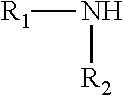
In order for the polyamide to have a monoamine end group, it is sufficient to use a chain stopper of formula:
Figure US08883899-20141111-C00001

in which:
R1 is a hydrogen atom or a linear or branched alkyl group containing up to 20 carbon atoms,
R2 is a linear or branched alkyl or alkenyl group having up to 20 carbon atoms, a saturated or unsaturated cycloaliphatic radical, an aromatic radical or a combination of these. The stopper may, for example, be laurylamine, oleylamine, butylamine or hexylamine and generally any monoamine of R2—NH2.
Advantageously, the amine-terminated polyamide has a molar mass between 1000 and 5000 g/mol and preferably between 2000 and 3000 g/mol.
The preferred amino acid or lactam monomers for the synthesis of the monoamine oligomer according to the invention are chosen from caprolactam, 11-aminoundecanoic acid and lauryllactam.
The polycondensation defined above is carried out according to the commonly known processes, for example at a temperature in general between 200° C. and 350° C., under vacuum or in an inert atmosphere, with stirring of the reaction mixture. The average chain length of the oligomer is determined by the initial molar ratio between the polycondensable monomer or the lactam and the monofunctional polymerization stopper. For the calculation of their average chain length, one chain stopper molecule is usually counted per one oligomer chain.
The addition of the monoamine polyamide oligomer to the polyolefin backbone containing X is carried out by reacting an amine function of the oligomer with X. Advantageously, X bears an anhydride or acid function, thus creating amide or imide bonds.
In general, the addition of the amine-terminated oligomer to the polyolefin backbone containing X is preferably carried out in the melt state. It is thus possible, in a self-cleaning meshing co-rotating twin-screw extruder or in any other suitable equipment (internal mixer, Buss co-kneader, etc.) to melt blend the oligomer and the backbone at a temperature generally between 180° C. and 350° C. The average residence time of the molten material in the extruder may be between 5 seconds and 5 minutes, and preferably between 20 seconds and 1 minute. The efficiency of this addition is evaluated by selective extraction of the free polyamide oligomers, that is to say those which have not reacted to form the final polyamide-block graft copolymer.
The preparation of such amine-terminated polyamides and also their addition to a polyolefin backbone containing X is described in U.S. Pat. Nos. 3,976,720, 3,963,799, 5,342,886 and FR 2291225.
The polyamide-block graft copolymers of the present invention are characterized by a nanostructured arrangement with polyamide lamellae having a thickness of between 10 and 50 nanometers.
Advantageously, the proportion of polyolefin backbone is from 50% to 90% and that of the amine-terminated polyamide is from 10% to 50%.
The polyamide-block graft copolymer of the invention has a very good flow resistance at temperatures at least equal to 80° C. and that may range up to 200° C., that is to say they do not rupture under a load of 2 MPa.
The polyamide-block graft copolymers of the invention may be prepared by melt blending in extruders (single-screw but preferably twin-screw extruders), Buss co-kneaders, internal mixers and in general the conventional devices for blending thermoplastic polymers and preferably self-cleaning meshing co-rotating twin-screw extruders. The blends of the invention may also comprise fluidizing agents such as silica, ethylenebisamide, calcium stearate or magnesium stearate. They may also comprise antioxidants, UV stabilizers, mineral fillers and coloring pigments.
The compositions according to the invention may be prepared according to two different processes.
It is possible to prepare them according to a two-step process: in a first step, the polyamide-block graft copolymer is firstly prepared by reacting the polyolefin backbone bearing the X residue with the polyamide. Then, in a second step, the polyamide-block graft copolymer previously prepared is melt-blended with the flame-retardant additives: poly(pentabromobenzyl acrylate), antimony trioxide and organophilic treated clay.
It is also possible to prepare the compositions according to the invention according to a one-step process, during which the polyolefin backbone bearing the X residue, the polyamide and the flame-retardant additives, namely the poly(pentabromobenzyl acrylate), antimony trioxide and organophilic treated clay, are all mixed together.
Regarding the poly(pentabromobenzyl (meth)acrylate), it is a compound belonging to the family of polyhalogenated aromatic polymers. More particularly, the “poly(pentabromobenzyl (meth)acrylate)” polymer results from the polymerization of polybromosubstituted aromatic esters of α,β-unsaturated acids of the following formula:
Figure US08883899-20141111-C00002

where R and R′ are hydrogen atoms or alkyl groups.
Regarding the synergistic flame retardant, it is understood as having a synergistic function with the poly(pentabromobenzyl (meth)acrylate), so as to exponentially (and not obviously before tests were carried out on the compositions according to the invention) increase the flame-retardant properties otherwise conferred by the latter.
Preferably, this synergistic flame retardant is antimony trioxide but it would not be outside of the scope of the invention if the antimony trioxide was substituted by derivatives of tin, molybdenum or bismuth known to a person skilled in the art for also functioning synergistically with brominated flame retardants. Replacing the antimony trioxide with another antimony oxide (Sb2O5) or an antimony sulfide (SbS3) could also be envisaged. Similarly, boron and zinc oxides, calcium borates, calcium sulfate or zinc stannate could also be envisaged.
Subsequently, tests on the compositions according to the invention were carried out on the basis of antimony trioxide which exhibits the most satisfactory results, nevertheless, the other compounds that act as a synergistic agent with poly(pentabromobenzyl acrylate) also show satisfactory results in the context of a composition according to the invention.
Regarding antimony trioxide more specifically, this product is conventionally in the form of a fine white powder that is insoluble in organic solvents, this is why this compound is here present in the form of masterbatches in a polyethylene matrix which acts as a support for it. Of course, provision could be made to add the antimony trioxide to the thermoplastic composition by other means, or even by incorporating pure or virtually pure antimony trioxide.
It would also not be outside the scope of the invention if “anti-drip” agents, such as products based on silicone (PDMS) or fluorinated products such as PTFE, were added to the compositions.
Regarding the organophilic treated clay, these are clays which are in the form of platelets. These clays are rendered organophilic by intercalation between the latter of swelling agents, which are organic molecules or polymers, and are obtained in particular according to a process as described in document U.S. Pat. No. 5,578,672.
Preferably, the clays used are of smectic type, or of natural origin such as, in particular, montmorillonites, bentonites, saponites, hectorites, fluorohectorites, beidellites, stibensites, nontronites, stipulgites, attapulgites, illites, vermiculites, halloysites, stevensites, zeolites, Fuller's earth and mica, or of synthetic origin, such as permutites.
By way of example, mention may be made of the organophilic clays described in U.S. Pat. No. 6,117,932. Preferably, the clay is modified with an organic substance via an ionic bond with an onium ion having 6 carbon atoms or more. If the number of carbon atoms is less than 6, the organic onium ion is too hydrophilic and therefore the compatibility with the olefinic copolymer may decrease. By way of example of an organic onium ion, mention may be made of hexylammonium ions, octylammonium ions, 2-ethylhexylammonium ions, dodecyl-ammonium ions, laurylammonium ions, octadecylammonium (stearylammonium) ions, dioctyldimethylammonium ions, trioctylammonium ions, distearyldimethylammonium ions, stearyltrimethylammonium ions and ammonium laurate ions. Other ions may be used, such as phosphonium and sulfonium ions. Use may also be made of amphoteric surfactants, derivatives of aliphatic, aromatic or arylaliphatic amines, phosphines and sulfides.
It is recommended to use a clay having the largest possible contact area with the polymer. The greater the contact area, the greater the separation of the clay lamellae. The cation-exchange capacity of clay is preferably between fifty and two hundred milliequivalents per 100 grams (g). If the capacity is less than fifty, the exchange of the onium ions is insufficient and the separation of the clay lamellae may be difficult. On the other hand, if the capacity is greater than two hundred, the bonding force between the clay lamellae is so strong that the separation of the lamellae may be difficult. By way of example of clay, mention may be made of smectite, montmorillonite, saponite, hectorite, beidellite, stibensite, nontronite, vermiculite, halloysite and mica. These clays may be of natural or synthetic origin. The proportion of organic onium ion is advantageously between 0.3 and 3 equivalents of the ion-exchange capacity of the clay. If the proportion is less than 0.3, the separation of the clay lamellae may be difficult. If the proportion is greater than 3, there may be degradation of the polymer. The proportion of the organic onium ion is preferably between 0.5 and 2 equivalents of the ion-exchange capacity of the clay. These organophilic clays have a high dispersibility in polymeric media under a low shear rate and modify the rheological behavior of these media. However, other types of lamellae fillers, such as zirconium or titanium phosphates, may be used according to the invention.
Obtaining the Formulations Tested:
The formulations described below are prepared by compounding using a COPERION ZSK40 self-cleaning meshing co-rotating twin-screw extruder having a diameter of 40 millimeters (mm), a length 40 times its diameter (i.e. 160 centimeters), heated with a flat profile at 250° C. with a throughput of 70 kg/h (kilograms per hour) and a rotational speed of 300 rpm (revolutions per minute), the polymers being introduced as main feed and the additives in powder form by side feeding into the molten polymer.
Generally, the term “compounding” is understood to mean a technique for obtaining polymers or blends of polymers that is well known to a person skilled in the art and which consists of shaping the formulate (that is present, for example, in the form of rods on leaving the kneader) by extrusion with a die having circular holes, then cutting the cooled rods and drying in order to manufacture granules having a diameter of a few millimeters.
Materials Used to Form the Formulations Tested:
Apolhya®: Sold by the applicant, is a product of the reaction of a mixture of monoamine-terminated PA-6 oligomer with Mn=2500 g/mol (30% by weight) and of Domamid 24 (20%) with 50% of an ethylene/ethyl acrylate (EA)/maleic anhydride (MAh) terpolymer having 17% EA and 3% MAh and an MFI (190° C., 2.16 kg) of 70 g/10 min.
Lotader®: Ethylene/ethyl acrylate (EA)/maleic anhydride (MAh) terpolymer, sold by the applicant and having 17% EA, 3% MAh and an MFI (2.16 kg, 190° C.) of 70 g/10 min.
Domamid® 24: PA-6 sold by DOMO, having a relative viscosity of 2.4 measured at 1% in 96% sulfuric acid according to the standard ISO 307.
Domamid® 27: PA-6 sold by DOMO, having a relative viscosity of 2.7 measured at 1% in 96% sulfuric acid according to the standard ISO 307.
TC Orgalloy: Polypropylene grafted by PA grafts as according to patent EP 0342066.
STAMILAN® P: Polypropylene produced by Sabic.
FR 1025®: Poly(pentabromobenzyl acrylate), sold by ICL-IP.
Polytriox® AOPE 8020: Masterbatch containing 80% antimony trioxide in a polyethylene matrix sold by Produit Chimique de Lucette.
MM nanoclay: Masterbatch containing 60% of Nanofil SE3010 (produced by Süd Chemie) in Lotryl® 28MA07 which is an ethylene/methyl acrylate (MeA) copolymer comprising 28% by weight of MeA and having an MFI (at 190° C., 2.16 kg, measured according to the standard ISO 1133) of 7 g/10 min. This masterbatch is produced, for example, on a Buss PR46 co-kneader at a throughput of 13 kg/h, a rotational speed of the co-kneader of 280 rpm and a flat temperature profile of 230° C., the EMA copolymer and the filler being introduced into the first well.
Exolit® AP766: Product based on ammonium polyphosphate produced by CLARIANT having a phosphorus content of 24% and a nitrogen content of 15%.
Siliporite® NK10AP: Molecular sieve of 4A zeolite type produced by CECA.
Magnifin® H5: Magnesium dihydroxide sold by Albemarle.
The present invention is illustrated in greater detail by the following non-limiting examples.
Example 1
The composition entitled “DM1” is a formulation that falls within the context of the present invention. It comprises, as a weight percentage of the total composition, 61% of Apolhya®, 28.5% of FR1025 and 6% of Polytriox AOPE 8020 and 4.5% of organophilic treated clay.
Example 2
The composition entitled “DM2” is a formulation that falls within the context of the present invention. It comprises, as a weight percentage of the total composition, 69.5% of Apolhya®, 22.3% of FR1025 and 6% of Polytriox AOPE 8020 and 2.2% of organophilic treated clay.
Example 3
The composition entitled “DM4” is a formulation that falls within the context of the present invention. It comprises, as a weight percentage of the total composition, 63.7% of Apolhya®, 27% of FR1025, 7.9% of Polytriox AOPE 8020 and 1.4% of organophilic treated clay.
Example 4
The composition entitled “DM5” is a formulation that falls within the context of the present invention. It comprises, as a weight percentage of the total composition, 67.7% of Apolhya®, 24% of FR1025, 4.1% of Polytriox AOPE 8020 and 4.2% of organophilic treated clay.
Example 5
The composition entitled “DM6” is a formulation that falls within the context of the present invention. It comprises, as a weight percentage of the total composition, 68% of Apolhya®, 25.4% of FR1025, 6% of Polytriox AOPE 8020 and 0.6% of organophilic treated clay.
Example 6
The composition entitled “DM6” is a formulation that falls within the context of the present invention. It comprises, as a weight percentage of the total composition, 65.8% of Apolhya®, 24% of FR1025, 5.3% of Polytriox AOPE 8020 and 4.9% of organophilic treated clay.
Example 7
The composition entitled “DM7” is a formulation that falls within the context of the present invention. It comprises, as a weight percentage of the total composition, 63.70% of Apolhya®, 27% of FR1025, 6% of Polytriox AOPE 8020 and 3.30% of organophilic treated clay.
Example 8
The composition entitled “DM8” is a formulation that falls within the context of the present invention. It comprises, as a weight percentage of the total composition, 62.3% of Apolhya®, 25.9% of FR1025, 7.2% of Polytriox AOPE 8020 and 4.6% of organophilic treated clay.
Example 9
The composition entitled “DM9” is a formulation that falls within the context of the present invention. It comprises, as a weight percentage of the total composition, 67.7% of Apolhya®, 25.2% of FR1025, 4.8% of Polytriox AOPE 8020 and 2.3% of organophilic treated clay.
Example 10
The composition entitled “DM10” is a formulation that falls within the context of the present invention. It comprises, as a weight percentage of the total composition, 64.7% of Apolhya®, 27.1% of FR1025, 6% of Polytriox AOPE 8020 and 2.2% of organophilic treated clay.
Furthermore, in order to compare the examples of the invention with respect to other flame-retardant thermoplastic compositions, the following composition examples were provided for the tests.
Example 11
The composition entitled “DM11” is a formulation from the prior art comprising, as a weight percentage of the thermoplastic composition, 44.60% of Bondine® HX8290, 19.10% of Domamid® 24, 27% of FR1025®, 6% of Polytriox AOPE 8020® and 3.30% of organophilic treated clay.
Example 12
The composition entitled “DM12” is a formulation comprising, as a weight percentage of the thermoplastic composition, 78% of Apolhya®, 20% of Exolit® AP766 and 2% of Siliporite® NK10AP.
Example 13
The composition entitled “DM13” is a formulation comprising 100% of Apolhya®.
Example 14
The composition entitled “DM14” is a formulation from the prior art comprising 29% PA-6, 11% of polypropylene (STAMILAN® P), 5% of TC Orgalloy and 55% of Magnifin H5 flame retardant.
Example 15
The composition entitled “DM15” is a formulation comprising, as a weight percentage of the composition, 58.4% of Apolhya®, 26% of FR1025 and 6% of Polytriox AOPE 8020, and 9.6% of organophilic treated clay.
Example 16
The composition entitled “DM16” is a formulation comprising, as a weight percentage of the composition, 71% of Apolhya®, 21% of FR1025, 5% of Polytriox AOPE 8020, and 3% of organophilic treated clay.
Example 17
The composition entitled “DM17” is a formulation comprising, as a weight percentage of the composition, 74% of Apolhya®, 21% of FR1025 and 5% of Polytriox AOPE 8020.
Example 18
The composition entitled “DM18” is a formulation comprising, as a weight percentage of the composition, 53% of Apolhya®, 40% of FR1025 and 7% of Polytriox AOPE 8020.
Example 19
The composition entitled “DM19” is a formulation comprising, as a weight percentage of the composition, 66.8% of Apolhya®, 27% of FR1025, 2.9% of Polytriox AOPE 8020, and 3.3% of organophilic treated clay.
Example 20
The composition entitled “DM20” is a formulation comprising, as a weight percentage of the composition, 67% of Apolhya®, 23% of FR1025 and 10% of Polytriox AOPE 8020.
Characterization of the Materials:
The granules are shaped using a ThermoHaake Rheocord System 40 laboratory twin-screw extruder equipped with a sheet die; the extruder being heated at 210° C. in order to give strips from which the test specimens necessary in order to characterize the materials will be cut.
In accordance with the objectives of the invention, the thermoplastic composition, in order to be satisfactory, must have a UL94-V0 classification, for a test specimen of defined thickness (1.6 mm), i.e. the best flame retardancy classification. This measurement of the resistance to flame propagation is measured by the UL94 test in accordance with the standard ISO 1210 and is the subject, in the table below, of the first test carried out on a standard test specimen for each composition.
Next, the second line of characterizations consists in noting the generation or otherwise of flaming drips (FD) or of non-flaming drips (NFD) during the UL94 test. It will be noted that, in order to achieve the V0 classification according to the UL94 flame propagation tests, it is possible for non-flaming drips (NFD) to appear, but in no case for flaming drips (FD) to appear.
The flow test in the flame consists in assessing whether the test specimen, subjected to the flame, in the first or second application thereof, flows under its own weight or not.
Next is the flow test in an oven (at high temperature and under a pressure greater than atmospheric pressure) for a certain time, in this case this flow test of the IFC-type test specimens cut from the films is carried out at 200° C. under a load of 2 MPa for 15 minutes and consists in measuring the elongation undergone by the test specimens. If the test specimen gives way under the load, the time to arrive at this failure is noted. This test is known to a person skilled in the art under the name “hot set test”.
The last characterizations from the table represent the ultimate mechanical properties of the materials, in terms of elongation at break and tensile strength, measured according to the standard ISO R527: 93-1BA.
A material is considered to have good mechanical properties, in particular in the particular applications of pipes, cables and other insulators of the electrical field which must be able to be bent and stretched freely without breaking, when this elongation at break value is greater than 100%.
The tensile strength test consists of a tensile test carried out on standard test specimens of composition in order to determine at what applied force the latter yield or break. It is considered that a standard test specimen of thermoplastic composition tested as satisfactory must as a minimum be able to withstand the application of a force of at least 7 MPa without breaking. This test makes it possible to demonstrate the solidity of the composition/material.
The elongation at break and tensile strength tests are measured according to the standard ISO 527: 93-1BA from test specimens cut from the strips of thermoplastic compositions presented above.
In order to characterize the resistance to thermooxidation, the elongation at break half-life time is determined, which corresponds to the aging time required, at a given temperature (150° C. and 175° C. in a ventilated oven thermally controlled to ±2° C.) for the material to lose half the initial value of its elongation at break. Furthermore, only one composition according to the invention was tested (DM7) and compared to two compositions according to the prior art (DM12 and DM13), it being understood that the best results obtained with the formulation according to the invention may be generalized to all of the compositions of the invention.
All these tests are carried out conventionally by taking standard test specimens of identical shape for each composition tested and by making them undergo each test on a test bench, according to the definitions (shape, dimensions, test speeds, calibration of the machine, accuracy of the apparatus, etc.) given by the international standards and that are well known to a person skilled in the art.
The composition must satisfy all of the aforementioned tests in an optimal manner in order to be considered to be satisfactory from the point of view of its mechanical properties, its thermomechanical properties or in other words preserving its high-temperature mechanical properties, and finally its flame-retardant properties. As can be observed, the applicant observed, after its experimentations, that, surprisingly, the composition according to the invention perfectly satisfied all of the tests demonstrating that its mechanical, thermomechanical and flame-retardant properties are excellent, or in other words of a very high level.
Results of the Tests Carried Out on the Test Specimens of Various Formulations:
DM1 DM2 DM3 DM4 DM5 DM6 DM7 DM8 DM9 DM10 DM11
APOLHYA 61 69.5 63.7 67.7 68 63.7 64 62.3 67.7 64.7
Domamid 24 19.1
Lotader P2 44.6
Domamid 27
PP
(Stamilian ®)
TC Orgalloy
FR 1025 27.8 22.3 27 24 25.4 27 27 25.9 25.2 27.1 27
Polytriox 6 6 7.9 4.1 6 6 6 7.2 4.8 6 6
AOPE 8020
MM Nano 4.2 2.2 1.4 4.2 0.6 3.3 3 4.6 2.3 2.2 3
clay
Exolit AP766
Magnifin H5
Siliporite
NK10AP
TESTS
UL94 V0 V0 V0 V0 V0 V0 V0 V0 V0 V0 V0
classification
FD/NFD on 10 No No No No No No No No No No No but
applications 10 NFD
of flame
Flow in the No No No No No No No No No No Yes
flame
Flow at 160° C. 3% 5% 2% 3% 8% 2.6% 2.5% 6% 7% 7% flows
under 2 bar for el.* el.* el.* el.* el.* el.* el.* el.* el.* el.* in 25
15 min seconds
(% or time)
Elongation 120 140 110 120 120 100 103 115 120 112 32
at break (%)
Tensile 11 12 10 11 10 9.4 9.6 10 11 11 3.5
strength (MPa)
Half-life time 1350
at 150° C. (h)
Half-life time 150
at 175° C. (h)
DM12 DM13 DM14 DM15 DM16 DM17 DM18 DM19 DM20
APOLHYA 78 100 58.4 71 74 53 66.8 67
Domamid 24
Lotader P2
Domamid 27 29
PP 11
(Stamilian ®)
TC Orgalloy 5
FR 1025 26 21 21 40 27 23
Polytriox 6 5 5 7 2.9 10
AOPE 8020
MM Nano 9.6 3 3.3
clay
Exolit AP766 20
Magnifin H5 55
Siliporite 2
NK10AP
TESTS
UL94 V1 NC V0 V0 V1 V2 V2 V1 V2
classification
FD/NFD on 10 No Yes No No No Yes Yes No Yes
applications (FD)
of flame
Flow in the No No No No No No No No No
flame
Flow at 160° C. 10% 5% No 4% 6% 7% 7% 3% 10%
under 2 bar for el.* el.* el.* el.* el.* el.* el.* el.*
15 min
(% or time)
Elongation 94 401 22 32 200 224 11 120 130
at break (%)
Tensile 35 32.4 4 6 21 17 19 12 13
strength (MPa)
Half-life time 50 1350
at 150° C. (h)
Half-life time <10 125
at 175° C. (h)
*stands for “elongation”

Claims (26)

The invention claimed is:
1. A flame-retardant thermoplastic composition comprising a polyamide-block graft copolymer consisting of a polyolefin backbone and, on average, at least one polyamide graft wherein the grafts are attached to the backbone by the residues of an unsaturated monomer (X) having a function capable of reacting with a polyamide, the residues of the unsaturated monomer (X) are attached to the backbone by grafting or copolymerization via its double bond, wherein the composition comprises:
between 60% and 70% by weight of the polyamide-block graft copolymer,
between 22% and 28% by weight of poly(pentabromobenzyl acrylate),
between 4% and 8% by weight of a synergistic flame retardant selected from the group consisting of at least one of antimony trioxide, antimony oxide, antimony sulfide, derivatives of tin, derivatives of molybdenum, derivatives of bismuth, boron, zinc oxides, calcium borates, calcium sulfate and zinc stannate,
between 0.5% and 5% by weight of a clay intercalated by a swelling agent.
2. The composition as claimed in claim 1, wherein the polyolefin backbone containing (X) is selected from ethylene/maleic anhydride and ethylene/alkyl (meth)acrylate/maleic anhydride copolymers.
3. The composition as claimed in claim 1, wherein there are at least 1.3 mol of (X) attached to the polyolefin backbone.
4. The composition as claimed in claim 1, wherein the polyamide graft has a molar mass between 1000 and 5000 g/mol.
5. The composition as claimed in claim 1, wherein the polyamide-block graft copolymer comprises from 10% to 50% by weight of polyamide grafts.
6. The composition as claimed in claim 1, wherein the number of monomers (X) attached to the polyolefin backbone is greater than or equal to 1.3 and/or less than or equal to 10.
7. The composition as claimed in claim 1, wherein the clay is present in the composition between 1% and 4% by weight.
8. The composition as claimed in claim 1, wherein the poly-(pentabromobenzyl acrylate) is present in the composition between 23% and 27% by weight.
9. The composition as claimed in claim 1, wherein the synergistic flame retardant is present in the composition between 5% and 7% by weight.
10. The composition as claimed in claim 1, wherein the composition consists of a mixture of the polyamide-block graft copolymer, the poly(pentabromobenzyl acrylate), the antimony trioxide and the clay.
11. The composition as claimed in claim 1, wherein the composition further comprises at least one component selected from the group consisting of antioxidants, UV stabilizers, mineral fillers, coloring pigments, anti-drip agents and/or zeolites.
12. The composition as claimed in claim 1, wherein the unsaturated monomer (X) is maleic anhydride.
13. The composition as claimed in claim 1, wherein the synergistic flame retardant is antimony trioxide.
14. A coating layer for cable and/or for electric parts comprising the composition as claimed in claim 1.
15. A cable or pipe having at least two layers, at least one layer of which is formed by the thermoplastic composition as claimed in claim 1.
16. A flame-retardant thermoplastic composition comprising a polyamide-block graft copolymer consisting of a polyolefin backbone and, on average, at least one polyamide graft wherein the grafts are attached to the backbone by the residues of an unsaturated monomer (X) having a function capable of reacting with a polyamide, the residues of the unsaturated monomer (X) are attached to the backbone by grafting or copolymerization via its double bond, wherein the composition comprises:
between 60% and 70% by weight of the polyamide-block graft copolymer,
between 22% and 28% by weight of poly(pentabromobenzyl acrylate),
between 4% and 8% by weight of a synergistic flame retardant selected from the group consisting of at least one of antimony trioxide, antimony oxide, antimony sulfide, derivatives of tin, derivatives of molybdenum, derivatives of bismuth, boron, zinc oxides, calcium borates, calcium sulfate and zinc stannate,
between 0.5% and 5% by weight of a clay modified with an onium ion.
17. A coating layer for cable and/or for electric parts comprising the composition as claimed in claim 16.
18. A cable or pipe having at least two layers, at least one layer of which is formed by the thermoplastic composition as claimed in claim 16.
19. The composition as claimed in claim 16, wherein the polyolefin backbone containing (X) is selected from ethylene/maleic anhydride and ethylene/alkyl (meth)acrylate/maleic anhydride copolymers.
20. The composition as claimed in claim 16, wherein the clay is present in the composition between 1% and 4% by weight.
21. The composition as claimed in claim 1, wherein the clay is in the form of platelets.
22. The composition as claimed in claim 16, wherein the unsaturated monomer (X) is maleic anhydride.
23. The composition as claimed in claim 16, wherein the synergistic flame retardant is antimony trioxide.
24. The composition as claimed in claim 16, wherein the poly-(pentabromobenzyl acrylate) is present in the composition between 23% and 27% by weight.
25. The composition as claimed in claim 16, wherein the synergistic flame retardant is present in the composition between 5% and 7% by weight.
26. The composition as claimed in claim 16, wherein the onium ion has six carbon atoms or more.
US13/881,491 2010-10-26 2011-10-18 Flame-retarded thermoplastic compositions of high thermomechanical strength, in particular for electric cables Expired - Fee Related US8883899B2 (en)

Applications Claiming Priority (3)

Application Number Priority Date Filing Date Title
FR1058757 2010-10-26
FR1058757A FR2966464B1 (en) 2010-10-26 2010-10-26 HIGH THERMOMECHANICAL, FIRE RETARDANT THERMOPLASTIC COMPOSITIONS, ESPECIALLY FOR ELECTRIC CABLES
PCT/FR2011/052431 WO2012056146A1 (en) 2010-10-26 2011-10-18 Flame-retarded thermoplastic compositions of high thermomechanical strength, in particular for electric cables

Publications (2)

Publication Number Publication Date
US20130261244A1 US20130261244A1 (en) 2013-10-03
US8883899B2 true US8883899B2 (en) 2014-11-11

Family

ID=43799534

Family Applications (1)

Application Number Title Priority Date Filing Date
US13/881,491 Expired - Fee Related US8883899B2 (en) 2010-10-26 2011-10-18 Flame-retarded thermoplastic compositions of high thermomechanical strength, in particular for electric cables

Country Status (7)

Country Link
US (1) US8883899B2 (en)
EP (1) EP2632982B1 (en)
JP (1) JP5898222B2 (en)
KR (1) KR101857840B1 (en)
CN (1) CN103261316B (en)
FR (1) FR2966464B1 (en)
WO (1) WO2012056146A1 (en)

Families Citing this family (9)

* Cited by examiner, † Cited by third party
Publication number Priority date Publication date Assignee Title
FR2990693B1 (en) 2012-05-16 2015-04-10 Arkema France THERMOPLASTIC LAYER OF CABLE, PIPE, COATING OR ANALOGUE
US9993672B2 (en) * 2013-01-22 2018-06-12 GelTech Solutions, Inc. Method and device for suppressing electrical fires in underground conduit
US20140202720A1 (en) * 2013-01-22 2014-07-24 GelTech Solutions, Inc. Method and Device for Suppressing Electrical Fires in Underground Conduit
WO2015123042A1 (en) * 2014-02-12 2015-08-20 Icl-Ip America Inc. Flame-retarded polyolefin polymer composition with reduced antimony trioxide content
EP2937869B1 (en) * 2014-04-24 2019-01-09 Nexans Self-healing materials and cables
FR3029526B1 (en) * 2014-12-03 2018-01-12 Arkema France THERMOPLASTIC COMPOSITION BASED ON POLY (PHENYLENE SULFIDE) AND POLYAMIDE GRAFT POLYOLEFIN
FR3062390B1 (en) * 2017-01-27 2020-11-06 Arkema France FLEXIBLE THERMOPLASTIC COMPOSITIONS WITH HIGH THERMOMECHANICAL STRENGTH AND FIRE RETARDANT WITH IMPROVED THERMAL AGING
WO2022112054A1 (en) * 2020-11-26 2022-06-02 Basell Polyolefine Gmbh Low-smoke self-extinguishing electrical cable and flame-retardant composition used therein
CN119735910B (en) * 2025-03-04 2025-05-16 浙江润正新材料科技有限公司 High-performance flame-retardant reinforced PPA composite material and production method thereof

Citations (10)

* Cited by examiner, † Cited by third party
Publication number Priority date Publication date Assignee Title
US4128709A (en) 1975-06-21 1978-12-05 Dynamit Nobel Aktiengesellschaft Acrylate-based polymers and their use as flameproofing agents
US4996276A (en) 1988-06-02 1991-02-26 Fishler Theodor Morel Process for the polymerization of pentabromobenzylester monoacrylate
US5072028A (en) 1989-03-29 1991-12-10 Bromine Compounds Limited Process for the preparation of bromo-substituted aromatic esters of α,β-unsaturated acids
EP0629678A1 (en) 1993-06-18 1994-12-21 Elf Atochem S.A. Fireproofing compositions for mixtures of synthetic resins comprising a zeolite
EP0704489A1 (en) 1994-09-28 1996-04-03 Elf Atochem S.A. Flame resistant polyamide compositions and their use as coating of electrical cables
EP0816422A1 (en) 1996-06-26 1998-01-07 Showa Denko Kabushiki Kaisha Flame retardant resin composition and molded article thereof
DE19857965A1 (en) 1998-12-16 2000-06-21 Bayer Ag Flame-retardant extrudates and flame-retardant molded articles produced by pressing processes
US20040242751A1 (en) * 1997-08-08 2004-12-02 Fischer Hartmut Rudolf Nanocomposite material
WO2007141449A2 (en) 2006-06-02 2007-12-13 Arkema France Flexible high thermomechanical stress-resistant and fireproof halogen-free thermoplastic compositions
FR2912150A1 (en) 2007-02-06 2008-08-08 Arkema France Oil-resistant thermoplastic composition, e.g. for cable holders or fuel pipes in car engines, comprises e.g. ethylene-maleic anhydride copolymer, grafted polyamide and ethylene-vinyl alcohol copolymer or polyamide

Family Cites Families (13)

* Cited by examiner, † Cited by third party
Publication number Priority date Publication date Assignee Title
JPS51125466A (en) 1974-11-13 1976-11-01 Du Pont Process for preparing graftcopolymer
US3976720A (en) 1974-11-13 1976-08-24 E. I. Du Pont De Nemours And Company Polyamide/polyolefin plastic graft copolymers
US3963799A (en) 1974-11-13 1976-06-15 E. I. Du Pont De Nemours And Company Graft copolymer in polyamide polyethylene blends
US5342886A (en) 1988-03-24 1994-08-30 Atochem α-monoolefinic graft copolymers
FR2629090B1 (en) 1988-03-24 1990-11-23 Atochem GRAFT COPOLYMER BASED ON ALPHA-MONO-OLEFIN, ITS MANUFACTURING PROCESS, ITS APPLICATION TO THE MANUFACTURE OF THERMOPLASTIC ALLOYS, THERMOPLASTIC ALLOYS OBTAINED
US5578672A (en) 1995-06-07 1996-11-26 Amcol International Corporation Intercalates; exfoliates; process for manufacturing intercalates and exfoliates and composite materials containing same
US6117932A (en) 1997-09-18 2000-09-12 Kabushiki Kaisha Toyota Chuo Kenkyusho Resin composite
JP3356027B2 (en) * 1997-10-03 2002-12-09 株式会社豊田中央研究所 Resin composite
FR2815037B1 (en) * 2000-10-06 2002-12-13 Atofina SOFT POLYOLEFINS MODIFIED WITH POLYAMIDE BLOCK GRAFT COPOLYMERS
FR2841254B1 (en) * 2002-06-24 2004-09-03 Atofina FLAME RETARDANT COMPOSITIONS BASED ON POLYAMIDE AND POLYOLEFIN
JP5006554B2 (en) * 2005-02-23 2012-08-22 ポリプラスチックス株式会社 Flame retardant resin composition
FR2891490B1 (en) * 2005-09-30 2007-11-23 Arkema Sa MULTILAYER STRUCTURE BASED ON RUBBER AND COPOLYMER GRAFT WITH POLYAMIDE BLOCKS, AND ITS USE AS TUBES FOR AIR CONDITIONING CIRCUITS.
EP2318457B1 (en) * 2008-08-29 2012-04-04 Akzo Nobel N.V. Flame retardant polyolefin composition

Patent Citations (13)

* Cited by examiner, † Cited by third party
Publication number Priority date Publication date Assignee Title
US4128709A (en) 1975-06-21 1978-12-05 Dynamit Nobel Aktiengesellschaft Acrylate-based polymers and their use as flameproofing agents
US4996276A (en) 1988-06-02 1991-02-26 Fishler Theodor Morel Process for the polymerization of pentabromobenzylester monoacrylate
US5072028A (en) 1989-03-29 1991-12-10 Bromine Compounds Limited Process for the preparation of bromo-substituted aromatic esters of α,β-unsaturated acids
EP0629678A1 (en) 1993-06-18 1994-12-21 Elf Atochem S.A. Fireproofing compositions for mixtures of synthetic resins comprising a zeolite
US6025423A (en) 1994-09-28 2000-02-15 Elf Atochem S.A. Flame-retardant thermoplastic compositions for electrical cable coatings
EP0704489A1 (en) 1994-09-28 1996-04-03 Elf Atochem S.A. Flame resistant polyamide compositions and their use as coating of electrical cables
EP0816422A1 (en) 1996-06-26 1998-01-07 Showa Denko Kabushiki Kaisha Flame retardant resin composition and molded article thereof
US20040242751A1 (en) * 1997-08-08 2004-12-02 Fischer Hartmut Rudolf Nanocomposite material
DE19857965A1 (en) 1998-12-16 2000-06-21 Bayer Ag Flame-retardant extrudates and flame-retardant molded articles produced by pressing processes
WO2007141449A2 (en) 2006-06-02 2007-12-13 Arkema France Flexible high thermomechanical stress-resistant and fireproof halogen-free thermoplastic compositions
US20090253836A1 (en) 2006-06-02 2009-10-08 Arkema France Flexible high thermomechanical stress-resistant and fireproof halogen-free thermoplastic compositions
FR2912150A1 (en) 2007-02-06 2008-08-08 Arkema France Oil-resistant thermoplastic composition, e.g. for cable holders or fuel pipes in car engines, comprises e.g. ethylene-maleic anhydride copolymer, grafted polyamide and ethylene-vinyl alcohol copolymer or polyamide
US20100099817A1 (en) * 2007-02-06 2010-04-22 Stephane Bizet Flexible thermoplastic composition with improved resistance to the effect of oils, and use of such a composition

Non-Patent Citations (2)

* Cited by examiner, † Cited by third party
Title
International Search Report (PCT/ISA/210) issued on Dec. 20, 2011, by the French Patent Office as the International Searching Authority for International Application No. PCT/FR2011/052431.
V. Dave "Processing, characterization, and degradation studies of flame-retarded nylon 66", Recent Advances in Flame Retardancy of Polymeric Materials (1995), 6, 186-195. *

Also Published As

Publication number Publication date
KR20130141544A (en) 2013-12-26
CN103261316B (en) 2015-07-22
KR101857840B1 (en) 2018-05-14
US20130261244A1 (en) 2013-10-03
WO2012056146A1 (en) 2012-05-03
JP2013542293A (en) 2013-11-21
EP2632982A1 (en) 2013-09-04
EP2632982B1 (en) 2014-11-26
FR2966464B1 (en) 2012-11-02
CN103261316A (en) 2013-08-21
JP5898222B2 (en) 2016-04-06
FR2966464A1 (en) 2012-04-27

Similar Documents

Publication Publication Date Title
US8883899B2 (en) Flame-retarded thermoplastic compositions of high thermomechanical strength, in particular for electric cables
CN101495574B (en) Flexible halogen-free thermoplastic composition with high thermomechanical stress resistance and fire protection
US7235604B2 (en) Polyamide- and polyolefin-based fire-retarded compositions
JP6924699B2 (en) Polyamide composition containing hollow glass microspheres, and articles and methods related thereto.
CN101622299B (en) Flexible thermoplastic composition with improved resistance to the effect of oils, and use of such a composition
US6025423A (en) Flame-retardant thermoplastic compositions for electrical cable coatings
US8410216B2 (en) Impact-resistant composition based on a polyamide resin and on a blend of at least one graft copolymer with polyamide blocks and a low-density ethylene polymer
JP4866370B2 (en) Use of thermoplastic compositions in the thermal protection of substrates
JP2016535164A (en) Impact resistant thermoplastic composition
WO2012127463A1 (en) Flame retardant composition and flame retarded high impact polypropylene
WO2010061128A1 (en) Polyamide and polyolefin thermoplastic composition
US20190367714A1 (en) Flexible, fireproof thermoplastic compositions with high thermomechanical strength and improved thermal ageing
JP6527852B2 (en) Nanostructured thermoplastic polyolefin grafted polyamide composition
US9315646B2 (en) Thermoplastic layer for a cable, pipe, coating or analogous
JPH0621217B2 (en) Flame-retardant resin composition
US20230220202A1 (en) Polyamide compositions having a high modulus and a low dielectric constant and use thereof
DE19525873A1 (en) Flame-retardant thermoplastic polyamide molding compounds

Legal Events

Date Code Title Description
AS Assignment

Owner name: ARKEMA FRANCE, FRANCE

Free format text: ASSIGNMENT OF ASSIGNORS INTEREST;ASSIGNORS:JOUSSET, DOMINIQUE;FLAT, JEAN-JACQUES;GEORLETTE, PIERRE;SIGNING DATES FROM 20130429 TO 20130513;REEL/FRAME:030579/0686

STCF Information on status: patent grant

Free format text: PATENTED CASE

MAFP Maintenance fee payment

Free format text: PAYMENT OF MAINTENANCE FEE, 4TH YEAR, LARGE ENTITY (ORIGINAL EVENT CODE: M1551)

Year of fee payment: 4

FEPP Fee payment procedure

Free format text: MAINTENANCE FEE REMINDER MAILED (ORIGINAL EVENT CODE: REM.); ENTITY STATUS OF PATENT OWNER: LARGE ENTITY

LAPS Lapse for failure to pay maintenance fees

Free format text: PATENT EXPIRED FOR FAILURE TO PAY MAINTENANCE FEES (ORIGINAL EVENT CODE: EXP.); ENTITY STATUS OF PATENT OWNER: LARGE ENTITY

STCH Information on status: patent discontinuation

Free format text: PATENT EXPIRED DUE TO NONPAYMENT OF MAINTENANCE FEES UNDER 37 CFR 1.362

FP Lapsed due to failure to pay maintenance fee

Effective date: 20221111