US8883763B2 - Use of isoquinolones for preparing drugs, novel isoquinolones and method for synthesising same - Google Patents
Use of isoquinolones for preparing drugs, novel isoquinolones and method for synthesising same Download PDFInfo
- Publication number
- US8883763B2 US8883763B2 US13/581,830 US201113581830A US8883763B2 US 8883763 B2 US8883763 B2 US 8883763B2 US 201113581830 A US201113581830 A US 201113581830A US 8883763 B2 US8883763 B2 US 8883763B2
- Authority
- US
- United States
- Prior art keywords
- alkyl
- compound
- group
- formula
- fluorines
- Prior art date
- Legal status (The legal status is an assumption and is not a legal conclusion. Google has not performed a legal analysis and makes no representation as to the accuracy of the status listed.)
- Active
Links
- 0 [1*]C1=C([2*])n(C)c(c)C2=C1C=C([5*])C([4*])=C2 Chemical compound [1*]C1=C([2*])n(C)c(c)C2=C1C=C([5*])C([4*])=C2 0.000 description 17
- RAOBBIDIKBMCSC-UHFFFAOYSA-N C#COC.COC#N Chemical compound C#COC.COC#N RAOBBIDIKBMCSC-UHFFFAOYSA-N 0.000 description 6
- UAYPARXFZBQJTG-UHFFFAOYSA-N COC1=CC2=C(C=C1)C([N+](=O)[O-])=C(C1=CC=C(C#CC(C)(C)C)C=C1)NC2=O Chemical compound COC1=CC2=C(C=C1)C([N+](=O)[O-])=C(C1=CC=C(C#CC(C)(C)C)C=C1)NC2=O UAYPARXFZBQJTG-UHFFFAOYSA-N 0.000 description 3
- BQDGZIJWINPFGV-UHFFFAOYSA-N COC1=CC2=C(C=C1)C([N+](=O)[O-])=C(C1=CC=C(C#CC(C)(C)O)C=C1)NC2=O Chemical compound COC1=CC2=C(C=C1)C([N+](=O)[O-])=C(C1=CC=C(C#CC(C)(C)O)C=C1)NC2=O BQDGZIJWINPFGV-UHFFFAOYSA-N 0.000 description 3
- IXAZCGLWBVMWSC-UHFFFAOYSA-N COC1=CC2=C(C=C1)C([N+](=O)[O-])=C(C1=CC=C(OC(=O)OC(C)(C)C)C=C1)NC2=O Chemical compound COC1=CC2=C(C=C1)C([N+](=O)[O-])=C(C1=CC=C(OC(=O)OC(C)(C)C)C=C1)NC2=O IXAZCGLWBVMWSC-UHFFFAOYSA-N 0.000 description 3
- YOJUXIQQADEODJ-UHFFFAOYSA-N COC1=CC=C(C2=C([N+](=O)[O-])C3=C(C=C(OC)C=C3)C(=O)N2C)C=C1 Chemical compound COC1=CC=C(C2=C([N+](=O)[O-])C3=C(C=C(OC)C=C3)C(=O)N2C)C=C1 YOJUXIQQADEODJ-UHFFFAOYSA-N 0.000 description 3
- ZDZHLASTLHUGMT-UHFFFAOYSA-N COC1=CC=C(C2=CC3=C(C=C(OC)C=C3)C(=O)N2N)C=C1 Chemical compound COC1=CC=C(C2=CC3=C(C=C(OC)C=C3)C(=O)N2N)C=C1 ZDZHLASTLHUGMT-UHFFFAOYSA-N 0.000 description 3
- LTHUIFSDBSKRCO-UHFFFAOYSA-N COC1=CC=C(COC2=NC(C3=CC=C(OC)C=C3)=C(C)C3=C2C=C(OC)C=C3)C=C1 Chemical compound COC1=CC=C(COC2=NC(C3=CC=C(OC)C=C3)=C(C)C3=C2C=C(OC)C=C3)C=C1 LTHUIFSDBSKRCO-UHFFFAOYSA-N 0.000 description 3
- ZLJAWDVPRVGFNY-UHFFFAOYSA-N C.C#CC1=CC=C(C2=C([N+](=O)[O-])C3=C(C=C(C)C=C3)C(=O)N2)C=C1.CC1=CC2=C(C=C1)C([N+](=O)[O-])=C(C1=CC=C(Br)C=C1)NC2=O.CC1=CC=C(C2=C(C=O)C3=C(C=C(C)C=C3)C(=O)N2)C=C1.CC1=CC=C(C2=C([N+](=O)[O-])C3=C(C=C(C)C=C3)C(=S)N2)C=C1 Chemical compound C.C#CC1=CC=C(C2=C([N+](=O)[O-])C3=C(C=C(C)C=C3)C(=O)N2)C=C1.CC1=CC2=C(C=C1)C([N+](=O)[O-])=C(C1=CC=C(Br)C=C1)NC2=O.CC1=CC=C(C2=C(C=O)C3=C(C=C(C)C=C3)C(=O)N2)C=C1.CC1=CC=C(C2=C([N+](=O)[O-])C3=C(C=C(C)C=C3)C(=S)N2)C=C1 ZLJAWDVPRVGFNY-UHFFFAOYSA-N 0.000 description 2
- MQYIZPOMKHVDIV-UHFFFAOYSA-N C.CC1=CC2=C(C=C1)C([N+](=O)[O-])=C(C1=CC=C(C#C[Si](C)(C)C)C=C1)NC2=O.CC1=CC=C(C2=C([N+](=O)[O-])C3=C(C=C(C)C=C3)C(=O)N2)C=C1.COC1=CC=C(C2=C(N3C=CC=C3)C3=C(C=C(C)C=C3)C(=O)N2)C=C1 Chemical compound C.CC1=CC2=C(C=C1)C([N+](=O)[O-])=C(C1=CC=C(C#C[Si](C)(C)C)C=C1)NC2=O.CC1=CC=C(C2=C([N+](=O)[O-])C3=C(C=C(C)C=C3)C(=O)N2)C=C1.COC1=CC=C(C2=C(N3C=CC=C3)C3=C(C=C(C)C=C3)C(=O)N2)C=C1 MQYIZPOMKHVDIV-UHFFFAOYSA-N 0.000 description 2
- QESBCVGPKBKZHN-UHFFFAOYSA-N C.CC1=CC=C(C2=C(N3CCCCC3)C3=C(C=C(C)C=C3)C(=O)N2)C=C1.CCCOCCNC1=C(C2=CC=C(C)C=C2)NC(=O)C2=C1C=CC(OC)=C2 Chemical compound C.CC1=CC=C(C2=C(N3CCCCC3)C3=C(C=C(C)C=C3)C(=O)N2)C=C1.CCCOCCNC1=C(C2=CC=C(C)C=C2)NC(=O)C2=C1C=CC(OC)=C2 QESBCVGPKBKZHN-UHFFFAOYSA-N 0.000 description 2
- NOFQJCSJKOGRNT-UHFFFAOYSA-N COC1=CC2=C(C=C1)C([N+](=O)[O-])=C(C1=CC=C(O)C=C1)NC2=O Chemical compound COC1=CC2=C(C=C1)C([N+](=O)[O-])=C(C1=CC=C(O)C=C1)NC2=O NOFQJCSJKOGRNT-UHFFFAOYSA-N 0.000 description 2
- GARGXOAFWUKAHU-UHFFFAOYSA-N COC1=CC=C(C2=C(Br)C3=CC=C(OC)C=C3C(=O)N2)C=C1 Chemical compound COC1=CC=C(C2=C(Br)C3=CC=C(OC)C=C3C(=O)N2)C=C1 GARGXOAFWUKAHU-UHFFFAOYSA-N 0.000 description 2
- KYFSQLTZCBVZIW-UHFFFAOYSA-N COC1=CC=C(C2=C(N(=O)=O)C3=C(C=C(OC)C=C3)C(=O)N2N)C=C1 Chemical compound COC1=CC=C(C2=C(N(=O)=O)C3=C(C=C(OC)C=C3)C(=O)N2N)C=C1 KYFSQLTZCBVZIW-UHFFFAOYSA-N 0.000 description 2
- KQHJBMHFMBDAAV-UHFFFAOYSA-N COC1=CC=C(C2=C(N(=O)=O)C3=C(C=C(OC)C=C3)C(Cl)=N2)C=C1 Chemical compound COC1=CC=C(C2=C(N(=O)=O)C3=C(C=C(OC)C=C3)C(Cl)=N2)C=C1 KQHJBMHFMBDAAV-UHFFFAOYSA-N 0.000 description 2
- MTWHAKRFBIFLGT-UHFFFAOYSA-N COC1=CC=C(C2=C(O)C3=CC=C(OC)C=C3C(=O)N2)C=C1 Chemical compound COC1=CC=C(C2=C(O)C3=CC=C(OC)C=C3C(=O)N2)C=C1 MTWHAKRFBIFLGT-UHFFFAOYSA-N 0.000 description 2
- SOWDFCCVUUUJKU-UHFFFAOYSA-N COC1=CC=C(C2=C([N+](=O)[O-])C3=C(C=C(OC)C=C3)C(=O)N2CCO)C=C1 Chemical compound COC1=CC=C(C2=C([N+](=O)[O-])C3=C(C=C(OC)C=C3)C(=O)N2CCO)C=C1 SOWDFCCVUUUJKU-UHFFFAOYSA-N 0.000 description 2
- LRGFBGWXJDQJNK-UHFFFAOYSA-N COC1=CC=C(C2=C([N+](=O)[O-])C3=C(C=C(OC)C=C3)C(N)=N2)C=C1 Chemical compound COC1=CC=C(C2=C([N+](=O)[O-])C3=C(C=C(OC)C=C3)C(N)=N2)C=C1 LRGFBGWXJDQJNK-UHFFFAOYSA-N 0.000 description 2
- OIOBVXIMGANEKS-UHFFFAOYSA-N COC1=CC=C(C2=CC3=C(C=C(OC)C=C3)C(=O)N2C)C=C1 Chemical compound COC1=CC=C(C2=CC3=C(C=C(OC)C=C3)C(=O)N2C)C=C1 OIOBVXIMGANEKS-UHFFFAOYSA-N 0.000 description 2
- OUFVELIDJJVKDJ-UHFFFAOYSA-N COC1=CC=C(C2=CC3=C(C=C(OC)C=C3)C(=O)N2CCO)C=C1 Chemical compound COC1=CC=C(C2=CC3=C(C=C(OC)C=C3)C(=O)N2CCO)C=C1 OUFVELIDJJVKDJ-UHFFFAOYSA-N 0.000 description 2
- CMQCCEZUGHCJOO-UHFFFAOYSA-N COC1=CC=C(C2=CC3=C(C=C(OC)C=C3)C(OC)N2)C=C1 Chemical compound COC1=CC=C(C2=CC3=C(C=C(OC)C=C3)C(OC)N2)C=C1 CMQCCEZUGHCJOO-UHFFFAOYSA-N 0.000 description 2
- QFSKZSXCCLDUJJ-UHFFFAOYSA-N COC1=CC=C(C2=CC3=CC=C(OC)C=C3C(=S)N2)C=C1 Chemical compound COC1=CC=C(C2=CC3=CC=C(OC)C=C3C(=S)N2)C=C1 QFSKZSXCCLDUJJ-UHFFFAOYSA-N 0.000 description 2
- QGHWELSLLREGJG-UHFFFAOYSA-N COC1=CC=C(COC2=NC(C3=CC=C(OC)C=C3)=C(C(F)(F)F)C3=C2C=C(OC)C=C3)C=C1 Chemical compound COC1=CC=C(COC2=NC(C3=CC=C(OC)C=C3)=C(C(F)(F)F)C3=C2C=C(OC)C=C3)C=C1 QGHWELSLLREGJG-UHFFFAOYSA-N 0.000 description 2
- LSOGMBGESNGFNW-UHFFFAOYSA-N O=C1C2=C(C=CC=C2)C=C(C2=CC=CC=C2)N1CC1=CC=C(O)C=C1 Chemical compound O=C1C2=C(C=CC=C2)C=C(C2=CC=CC=C2)N1CC1=CC=C(O)C=C1 LSOGMBGESNGFNW-UHFFFAOYSA-N 0.000 description 2
- WFMMTXSUHOQILR-UHFFFAOYSA-N O=C1NC(C2=CC=C(O)C=C2)=C(Cl)C2=C1C=C(O)C=C2 Chemical compound O=C1NC(C2=CC=C(O)C=C2)=C(Cl)C2=C1C=C(O)C=C2 WFMMTXSUHOQILR-UHFFFAOYSA-N 0.000 description 2
- XPHYXXZXADRVGJ-UHFFFAOYSA-N O=C1NC(C2=CC=C(O)C=C2)=CC2=C1C=C(O)C=C2 Chemical compound O=C1NC(C2=CC=C(O)C=C2)=CC2=C1C=C(O)C=C2 XPHYXXZXADRVGJ-UHFFFAOYSA-N 0.000 description 2
- GJYLNXOAOUCGPW-UHFFFAOYSA-N C#CC1=C(C2=CC=C(C)C=C2)N=C(OC)C2=C1C=CC(C)=C2.C#CCOC1=NC(C2=CC=C(C)C=C2)=C([N+](=O)[O-])C2=C1C=C(C)C=C2.CC1=CC=C(C2=C(Br)C3=C(C=C(C)C=C3)C(Cl)=N2)C=C1.CC1=CC=C(C2=C([N+](=O)[O-])C3=C(C=C(C)C=C3)C(NCC3=CC=CC=C3)=N2)C=C1.CC1=CC=C(C2=C([N+](=O)[O-])C3=C(C=C(C)C=C3)C(OCC#N)=N2)C=C1.COC1=NC(C2=CC=C(C)C=C2)=C(Br)C2=C1C=C(C)C=C2 Chemical compound C#CC1=C(C2=CC=C(C)C=C2)N=C(OC)C2=C1C=CC(C)=C2.C#CCOC1=NC(C2=CC=C(C)C=C2)=C([N+](=O)[O-])C2=C1C=C(C)C=C2.CC1=CC=C(C2=C(Br)C3=C(C=C(C)C=C3)C(Cl)=N2)C=C1.CC1=CC=C(C2=C([N+](=O)[O-])C3=C(C=C(C)C=C3)C(NCC3=CC=CC=C3)=N2)C=C1.CC1=CC=C(C2=C([N+](=O)[O-])C3=C(C=C(C)C=C3)C(OCC#N)=N2)C=C1.COC1=NC(C2=CC=C(C)C=C2)=C(Br)C2=C1C=C(C)C=C2 GJYLNXOAOUCGPW-UHFFFAOYSA-N 0.000 description 1
- NCSVMLMTUJHMPQ-UHFFFAOYSA-N C#CC1=C(C2=CC=C(C)C=C2)N=C(OC)C2=C1C=CC(C)=C2.CC1=CC2=C(C=C1)C([N+](=O)[O-])=C(C1=CC=C(OCCOCCOCCOCCN)C=C1)NC2=O.CC1=CC=C(C2=C(N(C)C)C3=C(C=C(C)C=C3)C(=O)N2)C=C1.CC1=CC=C(C2=C(N)C3=C(C=C(C)C=C3)C(=O)N2)C=C1.CC1=CC=C(C2=C(N)C3=C(C=CC=C3)C(=O)N2)C=C1.CC1=CC=C(C2=C(N3CCCCC3)C3=C(C=C(C)C=C3)C(=O)N2)C=C1.CC1=CC=C(C2=C(NC=O)C3=C(C=C(C)C=C3)C(=O)N2)C=C1.CC1=CC=C(C2=C(O)C3=C(C=C(C)C=C3)C(=O)N2)C=C1.CC1=CC=C(C2=C([N+](=O)[O-])C3=C(C=CC=C3)C(=O)N2)C=C1.COC(=O)C1=C(C(=O)OC)N(C2=C(C3=CC=C(C)C=C3)NC(=O)C3=C2C=CC(C)=C3)N=N1 Chemical compound C#CC1=C(C2=CC=C(C)C=C2)N=C(OC)C2=C1C=CC(C)=C2.CC1=CC2=C(C=C1)C([N+](=O)[O-])=C(C1=CC=C(OCCOCCOCCOCCN)C=C1)NC2=O.CC1=CC=C(C2=C(N(C)C)C3=C(C=C(C)C=C3)C(=O)N2)C=C1.CC1=CC=C(C2=C(N)C3=C(C=C(C)C=C3)C(=O)N2)C=C1.CC1=CC=C(C2=C(N)C3=C(C=CC=C3)C(=O)N2)C=C1.CC1=CC=C(C2=C(N3CCCCC3)C3=C(C=C(C)C=C3)C(=O)N2)C=C1.CC1=CC=C(C2=C(NC=O)C3=C(C=C(C)C=C3)C(=O)N2)C=C1.CC1=CC=C(C2=C(O)C3=C(C=C(C)C=C3)C(=O)N2)C=C1.CC1=CC=C(C2=C([N+](=O)[O-])C3=C(C=CC=C3)C(=O)N2)C=C1.COC(=O)C1=C(C(=O)OC)N(C2=C(C3=CC=C(C)C=C3)NC(=O)C3=C2C=CC(C)=C3)N=N1 NCSVMLMTUJHMPQ-UHFFFAOYSA-N 0.000 description 1
- PNTCYCGXEHRZQI-UHFFFAOYSA-N C#CC1=C(C2=CC=C(C)C=C2)N=C(OC)C2=C1C=CC(OC)=C2.C#CCOC1=NC(C2=CC=C(C)C=C2)=C([N+](=O)[O-])C2=C1C=C(OC)C=C2.CC1=CC2=C(C=C1)C([N+](=O)[O-])=C(C1=CC=C(OCCOCCOCCOCCN)C=C1)NC2=O.COC1=CC2=C(C=C1)C(Br)=C(C1=CC=C(C)C=C1)N=C2Cl.COC1=CC2=C(C=C1)C(Br)=C(C1=CC=C(C)C=C1)N=C2OC.COC1=CC2=C(C=C1)C(N1CCCCC1)=C(C1=CC=C(C)C=C1)NC2=O.COC1=CC2=C(C=C1)C(NC=O)=C(C1=CC=C(C)C=C1)NC2=O.COC1=CC2=C(C=C1)C(O)=C(C1=CC=C(C)C=C1)NC2=O.COC1=CC2=C(C=C1)C([N+](=O)[O-])=C(C1=CC=C(C)C=C1)N=C2OCC#N.COC1=CC2=C(C=C1)C=C(C1=CC=C(C#C[Si](C)(C)C)C=C1)NC2=O.COC1=CC2=C(C=C1)C=C(C1=CC=C(O)C=C1)NC2=O Chemical compound C#CC1=C(C2=CC=C(C)C=C2)N=C(OC)C2=C1C=CC(OC)=C2.C#CCOC1=NC(C2=CC=C(C)C=C2)=C([N+](=O)[O-])C2=C1C=C(OC)C=C2.CC1=CC2=C(C=C1)C([N+](=O)[O-])=C(C1=CC=C(OCCOCCOCCOCCN)C=C1)NC2=O.COC1=CC2=C(C=C1)C(Br)=C(C1=CC=C(C)C=C1)N=C2Cl.COC1=CC2=C(C=C1)C(Br)=C(C1=CC=C(C)C=C1)N=C2OC.COC1=CC2=C(C=C1)C(N1CCCCC1)=C(C1=CC=C(C)C=C1)NC2=O.COC1=CC2=C(C=C1)C(NC=O)=C(C1=CC=C(C)C=C1)NC2=O.COC1=CC2=C(C=C1)C(O)=C(C1=CC=C(C)C=C1)NC2=O.COC1=CC2=C(C=C1)C([N+](=O)[O-])=C(C1=CC=C(C)C=C1)N=C2OCC#N.COC1=CC2=C(C=C1)C=C(C1=CC=C(C#C[Si](C)(C)C)C=C1)NC2=O.COC1=CC2=C(C=C1)C=C(C1=CC=C(O)C=C1)NC2=O PNTCYCGXEHRZQI-UHFFFAOYSA-N 0.000 description 1
- XFLFDNSYCXLGAH-UHFFFAOYSA-N C#CC1=C(C2=CC=C(C)C=C2)N=C(OC)C2=C1C=CC(OC)=C2.CC1=CC2=C(C=C1)C([N+](=O)[O-])=C(C1=CC=C(OCCOCCOCCOCCN)C=C1)NC2=O.CC1=CC=C(C2=C(N)C3=C(C=CC=C3)C(=O)N2)C=C1.CC1=CC=C(C2=C([N+](=O)[O-])C3=C(C=CC=C3)C(=O)N2)C=C1.COC1=CC2=C(C=C1)C(N(C)C)=C(C1=CC=C(C)C=C1)NC2=O.COC1=CC2=C(C=C1)C(N)=C(C1=CC=C(C)C=C1)NC2=O.COC1=CC2=C(C=C1)C(N1CCCCC1)=C(C1=CC=C(C)C=C1)NC2=O.COC1=CC2=C(C=C1)C(NC=O)=C(C1=CC=C(C)C=C1)NC2=O Chemical compound C#CC1=C(C2=CC=C(C)C=C2)N=C(OC)C2=C1C=CC(OC)=C2.CC1=CC2=C(C=C1)C([N+](=O)[O-])=C(C1=CC=C(OCCOCCOCCOCCN)C=C1)NC2=O.CC1=CC=C(C2=C(N)C3=C(C=CC=C3)C(=O)N2)C=C1.CC1=CC=C(C2=C([N+](=O)[O-])C3=C(C=CC=C3)C(=O)N2)C=C1.COC1=CC2=C(C=C1)C(N(C)C)=C(C1=CC=C(C)C=C1)NC2=O.COC1=CC2=C(C=C1)C(N)=C(C1=CC=C(C)C=C1)NC2=O.COC1=CC2=C(C=C1)C(N1CCCCC1)=C(C1=CC=C(C)C=C1)NC2=O.COC1=CC2=C(C=C1)C(NC=O)=C(C1=CC=C(C)C=C1)NC2=O XFLFDNSYCXLGAH-UHFFFAOYSA-N 0.000 description 1
- RMBPEYJHOAHXJH-UHFFFAOYSA-N C#CC1=C(C2=CC=C(OC)C=C2)N=C(OC)C2=C1C=CC(OC)=C2 Chemical compound C#CC1=C(C2=CC=C(OC)C=C2)N=C(OC)C2=C1C=CC(OC)=C2 RMBPEYJHOAHXJH-UHFFFAOYSA-N 0.000 description 1
- UJDKARPTKXIOEV-UHFFFAOYSA-N C#CC1=CC=C(C2=C(N(=O)=O)C3=C(C=C(OC)C=C3)C(=O)N2)C=C1 Chemical compound C#CC1=CC=C(C2=C(N(=O)=O)C3=C(C=C(OC)C=C3)C(=O)N2)C=C1 UJDKARPTKXIOEV-UHFFFAOYSA-N 0.000 description 1
- MPRWKQISWWMSTQ-UHFFFAOYSA-N C#CC1=CC=C(C2=C([N+](=O)[O-])C3=C(C=C(C)C=C3)C(=O)N2)C=C1.CC1=CC2=C(C=C1)C([N+](=O)[O-])=C(C1=CC=C(Br)C=C1)NC2=O.CC1=CC2=C(C=C1)C([N+](=O)[O-])=C(C1=CC=C(C#C[Si](C)(C)C)C=C1)NC2=O.CC1=CC=C(C2=C(N3CCCCC3)C3=C(C=C(C)C=C3)C(=O)N2)C=C1.COC1=CC2=C(C=C1)C(O)=C(C1=CC=C(C)C=C1)NC2=O.COC1=CC=C(C2=C(N3C=CC=C3)C3=C(C=C(C)C=C3)C(=O)N2)C=C1 Chemical compound C#CC1=CC=C(C2=C([N+](=O)[O-])C3=C(C=C(C)C=C3)C(=O)N2)C=C1.CC1=CC2=C(C=C1)C([N+](=O)[O-])=C(C1=CC=C(Br)C=C1)NC2=O.CC1=CC2=C(C=C1)C([N+](=O)[O-])=C(C1=CC=C(C#C[Si](C)(C)C)C=C1)NC2=O.CC1=CC=C(C2=C(N3CCCCC3)C3=C(C=C(C)C=C3)C(=O)N2)C=C1.COC1=CC2=C(C=C1)C(O)=C(C1=CC=C(C)C=C1)NC2=O.COC1=CC=C(C2=C(N3C=CC=C3)C3=C(C=C(C)C=C3)C(=O)N2)C=C1 MPRWKQISWWMSTQ-UHFFFAOYSA-N 0.000 description 1
- YFNHVVMLJHFNFP-UHFFFAOYSA-N C#CC1=CC=C(C2=C([N+](=O)[O-])C3=C(C=C(C)C=C3)C(=O)N2)C=C1.CC1=CC2=C(C=C1)C([N+](=O)[O-])=C(C1=CC=C(Br)C=C1)NC2=O.CC1=CC=C(C2=C(C=O)C3=C(C=C(C)C=C3)C(=O)N2)C=C1.CC1=CC=C(C2=C(I)C3=C(C=C(C)C=C3)C(=O)N2)C=C1.CC1=CC=C(C2=C(N3CCCCC3)C3=C(C=C(C)C=C3)C(=O)N2)C=C1.CC1=CC=C(C2=C(NC=O)C3=C(C=C(C)C=C3)C(=O)N2)C=C1 Chemical compound C#CC1=CC=C(C2=C([N+](=O)[O-])C3=C(C=C(C)C=C3)C(=O)N2)C=C1.CC1=CC2=C(C=C1)C([N+](=O)[O-])=C(C1=CC=C(Br)C=C1)NC2=O.CC1=CC=C(C2=C(C=O)C3=C(C=C(C)C=C3)C(=O)N2)C=C1.CC1=CC=C(C2=C(I)C3=C(C=C(C)C=C3)C(=O)N2)C=C1.CC1=CC=C(C2=C(N3CCCCC3)C3=C(C=C(C)C=C3)C(=O)N2)C=C1.CC1=CC=C(C2=C(NC=O)C3=C(C=C(C)C=C3)C(=O)N2)C=C1 YFNHVVMLJHFNFP-UHFFFAOYSA-N 0.000 description 1
- ZIAVBZZBFCWXPX-UHFFFAOYSA-N C#CC1=CC=C(C2=C([N+](=O)[O-])C3=C(C=C(C)C=C3)C(=O)N2)C=C1.CC1=CC2=C(C=C1)C([N+](=O)[O-])=C(C1=CC=C(Br)C=C1)NC2=O.CC1=CC=C(C2=C(C=O)C3=C(C=C(C)C=C3)C(=O)N2)C=C1.CC1=CC=C(C2=C(NC=O)C3=C(C=C(C)C=C3)C(=O)N2)C=C1 Chemical compound C#CC1=CC=C(C2=C([N+](=O)[O-])C3=C(C=C(C)C=C3)C(=O)N2)C=C1.CC1=CC2=C(C=C1)C([N+](=O)[O-])=C(C1=CC=C(Br)C=C1)NC2=O.CC1=CC=C(C2=C(C=O)C3=C(C=C(C)C=C3)C(=O)N2)C=C1.CC1=CC=C(C2=C(NC=O)C3=C(C=C(C)C=C3)C(=O)N2)C=C1 ZIAVBZZBFCWXPX-UHFFFAOYSA-N 0.000 description 1
- AORZEHXEYGGZSI-UHFFFAOYSA-N C#CC1=CC=C(C2=C([N+](=O)[O-])C3=C(C=C(C)C=C3)C(=O)N2)C=C1.CC1=CC2=C(C=C1)C([N+](=O)[O-])=C(C1=CC=C(Br)C=C1)NC2=O.CC1=CC=C(C2=C(C=O)C3=C(C=C(C)C=C3)C(=O)N2)C=C1.CC1=CC=C(C2=C([N+](=O)[O-])C3=C(C=C(C)C=C3)C(=S)N2)C=C1 Chemical compound C#CC1=CC=C(C2=C([N+](=O)[O-])C3=C(C=C(C)C=C3)C(=O)N2)C=C1.CC1=CC2=C(C=C1)C([N+](=O)[O-])=C(C1=CC=C(Br)C=C1)NC2=O.CC1=CC=C(C2=C(C=O)C3=C(C=C(C)C=C3)C(=O)N2)C=C1.CC1=CC=C(C2=C([N+](=O)[O-])C3=C(C=C(C)C=C3)C(=S)N2)C=C1 AORZEHXEYGGZSI-UHFFFAOYSA-N 0.000 description 1
- GCIZYVOXZDPEAR-UHFFFAOYSA-N C#CCN1C(=O)C2=C(C=CC(C)=C2)C([N+](=O)[O-])=C1C1=CC=C(C)C=C1.CC1=CC2=C(C=C1)C=C(C1=CC=C(Br)C=C1)NC2=O.CC1=CC2=C(C=C1)C=C(C1=CC=C(C#C[Si](C)(C)C)C=C1)NC2=O.CC1=CC=C(C2=C(C=O)C3=C(C=C(C)C=C3)C(=O)N2)C=C1.CC1=CC=C(C2=C(NC=O)C3=C(C=C(C)C=C3)C(=O)N2)C=C1.CC1=CC=C(C2=C([N+](=O)[O-])C3=C(C=C(C)C=C3)C(=O)N2CC#N)C=C1 Chemical compound C#CCN1C(=O)C2=C(C=CC(C)=C2)C([N+](=O)[O-])=C1C1=CC=C(C)C=C1.CC1=CC2=C(C=C1)C=C(C1=CC=C(Br)C=C1)NC2=O.CC1=CC2=C(C=C1)C=C(C1=CC=C(C#C[Si](C)(C)C)C=C1)NC2=O.CC1=CC=C(C2=C(C=O)C3=C(C=C(C)C=C3)C(=O)N2)C=C1.CC1=CC=C(C2=C(NC=O)C3=C(C=C(C)C=C3)C(=O)N2)C=C1.CC1=CC=C(C2=C([N+](=O)[O-])C3=C(C=C(C)C=C3)C(=O)N2CC#N)C=C1 GCIZYVOXZDPEAR-UHFFFAOYSA-N 0.000 description 1
- SCRHZCFCEVUBKQ-UHFFFAOYSA-N C#CCN1C(=O)C2=C(C=CC(OC)=C2)C(N(=O)=O)=C1C1=CC=C(OC)C=C1 Chemical compound C#CCN1C(=O)C2=C(C=CC(OC)=C2)C(N(=O)=O)=C1C1=CC=C(OC)C=C1 SCRHZCFCEVUBKQ-UHFFFAOYSA-N 0.000 description 1
- CRDFRXNKEXOEIX-UHFFFAOYSA-N C#CCOC1=NC(C2=CC=C(OC)C=C2)=C(N(=O)=O)C2=C1C=C(OC)C=C2 Chemical compound C#CCOC1=NC(C2=CC=C(OC)C=C2)=C(N(=O)=O)C2=C1C=C(OC)C=C2 CRDFRXNKEXOEIX-UHFFFAOYSA-N 0.000 description 1
- CLFGCWAMBQSIBZ-UHFFFAOYSA-N C.CC1=CC2=C(C=C1)C([N+](=O)[O-])=C(C1=CC=C(C#CC(C)(C)C)C=C1)NC2=O.CC1=CC2=C(C=C1)C([N+](=O)[O-])=C(C1=CC=C(C#CC(C)(C)O)C=C1)NC2=O.CC1=CC=C(C2=C(N3CCCCC3)C3=C(C=C(C)C=C3)C(=O)N2)C=C1 Chemical compound C.CC1=CC2=C(C=C1)C([N+](=O)[O-])=C(C1=CC=C(C#CC(C)(C)C)C=C1)NC2=O.CC1=CC2=C(C=C1)C([N+](=O)[O-])=C(C1=CC=C(C#CC(C)(C)O)C=C1)NC2=O.CC1=CC=C(C2=C(N3CCCCC3)C3=C(C=C(C)C=C3)C(=O)N2)C=C1 CLFGCWAMBQSIBZ-UHFFFAOYSA-N 0.000 description 1
- BTNCAGZBYABRDG-UHFFFAOYSA-N C.CC1=CC2=C(C=C1)C([N+](=O)[O-])=C(C1=CC=C(OCCOCCOCCOCCN)C=C1)NC2=O.CC1=CC=C(C2=C(N(C)C)C3=C(C=C(C)C=C3)C(=O)N2)C=C1.CC1=CC=C(C2=C(N)C3=C(C=C(C)C=C3)C(=O)N2)C=C1.CC1=CC=C(C2=C(N3CCOCC3)C3=C(C=C(C)C=C3)C(=O)N2)C=C1.CC1=CC=C(C2=C(NC=O)C3=C(C=C(C)C=C3)C(=O)N2)C=C1.CC1=CC=C(C2=C(O)C3=C(C=C(C)C=C3)C(=O)N2)C=C1.CC1=CC=C(C2=C([N+](=O)[O-])C3=C(C=CC=C3)C(=O)N2)C=C1.COC(=O)C1=C(C(=O)OC)N(C2=C(C3=CC=C(C)C=C3)NC(=O)C3=C2C=CC(C)=C3)N=N1 Chemical compound C.CC1=CC2=C(C=C1)C([N+](=O)[O-])=C(C1=CC=C(OCCOCCOCCOCCN)C=C1)NC2=O.CC1=CC=C(C2=C(N(C)C)C3=C(C=C(C)C=C3)C(=O)N2)C=C1.CC1=CC=C(C2=C(N)C3=C(C=C(C)C=C3)C(=O)N2)C=C1.CC1=CC=C(C2=C(N3CCOCC3)C3=C(C=C(C)C=C3)C(=O)N2)C=C1.CC1=CC=C(C2=C(NC=O)C3=C(C=C(C)C=C3)C(=O)N2)C=C1.CC1=CC=C(C2=C(O)C3=C(C=C(C)C=C3)C(=O)N2)C=C1.CC1=CC=C(C2=C([N+](=O)[O-])C3=C(C=CC=C3)C(=O)N2)C=C1.COC(=O)C1=C(C(=O)OC)N(C2=C(C3=CC=C(C)C=C3)NC(=O)C3=C2C=CC(C)=C3)N=N1 BTNCAGZBYABRDG-UHFFFAOYSA-N 0.000 description 1
- RORPHSUDISIQPM-UHFFFAOYSA-N C.CC1=CC=C(C2=C(N3CCOCC3)C3=C(C=C(C)C=C3)C(=O)N2)C=C1.CCCOCCNC1=C(C2=CC=C(C)C=C2)NC(=O)C2=C1C=CC(OC)=C2 Chemical compound C.CC1=CC=C(C2=C(N3CCOCC3)C3=C(C=C(C)C=C3)C(=O)N2)C=C1.CCCOCCNC1=C(C2=CC=C(C)C=C2)NC(=O)C2=C1C=CC(OC)=C2 RORPHSUDISIQPM-UHFFFAOYSA-N 0.000 description 1
- AFXUVWHNDKOUHS-UHFFFAOYSA-N CC1=CC2=C(C=C1)C(N)=C(C1=CC=CC=C1)NC2=O.CC1=CC2=C(C=C1)C(NC=O)=C(C1=CC=CC=C1)NC2=O Chemical compound CC1=CC2=C(C=C1)C(N)=C(C1=CC=CC=C1)NC2=O.CC1=CC2=C(C=C1)C(NC=O)=C(C1=CC=CC=C1)NC2=O AFXUVWHNDKOUHS-UHFFFAOYSA-N 0.000 description 1
- XNPIQGWPJCJPHB-UHFFFAOYSA-N CC1=CC2=C(C=C1)C(NC=O)=C(C1=CC=CC=C1)NC2=O.CC1=CC2=C(C=C1)C([N+](=O)[O-])=C(C1=CC=C(OCCOCCOCCOCCN)C=C1)NC2=O.CC1=CC2=C(C=C1)C=C(C1=CC=C(C#C[Si](C)(C)C)C=C1)NC2=O.CC1=CC=C(C2=C(Br)C3=C(C=C(C)C=C3)C(=O)N2)C=C1.CC1=CC=C(C2=C(N(C)C)C3=C(C=C(C)C=C3)C(=O)N2)C=C1.CC1=CC=C(C2=C(N)C3=C(C=C(C)C=C3)C(=O)N2)C=C1.CC1=CC=C(C2=C(NC=O)C3=C(C=C(C)C=C3)C(=O)N2)C=C1.CC1=CC=C(C2=C([N+](=O)[O-])C3=C(C=C(C)C=C3)C(Cl)=N2)C=C1.CC1=CC=C(C2=C([N+](=O)[O-])C3=C(C=CC=C3)C(=O)N2)C=C1.COC1=NC(C2=CC=C(C)C=C2)=C(Br)C2=C1C=C(C)C=C2.NC1=C(C2=CC=CC=C2)NC(=O)C2=C1C=CC=C2 Chemical compound CC1=CC2=C(C=C1)C(NC=O)=C(C1=CC=CC=C1)NC2=O.CC1=CC2=C(C=C1)C([N+](=O)[O-])=C(C1=CC=C(OCCOCCOCCOCCN)C=C1)NC2=O.CC1=CC2=C(C=C1)C=C(C1=CC=C(C#C[Si](C)(C)C)C=C1)NC2=O.CC1=CC=C(C2=C(Br)C3=C(C=C(C)C=C3)C(=O)N2)C=C1.CC1=CC=C(C2=C(N(C)C)C3=C(C=C(C)C=C3)C(=O)N2)C=C1.CC1=CC=C(C2=C(N)C3=C(C=C(C)C=C3)C(=O)N2)C=C1.CC1=CC=C(C2=C(NC=O)C3=C(C=C(C)C=C3)C(=O)N2)C=C1.CC1=CC=C(C2=C([N+](=O)[O-])C3=C(C=C(C)C=C3)C(Cl)=N2)C=C1.CC1=CC=C(C2=C([N+](=O)[O-])C3=C(C=CC=C3)C(=O)N2)C=C1.COC1=NC(C2=CC=C(C)C=C2)=C(Br)C2=C1C=C(C)C=C2.NC1=C(C2=CC=CC=C2)NC(=O)C2=C1C=CC=C2 XNPIQGWPJCJPHB-UHFFFAOYSA-N 0.000 description 1
- ILMHGXMGZXOINY-UHFFFAOYSA-N CC1=CC2=C(C=C1)C([N+](=O)[O-])=C(C1=CC=C(C#CC(C)(C)C)C=C1)NC2=O.CC1=CC2=C(C=C1)C([N+](=O)[O-])=C(C1=CC=C(C#CC(C)(C)O)C=C1)NC2=O Chemical compound CC1=CC2=C(C=C1)C([N+](=O)[O-])=C(C1=CC=C(C#CC(C)(C)C)C=C1)NC2=O.CC1=CC2=C(C=C1)C([N+](=O)[O-])=C(C1=CC=C(C#CC(C)(C)O)C=C1)NC2=O ILMHGXMGZXOINY-UHFFFAOYSA-N 0.000 description 1
- YSDCDPWPOGTDFK-UHFFFAOYSA-N CC1=CC2=C(C=C1)C([N+](=O)[O-])=C(C1=CC=C(C#C[Si](C)(C)C)C=C1)NC2=O.CC1=CC2=C(C=C1)C=C(C1=CC=C(Br)C=C1)NC2=O.CC1=CC2=C(C=C1)C=C(C1=CC=C(OCC3=CC=CC=C3)C=C1)NC2=O.CC1=CC=C(C2=C([N+](=O)[O-])C3=C(C=C(C)C=C3)C(=O)N2)C=C1.CC1=CC=C(C2=CC3=C(C=C(C)C=C3)C(=S)N2)C=C1.COC1=CC=C(C2=C(N3C=CC=C3)C3=C(C=C(C)C=C3)C(=O)N2)C=C1 Chemical compound CC1=CC2=C(C=C1)C([N+](=O)[O-])=C(C1=CC=C(C#C[Si](C)(C)C)C=C1)NC2=O.CC1=CC2=C(C=C1)C=C(C1=CC=C(Br)C=C1)NC2=O.CC1=CC2=C(C=C1)C=C(C1=CC=C(OCC3=CC=CC=C3)C=C1)NC2=O.CC1=CC=C(C2=C([N+](=O)[O-])C3=C(C=C(C)C=C3)C(=O)N2)C=C1.CC1=CC=C(C2=CC3=C(C=C(C)C=C3)C(=S)N2)C=C1.COC1=CC=C(C2=C(N3C=CC=C3)C3=C(C=C(C)C=C3)C(=O)N2)C=C1 YSDCDPWPOGTDFK-UHFFFAOYSA-N 0.000 description 1
- GNICNBIWONTTGV-UHFFFAOYSA-N CC1=CC2=C(C=C1)C([N+](=O)[O-])=C(C1=CC=C(OCC3=CC=CC=C3)C=C1)NC2=O.CC1=CC2=C(C=C1)C=C(C1=CC=C(O)C=C1)NC2=O.CC1=CC2=C(C=C1)C=C(C1=CC=C(OCC3=CC=CC=C3)C=C1)NC2=O.CC1=CC=C(C2=C(N3CCOCC3)C3=C(C=C(C)C=C3)C(=O)N2)C=C1.CCCOCCNC1=C(C2=CC=C(C)C=C2)NC(=O)C2=C1C=CC(OC)=C2.COC(=O)C1=C(C(=O)OC)N(C2=C(C3=CC=C(C)C=C3)NC(=O)C3=C2C=CC(C)=C3)N=N1 Chemical compound CC1=CC2=C(C=C1)C([N+](=O)[O-])=C(C1=CC=C(OCC3=CC=CC=C3)C=C1)NC2=O.CC1=CC2=C(C=C1)C=C(C1=CC=C(O)C=C1)NC2=O.CC1=CC2=C(C=C1)C=C(C1=CC=C(OCC3=CC=CC=C3)C=C1)NC2=O.CC1=CC=C(C2=C(N3CCOCC3)C3=C(C=C(C)C=C3)C(=O)N2)C=C1.CCCOCCNC1=C(C2=CC=C(C)C=C2)NC(=O)C2=C1C=CC(OC)=C2.COC(=O)C1=C(C(=O)OC)N(C2=C(C3=CC=C(C)C=C3)NC(=O)C3=C2C=CC(C)=C3)N=N1 GNICNBIWONTTGV-UHFFFAOYSA-N 0.000 description 1
- PBQOKXGGLYZRKU-UHFFFAOYSA-N CC1=CC2=C(C=C1)C([N+](=O)[O-])=C(C1=CC=C(OCCOCCOCCOCCN)C=C1)NC2=O.CC1=CC=C(C2=C(N3CCOCC3)C3=C(C=C(C)C=C3)C(=O)N2)C=C1.CC1=CC=C(C2=C([N+](=O)[O-])C3=C(C=CC=C3)C(=O)N2)C=C1.COC(=O)C1=C(C(=O)OC)N(C2=C(C3=CC=C(C)C=C3)NC(=O)C3=C2C=CC(OC)=C3)N=N1.COC1=CC2=C(C=C1)C(N(C)C)=C(C1=CC=C(C)C=C1)NC2=O.COC1=CC2=C(C=C1)C(N)=C(C1=CC=C(C)C=C1)NC2=O.COC1=CC2=C(C=C1)C(NC=O)=C(C1=CC=C(C)C=C1)NC2=O.COC1=CC2=C(C=C1)C(O)=C(C1=CC=C(C)C=C1)NC2=O Chemical compound CC1=CC2=C(C=C1)C([N+](=O)[O-])=C(C1=CC=C(OCCOCCOCCOCCN)C=C1)NC2=O.CC1=CC=C(C2=C(N3CCOCC3)C3=C(C=C(C)C=C3)C(=O)N2)C=C1.CC1=CC=C(C2=C([N+](=O)[O-])C3=C(C=CC=C3)C(=O)N2)C=C1.COC(=O)C1=C(C(=O)OC)N(C2=C(C3=CC=C(C)C=C3)NC(=O)C3=C2C=CC(OC)=C3)N=N1.COC1=CC2=C(C=C1)C(N(C)C)=C(C1=CC=C(C)C=C1)NC2=O.COC1=CC2=C(C=C1)C(N)=C(C1=CC=C(C)C=C1)NC2=O.COC1=CC2=C(C=C1)C(NC=O)=C(C1=CC=C(C)C=C1)NC2=O.COC1=CC2=C(C=C1)C(O)=C(C1=CC=C(C)C=C1)NC2=O PBQOKXGGLYZRKU-UHFFFAOYSA-N 0.000 description 1
- MHUULNBUQHQOJD-UHFFFAOYSA-N CC1=CC2=C(C=C1)C=C(C1=CC=C(O)C=C1)NC2=O.CC1=CC=C(C2=C(N3CCOCC3)C3=C(C=C(C)C=C3)C(=O)N2)C=C1.CC1=CC=C(C2=C(O)C3=C(C=C(C)C=C3)C(=O)N2)C=C1.COC(=O)C1=C(C(=O)OC)N(C2=C(C3=CC=C(C)C=C3)NC(=O)C3=C2C=CC(C)=C3)N=N1 Chemical compound CC1=CC2=C(C=C1)C=C(C1=CC=C(O)C=C1)NC2=O.CC1=CC=C(C2=C(N3CCOCC3)C3=C(C=C(C)C=C3)C(=O)N2)C=C1.CC1=CC=C(C2=C(O)C3=C(C=C(C)C=C3)C(=O)N2)C=C1.COC(=O)C1=C(C(=O)OC)N(C2=C(C3=CC=C(C)C=C3)NC(=O)C3=C2C=CC(C)=C3)N=N1 MHUULNBUQHQOJD-UHFFFAOYSA-N 0.000 description 1
- AOEFDYVOTYMWBJ-UHFFFAOYSA-N CC1=CC=C(C2=C(Br)C3=C(C=C(C)C=C3)C(=O)N2)C=C1.CC1=CC=C(C2=C(Cl)C3=C(C=C(C)C=C3)C(=O)N2)C=C1.CC1=CC=C(C2=C(I)C3=C(C=C(C)C=C3)C(=O)N2)C=C1.CC1=CC=C(C2=C(N(C)C)C3=C(C=C(C)C=C3)C(=O)N2)C=C1.CC1=CC=C(C2=C([N+](=O)[O-])C3=C(C=C(C)C=C3)C(=S)N2)C=C1.CC1=CC=C(C2=CC3=C(C=C(C)C=C3)C(=S)N2)C=C1 Chemical compound CC1=CC=C(C2=C(Br)C3=C(C=C(C)C=C3)C(=O)N2)C=C1.CC1=CC=C(C2=C(Cl)C3=C(C=C(C)C=C3)C(=O)N2)C=C1.CC1=CC=C(C2=C(I)C3=C(C=C(C)C=C3)C(=O)N2)C=C1.CC1=CC=C(C2=C(N(C)C)C3=C(C=C(C)C=C3)C(=O)N2)C=C1.CC1=CC=C(C2=C([N+](=O)[O-])C3=C(C=C(C)C=C3)C(=S)N2)C=C1.CC1=CC=C(C2=CC3=C(C=C(C)C=C3)C(=S)N2)C=C1 AOEFDYVOTYMWBJ-UHFFFAOYSA-N 0.000 description 1
- DUXHSQIGMPJDAW-UHFFFAOYSA-N CC1=CC=C(C2=C(Cl)C3=C(C=C(C)C=C3)C(=O)N2)C=C1.CC1=CC=C(C2=C(I)C3=C(C=C(C)C=C3)C(=O)N2)C=C1.CC1=CC=C(C2=C(N3CCCCC3)C3=C(C=C(C)C=C3)C(=O)N2)C=C1.CCCOCCNC1=C(C2=CC=C(C)C=C2)NC(=O)C2=C1C=CC(OC)=C2 Chemical compound CC1=CC=C(C2=C(Cl)C3=C(C=C(C)C=C3)C(=O)N2)C=C1.CC1=CC=C(C2=C(I)C3=C(C=C(C)C=C3)C(=O)N2)C=C1.CC1=CC=C(C2=C(N3CCCCC3)C3=C(C=C(C)C=C3)C(=O)N2)C=C1.CCCOCCNC1=C(C2=CC=C(C)C=C2)NC(=O)C2=C1C=CC(OC)=C2 DUXHSQIGMPJDAW-UHFFFAOYSA-N 0.000 description 1
- QYYAYKHQZCQUAW-UHFFFAOYSA-N CC1=CC=C(C2=C(N)C3=C(C=C(C)C=C3)C(=O)N2)C=C1.CC1=CC=C(C2=C(N)C3=C(C=CC=C3)C(=O)N2)C=C1.CC1=CC=C(C2=C([N+](=O)[O-])C3=C(C=C(C)C=C3)C(=O)N2)C=C1.CC1=CC=C(C2=C([N+](=O)[O-])C3=C(C=CC=C3)C(=O)N2)C=C1.COC1=CC=C(C2=C(C3=CC=C(C)C=C3)NC(=O)C3=C2C=CC(C)=C3)C=C1.NC1=C(C2=CC=CC=C2)NC(=O)C2=C1C=CC=C2 Chemical compound CC1=CC=C(C2=C(N)C3=C(C=C(C)C=C3)C(=O)N2)C=C1.CC1=CC=C(C2=C(N)C3=C(C=CC=C3)C(=O)N2)C=C1.CC1=CC=C(C2=C([N+](=O)[O-])C3=C(C=C(C)C=C3)C(=O)N2)C=C1.CC1=CC=C(C2=C([N+](=O)[O-])C3=C(C=CC=C3)C(=O)N2)C=C1.COC1=CC=C(C2=C(C3=CC=C(C)C=C3)NC(=O)C3=C2C=CC(C)=C3)C=C1.NC1=C(C2=CC=CC=C2)NC(=O)C2=C1C=CC=C2 QYYAYKHQZCQUAW-UHFFFAOYSA-N 0.000 description 1
- HCHQAMFNYLXUDT-UHFFFAOYSA-N CC1=CC=C(C2=C(N)C3=C(C=CC=C3)C(=O)N2)C=C1.CC1=CC=C(C2=C([N+](=O)[O-])C3=C(C=CC=C3)C(=O)N2)C=C1.COC1=CC2=C(C=C1)C(Br)=C(C1=CC=C(C)C=C1)NC2=O.COC1=CC2=C(C=C1)C(Cl)=C(C1=CC=C(C)C=C1)NC2=O.COC1=CC2=C(C=C1)C(I)=C(C1=CC=C(C)C=C1)NC2=O.COC1=CC2=C(C=C1)C(N(C)C)=C(C1=CC=C(C)C=C1)NC2=O.COC1=CC2=C(C=C1)C(N)=C(C1=CC=C(C)C=C1)NC2=O.COC1=CC2=C(C=C1)C(N)=C(C1=CC=CC=C1)NC2=O.COC1=CC2=C(C=C1)C(NC=O)=C(C1=CC=CC=C1)NC2=O.COC1=CC2=C(C=C1)C([N+](=O)[O-])=C(C1=CC=C(C)C=C1)N=C2Cl.COC1=CC2=C(C=C1)C=C(C1=CC=C(C)C=C1)N=C2S(=O)(=O)O.NC1=C(C2=CC=CC=C2)NC(=O)C2=C1C=CC=C2 Chemical compound CC1=CC=C(C2=C(N)C3=C(C=CC=C3)C(=O)N2)C=C1.CC1=CC=C(C2=C([N+](=O)[O-])C3=C(C=CC=C3)C(=O)N2)C=C1.COC1=CC2=C(C=C1)C(Br)=C(C1=CC=C(C)C=C1)NC2=O.COC1=CC2=C(C=C1)C(Cl)=C(C1=CC=C(C)C=C1)NC2=O.COC1=CC2=C(C=C1)C(I)=C(C1=CC=C(C)C=C1)NC2=O.COC1=CC2=C(C=C1)C(N(C)C)=C(C1=CC=C(C)C=C1)NC2=O.COC1=CC2=C(C=C1)C(N)=C(C1=CC=C(C)C=C1)NC2=O.COC1=CC2=C(C=C1)C(N)=C(C1=CC=CC=C1)NC2=O.COC1=CC2=C(C=C1)C(NC=O)=C(C1=CC=CC=C1)NC2=O.COC1=CC2=C(C=C1)C([N+](=O)[O-])=C(C1=CC=C(C)C=C1)N=C2Cl.COC1=CC2=C(C=C1)C=C(C1=CC=C(C)C=C1)N=C2S(=O)(=O)O.NC1=C(C2=CC=CC=C2)NC(=O)C2=C1C=CC=C2 HCHQAMFNYLXUDT-UHFFFAOYSA-N 0.000 description 1
- JWQVBJQHLFJKNF-UHFFFAOYSA-N CC1=CC=C(C2=C([N+](=O)[O-])C3=C(C=C(C)C=C3)C(Cl)=N2)C=C1.CC1=CC=C(C2=C([N+](=O)[O-])C3=C(C=C(C)C=C3)C(SC3=CC=CC=C3)=N2)C=C1.CC1=CC=C(C2=C([N+](=O)[O-])C3=C(C=C(C)C=C3)C(SCC3=CC=CC=C3)=N2)C=C1.CC1=CC=C(C2=CC3=C(C=C(C)C=C3)C(S(=O)(=O)O)=N2)C=C1.COC1=NC(C2=CC=C(C)C=C2)=C([N+](=O)[O-])C2=C1C=C(C)C=C2 Chemical compound CC1=CC=C(C2=C([N+](=O)[O-])C3=C(C=C(C)C=C3)C(Cl)=N2)C=C1.CC1=CC=C(C2=C([N+](=O)[O-])C3=C(C=C(C)C=C3)C(SC3=CC=CC=C3)=N2)C=C1.CC1=CC=C(C2=C([N+](=O)[O-])C3=C(C=C(C)C=C3)C(SCC3=CC=CC=C3)=N2)C=C1.CC1=CC=C(C2=CC3=C(C=C(C)C=C3)C(S(=O)(=O)O)=N2)C=C1.COC1=NC(C2=CC=C(C)C=C2)=C([N+](=O)[O-])C2=C1C=C(C)C=C2 JWQVBJQHLFJKNF-UHFFFAOYSA-N 0.000 description 1
- MGRYFVDVUSFAMQ-UHFFFAOYSA-N CCCOCCNC1=C(C2=CC=C(C)C=C2)NC(=O)C2=C1C=CC(OC)=C2.COC(=O)C1=C(C(=O)OC)N(C2=C(C3=CC=C(C)C=C3)NC(=O)C3=C2C=CC(OC)=C3)N=N1.COC1=CC2=C(C=C1)C(N1CCOCC1)=C(C1=CC=C(C)C=C1)NC2=O Chemical compound CCCOCCNC1=C(C2=CC=C(C)C=C2)NC(=O)C2=C1C=CC(OC)=C2.COC(=O)C1=C(C(=O)OC)N(C2=C(C3=CC=C(C)C=C3)NC(=O)C3=C2C=CC(OC)=C3)N=N1.COC1=CC2=C(C=C1)C(N1CCOCC1)=C(C1=CC=C(C)C=C1)NC2=O MGRYFVDVUSFAMQ-UHFFFAOYSA-N 0.000 description 1
- OFYZETQCXBQBJY-UHFFFAOYSA-N COC(=O)C1=C(C(=O)OC)N(C2=C(C3=CC=C(C)C=C3)NC(=O)C3=C2C=CC(OC)=C3)N=N1.COC1=CC2=C(C=C1)C(N1CCOCC1)=C(C1=CC=C(C)C=C1)NC2=O.COC1=CC2=C(C=C1)C(NCCOCCO)=C(C1=CC=C(C)C=C1)NC2=O.COC1=CC2=C(C=C1)C(O)=C(C1=CC=C(C)C=C1)NC2=O Chemical compound COC(=O)C1=C(C(=O)OC)N(C2=C(C3=CC=C(C)C=C3)NC(=O)C3=C2C=CC(OC)=C3)N=N1.COC1=CC2=C(C=C1)C(N1CCOCC1)=C(C1=CC=C(C)C=C1)NC2=O.COC1=CC2=C(C=C1)C(NCCOCCO)=C(C1=CC=C(C)C=C1)NC2=O.COC1=CC2=C(C=C1)C(O)=C(C1=CC=C(C)C=C1)NC2=O OFYZETQCXBQBJY-UHFFFAOYSA-N 0.000 description 1
- XPWRVOBSGKARDU-UHFFFAOYSA-N COC(=O)C1=C(C(=O)OC)N(C2=C(C3=CC=C(OC)C=C3)NC(=O)C3=CC(OC)=CC=C32)N=N1 Chemical compound COC(=O)C1=C(C(=O)OC)N(C2=C(C3=CC=C(OC)C=C3)NC(=O)C3=CC(OC)=CC=C32)N=N1 XPWRVOBSGKARDU-UHFFFAOYSA-N 0.000 description 1
- OELHBWADJKVIGD-UHFFFAOYSA-N COC1=CC2=C(C=C1)C(N(=O)=O)=C(C1=CC=C(C#C[Si](C)(C)C)C=C1)NC2=O Chemical compound COC1=CC2=C(C=C1)C(N(=O)=O)=C(C1=CC=C(C#C[Si](C)(C)C)C=C1)NC2=O OELHBWADJKVIGD-UHFFFAOYSA-N 0.000 description 1
- XNWPSHVDDXZXBO-UHFFFAOYSA-N COC1=CC2=C(C=C1)C(N(=O)=O)=C(C1=CC=C(OCCOCCOCCOCCN)C=C1)NC2=O Chemical compound COC1=CC2=C(C=C1)C(N(=O)=O)=C(C1=CC=C(OCCOCCOCCOCCN)C=C1)NC2=O XNWPSHVDDXZXBO-UHFFFAOYSA-N 0.000 description 1
- WMZMUBJYCMYVMN-UHFFFAOYSA-N COC1=CC2=C(C=C1)C(N1CCOCC1)=C(C1=CC=C(C)C=C1)NC2=O Chemical compound COC1=CC2=C(C=C1)C(N1CCOCC1)=C(C1=CC=C(C)C=C1)NC2=O WMZMUBJYCMYVMN-UHFFFAOYSA-N 0.000 description 1
- MMZGPFSSGZFCQL-UHFFFAOYSA-N COC1=CC2=C(C=C1)C(NCCOCCO)=C(C1=CC=C(C)C=C1)NC2=O Chemical compound COC1=CC2=C(C=C1)C(NCCOCCO)=C(C1=CC=C(C)C=C1)NC2=O MMZGPFSSGZFCQL-UHFFFAOYSA-N 0.000 description 1
- SLOFACFASVNUQP-UHFFFAOYSA-N COC1=CC2=C(C=C1)C=C(C1=CC=C(Br)C=C1)NC2=O Chemical compound COC1=CC2=C(C=C1)C=C(C1=CC=C(Br)C=C1)NC2=O SLOFACFASVNUQP-UHFFFAOYSA-N 0.000 description 1
- DMPTWNKWCGZTOU-UHFFFAOYSA-N COC1=CC2=C(C=C1)C=C(C1=CC=C(C#C[Si](C)(C)C)C=C1)NC2=O Chemical compound COC1=CC2=C(C=C1)C=C(C1=CC=C(C#C[Si](C)(C)C)C=C1)NC2=O DMPTWNKWCGZTOU-UHFFFAOYSA-N 0.000 description 1
- SWRMZSQJPHPUAB-UHFFFAOYSA-N COC1=CC=C(C2=C(Br)C3=C(C=C(OC)C=C3)C(Cl)=N2)C=C1 Chemical compound COC1=CC=C(C2=C(Br)C3=C(C=C(OC)C=C3)C(Cl)=N2)C=C1 SWRMZSQJPHPUAB-UHFFFAOYSA-N 0.000 description 1
- XMSCQIUTPIQIOE-UHFFFAOYSA-N COC1=CC=C(C2=C(Br)C3=C(C=C(OC)C=C3)C(OC)=N2)C=C1 Chemical compound COC1=CC=C(C2=C(Br)C3=C(C=C(OC)C=C3)C(OC)=N2)C=C1 XMSCQIUTPIQIOE-UHFFFAOYSA-N 0.000 description 1
- QYGQOZGYCFJBQC-UHFFFAOYSA-N COC1=CC=C(C2=C(C3=CC=C(OC)C=C3)C3=CC=C(OC)C=C3C(=O)N2)C=C1 Chemical compound COC1=CC=C(C2=C(C3=CC=C(OC)C=C3)C3=CC=C(OC)C=C3C(=O)N2)C=C1 QYGQOZGYCFJBQC-UHFFFAOYSA-N 0.000 description 1
- JISJUZOBISHDIG-UHFFFAOYSA-N COC1=CC=C(C2=C(C=O)C3=CC=C(OC)C=C3C(=O)N2)C=C1 Chemical compound COC1=CC=C(C2=C(C=O)C3=CC=C(OC)C=C3C(=O)N2)C=C1 JISJUZOBISHDIG-UHFFFAOYSA-N 0.000 description 1
- IKVVZRPUZCXPEC-UHFFFAOYSA-N COC1=CC=C(C2=C(Cl)C3=CC=C(OC)C=C3C(=O)N2)C=C1 Chemical compound COC1=CC=C(C2=C(Cl)C3=CC=C(OC)C=C3C(=O)N2)C=C1 IKVVZRPUZCXPEC-UHFFFAOYSA-N 0.000 description 1
- ISNNTVAMKDVGLE-UHFFFAOYSA-N COC1=CC=C(C2=C(I)C3=CC=C(OC)C=C3C(=O)N2)C=C1 Chemical compound COC1=CC=C(C2=C(I)C3=CC=C(OC)C=C3C(=O)N2)C=C1 ISNNTVAMKDVGLE-UHFFFAOYSA-N 0.000 description 1
- XALMOSWLABEULT-UHFFFAOYSA-N COC1=CC=C(C2=C(N(=O)=O)C3=C(C=C(OC)C=C3)C(=O)N2CC#N)C=C1 Chemical compound COC1=CC=C(C2=C(N(=O)=O)C3=C(C=C(OC)C=C3)C(=O)N2CC#N)C=C1 XALMOSWLABEULT-UHFFFAOYSA-N 0.000 description 1
- FWAAMQJSKKIEKV-UHFFFAOYSA-N COC1=CC=C(C2=C(N(=O)=O)C3=C(C=C(OC)C=C3)C(=S)N2)C=C1 Chemical compound COC1=CC=C(C2=C(N(=O)=O)C3=C(C=C(OC)C=C3)C(=S)N2)C=C1 FWAAMQJSKKIEKV-UHFFFAOYSA-N 0.000 description 1
- TZCFNZPDIUZPEX-UHFFFAOYSA-N COC1=CC=C(C2=C(N(=O)=O)C3=C(C=C(OC)C=C3)C(NCC3=CC=CC=C3)=N2)C=C1 Chemical compound COC1=CC=C(C2=C(N(=O)=O)C3=C(C=C(OC)C=C3)C(NCC3=CC=CC=C3)=N2)C=C1 TZCFNZPDIUZPEX-UHFFFAOYSA-N 0.000 description 1
- NEYUXMKOCBXHNV-UHFFFAOYSA-N COC1=CC=C(C2=C(N(=O)=O)C3=C(C=C(OC)C=C3)C(OC)=N2)C=C1 Chemical compound COC1=CC=C(C2=C(N(=O)=O)C3=C(C=C(OC)C=C3)C(OC)=N2)C=C1 NEYUXMKOCBXHNV-UHFFFAOYSA-N 0.000 description 1
- VCFJTFJODFHCJD-UHFFFAOYSA-N COC1=CC=C(C2=C(N(=O)=O)C3=C(C=C(OC)C=C3)C(OCC#N)=N2)C=C1 Chemical compound COC1=CC=C(C2=C(N(=O)=O)C3=C(C=C(OC)C=C3)C(OCC#N)=N2)C=C1 VCFJTFJODFHCJD-UHFFFAOYSA-N 0.000 description 1
- KSCCYVIZNYTAAE-UHFFFAOYSA-N COC1=CC=C(C2=C(N(=O)=O)C3=C(C=C(OC)C=C3)C(SC3=CC=CC=C3)=N2)C=C1 Chemical compound COC1=CC=C(C2=C(N(=O)=O)C3=C(C=C(OC)C=C3)C(SC3=CC=CC=C3)=N2)C=C1 KSCCYVIZNYTAAE-UHFFFAOYSA-N 0.000 description 1
- XNOUKJYDKLBUME-UHFFFAOYSA-N COC1=CC=C(C2=C(N(=O)=O)C3=C(C=C(OC)C=C3)C(SCC3=CC=CC=C3)=N2)C=C1 Chemical compound COC1=CC=C(C2=C(N(=O)=O)C3=C(C=C(OC)C=C3)C(SCC3=CC=CC=C3)=N2)C=C1 XNOUKJYDKLBUME-UHFFFAOYSA-N 0.000 description 1
- QLMIDQDRXBRNJT-UHFFFAOYSA-N COC1=CC=C(C2=C(N(=O)=O)C3=CC=C(OC)C=C3C(=O)N2)C=C1 Chemical compound COC1=CC=C(C2=C(N(=O)=O)C3=CC=C(OC)C=C3C(=O)N2)C=C1 QLMIDQDRXBRNJT-UHFFFAOYSA-N 0.000 description 1
- QGMLIGBGTDUOCN-UHFFFAOYSA-N COC1=CC=C(C2=C(N(=O)=O)C3=CC=CC=C3C(=O)N2)C=C1 Chemical compound COC1=CC=C(C2=C(N(=O)=O)C3=CC=CC=C3C(=O)N2)C=C1 QGMLIGBGTDUOCN-UHFFFAOYSA-N 0.000 description 1
- DXKFDHVRONAOEM-UHFFFAOYSA-N COC1=CC=C(C2=C(N(C)C)C3=CC=C(OC)C=C3C(=O)N2)C=C1 Chemical compound COC1=CC=C(C2=C(N(C)C)C3=CC=C(OC)C=C3C(=O)N2)C=C1 DXKFDHVRONAOEM-UHFFFAOYSA-N 0.000 description 1
- IFXHMKYCFMUPFI-UHFFFAOYSA-N COC1=CC=C(C2=C(N)C3=CC=C(OC)C=C3C(=O)N2)C=C1 Chemical compound COC1=CC=C(C2=C(N)C3=CC=C(OC)C=C3C(=O)N2)C=C1 IFXHMKYCFMUPFI-UHFFFAOYSA-N 0.000 description 1
- KBXBPKNZBQAOGK-UHFFFAOYSA-N COC1=CC=C(C2=C(N)C3=CC=CC=C3C(=O)N2)C=C1 Chemical compound COC1=CC=C(C2=C(N)C3=CC=CC=C3C(=O)N2)C=C1 KBXBPKNZBQAOGK-UHFFFAOYSA-N 0.000 description 1
- QHOAUWYUQJBNNK-UHFFFAOYSA-N COC1=CC=C(C2=C(N3C=CC=C3)C3=CC=C(OC)C=C3C(=O)N2)C=C1 Chemical compound COC1=CC=C(C2=C(N3C=CC=C3)C3=CC=C(OC)C=C3C(=O)N2)C=C1 QHOAUWYUQJBNNK-UHFFFAOYSA-N 0.000 description 1
- QIDYIKAJRVMKEK-UHFFFAOYSA-N COC1=CC=C(C2=C(N3CCCCC3)C3=CC=C(OC)C=C3C(=O)N2)C=C1 Chemical compound COC1=CC=C(C2=C(N3CCCCC3)C3=CC=C(OC)C=C3C(=O)N2)C=C1 QIDYIKAJRVMKEK-UHFFFAOYSA-N 0.000 description 1
- FEMDDGWJYCCTHQ-UHFFFAOYSA-N COC1=CC=C(C2=C(N3CCOCC3)C3=CC=C(OC)C=C3C(=O)N2)C=C1 Chemical compound COC1=CC=C(C2=C(N3CCOCC3)C3=CC=C(OC)C=C3C(=O)N2)C=C1 FEMDDGWJYCCTHQ-UHFFFAOYSA-N 0.000 description 1
- ODXMXXLMQWGOOD-UHFFFAOYSA-N COC1=CC=C(C2=C(NC=O)C3=CC=C(OC)C=C3C(=O)N2)C=C1 Chemical compound COC1=CC=C(C2=C(NC=O)C3=CC=C(OC)C=C3C(=O)N2)C=C1 ODXMXXLMQWGOOD-UHFFFAOYSA-N 0.000 description 1
- GHXHVBKPPFGSLF-UHFFFAOYSA-N COC1=CC=C(C2=C(NCCOCCO)C3=CC=C(OC)C=C3C(=O)N2)C=C1 Chemical compound COC1=CC=C(C2=C(NCCOCCO)C3=CC=C(OC)C=C3C(=O)N2)C=C1 GHXHVBKPPFGSLF-UHFFFAOYSA-N 0.000 description 1
- IZEQZCNWKQALQL-UHFFFAOYSA-N COC1=CC=C(C2=CC3=C(C=C(OC)C=C3)C(S(=O)(=O)O)=N2)C=C1 Chemical compound COC1=CC=C(C2=CC3=C(C=C(OC)C=C3)C(S(=O)(=O)O)=N2)C=C1 IZEQZCNWKQALQL-UHFFFAOYSA-N 0.000 description 1
- DICLRIZRNQFRJR-UHFFFAOYSA-N COC1=CC=C(C2=CC3=CC=C(OC)C=C3C(=O)N2)C=C1 Chemical compound COC1=CC=C(C2=CC3=CC=C(OC)C=C3C(=O)N2)C=C1 DICLRIZRNQFRJR-UHFFFAOYSA-N 0.000 description 1
- XPARQDARIFFXNM-UHFFFAOYSA-N COC1=CC=C2C(=C1)C(=O)NC(C1=CC=C(Br)C=C1)=C2N(=O)=O Chemical compound COC1=CC=C2C(=C1)C(=O)NC(C1=CC=C(Br)C=C1)=C2N(=O)=O XPARQDARIFFXNM-UHFFFAOYSA-N 0.000 description 1
- DYMNZYVJIWLDLH-UHFFFAOYSA-N COC1=CC=C2C(=C1)C(=O)NC(C1=CC=C(OCC3=CC=CC=C3)C=C1)=C2N(=O)=O Chemical compound COC1=CC=C2C(=C1)C(=O)NC(C1=CC=C(OCC3=CC=CC=C3)C=C1)=C2N(=O)=O DYMNZYVJIWLDLH-UHFFFAOYSA-N 0.000 description 1
- GBESIXLFVVANPO-UHFFFAOYSA-N COC1=CC=C2C(=C1)C(=O)NC(C1=CC=CC=C1)=C2N Chemical compound COC1=CC=C2C(=C1)C(=O)NC(C1=CC=CC=C1)=C2N GBESIXLFVVANPO-UHFFFAOYSA-N 0.000 description 1
- PSVORHXXAZHHJF-UHFFFAOYSA-N COC1=CC=C2C(=C1)C(=O)NC(C1=CC=CC=C1)=C2NC=O Chemical compound COC1=CC=C2C(=C1)C(=O)NC(C1=CC=CC=C1)=C2NC=O PSVORHXXAZHHJF-UHFFFAOYSA-N 0.000 description 1
- SQXCEBCDUMDJLD-UHFFFAOYSA-N COC1=CC=C2C=C(C3=CC=C(O)C=C3)NC(=O)C2=C1 Chemical compound COC1=CC=C2C=C(C3=CC=C(O)C=C3)NC(=O)C2=C1 SQXCEBCDUMDJLD-UHFFFAOYSA-N 0.000 description 1
- IHBPIUIGVFQOSX-UHFFFAOYSA-N COC1=CC=C2C=C(C3=CC=C(OCC4=CC=CC=C4)C=C3)NC(=O)C2=C1 Chemical compound COC1=CC=C2C=C(C3=CC=C(OCC4=CC=CC=C4)C=C3)NC(=O)C2=C1 IHBPIUIGVFQOSX-UHFFFAOYSA-N 0.000 description 1
- GKWCTEQCMYMSIT-UHFFFAOYSA-N NC1=C(C2=CC=CC=C2)NC(=O)C2=CC=CC=C21 Chemical compound NC1=C(C2=CC=CC=C2)NC(=O)C2=CC=CC=C21 GKWCTEQCMYMSIT-UHFFFAOYSA-N 0.000 description 1
- WHGYBXFWUBPSRW-BJAQOXTQSA-N OC[C@H]1OC2O[C@@H]3[C@@H](CO)OC(O[C@@H]4[C@@H](CO)OC(O[C@@H]5[C@@H](CO)OC(O[C@@H]6[C@@H](CO)OC(O[C@@H]7[C@@H](CO)OC(O[C@@H]8[C@@H](CO)OC(OC1[C@H](O)[C@H]2O)[C@H](O)[C@H]8O)[C@H](O)[C@H]7O)[C@H](O)[C@H]6O)[C@H](O)[C@H]5O)C(O)[C@H]4O)[C@H](O)[C@H]3O Chemical compound OC[C@H]1OC2O[C@@H]3[C@@H](CO)OC(O[C@@H]4[C@@H](CO)OC(O[C@@H]5[C@@H](CO)OC(O[C@@H]6[C@@H](CO)OC(O[C@@H]7[C@@H](CO)OC(O[C@@H]8[C@@H](CO)OC(OC1[C@H](O)[C@H]2O)[C@H](O)[C@H]8O)[C@H](O)[C@H]7O)[C@H](O)[C@H]6O)[C@H](O)[C@H]5O)C(O)[C@H]4O)[C@H](O)[C@H]3O WHGYBXFWUBPSRW-BJAQOXTQSA-N 0.000 description 1
Images


Classifications
-
- A—HUMAN NECESSITIES
- A61—MEDICAL OR VETERINARY SCIENCE; HYGIENE
- A61K—PREPARATIONS FOR MEDICAL, DENTAL OR TOILETRY PURPOSES
- A61K31/00—Medicinal preparations containing organic active ingredients
- A61K31/33—Heterocyclic compounds
- A61K31/395—Heterocyclic compounds having nitrogen as a ring hetero atom, e.g. guanethidine or rifamycins
- A61K31/435—Heterocyclic compounds having nitrogen as a ring hetero atom, e.g. guanethidine or rifamycins having six-membered rings with one nitrogen as the only ring hetero atom
- A61K31/4353—Heterocyclic compounds having nitrogen as a ring hetero atom, e.g. guanethidine or rifamycins having six-membered rings with one nitrogen as the only ring hetero atom ortho- or peri-condensed with heterocyclic ring systems
- A61K31/4375—Heterocyclic compounds having nitrogen as a ring hetero atom, e.g. guanethidine or rifamycins having six-membered rings with one nitrogen as the only ring hetero atom ortho- or peri-condensed with heterocyclic ring systems the heterocyclic ring system containing a six-membered ring having nitrogen as a ring heteroatom, e.g. quinolizines, naphthyridines, berberine, vincamine
-
- C—CHEMISTRY; METALLURGY
- C07—ORGANIC CHEMISTRY
- C07D—HETEROCYCLIC COMPOUNDS
- C07D217/00—Heterocyclic compounds containing isoquinoline or hydrogenated isoquinoline ring systems
- C07D217/22—Heterocyclic compounds containing isoquinoline or hydrogenated isoquinoline ring systems with hetero atoms or with carbon atoms having three bonds to hetero atoms with at the most one bond to halogen, e.g. ester or nitrile radicals, directly attached to carbon atoms of the nitrogen-containing ring
- C07D217/24—Oxygen atoms
-
- A—HUMAN NECESSITIES
- A61—MEDICAL OR VETERINARY SCIENCE; HYGIENE
- A61K—PREPARATIONS FOR MEDICAL, DENTAL OR TOILETRY PURPOSES
- A61K31/00—Medicinal preparations containing organic active ingredients
- A61K31/33—Heterocyclic compounds
- A61K31/335—Heterocyclic compounds having oxygen as the only ring hetero atom, e.g. fungichromin
- A61K31/337—Heterocyclic compounds having oxygen as the only ring hetero atom, e.g. fungichromin having four-membered rings, e.g. taxol
-
- A—HUMAN NECESSITIES
- A61—MEDICAL OR VETERINARY SCIENCE; HYGIENE
- A61K—PREPARATIONS FOR MEDICAL, DENTAL OR TOILETRY PURPOSES
- A61K31/00—Medicinal preparations containing organic active ingredients
- A61K31/33—Heterocyclic compounds
- A61K31/395—Heterocyclic compounds having nitrogen as a ring hetero atom, e.g. guanethidine or rifamycins
- A61K31/435—Heterocyclic compounds having nitrogen as a ring hetero atom, e.g. guanethidine or rifamycins having six-membered rings with one nitrogen as the only ring hetero atom
- A61K31/47—Quinolines; Isoquinolines
- A61K31/4704—2-Quinolinones, e.g. carbostyril
-
- A—HUMAN NECESSITIES
- A61—MEDICAL OR VETERINARY SCIENCE; HYGIENE
- A61K—PREPARATIONS FOR MEDICAL, DENTAL OR TOILETRY PURPOSES
- A61K31/00—Medicinal preparations containing organic active ingredients
- A61K31/33—Heterocyclic compounds
- A61K31/395—Heterocyclic compounds having nitrogen as a ring hetero atom, e.g. guanethidine or rifamycins
- A61K31/435—Heterocyclic compounds having nitrogen as a ring hetero atom, e.g. guanethidine or rifamycins having six-membered rings with one nitrogen as the only ring hetero atom
- A61K31/47—Quinolines; Isoquinolines
- A61K31/4709—Non-condensed quinolines and containing further heterocyclic rings
-
- A—HUMAN NECESSITIES
- A61—MEDICAL OR VETERINARY SCIENCE; HYGIENE
- A61K—PREPARATIONS FOR MEDICAL, DENTAL OR TOILETRY PURPOSES
- A61K31/00—Medicinal preparations containing organic active ingredients
- A61K31/33—Heterocyclic compounds
- A61K31/395—Heterocyclic compounds having nitrogen as a ring hetero atom, e.g. guanethidine or rifamycins
- A61K31/435—Heterocyclic compounds having nitrogen as a ring hetero atom, e.g. guanethidine or rifamycins having six-membered rings with one nitrogen as the only ring hetero atom
- A61K31/47—Quinolines; Isoquinolines
- A61K31/472—Non-condensed isoquinolines, e.g. papaverine
-
- A—HUMAN NECESSITIES
- A61—MEDICAL OR VETERINARY SCIENCE; HYGIENE
- A61K—PREPARATIONS FOR MEDICAL, DENTAL OR TOILETRY PURPOSES
- A61K31/00—Medicinal preparations containing organic active ingredients
- A61K31/33—Heterocyclic compounds
- A61K31/395—Heterocyclic compounds having nitrogen as a ring hetero atom, e.g. guanethidine or rifamycins
- A61K31/435—Heterocyclic compounds having nitrogen as a ring hetero atom, e.g. guanethidine or rifamycins having six-membered rings with one nitrogen as the only ring hetero atom
- A61K31/47—Quinolines; Isoquinolines
- A61K31/472—Non-condensed isoquinolines, e.g. papaverine
- A61K31/4725—Non-condensed isoquinolines, e.g. papaverine containing further heterocyclic rings
-
- A—HUMAN NECESSITIES
- A61—MEDICAL OR VETERINARY SCIENCE; HYGIENE
- A61K—PREPARATIONS FOR MEDICAL, DENTAL OR TOILETRY PURPOSES
- A61K31/00—Medicinal preparations containing organic active ingredients
- A61K31/33—Heterocyclic compounds
- A61K31/395—Heterocyclic compounds having nitrogen as a ring hetero atom, e.g. guanethidine or rifamycins
- A61K31/535—Heterocyclic compounds having nitrogen as a ring hetero atom, e.g. guanethidine or rifamycins having six-membered rings with at least one nitrogen and one oxygen as the ring hetero atoms, e.g. 1,2-oxazines
- A61K31/5375—1,4-Oxazines, e.g. morpholine
- A61K31/5377—1,4-Oxazines, e.g. morpholine not condensed and containing further heterocyclic rings, e.g. timolol
-
- A—HUMAN NECESSITIES
- A61—MEDICAL OR VETERINARY SCIENCE; HYGIENE
- A61K—PREPARATIONS FOR MEDICAL, DENTAL OR TOILETRY PURPOSES
- A61K31/00—Medicinal preparations containing organic active ingredients
- A61K31/695—Silicon compounds
-
- A—HUMAN NECESSITIES
- A61—MEDICAL OR VETERINARY SCIENCE; HYGIENE
- A61P—SPECIFIC THERAPEUTIC ACTIVITY OF CHEMICAL COMPOUNDS OR MEDICINAL PREPARATIONS
- A61P27/00—Drugs for disorders of the senses
- A61P27/02—Ophthalmic agents
-
- A—HUMAN NECESSITIES
- A61—MEDICAL OR VETERINARY SCIENCE; HYGIENE
- A61P—SPECIFIC THERAPEUTIC ACTIVITY OF CHEMICAL COMPOUNDS OR MEDICINAL PREPARATIONS
- A61P35/00—Antineoplastic agents
-
- A—HUMAN NECESSITIES
- A61—MEDICAL OR VETERINARY SCIENCE; HYGIENE
- A61P—SPECIFIC THERAPEUTIC ACTIVITY OF CHEMICAL COMPOUNDS OR MEDICINAL PREPARATIONS
- A61P43/00—Drugs for specific purposes, not provided for in groups A61P1/00-A61P41/00
-
- C—CHEMISTRY; METALLURGY
- C07—ORGANIC CHEMISTRY
- C07D—HETEROCYCLIC COMPOUNDS
- C07D215/00—Heterocyclic compounds containing quinoline or hydrogenated quinoline ring systems
- C07D215/02—Heterocyclic compounds containing quinoline or hydrogenated quinoline ring systems having no bond between the ring nitrogen atom and a non-ring member or having only hydrogen atoms or carbon atoms directly attached to the ring nitrogen atom
- C07D215/16—Heterocyclic compounds containing quinoline or hydrogenated quinoline ring systems having no bond between the ring nitrogen atom and a non-ring member or having only hydrogen atoms or carbon atoms directly attached to the ring nitrogen atom with hetero atoms or with carbon atoms having three bonds to hetero atoms with at the most one bond to halogen, e.g. ester or nitrile radicals, directly attached to ring carbon atoms
- C07D215/20—Oxygen atoms
- C07D215/22—Oxygen atoms attached in position 2 or 4
- C07D215/233—Oxygen atoms attached in position 2 or 4 only one oxygen atom which is attached in position 4
-
- C—CHEMISTRY; METALLURGY
- C07—ORGANIC CHEMISTRY
- C07D—HETEROCYCLIC COMPOUNDS
- C07D217/00—Heterocyclic compounds containing isoquinoline or hydrogenated isoquinoline ring systems
- C07D217/22—Heterocyclic compounds containing isoquinoline or hydrogenated isoquinoline ring systems with hetero atoms or with carbon atoms having three bonds to hetero atoms with at the most one bond to halogen, e.g. ester or nitrile radicals, directly attached to carbon atoms of the nitrogen-containing ring
-
- C—CHEMISTRY; METALLURGY
- C07—ORGANIC CHEMISTRY
- C07D—HETEROCYCLIC COMPOUNDS
- C07D401/00—Heterocyclic compounds containing two or more hetero rings, having nitrogen atoms as the only ring hetero atoms, at least one ring being a six-membered ring with only one nitrogen atom
- C07D401/02—Heterocyclic compounds containing two or more hetero rings, having nitrogen atoms as the only ring hetero atoms, at least one ring being a six-membered ring with only one nitrogen atom containing two hetero rings
- C07D401/04—Heterocyclic compounds containing two or more hetero rings, having nitrogen atoms as the only ring hetero atoms, at least one ring being a six-membered ring with only one nitrogen atom containing two hetero rings directly linked by a ring-member-to-ring-member bond
-
- C—CHEMISTRY; METALLURGY
- C07—ORGANIC CHEMISTRY
- C07D—HETEROCYCLIC COMPOUNDS
- C07D413/00—Heterocyclic compounds containing two or more hetero rings, at least one ring having nitrogen and oxygen atoms as the only ring hetero atoms
- C07D413/02—Heterocyclic compounds containing two or more hetero rings, at least one ring having nitrogen and oxygen atoms as the only ring hetero atoms containing two hetero rings
- C07D413/04—Heterocyclic compounds containing two or more hetero rings, at least one ring having nitrogen and oxygen atoms as the only ring hetero atoms containing two hetero rings directly linked by a ring-member-to-ring-member bond
-
- C—CHEMISTRY; METALLURGY
- C07—ORGANIC CHEMISTRY
- C07F—ACYCLIC, CARBOCYCLIC OR HETEROCYCLIC COMPOUNDS CONTAINING ELEMENTS OTHER THAN CARBON, HYDROGEN, HALOGEN, OXYGEN, NITROGEN, SULFUR, SELENIUM OR TELLURIUM
- C07F7/00—Compounds containing elements of Groups 4 or 14 of the Periodic Table
- C07F7/02—Silicon compounds
- C07F7/08—Compounds having one or more C—Si linkages
- C07F7/10—Compounds having one or more C—Si linkages containing nitrogen having a Si-N linkage
Definitions
- the invention relates to the use of isoquinolones for preparing drugs, including novel isoquinolones.
- the invention also relates to these novel isoquinolones as well as their synthesis method.
- the invention relates to isoquinolone derivatives used in the treatment of pathological angiogenesis, and more particularly cancer.
- Chemotherapy together with surgery and radiotherapy, remains one of the most used approaches for the treatment of cancer. Although some tens of anticancer compounds have been approved for clinical use, there is still a constant need for more selective, more effective and less toxic novel therapeutics.
- Chemotherapy drugs are many and various both as regards their action mechanism and as regards their cell target. The majority of these drugs come within the following categories: alkylating agents, anti-metabolites, plant alkaloids, topoisomerase inhibitors, antitumour and antimitotic antibiotics. Most antimitotic compounds interact with the microtubule cytoskeleton. These compounds act directly on tubulin and/or microtubules, either depolymerizing the microtubules, like vinblastine and vincristine, or stabilizing them like Taxol and its derivatives (Jordan M A and Wilson L, Nat Rev Cancer. 2004, v4(4): pp 253-65).
- depolymerizing or stabilizing molecules act mainly on mitosis, and their anti-proliferative activity is due to the suppression of the “physiological” dynamics of the microtubules (Jordan M A et al., Cancer Res. 1991, v51(8): pp 2212-22; Derry W B, Wilson L and Jordan M A, Biochemistry. 1995; 34(7): pp 2203-11).
- the inhibition of the microtubule dynamics leads to the formation of an aberrant spindle, which maintains the mitotic checkpoint activated, and induces the arrest of cells in metaphase. Prolonged mitotic arrest triggers mitotic catastrophe and therefore cell death (Jordan M A and Wilson L, Nat Rev Cancer. 2004 April; v4(4): pp 253-65).
- This action mechanism constitutes the basis for the therapeutic use of these compounds, as rapidly dividing cancer cells are particularly sensitive to disturbances of the microtubule dynamics, and are therefore preferentially targeted relative to most of the somatic cells of the organism.
- the best-known stabilizing compounds are Taxol and its derivatives, which are widely used for the treatment of breast or ovarian cancer.
- the compounds destabilizing the microtubules include vinca alkaloids such as vinblastine and the vincristine, preferentially used for haematological tumours but also for certain solid tumours such as lung and testicular cancer.
- products of low molecular weight such as 2-phenyl-4-quinolones (Led et al., J. Med. Chem., 1994, v37: pp 1126-35 and pp 3400-07; 2009, 52, 4883-4891) or 1,2,3,4-tetrahydro-2-phenyl-4-quinolones (Led et al., J. Med. Chem., 1998, v41, pp. 1155-62) have also shown tubulin polymerization inhibition properties (anti-tubulin compounds).
- anti-tubulin molecules are effective on a large number of cancers, and widely used clinically, the peripheral neurotoxicity and resistance phenomena developed by mammals, in particular humans, demonstrate the need to seek novel anti-mitotic agents acting on new targets.
- mammal in particular a domestic animal.
- Another large class of anticancer drugs is represented by enzyme inhibitors, such as methotrexate (dihydrofolate reductase (DHFR) inhibitor), fluorouracile (thymidylate synthase inhibitor) Gleevec and BMS-354825 (Bcr-Abl tyrosine kinase activity inhibitors), erlonitib (epidermal growth factor receptor (EGFR) inhibitor), PALACI-1040 and PD0325901 (mitogen-activated protein kinase (MAPKK) inhibitors, PALA (aspartate transcarbamoylase inhibitor), flavopiridol (Kaur G et al., J Natl Cancer Inst.
- enzyme inhibitors such as methotrexate (dihydrofolate reductase (DHFR) inhibitor), fluorouracile (thymidylate synthase inhibitor) Gleevec and BMS-354825 (Bcr-Abl tyrosine
- poly-ADP ribose polymerase (pADPRT) inhibitors in vitro pre-treatment with benzopyrone derivatives, poly-ADP ribose polymerase (pADPRT) inhibitors and in particular with the compound 5-iodo-6-amino-1,2-benzopyrone (INH 2 BP) of E-ras-transformed cow endothelial cells and human prostate adenocarcinoma DU145 cells has demonstrated a tumourigenicity inhibition activity (on these pre-treated cells) in the nude mouse xenograft model.
- pADPRT poly-ADP ribose polymerase
- IH 2 BP 5-iodo-6-amino-1,2-benzopyrone
- pADPRT inhibitory compounds such as isoquinolinone, are described in international application WO 98/51307 (Octamer), for the treatment of inflammation and inflammatory diseases, arthritis and heart attack.
- Protein phosphorylation is defined by the transfer of a high-energy phosphate from ATP (adenosine triphosphate) molecules to a protein via a protein kinase. Its removal by a protein phosphatase is called dephosphorylation. More than 98% of the phosphate attached to the proteins is bound via a serine or threonine (Berndt, Progress in Cell Cycle Res. 2003, (5): pp 497-510).
- the reversible phosphorylation of proteins represents the most important phenomenon for the rapid regulation of the activities of proteins in eukaryotic cells. It is involved in the regulation (activation/inactivation) of various cell activities, such as for example gene expression, the cell cycle and cell differentiation.
- the phosphorylation/dephosphorylation cycles are ensured by a large number of kinases (518) and phosphatases (more than 130) (Alonso et al., Cell. 2004 (117): pp 699-711).
- the latter include the PPP (Phospho-Protein Phosphatase) family comprising: PP1, PP2A, PP2B, PP4, PPS, PP6 and PP7.
- PPP Phospho-Protein Phosphatase
- the two protein phosphatases PP1 and PP2A are responsible for more than 90% of the intracellular serine/threonine phosphatase activity (Stewart et al., Bioorg. Med. Chem., 2007 (15): pp 7301-10).
- PP1 and PP2A are enzymes formed by a catalytic sub-unit associated with one or more regulatory sub-units. These regulatory parts regulate the catalytic part and determine the intracellular localization of the holoenzyme and its specificity. In this way, the catalytic sub-units can act on a large panel of substrates.
- the catalytic domain of protein phosphatase 1 exists in three isoforms: alpha, beta (also called delta) and gamma. In mitosis, these are found on the mitotic spindle, to be precise at the level of the centrosome, kinetochores, microtubules and chromosomes (Andreassen P R et al., J. Cell Biol. 1998, 141(5): pp 1207-15; Trinkle-Mulcahy L and Lamond A I, Curr Opin Cell Biol. 2006, (6): pp 623-31).
- the PP1 participates, via the regulatory sub-units controlling its subcellular localization, in numerous physiological processes such as protein synthesis, cell division, glycogen metabolism, apoptosis, calcium transport or also muscle contraction.
- PP1 is involved in cancer progression.
- analysis of transcripts of 60 cancer cell lines (NCI-60: http://genome-www.stanford.edu/nci60/) has shown that the different isoforms of PP1 were overexpressed in cancers of the colon, breast, lung and central nervous system (Ross D T et al., 2000; Nat. Genet., v24(3): pp 227-35).
- PP1 and PP2A are inhibited by a large number of natural toxins, such as okadaic acid, calyculin A, tautomycin, tautomycetin, or fostriecin (McConnell J L and Wadzinski B E, Mol Pharmacol, 2009, v75: pp 1249-61).
- natural toxins such as okadaic acid, calyculin A, tautomycin, tautomycetin, or fostriecin (McConnell J L and Wadzinski B E, Mol Pharmacol, 2009, v75: pp 1249-61).
- fostriecin exhibits a strong selectivity for PP2A (40,000 times)
- tautomycin and tautomycetin show a weak selectivity for PP1 relative to PP2A (4 times and 40 times respectively).
- Phosphatidic acid exhibits a selectivity for PP1 100 times greater than for PP2A, but this window remains closed for a PP1-specific study with inhibitors (Stewart S G et al., Bioorg. Med. Chem. 2007 (15): pp 7301-10).
- VDAs Vascular-disrupting Agents
- the VDA molecules act on the endothelial cells constituting tumour neovessels and cause a collapse of the vascular system, stopping the blood flow and rapidly leading to necrosis of the tumour mass.
- VDAs vascular-disrupting agents
- ZD6126 ANG453; AZD6126
- CA4 Combretastatin A-4
- CA4P Zybrestat, OXi2021, Fosbretabulin, Combretastatin A-4 disodium phosphate
- BNC 1 05 MN-029 (Denibulin), CYT997, AVE8062 (AC7700, Ombrabulin), NPI-2358 (Diketopiperazine), EPC2407 (MX-116407, MX-2407), TZT-1027 (Auristatin PE, Soblidotin, NSC-654663), MPC-6827 (Azixa), ABT751, Trisenox (Arsenic trioxide), OXi4503 (CA1P), 2-Methoxyestradiol (Panzem, NSC-659853; 2-ME).
- VDAs which do not act on tubulin
- tubulin include: SU6668 (VEGFR, PDGFR, FGFR inhibitor), PTK787 (ZK222584; VEGFR1, 2, 3 inhibitor), ZD6474 (VEGFR2 and EGFR inhibitor), and Exherin (ADH-1, Adherex; N-cadherin inhibitor), ASA404 (DMXAA, AS1404; inducer of cytokines such as TNF and INF) and FAA (Flavone Acetic Acid, NSC 347512, LM975).
- SU6668 VEGFR, PDGFR, FGFR inhibitor
- PTK787 ZK222584; VEGFR1, 2, 3 inhibitor
- ZD6474 VEGFR2 and EGFR inhibitor
- Exherin ADH-1, Adherex; N-cadherin inhibitor
- ASA404 DMXAA, AS1404; inducer of cytokines such as TNF and INF
- FAA Favone Acetic Acid
- the selectivity associated with these agents is mainly due to a higher sensitivity of the immature endothelial cells (more fragile and more permeable) forming the walls of the new vessels (Tozer G et al., Nature Reviews. 2006, v5: pp 423-35).
- antitumour drugs in the VDA class are more active on large tumours with aggressive growth, rather than on small tumours, probably because the latter are less vascularized than large neoplasias (Landuyt W., Intl J of Rad Oncol Biol Phys. 2001, v49(2): pp 443-50; Sieman D W and Shi W, Sem in Rad Oncol. 2003, v13(1): pp 53-61).
- the VDAs therefore seem to be particularly suitable for the treatment of pathological angiogenesis.
- the latter characterized by the excessive and/or abnormal formation of blood vessels, is involved in a large number of diseases, especially the proliferative diseases, particularly those dependent on the growth of the vessels.
- Excessive and/or abnormal angiogenesis is observed in cancer, psoriasis, infectious diseases (the pathogens can themselves express angiogenic factors, induce the expression of such factors by the host, or can transform endothelial cells), autoimmune diseases (with activation of the leucocytes and/or mastocytes).
- angiogenesis can be induced by eating too much fat (the use of angiogenesis inhibitors induces weight loss).
- Retinal neovascularization a major cause of blindness, is a complication of a large number of diseases, including diabetic retinopathy, age-related macular degeneration, and vascular occlusions.
- One of the purposes of the invention is to provide selective PP1 inhibitors, additionally possessing VDA activity, and/or microtubule depolymerization activity, for preparing a drug intended for the prevention or treatment of pathological angiogenesis and/or benign or malignant (cancerous) tumours, irrespective of their origin or size, within the context of a first-line treatment or in mammals, in particular humans, resistant to conventional treatments.
- Another purpose of the invention is to provide pharmaceutical compositions containing PP1-selective inhibitors, additionally possessing VDA activity, and/or a microtubule depolymerizing activity, for the prevention or treatment of pathological angiogenesis and/or of benign or malignant tumours.
- the present invention relates to the use of at least one compound of general formula (I) below as a protein phosphatase 1 and/or tubulin polymerization, and/or vascular-disrupting agent (VDA) inhibitor, for preparing a drug intended for the prevention and/or treatment of patients suffering from pathological angiogenesis, in particular retinopathies, benign tumours, or malignant (cancerous) tumours.
- a protein phosphatase 1 and/or tubulin polymerization and/or vascular-disrupting agent (VDA) inhibitor
- the present invention relates to the use of at least one compound of general formula (I) below:
- halogen denotes: bromine (Br), chlorine (Cl), fluorine (F) and iodine (I),
- alkyl denotes linear or branched hydrocarbon-containing radicals which derive from alkanes by loss of a hydrogen. Unless otherwise specified, they comprise from 1 to 10 carbon atoms and include all possible positional isomers.
- cycloalkyl corresponds to a cyclized alkane and comprises from 3 to 10 carbon atoms.
- amino acid bound by its acid function denotes any natural or non-natural amino acid which is bound by an amidic bond (NH—CO) between an amine of the molecule and the main acid function or of the side chain in the case of acidic amino acids such as the aspartic or glutamic acid of the amino acid.
- NH—CO amidic bond
- substituted phenyl denotes a phenyl group which can comprise from 1 to 5 substituents, said substituents being able to be independently of each other, a halogen, a hydroxy, a thiol, a cyano, an azido, a nitro, an amino optionally substituted by a mono- or di(C 1-4 )alkyl, a (C 1-4 )alkyl, a (C 3-6 )cycloalkyl, a (C 2-4 )alkenyl, a (C 2-4 )alkynyl, (C 1-4 )alkyloxy or a phenyl.
- substituted heteroaryl denotes an aromatic ring comprising at least one heteroatom such as O, N or S, and which can comprise one or more substituents, independently of each other, as defined above.
- R 4 and R 5 groups defined above can also represent a heteroaryl or a phenyl, optionally substituted by the substituents defined above, but also by a phosphate group.
- R 1 group defined above when it corresponds to a phenyl, substituted or not, or a heteroaryl, substituted or not, can also be substituted by a phosphate group.
- inorganic acids making it possible to obtain pharmaceutically acceptable salts include, but are not limited to, hydrochloric acid, hydrobromic acid, nitric acid, carbonic acid, formic acid, monohydrogen carbonic acid, phosphoric acid, monohydrogen phosphoric acid, dihydrogen phosphoric acid, perchloric acid, sulphuric acid, monohydrogen sulphuric acid, hydriodic acid.
- organic acids making it possible to obtain pharmaceutically acceptable salts include, but are not limited to, acetic acid, lactic acid, propionic acid, butyric acid, isobutyric acid, palmic acid, maleic acid, glutamic acid, hydroxymaleic acid, malonic acid, benzoic acid, succinic acid, glycolic acid, suberic acid, fumaric acid, mandelic acid, phthalic acid, salicylic acid, benzenesulphonic acid, p-toluenesulphonic acid, citric acid, tartaric acid, methanesulphonic acid, hydroxynaphthhoic acid.
- the salts of amino acids such as the arginates and their equivalents are also included as well as the salts of organic acids such as glucuronic acid or galacturonic acid and their equivalents (see, for example, Berge et al., “Pharmaceutical Salts”, Journal of Pharmaceutical Science, 1977, 66, 1-19).
- alkyl halides making it possible to obtain pharmaceutically acceptable salts include, but are not limited to, the alkyl bromides, iodide, fluoride or chloride in which said alkyl residue is saturated or non-saturated, linear or branched, with 1 to 20 carbon atoms, or an O-cycloalkyl group of 3 to 8 carbon atoms.
- abnormal pathological angiogenesis denotes a pathological process consisting of a proliferation, and then the persistence of said proliferation, of the blood vessels in “abnormal” tissues, for example and without being limited to the latter, in tumour tissues, or in healthy tissues but “in abnormal positions” or exhibiting “abnormal morphology”.
- treatment of pathological angiogenesis signifies that mammals, in particular humans, suffer from a diagnosed angiogenesis/pathological vascularization and will be treated with a drug in order to bring about the disappearance of said angiogenesis/vascularization.
- prevention of pathological angiogenesis signifies that a mammal, in particular a human, has not been diagnosed, i.e. is not suffering from a pathological angiogenesis, but is likely to develop one, and that taking or administering a drug of the invention prevents the development or appearance of a pathological angiogenesis.
- pathological angiogenesis can be envisaged for a mammal, in particular a human, already suffering from a pathological angiogenesis, within the context of a therapy aimed at limiting the expansion or prolongation of the pathological angiogenesis process.
- retinopathy which denotes all the diseases of the retina, in particular the diabetic, hypertensive or pigmentary retinopathies, macular degeneration, rubeosis, neovascular glaucoma, or retinopathy of prematurity.
- Pathological angiogenesis is also characteristic of, but not limited to, skin lesions in psoriasis or myocardial angiogenesis, atherosclerosis, coronary collateral angiogenesis, cerebral collateral angiogenesis, arteriovenous malformations, angiogenesis in limb ischaemia, angioplasty or arteriovenous shunt, DiGeorge syndrome, vascular malformations, hereditary hemorrhagic telangiectasia, cavernous or cutaneous haemangioma, lymphatic malformations, arteriopathy, neovascularization of atherosclerotic plaques, haemangioma, haemangiopericytoma, kaposiform haemangio-endothelioma, angiokeratoma, capillary haemangioma, lymphangioma, acoustic neuroma, neurofibromas, angiofibroma, pyogenic granuloma, phakomatoses, Rendu-Osler-Weber disease.
- tumor denotes a neoformation of body tissues (“neoplasia”), linked to a deregulation of cell growth of benign or malinant type.
- tumours denotes slow growing, well delimited tumours whatever their origin or size, formed by a homogeneous tissue with well differentiated cells, with low mitotic activity, without metastases.
- tumours or “malignant tumours” denotes rapidly growing and invasive, poorly delimited tumours, irrespective of their origin or size, formed by a heterogeneous tissue with non-differentiated cells described as immature, with significant cell division, often with metastases.
- cancers or “malignant tumours” also denote without being limited thereto: primary tumours, tumour metastases, solid tumours, hematopoietic cancers, leukaemias, lymphomas, carcinomas, adenocarcinomas, sarcomas, melanoma, head and neck carcinoma, cancer of the oesophagus, oral cancer and cancer of the pharynx, cancer of the larynx, cancer of the bladder, colorectal cancer, ovarian cancer, cancer of the uterus, cancer of the penis, cancer of the vulva and of the vagina, cervical cancer, prostate cancer, renal cancer, skin cancer, bone cancer, cancer of the joints and joint cartilages, testicular cancer, stomach cancer, gastrointestinal cancer, genitourinary cancer, lung cancer, thymoma, mesothelioma, teratoma, brain cancer, liver cancer, pancreatic, glioma, glioblastoma,
- One of the advantages of the molecules of the invention is that they possess vascular-disrupting properties rapidly causing necrosis of the tumour by mechanical rupture of the blood network in the tumour. Furthermore, by disrupting the blood flow, the molecules of the invention (as well as other anticancer products administered beforehand or simultaneously with the molecules of the invention) are retained in the tumour, rather than being eliminated by the blood circulation which leads to increased efficiency.
- the present invention relates to the use of at least one compound of general formula (I) defined above as a protein phosphatase 1 inhibitor.
- protein phosphatase 1 denotes both the catalytic domain of the protein phosphatase 1C (PP1C) in one of its three isoforms and the catalytic sub-unit of myosin light chain phosphatase (MLCP).
- protein phosphatase 1 also denotes protein phosphatase 1 holoenzyme to the extent that it contains one of its three isoforms (alpha, beta/delta and gamma) of the catalytic part of the protein phosphatase 1.
- PP1 alpha Reduction in the level of PP1 alpha with siRNAs makes it possible to stop the proliferation of squamous mouth cancer cells in vitro (Hsu et al., Oncogene. 2006, v25(40): pp 5517-26). As a result, a PP1-selective inhibitor would allow the treatment of this type of cancer.
- a second advantage of the molecules of the invention is that they possess selective inhibition of protein phosphatase 1 as opposed to protein phosphatase 2A which gives them an advantage over the non-specific inhibitors by limiting the toxic effects.
- the present invention relates to the use of at least one compound of general formula (I) defined above, as a vascular-disrupting agent, protein phosphatase 1 inhibitor, and antiproliferative agent, for preparing a drug intended for the prevention and treatment in the case of mammals, in particular humans, suffering from pathological angiogenesis, in particular retinopathies, or benign or malignant (cancerous) tumours.
- a vascular-disrupting agent protein phosphatase 1 inhibitor
- antiproliferative agent for preparing a drug intended for the prevention and treatment in the case of mammals, in particular humans, suffering from pathological angiogenesis, in particular retinopathies, or benign or malignant (cancerous) tumours.
- antiproliferative agent is meant a drug which interferes with the proliferation of cells irrespective of the phase of the cell cycle affected by said agent.
- Another advantage of the molecules of the invention is that they possess both vascular-disrupting properties and selective inhibition of protein phosphatase 1.
- the present invention relates to the use of at least one compound of general formula (I) defined above, as a vascular-disrupting agent and protein phosphatase 1 inhibitor and antiproliferative agent, but devoid of tubulin polymerization inhibiting activity.
- the tubulin polymerization inhibiting activity can be harmful in the case where mammals, in particular humans, are likely to develop a peripheral neuropathy (Clinical Lung Cancer, Volume 12, Number 1/January 2011, pages 18-25).
- the tubulin polymerization inhibiting activity can also cause inhibition of haematopoieisis.
- one of the advantages of this type of compound is that they can target a population of mammals, in particular humans, likely to develop a peripheral neuropathy without causing the inhibition of haematopoieisis and in particular they can treat aged mammals, in particular humans.
- the anti-PP1 compounds are capable of exhibiting toxicity lower than or at least very different from that of the anti-tubulin agents, which cause peripheral neurotoxicity effects, especially in aged mammals, in particular humans, (Phister J E et al., Drugs, 1989, 37[4] pp. 551-65; Repetto L., J Support Oncol., 2003, 1 [4 Suppl 2]: pp 18-24).
- the present invention relates to the use of at least one compound of general formula (I) defined above, as a vascular-disrupting agent, tubulin polymerization inhibitor, and antiproliferative agent, for preparing a drug intended for the prevention and treatment in the case of mammals, in particular humans, suffering from pathological angiogenesis, in particular retinopathies, or benign or malignant (cancerous) tumours.
- the compound of the invention possesses little or no PP1 inhibiting activity.
- a further advantage of the molecules of the invention is that they possess the ability to depolymerize the microtubules in the cells, thus conferring an anti-mitotic effect upon the molecules of the invention, thus allowing a cell proliferation inhibiting action via a mechanism independant of PP1 inhibition.
- the present invention relates to the use of at least one compound of general formula (I) defined above, as a protein phosphatase 1 and tubulin polymerization inhibitor, vascular-disrupting agent and antiproliferative agent, for preparing a drug intended for the prevention and treatment in the case of mammals, in particular humans, suffering from pathological angiogenesis, in particular retinopathies, or benign or malignant (cancerous) tumours.
- a protein phosphatase 1 and tubulin polymerization inhibitor vascular-disrupting agent and antiproliferative agent
- Another advantage of the molecules of the invention is that they possess, in addition to the vascular-disrupting properties and PP1 inhibition described above, the ability to depolymerize the microtubules in the cells, thus conferring an anti-mitotic effect upon the molecules of the invention.
- the molecules of the invention due to their PP1 inhibiting activity and their activity of depolymerization of the microtubules in the cells, resulting in an antiproliferative effect, in addition to their VDA activity, are capable of being active on tumours irrespective of the size and origin of these tumours.
- the necrosis of the tumour caused by this triple activity is rapid and takes place within 24 hours or less making it possible to more particularly target large tumours and also makes it possible to target inoperable mammals, in particular humans.
- Another advantage of the molecules of the invention is that they are active after administration by parenteral or oral route.
- Yet another advantage of the molecules of the invention is that they do not exhibit toxicity in vivo, the maximum tolerated oral dose being able to be estimated between 200 and 400 mg/kg in a nude mouse.
- the compounds of the invention are very active in vitro on human umbilical vein endothelial cells (HUVEC) as well as on human mammary epithelial cells (HMEC), with a concentration inhibiting cell proliferation by half (GI50) much lower than that of cancer cell lines or that of primary skin fibroblasts ( FIGS. 7 and 8 and Table I).
- HAVEC human umbilical vein endothelial cells
- HMEC human mammary epithelial cells
- the results obtained with the HMEC cells are representative of the VDA activity.
- the compounds of the invention are capable of preferentially targeting endothelial tumour cells and distinguising the “mature” endothelial cells of healthy tissues, from “young” endothelial tumour cells recently conveyed into the tumour by the blood flow, i.e. having an action only on the “young” cells and not on the “mature” endothelial cells.
- the present invention also relates to the use of at least one compound of formula (I), in which:
- R2, R4 and R5 groups represents a phosphate group: OPO 3 H 2 , alkyl phosphate: OPO—(O—(C 1 -C 2 )alkyl) 2 , and/or
- the R3 group represents a CH 2 OPO 3 H 2 or CH 2 OPO—(O—(C 1 -C 2 )alkyl) 2 group
- R1 and R2 groups represents a peptide or an amino acid bound by its acid function, in particular a serine.
- the molecules of the invention are considered as prodrugs, i.e. the active molecule will be released into the organism by hydrolysis using an enzyme, for example a phosphatase, or due to the pH, in order to produce a free OH function or CH 2 OH, and/or by hydrolysis using an aminopeptidase in order to produce a free NH 2 function, after administration of the prodrug.
- an enzyme for example a phosphatase
- CH 2 OH hydrolysis using an aminopeptidase in order to produce a free NH 2 function
- the abnormal environment of the tumour vessels is associated with the increased expression of alkaline phosphatase at the surface of the endothelial cells, which allows the dephosphorylation of the prodrugs, such as CA4P (Combretastatin A4 Disodium Phosphate).
- the invention relates in particular to the use of at least one of the compounds of general formula (I) defined above or of their pharmaceutically acceptable salts, as a protein phosphatase 1 and/or tubulin polymerization inhibitor, and/or vascular-disrupting agent and/or antiproliferative agent, for preparing a drug intended for the prevention and/or treatment in the case of mammals, in particular humans, suffering from benign or malignant (cancerous) tumours, said mammals, in particular humans, suffering from tumours resistant to the conventional treatments or not being capable of developing resistance after treatment with said drug.
- the compounds of general formula (I) defined above or of their pharmaceutically acceptable salts as a protein phosphatase 1 and/or tubulin polymerization inhibitor, and/or vascular-disrupting agent and/or antiproliferative agent, for preparing a drug intended for the prevention and/or treatment in the case of mammals, in particular humans, suffering from benign or malignant (cancerous) tumours, said mammals, in particular humans, suffering from tumours resistant
- preventional treatment is meant any antitumour treatment well known to a person skilled in the art, such as but without being limited to: surgery, radiotherapy, chemotherapy, so-called “targeted” therapy, gene therapy, therapy with bioproduits, including passive or active immunization products.
- chemotherapy is meant a method of treatment with chemical substances in order to treat a disease, in particular tumours.
- chemical substance for chemotherapy is meant the following compounds, without being limited thereto, such as 5-fluorouracil, gemcitabine, hydroxyurea, alkylating agents, cisplatin, paclitaxel, the vinca alkaloids such as vinblastine or vincristine, methotrexate, the camptothecins, etoposide, daunorubicin and doxorubicin, and other compounds well known to a person skilled in the art.
- target therapy is meant a therapeutic product or strategy, with a focussed strategy, which acts on a well-defined target or biological signalling pathway, which, once inactivated, leads to the regression or destruction of the cancer.
- substance for targeted therapy is meant substances of chemical or protein/peptide origin, without being limited thereto, such as imatinib mesylate (Gleevec®), gefinitib (Iressa®), bevacizumab (Avastin®), trastuzumab (Herceptin®), cetuximab (Erbitux®), iodine 131 -tositumomab (Bexxar®), rituximab (Rituxan®), alemtuzumab (Campath®), ibritumomab tiuxetan (Zevalin®) or gemtuzumab ozogamicin (Mylotarg®); anti-hormone products such as anastrozole, leuprolide,
- radiotherapy is meant a method for locoregional treatment of tumours, using radiation to destroy the tumour cells by blocking their ability to multiply.
- mammals in particular humans, . . . being resistant to the conventional treatments
- mammals in particular humans, having been resistant to conventional treatments from the start or having become resistant to the conventional treatments after being treated.
- the compounds of the invention can be used for:
- chemoresistance in particular chemoresistance to paclitaxel
- compounds of the invention in particular compound 6, or a combination of a compound of the invention with a chemotherapy agent identical to or different from that to which the mammals, in particular the humans, are resistant, can be evaluated by the protocol of Example 14.
- the present invention also relates to the use of at least one compound of formula (I), as a tubulin polymerization inhibitor and/or vascular-disrupting agent and antiproliferative agent, for preparing a drug intended for the prevention and treatment in the case of mammals, in particular humans, suffering from pathological angiogenesis, in particular retinopathies, or benign or malignant (cancerous) tumours, said mammals, in particular humans, suffering from benign or malignant tumours, being resistant to the conventional treatments or not being capable of developing resistance after treatment with said drug.
- at least one compound of formula (I) as a tubulin polymerization inhibitor and/or vascular-disrupting agent and antiproliferative agent
- the present invention also relates to the use of at least one compound of formula (I), as a tubulin polymerization inhibitor, vascular-disrupting agent and antiproliferative agent, for preparing a drug intended for the prevention and treatment in the case of mammals, in particular humans, suffering from pathological angiogenesis, in particular retinopathies, or benign or malignant (cancerous) tumours, said mammals, in particular humans, suffering from benign or malignant (cancerous) tumours being resistant to the conventional treatments or not being capable of developing resistance after treatment with said drug.
- at least one compound of formula (I) as a tubulin polymerization inhibitor, vascular-disrupting agent and antiproliferative agent
- the present invention also relates to the use of at least one compound of formula (I), as a protein phosphatase 1 inhibitor and/or vascular-disrupting agent and antiproliferative agent, for preparing a drug intended for the prevention and treatment in the case of mammals, in particular humans, suffering from pathological angiogenesis, in particular retinopathies, or benign or malignant (cancerous) tumours, said mammals, in particular humans, suffering from benign or malignant (cancerous) tumours being resistant to the conventional treatments or not being capable of developing resistance after treatment with said drug.
- a compound of formula (I) as a protein phosphatase 1 inhibitor and/or vascular-disrupting agent and antiproliferative agent
- the present invention also relates to the use of at least one compound of formula (I), as a protein phosphatase 1 inhibitor, vascular-disrupting agent and antiproliferative agent, for preparing a drug intended for the prevention and treatment in the case of mammals, in particular humans, suffering from pathological angiogenesis, in particular retinopathies, or benign or malignant (cancerous) tumours, said mammals, in particular humans, suffering from benign or malignant (cancerous) tumours being resistant to the conventional treatments or not being capable of developing resistance after treatment with said drug.
- a compound of formula (I) as a protein phosphatase 1 inhibitor, vascular-disrupting agent and antiproliferative agent
- the present invention also relates to the use of at least one compound of formula (I), as a protein phosphatase 1 and/or of tubulin polymerization inhibitor and antiproliferative agent, for preparing a drug intended for the prevention and treatment in the case of mammals, in particular humans, suffering from pathological angiogenesis, in particular retinopathies, or benign or malignant (cancerous) tumours, said mammals, in particular humans, suffering from benign or malignant (cancerous) tumours being resistant to the conventional treatments or not being capable of developing resistance after treatment with said drug.
- at least one compound of formula (I) as a protein phosphatase 1 and/or of tubulin polymerization inhibitor and antiproliferative agent
- the present invention also relates to the use of at least one compound of formula (I), as a protein phosphatase 1 and tubulin polymerization inhibitor and antiproliferative agent, for preparing a drug intended for the prevention and treatment in the case of mammals, in particular humans, suffering from pathological angiogenesis, in particular retinopathies, or benign or malignant (cancerous) tumours said mammals, in particular humans, suffering from benign or malignant (cancerous) tumours being resistant to the conventional treatments or not being capable of developing resistance after treatment with said drug.
- at least one compound of formula (I) as a protein phosphatase 1 and tubulin polymerization inhibitor and antiproliferative agent
- the present invention also relates to the use of at least one compound of formula (I), as a protein phosphatase 1 and tubulin polymerization inhibitor and vascular-disrupting agent and antiproliferative agent, for preparing a drug intended for the prevention and treatment in the case of mammals, in particular humans, suffering from pathological angiogenesis, in particular retinopathies, or benign or malignant (cancerous) tumours, said mammals, in particular humans, suffering from benign or malignant (cancerous) tumours being resistant to the conventional treatments or not being capable of developing resistance after treatment with said drug.
- a compound of formula (I) as a protein phosphatase 1 and tubulin polymerization inhibitor and vascular-disrupting agent and antiproliferative agent
- the present invention relates to one of the uses defined above, of at least one compound of general formula (I), for preparing a drug intended for the prevention and treatment in the case of mammals, in particular humans, suffering from pathological angiogenesis, in particular retinopathies, or benign or malignant (cancerous) tumours, irrespective of their size or their origin.
- the molecules defined above are used for preparing a drug intended for the prevention and/or treatment in the case of mammals, in particular humans, suffering from benign or malignant (cancerous) tumours chosen from the following: large-cell lung carcinoma, renal cell carcinoma, epithelial adenocarcinoma of the uterus, prostate carcinoma, glioblastoma, breast carcinoma, colorectal carcinoma and colorectal adenocarcinoma.
- benign or malignant (cancerous) tumours chosen from the following: large-cell lung carcinoma, renal cell carcinoma, epithelial adenocarcinoma of the uterus, prostate carcinoma, glioblastoma, breast carcinoma, colorectal carcinoma and colorectal adenocarcinoma.
- the present invention relates to the use of at least one compound of formula (I) defined above, in which the R1 group of general formula (I) is chosen from H, NO 2 or pyrrole.
- the compounds of this embodiment essentially possess a VDA activity and are PP1 inhibitors.
- the present invention relates to the use of at least one compound of formula (I) defined above, in which the R1 group of general formula (I) is as defined above, with the exclusion of NO 2 and/or R2 corresponds to a substituted phenyl.
- the substituents are for example chosen from, but not limited to, an OH, OPO 3 H 2 , a C 2 -C 3 alkyl, an O—(C 1 -C 3 )alkyl.
- the compounds of this embodiment possess a VDA activity, but little or no PP1 inhibiting activity and possess a tubulin-inhibiting activity.
- the present invention relates to the use of at least one compound of formula (I) defined above, in which the R2 group of general formula (I) represents in particular a substituted phenyl.
- the substituents are for example chosen from, but not limited to, a C 2 -C 4 alkynyl group substituted by a trimethylsilyl, a tert-butyl, a hydroxy-2-propyl or an isopropyl.
- the compounds of this embodiment essentially possess a VDA activity, but little or no PP1 inhibiting activity and possess little or no tubulin-inhibiting activity.
- the present invention relates to the use of at least one compound of formula (I) defined above, as a tubulin polymerization inhibitor, vascular-disrupting agent and antiproliferative agent, or as a protein phosphatase 1 and tubulin polymerization inhibitor, vascular-disrupting agent and antiproliferative agent, in which the R2 group of general formula (I) represents a phenyl substituted in the para position by a group chosen from ORe, Re being as defined above, a halogen, a C 2 -C 4 alkyne group, substituted or not, in particular by a trimethylsilyl, a tert-butyl, a hydroxy-2-propyl or an isopropyl.
- the R2 group of general formula (I) represents a phenyl substituted in the para position by a group chosen from ORe, Re being as defined above, a halogen, a C 2 -C 4 alkyne group, substituted or not, in particular
- the compounds of this embodiment essentially possess a VDA activity and possess a tubulin-inhibiting activity.
- the present invention relates to the use of at least one compound of formula (I) defined above, as a vascular-disrupting agent, or
- tubulin polymerization inhibitor as a tubulin polymerization inhibitor, vascular-disrupting agent and antiproliferative agent
- R1 group of general formula (I) is chosen from H, NO 2 or pyrrole and the R2 group of general formula (I) represents a phenyl substituted by a group of high steric hindrance.
- those essentially possessing a VDA activity which are PP1 inhibitors and or not possessing a tubulin-inhibiting activity, and those essentially possessing a VDA activity, having little or no PP1-inhibiting activity and possessing little or no tubulin-inhibiting activity.
- the present invention relates to the use of at least one compound of formula (I) defined above,
- vascular-disrupting agent as a vascular-disrupting agent
- tubulin polymerization inhibitor as a tubulin polymerization inhibitor, vascular-disrupting agent and antiproliferative agent, or
- R1 group of general formula (I) is chosen from H, NO 2 or pyrrole and the R2 group of general formula (I) represents a phenyl substituted in the para position by a group chosen from ORe, Re being as defined above, a halogen, a C 2 -C 4 alkyne group, substituted or not, in particular by a trimethylsilyl, a tert-butyl, a hydroxy-2-propyl or an isopropyl.
- VDA activity those essentially possessing a VDA activity, which are PP1 inhibitors, and possessing or not possessing a tubulin-inhibiting activity, and
- the present invention relates to the use of at least one compound of formula (I) defined above,
- vascular-disrupting agent as a vascular-disrupting agent
- tubulin polymerization inhibitor as a tubulin polymerization inhibitor, vascular-disrupting agent and antiproliferative agent, or
- the compound of the invention is more particularly used for preparing a drug intended for the prevention and treatment in the case of mammals, in particular humans, suffering from pathological angiogenesis, in particular retinopathies.
- the present invention relates to the use of at least one compound of formula (I) defined above,
- vascular-disrupting agent as a vascular-disrupting agent
- tubulin polymerization inhibitor as a tubulin polymerization inhibitor, vascular-disrupting agent and antiproliferative agent, or
- the present invention relates to the use of at least one compound of general formula (I) defined above, corresponding to a compound of general formula (IIa) below:
- the present invention relates to the use of at least one compound of general formula (I) defined above, corresponding to a compound of general formula (IIb) below:
- the present invention relates to the use of at least one compound of formula (IIa) defined above, chosen from the following:
- the present invention relates to the use of at least one compound of formula (IIa) defined above, chosen from the following:
- the present invention relates to the use of at least compound of formula (IIb) defined above, chosen from the following:
- the present invention relates to the use of at least one compound of formula (I) defined above, as a vascular-disrupting agent, in which the compounds of formula (I) are chosen from the following:
- the compounds of this embodiment possess essentially a VDA activity and are not PP1 inhibitors.
- the present invention relates to the use of at least one compound of formula (I) defined above, as a protein phosphatase 1 inhibitor, vascular-disrupting agent and antiproliferative agent, in which the compounds of formula (I) are chosen from the following:
- the compounds of this embodiment possess a VDA activity and are PP1 inhibitors but possess little or no tubulin-inhibiting activity.
- the present invention relates to the use of at least one compound of formula (I) defined above, as a protein phosphatase 1 inhibitor, vascular-disrupting agent, tubulin polymerization inhibitor, and antiproliferative agent, in which the compounds of formula (I) are chosen from the following:
- the present invention relates to the use of at least one compound of formula (I) defined above, as a vascular-disrupting agent and antiproliferative agent, in which the compounds of formula (I) are chosen from the following:
- the compounds of this embodiment possess a VDA activity, have little or no PP1 inhibiting activity and possess little or no tubulin-inhibiting activity.
- the present invention relates to the use of at least one compound of formula (I) defined above, as a vascular-disrupting agent, tubulin polymerization inhibitor and antiproliferative agent, in which the compounds of formula (I) are chosen from the following:
- the compounds of this embodiment possess a VDA activity, have little or no PP1 inhibiting activity and possess a tubulin-inhibiting activity.
- the present invention relates to the use of at least one compound of formula (I) defined above, in which one of the R4 and R5 groups of the compounds of formula (I) are as defined above with the exception of a halogen.
- the present invention relates to the use of at least one compound of formula (I), (IIa) or (IIb) defined above, said compound of formula (I), or (IIa) or (IIb) provoking a necrosis in vivo in the centre of the tumour, which can be observed 24 hours or less after administration by oral or parenteral route of an active dose of said compound, such a necrosis is observed and measured on several histological tumour sections (from different depth levels) stained with haematoxylin-eosin.
- the compounds of the invention cause asphyxia inside the tumour which is difficult to access and which is not usually destroyed by the products conventionally used, especially not by the anti-mitotic products, in particular because there are very few mitotic cells in the centre of tumours, since said mitotic cells are mostly found at the periphery of tumours
- the compounds of the invention also cause inflammation of the tissues around the necrotic areas which can thus lead to the destruction of the tumour masses not only by asphyxia but also by non-specific inflammation.
- the present invention relates to the use of at least one compound of formula (I), (IIa) or (IIb) defined above, said compound of formula (I), (IIa) or (IIb) possessing no anti-inflammatory properties.
- the present invention relates to the use of at least one compound of formula (I), (IIa) or (IIb) defined above, said compound of formula (I), (IIa) or (IIb) being administered by oral route, at a dose comprised between approximately 1 mg/kg and approximately 200 mg/kg, preferentially from approximately 10 mg/kg to approximately 100 mg/kg, more preferentially from 20 mg/kg to 50 mg/kg, in particular 40 mg/kg.
- the present invention relates to the use of at least one compound of formula (I), (IIa) or (IIb) defined above, said compound of formula (I), (IIa) or (IIb) being administered by oral route, divided into one or more doses from approximately 3 mg/m 2 to approximately 600 mg/m 2 , preferably from approximately 30 mg/m 2 to approximately 300 mg/m 2 , more preferably from 60 mg/m 2 to 150 mg/m 2 , in particular 120 mg/m 2 .
- the dose of the compound of formula (I), (II) or (III), defined above, used for the treatment can be approximately 1 mg/kg, approximately 2 mg/kg, approximately 5 mg/kg, approximately 7 mg/kg, approximately 10 mg/kg, approximately 20 mg/kg, or it can be approximately 30 mg/kg, approximately 40 mg/kg, approximately 50 mg/kg, approximately 60 mg/kg, approximately 80 mg/kg, or also approximately 100 mg/kg, approximately 120 mg/kg, approximately 140 mg/kg, approximately 150 mg/kg, approximately 160 mg/kg, approximately 180 mg/kg, approximately 200 mg/kg.
- the compound of formula (I), (II) or (III), defined above, used for the treatment can be administered in one or more divided doses of approximately 3 mg/m 2 , approximately 6 mg/m 2 , approximately 15 mg/m 2 , approximately 21 mg/m 2 , approximately 30 mg/m 2 , approximately 60 mg/m 2 , or it can be approximately 90 mg/m 2 , approximately 120 mg/m 2 , approximately 150 mg/m 2 , approximately 180 mg/m 2 , approximately 240 mg/m 2 , or also approximately 300 mg/m 2 , approximately 360 mg/m 2 , approximately 420 mg/m 2 , approximately 450 mg/m 2 , approximately 480 mg/m 2 , approximately 540 mg/m 2 , approximately 600 mg/m 2 .
- the dose of the compound of formula (I), (IIa) or (IIb), defined above, used for the treatment can be comprised between approximately 200 mg/kg and approximately 400 mg/kg, in particular from approximately 200 to approximately 300 mg/kg, and preferably approximately 200 mg/kg, approximately 210 mg/kg, approximately 220 mg/kg, approximately 230 mg/kg, approximately 240 mg/kg, approximately 250 mg/kg, approximately 260 mg/kg, approximately 270 mg/kg, approximately 280 mg/kg, approximately 290 mg/kg or approximately 300 mg/kg, as a function of the effective dose and/or maximum tolerated by mammals, in particular humans.
- the compound of formula (I), (IIa) or (IIb), defined above, used for the treatment can be administered in one or more divided doses comprised between approximately 600 mg/m 2 and approximately 1200 mg/m 2 , in particular from approximately 600 to approximately 900 mg/m 2 , and preferably approximately 600 mg/m 2 , approximately 630 mg/m 2 , approximately 660 mg/m 2 , approximately 690 mg/m 2 , approximately 720 mg/m 2 , approximately 750 mg/m 2 , approximately 780 mg/m 2 , approximately 810 mg/m 2 , approximately 840 mg/m 2 , approximately 870 mg/m 2 ou approximately 900 mg/m 2 , as a function of the effective dose and/or maximum tolerated by mammals, in particular humans.
- the compounds of the invention and in particular compound 6 exhibit an effect ( FIG. 15 ) confirming de facto the bioavailibility of the products of the invention and in particular of compound 6.
- the present invention relates to the use of at least one compound of formula (I), (IIa) or (IIb) defined above, said compound of formula (I), (IIa) or (IIb) being administrable by intravenous route at a dose comprised between approximately 0.1 mg/kg/d and approximately 100 mg/kg/d, in particular 50 mg/kg/d, in particular 10 mg/kg/d.
- said compound of formula (I), (IIa) or (IIb) defined above is in combination with at least one antitumour drug chosen from the following, without being limited to: abraxane, abarelix, aldesleukin, alemtuzumab, alitretinoin, allopurinol, altretamine, anastrozole, arsenic trioxide, asparaginase, azacitidine, bevacizumab, bexarotene, bicalutamide, bleomycin, bortezomib, intravenous busulphan, oral busulphan, calusterone, capecitabine, carboplatin, carmustine, cetuximab, chlorambucil, cisplatin, cladribine, clofarabine, cyclophosphamide, cytarabine, dacarbazine, dactinomycin, dalteparin sodium, dasatinib
- said compound of formula (I), (IIa) or (IIb) defined above can be combined with an effective quantity of ionizing radiation.
- the compound of the invention and the standard antitumour drug or the effective quantity of ionizing radiation can be administered concommitantly and/or non-concommitantly, i.e. sequentially.
- said compound of formula (I), (IIa) or (IIb) defined above can be associated with surgery.
- the compound of the invention can then be administered before, during or after the conventional treatment(s).
- said compound of formula (I), (IIa) or (IIb) defined above is combined with at least one treatment against retinopathy such as, but not limited to, laser treatment or Avastin.
- Avastin in retinopathy is in particular described in: Spaide R. F. and Fisher Y L, Retina. 2006, v26(3): pp 275-8.
- the invention relates to a pharmaceutical composition
- a pharmaceutical composition comprising as active ingredient a compound of formula (I), as defined above, in combination with a pharmaceutically acceptable vehicle, with the exclusion of the following compounds:
- R2 phenyl or 4-OH-phenyl, substituted or not
- R4 H, OH, an O—(C 1 -C 6 )alkyl, a C 1 -C 6 alkyl, a C 3 -C 6 cycloalkyl
- R5 H, OH, an O—(C 1 -C 6 )alkyl, a C 1 -C 6 alkyl, a C 3 -C 6 cycloalkyl.
- compositions of the invention are well known to a person skilled in the art.
- the pharmaceutical composition defined above comprises as active ingredient a compound of formula I, in which:
- the invention relates to a pharmaceutical composition
- the invention relates to a pharmaceutical composition
- a pharmaceutical composition comprising as active ingredient a compound of formula I, with the exclusion of the following compounds:
- the pharmaceutical composition defined above comprises as active ingredient a compound of formula (IIa), as defined above, in combination with a pharmaceutically acceptable vehicle, diluent or excipient.
- the pharmaceutical composition defined above comprises as active ingredient a compound of formula IIa, as defined above, in combination with a pharmaceutically acceptable vehicle, diluent or excipient.
- the pharmaceutical composition defined above comprises as active ingredient a compound of formula IIb, as defined above.
- the pharmaceutical composition defined above comprises as active ingredient a compound of formula IIa, chosen from compounds 1, 2, 4-10 defined above.
- the pharmaceutical composition defined above comprises as active ingredient a compound of formula IIa, chosen from compounds 1, 14-16, 18, 23-25, 28, 30, 32-36, 39-41, 44-46 and 48-50 defined above.
- the pharmaceutical composition defined above comprises as active ingredient a compound of formula IIb, chosen from compounds 13, 17, 19-22, 26-27, 29, 31 and 38 defined above.
- the pharmaceutical composition defined above comprises as active ingredient a compound chosen from compounds 1, 2, 7, 8, 9, 10, 13-17, 23-24, 26-27, 29, 31, 33, 37-38, 40-41, 45, and 48-50 defined above.
- the pharmaceutical composition defined above comprises as active ingredient a compound chosen from compounds 6, 12, 19, 20, 22, 28, 30, 32, 35, 39, 44, and 46 defined above.
- the pharmaceutical composition defined above comprises as active ingredient a compound chosen from compounds 18, 21, 25, 29, 34 and 36 defined above.
- the pharmaceutical composition defined above comprises as active ingredient a compound chosen from compounds 1, 2, 7, 8, 9, 10, 13, 15, 17, 23-24, 26-27, 29, 31, 33, 37-38, 41, 45 and 48-49 defined above.
- the pharmaceutical composition defined above comprises as active ingredient a compound chosen from compounds 14, 16, 24, 26-40 and 50 defined above.
- the pharmaceutical composition defined above comprises as active ingredient a prodrug, as defined above, in which at least one of the X, R2, R4 and R5 groups represents a phosphate group: OPO 3 H 2 , alkyl phosphate: OPO—(O—(C 1 -C 2 )alkyl) 2 , and/or
- the R3 group represents a CH 2 OPO 3 H 2 or CH 2 OPO—(O—(C 1 -C 2 )alkyl) 2 group, and/or
- At least one of the R1 and R2 groups represents an amino acid bound by its acid function, in particular a serine.
- the pharmaceutical composition comprising a compound of formula (I), (IIa) or (IIb) defined above can be administered by oral route at a dose comprised of from approximately 1 mg/kg to approximately 200 mg/kg, preferably from approximately 10 mg/kg to approximately 100 mg/kg, more preferably from 20 mg/kg to 50 mg/kg, in particular 40 mg/kg.
- the pharmaceutical composition comprising a compound of formula (I), (IIa) or (IIb) defined above can be administered by oral route, divided into one or more doses from approximately 3 mg/m 2 to approximately 600 mg/m 2 , preferably from approximately 30 mg/m 2 to approximately 300 mg/m 2 , more preferably from 60 mg/m 2 to 150 mg/m 2 , in particular 120 mg/m 2 .
- the pharmaceutical composition comprising a compound of formula (I), (IIa) or (IIb) defined above can be administered by oral route, at a dose comprised of approximately 1 mg/kg, approximately 2 mg/kg, approximately 5 mg/kg, approximately 7 mg/kg, approximately 10 mg/kg, approximately 20 mg/kg, or it can be approximately 30 mg/kg, approximately 40 mg/kg, approximately 50 mg/kg, approximately 60 mg/kg, approximately 80 mg/kg, or also approximately 100 mg/kg, approximately 120 mg/kg, approximately 140 mg/kg, approximately 150 mg/kg, approximately 160 mg/kg, approximately 180 mg/kg, approximately 200 mg/kg.
- the pharmaceutical composition comprising a compound of formula (I), (IIa) or (IIb) defined above can be administered by oral route, divided into one or more doses of approximately 3 mg/m 2 , approximately 6 mg/m 2 , approximately 15 mg/m 2 , approximately 21 mg/m 2 , approximately 30 mg/m 2 , approximately 60 mg/m 2 , or it can be approximately 90 mg/m 2 , approximately 120 mg/m 2 , approximately 150 mg/m 2 , approximately 180 mg/m 2 , approximately 240 mg/m 2 , or also approximately 300 mg/m 2 , approximately 360 mg/m 2 , approximately 420 mg/m 2 , approximately 450 mg/m 2 , approximately 480 mg/m 2 , approximately 540 mg/m 2 , approximately 600 mg/m 2 .
- the pharmaceutical composition comprising a compound of formula (I), (IIa) or (IIb) defined above can be administered by oral route, divided into one or more doses from approximately 600 mg/m 2 to approximately 1200 mg/m 2 , in particular from approximately 600 to approximately 900 mg/m 2 , and preferably approximately 600 mg/m 2 , approximately 630 mg/m 2 , approximately 660 mg/m 2 , approximately 690 mg/m 2 , approximately 720 mg/m 2 , approximately 750 mg/m 2 , approximately 780 mg/m 2 , approximately 810 mg/m 2 , approximately 840 mg/m 2 , approximately 870 mg/m 2 or approximately 900 mg/m 2 , as a function of the maximum dose tolerated by mammals, in particular humans.
- the pharmaceutical composition comprising a compound of formula (I), (IIa) or (IIb) defined above can be administered by oral route, divided into one or more doses from approximately 3 mg/m 2 to approximately 600 mg/m 2 , preferably from approximately 30 mg/m 2 to approximately 300 mg/m 2 , more preferably from 60 mg/m 2 to 150 mg/m 2 , in particular 120 mg/m 2 as a function of the maximum dose tolerated by mammals, in particular humans.
- a pharmaceutically acceptable vehicle such as beta cyclodextrin ( ⁇ -CD) makes it possible to increase the solubility of the compounds of the invention, and as a result to administer the compounds of the invention by oral route.
- ⁇ -CD beta cyclodextrin
- Beta cyclodextrin has the following structure:
- alpha cyclodextrin or gamma cyclodextrin can also be used as a means of increasing the aqueous solubility of the product.
- a pharmaceutical vehicle which can be used with the products of the invention is albumin or another protein and/or another pharmaceutically acceptable non-protein macromolecule, loaded with the product of the invention in its native state or in the form of nanoparticles.
- the pharmaceutical composition comprising a compound of formula (I), (IIa) or (IIb) defined above, can be administered by for example, without being limited to: parenteral, intravenous route at a dose comprised of from approximately 0.1 mg/kg/d to approximately 100 mg/kg/d, in particular 0.1 mg/kg to 50 mg/kg/d, in particular 10 mg/kg/d.
- the invention relates to a compound as defined above, of general formula (I) below:
- the present invention relates to a compound as defined above, of general formula (I) below:
- the invention relates to a novel product comprising a first pharmaceutical preparation of formula (I) defined above, and a second pharmaceutical preparation comprising but not limited to at least one of the following antitumour drugs:
- abraxane abarelix, aldesleukin, alemtuzumab, alitretinoin, allopurinol, altretamine, anastrozole, arsenic trioxide, asparaginase, azacitidine, bevacizumab, bexarotene, bicalutamide, bleomycin, bortezomib, intravenous busulphan, oral busulphan, calusterone, capecitabine, carboplatin, carmustine, cetuximab, chlorambucil, cisplatin, cladribine, clofarabine, cyclophosphamide, cytarabine, dacarbazine, dactinomycin, dalteparin sodium, dasatinib, daunorubicin, decitabine, denileukin, denileukin diftitox, dexrazoxane, docetaxel, doxorubicin
- the invention relates to a novel product comprising a first pharmaceutical preparation of formula (I) defined above, and a second pharmaceutical preparation comprising at least one of the antitumour drugs defined above as combined preparation for a simultaneous, separate or sequential use in the treatment of mammals, in particular humans, suffering from benign or malignant (cancerous) tumours,
- the invention relates to a method for preparing compounds of formula IIa as defined above, comprising the following stages:
- the invention relates to a method for preparing compounds of formula IIb as defined above, comprising the following stages
- FIGS. 1A to 1F represent indirect immunofluorescence images showing the phenotypes induced by compound 6 on the microtubules and actin cytoskeleton of HeLa cells in interphase. This compound induces a depolymerization of the microtubules and a reorganization of the actin cytoskeleton (reinforcement of the actin at the level of the cell cortex and reduction in stress fibres).
- FIGS. 1A to 1C represent the microtubules labelled with an anti ⁇ -tubulin antibody and FIGS. 1D to 1F represent F-actin labelled with a phalloidin conjugate Alexa Fluorine® 568.
- FIGS. 1A and 1D represent the control cells incubated with DMSO.
- FIGS. 1B and 1E represent the cells incubated with compound 6 at a concentration of 1 ⁇ M for 24 hours.
- FIGS. 1C and 1F represent the cells incubated with compound 6 at a concentration of 10 ⁇ M for 24 hours.
- FIGS. 2A to 2I represent indirect immunofluorescence images showing the phenotypes induced by compound 6 on the microtubules and actin cytoskeleton of HeLa cells in mitosis. This compound induces a depolymerization of the spindle microtubules and actin blebbing at the level of the cortex.
- FIGS. 2A to 2C represent the microtubules labelled with an anti ⁇ -tubulin antibody.
- FIGS. 2D to 2F represent F-actin labelled with a phalloidin conjugate Alexa Fluorine® 568.
- FIGS. 2G to 2I represent the superimposition of the 2 images showing the tubulin and actin with, in addition, the mitotic DNA [black arrows ( 1 ) corresponding to the DNA labelled with Hoechst 33258].
- FIGS. 2A , 2 D and 2 G represent the control cells, incubated with DMSO.
- FIGS. 2B , 2 E and 2 H represent the cells incubated with compound 6 at a concentration of 1 ⁇ M for 24 hours.
- FIGS. 2C , 2 F and 2 I represent the cells incubated with compound 6 at a concentration of 10 ⁇ M for 24 hours.
- FIGS. 3A to 3F represent the indirect immunofluorescence images showing the phenotypes induced by compound 6 on the microtubules and the actin cytoskeleton of the primary human fibroblasts in interphase. This compound induces a depolymerization of the microtubules and a reorganization of the actin cytoskeleton (slight reinforcement of the actin at the level of the cell cortex).
- FIGS. 3A to 3C represent the microtubules labelled with an anti ⁇ -tubulin antibody and FIGS. 3D to 3F represent F-actin labelled with a phalloidin conjugate Alexa Fluorine® 568.
- FIGS. 3A and 3D represent the control cells, incubated with DMSO.
- FIGS. 3B and 3E represent the cells incubated with compound 6 at a concentration of 5 ⁇ M for 24 hours.
- FIGS. 3C and 3F represent the cells incubated with compound 6 at a concentration of 10 ⁇ M for 24 hours.
- FIGS. 4A to 4I represent the indirect immunofluorescence images showing the phenotypes induced by compound 6 on the microtubules and the actin cytoskeleton of the primary human fibroblasts in mitosis. This compound induces a depolymerization of the spindle microtubules and the formation of ectopic furrows.
- FIGS. 4A to 4C represent the microtubules labelled with an anti ⁇ -tubulin antibody
- FIGS. 4D to 4F represent F-actin labelled with a phalloidin conjugate Alexa Fluorine® 568
- FIGS. 4G to 4I represent the superimposition of the 2 images showing the tubulin and actin with, in addition, the mitotic DNA [black arrows ( 1 ) corresponding to the DNA labelled with Hoechst 33258].
- FIGS. 4A , 4 D and 4 G represent the control cells, incubated with DMSO.
- FIGS. 4B , 4 E and 4 H represent the cells incubated with compound 6 at a concentration of 5 ⁇ M for 24 hours.
- FIGS. 4C , 4 F and 4 I represent the cells incubated with compound 6 at a concentration of 10 ⁇ M for 24 hours.
- FIGS. 5A to 5I illustrate the mitotic arrest induced by compound 6 on HeLa cells, in phase contrast microscopy over 24 hours (video microscopy).
- Neofluar 20 ⁇ objective Zeiss
- FIGS. 6A to 6D present the phase contrast microscopy images showing the cortical blebbings induced by compound 6 (0.5 ⁇ M) on HeLa cells (in interphase and in mitosis).
- FIG. 6A Control cells, incubated with DMSO.
- FIG. 6B Cells after incubating for 3 hours with compound 6.
- FIG. 6C Zoom view of an interphase adherent cell after incubating for 3 hours with compound 6 (originating from FIG. 6B ).
- FIG. 6D Zoom view of a rounded cell after incubating for 3 hours with compound 6 (originating from FIG. 6B ).
- FIG. 7 presents a graph showing the antiproliferative activity of compound 6 on different cell types.
- FIG. 8 presents the graph showing the antiproliferative activity of compound 6 on the HUVECs and the HTB177 cell line.
- HTB177 cells the cell line most sensitive to compound 6
- HUVECs human umbilical vein endothelial cells
- FIG. 9 presents the graph showing the effect of compound 6 (50 ⁇ M) on tubulin polymerization in vitro.
- the control is carried out with 0.5% DMSO which corresponds to the quantity of DMSO added to the molecule 6 as the latter is solubilized in DMSO.
- FIGS. 10A to 10C present the graph showing the duration of the mitosis of HeLa cells in the presence of compound 6 as well as the phase contrast microscopy illustration of the development of these cells arrested in mitosis.
- Compound 6 increases the duration of mitosis in the HeLa cells compared with the control cells (DMSO).
- FIG. 10A mitosis lasts 22 hours in the presence of 0.5 ⁇ M of compound 6 whereas it lasts 1 hour under control conditions.
- FIG. 10B control. After 1 hour the cell divides into 2 daughter cells.
- FIG. 10C (phase contrast) video microscopy monitoring of mitosis in the presence of 0.5 ⁇ M of compound 6.
- the mitosis lasts 22 hours with a strong membrane blebbing activity until the cell dies. 80% of the mitotic cells observed show intense blebbing, 20% of the cells remaining rounded.
- the cells were filmed over 48 hours (image acquisition every 5 minutes) with a Neofluar 40 ⁇ objective (Zeiss).
- FIG. 10A are averages ⁇ SEM of two experiments in which 50 mitotic cells were monitored.
- FIGS. 11A to 11D present the phase contrast microscopy images showing that the simultaneous suppression of the three isoforms of PP1 ( ⁇ + ⁇ + ⁇ ) in HeLa cells, by siRNA, reproduces the phenotype induced by compound 6.
- the simultaneous suppression of the three isoforms of PP1 by the siRNA induces membrane blebbing of the HeLa cells 48 hours after transfection.
- FIG. 11A control cells.
- FIG. 11B HeLa cells incubated with compound 6 at 0.5 ⁇ M for 3 hours.
- FIG. 11C the suppression of the three catalytic subunits of PP1 leads to the appearance of a phenotype membrane blebbing identical to that of FIG. 11B .
- FIG. 11D the suppression of the catalytic domain of PP2A by the corresponding siRNA, induces an accumulation of rounded cells.
- FIGS. 12A and 12B present compound 37 which specifically retains the catalytic domain(s) of PP1.
- FIG. 13 presents the graph showing the inhibition of the PP1C ⁇ activity by compound 6 in vitro.
- PP1C ⁇ New England Biolabs, 30 mU/well
- diFMUP a fluorescent substrate
- combretastatin A-4 (CA-4) (substance used as negative control) does not inhibit PP1 activity.
- FIG. 14 presents the change in the weight of nude mice over 63 days.
- the mice received an administration of compound 6 (200 mg/kg) per os twice weekly over 2 months.
- Compound 6 was dissolved at 8 mg/ml in a 60 mg/ml aqueous solution of beta-cyclodextrin (vehicle).
- Compound 6 has no significant effect on the weight of the nude mice.
- FIGS. 15A to 15C present images of human tumours (HTB-177: pulmonary carcinoma) xenografted onto nude mice after treatment with compound 6 (40 mg/kg administered twice weekly per os) or the vehicle alone.
- FIG. 15A control tumour on day 7.
- FIG. 15B tumour treated with compound 6 on day 7.
- FIG. 15C tumour treated with compound 6 on day 20.
- the animals xenografted with HTB-177 treated orally with compound 6 already show central necrosis after a cycle of administration of compound 6 (day 7). It should be noted that the control animals show no sign of necrosis.
- FIGS. 16A to 16D present the photographs showing the necrosis of xenografted tumours (HTB177) 48 hours after administration of compound 6 (40 mg/kg).
- the tumour sections (10 ⁇ m in thickness) have been stained with H&E (haematoxilin-eosin).
- H&E haematoxilin-eosin
- FIGS. 16A and 16C present tumour sections obtained from control animals.
- FIGS. 16B and 16D present tumour sections after treatment with compound 6.
- All the culture media were enriched with Foetal Bovine Serum (10%), Penicillin (100 U/ml) and Streptomycin (100 mg/ml).
- the cells are cultured in an oven at 37° C. in the presence of 5% CO 2 .
- PEFs Primary human fibroblasts
- HeLa ATCC # CCL-2, human cervical carcinoma
- NCI-H460 ATCC #HTB-177, human pulmonary large cell carcinoma
- 786-0 ATCC # CRL-1932, human renal adenocarcinoma
- RT-112 Benham F et al., J Histochem Cytochem. 1977, 25: pp 266-74, human bladder carcinoma
- HMEC Pasquier E et al., Mol Cancer Ther 9(5) 2010, pp 1408-18: ENMD-1198, a new analogue of 2-methoxyestradiol, displays both antiangiogenic and vascular-disrupting properties
- the following cell lines U87 (ATCC # HTB-14, human glioblastoma), HT-29 (ATCC # HTB-38, grade II human colon adenocarcinomona), MCF7 (ATCC # HTB-22, human breast adenocarcinoma) were cultured in a DMEM medium.
- MCF7 the medium was enriched with insulin (0.01 mg/ml).
- A549 cells (ATCC #CCL-185, human lung carcinoma) were cultured in an F-12K medium.
- HUVECs Human Umbilical Vein Endothelial Cells, PromoCell # c-12203
- endothelial cell growth medium recommended by the supplier (Promocell # c-22010).
- molecule 6 (8 mg/ml) was prepared in 60 mg/ml of ⁇ -cyclodextrin (Sigma #4805) dissolved in water and vortexed.
- Xenopus egg cytoplasmic extracts were prepared from unfertilized Xenopus laevis eggs according to the method described (Desai A et al., Methods Cell Biol. 1999; 61: pp 385-412).
- the cells were cultured on slides in 24-well plates and incubated for 24 hours with molecule 6 at different concentrations from 1 to 10 ⁇ M.
- the cells were fixed in a solution of PBS with 4% paraformaldehyde (PFA) and 0.1% glutaraldehyde (GA), for 15 minutes and centrifuged at 300 g for the last 10 minutes of the fixing.
- PFA paraformaldehyde
- GA glutaraldehyde
- the slides were rinsed in PBS and the free aldehyde groups were reduced by two successive 5-minute incubations in PBS containing 1 mg/ml of NaBH4.
- PBST PBS with 0.5% triton-X-100
- the cells are incubated for 30 minutes at ambient temperature with anti ⁇ -tubulin monoclonal antibody solution (DM1A clone, Sigma # T6199) diluted to 1:200 in PBST.
- D1A clone anti ⁇ -tubulin monoclonal antibody solution
- the cells are incubated for 30 minutes at ambient temperature in a solution of goat anti-mouse polyclonal antibodies coupled with Alexa 488 (1:1000, Molecular Probes # A-11029) and phalloidin coupled with Texas red to label the actin (1:2000, Molecular Probes # T7471), in PBST also containing Hoechst 33258 (1 ⁇ g/ml) for labelling the DNA.
- the slides are mounted on plates in FluorsaveTM mounting medium (Calbiochem #345789) and are observed and analyzed using an Axiovert 200M inverted fluorescence microscope (Zeiss®).
- the images are produced with a Plan-Apochromat 63 ⁇ oil objective (Zeiss®) by means of a Coolsnap HQ camera (Roper Scientifics®) and with Metamorph acquisition software (Universal ImagingTM Corporation).
- the immunofluorescence technique described above was used and adapted to a 96-well dish format.
- the cells were seeded in glass-bottomed 96-well dishes and incubated for 24 hours in the presence of different concentrations of molecules from 100 ⁇ M to 50 nM. And in the same way as described above, the cells were fixed and immunolabelled. Analysis of the phenotypes as well as counting the mitotic cells were carried out with the same microscope but using a ⁇ 40 objective (Olympus). The molecules were compared with each other with respect to the mitotic arrest induced on PHFs and HeLa cells at 25 and 0.3 ⁇ M.
- HeLa cells were cultured in glass-bottomed dishes (Iwaki, Milian # BY-3910035).
- the system comprises: an AXIOVERT 200M inverted microscope (Zeiss®), a thermostated incubation chamber which maintains a temperature of 37° C. and a constant CO 2 level of 5%, a motorized platform and a CoolSNAP HQ camera (Roper Scientifics®) coupled with the Metamorph acquisition and analysis system (Universal ImagingTM Corporation).
- the studies were carried out with ⁇ 20 or ⁇ 40 objectives (Neofluar Zeiss).
- the acquisition fields were chosen and stored in the memory, then the acquisition parameters were defined, such as the duration of the experiment (48 hours), the interval between the image captures (5 minutes), or the number of sections at depth z (9 sections).
- the acquisition batteries were reconstituted with the image at z having the same focus, using the Metamorph software.
- the cells were seeded in 96-well plates (1,000 per well) and incubated with different concentrations of compound 6 (1 nM to 100 ⁇ M), for 5 days (120 hours). At the end of this incubation, Hoechst 33342 (1 ⁇ g/ml) was added to the culture medium and the live cells were counted under a fluorescence microscope (Zeiss Axiovert 200M). The data represents the average of two independent experiments during which 10 fields chosen at random were analyzed for each concentration of compound 6, themselves produced in triplicate.
- Tubulin was purified from bovine brain using the polymerization-depolymerization process described by (Castoldi M and Popov A V. Protein Expr Purif. 2003, 32(1): pp 83-8).
- the in vitro tubulin polymerization tests (at 50 ⁇ M) were carried out in the presence of GTP 1 mM in BRB80 buffer (80 mM K-PIPES pH 6.8, 1 mM MgCl 2 , 1 mM EGTA) at 37° C. The tests were carried out in 96-microwell plates (half-wells) (Costar plates, Corning #3695), in triplicate with a final volume of 70 ⁇ l. Tubulin assembly was carried out in the presence of compound 6 or its analogues (all used at a concentration of 50 ⁇ M) and was monitored by turbidimetry measurement at 350 nm using a spectrophotometer (Spectramax More, Molecular Devices).
- (+) weak PP1 inhibition 1050 ⁇ 50 ⁇ M.
- ( ⁇ ) signifies that the molecule induces little or no tubulin assembly inhibition in vitro: 0+ or ⁇ ⁇ 5% of the DMSO control.
- (+) signifies that the molecule induces tubulin assembly inhibition in vitro comprised between 6 and 25% of the DMSO control.
- (++) signifies that the molecule induces tubulin assembly inhibition in vitro comprised between 26 and 50% of the DMSO control.
- (+++) signifies that the molecule induces tubulin assembly inhibition in vitro of more than 50% with respect to the DMSO control.
- NT molecule not tested.
- the mitotic index and/or the depolymerization of the MTs were evaluated at 25 ⁇ M.
- NT molecule not tested.
- the HMECs were seeded at 10% confluence and incubated with the molecules at different concentrations (from 50 ⁇ M to 1 nM) for 5 days.
- the GI50 50% Growth Inhibition defines the concentration inducing a 50% reduction in proliferation with respect to the control.
- NT molecule not tested.
- the molecule 37 was immobilized on a sepharose resin activated by an N-hydroxysuccinimide (NHS) group (GE Healthcare #17-0906-01) as follows: 100 ⁇ g of the molecule 37 per ml of NHS Sepharose in PBS, pH 8.3, for 1 hour at ambient temperature.
- the sepharose coupled with molecule 37 was designated “compound 6” resin, whereas in parallel, another “control” resin was produced with incubation in 0.5 M Monoethanolamine (MEA), pH 8.3, under the same conditions, in order to neutralize the NHS functions. After several washings with PBS, pH 8.3, the NHS functions remaining free were blocked with 0.5 M MEA for 30 minutes.
- NHS N-hydroxysuccinimide
- Immunodetection was carried out using mouse anti-PP1 (Sigma #7979) or rabbit anti-PP2A (Upstate #07-324) antibodies at a dilution of 1:1000, and the corresponding secondary antibodies coupled with an HRP0 antibody (1:5000, goat anti-mouse IgG, Sigma # A3683; goat anti-rabbit IgG, Sigma # A0545).
- PP1 ⁇ New England Biolabs # P0754
- PP1 ⁇ New England Biolabs # P0754
- 6FMUP 6,8-difluoro-4-methylumbelliferyl phosphate
- All the tests were carried out in a final volume of 100 ⁇ l, at 37° C. in 96-microwell plates (Greiner #655096).
- Compound 6, combretastatin A4 (CA-4) as well as all the analogues were diluted in 50 ⁇ l of PP1 buffer (100 mM Tris-HCl, pH 7.5, 4 mM DTT, 0.2 mM EDTA, 0.5 mM MnCl 2 ) from 50 ⁇ M to 50 nM.
- Corresponding quantities of DMSO were added to control wells.
- PP1 ⁇ (30 or 80 mU in 30 ⁇ l of PP1 buffer) was added to each well. After incubating for 15 minutes at AT, the substrate was added (in 20 ⁇ l of PP1 buffer). After incubating for 20 minutes at 37° C., the fluorescence was measured in a plate fluorometer at 355-460 nm in order to assay the phosphatase activity. The test was carried out three times in duplicate for each condition.
- mice NCr-nu/nu females (Harlan Laboratories), were housed in a room with filtered air at 22° C., alternating 12 hours of day and 12 hours of night.
- HTB177 cells (1 ⁇ 10 6 ) were implanted sub-cutaneously in the flanks of the mice.
- the tumour growth was monitored twice weekly by measuring the size of the tumours with a slide caliper, thus making it possible to estimate the volume of the tumour, calculated in mm 3 according to the following formula: length ⁇ width ⁇ height ⁇ /6.
- Treatment commenced when the tumours reached a size of approximately 250 mm 3 .
- the weight of the animal, the volume of the tumour and the extension of the necroses were measured twice weekly.
- the animals were sacrificed when the tumour reached 2000 mm 3 or sooner if a clinical sign of suffering, defined by the ethics committee, was observed.
- mice received compound 6 per os in doses and at intervals described in the captions to the figures.
- the control mice received the vehicle alone (identical volume of beta-cyclodextrin at 60 mg/ml))
- tumours were removed, cut sagittally along the median line, frozen rapidly in nitrogen liquid and stored at ⁇ 80° C.
- H&E haematoxylin-eosin
- tumour sections were produced under an optical microscope ( ⁇ 10 objective) with an Olympus BX41 camera.
- Compound 5 was synthesized according to Croisy-Delsey et al., Bioorg. Med. Chem., 200, 8, 2629-2641.
- Lawesson's reagent (975 mg, 2.4 mmol) is added under an argon atmosphere to a suspension of lactame 4 (584 mg, 2.1 mmol) in anhydrous toluene (25 mL) at 85° C. The reaction mixture is stirred at this temperature for 20 hours. Water (150 mL) is added and the mixture is extracted with ethyl acetate (2 ⁇ 150 mL).
- N-chlorosuccinimide (67 mg; 0.5 mmol) is added in one go to a solution of lactame 4 (128 mg, 0.45 mmol) dissolved in AcOH (1.2 mL) and AcOEt (1.2 mL). The reaction mixture is stirred for 24 hours and a new portion of N-chlorosuccinimide (67 mg; 0.5 mmol) is added. Once again the reaction mixture is stirred for 24 hours, then water (10 mL) is added and the precipitate formed is filtered, washed with water and dried.
- N-bromosuccinimide (92 mg; 0.5 mmol) is added in one go to a solution of lactame 4 (108 mg, 0.38 mmol) dissolved in AcOH (1.0 mL) and AcOEt (1.0 mL). The reaction mixture is stirred for 4 hours, water (10 mL) is added and the precipitate formed is filtered, washed with water and dried.
- N-iodosuccinimide (127 mg; 0.5 mmol) is added in one go to a solution of lactame 4 (130 mg, 0.46 mmol) dissolved in AcOH (1.2 mL) and AcOEt (1.2 mL). The reaction mixture is stirred for 2.5 hours, water (10 mL) is added and the precipitate formed is filtered, washed with water and dried.
- phosphorus chloride oxide (3.2 mL) is added in one go to a solution of nitrolactame 6 (1.33 g, 40 mmol) and benzyltriethylammonium chloride in acetonitrile (27 mL). The reaction mixture is then heated under reflux for 3 hours then evaporated under reduced pressure. Cold water (50 mL) is added and the pH is adjusted to 7-8 with 14% NH 4 OH.
- Cyanoborohydride 126 mg (2.01 mmol) is added to a mixture of 4-amino-7-methoxy-3-(4-methoxyphenyl)isoquinolin-1(2H)-one (compound 1) (200 mg, 0.67 mmol), 37% aqueous formaldehyde (0.54 mL, 6.7 mmol) and acetonitrile (5 mL), at ambient temperature. Glacial acetic acid (116 ⁇ L, 2.01 mmol) is then added slowly and the mixture is left under stirring for 5 hours.
- Formic acid (1.6 mL) is added to a mixture of 4-amino-7-methoxy-3-(4-methoxyphenyl)isoquinolin-1(2H)-one (compound 1) (100 mg, 0.33 mmol) and ethyl formate (7 mL, previously distilled over calcium hydride) and the mixture is heated under reflux for 12 hours. The mixture is then evaporated to dryness under reduced pressure and the residue obtained is washed with ethanol, filtered, dried under vacuum in order to produce 36 mg of the expected compound 24.
- n-BuLi (1.6M in hexane, 1.8 mL, 1.1 mmol) is added to a solution of 4-bromo-7-methoxy-3-(4-methoxyphenyl)isoquinolin-1(2H)-one (compound 15, 200 mg, 0.55 mmol) and THF (10 mL).
- THF 10 mL
- DMF 85 L, 1.1 mmol
- the organic phase is washed with a saturated aqueous solution of NH 4 Cl until neutral, dried over MgSO 4 and evaporated under reduced pressure.
- the solid obtained is purified by chromatography on a silica column (cyclohexane/ethyl acetate, 9/1).
- a 53% aqueous solution of nitric acid (6 mL, 50 mmol) diluted in 25 mL of ethyl acetate is added to a mixture of compound 32 (4 g, 12.1 mmol) in suspension in 20 mL of ethyl acetate and 40 mL of acetic acid.
- the suspension is heated at 50° C. for 2 hours.
- a precipitate is formed, which is filtered, dried and recrystallized from toluene.
- Tributylammonium fluoride on silica (5 g, 7.61 mmol) is added to a solution of compound 35 (2 g, 5.1 mmol) in 100 mL of distilled THF. The mixture is stirred at ambient temperature for 4 hours. Then the solution is filtered on Celite and the filtrate is evaporated under reduced pressure. The crude product is then purified by chromatography on a silica column (cyclohexane/ethyl acetate 7/3).
- Nitration of the compound 3-(4-(2-(2-(2-(2-azidoethoxy)ethoxy)ethoxy)ethoxy)phenyl)-7-methoxyisoquinolin-1(2H)-one, obtained above, is carried out according to the conditions described by E. Bisagni et al.
- Tributylammonium fluoride adsorbed on silica (450 mg, 0.67 mmol) is added to a solution of 1,7-dimethoxy-3-(4-methoxyphenyl)-4-((trimethylsilyl)ethynyl)isoquinoline (175 mg, 0.447 mmol) in 25 mL of distilled THF. The mixture is stirred at ambient temperature overnight. The reaction solution is filtered on Celite, then the filtrate is concentrated under reduced pressure. The crude is then purified on a silica column (cyclohexane/dichloromethane, 1/1).
- Dimethoxytetrahydrofuran (42 ⁇ L, 0.32 mmol) is added, at 0° C. under stirring, to a suspension of 4-amino-7-methoxy-3-(4-methoxyphenyl)isoquinolin-1(2H)-one (compound 1, 80 mg, 0.27 mmol) in HOAc (5 mL) then the mixture is heated under reflux for 2 hours. Water (10 mL) and 14% NH 4 OH (2 mL) are introduced into the cooled reaction mixture. The precipitate formed is filtered, washed with water and dried.
- Nitration of the compound 3-(4-(2-(2-(2-(2-azidoethoxy)ethoxy)ethoxy)ethoxy)phenyl)-7-methoxyisoquinolin-1(2H)-one, obtained above, is carried out according to the conditions described by E. Bisagni et al.
- NaIO4 (66 mg, 0.33 mmol) is added to a flask containing 1,4-anhydroerythritol (34 mg, 0.33 mmol) dissolved in a water/CH 3 CN mixture (1:1; 4 mL) and the mixture is maintained under stirring for 18 hours.
- 4-amino-7-methoxy-3-(4-methoxyphenyl)isoquinolin-1(2H)-one (compound 1) 100 mg, 0.33 mmol
- NaBH 3 CN 63 mg, 1 mmol
- Compound 59 is synthesized in the same way as compound 60 but starting from 2-methylbut-3-yn-2-ol and 32 the synthesis of which is indicated above.
- the medium is then neutralized with 20 mL of a N hydrochloric acid solution then extracted with 3 ⁇ 10 mL of dichoromethane.
- the organic phases are washed with 3 ⁇ 10 ml of H 2 O, dried over MgSO 4 and concentrated under vacuum.
- the residue obtained is chromatographed on a silica gel column using a gradient of CH 2 Cl 2 /ethanol: 100/0 to 97/3 as eluent in order to produce compound 62 (65 mg, 41%) in the form of a yellow solid.
- the molecule was prepared according to the procedure described by Bisagni (Bisagni, E.; Landras, C.; Thirot, S.; Huel, C., Tetrahedron 1996, 52 (31), 10427-10440), starting from 2-(4-(benzyloxy)phenyl)ethanoic acid (Mannekens, E.; Tourwe, D.; Lubell, W. D., Synthesis 2000, 2000 (09), 1214.1216) and 4-methoxybenzaldehyde.
- the O-benzylated intermediate is then debenzylated according to the method described by Mannekens (Mannekens, E.; Tourwe, D.; Lubell, W. D., Synthesis 2000, 2000 (09), 1214.1216).
- NCI-H460/R clones of the NCI-H460 line (ATCC # HTB-177, human large cell pulmonary carcinoma), resistant to Paclitaxel are selected and designated NCI-H460/R.
- NCI-H460 cells are seeded in 96-well plates (1000 per well) and incubated with different concentrations of compound 6 or paclitaxel or vinblastine (from 0.01 nM to 100 ⁇ M), for 5 days (120 hours).
- Hoechst 33342 (1 ⁇ g/ml) is added to the culture medium and the living cells are counted under a fluorescence microscope (Zeiss Axiovert 200M), in order to evaluate the concentration reducing the number of cells at 120 hours by 50% with respect to the control, for each compound tested.
- CAR carrageenan
- the compounds of the invention are given orally 1 to 6 hours before the injection of CAR.
- a 1% solution of CAR in a saline solution is injected by s. c. route into the sub-plantar part of the rat's (mouse's) right hindpaw.
- the volume of the inflammatory reaction is measured by plethysmography between 1 and 5 hours after the injection of CAR.
- the volume of the inflammatory reaction is compared with that of the control (CAR injection without treatment or after treatment with the vehicle).
Landscapes
- Chemical & Material Sciences (AREA)
- Health & Medical Sciences (AREA)
- Organic Chemistry (AREA)
- General Health & Medical Sciences (AREA)
- Veterinary Medicine (AREA)
- Medicinal Chemistry (AREA)
- Public Health (AREA)
- Pharmacology & Pharmacy (AREA)
- Life Sciences & Earth Sciences (AREA)
- Animal Behavior & Ethology (AREA)
- Epidemiology (AREA)
- Nuclear Medicine, Radiotherapy & Molecular Imaging (AREA)
- General Chemical & Material Sciences (AREA)
- Chemical Kinetics & Catalysis (AREA)
- Engineering & Computer Science (AREA)
- Bioinformatics & Cheminformatics (AREA)
- Ophthalmology & Optometry (AREA)
- Pharmaceuticals Containing Other Organic And Inorganic Compounds (AREA)
- Other In-Based Heterocyclic Compounds (AREA)
- Plural Heterocyclic Compounds (AREA)
- Medicinal Preparation (AREA)
- Acyclic And Carbocyclic Compounds In Medicinal Compositions (AREA)
Abstract
Description
-
- (i) PP1 blocks entry into S phase, stopping the cells in G1 (Berndt N et al., Curr Biol 1997, v7: pp 375-86).
- (ii) PP1 activity is necessary for entry into M phase (Margolis S S et al., EMBO J. 2003, 22(21): pp 5734-45).
- (iii) PP1 is necessary for dephosphorylation of histone H3 and is opposed to the activity of Aurora-B kinase (Goto H et al., Genes Cells. 2002, 7(1): pp 11-7).
- (iv) PP1 is involved in the cohesion of the centrioles forming the centrosome (Meraldi P and Nigg E A, J Cell Sci. 2001, 114 (Pt 20): pp 3749-57).
- (v) PP1 activity participates at the checkpoint associated with DNA damage (Tang X et al., 2008, Mol Cell Biol., 28(8): pp 2559-66).
- (vi) PP1 is indispensable for inhibition of the spindle checkpoint and disassembly of the kinetochores on leaving the M phase (Emanuele M J et al., J. Cell Biol. 2008, 181(2): pp 241-54).
- (vii) The dephosphorylation of the phosphoproteins by PP1 is indispensable for leaving the M phase (Wu J Q et al. Nature Cell Biol, 2009, v11(5): pp 644-51).
- (viii) PP1 plays a role in M/G1 transition by contributing to the reassembly of the nuclear envelope on completion of mitosis by dephosphorylating the B lamins (Thompson L J et al., 1997, J Biol. Chem. 1997, 272(47): pp 29693-7).

in which:
1) the bond between
-
- it being understood that:
- a) when the bond between X and said
carbon 1 is double, then the bond betweennitrogen 2 andcarbon 1 is single:
- a) when the bond between X and said
- and,
- b) when the bond between X and said
carbon 1 is single, then the bond betweennitrogen 2 andcarbon 1 is double and formula I corresponds to an aromatic system of formula I-A
- b) when the bond between X and said
- it being understood that:

-
- 2) n represents 0 or 1,
- 3) X represents:
- a) when n=1:
- O, S, NH, N—(C1-C6)alkyl,
- b) when n=0:
- OH, OPO3H2, OPO—(O—(C1-C2)alkyl)2, the alkyl being optionally substituted by one or more fluorines, O—(C1-C6)alkyl, in particular OCH3, the alkyl being optionally substituted by one or more fluorines, O(C3-C6)cycloalkyl, NH2, NH—(C1-C6)alkyl, N—[(C1-C6)alkyl]2, NH—(C3-C6)cycloalkyl, N—[(C3-C6)cycloalkyl]2, SH, S—(C1-C6)alkyl, the alkyl being optionally substituted by one or more fluorines, in particular SCH3, S(C3-C6)cycloalkyl, SO3H, NH—CH2-aryl or heteroaryl,
- OPh, SPh, OCH2Ph, SCH2Ph, the phenyl of these four groups being able to be substituted or not by one or more (C1-C6)alkyls, the alkyl being optionally substituted by one or more fluorines,

-
- 4) R1 represents:
- H, a halogen, OH, OPO3H2, OPO—(O—(C1-C2)alkyl)2, the alkyl being optionally substituted by one or more fluorines,
- CF3, CH2OR′, R′ representing H or (C1-C6)alkyl, the alkyl being optionally substituted by one or more fluorines, CHO,
- CO2R″, R″ representing H, (C1-C6)alkyl, the alkyl being optionally substituted by one or more fluorines,
- CONRcRd, CH2SO2NRcRd, CH2NHSO2Rc, Rc and Rd representing independently of each other: H, a C1-C6 alkyl, and NRcRd represents an amino acid bound by its function amine, in particular a serine or a threonine, a C3-C6 cycloalkyl, or Rc and Rd represent together a C2-C6 alkyl,
- NO2, N3, ≡, CN, C(═N)NH2, SO3H, SO2NH2, SO2NHCH3, NHSO2CH3, CH2SO2NRcRd, CH2NHSO2Rc, SO2—NRaRb, SO2-imidazole,
- NRaRb, where:
- Ra and Rb represent independently of each other: H, a C1-C6 alkyl, a C3-C6 cycloalkyl, or
- Ra is H, a C1-C6 alkyl, a C3-C6 cycloalkyl, and Rb═CORf, COORf or CONRfRfRf and Rf′ representing H, a C1-C6 alkyl, a C3-C6 cycloalkyl or an amino acid chain (such as CH(CH2OH)NH2 for serine) Ra and Rb represent together a C2-C6 alkyl,
- Ra and Rb can form a C5 to C7 ring, in particular a pyrrolidine, a piperazine, a morpholine, a thiomorpholine,
- a heteroaryl, substituted or not, in particular a pyridine, an imidazole, an oxazole, a triazole, a pyrrole, a tetrazole.
- 5) R2 represents:
- a phenyl substituted or not by one to three substituents chosen from:
- a halogen, an OH, NHRa,
- ORe, Re representing a benzyl, a methylene triazole, substituted or not, in particular by a C1-C6 alkyl,
- OPO3H2, OPO—(O—(C1-C2)alkyl)2, the alkyl being optionally substituted by one or more fluorines, an NH2,
- an NH—CORc group in which Rc represents H, a C1-C6 alkyl, a C3-C6 cycloalkyl or an amino acid chain (such as CH(CH2OH)NH2 for serine),
- an O—(C1-C6)alkyl, in particular OCH3, the alkyl being optionally substituted by one or more fluorines,
- an O—COR1 where R1 represents O—(C1-C6)alkyl, or NRiRii, Ri and Rii being able to be C1-C6 alkyl,
- a C2-C4 alkyl group, the alkyl group being optionally substituted by one or more fluorines, a C2-C4 alkenyl group, substituted or not,
- a C2-C4 alkynyl group, substituted or not, in particular by a trimethylsilyl, a tert-butyl, a hydroxy-2-propyl or an isopropyl
- a heteroaryl, substituted or not, in particular a pyridine, an imidazole, an oxazole, a triazole, a pyrrole, a benzofuran, a thiophene, a benzothiophene, an indole,
- a cyclohexyl, a piperazine, a morpholine, a thiomorpholine, a piperidine,
- a 4-(NH2—(CH2—CH2O)p)Ph group in which p is an integer from 1 to 6
- 6) R3 represents:
- H, (C1-C6)alkyl, the alkyl being optionally substituted by one or more fluorines, (C3-C6)cycloalkyl, OH, OPO3H2, OPO—(O—(C1-C2)alkyl)2, OSO3H, SO3H, O—(C1 to C6)alkyl, NH2, NH—(C1-C6)alkyl, N—[(C1-C6)alkyl]2, NH—(C3-C6)cycloalkyl, N—[(C3-C6)cycloalkyl]2, a propargyl group, CH2CN, (CH2)pOH, p varying from 1 to 6, CH2OPO3H2, CH2OPO—(O—(C1-C2)alkyl)2, CH2CH2F, CH2CHF2, CH2CF3,
- 7) R4 and R5 represent independently of each other:
- H, OH, OPO3H2, OPO—(O—(C1-C2)alkyl)2, the alkyl being optionally substituted by one or more fluorines, an O—(C1-C6)alkyl, in particular OCH3, the alkyl being optionally substituted by one or more fluorines, a C1-C6 alkyl, the alkyl being optionally substituted by one or more fluorines, a C3-C6 cycloalkyl, a halogen,
- R4 and R5 represent together a (C1-C2)dioxy alkenyl optionally substituted by one or more fluorines,
- and pharmaceutically acceptable salts,
as vascular-disrupting agents, for preparing a drug intended for the prevention and treatment in the case of mammals, in particular humans, suffering from pathological angiogenesis, in particular retinopathies, or benign or malignant (cancerous) tumours.
- 4) R1 represents:

-
- a carboxylic, or phosphoric (OPO3H) or sulphonic (SO3H) or sulphuric (OSO3H) acid function, or a phenol function, said salt being obtained with organic or mineral bases, in order to lead for example to alkali metal salts, such as lithium, sodium or potassium salts.
- an amine function, substituted or not, said salt being obtained by reaction of an inorganic acid, an organic acid or an alkyl halide, on the amine in order to produce a quaternary ammonium.
-
- the prevention of resistance to chemotherapy in mammals, in particular humans, having never been treated with a chemotherapeutic agent,
- the treatment of resistance to chemotherapy in mammals, in particular humans, already resistant to a chemotherapeutic agent,
- the treatment of resistance to chemotherapy in mammals, in particular humans, already resistant to a chemotherapeutic agent by means of the combination of a product of the invention with a chemotherapy agent identical to or different from that to which the mammals, in particular the humans, are resistant.

in which:
-
- 1) X represents:
- O, S, NH, N—(C1-C6)alkyl,
- 2) R1 represents:
- H, a halogen, OH, OPO3H2, OPO—(O—(C1-C2)alkyl)2, the alkyl being optionally substituted by one or more fluorines,
- CF3, CH2OR′, R′ representing H or (C1-C6)alkyl, the alkyl being optionally substituted by one or more fluorines, CHO,
- CO2R″, R″ representing H, (C1-C6)alkyl, the alkyl being optionally substituted by one or more fluorines,
- CONRcRd, CH2SO2NRcRd, CH2NHSO2Rc, Rc and Rd representing independently of each other: H, a C1-C6 alkyl, and NRcRd represents an amino acid bound by its amine function, in particular a serine or a threonine, a C3-C6 cycloalkyl, or Rc and Rd represent together a C2-C6 alkyl,
- NO2, N3, ≡, CN, C(═N)NH2, SO3H, SO2NH2, SO2NHCH3, NHSO2CH3, CH2SO2NRcRd, CH2NHSO2Rc, SO2—NRaRb, SO2-imidazole,
- NRaRb, where:
- Ra and Rb represent independently of each other: H, a C1-C6 alkyl, a C3-C6 cycloalkyl, or
- Ra is H, a C1-C6 alkyl, a C3-C6 cycloalkyl, and Rb═CORf, COORf or CONRfRfRf and Rf′ representing H, a C1-C6 alkyl, a C3-C6 cycloalkyl or an amino acid chain (such as CH(CH2OH)NH2 for serine); Ra and Rb represent together a C2-C6 alkyl,
- Ra and Rb can form a C5 to C7 ring, in particular a pyrrolidine, a piperazine, a morpholine, a thiomorpholine,
- a heteroaryl, substituted or not, in particular a pyridine, an imidazole, an oxazole, a triazole, a pyrrole, a tetrazole.
- 3) R2 represents:
- a phenyl substituted or not by one to three substituents chosen from:
- a halogen, an OH, NHRa,
- ORe, Re representing a benzyl, a methylene triazole, substituted or not, in particular by a C1-C6 alkyl.
- OPO3H2, OPO—(O—(C1-C2)alkyl)2, the alkyl being optionally substituted by one or more fluorines, an NH2,
- an NH—CORc group in which Rc represents H, a C1-C6 alkyl, a C3-C6 cycloalkyl or an amino acid chain (such as CH(CH2OH)NH2 for serine),
- an O—(C1-C6)alkyl, in particular OCH3, the alkyl being optionally substituted by one or more fluorines,
- an O—COR1 where R1 represents O—(C1-C6)alkyl, or NRiRii, Ri and Rii being able to be C1-C6 alkyl,
- a C2-C4 alkyl group, the alkyl group being optionally substituted by one or more fluorines, a C2-C4 alkenyl group, substituted or not,
- a C2-C4 alkynyl group, substituted or not, in particular by a trimethylsilyl, a tert-butyl, a hydroxy-2-propyl or an isopropyl,
- a heteroaryl, substituted or not, in particular a pyridine, an imidazole, an oxazole, a triazole, a pyrrole, a benzofuran, a thiophene, a benzothiophene, an indole,
- a cyclohexyl, a piperazine, a morpholine, a thiomorpholine, a piperidine,
- a 4-(NH2—(CH2—CH2O)p)Ph group in which p is an integer from 1 to 6
- 4) R3 represents:
- H, (C1-C6)alkyl, the alkyl being optionally substituted by one or more fluorines, (C3-C6)cycloalkyl, OH, OPO3H2, OPO—(O—(C1-C2)alkyl)2, OSO3H, SO3H, O—(C1 to C6)alkyl, NH2, NH—(C1-C6)alkyl, N—[(C1-C6)alkyl]2, NH—(C3-C6)cycloalkyl, N—[(C3-C6)cycloalkyl]2, a propargyl group, CH2CN, (CH2)pOH, p varying from 1 to 6, CH2OPO3H2, CH2OPO—(O—(C1-C2)alkyl)2, CH2CH2F, CH2CHF2, CH2CF3,
- 5) R4 and R5 represent independently of each other:
- H, OH, OPO3H2, OPO—(O—(C1-C2)alkyl)2, the alkyl being optionally substituted by one or more fluorines, an O—(C1-C6)alkyl, in particular OCH3, the alkyl being optionally substituted by one or more fluorines, a C1-C6 alkyl, the alkyl being optionally substituted by one or more fluorines, a C3-C6 cycloalkyl, a halogen,
- R4 and R5 represent together a (C1-C2) alkenyl dioxy optionally substituted by one or more fluorines,

in which:
-
- 1) X represents:
- OH, OPO3H2, OPO—(O—(C1-C2)alkyl)2, the alkyl being optionally substituted by one or more fluorines, O—(C1-C6)alkyl, in particular OCH3, the alkyl being optionally substituted by one or more fluorines, O(C3-C6)cycloalkyl, NH2, NH4C1-C6)alkyl, N—[(C1-C6)alkyl]2, NH—(C3-C6)cycloalkyl, N—[(C3-C6)cycloalkyl]2, SH, S—(C1-C6)alkyl, the alkyl being optionally substituted by one or more fluorines, in particular SCH3, S(C3-C6)cycloalkyl, SO3H, NH—CH2-aryl or heteroaryl,
- OPh, SPh, OCH2Ph, SCH2Ph, the phenyl of these four groups being able to be substituted or not by one or more (C1-C6)alkyls, the alkyl being optionally substituted by one or more fluorines,
- 1) X represents:

-
- 2) R1 represents:
- H, a halogen, OH, OPO3H2, OPO—(O—(C1-C2)alkyl)2, the alkyl being optionally substituted by one or more fluorines,
- CF3, CH2OR′, R′ representing H or (C1-C6)alkyl, the alkyl being optionally substituted by one or more fluorines, CHO,
- CO2R″, R″ representing H, (C1-C6)alkyl, the alkyl being optionally substituted by one or more fluorines,
- CONRcRd, CH2SO2NRcRd, CH2NHSO2Rc, Rc and Rd representing independently of each other: H, a C1-C6 alkyl, and NRcRd represents an amino acid bound by its amine function, in particular a serine or a threonine, a C3-C6 cycloalkyl, or Rc and Rd represent together a C2-C6 alkyl,
- NO2, N3, ≡, CN, C(═N)NH2, SO3H, SO2NH2, SO2NHCH3, NHSO2CH3, CH2SO2NRcRd, CH2NHSO2Rc, SO2—NRaRb, SO2-imidazole, NRaRb, where:
- Ra and Rb represent independently of each other: H, a C1-C6 alkyl, a C3-C6 cycloalkyl, or
- Ra is H, a C1-C6 alkyl, a C3-C6 cycloalkyl, and Rb═CORf, COORf or CONRfRfRf and Rf′ representing H, a C1-C6 alkyl, a C3-C6 cycloalkyl or an amino acid chain (such as CH(CH2OH)NH2 for serine), Ra and Rb represent together a C2-C6 alkyl,
- Ra and Rb can form a C5 to C7 ring, in particular a pyrrolidine, a piperazine, a morpholine, a thiomorpholine,
- a heteroaryl, substituted or not, in particular a pyridine, an imidazole, an oxazole, a triazole, a pyrrole, a tetrazole.
- 3) R2 represents:
- a phenyl substituted or not by one to three substituents chosen from:
- a halogen, an OH, NHRa,
- ORe, Re representing a benzyl, a methylene triazole, substituted or not, in particular by a C1-C6 alkyl,
- OPO3H2, OPO—(O—(C1-C2)alkyl)2, the alkyl being optionally substituted by one or more fluorines, an NH2,
- an NH—CORc group in which Rc represents H, a C1-C6 alkyl, a C3-C6 cycloalkyl or an amino acid chain (such as CH(CH2OH)NH2 for serine),
- an O—(C1-C6)alkyl, in particular OCH3, the alkyl being optionally substituted by one or more fluorines,
- an O—COR1 where R1 represents O—(C1-C6)alkyl, or NRiRii, Ri and Rii being able to be C1-C6 alkyl,
- a C2-C4 alkyl group, the alkyl group being optionally substituted by one or more fluorines, a C2-C4 alkenyl group, substituted or not,
- a C2-C4 alkynyl group, substituted or not, in particular by a trimethylsilyl, a tert-butyl, a hydroxy-2-propyl or an isopropyl
- a heteroaryl, substituted or not, in particular a pyridine, an imidazole, an oxazole, a triazole, a pyrrole, a benzofuran, a thiophene, a benzothiophene, an indole,
- a cyclohexyl, a piperazine, a morpholine, a thiomorpholine, a piperidine,
- a 4-(NH2—(CH2—CH2O)p)Ph group in which p is an integer from 1 to 6
- 4) R3 represents:
- H, (C1-C6)alkyl, the alkyl being optionally substituted by one or more fluorines, (C3-C6)cycloalkyl, OH, OPO3H2, OPO—(O—(C1-C2)alkyl)2, OSO3H, SO3H, O—(C1 to C6)alkyl, NH2, NH—(C1-C6)alkyl, N—[(C1-C6)alkyl]2, NH—(C3-C6)cycloalkyl, N—[(C3-C6)cycloalkyl]2, a propargyl group, CH2CN, (CH2)pOH, p varying from 1 to 6, CH2OPO3H2, CH2OPO—(O—(C1-C2)alkyl)2, CH2CH2F, CH2CHF2, CH2CF3,
- 5) R4 and R5 represent independently of each other:
- H, OH, OPO3H2, OPO—(O—(C1-C2)alkyl)2, the alkyl being optionally substituted by one or more fluorines, an O—(C1-C6)alkyl, in particular OCH3, the alkyl being optionally substituted by one or more fluorines, a C1-C6 alkyl, the alkyl being optionally substituted by one or more fluorines, a C3-C6 cycloalkyl, a halogen,
- R4 and R5 represent together a (C1-C2) alkenyl dioxy optionally substituted by one or more fluorines.
- 2) R1 represents:


Compounds 13, 17, 19-22, 26-27, 29, 31 and 38 are novel compounds.

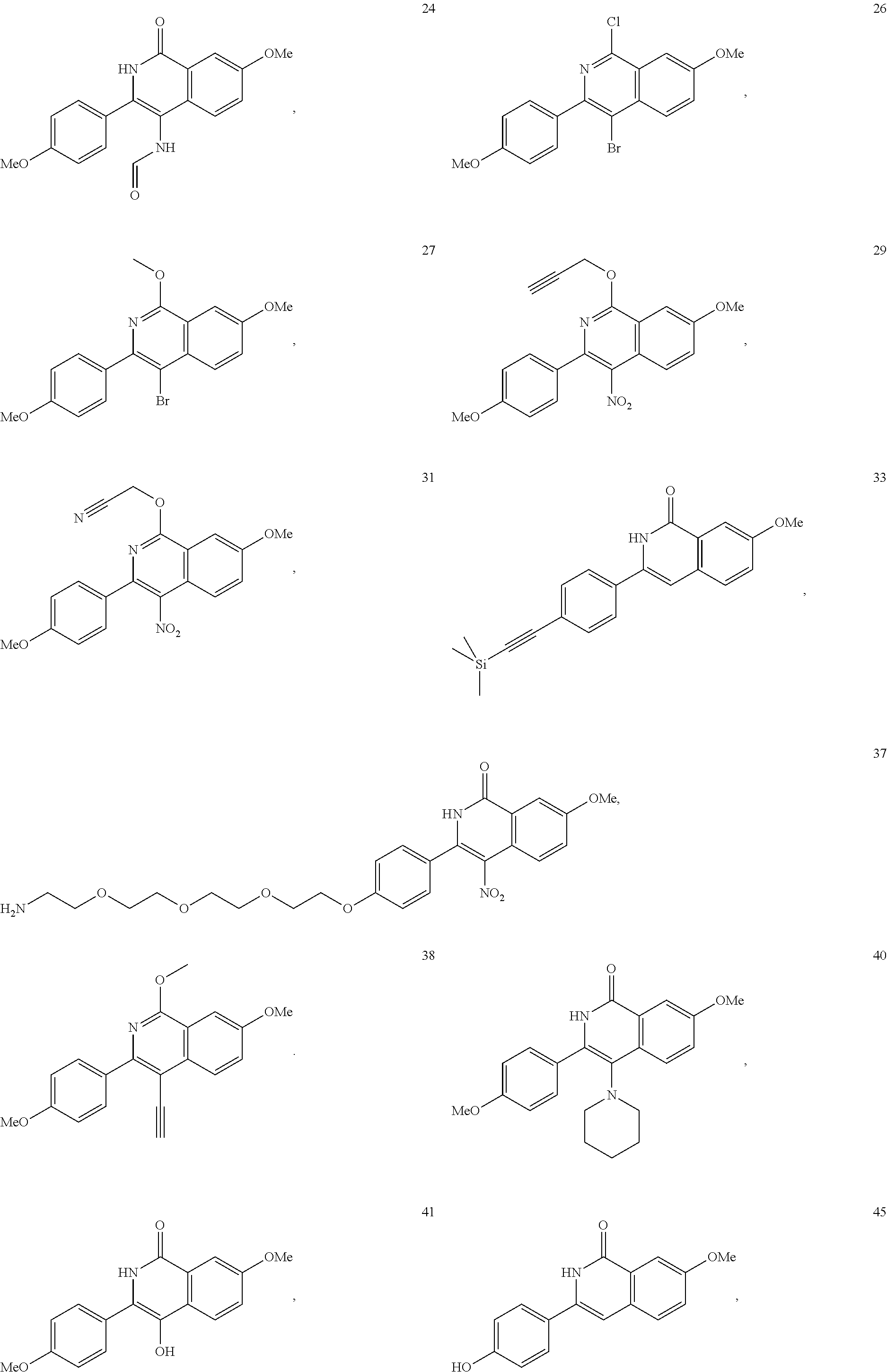


The compounds of this embodiment possess a VDA activity and are PP1 inhibitors but possess little or no tubulin-inhibiting activity.


The compounds of this embodiment possess a VDA activity, have little or no PP1 inhibiting activity and possess a tubulin-inhibiting activity.
-
- when X═O, n=1, R3=H, and the bond between
carbon 1 and the X group is double and,
R1=NH2, R2=phenyl or 4-OH-phenyl, substituted or not, R4=H, OH, an O—(C1-C6)alkyl, a C1-C6 alkyl, a C3-C6 cycloalkyl, and R5=H, OH, an O—(C1-C6)alkyl, a C1-C6 alkyl, a C3-C6 cycloalkyl, and - when X═O or S, n=1, R3=H, and when the bond between
carbon 1 and the X group is double, R2 having the same meaning as above and one of R4 and R5 represents a halogen.
- when X═O, n=1, R3=H, and the bond between

in which R2=phenyl or 4-OH-phenyl, substituted or not, R4=H, OH, an O—(C1-C6)alkyl, a C1-C6 alkyl, a C3-C6 cycloalkyl, and R5=H, OH, an O—(C1-C6)alkyl, a C1-C6 alkyl, a C3-C6 cycloalkyl.
-
- n=0, the bond between
carbon 1 and the X group is single and X is chosen from SO3H, OCH3,
- n=0, the bond between

or
-
- n=1, the bond between
carbon 1 and the X group is double, X═O or S and R2 represents a phenyl substituted inposition 4 by a group chosen from OH, OCH3, O-benzyl, Br, a C2-C4 alkynyl group substituted or not, in particular by a trimethylsilyl, a tert-butyl, a hydroxy-2-propyl or an isopropyl.
- n=1, the bond between
-
- when X═O or S, n=1, R3=H, and when the bond between
carbon 1 and the X group is double, R2, R4 and R5 having the same meaning as above, the compounds in which R1=H.
- when X═O or S, n=1, R3=H, and when the bond between

but alpha cyclodextrin or gamma cyclodextrin can also be used as a means of increasing the aqueous solubility of the product.

in which:
-
- 1) the bond between
carbon 1 and the X group is single or double, the bond betweennitrogen 2 andcarbon 1 can be single or double- it being understood that:
- a. when the bond between X and said
carbon 1 is double, then the bond betweennitrogen 2 andcarbon 1 is single:
- a. when the bond between X and said
- and,
- b. when the bond between X and said
carbon 1 is single, then the bond betweennitrogen 2 andcarbon 1 is double and formula I corresponds to an aromatic system of formula I-A below:
- b. when the bond between X and said
- it being understood that:
- 1) the bond between

-
- 2) n represents 0 or 1,
- 3) X represents:
- a) when n=1:
- O, S, NH, N—(C1-C6)alkyl,
- b) when n=0:
- OH, OPO3H2, OPO—(O—(C1-C2)alkyl)2, the alkyl being optionally substituted by one or more fluorines, O—(C1-C6)alkyl, in particular OCH3, the alkyl being optionally substituted by one or more fluorines, O(C3-C6)cycloalkyl, NH2, NH—(C1-C6)alkyl, N—[(C1-C6)alkyl]2, NH—(C3-C6)cycloalkyl, N—[(C3-C6)cycloalkyl]2, SH, S—(C1-C6)alkyl, the alkyl being optionally substituted by one or more fluorines, in particular SCH3, S(C3-C6)cycloalkyl, SO3H, NH—CH2-aryl or heteroaryl,
- OPh, SPh, OCH2Ph, SCH2Ph, the phenyl of these four groups being able to be substituted or not by one or more (C1-C6)alkyls, the alkyl being optionally substituted by one or more fluorines,

-
- 4) R1 represents:
- H, a halogen, OH, OPO3H2, OPO—(O—(C1-C2)alkyl)2, the alkyl being optionally substituted by one or more fluorines,
- CF3, CH2OR′, R′ representing H or (C1-C6)alkyl, the alkyl being optionally substituted by one or more fluorines, CHO,
- CO2R″, R″ representing H, (C1-C6)alkyl, the alkyl being optionally substituted by one or more fluorines,
- CONRcRd, CH2SO2NRcRd, CH2NHSO2Rc, Rc and Rd representing independently of each other: H, a C1-C6 alkyl, and NRcRd represents an amino acid bound by its amine function, in particular a serine or a threonine, a C3-C6 cycloalkyl, or Rc and Rd represent together a C2-C6 alkyl,
- NO2, N3, ≡, CN, C(═N)NH2, SO3H, SO2NH2, SO2NHCH3, NHSO2CH3, CH2SO2NRcRd, CH2NHSO2Rc, SO2—NRaRb, SO2-imidazole,
- NRaRb, where:
- Ra and Rb represent independently of each other: H, a C1-C6 alkyl, a C3-C6 cycloalkyl, or
- Ra is H, a C1-C6 alkyl, a C3-C6 cycloalkyl, and Rb═CORf, COORf or CONRfRfRf and Rf′ representing H, a C1-C6 alkyl, a C3-C6 cycloalkyl or an amino acid chain (such as CH(CH2OH)NH2 for serine), Ra and Rb represent together a C2-C6 alkyl,
- Ra and Rb can form a C5 to C7 ring, in particular a pyrrolidine, a piperazine, a morpholine, a thiomorpholine,
- a heteroaryl, substituted or not, in particular a pyridine, an imidazole, an oxazole, a triazole, a pyrrole, a tetrazole.
- 5) R2 represents:
- a phenyl substituted or not by one to three substituents chosen from:
- a halogen, an OH, NHRa,
- ORe, Re representing a benzyl, a methylene triazole, substituted or not, in particular by a C1-C6 alkyl,
- OPO3H2, OPO—(O—(C1-C2)alkyl)2, the alkyl being optionally substituted by one or more fluorines, an NH2,
- an NH—CORc group in which Rc represents H, a C1-C6 alkyl, a C3-C6 cycloalkyl or an amino acid chain (such as CH(CH2OH)NH2 for serine),
- an O—(C1-C6)alkyl, in particular OCH3, the alkyl being optionally substituted by one or more fluorines,
- an O—COR1 where R1 represents O—(C1-C6)alkyl, or NRiRii, Ri and Rii being able to be C1-C6 alkyl,
- a C2-C4 alkyl group, the alkyl group being optionally substituted by one or more fluorines, a C2-C4 alkenyl group, substituted or not,
- a C2-C4 alkynyl group, substituted or not, in particular by a trimethylsilyl, a tert-butyl, a hydroxy-2-propyl or an isopropyl
- a heteroaryl, substituted or not, in particular a pyridine, an imidazole, an oxazole, a triazole, a pyrrole, a benzofuran, a thiophene, a benzothiophene, an indole,
- a cyclohexyl, a piperazine, a morpholine, a thiomorpholine, a piperidine,
- a 4-(NH2—(CH2—CH2O)p)Ph group in which p is an integer from 1 to 6
- 6) R3 represents:
- H, (C1-C6)alkyl, the alkyl being optionally substituted by one or more fluorines, (C3-C6)cycloalkyl, OH, OPO3H2, OPO—(O—(C1-C2)alkyl)2, OSO3H, SO3H, O—(C1 to C6)alkyl, NH2, NH—(C1-C6)alkyl, N—[(C1-C6)alkyl]2, NH—(C3-C6)cycloalkyl, N—[(C3-C6)cycloalkyl]2, a propargyl group, CH2CN, (CH2)pOH, p varying from 1 to 6, CH2OPO3H2, CH2OPO—(O—(C1-C2)alkyl)2, CH2CH2F, CH2CHF2, CH2CF3,
- 7) R4 and R5 represent independently of each other:
- H, OH, OPO3H2, OPO—(O—(C1-C2)alkyl)2, the alkyl being optionally substituted by one or more fluorines, an O—(C1-C6)alkyl, in particular OCH3, the alkyl being optionally substituted by one or more fluorines, a C1-C6 alkyl, the alkyl being optionally substituted by one or more fluorines, a C3-C6 cycloalkyl, a halogen,
- R4 and R5 represent together a (C1-C2) alkenyl dioxy optionally substituted by one or more fluorines,
with the exclusion of the following compounds: - when X═O, R3=H, and the bond between
carbon 1 and the X group is double: - a. R1=NH2, R2=4-methoxy-phenyl, R4=OCH3 and R5=H,
- b. R1=NH2, R2=phenyl, R4=H and R5=H,
- c. R1=NO2, R2=4-methoxy-phenyl, R4=OCH3 and R5=H,
- d. R1=NO2, R2=4-methoxy-phenyl, R4=H and R5=H,
- e. R1=NH2, R2=4-methoxy-phenyl, R4=H and R5=H,
- f. R1=NHCHO, R2=phenyl, R4=OCH3 and R5=H,
- g. R1=NH2, R2=phenyl, R4=OCH3 and R5=H,
- h. R1=NH2, R2=phenyl or 4-OH-phenyl, substituted or not, R4=H, OH, an O—(C1-C6)alkyl, a C1-C6 alkyl, a C3-C6 cycloalkyl, and R5=H, OH, an O—(C1-C6)alkyl, a C1-C6 alkyl, a C3-C6 cycloalkyl,
- i. the compounds in which one of R4 and R5 represents a halogen.
- 4) R1 represents:

and R1 is chosen from H, NO2 or Br, or n=1, the bond between

in which:
1) the bond between
-
- it being understood that:
- a. when the bond between X and said
carbon 1 is double, then the bond betweennitrogen 2 andcarbon 1 is single:
- a. when the bond between X and said
- and,
- b. when the bond between X and said
carbon 1 is single, then the bond betweennitrogen 2 andcarbon 1 is double and formula I corresponds to an aromatic system of formula I-A below:
- b. when the bond between X and said
- it being understood that:

-
- 2) n represents 0 or 1,
- 3) X represents:
- a) when n=1:
- O, S, NH, N—(C1-C6)alkyl,
- b) when n=0:
- OH, OPO3H2, OPO—(O—(C1-C2)alkyl)2, the alkyl being optionally substituted by one or more fluorines, O—(C1-C6)alkyl, in particular OCH3, the alkyl being optionally substituted by one or more fluorines, O(C3-C6)cycloalkyl, NH2, NH—(C1-C6)alkyl, N—[(C1-C6)alkyl]2, NH—(C3-C6)cycloalkyl, N—[(C3-C6)cycloalkyl]z, SH, S—(C1-C6)alkyl, the alkyl being optionally substituted by one or more fluorines, in particular SCH3, S(C3-C6)cycloalkyl, SO3H, NH—CH2-aryl or heteroaryl,
- OPh, SPh, OCH2Ph, SCH2Ph, the phenyl of these four groups being able to be substituted or not by one or more (C1-C6)alkyls, the alkyl being optionally substituted by one or more fluorines,

-
- 4) R1 represents:
- a halogen, OH, OPO3H2, OPO—(O—(C1-C2)alkyl)2, the alkyl being optionally substituted by one or more fluorines,
- CF3, CH2OR′, R′ representing H or (C1-C6)alkyl, the alkyl being optionally substituted by one or more fluorines, CHO,
- CO2R″, R″ representing H, an amino acid, (C1-C6)alkyl, the alkyl being optionally substituted by one or more fluorines,
- CONRcRd, Rc and Rd representing independently of each other: H, a C1-C6 alkyl, an amino acid, a C3-C6 cycloalkyl, or Rc and Rd represent together a C2-C6 alkyl,
- NO2, N3, ≡, CN, C(═N)NH2, SO3H, SO2NH2, SO2NHCH3, NHSO2CH3, CH2SO2NRcRd, CH2NHSO2Rc, SO2—NRaRb, SO2-imidazole,
- NRaRb, where:
- Ra and Rb represent independently of each other: H, CHO, a C1-C6 alkyl, a C3-C6 cycloalkyl, an amino acid bound by its acid function, in particular a serine,
- Ra and Rb represent together a C2-C6 alkyl,
- Ra and Rb can form a C5 to C7 ring, in particular a pyrrolidine, a piperazine, a morpholine, a thiomorpholine,
- a heteroaryl, substituted or not, in particular a pyridine, an imidazole, an oxazole, a triazole, a pyrrole, a tetrazole.
- 5) R2 represents:
- a phenyl substituted or not by one to three substituents chosen from:
- a halogen, an OH, NHRa,
- ORe, Re representing a benzyl, a methylene triazole, substituted or not,
- OPO3H2, OPO—(O—(C1-C2)alkyl)2, the alkyl being optionally substituted by one or more fluorines, an NH2,
- an NH—Rc group in which Rc represents an amino acid bound by its acid function, in particular a serine,
- an O—(C1-C6)alkyl, in particular OCH3, the alkyl being optionally substituted by one or more fluorines,
- a C2-C4 alkyl group, the alkyl group being optionally substituted by one or more fluorines, a C2-C4 alkenyl group, substituted or not,
- a C2-C4 alkynyl group, substituted or not, in particular by a trimethylsilyl, a tert-butyl, a hydroxy-2-propyl or an isopropyl
- a heteroaryl, substituted or not, in particular a pyridine, an imidazole, an oxazole, a triazole, a pyrrole, a benzofuran, a thiophene, a benzothiophene, an indole,
- a cyclohexyl, a piperazine, a morpholine, a thiomorpholine, a piperidine,
- a 4-(NH2—(CH2—CH2O)p)Ph group in which p is an integer from 1 to 6.
- 6) R3 represents:
- H, (C1-C6)alkyl, the alkyl being optionally substituted by one or more fluorines, (C3-C6)cycloalkyl, OH, OPO3H2, OPO—(O—(C1-C2)alkyl)2, O—(C1 to C6)alkyl, NH2, NH—(C1-C6)alkyl, N—[(C1-C6)alkyl]2, NH—(C3-C6)cycloalkyl, N—[(C3-C6)cycloalkyl]2, a propargyl group, CH2CN, (CH2)pOH, p varying from 1 to 6, CH2OPO3H2, CH2OPO—(O—(C1-C2)alkyl)2, CH2CH2F, CH2CHF2, CH2CF3,
- 7) R4 and R5 represent independently of each other:
- H, OH, OPO3H2, OPO—(O—(C1-C2)alkyl)2, the alkyl being optionally substituted by one or more fluorines, an O—(C1-C6)alkyl, in particular OCH3, the alkyl being optionally substituted by one or more fluorines, a C1-C6 alkyl, the alkyl being optionally substituted by one or more fluorines, a C3-C6 cycloalkyl, a halogen,
- R4 and R5 represent together a (C1-C2) alkenyl dioxy optionally substituted by one or more fluorines,
- 4) R1 represents:


-
- as combined preparation for a simultaneous, separate or sequential use in the treatment of mammals, in particular humans, suffering from benign or malignant (cancerous) tumours.
-
- for X═O:
- a) condensation of an arylacetic acid with an arylcarboxaldehyde in order to form a 2,3-diarylacrylic acid intermediate,
- b) conversion of the acid group to the corresponding azide with NaN3 via a mixed anhydride,
- c) cyclization of the azide by thermal route in order to produce 3-arylisoquinolin-1(2H)-one,
- d) arrangement of the functional groups according to the protocols detailed below.
- for X═S,
- a) starting from 3-arylisoquinolin-1(2H)-one, the synthesis of isoquinolin-1(2H)-thione is carried out with Lawesson's reagent,
- b) starting from 3-aryl-4-nitroisoquinolin-1(2H)-one, the isoquinolin-1(2H)-thione synthesis method comprises the following main stages:
- i. chlorination with phosphorus chloride oxide or with Vilsmeier reagent in order to form the 1-chloroisoquinoline intermediate,
- ii. conversion of the chloro group to a thione group with thiourea.
- for X═O:
-
- starting from 3-arylisoquinolin-1(2H)-one: the synthesis of isoquinoline IIb is carried out with the desired haloakyl in the presence of a base such as K2CO3;
- starting from 1-chloro-4-nitroisoquinoline the synthesis of which was mentioned above: the synthesis of isoquinoline IIb carried out with the desired nucleophile in basic medium.
- starting from 3-arylisoquinolin-1(2H)-one: the synthesis of isoquinoline IIb is carried out with the desired haloakyl in the presence of a base such as K2CO3;
| TABLE I | |||||||||
| PP1 | Tubulin | Effect | |||||||
| In- | polymer- | on | |||||||
| hibi- | ization | Hela | GI50 | ||||||
| Molecular | tion | inhibi- | at 25 | on | |||||
| No. | Code | Structure | formula | MW | IC50 | | μM | HMEC | |
| 1 | ICC128- L-004- H09 |  | C17H16N2O3 | 296.32 | — | — | *** | ++ | |
| 2 | ICC108- L-006- C05- |  | C15H12N2O | 236.28 | — | — | — | + | |
| 4 | ICC123- L-022- C04- |  | C17H15NO3 | 281.3 | — | — | — but effect ** at 50 and 100 μM | — | |
| 5 | ICC103- L-030- D05- |  | C24H21NO4 | 387.4 | — | +++ | *** | +++ | |
| 6 | ICC128- L-013- B06- |  | C17H14N2O5 | 326.3 | ++++ | + | **** | ++++ | |
| 7 | ICC108- L-006- G06- |  | C16H12N2O4 | 296.27 | — | + | *** | ++ | |
| 8 | ICC108- L-006- G08- |  | C16H14N2O2 | 266.29 | — | — | — | — | |
| 9 | ICC108- L-006- H06- |  | C17H14N2O3 | 294.3 | — | — | — but effect ** at 50 and 100 μM | + | |
| 10 | ICC108- L-006- H03- |  | C16H14N2O2 | 266.29 | — | + | — but effect * at 50 and 100 μM | — | |
| 12 | CH1583A |  | C17H15NO2S | 297.37 | ++++ | ++ | — but effet * to 100 μM | ++ | |
| 13 | CH1585 |  | C17H15NO5S | 345.37 | — | ++ | — but effect * at 100 μM | — | |
| 14 | CH1587A |  | C17H14CLNO3 | 315.75 | — | +++ | — | + | |
| 15 | CH1584A | 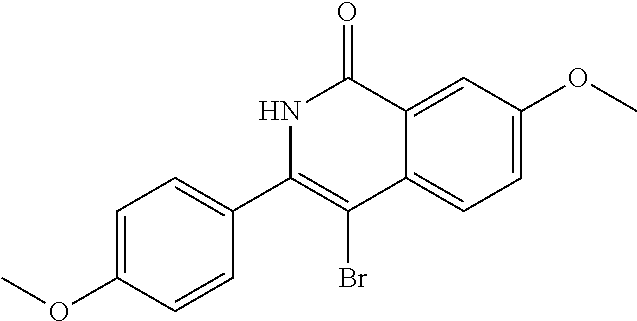 | C17H14BrNO3 | 360.2 | — | ++ | *** | +++ | |
| 16 | CH1586 |  | C17H14INO3 | 407.2 | — | +++ | *** | +++ | |
| 17 | CH1576 |  | C17H13ClN2O4 | 344.75 | — | ++ | — | + | |
| 18 | CH1590 |  | C17H14N2O4S | 342.4 | +++ | +++ | **** | ++ | |
| 19 | CH1577 |  | C18H16N2O5 | 340.33 | ++ | + | — but effect ** at 100 μM | — | |
| 20 | CH1591 |  | C23H18N2O4S | 418.46 | ++ | ++ | — but effect * at 50 and 100 μM | — | |
| 21 | CH1592 |  | C24H20N2O4S | 432.49 | ++ | +++ | — | — | |
| 22 | CH1594 |  | C24H21N3O4 | 415.44 | ++++ | + | — | — | |
| 23 | DN78-2 |  | C19H20N2O3 | 324.37 | — | + | *** | ++ | |
| 24 | DN86 |  | C18H16N2O4 | 324.33 | — | + | **** | ++ | |
| 25 | DN77-1 |  | C18H15NO4 | 309.3 | + | +++ | **** | +++ | |
| 26 | PJ23 |  | C17H13BrClNO2 | 378.65 | — | — | — | — | |
| 27 | PJ24 |  | C18H16BrNO3 | 374.23 | — | + | — | + | |
| 28 | PJ38f2 |  | C20H16N2O5 | 364.35 | ++ | — | — but effect ** at 50 and 100 μM | — | |
| 29 | PJ38f1 |  | C20H16N2O5 | 364.35 | + | + | — | — | |
| 30 | PJ46f2 |  | C19H15N3O5 | 365.34 | + | + | — | — | |
| 31 | PJ46f1 |  | C19H15N3O5 | 365.34 | — | ++ | — | — | |
| 32 | PJ37 |  | C16H12BrNO2 | 330.18 | +++ | — | **** | +++ | |
| 33 | PJ39 |  | C21H21NO2Si | 347.48 | — | — | — | + | |
| 34 | PJ47 |  | C16H11BrN2O4 | 375.17 | ++ | +++ | *** | ++++ | |
| 35 | PJ54 |  | C21H20N2O4Si | 392.48 | +++ | — | *** | ++++ | |
| 36 | PJ56 |  | C18H12N2O4 | 320.30 | +++ | +++ | **** | ++++ | |
| 37 | CLG1963 |  | C24H29N3O8 | 487.5 | — | — | — | + | |
| 38 | PJ-58 |  | C20H17NO3 | 319.35 | — | + | — | — | |
| 39 | DN103-1 |  | C21H18N2O3 | 346.38 | +++ | + | — | +++ | |
| 40 | DN114 |  | C22H24N2O3 | 364.43 | — | +++ | — | +++ | |
| 41 | DN122 |  | C17H15NO4 | 297.31 | — | — | — | ++ | |
| 44 | CLG 1929 |  | C23H19NO3 | 357.4 | +++ | — | — | + | |
| 45 | CLG 1930 |  | C16H13NO3 | 267.28 | — | ++ | **** | +++ | |
| 46 | CLG 1939 |  | C23H18N2O5 | 402.40 | +++ | + | — | — | |
| In- | Tubulin | Effect | |||||||
| hibi- | polymer- | on | |||||||
| tion | ization | Hela | GI50 | ||||||
| Molecular | PP1 | inhibi- | at 25 | on | |||||
| No. | Code | Structure | formula | MW | IC50 | | μM | HMEC | |
| 48 | DN141-2 |  | C23H20H4O7 | 464.42 | — | — | — but effect * at 50 μM | + | |
| 49 | DN145-1 |  | C21H22N2O4 | 366.4 | — | + | ** | +++ | |
| 50 | DN145-3 |  | C21H24N2O5 | 384.42 | — | +++ | — | + | |
| 56 | DN 174-2 |  | C15H10ClNO3 | 287.7 | +++ | — | — but effect * at 100 μM | — | |
| 57 | DN 171 |  | C15H11NO3 | 253.25 | — | + | *** | ++ | |
| 59 | ADV 1- 116 |  | C21H18N2O5 | 378.38 | ++ | — | — | — | |
| 60 | ADV 1- 112 |  | C22H20N2O4 | 376.41 | ++++ | — | *** | ++ | |
| 61 | DN228-1 |  | C17H16N2O3 | 296.12 | — | — | — | — | |
| 62 | DN282 |  | C17H15N3O5 | 341.10 | — | — | *** | ++ | |
| 64 | DN263-1 |  | C18H19NO3 | 297.36 | +++ | — | — | — | |
| 65 | DN263-2 | 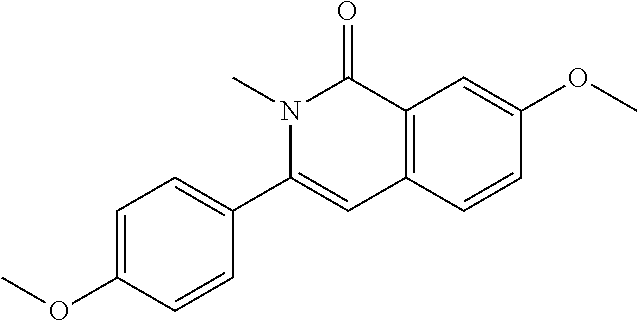 | C18H17NO3 | 295.12 | + | + | * | ++ | |
| 66 | DN264 |  | C18H16N2O5 | 340.11 | ++++ | + | * | ++ | |
| 67 | DN267 |  | C19H19NO4 | 325.13 | ++ | — | — | + | |
| 68 | DN281-2 |  | C19H18N2O6 | 370.12 | — | — | — | + | |
| 69 | DN274 |  | C25H22INO4 | 527.06 | ++ | + | — | + | |
| 70 | DN279 |  | C26H22F3NO4 | 469.15 | +++ | + | — | + | |
| 71 | DN278 |  | C17H15N3O4 | 325.11 | — | + | — | + | |
| 72 | ADV2- 029 |  | C16H12N2O5 | 312.28 | +++ | ++ | **** | +++ | |
| 73 | ADV2- 046 |  | C21H20N2O7 | 412.39 | +++ | — | *** | ++ | |
| 74 | ADV2- 035 |  | C23H18N2O6 | 418.39 | +++ | + | — but effect * at 50 μM | + | |
N.B.: MA: Mitotic arrest; PHF: Primary human fibroblasts; MTs: Microtubules
1. Effect on the activity of PP1CA in vitro
-
- for X═O, the synthesis method is carried out according to Bisagni et al., Tetrahedron 1996, 52, 10427-10440 and comprises the following main stages:
- a) condensation of an arylacetic acid with an arylcarboxaldehyde in order to form an intermediate 2,3-diarylacrylic acid,
- b) conversion of the acid group to the corresponding azide by NaN3 via a mixed anhydride,
- c) cyclization of the azide by thermal route in order to produce 3-arylisoquinolin-1(2H)-one,
- d) arrangement of the functional groups according to the protocols detailed below.
- for X═S, the synthesis comprises the following stages
- a) starting from 3-arylisoquinolin-1(2H)-one, the synthesis of isoquinolin-1(2H)-thione is carried out with Lawesson's reagent,
- b) starting from 3-aryl-4-nitroisoquinolin-1(2H)-one, the isoquinolin-1(2H)-thione synthesis method comprises the following main stages:
- chlorination with phosphorus chloride oxide or Vilsmeier reagent in order to form the 1-chloroisoquinoline intermediate,
- conversion of the chloro group to a thione group with thiourea.
- for X═O, the synthesis method is carried out according to Bisagni et al., Tetrahedron 1996, 52, 10427-10440 and comprises the following main stages:
-
- starting from 3-arylisoquinolin-1(2H)-one: the synthesis of isoquinoline IIb is carried out with the desired haloalkyl in the presence of a base such as K2CO3,
- starting from 1-chloro-4-nitroisoquinoline the synthesis of which was mentioned above: the synthesis of isoquinoline IIb is carried out with the desired nucleophile in basic medium.
- starting from 3-arylisoquinolin-1(2H)-one: the synthesis of isoquinoline IIb is carried out with the desired haloalkyl in the presence of a base such as K2CO3,

and Compound 50: 4-(2-(2-hydroxyethoxy)ethylamino)-7-methoxy-3-(4-methoxyphenyl)isoquinolin-1(2H)-one


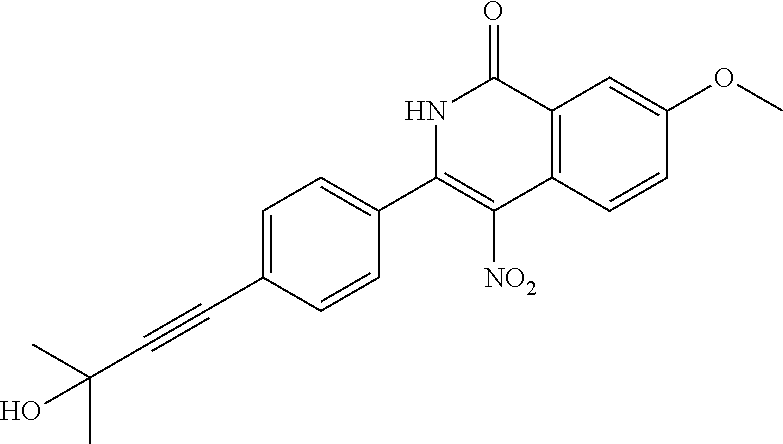

Compound 59 is synthesized in the same way as


Claims (34)


Applications Claiming Priority (4)
| Application Number | Priority Date | Filing Date | Title |
|---|---|---|---|
| FR1000829A FR2956816B1 (en) | 2010-03-01 | 2010-03-01 | USE OF QUINOLONES FOR THE PREPARATION OF MEDICAMENTS, NEW QUINOLONES AND THEIR METHOD OF SYNTHESIS |
| FR10/00829 | 2010-03-01 | ||
| FR1000829 | 2010-03-01 | ||
| PCT/FR2011/050431 WO2011107709A1 (en) | 2010-03-01 | 2011-03-01 | Use of isoquinolones for preparing drugs, novel isoquinolones and method for synthesising same |
Publications (2)
| Publication Number | Publication Date |
|---|---|
| US20130096083A1 US20130096083A1 (en) | 2013-04-18 |
| US8883763B2 true US8883763B2 (en) | 2014-11-11 |
Family
ID=43247863
Family Applications (1)
| Application Number | Title | Priority Date | Filing Date |
|---|---|---|---|
| US13/581,830 Active US8883763B2 (en) | 2010-03-01 | 2011-03-01 | Use of isoquinolones for preparing drugs, novel isoquinolones and method for synthesising same |
Country Status (7)
| Country | Link |
|---|---|
| US (1) | US8883763B2 (en) |
| EP (1) | EP2542239B1 (en) |
| JP (1) | JP5856086B2 (en) |
| CA (1) | CA2791490C (en) |
| EA (1) | EA032434B1 (en) |
| FR (1) | FR2956816B1 (en) |
| WO (1) | WO2011107709A1 (en) |
Cited By (1)
| Publication number | Priority date | Publication date | Assignee | Title |
|---|---|---|---|---|
| US9376433B2 (en) | 2012-08-08 | 2016-06-28 | Merck Patent Gmbh | (AZA-)isoquinolinone derivatives |
Families Citing this family (9)
| Publication number | Priority date | Publication date | Assignee | Title |
|---|---|---|---|---|
| CN102875466A (en) * | 2012-04-23 | 2013-01-16 | 中国药科大学 | Isoquinolinone derivatives, and preparation method and medical purpose thereof |
| CN103709138B (en) * | 2013-12-23 | 2015-09-09 | 河南大学 | 5-(fluoroquinolone C3-methylene)-3-pyrrole amide derivative, preparation method and application |
| RU2585623C1 (en) * | 2014-11-20 | 2016-05-27 | Федеральное государственное бюджетное учреждение науки Институт физиологически активных веществ Российской академии наук | METHOD FOR SYNTHESIS OF 7-METHOXY-4-NITRO-3-(p-METHOXYPHENYL) ISOQUINOLINONE DERIVATIVES |
| KR101800876B1 (en) * | 2015-10-28 | 2017-11-27 | 전남대학교 산학협력단 | Novel Diarylisoquinolines and Pharmaceutical Composition Comprising the Same |
| RU2613146C1 (en) * | 2015-11-17 | 2017-03-15 | Общество с ограниченной ответственностью "Биофармацевтические инвестиции РВК" (ООО "Биофонд РВК") | Gelatine capsule of selective vessel destruction in tumours |
| WO2018074563A1 (en) * | 2016-10-21 | 2018-04-26 | 学校法人 慶應義塾 | Modified phenylphthalimide and pharmaceutical composition having same as active ingredient |
| WO2019089422A1 (en) * | 2017-10-30 | 2019-05-09 | Synblia Therapeutics, Inc. | Irak4 inhibitors and uses thereof |
| CN110498784B (en) * | 2019-05-20 | 2022-06-14 | 广东克冠达医药科技有限公司 | Nobiletin derivatives or pharmaceutically acceptable salts thereof, and preparation method and application thereof |
| DK4426434T3 (en) | 2021-11-02 | 2025-11-10 | Flare Therapeutics Inc | PPARG INVERSE AGONISTS AND USES THEREOF |
Citations (7)
| Publication number | Priority date | Publication date | Assignee | Title |
|---|---|---|---|---|
| WO1992003419A1 (en) | 1990-08-23 | 1992-03-05 | Synphar Laboratories, Inc. | Isocarbostiryl compounds and antitumor use thereof |
| WO2006058201A2 (en) | 2004-11-23 | 2006-06-01 | Reddy Us Therapeutics, Inc. | Heterocyclic and bicyclic compounds, compositions and methods |
| EP1724262A1 (en) | 2004-02-06 | 2006-11-22 | Chugai Seiyaku Kabushiki Kaisha | 1-(2h)-isoquinolone derivative |
| EP1854792A1 (en) | 2005-02-22 | 2007-11-14 | Chugai Seiyaku Kabushiki Kaisha | 1-(2h)-isoquinolone derivative |
| WO2008028427A1 (en) | 2006-09-04 | 2008-03-13 | Univerzita Palackeho | Derivatives of 2-phenyl-3-hydroxyquinoline-4(1h)-one and methods of their preparation and utilization |
| WO2008036540A2 (en) | 2006-09-20 | 2008-03-27 | Boehringer Ingelheim International Gmbh | Rho kinase inhibitors |
| WO2008063548A2 (en) | 2006-11-17 | 2008-05-29 | Rexahn Pharmaceuticals, Inc. | 5, 6, or 7-substituted-s- (hetero)arylisoquinolinamine derivatives as antitumor agents |
Family Cites Families (5)
| Publication number | Priority date | Publication date | Assignee | Title |
|---|---|---|---|---|
| FR1526841A (en) * | 1966-06-01 | 1968-05-31 | New derivatives of 2 h-isoquinoline-thione-1 and process for their preparation | |
| US3452027A (en) * | 1967-07-03 | 1969-06-24 | American Home Prod | 2-hydroxyalkylisocarbostyrils |
| FR2728900B1 (en) * | 1994-12-29 | 1997-01-31 | Synthelabo | 3-PHENYLISOQUINOLEIN-1 (2H) -ONE DERIVATIVES, THEIR PREPARATION AND THEIR THERAPEUTIC APPLICATION |
| JP3989102B2 (en) * | 1997-10-02 | 2007-10-10 | エーザイ・アール・アンド・ディー・マネジメント株式会社 | Condensed pyridine derivatives |
| TWI499418B (en) * | 2009-05-21 | 2015-09-11 | Nerviano Medical Sciences Srl | Isoquinolin-1(2h)-one derivatives |
-
2010
- 2010-03-01 FR FR1000829A patent/FR2956816B1/en not_active Expired - Fee Related
-
2011
- 2011-03-01 EA EA201290843A patent/EA032434B1/en not_active IP Right Cessation
- 2011-03-01 JP JP2012555472A patent/JP5856086B2/en not_active Expired - Fee Related
- 2011-03-01 WO PCT/FR2011/050431 patent/WO2011107709A1/en not_active Ceased
- 2011-03-01 US US13/581,830 patent/US8883763B2/en active Active
- 2011-03-01 EP EP11712950.2A patent/EP2542239B1/en not_active Not-in-force
- 2011-03-01 CA CA2791490A patent/CA2791490C/en active Active
Patent Citations (7)
| Publication number | Priority date | Publication date | Assignee | Title |
|---|---|---|---|---|
| WO1992003419A1 (en) | 1990-08-23 | 1992-03-05 | Synphar Laboratories, Inc. | Isocarbostiryl compounds and antitumor use thereof |
| EP1724262A1 (en) | 2004-02-06 | 2006-11-22 | Chugai Seiyaku Kabushiki Kaisha | 1-(2h)-isoquinolone derivative |
| WO2006058201A2 (en) | 2004-11-23 | 2006-06-01 | Reddy Us Therapeutics, Inc. | Heterocyclic and bicyclic compounds, compositions and methods |
| EP1854792A1 (en) | 2005-02-22 | 2007-11-14 | Chugai Seiyaku Kabushiki Kaisha | 1-(2h)-isoquinolone derivative |
| WO2008028427A1 (en) | 2006-09-04 | 2008-03-13 | Univerzita Palackeho | Derivatives of 2-phenyl-3-hydroxyquinoline-4(1h)-one and methods of their preparation and utilization |
| WO2008036540A2 (en) | 2006-09-20 | 2008-03-27 | Boehringer Ingelheim International Gmbh | Rho kinase inhibitors |
| WO2008063548A2 (en) | 2006-11-17 | 2008-05-29 | Rexahn Pharmaceuticals, Inc. | 5, 6, or 7-substituted-s- (hetero)arylisoquinolinamine derivatives as antitumor agents |
Non-Patent Citations (63)
Cited By (1)
| Publication number | Priority date | Publication date | Assignee | Title |
|---|---|---|---|---|
| US9376433B2 (en) | 2012-08-08 | 2016-06-28 | Merck Patent Gmbh | (AZA-)isoquinolinone derivatives |
Also Published As
| Publication number | Publication date |
|---|---|
| CA2791490C (en) | 2020-04-07 |
| US20130096083A1 (en) | 2013-04-18 |
| JP2013521265A (en) | 2013-06-10 |
| FR2956816A1 (en) | 2011-09-02 |
| EA201290843A1 (en) | 2013-04-30 |
| CA2791490A1 (en) | 2011-09-09 |
| EP2542239A1 (en) | 2013-01-09 |
| EA032434B1 (en) | 2019-05-31 |
| JP5856086B2 (en) | 2016-02-09 |
| EP2542239B1 (en) | 2015-11-11 |
| WO2011107709A1 (en) | 2011-09-09 |
| FR2956816B1 (en) | 2012-05-18 |
Similar Documents
| Publication | Publication Date | Title |
|---|---|---|
| US20130096083A1 (en) | Use of isoquinolones for preparing drugs, novel isoquinolones and method for synthesising same | |
| TWI825637B (en) | 3,4-dihydro-2,7-naphthyridine-1,6(2h,7h)-diones as mek inhibitors | |
| JP2024138293A (en) | Biomarker-Based Therapeutic Compositions | |
| EP3074396B1 (en) | 1-(5-tert-butyl-2-aryl-pyrazol-3-yl)-3-[2-fluoro-4-[(3-oxo-4h-pyrido[2, 3-b]pyrazin-8-yl)oxy]phenyl]urea derivatives as raf inhibitors for the treatment of cancer | |
| JP6968141B2 (en) | New ULK1 inhibitor and method of using it | |
| US11466010B2 (en) | Toll-like receptor 8 (TLR8) specific antagonists and methods of making and uses thereof | |
| USRE37650E1 (en) | Aryl and heteroaryl quinazoline compounds which inhibit CSF-1R receptor tyrosine kinase | |
| JP2013500255A (en) | Potent small molecule inhibitors of autophagy and methods of use thereof | |
| JP2013500255A5 (en) | ||
| WO2005009971A1 (en) | Quinolone derivative or salt thereof | |
| SG175877A1 (en) | Compounds and methods for inhibition of renin, and indications therefor | |
| JP2010520881A (en) | Melanoma treatment | |
| JP2001048786A (en) | Tricyclic heteroaryl derivative | |
| TW201619133A (en) | Novel IMINONITRILE derivatives | |
| JP2004529088A (en) | Methods for treating inflammatory and immune diseases using inhibitors of IkB kinase (IKK) | |
| EA016691B1 (en) | Sulfonyl-quinoline derivatives | |
| CN101260104A (en) | Inhibits phosphoinositide 3-kinase beta | |
| US20200131125A1 (en) | Aryl-piperidine derivatives | |
| JP6382964B2 (en) | Phthalazine derivatives | |
| CA2860413C (en) | Therapeutic use of imidazopyridine derivatives | |
| TW201609673A (en) | Quinoxaline compound, its production method and use | |
| US20200170966A1 (en) | Use of aminomethylenecyclohexane-1,3-dione compound | |
| JP4853824B2 (en) | Pharmaceutical composition comprising a quinolone derivative as an active ingredient | |
| JP2005053903A (en) | Quinolone derivative or its salt | |
| JP2006225379A (en) | Process for producing quinolone derivative or salt thereof |
Legal Events
| Date | Code | Title | Description |
|---|---|---|---|
| AS | Assignment |
Owner name: UNIVERSITE JOSEPH FOURIER, FRANCE Free format text: ASSIGNMENT OF ASSIGNORS INTEREST;ASSIGNORS:POPOV, ANDREI;JUHEM, AURELIE;FLORENT, JEAN-CLAUDE;AND OTHERS;SIGNING DATES FROM 20120918 TO 20121121;REEL/FRAME:029423/0347 Owner name: CENTRE NATIONAL DE LA RECHERCHE SCIENTIFIQUE, FRAN Free format text: ASSIGNMENT OF ASSIGNORS INTEREST;ASSIGNORS:POPOV, ANDREI;JUHEM, AURELIE;FLORENT, JEAN-CLAUDE;AND OTHERS;SIGNING DATES FROM 20120918 TO 20121121;REEL/FRAME:029423/0347 Owner name: INSTITUT CURIE, FRANCE Free format text: ASSIGNMENT OF ASSIGNORS INTEREST;ASSIGNORS:POPOV, ANDREI;JUHEM, AURELIE;FLORENT, JEAN-CLAUDE;AND OTHERS;SIGNING DATES FROM 20120918 TO 20121121;REEL/FRAME:029423/0347 |
|
| STCF | Information on status: patent grant |
Free format text: PATENTED CASE |
|
| AS | Assignment |
Owner name: UNIVERSITE GRENOBLE ALPES, FRANCE Free format text: MERGER AND CHANGE OF NAME;ASSIGNORS:UNIVERSITE JOSEPH FOURIER - GRENOBLE 1;UNIVERSITE GRENOBLE ALPES;REEL/FRAME:039427/0274 Effective date: 20150911 |
|
| MAFP | Maintenance fee payment |
Free format text: PAYMENT OF MAINTENANCE FEE, 4TH YEAR, LARGE ENTITY (ORIGINAL EVENT CODE: M1551) Year of fee payment: 4 |
|
| FEPP | Fee payment procedure |
Free format text: 7.5 YR SURCHARGE - LATE PMT W/IN 6 MO, LARGE ENTITY (ORIGINAL EVENT CODE: M1555); ENTITY STATUS OF PATENT OWNER: LARGE ENTITY |
|
| MAFP | Maintenance fee payment |
Free format text: PAYMENT OF MAINTENANCE FEE, 8TH YEAR, LARGE ENTITY (ORIGINAL EVENT CODE: M1552); ENTITY STATUS OF PATENT OWNER: LARGE ENTITY Year of fee payment: 8 |
|
| AS | Assignment |
Owner name: UNIVERSITE GRENOBLE ALPES, FRANCE Free format text: MERGER;ASSIGNOR:UNIVERSITE GRENOBLE ALPES;REEL/FRAME:063695/0599 Effective date: 20220912 |