US8880258B2 - Hybrid powertrain control - Google Patents

Hybrid powertrain control Download PDF

Info

Publication number
US8880258B2
US8880258B2 US13/681,378 US201213681378A US8880258B2 US 8880258 B2 US8880258 B2 US 8880258B2 US 201213681378 A US201213681378 A US 201213681378A US 8880258 B2 US8880258 B2 US 8880258B2
Authority
US
United States
Prior art keywords
engine
powertrain
torque
motor
recited
Prior art date
Legal status (The legal status is an assumption and is not a legal conclusion. Google has not performed a legal analysis and makes no representation as to the accuracy of the status listed.)
Active, expires
Application number
US13/681,378
Other versions
US20130096759A1 (en
Inventor
Leo G. BRETON
Ronald D. Yuille
Mark A. Shost
Louis J. Serrano
John W. PARSELS
Matthew A. Younkins
Current Assignee (The listed assignees may be inaccurate. Google has not performed a legal analysis and makes no representation or warranty as to the accuracy of the list.)
Tula Technology Inc
Original Assignee
Tula Technology Inc
Priority date (The priority date is an assumption and is not a legal conclusion. Google has not performed a legal analysis and makes no representation as to the accuracy of the date listed.)
Filing date
Publication date
Priority claimed from US13/654,217 external-priority patent/US8892330B2/en
Application filed by Tula Technology Inc filed Critical Tula Technology Inc
Priority to US13/681,378 priority Critical patent/US8880258B2/en
Assigned to TULA TECHNOLOGY, INC. reassignment TULA TECHNOLOGY, INC. ASSIGNMENT OF ASSIGNORS INTEREST (SEE DOCUMENT FOR DETAILS). Assignors: BRETON, LEO G., SERRANO, LOUIS J., SHOST, MARK A., YUILLE, RONALD D
Publication of US20130096759A1 publication Critical patent/US20130096759A1/en
Assigned to TULA TECHNOLOGY, INC. reassignment TULA TECHNOLOGY, INC. ASSIGNMENT OF ASSIGNORS INTEREST (SEE DOCUMENT FOR DETAILS). Assignors: PARSELS, JOHN W., YOUNKINS, MATTHEW A.
Application granted granted Critical
Publication of US8880258B2 publication Critical patent/US8880258B2/en
Active legal-status Critical Current
Adjusted expiration legal-status Critical

Links

Images

Classifications

    • BPERFORMING OPERATIONS; TRANSPORTING
    • B60VEHICLES IN GENERAL
    • B60WCONJOINT CONTROL OF VEHICLE SUB-UNITS OF DIFFERENT TYPE OR DIFFERENT FUNCTION; CONTROL SYSTEMS SPECIALLY ADAPTED FOR HYBRID VEHICLES; ROAD VEHICLE DRIVE CONTROL SYSTEMS FOR PURPOSES NOT RELATED TO THE CONTROL OF A PARTICULAR SUB-UNIT
    • B60W20/00Control systems specially adapted for hybrid vehicles
    • B60W20/10Controlling the power contribution of each of the prime movers to meet required power demand
    • BPERFORMING OPERATIONS; TRANSPORTING
    • B60VEHICLES IN GENERAL
    • B60KARRANGEMENT OR MOUNTING OF PROPULSION UNITS OR OF TRANSMISSIONS IN VEHICLES; ARRANGEMENT OR MOUNTING OF PLURAL DIVERSE PRIME-MOVERS IN VEHICLES; AUXILIARY DRIVES FOR VEHICLES; INSTRUMENTATION OR DASHBOARDS FOR VEHICLES; ARRANGEMENTS IN CONNECTION WITH COOLING, AIR INTAKE, GAS EXHAUST OR FUEL SUPPLY OF PROPULSION UNITS IN VEHICLES
    • B60K6/00Arrangement or mounting of plural diverse prime-movers for mutual or common propulsion, e.g. hybrid propulsion systems comprising electric motors and internal combustion engines
    • B60K6/20Arrangement or mounting of plural diverse prime-movers for mutual or common propulsion, e.g. hybrid propulsion systems comprising electric motors and internal combustion engines the prime-movers consisting of electric motors and internal combustion engines, e.g. HEVs
    • B60K6/22Arrangement or mounting of plural diverse prime-movers for mutual or common propulsion, e.g. hybrid propulsion systems comprising electric motors and internal combustion engines the prime-movers consisting of electric motors and internal combustion engines, e.g. HEVs characterised by apparatus, components or means specially adapted for HEVs
    • B60K6/28Arrangement or mounting of plural diverse prime-movers for mutual or common propulsion, e.g. hybrid propulsion systems comprising electric motors and internal combustion engines the prime-movers consisting of electric motors and internal combustion engines, e.g. HEVs characterised by apparatus, components or means specially adapted for HEVs characterised by the electric energy storing means, e.g. batteries or capacitors
    • BPERFORMING OPERATIONS; TRANSPORTING
    • B60VEHICLES IN GENERAL
    • B60KARRANGEMENT OR MOUNTING OF PROPULSION UNITS OR OF TRANSMISSIONS IN VEHICLES; ARRANGEMENT OR MOUNTING OF PLURAL DIVERSE PRIME-MOVERS IN VEHICLES; AUXILIARY DRIVES FOR VEHICLES; INSTRUMENTATION OR DASHBOARDS FOR VEHICLES; ARRANGEMENTS IN CONNECTION WITH COOLING, AIR INTAKE, GAS EXHAUST OR FUEL SUPPLY OF PROPULSION UNITS IN VEHICLES
    • B60K6/00Arrangement or mounting of plural diverse prime-movers for mutual or common propulsion, e.g. hybrid propulsion systems comprising electric motors and internal combustion engines
    • B60K6/20Arrangement or mounting of plural diverse prime-movers for mutual or common propulsion, e.g. hybrid propulsion systems comprising electric motors and internal combustion engines the prime-movers consisting of electric motors and internal combustion engines, e.g. HEVs
    • B60K6/42Arrangement or mounting of plural diverse prime-movers for mutual or common propulsion, e.g. hybrid propulsion systems comprising electric motors and internal combustion engines the prime-movers consisting of electric motors and internal combustion engines, e.g. HEVs characterised by the architecture of the hybrid electric vehicle
    • B60K6/48Parallel type
    • B60K6/485Motor-assist type
    • BPERFORMING OPERATIONS; TRANSPORTING
    • B60VEHICLES IN GENERAL
    • B60WCONJOINT CONTROL OF VEHICLE SUB-UNITS OF DIFFERENT TYPE OR DIFFERENT FUNCTION; CONTROL SYSTEMS SPECIALLY ADAPTED FOR HYBRID VEHICLES; ROAD VEHICLE DRIVE CONTROL SYSTEMS FOR PURPOSES NOT RELATED TO THE CONTROL OF A PARTICULAR SUB-UNIT
    • B60W10/00Conjoint control of vehicle sub-units of different type or different function
    • B60W10/04Conjoint control of vehicle sub-units of different type or different function including control of propulsion units
    • B60W10/06Conjoint control of vehicle sub-units of different type or different function including control of propulsion units including control of combustion engines
    • BPERFORMING OPERATIONS; TRANSPORTING
    • B60VEHICLES IN GENERAL
    • B60WCONJOINT CONTROL OF VEHICLE SUB-UNITS OF DIFFERENT TYPE OR DIFFERENT FUNCTION; CONTROL SYSTEMS SPECIALLY ADAPTED FOR HYBRID VEHICLES; ROAD VEHICLE DRIVE CONTROL SYSTEMS FOR PURPOSES NOT RELATED TO THE CONTROL OF A PARTICULAR SUB-UNIT
    • B60W10/00Conjoint control of vehicle sub-units of different type or different function
    • B60W10/04Conjoint control of vehicle sub-units of different type or different function including control of propulsion units
    • B60W10/08Conjoint control of vehicle sub-units of different type or different function including control of propulsion units including control of electric propulsion units, e.g. motors or generators
    • BPERFORMING OPERATIONS; TRANSPORTING
    • B60VEHICLES IN GENERAL
    • B60WCONJOINT CONTROL OF VEHICLE SUB-UNITS OF DIFFERENT TYPE OR DIFFERENT FUNCTION; CONTROL SYSTEMS SPECIALLY ADAPTED FOR HYBRID VEHICLES; ROAD VEHICLE DRIVE CONTROL SYSTEMS FOR PURPOSES NOT RELATED TO THE CONTROL OF A PARTICULAR SUB-UNIT
    • B60W20/00Control systems specially adapted for hybrid vehicles
    • B60W20/10Controlling the power contribution of each of the prime movers to meet required power demand
    • B60W20/15Control strategies specially adapted for achieving a particular effect
    • B60W20/19Control strategies specially adapted for achieving a particular effect for achieving enhanced acceleration
    • BPERFORMING OPERATIONS; TRANSPORTING
    • B60VEHICLES IN GENERAL
    • B60YINDEXING SCHEME RELATING TO ASPECTS CROSS-CUTTING VEHICLE TECHNOLOGY
    • B60Y2300/00Purposes or special features of road vehicle drive control systems
    • B60Y2300/43Control of engines
    • B60Y2300/435Control of engine cylinder cut-off
    • BPERFORMING OPERATIONS; TRANSPORTING
    • B60VEHICLES IN GENERAL
    • B60YINDEXING SCHEME RELATING TO ASPECTS CROSS-CUTTING VEHICLE TECHNOLOGY
    • B60Y2400/00Special features of vehicle units
    • B60Y2400/11Electric energy storages
    • B60Y2400/114Super-capacities
    • YGENERAL TAGGING OF NEW TECHNOLOGICAL DEVELOPMENTS; GENERAL TAGGING OF CROSS-SECTIONAL TECHNOLOGIES SPANNING OVER SEVERAL SECTIONS OF THE IPC; TECHNICAL SUBJECTS COVERED BY FORMER USPC CROSS-REFERENCE ART COLLECTIONS [XRACs] AND DIGESTS
    • Y02TECHNOLOGIES OR APPLICATIONS FOR MITIGATION OR ADAPTATION AGAINST CLIMATE CHANGE
    • Y02TCLIMATE CHANGE MITIGATION TECHNOLOGIES RELATED TO TRANSPORTATION
    • Y02T10/00Road transport of goods or passengers
    • Y02T10/60Other road transportation technologies with climate change mitigation effect
    • Y02T10/62Hybrid vehicles
    • Y02T10/6226
    • Y02T10/6286
    • YGENERAL TAGGING OF NEW TECHNOLOGICAL DEVELOPMENTS; GENERAL TAGGING OF CROSS-SECTIONAL TECHNOLOGIES SPANNING OVER SEVERAL SECTIONS OF THE IPC; TECHNICAL SUBJECTS COVERED BY FORMER USPC CROSS-REFERENCE ART COLLECTIONS [XRACs] AND DIGESTS
    • Y10TECHNICAL SUBJECTS COVERED BY FORMER USPC
    • Y10STECHNICAL SUBJECTS COVERED BY FORMER USPC CROSS-REFERENCE ART COLLECTIONS [XRACs] AND DIGESTS
    • Y10S903/00Hybrid electric vehicles, HEVS
    • Y10S903/902Prime movers comprising electrical and internal combustion motors
    • Y10S903/903Prime movers comprising electrical and internal combustion motors having energy storing means, e.g. battery, capacitor
    • Y10S903/93Conjoint control of different elements

Definitions

  • the present invention relates to an apparatus for, and a method of improving the fuel economy of internal combustion engines used in hybrid vehicles and used in stationary applications.
  • Skip fire engine control contemplates selectively skipping the firing of certain cylinders during selected firing opportunities. Thus, for example, a particular cylinder may be fired during one firing opportunity and then may be skipped during the next firing opportunity and then selectively skipped or fired during the next. This is contrasted with conventional variable displacement engine operation in which a fixed set of the cylinders are deactivated during certain low-load operating conditions.
  • skip fire engine control is understood to offer a number of potential advantages, including the potential of significantly improved fuel economy in many applications. Such skip fire control was described, for example by Förster (U.S. Pat. No.
  • a cylinder may be deactivated during skipped cycles so that air is not pumped through the cylinder, which helps reduce pumping losses.
  • the engine working chambers are preferably operated in a manner that provides substantially the maximum available energy efficiency when alternating between the first and second displacements and unfired working chambers are preferably deactivated to reduce pumping losses.
  • the energy added and subtracted from the powertrain is primarily drawn from and stored in a capacitor (e.g., a supercapacitor or an ultracapacitor) when alternating between the first and second effective displacements.
  • a capacitor e.g., a supercapacitor or an ultracapacitor
  • batteries or other suitable energy storage devices may be used for this purpose.
  • the different effective displacements may be provided through the use of traditional variable displacement strategies (e.g., different displacements in a variable displacement engine), through the use of different firing fractions in a skip fire control strategy, or in any other suitable manner.
  • the motor/generator unit may being arranged to facilitate regenerative braking and configured such that during regenerative braking electricity generated by the motor/generator unit is stored in at least in part in both the capacitor and a battery.
  • a hybrid powertrain arrangement in another aspect includes an engine and a motor/generator unit.
  • the engine is capable of operating in a variable displacement mode or it is capable of operating in a skip fire mode.
  • a battery and a capacitor e.g., a supercapacitor or an ultracapacitor are arranged such that they may be charged and discharged by the motor/generator unit, with at least the capacitor being arranged to store and deliver electrical energy to the motor/generator unit during operation of the engine in the variable displacement or skip fire mode.
  • a controller is arranged to direct the engine and motor/generator unit to cooperatively deliver a requested output.
  • the controller may be arranged to alternatingly operate the engine at different effective displacements and cooperatively control the motor/generator to deliver a desired powertrain output as described above.
  • FIG. 1 is a graph illustrating brake specific fuel consumption of a representative internal combustion engine.
  • FIG. 3 is a flow diagram that illustrates one method of determining the number of cylinders to use in (i.e., the operating state of) a variable displacement engine.
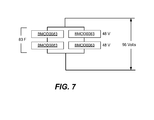
  • FIG. 7 is a schematic diagram of an ultracapacitor suitable for use in particular applications.
  • the present invention relates to systems and methods for improving the overall energy efficiency of a stationary or mobile power delivery system employing an internal combustion engine possessing one or more working chambers (e.g., cylinders) as part of a hybrid powertrain.
  • an internal combustion engine possessing one or more working chambers (e.g., cylinders) as part of a hybrid powertrain.
  • the effective displacement of an engine may be alternatingly varied between a first displacement that provides more than the requested powertrain output and a second displacement that provides less than the requested powertrain output.
  • the minimum energy storage capacity that is needed to operate the system can be determined based in significant part on how frequently the effective displacement (e.g., the number of deactivated cylinders in a variable displacement engine) can be changed without overly compromising other design goals.
  • Relatively small energy storage capacities e.g. small ultracapacitors
  • Larger energy storage capacities are necessary for use with variable displacement engine technologies in which less frequent changes to the number of deactivated cylinders is preferable.
  • step 108 the operating mode calculator determines whether the current state of charge of the energy storage system is above a predetermined threshold low state of charge (SOC low ). If cylinder deactivation is currently allowed and said current state of charge is below the threshold low state of charge (SOC low ), then the powertrain controller commands the variable displacement engine to operate with C min activated cylinders, thereby producing all of the required torque, as well as some surplus torque, which is used to drive the motor/generator 14 as a generator and thereby store electrical energy in the energy storage system which includes the battery 22 and ultracapacitor 24 . Step 209 .
  • SOC low threshold low state of charge
  • SOC Energy Storage System State of Charge
  • said thresholds would refer to the state of charge of the hydraulic accumulator.
  • changes in the displacement may be disfavored so that the effective displacement isn't changed even through variations in the requested torque unless the storage capacity exceeds an upper limit or is below a lower limit or there are significant changes in the requested torque (e.g. a net torque request change of greater than a hysteresis threshold is exceeded).
  • the capacitors or other storage devices may be sized to store more energy so that less frequent effective displacement changes are required.

Landscapes

  • Engineering & Computer Science (AREA)
  • Chemical & Material Sciences (AREA)
  • Combustion & Propulsion (AREA)
  • Transportation (AREA)
  • Mechanical Engineering (AREA)
  • Automation & Control Theory (AREA)
  • Output Control And Ontrol Of Special Type Engine (AREA)
  • Electric Propulsion And Braking For Vehicles (AREA)

Abstract

Methods and arrangements for controlling hybrid powertrains are described. In one aspect, an engine is alternatingly operated at different effective displacements. One displacement delivers less than a requested powertrain output and the other delivers more. A motor/generator system is used to add and subtract torque to/from the powertrain to cause the net delivery of the requested powertrain output. In some embodiments, energy added and subtracted from the powertrain is primarily drawn from and stored in a capacitor (e.g., a supercapacitor or an ultracapacitor) when alternating between effective displacements. In another aspect a hybrid powertrain arrangement includes an engine a motor/generator and an energy storage system that includes both a battery and a capacitor. The capacitor stores and delivers electrical energy to the motor/generator unit during operation of the engine in a variable displacement or skip fire mode.

Description

CROSS-REFERENCE TO RELATED APPLICATIONS
This application is a continuation-in-part of U.S. application Ser. No. 13/654,217 filed on Oct. 17, 2012, which claims priority of Provisional Application No. 61/548,188 filed on Oct. 17, 2011. This application also claims the priority of Provisional Application Nos. 61/560,803 filed on Nov. 17, 2011, and 61/570,277 filed on Dec. 13, 2011. Each of these prior applications is incorporated herein by reference.
BACKGROUND
The present invention relates to an apparatus for, and a method of improving the fuel economy of internal combustion engines used in hybrid vehicles and used in stationary applications.
When generating power or providing torque with an internal combustion engine for the purpose of propelling a vehicle, or for providing power for stationary applications, it is desirable to maximize energy efficiency and minimize net fuel usage.
It is well-known that the energy efficiency of an internal combustion engine is dependent on matching the engine characteristics to the intended application. Unfortunately, only a limited number of engine sizes are available which makes it difficult to choose an engine with optimal characteristics, even in the case of steady power requirements. Furthermore, many engines are employed in applications with varying loads for which the ideal engine characteristics also vary. Therefore, it is usually the case that no single conventional engine is the best choice for the full set of operating conditions to be encountered.
Known in the art for purposes of improved fuel economies are numerous “variable displacement engine” designs and strategies using “cylinder deactivation,” i.e. operating with a reduced number of active cylinders, as conditions allow. Long period, commercially available deactivation strategies in automobiles with only a subset of the cylinders capable of deactivation operate at somewhat improved fuel efficiencies but do not operate at substantially maximum fuel efficiency over most of the operating conditions to be experienced. This is because more than the minimum, fractional number of cylinders necessary to achieve the desired output at peak fuel efficiency are employed most of the time, and therefore, the active cylinders must still be purposefully de-rated or throttled to ensure the desired output.
Another known approach is often referred to as “skip fire” engine control. Skip fire engine control contemplates selectively skipping the firing of certain cylinders during selected firing opportunities. Thus, for example, a particular cylinder may be fired during one firing opportunity and then may be skipped during the next firing opportunity and then selectively skipped or fired during the next. This is contrasted with conventional variable displacement engine operation in which a fixed set of the cylinders are deactivated during certain low-load operating conditions. In general, skip fire engine control is understood to offer a number of potential advantages, including the potential of significantly improved fuel economy in many applications. Such skip fire control was described, for example by Förster (U.S. Pat. No. 4,509,488) and in a number of co-assigned patents such as Tripathi (U.S. Pat. No. 7,954,474). During skip fire operation, a cylinder may be deactivated during skipped cycles so that air is not pumped through the cylinder, which helps reduce pumping losses.
Another way to improve fuel economy in a vehicle is to employ an engine as part of a hybrid electric or hybrid hydraulic propulsion system whereby an otherwise smaller displacement engine with improved fuel economy can be used and which allows the engine to be operated by automated control systems at a narrower range of engine speeds and outputs. Hanada (U.S. Pat. No. 6,886,524) discloses a variable displacement engine combined with a hybrid powertrain configuration. Although Hanada's system can offer improve fuel efficiencies, there are continuing efforts to further improve the efficiency of hybrid powertrains.
SUMMARY
Various methods and arrangements for controlling hybrid powertrains are described. In one aspect, an engine in a hybrid powertrain is alternatingly operated at different effective displacements. One of the displacements delivers less than a requested powertrain output and energy drawn from an energy storage device is used to add torque to the powertrain to cause the net delivery of the requested powertrain output. A second displacement delivers more than the requested powertrain output and torque is subtracted from the powertrain to cause the delivery of the desired output, with the excess energy subtracted from the powertrain being stored in the energy storage device. A motor/generator unit or other suitable device may be used to add and subtract torque from the powertrain. The motor/generator unit may take the form of one or more integrated motor/generator(s) or separate motor and generator units or combinations thereof.
The engine working chambers are preferably operated in a manner that provides substantially the maximum available energy efficiency when alternating between the first and second displacements and unfired working chambers are preferably deactivated to reduce pumping losses.
In some embodiments, the energy added and subtracted from the powertrain is primarily drawn from and stored in a capacitor (e.g., a supercapacitor or an ultracapacitor) when alternating between the first and second effective displacements. In other embodiments, batteries or other suitable energy storage devices may be used for this purpose. The different effective displacements may be provided through the use of traditional variable displacement strategies (e.g., different displacements in a variable displacement engine), through the use of different firing fractions in a skip fire control strategy, or in any other suitable manner.
In some embodiments, the motor/generator unit may being arranged to facilitate regenerative braking and configured such that during regenerative braking electricity generated by the motor/generator unit is stored in at least in part in both the capacitor and a battery.
In another aspect a hybrid powertrain arrangement includes an engine and a motor/generator unit. The engine is capable of operating in a variable displacement mode or it is capable of operating in a skip fire mode. A battery and a capacitor (e.g., a supercapacitor or an ultracapacitor) are arranged such that they may be charged and discharged by the motor/generator unit, with at least the capacitor being arranged to store and deliver electrical energy to the motor/generator unit during operation of the engine in the variable displacement or skip fire mode. A controller is arranged to direct the engine and motor/generator unit to cooperatively deliver a requested output.
In various embodiments, the controller is further arranged to operate the engine in a manner that provides substantially the maximum available energy efficiency during operation in the variable displacement mode or the skip fire mode and preferably the controller is further arranged to deactivate unfired working chambers in the variable displacement mode or the skip fire mode to thereby reduce pumping losses.
In some embodiments, the controller may be arranged to alternatingly operate the engine at different effective displacements and cooperatively control the motor/generator to deliver a desired powertrain output as described above.
In still another aspect, a hybrid powertrain controller is described. The hybrid powertrain controller includes an engine controller arranged to operate an engine in a manner that delivers a plurality of different effective displacements and a motor controller that directs the operation of a motor/generator unit. The control system is arranged to direct the motor/generator to charge and discharge a capacitor in a manner that accounts for transitory variations in the torque delivered by the engine.
BRIEF DESCRIPTION OF THE DRAWINGS
FIG. 1 is a graph illustrating brake specific fuel consumption of a representative internal combustion engine.
FIG. 2A is a diagrammatic illustration of a representative hybrid powertrain operating in a manner in which a generator subtract torque from a powertrain and generates electrical energy which is stored in an energy storage system that includes a capacitor.
FIG. 2B is a diagrammatic illustration of the hybrid powertrain of FIG. 2A operating in a manner in which a motor adds torque to the powertrain and is powered by electricity drawn from the capacitor.
FIG. 3 is a flow diagram that illustrates one method of determining the number of cylinders to use in (i.e., the operating state of) a variable displacement engine.
FIG. 4 is a graph illustrating brake specific fuel consumption vs. engine speed and torque of a 4 cylinder passenger vehicle internal combustion engine with the approximate torque per cylinder in parentheses.
FIG. 5 is a graph illustrating the values of selected variable displacement engine and energy storage system parameters as a function of time while a powertrain produces a constant output torque of 78.0 N-m.
FIG. 6 is a graph illustrating the values of selected variable displacement engine and energy storage system parameters as a function of time while a hybrid vehicle goes through a range of different operating conditions.
FIG. 7 is a schematic diagram of an ultracapacitor suitable for use in particular applications.
DETAILED DESCRIPTION OF THE DRAWINGS
The present invention relates to systems and methods for improving the overall energy efficiency of a stationary or mobile power delivery system employing an internal combustion engine possessing one or more working chambers (e.g., cylinders) as part of a hybrid powertrain.
In some preferred embodiments, a single or multiple cylinder variable displacement engine is operated in conjunction with, or assisted by, another power source and sink such as an electric motor/generator and corresponding electrical storage to deliver the desired powertrain output. In this arrangement, each activated cylinder is operated under conditions that tend to facilitate substantially the best fuel economy or minimum brake specific fuel consumption for that cylinder at a given engine speed and required total combined powertrain output. In other embodiments, the cylinders may be operated under conditions that are optimized taking factors in addition to brake specific fuel consumption into account, including, for example, emission characteristics, noise vibration and harshness (NVH) concerns, etc. By employing energy storage systems and improved control methodologies, the overall efficiency of delivering power is increased compared with conventional variable displacement internal combustion engines, conventional hybrid power delivery systems, and conventional hybrid power delivery systems employing variable displacement internal combustion engines.
In some embodiments, skip fire control approaches are used to allow the engine to effectively operate at displacements that correspond to the use of a non-integer number of cylinders. By way of example, in a conventional six cylinder variable displacement engine, the engine may be able to operate using 3, 4 or 6 cylinder (corresponding to ½, ⅔ or 100% of the engine's full displacement). When skip fire control is used, a wider range of fractional displacements may effectively be obtained by simply varying the fraction of the cylinders that are fired. This allows the engine output to more closely match the desired powertrain output. In such embodiments, the sets of available firing fractions may be dictated by a wide range of different factors including NVH concerns, control strategies, etc.
Energy storage systems may utilize batteries, ultracapacitors or other storage techniques. When batteries are used, batteries having lower charging and discharging energy losses and faster charging capabilities are generally preferred. At the present time, ultracapacitors (aka supercapacitors) or hydraulic pressure storage are particularly well-suited because of their relatively small energy losses while “charging”, their fast “charging” capabilities, and long lifetimes under conditions of repetitive and numerous charge and discharge cycling.
The integration of ultracapacitors with a conventional hybrid electric power delivery system allows maximum improvement of the efficiency of a conventional hybrid electric power delivery system, the ultracapacitors being employed to alternately absorb surplus engine torque and compensate for deficit torque. Additionally, the ultracapacitors may absorb some or all regenerative braking energy.
In one described operational approach, the effective displacement of an engine may be alternatingly varied between a first displacement that provides more than the requested powertrain output and a second displacement that provides less than the requested powertrain output. In such a system, the minimum energy storage capacity that is needed to operate the system can be determined based in significant part on how frequently the effective displacement (e.g., the number of deactivated cylinders in a variable displacement engine) can be changed without overly compromising other design goals. Relatively small energy storage capacities (e.g. small ultracapacitors) can be advantageous and inexpensive when used with variable displacement engine technologies that allow frequent changes to the number of deactivated working chambers. Larger energy storage capacities are necessary for use with variable displacement engine technologies in which less frequent changes to the number of deactivated cylinders is preferable.
To better understand some of the benefits provided by the described approach reference is made to FIG. 1. The figure is a graph showing an exemplary brake specific fuel consumption (BSFC) map of a conventional passenger car internal combustion engine vs. engine load and engine speed. In this view, the engine load is in terms of brake mean effective pressure (BMEP) but could also be shown in terms of brake horsepower hour or kilowatt-hrs. The lower the BSFC value, the more efficiently the engine coverts the chemical energy of the fuel into mechanical work. The figure shows the most efficient engine operation for this particular engine is centered around 2,000 rpm and approximately 100 BMEP. The plotted points in the figure also illustrate that during normal driving, the majority of engine speeds and loads experienced are at engine loads that are associated with significantly higher BSFC values and reduced engine energy efficiency, compared with the minimum BSFC region. It should be apparent that an engine will at least theoretically have better fuel efficiency if it operates under conditions generally closer to the sweet spot where BSFC is the lowest and the engine is therefore most efficient. Hybrid drivetrain vehicles, variable displacement internal combustion engines, and the combination of hybrid drivetrain vehicles employing variable displacement internal combustion engines have all been described as having the potential for causing a greater fraction of real-world, in-use engine operation to occur closer to the region of minimum BSFC and higher energy efficiency, among other energy efficiency improvements of the overall vehicle.
FIGS. 2( a) and 2(b) schematically illustrates an exemplary hybrid electric vehicle powertrain and associated components that can be used to in conjunction with the present invention. These figures shows a parallel hybrid electric powertrain configuration however, it should be appreciated that the same concepts can be applied to other hybrid powertrains including series hybrid electric configurations, powersplit electric configurations and hydraulic hybrid configurations, although the largest improvements in fuel efficiency are expected for the parallel and series electric hybrid configurations.
FIGS. 2( a) and 2(b) show a variable displacement engine 10 applying torque to a drive shaft which is connected to a transmission 12, which in turn drives selected wheels 20 of a vehicle. A Motor/Generator 14 is also coupled to the drive shaft and is capable of either simultaneously generating electrical power (thereby effectively subtracting torque from the drive shaft) or supplementing the engine torque, depending on whether the engine is producing surplus torque or deficit torque relative to a desired powertrain torque output.
When the engine produces surplus torque as represented by FIG. 2( a), the surplus torque causes the Motor/Generator 14 to generate electricity which gets stored in the Battery 22 and/or the Ultracapacitor 24 after conditioning by the Power Electronics 26. The power electronics may include circuitry to convert the output voltage of the battery and ultracapacitor to a voltage suitable for delivering/receiving power from the motor/generator. This circuitry may include DC to DC converters to match voltages of the various electrical system components. The battery and ultracapacitor can both store and receive energy independently or in concert as determined by the power electronics. When the engine produces deficit torque as shown in FIG. 2( b), the engine torque is supplemented with torque produced by the Motor/Generator 14 using energy previously stored in the Battery 22 and/or Ultracapacitor 24. The illustrated embodiment uses an ultracapacitor in conjunction with a conventional battery pack, but in other embodiments the ultracapacitor could be used without a battery pack or a battery pack alone could be used. As will be described in more detail below, the addition of the ultracapacitor leads to a larger improvement of the overall fuel economy of the vehicle since it largely avoids the energy losses associated with charging and discharging conventional batteries which is particularly advantageous when relatively frequent storage and retrieval cycles are contemplated.
In one implementation, a control system for a variable displacement engine 10 may be arranged to calculate the lowest available engine displacement state that can deliver the desired powertrain output. If the variable displacement engine is designed to individually deactivate any number of cylinders individually, then this would correspond to the minimum number of cylinders needed to deliver the desired output assuming that the active cylinders are operated under conditions that provide the best overall fuel economy given the current operating conditions (e.g. engine speed). However, it should be appreciated that many commercially available variable displacement engines are only capable of operating in a relatively smaller subset of states—e.g., a 4/8 variable displacement engine which is an 8 cylinder engine that can only be operated in four and eight cylinder modes or a 3/4/6 variable displacement engine which is a six cylinder engine that can only be operated in three, four or six cylinder modes. In such cases, the minimum lowest available engine displacement would need to be determined based on the displacements that can actually be attained by the engine.
If the energy storage system holds less than a designated low threshold amount of energy, the control system places the engine in the lowest available engine state that can deliver the desired output. The cylinders are then operated under conditions that deliver substantially their best overall fuel economy and the controller causes any surplus energy (which typically would be expected) to flow into the storage system. This continues until the energy storage system holds more than a designated high threshold amount of energy.
When the high threshold is reached (or alternatively, if the energy storage system is initially determined to hold more than said high threshold amount of energy), the powertrain control system communicates a request to the variable displacement engine electronic control module to reduce the displacement of the engine. This can be accomplished by deactivating one or more of the currently operating cylinders, by switching to the next lower available displacement state, or in any other suitable manner—however, the cylinders that remain active continue to be operated under conditions that facilitate substantially the best overall fuel economy. This results in the engine providing less than the desired powertrain output. Accordingly, the control system simultaneously causes an energy conversion device (e.g., Motor/Generator 14) to supplement the powertrain torque. Energy to drive the energy conversion device is supplied by the energy storage system. The engine continues to operate in this manner until the low threshold is reached at which point the engine displacement is increased again to a level that can meet or exceed the requested torque and the process may be repeated again and again alternating between storage system charging and discharging states. It should be appreciated that the benefit of the described approach is that the operating cylinders can be operated at near their peak efficiency (e.g., near their minimum BSFC) while the system continues to deliver the desired powertrain output. Such an approach can provide better system fuel economy than conventional variable displacement engines and/or conventional hybrid systems.
Although steady-state operation has been described for purposes of clarity, it should be appreciated that the described approach is in no way limited to steady-state power requests. Rather, the requested output of the engine may vary widely over time, and indeed in many instances, it can and will be almost continually changing. To accommodate such changes, the hybrid powertrain controller can be arranged to repeatedly recalculate the minimum number of cylinders required to deliver the currently requested output and if a change is identified in the lowest available engine displacement state that can deliver the desired powertrain output appropriate change can be made to the engine displacement.
FIG. 3 illustrates a process suitable for use by a powertrain controller to deliver a desired torque in a Power Delivery System (PDS) that includes a variable displacement internal combustion engine and an electric motor. Generally, the process begins at step 101 when variable displacement mode operation is selected. This determination would typically be made by a powertrain controller. When variable displacement mode operation not selected, the engine 10 and motor/generator 14 are operated in a conventional hybrid operational mode. That is, when the engine is active, it is operated in a conventional, all cylinder operating mode. Alternatively, when variable displacement operation is appropriate and selected, the operating mode calculator obtains the desired torque in step 103. The desired torque is typically determined by other components of the powertrain controller system based on the vehicle driver controls (e.g. accelerator pedal position), as well as other vehicle systems. In the illustrated process, the operating mode calculator calculates the minimum number of activated cylinders (Cmin) needed to provide a torque greater than or equal to the desired torque. It also determines the torque that will be available operating at Cmin with each activated cylinder operating under conditions of best overall efficiency. Step 105. Operation at Cmin under conditions of best overall efficiency will generally cause the engine to provide excess torque by “rounding up” the number of activated cylinders.
In step 106 the operating mode calculator determines the next lower available displacement, (Cmin-1) and also determines the torque that would be available from the variable displacement engine with Cmin-1 activated cylinders, which inherently will provide a lower engine torque than the desired torque. Thus, operation at Cmin-1 will produce a deficit torque by effectively “rounding down” the number of activated cylinders.
In step 108 the operating mode calculator determines whether the current state of charge of the energy storage system is above a predetermined threshold low state of charge (SOClow). If cylinder deactivation is currently allowed and said current state of charge is below the threshold low state of charge (SOClow), then the powertrain controller commands the variable displacement engine to operate with Cmin activated cylinders, thereby producing all of the required torque, as well as some surplus torque, which is used to drive the motor/generator 14 as a generator and thereby store electrical energy in the energy storage system which includes the battery 22 and ultracapacitor 24. Step 209.
In step 111 the operating mode calculator determines if the current state of charge is equal to or above a high threshold state of charge (SOChi), then the controller commands the variable displacement engine to operate with Cmin-1 activated cylinders, thereby producing less torque than necessary (deficit torque). Step 112. Simultaneously, the powertrain controller also causes the deficit torque to be supplied by the motor/generator 14 operating as a motor.
If the state of charge is in a range between the high and low thresholds, than operation is continued at the current state (i.e., Cmin or Cmin-1 activated cylinders) as represented at step 115. It is noted that the desired torque may (and indeed often will) change during variable displacement operation. In some circumstances this will cause a change in Cmin and in others it won't. If Cmin changes, than the number of active cylinders may be changed accordingly.
The control process shown in FIG. 3 is continuously performed as long as variable displacement operation is still allowed. If at any time it is determined that variable displacement operation is no longer appropriate (step 118) the variable displacement mode is exited and normal hybrid operation with conventional all cylinder operation of the engine is resumed.
During periods of time when said cylinder deactivation is allowed, the overall effect is to cause switching back and forth between modes of producing surplus torque and adding deficit torque. When producing surplus torque, Cmin cylinders may be operated at their best overall efficiency with the surplus energy being stored in the ultracapacitor 24 (or other appropriate storage). When Cmin-1 cylinders are used, they are still operated at their best overall efficiency with the motor supplying the deficit torque.
Employing an ultracapacitor 24 connected to the motor/generator 14, but isolated from said battery 22 tends to provide the best overall efficiency operation because the round trip efficiency of storing and retrieving energy from a capacitor tends to be better than the round trip efficiency of storing and retrieving energy from a battery. Ultracapacitor sizing or capacity may be determined by how frequently changes to the number of activated cylinders is acceptable, based on the design of the activation/deactivation system, NVH concerns and other design factors.
It is noted that there are some operational conditions where the generator 14 may generate more than can be absorbed by the ultracapacitor 24. One good example of such a scenario is during regenerative braking. Thus, in some embodiments, the Power Electronics module 26 is arranged to causes regenerative braking derived electrical energy to be stored in the battery 22, once the ultracapacitor is charged to a chosen threshold.
FIG. 4 is an exemplary BSFC map for an actual 4 cylinder passenger car engine, showing the BSFC in units of grams per kilowatt-hr, vs. engine speed in rpm and engine torque in N-m from the combined 4 cylinders. Approximate engine torque values per cylinder, in N-m, are also shown in parentheses.
For illustrative purposes, if a 4 cylinder engine had variable displacement capabilities using the cylinder deactivation scheme disclosed by the present invention, allowing n cylinders to be activated (for n=0, 1, 2, 3, or 4), then said engine torque shown in parentheses would be indicative of the approximate torque output of the engine per activated cylinder. The region of minimum BSFC and best engine efficiency would occur at approximately 2500 rpm and 31.2 N-m per activated cylinder.
The control scheme shown in FIG. 3, applied to the hybrid apparatus shown in FIG. 2, seeks to cause the variable displacement engine to output the required torque on average, with each activated cylinder continuously operating close to the minimum BSFC and best cylinder fuel efficiency. Short-term energy storage and retrieval is used to “absorb” excess torque and supply deficit torque using the motor/generator as needed, while the engine remains approximately in the area of best cylinder fuel efficiency as vehicle load changes and as changes are made to the number of cylinders activated and deactivated to maintain an acceptable level of charge below an upper design limit or threshold and above a lower design limit or second threshold of the energy storage system.
FIG. 5 is a timeline illustrating the values of selected variable displacement engine and energy storage system parameters as a function of time while an powertrain is expected to deliver a constant net output. The figure illustrates how the engine brake specific fuel consumption may be reduced by approximately 9% by employing the present invention. The number of activated cylinders is caused to change by the control system shown in FIG. 3, applied to the exemplary hybrid powertrain shown in FIGS. 2( a) and 2(b). In doing so, the variable displacement engine continuously operates at close to the minimum BSFC for the full range of possible vehicle loads, up to the engine torque associated with minimum engine BSFC.
The illustrated example assumes a Torque Required (TR) from the Power Delivery System (PDS) of 78.0 N-m at a vehicle speed corresponding to an engine speed of 2000 rpm in the exemplary case of a parallel hybrid PDS (a preferred engine speed of 2500 rpm in the case of a series or power split hybrid PDS). It is also assumed, only for purposes of illustration, that the energy storage system employs a storage medium with minimum storage and retrieval losses, e.g. an ultracapacitor.
Following the process of FIG. 3, Cmin=RoundUpInteger (78.0 N-m/31.2 N-m)=RoundUpInteger (2.5)=3, and Cmin-1=3−1=2. Therefore, under the present operating conditions, and while cylinder deactivation is allowed, the control system will cause the variable displacement engine to modulate between 3 activated cylinders providing approximately 3×31.2 N-m−78.0 N-m, or 15.6 N-m of surplus torque, and 2 activated cylinders providing 78.0 N-m−(2×31.2 N-m), or 15.6 N-m of deficit torque, depending on the Energy Storage System State of Charge (SOC). When the engine is operating on 3 cylinders, producing surplus torque, the surplus torque is used to charge the energy storage device using the motor/generator as a generator until the SOChi threshold is reached. Once the SOChi threshold is reached, said engine is caused to operate on 2 activated cylinders, producing deficit torque. The deficit torque is supplemented by torque from the electric motor/generator using the stored charge in the energy storage device until the SOClow threshold is reached, upon which, the process is repeated.
For clarity, FIG. 5 illustrates operation during a period in which a constant output is desired. However, it should be appreciated that in reality, the requested powertrain output will typically vary significantly over the course of operation of a vehicle. The effects of such variation are illustrated in FIG. 6, which is a timeline showing the values of selected variable displacement engine and energy storage system parameters as a function of time while a hybrid vehicle goes through a range of different operating conditions. In this example, the engine is a six cylinder variable displacement engine. In the illustrated operating sequence, a vehicle begins at rest at time 0, with the engine off and all intake and exhaust valves closed for minimum energy losses upon turning of the engine crankshaft. The battery state of charge (SOC) is greater than zero, and the ultracapacitor 24 has a SOC=SOChi, the upper desired threshold SOC.
As the driver depresses said vehicle's accelerator pedal, said vehicle launches and accelerates using only the electric motor powered by the hybrid battery storage, as is commonly done in hybrid electric vehicles available at the present time. During this period, the battery storage decreases as shown by the SOC decline.
When the battery energy storage is below a chosen SOC threshold, or when vehicle speed is above a chosen speed threshold (time 1), the variable displacement engine is started by activating at least one (1) cylinder and supplying fuel to the activated cylinder(s). In the present example the Torque Required TR from the overall Power Delivery System, as shown in FIG. 3, is equal to a torque value greater than the engine could provide operating with two (2) activated cylinders and 4 deactivated cylinders, each deactivated cylinder having closed valves to minimize pumping losses, and each activated cylinder operating under conditions to achieve best overall Power Delivery System fuel efficiency in terms of fuel consumed per work done by the overall Power Delivery System.
The value of the Torque Required is also less than said engine is capable of providing while operating with three (3) activated cylinders and 3 deactivated cylinders, each deactivated cylinder having closed valves to minimize pumping losses, and each activated cylinder operating under conditions to achieve best overall Power Delivery System fuel efficiency.
Informally speaking, the Torque Required from the Power Delivery System lies between the torque said engine is capable of delivering with two (2) cylinders operating at peak PDS efficiency and three (3) cylinders operating at peak PDS efficiency, with the other cylinders deactivated in such a way as to create the least energy losses possible.
Referring to FIG. 3, since the ultracapacitor SOC exceeds the chosen SOChi threshold when the engine starts, the engine begins operation with Cmin-1 activated cylinders, in this case two (2) cylinders. If the ultracapacitor SOC was less than the chosen SOClow threshold, the engine would have begun operation with Cmin activated cylinders, i.e. three (3) activated cylinders.
In the case of a hybrid-electric vehicle employing the present invention without using an ultracapacitor, the SOChi and SOClow chosen thresholds would relate to the state of charge of the storage battery. The thresholds could refer to the state of charge of a segregated portion of the storage battery or could refer to the state of charge of the entire storage battery.
In the case of a hydraulic-hybrid vehicle, said thresholds would refer to the state of charge of the hydraulic accumulator.
There exists a trade-off between consuming additional fuel in creating additional surplus energy to cause the engine efficiency to be higher, and the losses associated with generating the electrical energy to be stored and the losses associated with storage and retrieval of said additional surplus energy. Use of an energy storage device with small charging and discharging losses, for storing and retrieving surplus energy associated with the scheme of FIG. 3, leads to achieving the maximum improvement in overall PDS efficiency.
Once the engine has started, each of the two (2) activated cylinders is operated under conditions of maximum PDS fuel efficiency.
Since the engine is operating on Cmin-1 activated cylinders, it is producing deficit torque, i.e. the engine torque is less than said Torque Required. Therefore, the hybrid vehicle electric motor/generator must be caused to act as a motor to supplement the engine torque so that the total Power Delivery System torque equals Torque Required. Since the hybrid electric motor is powered by the energy stored in the ultracapacitor, the ultracapacitor SOC decreases with time as its stored energy is depleted.
In the “low cruise” region of vehicle operation as shown in FIG. 6, the vehicle speed is steady on level ground and the Torque Required is constant. When the ultracapacitor SOC drops below the SOClow threshold (time 2), the control system causes the variable displacement engine to operate with Cmin=3 activated cylinders and three (3) deactivated cylinders, as determined by the logic shown in FIG. 3. Each activated cylinder is caused to operate at the conditions associated with best overall PDS fuel economy.
The engine operation continues with three (3) activated and three (3) deactivated cylinders which produces surplus torque. The control system causes the motor/generator to act as a generator and produce surplus electrical energy using the surplus torque. The surplus energy is stored in the ultracapacitor. The process continues indefinitely with alternating periods of surplus torque followed by deficit torque and the associated storage of energy in the ultracapacitor followed by retrieval of the stored energy.
A mild or low acceleration (time 3) following the cruise conditions results in a higher value of Torque Required. In the present example, the increased Torque Required value is still satisfied by alternating between the same Cmin=3 activated cylinders and Cmin-1=2 activated cylinders. But the engine now operates on Cmin=3 activated cylinders a higher percentage of time compared to its operation on Cmin-1=2 activated cylinders because the average engine torque output needs to be higher.
Under the increased loading conditions associated with the “low accel” region of FIG. 6 described above, when operating with three (3) activated cylinders, the surplus torque is less than the surplus torque under the preceding “low cruise” region of said figure. For this reason there is less available torque to drive the generator and create electrical energy for storage in the ultracapacitor. The ultracapacitor charging rate is therefore lower, as shown.
Upon the ultracapacitor state of charge reaching SOChi (time 4), the control system causes said engine to continue running with Cmin-1=2 activated cylinders. The deficit torque is greater than the deficit torque experienced under the preceding “low cruise” region of FIG. 6. For this reason more torque is required from the electric motor, thereby discharging the ultracapacitor at a greater rate compared with the discharge rate while in the “low cruise” region.
As shown in the “high accel” region of FIG. 6, higher acceleration rates require an increase in Cmin. In the present example, fewer than Cmin=6 activated cylinders cannot supply “at least” the necessary torque, or Torque Required.
The “high accel” region shown in FIG. 6 is indicative of an increase in acceleration compared with the “low accel” region also shown in the figure. In this particular example, the surplus torque available to drive the generator and charge the ultracapacitor is large, with a correspondingly small amount of deficit torque experienced when operating with Cmin-1=5 activated cylinders. For this reason, the ultracapacitor charges quickly and discharges slowly in this region of vehicle operation. The amount of time the engine operates on 6 activated cylinders is small compared with the operating time on 5 activated cylinders.
After the vehicle reaches the “high cruise,” steady-speed, level road region shown in FIG. 6, the Torque Required is lower than the preceding “high accel” region. For this region, Cmin=5 and Cmin-1=4. The control system causes the variable displacement engine to alternate between 5 activated cylinders and 4 activated cylinders, the remaining cylinders deactivated, with corresponding rates of charging and discharging the ultracapacitor as shown. All activated cylinders operate under conditions of maximum overall PDS fuel efficiency and all deactivated cylinders operate with closed valves to result in the smallest energy losses possible.
Decelerating the vehicle with a release of accelerator pedal pressure causes the engine to turn off by stopping the fuel supply to all cylinders, and causes all intake and exhaust valves to close to minimize pumping energy losses.
The control system causes the motor/generator to act as a generator to facilitate regeneration, i.e. to convert kinetic energy of the vehicle into electrical energy and to store said electrical energy, as is commonly done in hybrid-electric vehicles.
The ultracapacitor is charged to SOChi before any energy is stored in the battery since battery storage and retrieval has higher energy losses compared with the ultracapacitor. The remaining regeneration energy is subsequently stored in the hybrid-electric battery in the normal manner for a hybrid-electric vehicle with regenerative braking, i.e. as chemical energy.
Following the “decel with regeneration” mode, the vehicle comes to a stop. At this point the engine is off, the ultracapacitor is fully charged, and the battery is at least partially charged.
The variable displacement, internal combustion engine used with the present invention can be designed in such a way that all of the operation described above not only occurs at the best overall PDS energy efficiency for each engine speed experienced, but also occurs with no intake air throttling, i.e. at the equivalent of Wide Open Throttle (WOT), and therefore without the need of a throttle valve or engine idle air controller. In other words, the power modulation scheme described above can be used to control the engine torque without the use of intake air throttling (as is normally the case in a conventional diesel engine) and its associated energy losses, with minimal other pumping losses by closing the intake and exhaust valves on deactivated cylinders, and with activated cylinders operating in such a way as to maximize the overall energy efficiency of the PDS.
The engine design can then be optimized for continuous operation at peak energy efficiency (near minimum BSFC), thereby further reducing BSFC or improving fuel economy.
For a given engine design and associated BSFC map, e.g. the one shown in FIG. 4, if the absence of a throttle valve (i.e. WOT operation) is associated with lower PDS efficiency than would be obtained with some throttling, exhaust gas recirculation (EGR) can be used to reduce the activated cylinder torque outputs to the values associated with highest PDS efficiency. In this way all the benefits of removing the throttle valve are achieved (lower cost and higher efficiency), while also achieving highest PDS efficiency.
Removing the throttle valve results in improved fuel efficiency by eliminating throttling losses. The throttle body, housing the throttle valve, and the motor to control the throttle valve in “by-wire” systems can also be eliminated, resulting in additional manufacturing cost savings.
Since each activated cylinder is running under nearly identical conditions whenever, and for as long as it is activated, the exhaust gas emissions control system can be simplified, leading to additional overall vehicle cost savings. Large changes in instantaneous engine load, which can lead to high exhaust emissions in a conventional vehicle, are only experienced when the number of activated cylinders changes, and those events are known to said engine control system in advance, since said control system is determining how many, and which cylinders will be activated. The engine control system can be calibrated to minimize the resulting emissions due to the periodic, nearly identical, and known load changes over time.
The steady-load operating percentage of time is greatly increased by employing the present invention, thereby offering advantageous operation from an emissions control perspective, compared to both a conventional vehicular engine and a conventional hybrid engine.
Application to a commercially available hybrid electric vehicle will exemplify construction of the present invention. Consider a parallel hybrid-electric vehicle with, but not limited to, the following attributes:
4 cylinder, 4 stroke, gasoline-fueled, internal combustion engine;
Deactivation of all cylinders by closing all intake and exhaust valves capable;
Combined engine/motor peak power=110 hp (82.5 kW);
Electric Motor Power=23 hp (17.2 kW);
Peak Engine Power=87 hp (65.3 kW);
Peak Engine Power per Cylinder=65.3 kW/4 cyl.=16.3 kW/cyl;
Minimum Electric Motor Power Needed=Peak Engine Power per Cylinder=16.3 kW;
Therefore, the 23 hp (>16.3 hp) motor is sufficient for applying the present invention;
Replace intake and exhaust valve operating mechanisms and associated valve control system with individually activated/deactivated valve, valve control system known in the art to result in a variable displacement engine operating on 0, 1, 2, 3, or 4 activated cylinders, with the remaining cylinders deactivated;
Dampen introduced vibrations employing methods known in the art;
Peak surplus power=peak engine power per cyl×1 cyl=16.3 kW;
Peak deficit power=peak surplus power=16.3 kW;
Average Surplus Engine Power=16.3 kW/cyl×½ cyl=8.15 kW (½ of a single cylinder equivalent);
Average Deficit Engine Power=Average Surplus Engine Power=8.15 kW;
For purposes of illustration, determine ultracapacitor size C required to ensure charging time is never less than minimum (min.) allowable time=10 sec, and discharging time is never less than min. allowable time=10 s to define the highest frequency of the cylinder activation/deactivation process to ensure compatibility with activation/deactivation mechanisms known in the art. Assuming no losses for simplicity, the estimated energy Emin needing to be stored for each cylinder activation/deactivation cycle while operating under peak surplus torque conditions is:
Emin=Peak Surplus Power×min. allowable time, or
Emin=16.3 kW×10 s=163 kJ;
For an ultracapacitor of capacitance C, with a potential difference (voltage) of V, the stored energy E is given by: E=½ CV^2;
To meet the stored energy requirements different combinations of capacitance and voltage may be used. Readily available and known capacitors can be configured to provide this level of operating voltage and capacitance. For example, 4 Model #BMOD00083 ultracapacitors available from Maxwell Technologies Inc. of San Diego, Calif. may be used. Each individual capacitor has a capacitance of 83 Farads and a maximum voltage of 48 Volts. Arranging the four capacitors in a network of two serial and two parallel capacitors as shown in FIG. 7 yields a net total capacitance of 83 F and maximum voltage of 96 V. This combination is capable of storing significantly more than the calculated required energy, 383 kJ compared to the required 163 kJ. This excess provides margin to account for the inevitable system losses. It also ensures that the capacitor network is sufficiently sized to avoid overheating from the continual charging and discharging of the capacitor. Use of the Model #BMOD0083 capacitors is for exemplary purposes only, as there are additional benefits to using an ultracapacitor optimized for the particular vehicle employing the current invention.
In the example given above, the capacitor is sized to permit charge and discharge cycles to extend for a minimum of 10 seconds each. It should be appreciated that these are just examples and that shorter or longer minimum charge/discharge periods may be desirable. An advantage of shorter periods is that smaller ultracapacitors may be used which can help reduce overall system costs. An advantage of longer periods is that fewer displacement/firing fraction changes would be required which can help reduce NVH concerns.
One advantage of using the energy storage/retrieval system described here is that the power profile delivered/received from the energy storage can be controlled. FIGS. 5 and 6 show power profiles from the energy storage which are different than the power profile of an operating cylinder. An operating cylinder produces power only on the power stroke, which is at most a quarter of the time for a four cycle engine. The power profile from the energy storage unit may match this profile or it may be different. An advantageous profile is one where the power profile is smooth, with little or any structure associated with the cylinder firings and skipping. This type of profile will minimize the energy being delivered/received into/from the energy storage. It also will minimize the current required to store that energy. Both these factors improve the overall energy efficiency of the PDS.
In the embodiments described above, a conventional variable displacement engine is used and different effective displacements are achieved by deactivating one or more specific cylinders. However, in other embodiments, other mechanisms may be used to vary the effective displacement of an engine. One such approach is skip fire control. In many skip fire control approaches a set of firing fractions are available to the skip fire controller. In practice, each different firing fraction will correspond to a different effective displacement. Therefore, like in the variable displacement engine example, operating the fired cylinders under conditions that would provide the most efficient BSFC will typically cause the engine output to be mismatched with the requested powertrain output. Thus, the same alternating energy storage and retrieval approach can be used to help optimize efficiency in a skip fire control scheme which has a finite set of available firing fractions.
Although only a few embodiments have been described in detail, it should be appreciated that the invention may be implemented in many other forms without departing from the invention. For example, the primary described embodiment contemplates alternating between the lowest available effective engine displacement state that can deliver the desired powertrain output and the next smaller available effective displacement in order to minimize the amount of energy that must to stored and retrieved during operation. However, in some circumstances it may be desirable to utilize wider displacement swings. For example, in some specific instances such approaches may be desirable to help address NVH issues, to accommodate charging or discharging an energy storage device, to provide improved responsiveness in certain operational conditions or for other specific reasons.
In some applications changes in the displacement may be disfavored so that the effective displacement isn't changed even through variations in the requested torque unless the storage capacity exceeds an upper limit or is below a lower limit or there are significant changes in the requested torque (e.g. a net torque request change of greater than a hysteresis threshold is exceeded). In such applications the capacitors (or other storage devices) may be sized to store more energy so that less frequent effective displacement changes are required.
In the description above, frequent reference is made to a motor/generator 14. It should be appreciated that the motor/generator may be implemented as a single integrated unit that can reversibly run as a motor and a generator or as separate motor and generator components. Furthermore, either the motor or the generator may be implemented as multiple discrete devices and/or any combination of discrete and integrated devices may be used (e.g. 2 or more motors may be used and/or 2 or more generators may be used and/or an integrated motor/generator may be used in combination with a second dedicated motor, etc.).
Many hybrid powertrains are arranged to facilitate regenerative braking. As will be appreciated by those familiar with the art, regenerative braking can generate a significant amount of electrical energy and in many instances, the amount of electrical energy generated during regenerative braking will exceed the available storage capacity of the ultracapacitor. Thus, in some embodiments that utilize both ultracapacitor and battery storage, it may be desirable to direct all of the regenerative braking energy to the battery. In other embodiments, it may be desirable to direct some of the regenerative braking energy to the ultracapacitor and some to the battery. For example, in some specific implementations, regenerative energy may first be directed to the ultracapacitor until the ultracapacitor is full or reaches a designated threshold and then any additional regenerative energy may be directed to the battery.
In some of the described embodiments various thresholds such as the SOChi and SOClow thresholds are used in making decisions regarding when to switch operating modes. Such thresholds may be fixed points or they may be variables which can change based on any factors that the controller designer deems appropriate. By way of example, in some implementations, it may be desirable vary the SOC thresholds based on operating parameters such as engine firing fraction or transmission gear, or characteristics of the energy storage system such as capacitor temperature, charge/discharge cycle times or any other relevant factor or factors.
In embodiments that utilize ultracapacitors as part of the electrical storage system, it may sometimes be desirable to include a capacitor cooling system—as may be accomplished, for example, by providing a fan to help cool the capacitor.
In view of the foregoing, it should be apparent that the present embodiments should be considered illustrative and not restrictive and the invention is not to be limited to the details given herein, but may be modified within the scope of the appended claims.

Claims (36)

What is claimed is:
1. A method of controlling a hybrid powertrain to deliver a requested powertrain output, the method comprising alternatingly:
operating an internal combustion engine in one or more first effective displacement modes that deliver less torque to the powertrain than the requested powertrain output and controlling at least one motor to add torque to the powertrain to cause the delivery of the requested powertrain output wherein electrical energy used to drive the at least one motor during addition of torque to the powertrain is drawn from an electrical energy storage device; and
operating the engine in one or more second effective displacement modes that have a larger effective displacement than the one or more first effective displacement modes and that deliver more than the requested powertrain output and controlling at least one generator to subtract torque from the powertrain to cause the delivery of the requested powertrain output, wherein electrical energy generated by the at least one generator during subtraction of torque from the powertrain is stored in the electrical energy storage device; and
wherein active working chambers in the engine are fired under substantially the same operating conditions in the first and second effective displacement modes and the motor and generator take the form of at least one selected from the group consisting of an integrated motor/generator and separate units.
2. A method as recited in claim 1 wherein:
the electrical energy storage device includes a capacitor and energy added and subtracted from the powertrain is primarily drawn from and stored in the capacitor when alternating between the first and second effective displacement modes; and
the engine is one of (a) a variable displacement engine in which the first and second effective displacement modes correspond to different numbers of active cylinders, and (b) arranged to be operated in a skip fire mode in which the first and second effective displacement modes correspond to different firing fractions.
3. A method as recited in claim 2 wherein during regenerative braking electricity generated by the at least one generator is stored at least in part in both the capacitor and a battery.
4. A method as recited in claim 1 wherein:
the engine working chambers that are fired in the first and second displacement modes are operated in a manner that provide substantially the maximum available energy efficiency; and
any unfired working chambers are deactivated to thereby reduce pumping losses.
5. A method as recited in claim 1 wherein the effective displacements utilized in the first and second effective displacement modes may vary over time.
6. A method as recited in claim 1 wherein the engine transitions directly between the first and second effective displacement modes.
7. A method as recited in claim 1 wherein the engine is a variable displacement engine and the first and second effective displacement modes utilize different numbers of active cylinders and the specific number of active cylinders utilized in the first and second effective displacement modes may vary over time.
8. A method as recited in claim 1 wherein the engine is operated in a skip fire mode and the different first and second effective displacement modes utilize different firing fractions and the specific firing fractions utilized in the first and second effective displacement modes may vary over time.
9. A method as recited claim 1 wherein the energy added and subtracted from the powertrain is primarily drawn from and stored in a capacitor when alternating between the first and second effective displacement modes.
10. A method as recited in claim 9 wherein a motor/generator unit is used to add and subtract energy from the powertrain, the motor/generator being arranged to facilitate regenerative braking, wherein during regenerative braking electricity generated by the motor/generator unit is stored in at least in part in both the capacitor and a battery.
11. A method of controlling a hybrid powertrain to deliver a requested powertrain output, the method comprising alternatingly:
operating an engine in a first effective displacement mode that delivers less torque to the powertrain than the requested powertrain output and controllably utilizing energy drawn from an energy storage device to add torque to the powertrain to cause the net delivery of the requested powertrain output; and
operating the engine in a second effective displacement mode that has a different displacement than the first effective displacement mode and that delivers more than the requested powertrain output and controllably subtracting torque from the powertrain to cause the delivery of the requested powertrain output, wherein excess energy subtracted from the powertrain is stored in the energy storage device, and
whereby the engine alternatingly transition back and forth between the first and second effective displacement modes such that the engine alternatingly supplies less torque and more torque than the requested powertrain output.
12. A method as recited in claim 11 wherein the energy added and subtracted from the powertrain is primarily drawn from and stored in a capacitor when alternating between the first and second effective displacement modes.
13. A method as recited in claim 12 wherein a motor/generator unit is used to add and subtract energy from the powertrain, the motor/generator being arranged to facilitate regenerative braking, wherein during regenerative braking electricity generated by the motor/generator unit is stored in at least in part in both the capacitor and a battery.
14. A method as recited in claim 11 wherein the engine working chambers that are fired in the first and second effective displacement modes are operated in a manner that provides substantially the maximum available energy efficiency.
15. A method as recited in claim 11 wherein the engine is a variable displacement engine and the first and second effective displacement modes utilize different numbers of active cylinders and the specific number of cylinders utilized in the first and second effective displacement modes may vary over time.
16. A method as recited in claim 11 wherein the engine is operated in a skip fire mode and the different first and second effective displacement modes utilize different firing fractions and the specific firing fractions utilized in the first and second effective displacement modes may vary over time.
17. A method as recited in claim 11 wherein unfired working chambers are deactivated to thereby reduce pumping losses.
18. A method as recited in claim 11 wherein active working chambers in the engine are operated under substantially the same conditions in the first and second effective displacement modes.
19. A method as recited in claim 11 wherein unfired working chambers are deactivated to thereby reduce pumping losses.
20. An arrangement comprising:
an engine capable of applying torque to a powertrain, wherein the engine is arranged to operate in at least one of a variable displacement mode and a skip fire mode;
an electric motor/generator unit arranged to add torque to and subtract torque from the powertrain during operation of the engine in the variable displacement mode or the skip fire mode;
a battery arranged to store electrical energy, the battery being coupled to the electric motor/generator unit such that the battery may be charged and discharged by the motor/generator unit;
a capacitor arranged to store electrical energy, the capacitor being arranged in a manner that facilitates the storage of electrical energy generated by the motor/generator unit and the delivery of electrical energy to the motor/generator unit during operation of the engine in the variable displacement or the skip fire mode to facilitate adding torque to and subtracting torque from the powertrain; and
a controller arranged to direct the engine and motor/generator unit to cooperatively deliver a requested output.
21. An arrangement as recited in claim 20 wherein the controller is further arranged to operate the engine in a manner that provides substantially the maximum available energy efficiency during operation in the variable displacement mode or the skip fire mode.
22. An arrangement as recited in claim 20 wherein the controller is further arranged to deactivate unfired working chambers in the variable displacement mode or the skip fire mode to thereby reduce pumping losses.
23. An arrangement as recited in claim 20 wherein the controller is further arranged to alternatingly:
operate the engine at a first effective displacement that delivers less torque to the powertrain than the requested output and operate the electric motor/generator to add torque to the powertrain to cause the net delivery of the requested powertrain output, during which the electric motor/generator draws electrical energy from at least one of the capacitor and the battery; and
operate the engine at a second effective displacement that is different than the first effective displacement and that delivers more torque to the powertrain than the requested output and operate the electric motor/generator to subtract torque from the powertrain to cause the delivery of the requested powertrain output, during which the electric motor/generator provides electrical energy to at least one of the capacitor and the battery wherein excess energy subtracted from the powertrain is stored in at least one of the capacitor and the battery.
24. An arrangement as recited in claim 23 wherein the engine is a variable displacement engine and the first and second effective displacements utilize different numbers of active cylinders and the specific number of cylinders utilized in the first and second effective displacement modes may vary over time.
25. An arrangement as recited in claim 23 wherein the engine is operated in a skip fire mode and the different first and second effective displacement utilize different firing fractions and the specific firing fractions utilized in the first and second effective displacement modes may vary over time.
26. An arrangement as recited in any claim 20 wherein the controller is further arranged to deactivate unfired working chambers during operation in a variable displacement mode or a skip fire mode to thereby reduce pumping losses.
27. An arrangement as recited in claim 20 wherein the controller is further arranged to alternatingly:
operate the engine at a first effective displacement that delivers less torque to the powertrain than the requested output and operate the electric motor/generator to add torque to the powertrain to cause the net delivery of the requested powertrain output, during which the electric motor/generator draws electrical energy from at least one of the capacitor and the battery; and
operate the engine at a second effective displacement that is different than the first effective displacement and that delivers more torque to the powertrain than the requested output and operate the electric motor/generator to subtract torque from the powertrain to cause the delivery of the requested powertrain output, during which the electric motor/generator provides electrical energy to at least one of the capacitor and the battery wherein excess energy subtracted from the powertrain is stored in at least one of the capacitor and the battery.
28. An arrangement as recited in claim 27 wherein the engine is a variable displacement engine and the first and second effective displacements are different engine displacements.
29. An arrangement as recited in claim 27 wherein the engine is operated in a skip fire mode and the different first and second effective displacement utilize different firing fractions.
30. A hybrid powertrain controller suitable for use in a vehicle having an engine that drives a powertrain, at least one motor/generator unit arranged to add torque to and subtract torque from the powertrain and a capacitor arranged to store electrical energy, the hybrid powertrain controller comprising:
an engine controller arranged to operate an engine in a manner that delivers a plurality of different effective displacements;
a motor controller arranged to direct the operation of at least one motor/generator unit; and
wherein the engine controller and motor controller are arranged to operate the engine and the motor/generator unit in a manner that delivers a requested powertrain output; and
the engine controller and motor controller are further arranged to be capable of causing the engine to alternatingly (i) operate the engine in a first effective displacement mode that delivers less torque to the powertrain than the requested powertrain output while operating the motor/generator unit as a motor to add torque to the powertrain using energy stored in the capacitor to cause the net delivery of the requested powertrain output, and (ii) operate the engine in a second effective displacement mode that has a different displacement than the first effective displacement mode and that delivers more than the requested powertrain output while operating the motor/generator unit as a generator to subtract torque from the powertrain to cause the net delivery of the requested powertrain output, wherein electricity generated by the generator is used to charge the capacitor during operation of the engine in the second effective displacement mode.
31. A hybrid powertrain controller as recited in claim 30 further arranged to:
operate the engine in a manner that provides substantially the maximum available energy efficiency during operation in the plurality of different effective displacements; and
deactivate unfired working chambers during operation in the plurality of different effective displacements to thereby reduce pumping losses.
32. A hybrid vehicle powertrain comprising a motor, a generator, an engine capable of operating with at least one deactivated cylinder, an energy storage device, and a controller capable of directing operation of the powertrain in a manner in which activated cylinders of the engine are operated at substantially at their maximum energy efficiency during which time:
(i) said engine sometimes operates, at a reduced output that is lower than the required total powertrain output by deactivating at least one cylinder, when said energy storage device's stored energy is sufficient to cause said motor to compensate for the difference between said required output and said reduced output; and
(ii) said engine sometimes operates at an increased output exceeding the required total powertrain output when said energy storage device possesses enough available storage capacity to store the difference between said required output and any surplus output exceeding said required output.
33. A hybrid vehicle powertrain as recited in claim 32, wherein the energy storage device is a battery.
34. A hybrid vehicle powertrain as recited in claim 32, wherein the energy storage device is an ultracapacitor.
35. A hybrid vehicle powertrain as recited in claim 32, wherein the energy storage device is comprised of both a battery and an ultracapacitor.
36. A hybrid vehicle powertrain as recited in claim 35, wherein the ultra capacitor is partitioned from the battery.
US13/681,378 2011-10-17 2012-11-19 Hybrid powertrain control Active 2033-05-28 US8880258B2 (en)

Priority Applications (1)

Application Number Priority Date Filing Date Title
US13/681,378 US8880258B2 (en) 2011-10-17 2012-11-19 Hybrid powertrain control

Applications Claiming Priority (5)

Application Number Priority Date Filing Date Title
US201161548188P 2011-10-17 2011-10-17
US201161560803P 2011-11-17 2011-11-17
US201161570277P 2011-12-13 2011-12-13
US13/654,217 US8892330B2 (en) 2011-10-17 2012-10-17 Hybrid vehicle with cylinder deactivation
US13/681,378 US8880258B2 (en) 2011-10-17 2012-11-19 Hybrid powertrain control

Related Parent Applications (1)

Application Number Title Priority Date Filing Date
US13/654,217 Continuation-In-Part US8892330B2 (en) 2008-07-11 2012-10-17 Hybrid vehicle with cylinder deactivation

Publications (2)

Publication Number Publication Date
US20130096759A1 US20130096759A1 (en) 2013-04-18
US8880258B2 true US8880258B2 (en) 2014-11-04

Family

ID=48086536

Family Applications (1)

Application Number Title Priority Date Filing Date
US13/681,378 Active 2033-05-28 US8880258B2 (en) 2011-10-17 2012-11-19 Hybrid powertrain control

Country Status (1)

Country Link
US (1) US8880258B2 (en)

Cited By (14)

* Cited by examiner, † Cited by third party
Publication number Priority date Publication date Assignee Title
US20150142229A1 (en) * 2013-11-21 2015-05-21 Cummins Inc. Hybrid controls architecture
US20150267674A1 (en) * 2008-07-11 2015-09-24 Tula Technology, Inc. Internal combustion engine control for improved fuel efficiency
US9660558B2 (en) * 2014-10-08 2017-05-23 Hyundai Motor Company System and method for controlling regenerative braking of electric vehicle
US10060368B2 (en) 2015-01-12 2018-08-28 Tula Technology, Inc. Engine torque smoothing
US10196995B2 (en) 2015-01-12 2019-02-05 Tula Technology, Inc. Engine torque smoothing
DE112017002792T5 (en) 2016-06-02 2019-02-28 Fca Us Llc Torque estimation in engine control
US10221786B2 (en) 2015-01-12 2019-03-05 Tula Technology, Inc. Noise, vibration and harshness reduction in a skip fire engine control system
US10344692B2 (en) 2015-01-12 2019-07-09 Tula Technology, Inc. Adaptive torque mitigation by micro-hybrid system
US10358990B2 (en) 2016-06-28 2019-07-23 Eaton Intelligent Power Limited Strategies for resonance management
US10443518B2 (en) 2017-07-20 2019-10-15 Fca Us Llc Optimal firing patterns for cylinder deactivation control with limited deactivation mechanisms
US10578037B2 (en) 2015-01-12 2020-03-03 Tula Technology, Inc. Adaptive torque mitigation by micro-hybrid system
US10780772B2 (en) * 2018-10-23 2020-09-22 Ge Global Sourcing Llc Vehicle engine assist system
US10954877B2 (en) 2017-03-13 2021-03-23 Tula Technology, Inc. Adaptive torque mitigation by micro-hybrid system
US11555461B2 (en) 2020-10-20 2023-01-17 Tula Technology, Inc. Noise, vibration and harshness reduction in a skip fire engine control system

Families Citing this family (37)

* Cited by examiner, † Cited by third party
Publication number Priority date Publication date Assignee Title
US9043065B2 (en) * 2010-12-23 2015-05-26 Siemens S.A.S. Method of adjusting the electrical supply voltage for the operation of at least one electrically powered vehicle
JP5580914B1 (en) * 2013-03-22 2014-08-27 トヨタ自動車株式会社 Power control device
US10449864B2 (en) * 2014-04-15 2019-10-22 Borgwarner Inc. Motor/energy generator and energy storage device combination
US9725082B2 (en) 2014-06-19 2017-08-08 Tula Technology, Inc. Implementing skip fire with start/stop feature
US9403523B2 (en) 2014-08-13 2016-08-02 Ford Global Technologies, Llc Methods and systems for adjusting hybrid vehicle efficiency
WO2016180581A1 (en) * 2015-05-14 2016-11-17 Robert Bosch Gmbh An electric drive and assist assembly
US10035511B2 (en) * 2015-07-27 2018-07-31 Cummins Inc. Method and system for controlling operation of an engine powered device having cyclical duty cycles
US20170030257A1 (en) * 2015-07-30 2017-02-02 GM Global Technology Operations LLC Enhancing cylinder deactivation by electrically driven compressor
DE102016117304B4 (en) * 2015-09-17 2022-09-08 Hyundai Motor Company Non-uniform displacement internal combustion engine control system and method with a transient state control mode
US10202111B2 (en) * 2015-09-17 2019-02-12 Hyundai Motor Company Non-uniform displacement engine control system employing cylinder deactivation and method for controlling non-uniform displacement engine control system employing cylinder deactivation
KR101714223B1 (en) * 2015-09-17 2017-03-08 현대자동차주식회사 Non-uniform displacement engine control system assisted by motor and method for the same
DE102016117300B4 (en) 2015-09-17 2024-06-13 Hyundai Motor Company Uneven displacement internal combustion engine control system with different control modes based on a state of charge of a battery and method for controlling an uneven displacement internal combustion engine with different control modes based on a state of charge of a battery
DE102016117299A1 (en) * 2015-09-17 2017-03-23 Hyundai Motor Company A user interface device of a nonuniform displacement internal combustion engine control system and control method of the user interface device of the nonuniform displacement internal combustion engine control system
GB2548108B (en) * 2016-03-07 2018-07-18 Ford Global Tech Llc Method of controlling a vehicle
US9983583B2 (en) * 2016-08-11 2018-05-29 Tula Technology, Inc. Autonomous driving with dynamic skip fire
WO2018085538A1 (en) * 2016-11-02 2018-05-11 Dana Limited Method for control of a ball planetary type continuously variable transmission to extend cylinder cutoff time
JP6521491B1 (en) * 2017-12-01 2019-05-29 マツダ株式会社 Vehicle control device
JP2021508643A (en) 2018-02-09 2021-03-11 エーアイキュー ハイブリッド ピーティーワイ リミテッド Hybrid powertrain
US10883566B2 (en) 2018-05-09 2021-01-05 Paccar Inc Systems and methods for reducing noise, vibration and/or harshness associated with cylinder deactivation in internal combustion engines
US10730505B2 (en) * 2018-05-09 2020-08-04 Karma Automotive Llc Hybrid electric vehicle using intelligent vehicle controller
JP7254270B2 (en) * 2019-06-03 2023-04-10 マツダ株式会社 vehicle drive
US11432123B2 (en) 2019-06-07 2022-08-30 Anthony Macaluso Systems and methods for managing a vehicle's energy via a wireless network
US11615923B2 (en) 2019-06-07 2023-03-28 Anthony Macaluso Methods, systems and apparatus for powering a vehicle
US11289974B2 (en) 2019-06-07 2022-03-29 Anthony Macaluso Power generation from vehicle wheel rotation
US11133729B2 (en) * 2019-06-07 2021-09-28 Anthony Macaluso Methods and apparatus for providing electricity to a vehicle
US11837411B2 (en) 2021-03-22 2023-12-05 Anthony Macaluso Hypercapacitor switch for controlling energy flow between energy storage devices
US11222750B1 (en) 2021-03-22 2022-01-11 Anthony Macaluso Hypercapacitor apparatus for storing and providing energy
US11641572B2 (en) 2019-06-07 2023-05-02 Anthony Macaluso Systems and methods for managing a vehicle's energy via a wireless network
US11685276B2 (en) 2019-06-07 2023-06-27 Anthony Macaluso Methods and apparatus for powering a vehicle
WO2021046604A1 (en) * 2019-09-09 2021-03-18 AIQ Hybrid Pty Ltd Managing capacitive charge storage or delivery for a hybrid power system
US20220307434A1 (en) * 2021-03-26 2022-09-29 Tula Technology, Inc. Deceleration management for dynamic skip fire
US11472306B1 (en) 2022-03-09 2022-10-18 Anthony Macaluso Electric vehicle charging station
US11577606B1 (en) 2022-03-09 2023-02-14 Anthony Macaluso Flexible arm generator
US12160132B2 (en) 2023-01-30 2024-12-03 Anthony Macaluso Matable energy storage devices
US12407219B2 (en) 2023-02-28 2025-09-02 Anthony Macaluso Vehicle energy generation system
US11955875B1 (en) 2023-02-28 2024-04-09 Anthony Macaluso Vehicle energy generation system
US12412430B2 (en) 2023-12-22 2025-09-09 Anthony Macaluso Systems and methods for managing a vehicle's energy via a wireless network

Citations (72)

* Cited by examiner, † Cited by third party
Publication number Priority date Publication date Assignee Title
US4434767A (en) 1980-12-24 1984-03-06 Nippon Soken, Inc. Output control system for multicylinder internal combustion engine
US4489695A (en) 1981-02-04 1984-12-25 Nippon Soken, Inc. Method and system for output control of internal combustion engine
US4509488A (en) 1981-07-23 1985-04-09 Daimler-Benz Aktiengesellschaft Process and apparatus for intermittent control of a cyclically operating internal combustion engine
US5377631A (en) 1993-09-20 1995-01-03 Ford Motor Company Skip-cycle strategies for four cycle engine
US5806617A (en) 1995-04-20 1998-09-15 Kabushikikaisha Equos Research Hybrid vehicle
US5975052A (en) 1998-01-26 1999-11-02 Moyer; David F. Fuel efficient valve control
US6006157A (en) 1999-05-03 1999-12-21 Ford Global Technologies, Inc. Real-time engine misfire detection method
US6158411A (en) 1995-06-22 2000-12-12 Fuji Jukogyo Kabushiki Kaisha Control system for two cycle direct injection engine and the method thereof
US6364807B1 (en) 2000-06-30 2002-04-02 Ford Global Technologies, Inc. Control strategy for a hybrid powertrain for an automotive vehicle
US20020170527A1 (en) * 2001-05-18 2002-11-21 Rayl Allen B. Method and apparatus for control of a variable displacement engine for fuel economy and performance
US6487998B1 (en) 1995-08-31 2002-12-03 Isad Electronic Systems Gmbh & Co., Kg Drive system, particularly for a motor vehicle, and process for operating it
US6494087B2 (en) 1997-04-04 2002-12-17 Honda Giken Kogyo Kabushiki Kaisha Misfire state discrimination system of internal combustion engine
US6619258B2 (en) 2002-01-15 2003-09-16 Delphi Technologies, Inc. System for controllably disabling cylinders in an internal combustion engine
US6692404B2 (en) 2001-08-29 2004-02-17 Honda Giken Kogyo Kabushiki Kaisha Engine control system and method for hybrid vehicle
US6691807B1 (en) 2000-04-11 2004-02-17 Ford Global Technologies Llc Hybrid electric vehicle with variable displacement engine
JP2004068759A (en) 2002-08-08 2004-03-04 Honda Motor Co Ltd Control device for hybrid vehicle
US6718937B2 (en) 2001-06-14 2004-04-13 Hyundai Motor Company System and method for performing partial cylinder cut-off of internal combustion engine
WO2005073004A1 (en) 2004-01-28 2005-08-11 General Motors Corporation Method of compensating torque at cylinder switching on a dod engine with electric parallel hybrid
US6943460B2 (en) 2002-07-16 2005-09-13 Honda Giken Kogyo Kabushiki Kaisha Control device for hybrid vehicle
US7021409B2 (en) 2000-10-11 2006-04-04 Ford Global Technologies, Llc Control system for a hybrid electric vehicle to anticipate the need for a mode change
US20060086546A1 (en) 2002-02-08 2006-04-27 Green Vision Technology, Llc Internal combustion engines for hybrid power train
US7059997B2 (en) 2003-08-04 2006-06-13 Kabushiki Kaisha Toyota Chuo Kenkyusho Engine system with cylinder number variable engine and method for controlling the engine system
US7063062B2 (en) 2004-03-19 2006-06-20 Ford Global Technologies, Llc Valve selection for an engine operating in a multi-stroke cylinder mode
US20060130814A1 (en) * 2004-12-20 2006-06-22 Bolander Thomas E Variable incremental activation and deactivation of cylinders in a displacement on demand engine
US7085647B1 (en) 2005-03-21 2006-08-01 Daimlerchrysler Corporation Airflow-based output torque estimation for multi-displacement engine
US7086386B2 (en) 2004-03-05 2006-08-08 Ford Global Technologies, Llc Engine system and method accounting for engine misfire
US7104244B2 (en) 2004-11-22 2006-09-12 Honda Motor Co., Ltd. Control system for variable-cylinder internal combustion engine
US7225783B2 (en) 2005-06-21 2007-06-05 Gm Global Technology Operations, Inc. Engine motion active control
US7225782B2 (en) 2005-03-03 2007-06-05 Ford Global Technologies, Llc System and method to control transitions in the number of cylinders in a hybrid vehicle
US7275518B1 (en) 2006-04-28 2007-10-02 Ford Global Technologies, Llc Torque-based powertrain control for vehicles
US7275916B2 (en) 2003-11-24 2007-10-02 Southwest Research Institute Integrated engine/compressor control for gas transmission compressors
US7278392B2 (en) 2005-01-07 2007-10-09 Volkswagen Ag Method for operating a hybrid vehicle and hybrid vehicle with a multi-cylinder internal combustion engine coupled to an electric motor
US7308886B2 (en) 2004-03-10 2007-12-18 Bayerische Motoren Werke Aktiengesellschaft Method for operating an internal combustion engine during engine braking
US7308959B2 (en) 2003-09-15 2007-12-18 General Motors Corporation Displacement on demand with regenerative braking
US7320300B2 (en) 2004-03-19 2008-01-22 Ford Global Technologies Llc Multi-stroke cylinder operation in an internal combustion engine
US7350499B2 (en) 2003-11-07 2008-04-01 Toyota Jidosha Kabushiki Kaisha Control device of cylinder reducing operation of multi-cylinder engine
US20080135021A1 (en) 2006-12-08 2008-06-12 Michelini John O Engine Dynamic Load Leveling
US20080154468A1 (en) 2005-04-13 2008-06-26 Ford Global Technologies, Llc Variable Displacement Engine Operation With NVH Management
US20080185194A1 (en) 2007-02-02 2008-08-07 Ford Global Technologies, Llc Hybrid Vehicle With Engine Power Cylinder Deactivation
US7426915B2 (en) 2005-12-08 2008-09-23 Ford Global Technologies, Llc System and method for reducing vehicle acceleration during engine transitions
US7456509B2 (en) 2003-09-25 2008-11-25 The United States Of America As Represented By The Administrator Of The U.S. Environmental Protection Agency Methods of operating a series hybrid vehicle
US7503312B2 (en) 2007-05-07 2009-03-17 Ford Global Technologies, Llc Differential torque operation for internal combustion engine
US20090084618A1 (en) 2007-09-28 2009-04-02 Gm Global Technology Operations, Inc. Hybrid powertrains and methods of operating
US20090105896A1 (en) 2007-10-23 2009-04-23 Gm Global Technology Operations, Inc. Method for controlling power flow within a powertrain system
US7530413B2 (en) 2004-08-13 2009-05-12 General Motors Corporation Reducing torque disturbances and improving fuel economy in hybrid electric powertrains
US7577511B1 (en) 2008-07-11 2009-08-18 Tula Technology, Inc. Internal combustion engine control for improved fuel efficiency
US7580779B2 (en) 2005-01-07 2009-08-25 Volkswagen Ag Method for operating a hybrid vehicle and hybrid vehicle
US20100050993A1 (en) 2008-08-29 2010-03-04 Yuanping Zhao Dynamic Cylinder Deactivation with Residual Heat Recovery
US7751963B2 (en) 2008-02-14 2010-07-06 Gm Global Technology Operations, Inc. Self-tuning active engine mount for vehicles with active fuel management engine
US7775310B2 (en) 2006-02-03 2010-08-17 Ford Global Technologies, Llc Dynamic allocation of energy storage limits for a hybrid vehicle propulsion system
US20100211297A1 (en) * 2009-02-17 2010-08-19 Ford Global Technologies, Llc Coordination of variable cam timing and variable displacement engine systems
US7849835B2 (en) 2008-07-11 2010-12-14 Tula Technology, Inc. Internal combustion engine control for improved fuel efficiency
US7867134B2 (en) 2007-10-17 2011-01-11 Hyundai Motor Company Control method for improving fuel efficiency of hybrid electric vehicle
US20110030657A1 (en) 2009-07-10 2011-02-10 Tula Technology, Inc. Skip fire engine control
US7930087B2 (en) 2006-08-17 2011-04-19 Ford Global Technologies, Llc Vehicle braking control
US7946275B2 (en) 2008-07-30 2011-05-24 GM Global Technology Operations LLC Extending variable displacement operation through spark knock control
US7950359B2 (en) 2007-12-14 2011-05-31 Hyundai Motor Company Variable valve system
US20110130902A1 (en) 2009-11-30 2011-06-02 Gm Global Technology Operations, Inc. Method of smoothing output torque
US20110144838A1 (en) 2009-12-10 2011-06-16 Gm Global Technology Operations, Inc. Fuel economy with a dual overhead cam engine and a strong hybrid
US7972235B2 (en) 2007-10-11 2011-07-05 GM Global Technology Operations LLC Hybrid powertrain system having selectively connectable engine, motor/generator, and transmission
US20110213540A1 (en) 2008-07-11 2011-09-01 Tula Technology, Inc. Internal combustion engine control for improved fuel efficiency
US8015960B2 (en) 2007-12-10 2011-09-13 Hitachi, Ltd. Vibration-damping control apparatus and method for internal combustion engine
US20110251773A1 (en) 2008-07-11 2011-10-13 Tula Technology, Inc. Internal combustion engine control for improved fuel efficiency
US20120031357A1 (en) 2010-08-06 2012-02-09 Ford Global Technologies, Llc Feed Forward Control for Electric Variable Valve Operation
US8131447B2 (en) 2008-07-11 2012-03-06 Tula Technology, Inc. Internal combustion engine control for improved fuel efficiency
US8135532B2 (en) 2007-11-04 2012-03-13 GM Global Technology Operations LLC Method for controlling output power of an energy storage device in a powertrain system
US20120109495A1 (en) 2008-07-11 2012-05-03 Tula Technology, Inc. Skip fire internal combustion engine control
US20120143471A1 (en) 2010-12-01 2012-06-07 Tula Technology, Inc. Skip fire internal combustion engine control
US8251044B2 (en) 2001-12-18 2012-08-28 Ford Global Technologies, Llc Vehicle control system
US20130066502A1 (en) 2008-07-11 2013-03-14 Tula Technology Inc. Hybrid vehicle with cylinder deactivation
US20130092127A1 (en) 2011-10-17 2013-04-18 Tula Technology, Inc. Firing fraction management in skip fire engine control
US8473179B2 (en) 2010-07-28 2013-06-25 GM Global Technology Operations LLC Increased fuel economy mode control systems and methods

Patent Citations (82)

* Cited by examiner, † Cited by third party
Publication number Priority date Publication date Assignee Title
US4434767A (en) 1980-12-24 1984-03-06 Nippon Soken, Inc. Output control system for multicylinder internal combustion engine
US4489695A (en) 1981-02-04 1984-12-25 Nippon Soken, Inc. Method and system for output control of internal combustion engine
US4509488A (en) 1981-07-23 1985-04-09 Daimler-Benz Aktiengesellschaft Process and apparatus for intermittent control of a cyclically operating internal combustion engine
US5377631A (en) 1993-09-20 1995-01-03 Ford Motor Company Skip-cycle strategies for four cycle engine
US5806617A (en) 1995-04-20 1998-09-15 Kabushikikaisha Equos Research Hybrid vehicle
US6158411A (en) 1995-06-22 2000-12-12 Fuji Jukogyo Kabushiki Kaisha Control system for two cycle direct injection engine and the method thereof
US6487998B1 (en) 1995-08-31 2002-12-03 Isad Electronic Systems Gmbh & Co., Kg Drive system, particularly for a motor vehicle, and process for operating it
US6494087B2 (en) 1997-04-04 2002-12-17 Honda Giken Kogyo Kabushiki Kaisha Misfire state discrimination system of internal combustion engine
US5975052A (en) 1998-01-26 1999-11-02 Moyer; David F. Fuel efficient valve control
US6006157A (en) 1999-05-03 1999-12-21 Ford Global Technologies, Inc. Real-time engine misfire detection method
US6986399B2 (en) 2000-04-11 2006-01-17 Ford Global Technologies, Llc Hybrid electric vehicle with variable displacement engine
US6691807B1 (en) 2000-04-11 2004-02-17 Ford Global Technologies Llc Hybrid electric vehicle with variable displacement engine
US7240749B2 (en) 2000-04-11 2007-07-10 Ford Global Technologies, Llc Hybrid electric vehicle with variable displacement engine
US6364807B1 (en) 2000-06-30 2002-04-02 Ford Global Technologies, Inc. Control strategy for a hybrid powertrain for an automotive vehicle
US7021409B2 (en) 2000-10-11 2006-04-04 Ford Global Technologies, Llc Control system for a hybrid electric vehicle to anticipate the need for a mode change
US20020170527A1 (en) * 2001-05-18 2002-11-21 Rayl Allen B. Method and apparatus for control of a variable displacement engine for fuel economy and performance
US6718937B2 (en) 2001-06-14 2004-04-13 Hyundai Motor Company System and method for performing partial cylinder cut-off of internal combustion engine
US6692404B2 (en) 2001-08-29 2004-02-17 Honda Giken Kogyo Kabushiki Kaisha Engine control system and method for hybrid vehicle
US8251044B2 (en) 2001-12-18 2012-08-28 Ford Global Technologies, Llc Vehicle control system
US6619258B2 (en) 2002-01-15 2003-09-16 Delphi Technologies, Inc. System for controllably disabling cylinders in an internal combustion engine
US20060086546A1 (en) 2002-02-08 2006-04-27 Green Vision Technology, Llc Internal combustion engines for hybrid power train
US6943460B2 (en) 2002-07-16 2005-09-13 Honda Giken Kogyo Kabushiki Kaisha Control device for hybrid vehicle
JP2004068759A (en) 2002-08-08 2004-03-04 Honda Motor Co Ltd Control device for hybrid vehicle
US6886524B2 (en) 2002-08-08 2005-05-03 Honda Giken Kogyo Kabushiki Kaisha Control apparatus for hybrid vehicle
US7059997B2 (en) 2003-08-04 2006-06-13 Kabushiki Kaisha Toyota Chuo Kenkyusho Engine system with cylinder number variable engine and method for controlling the engine system
US7308959B2 (en) 2003-09-15 2007-12-18 General Motors Corporation Displacement on demand with regenerative braking
US7456509B2 (en) 2003-09-25 2008-11-25 The United States Of America As Represented By The Administrator Of The U.S. Environmental Protection Agency Methods of operating a series hybrid vehicle
US7350499B2 (en) 2003-11-07 2008-04-01 Toyota Jidosha Kabushiki Kaisha Control device of cylinder reducing operation of multi-cylinder engine
US7275916B2 (en) 2003-11-24 2007-10-02 Southwest Research Institute Integrated engine/compressor control for gas transmission compressors
WO2005073004A1 (en) 2004-01-28 2005-08-11 General Motors Corporation Method of compensating torque at cylinder switching on a dod engine with electric parallel hybrid
US7232401B2 (en) 2004-01-28 2007-06-19 General Motors Corporation Method of compensating torque at cylinder switching on a DOD engine with electric parallel hybrid
US7086386B2 (en) 2004-03-05 2006-08-08 Ford Global Technologies, Llc Engine system and method accounting for engine misfire
US7308886B2 (en) 2004-03-10 2007-12-18 Bayerische Motoren Werke Aktiengesellschaft Method for operating an internal combustion engine during engine braking
US7320300B2 (en) 2004-03-19 2008-01-22 Ford Global Technologies Llc Multi-stroke cylinder operation in an internal combustion engine
US7063062B2 (en) 2004-03-19 2006-06-20 Ford Global Technologies, Llc Valve selection for an engine operating in a multi-stroke cylinder mode
US7530413B2 (en) 2004-08-13 2009-05-12 General Motors Corporation Reducing torque disturbances and improving fuel economy in hybrid electric powertrains
US7104244B2 (en) 2004-11-22 2006-09-12 Honda Motor Co., Ltd. Control system for variable-cylinder internal combustion engine
US20060130814A1 (en) * 2004-12-20 2006-06-22 Bolander Thomas E Variable incremental activation and deactivation of cylinders in a displacement on demand engine
US7580779B2 (en) 2005-01-07 2009-08-25 Volkswagen Ag Method for operating a hybrid vehicle and hybrid vehicle
US7278392B2 (en) 2005-01-07 2007-10-09 Volkswagen Ag Method for operating a hybrid vehicle and hybrid vehicle with a multi-cylinder internal combustion engine coupled to an electric motor
US7225782B2 (en) 2005-03-03 2007-06-05 Ford Global Technologies, Llc System and method to control transitions in the number of cylinders in a hybrid vehicle
US7085647B1 (en) 2005-03-21 2006-08-01 Daimlerchrysler Corporation Airflow-based output torque estimation for multi-displacement engine
US20080154468A1 (en) 2005-04-13 2008-06-26 Ford Global Technologies, Llc Variable Displacement Engine Operation With NVH Management
US8145410B2 (en) 2005-04-13 2012-03-27 Ford Global Technologies, Llc Variable displacement engine operation with NVH management
US7225783B2 (en) 2005-06-21 2007-06-05 Gm Global Technology Operations, Inc. Engine motion active control
US7426915B2 (en) 2005-12-08 2008-09-23 Ford Global Technologies, Llc System and method for reducing vehicle acceleration during engine transitions
US7775310B2 (en) 2006-02-03 2010-08-17 Ford Global Technologies, Llc Dynamic allocation of energy storage limits for a hybrid vehicle propulsion system
US7275518B1 (en) 2006-04-28 2007-10-02 Ford Global Technologies, Llc Torque-based powertrain control for vehicles
US7930087B2 (en) 2006-08-17 2011-04-19 Ford Global Technologies, Llc Vehicle braking control
US20080135021A1 (en) 2006-12-08 2008-06-12 Michelini John O Engine Dynamic Load Leveling
US20080185194A1 (en) 2007-02-02 2008-08-07 Ford Global Technologies, Llc Hybrid Vehicle With Engine Power Cylinder Deactivation
US7503312B2 (en) 2007-05-07 2009-03-17 Ford Global Technologies, Llc Differential torque operation for internal combustion engine
US20090084618A1 (en) 2007-09-28 2009-04-02 Gm Global Technology Operations, Inc. Hybrid powertrains and methods of operating
US7972235B2 (en) 2007-10-11 2011-07-05 GM Global Technology Operations LLC Hybrid powertrain system having selectively connectable engine, motor/generator, and transmission
US7867134B2 (en) 2007-10-17 2011-01-11 Hyundai Motor Company Control method for improving fuel efficiency of hybrid electric vehicle
US20090105896A1 (en) 2007-10-23 2009-04-23 Gm Global Technology Operations, Inc. Method for controlling power flow within a powertrain system
US8135532B2 (en) 2007-11-04 2012-03-13 GM Global Technology Operations LLC Method for controlling output power of an energy storage device in a powertrain system
US8015960B2 (en) 2007-12-10 2011-09-13 Hitachi, Ltd. Vibration-damping control apparatus and method for internal combustion engine
US7950359B2 (en) 2007-12-14 2011-05-31 Hyundai Motor Company Variable valve system
US7751963B2 (en) 2008-02-14 2010-07-06 Gm Global Technology Operations, Inc. Self-tuning active engine mount for vehicles with active fuel management engine
US20110213540A1 (en) 2008-07-11 2011-09-01 Tula Technology, Inc. Internal combustion engine control for improved fuel efficiency
US7577511B1 (en) 2008-07-11 2009-08-18 Tula Technology, Inc. Internal combustion engine control for improved fuel efficiency
US20130066502A1 (en) 2008-07-11 2013-03-14 Tula Technology Inc. Hybrid vehicle with cylinder deactivation
US7954474B2 (en) 2008-07-11 2011-06-07 Tula Technology, Inc. Internal combustion engine control for improved fuel efficiency
US8336521B2 (en) 2008-07-11 2012-12-25 Tula Technology, Inc. Internal combustion engine control for improved fuel efficiency
US8131447B2 (en) 2008-07-11 2012-03-06 Tula Technology, Inc. Internal combustion engine control for improved fuel efficiency
US7886715B2 (en) 2008-07-11 2011-02-15 Tula Technology, Inc. Internal combustion engine control for improved fuel efficiency
US20110251773A1 (en) 2008-07-11 2011-10-13 Tula Technology, Inc. Internal combustion engine control for improved fuel efficiency
US20120109495A1 (en) 2008-07-11 2012-05-03 Tula Technology, Inc. Skip fire internal combustion engine control
US8099224B2 (en) 2008-07-11 2012-01-17 Tula Technology, Inc. Internal combustion engine control for improved fuel efficiency
US7849835B2 (en) 2008-07-11 2010-12-14 Tula Technology, Inc. Internal combustion engine control for improved fuel efficiency
US8131445B2 (en) 2008-07-11 2012-03-06 Tula Technology, Inc. Internal combustion engine control for improved fuel efficiency
US7946275B2 (en) 2008-07-30 2011-05-24 GM Global Technology Operations LLC Extending variable displacement operation through spark knock control
US20100050993A1 (en) 2008-08-29 2010-03-04 Yuanping Zhao Dynamic Cylinder Deactivation with Residual Heat Recovery
US20100211297A1 (en) * 2009-02-17 2010-08-19 Ford Global Technologies, Llc Coordination of variable cam timing and variable displacement engine systems
US20110030657A1 (en) 2009-07-10 2011-02-10 Tula Technology, Inc. Skip fire engine control
US20110130902A1 (en) 2009-11-30 2011-06-02 Gm Global Technology Operations, Inc. Method of smoothing output torque
US20110144838A1 (en) 2009-12-10 2011-06-16 Gm Global Technology Operations, Inc. Fuel economy with a dual overhead cam engine and a strong hybrid
US8473179B2 (en) 2010-07-28 2013-06-25 GM Global Technology Operations LLC Increased fuel economy mode control systems and methods
US20120031357A1 (en) 2010-08-06 2012-02-09 Ford Global Technologies, Llc Feed Forward Control for Electric Variable Valve Operation
US20120143471A1 (en) 2010-12-01 2012-06-07 Tula Technology, Inc. Skip fire internal combustion engine control
US20130092127A1 (en) 2011-10-17 2013-04-18 Tula Technology, Inc. Firing fraction management in skip fire engine control

Non-Patent Citations (7)

* Cited by examiner, † Cited by third party
Title
International Preliminary Report on Patentability dated Jan. 3, 2014 from International Application No. PCT/US2012/060674.
International Preliminary Report on Patentability dated Oct. 4, 2013 from International Application No. PCT/US2012/65944.
International Search Report dated Feb. 7, 2013, from PCT/US2012/065944.
International Search report dated Mar. 27, 2013 in International Application No. PCT/US2012/060674.
U.S. Office Action dated Sep. 5, 2014 from U.S. Appl. No. 13/654,217.
Written Opinion dated Feb. 7, 2013, from PCT/US2012/065944.
Written Opinion dated Mar. 27, 2013 in International Application No. PCT/US2012/060674.

Cited By (23)

* Cited by examiner, † Cited by third party
Publication number Priority date Publication date Assignee Title
US20150267674A1 (en) * 2008-07-11 2015-09-24 Tula Technology, Inc. Internal combustion engine control for improved fuel efficiency
US9541050B2 (en) * 2008-07-11 2017-01-10 Tula Technology, Inc. Internal combustion engine control for improved fuel efficiency
US20150142229A1 (en) * 2013-11-21 2015-05-21 Cummins Inc. Hybrid controls architecture
US9718454B2 (en) * 2013-11-21 2017-08-01 Cummins Inc. Hybrid controls architecture
US9660558B2 (en) * 2014-10-08 2017-05-23 Hyundai Motor Company System and method for controlling regenerative braking of electric vehicle
US10221786B2 (en) 2015-01-12 2019-03-05 Tula Technology, Inc. Noise, vibration and harshness reduction in a skip fire engine control system
US10196995B2 (en) 2015-01-12 2019-02-05 Tula Technology, Inc. Engine torque smoothing
US11136928B2 (en) 2015-01-12 2021-10-05 Tula Technology, Inc. Noise, vibration and harshness reduction in a skip fire engine control system
US10344692B2 (en) 2015-01-12 2019-07-09 Tula Technology, Inc. Adaptive torque mitigation by micro-hybrid system
US10060368B2 (en) 2015-01-12 2018-08-28 Tula Technology, Inc. Engine torque smoothing
US10436133B2 (en) 2015-01-12 2019-10-08 Tula Technology, Inc. Engine torque smoothing
US11359562B2 (en) 2015-01-12 2022-06-14 Tula Technology, Inc. Noise, vibration and harshness reduction in a skip fire engine control system
DE112016000318B4 (en) 2015-01-12 2019-10-24 Tula Technology, Inc. Reduce noise, vibration and roughness in a Skip Fire (cylinder deactivation / activation) engine control system
US10578037B2 (en) 2015-01-12 2020-03-03 Tula Technology, Inc. Adaptive torque mitigation by micro-hybrid system
US11208964B2 (en) 2015-01-12 2021-12-28 Tula Technology, Inc. Engine torque smoothing
US10787979B2 (en) 2015-01-12 2020-09-29 Tula Technology, Inc. Engine torque smoothing
US10830166B2 (en) 2015-01-12 2020-11-10 Tula Technology, Inc. Noise, vibration and harshness reduction in a skip fire engine control system
DE112017002792T5 (en) 2016-06-02 2019-02-28 Fca Us Llc Torque estimation in engine control
US10358990B2 (en) 2016-06-28 2019-07-23 Eaton Intelligent Power Limited Strategies for resonance management
US10954877B2 (en) 2017-03-13 2021-03-23 Tula Technology, Inc. Adaptive torque mitigation by micro-hybrid system
US10443518B2 (en) 2017-07-20 2019-10-15 Fca Us Llc Optimal firing patterns for cylinder deactivation control with limited deactivation mechanisms
US10780772B2 (en) * 2018-10-23 2020-09-22 Ge Global Sourcing Llc Vehicle engine assist system
US11555461B2 (en) 2020-10-20 2023-01-17 Tula Technology, Inc. Noise, vibration and harshness reduction in a skip fire engine control system

Also Published As

Publication number Publication date
US20130096759A1 (en) 2013-04-18

Similar Documents

Publication Publication Date Title
US8880258B2 (en) Hybrid powertrain control
WO2013075139A1 (en) Hybrid powertrain control
US8598852B2 (en) Cost effective configuration for supercapacitors for HEV
US5318142A (en) Hybrid drive system
US7232401B2 (en) Method of compensating torque at cylinder switching on a DOD engine with electric parallel hybrid
US8464690B2 (en) Hybrid vehicle with cylinder deactivation
US7152705B2 (en) Dual engine electric drive system
US6583599B1 (en) Method and apparatus for controlling battery charging in a hybrid electric vehicle
US20200369259A1 (en) Hybrid powertrains
JP4646262B2 (en) Driving method of an automobile having a hybrid drive mechanism
JP2011025923A (en) Methods for operating series hybrid vehicle
US7024859B2 (en) Combustion engine acceleration support using an integrated starter/alternator
US20200070805A1 (en) Control system for hybrid vehicle
US7308958B2 (en) Method for controlling a series hybrid electric vehicle
JP2009504469A (en) Drive train for automobile and driving method of drive train
JP3841052B2 (en) Control device for hybrid vehicle
JP5943013B2 (en) Vehicle control device
CN113022534A (en) System and method for managing temperature of electric machine of hybrid electric vehicle
JP7337443B2 (en) Hybrid vehicle control device
JP7424864B2 (en) Hybrid system control device
JP7139925B2 (en) Hybrid vehicle control system
JP2022084429A (en) Hybrid vehicle control device
WO2021046604A1 (en) Managing capacitive charge storage or delivery for a hybrid power system
JP7123480B2 (en) Hybrid vehicle control device
Gortan et al. Hybrid pollutants emissions and driving experimental results

Legal Events

Date Code Title Description
AS Assignment

Owner name: TULA TECHNOLOGY, INC., CALIFORNIA

Free format text: ASSIGNMENT OF ASSIGNORS INTEREST;ASSIGNORS:BRETON, LEO G.;YUILLE, RONALD D;SHOST, MARK A.;AND OTHERS;SIGNING DATES FROM 20121120 TO 20121213;REEL/FRAME:029466/0717

AS Assignment

Owner name: TULA TECHNOLOGY, INC., CALIFORNIA

Free format text: ASSIGNMENT OF ASSIGNORS INTEREST;ASSIGNORS:PARSELS, JOHN W.;YOUNKINS, MATTHEW A.;REEL/FRAME:030762/0169

Effective date: 20130529

STCF Information on status: patent grant

Free format text: PATENTED CASE

MAFP Maintenance fee payment

Free format text: PAYMENT OF MAINTENANCE FEE, 4TH YEAR, LARGE ENTITY (ORIGINAL EVENT CODE: M1551)

Year of fee payment: 4

MAFP Maintenance fee payment

Free format text: PAYMENT OF MAINTENANCE FEE, 8TH YEAR, LARGE ENTITY (ORIGINAL EVENT CODE: M1552); ENTITY STATUS OF PATENT OWNER: LARGE ENTITY

Year of fee payment: 8