US8876648B2 - Planetary belt transmission - Google Patents

Planetary belt transmission Download PDF

Info

Publication number
US8876648B2
US8876648B2 US14/032,028 US201314032028A US8876648B2 US 8876648 B2 US8876648 B2 US 8876648B2 US 201314032028 A US201314032028 A US 201314032028A US 8876648 B2 US8876648 B2 US 8876648B2
Authority
US
United States
Prior art keywords
pulley
collecting
distributing
belts
pulleys
Prior art date
Legal status (The legal status is an assumption and is not a legal conclusion. Google has not performed a legal analysis and makes no representation as to the accuracy of the status listed.)
Expired - Fee Related
Application number
US14/032,028
Other versions
US20140087909A1 (en
Inventor
Yefim Kereth
Current Assignee (The listed assignees may be inaccurate. Google has not performed a legal analysis and makes no representation or warranty as to the accuracy of the list.)
Individual
Original Assignee
Individual
Priority date (The priority date is an assumption and is not a legal conclusion. Google has not performed a legal analysis and makes no representation as to the accuracy of the date listed.)
Filing date
Publication date
Application filed by Individual filed Critical Individual
Publication of US20140087909A1 publication Critical patent/US20140087909A1/en
Application granted granted Critical
Publication of US8876648B2 publication Critical patent/US8876648B2/en
Expired - Fee Related legal-status Critical Current
Anticipated expiration legal-status Critical

Links

Images

Classifications

    • FMECHANICAL ENGINEERING; LIGHTING; HEATING; WEAPONS; BLASTING
    • F16ENGINEERING ELEMENTS AND UNITS; GENERAL MEASURES FOR PRODUCING AND MAINTAINING EFFECTIVE FUNCTIONING OF MACHINES OR INSTALLATIONS; THERMAL INSULATION IN GENERAL
    • F16HGEARING
    • F16H7/00Gearings for conveying rotary motion by endless flexible members
    • F16H7/02Gearings for conveying rotary motion by endless flexible members with belts; with V-belts

Definitions

  • This invention relates to a planetary belt transmission.
  • a typical propulsion system consists of a motor drive and a transmission that converts the motor drive torque and rotation velocity to torque and rotation velocity required by the propelled element (e.g. propeller).
  • Planetary transmissions are widely implemented in different types of propulsion systems. Planetary transmission has certain advantages (e.g. input and output shafts are concentric, no side/radial loads on a motor drive shaft) but is also considered as relatively expensive and heavy.
  • belt transmissions are also widely implemented in different types of propulsion systems. Belt transmissions are considered to be relatively inexpensive and simple but do not have the advantages of planetary transmission.
  • a planetary belt transmission comprising:
  • a distributing pulley at least indirectly attached to the motor drive shaft
  • peripheral shafts supporting said two or more pairs of transmitting pulleys, and passing through elongated openings in said structure so as to allow movement in a radial direction only relative to the output shaft
  • said peripheral shafts are preloaded in a radial direction by two or more preload elements that are configured to stretch the distributing belts and the collecting belts via the pairs of transmitting pulleys so as to apply a net radial force approaching zero on to the distributing pulleys and the collecting pulleys in a plane perpendicular to respective axes of said pulleys.
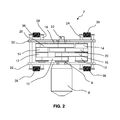
  • FIGS. 1 , 2 , 3 and 4 are detailed representation of a planetary belt transmission of “I” configuration in perspective, side, top and cross-section views;
  • FIGS. 5 , 6 and 7 are detailed representations of planetary belt transmission of “X” configuration in perspective, side and top views;
  • FIGS. 8 and 9 are detailed perspective and side views, respectively, of a planetary belt transmission of “I” configuration with an equal force preload mechanism
  • FIG. 10 is a detailed perspective of a planetary belt transmission having teeth coupling belts according to an alternative embodiments.
  • FIG. 11 is a partial cross-sectional view of a planetary belt transmission having a collecting pulley that is non-concentric to the distributing pulley.
  • FIGS. 1 to 7 are detailed representations of a planetary belt transmission shown generally as 2 comprising a distributing pulley 4 attached to a drive shaft 6 (shown in cross-section in FIG. 4 ) of a motor drive 8 and distributing power (moment-rotation velocity) from the motor drive 8 via distributing belts 10 to two or more pairs of concentric transmitting pulleys 12 and 14 , each pair being designated as 16 , which convey power from the motor drive 8 to the collecting pulley 18 via the collecting belts 20 .
  • the power collected by the collecting pulley 18 is relayed to a propulsion element (not shown) which may be a propeller, wheel, etc. by an output shaft 22 coupled to the collecting pulley 18 .
  • a propulsion element not shown
  • an output shaft 22 coupled to the collecting pulley 18 .
  • Each pair 16 of transmitting pulleys 12 and 14 is commonly rotatable about a peripheral shaft 24 , each of whose ends passes through a respective slot 26 (constituting an “elongated opening”) on opposite sides of armatures 30 and 32 that serve as a support structure for supporting the motor drive 8 .
  • the support structure may be attached to a body on which the propelled element is powered (e.g. vehicle chassis or other platform) via apertures 70 in the armatures 30 and 32 .
  • the output shaft 22 is preferably coaxial with the drive shaft 6 of the motor drive 8 , albeit not directly coupled thereto.
  • the slots 26 constrain the shafts 24 to move along the slots 26 , i.e.
  • Preload elements 36 and 38 which may be springs, urge the shaft 24 in the radial direction, and create an appropriate tension in the distributing belts 10 and collecting belts 20 .
  • the preload force of the preload elements 36 and 38 is adjusted such that the net force created by all the preload elements 36 and 38 on the distributing pulley 4 and on the collecting pulley 18 approaches zero. This enables the motor drive 8 to face pure moment only and avoids the need for an additional bearing arrangement to support the drive shaft 6 against transverse or radial forces.
  • FIGS. 8 and 9 there is shown a first pair of arcuate preload arms 50 and 52 rotatable about a floating hinge (not shown) and second pair of arcuate preload arms 54 and 56 , rotatable about a floating hinge 60 .
  • Both pairs of preload arms 50 , 52 and 54 , 56 are preloaded by respective preload elements, shown by way of example as bolts 62 and 64 and/or springs 36 and 38 , thus subjecting the peripheral shafts 24 to equal and opposite forces and subjecting the distributing belts 10 and collecting belts 20 , on both sides, to equal tensile forces.
  • the fact that the motor drive shaft 6 and output shaft 22 are subject to pure moment allows minimizing the structural requirements and the transmission weight and cost.
  • the multi-channel power distribution of the motor drive 8 via two or more distributing belts 10 and pairs of transmitting pulleys 16 provides the flexibility to optimize the transmission configuration with respect to power-weight-volume-cost parameters.
  • Bearings 40 ( FIG. 4 ) between the distributing pulley 4 and the collecting pulley 18 are needed for the operation of the transmission as a standalone module only. Once the collecting pulley 18 is attached to the propulsion element (e.g. propeller) via output shaft 22 , the bearings 40 can be dispensed.
  • the propulsion element e.g. propeller
  • the collecting pulley 18 may be floating relative to the other parts of the transmission, and the bending moment, which is a result of the distance between the collecting belts 20 , and can be easily absorbed by the bearing arrangement of the propulsion element.
  • Bearings 42 ( FIG. 4 ) allows the pairs of pulleys 16 to rotate about the shaft 24 . These bearings may be of low capacity as they carry only 50% of the load in the “I” configuration, 33% of the load in the “Y” configuration (not shown) or 25% of the load in the “X” configuration ( FIGS. 5 to 7 ).
  • the belt planet is defined by all the elements in the same radial direction (except the distributing and collecting pulleys 4 and 18 ), namely: a) distributing and collecting belts 10 and 20 ; b) the pair 16 of transmitting pulleys 12 and 14 ; c) peripheral shaft 24 ; d) bearings 42 ; e) preload elements 36 and 38 ; f) the armatures 30 and 32 that supports the abovementioned elements.
  • FIGS. 1 to 9 are defined by the number of the belt planets.
  • the “I” configuration shown in FIGS. 1 to 4 and FIGS. 8 and 9 is defined by two belt planets.
  • the “Y” configuration (not shown) is defined by three belt planets and the “X” configuration shown in FIGS. 5 to 7 is defined by four belt planets.
  • Other configurations, with higher numbers of belt planets, are possible, and can be implemented based on the embodiments described above.
  • D c pitch diameter of the collecting pulley 18 ;
  • D 14 pitch diameter of the transmitting pulley 14 ;
  • D 12 pitch diameter of the transmitting pulley 12 ;
  • D d pitch diameter of the distributing pulley 4 .
  • the pulleys and the belts in the figures are of the friction coupling, flat type, in all the embodiments as described, the belts and the pulleys can be of any other friction coupling (e.g. V belts, O belts) as shown in FIG. 8 , or teeth coupling (e.g. timing belts) type, as shown in FIG. 10 .
  • the transmitting pulleys 12 and 14 in the embodiments shown in FIGS. 1 to 7 are of equal diameters
  • the diameters of the transmitting pulleys 12 and 14 can be different, as shown in FIGS. 8 and 9 , in order to achieve transmission ratio based on the two step reduction
  • the planetary belt transmission has been described with specific reference to vehicle propulsion, this is by way of non-limiting example only and the planetary belt transmission according to the invention may be used in other configurations or applications.
  • the planetary belt transmission has a single shaft input/output, in other applications the planetary belt transmission may have multi-input and/or multi-output shafts.
  • the pairs 16 of transmitting pulleys can be either powered by additional motor drives 8 attached to the pairs 16 of transmitting pulleys and to the structure 30 and/or 32 , or serve as additional output shafts.
  • the collecting pulley 18 is represented as concentric to the distributing pulley 4 . This configuration is considered as more compact, but it is not the only configuration. As shown in FIG. 11 , the collecting pulley 18 may be eccentric to the distribution pulley 4 if the distribution belts 10 and/or the collecting belts 20 are of different lengths.

Landscapes

  • Engineering & Computer Science (AREA)
  • General Engineering & Computer Science (AREA)
  • Mechanical Engineering (AREA)
  • Transmission Devices (AREA)

Abstract

A planetary belt transmission has a motor drive having a motor drive shaft, a distributing pulley attached to the motor drive shaft and a collecting pulley attached to an output shaft. Two or more distributing belts are coupled to the distributing pulley and two or more collecting belts are coupled to the collecting pulley from mutually opposite radial directions. Four or more transmitting pulleys are arranged in two or more concentric pairs around the distributing pulley and the collecting pulley and are coupled to the distributing pulley and the collecting pulley via the distributing belts and the collecting belts, respectively. Two or more peripheral shafts support the transmitting pulleys, while allowing movement in a radial direction only relative to the output shaft and being preloaded so as to apply a net zero radial force on the distributing pulleys and the collecting pulleys in a plane perpendicular to respective axes thereof.

Description

CROSS-REFERENCE TO RELATED APPLICATIONS
The present application claims priority to Israeli Application No. 222078 filed on Sep. 23, 2013.
STATEMENT RE: FEDERALLY SPONSORED RESEARCH/DEVELOPMENT
Not Applicable
BACKGROUND Field of the Invention
This invention relates to a planetary belt transmission.
A typical propulsion system consists of a motor drive and a transmission that converts the motor drive torque and rotation velocity to torque and rotation velocity required by the propelled element (e.g. propeller). Planetary transmissions are widely implemented in different types of propulsion systems. Planetary transmission has certain advantages (e.g. input and output shafts are concentric, no side/radial loads on a motor drive shaft) but is also considered as relatively expensive and heavy. On the other hand, belt transmissions are also widely implemented in different types of propulsion systems. Belt transmissions are considered to be relatively inexpensive and simple but do not have the advantages of planetary transmission.
BRIEF SUMMARY
It is therefore an object of the present invention to provide a planetary belt transmission having the advantages of both planetary and belt transmissions.
This object is realized in accordance with a broad aspect of the invention by a planetary belt transmission, comprising:
a structure supporting a motor drive having a motor drive shaft;
a distributing pulley at least indirectly attached to the motor drive shaft;
a collecting pulley attached to an output shaft;
two or more distributing belts coupled to the distributing pulley from mutually opposite radial directions;
two or more collecting belts coupled to the collecting pulley from mutually opposite radial directions;
four or more transmitting pulleys arranged in two or more concentric pairs located around the distributing pulley and the collecting pulley and coupled to the distributing pulley and the collecting pulley via the distributing belts and the collecting belts, respectively;
two or more peripheral shafts supporting said two or more pairs of transmitting pulleys, and passing through elongated openings in said structure so as to allow movement in a radial direction only relative to the output shaft wherein said peripheral shafts are preloaded in a radial direction by two or more preload elements that are configured to stretch the distributing belts and the collecting belts via the pairs of transmitting pulleys so as to apply a net radial force approaching zero on to the distributing pulleys and the collecting pulleys in a plane perpendicular to respective axes of said pulleys.
BRIEF DESCRIPTION OF THE DRAWINGS
In order to understand the invention and to see how it may be carried out in practice, embodiments will now be described, by way of non-limiting example only, with reference to the accompanying drawings, in which:
FIGS. 1, 2, 3 and 4 are detailed representation of a planetary belt transmission of “I” configuration in perspective, side, top and cross-section views;
FIGS. 5, 6 and 7 are detailed representations of planetary belt transmission of “X” configuration in perspective, side and top views;
FIGS. 8 and 9 are detailed perspective and side views, respectively, of a planetary belt transmission of “I” configuration with an equal force preload mechanism;
FIG. 10 is a detailed perspective of a planetary belt transmission having teeth coupling belts according to an alternative embodiments; and
FIG. 11 is a partial cross-sectional view of a planetary belt transmission having a collecting pulley that is non-concentric to the distributing pulley.
DETAILED DESCRIPTION
The above description is given by way of example, and not limitation. Given the above disclosure, one skilled in the art could devise variations that are within the scope and spirit of the invention disclosed herein. Further, the various features of the embodiments disclosed herein can be used alone, or in varying combinations with each other and are not intended to be limited to the specific combination described herein. Thus, the scope of the claims is not to be limited by the illustrated embodiments.
FIGS. 1 to 7 are detailed representations of a planetary belt transmission shown generally as 2 comprising a distributing pulley 4 attached to a drive shaft 6 (shown in cross-section in FIG. 4) of a motor drive 8 and distributing power (moment-rotation velocity) from the motor drive 8 via distributing belts 10 to two or more pairs of concentric transmitting pulleys 12 and 14, each pair being designated as 16, which convey power from the motor drive 8 to the collecting pulley 18 via the collecting belts 20. The power collected by the collecting pulley 18 is relayed to a propulsion element (not shown) which may be a propeller, wheel, etc. by an output shaft 22 coupled to the collecting pulley 18. Each pair 16 of transmitting pulleys 12 and 14 is commonly rotatable about a peripheral shaft 24, each of whose ends passes through a respective slot 26 (constituting an “elongated opening”) on opposite sides of armatures 30 and 32 that serve as a support structure for supporting the motor drive 8. The support structure may be attached to a body on which the propelled element is powered (e.g. vehicle chassis or other platform) via apertures 70 in the armatures 30 and 32. The output shaft 22 is preferably coaxial with the drive shaft 6 of the motor drive 8, albeit not directly coupled thereto. The slots 26 constrain the shafts 24 to move along the slots 26, i.e. only in the radial direction relative to a central hub defined by the axis of the drive shaft 6. Preload elements 36 and 38, which may be springs, urge the shaft 24 in the radial direction, and create an appropriate tension in the distributing belts 10 and collecting belts 20. The preload force of the preload elements 36 and 38 is adjusted such that the net force created by all the preload elements 36 and 38 on the distributing pulley 4 and on the collecting pulley 18 approaches zero. This enables the motor drive 8 to face pure moment only and avoids the need for an additional bearing arrangement to support the drive shaft 6 against transverse or radial forces. Concomitantly, this ensures that the output shaft 22 provides pure moment only and cancels the need for an additional bearing arrangement where the output shaft 22 is coupled to the propulsion element. To ensure an equal preload force on both sides of each distributing pulley 4 and collecting pulley 18, and to remove the preload force from the armatures 30 and 32, a preload mechanism such as shown in FIGS. 8 and 9 can be implemented. In FIGS. 8 and 9, there is shown a first pair of arcuate preload arms 50 and 52 rotatable about a floating hinge (not shown) and second pair of arcuate preload arms 54 and 56, rotatable about a floating hinge 60. Both pairs of preload arms 50, 52 and 54, 56 are preloaded by respective preload elements, shown by way of example as bolts 62 and 64 and/or springs 36 and 38, thus subjecting the peripheral shafts 24 to equal and opposite forces and subjecting the distributing belts 10 and collecting belts 20, on both sides, to equal tensile forces.
The fact that the motor drive shaft 6 and output shaft 22 are subject to pure moment allows minimizing the structural requirements and the transmission weight and cost. The multi-channel power distribution of the motor drive 8 via two or more distributing belts 10 and pairs of transmitting pulleys 16 provides the flexibility to optimize the transmission configuration with respect to power-weight-volume-cost parameters.
Bearings 40 (FIG. 4) between the distributing pulley 4 and the collecting pulley 18 are needed for the operation of the transmission as a standalone module only. Once the collecting pulley 18 is attached to the propulsion element (e.g. propeller) via output shaft 22, the bearings 40 can be dispensed.
In this case, the collecting pulley 18 may be floating relative to the other parts of the transmission, and the bending moment, which is a result of the distance between the collecting belts 20, and can be easily absorbed by the bearing arrangement of the propulsion element.
Bearings 42 (FIG. 4) allows the pairs of pulleys 16 to rotate about the shaft 24. These bearings may be of low capacity as they carry only 50% of the load in the “I” configuration, 33% of the load in the “Y” configuration (not shown) or 25% of the load in the “X” configuration (FIGS. 5 to 7).
The belt planet is defined by all the elements in the same radial direction (except the distributing and collecting pulleys 4 and 18), namely: a) distributing and collecting belts 10 and 20; b) the pair 16 of transmitting pulleys 12 and 14; c) peripheral shaft 24; d) bearings 42; e) preload elements 36 and 38; f) the armatures 30 and 32 that supports the abovementioned elements.
The configurations represented by FIGS. 1 to 9 are defined by the number of the belt planets. Thus, the “I” configuration shown in FIGS. 1 to 4 and FIGS. 8 and 9 is defined by two belt planets. The “Y” configuration (not shown) is defined by three belt planets and the “X” configuration shown in FIGS. 5 to 7 is defined by four belt planets. Other configurations, with higher numbers of belt planets, are possible, and can be implemented based on the embodiments described above.
The transmission ratio of the transmission of the FIGS. 1 to 9 calculated based on the pitch diameters, in the following way:
transmission ratio = D c D 14 × D 12 D d
Wherein:
Dc=pitch diameter of the collecting pulley 18;
D14=pitch diameter of the transmitting pulley 14;
D12=pitch diameter of the transmitting pulley 12; and
Dd=pitch diameter of the distributing pulley 4.
With reference to the belt planetary transmission of the “I” configuration shown in FIGS. 1 to 4 the transmission ratio calculated based on the following pitch diameters:
Dc=40 mm;
D14=20 mm;
D12=20 mm; and
Dd=20 mm
is given by
40 20 × 20 20 ,
i.e. 2.
This means that the rotation velocity of the output shaft 22 will be half the rotation velocity of the motor drive 8 and the output moment will be twice that of the motor drive 8.
Although, for the sake of simplicity of the drawings, the pulleys and the belts in the figures are of the friction coupling, flat type, in all the embodiments as described, the belts and the pulleys can be of any other friction coupling (e.g. V belts, O belts) as shown in FIG. 8, or teeth coupling (e.g. timing belts) type, as shown in FIG. 10.
In addition, although, for the sake of simplicity, the transmitting pulleys 12 and 14 in the embodiments shown in FIGS. 1 to 7 are of equal diameters, the diameters of the transmitting pulleys 12 and 14 can be different, as shown in FIGS. 8 and 9, in order to achieve transmission ratio based on the two step reduction
( first step being based on D 12 D d and the second step based on D c D 14 ) .
It will be appreciated that although the planetary belt transmission has been described with specific reference to vehicle propulsion, this is by way of non-limiting example only and the planetary belt transmission according to the invention may be used in other configurations or applications. Likewise, while in the embodiments described above the planetary belt transmission has a single shaft input/output, in other applications the planetary belt transmission may have multi-input and/or multi-output shafts. For this purpose, the pairs 16 of transmitting pulleys can be either powered by additional motor drives 8 attached to the pairs 16 of transmitting pulleys and to the structure 30 and/or 32, or serve as additional output shafts.
In the embodiments as described, the collecting pulley 18 is represented as concentric to the distributing pulley 4. This configuration is considered as more compact, but it is not the only configuration. As shown in FIG. 11, the collecting pulley 18 may be eccentric to the distribution pulley 4 if the distribution belts 10 and/or the collecting belts 20 are of different lengths.
Claims (4)

What is claimed is:
1. A planetary belt transmission, comprising:
a structure supporting a motor drive, said motor drive having a motor drive shaft;
a distributing pulley at least indirectly attached to the motor drive shaft;
a collecting pulley attached to an output shaft;
two or more distributing belts coupled to the distributing pulley from mutually opposite radial directions;
two or more collecting belts coupled to the collecting pulley from said mutually opposite radial directions;
two or more concentric pairs of first and second transmitting pulleys located around the distributing pulley and the collecting pulley, the respective first transmitting pulley in each pair being coupled to the distributing pulley via the distributing belts and the respective second transmitting pulley in each pair being coupled to the collecting pulley via the collecting belts;
two or more peripheral shafts each supporting a respective one of said pairs of transmitting pulleys, each of the peripheral shafts passing through elongated openings in said structure so as to allow movement in a respective one of said mutually opposite radial directions only relative to the output shaft; and
wherein, said peripheral shafts are preloaded in said mutually opposite radial directions by two or more preload elements that are configured to stretch the distributing belts and the collecting belts via the pairs of transmitting pulleys so as to apply a net radial force approaching zero on to the distributing pulleys and the collecting pulleys.
2. The planetary belt transmission according to claim 1, wherein the distributing pulley, the collecting pulley, the transmitting pulleys and the distributing belts and the collecting belts are of teeth coupling or of friction coupling type.
3. The planetary belt transmission according to claim 1, wherein the collecting pulley is concentric to an axis of the distributing pulley.
4. The planetary belt transmission according to claim 1, wherein the collecting pulley is non-concentric to an axis of the distributing pulley.
US14/032,028 2012-09-23 2013-09-19 Planetary belt transmission Expired - Fee Related US8876648B2 (en)

Applications Claiming Priority (2)

Application Number Priority Date Filing Date Title
IL222078A IL222078A (en) 2012-09-23 2012-09-23 Belt planetary transmission
IL222078 2012-09-23

Publications (2)

Publication Number Publication Date
US20140087909A1 US20140087909A1 (en) 2014-03-27
US8876648B2 true US8876648B2 (en) 2014-11-04

Family

ID=50339421

Family Applications (1)

Application Number Title Priority Date Filing Date
US14/032,028 Expired - Fee Related US8876648B2 (en) 2012-09-23 2013-09-19 Planetary belt transmission

Country Status (2)

Country Link
US (1) US8876648B2 (en)
IL (1) IL222078A (en)

Cited By (2)

* Cited by examiner, † Cited by third party
Publication number Priority date Publication date Assignee Title
WO2015140805A2 (en) 2014-03-20 2015-09-24 Yefim Kereth Hub planetary belt transmission
US9441712B1 (en) * 2015-06-11 2016-09-13 Vestas Wind Systems A/S Belt drive with fixed large disc

Families Citing this family (2)

* Cited by examiner, † Cited by third party
Publication number Priority date Publication date Assignee Title
JP7174690B2 (en) * 2016-08-11 2022-11-17 リテンズ オートモーティヴ パートナーシップ Two-arm tensioning system for endless drive and improved endless drive
CN113357331A (en) * 2021-07-14 2021-09-07 汤群峰 Labor-saving and efficiency-increasing driving device

Citations (2)

* Cited by examiner, † Cited by third party
Publication number Priority date Publication date Assignee Title
US2459969A (en) * 1944-07-20 1949-01-25 William M Schweickart Variable-speed drive
US5074829A (en) * 1990-10-19 1991-12-24 Menge Sr Theodore L Combination chain & gear reducing device

Patent Citations (2)

* Cited by examiner, † Cited by third party
Publication number Priority date Publication date Assignee Title
US2459969A (en) * 1944-07-20 1949-01-25 William M Schweickart Variable-speed drive
US5074829A (en) * 1990-10-19 1991-12-24 Menge Sr Theodore L Combination chain & gear reducing device

Cited By (3)

* Cited by examiner, † Cited by third party
Publication number Priority date Publication date Assignee Title
WO2015140805A2 (en) 2014-03-20 2015-09-24 Yefim Kereth Hub planetary belt transmission
US10156288B2 (en) 2014-03-20 2018-12-18 Yefim Kereth Hub planetary belt transmission
US9441712B1 (en) * 2015-06-11 2016-09-13 Vestas Wind Systems A/S Belt drive with fixed large disc

Also Published As

Publication number Publication date
IL222078A (en) 2015-02-26
US20140087909A1 (en) 2014-03-27

Similar Documents

Publication Publication Date Title
US8876648B2 (en) Planetary belt transmission
US8585525B2 (en) Left and right wheels drive system
US9243700B1 (en) Coupled worm planetary gear continuously variable ratio transmission
US10677320B2 (en) Epicyclic gear train
CN102844586B (en) Gear transmission load sharing mechanism
US20130035194A1 (en) Load split mechanism for gear transmission
US10132391B2 (en) Continuously variable transmission
US20190111778A1 (en) Driveline assembly for an electric vehicle
US20140196557A1 (en) Anti-Backlash Gear
CN110154752A (en) Vehicle propulsion system
US10156288B2 (en) Hub planetary belt transmission
US10247278B2 (en) Hybrid orbitless gearbox
US20170001664A1 (en) Infinitely variable transmission for differentially steered vehicles
RU2481513C2 (en) Adjustable transmission
EP3143305B1 (en) Orbitless gearbox
FI3784925T3 (en) Transmission gear as well as wind turbines and electric drive for vehicles with such a transmission gear
US10473195B2 (en) Continuously-variable transmission
US12007023B2 (en) Belt for continuously variable transmission
US9222560B2 (en) Two mode continuously variable transmission
US9303734B2 (en) Belt transmission
CN112810433A (en) Parallel shaft electric drive axle with planet row
RU2610236C2 (en) Transmission with smoothly varying gear ratio beginning from zero and with displaced external base of universal self-centering system
US20200263764A1 (en) Coaxial orbitless drive
CZ36316U1 (en) Traction drive of the wheel unit with a master gear and an out-of-level engine
CN118254154B (en) Transmission equipment and robot power unit

Legal Events

Date Code Title Description
STCF Information on status: patent grant

Free format text: PATENTED CASE

MAFP Maintenance fee payment

Free format text: PAYMENT OF MAINTENANCE FEE, 4TH YR, SMALL ENTITY (ORIGINAL EVENT CODE: M2551)

Year of fee payment: 4

FEPP Fee payment procedure

Free format text: MAINTENANCE FEE REMINDER MAILED (ORIGINAL EVENT CODE: REM.); ENTITY STATUS OF PATENT OWNER: SMALL ENTITY

LAPS Lapse for failure to pay maintenance fees

Free format text: PATENT EXPIRED FOR FAILURE TO PAY MAINTENANCE FEES (ORIGINAL EVENT CODE: EXP.); ENTITY STATUS OF PATENT OWNER: SMALL ENTITY

STCH Information on status: patent discontinuation

Free format text: PATENT EXPIRED DUE TO NONPAYMENT OF MAINTENANCE FEES UNDER 37 CFR 1.362

FP Lapsed due to failure to pay maintenance fee

Effective date: 20221104