US8874616B1 - Method and apparatus for fusion of multi-modal interaction data - Google Patents
Method and apparatus for fusion of multi-modal interaction data Download PDFInfo
- Publication number
- US8874616B1 US8874616B1 US13/546,954 US201213546954A US8874616B1 US 8874616 B1 US8874616 B1 US 8874616B1 US 201213546954 A US201213546954 A US 201213546954A US 8874616 B1 US8874616 B1 US 8874616B1
- Authority
- US
- United States
- Prior art keywords
- interaction
- identifiers
- interaction data
- entity
- identifier
- Prior art date
- Legal status (The legal status is an assumption and is not a legal conclusion. Google has not performed a legal analysis and makes no representation as to the accuracy of the status listed.)
- Active
Links
Images


Classifications
-
- G—PHYSICS
- G06—COMPUTING OR CALCULATING; COUNTING
- G06Q—INFORMATION AND COMMUNICATION TECHNOLOGY [ICT] SPECIALLY ADAPTED FOR ADMINISTRATIVE, COMMERCIAL, FINANCIAL, MANAGERIAL OR SUPERVISORY PURPOSES; SYSTEMS OR METHODS SPECIALLY ADAPTED FOR ADMINISTRATIVE, COMMERCIAL, FINANCIAL, MANAGERIAL OR SUPERVISORY PURPOSES, NOT OTHERWISE PROVIDED FOR
- G06Q10/00—Administration; Management
- G06Q10/40—Business processes related to social networking or social networking services
- G06Q10/48—Business processes related to social networking or social networking services using social graphs
-
- G—PHYSICS
- G06—COMPUTING OR CALCULATING; COUNTING
- G06Q—INFORMATION AND COMMUNICATION TECHNOLOGY [ICT] SPECIALLY ADAPTED FOR ADMINISTRATIVE, COMMERCIAL, FINANCIAL, MANAGERIAL OR SUPERVISORY PURPOSES; SYSTEMS OR METHODS SPECIALLY ADAPTED FOR ADMINISTRATIVE, COMMERCIAL, FINANCIAL, MANAGERIAL OR SUPERVISORY PURPOSES, NOT OTHERWISE PROVIDED FOR
- G06Q10/00—Administration; Management
- G06Q10/40—Business processes related to social networking or social networking services
Definitions
- Embodiments of the invention were made with government support under contract number N00014-09-C-0262 awarded by the Office of Naval Research. The government has certain rights in the invention.
- the invention relates generally to the fusion and analysis of interaction data, including intelligence data.
- an intelligence analyst may have access to multiple modalities of intelligence data, including human intelligence (HUMINT), Significant Activity (SIGACT) reports, imagery intelligence (IMINT), communications intelligence (COMINT), and digital network exploitation (DNE) data.
- HUMINT human intelligence
- SIGACT Significant Activity
- IMINT imagery intelligence
- COMINT communications intelligence
- DNE digital network exploitation
- Other potential modalities of interaction data include social media communications (e.g., blogs or Twitter), computer network connections, email records, and telephone records.
- INT is used here to refer generally to interaction data from any modality
- Multi-INT refers to interaction data obtained from multiple interaction data sources, which may include interaction data from different modalities.
- the method includes representing first and second intelligence data from first and second intelligence modalities in first and second link-oriented datasets, fusing the first and second link-oriented datasets, and optimizing a mapping of identifiers from the first and second intelligence data to first and second entities, wherein the optimizing comprises consideration of link structures for the plurality of links between the first and second entities. Also disclosed is a computer system for performing the foregoing embodiment of a method for fusing intelligence data from multiple intelligence modalities.
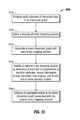
- Also disclosed herein is an embodiment of a method for fusing interaction data, where the interaction data is collected in a plurality of collections of interaction data collected from a plurality of interaction data sources, comprising embodying first and second collections of interaction data in first and second interaction graphs, defining a plurality of entity-mapping solutions, by which identifiers in the first and second collections are mapped to entities, associating with each of the plurality of entity-mapping solutions a fused interaction graph comprising a plurality of fused nodes and aggregated edges, and identifying an optimal entity mapping solution out of the plurality of entity mapping solutions, wherein identifying the optimal entity mapping solution comprises evaluation of compatibility of identifier attributes, mutual information across interaction data sources, and/or fit with one or more behavior models.
- FIG. 1 depicts generally the steps of an exemplary method of fusing multi-modal interaction data.
- FIG. 2 depicts generally an exemplary computer system for use in an embodiment of a method for fusing multi-modal interaction data.
- FIG. 3 depicts an exemplary repository of data from multiple intelligence modalities.
- FIG. 4 depicts an exemplary mapping of INT-specific Identifiers to Entities.
- FIG. 5 depicts another view of an exemplary mapping of INT-specific Identifiers to Entities.
- FIG. 6 depicts an exemplary collapsing of Links to Relationships.
- FIGS. 7 and 8 depict exemplary GUIs for visualizing identified mappings and resulting Relationship networks.
- FIG. 9 depicts an exemplary symbolic representation of a Graph.
- FIG. 10 depicts an exemplary symbolic representation of a mapping of Identifiers to Entities.
- FIG. 11 depicts an exemplary symbolic representation of a fused Graph.
- FIG. 12 depicts the equation of an exemplary objective function.
- FIGS. 13 and 14 depict examples of good mappings and bad mappings.
- FIG. 15 provides an exemplary comparison of attributes of good mappings and bad mappings.
- FIG. 16 illustrates exemplary general multi-INT correlation patterns in an embodiment.
- FIG. 17 illustrates an exemplary Persona model in an embodiment.
- FIG. 18 illustrates an exemplary behavior model based on responses to recent events.
- FIG. 19 depicts an exemplary behavior model based on execution of a collaborative task.
- FIG. 20 is a flowchart showing the steps of an exemplary method of fusing interaction data.
- a recurring task in behavioral and intelligence analysis involves deriving a Network of Entities from interaction data obtained from different sources and modalities.
- Several related technical needs arise in this process One is the need to perform Multi-INT entity resolution, disambiguation, and co-referencing. This is broadly described as “fusion.”
- Another task requires moving from Links (physical evidence of interactions) to Relationships (the reasons behind the interactions).
- Another task requires combined statistical and semantic analysis of Entities and Relationships.
- the complexity of the fused network should be minimized, and network detection accuracy and network exploitation effectiveness should be maximized. What is described here is an embodiment of a method and apparatus for Entity fusion across all-source data that minimizes fused network complexity and maximizes subsequent network exploitation effectiveness.
- a technical solution has two key sub-problems: entity resolution (meaning mapping Identifiers and Links from different interaction data sources to a common Entity), and the subsequent Link collapsing.
- entity resolution meaning mapping Identifiers and Links from different interaction data sources to a common Entity
- Link collapsing In an embodiment, accurate Identifier-to-Entity mapping (also called cross-INT entity resolution) is a prerequisite for accurately collapsing Links into Relationships; otherwise the collapsing will be based on false associations and generate ineffective results.
- FIG. 20 is a flowchart illustrating the steps of an exemplary embodiment of a method of fusing interaction data.
- FIG. 3 separate and disjoint observations from many INTs are gathered into, preferably, a single multi-INT repository 300 .
- the scope of the invention is not limited to a specific mapping between INTs and modalities: each INT may contain interaction data from different modalities; a single INT may contain data from two or more modalities, or two more data sources or sensors of the same modality; and different INTs may contain data from the same modality or, for example, different sensors of the same modality.
- FIG. 4 illustrates an exemplary Cross-INT entity resolution that maps INT-specific Identifiers to Entities.
- An Entity may have zero, one, or more Identifiers in each INT.
- Events link Identifiers to each other and are evidenced by Links.
- the entity resolution problem is to then map those Identifiers (and thus events and Links) to Entities that span INTs.
- Steps 2030 (associating a fused interaction graph with each entity mapping solution) and 2040 (identifying an optimal mapping solution) of FIG. 20 are discussed in more detail below.
- step 2050 of FIG. 20 the aggregated edges between each pair of Entities, meaning all the Cross-INT edges that connect the Identifiers associated with each of the Entities, are collapsed.
- Links are collapsed into Relationships. Without an accurate Identifier-to-Entity mapping, incorrect Relationships may be formed by collapsing the wrong sets of Links.
- FIG. 6 shows the final result after Links are collapsed to Relationships.
- Cross-INT entity resolution preferably is done in an embodiment in a model-driven optimization framework.
- the mapping of Identifiers (which are specific to an INT) to Entities (which span INTs) preferably consider these three factors alone or in combination: 1) the compatibility of the matched Identifiers, 2) the compatibility of Link structure across INTs, and 3) the fit of the resulting fused Link structure to applicable models.
- An example of compatible Identifiers is similar names—e.g., “Osama” in a SIGACT and “Usama” in a DNE result.
- Compatible Link structures have high mutual information. Successful Entity resolution will generate Link structures that are compatible with human interaction models such as scale-free networks, personas constructed from subject matter expertise, or known social roles such as “bridge” or “isolate.”
- the general approach is as follows. Cross-INT entity resolution is performed within an optimization framework.
- the optimization identifies the best global mapping of Identifiers to Entities.
- the concept of “best” is defined by a multi-term objective function.
- the attributes e.g., name, gender, and geo-temporal location
- Link structure should exhibit high mutual information across INTs
- Link structure and Relationships should fit with behavior models and established models of expected interaction patterns.
- Embodiments of the invention assume the existence of a data store and associated schema that are able to represent the multi-INT data within a multi-modal Graph.
- the data store preferably should be able to represent, save, load, and manipulate a plurality of Graphs.
- Each Graph may signify Entities and the Relationships between them, or it may signify Identifiers and the Links between them. Entities and Identifiers are represented as nodes in the Graphs. Relationships and Links are represented as edges in the Graphs. Both nodes and edges may have multiple associated attribute values.
- LYNXeon Analyst StudioTM commercially available from 21CT, Inc., is an example of a data store and associated schema that can provide this functionality.
- Embodiments also include an interactive user interface for results visualization and input from the user using input devices such as a keyboard or a mouse.
- the user interface would permit the analyst to visualize Identifiers and Links, the mappings of Identifiers to Entities, the INT-specific Graphs, and the fused Graph.
- the user interface can display a fused Graph reflecting a specific mapping of Identifiers to Entities, and a fused Graph in which the edges have been collapsed into a single Link.
- the user interface would further permit the analyst to set configuration parameters for optimization function 1200 (described below).
- the user interface would permit the analyst to assert that particular Identifiers map to particular Entities, and run the automated algorithms to optimize a solution that includes those asserted mappings.
- the user interface permits the analyst to select one or more behavior models.
- FIGS. 7 and 8 depict exemplary GUIs for visualizing identified mappings and resulting relationship networks. Lynxeon Analyst StudioTM, commercially available from 21CT, Inc. is an example of an interactive user interface that can provide this functionality. The interactive user interface is not required for the invention; some embodiments do not require this interface.
- Cross-INT entity resolution can be formulated as an optimization problem. Aspects of an exemplary embodiment of the optimization problem are as follows.
- Each different INT modality provides a set of Identifiers and Links in a link-oriented dataset, represented in an embodiment as a Graph.
- the mapping of Identifiers (which are specific to a single INT) to Entities (which cross INTs) is unknown.
- Each Identifier is represented as a separate node in the uni-INT graphs.
- Each Identifier has a set of INT-dependent attributes.
- FIG. 9 shows a collection of graph data 900 based on different collection modalities:
- IMINT n 11 , n 12 , n 13 , . . . , n 1k
- SIGACT n 21 , n 22 , n 23 , . . . , n 2j . . . . .
- DNE n m1 , n m2 , n m3 , . . . , n mp
- G i ( N i ,E i )
- N i ⁇ n i1 , n i2 , . . . , n ij ⁇
- the solution space being searched is the set of all possible mappings from Identifiers to Entities. This is a many-to-one mapping. Often there will be one Identifier per Entity in each INT. When an Entity is not represented in an INT, it will have zero Identifiers. Alternatively, an Entity may have multiple Identifiers in a single INT; imperfect entity resolution within SIGACTs and users of multiple mobile devices within COMINT are examples. The system and method can handle all of these cases.
- a solution X is a set of mappings from Identifiers (n's) to Entities (x's). Identifiers that are not matched to other Identifiers constitute their own degenerate Entities.
- a solution X is a set of Identifier groupings x 1 . . . x q (one grouping per Entity). The presence of an Identifier in the grouping for a particular Entity indicates that the Identifier has been mapped to that Entity. All Identifiers that co-exist within a grouping are considered Associated Identifiers.
- An exemplary solution X is illustrated in FIG. 10 :
- each grouping may be associated with a confidence level, as indicated by the subscript probabilities in FIG. 10 .
- each solution X induces a fused multi-INT Graph G in which each Entity is a single node and that node's edges comprise all Links for any Identifier that was mapped to the Entity.
- the set of all edges in G is thus the union of all edges (Links) from each single-INT Graph, structured according to the mapping X.
- the fused Graph is G where nodes are Entities x 1 . . . x q ; and edges are union of E i given set of groupings X. As shown in FIG. 11 :
- each solution X is evaluated by evaluating the graph G that it induces with a weighted multi-term objective function.
- the objective function represents considerations found in preferred mappings, for example: the attributes of the matched Identifiers should be compatible; the Link structure should exhibit high mutual information across INTs; and the fused Link structure should fit established models of expected interaction patterns.
- An exemplary objective function 1200 over the solution X is represented in the equation shown in FIG. 12 :
- the ⁇ , ⁇ and ⁇ factors in objective function 1200 are constants that reflect a relative weighting of the three components 1210 , 1220 , and 1230 of objective function 1200 .
- the user can modify the weightings to emphasize different perspectives of the interaction data.
- An exemplary weighting will define each of ⁇ , ⁇ and ⁇ equal to 33.3%.
- any of ⁇ , ⁇ or ⁇ can be set to zero (0%) to remove that factor from the objective function.
- Finding the optimal solution for a particular objective function is a combinatoric optimization problem familiar to those of ordinary skill in the art; existing heuristic approaches to combinatoric optimization apply.
- An initial approach in an embodiment preferably uses a meta-heuristic approach such as a genetic algorithms or simulated annealing.
- Heuristic optimization approaches can be used to build effective and scalable graph theoretic optimization approaches.
- Alternative embodiments may employ other optimization algorithms (e.g., convex optimization) that may provide other convergence guarantees, runtimes, and/or characteristic results.
- all data and “conclusions” may be associated with reliabilities or confidence evaluations ranging continuously from 0.0 to 1.0.
- Inference (including specifically the collapsing of Links between Entities into Relationships) is performed, in an embodiment, using probabilistic methods such as Markov Logic Networks or Fuzzy Logic that address this type of scenario directly. Even when operating on input data with severe limitations, some inferences (however weak) can be provided. In these cases, early stages of the workflow will rely more heavily on analyst assertions.
- an embodiment may also incorporate the use of Dynamic Bayesian Networks or similar techniques.
- the first term 1210 in the exemplary objective function 1200 measures the compatibility between the attributes of Identifiers that are mapped to each Entity (i.e., Associated Identifiers). Preferred mappings of Identifiers to Entities will yield, for all Entities, high attribute compatibility among its set of Associated Identifiers.
- mappings which associate Identifiers with names that are similar phonetically. For example the association ⁇ “Sean”, “Shawn”, “Shaun” ⁇ would be preferable to the association ⁇ “Larry”, “Curly”, “Moe” ⁇ .
- value AF in term 1210 can be set to 1.0 minus the average value of d w for all pairwise comparisons of Identifiers associated with each Entity.
- optimizing objective function 1200 would tend to generate mappings in which Associated Identifiers are phonetically similar.
- mappings that minimize the differences between those attributes. For example, the association ⁇ “35 years old, 6 feet tall, 200 pounds”, “35 years old, 6 feet 2 inches tall, 190 pounds” ⁇ would be preferable to the association ⁇ “35 years old, 6 feet tall, 200 pounds”, “70 years old, 5 feet 6 inches tall, 150 pounds” ⁇ .
- An embodiment would compute the differences in each attribute, scale each difference by a constant, and sum the scaled differences. Thus, optimizing objective function 1200 would tend to generate mappings in which Associated Identifiers have similar demographic attributes.
- an embodiment seeks mappings that minimize differences in distance and/or time between those attributes. For example, the association ⁇ “12:00 pm July 4 in Boston, Mass.”, “2:00 pm July 4 in Cambridge, Mass.” ⁇ would be preferable to the association ⁇ “12:00 pm July 4 in Boston, Mass.”, “8:00 am June 10 in Berkeley, Calif.” ⁇ .
- An embodiment would compute the spatial difference in miles and the temporal difference in hours, scale each difference by a constant, and sum the scaled differences. Thus, optimizing objective function 1200 would tend to generate mappings in which Associated Identifiers have similar spatio-temporal attributes.
- any semantic attribute shared by two or more Associated Identifiers can be measured for compatibility and contribute to the attribute compatibility measurement of term 1210 . If Identifiers have multiple attributes (e.g., both name and demographic attributes), then in an embodiment, the attribute similarity metrics described above would each be scaled by a constant and then summed to define the value AF in term 1210 . In this way, similarities between multiple attributes can be considered simultaneously. Further, the attribute compatibility of one set of Identifiers is independent of how other identifiers are arranged into sets. Thus, in term 1210 , Identifier attribute compatibility is computed Entity by Entity (i.e., Identifier set by Identifier set) and summed.
- external reference sources can be leveraged to help measure attribute compatibility.
- exemplary reference sources include census data, telephone books, telephone number data, Internet Protocol (IP) address maps, and associations between mobile hardware, device, and user identifiers. For example, given a HUMINT Identifier with attribute “wealthy male” and a COMINT Identifier owned by “John Smith of 123 Main Street, Beverly Hills, Calif.”, census reference data could associate the location Beverly Hills, Calif. with a median household income of $250,000, with the qualitative attribute “wealthy” to allow attribute comparison.
- Alternative embodiments could use other reference sources in similar ways.
- the second term 1220 in the exemplary objective function 1200 in an embodiment seeks to maximize the mutual information (MI) measured in the Links across INTs.
- MI mutual information
- Preferred mappings of Identifiers to Entities will yield high mutual information in links across INT.
- Mutual Information is defined in probability theory to measure the mutual dependence between two random variables, or equivalently, the ability of one random variable to accurately predict the other.
- Term 1220 is formulated to apply the principles of mutual information when measuring the compatibility of Link structure across INTs for a given mapping.
- term 1220 evaluates the mutual information between two single-INT graphs, G 1 and G 2 , as follows. For each Identifier n, define S(n) as the Entity to which n is mapped in the mapping X. Copy graphs G 1 and G 2 without modification into working copies WG 1 and WG 2 , respectively. In WG 1 and WG 2 , replace each node representing an Identifier n with a node representing its Entity S(n), maintaining all edges between nodes. At this stage, WG 1 and WG 2 may each contain multiple nodes for some Entity, e.
- Alternative embodiments may formulate term 1220 in many different ways.
- An alternative embodiment will not remove all nodes representing Entities that do not appear in both WG 1 and WG 2 .
- Another alternative embodiment will not remove duplicate edges, but will instead represent duplicate counts as weights on the edges and compute a weighted edit distance.
- Another alternative embodiment will consider node additions or removals when computing edit distance ED.
- the alternative embodiments described here are exemplary only and do not limit the claimed invention.
- the method of evaluating mutual information described immediately above is an embodiment that considers exactly two random variables (corresponding to G 1 and G 2 in this application).
- Other metrics can be used for evaluate mutual information between more than two random variables.
- Such exemplary metrics include total correlation and interaction information.
- terms 1210 and 1220 in exemplary objective function 1200 seek to maximize compatibility.
- the use of term 1220 is novel in that it applies this concept to Link structure when performing entity resolution.
- term 1210 in an embodiment describes how the approach seeks maximal compatibility among the attributes of Identifiers that are mapped to the same Entity. Seeking “maximal compatibility” can also be described as seeking maximal redundancy, minimum novelty, minimum innovation (in the sense of Kalman filtering), and importantly, as maximum mutual information between the attributes.
- the same maximum mutual information criterion is used, in an embodiment, by term 1220 to measure the quality of cross-INT Link correlations that are induced by an Identifier-to-Entity mapping.
- the exemplary objective function does not compute mutual information locally for each node and then sum the results. Instead the mutual information term represents the global Link structure.
- the representation of global Link structure in term 1220 models the effects of one Identifier-to-Entity mapping on the quality of other mappings (called “joint effects”).
- joint effects can thus inform each individual mapping. This improves entity resolution accuracy, in an analogous way as to how the use of language model improves speech recognition performance beyond what is possible by considering each word in isolation.
- Established characteristics of human activity e.g., preferential linking, homophily, and the horizon of observability
- mapping 1310 and 1320 reflects a mapping of Identifiers to Entities.
- Identifiers A and 1 are mapped to a single entity, as are Identifiers, B and 2, C and 3, D and 4, and E and 5.
- Mapping 1320 reflects a different mapping of Identifiers to Entities, one in which Identifiers A, B, C, D and E are paired with 1, 3, 5, 2 and 4, respectively. Comparing the mutual information between these two mappings, mapping 1310 will be preferred. In the preferred mapping 1310 , the numbered data from one INT still contributes a novel link (i.e., between the Entities with Identifier 4 and Identifier.
- FIG. 14 depicts another example of a preferred mapping ( 1410 ) as opposed to a non-preferred mapping ( 1420 ), but illustrated by attribute compatibility ( 1410 ) and incompatibility ( 1420 ). Juxtaposed, FIG. 13 and FIG. 14 illustrate the conceptual similarity between applying MI to Link structure compatibility ( FIG. 13 ) and applying it to attribute compatibility ( FIG. 14 ).
- CER collective entity resolution
- CER methods consider the count of common neighbors between two Identifiers when performing fusion. Such an approach exploits local Graph structure in a limited way but ignores the regional and global structure captured by term 1220 . Other CER methods may consider the count of common indirect neighbors; this is still less expressive than term 1220 because it fails to capture the compatibility or incompatibility in the Link structure among those neighbors. Their Link information could be wildly inconsistent between modalities, but the mapping would still receive a favorable rating by CER methods. In contrast, embodiments of the invention allow differentiation between solutions that exhibit globally compatible Link structure across modalities, and those that do not.
- CER methods map Identifiers to Entities in an incremental clustering algorithm using a Greedy search heuristic; Identifier-to-Entity mappings are made one-by-one in a series of locally optimal (but not globally optimal) decisions.
- This search heuristic may produce suboptimal solutions for problems exhibiting local minima and/or local maxima; fusion of multi-modal interaction data has been determined to be one such problem.
- embodiments of the invention compute all mappings simultaneously using global optimization algorithms. This provides superior fusion results.
- CER methods are designed to address a different problem than the invention. They are focused on entity resolution in single-modality data such as academic co-reference databases, where Identifiers are typically not unique within a modality—e.g., the Identifier “T. Coffman” could be shared by multiple Entities named Thayne Coffman, Tim Coffman, Tom Coffman, etc.
- CER methods emphasize abstract single-modality data (e.g., academic co-references) with possibly multiple Identifiers per Entity, and possibly multiple Entities per Identifier. Further, CER methods assume that each Identifier can participate in at most one transaction.
- the invention in contrast, accommodates multi-modality data (e.g., transactional human interactions or communications in multiple domains) with possibly multiple Identifiers per Entity, but at most one Entity per Identifier in each collection of interaction data, and with each Identifier able to participate in one or many transactions.
- This allows an improved use of the Link structure to inform entity resolution, which is captured by terms 1220 and 1230 in objective function 1200 .
- Term 1220 captures the compatibility of Link structure across INTs for a given mapping
- term 1230 (described below) captures the compatibility of the fused Multi-INT Link structure with established behavioral models.
- Identifier-to-Entity mappings may result in fused Graphs that fit established behavior models for human interactions, and embodiments will search for mappings that exhibit a good fit.
- the system designer can select an appropriate set of behavior models to leverage.
- Technical metrics can then be created to measure the fit of observed Links to those models.
- the third term 1230 of the exemplary objective function 1200 measures the fit of fused Links to the selected behavior models. The invention uses these behavior models to improve the quality of the Identifier-to-Entity mappings.
- a wide variety of behavior models can be defined, each with associated metrics that quantify the fit of the fused multi-INT graph to the models, and in different embodiments these form part or all of term 1230 .
- These models include generic multi-INT correlation models, generic social structure models, role-specific models, task-specific models, and event-specific models.
- Various embodiments will apply different models or combinations of models, and thus those embodiments will define the details of term 1230 in different ways.
- one or more models accepts parameters, such that measuring the fit of the fused multi-INT graph to the model also includes the process of automatically identifying the model parameter that maximizes the measured fit.
- one or more models allows flexible assignment of entities to model actors, such that measuring the fit of the fused multi-INT graph to the model also includes the process of automatically identifying the assignment that maximizes the measured fit.
- multiple models are used that accept parameters and/or allow flexible assignment, such that measuring the fit of the graph to the model includes automatically identifying both parameters and assignments that maximize the measured fit.
- Generic multi-INT correlation models apply broadly across many scenarios.
- a first exemplary generic multi-INT correlation model also known as a multi-modality correlation model
- two interacting Entities prefer to communicate in one modality (e.g., cell phone, email, or face-to-face); communicating in that modality reduces the likelihood of their communicating soon after in another modality.
- one modality e.g., cell phone, email, or face-to-face
- communicating in that modality reduces the likelihood of their communicating soon after in another modality.
- Entities interacting in one modality are more likely to interact with each other using a different modality than they are to interact with other randomly-selected entities. (This is an established property of human social behavior.)
- Entities show short-time aversion and long-time affinity across modalities.
- FIG. 16 depicts both of these exemplary general multi-INT correlation models together in an embodiment.
- the first exemplary generic multi-INT correlation model described above is represented in term 1230 as follows. Two durations are defined, short (D S ) and long (D L ). A time step is defined (TS) and the full duration of the multi-INT data is divided into multiple times t with separation TS. Short-term preference for a single modality is modeled as follows. For every time t and every pair of Entities (i,j), the “preferred modality” is selected as the modality in which they share the most Links in the time interval [t, t+DS].
- the pair's short term preference at time t is defined as the ratio of Links observed between the Entities within the preferred modality in time interval [t, t+D S ] to all Links observed between the Entities in the same time interval.
- the entire mapping's short-term preference, STP(X), is defined as the average of STP(i,j,t) over all i, j, and t; this value lies on the range [0, 1].
- Long-term friend preference across modalities for communicating with the same Entities is modeled as follows.
- the Entities “friends” are selected as the K Entities with whom it shares the most Links (in any modality) in the time interval [t, t+D S ], for some value of K.
- the “preferred modality” between every pair of entities is defined as before.
- the Entity's long term friend preference at time t, LTF(i,t) is defined as the ratio of Links observed between the Entity and its “friends” in non-preferred-modalities (all modalities except the preferred modality) in time interval [t, t+D L ] to all Links observed between the Entity and any others in non-preferred modalities in the same time interval.
- LTF(X) The entire mapping's long-term friend preference, LTF(X), is defined as the average of LTF(i,t) over all i and t; this value lies on the range [0, 1].
- Human Relationship structures also exhibit other tendencies, referred to here as generic social structure models.
- graphs of Entities and Relationships representing human social structure are known to be well represented by models known alternatively as scale-free models, power law models, or small world models.
- a power law is a mathematical relationship between two quantities such that the frequency of an event varies with the power (e.g., exponent) of some attribute of the event.
- the number of acquaintances with which a person has at least K interactions is found to vary as a power of the threshold number of interactions K.
- Graphs representing these persons and interactions as Entities (or Identifiers) and Links will be well represented by power law models.
- Alternative embodiments may incorporate other relevant a priori statistical models.
- the exemplary power law social structure model is represented in term 1230 as follows.
- the MF value in term 1230 is computed in two steps. First, for a mapping X, compute the values of C and r that best fit the link structure of the fused multi-INT graph induced by X. In an embodiment, this is done by computing a histogram of node degrees, computing the natural log of both axes, and selecting the best-fit line to the resulting data using least-squares regression.
- the value of R 2 lies on the range [0, 1].
- Behavior models can be defined for a particular social role or Persona; we call these role-specific models.
- the sociology and social network analysis (SNA) research communities have defined multiple such roles.
- One exemplary role is that of a “bridge,” who provides a social tie that connects two different groups in a social network; this role is also sometimes called either “gatekeeper” or “courier.”
- Another exemplary role is that of an “isolate,” who does not actively participate in cliques or friendship groups.
- Other role-based behavior models are specific to a particular data set or scenario.
- Alternative embodiments may select from a notional library of candidate roles and Personas against which fused Link behavior is compared. As with Relationship strength, the role(s) or Persona(s) of an Entity tend to change slowly; they should remain consistent across INTs and across time.
- the “bridge” role-specific model is represented in term 1230 as follows.
- the SNA metric “betweenness centrality” (BC(n)) measures the number of shortest paths from all nodes to all others that pass through a given node.
- the SNA metric “degree” (D(n)) measures the number of edges for a given node.
- the SNA metric “local clustering coefficient” (LCC(n)) measures the similarity of a particular node's neighbors to a clique. Entities following a “bridge” model are expected to exhibit a high betweenness centrality, low degree, and low local clustering coefficient.
- the MFB(n) value lies on the range [0, 1], and in an embodiment the value MF can be defined as the average of MFB(n) for all nodes expected to follow the “bridge” model.
- an analogous formulation measures fit to the “isolate” model, which is characterized by low betweenness centrality and low degree.
- Alternative embodiments will formulate still other role-specific models as analogous quantities computed over SNA metrics.
- FIG. 17 illustrates an exemplary Persona model such as can be represented in term 1230 in an embodiment.
- the Persona model is comprised of a plurality of behavior attributes. Exemplary attributes include strength of community involvement, legality of interactions, strength of relational ties, socioeconomic status, etc. Attributes are shown as (non-orthogonal) axes emanating from the center of FIG. 17 , and the Persona's expected value along each axis is indicated by the shape at the center of FIG. 17 . Each attribute is defined and quantified using a different combination of SNA metrics, in an analogous fashion to the definition of the “bridge” role above which was defined by MFB(n).
- a Persona is defined as a set of attributes and expected values for each attribute. The fit of an Entity to a Persona model is quantified as the distance between its observed attribute values and the Persona model's expected attribute values, using established distance metrics such as the Euclidean, Manhattan, or Mahalanobis distances.
- a task-specific model is a behavior model that is defined for a particular collaborative task.
- FIG. 19 depicts an exemplary model based on execution of the task of smuggling drugs into the United States.
- different individuals play different task-specific roles (e.g., “dealer”, “national leader”, “local leader”), and those roles heavily shape expected communication behavior.
- these behavior expectations can contribute to measuring the quality of a proposed Identifier-to-Entity mapping.
- the “local leader” task-specific model depicted in FIG. 19 is represented in term 1230 as follows.
- the local leader is expected to first communicate with the recruiter, then with the national leader to receive instructions, and finally with the national leader to report results.
- the local leader is further expected to minimize other communications to avoid detection.
- Three time periods can be defined corresponding to the local leader's expected Links. In the first period, the model has bidirectional Links with the recruiter. In the second period, the model has incoming Links from the national leader. In the third period, the model has outgoing Links to the national leader. In all periods, the model has no other Links.
- Links are counted that match the model and the links that do not match the model for a particular Entity that is expected to follow the local leader model are counted.
- the ratio of matching to non-matching Links in each period is computed, and finally the average ratio across the three periods.
- the time period boundaries that maximize that average ratio can be identified.
- the value MF in term 1230 for an Entity expected to follow the local leader model is defined to be the maximum average ratio.
- Event-specific models are behavior models that are defined explicitly or implicitly for a specific event.
- an explicit event-specific model is defined by analyzing and modeling Entity reactions to past events. The fit to this explicit model is measured as the degree to which observed behavior surrounding the event is similar to past behavior surrounding similar events.
- an implicit event-specific model is defined by analyzing and modeling collective Entity reactions to the current event, and characterizing the normal collective reactions to the event. The fit to this implicit model is measured as the degree to which the Entity reactions to the event are similar.
- FIG. 18 illustrates an exemplary event-specific model based on responses to recent events in an embodiment.
- a plurality of SNA metrics are computed for the Entities for time periods immediately preceding and immediately following the event. The most significant variations of those SNA metrics are automatically computed using the known technique of principal components analysis; these define the x- and y-axes in FIG. 18 .
- the expected behavior change (EBC) is defined as the difference between the mean principal component values after the event and the mean principal component values before the event, and the magnitude of the expected behavior change (MEBC) is computed.
- EBC expected behavior change
- MEBC magnitude of the expected behavior change
- each arrow depicts the difference in a single Entity's principle component values before and after the event.
- the average length of the pictured arrows corresponds to the MEBC.
- the deviation from the EBC is computed as a vector by subtracting the EBC from the specific Entity's change in principal component values, and is called the deviation from expected behavior (DEB).
- the average magnitude of the DEB vectors is then computed, and is named the average deviation from expected behavior (ADEB).
- multiple models contribute to the MF value in term 1230 .
- the quality of fit to these models can be combined by scaling each and summing them.
- a variety of different statistics may be used to combine the contributions of each model to the MF value, including the average quality, median quality, minimum quality, or other statistics. All of the models described above as contributing to term 1230 are exemplary only and do not limit the claimed invention.
- FIG. 2 is a block diagram representation of an exemplary computer system, which implements embodiments of the invention as described herein and is identified here as a Multi-Modal Transactional Data Fusion System (MMTDF) 200 .
- MMTDF Multi-Modal Transactional Data Fusion System
- the MMTDF System 200 may include one or more central processing units (CPU) 210 connected to memory 220 via system interconnect/bus 205 . Also connected to system bus 205 is I/O bus controller 215 , which provides connectivity and control for input devices, mouse 216 and keyboard 217 , and output device, display 218 . Also connected to system bus 205 is a data store 250 . Data store 250 can include a hard disk or any other form of persistent storage medium know to those of skill in the art operative to store the Graph data structures and other data used by the MMTDF System 200 , including but not limited to Graph Analytics Platform 237 .
- CPU central processing unit
- I/O bus controller 215 which provides connectivity and control for input devices, mouse 216 and keyboard 217 , and output device, display 218 .
- Data store 250 can include a hard disk or any other form of persistent storage medium know to those of skill in the art operative to store the Graph data structures and other data used by the MMTDF System 200 , including but not limited to Graph Analytics Platform
- the MMTDF System 200 further comprises one or more network interface devices (NID) 230 by which MMTDF System 200 communicates/links to a network and/or remote computers (which may be hosts, clients or servers) 132 . . . 138 (not shown). NID may comprise modem and/or network adapter, for example, depending on the type of connection to the network.
- MMTDF System 200 comprises a data store (unnumbered) for persistent storage of the Graph data structures and other data used by the MMTDF System 200 , including but not limited to Graph Analytics Platform 237 and multi-INT repository 300 .
- the data store may be stored on one or more remote computers 132 . . .
- Local data store 250 may be any other form of persistent storage known to those of ordinary skill in the art, including but not limited to RAM, RAM drives, USB drives, SD memory, disks, tapes, DVDs and CD-ROMs.
- FIG. 2 is a basic illustration of a computer device and may vary from system to system. Thus, the depicted example is not meant to imply architectural limitations with respect to the present invention.
- various features of the invention are provided as software code stored within memory 220 or other storage (not shown) and fetched from memory and executed by CPU 210 .
- OS operating system
- Located within memory 220 and executed on CPU 210 are a number of software components, including operating system (OS) 225 (e.g., Microsoft Windows®, a trademark of Microsoft Corp, or GNU®/Linux®, registered trademarks of the Free Software Foundation and The Linux Mark Institute), and a plurality of software applications, of which MMTDF software 235 and Graph Analytics Platform 237 are shown.
- OS operating system
- MMTDF software 235 and Graph Analytics Platform 237 may be added to an existing application server or other network device to provide the enhanced features within that device, as described below.
- CPU 210 executes these (and other) application programs 233 as well as OS 225 , which supports the application programs 233 , MMTDF software 235 and Graph Analytics Platform 237 .
- the software code instructions provided by MMTDF 235 include coded instructions for: (a) fusing Graphs containing Identifiers from INT sources, (b) resolving Identifiers to Entities, and (c) optimizing mappings of Identifiers to Entities.
- Graph Analytics Platform (GAP) 237 provides a graph analytics platform technology for using, viewing, manipulating and analyzing the data structures described herein.
- the graph analytics platform is implemented in software or coded instructions (which may include portions implemented in hardware) and stored in memory and fetched and executed by a processing unit. It is assumed that observable (or raw) data has been collected, and the graph analytics platform preferably stores or organizes the collected observable data in a form that is link-oriented, that is, data is organized as nodes and Links (or edges) between nodes.
- Exemplary link-oriented data sets include graphs and trees, and can be implemented with relational database technology such as a relational database management systems or object-oriented relational database management systems, and query language using methods well-known to those of ordinary skill in the art.
- nodes have types associated with them (e.g. People) and one or more attributes and Links are named (e.g. parentOf) and their end points are also typed (e.g. links of People).
- Attributes are named scalar value properties that express owned aspects of a given Node type (e.g., a person's name, a vehicle's model, or a phone call's duration). The features of the graph analytics platform are not dependent on the definition of any one data set, but can adapt to function against any data set that is or will be defined.
- GAP 237 in an embodiment includes search and segment matching tools to search the data set efficiently and to match segments or patterns or identify nodes or links that meet specified criteria.
- Methods and techniques for searching and segment matching including without limitation graph tools including sub-graph matching and relational database methods, are well-known to those of ordinary skill in the art.
- the link-oriented data set uses a strongly-typed node and link system, where every node is of an identifiable type such as ‘Person’ or ‘Organization’. Links are typed and connected between identifying node types, such as ‘Person memberOf Organization’. In an embodiment, links are typed but do not have attributes, which facilitates scalable, fast pattern matching.
- the graph analytics platform uses a strongly-typed link-oriented data, segment matching for data set searches, an efficient storage format and language and use of query languages for building queries, all as described in pending U.S. patent application Ser. No. 11/590,070 filed Oct. 30, 2006 entitled Segment Matching Search System and Method, hereby incorporated by reference. Also incorporated by reference for all that it discloses is PCT Patent Application No. PCT/US2008/086729, entitled A Method and System for Abstracting Information for Use In Link Analysis, International Publication Number WO2009/148473 A1
- a graph analytics platform preferably also provides pattern search (including graph pattern matching), and management and application development (including client and server tools) functionality.
- An exemplary embodiment of a graph analytics platform is the Lynxeon Intelligence Analytics Enterprise product suite provided by 21CT, Inc.
- MMTDF Software the collective body of code that enables these various features.
- CPU 210 executes OS 225 , MMTDF Software 235 , and GAP 237 , CPU 210 performs the methods and functions described herein, including, in embodiments, representing a plurality of collections of intelligence or interaction data in a plurality of graphs or other link-oriented datasets, fusing the graphs or link-oriented data sets, identifying an optimal mapping of Identifiers to Entities in the plurality of collections of interaction or intelligence data, and collapsing edges or links between Entities.
- MMTDF System 200 is coupled to an intranet or a local area network (LAN).
- MMTDF System 200 may be, or may also be, coupled to a wide area network (WAN), such as the Internet and the network infrastructure may be represented as a global collection of smaller networks and gateways that utilize the Transmission Control Protocol/Internet Protocol (TCP/IP) suite of protocols to communicate with each other.
- WAN wide area network
- TCP/IP Transmission Control Protocol/Internet Protocol
- embodiments described herein may be implemented to advantage in a variety of sequential orders and that embodiments may be generally implemented in a physical medium, preferably magnetic or optical media such as RAM, RAM drives, USB drives, SD memory, disks, tapes, DVDs and CD-ROMs or other storage media, for introduction into a computer system described herein.
- the media will contain program instructions embedded in the media that, when executed by one or more central processing units, will execute the steps and perform the methods, processes, and techniques described herein including fusing Graphs containing Identifiers from INT sources, resolving Identifiers to Entities, and, in embodiments, optimizing mappings of Identifiers to Entities.
Landscapes
- Business, Economics & Management (AREA)
- Engineering & Computer Science (AREA)
- Economics (AREA)
- Entrepreneurship & Innovation (AREA)
- Human Resources & Organizations (AREA)
- Marketing (AREA)
- Operations Research (AREA)
- Quality & Reliability (AREA)
- Strategic Management (AREA)
- Tourism & Hospitality (AREA)
- Physics & Mathematics (AREA)
- General Business, Economics & Management (AREA)
- General Physics & Mathematics (AREA)
- Theoretical Computer Science (AREA)
- Information Retrieval, Db Structures And Fs Structures Therefor (AREA)
Abstract
Description
-
- Associated Identifiers: In a mapping of Identifiers to Entities, two or more Identifiers are said to be associated if they are mapped to the same Entity.
- Entity: A human actor that has Relationships and generates interactions.
- Graph: Abstract representation of INT-specific observed interactions or multi-INT derived relationships. Graphs are comprised of nodes and edges. Nodes may represent Identifiers or Entities. Edges may represent Links or Relationships.
- Identifier: A moniker for an Entity within a specific INT.
- Link: Observed evidence of an interaction between two Identifiers
- Network: A coherent group of interacting Entities.
- Persona: An identifiable Entity behavior profile (either task-specific or task-independent).
- Relationship: An underlying bond that causes Entities to create one or more Links across one or more INTs.
| IMINT: | n11, n12, n13, . . . , n1k | ||||
| SIGACT: | n21, n22, n23, . . . , n2j | ||||
| . . . | . . . | ||||
| DNE: | nm1, nm2, nm3, . . . , nmp | ||||
G i=(N i ,E i)N i ={n i1 , n i2 , . . . , n ij}
| X1 = (n11, n27, n34)P=0.7, | ||||
| X2 = (n12, n33)P = 0.9, | ||||
| X3 = (n23, n41, n42)P=0.5, . . . | ||||
-
- AF: Matched Identifier attribute compatibility
- MI: Cross-INT Link mutual information
- MF: Fused Graph compatibility with interaction models
d w =d j+(lp(1−d j)),
where dw is the Jaro-Winkler distance, dj is the Jaro distance for the two strings being compared, 1 is the length of the common starting prefix, and p is a constant scaling factor which is often set to 0.1. In an embodiment, value AF in
where SSerr=Σ(yi−fi)2, SStot=Σ(yi−
Claims (55)
Priority Applications (1)
| Application Number | Priority Date | Filing Date | Title |
|---|---|---|---|
| US13/546,954 US8874616B1 (en) | 2011-07-11 | 2012-07-11 | Method and apparatus for fusion of multi-modal interaction data |
Applications Claiming Priority (2)
| Application Number | Priority Date | Filing Date | Title |
|---|---|---|---|
| US201161506582P | 2011-07-11 | 2011-07-11 | |
| US13/546,954 US8874616B1 (en) | 2011-07-11 | 2012-07-11 | Method and apparatus for fusion of multi-modal interaction data |
Publications (1)
| Publication Number | Publication Date |
|---|---|
| US8874616B1 true US8874616B1 (en) | 2014-10-28 |
Family
ID=51752854
Family Applications (1)
| Application Number | Title | Priority Date | Filing Date |
|---|---|---|---|
| US13/546,954 Active US8874616B1 (en) | 2011-07-11 | 2012-07-11 | Method and apparatus for fusion of multi-modal interaction data |
Country Status (1)
| Country | Link |
|---|---|
| US (1) | US8874616B1 (en) |
Cited By (27)
| Publication number | Priority date | Publication date | Assignee | Title |
|---|---|---|---|---|
| US20150039289A1 (en) * | 2013-07-31 | 2015-02-05 | Stanford University | Systems and Methods for Representing, Diagnosing, and Recommending Interaction Sequences |
| WO2016073614A1 (en) * | 2014-11-05 | 2016-05-12 | Fair Isaac Corporation | Combining network analysis and predictive analytics |
| US20180041397A1 (en) * | 2016-08-05 | 2018-02-08 | International Business Machines Corporation | Network modality reduction |
| US10210246B2 (en) | 2014-09-26 | 2019-02-19 | Oracle International Corporation | Techniques for similarity analysis and data enrichment using knowledge sources |
| US10296192B2 (en) | 2014-09-26 | 2019-05-21 | Oracle International Corporation | Dynamic visual profiling and visualization of high volume datasets and real-time smart sampling and statistical profiling of extremely large datasets |
| US10445062B2 (en) | 2016-09-15 | 2019-10-15 | Oracle International Corporation | Techniques for dataset similarity discovery |
| CN110457757A (en) * | 2019-07-16 | 2019-11-15 | 江西理工大学 | Prediction method and device of rock mass instability stage based on multi-feature fusion |
| US10565222B2 (en) | 2016-09-15 | 2020-02-18 | Oracle International Corporation | Techniques for facilitating the joining of datasets |
| US10572935B1 (en) * | 2014-07-16 | 2020-02-25 | Intuit, Inc. | Disambiguation of entities based on financial interactions |
| US10650000B2 (en) | 2016-09-15 | 2020-05-12 | Oracle International Corporation | Techniques for relationship discovery between datasets |
| US10810472B2 (en) | 2017-05-26 | 2020-10-20 | Oracle International Corporation | Techniques for sentiment analysis of data using a convolutional neural network and a co-occurrence network |
| CN112016836A (en) * | 2020-08-31 | 2020-12-01 | 中国银联股份有限公司 | Method and device for determining similarity between objects |
| US10885056B2 (en) | 2017-09-29 | 2021-01-05 | Oracle International Corporation | Data standardization techniques |
| US10891272B2 (en) | 2014-09-26 | 2021-01-12 | Oracle International Corporation | Declarative language and visualization system for recommended data transformations and repairs |
| US10936599B2 (en) | 2017-09-29 | 2021-03-02 | Oracle International Corporation | Adaptive recommendations |
| CN112800179A (en) * | 2021-02-02 | 2021-05-14 | 浙江公共安全技术研究院有限公司 | Associated database query method and device, storage medium and electronic equipment |
| US20210217109A1 (en) * | 2020-09-28 | 2021-07-15 | Beijing Baidu Netcom Science Technology Co., Ltd. | Method and apparatus of constructing a fused relationship network, electronic device and medium |
| CN113569931A (en) * | 2021-07-16 | 2021-10-29 | 中国铁道科学研究院集团有限公司 | Dynamic data fusion method, device, equipment and medium |
| CN113887708A (en) * | 2021-10-26 | 2022-01-04 | 厦门渊亭信息科技有限公司 | Multi-agent learning method based on mean field, storage medium and electronic device |
| US11256957B2 (en) | 2019-11-25 | 2022-02-22 | Conduent Business Services, Llc | Population modeling system based on multiple data sources having missing entries |
| US20220092041A1 (en) * | 2015-03-18 | 2022-03-24 | Groupon, Inc. | Automatic entity resolution data cleaning |
| CN115269984A (en) * | 2022-07-28 | 2022-11-01 | 清华大学深圳国际研究生院 | Professional information recommendation method and system |
| CN119513820A (en) * | 2025-01-17 | 2025-02-25 | 福建信息职业技术学院 | A multi-dimensional data fusion and intelligent analysis system for smart parks |
| CN120673123A (en) * | 2025-05-22 | 2025-09-19 | 中国科学技术大学 | Behavior recognition model self-adaptive learning method under dynamic consignment data monitoring |
| US20250348507A1 (en) * | 2022-06-08 | 2025-11-13 | Nippon Telegraph And Telephone Corporation | Prerequisite relationship extraction device, prerequisite relationship extraction method, and prerequisite relationship extraction program |
| WO2026012583A1 (en) * | 2024-07-10 | 2026-01-15 | Telefonaktiebolaget Lm Ericsson (Publ) | Personalized content assistance using generative artificial intelligence |
| US12608371B1 (en) * | 2024-12-17 | 2026-04-21 | Cvs Pharmacy, Inc. | Chatbot using retrieval-augmented generation |
Citations (7)
| Publication number | Priority date | Publication date | Assignee | Title |
|---|---|---|---|---|
| US20060085370A1 (en) * | 2001-12-14 | 2006-04-20 | Robert Groat | System for identifying data relationships |
| US20070286218A1 (en) * | 2006-05-19 | 2007-12-13 | The Research Foundation Of State University Of New York | Bridging centrality: a concept and formula to identify bridging nodes in scale-free networks |
| US20070299872A1 (en) * | 2006-06-27 | 2007-12-27 | Palo Alto Research Center | Method, Apparatus, And Program Product For Developing And Maintaining A Comprehension State Of A Collection Of Information |
| US20090271363A1 (en) * | 2008-04-24 | 2009-10-29 | Lexisnexis Risk & Information Analytics Group Inc. | Adaptive clustering of records and entity representations |
| US20110295982A1 (en) * | 2010-05-25 | 2011-12-01 | Telcordia Technologies, Inc. | Societal-scale graph-based interdiction for virus propagation slowdown in telecommunications networks |
| US20120016948A1 (en) * | 2010-07-15 | 2012-01-19 | Avaya Inc. | Social network activity monitoring and automated reaction |
| US20130163471A1 (en) * | 2011-12-27 | 2013-06-27 | Infosys Limited | Methods for discovering and analyzing network topologies and devices thereof |
-
2012
- 2012-07-11 US US13/546,954 patent/US8874616B1/en active Active
Patent Citations (7)
| Publication number | Priority date | Publication date | Assignee | Title |
|---|---|---|---|---|
| US20060085370A1 (en) * | 2001-12-14 | 2006-04-20 | Robert Groat | System for identifying data relationships |
| US20070286218A1 (en) * | 2006-05-19 | 2007-12-13 | The Research Foundation Of State University Of New York | Bridging centrality: a concept and formula to identify bridging nodes in scale-free networks |
| US20070299872A1 (en) * | 2006-06-27 | 2007-12-27 | Palo Alto Research Center | Method, Apparatus, And Program Product For Developing And Maintaining A Comprehension State Of A Collection Of Information |
| US20090271363A1 (en) * | 2008-04-24 | 2009-10-29 | Lexisnexis Risk & Information Analytics Group Inc. | Adaptive clustering of records and entity representations |
| US20110295982A1 (en) * | 2010-05-25 | 2011-12-01 | Telcordia Technologies, Inc. | Societal-scale graph-based interdiction for virus propagation slowdown in telecommunications networks |
| US20120016948A1 (en) * | 2010-07-15 | 2012-01-19 | Avaya Inc. | Social network activity monitoring and automated reaction |
| US20130163471A1 (en) * | 2011-12-27 | 2013-06-27 | Infosys Limited | Methods for discovering and analyzing network topologies and devices thereof |
Non-Patent Citations (14)
| Title |
|---|
| Amit Bagga, Entity Based Cross document Coreferencing Using the Vector Space Model. * |
| Bhattacharya, Collective Entity Resolution in Relation Data. * |
| David Hall, An Introduction to Multisensor Data Fusion. * |
| Heeyoung Lee, Joint Entity and Event Coreference Resolution Across Documents. * |
| Intelligent System Design and Applications by Ajith Abraham, Katrin Franke, Mario Koppen, ISBN 3-540-40426-0 Springer 2003. * |
| John Gersh,Supporting insight-based Information exploration in intelligence analysis. * |
| John Gersh,Supporting insight—based Information exploration in intelligence analysis. * |
| Narrullah Memon,Detecting Hidden Hierarchy in Terrorist Networks Some Case Studies. * |
| Santo Fortunato, Community detection in graphs. * |
| Shahriar Hossain, Storytelling in Entity Networks to Support Intelligence Analysists. * |
| Social Network Analysis as an Approach to Combat Terrorism: Past, Present, and Future Research written by Steve Ressler, Homeland Security Affair, vol. II, No. 2 (Jul. 2006). * |
| Thayne Coffman, Graph Based Technologies for Intelligence Analysis. * |
| William Winkler, Matching and Record Linkage. * |
| Zhaoqi Chen,Exploiting Context Analysis for Combining Multiple Entity Resolution Systems. * |
Cited By (43)
| Publication number | Priority date | Publication date | Assignee | Title |
|---|---|---|---|---|
| US9710787B2 (en) * | 2013-07-31 | 2017-07-18 | The Board Of Trustees Of The Leland Stanford Junior University | Systems and methods for representing, diagnosing, and recommending interaction sequences |
| US20150039289A1 (en) * | 2013-07-31 | 2015-02-05 | Stanford University | Systems and Methods for Representing, Diagnosing, and Recommending Interaction Sequences |
| US10572935B1 (en) * | 2014-07-16 | 2020-02-25 | Intuit, Inc. | Disambiguation of entities based on financial interactions |
| US10210246B2 (en) | 2014-09-26 | 2019-02-19 | Oracle International Corporation | Techniques for similarity analysis and data enrichment using knowledge sources |
| US10976907B2 (en) | 2014-09-26 | 2021-04-13 | Oracle International Corporation | Declarative external data source importation, exportation, and metadata reflection utilizing http and HDFS protocols |
| US11693549B2 (en) | 2014-09-26 | 2023-07-04 | Oracle International Corporation | Declarative external data source importation, exportation, and metadata reflection utilizing HTTP and HDFS protocols |
| US10296192B2 (en) | 2014-09-26 | 2019-05-21 | Oracle International Corporation | Dynamic visual profiling and visualization of high volume datasets and real-time smart sampling and statistical profiling of extremely large datasets |
| US10915233B2 (en) | 2014-09-26 | 2021-02-09 | Oracle International Corporation | Automated entity correlation and classification across heterogeneous datasets |
| US10891272B2 (en) | 2014-09-26 | 2021-01-12 | Oracle International Corporation | Declarative language and visualization system for recommended data transformations and repairs |
| US11379506B2 (en) | 2014-09-26 | 2022-07-05 | Oracle International Corporation | Techniques for similarity analysis and data enrichment using knowledge sources |
| US9660869B2 (en) | 2014-11-05 | 2017-05-23 | Fair Isaac Corporation | Combining network analysis and predictive analytics |
| WO2016073614A1 (en) * | 2014-11-05 | 2016-05-12 | Fair Isaac Corporation | Combining network analysis and predictive analytics |
| US20220092041A1 (en) * | 2015-03-18 | 2022-03-24 | Groupon, Inc. | Automatic entity resolution data cleaning |
| US10171307B2 (en) * | 2016-08-05 | 2019-01-01 | International Business Machines Corporation | Network modality reduction |
| US10425289B2 (en) * | 2016-08-05 | 2019-09-24 | International Business Machines Corporation | Network modality reduction |
| US20180041397A1 (en) * | 2016-08-05 | 2018-02-08 | International Business Machines Corporation | Network modality reduction |
| US10650000B2 (en) | 2016-09-15 | 2020-05-12 | Oracle International Corporation | Techniques for relationship discovery between datasets |
| US10565222B2 (en) | 2016-09-15 | 2020-02-18 | Oracle International Corporation | Techniques for facilitating the joining of datasets |
| US11704321B2 (en) | 2016-09-15 | 2023-07-18 | Oracle International Corporation | Techniques for relationship discovery between datasets |
| US10445062B2 (en) | 2016-09-15 | 2019-10-15 | Oracle International Corporation | Techniques for dataset similarity discovery |
| US11163527B2 (en) | 2016-09-15 | 2021-11-02 | Oracle International Corporation | Techniques for dataset similarity discovery |
| US11200248B2 (en) | 2016-09-15 | 2021-12-14 | Oracle International Corporation | Techniques for facilitating the joining of datasets |
| US11417131B2 (en) | 2017-05-26 | 2022-08-16 | Oracle International Corporation | Techniques for sentiment analysis of data using a convolutional neural network and a co-occurrence network |
| US10810472B2 (en) | 2017-05-26 | 2020-10-20 | Oracle International Corporation | Techniques for sentiment analysis of data using a convolutional neural network and a co-occurrence network |
| US11500880B2 (en) | 2017-09-29 | 2022-11-15 | Oracle International Corporation | Adaptive recommendations |
| US10936599B2 (en) | 2017-09-29 | 2021-03-02 | Oracle International Corporation | Adaptive recommendations |
| US10885056B2 (en) | 2017-09-29 | 2021-01-05 | Oracle International Corporation | Data standardization techniques |
| CN110457757A (en) * | 2019-07-16 | 2019-11-15 | 江西理工大学 | Prediction method and device of rock mass instability stage based on multi-feature fusion |
| CN110457757B (en) * | 2019-07-16 | 2022-09-13 | 江西理工大学 | Rock mass instability stage prediction method and device based on multi-feature fusion |
| US11256957B2 (en) | 2019-11-25 | 2022-02-22 | Conduent Business Services, Llc | Population modeling system based on multiple data sources having missing entries |
| CN112016836B (en) * | 2020-08-31 | 2023-11-03 | 中国银联股份有限公司 | A method and device for determining similarity between objects |
| CN112016836A (en) * | 2020-08-31 | 2020-12-01 | 中国银联股份有限公司 | Method and device for determining similarity between objects |
| US20210217109A1 (en) * | 2020-09-28 | 2021-07-15 | Beijing Baidu Netcom Science Technology Co., Ltd. | Method and apparatus of constructing a fused relationship network, electronic device and medium |
| CN112800179A (en) * | 2021-02-02 | 2021-05-14 | 浙江公共安全技术研究院有限公司 | Associated database query method and device, storage medium and electronic equipment |
| CN113569931A (en) * | 2021-07-16 | 2021-10-29 | 中国铁道科学研究院集团有限公司 | Dynamic data fusion method, device, equipment and medium |
| CN113569931B (en) * | 2021-07-16 | 2024-04-05 | 中国铁道科学研究院集团有限公司 | Dynamic data fusion method, device, equipment and medium |
| CN113887708A (en) * | 2021-10-26 | 2022-01-04 | 厦门渊亭信息科技有限公司 | Multi-agent learning method based on mean field, storage medium and electronic device |
| US20250348507A1 (en) * | 2022-06-08 | 2025-11-13 | Nippon Telegraph And Telephone Corporation | Prerequisite relationship extraction device, prerequisite relationship extraction method, and prerequisite relationship extraction program |
| CN115269984A (en) * | 2022-07-28 | 2022-11-01 | 清华大学深圳国际研究生院 | Professional information recommendation method and system |
| WO2026012583A1 (en) * | 2024-07-10 | 2026-01-15 | Telefonaktiebolaget Lm Ericsson (Publ) | Personalized content assistance using generative artificial intelligence |
| US12608371B1 (en) * | 2024-12-17 | 2026-04-21 | Cvs Pharmacy, Inc. | Chatbot using retrieval-augmented generation |
| CN119513820A (en) * | 2025-01-17 | 2025-02-25 | 福建信息职业技术学院 | A multi-dimensional data fusion and intelligent analysis system for smart parks |
| CN120673123A (en) * | 2025-05-22 | 2025-09-19 | 中国科学技术大学 | Behavior recognition model self-adaptive learning method under dynamic consignment data monitoring |
Similar Documents
| Publication | Publication Date | Title |
|---|---|---|
| US8874616B1 (en) | Method and apparatus for fusion of multi-modal interaction data | |
| US12242431B2 (en) | Predictive search and navigation for functional information systems | |
| CN110889556B (en) | A kind of enterprise management risk characteristic data information extraction method and extraction system | |
| US11151096B2 (en) | Dynamic syntactic affinity group formation in a high-dimensional functional information system | |
| US7856411B2 (en) | Social network aware pattern detection | |
| Pan et al. | Clustering of designers based on building information modeling event logs | |
| CN110020433A (en) | A kind of industrial and commercial senior executive's name disambiguation method based on enterprise's incidence relation | |
| Leng et al. | Granular computing–based development of service process reference models in social manufacturing contexts | |
| Wang et al. | Structural centrality in fuzzy social networks based on fuzzy hypergraph theory | |
| US12340333B2 (en) | Interactive tree representing attribute quality or consumption metrics for data ingestion and other applications | |
| US20230306033A1 (en) | Dashboard for monitoring current and historical consumption and quality metrics for attributes and records of a dataset | |
| CN111696656B (en) | Doctor evaluation method and device of Internet medical platform | |
| US11609971B2 (en) | Machine learning engine using a distributed predictive analytics data set | |
| Gross et al. | Systemic test and evaluation of a hard+ soft information fusion framework: Challenges and current approaches | |
| Bouneffouf | DRARS, a dynamic risk-aware recommender system | |
| US20230289839A1 (en) | Data selection based on consumption and quality metrics for attributes and records of a dataset | |
| US12339878B2 (en) | Systems and methods for region-based segmentation of a knowledge base developed using data collected from myriad sources | |
| Eisenstadt et al. | Autocompletion of architectural spatial configurations using case-based reasoning, graph clustering, and deep learning | |
| Oo | Pattern discovery using association rule mining on clustered data | |
| Shi et al. | Practical POMDP-based test mechanism for quality assurance in volunteer crowdsourcing | |
| GarcÍa Cabello | A new decision making method for selection of optimal data using the Von Neumann-Morgenstern theorem | |
| Taranto et al. | Uncertain Graphs meet Collaborative Filtering. | |
| CN114491238A (en) | Recommendation method and device for position information, electronic equipment and storage medium | |
| Eisenstadt et al. | Supporting Architectural Design Process with FLEA: A Distributed AI Methodology for Retrieval, Suggestion, Adaptation, and Explanation of Room Configurations | |
| Zreik | Semantic trajectory analysis for the prediction of the physical state of the collections at the BnF |
Legal Events
| Date | Code | Title | Description |
|---|---|---|---|
| AS | Assignment |
Owner name: 21CT, INC., TEXAS Free format text: ASSIGNMENT OF ASSIGNORS INTEREST;ASSIGNORS:COFFMAN, THAYNE RICHARD;MUGAN, JONATHAN WILLIAM;MCDERMID, ERIC JOHN;SIGNING DATES FROM 20120813 TO 20120815;REEL/FRAME:028802/0493 |
|
| STCF | Information on status: patent grant |
Free format text: PATENTED CASE |
|
| FEPP | Fee payment procedure |
Free format text: SURCHARGE FOR LATE PAYMENT, SMALL ENTITY (ORIGINAL EVENT CODE: M2554) |
|
| MAFP | Maintenance fee payment |
Free format text: PAYMENT OF MAINTENANCE FEE, 4TH YR, SMALL ENTITY (ORIGINAL EVENT CODE: M2551) Year of fee payment: 4 |
|
| MAFP | Maintenance fee payment |
Free format text: PAYMENT OF MAINTENANCE FEE, 8TH YR, SMALL ENTITY (ORIGINAL EVENT CODE: M2552); ENTITY STATUS OF PATENT OWNER: SMALL ENTITY Year of fee payment: 8 |
|
| MAFP | Maintenance fee payment |
Free format text: PAYMENT OF MAINTENANCE FEE, 12TH YR, SMALL ENTITY (ORIGINAL EVENT CODE: M2553); ENTITY STATUS OF PATENT OWNER: SMALL ENTITY Year of fee payment: 12 |