US8871957B2 - Metal catalyst composition for producing furfural derivatives from raw materials of lignocellulosic biomass, and method for producing furfural derivatives using the composition - Google Patents

Metal catalyst composition for producing furfural derivatives from raw materials of lignocellulosic biomass, and method for producing furfural derivatives using the composition Download PDF

Info

Publication number
US8871957B2
US8871957B2 US13/640,764 US201113640764A US8871957B2 US 8871957 B2 US8871957 B2 US 8871957B2 US 201113640764 A US201113640764 A US 201113640764A US 8871957 B2 US8871957 B2 US 8871957B2
Authority
US
United States
Prior art keywords
metal catalyst
furfural
lignocellulosic biomass
furfural derivatives
producing
Prior art date
Legal status (The legal status is an assumption and is not a legal conclusion. Google has not performed a legal analysis and makes no representation as to the accuracy of the status listed.)
Active, expires
Application number
US13/640,764
Other versions
US20130030194A1 (en
Inventor
Jin Ku Cho
Sangyong Kim
Dohoon Lee
Bora KIM
Jaewon Jeong
Current Assignee (The listed assignees may be inaccurate. Google has not performed a legal analysis and makes no representation or warranty as to the accuracy of the list.)
Korea Institute of Industrial Technology KITECH
Original Assignee
Korea Institute of Industrial Technology KITECH
Priority date (The priority date is an assumption and is not a legal conclusion. Google has not performed a legal analysis and makes no representation as to the accuracy of the date listed.)
Filing date
Publication date
Priority claimed from KR1020100034646A external-priority patent/KR101186503B1/en
Priority claimed from KR1020110013821A external-priority patent/KR101252819B1/en
Application filed by Korea Institute of Industrial Technology KITECH filed Critical Korea Institute of Industrial Technology KITECH
Assigned to KOREA INSTITUTE OF INDUSTRIAL TECHNOLOGY reassignment KOREA INSTITUTE OF INDUSTRIAL TECHNOLOGY ASSIGNMENT OF ASSIGNORS INTEREST (SEE DOCUMENT FOR DETAILS). Assignors: CHO, JIN KU, JEUNG, JAEWON, KIM, BORA, KIM, SANGYONG, LEE, DOHOON
Publication of US20130030194A1 publication Critical patent/US20130030194A1/en
Application granted granted Critical
Publication of US8871957B2 publication Critical patent/US8871957B2/en
Active legal-status Critical Current
Adjusted expiration legal-status Critical

Links

Images

Classifications

    • BPERFORMING OPERATIONS; TRANSPORTING
    • B01PHYSICAL OR CHEMICAL PROCESSES OR APPARATUS IN GENERAL
    • B01JCHEMICAL OR PHYSICAL PROCESSES, e.g. CATALYSIS OR COLLOID CHEMISTRY; THEIR RELEVANT APPARATUS
    • B01J27/00Catalysts comprising the elements or compounds of halogens, sulfur, selenium, tellurium, phosphorus or nitrogen; Catalysts comprising carbon compounds
    • B01J27/06Halogens; Compounds thereof
    • B01J27/132Halogens; Compounds thereof with chromium, molybdenum, tungsten or polonium
    • BPERFORMING OPERATIONS; TRANSPORTING
    • B01PHYSICAL OR CHEMICAL PROCESSES OR APPARATUS IN GENERAL
    • B01JCHEMICAL OR PHYSICAL PROCESSES, e.g. CATALYSIS OR COLLOID CHEMISTRY; THEIR RELEVANT APPARATUS
    • B01J23/00Catalysts comprising metals or metal oxides or hydroxides, not provided for in group B01J21/00
    • B01J23/38Catalysts comprising metals or metal oxides or hydroxides, not provided for in group B01J21/00 of noble metals
    • B01J23/40Catalysts comprising metals or metal oxides or hydroxides, not provided for in group B01J21/00 of noble metals of the platinum group metals
    • B01J23/46Ruthenium, rhodium, osmium or iridium
    • B01J23/462Ruthenium
    • BPERFORMING OPERATIONS; TRANSPORTING
    • B01PHYSICAL OR CHEMICAL PROCESSES OR APPARATUS IN GENERAL
    • B01JCHEMICAL OR PHYSICAL PROCESSES, e.g. CATALYSIS OR COLLOID CHEMISTRY; THEIR RELEVANT APPARATUS
    • B01J23/00Catalysts comprising metals or metal oxides or hydroxides, not provided for in group B01J21/00
    • B01J23/38Catalysts comprising metals or metal oxides or hydroxides, not provided for in group B01J21/00 of noble metals
    • B01J23/54Catalysts comprising metals or metal oxides or hydroxides, not provided for in group B01J21/00 of noble metals combined with metals, oxides or hydroxides provided for in groups B01J23/02 - B01J23/36
    • B01J23/56Platinum group metals
    • B01J23/64Platinum group metals with arsenic, antimony, bismuth, vanadium, niobium, tantalum, polonium, chromium, molybdenum, tungsten, manganese, technetium or rhenium
    • B01J23/652Chromium, molybdenum or tungsten
    • B01J23/6522Chromium
    • BPERFORMING OPERATIONS; TRANSPORTING
    • B01PHYSICAL OR CHEMICAL PROCESSES OR APPARATUS IN GENERAL
    • B01JCHEMICAL OR PHYSICAL PROCESSES, e.g. CATALYSIS OR COLLOID CHEMISTRY; THEIR RELEVANT APPARATUS
    • B01J27/00Catalysts comprising the elements or compounds of halogens, sulfur, selenium, tellurium, phosphorus or nitrogen; Catalysts comprising carbon compounds
    • B01J27/06Halogens; Compounds thereof
    • B01J27/128Halogens; Compounds thereof with iron group metals or platinum group metals
    • B01J27/13Platinum group metals
    • BPERFORMING OPERATIONS; TRANSPORTING
    • B01PHYSICAL OR CHEMICAL PROCESSES OR APPARATUS IN GENERAL
    • B01JCHEMICAL OR PHYSICAL PROCESSES, e.g. CATALYSIS OR COLLOID CHEMISTRY; THEIR RELEVANT APPARATUS
    • B01J31/00Catalysts comprising hydrides, coordination complexes or organic compounds
    • B01J31/02Catalysts comprising hydrides, coordination complexes or organic compounds containing organic compounds or metal hydrides
    • B01J31/0215Sulfur-containing compounds
    • B01J31/0225Sulfur-containing compounds comprising sulfonic acid groups or the corresponding salts
    • BPERFORMING OPERATIONS; TRANSPORTING
    • B01PHYSICAL OR CHEMICAL PROCESSES OR APPARATUS IN GENERAL
    • B01JCHEMICAL OR PHYSICAL PROCESSES, e.g. CATALYSIS OR COLLOID CHEMISTRY; THEIR RELEVANT APPARATUS
    • B01J31/00Catalysts comprising hydrides, coordination complexes or organic compounds
    • B01J31/02Catalysts comprising hydrides, coordination complexes or organic compounds containing organic compounds or metal hydrides
    • B01J31/0215Sulfur-containing compounds
    • B01J31/0225Sulfur-containing compounds comprising sulfonic acid groups or the corresponding salts
    • B01J31/0227Sulfur-containing compounds comprising sulfonic acid groups or the corresponding salts being perfluorinated, i.e. comprising at least one perfluorinated moiety as substructure in case of polyfunctional compounds
    • BPERFORMING OPERATIONS; TRANSPORTING
    • B01PHYSICAL OR CHEMICAL PROCESSES OR APPARATUS IN GENERAL
    • B01JCHEMICAL OR PHYSICAL PROCESSES, e.g. CATALYSIS OR COLLOID CHEMISTRY; THEIR RELEVANT APPARATUS
    • B01J31/00Catalysts comprising hydrides, coordination complexes or organic compounds
    • B01J31/02Catalysts comprising hydrides, coordination complexes or organic compounds containing organic compounds or metal hydrides
    • B01J31/0277Catalysts comprising hydrides, coordination complexes or organic compounds containing organic compounds or metal hydrides comprising ionic liquids, as components in catalyst systems or catalysts per se, the ionic liquid compounds being used in the molten state at the respective reaction temperature
    • B01J31/0278Catalysts comprising hydrides, coordination complexes or organic compounds containing organic compounds or metal hydrides comprising ionic liquids, as components in catalyst systems or catalysts per se, the ionic liquid compounds being used in the molten state at the respective reaction temperature containing nitrogen as cationic centre
    • B01J31/0281Catalysts comprising hydrides, coordination complexes or organic compounds containing organic compounds or metal hydrides comprising ionic liquids, as components in catalyst systems or catalysts per se, the ionic liquid compounds being used in the molten state at the respective reaction temperature containing nitrogen as cationic centre the nitrogen being a ring member
    • B01J31/0284Catalysts comprising hydrides, coordination complexes or organic compounds containing organic compounds or metal hydrides comprising ionic liquids, as components in catalyst systems or catalysts per se, the ionic liquid compounds being used in the molten state at the respective reaction temperature containing nitrogen as cationic centre the nitrogen being a ring member of an aromatic ring, e.g. pyridinium
    • BPERFORMING OPERATIONS; TRANSPORTING
    • B01PHYSICAL OR CHEMICAL PROCESSES OR APPARATUS IN GENERAL
    • B01JCHEMICAL OR PHYSICAL PROCESSES, e.g. CATALYSIS OR COLLOID CHEMISTRY; THEIR RELEVANT APPARATUS
    • B01J37/00Processes, in general, for preparing catalysts; Processes, in general, for activation of catalysts
    • B01J37/04Mixing
    • CCHEMISTRY; METALLURGY
    • C07ORGANIC CHEMISTRY
    • C07DHETEROCYCLIC COMPOUNDS
    • C07D307/00Heterocyclic compounds containing five-membered rings having one oxygen atom as the only ring hetero atom
    • C07D307/02Heterocyclic compounds containing five-membered rings having one oxygen atom as the only ring hetero atom not condensed with other rings
    • C07D307/34Heterocyclic compounds containing five-membered rings having one oxygen atom as the only ring hetero atom not condensed with other rings having two or three double bonds between ring members or between ring members and non-ring members
    • C07D307/38Heterocyclic compounds containing five-membered rings having one oxygen atom as the only ring hetero atom not condensed with other rings having two or three double bonds between ring members or between ring members and non-ring members with substituted hydrocarbon radicals attached to ring carbon atoms
    • C07D307/40Radicals substituted by oxygen atoms
    • C07D307/46Doubly bound oxygen atoms, or two oxygen atoms singly bound to the same carbon atom
    • C07D307/48Furfural
    • CCHEMISTRY; METALLURGY
    • C07ORGANIC CHEMISTRY
    • C07DHETEROCYCLIC COMPOUNDS
    • C07D307/00Heterocyclic compounds containing five-membered rings having one oxygen atom as the only ring hetero atom
    • C07D307/02Heterocyclic compounds containing five-membered rings having one oxygen atom as the only ring hetero atom not condensed with other rings
    • C07D307/34Heterocyclic compounds containing five-membered rings having one oxygen atom as the only ring hetero atom not condensed with other rings having two or three double bonds between ring members or between ring members and non-ring members
    • C07D307/38Heterocyclic compounds containing five-membered rings having one oxygen atom as the only ring hetero atom not condensed with other rings having two or three double bonds between ring members or between ring members and non-ring members with substituted hydrocarbon radicals attached to ring carbon atoms
    • C07D307/40Radicals substituted by oxygen atoms
    • C07D307/46Doubly bound oxygen atoms, or two oxygen atoms singly bound to the same carbon atom
    • C07D307/48Furfural
    • C07D307/50Preparation from natural products

Definitions

  • the present invention relates to a metal catalyst composition for producing furfural derivatives from raw materials of lignocellulosic biomass, and method for producing furfural derivatives using the composition. More particularly to the composition and the method which may turn lignocellulosic biomass raw materials to furfural derivatives through single step process without additional saccharification process by using various kinds of metal catalyst in optimal reacting condition, thus significantly reducing process costs, unlike conventional composition and method going through multi step process.
  • the extractable carbohydrate polymers celluloses and hemicelluloses from lignocellulosic biomass are produced in large amounts (production volume: 127 billion ton per year) every year through photosynthesis, and only 3-4% of the production volume is currently used. Due to the reason, advanced countries such as the U.S., Europe, Japan, etc are actively carrying out research on utilizing celluloses and hemicelluloses produced from lignocellulosic biomass.
  • the carbohydrate polymers produced from lignocellulosic biomass are polysaccharides whose hexose or pentose structure is connected 1 or 2-dimmentionally.
  • polysaccharides turn to hexose glucoseor or hexose fructose, and pentose xylose through hydrolysis saccharification process, and then they are applied to the next organism fermentation or catalyst chemical processes through separation and purification process.
  • commonly used production method for obtaining the final target compound from lignocellulosic biomass raw materials comprises; a pre-process (a) for extracting polysaccharides carbohydrate polymers from biomass supply source; a saccharification process (b) for obtaining hexose glucose or hexose fructose and pentose xylose; and a separation and purification process (c) of produced monosaccharide compound; and a organism fermentation or catalyst chemical multi-stage process (d) for obtaining final compound.
  • the multi-stage processes cause an increase in production costs and a decreased in yield.
  • the furfural derivatives compound from biomass is currently drawing a lot of attention.
  • the hexose derived 5-hydroxymethyl-2-furfural and pentose derived 2-furfural are typical core platforms and are widely applicable for next generation biofuels, bio-based plastics monomer and adhesives, and eco-friendly adhesives and coating agents fine chemistry products. A research on mass production methods of those products is being actively carried out.
  • the typical technology for producing HMF from derived carbohydrates from biomass has a method for obtaining HMF in acid catalyst condition thorough dehydration reaction with fructose that serves as a starting material.
  • This method has an advantage of easily obtaining furan structure without additional isomerization reaction unlike pentose fructose and hexose sugar compounds.
  • Dumesic's group at the University of Wisconsin-Madison reported on a technology for producing HMF under various solvent conditions through acid catalyst conversion reaction with fructose that serves as a starting material (Science, 2006, 312, 1933-1937). According to the report, the technology showed high process efficiency by obtaining high HMF concentration (30 wt %).
  • Furfuryl alcohol and furfuryl acid derivatives from oxidation-reduction process are compounds that are used as polymer elements raw materials and are obtained through dehydration reaction under the acid condition of hemicellulose existed in lignocellulosic biomass.
  • the performing condition of the dehydration reaction through sulfuric acid and strong acid is poor and cause a huge amount of waste acid and waste water.
  • the present invention is intended to solve the problems described above.
  • the conventional invention should go through multi step processes such as pre-process and saccharification process.
  • the present invention could directly turn cellulose or lignocellulosic biomass raw materials to furfural derivatives through simple reaction process in one reaction apparatus by mixing various kinds of metal catalyst at an optimum ratio.
  • the present invention is aimed to reduce material costs and turn lignocellulosic biomass raw materials to furfural derivatives effectively by applying best optimized process to the lignocellulosic biomass and using the lignocellulosic biomass as raw material that does not cause food problem.
  • the present invention is aimed to significantly reduce process costs and increase the yield as the furfural derivatives may be produced directly through simple process.
  • the present invention is also aimed to be environment-friendly as they avoid waste acid and waste water which are caused through pre-process and saccharification process, etc, and reduce energy loss.
  • the present invention does not have to extract cellulose from lignocellulosic biomass raw materials and utilize the useful component hemicellulose directly in lignocellulosic biomass raw materials.
  • the products of the present invention are very useful and effective as they may be used widely in various fields through various conversion reactions as typical core platform materials, and are optimized for converting 2-hydroxy-methyl furfural and 2-furfural immediately.
  • the metal catalysts for producing furfural derivatives directly from lignocellulosic biomass raw materials comprise a ruthenium and a chrome.
  • the chrome is from 300 to 500 parts by weight on the basis of 100 parts by weight of the ruthenium, further comprises a solvent and the solvent is at least one of an ionic solvent and an aprotic polar solvent.
  • the ionic solvent is at least one of ethylmethylimidazolium chloride ([EMIM]Cl), ethylmethylimidazolium bromine ([EMIM]Br) or ethylmethylimidazolium iodine ([EMIM]I),
  • the aprotic polar solvent is at least one of dimethylacetamide, dimethyl sulfoxide, dimethylformamide, hexamethylphosphorous triamide, N-methylpyrrolidone, tetrahydrofuran or ⁇ -butylorac.
  • a method for producing furfural derivatives from lignocellulosic biomass raw materials comprises a pre-processing lignocellulosic biomass to extract cellulose; and a reacting metal catalyst MXn or MXn.H 2 O through catalyst conversion reaction in solvent to produce 5-hydroxy (the metal element, X is selected from the functional group consisting of halogen element, triflate, nonaflate, mesylate, tosylate or diazonium, and the n is from 1 to 3).
  • the metal element (M) comprises at least one of Cr ( ⁇ ) metal catalyst and Ru ( ⁇ ) metal catalyst and the equivalence ratio of the metal catalyst comprising the Cr ( ⁇ ) to the metal catalyst comprising the Ru ( ⁇ ) is from 1:1 to 5:1.
  • the ratio of the cellulose to the solvent is from 50 g/L to 500 g/L, and the equivalent of the metal catalyst is from 0.5 mol % to 200 mol %.
  • the temperature of reacting is from 100° C. to 150 ⁇ , and the time of reacting is from 1 to 5 hours.
  • a method for producing furfural derivatives from lignocellulosic biomass raw materials comprises a mixing a metal catalyst and a solvent to produce a compound; a heating the compound; an adding lignocellulosic biomass raw materials to the compound to produce reaction materials; and a reacting the reaction materials to heat and react it.
  • the metal catalyst is comprised of MXn or MXn.H 2 O
  • the M is a metal element
  • the X is selected from the functional group consisting of halogen element, triflate, nonaflate, mesylate, tosylate or diazonium
  • the n is from 1 to 3.
  • the metal element is one of Mn, Ni, Fe, Cr, Cu, Co, Ru, Sn, Zn, Al, Ce, La, Nd, Sc, Yb or In.
  • the metal catalyst When mixing a metal catalyst and a solvent to produce a compound, the metal catalyst is consisted of a ruthenium and a chrome, and the chrome is from 300 to 500 parts by weight on the basis of 100 parts by weight of the ruthenium.
  • the solvent is at least one of ionic solvent and aprotic polar solvent
  • the ionic solvent is at least one of ethylmethylimidazolium chloride, ethylmethylimidazolium bromine or ethylmethylimidazolium iodine
  • the aprotic polar solvent is at least one of dimethylacetamide, dimethyl sulfoxide, dimethylformamide, hexamethylphosphorous triamide, N-methylpyrrolidone, tetrahydrofuran or ⁇ -butylorac.
  • the temperature of reacting is from 60° C. to 100° C.
  • the lignocellulosic biomass raw material is consisted of at least one of cellulose or hemicellulose.
  • the metal catalyst is from 1 mole % to 20 mole % on the basis of 100 mole % of the lignocellulosic biomass raw material
  • the lignocellulosic biomass raw material is from 50 g to 500 g on the basis of 1 L solvent
  • the temperature of reacting is from 100° C. to 150° C. and the time of reacting is from 1 to 4 hours.
  • the present invention solves the problem of a rise in crop prices by utilizing celluloses derived from lignocellulosic biomass, and also possibly reduces process costs by catalyst conversion reaction that converts the product itself through single step process without saccharification process for producing monosaccharide from celluloses to glucoses.
  • Raw materials prices could be reduced by using lignocellulosic biomass raw materials not causing food problem and the lignocellulosic biomass raw materials could be effectively turned to furfural derivatives by applying optimized process to the lignocellulosic biomass.
  • furfural derivatives could be directly produced from lignocellulosic biomass raw materials through simple process, process costs are significantly reduced, and the yield increases.
  • Waste acid and waste water are avoided from pre-process and saccharification process and energy consumption is significantly reduced, which are eco-friendly.
  • Cellulose does not have to be additionally extracted and the useful component, hemicelluloses in lignocellulosic biomass raw materials is directly utilized.
  • the present invention is optimized to turn lignocellulosic biomass raw materials to 2-hydroxy-methyl furfural and 2-furfural. Those product materials are very useful and effective as they are widely used in various fields through various conversion reactions as typical platform materials.
  • FIG. 1 is a flowchart of a method for producing furfural derivatives according to the first example of the present invention.
  • FIG. 2 is a flowchart of a method for producing furfural derivatives according to the second example of the present invention.
  • FIG. 3 is a graph of a high-performance liquid chromatography (HPLC) of product materials which are produced through the method for producing furfural derivatives of the present invention.
  • HPLC high-performance liquid chromatography
  • FIG. 4 is a graph for comparing each yield of 5-hydroxymethyl-2-furfurals product materials which are produced through the method for producing the furfural derivatives of the present invention according to lignocellulosic biomass raw materials.
  • FIG. 5 is a graph for comparing each yield of 2-furfurals product materials which are produced through the method for producing the furfural derivatives of the present invention according to lignocellulosic biomass raw materials.
  • a metal catalyst composition for producing furfural derivatives from raw materials of lignocellulosic biomass, and method for producing furfural derivatives using the composition are described here in detail in reference to attached drawings.
  • the present invention could be well appreciated through preferable examples aimed at illustrating present invention's purpose. However, this is not intended to narrow the protection rights scope which is limited by attached claims.
  • the first example of the composition of the present invention comprises MXn or MXn.H 2 O, the M is a metal element, the X is selected from the functional group consisting of halogen element, triflate, nonaflate, mesylate, tosylate or diazonium, and the n is from 1 to 3.
  • the functional group comprises halogen elements such as Cl, Br, I, etc.
  • the corresponding functional group is one at least of triflate, nonaflate, methylate, ethylsulfonate, benzensulfonate, tosylate, tri-isopropyl benzensulfonate, formate, acetate, trifluoroacetate, nitrobenzoate, and halogen arylcarboxylate.
  • boron benzonate methyl carbonate, ethyl carbonate, benzyl carbonate, t-butyl carbonate, dimethyl phosphonate, diethyl phosphonate, diphenyl phosphonate or diazonium. More preferably, it is most effective to use one of functional groups consisting of halogen element, triflate, nonaflate, mesylate, tosylate or diazonium.
  • the metal catalyst composition of the present invention is proved to be most effective for the reaction of converting lignocellulosic raw material to furfural derivatives directly.
  • the MXn or MXn.H 2 O is from 1 mole % to 20 mole % on the basis of the 100 mole % lignocellulosic biomass raw material. More preferably, from 5 mole % to 10 mole % for the MXn or MXn.H 2 O is effective.
  • the mole % of the MXn or MXn.H 2 O is below 1 mole %, the conversion is almost impossible because catalyst is difficult to perform. Even though the conversion is possible, there is a problem of the low conversion rate.
  • the mole % of the MXn or MXn.H 2 O is above 20 mole %, the economic value and the yield drops.
  • the second example for producing furfural derivatives from lignocellulosic biomass raw materials comprises a ruthenium and a chrome. More preferably, it is effective for the second example to comprise RuCl 3 and CrCl 2 .
  • the RuCl 3 and CrCl 2 are the most effective metal catalyst and perform their unique role most effectively in hydrolysis, dehydration and isomerization reactions as they are comprised of various kinds of metal catalysts.
  • the ruthenium and the chrome perform various kinds of reaction at the same time by mixing them because the ruthenium serves as a lewis acid for hydrolysis and dehydration reactions, and the chrome is effective for isomerization reaction.
  • the chrome is from 300 to 500 parts by weight on the basis of 100 parts by weight of the ruthenium. More preferably, the chrome's parts by weight from 350 to 450 is effective. When the chrome's parts by weight is below 300 or above 500, it is out of the most effective compound rate range and this leads to significant decrease in the final product's yield.
  • the solvent is effective to be at least one of ionic solvent and aprotic polar solvent. This helps the conversion reaction.
  • the ionic solvent is desirable to be at least one of ethylmethylimidazolium chloride, ethylmethylimidazolium bromine or ethylmethylimidazolium iodine
  • the aprotic polar solvent is effective to be at least one of dimethylacetamide, dimethyl sulfoxide, dimethylformamide, hexamethylphosphorous triamide N-methylpyrrolidone, tetrahydrofuran or ⁇ -butylorac.
  • the metal catalyst composition for producing furfural derivatives from lignocellulosic biomass materials of the present invention is optimized in the second example of producing method of furfural derivatives. So, the metal catalyst composition for producing furfural derivatives from lignocellulosic biomass materials of the present invention is in common with the technical features of the metal catalyst used in the first example of furfural derivatives producing method, but the compound rate may be different.
  • the first example of producing furfural derivatives of the present invention comprises a pre-processing (S10) lignocellulosic biomass to extract cellulose and a reacting (S11) cellulose and metal catalyst in solvent through catalyst conversion reaction to produce furfural derivatives. Now, each process will be looked over.
  • the pre-processing (S10) is pre-processing lignocellulosic biomass to extract cellulose that is used as starting material in the reacting (S11).
  • the lignocellulosic biomass grows naturally in nature and it is a wood waste in city or a wood by-product in forests.
  • the lignocellulosic biomass could be a plant that grows naturally with great vitality on non-cultivated lands (switchgrass, etc), crop residue after cultivation (rice straw, corn stalk, etc) and waste wood resources (waste wood, waste paper, etc).
  • any method could be used limitlessly for extracting cellulose from lignocellulosic biomass resources.
  • the amount of cellulose through pre-processing from lignocellulosic biomass resources varies according to plants, but it is known that the amount exists about 33% in average, 50% in trees and 90% in cottons.
  • the important main rest components are pentose natural polymer hemicellulose and aromatic phenols lignin. Normally, during the pre-processing (S10), the lignin is separated and removed by dissolving the lignin in the alkaline condition, and hemicellulose that is weaker acid than cellulose could be separated by dealing with weak acid.
  • the extracted cellulose through this way is a natural polymer comprising D-glucose as monomer.
  • the extracted cellulose forms glycosidic bond in the C1 and C4 position of glucose and is linked through ⁇ (1 ⁇ 4) bond as shown in chemical formula 1 below.
  • the reacting (S11) is producing furfural derivatives through catalyst conversion reaction of the cellulose and the metal catalyst in solvent.
  • furfural derivative could be obtained through single step reaction without the processing of converting the starting material cellulose to monomer through hydrolysis.
  • the reaction formula 1 below the processing of obtaining 5-hydroxymethyl-2-furfural through single step reaction using cellulose is simply shown as preferable one example.
  • various kinds of metal catalysts were used to materialize hydrolysis reaction (saccharification reaction) (a), isomerization reaction (b) and dehydration reaction (c) at the same time in one reaction apparatus.
  • sacharification reaction sacharification reaction
  • b isomerization reaction
  • c dehydration reaction
  • they tried finding the optimum metal catalyst conversion reaction condition by changing various reaction conditions such as kinds of metal catalyst, combination of various kinds of metal catalyst, composition rate, temperature, time and solvent of the various kinds of metal catalyst when mixing them.
  • Metal catalyst used in the reacting (S11) of the present invention serves as a lewis acid to accelerate hydrolysis and dehydration reactions, and the metal catalyst mediated the isomerization reaction that converts hexose cellulose to pentose cellulose.
  • metal catalyst used in one example of the present invention are MXn or MXn.H 2 O materials could be used not being specially limited.
  • the M is a metal element
  • the X comprises halogen element
  • the X is corresponding functional group
  • n is from 1 to 3.
  • the metal catalyst comprises Cl, Br, I, etc and halogen element
  • the corresponding functional group is one of triflate, nonaflate, methylate, ethylsulfonate, benzensulfonate, tosylate, tri-isopropyl benzensulfonate, formate, acetate, trifluoroacetate, nitrobenzoate, and halogen arylcarboxylate.
  • the corresponding functional group is one of boron benzonate, methyl carbonate, ethyl carbonate, benzyl carbonate, t-butyl carbonate, dimethyl phosphonate, diethyl phosphonate, diphenyl phosphonate or diazonium.
  • the preferable applicable metal element is selected from a group consisting of Mn, Ni, Fe, Cr, Cu, Co, Ru, Zn, Al, Ce, La, Nd, Sc, Yb and In.
  • the metal catalyst comprising Cr (II) as a metal element for example, CrCl 2 , CrCl 2 .H 2 O, CrBr 2 , chrome triplate, chrome acetate or/and the metal catalyst comprising Ru (III) as a metal element, for example, RuCl 3 , RuCl 3 .H 2 O, RuBr 3 , ruthenium tosylate, etc, showed preferable yield.
  • the solvent used for the reacting (S11) of the present invention is desirable to be an ionic solvent such as ethylmethylimidazolium chloride, ethylmethylimidazolium bromine or ethylmethylimidazolium iodine, etc, and an aprotic polar solvent such as dimethyl acetamide (DMA), dimethyl sulfoxide (DMSO), dimethyl formamide (DMF), hexamethyl phosphorous triamide, N-methylpyrrolidone, tetrahydrofuran or ⁇ -butylorac.
  • an ionic solvent is preferably used as a solvent.
  • the preferable ratio of the added cellulose to the solvent is from 50 g/L to 500 g/L. More preferably, the ratio of the added cellulose to the solvent is from 100 g/L to 300 g/L (wt/V), and high yield was shown when applying the ratio of the added cellulose to the solvent (from 100 g/L to 300 g/L).
  • the whole equivalent of the metal catalyst to maximize yield is from 0.5 mole % to 20 mole %, and more preferably the whole equivalent of the metal catalyst is from 5 mole % to 10 mole %. It is desirable to use more than two kinds of metal catalysts at the same time and the each used metal catalyst is selected to serve its unique role in hydrolysis, isomerization and dehydration reactions.
  • Ru(III) is preferably used as a metal catalyst that serves a lewis acid for hydrolysis and dehydration reactions and Cr(II) is used as metal catalyst for isomerization reaction.
  • composition rate of various kinds of metal catalyst affects a yield of final products.
  • the preferable composition rate of Cr (II) metal catalyst and Ru (III) metal catalyst (Cr (II): Ru (I), equivalent rate, mole rate) is from 1:1 to 5:1, and in particular 4:1 is preferable.
  • the preferable reaction temperature is above 100° C. according to one example, the temperature of from 100° C. to 150° C. is more preferable, and the reaction time is from 1 hour to 5 hours.
  • the second example of producing method for furfural derivatives comprises mixing (S20), heating (S21), adding (S22) and reacting (S23) as shown in FIG. 2 .
  • the mixing (S20) is mixing metal catalyst and solvent to produce compound, which is a process of mixing metal catalyst and solvent effectively to facilitate them in the reaction.
  • the metal catalyst is MXn or MXn.H 2 O
  • the M is a metal element
  • the X is one of functional group consisting of halogen element, triflate, nonaflate, mesylate, tosylate or diazonium
  • the n is from 1 to 3.
  • the metal element is one of Mn, Ni, Fe, Cr, Cu, Co, Ru, Sn, Zn, Al, Ce, La, Nd, Sc, Yb or In.
  • the metal catalyst is RuCl 2 and CrCl 2
  • the CrCl 2 is from 300 to 500 parts by weight on the basis of 100 parts by weight of the RuCl 2 .
  • the solvent is desirable to be at least one of an ionic solvent or an aprotic polar solvent.
  • the ionic solvent is at least one of ethylmethylimidazoliurn chloride, ethylmethylimidazolium bromine or ethylmethylimidazolium iodine, etc
  • the aprotic polar solvent is at least one of dimethylacetamide (DMA), dimethyl sulfoxide (DMSO), dimethylformamide (DMF), hexamethylphosphorous triamide, N-methylpyrrolidone, tetrahydrofuran or ⁇ -butylorac.
  • the heating (S21) is heating the compound. This is a mixing process to facilitate the reaction by mixing the solvent and the metal catalyst effectively.
  • temperature of heating is desirable to be from 60° C. to 100° C. and more preferably temperature of heating is effective to be from 80° C. to 90° C.
  • temperature of heating is desirable to be from 60° C. to 100° C. and more preferably temperature of heating is effective to be from 80° C. to 90° C.
  • the metal catalyst is difficult to be dispersed effectively in solvent, and for the temperature above 100° C., there is a problem of economic value decreasing.
  • the adding (S22) is adding the lignocellulosic biomass material to the compound to produce reaction materials. This is a reaction preparing process to produce final product for the reaction by inputting biomass raw material.
  • any lignocellulosic biomass is appropriate for the lignocellulosic biomass material.
  • the lignocellulosic biomass material is desirable to comprise at least one of cellulose or hemicellulose.
  • the cellulose which is a main component of lignocellulosic biomass used in the present invention is a linear natural polymer comprising D-glucose as a monomer.
  • a hemicellulose is a natural polymer comprising D-xylose as a main monomer.
  • a cellulose forms glycosidic bond in the position of C1 and C4 of D-glucose and is linked through ⁇ (1 ⁇ 4) bond.
  • the bond of hemicellulose is formed in the position of C1 and C4 of D-xylose.
  • a hemicellulose has two-dimensional chemical structure with some bonding lines unlike a linear polymer cellulose.
  • lignocellulosic biomass is most effective to comprise at least one of 20% to 70% carbohydrate polymers (i.e. cellulose or hemicellulose).
  • the reaction material when adding the lignocellulosic biomass material to the compound to produce reaction materials (S22), the reaction material is desirable to be from 1 mole % to 20 mole % on the basis of 100 mole % of the lignocellulosic biomass raw material. More preferably, the reaction material mole from 5% to 10% is effective. The description about it is same with the ones in this specification.
  • the lignocellulosic biomass material is desirable to be from 50 g to 500 g on the basis of the solvent 1 L. More preferably, the lignocellulosic biomass material from 100 g to 300 g is effective. When the lignocellulosic biomass material is below 50 g and above 500 g, there is a problem of a rapid decrease in yield, and the content rate of the described range in the present invention could maximize the yield.
  • the temperature of the adding (S22) is desirable to decrease in the heating (S21) and maintains from 15° C. to 30° C. More preferably, the temperature of the adding (S22) is effective to maintain from 20° C. to 25° C. For the temperature below 15° C., there is a problem of the compound and lignocellulosic raw material being damaged due to the low temperature. For the temperature above 30° C., some reactions could happen by adding lignocellulosic biomass raw material, which leads to a decrease in quality of the produced furfural derivatives and the yield.
  • a reacting (S23) is heating and reacting the reaction materials. This is a furfural derivatives producing process through conversion reaction.
  • the temperature of reacting is desirable to be from 100° C. to 200° C. More preferably, the temperature of reacting is effective from 120° C. to 150° C. For the temperature below 100° C. there is a problem of enough reactions not happening. For the temperature above 200° C., a great amount of energy is consumed and the velocity of reacting increases sharply, which leads to a decrease in quality of the product, furfural derivatives and the yield.
  • the time of reacting is desirable to be from 1 hour to 4 hours, and more preferably the time of reacting is effective to be from 2 hours to 3 hours. For the time of reacting below 1 hour, enough conversion reaction does not happen, and for the time of reacting above 4 hours economic values decrease, and quality of product decreases because additional reaction of the product and by-product happens.
  • the velocity of the stirrer from 500 RPM to 1000 RPM, could maximize the reactivity and the yield.
  • the conversion reaction of the present invention comprises a dissolve processing (a) for extracting polysaccharides, carbohydrate polymers from biomass supply source; a hydrolysis processing (b) for obtaining monosaccharide glucose or xylose from polysaccharide cellulose or hemicelluloses, a isomerization processing (c) for converting hexose glucose to pentagon glucose and a dehydration processing (d) for obtaining furan structure, and the all processes could be materialized at the same time in one reacting apparatus.
  • the various kinds of metal catalyst serves as a lewis acid to accelerate hydrolysis and dehydration reactions and mediate isomerization reaction which converts hexose structure to pentose structure.
  • the reaction formula 2 briefly shows the process of one example obtaining 5-hydroxymethyl-2-furfural and 2-furfural at the same time through single-step reaction from lignocellulosic biomass supply source which comprise carbohydrate polymer cellulose and hemicellulose as main components.
  • the starting material is a lignocellulosic biomass which comprises carbohydrate polymers cellulose and hemicelluloses as main components.
  • the lignocellulosic biomass could be obtained from plants that grow naturally with great vitality on non-cultivated lands (grass, reed, etc), crop residue after cultivation (rice straw, barley straw, wheat straw, corn stem, rape stem, etc), waste lignocellulosic resources (waste wood, waste paper, coffee residues, etc), etc.
  • Metal catalysts (10 mol % of the substrate), 500 mg of solvent ionic liquid [EMIM]Cl were put into 6 mL of vial, the mixture was heated at 60° C. and stirred for 40 minutes. The mixture was cooled to room temperature and 50 mg of cellulose was poured into the mixture. And then the mixture was re-heated again at 90° C. to 120° C. and stirred at 700 rpm for 2 to 4 hours. After reactions were closed, the each vial was cooled to room temperature, diluted with 5 ml of HPLC grade distilled water and stirred for 40 minutes. After the each vial was diluted 100 fold, the each yield rate was measured through HPLC analysis. The each sample was separated through C18 reverse phase column on the HPLC (Varian Pro Star 310), and the peak area was measured by using UV detector (280 nm) and the yield rate was calculated back by using response factors obtained in advance.
  • EMIM solvent ionic liquid
  • the present reaction has a possibility of improving the yield rate under the condition of removing water with easiness through dehydration reaction. Therefore, each reaction of water at 90° C. which is lower than the boiling point and water at 120° C. which is higher than the boiling point was implemented and the effect of each temperature on reaction was observed. The time of reacting was 2 hours and the result is shown in the Table 1. As a result, the yield rate was better when the temperature on reaction was at 120° C. which is higher than the boiling point of water. The best yield rate, 19.1%, was obtained, when Cr (II) metal catalyst was used and the temperature of reacting was 120° C.
  • the temperature of reaction was fixed at 120° C., the time of reacting was extended to 4 hours and the yield rate of HMF was measured.
  • the yield rate increased from 19.1% to 27.1% when the chrome was used as catalyst, however, it is confirmed that when the rest of metal catalysts were used, the yield rate remained at the same or rather decreased. The reason seems to be the result of the creation of levulinic acid produced by additional dehydration reaction of the created HMF.
  • the effect of reaction time on the yield rate of HMF is shown in the Table 2.
  • Lignocellulosic Component biomass supply Hemi- source Cellulose cellulose Lignin Ash rice straw 35.0 25.0 12.0 — barley straw 37.0 22.2 — — wheat straw 38.2 21.2 23.4 — triticale 35.8 24.3 21.9 7.4 rape stem 31.2 17.2 20.5 6.5 grass 39.7 26.4 24.3 2.4 reed 40.0 22.0 26.1 5.2 MDF board 33.2 12.1 32.2 1.1 waste paper 63.9 10.4 1.5 11.5 coffee bean 5.9 37.4 41.6 0.4 residue
  • Metal catalyst RuCl 3 and CrCl 2 (equivalent ratio 1:4 and equivalent total sum: 10 mole % of substrate), and ionic liquid solvent [EMIM]Cl (500 mg) were put in a tubular type reactor. And then, the mixture was heated at 90° C. and stirred for 30 minutes. After lowering the temperature of the mixture to room temperature, each of the lignocellulosic biomass raw materials (50 mg for each) shown in Table 1 was put in the mixture, reheated at 120° C. and stirred at 700 rpm for 2 hours. After the reaction was completed, each reactor was cooled to room temperature, diluted with HPLC grade distilled water. And then a each yield rate was measured for each reactor through HPLC analysis.
  • EMIM ionic liquid solvent
  • the sample was separated through C18 reverse phase column on high-performance liquid chromatography (HPLC; Agilent 1200 series), its peak area was measured through a UV detector (280 nm), and its yield was calculated back through a pre-obtained HMF response factor.
  • HPLC high-performance liquid chromatography
  • the HPLC was as shown in FIG. 3 , and each peak was confirmed as HMF and 2-furfural.
  • the yield rate of the HMF and 2-furfural produced from each of the lignocellulosic biomass raw materials under the conversion reaction condition was as shown in FIG. 4 and FIG. 5 .
  • the present invention relates to a metal catalyst composition for producing furfural derivatives from raw materials of lignocellulosic biomass, and method for producing furfural derivatives using the composition. More particularly to the composition and the method which may turn lignocellulosic biomass raw materials to furfural derivatives through single step process without additional saccharification process by using various kinds of metal catalyst in optimal reacting condition, thus significantly reducing process costs, unlike conventional composition and method going through multi step process.

Landscapes

  • Chemical & Material Sciences (AREA)
  • Organic Chemistry (AREA)
  • Engineering & Computer Science (AREA)
  • Materials Engineering (AREA)
  • Chemical Kinetics & Catalysis (AREA)
  • Furan Compounds (AREA)
  • Catalysts (AREA)
  • Low-Molecular Organic Synthesis Reactions Using Catalysts (AREA)

Abstract

The present invention relates to a metal catalyst composition for producing furfural derivatives from raw materials of lignocellulosic biomass, and method for producing furfural derivatives using the composition. The present invention comprises ruthenium chloride (RuCl3) and chromium chloride (CrCl2). The chromium chloride (CCl2) is from 300 to 500 parts by weight on the basis of 100 parts by weight of the ruthenium chloride (RuCl3). Unlike conventional furfural derivatives producing process that should go through multi step processes such as pre-process, saccharification process, etc, the present invention has an advantage of producing furfural derivatives from lignocellulosic raw material only through simple reaction process in one reaction apparatus by mixing various kinds of metal catalyst at an optimum ratio.

Description

CROSS REFERENCE TO RELATED APPLICATION
This application is the national stage entry of International Patent Application No. PCT/KR2011/129640 having a filing date of Apr. 14, 2011, which claims priority to and the benefit of Korean Patent Application No. 10-2010-0034646 filed in the Korean Intellectual Property Office on Apr. 15, 2010 and Korean Patent Application No. 10-2011-0013821 filed in the Korean Intellectual Property Office on Feb. 16, 2011, the entire contents of which are incorporated herein by reference.
BACKGROUND OF THE INVENTION
1. Field of the Invention
The present invention relates to a metal catalyst composition for producing furfural derivatives from raw materials of lignocellulosic biomass, and method for producing furfural derivatives using the composition. More particularly to the composition and the method which may turn lignocellulosic biomass raw materials to furfural derivatives through single step process without additional saccharification process by using various kinds of metal catalyst in optimal reacting condition, thus significantly reducing process costs, unlike conventional composition and method going through multi step process.
2. Description of the Related Art
Continuous reduction in limited oil resources and dramatic increase in oil demand due to the rapid growth of emerging countries like the BRICs cause the imbalance between demand and supply of oil, which leads to the era of high oil prices. Large amount of green house gases are emitted irreversibly due to reckless use of non-cyclic oil resources, and thus cause a serious environment problem like global warming. Because of those circumstances, most of countries come up with tough regulation of imposing costs on the amount of emitted green house gases to pose tough sanctions on the use of the non-cyclic oil resources.
Advanced countries are already taking great efforts to replace the oil resources with renewable and sustainable resources like biomass. For those efforts they are industrially producing biofuels such as bioethanol, biodiesel, and biomass-derived chemical materials such as lactic acid and propanediol which are raw materials for polymer elements.
However, the industrially produced biomass derived fuels and raw materials in current times use crop biomass resources such as glucide group (sugar cane, sugar beet, etc) and starchy group (corn, potato, sweet potato, etc) which are used for food as supply sources. This leads to a drop in agricultural lands, a rise in grain prices and current controversy about global food problem in the international community.
In order to solve those problems, attentions are drawn to plants that grow naturally with great vitality on non-cultivated lands, crop residue after cultivation and carbohydrates such as celluloses and hemicelluloses that can be extracted from lignocellulosic biomasses such as waste lignocellulosic resources, etc. The cellulose and hemicelluloses are regarded as replaceable by carbohydrates sucroses or starches coming from starchy group.
The extractable carbohydrate polymers celluloses and hemicelluloses from lignocellulosic biomass are produced in large amounts (production volume: 127 billion ton per year) every year through photosynthesis, and only 3-4% of the production volume is currently used. Due to the reason, advanced countries such as the U.S., Europe, Japan, etc are actively carrying out research on utilizing celluloses and hemicelluloses produced from lignocellulosic biomass. The carbohydrate polymers produced from lignocellulosic biomass are polysaccharides whose hexose or pentose structure is connected 1 or 2-dimmentionally. Normally the polysaccharides turn to hexose glucoseor or hexose fructose, and pentose xylose through hydrolysis saccharification process, and then they are applied to the next organism fermentation or catalyst chemical processes through separation and purification process. Specifically, commonly used production method for obtaining the final target compound from lignocellulosic biomass raw materials comprises; a pre-process (a) for extracting polysaccharides carbohydrate polymers from biomass supply source; a saccharification process (b) for obtaining hexose glucose or hexose fructose and pentose xylose; and a separation and purification process (c) of produced monosaccharide compound; and a organism fermentation or catalyst chemical multi-stage process (d) for obtaining final compound. However, the multi-stage processes cause an increase in production costs and a decreased in yield.
The furfural derivatives compound from biomass is currently drawing a lot of attention. The hexose derived 5-hydroxymethyl-2-furfural and pentose derived 2-furfural are typical core platforms and are widely applicable for next generation biofuels, bio-based plastics monomer and adhesives, and eco-friendly adhesives and coating agents fine chemistry products. A research on mass production methods of those products is being actively carried out.
[A Structural Formular of 2-Hydroxy-Methyl Furfural]
Figure US08871957-20141028-C00001

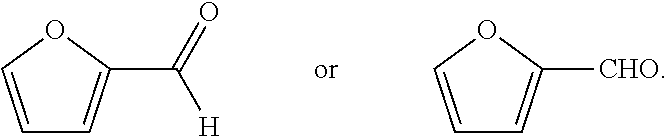
[A Structural Formular of 2-Furfural]
Figure US08871957-20141028-C00002
The typical technology for producing HMF from derived carbohydrates from biomass has a method for obtaining HMF in acid catalyst condition thorough dehydration reaction with fructose that serves as a starting material. This method has an advantage of easily obtaining furan structure without additional isomerization reaction unlike pentose fructose and hexose sugar compounds. Dumesic's group at the University of Wisconsin-Madison reported on a technology for producing HMF under various solvent conditions through acid catalyst conversion reaction with fructose that serves as a starting material (Science, 2006, 312, 1933-1937). According to the report, the technology showed high process efficiency by obtaining high HMF concentration (30 wt %).
However, for fructose, it has limited supply source as the starting material and exists only in agricultural productions. In the technology above, the solvents with optimum performance has the high boiling point, and thus high-energy distillation process is required to eliminate the boiling point, which requires new separation process technology.
Besides, a saccharification process for effectively obtaining glucose from polysaccharide cellulose is required and this is the problem for the fructose.
Meanwhile, 2-furfural is usable itself as a fuel material. Furfuryl alcohol and furfuryl acid derivatives from oxidation-reduction process are compounds that are used as polymer elements raw materials and are obtained through dehydration reaction under the acid condition of hemicellulose existed in lignocellulosic biomass. However, the performing condition of the dehydration reaction through sulfuric acid and strong acid is poor and cause a huge amount of waste acid and waste water.
So, developing a method for simply manufacturing furfural derivatives without complex and high-cost pre-process and saccharification process is required.
DETAILED DESCRIPTION OF THE EMBODIMENTS
The present invention is intended to solve the problems described above. The conventional invention should go through multi step processes such as pre-process and saccharification process. The present invention could directly turn cellulose or lignocellulosic biomass raw materials to furfural derivatives through simple reaction process in one reaction apparatus by mixing various kinds of metal catalyst at an optimum ratio.
Also, the present invention is aimed to reduce material costs and turn lignocellulosic biomass raw materials to furfural derivatives effectively by applying best optimized process to the lignocellulosic biomass and using the lignocellulosic biomass as raw material that does not cause food problem. The present invention is aimed to significantly reduce process costs and increase the yield as the furfural derivatives may be produced directly through simple process. The present invention is also aimed to be environment-friendly as they avoid waste acid and waste water which are caused through pre-process and saccharification process, etc, and reduce energy loss.
Moreover, the present invention does not have to extract cellulose from lignocellulosic biomass raw materials and utilize the useful component hemicellulose directly in lignocellulosic biomass raw materials.
The products of the present invention are very useful and effective as they may be used widely in various fields through various conversion reactions as typical core platform materials, and are optimized for converting 2-hydroxy-methyl furfural and 2-furfural immediately.
In order to achieve those goals described above, the metal catalysts for producing furfural derivatives directly from lignocellulosic biomass raw materials comprise a ruthenium and a chrome.
The chrome is from 300 to 500 parts by weight on the basis of 100 parts by weight of the ruthenium, further comprises a solvent and the solvent is at least one of an ionic solvent and an aprotic polar solvent.
The ionic solvent is at least one of ethylmethylimidazolium chloride ([EMIM]Cl), ethylmethylimidazolium bromine ([EMIM]Br) or ethylmethylimidazolium iodine ([EMIM]I), the aprotic polar solvent is at least one of dimethylacetamide, dimethyl sulfoxide, dimethylformamide, hexamethylphosphorous triamide, N-methylpyrrolidone, tetrahydrofuran or γ-butylorac.
Next, a method for producing furfural derivatives from lignocellulosic biomass raw materials comprises a pre-processing lignocellulosic biomass to extract cellulose; and a reacting metal catalyst MXn or MXn.H2O through catalyst conversion reaction in solvent to produce 5-hydroxy (the metal element, X is selected from the functional group consisting of halogen element, triflate, nonaflate, mesylate, tosylate or diazonium, and the n is from 1 to 3).
For the metal catalyst, the metal element (M) comprises at least one of Cr (□) metal catalyst and Ru (□) metal catalyst and the equivalence ratio of the metal catalyst comprising the Cr (□) to the metal catalyst comprising the Ru (□) is from 1:1 to 5:1. The ratio of the cellulose to the solvent is from 50 g/L to 500 g/L, and the equivalent of the metal catalyst is from 0.5 mol % to 200 mol %.
When reacting metal catalyst MXn or MXn.H2O through catalyst conversion reaction in solvent to produce 5-hydroxy, the temperature of reacting is from 100° C. to 150□, and the time of reacting is from 1 to 5 hours.
Next, a method for producing furfural derivatives from lignocellulosic biomass raw materials comprises a mixing a metal catalyst and a solvent to produce a compound; a heating the compound; an adding lignocellulosic biomass raw materials to the compound to produce reaction materials; and a reacting the reaction materials to heat and react it.
When mixing a metal catalyst and a solvent to produce a compound, the metal catalyst is comprised of MXn or MXn.H2O, the M is a metal element, the X is selected from the functional group consisting of halogen element, triflate, nonaflate, mesylate, tosylate or diazonium, and the n is from 1 to 3.
Also, when mixing a metal catalyst and a solvent to produce a compound, the metal element is one of Mn, Ni, Fe, Cr, Cu, Co, Ru, Sn, Zn, Al, Ce, La, Nd, Sc, Yb or In.
When mixing a metal catalyst and a solvent to produce a compound, the metal catalyst is consisted of a ruthenium and a chrome, and the chrome is from 300 to 500 parts by weight on the basis of 100 parts by weight of the ruthenium.
Also, when mixing a metal catalyst and a solvent to produce a compound, the solvent is at least one of ionic solvent and aprotic polar solvent, and the ionic solvent is at least one of ethylmethylimidazolium chloride, ethylmethylimidazolium bromine or ethylmethylimidazolium iodine, and the aprotic polar solvent is at least one of dimethylacetamide, dimethyl sulfoxide, dimethylformamide, hexamethylphosphorous triamide, N-methylpyrrolidone, tetrahydrofuran or γ-butylorac.
When heating the compound, the temperature of reacting is from 60° C. to 100° C., and when adding producing reaction materials by adding lignocellulosic biomass to the compound, the lignocellulosic biomass raw material is consisted of at least one of cellulose or hemicellulose. Also, when adding lignocellulosic biomass raw materials to the compound to produce reaction materials, the metal catalyst is from 1 mole % to 20 mole % on the basis of 100 mole % of the lignocellulosic biomass raw material, and when adding lignocellulosic biomass raw materials to the compound to produce reaction materials, the lignocellulosic biomass raw material is from 50 g to 500 g on the basis of 1 L solvent, and when reacting heating and reacting the reaction materials, the temperature of reacting is from 100° C. to 150° C. and the time of reacting is from 1 to 4 hours.
The present invention solves the problem of a rise in crop prices by utilizing celluloses derived from lignocellulosic biomass, and also possibly reduces process costs by catalyst conversion reaction that converts the product itself through single step process without saccharification process for producing monosaccharide from celluloses to glucoses.
Raw materials prices could be reduced by using lignocellulosic biomass raw materials not causing food problem and the lignocellulosic biomass raw materials could be effectively turned to furfural derivatives by applying optimized process to the lignocellulosic biomass.
Also, furfural derivatives could be directly produced from lignocellulosic biomass raw materials through simple process, process costs are significantly reduced, and the yield increases.
Waste acid and waste water are avoided from pre-process and saccharification process and energy consumption is significantly reduced, which are eco-friendly.
Cellulose does not have to be additionally extracted and the useful component, hemicelluloses in lignocellulosic biomass raw materials is directly utilized.
The present invention is optimized to turn lignocellulosic biomass raw materials to 2-hydroxy-methyl furfural and 2-furfural. Those product materials are very useful and effective as they are widely used in various fields through various conversion reactions as typical platform materials.
BRIEF DESCRIPTION OF THE DRAWINGS
FIG. 1 is a flowchart of a method for producing furfural derivatives according to the first example of the present invention.
FIG. 2 is a flowchart of a method for producing furfural derivatives according to the second example of the present invention.
FIG. 3 is a graph of a high-performance liquid chromatography (HPLC) of product materials which are produced through the method for producing furfural derivatives of the present invention.
FIG. 4 is a graph for comparing each yield of 5-hydroxymethyl-2-furfurals product materials which are produced through the method for producing the furfural derivatives of the present invention according to lignocellulosic biomass raw materials.
FIG. 5 is a graph for comparing each yield of 2-furfurals product materials which are produced through the method for producing the furfural derivatives of the present invention according to lignocellulosic biomass raw materials.
DETAILED DESCRIPTION OF THE EMBODIMENTS
A metal catalyst composition for producing furfural derivatives from raw materials of lignocellulosic biomass, and method for producing furfural derivatives using the composition are described here in detail in reference to attached drawings. The present invention could be well appreciated through preferable examples aimed at illustrating present invention's purpose. However, this is not intended to narrow the protection rights scope which is limited by attached claims.
The first example of the composition of the present invention comprises MXn or MXn.H2O, the M is a metal element, the X is selected from the functional group consisting of halogen element, triflate, nonaflate, mesylate, tosylate or diazonium, and the n is from 1 to 3.
It is desirable that the functional group comprises halogen elements such as Cl, Br, I, etc. The corresponding functional group is one at least of triflate, nonaflate, methylate, ethylsulfonate, benzensulfonate, tosylate, tri-isopropyl benzensulfonate, formate, acetate, trifluoroacetate, nitrobenzoate, and halogen arylcarboxylate. In particular, it is also desirable to use boron benzonate, methyl carbonate, ethyl carbonate, benzyl carbonate, t-butyl carbonate, dimethyl phosphonate, diethyl phosphonate, diphenyl phosphonate or diazonium. More preferably, it is most effective to use one of functional groups consisting of halogen element, triflate, nonaflate, mesylate, tosylate or diazonium.
It is effective to use one metal element of Mn, Ni, Fe, Cr, Cu, Co, Ru, Sn, Zn, Al, Ce, La, Nd, Sc, Yb or In for improving conversion efficiency.
Through various experiments, the metal catalyst composition of the present invention is proved to be most effective for the reaction of converting lignocellulosic raw material to furfural derivatives directly.
It is desirable that the MXn or MXn.H2O is from 1 mole % to 20 mole % on the basis of the 100 mole % lignocellulosic biomass raw material. More preferably, from 5 mole % to 10 mole % for the MXn or MXn.H2O is effective. When the mole % of the MXn or MXn.H2O is below 1 mole %, the conversion is almost impossible because catalyst is difficult to perform. Even though the conversion is possible, there is a problem of the low conversion rate. When the mole % of the MXn or MXn.H2O is above 20 mole %, the economic value and the yield drops.
Next, the second example for producing furfural derivatives from lignocellulosic biomass raw materials comprises a ruthenium and a chrome. More preferably, it is effective for the second example to comprise RuCl3 and CrCl2. The RuCl3 and CrCl2 are the most effective metal catalyst and perform their unique role most effectively in hydrolysis, dehydration and isomerization reactions as they are comprised of various kinds of metal catalysts.
Here, the ruthenium and the chrome perform various kinds of reaction at the same time by mixing them because the ruthenium serves as a lewis acid for hydrolysis and dehydration reactions, and the chrome is effective for isomerization reaction.
Also, it is desirable that the chrome is from 300 to 500 parts by weight on the basis of 100 parts by weight of the ruthenium. More preferably, the chrome's parts by weight from 350 to 450 is effective. When the chrome's parts by weight is below 300 or above 500, it is out of the most effective compound rate range and this leads to significant decrease in the final product's yield.
Next, it is desirable to further comprise solvent in the first and the second examples. The solvent is effective to be at least one of ionic solvent and aprotic polar solvent. This helps the conversion reaction.
The ionic solvent is desirable to be at least one of ethylmethylimidazolium chloride, ethylmethylimidazolium bromine or ethylmethylimidazolium iodine, and the aprotic polar solvent is effective to be at least one of dimethylacetamide, dimethyl sulfoxide, dimethylformamide, hexamethylphosphorous triamide N-methylpyrrolidone, tetrahydrofuran or γ-butylorac.
It is possible to convert lignocellulosic biomass material to furfural derivatives directly because the metal catalyst composition for producing furfural derivatives from lignocellulosic biomass materials of the present invention is optimized in the second example of producing method of furfural derivatives. So, the metal catalyst composition for producing furfural derivatives from lignocellulosic biomass materials of the present invention is in common with the technical features of the metal catalyst used in the first example of furfural derivatives producing method, but the compound rate may be different.
Next, the first example of producing furfural derivatives of the present invention comprises a pre-processing (S10) lignocellulosic biomass to extract cellulose and a reacting (S11) cellulose and metal catalyst in solvent through catalyst conversion reaction to produce furfural derivatives. Now, each process will be looked over.
The pre-processing (S10) is pre-processing lignocellulosic biomass to extract cellulose that is used as starting material in the reacting (S11).
The lignocellulosic biomass grows naturally in nature and it is a wood waste in city or a wood by-product in forests. Preferably, the lignocellulosic biomass could be a plant that grows naturally with great vitality on non-cultivated lands (switchgrass, etc), crop residue after cultivation (rice straw, corn stalk, etc) and waste wood resources (waste wood, waste paper, etc).
Any method could be used limitlessly for extracting cellulose from lignocellulosic biomass resources. In terms of chemical composition, the amount of cellulose through pre-processing from lignocellulosic biomass resources varies according to plants, but it is known that the amount exists about 33% in average, 50% in trees and 90% in cottons. The important main rest components are pentose natural polymer hemicellulose and aromatic phenols lignin. Normally, during the pre-processing (S10), the lignin is separated and removed by dissolving the lignin in the alkaline condition, and hemicellulose that is weaker acid than cellulose could be separated by dealing with weak acid.
The extracted cellulose through this way is a natural polymer comprising D-glucose as monomer. The extracted cellulose forms glycosidic bond in the C1 and C4 position of glucose and is linked through β(1→4) bond as shown in chemical formula 1 below.
Figure US08871957-20141028-C00003
The reacting (S11) is producing furfural derivatives through catalyst conversion reaction of the cellulose and the metal catalyst in solvent. According to the reacting for the first example of the present invention, furfural derivative could be obtained through single step reaction without the processing of converting the starting material cellulose to monomer through hydrolysis. In the reaction formula 1 below, the processing of obtaining 5-hydroxymethyl-2-furfural through single step reaction using cellulose is simply shown as preferable one example.
Figure US08871957-20141028-C00004
As described by inventors of the present invention, various kinds of metal catalysts were used to materialize hydrolysis reaction (saccharification reaction) (a), isomerization reaction (b) and dehydration reaction (c) at the same time in one reaction apparatus. For this, they tried finding the optimum metal catalyst conversion reaction condition by changing various reaction conditions such as kinds of metal catalyst, combination of various kinds of metal catalyst, composition rate, temperature, time and solvent of the various kinds of metal catalyst when mixing them.
Metal catalyst used in the reacting (S11) of the present invention serves as a lewis acid to accelerate hydrolysis and dehydration reactions, and the metal catalyst mediated the isomerization reaction that converts hexose cellulose to pentose cellulose.
Here, if metal catalyst used in one example of the present invention are MXn or MXn.H2O materials could be used not being specially limited. The M is a metal element, the X comprises halogen element, the X is corresponding functional group, and n is from 1 to 3.
For example, the metal catalyst comprises Cl, Br, I, etc and halogen element, and the corresponding functional group is one of triflate, nonaflate, methylate, ethylsulfonate, benzensulfonate, tosylate, tri-isopropyl benzensulfonate, formate, acetate, trifluoroacetate, nitrobenzoate, and halogen arylcarboxylate. In particular, the corresponding functional group is one of boron benzonate, methyl carbonate, ethyl carbonate, benzyl carbonate, t-butyl carbonate, dimethyl phosphonate, diethyl phosphonate, diphenyl phosphonate or diazonium. Among these, preferably, it is desirable to apply one of functional group of halogen element, triflate, nonaflate, methylate, tosylate or diazonium.
Here, the preferable applicable metal element is selected from a group consisting of Mn, Ni, Fe, Cr, Cu, Co, Ru, Zn, Al, Ce, La, Nd, Sc, Yb and In. As described later, in particular, the metal catalyst comprising Cr (II) as a metal element, for example, CrCl2, CrCl2.H2O, CrBr2, chrome triplate, chrome acetate or/and the metal catalyst comprising Ru (III) as a metal element, for example, RuCl3, RuCl3.H2O, RuBr3, ruthenium tosylate, etc, showed preferable yield.
The solvent used for the reacting (S11) of the present invention is desirable to be an ionic solvent such as ethylmethylimidazolium chloride, ethylmethylimidazolium bromine or ethylmethylimidazolium iodine, etc, and an aprotic polar solvent such as dimethyl acetamide (DMA), dimethyl sulfoxide (DMSO), dimethyl formamide (DMF), hexamethyl phosphorous triamide, N-methylpyrrolidone, tetrahydrofuran or γ-butylorac. In particular, an ionic solvent is preferably used as a solvent.
Also, the preferable ratio of the added cellulose to the solvent is from 50 g/L to 500 g/L. More preferably, the ratio of the added cellulose to the solvent is from 100 g/L to 300 g/L (wt/V), and high yield was shown when applying the ratio of the added cellulose to the solvent (from 100 g/L to 300 g/L). Moreover, the whole equivalent of the metal catalyst to maximize yield is from 0.5 mole % to 20 mole %, and more preferably the whole equivalent of the metal catalyst is from 5 mole % to 10 mole %. It is desirable to use more than two kinds of metal catalysts at the same time and the each used metal catalyst is selected to serve its unique role in hydrolysis, isomerization and dehydration reactions.
As proven in many experiments, the best condition happens when Ru(III) is preferably used as a metal catalyst that serves a lewis acid for hydrolysis and dehydration reactions and Cr(II) is used as metal catalyst for isomerization reaction.
Achieving optimum composition rate of various kinds of metal catalyst is important because composition rate of various kinds of metal catalyst affects a yield of final products. When using the metal catalyst combination, the preferable composition rate of Cr (II) metal catalyst and Ru (III) metal catalyst (Cr (II): Ru (I), equivalent rate, mole rate) is from 1:1 to 5:1, and in particular 4:1 is preferable.
The preferable reaction temperature is above 100° C. according to one example, the temperature of from 100° C. to 150° C. is more preferable, and the reaction time is from 1 hour to 5 hours.
Next, the second example of producing method for furfural derivatives comprises mixing (S20), heating (S21), adding (S22) and reacting (S23) as shown in FIG. 2.
Here, the mixing (S20) is mixing metal catalyst and solvent to produce compound, which is a process of mixing metal catalyst and solvent effectively to facilitate them in the reaction. When mixing metal catalyst and solvent to produce compound (S20), the metal catalyst is MXn or MXn.H2O, the M is a metal element, the X is one of functional group consisting of halogen element, triflate, nonaflate, mesylate, tosylate or diazonium, and the n is from 1 to 3. The metal element is one of Mn, Ni, Fe, Cr, Cu, Co, Ru, Sn, Zn, Al, Ce, La, Nd, Sc, Yb or In. Also, the metal catalyst is RuCl2 and CrCl2, and the CrCl2 is from 300 to 500 parts by weight on the basis of 100 parts by weight of the RuCl2.
When mixing metal catalyst and solvent to produce compound (S20), the solvent is desirable to be at least one of an ionic solvent or an aprotic polar solvent. Preferably, the ionic solvent is at least one of ethylmethylimidazoliurn chloride, ethylmethylimidazolium bromine or ethylmethylimidazolium iodine, etc, and the aprotic polar solvent is at least one of dimethylacetamide (DMA), dimethyl sulfoxide (DMSO), dimethylformamide (DMF), hexamethylphosphorous triamide, N-methylpyrrolidone, tetrahydrofuran or γ-butylorac.
The specific description about the above contents is the same with the description about the metal catalyst composition to produce furfural derivatives from lignocellulosic biomass raw materials.
Next, the heating (S21) is heating the compound. This is a mixing process to facilitate the reaction by mixing the solvent and the metal catalyst effectively.
When heating the compound (S21), temperature of heating is desirable to be from 60° C. to 100° C. and more preferably temperature of heating is effective to be from 80° C. to 90° C. For the temperature below 60° C., the metal catalyst is difficult to be dispersed effectively in solvent, and for the temperature above 100° C., there is a problem of economic value decreasing.
When heating the compound (S21), it is desirable to stir and heat at the same time. The time of heating and stirring is preferably is from 20 minute to 50 minute. More preferably, the time of 30 minute is effective. For the time below 20 minute, the metal catalyst is not dispersed enough, and for the time below 50 minute, there is a problem of economic value decreasing. Next, the adding (S22) is adding the lignocellulosic biomass material to the compound to produce reaction materials. This is a reaction preparing process to produce final product for the reaction by inputting biomass raw material.
When adding the lignocellulosic biomass material to the compound to produce reaction materials (S22), any lignocellulosic biomass is appropriate for the lignocellulosic biomass material. However, for the best effectiveness, the lignocellulosic biomass material is desirable to comprise at least one of cellulose or hemicellulose.
The cellulose which is a main component of lignocellulosic biomass used in the present invention is a linear natural polymer comprising D-glucose as a monomer. A hemicellulose is a natural polymer comprising D-xylose as a main monomer. Also, as shown in the chemical formula 2, a cellulose forms glycosidic bond in the position of C1 and C4 of D-glucose and is linked through β(1→4) bond. The bond of hemicellulose is formed in the position of C1 and C4 of D-xylose. A hemicellulose has two-dimensional chemical structure with some bonding lines unlike a linear polymer cellulose.
Figure US08871957-20141028-C00005
Also, in terms of chemical composition, lignocellulosic biomass is most effective to comprise at least one of 20% to 70% carbohydrate polymers (i.e. cellulose or hemicellulose).
Moreover, when adding the lignocellulosic biomass material to the compound to produce reaction materials (S22), the reaction material is desirable to be from 1 mole % to 20 mole % on the basis of 100 mole % of the lignocellulosic biomass raw material. More preferably, the reaction material mole from 5% to 10% is effective. The description about it is same with the ones in this specification.
Also, the lignocellulosic biomass material is desirable to be from 50 g to 500 g on the basis of the solvent 1 L. More preferably, the lignocellulosic biomass material from 100 g to 300 g is effective. When the lignocellulosic biomass material is below 50 g and above 500 g, there is a problem of a rapid decrease in yield, and the content rate of the described range in the present invention could maximize the yield.
The temperature of the adding (S22) is desirable to decrease in the heating (S21) and maintains from 15° C. to 30° C. More preferably, the temperature of the adding (S22) is effective to maintain from 20° C. to 25° C. For the temperature below 15° C., there is a problem of the compound and lignocellulosic raw material being damaged due to the low temperature. For the temperature above 30° C., some reactions could happen by adding lignocellulosic biomass raw material, which leads to a decrease in quality of the produced furfural derivatives and the yield.
Finally, a reacting (S23) is heating and reacting the reaction materials. This is a furfural derivatives producing process through conversion reaction.
When heating and reacting the reaction materials (S23), the temperature of reacting is desirable to be from 100° C. to 200° C. More preferably, the temperature of reacting is effective from 120° C. to 150° C. For the temperature below 100° C. there is a problem of enough reactions not happening. For the temperature above 200° C., a great amount of energy is consumed and the velocity of reacting increases sharply, which leads to a decrease in quality of the product, furfural derivatives and the yield.
When heating and reacting the reaction materials (S23), the time of reacting is desirable to be from 1 hour to 4 hours, and more preferably the time of reacting is effective to be from 2 hours to 3 hours. For the time of reacting below 1 hour, enough conversion reaction does not happen, and for the time of reacting above 4 hours economic values decrease, and quality of product decreases because additional reaction of the product and by-product happens.
Also, when heating and reacting the reaction materials (S23), it is desirable to stir and react reaction material by using a stirrer with a velocity from 500 RPM to 1000 RPM. The stirring could make all materials be reacted evenly, and as a result increase the reactivity and the yield.
Also, the velocity of the stirrer, from 500 RPM to 1000 RPM, could maximize the reactivity and the yield.
The conversion reaction of the present invention comprises a dissolve processing (a) for extracting polysaccharides, carbohydrate polymers from biomass supply source; a hydrolysis processing (b) for obtaining monosaccharide glucose or xylose from polysaccharide cellulose or hemicelluloses, a isomerization processing (c) for converting hexose glucose to pentagon glucose and a dehydration processing (d) for obtaining furan structure, and the all processes could be materialized at the same time in one reacting apparatus. Herein, in the conversion reaction, the various kinds of metal catalyst serves as a lewis acid to accelerate hydrolysis and dehydration reactions and mediate isomerization reaction which converts hexose structure to pentose structure.
The reaction formula 2 briefly shows the process of one example obtaining 5-hydroxymethyl-2-furfural and 2-furfural at the same time through single-step reaction from lignocellulosic biomass supply source which comprise carbohydrate polymer cellulose and hemicellulose as main components.
Figure US08871957-20141028-C00006
The starting material is a lignocellulosic biomass which comprises carbohydrate polymers cellulose and hemicelluloses as main components. Preferably, the lignocellulosic biomass could be obtained from plants that grow naturally with great vitality on non-cultivated lands (grass, reed, etc), crop residue after cultivation (rice straw, barley straw, wheat straw, corn stem, rape stem, etc), waste lignocellulosic resources (waste wood, waste paper, coffee residues, etc), etc.
Experiment results for proving the excellence of a composition of metal catalysts for preparation of furfural derivatives directly from lignocellulosic biomass raw materials and method of preparing furfural derivatives directly from lignocellulosic biomass raw materials using thereof will be examined.
The experiment results about the first example of producing furfural derivatives of the present invention are described below.
Producing Method
Metal catalysts (10 mol % of the substrate), 500 mg of solvent ionic liquid [EMIM]Cl were put into 6 mL of vial, the mixture was heated at 60° C. and stirred for 40 minutes. The mixture was cooled to room temperature and 50 mg of cellulose was poured into the mixture. And then the mixture was re-heated again at 90° C. to 120° C. and stirred at 700 rpm for 2 to 4 hours. After reactions were closed, the each vial was cooled to room temperature, diluted with 5 ml of HPLC grade distilled water and stirred for 40 minutes. After the each vial was diluted 100 fold, the each yield rate was measured through HPLC analysis. The each sample was separated through C18 reverse phase column on the HPLC (Varian Pro Star 310), and the peak area was measured by using UV detector (280 nm) and the yield rate was calculated back by using response factors obtained in advance.
Experiment 1: The Effect of Temperature on Reaction
The present reaction has a possibility of improving the yield rate under the condition of removing water with easiness through dehydration reaction. Therefore, each reaction of water at 90° C. which is lower than the boiling point and water at 120° C. which is higher than the boiling point was implemented and the effect of each temperature on reaction was observed. The time of reacting was 2 hours and the result is shown in the Table 1. As a result, the yield rate was better when the temperature on reaction was at 120° C. which is higher than the boiling point of water. The best yield rate, 19.1%, was obtained, when Cr (II) metal catalyst was used and the temperature of reacting was 120° C.
TABLE 1
The Effect of Reacting Temperature about Yield
Temperature
Order Metal Catalyst Solvent (° C.) Hours (h) Yield (%)
1 CrCl2 [EMIM]Cl 90 2 7.4
2 CrCl2 [EMIM]Cl 120 2 19.1
3 MnCl2 [EMIM]Cl 90 2 6.6
4 MnCl2 [EMIM]Cl 120 2 9.1
5 FeCl2 [EMIM]Cl 90 2 9.0
6 FeCl2 [EMIM]Cl 120 2 12.6
7 FeCl3 [EMIM]Cl 90 2 12.8
8 FeCl3 [EMIM]Cl 120 2 10.8
9 CoCl26H2O [EMIM]Cl 90 2 5.8
10 CoCl26H2O [EMIM]Cl 120 2 9.8
11 NiCl2 [EMIM]Cl 90 2 5.4
12 NiCl2 [EMIM]Cl 120 2 6.5
13 CuCl2 [EMIM]Cl 90 2 13.1
14 CuCl2 [EMIM]Cl 120 2 12.8
15 ZnCl2 [EMIM]Cl 90 2 6.7
16 ZnCl2 [EMIM]Cl 120 2 14.8
Experiment 2: The Effect of Reacting Time
The temperature of reaction was fixed at 120° C., the time of reacting was extended to 4 hours and the yield rate of HMF was measured. The yield rate increased from 19.1% to 27.1% when the chrome was used as catalyst, however, it is confirmed that when the rest of metal catalysts were used, the yield rate remained at the same or rather decreased. The reason seems to be the result of the creation of levulinic acid produced by additional dehydration reaction of the created HMF. The effect of reaction time on the yield rate of HMF is shown in the Table 2.
TABLE 2
The Effect of Reacting Time about HMF Yield
Temperature Yield
Order Metal Catalyst Solvent (° C.) Hours (h) (%)
1 CrCl2 [EMIM]Cl 120 2 19.1
2 CrCl2 [EMIM]Cl 120 4 27.1
3 MnCl2 [EMIM]Cl 120 2 9.1
4 MnCl2 [EMIM]Cl 120 4 10.9
5 FeCl2 [EMIM]Cl 120 2 12.6
6 FeCl2 [EMIM]Cl 120 4 9.2
7 FeCl3 [EMIM]Cl 120 2 10.8
8 FeCl3 [EMIM]Cl 120 4 6.8
9 CoCl26H2O [EMIM]Cl 120 2 9.8
10 CoCl26H2O [EMIM]Cl 120 4 9.6
11 NiCl2 [EMIM]Cl 120 2 6.5
12 NiCl2 [EMIM]Cl 120 4 6.1
13 CuCl2 [EMIM]Cl 120 2 12.8
14 CuCl2 [EMIM]Cl 120 4 9.5
15 ZnCl2 [EMIM]Cl 120 2 14.8
16 ZnCl2 [EMIM]Cl 120 4 6.0
Experiment 3: The Dual Catalyst System
From the result of above experiment, temperature of reaction was fixed at 120° C., the two metal catalysts were used simultaneously to convert the glucose into HMF. The time of reacting was 2 hours. Intriguingly, the yield rate on reaction increased significantly when the two catalysts were used simultaneously compared to that of the yield rate on reaction when only one catalyst was used. In particular, using combined metal catalysts including Cr (II) and Ru (III) made it possible to obtain about 60% of HMF. However, as it is confirmed in the result, the yield rate rather decreased when the time of reacting increased to 4 hours. The result is shown in the Table 3
TABLE 3
Dual Catalyst System
Metal Metal Temper-
cata- cata- ature Hours Yield
Order lyst 1 lyst 2 Solvent (° C.) (h) (%)
1 CrCl2 FeCl2 [EMIM]Cl 120 2 48.0
2 CrCl2 FeCl2 [EMIM]Cl 120 4 40.2
3 CrCl2 FeCl3 [EMIM]Cl 120 2 43.3
4 CrCl2 FeCl3 [EMIM]Cl 120 4 32.0
5 CrCl2 CuCl2 [EMIM]Cl 120 2 37.1
6 CrCl2 CuCl2 [EMIM]Cl 120 4 39.8
7 CrCl2 RuCl3 [EMIM]Cl 120 2 59.1
8 CrCl2 RuCl3 [EMIM]Cl 120 4 35.0
Experiment 4: The Effect of Catalyst Composition Rate in the Dual Catalyst System
In order to optimize the composition rate of Cr(II) and Ru (III) which showed the best result in the dual catalyst system, the yield rate of HMF was measured by differentiating the composition rate. As a result, the best yield rate was obtained when the composition rate of Cr (II) and Ru (III) was 4:1. The result of each composition rate is shown in the Table 4.
TABLE 4
The Effect of Catalyst Composition Rate in Dual Catalyst System
Metal Metal Compo- Temper-
cata- cata- sition ature Hours Yield
Order lyst 1 lyst 2 rate Solvent (° C.) (h) (%)
1 CrCl2 RuCl3 10:1  [EMIM]Cl 120 2 37.6
2 CrCl2 RuCl3 6:1 [EMIM]Cl 120 2 51.3
3 CrCl2 RuCl3 5:1 [EMIM]Cl 120 2 53.1
4 CrCl2 RuCl3 4:1 [EMIM]Cl 120 2 59.6
5 CrCl2 RuCl3 3:1 [EMIM]Cl 120 2 54.6
6 CrCl2 RuCl3 2:1 [EMIM]Cl 120 2 53.6
7 CrCl2 RuCl3 1:1 [EMIM]Cl 120 2 54.2
8 CrCl2 RuCl3 1:2 [EMIM]Cl 120 2 34.1
9 CrCl2 RuCl3 1:3 [EMIM]Cl 120 2 31.2
10 CrCl2 RuCl3 1:4 [EMIM]Cl 120 2 28.5
Experiment 5: 3-Catalyst System
An experiment on 3-catalyst system was performed. Based on the result of the above experiment, manganese, copper and zinc metal catalysts were applied to dual catalysts of chrome and ruthenium, chrome and iron and chrome and copper. The temperature of reacting was fixed at 120° C. and the time of reacting was two hours. The best yield rate of HMF was obtained when the chrome, iron and manganese was used, however the result was not as good as that of the dual catalyst system. The result of 3-catalyst system is shown in the Table 5.
TABLE 5
Catalyst System
Metal Metal Metal Temper-
cata- cata- cata- ature Yield
Order lyst
1 lyst 2 lyst 3 Solvent (° C.) Hour(h) (%)
1 CrCl2 FeCl2 MnCl2 [EMIM]Cl 120 2 38.0
2 CrCl2 FeCl2 CuCl2 [EMIM]Cl 120 2 31.1
3 CrCl2 FeCl2 ZnCl2 [EMIM]Cl 120 2 37.3
4 CrCl2 CuCl2 MnCl2 [EMIM]Cl 120 2 31.5
5 CrCl2 CuCl2 ZnCl2 [EMIM]Cl 120 2 29.4
6 CrCl2 RuCl3 FeCl2 [EMIM]Cl 120 2 32.7
7 CrCl2 RuCl3 MnCl2 [EMIM]Cl 120 2 33.3
8 CrCl2 RuCl3 CuCl2 [EMIM]Cl 120 2 22.7
9 CrCl2 RuCl3 ZnCl2 [EMIM]Cl 120 2 32.8
In conclusion, it was proven that HMF could be produced directly by high yield from cellulose extracted through metal catalyst conversion reaction from lignocellulosic biomass. Next, experiment results about the second example of furfural derivatives producing methods of the present invention are shown as below.
The component analysis results of cellulose and hemicellulose contents on various kinds of lignocellulosic biomass source supplies are shown as below in the Table 6.
TABLE 6
Lignocellulosic Component
biomass supply Hemi-
source Cellulose cellulose Lignin Ash
rice straw 35.0 25.0 12.0
barley straw 37.0 22.2
wheat straw 38.2 21.2 23.4
triticale 35.8 24.3 21.9 7.4
rape stem 31.2 17.2 20.5 6.5
grass 39.7 26.4 24.3 2.4
reed 40.0 22.0 26.1 5.2
MDF board 33.2 12.1 32.2 1.1
waste paper 63.9 10.4  1.5 11.5 
coffee bean 5.9 37.4 41.6 0.4
residue
Exemplary Embodiment
Metal catalyst RuCl3 and CrCl2 (equivalent ratio 1:4 and equivalent total sum: 10 mole % of substrate), and ionic liquid solvent [EMIM]Cl (500 mg) were put in a tubular type reactor. And then, the mixture was heated at 90° C. and stirred for 30 minutes. After lowering the temperature of the mixture to room temperature, each of the lignocellulosic biomass raw materials (50 mg for each) shown in Table 1 was put in the mixture, reheated at 120° C. and stirred at 700 rpm for 2 hours. After the reaction was completed, each reactor was cooled to room temperature, diluted with HPLC grade distilled water. And then a each yield rate was measured for each reactor through HPLC analysis.
The sample was separated through C18 reverse phase column on high-performance liquid chromatography (HPLC; Agilent 1200 series), its peak area was measured through a UV detector (280 nm), and its yield was calculated back through a pre-obtained HMF response factor. Herein, the HPLC was as shown in FIG. 3, and each peak was confirmed as HMF and 2-furfural. According to the HPLC analysis results, the yield rate of the HMF and 2-furfural produced from each of the lignocellulosic biomass raw materials under the conversion reaction condition was as shown in FIG. 4 and FIG. 5.
Thus, the present experiment results in accordance with embodiments of the present invention show that each of the lignocellulosic biomass raw materials was converted into a furfural derivative effectively, and with an excellent yield rate.
INDUSTRIAL APPLICABILITY
The present invention relates to a metal catalyst composition for producing furfural derivatives from raw materials of lignocellulosic biomass, and method for producing furfural derivatives using the composition. More particularly to the composition and the method which may turn lignocellulosic biomass raw materials to furfural derivatives through single step process without additional saccharification process by using various kinds of metal catalyst in optimal reacting condition, thus significantly reducing process costs, unlike conventional composition and method going through multi step process.

Claims (13)

What is claimed is:
1. A composition of metal catalysts and an ionic solvent for preparation of furfural derivatives from lignocellulosic biomass raw materials comprising a ruthenium and a chrome, wherein the chrome is from 300 to 500 parts by weight on the basis of 100 parts by weight of the ruthenium, and wherein the furfural derivative is either hydroxymethyl-2-furfural (HMF) having a structural formula of
Figure US08871957-20141028-C00007
or 2-furfural having a structural formula of
Figure US08871957-20141028-C00008
2. The composition of metal catalysts for preparation of furfural derivatives from lignocellulosic biomass raw materials according to claim 1,
wherein the ionic solvent is at least one of ethylmethylimidazolium chloride, ethylmethylimidazolium bromine or ethylmethylimidazolium iodine.
3. A method for producing furfural derivatives comprising;
extracting cellulose from lignocellulosic biomass; and
reacting (1) metal catalyst of MXn or MXn.H2O (M is a metal element, X is selected from the functional group consisting of halogen element, triflate, nonaflate, mesylate, tosylate or diazonium, and n is from 1 to 3) in an ionic solvent through catalyst conversion reaction to produce furfural derivatives, wherein the metal catalyst comprises Cr(II) metal catalyst and Ru(III) metal catalyst, and wherein the furfural derivative is either hydroxymethyl-2-furfural (HMF) having a structural formula of
Figure US08871957-20141028-C00009
or 2-furfural having a structural formula of
Figure US08871957-20141028-C00010
4. The method for producing furfural derivatives according to claim 3;
wherein equivalence ratio of Cr(II) metal catalyst and Ru(III) metal catalyst is from 1:1 to 5:1.
5. The method for producing furfural derivatives according to claim 3;
wherein the ratio of a cellulose to ionic solvent is from 50 g/L to 500 g/L.
6. The method for producing furfural derivatives according to claim 3;
wherein temperature of reacting is from 100° C. to 150° C. and time of reacting is from 1 hour to 5 hours.
7. A method for producing furfural derivatives comprising:
mixing a metal catalyst and an ionic solvent to produce a compound;
heating the compound;
adding lignocellulosic biomass to the compound to produce reaction materials; and
reacting the reaction material by heating, wherein the metal catalyst comprises a ruthenium and a chrome when mixing the metal catalyst and the ionic solvent to produce the compound, wherein the chrome is from 300 parts to 500 parts by weight on the basis of 100 parts by weight of the ruthenium the furfural derivative is either hydroxymethyl-2-furfural (HMF) having a structural formula of
Figure US08871957-20141028-C00011
or 2-furfural having a structural formula of
Figure US08871957-20141028-C00012
8. The method for producing furfural derivatives according to claim 7;
wherein the ionic solvent is at least one of ethylmethylimidazolium chloride, ethylmethylimidazolium bromine or ethylmethylimidazolium iodine.
9. The method for producing furfural derivatives according to claim 7;
wherein the temperature of heating is from 60° C. to 100° C.
10. The method for producing furfural derivatives according to claim 7;
wherein the lignocellulosic biomass raw material comprises at least one of a cellulose or a hemicellulose.
11. The method for producing furfural derivatives according to claim 7;
wherein the reaction material is from 1 mole % to 20 mole % on the basis of 100 mole % of the lignocellulosic biomass raw material.
12. The method for producing furfural derivatives according to claim 7;
wherein the lignocellulosic biomass raw material is from 50 g to 500 g on the basis of 1 L solvent.
13. The method for producing furfural derivatives according to claim 7;
wherein temperature of reacting is from 100° C. to 200° C., and time of reacting is from 1 hour to 4 hours.
US13/640,764 2010-04-15 2011-04-14 Metal catalyst composition for producing furfural derivatives from raw materials of lignocellulosic biomass, and method for producing furfural derivatives using the composition Active 2031-06-02 US8871957B2 (en)

Applications Claiming Priority (7)

Application Number Priority Date Filing Date Title
KR10-2010-0034646 2010-04-15
KR1020100034646 2010-04-15
KR1020100034646A KR101186503B1 (en) 2010-04-15 2010-04-15 Method for preparing 5-hydroxymethyl-2-furfural using cellulose derived from ligneous biomass
KR1020110013821A KR101252819B1 (en) 2011-02-16 2011-02-16 Composition of metal catalysts for preparation of furfural derivatives directly from wood-based biomass raw materials and method of preparing furfural derivatives directly from wood-based biomass raw materials using thereof
KR1020110013821 2011-02-16
KR10-2011-0013821 2011-02-16
PCT/KR2011/002681 WO2011129640A2 (en) 2010-04-15 2011-04-14 Metal catalyst composition for producing furfural derivatives from raw materials of lignocellulosic biomass, and method for producing furfural derivatives using the composition

Publications (2)

Publication Number Publication Date
US20130030194A1 US20130030194A1 (en) 2013-01-31
US8871957B2 true US8871957B2 (en) 2014-10-28

Family

ID=44799196

Family Applications (1)

Application Number Title Priority Date Filing Date
US13/640,764 Active 2031-06-02 US8871957B2 (en) 2010-04-15 2011-04-14 Metal catalyst composition for producing furfural derivatives from raw materials of lignocellulosic biomass, and method for producing furfural derivatives using the composition

Country Status (3)

Country Link
US (1) US8871957B2 (en)
CN (1) CN102844114B (en)
WO (1) WO2011129640A2 (en)

Cited By (2)

* Cited by examiner, † Cited by third party
Publication number Priority date Publication date Assignee Title
WO2017134505A1 (en) * 2015-12-30 2017-08-10 بدر، موسى، أحمد الصلاحي System for producing energy from sewage and domestic and agricultural waste by integrating four apparatuses
RU2628802C1 (en) * 2016-12-21 2017-08-22 Федеральное государственное бюджетное образовательное учреждение высшего образования "Российский государственный университет нефти и газа (национальный исследовательский университет) имени И.М. Губкина" Method of producing furanous compounds from carbohydrates, cellulose or lignocellulosic raw materials

Families Citing this family (4)

* Cited by examiner, † Cited by third party
Publication number Priority date Publication date Assignee Title
CN105348238A (en) * 2015-12-01 2016-02-24 滁州市润达溶剂有限公司 Method for preparing furfural with rice straw and rice husks as main materials
WO2019017468A1 (en) * 2017-07-21 2019-01-24 三菱瓦斯化学株式会社 2,5-bis(aminomethyl)furan production method
CN109280039B (en) * 2018-12-10 2022-11-25 苏州科技大学 A method for preparing 5-hydroxymethylfurfural based on cellulose conversion
JP2020143046A (en) * 2019-03-01 2020-09-10 国立研究開発法人産業技術総合研究所 Synthesis method of 5-hydroxymethyl-2-furfural and 2,5-diformylfuran

Citations (9)

* Cited by examiner, † Cited by third party
Publication number Priority date Publication date Assignee Title
KR20000031378A (en) 1998-11-05 2000-06-05 김충섭 Manufacture and method for tableting furfural using solid acid catalyst and supercritical fluid
KR20040044933A (en) 2001-09-17 2004-05-31 이 아이 듀폰 디 네모아 앤드 캄파니 Process for Preparing 2,5-Diformylfuran from Carbohydrates
WO2007104515A1 (en) * 2006-03-10 2007-09-20 Furanix Technologies B.V. Method for the synthesis of organic acid esters of 5-hydroxymethylfurfural and their use
KR20090024664A (en) 2006-03-10 2009-03-09 퓨라닉스 테크놀러지스 비.브이. Method for preparing 5-alkoxymethylfurfural ether and uses thereof
WO2009030512A2 (en) * 2007-09-07 2009-03-12 Furanix Technologies B.V. Hydroxymethylfurfural ethers and esters prepared in ionic liquids
WO2009030551A1 (en) 2007-09-06 2009-03-12 Nv Bekaert Sa Self-cleaning comb needle
WO2009076627A2 (en) * 2007-12-12 2009-06-18 Archer Daniels Midland Co Conversion of carbohydrates to hydroxy-methylfurfural (hmf) and derivatives
US20100004437A1 (en) 2008-06-17 2010-01-07 Binder Joseph Bartholomew Chemical Transformation of Lignocellulosic Biomass into Fuels and Chemicals
US20100317879A1 (en) 2006-08-07 2010-12-16 Battelle Memorial Institute Methods for conversion of carbohydrates in ionic liquids to value-added chemicals

Family Cites Families (1)

* Cited by examiner, † Cited by third party
Publication number Priority date Publication date Assignee Title
UA98002C2 (en) * 2007-09-07 2012-04-10 Фураникс Технолоджиз Б.В. Mixture of furfural and 5-(alkoxymethyl)furfural derivatives from sugars and alcohols

Patent Citations (10)

* Cited by examiner, † Cited by third party
Publication number Priority date Publication date Assignee Title
KR20000031378A (en) 1998-11-05 2000-06-05 김충섭 Manufacture and method for tableting furfural using solid acid catalyst and supercritical fluid
KR20040044933A (en) 2001-09-17 2004-05-31 이 아이 듀폰 디 네모아 앤드 캄파니 Process for Preparing 2,5-Diformylfuran from Carbohydrates
WO2007104515A1 (en) * 2006-03-10 2007-09-20 Furanix Technologies B.V. Method for the synthesis of organic acid esters of 5-hydroxymethylfurfural and their use
KR20090024664A (en) 2006-03-10 2009-03-09 퓨라닉스 테크놀러지스 비.브이. Method for preparing 5-alkoxymethylfurfural ether and uses thereof
US20100317879A1 (en) 2006-08-07 2010-12-16 Battelle Memorial Institute Methods for conversion of carbohydrates in ionic liquids to value-added chemicals
US7939681B2 (en) 2006-08-07 2011-05-10 Battelle Memorial Institute Methods for conversion of carbohydrates in ionic liquids to value-added chemicals
WO2009030551A1 (en) 2007-09-06 2009-03-12 Nv Bekaert Sa Self-cleaning comb needle
WO2009030512A2 (en) * 2007-09-07 2009-03-12 Furanix Technologies B.V. Hydroxymethylfurfural ethers and esters prepared in ionic liquids
WO2009076627A2 (en) * 2007-12-12 2009-06-18 Archer Daniels Midland Co Conversion of carbohydrates to hydroxy-methylfurfural (hmf) and derivatives
US20100004437A1 (en) 2008-06-17 2010-01-07 Binder Joseph Bartholomew Chemical Transformation of Lignocellulosic Biomass into Fuels and Chemicals

Non-Patent Citations (4)

* Cited by examiner, † Cited by third party
Title
Article-Su et al., "Single-step conversion of cellulose to 5-hydroxymethylfurfural (HMF), a versatile platform chemical," Applied Catalysis A: General, vol. 361, 2009, pp. 117-122.
Article—Su et al., "Single-step conversion of cellulose to 5-hydroxymethylfurfural (HMF), a versatile platform chemical," Applied Catalysis A: General, vol. 361, 2009, pp. 117-122.
Donohoe et al., Org. Let. (2007), vol. 9(6), pp. 953-956. *
Search Report for PCT/KR2011/002681 dated Dec. 9, 2011, 2 pages.

Cited By (2)

* Cited by examiner, † Cited by third party
Publication number Priority date Publication date Assignee Title
WO2017134505A1 (en) * 2015-12-30 2017-08-10 بدر، موسى، أحمد الصلاحي System for producing energy from sewage and domestic and agricultural waste by integrating four apparatuses
RU2628802C1 (en) * 2016-12-21 2017-08-22 Федеральное государственное бюджетное образовательное учреждение высшего образования "Российский государственный университет нефти и газа (национальный исследовательский университет) имени И.М. Губкина" Method of producing furanous compounds from carbohydrates, cellulose or lignocellulosic raw materials

Also Published As

Publication number Publication date
WO2011129640A9 (en) 2011-12-15
CN102844114A (en) 2012-12-26
WO2011129640A3 (en) 2012-02-02
CN102844114B (en) 2016-06-08
US20130030194A1 (en) 2013-01-31
WO2011129640A2 (en) 2011-10-20

Similar Documents

Publication Publication Date Title
Gómez Millán et al. Recent advances in the catalytic production of platform chemicals from holocellulosic biomass
US8871957B2 (en) Metal catalyst composition for producing furfural derivatives from raw materials of lignocellulosic biomass, and method for producing furfural derivatives using the composition
Yang et al. Conversion of biomass into 5-hydroxymethylfurfural using solid acid catalyst
de Souza et al. Bio (chemo) technological strategies for biomass conversion into bioethanol and key carboxylic acids
US8426619B2 (en) Continuous production of furfural and levulininc acid
Bhagia et al. Biofuel production from Jerusalem artichoke tuber inulins: a review
Rivas et al. Biorefinery processes for the valorization of Miscanthus polysaccharides: from constituent sugars to platform chemicals
EP3180297A1 (en) Process for the manufacture of furural and furfural derivatives
US20150246865A1 (en) Process for making levulinic acid
Klamrassamee et al. Comparison of homogeneous and heterogeneous acid promoters in single-step aqueous-organosolv fractionation of eucalyptus wood chips
Heo et al. Seagrass-based platform strategies for sustainable hydroxymethylfurfural (HMF) production: toward bio-based chemical products
Xing et al. Efficient synthesis of 5-hydroxymethylfurfural from carbohydrates via SO3H-containing dendrimer β zeolite catalyst
Agarwal et al. Sustainable production of chemicals and energy fuel precursors from lignocellulosic fractions
Liao et al. Optimizing tri-acid mixture hydrolysis: An improved strategy for efficient xylooligosaccharides production from corncob
Arora et al. Valorization of by-products following the biorefinery concept: commercial aspects of by-products of lignocellulosic biomass
US9024047B2 (en) Methods for furfural production from branched non-fermentable sugars in stillage or syrup
US8795393B2 (en) Method for producing biofuel using marine algae-derived galactan
KR101186503B1 (en) Method for preparing 5-hydroxymethyl-2-furfural using cellulose derived from ligneous biomass
US8674150B2 (en) One-step catalytic conversion of biomass-derived carbohydrates to liquid fuels
KR101252819B1 (en) Composition of metal catalysts for preparation of furfural derivatives directly from wood-based biomass raw materials and method of preparing furfural derivatives directly from wood-based biomass raw materials using thereof
KR101141675B1 (en) Method of preparing 5-hydroxymethyl-2-furfural from algal galactans
CN107235938B (en) A kind of method for preparing 5-HMF based on MTO composite catalyst one-pot method
AU2024201711B2 (en) An integrated process for the purification of levulinic acid from technical lignin
Suriyachai et al. Effects of acid and alkali promoters on organosolv fractionation of sugarcane bagasse using ternary solvent system
Klamrassamee et al. Comparison of Fractionated and Non-Fractionated Eucalyptus in Organic Solvent Subsequence Hydrolysis Reaction to Sugar Production

Legal Events

Date Code Title Description
AS Assignment

Owner name: KOREA INSTITUTE OF INDUSTRIAL TECHNOLOGY, KOREA, R

Free format text: ASSIGNMENT OF ASSIGNORS INTEREST;ASSIGNORS:CHO, JIN KU;KIM, SANGYONG;LEE, DOHOON;AND OTHERS;REEL/FRAME:029143/0523

Effective date: 20121015

STCF Information on status: patent grant

Free format text: PATENTED CASE

FEPP Fee payment procedure

Free format text: PAYOR NUMBER ASSIGNED (ORIGINAL EVENT CODE: ASPN); ENTITY STATUS OF PATENT OWNER: SMALL ENTITY

FEPP Fee payment procedure

Free format text: PAT HOLDER CLAIMS SMALL ENTITY STATUS, ENTITY STATUS SET TO SMALL (ORIGINAL EVENT CODE: LTOS); ENTITY STATUS OF PATENT OWNER: SMALL ENTITY

MAFP Maintenance fee payment

Free format text: PAYMENT OF MAINTENANCE FEE, 4TH YR, SMALL ENTITY (ORIGINAL EVENT CODE: M2551)

Year of fee payment: 4

MAFP Maintenance fee payment

Free format text: PAYMENT OF MAINTENANCE FEE, 8TH YR, SMALL ENTITY (ORIGINAL EVENT CODE: M2552); ENTITY STATUS OF PATENT OWNER: SMALL ENTITY

Year of fee payment: 8