US8871509B2 - Nanoparticle-based gene delivery systems - Google Patents
Nanoparticle-based gene delivery systems Download PDFInfo
- Publication number
- US8871509B2 US8871509B2 US12/809,996 US80999610A US8871509B2 US 8871509 B2 US8871509 B2 US 8871509B2 US 80999610 A US80999610 A US 80999610A US 8871509 B2 US8871509 B2 US 8871509B2
- Authority
- US
- United States
- Prior art keywords
- gene
- aunp
- cells
- oligonucleotide
- shrna
- Prior art date
- Legal status (The legal status is an assumption and is not a legal conclusion. Google has not performed a legal analysis and makes no representation as to the accuracy of the status listed.)
- Active, expires
Links
Images




Classifications
-
- C—CHEMISTRY; METALLURGY
- C12—BIOCHEMISTRY; BEER; SPIRITS; WINE; VINEGAR; MICROBIOLOGY; ENZYMOLOGY; MUTATION OR GENETIC ENGINEERING
- C12N—MICROORGANISMS OR ENZYMES; COMPOSITIONS THEREOF; PROPAGATING, PRESERVING, OR MAINTAINING MICROORGANISMS; MUTATION OR GENETIC ENGINEERING; CULTURE MEDIA
- C12N15/00—Mutation or genetic engineering; DNA or RNA concerning genetic engineering, vectors, e.g. plasmids, or their isolation, preparation or purification; Use of hosts therefor
- C12N15/09—Recombinant DNA-technology
- C12N15/11—DNA or RNA fragments; Modified forms thereof; Non-coding nucleic acids having a biological activity
- C12N15/113—Non-coding nucleic acids modulating the expression of genes, e.g. antisense oligonucleotides; Antisense DNA or RNA; Triplex- forming oligonucleotides; Catalytic nucleic acids, e.g. ribozymes; Nucleic acids used in co-suppression or gene silencing
-
- A—HUMAN NECESSITIES
- A61—MEDICAL OR VETERINARY SCIENCE; HYGIENE
- A61K—PREPARATIONS FOR MEDICAL, DENTAL OR TOILETRY PURPOSES
- A61K31/00—Medicinal preparations containing organic active ingredients
- A61K31/70—Carbohydrates; Sugars; Derivatives thereof
- A61K31/7088—Compounds having three or more nucleosides or nucleotides
- A61K31/7105—Natural ribonucleic acids, i.e. containing only riboses attached to adenine, guanine, cytosine or uracil and having 3'-5' phosphodiester links
-
- A—HUMAN NECESSITIES
- A61—MEDICAL OR VETERINARY SCIENCE; HYGIENE
- A61K—PREPARATIONS FOR MEDICAL, DENTAL OR TOILETRY PURPOSES
- A61K31/00—Medicinal preparations containing organic active ingredients
- A61K31/70—Carbohydrates; Sugars; Derivatives thereof
- A61K31/7088—Compounds having three or more nucleosides or nucleotides
- A61K31/713—Double-stranded nucleic acids or oligonucleotides
-
- A—HUMAN NECESSITIES
- A61—MEDICAL OR VETERINARY SCIENCE; HYGIENE
- A61K—PREPARATIONS FOR MEDICAL, DENTAL OR TOILETRY PURPOSES
- A61K33/00—Medicinal preparations containing inorganic active ingredients
- A61K33/24—Heavy metals; Compounds thereof
-
- A—HUMAN NECESSITIES
- A61—MEDICAL OR VETERINARY SCIENCE; HYGIENE
- A61K—PREPARATIONS FOR MEDICAL, DENTAL OR TOILETRY PURPOSES
- A61K33/00—Medicinal preparations containing inorganic active ingredients
- A61K33/24—Heavy metals; Compounds thereof
- A61K33/242—Gold; Compounds thereof
-
- A61K47/48861—
-
- A—HUMAN NECESSITIES
- A61—MEDICAL OR VETERINARY SCIENCE; HYGIENE
- A61K—PREPARATIONS FOR MEDICAL, DENTAL OR TOILETRY PURPOSES
- A61K47/00—Medicinal preparations characterised by the non-active ingredients used, e.g. carriers or inert additives; Targeting or modifying agents chemically bound to the active ingredient
- A61K47/50—Medicinal preparations characterised by the non-active ingredients used, e.g. carriers or inert additives; Targeting or modifying agents chemically bound to the active ingredient the non-active ingredient being chemically bound to the active ingredient, e.g. polymer-drug conjugates
- A61K47/51—Medicinal preparations characterised by the non-active ingredients used, e.g. carriers or inert additives; Targeting or modifying agents chemically bound to the active ingredient the non-active ingredient being chemically bound to the active ingredient, e.g. polymer-drug conjugates the non-active ingredient being a modifying agent
- A61K47/54—Medicinal preparations characterised by the non-active ingredients used, e.g. carriers or inert additives; Targeting or modifying agents chemically bound to the active ingredient the non-active ingredient being chemically bound to the active ingredient, e.g. polymer-drug conjugates the non-active ingredient being a modifying agent the modifying agent being an organic compound
- A61K47/549—Sugars, nucleosides, nucleotides or nucleic acids
-
- A—HUMAN NECESSITIES
- A61—MEDICAL OR VETERINARY SCIENCE; HYGIENE
- A61K—PREPARATIONS FOR MEDICAL, DENTAL OR TOILETRY PURPOSES
- A61K47/00—Medicinal preparations characterised by the non-active ingredients used, e.g. carriers or inert additives; Targeting or modifying agents chemically bound to the active ingredient
- A61K47/50—Medicinal preparations characterised by the non-active ingredients used, e.g. carriers or inert additives; Targeting or modifying agents chemically bound to the active ingredient the non-active ingredient being chemically bound to the active ingredient, e.g. polymer-drug conjugates
- A61K47/51—Medicinal preparations characterised by the non-active ingredients used, e.g. carriers or inert additives; Targeting or modifying agents chemically bound to the active ingredient the non-active ingredient being chemically bound to the active ingredient, e.g. polymer-drug conjugates the non-active ingredient being a modifying agent
- A61K47/68—Medicinal preparations characterised by the non-active ingredients used, e.g. carriers or inert additives; Targeting or modifying agents chemically bound to the active ingredient the non-active ingredient being chemically bound to the active ingredient, e.g. polymer-drug conjugates the non-active ingredient being a modifying agent the modifying agent being an antibody, an immunoglobulin or a fragment thereof, e.g. an Fc-fragment
- A61K47/6801—Drug-antibody or immunoglobulin conjugates defined by the pharmacologically or therapeutically active agent
- A61K47/6803—Drugs conjugated to an antibody or immunoglobulin, e.g. cisplatin-antibody conjugates
- A61K47/6807—Drugs conjugated to an antibody or immunoglobulin, e.g. cisplatin-antibody conjugates the drug or compound being a sugar, nucleoside, nucleotide, nucleic acid, e.g. RNA antisense
-
- A—HUMAN NECESSITIES
- A61—MEDICAL OR VETERINARY SCIENCE; HYGIENE
- A61K—PREPARATIONS FOR MEDICAL, DENTAL OR TOILETRY PURPOSES
- A61K47/00—Medicinal preparations characterised by the non-active ingredients used, e.g. carriers or inert additives; Targeting or modifying agents chemically bound to the active ingredient
- A61K47/50—Medicinal preparations characterised by the non-active ingredients used, e.g. carriers or inert additives; Targeting or modifying agents chemically bound to the active ingredient the non-active ingredient being chemically bound to the active ingredient, e.g. polymer-drug conjugates
- A61K47/69—Medicinal preparations characterised by the non-active ingredients used, e.g. carriers or inert additives; Targeting or modifying agents chemically bound to the active ingredient the non-active ingredient being chemically bound to the active ingredient, e.g. polymer-drug conjugates the conjugate being characterised by physical or galenical forms, e.g. emulsion, particle, inclusion complex, stent or kit
- A61K47/6921—Medicinal preparations characterised by the non-active ingredients used, e.g. carriers or inert additives; Targeting or modifying agents chemically bound to the active ingredient the non-active ingredient being chemically bound to the active ingredient, e.g. polymer-drug conjugates the conjugate being characterised by physical or galenical forms, e.g. emulsion, particle, inclusion complex, stent or kit the form being a particulate, a powder, an adsorbate, a bead or a sphere
- A61K47/6923—Medicinal preparations characterised by the non-active ingredients used, e.g. carriers or inert additives; Targeting or modifying agents chemically bound to the active ingredient the non-active ingredient being chemically bound to the active ingredient, e.g. polymer-drug conjugates the conjugate being characterised by physical or galenical forms, e.g. emulsion, particle, inclusion complex, stent or kit the form being a particulate, a powder, an adsorbate, a bead or a sphere the form being an inorganic particle, e.g. ceramic particles, silica particles, ferrite or synsorb
-
- A—HUMAN NECESSITIES
- A61—MEDICAL OR VETERINARY SCIENCE; HYGIENE
- A61K—PREPARATIONS FOR MEDICAL, DENTAL OR TOILETRY PURPOSES
- A61K48/00—Medicinal preparations containing genetic material which is inserted into cells of the living body to treat genetic diseases; Gene therapy
- A61K48/005—Medicinal preparations containing genetic material which is inserted into cells of the living body to treat genetic diseases; Gene therapy characterised by an aspect of the 'active' part of the composition delivered, i.e. the nucleic acid delivered
-
- C—CHEMISTRY; METALLURGY
- C12—BIOCHEMISTRY; BEER; SPIRITS; WINE; VINEGAR; MICROBIOLOGY; ENZYMOLOGY; MUTATION OR GENETIC ENGINEERING
- C12N—MICROORGANISMS OR ENZYMES; COMPOSITIONS THEREOF; PROPAGATING, PRESERVING, OR MAINTAINING MICROORGANISMS; MUTATION OR GENETIC ENGINEERING; CULTURE MEDIA
- C12N15/00—Mutation or genetic engineering; DNA or RNA concerning genetic engineering, vectors, e.g. plasmids, or their isolation, preparation or purification; Use of hosts therefor
- C12N15/09—Recombinant DNA-technology
- C12N15/11—DNA or RNA fragments; Modified forms thereof; Non-coding nucleic acids having a biological activity
- C12N15/111—General methods applicable to biologically active non-coding nucleic acids
-
- C—CHEMISTRY; METALLURGY
- C12—BIOCHEMISTRY; BEER; SPIRITS; WINE; VINEGAR; MICROBIOLOGY; ENZYMOLOGY; MUTATION OR GENETIC ENGINEERING
- C12N—MICROORGANISMS OR ENZYMES; COMPOSITIONS THEREOF; PROPAGATING, PRESERVING, OR MAINTAINING MICROORGANISMS; MUTATION OR GENETIC ENGINEERING; CULTURE MEDIA
- C12N15/00—Mutation or genetic engineering; DNA or RNA concerning genetic engineering, vectors, e.g. plasmids, or their isolation, preparation or purification; Use of hosts therefor
- C12N15/09—Recombinant DNA-technology
- C12N15/87—Introduction of foreign genetic material using processes not otherwise provided for, e.g. co-transformation
-
- C—CHEMISTRY; METALLURGY
- C12—BIOCHEMISTRY; BEER; SPIRITS; WINE; VINEGAR; MICROBIOLOGY; ENZYMOLOGY; MUTATION OR GENETIC ENGINEERING
- C12N—MICROORGANISMS OR ENZYMES; COMPOSITIONS THEREOF; PROPAGATING, PRESERVING, OR MAINTAINING MICROORGANISMS; MUTATION OR GENETIC ENGINEERING; CULTURE MEDIA
- C12N15/00—Mutation or genetic engineering; DNA or RNA concerning genetic engineering, vectors, e.g. plasmids, or their isolation, preparation or purification; Use of hosts therefor
- C12N15/09—Recombinant DNA-technology
- C12N15/87—Introduction of foreign genetic material using processes not otherwise provided for, e.g. co-transformation
- C12N15/89—Introduction of foreign genetic material using processes not otherwise provided for, e.g. co-transformation using microinjection
-
- C—CHEMISTRY; METALLURGY
- C12—BIOCHEMISTRY; BEER; SPIRITS; WINE; VINEGAR; MICROBIOLOGY; ENZYMOLOGY; MUTATION OR GENETIC ENGINEERING
- C12N—MICROORGANISMS OR ENZYMES; COMPOSITIONS THEREOF; PROPAGATING, PRESERVING, OR MAINTAINING MICROORGANISMS; MUTATION OR GENETIC ENGINEERING; CULTURE MEDIA
- C12N2310/00—Structure or type of the nucleic acid
- C12N2310/10—Type of nucleic acid
- C12N2310/11—Antisense
-
- C—CHEMISTRY; METALLURGY
- C12—BIOCHEMISTRY; BEER; SPIRITS; WINE; VINEGAR; MICROBIOLOGY; ENZYMOLOGY; MUTATION OR GENETIC ENGINEERING
- C12N—MICROORGANISMS OR ENZYMES; COMPOSITIONS THEREOF; PROPAGATING, PRESERVING, OR MAINTAINING MICROORGANISMS; MUTATION OR GENETIC ENGINEERING; CULTURE MEDIA
- C12N2310/00—Structure or type of the nucleic acid
- C12N2310/10—Type of nucleic acid
- C12N2310/12—Type of nucleic acid catalytic nucleic acids, e.g. ribozymes
- C12N2310/127—DNAzymes
-
- C—CHEMISTRY; METALLURGY
- C12—BIOCHEMISTRY; BEER; SPIRITS; WINE; VINEGAR; MICROBIOLOGY; ENZYMOLOGY; MUTATION OR GENETIC ENGINEERING
- C12N—MICROORGANISMS OR ENZYMES; COMPOSITIONS THEREOF; PROPAGATING, PRESERVING, OR MAINTAINING MICROORGANISMS; MUTATION OR GENETIC ENGINEERING; CULTURE MEDIA
- C12N2310/00—Structure or type of the nucleic acid
- C12N2310/10—Type of nucleic acid
- C12N2310/14—Type of nucleic acid interfering nucleic acids [NA]
-
- C—CHEMISTRY; METALLURGY
- C12—BIOCHEMISTRY; BEER; SPIRITS; WINE; VINEGAR; MICROBIOLOGY; ENZYMOLOGY; MUTATION OR GENETIC ENGINEERING
- C12N—MICROORGANISMS OR ENZYMES; COMPOSITIONS THEREOF; PROPAGATING, PRESERVING, OR MAINTAINING MICROORGANISMS; MUTATION OR GENETIC ENGINEERING; CULTURE MEDIA
- C12N2310/00—Structure or type of the nucleic acid
- C12N2310/30—Chemical structure
- C12N2310/35—Nature of the modification
- C12N2310/351—Conjugate
-
- C—CHEMISTRY; METALLURGY
- C12—BIOCHEMISTRY; BEER; SPIRITS; WINE; VINEGAR; MICROBIOLOGY; ENZYMOLOGY; MUTATION OR GENETIC ENGINEERING
- C12N—MICROORGANISMS OR ENZYMES; COMPOSITIONS THEREOF; PROPAGATING, PRESERVING, OR MAINTAINING MICROORGANISMS; MUTATION OR GENETIC ENGINEERING; CULTURE MEDIA
- C12N2310/00—Structure or type of the nucleic acid
- C12N2310/50—Physical structure
- C12N2310/51—Physical structure in polymeric form, e.g. multimers, concatemers
-
- C—CHEMISTRY; METALLURGY
- C12—BIOCHEMISTRY; BEER; SPIRITS; WINE; VINEGAR; MICROBIOLOGY; ENZYMOLOGY; MUTATION OR GENETIC ENGINEERING
- C12N—MICROORGANISMS OR ENZYMES; COMPOSITIONS THEREOF; PROPAGATING, PRESERVING, OR MAINTAINING MICROORGANISMS; MUTATION OR GENETIC ENGINEERING; CULTURE MEDIA
- C12N2310/00—Structure or type of the nucleic acid
- C12N2310/50—Physical structure
- C12N2310/53—Physical structure partially self-complementary or closed
- C12N2310/531—Stem-loop; Hairpin
-
- C—CHEMISTRY; METALLURGY
- C12—BIOCHEMISTRY; BEER; SPIRITS; WINE; VINEGAR; MICROBIOLOGY; ENZYMOLOGY; MUTATION OR GENETIC ENGINEERING
- C12N—MICROORGANISMS OR ENZYMES; COMPOSITIONS THEREOF; PROPAGATING, PRESERVING, OR MAINTAINING MICROORGANISMS; MUTATION OR GENETIC ENGINEERING; CULTURE MEDIA
- C12N2320/00—Applications; Uses
- C12N2320/30—Special therapeutic applications
- C12N2320/32—Special delivery means, e.g. tissue-specific
-
- Y—GENERAL TAGGING OF NEW TECHNOLOGICAL DEVELOPMENTS; GENERAL TAGGING OF CROSS-SECTIONAL TECHNOLOGIES SPANNING OVER SEVERAL SECTIONS OF THE IPC; TECHNICAL SUBJECTS COVERED BY FORMER USPC CROSS-REFERENCE ART COLLECTIONS [XRACs] AND DIGESTS
- Y10—TECHNICAL SUBJECTS COVERED BY FORMER USPC
- Y10S—TECHNICAL SUBJECTS COVERED BY FORMER USPC CROSS-REFERENCE ART COLLECTIONS [XRACs] AND DIGESTS
- Y10S977/00—Nanotechnology
- Y10S977/70—Nanostructure
- Y10S977/773—Nanoparticle, i.e. structure having three dimensions of 100 nm or less
Definitions
- the present invention relates to a gene delivery system containing nanoparticles.
- nanomaterials including carbon nanotubes and iron oxide, silica, and gold nanoparticles
- Gold nanoparticles are attractive scaffolds for the creation of gene delivery systems because they are bioinert, nontoxic, and easily synthesized and functionalized [7].
- several strategies for gene delivery systems have been developed, including mixed monolayer protected gold nanoparticles, complexes of polymer and gold nanoparticles, double-stranded DNA functionalized gold nanoparticles, and single stranded DNA functionalized gold nanoparticles [8].
- Single-stranded DNA functionalized gold nanoparticles developed by Mirkin et al. were a good gene delivery system and antisense [8f].
- these nanoparticles showed greater knockdown of gene expression, higher binding affinity for target DNA, higher immunity to nuclease, and lower cell toxicity than antisense DNA delivered by either Lipofectamine or Cytofectin.
- the system could deliver only antisense DNA covalently cross-linked to gold nanoparticles, which needed to be individually synthesized for each gene of interest, procedures that are both time consuming and inconvenient.
- the present inventors have made intensive researches to develop an effective gene delivery system for a material (e.g., oligo antisense DNAs specific to a target gene) which enables to inhibit the expression of a target gene without affecting normal cell physiology.
- a material e.g., oligo antisense DNAs specific to a target gene
- an universal binding partner is covalently linked to the surface of a nanomaterial followed by binding an inhibitory molecule or an inducible molecule having the sequence of the target gene of interest to be expressed as a binding counter-partner, contributing to inhibition or expression of the target gene in a more effective manner.
- a gene delivery system comprising: (a) a nanomaterial; (b) an oligonucleotide as an universal binding partner covalently linked to the surface of the nanomaterial; and (c) a cargo comprising (i) a complementary oligonucleotide containing a nucleotide sequence complementary to the universal binding partner as a binding counter-partner, and (ii) an inhibitory molecule having a nucleotide sequence complementary to a target gene of interest to be inhibited or an inducible molecule having a nucleotide sequence of a target gene of interest to be expressed.
- a method for deliver a cargo into cells comprising contacting into cells a gene delivery system, comprising: (a) a nanomaterial; (b) an oligonucleotide as an universal binding partner covalently linked to the surface of the nanomaterial; and (c) a cargo comprising (i) a complementary oligonucleotide containing a nucleotide sequence complementary to the universal binding partner as a binding counter-partner, and (ii) an inhibitory molecule having a nucleotide sequence complementary to a target gene of interest to be inhibited or an inducible molecule having a nucleotide sequence of a target gene of interest to be expressed.
- the present inventors have made intensive researches to develop an effective gene delivery system for a material (e.g., oligo antisense DNAs specific to a target gene) which enables to inhibit the expression of a target gene without affecting normal cell physiology.
- a material e.g., oligo antisense DNAs specific to a target gene
- an universal binding partner is covalently linked to the surface of a nanomaterial followed by binding an inhibitory molecule or an inducible molecule having the sequence of the target gene of interest to be expressed as a binding counter-partner, contributing to inhibition or expression of the target gene in a more effective manner.
- the gene delivery system of the present invention comprises (a) a nanomaterial; (b) an oligonucleotide as a universal binding partner; and (c) a cargo including (i) a complementary oligonucleotide as a binding counter-partner, and (ii) an inhibitory molecule having a nucleotide sequence complementary to a target gene of interest to be inhibited or an inducible molecule having a nucleotide sequence of a target gene of interest to be expressed.
- nanomaterial used herein as a component of the gene delivery system refers to a material with the size range of 1-100 nm, preferably.
- the form and shape of the nanomaterial used in this invention includes, but not limited to, any material of a nano-scale size, for example, having a form such as a particle, a tube, a rod or a regular tetrahedron.
- the nanomaterial used in the present invention is a nanoparticle.
- the term “nanoparticle” used herein refers to a particle of various materials with the diameter range of preferably 8-100 nm, more preferably 10-50 nm and most preferably 12-14 nm.
- the nanoparticle includes, but not limited to, a material of a nano-scale size, for example including a nanocarbon, a metal nanoparticle, a metal oxide particle, a quantum dot, a polymer latex, a polymer nanosphere, and so forth.
- Practical examples of the metal particle include Au, Ag, Pd, Pt, Cu, Ni, Co, Fe, Mn, Ru, Rh, Os or Ir.
- the metal oxide particle indicates a compound represented by the formula M x O y (M represents metal; O represents oxygen; and x and y represent an integer), for example including Fe 2 O 3 , Ag 2 O, TiO 2 or SiO 2 .
- the nanomaterial used in the present invention means a metal nanoparticle.
- metal nanoparticle refers to, but not limited to, a metal particle with the diameter range of preferably 8-100 nm, more preferably 10-50 nm and most preferably 12-14 nm (e.g., gold, silver, platinum, palladium and iron), and also includes all nano-sized particles of which the group have metal properties.
- the small particle size enables to feasibly penetrate the nanoparticle of the present invention to a cell of interest (e.g., human cells), resulting in penetration of a gene delivery system into cells. Consequently, the ease penetration allows the gene delivery system of the present invention to suppress the expression of a target molecule in much more effective manner.
- the nanomaterial used in this invention includes a metal nanoparticle.
- Gold nanoparticles with a form of stable particle have several advantages such as (a) easy fabrication, (b) flexible size and (c) high bioaffinity having the non-toxicity in the body compared to a heavy metal including manganese, aluminum, cadmium, lead, mercury, cobalt, nickel or beryllium.
- the gold nanoparticle used in this invention may be prepared as follows: gold nanoparticles were prepared by reducing HAuCl 4 using each HAuCl 4 and sodium citrate as a gold donor and a reducing agent.
- the size of gold nanoparticle may be controlled depending on the amount of citrate added. In other words, the size of gold nanoparticle is decreased as nucleation is greatly formed in proportion to increase in the additive amount of citrate.
- Gold nanoparticles have a property binding to other material (e.g., compound) feasibly. However, it is very difficult to attach gold nanoparticles as a state of particle to the surface of particular materials or to maintain them in the suspension condition because the stability of gold nanoparticle is reduced in the diameter of above 100 nm. Therefore, the diameter of gold nanoparticle in the present invention is in a range of preferably 8-100 nm, more preferably 10-50 nm and most preferably 12-14 nm.
- the oligonucleotide as the universal binding partner in the present invention has an additive functionality to be covalently linked to nanoparticles.
- the additive functionality is placed at the end of the oligonucleotide.
- a thiol or amine group is bound to the end of the oligonucleotide as the universal binding partner.
- the additive functionality is located in 3′-end, followed by preferably an alkyl group, for example including alkyl groups having a carbon atom of 1-20 (preferably, alkyl group having a carbon atom of 4-8) at 5′-direction.
- the universal binding partner may be directly linked to a functionality portion, it is preferable that a linker (or a spacer) is introduced to a middle portion.
- the linker allows the universal binding partner to bind to nanoparticles at higher density, and also contributes to binding of the universal binding partner with the binding counter-partner in a feasible manner.
- the suitable linker includes oligonucleotide or polyether, and preferably oligo A nucleotide, oligo T nucleotide, oligo G nucleotide or oligo C nucleotide.
- the universal binding partner has a structure of “3′-SH (or NH 2 )-linker-oligonucleotide-5′”, and more preferably “3′-SH (or NH 2 )-alkyl-linker-oligonucleotide-5′”
- the oligonucleotide as the universal binding partner in the present invention includes a non-human nucleotide sequence. More preferably, the oligonucleotide as the universal binding partner is derived from animals except for viruses, prokaryotes, fungi, marine biota, plants or human, and may include nucleotide sequences absent in human cells.
- the oligonucleotide as the universal binding partner includes a sequence derived from GFP (green fluorescence protein), and more preferably GFP variants, a nucleotide sequence derived from EGFP (enhanced green fluorescence protein).
- GFP green fluorescence protein
- EGFP enhanced green fluorescence protein
- the length of the oligonucleotide as the universal binding partner is not particularly limited, and is composed of preferably 3-100 nucleotide, more preferably 10-50 nucleotide, much more preferably 15-30 nucleotide, and most preferably 19-21 nucleotide.
- the universal oligonucleotide may be modified at above one or more positions of base, sugar or backbone to enhance its efficacy (De Mesmaeker et al., Curr Opin Struct Biol., 5(3): 343-55, 1995).
- binding counter-partner means an oligonucleotide having a sequence complementary to the universal binding partner or a homology at above ratio enough to hybridization.
- the complementary oligonucleotide as the binding counter-partner is composed of 3-100 nucleotide, more preferably 10-50 nucleotide, much more preferably 15-30 nucleotide, and most preferably 19-21 nucleotide.
- step (c) refers to elimination or suppression of mRNA and/or protein level produced by target gene, e.g., mediated by RNA interference (RNAi) through cleavage of mRNA.
- RNAi RNA interference
- target gene of interest to be inhibited means a gene or oligonucleotide to undergo expression inhibition in cells (preferably, animal cells, and more preferably, human cells).
- the target gene of interest to be inhibited includes, but not limited to, oncogenes (e.g., c-myc, N-myc, L-myc, c-jun, jun-B, jun-D, c-fos, fos-B, ets-1, ets-2, myb, erbA, rel, ski, spi-1, evi-1, Ha-ras, Ki-ras, N-ras, erbB-1, erbB-2, erbB-2/neu, src, fms, mos, abl, ros, raf, yes, fps, trk, sis, p53, Adeno E1A, Polyoma large T, Papill
- the present invention has an excellent efficiency on inhibition of p53 and Mcl-1L expression which are cancer and apoptosis-related genes.
- the inhibitory molecule of this invention is linked to the binding counter-partner of the step (c) and in intracellular introduction of the gene delivery system, the activity of target gene may be much more remarkably suppressed by inhibition of target gene expression.
- complementar used in the present invention comprehensively includes not only 100% complementarity, but also incomplete complementarity to what extent target gene expression may be inhibited, and refers to preferably 90% complementarity, more preferably 98% complementarity and most preferably 100% complementarity.
- completely complementary used in the present invention is particularly described for expression of 100% complementarity.
- the inhibitory molecule has a nucleotide sequence complementary to a partial sequence of the target gene to be inhibited.
- target gene used herein in conjunction of inhibition of gene expression means a regulatory sequence plus CDS (coding sequence) of target gene.
- the inhibitory molecule may have a nucleotide sequence complementary to a regulatory sequence (e.g., promoter or enhancer) of the target gene or a partial sequence of the regulatory sequence.
- the inhibitory molecule may have a nucleotide sequence complementary to a partial sequence of CDS of the target gene.
- the inhibitory molecule may have a nucleotide sequence complementary to a partial sequence of the regulatory sequence and a partial sequence of CDS of the target gene.
- antisense oligonucleotide used herein is intended to refer to nucleic acids, preferably, DNA, RNA or its derivatives, that are complementary to the base sequences of a target mRNA, characterized in that they bind to the target mRNA and interfere its translation to protein.
- the antisense oligonucleotide of the present invention refers to DNA or RNA sequences which are complementary to a target gene, characterized in that they bind to the target gene mRNA and interfere its translation to protein, translocation into cytoplasm, or essential activities to other biological functions.
- the length of antisense oligonucleotide is in a range of 6-100 nucleotides, preferably 8-60 nucleotides, and more preferably 10-40 nucleotides.
- the antisense oligonucleotide may be modified at above one or more positions of base, sugar or backbone (De Mesmaeker et al., Curr Opin Struct Biol., 5(3): 343-55 (1995)).
- the oligonucleotide backbone may be modified by phosphothioate, phosphotriester, methyl phosphonate, single chain alkyl, cycloalkyl, single chain heteroatomic, heterocyclic bond between sugars, and so on.
- the antisense oligonucleotide may include one or more substituted sugar moieties.
- the antisense oligonucleotide may include a modified base.
- the modified base includes hypoxanthine, 6-methyladenine, 5-me pyrimidine (particularly, 5-methylcytosine), 5-hydroxymethylcytosine (HMC), glycosyl HMC, gentobiosyl HMC, 2-aminoadenine, 2-thiouracil, 2-thiothymine, 5-bromouracil, 5-hydroxymethyluracil, 8-azaguanine, 7-deazaguanine, N6(6-aminohexyl)adenine, 2,6-diaminopurine, and so on.
- aptamer refers to an oligonucleotide (generally, RNA molecule) linked to a specific target.
- aptamer used herein means an oligonucleotide aptamer (for example, RNA aptamer).
- aptamer used herein means an oligonucleotide aptamer (for example, RNA aptamer).
- General descriptions of aptamer are described in Bock L C et al., Nature 355 (6360): 564-6 (1992); Hoppe-Seyler F, Butz K “Peptide aptamers: powerful new tools for molecular medicine”. J Mol Med. 78 (8): 426-30 (2000); Cohen B A, Colas P, Brent R. “An artificial cell-cycle inhibitor isolated from a combinatorial library”. Proc Natl Acad Sci USA. 95 (24): 14272-7 (1998).
- siRNA refers to a short double strand RNA that enables to mediate RNA interference via cleavage of mRNA.
- the siRNA of the present invention may consist of a sense RNA strand having a sequence corresponding to a target gene and an antisense RNA strand having a sequence complementary to the target gene.
- the siRNA to inhibit expression of a target gene provides effective gene knock-down method or gene therapy method.
- the siRNA of this invention is not restricted to a RNA duplex of which two strands are completely paired and may comprise non-paired portion such as mismatched portion with non-complementary bases and bulge with no opposite bases.
- the overall length of the siRNA is 10-100 nucleotides, preferably 15-80 nucleotides, and more preferably, 20-70 nucleotides.
- the siRNA may comprise either blunt or cohesive end so long as it enables to inhibit the target gene expression via RNAi effect.
- the cohesive end may be prepared in 3′-end overhanging structure or 5′-end overhanging structure.
- the base number protruded is not particularly limited, for example 1-8 bases, preferably 2-6 bases.
- siRNA molecule in the present invention may be calculated by the sum of a short nucleotide sequence consisting of double strand in a central portion and single strand protruded at both ends.
- siRNA may comprise low molecular weight RNA (for example, tRNA, rRNA, natural RNA molecule such as viral RNA or artificial RNA molecule) in the protruded portion of one end to the extent that it enables to maintain an effect on the inhibition of target gene expression.
- the terminal structure of siRNA is not demanded as cut structure at both ends, and one end portion of double strand RNA may be stem-and-loop structure linked by a linker RNA.
- the length of linker is not restricted where it has no influence on the pair formation of the stem portion.
- the term “specific” or “distinct” used herein refers to a capability of inhibiting or promoting only a target gene expression without interfering other gene expression in the cell.
- the siRNA of this invention includes an antisense RNA strand which contains a sequence complementary to a target gene or target nucleotide and is applicable to the target gene in a specific manner.
- RNA means a single strand nucleotide consisting of 50-70 bases, and forms stem-loop structure in vivo.
- Long RNA of 19-29 nucleotides is complementarily base-paired at both directions of loop consisting of 5-10 nucleotides, forming a double-stranded stem.
- miRNA functions to regulate gene expression and means single strand RNA molecule composed of 21-23 nucleotides in full-length.
- the miRNA is an oligonucleotide which is not expressed intracellularly, and forms a short stem-loop structure.
- the miRNA has a whole or partial complementarity to one or two or more mRNAs (messenger RNA), and the target gene expression is suppressed by the complementary binding of miRNA to the mRNA.
- ribozyme refers to a RNA molecule having an activity of an enzyme which recognizes and restricts a base sequence of a specific RNA.
- the ribozyme is a base sequence complementary to transfer RNA strand as target and consists of a binding portion capable of specifically binding with the target nucleotide sequence and an enzymatic portion to restrict target RNA.
- DNAzyme refers to a single-strand DNA molecule with enzymatic activity.
- DNAzyme consisting of 10-23 nucleotide sequence (10-23 DNAzyme) may restrict a specific site of RNA strand under physiological conditions.
- 10-23 DNAzyme may cleave any portion which is randomly protruded between purine and pyrimidine without pairs.
- 10-23 DNAzyme is as follows (SEQ ID NO:35): (a) a conserved catalytic domain of enzyme consisting of 15-nucleotide sequence; and (b) RNA substrate binding domain consisting of 7-8 nucleotide sequence placed at both ends of the catalytic domain.
- PNA peptide nucleic acid
- PNA is reacted with a natural nucleic acid having a complementary base sequence through hybridization response, forming double strand.
- PNA/DNA and PNA/RNA double strand are more stable than DNA/DNA and DNA/RNA double strand, respectively.
- the form of repeating N-(2-aminoethyl)-glycine units linked by amide bonds is commonly used as a basic peptide backbone.
- the backbone of peptide nucleic acid is electrically neutral different from that of natural nucleic acids having negative charge.
- Four bases of nucleic acid present in PNA are almost the same to those of natural nucleic acid in the respect of spatial size and distance between nucleobases.
- PNA has not only a chemical stability compared with natural nucleic acid, but also a biological stability due to no degradation by a nuclease or protease.
- the inhibitory molecule having the sequence complementary to the target gene of interest to be suppressed in the step (c) of the present invention includes antisense oligonucleotide, aptamer, siRNA (small interfering RNA), shRNA (short hairpin RNA), miRNA (microRNA), ribozyme, DNAzyme or PNA (peptide nucleic acid), more preferably antisense oligonucleotide, aptamer, siRNA, shRNA or DNAzyme.
- the inducible molecule having the sequence of the target gene of interest to be expressed in this invention is linked to the binding counter-partner in the step (c), and permits to effectively facilitate target gene expression through introduction of gene delivery system into cells.
- the inducible molecule includes RNA or DNA.
- the inducible molecule in this invention is an expression construct containing (i) a promoter, and (ii) a CDS (coding sequence) of a target gene of interest to be expressed operatively linked to the promoter, and more preferably (i) a promoter, (ii) a CDS (coding sequence) of a target gene of interest to be expressed operatively linked to the promoter and (iii) a polyadenylation sequence.
- operatively linked refers to functional linkage between a nucleic acid expression control sequence (such as a promoter, signal sequence, or array of transcription factor binding sites) and a second nucleic acid sequence, wherein the expression control sequence affects transcription and/or translation of the nucleic acid corresponding to the second sequence.
- a nucleic acid expression control sequence such as a promoter, signal sequence, or array of transcription factor binding sites
- the promoter used in the expression construct as the inducible molecule includes, but not limited to, TERT promoter, U6 promoter, H1 promoter, CMV (cytomegalovirus) promoter, the adenovirus late promoter, the vaccinia virus 7.5K promoter, SV40 promoter, HSV tk promoter, RSV promoter, EF1 alpha promoter, metallothionein promoter, beta-actin promoter, human IL-2 gene promoter, human IFN gene promoter, human IL-4 gene promoter, human lymphotoxin gene promoter, human GM-CSF gene promoter, inducible promoter, cancer cell-specific promoter (for example, PSA promoter, PSMA promoter, CEA promoter, E2F promoter and AFP promoter) or tissue-specific promoter (for example, albumin promoter).
- TERT promoter for example, PSA promoter, PSMA promoter, CEA promoter, E2F promoter and AFP promoter
- the polyadenylation sequence useful in the expression construct includes, without limitation, bovine growth hormone terminator (Gimmi, E. R., et al., Nucleic Acids Res., 17: 6983-6998 (1989)), SV40-derived polyadenylation sequence (Schek, N., et al., Mol. Cell Biol., 12: 5386-5393 (1992)), HIV-1 polyA (Klasens, B. I.
- target gene of interest to be expressed means a gene or oligonucleotide desirable to express in the cells (preferably, animal cells, and more preferably, human cells).
- the target gene of interest to be expressed includes a gene (for example, luciferase gene) derived from human or other sources, or a therapeutic transgene.
- the therapeutic transgene includes tumor suppressor genes, antigenic genes, cytotoxic genes, cytostatic genes, apoptotic genes or anti-angiogenic genes.
- therapeutic transgene refers to a nucleotide sequence which exhibits a therapeutical efficacy corresponding to its expression in the cell, including tumor suppressor genes, antigenic genes, cytotoxic genes, cytostatic genes, apoptotic genes or anti-angiogenic genes, but not limited to.
- tumor suppressor gene used herein means a nucleotide sequence which may inhibit a tumor phenotype depending on its expression in the cell, or induce apoptosis.
- the tumor suppressor gene useful in the present invention includes p53 gene, APC gene, DPC-4/Smad4 gene, BRCA-1 gene, BRCA-2 gene, WT-1 gene, retinoblastoma gene (Lee et al., Nature, 329: 642 (1987)), MMAC-1 gene, adenomatouspolyposis coil protein (U.S. Pat. No.
- DCC colorectal cancer
- MMSC-2 MMSC-2 gene
- NF-1 gene NF-1 gene
- NF-2 gene nasopharyngeal carcinoma tumor suppressor gene that maps at chromosome 3p21.3
- MTS1 gene CDK4 gene
- NF-1 gene NF-2 gene
- VHL gene VHL gene
- antigenic gene refers to a nucleotide sequence which is expressed in the target cells to produce a cell surface antigenic protein recognized in the immune system.
- the exemplary antigenic gene includes carcinoembryonic antigen (CEA) and p53 (Levine, A., PCT publication No. WO 94/02167).
- CEA carcinoembryonic antigen
- p53 Levine, A., PCT publication No. WO 94/02167.
- the antigenic gene may be linked to type I MHC antigen for feasible recognition via immune system.
- cytotoxic gene refers to a nucleotide sequence which represents a cytotoxic effect on the cells depending on its expression.
- the example of the cytotoxic gene includes a nucleotide sequence encoding pseudomonas exotoxin, ricin toxin, diphtheria toxin, and so forth.
- cytostatic gene refers to a nucleotide sequence which halts progress in cell cycle according to its expression.
- the exemplary cytostatic gene includes, but not limited to, p21, retinoblastoma gene, E2F-Rb fusion protein gene, gene encoding a cyclin-dependent kinase inhibitor (for example, p16, p15, p18 and p19) or growth arrest specific homeobox (GAX) gene (PCT publication No. WO 97/16459 and WO 96/30385).
- apoptotic gene refers to a nucleotide sequence of which the expression induces a programmed cell death.
- the example of pro-apoptotic gene includes p53, adenovirus E3-11.6K (derived from Ad2 and Ad5) or adenovirus E3-10.5K (derived from Ad), adenovirus E4 gene, p53 pathway genes or genes encoding caspases.
- anti-angiogenic gene refers to a nucleotide sequence of which the expression induces an extracellular secretion of anti-angiogenic factor.
- anti-angiogenic factor includes angiostatin, vascular endothelial growth factor (VEGF) inhibitor such as Tie 2 ( PNAS, 95: 8795-8800 (1998)) or endostatin.
- VEGF vascular endothelial growth factor
- the present invention may be applied to various cells to deliver a cargo into cells.
- the cells used in the present invention include animal cells, more preferably mammalian cells, and much more preferably human, mouse, rat, bovine, pig, horse, rabbit or goat cells.
- the cells used in the present invention include somatic cells, reproductive cells, immune cells, embryonic stem cells, adult stem cells, iPCs (induced pluripotent stem cells) or precursor cells.
- the present invention may be applied to all tumor cells, cancer cell lines and primary cultured cells.
- the present invention provides a gene delivery system containing nanoparticles.
- the present invention provides a gene delivery system containing (a) a nanomaterial; (b) an oligonucleotide covalently linked to the surface of the nanomaterial as an universal binding partner; and (c) a cargo comprising (i) a complementary oligonucleotide containing a sequence complementary to the binding partner as a binding counter-partner, and (ii) an inhibitory molecule having a sequence complementary to a target gene of interest to be suppressed or an inducible molecule having a sequence of a target gene of interest to be expressed.
- the present invention is a gene delivery system capable of feasibly deliver aptamer, siRNA, shRNA, miRNA, ribozyme, DNAzyme, PNA or gene as well as antisense oligonucleotide into the cells.
- the present invention is more efficient than the commercially available gene transfer reagent (for example, Lipofectamine 2000) in respect to the degree of knockdown of target protein expression.
- FIG. 1 schematically represent a single-stranded DNA functionalized gold (Au) nanoparticle-antisense.
- FIG. 2 shows representative confocal fluorescence microscopy images of HeLa cells.
- FIG. 3 represents dose response of each Au NP-GDS-antisense oligo complex to gene knockdown in HeLa cells. Percent knockdown indicates the percentage of knockdown.
- FIG. 4 represents knockdown of gene expression by Au NP-GDS-antisense oligo complexes in different cell lines.
- FIG. 5 shows knockdown efficiency of ⁇ -McL-1 expression by Au NP-GDS-AS-Mcl-1 conjugates in HeLa Cells as incubation time.
- FIG. 6 is a result determining the number of AS DNA on one AuNP GDS.
- A) a graph for calibrations cure of FITC-antisense oligonucleotide. Each vertical and horizontal axis indicates fluorescence at 518 nm and concentration of FITC-antisense DNA.
- FIG. 7 a is a result to knockdown p53 expression by antisense oligo delivered using AuNP- ⁇ RNA I.
- FIG. 7 b represents a nucleotide sequence of AuNP-oligo (SEQ ID NO:7) and antisense oligo (SEQ ID NO:24) linked to gold nanoparticles used in knockdown of p53 expression.
- FIG. 8 a is a result to knockdown p53 expression by shRNA delivered using AuNP- ⁇ GFP.
- FIGS. 8 b - 8 c represent a nucleotide sequence ( FIG. 8 b ) of AuNP-oligo and (SEQ ID NO:1) and p53 shRNA (SEQ ID NO:27and SEQ ID NO:6) linked to gold nanoparticles used in knockdown of p53 expression and a synthetic process of p53 shRNA ( FIG. 8 c ).
- FIG. 9 a is a histogram showing the expression of luciferase gene delivered using AuNP- ⁇ RNA I.
- FIG. 9 b represents nucleotide sequences and schematic diagram including SV40 promoter and luciferase gene synthesized using an oligonucleotide of AuNP- ⁇ RNA I (SEQ ID NO:7) covalently linked to the surface of the nanomaterial as the universal binding partner, the complementary oligonucleotide thereof (SEQ ID NO: 27) as the binding counter-partner having the sequence complementary to the binding partner, and PCR.
- FIG. 9 c shows a result synthesizing three-type PCR DNA using four oligos and pGL3-Control (SEQ ID NO:8and SEQ ID NOs:28-31).
- FIG. 9 d schematically represents a map of pGL3-Control plasmid.
- FIG. 10 schematically represents single-stranded DNA functionalized gold nanoparticle and shRNA conjugates. Sequences of shRNAs used in this study are (SEQ ID NO6and SEQ ID NO:32).
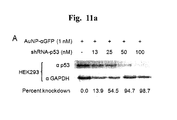
- FIG. 11 represents effects of shRNAs delivered by single-stranded DNA functionalized gold nanoparticles.
- A Dose response of AuNP• ⁇ EGFP•shRNA-p53 conjugates to p53 gene knockdown in HEK293 cells. HEK293 cells were incubated with AuNP• ⁇ EGFP•shRNA-p53 conjugates and harvested 24 hr after treatment for western blot analysis.
- B Knockdown efficiency of shRNA-p53 delivered by AuNP• ⁇ EGFP in HEK293 and HeLa cells. Cells were treated with either AuNP• ⁇ EGFP•shRNA-p53 conjugates or a mixture of shRNA-p53 and lipofectamine and harvested 24 hr after treatment for western blot analysis.
- C Dose response of AuNP• ⁇ EGFP•shRNA-p53 conjugates to p53 gene knockdown in HEK293 cells. HEK293 cells were incubated with AuNP• ⁇ EGFP•shRNA-p53 conjugates and harvested 24
- FIG. 12 represents knockdown of Mcl-1L expression by AuNP•RNA I•shRNA-Mcl-1L in HEK293 cells.
- HEK293 cells were treated with AuNP•RNA I•shRNA-Mcl-1L conjugates and harvested 24 hr after treatment for western blot analysis.
- FIG. 13 represents preparation of DNAzyme annealed gold nano particles.
- A General sequence of RNA-cleaving DNAzyme is shown in the box (SEQ ID NOs:34and 35). DNAzyme cleaves any purine (R) and pyrimidine (Y) junction in RNA that is complementary to the DNAzyme sequence. At a position of 2208 th base of ⁇ -catenin mRNA is chosen for cleavage with DNAzyme (Dz2208) (SEQ ID NO:33).
- B Scheme of action by the DNAzyme annealed to GFP antisense oligonucleotide-conjugated gold nano particles.
- C Sequence of DNAzyme (SEQ ID NO:25) annealed to GFP antisense oligonucleotide (SEQ ID NO:26).
- FIG. 14 indicates that DNAzyme annealed gold nano particles reduces target gene expression in cells.
- A Extent of DNAzyme annealing to the gold nano particles was analyzed with native poly acrylamide gel electrophoresis (15%). See text for details.
- B Transfection of the DNAzyme annealed gold nano particles into GFP-expressing cells was performed. At 24 hrs after transfection green fluorescence emitted from the cells were measured with the fluorescence microscope. Note the decrease in green fluorescence in cells after transfection with the gold nano particles.
- C Colon cancer cells transfected with Dz2208-annealed gold nano particles (1.0 and 10. nM) was lysed and analyzed for ⁇ -catenin protein expression with Western blot assay.
- AuNP• ⁇ GFP or AuNP•RNA I (10 nM) were mixed with shRNA in annealing buffer (1 ⁇ phosphate-buffered saline containing 0.3 M NaCl) by gentle shaking for 10 min, incubated at 55° C. for 10 min, and cooled to 4° C. for about 1 hr.
- the resulting conjugates were spun down at 12,000 ⁇ g for 10 min, the supernatant was removed, and the conjugate pellet was resuspended in DMEM medium. This precipitation and resuspension step was carried out three times.
- the conjugates (10 nM) was added to a tissue culture media, such that the final concentration was 1 nM.
- ShRNA was synthesized from synthetic oligonucleotieds containing the sequence of T7 promoter followed by the sequence of short haripin structure of p53 and MCL-1 using the MEGAshortscriptTM kit (Ambion, USA) according to the manufacturer's instruction. DNA templates were prepared by amplifying oligonucleotides using PCR.
- sh-p53-template 5′-TAATACGACTCACTATAGGGACGGCAGCGTGCAGCTCGACTCCAGTGGTAATCTACT TCAAGAGAGTAGATTACCACTGGAGTCTT (SEQ ID NO:11); T7 promoter is underlined
- sh-Mcl-1L-template-1 5′TAATACGACTCACTATAGGGACGGCAGCGTGCAGCTCCCCCGGGACTGGCTAGTT AAACTTCAAGAGAGTTTAACTAGCCAGTCCCGTTTTTGGAAA (SEQ ID NO:12); T7 promoter is underlined
- sh-Mcl-1L-template-2 5′TAATACGACTCACTATAGGCTCTAGCAGAGCCGAGATCCCCGGGACTGGCTAGTT AAACTTCAAGAGAGTTTAACTAGCCAGTCCCGTTTTTGGAAA (SEQ ID NO13); T7 promoter is underlined.
- the PCR primers used were T7-1 (5′-TTAATACGACTCACTATAGG-3′(SEQ ID NO:14))and sh-p53-R (5′-AAGACTCCAGTGGTAA-3′), (SEQ ID NO:15)), shMCL-1-R (5′-TTACCAAAAACGGGACTGGCT-3′(SEQ ID NO:16).
- Synthesized shRNAs were purified with illustraTM MicroSpinTM G-50 columns (GE; Little Chalfont, Buckinghamshire, UK)
- HEK293 (4.5 ⁇ 10 5 ) or HeLa cells (3.0 ⁇ 10 5 ) were incubated with short hairpin RNA functionalized with gold-nanoparticles in six-well dishes.
- Cell were lysed in NP-40 lysis buffer (50 mM Tris-HCl, pH 8.0, 0.15 M NaCl, and 1% NP-40) containing 10% protease inhibitor cocktail (Sigma).
- NP-40 lysis buffer 50 mM Tris-HCl, pH 8.0, 0.15 M NaCl, and 1% NP-40
- protease inhibitor cocktail Sigma
- a standard curve was established with the standard BSA solution (Pierce, Rockford, Ill., USA), and cell lysates containing equal amounts of total protein were separated by 10% polyacrylamide gel and transferred onto nitrocellulose membrane and western blot analyses were performed.
- Anti-p53 monoclonal and anti-MCL1-L polyclonal antibodies (both from Santa Cruz Biotechnology, Santa Cruz, Calif., USA
- Primers used for p53 were p53-F (5′-AGCTTTGAGGTGCGTGTTTG (SEQ ID NO17) and p53-R (5′-TCAGCTCTCGGAACATCTCG), (SEQ ID NO:18)), and MCL-1L-F (5′-TGGTCGGGGAATCTGGTAAT (SEQ ID NO:19)) and MCL-1L-R (5′-GTAAGGTCTCCAGCGCCTTC (SEQ ID NO:20))for MCL-1L and GAPDH-F (5′-AGCCAAAAGGGTCATCATCTCT) (SEQ ID NO:21))and GAPDH-R (5′-AGGGGCCATCCACAGTCTT) for loading control.
- ⁇ -catenin mRNA-cleaving DNAzyme (sequence shown in FIG. 13 ) was constructed and its 5′-terminal sequence was designed to be annealed to the GFP antisense oligonucleotide conjugated to gold nano particle ( FIG. 13 ).
- To anneal the DNAzyme to the GFP antisense oligonucleotide-conjugated gold nano particles the following procedure was carried out. 1 ml of gold nano particle solution (36.5 nM) was centrifuged at 13,000 rpm at 4° C. for 40 min. Supernatant was removed and the pellet was rapidly mixed with 1 ml of 1% BSA solution in saline-free phosphate buffer (pH. 7.5).
- the pellet solution was incubated for 30 min at room temperature, it was centrifuged at 13,000 rpm at 4° C. for 40 min.
- the pellet containing gold nano particles was resuspended with 300 ⁇ l of saline-free phosphate buffer (pH. 7.5) to be 120 nM and stored at 4° C. for further use.
- 10 ⁇ l of DNAzyme oligonucleotide (10 ⁇ M) was mixed with various amounts (at desired concentration, shown in FIG. 14 ) of the BSA-protected gold nano particles which were prepared as above.
- the mixing solution was supplemented with 20 mM MgCl 2 and Tris/HCl (20 mM, pH 7.5).
- the DNA mixed solution was heated at 95° C. for 2 min, 42° C. for 10 min, and slowly cooled to the room temperature. These DNAzyme-annealed gold nano particles are ready for use.
- DNAzyme annealing to the gold nano particles was analyzed with native (nondenaturing) poly acrylamide gel electrophoresis (15%). Fixed amount of DNAzyme (10 ⁇ M) was mixed with increasing amount of the BSA-protected nano particles (0, 0.5, 1, 2, 4, 10, and 15 ⁇ l). Gel was run for 2 hrs and stained with ethidium bromide for the detection of DNA under UV transilluminator ( FIG. 14A ).
- Colon cancer cell line SW480 were obtained from the American Type Culture Collection (Manassas, Va., USA), and maintained in DMEM supplemented with 10% FBS, 120 ⁇ g penicillin/ml, and 200 ⁇ g streptomycin/ml in a 37° C. incubator with 5% CO 2 humidified air. Approximately, 6 ⁇ 10 4 cells were plated per 12-well plate in media containing 10% fetal bovine serum to give 50-60% confluence. Cells were transfected with Green Fluorescence Protein (GFP) expression plasmid DNA using the LipofectamineTM 2000 (Invitrogen, Carlsbad, Calif., USA) according to the manufacturer's instructions. The transfection reagent was completely removed by exchanging culture media.
- GFP Green Fluorescence Protein
- transfections of antisense DNAzyme oligonucleotides were carried out with the GFP antisense oligonucleotide-modified gold nano particles. Transfection of the DNAzyme was performed using the gold nano particles to a desired concentration of each oligonucleotide. At 24 hrs after transfection of the DNAzyme-annealed gold nano particles, green fluorescence emitted from the cells were measured with the fluorescence microscope ( FIG. 14B ).
- the cells were harvested and lysed in lysis buffer (20 mM Tris-HCl, pH 8.0, 0.1% NP-40, 20 mM EDTA, 10% glycerol, 10 mM KCl) for Western blot analysis.
- lysis buffer (20 mM Tris-HCl, pH 8.0, 0.1% NP-40, 20 mM EDTA, 10% glycerol, 10 mM KCl
- Lysed cell proteins were separated by 10% SDS-PAGE and transferred to a nitrocellulose membrane (Whatman).
- the membranes were blocked with 5% nonfat milk and probed with anti- ⁇ -catenin (1:500; Santa Cruz Biotechnology), and anti- ⁇ -actin (1:1000; Sigma). After washing, the membranes were incubated with horseradish peroxidase-conjugated antimouse IgG antibody (Santa Cruz Biotechnology) at a 1:3000 dilution for 1 hr at room temperature, then developed using the enhanced chemiluminescence system (Intron Biotechnology, Seoul, Korea) ( FIG. 14C ).
- AuNP GDS gold nanoparticle gene delivery system
- AuNP GDS single-stranded DNA functionalized gold nanoparticles as AuNP GDS
- an oligonucleotide (5′-CTCGACGTGCGACGGCAG-3′) bearing a sequence complementary to the coding region (bases 1198 to 1215; 5′-GAGCTGCACGCTGCCGTC-3′(SEQ ID NO 1)) of EGFP (anti-EGFP oligo) because it has been shown to be effective in the delivery and silencing the expression of EGFP in human tissue cultures without interfering with expression of human genes other than egfp.
- 9 AuNP GDS was prepared by functionalizing 13 nm gold nanoparticle with the thiolated anti-EGFP oligo.
- AuNP GDS anti-EGFP oligo-functionalized gold nanoparticles were annealed with antisense DNA (AuNP GDS-AS) having a complementary sequence to the anti-EGFP oligo DNA and a sequence specific to Mcl-1L (myeloid cell leukemia-1 long) gene, and the resulting conjugates were applied to HeLa cells (Human Cervix Carcinoma, Korean Cell Line Bank).
- the gene mcl-1L encodes an antiapoptotic Bcl-2 family protein which was discovered as an early induction gene during leukemia cell differentiation.
- Antisense DNA to the Mcl-1L contained a sequence complementary to AuNP GDS followed by a 20 nucleotide-sequence complementary to an internal coding region (bases 576 to 595; 5′-TTGGCTTTGTGTCCTTGGCG-3′)(SEQ ID NO:3)) of the Mcl-1L mRNA [11].
- AuNP GDS-AS conjugates were mixed with the antisense oligonucleotide (0.1 or 1 ⁇ M) in annealing buffer (1 ⁇ phosphate-buffer saline containing 0.3 M NaCl) by gently shaking for 10 min, incubated at 55° C. for 10 min, and cooled downed to room temperature for about 1 hr.
- the resulting conjugates were washed with phosphate buffer saline (PBS, pH 7.4) three times before applying the conjugate to cells.
- AuNP GDS-Mcl-1L-AS conjugates were applied to the HeLa cells, protein samples were prepared from the cultures 24 hrs after transfection for quantitative analysis of MCL-1L using western blot analyses. As shown in FIG. 3 , AuNP GDS-Mcl-1L-AS conjugates efficiently knockdowned the MCL-1L expression in a manner dependent on MCL-1L antisense concentrations.
- 0.1 ⁇ M Mcl-1L AS was delivered into the cells using a liposome-based reagent (Lipofectamine 2000, Invitrogen), the knockdown efficiency was lower than AuNP GDS (9.8% vs. 19.5%), indicating that the AuNP GDS system is more efficient in delivering antisense DNA than the liposome-based reagent.
- p53 is a well characterized transcription factor which plays a crucial role in the maintenance of cell-cycle arrest after DNA damage and in apoptosis as a tumor suppressor.
- 12 Antisense DNAs to the p53 gene contained a sequence complementary to AuNP GDS followed by a 20 nucleotide-sequence complementary to either an internal coding region of Mcl-1L (bases 886 to 905; 5′-CCCTGCTCCCCCCTGGCTCC-3′(SEQ ID NO:4)) for AS-Mcl-1L, 13 or to the region covering the six base pairs immediately before the first codon and the first four coding codons of p53 for AS-p53-2 (5′-GGGCACCACCACCACACTATGTCGAA-3′(SEQ ID NO:5)) [14].
- the conjugates were incubated with HeLa cells or 293T cells. After 24 hrs incubation, the cells were harvested and the expressions of target proteins were quantified using GAPDH (Glyceraldehyde 3-phosphate dehydrogenase) as a reference protein. The results showed that the three nanoconjugates efficiently decreased the levels of target proteins in two different human cell lines ( FIG. 4 ). In addition, AuNP GDS itself did not affect expression levels of target proteins and a reference protein. These data demonstrate that AuNP GDS can be used as a general gene delivery system for antisense DNAs specific to any gene of interest in different human cell lines.
- GAPDH Glyceraldehyde 3-phosphate dehydrogenase
- AuNP GDS was mixed with the FITC-antisense oligonucleotide (0.1 or 1 ⁇ M) in annealing buffer (1 ⁇ phosphate-buffer saline containing 0.3 M NaCl) by gently shaking for 10 min, incubated at 55° C. for 10 min, and cooled downed to room temperature for 1 hr. The resulting conjugates were centrifuged at 10,000 ⁇ g for 20 min at 4° C. The loadings of FITC-antisense oligonucleotide on the AuNP GDS were estimated from fluorescence measurements of the supernatant after the coupling reaction using the calibrations cure of FITC-antisense oligonucleotide ( FIG. 6 ).
- HeLa cells were transfected with 0, 1, 5 or 10 nM gold nanoparticle-anti GFP, and incubated for 48 hrs. Viable cells were counted after staining dead cells with trypan blue.
- AuNP GDS single strand DNA functionalized gold nanoparticle
- RISC RNA-induced silencing complex
- oligo antisense DNAs delivered by the AuNP GDS system only knockdown the target gene expression without interfering with normal cellular processes. Not only the AuNP GDS-antisense conjugates efficiently knockdowned the expression of target proteins, but also the system was more efficient than the commercially available gene transfer reagent (Lipofectamine 2000) in respect to the degree of knockdown of target protein expression. Moreover, the activity of antisense DNAs delivered by the AuNP GDS lasted for three days. Taken together, our results demonstrate that the AuNP GDS is an excellent gene delivery system. This system may be also easily applicable to the delivery of siRNA, ribozyme, and PNA (peptide nucleotide acid).
- the shRNA was tested for knockdown of target gene expression.
- siRNA is an efficient gene knockdown tool to suppress target gene expression.
- the sh-p53-1 [18 ] contained a sequence complementary to AuNP GDS followed by a nucleotide-sequence complementary to the p53 coding region (5′-GACUCCAGUGGUAAUCUACUUCAAGAGAGUAGAUUACCACUGGAGUCUU-3′SEQ ID NO:6)).
- the synthetic procedure for the shRNA to the p53 was described in FIG. 8C .
- sh-p53 was synthesized from PCR DNAs containing the sequence of T7 promoter followed by anti-EGFP oligo and the sequence complementary to the p53, which form a loop structure.
- AuNP GDS-sh-p53-1 conjugates were prepared by the same method of antisense oligo, and applied to 293T cells. To quantitate p53 using Western blot analysis, protein samples were harvested after transfection and incubation for 24 hrs. As shown in FIG. 8 a , AuNP GDS-sh-p53 conjugates effectively knockdowned the expression of p53 in a manner dependent on the concentration of sh-p53 antisense bound to them.
- PCR polymerase chain reaction
- the synthetic AuPN GDS-Luc (luciferase gene) was applied to 293T cells. After expression of luciferase gene in the cells, cells were collected and luciferase activity was measured (Luciferase Assay Kit, PROMEGA). Luciferase fluorescence enzyme releases fluorescence by redox reaction with Luciferin. As described in FIG. 9 a , the products having ⁇ RNA I nucleotide sequence at 5′-end (5′- ⁇ RNA I-Luc.) had luciferase activities, suggesting a feasible delivery of double strand DNA gene into the cells by AuNP-GDS.
- Single-stranded DNA functionalized gold nanoparticles developed by Rosi et al. [8] showed efficient delivery of antisense DNA into human cells and, consequently knockdown of target gene expression. These functionalized gold nanoparticles also exhibited lower cellular toxicity than antisense DNA delivered by liposome-based reagents. To circumvent the inconvenience of the system that can deliver antisense DNA covalently cross-linked to gold nanoparticles, which needs to be individually synthesized for each gene of interest, we tested whether single-stranded DNA functionalized AuNP can be used as a universal carrier for the delivery of small hairpin RNA (shRNA) specific to any gene of interest.
- shRNA small hairpin RNA
- oligo DNA oligonucleotide bearing a sequence complementary to the coding region (bases 1198 to 1215) of EGFP (an ⁇ EGFP oligo), which has been shown to be effective in the delivery and silencing of EGFP expression in human tissue cultures without interfering with expression of any other genes [8].
- AuNP• ⁇ EGFP oligo complex was prepared by functionalizing 13 nm gold nanoparticles with thiolated ⁇ EGFP oligos [10].
- shRNA specific to the p53 gene was synthesized in vitro and annealed to ⁇ EGFP oligos that were covalently cross-linked to AuNP, and the resulting conjugates were applied to HEK293 cells.
- the shRNA to the p53 gene contained a sequence complementary to ⁇ EGFP oligo followed by a 67 nucleotide-sequence that forms a hairpin ( FIG. 10 ).
- the hairpin functions as short interfering RNA and contains inverted direct repeats corresponding to an internal coding region of p53 (bases 895 to 913) flanked by a loop composed of 9 nucleotides [16].
- AuNP• ⁇ EGFP•shRNA-p53 conjugates were applied to HEK293 cells and protein samples were prepared from the cultures 24 hours after transfection for quantitative analysis of p53 using western blot analysis. As shown in FIG. 11A , AuNP• ⁇ EGFP•shRNA-p53 conjugates efficiently knocked down p53 expression in an shRNA-p53 concentration dependent manner. Application of shRNA-p53 at concentrations above 50 nM repressed over 90% of p53 expression. When shRNA-p53 was delivered into cells using a liposome-based reagent, the knockdown efficiency was similar to that of AuNP• ⁇ EGFP ( FIG. 11B ).
- shRNA-Mcl-10 contained a sequence complementary to ⁇ EGFP oligo followed by a 78 nucleotide-sequence that forms a hairpin ( FIG. 10 ).
- the hairpin contained inverted direct repeats corresponding to an internal coding region of Mcl-1L (bases 906 to 925) flanked by a loop composed of 9 nucleotides [17].
- the AuNP• ⁇ EGFP•shRNA-Mcl-1L conjugates were incubated with HeLa cells. After a 24-hour incubation, cells were harvested and the expressions of target proteins were quantified using western blot analysis.
- the nanoconjugates efficiently decreased the levels of MCL-1L protein in HeLa cells ( FIG. 11D ).
- RNA I an antisense RNA for the replication of ColE1-type plasmid in Escherichia coli [ 18].
- single-stranded DNA functionalized gold nanoparticles can be used as gene delivery systems for shRNAs specific to any gene of interest. Not only did the AuNP• ⁇ EGFP-shRNA conjugates efficiently knock down the expression of target proteins, but the system was also as efficient as commercially available gene transfer reagents in respect to the degree of knockdown of target protein expression. Taken together, our results demonstrate that the single-stranded DNA functionalized gold nanoparticles are an excellent gene delivery system for shRNA.
Landscapes
- Health & Medical Sciences (AREA)
- Life Sciences & Earth Sciences (AREA)
- Engineering & Computer Science (AREA)
- Genetics & Genomics (AREA)
- Chemical & Material Sciences (AREA)
- Biomedical Technology (AREA)
- Bioinformatics & Cheminformatics (AREA)
- Molecular Biology (AREA)
- General Health & Medical Sciences (AREA)
- Biotechnology (AREA)
- General Engineering & Computer Science (AREA)
- Wood Science & Technology (AREA)
- Organic Chemistry (AREA)
- Zoology (AREA)
- Biochemistry (AREA)
- Medicinal Chemistry (AREA)
- Animal Behavior & Ethology (AREA)
- Epidemiology (AREA)
- Pharmacology & Pharmacy (AREA)
- Public Health (AREA)
- Veterinary Medicine (AREA)
- Physics & Mathematics (AREA)
- Plant Pathology (AREA)
- Microbiology (AREA)
- Biophysics (AREA)
- Inorganic Chemistry (AREA)
- Ceramic Engineering (AREA)
- Immunology (AREA)
- Medicines That Contain Protein Lipid Enzymes And Other Medicines (AREA)
- Pharmaceuticals Containing Other Organic And Inorganic Compounds (AREA)
- Medicinal Preparation (AREA)
Abstract
Description
- [19 a) F. McCormick,
Nat. Rev. Cancer 2001, 1, 130-141; b) J. B. Opalinska, A. M. Gewirtz, Nat. Rev. Drug Discov. 2002, 1, 503-514. - [29 M. A. Kay, J. C. Glorioso, L. Naldini, Nat. Med. 2001, 7, 33-40.
- [39 a) S. E. Raper, N. Chirmule, F. S. Lee, N. A. Wivel, A. Bagg, G.-R Gao, J. M. Wilson, M. L. Batshaw, Mol. Genet. Metab. 2003, 80, 148-158; b) S. Hacein-Bey-Abina, C. von Kalle, M. Schmidt, F. Le Deist, N. Wulffraat, E. McIntyre, I. Radford, J. L. Villeval, C. C. Fraser, M. Cavazzana-Calvo, et. al, N. Engl. J. Med. 2003, 348, 255-256; c) J. J. Green, R. Langer, D. G. Anderson, Acc. Chem. Res., 2008, 41, 749-759.
- [49 I. M. Verma, N. Somia, Nature 1997, 389, 239-242.
- [59 a) M. A. Mintzer, E. E. Simanek, Chem. Rev. 2009, 109, 259-302; b) X. Guo, F. C. Szoka Jr., Acc. Chem. Res., 2003, 36, 335-341; c) R. K. Tekade, P. V. Kumar, N. K. Jain, Chem, Rev., 2009, 109, 49-87; d) K. S. Soppimath, T. M. Aminabhavi, A. R. Kulkarni, W. E. Rudzinski, J. Control. Release, 2001, 70, 1-20.
- [69 a) M. Prato, K. Kostarelos, A. Bianco, Acc. Chem. Res., 2008, 41, 60-68; b) J. Cheon, J.-H. Lee, Acc. Chem. Res., 2008, 41, 1630-1640; c) B. G. Trewyn, I. I. Slowing, S. Giri, H.-T. Chen, V. S.-Y. Lin, Acc. Chem. Res., 2007, 40, 846-853; d) I. I. Slowing, J. L. Vivero-Escoto, C.-W. Wu, V. S.-Y. Lin, Adv. Drug Deliv. Rev., 2008, 60, 1278-1288; e) C. J. Murphy, A. M. Gole, J. W. Stone, P. N. Sisco, A. M. Alkilany, E. C. Goldsmith, S. C. Baxter, Acc. Chem. Res., 2008, 41, 1721-1730
- [79 M.-C. Daniel, D. Astruc, Chem. Rev 2004, 104, 293-346.
- [89 a) K. K. Sandhu, C. M. McIntosh, J. M. Simard, S. W. Smith, V. M. Rotello, Bioconjugate Chem. 2002, 13, 3-6; b) ACS nano 2008, 2213; c) M. Thomas, A. M. Klibanov, Proc. Natl. Acad. Sci. U.S.A. 2003, 100, 9138-9143; d) C. Agbasi-Porter, J. Ryman-Rasmussen, S. Franzen, D. Feldheim, Bioconjugate Chem. 2006, 17, 1178-1183; e) C.-Y. Tsai, A.-L. Shiau, P.-C. Cheng, D.-B. Shieh, D.-H. Chen, C.-H. Chou, C.-S. Yeh, C.-L. Wu, Nano lett. 2004, 4, 1209-1212; f) N. L. Rosi, D. A. Giljohann, C. S. Thaxton, A. K. R. Lytton-Jean, M. S. Han, C. A. Mirkin, Science 2006, 312, 1027-1030.
- [99 J.-R. Bertrand, M. Pottier, A. Vekris, P. Opolon, A. Maksimenko, C. Malvy, Biochem. Biophys. Res. Commun. 2002, 296, 1000-1004.
- [109 S. J. Hurst, A. K. R. Lytton-Jean, C. A. Mirkin, Anal. Chem. 2006, 78, 8313-8318.
- [119 C. Skoda, B. M. Erovic, V. Wachek, L. Vormittag, F Wrba, H. Martinek, G. Heiduschka, P. Kloimstein, E. Selzer, D. Thurnher, Oncol. Rep. 2008, 19, 1499-1503.
- [129 R. Agami, R. Bernards, Cell, 2000, 102, 55-66.
- [139 L.-C. Dai, X. Wang, X. Yao, L.-S. Min, F.-C. Qian, J.-F. He,
Acta Pharmacologica Sinica 2006, 27, 1453-1458. - [149 S. Bi, F. Lanza, J. M. Goldman, Cancer Research 1994, 54, 582-586.
- [159 a) Z. Wang, A. G. Kanaras, A. D. Bates, R. Cosstick, M. Brust, J. Mater. Chem. 2004, 14, 578; b) D. S. Seferos, A. E. Prigodich, D. A. Giljohann, P. C. Patel, C. A. Mirkin, Nano Lett 2009, 9, 308-311.
- [169 T. R. Brummelkamp, R. Bernards, R. Agami, A system for stable expression of short interfering RNAs in mammalian cells, Science 296 (2002) 550-553.
- [179 M. Taniai, A. Grambihler, H. Higuchi, N. Werneburg, S. F. Bronk, D. J. Farrugia, S. H. Kaufmann, G. J. Gores, Mcl-1 mediates tumor necrosis factor-related apoptosis-inducing ligand resistance in human cholangiocarcinoma cells, Cancer Res. 64 (2004) 3517-3524.
- [189 B. Polisky, ColE1 replication control circuitry: sense from antisense, Cell 55 (1988) 929-932.
Claims (4)
Applications Claiming Priority (5)
| Application Number | Priority Date | Filing Date | Title |
|---|---|---|---|
| KR10-2009-0107234 | 2009-11-06 | ||
| KR20090107234 | 2009-11-06 | ||
| KR1020100024120A KR101230913B1 (en) | 2009-11-06 | 2010-03-18 | Nanoparticle-Based Gene Delivery Systems |
| KR10-2010-0024120 | 2010-03-18 | ||
| PCT/KR2010/001679 WO2011055888A1 (en) | 2009-11-06 | 2010-03-18 | Nanoparticle-based gene delivery systems |
Publications (2)
| Publication Number | Publication Date |
|---|---|
| US20110229966A1 US20110229966A1 (en) | 2011-09-22 |
| US8871509B2 true US8871509B2 (en) | 2014-10-28 |
Family
ID=43970114
Family Applications (1)
| Application Number | Title | Priority Date | Filing Date |
|---|---|---|---|
| US12/809,996 Active 2031-10-24 US8871509B2 (en) | 2009-11-06 | 2010-03-18 | Nanoparticle-based gene delivery systems |
Country Status (5)
| Country | Link |
|---|---|
| US (1) | US8871509B2 (en) |
| EP (1) | EP2496268A4 (en) |
| JP (1) | JP2012503494A (en) |
| KR (1) | KR101230913B1 (en) |
| WO (1) | WO2011055888A1 (en) |
Cited By (11)
| Publication number | Priority date | Publication date | Assignee | Title |
|---|---|---|---|---|
| WO2018195338A1 (en) | 2017-04-20 | 2018-10-25 | Atyr Pharma, Inc. | Compositions and methods for treating lung inflammation |
| WO2019195770A1 (en) | 2018-04-06 | 2019-10-10 | Atyr Pharma, Inc. | Compositions and methods comprising anti-nrp2 antibodies |
| WO2020010107A1 (en) | 2018-07-03 | 2020-01-09 | Gilead Sciences, Inc. | Antibodies that target hiv gp120 and methods of use |
| WO2020023918A1 (en) | 2018-07-26 | 2020-01-30 | Atyr Pharma, Inc. | Compositions and methods for treating nrp2-associated diseases |
| WO2020263830A1 (en) | 2019-06-25 | 2020-12-30 | Gilead Sciences, Inc. | Flt3l-fc fusion proteins and methods of use |
| WO2021011544A1 (en) | 2019-07-16 | 2021-01-21 | Gilead Sciences, Inc. | Hiv vaccines and methods of making and using |
| WO2021067181A1 (en) | 2019-09-30 | 2021-04-08 | Gilead Sciences, Inc. | Hbv vaccines and methods treating hbv |
| EP3954393A1 (en) | 2020-08-13 | 2022-02-16 | Bioasis Technologies Inc. | Combination therapies for delivery across the blood brain barrier |
| WO2022087149A2 (en) | 2020-10-22 | 2022-04-28 | Gilead Sciences, Inc. | Interleukin-2-fc fusion proteins and methods of use |
| US20220233714A1 (en) * | 2021-01-27 | 2022-07-28 | Vanderbilt University | Nanogold-dna bioconjugates and methods of use thereof |
| WO2024015741A1 (en) | 2022-07-12 | 2024-01-18 | Gilead Sciences, Inc. | Hiv immunogenic polypeptides and vaccines and uses thereof |
Families Citing this family (20)
| Publication number | Priority date | Publication date | Assignee | Title |
|---|---|---|---|---|
| KR101784904B1 (en) * | 2009-08-04 | 2017-10-12 | 카운슬 오브 사이언티픽 앤드 인더스트리얼 리서치 | DNA loaded supported gold nanoparticles, process for the preparation and use thereof |
| KR101337684B1 (en) | 2011-10-17 | 2013-12-30 | 성균관대학교산학협력단 | Multi-functional nucleic acid-based anticancer agent for targeted delivery and therapy, preparation method thereof, and anticancer composition comprising the same |
| CA2876165C (en) | 2012-06-25 | 2021-06-15 | Emory University | Particle-nucleic acid conjugates and therapeutic uses related thereto |
| KR101596552B1 (en) * | 2013-02-13 | 2016-02-23 | 중앙대학교 산학협력단 | Gold nanoparticle-aptamer conjugates-based protein delivery system and preparation method thereof |
| WO2014201454A2 (en) * | 2013-06-14 | 2014-12-18 | University Of Notre Dame | Dnazyme-nanoparticle conjugates and methods of use thereof |
| KR20150006742A (en) * | 2013-07-09 | 2015-01-19 | (주)바이오니아 | Liver cancer related genes-specific siRNA, double-stranded oligo RNA molecules comprising the siRNA, and composition for the prevention or treatment of cancer comprising the same |
| KR20150006743A (en) * | 2013-07-09 | 2015-01-19 | (주)바이오니아 | Liver cancer related genes-specific siRNA, double-stranded oligo RNA molecules comprising the siRNA, and composition for the prevention or treatment of cancer comprising the same |
| US10612020B2 (en) | 2013-12-26 | 2020-04-07 | Tokyo Medical University | Artificial mimic miRNA for controlling gene expression, and use of same |
| WO2015099187A1 (en) | 2013-12-27 | 2015-07-02 | 株式会社ボナック | Artificial match-type mirna for controlling gene expression and use therefor |
| US11027023B2 (en) | 2014-12-27 | 2021-06-08 | Bonac Corporation | Natural type miRNA for controlling gene expression, and use of same |
| WO2016109522A1 (en) * | 2014-12-30 | 2016-07-07 | Emory University | Particle-nucleic acid conjugates and therapeutic uses related thereto |
| KR101734308B1 (en) | 2015-01-21 | 2017-05-12 | 한국과학기술연구원 | RNA/DNA hybrid nanoparticle used for target-specific siRNA delivery and use thereof |
| US11142769B2 (en) | 2015-03-27 | 2021-10-12 | Bonac Corporation | Single-stranded nucleic acid molecule having delivery function and gene expression regulating ability |
| KR20230160699A (en) | 2022-05-16 | 2023-11-24 | 주식회사 엔이에스바이오테크놀러지 | Genetic manipulation and manufacturing method based on gold nanoparticle-CRISPR conjugate |
| CN119998457A (en) * | 2022-05-17 | 2025-05-13 | 恩斯生物技术有限公司 | Gene delivery based on metal nanoparticle-nucleic acid conjugates |
| KR102685034B1 (en) * | 2022-05-17 | 2024-07-16 | 주식회사 엔이에스바이오테크놀러지 | Gene expression particle based on metal nanoparticle-nucleic acid conjugate and manufacturing method thereof |
| KR102494402B1 (en) | 2022-05-24 | 2023-02-06 | 주식회사 엔이에스바이오테크놀러지 | Nanoparticle-oligoT conjugates based messenger RNA delivery system |
| WO2024144193A1 (en) * | 2022-12-26 | 2024-07-04 | 주식회사 엔이에스바이오테크놀러지 | Vaccine composition comprising gold-nanoparticle-carrier having double-stranded dna bound thereto |
| WO2025110775A1 (en) * | 2023-11-21 | 2025-05-30 | 주식회사 엔이에스바이오테크놀러지 | Therapeutic agent for metabolic diseases comprising delivery system based on metal nanoparticle-nucleic acid conjugate |
| WO2025110773A1 (en) * | 2023-11-21 | 2025-05-30 | 주식회사 엔이에스바이오테크놀러지 | Composition for treating cancer comprising gene carrier based on gold nanoparticle-nucleic acid conjugate |
Citations (2)
| Publication number | Priority date | Publication date | Assignee | Title |
|---|---|---|---|---|
| US7332586B2 (en) * | 2001-07-10 | 2008-02-19 | North Carolina State University | Nanoparticle delivery vehicle |
| US20090148535A1 (en) * | 2007-12-06 | 2009-06-11 | Minerva Biotechnologies Corporation | Method for treating cancer using interference rna |
Family Cites Families (8)
| Publication number | Priority date | Publication date | Assignee | Title |
|---|---|---|---|---|
| US5352775A (en) | 1991-01-16 | 1994-10-04 | The Johns Hopkins Univ. | APC gene and nucleic acid probes derived therefrom |
| EP0651653B1 (en) | 1992-07-22 | 2004-03-10 | The Trustees Of Princeton University | p53 VACCINE |
| FR2732357B1 (en) | 1995-03-31 | 1997-04-30 | Rhone Poulenc Rorer Sa | VIRAL VECTORS AND USE FOR THE TREATMENT OF HYPERPROLIFERATIVE DISORDERS, ESPECIALLY RESTENOSIS |
| FR2740344B1 (en) | 1995-10-31 | 1997-11-21 | Rhone Poulenc Rorer Sa | APPLICATION OF PROTEIN GAX TO THE TREATMENT OF CANCERS |
| AU2001262152A1 (en) * | 2000-03-31 | 2001-10-08 | Memorec Stoffel Gmbh | Method for extracting nucleic acids |
| EP1215199A1 (en) * | 2000-12-08 | 2002-06-19 | Sony International (Europe) GmbH | Linker molecules for selective metallisation of nucleic acids and their uses |
| JP2005287507A (en) * | 2004-03-10 | 2005-10-20 | Japan Science & Technology Agency | Cationic gold nanoparticles and polyethylene glycol modified cationic gold nanoparticles and their complexes with nucleic acids |
| EP1756289B1 (en) * | 2004-05-24 | 2015-01-14 | Midatech Ltd. | Nanoparticles comprising rna ligands |
-
2010
- 2010-03-18 WO PCT/KR2010/001679 patent/WO2011055888A1/en not_active Ceased
- 2010-03-18 EP EP20100723475 patent/EP2496268A4/en not_active Ceased
- 2010-03-18 US US12/809,996 patent/US8871509B2/en active Active
- 2010-03-18 JP JP2011539457A patent/JP2012503494A/en active Pending
- 2010-03-18 KR KR1020100024120A patent/KR101230913B1/en not_active Expired - Fee Related
Patent Citations (2)
| Publication number | Priority date | Publication date | Assignee | Title |
|---|---|---|---|---|
| US7332586B2 (en) * | 2001-07-10 | 2008-02-19 | North Carolina State University | Nanoparticle delivery vehicle |
| US20090148535A1 (en) * | 2007-12-06 | 2009-06-11 | Minerva Biotechnologies Corporation | Method for treating cancer using interference rna |
Non-Patent Citations (26)
Cited By (15)
| Publication number | Priority date | Publication date | Assignee | Title |
|---|---|---|---|---|
| WO2018195338A1 (en) | 2017-04-20 | 2018-10-25 | Atyr Pharma, Inc. | Compositions and methods for treating lung inflammation |
| WO2019195770A1 (en) | 2018-04-06 | 2019-10-10 | Atyr Pharma, Inc. | Compositions and methods comprising anti-nrp2 antibodies |
| EP4257600A2 (en) | 2018-07-03 | 2023-10-11 | Gilead Sciences, Inc. | Antibodies that target hiv gp120 and methods of use |
| WO2020010107A1 (en) | 2018-07-03 | 2020-01-09 | Gilead Sciences, Inc. | Antibodies that target hiv gp120 and methods of use |
| EP4624491A2 (en) | 2018-07-03 | 2025-10-01 | Gilead Sciences, Inc. | Antibodies that target hiv gp120 and methods of use |
| WO2020023918A1 (en) | 2018-07-26 | 2020-01-30 | Atyr Pharma, Inc. | Compositions and methods for treating nrp2-associated diseases |
| WO2020263830A1 (en) | 2019-06-25 | 2020-12-30 | Gilead Sciences, Inc. | Flt3l-fc fusion proteins and methods of use |
| WO2021011544A1 (en) | 2019-07-16 | 2021-01-21 | Gilead Sciences, Inc. | Hiv vaccines and methods of making and using |
| WO2021067181A1 (en) | 2019-09-30 | 2021-04-08 | Gilead Sciences, Inc. | Hbv vaccines and methods treating hbv |
| EP4458975A2 (en) | 2019-09-30 | 2024-11-06 | Gilead Sciences, Inc. | Hbv vaccines and methods treating hbv |
| EP3954393A1 (en) | 2020-08-13 | 2022-02-16 | Bioasis Technologies Inc. | Combination therapies for delivery across the blood brain barrier |
| WO2022087149A2 (en) | 2020-10-22 | 2022-04-28 | Gilead Sciences, Inc. | Interleukin-2-fc fusion proteins and methods of use |
| EP4667499A2 (en) | 2020-10-22 | 2025-12-24 | Gilead Sciences, Inc. | Interleukin-2-fc fusion proteins and methods of use |
| US20220233714A1 (en) * | 2021-01-27 | 2022-07-28 | Vanderbilt University | Nanogold-dna bioconjugates and methods of use thereof |
| WO2024015741A1 (en) | 2022-07-12 | 2024-01-18 | Gilead Sciences, Inc. | Hiv immunogenic polypeptides and vaccines and uses thereof |
Also Published As
| Publication number | Publication date |
|---|---|
| WO2011055888A1 (en) | 2011-05-12 |
| KR101230913B1 (en) | 2013-02-07 |
| EP2496268A4 (en) | 2013-06-19 |
| US20110229966A1 (en) | 2011-09-22 |
| KR20110050338A (en) | 2011-05-13 |
| EP2496268A1 (en) | 2012-09-12 |
| JP2012503494A (en) | 2012-02-09 |
Similar Documents
| Publication | Publication Date | Title |
|---|---|---|
| US20110229966A1 (en) | Nanoparticle-Based Gene Delivery Systems | |
| Ibrahim et al. | MicroRNA replacement therapy for miR-145 and miR-33a is efficacious in a model of colon carcinoma | |
| HyeáJang et al. | A functionalized gold nanoparticles-assisted universal carrier for antisense DNA | |
| AU2024259800A1 (en) | Systems, methods, and compositions for targeted nucleic acid editing | |
| AU2016359629B2 (en) | Tracking and manipulating cellular RNA via nuclear delivery of CRISPR/Cas9 | |
| US9879254B2 (en) | Targeting RNAs to microvesicles | |
| US9267150B2 (en) | Supercoiled minicircle DNA for gene therapy applications | |
| Ryou et al. | Delivery of shRNA using gold nanoparticle–DNA oligonucleotide conjugates as a universal carrier | |
| CN108175759A (en) | A kind of antineoplastic target drug delivery system and preparation method and application | |
| JP5252622B2 (en) | Double-stranded RNA capable of expressing high nuclease resistance and excellent RNA interference effect | |
| US20150322430A1 (en) | Treatment of b-cell lymphoma with microrna | |
| Zhang et al. | Pistol ribozyme-driven catalytic spherical nucleic acid integrates gene and chemotherapy for enhanced cancer therapy | |
| KR101484441B1 (en) | Glycol Chitosan-Methyl Acrylate-Polyethyleneimine nanoparticle for Gene Delivery | |
| KR20210031494A (en) | Nucleic acid nanoparticles, drug composition containing same, drug containing doxorubicin, and method for manufacturing same | |
| CN104031916B (en) | New RNAi precursors and its preparation and application | |
| Alzahrani et al. | Recent advances in RNA interference-based therapy for hepatocellular carcinoma: emphasis on siRNA | |
| Keates et al. | TransKingdom RNA interference: a bacterial approach to challenges in RNAi therapy and delivery | |
| KR101956450B1 (en) | Nanoparticle complexes for specific delivery of RNA and preparation method thereof | |
| CN104189920A (en) | Gene composition h-R3/PAMAM siRNA for reversing multidrug resistance of tumors and application of gene composition | |
| WO2025171684A1 (en) | Pharmaceutical composition and use thereof | |
| CN115845085A (en) | Preparation method of polypeptide modified liposome for solving siRNA lysosome disorder | |
| CN121574987A (en) | A type of siRNA, its conjugates, and their applications | |
| CN117025644A (en) | Gal4DB-hRluc fusion protein-based reporter gene probe and construction method and application thereof | |
| WO2024259149A1 (en) | Methods of assessing splice-switching aso features | |
| HK40082089A (en) | Nucleic acid loaded red blood cell extracellular vesicles |
Legal Events
| Date | Code | Title | Description |
|---|---|---|---|
| AS | Assignment |
Owner name: CHUNG-ANG UNIVERSITY INDUSTRY-ACADEMY COOPERATION Free format text: ASSIGNMENT OF ASSIGNORS INTEREST;ASSIGNORS:HAN, MIN SU;LEE, KANGSEOK;KIM, DONG-EUN;REEL/FRAME:024602/0341 Effective date: 20100609 |
|
| STCF | Information on status: patent grant |
Free format text: PATENTED CASE |
|
| MAFP | Maintenance fee payment |
Free format text: PAYMENT OF MAINTENANCE FEE, 4TH YR, SMALL ENTITY (ORIGINAL EVENT CODE: M2551) Year of fee payment: 4 |
|
| AS | Assignment |
Owner name: NES BIOTECHNOLOGY CO., LTD., KOREA, REPUBLIC OF Free format text: ASSIGNMENT OF ASSIGNORS INTEREST;ASSIGNOR:CHUNG-ANG UNIVERSITY INDUSTRY-ACADEMY COOPERATION FOUNDATION;REEL/FRAME:054718/0238 Effective date: 20201209 |
|
| MAFP | Maintenance fee payment |
Free format text: PAYMENT OF MAINTENANCE FEE, 8TH YR, SMALL ENTITY (ORIGINAL EVENT CODE: M2552); ENTITY STATUS OF PATENT OWNER: SMALL ENTITY Year of fee payment: 8 |
|
| MAFP | Maintenance fee payment |
Free format text: PAYMENT OF MAINTENANCE FEE, 12TH YR, SMALL ENTITY (ORIGINAL EVENT CODE: M2553); ENTITY STATUS OF PATENT OWNER: SMALL ENTITY Year of fee payment: 12 |