US8866420B2 - Electric power consumption control system - Google Patents

Electric power consumption control system Download PDF

Info

Publication number
US8866420B2
US8866420B2 US13/504,887 US201113504887A US8866420B2 US 8866420 B2 US8866420 B2 US 8866420B2 US 201113504887 A US201113504887 A US 201113504887A US 8866420 B2 US8866420 B2 US 8866420B2
Authority
US
United States
Prior art keywords
electric power
power consumption
controlling means
machine tool
control system
Prior art date
Legal status (The legal status is an assumption and is not a legal conclusion. Google has not performed a legal analysis and makes no representation as to the accuracy of the status listed.)
Active, expires
Application number
US13/504,887
Other versions
US20120261989A1 (en
Inventor
Shunji Mishina
Current Assignee (The listed assignees may be inaccurate. Google has not performed a legal analysis and makes no representation or warranty as to the accuracy of the list.)
Mitsubishi Heavy Industries Ltd
Original Assignee
Mitsubishi Heavy Industries Ltd
Priority date (The priority date is an assumption and is not a legal conclusion. Google has not performed a legal analysis and makes no representation as to the accuracy of the date listed.)
Filing date
Publication date
Application filed by Mitsubishi Heavy Industries Ltd filed Critical Mitsubishi Heavy Industries Ltd
Assigned to MITSUBISHI HEAVY INDUSTRIES, LTD. reassignment MITSUBISHI HEAVY INDUSTRIES, LTD. ASSIGNMENT OF ASSIGNORS INTEREST (SEE DOCUMENT FOR DETAILS). Assignors: MISHINA, SHUNJI
Publication of US20120261989A1 publication Critical patent/US20120261989A1/en
Application granted granted Critical
Publication of US8866420B2 publication Critical patent/US8866420B2/en
Active legal-status Critical Current
Adjusted expiration legal-status Critical

Links

Images

Classifications

    • HELECTRICITY
    • H02GENERATION; CONVERSION OR DISTRIBUTION OF ELECTRIC POWER
    • H02JELECTRIC POWER NETWORKS; CIRCUIT ARRANGEMENTS OR SYSTEMS FOR SUPPLYING OR DISTRIBUTING ELECTRIC POWER; SYSTEMS FOR STORING ELECTRIC ENERGY
    • H02J3/00Circuit arrangements for AC mains or AC distribution networks
    • H02J3/12Arrangements for adjusting voltage in AC networks by changing a characteristic of the network load
    • H02J3/14Arrangements for adjusting voltage in AC networks by changing a characteristic of the network load by switching loads on to, or off from, the networks, e.g. progressively balanced loading
    • GPHYSICS
    • G05CONTROLLING; REGULATING
    • G05BCONTROL OR REGULATING SYSTEMS IN GENERAL; FUNCTIONAL ELEMENTS OF SUCH SYSTEMS; MONITORING OR TESTING ARRANGEMENTS FOR SUCH SYSTEMS OR ELEMENTS
    • G05B19/00Program-control systems
    • G05B19/02Program-control systems electric
    • G05B19/18Numerical control [NC], i.e. automatically operating machines, in particular machine tools, e.g. in a manufacturing environment, so as to execute positioning, movement or co-ordinated operations by means of program data in numerical form
    • G05B19/416Numerical control [NC], i.e. automatically operating machines, in particular machine tools, e.g. in a manufacturing environment, so as to execute positioning, movement or co-ordinated operations by means of program data in numerical form characterised by control of velocity, acceleration or deceleration
    • GPHYSICS
    • G05CONTROLLING; REGULATING
    • G05BCONTROL OR REGULATING SYSTEMS IN GENERAL; FUNCTIONAL ELEMENTS OF SUCH SYSTEMS; MONITORING OR TESTING ARRANGEMENTS FOR SUCH SYSTEMS OR ELEMENTS
    • G05B2219/00Program-control systems
    • G05B2219/30Nc systems
    • G05B2219/32Operator till task planning
    • G05B2219/32021Energy management, balance and limit power to tools
    • GPHYSICS
    • G05CONTROLLING; REGULATING
    • G05BCONTROL OR REGULATING SYSTEMS IN GENERAL; FUNCTIONAL ELEMENTS OF SUCH SYSTEMS; MONITORING OR TESTING ARRANGEMENTS FOR SUCH SYSTEMS OR ELEMENTS
    • G05B2219/00Program-control systems
    • G05B2219/30Nc systems
    • G05B2219/34Director, elements to supervisory
    • G05B2219/34314Slow down, limit speed for energy saving
    • HELECTRICITY
    • H02GENERATION; CONVERSION OR DISTRIBUTION OF ELECTRIC POWER
    • H02JELECTRIC POWER NETWORKS; CIRCUIT ARRANGEMENTS OR SYSTEMS FOR SUPPLYING OR DISTRIBUTING ELECTRIC POWER; SYSTEMS FOR STORING ELECTRIC ENERGY
    • H02J2105/00Networks for supplying or distributing electric power characterised by their spatial reach or by the load
    • H02J2105/50Networks for supplying or distributing electric power characterised by their spatial reach or by the load for selectively controlling the operation of the loads
    • H02J2105/52Networks for supplying or distributing electric power characterised by their spatial reach or by the load for selectively controlling the operation of the loads for limitation of the power consumption in the networks or in one section of the networks, e.g. load shedding or peak shaving
    • YGENERAL TAGGING OF NEW TECHNOLOGICAL DEVELOPMENTS; GENERAL TAGGING OF CROSS-SECTIONAL TECHNOLOGIES SPANNING OVER SEVERAL SECTIONS OF THE IPC; TECHNICAL SUBJECTS COVERED BY FORMER USPC CROSS-REFERENCE ART COLLECTIONS [XRACs] AND DIGESTS
    • Y02TECHNOLOGIES OR APPLICATIONS FOR MITIGATION OR ADAPTATION AGAINST CLIMATE CHANGE
    • Y02PCLIMATE CHANGE MITIGATION TECHNOLOGIES IN THE PRODUCTION OR PROCESSING OF GOODS
    • Y02P70/00Climate change mitigation technologies in the production process for final industrial or consumer products
    • Y02P70/10Greenhouse gas [GHG] capture, material saving, heat recovery or other energy efficient measures, e.g. motor control, characterised by manufacturing processes, e.g. for rolling metal or metal working
    • YGENERAL TAGGING OF NEW TECHNOLOGICAL DEVELOPMENTS; GENERAL TAGGING OF CROSS-SECTIONAL TECHNOLOGIES SPANNING OVER SEVERAL SECTIONS OF THE IPC; TECHNICAL SUBJECTS COVERED BY FORMER USPC CROSS-REFERENCE ART COLLECTIONS [XRACs] AND DIGESTS
    • Y02TECHNOLOGIES OR APPLICATIONS FOR MITIGATION OR ADAPTATION AGAINST CLIMATE CHANGE
    • Y02PCLIMATE CHANGE MITIGATION TECHNOLOGIES IN THE PRODUCTION OR PROCESSING OF GOODS
    • Y02P90/00Enabling technologies with a potential contribution to greenhouse gas [GHG] emissions mitigation
    • Y02P90/02Total factory control, e.g. smart factories, flexible manufacturing systems [FMS] or integrated manufacturing systems [IMS]

Definitions

  • the present invention relates to an electric power consumption control system for a facility in which multiple industrial machines each causing a motor to rotationally drive are installed.
  • the present invention is very effective when applied to a facility in which machine tools each configured to machine a workpiece by moving a tool and the workpiece relative to each other are installed.
  • a machine tool tends to consume a very large amount of electric power when a tool and a workpiece are moved relative to each other, i.e. when a positioning and feeding motion is performed, compared to other cases. Accordingly, in a facility such as a factory in which multiple machine tools are installed, a large peak occurs in an electric power consumption of the facility when the timings of positioning and feeding motion of these machine tools coincide with each other. As a result, a large load is placed on a power supply system of the facility.
  • Patent Document 1 listed below and the like proposes a processing machine including a mode changing switch allowing the processing machine to change from a normal mode to an energy saving mode and vice versa.
  • An operator can set the mode changing switch to the energy saving mode as needed and thereby reduce the required current to deal with the large peak.
  • the operator sets the mode changing switch to the energy saving mode as needed and thereby deals with the large peak. Accordingly, when a large peak occurs in the electric power consumption of the facility while the operator is performing a machining work, it is difficult for the operator to deal with the large peak.
  • Such a problem may occur not only in the aforementioned machine tool which machines a workpiece by moving a tool and the workpiece relative to each other, but also in an industrial machine which performs the positioning and feeding motion, such as a press machine, an extruder, and an industrial robot, and to any industrial machine which causes a motor to rotationally drive, such as a pump or a blower.
  • an object of the present invention is to provide an electric power consumption control system capable of easily suppressing a load on a power supply system of a facility even when a large peak occurs in an electric power consumption of the facility while an operator is performing a work.
  • An electric power consumption control system for solving the problem is an electric power consumption control system for a facility in which a plurality of industrial machines each causing a motor to rotationally drive are installed, the electric power consumption control system characterized in that only one of the industrial machines includes controlling means for controlling at least one of a rotational acceleration/deceleration speed Pi and a rotational speed Si of the motor of the one industrial machine, on the basis of information on an electric power consumption Wt of the facility, in such a way that the electric power consumption Wt becomes equal to or less than a specified value We, and the electric power consumption control system comprises electric power monitoring means for obtaining the electric power consumption Wt of the facility by measuring each of electric power consumptions of all of the industrial machines installed in the facility and for providing the information on the electric power consumption Wt to the controlling means of the industrial machine including the controlling means.
  • An electric power consumption control system is the electric power consumption control system according to the first aspect of the invention characterized in that the controlling means of the industrial machine including the controlling means controls the motor of the industrial machine including the controlling means on the basis of information indicating that the electric power consumption Wt continuously exceeds the specified value We for a specified time period Te 1 , in such a way that at least one of the rotational acceleration/deceleration speed Pi and the rotational speed Si of the industrial machine including the controlling means is reduced until the electric power consumption Wt becomes equal to or less than the specified value We.
  • An electric power consumption control system is the electric power consumption control system according to the first aspect of the invention or the second aspect of the invention characterized in that, when at least one of the rotational acceleration/deceleration speed Pi and the rotational speed Si of the industrial machine including the controlling means is less than a steady state value Pin, Sin, the controlling means of the industrial machine including the controlling means controls the motor of the industrial machine including the controlling means, on the basis of information indicating that the electric power consumption Wt continuously falls below the specified value We for a specified time period Te 2 , in such a way that the at least one of the rotational acceleration/deceleration speed Pi and the rotational speed Si is raised until any one of following conditions is satisfied: the at least one of the rotational acceleration/deceleration speed Pi and the rotational speed Si reaches the steady state value Pin, Sin; and the electric power consumption Wt reaches the specified value We.
  • An electric power consumption control system is the electric power consumption control system according to any one of the first aspect of the invention to the third aspect of the invention characterized in that the industrial machine including the controlling means is a machine tool for machining a workpiece by moving a tool and the workpiece relative to each other, the rotational acceleration/deceleration speed Pi is an acceleration/deceleration speed Pi of a positioning and feeding motion, and the rotational speed Si is a feeding speed Si of the positioning and feeding motion.
  • An electric power consumption control system is the electric power consumption control system according to the fourth aspect of the invention characterized in that the controlling means of the machine tool including the controlling means further controls an acceleration/deceleration speed Ri of a rotating motion of a main spindle of the machine tool on the basis of the information on the electric power consumption Wt in such a way that the electric power consumption Wt becomes equal to or less than the specified value We.
  • An electric power consumption control system is the electric power consumption control system according to the fifth aspect of the invention characterized in that the controlling means of the machine tool including the controlling means further controls the motor of the machine tool including the controlling means on the basis of information indicating that the electric power consumption Wt continuously exceeds the specified value We for the specified time period Te 1 , in such a way that the acceleration/deceleration speed Ri of the machine tool including the controlling means is reduced until the electric power consumption Wt becomes equal to or less than the specified value We.
  • An electric power consumption control system is the electric power consumption control system according to the fifth aspect of the invention or the sixth aspect of the invention characterized in that, when the acceleration/deceleration speed Ri of the machine tool including the controlling means is less than a steady state value Rin, the controlling means of the machine tool including the controlling means controls the motor of the machine tool including the controlling means on the basis of information indicating that the electric power consumption Wt continuously falls below the specified value We for the specified time period Te 2 , in such a way that the acceleration/deceleration speed Ri is raised until any one of following conditions is satisfied: the acceleration/deceleration speed Ri reaches the steady state value Rin; and the electric power consumption Wt reaches the specified value We.
  • An electric power consumption control system is the electric power consumption control system according to any one of the first aspect of the invention to the seventh aspect of the invention characterized in that the controlling means of the industrial machine including the controlling means controls the industrial machine in such a way that an average value of the electric power consumption Wt during a specified time period becomes equal to or less than the specified value We.
  • the controlling means controls at least one of the rotational acceleration/deceleration speed Pi and the rotational speed Si of the motor of the industrial machine on the basis of the information on the electric power consumption Wt of the facility, in such a way that the electric power consumption Wt becomes equal to or less than the specified value We.
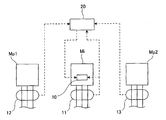
  • FIG. 1 is an overall configuration diagram showing a main portion in a main embodiment of an electric power consumption control system of the present invention.
  • FIG. 2 is a control flowchart of the main embodiment of the electric power consumption control system of the present invention.
  • FIG. 3 is a time chart of electric power consumption in the main embodiment of the electric power consumption control system of the present invention.
  • FIGS. 1 to 3 A main embodiment of the electric power consumption control system of the present invention is described based on FIGS. 1 to 3 .
  • machine tools Mp 1 , Mp 2 are each a general machine tool such as a general-purpose machine center which is installed in a facility such as a factory and which machines a workpiece by moving a tool and the workpiece relative to each other, the general machine tool performing a rotating motion of a main spindle and a positioning and feeding motion by causing motors to rotationally drive.
  • a general machine tool such as a general-purpose machine center which is installed in a facility such as a factory and which machines a workpiece by moving a tool and the workpiece relative to each other, the general machine tool performing a rotating motion of a main spindle and a positioning and feeding motion by causing motors to rotationally drive.
  • a machine tool Mi of the present invention is also a general machine tool such as a general-purpose machine center which is installed in the facility and which machines a workpiece by moving a tool and the workpiece relative to each other, the general machine tool performing the rotating motion of a main spindle and the positioning and feeding motion by causing a motor to rotationally drive.
  • the machine tool Mi is different from the machine tools Mp 1 , Mp 2 in that the machine tool Mi includes a control device being controlling means having technical characteristics to be described later.
  • the machine tools Mi, Mp 1 , Mp 2 are respectively provided with electric power detection instruments 11 to 13 which measure electric power consumption.
  • the electric power detection instruments 11 to 13 are connected to an input portion of an electric power monitoring instrument 20 which obtains electric power consumption Wt of the entire facility.
  • An output portion of the electric power monitoring instrument 20 and the electric power detection instrument 11 are connected to an input portion of the control device 10 of the machine tool Mi.
  • the control device 10 is configured to be capable of controlling an acceleration/deceleration speed (rotational acceleration/deceleration speed of a servo motor for the positioning and feeding motion) Pi and a feeding speed (rotational speed of the servo motor for the positioning and feeding motion) Si of the positioning and feeding motion of the machine tool Mi and an acceleration/deceleration speed (rotational acceleration/deceleration speed of a motor for the rotating motion of the main spindle) Ri of the rotating motion of the main spindle, on the basis of information provided from the electric power monitoring instrument 20 and the electric power detection instrument 11 , in such a way that the electric power consumption Wt of the facility becomes equal to or less than a specified value We (to be described specifically later).
  • electric power monitoring means is formed of the electric power detection instruments 11 to 13 , the electric power monitoring instrument 20 , and the like.
  • the electric power monitoring instrument 20 obtains the total of electric power consumption Wi (for example, 20 kW), electric power consumption W 1 (for example, 10 kW), and the electric power consumption W 2 (for example, 10 kW) respectively of the machine tools Mi, Mp 1 , Mp 2 , i.e. the electric power consumption Wt (for example, 40 kW) of the facility on the basis of the information from the electric power detection instruments 11 to 13 , and monitors whether the electric power consumption Wt is equal to or less than the specified value We (for example, 50 kW).
  • We for example, 50 kW
  • the control device 10 controls the servo motor for the positioning and feeding motion and the motor for the rotating motion of the main spindle on the basis of the information from the electric power monitoring instrument 20 and the electric power detection instrument 11 , in such a way that the acceleration/deceleration speed Pi and the feeding speed Si of the positioning and feeding motion and the acceleration/deceleration speed Ri of the rotating motion of the main spindle are maintained, i.e. machining is performed at steady-state values Pin, Sin, Rin of the respective speeds (S 2 in FIG. 2 ).
  • the control device 10 continues to control the motors on the basis of the information from the electric power monitoring instrument 20 and the electric power detection instrument 11 , in such a way that the machining is performed at the steady-state speeds Pin, Sin, Rin (S 2 in FIG. 2 ).
  • the control device 10 checks whether the electric power consumption Wt continuously exceeds the specified value We for a specified time period Te 1 (for example, one minute) on the basis of the information from the electric power monitoring instrument 20 and the electric power detection instrument 11 (S 4 in FIG. 2 ).
  • control device 10 When the electric power consumption Wt continuously exceeds the specified value We only for a time less than the specified time period Te 1 , the control device 10 continues to control the motors in such a way that the machining is performed at the steady-state speeds Pin, Sin, Rin (S 2 in FIG. 2 ).
  • the control device 10 controls the motors on the basis of the information from the electric power monitoring instrument 20 and the electric power detection instrument 11 , in such a way that the speeds Pi, Si, Ri are reduced until the electric power consumption Wt of the facility becomes equal to or less than the specified value We (T 3 in FIG. 3 ).
  • the machining continues in this state (S 5 , S 6 in FIG. 2 ).
  • the feeding speed is proportionate to a required driving force Pc, as could be understood from the following formula, and the required driving force Pc can be reduced by reducing the feeding speed, i.e. the electric power consumption Wi can be decreased by reducing the feeding speed.
  • Pc ap ⁇ ae ⁇ Vf ⁇ Kc/ 60*106* ⁇
  • ap represents a depth of cut (mm)
  • ae represents a width of cut (mm)
  • Vf represents the feeding speed (mm/minute)
  • Kc represents a specific cutting resistance (MPa)
  • represents a mechanical efficiency
  • Pc represents the required driving force (kW).
  • the machine tools Mp 1 for example, 20 kW
  • Mp 2 for example, 20 kW
  • Mi for example, 10 kW
  • Wt for example, 50 kW
  • We for example, 50 kW
  • the control device 10 checks whether the electric power consumption Wt continuously falls below the specified value We for a specified time period Te 2 (for example, one minute) on the basis of the information from the electric power monitoring instrument 20 and the electric power detection instrument 11 (S 7 in FIG. 2 ).
  • the control device 10 controls the motors in such a way that the machining is continuously performed in the state with the speeds Pin, Sin, Rin (S 2 in FIG. 2 ).
  • the control device 10 further checks whether the speeds Pi, Si, Ri are respectively at the steady-state speeds Pin, Sin, Rin (S 8 in FIG. 2 ).
  • the control device 10 controls the motors in such a way that the machining continuous at the steady-state speeds Pin, Sin, Rin (S 2 in FIG. 2 ).
  • the control device 10 controls the motors on the basis of the information from the electric power monitoring instrument 20 and the electric power detection instrument 11 , in such a way that the speeds Pi, Si, Ri are raised until any one of the following conditions are satisfied: the speeds Pi, Si, Ri respectively reach the steady-state value Pin, Sin, Rin; and the electric power consumption Wt of the facility reaches the specified value We (in this case until the electric power consumption Wt reaches the specified value We) (S 9 to S 11 in FIG. 2 /T 5 in FIG. 3 ).
  • the machine tool Mi (for example, 15 kW), can thus improve the machining ability for the workpiece with the electric power consumption Wt (for example, 50 kW) of the facility being equal to the specified value We (for example, 50 kW).
  • the control device 10 continues to control the motors on the basis of the information from the electric power monitoring instrument 20 and the electric power detection instrument 11 , in such a way that the speeds Pi, Si, Ri are raised until any one of the following conditions are satisfied: the speeds Pi, Si, Ri respectively reach the steady-state value Pin, Sin, Rin; and the electric power consumption Wt of the facility reaches the specified value We (in this case until the speeds Pi, Si, Ri respectively reach the steady-state value Pin, Sin, Rin and the electric power consumption Wt reaches the specified value We) (S 10 in FIG. 2 /T 7 in FIG. 3 ).
  • the machine tool Mi (for example, 20 kW) can restore the machining ability for the workpiece with the electric power consumption Wt (for example, 50 kW) of the facility being equal to the specified value We (for example, 50 kW).
  • the control device 10 continues to maintain the control of the motors as it is, if the machine tool Mi is machining at the steady-state speeds Pin, Sin, Rin (S 8 in FIG. 2 ), the control maintained on the basis of the information from the electric power monitoring instrument 20 and the electric power detection instrument 11 , in such a way that the machining is performed at the steady-state speeds Pin, Sin, Rin (S 2 in FIG. 2 ).
  • the control device 10 continues to maintain the control of the motors as it is, if the machine tool Mi is machining at the steady-state speeds Pin, Sin, Rin (S 8 in FIG. 2 ), the control maintained on the basis of the information from the electric power monitoring instrument 20 and the electric power detection instrument 11 , in such a way that the machining is performed at the steady-state speeds Pin, Sin, Rin (S 2 in FIG. 2 ).
  • the control device 10 continues to control the motors on the basis of the information from the electric power monitoring instrument 20 and the electric power detection instrument 11 in such a way that the machining is performed at the steady-state speeds Pin, Sin, Rin (S 2 in FIG. 2 ).
  • the control device 10 controls the motors on the basis of the information from the electric power monitoring instrument 20 and the electric power detection instrument 11 , in such a way that the speeds Pi, Si, Ri are reduced until the electric power consumption Wt of the facility becomes equal to or less than the specified value We (T 3 in FIG. 3 ). The machining continues in this state.
  • the machine tool Mi can continuously perform the machining of workpiece with the electric power consumption Wt of the facility being equal to or less than the specified value We, by repeating the operation described above until a stop signal is inputted (S 12 in FIG. 2 ) and the operation is thereby terminated.
  • a load on a power supply system of the facility can be easily suppressed even when a large peak occurs in the electric power consumption Wt of the facility while an operator is performing a machining work.
  • an average value of the electric power consumption Wt (demanded electric power) in a predetermined time period can be made equal to or less than the specified value We. This makes it possible to reduce a basic charge for the facility in a contract with an electric company and thereby reduce the operating cost of the entire facility, for example.
  • control device 10 of the machine tool Mi controls the acceleration/deceleration speed Pi and the feeding speed Si of the positioning and feeding motion and the acceleration/deceleration speed Ri of the rotating motion of the main spindle, on the basis of the information from the electric power monitoring instrument 20 and the electric power detection instrument 11 .
  • the control device 10 of the machine tool Mi may omit the control of the acceleration/deceleration speed Ri of the rotating motion of the main spindle and control only the acceleration/deceleration speed Pi and the feeding speed Si of the positioning and feeding motion or control only one of the acceleration/deceleration speed Pi and the feeding speed Si of the positioning and feeding motion, on the basis of the information from the electric power monitoring instrument 20 and the electric power detection instrument 11 . Operation and effect similar to those of the embodiment described above can be also obtained by performing the controls described above.
  • the present invention is applied to the machine tools Mi, Mp 1 , and Mp 2 which each machine the workpiece by moving the tool and the workpiece relative to each other.
  • the present invention can be applied to an industrial machine which performs the positioning and feeding motion, such as a press machine, an extruder, and an industrial robot, and to any industrial machine which causes a motor to rotationally drive, such as a pump or a blower.
  • the present invention can be applied to such industrial machines in a similar manner as the embodiment described above and similar operation and effects can be obtained by controlling at least one of the rotational acceleration/deceleration speed Pi and the rotational speed Si.
  • the electric power consumption control system of the present invention can easily suppress the load on the power supply system of the facility even when a large peak occurs in the electric power consumption Wt of the facility while an operator is performing a work.
  • the electric power consumption control system can be thus used very effectively in various industries.

Landscapes

  • Engineering & Computer Science (AREA)
  • Human Computer Interaction (AREA)
  • Manufacturing & Machinery (AREA)
  • Physics & Mathematics (AREA)
  • General Physics & Mathematics (AREA)
  • Automation & Control Theory (AREA)
  • Power Engineering (AREA)
  • Control Of Electric Motors In General (AREA)
  • Control Of Multiple Motors (AREA)
  • Numerical Control (AREA)

Abstract

Disclosed is an electric power consumption control system for a factory where a plurality of machine tools (Mi, Mp1, Mp2) are installed. A machine tool (Mi) is provided with a control device (10) whereby either the rotational acceleration/deceleration (Pi) for the motor for the machine tool and/or the rotational speed (Si) thereof is controlled on the basis of information regarding electric power consumption (Wt) in the factory so that electric power consumption will not exceed a specified value (We). This electric power consumption control system is also provided with electric power detection instruments (11, 12, 13) and an electric power monitoring instrument (20) which measure the electric power consumption of all the machine tools installed in the factory, thereby obtaining the electric power consumption of the factory, and provide information regarding the electric power consumption to the control device of the machine tool equipped with the control device.

Description

TECHNICAL FIELD
The present invention relates to an electric power consumption control system for a facility in which multiple industrial machines each causing a motor to rotationally drive are installed. Particularly, the present invention is very effective when applied to a facility in which machine tools each configured to machine a workpiece by moving a tool and the workpiece relative to each other are installed.
BACKGROUND ART
A machine tool tends to consume a very large amount of electric power when a tool and a workpiece are moved relative to each other, i.e. when a positioning and feeding motion is performed, compared to other cases. Accordingly, in a facility such as a factory in which multiple machine tools are installed, a large peak occurs in an electric power consumption of the facility when the timings of positioning and feeding motion of these machine tools coincide with each other. As a result, a large load is placed on a power supply system of the facility.
In this respect, for example, Patent Document 1 listed below and the like proposes a processing machine including a mode changing switch allowing the processing machine to change from a normal mode to an energy saving mode and vice versa. An operator can set the mode changing switch to the energy saving mode as needed and thereby reduce the required current to deal with the large peak.
CITATION LIST Patent Literature
  • Patent Document 1: Japanese Patent Application Publication No. Hei 6-161535
SUMMARY OF INVENTION Technical Problem
In the processing machine described in Patent Document 1 and the like, the operator sets the mode changing switch to the energy saving mode as needed and thereby deals with the large peak. Accordingly, when a large peak occurs in the electric power consumption of the facility while the operator is performing a machining work, it is difficult for the operator to deal with the large peak.
Such a problem may occur not only in the aforementioned machine tool which machines a workpiece by moving a tool and the workpiece relative to each other, but also in an industrial machine which performs the positioning and feeding motion, such as a press machine, an extruder, and an industrial robot, and to any industrial machine which causes a motor to rotationally drive, such as a pump or a blower.
In view of this problem, an object of the present invention is to provide an electric power consumption control system capable of easily suppressing a load on a power supply system of a facility even when a large peak occurs in an electric power consumption of the facility while an operator is performing a work.
Solution to Problem
An electric power consumption control system according to a first aspect of the invention for solving the problem is an electric power consumption control system for a facility in which a plurality of industrial machines each causing a motor to rotationally drive are installed, the electric power consumption control system characterized in that only one of the industrial machines includes controlling means for controlling at least one of a rotational acceleration/deceleration speed Pi and a rotational speed Si of the motor of the one industrial machine, on the basis of information on an electric power consumption Wt of the facility, in such a way that the electric power consumption Wt becomes equal to or less than a specified value We, and the electric power consumption control system comprises electric power monitoring means for obtaining the electric power consumption Wt of the facility by measuring each of electric power consumptions of all of the industrial machines installed in the facility and for providing the information on the electric power consumption Wt to the controlling means of the industrial machine including the controlling means.
An electric power consumption control system according to a second aspect of the invention is the electric power consumption control system according to the first aspect of the invention characterized in that the controlling means of the industrial machine including the controlling means controls the motor of the industrial machine including the controlling means on the basis of information indicating that the electric power consumption Wt continuously exceeds the specified value We for a specified time period Te1, in such a way that at least one of the rotational acceleration/deceleration speed Pi and the rotational speed Si of the industrial machine including the controlling means is reduced until the electric power consumption Wt becomes equal to or less than the specified value We.
An electric power consumption control system according to a third aspect of the invention is the electric power consumption control system according to the first aspect of the invention or the second aspect of the invention characterized in that, when at least one of the rotational acceleration/deceleration speed Pi and the rotational speed Si of the industrial machine including the controlling means is less than a steady state value Pin, Sin, the controlling means of the industrial machine including the controlling means controls the motor of the industrial machine including the controlling means, on the basis of information indicating that the electric power consumption Wt continuously falls below the specified value We for a specified time period Te2, in such a way that the at least one of the rotational acceleration/deceleration speed Pi and the rotational speed Si is raised until any one of following conditions is satisfied: the at least one of the rotational acceleration/deceleration speed Pi and the rotational speed Si reaches the steady state value Pin, Sin; and the electric power consumption Wt reaches the specified value We.
An electric power consumption control system according to a fourth aspect of the invention is the electric power consumption control system according to any one of the first aspect of the invention to the third aspect of the invention characterized in that the industrial machine including the controlling means is a machine tool for machining a workpiece by moving a tool and the workpiece relative to each other, the rotational acceleration/deceleration speed Pi is an acceleration/deceleration speed Pi of a positioning and feeding motion, and the rotational speed Si is a feeding speed Si of the positioning and feeding motion.
An electric power consumption control system according to a fifth aspect of the invention is the electric power consumption control system according to the fourth aspect of the invention characterized in that the controlling means of the machine tool including the controlling means further controls an acceleration/deceleration speed Ri of a rotating motion of a main spindle of the machine tool on the basis of the information on the electric power consumption Wt in such a way that the electric power consumption Wt becomes equal to or less than the specified value We.
An electric power consumption control system according to a sixth aspect of the invention is the electric power consumption control system according to the fifth aspect of the invention characterized in that the controlling means of the machine tool including the controlling means further controls the motor of the machine tool including the controlling means on the basis of information indicating that the electric power consumption Wt continuously exceeds the specified value We for the specified time period Te1, in such a way that the acceleration/deceleration speed Ri of the machine tool including the controlling means is reduced until the electric power consumption Wt becomes equal to or less than the specified value We.
An electric power consumption control system according to a seventh aspect of the invention is the electric power consumption control system according to the fifth aspect of the invention or the sixth aspect of the invention characterized in that, when the acceleration/deceleration speed Ri of the machine tool including the controlling means is less than a steady state value Rin, the controlling means of the machine tool including the controlling means controls the motor of the machine tool including the controlling means on the basis of information indicating that the electric power consumption Wt continuously falls below the specified value We for the specified time period Te2, in such a way that the acceleration/deceleration speed Ri is raised until any one of following conditions is satisfied: the acceleration/deceleration speed Ri reaches the steady state value Rin; and the electric power consumption Wt reaches the specified value We.
An electric power consumption control system according to an eighth aspect of the invention is the electric power consumption control system according to any one of the first aspect of the invention to the seventh aspect of the invention characterized in that the controlling means of the industrial machine including the controlling means controls the industrial machine in such a way that an average value of the electric power consumption Wt during a specified time period becomes equal to or less than the specified value We.
Advantageous Effects of Invention
In the electric power consumption control system of the present invention, the controlling means controls at least one of the rotational acceleration/deceleration speed Pi and the rotational speed Si of the motor of the industrial machine on the basis of the information on the electric power consumption Wt of the facility, in such a way that the electric power consumption Wt becomes equal to or less than the specified value We. Thus, even when a large peak occurs in the electric power consumption Wt of the facility while an operator is performing a work, a load on a power supply system of the facility can be suppressed easily.
BRIEF DESCRIPTION OF DRAWINGS
FIG. 1 is an overall configuration diagram showing a main portion in a main embodiment of an electric power consumption control system of the present invention.
FIG. 2 is a control flowchart of the main embodiment of the electric power consumption control system of the present invention.
FIG. 3 is a time chart of electric power consumption in the main embodiment of the electric power consumption control system of the present invention.
DESCRIPTION OF EMBODIMENTS
Embodiments of an electric power consumption control system of the present invention are described below based on the drawings. However, the present invention is not limited to the embodiments described below based on the drawings.
Main Embodiment
A main embodiment of the electric power consumption control system of the present invention is described based on FIGS. 1 to 3.
In FIG. 1, machine tools Mp1, Mp2 are each a general machine tool such as a general-purpose machine center which is installed in a facility such as a factory and which machines a workpiece by moving a tool and the workpiece relative to each other, the general machine tool performing a rotating motion of a main spindle and a positioning and feeding motion by causing motors to rotationally drive. Moreover, as similar to the machine tools Mp1, Mp2, a machine tool Mi of the present invention is also a general machine tool such as a general-purpose machine center which is installed in the facility and which machines a workpiece by moving a tool and the workpiece relative to each other, the general machine tool performing the rotating motion of a main spindle and the positioning and feeding motion by causing a motor to rotationally drive. However, the machine tool Mi is different from the machine tools Mp1, Mp2 in that the machine tool Mi includes a control device being controlling means having technical characteristics to be described later.
The machine tools Mi, Mp1, Mp2 are respectively provided with electric power detection instruments 11 to 13 which measure electric power consumption. The electric power detection instruments 11 to 13 are connected to an input portion of an electric power monitoring instrument 20 which obtains electric power consumption Wt of the entire facility. An output portion of the electric power monitoring instrument 20 and the electric power detection instrument 11 are connected to an input portion of the control device 10 of the machine tool Mi. The control device 10 is configured to be capable of controlling an acceleration/deceleration speed (rotational acceleration/deceleration speed of a servo motor for the positioning and feeding motion) Pi and a feeding speed (rotational speed of the servo motor for the positioning and feeding motion) Si of the positioning and feeding motion of the machine tool Mi and an acceleration/deceleration speed (rotational acceleration/deceleration speed of a motor for the rotating motion of the main spindle) Ri of the rotating motion of the main spindle, on the basis of information provided from the electric power monitoring instrument 20 and the electric power detection instrument 11, in such a way that the electric power consumption Wt of the facility becomes equal to or less than a specified value We (to be described specifically later).
In the embodiment, electric power monitoring means is formed of the electric power detection instruments 11 to 13, the electric power monitoring instrument 20, and the like.
Operations of the machine tool Mi of the embodiment as described above and the electric power consumption control system using the machine tool Mi are described based on FIGS. 2, 3.
When the machine tools Mp1, Mp2 are actuated and the machine tool Mi is also actuated to machine (for example, mill) a workpiece (for example, aluminum), the electric power monitoring instrument 20 obtains the total of electric power consumption Wi (for example, 20 kW), electric power consumption W1 (for example, 10 kW), and the electric power consumption W2 (for example, 10 kW) respectively of the machine tools Mi, Mp1, Mp2, i.e. the electric power consumption Wt (for example, 40 kW) of the facility on the basis of the information from the electric power detection instruments 11 to 13, and monitors whether the electric power consumption Wt is equal to or less than the specified value We (for example, 50 kW).
When the electric power consumption Wt of the facility is judged to be the specified value We (S1 in FIG. 2), in the machine tool Mi, the control device 10 controls the servo motor for the positioning and feeding motion and the motor for the rotating motion of the main spindle on the basis of the information from the electric power monitoring instrument 20 and the electric power detection instrument 11, in such a way that the acceleration/deceleration speed Pi and the feeding speed Si of the positioning and feeding motion and the acceleration/deceleration speed Ri of the rotating motion of the main spindle are maintained, i.e. machining is performed at steady-state values Pin, Sin, Rin of the respective speeds (S2 in FIG. 2).
Here, for example, assume a case where a machining load on the machine tool Mp1 increases and the electric power consumption W1 of the machine tool Mp1 increases (for example, 20 kW), thereby causing the electric power consumption Wt of the facility to increase (for example, 50 kW) (T1 in FIG. 3). Even in this case, if the electric power consumption Wt is equal to or less than the specified value We, in the machine tool Mi, the control device 10 continues to control the motors on the basis of the information from the electric power monitoring instrument 20 and the electric power detection instrument 11, in such a way that the machining is performed at the steady-state speeds Pin, Sin, Rin (S2 in FIG. 2).
Moreover, assume a case, for example, where a machining load on the machine tool Mp2 increases and the electric power consumption W2 of the machine tool Mp2 increases (for example, 20 kW), thereby causing the electric power consumption Wt of the facility to further increase (for example, 60 kW) and exceed the specified value We (S3 in FIG. 2/T2 in FIG. 3). In this case, in the machine tool Mi, the control device 10 checks whether the electric power consumption Wt continuously exceeds the specified value We for a specified time period Te1 (for example, one minute) on the basis of the information from the electric power monitoring instrument 20 and the electric power detection instrument 11 (S4 in FIG. 2). When the electric power consumption Wt continuously exceeds the specified value We only for a time less than the specified time period Te1, the control device 10 continues to control the motors in such a way that the machining is performed at the steady-state speeds Pin, Sin, Rin (S2 in FIG. 2).
Meanwhile, when the electric power consumption Wt continuously exceeds the specified value We for the specified time period Te1, in the machine tool Mi, the control device 10 controls the motors on the basis of the information from the electric power monitoring instrument 20 and the electric power detection instrument 11, in such a way that the speeds Pi, Si, Ri are reduced until the electric power consumption Wt of the facility becomes equal to or less than the specified value We (T3 in FIG. 3). The machining continues in this state (S5, S6 in FIG. 2).
For example, the feeding speed is proportionate to a required driving force Pc, as could be understood from the following formula, and the required driving force Pc can be reduced by reducing the feeding speed, i.e. the electric power consumption Wi can be decreased by reducing the feeding speed.
Pc=ap·ae·Vf·Kc/60*106*η
In this formula, ap represents a depth of cut (mm), ae represents a width of cut (mm), Vf represents the feeding speed (mm/minute), Kc represents a specific cutting resistance (MPa), η represents a mechanical efficiency, and Pc represents the required driving force (kW).
The machine tools Mp1 (for example, 20 kW), Mp2 (for example, 20 kW), Mi (for example, 10 kW) can thus continuously machine the workpiece with the electric power consumption Wt (for example, 50 kW) of the facility being equal to or less than the specified value We (for example, 50 kW).
Moreover, for example, assume a case where a machining load on the machine tool Mp1 decreases and the electric power consumption W1 of the machine tool Mp1 decreases (for example, 15 kW), thereby causing the electric power consumption Wt of the facility to decrease (for example, 45 kW) and falls below the specified value We (S3 in FIG. 2/T4 in FIG. 3). In this case, in the machine tool Mi, the control device 10 checks whether the electric power consumption Wt continuously falls below the specified value We for a specified time period Te2 (for example, one minute) on the basis of the information from the electric power monitoring instrument 20 and the electric power detection instrument 11 (S7 in FIG. 2). When the electric power consumption Wt continuously falls below the specified value We only for a time less than the specified time period Te2, the control device 10 controls the motors in such a way that the machining is continuously performed in the state with the speeds Pin, Sin, Rin (S2 in FIG. 2).
Meanwhile, when the electric power consumption Wt continuously falls below the specified value We for the specified time period Te2, in the machine tool Mi, the control device 10 further checks whether the speeds Pi, Si, Ri are respectively at the steady-state speeds Pin, Sin, Rin (S8 in FIG. 2). When the speeds Pi, Si, Ri are respectively at the steady-state speeds Pin, Sin, Rin, the control device 10 controls the motors in such a way that the machining continuous at the steady-state speeds Pin, Sin, Rin (S2 in FIG. 2).
Meanwhile, when the speeds Pi, Si, Ri are respectively less than the steady-state speeds Pin, Sin, Rin, in the machine tool Mi, the control device 10 controls the motors on the basis of the information from the electric power monitoring instrument 20 and the electric power detection instrument 11, in such a way that the speeds Pi, Si, Ri are raised until any one of the following conditions are satisfied: the speeds Pi, Si, Ri respectively reach the steady-state value Pin, Sin, Rin; and the electric power consumption Wt of the facility reaches the specified value We (in this case until the electric power consumption Wt reaches the specified value We) (S9 to S11 in FIG. 2/T5 in FIG. 3).
The machine tool Mi (for example, 15 kW), can thus improve the machining ability for the workpiece with the electric power consumption Wt (for example, 50 kW) of the facility being equal to the specified value We (for example, 50 kW).
Moreover, assume a case where, for example, the machining load on the machine tool Mp2 decreases and the electric power consumption W2 of the machine tool Mp2 decreases (for example, 15 kW), thereby causing the electric power consumption Wt of the facility to decrease (for example, 45 kW) and become equal to or less than the specified value We (T6 in FIG. 3). In this case, when the electric power consumption Wt is less than the specified value We for a specified time period Te2 (for example, one minute), in the machine tool Mi, the control device 10 continues to control the motors on the basis of the information from the electric power monitoring instrument 20 and the electric power detection instrument 11, in such a way that the speeds Pi, Si, Ri are raised until any one of the following conditions are satisfied: the speeds Pi, Si, Ri respectively reach the steady-state value Pin, Sin, Rin; and the electric power consumption Wt of the facility reaches the specified value We (in this case until the speeds Pi, Si, Ri respectively reach the steady-state value Pin, Sin, Rin and the electric power consumption Wt reaches the specified value We) (S10 in FIG. 2/T7 in FIG. 3).
The machine tool Mi (for example, 20 kW) can restore the machining ability for the workpiece with the electric power consumption Wt (for example, 50 kW) of the facility being equal to the specified value We (for example, 50 kW).
Moreover, assume a case where, for example, the machining load on the machine tool Mp1 also decreases, the electric power consumption W1 of the machine tool Mp1 decreases to an original level (for example, 10 kW), and the electric power consumption Wt of the facility decreases (for example, 45 kW), thereby causing the electric power consumption Wt to fall below the specified value We. Even when this state continues for the specified time period Te2 (T8 in FIG. 3), in the machine tool Mi, the control device 10 continues to maintain the control of the motors as it is, if the machine tool Mi is machining at the steady-state speeds Pin, Sin, Rin (S8 in FIG. 2), the control maintained on the basis of the information from the electric power monitoring instrument 20 and the electric power detection instrument 11, in such a way that the machining is performed at the steady-state speeds Pin, Sin, Rin (S2 in FIG. 2).
Similarly, assume a case where, for example, the machining load on the machine tool Mp2 further decreases as well, the electric power consumption W2 of the machine tool Mp2 decreases to an original level (for example, 10 kW), and the electric power consumption Wt of the facility further decreases (for example, 40 kW), thereby causing the electric power consumption Wt to fall below the specified value We. Even when this state continues for the specified time period Te2 (T9 in FIG. 3), in the machine tool Mi, the control device 10 continues to maintain the control of the motors as it is, if the machine tool Mi is machining at the steady-state speeds Pin, Sin, Rin (S8 in FIG. 2), the control maintained on the basis of the information from the electric power monitoring instrument 20 and the electric power detection instrument 11, in such a way that the machining is performed at the steady-state speeds Pin, Sin, Rin (S2 in FIG. 2).
Here, assume a case where, for example, the machining load on the machine tool Mi increases, the electric power consumption Wi of the machine tool Mi increases (for example, 30 kW), and the electric power consumption Wt of the facility increases (for example, 50 kW) (T10 in FIG. 3). Even in this case, when the electric power consumption Wt is equal to or lower than the specified value We, in the machine tool Mi, the control device 10 continues to control the motors on the basis of the information from the electric power monitoring instrument 20 and the electric power detection instrument 11 in such a way that the machining is performed at the steady-state speeds Pin, Sin, Rin (S2 in FIG. 2).
Moreover, assume a case where, for example, the machining load on the machine tool Mp1 again increases, the electric power consumption W1 of the machine tool Mp1 increases (for example, 20 kW), the electric power consumption Wt of the facility increases (for example, kW), and the electric power consumption Wt continuously exceeds the specified value We for the specified time period Te1 (T11 in FIG. 3). Here, as in the case described above, the control device 10 controls the motors on the basis of the information from the electric power monitoring instrument 20 and the electric power detection instrument 11, in such a way that the speeds Pi, Si, Ri are reduced until the electric power consumption Wt of the facility becomes equal to or less than the specified value We (T3 in FIG. 3). The machining continues in this state.
Hereafter, the machine tool Mi can continuously perform the machining of workpiece with the electric power consumption Wt of the facility being equal to or less than the specified value We, by repeating the operation described above until a stop signal is inputted (S12 in FIG. 2) and the operation is thereby terminated.
Accordingly, in the embodiment, a load on a power supply system of the facility can be easily suppressed even when a large peak occurs in the electric power consumption Wt of the facility while an operator is performing a machining work.
Moreover, an average value of the electric power consumption Wt (demanded electric power) in a predetermined time period (for example, 30 minutes) can be made equal to or less than the specified value We. This makes it possible to reduce a basic charge for the facility in a contract with an electric company and thereby reduce the operating cost of the entire facility, for example.
Other Embodiments
In the embodiment described above, the descriptions are given of the case where the control device 10 of the machine tool Mi controls the acceleration/deceleration speed Pi and the feeding speed Si of the positioning and feeding motion and the acceleration/deceleration speed Ri of the rotating motion of the main spindle, on the basis of the information from the electric power monitoring instrument 20 and the electric power detection instrument 11. However, depending on machining work conditions and the like, the control device 10 of the machine tool Mi may omit the control of the acceleration/deceleration speed Ri of the rotating motion of the main spindle and control only the acceleration/deceleration speed Pi and the feeding speed Si of the positioning and feeding motion or control only one of the acceleration/deceleration speed Pi and the feeding speed Si of the positioning and feeding motion, on the basis of the information from the electric power monitoring instrument 20 and the electric power detection instrument 11. Operation and effect similar to those of the embodiment described above can be also obtained by performing the controls described above.
In the embodiment described above, the descriptions are given of the case where the present invention is applied to the machine tools Mi, Mp1, and Mp2 which each machine the workpiece by moving the tool and the workpiece relative to each other. However, the present invention can be applied to an industrial machine which performs the positioning and feeding motion, such as a press machine, an extruder, and an industrial robot, and to any industrial machine which causes a motor to rotationally drive, such as a pump or a blower. The present invention can be applied to such industrial machines in a similar manner as the embodiment described above and similar operation and effects can be obtained by controlling at least one of the rotational acceleration/deceleration speed Pi and the rotational speed Si.
INDUSTRIAL APPLICABILITY
The electric power consumption control system of the present invention can easily suppress the load on the power supply system of the facility even when a large peak occurs in the electric power consumption Wt of the facility while an operator is performing a work. The electric power consumption control system can be thus used very effectively in various industries.
REFERENCE SIGNS LIST
  • Mi, Mp1, Mp2 machine tool
  • 10 control device
  • 11 to 13 electric power detection instrument
  • 20 electric power monitoring instrument
  • Wi electric power consumption of machine tool Mi
  • W1 electric power consumption of machine tool Mp1
  • W2 electric power consumption of machine tool Mp2
  • Wt electric power consumption of entire facility
  • We specified value

Claims (8)

The invention claimed is:
1. An electric power consumption control system for a facility in which a plurality of industrial machines each causing a motor to rotationally drive are installed, wherein
only one of the industrial machines includes controlling means for controlling at least one of a rotational acceleration/deceleration speed Pi and a rotational speed Si of the motor of the one industrial machine, on the basis of information on an electric power consumption Wt of the facility, in such a way that the electric power consumption Wt becomes equal to or less than a specified value We, and
the electric power consumption control system comprises electric power monitoring means for obtaining the electric power consumption Wt of the facility by measuring each of electric power consumptions of all of the industrial machines installed in the facility and for providing the information on the electric power consumption Wt to the controlling means of the industrial machine including the controlling means.
2. The electric power consumption control system according to claim 1, wherein, when at least one of the rotational acceleration/deceleration speed Pi and the rotational speed Si of the industrial machine including the controlling means is less than a steady state value Pin, Sin, the controlling means of the industrial machine including the controlling means controls the motor of the industrial machine including the controlling means, on the basis of information indicating that the electric power consumption Wt continuously falls below the specified value We for a specified time period Te2, in such a way that the at least one of the rotational acceleration/deceleration speed Pi and the rotational speed Si is raised until any one of following conditions is satisfied: the at least one of the rotational acceleration/deceleration speed Pi and the rotational speed Si reaches the steady state value Pin, Sin; and the electric power consumption Wt reaches the specified value We.
3. The electric power consumption control system according to claim 1, wherein
the industrial machine including the controlling means is a machine tool for machining a workpiece by moving a tool and the workpiece relative to each other,
the rotational acceleration/deceleration speed Pi is an acceleration/deceleration speed Pi of a positioning and feeding motion, and
the rotational speed Si is a feeding speed Si of the positioning and feeding motion.
4. The electric power consumption control system according to claim 3, wherein the controlling means of the machine tool including the controlling means further controls an acceleration/deceleration speed Ri of a rotating motion of a main spindle of the machine tool on the basis of the information on the electric power consumption Wt in such a way that the electric power consumption Wt becomes equal to or less than the specified value We.
5. The electric power consumption control system according to claim 4, wherein the controlling means of the machine tool including the controlling means further controls the motor of the machine tool including the controlling means on the basis of information indicating that the electric power consumption Wt continuously exceeds the specified value We for the specified time period Te1, in such a way that the acceleration/deceleration speed Ri of the machine tool including the controlling means is reduced until the electric power consumption Wt becomes equal to or less than the specified value We.
6. The electric power consumption control system according to claim 4, wherein, when the acceleration/deceleration speed Ri of the machine tool including the controlling means is less than a steady state value Rin, the controlling means of the machine tool including the controlling means controls the motor of the machine tool including the controlling means on the basis of information indicating that the electric power consumption Wt continuously falls below the specified value We for the specified time period Te2, in such a way that the acceleration/deceleration speed Ri is raised until any one of following conditions is satisfied: the acceleration/deceleration speed Ri reaches the steady state value Rin; and the electric power consumption Wt reaches the specified value We.
7. The electric power consumption control system according to claim 1, wherein the controlling means of the industrial machine including the controlling means controls the industrial machine in such a way that an average value of the electric power consumption Wt during a specified time period becomes equal to or less than the specified value We.
8. The electric power consumption control system according to claim 1, wherein the controlling means of the industrial machine including the controlling means controls the motor of the industrial machine including the controlling means on the basis of information indicating that the electric power consumption Wt continuously exceeds the specified value We for a specified time period Te1, in such a way that at least one of the rotational acceleration/deceleration speed Pi and the rotational speed Si of the industrial machine including the controlling means is reduced until the electric power consumption Wt becomes equal to or less than the specified value We.
US13/504,887 2010-01-29 2011-01-20 Electric power consumption control system Active 2031-08-30 US8866420B2 (en)

Applications Claiming Priority (3)

Application Number Priority Date Filing Date Title
JP2010-017656 2010-01-29
JP2010017656A JP4585613B1 (en) 2010-01-29 2010-01-29 Power consumption control system
PCT/JP2011/050914 WO2011093194A1 (en) 2010-01-29 2011-01-20 Electric power consumption control system

Publications (2)

Publication Number Publication Date
US20120261989A1 US20120261989A1 (en) 2012-10-18
US8866420B2 true US8866420B2 (en) 2014-10-21

Family

ID=43365186

Family Applications (1)

Application Number Title Priority Date Filing Date
US13/504,887 Active 2031-08-30 US8866420B2 (en) 2010-01-29 2011-01-20 Electric power consumption control system

Country Status (4)

Country Link
US (1) US8866420B2 (en)
JP (1) JP4585613B1 (en)
CN (1) CN102596494B (en)
WO (1) WO2011093194A1 (en)

Cited By (1)

* Cited by examiner, † Cited by third party
Publication number Priority date Publication date Assignee Title
US10175746B2 (en) 2013-11-27 2019-01-08 Mitsubishi Heavy Industries, Ltd. Power consumption control system and method

Families Citing this family (12)

* Cited by examiner, † Cited by third party
Publication number Priority date Publication date Assignee Title
JP4585613B1 (en) * 2010-01-29 2010-11-24 三菱重工業株式会社 Power consumption control system
JP5717802B2 (en) 2013-07-03 2015-05-13 ファナック株式会社 Machine control device
JP6372177B2 (en) * 2014-06-11 2018-08-15 株式会社ジェイテクト Transport system
JP6059375B1 (en) 2016-02-09 2017-01-11 ファナック株式会社 Production control system and integrated production control system
JP2017162300A (en) * 2016-03-10 2017-09-14 ファナック株式会社 Machine controller for adjusting operating state of a plurality of manufacturing machines, and production system
JP6453806B2 (en) * 2016-04-26 2019-01-16 ファナック株式会社 Manufacturing management device that reduces the operating load of manufacturing machines
US20170328360A1 (en) * 2016-05-11 2017-11-16 GE Lighting Solutions, LLC Apparatus, system and method of controlling electric submersible pump based on demand response
JP6599942B2 (en) 2017-08-10 2019-10-30 ファナック株式会社 Motor control device and machine tool system for controlling motor according to voltage drop amount of power supply voltage
EP3719591B1 (en) * 2017-11-28 2025-05-21 Kabushiki Kaisha Yaskawa Denki Mechanical equipment control system, mechanical equipment controller, and mechanical equipment control method
CA3209343A1 (en) * 2022-09-08 2024-03-08 Shandong University Of Science And Technology Energy saving method of spindle deceleration in no-load process between adjacent cutting activities of cnc machine tool
CN115903671B (en) * 2022-09-08 2024-07-30 山东科技大学 Energy-saving method for spindle deceleration during no-load process between adjacent cutting activities of CNC machine tools
DE112022007281T5 (en) * 2022-09-27 2025-04-30 Fanuc Corporation machine tool

Citations (13)

* Cited by examiner, † Cited by third party
Publication number Priority date Publication date Assignee Title
JPS5682909A (en) 1979-10-31 1981-07-07 Valeron Corp Machine process controller
US4351029A (en) * 1979-12-05 1982-09-21 Westinghouse Electric Corp. Tool life monitoring and tracking apparatus
US4509126A (en) * 1982-06-09 1985-04-02 Amca International Corporation Adaptive control for machine tools
JPS61180530A (en) 1985-02-05 1986-08-13 株式会社日本製鋼所 Power control for injection molding plant
US4663721A (en) * 1979-01-24 1987-05-05 Power Engineering And Manufacturing, Ltd. Gear cutter
JPS6463745A (en) 1987-09-02 1989-03-09 Daikin Ind Ltd Demand controller of air conditioning equipment
JPH06161535A (en) 1992-11-18 1994-06-07 Amada Co Ltd Shaft feeding control method and controller of working
JP2002236508A (en) 2001-02-13 2002-08-23 Mori Seiki Co Ltd Machine tool control device
JP2006277131A (en) 2005-03-28 2006-10-12 Matsushita Electric Ind Co Ltd Power monitoring method
US20070293969A1 (en) 2005-02-17 2007-12-20 Wataru Hirai Mounting Condition Determining Method, Mounting Condition Determining Device, and Mounter
US20100117568A1 (en) * 2008-11-07 2010-05-13 Fanuc Ltd Controller for calculating electric power consumption of industrial machine
JP4585613B1 (en) 2010-01-29 2010-11-24 三菱重工業株式会社 Power consumption control system
US8774948B2 (en) * 2009-04-14 2014-07-08 Wilsun Xu Operation and construction of electric power consuming facilities using facility models

Family Cites Families (3)

* Cited by examiner, † Cited by third party
Publication number Priority date Publication date Assignee Title
CN101129107A (en) * 2005-02-17 2008-02-20 松下电器产业株式会社 Mounting condition determining method, mounting condition determining device, and mounting apparatus
CN101527453A (en) * 2008-03-07 2009-09-09 苏州飞腾电器有限公司 Electric equipment control and management method
CN101373197B (en) * 2008-10-20 2010-12-15 华北电力大学(保定) A method and device for on-line overvoltage monitoring

Patent Citations (15)

* Cited by examiner, † Cited by third party
Publication number Priority date Publication date Assignee Title
US4663721A (en) * 1979-01-24 1987-05-05 Power Engineering And Manufacturing, Ltd. Gear cutter
US4279013A (en) * 1979-10-31 1981-07-14 The Valeron Corporation Machine process controller
JPS5682909A (en) 1979-10-31 1981-07-07 Valeron Corp Machine process controller
US4351029A (en) * 1979-12-05 1982-09-21 Westinghouse Electric Corp. Tool life monitoring and tracking apparatus
US4509126A (en) * 1982-06-09 1985-04-02 Amca International Corporation Adaptive control for machine tools
US4547847A (en) * 1982-06-09 1985-10-15 Amca International Corporation Adaptive control for machine tools
JPS61180530A (en) 1985-02-05 1986-08-13 株式会社日本製鋼所 Power control for injection molding plant
JPS6463745A (en) 1987-09-02 1989-03-09 Daikin Ind Ltd Demand controller of air conditioning equipment
JPH06161535A (en) 1992-11-18 1994-06-07 Amada Co Ltd Shaft feeding control method and controller of working
JP2002236508A (en) 2001-02-13 2002-08-23 Mori Seiki Co Ltd Machine tool control device
US20070293969A1 (en) 2005-02-17 2007-12-20 Wataru Hirai Mounting Condition Determining Method, Mounting Condition Determining Device, and Mounter
JP2006277131A (en) 2005-03-28 2006-10-12 Matsushita Electric Ind Co Ltd Power monitoring method
US20100117568A1 (en) * 2008-11-07 2010-05-13 Fanuc Ltd Controller for calculating electric power consumption of industrial machine
US8774948B2 (en) * 2009-04-14 2014-07-08 Wilsun Xu Operation and construction of electric power consuming facilities using facility models
JP4585613B1 (en) 2010-01-29 2010-11-24 三菱重工業株式会社 Power consumption control system

Cited By (1)

* Cited by examiner, † Cited by third party
Publication number Priority date Publication date Assignee Title
US10175746B2 (en) 2013-11-27 2019-01-08 Mitsubishi Heavy Industries, Ltd. Power consumption control system and method

Also Published As

Publication number Publication date
JP4585613B1 (en) 2010-11-24
JP2011156598A (en) 2011-08-18
CN102596494A (en) 2012-07-18
WO2011093194A1 (en) 2011-08-04
US20120261989A1 (en) 2012-10-18
CN102596494B (en) 2014-04-30

Similar Documents

Publication Publication Date Title
US8866420B2 (en) Electric power consumption control system
Li et al. An investigation into fixed energy consumption of machine tools
JP5612058B2 (en) Machine tool control apparatus having a feed shaft motor and a spindle motor
JP6377985B2 (en) Motor control device with torque command limiting function during power failure
JP5319798B2 (en) Motor control device that limits torque command according to input current or power
CN110174873B (en) Servo control device
CN102205512A (en) Control device for machine tool
KR102239951B1 (en) Robot control system
JP2011138463A (en) Numerical control device
US9921556B2 (en) Machine controller and power consumption control of machine tool peripherals
CN103223623B (en) Motor drive control device for limiting output of motor
CN102739129B (en) The motor drive control apparatus of DC-AC converting means can be connected
US8497649B2 (en) Motor driving control apparatus for controlling motor output according to power characteristics of AC power supply
CN106975805A (en) A kind of back to zero system and method for spark-erosion machine tool
JP2016093040A (en) Motor control device for detecting excessive load
US10082783B2 (en) Computer numerical control servo drive system
EP1265350B1 (en) Numerical control drive system
JP6708517B2 (en) Servo system
WO2022070490A1 (en) Rotation speed assessment device
CN101729019A (en) Electric motor driving device and motor driving method
US20260079477A1 (en) Method and system for controlling the operation of a cnc machine for machining a workpiece
CN117207192B (en) A control method for a grinding robot with self-learning motion trajectory
JP6034757B2 (en) Motor drive controller that can be connected to a DC / AC converter
Mikhov et al. Methodology for Selection of Spindle Drives for Milling Machines
CN108021102A (en) control method of tapping cutter

Legal Events

Date Code Title Description
AS Assignment

Owner name: MITSUBISHI HEAVY INDUSTRIES, LTD., JAPAN

Free format text: ASSIGNMENT OF ASSIGNORS INTEREST;ASSIGNOR:MISHINA, SHUNJI;REEL/FRAME:028396/0580

Effective date: 20120515

STCF Information on status: patent grant

Free format text: PATENTED CASE

FEPP Fee payment procedure

Free format text: PAYOR NUMBER ASSIGNED (ORIGINAL EVENT CODE: ASPN); ENTITY STATUS OF PATENT OWNER: LARGE ENTITY

MAFP Maintenance fee payment

Free format text: PAYMENT OF MAINTENANCE FEE, 4TH YEAR, LARGE ENTITY (ORIGINAL EVENT CODE: M1551)

Year of fee payment: 4

MAFP Maintenance fee payment

Free format text: PAYMENT OF MAINTENANCE FEE, 8TH YEAR, LARGE ENTITY (ORIGINAL EVENT CODE: M1552); ENTITY STATUS OF PATENT OWNER: LARGE ENTITY

Year of fee payment: 8