US8863180B1 - Interactive episodes - Google Patents
Interactive episodes Download PDFInfo
- Publication number
- US8863180B1 US8863180B1 US13/476,721 US201213476721A US8863180B1 US 8863180 B1 US8863180 B1 US 8863180B1 US 201213476721 A US201213476721 A US 201213476721A US 8863180 B1 US8863180 B1 US 8863180B1
- Authority
- US
- United States
- Prior art keywords
- episode
- user
- presented
- storyline
- episodes
- Prior art date
- Legal status (The legal status is an assumption and is not a legal conclusion. Google has not performed a legal analysis and makes no representation as to the accuracy of the status listed.)
- Active, expires
Links
Images


Classifications
-
- H—ELECTRICITY
- H04—ELECTRIC COMMUNICATION TECHNIQUE
- H04N—PICTORIAL COMMUNICATION, e.g. TELEVISION
- H04N21/00—Selective content distribution, e.g. interactive television or video on demand [VOD]
- H04N21/40—Client devices specifically adapted for the reception of or interaction with content, e.g. set-top-box [STB]; Operations thereof
- H04N21/47—End-user applications
- H04N21/472—End-user interface for requesting content, additional data or services; End-user interface for interacting with content, e.g. for content reservation or setting reminders, for requesting event notification, for manipulating displayed content
- H04N21/47205—End-user interface for requesting content, additional data or services; End-user interface for interacting with content, e.g. for content reservation or setting reminders, for requesting event notification, for manipulating displayed content for manipulating displayed content, e.g. interacting with MPEG-4 objects, editing locally
-
- H—ELECTRICITY
- H04—ELECTRIC COMMUNICATION TECHNIQUE
- H04N—PICTORIAL COMMUNICATION, e.g. TELEVISION
- H04N21/00—Selective content distribution, e.g. interactive television or video on demand [VOD]
- H04N21/80—Generation or processing of content or additional data by content creator independently of the distribution process; Content per se
- H04N21/85—Assembly of content; Generation of multimedia applications
- H04N21/854—Content authoring
- H04N21/8541—Content authoring involving branching, e.g. to different story endings
Definitions
- This disclosure relates to providing interactive audio-video episodes in which progression of storylines is contingent upon user interactions with the episodes.
- Interactive episodes are known. Conventional approaches, however, do not feature activities contextual to the storyline. For example, existing interactive episodes do not have native device optimizations to drive “clicking” and “talking” to move the story forward. Instead, most existing interactive episodes merely provide bonus content or trivia about the episode.
- a user may view an episode via a client computing platform, such as an Apple iPhone® or iPad®.
- the episode may be akin to a television program in which audio and visual media convey a storyline involving an evolving plot with various characters and scenes.
- the episode may be interactive in that the user is queued to participate in activities while viewing the episode.
- the activities may be contextually related to the storyline of the episode. Progression of the storyline may be suspended during a given activity until the user has completed that activity. That is, user participation in the activities may drive progression of the storyline forward.
- the system may include one or more servers, one or more client computing platforms, and/or other components.
- the server(s) may be configured to communicate with the client computing platform(s) according to a client/server architecture.
- the client computing platform(s) may download and/or stream applications, computer program modules, episodes, and/or other information from the server(s). Users may access the system and/or episodes via the client computing platform(s).
- the server(s) and/or client computing platform(s) may be configured to execute one or more computer program modules.
- the computer program modules may include one or more of an episode viewing module, an activity module, an interaction module, an episode selection module, an episode acquisition module, and/or other modules.
- the episode viewing module may be configured to provide an episode for presentation to a user.
- the episode may include audio and visual media conveying a storyline involving an evolving plot with one or both of one or more characters or one or more scenes.
- aspects of the episode may be similar to a television program.
- the episode may be presented to the user via a client computing platform(s) 104 that is configured to facilitate user interactions with the presented episode.
- the episode may be stored locally on a given client computing platform and/or streamed to that client computing platform.
- the episode viewing module may be configured to provide a media player that is locally executed by a client computing platform.
- the episode viewing module may be configured to provide a media player that is accessed by a client computing platform via the Internet, such as with a browser.
- the interaction module may be configured to receive one or more user interactions during individual ones of the one or more user activities facilitated during presentation of the episode.
- User interactions may include one or more of manual interactions, vocal interactions, and/or other interactions performed by the user with the episode and/or the client computing platform presenting the episode.
- manual interactions may include one or more of touching, tapping, swiping, tilting, shaking, and/or other manual interactions with the episode and/or the client computing platform presenting the episode.
- vocal interactions may include one or more of speaking one or more words, making one or more vocal sounds, singing one or more notes and/or songs, and/or other vocal interactions.
- the storyline of the episode may continue to progress after a given user activity responsive to receipt of a user interaction prompted by that user activity. Completion of an individual user activity may be inconsequential to the plot of the storyline of the presented episode. That is, only the progression of the storyline—not the actual plot—may be affected by the user activities. In some implementations, completion of an individual user activity, or a manner in which an individual user activity is completed, may affect the plot of the storyline of the presented episode.
- characters may encounter a series of obstacles during the course of an episode. At a given obstacle, the user may be prompted to selected an appropriate tool from a plurality of tools available to the characters. Taking the activity a step further, the user may be prompted to use the on-screen tool to overcome the obstacle.
- the characters may encounter a plurality of rubber duckies on a road. A character may address the camera and ask, “which of these tools can we use to store all of these rubber duckies and get them off the road?” The user may then select a steamer trunk from the available tools.
- the user may tap and drag each of the rubber duckies placing them one-by-one into the steamer trunk.
- presentation of the episode may continue. There may be subsequent activities involving other available tools such as a bicycle pump or binoculars that fit within the context of the episode.
- Some activities may require the user to interact with characters of the episode. For example, a character may be shown sitting on a tricycle in the episode. The user may be prompted to incite the character to ride the tricycle by chanting encouragements. The character may move responsive to the user speaking; the character may stop moving responsive to the user stopping speaking.
- the episode selection module may be configured to receive a selection of one or more other episodes for presentation to the user.
- the selection may be received from the user via a client computing platform.
- the other episodes may be presented via a library of locally stored episodes and/or episodes available from sources remote from the client computing platform, in some embodiments.
- the episode acquisition module may be configured to receive a selection of one or more available episodes to be acquired by the user. Acquiring a given available episode may include one or more of purchasing the given available episode, downloading the given available episode to a client computing platform, and/or otherwise acquiring an ability to present the given episode.
- one or more of the episode viewing module, the activity module, the interaction module, the episode selection module, and/or the episode acquisition module may be included in a software application downloaded from the server(s) and executable by the client computing platform(s).
- a software application may be packaged as a single episode with an accompanying player configured to present the episode via a client computing platform. Through the player, a user may select additional episodes to purchase and/or download. In some implementations, additional episodes may become available and/or be pushed to a client computing platform on a subscription basis.
- FIG. 1 illustrates a system 100 configured to provide interactive audio-video episodes in which progression of storylines is contingent upon user interactions with the episodes, in accordance with one or more implementations.
- a user may view an episode via a client computing platform, such as an Apple iPhone® or iPad®.
- the episode may be akin to a television program in which audio and visual media convey a storyline involving an evolving plot with various characters and scenes.
- the episode may include only audio media or only visual media, in some implementations
- the episode may be interactive in that the user is queued to participate in activities while viewing the episode.
- the activities may be contextually related to the storyline of the episode. Progression of the storyline may be suspended during a given activity until the user has completed that activity. That is, user participation in the activities may drive progression of the storyline forward.
- system 100 may include one or more server 102 , one or more client computing platforms 104 , and/or other components.
- server(s) 102 may be configured to communicate with client computing platform(s) 104 according to a client/server architecture.
- client computing platform(s) 104 may download and/or stream applications, computer program modules, episodes, and/or other information from server(s) 102 . Users may access system 100 and/or episodes via client computing platform(s) 104 .
- the activity module 108 may be configured to facilitate one or more user activities during presentation of the episode. Individual ones of the one or more user activities may be contextually related to the storyline of the presented episode.
- a given user activity may include a visual and/or audio queue to prompt the user to participate in the given user activity. Progression of the storyline of the presented episode may be suspended during the given user activity.
- the interaction module 110 may be configured to receive one or more user interactions during individual ones of the one or more user activities facilitated during presentation of the episode.
- User interactions may include one or more of manual interactions, vocal interactions, and/or other interactions performed by the user with the episode and/or the client computing platform 104 presenting the episode.
- manual interactions may include one or more of touching, tapping, swiping, tilting, shaking, and/or other manual interactions with the episode and/or the client computing platform 104 presenting the episode.
- vocal interactions may include one or more of speaking one or more words, making one or more vocal sounds, singing one or more notes and/or songs, and/or other vocal interactions.
- the storyline of the episode may continue to progress after a given user activity responsive to receipt of a user interaction prompted by that user activity. Completion of an individual user activity may be inconsequential to the plot of the storyline of the presented episode. That is, only the progression of the storyline—not the actual plot—may be affected by the user activities. In some implementations, completion of an individual user activity, or a manner in which an individual user activity is completed, may affect the plot of the storyline of the presented episode.
- characters may encounter a series of obstacles during the course of an episode. At a given obstacle, the user may be prompted to selected an appropriate tool from a plurality of tools available to the characters. Taking the activity a step further, the user may be prompted to use the on-screen tool to overcome the obstacle.
- the characters may encounter a plurality of rubber duckies on a road. A character may address the camera and ask, “which of these tools can we use to store all of these rubber duckies and get them off the road?” The user may then select a steamer trunk from the available tools.
- the episode acquisition module 114 may be configured to receive a selection of one or more available episodes to be acquired by the user. Acquiring a given available episode may include one or more of purchasing the given available episode, downloading the given available episode to a client computing platform 104 , and/or otherwise acquiring an ability to present the given episode.
- the server(s) 102 , client computing platform(s) 104 , and/or external resources 116 may be operatively linked via one or more electronic communication links.
- electronic communication links may be established, at least in part, via a network such as the Internet and/or other networks. It will be appreciated that this is not intended to be limiting, and that the scope of this disclosure includes implementations in which server(s) 102 , client computing platform(s) 104 , and/or external resources 116 may be operatively linked via some other communication media.
- a given client computing platform 104 may include electronic storage and/or one or more processors configured to execute computer program modules including episode viewing module 106 , activity module 108 , interaction module 110 , episode selection module 112 , episode acquisition module 114 , and/or other modules.
- the computer program modules may be configured to enable an expert or user associated with the given client computing platform 104 to interface with system 100 and/or external resources 116 , and/or provide other functionality attributed herein to client computing platform(s) 104 .
- the given client computing platform 104 may include one or more of a desktop computer, a laptop computer, a handheld computer, a NetBook, a Smartphone, a gaming console, and/or other computing platforms.
- the external resources 116 may include sources of information, hosts and/or providers of episodes outside of system 100 , external entities participating with system 100 , and/or other resources. In some implementations, some or all of the functionality attributed herein to external resources 116 may be provided by resources included in system 110 .
- Electronic storage 118 may comprise electronic storage media that electronically stores information.
- the electronic storage media of electronic storage 118 may include one or both of system storage that is provided integrally (i.e., substantially non-removable) with server(s) 102 and/or removable storage that is removably connectable to server(s) 102 via, for example, a port (e.g., a USB port, a firewire port, etc.) or a drive (e.g., a disk drive, etc.).
- a port e.g., a USB port, a firewire port, etc.
- a drive e.g., a disk drive, etc.
- Electronic storage 118 may store software algorithms, information determined by processor(s) 120 , information received from server(s) 102 , information received from client computing platform(s) 104 , and/or other information that enables server(s) 102 to function as described herein.
- Electronic storage of a given client computing platform 104 may be the same as or similar to electronic storage 118 .
- the processor(s) 120 may be configured to provide information processing capabilities in server(s) 102 .
- processor(s) 120 may include one or more of a digital processor, an analog processor, a digital circuit designed to process information, an analog circuit designed to process information, a state machine, and/or other mechanisms for electronically processing information.
- processor(s) 120 is shown in FIG. 1 as a single entity, this is for illustrative purposes only.
- processor(s) 120 may include a plurality of processing units. These processing units may be physically located within the same device, or processor(s) 120 may represent processing functionality of a plurality of devices operating in coordination.
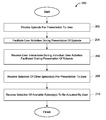
- method 200 may be implemented in one or more processing devices (e.g., a digital processor, an analog processor, a digital circuit designed to process information, an analog circuit designed to process information, a state machine, and/or other mechanisms for electronically processing information).
- the one or more processing devices may include one or more devices executing some or all of the operations of method 200 in response to instructions stored electronically on an electronic storage medium.
- the one or more processing devices may include one or more devices configured through hardware, firmware, and/or software to be specifically designed for execution of one or more of the operations of method 200 .
- an episode may be provided for presentation to a user.
- the episode may include audio and visual media conveying a storyline involving an evolving plot with one or both of one or more characters or one or more scenes.
- Operation 202 may be performed by an episode viewing module that is the same as or similar to episode viewing module 106 , in accordance with one or more implementations.
- one or more user activities may be facilitated during presentation of the episode.
- the one or more user activities may include a first user activity.
- Individual ones of the one or more user activities may be contextually related to the storyline of the presented episode.
- a given user activity may include a visual and/or audio queue to prompt the user to participate in the given user activity. Progression of the storyline of the presented episode may be suspended during the given user activity.
- Operation 204 may be performed by an activity module that is the same as or similar to activity module 108 , in accordance with one or more implementations.
- a selection may be received of one or more other episodes for presentation to the user.
- the one or more other episodes may be stored locally by a client computing platform (e.g., client computing platform(s) 104 or streamed to the client computing platform, such as from server(s) 102 .
- Operation 208 may be performed by an episode selection module that is the same as or similar to episode selection module 112 , in accordance with one or more implementations.
- a selection may be received of one or more available episodes to be acquired by the user.
- Acquiring a given available episode includes one or both of purchasing the given available episode or downloading the given available episode to a client computing platform.
- Operation 210 may be performed by an episode acquisition module that is the same as or similar to episode acquisition module 114 , in accordance with one or more implementations.
Landscapes
- Engineering & Computer Science (AREA)
- Multimedia (AREA)
- Signal Processing (AREA)
- Databases & Information Systems (AREA)
- Human Computer Interaction (AREA)
- Computer Security & Cryptography (AREA)
- Television Signal Processing For Recording (AREA)
Abstract
Description
Claims (16)
Priority Applications (1)
| Application Number | Priority Date | Filing Date | Title |
|---|---|---|---|
| US13/476,721 US8863180B1 (en) | 2012-05-21 | 2012-05-21 | Interactive episodes |
Applications Claiming Priority (1)
| Application Number | Priority Date | Filing Date | Title |
|---|---|---|---|
| US13/476,721 US8863180B1 (en) | 2012-05-21 | 2012-05-21 | Interactive episodes |
Publications (1)
| Publication Number | Publication Date |
|---|---|
| US8863180B1 true US8863180B1 (en) | 2014-10-14 |
Family
ID=51661303
Family Applications (1)
| Application Number | Title | Priority Date | Filing Date |
|---|---|---|---|
| US13/476,721 Active 2032-12-13 US8863180B1 (en) | 2012-05-21 | 2012-05-21 | Interactive episodes |
Country Status (1)
| Country | Link |
|---|---|
| US (1) | US8863180B1 (en) |
Cited By (6)
| Publication number | Priority date | Publication date | Assignee | Title |
|---|---|---|---|---|
| US20150113551A1 (en) * | 2013-10-23 | 2015-04-23 | Samsung Electronics Co., Ltd. | Computing system with content delivery mechanism and method of operation thereof |
| US20150235513A1 (en) * | 2012-11-05 | 2015-08-20 | Gamblit Gaming, Llc | Interactive media based gambling hybrid games |
| US10966000B1 (en) * | 2019-12-05 | 2021-03-30 | Rovi Guides, Inc. | Method and apparatus for determining and presenting answers to content-related questions |
| US11086862B2 (en) | 2019-12-05 | 2021-08-10 | Rovi Guides, Inc. | Method and apparatus for determining and presenting answers to content-related questions |
| CN116243790A (en) * | 2022-12-30 | 2023-06-09 | 奇点六艺教育科技股份有限公司 | A method and device for generating branch plots based on motion capture |
| CN116881397A (en) * | 2023-07-03 | 2023-10-13 | 深圳市人马互动科技有限公司 | Information processing method and device for multi-association story line |
Citations (2)
| Publication number | Priority date | Publication date | Assignee | Title |
|---|---|---|---|---|
| US20020178442A1 (en) * | 2001-01-02 | 2002-11-28 | Williams Dauna R. | Interactive television scripting |
| US20100053557A1 (en) * | 2008-09-02 | 2010-03-04 | Disney Enterprises, Inc. | Interactive zoetrope rotomation |
-
2012
- 2012-05-21 US US13/476,721 patent/US8863180B1/en active Active
Patent Citations (2)
| Publication number | Priority date | Publication date | Assignee | Title |
|---|---|---|---|---|
| US20020178442A1 (en) * | 2001-01-02 | 2002-11-28 | Williams Dauna R. | Interactive television scripting |
| US20100053557A1 (en) * | 2008-09-02 | 2010-03-04 | Disney Enterprises, Inc. | Interactive zoetrope rotomation |
Cited By (10)
| Publication number | Priority date | Publication date | Assignee | Title |
|---|---|---|---|---|
| US20150235513A1 (en) * | 2012-11-05 | 2015-08-20 | Gamblit Gaming, Llc | Interactive media based gambling hybrid games |
| US10121311B2 (en) * | 2012-11-05 | 2018-11-06 | Gamblit Gaming, Llc | Interactive media based gambling hybrid games |
| US20150113551A1 (en) * | 2013-10-23 | 2015-04-23 | Samsung Electronics Co., Ltd. | Computing system with content delivery mechanism and method of operation thereof |
| US10966000B1 (en) * | 2019-12-05 | 2021-03-30 | Rovi Guides, Inc. | Method and apparatus for determining and presenting answers to content-related questions |
| US11086862B2 (en) | 2019-12-05 | 2021-08-10 | Rovi Guides, Inc. | Method and apparatus for determining and presenting answers to content-related questions |
| US11468055B2 (en) | 2019-12-05 | 2022-10-11 | Rovi Guides, Inc. | Method and apparatus for determining and presenting answers to content-related questions |
| US11893013B2 (en) | 2019-12-05 | 2024-02-06 | Rovi Guides, Inc. | Method and apparatus for determining and presenting answers to content-related questions |
| US12204533B2 (en) | 2019-12-05 | 2025-01-21 | Adeia Guides Inc. | Method and apparatus for determining and presenting answers to content-related questions |
| CN116243790A (en) * | 2022-12-30 | 2023-06-09 | 奇点六艺教育科技股份有限公司 | A method and device for generating branch plots based on motion capture |
| CN116881397A (en) * | 2023-07-03 | 2023-10-13 | 深圳市人马互动科技有限公司 | Information processing method and device for multi-association story line |
Similar Documents
| Publication | Publication Date | Title |
|---|---|---|
| US12059628B2 (en) | Joining or replaying a game instance from a game broadcast | |
| CN107029429B (en) | System, method, and readable medium for implementing time-shifting tutoring for cloud gaming systems | |
| US11233875B2 (en) | Content sharing with user and recipient devices | |
| CN114911968B (en) | Collaborative immersive live action 360-degree video and virtual reality | |
| US20170189809A1 (en) | Web explorer for gaming platform interface | |
| US12157053B2 (en) | Systems and methods for facilitating streaming interfaces for games | |
| BR102013033136B1 (en) | METHOD FOR GENERATING A LIMITED PLAYABLE VERSION OF A VIDEO GAME; AND METHOD TO PROVIDE REMOTE CONTROL OF A USER'S GAME | |
| CN113710340A (en) | Interactive objects in streaming media and market ledgers | |
| US10248970B1 (en) | Virtual item promotions via time-period-based virtual item benefits | |
| US20200188794A1 (en) | Media-activity binding and content blocking | |
| US20150231510A1 (en) | System and method for providing enhanced walkthroughs | |
| US12400649B2 (en) | Customized dialogue support | |
| CN114341830B (en) | Context-based action suggestions | |
| US12183340B2 (en) | Intent identification for dialogue support | |
| US20230302365A1 (en) | Classification of gaming styles | |
| US12605627B2 (en) | Second screen synchronization and handoff | |
| EP3928487B1 (en) | Contextual layer for digital content | |
| US9093259B1 (en) | Collaborative musical interaction among avatars | |
| US20180124464A1 (en) | Experience-directed dynamic steganographic content switching | |
| US9415306B1 (en) | Clients communicate input technique to server | |
| US20250381485A1 (en) | Classification of gaming styles | |
| US9445949B1 (en) | System and method for processing commands in an online game | |
| Vieira | Creation of dynamic virtual tours in multimedia spaces |
Legal Events
| Date | Code | Title | Description |
|---|---|---|---|
| AS | Assignment |
Owner name: DISNEY ENTERPRISES, INC., CALIFORNIA Free format text: ASSIGNMENT OF ASSIGNORS INTEREST;ASSIGNORS:DEVILLIER, LAUREN;PETERSON, MICHAEL;BUTLER, CHRISTOPHER;AND OTHERS;REEL/FRAME:028243/0226 Effective date: 20120521 |
|
| FEPP | Fee payment procedure |
Free format text: PAYOR NUMBER ASSIGNED (ORIGINAL EVENT CODE: ASPN); ENTITY STATUS OF PATENT OWNER: LARGE ENTITY |
|
| STCF | Information on status: patent grant |
Free format text: PATENTED CASE |
|
| MAFP | Maintenance fee payment |
Free format text: PAYMENT OF MAINTENANCE FEE, 4TH YEAR, LARGE ENTITY (ORIGINAL EVENT CODE: M1551) Year of fee payment: 4 |
|
| MAFP | Maintenance fee payment |
Free format text: PAYMENT OF MAINTENANCE FEE, 8TH YEAR, LARGE ENTITY (ORIGINAL EVENT CODE: M1552); ENTITY STATUS OF PATENT OWNER: LARGE ENTITY Year of fee payment: 8 |
|
| MAFP | Maintenance fee payment |
Free format text: PAYMENT OF MAINTENANCE FEE, 12TH YEAR, LARGE ENTITY (ORIGINAL EVENT CODE: M1553); ENTITY STATUS OF PATENT OWNER: LARGE ENTITY Year of fee payment: 12 |