US8862592B2 - Systems and methods for graphical search interface - Google Patents
Systems and methods for graphical search interface Download PDFInfo
- Publication number
- US8862592B2 US8862592B2 US13/730,844 US201213730844A US8862592B2 US 8862592 B2 US8862592 B2 US 8862592B2 US 201213730844 A US201213730844 A US 201213730844A US 8862592 B2 US8862592 B2 US 8862592B2
- Authority
- US
- United States
- Prior art keywords
- search
- search parameters
- parameters
- elements
- initial
- Prior art date
- Legal status (The legal status is an assumption and is not a legal conclusion. Google has not performed a legal analysis and makes no representation as to the accuracy of the status listed.)
- Active - Reinstated, expires
Links
Images



Classifications
-
- G—PHYSICS
- G06—COMPUTING OR CALCULATING; COUNTING
- G06F—ELECTRIC DIGITAL DATA PROCESSING
- G06F16/00—Information retrieval; Database structures therefor; File system structures therefor
- G06F16/90—Details of database functions independent of the retrieved data types
- G06F16/95—Retrieval from the web
- G06F16/953—Querying, e.g. by the use of web search engines
-
- G06F17/30864—
-
- G—PHYSICS
- G06—COMPUTING OR CALCULATING; COUNTING
- G06F—ELECTRIC DIGITAL DATA PROCESSING
- G06F16/00—Information retrieval; Database structures therefor; File system structures therefor
- G06F16/90—Details of database functions independent of the retrieved data types
- G06F16/95—Retrieval from the web
- G06F16/951—Indexing; Web crawling techniques
-
- G—PHYSICS
- G06—COMPUTING OR CALCULATING; COUNTING
- G06F—ELECTRIC DIGITAL DATA PROCESSING
- G06F16/00—Information retrieval; Database structures therefor; File system structures therefor
- G06F16/90—Details of database functions independent of the retrieved data types
- G06F16/95—Retrieval from the web
- G06F16/953—Querying, e.g. by the use of web search engines
- G06F16/9535—Search customisation based on user profiles and personalisation
-
- G—PHYSICS
- G06—COMPUTING OR CALCULATING; COUNTING
- G06F—ELECTRIC DIGITAL DATA PROCESSING
- G06F16/00—Information retrieval; Database structures therefor; File system structures therefor
- G06F16/90—Details of database functions independent of the retrieved data types
- G06F16/95—Retrieval from the web
- G06F16/953—Querying, e.g. by the use of web search engines
- G06F16/9536—Search customisation based on social or collaborative filtering
-
- G06F17/30867—
Definitions
- the present disclosure is directed towards providing an intuitive means of representing and manipulating the weightings of search parameters employed by database search algorithms.
- Information in this modern sense may be considered as a two component entity; the first being the actual data it embodies, the second being its accessibility, based on identifying tags, anchors, or fields.
- Search output discrepancies may result from a circumstance referred to as the “local search problem.” This problem arises when global data sets containing extrinsic information are not consistently cross checked or “curated” with local data sets containing intrinsic information. For example, a search for vacation destinations may yield inconsistent output if not updated with local information such as prices, business hours and patron ratings.
- Search output bias may result primarily from either (1) discontinuities in search parameters weightings between the user and the search algorithm, or (2) misguiding parameter weightings through “search engine optimization” practices. In either case, miscommunication or lack of clear communication between user input and search algorithm programming may skew output away from the user's intentions.
- search is guided by a serial step-by-step process.
- the user attempts to convert a search concept to a string of terms (hoping to characterize the concept), enters the terms, sorts through the search output, and possibly re-enters terms.
- This strategy works well for navigational searches where pre-conceptualized output, such as a web page or a phone number, is sought.
- pre-conceptualized output such as a web page or a phone number
- the search object could be represented as a coordinate system whose boundary is composed of parameters defining the object (e.g. a friend's parameters might be “gender”, “age”, etc.). Given this representation, the magnitude and direction of vectors connecting object parameters would translate to a weight or significance of that parameter. Collectively all parameters, weighted appropriately, would compose the object's search query string. Additionally, manually manipulating a parameter location within the coordinate space could adjust its relative weight in the overall search query string.
- search would more closely match the mind's heuristic behavior of obtaining, classifying, and presenting information. It would allow a more intuitive graphical representation of the multi-dimensional information structure used to drive decision making processes. It should speed the search process by maintaining a multi-dimensional view of the critical characteristics that are intended to guide the search. It may also enable a more exhaustive search due to the graphical sensitivity.
- the search interface described herein provides an intuitive and fundamentally more accurate means for image search.
- image search requires a series of translations, such as from user cognition to language representation, from language representation to image meta-tag searching, and from image meta-tag searching to search results structuring.
- Each one of these translational steps introduce a degree of error, distancing the original intent from search output. From an operational perspective, this disconnect between intent and output introduce an unaddressed need at two levels.
- One, the user either is not connected with the most accurate solution to their search, or must take additional time to search.
- Two, information providers, observing user search behavior will misinterpret the user's behavior-intent relationship, and thus inaccurately addressing the user's needs or preferences.
- the present disclosure provides a graphical interface between a user and a database search algorithm or search engine.
- the interface provides the user an intuitive visualization of search parameter weighting hierarchy, as well as a means to manually reconfigure the weighting hierarchy.
- the graphical interface symbolically projects the parameter weighting hierarchy as a two or three dimensional “search space,” whose center represents optimal search output.
- the shape of the “search space” is found to have ‘n’ vertices representing the ‘n’ parameters employed in the search.
- the relative distances of parameter vertices to the space center represent the relative weightings or importance of each parameter in the overall search.
- vertices are determined and populated either through search engine suggestions, default settings, or user definitions. Initially, all parameters are weighted equally, represented as a radially symmetric shape about the optimal search output.
- the interface presents the user the capability of reconfiguring the search by dragging individual parameters toward (increasing weight), away from (decreasing weight), or completely away from (eliminating parameter) the shape center. As the shape is manipulated in this fashion, optimal search results are updated in real time.
- the interface allows the user to simultaneously examine multiple data sets, searching for intersection by joining parameters common to each set, or union by joining “search spaces” of each set.
- the interface allows whole entities, such as images, “friends”, or socially shared media, to be used as search parameters which may either collectively defined by their set of tagged data, or user defined through selection of pertinent values the search parameters might represent.
- FIG. 1 depicts one example of a typical search engine output
- FIG. 2 depicts one example of a typical search engine related search suggestions output
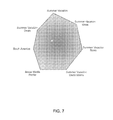
- FIG. 3 depicts an exemplary “search space” two-dimensional projection with vertices populated with search suggestion output, e.g., a search for summer vacations, consistent with the presently disclosed graphical search interface;
- FIG. 4 depicts an exemplary reconfigured graphical “search space” projection, e.g., a reconfigured graphical “search space” to reflect the elimination of parameters, consistent with the presently disclosed graphical search interface;
- FIG. 5 depicts an exemplary reconfigured graphical “search space” projection weighting, e.g., “Summer Vacation Deals” and “South America” with greater weightings, consistent with the presently disclosed graphical search interface;
- FIG. 6 depicts an exemplary “search space” projection weighting, e.g., summer vacation with social network profile applied in ‘search within’ mode, consistent with the presently disclosed graphical search interface;
- FIG. 7 depicts an exemplary “search space” projection weighting, e.g., summer vacation with social network profile applied in ‘search beyond’ mode, consistent with the presently disclosed graphical search interface
- FIG. 8 depicts an exemplary image search using the presently disclosed graphical search interface, e.g., a user identifies objects within an image as pertinent values and drags them to the graphical search interface for weighted search, consistent with the presently disclosed graphical search interface.
- the graphical user interface consistent with the present disclosure may be employed with any database search algorithm or search engine capable of examining multiple search parameters in determining optimal match output.
- results for a search of ‘summer vacation’ would output a tabulated list ( FIG. 1 ).
- This output presents two issues that the invention addresses.
- the related searches that Google produces at the bottom of the initial search output page are numerous and call for extensive cross referencing of search output lists in order to determine optimal results ( FIG. 2 ).
- the presently disclosed graphical search interface would provide the following graphical output immediately after the initial search parameter was entered as represented in FIG. 3 .
- This initial graphical output projects a radially symmetric search space shape whose vertices are populated with the initial search parameter along with all related searches that are generated ( FIG. 3 ). Each vertex, then represents a search parameter.
- the maximum and minimum number of search parameters may be default or user defined ( FIG. 4 ).
- Contained within the search space shape is a matrix of hyperlinks related to all parameters. A given hyperlink's coordinates inside the search space are determined by its relevance to the search parameters. Nearer proximity represents higher relevance between hyperlink and search parameter.
- the middle region of the search space represents search output generated by equally weighting all search space parameters. Thus the center of the search space represents an optimal hit subset, most equally relevant to all search parameters—labeled ‘A’ in FIG. 3 .
- the user In order to view a hyperlink contained within the graphic, the user simply highlights the point on the graphic that is in tune with his/her goals, preferences, and needs, and the interface will display a list of hyperlinks common to that search region. If the initial search space output does match the user's intentions, the interface presents the user the capability of reconfiguring the search by dragging individual parameters toward (increasing weight), away from (decreasing weight), or completely away from (eliminating parameter) the shape center ( FIG. 5 ). As the search space dimensions are reconfigured, its coordinate system is continually repopulated with the updated the hyperlink matrix. In this way, the presently disclosed graphical search interface allows for users to intuitively perform a search in unison with their mental criteria for what a successful search will generate.
- the presently disclosed graphical search interface provides a means for the user to intuitively perform searches across seeming non-compatible data bases. Comparing value preferences of a user's social network database, loosely considered intrinsic data, with extrinsic data sets, such as lists of films offered through a video streaming website, may be performed as follows with the presently disclosed graphical search interface. Suppose the user would wish to conduct a search looking for a film based on how his social network preferences would value each of the search space initial search parameters; say, thriller films, foreign films, and films produced before the year 2000. To engage this ‘search within’ protocol, the user would simply encircle the graphical search space with the user's social network icon to search for hits within the network preferences ( FIG.
- the presently disclosed graphical search interface proposes the following solution.
- the mind identifies individual objects within that image, and then applies relative importance to those objects based on their spatial and contextual presentation or relationships within the image. Beyond simply searching for objects, an effective image search interface must communicate those relationships.
- the presently disclosed graphical search interface would allow the user to conduct an object based search using a representative image as a sort of contextual template. The user would simply encircle and drag chosen objects from the representative image to the search interface icon using graphical user interface technologies, such as touch screen or mouse ( FIG. 8 ). For example, a skier and skis have been selected and dragged to the graphical search interface for weighting search, as shown in FIG. 8 .
- the encircled areas would be passed through a series of filters, which characterize the object they contain. Once the search interface had been populated with the characterized objects, their relative weights (search importance) would be manipulated as described above. Object weights could then be cross-referenced with those of previously scanned or tagged images or any other type of data sets producing a hierarchical results list.
Landscapes
- Engineering & Computer Science (AREA)
- Databases & Information Systems (AREA)
- Theoretical Computer Science (AREA)
- Data Mining & Analysis (AREA)
- Physics & Mathematics (AREA)
- General Engineering & Computer Science (AREA)
- General Physics & Mathematics (AREA)
- User Interface Of Digital Computer (AREA)
- Information Retrieval, Db Structures And Fs Structures Therefor (AREA)
Abstract
Description
Claims (22)
Priority Applications (2)
| Application Number | Priority Date | Filing Date | Title |
|---|---|---|---|
| US13/730,844 US8862592B2 (en) | 2012-01-10 | 2012-12-29 | Systems and methods for graphical search interface |
| US14/478,087 US9256684B2 (en) | 2012-01-10 | 2014-09-05 | Systems and methods for graphical search interface |
Applications Claiming Priority (2)
| Application Number | Priority Date | Filing Date | Title |
|---|---|---|---|
| US13/346,730 US8694513B2 (en) | 2012-01-10 | 2012-01-10 | Systems and methods for graphical search interface |
| US13/730,844 US8862592B2 (en) | 2012-01-10 | 2012-12-29 | Systems and methods for graphical search interface |
Related Parent Applications (1)
| Application Number | Title | Priority Date | Filing Date |
|---|---|---|---|
| US13/346,730 Continuation-In-Part US8694513B2 (en) | 2012-01-10 | 2012-01-10 | Systems and methods for graphical search interface |
Related Child Applications (1)
| Application Number | Title | Priority Date | Filing Date |
|---|---|---|---|
| US14/478,087 Continuation US9256684B2 (en) | 2012-01-10 | 2014-09-05 | Systems and methods for graphical search interface |
Publications (2)
| Publication Number | Publication Date |
|---|---|
| US20140074862A1 US20140074862A1 (en) | 2014-03-13 |
| US8862592B2 true US8862592B2 (en) | 2014-10-14 |
Family
ID=50234443
Family Applications (2)
| Application Number | Title | Priority Date | Filing Date |
|---|---|---|---|
| US13/730,844 Active - Reinstated 2032-02-19 US8862592B2 (en) | 2012-01-10 | 2012-12-29 | Systems and methods for graphical search interface |
| US14/478,087 Active US9256684B2 (en) | 2012-01-10 | 2014-09-05 | Systems and methods for graphical search interface |
Family Applications After (1)
| Application Number | Title | Priority Date | Filing Date |
|---|---|---|---|
| US14/478,087 Active US9256684B2 (en) | 2012-01-10 | 2014-09-05 | Systems and methods for graphical search interface |
Country Status (1)
| Country | Link |
|---|---|
| US (2) | US8862592B2 (en) |
Families Citing this family (1)
| Publication number | Priority date | Publication date | Assignee | Title |
|---|---|---|---|---|
| US11029809B2 (en) * | 2018-05-10 | 2021-06-08 | Citrix Systems, Inc. | System for displaying electronic mail metadata and related methods |
Citations (14)
| Publication number | Priority date | Publication date | Assignee | Title |
|---|---|---|---|---|
| US20040229290A1 (en) * | 2003-05-07 | 2004-11-18 | Duke University | Protein design for receptor-ligand recognition and binding |
| US20050055341A1 (en) | 2003-09-05 | 2005-03-10 | Paul Haahr | System and method for providing search query refinements |
| US20060204107A1 (en) * | 2005-03-04 | 2006-09-14 | Lockheed Martin Corporation | Object recognition system using dynamic length genetic training |
| US20060235841A1 (en) | 2005-04-14 | 2006-10-19 | International Business Machines Corporation | Page rank for the semantic web query |
| US20070179946A1 (en) | 2006-01-12 | 2007-08-02 | Wissner-Gross Alexander D | Method for creating a topical reading list |
| US20080243774A1 (en) * | 2005-09-30 | 2008-10-02 | Egbert Jaspers | Method and Software Program for Searching Image Information |
| US20090006356A1 (en) | 2007-06-27 | 2009-01-01 | Oracle International Corporation | Changing ranking algorithms based on customer settings |
| US20090254537A1 (en) | 2005-12-22 | 2009-10-08 | Matsushita Electric Industrial Co., Ltd. | Image search apparatus and image search method |
| US20110029514A1 (en) | 2008-07-31 | 2011-02-03 | Larry Kerschberg | Case-Based Framework For Collaborative Semantic Search |
| US8001152B1 (en) | 2007-12-13 | 2011-08-16 | Zach Solan | Method and system for semantic affinity search |
| US8275446B2 (en) * | 1994-10-27 | 2012-09-25 | Wake Forest University Health Sciences | Automatic analysis in virtual endoscopy |
| US8363972B1 (en) | 1998-07-13 | 2013-01-29 | Cognex Corporation | Method for fast, robust, multi-dimensional pattern recognition |
| US8429153B2 (en) | 2010-06-25 | 2013-04-23 | The United States Of America As Represented By The Secretary Of The Army | Method and apparatus for classifying known specimens and media using spectral properties and identifying unknown specimens and media |
| US20130103680A1 (en) * | 2011-10-20 | 2013-04-25 | Nokia Corporation | Method, apparatus and computer program product for dynamic and visual object search interface |
Family Cites Families (3)
| Publication number | Priority date | Publication date | Assignee | Title |
|---|---|---|---|---|
| US7676452B2 (en) * | 2002-07-23 | 2010-03-09 | International Business Machines Corporation | Method and apparatus for search optimization based on generation of context focused queries |
| US20080077570A1 (en) * | 2004-10-25 | 2008-03-27 | Infovell, Inc. | Full Text Query and Search Systems and Method of Use |
| US8099683B2 (en) * | 2005-12-08 | 2012-01-17 | International Business Machines Corporation | Movement-based dynamic filtering of search results in a graphical user interface |
-
2012
- 2012-12-29 US US13/730,844 patent/US8862592B2/en active Active - Reinstated
-
2014
- 2014-09-05 US US14/478,087 patent/US9256684B2/en active Active
Patent Citations (15)
| Publication number | Priority date | Publication date | Assignee | Title |
|---|---|---|---|---|
| US8275446B2 (en) * | 1994-10-27 | 2012-09-25 | Wake Forest University Health Sciences | Automatic analysis in virtual endoscopy |
| US8363972B1 (en) | 1998-07-13 | 2013-01-29 | Cognex Corporation | Method for fast, robust, multi-dimensional pattern recognition |
| US20040229290A1 (en) * | 2003-05-07 | 2004-11-18 | Duke University | Protein design for receptor-ligand recognition and binding |
| US20050055341A1 (en) | 2003-09-05 | 2005-03-10 | Paul Haahr | System and method for providing search query refinements |
| US20060204107A1 (en) * | 2005-03-04 | 2006-09-14 | Lockheed Martin Corporation | Object recognition system using dynamic length genetic training |
| US20060235841A1 (en) | 2005-04-14 | 2006-10-19 | International Business Machines Corporation | Page rank for the semantic web query |
| US20080243774A1 (en) * | 2005-09-30 | 2008-10-02 | Egbert Jaspers | Method and Software Program for Searching Image Information |
| US20090254537A1 (en) | 2005-12-22 | 2009-10-08 | Matsushita Electric Industrial Co., Ltd. | Image search apparatus and image search method |
| US20070179946A1 (en) | 2006-01-12 | 2007-08-02 | Wissner-Gross Alexander D | Method for creating a topical reading list |
| US20090006356A1 (en) | 2007-06-27 | 2009-01-01 | Oracle International Corporation | Changing ranking algorithms based on customer settings |
| US20110258184A1 (en) | 2007-06-27 | 2011-10-20 | Oracle International Corporation | Changing ranking algorithms based on customer settings |
| US8001152B1 (en) | 2007-12-13 | 2011-08-16 | Zach Solan | Method and system for semantic affinity search |
| US20110029514A1 (en) | 2008-07-31 | 2011-02-03 | Larry Kerschberg | Case-Based Framework For Collaborative Semantic Search |
| US8429153B2 (en) | 2010-06-25 | 2013-04-23 | The United States Of America As Represented By The Secretary Of The Army | Method and apparatus for classifying known specimens and media using spectral properties and identifying unknown specimens and media |
| US20130103680A1 (en) * | 2011-10-20 | 2013-04-25 | Nokia Corporation | Method, apparatus and computer program product for dynamic and visual object search interface |
Non-Patent Citations (3)
| Title |
|---|
| Christopher D. Manning et al., "An Introduction to Information Retrieval," Cambridge University Press, Ch. 19, Apr. 1, 2009, http://nlp.stanford.edu/IR-book/pdf/19web.pdf, pp. 421-442. |
| Matthew Hurst, "Data Mining: Text Mining, Visualization and Social Media: How Hard is the Local Search Problem?," Aug. 29, 2011, http://datamining.typepad.com/data-mining/2011/08/how-hard-is-the-local-search-problem.html. |
| Mona Taghavi et al., "An Analysis of Web Proxy Logs with Query Distribution Pattern Approach for Search Engines," Journal of Computer Standards & Interfaces, vol. 33, Issue: 6, Jan. 2012, pp. 162-170. |
Also Published As
| Publication number | Publication date |
|---|---|
| US20140379685A1 (en) | 2014-12-25 |
| US9256684B2 (en) | 2016-02-09 |
| US20140074862A1 (en) | 2014-03-13 |
Similar Documents
| Publication | Publication Date | Title |
|---|---|---|
| US9529910B2 (en) | Systems and methods for an expert-informed information acquisition engine utilizing an adaptive torrent-based heterogeneous network solution | |
| Marie et al. | Survey of linked data based exploration systems | |
| JP5997350B2 (en) | Structured search query based on social graph information | |
| US8001152B1 (en) | Method and system for semantic affinity search | |
| US8930356B2 (en) | Techniques for modifying a query based on query associations | |
| US20140280312A1 (en) | Semantic Vector in a Method and Apparatus for Keeping and Finding Information | |
| US8997008B2 (en) | System and method for searching through a graphic user interface | |
| WO2014052464A1 (en) | Information space exploration tool system and method | |
| Arguello | Aggregated search | |
| US20250182181A1 (en) | Generating product profile recommendations and quality indicators to enhance product profiles | |
| US20200081912A1 (en) | Identifying physical objects using visual search query | |
| US20220083617A1 (en) | Systems and methods for enhanced online research | |
| US12393639B2 (en) | Interactive search exploration | |
| US9251264B2 (en) | Systems and methods for enabling an electronic graphical search space of a database | |
| JP5827449B2 (en) | Personalized structured search queries for online social networks | |
| Chafiki et al. | A systematic review of advancements in context-aware recommendation systems: MEA Chafiki et al. | |
| US9251263B2 (en) | Systems and methods for graphical search interface | |
| US20250173385A1 (en) | Gameplans for improved decision making | |
| US9256684B2 (en) | Systems and methods for graphical search interface | |
| US20250265066A1 (en) | Techniques for managing images associated with software applications | |
| Sayed et al. | Recommender Systems Evolution: Challenges and Future Directions | |
| WO2023097046A1 (en) | Gameplans for improved decision-making | |
| WO2021097516A1 (en) | A document searching system |
Legal Events
| Date | Code | Title | Description |
|---|---|---|---|
| AS | Assignment |
Owner name: SWOOP SEARCH, LLC, MINNESOTA Free format text: ASSIGNMENT OF ASSIGNORS INTEREST;ASSIGNORS:BOTTUM, QUINN COLTON;BOTTUM, MICHAEL CHRISTOPHER;BOTTUM, PAUL WILLIAM;SIGNING DATES FROM 20130812 TO 20130820;REEL/FRAME:031058/0724 |
|
| FEPP | Fee payment procedure |
Free format text: MAINTENANCE FEE REMINDER MAILED (ORIGINAL EVENT CODE: REM.) |
|
| LAPS | Lapse for failure to pay maintenance fees |
Free format text: PATENT EXPIRED FOR FAILURE TO PAY MAINTENANCE FEES (ORIGINAL EVENT CODE: EXP.); ENTITY STATUS OF PATENT OWNER: SMALL ENTITY |
|
| FP | Lapsed due to failure to pay maintenance fee |
Effective date: 20181014 |
|
| PRDP | Patent reinstated due to the acceptance of a late maintenance fee |
Effective date: 20190109 |
|
| PRDP | Patent reinstated due to the acceptance of a late maintenance fee |
Effective date: 20190109 |
|
| FEPP | Fee payment procedure |
Free format text: SURCHARGE, PETITION TO ACCEPT PYMT AFTER EXP, UNINTENTIONAL. (ORIGINAL EVENT CODE: M2558); ENTITY STATUS OF PATENT OWNER: SMALL ENTITY Free format text: PETITION RELATED TO MAINTENANCE FEES GRANTED (ORIGINAL EVENT CODE: PMFG); ENTITY STATUS OF PATENT OWNER: SMALL ENTITY Free format text: PETITION RELATED TO MAINTENANCE FEES FILED (ORIGINAL EVENT CODE: PMFP); ENTITY STATUS OF PATENT OWNER: SMALL ENTITY |
|
| MAFP | Maintenance fee payment |
Free format text: PAYMENT OF MAINTENANCE FEE, 4TH YR, SMALL ENTITY (ORIGINAL EVENT CODE: M2551); ENTITY STATUS OF PATENT OWNER: SMALL ENTITY Year of fee payment: 4 |
|
| STCF | Information on status: patent grant |
Free format text: PATENTED CASE |
|
| MAFP | Maintenance fee payment |
Free format text: PAYMENT OF MAINTENANCE FEE, 8TH YR, SMALL ENTITY (ORIGINAL EVENT CODE: M2552); ENTITY STATUS OF PATENT OWNER: SMALL ENTITY Year of fee payment: 8 |
|
| FEPP | Fee payment procedure |
Free format text: MAINTENANCE FEE REMINDER MAILED (ORIGINAL EVENT CODE: REM.); ENTITY STATUS OF PATENT OWNER: SMALL ENTITY |