US8859922B1 - Multi-function switch apparatus and method of use - Google Patents
Multi-function switch apparatus and method of use Download PDFInfo
- Publication number
- US8859922B1 US8859922B1 US12/906,930 US90693010A US8859922B1 US 8859922 B1 US8859922 B1 US 8859922B1 US 90693010 A US90693010 A US 90693010A US 8859922 B1 US8859922 B1 US 8859922B1
- Authority
- US
- United States
- Prior art keywords
- touch
- sensor
- additional
- capacitance
- touch surface
- Prior art date
- Legal status (The legal status is an assumption and is not a legal conclusion. Google has not performed a legal analysis and makes no representation as to the accuracy of the status listed.)
- Active, expires
Links
Images




Classifications
-
- H—ELECTRICITY
- H03—ELECTRONIC CIRCUITRY
- H03K—PULSE TECHNIQUE
- H03K17/00—Electronic switching or gating, i.e. not by contact-making and –breaking
- H03K17/94—Electronic switching or gating, i.e. not by contact-making and –breaking characterised by the way in which the control signals are generated
- H03K17/965—Switches controlled by moving an element forming part of the switch
- H03K17/975—Switches controlled by moving an element forming part of the switch using a capacitive movable element
-
- H—ELECTRICITY
- H03—ELECTRONIC CIRCUITRY
- H03K—PULSE TECHNIQUE
- H03K2217/00—Indexing scheme related to electronic switching or gating, i.e. not by contact-making or -breaking covered by H03K17/00
- H03K2217/94—Indexing scheme related to electronic switching or gating, i.e. not by contact-making or -breaking covered by H03K17/00 characterised by the way in which the control signal is generated
- H03K2217/965—Switches controlled by moving an element forming part of the switch
- H03K2217/9653—Switches controlled by moving an element forming part of the switch with illumination
- H03K2217/9655—Switches controlled by moving an element forming part of the switch with illumination using a single or more light guides
Definitions
- FIG. 1 is a plan view of an illustrative embodiment of a multi-function switch 20 including switch mat 36 having tactile structure defining five touch surfaces 54 , as it typically would be seen by a user;
- FIG. 4 is a partial schematic diagram showing a controller 60 coupled to proximity sensing electrode 46 and touch sensing electrodes 48 ;
- FIG. 5C is a portion of a flow chart showing an illustrative algorithm for operating switch 20 ;
- FIG. 6 is a graph of change in electrode capacitance versus sampling period
- FIG. 7 is another graph of change in electrode capacitance versus sampling period.
- Switch 20 includes a proximity sensing electrode 46 disposed on a sensor carrier 32 .
- Proximity sensing electrode 46 is coupled to a suitable control circuit that energizes and detects stimuli proximate proximity sensing electrode 46 , as will be discussed further below.
- the control circuit can be located on sensor carrier 32 or elsewhere within switch 20 .
- Proximity sensing electrode 46 either alone or in combination with the corresponding control circuit, may be referred to herein as a proximity sensor. Other embodiments could include more than one proximity sensing electrode.
- Switch 20 also includes five touch sensing electrodes 48 disposed on sensor carrier 32 .
- Each touch sensing electrode 48 is coupled to a suitable control circuit that energizes and detects stimuli proximate touch sensing electrode 48 , as will be discussed further below.
- the control circuit can be located on sensor carrier 32 or elsewhere within switch 20 .
- Each of touch sensing electrodes 48 either alone or in combination with the corresponding control circuit may be referred to herein as a touch sensor. Other embodiments could include more (as many as practical) or fewer (as few as one) than five touch sensing electrodes.
- the proximity and touch sensing electrodes preferably are embodied as thin conductive pads or traces made of any suitable conductive or semi-conductive material, for example, copper, silver, or indium tin oxide, as would be understood by one skilled in the art.
- FIG. 3 depicts proximity sensing electrode 46 as a thin conductive trace and touch sensing electrodes 48 as thin conductive pads.
- the sensing electrodes could be embodied in other forms, as would be understood by one skilled in the art.
- the sensing electrodes are sized to readily allow reliable sensing of an intended stimulus, for example, a hand, finger, or other conductive object.
- proximity and touch sensing electrodes are disposed on the side of sensor carrier 32 facing switch mat 36 , as will be discussed below. In other embodiments, any or all of these proximity and touch sensing electrodes could be disposed on the other side of sensor carrier 32 .
- Sensor carrier 32 can be embodied as a printed wiring board, flexible circuit carrier, a glass or plastic substrate, or any other medium suitable for bearing sensing electrodes and electrical circuit components, as would be understood by one skilled in the art.
- Sensor carrier 32 could include a flexible tail and/or be coupled to a wiring harness or other structure to facilitate coupling of the sensing electrodes and/or other components thereon to other electrical circuits or controllers.
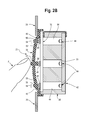
- Switch mat 36 preferably is made of a flexible, compressible, and/or resilient, non-conductive material, for example, a compressible rubber material, enabling displacement of touch surfaces 54 closer to touch sensing electrodes 48 in response to pressure applied to switch mat 36 , as shown in FIG. 2C and as will be discussed further below.
- switch mat 36 is made of a single, continuous sheet of material and is assembled to switch 20 in a manner that mitigates intrusion of liquid and/or solid contaminants into the internals of switch 20 .
- Light emitting devices 44 corresponding, respectively, to touch sensing electrodes 48 and touch surfaces 54 are disposed on a lighting carrier 42 .
- Light emitting devices 44 can be embodied as LEDs, OLEDs, PLEDS, lamps, and the like, as would be recognized by one skilled in the art.
- Light emitting devices 44 preferably are electrically coupled to a suitable, auxiliary control circuit, as mentioned above and discussed further below, by way of electrical circuit traces disposed on lighting carrier 42 .
- a flexible tail, wiring harness, and/or other structure can be provided, as well, to facilitate the foregoing coupling.
- controller 60 and the foregoing auxiliary control circuit could be integrated with each other.
- Lighting carrier 42 is attached to or otherwise associated with a first surface of a light guide 40 .
- Sensor carrier 32 is attached to or otherwise associated with a second surface of light guide 40 .
- Light guide 40 defines five optical paths 50 . Each optical path 50 corresponds to and generally aligns with a respective light emitting device 44 , touch sensing electrode 48 , and touch surface 54 .
- Light guide 40 could be made of any material suitable for guiding light from light emitting devices 44 to the first side of light guide 40 .
- light guide 40 would be made of a highly reflective material that inhibits transmission of light there through.
- interior surfaces of optical paths 50 could be coated or sleeved with a reflective material to further this functionality.
- light emitting devices 44 could be disposed on or otherwise associated directly with sensor carrier 32 .
- lighting carrier 42 and light guide 40 could be omitted.
- reflectors (not shown) could be associated with light emitting devices 44 and/or sensor carrier 32 to direct light emanating from light emitting devices 44 as desired.
- switch mat 36 In order that lighting emanating from light emitting devices 44 may be visible at touch surfaces 54 , at least relevant portions of sensor carrier 32 , touch sensing electrodes 48 , and switch mat 36 should be made of a material that is transparent or translucent, as would be understood by one skilled in the art. Such transparent or translucent portions could be shaped to define decorative or functional indicia when backlit.
- switch mat 36 could include transparent or translucent portions proximate touch surfaces 54 configured to define words, numbers, or symbols when the corresponding light emitting device 44 is energized.
- the corresponding light emitting devices 44 and/or optical paths 50 could be omitted.
- light emitting devices 44 , lighting carrier 42 and light guide 40 could be omitted altogether.
- Switch 20 typically would also include a pig tail or connector (not shown) to facilitate electrical connection of switch 20 to a wiring harness, communications bus, controlled device, or the like.
- Housing 28 can include mounting features, for example, tabs, brackets, snap features, interference fit features, and the like, to facilitate mechanical connection of switch 20 to a panel or other structure.
- switch 20 is shown as having a generally round face and cylindrical overall structure, it could have any other suitable configuration, for example, ovoid or rectangular, and proximity sensing electrode 46 and touch sensing electrodes 48 could be arranged thereon in any suitable manner.
- controller 60 In use, controller 60 generates and provides signals to each of proximity sensing electrode 46 and touch sensing electrodes 48 . These signals establish a capacitance between each of the sensing electrodes and ground. In the absence of a stimulus proximate the sensing electrodes, each of these capacitances would be at or about some baseline level. Introduction of a stimulus proximate any of the sensing electrodes causes the corresponding capacitance to change. Controller 60 detects these changes. When any of the changes in capacitance exceeds a predetermined threshold level (or exceeds a predetermined threshold level for at least a predetermined amount of time), controller 60 outputs a signal indicative thereof according to a suitable algorithm. One such algorithm is discussed further below.
- controller 60 could output a signal indicative thereof.
- the threshold level of change in capacitance would be exceeded when the stimulus moves to within a predetermined distance of switch mat 36 (a “proximity event”).
- the proximity event threshold would be set so as to not require actual touch of the stimulus to switch mat 36 .
- controller 60 could output a signal indicative thereof.
- the touched state would be achieved when the stimulus lightly touches a corresponding touch surface 54 , as shown in FIG. 2B , but does not displace the touch surface toward the corresponding electrode, as shown in FIG. 2C .
- a plurality of light emitting devices having different colors could replace each of light emitting devices 44 .
- the auxiliary controller could cause different ones of a particular plurality of such light emitting devices to be illuminated in response to a proximity event, a touch event, or a push event, thereby providing different colors of backlighting at touch surfaces 54 .
- FIGS. 5A , 5 B and 5 C illustrate an embodiment of an algorithm for operating switch 20 .
- This algorithm could be implemented in hardware form or as software programmed into controller 60 .
- the algorithm uses capacitive measurements, as will be discussed further below, to determine whether or not a stimulus is present in the vicinity of proximity sensing electrode 46 , whether or not a stimulus is in contact with the touch surface 54 corresponding to a specific one of touch sensing electrodes 48 , and whether or not a stimulus is displacing the touch surface 54 corresponding to a specific one of touch sensing electrodes 48 .
- the capacitive module shown in FIG. 5A represents, for example, hardware or software that processes signal received from the sensing electrodes and provides outputs indicative of the capacitances at the electrodes.
- the capacitive module preferably samples the capacitance at the sensing electrodes as frequently as possible, for example, every 5 milliseconds or so.
- Dynamic adjustment of the capacitive baseline could adversely affect operation of switch 20 if the dynamic adjustment were to occur with a stimulus present in the vicinity of switch 20 . Under such circumstances, the dynamic adjustment routine could inappropriately adjust the capacitive baseline value to a capacitive raw value resulting from proximity of the stimulus to the electrode. If this were to occur, subsequent processing dependent on an accurate capacitive baseline value could be adversely affected such that the algorithm could fail properly determine whether an actuation event has occurred.
- the capacitive raw value is obtained by sampling the real-time capacitance at the electrode.
- the signals providing the capacitive raw value typically are noisy signals with significant variation from sample to sample, as would be understood by one skilled in the art.
- the algorithm preferably implements a running average filter to reduce the influence of noise on subsequent calculations. This filtering could be based on running average of any practical number of samples, for example sixteen samples.
- the delta value represents the difference between the capacitive baseline value (or locked capacitive baseline) and capacitive raw value (preferably the filtered capacitive raw value).
- capacitive baseline value or locked capacitive baseline
- capacitive raw value preferably the filtered capacitive raw value.
- increases and decreases in the delta value over time are used in determining whether a whether or not an actuation event has occurred. These increases and decreases in the delta value (also referred to herein as “rises” and “falls”) can accumulate over multiple capacitance sampling cycles because the physical effects precipitating the underlying increases and decreases to the capacitive raw values might not be confined to a single sampling cycle.
- the algorithm can consider the capacitive raw values at the adjacent sensors by summing and averaging the filtered count (that is, the filtered capacitive raw values) for each those sensors with the filtered count for the center sensor.
- Each sensor has a defined rise threshold constant. An accumulated rise value greater than the rise threshold constant indicates that a rising edge event has occurred. Each sensor also has a defined fall threshold constant. An accumulated fall value greater than the fall threshold constant indicates that a falling edge event has occurred.
- FIG. 6 shows a delta value that is stable at the 2-3 level and that then increases in a continuous manner to the 11-12 level. Because the rise is continuous, the accumulated rise value is 9. If this accumulated rise value is greater than the rise threshold constant (which, in this example, it is deemed to be), a rising edge event is deemed to have occurred.
- a falling edge event is evaluated in a similar manner. The occurrence of a rising edge event is indicative of the occurrence of an actuation event, and the occurrence of a falling edge event is indicative of the termination of an actuation event.
- FIG. 7 shows an increase in the delta value of a total magnitude similar to that shown in FIG. 6 , but which would not be deemed to be a rising edge event because no part of the signal increases in a continuous manner long enough to permit the accumulated rise value to exceed the rise threshold constant.
- Each touch sensor (that is, each touch sensing electrode 48 and corresponding control circuit) has a pushed threshold value and a touched threshold value.
- the pushed threshold value is the value the accumulated rise value must exceed in order to indicate a pushed event.
- the touched threshold value is the value the accumulated rise value must exceed in order to indicate a touched event.
- the pushed and touched threshold values are stored in RAM and may be adjusted during plateau events. Their initial values are set from defined constants. The pushed threshold value always is greater than the touched threshold value.
- the delta value is first compared to the pushed threshold value. If the delta value is greater than the pushed threshold value, a sensor activation subroutine is performed and the sensor's state is set to “pushed.” If the delta value is not greater than the pushed threshold value, the delta value is compared to the touched threshold value. If the delta value is greater than the touched threshold value, the sensor activation process is performed and the sensor's state is set to “touched.”
- the algorithm preferably locks the capacitive baseline for the sensor being evaluated if the baseline is not already locked.
- the proximity sensor If the proximity sensor is deemed to be actuated, its state is set as “proxy” or “touched,” indicative of a stimulus in proximity to switch 20 . If the proximity sensor is not deemed to be actuated, its state is set as “not touched.” If a touch sensor is deemed to be touched, its state is set as “touched.” If it is deemed to be pushed, its state is set as “pushed.” If it is deemed not to be actuated, its state is set as “not touched.”
- the touch sensors could further have a proximity threshold in addition to the foregoing “touched” and “pushed” thresholds and have a corresponding third output state, namely, “proxy.”
- a proximity threshold in addition to the foregoing “touched” and “pushed” thresholds and have a corresponding third output state, namely, “proxy.”
- the algorithm could determine that a stimulus is proximate, but not touching the corresponding touch surface, and the sensor's state could be set to “proxy.”
- proximity sensor 46 could be omitted.
- a sensor deactivation process is performed in which the delta value is first compared to the touched threshold. If the delta value is less than the touched threshold, the accumulated falling edge is reset, the capacitive baseline is unlocked (if it was locked), and the sensor's state is set to “not-touched.” If the delta value is not less than the touched threshold, the delta value is compared to the pushed threshold. If the delta value is less than the pushed threshold, the sensor's state is changed from “pushed” to “touched.”
- the sensor's touched and pushed threshold values can be adjusted. This adjustment is performed only when the sensor is in the non-touched state.
- a predetermined touch margin constant that is, a value representing how much higher than the plateau the delta value must be for a sensor to be judged to be in the touched state, is added to the plateau average value to calculate the new touched threshold value.
- a predetermined pushed margin constant that is, a value representing how much higher than the touched threshold the delta value must be for a sensor to be judged to be in the pushed state, is added to the new touched threshold value to calculate the new pushed threshold value
- a button can become “stuck” if there is a significant and long-term or permanent increase in the measured raw capacitance. This condition could be the result of switch mat 36 becoming stuck in a deflected or compressed state. This condition also could result from foreign material, for example, a contaminant or an object not intended to act as a stimulus (for example, a map propped up against the sensor panel), being introduced proximate the sensor.
- the locked baseline and the capacitive baseline are compared and the locked baseline is incremented or decremented to adjust the locked baseline to be closer to the capacitive baseline. Over time, this will cause the delta value of a sensor which is stuck in, for example, the touched or pushed state to decrease until the sensor state becomes non-touched.
- the algorithm also can include a timer to limit the amount of time any sensor can remain in the touched or pushed state.
- Capacitive sensing could be used to sense proximity to switch 20 and touch surfaces 54
- inductive sensing could be used to detect a push to touch surface 54
- Inductive sensing can use a flat inductive coil to on the surface of a circuit carrier to sense deflection of a conductive sheet or target spaced above the coil. The inductive coil also could be used to detect light touch to the touch surface, but some displacement of the touch surface probably would be required to achieve such detection.
- Haptic feedback could be provided to provide verification that a function has been performed and/or to provide indication of what function has been performed.
- the dedicated proximity sensor could be omitted and switch 20 could be “live” at all times.
- the proximity sensor could be omitted and any or all of the touch sensors could be configured to detect proximity events in addition to touch and push events.
Landscapes
- Switches That Are Operated By Magnetic Or Electric Fields (AREA)
Abstract
Description
| TABLE 1 | |
| |
|
| No stimulus |
All on |
| No stimulus |
All off |
| Stimulus |
All on |
| Stimulus touching particular | Corresponding light emitting device on, |
| |
all others off |
| Stimulus touching particular | Corresponding light emitting device on, |
| |
all others on at different (greater or |
| lesser) intensity | |
| Stimulus displacing particular | Corresponding light emitting device on, |
| |
all others off |
| Stimulus displacing particular | Corresponding light emitting device on, |
| |
all others on at different (greater or |
| lesser) intensity | |
Claims (22)
Priority Applications (1)
| Application Number | Priority Date | Filing Date | Title |
|---|---|---|---|
| US12/906,930 US8859922B1 (en) | 2009-10-18 | 2010-10-18 | Multi-function switch apparatus and method of use |
Applications Claiming Priority (2)
| Application Number | Priority Date | Filing Date | Title |
|---|---|---|---|
| US25270009P | 2009-10-18 | 2009-10-18 | |
| US12/906,930 US8859922B1 (en) | 2009-10-18 | 2010-10-18 | Multi-function switch apparatus and method of use |
Publications (1)
| Publication Number | Publication Date |
|---|---|
| US8859922B1 true US8859922B1 (en) | 2014-10-14 |
Family
ID=51661084
Family Applications (1)
| Application Number | Title | Priority Date | Filing Date |
|---|---|---|---|
| US12/906,930 Active 2032-07-08 US8859922B1 (en) | 2009-10-18 | 2010-10-18 | Multi-function switch apparatus and method of use |
Country Status (1)
| Country | Link |
|---|---|
| US (1) | US8859922B1 (en) |
Cited By (10)
| Publication number | Priority date | Publication date | Assignee | Title |
|---|---|---|---|---|
| US20150165964A1 (en) * | 2013-12-13 | 2015-06-18 | GM Global Technology Operations LLC | Vehicle with illuminated display instrument |
| CN107251183A (en) * | 2015-03-05 | 2017-10-13 | 美蓓亚三美株式会社 | The installation method of XY switch and the XY switch |
| US20180302088A1 (en) * | 2017-04-18 | 2018-10-18 | Ford Global Technologies, Llc | Proximity switch having sensor with decorative metal |
| DE102018108299A1 (en) * | 2018-04-09 | 2019-10-10 | Dr. Schneider Kunststoffwerke Gmbh | operating device |
| CN110391807A (en) * | 2018-04-19 | 2019-10-29 | 宏碁股份有限公司 | Optics knob assembly and optical detecting method |
| US10868532B2 (en) | 2018-09-12 | 2020-12-15 | Ford Global Technologies, Llc | Vehicle trim assembly having sensor and grounded trim component |
| GB2586961A (en) * | 2019-08-23 | 2021-03-17 | Tangi0 Ltd | Control system for vehicle interior |
| WO2021081570A1 (en) * | 2019-10-22 | 2021-04-29 | Azoteq (Pty) Ltd | Electronic device user interface |
| US11729509B2 (en) * | 2020-05-22 | 2023-08-15 | Magic Control Technology Corp. | 360-degree panoramic image selective displaying camera and method |
| EP4425792A1 (en) * | 2023-03-01 | 2024-09-04 | Turck Holding GmbH | Display device with capacitive proximity sensors, electrical device and method for operating such an electrical device |
Citations (3)
| Publication number | Priority date | Publication date | Assignee | Title |
|---|---|---|---|---|
| US20090160529A1 (en) * | 2004-12-17 | 2009-06-25 | Stoneridge Control Devices, Inc. | Touch Sensor System |
| US7829812B2 (en) * | 2007-07-03 | 2010-11-09 | Sony Ericsson Mobile Communications Ab | Input device and an electronic device comprising an input device |
| US8110767B2 (en) * | 2007-06-11 | 2012-02-07 | Mitsubishi Jidosha Kogyo Kabushiki Kaisha | Structured touch switch |
-
2010
- 2010-10-18 US US12/906,930 patent/US8859922B1/en active Active
Patent Citations (3)
| Publication number | Priority date | Publication date | Assignee | Title |
|---|---|---|---|---|
| US20090160529A1 (en) * | 2004-12-17 | 2009-06-25 | Stoneridge Control Devices, Inc. | Touch Sensor System |
| US8110767B2 (en) * | 2007-06-11 | 2012-02-07 | Mitsubishi Jidosha Kogyo Kabushiki Kaisha | Structured touch switch |
| US7829812B2 (en) * | 2007-07-03 | 2010-11-09 | Sony Ericsson Mobile Communications Ab | Input device and an electronic device comprising an input device |
Cited By (16)
| Publication number | Priority date | Publication date | Assignee | Title |
|---|---|---|---|---|
| US20150165964A1 (en) * | 2013-12-13 | 2015-06-18 | GM Global Technology Operations LLC | Vehicle with illuminated display instrument |
| CN107251183A (en) * | 2015-03-05 | 2017-10-13 | 美蓓亚三美株式会社 | The installation method of XY switch and the XY switch |
| US20170359068A1 (en) * | 2015-03-05 | 2017-12-14 | Minebea Mitsumi Inc. | Plain-face switch and method for attaching the plain-face switch |
| US20180302088A1 (en) * | 2017-04-18 | 2018-10-18 | Ford Global Technologies, Llc | Proximity switch having sensor with decorative metal |
| US10454474B2 (en) * | 2017-04-18 | 2019-10-22 | Ford Global Technologies, Llc | Proximity switch having sensor with decorative metal |
| DE102018108299A1 (en) * | 2018-04-09 | 2019-10-10 | Dr. Schneider Kunststoffwerke Gmbh | operating device |
| DE102018108299B4 (en) | 2018-04-09 | 2019-12-12 | Dr. Schneider Kunststoffwerke Gmbh | operating device |
| CN110391807A (en) * | 2018-04-19 | 2019-10-29 | 宏碁股份有限公司 | Optics knob assembly and optical detecting method |
| US10868532B2 (en) | 2018-09-12 | 2020-12-15 | Ford Global Technologies, Llc | Vehicle trim assembly having sensor and grounded trim component |
| GB2586961A (en) * | 2019-08-23 | 2021-03-17 | Tangi0 Ltd | Control system for vehicle interior |
| GB2586961B (en) * | 2019-08-23 | 2022-07-13 | Tangi0 Ltd | Control system for vehicle interior |
| US11584313B2 (en) | 2019-08-23 | 2023-02-21 | Tangi0 Limited | Control system for vehicle interior |
| WO2021081570A1 (en) * | 2019-10-22 | 2021-04-29 | Azoteq (Pty) Ltd | Electronic device user interface |
| US12609699B2 (en) | 2019-10-22 | 2026-04-21 | Azoteq Holdings Limited | Electronic device user interface |
| US11729509B2 (en) * | 2020-05-22 | 2023-08-15 | Magic Control Technology Corp. | 360-degree panoramic image selective displaying camera and method |
| EP4425792A1 (en) * | 2023-03-01 | 2024-09-04 | Turck Holding GmbH | Display device with capacitive proximity sensors, electrical device and method for operating such an electrical device |
Similar Documents
| Publication | Publication Date | Title |
|---|---|---|
| KR101077389B1 (en) | Touch sensor device and recording medium for recording touch sensor program | |
| US8421757B2 (en) | Touch sensor with a plurality of touch sensor sections | |
| US7843200B2 (en) | Capacitive proximity switch and domestic appliance equipped therewith | |
| EP2110834B1 (en) | Touch switch structure | |
| KR102726884B1 (en) | Electrostatic capacity switching unit | |
| PL1704642T3 (en) | Operating control comprising a capacitive sensor element and an electrical device comprising an operating control of this type | |
| WO2013009778A1 (en) | Combined force and proximity sensing | |
| US20090128515A1 (en) | Proximity sensing by increasing gain in touchpad circuitry and increasing distance between sensor electrodes and a sense electrode | |
| JPWO2011101894A1 (en) | Touch panel device | |
| WO2007009251A1 (en) | Illuminated touch control interface | |
| US20160197608A1 (en) | Multi-stage switch | |
| EP3036834B1 (en) | Capacitive sensor filtering method | |
| JP2016120890A (en) | Vehicular switching device | |
| WO2013058708A1 (en) | A method of moulding | |
| JP2016091803A (en) | Electrostatic capacity type input device | |
| US7791356B2 (en) | Capacitive proximity switch and household appliance equipped therewith | |
| US7969331B2 (en) | System and method for verifying entry of keystrokes received from a capacitive keypad | |
| US9733745B1 (en) | Pressure detection system for touch-sense devices | |
| KR20110094568A (en) | Capacitive Sensing Touch Switch | |
| KR20110094571A (en) | Capacitive Sensing Touch Switch | |
| CN111917405B (en) | Force sensitive capacitive sensor | |
| RU2678775C2 (en) | Proximity switch assembly (versions) | |
| US10133420B2 (en) | Capacitive sensor arrangement and touch-sensitive screen having a capacitive sensor arrangement | |
| KR100895147B1 (en) | Refrigerator | |
| JP2015130122A (en) | Capacitive operation device |
Legal Events
| Date | Code | Title | Description |
|---|---|---|---|
| AS | Assignment |
Owner name: METHODE ELECTRONICS, INC., ILLINOIS Free format text: ASSIGNMENT OF ASSIGNORS INTEREST;ASSIGNORS:SAGE, IAN;GREEN, TIM;SIGNING DATES FROM 20101117 TO 20101127;REEL/FRAME:025596/0051 |
|
| STCF | Information on status: patent grant |
Free format text: PATENTED CASE |
|
| MAFP | Maintenance fee payment |
Free format text: PAYMENT OF MAINTENANCE FEE, 4TH YEAR, LARGE ENTITY (ORIGINAL EVENT CODE: M1551) Year of fee payment: 4 |
|
| MAFP | Maintenance fee payment |
Free format text: PAYMENT OF MAINTENANCE FEE, 8TH YEAR, LARGE ENTITY (ORIGINAL EVENT CODE: M1552); ENTITY STATUS OF PATENT OWNER: LARGE ENTITY Year of fee payment: 8 |
|
| AS | Assignment |
Owner name: BANK OF AMERICA, N.A., AS ADMINISTRATIVE AGENT, NORTH CAROLINA Free format text: SECURITY INTEREST;ASSIGNOR:METHODE ELECTRONICS, INC.;REEL/FRAME:068275/0875 Effective date: 20240625 |
|
| MAFP | Maintenance fee payment |
Free format text: PAYMENT OF MAINTENANCE FEE, 12TH YEAR, LARGE ENTITY (ORIGINAL EVENT CODE: M1553); ENTITY STATUS OF PATENT OWNER: LARGE ENTITY Year of fee payment: 12 |