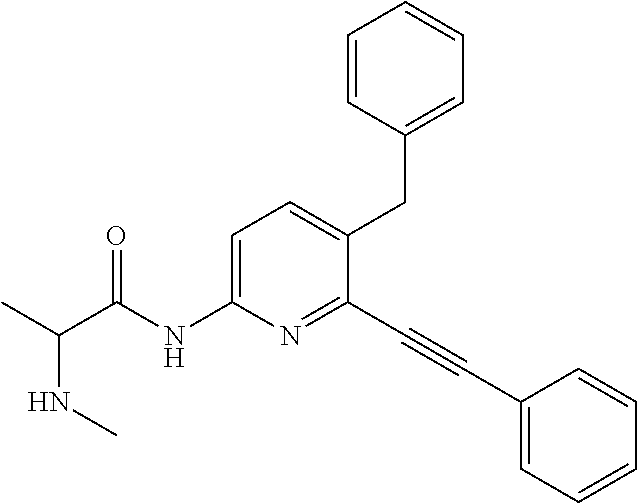
This invention relates to compounds of the general formula (I)
wherein the groups R
1 to R
5 have the meanings given below in this specification. The compounds of the invention are suitable for the treatment of diseases characterized by excessive or abnormal cell proliferation, pharmaceutical preparations containing such compounds and their uses as a medicament. The compounds of the invention modulate IAP activity.
BACKGROUND OF THE INVENTION
Apoptosis, a form of programmed cell death, typically occurs in the normal development and maintenance of healthy tissues in multicellular organisms. It is a complex process, which results in the removal of damaged, diseased or developmentally redundant cells, without signs of inflammation or necrosis. Apoptosis thus occurs as a normal part of development, the maintenance of normal cellular homeostasis, or as a consequence of stimuli such as chemotherapy and radiation.
The intrinsic apoptotic pathway is known to be deregulated in cancer and lymphoproliferative syndromes, as well as autoimmune disorders such as multiple sclerosis and rheumatoid arthritis. Additionally, alterations in a host apoptotic response have been described in the development or maintenance of viral and bacterial infections. Cancer cells gain the ability to overcome or circumvent apoptosis and continue with inappropriate proliferation despite strong pro-apoptotic signals such as hypoxia, endogenous cytokines, radiation treatments and chemotherapy. In autoimmune disease, pathogenic effector cells can become resistant to normal apoptotic cues. Resistance can be caused by numerous mechanisms, including alterations in the apoptotic machinery due to increased activity of anti-apoptotic pathways or expression of anti-apoptotic genes. Thus, approaches that reduce the threshold of apoptotic induction in cancer cells by overcoming resistance mechanisms may be of significant clinical utility.
Caspases serve as key effector molecules in apoptosis signaling. Caspases (cysteine containing aspartate specific proteases) are strong proteases and once activated, digest vital cell proteins from within the cell. Since caspases are highly active proteases, tight control of this family of proteins is necessary to prevent premature cell death. In general, caspases are synthesized as largely inactive zymogens that require proteolytic processing for activation. This proteolytic processing is only one of the ways in which caspases are regulated. The second mechanism of regulation is through a family of proteins that bind and inhibit caspases.
One family of molecules that inhibit caspases are the Inhibitors of Apoptosis (IAP) (Deveraux et al., J Clin Immunol (1999), 19: 388-398). IAPs were originally discovered in baculovirus by their ability to substitute for P35 protein function, an anti-apoptotic gene (Crook et al. (1993) J Virology 67, 2168-2174). Human IAPs are characterized by the presence of one to three homologous structural domains known as baculovirus IAP repeat (BIR) domains. Some IAP family members also contain a RING zinc finger domain at the C-terminus, with the capability to ubiquitylate target proteins via their E3 ligase function. The human IAPs, XIAP, HIAP1 (also referred to as cIAP2), and HIAP2 (cIAP1) each have three BIR domains, and a carboxy terminal RING zinc finger. Another IAP, NAIP, has three BIR domains (BIR1, BIR2 and BIR3), but no RING domain, whereas Livin, TsIAP and MLIAP have a single BIR domain and a RING domain. The X chromosome-linked inhibitor of apoptosis (XIAP) is an example of an IAP, which can inhibit the initiator caspase Caspase-9, and the effector caspases, Caspase-3 and Caspase-7, by direct binding. XIAP can also induce the degradation of caspases through the ubiquitylation-mediated proteasome pathway via the E3 ligase activity of a RING zinc finger domain. Inhibition of Caspase-9 is mediated by the BIR3 domains of XIAP, whereas effector caspases are inhibited by binding to the linker-BIR2 domain. The BIR domains also mediate the interactions of IAPs with tumor necrosis factor-receptor associated factor (TRAFs)-I and -2, and with TAB1, adaptor proteins affecting survival signaling through NFkB activation. IAP proteins can thus function as direct brakes on the apoptosis cascade by inhibiting active caspases or by redirecting cellular signaling to a pro-survival mode. Survivin is another member of the IAP family of antiapoptotic proteins. It is shown to be conserved in function across evolution as homologues of the protein are found both in vertebrates and invertebrates.
Cancer cells and cells involved in autoimmune disease may avoid apoptosis by the sustained over-expression of one or more members of the IAP family of proteins. For example, IAP overexpression has been demonstrated to be prognostic of poor clinical outcome in multiple cancers, and decreased IAP expression through RNAi strategies sensitizes tumor cells to a wide variety of apoptotic insults including chemotherapy, radiotherapy and death receptor ligands. For XIAP, this is shown in cancers as diverse as leukemia and ovarian cancer. Over expression of cIAP1 and cIAP2 resulting from the frequent chromosome amplification of the 11q21-q23 region, which encompasses both genes, has been observed in a variety of malignancies, including medulloblastomas, renal cell carcinomas, glioblastomas, and gastric carcinomas.
The interaction between the baculoviral IAP repeat-3 (BIR3) domain of X-linked inhibitor of apoptosis (XIAP) and caspase-9 is of therapeutic interest because this interaction is inhibited by the NH2-terminal seven-amino-acid residues of the so-called “second mitochondrial-derived activator of caspase” (in short and hereinafter Smac), a naturally occurring antagonist of IAPs. Small-molecule Smac mimetics have been generated anticipating efficacy in cancer by reconstituting apoptotic signaling.
Thus, there is the need to provide SMAC mimetics useful for the prevention and/or treatment of diseases characterized by excessive or abnormal cell proliferation, such as cancer.
DETAILED DESCRIPTION OF THE INVENTION
The present invention relates to compounds of formula (I)
wherein R
1 to R
5 are as defined below in this specification. The compounds according to formula (I) act as Smac mimetics. Thus, the compounds of the invention may be used for example for the treatment of diseases which are characterized by an increased apoptosis threshold due to overexpression of IAP protein. Preferably, the compounds of the invention can be used in the treatment of cancer.
The present invention therefore relates to compounds of general formula (I)
-
- wherein
- R1 is —H or —C1-5alkyl;
- R2, R2a are independently selected from —H and —C1-5alkyl optionally substituted with one or more —F;
- R3 is selected from —C6-10aryl and 5-14 membered heteroaryl, each of which groups can be optionally and independently substituted with one or more, independently selected, R6; or R3 is selected from —C1-6alkyl, —C4-7cycloalkyl, —C4-7cycloalkenyl, and 5-14 membered aromatic ring system, each of which groups can be optionally and independently substituted with one or more, independently selected, R6a;
- R6 is selected from —CN, halogen, —C1-3alkyl, —O—C1-3alkyl, —C(O)—R12, and 5-6 membered heteroaryl, which 5-6 membered heteroaryl group can be optionally substituted with —C1-3alkyl; or R6 is phenyl, which phenyl can be optionally substituted with —O—C1-3alkyl;
- R6a is selected from ═O, —CN, halogen, —C1-3alkyl, —O—C1-3alkyl, —C(O)—R12, and 5-6 membered heteroaryl, which 5-6 membered heteroaryl group can be optionally substituted with —C1-3alkyl; or R6a is phenyl, which phenyl can be optionally substituted with —O—C1-3alkyl;
- R12 is selected from —NH2, —NH—C1-3alkyl, 5-7 membered heterocyclyl, and —O—C1-3alkyl, which —C1-3alkyl groups can be optionally substituted with a 5-7 membered heterocyclyl;
- R4 is selected from —H, —C6-10aryl and 5-14 membered heteroaryl, each of which groups is optionally and independently substituted with one or more, independently selected, R7 or R4 is selected from C1-6alkyl, 5-14 membered aromatic ring system, and —C5-7cycloalkyl, each of which group is optionally and independently substituted with one or more, independently selected, R7a,
- or R4 is —N(R8,R9) wherein
- R8, R9 are independently selected from H, —C1-3alkyl, —C(O)—R10 and —S(O)2—R11;
- R10, R11 are independently selected from 5-7 membered heterocyclyl, —C5-7cycloalkyl, —C6-10aryl, and 5-10 membered heteroaryl;
- R7 is selected from —CN, halogen, —CF3, —NO2, —C1-3alkyl, —S—C1-3alkyl, —NH—C1-3alkyl, —N(C1-3alkyl)2, —NHC(O)—C1-3alkyl, —C(O)—R13, —O—C1-3alkyl, 5-14-membered heteroaryl, —O-phenyl, —CH2-phenyl, and phenyl, which phenyl group can be optionally substituted with halogen, or 5-6 membered heterocyclyl, which 5-6 membered heterocyclyl can be optionally substituted with —C1-3alkyl;
- R7a is selected from ═O, —CN, halogen, —CF3, —NO2, —C1-3alkyl, —S—C1-3alkyl, —NH—C1-3alkyl, —N(C1-3alkyl)2, —NHC(O)—C1-3alkyl, —C(O)—R13, —O—C1-3alkyl, 5-14 membered heteroaryl, —O-phenyl, —CH2-phenyl, and phenyl, which phenyl group can be optionally substituted with halogen, or 5-6 membered heterocyclyl, which 5-6 membered heterocyclyl can be optionally substituted with —C1-3alkyl; wherein
- R13 is selected from —OH, —NH2, —NH—C1-3alkyl, and —C1-3alkyl;
- R5 is selected from —H, halogen, —C1-3alkyl, and —O—C1-3alkyl, which —C1-3alkyl groups can be optionally substituted with one or more halogen;
- or R4 and R5 taken together form a —C6-10aryl or 5-14 membered heteroaryl,
- and wherein the compounds of formula (I) may optionally be present in the form of salts.
In a preferred embodiment the invention relates to compounds of formula (I),
-
- wherein
- R1 is —H or —C1-5alkyl;
- R2, R2a are independently selected from —H and —C1-5alkyl optionally substituted with one or more —F;
- R3 is selected from —C6-10aryl and 5-14 membered heteroaryl, each of which groups can be optionally and independently substituted with one or more, independently selected, R6; or R3 is selected from —C1-6alkyl, —C4-7cycloalkyl, —C4-7cycloalkenyl and 5-14 membered aromatic ring system, each of which groups can be optionally and independently substituted with one or more, independently selected, R6a;
- R6 is selected from —CN, halogen, —C1-3alkyl, —O—C1-3alkyl, —C(O)—R12, and 5-6 membered heteroaryl, which 5-6 membered heteroaryl group can be optionally substituted with —C1-3alkyl; or R6 is phenyl, which phenyl can be optionally substituted with —O—C1-3alkyl
- R6a is selected from ═O, —CN, halogen, —C1-3alkyl, —O—C1-3alkyl, —C(O)—R12, and 5-6 membered heteroaryl, which 5-6 membered heteroaryl group can be optionally substituted with —C1-3alkyl; or R6a is phenyl, which phenyl can be optionally substituted with —O—C1-3alkyl;
- R12 is selected from —NH2, —NH—C1-3alkyl, 5-7 membered non aromatic to heterocyclyl, and —O—C1-3alkyl, which —C1-3alkyl groups can be optionally substituted with a 5-7 membered non aromatic heterocyclyl;
- R4 is selected from —H, —C6-10aryl and 5-14 membered heteroaryl, each of which groups is optionally and independently substituted with one or more, independently selected, R7, or R4 is selected from C1-6alkyl, 5-14 membered aromatic ring system and —C5-7cycloalkyl, each of which group is optionally and independently substituted with one or more, independently selected, R7a,
- or R4 is selected from —N(R8,R9) wherein
- R8, R9 are independently selected from H, —C1-3alkyl, —C(O)—R10 and —S(O)2—R11;
- R10, R11 are independently selected from 5-7 membered non aromatic heterocyclyl, —C5-7cycloalkyl, —C6-10aryl, and 5-10 membered heteroaryl;
- R7 is selected from —CN, halogen, —CF3, —NO2, —C1-3alkyl, —S—C1-3alkyl, —NH—C1-3alkyl, —N(C1-3alkyl)2, —NHC(O)—C1-3alkyl, —C(O)—R13, —O—C1-3alkyl, 5-14 membered heteroaryl, —O-phenyl, —CH2-phenyl, phenyl, each of which phenyl group can be optionally substituted with halogen, and 5-6 membered non aromatic heterocyclyl, which 5-6 membered non aromatic heterocyclyl can be optionally substituted with —C1-3alkyl;
- R7a is selected from ═O, —CN, halogen, —CF3, —NO2, —C1-3alkyl, —S—C1-3alkyl, —NH—C1-3alkyl, —N(C1-3alkyl)2, —NHC(O)—C1-3alkyl, —C(O)—R13, —O—C1-3alkyl, 5-14 membered heteroaryl, —O-phenyl, —CH2-phenyl, phenyl, each of which phenyl group can be optionally substituted with halogen, and 5-6 membered non aromatic heterocyclyl, which 5-6 membered non aromatic heterocyclyl can be optionally substituted with —C1-3alkyl; wherein
- R13 is selected from —OH, —NH2, —NH—C1-3alkyl, and —C1-3alkyl;
- R5 is selected from —H, halogen, —C1-3alkyl, and —O—C1-3alkyl, which —C1-3alkyl groups can be optionally substituted with one or more halogen;
- or R4 and R5 taken together form a —C6-10aryl or 5-14 membered heteroaryl,
and wherein the compounds of formula (I) may optionally be present in the form of salts.
In a preferred embodiment the invention relates to compounds of formula (I), wherein R1 is selected from —CH3 and —CH2—CH3.
In a preferred embodiment the invention relates to compounds of formula (I), wherein R2 and R2a are independently selected from —H, —CH3, —CH2—CH3. —CH—(CH3)2, and —(CH2)2—CH3.
In a preferred embodiment the invention relates to compounds of formula (I), wherein R5 is selected from —H, —Cl, —F, —CF3, —OCH3, and —CH3.
In a preferred embodiment the invention relates to compounds of formula (I), wherein R3 is selected from —C6-10aryl, 5-14 membered heteroaryl, —CH2-phenyl, —C5-7cycloalkenyl, and 5-14 membered aromatic ring system, each of which groups can be optionally and independently substituted with one or more, independently selected, R6 or R6a as defined above.
In a preferred embodiment the invention relates to compounds of formula (I), wherein R3 is selected from —C6-10aryl and 5-14 membered heteroaryl, each of which groups can be optionally and independently substituted with one or more, independently selected, R6, or R3 is selected from —C5-7cycloalkenyl and 5-14 membered aromatic ring system, each of which groups can be optionally and independently substituted with one or more, independently selected R6a, or R3 is —CH2-phenyl, which phenyl can be optionally substituted with —O—C1-3alkyl, and wherein R6 and R6a are as defined above.
In a preferred embodiment the invention relates to compounds of formula (I), wherein R3 is selected from —C6-10aryl, 5-14 membered heteroaryl, and 5-14 membered aromatic ring system, which groups can be optionally and independently substituted with one or more, independently selected, R6 or R6a as defined above.
In a preferred embodiment the invention relates to compounds of formula (I), wherein R3 is selected from —C6-10aryl and 5-14 membered heteroaryl, each of which groups can be optionally and independently substituted with one or more, independently selected, R6, or R3 is selected from 5-14 membered aromatic ring system, which groups can be optionally and independently substituted with one or more, independently selected, R6a, wherein R6 and R6a are as defined above.
In a preferred embodiment the invention relates to compounds of formula (I), wherein R3 is selected from —CH2-phenyl,
each of which group is optionally substituted in the manner described above.
In a preferred embodiment the invention relates to compounds of formula (I), wherein R4 is selected from —H, —C1-6alkyl, —C6-10aryl, 5-14 membered heteroaryl, 5-14 membered aromatic ring system, and —C5-7cycloalkyl, each of which group is optionally and independently substituted with one or more, independently selected, R7 or R7a, or R4 is —N(R8,R9), wherein,
-
- R7 is selected from —CN, halogen, —CF3, —NO2, —C1-3alkyl, —S—C1-3alkyl, —NH—C1-3alkyl, —N(C1-3alkyl)2, —NHC(O)—C1-3alkyl, —C(O)—R13, —O—C1-3alkyl, 5-14 membered heteroaryl, —O-phenyl, —CH2-phenyl, and phenyl, which phenyl group can be optionally substituted with halogen, or 5-6 membered heterocyclyl, which 5-6 membered heterocyclyl can be optionally substituted with —C1-3alkyl;
- R7a is selected from ═O, —CN, halogen, —CF3, —NO2, —C1-3alkyl, —S—C1-3alkyl, —NH—C1-3alkyl, —N(C1-3alkyl)2, —NHC(O)—C1-3alkyl, —C(O)—R13, —O—C1-3alkyl, 5-14 membered heteroaryl, —O-phenyl, —CH2-phenyl, and phenyl, which phenyl group can be optionally substituted with halogen, or 5-6 membered heterocyclyl, which 5-6 membered heterocyclyl can be optionally substituted with —C1-3alkyl; wherein
- R13 is selected from —OH, —NH2, —NH—C1-3alkyl, and —C1-3alkyl; and
R8 and R9 are as defined above.
In a preferred embodiment the invention relates to compounds of formula (I), wherein R4 is selected from —H, —C6-10aryl, and 5-14 membered heteroaryl, each of which group is optionally and independently substituted with one or more, independently selected, R7, or R4 is selected from —C1-6alkyl, 5-14 membered aromatic ring system and —C5-7cycloalkyl, each of which group is optionally and independently substituted with one or more, independently selected, R7a, or R4 is —N(R8,R9), wherein R7, R7a, R8 and R9 are as defined above.
In a preferred embodiment the invention relates to compounds of formula (I), wherein R4 is selected from —C6-10aryl, 5-14 membered heteroaryl, 5-14 membered aromatic ring system, and —C5-7cycloalkyl, each of which group is optionally and independently substituted with one or more, independently selected, R7 or R7a as defined above, or R4 is —N(R8,R9), wherein R8 and R9 are as defined above.
In a preferred embodiment the invention relates to compounds of formula (I), wherein R4 is selected from —C6-10aryl and 5-14 membered heteroaryl, each of which group is optionally and independently substituted with one or more, independently selected, R7, or R4 is selected from 5-14 membered aromatic ring system and —C5-7cycloalkyl, each of which group is optionally and independently substituted with one or more, independently selected, R7a or R4 is —N(R8,R9), wherein R7, R7a, R8 and R9 are as defined above.
In a preferred embodiment the invention relates to compounds of formula (I), wherein R4 is selected from —C6-10aryl, 5-14 membered heteroaryl, and 5-14 membered aromatic ring system, each of which group is optionally and independently substituted with one or more, independently selected, R7 or R7a as defined above.
In a preferred embodiment the invention relates to compounds of formula (I), wherein R4 is selected from —C6-10aryl and 5-14 membered heteroaryl, each of which group is optionally and independently substituted with one or more, independently selected, R7, or R4 is 5-14 membered aromatic ring system, each of which group is optionally and independently substituted with one or more, independently selected, R7a, wherein R7 and R7a are as defined above.
In a preferred embodiment the invention relates to compounds of formula (I), wherein R4 is selected from —H, —C1-3alkyl, —CH2-phenyl, —N(CH3)—SO2-phenyl, —N(CH3)CO—R10; and —NH—CO—R10, wherein R10 is independently selected from morpholin, cyclopentyl, and phenyl, or R4 is selected from
each of which groups is optionally substituted in the manner described above.
In a preferred embodiment the invention relates to compounds of formula (I), wherein R6 is selected from —F, —Cl, —CN—CH3, —O—CH3, —C(O)NHCH3, —C(O)NH2, C(O)OCH3, —C(O)-morpholinyl, —C(O)—O—CH2-tetrahydropyran, phenyl,
In a preferred embodiment the invention relates to compounds of formula (I), wherein R6a is selected from ═O, —F, —Cl, —CN—CH3, —O—CH3, —C(O)NHCH3, —C(O)NH2, C(O)OCH3, —C(O)-morpholinyl, —C(O)—O—CH2-tetrahydropyran, phenyl,
In a preferred embodiment the invention relates to compounds of formula (I), wherein R7 is selected from —CN, —F, —Cl, —CF3, —NO2, —CH3, —CH2CH3, —CH2(CH3)2, —S—CH3, —NH2, —NH—CH3, —N(CH3)2, —C(O)OH, —C(O)OCH3, —C(O)NH2, —C(O)NH—CH3, —NHC(O)CH3, —O—CH3, —O—CH2CH3, pyridyl, phenyl, —O-Phenyl, —CH2-phenyl,
In a preferred embodiment the invention relates to compounds of formula (I), wherein R7a is selected from ═O, —CN, —F, —Cl, —CF3, —NO2, —CH3, —CH2CH3, —CH2(CH3)2, —S—CH3, —NH2, —NH—CH3, —N(CH3)2, —C(O)OH, —C(O)OCH3, —C(O)NH2, —C(O)NH—CH3, —NHC(O)CH3, —O—CH3, —O—CH2CH3, pyridyl, phenyl, —O-Phenyl, —CH2-phenyl,
In a preferred embodiment the invention relates to compounds of formula (I), wherein R4 and R5 taken together form a phenyl.
In a preferred embodiment the invention relates to compounds of formula (I), wherein R3 is selected from
In a preferred embodiment the invention relates to compounds of formula (I), wherein R4 is selected from
In another aspect the invention relates to compounds of general formula (I) or of anyone of the embodiments as disclosed above for use in the treatment of cancer.
In another aspect the invention relates to compounds of general formula (I) or of anyone of the embodiments as disclosed above—or the pharmaceutically acceptable salts thereof—as medicaments.
In another aspect the invention relates to compounds of general formula (I) or of anyone of the embodiments as disclosed above—or the pharmaceutically acceptable salts thereof—for use in the treatment and/or prevention of cancer, infections, inflammations and autoimmune diseases.
In another aspect the invention relates to compounds of general formula (I) or of anyone of the embodiments as disclosed above—or the pharmaceutically acceptable salts thereof—for use in the treatment and/or prevention of cancer, preferably of carcinomas of the breast, prostate, brain or ovary, non-small-cell bronchial carcinomas (NSCLC), melanomas and chronic lymphatic leukaemias (CLL).
In another aspect the invention relates to compounds of general formula (I) or of anyone of the embodiments as disclosed above—or the pharmaceutically acceptable salts thereof—for use in the treatment and/or prevention of carcinomas of the breast, prostate, brain or ovary, non-small-cell bronchial carcinomas (NSCLC), melanomas and chronic lymphatic leukaemias (CLL).
In another aspect the invention relates to a method for the treatment and/or prevention of cancer comprising administering a therapeutically effective amount of a compound of general formula (I) or of anyone of the embodiments as disclosed above—or one of the pharmaceutically acceptable salts thereof—to a human being.
In another aspect the invention relates to a pharmaceutical preparation containing as active substance one or more compounds of general formula (I) or of anyone of the embodiments as disclosed above—or the pharmaceutically acceptable salts thereof—optionally in combination with conventional excipients and/or carriers.
In another aspect the invention relates to a pharmaceutical preparation comprising a compound of general formula (I) or of anyone of the embodiments as disclosed above—or one of the pharmaceutically acceptable salts thereof—and at least one other cytostatic or cytotoxic active substance, different from formula (I).
Definitions
Terms that are not specifically defined here have the meanings that are apparent to the skilled man in the light of the overall disclosure and the context as a whole.
As used herein, the following definitions apply, unless stated otherwise:
In the groups, radicals, or moieties defined below, the number of carbon atoms is often specified preceding the group, for example, —C1-5alkyl means an alkyl group or radical having 1 to 5 carbon atoms. In general, for groups comprising two or more subgroups, the first named sub-group is the radical attachment point, for example the substitutent —C1-5alkyl-C3-10cylcoalkyl, means a C3-10cylcoalkyl group which is bound to a C1-5alkyl, the latter of which is bound to the core structure or to the group to which the substitutent is attached.
The indication of the number of members in groups that contain one or more heteroatom(s) (heteroalkyl, heteroaryl, heteroarylalkyl, heterocyclyl, heterocycylalkyl) relates to the total atomic number of all the ring members or chain members or the total of all the ring and chain members.
The person skilled in the art will appreciate that substituent groups containing a nitrogen atom can also be indicated as amine or amino. Similarly, groups containing oxygen atom can also be indicated with -oxy, like for example alkoxy. Groups containing —C(O)— can also be indicated as carboxy; groups containing —NC(O)— can also be indicated as amide; groups containing —NC(O)N— can also be indicated as urea; groups containing —NS(O)2— can also be indicated as sulfonamide.
Alkyl denotes monovalent, saturated hydrocarbon chains, which may be present in both linear and branched form. If an alkyl is substituted, the substitution may take place independently of one another, by mono- or polysubstitution in each case, on all the hydrogen-carrying carbon atoms.
The term “C1-5-alkyl” includes for example methyl (Me; —CH3), ethyl (Et; —CH2CH3), 1-propyl (n-propyl; n-Pr; —CH2CH2CH3), 2-propyl (i-Pr; iso-propyl; —CH(CH3)2), 1-butyl (n-butyl; n-Bu; —CH2CH2CH2CH3), 2-methyl-1-propyl (iso-butyl; i-Bu; —CH2CH(CH3)2), 2-butyl (sec-butyl; sec-Bu; —CH(CH3)CH2CH3), 2-methyl-2-propyl (tert-butyl; t-Bu; —C(CH3)3), 1-pentyl (n-pentyl; —CH2CH2CH2CH2CH3), 2-pentyl (—CH(CH3)CH2CH2CH3), 3-pentyl (—CH(CH2CH3)2), 3-methyl-1-butyl (iso-pentyl; —CH2CH2CH(CH3)2), 2-methyl-2-butyl (—C(CH3)2CH2CH3), 3-methyl-2-butyl (—CH(CH3)CH(CH3)2), 2,2-dimethyl-1-propyl (neo-pentyl; —CH2C(CH3)3), 2-methyl-1-butyl (—CH2CH(CH3)CH2CH3).
By the terms propyl, butyl, pentyl, etc. without any further definition are meant saturated hydrocarbon groups with the corresponding number of carbon atoms, wherein all isomeric forms are included.
The above definition for alkyl also applies if alkyl is a part of another group such as for example Cx-y-alkylamino or Cx-y-alkyloxy or Cx-y-alkoxy, wherein Cx-y-alkyloxy and Cx-y-alkoxy indicate the same group.
The term alkylene can also be derived from alkyl. Alkylene is bivalent, unlike alkyl, and requires two binding partners. Formally, the second valency is produced by removing a hydrogen atom in an alkyl. Corresponding groups are for example —CH3 and —CH2, —CH2CH3 and —CH2CH2 or >CHCH3 etc.
The term “C1-4-alkylene” includes for example —(CH2)—, —(CH2—CH2)—, —(CH(CH3))—, —(CH2—CH2—CH2)—, —(C(CH3)2)—, —(CH(CH2CH3))—, —(CH(CH3)—CH2)—, —(CH2—CH(CH3))—, —(CH2—CH2—CH2—CH2)—, —(CH2—CH2—CH(CH3))—, —(CH(CH3)—CH2—CH2)—, —(CH2—CH(CH3)—CH2)—, —(CH2—C(CH3)2)—, —(C(CH3)2—CH2)—, —(CH(CH3)—CH(CH3))—, —(CH2—CH(CH2CH3))—, —(CH(CH2CH3)—CH2)—, —(CH(CH2CH2CH3))—, —(CHCH(CH3)2)— and —C(CH3)(CH2CH3)—.
Other examples of alkylene are methylene, ethylene, propylene, 1-methylethylene, butylene, 1-methylpropylene, 1.1-dimethylethylene, 1,2-dimethylethylene, pentylene, 1,1-dimethylpropylene, 2,2-dimethylpropylene, 1,2-dimethylpropylene, 1,3-dimethylpropylene, etc.
By the generic terms propylene, butylene, pentylene, hexylene etc. without any further definition are meant all the conceivable isomeric forms with the corresponding number of carbon atoms, i.e. propylene includes 1-methylethylene and butylene includes 1-methylpropylene, 2-methylpropylene, 1,1-dimethylethylene and 1,2-dimethylethylene. The above definition for alkylene also applies if alkylene is part of another group such as for example in HO—Cx-y-alkylenamino or H2N—Cx-y-alkylenoxy.
Unlike alkyl, alkenyl consists of at least two carbon atoms, wherein at least two adjacent carbon atoms are joined together by a C—C double bond. If in an alkyl as hereinbefore defined having at least two carbon atoms, two hydrogen atoms on adjacent carbon atoms are formally removed and the free valencies are saturated to form a second bond, the corresponding alkenyl is formed.
Examples of alkenyl are vinyl (ethenyl), prop-1-enyl, allyl (prop-2-enyl), isopropenyl, but-1-enyl, but-2-enyl, but-3-enyl, 2-methyl-prop-2-enyl, 2-methyl-prop-1-enyl, 1-methyl-prop-2-enyl, 1-methyl-prop-1-enyl, 1-methylidenepropyl, pent-1-enyl, pent-2-enyl, pent-3-enyl, pent-4-enyl, 3-methyl-but-3-enyl, 3-methyl-but-2-enyl, 3-methyl-but-1-enyl, hex-1-enyl, hex-2-enyl, hex-3-enyl, hex-4-enyl, hex-5-enyl, 2,3-dimethyl-but-3-enyl, 2,3-dimethyl-but-2-enyl, 2-methylidene-3-methylbutyl, 2,3-dimethyl-but-1-enyl, hexa-1,3-dienyl, hexa-1,4-dienyl, penta-1,4-dienyl, penta-1,3-dienyl, buta-1,3-dienyl, 2,3-dimethylbuta-1,3-diene etc.
By the generic terms propenyl, butenyl, pentenyl, hexenyl, butadienyl, pentadienyl, hexadienyl, heptadienyl, octadienyl, nonadienyl, decadienyl etc. without any further definition are meant all the conceivable isomeric forms with the corresponding number of carbon atoms, i.e. propenyl includes prop-1-enyl and prop-2-enyl, butenyl includes but-1-enyl, but-2-enyl, but-3-enyl, 1-methyl-prop-1-enyl, 1-methyl-prop-2-enyl etc.
Alkenyl may optionally be present in the cis or trans or E or Z orientation with regard to the double bond(s).
The above definition for alkenyl also applies when alkenyl is part of another group such as for example in Cx-y-alkenylamino or Cx-y-alkenyloxy.
Unlike alkylene, alkenylene consists of at least two carbon atoms, wherein at least two adjacent carbon atoms are joined together by a C—C double bond. If in an alkylene as hereinbefore defined having at least two carbon atoms, two hydrogen atoms at adjacent carbon atoms are formally removed and the free valencies are saturated to form a second bond, the corresponding alkenylene is formed.
Examples of alkenylene are ethenylene, propenylene, 1-methylethenylene, butenylene, 1-methylpropenylene, 1,1-dimethylethenylene, 1,2-dimethylethenylene, pentenylene, 1,1-dimethylpropenylene, 2,2-dimethylpropenylene, 1,2-dimethylpropenylene, 1,3-dimethylpropenylene, hexenylene etc.
By the generic terms propenylene, butenylene, pentenylene, hexenylene etc. without any further definition are meant all the conceivable isomeric forms with the corresponding number of carbon atoms, i.e. propenylene includes 1-methylethenylene and butenylene includes 1-methylpropenylene, 2-methylpropenylene, 1,1-dimethylethenylene and 1,2-dimethylethenylene.
Alkenylene may optionally be present in the cis or trans or E or Z orientation with regard to the double bond(s).
The above definition for alkenylene also applies when alkenylene is a part of another group as in for example HO—Cx-y-alkenylenamino or H2N—Cx-y-alkenylenoxy.
Unlike alkyl, alkynyl consists of at least two carbon atoms, wherein at least two adjacent carbon atoms are joined together by a C—C triple bond. If in an alkyl as hereinbefore defined having at least two carbon atoms, two hydrogen atoms in each case at adjacent carbon atoms are formally removed and the free valencies are saturated to form two further bonds, the corresponding alkynyl is formed.
Examples of alkynyl are ethynyl, prop-1-ynyl, prop-2-ynyl, but-1-ynyl, but-2-ynyl, but-3-ynyl, 1-methyl-prop-2-ynyl, pent-1-ynyl, pent-2-ynyl, pent-3-ynyl, pent-4-ynyl, 3-methyl-but-1-ynyl.
By the generic terms propynyl, butynyl, pentynyl, etc. without any further definition are meant all the conceivable isomeric forms with the corresponding number of carbon atoms, i.e. propynyl includes prop-1-ynyl and prop-2-ynyl, butynyl includes but-1-ynyl, but-2-ynyl, but-3-ynyl, 1-methyl-prop-1-ynyl, 1-methyl-prop-2-ynyl.
If a hydrocarbon chain carries both at least one double bond and also at least one triple bond, by definition it belongs to the alkynyl subgroup.
The above definition for alkynyl also applies if alkynyl is part of another group, as in Cx-y-alkynylamino or Cx-y-alkynyloxy, for example.
Unlike alkylene, alkynylene consists of at least two carbon atoms, wherein at least two adjacent carbon atoms are joined together by a C—C triple bond. If in an alkylene as hereinbefore defined having at least two carbon atoms, two hydrogen atoms in each case at adjacent carbon atoms are formally removed and the free valencies are saturated to form two further bonds, the corresponding alkynylene is formed.
Examples of alkynylene are ethynylene, propynylene, 1-methylethynylene, butynylene, 1-methylpropynylene, 1,1-dimethylethynylene, 1,2-dimethylethynylene, pentynylene, 1,1-dimethylpropynylene, 2,2-dimethylpropynylene, 1,2-dimethylpropynylene, 1,3-dimethylpropynylene, hexynylene etc.
By the generic terms propynylene, butynylene, pentynylene, etc. without any further definition are meant all the conceivable isomeric forms with the corresponding number of carbon atoms, i.e. propynylene includes 1-methylethynylene and butynylene includes 1-methylpropynylene, 2-methylpropynylene, 1,1-dimethylethynylene and 1,2-dimethylethynylene.
The above definition for alkynylene also applies if alkynylene is part of another group, as in HO—Cx-y-alkynyleneamino or H2N—Cx-y-alkynyleneoxy, for example.
By heteroatoms are meant oxygen, nitrogen and sulphur atoms.
Haloalkyl (haloalkenyl, haloalkynyl) is derived from the previously defined alkyl (alkenyl, alkynyl) by replacing one or more hydrogen atoms of the hydrocarbon chain independently of one another by halogen atoms, which may be identical or different. If a haloalkyl (haloalkenyl, haloalkynyl) is to be further substituted, the substitutions may take place independently of one another, in the form of mono- or polysubstitutions in each case, on all the hydrogen-carrying carbon atoms.
Examples of haloalkyl (haloalkenyl, haloalkynyl) are —CF3, —CHF2, —CH2F, —CF2CF3, —CHFCF3, —CH2CF3, —CF2CH3, —CHFCH3, —CF2CF2CF3, —CF2CH2CH3, —CF═CF2, —CCl═CH2, —CBr═CH2, —CI═CH2, —C≡C—CF2, —CHFCH2CH3, —CHFCH2CF3 etc.
From the previously defined haloalkyl (haloalkenyl, haloalkynyl) are also derived the terms haloalkylene (haloalkenylene, haloalkynylene). Haloalkylene (haloalkenyl, haloalkynyl), unlike haloalkyl, is bivalent and requires two binding partners. Formally, the second valency is formed by removing a hydrogen atom from a haloalkyl. Corresponding groups are for example —CH2F and —CHF—, —CHFCH2F and —CHFCHF— or >CFCH2F etc.
The above definitions also apply if the corresponding halogen groups are part of another group.
Halogen relates to fluorine, chlorine, bromine and/or iodine atoms.
Cycloalkyl is made up of the subgroups monocyclic hydrocarbon rings, bicyclic hydrocarbon rings and spiro-hydrocarbon rings. The systems are saturated. In bicyclic hydrocarbon rings two rings are joined together so that they have at least two carbon atoms together. In spiro-hydrocarbon rings a carbon atom (spiroatom) belongs to two rings together. If a cycloalkyl is to be substituted, the substitutions may take place independently of one another, in the form of mono- or polysubstitutions in each case, on all the hydrogen-carrying carbon atoms. Cycloalkyl itself may be linked as a substituent to the molecule via every suitable position of the ring system.
Examples of cycloalkyl are cyclopropyl, cyclobutyl, cyclopentyl, cyclohexyl, cycloheptyl, bicyclo[2.2.0]hexyl, bicyclo[3.2.0]heptyl, bicyclo[3.2.1]octyl, bicyclo[2.2.2]octyl, bicyclo[4.3.0]nonyl (octahydroindenyl), bicyclo[4.4.0]decyl (decahydronaphthalene), bicyclo[2.2.1]heptyl (norbornyl), bicyclo[4.1.0]heptyl (norcaranyl), bicyclo-[3.1.1]heptyl (pinanyl), spiro[2.5]octyl, spiro[3.3]heptyl etc.
The above definition for cycloalkyl also applies if cycloalkyl is part of another group as in Cx-y-cycloalkylamino or Cx-y-cycloalkyloxy, for example.
If the free valency of a cycloalkyl is saturated, then an alicyclic group is obtained.
The term cycloalkylene can thus be derived from the previously defined cycloalkyl. Cycloalkylene, unlike cycloalkyl, is bivalent and requires two binding partners. Formally, the second valency is obtained by removing a hydrogen atom from a cycloalkyl. Corresponding groups are for example cyclohexyl and
The above definition for cycloalkylene also applies if cycloalkylene is part of another group as in HO—Cx-y-cycloalkyleneamino or H2N—Cx-y-cycloalkyleneoxy, for example.
Cycloalkenyl is also made up of the subgroups monocyclic hydrocarbon rings, bicyclic hydrocarbon rings and spiro-hydrocarbon rings. However, the systems are unsaturated, i.e. there is at least one C—C double bond but no aromatic system. If in a cycloalkyl as hereinbefore defined two hydrogen atoms at adjacent cyclic carbon atoms are formally removed and the free valencies are saturated to form a second bond, the corresponding cycloalkenyl is obtained. If a cycloalkenyl is to be substituted, the substitutions may take place independently of one another, in the form of mono- or polysubstitutions in each case, on all the hydrogen-carrying carbon atoms. Cycloalkenyl itself may be linked as a substituent to the molecule via every suitable position of the ring system.
Examples of cycloalkenyl are cycloprop-1-enyl, cycloprop-2-enyl, cyclobut-1-enyl, cyclobut-2-enyl, cyclopent-1-enyl, cyclopent-2-enyl, cyclopent-3-enyl, cyclohex-1-enyl, cyclohex-2-enyl, cyclohex-3-enyl, cyclohept-1-enyl, cyclohept-2-enyl, cyclohept-3-enyl, cyclohept-4-enyl, cyclobuta-1,3-dienyl, cyclopenta-1,4-dienyl, cyclopenta-1,3-dienyl, cyclopenta-2,4-dienyl, cyclohexa-1,3-dienyl, cyclohexa-1,5-dienyl, cyclohexa-2,4-dienyl, cyclohexa-1,4-dienyl, cyclohexa-2,5-dienyl, bicyclo[2.2.1]hepta-2,5-dienyl(norborna-2,5-dienyl), bicyclo[2.2.1]hept-2-enyl(norbornenyl), spiro[4.5]dec-2-ene etc.
The above definition for cycloalkenyl also applies when cycloalkenyl is part of another group as in Cx-y-cycloalkenylamino or Cx-y-cycloalkenyloxy, for example.
If the free valency of a cycloalkenyl is saturated, then an unsaturated alicyclic group is obtained.
The term cycloalkenylene can thus be derived from the previously defined cycloalkenyl. Cycloalkenylene, unlike cycloalkenyl, is bivalent and requires two binding partners. Formally the second valency is obtained by removing a hydrogen atom from a cycloalkenyl. Corresponding groups are for example cyclopentenyl and
The above definition for cycloalkenylene also applies when cycloalkenylene is part of another group as in HO—Cx-y-cycloalkenyleneamino or H2N—Cx-y-cycloalkenyleneoxy, for example.
Aryl denotes a mono-, bi- or tricyclic group with at least one aromatic carbocycle. Preferably it denotes a monocyclic group with six carbon atoms (phenyl) or a bicyclic group with nine or ten carbon atoms (two six-membered rings or one six-membered ring with a five-membered ring), wherein the second ring may also be aromatic or, however, may also be saturated or partially saturated. If an aryl is to be substituted, the substitutions may take place independently of one another, in the form of mono- or polysubstitutions in each case, on all the hydrogen-carrying carbon atoms. Aryl itself may be linked as a substituent to the molecule via every suitable position of the ring system.
Examples of aryl are phenyl, naphthyl, indanyl (2,3-dihydroindenyl), indenyl, anthracenyl, phenanthrenyl, tetrahydronaphthyl (1,2,3,4-tetrahydronaphthyl, tetralinyl), dihydronaphthyl (1,2-dihydronaphthyl), fluorenyl etc.
The above definition of aryl also applies when aryl is part of another group as in arylamino or aryloxy, for example.
If the free valency of an aryl is saturated, then an aromatic group is obtained.
The term arylene can also be derived from the previously defined aryl. Arylene, unlike aryl, is bivalent and requires two binding partners. Formally, the second valency is formed by removing a hydrogen atom from an aryl. Corresponding groups are e.g.
(o, m, p-phenylene), naphthyl and
The above definition for arylene also applies when arylene is part of another group as in HO-aryleneamino or H2N-aryleneoxy for example.
Heterocyclyl denotes ring systems, which are derived from the previously defined cycloalkyl, cycloalkenyl and aryl by replacing one or more of the groups —CH2— independently of one another in the hydrocarbon rings by the groups —O—, —S— or —NH— or by replacing one or more of the groups ═CH— by the group ═N—, wherein a total of not more than five heteroatoms may be present, at least one carbon atom may be present between two oxygen atoms and between two sulphur atoms or between one oxygen and one sulphur atom and the ring as a whole must have chemical stability. Heteroatoms may optionally be present in all the possible oxidation stages (sulphur→sulphoxide —SO, sulphone —SO2—; nitrogen→N-oxide). Preferred heterocylyl are non aromatic heterocyclyl.
A direct result of the derivation from cycloalkyl, cycloalkenyl and aryl is that heterocyclyl is made up of the subgroups monocyclic heterorings, bicyclic heterorings, tricyclic heterorings and spiro-heterorings, which may be present in saturated or unsaturated form. By unsaturated is meant that there is at least one double bond in the ring system in question, but no heteroaromatic system is formed. In bicyclic heterorings two rings are linked together so that they have at least two (hetero)atoms in common. In spiro-heterorings a carbon atom (spiroatom) belongs to two rings together. If a heterocyclyl is substituted, the substitutions may take place independently of one another, in the form of mono- or polysubstitutions in each case, on all the hydrogen-carrying carbon and/or nitrogen atoms. Heterocyclyl itself may be linked as a substituent to the molecule via every suitable position of the ring system. When the heterocyclyl has a nitrogen atom, the preferred position to bind the heterocyclyl substituent to the molecule is the nitrogen atom.
Examples of heterocyclyl are tetrahydrofuryl, pyrrolidinyl, pyrrolinyl, imidazolidinyl, thiazolidinyl, imidazolinyl, pyrazolidinyl, pyrazolinyl, piperidinyl, piperazinyl, oxiranyl, aziridinyl, azetidinyl, 1,4-dioxanyl, azepanyl, diazepanyl, morpholinyl, thiomorpholinyl, homomorpholinyl, homopiperidinyl, homopiperazinyl, homothiomorpholinyl, thiomorpholinyl-S-oxide, thiomorpholinyl-S,S-dioxide, 1,3-dioxolanyl, tetrahydropyranyl, tetrahydrothiopyranyl, [1.4]-oxazepanyl, tetrahydrothienyl, homothiomorpholinyl-S,S-dioxide, oxazolidinonyl, dihydropyrazolyl, dihydropyrrolyl, dihydropyrazinyl, dihydropyridyl, dihydro-pyrimidinyl, dihydrofuryl, dihydropyranyl, tetrahydrothienyl-S-oxide, tetrahydrothienyl-S,S-dioxide, homothiomorpholinyl-S-oxide, 2,3-dihydroazet, 2H-pyrrolyl, 4H-pyranyl, 1,4-dihydropyridinyl, 8-azabicyclo[3.2.1]octyl, 8-azabicyclo[5.1.0]octyl, 2-oxa-5-azabicyclo[2.2.1]heptyl, 8-oxa-3-aza-bicyclo[3.2.1]octyl, 3,8-diaza-bicyclo[3.2.1]octyl, 2,5-diaza-bicyclo-[2.2.1]heptyl, 1-aza-bicyclo[2.2.2]octyl, 3,8-diaza-bicyclo[3.2.1]octyl, 3,9-diaza-bicyclo[4.2.1]nonyl, 2,6-diaza-bicyclo[3.2.2]-nonyl, 1,4-dioxa-spiro[4.5]decyl, 1-oxa-3.8-diaza-spiro[4.5]decyl, 2,6-diaza-spiro[3.3]-heptyl, 2,7-diaza-spiro[4.4]nonyl, 2,6-diaza-spiro[3.4]octyl, 3,9-diaza-spiro[5.5]undecyl, 2.8-diaza-spiro[4.5]decyl etc.
Further examples are the structures illustrated below, which may be attached via each hydrogen-carrying atom (exchanged for hydrogen):
The above definition of heterocyclyl also applies if heterocyclyl is part of another group as in heterocyclylamino or heterocyclyloxy for example.
If the free valency of a heteroyclyl is saturated, then a heterocyclic group is obtained.
The term heterocyclylene is also derived from the previously defined heterocyclyl. Heterocyclylene, unlike heterocyclyl, is bivalent and requires two binding partners. Formally, the second valency is obtained by removing a hydrogen atom from a heterocyclyl. Corresponding groups are for example
2,3-dihydro-1H-pyrrolyl and
The above definition of heterocyclylene also applies if heterocyclylene is part of another group as in HO-heterocyclyleneamino or H2N-heterocyclyleneoxy for example.
Heteroaryl denotes monocyclic heteroaromatic rings or polycyclic rings with at least one heteroaromatic ring, which compared with the corresponding aryl or cycloalkyl (cycloalkenyl) contain, instead of one or more carbon atoms, one or more identical or different heteroatoms, selected independently of one another from among nitrogen, sulphur and oxygen, wherein the resulting group must be chemically stable. The prerequisite for the presence of heteroaryl is a heteroatom and a heteroaromatic system. If a heteroaryl is to be substituted, the substitutions may take place independently of one another, in the form of mono- or polysubstitutions in each case, on all the hydrogen-carrying carbon and/or nitrogen atoms. Heteroaryl itself may be linked as a substituent to the molecule via every suitable position of the ring system, both carbon and nitrogen.
Examples of heteroaryl are furyl, thienyl, pyrrolyl, oxazolyl, thiazolyl, isoxazolyl, isothiazolyl, pyrazolyl, imidazolyl, triazolyl, tetrazolyl, oxadiazolyl, thiadiazolyl, pyridyl, pyrimidyl, pyridazinyl, pyrazinyl, triazinyl, pyridyl-N-oxide, pyrrolyl-N-oxide, pyrimidinyl-N-oxide, pyridazinyl-N-oxide, pyrazinyl-N-oxide, imidazolyl-N-oxide, isoxazolyl-N-oxide, oxazolyl-N-oxide, thiazolyl-N-oxide, oxadiazolyl-N-oxide, thiadiazolyl-N-oxide, triazolyl-N-oxide, tetrazolyl-N-oxide, indolyl, isoindolyl, benzofuryl, benzothienyl, benzoxazolyl, benzothiazolyl, benzisoxazolyl, benzisothiazolyl, benzimidazolyl, indazolyl, isoquinolinyl, quinolinyl, quinoxalinyl, cinnolinyl, phthalazinyl, quinazolinyl, benzotriazinyl, indolizinyl, oxazolopyridyl, imidazopyridyl, naphthyridinyl, benzoxazolyl, pyridopyridyl, purinyl, pteridinyl, benzothiazolyl, imidazopyridyl, imidazothiazolyl, quinolinyl-N-oxide, indolyl-N-oxide, isoquinolyl-N-oxide, quinazolinyl-N-oxide, quinoxalinyl-N-oxide, phthalazinyl-N-oxide, indolizinyl-N-oxide, indazolyl-N-oxide, benzothiazolyl-N-oxide, benzimidazolyl-N-oxide etc.
Further examples are the structures illustrated below, which may be attached via each hydrogen-carrying atom (exchanged for hydrogen):
The above definition of heteroaryl also applies when heteroaryl is part of another group as in heteroarylamino or heteroaryloxy, for example.
If the free valency of a heteroaryl is saturated, a heteroaromatic group is obtained.
The term heteroarylene can therefore be derived from the previously defined heteroaryl. Heteroarylene, unlike heteroaryl, is bivalent and requires two binding partners. Formally, the second valency is obtained by removing a hydrogen atom from a heteroaryl. Corresponding groups are for example
pyrrolyl and
The above definition of heteroarylene also applies when heteroarylene is part of another group as in HO-heteroaryleneamino or H2N-heteroaryleneoxy, for example.
The bivalent groups mentioned above (alkylene, alkenylene, alkynylene etc.) may also be part of composite groups (e.g. H2N—C1-4alkylene- or HO—C1-4alkylene-). In this case one of the valencies is saturated by the attached group (here: —NH2, —OH), so that a composite group of this kind written in this way is only a monovalent substituent over all.
Aromatic ring system means a mono- or multi-ring structure, preferably a multi-ring structure, comprising between one, preferably two, to four cyclic groups, wherein at least one of these cyclic groups is an aromatic or heteroaromatic ring. Multi-ring structure comprises two to four cyclic groups, which are fused together, wherein at least one of the cyclic groups is aromatic (or heteroaromatic). Preferred multi-ring structures are 9-14 membered multi-ring structures. The cyclic groups described herein can be fused together in order to obtain a multi-ring structure, i.e., an aromatic ring system. For example, multi-ring structure comprises an aryl fused with a heterocycle but also a heteroaryl fused to a cycloalkyl. Non-limitative examples of aromatic systems are
By substituted is meant that a hydrogen atom which is bound directly to the atom under consideration, is replaced by another atom or another group of atoms (substituent). Depending on the starting conditions (number of hydrogen atoms) mono- or polysubstitution may take place on one atom. Substitution with a particular substituent is only possible if the permitted valencies of the substituent and of the atom that is to be substituted correspond to one another and the substitution leads to a stable compound (i.e. to a compound which is not converted spontaneously, e.g. by rearrangement, cyclisation or elimination).
Bivalent substituents such as ═S, ═NR, ═NOR, ═NNRR, ═NN(R)C(O)NRR, ═N2 or the like, may only be substituted at carbon atoms, wherein the bivalent substituent ═O may also be a substituent at sulphur. Generally, substitution may be carried out by a bivalent substituent only at ring systems and requires replacement by two geminal hydrogen atoms, i.e. hydrogen atoms that are bound to the same carbon atom that is saturated prior to the substitution. Substitution by a bivalent substituent is therefore only possible at the group —CH2— or sulphur atoms of a ring system.
Stereochemistry/Solvates/Hydrates: Unless stated otherwise a structural formula given in the description or in the claims or a chemical name refers to the corresponding compound itself, but also encompasses the tautomers, stereoisomers, optical and geometric isomers (e.g. enantiomers, diastereomers, E/Z isomers, etc.), racemates, mixtures of separate enantiomers in any desired combinations, mixtures of diastereomers, mixtures of the forms mentioned hereinbefore (if such forms exist) as well as salts, particularly pharmaceutically acceptable salts thereof. The compounds and salts according to the invention may be present in solvated form (e.g. with pharmaceutically acceptable solvents such as e.g. water, ethanol etc.) or in unsolvated form. Generally, for the purposes of the present invention the solvated forms, e.g. hydrates, are to be regarded as of equal value to the unsolvated forms.
Salts: The term “pharmaceutically acceptable” is used herein to denote compounds, materials, compositions and/or formulations which are suitable, according to generally recognised medical opinion, for use in conjunction with human and/or animal tissue and do not have or give rise to any excessive toxicity, irritation or immune response or lead to other problems or complications, i.e. correspond overall to an acceptable risk/benefit ratio.
The term “pharmaceutically acceptable salts” relates to derivatives of the chemical compounds disclosed in which the parent compound is modified by the addition of acid or base. Examples of pharmaceutically acceptable salts include (without being restricted thereto) salts of mineral or organic acids in relation to basic functional groups such as for example amines, alkali metal or organic salts of acid functional groups such as for example carboxylic acids, etc. These salts include in particular acetate, ascorbate, benzenesulphonate, benzoate, besylate, bicarbonate, bitartrate, bromide/hydrobromide, Ca-edetate/edetate, camsylate, carbonate, chloride/hydrochloride, citrate, edisylate, ethane disulphonate, estolate, esylate, fumarate, gluceptate, gluconate, glutamate, glycolate, glycollylarsnilate, hexylresorcinate, hydrabamine, hydroxymaleate, hydroxynaphthoate, iodide, isothionate, lactate, lactobionate, malate, maleate, mandelate, methanesulphonate, mesylate, methylbromide, methylnitrate, methylsulphate, mucate, napsylate, nitrate, oxalate, pamoate, pantothenate, phenyl acetate, phosphate/diphosphate, polygalacturonate, propionate, salicylate, stearate, subacetate, succinate, sulphamide, sulphate, tannate, tartrate, teoclate, toluenesulphonate, triethiodide, ammonium, benzathine, chloroprocaine, choline, diethanolamine, ethylenediamine, meglumin and procaine. Other pharmaceutically acceptable salts may be formed with cations of metals such as aluminium, calcium, lithium, magnesium, potassium, sodium, zinc, etc. (cf. also Pharmaceutical salts, Birge, S. M. et al., J. Pharm. Sci., (1977), 66, 1-19).
The pharmaceutically acceptable salts of the present invention may be prepared starting from the parent compound, which carries a basic or acidic functionality, by conventional chemical methods. Generally, such salts may be synthesised by reacting the free acid or base form of these compounds with a sufficient amount of the corresponding base or acid in water or an organic solvent such as for example ether, ethyl acetate, ethanol, isopropanol, acetonitrile (or mixtures thereof).
Salts of acids other than those mentioned above, which are useful for example for purifying or isolating the compounds from the reaction mixtures (e.g. trifluoroacetates), are also to be regarded as part of the invention.
In a representation such as for example
the letter A has the function of a ring designation in order to make it easier, for example, to indicate the attachment of the ring in question to other rings.
For bivalent groups in which it is crucial to determine which adjacent groups they bind and with which valency, the corresponding binding partners are indicated in brackets, where necessary for clarification purposes, as in the following representations:
Groups or substituents are frequently selected from among a number of alternative groups/substituents with a corresponding group designation (e.g. Ra, Rb etc). If such a group is used repeatedly to define a compound according to the invention in different molecular parts, it must always be borne in mind that the various uses are to be regarded as totally independent of one another.
By a therapeutically effective amount for the purposes of this invention is meant a quantity of substance that is capable of obviating symptoms of illness or of preventing or alleviating these symptoms, or which prolong the survival of a treated patient.
| ACN |
acetonitrile |
| Bu |
butyl |
| conc. |
concentrated |
| d |
day(s) |
| DCM |
dichloromethane |
| DIPEA |
diisopropylethyl amine |
| DMA |
N,N-dimethylacetamide |
| DMAP |
N,N-dimethylpyridin-4-amine |
| DMF |
N,N-dimethylformamide |
| DMSO |
dimethylsulphoxide |
| Et |
ethyl |
| h |
hour(s) |
| HATU |
N-[(dimethylamino)-(1H-1,2,3-triazolo[4,5-b]pyridin-1-yl)- |
| |
methylene]-N-methylmethan-aminium hexafluorophosphate |
| |
N-oxide |
| HPLC |
high performance liquid chromatography |
| iPr |
isopropyl |
| M |
molar |
| m.p. |
melting point |
| Me |
methyl |
| min |
minute(s) |
| mL |
millilitre |
| MS |
mass spectrometry |
| N |
normal |
| NMP |
N-methylpyrrolindinone |
| NMR |
nuclear resonance spectroscopy |
| NP |
normal phase |
| ppm |
part per million |
| prep |
preparative |
| Rf |
retention factor |
| RP |
reversed phase |
| RT |
room temperature |
| tert |
tertiary |
| TFA |
trifluoroacetic acid |
| THF |
tetrahydrofuran |
| TLC |
thin layer chromatography |
| tR |
retention time |
| |
Other features and advantages of the present invention will become apparent from the following more detailed examples which exemplarily illustrate the principles of the invention without restricting its scope.
General
Unless stated otherwise, all the reactions are carried out in commercially obtainable apparatuses using methods that are commonly used in chemical laboratories. Starting materials that are sensitive to air and/or moisture are stored under protective gas and corresponding reactions and manipulations therewith are carried out under protective gas (nitrogen or argon).
The compounds according to the invention are named in accordance with IUPAC guidelines using the software Lexichem (OpenEye Scientific Software Inc., release 2.0.0).
If a compound is to be represented both by a structural formula and by its nomenclature, in the event of a conflict the structural formula is decisive.
Chromatography
Thin layer chromatography is carried out on ready-made TLC plates of silica gel 60 on glass (with fluorescence indicator F-254) made by Merck.
For preparative medium pressure chromatography (NP chromatography) silica gel made by Millipore (Granula Silica Si-60A 35-70 μm, NP phase) is used.
Automated normal phase chromatography is also carried out on a CombiFlash Companion XL apparatus in combination with a CombiFlash Foxy 200 fraction collector made by Isco. For this, commercially obtainable RediSepRf (120 g silica gel) one-way columns are used. Furthermore, automated normal phase chromatography can also be carried out on an Isolera Flash Purification apparatus made by Biotage. For this, commercially obtainable one-way SNAP-Cartridges (e.g. 50 g silica gel) are used.
The preparative high pressure chromatography (RP HPLC) is carried out with columns made by Waters (Sunfire C18, 5 μm, 30×100 mm Part. No. 186002572; X-Bridge C18, 5 μm, 30×100 mm Part. No. 186002982).
The compounds are eluted using either different gradients of H2O/acetonitrile or H2O/MeOH, where 0.1% HCOOH is added to the water, or with different gradients utilizing a basic aqueous buffer solution (1 L water contains 5 mL of an ammonium hydrogencarbonate solution (158 g per 1 L H2O) and 2 mL ammonia (7 mol/l solution in MeOH)) instead of the water-HCOOH-mixture.
The analytical HPLC (reaction monitoring) of intermediate compounds is carried out with columns made by Agilent and Waters. The analytical equipment is also provided with a mass detector in each case.
HPLC Mass Spectroscopy/UV Spectrometry
The retention times/MS-ESI+ for characterising the example compounds according to the invention are produced using an HPLC-MS apparatus (high performance liquid chromatography with mass detector) made by Agilent. Compounds that elute at the injection peak are given the retention time tR=0.
Analytical HPLC Methods
*Method—1
-
- HPLC: Agilent 1100 Series
- MS: Agilent LC/MSD SL
- Column: Waters, Xbridge C18, 2.5 μm, 2.1×20 mm,
- Solvent A: 20 mM NH4HCO3/NH3
- Detection: MS: Positive and negative
- Injection: 5 μL
- Flow: 1.00 mL/min
- Column temperature: 60° C.
- Gradient:
| | |
| | 0.00 min | 10% B |
| | 0.00-1.50 min | 10% −> 95% B |
| | 1.50-2.00 min | 95% B |
| | 2.00-2.10 min | 95% −> 10% B |
| | |
*Method
—2
-
- HPLC: Agilent 1100/1200 Series
- MS: Agilent 1100 LC/MSD SL
- Column: Waters Sunfire, 5.0 μm, 2.1×50 mm
- Eluant: A: H2O+0.2% HCOOH; B: ACN
- Detection: ESI
- Mass range: 100-1200 m/z
- Flow: 1.20 ml/min
- Column temp.: 35° C.
- Gradient:
| | |
| | 0.01 min: | 5% B |
| | 0.01-1.50 min: | 5% → 95% B |
| | 1.50-2.00 min: | 100% B |
| | |
*Method
—3
-
- HPLC: Agilent 1100 Series
- MS: Agilent LC/MSD SL
- Column: Waters X-Bridge C18, 2.1×50 mm, 5.0 μm
- Eluant: A: 5 mM NH4HCO3/19 mM NH3 in H2O; B: ACN(HPLC grade)
- Detection: MS: Positive and negative mode
- Mass range: 105-1200 m/z
- Flow: 1.20 ml/min
- Column temp.:35° C.
- Gradient:
| | |
| | 0.01 min: | 5% B |
| | 0.01-1.25 min: | 5% → 95% B |
| | 1.25-2.00 min: | 95% B |
| | 2.00-2.01 min: | 95% → 5% B |
| | |
*Method
—4
-
- HPLC: Agilent 1100 Series
- MS: Agilent LC/MSD SL
- Column: Waters X-Bridge C18, 2.1×50 mm, 3.5 μm
- Eluant: A: 5 mM NH4HCO3/20 mM NH3 in H2O; B: ACN (HPLC grade)
- Detection: MS: Positive and negative mode
- Mass range: 105-1200 m/z
- Flow: 1.20 ml/min
- Column temp.:35° C.
- Gradient:
| | |
| | 0.01 min: | 5% B |
| | 0.01-1.25 min: | 5% → 95% B |
| | 1.25-2.00 min: | 95% B |
| | 2.00-2.01 min: | 95% → 5% B |
| | |
*Method
—5
-
- HPLC: Agilent 1100 Series
- MS: Agilent LC/MSD SL
- Column: WatersXBridge C18 2.1×50 mm, 5.0 μm
- Eluant: A: 5 mM NH4HCO3/19 mM NH3 in H2O; B: ACN (HPLC grade)
- Detection: MS: Positive and negative mode
- Mass range: 105-1200 m/z
- Flow: 1.20 ml/min
- Column temp.: 35° C.
- Gradient:
| | |
| | 0.01 min: | 5% B |
| | 0.01-1.25 min: | 5% → 95% B |
| | 1.25-2.00 min: | 95% B |
| | 2.00-2.01 min: | 95% → 5% B |
| | |
*Method
—6
-
- HPLC: Agilent 1100 Series
- MS: Agilent LC/MSD SL
- Column: Waters Sunfire, 2.1×50 mm, 5.0 μm
- Eluant: A: H2O+0.2% HCOOH; B: ACN (HPLC grade)+0.2% HCOOH
- Detection: MS: Positive and negative mode
- Mass range: 105-1200 m/z
- Flow: 1.20 ml/min
- Column temp.: 35° C.
- Gradient:
| |
|
| |
0.01 min: |
5% B |
| |
0.01-1.50 min: |
5% → 95% B |
| |
1.50-2.00 min: |
95% B |
| |
2.00-2.01 min: |
95% → 5% B |
| |
|
Preparation of the Compounds According to the Invention
The compounds according to the invention are prepared by methods of synthesis described hereinafter, in which the substituents of the general formulae have the meanings given hereinbefore. These methods are intended as an illustration of the invention, without restricting its subject matter and the scope of the compounds claimed to these examples. Where the preparation of starting compounds is not described, they are commercially obtainable or may be prepared analogously to known compounds or methods described herein. Substances described in literature are prepared according to the published methods.
Unless otherwise specified, the substituents R1 through R5 of the following reaction schemes are as defined above.
The compounds of formula (I) may be prepared according to the following schemes (1-5).
One method for the preparation of compounds of formula (I) starts from building block A1 as depicted in Scheme 1. In step (a) A1 is reacted with a trialkylsilylacetylene to obtain B1 which is converted into C1 via amidation. C1 compounds can be converted into the boronic acids D1 which allows the transformation to E1 e.g. via Suzuki coupling. Alternatively, intermediates C1 can be converted into E1 compounds via step (c), e.g via coupling reactions with suitable boronic acids, organozinc reagents or other methods known in the art. With step (f) F1 compounds can be obtained via desilylation reaction. F1 can be converted into G1 in step (g) e.g. via Sonogashira coupling. Finally, compounds of the formula (I) are obtained via deprotection reaction. The products are isolated by conventional means and preferably purified by chromatography.
Another method for the preparation of compounds of formula (I) is depicted in Scheme 2. In step (a) a suitable alkyne is coupled to A1. In step (b) compounds of the type B2 are converted to the corresponding amides C2. As described for Scheme 1, compounds C2 can be converted to E2 via step (c) or via boronic acids B2 in step (d)+(e). In step (f) compounds E2 are deprotected to compounds (I). The products are isolated by conventional means and preferably purified by chromatography.
Another alternative method for the preparation of compounds of formula (I) is depicted in Scheme 3. In step (a) a suitable alkyne is coupled to A3. In step (b) R4 moieties are introduced, e.g. by halogenation reaction and optionally subsequently further modified. In step (c) compounds of the type C3 are converted to corresponding amides D3. In step (d) D3 compounds are deprotected to compounds of the formula (I). The products are isolated by conventional means and preferably purified by chromatography.
R4 or R5 moieties might be further modified during the reaction sequence.
Another method for the preparation of compounds of formula (I) is depicted in Scheme 4. Building blocks of type A4 are converted in step (a) into the corresponding amides B4, to which suitable alkynes can be coupled in step (d) to obtain compounds of type E4. Alternatively, trialkylsilylacetylenes can be coupled to compounds B4, which can be desilylated to D4 in step (c) and the alkyne group further converted to obtain compounds E4 (step (e), e.g. via Sonogashira coupling). Finally, compounds of the formula (I) are obtained via deprotection reaction. The products are isolated by conventional means and preferably purified by chromatography.
Another method for the preparation of compounds of formula (I) is depicted in Scheme 5. In step (a) a suitable alkyne is coupled to building blocks of type A5 to result in compounds B5. The NH2-moiety in B5 can be further transformed to NH—R4′ groups in C5, e.g. via acylation, alkylation or sulfonamidation. After deprotection in step (c) the NH—R4′— group might optionally be further modified to NR4′R4″ e.g. via alkylation reactions, before the conversion to compounds of type F5 in an amidation reaction. Finally, compounds of the formula (I) are obtained via deprotection reaction. The products are isolated by conventional means and preferably purified by chromatography.
As exemplified in the experimental part, initial products of formula (I) can optionally be further modified to obtain additional compounds of formula (I).
Preparation of Compounds B
B1a) 5-bromo-6-[2-tri(propan-2-yl)silylethynyl]pyridin-2-amine
A mixture of 5,6-dibromopyridin-2-amine (60 g, 233 mmol), ethynyl-tri(propan-2-yl)silane (64 ml, 285 mmol), copper(I) iodide (1.5 g, 7.88 mmol), Dichlorobis(triphenylphosphine)-palladium(II) (4.0 g, 5.48 mmol) and triethylamine (80 ml, 577 mmol) is stirred under argon atmosphere in ACN (200 ml) with THF (100 ml) for 2 h at 50° C. The mixture is concentrated in vacuo and the product purified by NP chromatography. Yield: 76 g (92%). HPLC-MS: M+H=353/355; tR=1.79 min (*Method—1).
B2a) 5-bromo-6-(2-phenylethynyl)pyridin-2-amine
A mixture of 5,6-dibromopyridin-2-amine (80 g, 318 mmol), ethynylbenzene (78 ml, 698 mmol), copper(I) iodide (1.51 g, 7.94 mmol), Dichlorobis(triphenylphosphine)-palladium(II) (5.79 g, 7.94 mmol) and triethylamine (110 ml, 794 mmol) is stirred under argon atmosphere in ACN (500 ml) with THF (250 ml) for 21 h at 50° C. The mixture is diluted with water and extracted with DCM. The combined organic layers are dried over MgSO4, concentrated in vacuo and the product purified by NP chromatography. Yield: 82 g (94%). HPLC-MS: M+H=273/275; tR=1.34 min (*Method—1).
The following compounds are prepared analogously:
| |
| # |
Molecular Structure |
Chemical Name |
| |
| B2a |
|
5-bromo-6-(2-phenyl- ethynyl)pyridin-2-amine |
| |
| B2b |
|
5-bromo-6-[2-(4-methyl- phenyl)ethynyl]pyridin-2- amine |
| |
| B2c |
|
5-bromo-6-[2-(3,5- difluorophenyl)ethynyl]- pyridin-2-amine |
| |
| B2d |
|
5-bromo-6-(2-naphthalen-2- ylethynyl)pyridin-2-amine |
| |
| B2e |
|
5-bromo-6-(2-isoquinolin-6- ylethynyl)pyridin-2-amine |
| |
| B2f |
|
5-bromo-6-(2-quinolin-6-yl- ethynyl)pyridin-2-amine |
| |
B3a) 4-chloro-6-(2-phenylethynyl)pyridin-2-amine
A mixture of 4,6-dichloropyridin-2-amine (2.0 g, 12.3 mmol), ethynylbenzene (2.51 g, 24.5 mmol), copper(I) iodide (234 mg, 1.23 mmol), Dichlorobis(triphenylphosphine)-palladium(II) (1.0 g, 1.23 mmol) and triethylamine (4.3 ml, 31 mmol) is stirred under argon atmosphere in ACN (20 ml) with THF (10 ml) for 6 h at 90° C. The mixture is diluted with water and extracted with EtOAc. The combined organic layers are dried over MgSO4, concentrated in vacuo and the product purified by NP chromatography. Yield: 1.2 g (43%). HPLC-MS: M+H=229; tR=1.96 min (*Method—2).
B3b) 6-(2-phenylethynyl)-4-(trifluoromethyl)pyridin-2-amine
A mixture of 6-chloro-4-(trifluoromethyl)pyridin-2-amine (1.0 g, 5.09 mmol) ethynylbenzene (779 mg, 7.63 mmol), 1,1′-Bis(diphenylphosphino)ferrocene]dichloro-palladium(II) (372 mg, 0.51 mmol), copper(I) iodide (96 mg, 0.51 mmol), triethylamine (1.8 ml, 12.7 mmol), ACN (10 ml) and THF (5 ml) is stirred for 6 h at 90° C. The mixture is concentrated in vacuo, water is added (100 ml) and the mixture extracted with EtOAc. The combined organic layers are dried over MgSO4 and concentrated in vacuo. The product is purified by NP chromatography. Yield: 680 mg (51%). HPLC-MS: M+H=263.
B4a) tert-butyl-N-[1-[(1-bromoisoquinolin-3-yl)amino]-1-oxopropan-2-yl]carbamate
HATU (7.5 g, 19.7 mmol) is added to a mixture of 1-bromoisoquinolin-3-amine (2.0 g, 9.0 mmol), 2-[(2-methylpropan-2-yl)oxycarbonylamino]propanoic acid (1.7 g, 9.0 mmol) and DIPEA (3.4 ml, 200 mmol) in DMA (10 ml). After stirring for 3 days at RT the mixture is concentrated in vacuo and the product purified by RP HPLC. Yield: 3.3 g (94%). HPLC-MS: M−H=392/394; tR=1.97 min (*Method—1).
The following compound is prepared analogously:
| |
| # |
Molecular Structure |
Chemical Name |
| |
| B4b |
|
tert-butyl N- [1-[(6-bromo- pyridin-2-yl) amino]-1-oxo- propan-2-yl] carbamate |
| |
B5a) tert-butyl-N-[5-amino-6-(2-phenylethynyl)pyridin-2-yl]carbamate
Tert-butyl-N-(5-amino-6-bromopyridin-2-yl)carbamate A5 (617 mg, 1.82 mmol), ethynylbenzene (420 μl, 3.82 mmol), copper(I) iodide (35 mg, 0.18 mmol), 1,1′-Bis-(diphenylphosphino)ferrocene]dichloropalladium(II) (66.4 mg, 0.09 mmol) and triethylamine (631 μl, 4.55 mmol) are stirred under argon atmosphere in a mixture of ACN (10 ml) and THF (5 ml) for 2 h at RT. The mixture is warmed to 45° C. and stirred for 70 h. The mixture is concentrated in vacuo and the product purified by RP HPLC. Yield: 320 mg (57%). HPLC-MS: M+H=310; tR=2.05 min (*Method—2).
Preparation of Compounds C
C1a) tert-butyl-N-[1-[[5-bromo-6-[2-tri(propan-2-yl)silylethynyl]pyridin-2-yl]-amino]-1-oxopropan-2-yl]-N-methylcarbamate
A mixture of 2-[methyl-[(2-methylpropan-2-yl)oxycarbonyl]amino]propanoic acid (55 g, 271 mmol) and N,N′-dicyclohexylcarbodiimide (35 g, 170 mmol) in DCM (200 ml) is stirred with ice bath cooling for 30 minutes. A solution of 5-bromo-6-[2-tri(propan-2-yl)-silylethynyl]pyridin-2-amine B1a (40 g, 113 mmol) in DCM (100 ml) is added. After stirring for 14 days at RT the reaction mixture is diluted with DCM and extracted with water. The combined organic layers are dried over MgSO4 and concentrated in vacuo. The product is purified by NP chromatography. Yield: 51 g (95%). HPLC-MS: M+H=538/540; tR=1.97 min (*Method—1).
C2a) tert-butyl-N-[1-[[5-bromo-6-(2-phenylethynyl)pyridin-2-yl]amino]-1-oxopropan-2-yl]-N-methylcarbamate
A mixture of 2-[methyl-[(2-methylpropan-2-yl)oxycarbonyl]amino]propanoic acid (36 g, 177 mmol) and N,N′-dicyclohexylcarbodiimide (22.5 g, 109 mmol) in DCM (150 ml) is stirred with ice bath cooling for 30 minutes. A solution of 5-bromo-6-(2-phenylethynyl)pyridin-2-amine B2a (20 g, 73.2 mmol) in DCM (100 ml) is added. After stirring for 7 days at RT the reaction mixture is diluted with DCM and extracted with water. The combined organic layers are dried over MgSO4 and concentrated in vacuo. The product is purified by NP chromatography. Yield: 25 g (74%). HPLC-MS: M+H=458/460; tR=2.33 min (*Method—1).
The following compounds are prepared analogously:
| |
| # |
Molecular Structure |
Chemical Name |
| |
| C2b |
|
tert-butyl N-[1-[[5-bromo-6-(2- naphthalen-2-ylethynyl)- pyridin-2-yl]amino]-1-oxo- propan-2-yl]-N-methyl- carbamate |
| |
| C2c |
|
tert-butyl N-[1-[[5-bromo-6-(2- phenylethynyl)pyridin-2-yl]- amino)-1-oxopropan-2-yl]- carbamate |
| |
| C2d |
|
tert-butyl N-[1-[[5-bromo-6-(2- phenylethynyl)pyridin-2-yl]- amino]-1-oxopropan-2-yl]-N- methylcarbamate |
| |
| C2e |
|
tert-butyl N-[1-[[5-bromo-6-[2- (4-methylphenyl)ethynyl]- pyridin-2-yl]amino]-1-oxo- propan-2-yl]-N-methyl- carbamate |
| |
| C2f |
|
tert-butyl N-[1-[[5-bromo-6-[2- (3,5-difluorophenyl)ethynyl]- pyridin-2-yl]amino]-1-oxo- propan-2-yl]-N-methyl- carbamate |
| |
| C2g |
|
tert-butyl N-[1-[[5-bromo-6-(2- quinolin-6-ylethynyl)pyridin-2- yl]amino]-1-oxopropan-2-yl]- N-methylcarbamate |
| |
C3a) 5-bromo-4-chloro-6-(2-phenylethynyl)pyridin-2-amine
A mixture of 4-chloro-6-(2-phenylethynyl)pyridin-2-amine B3a (1.0 g, 4.37 mmol), NBS (778 mg, 4.37 mmol) and ACN (20 ml) is stirred for 3 h at RT in the dark. The mixture is concentrated in vacuo and the product purified NP chromatography. Yield: 1.0 g (74%). HPLC-MS: M+H=307/309.
The following compound is prepared analogously:
| |
| # |
Molecular Structure |
Chemical Name |
| |
| C3b |
|
5-bromo-6-(2- phenylethynyl)- 4- (trifluoromethyl) pyridin-2- amine |
| |
C3c) 4-chloro-6-(2-phenylethynyl)-5-pyrimidin-5-ylpyridin-2-amine
A mixture of 5-bromo-4-chloro-6-(2-phenylethynyl)pyridin-2-amine C3a (1.0 g, 3.25 mmol), pyrimidin-5-ylboronic acid (604 mg, 4.88 mmol), Tetrakis(triphenylphosphine)palladium(0) (375 mg, 0.33 mmol), sodium carbonate (aqueous solution, 2 mol/l, 4.88 ml, 9.75 mmol) and ACN (15 ml) is stirred in a sealed tube at 120° C. until C3a is almost completely consumed. The mixture is then concentrated in vacuo and the product purified by NP chromatography. Yield: 420 mg (42%). HPLC-MS: M+H=307.
The following compounds are prepared analogously:
| |
| # |
Molecular Structure |
Chemical Name |
| |
| C3d |
|
6-(2- phenylethynyl)-5- pyrimidin-5-yl-4- (trifluoro- methyl)pyridin- 2-amine |
| |
C3e) 4-methoxy-6-(2-phenylethynyl)-5-pyrimidin-5-ylpyridin-2-amine
A mixture of 4-chloro-6-(2-phenylethynyl)-5-pyrimidin-5-ylpyridin-2-amine C3c (400 mg, 1.3 mmol), sodium methoxide (a solution of 2.61 mmol in 0.29 ml MeOH) and MeOH (2 ml) is stirred for 20 minutes at 100° C. and 10 minutes at 110° C. The mixture is diluted with water and extracted with DCM. The combined organic layers are dried over Na2SO4, concentrated in vacuo and the product purified by NP chromatography. Yield: 228 mg (58%). HPLC-MS: M+H=303.
C4a) tert-butyl-N-[1-oxo-1-[[1-(2-trimethylsilylethynyl)isoquinolin-3-yl]amino]-propan-2-yl]carbamate
A mixture of tert-butyl-N-[1-[(1-bromoisoquinolin-3-yl)amino]-1-oxopropan-2-yl]-carbamate B4a (500 mg, 1.27 mmol), ethynyl(trimethyl)silane (137 mg, 1.4 mmol), copper(I) iodide (23 mg, 0.12 mmol), Dichlorobis(triphenylphosphine)palladium(II) (90 mg, 0.13 mmol) and DIPEA (700 μl, 4.12 mmol) is stirred under argon atmosphere in NMP (4 ml) for 1 h at 80° C. The mixture is concentrated in vacuo and the product purified by RP HPLC. Yield: 319 mg (61%). HPLC-MS: M+H=412; tR=2.11 min (*Method—4).
The following compound is prepared analogously:
| |
| # |
Molecular Structure |
Chemical Name |
| |
| C4d |
|
tert-butyl-N-[1-oxo-1-[[6-(2- trimethylsilylethynyl)pyridin- 2-yl]amino]propan-2-yl]- carbamate |
| |
C5a) tert-butyl-N-[5-(benzenesulfonamido)-6-(2-phenylethynyl)pyridin-2-yl]-carbamate
Benzenesulfonyl chloride (20 μl, 0.4 mmol) diluted with 400 μl DCM is added to a mixture of tert-butyl-N-[5-amino-6-(2-phenylethynyl)pyridin-2-yl]carbamate B5a (40 mg, 0.13 mmol), pyridine (32 μl, 0.4 mmol) and 400 μl DCM at RT and stirred for 1 h. The mixture is concentrated in vacuo and the product purified by RP HPLC. Yield: 37 mg (64%). HPLC-MS: M+H=450; tR=2.16 min (*Method—2).
C5b) tert-butyl-N-[5-(oxane-4-carbonylamino)-6-(2-phenylethynyl)pyridin-2-yl]-carbamate
A mixture of oxane-4-carboxylic acid (45 mg, 0.34 mmol), HATU (162 mg, 0.43 mmol) and DIPEA (43 μl, 0.25 mmol) in DMF (1 ml) is stirred at RT for 30 minutes. Tert-butyl-N-[5-amino-6-(2-phenylethynyl)pyridin-2-yl]carbamate B5a (60 mg, 0.19 mmol) is added and stirring continued for 17 h. The mixture is concentrated in vacuo and the product purified by RP HPLC. Yield: 40 mg (49%). HPLC-MS: M+H=422; tR=1.73 min (*Method—5).
Preparation of Compounds D
D1a) [6-[2-[methyl-[(2-methylpropan-2-yl)oxycarbonyl]amino]propanoylamino]-2-[2-tri(propan-2-yl)silylethynyl]pyridin-3-yl]boronic acid
A mixture of tert-butyl-N-[1-[[5-bromo-6-[2-tri(propan-2-yl)silylethynyl]pyridin-2-yl]-amino]-1-oxopropan-2-yl]-N-methylcarbamate C1a (51 g, 90 mmol), bis(neopentyl glycolato)diboron (40.5 g, 179 mmol), KOAc (26.4 g, 269 mmol), 1,1′-Bis(diphenyl-phosphino)ferrocene]dichloropalladium(II) (3.3 g, 4.5 mmol) and dioxane (400 ml) is stirred under argon atmosphere for 17 h at 50° C. The mixture is diluted with DCM and extracted with a saturated aqueous solution of NaHCO3. The combined organic layers are dried over MgSO4 and concentrated in vacuo. The product is purified by NP chromatography. Yield: 21.9 g (48%). HPLC-MS: M+H=504; tR=2.17 min (*Method—4).
D2a) [6-[2-[methyl-[(2-methylpropan-2-yl)oxycarbonyl]amino]propanoylamino]-2-(2-phenylethynyl)pyridin-3-yl]boronic acid
A mixture of tert-butyl-N-[1-[[5-bromo-6-(2-phenylethynyl)pyridin-2-yl]amino]-1-oxopropan-2-yl]-N-methylcarbamate C2a (2.5 g, 5.45 mmol), bis(neopentyl glycolato)diboron (2.46 g, 10.9 mmol), KOAc (1.61 g, 16.4 mmol), 1,1′-Bis(diphenylphosphino)ferrocene]-dichloropalladium(II) (399 mg, 0.55 mmol) and DMSO (20 ml) is stirred under argon atmosphere for 39 h at 65° C. The mixture is diluted with water and extracted with DCM. The combined organic layers are dried over MgSO4, concentrated in vacuo and the product purified by RP HPLC. Yield: 1.73 g (75%). HPLC-MS: M+H=424; tR=1.59 min (*Method—5).
The following compound is prepared analogously:
| |
| # |
Molecular Structure |
Chemical Name |
| |
| D2d |
|
[6-[2-[methyl-[(2- methylpropan-2-yl)- oxycarbonyl]amino]- propanoylamino]-2-(2- naphthalen-2-ylethynyl)- pyridin-3-yl]boronic acid |
| |
D4a) tert-butyl-N-[1-[(1-ethynylisoquinolin-3-yl)amino]-1-oxopropan-2-yl]-carbamate
A mixture of tert-butyl-N-[1-oxo-1-[[1-(2-trimethylsilylethynyl)isoquinolin-3-yl]amino]-propan-2-yl]carbamate C4a (319 mg, 0.78 mmol), aqueous 1 N KOH solution (3 ml) and MeOH (10 ml) is stirred at RT for 2 h. The mixture is diluted with water and extracted with EtOAc. The combined organic layers are dried over Na2SO4 and concentrated in vacuo and the product purified by RP HPLC. Yield: 225 mg (86%). HPLC-MS: M+H=340; tR=1.84 min (*Method—1).
The following compound is prepared analogously:
| |
| # |
Molecular Structure |
Chemical Name |
| |
| D4d |
|
tert-butyl-N-[1-[(6-ethynyl- pyridin-2-yl)amino]-1-oxo- propan-2-yl]carbamate |
| |
D5a) N-[6-amino-2-(2-phenylethynyl)pyridin-3-yl]benzenesulfonamide
A mixture of tert-butyl-N-[5-(benzenesulfonamido)-6-(2-phenylethynyl)pyridin-2-yl]-carbamate C5a (37 mg, 0.08 mmol) and DCM:TFA (9:1, 4 ml) is stirred at RT for 2 h. The mixture is diluted with DCM and extracted with a saturated aqueous solution of NaHCO3. The combined organic layers are dried over MgSO4 and concentrated in vacuo. The crude D5a (27 mg) is used in the next step without further purification.
D5b) N-[6-amino-2-(2-phenylethynyl)pyridin-3-yl]oxane-4-carboxamide
A mixture of tert-butyl-N-[5-(oxane-4-carbonylamino)-6-(2-phenylethynyl)pyridin-2-yl]-carbamate C5b (29 mg, 0.07 mmol) and DCM:TFA (9:1, 3 ml) is stirred at RT for 2 h. The mixture is diluted with DCM and extracted with a saturated aqueous solution of NaHCO3.
The combined organic layers are dried over MgSO4 and concentrated in vacuo. The crude product (28 mg) is used in the next step without further purification.
Preparation of Compounds E
E1a) tert-butyl-N-[1-[[5-(3,5-dimethylpyridin-4-yl)-6-[2-tri(propan-2-yl)silylethynyl]pyridin-2-yl]amino]-1-oxopropan-2-yl]-N-methylcarbamate
A mixture of tert-butyl-N-[1-[[5-bromo-6-[2-tri(propan-2-yl)silylethynyl]pyridin-2-yl]-amino]-1-oxopropan-2-yl]-N-methylcarbamate C1a (300 mg, 0.56 mmol), 3,5-dimethyl-4-(4,4,5,5-tetramethyl-1,3,2-dioxaborolan-2-yl)pyridine (169 mg, 0.72 mmol), Na2CO3 (118 mg, 1.11 mmol), 1,1′-Bis(diphenylphosphino)ferrocene]dichloropalladium(II) (40.8 mg, 0.06 mmol), dioxane (2 ml) and water (0.4 ml) is stirred under argon atmosphere for 17 h at 90° C. The mixture is concentrated in vacuo and the product purified by RP HPLC. Yield: 26 mg (51%). HPLC-MS: M+H=565; tR=2.32 min (*Method—4).
E1b) tert-butyl-N-methyl-N-[1-oxo-1-[[5-pyrimidin-5-yl-6-[2-tri(propan-2-yl)silylethynyl]pyridin-2-yl]amino]propan-2-yl]carbamate
A mixture of tert-butyl-N-[1-[[5-bromo-6-[2-tri(propan-2-yl)silylethynyl]pyridin-2-yl]-amino]-1-oxopropan-2-yl]-N-methylcarbamate C1a (3.5 g, 6.5 mmol), pyrimidin-5-ylboronic acid (1.0 g, 7.8 mmol), Na2CO3 (1.4 g, 13.2 mmol), Dichlorobis(triphenylphosphine)palladium(II) (450 mg, 0.64 mmol), dioxane (20 ml), MeOH (5 ml) and water (3.5 ml) is stirred under argon atmosphere for 17 h at 80° C. The mixture is diluted with water and extracted with DCM. The combined organic layers are dried over MgSO4 and concentrated in vacuo. The product is purified by RP HPLC. Yield: 2.33 g (67%). HPLC-MS: M+H=538; tR=2.26 min (*Method—4).
The following compounds are prepared analogously:
| |
| # |
Molecular Structure |
Chemical Name |
| |
| E1c |
|
tert-butyl N-[1-[[5-isoquinolin-4-yl- 6-[2-tri(propan-2-yl)silylethynyl]- pyridin-2-yl]amino]-1-oxopropan-2- yl]-N-methylcarbamate |
| |
| E1d |
|
tert-butyl N-methyl-N-[1-[[5-(4- methylpyrimidin-5-yl)-6-[2-tri- (propan-2-yl)silylethynyl]pyridin-2- yl]amino]-1-oxopropan-2-yl]- carbamate |
| |
| E1e |
|
methyl 5-[6-[2-[methyl-[(2- methylpropan-2-yl)oxycarbonyl]- amino]propanoylamino]-2-[2-tri- (propan-2-yl)silylethynyl]pyridin-3- yl]pyridine-3-carboxylate |
| |
| E1f |
|
tert-butyl N-[1-[[5-(1,5-dimethyl- indazol-4-yl)-6-[2-tri(propan-2-yl)- silylethynyl]pyridin-2-yl]aminol-1- oxopropan-2-yl]-N-methylcarbamate |
| |
| E1g |
|
tert-butyl N-[1-[[5-isoquinolin-8-yl- 6-[2-tri(propan-2-yl)silylethynyl]- pyridin-2-yl]amino]-1-oxopropan-2- yl]-N-methylcarbamate |
| |
| E1i |
|
tert-butyl N-methyl-N-[1-[[5-(6- methylquinolin-5-yl)-6-[2- tri(propan-2-yl)silylethynyl)pyridin- 2-yl]amino]-1-oxopropan-2-yl]- carbamate |
| |
E1j) tert-butyl-N-methyl-N-[1-[[5-(7-methyl-2-pyridin-4-ylimidazo[1,2-a]pyridin-3-yl)-6-[2-tri(propan-2-yl)silylethynyl]pyridin-2-yl]amino]-1-oxopropan-2-yl]-carbamate
A mixture of [6-[2-[methyl-[(2-methylpropan-2-yl)oxycarbonyl]amino]propanoylamino]-2-[2-tri(propan-2-yl)silylethynyl]pyridin-3-yl]boronic acid D1a (1.5 g, 3.0 mmol), 3-iodo-7-methyl-2-pyridin-4-ylimidazo[1,2-a]pyridine Za (1.3 g, 3.9 mmol), Na2CO3 (0.95 g, 8.9 mmol), Dichlorobis(triphenylphosphine)palladium(II) (209 mg, 0.3 mmol), dioxane (30 ml) and water (5 ml) is stirred under argon atmosphere for 17 h at 70° C. The mixture is diluted with water and extracted with DCM. The combined organic layers are dried over MgSO4 and concentrated in vacuo. The product is purified by RP HPLC. Yield: 965 mg (49%). HPLC-MS: M+H=667; tR=2.04 min (*Method—3).
E1k) tert-butyl-N-methyl-N-[1-[[5-(2-methylimidazo[1,2-a]pyridin-3-yl)-6-[2-tri-(propan-2-yl)silylethynyl]pyridin-2-yl]amino]-1-oxopropan-2-yl]carbamate
A mixture of [6-[2-[methyl-[(2-methylpropan-2-yl)oxycarbonyl]amino]propanoylamino]-2-[2-tri(propan-2-yl)silylethynyl]pyridin-3-yl]boronic acid D1a (1.5 g, 3.0 mmol), 3-bromo-2-methylimidazo[1,2-a]pyridine (842 mg, 3.9 mmol), Na2CO3 (0.95 g, 8.9 mmol), Dichlorobis(triphenylphosphine)palladium(II) (209 mg, 0.3 mmol), dioxane (30 ml) and water (5 ml) is stirred under argon atmosphere for 2 h at 60° C. The mixture is diluted with water and extracted with DCM. The combined organic layers are dried over MgSO4 and concentrated in vacuo. The product is purified by RP HPLC. Yield: 0.6 g (34%). HPLC-MS: M+H=590; tR=2.05 min (*Method—3).
The following compounds are prepared analogously. For compounds E1l, E1o, E1s and E1u the building blocks Zb-Ze are utilized.
| |
| # |
Molecular Structure |
Chemical Name |
| |
| E1l |
|
tert-butyl N-[1-[[5-(4,6-dimethyl-2- morpholin-4-ylpyrimidin-5-yl)-6-[2- tri(propan-2-yl)silylethynyl]pyridin-2- yl]amino]-1-oxopropan-2-yl]-N- methylcarbamate |
| |
| E1m |
|
tert-butyl N-[1-[[5-(6- cyanoimidazo[1,2-a]pyridin-3-yl)-6- [2-tri(propan-2-yl)silylethynyl]- pyridin-2-yl]amino]-1-oxopropan-2- yl]-N-methylcarbamate |
| |
| E1n |
|
tert-butyl N-[1-[[5-(4,6- dimethylpyrimidin-5-yl)-6-[2- tri(propan-2-yl)silylethynyl]pyridin-2- yl]amino]-1-oxopropan-2-yl]-N- methylcarbamate |
| |
| E1o |
|
tert-butyl N-[1-[[5-(7-chloro-2- methylimidazo[1,2-a]pyridin-3-yl)-6- [2-tri(propan-2-yl)silylethynyl]- pyridin-2-yl]amino]-1-oxopropan-2- yl]-N-methylcarbamate |
| |
| E1p |
|
tert-butyl N-[1-[[5-(7-fluoro-2-methyl- imidazo[1,2-a]pyridin-3-yl)-6-[2- tri(propan-2-yl)silylethynyl]pyridin-2- yl]amino]-1-oxopropan-2-yl]-N- methylcarbamate |
| |
| E1q |
|
tert-butyl N-[1-[[5-(3,5- dichloropyridin-4-yl)-6-[2-tri(propan- 2-yl)silylethynyl]pyridin-2-yl]amino]- 1-oxopropan-2-yl]-N-methyl- carbamate |
| |
| E1r |
|
tert-butyl N-[1-[[5-(4-cyano-2- methylsulfanylpyrimidin-5-yl)-6-[2- tri(propan-2-yl)silylethynyl]pyridin-2- yl]amino]-1-oxopropan-2-yl]-N- methylcarbamate |
| |
| E1s |
|
tert-butyl N-methyl-N-[1-[[5-(2- methylimidazo[1,2-a]pyrazin-3-yl)-6- [2-tri(propan-2-yl)silylethynyl]- pyridin-2-yl]amino]-1-oxopropan-2- yl]carbamate |
| |
| E1t |
|
tert-butyl N-[1-[[5-[2-(dimethyl- amino)-4,6-dimethylpyrimidin-5-yl]- 6-[2-tri(propan-2-yl)silylethynyl]- pyridin-2-yl]amino]-1-oxopropan-2- yl]-N-methylcarbamate |
| |
| E1u |
|
tert-butyl N-[1-[[5-(4,6-dimethyl-2- pyrrolidin-1-ylpyrimidin-5-yl)-6-[2- tri(propan-2-yl)silylethynyl]pyridin-2- yl]amino]-1-oxopropan-2-yl]-N- methylcarbamate |
| |
E5a) N-[6-amino-2-(2-phenylethynyl)pyridin-3-yl]-N-methylbenzenesulfonamide
At RT NaH (60% dispersion in mineral oil, 4.6 mg, 0.12 mmol) is added to N-[6-amino-2-(2-phenylethynyl)pyridin-3-yl]benzenesulfonamide D5a (27 mg, approx. 0.07 mmol) in THF (0.6 ml). After stirring for 10 minutes dimethylsulfate (8 μl, 0.08 mmol) is added to the mixture and stirring continued for 1 h. The mixture is concentrated in vacuo and the product purified by RP HPLC. Yield: 16 mg (57%). HPLC-MS: M+H=364; tR=1.85 min (*Method—2).
E5b) tert-butyl-N-methyl-N-[1-[[5-(oxane-4-carbonylamino)-6-(2-phenylethynyl)pyridin-2-yl]amino]-1-oxopropan-2-yl]carbamate
A mixture of 2-[methyl-[(2-methylpropan-2-yl)oxycarbonyl]amino]propanoic acid (34 mg, 0.17 mmol) and N,N′-dicyclohexylcarbodiimide (17 mg, 0.08 mmol) in DCM (1 ml) is stirred at RT for 20 minutes. This mixture is added to N-[6-amino-2-(2-phenylethynyl)pyridin-3-yl]oxane-4-carboxamide D5b (28 mg, 0.09 mmol) and DIPEA (17 μl; 0.10 mmol) in DCM (1 ml). After stirring for 6 days at 40° C. the reaction mixture is diluted with DCM and extracted with water. The combined organic layers are dried over MgSO4 to and concentrated in vacuo. The crude product (70 mg) is used in the next step without further purification.
Preparation of Compounds F1
All triisopropyl-alkyne containing compounds (e.g. E1a-E1u) are desilylated analogously as exemplified for F1a:
F1a tert-butyl-N-[1-[[6-ethynyl-5-(2-methylimidazo[1,2-a]pyridin-3-yl)pyridin-2-yl]amino]-1-oxopropan-2-yl]-N-methylcarbamate
A mixture of tert-butyl-N-methyl-N-[1-[[5-(2-methylimidazo[1,2-a]pyridin-3-yl)-6-[2-tri-(propan-2-yl)silylethynyl]pyridin-2-yl]-amino]-1-oxopropan-2-yl]carbamate E1k (16.7 g, 28.3 mmol), THF (200 ml) and tetrabutylammonium fluoride (1 mol/l solution in THF, 34 ml, 34 mmol) is stirred at RT for 15 minutes. The mixture is diluted with DCM and extracted with a saturated aqueous solution of NaHCO3. The combined organic layers are dried over MgSO4 and concentrated in vacuo. The mixture is concentrated in vacuo and the product purified by NP chromatography. Yield: 10.6 g (86%). HPLC-MS: M+H=434; tR=1.20 min (*Method—1).
Additional building blocks Z are synthesized as follows:
Za) 3-iodo-7-methyl-2-pyridin-4-ylimidazo[1,2-a]pyridine
A mixture of 7-methyl-2-pyridin-4-ylimidazo[1,2-a]pyridine (6.52 g, 31.1 mmol), N-iodosuccinimide (7.0 g, 31.1 mmol) and ACN (180 ml) is stirred at RT for 17 h. The precipitate is collected, washed with ACN and dried. Yield: 4.4 g (42%). HPLC-MS: M+H=336; tR=1.55 min (*Method—3).
The following building blocks are prepared analogously:
| |
| # |
Molecular Structure |
Chemical Name |
| |
| Zb |
|
7-chloro-3-iodo-2-methyl- imidazo[1,2-a]pyridine |
| |
| Zc |
|
3-iodo-2-methylimidazo[1,2- a]pyrazine |
| |
Zd) 4-(5-iodo-4,6-dimethylpyrimidin-2-yl)morpholine
A mixture of 4-(4,6-dimethylpyrimidin-2-yl)morpholine (20.6 g, 107 mmol), N-iodosuccinimide (28.8 g, 128 mmol) and ACN (400 ml) is stirred at RT for 24 h. DCM and an aqueous solution containing 3% sodium thiosulfate is added and the mixture extracted with DCM. The combined organic layers are dried over MgSO4 and concentrated in vacuo. This material is used without further purification. Yield: 33.7 g (89%).
The following building block is prepared analogously:
| |
|
| |
# |
Molecular Structure |
Chemical Name |
| |
|
| |
Ze |
|
5-iodo-4,6-dimethyl-2- pyrrolidin-1-ylpyrimidine |
| |
|
Preparation of Examples (I)
The following section comprises the respective last step towards the examples combined with the corresponding subsequent deprotection step where required:
G1a tert-butyl-N-[1-[[5-(3,5-dimethylpyridin-4-yl)-6-(2-quinolin-6-ylethynyl)pyridin-2-yl]amino]-1-oxopropan-2-yl]-N-methylcarbamate
A mixture of tert-butyl-N-[1-[[5-(3,5-dimethylpyridin-4-yl)-6-ethynylpyridin-2-yl]amino]-1-oxopropan-2-yl]-N-methylcarbamate (E1a desilylated according to the general method exemplified for F1a) (50 mg, 0.12 mmol), 6-iodoquinoline (89 mg, 0.35 mmol), copper(I) iodide (2.2 mg, 0.01 mmol), Dichlorobis(triphenylphosphine)palladium(II) (8.1 mg, 0.01 mmol) and triethylamine (64 μl, 0.47 mmol) is stirred under argon atmosphere in NMP (0.5 ml) for 1 h at 50° C. The mixture is concentrated in vacuo and the product purified by RP HPLC. Yield: 28 mg (45%). HPLC-MS: M+H=536; tR=1.79 min (*Method—3).
Example 1
N-[5-(3,5-dimethylpyridin-4-yl)-6-(2-quinolin-6-ylethynyl)pyridin-2-yl]-2-(methylamino)propanamide
A mixture of tert-butyl-N-[1-[[5-(3,5-dimethylpyridin-4-yl)-6-(2-quinolin-6-ylethynyl)pyridin-2-yl]amino]-1-oxopropan-2-yl]-N-methylcarbamate G1a (28 mg, 0.05 mmol) and DCM:TFA (8:2, 10 ml) is stirred at RT for 15 minutes. The mixture is diluted with toluene (10 ml) and concentrated in vacuo. The product is purified by RP HPLC. Yield: 16 mg (70%). HPLC-MS: M+H=436; tR=1.09 min (*Method—1).
The following examples are prepared analogously:
| |
| # |
Molecular Structure |
Chemical Name |
HPLC-MS |
| |
| 2 |
|
N-(6-[2-(3,4-dihydro-2H-1,5- benzodioxepin-7-yl)ethynyl]- 5-pyrimidin-5-ylpyridin-2-yl]- 2-(methylamino)propanamide |
M + H = 430; tR = 1.23 |
| |
| 3 |
|
N-[5-isoquinolin-4-yl-6-[2-(4- methoxyphenyl)ethynyl]- pyridin-2-yl]-2-(methyl- amino)propanamide |
M + H = 437; tR = 1.92 |
| |
| 4 |
|
N-[6-[2-(4-fluorophenyl)- ethynyl]-5-isoquinolin-4- ylpyridin-2-yl]-2-(methyl- amino)propanamide |
M + H = 425; tR = 1.95 |
| |
| 5 |
|
N-[5-isoquinolin-4-yl-6-[2-(3- oxo-4H-1,4-benzoxazin-7-yl)- ethynyl]pyridin-2-yl]-2- (methylamino)propanamide |
M + H = 478; tR = 1.64 |
| |
| 6 |
|
N-[6-[2-(3,4-dimethylphenyl)- ethynyl]-5-(4- methylpyrimidin-5-yl)pyridin- 2-yl]-2-(methylamino)propan- amide |
M + H = 400; tR = 1.40 |
| |
| 7 |
|
2-(methylamino)-N-[6-[2-(2- methyl-1H-benzimidazol-5- yl)ethynyl]-5-pyrimidin-5- ylpyridin-2-yl]propanamide |
M + H = 412; tR = 0.97 |
| |
| 8 |
|
2-(methylamino)-N-[6-[2-(5- pyridin-2-ylthiophen-2-yl)- ethynyl]-5-pyrimidin-5- ylpyridin-2-yl]propanamide |
M + H = 441; tR = 1.27 |
| |
| 9 |
|
2-(methylamino)-N-[5- pyrimidin-5-yl-6-(2-quinolin- 2-ylethynyl)pyridin-2-yl]- propanamide |
M + H = 409; tR = 1.24 |
| |
| 10 |
|
N-[6-[2-(1H-benzimidazol-5- yl)ethynyl]-5-pyrimidin-5- ylpyridin-2-yl]-2-(methyl- amino)propanamide |
M + H = 398; tR = 0.94 |
| |
| 11 |
|
2-(methylamino)-N-[6-[2-(4- oxo-2,3-dihydrochromen-6- yl)ethynyl]-5-pyrimidin-5- ylpyridin-2-yl]propanamide |
M + H = 428; tR = 1.21 |
| |
| 12 |
|
N-[6-[2-(3-cyano-4- methoxyphenyl)ethynyl]-5- pyrimidin-5-ylpyridin-2-yl]-2- (methylamino)propanamide |
M + H = 413; tR = 1.23 |
| |
| 13 |
|
methyl 5-[6-[[2-(methyl- amino)propanoyl]amino]-2-[2- (3-methylphenyl)ethynyl]- pyridin-3-yl]pyridine-3- carboxylate |
M + H = 429; tR = 1.98 |
| |
| 14 |
|
N-[6-[2-(2,3-dihydro-1,4- benzodioxin-6-yl)ethynyl]-5- pyrimidin-5-ylpyridin-2-yl]-2- (methylamino)propanamide |
M + H = 416; tR = 1.19 |
| |
| 15 |
|
N-[6-[2-(1,3-benzothiazol-5- yl)ethynyl]-5-pyrimidin-5- ylpyridin-2-yl]-2-(methyl- amino)propanamide |
M + H = 415; tR = 1.13 |
| |
| 16 |
|
N-[6-[2-(1-benzofuran-5-yl)- ethynyl]-5-isoquinolin-4- ylpyridin-2-yl]-2-(methyl- amino)propanamide |
M + H = 447; tR = 1.94 |
| |
| 17 |
|
N-[6-[2-(3-chloro-5- fluorophenyl)ethynyl]-5- pyrimidin-5-ylpyridin-2-yl]-2- (methylamino)propanamide |
M + H = 410; tR = 1.36 |
| |
| 18 |
|
N-[6-(2-isoquinolin-7-yl- ethynyl)-5-pyrimidin-5- ylpyridin-2-yl]-2-(methyl- amino)propanamide |
M + H = 409; tR = 1.11 |
| |
| 19 |
|
2-(methylamino)-N-[5- pyrimidin-5-yl-6-(2-quinolin- 6-ylethynyl)pyridin-2-yl]- propanamide |
M + H = 409; tR = 1.11 |
| |
| 20 |
|
N-[6-(2-dibenzofuran-2-yl- ethynyl)-5-pyrimidin-5- ylpyridin-2-yl]-2-(methyl- amino)propanamide |
M + H = 448; tR = 1.46 |
| |
| 21 |
|
N-[5-(1,5-dimethylindazol-4- yl)-6-(2-quinolin-6-ylethynyl)- pyridin-2-yl]-2-(methyl- amino)propanamide |
M + H = 475; tR = 1.00 |
| |
| 22 |
|
N-[5-isoquinolin-8-yl-6-(2- quinolin-6-ylethynyl)pyridin- 2-yl]-2-(methylamino)propan- amide |
M + H = 458; tR = 1.11 |
| |
| 23 |
|
2-(methylamino)-N-[6-(2- naphthalen-2-ylethynyl)-5- pyrimidin-5-ylpyridin-2-yl]- propanamide |
M + H = 408; tR = 1.83 |
| |
| 24 |
|
2-(methylamino)-N-[5-(6- methylquinolin-5-yl)-6-(2- quinolin-6-ylethynyl)pyridin- 2-yl]propanamide |
M + H = 472; tR = 1.16 |
| |
| 25 |
|
2-(methylamino)-N-[5-(4- methylpyrimidin-5-yl)-6-(2- quinazolin-7-ylethynyl)- pyridin-2-yl]propanamide |
M + H = 424; tR = 1.13 |
| |
G1b tert-butyl-N-methyl-N-[1-[[5-(2-methylimidazo[1,2-a]pyridin-3-yl)-6-[2-(1-methyl-2-oxoquinolin-6-yl)ethynyl]pyridin-2-yl]amino]-1-oxopropan-2-yl]-carbamate
A mixture of tert-butyl-N-[1-[[6-ethynyl-5-(2-methylimidazo[1,2-a]pyridin-3-yl)pyridin-2-yl]amino]-1-oxopropan-2-yl]-N-methylcarbamate F1a (60 mg, 0.14 mmol), 6-bromo-1-methylquinolin-2-one (82 mg, 0.35 mmol), copper(I) iodide (2.6 mg, 0.01 mmol), Dichlorobis(triphenylphosphine)palladium(II) (8.1 mg, 0.01 mmol) and DIPEA (94 μl, 0.55 mmol) is stirred under argon atmosphere in NMP (0.5 ml) for 2 h at 50° C. The mixture is concentrated in vacuo and the product purified by RP HPLC. Yield: 17 mg (21%). HPLC-MS: M+H=591; tR=1.79 min (*Method—4).
Example 26
2-(methylamino)-N-[5-(2-methylimidazo[1,2-a]pyridin-3-yl)-6-[2-(1-methyl-2-oxoquinolin-6-yl)ethynyl]pyridin-2-yl]propanamide
A mixture of tert-butyl-N-methyl-N-[1-[[5-(2-methylimidazo[1,2-a]pyridin-3-yl)-6-[2-(1-methyl-2-oxoquinolin-6-yl)ethynyl]pyridin-2-yl]amino]-1-oxopropan-2-yl]carbamate G1b (17 mg, 0.03 mmol) and DCM:TFA (9:1, 2 ml) is stirred at RT for 2 h. The mixture is diluted with DCM and a saturated aqueous solution of NaHCO3 is added. The mixture is extracted with DCM. The combined organic layers are dried over MgSO4 and concentrated in vacuo. The product is purified by RP HPLC. Yield: 14 mg (99%). HPLC-MS: M+H=491; tR=0.97 min (*Method—1).
The following examples are prepared analogously.
| |
| # |
Molecular Structure |
Chemical Name |
HPLC-MS |
| |
| 27 |
|
2-(methylamino)-N-[5-(7- methyl-2-pyridin-4- ylimidazo[1,2-a]pyridin-3-yl)-6- (2-quinolin-6-ylethynyl)pyridin- 2-yl]propanamide |
M + H = 538; tR = 1.23 |
| |
| 28 |
|
2-(methylamino)-N-[5-(2- methylimidazo[1,2-a]pyridin-3- yl)-6-(2-quinolin-6-ylethynyl)- pyridin-2-yl]propanamide |
M + H = 461; tR = 1.20 |
| |
| 29 |
|
N-[6-(2-isoquinolin-6-yl- ethynyl)-5-(2-methyl- imidazo[1,2-a]pyridin-3-yl)- pyridin-2-yl]-2-(methylamino)- propanamide |
M + H = 561; tR = t0 |
| |
| 30 |
|
2-(methylamino)-N-[5-(2- methylimidazo[1,2-a]pyridin-3- yl)-6-[2-(2-methylquinolin-6- yl)ethynyl]pyridin-2-yl]propan- amide |
M + H = 475; tR = 1.06 |
| |
| 31 |
|
2-(methylamino)-N-[5-(2- methylimidazo[1,2-a]pyridin-3- yl)-6-[2-(2-methyl-1-oxo-3H- isoindol-5-yl)ethynyl]pyridin-2- yl]propanamide |
M + H = 479; tR = 0.93 |
| |
| 32 |
|
2-(methylamino)-N-[5-(2- methylimidazo[1,2-a]pyridin-3- yl)-6-[2-(2-methyl-1- oxoisoquinolin-6-yl)ethynyl]- pyridin-2-yl]propanamide |
M + H = 491; tR = 1.01 |
| |
| 33 |
|
2-(methylamino)-N-[5-(2- methylimidazo[1,2-a]pyridin-3- yl)-6-[2-(4-methyl-3-oxo-1,4- benzoxazin-7-yl)ethynyl]- pyridin-2-yl]propanamide |
M + H = 495; tR = 1.03 |
| |
| 34 |
|
2-(methylamino)-N-[5-(2- methylimidazo[1,2-a]pyridin-3- yl)-6-[2-[4-(1,2-oxazol-3-yl)- phenyl]ethynyl]pyridin-2-yl]- propanamide |
M + H = 477; tR = 1.14 |
| |
| 35 |
|
N-[5-(4,6-dimethyl-2- morpholin-4-ylpyrimidin-5-yl)- 6-[2-(1-methyl-2-oxoquinolin-6- yl)ethynyl]pyridin-2-yl]-2- (methylamino)propanamide |
M + H = 552; tR = 1.17 |
| |
| 36 |
|
2-(methylamino)-N-[5-(2- methylimidazo[1,2-a]pyridin-3- yl)-6-[2-(4-pyridin-3-ylphenyl)- ethynyl]pyridin-2-yl]propan- amide |
M + H = 487; tR = 1.10 |
| |
| 37 |
|
2-(methylamino)-N-[5-(2- methylimidazo[1,2-a]pyridin-3- yl)-6-[2-[4-(1,2,4-triazol-1-yl)- phenyl]ethynyl]pyridin-2-yl]- propanamide |
M + H = 477; tR = 1.00 |
| |
| 38 |
|
N-[6-[2-(4-cyano-3-methyl- phenyl)ethynyl]-5-(2-methyl- imidazo[1,2-a]pyridin-3-yl)- pyridin-2-yl]-2-(methylamino)- propanamide |
M + H = 449; tR = 1.57 |
| |
| 39 |
|
N-[6-[2-(3,4-dichlorophenyl)- ethynyl)-5-(7-methyl-2-pyridin- 4-ylimidazo[1,2-a]pyridin-3-yl)- pyridin-2-yl]-2-(methylamino)- propanamide |
M + H = 555; tR = 1.83 |
| |
| 40 |
|
N-[5-(6-cyanoimidazo[1,2-a]- pyridin-3-yl)-6-(2-isoquinolin-6- ylethynyl)pyridin-2-yl]-2- (methylamino)propanamide |
M + H = 472; tR = 1.24 |
| |
| 41 |
|
N-[6-[2-(3-chloro-4- cyanophenyl)ethynyl]-5-(2- methylimidazo[1,2-a]pyridin-3- yl)pyridin-2-yl]-2-(methyl- amino)propanamide |
M + H = 469/ 471; tR = 1.32 |
| |
| 42 |
|
N-[6-[2-(1,3-benzothiazol-6-yl)- ethynyl]-5-(2-methyl- imidazo[1,2-a]pyridin-3-yl)- pyridin-2-yl]-2-(methylamino)- propanamide |
M + H = 467; tR = 1.04 |
| |
| 43 |
|
N-[6-[2-(1-chloroisoquinolin-6- yl)ethynyl]-5-(2-methyl- imidazo[1,2-a]pyridin-3-yl)- pyridin-2-yl]-2-(methylamino)- propanamide |
M + H = 495; tR = 1.18 |
| |
| 44 |
|
2-(methylamino)-N-[5-(2- methylimidazo[1,2-a]pyridin-3- yl)-6-[2-[4-(1,3-oxazol-5-yl)- phenyl]ethynyl]pyridin-2-yl]- propanamide |
M + H = 477; tR = 1.09 |
| |
| 45 |
|
N-[5-(4,6-dimethylpyrimidin-5- yl)-6-(2-isoquinolin-6-yl- ethynyl)pyridin-2-yl]-2-(methyl- amino)propanamide |
M + H = 437; tR = 1.16 |
| |
| 46 |
|
N-[5-(7-chloro-2-methyl- imidazo[1,2-a]pyridin-3-yl)-6- (2-quinolin-6-ylethynyl)pyridin- 2-yl]-2-(methylamino)propan- amide |
M + H = 495; tR = 1.11 |
| |
| 47 |
|
N-[5-(7-fluoro-2-methyl- imidazo[1,2-a]pyridin-3-yl)-6- (2-quinolin-6-ylethynyl)pyridin- 2-yl]-2-(methylamino)propan- amide |
M + H = 479; tR = 1.04 |
| |
| 48 |
|
N-[6-(2-imidazo[1,2-a]pyridin- 6-ylethynyl)-5-(2-methyl- imidazo[1,2-a]pyridin-3-yl)- pyridin-2-yl]-2-(methylamino)- propanamide |
M + H = 450; tR = 0.92 |
| |
| 49 |
|
2-(methylamino)-N-[5-(2- methylimidazo[1,2-a]pyridin-3- yl)-6-[2-(1-methylindazol-6-yl)- ethynyl]pyridin-2-yl]propan- amide |
M + H = 464; tR = 1.05 |
| |
| 50 |
|
2-(methylamino)-N-[5-(2- methylimidazo[1,2-a]pyridin-3- yl)-6-(2-thieno[2,3-c]pyridin-2- ylethynyl)pyridin-2-yl]propan- amide |
M + H = 467; tR = 1.00 |
| |
| 51 |
|
N-[6-[2-(6-fluoronaphthalen-2- yl)ethynyl]-5-(2-methyl- imidazo[1,2-a]pyridin-3-yl)- pyridin-2-yl]-2-(methylamino)- propanamide |
M + H = 478; tR = 1.24 |
| |
| 52 |
|
N-[6-[2-(1-benzofuran-5-yl)- ethynyl)-5-(2-methyl- imidazo[1,2-a]pyridin-3-yl)- pyridin-2-yl]-2-(methylamino)- propanamide |
M + H = 450; tR = 1.13 |
| |
| 53 |
|
N-[6-[2-(1,3-dihydro-2- benzofuran-5-yl)ethynyl]-5-(2- methylimidazo[1,2-a]pyridin-3- yl)pyridin-2-yl]-2-(methyl- amino)propanamide |
M + H = 452; tR = 1.02 |
| |
| 54 |
|
N-[5-(4,6-dimethyl-2- morpholin-4-ylpyrimidin-5-yl)- 6-(2-quinolin-6-ylethynyl)- pyridin-2-yl]-2-(methylamino)- propanamide |
M + H = 522; tR = 1.23 |
| |
| 55 |
|
2-(methylamino)-N-[5-(2- methylimidazo[1,2-a]pyridin-3- yl)-6-[2-(4-pyrimidin-4- ylphenyl)ethynyl]pyridin-2-yl]- propanamide |
M + H = 488; tR = 1.06 |
| |
| 56 |
|
N-[5-(3,5-dichloropyridin-4-yl)- 6-(2-quinolin-6-ylethynyl)- pyridin-2-yl]-2-(methylamino)- propanamide |
M + H = 476; tR = 1.23 |
| |
| 57 |
|
2-(methylamino)-N-[5-(2- methylimidazo[1,2-a]pyridin-3- yl)-6-[2-[4-(3-methyl-1,2,4- oxadiazol-5-yl)phenyl]ethynyl]- pyridin-2-yl]propanamide |
M + H = 492; tR = 1.16 |
| |
| 58 |
|
2-(methylamino)-N-[5-(2- methylimidazo[1,2-a]pyridin-3- yl)-6-[2-(1-methylpyrazolo[3,4- b]pyridin-3-yl)ethynyl]pyridin- 2-yl]propanamide |
M + H = 465; tR = 1.01 |
| |
| 59 |
|
N-[5-(4-cyano-2- methylsulfanylpyrimidin-5-yl)- 6-(2-isoquinolin-6-ylethynyl)- pyridin-2-yl]-2-(methylamino)- propanamide |
M + H = 480; tR = 1.44 |
| |
| 60 |
|
N-[6-(2-imidazo[1,2-a]pyridin- 3-ylethynyl)-5-(2-methyl- imidazo[1,2-a]pyridin-3-yl)- pyridin-2-yl]-2-(methylamino)- propanamide |
M + H = 450; tR = 0.96 |
| |
| 61 |
|
2-(methylamino)-N-[5-(2- methylimidazo[1,2-a]pyridin-3- yl)-6-[2-(1-methylindazol-3-yl)- ethynyl]pyridin-2-yl]propan- amide |
M + H = 464; tR = 1.09 |
| |
| 62 |
|
N-methyl-5-[2-[6-[[2-(methyl- amino)propanoyl]amino]-3-(2- methylimidazo[1,2-a]pyridin-3- yl)pyridin-2-yl]ethynyl]pyridine- 2-carboxamide |
M + H = 468; tR = 0.95 |
| |
| 63 |
|
4-[2-[6-[[2-(methylamino)- propanoyl]amino]-3-(2-methyl- imidazo[1,2-a]pyridin-3-yl)- pyridin-2-yl]ethynyl]benzamide |
M + H = 453; tR = 0.90 |
| |
| 64 |
|
2-(methylamino)-N-[5-(7- methyl-2-pyridin-4- ylimidazo[1,2-a]pyridin-3-yl)-6- [2-(2-methylquinolin-6-yl)- ethynyl]pyridin-2-yl]propan- amide |
M + H = 552; tR = 1.13 |
| |
| 65 |
|
N-[6-[2-[4-(4-methoxyphenyl)- phenyl]ethynyl]-5-(2-methyl- imidazo[1,2-a]pyridin-3-yl)- pyridin-2-yl]-2-(methylamino)- propanamide |
M + H = 516; tR = 1.33 |
| |
| 66 |
|
2-(methylamino)-N-[5-(2- methyliniidazo[1,2-a]pyridin-3- yl)-6-[2-(1-methyl-2-oxo-3H- indol-5-yl)ethynyl]pyridin-2-yl]- propanamide |
M + H = 479; tR = 1.00 |
| |
| 67 |
|
N-[6-[2-(1,3-benzothiazol-2-yl)- ethynyl]-5-(2-methyl- imidazo[1,2-a]pyridin-3-yl)- pyridin-2-yl]-2-(methylamino)- propanamide |
M + H = 467; tR = 1.14 |
| |
| 68 |
|
2-(methylamino)-N-[5-(2- methylimidazo[1,2-a]pyrazin-3- yl)-6-(2-quinolin-6-ylethynyl)- pyridin-2-yl]propanamide |
M + H = 462; tR = 1.27 |
| |
| 69 |
|
N-[6-[2-(2,3-dihydro-1- benzofuran-5-yl)ethynyl]-5-(2- methylimidazo[1,2-a]pyridin-3- yl)pyridin-2-yl]-2-(methyl- amino)propanamide |
M + H = 452; tR = 1.08 |
| |
| 70 |
|
N-[6-[2-(1-benzofuran-2-yl)- ethynyl]-5-(2-methyl- imidazo[1,2-a]pyridin-3-yl)- pyridin-2-yl]-2-(methylamino)- propanamide |
M + H = 450; tR = 1.19 |
| |
| 71 |
|
2-(methylamino)-N-[5-(2- methylimidazo[1,2-a]pyridin-3- yl)-6-[2-(3-methyl-2-oxo-1,3- benzoxazol-6-yl)ethynyl]- pyridin-2-yl]propanamide |
M + H = 481; tR = 0.97 |
| |
| 72 |
|
2-(methylamino)-N-[5-(2- methylimidazo[1,2-a]pyridin-3- yl)-6-[2-(2-methylindazol-5-yl)- ethynyl]pyridin-2-yl]propan- amide |
M + H = 464; tR = 0.96 |
| |
| 73 |
|
N-[6-[2-(2-methoxyquinolin-6- yl)ethynyl]-5-(2-methyl- imidazo[1,2-a]pyridin-3-yl)- pyridin-2-yl]-2-(methylamino)- propanamide |
M + H = 491; tR = 1.22 |
| |
| 74 |
|
2-(methylamino)-N-[5-(2- methylimidazo[1,2-a]pyridin-3- yl)-6-[2-(3-methyl-2-oxo-1,3- benzoxazol-5-yl)ethynyl]- pyridin-2-yl]propanamide |
M + H = 481; tR = 1.03 |
| |
| 75 |
|
N-[5-[2-(dimethylamino)-4,6- dimethylpyrimidin-5-yl]-6-[2-(1- methyl-2-oxoquinolin-6-yl)- ethynyl]pyridin-2-yl]-2-(methyl- amino)propanamide |
M + H = 510; tR = 1.22 |
| |
| 76 |
|
N-[5-[2-(dimethylamino)-4,6- dimethylpyrimidin-5-yl]-6-(2- quinolin-6-ylethynyl)pyridin-2- yl]-2-(methylamino)propan- amide |
M + H = 480; tR = 1.28 |
| |
| 77 |
|
N-[6-[2-(1-methoxyisoquinolin- 6-yl)ethynyl]-5-(2-methyl- imidazo[1,2-a]pyridin-3-yl)- pyridin-2-yl]-2-(methylamino)- propanamide |
M + H = 491; tR = 1.21 |
| |
| 78 |
|
N-[6-[2-(8-fluoroquinolin-5-yl)- ethynyl]-5-(7-methyl-2-pyridin- 4-ylimidazo[1,2-a]pyridin-3-yl)- pyridin-2-yl]-2-(methylamino)- propanamide |
M + H = 556; tR = 1.09 |
| |
| 79 |
|
N-[5-(4,6-dimethyl-2-pyrrolidin- 1-ylpyrimidin-5-yl)-6-[2-(1- methyl-2-oxoquinolin-6-yl)- ethynyl]pyridin-2-yl]-2-(methyl- amino)propanamide |
M + H = 536; tR = 1.24 |
| |
| 80 |
|
N-[5-(4,6-dimethyl-2-pyrrolidin- 1-ylpyrimidin-5-yl)-6-(2- quinolin-6-ylethynyl)pyridin-2- yl]-2-(methylamino)propan- amide |
M + H = 506; tR = 1.31 |
| |
| 81 |
|
2-(methylamino)-N-[6-[2-(1- methyl-2-oxoquinolin-6-yl)- ethynyl]-5-(7-methyl-2-pyridin- 4-ylimidazo[1,2-a]pyridin-3-yl)- pyridin-2-yl]propanamide |
M + H = 568; tR = 1.04 |
| |
| 82 |
|
2-(methylamino)-N-[5-(7- methyl-2-pyridin-4- ylimidazo[1,2-a]pyridin-3-yl)-6- [2-[4-(1,2-oxazol-3-yl)phenyl]- ethynyl]pyridin-2-yl]propan- amide |
M + H = 554; tR = 1.17 |
| |
| 83 |
|
N-[5-(4,6-dimethyl-2- morpholin-4-ylpyrimidin-5-yl)- 6-(2-isoquinolin-6-ylethynyl)- pyridin-2-yl]-2-(methylamino)- propanamide |
M + H = 522; tR = 1.23 |
| |
| 84 |
|
N-[6-[2-(8-fluoroquinolin-5-yl)- ethynyl]-5-(2-methyl- imidazo[1,2-a]pyridin-3-yl)- pyridin-2-yl]-2-(methylamino)- propanamide |
M + H = 479; tR = 1.05 |
| |
| 85 |
|
N-[6-[2-(8-methoxyquinolin-5- yl)ethynyl]-5-(2-methyl- imidazo[1,2-a]pyridin-3-yl)- pyridin-2-yl]-2-(methylamino)- propanamide |
M + H = 491; tR = 1.00 |
| |
| 86 |
|
N-[5-(4,6-dimethyl-2- morpholin-4-ylpyrimidin-5-yl)- 6-[2-(4-pyridin-3-ylphenyl)- ethynyl]pyridin-2-yl]-2-(methyl- amino)propanamide |
M + H = 548; tR = 1.28 |
| |
| 87 |
|
N-[5-(4,6-dimethyl-2- morpholin-4-ylpyrimidin-5-yl)- 6-[2-(1-methyl-2-oxo-3H-indol- 5-yl)ethynyl]pyridin-2-yl]-2- (methylamino)propanamide |
M + H = 540; tR = 1.16 |
| |
| 88 |
|
N-[6-[2-(4-imidazol-1- ylphenyl)ethynyl]-5-(2-methyl- imidazo[1,2-a]pyridin-3-yl)- pyridin-2-yl]-2-(methylamino)- propanamide |
M + H = 476; tR = 1.00 |
| |
| 89 |
|
2-(methylamino)-N-[5-(2- methylimidazo[1,2-a]pyridin-3- yl)-6-(2-quinolin-5-ylethynyl)- pyridin-2-yl]propanamide |
M + H = 461; tR = 1.04 |
| |
| 90 |
|
2-(methylamino)-N-[5-(2- methylimidazo[1,2-a]pyridin-3- yl)-6-[2-(4-pyrazol-1-ylphenyl)- ethynyl]pyridin-2-yl]propan- amide |
M + H = 476; tR = 1.12 |
| |
| 91 |
|
2-(methylamino)-N-[5-(2- methylimidazo[1,2-a]pyridin-3- yl)-6-[2-(4-pyridin-4-ylphenyl)- ethynyl]pyridin-2-yl]propan- amide |
M + H = 487; tR = 1.09 |
| |
| 92 |
|
N-[6-[2-(8-fluoro-2- methylquinolin-4-yl)ethynyl]-5- (2-methylimidazo[1,2-a]pyridin- 3-yl)pyridin-2-yl]-2-(methyl- amino)propanamide |
M + H = 493; tR = 1.11 |
| |
| 93 |
|
N-[6-[2-(8-fluoroquinolin-4-yl)- ethynyl]-5-(2-methyl- imidazo[1,2-a]pyridin-3-yl)- pyridin-2-yl]-2-(methylamino)- propanamide |
M + H = 479; tR = 1.06 |
| |
| 94 |
|
2-(methylamino)-N-[6-[2-(4- methyl-3-oxo-1,4-benzoxazin-7- yl)ethynyl]-5-(7-methyl-2- pyridin-4-ylimidazo[1,2-a]- pyridin-3-yl)pyridin-2-yl]- propanamide |
M + H = 572; tR = 1.08 |
| |
| 95 |
|
N-[6-(2-imidazo[1,2-a]pyridin- 6-ylethynyl)-5-(7-methyl-2- pyridin-4-ylimidazo[1,2-a]- pyridin-3-yl)pyridin-2-yl]-2- (methylamino)propanamide |
M + H = 527; tR = 0.98 |
| |
| 96 |
|
N-[6-[2-(8-methoxyquinolin-5- yl)ethynyl]-5-(7-methyl-2- pyridin-4-ylimidazo[1,2-a]- pyridin-3-yl)pyridin-2-yl]-2- (methylamino)propanamide |
M + H = 568; tR = 1.04 |
| |
E1a) tert-butyl-N-[1-[[5-(3,5-dimethyl-1,2-oxazol-4-yl)-6-(2-isoquinolin-6-ylethynyl)pyridin-2-yl]amino]-1-oxopropan-2-yl]-N-methylcarbamate
A mixture of tert-butyl-N-[1-[[5-bromo-6-(2-isoquinolin-6-ylethynyl)pyridin-2-yl]amino]-1-oxopropan-2-yl]-N-methylcarbamate C2b (300 mg, 0.59 mmol), (3,5-dimethyl-1,2-oxazol-4-yl)boronic acid (166 mg, 1.18 mmol), CsF (358 mg, 2.36 mmol) tris-(dibenzylideneacetone)dipalladium(0) (41 mg, 0.06 mmol), tri-tert-butylphosphonium tetrafluoroborate (34 mg, 0.12 mmol) and dioxane (4.5 ml) is stirred under argon atmosphere at 50° C. for 2 h. The mixture is diluted with DCM and extracted with a saturated aqueous solution of NaHCO3. The combined organic layers are dried over MgSO4 and concentrated in vacuo. The product is purified by RP HPLC. Yield: 191 mg (62%). HPLC-MS: M+H=526; tR=1.89 min (*Method—2).
Example 97
N-[5-(3,5-dimethyl-1,2-oxazol-4-yl)-6-(2-isoquinolin-6-ylethynyl)pyridin-2-yl]-2-(methylamino)propanamide
A mixture of tert-butyl-N-[1-[[5-(3,5-dimethyl-1,2-oxazol-4-yl)-6-(2-isoquinolin-6-yl-ethynyl)pyridin-2-yl]amino]-1-oxopropan-2-yl]-N-methylcarbamate E2a (191 mg, 0.36 mmol) and DCM:TFA (9:1, 10 ml) is stirred at RT for 2 h. The mixture is diluted with DCM and extracted with a saturated aqueous solution of NaHCO3. The combined organic layers are dried over MgSO4 and concentrated in vacuo. The product is purified by RP HPLC. Yield: 101 mg (65%). HPLC-MS: M+H=426; tR=1.30 min (*Method—1).
E2b) tert-butyl-N-methyl-N-[1-[[6-(2-naphthalen-2-ylethynyl)-5-quinolin-3-yl-pyridin-2-yl]amino]-1-oxopropan-2-yl]carbamate
A mixture of tert-butyl-N-[1-[[5-bromo-6-(2-naphthalen-2-ylethynyl)pyridin-2-yl]amino]-1-oxopropan-2-yl]-N-methylcarbamate C2c (150 mg, 0.30 mmol), quinolin-3-ylboronic acid (61 mg, 0.35 mmol), Dichlorobis(triphenylphosphine)palladium(II) (40 mg, 0.06 mmol), Na2CO3 (63 mg, 0.59 mmol), dioxane (1 ml), MeOH (0.2 ml) and water (0.1 ml) is stirred under argon atmosphere for 2 h at 85° C. The mixture is diluted with DCM and extracted with a saturated aqueous solution of NaHCO3. The combined organic layers are dried over MgSO4, concentrated in vacuo and the product purified by RP HPLC. Yield: 91 mg (55%).
Example 98
2-(methylamino)-N-[6-(2-naphthalen-2-ylethynyl)-5-quinolin-3-yl-pyridin-2-yl]propanamide
A mixture of tert-butyl-N-methyl-N-[1-[[6-(2-naphthalen-2-ylethynyl)-5-quinolin-3-yl-pyridin-2-yl]amino]-1-oxopropan-2-yl]carbamate E2b (91 mg, 0.16 mmol) and DCM:TFA (9:1, 5 ml) is stirred at RT for 1 h. The mixture is diluted with toluene (10 ml) and concentrated in vacuo. The product is purified by RP HPLC. Yield: 74 mg (99%). HPLC-MS: M+H=457; tR=1.58 min (*Method—1).
E2c) 3-[6-[2-[(2-methylpropan-2-yl)oxycarbonylamino]propanoylamino]-2-(2-phenylethynyl)pyridin-3-yl]benzoic acid
A mixture of tert-butyl-N-[1-[[5-bromo-6-(2-phenylethynyl)pyridin-2-yl]amino]-1-oxopropan-2-yl]carbamate C2d (40 mg, 0.09 mmol), 3-boronobenzoic acid (18 mg, 0.11 mmol), Dichlorobis(triphenylphosphine)palladium(II) (6.3 mg, 0.01 mmol), Na2CO3 (19 mg, 0.18 mmol), dioxane (0.9 ml), MeOH (0.2 ml) and water (0.1 ml) is stirred under argon atmosphere for 4 h at 70° C. The reaction mixture is concentrated in vacuo and the product purified by RP HPLC. Yield: 16 mg (37%). HPLC-MS: M+H=486; tR=1.49 min (*Method—5).
Example 99
3-[6-(2-aminopropanoylamino)-2-(2-phenylethynyl)pyridin-3-yl]-benzoic acid
A mixture of 3-[6-[2-[(2-methylpropan-2-yl)oxycarbonylamino]propanoylamino]-2-(2-phenylethynyl)pyridin-3-yl]benzoic acid E2c (16 mg, 0.03 mmol) and DCM:TFA (9:1, 1.7 ml) is stirred at RT for 90 minutes. The mixture is diluted with toluene (10 ml) and concentrated in vacuo. The product is purified by RP HPLC. Yield: 3 mg (24%). HPLC-MS: M+H=386; tR=1.03 min (*Method—1).
E2d) tert-butyl-N-[1-[[5-benzyl-6-(2-phenylethynyl)pyridin-2-yl]amino]-1-oxopropan-2-yl]-N-methylcarbamate
A mixture of tert-butyl-N-[1-[[5-bromo-6-(2-phenylethynyl)pyridin-2-yl]amino]-1-oxopropan-2-yl]-N-methylcarbamate C2a (50 mg, 0.11 mmol), 9-benzyl-9-borabicyclo[3.3.1]-nonane (283 μl, 0.14 mmol) Cs2CO3 (71 mg, 0.22 mmol), 1,1′-Bis(diphenylphosphino)-ferrocene]dichloropalladium(II) (8.0 mg, 0.01 mmol) and dioxane (0.6 ml) is stirred under argon atmosphere for 45 minutes at 70° C. The mixture is concentrated in vacuo and the product purified by RP HPLC. Yield: 26 mg (51%). HPLC-MS: M+H=470; tR=1.97 min (*Method—4).
Example 119
N-[5-benzyl-6-(2-phenylethynyl)pyridin-2-yl]-2-(methylamino)-propan-amide
A mixture of tert-butyl-N-[1-[[5-benzyl-6-(2-phenylethynyl)pyridin-2-yl]amino]-1-oxopropan-2-yl]-N-methylcarbamate E2d (26 mg, 0.6 mmol) and DCM:TFA (9:1, 2 ml) is stirred at RT for 90 minutes. The mixture is diluted with DCM and extracted with a saturated aqueous solution of NaHCO3. The combined organic layers are dried over MgSO4 and concentrated in vacuo. The product is purified by RP HPLC. Yield: 4 mg (20%). HPLC-MS: M+H=370; tR=2.16 min (*Method—1).
The following examples are prepared analogously:
| |
| # |
Molecular Structure |
Chemical Name |
HPLC-MS |
| |
| 100 |
|
2-amino-N-[5-(5-phenoxypyridin- 3-yl)-6-(2-phenylethynyl)pyridin- 2-yl]propanamide |
M + H = 435; tR = 1.99 |
| |
| 101 |
|
2-amino-N-[6-(2-phenylethynyl)- 5-pyridin-3-ylpyridin-2-yl]- propanamide |
M + H = 343; tR = 1.61 |
| |
| 102 |
|
2-amino-N-[5-(2-fluorophenyl)-6- (2-phenylethynyl)pyridin-2-yl]- propanamide |
M + H = 360; tR = 1.97 |
| |
| 103 |
|
2-amino-N-[5-(2,6- dichlorophenyl)-6-(2-phenyl- ethynyl)pyridin-2-yl]propanamide |
M + H = 410/ 412/414 |
| |
| 104 |
|
2-amino-N-[5-(2,6-dimethyl- phenyl)-6-(2-phenylethynyl)- pyridin-2-yl]propanamide |
M + H = 370; tR = 2.21 |
| |
| 105 |
|
2-amino-N-[6-(2-phenylethynyl)- 5-pyrimidin-5-ylpyridin-2-yl]- propanamide |
M + H = 344; tR = 1.49 |
| |
| 106 |
|
2-amino-N-[5-(5-fluoropyridin-3- yl)-6-(2-phenylethynyl)pyridin-2- yl]propanamide |
M + H = 361; tR = 1.75 |
| |
| 107 |
|
2-amino-N-[5-phenyl-6-(2- phenylethynyl)pyridin-2-yl]- propanamide |
M + H = 342; tR = 1.98 |
| |
| 108 |
|
2-amino-N-[5-(2-methylphenyl)- 6-(2-phenylethynyl)pyridin-2-yl]- propanamide |
M + H = 356; tR = 2.04 |
| |
| 109 |
|
2-amino-N-[5-(2-cyanophenyl)-6- (2-phenylethynyl)pyridin-2-yl]- propanamide |
M + H = 367; tR = 1.84 |
| |
| 110 |
|
2-amino-N-[6-(2-phenylethynyl)- 5-[2-(trifluoromethyl)phenyl]- pyridin-2-yl]propanamide |
M + H = 410; tR = 2.06 |
| |
| 111 |
|
2-amino-N-[5-(3,5- difluorophenyl)-6-(2-phenyl- ethynyl)pyridin-2-yl]propanamide |
M + H = 378; tR = 1.99 |
| |
| 112 |
|
2-amino-N-[5-[6-(4- fluorophenyl)pyridin-3-yl]-6-(2- phenylethynyl)pyridin-2-yl]- propanamide |
M + H = 437; tR = 2.11 |
| |
| 113 |
|
2-amino-N-[5-(3-cyanophenyl)-6- (2-phenylethynyl)pyridin-2-yl]- propanamide |
M + H = 367; tR = 1.86 |
| |
| 114 |
|
2-amino-N-[5-(3-fluorophenyl)-6- (2-phenylethynyl)pyridin-2-yl]- propanamide |
M + H = 360; tR = 2.01 |
| |
| 115 |
|
2-amino-N-[5-[3-fluoro-5- (trifluoromethyl)phenyl]-6-(2- phenylethynyl)pyridin-2-yl]- propanamide |
M + H = 428; tR = 2.32 |
| |
| 116 |
|
N-[5-(2-chlorophenyl)-6-(2- phenylethynyl)pyridin-2-yl]-2- (methylamino)propanamide |
M + H = 390/ 392; tR = 2.10 |
| |
| 117 |
|
N-[5-(2-chloro-5-cyanophenyl)-6- (2-phenylethynyl)pyridin-2-yl]-2- (methylamino)propanamide |
M + H = 415; tR = 2.00 |
| |
| 118 |
|
N-[5-(3-acetamidophenyl)-6-(2- phenylethynyl)pyridin-2-yl]-2- (methylamino)propanamide |
M + H = 413; tR = 1.72 |
| |
| 120 |
|
5-[6-[[2-(methylamino)- propanoyl]amino]-2-(2-phenyl- ethynyl)pyridin-3-yl]pyridine-3- carboxylic acid |
M + H = 401; tR = 1.04 |
| |
| 121 |
|
N-[5-(5-methoxypyridin-3-yl)-6- (2-phenylethynyl)pyridin-2-yl]-2- (methylamino)propanamide |
M + H = 387; tR = 1.77 |
| |
| 122 |
|
N-[5-(5-chloropyridin-3-yl)-6-(2- phenylethynyl)pyridin-2-yl]-2- (methylamino)propanamide |
M + H = 391; tR = 1.94 |
| |
| 123 |
|
N-[5-(5-cyanopyridin-3-yl)-6-(2- phenylethynyl)pyridin-2-yl]-2- (methylamino)propanamide |
M + H = 382; tR = 1.75 |
| |
| 124 |
|
N-[5-(2-ethylphenyl)-6-(2-phenyl- ethynyl)pyridin-2-yl]-2-(methyl- amino)propanamide |
M + H = 384; tR = 2.25 |
| |
| 125 |
|
N-[5-(6-ethoxypyridin-3-yl)-6-(2- phenylethynyl)pyridin-2-yl]-2- (methylamino)propanamide |
M + H = 401; tR = 2.05 |
| |
| 126 |
|
N-[5-(2,6-dimethoxypyridin-3- yl)-6-(2-phenylethynyl)pyridin-2- yl]-2-(methylamino)propanamide |
M + H = 417; tR = 2.08 |
| |
| 127 |
|
2-(methylamino)-N-[5-(5- methylpyridin-3-yl)-6-(2-phenyl- ethynyl)pyridin-2-yl]propanamide |
M + H = 371; tR = 1.78 |
| |
| 128 |
|
N-[5-(5-aminopyridin-3-yl)-6-(2- phenylethynyl)pyridin-2-yl]-2- (methylamino)propanamide |
M + H = 372; tR = 1.47 |
| |
| 129 |
|
2-(methylamino)-N-[6-(2-phenyl- ethynyl)-5-(6-pyrrolidin-1- ylpyridin-3-yl)pyridin-2-yl]- propanamide |
M + H = 426; tR = 2.02 |
| |
| 130 |
|
2-(methylamino)-N-[5- naphthalen-1-yl-6-(2-phenyl- ethynyl)pyridin-2-yl]propanamide |
M + H = 406; tR = 2.17 |
| |
| 131 |
|
methyl 4-methoxy-3-[6-[[2- (methylamino)propanoyl]amino]- 2-(2-phenylethynyl)pyridin-3-yl]- benzoate |
M + H = 444; tR = 1.95 |
| |
| 132 |
|
methyl 3-fluoro-5-[6-[[2-(methyl- amino)propanoyl]amino]-2-(2- phenylethynyl)pyridin-3-yl]- benzoate |
M + H = 432; tR = 2.11 |
| |
| 133 |
|
methyl 3-[6-[[2-(methylamino)- propanoyl]amino]-2-(2-phenyl- ethynyl)pyridin-3-yl]-5- nitrobenzoate |
M + H = 459; tR = 2.06 |
| |
| 134 |
|
methyl 2-methyl-5-[6-[[2- (methylamino)propanoyl]amino]- 2-(2-phenylethynyl)pyridin-3-yl]- benzoate |
M + H = 428; tR = 2.10 |
| |
| 135 |
|
2-amino-N-[6-(2-phenylethynyl)- 5-quinolin-8-ylpyridin-2-yl]- propanamide |
M + H = 393; tR = 1.80 |
| |
| 136 |
|
2-(methylamino)-N-[5-(4-methyl- 2-phenyl-1,3-thiazol-5-yl)-6-(2- phenylethynyl)pyridin-2-yl]- propanamide |
M + H = 453; tR = 2.30 |
| |
| 137 |
|
N-[5-(1H-indazol-4-yl)-6-(2- phenylethynyl)pyridin-2-yl]-2- (methylamino)propanamide |
M + H = 396; tR = 1.76 |
| |
| 138 |
|
2-(methylamino)-N-[6-(2-phenyl- ethynyl)-5-pyrazolo[1,5-a]- pyridin-3-ylpyridin-2-yl]propan- amide |
M + H = 396; tR = 1.85 |
| |
| 139 |
|
N-[5-(2,3-difluorophenyl)-6-(2- phenylethynyl)pyridin-2-yl]-2- (methylamino)propanamide |
M + H = 392; tR = 2.13 |
| |
| 140 |
|
N-[5-[2-methoxy-3- (trifluoromethyl)phenyl]-6-(2- phenylethynyl)pyridin-2-yl]-2- (methylamino)propanamide |
M + H = 454; tR = 2.22 |
| |
| 141 |
|
2-methoxy-3-[6-[[2-(methyl- amino)propanoyl]aminol-2-(2- phenylethynyl)pyridin-3-yl]- benzoic acid |
M + H = 430; tR = 1.16 |
| |
| 142 |
|
2-(methylamino)-N-[5-(1- methylindol-4-yl)-6-(2-phenyl- ethynyl)pyridin-2-yl]propanamide |
M + H = 409; tR = 2.07 |
| |
| 143 |
|
2-(methylamino)-N-[6-[2-(4- methylphenyl)ethynyl]-5- quinolin-5-ylpyridin-2-yl]propan- amide |
M + H = 421; tR = 1.92 |
| |
| 144 |
|
N-[5-isoquinolin-5-yl-6-[2-(4- methylphenyl)ethynyl]pyridin-2- yl]-2-(methylamino)propanamide |
M + H = 421; tR = 1.92 |
| |
| 145 |
|
N-[5-(4-cyanothiophen-3-yl)-6- (2-phenylethynyl)pyridin-2-yl]-2- (methylamino)propanamide |
M + H = 387; tR = 1.87 |
| |
| 146 |
|
N-[5-(6-fluoropyridin-3-yl)-6-(2- phenylethynyl)pyridin-2-yl]-2- (methylamino)propanamide |
M + H = 375; tR = 1.85 |
| |
| 147 |
|
2-(methylamino)-N-[5-(6- methylpyridin-3-yl)-6-(2-phenyl- ethynyl)pyridin-2-yl]propanamide |
M + H = 371; tR = 1.77 |
| |
| 148 |
|
N-[5-(4-cyanopyridin-3-yl)-6-[2- (4-methylphenyl)ethynyl]pyridin- 2-yl]-2-(methylamino)propan- amide |
M + H = 396; tR = 1.79 |
| |
| 149 |
|
2-(methylamino)-N-[6-(2-phenyl- ethynyl)-5-(5-phenylpyridin-3- yl)pyridin-2-yl]propanamide |
M + H = 433; tR = 2.12 |
| |
| 150 |
|
2-(methylamino)-N-[6-(2-phenyl- ethynyl)-5-(3-phenylphenyl)- pyridin-2-yl]propanamide |
M + H = 432; tR = 2.41 |
| |
| 151 |
|
methyl 5-[2-[2-(3,5- difluorophenyl)ethynyl]-6-[[2- (methylamino)propanoyl]amino]- pyridin-3-yl]pyridine-2- carboxylate |
M + H = 451; tR = 1.82 |
| |
| 152 |
|
N-[6-[2-(3,5-difluorophenyl)- ethynyl]-5-quinolin-4-ylpyridin-2- yl]-2-(methylamino)propanamide |
M + H = 443; tR = 1.95 |
| |
| 153 |
|
N-[6-(2-isoquinolin-6-ylethynyl)- 5-(4-methoxypyridin-3-yl)- pyridin-2-yl]-2-(methylamino)- propanamide |
M + H = 438; tR = 1.17 |
| |
| 154 |
|
N-[5-(4-methoxypyridin-3-yl)-6- (2-naphthalen-2-ylethynyl)- pyridin-2-yl]-2-(methylamino)- propanamide |
M + H = 437; tR = 1.48 |
| |
| 155 |
|
2-(methylamino)-N-[6-(2- naphthalen-2-ylethynyl)-5-(2- pyrrolidin-1-ylpyrimidin-5-yl)- pyridin-2-yl]propanamide |
M + H = 477; tR = 1.60 |
| |
| 156 |
|
2-(methylamino)-N-[5-(5-methyl- 3-phenyl-1,2-oxazol-4-yl)-6-(2- naphthalen-2-ylethynyl)pyridin-2- yl]propanamide |
M + H = 487; tR = 1.62 |
| |
| 157 |
|
2-(methylamino)-N-[5-[2- (methylamino)pyrimidin-5-yl]-6- (2-naphthalen-2-ylethynyl)- pyridin-2-yl]propanamide |
M + H = 437; tR = 1.39 |
| |
| 158 |
|
2-(methylamino)-N-[5-(2- methylsulfanylpyrimidin-5-yl)-6- (2-naphthalen-2-ylethynyl)- pyridin-2-yl]propanamide |
M + H = 454; tR = 1.62 |
| |
| 159 |
|
2-(methylamino)-N-[6-(2- naphthalen-2-ylethynyl)-5-(4- propan-2-ylpyrimidin-5-yl)- pyridin-2-yl]propanamide |
M + H = 450; tR = 1.55 |
| |
| 160 |
|
N-[5-(4-cyanopyridin-3-yl)-6-[2- (3,5-difluorophenyl)ethynyl]- pyridin-2-yl]-2-(methylamino)- propanamide |
M + H = 418; tR = 1.68 |
| |
| 161 |
|
2-(methylamino)-N-[5-(2- morpholin-4-ylpyrimidin-5-yl)-6- (2-phenylethynyl)pyridin-2-yl]- propanamide |
M + H = 443; tR = 1.63 |
| |
| 162 |
|
N-[5-(7-fluoro-2-methylquinolin- 8-yl)-6-(2-phenylethynyl)pyridin- 2-yl]-2-(methylamino)propan- amide |
M + H = 439; tR = 1.73 |
| |
| 163 |
|
N-[5-(2-methoxynaphthalen-1- yl)-6-(2-phenylethynyl)pyridin-2- yl]-2-(methylamino)propanamide |
M + H = 436; tR = 2.02 |
| |
| 164 |
|
N-[6-(2-isoquinolin-6-ylethynyl)- 5-(1,3,5-trimethylpyrazol-4-yl)- pyridin-2-yl]-2-(methylamino)- propanamide |
M − H = 437; tR = 1.21 |
| |
| 165 |
|
2-amino-N-[5-(3,5-dimethyl-1,2- oxazol-4-yl)-6-(2-phenylethynyl)- pyridin-2-yl]propanamide |
M + H = 361; tR = 1.27 |
| |
E2e) tert-butyl-N-[1-[[5-cyclopentyl-6-(2-phenylethynyl)pyridin-2-yl]amino]-1-oxopropan-2-yl]carbamate
A mixture of tert-butyl-N-[1-[[5-bromo-6-(2-phenylethynyl)pyridin-2-yl]amino]-1-oxopropan-2-yl]carbamate C2d (60 mg, 0.14 mmol), bromo(cyclopentyl)zinc (0.5 M solution in THF, 1.6 ml, 0.81 mmol), Palladium(II) acetate (1.5 mg, 0.01 mmol), 2-Dicyclohexyl-phosphino-2′,4′,6′-triisopropylbiphenyl (6.4 mg, 0.01 mmol) in toluene (0.25 ml) is stirred at RT for 6 days. The reaction mixture is concentrated in vacuo and the product purified by RP HPLC. Yield: 18 mg (31%). HPLC-MS: M+H=434; tR=1.97 min (*Method—5).
Example 166
2-amino-N-[5-cyclopentyl-6-(2-phenylethynyl)pyridin-2-yl]-propan-amide
A mixture of tert-butyl-N-[1-[[5-cyclopentyl-6-(2-phenylethynyl)pyridin-2-yl]amino]-1-oxopropan-2-yl]carbamate E2e (18 mg, 0.04 mmol) and DCM:TFA (9:1, 2 ml) is stirred at RT for 90 minutes. The mixture is diluted with DCM and extracted with a saturated aqueous solution of NaHCO3. The combined organic layers are dried over MgSO4 and concentrated in vacuo. The product is purified by RP HPLC. Yield: 13 mg (94%). HPLC-MS: M+H=334; tR=2.09 min (*Method—1).
The following compound is prepared analogously:
| |
| # |
Molecular Structure |
Chemical Name |
HPLC-MS |
| |
| 167 |
|
2-amino-N-[6-(2-phenylethynyl)-5- propylpyridin-2-yl]propanamide |
M + H = 308; tR = 1.95 |
| |
In a variant of the route depicted in scheme 2, the following examples 168-172 are prepared:
G2a) 5-(3,5-dimethyl-1,2-oxazol-4-yl)-6-(2-phenylethynyl)pyridin-2-amine
A mixture of 5-bromo-6-(2-phenylethynyl)pyridin-2-amine B2a (20 g, 73 mmol), (3,5-dimethyl-1,2-oxazol-4-yl)boronic acid (24 g, 170 mmol), CsF (44 g, 289 mmol) tris-(dibenzylideneacetone)dipalladium(0) (10.28 g, 11.2 mmol), tri-tert-butylphosphonium tetrafluoroborate (8.6 g, 296 mmol) and THF (200 ml) is stirred under argon atmosphere at 50° C. for 1 h. The mixture is filtrated and the precipitate washed with THF. The combined organic layers are concentrated in vacuo, diluted with DCM and extracted with a saturated aqueous solution of NaHCO3. The combined organic layers are dried over MgSO4 and concentrated in vacuo. The product is purified by NP chromatography. Yield: 12.2 g (58%). HPLC-MS: M+H=290; tR=1.54 min (*Method—6).
The following compound is prepared analogously:
| |
| # |
Molecular Structure |
Chemical Name |
| |
| G2b |
|
5-pyrimidin-5-yl-6-(2-quinolin- 6-ylethynyl)pyridin-2-amine |
| |
E1f) tert-butyl-N-[1-[[5-(3,5-dimethyl-1,2-oxazol-4-yl)-6-(2-phenylethynyl)pyridin-2-yl]amino]-1-oxopropan-2-yl]-N-(trideuteriomethyl)carbamate
A mixture of 2-[(2-methylpropan-2-yl)oxycarbonyl-(trideuteriomethyl)amino]propanoic acid (1.4 g, 6.79 mmol) and N,N′-dicyclohexylcarbodiimide (0.71 g, 3.46 mmol) in DCM (20 ml) is stirred at RT for 30 minutes. This mixture is added to 5-(3,5-dimethyl-1,2-oxazol-4-yl)-6-(2-phenylethynyl)pyridin-2-amine G2a (1.0 g, 3.46 mmol) and DIPEA (700 μl; 4.12 mmol) in DCM (10 ml). After stirring for 7 days at RT the reaction mixture is filtrated, concentrated in vacuo, and the product purified by RP HPLC. The product (1.29 g, 78%) is used directly in the following step.
Example 168
N-[5-(3,5-dimethyl-1,2-oxazol-4-yl)-6-(2-phenylethynyl)pyridin-2-yl]-2-(trideuteriomethylamino)propanamide
A mixture of tert-butyl-N-[1-[[5-(3,5-dimethyl-1,2-oxazol-4-yl)-6-(2-phenylethynyl)pyridin-2-yl]amino]-1-oxopropan-2-yl]-N-(trideuteriomethyl)carbamate E2f (1.29 g, 2.70 mmol) and DCM:TFA (9:1, 20 ml) is stirred at RT for 2 h. The mixture is diluted with DCM and extracted with a saturated aqueous solution of NaHCO3. The combined organic layers are dried over MgSO4 and concentrated in vacuo. The product is purified by RP HPLC. Yield: 0.75 g (73%). HPLC-MS: M+H=378; tR=1.44 min (*Method—1).
Example 169
2-(ethylamino)-N-[5-pyrimidin-5-yl-6-(2-quinolin-6-ylethynyl)pyridin-2-yl]butanamide
5-pyrimidin-5-yl-6-(2-quinolin-6-ylethynyl)pyridin-2-amine G2b (600 mg, 1.86 mmol) is mixed with NMP (10 ml) and DIPEA (1.42 ml, 8.35 mmol). 2-Bromobutanoyl bromide (985 μl, 8.17 mmol) is added dropwise. The mixture stirred for 1 h at RT. The mixture is diluted with DCM and extracted with a saturated aqueous solution of NaHCO3. The combined organic layers are dried over MgSO4 and concentrated in vacuo. The crude intermediate is mixed with a THF solution of methylamine (2 mol/l, 5 ml, 10 mmol) and stirred at RT for 16 h. The mixture is diluted with DCM and extracted with a saturated aqueous solution of NaHCO3. The combined organic layers are dried over MgSO4 and concentrated in vacuo. The product is purified by RP HPLC. Yield: 250 mg (32%). HPLC-MS: M+H=423; tR=1.25 min (*Method—1).
The following example is prepared analogously:
| |
| # |
Molecular Structure |
Chemical Name |
HPLC-MS |
| |
| 170 |
|
2-(ethylamino)-N-[5- pyrimidin-5-yl-6-(2-quinolin-6- ylethynyl)pyridin-2-yl]- butanamide |
M + H = 437; tR = 1.29 |
| |
Examples 171-172 are obtained by further modifying example 166:
Example 171
N-[5-(3,5-dimethyl-1,2-oxazol-4-yl)-6-(2-phenylethynyl)pyridin-2-yl]-2-(propan-2-ylamino)propanamide
A mixture of 2-amino-N-[5-(3,5-dimethyl-1,2-oxazol-4-yl)-6-(2-phenylethynyl)pyridin-2-yl]propanamide (example 165, 20 mg, 0.06 mmol), propan-2-one (16.2 ml, 0.28 mmol), acetic acid (4 μl, 0.07 mmol), MeOH (0.5 ml) and sodium cyanoborohydride (5.5 mg, 0.08 mmol) is stirred at 50° C. for 30 minutes. The reaction mixture is concentrated in vacuo and the product purified by RP HPLC. Yield: 11 mg (48%). HPLC-MS: M+H=403; tR=1.52 min (*Method—1).
The following example is prepared analogously:
| |
| # |
Molecular Structure |
Chemical Name |
HPLC-MS |
| |
| 172 |
|
N-[5-(3,5-dimethyl-1,2-oxazol- 4-yl)-6-(2-phenylethynyl)- pyridin-2-yl]-2-(propylamino)- propanamide |
M + H = 403; tR = 1.38 |
| |
E2g) tert-butyl-N-[1-[[5-(4,6-dimethylpyrimidin-5-yl)-6-(2-naphthalen-2-ylethynyl)pyridin-2-yl]amino]-1-oxopropan-2-yl]-N-methylcarbamate
A mixture of [6-[2-[methyl-[(2-methylpropan-2-yl)oxycarbonyl]amino]propanoylamino]-2-(2-naphthalen-2-ylethynyl)pyridin-3-yl]boronic acid D2b (50 mg, 0.11 mmol), 5-bromo-4,6-dimethylpyrimidine (26 mg, 0.14 mmol), Dichlorobis(triphenylphosphine)-palladium(II) (8 mg, 0.01 mmol), Na2CO3 (34 mg, 0.32 mmol), dioxane (0.9 ml), MeOH (0.3 ml) and water (0.1 ml) is stirred under argon atmosphere for 2 h at 80° C. The mixture is concentrated in vacuo and the product purified by RP HPLC. Yield: 12 mg (21%). HPLC-MS: M+H=536; tR=2.22 min (*Method—6).
Example 173
N-[5-(4,6-dimethylpyrimidin-5-yl)-6-(2-naphthalen-2-ylethynyl)pyridin-2-yl]-2-(methylamino)propanamide
A mixture of tert-butyl-N-[1-[[5-(4,6-dimethylpyrimidin-5-yl)-6-(2-naphthalen-2-yl-ethynyl)pyridin-2-yl]amino]-1-oxopropan-2-yl]-N-methylcarbamate E2g (12 mg, 0.02 mmol) and DCM:TFA (9:1, 5 ml) is stirred at RT for 60 minutes. The mixture is diluted with toluene (10 ml) and concentrated in vacuo. The product is purified by RP HPLC. Yield: 6 mg (61%). HPLC-MS: M+H=436; tR=1.38 min (*Method—1).
The following examples are prepared analogously:
| |
| # |
Molecular Structure |
Chemical Name |
HPLC-MS |
| |
| 174 |
|
2-(methylamino)-N-[5-(2-methyl- imidazo[1,2-a]pyridin-3-yl)-6-(2- phenylethynyl)pyridin-2-yl]- propanamide |
M + H = 410; tR = 1.27 |
| |
| 175 |
|
N-[5-(1,3-dioxoisoindol-5-yl)-6- (2-phenylethynyl)pyridin-2-yl]-2- (methylamino)propanamide |
M + H = 425; tR = 1.66 |
| |
| 176 |
|
dimethyl 5-[6-[[2-(methylamino)- propanoyl]amino]-2-(2-phenyl- ethynyl)pyridin-3-yl]benzene-1,3- dicarboxylate |
M + H = 472; tR = 1.87 |
| |
| 177 |
|
2-(methylamino)-N-[5-(9- oxofluoren-2-yl)-6-(2-phenyl- ethynyl)pyridin-2-yl]propanamide |
M + H = 458; tR = 2.04 |
| |
| 178 |
|
2-(methylamino)-N-[5-(8-oxo- 6,7-dihydro-5H-naphthalen-2-yl)- 6-(2-phenylethynyl)pyridin-2-yl]- propanamide |
M + H = 424; tR = 1.83 |
| |
| 179 |
|
N-[5-isoquinolin-1-yl-6-(2- phenylethynyl)pyridin-2-yl]-2- (methylamino)propanamide |
M + H = 407; tR = 2.48 |
| |
| 180 |
|
2-(methylamino)-N-[6-(2-phenyl- ethynyl)-5-(4-pyridin-4- ylthiophen-3-yl)pyridin-2-yl]- propanamide |
M + H = 439; tR = 1.91 |
| |
| 181 |
|
2-(methylamino)-N-[5-(6- nitropyridin-3-yl)-6-(2-phenyl- ethynyl)pyridin-2-yl]propanamide |
M + H = 402; tR = 1.83 |
| |
| 182 |
|
N-methyl-5-[6-[[2-(methyl- amino)propanoyl]amino]-2-(2- phenylethynyl)pyridin-3-yl]- pyridine-2-carboxamide |
M + H = 414; tR = 1.67 |
| |
| 183 |
|
5-[6-[[2-(methylamino)- propanoyl]amino]-2-(2-phenyl- ethynyl)pyridin-3-yl]pyridine-2- carboxamide |
M + H = 400; tR = 1.56 |
| |
| 184 |
|
N-[5-(4-chlorophthalazin-1-yl)-6- (2-phenylethynyl)pyridin-2-yl]-2- (methylamino)propanamide |
M + H = 442/ 444; tR = 1.89 |
| |
| 185 |
|
2-(methylamino)-N-[5-(7-methyl- 2-pyridin-4-ylimidazo[1,2-a]- pyridin-3-yl)-6-(2-phenyl- ethynyl)pyridin-2-yl]propanamide |
M + H = 487; tR = 1.32 |
| |
| 186 |
|
N-[5-(2,4-dimethyl-1,3-thiazol-5- yl)-6-(2-phenylethynyl)pyridin-2- yl]-2-(methylamino)propanamide |
M + H = 391; tR = 1.38 |
| |
| 187 |
|
2-(methylamino)-N-[5-(3-methyl- 4-oxoquinazolin-6-yl)-6-(2- phenylethynyl)pyridin-2-yl]- propanamide |
M + H = 438; tR = 1.65 |
| |
| 188 |
|
2-(methylamino)-N-[5-(5-methyl- 1,2-oxazol-4-yl)-6-(2-phenyl- ethynyl)pyridin-2-yl]propanamide |
M + h = 361; tr = 1.37 |
| |
| 189 |
|
N-[5-(1,5-dimethylpyrazol-4-yl)- 6-(2-phenylethynyl)pyridin-2-yl]- 2-(methylamino)propanamide |
M + H = 374; tR = 1.25 |
| |
| 190 |
|
2-(methylamino)-N-[5-(1-methyl- 5-phenylpyrazol-4-yl)-6-(2- phenylethynyl)pyridin-2-yl]- propanamide |
M + H = 436; tR = 1.92 |
| |
| 191 |
|
2-(methylamino)-N-[5-[2-(4- methylpiperazin-1-yl)pyrimidin- 5-yl]-6-(2-phenylethynyl)pyridin- 2-yl]propanamide |
M + H = 456; tR = 1.45 |
| |
| 192 |
|
N-[5-(2-imidazol-1-ylpyrimidin- 5-yl)-6-(2-phenylethynyl)pyridin- 2-yl]-2-(methylamino)propan- amide |
M + H = 424; tR = 1.36 |
| |
| 193 |
|
methyl 4-[6-[[2-(methylamino)- propanoyl]amino]-2-(2-phenyl- ethynyl)pyridin-3-yl]-1H- pyrazole-3-carboxylate |
M + H = 404; tR = 1.15 |
| |
| 194 |
|
methyl 5-[6-[[2-(methylamino)- propanoyl]amino]-2-(2-phenyl- ethynyl)pyridin-3-yl]pyrimidine- 2-carboxylate |
M + H = 416; tR = 1.27 |
| |
| 195 |
|
N-[5-(3,5-dimethylimidazol-4-yl)- 6-(2-phenylethynyl)pyridin-2-yl]- 2-(methylamino)propanamide |
M + H = 374; tR = 1.19 |
| |
| 196 |
|
N-[5-(3-benzyl-5-methylimidazol- 4-yl)-6-(2-phenylethynyl)pyridin- 2-yl]-2-(methylamino)propan- amide |
M + H = 450; tR = 1.34 |
| |
D3a) tert-butylN-[1-[[4-chloro-6-(2-phenylethynyl)pyridin-2-yl]amino]-1-oxopropan-2-yl]carbamate
A mixture of 2-[(2-methylpropan-2-yl)oxycarbonylamino]propanoic acid (1.17 g, 6.19 mmol), 4-chloro-6-(2-phenylethynyl)pyridin-2-amine B3a (1.09 g, 4.76 mmol), triethylamine (3.63 ml, 25.7 mmol) HATU (2.89 g, 7.61 mmol) and NMP (3.75 ml) is stirred at 40° C. for 60 h. 2-[(2-methylpropan-2-yl)oxycarbonylamino]propanoic acid (0.72 g, 3.81 mmol) and HATU (1.45 g, 3.81 mmol) is added to the mixture and stirring continued for 48 h at 60° C. At RT water is added and the mixture extracted with DCM. The combined organic layers are dried over MgSO4 and concentrated in vacuo. The product is purified by RP HPLC. Yield: 712 mg (37%). HPLC-MS: M+H=400; tR=2.27 min (*Method—2).
Example 197
2-amino-N-[4-chloro-6-(2-phenylethynyl)pyridin-2-yl]propanamide
A mixture of tert-butylN-[1-[[4-chloro-6-(2-phenylethynyl)pyridin-2-yl]amino]-1-oxopropan-2-yl]carbamate D3a (20 mg, 0.05 mmol) and DCM:TFA (9:1, 1.8 ml) is stirred at RT for 90 minutes. The mixture is diluted with DCM and extracted with a saturated aqueous solution of NaHCO3. The combined organic layers are dried over MgSO4 and concentrated in vacuo. The product is purified by RP HPLC. Yield: 14 mg (93%). HPLC-MS: M+H=300; tR=1.92 min (*Method—1).
Example 198
2-(methylamino)-N-[6-(2-phenylethynyl)-4-(trifluoromethyl)pyridin-2-yl]propanamide
A mixture of 2-[methyl-[(2-methylpropan-2-yl)oxycarbonyl]amino]propanoic acid (620 mg, 3.05 mmol) and N,N′-dicyclohexylcarbodiimide (315 mg, 1.53 mmol) in DCM (4 ml) is stirred at RT for 30 minutes. This mixture is added to 6-(2-phenylethynyl)-4-(trifluoromethyl)pyridin-2-amine B3b (100 mg, 0.38 mmol) and DIPEA (73 μl; 0.42 mmol) in NMP (5 ml). After stirring for 6 days at 50° C. the reaction mixture is concentrated in vacuo and the boc-protected product purified by NP chromatography. The boc-protected product is treated with DCM:TFA (9:1, 4 ml) for 1.5 h at RT. This mixture is diluted with DCM and extracted with a saturated aqueous solution of NaHCO3. The combined organic layers are dried over MgSO4 and concentrated in vacuo. The product is purified by RP HPLC. Yield: 10.2 mg (8%). HPLC-MS: M+H=348; tR=1.46 (*Method—1).
The following example is prepared analogously starting from compound C3e:
| |
| # |
Molecular Structure |
Chemical Name |
HPLC-MS |
| |
| 199 |
|
N-[4-methoxy-6-(2-phenyl- ethynyl)-5-pyrimidin-5- ylpyridin-2-yl]-2-(methyl- amino)propanamide |
M + H = 388; tR = 1.10 |
| |
D3b) tert-butyl-N-[1-[[4-methyl-6-(2-phenylethynyl)pyridin-2-yl]amino]-1-oxopropan-2-yl]carbamate
A mixture of tert-butylN-[1-[[4-chloro-6-(2-phenylethynyl)pyridin-2-yl]amino]-1-oxopropan-2-yl]carbamate D3a (40 mg, 0.10 mmol), 2,4,6-trihydroxy-1,3,5,2,4,6-trioxatriborinane (36 μl, 0.26 mmol), Tetrakis(triphenylphosphine)palladium(0) (16.6 mg, 0.01 mmol), potassium carbonate (41.5 mg, 0.30 mmol), 1,2-dimethoxyethane (600 μl) and water (100 μl) is stirred for 2 day at 80° C. The mixture is concentrated in vacuo and the product purified by RP HPLC. Yield: 2 mg (5%). HPLC-MS: M+H=380; tR=2.18 min (*Method—2).
Example 200
2-amino-N-[4-methyl-6-(2-phenylethynyl)pyridin-2-yl]propanamide
A mixture of tert-butyl-N-[1-[[4-methyl-6-(2-phenylethynyl)pyridin-2-yl]amino]-1-oxopropan-2-yl]carbamate D3b (2 mg, 5 μmol) and DCM:TFA (9:1, 400 μl) is stirred at RT for 4 hours. The mixture is diluted with DCM and extracted with a saturated aqueous solution of NaHCO3. The combined organic layers are dried over MgSO4 and concentrated in vacuo. Yield: 1.5 mg (quant.). HPLC-MS: M+H=280; tR=1.77 min (*Method—1).
Example 201
2-(methylamino)-N-[6-(2-phenylethynyl)-5-pyrimidin-5-yl-4-(trifluoromethyl)pyridin-2-yl]propanamide
Under stirring at 0° C. 2-bromopropanoyl bromide (44 μl, 0.42 mmol) is added dropwise to a mixture of 6-(2-phenylethynyl)-5-pyrimidin-5-yl-4-(trifluoromethyl)pyridin-2-amine C3d (95 mg, 0.28 mmol), triethylamine (59 μl, 0.42 mmol), DMAP (0.3 mg, 3 μmol) and dioxane (1.4 ml). The mixture is warmed to RT and stirred for 1 h. Methylamine (solution in THF 2 mol/l, 1.4 ml, 2.8 mmol) is added and stirring continued for 6 h. The mixture is concentrated in vacuo and the product purified by RP HPLC. Yield: 45 mg (38%). HPLC-MS: M+H=426; tR=1.27 min (*Method—1).
The following example is prepared analogously:
| |
| # |
Molecular Structure |
Chemical Name |
HPLC-MS |
| |
| 202 |
|
N-[4-chloro-6-(2- phenylethynyl)-5-pyrimidin- 5-ylpyridin-2-yl]-2-(methyl- amino)propanamide |
M + H = 392; tR = 1.19 |
| |
E4a) tert-butyl-N-[1-oxo-1-[[1-(2-thiophen-3-ylethynyl)isoquinolin-3-yl]amino]-propan-2-yl]carbamate
A mixture of tert-butyl-N-[1-[(1-bromoisoquinolin-3-yl)amino]-1-oxopropan-2-yl]-carbamate B4a (150 mg, 0.38 mmol), 3-ethynylthiophene (45 mg, 0.42 mmol), copper(I) iodide (7 mg, 0.04 mmol), Dichlorobis(triphenylphosphine)palladium(II) (27 mg, 0.04 mmol) and DIPEA (200 μl, 2 mmol) is stirred under argon atmosphere in NMP (1 ml) for 1 h at 80° C. The mixture is concentrated in vacuo and the product purified by RP HPLC. Yield: 102 mg (64%). HPLC-MS: M+H=422; tR=1.99 min (*Method—4).
Example 203
2-amino-N-[1-(2-thiophen-3-ylethynyl)isoquinolin-3-yl]propanamide
A mixture of tert-butyl-N-[1-oxo-1-[[1-(2-thiophen-3-ylethynyl)isoquinolin-3-yl]amino]-propan-2-yl]carbamate E4a (102 mg, 0.24 mmol) and DCM:TFA (9:1, 2 ml) is stirred at RT for 1 h. The mixture is diluted with toluene (10 ml) and concentrated in vacuo. The product is purified by RP HPLC. Yield: 65 mg (84%). HPLC-MS: M+H=322; tR=1.84 min (*Method—1).
The following examples are prepared analogously:
| |
| # |
Molecular Structure |
Chemical Name |
HPLC-MS |
| |
| 204 |
|
2-amino-N-[1-(2-phenyl- ethynyl)isoquinolin-3-yl]- propanamide |
M + H = 316; tR = 1.92 |
| |
| 205 |
|
2-amino-N-[1-[2-(4-methyl- phenyl)ethynyl]isoquinolin- 3-yl]propanamide |
M + H = 330; tR = 2.05 |
| |
| 206 |
|
2-amino-N-[1-(2-pyridin-2- ylethynyl)isoquinolin-3-yl]- propanamide |
M + H = 317; tR = 1.54 |
| |
| 207 |
|
2-amino-N-[1-[2-(4- chlorophenyl)ethynyl]- isoquinolin-3-yl]propan- amide |
M + H = 350/352; tR = 2.05 |
| |
| 208 |
|
2-amino-N-[1-(2-thiophen-2- ylethynyl)isoquinolin-3-yl]- propanamide |
M + H = 322; tR = 1.87 |
| |
| 209 |
|
2-amino-N-[6-[2-(4- methylphenyl)ethynyl]pyridin- 2-yl]propanamide |
M + H = 280; tR = 1.79 |
| |
| 210 |
|
2-amino-N-[6-[2-(2,4- difluorophenyl)ethynyl]pyridin- 2-yl]propanamide |
M + H = 302; tR = 1.71 |
| |
| 211 |
|
2-amino-N-[6-[2-(4- chlorophenyl)ethynyl]pyridin- 2-yl]propanamide |
M + H = 300; tR = 1.82 |
| |
| 212 |
|
2-amino-N-[6-[2-(3,4- difluorophenyl)ethynyl]pyridin- 2-yl]propanamide |
M + H = 302; tR = 1.72 |
| |
| 213 |
|
2-amino-N-[6-[2-[3- (morpholine-4-carbonyl)- phenyl]ethynyl]pyridin-2- yl]propanamide |
M + H = 379; tR = 1.41 |
| |
| 214 |
|
oxan-4-ylmethyl 3-[2-[6-[[2- aminopropanoyl]- amino]pyridin-2- yl]ethynyl]benzoate |
M + H = 408; tR = 1.78 |
| |
| 215 |
|
2-amino-N-[6-(2-pyridin-3- ylethynyl)pyridin-2- yl]propanamide |
M + H = 267; tR = 1.33 |
| |
| 216 |
|
2-amino-N-[6-(2-thiophen-3- ylethynyl)pyridin-2- yl]propanamide |
M + H = 272; tR = 1.62 |
| |
| 217 |
|
2-amino-N-[6-(2-thiophen-2- ylethynyl)pyridin-2- yl]propanamide |
M + H = 272; tR = 1.75 |
| |
| 218 |
|
2-amino-N-[6-(2-pyridin-4- ylethynyl)pyridin-2- yl]propanamide |
M + H = 267; tR = 1.30 |
| |
| 219 |
|
2-amino-N-[6-[2-(4- fluorophenyl)ethynyl]pyridin- 2-yl]propanamide |
M + H = 284; tR = 1.68 |
| |
| 220 |
|
2-amino-N-[6-[2-(3- methoxyphenyl)ethynyl]pyridin- 2-yl]propanamide |
M + H = 296; tR = 1.69 |
| |
| 221 |
|
2-amino-N-[6-[2-(3- methylphenyl)ethynyl]pyridin- 2-yl]propanamide |
M + H = 280; tR = 1.82 |
| |
| 222 |
|
2-amino-N-[6-[2-(2- chlorophenyl)ethynyl]pyridin- 2-yl]propanamide |
M + H = 300; tR = 1.82 |
| |
| 223 |
|
methyl 3-[2-[6-[[2- aminopropanoyl]amino]pyridin- 2-yl]ethynyl]benzoate |
M + H = 324; tR = 1.68 |
| |
| 224 |
|
2-amino-N-[6-(3-phenylprop- 1-ynyl)pyridin-2- yl]propanamide |
M + H = 280; tR = 1.64 |
| |
| 225 |
|
2-amino-N-[6-[2- (cyclohexen-1- yl)ethynyl]pyridin-2- yl]propanamide |
M + H = 270; tR = 1.78 |
| |
E4b) tert-butyl-N-[1-oxo-1-[[1-[2-(1,3-thiazol-4-yl)ethynyl]isoquinolin-3-yl]amino]-propan-2-yl]carbamate
A mixture of tert-butyl-N-[1-[(1-ethynylisoquinolin-3-yl)amino]-1-oxopropan-2-yl]-carbamate D4a (50 mg, 0.15 mmol), 4-bromo-1,3-thiazole (24 mg, 0.15 mmol), copper(I) iodide (3 mg, 0.02 mmol), Dichlorobis(triphenylphosphine)palladium(II) (10 mg, 0.01 mmol) and DIPEA (75 μl, 0.44 mmol) is stirred under argon atmosphere in NMP (1 ml) for 2 h at 80° C. The mixture is concentrated in vacuo and the product purified by RP HPLC. Yield: 12 mg (19%). HPLC-MS: M+H=423; tR=1.84 min (*Method—4).
Example 226
2-amino-N-[1-[2-(1,3-thiazol-4-yl)ethynyl]isoquinolin-3-yl]propanamide
A mixture of tert-butyl-N-[1-oxo-1-[[1-[2-(1,3-thiazol-4-yl)ethynyl]isoquinolin-3-yl]-amino]propan-2-yl]carbamate E4b (12 mg, 0.03 mmol) and DCM:TFA (9:1, 3 ml) is stirred at RT for 1 h. The mixture is diluted with DCM and extracted with a saturated aqueous solution of NaHCO3. The combined organic layers are dried over MgSO4 and concentrated in vacuo. The product is purified by RP HPLC. Yield: 2 mg (22%). HPLC-MS: M+H=323; tR=1.65 min (*Method—1).
The following examples are prepared analogously:
| |
| # |
Molecular Structure |
Chemical Name |
HPLC-MS |
| |
| 227 |
|
2-amino-N-[1-[2-(1,3-thiazol-5- yl)ethynyl]isoquinolin-3-yl]- propanamide |
M + H = 323; tR = 1.59 |
| |
| 228 |
|
2-amino-N-[1-[2-(3,5-dimethyl- phenyl)ethynyl]isoquinolin-3- yl]propanamide |
M + H = 344; tR = 2.18 |
| |
| 229 |
|
2-amino-N-[1-[2-(3,5- difluorophenyl)ethynyl]- isoquinolin-3-yl]propanamide |
M + H = 352; tR = 2.01 |
| |
| 230 |
|
2-amino-N-[6-[2-(2,6- difluorophenyl)ethynyl]pyridin- 2-yl]propanamide |
M + H = 302; tR = 1.50 |
| |
| 231 |
|
2-amino-N-[6-[2-(3,5- dichlorophenyl)ethynyl]pyridin- 2-yl]propanamide |
M + H = 334; tR = 1.85 |
| |
| 232 |
|
2-amino-N-[6-[2-(2- methylphenyl)ethynyl]pyridin-2- yl]propanamide |
M + H = 280; tR = 1.86 |
| |
| 233 |
|
2-amino-N-[6-[2-(3,5- difluorophenyl)ethynyl]pyridin- 2-yl]propanamide |
M + H = 302; tR = 1.80 |
| |
| 234 |
|
2-amino-N-[6-[2-(1H-indol-6- yl)ethynyl]pyridin-2- yl]propanamide |
M + H = 305; tR = 0.25 |
| |
| 235 |
|
2-amino-N-[6-[2-(3,5- dimethylphenyl)ethynyl]pyridin- 2-yl]propanamide |
M + H = 294; tR = 2.02 |
| |
| 236 |
|
2-amino-N-[6-[2-(2,6- dichlorophenyl)ethynyl]pyridin- 2-yl]propanamide |
M + H = 334; tR = 1.90 |
| |
| 237 |
|
2-amino-N-[6-[2-(1,3-thiazol-2- yl)ethynyl]pyridin-2- yl]propanainide |
M + H = 273; tR = 1.29 |
| |
| 238 |
|
2-amino-N-[6-[2-(1,3-thiazol-4- yl)ethynyl]pyridin-2- yl]propanamide |
M + H = 273; tR = 1.22 |
| |
| 239 |
|
2-amino-N-[6-[2-(1,3-thiazol-5- yl)ethynyl]pyridin-2- yl]propanamide |
M + H = 273; tR = 1.28 |
| |
| 240 |
|
2-amino-N-[6-[2-(furan-3- yl)ethynyl]pyridin-2- yl]propanamide |
M + H = 256; tR = 1.46 |
| |
| 241 |
|
2-amino-N-[6-[2-(furan-2- yl)ethynyl]pyridin-2- yl]propanamide |
M + H = 256; tR = 1.50 |
| |
| 242 |
|
2-amino-N-[6-(2-naphthalen-2- ylethynyl)pyridin-2- yl]propanamide |
M + H = 316; tR = 1.93 |
| |
F5a) tert-butyl-N-[1-[[5-[benzenesulfonyl(methyl)amino]-6-(2-phenylethynyl)pyridin-2-yl]amino]-1-oxopropan-2-yl]-N-methylcarbamate
A mixture of 2-[methyl-[(2-methylpropan-2-yl)oxycarbonyl]amino]propanoic acid (54 mg, 0.26 mmol) and N,N′-dicyclohexylcarbodiimide (27 mg, 0.13 mmol) in DCM (1.5 ml) is stirred at RT for 20 minutes. This mixture is added to N-[6-amino-2-(2-phenylethynyl)pyridin-3-yl]-N-methylbenzenesulfonamide E5a (16 mg, 0.04 mmol) and DIPEA (9 μl; 0.05 mmol) in DCM (0.5 ml). After stirring for 4 days at 40° C. the reaction mixture is diluted with DCM and extracted with water. The combined organic layers are dried over MgSO4 and concentrated in vacuo. The crude product (22 mg) is used in the next step without further purification.
Example 243
N-[5-[benzenesulfonyl(methyl)amino]-6-(2-phenylethynyl)pyridin-2-yl]-2-(methylamino)propanamide
A mixture of tert-butyl-N-[1-[[5-[benzenesulfonyl(methyl)amino]-6-(2-phenylethynyl)pyridin-2-yl]amino]-1-oxopropan-2-yl]-N-methylcarbamate F5a (25 mg) and DCM:TFA (9:1, 3 ml) is stirred at RT for 2 h. The mixture is diluted with DCM and extracted with a saturated aqueous solution of NaHCO3. The combined organic layers are dried over MgSO4 and concentrated in vacuo. The product is purified by RP HPLC. Yield: 7 mg. HPLC-MS: M+H=449; tR=1.49 min (*Method—1).
F5b) tert-butyl-N-methyl-N-[1-[[5-[methyl(oxane-4-carbonyl)amino]-6-(2-phenylethynyl)pyridin-2-yl]amino]-1-oxopropan-2-yl]carbamate
At RT NaH (60% dispersion in mineral oil, 2.3 mg, 0.0.06 mmol) is added to tert-butyl-N-methyl-N-[1-[[5-(oxane-4-carbonylamino)-6-(2-phenylethynyl)pyridin-2-yl]amino]-1-oxopropan-2-yl]carbamate E5b (35 mg, 0.04 mmol) in THF (1 ml). After stirring for 10 minutes dimethylsulfate (4 μl, 0.06 mmol) is added to the mixture and stirring continued for 20 minutes. The mixture is concentrated in vacuo and the product purified by RP HPLC. Yield: 5 mg (23%). HPLC-MS: M+H=521; tR=2.06 min (*Method—2).
Example 244
N-methyl-N-[6-[2-(methylamino)propanoylamino]-2-(2-phenylethynyl)pyridin-3-yl]oxane-4-carboxamide
A mixture of tert-butyl-N-methyl-N-[1-[[5-[methyl(oxane-4-carbonyl)amino]-6-(2-phenylethynyl)pyridin-2-yl]amino]-1-oxopropan-2-yl]carbamate F5b (5 mg) and DCM:TFA (9:1, 1 ml) is stirred at RT for 100 minutes. The mixture is diluted with DCM and extracted with a saturated aqueous solution of NaHCO3. The combined organic layers are dried over MgSO4 and concentrated in vacuo. The product is purified by RP HPLC. Yield: 7 mg. HPLC-MS: M+H=421; tR=1.33 min (*Method—1).
The following examples are prepared analogously. For examples 214-215 the alkylation step (transmoration D5→E5) is skipped.
| |
| # | Molecular Structure | Chemical Name | HPLC-MS |
| |
| 245 | | N-[6-[[2-(methylamino)- propanoyl]amino]-2-(2- phenylethynyl)pyridin-3-yl]- cyclopentanecarboxamide | M + H = 391; tR = 1.41 |
| |
| 246 | | N-[6-[[2-(methylamino)- propanoyl]amino]-2-(2- phenylethynyl)pyridin-3-yl]- oxane-4-carboxamide | M + H = 407; tR = 1.25 |
| |
| 247 | | N-methyl-N-[6-[[2-(methyl- amino)propanoyl]amino]-2-(2- phenylethynyl)pyridin-3-yl]- benzamide | M + H = 413; tR = 1.36 |
| |
| 248 | | N-methyl-N-[6-[[2-(methyl- amino)propanoyl]amino]-2-(2- phenylethynyl)pyridin-3-yl]- cyclopentanecarboxamide | M + H = 405; tR = 1.44 |
| |
Biological Methods
XIAP BIR3 and cIAP1 BIR3 Binding Assays (DELFIA)
BIR3 domains of human XIAP (covering amino acids 241 to 356; XIAP BIR3) and cIAP1 (covering amino acids 256 to 363; cIAP1 BIR3) were expressed and purified from E. coli as GST-fusion proteins. Peptide AVPIAQKSE-Lys(Biotin), representing the N-terminus of mature human SMAC (SMAC peptide), was used as interaction partner in the protein-peptide interaction assay.
BIR3 domains (10 nM) were incubated with SMAC peptide (10 nM) in Assay Buffer (50 mM Tris, 120 mM NaCl, 0.1% BSA, 1 mM DTT, 0.05% TritonX100) for one hour at room temperature in the presence of inhibitiory compounds. The assay mixture was transferred to a strepatvidin coated plate and incubated for one hour at room temperature to allow binding of the biotinylated peptide and associated BIR3 domains to the plate. After several washing steps Eu labeled anti-GST antibody (e.g. Perkin Elmer DELFIA Eu-N1-antiGST AD0250) was added to detect BIR3 domain-SMAC peptide interactions according to Perkin Elmer's instructions. Briefly, the antibody was added (dilution 1:5000 in Perkin Elmer DELFIA Assay Buffer 2013-01) and incubated for one hour. After 3 washing steps using Delfia Washing Buffer (Perkin Elmer DELFIA Wash 2013-05), Enhancement Solution (Perkin Elmer Enhancement Asolution 2013-02) was added and incubation continued for 10 minutes. Time resolved Europium fluoresecence was measured in a Wallac Victor using Standard assay settings.
IC50 values for inhibitory compounds were calculated from assay results obtained by incubating BIR3 domains with SMAC peptide in the presence of serially diluted compounds (e.g. 1:5). DELFIA assay results were plotted against compound concentrations and Software GraphPad Prizm was used to calculate half maximal inhibitory concentrations (IC50 values).
The IC50 values representing the biological activity of the examples are listed in the tables below. All IC50 values are reported in nM and represent the activity of the (S)-isomers in case the compounds contain a chiral center adjacent to R1 according to formula (I):
| |
|
| |
example # |
IC50 XIAP BIR3 |
| |
|
| |
1 |
287 |
| |
2 |
259 |
| |
3 |
1152 |
| |
4 |
643 |
| |
5 |
509 |
| |
6 |
214 |
| |
7 |
460 |
| |
8 |
351 |
| |
9 |
1010 |
| |
10 |
787 |
| |
11 |
1214 |
| |
12 |
1433 |
| |
13 |
96 |
| |
14 |
417 |
| |
15 |
711 |
| |
16 |
554 |
| |
17 |
122 |
| |
18 |
745 |
| |
19 |
867 |
| |
20 |
4281 |
| |
21 |
540 |
| |
22 |
1300 |
| |
23 |
265 |
| |
24 |
698 |
| |
25 |
653 |
| |
26 |
579 |
| |
27 |
79 |
| |
28 |
200 |
| |
29 |
145 |
| |
30 |
417 |
| |
31 |
228 |
| |
32 |
228 |
| |
33 |
277 |
| |
34 |
279 |
| |
35 |
1477 |
| |
36 |
112 |
| |
37 |
166 |
| |
38 |
142 |
| |
39 |
87 |
| |
40 |
445 |
| |
41 |
123 |
| |
42 |
94 |
| |
43 |
310 |
| |
44 |
136 |
| |
45 |
431 |
| |
46 |
145 |
| |
47 |
180 |
| |
48 |
212 |
| |
49 |
107 |
| |
50 |
95 |
| |
51 |
453 |
| |
52 |
145 |
| |
53 |
116 |
| |
54 |
863 |
| |
55 |
310 |
| |
56 |
2876 |
| |
57 |
n.a. |
| |
58 |
224 |
| |
59 |
918 |
| |
60 |
184 |
| |
61 |
187 |
| |
62 |
620 |
| |
63 |
70 |
| |
64 |
152 |
| |
65 |
1188 |
| |
66 |
252 |
| |
67 |
270 |
| |
68 |
165 |
| |
69 |
110 |
| |
70 |
66 |
| |
71 |
300 |
| |
72 |
145 |
| |
73 |
378 |
| |
74 |
175 |
| |
75 |
1674 |
| |
76 |
1066 |
| |
77 |
196 |
| |
78 |
47 |
| |
79 |
2399 |
| |
80 |
1308 |
| |
81 |
253 |
| |
82 |
61 |
| |
83 |
446 |
| |
84 |
130 |
| |
85 |
259 |
| |
86 |
770 |
| |
87 |
1453 |
| |
88 |
207 |
| |
89 |
92 |
| |
90 |
166 |
| |
91 |
267 |
| |
92 |
172 |
| |
93 |
198 |
| |
94 |
107 |
| |
95 |
97 |
| |
96 |
83 |
| |
97 |
644 |
| |
98 |
526 |
| |
99 |
521 |
| |
100 |
461 |
| |
101 |
128 |
| |
102 |
1984 |
| |
103 |
3043 |
| |
104 |
2023 |
| |
105 |
220 |
| |
106 |
243 |
| |
107 |
1012 |
| |
108 |
1605 |
| |
109 |
650 |
| |
110 |
3192 |
| |
111 |
1550 |
| |
112 |
1070 |
| |
113 |
228 |
| |
114 |
1628 |
| |
115 |
2036 |
| |
116 |
1768 |
| |
117 |
406 |
| |
118 |
287 |
| |
119 |
327 |
| |
120 |
185 |
| |
121 |
97 |
| |
122 |
148 |
| |
123 |
121 |
| |
124 |
2839 |
| |
125 |
580 |
| |
126 |
1007 |
| |
127 |
128 |
| |
128 |
101 |
| |
129 |
436 |
| |
130 |
3204 |
| |
131 |
305 |
| |
132 |
326 |
| |
133 |
142 |
| |
134 |
581 |
| |
135 |
490 |
| |
136 |
1042 |
| |
137 |
155 |
| |
138 |
55 |
| |
139 |
1411 |
| |
140 |
1992 |
| |
141 |
558 |
| |
142 |
503 |
| |
143 |
388 |
| |
144 |
400 |
| |
145 |
317 |
| |
146 |
257 |
| |
147 |
125 |
| |
148 |
416 |
| |
149 |
195 |
| |
150 |
2450 |
| |
151 |
326 |
| |
152 |
431 |
| |
153 |
1243 |
| |
154 |
569 |
| |
155 |
284 |
| |
156 |
3178 |
| |
157 |
276 |
| |
158 |
772 |
| |
159 |
767 |
| |
160 |
474 |
| |
161 |
102 |
| |
162 |
1822 |
| |
163 |
4449 |
| |
164 |
335 |
| |
165 |
67 |
| |
166 |
898 |
| |
167 |
874 |
| |
168 |
151 |
| |
169 |
1149 |
| |
170 |
1370 |
| |
171 |
1031 |
| |
172 |
502 |
| |
173 |
324 |
| |
174 |
51 |
| |
175 |
103 |
| |
176 |
50 |
| |
177 |
337 |
| |
178 |
214 |
| |
179 |
3802 |
| |
180 |
260 |
| |
181 |
222 |
| |
182 |
135 |
| |
183 |
146 |
| |
184 |
138 |
| |
185 |
16 |
| |
186 |
151 |
| |
187 |
49 |
| |
188 |
128 |
| |
189 |
87 |
| |
190 |
276 |
| |
191 |
102 |
| |
192 |
76 |
| |
193 |
141 |
| |
194 |
102 |
| |
195 |
269 |
| |
196 |
609 |
| |
197 |
3182 |
| |
198 |
10483 |
| |
199 |
268 |
| |
200 |
1788 |
| |
201 |
10804 |
| |
202 |
483 |
| |
203 |
760 |
| |
204 |
703 |
| |
205 |
2303 |
| |
206 |
3615 |
| |
207 |
4236 |
| |
208 |
467 |
| |
209 |
1458 |
| |
210 |
2613 |
| |
211 |
2008 |
| |
212 |
3064 |
| |
213 |
9955 |
| |
214 |
7381 |
| |
215 |
9697 |
| |
216 |
2135 |
| |
217 |
895 |
| |
218 |
6537 |
| |
219 |
359 |
| |
220 |
2156 |
| |
221 |
222 |
| |
222 |
1417 |
| |
223 |
2457 |
| |
224 |
3559 |
| |
225 |
7036 |
| |
226 |
1199 |
| |
227 |
1893 |
| |
228 |
1919 |
| |
229 |
2423 |
| |
230 |
2407 |
| |
231 |
4860 |
| |
232 |
1247 |
| |
233 |
2907 |
| |
234 |
2731 |
| |
235 |
2193 |
| |
236 |
1974 |
| |
237 |
5925 |
| |
238 |
7187 |
| |
239 |
4576 |
| |
240 |
3017 |
| |
241 |
3199 |
| |
242 |
4235 |
| |
243 |
160 |
| |
244 |
1475 |
| |
245 |
1287 |
| |
246 |
1520 |
| |
247 |
745 |
| |
248 |
794 |
| |
|
| |
example # |
IC50 cIAP1 BIR3 |
| |
|
| |
13 |
12 |
| |
26 |
1 |
| |
27 |
1 |
| |
28 |
1 |
| |
29 |
1 |
| |
30 |
1 |
| |
31 |
1 |
| |
33 |
1 |
| |
34 |
1 |
| |
35 |
1 |
| |
36 |
1 |
| |
37 |
1 |
| |
39 |
1 |
| |
41 |
1 |
| |
42 |
1 |
| |
44 |
1 |
| |
45 |
2 |
| |
46 |
1 |
| |
47 |
1 |
| |
48 |
1 |
| |
49 |
1 |
| |
50 |
1 |
| |
52 |
1 |
| |
53 |
1 |
| |
54 |
1 |
| |
58 |
5 |
| |
60 |
2 |
| |
61 |
5 |
| |
63 |
1 |
| |
64 |
1 |
| |
66 |
1 |
| |
69 |
2 |
| |
70 |
1 |
| |
71 |
1 |
| |
72 |
1 |
| |
74 |
1 |
| |
75 |
1 |
| |
77 |
1 |
| |
78 |
2 |
| |
79 |
1 |
| |
80 |
1 |
| |
81 |
1 |
| |
82 |
1 |
| |
87 |
1 |
| |
88 |
1 |
| |
89 |
2 |
| |
90 |
1 |
| |
92 |
1 |
| |
93 |
1 |
| |
94 |
1 |
| |
95 |
1 |
| |
96 |
1 |
| |
100 |
324 |
| |
108 |
175 |
| |
113 |
67 |
| |
118 |
92 |
| |
121 |
31 |
| |
122 |
23 |
| |
123 |
25 |
| |
125 |
131 |
| |
126 |
166 |
| |
127 |
21 |
| |
129 |
98 |
| |
130 |
172 |
| |
132 |
97 |
| |
138 |
12 |
| |
145 |
94 |
| |
147 |
32 |
| |
149 |
80 |
| |
161 |
22 |
| |
165 |
1 |
| |
168 |
3 |
| |
174 |
1 |
| |
175 |
16 |
| |
176 |
23 |
| |
177 |
92 |
| |
182 |
36 |
| |
184 |
17 |
| |
185 |
1 |
| |
186 |
16 |
| |
187 |
9 |
| |
189 |
30 |
| |
191 |
22 |
| |
192 |
22 |
| |
194 |
23 |
| |
195 |
4 |
| |
198 |
4926 |
| |
203 |
251 |
| |
204 |
430 |
| |
206 |
880 |
| |
208 |
255 |
| |
213 |
2123 |
| |
215 |
985 |
| |
217 |
206 |
| |
223 |
2622 |
| |
226 |
332 |
| |
228 |
1472 |
| |
229 |
589 |
| |
232 |
672 |
| |
234 |
1234 |
| |
240 |
1339 |
| |
|
On the basis of their biological properties the compounds of general formula (1) according to the invention, their tautomers, racemates, enantiomers, diastereomers, mixtures thereof and the salts of all the above-mentioned forms are suitable for treating diseases characterised by excessive or abnormal cell proliferation.
Such diseases include for example: viral infections (e.g. HIV and Kaposi's sarcoma); inflammatory and autoimmune diseases (e.g. colitis, arthritis, Alzheimer's disease, glomerulonephritis and wound healing); bacterial, fungal and/or parasitic infections; leukaemias, lymphomas and solid tumours (e.g. carcinomas and sarcomas), skin diseases (e.g. psoriasis); diseases based on hyperplasia which are characterised by an increase in the number of cells (e.g. fibroblasts, hepatocytes, bones and bone marrow cells, cartilage or smooth muscle cells or epithelial cells (e.g. endometrial hyperplasia)); bone diseases and cardiovascular diseases (e.g. restenosis and hypertrophy). They are also suitable for protecting proliferating cells (e.g. hair, intestinal, blood and progenitor cells) from DNA damage caused by radiation, UV treatment and/or cytostatic treatment.
For example, the following cancers may be treated with compounds according to the invention, without being restricted thereto: brain tumours such as for example acoustic neurinoma, astrocytomas such as pilocytic astrocytomas, fibrillary astrocytoma, protoplasmic astrocytoma, gemistocytary astrocytoma, anaplastic astrocytoma and glioblastoma, brain lymphomas, brain metastases, hypophyseal tumour such as prolactinoma, HGH (human growth hormone) producing tumour and ACTH producing tumour (adrenocorticotropic hormone), craniopharyngiomas, medulloblastomas, meningeomas and oligodendrogliomas; nerve tumours (neoplasms) such as for example tumours of the vegetative nervous system such as neuroblastoma sympathicum, ganglioneuroma, paraganglioma (pheochromocytoma, chromaffinoma) and glomus-caroticum tumour, tumours on the peripheral nervous system such as amputation neuroma, neurofibroma, neurinoma (neurilemmoma, Schwannoma) and malignant Schwannoma, as well as tumours of the central nervous system such as brain and bone marrow tumours; intestinal cancer such as for example carcinoma of the rectum, colon carcinoma, colorectal carcinoma, anal carcinoma, carcinoma of the large bowel, tumours of the small intestine and duodenum; eyelid tumours such as basalioma or basal cell carcinoma; pancreatic cancer or carcinoma of the pancreas; bladder cancer or carcinoma of the bladder; lung cancer (bronchial carcinoma) such as for example small-cell bronchial carcinomas (oat cell carcinomas) and non-small cell bronchial carcinomas (NSCLC) such as plate epithelial carcinomas, adenocarcinomas and large-cell bronchial carcinomas; breast cancer such as for example mammary carcinoma such as infiltrating ductal carcinoma, colloid carcinoma, lobular invasive carcinoma, tubular carcinoma, adenocystic carcinoma and papillary carcinoma; non-Hodgkin's lymphomas (NHL) such as for example Burkitt's lymphoma, low-malignancy non-Hodgkin's lymphomas (NHL) and mucosis fungoides; uterine cancer or endometrial carcinoma or corpus carcinoma; CUP syndrome (Cancer of Unknown Primary); ovarian cancer or ovarian carcinoma such as mucinous, endometrial or serous cancer; gall bladder cancer; bile duct cancer such as for example Klatskin tumour; testicular cancer such as for example seminomas and non-seminomas; lymphoma (lymphosarcoma) such as for example malignant lymphoma, Hodgkin's disease, non-Hodgkin's lymphomas (NHL) such as chronic lymphatic leukaemia, leukaemic reticuloendotheliosis, immunocytoma, plasmocytoma (multiple myeloma), immunoblastoma, Burkitt's lymphoma, T-zone mycosis fungoides, large-cell anaplastic lymphoblastoma and lymphoblastoma; laryngeal cancer such as for example tumours of the vocal cords, supraglottal, glottal and subglottal laryngeal tumours; bone cancer such as for example osteochondroma, chondroma, chondroblastoma, chondromyxoid fibroma, osteoma, osteoid osteoma, osteoblastoma, eosinophilic granuloma, giant cell tumour, chondrosarcoma, osteosarcoma, Ewing's sarcoma, reticulo-sarcoma, plasmocytoma, fibrous dysplasia, juvenile bone cysts and aneurysmatic bone cysts; head and neck tumours such as for example tumours of the lips, tongue, floor of the mouth, oral cavity, gums, palate, salivary glands, throat, nasal cavity, paranasal sinuses, larynx and middle ear; liver cancer such as for example liver cell carcinoma or hepatocellular carcinoma (HCC); leukaemias, such as for example acute leukaemias such as acute lymphatic/lymphoblastic leukaemia (ALL), acute myeloid leukaemia (AML); chronic leukaemias such as chronic lymphatic leukaemia (CLL), chronic myeloid leukaemia (CML); stomach cancer or gastric carcinoma such as for example papillary, tubular and mucinous adenocarcinoma, signet ring cell carcinoma, adenosquamous carcinoma, small-cell carcinoma and undifferentiated carcinoma; melanomas such as for example superficially spreading, nodular, lentigo-maligna and acral-lentiginous melanoma; renal cancer such as for example kidney cell carcinoma or hypernephroma or Grawitz's tumour; oesophageal cancer or carcinoma of the oesophagus; penile cancer; prostate cancer; throat cancer or carcinomas of the pharynx such as for example nasopharynx carcinomas, oropharynx carcinomas and hypopharynx carcinomas; retinoblastoma such as for example vaginal cancer or vaginal carcinoma; plate epithelial carcinomas, adenocarcinomas, in situ carcinomas, malignant melanomas and sarcomas; thyroid carcinomas such as for example papillary, follicular and medullary thyroid carcinoma, as well as anaplastic carcinomas; spinalioma, epidormoid carcinoma and plate epithelial carcinoma of the skin; thymomas, cancer of the urethra and cancer of the vulva.
Preferred cancers, which may be treated with compounds according to the invention, are lung, liver, colon, brain, breast, ovary, prostate cancer, pancreas, kidney, stomach, head, neck, lymphoma and leukemia.
The new compounds may be used for the prevention, short-term or long-term treatment of the above-mentioned diseases, optionally also in combination with radiotherapy or other “state-of-the-art” compounds, such as e.g. cytostatic or cytotoxic substances, cell proliferation inhibitors, anti-angiogenic substances, steroids or antibodies.
The compounds of general formula (1) may be used on their own or in combination with other active substances according to the invention, optionally also in combination with other pharmacologically active substances.
Chemotherapeutic agents which may be administered in combination with the compounds according to the invention, include, without being restricted thereto, hormones, hormone analogues and antihormones (e.g. tamoxifen, toremifene, raloxifene, fulvestrant, megestrol acetate, flutamide, nilutamide, bicalutamide, aminoglutethimide, cyproterone acetate, finasteride, buserelin acetate, fludrocortisone, fluoxymesterone, medroxyprogesterone, octreotide), aromatase inhibitors (e.g. anastrozole, letrozole, liarozole, vorozole, exemestane, atamestane), LHRH agonists and antagonists (e.g. goserelin acetate, luprolide), inhibitors of growth factors (growth factors such as for example “platelet derived growth factor” and “hepatocyte growth factor”, inhibitors are for example “growth factor” antibodies, “growth factor receptor” antibodies and tyrosine kinase inhibitors, such as for example cetuximab, gefitinib, imatinib, lapatinib and trastuzumab); antimetabolites (e.g. antifolates such as methotrexate, raltitrexed, pyrimidine analogues such as 5-fluorouracil, capecitabin and gemcitabin, purine and adenosine analogues such as mercaptopurine, thioguanine, cladribine and pentostatin, cytarabine, fludarabine); antitumour antibiotics (e.g. anthracyclins such as doxorubicin, daunorubicin, epirubicin and idarubicin, mitomycin-C, bleomycin, dactinomycin, plicamycin, streptozocin); platinum derivatives (e.g. cisplatin, oxaliplatin, carboplatin); alkylation agents (e.g. estramustin, meclorethamine, melphalan, chlorambucil, busulphan, dacarbazin, cyclophosphamide, ifosfamide, temozolomide, nitrosoureas such as for example carmustin and lomustin, thiotepa); antimitotic agents (e.g. Vinca alkaloids such as for example vinblastine, vindesin, vinorelbin and vincristine; and taxanes such as paclitaxel, docetaxel); topoisomerase inhibitors (e.g. epipodophyllotoxins such as for example etoposide and etopophos, teniposide, amsacrin, topotecan, irinotecan, mitoxantron) and various chemotherapeutic agents such as amifostin, anagrelid, clodronat, filgrastin, interferon alpha, leucovorin, rituximab, procarbazine, levamisole, mesna, mitotane, pamidronate and porfimer.
Other possible combination partners are 2-chlorodesoxyadenosine, 2-fluorodesoxycytidine, 2-methoxyoestradiol, 2C4, 3-alethine, 131-I-TM-601, 3CPA, 7-ethyl-10-hydroxycamptothecin, 16-aza-epothilone B, A 105972, A 204197, aldesleukin, alitretinoin, altretamine, alvocidib, amonafide, anthrapyrazole, AG-2037, AP-5280, apaziquone, apomine, aranose, arglabin, arzoxifene, atamestane, atrasentan, auristatin PE, AVLB, AZ10992, ABX-EGF, ARRY-300, ARRY-142886/AZD-6244, ARRY-704/AZD-8330, AS-703026, azacytidine, azaepothilone B, azonafide, BAY-43-9006, BBR-3464, BBR-3576, bevacizumab, biricodar dicitrate, BCX-1777, bleocin, BLP-25, BMS-184476, BMS-247550, BMS-188797, BMS-275291, BNP-1350, BNP-7787, BIBW 2992, BIBF 1120, bleomycinic acid, bleomycin A, bleomycin B, bryostatin-1, bortezomib, brostallicin, busulphan, CA-4 prodrug, CA-4, CapCell, calcitriol, canertinib, canfosfamide, capecitabine, carboxyphthalatoplatin, CCI-779, CEP-701, CEP-751, CBT-1 cefixime, ceflatonin, ceftriaxone, celecoxib, celmoleukin, cemadotin, CH4987655/RO-4987655, chlorotrianisene, cilengitide, ciclosporin, CDA-II, CDC-394, CKD-602, clofarabin, colchicin, combretastatin A4, CHS-828, CLL-Thera, CMT-3 cryptophycin 52, CTP-37, CP-461, CV-247, cyanomorpholinodoxorubicin, cytarabine, D 24851, decitabine, deoxorubicin, deoxyrubicin, deoxycoformycin, depsipeptide, desoxyepothilone B, dexamethasone, dexrazoxanet, diethylstilbestrol, diflomotecan, didox, DMDC, dolastatin 10, doranidazole, E7010, E-6201, edatrexat, edotreotide, efaproxiral, eflornithine, EKB-569, EKB-509, elsamitrucin, epothilone B, epratuzumab, ER-86526, erlotinib, ET-18-OCH3, ethynylcytidine, ethynyloestradiol, exatecan, exatecan mesylate, exemestane, exisulind, fenretinide, floxuridine, folic acid, FOLFOX, FOLFIRI, formestane, galarubicin, gallium maltolate, gefinitib, gemtuzumab, gimatecan, glufosfamide, GCS-IOO, G17DT immunogen, GMK, GPX-100, GSK-5126766, GSK-1120212, GW2016, granisetron, hexamethylmelamine, histamine, homoharringtonine, hyaluronic acid, hydroxyurea, hydroxyprogesterone caproate, ibandronate, ibritumomab, idatrexate, idenestrol, IDN-5109, IMC-1C11, immunol, indisulam, interferon alpha-2a, interferon alfa-2b, interleukin-2, ionafarnib, iproplatin, irofulven, isohomohalichondrin-B, isoflavone, isotretinoin, ixabepilone, JRX-2, JSF-154, J-107088, conjugated oestrogens, kahalid F, ketoconazole, KW-2170, lobaplatin, leflunomide, lenograstim, leuprolide, leuporelin, lexidronam, LGD-1550, linezolid, lutetium texaphyrin, lometrexol, losoxantrone, LU 223651, lurtotecan, mafosfamide, marimastat, mechloroethamine, methyltestosteron, methylprednisolone, MEN-10755, MDX-H210, MDX-447, MGV, midostaurin, minodronic acid, mitomycin, mivobulin, MK-2206, MLN518, motexafin gadolinium, MS-209, MS-275, MX6, neridronate, neovastat, nimesulide, nitroglycerin, nolatrexed, norelin, N-acetylcysteine, 06-benzylguanine, omeprazole, oncophage, ormiplatin, ortataxel, oxantrazole, oestrogen, patupilone, pegfilgrastim, PCK-3145, pegfilgrastim, PBI-1402, PEG-paclitaxel, PEP-005, P-04, PKC412, P54, PI-88, pelitinib, pemetrexed, pentrix, perifosine, perillylalcohol, PG-TXL, PG2, PLX-4032/RO-5185426, PT-100, picoplatin, pivaloyloxymethylbutyrate, pixantrone, phenoxodiol O, PKI166, plevitrexed, plicamycin, polyprenic acid, porfiromycin, prednisone, prednisolone, quinamed, quinupristin, RAF-265, ramosetron, ranpirnase, RDEA-119/BAY 869766, rebeccamycin analogues, revimid, RG-7167, rhizoxin, rhu-MAb, risedronate, rituximab, rofecoxib, Ro-31-7453, RO-5126766, RPR 109881A, rubidazon, rubitecan, R-flurbiprofen, S-9788, sabarubicin, SAHA, sargramostim, satraplatin, SB 408075, SU5416, SU6668, SDX-101, semustin, seocalcitol, SM-11355, SN-38, SN-4071, SR-27897, SR-31747, SRL-172, sorafenib, spiroplatin, squalamine, suberanilohydroxamic acid, sutent, T 900607, T 138067, TAS-103, tacedinaline, talaporfin, tariquitar, taxotere, taxoprexin, tazarotene, tegafur, temozolamide, tesmilifene, testosterone, testosterone propionate, tesmilifene, tetraplatin, tetrodotoxin, tezacitabine, thalidomide, theralux, therarubicin, thymectacin, tiazofurin, tipifarnib, tirapazamine, tocladesine, tomudex, toremofin, trabectedin, TransMID-107, transretinic acid, traszutumab, tretinoin, triacetyluridine, triapine, trimetrexate, TLK-286TXD 258, urocidin, valrubicin, vatalanib, vincristine, vinflunine, virulizin, WX-UK1, vectibix, xeloda, XELOX, XL-281, XL-518/R-7420, YM-511, YM-598, ZD-4190, ZD-6474, ZD-4054, ZD-0473, ZD-6126, ZD-9331, ZDI839, zoledronat and zosuquidar.
Suitable preparations include for example tablets, capsules, suppositories, solutions—particularly solutions for injection (s.c., i.v., i.m.) and infusion—elixirs, emulsions or dispersible powders. The content of the pharmaceutically active compound(s) should be in to the range from 0.1 to 90 wt.-%, preferably 0.5 to 50 wt.-% of the composition as a whole, i.e. in amounts which are sufficient to achieve the dosage range specified below. The doses specified may, if necessary, be given several times a day.
Suitable tablets may be obtained, for example, by mixing the active substance(s) with known excipients, for example inert diluents such as calcium carbonate, calcium phosphate or lactose, disintegrants such as corn starch or alginic acid, binders such as starch or gelatine, lubricants such as magnesium stearate or talc and/or agents for delaying release, such as carboxymethyl cellulose, cellulose acetate phthalate, or polyvinyl acetate. The tablets may also comprise several layers.
Coated tablets may be prepared accordingly by coating cores produced analogously to the tablets with substances normally used for tablet coatings, for example collidone or shellac, gum arabic, talc, titanium dioxide or sugar. To achieve delayed release or prevent incompatibilities the core may also consist of a number of layers. Similarly the tablet coating may consist of a number of layers to achieve delayed release, possibly using the excipients mentioned above for the tablets.
Syrups or elixirs containing the active substances or combinations thereof according to the invention may additionally contain a sweetener such as saccharine, cyclamate, glycerol or sugar and a flavour enhancer, e.g. a flavouring such as vanillin or orange extract. They may also contain suspension adjuvants or thickeners such as sodium carboxymethyl cellulose, wetting agents such as, for example, condensation products of fatty alcohols with ethylene oxide, or preservatives such as p-hydroxybenzoates.
Solutions for injection and infusion are prepared in the usual way, e.g. with the addition of isotonic agents, preservatives such as p-hydroxybenzoates, or stabilisers such as alkali metal salts of ethylenediamine tetraacetic acid, optionally using emulsifiers and/or dispersants, whilst if water is used as the diluent, for example, organic solvents may optionally be used as solvating agents or dissolving aids, and transferred into injection vials or ampoules or infusion bottles.
Capsules containing one or more active substances or combinations of active substances may for example be prepared by mixing the active substances with inert carriers such as lactose or sorbitol and packing them into gelatine capsules.
Suitable suppositories may be made for example by mixing with carriers provided for this purpose, such as neutral fats or polyethyleneglycol or the derivatives thereof.
Excipients which may be used include, for example, water, pharmaceutically acceptable organic solvents such as paraffins (e.g. petroleum fractions), vegetable oils (e.g. groundnut or sesame oil), mono- or polyfunctional alcohols (e.g. ethanol or glycerol), carriers such as e.g. natural mineral powders (e.g. kaolins, clays, talc, chalk), synthetic mineral powders (e.g. highly dispersed silicic acid and silicates), sugars (e.g. cane sugar, lactose and glucose) emulsifiers (e.g. lignin, spent sulphite liquors, methylcellulose, starch and polyvinylpyrrolidone) and lubricants (e.g. magnesium stearate, talc, stearic acid and sodium lauryl sulphate).
The preparations are administered by the usual methods, preferably by oral or transdermal route, most preferably by oral route. For oral administration the tablets may, of course contain, apart from the abovementioned carriers, additives such as sodium citrate, calcium carbonate and dicalcium phosphate together with various additives such as starch, preferably potato starch, gelatine and the like. Moreover, lubricants such as magnesium stearate, sodium lauryl sulphate and talc may be used at the same time for the tabletting process. In the case of aqueous suspensions the active substances may be combined with various flavour enhancers or colourings in addition to the excipients mentioned above.
For parenteral use, solutions of the active substances with suitable liquid carriers may be used.
However, it may sometimes be necessary to depart from the amounts specified, depending on the body weight, the route of administration, the individual response to the drug, the nature of its formulation and the time or interval over which the drug is administered. Thus, in some cases it may be sufficient to use less than the minimum dose given above, whereas in other cases the upper limit may have to be exceeded. When administering large amounts it may be advisable to divide them up into a number of smaller doses spread over the day.
The formulation examples which follow illustrate the present invention without restricting its scope:
Examples of Pharmaceutical Formulations
| |
active substance according to formula (I) |
100 mg |
| |
lactose |
140 mg |
| |
corn starch |
240 mg |
| |
polyvinylpyrrolidone |
15 mg |
| |
magnesium stearate |
5 mg |
| |
|
500 mg |
| |
|
The finely ground active substance, lactose and some of the corn starch are mixed together. The mixture is screened, then moistened with a solution of polyvinylpyrrolidone in water, kneaded, wet-granulated and dried. The granules, the remaining corn starch and the magnesium stearate are screened and mixed together. The mixture is compressed to produce tablets of suitable shape and size.
| |
active substance according to formula (I) |
80 mg |
| |
lactose |
55 mg |
| |
corn starch |
190 mg |
| |
microcrystalline cellulose |
35 mg |
| |
polyvinylpyrrolidone |
15 mg |
| |
sodium-carboxymethyl starch |
23 mg |
| |
magnesium stearate |
2 mg |
| |
|
400 mg |
| |
|
The finely ground active substance, some of the corn starch, lactose, microcrystalline cellulose and polyvinylpyrrolidone are mixed together, the mixture is screened and worked with the remaining corn starch and water to form a granulate which is dried and screened. The sodiumcarboxymethyl starch and the magnesium stearate are added and mixed in and the mixture is compressed to form tablets of a suitable size.
| |
active substance according to formula (I) |
50 mg |
| |
sodium chloride |
50 mg |
| |
water for inj. |
5 mL |
| |
|
The active substance is dissolved in water at its own pH or optionally at pH 5.5 to 6.5 and sodium chloride is added to make it isotonic. The solution obtained is filtered free from pyrogens and the filtrate is transferred under aseptic conditions into ampoules which are then sterilised and sealed by fusion. The ampoules contain 5 mg, 25 mg and 50 mg of active substance.