US8856744B2 - HDMI-muxed debug cable methods and apparatuses - Google Patents

HDMI-muxed debug cable methods and apparatuses Download PDF

Info

Publication number
US8856744B2
US8856744B2 US13/223,017 US201113223017A US8856744B2 US 8856744 B2 US8856744 B2 US 8856744B2 US 201113223017 A US201113223017 A US 201113223017A US 8856744 B2 US8856744 B2 US 8856744B2
Authority
US
United States
Prior art keywords
hdmi
line
cable
debug
controller
Prior art date
Legal status (The legal status is an assumption and is not a legal conclusion. Google has not performed a legal analysis and makes no representation as to the accuracy of the status listed.)
Active, expires
Application number
US13/223,017
Other versions
US20130048372A1 (en
Inventor
Mark Alan Overby
Current Assignee (The listed assignees may be inaccurate. Google has not performed a legal analysis and makes no representation or warranty as to the accuracy of the list.)
Nvidia Corp
Original Assignee
Nvidia Corp
Priority date (The priority date is an assumption and is not a legal conclusion. Google has not performed a legal analysis and makes no representation as to the accuracy of the date listed.)
Filing date
Publication date
Application filed by Nvidia Corp filed Critical Nvidia Corp
Priority to US13/223,017 priority Critical patent/US8856744B2/en
Assigned to NVIDIA CORPORATION reassignment NVIDIA CORPORATION ASSIGNMENT OF ASSIGNORS INTEREST (SEE DOCUMENT FOR DETAILS). Assignors: OVERBY, MARK ALAN
Priority to TW101131127A priority patent/TWI493335B/en
Publication of US20130048372A1 publication Critical patent/US20130048372A1/en
Application granted granted Critical
Publication of US8856744B2 publication Critical patent/US8856744B2/en
Active legal-status Critical Current
Adjusted expiration legal-status Critical

Links

Images

Classifications

    • GPHYSICS
    • G09EDUCATION; CRYPTOGRAPHY; DISPLAY; ADVERTISING; SEALS
    • G09GARRANGEMENTS OR CIRCUITS FOR CONTROL OF INDICATING DEVICES USING STATIC MEANS TO PRESENT VARIABLE INFORMATION
    • G09G3/00Control arrangements or circuits, of interest only in connection with visual indicators other than cathode-ray tubes
    • G09G3/006Electronic inspection or testing of displays and display drivers, e.g. of LED or LCD displays
    • GPHYSICS
    • G06COMPUTING OR CALCULATING; COUNTING
    • G06FELECTRIC DIGITAL DATA PROCESSING
    • G06F11/00Error detection; Error correction; Monitoring
    • G06F11/30Monitoring
    • G06F11/3089Monitoring arrangements determined by the means or processing involved in sensing the monitored data, e.g. interfaces, connectors, sensors, probes, agents
    • GPHYSICS
    • G06COMPUTING OR CALCULATING; COUNTING
    • G06FELECTRIC DIGITAL DATA PROCESSING
    • G06F11/00Error detection; Error correction; Monitoring
    • G06F11/36Prevention of errors by analysis, debugging or testing of software
    • G06F11/362Debugging of software
    • G06F11/3648Debugging of software using additional hardware
    • GPHYSICS
    • G09EDUCATION; CRYPTOGRAPHY; DISPLAY; ADVERTISING; SEALS
    • G09GARRANGEMENTS OR CIRCUITS FOR CONTROL OF INDICATING DEVICES USING STATIC MEANS TO PRESENT VARIABLE INFORMATION
    • G09G2330/00Aspects of power supply; Aspects of display protection and defect management
    • G09G2330/02Details of power systems and of start or stop of display operation
    • GPHYSICS
    • G09EDUCATION; CRYPTOGRAPHY; DISPLAY; ADVERTISING; SEALS
    • G09GARRANGEMENTS OR CIRCUITS FOR CONTROL OF INDICATING DEVICES USING STATIC MEANS TO PRESENT VARIABLE INFORMATION
    • G09G2370/00Aspects of data communication
    • G09G2370/04Exchange of auxiliary data, i.e. other than image data, between monitor and graphics controller
    • G09G2370/042Exchange of auxiliary data, i.e. other than image data, between monitor and graphics controller for monitor identification
    • GPHYSICS
    • G09EDUCATION; CRYPTOGRAPHY; DISPLAY; ADVERTISING; SEALS
    • G09GARRANGEMENTS OR CIRCUITS FOR CONTROL OF INDICATING DEVICES USING STATIC MEANS TO PRESENT VARIABLE INFORMATION
    • G09G2370/00Aspects of data communication
    • G09G2370/12Use of DVI or HDMI protocol in interfaces along the display data pipeline

Definitions

  • Computing devices have made significant contributions toward the advancement of modern society and are utilized in a number of applications to achieve advantageous results.
  • Numerous devices such as personal computers, laptop computers, tablet computers, smart phones and the like are directed toward specific markets and applications.
  • the desktop PCs are generally able to operate with a large number of external peripheral devices, such as monitors, keyboards, pointing devices, printers, cameras, speakers and the like.
  • the desktop PC are generally adapted to be readily expanded and/or upgraded.
  • Laptop computers, tablet computers and smart phones provide increasing portability but generally are adapted to support fewer external peripheral devices, particularly at any given time and it generally is more difficult to upgrade or expand the devices.
  • Most conventional computing devices include a plurality of ports for communicating with one or more peripheral device and/or one or more other devices.
  • a conventional laptop computer may include an HDMI port, a DVI port, a plurality of USB ports, an Ethernet port, a WIFI transceiver, and/or the like.
  • a conventional tablet computer may include one HDMI port, one USB port, a WIFI transceiver and/or the like.
  • the smaller the form fact of the computing device the less communication ports are included.
  • one or more peripherals such as a keyboard, a pointing device, speakers, a camera, a storage device and the like are coupled to the computing device through the USB port of the computing device.
  • the operation of the computing device or between the computing device and one or more USB coupled peripheral device, and/or software running on the computing device or USB peripheral may experience problems.
  • one of the ports may be used to debug the problem.
  • one USB port can be used for normal USB operations while a debug platform can be coupled to another USB port for debugging the software or hardware of the computing device.
  • Embodiments of the present technology are directed toward cables adapted for multiplexing debug commands and data on a high-definition multimedia interface (HDMI) when a computing device includes a single universal serial bus (USB).
  • the a high-definition multimedia interface (HDMI) cable includes a pull up from a hot plug detect line to a power line, a static memory including an extended display identification data (EDID) code indicating a debug cable or debug host device, and serial input (RXD) and a serial output (TXD) lines.
  • EDID extended display identification data
  • RXD serial input
  • TXD serial output
  • a high-definition multimedia interface (HDMI) cable includes a pull up from an HDMI hot plug detect line to an HDMI power line, a static memory to receive a query and output an extended display identification data (EDID) code indicating a debug cable or debug host device on an HDMI SCL line and an HDMI SDA lines, and an HDMI serial input (RXD) line and an HDMI serial output (TXD) line to transmit and receive debug commands and data.
  • EDID extended display identification data
  • FIG. 1 shows a block diagram of an exemplary computing device, in accordance with one embodiment of the present technology.
  • FIG. 2 shows a block diagram of a display engine with muxed HDMI controller, in accordance with one embodiment of the present technology.
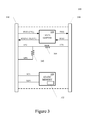
  • FIG. 3 shows a block diagram of a HDMI cable adapted for debugging, in accordance with one embodiment of the present technology.
  • FIG. 4 shows a muxed HDMI for use in a debugging system, in accordance with one embodiment of the present technology.
  • routines, modules, logic blocks, and other symbolic representations of operations on data within one or more electronic devices are presented in terms of routines, modules, logic blocks, and other symbolic representations of operations on data within one or more electronic devices.
  • the descriptions and representations are the means used by those skilled in the art to most effectively convey the substance of their work to others skilled in the art.
  • a routine, module, logic block and/or the like is herein, and generally, conceived to be a self-consistent sequence of processes or instructions leading to a desired result.
  • the processes are those including physical manipulations of physical quantities.
  • these physical manipulations take the form of electric or magnetic signals capable of being stored, transferred, compared and otherwise manipulated in an electronic device.
  • these signals are referred to as data, bits, values, elements, symbols, characters, terms, numbers, strings, and/or the like with reference to embodiments of the present technology.
  • the use of the disjunctive is intended to include the conjunctive.
  • the use of definite or indefinite articles is not intended to indicate cardinality.
  • a reference to “the” object or “a” object is intended to denote also one of a possible plurality of such objects. It is also to be understood that the phraseology and terminology used herein is for the purpose of description and should not be regarded as limiting.
  • Embodiments of the present technology are directed toward using an HDMI port of a device having a single USB port to allow debugging by a second computing device.
  • the techniques multiplex the use of the HDMI port to allow debugging of the device without increasing the number of USB ports.
  • the exemplary computing platform may include one or more central processing units (CPUs) 105 , one or more graphics processing units (GPUs) (not shown), volatile and/or non-volatile memory (e.g., computer readable media) 110 , 115 , a input/output controller hub 120 , one or more internal peripheral devices 125 , 130 , one or more HDMI ports 134 , and a single USB port communicatively coupled by one or more busses.
  • CPUs central processing units
  • GPUs graphics processing units
  • volatile and/or non-volatile memory e.g., computer readable media
  • the input/output controller hub 120 is adapted to communicate data and instructions between the CPU 105 , the computing device-readable media 110 , 115 , the one or more internal peripheral devices 125 , 130 , the one or more HDMI ports 134 , and the single USB port.
  • the internal peripheral devices 125 , 130 may include a display 125 , a keyboard 130 , a pointing device, a speaker, a microphone, a wireless network radio (e.g., WIFI card) and/or the like.
  • the computing device-readable media 110 , 115 may be characterized as primary memory and secondary memory.
  • the secondary memory such as a solid state (e.g., flash memory), magnetic and/or optical mass storage, provides for non-volatile storage of computer-readable instructions and data for use by the computing device.
  • the flash memory drive 115 may store the operating system (OS) 150 , applications (e.g., programs, drivers, routines, utilities) and data 155 .
  • the primary memory such as the system memory 110 and/or graphics memory (not shown), provides for volatile storage of computer-readable instructions and data for use by the computing device.
  • the system memory 110 may temporarily store all or a portion of the operating system 150 ′, and all or a portion of one or more applications and associated data 155 ′ that are currently used by the CPU 105 , GPU and the like.
  • the input/output controller hub 120 may be implemented as an integral sub-circuit (e.g., single IC chip), or as one or more sub-circuits (e.g., a plurality of IC chips, such as a north and south bridge chip set).
  • the input/output controller hub 120 may include a display engine 122 , a USB controller 124 , memory controllers, other peripheral controllers, and/or the like.
  • the display engine 120 may include a muxed HDMI controller 122 .
  • the muxed HDMI controller 122 may be implemented as a single sub-circuit (e.g., system-on-a-chip (SOIC)) or as one or more sub-circuit.
  • SOIC system-on-a-chip
  • the muxed HDMI controller 210 may include a universal asynchronous receiver/transmitter (UART) 212 , an HDMI module 214 and an isolation/level shifter circuit 216 . It is appreciated that the muxed HDMI controller 210 may be implemented by one or more separate and/or integral sub-circuits.
  • the UART 212 and HDMI module 214 may be implemented by a system-on-an-integrated-circuit (SOIC), while the isolation/level shifter circuit 216 may be implemented by a separate integrated circuit, such as Texas Instrument's TX0102 voltage translation circuit IC.
  • SOIC system-on-an-integrated-circuit
  • the circuit isolation and/or signal level shifting of the isolation/level shifter circuit 216 may be controlled by an output enable signal from the UART 212 .
  • the functional blocks of the muxed HDMI controller 210 may be implemented in any other of a number of arrangements of separate and/or integral sub-circuits in accordance with embodiments of the present technology.
  • the HDMI controller provides connections at the HDMI port 135 that include a consumer electronics control (CEC) line (e.g., serial output (TXD)), a serial input (RXD) (also known as the reserved, utility or HEC—according to the HDMI standard), ground (not shown) and power lines, a hot plug detect line, a display data channel bus (e.g., transition minimized differential signaling (TMDS) lines), and serial clock line (SCL) and serial data lines (SDA).
  • CEC consumer electronics control
  • TXD serial output
  • RXD serial input
  • ground not shown
  • power lines e.g., ground (not shown) and power lines
  • a hot plug detect line e.g., a display data channel bus (e.g., transition minimized differential signaling (TMDS) lines), and serial clock line (SCL) and serial data lines (SDA).
  • TMDS transition minimized differential signaling
  • SCL serial clock line
  • SDA serial data lines
  • the muxed HDMI controller 210 is also adapted to transmit and receive debugging commands and data through the HDMI port 135 .
  • the HDMI module 214 detects a hot plug device signal on the HPD line, the HDMI module 214 reads extended display identification data (EDID) across the SCL and SDA lines. If the EDID is a unique code indicating a “debug” cable or hostdevice, the HDMI module 214 disables (e.g., high impedance state) the display data channel bus (e.g., transition minimized differential signaling (TMDS) lines). Thereafter, the debug commands and data are transmitted and received across the serial input (RXD) and output (TXD) lines of the HDMI port 135 by the UART 212 and isolation/level shifter circuit 216 .
  • EDID extended display identification data
  • TMDS transition minimized differential signaling
  • the serial input (RXD) and output (TXD) lines are left in a high impedance state, and the line level is typically used at 1.8V, although any voltage is usable. If another line level is appropriate, the signals on the serial input (RXD) and output (TXD) lines are line leveled with one of the other voltages commonly used by the HDMI connector for these pins. To avoid incompatibility with a conventional HDMI cable assembly that is being inserted into the socket, the outputs of the isolation/level shifter circuit 216 are held in a high impedance state until such time as the muxed HDMI controller 210 enables the debugging state.
  • the HDMI cable includes an HDMI connector 310 , a consumer electronics control (CEC) line (e.g., serial output (TXD)), a serial input (RXD), ground (not shown) and power (e.g., 5V) lines, a hot plug detect (HPD) line, SCL and SDA lines, static memory 320 and a debug connector 330 .
  • CEC consumer electronics control
  • TXD serial output
  • RXD serial input
  • HPD hot plug detect
  • SCL and SDA static memory
  • static memory 320 static memory
  • debug connector 330 e.g., static memory 320
  • the HPD line is coupled to provide a pull-up 340 to the power line.
  • a resistive element may provide the pull-up 340 from the HPD line to the power line.
  • the static memory 320 such as a 12C EEPROM or ROM, is coupled to the SCL and SDA lines.
  • the static memory 320 includes a unique EDID code 322 indicating a “debug” host mode/device.
  • the HDMI cable may optionally include a level shifter circuit 350 in the consumer electronics control (CEC line (e.g., serial output (TXD)) and the serial input (RXD) line.
  • the optional level shifter circuit 340 is adapted to translate the voltage line levels from one logic level to another.
  • One or more lines of the HDMI cable may optionally include short circuit protection 360 , such as a resistive element.
  • the debug connector 330 may be any conventional connector, such as a DB-9 connector, for coupling to a host debugging computing, system. If the cable is designed for use with a TTL compatible serial device such as another UART, then the signals could be passed through the cable without further electrical modification. In another implementation, a RS232 level converter can be used such that the serial connection is then made available with personal computer (PC) compatible signaling levels still using passive components that require no configuration.
  • PC personal computer
  • FIG. 4 shows a muxed HDMI for use in a debugging system.
  • the system includes a target computing device 100 communicatively coupled by an HDMI cable adapted for debugging 300 to a host debugging computing device 410 .
  • the target debug computing device 100 includes a single USB port 140 , and an HDMI port 135 .
  • a muxed HDMI controller 212 - 216 of the target computing device 110 detects a hot plug detect signal when the HDMI cable adapted for debugging 300 is coupled to its HDMI port 135 .
  • the conventional hot plug detection circuitry is used allowing unchanged design from a platform that does not support muxed HDMI debugging.
  • the muxed HDMI controller 212 - 216 of the target computing device 100 reads an EDID code across the SCL and SDA lines from a static memory 320 of the HDMI cable assembly 300 .
  • the unique EDID code indicates the presence of an HDMI cable adapted for debugging and/or a “debug” host device, and not to standard HDMI sink.
  • the static memory may optionally include information about the cable to allow for further configuration of the debug host 410 .
  • the muxed HDMI controller 212 - 216 In response to the “debug” cable/host device EDID code, the muxed HDMI controller 212 - 216 disables the TMDS data bus.
  • the muxed HDMI controller 212 - 216 also enables transmission and receipt of debug commands and data across the consumer electronics control (CEC) line (e.g., serial output (TXD)) and the serial input (RXD) line, in response to the “debug” host mode/device EDID code.
  • the debugging computing device 410 may be acting substantially similar to a USB host and the target computing device 100 may be acting substantially similar to a USB slave/bridge device.
  • embodiments of the present technology advantageously allow debugging a device without increasing the number of USB ports that are on the chassis or affecting the final height (z) of the chassis.

Landscapes

  • Engineering & Computer Science (AREA)
  • Theoretical Computer Science (AREA)
  • Physics & Mathematics (AREA)
  • General Physics & Mathematics (AREA)
  • Quality & Reliability (AREA)
  • General Engineering & Computer Science (AREA)
  • Computer Hardware Design (AREA)
  • Information Transfer Systems (AREA)

Abstract

The HDMI debug cable methods and apparatuses are directed toward a means for pulling up a hot plug detect line to a power line. The debug cable methods and apparatuses also include means for providing an extended display identification data (EDID) code indicating a debug cable or debug host device. The debug cable methods and apparatuses also include means for transmitting and receiving debug commands and data.

Description

BACKGROUND OF THE INVENTION
Computing devices have made significant contributions toward the advancement of modern society and are utilized in a number of applications to achieve advantageous results. Numerous devices, such as personal computers, laptop computers, tablet computers, smart phones and the like are directed toward specific markets and applications. For example, there are relatively large desktop personal computers for use in home and office. The desktop PCs are generally able to operate with a large number of external peripheral devices, such as monitors, keyboards, pointing devices, printers, cameras, speakers and the like. The desktop PC are generally adapted to be readily expanded and/or upgraded. Laptop computers, tablet computers and smart phones provide increasing portability but generally are adapted to support fewer external peripheral devices, particularly at any given time and it generally is more difficult to upgrade or expand the devices.
Most conventional computing devices include a plurality of ports for communicating with one or more peripheral device and/or one or more other devices. For example, a conventional laptop computer may include an HDMI port, a DVI port, a plurality of USB ports, an Ethernet port, a WIFI transceiver, and/or the like. A conventional tablet computer may include one HDMI port, one USB port, a WIFI transceiver and/or the like. Typically, the smaller the form fact of the computing device, the less communication ports are included.
Usually one or more peripherals such as a keyboard, a pointing device, speakers, a camera, a storage device and the like are coupled to the computing device through the USB port of the computing device. At times the operation of the computing device or between the computing device and one or more USB coupled peripheral device, and/or software running on the computing device or USB peripheral may experience problems. In a conventional computing device having a plurality of USB ports, one of the ports may be used to debug the problem. In such case, one USB port can be used for normal USB operations while a debug platform can be coupled to another USB port for debugging the software or hardware of the computing device.
SUMMARY OF THE INVENTION
The present technology may best be understood by referring to the following description and accompanying drawings that are used to illustrate embodiments of the present technology.
Embodiments of the present technology are directed toward cables adapted for multiplexing debug commands and data on a high-definition multimedia interface (HDMI) when a computing device includes a single universal serial bus (USB). In one embodiment, the a high-definition multimedia interface (HDMI) cable includes a pull up from a hot plug detect line to a power line, a static memory including an extended display identification data (EDID) code indicating a debug cable or debug host device, and serial input (RXD) and a serial output (TXD) lines.
In another embodiment, a high-definition multimedia interface (HDMI) cable includes a pull up from an HDMI hot plug detect line to an HDMI power line, a static memory to receive a query and output an extended display identification data (EDID) code indicating a debug cable or debug host device on an HDMI SCL line and an HDMI SDA lines, and an HDMI serial input (RXD) line and an HDMI serial output (TXD) line to transmit and receive debug commands and data.
BRIEF DESCRIPTION OF THE DRAWINGS
Embodiments of the present technology are illustrated by way of example and not by way of limitation, in the figures of the accompanying drawings and in which like reference numerals refer to similar elements and in which:
FIG. 1 shows a block diagram of an exemplary computing device, in accordance with one embodiment of the present technology.
FIG. 2 shows a block diagram of a display engine with muxed HDMI controller, in accordance with one embodiment of the present technology.
FIG. 3 shows a block diagram of a HDMI cable adapted for debugging, in accordance with one embodiment of the present technology.
FIG. 4 shows a muxed HDMI for use in a debugging system, in accordance with one embodiment of the present technology.
DETAILED DESCRIPTION OF THE INVENTION
Reference will now be made in detail to the embodiments of the present technology, examples of which are illustrated in the accompanying drawings. While the present technology will be described in conjunction with these embodiments, it will be understood that they are not intended to limit the invention to these embodiments. On the contrary, the invention is intended to cover alternatives, modifications and equivalents, which may be included within the scope of the invention as defined by the appended claims. Furthermore, in the following detailed description of the present technology, numerous specific details are set forth in order to provide a thorough understanding of the present technology. However, it is understood that the present technology may be practiced without these specific details. In other instances, well-known methods, procedures, components, and circuits have not been described in detail as not to unnecessarily obscure aspects of the present technology.
Some embodiments of the present technology which follow are presented in terms of routines, modules, logic blocks, and other symbolic representations of operations on data within one or more electronic devices. The descriptions and representations are the means used by those skilled in the art to most effectively convey the substance of their work to others skilled in the art. A routine, module, logic block and/or the like, is herein, and generally, conceived to be a self-consistent sequence of processes or instructions leading to a desired result. The processes are those including physical manipulations of physical quantities. Usually, though not necessarily, these physical manipulations take the form of electric or magnetic signals capable of being stored, transferred, compared and otherwise manipulated in an electronic device. For reasons of convenience, and with reference to common usage, these signals are referred to as data, bits, values, elements, symbols, characters, terms, numbers, strings, and/or the like with reference to embodiments of the present technology.
It should be borne in mind, however, that all of these terms are to be interpreted as referencing physical manipulations and quantities and are merely convenient labels and are to be interpreted further in view of terms commonly used in the art. Unless specifically stated otherwise as apparent from the following discussion, it is understood that through discussions of the present technology, discussions utilizing the terms such as “receiving,” and/or the like, refer to the actions and processes of an electronic device such as an electronic computing device that manipulates and transforms data. The data is represented as physical (e.g., electronic) quantities within the electronic device's logic circuits, registers, memories and/or the like, and is transformed into other data similarly represented as physical quantities within the electronic device.
In this application, the use of the disjunctive is intended to include the conjunctive. The use of definite or indefinite articles is not intended to indicate cardinality. In particular, a reference to “the” object or “a” object is intended to denote also one of a possible plurality of such objects. It is also to be understood that the phraseology and terminology used herein is for the purpose of description and should not be regarded as limiting.
Embodiments of the present technology are directed toward using an HDMI port of a device having a single USB port to allow debugging by a second computing device. The techniques multiplex the use of the HDMI port to allow debugging of the device without increasing the number of USB ports.
Referring now to FIG. 1, an exemplary computing device, in accordance with one embodiment of the present technology, is shown. The exemplary computing platform may include one or more central processing units (CPUs) 105, one or more graphics processing units (GPUs) (not shown), volatile and/or non-volatile memory (e.g., computer readable media) 110, 115, a input/output controller hub 120, one or more internal peripheral devices 125, 130, one or more HDMI ports 134, and a single USB port communicatively coupled by one or more busses. The input/output controller hub 120 is adapted to communicate data and instructions between the CPU 105, the computing device- readable media 110, 115, the one or more internal peripheral devices 125, 130, the one or more HDMI ports 134, and the single USB port. The internal peripheral devices 125, 130 may include a display 125, a keyboard 130, a pointing device, a speaker, a microphone, a wireless network radio (e.g., WIFI card) and/or the like.
The computing device- readable media 110, 115, may be characterized as primary memory and secondary memory. Generally, the secondary memory, such as a solid state (e.g., flash memory), magnetic and/or optical mass storage, provides for non-volatile storage of computer-readable instructions and data for use by the computing device. For instance, the flash memory drive 115 may store the operating system (OS) 150, applications (e.g., programs, drivers, routines, utilities) and data 155. The primary memory, such as the system memory 110 and/or graphics memory (not shown), provides for volatile storage of computer-readable instructions and data for use by the computing device. For instance, the system memory 110 may temporarily store all or a portion of the operating system 150′, and all or a portion of one or more applications and associated data 155′ that are currently used by the CPU 105, GPU and the like.
The input/output controller hub 120 may be implemented as an integral sub-circuit (e.g., single IC chip), or as one or more sub-circuits (e.g., a plurality of IC chips, such as a north and south bridge chip set). The input/output controller hub 120 may include a display engine 122, a USB controller 124, memory controllers, other peripheral controllers, and/or the like. The display engine 120 may include a muxed HDMI controller 122. The muxed HDMI controller 122 may be implemented as a single sub-circuit (e.g., system-on-a-chip (SOIC)) or as one or more sub-circuit. Referring now to FIG. 2, a display engine 122 with muxed HDMI controller 210, in accordance with one embodiment of the present technology, is shown. The muxed HDMI controller 210 may include a universal asynchronous receiver/transmitter (UART) 212, an HDMI module 214 and an isolation/level shifter circuit 216. It is appreciated that the muxed HDMI controller 210 may be implemented by one or more separate and/or integral sub-circuits. For example, the UART 212 and HDMI module 214 may be implemented by a system-on-an-integrated-circuit (SOIC), while the isolation/level shifter circuit 216 may be implemented by a separate integrated circuit, such as Texas Instrument's TX0102 voltage translation circuit IC. The circuit isolation and/or signal level shifting of the isolation/level shifter circuit 216 may be controlled by an output enable signal from the UART 212. However, it is further appreciated that the functional blocks of the muxed HDMI controller 210 may be implemented in any other of a number of arrangements of separate and/or integral sub-circuits in accordance with embodiments of the present technology.
In accordance with the applicable standards, the HDMI controller provides connections at the HDMI port 135 that include a consumer electronics control (CEC) line (e.g., serial output (TXD)), a serial input (RXD) (also known as the reserved, utility or HEC—according to the HDMI standard), ground (not shown) and power lines, a hot plug detect line, a display data channel bus (e.g., transition minimized differential signaling (TMDS) lines), and serial clock line (SCL) and serial data lines (SDA). The muxed HDMI controller 210 may transmit and receive display and control commands and data through the HDMI port 135 in accordance with the conventional HDMI standards.
The muxed HDMI controller 210 is also adapted to transmit and receive debugging commands and data through the HDMI port 135. When the HDMI module 214 detects a hot plug device signal on the HPD line, the HDMI module 214 reads extended display identification data (EDID) across the SCL and SDA lines. If the EDID is a unique code indicating a “debug” cable or hostdevice, the HDMI module 214 disables (e.g., high impedance state) the display data channel bus (e.g., transition minimized differential signaling (TMDS) lines). Thereafter, the debug commands and data are transmitted and received across the serial input (RXD) and output (TXD) lines of the HDMI port 135 by the UART 212 and isolation/level shifter circuit 216.
To conserve power when not debugging, the serial input (RXD) and output (TXD) lines are left in a high impedance state, and the line level is typically used at 1.8V, although any voltage is usable. If another line level is appropriate, the signals on the serial input (RXD) and output (TXD) lines are line leveled with one of the other voltages commonly used by the HDMI connector for these pins. To avoid incompatibility with a conventional HDMI cable assembly that is being inserted into the socket, the outputs of the isolation/level shifter circuit 216 are held in a high impedance state until such time as the muxed HDMI controller 210 enables the debugging state.
Referring, now to FIG. 3, a block diagram of a HDMI cable assembly adapted for debugging, in accordance with one embodiment of the present technology, is shown. The HDMI cable includes an HDMI connector 310, a consumer electronics control (CEC) line (e.g., serial output (TXD)), a serial input (RXD), ground (not shown) and power (e.g., 5V) lines, a hot plug detect (HPD) line, SCL and SDA lines, static memory 320 and a debug connector 330. The HPD line is coupled to provide a pull-up 340 to the power line. In one implementation, a resistive element may provide the pull-up 340 from the HPD line to the power line. The static memory 320, such as a 12C EEPROM or ROM, is coupled to the SCL and SDA lines. The static memory 320 includes a unique EDID code 322 indicating a “debug” host mode/device. The HDMI cable may optionally include a level shifter circuit 350 in the consumer electronics control (CEC line (e.g., serial output (TXD)) and the serial input (RXD) line. The optional level shifter circuit 340 is adapted to translate the voltage line levels from one logic level to another. One or more lines of the HDMI cable may optionally include short circuit protection 360, such as a resistive element. The debug connector 330 may be any conventional connector, such as a DB-9 connector, for coupling to a host debugging computing, system. If the cable is designed for use with a TTL compatible serial device such as another UART, then the signals could be passed through the cable without further electrical modification. In another implementation, a RS232 level converter can be used such that the serial connection is then made available with personal computer (PC) compatible signaling levels still using passive components that require no configuration.
Embodiments of the present technology will be further explained with reference to FIG. 4, which shows a muxed HDMI for use in a debugging system. The system includes a target computing device 100 communicatively coupled by an HDMI cable adapted for debugging 300 to a host debugging computing device 410. The target debug computing device 100 includes a single USB port 140, and an HDMI port 135. A muxed HDMI controller 212-216 of the target computing device 110 detects a hot plug detect signal when the HDMI cable adapted for debugging 300 is coupled to its HDMI port 135. The conventional hot plug detection circuitry is used allowing unchanged design from a platform that does not support muxed HDMI debugging. In response to the HPD signal, the muxed HDMI controller 212-216 of the target computing device 100 reads an EDID code across the SCL and SDA lines from a static memory 320 of the HDMI cable assembly 300. The unique EDID code indicates the presence of an HDMI cable adapted for debugging and/or a “debug” host device, and not to standard HDMI sink. In addition to detecting that there is a HDMI cable adapted for debugging present, the static memory may optionally include information about the cable to allow for further configuration of the debug host 410.
In response to the “debug” cable/host device EDID code, the muxed HDMI controller 212-216 disables the TMDS data bus. The muxed HDMI controller 212-216 also enables transmission and receipt of debug commands and data across the consumer electronics control (CEC) line (e.g., serial output (TXD)) and the serial input (RXD) line, in response to the “debug” host mode/device EDID code. In such case the debugging computing device 410 may be acting substantially similar to a USB host and the target computing device 100 may be acting substantially similar to a USB slave/bridge device.
Accordingly, embodiments of the present technology advantageously allow debugging a device without increasing the number of USB ports that are on the chassis or affecting the final height (z) of the chassis.
The foregoing descriptions of specific embodiments of the present technology have been presented for purposes of illustration and description. They are not intended to be exhaustive or to limit the invention to the precise forms disclosed, and obviously many modifications and variations are possible in light of the above teaching. The embodiments were chosen and described in order to best explain the principles of the present technology and its practical application, to thereby enable others skilled in the art to best utilize the present technology and various embodiments with various modifications as are suited to the particular use contemplated. It is intended that the scope of the invention be defined by the claims appended hereto and their equivalents.

Claims (12)

What is claimed is:
1. A system comprising:
an high definition multimedia interface (HDMI) cable including;
a pull up from a hot plug detect (HPD) line of the HDMI cable to a power line of the HDMI cable;
a static memory on a serial clock line (SCL) of the HDMI cable and serial data line (SDA) of the HDMI cable, wherein the static memory includes an extended display identification data (EDID) code indicating a debug cable or debug host device;
a serial input (RXD) line of the cable; and
a serial output (TXD) line of the HDMI cable; and
an HDMI controller including:
an HDMI module communicatively coupled to the HPD line, a display data channel bus, the SCL, and SDA of the electrical HDMI cable, wherein the HDMI module reads the EDID code when a hot plug device signal is detected on the HPD line and wherein the HDMI module disables the display data channel bus if the EDID code indicates a debug cable or debug host device.
2. The system of claim 1, wherein the HDMI cable further includes a level shifter circuit coupled on the serial input (RXD) and serial output (TXD) between HDMI connector and a debug connect.
3. The system of claim 1, further comprising a short circuit protection coupled on one or more lines of the HDMI cable.
4. The system of claim 3, wherein the short circuit protection comprises a resistive element.
5. The system of claim 1, wherein the pull-up comprises a resistive element.
6. The system of claim 1, wherein the HDMI controller further includes an isolation circuit communicatively coupled to the RXD line and TXD line of the electrical HDMI cable, wherein the isolation circuit holds the RXD line and TXD line in a high impedance state until the HDMI controller enables a debugging state if the EDID code indicates the debug cable or debug host device.
7. A high-definition multimedia interface (HDMI) debug system comprising:
a means for polling up a hot plug detect line to a power line on an HDMI cable;
a means for providing an extended display identification data (EDID) code on a serial clock line (SCL) and serial data line (SDA) of the HDMI cable, wherein the EDID code indicates a debug cable or debug host device;
a means for reading the EDID code by an HDMI controller when a hot plug device signal is detected on the HPD line by the HDMI controller;
a means for disabling a display data channel bus by the HDMI controller if the EDID code read by the HDMI controller indicates the debug cable or debug host device; and
a means for transmitting and receiving debug commands and data on the HDMI cable in response to providing the EDID code by the HDMI cable indicating the debug cable or debug host device.
8. The HDMI debug system according to claim 7, further comprising a means for level shifting the transmitted and received debug commands and data on the HDMI cable.
9. The HDMI system according to claim 7, further comprising a means for short circuit protecting one or more lines of the HDMI cable.
10. The HDMI debug system according to claim 7, further comprising a means for holding the RXD line and TXD line in a high impedance state by the HDMI controller until a debugging state is enable in response to the EDID code read by the HDMI controller indicating the debug cable or debut host device.
11. An electrical high-definition multimedia interface (HDMI) cable comprising:
a pull up between a hot plug detect (HPD) line to an power line on the electrical HDMI cable to provide a HPD signal from the electrical HDMI cable to a HDMI controller;
a static memory of the electrical HDMI cable to receive a query from the HDMI controller and output an extended display identification data (EDID) code indicating a debug cable or debug host device on an SCL line and an SDA line of the electrical HDMI cable in response to the HDMI controller detecting the HPD signal; and
a serial input (RXD) line and a serial output (TXD) line of the electrical HDMI cable to transmit and receive debug commands and data a debugging state, and wherein the RXD line and TXD line are held in an high impedance state by the HDMI controller after the EDID code indicates the debug cable or debug host device output on the SCL line and SDA line until the debugging state is enabled.
12. The electrical HDMI cable of claim 11, further comprising a level shifter circuit coupled on the serial input (RXD) line and the serial output (TXD) line of the electrical HDMI cable.
US13/223,017 2011-08-31 2011-08-31 HDMI-muxed debug cable methods and apparatuses Active 2031-10-04 US8856744B2 (en)

Priority Applications (2)

Application Number Priority Date Filing Date Title
US13/223,017 US8856744B2 (en) 2011-08-31 2011-08-31 HDMI-muxed debug cable methods and apparatuses
TW101131127A TWI493335B (en) 2011-08-31 2012-08-28 Hdmi-muxed debug cable methods and apparatuses

Applications Claiming Priority (1)

Application Number Priority Date Filing Date Title
US13/223,017 US8856744B2 (en) 2011-08-31 2011-08-31 HDMI-muxed debug cable methods and apparatuses

Publications (2)

Publication Number Publication Date
US20130048372A1 US20130048372A1 (en) 2013-02-28
US8856744B2 true US8856744B2 (en) 2014-10-07

Family

ID=47742014

Family Applications (1)

Application Number Title Priority Date Filing Date
US13/223,017 Active 2031-10-04 US8856744B2 (en) 2011-08-31 2011-08-31 HDMI-muxed debug cable methods and apparatuses

Country Status (2)

Country Link
US (1) US8856744B2 (en)
TW (1) TWI493335B (en)

Cited By (4)

* Cited by examiner, † Cited by third party
Publication number Priority date Publication date Assignee Title
US9003369B2 (en) 2011-08-31 2015-04-07 Nvidia Corporation HDMI-muxed debug port methods and apparatuses
US10535961B2 (en) 2016-04-26 2020-01-14 Ryan E. Cote Electrical cables having integrated and manually controllable identification and illumination light sources
US10817405B2 (en) 2018-01-19 2020-10-27 Samsung Electronics Co., Ltd. Storage device and debugging system thereof
US11989150B2 (en) 2019-10-18 2024-05-21 Autel Intelligent Technology Corp., Ltd. Interface circuit, and method and apparatus for interface communication thereof

Families Citing this family (7)

* Cited by examiner, † Cited by third party
Publication number Priority date Publication date Assignee Title
US9274992B2 (en) * 2013-07-19 2016-03-01 Lattice Semiconductor Corporation Cable with circuitry for communicating performance information
US9870301B2 (en) * 2014-03-31 2018-01-16 Intel Corporation High-speed debug port using standard platform connectivity
CN108804274A (en) * 2017-04-26 2018-11-13 精英电脑股份有限公司 error detection device
JP2019046066A (en) * 2017-08-31 2019-03-22 株式会社東芝 Electronic device and cable
CN112419952B (en) * 2019-08-21 2022-04-26 京东方科技集团股份有限公司 Shifting register, driving method thereof and grid driving circuit
US12051389B2 (en) * 2021-01-05 2024-07-30 Lg Electronics Inc. Display device
CN117055966B (en) * 2023-10-13 2024-09-20 深圳中微电科技有限公司 HDMI-based hot plug detection and processing method, device and storage medium

Citations (5)

* Cited by examiner, † Cited by third party
Publication number Priority date Publication date Assignee Title
US20040027515A1 (en) * 2002-08-09 2004-02-12 Nec-Mitsubishi Electric Visual Systems Corporation Display apparatus, display system and cable
US20050182876A1 (en) * 2004-02-18 2005-08-18 Silicon Image, Inc. Cable with circuitry for asserting stored cable data or other information to an external device or user
US20060031611A1 (en) * 2004-08-05 2006-02-09 Sumitomo Electric Industries, Ltd. Digital video signal interface module
US20060277586A1 (en) * 2005-05-20 2006-12-07 Fuji Xerox Co., Ltd. Signal communication apparatus and signal communication system
US20120064758A1 (en) * 2010-09-09 2012-03-15 Grice Michael E HDMI Plug and Cable Assembly

Family Cites Families (3)

* Cited by examiner, † Cited by third party
Publication number Priority date Publication date Assignee Title
TWI301699B (en) * 2005-10-18 2008-10-01 Sunplus Technology Co Ltd Transmitting circuit, receiving circuit, interface switching module and interface switching method for sata and sas interface
EP2090955B1 (en) * 2006-11-07 2016-01-27 Sony Corporation Electronic apparatus and cable device
CN101282413A (en) * 2008-04-11 2008-10-08 青岛海信电器股份有限公司 HDMI serial port communication circuit

Patent Citations (5)

* Cited by examiner, † Cited by third party
Publication number Priority date Publication date Assignee Title
US20040027515A1 (en) * 2002-08-09 2004-02-12 Nec-Mitsubishi Electric Visual Systems Corporation Display apparatus, display system and cable
US20050182876A1 (en) * 2004-02-18 2005-08-18 Silicon Image, Inc. Cable with circuitry for asserting stored cable data or other information to an external device or user
US20060031611A1 (en) * 2004-08-05 2006-02-09 Sumitomo Electric Industries, Ltd. Digital video signal interface module
US20060277586A1 (en) * 2005-05-20 2006-12-07 Fuji Xerox Co., Ltd. Signal communication apparatus and signal communication system
US20120064758A1 (en) * 2010-09-09 2012-03-15 Grice Michael E HDMI Plug and Cable Assembly

Non-Patent Citations (6)

* Cited by examiner, † Cited by third party
Title
"Communication interface circuit for on-line emulation and debugging, has set of sending/receiving switching channels in protocol level shifter circuit, and channel's output end connected with serial port's data receiving terminal" CN 200976142 Y, Nov. 14, 2007. *
Debugging-Wikipedia, the free encyclopedia, Aug. 23, 2011, http://web.archive.org/web/20110913013559/http://en.wikipedia.org/wiki/Debugging. *
Debugging—Wikipedia, the free encyclopedia, Aug. 23, 2011, http://web.archive.org/web/20110913013559/http://en.wikipedia.org/wiki/Debugging. *
Digital Visual Interface-Wikepedia, the three encyclopedia, Feb. 9, 2010, http://web.archive.org/web/20100209004631/http://en.wikipedia.org/wiki/Digital-Visual-Interface. *
Digital Visual Interface—Wikepedia, the three encyclopedia, Feb. 9, 2010, http://web.archive.org/web/20100209004631/http://en.wikipedia.org/wiki/Digital—Visual—Interface. *
HDMI-based debug module, Leonard Tsai, Jan. 2011, Research Disclosure databased No. 561059. *

Cited By (4)

* Cited by examiner, † Cited by third party
Publication number Priority date Publication date Assignee Title
US9003369B2 (en) 2011-08-31 2015-04-07 Nvidia Corporation HDMI-muxed debug port methods and apparatuses
US10535961B2 (en) 2016-04-26 2020-01-14 Ryan E. Cote Electrical cables having integrated and manually controllable identification and illumination light sources
US10817405B2 (en) 2018-01-19 2020-10-27 Samsung Electronics Co., Ltd. Storage device and debugging system thereof
US11989150B2 (en) 2019-10-18 2024-05-21 Autel Intelligent Technology Corp., Ltd. Interface circuit, and method and apparatus for interface communication thereof

Also Published As

Publication number Publication date
TWI493335B (en) 2015-07-21
US20130048372A1 (en) 2013-02-28
TW201324133A (en) 2013-06-16

Similar Documents

Publication Publication Date Title
US8856744B2 (en) HDMI-muxed debug cable methods and apparatuses
US9003369B2 (en) HDMI-muxed debug port methods and apparatuses
US10216683B2 (en) Multimedia communication apparatus and control method for multimedia data transmission over standard cable
US11624788B2 (en) Display module test platform
US7921233B2 (en) Signal converter for an all-in-one USB connector that includes USB 2.0, USB 3.0 and eSATA
US10289584B2 (en) Using a standard USB Type-C connector to communicate both USB 3.x and displayport data
CN103563334B (en) Method, Apparatus and system for audio/video devices conversion between source module and trap pattern
US20160004287A1 (en) Portable electronic device and power management method thereof
JP5009519B2 (en) Virtual extended display identification data (EDID) in flat panel controller
EP2040174B1 (en) Card-type peripheral device
US11609622B2 (en) Ground and supply cable compensation architecture for USB power delivery subsystem
US11151065B2 (en) Method for performing detection control of write protection function of memory device, associated control chip and associated electronic device
US7839409B2 (en) Acquisition of extended display identification data (EDID) using inter-IC (I2C) protocol
US20060082586A1 (en) Arbitration for acquisition of extended display identification data (EDID)
US9710875B2 (en) Image transmission apparatus and image processing method thereof
US20060082570A1 (en) Acquisition of extended display identification data (EDID) in a display controller in a power up mode from a power down mode
JP5107205B2 (en) Display connection adapter and display connection system
US20060091943A1 (en) Automatic activity detection in a display controller
CN104636096A (en) Graphic card and electronic device
US20090153467A1 (en) System and method for connection detection
CN219497051U (en) Master-slave detection circuit and electronics
US20170220069A1 (en) Docking apparatus and control method thereof
CN205068363U (en) Conversion IC who shows signal
CN204129732U (en) Based on the board self-adaptation equipment of satellite time transfer machine frame system
US7353372B2 (en) Detection of support components for add-in card

Legal Events

Date Code Title Description
AS Assignment

Owner name: NVIDIA CORPORATION, CALIFORNIA

Free format text: ASSIGNMENT OF ASSIGNORS INTEREST;ASSIGNOR:OVERBY, MARK ALAN;REEL/FRAME:026841/0283

Effective date: 20110831

STCF Information on status: patent grant

Free format text: PATENTED CASE

MAFP Maintenance fee payment

Free format text: PAYMENT OF MAINTENANCE FEE, 4TH YEAR, LARGE ENTITY (ORIGINAL EVENT CODE: M1551)

Year of fee payment: 4

MAFP Maintenance fee payment

Free format text: PAYMENT OF MAINTENANCE FEE, 8TH YEAR, LARGE ENTITY (ORIGINAL EVENT CODE: M1552); ENTITY STATUS OF PATENT OWNER: LARGE ENTITY

Year of fee payment: 8