US8856200B2 - Exponentiation calculation apparatus and exponentiation calculation method - Google Patents
Exponentiation calculation apparatus and exponentiation calculation method Download PDFInfo
- Publication number
- US8856200B2 US8856200B2 US12/233,626 US23362608A US8856200B2 US 8856200 B2 US8856200 B2 US 8856200B2 US 23362608 A US23362608 A US 23362608A US 8856200 B2 US8856200 B2 US 8856200B2
- Authority
- US
- United States
- Prior art keywords
- values
- calculating unit
- power
- field
- extension field
- Prior art date
- Legal status (The legal status is an assumption and is not a legal conclusion. Google has not performed a legal analysis and makes no representation as to the accuracy of the status listed.)
- Expired - Fee Related, expires
Links
Images




Classifications
-
- G—PHYSICS
- G06—COMPUTING OR CALCULATING; COUNTING
- G06F—ELECTRIC DIGITAL DATA PROCESSING
- G06F7/00—Methods or arrangements for processing data by operating upon the order or content of the data handled
- G06F7/60—Methods or arrangements for performing computations using a digital non-denominational number representation, i.e. number representation without radix; Computing devices using combinations of denominational and non-denominational quantity representations, e.g. using difunction pulse trains, STEELE computers, phase computers
- G06F7/72—Methods or arrangements for performing computations using a digital non-denominational number representation, i.e. number representation without radix; Computing devices using combinations of denominational and non-denominational quantity representations, e.g. using difunction pulse trains, STEELE computers, phase computers using residue arithmetic
- G06F7/724—Finite field arithmetic
- G06F7/726—Inversion; Reciprocal calculation; Division of elements of a finite field
Definitions
- the present invention relates to a exponentiation calculation apparatus and exponentiation calculation method.
- an encryption protocol e.g., an ID based cryptogram, or a short signature
- Pairing using an elliptic curve of a large embedded degree k is effective in terms of safety.
- Tate pairing over a finite field is such mapping as represented by Expression (1).
- q is a power of a prime p
- Fq is a finite field with q elements
- E(Fq) is an elliptic curve defined over the finite field Fq.
- m is coprime to q and it is a positive integer satisfying m
- the symbol ⁇ represents exponentiation operation.
- q ⁇ k represents the kth power of q.
- An embedded degree k is a minimum positive integer satisfying m
- #E represents the number of points of the elliptic curve E (an order of a curve).
- b represents that a is divisor of b.
- Tate pairing over the finite field is mapping of inputting an Fq rational point P on an elliptic curve E (Fq) and an Fq ⁇ k rational point Q on an elliptic curve E(Fq ⁇ k) and outputting an element on Fq ⁇ k.
- a procedure of a pairing calculation consists of the following two steps.
- a value obtained on the first stage is an element of the finite field Fq ⁇ k. Since this value is representation including ambiguity, it is not suitable for use in an encryption protocol. Thus, on the second stage, ambiguity is removed from the value obtained on the first stage.
- the calculation on the first stage will be referred to as a “pairing intermediate value calculation” and a value obtained by the pairing intermediate value calculation will be referred to as a pairing intermediate value. Further, the calculation on the second stage will be referred to as “final exponentiation”. A value obtained by the final exponentiation is a “pairing value” to be acquired.
- the final exponentiation is an operation of raising a pairing intermediate value represented by an element of the finite field Fq ⁇ k to the (q ⁇ k ⁇ 1)/mth power in such a manner that the pairing intermediate value becomes unique as an element in a cyclic group of an order m.
- the pairing value is raised to the (q ⁇ 3 ⁇ 1)(q+1)th power in such a manner that the pairing value becomes unique as an element of the torus T 6 (Fq), and a result is further raised to the (q ⁇ 2 ⁇ q+1)/mth power.
- a calculation result becomes unique representation of a torus T 2 (Fq ⁇ 3) when the pairing value is raised to the (q ⁇ 3 ⁇ 1)th power. Therefore, utilizing a property that the calculation result is an element of the torus T 2 (Fq ⁇ 3) to calculate the remaining (q+1)th power enables increasing the speed. Specifically, the number of times of multiplications in the (q+1)th power calculation can be reduced by using three relational expressions present in a set of input six numbers to replace given multiplications in the calculation by other multiplications.
- a exponentiation calculation apparatus which includes a dividing unit configured to divide an input value as an element of a 2rth degree extension field and as an element of a torus T 2 (Fq ⁇ r) (where r is an odd prime, q is a power of a prime, Fq is a finite field with q elements, and Fq ⁇ r is an rth degree extension field of the finite field Fq) into a first element of the rth degree extension field with r values and a second element of the rth degree extension field with r values, a first calculating unit configured to calculate some multiplications (i.e., multiplications and squares) on a base field based on the r values of the first element and some multiplications (i.e., multiplications and squares) on a base field based on the r values of the second element, in order to obtain a plurality of multiplication results as bases for a calculation of a third element of the r
- a dividing unit configured to divide an
- FIG. 1 is a view showing a structural example of a functional block of a pairing calculation apparatus according to a first embodiment
- FIG. 2 is a view showing a structural example of a functional block of a final exponentiation calculating unit in the pairing calculation apparatus;
- FIG. 3 is a flowchart showing an example of a processing procedure of the pairing calculation apparatus
- FIG. 4 is a view showing a structural example of a functional block of a (q+1)th power calculating unit in the final exponentiation calculating unit;
- FIG. 5 is a flowchart showing an example of a processing procedure of a (q+1)th power calculation according to the first embodiment
- FIG. 6 is a view showing a structural example of a functional block of a signature service system according to a second embodiment
- FIG. 7 is a view showing a structural example of a functional block of a signature service system according to a third embodiment
- FIG. 8 is a view showing a structural example of a functional block of a pairing calculation apparatus according to the third embodiment.
- FIG. 9 is a view showing a structural example of a functional block of a final exponentiation calculating unit in the pairing calculation apparatus.
- FIG. 10 is a view showing a structural example of a functional block of a (q+1)th power calculating unit in the final exponentiation calculating unit.
- This embodiment increases a speed of a calculation of a (q+1)th power which is a part of a final exponentiation corresponding to the second stage of the pairing calculation.
- a pairing calculation apparatus 1 includes a pairing intermediate value calculating unit 100 and a final exponentiation calculating unit 200 .
- Parameters required for the pairing calculation may be set by an appropriate method.
- FIG. 2 shows a structural example of a functional block of the final power calculating section 200 depicted in FIG. 1 .
- the final exponentiation calculating unit 200 includes a (q ⁇ r ⁇ 1)th power calculating unit 201 , a (q+1)th power calculating unit 202 , and a ⁇ 2r(q)/mth power calculating unit 203 .
- ⁇ n(q) is an nth degree cyclotimic polynomial expression.
- an internal structure of the pairing calculation apparatus 1 may be basically the same as a conventional structure except the (q+1)th power calculating unit 202 (especially a portion concerning a Y 0 pre-calculation and a Y 0 calculation which will be explained later) present in the final exponentiation calculating unit 202 .
- the pairing intermediate value calculating unit 100 calculates one pairing intermediate value e(P, Q) with respect to two inputs (P, Q) and outputs the calculated value (step S 1 ).
- An existing algorithm e.g., a Miller algorithm
- Inputs to the pairing intermediate value calculating unit 100 is an Fq rational point P on an elliptic curve E(Fq) defined over a finite field Fq and an Fq ⁇ 2r rational point Q on an elliptic curve E(Fq ⁇ 2r), and an output e(P, Q) from the same is an element of a 2rth degree extension field (Fq ⁇ 2r).
- Fq ⁇ 2r 2rth degree extension field
- an output from the pairing intermediate value calculating unit 100 is an element of a 10th degree extension field (Fq ⁇ 10).
- the final exponentiation calculating unit 200 receives the pairing intermediate value calculated by the pairing intermediate value calculating unit 100 , and executes the final exponentiation with respect to the pairing intermediate value.
- the final exponentiation calculating unit 200 outputs a calculation result of the final exponentiation as a pairing value.
- the (q ⁇ r ⁇ 1)th power calculating unit 201 in the final exponentiation calculating unit 200 raises the element of the 2rth degree extension field (the pairing intermediate value calculated by the pairing intermediate value calculating unit 100 in the structural example depicted in FIG. 2 ) which is input thereto to the (q ⁇ r ⁇ 1)th power (step S 2 ).
- a calculation result of the (q ⁇ r ⁇ 1)th power is also an element of the 2rth degree extension field.
- the (q+1)th power calculating unit 202 raises the element of the 2rth degree extension field which is input thereto (the calculation result obtained by the (q ⁇ r ⁇ 1)th power calculating unit 201 in the structural example depicted in FIG. 2 ) to the (q+1)th power (step S 3 ).
- a calculation result of the (q+1)th power is also an element of the 2rth degree extension field.
- the ⁇ r(q)/mth power calculating unit 203 raises the element of the 2rth degree extension field which is input thereto (the calculation result obtained by the (q+1)th power calculating unit 202 in the structural example depicted in FIG. 2 ) to the ⁇ 2r(q)/mth power (step S 4 ).
- a calculation result of the ⁇ 2r(q)/mth power is also an element of the 2rth degree extension field.
- the pairing intermediate value satisfies properties as pairing but is representation including ambiguity, it is not suitable for use in an encryption protocol.
- the final exponentiation is an operation of raising a pairing intermediate value represented by an element of a finite field Fq ⁇ 2r to the (q ⁇ k ⁇ 1)/mth power in such a manner that the intermediate value becomes unique as an element of a cyclic group of an order m. This operation enables removal of ambiguity from the pairing intermediate value and use in the encryption protocol.
- a calculation result obtained by performing the (q ⁇ r ⁇ 1)th power calculation with respect to a pairing intermediate value as an element of the finite field Fq ⁇ 2r becomes unique representation of a torus T 2 (Fq ⁇ r). Further, a calculation result obtained by raising this calculation result to the (q+1) the power is unique representation of a torus T 2r (Fq).
- a calculation result obtained by raising a pairing intermediate value as an element of a 10th degree extension field (Fq ⁇ 10) to the (q ⁇ 5 ⁇ 1)th power is unique representation of a torus T 2 (fq ⁇ 5).
- a calculation result obtained by raising this calculation result to the (q+1)th power is unique representation of a torus T 10 (Fq).
- the (q ⁇ r ⁇ 1)th power is calculated prior to the (q+1)th power.
- a speed of the calculation of the (q+1)th power is increased by utilizing a property that a calculation result of the (q ⁇ r ⁇ 1)th power becomes unique representation of the torus T 2 (Fq ⁇ r).
- the (q ⁇ r ⁇ 1)th power calculation must be executed before the (q+1)th power calculation as explained above, but an order of execution of the ⁇ 2r(q)/mth power calculation is arbitrary. Therefore, in place of executing the calculations in order of the (q ⁇ r ⁇ 1)th power, the (q+1)th power, and the ⁇ 2r(q)/mth power like the example shown in FIGS. 2 and 3 , the calculations may be executed in order of the (q ⁇ r ⁇ 1)th power, the ⁇ 2r(q)/mth power, and the (q+1)th power, or the calculations may be executed in order of the ⁇ 2r(q)/mth power, the (q ⁇ r ⁇ 1)th power, and the (q+1)th power.
- the structural example depicted in FIG. 2 may be modified. That is, the ⁇ 2r(q)/mth power calculating unit 203 may be placed immediately before the (q+1)th power calculating unit 202 or may be placed immediately before the (q ⁇ r ⁇ 1)th power calculating unit 201 .
- the (q ⁇ r ⁇ 1)th power calculating unit 201 and the ⁇ 2r(q)/mth power calculating unit 203 are independently provided.
- one power calculating unit ((q ⁇ r ⁇ 1) ⁇ 2r(q)/mth power calculating unit) in which the (q ⁇ r ⁇ 1)th power calculating unit 201 is combined with the ⁇ 2r(q)/mth power calculating unit 203 may be provided.
- FIG. 4 shows a structural example of a functional block of the (q+1)th power calculating unit 202 depicted in FIG. 2 .
- the (q+1)th power calculating unit 202 includes a dividing unit 221 , a Y 0 pre-calculating unit 222 , a Y 1 pre-calculating unit 223 , a Y 0 calculating unit 224 , a Y 1 calculating unit 225 , and a coupling unit 226 .
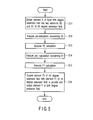
- FIG. 5 shows an example of a processing procedure of the (q+1)th power calculating unit 202 .
- X ( x 1 ,x 2 ,x 3 ,x 4 ,x 5 ,x 6 ,x 7 ,x 8 ,x 9 ,x 10)
- Y ( y 1 ,y 2 ,y 3 ,y 4 ,y 5 ,y 6 ,y 7 ,y 8 ,y 9 ,y 10)
- X 0 , X 1 , Y 0 , and Y 1 are all elements of a fifth degree extension field.
- the dividing unit 221 Upon receiving the element X of the 2rth degree extension field, the dividing unit 221 divides the element X of the 2rth degree extension field into the element X 0 of an rth degree extension field and the element X 1 of the rth degree extension field (step S 11 ).
- the Y 0 pre-calculating unit 222 executes a pre-calculation concerning Y 0 in order to obtain a value that is a basis for calculating the element Y 0 of the rth degree extension field (step S 12 ).
- the Y 0 calculating unit 224 calculates Y 0 by a linear addition of a plurality of arithmetic values obtained by the Y 0 pre-calculating unit 222 (step S 13 ).
- the Y 1 pre-calculating unit 223 executes a pre-calculation concerning Y 1 in order to obtain a value that is a basis for calculating the element Y 1 of the rth degree extension field (step S 14 ).
- a pre-calculation for example, a plurality of multiplications based on the r values included in X 0 and the r values included in X 1 are executed.
- the Y 1 calculating unit 225 calculates Y 1 based on a linear addition of a plurality of arithmetic values obtained by the Y 1 pre-calculating unit 223 (step S 15 ).
- the coupling unit 226 couples the element Y 0 of the rth degree extension field calculated by the Y 0 calculating unit 224 with the element Y 1 of the rth degree extension field calculated by the Y 1 calculating unit 225 to provide the element Y of the 2rth degree extension field, and outputs this element (step S 16 ).
- step S 11 when the step S 11 is first executed, the step S 12 is executed before the step S 13 , the step S 14 is executed before the step S 15 , an the step S 16 is executed at last, an execution order different from that depicted in FIG. 5 may be adopted, or the plurality of steps may be simultaneously executed.
- the (q ⁇ r ⁇ 1)th power calculation is executed before the (q+1)th power calculation.
- its calculation result becomes unique representation of the torus T 2 (Fq ⁇ r).
- a calculation amount can be reduced by utilizing the property that the calculation result of the (q ⁇ r ⁇ 1)th power is the element of the torus T 2 (Fq ⁇ r) to replace several multiplications (i.e., squares) in the Y 0 pre-calculation by other multiplications (i.e., multiplications and squares).
- a primitive polynomial and a base of the 2rth degree extension field are determined in such a manner that Frobenius mapping (a qth power) of an rth degree extension field can represent an arithmetic operation having a smaller calculation amount than a multiplication of elements (e.g., replacement of elements and/or a weighting addition/subtraction of elements).
- a primitive polynomial of a second degree extension field of a fifth degree extension field is set as represented by Expression (2).
- ⁇ is a primitive 11th root of 1
- ⁇ is a square root of ⁇ 1.
- a base is set by using ⁇ and ⁇ . ⁇ ( ⁇ + ⁇ 10 ),( ⁇ 2 + ⁇ 9 ),( ⁇ 3 + ⁇ 8 ),( ⁇ 4 + ⁇ 7 ),( ⁇ 5 + ⁇ 6 ),( ⁇ + ⁇ 10 ) ⁇ ,( ⁇ 2 + ⁇ 9 ) ⁇ ,( ⁇ 3 + ⁇ 8 ) ⁇ ,( ⁇ 4 + ⁇ 7 ) ⁇ ,( ⁇ 5 + ⁇ 6 ) ⁇ (3)
- x 1 to x 10 are elements of a finite field with q elements.
- q is a prime
- each of x 1 to x 10 can be an integer from 0 to q ⁇ 1.
- the element X of the torus T 2 (Fq ⁇ 5 ) has a property that it becomes 1 when raised to the (q ⁇ 5+1)th power.
- r is an odd prime other than 5
- the element X of the torus T 2 (Fq ⁇ r) has a property that it becomes 1 when raised to the (q ⁇ r+1)th power.
- Expression (4) can be provided.
- X 0 2 +X 1 2 1 (4)
- x 5 ⁇ 2+x 10 ⁇ 2, x 1 ⁇ 2+x 6 ⁇ 2, and 3 ⁇ 2+x 8 ⁇ 2 can be replaced by other multiplications by using Expression (6).
- a first term on a right-hand side of Expression (7) is represented as Y 0
- a second term of the same is represented as Y 1 .
- Y 0 (y 1 , y 2 , y 3 , y 4 , y 5 ) is obtained based on the following Expression (8).
- Y 0 (y 1 , y 2 , y 3 , y 4 , y 5 )
- y 1 2 z 11+2 z 23 ⁇ 2 z 4 ⁇ z 9 ⁇ 3 z 7 ⁇ z 10 ⁇ 2 z 16 ⁇ z 21 ⁇ 3 z 19 ⁇ z 22 ⁇ z 2 ⁇ z 14 +z 6 +z 18+4 z 8+4 z 20 ⁇ 2 z 12+2 z 3 ⁇ 2 z 24+2 z
- Using an Fq 5 multiplier to calculate Y 1 can suffice. Since the Y 1 calculating unit 225 does not use a result obtained by the Y 0 calculating unit 224 , the Y 0 calculating unit 224 and the Y 1 calculating unit 225 can execute processing in parallel.
- Y 1 can be obtained based on the following Expression (11).
- y 6 ⁇ 2 x 5 x 6+2 x 10 x 1 ⁇ 2 x 1 x 7+2 x 6 x 2 ⁇ 3 x 4 x 8+3 x 9 x 3 ⁇ 3 x 2 x 9+3 x 7 x 4 ⁇ x 3 x 10 +x 8 x 5 ⁇ x 3 x 6 +x 1 x 8 ⁇ x 3 x 7 +x 2 x 8,
- Y 1 (y 6 , y 7 , y 8 , y 9 , y 10 )
- y 6 ⁇ 2 w 9+2 w 6 ⁇ 3 w 13+3 w 11 +w 14 ⁇ w 7 ⁇ w 10 +w 1 ⁇ w 5
- y 7 ⁇ 3 w 9+2 w 6 ⁇ 3 w 13+2 w 11+3 w 14 ⁇ w 12 ⁇ w 15 ⁇ w 1 +w 2 ⁇ 2 w
- y 8 ⁇ 3 w 9+3 w 6 ⁇ 2 w 13 +w 11+2 w 14 +w 10 +w 12 +w 3 ⁇ w 4 ⁇ w
- y 9 ⁇ 3 w 9 +w 6 ⁇ 2 w 13+2 w 11+3 w 14 +w 7 +w 8 ⁇ w 2 +w 4
- y 10 ⁇ 2 w 9+3 w 6 ⁇ w 13+3 w 11+3 w 11+3 w 11+3 w 11+3 w 11+3 w 11
- the number of times of multiplications for the Y 0 calculation is 30, the number of times of multiplications for the Y 1 calculation is 15, and a total number is 45.
- the number of times of multiplications for the Y 0 calculation is 24, the number of times of multiplications for the Y 1 calculation is 15, and a total number is 39.
- the (q+1)th power calculating unit 202 in this embodiment is a device which calculates an element of the torus T 2 (Fq ⁇ r) raised to the (q+1) the power at a high speed, and hence it can be utilized for other calculations than the final exponentiation of pairing.
- the (q+1)th power calculating unit 202 can be generally used by determining whether the given element is an element of the torus T 2 (Fq ⁇ r) in place of calculating the (q ⁇ r ⁇ 1)th power of the given element.
- Pairing e which is a two-input and one-output function has a property that linearity is achieved with respect to each input (bilinearity) as follows.
- a signature scheme using pairing is disclosed in detail in, e.g., “D. Boneh, B. Lynn and H. Shacham. Short signatures from the Weil pairing. Asiacrypt 2001, LNCS 2248, 514-532, 2001” or “D. Boneh, B. Lynn and H. Shacham. Short signatures from the Weil pairing. J. of Cryptology, Vol. 17, No. 4, 297-319, 2004”.
- a service provider system 50 As shown in FIG. 6 , a service provider system 50 , a signatory system 40 , and a verifier system 10 are present in the signature service system. In this signature service system, a pairing calculation is executed in verification of a signature by the verifier system 10 .
- FIG. 6 shows one signatory system 40 alone, the plurality of signatory systems may be present. Further, although FIG. 6 shows one verifier system 10 alone, the plurality of verifier systems may be present.
- the service provider system 50 and the signatory system 40 can communicate with each other, the service provider system 50 and the verifier system 10 can communicate with each other, and the signatory system 40 and the verifier system 10 can communicate with each other, through a network.
- the network may be, e.g., the Internet.
- Each of the service provider system 50 , the signatory system 40 , and the verifier system 10 can be formed of a computer.
- One terminal may have both a function of the signatory system 40 and a function of the verifier system 10 .
- the signature service system shown in FIG. 6 may basically have the same structure as a conventional structure except for a portion concerning the (q+1)th power calculating unit (see 202 in FIG. 2 ) in the pairing calculation apparatus 1 .
- the signatory system 40 includes a key pair generating unit 41 and a signature generating unit 42 .
- the verifier system 10 includes an input processing unit 11 , the pairing calculation apparatus 1 according to the first embodiment, and a determination unit 12 .
- the service provider system 50 provides necessary system parameter information (e.g., system parameters required for a signature service (e.g., all or some of pairing, an elliptic curve, a finite field, a generation source of a group consisting of rational points of the elliptic curve, a hash function, and others)) to the signatory system 40 and the verifier system 10 .
- system parameters required for a signature service e.g., all or some of pairing, an elliptic curve, a finite field, a generation source of a group consisting of rational points of the elliptic curve, a hash function, and others
- the signature generating unit 42 in the signatory system 40 generates a signature for a message as a signature target. For example, it obtains a hash value h(M) of a message M as a signature target and determines h(M) ⁇ x as a signature.
- the signatory system 40 supplies a public key, a message, and a signature to the verifier system 10 .
- it supplies the public key v, the message M, and the signature h(M) ⁇ x.
- the input processing unit 11 in the verifier system 10 first inputs a first input (P 1 , Q 1 ) to the pairing calculating unit 1 . For example, it inputs (the generation source g, the signature h(M) ⁇ x).
- a first pairing value Ya for the first input is input to the determination unit 12 .
- the input processing unit 11 inputs a second input (P 2 , Q 2 ) to the pairing calculation apparatus 1 . For example, it obtains a hash value h(M) from the acquired message M and inputs (the public key g ⁇ x, the hash value h(M) of the message). A second pairing value Yb for the second input is input to the determination unit 12 .
- FIG. 7 shows a structural example of a functional block of a signature service system according to this embodiment. Furthermore, FIG. 8 shows a structural example of the functional block of the pairing calculation apparatus 1 depicted in FIG. 7 .
- the service provider system 50 includes a system parameter setting unit 51 in addition to the structures depicted in FIG. 6 .
- the system parameter setting unit 51 includes a finite field setting unit 52 .
- the system parameter setting unit 51 sets system parameters required for the signature service (e.g., all or some of pairing, an elliptic curve, a finite field, a generation source of a group consisting of rational points of the elliptic curve, a hash function, and others), and releases them to the public.
- system parameters required for the signature service e.g., all or some of pairing, an elliptic curve, a finite field, a generation source of a group consisting of rational points of the elliptic curve, a hash function, and others
- the finite field setting unit 52 sets parameters of a finite field that allows defining an elliptic curve.
- r (r is an odd prime) may be determined in accordance with security requirements.
- a primitive polynomial and a base of a 2rth degree extension field are determined in such a manner that Frobenius mapping (a qth power) of an rth degree extension field can be represented by an arithmetic operation (e.g., counterchanging of elements and/or weighting addition/subtraction of elements) whose calculation amount is smaller than that of a multiplication of elements.
- Frobenius mapping a qth power
- arithmetic operation e.g., counterchanging of elements and/or weighting addition/subtraction of elements
- the system parameter setting unit 51 does not have to be necessarily operated every time a signature is generated or verified.
- a signatory system 40 includes a parameter storage unit 43 in addition to the structures depicted in FIG. 6 .
- the parameter storage unit 43 stores system parameters required by the signatory system 40 itself in system parameters which are released to the public by the system parameter setting unit 51 in the service provider system 50 and required for the signature service.
- a key pair generating unit 41 and a signature generating unit 42 in the signatory system 40 execute processing based on the parameters stored in the parameter storage unit 43 .
- a verifier system 10 includes a parameter storage unit 13 in addition to the structures depicted in FIG. 6 .
- the parameter storage unit 13 stores system parameters required by the signatory system 40 itself in system parameters which are released to the public by the system parameter setting unit 51 in the service provider system 50 and required for the signature service.
- the input processing unit 11 and (a pairing intermediate value calculating unit 100 and a final exponentiation calculating unit 200 in) the pairing calculation apparatus 1 in the verifier system 10 execute processing based on the parameters stored in the parameter storage unit 13 .
- FIG. 9 shows a structural example of a functional block of the final exponentiation calculating unit 200 in the pairing calculation apparatus 1 .
- the final exponentiation calculating unit 200 includes a finite field arithmetic operation rule storage unit 204 in addition to the structures depicted in FIG. 6 .
- the finite field arithmetic operation rule storage unit 204 stores arithmetic operation rules of a second degree extension field and an rth degree extension field determined based on the primitive polynomial and the base.
- FIG. 10 shows a structural example of a functional block of a (q+1)th power calculating unit 202 depicted in FIG. 9 .
- the (q+1)th power calculating unit 202 includes a parameter storage unit 227 in addition to the structures depicted in FIG. 6 .
- the parameter storage unit 227 stores the primitive polynomial and the base of the 2rth degree extension field.
- the base is determined in such a manner that Frobenius mapping (the qth power) of the rth degree extension field can be represented by an arithmetic operation (e.g., counterchanging of elements and/or weighting addition/subtraction of elements) whose calculation amount is smaller than that of a multiplication of elements.
- Frobenius mapping the qth power
- the rth degree extension field can be represented by an arithmetic operation (e.g., counterchanging of elements and/or weighting addition/subtraction of elements) whose calculation amount is smaller than that of a multiplication of elements.
- An operation of the signatory system 40 and an operation of the verifier system 10 in this embodiment are basically equal to those in the second embodiment.
- pairing calculation apparatus is applied to the signature service.
- this pairing calculation apparatus can be applied to any other signature service or various kinds of encryption protocols other than the signature service.
- this embodiment can be also carried out as a program that allows a computer to execute a predetermined procedure, a program that allows the computer to function as predetermined means, or a program that allows the computer to realize a predetermined function.
- this embodiment can be also carried out as a computer readable recording medium having the program recorded therein.
Landscapes
- Physics & Mathematics (AREA)
- General Physics & Mathematics (AREA)
- Engineering & Computer Science (AREA)
- Computational Mathematics (AREA)
- Mathematical Analysis (AREA)
- Mathematical Optimization (AREA)
- Pure & Applied Mathematics (AREA)
- Theoretical Computer Science (AREA)
- Computing Systems (AREA)
- Mathematical Physics (AREA)
- General Engineering & Computer Science (AREA)
- Complex Calculations (AREA)
Abstract
Description
<P,Q> m :E(Fq)[m]×E(Fq^k)/mE(Fq^k)→F*q^k/(F*q^k)m (1)
X=(x1,x2,x3,x4,x5,x6,x7,x8,x9,x10)
Y=(y1,y2,y3,y4,y5,y6,y7,y8,y9,y10)
σ2=−1,ξ10+ξ9+ξ8+ξ7+ξ6+ξ5+ξ4+ξ3+ξ2+ξ+1=0 (2)
{(ξ+ξ10),(ξ2+ξ9),(ξ3+ξ8),(ξ4+ξ7),(ξ5+ξ6),(ξ+ξ10)σ,(ξ2+ξ9)σ,(ξ3+ξ8)σ,(ξ4+ξ7)σ,(ξ5+ξ6)σ} (3)
X02 +X12=1 (4)
1−2x42−2x92−2x12−2x62−2x22−2x72−2x32−2x82 −x52 −x102+2x1x2+2x4x3+2x6x7+2x9x8+2x3x2+2x8x7+2x5x4+2x10x9=0,
1−2x42−2x92 −x12 −x62−2x22−2x72−2x32−2x82 −x52−2x10²+2x2x4+2x3x5+2x7x9+2x8x10+2x3x1+2x8x6+2x5x4+2x10x9=0,
1−x42 −x92−2x12−2x62−2x22−2x72−2x32−2x82 −x52−2x10²+2x1x2+2x3x5+2x6x7+2x8x10+2x5x2+2x10x7+2x4x1+2x6x9=0,
1−2x42−2x92−2x12−2x62 −x22 −x72−2x32−2x82 −x52−2x10²+2x5x1+2x4x3+2x10x6+2x9x8+2x3x1+2x8x6+2x5x2+2x10x7=0,
1−2x42−2x92−2x12−2x62−2x22−2x72 −x32 −x82−2x52−2x10²+2x5x1+2x2x4+2x10x6+2x7x9+2x3x2+2x8x7+2x4x1+2x6x9=0, (5)
−x42 −x92 +x52 +x102+2x4x3−2x3x5+2x9x8−2x8x10+2x3x2+2x8x7−2x5x2−2x10x7+2x5x4−2x4x1+2x10x9−2x6x9=0,
−x42 −x92 +x12 +x62+2x1x2−2x2x4+2x6x7−2x7x9+2x3x1+2x8x6−2x5x2−2x10x7+2x5x4−2x4+2x10x 9−2 x6x9=0,
x22 −x72 +x32 +x82+2x4x3−2x2x4+2x9x8−2x7x9+2x3x1+2x8x6−2x3x2−2x8x7+2x5x2−2x10x7+2x4x1−2x6x9=0, (6)
y1=2x42+2x92−2x5x1−x4x3−3x2x4−x3x5−2x10x6−x9x8−3x7x9−x8x10−x3x1−x8x6+x3x2+x8x7+4x5x2+4x7x10−2x5x4+2x4x1−2x10x9+2x6x9,
y2=2x22+2x72 −x5x1−2x1x2−x4x3−4x2x4−x3x5−x10x6−2x6x7−x9x8−4x7x9−x8x10+2x3x1+2x8x6+2x3x2+2x8x7−3x5x2+3x7x10−x5x4+x10x9,
y3=x42 +x92 +x22 +x72 −x5x1+x1x2−5x2x4−2x3x5−x10x6+x6x7−5x7x9−2x8x10−x3x2−x8x7+5x5x2+5x10x7,
y4=2x42+2x92 −x5x1−x1x2−4x4x3−2x2x4+x3x5−x10x6−x6x7−4x9x8−2x7x9+x8x10+x3x1+x8x6+2x5x2+2x10x7−2x5x4+3x4x1−2x10x9+3x6x9,
y5=x42 +x92 −x22 +x72−2x5x1−3x4x3−x2x4−2x10x6−x6x7−3x9x8−x7x9+2x3x1+2x8x6−2x3x2−2x8x7+2x5x2+2x10x7−x5x4−3x4x1−x10x9+3x6x9, (8)
z1=x1x2,
z2=x1x3,
z3=x1x4,
z4=x1x5,
z5=x2x2,
z6=x2x3,
z7=x2x4,
z8=x2x5,
z9=x3x4,
z10=x3x5,
z11=x4x4,
z12=x4x5,
z13=x6x7,
z14=x6x8,
z15=x6x9,
z16=x6x10,
z17=x7x7,
z18=x7x8,
z19=x7x9,
z20=x7x10,
z21=x8x9,
z22=x8x10,
z23=x9x9,
z24=x9x10, (9)
y1=2z11+2z23−2z4−z9−3z7−z10−2z16−z21−3z19−z22−z2−z14+z6+z18+4z8+4z20−2z12+2z3−2z24+2z15,
y2=2z5+2z17−z4−2z1+z9−4z7−z10−z16−2z12+z21−4z19−z22+2z2+2z14−2z6−2z18+3z8+3z20+z12+z24,
y3=z11+z23+z5+z17−z4+z1−5z7−2z10−z16+z13−5z19−2z22−z6−z18+5z8+5z24,
y4=2z11+2z23−z4−4z9−2z7+z10−z16−z13−4z21−2z19+z22+z2+z14+2z8+2z20−2z12+3z3−2z24+3z15,
y5=z11+z23+z17−2z4−z1−3z9−z7−2z16−z13−3z21−z19+2z2+2z14−z6−2z18+2z8+2z20−z12+3z3−z24+3z15, (10)
y6=−2x5x6+2x10x1−2x1x7+2x6x2−3x4x8+3x9x3−3x2x9+3x7x4−x3x10+x8x5−x3x6+x1x8−x3x7+x2x8,
y7=−x5x6+x10x1−2x1x7+2x6x2−3x4x8+3x9x3−2x2x9+2x7x4−3x3x10+3x8x5−x5x7+x10x2−x5x9+x10x4,
y8=−2x5x6+3x10x1−3x1x7+3x6x2−2x4x8+2x9x3−x2x9+x7x4−2x3x10+2x8x5+x3x7−x2x8+x5x7−x10x2,
y9=−3x5x6+3x10x1−x1x7+x6×2−2x4x8+2x9x3−2x2x9+2x7x4−3x3x10+3x8x5+x3x6−x1x8−x1x9+x6x4,
y10=−2x5x6+2x10x1−3x1x7+3x6x2−x4x8+x9x3−3x2x9+3x7x4−2x3x10+2x8x5+x5x9+x1x9−x10x4−x6x4, (11)
w1=x1x6,
w2=x2x7,
w3=x3x8,
w4=x4x9,
w5=x5x10,
w6=(x1+x2)(x6−x7),
w7=(x1+x3)(x6−x8),
w8=(x1+x4)(x6−x9),
w9=(x1+x5)(x6−x10),
w10=(x2+x3)(x7−x8),
w11=(x2+x4)(x7−x9),
w12=(x2+x5)(x7−x10),
w13=(x3+x4)(x8−x9),
w14=(x3+x5)(x8−x10),
w15=(x4+x5)(x9−x10) (12)
y6=−2w9+2w6−3w13+3w11+w14−w7−w10+w1−w5,
y7=−3w9+2w6−3w13+2w11+3w14−w12−w15−w1+w2−2w5,
y8=−3w9+3w6−2w13+w11+2w14+w10+w12+w3−w4−w5,
y9=−3w9+w6−2w13+2w11+3w14+w7+w8−w2+w4,
y10=−2w9+3w6−w13+3w11+2w14+w15−w8−w3+w5 (13)
e(P1+P2,Q)=e(P1,Q)e(P2,Q)
e(P,Q1+Q2)=e(P,Q1)e(P,Q2)
e(aP,bQ)=e(bP,aQ)=e(P,Q)ab
Ya=e(g,h(M)^x)=e(g,h(M))^x=e(g^x,h(M))=Yb
The example where the pairing calculation apparatus is applied to the signature service has been explained in this embodiment, but this pairing calculation apparatus can be of course applied to any other signature service or various kinds of encryption protocols other than the signature service.
Claims (20)
Applications Claiming Priority (2)
| Application Number | Priority Date | Filing Date | Title |
|---|---|---|---|
| JP2007-250088 | 2007-09-26 | ||
| JP2007250088A JP4649456B2 (en) | 2007-09-26 | 2007-09-26 | Power calculation apparatus, power calculation method and program |
Publications (2)
| Publication Number | Publication Date |
|---|---|
| US20090083351A1 US20090083351A1 (en) | 2009-03-26 |
| US8856200B2 true US8856200B2 (en) | 2014-10-07 |
Family
ID=40085544
Family Applications (1)
| Application Number | Title | Priority Date | Filing Date |
|---|---|---|---|
| US12/233,626 Expired - Fee Related US8856200B2 (en) | 2007-09-26 | 2008-09-19 | Exponentiation calculation apparatus and exponentiation calculation method |
Country Status (3)
| Country | Link |
|---|---|
| US (1) | US8856200B2 (en) |
| EP (1) | EP2045716A3 (en) |
| JP (1) | JP4649456B2 (en) |
Families Citing this family (9)
| Publication number | Priority date | Publication date | Assignee | Title |
|---|---|---|---|---|
| JP4970291B2 (en) * | 2008-01-07 | 2012-07-04 | 株式会社東芝 | Pairing calculation device and program |
| JP5329879B2 (en) * | 2008-09-10 | 2013-10-30 | 株式会社東芝 | COMPUTER DEVICE, METHOD, AND PROGRAM |
| KR101633148B1 (en) * | 2009-04-21 | 2016-06-23 | 고꾸리츠 다이가꾸 호우징 오까야마 다이가꾸 | Pairing arithmetic device, pairing arithmetic method and recording medium having pairing arithmetic program recorded thereon |
| JP5471253B2 (en) * | 2009-09-30 | 2014-04-16 | 富士通株式会社 | Pairing calculation device |
| US8887171B2 (en) * | 2009-12-28 | 2014-11-11 | Intel Corporation | Mechanisms to avoid inefficient core hopping and provide hardware assisted low-power state selection |
| JP2014219597A (en) * | 2013-05-09 | 2014-11-20 | 株式会社東芝 | Arithmetic unit, operation method and program |
| JP6610277B2 (en) | 2016-01-15 | 2019-11-27 | 富士通株式会社 | Shared key generation program, shared key generation method, and information processing terminal |
| CN112784315B (en) * | 2019-11-04 | 2024-10-15 | 电科云(北京)科技有限公司 | Multiplication calculation method, device and storage medium in SPDZ series protocol |
| US20250030543A1 (en) * | 2023-07-21 | 2025-01-23 | Nxp B.V. | Efficient point verification for semi-static elliptic curve diffie-hellman authentication protocols |
Citations (3)
| Publication number | Priority date | Publication date | Assignee | Title |
|---|---|---|---|---|
| US7299253B2 (en) * | 1999-03-12 | 2007-11-20 | Certicom Corp. | System and method for efficient basis conversion |
| USRE40710E1 (en) * | 2003-10-14 | 2009-05-12 | Panasonic Corporation | Data converter for performing exponentiation in polynomial residue class ring with value in finite field as coefficient |
| US8111826B2 (en) * | 2006-01-11 | 2012-02-07 | Mitsubishi Electric Corporation | Apparatus for generating elliptic curve cryptographic parameter, apparatus for processing elliptic curve cryptograph, program for generating elliptic curve cryptographic parameter, and program for processing elliptic cyptograph |
Family Cites Families (2)
| Publication number | Priority date | Publication date | Assignee | Title |
|---|---|---|---|---|
| JP4956817B2 (en) * | 2006-07-12 | 2012-06-20 | 公立大学法人公立はこだて未来大学 | Pairing calculation device and pairing calculation program |
| JP4856599B2 (en) * | 2007-07-25 | 2012-01-18 | 日本電信電話株式会社 | Pairing arithmetic device, program |
-
2007
- 2007-09-26 JP JP2007250088A patent/JP4649456B2/en not_active Expired - Fee Related
-
2008
- 2008-09-19 US US12/233,626 patent/US8856200B2/en not_active Expired - Fee Related
- 2008-09-23 EP EP08164873A patent/EP2045716A3/en not_active Withdrawn
Patent Citations (4)
| Publication number | Priority date | Publication date | Assignee | Title |
|---|---|---|---|---|
| US7299253B2 (en) * | 1999-03-12 | 2007-11-20 | Certicom Corp. | System and method for efficient basis conversion |
| US20080077645A1 (en) * | 1999-03-12 | 2008-03-27 | Lambert Robert J | System and method for efficient basis conversion |
| USRE40710E1 (en) * | 2003-10-14 | 2009-05-12 | Panasonic Corporation | Data converter for performing exponentiation in polynomial residue class ring with value in finite field as coefficient |
| US8111826B2 (en) * | 2006-01-11 | 2012-02-07 | Mitsubishi Electric Corporation | Apparatus for generating elliptic curve cryptographic parameter, apparatus for processing elliptic curve cryptograph, program for generating elliptic curve cryptographic parameter, and program for processing elliptic cyptograph |
Non-Patent Citations (19)
| Title |
|---|
| Baktir, et al., "Optimal Tower Fields"; IEEE Transactions on Computers, Oct. 1, 2004, vol. 53, No. 10, pp. 1231-1243. |
| Beuchat, et al., "A Coprocessor for the Final Exponentiation of the etaT Pairing in Characteristic Three", Arithmetic of Finite Fields; Jun. 21, 2007, pp. 25-39. |
| Beuchat, et al., "A Coprocessor for the Final Exponentiation of the ηT Pairing in Characteristic Three", Arithmetic of Finite Fields; Jun. 21, 2007, pp. 25-39. |
| Boneh, et al., "Short Signature from the Weil Pairing", Asiacrypt 2001, LNCS 2248, pp. 514-532, 2001. |
| Boneh, et al., "Short Signature from the Weil Pairing", J. of Cryptology, vol. 17, No. 4, 2004, pp. 297-319. |
| Comuta, et al., "Pairing-friendly Elliptic Curves with Small Security Loss by Cheon's Algorithm", IACR ePrint Archive, 2006, pp. 1-13. |
| Freeman, et al., "A Taxonomy of Pairing-Friendly Elliptic Curves", IACR ePring rchive, 2006, pp. 1-47. |
| Granger, et al., "Hardware and Software Normal Basis Arithmetic for Pairing-Based Cryptography in Characteristic Three"; IEEE Transactions on Computers, Jul. 1, 2005, vol. 54, No. 7, pp. 852-860. |
| Granger, et al., "On Small Characteristic Algebraic Tori in Pairing-based Cryptography"; LMS Journal of Computation and Mathematics, Mar. 9, 2006, p. 1461. |
| Official Action dated Oct. 6, 2009 for corresponding Japanese Application No. 2007-250088 (with English abstract). |
| Search Report dated Feb. 15, 2010 from corresponding EP Application No. 08165873.5. |
| Shirase, et al., "Final Exponentiation of etaT Pairing", IEICE Technical Report, 2006, pp. 19-26 (with English abstract). |
| Shirase, et al., "Final Exponentiation of ηT Pairing", IEICE Technical Report, 2006, pp. 19-26 (with English abstract). |
| Shirase, et al., "Some Efficient Algorithms for the Final Exponentiation of etaT Pairing", IACR ePrint Archive, 2006, pp. 1-15. |
| Shirase, et al., "Some Efficient Algorithms for the Final Exponentiation of etaT Pairing", Information Security Practice and Experience; May 7, 2007, pp. 254-268. |
| Shirase, et al., "Some Efficient Algorithms for the Final Exponentiation of ηT Pairing", IACR ePrint Archive, 2006, pp. 1-15. |
| Shirase, et al., "Some Efficient Algorithms for the Final Exponentiation of ηT Pairing", Information Security Practice and Experience; May 7, 2007, pp. 254-268. |
| Shirase, et al., "Universal etaT Pairing Algorithm over Arbitrary Extension Degree", Information Security Practice and Experience; Aug. 28, 2006, pp. 1-15. |
| Shirase, et al., "Universal ηT Pairing Algorithm over Arbitrary Extension Degree", Information Security Practice and Experience; Aug. 28, 2006, pp. 1-15. |
Also Published As
| Publication number | Publication date |
|---|---|
| JP4649456B2 (en) | 2011-03-09 |
| US20090083351A1 (en) | 2009-03-26 |
| EP2045716A2 (en) | 2009-04-08 |
| JP2009080344A (en) | 2009-04-16 |
| EP2045716A3 (en) | 2010-03-17 |
Similar Documents
| Publication | Publication Date | Title |
|---|---|---|
| US8856200B2 (en) | Exponentiation calculation apparatus and exponentiation calculation method | |
| Eisenträger et al. | Supersingular isogeny graphs and endomorphism rings: reductions and solutions | |
| Blömer et al. | Low secret exponent RSA revisited | |
| Gouvêa et al. | Efficient software implementation of public-key cryptography on sensor networks using the MSP430X microcontroller | |
| Lange et al. | Efficient doubling on genus two curves over binary fields | |
| US7908641B2 (en) | Modular exponentiation with randomized exponent | |
| JP5553773B2 (en) | Apparatus and method for calculating scalar multiple of points on elliptic curve | |
| Dai et al. | Don’t forget pairing-friendly curves with odd prime embedding degrees | |
| Jang et al. | New quantum cryptanalysis of binary elliptic curves | |
| Mohamed et al. | Improved fixed-base comb method for fast scalar multiplication | |
| Knežević et al. | Modular Reduction in GF (2 n) without Pre-computational Phase | |
| JP5147085B2 (en) | Calculation method and calculation device | |
| CN101253473A (en) | Method for scalar multiplication of points on elliptic arcs | |
| Birkner et al. | Efficient halving for genus 3 curves over binary fields | |
| Purohit et al. | Elliptic curve point multiplication using MBNR and point halving | |
| Xiong et al. | TinyPairing: computing tate pairing on sensor nodes with higher speed and less memory | |
| Bos et al. | Efficient modular multiplication | |
| US20140270156A1 (en) | Cryptographic devices and methods for encoding-free encryption on elliptic curves | |
| Koyama et al. | A signed binary window method for fast computing over elliptic curves | |
| Lange | Montgomery addition for genus two curves | |
| JP3626315B2 (en) | Remainder calculation apparatus, information processing apparatus, and remainder calculation method | |
| Inoue et al. | A faster variant of cgl hash function via efficient backtracking checks | |
| Zaman et al. | Supersingular isogeny-based single compression cryptographic hash function | |
| Ismail et al. | An Algorithm to enhance Elliptic Curves scalar Multiplication Combinig MBNR with point halving | |
| Guo et al. | Foundations of group-based cryptography |
Legal Events
| Date | Code | Title | Description |
|---|---|---|---|
| AS | Assignment |
Owner name: KABUSHIKI KAISHA TOSHIBA, JAPAN Free format text: ASSIGNMENT OF ASSIGNORS INTEREST;ASSIGNOR:YONEMURA, TOMOKO;REEL/FRAME:021917/0583 Effective date: 20081003 |
|
| FEPP | Fee payment procedure |
Free format text: PAYOR NUMBER ASSIGNED (ORIGINAL EVENT CODE: ASPN); ENTITY STATUS OF PATENT OWNER: LARGE ENTITY |
|
| FEPP | Fee payment procedure |
Free format text: MAINTENANCE FEE REMINDER MAILED (ORIGINAL EVENT CODE: REM.) |
|
| LAPS | Lapse for failure to pay maintenance fees |
Free format text: PATENT EXPIRED FOR FAILURE TO PAY MAINTENANCE FEES (ORIGINAL EVENT CODE: EXP.); ENTITY STATUS OF PATENT OWNER: LARGE ENTITY |
|
| STCH | Information on status: patent discontinuation |
Free format text: PATENT EXPIRED DUE TO NONPAYMENT OF MAINTENANCE FEES UNDER 37 CFR 1.362 |
|
| FP | Lapsed due to failure to pay maintenance fee |
Effective date: 20181007 |