US8855307B1 - Validation service portal for wireless location management - Google Patents
Validation service portal for wireless location management Download PDFInfo
- Publication number
- US8855307B1 US8855307B1 US14/017,973 US201314017973A US8855307B1 US 8855307 B1 US8855307 B1 US 8855307B1 US 201314017973 A US201314017973 A US 201314017973A US 8855307 B1 US8855307 B1 US 8855307B1
- Authority
- US
- United States
- Prior art keywords
- user
- identification information
- wireless device
- party application
- verification
- Prior art date
- Legal status (The legal status is an assumption and is not a legal conclusion. Google has not performed a legal analysis and makes no representation as to the accuracy of the status listed.)
- Expired - Fee Related
Links
Images




Classifications
-
- H—ELECTRICITY
- H04—ELECTRIC COMMUNICATION TECHNIQUE
- H04W—WIRELESS COMMUNICATION NETWORKS
- H04W12/00—Security arrangements; Authentication; Protecting privacy or anonymity
- H04W12/02—Protecting privacy or anonymity, e.g. protecting personally identifiable information [PII]
-
- G—PHYSICS
- G06—COMPUTING OR CALCULATING; COUNTING
- G06F—ELECTRIC DIGITAL DATA PROCESSING
- G06F21/00—Security arrangements for protecting computers, components thereof, programs or data against unauthorised activity
- G06F21/30—Authentication, i.e. establishing the identity or authorisation of security principals
- G06F21/31—User authentication
-
- G—PHYSICS
- G06—COMPUTING OR CALCULATING; COUNTING
- G06F—ELECTRIC DIGITAL DATA PROCESSING
- G06F21/00—Security arrangements for protecting computers, components thereof, programs or data against unauthorised activity
- G06F21/60—Protecting data
- G06F21/62—Protecting access to data via a platform, e.g. using keys or access control rules
- G06F21/6209—Protecting access to data via a platform, e.g. using keys or access control rules to a single file or object, e.g. in a secure envelope, encrypted and accessed using a key, or with access control rules appended to the object itself
-
- G—PHYSICS
- G06—COMPUTING OR CALCULATING; COUNTING
- G06F—ELECTRIC DIGITAL DATA PROCESSING
- G06F21/00—Security arrangements for protecting computers, components thereof, programs or data against unauthorised activity
- G06F21/60—Protecting data
- G06F21/62—Protecting access to data via a platform, e.g. using keys or access control rules
- G06F21/6218—Protecting access to data via a platform, e.g. using keys or access control rules to a system of files or objects, e.g. local or distributed file system or database
- G06F21/6245—Protecting personal data, e.g. for financial or medical purposes
-
- H—ELECTRICITY
- H04—ELECTRIC COMMUNICATION TECHNIQUE
- H04L—TRANSMISSION OF DIGITAL INFORMATION, e.g. TELEGRAPHIC COMMUNICATION
- H04L63/00—Network architectures or network communication protocols for network security
- H04L63/08—Network architectures or network communication protocols for network security for authentication of entities
- H04L63/083—Network architectures or network communication protocols for network security for authentication of entities using passwords
-
- H—ELECTRICITY
- H04—ELECTRIC COMMUNICATION TECHNIQUE
- H04L—TRANSMISSION OF DIGITAL INFORMATION, e.g. TELEGRAPHIC COMMUNICATION
- H04L63/00—Network architectures or network communication protocols for network security
- H04L63/08—Network architectures or network communication protocols for network security for authentication of entities
- H04L63/0884—Network architectures or network communication protocols for network security for authentication of entities by delegation of authentication, e.g. a proxy authenticates an entity to be authenticated on behalf of this entity vis-à-vis an authentication entity
-
- H—ELECTRICITY
- H04—ELECTRIC COMMUNICATION TECHNIQUE
- H04W—WIRELESS COMMUNICATION NETWORKS
- H04W12/00—Security arrangements; Authentication; Protecting privacy or anonymity
- H04W12/06—Authentication
-
- H—ELECTRICITY
- H04—ELECTRIC COMMUNICATION TECHNIQUE
- H04W—WIRELESS COMMUNICATION NETWORKS
- H04W4/00—Services specially adapted for wireless communication networks; Facilities therefor
- H04W4/02—Services making use of location information
-
- H—ELECTRICITY
- H04—ELECTRIC COMMUNICATION TECHNIQUE
- H04W—WIRELESS COMMUNICATION NETWORKS
- H04W4/00—Services specially adapted for wireless communication networks; Facilities therefor
- H04W4/02—Services making use of location information
- H04W4/029—Location-based management or tracking services
-
- H—ELECTRICITY
- H04—ELECTRIC COMMUNICATION TECHNIQUE
- H04W—WIRELESS COMMUNICATION NETWORKS
- H04W4/00—Services specially adapted for wireless communication networks; Facilities therefor
- H04W4/50—Service provisioning or reconfiguring
-
- G—PHYSICS
- G06—COMPUTING OR CALCULATING; COUNTING
- G06F—ELECTRIC DIGITAL DATA PROCESSING
- G06F2221/00—Indexing scheme relating to security arrangements for protecting computers, components thereof, programs or data against unauthorised activity
- G06F2221/21—Indexing scheme relating to G06F21/00 and subgroups addressing additional information or applications relating to security arrangements for protecting computers, components thereof, programs or data against unauthorised activity
- G06F2221/2111—Location-sensitive, e.g. geographical location, GPS
-
- G—PHYSICS
- G06—COMPUTING OR CALCULATING; COUNTING
- G06F—ELECTRIC DIGITAL DATA PROCESSING
- G06F2221/00—Indexing scheme relating to security arrangements for protecting computers, components thereof, programs or data against unauthorised activity
- G06F2221/21—Indexing scheme relating to G06F21/00 and subgroups addressing additional information or applications relating to security arrangements for protecting computers, components thereof, programs or data against unauthorised activity
- G06F2221/2115—Third party
-
- H—ELECTRICITY
- H04—ELECTRIC COMMUNICATION TECHNIQUE
- H04L—TRANSMISSION OF DIGITAL INFORMATION, e.g. TELEGRAPHIC COMMUNICATION
- H04L63/00—Network architectures or network communication protocols for network security
- H04L63/08—Network architectures or network communication protocols for network security for authentication of entities
- H04L63/0876—Network architectures or network communication protocols for network security for authentication of entities based on the identity of the terminal or configuration, e.g. MAC address, hardware or software configuration or device fingerprint
Definitions
- Wireless devices and associated network components are often able to determine a geographic location of the wireless device.
- Various methods such as Global Positioning System (GPS), triangulation, or user self-reported location can be employed to determine the geographic location of a wireless device. Services can then be provided to a user of the wireless device that require the use of the wireless device's geographic location. As the user self-reported location may be unreliable or burdensome for a user to keep up to date it does not provide adequate results.
- the geographic location of the wireless device provided by GPS or triangulation can be more reliable then in the providing of location-based services.
- users often have concerns over the sharing the geographic location of their wireless devices with third parties that provide location-based services.
- a method of validating the identity of a user of a wireless device to establish that the user is an authorized user under a service agreement for the wireless device comprises receiving a request from a third-party application to validate the identity of the user of the wireless device, wherein the third-party application requires the use of a geographic location for the wireless device and consent of the user to utilize said geographic location.
- identification information is received from the user and compared to known identification information for the user.
- An indication is provided to the third-party application that the user is an authorized user under the service agreement of the wireless device when the received identification information is substantially similar to the known identification information for the user.
- An indication is provided to a third-party application that the user is not an authorized user under the service agreement of the wireless device when the received identification information differs from the known identification information for the user.
- computer-readable media for storing computer executable instructions for performing a method of validating the authority of a user to consent to providing geographic locations of a wireless device to a third-party application.
- the method comprises receiving a request from a user to initiate a third-party application, said third-party application requiring geographic location of a wireless device.
- the user is directed to a validation service portal to determine whether the user has authority to consent to the providing geographic locations associated with the wireless device to the third-party application.
- the third-party application is initiated if the user has authority to consent.
- a system in a third embodiment, comprises a wireless device configured to initiate a request for location-based services.
- a third-party application is configured to provide location-based services to the user of a wireless device, said services requiring the usage of the geographic location of the wireless device.
- a validation component is configured to validate the identity of a user of the wireless device to determine if the user has authority to consent to the providing geographic locations to the third-party application component.
- a communications network provides communication between the third-party application component and the validation component.
- FIG. 1 depicts an exemplary network system in accordance with an embodiment of the invention
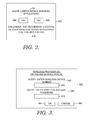
- FIG. 2 depicts an exemplary screen shot of a user interface, according to an embodiment of the invention
- FIG. 3 depicts an exemplary screen shot of a user interface, according to an embodiment of the invention.
- FIG. 4 depicts a flow diagram for initiating a third-party application in accordance with an embodiment of the invention
- FIG. 5 depicts a flow diagram for validating the identity of a user of a wireless device in accordance with an embodiment of the invention.
- FIG. 6 depicts a flow diagram for validating the authority of a user to consent to the providing of geographic location describing the location of a wireless device to a third-party application.
- Embodiments of the invention provide systems, computer-readable media, and methods for validating the identity of a user of a wireless device to ensure that the user has authority to consent to release of geographic locations of the wireless device to third-party applications. After a user with authority consents, third-party applications can then use the geographic location to provide location-based services to the user of the wireless device.
- a validation service portal is used to verify the identity of the user and determine whether the user has authority to consent to release of geographic locations associated with the wireless device to the third-party applications.
- Embodiments of the invention may include, among other things: a method, system, or computer-program product. Accordingly, the embodiments may take the form of a hardware embodiment, a software embodiment, or an embodiment combining software and hardware. In one embodiment, the inventions takes the form of a computer-program product that includes computer-useable instructions embodied on one or more computer-readable media.
- Computer-readable media include both volatile and nonvolatile media, removable and nonremovable media, and contemplates media readable by a database, a switch, and various other network devices.
- computer-readable media comprise media implemented in any method or technology for storing information. Examples of stored information include computer-useable instructions, data structures, program modules, and other data representations.
- Media examples include, but are not limited to information-delivery media, RAM, ROM, EEPROM, flash memory or other memory technology, CD-ROM, digital versatile discs (DVD), holographic media or other optical disc storage, magnetic cassettes, magnetic tape, magnetic disk storage, and other magnetic storage devices. These technologies can store data momentarily, temporarily, or permanently.
- the wireless system 100 includes communication network 102 , which may be any type of network as known in the art, such as, but not limited to, the Internet, an intranet, a local area network (LAN), or a wide area network (WAN). As such networks are well known in the art, no further description will be provided.
- Base stations 104 and 106 are communicatively connected to the communication network 102 and provide for the communication between the wireless devices 110 , 112 , and 114 and the network 102 and, in turn, the wireless provider 108 . Additionally, the wireless provider 108 may communicatively coupled to either or both of the base stations 104 and 106 .
- wireless device 112 While multiple wireless devices 110 , 112 , and 114 are depicted in FIG. 1 , further mention will only be made to wireless device 112 for the sake of clarity.
- Third-party application 117 and validation service portal 116 are communicatively connected to the network 102 , as well.
- Wireless provider 108 can be any wireless service provider that provides wireless communication services to a user of wireless device 112 .
- the wireless service can be provided under the terms of a service agreement between the user of a wireless device 112 and the wireless provider 108 .
- the service agreement can specify the types of wireless services that will be provided to the user through their respective wireless device.
- the service agreement can also provide information that serves to identify both the user and the wireless device.
- the information can also include identification information on a plurality of users associated with one or more wireless devices, all of which are served by a single service agreement. In this manner, only certain users may have the authority to consent to the providing of geographic locations associated with the wireless device 112 to third-party application 117 .
- Validation service portal 116 provides for the determination of the identity of a user of a wireless device 112 , and in turn the authority of the user to consent to the providing of geographic location for the wireless device 112 to a third-party application 117 .
- Validation service portal 116 may also be referred to as a privacy consent web portal.
- different users under a single service agreement may have differing levels of authority.
- the validation service portal 116 can require additional information from the user to particularly differentiate the user from the other users served under the single service agreement.
- the additional information could include portions of personally identifiable information, such as portions of a user's social security number, a user's driver's license number, or a user's date of birth.
- personally identifiable information can be used to identify a user to the validation service portal 116 without use of the wireless device number.
- the validation service portal 116 can be administered by the wireless provider 108 and communicate with the wireless provider 108 over the network 102 . Additionally, while the validation service portal 116 is shown in FIG. 1 as being separate from the wireless provider 108 , the validation service portal 116 can be located within the wireless provider 108 .
- Third-party application 117 can be any application that uses the geographic location of the wireless device 112 to provide location-based services to the wireless device 112 , and in turn to a user of said device. These services can be, for instance, mapping services, friend-locator services that let users keep track of their friend's location, or any other application that provides services based on the geographic location of the wireless device.
- Wireless devices 112 can be defined as a plurality of types of devices, such as: cell phones, smart phones, PDAs, or any other computing device that is capable of wireless communication. This definition includes laptop computers that have wireless communication capabilities.
- the simplified depiction of the wireless system 100 in FIG. 1 is provided to aid in the understanding of the concepts of embodiments of the embodiment and is not intended to be limiting in nature.
- Wireless device 112 includes an input component 118 , an output component 120 , a processor component 122 , a storage component 126 , and a wireless input/output (I/O) component 124 .
- Input component 118 provides for the input of information in the wireless device 112 .
- Input component 118 can take the form of a keypad, microphone, keyboard, selection device, mouse, track ball, or any other forms that provides for the input of information into the wireless device.
- Output component 120 provides for the output of information from the wireless device 112 .
- Output component 120 can take the form of components for the output of visual, audible, vibratory, or other forms of information.
- Visual forms of the output component 120 can take the form of an LCD display, plasma display, or any other display method that provides for the presentation of visual information to a user of the wireless device 112 .
- Processor component 122 provides computer processing functionality for the wireless device 112 .
- Processor component 122 serves to control the functioning of the wireless device 112 and the functioning of the components that make up the wireless device 112 .
- Storage component 126 provides for the storage of information on the wireless device 112 . It can take the form of a hard disk drive, differing types of computer memory, or any other suitable computer storage media. Common to all types of storage components 126 is the ability to store computer executable instructions.
- Wireless I/O component 124 provides for the communication of wireless device 112 with the network 102 through base stations 104 and 106 .
- Wireless I/O component 124 can take many forms, such as a receiver and transmitting module, for the reception of radio frequency waves and generation of the same. Common to all forms of wireless I/O 124 components is the ability to send and receive communications wirelessly.
- User interface 202 is a typical embodiment of an output component of a wireless device.
- Alert 204 can be presented at the user interface 202 of the wireless device when a user has attempted to initiate a location-based service provided by a third-party application.
- the third-party application Upon receiving the request to initiate the location-based service, the third-party application communicates to the wireless device the alert 204 to present to the user of the wireless device through the output component.
- the alert 204 serves to solicit an affirmative or negative response from the user as to whether they desire to launch the third-party application.
- a user can provide an affirmative response by selecting the affirmative response button 206 , or can provide a negative response by selecting the negative response button 208 .
- the user can effectuate these selections through the input component on the wireless device.
- the response Once the response is received by the wireless device, it can be communicated to the base stations through the communications network to the third-party application.
- the third-party application Upon receiving an affirmative response, the third-party application can direct the user interface of the wireless device to the validation service portal. This direction can occur automatically, without any further action required of the user of the wireless device.
- Disclaimer 210 serves to notify the user of the wireless device that the geographic location of the wireless device is required for the application. This can aid the user in deciding whether they desire to provide an affirmative or negative response.
- the content of the disclaimer 210 can vary considerably, and according to some embodiments of the invention may not even be utilized by the third-party application.
- a user can indicate their response to the alert through an audible input to the input component, and voice recognition techniques can be utilized to determine the content of the audible input.
- User interface 302 is a typical embodiment of an output component of a wireless device.
- the user interface 302 is presented to a user of the wireless device when accessing the validation service portal.
- the user interface of a wireless device can be directed to a validation service portal.
- the validation service portal provides the role of verifying the identity and therefore the authority of the user to consent to the providing of geographic location to third-party applications. Unauthorized users are therefore not permitted to consent to the providing of geographic locations of wireless devices to third-party applications. A user would therefore not be able to clandestinely initiate the use of a third-party application that provides location-based services on a wireless device for which they did not have the authority to do so.
- the validation service portal serves to verify the identity or authority of the user of the wireless device to consent to the providing of geographic locations of the wireless device to a third-party application.
- the validation service portal accomplishes this verification by querying the user of the wireless device for information identifying the wireless device. In FIG. 3 , this can be by way of the query 307 , asking a user to enter the wireless device number into a response field 308 .
- the wireless device number could be a telephone number associated with the wireless device, or any other number that would identify the device, such as a serial number of the device or an IP address of the wireless device.
- the information solicited by the query 307 can be of any type that serves to identify the user to the wireless provider.
- a wireless device telephone number or serial number is provided to validate the identity of the user.
- the numbers would be known by the wireless provider 108 to be associated to a particular user.
- the wireless provider 108 would determine this information by consulting any combination of the following: one or more databases, user account information, or the service agreement entered into between the user and the wireless provider.
- Verification query 309 serves to solicit information from the user that only the user and the wireless provider 108 would know.
- verification query 309 solicits the wireless account password from the user. This is information that a user would likely keep confidential and not share with other users, and would serve as a tool to verify the identity of the user.
- the user can enter the information sought by the verification query 309 into the response field 310 of the user interface 302 .
- the information solicited by the verification query 309 could also be dynamic. An example of this would be a verification query 309 that requires the user to identify the geographic location of their wireless device at some point in the past, such as 24 hours. Dynamic information of this type can be used in conjunction with the more static information such as a password to improve the level of security. Other embodiments of the invention may make use of only dynamic types of information for the verification query 309 .
- the user can then select the transmit icon 304 to send the information provided in the response fields 308 and 310 to the base stations and through the communication network to the validation service portal.
- the validation service portal then verifies the information received from the wireless device 112 against information contained in one or more databases maintained by the wireless provider. As described above, even though the validation service portal is shown as separate from the wireless provider in FIG. 1 , the validation service portal can in fact be part of and/or operated by the wireless provider 108 .
- the user can select the cancel icon 306 to end communication with the validation service portal and decline to provide any information entered into the response fields 308 and 310 .
- the validation service portal determines that the information provided by the wireless device is substantially similar to the information contained in one or more databases maintained by the wireless provider 108 , an indication will be provided to the third-party application that the user is an authorized user under the service agreement of the wireless device.
- the third-party application will therefore be permitted to use the geographic location of the wireless device to provide location-based services to the wireless device and associated user.
- the two could be considered to be substantially similar.
- This provides a compromise to aid the user in inputting the information in the wireless device, while still maintaining a level of security in the verification process conducted at the validation service portal.
- Other methods could be permitted as well, such as only requiring the entering of truncated information, such as the first five digits of the wireless device number, or the first four characters of the wireless account password.
- the definition of substantially similar could then be predefined by the validation service portal, wireless provider, or the under the terms of the service agreement.
- a flow diagram is depicted of a method for initiating a third-party application in accordance with an embodiment of the invention.
- a request is received to initiate a third-party application.
- This request could be generated in response to the user seeking to launch a third-party application that provides location-based services. Additionally, it could be generated upon the issuance of an affirmative response as discussed in relation to FIG. 2 , above.
- the request to initiate a third-party application can be received at the wireless provider, third-party application, validation service portal, or the wireless device.
- the validation service portal Upon receiving the request detailed in block 410 , a determination will be made by the validation service portal at block 420 of whether the authority of the user to consent to the providing of geographic location for their respective wireless device has previously been verified.
- one or more databases maintained by the wireless provider can be consulted. Additionally, this information could be stored by the third-party application, validation service portal, or wireless device. The information could be in the form of a token or cookie, as is known in the art.
- the method proceeds to block 425 and the location-based services provided by the third-party application are initiated. In these instances, the method can appear transparent to a user of the wireless device.
- the authority of the user to consent has not previously been verified, or if it has previously been determined that the user did not have the authority to consent, the authority of the user to consent to providing of geographic locations of the wireless device is determined in block 430 . This can be accomplished through the use of the validation service portal, as described in detail in relation to FIG. 3 .
- the method proceeds to block 440 , where if it was determined in block 430 that user had authority to consent, the location-based services provided by the third-party application are subsequently initiated in block 425 . If, however, the user did not have authority to consent, the method proceeds to block 450 where the location-based services of the third-party application are not permitted to initiate.
- FIG. 5 a depiction of a flow diagram for validating the identity of a user of a wireless device in accordance with an embodiment of the invention is provided.
- block 510 when a request is received from a third-party application to validate the identity of a user of a wireless device.
- the third-party application can require the use of information defining the geographic location of the wireless device and the consent of the user to utilize the information.
- identification information is received from the user in the validation service portal.
- the identification information can be received in the same manner as that described in relation to FIG. 3 , above.
- the received identification information is compared to known identification information for the user in block 530 .
- the known identification information for the user can be stored in one or more databases maintained by the wireless provider.
- the validation service portal can consult those databases to compare the received identification information in block 520 to the known identification information contained in the databases. This permits the validation service portal to determine if the user of the wireless device has the authority to consent to the providing of geographic location for the wireless device to the third-party application. For instance, a user is requested to provide their wireless device number and wireless account password. The validation service portal then compares that information to that contained in the one or more databases.
- the databases could contain an entry for each wireless device number. For that entry, additional information could be stored, such as a wireless account password, date of birth of the user, or identifying information.
- the validation service portal can verify the identity of the user and establish their authority to consent. For example, if the wireless account passwords match, or are substantially similar as defined above, the user can be deemed to have authority to consent.
- an indication is provided to the third-party application that the user is an authorized user under the service agreement of the wireless device when the received identification information is substantially similar to the known identification information for the user.
- the indication can be referred to as a redirections command and can take the form of one or more characters in a header, or any other form of communication to the third-party application.
- the user can be redirected by the validation service portal to the third-party application after the successful verification in block 530 . Included in the redirection command issued by the validation service portal can be the indication that the user is an authorized user under the service agreement and is authorized to consent to the release of geographic information to the third-party application.
- an indication is provided to the third-party application by the validation service portal that the user is not an authorized user under the service agreement of the wireless device when the received identification information is not substantially similar to the known identification information for the user.
- the indication can take the form of one or more characters in a header, or any other form of communication to the third-party application.
- a flow diagram is depicted for validating the authority of a user to consent to providing of geographic locations of a wireless device to a third-party application in accordance with an embodiment of the invention.
- receives a request from a user to initiate location-based services provided by a third-party application The third-party application can require the use of geographic location for the wireless device to provide location-based services to the user.
- the request can be received when users confirm their desire to initiate the location-based services provided by the third-party application.
- the request to initiate location-based services can be communicated to the, without the intermediate confirmatory process described in FIG. 2 .
- the user is directed to a validation service portal to determine the authority of the user to consent to the providing of geographic locations associated with the wireless device to the third-party application.
- the validation service portal verifies the identity of a user of a wireless device as being associated with the wireless device to establish that the user has authority to consent.
- the location-based services provided by the third-party application are initiated based on the determination by the validation service portal. If the validation service portal determines that a user has the necessary authority to consent to the providing of geographic locations, an indication can be communicated to the third-party application over the communication network through base stations. If the validation service portal determines that the user does not have authority to consent to the providing of geographic locations, an indication of such can be communicated to the third-party application in the same manner.
Landscapes
- Engineering & Computer Science (AREA)
- Computer Security & Cryptography (AREA)
- Theoretical Computer Science (AREA)
- Computer Networks & Wireless Communication (AREA)
- Signal Processing (AREA)
- Computer Hardware Design (AREA)
- General Engineering & Computer Science (AREA)
- Bioethics (AREA)
- Health & Medical Sciences (AREA)
- General Health & Medical Sciences (AREA)
- Software Systems (AREA)
- Physics & Mathematics (AREA)
- General Physics & Mathematics (AREA)
- Computing Systems (AREA)
- Medical Informatics (AREA)
- Databases & Information Systems (AREA)
- Telephonic Communication Services (AREA)
- Mobile Radio Communication Systems (AREA)
Abstract
Description
Claims (18)
Priority Applications (2)
| Application Number | Priority Date | Filing Date | Title |
|---|---|---|---|
| US14/017,973 US8855307B1 (en) | 2008-06-19 | 2013-09-04 | Validation service portal for wireless location management |
| US14/454,425 US10075843B1 (en) | 2008-06-19 | 2014-08-07 | Validation service portal for wireless location management |
Applications Claiming Priority (2)
| Application Number | Priority Date | Filing Date | Title |
|---|---|---|---|
| US12/142,631 US8565430B1 (en) | 2008-06-19 | 2008-06-19 | Validation service portal for wireless location management |
| US14/017,973 US8855307B1 (en) | 2008-06-19 | 2013-09-04 | Validation service portal for wireless location management |
Related Parent Applications (1)
| Application Number | Title | Priority Date | Filing Date |
|---|---|---|---|
| US12/142,631 Continuation US8565430B1 (en) | 2008-06-19 | 2008-06-19 | Validation service portal for wireless location management |
Related Child Applications (1)
| Application Number | Title | Priority Date | Filing Date |
|---|---|---|---|
| US14/454,425 Continuation US10075843B1 (en) | 2008-06-19 | 2014-08-07 | Validation service portal for wireless location management |
Publications (1)
| Publication Number | Publication Date |
|---|---|
| US8855307B1 true US8855307B1 (en) | 2014-10-07 |
Family
ID=49355294
Family Applications (3)
| Application Number | Title | Priority Date | Filing Date |
|---|---|---|---|
| US12/142,631 Active 2032-01-16 US8565430B1 (en) | 2008-06-19 | 2008-06-19 | Validation service portal for wireless location management |
| US14/017,973 Expired - Fee Related US8855307B1 (en) | 2008-06-19 | 2013-09-04 | Validation service portal for wireless location management |
| US14/454,425 Active US10075843B1 (en) | 2008-06-19 | 2014-08-07 | Validation service portal for wireless location management |
Family Applications Before (1)
| Application Number | Title | Priority Date | Filing Date |
|---|---|---|---|
| US12/142,631 Active 2032-01-16 US8565430B1 (en) | 2008-06-19 | 2008-06-19 | Validation service portal for wireless location management |
Family Applications After (1)
| Application Number | Title | Priority Date | Filing Date |
|---|---|---|---|
| US14/454,425 Active US10075843B1 (en) | 2008-06-19 | 2014-08-07 | Validation service portal for wireless location management |
Country Status (1)
| Country | Link |
|---|---|
| US (3) | US8565430B1 (en) |
Families Citing this family (3)
| Publication number | Priority date | Publication date | Assignee | Title |
|---|---|---|---|---|
| US10897468B1 (en) * | 2018-12-12 | 2021-01-19 | Amazon Technologies, Inc. | Region management for distirbuted services in provider networks |
| US11528267B2 (en) * | 2019-12-06 | 2022-12-13 | Bank Of America Corporation | System for automated image authentication and external database verification |
| US12615253B2 (en) | 2022-03-10 | 2026-04-28 | Honeywell International Inc. | System and method of sharing user credentials |
Citations (2)
| Publication number | Priority date | Publication date | Assignee | Title |
|---|---|---|---|---|
| WO2005051033A1 (en) | 2003-11-13 | 2005-06-02 | Nokia Corporation | Ip-based mechanism for location service systems, methods, and devices |
| US20080039059A1 (en) | 2002-03-25 | 2008-02-14 | Mullen Jeffrey D | Systems and methods for locating cellular phones and security measures for the same |
Family Cites Families (3)
| Publication number | Priority date | Publication date | Assignee | Title |
|---|---|---|---|---|
| US20050043042A1 (en) * | 2003-01-30 | 2005-02-24 | Kuen-Yih Hwang | Location caller identification information method and apparatus |
| US8893010B1 (en) * | 2011-07-20 | 2014-11-18 | Google Inc. | Experience sharing in location-based social networking |
| US20130316311A1 (en) * | 2012-05-24 | 2013-11-28 | Drive Power, LLC | Driving monitoring system |
-
2008
- 2008-06-19 US US12/142,631 patent/US8565430B1/en active Active
-
2013
- 2013-09-04 US US14/017,973 patent/US8855307B1/en not_active Expired - Fee Related
-
2014
- 2014-08-07 US US14/454,425 patent/US10075843B1/en active Active
Patent Citations (2)
| Publication number | Priority date | Publication date | Assignee | Title |
|---|---|---|---|---|
| US20080039059A1 (en) | 2002-03-25 | 2008-02-14 | Mullen Jeffrey D | Systems and methods for locating cellular phones and security measures for the same |
| WO2005051033A1 (en) | 2003-11-13 | 2005-06-02 | Nokia Corporation | Ip-based mechanism for location service systems, methods, and devices |
Non-Patent Citations (5)
| Title |
|---|
| "How to Redirect Browser Requests in Internet Information Services 5.0", Available at: http://support.microsoft.com/kb/313074, Microsoft, (2013). |
| "Using User Authentication", Available at: http://www.apacheweek.com/features/userauth, redhat, (Oct. 18, 1996). |
| Advisory Action: mailed Feb. 25, 2013, in U.S. Appl. No. 12/142,631. |
| Final Office Action, mailed Dec. 18, 2012, in U.S. Appl. No. 12/142,631. |
| Non Final Office Action, mailed May 29, 2012, in U.S. Appl. No. 12/142,631. |
Also Published As
| Publication number | Publication date |
|---|---|
| US10075843B1 (en) | 2018-09-11 |
| US8565430B1 (en) | 2013-10-22 |
Similar Documents
| Publication | Publication Date | Title |
|---|---|---|
| US10826910B2 (en) | Frictionless multi-factor authentication system and method | |
| US11790077B2 (en) | Methods, mediums, and systems for establishing and using security questions | |
| US9218480B2 (en) | Method and system for improved security utilizing location based services for authentication | |
| US9521521B2 (en) | Systems, methods, and apparatus for geolocation platform mechanics | |
| US11159525B2 (en) | Multi-dimensional framework for defining criteria that indicate when authentication should be revoked | |
| US10972458B1 (en) | Methods and systems for authentication assistant | |
| US10659453B2 (en) | Dual channel identity authentication | |
| US20130239173A1 (en) | Computer program and method for administering secure transactions using secondary authentication | |
| US9628482B2 (en) | Mobile based login via wireless credential transfer | |
| US20190190911A1 (en) | Methods, apparatus, and systems for identity authentication | |
| US11658963B2 (en) | Cooperative communication validation | |
| US20130305325A1 (en) | Methods for Thwarting Man-In-The-Middle Authentication Hacking | |
| US8489072B1 (en) | Authentication of mobile communication device communicating through Wi-Fi connection | |
| US20240296449A1 (en) | Mobile authentification method via peer mobiles | |
| US20220116404A1 (en) | Methods and systems for adaptive multi-factored geo-location based document access rights management and enforcement | |
| US9742769B2 (en) | Method and system for determining trusted wireless access points | |
| US11063942B2 (en) | Enhanced authentication method using dynamic geographical location information | |
| US10069829B1 (en) | Multi-party secure global attestation | |
| US8855307B1 (en) | Validation service portal for wireless location management | |
| CN103167403A (en) | Authentication method and system for electronic channel business | |
| AU2017200693A1 (en) | Location based access for key retrieval | |
| US20230319775A1 (en) | Location based attestation | |
| KR20200125279A (en) | User Identification Method Using Block Chain and System thereof | |
| US20220400108A1 (en) | Tokenizing authentication information | |
| KR102393500B1 (en) | Login system and authentication method |
Legal Events
| Date | Code | Title | Description |
|---|---|---|---|
| AS | Assignment |
Owner name: SPRINT COMMUNICATIONS COMPANY L.P., KANSAS Free format text: ASSIGNMENT OF ASSIGNORS INTEREST;ASSIGNORS:SCHULER, JOHN R.;NELSON, RODNEY D.;MCMULLEN, MICHAEL P.;AND OTHERS;REEL/FRAME:031194/0411 Effective date: 20080618 |
|
| STCF | Information on status: patent grant |
Free format text: PATENTED CASE |
|
| AS | Assignment |
Owner name: DEUTSCHE BANK TRUST COMPANY AMERICAS, NEW YORK Free format text: GRANT OF FIRST PRIORITY AND JUNIOR PRIORITY SECURITY INTEREST IN PATENT RIGHTS;ASSIGNOR:SPRINT COMMUNICATIONS COMPANY L.P.;REEL/FRAME:041895/0210 Effective date: 20170203 |
|
| MAFP | Maintenance fee payment |
Free format text: PAYMENT OF MAINTENANCE FEE, 4TH YEAR, LARGE ENTITY (ORIGINAL EVENT CODE: M1551) Year of fee payment: 4 |
|
| AS | Assignment |
Owner name: SPRINT COMMUNICATIONS COMPANY L.P., KANSAS Free format text: TERMINATION AND RELEASE OF FIRST PRIORITY AND JUNIOR PRIORITY SECURITY INTEREST IN PATENT RIGHTS;ASSIGNOR:DEUTSCHE BANK TRUST COMPANY AMERICAS;REEL/FRAME:052969/0475 Effective date: 20200401 Owner name: DEUTSCHE BANK TRUST COMPANY AMERICAS, NEW YORK Free format text: SECURITY AGREEMENT;ASSIGNORS:T-MOBILE USA, INC.;ISBV LLC;T-MOBILE CENTRAL LLC;AND OTHERS;REEL/FRAME:053182/0001 Effective date: 20200401 |
|
| AS | Assignment |
Owner name: T-MOBILE INNOVATIONS LLC, KANSAS Free format text: ASSIGNMENT OF ASSIGNORS INTEREST;ASSIGNOR:SPRINT COMMUNICATIONS COMPANY L.P.;REEL/FRAME:055604/0001 Effective date: 20210303 |
|
| FEPP | Fee payment procedure |
Free format text: MAINTENANCE FEE REMINDER MAILED (ORIGINAL EVENT CODE: REM.); ENTITY STATUS OF PATENT OWNER: LARGE ENTITY |
|
| AS | Assignment |
Owner name: SPRINT SPECTRUM LLC, KANSAS Free format text: RELEASE BY SECURED PARTY;ASSIGNOR:DEUTSCHE BANK TRUST COMPANY AMERICAS;REEL/FRAME:062595/0001 Effective date: 20220822 Owner name: SPRINT INTERNATIONAL INCORPORATED, KANSAS Free format text: RELEASE BY SECURED PARTY;ASSIGNOR:DEUTSCHE BANK TRUST COMPANY AMERICAS;REEL/FRAME:062595/0001 Effective date: 20220822 Owner name: SPRINT COMMUNICATIONS COMPANY L.P., KANSAS Free format text: RELEASE BY SECURED PARTY;ASSIGNOR:DEUTSCHE BANK TRUST COMPANY AMERICAS;REEL/FRAME:062595/0001 Effective date: 20220822 Owner name: SPRINTCOM LLC, KANSAS Free format text: RELEASE BY SECURED PARTY;ASSIGNOR:DEUTSCHE BANK TRUST COMPANY AMERICAS;REEL/FRAME:062595/0001 Effective date: 20220822 Owner name: CLEARWIRE IP HOLDINGS LLC, KANSAS Free format text: RELEASE BY SECURED PARTY;ASSIGNOR:DEUTSCHE BANK TRUST COMPANY AMERICAS;REEL/FRAME:062595/0001 Effective date: 20220822 Owner name: CLEARWIRE COMMUNICATIONS LLC, KANSAS Free format text: RELEASE BY SECURED PARTY;ASSIGNOR:DEUTSCHE BANK TRUST COMPANY AMERICAS;REEL/FRAME:062595/0001 Effective date: 20220822 Owner name: BOOST WORLDWIDE, LLC, KANSAS Free format text: RELEASE BY SECURED PARTY;ASSIGNOR:DEUTSCHE BANK TRUST COMPANY AMERICAS;REEL/FRAME:062595/0001 Effective date: 20220822 Owner name: ASSURANCE WIRELESS USA, L.P., KANSAS Free format text: RELEASE BY SECURED PARTY;ASSIGNOR:DEUTSCHE BANK TRUST COMPANY AMERICAS;REEL/FRAME:062595/0001 Effective date: 20220822 Owner name: T-MOBILE USA, INC., WASHINGTON Free format text: RELEASE BY SECURED PARTY;ASSIGNOR:DEUTSCHE BANK TRUST COMPANY AMERICAS;REEL/FRAME:062595/0001 Effective date: 20220822 Owner name: T-MOBILE CENTRAL LLC, WASHINGTON Free format text: RELEASE BY SECURED PARTY;ASSIGNOR:DEUTSCHE BANK TRUST COMPANY AMERICAS;REEL/FRAME:062595/0001 Effective date: 20220822 Owner name: PUSHSPRING, LLC, WASHINGTON Free format text: RELEASE BY SECURED PARTY;ASSIGNOR:DEUTSCHE BANK TRUST COMPANY AMERICAS;REEL/FRAME:062595/0001 Effective date: 20220822 Owner name: LAYER3 TV, LLC, WASHINGTON Free format text: RELEASE BY SECURED PARTY;ASSIGNOR:DEUTSCHE BANK TRUST COMPANY AMERICAS;REEL/FRAME:062595/0001 Effective date: 20220822 Owner name: IBSV LLC, WASHINGTON Free format text: RELEASE BY SECURED PARTY;ASSIGNOR:DEUTSCHE BANK TRUST COMPANY AMERICAS;REEL/FRAME:062595/0001 Effective date: 20220822 Owner name: IBSV LLC, WASHINGTON Free format text: RELEASE OF SECURITY INTEREST;ASSIGNOR:DEUTSCHE BANK TRUST COMPANY AMERICAS;REEL/FRAME:062595/0001 Effective date: 20220822 Owner name: LAYER3 TV, LLC, WASHINGTON Free format text: RELEASE OF SECURITY INTEREST;ASSIGNOR:DEUTSCHE BANK TRUST COMPANY AMERICAS;REEL/FRAME:062595/0001 Effective date: 20220822 Owner name: PUSHSPRING, LLC, WASHINGTON Free format text: RELEASE OF SECURITY INTEREST;ASSIGNOR:DEUTSCHE BANK TRUST COMPANY AMERICAS;REEL/FRAME:062595/0001 Effective date: 20220822 Owner name: T-MOBILE CENTRAL LLC, WASHINGTON Free format text: RELEASE OF SECURITY INTEREST;ASSIGNOR:DEUTSCHE BANK TRUST COMPANY AMERICAS;REEL/FRAME:062595/0001 Effective date: 20220822 Owner name: T-MOBILE USA, INC., WASHINGTON Free format text: RELEASE OF SECURITY INTEREST;ASSIGNOR:DEUTSCHE BANK TRUST COMPANY AMERICAS;REEL/FRAME:062595/0001 Effective date: 20220822 Owner name: ASSURANCE WIRELESS USA, L.P., KANSAS Free format text: RELEASE OF SECURITY INTEREST;ASSIGNOR:DEUTSCHE BANK TRUST COMPANY AMERICAS;REEL/FRAME:062595/0001 Effective date: 20220822 Owner name: BOOST WORLDWIDE, LLC, KANSAS Free format text: RELEASE OF SECURITY INTEREST;ASSIGNOR:DEUTSCHE BANK TRUST COMPANY AMERICAS;REEL/FRAME:062595/0001 Effective date: 20220822 Owner name: CLEARWIRE COMMUNICATIONS LLC, KANSAS Free format text: RELEASE OF SECURITY INTEREST;ASSIGNOR:DEUTSCHE BANK TRUST COMPANY AMERICAS;REEL/FRAME:062595/0001 Effective date: 20220822 Owner name: CLEARWIRE IP HOLDINGS LLC, KANSAS Free format text: RELEASE OF SECURITY INTEREST;ASSIGNOR:DEUTSCHE BANK TRUST COMPANY AMERICAS;REEL/FRAME:062595/0001 Effective date: 20220822 Owner name: SPRINTCOM LLC, KANSAS Free format text: RELEASE OF SECURITY INTEREST;ASSIGNOR:DEUTSCHE BANK TRUST COMPANY AMERICAS;REEL/FRAME:062595/0001 Effective date: 20220822 Owner name: SPRINT COMMUNICATIONS COMPANY L.P., KANSAS Free format text: RELEASE OF SECURITY INTEREST;ASSIGNOR:DEUTSCHE BANK TRUST COMPANY AMERICAS;REEL/FRAME:062595/0001 Effective date: 20220822 Owner name: SPRINT INTERNATIONAL INCORPORATED, KANSAS Free format text: RELEASE OF SECURITY INTEREST;ASSIGNOR:DEUTSCHE BANK TRUST COMPANY AMERICAS;REEL/FRAME:062595/0001 Effective date: 20220822 Owner name: SPRINT SPECTRUM LLC, KANSAS Free format text: RELEASE OF SECURITY INTEREST;ASSIGNOR:DEUTSCHE BANK TRUST COMPANY AMERICAS;REEL/FRAME:062595/0001 Effective date: 20220822 |
|
| LAPS | Lapse for failure to pay maintenance fees |
Free format text: PATENT EXPIRED FOR FAILURE TO PAY MAINTENANCE FEES (ORIGINAL EVENT CODE: EXP.); ENTITY STATUS OF PATENT OWNER: LARGE ENTITY |
|
| STCH | Information on status: patent discontinuation |
Free format text: PATENT EXPIRED DUE TO NONPAYMENT OF MAINTENANCE FEES UNDER 37 CFR 1.362 |
|
| FP | Lapsed due to failure to pay maintenance fee |
Effective date: 20221007 |