US8854935B2 - Disk drive device - Google Patents

Disk drive device Download PDF

Info

Publication number
US8854935B2
US8854935B2 US14/111,487 US201114111487A US8854935B2 US 8854935 B2 US8854935 B2 US 8854935B2 US 201114111487 A US201114111487 A US 201114111487A US 8854935 B2 US8854935 B2 US 8854935B2
Authority
US
United States
Prior art keywords
end unit
local storage
disk drive
unit
cpu
Prior art date
Legal status (The legal status is an assumption and is not a legal conclusion. Google has not performed a legal analysis and makes no representation as to the accuracy of the status listed.)
Expired - Fee Related
Application number
US14/111,487
Other versions
US20140029401A1 (en
Inventor
Kenji Sakata
Current Assignee (The listed assignees may be inaccurate. Google has not performed a legal analysis and makes no representation or warranty as to the accuracy of the list.)
Mitsubishi Electric Corp
Original Assignee
Mitsubishi Electric Corp
Priority date (The priority date is an assumption and is not a legal conclusion. Google has not performed a legal analysis and makes no representation as to the accuracy of the date listed.)
Filing date
Publication date
Application filed by Mitsubishi Electric Corp filed Critical Mitsubishi Electric Corp
Assigned to MITSUBISHI ELECTRIC CORPORATION reassignment MITSUBISHI ELECTRIC CORPORATION ASSIGNMENT OF ASSIGNORS INTEREST (SEE DOCUMENT FOR DETAILS). Assignors: SAKATA, KENJI
Publication of US20140029401A1 publication Critical patent/US20140029401A1/en
Application granted granted Critical
Publication of US8854935B2 publication Critical patent/US8854935B2/en
Expired - Fee Related legal-status Critical Current
Anticipated expiration legal-status Critical

Links

Images

Classifications

    • GPHYSICS
    • G11INFORMATION STORAGE
    • G11BINFORMATION STORAGE BASED ON RELATIVE MOVEMENT BETWEEN RECORD CARRIER AND TRANSDUCER
    • G11B20/00Signal processing not specific to the method of recording or reproducing; Circuits therefor
    • HELECTRICITY
    • H04ELECTRIC COMMUNICATION TECHNIQUE
    • H04NPICTORIAL COMMUNICATION, e.g. TELEVISION
    • H04N5/00Details of television systems
    • H04N5/76Television signal recording
    • H04N5/765Interface circuits between an apparatus for recording and another apparatus
    • H04N5/775Interface circuits between an apparatus for recording and another apparatus between a recording apparatus and a television receiver
    • HELECTRICITY
    • H04ELECTRIC COMMUNICATION TECHNIQUE
    • H04NPICTORIAL COMMUNICATION, e.g. TELEVISION
    • H04N21/00Selective content distribution, e.g. interactive television or video on demand [VOD]
    • H04N21/40Client devices specifically adapted for the reception of or interaction with content, e.g. set-top-box [STB]; Operations thereof
    • H04N21/41Structure of client; Structure of client peripherals
    • H04N21/426Internal components of the client ; Characteristics thereof
    • H04N21/42646Internal components of the client ; Characteristics thereof for reading from or writing on a non-volatile solid state storage medium, e.g. DVD, CD-ROM
    • HELECTRICITY
    • H04ELECTRIC COMMUNICATION TECHNIQUE
    • H04NPICTORIAL COMMUNICATION, e.g. TELEVISION
    • H04N21/00Selective content distribution, e.g. interactive television or video on demand [VOD]
    • H04N21/40Client devices specifically adapted for the reception of or interaction with content, e.g. set-top-box [STB]; Operations thereof
    • H04N21/43Processing of content or additional data, e.g. demultiplexing additional data from a digital video stream; Elementary client operations, e.g. monitoring of home network or synchronising decoder's clock; Client middleware
    • H04N21/432Content retrieval operation from a local storage medium, e.g. hard-disk
    • H04N21/4325Content retrieval operation from a local storage medium, e.g. hard-disk by playing back content from the storage medium
    • GPHYSICS
    • G11INFORMATION STORAGE
    • G11BINFORMATION STORAGE BASED ON RELATIVE MOVEMENT BETWEEN RECORD CARRIER AND TRANSDUCER
    • G11B20/00Signal processing not specific to the method of recording or reproducing; Circuits therefor
    • G11B20/10Digital recording or reproducing
    • GPHYSICS
    • G11INFORMATION STORAGE
    • G11BINFORMATION STORAGE BASED ON RELATIVE MOVEMENT BETWEEN RECORD CARRIER AND TRANSDUCER
    • G11B2220/00Record carriers by type
    • G11B2220/20Disc-shaped record carriers
    • G11B2220/25Disc-shaped record carriers characterised in that the disc is based on a specific recording technology
    • G11B2220/2537Optical discs
    • G11B2220/2541Blu-ray discs; Blue laser DVR discs
    • HELECTRICITY
    • H04ELECTRIC COMMUNICATION TECHNIQUE
    • H04NPICTORIAL COMMUNICATION, e.g. TELEVISION
    • H04N5/00Details of television systems
    • H04N5/76Television signal recording
    • H04N5/84Television signal recording using optical recording
    • H04N5/85Television signal recording using optical recording on discs or drums

Definitions

  • the present invention relates to a disk drive device in which a front-end unit and a back-end unit are configured with different boards.
  • a front-end unit and a back-end unit are configured with different boards.
  • processing for digitizing analog signals namely processing for controlling a disk drive
  • processing for analogizing processing results of the digital signals obtained by the front-end unit namely decoding control for videos and audios read out from a disk.
  • Patent Document 1 there is disclosed a storage system in which a host provided with a CPU and an ATA (Advanced Technology Attachment) controller is connected to a storage apparatus provided with a plurality of storage devices including a hard-disk drive (HDD), a flash memory drive (FMD), and the like, a drive selection unit, and an interface unit.
  • the host controls the access to the plurality of memory devices through an ATA interface.
  • Components for controlling the disk drive are arranged on the board of the front-end unit, and a disk slot in which a disk is inserted into the device by a user is provided around the board of the front-end unit.
  • a face provided with the disk slot and faced toward a user's side is formed around the front-end unit.
  • a connector of the local storage and Ethernet (in a case where the local storage is constituted by an attachable/detachable memory medium) is arranged on the face that is formed around the front-end unit and faced toward the user's side.
  • Patent Document 1 the following case is specified as an example: the CPU of the host controls the access to the plurality of storage devices through the ATA interface; there is no description regarding a disk drive device in which a front-end unit and a back-end unit are configured with different boards like the invention. For this reason, the invention of Patent Document 1 is directly inapplicable to the disk drive device in which the front-end unit and the back-end unit are configured with different boards.
  • the present invention is made to solve the problems as described above, and an object of the invention is to provide a disk drive device capable of resolving the positional restriction in the placement of the back-end unit.
  • a disk drive device includes: a front-end unit having a disk drive and a front-end controller for controlling the disk drive; and a back-end unit arranged on aboard different from that of the front-end unit, and including a decoder for reproducing data obtained by the corresponding front-end unit and a back-end controller for controlling the decoder, and the front-end unit includes a communication unit and a local storage to be used by the back-end controller on the board in which the front-end unit itself is arranged, and the front-end unit and the back-end unit include an interface unit that makes a connection in an accessible manner from the back-end controller to the communication unit and the local storage in the front-end unit.
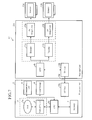
  • FIG. 1 is a diagram showing a configuration of a disk drive device according to Embodiment 1 of the invention.
  • FIG. 2 is a diagram showing a board configuration of a front-end unit and a back-end unit.
  • FIG. 3 is a diagram showing a configuration of a disk drive device according to Embodiment 2 of the invention.
  • FIG. 4 is a flowchart showing an operation by the disk drive device according to Embodiment 2.
  • FIG. 5 is a diagram showing a configuration of a disk drive device according to Embodiment 3 of the invention.
  • FIG. 6 is a flowchart showing an operation by the disk drive device according to Embodiment 3.
  • FIG. 7 is a diagram showing a configuration of a disk drive device according to Embodiment 4 of the invention.
  • FIG. 1 is a diagram showing a configuration of a disk drive device according to Embodiment 1 of the invention.
  • a disk drive device 1 according to Embodiment 1 has a board configuration divided into a front-end unit 2 and a back-end unit 3 .
  • a CPU 4 a In addition to a CPU 4 a , a disk drive 5 , a memory 7 , and an I/F unit 10 a , a communication unit 8 and a local storage 9 that are necessary for processing in the back-end unit 3 are arranged on a board of the front-end unit 2 .
  • a CPU 4 b On the other hand, a CPU 4 b , an I/F unit 10 b , a decoder 11 , and an AV output unit 12 are arranged on a board of the back-end unit 3 .
  • the CPU 4 a of the front-end unit 2 reads out video/audio data from a disk 5 a by controlling an operation of an optical pickup 6 of the disk drive 5 , and transmits the data to the memory 7 .
  • the CPU 4 b of the back-end unit 3 makes access to the memory 7 of the front-end unit 2 through the I/F units 10 a , 10 b , and a transmission cable 10 c , and acquires the video/audio data read out from the disk 5 a.
  • the CPU 4 b decodes the video/audio data acquired from the front-end unit 2 by controlling the decoder 11 , and outputs the resultant to the AV output unit 12 .
  • the AV output unit 12 outputs the videos and audios of the decoded results by a monitor 13 .
  • a communication function with the communication unit 8 and a read/write access function to the local storage are necessary depending on a standard of a storage medium.
  • a BD standard it is assumed that when the video/audio data read out from a BD is reproduced and output by the monitor 13 , update data, newly produced content information, and the like on a network are acquired with the communication unit 8 such as Ethernet. Further, assumed is a purpose in which data produced by the use of the acquired update data and newly produced content information (for example, a high score in a game, etc.) is stored in the local storage 9 .
  • the I/F units 10 a , 10 b that are communication interfaces such as ATAPI (Advanced Technology Attachment Packet Interface) are arranged therein; when the communication unit 8 and local storage 9 become necessary in the reproduction of the video/audio data by the back-end unit 3 , the CPU 4 b in the back-end unit 3 makes access to the communication unit 8 and local storage 9 in the front-end unit 2 through the I/F units 10 a , 10 b .
  • the ATAPI is the communication interface that enables bidirectional communication between the communication unit 8 and local storage 9 in the front-end unit 2 , and the CPU 4 b in the back-end unit 3 .
  • FIG. 2 is a diagram showing the board configuration of the front-end unit and back-end unit.
  • the disk drive 5 has a disk slot to be inserted into or taken out by the disk 5 a .
  • an insertion slot for an Ethernet card and an Ethernet connector are formed in the communication unit 8 .
  • an attaching/detaching slot therefor is provided in the local storage 9 , while in the case of an external storage device, a connector for connection therefor is formed therein.
  • These slots and connectors are arranged on a face facing toward the user's side like a front panel face 14 .
  • the disk drive 5 , communication unit 8 , and local storage 9 that are hardware components requiring an interface with the outside are collectively arranged on the board of the front-end unit 2 as shown in FIG. 2 .
  • the back-end unit 3 makes access to the communication unit 8 and local storage 9 through the ATAPI including the I/F units 10 a , 10 b , and the transmission cable 10 c.
  • the front-end unit 2 may be placed in the vicinity of the front panel face 14
  • the back-end unit 3 may be placed apart from the front panel face 14 .
  • the disk drive 5 , communication unit 8 and local storage 9 are the hardware components to be used corresponding to the type of the disk 5 a (storage medium), these are gathered in the front-end unit 2 , and only the components that reproduce the video/audio data readout from the disk 5 a are placed in the back-end unit 3 .
  • the software for data reproduction in the back-end unit 3 is just replaced, a variety of front-end units 2 according to the type of the disk 5 a can be adapted with the single back-end unit 3 .
  • the front-end unit 2 includes the communication unit 8 and the local storage 9 to be used by the CPU 4 b on the board in which the front-end unit is arranged, and the front-end unit 2 and the back-end unit 3 include the I/F units 10 a , 10 b for making connections in an accessible manner from the CPU 4 b to the communication unit 8 and the local storage 9 in the front-end unit 2 .
  • the front-end unit 2 and the back-end unit 3 include the I/F units 10 a , 10 b for making connections in an accessible manner from the CPU 4 b to the communication unit 8 and the local storage 9 in the front-end unit 2 .
  • Embodiment 2 hardware components to be used depending on a type of a disk are gathered in a front-end unit, and power supplies to the components in the front-end unit are controlled depending on whether to be used by a back-end unit or not.
  • FIG. 3 is a diagram showing a configuration of a disk drive device according to Embodiment 2 of the invention; the same reference numerals are given for the same components as those of FIG. 1 or components equivalent thereto, and detailed descriptions thereof will be omitted.
  • a disk drive device 1 A according to Embodiment 2 has a board configuration divided into a front-end unit 2 A and a back-end unit 3 .
  • switches 15 a to 15 c are arranged on a board of the front-end unit 2 A.
  • a CPU 4 b an I/F unit 10 b , a decoder 11 , and an AV output unit 12 are arranged on a board of the back-end unit 3 .
  • the switches 15 a to 15 c are the switches each of which the opening/closing is controlled by the CPUs 4 a , 4 b.
  • the switch 15 a is the switch that opens and closes a power supply to the disk drive 5 .
  • the switch 15 a is explained as the switch that opens and closes the power supply to an optical pickup 6 in the disk drive 5 .
  • the switch 15 a may open and close the power supply to the whole disk drive 5 .
  • the switch 15 b is the switch to open and close a power supply to the communication unit 8 .
  • the switch 15 c is the switch to open and close a power supply to the local storage 9 .
  • FIG. 4 is a flowchart showing the operation by the disk drive device according to Embodiment 2. The details of a control for the power supplies in Embodiment 2 will be described by reference to FIG. 4 .
  • the CPU 4 a in the front-end unit 2 A determines a type of a storage medium (reproduction medium) in which a data readout is carried out in the front-end unit 2 A (Step ST 1 ).
  • Step ST 1 the CPU 4 a controls an operation of the optical pickup 6 in the disk drive 5 , and reads out video/audio data from the disk 5 a .
  • the CPU 4 a determines whether or not the format of the video/audio data is BDMV (Blu-ray Disk Movie) (Step ST 2 ).
  • BDMV Blu-ray Disk Movie
  • reflected light of a laser beam irradiated from the optical pickup 6 at the disk 5 a is detected, and it is determined whether the disk 5 a is a BD or not from the detected reflected light.
  • the disk 5 a is the BD
  • Step ST 2 When it is determined that the format of the video/audio data is the BDMV (Step ST 2 ; BDMV), after the data readout from the disk 5 a using the optical pickup 6 , the CPU 4 a decides that the communication unit 8 and the local storage 9 are to be used for reproduction processing of the video/audio data in the back-end unit 3 ; thus, all the switches 15 a to 15 c are turned ON, to thereby continue the power supplies to the optical pickup 6 , communication unit 8 , and local storage 9 (Step ST 3 ).
  • the CPU 4 a decides that although the data readout using the optical pickup 6 is continued, the communication unit 8 and local storage 9 are not used for reproduction processing of the video/audio data in the back-end unit 3 ; thus, only the switch 15 a is turned ON, and the switches 15 b , 15 c are turned OFF, to thereby continue the power supply to the optical pickup 6 , and stop the power supplies to the communication unit 8 and the local storage 9 (Step ST 4 ).
  • Step ST 1 when it is determined that the reproduction medium is the local storage 9 (Step ST 1 ; Local Storage), the CPU 4 a decides that the data readout using the optical pickup 6 and the communication processing by the communication unit 8 are not carried out; thus, only the switch 15 c is turned ON, and the switches 15 a , 15 b are turned OFF, to thereby stop the power supplies to the optical pickup 6 and the communication unit 8 , and continue the power supply to the local storage 9 (Step ST 5 ).
  • the front-end unit 2 A includes the switches 15 a to 15 c that are provided on the board in which the front end unit itself is arranged, and that turn on/off the power supplies to the disk drive 5 , communication unit 8 , and local storage 9 , respectively, according to usage conditions of the disk drive 5 , communication unit 8 , and local storage 9 .
  • This provides a similar effect to that in Embodiment 1 described above, and further makes it possible to achieve power saving by stopping the power supply.
  • Embodiment 3 there is described a configuration in which another local storage that stores the backup of the data resulted by the reproduction processing in the back-end unit is provided separately from the attachable/detachable local storage.
  • FIG. 5 is a diagram showing a configuration of a disk drive device according to Embodiment 3 of the invention; the same reference numerals are given for the same components as those of FIG. 1 or components equivalent thereto, and detailed descriptions thereof will be omitted.
  • a disk drive device 1 B according to Embodiment 3 has a board configuration divided into a front-end unit 2 B and a back-end unit 3 .
  • an internal local storage 9 A is arranged on a board of the front-end unit 2 B.
  • a CPU 4 b an I/F unit 10 b , a decoder 11 , and an AV output unit 12 are arranged on a board of the back-end unit 3 .
  • the local storage 9 is constituted by a storage device that can be attached/detached by a user.
  • a flash memory to be attached/detached through a USB connector
  • an SD card to be attached/detached through a card slot, and the like.
  • the internal local storage 9 A is the memory unit mounted on the board of the front-end unit 2 B.
  • the internal local storage 9 A can be achieved by a hard disk drive (HDD) device or a RAM.
  • FIG. 6 is a flowchart showing the operation by the disk drive device according to Embodiment 3. The details of data preservation to the local storages in Embodiment 3 will be described by reference to FIG. 6 .
  • the CPU 4 a determines whether an access request to the local storages from the CPU 4 b is a read-out of data or a write-in of data (Step ST 1 a ).
  • this corresponds to the following case: when video/audio data of BDMV is reproduced in the back-end unit 3 , the CPU 4 b performs data transmission processing required by a BD standard, and/or makes access to the local storage associated with the processing.
  • Step ST 1 a When the access request to the local storage is the write-in of data (Step ST 1 a ; Write-in), the CPU 4 a stores in the internal local storage 9 A the data that is write-in requested by the CPU 4 b (Step ST 2 a ).
  • Step ST 3 a the CPU 4 a determines whether or not the local storage 9 has already been inserted therein. That is, it is determined whether the local storage 9 has been inserted in the slot or attached to the connector.
  • Step ST 3 a When it is determined that the local storage 9 has already been inserted therein (Step ST 3 a ; YES), the CPU 4 a determines whether or not the local storage 9 is write-protected (Step ST 4 a ). In this Step, when it is determined that the local storage 9 is write-protected (Step ST 4 a ; YES), the processing is terminated.
  • Step ST 4 a When it is determined that the local storage 9 is not write-protected (Step ST 4 a ; NO), the CPU 4 a also stores in the local storage 9 the data stored in the internal local storage 9 A in Step ST 2 a (Step ST 5 a ). Namely, the data stored in the internal storage 9 A is copied in the local storage 9 .
  • Step ST 1 a when the access request to the local storage is the read-out of data (Step ST 1 a ; Read-out), the CPU 4 a determines whether or not the local storage 9 has already been inserted therein (Step ST 6 a ). In this Step, when it is determined that the local storage 9 has already been inserted therein (Step ST 6 a ; YES), the CPU 4 a starts processing of reading out from the local storage 9 the data that is read-out requested (Step ST 7 a ).
  • Step ST 8 a When it is determined that the data read-out requested (target information) is located in the local storage 9 (Step ST 8 a ; YES), the CPU 4 a reads out the target information from the local storage 9 to transmit the information to the memory 7 .
  • the CPU 4 b in the back-end unit 3 makes access to the memory 7 in the front-end unit 2 through the I/F units 10 a , 10 b and the transmission cable 10 c to thus acquire the target information.
  • Step ST 8 a When the data read-out requested (target information) is not located in the local storage 9 (Step ST 8 a ; NO), the CPU 4 a performs processing of reading out the corresponding data from among the data stored in the internal local storage 9 a (Step ST 9 a ).
  • the front-end unit 2 B further includes the internal local storage 9 A that backs up the data stored in the local storage 9 on the board where the front-end unit is arranged, thereby providing a similar effect to that in Embodiment 1 described above, and also enhancing user's convenience relating to the access to the local storage 9 required by the BD standard.
  • FIG. 7 is a diagram showing a configuration of a disk drive device according to Embodiment 4 of the invention; the same reference numerals are given for the same components as those of FIG. 1 or components equivalent thereto, and detailed descriptions thereof will be omitted.
  • a disk drive device 1 C according to Embodiment 4 has a board configuration divided into a front-end unit 2 and a back-end unit 3 A.
  • a communication unit 8 and a local storage 9 are arranged on a board of the front-end unit 2 .
  • a data reproduction system composed of a decoder 11 a and an AV output unit 12 a and another data reproduction system composed of a decoder 11 b and an AV output unit 12 b are arranged on a board of the back-end unit 3 A.
  • the number of data reproduction systems may be two or more.
  • the CPU 4 a of the front-end unit 2 reads out video/audio data from a disk 5 a to transmit the data to the memory 7 .
  • the CPU 4 b of the back-end unit 3 A makes access to the memory 7 of the front-end unit 2 through the I/F units 10 a , 10 b and a transmission cable 10 c to thus acquire the video/audio data read out from the disk 5 a.
  • the CPU 4 b decodes the video/audio data acquired from the front-end unit 2 , and outputs the resultant to the AV output units 12 a , 12 b.
  • the AV output units 12 a , 12 b outputs videos and sounds of the decoded results through monitor 13 a , 13 b . In this way, the duplication of the reproduction systems in the back-end unit 3 A enables simultaneous decoding or simultaneous output of the video/audio data.
  • the local storage 9 is not only used for the access to the local storage required by a BD standard, but also any user file such as an audio file can be stored therein and reproduced.
  • a data transfer rate through the I/F units 10 a , 10 b and the transmission cable 10 c is determined as a transfer rate necessary for performing simultaneously each of the reproduction of BDMV, the access to the local storage 9 required by the BD standard, and the reproduction of the user file readout from the local storage 9 .
  • a data transfer rate to the local storage 9 is determined as a transfer rate necessary for performing simultaneously each of the access to the local storage 9 required by the BD standard, and the reproduction of the used file stored in the local storage 9 .
  • Embodiment 4 since the back-end unit 3 A has a plurality of data reproduction systems including the decoders 11 a , 11 b on the board in which the back-end unit itself is arranged, a similar effect to that in Embodiment 1 described above can be obtained, and it is also possible that any user file is stored and reproduced in the storage region of a part of the corresponding local storage 9 , while the access to the local storage 9 required by the BD standard is carried out.
  • the disk drive device can resolve the positional restriction in the placement of the back-end unit, and hence it is suitable for an onboard disk drive device such that configurations with a variety of dimensions are required corresponding to vehicle types.
  • 1 , 1 A- 1 C disk drive devices, 2 , 2 A, 2 B: front-end units, 3 , 3 A: back-end units, 4 a , 4 b : CPUs, 5 : disk drive, 5 a : disk, 6 : optical pickup, 7 : memory, 8 : communication unit, 9 : local storage, 9 A: internal local storage, 10 a , 10 b : I/F units, 10 c : transmission cable, 11 , 11 a , 11 b : decoders, 12 , 12 a , 12 b : AV output units, 13 , 13 a , 13 b : monitors, 14 : front panel face, 15 a to 15 c : switches.

Landscapes

  • Engineering & Computer Science (AREA)
  • Signal Processing (AREA)
  • Multimedia (AREA)
  • Databases & Information Systems (AREA)
  • Signal Processing For Digital Recording And Reproducing (AREA)

Abstract

A front-end unit 2 includes: a communication unit 8 and a local storage 9 to be used by a CPU 4 b on the board in which the front-end unit itself is arranged; and I/F units 10 a, 10 b that make connections in an accessible manner from the CPU 4 b to the communication unit 8 and the local storage 9 in the front-end unit 2.

Description

TECHNICAL FIELD
The present invention relates to a disk drive device in which a front-end unit and a back-end unit are configured with different boards.
BACKGROUND ART
Among conventional disk drive devices, there is the device that a front-end unit and a back-end unit are configured with different boards. In the front-end unit, processing for digitizing analog signals, namely processing for controlling a disk drive, is performed. In the back-end unit, processing for analogizing processing results of the digital signals obtained by the front-end unit, namely decoding control for videos and audios read out from a disk, is performed.
Meanwhile, in Patent Document 1, there is disclosed a storage system in which a host provided with a CPU and an ATA (Advanced Technology Attachment) controller is connected to a storage apparatus provided with a plurality of storage devices including a hard-disk drive (HDD), a flash memory drive (FMD), and the like, a drive selection unit, and an interface unit. In this system, the host controls the access to the plurality of memory devices through an ATA interface.
PRIOR ART DOCUMENTS Patent Documents
  • Patent Document 1: Japanese Patent Application Laid-Open No. 2007-26453
SUMMARY OF THE INVENTION Problems to be Solved by the Invention
Components for controlling the disk drive are arranged on the board of the front-end unit, and a disk slot in which a disk is inserted into the device by a user is provided around the board of the front-end unit. In other words, a face provided with the disk slot and faced toward a user's side is formed around the front-end unit.
On the other hand, for example, when a BD (Blu-ray Disk) is reproduced, in the processing of the back-end unit, the communication by a local storage and Ethernet (registered trademark; hereinafter, this indication will be omitted) to be required by a BD standard is necessary for the decoding control for videos and audios in the back-end unit. For this reason, in the conventional disk drive device, a communication unit of the local storage and Ethernet is mounted on the board of the back-end unit.
Thus, it is required that a connector of the local storage and Ethernet (in a case where the local storage is constituted by an attachable/detachable memory medium) is arranged on the face that is formed around the front-end unit and faced toward the user's side.
In this manner, in the conventional disk drive device, there is a need in which the connector and so on in the components mounted on the board of the back-end unit are arranged on the above face faced toward the user's side. For this reason, the back-end unit must be inevitably arranged around the front-end unit, which poses a problem such that there is a positional restriction in the placement of the back-end unit.
Meanwhile, in Patent Document 1, the following case is specified as an example: the CPU of the host controls the access to the plurality of storage devices through the ATA interface; there is no description regarding a disk drive device in which a front-end unit and a back-end unit are configured with different boards like the invention. For this reason, the invention of Patent Document 1 is directly inapplicable to the disk drive device in which the front-end unit and the back-end unit are configured with different boards.
The present invention is made to solve the problems as described above, and an object of the invention is to provide a disk drive device capable of resolving the positional restriction in the placement of the back-end unit.
Means for Solving the Problems
A disk drive device according to the invention includes: a front-end unit having a disk drive and a front-end controller for controlling the disk drive; and a back-end unit arranged on aboard different from that of the front-end unit, and including a decoder for reproducing data obtained by the corresponding front-end unit and a back-end controller for controlling the decoder, and the front-end unit includes a communication unit and a local storage to be used by the back-end controller on the board in which the front-end unit itself is arranged, and the front-end unit and the back-end unit include an interface unit that makes a connection in an accessible manner from the back-end controller to the communication unit and the local storage in the front-end unit.
Effect of the Invention
According to the invention, there is an advantageous effect such that the positional restriction in the placement of the back-end unit can be resolved.
BRIEF DESCRIPTION OF THE DRAWINGS
FIG. 1 is a diagram showing a configuration of a disk drive device according to Embodiment 1 of the invention.
FIG. 2 is a diagram showing a board configuration of a front-end unit and a back-end unit.
FIG. 3 is a diagram showing a configuration of a disk drive device according to Embodiment 2 of the invention.
FIG. 4 is a flowchart showing an operation by the disk drive device according to Embodiment 2.
FIG. 5 is a diagram showing a configuration of a disk drive device according to Embodiment 3 of the invention.
FIG. 6 is a flowchart showing an operation by the disk drive device according to Embodiment 3.
FIG. 7 is a diagram showing a configuration of a disk drive device according to Embodiment 4 of the invention.
BEST MODE FOR CARRYING OUT THE INVENTION
Hereinafter, in order to describe the present invention in more detail, embodiments for carrying out the invention will be described with reference to the attached drawings.
Embodiment 1
FIG. 1 is a diagram showing a configuration of a disk drive device according to Embodiment 1 of the invention. In FIG. 1, a disk drive device 1 according to Embodiment 1 has a board configuration divided into a front-end unit 2 and a back-end unit 3.
In addition to a CPU 4 a, a disk drive 5, a memory 7, and an I/F unit 10 a, a communication unit 8 and a local storage 9 that are necessary for processing in the back-end unit 3 are arranged on a board of the front-end unit 2. On the other hand, a CPU 4 b, an I/F unit 10 b, a decoder 11, and an AV output unit 12 are arranged on a board of the back-end unit 3.
The CPU 4 a of the front-end unit 2 reads out video/audio data from a disk 5 a by controlling an operation of an optical pickup 6 of the disk drive 5, and transmits the data to the memory 7. The CPU 4 b of the back-end unit 3 makes access to the memory 7 of the front-end unit 2 through the I/ F units 10 a, 10 b, and a transmission cable 10 c, and acquires the video/audio data read out from the disk 5 a.
Then, the CPU 4 b decodes the video/audio data acquired from the front-end unit 2 by controlling the decoder 11, and outputs the resultant to the AV output unit 12. The AV output unit 12 outputs the videos and audios of the decoded results by a monitor 13.
On the other hand, there are some cases in which a communication function with the communication unit 8 and a read/write access function to the local storage are necessary depending on a standard of a storage medium. For example, according to a BD standard, it is assumed that when the video/audio data read out from a BD is reproduced and output by the monitor 13, update data, newly produced content information, and the like on a network are acquired with the communication unit 8 such as Ethernet. Further, assumed is a purpose in which data produced by the use of the acquired update data and newly produced content information (for example, a high score in a game, etc.) is stored in the local storage 9.
Thus, the I/ F units 10 a, 10 b that are communication interfaces such as ATAPI (Advanced Technology Attachment Packet Interface) are arranged therein; when the communication unit 8 and local storage 9 become necessary in the reproduction of the video/audio data by the back-end unit 3, the CPU 4 b in the back-end unit 3 makes access to the communication unit 8 and local storage 9 in the front-end unit 2 through the I/ F units 10 a, 10 b. The ATAPI is the communication interface that enables bidirectional communication between the communication unit 8 and local storage 9 in the front-end unit 2, and the CPU 4 b in the back-end unit 3.
FIG. 2 is a diagram showing the board configuration of the front-end unit and back-end unit. The disk drive 5 has a disk slot to be inserted into or taken out by the disk 5 a. Also, an insertion slot for an Ethernet card and an Ethernet connector are formed in the communication unit 8. Further, in the case of a storage medium to be attached/detached by a user, an attaching/detaching slot therefor is provided in the local storage 9, while in the case of an external storage device, a connector for connection therefor is formed therein. These slots and connectors are arranged on a face facing toward the user's side like a front panel face 14.
Thus, in the disk drive device 1 of Embodiment 1, the disk drive 5, communication unit 8, and local storage 9 that are hardware components requiring an interface with the outside are collectively arranged on the board of the front-end unit 2 as shown in FIG. 2.
On the other hand, the back-end unit 3 makes access to the communication unit 8 and local storage 9 through the ATAPI including the I/ F units 10 a, 10 b, and the transmission cable 10 c.
With this configuration, it becomes unnecessary to arrange the board of the back-end unit 3 around the front-end unit 2, which enables to resolve a positional restriction in the placement of the back-end unit 3. For example, the front-end unit 2 may be placed in the vicinity of the front panel face 14, and the back-end unit 3 may be placed apart from the front panel face 14.
Further, since the disk drive 5, communication unit 8 and local storage 9 are the hardware components to be used corresponding to the type of the disk 5 a (storage medium), these are gathered in the front-end unit 2, and only the components that reproduce the video/audio data readout from the disk 5 a are placed in the back-end unit 3. Thus, when the software for data reproduction in the back-end unit 3 is just replaced, a variety of front-end units 2 according to the type of the disk 5 a can be adapted with the single back-end unit 3.
As described above, according to Embodiment 1, the front-end unit 2 includes the communication unit 8 and the local storage 9 to be used by the CPU 4 b on the board in which the front-end unit is arranged, and the front-end unit 2 and the back-end unit 3 include the I/ F units 10 a, 10 b for making connections in an accessible manner from the CPU 4 b to the communication unit 8 and the local storage 9 in the front-end unit 2. With this configuration, a positional restriction in the placement of the back-end unit 3 can be resolved.
Embodiment 2
In Embodiment 2, hardware components to be used depending on a type of a disk are gathered in a front-end unit, and power supplies to the components in the front-end unit are controlled depending on whether to be used by a back-end unit or not.
FIG. 3 is a diagram showing a configuration of a disk drive device according to Embodiment 2 of the invention; the same reference numerals are given for the same components as those of FIG. 1 or components equivalent thereto, and detailed descriptions thereof will be omitted.
In FIG. 3, a disk drive device 1A according to Embodiment 2 has a board configuration divided into a front-end unit 2A and a back-end unit 3.
In addition to a CPU 4 a, a disk drive 5, a memory 7, a communication unit 8, a local storage 9, and an I/F unit 10 a, switches 15 a to 15 c are arranged on a board of the front-end unit 2A. On the other hand, a CPU 4 b, an I/F unit 10 b, a decoder 11, and an AV output unit 12 are arranged on a board of the back-end unit 3.
The switches 15 a to 15 c are the switches each of which the opening/closing is controlled by the CPUs 4 a, 4 b.
Here, the switch 15 a is the switch that opens and closes a power supply to the disk drive 5. Hereinafter, the switch 15 a is explained as the switch that opens and closes the power supply to an optical pickup 6 in the disk drive 5. Note that the switch 15 a may open and close the power supply to the whole disk drive 5.
The switch 15 b is the switch to open and close a power supply to the communication unit 8. The switch 15 c is the switch to open and close a power supply to the local storage 9.
Next, an operation thereof will be described.
FIG. 4 is a flowchart showing the operation by the disk drive device according to Embodiment 2. The details of a control for the power supplies in Embodiment 2 will be described by reference to FIG. 4.
First, the CPU 4 a in the front-end unit 2A determines a type of a storage medium (reproduction medium) in which a data readout is carried out in the front-end unit 2A (Step ST1).
For example, through an input operation from outside, if a disk reproduction at the disk drive 5 is instructed, it is determined that the reproduction medium is a disk, while if a reproduction of the local storage 9 is instructed, it is determined that the reproduction medium is a local storage.
When it is determined that the reproduction medium is a disk 5 a (Step ST1; Disk), the CPU 4 a controls an operation of the optical pickup 6 in the disk drive 5, and reads out video/audio data from the disk 5 a. At this time, the CPU 4 a determines whether or not the format of the video/audio data is BDMV (Blu-ray Disk Movie) (Step ST2).
For example, reflected light of a laser beam irradiated from the optical pickup 6 at the disk 5 a is detected, and it is determined whether the disk 5 a is a BD or not from the detected reflected light. When it is determined that the disk 5 a is the BD, it is determined that the video/audio data read out from the disk 5 a is BDMV.
When it is determined that the format of the video/audio data is the BDMV (Step ST2; BDMV), after the data readout from the disk 5 a using the optical pickup 6, the CPU 4 a decides that the communication unit 8 and the local storage 9 are to be used for reproduction processing of the video/audio data in the back-end unit 3; thus, all the switches 15 a to 15 c are turned ON, to thereby continue the power supplies to the optical pickup 6, communication unit 8, and local storage 9 (Step ST3).
Contrarily, when it is determined that the format of the video/audio data is not the BDMV (Step ST2; Other Than BDMV), the CPU 4 a decides that although the data readout using the optical pickup 6 is continued, the communication unit 8 and local storage 9 are not used for reproduction processing of the video/audio data in the back-end unit 3; thus, only the switch 15 a is turned ON, and the switches 15 b, 15 c are turned OFF, to thereby continue the power supply to the optical pickup 6, and stop the power supplies to the communication unit 8 and the local storage 9 (Step ST4). For example, in a case where a reproduction of DVD-VIDEO is carried out, since a data acquisition by the communication unit 8 and an access to the local storage 9 associated with the acquisition are not carried out, power saving thereof can be achieved when the power supply to the communication unit 8 and local storage 9 is stopped.
On the other hand, when it is determined that the reproduction medium is the local storage 9 (Step ST1; Local Storage), the CPU 4 a decides that the data readout using the optical pickup 6 and the communication processing by the communication unit 8 are not carried out; thus, only the switch 15 c is turned ON, and the switches 15 a, 15 b are turned OFF, to thereby stop the power supplies to the optical pickup 6 and the communication unit 8, and continue the power supply to the local storage 9 (Step ST5).
As described above, according to Embodiment 2, the front-end unit 2A includes the switches 15 a to 15 c that are provided on the board in which the front end unit itself is arranged, and that turn on/off the power supplies to the disk drive 5, communication unit 8, and local storage 9, respectively, according to usage conditions of the disk drive 5, communication unit 8, and local storage 9. This provides a similar effect to that in Embodiment 1 described above, and further makes it possible to achieve power saving by stopping the power supply.
Embodiment 3
In Embodiment 3, there is described a configuration in which another local storage that stores the backup of the data resulted by the reproduction processing in the back-end unit is provided separately from the attachable/detachable local storage.
FIG. 5 is a diagram showing a configuration of a disk drive device according to Embodiment 3 of the invention; the same reference numerals are given for the same components as those of FIG. 1 or components equivalent thereto, and detailed descriptions thereof will be omitted.
In FIG. 5, a disk drive device 1B according to Embodiment 3 has a board configuration divided into a front-end unit 2B and a back-end unit 3.
In addition to a CPU 4 a, a disk drive 5, a memory 7, a communication unit 8, a local storage 9, and an I/F unit 10 a, an internal local storage 9A is arranged on a board of the front-end unit 2B. On the other hand, a CPU 4 b, an I/F unit 10 b, a decoder 11, and an AV output unit 12 are arranged on a board of the back-end unit 3.
In Embodiment 3, the local storage 9 is constituted by a storage device that can be attached/detached by a user. For example, it is specified by a flash memory to be attached/detached through a USB connector, an SD card to be attached/detached through a card slot, and the like.
On the other hand, the internal local storage 9A is the memory unit mounted on the board of the front-end unit 2B. For example, it can be achieved by a hard disk drive (HDD) device or a RAM.
Next an operation thereof will be described.
FIG. 6 is a flowchart showing the operation by the disk drive device according to Embodiment 3. The details of data preservation to the local storages in Embodiment 3 will be described by reference to FIG. 6.
First, the CPU 4 a determines whether an access request to the local storages from the CPU 4 b is a read-out of data or a write-in of data (Step ST1 a).
For example, this corresponds to the following case: when video/audio data of BDMV is reproduced in the back-end unit 3, the CPU 4 b performs data transmission processing required by a BD standard, and/or makes access to the local storage associated with the processing.
When the access request to the local storage is the write-in of data (Step ST1 a; Write-in), the CPU 4 a stores in the internal local storage 9A the data that is write-in requested by the CPU 4 b (Step ST2 a).
Thereafter, the CPU 4 a determines whether or not the local storage 9 has already been inserted therein (Step ST3 a). That is, it is determined whether the local storage 9 has been inserted in the slot or attached to the connector.
When it is determined that the local storage 9 has already been inserted therein (Step ST3 a; YES), the CPU 4 a determines whether or not the local storage 9 is write-protected (Step ST4 a). In this Step, when it is determined that the local storage 9 is write-protected (Step ST4 a; YES), the processing is terminated.
When it is determined that the local storage 9 is not write-protected (Step ST4 a; NO), the CPU 4 a also stores in the local storage 9 the data stored in the internal local storage 9A in Step ST2 a (Step ST5 a). Namely, the data stored in the internal storage 9A is copied in the local storage 9.
By doing so, the data resulted by reproduction of a BD is stored in both the local storage 9 and the internal local storage 9A.
On the other hand, when the access request to the local storage is the read-out of data (Step ST1 a; Read-out), the CPU 4 a determines whether or not the local storage 9 has already been inserted therein (Step ST6 a). In this Step, when it is determined that the local storage 9 has already been inserted therein (Step ST6 a; YES), the CPU 4 a starts processing of reading out from the local storage 9 the data that is read-out requested (Step ST7 a).
When it is determined that the data read-out requested (target information) is located in the local storage 9 (Step ST8 a; YES), the CPU 4 a reads out the target information from the local storage 9 to transmit the information to the memory 7. The CPU 4 b in the back-end unit 3 makes access to the memory 7 in the front-end unit 2 through the I/ F units 10 a, 10 b and the transmission cable 10 c to thus acquire the target information.
When the data read-out requested (target information) is not located in the local storage 9 (Step ST8 a; NO), the CPU 4 a performs processing of reading out the corresponding data from among the data stored in the internal local storage 9 a (Step ST9 a).
As described above, according to Embodiment 3, the front-end unit 2B further includes the internal local storage 9A that backs up the data stored in the local storage 9 on the board where the front-end unit is arranged, thereby providing a similar effect to that in Embodiment 1 described above, and also enhancing user's convenience relating to the access to the local storage 9 required by the BD standard.
Embodiment 4
FIG. 7 is a diagram showing a configuration of a disk drive device according to Embodiment 4 of the invention; the same reference numerals are given for the same components as those of FIG. 1 or components equivalent thereto, and detailed descriptions thereof will be omitted.
In FIG. 7, a disk drive device 1C according to Embodiment 4 has a board configuration divided into a front-end unit 2 and a back-end unit 3A.
In addition to a CPU 4 a, a disk drive 5, a memory 7, and an I/F unit 10 a, a communication unit 8 and a local storage 9 are arranged on a board of the front-end unit 2.
On the other hand, in addition to a CPU 4 b and an I/F unit 10 b, a data reproduction system composed of a decoder 11 a and an AV output unit 12 a, and another data reproduction system composed of a decoder 11 b and an AV output unit 12 b are arranged on a board of the back-end unit 3A. Note that the number of data reproduction systems may be two or more.
By controlling an operation of an optical pickup 6 of the disk drive 5, the CPU 4 a of the front-end unit 2 reads out video/audio data from a disk 5 a to transmit the data to the memory 7. The CPU 4 b of the back-end unit 3A makes access to the memory 7 of the front-end unit 2 through the I/ F units 10 a, 10 b and a transmission cable 10 c to thus acquire the video/audio data read out from the disk 5 a.
Then, by controlling the decoders 11 a, 11 b, the CPU 4 b decodes the video/audio data acquired from the front-end unit 2, and outputs the resultant to the AV output units 12 a, 12 b.
The AV output units 12 a, 12 b outputs videos and sounds of the decoded results through monitor 13 a, 13 b. In this way, the duplication of the reproduction systems in the back-end unit 3A enables simultaneous decoding or simultaneous output of the video/audio data.
It is noted that in Embodiment 4, the local storage 9 is not only used for the access to the local storage required by a BD standard, but also any user file such as an audio file can be stored therein and reproduced.
For instance, on the reproduction of video/audio data of BDMV, while the access to the local storage 9 required by the BD standard is carried out, a user file located in a different storage region in the same local storage 9 is simultaneously reproduced.
In this case, a data transfer rate through the I/ F units 10 a, 10 b and the transmission cable 10 c is determined as a transfer rate necessary for performing simultaneously each of the reproduction of BDMV, the access to the local storage 9 required by the BD standard, and the reproduction of the user file readout from the local storage 9.
Meanwhile, a data transfer rate to the local storage 9 is determined as a transfer rate necessary for performing simultaneously each of the access to the local storage 9 required by the BD standard, and the reproduction of the used file stored in the local storage 9.
As describe above, according to Embodiment 4, since the back-end unit 3A has a plurality of data reproduction systems including the decoders 11 a, 11 b on the board in which the back-end unit itself is arranged, a similar effect to that in Embodiment 1 described above can be obtained, and it is also possible that any user file is stored and reproduced in the storage region of a part of the corresponding local storage 9, while the access to the local storage 9 required by the BD standard is carried out.
It is noted that in the present invention, it is possible to freely combine the embodiments, modify any component of the embodiments, or omit any component in the embodiments within the scope of the invention.
INDUSTRIAL APPLICABILITY
The disk drive device according to the present invention can resolve the positional restriction in the placement of the back-end unit, and hence it is suitable for an onboard disk drive device such that configurations with a variety of dimensions are required corresponding to vehicle types.
EXPLANATION OF REFERENCE NUMERALS
1, 1A-1C: disk drive devices, 2, 2A, 2B: front-end units, 3, 3A: back-end units, 4 a, 4 b: CPUs, 5: disk drive, 5 a: disk, 6: optical pickup, 7: memory, 8: communication unit, 9: local storage, 9A: internal local storage, 10 a, 10 b: I/F units, 10 c: transmission cable, 11, 11 a, 11 b: decoders, 12, 12 a, 12 b: AV output units, 13, 13 a, 13 b: monitors, 14: front panel face, 15 a to 15 c: switches.

Claims (4)

The invention claimed is:
1. A disk drive device comprising:
a front-end unit that has a disk drive and a front-end controller for controlling the disk drive; and
a back-end unit arranged on a board different from that of the front-end unit, and including a decoder for reproducing data obtained by the said front-end unit and a back-end controller for controlling the decoder,
wherein the front-end unit includes a communication unit and a local storage to be used by the back-end controller on the board in which the front-end unit itself is arranged, and
wherein the front-end unit and the back-end unit include an interface unit that makes a connection in an accessible manner from the back-end controller to the communication unit and the local storage in the front-end unit.
2. The disk drive device according to claim 1, wherein the front-end unit includes a switch that is provided on the board in which the front end unit itself is arranged, and that turns on/off power supplies to the disk drive, the communication unit and the local storage, respectively, according to usage conditions of the disk drive, the communication unit, and the local storage.
3. The disk drive device according to claim 1, wherein the front-end unit further includes a local storage that backs up data stored in the local storage on the board where the front end unit itself is arranged.
4. The disk drive device according to claim 1, wherein the back-end unit includes a plurality of data reproduction systems including the decoder on the board where the back end unit itself is arranged.
US14/111,487 2011-08-22 2011-08-22 Disk drive device Expired - Fee Related US8854935B2 (en)

Applications Claiming Priority (1)

Application Number Priority Date Filing Date Title
PCT/JP2011/004652 WO2013027235A1 (en) 2011-08-22 2011-08-22 Disk drive device

Publications (2)

Publication Number Publication Date
US20140029401A1 US20140029401A1 (en) 2014-01-30
US8854935B2 true US8854935B2 (en) 2014-10-07

Family

ID=47746017

Family Applications (1)

Application Number Title Priority Date Filing Date
US14/111,487 Expired - Fee Related US8854935B2 (en) 2011-08-22 2011-08-22 Disk drive device

Country Status (4)

Country Link
US (1) US8854935B2 (en)
JP (1) JP5383955B2 (en)
CN (1) CN103650050B (en)
WO (1) WO2013027235A1 (en)

Families Citing this family (1)

* Cited by examiner, † Cited by third party
Publication number Priority date Publication date Assignee Title
WO2019187267A1 (en) * 2018-03-28 2019-10-03 パナソニックIpマネジメント株式会社 Voice processing device

Citations (7)

* Cited by examiner, † Cited by third party
Publication number Priority date Publication date Assignee Title
EP1091353A1 (en) 1999-10-07 2001-04-11 Deutsche Thomson-Brandt Gmbh Appliance for reading from or writing to optical recording media
US20020120709A1 (en) * 2001-02-13 2002-08-29 Matsushita Electric Industrial Co., Ltd. Shared-memory controller for use in a multimedia processor system
US20040190860A1 (en) * 2003-03-31 2004-09-30 Fusao Ishiguchi Equipment for digital video disc processing information on digital video disc using prescribed information serving as key, and method and apparatus for recording prescribed information
JP2005157693A (en) 2003-11-25 2005-06-16 Susumu Asai Recording/reproducing device
JP2007026453A (en) 2003-07-07 2007-02-01 Hitachi Ulsi Systems Co Ltd Storage device and storage system
JP2008065950A (en) 2006-09-11 2008-03-21 Matsushita Electric Ind Co Ltd Signal processing circuit
US20080117548A1 (en) 2003-07-07 2008-05-22 Shuichiro Azuma Storage Device And Storage System

Family Cites Families (1)

* Cited by examiner, † Cited by third party
Publication number Priority date Publication date Assignee Title
JP2004204889A (en) * 2002-12-24 2004-07-22 Mitsumi Electric Co Ltd Fixing structure of plate-like member and disk device having this structure

Patent Citations (8)

* Cited by examiner, † Cited by third party
Publication number Priority date Publication date Assignee Title
EP1091353A1 (en) 1999-10-07 2001-04-11 Deutsche Thomson-Brandt Gmbh Appliance for reading from or writing to optical recording media
JP2001126447A (en) 1999-10-07 2001-05-11 Deutsche Thomson Brandt Gmbh Reading and writing device for optical recording medium
US20020120709A1 (en) * 2001-02-13 2002-08-29 Matsushita Electric Industrial Co., Ltd. Shared-memory controller for use in a multimedia processor system
US20040190860A1 (en) * 2003-03-31 2004-09-30 Fusao Ishiguchi Equipment for digital video disc processing information on digital video disc using prescribed information serving as key, and method and apparatus for recording prescribed information
JP2007026453A (en) 2003-07-07 2007-02-01 Hitachi Ulsi Systems Co Ltd Storage device and storage system
US20080117548A1 (en) 2003-07-07 2008-05-22 Shuichiro Azuma Storage Device And Storage System
JP2005157693A (en) 2003-11-25 2005-06-16 Susumu Asai Recording/reproducing device
JP2008065950A (en) 2006-09-11 2008-03-21 Matsushita Electric Ind Co Ltd Signal processing circuit

Non-Patent Citations (1)

* Cited by examiner, † Cited by third party
Title
International Search Report for PCT/JP2011/004652 mailed on Nov. 15, 2011.

Also Published As

Publication number Publication date
JPWO2013027235A1 (en) 2015-03-05
CN103650050B (en) 2015-07-15
US20140029401A1 (en) 2014-01-30
WO2013027235A1 (en) 2013-02-28
JP5383955B2 (en) 2014-01-08
CN103650050A (en) 2014-03-19

Similar Documents

Publication Publication Date Title
US20080212940A1 (en) Portable Storage Device For Recording and Playing Back Data
US20090113087A1 (en) Stream data transfer control device
EP2942695B1 (en) Storage device with expansion slot
US8854935B2 (en) Disk drive device
US20100131982A1 (en) Method for generating and accessing scheduled program list and multimedia device for the same
US20090187774A1 (en) Information Recording and Reproducing Apparatus
JP6693417B2 (en) Reader / writer device, information processing device, data transfer control method, and program
US20110019523A1 (en) Integrated standalone optical disc duplication and labeling system
CN210666753U (en) Device compatible with RAID and NVMe hard disk storage requirements
CN202373297U (en) High-definition player capable of playing blue light international standardization organization (ISO) files smoothly
KR20110000294A (en) Optical disc drive and its driving method
US20080107406A1 (en) Reproduction apparatus and data transfer system
CN100479045C (en) Optical recording/reproducing apparatus having at least two atapi interfaces
US20110202580A1 (en) Storage equipment
KR100599086B1 (en) Multi-Device Access System and AW Device with Multi-Device Access Function Using the Same
KR20070076682A (en) Firmware Upgrade Device and Method of Home Theater Using USB Storage Device
KR200429318Y1 (en) Video recording devices, integrated video capturing / recording devices, and audio / video editing systems
JP2008065950A (en) Signal processing circuit
KR100809771B1 (en) Image Display System and Control Method of the System
CN102143395A (en) Set-top box supporting PVR (Personal Video Record) and a method thereof for processing audio and video data
US20090185469A1 (en) Device, system and method for automatic data solidification
JP2008176680A (en) Portable disk unit
KR20150022271A (en) Optical disc drive and driving method thereof
KR20100129438A (en) How to change the operation mode of PC integrated TV and PC integrated TV performing the same
EP2439740A1 (en) Information processing apparatus and information processing method

Legal Events

Date Code Title Description
AS Assignment

Owner name: MITSUBISHI ELECTRIC CORPORATION, JAPAN

Free format text: ASSIGNMENT OF ASSIGNORS INTEREST;ASSIGNOR:SAKATA, KENJI;REEL/FRAME:031408/0670

Effective date: 20130927

STCF Information on status: patent grant

Free format text: PATENTED CASE

FEPP Fee payment procedure

Free format text: PAYOR NUMBER ASSIGNED (ORIGINAL EVENT CODE: ASPN); ENTITY STATUS OF PATENT OWNER: LARGE ENTITY

MAFP Maintenance fee payment

Free format text: PAYMENT OF MAINTENANCE FEE, 4TH YEAR, LARGE ENTITY (ORIGINAL EVENT CODE: M1551)

Year of fee payment: 4

FEPP Fee payment procedure

Free format text: MAINTENANCE FEE REMINDER MAILED (ORIGINAL EVENT CODE: REM.); ENTITY STATUS OF PATENT OWNER: LARGE ENTITY

LAPS Lapse for failure to pay maintenance fees

Free format text: PATENT EXPIRED FOR FAILURE TO PAY MAINTENANCE FEES (ORIGINAL EVENT CODE: EXP.); ENTITY STATUS OF PATENT OWNER: LARGE ENTITY

STCH Information on status: patent discontinuation

Free format text: PATENT EXPIRED DUE TO NONPAYMENT OF MAINTENANCE FEES UNDER 37 CFR 1.362

FP Lapsed due to failure to pay maintenance fee

Effective date: 20221007