US8853483B2 - Oligomerization process - Google Patents
Oligomerization process Download PDFInfo
- Publication number
- US8853483B2 US8853483B2 US12/326,488 US32648808A US8853483B2 US 8853483 B2 US8853483 B2 US 8853483B2 US 32648808 A US32648808 A US 32648808A US 8853483 B2 US8853483 B2 US 8853483B2
- Authority
- US
- United States
- Prior art keywords
- oligomerization
- reaction zone
- oxygenated
- fraction
- isoolefin
- Prior art date
- Legal status (The legal status is an assumption and is not a legal conclusion. Google has not performed a legal analysis and makes no representation as to the accuracy of the status listed.)
- Active, expires
Links
Images


Classifications
-
- C—CHEMISTRY; METALLURGY
- C07—ORGANIC CHEMISTRY
- C07C—ACYCLIC OR CARBOCYCLIC COMPOUNDS
- C07C2/00—Preparation of hydrocarbons from hydrocarbons containing a smaller number of carbon atoms
- C07C2/02—Preparation of hydrocarbons from hydrocarbons containing a smaller number of carbon atoms by addition between unsaturated hydrocarbons
- C07C2/04—Preparation of hydrocarbons from hydrocarbons containing a smaller number of carbon atoms by addition between unsaturated hydrocarbons by oligomerisation of well-defined unsaturated hydrocarbons without ring formation
- C07C2/06—Preparation of hydrocarbons from hydrocarbons containing a smaller number of carbon atoms by addition between unsaturated hydrocarbons by oligomerisation of well-defined unsaturated hydrocarbons without ring formation of alkenes, i.e. acyclic hydrocarbons having only one carbon-to-carbon double bond
- C07C2/08—Catalytic processes
- C07C2/26—Catalytic processes with hydrides or organic compounds
- C07C2/28—Catalytic processes with hydrides or organic compounds with ion-exchange resins
-
- C—CHEMISTRY; METALLURGY
- C07—ORGANIC CHEMISTRY
- C07C—ACYCLIC OR CARBOCYCLIC COMPOUNDS
- C07C2/00—Preparation of hydrocarbons from hydrocarbons containing a smaller number of carbon atoms
- C07C2/02—Preparation of hydrocarbons from hydrocarbons containing a smaller number of carbon atoms by addition between unsaturated hydrocarbons
- C07C2/04—Preparation of hydrocarbons from hydrocarbons containing a smaller number of carbon atoms by addition between unsaturated hydrocarbons by oligomerisation of well-defined unsaturated hydrocarbons without ring formation
- C07C2/06—Preparation of hydrocarbons from hydrocarbons containing a smaller number of carbon atoms by addition between unsaturated hydrocarbons by oligomerisation of well-defined unsaturated hydrocarbons without ring formation of alkenes, i.e. acyclic hydrocarbons having only one carbon-to-carbon double bond
- C07C2/08—Catalytic processes
-
- C—CHEMISTRY; METALLURGY
- C07—ORGANIC CHEMISTRY
- C07C—ACYCLIC OR CARBOCYCLIC COMPOUNDS
- C07C11/00—Aliphatic unsaturated hydrocarbons
- C07C11/02—Alkenes
-
- C—CHEMISTRY; METALLURGY
- C07—ORGANIC CHEMISTRY
- C07C—ACYCLIC OR CARBOCYCLIC COMPOUNDS
- C07C29/00—Preparation of compounds having hydroxy or O-metal groups bound to a carbon atom not belonging to a six-membered aromatic ring
- C07C29/03—Preparation of compounds having hydroxy or O-metal groups bound to a carbon atom not belonging to a six-membered aromatic ring by addition of hydroxy groups to unsaturated carbon-to-carbon bonds, e.g. with the aid of H2O2
- C07C29/04—Preparation of compounds having hydroxy or O-metal groups bound to a carbon atom not belonging to a six-membered aromatic ring by addition of hydroxy groups to unsaturated carbon-to-carbon bonds, e.g. with the aid of H2O2 by hydration of carbon-to-carbon double bonds
-
- C—CHEMISTRY; METALLURGY
- C07—ORGANIC CHEMISTRY
- C07C—ACYCLIC OR CARBOCYCLIC COMPOUNDS
- C07C31/00—Saturated compounds having hydroxy or O-metal groups bound to acyclic carbon atoms
- C07C31/02—Monohydroxylic acyclic alcohols
- C07C31/125—Monohydroxylic acyclic alcohols containing five to twenty-two carbon atoms
-
- C—CHEMISTRY; METALLURGY
- C07—ORGANIC CHEMISTRY
- C07C—ACYCLIC OR CARBOCYCLIC COMPOUNDS
- C07C41/00—Preparation of ethers; Preparation of compounds having groups, groups or groups
- C07C41/01—Preparation of ethers
- C07C41/05—Preparation of ethers by addition of compounds to unsaturated compounds
- C07C41/06—Preparation of ethers by addition of compounds to unsaturated compounds by addition of organic compounds only
-
- C—CHEMISTRY; METALLURGY
- C07—ORGANIC CHEMISTRY
- C07C—ACYCLIC OR CARBOCYCLIC COMPOUNDS
- C07C43/00—Ethers; Compounds having groups, groups or groups
- C07C43/02—Ethers
- C07C43/03—Ethers having all ether-oxygen atoms bound to acyclic carbon atoms
- C07C43/04—Saturated ethers
-
- C—CHEMISTRY; METALLURGY
- C07—ORGANIC CHEMISTRY
- C07C—ACYCLIC OR CARBOCYCLIC COMPOUNDS
- C07C43/00—Ethers; Compounds having groups, groups or groups
- C07C43/02—Ethers
- C07C43/03—Ethers having all ether-oxygen atoms bound to acyclic carbon atoms
- C07C43/04—Saturated ethers
- C07C43/043—Dimethyl ether
-
- C—CHEMISTRY; METALLURGY
- C07—ORGANIC CHEMISTRY
- C07C—ACYCLIC OR CARBOCYCLIC COMPOUNDS
- C07C7/00—Purification; Separation; Use of additives
- C07C7/09—Purification; Separation; Use of additives by fractional condensation
-
- C—CHEMISTRY; METALLURGY
- C10—PETROLEUM, GAS OR COKE INDUSTRIES; TECHNICAL GASES CONTAINING CARBON MONOXIDE; FUELS; LUBRICANTS; PEAT
- C10G—CRACKING HYDROCARBON OILS; PRODUCTION OF LIQUID HYDROCARBON MIXTURES, e.g. BY DESTRUCTIVE HYDROGENATION, OLIGOMERISATION, POLYMERISATION; RECOVERY OF HYDROCARBON OILS FROM OIL-SHALE, OIL-SAND, OR GASES; REFINING MIXTURES MAINLY CONSISTING OF HYDROCARBONS; REFORMING OF NAPHTHA; MINERAL WAXES
- C10G50/00—Production of liquid hydrocarbon mixtures from lower carbon number hydrocarbons, e.g. by oligomerisation
-
- C—CHEMISTRY; METALLURGY
- C10—PETROLEUM, GAS OR COKE INDUSTRIES; TECHNICAL GASES CONTAINING CARBON MONOXIDE; FUELS; LUBRICANTS; PEAT
- C10G—CRACKING HYDROCARBON OILS; PRODUCTION OF LIQUID HYDROCARBON MIXTURES, e.g. BY DESTRUCTIVE HYDROGENATION, OLIGOMERISATION, POLYMERISATION; RECOVERY OF HYDROCARBON OILS FROM OIL-SHALE, OIL-SAND, OR GASES; REFINING MIXTURES MAINLY CONSISTING OF HYDROCARBONS; REFORMING OF NAPHTHA; MINERAL WAXES
- C10G69/00—Treatment of hydrocarbon oils by at least one hydrotreatment process and at least one other conversion process
- C10G69/02—Treatment of hydrocarbon oils by at least one hydrotreatment process and at least one other conversion process plural serial stages only
- C10G69/12—Treatment of hydrocarbon oils by at least one hydrotreatment process and at least one other conversion process plural serial stages only including at least one polymerisation or alkylation step
- C10G69/126—Treatment of hydrocarbon oils by at least one hydrotreatment process and at least one other conversion process plural serial stages only including at least one polymerisation or alkylation step polymerisation, e.g. oligomerisation
-
- C—CHEMISTRY; METALLURGY
- C10—PETROLEUM, GAS OR COKE INDUSTRIES; TECHNICAL GASES CONTAINING CARBON MONOXIDE; FUELS; LUBRICANTS; PEAT
- C10L—FUELS NOT OTHERWISE PROVIDED FOR; NATURAL GAS; SYNTHETIC NATURAL GAS OBTAINED BY PROCESSES NOT COVERED BY SUBCLASSES C10G OR C10K; LIQUIFIED PETROLEUM GAS; USE OF ADDITIVES TO FUELS OR FIRES; FIRE-LIGHTERS
- C10L1/00—Liquid carbonaceous fuels
- C10L1/02—Liquid carbonaceous fuels essentially based on components consisting of carbon, hydrogen, and oxygen only
-
- C—CHEMISTRY; METALLURGY
- C10—PETROLEUM, GAS OR COKE INDUSTRIES; TECHNICAL GASES CONTAINING CARBON MONOXIDE; FUELS; LUBRICANTS; PEAT
- C10L—FUELS NOT OTHERWISE PROVIDED FOR; NATURAL GAS; SYNTHETIC NATURAL GAS OBTAINED BY PROCESSES NOT COVERED BY SUBCLASSES C10G OR C10K; LIQUIFIED PETROLEUM GAS; USE OF ADDITIVES TO FUELS OR FIRES; FIRE-LIGHTERS
- C10L1/00—Liquid carbonaceous fuels
- C10L1/02—Liquid carbonaceous fuels essentially based on components consisting of carbon, hydrogen, and oxygen only
- C10L1/023—Liquid carbonaceous fuels essentially based on components consisting of carbon, hydrogen, and oxygen only for spark ignition
-
- C—CHEMISTRY; METALLURGY
- C10—PETROLEUM, GAS OR COKE INDUSTRIES; TECHNICAL GASES CONTAINING CARBON MONOXIDE; FUELS; LUBRICANTS; PEAT
- C10L—FUELS NOT OTHERWISE PROVIDED FOR; NATURAL GAS; SYNTHETIC NATURAL GAS OBTAINED BY PROCESSES NOT COVERED BY SUBCLASSES C10G OR C10K; LIQUIFIED PETROLEUM GAS; USE OF ADDITIVES TO FUELS OR FIRES; FIRE-LIGHTERS
- C10L1/00—Liquid carbonaceous fuels
- C10L1/02—Liquid carbonaceous fuels essentially based on components consisting of carbon, hydrogen, and oxygen only
- C10L1/026—Liquid carbonaceous fuels essentially based on components consisting of carbon, hydrogen, and oxygen only for compression ignition
-
- C—CHEMISTRY; METALLURGY
- C07—ORGANIC CHEMISTRY
- C07C—ACYCLIC OR CARBOCYCLIC COMPOUNDS
- C07C2531/00—Catalysts comprising hydrides, coordination complexes or organic compounds
- C07C2531/02—Catalysts comprising hydrides, coordination complexes or organic compounds containing organic compounds or metal hydrides
- C07C2531/06—Catalysts comprising hydrides, coordination complexes or organic compounds containing organic compounds or metal hydrides containing polymers
- C07C2531/08—Ion-exchange resins
-
- Y—GENERAL TAGGING OF NEW TECHNOLOGICAL DEVELOPMENTS; GENERAL TAGGING OF CROSS-SECTIONAL TECHNOLOGIES SPANNING OVER SEVERAL SECTIONS OF THE IPC; TECHNICAL SUBJECTS COVERED BY FORMER USPC CROSS-REFERENCE ART COLLECTIONS [XRACs] AND DIGESTS
- Y02—TECHNOLOGIES OR APPLICATIONS FOR MITIGATION OR ADAPTATION AGAINST CLIMATE CHANGE
- Y02P—CLIMATE CHANGE MITIGATION TECHNOLOGIES IN THE PRODUCTION OR PROCESSING OF GOODS
- Y02P20/00—Technologies relating to chemical industry
- Y02P20/10—Process efficiency
Definitions
- Embodiments disclosed herein relate generally to oligomerization of isoolefins. In another aspect, embodiments disclosed herein relate to oligomerization of isoolefins using an oxygen-containing reaction moderator.
- Isobutene is commercially significant in many applications.
- isobutene is one of the comonomers in butyl rubber.
- Isobutene can also be oligomerized to produce compounds that can be used as chemical feedstock for further reacting or in gasoline blending.
- Diisobutene, the isobutene dimer is of particular commercial value in several applications.
- diisobutene can be used as an alkylation reaction feedstock or as an intermediate in the preparation of detergents.
- Diisobutene can also be hydrogenated to pure isooctane (2,2,4 tri-methyl pentane) that is highly preferred in gasoline blending.
- Isoolefin oligomerization is a catalytic reaction that uses an acid catalyst.
- oligomerization of isoolefins has been disclosed in U.S. Pat. Nos. 4,242,530, 4,375,576, 5,003,124, and 7,145,049, among others.
- an isoolefin in particular isobutene
- High dimer selectivity may be achieved by adding suitable moderator to the reaction mixture, for example, a certain polar component.
- oxygenates such as water, primary, secondary and tertiary alcohols and ethers, are used as the moderator.
- Use of MTBE as a reaction moderator is disclosed in U.S. Pat. No. 4,375,576.
- the oxygenated byproducts contained in the selectively dimerized isobutene must be substantially removed prior to further use of the dimers, for example, in alkylation and gasoline blending.
- the selectively dimerized isobutene for example, can be used in an alkylation reaction to produce various derivatives.
- Alkylation is typically a catalytic process, the efficiency of which depends on the catalyst life and performance.
- feed impurities such as oxygenates
- oxygenates can poison the alkylation catalyst, thus adversely affecting its performance and increasing the frequency of expensive catalyst change-outs. Accordingly, oxygenates are not desirable in an alkylation feedstock.
- the selectively dimerized isobutene may also be used in gasoline blending.
- dimerization products are high value gasoline additives due to their high octane rating.
- the presence of oxygenates in the gasoline fuel can create various environmental, safety, and combustion performance problems due to the nature and properties of certain oxygenates, for example, certain alcohols and ethers.
- MTBE methyl tertiary butyl ether
- other ethers has created a problem for gasoline producers, prompting removal of oxygenates from fuel.
- Hydrogenation is typically used to remove oxygenates from the selectively dimerized isobutene.
- hydrogenation requires considerable hydrogen consumption that can add significant operating costs.
- hydrogenation can often lead to undesirable saturation of olefins, thus resulting in loss of the octane rating and the reduced market value of the selectively dimerized isobutene.
- embodiments disclosed herein relate to a process for oligomerizing isoolefins, the process including: feeding an isoolefin to an oligomerization reaction zone; feeding an oxygen-containing reaction moderator to the oligomerization reaction zone; concurrently in the oligomerization reaction zone: contacting the isoolefin with an oligomerization catalyst to convert at least a portion of the isoolefin to oligomers comprising dimers and trimers of the isoolefin; reacting a portion of the moderator with a portion of at least one of the isoolefin and the oligomers to form an oxygenated oligomerization byproduct; recovering an effluent from the oligomerization reaction zone comprising the oligomers and the oxygenated oligomerization byproduct; fractionating at least a portion of the effluent to recover a fraction comprising the oxygenated oligomerization byproduct and the trimers and a fraction comprising the dim
- embodiments disclosed herein relate to a process for oligomerizing isobutene, the process including: feeding isobutene to an oligomerization reaction zone; feeding an oxygen-containing reaction moderator to the oligomerization reaction zone; concurrently in the oligomerization reaction zone: contacting the isobutene with an oligomerization catalyst to convert at least a portion of the isobutene to oligomers comprising dimers and trimers of isobutene; reacting a portion of the moderator with a portion of at least one of the isobutene and the oligomers to form an oxygenated oligomerization byproduct; recovering an effluent from the oligomerization reaction zone comprising the oligomers and the oxygenated oligomerization byproduct; fractionating at least a portion of the effluent to recover a fraction comprising the oxygenated oligomerization byproduct and the trimers and a fraction comprising the isobutene dimers.
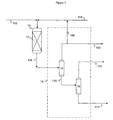
- FIG. 1 is a simplified flow diagram of an oligomerization process according to embodiments disclosed herein.
- FIG. 2 is a simplified flow diagram of an oligomerization process according to embodiments disclosed herein.
- embodiments disclosed herein relate generally to oligomerization of isoolefins. In another aspect, embodiments disclosed herein relate to oligomerization of isoolefins using an oxygen-containing reaction moderator.
- Oligomerization may be carried out, for example, in a partial liquid phase in the presence of an acid cation resin catalyst, either in straight pass type reaction, such as that disclosed in U.S. Pat. Nos. 4,313,016, 4,540,839, 5,003,124, and 6,335,473, or in a catalytic distillation reaction where there is both a vapor and a liquid phase and a concurrent reaction/fractionation.
- Isoolefins that may be oligomerized may include isobutene, isopentenes (isoamylenes), and combinations thereof, which are more reactive than n-olefins, and are selectively oligomerized.
- the primary oligomer products are dimers and trimers of isoolefins.
- isobutene may be oligomerized to form a C 8 or C 12 tertiary olefin
- isopentene may be oligomerized to form a C 10 or C 15 tertiary olefin
- mixtures of isobutene and isopentene may be reacted to form C 8 to C 15 tertiary olefins, among other products.
- C 6 to C 15 olefin oligomers may also be prepared from C 3 to C 5 olefins.
- the oligomers have 8 to 16 carbon atoms and correspond to oligomers which are prepared from C 4 to C 5 olefins.
- the oligomerization of the tertiary olefin may also be performed when carried out on a light naphtha stream with the separation of normal olefins being easily achieved by fractionation from the heavier (higher boiling) oligomers (mainly dimers and trimers).
- the oligomerization of isoolefins may be carried out in a partial liquid phase in the presence of an acid cation resin catalyst either in straight pass type reaction or in a catalytic distillation reaction where there is both a vapor and liquid phase and a concurrent reaction/fractionation.
- Catalysts used in oligomerization reactors may include acid resins, such as AMBERLYST 15 or related oleum derived resins and may include phosphoric acid derived catalysts, such as those known to the industry as SPA (solid phosphoric acid) catalysts.
- the feed to the oligomerization reactor may include purified isoolefin streams, such as a feed stream containing, propylene, isobutane, isoamylenes, or mixtures thereof.
- oligomerization fees may include a C 4 -C 5 , C 4 or C 5 light naphtha cut.
- the tertiary olefins such as isobutene and isoamylenes, are more reactive than the normal olefin isomers and are preferentially oligomerized.
- the primary oligomerization products are dimers and trimers of the C 3 to C 5 olefins.
- the isoalkanes in the C 4 to C 5 light naphtha cut may include isobutane, isopentane or mixtures thereof, as a diluent in the oligomerization reactor.
- Oxygen-containing moderators may be used to influence the selectivity of the oligomerization reaction to the dimer product.
- Oxygen-containing moderators useful in embodiments disclosed herein may include water as well as primary, secondary and tertiary alcohols and ethers.
- the oxygen-containing moderator may include at least one of: water, tertiary butyl alcohol, methanol, methyl tertiary butyl ether, ethanol, and ethyl tertiary butyl ether.
- Oligomerization reactions carried out in the presence of the oxygen-containing moderators may concurrently produce oligomers, such as dimers and trimers of the isoolefins, and various oxygen-containing byproducts due to reaction of a moderator with an isoolefin or an isoolefin oligomer, such as a dimer or trimer.
- the oxygenated oligomerization byproducts may include C 8 -C 16 ethers and C 8 -C 12 alcohols.
- the oligomerization reactors used in embodiments disclosed herein may include any physical devices or a combination of two or more devices.
- the reactors may have various internal devices for vapor-liquid separation and vapor/liquid traffic. Any type of reactor may be used to carry out the reactions described herein.
- the examples of reactors suitable for carrying out the reactions involving isoolefin dimerization or oligomerization reactions may include distillation column reactors, divided wall distillation column reactors, traditional tubular fixed bed reactors, bubble column reactors, slurry reactors equipped with or without a distillation column, pulsed flow reactors, catalytic distillation columns wherein slurry solid catalysts flow down the column, or any combination of these reactors.
- Multiple reactor systems useful in embodiments disclosed herein may include a series of multiple reactors or multiple reactors in parallel for the first reaction zone. A person of ordinary skill in the art would recognize that other types of reactors may also be used.
- straight pass oligomerization reactors may be used, such as disclosed in U.S. Pat. Nos. 4,313,016; 4,540,839; 5,003,124; and 6,335,473.
- the oligomerization of propylene may be carried out, for example, in tubular reactors at 330-482° F. and 1000 to 1215 psig using supported phosphoric acid (sPa), metal complexes (U.S. Pat. Nos. 5,510,555; 4,695,664 and 6,501,001) and various zeolites, especially ZSM-22, ZSM-57 (U.S. Pat. No. 6,143,942) and MCM-22 (U.S. Pat. No.
- sPa supported phosphoric acid
- metal complexes U.S. Pat. Nos. 5,510,555; 4,695,664 and 6,501,001
- various zeolites especially ZSM-22, ZSM-57 (U.S. Pat. No. 6,143,942) and MCM-22 (U.S.
- the effluent from the oligomerization reaction zone may include the oligomers, unreacted propylene and/or isoolefins, oxygen-containing reaction moderators, and oxygenated oligomerization byproducts.
- the oligomerization may be carried out in a catalytic distillation type reaction, such as that disclosed in U.S. Pat. Nos. 4,242,530 or 4,375,576.
- the oligomers and the oxygenated oligomerization byproducts may be fractionated from unreacted isoolefins and other light hydrocarbons.
- the unreacted isoolefins and other light hydrocarbons, when present, may be recovered as an overheads fraction, a fraction of which may also be used as column reflux.
- the oligomers and oxygenated oligomerization byproducts may be recovered as a bottoms fraction, where the bottoms fraction is herein defined as the reactor effluent from a catalytic distillation column.
- the oxygen-containing reaction moderator may be recovered with either or both the overheads fraction and the bottoms fraction.
- the reaction effluent including the oligomers and the oxygenated oligomerization byproduct, or a portion thereof, may then be fractionated to recover a fraction including the oxygenated oligomerization byproduct and the trimers and a fraction including the dimers.
- the reactor effluent may be fractionated to additionally recover a fraction containing the oxygen-containing moderator and/or the unreacted isoolefin, which may be recycled to the oligomerization reaction zone in some embodiments.
- Any separation scheme to produce three separate fractions including a light fraction (moderator and/or unreacted isoolefin), a medium fraction (dimers), and a heavy fraction (trimers and oxygenated oligomerization byproducts), may be used.
- the desired fractions may be obtained using a first distillation column to separate the lights fraction from the medium and heavy fractions followed by separation of the medium and heavy fractions.
- the desired fractions may be obtained using a first distillation column to separate the heavy fraction from the light and medium fraction followed by separation of the light and medium fractions.
- a single distillation column or a divided wall distillation column including a side draw may be used to provide the desired separations.
- One skilled in the art would recognize that other means to obtain the desired fractions can be used.
- the dimer (e.g., C 8 olefins) fraction produced in embodiments disclosed herein may have a purity of at least 99.5 weight percent; at least 99.7 weight percent in other embodiments; and at least 99.8 weight percent in yet other embodiments.
- the total concentration of oxygenates in the recovered dimer fraction may be less than 500 ppm in some embodiments; less than 400 ppm in other embodiments; and less than 250 ppm in yet other embodiments.
- An isoolefin such as isobutene
- An oxygen-containing moderator may be fed to dimerization reaction zone 10 via flow line 104 .
- the isoolefin reacts in the presence of the oligomerization catalyst 12 contained in dimerization reaction zone 10 to convert a portion of the isoolefin to oligomers, including dimers and trimers.
- the moderator may react with a portion of at least one of the isoolefin and the oligomerization products in dimerization reaction zone 10 to form an oxygenated oligomerization byproduct.
- Effluent containing the oligomerization product and the oxygenated oligomerization byproducts, as well as any unreacted moderator and isoolefin, may be recovered from dimerization reaction zone 10 via flow line 106 .
- the reaction effluent may then be fed to separation unit 14 to separate the reaction effluent into the desired fractions.
- the reaction effluent may be fed via flow line 106 to a first distillation column 16 to separate the moderator and unreacted isoolefin from the oligomers and the oxygenated oligomerization byproducts.
- the unreacted isoolefin and moderator may be recovered as an overheads fraction via flow line 108 , and the oligomers and oxygenated oligomerization byproducts may be recovered via flow line 110 .
- the moderator and unreacted isoolefin may be recycled to the oligomerization reaction zone via flow line 109 .
- the bottoms fraction may then be fed via flow line 110 to a second distillation column 18 , where the dimers may be separated from the trimers and the oxygenated oligomerization byproducts.
- the dimers may be recovered as an overheads fraction from column 18 via flow line 112 , and the trimers and oxygenated oligomerization byproducts may be recovered via flow line 114 , where each may be used in downstream processes as described above.
- An isoolefin and a moderator may be fed via flow lines 202 and 204 , respectively, to a catalytic distillation column 20 containing a bed 22 of oligomerization catalyst.
- isoolefin reacts in the presence of the oligomerization catalyst to form oligomers, including dimers and trimers;
- at least a portion of the moderator may react with a portion of at least one of the isoolefin and the oligomers to form oxygenated oligomerization byproducts;
- unreacted isoolefin is separated from the oligomers and oxygenated oligomerization byproducts.
- the unreacted isoolefin may be recovered as an overhead fraction via flow line 207 , a portion of which may be used as column reflux via flow line 213 .
- the oligomers and oxygenated oligomerization byproducts may be recovered as a bottoms fraction via flow line 206 .
- the bottoms fraction may then be fed to separation unit 24 to separate the reaction effluent into the desired fractions.
- the reaction effluent which may include unreacted moderator, may be fed via flow line 206 to a first distillation column 26 to separate the moderator and unreacted isoolefin from the oligomers and the oxygenated oligomerization byproducts.
- the unreacted moderator may be recovered as an overheads fraction via flow line 208 , and the oligomers and oxygenated oligomerization byproducts may be recovered via flow line 210 .
- the moderator may be recycled to the oligomerization reaction zone via flow line 209 .
- the bottoms fraction may then be fed via flow line 210 to a second distillation column 28 , where the dimers may be separated from the trimers and the oxygenated oligomerization byproducts.
- the dimers may be recovered as an overheads fraction from column 28 via flow line 212 , and the trimers and oxygenated oligomerization byproducts may be recovered via flow line 214 , where each may be used in downstream processes as described above.
- oligomerization processes disclosed herein may result in a product stream ( 112 , 212 ) containing isoolefin dimers having a reduced amount of oxygenated byproducts.
- the dimer fraction may include less than 100 ppm oxygen, by weight; less than 50 ppm oxygen, by weight, in other embodiments; and less than 25 ppm oxygen, by weight, in yet other embodiments.
- the resulting dimer fraction may be used, for example, as a raw material for the production of various chemicals, such as herbicides and pesticides.
- the dimer may be fed to an alkylation reaction, where the dimer dissociates into constituent olefins and reacts with an alkane to produce an alkylate in the gasoline-boiling range.
- the dimer may also be hydrogenated to form gasoline-range hydrocarbons, such as octane, nonane, and other hydrocarbons.
- the dimer containing stream may be used as a gasoline-range hydrocarbon blendstock without hydrogenation or alkylation.
- the recovered heavy fraction including the trimers, oxygenated oligomerization byproducts, and any other heavy components present, may be used as a blendstock for diesel fuel.
- the heavy fraction recovered according to embodiments disclosed herein may meet diesel fuel specifications, including being low in sulfur content and having a high flash point.
- a process similar to that of FIG. 1 is used to produce dimers of isobutene.
- a methanol extraction column is also used, as well as a light oxygenate/C 4 splitter (i.e., dividing stream 108 of FIG. 1 ).
- a C 4 feed stream ( 102 ) including approximately 21.8 weight percent isobutene is fed to an oligomerization reactor at a feed rate of about 60,000 kg/h.
- Methanol (stream 104 ) is also fed to the reactor at a flow rate of about 75 kg/h.
- the resulting reactor effluent is then separated to recover oxygenates (stream 108 ), unreacted olefins (stream 108 ), a dimer fraction (stream 112 ), and a trimer/heavies fraction (stream 114 ).
- diisobutylene including co-dimers dimethyl hexene and trimethylpentene
- embodiments disclosed herein relate to oligomerization of isoolefins.
- the isoolefins may be fractionated to obtain a fraction containing isoolefin dimers having a low oxygen content.
- One advantage of processes disclosed herein is lower operating costs. Fractionation does not require the use of hydrogen, as does the typical hydrogenation of oxygenated byproducts, which may result in significant cost savings, especially for an operator that does not have an indigenous source of hydrogen available on site. In addition, fractionation does not require the use of hydrogenation catalyst, which may result in significant cost savings by negating catalyst regeneration or replacement costs.
- Embodiments disclosed herein may advantageously result in higher value end products. For example, hydrogenation of oxygenated hydrocarbons tends to saturate olefinic hydrocarbons, thus resulting in loss of octane value for gasoline blending and reduction of olefin yield available for alkylation. In contrast, embodiments disclosed herein do not chemically alter the composition of the selectively dimerized isobutene and, thus, does not diminish its value.
- Yet another advantage of oligomerization processes according to embodiments disclosed herein is a higher yield of the overall fuel components.
- the hydrogenation process breaks the oxygenates into lighter hydrocarbons and water, wherein the water is removed.
- the fuel value associated with the oxygen bonds in the oxygenates is wasted.
- fractionation does not chemically alter the oxygenates, thus preserving their fuel value to be used, for example, in diesel fuel.
- Yet another advantage of processes disclosed herein is the potential capital costs savings available to a retrofit facility. For example, whereas hydrogenation may require an additional expensive reactor, the operator of a retrofit facility may simply re-commission a distillation tower from a different service to perform the required fractionations.
Landscapes
- Chemical & Material Sciences (AREA)
- Organic Chemistry (AREA)
- Oil, Petroleum & Natural Gas (AREA)
- Chemical Kinetics & Catalysis (AREA)
- Engineering & Computer Science (AREA)
- General Chemical & Material Sciences (AREA)
- Analytical Chemistry (AREA)
- Water Supply & Treatment (AREA)
- Organic Low-Molecular-Weight Compounds And Preparation Thereof (AREA)
- Low-Molecular Organic Synthesis Reactions Using Catalysts (AREA)
Abstract
Description
Isobutene Dimer+Water→C8 Alcohol
Isobutene Dimer+Tertiary Butyl Alcohol(TBA)→C12 Ether
Isobutene Monomer+TBA→C8 Ether
Isobutene Dimer+Methanol→C9 Ether
Isobutene Dimer+Ethanol→C10 Ether
Isobutene Trimer+Water→C12 Alcohol
Isobutene Trimer+TBA→C16 Ether
Isobutene Trimer+Methanol→C13 Ether
Isobutene Trimer+Ethanol→C14 Ether
| TABLE 1 | ||
| Stream | ||
| 108 - | 108 - | ||||||
| 102 | 104 | 112 | 114 | oxygenates | C4s | ||
| Mass Flow | kg/h | 60003 | 75 | 12356 | 1855 | 1303 | 45035 |
| Rate | |||||||
| Temperature | C. | 40 | 50.8 | 40 | 40 | 40 | 40 |
| Pressure | kPa-g | 1750 | 1570 | 500 | 1000 | 500 | 700 |
| Components | wt. % | ||||||
| Methane | wt. % | 0.07 | 0 | 0 | 0 | 0 | 0.09 |
| Propane | wt. % | 0.06 | 0 | 0 | 0 | 0 | 0.08 |
| Isobutane | wt. % | 1.08 | 0 | 0 | 0 | 0 | 1.44 |
| Isobutene | wt. % | 21.83 | 0 | 0 | 0 | 0 | 0.09 |
| 1-butene | wt. % | 37.36 | 0 | 0 | 0 | 0.01 | 36.58 |
| 1,3-butadiene | wt. % | ||||||
| Cis-2-butene | wt. % | 24.09 | 0 | 0 | 0 | 0.04 | 35.89 |
| n-butane | wt. % | 7.71 | 0 | 0 | 0 | 0.04 | 15.35 |
| 3-methyl-1- | wt. % | 7.7 | 0 | 0 | 0 | 0.01 | 10.26 |
| butene | |||||||
| 2-methyl-1- | wt. % | 0.1 | 0 | 0 | 0 | 0.14 | 0.08 |
| butene | |||||||
| 2-methyl-2- | wt. % | 0 | 0 | 0 | 0 | 0.24 | 0 |
| butene | |||||||
| Diisobutylene | wt. % | 0 | 0 | 71.06 | 0.94 | 1 | 0 |
| dimethyl | wt. % | 0 | 0 | 10.23 | 0.77 | 0.47 | 0 |
| hexene | |||||||
| Trimethyl | wt. % | 0 | 0 | 18.68 | 0.29 | 0 | 0 |
| pentene | |||||||
| Triisobutylene | wt. % | 0 | 0 | 0 | 90.64 | 0.12 | 0 |
| Quad- | wt. % | 0 | 0 | 0 | 1.54 | 0 | 0 |
| isobutylene | |||||||
| C9 ether | wt. % | 0 | 0 | 0.03 | 5.82 | 0 | 0 |
| Water | wt. % | 0.01 | 0.02 | 0 | 0 | 0 | 0.05 |
| Methanol | wt. % | 0 | 99.55 | 0 | 0 | 0 | 0.01 |
| MSBE | wt. % | 0 | 0 | 0 | 0 | 75.35 | 0 |
| TAME | wt. % | 0 | 0 | 0.01 | 0 | 17.67 | 0 |
| TBA and SBA | wt. % | 0 | 0 | 0 | 0 | 0.76 | 0 |
| DME | wt. % | 0 | 0.44 | 0 | 0 | 4.13 | 0.09 |
Claims (21)
Priority Applications (3)
| Application Number | Priority Date | Filing Date | Title |
|---|---|---|---|
| US12/326,488 US8853483B2 (en) | 2008-12-02 | 2008-12-02 | Oligomerization process |
| PCT/US2009/063418 WO2010065234A2 (en) | 2008-12-02 | 2009-11-05 | Oligomerization process |
| KR1020117013538A KR101447769B1 (en) | 2008-12-02 | 2009-11-05 | Oligomerization process |
Applications Claiming Priority (1)
| Application Number | Priority Date | Filing Date | Title |
|---|---|---|---|
| US12/326,488 US8853483B2 (en) | 2008-12-02 | 2008-12-02 | Oligomerization process |
Publications (2)
| Publication Number | Publication Date |
|---|---|
| US20100137668A1 US20100137668A1 (en) | 2010-06-03 |
| US8853483B2 true US8853483B2 (en) | 2014-10-07 |
Family
ID=42223426
Family Applications (1)
| Application Number | Title | Priority Date | Filing Date |
|---|---|---|---|
| US12/326,488 Active 2031-04-16 US8853483B2 (en) | 2008-12-02 | 2008-12-02 | Oligomerization process |
Country Status (3)
| Country | Link |
|---|---|
| US (1) | US8853483B2 (en) |
| KR (1) | KR101447769B1 (en) |
| WO (1) | WO2010065234A2 (en) |
Families Citing this family (13)
| Publication number | Priority date | Publication date | Assignee | Title |
|---|---|---|---|---|
| WO2011143215A2 (en) * | 2010-05-10 | 2011-11-17 | Catalytic Distillation Technologies | Production of jet and other heavy fuels from isobutanol |
| FI20106312A7 (en) * | 2010-12-10 | 2012-06-11 | Neste Oil Oyj | A method for production of middle distillate components from gasoline components |
| US20120149957A1 (en) * | 2010-12-10 | 2012-06-14 | Uop, Llc | Apparatus and process for oligomerizing one or more hydrocarbons |
| JP5767875B2 (en) | 2011-06-29 | 2015-08-26 | 出光興産株式会社 | Method for producing diisobutylene from mixed C4 fraction |
| US20140275664A1 (en) | 2013-03-13 | 2014-09-18 | Chevron Phillips Chemical Company Lp | Processes for Preparing Low Viscosity Lubricants |
| ES2682945T3 (en) | 2014-05-31 | 2018-09-24 | Indian Oil Corporation Limited | Process for the simultaneous production of alcohols and oligomeric product from a hydrocarbon feedstock |
| US20160010019A1 (en) * | 2014-07-14 | 2016-01-14 | Swift Fuels, Llc | Aviation fuel with a renewable oxygenate |
| US20160010018A1 (en) * | 2014-07-14 | 2016-01-14 | Swift Fuels,LLC | Unleaded gasoline formulations for piston engines |
| EP3814314B1 (en) * | 2018-06-29 | 2023-08-02 | Lyondell Chemical Technology, L.P. | Process for the production of diesel and gasoline additives from glycerol |
| TWI757903B (en) * | 2019-10-07 | 2022-03-11 | 美商魯瑪斯科技有限責任公司 | Co-production of high purity isobutane and butene-1 from mixed c4s |
| TWI801918B (en) | 2020-06-29 | 2023-05-11 | 美商魯瑪斯科技有限責任公司 | Process for the controlled oligomerization of butenes |
| FI130239B (en) | 2020-11-12 | 2023-05-04 | Neste Oyj | Trimerization of Olefins |
| WO2026085134A1 (en) * | 2024-10-15 | 2026-04-23 | Lummus Technology Llc | Method for producing bio or fossil fuels through light olefins oligomerization over zeolite catalysts and a system for producing the same |
Citations (24)
| Publication number | Priority date | Publication date | Assignee | Title |
|---|---|---|---|---|
| US2135117A (en) * | 1936-11-17 | 1938-11-01 | Gulf Research Development Co | Polymerization of olefines |
| US4242530A (en) | 1978-07-27 | 1980-12-30 | Chemical Research & Licensing Company | Process for separating isobutene from C4 streams |
| US4313016A (en) | 1980-10-23 | 1982-01-26 | Petro-Tex Chemical Corporation | Isobutene removal from C4 streams |
| US4375576A (en) | 1981-07-27 | 1983-03-01 | Chemical Research & Licensing Co. | Enhanced diisobutene production in the presence of methyl tertiary butyl ether |
| US4540839A (en) | 1984-03-26 | 1985-09-10 | Petro-Tex Chemical Corporation | Process for the production of polymer gasoline |
| US4695664A (en) | 1986-04-17 | 1987-09-22 | The Badger Company, Inc. | Method of recovering heat from low temperature effluent |
| US4956514A (en) | 1988-10-06 | 1990-09-11 | Mobil Oil Corp. | Process for converting olefins to higher hydrocarbons |
| US5003124A (en) | 1982-11-17 | 1991-03-26 | Chemical Research & Licensing Company | Oligomerization process |
| US5510555A (en) | 1991-01-04 | 1996-04-23 | Eniricerche, S.P.A. | Catalyst and process for oligomerizing olefins |
| US5723687A (en) * | 1995-06-01 | 1998-03-03 | Snamprogetti S.P.A. | Process for the joint production of ethers and hydrocarbons with a high octane number |
| US6011191A (en) * | 1997-05-15 | 2000-01-04 | Snamprogetti S.P.A. | Process for the production of hydrocarbons with a high octane number by the selective dimerization of isobutene |
| US6143942A (en) | 1994-02-22 | 2000-11-07 | Exxon Chemical Patents Inc. | Oligomerization and catalysts therefor |
| US6335473B1 (en) | 1994-07-18 | 2002-01-01 | Catalytic Distillation Technologies | Method for conducting exothermic reactions |
| US6376731B1 (en) * | 2000-01-14 | 2002-04-23 | Arco Chemical Technology, L.P. | Selective olefin oligomerization |
| US6501001B2 (en) | 2000-02-04 | 2002-12-31 | Institut Francais Du Petrole | Process for selective dimerization of propylene principally into branched dimers |
| US6613108B1 (en) * | 1998-10-16 | 2003-09-02 | Fortum Oil & Gas Oy | Process for producing a fuel component |
| US20040097773A1 (en) | 2002-08-06 | 2004-05-20 | Oxeno Olefinchemie Gmbh | Oligomerization of isobutene in N-butenic hydrocarbon streams |
| US6936742B2 (en) * | 2002-03-15 | 2005-08-30 | Catalytic Distillation Technologies | Production of diisobutene from tertiary butyl alcohol |
| US7038101B2 (en) * | 2001-09-05 | 2006-05-02 | Neste Oil Oyj | Method for product separation and purification in iso-butylene dimerization process |
| US20060122444A1 (en) | 2003-01-23 | 2006-06-08 | Udo Peters | Method for producing butene oligomers and tert-butylethers from c4 flows containing isobutene |
| US7145049B2 (en) | 2003-07-25 | 2006-12-05 | Catalytic Distillation Technologies | Oligomerization process |
| US20060287565A1 (en) * | 2000-07-10 | 2006-12-21 | Sasol Technology (Pty) Limited | Process and apparatus for the production of diesel fuels by oligomerisation of olefinic feed streams |
| US20080242909A1 (en) * | 2005-11-17 | 2008-10-02 | Snamprogetti S.P.A. | Process for the Production of High-Octane Hydrocarbon Compounds by the Selective Dimerization of Isobutene Contained in a Stream Which Also Contains C5 Hydrocarbons |
| US7601880B2 (en) * | 2003-09-18 | 2009-10-13 | Neste Oil Oyj | Method for catalytic deoxygenation of process fluids of olefin dimerization process |
-
2008
- 2008-12-02 US US12/326,488 patent/US8853483B2/en active Active
-
2009
- 2009-11-05 KR KR1020117013538A patent/KR101447769B1/en active Active
- 2009-11-05 WO PCT/US2009/063418 patent/WO2010065234A2/en not_active Ceased
Patent Citations (24)
| Publication number | Priority date | Publication date | Assignee | Title |
|---|---|---|---|---|
| US2135117A (en) * | 1936-11-17 | 1938-11-01 | Gulf Research Development Co | Polymerization of olefines |
| US4242530A (en) | 1978-07-27 | 1980-12-30 | Chemical Research & Licensing Company | Process for separating isobutene from C4 streams |
| US4313016A (en) | 1980-10-23 | 1982-01-26 | Petro-Tex Chemical Corporation | Isobutene removal from C4 streams |
| US4375576A (en) | 1981-07-27 | 1983-03-01 | Chemical Research & Licensing Co. | Enhanced diisobutene production in the presence of methyl tertiary butyl ether |
| US5003124A (en) | 1982-11-17 | 1991-03-26 | Chemical Research & Licensing Company | Oligomerization process |
| US4540839A (en) | 1984-03-26 | 1985-09-10 | Petro-Tex Chemical Corporation | Process for the production of polymer gasoline |
| US4695664A (en) | 1986-04-17 | 1987-09-22 | The Badger Company, Inc. | Method of recovering heat from low temperature effluent |
| US4956514A (en) | 1988-10-06 | 1990-09-11 | Mobil Oil Corp. | Process for converting olefins to higher hydrocarbons |
| US5510555A (en) | 1991-01-04 | 1996-04-23 | Eniricerche, S.P.A. | Catalyst and process for oligomerizing olefins |
| US6143942A (en) | 1994-02-22 | 2000-11-07 | Exxon Chemical Patents Inc. | Oligomerization and catalysts therefor |
| US6335473B1 (en) | 1994-07-18 | 2002-01-01 | Catalytic Distillation Technologies | Method for conducting exothermic reactions |
| US5723687A (en) * | 1995-06-01 | 1998-03-03 | Snamprogetti S.P.A. | Process for the joint production of ethers and hydrocarbons with a high octane number |
| US6011191A (en) * | 1997-05-15 | 2000-01-04 | Snamprogetti S.P.A. | Process for the production of hydrocarbons with a high octane number by the selective dimerization of isobutene |
| US6613108B1 (en) * | 1998-10-16 | 2003-09-02 | Fortum Oil & Gas Oy | Process for producing a fuel component |
| US6376731B1 (en) * | 2000-01-14 | 2002-04-23 | Arco Chemical Technology, L.P. | Selective olefin oligomerization |
| US6501001B2 (en) | 2000-02-04 | 2002-12-31 | Institut Francais Du Petrole | Process for selective dimerization of propylene principally into branched dimers |
| US20060287565A1 (en) * | 2000-07-10 | 2006-12-21 | Sasol Technology (Pty) Limited | Process and apparatus for the production of diesel fuels by oligomerisation of olefinic feed streams |
| US7038101B2 (en) * | 2001-09-05 | 2006-05-02 | Neste Oil Oyj | Method for product separation and purification in iso-butylene dimerization process |
| US6936742B2 (en) * | 2002-03-15 | 2005-08-30 | Catalytic Distillation Technologies | Production of diisobutene from tertiary butyl alcohol |
| US20040097773A1 (en) | 2002-08-06 | 2004-05-20 | Oxeno Olefinchemie Gmbh | Oligomerization of isobutene in N-butenic hydrocarbon streams |
| US20060122444A1 (en) | 2003-01-23 | 2006-06-08 | Udo Peters | Method for producing butene oligomers and tert-butylethers from c4 flows containing isobutene |
| US7145049B2 (en) | 2003-07-25 | 2006-12-05 | Catalytic Distillation Technologies | Oligomerization process |
| US7601880B2 (en) * | 2003-09-18 | 2009-10-13 | Neste Oil Oyj | Method for catalytic deoxygenation of process fluids of olefin dimerization process |
| US20080242909A1 (en) * | 2005-11-17 | 2008-10-02 | Snamprogetti S.P.A. | Process for the Production of High-Octane Hydrocarbon Compounds by the Selective Dimerization of Isobutene Contained in a Stream Which Also Contains C5 Hydrocarbons |
Non-Patent Citations (5)
| Title |
|---|
| CS ChemProp calculation (boiling points estimated by CS ChemProp in ChemDraw Ultra, 12.0, copyright CambridgeSoft, Inc., 2010). * |
| DeGarmo, et al., "Consider Reactive Distillation" in Chemical Engineering Progress, p. 43-50, Mar. 1992. * |
| International Search Report and Written Opinion issued May 24, 2010 in corresponding International Application No. PCT/US2009/063418 (7 pages). |
| Office Action (with translation) issued Mar. 26, 2013 in corresponding Korean application No. 10-2011-7013538 (7 pages). |
| Second Office Action (with translation) issued Oct. 8, 2013 in corresponding Korean application No. 10-2011-7013538 (11 pages). |
Also Published As
| Publication number | Publication date |
|---|---|
| KR20110095330A (en) | 2011-08-24 |
| KR101447769B1 (en) | 2014-10-06 |
| WO2010065234A2 (en) | 2010-06-10 |
| WO2010065234A3 (en) | 2010-07-29 |
| US20100137668A1 (en) | 2010-06-03 |
Similar Documents
| Publication | Publication Date | Title |
|---|---|---|
| US20100137668A1 (en) | Oligomerization process | |
| CA2740606C (en) | Metathesis unit pretreatment process with formation of octene | |
| WO2000023402A1 (en) | Process for dimerizing olefinic hydrocarbon feedstock and producing a fuel component | |
| US11939289B2 (en) | Process for the controlled oligomerization of butenes | |
| KR102627318B1 (en) | Selective dimerization and etherification of isobutylene via catalytic distillation | |
| CN114555545B (en) | Co-production of high purity isobutane and butene-1 from mixed C4 s | |
| WO2012076758A2 (en) | A method for production of middle distillate components from gasoline components | |
| US8124819B2 (en) | Oligomerization process | |
| US10131589B2 (en) | Process for simultaneous production of alcohols and oligomer product from hydrocarbon feed stock | |
| US8134039B2 (en) | Process for the production of high-octane hydrocarbon compounds by the selective dimerization of isobutene contained in a stream which also contains C5 hydrocarbons | |
| US10618857B2 (en) | Process for the separation of C5 hydrocarbons present in streams prevalently containing C4 products used for the production of high-octane hydrocarbon compounds by the selective dimerization of isobutene | |
| US11097998B1 (en) | Process for production of mixed butanol and diisobutenes as fuel blending components |
Legal Events
| Date | Code | Title | Description |
|---|---|---|---|
| AS | Assignment |
Owner name: CATALYTIC DISTILLATION TECHNOLOGIES,TEXAS Free format text: ASSIGNMENT OF ASSIGNORS INTEREST;ASSIGNORS:LOESCHER, MITCHELL E.;ODEGARD, TURI;SIGNING DATES FROM 20081216 TO 20090204;REEL/FRAME:023548/0963 Owner name: CATALYTIC DISTILLATION TECHNOLOGIES, TEXAS Free format text: ASSIGNMENT OF ASSIGNORS INTEREST;ASSIGNORS:LOESCHER, MITCHELL E.;ODEGARD, TURI;SIGNING DATES FROM 20081216 TO 20090204;REEL/FRAME:023548/0963 |
|
| STCF | Information on status: patent grant |
Free format text: PATENTED CASE |
|
| MAFP | Maintenance fee payment |
Free format text: PAYMENT OF MAINTENANCE FEE, 4TH YEAR, LARGE ENTITY (ORIGINAL EVENT CODE: M1551) Year of fee payment: 4 |
|
| MAFP | Maintenance fee payment |
Free format text: PAYMENT OF MAINTENANCE FEE, 8TH YEAR, LARGE ENTITY (ORIGINAL EVENT CODE: M1552); ENTITY STATUS OF PATENT OWNER: LARGE ENTITY Year of fee payment: 8 |
|
| MAFP | Maintenance fee payment |
Free format text: PAYMENT OF MAINTENANCE FEE, 12TH YEAR, LARGE ENTITY (ORIGINAL EVENT CODE: M1553); ENTITY STATUS OF PATENT OWNER: LARGE ENTITY Year of fee payment: 12 |