US8853330B2 - Hybrid polymers - Google Patents
Hybrid polymers Download PDFInfo
- Publication number
- US8853330B2 US8853330B2 US13/757,955 US201313757955A US8853330B2 US 8853330 B2 US8853330 B2 US 8853330B2 US 201313757955 A US201313757955 A US 201313757955A US 8853330 B2 US8853330 B2 US 8853330B2
- Authority
- US
- United States
- Prior art keywords
- polymer
- polyester
- poss
- alkyl
- group
- Prior art date
- Legal status (The legal status is an assumption and is not a legal conclusion. Google has not performed a legal analysis and makes no representation as to the accuracy of the status listed.)
- Active
Links
- 229920000642 polymer Polymers 0.000 title claims abstract description 147
- 229920000728 polyester Polymers 0.000 claims abstract description 94
- 239000002131 composite material Substances 0.000 claims abstract description 21
- -1 poly(D-lactic acid) Polymers 0.000 claims description 142
- 125000000217 alkyl group Chemical group 0.000 claims description 45
- 125000000753 cycloalkyl group Chemical group 0.000 claims description 38
- 239000001257 hydrogen Substances 0.000 claims description 36
- 229910052739 hydrogen Inorganic materials 0.000 claims description 36
- 125000003710 aryl alkyl group Chemical group 0.000 claims description 35
- 239000011159 matrix material Substances 0.000 claims description 29
- 125000000592 heterocycloalkyl group Chemical group 0.000 claims description 28
- 125000003342 alkenyl group Chemical group 0.000 claims description 24
- 238000000034 method Methods 0.000 claims description 24
- 125000000304 alkynyl group Chemical group 0.000 claims description 23
- 125000000392 cycloalkenyl group Chemical group 0.000 claims description 21
- 125000004366 heterocycloalkenyl group Chemical group 0.000 claims description 19
- 150000001875 compounds Chemical class 0.000 claims description 16
- 125000003118 aryl group Chemical group 0.000 claims description 15
- 238000002156 mixing Methods 0.000 claims description 11
- 229920000118 poly(D-lactic acid) Polymers 0.000 claims description 11
- 229920000058 polyacrylate Polymers 0.000 claims description 6
- UFHFLCQGNIYNRP-UHFFFAOYSA-N Hydrogen Chemical compound [H][H] UFHFLCQGNIYNRP-UHFFFAOYSA-N 0.000 claims description 3
- 229920003232 aliphatic polyester Polymers 0.000 claims description 2
- 238000013329 compounding Methods 0.000 claims description 2
- 239000000155 melt Substances 0.000 claims description 2
- 150000002431 hydrogen Chemical group 0.000 claims 14
- 239000000203 mixture Substances 0.000 description 43
- 230000015572 biosynthetic process Effects 0.000 description 22
- WYURNTSHIVDZCO-UHFFFAOYSA-N Tetrahydrofuran Chemical compound C1CCOC1 WYURNTSHIVDZCO-UHFFFAOYSA-N 0.000 description 20
- 0 [1*]C(OC(C)C)C(=O)OC(C)C Chemical compound [1*]C(OC(C)C)C(=O)OC(C)C 0.000 description 20
- 229920001400 block copolymer Polymers 0.000 description 20
- 125000004435 hydrogen atom Chemical group [H]* 0.000 description 19
- JVTAAEKCZFNVCJ-REOHCLBHSA-N L-lactic acid Chemical group C[C@H](O)C(O)=O JVTAAEKCZFNVCJ-REOHCLBHSA-N 0.000 description 17
- 229920001577 copolymer Polymers 0.000 description 17
- 239000000243 solution Substances 0.000 description 16
- 238000010560 atom transfer radical polymerization reaction Methods 0.000 description 15
- 125000005647 linker group Chemical group 0.000 description 15
- 229920001434 poly(D-lactide) Polymers 0.000 description 14
- RBMHUYBJIYNRLY-UHFFFAOYSA-N 2-[(1-carboxy-1-hydroxyethyl)-hydroxyphosphoryl]-2-hydroxypropanoic acid Chemical compound OC(=O)C(O)(C)P(O)(=O)C(C)(O)C(O)=O RBMHUYBJIYNRLY-UHFFFAOYSA-N 0.000 description 13
- 238000006243 chemical reaction Methods 0.000 description 13
- 150000004820 halides Chemical group 0.000 description 13
- 239000000178 monomer Substances 0.000 description 13
- 229920001432 poly(L-lactide) Polymers 0.000 description 13
- YMWUJEATGCHHMB-UHFFFAOYSA-N Dichloromethane Chemical compound ClCCl YMWUJEATGCHHMB-UHFFFAOYSA-N 0.000 description 12
- 238000009826 distribution Methods 0.000 description 10
- 150000002148 esters Chemical group 0.000 description 10
- JVTAAEKCZFNVCJ-UHFFFAOYSA-N lactic acid Chemical compound CC(O)C(O)=O JVTAAEKCZFNVCJ-UHFFFAOYSA-N 0.000 description 10
- 229920000747 poly(lactic acid) Polymers 0.000 description 10
- OKKJLVBELUTLKV-UHFFFAOYSA-N Methanol Chemical compound OC OKKJLVBELUTLKV-UHFFFAOYSA-N 0.000 description 9
- 239000003054 catalyst Substances 0.000 description 9
- 239000003999 initiator Substances 0.000 description 9
- 229910052751 metal Inorganic materials 0.000 description 9
- 239000002184 metal Substances 0.000 description 9
- 239000004626 polylactic acid Substances 0.000 description 9
- 238000006116 polymerization reaction Methods 0.000 description 9
- 150000003624 transition metals Chemical class 0.000 description 9
- 238000004736 wide-angle X-ray diffraction Methods 0.000 description 9
- 125000004432 carbon atom Chemical group C* 0.000 description 8
- 239000000945 filler Substances 0.000 description 8
- 238000005227 gel permeation chromatography Methods 0.000 description 8
- 230000008569 process Effects 0.000 description 8
- 239000000047 product Substances 0.000 description 8
- HEDRZPFGACZZDS-UHFFFAOYSA-N Chloroform Chemical compound ClC(Cl)Cl HEDRZPFGACZZDS-UHFFFAOYSA-N 0.000 description 7
- 239000013078 crystal Substances 0.000 description 7
- 150000002739 metals Chemical class 0.000 description 7
- 125000002496 methyl group Chemical group [H]C([H])([H])* 0.000 description 7
- 239000008188 pellet Substances 0.000 description 7
- 229910052723 transition metal Inorganic materials 0.000 description 7
- LFQSCWFLJHTTHZ-UHFFFAOYSA-N Ethanol Chemical compound CCO LFQSCWFLJHTTHZ-UHFFFAOYSA-N 0.000 description 6
- ZMXDDKWLCZADIW-UHFFFAOYSA-N N,N-Dimethylformamide Chemical compound CN(C)C=O ZMXDDKWLCZADIW-UHFFFAOYSA-N 0.000 description 6
- ZMANZCXQSJIPKH-UHFFFAOYSA-N Triethylamine Chemical compound CCN(CC)CC ZMANZCXQSJIPKH-UHFFFAOYSA-N 0.000 description 6
- 239000000463 material Substances 0.000 description 6
- VLKZOEOYAKHREP-UHFFFAOYSA-N n-Hexane Chemical compound CCCCCC VLKZOEOYAKHREP-UHFFFAOYSA-N 0.000 description 6
- 238000003917 TEM image Methods 0.000 description 5
- 238000010668 complexation reaction Methods 0.000 description 5
- 125000001495 ethyl group Chemical group [H]C([H])([H])C([H])([H])* 0.000 description 5
- 125000002887 hydroxy group Chemical group [H]O* 0.000 description 5
- 239000004310 lactic acid Substances 0.000 description 5
- 235000014655 lactic acid Nutrition 0.000 description 5
- 238000005259 measurement Methods 0.000 description 5
- 230000000704 physical effect Effects 0.000 description 5
- 238000002360 preparation method Methods 0.000 description 5
- 239000002904 solvent Substances 0.000 description 5
- 238000009864 tensile test Methods 0.000 description 5
- 238000001757 thermogravimetry curve Methods 0.000 description 5
- XKRFYHLGVUSROY-UHFFFAOYSA-N Argon Chemical compound [Ar] XKRFYHLGVUSROY-UHFFFAOYSA-N 0.000 description 4
- CPELXLSAUQHCOX-UHFFFAOYSA-M Bromide Chemical compound [Br-] CPELXLSAUQHCOX-UHFFFAOYSA-M 0.000 description 4
- VEXZGXHMUGYJMC-UHFFFAOYSA-M Chloride anion Chemical compound [Cl-] VEXZGXHMUGYJMC-UHFFFAOYSA-M 0.000 description 4
- 125000001931 aliphatic group Chemical group 0.000 description 4
- 125000003178 carboxy group Chemical group [H]OC(*)=O 0.000 description 4
- 238000000113 differential scanning calorimetry Methods 0.000 description 4
- 238000001938 differential scanning calorimetry curve Methods 0.000 description 4
- 230000001965 increasing effect Effects 0.000 description 4
- 230000000977 initiatory effect Effects 0.000 description 4
- 125000000959 isobutyl group Chemical group [H]C([H])([H])C([H])(C([H])([H])[H])C([H])([H])* 0.000 description 4
- 238000010550 living polymerization reaction Methods 0.000 description 4
- UKODFQOELJFMII-UHFFFAOYSA-N pentamethyldiethylenetriamine Chemical compound CN(C)CCN(C)CCN(C)C UKODFQOELJFMII-UHFFFAOYSA-N 0.000 description 4
- 238000003786 synthesis reaction Methods 0.000 description 4
- YLQBMQCUIZJEEH-UHFFFAOYSA-N tetrahydrofuran Natural products C=1C=COC=1 YLQBMQCUIZJEEH-UHFFFAOYSA-N 0.000 description 4
- WEVYAHXRMPXWCK-UHFFFAOYSA-N Acetonitrile Chemical compound CC#N WEVYAHXRMPXWCK-UHFFFAOYSA-N 0.000 description 3
- UHOVQNZJYSORNB-UHFFFAOYSA-N Benzene Chemical compound C1=CC=CC=C1 UHOVQNZJYSORNB-UHFFFAOYSA-N 0.000 description 3
- WVDDGKGOMKODPV-UHFFFAOYSA-N Benzyl alcohol Chemical compound OCC1=CC=CC=C1 WVDDGKGOMKODPV-UHFFFAOYSA-N 0.000 description 3
- JVTAAEKCZFNVCJ-UWTATZPHSA-N D-lactic acid Chemical group C[C@@H](O)C(O)=O JVTAAEKCZFNVCJ-UWTATZPHSA-N 0.000 description 3
- LYCAIKOWRPUZTN-UHFFFAOYSA-N Ethylene glycol Chemical compound OCCO LYCAIKOWRPUZTN-UHFFFAOYSA-N 0.000 description 3
- 238000005481 NMR spectroscopy Methods 0.000 description 3
- YXFVVABEGXRONW-UHFFFAOYSA-N Toluene Chemical compound CC1=CC=CC=C1 YXFVVABEGXRONW-UHFFFAOYSA-N 0.000 description 3
- 150000001336 alkenes Chemical class 0.000 description 3
- 150000001350 alkyl halides Chemical class 0.000 description 3
- 125000000732 arylene group Chemical group 0.000 description 3
- 150000001732 carboxylic acid derivatives Chemical group 0.000 description 3
- 239000010949 copper Substances 0.000 description 3
- 238000002425 crystallisation Methods 0.000 description 3
- 230000008025 crystallization Effects 0.000 description 3
- 125000000113 cyclohexyl group Chemical group [H]C1([H])C([H])([H])C([H])([H])C([H])(*)C([H])([H])C1([H])[H] 0.000 description 3
- 125000001511 cyclopentyl group Chemical group [H]C1([H])C([H])([H])C([H])([H])C([H])(*)C1([H])[H] 0.000 description 3
- 238000010438 heat treatment Methods 0.000 description 3
- 125000001072 heteroaryl group Chemical group 0.000 description 3
- 125000004051 hexyl group Chemical group [H]C([H])([H])C([H])([H])C([H])([H])C([H])([H])C([H])([H])C([H])([H])* 0.000 description 3
- 229920001519 homopolymer Polymers 0.000 description 3
- 238000010348 incorporation Methods 0.000 description 3
- 238000002844 melting Methods 0.000 description 3
- 230000008018 melting Effects 0.000 description 3
- 239000002114 nanocomposite Substances 0.000 description 3
- 229910052757 nitrogen Inorganic materials 0.000 description 3
- JRZJOMJEPLMPRA-UHFFFAOYSA-N olefin Natural products CCCCCCCC=C JRZJOMJEPLMPRA-UHFFFAOYSA-N 0.000 description 3
- 239000002245 particle Substances 0.000 description 3
- 125000001997 phenyl group Chemical group [H]C1=C([H])C([H])=C(*)C([H])=C1[H] 0.000 description 3
- 229920000139 polyethylene terephthalate Polymers 0.000 description 3
- 239000005020 polyethylene terephthalate Substances 0.000 description 3
- 125000001436 propyl group Chemical group [H]C([*])([H])C([H])([H])C([H])([H])[H] 0.000 description 3
- 238000000746 purification Methods 0.000 description 3
- 238000010526 radical polymerization reaction Methods 0.000 description 3
- 230000035882 stress Effects 0.000 description 3
- 238000004627 transmission electron microscopy Methods 0.000 description 3
- QPFMBZIOSGYJDE-UHFFFAOYSA-N 1,1,2,2-tetrachloroethane Chemical compound ClC(Cl)C(Cl)Cl QPFMBZIOSGYJDE-UHFFFAOYSA-N 0.000 description 2
- RYHBNJHYFVUHQT-UHFFFAOYSA-N 1,4-Dioxane Chemical compound C1COCCO1 RYHBNJHYFVUHQT-UHFFFAOYSA-N 0.000 description 2
- 238000005160 1H NMR spectroscopy Methods 0.000 description 2
- YOCIJWAHRAJQFT-UHFFFAOYSA-N 2-bromo-2-methylpropanoyl bromide Chemical compound CC(C)(Br)C(Br)=O YOCIJWAHRAJQFT-UHFFFAOYSA-N 0.000 description 2
- 125000006020 2-methyl-1-propenyl group Chemical group 0.000 description 2
- 125000003903 2-propenyl group Chemical group [H]C([*])([H])C([H])=C([H])[H] 0.000 description 2
- IJGRMHOSHXDMSA-UHFFFAOYSA-N Atomic nitrogen Chemical compound N#N IJGRMHOSHXDMSA-UHFFFAOYSA-N 0.000 description 2
- ROFVEXUMMXZLPA-UHFFFAOYSA-N Bipyridyl Chemical compound N1=CC=CC=C1C1=CC=CC=N1 ROFVEXUMMXZLPA-UHFFFAOYSA-N 0.000 description 2
- VJVNUJSJKJIRII-SVNRARETSA-N CC(C)OC(=O)C[C@@H](C)OC(C)C.CC(C)OC(=O)C[C@H](C)OC(C)C.CC(C)OC(=O)[C@@H](C)OC(C)C.CC(C)OC(=O)[C@@H](OC(C)C)C1=CC=CC=C1.CC(C)OC(=O)[C@H](C)OC(C)C.CC(C)OC(=O)[C@H](OC(C)C)C1=CC=CC=C1.CC[C@@H](CC(=O)OC(C)C)OC(C)C.CC[C@@H](OC(C)C)C(=O)OC(C)C.CC[C@H](CC(=O)OC(C)C)OC(C)C.CC[C@H](OC(C)C)C(=O)OC(C)C Chemical compound CC(C)OC(=O)C[C@@H](C)OC(C)C.CC(C)OC(=O)C[C@H](C)OC(C)C.CC(C)OC(=O)[C@@H](C)OC(C)C.CC(C)OC(=O)[C@@H](OC(C)C)C1=CC=CC=C1.CC(C)OC(=O)[C@H](C)OC(C)C.CC(C)OC(=O)[C@H](OC(C)C)C1=CC=CC=C1.CC[C@@H](CC(=O)OC(C)C)OC(C)C.CC[C@@H](OC(C)C)C(=O)OC(C)C.CC[C@H](CC(=O)OC(C)C)OC(C)C.CC[C@H](OC(C)C)C(=O)OC(C)C VJVNUJSJKJIRII-SVNRARETSA-N 0.000 description 2
- OKTJSMMVPCPJKN-UHFFFAOYSA-N Carbon Chemical group [C] OKTJSMMVPCPJKN-UHFFFAOYSA-N 0.000 description 2
- CURLTUGMZLYLDI-UHFFFAOYSA-N Carbon dioxide Chemical compound O=C=O CURLTUGMZLYLDI-UHFFFAOYSA-N 0.000 description 2
- RYGMFSIKBFXOCR-UHFFFAOYSA-N Copper Chemical compound [Cu] RYGMFSIKBFXOCR-UHFFFAOYSA-N 0.000 description 2
- 229910021589 Copper(I) bromide Inorganic materials 0.000 description 2
- RTZKZFJDLAIYFH-UHFFFAOYSA-N Diethyl ether Chemical compound CCOCC RTZKZFJDLAIYFH-UHFFFAOYSA-N 0.000 description 2
- RPNUMPOLZDHAAY-UHFFFAOYSA-N Diethylenetriamine Chemical compound NCCNCCN RPNUMPOLZDHAAY-UHFFFAOYSA-N 0.000 description 2
- IAZDPXIOMUYVGZ-UHFFFAOYSA-N Dimethylsulphoxide Chemical compound CS(C)=O IAZDPXIOMUYVGZ-UHFFFAOYSA-N 0.000 description 2
- KFZMGEQAYNKOFK-UHFFFAOYSA-N Isopropanol Chemical compound CC(C)O KFZMGEQAYNKOFK-UHFFFAOYSA-N 0.000 description 2
- 208000034530 PLAA-associated neurodevelopmental disease Diseases 0.000 description 2
- 239000002253 acid Substances 0.000 description 2
- 230000006978 adaptation Effects 0.000 description 2
- RDOXTESZEPMUJZ-UHFFFAOYSA-N anisole Chemical compound COC1=CC=CC=C1 RDOXTESZEPMUJZ-UHFFFAOYSA-N 0.000 description 2
- 229910052786 argon Inorganic materials 0.000 description 2
- 238000000149 argon plasma sintering Methods 0.000 description 2
- 125000001797 benzyl group Chemical group [H]C1=C([H])C([H])=C(C([H])=C1[H])C([H])([H])* 0.000 description 2
- 230000002902 bimodal effect Effects 0.000 description 2
- 229920000229 biodegradable polyester Polymers 0.000 description 2
- 239000004622 biodegradable polyester Substances 0.000 description 2
- 125000000484 butyl group Chemical group [H]C([*])([H])C([H])([H])C([H])([H])C([H])([H])[H] 0.000 description 2
- 239000011203 carbon fibre reinforced carbon Substances 0.000 description 2
- 230000000052 comparative effect Effects 0.000 description 2
- 229940126214 compound 3 Drugs 0.000 description 2
- 229910052802 copper Inorganic materials 0.000 description 2
- 125000001995 cyclobutyl group Chemical group [H]C1([H])C([H])([H])C([H])(*)C1([H])[H] 0.000 description 2
- 125000001559 cyclopropyl group Chemical group [H]C1([H])C([H])([H])C1([H])* 0.000 description 2
- MWKFXSUHUHTGQN-UHFFFAOYSA-N decan-1-ol Chemical compound CCCCCCCCCCO MWKFXSUHUHTGQN-UHFFFAOYSA-N 0.000 description 2
- 238000010586 diagram Methods 0.000 description 2
- 229920000359 diblock copolymer Polymers 0.000 description 2
- ZUOUZKKEUPVFJK-UHFFFAOYSA-N diphenyl Chemical compound C1=CC=CC=C1C1=CC=CC=C1 ZUOUZKKEUPVFJK-UHFFFAOYSA-N 0.000 description 2
- 239000006185 dispersion Substances 0.000 description 2
- LQZZUXJYWNFBMV-UHFFFAOYSA-N dodecan-1-ol Chemical compound CCCCCCCCCCCCO LQZZUXJYWNFBMV-UHFFFAOYSA-N 0.000 description 2
- 238000002296 dynamic light scattering Methods 0.000 description 2
- 230000000694 effects Effects 0.000 description 2
- 230000006870 function Effects 0.000 description 2
- 125000005843 halogen group Chemical group 0.000 description 2
- XMBWDFGMSWQBCA-UHFFFAOYSA-N hydrogen iodide Chemical compound I XMBWDFGMSWQBCA-UHFFFAOYSA-N 0.000 description 2
- 230000006872 improvement Effects 0.000 description 2
- 230000003993 interaction Effects 0.000 description 2
- 125000001449 isopropyl group Chemical group [H]C([H])([H])C([H])(*)C([H])([H])[H] 0.000 description 2
- 238000011068 loading method Methods 0.000 description 2
- 125000001434 methanylylidene group Chemical group [H]C#[*] 0.000 description 2
- 230000004048 modification Effects 0.000 description 2
- 238000012986 modification Methods 0.000 description 2
- 239000002105 nanoparticle Substances 0.000 description 2
- GLDOVTGHNKAZLK-UHFFFAOYSA-N octadecan-1-ol Chemical compound CCCCCCCCCCCCCCCCCCO GLDOVTGHNKAZLK-UHFFFAOYSA-N 0.000 description 2
- 239000005022 packaging material Substances 0.000 description 2
- 125000001147 pentyl group Chemical group C(CCCC)* 0.000 description 2
- 239000002243 precursor Substances 0.000 description 2
- 229920006395 saturated elastomer Polymers 0.000 description 2
- 239000000126 substance Substances 0.000 description 2
- HLZKNKRTKFSKGZ-UHFFFAOYSA-N tetradecan-1-ol Chemical compound CCCCCCCCCCCCCCO HLZKNKRTKFSKGZ-UHFFFAOYSA-N 0.000 description 2
- 229920001169 thermoplastic Polymers 0.000 description 2
- 239000004416 thermosoftening plastic Substances 0.000 description 2
- MBYLVOKEDDQJDY-UHFFFAOYSA-N tris(2-aminoethyl)amine Chemical compound NCCN(CCN)CCN MBYLVOKEDDQJDY-UHFFFAOYSA-N 0.000 description 2
- 125000000391 vinyl group Chemical group [H]C([*])=C([H])[H] 0.000 description 2
- XLYOFNOQVPJJNP-UHFFFAOYSA-N water Substances O XLYOFNOQVPJJNP-UHFFFAOYSA-N 0.000 description 2
- 239000003643 water by type Substances 0.000 description 2
- SCYULBFZEHDVBN-UHFFFAOYSA-N 1,1-Dichloroethane Chemical compound CC(Cl)Cl SCYULBFZEHDVBN-UHFFFAOYSA-N 0.000 description 1
- 125000005919 1,2,2-trimethylpropyl group Chemical group 0.000 description 1
- 125000005918 1,2-dimethylbutyl group Chemical group 0.000 description 1
- MDAXKAUIABOHTD-UHFFFAOYSA-N 1,4,8,11-tetraazacyclotetradecane Chemical compound C1CNCCNCCCNCCNC1 MDAXKAUIABOHTD-UHFFFAOYSA-N 0.000 description 1
- 125000000196 1,4-pentadienyl group Chemical group [H]C([*])=C([H])C([H])([H])C([H])=C([H])[H] 0.000 description 1
- 125000004973 1-butenyl group Chemical group C(=CCC)* 0.000 description 1
- 125000004972 1-butynyl group Chemical group [H]C([H])([H])C([H])([H])C#C* 0.000 description 1
- 125000006039 1-hexenyl group Chemical group 0.000 description 1
- 125000006023 1-pentenyl group Chemical group 0.000 description 1
- 125000006017 1-propenyl group Chemical group 0.000 description 1
- 125000000530 1-propynyl group Chemical group [H]C([H])([H])C#C* 0.000 description 1
- 125000003562 2,2-dimethylpentyl group Chemical group [H]C([H])([H])C([H])([H])C([H])([H])C(C([H])([H])[H])(C([H])([H])[H])C([H])([H])* 0.000 description 1
- NGNBDVOYPDDBFK-UHFFFAOYSA-N 2-[2,4-di(pentan-2-yl)phenoxy]acetyl chloride Chemical compound CCCC(C)C1=CC=C(OCC(Cl)=O)C(C(C)CCC)=C1 NGNBDVOYPDDBFK-UHFFFAOYSA-N 0.000 description 1
- 125000004974 2-butenyl group Chemical group C(C=CC)* 0.000 description 1
- 125000000069 2-butynyl group Chemical group [H]C([H])([H])C#CC([H])([H])* 0.000 description 1
- 125000006040 2-hexenyl group Chemical group 0.000 description 1
- 125000005916 2-methylpentyl group Chemical group 0.000 description 1
- 125000004336 3,3-dimethylpentyl group Chemical group [H]C([H])([H])C([H])([H])C(C([H])([H])[H])(C([H])([H])[H])C([H])([H])C([H])([H])* 0.000 description 1
- 125000004337 3-ethylpentyl group Chemical group [H]C([H])([H])C([H])([H])C([H])(C([H])([H])C([H])([H])[H])C([H])([H])C([H])([H])* 0.000 description 1
- 125000006041 3-hexenyl group Chemical group 0.000 description 1
- 125000003542 3-methylbutan-2-yl group Chemical group [H]C([H])([H])C([H])(*)C([H])(C([H])([H])[H])C([H])([H])[H] 0.000 description 1
- 125000005917 3-methylpentyl group Chemical group 0.000 description 1
- JJTUDXZGHPGLLC-IMJSIDKUSA-N 4511-42-6 Chemical group C[C@@H]1OC(=O)[C@H](C)OC1=O JJTUDXZGHPGLLC-IMJSIDKUSA-N 0.000 description 1
- BHKAXVBPKWUXBN-UHFFFAOYSA-N BCCCOC(=O)C(C)(CC(C)C)C(C)C Chemical compound BCCCOC(=O)C(C)(CC(C)C)C(C)C BHKAXVBPKWUXBN-UHFFFAOYSA-N 0.000 description 1
- HSGYTDNFOQEKLR-UHFFFAOYSA-N CO[SiH](C)O[Si]1(C)O[Si]2(C)O[Si](C)(OC)O[Si]3(C)O[Si](C)(OC)O[Si](C)(O1)O[Si](C)(O3)O2.C[Si]1(O)O[Si]2(C)O[Si]3(C)O[Si](C)(O)O[Si]4(C)O[Si](C)(O2)O[Si](C)(O1)O[Si](C)(O3)O4 Chemical compound CO[SiH](C)O[Si]1(C)O[Si]2(C)O[Si](C)(OC)O[Si]3(C)O[Si](C)(OC)O[Si](C)(O1)O[Si](C)(O3)O2.C[Si]1(O)O[Si]2(C)O[Si]3(C)O[Si](C)(O)O[Si]4(C)O[Si](C)(O2)O[Si](C)(O1)O[Si](C)(O3)O4 HSGYTDNFOQEKLR-UHFFFAOYSA-N 0.000 description 1
- 239000004215 Carbon black (E152) Substances 0.000 description 1
- 229920002261 Corn starch Polymers 0.000 description 1
- 238000007309 Fischer-Speier esterification reaction Methods 0.000 description 1
- KWYHDKDOAIKMQN-UHFFFAOYSA-N N,N,N',N'-tetramethylethylenediamine Chemical compound CN(C)CCN(C)C KWYHDKDOAIKMQN-UHFFFAOYSA-N 0.000 description 1
- FXHOOIRPVKKKFG-UHFFFAOYSA-N N,N-Dimethylacetamide Chemical compound CN(C)C(C)=O FXHOOIRPVKKKFG-UHFFFAOYSA-N 0.000 description 1
- SECXISVLQFMRJM-UHFFFAOYSA-N N-Methylpyrrolidone Chemical compound CN1CCCC1=O SECXISVLQFMRJM-UHFFFAOYSA-N 0.000 description 1
- CTQNGGLPUBDAKN-UHFFFAOYSA-N O-Xylene Chemical compound CC1=CC=CC=C1C CTQNGGLPUBDAKN-UHFFFAOYSA-N 0.000 description 1
- OAICVXFJPJFONN-UHFFFAOYSA-N Phosphorus Chemical compound [P] OAICVXFJPJFONN-UHFFFAOYSA-N 0.000 description 1
- 239000004698 Polyethylene Substances 0.000 description 1
- 229920000954 Polyglycolide Polymers 0.000 description 1
- 229920000331 Polyhydroxybutyrate Polymers 0.000 description 1
- 240000000111 Saccharum officinarum Species 0.000 description 1
- 235000007201 Saccharum officinarum Nutrition 0.000 description 1
- 229920000508 Vectran Polymers 0.000 description 1
- 239000004979 Vectran Substances 0.000 description 1
- 238000002835 absorbance Methods 0.000 description 1
- 230000001133 acceleration Effects 0.000 description 1
- 125000002252 acyl group Chemical group 0.000 description 1
- 125000004442 acylamino group Chemical group 0.000 description 1
- 125000004423 acyloxy group Chemical group 0.000 description 1
- 125000005035 acylthio group Chemical group 0.000 description 1
- 230000002776 aggregation Effects 0.000 description 1
- 238000004220 aggregation Methods 0.000 description 1
- 150000001298 alcohols Chemical class 0.000 description 1
- 125000004450 alkenylene group Chemical group 0.000 description 1
- 125000003302 alkenyloxy group Chemical group 0.000 description 1
- 125000003545 alkoxy group Chemical group 0.000 description 1
- 125000003282 alkyl amino group Chemical group 0.000 description 1
- 125000002877 alkyl aryl group Chemical group 0.000 description 1
- 125000005196 alkyl carbonyloxy group Chemical group 0.000 description 1
- 125000004647 alkyl sulfenyl group Chemical group 0.000 description 1
- 125000005278 alkyl sulfonyloxy group Chemical group 0.000 description 1
- 125000004414 alkyl thio group Chemical group 0.000 description 1
- 125000002947 alkylene group Chemical group 0.000 description 1
- 125000006319 alkynyl amino group Chemical group 0.000 description 1
- 125000004419 alkynylene group Chemical group 0.000 description 1
- HSFWRNGVRCDJHI-UHFFFAOYSA-N alpha-acetylene Natural products C#C HSFWRNGVRCDJHI-UHFFFAOYSA-N 0.000 description 1
- 229920005603 alternating copolymer Polymers 0.000 description 1
- PNEYBMLMFCGWSK-UHFFFAOYSA-N aluminium oxide Inorganic materials [O-2].[O-2].[O-2].[Al+3].[Al+3] PNEYBMLMFCGWSK-UHFFFAOYSA-N 0.000 description 1
- 150000001408 amides Chemical group 0.000 description 1
- 150000001412 amines Chemical group 0.000 description 1
- 150000008064 anhydrides Chemical class 0.000 description 1
- 239000012300 argon atmosphere Substances 0.000 description 1
- 150000004945 aromatic hydrocarbons Chemical class 0.000 description 1
- QVGXLLKOCUKJST-UHFFFAOYSA-N atomic oxygen Chemical compound [O] QVGXLLKOCUKJST-UHFFFAOYSA-N 0.000 description 1
- 235000019445 benzyl alcohol Nutrition 0.000 description 1
- 125000002619 bicyclic group Chemical group 0.000 description 1
- 230000005540 biological transmission Effects 0.000 description 1
- 239000004305 biphenyl Substances 0.000 description 1
- 235000010290 biphenyl Nutrition 0.000 description 1
- 150000001649 bromium compounds Chemical class 0.000 description 1
- 239000013590 bulk material Substances 0.000 description 1
- 150000004657 carbamic acid derivatives Chemical group 0.000 description 1
- 235000013877 carbamide Nutrition 0.000 description 1
- 229910052799 carbon Inorganic materials 0.000 description 1
- CREMABGTGYGIQB-UHFFFAOYSA-N carbon carbon Chemical compound C.C CREMABGTGYGIQB-UHFFFAOYSA-N 0.000 description 1
- 239000001569 carbon dioxide Substances 0.000 description 1
- 229910002092 carbon dioxide Inorganic materials 0.000 description 1
- 150000007942 carboxylates Chemical class 0.000 description 1
- 125000002843 carboxylic acid group Chemical group 0.000 description 1
- 150000001735 carboxylic acids Chemical class 0.000 description 1
- 239000007795 chemical reaction product Substances 0.000 description 1
- 239000007810 chemical reaction solvent Substances 0.000 description 1
- 239000003638 chemical reducing agent Substances 0.000 description 1
- 150000001805 chlorine compounds Chemical class 0.000 description 1
- 238000004891 communication Methods 0.000 description 1
- 239000008120 corn starch Substances 0.000 description 1
- 239000012043 crude product Substances 0.000 description 1
- IBAHLNWTOIHLKE-UHFFFAOYSA-N cyano cyanate Chemical compound N#COC#N IBAHLNWTOIHLKE-UHFFFAOYSA-N 0.000 description 1
- 125000004122 cyclic group Chemical group 0.000 description 1
- 150000001924 cycloalkanes Chemical class 0.000 description 1
- 125000002993 cycloalkylene group Chemical group 0.000 description 1
- 230000007423 decrease Effects 0.000 description 1
- 125000002704 decyl group Chemical group [H]C([H])([H])C([H])([H])C([H])([H])C([H])([H])C([H])([H])C([H])([H])C([H])([H])C([H])([H])C([H])([H])C([H])([H])* 0.000 description 1
- 125000004663 dialkyl amino group Chemical group 0.000 description 1
- 238000007865 diluting Methods 0.000 description 1
- 230000002708 enhancing effect Effects 0.000 description 1
- 230000007613 environmental effect Effects 0.000 description 1
- 150000002170 ethers Chemical group 0.000 description 1
- 125000000816 ethylene group Chemical group [H]C([H])([*:1])C([H])([H])[*:2] 0.000 description 1
- 125000002534 ethynyl group Chemical group [H]C#C* 0.000 description 1
- 238000000105 evaporative light scattering detection Methods 0.000 description 1
- 238000001914 filtration Methods 0.000 description 1
- 235000013305 food Nutrition 0.000 description 1
- 238000009472 formulation Methods 0.000 description 1
- 230000004927 fusion Effects 0.000 description 1
- 239000007789 gas Substances 0.000 description 1
- 125000005291 haloalkenyloxy group Chemical group 0.000 description 1
- 125000004438 haloalkoxy group Chemical group 0.000 description 1
- 125000001188 haloalkyl group Chemical group 0.000 description 1
- 125000000232 haloalkynyl group Chemical group 0.000 description 1
- 125000001475 halogen functional group Chemical group 0.000 description 1
- 125000003187 heptyl group Chemical group [H]C([*])([H])C([H])([H])C([H])([H])C([H])([H])C([H])([H])C([H])([H])C([H])([H])[H] 0.000 description 1
- 125000004475 heteroaralkyl group Chemical group 0.000 description 1
- 125000004476 heterocycloamino group Chemical group 0.000 description 1
- BXWNKGSJHAJOGX-UHFFFAOYSA-N hexadecan-1-ol Chemical compound CCCCCCCCCCCCCCCCO BXWNKGSJHAJOGX-UHFFFAOYSA-N 0.000 description 1
- 229930195733 hydrocarbon Natural products 0.000 description 1
- 230000007062 hydrolysis Effects 0.000 description 1
- 238000006460 hydrolysis reaction Methods 0.000 description 1
- 238000002347 injection Methods 0.000 description 1
- 239000007924 injection Substances 0.000 description 1
- 229910052742 iron Inorganic materials 0.000 description 1
- 239000012948 isocyanate Substances 0.000 description 1
- 150000002513 isocyanates Chemical class 0.000 description 1
- 125000004491 isohexyl group Chemical group C(CCC(C)C)* 0.000 description 1
- 125000001972 isopentyl group Chemical group [H]C([H])([H])C([H])(C([H])([H])[H])C([H])([H])C([H])([H])* 0.000 description 1
- 150000002596 lactones Chemical class 0.000 description 1
- 238000002356 laser light scattering Methods 0.000 description 1
- 239000003446 ligand Substances 0.000 description 1
- 238000010551 living anionic polymerization reaction Methods 0.000 description 1
- 238000010552 living cationic polymerization reaction Methods 0.000 description 1
- 230000005923 long-lasting effect Effects 0.000 description 1
- 238000004519 manufacturing process Methods 0.000 description 1
- 230000007246 mechanism Effects 0.000 description 1
- 230000001404 mediated effect Effects 0.000 description 1
- VUZPPFZMUPKLLV-UHFFFAOYSA-N methane;hydrate Chemical compound C.O VUZPPFZMUPKLLV-UHFFFAOYSA-N 0.000 description 1
- UZKWTJUDCOPSNM-UHFFFAOYSA-N methoxybenzene Substances CCCCOC=C UZKWTJUDCOPSNM-UHFFFAOYSA-N 0.000 description 1
- 125000001570 methylene group Chemical group [H]C([H])([*:1])[*:2] 0.000 description 1
- 244000005700 microbiome Species 0.000 description 1
- 239000002808 molecular sieve Substances 0.000 description 1
- 239000012768 molten material Substances 0.000 description 1
- 125000002950 monocyclic group Chemical group 0.000 description 1
- DWFKOMDBEKIATP-UHFFFAOYSA-N n'-[2-[2-(dimethylamino)ethyl-methylamino]ethyl]-n,n,n'-trimethylethane-1,2-diamine Chemical compound CN(C)CCN(C)CCN(C)CCN(C)C DWFKOMDBEKIATP-UHFFFAOYSA-N 0.000 description 1
- 125000004108 n-butyl group Chemical group [H]C([H])([H])C([H])([H])C([H])([H])C([H])([H])* 0.000 description 1
- 125000000740 n-pentyl group Chemical group [H]C([H])([H])C([H])([H])C([H])([H])C([H])([H])C([H])([H])* 0.000 description 1
- 125000004123 n-propyl group Chemical group [H]C([H])([H])C([H])([H])C([H])([H])* 0.000 description 1
- 125000001624 naphthyl group Chemical group 0.000 description 1
- 229910052759 nickel Inorganic materials 0.000 description 1
- 125000004971 nitroalkyl group Chemical group 0.000 description 1
- QJGQUHMNIGDVPM-UHFFFAOYSA-N nitrogen group Chemical group [N] QJGQUHMNIGDVPM-UHFFFAOYSA-N 0.000 description 1
- 231100000252 nontoxic Toxicity 0.000 description 1
- 230000003000 nontoxic effect Effects 0.000 description 1
- 125000001400 nonyl group Chemical group [H]C([*])([H])C([H])([H])C([H])([H])C([H])([H])C([H])([H])C([H])([H])C([H])([H])C([H])([H])C([H])([H])[H] 0.000 description 1
- 238000000655 nuclear magnetic resonance spectrum Methods 0.000 description 1
- 125000002347 octyl group Chemical group [H]C([*])([H])C([H])([H])C([H])([H])C([H])([H])C([H])([H])C([H])([H])C([H])([H])C([H])([H])[H] 0.000 description 1
- 239000003921 oil Substances 0.000 description 1
- 125000002524 organometallic group Chemical group 0.000 description 1
- 229910052762 osmium Inorganic materials 0.000 description 1
- 239000001301 oxygen Substances 0.000 description 1
- 229910052760 oxygen Inorganic materials 0.000 description 1
- 238000004806 packaging method and process Methods 0.000 description 1
- 229910052763 palladium Inorganic materials 0.000 description 1
- 230000000737 periodic effect Effects 0.000 description 1
- 125000001792 phenanthrenyl group Chemical group C1(=CC=CC=2C3=CC=CC=C3C=CC12)* 0.000 description 1
- 125000005328 phosphinyl group Chemical group [PH2](=O)* 0.000 description 1
- 125000001476 phosphono group Chemical group [H]OP(*)(=O)O[H] 0.000 description 1
- 229910052698 phosphorus Inorganic materials 0.000 description 1
- 239000011574 phosphorus Substances 0.000 description 1
- 229920003023 plastic Polymers 0.000 description 1
- 239000004033 plastic Substances 0.000 description 1
- 229920003207 poly(ethylene-2,6-naphthalate) Polymers 0.000 description 1
- 239000005014 poly(hydroxyalkanoate) Substances 0.000 description 1
- 239000005015 poly(hydroxybutyrate) Substances 0.000 description 1
- 229920009537 polybutylene succinate adipate Polymers 0.000 description 1
- 239000004630 polybutylene succinate adipate Substances 0.000 description 1
- 229920001707 polybutylene terephthalate Polymers 0.000 description 1
- 229920001610 polycaprolactone Polymers 0.000 description 1
- 239000004632 polycaprolactone Substances 0.000 description 1
- 125000003367 polycyclic group Chemical group 0.000 description 1
- 229920006149 polyester-amide block copolymer Polymers 0.000 description 1
- 229920000573 polyethylene Polymers 0.000 description 1
- 229920000921 polyethylene adipate Polymers 0.000 description 1
- 239000011112 polyethylene naphthalate Substances 0.000 description 1
- 239000004633 polyglycolic acid Substances 0.000 description 1
- 229920000903 polyhydroxyalkanoate Polymers 0.000 description 1
- 239000002861 polymer material Substances 0.000 description 1
- 239000003505 polymerization initiator Substances 0.000 description 1
- 229920002215 polytrimethylene terephthalate Polymers 0.000 description 1
- 125000001844 prenyl group Chemical group [H]C([*])([H])C([H])=C(C([H])([H])[H])C([H])([H])[H] 0.000 description 1
- 238000000425 proton nuclear magnetic resonance spectrum Methods 0.000 description 1
- 125000002577 pseudohalo group Chemical group 0.000 description 1
- 238000010926 purge Methods 0.000 description 1
- JUJWROOIHBZHMG-UHFFFAOYSA-N pyridine Substances C1=CC=NC=C1 JUJWROOIHBZHMG-UHFFFAOYSA-N 0.000 description 1
- UMJSCPRVCHMLSP-UHFFFAOYSA-N pyridine Natural products COC1=CC=CN=C1 UMJSCPRVCHMLSP-UHFFFAOYSA-N 0.000 description 1
- 150000003254 radicals Chemical class 0.000 description 1
- 229920005604 random copolymer Polymers 0.000 description 1
- 230000009467 reduction Effects 0.000 description 1
- 239000011347 resin Substances 0.000 description 1
- 229920005989 resin Polymers 0.000 description 1
- 229910052703 rhodium Inorganic materials 0.000 description 1
- 238000007151 ring opening polymerisation reaction Methods 0.000 description 1
- 229910052707 ruthenium Inorganic materials 0.000 description 1
- 239000011833 salt mixture Substances 0.000 description 1
- 125000002914 sec-butyl group Chemical group [H]C([H])([H])C([H])([H])C([H])(*)C([H])([H])[H] 0.000 description 1
- 238000001338 self-assembly Methods 0.000 description 1
- 230000035945 sensitivity Effects 0.000 description 1
- 238000000926 separation method Methods 0.000 description 1
- 238000006884 silylation reaction Methods 0.000 description 1
- URGAHOPLAPQHLN-UHFFFAOYSA-N sodium aluminosilicate Chemical compound [Na+].[Al+3].[O-][Si]([O-])=O.[O-][Si]([O-])=O URGAHOPLAPQHLN-UHFFFAOYSA-N 0.000 description 1
- 238000000935 solvent evaporation Methods 0.000 description 1
- 238000001228 spectrum Methods 0.000 description 1
- 229920006301 statistical copolymer Polymers 0.000 description 1
- 238000003756 stirring Methods 0.000 description 1
- HXJUTPCZVOIRIF-UHFFFAOYSA-N sulfolane Chemical compound O=S1(=O)CCCC1 HXJUTPCZVOIRIF-UHFFFAOYSA-N 0.000 description 1
- 229940124530 sulfonamide Drugs 0.000 description 1
- 150000003456 sulfonamides Chemical group 0.000 description 1
- 150000003457 sulfones Chemical group 0.000 description 1
- 150000003462 sulfoxides Chemical group 0.000 description 1
- 230000002195 synergetic effect Effects 0.000 description 1
- 125000000999 tert-butyl group Chemical group [H]C([H])([H])C(*)(C([H])([H])[H])C([H])([H])[H] 0.000 description 1
- 125000001973 tert-pentyl group Chemical group [H]C([H])([H])C([H])([H])C(*)(C([H])([H])[H])C([H])([H])[H] 0.000 description 1
- 239000012815 thermoplastic material Substances 0.000 description 1
- 125000005309 thioalkoxy group Chemical group 0.000 description 1
- 125000004001 thioalkyl group Chemical group 0.000 description 1
- 150000003568 thioethers Chemical group 0.000 description 1
- 238000012546 transfer Methods 0.000 description 1
- 238000006276 transfer reaction Methods 0.000 description 1
- ZIBGPFATKBEMQZ-UHFFFAOYSA-N triethylene glycol Chemical compound OCCOCCOCCO ZIBGPFATKBEMQZ-UHFFFAOYSA-N 0.000 description 1
- ITMCEJHCFYSIIV-UHFFFAOYSA-M triflate Chemical compound [O-]S(=O)(=O)C(F)(F)F ITMCEJHCFYSIIV-UHFFFAOYSA-M 0.000 description 1
- 150000003672 ureas Chemical group 0.000 description 1
- 229920002554 vinyl polymer Polymers 0.000 description 1
- 239000002699 waste material Substances 0.000 description 1
- 239000008096 xylene Substances 0.000 description 1
Images
Classifications
-
- C—CHEMISTRY; METALLURGY
- C08—ORGANIC MACROMOLECULAR COMPOUNDS; THEIR PREPARATION OR CHEMICAL WORKING-UP; COMPOSITIONS BASED THEREON
- C08L—COMPOSITIONS OF MACROMOLECULAR COMPOUNDS
- C08L67/00—Compositions of polyesters obtained by reactions forming a carboxylic ester link in the main chain; Compositions of derivatives of such polymers
- C08L67/04—Polyesters derived from hydroxycarboxylic acids, e.g. lactones
-
- C—CHEMISTRY; METALLURGY
- C08—ORGANIC MACROMOLECULAR COMPOUNDS; THEIR PREPARATION OR CHEMICAL WORKING-UP; COMPOSITIONS BASED THEREON
- C08G—MACROMOLECULAR COMPOUNDS OBTAINED OTHERWISE THAN BY REACTIONS ONLY INVOLVING UNSATURATED CARBON-TO-CARBON BONDS
- C08G63/00—Macromolecular compounds obtained by reactions forming a carboxylic ester link in the main chain of the macromolecule
- C08G63/68—Polyesters containing atoms other than carbon, hydrogen and oxygen
- C08G63/695—Polyesters containing atoms other than carbon, hydrogen and oxygen containing silicon
- C08G63/6952—Polyesters containing atoms other than carbon, hydrogen and oxygen containing silicon derived from hydroxycarboxylic acids
-
- C—CHEMISTRY; METALLURGY
- C08—ORGANIC MACROMOLECULAR COMPOUNDS; THEIR PREPARATION OR CHEMICAL WORKING-UP; COMPOSITIONS BASED THEREON
- C08G—MACROMOLECULAR COMPOUNDS OBTAINED OTHERWISE THAN BY REACTIONS ONLY INVOLVING UNSATURATED CARBON-TO-CARBON BONDS
- C08G63/00—Macromolecular compounds obtained by reactions forming a carboxylic ester link in the main chain of the macromolecule
- C08G63/91—Polymers modified by chemical after-treatment
-
- C—CHEMISTRY; METALLURGY
- C08—ORGANIC MACROMOLECULAR COMPOUNDS; THEIR PREPARATION OR CHEMICAL WORKING-UP; COMPOSITIONS BASED THEREON
- C08G—MACROMOLECULAR COMPOUNDS OBTAINED OTHERWISE THAN BY REACTIONS ONLY INVOLVING UNSATURATED CARBON-TO-CARBON BONDS
- C08G63/00—Macromolecular compounds obtained by reactions forming a carboxylic ester link in the main chain of the macromolecule
- C08G63/91—Polymers modified by chemical after-treatment
- C08G63/912—Polymers modified by chemical after-treatment derived from hydroxycarboxylic acids
-
- Y—GENERAL TAGGING OF NEW TECHNOLOGICAL DEVELOPMENTS; GENERAL TAGGING OF CROSS-SECTIONAL TECHNOLOGIES SPANNING OVER SEVERAL SECTIONS OF THE IPC; TECHNICAL SUBJECTS COVERED BY FORMER USPC CROSS-REFERENCE ART COLLECTIONS [XRACs] AND DIGESTS
- Y10—TECHNICAL SUBJECTS COVERED BY FORMER USPC
- Y10S—TECHNICAL SUBJECTS COVERED BY FORMER USPC CROSS-REFERENCE ART COLLECTIONS [XRACs] AND DIGESTS
- Y10S525/00—Synthetic resins or natural rubbers -- part of the class 520 series
- Y10S525/932—Blend of matched optical properties
Definitions
- the present disclosure relates to polymers that contain monomer species capable of forming stereocomplexes with each other.
- the polymers described herein can be used, for example, to improve the physical properties of thermoplastic composites.
- Polyester polymers have developed considerable interest due to their excellent physical properties and low manufacturing costs. However, many of the most widely used polyester polymers, such as polyethylene terephthalate, are not biodegradable and can have long lasting environmental consequences.
- biodegradable polyester polymers have been developed from naturally derived feed stocks as well as synthetic or semi-synthetic precursors.
- polylactic acid or polylactide
- renewable resources such as corn starch and sugar cane and its useful physical properties.
- Enantiopure polylactic acid is a crystalline thermoplastic material that has tensile strength equivalent to that of polyethylene and transparency equivalent to that of polyethylene terephthalate. Importantly, polylactic acid readily degrades when discarded in the environment into lactic acid, carbon dioxide, and water, all of which are essentially environmentally harmless.
- polyester polymers such as polylactic acid
- a polymer comprising a polyester and at least one polyhedral oligomeric silsesquioxane, wherein the polyester is capable of forming a stereocomplex with a polymer comprising a complimentary polyester.
- a stereocomplex comprising at least one polymer as described in the first aspect above.
- a composite comprising at least one polymer of the first aspect above and at least one matrix polymer.
- the polymers described herein are capable of forming stereocomplexes with polymers comprising complimentary polyesters. These stereocomplexes can be used to enhance the mechanical properties, the thermal resistance, and the hydrolysis resistance of polyester thermoplastic composites comprising them.
- the polymers described herein can be used to improve the toughness of a matrix polymer, such as polyester, without effecting the strength, stiffness, and transparency of the matrix polymer.
- the morphology and fracture characteristics of the formed composite can be predictably controlled and the tensile strength of the composite can be improved.
- a method comprising the steps of contacting a polymer as described in the first aspect above with a polymer comprising a complimentary polyester under conditions that favor stereocomplexation, thereby forming a stereocomplex comprising the polymer as described in the first aspect above and the polymer comprising a complimentary polyester.
- alkyl group includes within its meaning monovalent (“alkyl”) and divalent (“alkylene”) straight chain or branched, chain saturated aliphatic groups having from 1 to 10 carbon atoms, eg, 1, 2, 3, 4, 5, 6, 7, 8, 9, or 10 carbon atoms.
- alkyl includes, but is not limited to, methyl, ethyl, 1-propyl, isopropyl, 1-butyl, 2-butyl, isobutyl, tert-butyl, amyl, 1,2-dimethylpropyl, 1,1-dimethylpropyl, pentyl, isopentyl, hexyl, 4-methylpentyl, 1-methylpentyl, 2-methylpentyl, 3-methylpentyl, 2,2-dimethylbutyl, 3,3-dimethylbutyl, 1,2-dimethylbutyl, 1,3-dimethylbutyl, 1,2,2-trimethylpropyl, 1,1,2-trimethylpropyl, 2-ethylpentyl, 3-ethylpentyl, heptyl, 1-methylhexyl, 2,2-dimethylpentyl, 3,3-dimethylpentyl, 4,4-dimethylpentyl, 1,2-dimethylpentyl,
- alkenyl group includes within its meaning monovalent (“alkenyl”) and divalent (“alkenylene”) straight or branched chain unsaturated aliphatic hydrocarbon groups having from 2 to 10 carbon atoms, eg, 2, 3, 4, 5, 6, 7, 8, 9, or 10 carbon atoms and having at least one double bond, of either E, Z, cis or trans stereochemistry where applicable, anywhere in the alkyl chain.
- alkenyl groups include but are not limited to ethenyl, vinyl, allyl, 1-methylvinyl, 1-propenyl, 2-propenyl, 2-methyl-1-propenyl, 2-methyl-1-propenyl, 1-butenyl, 2-butenyl, 3-butentyl, 1,3-butadienyl, 1-pentenyl, 2-pententyl, 3-pentenyl, 4-pentenyl, 1,3-pentadienyl, 2,4-pentadienyl, 1,4-pentadienyl, 3-methyl-2-butenyl, 1-hexenyl, 2-hexenyl, 3-hexenyl, 1,3-hexadienyl, 1,4-hexadienyl, 2-methylpentenyl, 1-heptenyl, 2-heptentyl, 3-heptenyl, 1-octenyl, 1-nonenyl, 1-decenyl, and the like.
- alkynyl group as used herein includes within its meaning monovalent (“alkynyl”) and divalent (“alkynylene”) straight or branched chain unsaturated aliphatic hydrocarbon groups having from 2 to 10 carbon atoms and having at least one triple bond anywhere in the carbon chain.
- alkynyl groups include but are not limited to ethynyl, 1-propynyl, 1-butynyl, 2-butynyl, 1-methyl-2-butynyl, 3-methyl-1-butynyl, 1-pentynyl, 1-hexynyl, methylpentynyl, 1-heptynyl, 2-heptynyl, 1-octynyl, 2-octynyl, 1-nonyl, 1-decynyl, and the like.
- cycloalkyl refers to cyclic saturated aliphatic groups and includes within its meaning monovalent (“cycloalkyl”), and divalent (“cycloalkylene”), saturated, monocyclic, bicyclic, polycyclic or fused polycyclic hydrocarbon radicals having from 3 to 10 carbon atoms, eg, 3, 4, 5, 6, 7, 8, 9, or 10 carbon atoms, Examples of cycloalkyl groups include but are not limited to cyclopropyl, 2-methylcyclopropyl, cyclobutyl, cyclopentyl, 2-methylcyclopentyl, 3-methylcyclopentyl, cyclohexyl, and the like.
- aromatic group refers to monovalent (“aryl”) and divalent (“arylene”) single, polynuclear, conjugated and fused residues of aromatic hydrocarbons having from 6 to 10 carbon atoms.
- aromatic hydrocarbons having from 6 to 10 carbon atoms.
- examples of such groups include phenyl, biphenyl, naphthyl, phenanthrenyl, and the like.
- aralkyl as used herein, includes within its meaning monovalent (“aryl”) and divalent (“arylene”), single, polynuclear, conjugated and fused aromatic hydrocarbon radicals attached to divalent, saturated, straight and branched chain alkylene radicals.
- optionally substituted means the group to which this term refers may be unsubstituted, or may be substituted with one or more groups independently selected from alkyl, alkenyl, alkynyl, thioalkyl, cycloalkyl, cycloalkenyl, heterocycloalkyl, halo, carboxyl, haloalkyl, haloalkynyl, hydroxyl, alkoxy, thioalkoxy, alkenyloxy, haloalkoxy, haloalkenyloxy, nitro, amino, nitroalkyl, nitroalkenyl, nitroalkynyl, nitroheterocyclyl, alkylamino, dialkylamino, alkenylamine, alkynylamino, acyl, alkenoyl, alkynoyl, acylamino, diacylamino, acyloxy, alkylsulfonyloxy, hetero
- the term “complimentary polyester” as used herein refers to a polyester that is capable of forming a stereocomplex with the polyester contained in the reference compound.
- the complimentary polyester can comprise an enantiomeric isomer of the polyester present in the reference compound.
- the complimentary polyester can comprise a stereotactic isomer of the polyester present in the reference compound.
- stereocomplex refers to the association or complexation of two or more polymers having different tacticities and/or configurations, which prevails over the association or complexation of polymers of the same tacticity and/or configuration. This association between one or more polymers results in the formation of a complex.
- a “homo-stereocomplex” refers to a complex of two or more polymers having the same structure, but differing in tacticity and/or configuration.
- hetero-stereocomplex refers to a complex of two or more polymers having different chemical structures.
- the term “about”, in the context of concentrations of components of the formulations, typically means+/ ⁇ 5% of the stated value, more typically +/ ⁇ 4% of the stated value, more typically +/ ⁇ 3% of the stated value, more typically, +/ ⁇ 2% of the stated value, even more typically +/ ⁇ 1% of the stated value, and even more typically +/ ⁇ 0.5% of the stated value.
- range format is merely for convenience and brevity and should not be construed as an inflexible limitation on the scope of the disclosed ranges. Accordingly, the description of a range should be considered to have specifically disclosed all the possible sub-ranges as well as individual numerical values within that range. For example, description of a range such as from 1 to 6 should be considered to have specifically disclosed sub-ranges such as from 1 to 3, from 1 to 4, from 1 to 5, from 2 to 4, from 2 to 6, from 3 to 6 etc., as well as individual numbers within that range, for example, 1, 2, 3, 4, 5, and 6. This applies regardless of the breadth of the range.
- the polymers described herein can comprise a polyester and at least one polyhedral oligomeric silsesquioxane, wherein the polyester is capable of forming a stereocomplex with a polymer comprising a complimentary polyester.
- the polymer can be an alternating copolymer, periodic copolymer, a statistical copolymer, a random copolymer, a block copolymer, or combinations thereof.
- the polymer can be a block copolymer.
- the block copolymer is a diblock, triblock, tetrablock, or pentablock copolymer.
- the polymer is a block copolymer, comprising a polyester block and a polyacrylate block, wherein the polyacrylate block comprises at least one polyhedral oligomeric silsesquioxane and the polyester block is capable of forming a stereocomplex with a polymer comprising a complimentary polyester block.
- the polyester can have the Formula 1:
- m is about 1 to about 900; about 1 to about 800; about 1 to about 700; about 1 to about 600; about 10 to about 600; about 20 to about 500; about 100 to about 500; about 200 to about 500; or about 300 to about 500.
- v is 1-10; 1-9; 1-8; 1-7; 1-6; 1-5; 1-4; 1-3; or 1-2. In certain embodiments, v can be 1, 2, 3, 4, 5, 6, 7, 8, 9, or 10.
- R 1 is alkyl, cycloalkyl, aralkyl, heterocycloalkyl, heteroaryl, or heteroaralkyl. In certain embodiments, R 1 is alkyl or aryl. In certain embodiments, R 1 is methyl, ethyl, propyl, butyl, hexyl, cyclohexyl, cyclopentyl, benzyl, or phenyl.
- the polyester is selected from the group consisting of:
- the polyester can be substantially syndiotactic, substantially isotactic, or substantially heterotactic. In certain embodiments, the polyester is substantially isotactic.
- At least about 99 mol %, at least about 97 mol %, at least about 95 mol %, at least about 90 mol %, at least about 85 mol %, at least about 80 mol %, at least about 70 mol %, at least about 60 mol %, at least about 50 mol %, at least about 40 mol %, at least about 30 mol %, at least about 20 mol %, or at least about 10 mol % of the repeating ester units of the polyester are the same enantiomer.
- about 70 to about 100%, about 75 to about 100 mol %, about 80 about to 100 mol %, about 85 to about 100 mol %, about 90 to about 100 mol %, about 90 to about 97 mol %, or about 95 to about 97 mol % of the repeating ester units of the polyester are the same enantiomer.
- the polyester contains 90 to 100 mol %, 90 to 99 mol %, or 95 to 99 mol % of an L-lactic acid unit.
- Other units include a D-lactic acid unit and units other than lactic acid.
- the total amount of the D-lactic acid unit and units other than lactic acid in the polyester can be 0 to 10 mol %, 1 to 10 mol %, 1 to 5 mol %.
- the polyester contains 90 to 100 mol %, 90 to 99 mol %, or 95 to 99 mol % of a D-lactic acid unit.
- Other units include an L-lactic acid unit and units other than lactic acid.
- the total amount of the L-lactic acid unit and units other than lactic acid in the polyester can be 0 to 10 mol %, 1 to 10 mol %, 1 to 5 mol %.
- the polyester can have a weight average molecular weight of about 1,000 to about 30,000 g/mol; about 1,000 to about 25,000 g/mol; about 1,000 to about 20,000 g/mol; about 1,000 to about 15,000 g/mol; or about 5,000 to about 15,000 g/mol.
- the polyester is capable of forming a stereocomplex with a polymer comprising a complimentary polyester.
- the complimentary polyester can be comprise a polyester block that is enantiomeric or stereoisomeric (e.g., differing in tacticity) with the polyester of the polymer.
- the stereocomplex can be a homo-stereocomplex or a hetero-stereocomplex.
- the stereocomplex can form as a result of the complexation of the polymer and a polymer comprising a polyester, such as poly(D-lactic acid), poly(L-lactic acid), poly((R)-3-hydroxybutyrate), poly((S)-3-hydroxybutyrate), poly((R)-3-hydroxyvalerate), and poly((S)-3-hydroxyvalerate).
- a polymer comprising a polyester such as poly(D-lactic acid), poly(L-lactic acid), poly((R)-3-hydroxybutyrate), poly((S)-3-hydroxybutyrate), poly((R)-3-hydroxyvalerate), and poly((S)-3-hydroxyvalerate).
- the hetero-stereocomplex can form as the result of the complexation of a polymer as described herein and a polyester selected from the group consisting of:
- the stereocomplex can result from the complexation of two polymers as described herein each comprising complimentary polyesters capable of forming a stereocomplex.
- the polyhedral oligomeric silsesquioxane has the empirical formula RSiO 3/2 , wherein R can be hydrogen, alkyl, alkenyl, alkynyl, aralkyl, cycloalkyl, cycloalkenyl, heterocycloalkyl, or heterocycloalkenyl.
- R can be hydrogen, alkyl, alkenyl, alkynyl, aralkyl, cycloalkyl, cycloalkenyl, heterocycloalkyl, or heterocycloalkenyl.
- Polyhedral oligomeric silsesquioxanes can form open structures or closed, cage-like structures, such as in the shape of cubes, hexagonal prisms, octagonal prisms, and decagonal and dodecagonal prisms.
- the polyhedral oligomeric silsesquioxanes can have the formula selected from the group consisting of:
- R 4 can be hydrogen, alkyl, alkenyl, alkynyl, aralkyl, cycloalkyl, cycloalkenyl, heterocycloalkyl, or heterocycloalkenyl.
- R 4 is methyl, ethyl, propyl, iso-propyl, cyclopropyl, butyl, iso-butyl, cyclobutyl, pentyl, cyclopentyl, hexyl, cyclohexyl, isooctyl, phenyl, or benzyl.
- the polyhedral oliomeric silsesquioxane can also be an open cage structure selected from the group consisting of:
- R′ can be R 4 or an attachment site to the polymer.
- the polyhedral oligomeric silsesquioxane can be bonded to the polymer directly, via a linker, or as a pendant group on a polymer covalently bonded to the polymer comprising a polyester.
- the polyhedral oligomeric silsesquioxane can be bound to the polyester via a silicon oxygen bond, e.g., by silylation of a terminal hydroxyl group or terminal carboxylic acid group on the polyester.
- the linker can be any linker known in the art.
- linkers include, but are not limited to alkyl, cycloalkyl, alkenyl, cycloalkenyl, aryl, aralkyl, heterocycloalkyl, heteroaryl, heteroaralkyl linkers optionally substituted with ethers, amides, ureas, carbamates, esters, amines, thioethers, sulfones, sulfoxides, sulfonamides, and combinations thereof.
- the linker In instances where the linker is bonded directly to the polyester, the linker can be bonded to a terminal hydroxyl or carboxyl on the polyester.
- the linker can have the formula —(CR 2 ) p —, —[(CR 2 ) q X(CR 2 ) t ] p —, or —[(CR 2 ) q (OCR 2 CR 2 ) t ]—, wherein, p is a whole number selected from 1-100; q is an integer selected from 0-100; t is an integer selected from 0-100; R is independently selected from the group consisting of hydrogen, alkyl, aralkyl, cycloalkyl, and heterocycloalkyl; and X is —O—, —OC(O)—, —C(O)O—, —N(R)—, —C(O)—, —N(R)C(O)—, —C(O)N(R)—, —SO 2 —, —S(O)—, —OC(O)O—, —N(R)C(O)N(R)——
- p is a whole number selected from 1-80; 1-60; 1-40; 1-30; 1-20; and 1-10.
- q is an integer selected from 0-80; 0-60; 0-40; 0-30; 0-20; and 0-10.
- t is an integer selected from 0-80; 0-60; 0-40; 0-30; 0-20; and 0-10.
- the polymer can contain from about 1 to about 20 polyhedral oligomeric silsesquioxanes.
- the polyhedral oligomeric silsesquioxanes can be the same or different.
- the polymer has 1, 2, 3, 4, 5, 6, 7, 8, 9, 10, 11, 12, 13, 14, or 15 polyhedral oligomeric silsesquioxanes.
- the polymer has 1-15; 1-10; or 1-5 polyhedral oligomeric silsesquioxanes.
- the polyhedral oligomeric silsesquioxane is a pendant group on a polymer covalently bonded to the polymer comprising a polyester
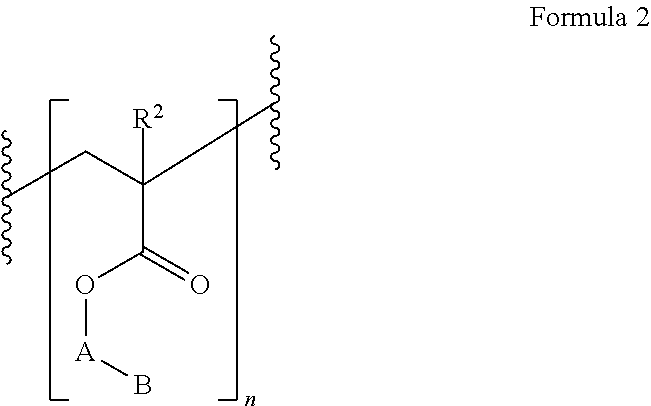
- the polymer can be represented by the Formula 2:
- n is a whole number selected between 1 and 20;
- A is a linker as described herein;
- B is the polyhedral oligomeric silsesquioxane;
- R is independently selected from the group consisting of hydrogen, alkyl, alkenyl, alkynyl, aralkyl, cycloalkyl, cycloalkenyl, heterocycloalkyl, and heterocycloalkenyl;
- R 2 is independently selected from the group consisting of hydrogen, alkyl, alkenyl, alkynyl, aralkyl, cycloalkyl, cycloalkenyl, heterocycloalkyl, and heterocycloalkenyl.
- R 2 is hydrogen, methyl, ethyl, or propyl.
- A has the formula —(CR 2 ) p — or —[CR 2 CR 2 (OCR 2 CR 2 ) q ]—; p is whole number selected from 1-20; and q is an integer selected from 0-10.
- A has the formula —(CH 2 ) p — or —[CH 2 CH 2 (OCH 2 CH 2 ) q ]—.
- A is —(CH 2 ) 2 —, —(CH 2 ) 3 —, —(CH 2 ) 4 —, —(CH 2 ) 5 —, or —(CH 2 ) 6 —.
- the polymer of Formula 2 can is represented by the Formula:
- n 1-15 and B is the polyhedral oligomeric silsesquioxane.
- the polymer of Formula 2 is represented by the Formula:
- n is 1-15 and R 4 is hydrogen, alkyl, alkenyl, alkynyl, aralkyl, cycloalkyl, cycloalkenyl, heterocycloalkyl, or heterocycloalkenyl.
- the polymer of Formula 2 can be directly bonded to the polymer comprising a polyester or bonded via a linker to the polymer comprising a polyester
- the polymer of Formula 2 can be covalently attached via an oxygen carbon bond at a terminal hydroxyl or terminal carboxyl, e.g., an ether linkage or an ester linkage.
- the linker can be rep resented by the Formula:
- R 3 is independently selected from the group consisting of hydrogen, alkyl, aralkyl, cycloalkyl, and aryl; or two instances of R3 taken together form a 3-7 membered cycloalkane.
- R 3 is hydrogen or alkyl.
- R 3 is methyl.
- the polymer of Formula 2 is bonded via a linker to the polymer comprising a polyester
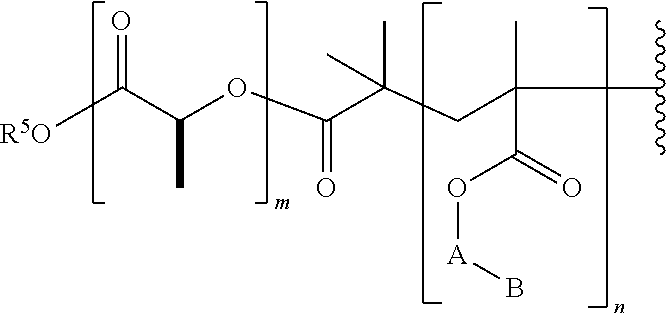
- the polymer can comprise a polymer of Formula 3:
- m is a whole number selected from 2 to 350; n is a whole number selected between 1 and 20;
- A has the formula —(CR 2 ) p — or —[(CR 2 ) q (OCR 2 CR 2 ) t ]—, wherein, p is whole number selected from 1-20; q is an integer selected from 0-10; t is a whole selected from 1-10;
- B is the polyhedral oligomeric silsesquioxane;
- R is independently selected from the group consisting of hydrogen, alkyl, alkenyl, alkynyl, aralkyl, cycloalkyl, cycloalkenyl, heterocycloalkyl, and heterocycloalkenyl;
- R 1 is independently selected from the group consisting of hydrogen, alkyl, alkenyl, alkynyl, aralkyl, cycloalkyl, cycloalkenyl, heterocycloalkyl, and heterocyclo
- the polymer of Formula 2 is bonded via a linker to the polymer comprising a polyester
- the polymer can comprise a polymer of Formula 4:
- m is a whole number selected from 2 to 350; n is a whole number selected between 1 and 15; A has the formula —(CR 2 ) p — or —[(CR 2 ) q (OCR 2 CR 2 ) t ]—, wherein, p is a whole number selected from 2-20; q is a whole selected from 1-10; t is a whole selected from 1-10: B is the polyhedral oligomeric silsesquioxane selected from the group consisting of:
- R 2 is independently selected from hydrogen and alkyl
- R 3 is independently selected from the group consisting of hydrogen, alkyl, aralkyl, cycloalkyl, and aryl;
- R 4 is independently selected from the group consisting of hydrogen, alkyl, aralkyl, and cycloalkyl
- R 5 is selected from the group consisting of hydrogen, alkyl, aralkyl, cycloalkyl, heterocycloalkyl, and aryl; or has the formula —[CR 3 (OCR 2 CR 2 ) u ]— wherein u is a whole number selected from 1-20; and
- R is independently selected from the group consisting of hydrogen, alkyl, aralkyl, cycloalkyl, and heterocycloalkyl.
- R 5 is methyl, ethyl, or CH—OCH 2 CH 2 —.
- the polymer of Formula 4 can have the formula:
- the polyester comprises isotactic polylactic acid.
- the polyester comprises poly(L-lactic acid) or poly(D-lactic acid).
- the polymers described herein can be readily prepared using methods well known to those of skill in the art. Convergent synthetic routes for the preparation of the polymers are preferred due to improved yield and efficiency.
- Convergent synthesis of the polymers described herein can entail the preparation of the polyester component, the preparation of the compound comprising the polyhedral oligomeric silsesquioxane and the covalent attachment of the polyester component and the compound comprising the polyhedral oligomeric silsesquioxane.
- n is halide, e.g., chloride, bromide, or iodide.
- the polyester 1 can be reacted with a linking group 2, such as an alpha halo acid halide in the presence of a suitable base.
- a linking group 2 such as an alpha halo acid halide
- the alpha halo ester substituted polyester 3 can then be reacted with an ⁇ , ⁇ -unsaturated ester 4 in a metal mediated atom transfer radical polymerization (“ATRP”) to yield the desired product 5.
- ATRP metal mediated atom transfer radical polymerization
- polyesters are commercially available and can be used in the methods for preparing the polymers described herein. Such polyesters include, but are not limited to poly(D-lactic acid), poly(L-lactic acid), poly((R)-3-hydroxybutyrate), poly((S)-3-hydroxybutyrate), poly((R)-3-hydroxyvalerate), and poly((S)-3-hydroxyvalerate).
- Polyesters can readily be synthesized by the polymerization of hydroxy substituted carboxylic acids and the ring-opening polymerization of lactones or cyclic diesters represented by the formula:
- v is a whole number selected from about 1 to about 10; and R 1 is independently selected from the group consisting of hydrogen, alkyl, alkenyl, alkynyl, aralkyl, cycloalkyl, cycloalkenyl, heterocycloalkyl, and heterocycloalkenyl.
- the polymerization reaction can be carried out in a conventionally known reactor, for example, vertical reactors equipped with a high viscosity stirring blade such as helical ribbon blade, which may be used alone or in combination.
- An alcohol may be used as a polymerization initiator.
- the alcohol preferably does not impede the polymerization of polylactic acid and is nonvolatile, as exemplified by decanol, dodecanol, tetradecanol, hexadecanol, octadecanol, ethylene glycol, triethylene glycol and benzyl alcohol.
- the terminal carboxylic acid unit of the polyester can be converted to an ester using standard methodologies known to those of skill in the art.
- the carboxyl can be activated by formation of an acid chloride, mixed anhydride, or activated ester, and reacted with a suitable alcohol to form the ester.
- the carboxylic acid can be deprotonated and reacted with alkyl halide, alkyl tosylate, or the like.
- the carboxylic acid can be subjected to a Fischer esterification reaction in the presence of an appropriate acid to form the ester.
- the alpha halo ester 3 can be reacted with the ⁇ , ⁇ -unsaturated ester 4 using a living (controlled) polymerization reaction. Living polymerization reactions are useful for preparing well defined polymers with low polydispersity indices.
- Living polymerization is a form of polymerization in which the ability of a growing polymer chain to terminate has been removed. Chain termination and chain transfer reactions are absent or occur at a very slow rate and the rate of radical initiation is generally much larger than the rate of chain propagation. As a result of these conditions, the polymer chain can grow at a more constant rate as compared with traditional polymerization reactions and each monomer block can be prepared sequentially.
- living polymerization techniques include living anionic polymerization, living cationic polymerization, living free radical polymerization, living free radical polymerization, living group-transfer polymerization, and living Ziegler-Natta polymerization.
- the polymer can be prepared by atom transfer radical polymerization (“ATRP”).
- ATRP is an example of a living radical polymerization method, which employs the use of a transition metal catalyst to mediate the formation of carbon-carbon bonds in a highly controlled process.
- ATRP reactions typically employ an organic halide initiator (e.g., compound 3 of Scheme 1), an olefin monomer (e.g., compound 4 of Scheme 1), and a transition metal catalyst.
- the organic halide initiator is typically an organic halide, such as a bromide or chloride (e.g., compound 3 of Scheme 1).
- Organic bromides tend to be more reactive and provide better results than organic chlorides.
- Typical organic halides include, but are not limited to alkyl halides, benzyl halides, ⁇ -halo esters, and ⁇ -halo amides.
- organic halide initiator can be used in the preparation of the copolymers described herein.
- the organic halide initiator can comprise an alkyl halide, a benzyl halide, or an ⁇ -halo ester.
- the organic halide initiator can be represented by a compound of Formula 5
- X can be chloride or bromide; and R 3 can be alkyl, aralkyl, cycloalkyl, or heterocycloalkyl.
- transition metals can be used to catalyze ATRP reactions.
- Such transition metals include, but are not limited to Group IV metals, such as Ti, Group VI metals, such as Mo, Group VII metals, such as Re, Group VIII metals, such as Fe, Ru, and Os, Group IX metals, such as Rh and Co, Group X metals, such as Ni and Pd, and group XI metals, such as Cu.
- the catalyst counterion can be a halide ion, a pseudohalide, a carboxylate, triflate, or hexafluorophosphate.
- the transition metal e.g., copper
- a nitrogenous ligand such as derivatives of bidentate bipyridine (bpy) and pyridine imine, tridentate diethylenetriamine (DETA), and tetradentate tris[2-aminoethyl]amine (TREN), 1,1,4,7,10,10-hexamethyltriethylenetetramine, N,N,N′,N′,N′′-pentamethyldiethylenetriamine (PMDTA), and tetraazacyclotetradecane (CYCLAM).
- bpy bidentate bipyridine
- DETA tridentate diethylenetriamine
- TREN tetradentate tris[2-aminoethyl]amine
- PMDTA 1,1,4,7,10,10-hexamethyltriethylenetetramine
- PMDTA tetraazacyclotetradecane
- CYCLAM tetraazacyclotetradecane
- the olefin monomer can be a monomer represented by compound 4 (of Scheme 1).
- the compound 4 has the formula:
- R 4 is iso-butyl
- ATRP reactions can be conducted in a broad range of solvents, such as benzene, toluene, xylene, tetrahydrofuran, 1,4-dioxane, anisole, dimethylformamide, dimethylsulfoxide, water, alcohols, such as methanol, ethanol, and isopropanol, acetonitrile, chloroform, and combinations thereof.
- solvents such as benzene, toluene, xylene, tetrahydrofuran, 1,4-dioxane, anisole, dimethylformamide, dimethylsulfoxide, water, alcohols, such as methanol, ethanol, and isopropanol, acetonitrile, chloroform, and combinations thereof.
- solvents such as benzene, toluene, xylene, tetrahydrofuran, 1,4-dioxane, anisole, dimethylformamide, dimethylsulfoxide, water
- the ATRP reaction can be conducted by contacting the organic halide initiator, the first monomer present in the desired polymer, and the transition metal catalyst under the appropriate reaction conditions for the ATRP reaction.
- the transition metal catalyst first reacts with the organic halide initiator to form an organometallic intermediate.
- This intermediate can then sequentially react by inserting into the double bond of the monomer to form a new carbon-carbon between the initiator and the monomer and carbon metal bond with the catalyst.
- This newly formed intermediate can continue to sequentially react with monomers by inserting into the olefin of additional monomer present in the reaction. In this way, the polymer chain continues to grow in length until substantially all of the first monomer is consumed in this fashion.
- a second monomer can be introduced into the reaction vessel and the second block of the polymer can be built in the same fashion. This process can be repeated until the polymer has the desired number of blocks. Once the desired number of blocks has been achieved the reaction is stopped and the desired product is isolated as a copolymer containing the organic initiator at a terminal end of the block copolymer and a transition metal residue, e.g., a halide, at the proximal end of the polymer.
- a transition metal residue e.g., a halide
- the transition metal residue can be removed or chemically modified, e.g., the halide can be reacted with a reducing agent to replace it with hydrogen.
- the polymers described herein further can comprise a catalyst residue covalently attached at a terminal end of the polymer as illustrated in the figure below.
- m, n, A, B, R 1 , R 2 , R 3 , R 4 , and R 5 are as described herein and the catalyst residue X can be selected from chloride, bromide, or iodide.
- the polymers prepared using ATRP reactor can have a very low polydispersity index (PDI).
- the PDI of the polymer can be from about 1 to about 2; about 1 to about 1.8; about 1 to about 1.6; about 1 to about 1.5; about 1 to about 1.4; about 1 to about 1.3; about 1 to about 1.2, or about 1 to about 1.1.
- the polymers described herein can form stereocomplexes when combined with a compound comprising a complimentary polyester.
- the compound comprising a complimentary polyester can be a second polymer as described herein or a polyester polymer.
- the formed stereocomplex can be used to improve the physical properties of polyester polymers, such as polylactic acid.
- the stereocomplex can be prepared by mixing together a polymer as described herein and a polymer containing a complimentary polyester in a predetermined weight ratio under conditions that favor stereocomplexation, thereby forming the stereocomplex.
- the stereocomplex comprises two polymers as described herein containing complimentary polyesters
- the two polymers as described herein can be present in a ratio of 1:100 to 100:1 (mol:mol). Suitable ratios include but are not limited to about 10:1 to about 1:10; about 5:1 to about 1:5; about 3:1 to about 1:3; about 2:1 to about 1:2; about 1.5:1 to about 1:1.5; or about 1.25:1 to about 1.25:1; about 1.1:1 to about 1:1.1; or about 1:1.
- the mixing can be carried out in the presence of a solvent.
- the solvent is not particularly limited if it can substantially dissolve the polymer described herein and the polymer containing a complimentary polyester.
- suitable solvents include, but are not limited to dichloromethane, chloroform, dichloroethane, tetrachloroethane, tetrahydrofuran, dioxane, sulfolane, N-methylpyrrolidone, N,N-dimethylacetamide, and dimethylformamide, which can be used alone or in combination.
- the stereocomplex Upon formation of the stereocomplex, it can be isolated from the reaction solvent using traditional purification techniques, such as filtration and or solvent evaporation.
- the mixing may be carried out in the absence of a solvent. That is, the polymer described herein and the polymer containing a complimentary polyester are melt blended together. Predetermined amounts of the polymer described herein and the polymer containing a complimentary polyester are mixed together and then melt kneaded together, or a method in which any one of them is molten and then the other is added to and kneaded with the molten material can be employed.
- Also provided is a composite comprising at least one polymer described herein and at least one matrix polymer.
- the matrix polymer can be a polyester, including but not limited to aliphatic polyesters, such as polyglycolic acid, poly(D-lactic acid), poly(L-lactic acid), poly((R)-3-hydroxybutyrate), poly((S)-3-hydroxybutyrate), poly((R)-3-hydroxyvalerate), poly((S)-3-hydroxyvalerate), polycaprolactone, polyethylene adipate, polyesteramide, polybutylene succinate adipate, polyhydroxyalkanoates, polyhydroxybutyrate, and aromatic polyesters, such as poly((R)-mandelic acid), poly((S)-mandelic acid), polyethylene terephthalate, polybutylene terephthalate, polytrimethylene terephthalate, polyethylene naphthalate, and vectran.
- aliphatic polyesters such as polyglycolic acid, poly(D-lactic acid), poly(L-lactic acid), poly((R)-3-hydroxybutyrate), poly((S)-3-
- the polymer described herein can be present in the composite at about 1% to about 50% by weight.
- the composite comprises at least about 1%, at least about 2%, at least about 3%, at least about 4%, at least about 5%, at least about 6%, at least about 7%, at least about 8%, at least about 9%, at least about 10%, at least about 15%, at least about 17%, at least about 20%, at least about 25%, at least about 30%, at least about 40%, at least about 50% by weight of the polymer described herein.
- the polymer described herein is present in the composite at about 1% to about 20%, at about 1% to about 15%, at about 1% to about 10%, at about 1% to about 70%, at about 1% to about 5%, or at about 1% to about 3% by weight.
- FIG. 1 is a schematic diagram showing the steps involved in the synthesis of PLLA-b-P(MA-POSS) and PDLA-b-P(MA-POSS) block copolymers via ATRP.
- FIG. 2 comprises FIGS. 2A and 2B .
- FIG. 2A shows the chemical structure of the PLLA-b-P(POSS-MA) n diblock copolymer.
- FIG. 2B shows a representative 1 H NMR spectrum and assignment of the respective peaks of the same diblock copolymer in d-chloroform.
- FIG. 3 shows the GPC profiles of PLLA macroinitiator and the obtained PLLA-b-P(MA-POSS).
- FIG. 4 comprises FIGS. 4A , 4 B and 4 C.
- FIG. 4A shows the scattering intensity from DLS measurements as a function of time (days) of individual PLLA-b-P(MA-POSS) 10 solution and a mixture of PLLA-b-P(MA-POSS) 10 with PDLA-b-P(MA-POSS) 10 , both at copolymer concentrations of 1.0 mg/mL in THF.
- FIG. 4B shows the distribution of the hydrodynamic radius R h , of stereocomplex aggregates in a mixture of PLLA-b-P(MA-POSS) 10 and PDLA-b-P(MA-POSS) 10 over a 30-day period and prepared at a copolymer concentration of 1.0 mg/mL.
- FIG. 4C shows the hydrodynamic radius R h , of aggregates in mixtures of PLLA-b-P(MA-POSS) 10 and PDLA-b-P(MA-POSS) 10 and PLLA-b-P(MA-POSS) 5 and PDLA-b-P(MA-POSS) 5 as a function of time and prepared at a copolymer concentration of 1.0 mg/mL.
- FIG. 5 comprises FIGS. 5A and 5B .
- FIG. 5A and FIG. 5B are TEM micrographs of the aggregates formed in a mixture of PLLA-b-P(MA-POSS) 10 and PDLA-b-P(MA-POSS) 10 in at a copolymer concentration of 1.0 mg/mL.
- FIG. 6 comprises FIGS. 6A , 6 B, 6 C and 6 D.
- FIG. 6A and FIG. 6B respectively show DSC thermograms of the 1 st and 2 nd heat scans of PLLA-b-P(MA-POSS) 5 , PDLA-b-P(MA-POSS) 5 , and their 1:1 blend.
- FIG. 6C and FIG. 6D respectively show DSC thermograms of the 1 st and 2 nd heat scans of PLLA-b-P(MA-POSS) 10 , PDLA-b-P(MA-POSS) 10 and their 1:1 blend.
- FIG. 7 comprises FIGS. 7A and 7B .
- FIG. 7A shows the WAXS diffractogram of PLLA-b-P(MA-POSS) 5 , PDLA-b-P(MA-POSS) 5 , and their 1:1 blend.
- FIG. 7B shows the WAX diffractograms of PLLA-b-P(MA-POSS) 10 , PDLA-b-P(MA-POSS) 10 and their 1:1 blend.
- FIG. 8 comprises FIGS. 8A , 8 B and 8 C.
- FIG. 8A , FIG. 8B and FIG. 8C are, respectively, the TEM micrographs of POSS-MA aggregates dispersed in a PLA matrix before tensile testing; after tensile testing where thereafter microvoid initiation within the POSS-MA aggregates are observed; and after further tensile testing where thereafter microvoids are observed to form an extensive network of macroscopic crack.
- FIG. 9 comprises FIGS. 9A and 9B .
- FIG. 9A and FIG. 9B respectively show the TEM micrographs (with a 5 ⁇ magnification in the inset of FIG. 9A ) of tensile tested PLA+PDLA-b-P(MA-POSS) 1 wt % depicting crack initiation within the MA-POSS aggregate, and tensile tested PLA+PLLA-b-P(MA-POSS) 1 wt % depicting crack initiation at the matrix and aggregate-matrix interfacial regions.
- FIG. 10 is a comparison of the DSC thermograms between a PLA matrix and various compositions of POSS-PLA nanocomposites.
- Non-limiting examples of the present disclosure will be further described, which should not be construed as in any way limiting the scope of the disclosure.
- Methacrylisobutyl polyhedral oligomeric silsesquioxane (POSS) (MA-POSS) was purchased from Hybrid Plastics (product #: MA0702) and used without further purification.
- Triethylamine (Fisher, 99.7%) was dried over molecular sieves before use.
- GPC Gel-permeation chromatography
- Diffractive light scattering (DLS) measurements were made at 25° C. using a Brookhaven BI-200SM multi-angle goniometer equipped with a BI-APD detector.
- the light source was a 35 mW He—Ne laser emitting vertically polarized light of 632.8 nm wavelength.
- TEM Transmission electron microscopy
- DSC Differential scanning calorimetry
- PLLA or PDLA (8.0 ⁇ 10 ⁇ 4 mol) was dissolved in dried dichloromethane (DCM) ( ⁇ 80 mL) under argon in a two neck round bottom flask equipped with a magnetic stirrer bar. Triethylamine (4.0 ⁇ 10 ⁇ 3 mol) was then added with a syringe and the solution was cooled in an ice/salt mixture before a stoichiometric amount of 2-bromoisobutyrylbromide was added drop wise. The reaction was allowed to continue overnight under argon atmosphere at room temperature.
- DCM dried dichloromethane
- reaction product was then filtered, precipitated in methanol and centrifuged at 10000 RPM. This process was repeated several times with fresh batches of methanol. The product was finally dried under vacuum at 40° C. overnight.
- PLLA or PDLA macroinitiator (0.19 mmol (Br)
- MA-POSS methacryloisobutyl POSS
- THF ⁇ 4 mL
- the mixture was deoxygenated by three freeze-pump-thaw cycles, followed by the addition of CuBr (0.19 mmol) and PMDETA (0.19 mmol) under argon.
- the contents were subjected to two more freeze-pump-thaw cycles to ensure complete oxygen removal.
- the Schlenk tube was then transferred to an oil bath maintained at 60° C. for approximately twenty hours. The reaction was finally stopped by exposing to air and diluting with THF.
- FIG. 1 provides a schematic diagram showing the overall synthesis process.
- the composition and hence the degree of polymerization of the P(MA-POSS) block can be estimated by comparing the integral values of signals representing the protons (e) of PLA and protons (c and d) of the P(MA-POSS) block.
- the monomodal molecular weight distributions and low values of polydispersity index (PDI) obtained for the block copolymer indicates the formation of well-defined PLLA-b-P(MA-POSS) and PDLA-b-P(MA-POSS) block copolymers with a narrow molecular weight distribution.
- FIG. 4A shows that the scattering intensity of the PLLA-b-P(MA-POSS) copolymer solution, measured using dynamic light scattering (DLS) at an angle of 90°, is relatively low (approximately 5.0 kcps) and remains constant with time (over 30 days). This suggests that at a concentration of 1.0 mg/mL, aggregation is not observed in the individual copolymer solution.
- DLS dynamic light scattering
- Fresh solutions of PLLA-b-P(MA-POSS) and PDLA-b-P(MA-POSS) were then prepared by separately dissolving an equivalent weight of each copolymer in THF at room temperature. The initial solutions were then filtered through filters (Whatman Anotop, porosity 0.2 ⁇ m) before they were mixed to form the stereocomplex. In contrast with the scattering intensities of the solutions of the individual copolymers, the scattering intensity of the mixture of PLLA-b-P(MA-POSS) and PDLA-b-P(MA-POSS) increased steadily for approximately 10 days and then appears to remain constant at approximately 100 kcps (depicted in FIG. 4A ).
- FIG. 4B shows the size distribution of the hydrodynamic radius, R h of the stereocomplex aggregates in the mixture of PLLA-b-P(MA-POSS) 10 and PDLA-b-P(MA-POSS) 10 at a concentration of 1.0 mg/mL.
- R h is observed to increase steadily in the first ten days, beyond which an apparent equilibrium R h value of approximately 70.0 ⁇ 7.2 nm is reached.
- FIG. 4C shows the evolution of the sizes of the stereocomplex aggregates with time, wherein R h is observed to increase steadily during the first 10 days. Beyond these first 10 days, apparent equilibrium values of approximately 60 nm (PLLA-b-P(MA-POSS) 10 +PDLA-b-P(MA-POSS) 10 ) and 85 nm (PLLA-b-P(MA-POSS) 5 +PDLA-b-P(MA-POSS) 5 ) are observed. The dispersions remain optically clear and stable over the entire 30-day period.
- the larger aggregate size obtained in the mixture of PLLA-b-P(MA-POSS) 5 +PDLA-b-P(MA-POSS) indicates that stereocomplexation in the block copolymers may be influenced by the number of POSS repeating units grafted to the PLA block.
- TEM observations of PLLA-b-P(MA-POSS) 10 +PDLA-b-P(MA-POSS) 10 were carried out.
- the TEM micrographs of the mixture of PLLA-b-P(MA-POSS) 10 +PDLA-b-P(MA-POSS) 10 at a concentration of 1.0 mg/mL in THF shown in FIG. 5 indicate that the stereocomplex exists in the form of compact aggregates with diameters in the range of 100-150 nm.
- DSC Differential Scanning Calorimetry
- WAXS Wide-Angle X-Ray Scattering
- melt blending was first employed to directly incorporate the hybrid block copolymer into commercially available PLA as it is considered a process which is more commercially compared to solution blending.
- Melt blending was performed by feeding commercial PLA pellets (Grade 3051D PLA, Natureworks Co. Ltd., USA) which compromises mainly L-lactide units, and the POSS fillers into an internal mixer or twin screw extruder set at a temperature of 140-180° C.
- the screw speed of the mixer was set at 100 rpm and the residence time of the material inside the barrel was about 9 minutes. After compounding, the materials were ground into flakes and later injection molded into specimens at barrel and mold temperatures of 190° C. and 45° C., respectively.
- the ductility and toughness of the PLA matrix is seen to be improved significantly with the incorporation of MA-POSS to form nanocomposites.
- Table 2 shows the mechanical properties of neat PLA matrix as compared to PLA incorporated with various amounts of MA-POSS prepared through melt blending. A slight improvement in strain at break was observed during tensile testing when the content of MA-POSS in the blends was relatively low, e.g., ⁇ 1-wt %. However, the blends exhibited significant enhancement in ductility when the content of MA-POSS was increased to 5 wt %. The MA-POSS aggregates were able to enhance the ductility of PLA through the promotion of microvoid formation.
- microvoids Upon tensile testing of the material, microvoids would initiate within the MA-POSS aggregates, as shown in FIGS. 8A to 8C , as the interparticle attraction is weaker compared to the POSS-matrix interfacial bonding. These microvoids would form almost simultaneously throughout a large area of the bulk and their sizes would become larger with an increasing loading.
- the process of microvoid formation throughout a large area will lead to high energy absorbance, while the rate of crack propagation will depend on the size and distribution of the MA-POSS particles.
- a critical size of the MA-POSS aggregates has to be reached in order for microvoids to initiate within the aggregates.
- the sizes of the MA-POSS aggregates were larger than the critical size and therefore microvoids could form easily within the aggregates.
- due to the inhomogeneous distribution of the aggregate sizes there would be a preference for microvoids to form in larger aggregates. This contributes to the reduction in maximum tensile stress of the bulk material, as seen from Table 2.
- the mechanical properties of the PLA can improve significantly with the presence of PDLA-b-P(MA-POSS) copolymer as a filler as the incorporation of the filler into the PLA matrix results in an interaction between the PDLA segments in the filler and the PLLA molecules from the matrix, forming stereocomplex crystals. This will significantly enhance the interfacial adhesion between the POSS hybrid and the PLA matrix.
- the number of repeating units of MA-POSS and the molecular weight (M w ) of the PDLA segment in the filler can effect the extent of stereocomplexation and filler-matrix interfacial bonding strength.
- Stereocomplex crystals are widely known to be more thermally stable and exhibit better mechanical properties as compared to homopolymer PLLA or PDLA crystals.
- the stereocomplex crystals are exploited not for their mechanical performance but as a carrier to control the size of POSS aggregates as well as to enhance interfacial adhesion between these particles with the matrix.
- the strain at the breaking point of PLA incorporated with PDLA-b-P(MA-POSS) increased more than 250% as compared to neat PLA.
- nanocomposites prepared with an equivalent amount of PLLA-b-P(MA-POSS) 10 exhibit no significant improvement in mechanical properties.
- FIGS. 9A and 9B respectively show a comparison of TEM images taken of PLA+PDLA-b-POSS, and PLA+PLLA-b-POSS melt blends after tensile loading.
- the average size of the MA-POSS aggregates in the PLA+PDLA-b-P(MA-POSS) blends was significantly larger than that in the PLA+PLLA-b-P(MA-POSS) blends, which will consequently affect the crack formation and propagation mechanism in these blends.
- aggregates larger than a critical size such as those featured in FIG.
- FIG. 9A shows evidence of microvoid formation in PLA+PDLA-b-P(MA-POSS 10 ) blend even at 1 wt % filler concentration.
- microvoids form preferentially within the matrix or at the aggregate-matrix interface in PLA-PLLA-b-P(MA-POSS 10 ) blend at similar filler concentration, as shown in FIG. 9B .
- the aggregate size in the PLA+PDLA-b-P(MA-POSS 10 ) was larger. This could be due to the formation of stereocomplex network around the aggregates, which inhibits further separation and dispersion of the MA-POSS particles.
- FIG. 10 shows the differential scanning calorimetry (DSC) thermograms of different compositions of PLA incorporated with various amounts of PDLA-b-P(MA-POSS) 10 .
- compositions of the composites as well as their corresponding thermal properties are compiled in Table 3.
- the thermograms of the neat PLA resin (100 (PLA)) as well as a melt-blend of PLA and PDLA at a blend ratio of 75:25 is also presented for comparison.
- the 75 (PLA)+25 (PDLA) blend thermogram exhibits enthalpy peaks at 151° C. and 210° C., which are the respective melting points of the PLA homopolymer (hc) and the stereocomplex crystalline (SC) phases. However, the peak disappears when PDLA-b-P(MA-POSS) was incorporated into PLA, irrespective of the blend composition.
- the HC peaks exhibited by these blends also becomes less intense as compared to that of neat PLA. This is an indication that the presence of 10 repeating units of MA-POSS in the co-polymer may hinder stereocomplexation while reducing the crystallization rate of the PLA matrix. Reducing the number of MA-POSS repeating units to half results in a slight resumption of stereocomplexation as well as an increase in HC content, as noted in the thermogram of 75 (PLA)+25 (PDLA-b-POSS 5 ) in FIG. 10 .
- Toughened PLA can be used as a packaging material due to its good transparency and biodegradability.
- the use of biodegradable pack aging materials can significantly reduce the amount of landfill space needed to contain waste materials.
- PLA is synthesized from natural and sustainable precursors
- toughened PLA is suitable green material for use in structural and non-structural components of, e.g., automotive, communication and sports applications
- MA-POSS is non-toxic and suitable to be incorporated into PLA to produce composites for biomedical as well as food packaging purposes.
Landscapes
- Chemical & Material Sciences (AREA)
- Health & Medical Sciences (AREA)
- Chemical Kinetics & Catalysis (AREA)
- Medicinal Chemistry (AREA)
- Polymers & Plastics (AREA)
- Organic Chemistry (AREA)
- General Chemical & Material Sciences (AREA)
- Polyesters Or Polycarbonates (AREA)
- Silicon Polymers (AREA)
- Biological Depolymerization Polymers (AREA)
Abstract
Described herein are polymers comprising a polyester and at least one polyhedral oligomeric silsesquioxane, wherein the polyester is capable of forming a stereocomplex with a polymer comprising a complimentary polyester and composites thereof.
Description
The present disclosure relates to polymers that contain monomer species capable of forming stereocomplexes with each other. The polymers described herein can be used, for example, to improve the physical properties of thermoplastic composites.
Polyester polymers have developed considerable interest due to their excellent physical properties and low manufacturing costs. However, many of the most widely used polyester polymers, such as polyethylene terephthalate, are not biodegradable and can have long lasting environmental consequences.
To cope with these problems, much effort has been focused on developing polymer materials that, when discarded and left in the environment, are naturally degraded by microorganisms and/or other natural factors into harmless materials.
A number of biodegradable polyester polymers have been developed from naturally derived feed stocks as well as synthetic or semi-synthetic precursors.
One such biodegradable polyester is polylactic acid (or polylactide), which has garnered considerable interest owing to the fact that it can be mass-produced from renewable resources, such as corn starch and sugar cane and its useful physical properties.
Enantiopure polylactic acid is a crystalline thermoplastic material that has tensile strength equivalent to that of polyethylene and transparency equivalent to that of polyethylene terephthalate. Importantly, polylactic acid readily degrades when discarded in the environment into lactic acid, carbon dioxide, and water, all of which are essentially environmentally harmless.
Despite the many desirable physical properties exhibited by polylactic acid, its inherent brittleness and notch sensitivity pose a considerable scientific challenge and limit its large-scale application as a structural material.
Accordingly, there exists a need to develop methods for toughening polyester polymers, such as polylactic acid, which do not compromise the strength, stiffness, and transparency of the polymer.
According to a first aspect, there is provided a polymer comprising a polyester and at least one polyhedral oligomeric silsesquioxane, wherein the polyester is capable of forming a stereocomplex with a polymer comprising a complimentary polyester.
According to a second aspect, there is provided a stereocomplex comprising at least one polymer as described in the first aspect above.
According to a third aspect, there is provided a composite comprising at least one polymer of the first aspect above and at least one matrix polymer.
The polymers described herein are capable of forming stereocomplexes with polymers comprising complimentary polyesters. These stereocomplexes can be used to enhance the mechanical properties, the thermal resistance, and the hydrolysis resistance of polyester thermoplastic composites comprising them.
Advantageously, the polymers described herein can be used to improve the toughness of a matrix polymer, such as polyester, without effecting the strength, stiffness, and transparency of the matrix polymer.
Furthermore, by controlling the strength of the interfacial interactions between the polymers described herein and the matrix polymer, the morphology and fracture characteristics of the formed composite can be predictably controlled and the tensile strength of the composite can be improved.
According to a fourth aspect, there is provided a method comprising the steps of contacting a polymer as described in the first aspect above with a polymer comprising a complimentary polyester under conditions that favor stereocomplexation, thereby forming a stereocomplex comprising the polymer as described in the first aspect above and the polymer comprising a complimentary polyester.
The following words and terms used herein shall have the meaning indicated:
As used herein, the term “alkyl group” includes within its meaning monovalent (“alkyl”) and divalent (“alkylene”) straight chain or branched, chain saturated aliphatic groups having from 1 to 10 carbon atoms, eg, 1, 2, 3, 4, 5, 6, 7, 8, 9, or 10 carbon atoms. For example, the term alkyl includes, but is not limited to, methyl, ethyl, 1-propyl, isopropyl, 1-butyl, 2-butyl, isobutyl, tert-butyl, amyl, 1,2-dimethylpropyl, 1,1-dimethylpropyl, pentyl, isopentyl, hexyl, 4-methylpentyl, 1-methylpentyl, 2-methylpentyl, 3-methylpentyl, 2,2-dimethylbutyl, 3,3-dimethylbutyl, 1,2-dimethylbutyl, 1,3-dimethylbutyl, 1,2,2-trimethylpropyl, 1,1,2-trimethylpropyl, 2-ethylpentyl, 3-ethylpentyl, heptyl, 1-methylhexyl, 2,2-dimethylpentyl, 3,3-dimethylpentyl, 4,4-dimethylpentyl, 1,2-dimethylpentyl, 1,3-dimethylpentyl, 1,4-dimethylpentyl, 1,2,3-trimethylbutyl, 1,1,2-trimethylbutyl, 1,1,3-trimethylbutyl, 5-methylheptyl, 1-methylheptyl, octyl, nonyl, decyl, and the like.
The term “alkenyl group” includes within its meaning monovalent (“alkenyl”) and divalent (“alkenylene”) straight or branched chain unsaturated aliphatic hydrocarbon groups having from 2 to 10 carbon atoms, eg, 2, 3, 4, 5, 6, 7, 8, 9, or 10 carbon atoms and having at least one double bond, of either E, Z, cis or trans stereochemistry where applicable, anywhere in the alkyl chain. Examples of alkenyl groups include but are not limited to ethenyl, vinyl, allyl, 1-methylvinyl, 1-propenyl, 2-propenyl, 2-methyl-1-propenyl, 2-methyl-1-propenyl, 1-butenyl, 2-butenyl, 3-butentyl, 1,3-butadienyl, 1-pentenyl, 2-pententyl, 3-pentenyl, 4-pentenyl, 1,3-pentadienyl, 2,4-pentadienyl, 1,4-pentadienyl, 3-methyl-2-butenyl, 1-hexenyl, 2-hexenyl, 3-hexenyl, 1,3-hexadienyl, 1,4-hexadienyl, 2-methylpentenyl, 1-heptenyl, 2-heptentyl, 3-heptenyl, 1-octenyl, 1-nonenyl, 1-decenyl, and the like.
The term “alkynyl group” as used herein includes within its meaning monovalent (“alkynyl”) and divalent (“alkynylene”) straight or branched chain unsaturated aliphatic hydrocarbon groups having from 2 to 10 carbon atoms and having at least one triple bond anywhere in the carbon chain. Examples of alkynyl groups include but are not limited to ethynyl, 1-propynyl, 1-butynyl, 2-butynyl, 1-methyl-2-butynyl, 3-methyl-1-butynyl, 1-pentynyl, 1-hexynyl, methylpentynyl, 1-heptynyl, 2-heptynyl, 1-octynyl, 2-octynyl, 1-nonyl, 1-decynyl, and the like.
The term “cycloalkyl” as used herein refers to cyclic saturated aliphatic groups and includes within its meaning monovalent (“cycloalkyl”), and divalent (“cycloalkylene”), saturated, monocyclic, bicyclic, polycyclic or fused polycyclic hydrocarbon radicals having from 3 to 10 carbon atoms, eg, 3, 4, 5, 6, 7, 8, 9, or 10 carbon atoms, Examples of cycloalkyl groups include but are not limited to cyclopropyl, 2-methylcyclopropyl, cyclobutyl, cyclopentyl, 2-methylcyclopentyl, 3-methylcyclopentyl, cyclohexyl, and the like.
The term “aromatic group”, or variants such as “aryl” or “arylene” as used herein refers to monovalent (“aryl”) and divalent (“arylene”) single, polynuclear, conjugated and fused residues of aromatic hydrocarbons having from 6 to 10 carbon atoms. Examples of such groups include phenyl, biphenyl, naphthyl, phenanthrenyl, and the like.
The term “aralkyl” as used herein, includes within its meaning monovalent (“aryl”) and divalent (“arylene”), single, polynuclear, conjugated and fused aromatic hydrocarbon radicals attached to divalent, saturated, straight and branched chain alkylene radicals.
The term “optionally substituted” as used herein means the group to which this term refers may be unsubstituted, or may be substituted with one or more groups independently selected from alkyl, alkenyl, alkynyl, thioalkyl, cycloalkyl, cycloalkenyl, heterocycloalkyl, halo, carboxyl, haloalkyl, haloalkynyl, hydroxyl, alkoxy, thioalkoxy, alkenyloxy, haloalkoxy, haloalkenyloxy, nitro, amino, nitroalkyl, nitroalkenyl, nitroalkynyl, nitroheterocyclyl, alkylamino, dialkylamino, alkenylamine, alkynylamino, acyl, alkenoyl, alkynoyl, acylamino, diacylamino, acyloxy, alkylsulfonyloxy, heterocycloxy, heterocycloamino, haloheterocycloalkyl, alkylsulfenyl, alkylcarbonyloxy, alkylthio, acylthio, phosphorus-containing groups such as phosphono and phosphinyl, aryl, heteroaryl, alkylaryl, alkylhetercaryl, cyano, cyanate, isocyanate, —C(O)NH(alkyl), and —C(O)N (alkyl)2.
The term “complimentary polyester” as used herein refers to a polyester that is capable of forming a stereocomplex with the polyester contained in the reference compound. In certain embodiments, the complimentary polyester can comprise an enantiomeric isomer of the polyester present in the reference compound. In certain embodiments, the complimentary polyester can comprise a stereotactic isomer of the polyester present in the reference compound.
The term “stereocomplex”, “stereocomplexation”, and the like as used herein refers to the association or complexation of two or more polymers having different tacticities and/or configurations, which prevails over the association or complexation of polymers of the same tacticity and/or configuration. This association between one or more polymers results in the formation of a complex.
A “homo-stereocomplex” refers to a complex of two or more polymers having the same structure, but differing in tacticity and/or configuration.
A “hetero-stereocomplex” refers to a complex of two or more polymers having different chemical structures.
The word “substantially” does not exclude “completely” e.g. a composition which is “substantially free” from Y may be completely free from Y. Where necessary, the word “substantially” may be omitted from the definition of the invention.
Unless specified otherwise, the terms “comprising” and “comprise”, and grammatical variants thereof, are intended to represent “open” or “inclusive” language such that they include recited elements but also permit inclusion of additional, unrecited elements.
As used herein, the term “about”, in the context of concentrations of components of the formulations, typically means+/−5% of the stated value, more typically +/−4% of the stated value, more typically +/−3% of the stated value, more typically, +/−2% of the stated value, even more typically +/−1% of the stated value, and even more typically +/−0.5% of the stated value.
Throughout this disclosure, certain embodiments may be disclosed in a range format. It should be understood that the description in range format is merely for convenience and brevity and should not be construed as an inflexible limitation on the scope of the disclosed ranges. Accordingly, the description of a range should be considered to have specifically disclosed all the possible sub-ranges as well as individual numerical values within that range. For example, description of a range such as from 1 to 6 should be considered to have specifically disclosed sub-ranges such as from 1 to 3, from 1 to 4, from 1 to 5, from 2 to 4, from 2 to 6, from 3 to 6 etc., as well as individual numbers within that range, for example, 1, 2, 3, 4, 5, and 6. This applies regardless of the breadth of the range.
Exemplary, non-limiting embodiments of a polymer, a composite comprising the polymer and a method of preparation thereof will now be disclosed.
The polymers described herein can comprise a polyester and at least one polyhedral oligomeric silsesquioxane, wherein the polyester is capable of forming a stereocomplex with a polymer comprising a complimentary polyester.
The polymer can be an alternating copolymer, periodic copolymer, a statistical copolymer, a random copolymer, a block copolymer, or combinations thereof. The polymer can be a block copolymer. In certain embodiments, the block copolymer is a diblock, triblock, tetrablock, or pentablock copolymer.
In certain embodiments, the polymer is a block copolymer, comprising a polyester block and a polyacrylate block, wherein the polyacrylate block comprises at least one polyhedral oligomeric silsesquioxane and the polyester block is capable of forming a stereocomplex with a polymer comprising a complimentary polyester block.
The polyester can have the Formula 1:
wherein, m is a whole number selected from about 1 to about 1,000; v is a whole number selected from about 1 to about 10; and R1 is independently selected from the group consisting of hydrogen, alkyl, alkenyl, alkynyl, aralkyl, cycloalkyl, cycloalkenyl, heterocycloalkyl, and heterocycloalkenyl.
In certain embodiments, m is about 1 to about 900; about 1 to about 800; about 1 to about 700; about 1 to about 600; about 10 to about 600; about 20 to about 500; about 100 to about 500; about 200 to about 500; or about 300 to about 500.
In certain embodiments v is 1-10; 1-9; 1-8; 1-7; 1-6; 1-5; 1-4; 1-3; or 1-2. In certain embodiments, v can be 1, 2, 3, 4, 5, 6, 7, 8, 9, or 10.
In certain embodiments, R1 is alkyl, cycloalkyl, aralkyl, heterocycloalkyl, heteroaryl, or heteroaralkyl. In certain embodiments, R1 is alkyl or aryl. In certain embodiments, R1 is methyl, ethyl, propyl, butyl, hexyl, cyclohexyl, cyclopentyl, benzyl, or phenyl.
In certain embodiments, the polyester is selected from the group consisting of:
The polyester can be substantially syndiotactic, substantially isotactic, or substantially heterotactic. In certain embodiments, the polyester is substantially isotactic.
In certain embodiments, at least about 99 mol %, at least about 97 mol %, at least about 95 mol %, at least about 90 mol %, at least about 85 mol %, at least about 80 mol %, at least about 70 mol %, at least about 60 mol %, at least about 50 mol %, at least about 40 mol %, at least about 30 mol %, at least about 20 mol %, or at least about 10 mol % of the repeating ester units of the polyester are the same enantiomer.
In certain embodiments, about 70 to about 100%, about 75 to about 100 mol %, about 80 about to 100 mol %, about 85 to about 100 mol %, about 90 to about 100 mol %, about 90 to about 97 mol %, or about 95 to about 97 mol % of the repeating ester units of the polyester are the same enantiomer.
In certain embodiments, the polyester contains 90 to 100 mol %, 90 to 99 mol %, or 95 to 99 mol % of an L-lactic acid unit. Other units include a D-lactic acid unit and units other than lactic acid. The total amount of the D-lactic acid unit and units other than lactic acid in the polyester can be 0 to 10 mol %, 1 to 10 mol %, 1 to 5 mol %.
In certain embodiments, the polyester contains 90 to 100 mol %, 90 to 99 mol %, or 95 to 99 mol % of a D-lactic acid unit. Other units include an L-lactic acid unit and units other than lactic acid. The total amount of the L-lactic acid unit and units other than lactic acid in the polyester can be 0 to 10 mol %, 1 to 10 mol %, 1 to 5 mol %.
The polyester can have a weight average molecular weight of about 1,000 to about 30,000 g/mol; about 1,000 to about 25,000 g/mol; about 1,000 to about 20,000 g/mol; about 1,000 to about 15,000 g/mol; or about 5,000 to about 15,000 g/mol.
The polyester is capable of forming a stereocomplex with a polymer comprising a complimentary polyester. In certain embodiments, the complimentary polyester can be comprise a polyester block that is enantiomeric or stereoisomeric (e.g., differing in tacticity) with the polyester of the polymer.
The stereocomplex can be a homo-stereocomplex or a hetero-stereocomplex.
In instances, where the stereocomplex is a hetero-stereocomplex, the stereocomplex can form as a result of the complexation of the polymer and a polymer comprising a polyester, such as poly(D-lactic acid), poly(L-lactic acid), poly((R)-3-hydroxybutyrate), poly((S)-3-hydroxybutyrate), poly((R)-3-hydroxyvalerate), and poly((S)-3-hydroxyvalerate).
In certain embodiments, the hetero-stereocomplex can form as the result of the complexation of a polymer as described herein and a polyester selected from the group consisting of:
In instances, where the stereocomplex is a homo-stereocomplex, the stereocomplex can result from the complexation of two polymers as described herein each comprising complimentary polyesters capable of forming a stereocomplex.
In certain embodiments, the polyhedral oligomeric silsesquioxane has the empirical formula RSiO3/2, wherein R can be hydrogen, alkyl, alkenyl, alkynyl, aralkyl, cycloalkyl, cycloalkenyl, heterocycloalkyl, or heterocycloalkenyl. Polyhedral oligomeric silsesquioxanes can form open structures or closed, cage-like structures, such as in the shape of cubes, hexagonal prisms, octagonal prisms, and decagonal and dodecagonal prisms.
The polyhedral oligomeric silsesquioxanes can have the formula selected from the group consisting of:
wherein R4 can be hydrogen, alkyl, alkenyl, alkynyl, aralkyl, cycloalkyl, cycloalkenyl, heterocycloalkyl, or heterocycloalkenyl.
In certain embodiments, R4 is methyl, ethyl, propyl, iso-propyl, cyclopropyl, butyl, iso-butyl, cyclobutyl, pentyl, cyclopentyl, hexyl, cyclohexyl, isooctyl, phenyl, or benzyl.
The polyhedral oliomeric silsesquioxane can also be an open cage structure selected from the group consisting of:
The polyhedral oligomeric silsesquioxane can be bonded to the polymer directly, via a linker, or as a pendant group on a polymer covalently bonded to the polymer comprising a polyester.
In instances where the polyhedral oligomeric silsesquioxane is bonded directly to the polymer, the polyhedral oligomeric silsesquioxane can be bound to the polyester via a silicon oxygen bond, e.g., by silylation of a terminal hydroxyl group or terminal carboxylic acid group on the polyester.
In instances where the polyhedral oligomeric silsesquioxane is bond to the polymer via a linker, the linker can be any linker known in the art. Examples of linkers include, but are not limited to alkyl, cycloalkyl, alkenyl, cycloalkenyl, aryl, aralkyl, heterocycloalkyl, heteroaryl, heteroaralkyl linkers optionally substituted with ethers, amides, ureas, carbamates, esters, amines, thioethers, sulfones, sulfoxides, sulfonamides, and combinations thereof.
In instances where the linker is bonded directly to the polyester, the linker can be bonded to a terminal hydroxyl or carboxyl on the polyester.
In certain embodiments, the linker can have the formula —(CR2)p—, —[(CR2)qX(CR2)t]p—, or —[(CR2)q(OCR2CR2)t]—, wherein, p is a whole number selected from 1-100; q is an integer selected from 0-100; t is an integer selected from 0-100; R is independently selected from the group consisting of hydrogen, alkyl, aralkyl, cycloalkyl, and heterocycloalkyl; and X is —O—, —OC(O)—, —C(O)O—, —N(R)—, —C(O)—, —N(R)C(O)—, —C(O)N(R)—, —SO2—, —S(O)—, —OC(O)O—, —N(R)C(O)N(R)—, —N(R)C(O)O—, —OC(O)N(R)—, —N(R)SO2-, or —SO2N(R)—.
In certain embodiments, p is a whole number selected from 1-80; 1-60; 1-40; 1-30; 1-20; and 1-10. In certain embodiments, q is an integer selected from 0-80; 0-60; 0-40; 0-30; 0-20; and 0-10. In certain embodiments, t is an integer selected from 0-80; 0-60; 0-40; 0-30; 0-20; and 0-10.
The polymer can contain from about 1 to about 20 polyhedral oligomeric silsesquioxanes. The polyhedral oligomeric silsesquioxanes can be the same or different. In certain embodiments, the polymer has 1, 2, 3, 4, 5, 6, 7, 8, 9, 10, 11, 12, 13, 14, or 15 polyhedral oligomeric silsesquioxanes. In certain embodiments the polymer has 1-15; 1-10; or 1-5 polyhedral oligomeric silsesquioxanes.
In instances where the polyhedral oligomeric silsesquioxane is a pendant group on a polymer covalently bonded to the polymer comprising a polyester, the polymer can be represented by the Formula 2:
wherein n is a whole number selected between 1 and 20;
A is a linker as described herein;
B is the polyhedral oligomeric silsesquioxane;
R is independently selected from the group consisting of hydrogen, alkyl, alkenyl, alkynyl, aralkyl, cycloalkyl, cycloalkenyl, heterocycloalkyl, and heterocycloalkenyl; and
R2 is independently selected from the group consisting of hydrogen, alkyl, alkenyl, alkynyl, aralkyl, cycloalkyl, cycloalkenyl, heterocycloalkyl, and heterocycloalkenyl.
In certain embodiments, R2 is hydrogen, methyl, ethyl, or propyl.
In certain embodiments, A has the formula —(CR2)p— or —[CR2CR2(OCR2CR2)q]—; p is whole number selected from 1-20; and q is an integer selected from 0-10. In certain embodiments, A has the formula —(CH2)p— or —[CH2CH2(OCH2CH2)q]—. In certain embodiments, A is —(CH2)2—, —(CH2)3—, —(CH2)4—, —(CH2)5—, or —(CH2)6—.
In certain embodiments, the polymer of Formula 2 can is represented by the Formula:
In certain embodiments, the polymer of Formula 2 is represented by the Formula:
wherein n is 1-15 and R4 is hydrogen, alkyl, alkenyl, alkynyl, aralkyl, cycloalkyl, cycloalkenyl, heterocycloalkyl, or heterocycloalkenyl.
The polymer of Formula 2 can be directly bonded to the polymer comprising a polyester or bonded via a linker to the polymer comprising a polyester
In instances where the polymer of Formula 2 is bonded directly to the polymer comprising a polyester, the polymer of Formula 2 can be covalently attached via an oxygen carbon bond at a terminal hydroxyl or terminal carboxyl, e.g., an ether linkage or an ester linkage.
In instances where the polymer of Formula 2 is bonded via a linker to the polymer comprising a polyester, the linker can be rep resented by the Formula:
wherein R3 is independently selected from the group consisting of hydrogen, alkyl, aralkyl, cycloalkyl, and aryl; or two instances of R3 taken together form a 3-7 membered cycloalkane. In certain embodiments, R3 is hydrogen or alkyl. In certain embodiments, R3 is methyl.
In certain instances where the polymer of Formula 2 is bonded via a linker to the polymer comprising a polyester, the polymer can comprise a polymer of Formula 3:
wherein
m is a whole number selected from 2 to 350;
n is a whole number selected between 1 and 20;
A has the formula —(CR2)p— or —[(CR2)q(OCR2CR2)t]—, wherein,
p is whole number selected from 1-20; q is an integer selected from 0-10; t is a whole selected from 1-10;
B is the polyhedral oligomeric silsesquioxane;
R is independently selected from the group consisting of hydrogen, alkyl, alkenyl, alkynyl, aralkyl, cycloalkyl, cycloalkenyl, heterocycloalkyl, and heterocycloalkenyl;
R1 is independently selected from the group consisting of hydrogen, alkyl, alkenyl, alkynyl, aralkyl, cycloalkyl, cycloalkenyl, heterocycloalkyl, and heterocycloalkenyl;
R3 is independently selected from the group consisting of hydrogen, alkyl, alkenyl, alkynyl, aralkyl, cycloalkyl, cycloalkenyl, heterocycloalkyl, and heterocycloalkenyl; and
R4 is independently selected from the group consisting of hydrogen, alkyl, aralkyl, cycloalkyl, and aryl.
In certain instances where the polymer of Formula 2 is bonded via a linker to the polymer comprising a polyester, the polymer can comprise a polymer of Formula 4:
wherein
m is a whole number selected from 2 to 350;
n is a whole number selected between 1 and 15;
A has the formula —(CR2)p— or —[(CR2)q(OCR2CR2)t]—, wherein,
p is a whole number selected from 2-20; q is a whole selected from 1-10; t is a whole selected from 1-10:
B is the polyhedral oligomeric silsesquioxane selected from the group consisting of:
R2 is independently selected from hydrogen and alkyl;
R3 is independently selected from the group consisting of hydrogen, alkyl, aralkyl, cycloalkyl, and aryl;
R4 is independently selected from the group consisting of hydrogen, alkyl, aralkyl, and cycloalkyl;
R5 is selected from the group consisting of hydrogen, alkyl, aralkyl, cycloalkyl, heterocycloalkyl, and aryl; or has the formula —[CR3(OCR2CR2)u]— wherein u is a whole number selected from 1-20; and
R is independently selected from the group consisting of hydrogen, alkyl, aralkyl, cycloalkyl, and heterocycloalkyl.
In certain embodiments, R5 is methyl, ethyl, or CH—OCH2CH2—.
In certain embodiments, the polymer of Formula 4 can have the formula:
wherein m, n, A, B, and R5 are as defined herein and the polyester comprises isotactic polylactic acid. In certain embodiments, the polyester comprises poly(L-lactic acid) or poly(D-lactic acid).
The polymers described herein can be readily prepared using methods well known to those of skill in the art. Convergent synthetic routes for the preparation of the polymers are preferred due to improved yield and efficiency.
Convergent synthesis of the polymers described herein can entail the preparation of the polyester component, the preparation of the compound comprising the polyhedral oligomeric silsesquioxane and the covalent attachment of the polyester component and the compound comprising the polyhedral oligomeric silsesquioxane.
Wherein m, n, A, B, R1, R2, R3, R4, and R5 are as described herein and X is halide, e.g., chloride, bromide, or iodide.
The polyester 1 can be reacted with a linking group 2, such as an alpha halo acid halide in the presence of a suitable base.
The alpha halo ester substituted polyester 3 can then be reacted with an α,β-unsaturated ester 4 in a metal mediated atom transfer radical polymerization (“ATRP”) to yield the desired product 5.
A variety of polyesters are commercially available and can be used in the methods for preparing the polymers described herein. Such polyesters include, but are not limited to poly(D-lactic acid), poly(L-lactic acid), poly((R)-3-hydroxybutyrate), poly((S)-3-hydroxybutyrate), poly((R)-3-hydroxyvalerate), and poly((S)-3-hydroxyvalerate).
Polyesters can readily be synthesized by the polymerization of hydroxy substituted carboxylic acids and the ring-opening polymerization of lactones or cyclic diesters represented by the formula:
wherein v is a whole number selected from about 1 to about 10; and R1 is independently selected from the group consisting of hydrogen, alkyl, alkenyl, alkynyl, aralkyl, cycloalkyl, cycloalkenyl, heterocycloalkyl, and heterocycloalkenyl.
The polymerization reaction can be carried out in a conventionally known reactor, for example, vertical reactors equipped with a high viscosity stirring blade such as helical ribbon blade, which may be used alone or in combination. An alcohol may be used as a polymerization initiator. The alcohol preferably does not impede the polymerization of polylactic acid and is nonvolatile, as exemplified by decanol, dodecanol, tetradecanol, hexadecanol, octadecanol, ethylene glycol, triethylene glycol and benzyl alcohol.
The terminal carboxylic acid unit of the polyester can be converted to an ester using standard methodologies known to those of skill in the art. For example, the carboxyl can be activated by formation of an acid chloride, mixed anhydride, or activated ester, and reacted with a suitable alcohol to form the ester. Alternatively, the carboxylic acid can be deprotonated and reacted with alkyl halide, alkyl tosylate, or the like. In another method, the carboxylic acid can be subjected to a Fischer esterification reaction in the presence of an appropriate acid to form the ester. The alpha halo ester 3 can be reacted with the α,β-unsaturated ester 4 using a living (controlled) polymerization reaction. Living polymerization reactions are useful for preparing well defined polymers with low polydispersity indices.
Living polymerization is a form of polymerization in which the ability of a growing polymer chain to terminate has been removed. Chain termination and chain transfer reactions are absent or occur at a very slow rate and the rate of radical initiation is generally much larger than the rate of chain propagation. As a result of these conditions, the polymer chain can grow at a more constant rate as compared with traditional polymerization reactions and each monomer block can be prepared sequentially.
Depending on the nature of the polymer that is desired, the appropriate living polymerization technique can be employed to prepare the polymer. Such living polymerization methods include living anionic polymerization, living cationic polymerization, living free radical polymerization, living free radical polymerization, living group-transfer polymerization, and living Ziegler-Natta polymerization.
The polymer can be prepared by atom transfer radical polymerization (“ATRP”). ATRP is an example of a living radical polymerization method, which employs the use of a transition metal catalyst to mediate the formation of carbon-carbon bonds in a highly controlled process. ATRP reactions typically employ an organic halide initiator (e.g., compound 3 of Scheme 1), an olefin monomer (e.g., compound 4 of Scheme 1), and a transition metal catalyst.
The organic halide initiator is typically an organic halide, such as a bromide or chloride (e.g., compound 3 of Scheme 1). Organic bromides tend to be more reactive and provide better results than organic chlorides. Typical organic halides include, but are not limited to alkyl halides, benzyl halides, α-halo esters, and α-halo amides.
Any organic halide initiator can be used in the preparation of the copolymers described herein. The organic halide initiator can comprise an alkyl halide, a benzyl halide, or an α-halo ester.
The organic halide initiator can be represented by a compound of Formula 5
wherein X can be chloride or bromide; and R3 can be alkyl, aralkyl, cycloalkyl, or heterocycloalkyl.
A broad range of transition metals can be used to catalyze ATRP reactions. Such transition metals include, but are not limited to Group IV metals, such as Ti, Group VI metals, such as Mo, Group VII metals, such as Re, Group VIII metals, such as Fe, Ru, and Os, Group IX metals, such as Rh and Co, Group X metals, such as Ni and Pd, and group XI metals, such as Cu.
The catalyst counterion can be a halide ion, a pseudohalide, a carboxylate, triflate, or hexafluorophosphate.
The transition metal, e.g., copper, can be complexed with a nitrogenous ligand, such as derivatives of bidentate bipyridine (bpy) and pyridine imine, tridentate diethylenetriamine (DETA), and tetradentate tris[2-aminoethyl]amine (TREN), 1,1,4,7,10,10-hexamethyltriethylenetetramine, N,N,N′,N′,N″-pentamethyldiethylenetriamine (PMDTA), and tetraazacyclotetradecane (CYCLAM).
The olefin monomer can be a monomer represented by compound 4 (of Scheme 1). In the examples below, the compound 4 has the formula:
ATRP reactions can be conducted in a broad range of solvents, such as benzene, toluene, xylene, tetrahydrofuran, 1,4-dioxane, anisole, dimethylformamide, dimethylsulfoxide, water, alcohols, such as methanol, ethanol, and isopropanol, acetonitrile, chloroform, and combinations thereof. In the examples below, the ATRP reaction is conducted in tetrahydrofuran.
The ATRP reaction can be conducted by contacting the organic halide initiator, the first monomer present in the desired polymer, and the transition metal catalyst under the appropriate reaction conditions for the ATRP reaction. The transition metal catalyst first reacts with the organic halide initiator to form an organometallic intermediate. This intermediate can then sequentially react by inserting into the double bond of the monomer to form a new carbon-carbon between the initiator and the monomer and carbon metal bond with the catalyst. This newly formed intermediate can continue to sequentially react with monomers by inserting into the olefin of additional monomer present in the reaction. In this way, the polymer chain continues to grow in length until substantially all of the first monomer is consumed in this fashion. After the first monomer is substantially consumed, if desired, a second monomer can be introduced into the reaction vessel and the second block of the polymer can be built in the same fashion. This process can be repeated until the polymer has the desired number of blocks. Once the desired number of blocks has been achieved the reaction is stopped and the desired product is isolated as a copolymer containing the organic initiator at a terminal end of the block copolymer and a transition metal residue, e.g., a halide, at the proximal end of the polymer.
If desired, the transition metal residue can be removed or chemically modified, e.g., the halide can be reacted with a reducing agent to replace it with hydrogen.
The polymers described herein further can comprise a catalyst residue covalently attached at a terminal end of the polymer as illustrated in the figure below.
wherein m, n, A, B, R1, R2, R3, R4, and R5 are as described herein and the catalyst residue X can be selected from chloride, bromide, or iodide.
Advantageously, the polymers prepared using ATRP reactor can have a very low polydispersity index (PDI). The PDI of the polymer can be from about 1 to about 2; about 1 to about 1.8; about 1 to about 1.6; about 1 to about 1.5; about 1 to about 1.4; about 1 to about 1.3; about 1 to about 1.2, or about 1 to about 1.1.
The polymers described herein can form stereocomplexes when combined with a compound comprising a complimentary polyester. The compound comprising a complimentary polyester can be a second polymer as described herein or a polyester polymer.
The formed stereocomplex can be used to improve the physical properties of polyester polymers, such as polylactic acid.
The stereocomplex can be prepared by mixing together a polymer as described herein and a polymer containing a complimentary polyester in a predetermined weight ratio under conditions that favor stereocomplexation, thereby forming the stereocomplex.
In instances where the stereocomplex comprises two polymers as described herein containing complimentary polyesters, the two polymers as described herein can be present in a ratio of 1:100 to 100:1 (mol:mol). Suitable ratios include but are not limited to about 10:1 to about 1:10; about 5:1 to about 1:5; about 3:1 to about 1:3; about 2:1 to about 1:2; about 1.5:1 to about 1:1.5; or about 1.25:1 to about 1.25:1; about 1.1:1 to about 1:1.1; or about 1:1.
The mixing can be carried out in the presence of a solvent. The solvent is not particularly limited if it can substantially dissolve the polymer described herein and the polymer containing a complimentary polyester. Examples of suitable solvents include, but are not limited to dichloromethane, chloroform, dichloroethane, tetrachloroethane, tetrahydrofuran, dioxane, sulfolane, N-methylpyrrolidone, N,N-dimethylacetamide, and dimethylformamide, which can be used alone or in combination.
Upon formation of the stereocomplex, it can be isolated from the reaction solvent using traditional purification techniques, such as filtration and or solvent evaporation.
The mixing may be carried out in the absence of a solvent. That is, the polymer described herein and the polymer containing a complimentary polyester are melt blended together. Predetermined amounts of the polymer described herein and the polymer containing a complimentary polyester are mixed together and then melt kneaded together, or a method in which any one of them is molten and then the other is added to and kneaded with the molten material can be employed.
Also provided is a composite comprising at least one polymer described herein and at least one matrix polymer.
The matrix polymer can be a polyester, including but not limited to aliphatic polyesters, such as polyglycolic acid, poly(D-lactic acid), poly(L-lactic acid), poly((R)-3-hydroxybutyrate), poly((S)-3-hydroxybutyrate), poly((R)-3-hydroxyvalerate), poly((S)-3-hydroxyvalerate), polycaprolactone, polyethylene adipate, polyesteramide, polybutylene succinate adipate, polyhydroxyalkanoates, polyhydroxybutyrate, and aromatic polyesters, such as poly((R)-mandelic acid), poly((S)-mandelic acid), polyethylene terephthalate, polybutylene terephthalate, polytrimethylene terephthalate, polyethylene naphthalate, and vectran.
The polymer described herein can be present in the composite at about 1% to about 50% by weight. In certain embodiments the composite comprises at least about 1%, at least about 2%, at least about 3%, at least about 4%, at least about 5%, at least about 6%, at least about 7%, at least about 8%, at least about 9%, at least about 10%, at least about 15%, at least about 17%, at least about 20%, at least about 25%, at least about 30%, at least about 40%, at least about 50% by weight of the polymer described herein. In certain embodiments, the polymer described herein is present in the composite at about 1% to about 20%, at about 1% to about 15%, at about 1% to about 10%, at about 1% to about 70%, at about 1% to about 5%, or at about 1% to about 3% by weight.
The accompanying drawings illustrate a disclosed embodiment and serves to explain the principles of the disclosed embodiment. It is to be understood, however, that the drawings are designed for purposes of illustration only, and not as a definition of the limits of the invention.
Non-limiting examples of the present disclosure will be further described, which should not be construed as in any way limiting the scope of the disclosure.
Methacrylisobutyl polyhedral oligomeric silsesquioxane (POSS) (MA-POSS) was purchased from Hybrid Plastics (product #: MA0702) and used without further purification. Triethylamine (Fisher, 99.7%) was dried over molecular sieves before use. 2-bromoisobutyryl bromide (98%) CuBr (99.99%), N,N,N,N,N,-pentamethyldiethylenetriamine (PMDETA) (99%, anhydrous tetrahydrofuran (99.9%) and dichloromethane (99.9%), were purchased from Aldrich and used without further purification. PLLA monomethoxy terminated (Mn=6000 g/ml) (product #: P7151A-LA) and PDLA, monomethoxy terminated (Mn=6000 g/mol) (product #: P5764-LA) were purchased from Polymer Source Inc. and dried under vacuum before use.
Nuclear magnetic resonance (1H-NMR) spectra were recorded on a Bruker 400 MHz spectrometer.
Gel-permeation chromatography (GPC) was conducted on a Waters 2690 fitted with an evaporative light scattering detector (Waters 2420) and three phenomenox linear 5 mm styragel columns (500, 104 and 106 Å) were used in the system.
Diffractive light scattering (DLS) measurements were made at 25° C. using a Brookhaven BI-200SM multi-angle goniometer equipped with a BI-APD detector. The light source was a 35 mW He—Ne laser emitting vertically polarized light of 632.8 nm wavelength.
Transmission electron microscopy (TEM) measurements were conducted using a JEOL 2100 transmission electron. microscope operating at an acceleration voltage of 200 kV.
Differential scanning calorimetry (DSC) measurements were conduced using a TA Instruments DSC-Q100 using nitrogen as purge gas. Samples were heated up with a ramp of 10° C./min from 25° C. to 250° C.
Wide-angle X-ray scattering (WAXS) measurements were done at room temperature using a Bruker D8 General Area Detector Diffraction System equipped with a CuKα source (λ=0.1542 nm) operating at 40 kV and 40 mA.
PLLA or PDLA (8.0×10⁻⁴ mol) was dissolved in dried dichloromethane (DCM) (˜80 mL) under argon in a two neck round bottom flask equipped with a magnetic stirrer bar. Triethylamine (4.0×10⁻³ mol) was then added with a syringe and the solution was cooled in an ice/salt mixture before a stoichiometric amount of 2-bromoisobutyrylbromide was added drop wise. The reaction was allowed to continue overnight under argon atmosphere at room temperature.
The reaction product was then filtered, precipitated in methanol and centrifuged at 10000 RPM. This process was repeated several times with fresh batches of methanol. The product was finally dried under vacuum at 40° C. overnight.
In a second step, PLLA or PDLA macroinitiator (0.19 mmol (Br)), methacryloisobutyl POSS (MA-POSS) (1.92 mmol), and anhydrous THF (˜4 mL) were added to a schlenk tube. The mixture was deoxygenated by three freeze-pump-thaw cycles, followed by the addition of CuBr (0.19 mmol) and PMDETA (0.19 mmol) under argon. The contents were subjected to two more freeze-pump-thaw cycles to ensure complete oxygen removal. The Schlenk tube was then transferred to an oil bath maintained at 60° C. for approximately twenty hours. The reaction was finally stopped by exposing to air and diluting with THF. The product solution was passed through an alumina column to remove copper catalyst. To remove unreacted MA-POSS, the crude product was dispersed in hexane and centrifuged at 10000 RPM. This process was repeated several times with fresh batches of hexane. Finally, the product was dried under vacuum at 40° C. overnight. FIG. 1 provides a schematic diagram showing the overall synthesis process.
1H-NMR spectroscopic studies were carried out on purified PLLA-b-P(MA-POSS) copolymer in d-chloroform. The NMR spectrum resulting from the studies as provided in FIG. 2 confirms the presence of protons from both the PLLA and P(MA-POSS) blocks. Signal e at approximately 5.2 ppm can be assigned to the methine proton (CH) of the PLLA backbone. Resonances observed at approximately δ=0.58-0.60 ppm can be assigned to the methylene protons (c and d) of the P(MA-POSS) block, Methyl protons (a) and methine protons (b) of the isobutyl groups in MA-POSS, identified at approximately δ=0.95 ppm and 1.9 ppm respectively, indicate that successful chain extension had occurred. The composition and hence the degree of polymerization of the P(MA-POSS) block can be estimated by comparing the integral values of signals representing the protons (e) of PLA and protons (c and d) of the P(MA-POSS) block.
GPC studies were carried out on the macrointiator PLLA and subsequent PLLA-b-P(MA-POSS) block copolymers. The resulting GPC profiles of the macroinitiator PLLA and the subsequent PLLA-b-P(MA-POSS) block copolymers are shown in FIG. 2 . A significant shift in the GPC trace of the PLLA macroinitiator (to a higher molecular weight) indicates successful chain extension. More importantly, the monomodal molecular weight distributions and low values of polydispersity index (PDI) obtained for the block copolymer indicates the formation of well-defined PLLA-b-P(MA-POSS) and PDLA-b-P(MA-POSS) block copolymers with a narrow molecular weight distribution.
A study based on the dynamic laser light scattering (DLS) in the solution blending and stereocomplex formation of PLLA-b-P(MA-POSS) and PDLA-b-P(MA-POSS) was carried out.
The individual block copolymers to be tested were first dissolved in THF at room temperature to give clear solutions at a concentration of 1.0 mg/mL. FIG. 4A shows that the scattering intensity of the PLLA-b-P(MA-POSS) copolymer solution, measured using dynamic light scattering (DLS) at an angle of 90°, is relatively low (approximately 5.0 kcps) and remains constant with time (over 30 days). This suggests that at a concentration of 1.0 mg/mL, aggregation is not observed in the individual copolymer solution.
Fresh solutions of PLLA-b-P(MA-POSS) and PDLA-b-P(MA-POSS) were then prepared by separately dissolving an equivalent weight of each copolymer in THF at room temperature. The initial solutions were then filtered through filters (Whatman Anotop, porosity 0.2 μm) before they were mixed to form the stereocomplex. In contrast with the scattering intensities of the solutions of the individual copolymers, the scattering intensity of the mixture of PLLA-b-P(MA-POSS) and PDLA-b-P(MA-POSS) increased steadily for approximately 10 days and then appears to remain constant at approximately 100 kcps (depicted in FIG. 4A ). It is worth emphasizing that under the experimental conditions, the only driving force for self-assembly to occur is the formation of stereocomplex aggregates between the PLLA and PDLA blocks of the polymers. It is also worth noting that this mixture solution remains optically clear over the 30-day period, implying the formation of stable nanoparticles in solution. FIG. 4B shows the size distribution of the hydrodynamic radius, Rh of the stereocomplex aggregates in the mixture of PLLA-b-P(MA-POSS)10 and PDLA-b-P(MA-POSS)10 at a concentration of 1.0 mg/mL. Rh is observed to increase steadily in the first ten days, beyond which an apparent equilibrium Rh value of approximately 70.0±7.2 nm is reached. In addition, a bimodal distribution of Rh was obtained up to the first 8 days, beyond which only a single-peak distribution was be detected. The first mode for the bimodal distribution (with dimensions around 3.2 nm) is related to the free chains; after 8 days, the scattering effect due to the growing nanoparticles became dominant over the light scattering due to the free chains and resulted in a single-peak distribution of the hydrodynamic radius.
TEM observations of PLLA-b-P(MA-POSS)10+PDLA-b-P(MA-POSS)10 were carried out. The TEM micrographs of the mixture of PLLA-b-P(MA-POSS)10+PDLA-b-P(MA-POSS)10 at a concentration of 1.0 mg/mL in THF shown in FIG. 5 , indicate that the stereocomplex exists in the form of compact aggregates with diameters in the range of 100-150 nm.
DSC and WAXS studies of the block copolymers were carried out. The DSC thermograms (FIG. 6 ) and wide-angle x-ray scattering (WAXS) diffractograms (FIG. 7 ) confirm that stereocomplexation occurs in the 50/50 solution blends between PLLA-b-P(MA-POSS) and PDLA-b-P(MA-POSS) hybrid block copolymers. However, the content of stereocomplex crystalline (SC) phase varies depending on the number of MA-POSS repeating units in the hybrid block copolymer. The thermograms in FIG. 6A and FIG. 6B indicate that the blends of PLA-b-P(MA-POSS) and PDLA-b-P(MA-POSS5) exhibit very sharp stereocomplex melting peaks at around 221-225° C. during a first and second heating scans with a ramp rate of 10° C./min, respectively. However, with the increase in MA-POSS repeating units in PLLA-b-P(MA-POSS10)+PDLA-b-P(MA-POSS10) blends, the melting peaks of the stereocomplex phase become broader, less intense and shifted to a lower temperature (213-217° C.), as shown in FIG. 6C and FIG. 6D . This indicates that the presence of more MA-POSS units in the hybrid block copolymer would inhibit the formation of stereocomplex crystals. Moreover, the shoulder peaks that appear between 110-170° C. are caused by the existence of homopolymer crystal line phases (HC) formed from residual PLLA or PDLA in the solution, and occurs when the process stereocomplexation is incomplete. Table 1 shows that as the MA-POSS repeating unit number decreases from 10 to 5, the heat of fusion of the SC increases indicating enhanced stereocomplexation. This is further confirmed in FIG. 7A where higher WAXS diffractogram peak intensities at 2θ=12° and 21° (dedicated to the SC phase) were found in the PLA-b-P(MA-POSS5)+PDLA-b-P(MA-POSS5) blends.
| TABLE 1 | |||
| 1st |
2nd heating scan | ||
| HC | SC | HC | ||
| phase | phase | phase | SC phase |
| Tm | ΔH | Tm | ΔH | Tm | ΔH | Tm | ΔH | |
| Sample | (° C.) | (J/g) | (° C.) | (J/g) | (° C.) | (J/g) | (° C.) | (J/g) |
| PLLA-b- | 157.8 | 30.1 | — | — | 155.9 | 29.5 | — | — |
| P (MA- | ||||||||
| POSS)5 | ||||||||
| PDLA-b- | 160.2 | 30.7 | — | — | 158.5 | 30.2 | — | — |
| P (MA- | ||||||||
| POSS)5 | ||||||||
| 50/50 | 225.4 | 61.3 | 221.6 | 57.4 | ||||
| blend | ||||||||
| PLLA-b- | 150.2 | 4.5 | — | — | — | — | — | — |
| P (MA- | ||||||||
| POSS)10 | ||||||||
| PDLA-b- | 157.9 | 3.9 | — | — | — | — | — | — |
| P (MA- | ||||||||
| POSS)10 | ||||||||
| 50/50 | 173.1 | 4.4 | 217.0 | 37.8 | — | — | 213.0 | 32.6 |
| blend | ||||||||
The incorporation of both POSS and enantiopure PDLA PLLA units within a single hybrid block copolymer provides opportunity for the synergistic exploitation of nanofillers and stereocomplexation in maximizing the mechanical properties of PLA. In this comparative example, melt blending was first employed to directly incorporate the hybrid block copolymer into commercially available PLA as it is considered a process which is more commercially compared to solution blending. Melt blending was performed by feeding commercial PLA pellets (Grade 3051D PLA, Natureworks Co. Ltd., USA) which compromises mainly L-lactide units, and the POSS fillers into an internal mixer or twin screw extruder set at a temperature of 140-180° C. The screw speed of the mixer was set at 100 rpm and the residence time of the material inside the barrel was about 9 minutes. After compounding, the materials were ground into flakes and later injection molded into specimens at barrel and mold temperatures of 190° C. and 45° C., respectively.
The ductility and toughness of the PLA matrix is seen to be improved significantly with the incorporation of MA-POSS to form nanocomposites. Table 2 shows the mechanical properties of neat PLA matrix as compared to PLA incorporated with various amounts of MA-POSS prepared through melt blending. A slight improvement in strain at break was observed during tensile testing when the content of MA-POSS in the blends was relatively low, e.g., ≦1-wt %. However, the blends exhibited significant enhancement in ductility when the content of MA-POSS was increased to 5 wt %. The MA-POSS aggregates were able to enhance the ductility of PLA through the promotion of microvoid formation. Upon tensile testing of the material, microvoids would initiate within the MA-POSS aggregates, as shown in FIGS. 8A to 8C , as the interparticle attraction is weaker compared to the POSS-matrix interfacial bonding. These microvoids would form almost simultaneously throughout a large area of the bulk and their sizes would become larger with an increasing loading.
| TABLE 2 | |||||
| Tensile | |||||
| Content (wt %) | Young's | Maximum | strain | ||
| Sample | POSS- | PLLA-b- | PDLA-b- | modulus | tensile | break |
| designation | MA | POSS | POSS | (GPa) | stress | (%) |
| 100 (PLA) | — | — | — | 3.41 | 67.44 | 3.68 |
| PLA + 0.05 (POSS) | 0.05 | — | — | 3.30 | 65.66 | 4.57 |
| PLA + 0.10 (POSS) | 0.10 | — | — | 3.56 | 64.92 | 4.89 |
| PLA + 0.50 (POSS) | 0.50 | — | — | 3.25 | 64.57 | 4.34 |
| PLA + 1.00 (POSS) | 1.00 | — | — | 3.28 | 65.69 | 3.67 |
| PLA + 3.00 (POSS) | 3.00 | — | — | 3.15 | 56.43 | 18.81 |
| PLA + 5.00 (POSS) | 5.00 | — | — | 3.29 | 60.02 | 8.01 |
| PLA + 7.00 (POSS) | 7.00 | — | — | 2.98 | 51.02 | 9.14 |
| PLA + 1.00 | — | 1.00 | — | 3.12 | 66.77 | 4.11 |
| (PLLA-b-POSS10) | ||||||
| PLA + 1.00 | — | — | 1.00 | 3.16 | 66.17 | 11.12 |
| (PDLA-b-POSS10) | ||||||
The expansion of the microvoids would eventually lead to their connection with other microvoids to form a large network of macroscopic cracks prior to eventual fracture. The process of microvoid formation throughout a large area will lead to high energy absorbance, while the rate of crack propagation will depend on the size and distribution of the MA-POSS particles. A critical size of the MA-POSS aggregates has to be reached in order for microvoids to initiate within the aggregates. In the case of 5 wt % MA-POSS compositions, the sizes of the MA-POSS aggregates were larger than the critical size and therefore microvoids could form easily within the aggregates. However, due to the inhomogeneous distribution of the aggregate sizes, there would be a preference for microvoids to form in larger aggregates. This contributes to the reduction in maximum tensile stress of the bulk material, as seen from Table 2.
The mechanical properties of the PLA can improve significantly with the presence of PDLA-b-P(MA-POSS) copolymer as a filler as the incorporation of the filler into the PLA matrix results in an interaction between the PDLA segments in the filler and the PLLA molecules from the matrix, forming stereocomplex crystals. This will significantly enhance the interfacial adhesion between the POSS hybrid and the PLA matrix. The number of repeating units of MA-POSS and the molecular weight (Mw) of the PDLA segment in the filler can effect the extent of stereocomplexation and filler-matrix interfacial bonding strength. Stereocomplex crystals are widely known to be more thermally stable and exhibit better mechanical properties as compared to homopolymer PLLA or PDLA crystals. However, in this case, the stereocomplex crystals are exploited not for their mechanical performance but as a carrier to control the size of POSS aggregates as well as to enhance interfacial adhesion between these particles with the matrix. As evident from Table 2, the strain at the breaking point of PLA incorporated with PDLA-b-P(MA-POSS) increased more than 250% as compared to neat PLA. In contrast nanocomposites prepared with an equivalent amount of PLLA-b-P(MA-POSS)10 exhibit no significant improvement in mechanical properties.
Stereocomplexation has also been shown to increase the size of MA-POSS aggregates in the melt blends. FIGS. 9A and 9B respectively show a comparison of TEM images taken of PLA+PDLA-b-POSS, and PLA+PLLA-b-POSS melt blends after tensile loading. The average size of the MA-POSS aggregates in the PLA+PDLA-b-P(MA-POSS) blends was significantly larger than that in the PLA+PLLA-b-P(MA-POSS) blends, which will consequently affect the crack formation and propagation mechanism in these blends. As explained earlier, aggregates larger than a critical size (such as those featured in FIG. 8 ) tend to act as stress concentration regions in which microvoids will form within the aggregates due to, e.g., the weaker interparticle attraction forces as compared to the aggregate-matrix interfacial strength. The formation of microvoids in smaller MA-POSS aggregates can be promoted by further enhancing the aggregate-matrix interfacial strength through stereocomplexation. FIG. 9A shows evidence of microvoid formation in PLA+PDLA-b-P(MA-POSS10) blend even at 1 wt % filler concentration. In contrast, microvoids form preferentially within the matrix or at the aggregate-matrix interface in PLA-PLLA-b-P(MA-POSS10) blend at similar filler concentration, as shown in FIG. 9B . It was also found that the aggregate size in the PLA+PDLA-b-P(MA-POSS10) was larger. This could be due to the formation of stereocomplex network around the aggregates, which inhibits further separation and dispersion of the MA-POSS particles.
In this example, the thermal properties of PLA pellets melt blended with MA-POSS or PDLA-b-P(MA-POSS) was compared with those of neat PLA pellets. The extent of stereocomplex formation as well as the crystallization rate of the blended matrix depends on the number of repeating MA-POSS units as well as the molecular weight of the PDLA segment in the filler. A higher number of MA-POSS repeating units in the copolymer can hinder stereocomplex crystal formation as well as reduce the crystallization rate of the PLA matrix. FIG. 10 shows the differential scanning calorimetry (DSC) thermograms of different compositions of PLA incorporated with various amounts of PDLA-b-P(MA-POSS)10. The compositions of the composites as well as their corresponding thermal properties are compiled in Table 3. The thermograms of the neat PLA resin (100 (PLA)) as well as a melt-blend of PLA and PDLA at a blend ratio of 75:25 is also presented for comparison. The 75 (PLA)+25 (PDLA) blend thermogram exhibits enthalpy peaks at 151° C. and 210° C., which are the respective melting points of the PLA homopolymer (hc) and the stereocomplex crystalline (SC) phases. However, the peak disappears when PDLA-b-P(MA-POSS) was incorporated into PLA, irrespective of the blend composition. Moreover, the HC peaks exhibited by these blends also becomes less intense as compared to that of neat PLA. This is an indication that the presence of 10 repeating units of MA-POSS in the co-polymer may hinder stereocomplexation while reducing the crystallization rate of the PLA matrix. Reducing the number of MA-POSS repeating units to half results in a slight resumption of stereocomplexation as well as an increase in HC content, as noted in the thermogram of 75 (PLA)+25 (PDLA-b-POSS5) in FIG. 10 .
| TABLE 3 | ||||
| HC | ||||
| Content (wt %) | Phase | SC Phase | ||
| Sample | Equivalent | PDLA-b-P | PDLA-b-P | Tm | ΔH | Tm | ΔH |
| designation | PDLA | (MA-POSS5) | (MA-POSS10) | (° C.) | (J/g) | (° C.) | (J/g) |
| 100 (PLA) | — | — | — | 151.3 | 6.4 | — | — |
| 97 PLA + 3 (PDLA- | 1.5 | — | 3.0 | 151.3 | 2.2 | — | — |
| b-POSS10) | |||||||
| 95 PLA + 5 (PDLA- | 2.5 | — | 5.0 | 150.3 | 2.3 | — | — |
| b-POSS10) | |||||||
| 90 PLA + 10 (PDLA- | 5.0 | — | 10.0 | 150.3 | 2.0 | — | — |
| b-POSS10) | |||||||
| 50 PLA + 50 (PDLA- | 25.0 | — | 50.0 | 150.4 | 2.0 | — | — |
| b-POSS10) | |||||||
| 69 PLA + 31 (PDLA- | 25.0 | 25.0 | — | 153.4 | 11.9 | 210.1 | 1.5 |
| b-POSS10) | |||||||
| 75 PLA + 25 (PDLA) | 25.0 | — | — | 158.3 | 13.2 | 208.7 | 7.0 |
Toughened PLA can be used as a packaging material due to its good transparency and biodegradability. The use of biodegradable pack aging materials can significantly reduce the amount of landfill space needed to contain waste materials.
Since PLA is synthesized from natural and sustainable precursors, toughened PLA is suitable green material for use in structural and non-structural components of, e.g., automotive, communication and sports applications
In addition, MA-POSS is non-toxic and suitable to be incorporated into PLA to produce composites for biomedical as well as food packaging purposes.
It will be apparent that various other modifications and adaptations of the invention will be apparent to the person skilled in the art after reading the foregoing disclosure without departing from the spirit and scope of the invention and it is intended that all such modifications and adaptations come within the scope of the appended claims.
Claims (25)
1. A polymer comprising a polyester block and a polyacrylate block, wherein the polyester is capable of forming a stereocomplex with a compound comprising a complimentary polyester and the polyacrylate block comprises at least one polyhedral oligomeric silsesquioxane moiety.
2. The polymer of claim 1 , wherein the polyester block comprises a polymer of Formula 1:
3. The polymer of claim 2 , the polyester block comprises a substantially enantiomerically pure aliphatic polyester.
4. The polymer of claim 2 , wherein the polyester block comprises one of substantially pure poly(D-lactic acid) or poly(L-lactic acid).
5. The polymer of claim 1 , wherein the polyacrylate block comprises about 1-20 polyhedral oligomeric silsesquioxanes moieties.
6. The polymer of claim 1 , wherein the polyacrylate block is represented by Formula 2:
wherein
n is a whole number selected between 1 and 20;
A has the formula —(CR2)p— or —[CR2CR2(OCR2CR2)q]—, wherein, p is whole number selected from 1-20; q is a whole selected from 1-10; R is independently selected from the group consisting of hydrogen, alkyl, alkenyl, alkynyl, aralkyl, cycloalkyl, cycloalkenyl, heterocycloalkyl, and heterocycloalkenyl;
B is the polyhedral oligomeric silsesquioxane moiety; and
R2 is independently selected from the group consisting of hydrogen, alkyl, alkenyl, alkynyl, aralkyl, cycloalkyl, cycloalkenyl, heterocycloalkyl, and heterocycloalkenyl.
7. The polymer of claim 1 , wherein the polymer is represented by Formula 3:
wherein
m is a whole number selected from 2 to 350;
n is a whole number selected between 1 and 20;
A has the formula —(CR2)p— or —[(CR2)q(OCR2CR2)t]—, wherein, p is whole number selected from 1-20; q is a whole selected from 1-10; t is a whole selected from 1-10;
B is the polyhedral oligomeric silsesquioxane moiety;
R is independently selected from the group consisting of hydrogen, alkyl, alkenyl, alkynyl, aralkyl, cycloalkyl, cycloalkenyl, heterocycloalkyl, and heterocycloalkenyl;
R1 is independently selected from the group consisting of hydrogen, alkyl, alkenyl, alkynyl, aralkyl, cycloalkyl, cycloalkenyl, heterocycloalkyl, and heterocycloalkenyl;
R3 is independently selected from the group consisting of hydrogen, alkyl, alkenyl, alkynyl, aralkyl, cycloalkyl, cycloalkenyl, heterocycloalkyl, and heterocycloalkenyl; and
R4 is independently selected from the group consisting of hydrogen, alkyl, aralkyl, cycloalkyl, and aryl.
9. The polymer of claim 7 , wherein the polyester block is terminated with a moiety selected from the group consisting of hydrogen, alkyl, alkenyl, alkynyl, aralkyl, cycloalkyl, cycloalkenyl, heterocycloalkyl, and heterocycloalkenyl; or has the formula CR3(OCR2CR2)u]—; wherein u is a whole number selected from 1-20; and R is independently selected from the group consisting of hydrogen, alkyl, alkenyl, alkynyl, aralkyl, cycloalkyl, cycloalkenyl, heterocycloalkyl, and heterocycloalkenyl.
10. The polymer of claim 1 , wherein the polymer is represented by Formula 4:
wherein
m is a whole number selected from 2 to 350;
n is a whole number selected between 1 and 15;
A has the formula —(CR2)p— or —[(CR2)q(OCR2CR2)t]—, wherein, p is a whole number selected from 1-20; q is a whole selected from 1-10; t is a whole selected from 1-10;
B is the polyhedral oligomeric silsesquioxane moiety selected from the group consisting of:
R2 is independently selected from hydrogen and alkyl;
R3 is independently selected from the group consisting of hydrogen, alkyl, aralkyl, cycloalkyl, and aryl;
R4 is independently selected from the group consisting of hydrogen, alkyl, aralkyl, and cycloalkyl;
R5 is selected from the group consisting of hydrogen, alkyl, aralkyl, cycloalkyl, heterocycloalkyl, and aryl; or has the formula —[CR3(OCR2CR2)u]— wherein u is a whole number selected from 1-20; and
R is independently selected from the group consisting of hydrogen, alkyl, aralkyl, cycloalkyl, and heterocycloalkyl.
11. The polymer of claim 1 , wherein the compound comprising a complimentary polyester comprises poly(D-lactic acid) or poly(L-lactic acid).
12. The polymer of claim 11 , wherein the complimentary polyester is a polymer of claim 1 , poly(D-lactic acid), or poly(L-lactic acid).
13. A stereocomplex comprising at least one polymer of claim 1 .
14. A composite comprising a stereocomplex and at least one matrix polymer, wherein the stereocomplex comprises at least one polymer of claim 1 .
15. The composite of claim 14 , wherein the stereocomplex further comprises a second polymer of claim 1 or a polymer used for forming the matrix polymer which is a polyester.
16. The composite of claim 14 , wherein the polymer of claim 1 comprises about 1% to about 10% by weight of the composite.
17. The composite of claim 15 , wherein the polyester is poly(D-lactic acid) or poly(L-lactic acid).
18. The composite of claim 14 , wherein the composite is prepared by melt compounding.
19. The composite of claim 14 , wherein the polymer of claim 1 is present in crystalline form.
20. A method comprising the steps of contacting a polymer of claim 1 with a compound comprising a complimentary polyester under conditions that favor stereocomplexation, thereby forming a stereocomplex comprising the polymer of claim 1 and the compound comprising a complimentary polyester.
21. The method of claim 20 , wherein the compound comprising a complimentary polyester comprises substantially pure poly(D-lactic acid) or poly(L-lactic acid).
22. The method of claim 21 , wherein the complimentary polyester is a polymer of claim 1 , poly(D-lactic acid), or poly(L-lactic acid).
23. The method of claim 20 , further comprising the step of melt mixing the stereocomplex with at least one matrix polymer.
24. The method of claim 23 , wherein the melt mixing takes place at a temperature less than about 200° C.
25. The method of claim 23 , wherein the matrix polymer is poly(D-lactic acid) or poly(L-lactic acid).
Applications Claiming Priority (2)
| Application Number | Priority Date | Filing Date | Title |
|---|---|---|---|
| SG201200761-3 | 2012-02-02 | ||
| SG201200761 | 2012-02-02 |
Publications (2)
| Publication Number | Publication Date |
|---|---|
| US20140046005A1 US20140046005A1 (en) | 2014-02-13 |
| US8853330B2 true US8853330B2 (en) | 2014-10-07 |
Family
ID=49301186
Family Applications (1)
| Application Number | Title | Priority Date | Filing Date |
|---|---|---|---|
| US13/757,955 Active US8853330B2 (en) | 2012-02-02 | 2013-02-04 | Hybrid polymers |
Country Status (2)
| Country | Link |
|---|---|
| US (1) | US8853330B2 (en) |
| SG (1) | SG192394A1 (en) |
Cited By (1)
| Publication number | Priority date | Publication date | Assignee | Title |
|---|---|---|---|---|
| JP2024531163A (en) * | 2022-04-26 | 2024-08-29 | エルジー・ケム・リミテッド | Highly branched polylactide resin and method for producing same |
Families Citing this family (3)
| Publication number | Priority date | Publication date | Assignee | Title |
|---|---|---|---|---|
| KR102289082B1 (en) * | 2014-08-13 | 2021-08-13 | 에스케이이노베이션 주식회사 | Composition for making hard coating layer |
| US10442823B2 (en) | 2014-10-07 | 2019-10-15 | Nbd Nanotechnologies, Inc. | Functionalized F-POSS monomer compositions and uses thereof |
| EP3268412A4 (en) * | 2015-03-09 | 2018-10-24 | Nbd Nanotechnologies, Inc. | Functionalized f-poss monomer compositions and uses thereof |
Citations (1)
| Publication number | Priority date | Publication date | Assignee | Title |
|---|---|---|---|---|
| US20100159011A1 (en) * | 2007-08-03 | 2010-06-24 | University Of Massachusetts Medical School | Compositions For Biomedical Applications |
-
2013
- 2013-02-04 SG SG2013008677A patent/SG192394A1/en unknown
- 2013-02-04 US US13/757,955 patent/US8853330B2/en active Active
Patent Citations (1)
| Publication number | Priority date | Publication date | Assignee | Title |
|---|---|---|---|---|
| US20100159011A1 (en) * | 2007-08-03 | 2010-06-24 | University Of Massachusetts Medical School | Compositions For Biomedical Applications |
Non-Patent Citations (3)
| Title |
|---|
| "Stable Dispersions of Hybrid Nanoparticles Induced by Stereocomplexation between Enantiomeric Poly(lactide) Star Polymers" authored by Tan et al. and published in Langmuir (2011), 27, 10538-10547. * |
| Abstract for CN 10875755 (Nov. 2010). * |
| Abstract for KR 2009084144 (Aug. 2009). * |
Cited By (2)
| Publication number | Priority date | Publication date | Assignee | Title |
|---|---|---|---|---|
| JP2024531163A (en) * | 2022-04-26 | 2024-08-29 | エルジー・ケム・リミテッド | Highly branched polylactide resin and method for producing same |
| EP4353776A4 (en) * | 2022-04-26 | 2024-11-13 | LG Chem, Ltd. | HIGHLY BRANCHED POLYLACTIDE RESIN AND PREPARATION METHOD THEREOF |
Also Published As
| Publication number | Publication date |
|---|---|
| SG192394A1 (en) | 2013-08-30 |
| US20140046005A1 (en) | 2014-02-13 |
Similar Documents
| Publication | Publication Date | Title |
|---|---|---|
| Zhang et al. | Reinforcement effect of poly (butylene succinate)(PBS)-grafted cellulose nanocrystal on toughened PBS/polylactic acid blends | |
| Suchao-in et al. | Starch grafted poly (butylene succinate) via conjugating reaction and its role on enhancing the compatibility | |
| binti Hashim et al. | Improving the mechanical properties of polycaprolactone using functionalized nanofibrillated bacterial cellulose with high dispersibility and long fiber length as a reinforcement material | |
| JP6231549B2 (en) | Polymer, process for synthesizing it and composition comprising it | |
| Doganci et al. | Mechanical, thermal and morphological properties of poly (lactic acid) by using star-shaped poly (ε-caprolactone) with POSS core | |
| CN108430625A (en) | Segmented copolymer | |
| CN103052672A (en) | Polysiloxane-polylactide block copolymer and preparation method thereof | |
| US8853330B2 (en) | Hybrid polymers | |
| Yin et al. | Modification of PEG-b-PCL block copolymer with high melting temperature by the enhancement of POSS crystal and ordered phase structure | |
| Choi et al. | Properties of poly (ethylene glycol)-grafted poly (lactic acid) plasticized with poly (ethylene glycol) | |
| Abdelwahab et al. | Poly [(R)‐3‐hydroxybutyrate)]/poly (styrene) blends compatibilized with the relevant block copolymer | |
| Chanda | Compatibilization phenomenon in polymer science and technology: Chemical aspects | |
| Fernández et al. | Synthesis, characterization and properties of telechelic hybrid biodegradable polymers containing polyhedral oligomeric silsesquioxane (POSS) | |
| KR101049058B1 (en) | Aliphatic polyester copolymer, its manufacturing method and polylactic acid resin composition using the same | |
| Yu et al. | Enhancing the crystallization performance of poly (L-lactide) by intramolecular hybridizing with tunable self-assembly-type oxalamide segments | |
| Lee et al. | Preparation and characterization of nanocomposites based on polylactides tethered with polyhedral oligomeric silsesquioxane | |
| Gardella et al. | On novel bio-hybrid system based on PLA and POSS | |
| JP2012523472A (en) | Method for producing heat-resistant polyamide | |
| Tong et al. | Synthesis and characterization of block copolymers comprising a polyrotaxane middle block flanked by two brush-like PCL blocks | |
| JP5641519B2 (en) | Stereocomplex body and method for producing the same | |
| JP5636438B2 (en) | Polylactide resin, process for producing the same, and polylactide resin composition containing the same | |
| JP2020520405A (en) | Polyester copolymer | |
| Nova et al. | Functionalization in solution of polypropylene with a maleinized hyperbranched polyol polyester: Structural, thermal, rheological, and mechanical properties | |
| WO2009087910A1 (en) | Process for production of biodegradable polymer | |
| Aytac et al. | Polyhedral oligomeric silsesquioxane (POSS) in polymer blends |
Legal Events
| Date | Code | Title | Description |
|---|---|---|---|
| FEPP | Fee payment procedure |
Free format text: PAYOR NUMBER ASSIGNED (ORIGINAL EVENT CODE: ASPN); ENTITY STATUS OF PATENT OWNER: LARGE ENTITY |
|
| STCF | Information on status: patent grant |
Free format text: PATENTED CASE |
|
| MAFP | Maintenance fee payment |
Free format text: PAYMENT OF MAINTENANCE FEE, 4TH YEAR, LARGE ENTITY (ORIGINAL EVENT CODE: M1551) Year of fee payment: 4 |
|
| MAFP | Maintenance fee payment |
Free format text: PAYMENT OF MAINTENANCE FEE, 8TH YEAR, LARGE ENTITY (ORIGINAL EVENT CODE: M1552); ENTITY STATUS OF PATENT OWNER: LARGE ENTITY Year of fee payment: 8 |