US8853285B2 - Polymer electrolyte membrane chemically bonded with ionic liquid and fuel cell using the same - Google Patents
Polymer electrolyte membrane chemically bonded with ionic liquid and fuel cell using the same Download PDFInfo
- Publication number
- US8853285B2 US8853285B2 US13/687,740 US201213687740A US8853285B2 US 8853285 B2 US8853285 B2 US 8853285B2 US 201213687740 A US201213687740 A US 201213687740A US 8853285 B2 US8853285 B2 US 8853285B2
- Authority
- US
- United States
- Prior art keywords
- polymer electrolyte
- electrolyte membrane
- ionic liquid
- polymer
- fuel cell
- Prior art date
- Legal status (The legal status is an assumption and is not a legal conclusion. Google has not performed a legal analysis and makes no representation as to the accuracy of the status listed.)
- Active
Links
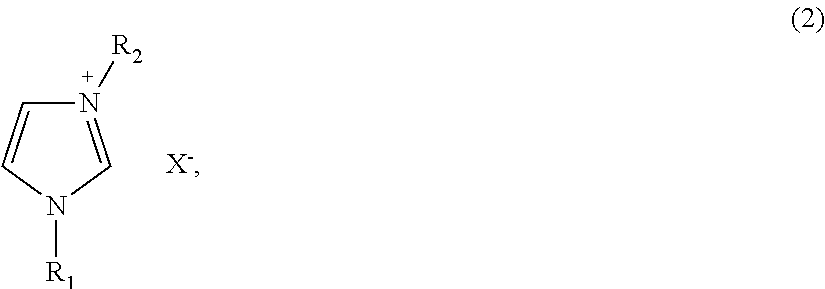
- 0 C.[1*]N1C=CN([2*])=C1 Chemical compound C.[1*]N1C=CN([2*])=C1 0.000 description 5
- BBQLNUYELLFANO-UHFFFAOYSA-N [H]C(=O)OC(CC)C(C)(CC(CC)C1=CC=CC=C1)NCCC1=NC=CN1 Chemical compound [H]C(=O)OC(CC)C(C)(CC(CC)C1=CC=CC=C1)NCCC1=NC=CN1 BBQLNUYELLFANO-UHFFFAOYSA-N 0.000 description 5
Images


Classifications
-
- C—CHEMISTRY; METALLURGY
- C08—ORGANIC MACROMOLECULAR COMPOUNDS; THEIR PREPARATION OR CHEMICAL WORKING-UP; COMPOSITIONS BASED THEREON
- C08J—WORKING-UP; GENERAL PROCESSES OF COMPOUNDING; AFTER-TREATMENT NOT COVERED BY SUBCLASSES C08B, C08C, C08F, C08G or C08H
- C08J5/00—Manufacture of articles or shaped materials containing macromolecular substances
- C08J5/20—Manufacture of shaped structures of ion-exchange resins
- C08J5/22—Films, membranes or diaphragms
-
- H—ELECTRICITY
- H01—ELECTRIC ELEMENTS
- H01M—PROCESSES OR MEANS, e.g. BATTERIES, FOR THE DIRECT CONVERSION OF CHEMICAL ENERGY INTO ELECTRICAL ENERGY
- H01M8/00—Fuel cells; Manufacture thereof
- H01M8/10—Fuel cells with solid electrolytes
- H01M8/1016—Fuel cells with solid electrolytes characterised by the electrolyte material
- H01M8/1018—Polymeric electrolyte materials
- H01M8/1069—Polymeric electrolyte materials characterised by the manufacturing processes
- H01M8/1072—Polymeric electrolyte materials characterised by the manufacturing processes by chemical reactions, e.g. in situ polymerisation or in situ crosslinking
-
- C—CHEMISTRY; METALLURGY
- C08—ORGANIC MACROMOLECULAR COMPOUNDS; THEIR PREPARATION OR CHEMICAL WORKING-UP; COMPOSITIONS BASED THEREON
- C08F—MACROMOLECULAR COMPOUNDS OBTAINED BY REACTIONS ONLY INVOLVING CARBON-TO-CARBON UNSATURATED BONDS
- C08F226/00—Copolymers of compounds having one or more unsaturated aliphatic radicals, each having only one carbon-to-carbon double bond, and at least one being terminated by a single or double bond to nitrogen or by a heterocyclic ring containing nitrogen
- C08F226/02—Copolymers of compounds having one or more unsaturated aliphatic radicals, each having only one carbon-to-carbon double bond, and at least one being terminated by a single or double bond to nitrogen or by a heterocyclic ring containing nitrogen by a single or double bond to nitrogen
-
- C—CHEMISTRY; METALLURGY
- C08—ORGANIC MACROMOLECULAR COMPOUNDS; THEIR PREPARATION OR CHEMICAL WORKING-UP; COMPOSITIONS BASED THEREON
- C08F—MACROMOLECULAR COMPOUNDS OBTAINED BY REACTIONS ONLY INVOLVING CARBON-TO-CARBON UNSATURATED BONDS
- C08F8/00—Chemical modification by after-treatment
-
- C—CHEMISTRY; METALLURGY
- C08—ORGANIC MACROMOLECULAR COMPOUNDS; THEIR PREPARATION OR CHEMICAL WORKING-UP; COMPOSITIONS BASED THEREON
- C08J—WORKING-UP; GENERAL PROCESSES OF COMPOUNDING; AFTER-TREATMENT NOT COVERED BY SUBCLASSES C08B, C08C, C08F, C08G or C08H
- C08J5/00—Manufacture of articles or shaped materials containing macromolecular substances
- C08J5/20—Manufacture of shaped structures of ion-exchange resins
- C08J5/22—Films, membranes or diaphragms
- C08J5/2206—Films, membranes or diaphragms based on organic and/or inorganic macromolecular compounds
- C08J5/2218—Synthetic macromolecular compounds
- C08J5/2231—Synthetic macromolecular compounds based on macromolecular compounds obtained by reactions involving unsaturated carbon-to-carbon bonds
- C08J5/2243—Synthetic macromolecular compounds based on macromolecular compounds obtained by reactions involving unsaturated carbon-to-carbon bonds obtained by introduction of active groups capable of ion-exchange into compounds of the type C08J5/2231
-
- C—CHEMISTRY; METALLURGY
- C08—ORGANIC MACROMOLECULAR COMPOUNDS; THEIR PREPARATION OR CHEMICAL WORKING-UP; COMPOSITIONS BASED THEREON
- C08L—COMPOSITIONS OF MACROMOLECULAR COMPOUNDS
- C08L53/00—Compositions of block copolymers containing at least one sequence of a polymer obtained by reactions only involving carbon-to-carbon unsaturated bonds; Compositions of derivatives of such polymers
- C08L53/02—Compositions of block copolymers containing at least one sequence of a polymer obtained by reactions only involving carbon-to-carbon unsaturated bonds; Compositions of derivatives of such polymers of vinyl-aromatic monomers and conjugated dienes
- C08L53/025—Compositions of block copolymers containing at least one sequence of a polymer obtained by reactions only involving carbon-to-carbon unsaturated bonds; Compositions of derivatives of such polymers of vinyl-aromatic monomers and conjugated dienes modified
-
- H—ELECTRICITY
- H01—ELECTRIC ELEMENTS
- H01M—PROCESSES OR MEANS, e.g. BATTERIES, FOR THE DIRECT CONVERSION OF CHEMICAL ENERGY INTO ELECTRICAL ENERGY
- H01M8/00—Fuel cells; Manufacture thereof
- H01M8/02—Details
-
- H—ELECTRICITY
- H01—ELECTRIC ELEMENTS
- H01M—PROCESSES OR MEANS, e.g. BATTERIES, FOR THE DIRECT CONVERSION OF CHEMICAL ENERGY INTO ELECTRICAL ENERGY
- H01M8/00—Fuel cells; Manufacture thereof
- H01M8/10—Fuel cells with solid electrolytes
-
- H—ELECTRICITY
- H01—ELECTRIC ELEMENTS
- H01M—PROCESSES OR MEANS, e.g. BATTERIES, FOR THE DIRECT CONVERSION OF CHEMICAL ENERGY INTO ELECTRICAL ENERGY
- H01M8/00—Fuel cells; Manufacture thereof
- H01M8/10—Fuel cells with solid electrolytes
- H01M8/1016—Fuel cells with solid electrolytes characterised by the electrolyte material
- H01M8/1018—Polymeric electrolyte materials
- H01M8/102—Polymeric electrolyte materials characterised by the chemical structure of the main chain of the ion-conducting polymer
- H01M8/1023—Polymeric electrolyte materials characterised by the chemical structure of the main chain of the ion-conducting polymer having only carbon, e.g. polyarylenes, polystyrenes or polybutadiene-styrenes
-
- C—CHEMISTRY; METALLURGY
- C08—ORGANIC MACROMOLECULAR COMPOUNDS; THEIR PREPARATION OR CHEMICAL WORKING-UP; COMPOSITIONS BASED THEREON
- C08J—WORKING-UP; GENERAL PROCESSES OF COMPOUNDING; AFTER-TREATMENT NOT COVERED BY SUBCLASSES C08B, C08C, C08F, C08G or C08H
- C08J2353/00—Characterised by the use of block copolymers containing at least one sequence of a polymer obtained by reactions only involving carbon-to-carbon unsaturated bonds; Derivatives of such polymers
- C08J2353/02—Characterised by the use of block copolymers containing at least one sequence of a polymer obtained by reactions only involving carbon-to-carbon unsaturated bonds; Derivatives of such polymers of vinyl aromatic monomers and conjugated dienes
-
- Y—GENERAL TAGGING OF NEW TECHNOLOGICAL DEVELOPMENTS; GENERAL TAGGING OF CROSS-SECTIONAL TECHNOLOGIES SPANNING OVER SEVERAL SECTIONS OF THE IPC; TECHNICAL SUBJECTS COVERED BY FORMER USPC CROSS-REFERENCE ART COLLECTIONS [XRACs] AND DIGESTS
- Y02—TECHNOLOGIES OR APPLICATIONS FOR MITIGATION OR ADAPTATION AGAINST CLIMATE CHANGE
- Y02E—REDUCTION OF GREENHOUSE GAS [GHG] EMISSIONS, RELATED TO ENERGY GENERATION, TRANSMISSION OR DISTRIBUTION
- Y02E60/00—Enabling technologies; Technologies with a potential or indirect contribution to GHG emissions mitigation
- Y02E60/30—Hydrogen technology
- Y02E60/50—Fuel cells
-
- Y02E60/521—
-
- Y—GENERAL TAGGING OF NEW TECHNOLOGICAL DEVELOPMENTS; GENERAL TAGGING OF CROSS-SECTIONAL TECHNOLOGIES SPANNING OVER SEVERAL SECTIONS OF THE IPC; TECHNICAL SUBJECTS COVERED BY FORMER USPC CROSS-REFERENCE ART COLLECTIONS [XRACs] AND DIGESTS
- Y02—TECHNOLOGIES OR APPLICATIONS FOR MITIGATION OR ADAPTATION AGAINST CLIMATE CHANGE
- Y02P—CLIMATE CHANGE MITIGATION TECHNOLOGIES IN THE PRODUCTION OR PROCESSING OF GOODS
- Y02P70/00—Climate change mitigation technologies in the production process for final industrial or consumer products
- Y02P70/50—Manufacturing or production processes characterised by the final manufactured product
Definitions
- the present invention relates to a polymer electrolyte membrane bonded with an ionic liquid by chemical reaction of the ionic liquid with a novel polymer chain terminal, and a fuel cell using the polymer electrolyte membrane.
- Hydrogen conductive polymers have been widely studied for use in a polymer exchange fuel cell (PEFC), which supplies an environmentally friendly (e.g., eco-friendly) source of energy.
- PEFC polymer exchange fuel cell
- One of the main problems for the development of hydrogen-conductive polymer technology is the ability to produce a hydrogen-conductive polymer that has long-term stability and durability.
- the stability and durability of such polymers is negatively impacted by a variety of factors, including: carbon monoxide pollution occurring in a platinum catalyst, complexity in heat and water control systems, moisture maintenance in a polymer electrolyte, and improvement of reaction speed in an electrode.
- the simplest approach to solve the foregoing problems is to improve the operating temperature of the PEFC. It is well known that carbon monoxide pollution in an electrode decreases to the ignorable level as operating temperature increases. However, such an increased operating temperature is higher than, or equal to, the boiling point of water, which requires a low humidification condition. Therefore, there is a need to develop a system in which a new hydrogen conductor having a high boiling point and non-volatile property is introduced in place of water.
- Nation® DuPont
- a polymer membrane of a polymer electrolyte fuel cell that operates at temperatures in the range of 60-80° C.
- National® is a sulfonated tetrafluoroethylene based fluoropolymer-copolymer, which is a synthetic polymer with ionic properties (e.g., ionomers).
- Similar polymer membranes may include, for example, Flemion® (Asahi Glass), Aciplex® (Asahi Kasei), etc., however, such polymer membranes are not commercially viable for use in a fuel cell-based application because of their prohibitively expensive price.
- aromatic polyether which is a representative, attractively priced engineering plastic, is a polymer in which a phenylene ring is Connected to an oxygen atom, is.
- the aromatic polyester in its humidified state shows high hygroscopic property and high hydrogen conductivity.
- a conventional polymer electrolyte fuel cell As to a conventional polymer electrolyte fuel cell, one suggested conventional art solution proposes a fuel cell consisting of an electrolyte membrane including an ionic conductive film between a nitrogen-containing compound, which contains histamine, and an ionic conductive polymer. Another suggested conventional art solution proposes a fuel cell asymmetric membrane that is a complex of polyarylene having a sulfonic acid group and a nitrogen-containing compound (histamine).
- the foregoing proposed solutions have the disadvantage of extremely low mechanical strength and/or leakage of the nitrogen-containing compounds from the polymer electrolyte membrane during the course of long-term use of the soaked nitrogen-containing compound.
- the present inventors have measured conductivities of various types of ionic liquids soaked in the PSS-PMB polymer electrolyte.
- alkylimidazole salt having high thermal stability, it has been found that various nano structures are formed according to a molecular weight of a polymer and a type and a relative content of a soaked ionic liquid.
- the conductivity of the resulting nano structures vary largely depending upon the type of the nano structure.
- the present invention provides a polymer electrolyte membrane bonded with an ionic liquid through chemical reaction of the ionic liquid with a novel polymer chain terminal, which provides high hydrogen ionic conductivity and electric-chemical and thermal stability in an anhydrous/high-temperature environment. Accordingly, the present invention provides a polymer electrolyte membrane having superior electro-chemical and thermal stability in an anhydrous/high-temperature environment.
- the present invention also provides a block copolymer for a poly(styrene-block-2-histamine methylbutylene formate) polymer electrolyte membrane, the poly being a novel polymer chain.
- the present invention also provides a fuel cell using the polymer electrolyte membrane.
- the present invention provides a polymer electrolyte membrane bonded by chemically reacting a block copolymer represented by the Chemical Formula 1 and an ionic liquid containing a fluorine-containing anion and an imidazolium salt cation, the ionic liquid represented by the Chemical Formula 2,
- R 1 and R 2 are independently hydrogen and a C 1 -C 30 alkyl group
- X ⁇ is selected from the group consisting of BF 4 ⁇ , PF 6 ⁇ , C 2 F 6 NO 4 S ⁇ , Cl ⁇ , OH ⁇ , Br ⁇ and CF 3 SO 3 ⁇ .
- the present invention also provides a block copolymer for a poly(styrene-block-histamine methylbutylene formate) polymer electrolyte membrane represented by the Chemical Formula 1:
- the present invention also provides a fuel cell including the polymer electrolyte membrane.
- FIG. 1 is a gel permeation chromatography (GPC) graph of a polymer electrolyte membrane manufactured according to an exemplary embodiment of the present invention
- FIG. 2 is an NMR spectrum graph of poly(styrene-block-2-histamine methylbutylene formate) manufactured according to an exemplary embodiment of the present invention
- FIG. 3 is a small-angle X-ray scattering graph showing formation of a nano structure after anion doping of an example synthesized polymer electrolyte
- FIG. 4 is a small-angle X-ray scattering graph showing formation of a nano structure of a polymer electrolyte membrane manufactured by a comparative example according to the present invention
- FIG. 5 is a hydrogen ionic conductivity graph in an anhydrous environment of a polymer electrolyte membrane manufactured according to an exemplary embodiment of the present invention
- FIG. 6 is a hydrogen ionic conductivity graph in an anhydrous environment of a an example polymer electrolyte membrane manufactured by a comparative example according to the present invention.
- FIG. 7 is a hydrogen ionic conductivity graph measured for 320 hours at 120° C. in a polymer electrolyte membrane manufactured according to an exemplary embodiment of the present invention.
- vehicle or “vehicular” or other similar term as used herein is inclusive of motor vehicles in general such as passenger automobiles including sports utility vehicles (SUV), buses, trucks, various commercial vehicles, watercraft including a variety of boats and ships, aircraft, and the like, and includes hybrid vehicles, electric vehicles, plug-in hybrid electric vehicles, hydrogen-powered vehicles and other alternative fuel vehicles (e.g., fuels derived from resources other than petroleum).
- a hybrid vehicle is a vehicle that has two or more sources of power, for example both gasoline-powered and electric-powered vehicles.
- Ranges provided herein are understood to be shorthand for all of the values within the range.
- a range of 1 to 50 is understood to include any number, combination of numbers, or sub-range from the group consisting of 1, 2, 3, 4, 5, 6, 7, 8, 9, 10, 11, 12, 13, 14, 15, 16, 17, 18, 19, 20, 21, 22, 23, 24, 25, 26, 27, 28, 29, 30, 31, 32, 33, 34, 35, 36, 37, 38, 39, 40, 41, 42, 43, 44, 45, 46, 47, 48, 49, or 50, as well as all intervening decimal values between the aforementioned integers such as, for example, 1.1, 1.2, 1.3, 1.4, 1.5, 1.6, 1.7, 1.8, and 1.9.
- a nested sub-range of an exemplary range of 1 to 50 may comprise 1 to 10, 1 to 20, 1 to 30, and 1 to 40 in one direction, or 50 to 40, 50 to 30, 50 to 20, and 50 to 10 in the other direction.
- the term “about” is understood as within a range of normal tolerance in the art, for example within 2 standard deviations of the mean. “About” can be understood as within 10%, 9%, 8%, 7%, 6%, 5%, 4%, 3%, 2%, 1%, 0.5%, 0.1%, 0.05%, or 0.01% of the stated value. Unless otherwise clear from the context, all numerical values provided herein are modified by the term “about.”
- the present invention provides a polymer electrolyte membrane bonded by chemically reacting:
- R 1 and R 2 are independently hydrogen and a C 1 -C 30 alkyl group
- X ⁇ is selected from the group consisting of BF 4 ⁇ , PF 6 ⁇ , C 2 F 6 NO 4 S ⁇ , Cl ⁇ , OH ⁇ , Br ⁇ and CF 3 SO 3 ⁇ .
- the polymer electrolyte membrane may comprise the ionic liquid in an amount of 30 to 50 parts by weight with respect to 100 parts by weight of the block copolymer. If the polymer electrolyte membrane comprises the ionic liquid in an amount of 30 parts by weight or less with respect to the block copolymer, the ionic conductivity may be too low. On the other hand, if the ionic liquid is present in an amount of 50 parts by weight or more, the mechanical strength of the electrolyte membrane may be too low.
- the present invention also includes a block copolymer for a poly(styrene-block-histamine methylbutylene formate) polymer electrolyte membrane represented by the Chemical Formula 1, as a medium of the polymer electrolyte membrane,
- poly(styrene-block-isoprene) poly(styrene-block-isoprene) (polymer 1) and are stirred for 7 hours at 50° C., such that poly(styrene-block-2-hydroxy methylbutylene formate) (polymer 2) may be obtained.
- hydrogen peroxide H 2 O 2
- HCOOH a formic acid
- poly(styrene-block-2-hydroxy methylbutylene formate) (polymer 2) may be stirred in an organic solvent and then histamine may be added thereto so that a block copolymer for a poly(styrene-block-2-histamine methylbutylene formate) (polymer 3) polymer electrolyte membrane may be manufactured.
- the present invention also includes a fuel cell including the polymer electrolyte membrane.
- the polymer electrolyte membrane bonded with an ionic liquid through chemical reaction of the ionic liquid to a novel polymer chain terminal, a high hydrogen ionic conductivity may be achieved even in a high-temperature and anhydrous environment. Additionally, the electro-chemical and thermal stability of the resulting membrane is excellent. Moreover, the polymer electrolyte membrane may also be applied to a high-temperature and dry-out bio fuel cell.
- the polymer electrolyte membrane was manufactured in the same manner as the foregoing embodiment with the exception that the terminus of poly(styrene-block-2-histamine methylbutylene formate), which is a general polymer chain, was doped with CH3SO3-by using methane sulfonate (hereinafter, “[MS]” for short, >99% HPLC grade from Sigma Aldrich) as the ionic liquid.
- [MS] methane sulfonate
- the molecular weight and molecular formula of the compound obtained in the foregoing embodiment were determined using a high-performance liquid chromatography (HPLC) analyzer, and identification of the structure of the compound was performed by analyzing a 1 H NMR spectrum through nuclear magnetic resonance analysis (Bruker AMX 500) (see FIG. 2 ).
- HPLC high-performance liquid chromatography
- SAXS Small-Angle X-Ray Scattering
- the SAXS experiment was conducted in a 4Cl SAX beam line of a Pohang Light Source (PLS).
- PLS Pohang Light Source
- small-angle X-ray scattering data was measured in the condition of Ar and room temperature.
- the polymer electrolyte membranes manufactured by Embodiment and Comparative Example have particular nano structures with periods of 7.5 nm and 25.4 nm, respectively, at room temperature.
- 25.4 nm shows the periodicity of a lamella in a plate shape and 7.5 nm indicates a size of an ionic domain formed by histamine. This means that the histamine forms re-ordered arrangement in the polymer's nano structure (see FIGS. 3 and 4 ).
- the Flory-Huggins interaction parameter in the disorder and lamellar structure phase boundary known in classic block copolymer thermodynamics is 10.5, and for this reason, in this study, the Flory-Huggins interaction parameter becomes larger than 10.5 by anion doping.
- the hydrogen ionic conductivities of the polymer electrolyte membranes manufactured according to Embodiment and Comparative Example were measured using alternating-current (AC) impedance spectroscopy.
- a through-plane hydrogen ionic conductivity was measured using two electrode cells of a stainless steel blocking electrode having a size of 1.25 cm ⁇ 1.25 cm and a Pt operating electrode/relative electrode having a size of 1 cm ⁇ 1 cm.
- the hydrogen ionic conductivities of the polymer electrolyte membranes manufactured according to Embodiment and Comparative Example were obtained as 0.2 mS/cm and 3-5 mS/cm, respectively, with different anion types, at 120° C. in an anhydrous environment, and those values are larger than conductivity values in an anhydrous environment, which were obtained in a system chemically bonded with an ionic liquid.
- the conductivity of the obtained hydrogen ionic corresponds well with the degree of order of the nano structure (see FIGS. 5 , 6 , and 7 ).
- the poly(styrene-block-2-histamine methylbutylene formate) block copolymer manufactured as described above is thermally and chemically stable at a high temperature of 180° C.
- BF 4 ⁇ having hydrophilic property and PF 6 ⁇ having hydrophobic property were doped, after which the influence upon the hydrogen ionic conductivity and durability were evaluated, resulting in a hydrogen ionic conductivity of 0.2 mS/cm of the anion-doped polymer electrolyte membrane at an operating temperature of 120° C. in an anhydrous environment, and a stable hydrogen conductivity even in continuous measurement for 300 hours or more.
- a high hydrogen ionic conductivity may be obtained even in a high-temperature and anhydrous environment, and the electro-chemical and thermal stability of the resulting membrane are excellent.
- the polymer electrolyte membrane may also be applied to a high-temperature and dry-out bio fuel cell.
Landscapes
- Chemical & Material Sciences (AREA)
- Engineering & Computer Science (AREA)
- Manufacturing & Machinery (AREA)
- Chemical Kinetics & Catalysis (AREA)
- General Chemical & Material Sciences (AREA)
- Organic Chemistry (AREA)
- Health & Medical Sciences (AREA)
- Polymers & Plastics (AREA)
- Medicinal Chemistry (AREA)
- Electrochemistry (AREA)
- Sustainable Energy (AREA)
- Sustainable Development (AREA)
- Life Sciences & Earth Sciences (AREA)
- Materials Engineering (AREA)
- Crystallography & Structural Chemistry (AREA)
- Inorganic Chemistry (AREA)
- Conductive Materials (AREA)
- Fuel Cell (AREA)
- Manufacture Of Macromolecular Shaped Articles (AREA)
Abstract
Description



Claims (17)


Applications Claiming Priority (2)
| Application Number | Priority Date | Filing Date | Title |
|---|---|---|---|
| KR1020120080160A KR101417305B1 (en) | 2012-07-23 | 2012-07-23 | Polymer electrolyte membrane chemically bonded by ionic liquid and fuel cell using the same |
| KR10-2012-0080160 | 2012-07-23 |
Publications (2)
| Publication Number | Publication Date |
|---|---|
| US20140024729A1 US20140024729A1 (en) | 2014-01-23 |
| US8853285B2 true US8853285B2 (en) | 2014-10-07 |
Family
ID=49879962
Family Applications (1)
| Application Number | Title | Priority Date | Filing Date |
|---|---|---|---|
| US13/687,740 Active US8853285B2 (en) | 2012-07-23 | 2012-11-28 | Polymer electrolyte membrane chemically bonded with ionic liquid and fuel cell using the same |
Country Status (5)
| Country | Link |
|---|---|
| US (1) | US8853285B2 (en) |
| JP (1) | JP6161269B2 (en) |
| KR (1) | KR101417305B1 (en) |
| CN (1) | CN103570899B (en) |
| DE (1) | DE102012224507A1 (en) |
Cited By (1)
| Publication number | Priority date | Publication date | Assignee | Title |
|---|---|---|---|---|
| US10361425B2 (en) | 2015-10-23 | 2019-07-23 | Samsung Electronics Co., Ltd. | Random copolymer, electrolyte, protected anode and lithium battery including the same, and method of preparing the random copolymer |
Families Citing this family (5)
| Publication number | Priority date | Publication date | Assignee | Title |
|---|---|---|---|---|
| WO2014185426A1 (en) * | 2013-05-13 | 2014-11-20 | 国立大学法人名古屋大学 | Non-volatile photonic material, and production method thereof |
| CN105694078B (en) * | 2016-01-29 | 2018-08-24 | 深圳市晓龙新能源科技有限公司 | Anion exchange membrane for fuel cell, preparation method thereof, and fuel cell using the anion exchange |
| CN107417942B (en) * | 2017-08-15 | 2020-08-04 | 北京秦天科技集团有限公司 | Butyl imidazolium copolymer material and preparation method thereof |
| US11680162B2 (en) * | 2020-04-01 | 2023-06-20 | Alliance For Sustainable Energy, Llc | Compositions for electrolyte fuel cells and other electrochemical conversion devices |
| JP7142796B1 (en) * | 2021-03-23 | 2022-09-27 | 東レ株式会社 | Block copolymers and polymer electrolyte materials using the same, polymer electrolyte moldings, polymer electrolyte membranes, catalyst layer-attached electrolyte membranes, membrane electrode assemblies, solid polymer fuel cells, and water electrolysis hydrogen generators |
Citations (5)
| Publication number | Priority date | Publication date | Assignee | Title |
|---|---|---|---|---|
| US5216115A (en) | 1990-06-12 | 1993-06-01 | Rutgers, The State University Of New Jersey | Polyarylate containing derivatives of the natural amino acid L-tyrosine |
| JP2001026573A (en) | 1999-01-26 | 2001-01-30 | Kumamoto Prefecture | Method for synthesizing amino acid acryloyl monomer or amino acid methacryloyl monomer and telomer or polymer thereof |
| JP2005149989A (en) | 2003-11-18 | 2005-06-09 | Jsr Corp | Proton conducting membrane and direct methanol fuel cell using the same |
| US6936365B2 (en) | 2000-09-29 | 2005-08-30 | Kabushiki Kaisha Toshiba | Ion conductive film and fuel cell using the same |
| KR101119532B1 (en) | 2010-07-28 | 2012-02-28 | 포항공과대학교 산학협력단 | Polymer electrolyte membrane and fuel cell using same |
Family Cites Families (6)
| Publication number | Priority date | Publication date | Assignee | Title |
|---|---|---|---|---|
| DE60314433T2 (en) * | 2002-09-20 | 2008-02-14 | Nisshinbo Industries, Inc. | COMPOSITION FOR POLYELECTROLYTE, POLYELECTROLYTE, ELECTRIC DOUBLE-LAYER CAPACITORS AND SECONDARY CELLS WITH A WATER-FREE ELECTROLYTE |
| US7955738B2 (en) * | 2004-03-05 | 2011-06-07 | Honeywell International, Inc. | Polymer ionic electrolytes |
| JP2006032181A (en) * | 2004-07-20 | 2006-02-02 | Honda Motor Co Ltd | Membrane / electrode structure for polymer electrolyte fuel cell and polymer electrolyte fuel cell |
| ATE544161T1 (en) * | 2006-10-06 | 2012-02-15 | Kuraray Co Ltd Kurashiki Plant | POLYMER SOLID ELECTROLYTE, ELECTROCHEMICAL DEVICE AND ACTUATOR |
| US7938892B2 (en) * | 2008-06-10 | 2011-05-10 | Palo Alto Research Center Incorporated | Producing articles that include ionic liquids |
| CN101908631B (en) * | 2010-07-08 | 2013-06-19 | 东华大学 | Non-metal cation type strong basicity polymer electrolyte membrane and preparation method thereof |
-
2012
- 2012-07-23 KR KR1020120080160A patent/KR101417305B1/en active Active
- 2012-11-28 US US13/687,740 patent/US8853285B2/en active Active
- 2012-11-29 JP JP2012261557A patent/JP6161269B2/en active Active
- 2012-12-28 DE DE102012224507.3A patent/DE102012224507A1/en active Pending
- 2012-12-31 CN CN201210592988.6A patent/CN103570899B/en active Active
Patent Citations (6)
| Publication number | Priority date | Publication date | Assignee | Title |
|---|---|---|---|---|
| US5216115A (en) | 1990-06-12 | 1993-06-01 | Rutgers, The State University Of New Jersey | Polyarylate containing derivatives of the natural amino acid L-tyrosine |
| JP2001026573A (en) | 1999-01-26 | 2001-01-30 | Kumamoto Prefecture | Method for synthesizing amino acid acryloyl monomer or amino acid methacryloyl monomer and telomer or polymer thereof |
| US6936365B2 (en) | 2000-09-29 | 2005-08-30 | Kabushiki Kaisha Toshiba | Ion conductive film and fuel cell using the same |
| US7538169B2 (en) | 2000-09-29 | 2009-05-26 | Kabushiki Kaisha Toshiba | Ion conductive film and fuel cell using the same |
| JP2005149989A (en) | 2003-11-18 | 2005-06-09 | Jsr Corp | Proton conducting membrane and direct methanol fuel cell using the same |
| KR101119532B1 (en) | 2010-07-28 | 2012-02-28 | 포항공과대학교 산학협력단 | Polymer electrolyte membrane and fuel cell using same |
Cited By (1)
| Publication number | Priority date | Publication date | Assignee | Title |
|---|---|---|---|---|
| US10361425B2 (en) | 2015-10-23 | 2019-07-23 | Samsung Electronics Co., Ltd. | Random copolymer, electrolyte, protected anode and lithium battery including the same, and method of preparing the random copolymer |
Also Published As
| Publication number | Publication date |
|---|---|
| KR20140013377A (en) | 2014-02-05 |
| KR101417305B1 (en) | 2014-07-08 |
| JP2014022363A (en) | 2014-02-03 |
| CN103570899B (en) | 2017-09-01 |
| JP6161269B2 (en) | 2017-07-12 |
| CN103570899A (en) | 2014-02-12 |
| US20140024729A1 (en) | 2014-01-23 |
| DE102012224507A1 (en) | 2014-01-23 |
Similar Documents
| Publication | Publication Date | Title |
|---|---|---|
| Wang et al. | Synthesis and characterization of a fluorinated cross-linked anion exchange membrane | |
| Wu et al. | Thermal crosslinking of an alkaline anion exchange membrane bearing unsaturated side chains | |
| Tripathi et al. | Organic-inorganic hybrid alkaline membranes by epoxide ring opening for direct methanol fuel cell applications | |
| US20140024729A1 (en) | Polymer electrolyte membrane chemically bonded with ionic liquid and fuel cell using the same | |
| KR20170095867A (en) | Novel polymers and methods for their manufacture | |
| Gokulapriyan et al. | Anion exchange membrane based on cross-linked poly (2, 6-dimethyl-1, 4-phenylene oxide)/poly (dimethylaminophenyl bisdiphenol) for fuel cell applications | |
| CN107910576A (en) | The preparation method of the anionic polymer film of a kind of high chemical stability | |
| Lee et al. | Development of crosslinked SEBS-based anion exchange membranes for water electrolysis: Investigation of the crosslinker effect | |
| US7833643B2 (en) | Neutral protic-salt electrolytes and protic-salt imbibed polymer membranes for high temperature fuel cell applications | |
| Wang et al. | Preparation and properties of organic–inorganic alkaline hybrid membranes for direct methanol fuel cell application | |
| Hwang et al. | Synthesis and characterization of vinylimidazole-co-trifluoroethylmethacrylate-co-divinylbenzene anion-exchange membrane for all-vanadium redox flow battery | |
| WO2008027282A2 (en) | Development of novel proton-conductive polymers for proton exchange membrane fuel cell (pemfc) technology | |
| Lehmann et al. | Quaternized polynorbornene random copolymers for fuel cell devices | |
| KR20180118529A (en) | Chemically modified anion-exchange membrane and method of preparing the same | |
| CN107417942B (en) | Butyl imidazolium copolymer material and preparation method thereof | |
| Li et al. | Intermolecular ionic cross-linked sulfonated poly (ether ether ketone) membranes with excellent mechanical properties and selectivity for direct methanol fuel cells | |
| JP2003288916A (en) | Direct alcohol fuel cell membrane and method for producing the same | |
| Wang et al. | High-performance proton exchange membranes based on block polybenzimidazole and organic–inorganic fillers with a low acid doping level | |
| JP2021534537A (en) | Organic-inorganic composite material with cross-linked structure inside the porous support Manufacture of cation or anion transportable electrolyte membranes containing electrolytes and their materials | |
| Han et al. | Alkyl side-chain attachment to imidazolium-functionalized polybiphenyl membranes for high-temperature proton exchange membrane fuel cell application | |
| CN114249882B (en) | Electrolyte membrane, fuel cell and water electrolysis device comprising same, and method for manufacturing same | |
| US9593215B2 (en) | Polymer useful for an ion exchange membrane | |
| Özden et al. | Synthesis and proton conductivity studies of doped azole functional polymer electrolyte membranes | |
| US8420767B2 (en) | Polyarlene-based polymer, preparation method for the same, and polymer electrolyte membrane for fuel cell using the polymer | |
| Lei et al. | A simple strategy for synthesis of side-chain sulfonated poly (arylene ether ketone sulfone) constructing hydrophilic/hydrophobic phase separation structure |
Legal Events
| Date | Code | Title | Description |
|---|---|---|---|
| AS | Assignment |
Owner name: POSTECH ACADEMY-INDUSTRY FOUNDATION, KOREA, REPUBL Free format text: ASSIGNMENT OF ASSIGNORS INTEREST;ASSIGNORS:KIM, YOUNG TAEK;HWANG, IN CHUL;KWON, NAK HYUN;AND OTHERS;REEL/FRAME:029366/0682 Effective date: 20121017 Owner name: HYUNDAI MOTOR COMPANY, KOREA, REPUBLIC OF Free format text: ASSIGNMENT OF ASSIGNORS INTEREST;ASSIGNORS:KIM, YOUNG TAEK;HWANG, IN CHUL;KWON, NAK HYUN;AND OTHERS;REEL/FRAME:029366/0682 Effective date: 20121017 |
|
| STCF | Information on status: patent grant |
Free format text: PATENTED CASE |
|
| FEPP | Fee payment procedure |
Free format text: PAYOR NUMBER ASSIGNED (ORIGINAL EVENT CODE: ASPN); ENTITY STATUS OF PATENT OWNER: LARGE ENTITY |
|
| MAFP | Maintenance fee payment |
Free format text: PAYMENT OF MAINTENANCE FEE, 4TH YEAR, LARGE ENTITY (ORIGINAL EVENT CODE: M1551) Year of fee payment: 4 |
|
| MAFP | Maintenance fee payment |
Free format text: PAYMENT OF MAINTENANCE FEE, 8TH YEAR, LARGE ENTITY (ORIGINAL EVENT CODE: M1552); ENTITY STATUS OF PATENT OWNER: LARGE ENTITY Year of fee payment: 8 |
|
| MAFP | Maintenance fee payment |
Free format text: PAYMENT OF MAINTENANCE FEE, 12TH YEAR, LARGE ENTITY (ORIGINAL EVENT CODE: M1553); ENTITY STATUS OF PATENT OWNER: LARGE ENTITY Year of fee payment: 12 |