US8849737B1 - Prediction method of predicting a future state of a system - Google Patents
Prediction method of predicting a future state of a system Download PDFInfo
- Publication number
- US8849737B1 US8849737B1 US13/051,672 US201113051672A US8849737B1 US 8849737 B1 US8849737 B1 US 8849737B1 US 201113051672 A US201113051672 A US 201113051672A US 8849737 B1 US8849737 B1 US 8849737B1
- Authority
- US
- United States
- Prior art keywords
- point
- phase space
- reconstructed phase
- current
- state point
- Prior art date
- Legal status (The legal status is an assumption and is not a legal conclusion. Google has not performed a legal analysis and makes no representation as to the accuracy of the status listed.)
- Active, expires
Links
Images


Classifications
-
- G—PHYSICS
- G06—COMPUTING OR CALCULATING; COUNTING
- G06N—COMPUTING ARRANGEMENTS BASED ON SPECIFIC COMPUTATIONAL MODELS
- G06N5/00—Computing arrangements using knowledge-based models
- G06N5/02—Knowledge representation; Symbolic representation
-
- G—PHYSICS
- G06—COMPUTING OR CALCULATING; COUNTING
- G06F—ELECTRIC DIGITAL DATA PROCESSING
- G06F17/00—Digital computing or data processing equipment or methods, specially adapted for specific functions
- G06F17/10—Complex mathematical operations
- G06F17/18—Complex mathematical operations for evaluating statistical data, e.g. average values, frequency distributions, probability functions, regression analysis
-
- G—PHYSICS
- G06—COMPUTING OR CALCULATING; COUNTING
- G06N—COMPUTING ARRANGEMENTS BASED ON SPECIFIC COMPUTATIONAL MODELS
- G06N3/00—Computing arrangements based on biological models
- G06N3/12—Computing arrangements based on biological models using genetic models
Definitions
- the present disclosure relates generally to the field of system prediction and analysis.
- Systems are sometimes initially characterized as stochastic, or exhibiting random behavior, and are later found to be nonlinearly deterministic. Stochastic analysis and prediction methodologies may misclassify such nonlinearly deterministic systems and may be inefficient for use with such systems.
- Control and prediction systems in industrial applications e.g., wind turbines
- deterministic prediction algorithms may be utilized but may be designed to smooth the deterministic nonlinearities, which may result in inefficient and/or inaccurate prediction.
- One embodiment of the disclosure relates to a method of predicting at least one future state of a system.
- the method comprises embedding, using a phase space embedding module, time series data relating to the system within a reconstructed phase space.
- the phase space embedding module comprises instructions stored on a non-transitory computer-readable medium that are executable by a processor.
- the method further comprises predicting, using a prediction module, the at least one future state of the system based on a rate of separation of trajectories of the embedded data within the reconstructed phase space.
- the prediction module comprises instructions stored on the non-transitory computer-readable medium that are executable by the processor.
- Another embodiment of the disclosure relates to a system comprising an electronic processor configured to embed time series data relating to a system within a reconstructed phase space.
- the processor is further configured to predict at least one future state of the system based on a rate of separation of trajectories of the embedded data within the reconstructed phase space.
- Another embodiment of the disclosure relates to a non-transitory computer-readable medium having instructions stored thereon.
- the instructions are executable by a processor to execute a method comprising embedding time series data relating to a system within a reconstructed phase space.
- the method further comprises predicting at least one future state of the system based on a rate of separation of trajectories of the embedded data within the reconstructed phase space.
- FIG. 1 is an illustration of a wind farm including a plurality of wind turbines controlled using a deterministic prediction method according to an exemplary embodiment.
- FIG. 2 is a block diagram of a processing circuit configured to predict the behavior of a system using a deterministic method according to an exemplary embodiment.
- FIG. 3 is a flow diagram of a process for predicting the behavior of a system using a deterministic method according to an exemplary embodiment.
- FIG. 4A is a flow diagram of a process for embedding data within a reconstructed phase space according to an exemplary embodiment.
- FIGS. 4B and 4C are Henon maps associated with a reconstruction of an example phase space using different embedding dimensions according to an exemplary embodiment.
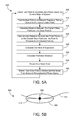
- FIG. 5A is a flow diagram of a process for predicting the behavior of a system using data embedded within a reconstructed phase space according to an exemplary embodiment.
- FIG. 5B is an illustration of a point on a trajectory and a neighborhood around the point according to an exemplary embodiment.
- Nonlinearly deterministic systems e.g., systems that exhibit chaotic behavior
- Systems generally tend toward one of several eventual states, such as steady state (e.g., to a fixed point), periodic, random, or chaotic.
- Chaotic states are represented by a metric space that is finitely bounded while exhibiting an infinite or nearly infinite number or trajectories or orbits within the bound space. These trajectories do not revisit a point previously visited within the bounds of the metric space; if they did, the trajectories would be periodic as the equations of motion for the chaotic states are deterministic.
- Prior methodologies for deterministic prediction of chaotic systems fail to take into account the exponential divergence/convergence of the system. For example, methods such as a nearest neighbor prediction and ellipsoid prediction make use of neighboring orbits of a system but do not consider that these orbits may diverge or converge at an exponential rate.
- Exemplary systems and methods disclosed herein predict future states of a system based on the rate of separation of trajectories within an embedded phase space to accurately predict the future states.
- some exemplary embodiments may be used to predict future states of a wind turbine or a group of wind turbines (e.g., a wind farm).
- the future states may relate to a predicted velocity of wind in the area of the wind turbines, predicted load on the wind turbines, predicted electrical power output of the wind turbines, and/or any other type of data relating to the wind turbines.
- Predicting the future states of a system may include embedding time series data relating to the system within a reconstructed phase space.
- Time series data includes a series or sequence of data points, each of which is measured at and/or associated with a particular point in time.
- time series data may be measured at regular periodic time intervals (e.g., 10 milliseconds, one second, 30 seconds, one minute, 15 minutes, one hour, one day, etc.).
- the time series data may represent wind speed or velocity, the load applied to the wind turbines, the electrical power output of the wind turbines, and/or other wind turbine-related data measured at a series of different times.
- the time series data may include wind velocity data for wind in the area of a wind turbine measured at 30 second intervals for a period of five minutes.
- the time series data can be used to reconstruct a phase space representation of various states of the system, and futures states of the system may be predicted based on the separation of trajectories of the embedded time series data within the reconstructed phase space.
- the electrical power output of a wind turbine or wind farm at a particular time or range of times may be predicted based on time series data relating to wind velocity or electrical power output of the wind turbine(s) that is embedded in the reconstructed phase space.
- Wind farm 150 including a plurality of wind turbines 155 controlled using a deterministic prediction method is shown according to an exemplary embodiment.
- Wind farm 150 is merely one example of a type of system that may be predicted and/or controlled using the systems and methods disclosed here.
- Wind farms and wind turbines are examples of systems that may display chaotic behavior.
- a processing circuit 160 associated with a single wind turbine 155 may receive input data relating to a state of the wind turbine 155 and may use the data to predict future states of the wind turbine 155 using methods disclosed herein.
- Processing circuit 160 may be configured to utilize one or more adjustable set points to determine the structural load that should be applied in wind turbine 155 to generate electrical energy.
- the set points may be used in conjunction with a power prediction schema that predicts the power to be generated by wind turbine 155 over a particular time period (e.g., a 24 hour period).
- processing circuit 160 may disable wind turbine 155 from operating to ensure power grid stability.
- part or all of wind farm 150 may be monitored by a central processing circuit 170 configured to receive input data relating to a state of several wind turbines and predict future states of the wind turbines and/or the wind farm 150 using methods disclosed herein.
- central processing circuit 170 may be configured to account for the impact individual turbines may have on other turbines in wind farm 150 .
- one turbine may generate a wake that affects the operation of other neighboring turbines in wind farm 150 .
- Central processing circuit 170 may be configured to operate the wind turbines in wind farm 150 in a manner that reduces the effect that the wakes from the turbines have on other neighboring turbines to reduce the structural loads on the neighboring turbines.
- Some exemplary embodiments may achieve an accuracy of 0.02 percent or less error (e.g., over 100 ten minute intervals for wind turbine generator speed and wind turbine fault prediction).
- systems and methods disclosed herein may be used to control and/or predict future states of various other types of systems in fields such as medicine (e.g., complex organs such as the heart and brain), trading market forecasting, civil and military cyber security, environmental systems, human behavior, and/or other types of systems.
- Processing circuit 200 includes at least one processor 205 , which may be any general purpose or special purpose processor (e.g., FPGA, CPLD, ASIC, etc.). In some embodiments, processor 205 may be chosen based on the type of application with which processing circuit 200 is being utilized. Processing circuit 200 also includes a memory 210 that may be any type of computer or machine-readable media (e.g., hard drive, flash memory, ROM, RAM, EEPROM, CD, DVD, etc.).
- processor 205 may be any general purpose or special purpose processor (e.g., FPGA, CPLD, ASIC, etc.). In some embodiments, processor 205 may be chosen based on the type of application with which processing circuit 200 is being utilized.
- Processing circuit 200 also includes a memory 210 that may be any type of computer or machine-readable media (e.g., hard drive, flash memory, ROM, RAM, EEPROM, CD, DVD, etc.).
- Processing circuit 200 may also include an input interface 215 for receiving input data relating to the system or process being controlled and an output interface 220 for outputting signals used to control the system or process.
- processing circuit 200 may be networked to one or more other processing circuits.
- processing circuit 200 and one or more other processing circuits may be employed to perform various operations (e.g., in a distributed computing environment).
- Memory 210 may be configured to store one or more modules having instructions that are executable by processor 205 .
- memory 210 may include a phase space embedding module 225 configured to generate a reconstructed phase space and embed time series data for a system being predicted within the reconstructed phase space.
- phase space embedding module 225 configured to generate a reconstructed phase space and embed time series data for a system being predicted within the reconstructed phase space.
- a prediction module 310 may be configured to predict the future states based on a rate of separation of trajectories in the embedded phase space (e.g., a rate of divergence or convergence of the trajectories).
- Process 300 may be implemented using a deterministic algorithm executed by a processing circuit (e.g., processing circuit 200 ).
- time series data relating to a system being predicted is received and embedded within a reconstructed phase space.
- the time series data may be data relating to one or more aspects of the system being predicted that is measured at regular intervals.
- Time series data includes a series or sequence of data points, each of which is measured at and/or associated with a particular point in time.
- time series data may be measured at regular periodic time intervals (e.g., 10 milliseconds, one second, 30 seconds, one minute, 15 minutes, one hour, one day, etc.).
- the time series data may represent wind speed or velocity, the load applied to the wind turbines, the electrical power output of the wind turbines, and/or other wind turbine-related data measured at a series of different times.
- the time series data is used to reconstruct a phase space representation of various states of the system.
- reconstruction of the phase space may be done using several metrics, including a time delay metric and a minimum embedding dimension.
- the time delay metric represents a time delay or time lag used to construct a new set of coordinates in the newly reconstructed phase space.
- the minimum embedding dimension represents a minimum number of dimensions that may be used to reconstruct, or unfold, the new phase space (e.g., the metric phase space) back to a multivariate phase space that is representational of the original phase.
- a metric representing the rate of separation of trajectories in the new embedded phase space may be determined. In some embodiments, this metric may be a maximum Lyapunov exponent of the nonlinear system.
- the behavior of the nonlinear system is predicted based on the rate of separation of trajectories in the embedded phase space.
- Future states of the system may be predicted by identifying a point in the reconstructed phase space as a current state of the system, finding one or more close points in the embedded phase space, and predicting a new state point based on the magnitude and/or direction of the maximum Lyapunov exponent of the system.
- the new state point may be predicted based on a single nearest neighbor point identified in the embedded phase space.
- the new state point may be embedded within the embedded time series in the reconstructed phase space, and step 310 may be used to predict further future states of the nonlinear system.
- a flow diagram of a process 400 for reconstructing a phase space and embedding time series data in the reconstructed phase space is shown according to an exemplary embodiment.
- One or more steps of process 400 may be performed, for example, as part of step 305 of process 300 .
- a time delay metric, or delay factor, for use in embedding time series data within the reconstructed phase space is determined.
- the time delay metric represents a time delay or time lag used to construct a new set of coordinates in the newly reconstructed phase space.
- a time delay metric ⁇ may be calculated to be the first value for which an autocorrelation function (e.g., representing a cross-correlation of the time series data signal with itself as a function of time separation) falls below 1/e.
- the autocorrelation function may be represented as follows:
- x is the mean of the time series data
- x t is the value of the data point x at time t
- r is the autocorrelation coefficient
- a minimum embedding dimension for the reconstructed phase space may be determined.
- the minimum embedding dimension represents a minimum number of dimensions that may be used to reconstruct, or unfold, the new phase space (e.g., the metric phase space) back to a multivariate phase space that is representational of the original phase.
- the time delay factor ⁇ may be calculated from the autocorrelation of the variable as described above with respect to step 405 .
- the symbol d in the scalar time series expression for the variable x above is the minimal embedding dimension for which the scalar time series is most representational of the original phase space.
- a False Nearest Neighbors (“FNN”) methodology may be used to calculate the minimum embedding dimension d.
- a FNN methodology is a procedure for obtaining the minimum embedding dimension for phase space reconstruction based on the neighborhood of points whose distance is below a given threshold ⁇ .
- ⁇ is the time delay factor from the autocorrelation function.
- all points within the neighborhood of x(n) e.g., within the threshold distance ⁇ may be calculated.
- the embedding dimension is then increased from dimension d to dimension d+1 such that, by time delay embedding, the (d+1)th coordinate is added to each of the vectors x(n).
- the distance of each point x′(n) ⁇ U(x(n)) to x(n) is again calculated.
- Those points whose distance to x(n) is larger than ⁇ are removed from the neighborhood U(x(n)).
- the removed points are considered false nearest neighbors to x(n) since they were nearest neighbors in the smaller embedding dimension but are not nearest neighbors to x(n) when the embedding dimension is expanded.
- the proper embedding dimension d is determined to be the smallest embedding dimension d in which no false nearest neighbors are discovered.
- the proper embedding dimension d may be determined to be the embedding dimension d in which the number of false nearest neighbors discovered is less than a certain maximum threshold of false nearest neighbors.
- FIG. 4B illustrates a Henon map associated with a reconstruction of an exemplary phase space using only an x variable.
- point a remains close to point c but point b is no longer in the neighborhood of point c.
- a maximum Lyapunov exponent of the system is calculated.
- the maximum Lyapunov exponent is a measure of the rate of separation (e.g., divergence or convergence) of trajectories or orbits in the reconstructed phase space.
- x 0+(d ⁇ 1) ⁇ ⁇ y ( n i ) ⁇ y 0 , y 0+ ⁇ , y 0+2 ⁇ , . . . , y 0+(d ⁇ 1) ⁇ ⁇
- the distance between x(n 1 ) and y(n 1 ) may be represented by a value ⁇ (e.g., a small value).
- the distance between the trajectories at some time ⁇ n in the future may be represented by the following:
- ⁇ ⁇ ⁇ ⁇ n ⁇ x n 1 + ⁇ ⁇ ⁇ n - y n 1 + ⁇ ⁇ ⁇ n ⁇
- the maximum Lyapunov exponent ⁇ of the trajectories for the selected variable may be determined as follows:
- ⁇ ⁇ ⁇ ⁇ n ⁇ ⁇ 0 ⁇ e ⁇ ⁇ ⁇ n ⁇ ⁇ or ⁇ ⁇ lim n ⁇ ⁇ ⁇ ⁇ 1 n ⁇ ⁇ n ⁇ ⁇ ⁇ ln ( ⁇ x n 1 + ⁇ ⁇ ⁇ n - y n 1 + ⁇ ⁇ ⁇ n ⁇ ⁇ x n 1 - y n 1 ⁇ )
- a more accurate maximum Lyapunov exponent may be calculated to determine the degree of non-linearity with the system by using a time series analysis of the Lyapunov exponent.
- a time series T and a neighborhood U(x(n 1 )) about a point x(n 1 ) ⁇ T, such that each point y n1 ⁇ U(x(n 1 )) has a distance from x(n 1 ) of some small value ⁇ .
- the Lyapunov exponent of the time series T can be calculated as follows:
- ⁇ ⁇ 1 N ⁇ ⁇ n 0 1 N ⁇ ⁇ ln ( 1 ⁇ U ⁇ ( x ⁇ ( n 1 ) ) ⁇ ⁇ ⁇ y n ⁇ U ⁇ ( x ⁇ ( n 1 ) ) ⁇ ⁇ ⁇ x n 0 + ⁇ ⁇ ⁇ n - y n + ⁇ ⁇ ⁇ n ⁇ )
- the reconstructed phase space may be generated.
- the Lyapunov exponent calculated at step 415 is indicative of the rate of divergence or convergence of the nearby trajectories in the embedded phase space. In some embodiments, this divergence or convergence may be visible in a plot of the embedded phase space. In other embodiments, higher dimension phase spaces may not be plotted. In such embodiments, the Lyapunov exponent may provide an understanding of the phase space that may be useful in the prediction of new future data points.
- a flow diagram of a process 500 for predicting the behavior (e.g., one or more future state points) of a system using data embedded within a reconstructed phase space is shown according to an exemplary embodiment.
- One or more steps of process 500 may be performed, for example, as part of step 310 of process 300 .
- a point e.g., the last point
- another point is located in a different trajectory than the selected current state point that is close (e.g., within a predefined distance), or closest, to the current state point.
- the close point may be determined using any distance metric, such as Euclidean Distance.
- the close point may reside on an orbit external to that of the current state point. Whether or not the orbit resides on an orbit external to that of the current state point may be determined through a time delay of mean orbit length.
- the distance D 1 between the current state point and the close point is calculated.
- the distance D 0 between the point previous (e.g., immediately previous) to the current state point on the trajectory of the current state point and a point previous to the closest point on the trajectory of the closest point is calculated.
- a constant of expansion c is calculated based on D 1 and D 0 , which may be calculated according to the following:
- ⁇ is the previously calculated Lyapunov exponent (e.g., at step 415 of process 400 ) relating to the rate of separation of trajectories in the system.
- a new future state point is predicted based on the determined prediction distance D p .
- the new state point may be predicted to be a distance D p from the current state point in the direction of the maximum Lyapunov exponent ⁇ .
- the direction of the maximum Lyapunov exponent ⁇ may be determined by generating a neighborhood U around the closest point determined at step 510 .
- the direction of the maximum Lyapunov exponent is in the direction of the major axis of the ellipsoidal hypersphere. In a chaotic system, the direction of the maximum Lyapunov exponent is the direction of divergence of the trajectory.
- FIG. 5B illustrates an exemplary embodiment including a trajectory 555 with a closest point 560 .
- the neighborhood U forms an ellipsoidal hypersphere 565 with the major axis as a tangent to the closest point.
- the predicted point utilizes the tangent of the closest point to determine its location within the embedded phase space.
- the tangent determines the first coordinate of the predicted point.
- the second coordinate is determined to be orthonormal to the tangent.
- the remaining coordinates correspond to the direction of the remaining axes whose length is that of their corresponding eigenvalues.
- the new state point is embedded in the nonlinear time series in the reconstructed phase space.
- the new state point may then be used as the current state point and prediction may continue by repeating (e.g., iteratively) process 500 .
- the length of predictability may depend on the magnitude of the Lyapunov exponent. The larger the Lyaponov exponent is, the shorter the accurate prediction time frame may become.
- machine-readable media for carrying or having machine-executable instructions or data structures stored thereon.
- Such machine-readable media can be any available media which can be accessed by a general purpose or special purpose computer or other machine with a processor.
- machine-readable media can comprise RAM, ROM, EPROM, EEPROM, CD ROM or other optical disk storage, magnetic disk storage or other magnetic storage devices, or any other medium (e.g., non-transitory medium) which can be used to carry or store desired program code in the form of machine-executable instructions or data structures and which can be accessed by a general purpose or special purpose computer or other machine with a processor.
- Machine-executable instructions comprise, for example, instructions and data which cause a general purpose computer, special purpose computer, or special purpose processing machine to perform a certain function or group of functions.
- Embodiments of the disclosure are described in the general context of method steps which may be implemented in one embodiment by a program product including machine-executable instructions, such as program code, for example, in the form of program modules executed by machines in networked environments.
- program modules include routines, programs, objects, components, data structures, etc., that perform particular tasks or implement particular abstract data types.
- Machine-executable instructions, associated data structures, and program modules represent examples of program code for executing steps of the methods disclosed herein.
- the particular sequence of such executable instructions or associated data structures represent examples of corresponding acts for implementing the functions described in such steps.
- Embodiments of the present disclosure may be practiced in a networked environment using logical connections to one or more remote computers having processors.
- Logical connections may include a local area network (LAN) and a wide area network (WAN) that are presented here by way of example and not limitation.
- LAN local area network
- WAN wide area network
- Such networking environments are commonplace in office-wide or enterprise-wide computer networks, intranets and the Internet and may use a wide variety of different communication protocols.
- Those skilled in the art will appreciate that such network computing environments will typically encompass many types of computer system configurations, including personal computers, hand-held devices, multi-processor systems, microprocessor-based or programmable consumer electronics, network PCs, servers, minicomputers, mainframe computers, and the like.
- Embodiments of the disclosure may also be practiced in distributed computing environments where tasks are performed by local and remote processing devices that are linked (either by hardwired links, wireless links, or by a combination of hardwired or wireless links) through a communications network.
- program modules may be located in both local and remote memory storage devices.
- An exemplary system for implementing the overall system or portions of the disclosure might include a general purpose computing device in the form of a computer, including a processing unit, a system memory, and a system bus that couples various system components including the system memory to the processing unit.
- the system memory may include read only memory (ROM) and random access memory (RAM).
- the computer may also include a magnetic hard disk drive for reading from and writing to a magnetic hard disk, a magnetic disk drive for reading from or writing to a removable magnetic disk, and an optical disk drive for reading from or writing to a removable optical disk such as a CD ROM or other optical media.
- the drives and their associated machine-readable media provide nonvolatile storage of machine-executable instructions, data structures, program modules, and other data for the computer.
Landscapes
- Engineering & Computer Science (AREA)
- Physics & Mathematics (AREA)
- Theoretical Computer Science (AREA)
- Data Mining & Analysis (AREA)
- General Physics & Mathematics (AREA)
- Mathematical Physics (AREA)
- Life Sciences & Earth Sciences (AREA)
- General Engineering & Computer Science (AREA)
- Software Systems (AREA)
- Computational Linguistics (AREA)
- Artificial Intelligence (AREA)
- Biophysics (AREA)
- Health & Medical Sciences (AREA)
- Pure & Applied Mathematics (AREA)
- Computing Systems (AREA)
- Mathematical Analysis (AREA)
- Evolutionary Computation (AREA)
- Evolutionary Biology (AREA)
- Computational Mathematics (AREA)
- Bioinformatics & Computational Biology (AREA)
- Mathematical Optimization (AREA)
- Bioinformatics & Cheminformatics (AREA)
- Databases & Information Systems (AREA)
- Algebra (AREA)
- Probability & Statistics with Applications (AREA)
- Operations Research (AREA)
- Genetics & Genomics (AREA)
- Biomedical Technology (AREA)
- General Health & Medical Sciences (AREA)
- Molecular Biology (AREA)
- Management, Administration, Business Operations System, And Electronic Commerce (AREA)
Abstract
Description
x(n i)={x 0 , x 0+τ , x 0+2τ , . . . , x 0+(d−1)τ}
y(n i)={y 0 , y 0+τ , y 0+2τ , . . . , y 0+(d−1)τ}
D p =D 1 +e cλ
Claims (14)
Priority Applications (1)
| Application Number | Priority Date | Filing Date | Title |
|---|---|---|---|
| US13/051,672 US8849737B1 (en) | 2011-03-18 | 2011-03-18 | Prediction method of predicting a future state of a system |
Applications Claiming Priority (1)
| Application Number | Priority Date | Filing Date | Title |
|---|---|---|---|
| US13/051,672 US8849737B1 (en) | 2011-03-18 | 2011-03-18 | Prediction method of predicting a future state of a system |
Publications (1)
| Publication Number | Publication Date |
|---|---|
| US8849737B1 true US8849737B1 (en) | 2014-09-30 |
Family
ID=51588262
Family Applications (1)
| Application Number | Title | Priority Date | Filing Date |
|---|---|---|---|
| US13/051,672 Active 2032-01-21 US8849737B1 (en) | 2011-03-18 | 2011-03-18 | Prediction method of predicting a future state of a system |
Country Status (1)
| Country | Link |
|---|---|
| US (1) | US8849737B1 (en) |
Cited By (22)
| Publication number | Priority date | Publication date | Assignee | Title |
|---|---|---|---|---|
| US20140058572A1 (en) * | 2012-08-27 | 2014-02-27 | Gridium, Inc. | Systems and methods for energy consumption and energy demand management |
| US20140149332A1 (en) * | 2011-06-27 | 2014-05-29 | Nec Corporation | Action suggestion device, action suggestion system, action suggestion method, and program |
| US20140244058A1 (en) * | 2013-02-26 | 2014-08-28 | Schweitzer Engineering Laboratories, Inc. | State Trajectory Prediction in an Electric Power Delivery System |
| CN104657910A (en) * | 2014-12-29 | 2015-05-27 | 国网湖南省电力公司 | Daily operation evaluation method for power grid |
| US20160072270A1 (en) * | 2014-09-05 | 2016-03-10 | Southern States, Llc | Fault detection and isolation using a common reference clock |
| CN107689638A (en) * | 2017-09-28 | 2018-02-13 | 中国电力科学研究院 | A Transient Coordinated Control Method for Power Systems Containing Wind Power Based on Phase Trajectory Analysis |
| CN108880886A (en) * | 2018-06-20 | 2018-11-23 | 国家电网公司信息通信分公司 | A communication network planning method for cross-regional power system protection |
| US10333312B2 (en) | 2013-06-26 | 2019-06-25 | Schweitzer Engineering Laboratories, Inc. | Distributed control in electric power delivery systems |
| US10379212B2 (en) * | 2014-03-06 | 2019-08-13 | Weibel Scientific A/S | Multi frequency range estimation |
| CN110298535A (en) * | 2019-05-14 | 2019-10-01 | 国网浙江省电力有限公司嘉兴供电公司 | A kind of power grid active O&M warning information generation method |
| US10487804B2 (en) | 2015-03-11 | 2019-11-26 | General Electric Company | Systems and methods for validating wind farm performance improvements |
| US10542961B2 (en) | 2015-06-15 | 2020-01-28 | The Research Foundation For The State University Of New York | System and method for infrasonic cardiac monitoring |
| US10678912B2 (en) | 2016-11-15 | 2020-06-09 | General Electric Company | Dynamic normalization of monitoring node data for threat detection in industrial asset control system |
| CN112462736A (en) * | 2020-11-13 | 2021-03-09 | 华北电力大学 | Wind turbine generator fault diagnosis method based on data analysis |
| CN114080634A (en) * | 2019-07-03 | 2022-02-22 | 伟摩有限责任公司 | Proxy trajectory prediction using anchor trajectories |
| US11313353B2 (en) * | 2019-05-31 | 2022-04-26 | Vestas Wind Systems A/S | Controlling a wind turbine using control outputs at certain time stages over a prediction horizon |
| US11790081B2 (en) | 2021-04-14 | 2023-10-17 | General Electric Company | Systems and methods for controlling an industrial asset in the presence of a cyber-attack |
| US12034741B2 (en) | 2021-04-21 | 2024-07-09 | Ge Infrastructure Technology Llc | System and method for cyberattack detection in a wind turbine control system |
| CN120601450A (en) * | 2025-04-14 | 2025-09-05 | 西安热工研究院有限公司 | A method and system for predicting energy storage frequency modulation instructions based on distance optimization method |
| CN120821229A (en) * | 2025-09-12 | 2025-10-21 | 青岛农业大学 | An intelligent control system |
| US12510052B1 (en) | 2024-06-27 | 2025-12-30 | GE Vernova Renovables Espana, S.L. | System and method for optimizing control of a wind turbine |
| US12560150B2 (en) | 2021-10-07 | 2026-02-24 | GE Vernova Renovables Espana, S.L. | Systems and methods for controlling a wind turbine |
Citations (52)
| Publication number | Priority date | Publication date | Assignee | Title |
|---|---|---|---|---|
| US20020029097A1 (en) | 2000-04-07 | 2002-03-07 | Pionzio Dino J. | Wind farm control system |
| US20030160457A1 (en) | 2000-07-07 | 2003-08-28 | Mario Ragwitz | Method and device for processing and predicting the flow parameters of turbulent media |
| US20040009063A1 (en) | 2002-07-12 | 2004-01-15 | Polacsek Ronald R. | Oscillating system entraining axial flow devices |
| US6975925B1 (en) | 2002-03-19 | 2005-12-13 | Windlynx Systems, B.V. | Forecasting an energy output of a wind farm |
| US7047169B2 (en) | 2001-01-18 | 2006-05-16 | The Board Of Trustees Of The University Of Illinois | Method for optimizing a solution set |
| US20070067067A1 (en) | 2005-09-22 | 2007-03-22 | Matthias Stommel | Method for adapting a wind energy installation to given wind conditions |
| US20070112698A1 (en) | 2005-10-20 | 2007-05-17 | Mcardle James M | Computer controlled method using genetic algorithms to provide non-deterministic solutions to problems involving physical restraints |
| US20070124025A1 (en) | 2005-11-29 | 2007-05-31 | General Electric Company | Windpark turbine control system and method for wind condition estimation and performance optimization |
| US7272584B2 (en) | 2004-03-04 | 2007-09-18 | International Business Machines Corporation | Use of dominance to improve performance or increase search space in genetic algorithms |
| US7403854B1 (en) | 2007-04-27 | 2008-07-22 | Airtricity Holdings Limited | Method and apparatus for determining wind farm electricity production |
| US20080183648A1 (en) | 2006-01-31 | 2008-07-31 | The Board Of Trustees Of The University Of Illinois | Methods and systems for interactive computing |
| US20080195255A1 (en) | 2007-02-13 | 2008-08-14 | Hans Henning Lutze | Utility grid, controller, and method for controlling the power generation in a utility grid |
| US20090060740A1 (en) | 2007-05-03 | 2009-03-05 | Henrik Stiesdal | Method of operating a wind turbine and wind turbine |
| US20090100293A1 (en) | 2007-10-16 | 2009-04-16 | General Electric Company | Method and system for predicting turbomachinery failure events employing genetic algorithm |
| US20090143871A1 (en) | 2002-04-18 | 2009-06-04 | Cleveland State University | Controllers, observers, and applications thereof |
| US20090259521A1 (en) * | 2008-04-14 | 2009-10-15 | Yitts Anthony M | Method of Identifying Innovations Possessing Business Disrupting Properties |
| US20090299780A1 (en) | 2008-05-29 | 2009-12-03 | Abhinanda Sarkar | Method and apparatus for determining and/or providing power output information of wind turbine farms |
| US20090295165A1 (en) | 2008-05-30 | 2009-12-03 | Ge Wind Energy Gmbh | Method for wind turbine placement in a wind power plant |
| US20090327178A1 (en) | 2005-04-07 | 2009-12-31 | Jacobson David L | Concurrent two-phase completion genetic algorithm system and methods |
| US20100094474A1 (en) | 2008-10-09 | 2010-04-15 | General Electric Company | Voltage control at windfarms |
| US20100117361A1 (en) | 2007-07-14 | 2010-05-13 | Poul Brandt Christensen | Wind Turbine, A Method For Compensating For Disparities In A Wind Turbine Rotor Blade Pitch System And Use Of A Method |
| US20100133848A1 (en) | 2009-08-14 | 2010-06-03 | Piasecki Frederick W | Wind Turbine |
| US20100138182A1 (en) | 2009-08-28 | 2010-06-03 | General Electric Company | System and method for managing wind turbines and enhanced diagnostics |
| US20100148712A1 (en) | 2007-10-26 | 2010-06-17 | Frederick William Klatt | Brushless Multiphase Self-Commutation (or BMSCC) And Related Invention |
| US20100204844A1 (en) | 2009-02-03 | 2010-08-12 | Optisolar, Inc. | Local power tracking for dynamic power management in weather-sensitive power systems |
| US7797259B2 (en) * | 2007-04-12 | 2010-09-14 | Hrl Laboratories, Llc | System for temporal prediction |
| US20100263167A1 (en) | 2009-04-16 | 2010-10-21 | Seymour Ian Fox | Counter-balance apparatus and method for providing a stabilizing force |
| US7822582B2 (en) | 2004-02-27 | 2010-10-26 | Deere & Company | Method and system of determining a location for a wind-powered electrical energy facility |
| US20100280673A1 (en) | 2009-10-07 | 2010-11-04 | Ge Wind Energy Gmbh | Systems and Methods for Analyzing Reporting Data |
| US20110004356A1 (en) | 2007-12-19 | 2011-01-06 | Vestas Wind Systems A/S | Event-based control system for wind turbine generators |
| WO2011014712A2 (en) | 2009-07-29 | 2011-02-03 | Michigan Aerospace Corporation | Atmospheric measurement system |
| US20110106324A1 (en) | 2009-09-28 | 2011-05-05 | Sagie Tsadka | Methods, devices and systems for remote wind sensing |
| US20110149268A1 (en) | 2009-12-17 | 2011-06-23 | Marchant Alan B | Dynamic 3d wind mapping system and method |
| US20110202191A1 (en) | 2010-02-18 | 2011-08-18 | Abb Research Ltd. | Energy generating system and control thereof |
| US20110224926A1 (en) | 2010-12-06 | 2011-09-15 | Morjaria Mahesh A | System, device, and method for estimating possible power output of wind turbines |
| US20110226892A1 (en) | 2008-08-08 | 2011-09-22 | William Crowther | Rotary wing vehicle |
| US20110245990A1 (en) | 2008-10-28 | 2011-10-06 | Technical University Of Denmark | System and method for connecting a converter to a utility grid |
| US8041417B2 (en) * | 2008-01-25 | 2011-10-18 | University Of Southern California | Method and system for dynamical systems modeling of electrocardiogram data |
| US20110307109A1 (en) | 2010-05-27 | 2011-12-15 | Sri-Jayantha Sri M | Smarter-Grid: Method to Forecast Electric Energy Production and Utilization Subject to Uncertain Environmental Variables |
| US8105781B2 (en) | 2007-10-12 | 2012-01-31 | Duke University | Predictors of long-term mortality following coronary artery bypass graft surgery |
| US20120049516A1 (en) | 2010-08-25 | 2012-03-01 | Vestas Wind Systems A/S | Method, system, and computer program product to optimize power plant output and operation |
| US20120059638A1 (en) | 2009-05-14 | 2012-03-08 | Alston Wind, S.L.U. | Method And System For Predicting The Occurrence Of A Wind Gust At A Wind Turbine |
| US20120078814A1 (en) * | 2010-09-23 | 2012-03-29 | Thomson Reuters (Markets) Llc | System and method for forecasting realized volatility via wavelets and non-linear dynamics |
| US8185331B2 (en) | 2011-09-02 | 2012-05-22 | Onsemble LLC | Systems, methods and apparatus for indexing and predicting wind power output from virtual wind farms |
| US8200435B2 (en) | 2008-07-22 | 2012-06-12 | Siemens Aktiengesellschaft | Method and arrangement for the forecast of wind-resources |
| US8265798B2 (en) | 2008-09-25 | 2012-09-11 | Kingston Consulting, Inc. | System and method of curtailing energy production within congestive grid operating environments |
| US8272265B2 (en) | 2005-07-12 | 2012-09-25 | Technion Research And Development Foundation Ltd. | System and method for active detection of asymmetry in rotating structures |
| US8332077B2 (en) | 2008-09-30 | 2012-12-11 | Hitachi, Ltd. | Controller and control method for a wind farm including a plurality of wind turbine generators |
| US20130035798A1 (en) | 2010-02-05 | 2013-02-07 | Yu Zhou | Method of operating a wind power plant |
| US20130046492A1 (en) | 2010-04-08 | 2013-02-21 | Carsten Hein Westergaard | Method and system for forecasting wind energy |
| US20130102379A1 (en) | 2011-01-07 | 2013-04-25 | Candace Sargent | Method of Simulation Reproductive Creatures |
| US20130121548A1 (en) | 2010-07-26 | 2013-05-16 | Kjaya, Llc | Adaptive visualization for direct physician use |
-
2011
- 2011-03-18 US US13/051,672 patent/US8849737B1/en active Active
Patent Citations (60)
| Publication number | Priority date | Publication date | Assignee | Title |
|---|---|---|---|---|
| US20020029097A1 (en) | 2000-04-07 | 2002-03-07 | Pionzio Dino J. | Wind farm control system |
| US20030160457A1 (en) | 2000-07-07 | 2003-08-28 | Mario Ragwitz | Method and device for processing and predicting the flow parameters of turbulent media |
| US6909198B2 (en) | 2000-07-07 | 2005-06-21 | Max-Planck-Gesellschaft Zur Forderung Der Wissenschaften E.V. | Method and device for processing and predicting the flow parameters of turbulent media |
| US7047169B2 (en) | 2001-01-18 | 2006-05-16 | The Board Of Trustees Of The University Of Illinois | Method for optimizing a solution set |
| US6975925B1 (en) | 2002-03-19 | 2005-12-13 | Windlynx Systems, B.V. | Forecasting an energy output of a wind farm |
| US8060340B2 (en) | 2002-04-18 | 2011-11-15 | Cleveland State University | Controllers, observers, and applications thereof |
| US20090143871A1 (en) | 2002-04-18 | 2009-06-04 | Cleveland State University | Controllers, observers, and applications thereof |
| US20040009063A1 (en) | 2002-07-12 | 2004-01-15 | Polacsek Ronald R. | Oscillating system entraining axial flow devices |
| US7822582B2 (en) | 2004-02-27 | 2010-10-26 | Deere & Company | Method and system of determining a location for a wind-powered electrical energy facility |
| US7272584B2 (en) | 2004-03-04 | 2007-09-18 | International Business Machines Corporation | Use of dominance to improve performance or increase search space in genetic algorithms |
| US20090327178A1 (en) | 2005-04-07 | 2009-12-31 | Jacobson David L | Concurrent two-phase completion genetic algorithm system and methods |
| US8272265B2 (en) | 2005-07-12 | 2012-09-25 | Technion Research And Development Foundation Ltd. | System and method for active detection of asymmetry in rotating structures |
| US20070067067A1 (en) | 2005-09-22 | 2007-03-22 | Matthias Stommel | Method for adapting a wind energy installation to given wind conditions |
| US20070112698A1 (en) | 2005-10-20 | 2007-05-17 | Mcardle James M | Computer controlled method using genetic algorithms to provide non-deterministic solutions to problems involving physical restraints |
| US20070124025A1 (en) | 2005-11-29 | 2007-05-31 | General Electric Company | Windpark turbine control system and method for wind condition estimation and performance optimization |
| US20080183648A1 (en) | 2006-01-31 | 2008-07-31 | The Board Of Trustees Of The University Of Illinois | Methods and systems for interactive computing |
| US20080195255A1 (en) | 2007-02-13 | 2008-08-14 | Hans Henning Lutze | Utility grid, controller, and method for controlling the power generation in a utility grid |
| US7797259B2 (en) * | 2007-04-12 | 2010-09-14 | Hrl Laboratories, Llc | System for temporal prediction |
| US7403854B1 (en) | 2007-04-27 | 2008-07-22 | Airtricity Holdings Limited | Method and apparatus for determining wind farm electricity production |
| US8202048B2 (en) | 2007-05-03 | 2012-06-19 | Siemens Aktiengesellschaft | Method of operating a wind turbine and wind turbine |
| US20090060740A1 (en) | 2007-05-03 | 2009-03-05 | Henrik Stiesdal | Method of operating a wind turbine and wind turbine |
| US7942634B2 (en) | 2007-07-14 | 2011-05-17 | Vestas Wind Systems A/S | Wind turbine, a method for compensating for disparities in a wind turbine rotor blade pitch system and use of a method |
| US20100117361A1 (en) | 2007-07-14 | 2010-05-13 | Poul Brandt Christensen | Wind Turbine, A Method For Compensating For Disparities In A Wind Turbine Rotor Blade Pitch System And Use Of A Method |
| US8105781B2 (en) | 2007-10-12 | 2012-01-31 | Duke University | Predictors of long-term mortality following coronary artery bypass graft surgery |
| US20090100293A1 (en) | 2007-10-16 | 2009-04-16 | General Electric Company | Method and system for predicting turbomachinery failure events employing genetic algorithm |
| US20100148712A1 (en) | 2007-10-26 | 2010-06-17 | Frederick William Klatt | Brushless Multiphase Self-Commutation (or BMSCC) And Related Invention |
| US20110004356A1 (en) | 2007-12-19 | 2011-01-06 | Vestas Wind Systems A/S | Event-based control system for wind turbine generators |
| US8041417B2 (en) * | 2008-01-25 | 2011-10-18 | University Of Southern California | Method and system for dynamical systems modeling of electrocardiogram data |
| US20090259521A1 (en) * | 2008-04-14 | 2009-10-15 | Yitts Anthony M | Method of Identifying Innovations Possessing Business Disrupting Properties |
| US20090299780A1 (en) | 2008-05-29 | 2009-12-03 | Abhinanda Sarkar | Method and apparatus for determining and/or providing power output information of wind turbine farms |
| US8050899B2 (en) | 2008-05-30 | 2011-11-01 | General Electric Company | Method for wind turbine placement in a wind power plant |
| US20090295165A1 (en) | 2008-05-30 | 2009-12-03 | Ge Wind Energy Gmbh | Method for wind turbine placement in a wind power plant |
| US8200435B2 (en) | 2008-07-22 | 2012-06-12 | Siemens Aktiengesellschaft | Method and arrangement for the forecast of wind-resources |
| US20110226892A1 (en) | 2008-08-08 | 2011-09-22 | William Crowther | Rotary wing vehicle |
| US8265798B2 (en) | 2008-09-25 | 2012-09-11 | Kingston Consulting, Inc. | System and method of curtailing energy production within congestive grid operating environments |
| US8332077B2 (en) | 2008-09-30 | 2012-12-11 | Hitachi, Ltd. | Controller and control method for a wind farm including a plurality of wind turbine generators |
| US20100094474A1 (en) | 2008-10-09 | 2010-04-15 | General Electric Company | Voltage control at windfarms |
| US8290634B2 (en) | 2008-10-09 | 2012-10-16 | General Electric Company | Optimizing system loss for a system of multiple windfarms |
| US20110245990A1 (en) | 2008-10-28 | 2011-10-06 | Technical University Of Denmark | System and method for connecting a converter to a utility grid |
| US20100204844A1 (en) | 2009-02-03 | 2010-08-12 | Optisolar, Inc. | Local power tracking for dynamic power management in weather-sensitive power systems |
| US20100263167A1 (en) | 2009-04-16 | 2010-10-21 | Seymour Ian Fox | Counter-balance apparatus and method for providing a stabilizing force |
| US20120059638A1 (en) | 2009-05-14 | 2012-03-08 | Alston Wind, S.L.U. | Method And System For Predicting The Occurrence Of A Wind Gust At A Wind Turbine |
| WO2011014712A2 (en) | 2009-07-29 | 2011-02-03 | Michigan Aerospace Corporation | Atmospheric measurement system |
| US20120169053A1 (en) | 2009-07-29 | 2012-07-05 | Michigan Aerospace Corporation | Atmospheric Measurement System |
| US20100133848A1 (en) | 2009-08-14 | 2010-06-03 | Piasecki Frederick W | Wind Turbine |
| US20100138182A1 (en) | 2009-08-28 | 2010-06-03 | General Electric Company | System and method for managing wind turbines and enhanced diagnostics |
| US20110106324A1 (en) | 2009-09-28 | 2011-05-05 | Sagie Tsadka | Methods, devices and systems for remote wind sensing |
| US20100280673A1 (en) | 2009-10-07 | 2010-11-04 | Ge Wind Energy Gmbh | Systems and Methods for Analyzing Reporting Data |
| US20110149268A1 (en) | 2009-12-17 | 2011-06-23 | Marchant Alan B | Dynamic 3d wind mapping system and method |
| US20130035798A1 (en) | 2010-02-05 | 2013-02-07 | Yu Zhou | Method of operating a wind power plant |
| US20110202191A1 (en) | 2010-02-18 | 2011-08-18 | Abb Research Ltd. | Energy generating system and control thereof |
| US20130046492A1 (en) | 2010-04-08 | 2013-02-21 | Carsten Hein Westergaard | Method and system for forecasting wind energy |
| US20110307109A1 (en) | 2010-05-27 | 2011-12-15 | Sri-Jayantha Sri M | Smarter-Grid: Method to Forecast Electric Energy Production and Utilization Subject to Uncertain Environmental Variables |
| US20130121548A1 (en) | 2010-07-26 | 2013-05-16 | Kjaya, Llc | Adaptive visualization for direct physician use |
| US20120049516A1 (en) | 2010-08-25 | 2012-03-01 | Vestas Wind Systems A/S | Method, system, and computer program product to optimize power plant output and operation |
| US20120078814A1 (en) * | 2010-09-23 | 2012-03-29 | Thomson Reuters (Markets) Llc | System and method for forecasting realized volatility via wavelets and non-linear dynamics |
| US20110224926A1 (en) | 2010-12-06 | 2011-09-15 | Morjaria Mahesh A | System, device, and method for estimating possible power output of wind turbines |
| US8150641B2 (en) | 2010-12-06 | 2012-04-03 | General Electric Company | System, device, and method for estimating possible power output of wind turbines |
| US20130102379A1 (en) | 2011-01-07 | 2013-04-25 | Candace Sargent | Method of Simulation Reproductive Creatures |
| US8185331B2 (en) | 2011-09-02 | 2012-05-22 | Onsemble LLC | Systems, methods and apparatus for indexing and predicting wind power output from virtual wind farms |
Non-Patent Citations (35)
| Title |
|---|
| Bookstaber, A Recessive/Dominant Genetic Algorithm, 2003, 11 pages. |
| Engler et al., Agent-Based Control of Thermostatic Appliances, Green Technologies Conference, 2010 IEEE, Apr. 15-16, 2010, 5 pages. |
| Engler, Optimization of Test Engineering Utilizing Evolutionary Computation, Autotestcon, 2009 IEEE, Sep. 14-17, 2009, 6 pages. |
| Giebel, The State-of-the-Art in Short-Term Prediction of Wind Power, A Literature Overview, Version 1.1, Project ANEMOS, Contract No. ENK5-CT-2002-00665, Aug. 2003, 36 pages. |
| Goldberg et al., Nonstationary Function Optimization Using Genetic Algorithm with Dominance and Diploidy, Proceedings of the Second International Conference on Genetic Algorithms on Genetic Algorithms and Their Application, 1987, 11 pages. |
| Kennel, Matthew B. et al.; "Determining embedding dimension for phase-space reconstruction using a geometrical construction"; 1992; The American Physical Society; Physical Review A, vol. 45, No. 6; pp. 3403-3411. * |
| Kominami et al., A New Genetic Algorithm with Diploid Chromosomes Using Probability Decoding for Adaption to Various Environments, Electronics and Communications in Japan, 2010, 9 pages. |
| Kusiak et al., Analysis of Wind Turbine Vibrations based on SCADA Data, Journal of Solar Energy Engineering, 2009, 13 pages. |
| Kusiak et al., Anticipatory Control of Wind Turbines with Data-Driven Predictive Models, IEEE Transactions on Energy Conversion, Sep. 2009, 9 pages. |
| Kusiak et al., Prediction of Status Patterns of Wind Turbines: A Data-Mining Approach, Journal of Solar Energy Engineering, Feb. 2011, 10 pages. |
| Kusiak et al., Short-Horizon Prediction of Wind Power: A Data-Driven Approach, IEEE Transactions on Energy Conversion, Dec. 2010, 11 pages. |
| Kusiak et al., Short-Term Prediction of Wind Farm Power: A Data Mining Approach, IEEE Transactions on Energy Conversion, Mar. 2009, 12 pages. |
| Lei, Dong et al.; "Prediction of Wind Power Generation based on Chaotic Phase Space Reconstruction Models"; 2007; Power Electronics and Drive Systems, 2007; pp. 744-748. * |
| Non-Final Office Action on U.S. Appl. No. 13/051,751 Dated Jul. 2, 2014, 9 pages. |
| Notice of Allowance for U.S. Appl. No. 13/051,717, mail date Mar. 28, 2013, 19 pages. |
| Notice of Allowance for U.S. Appl. No. 13/051,787, mail date Sep. 26, 2013, 8 pages. |
| Notice of Allowance for U.S. Appl. No. 13/051,835, mail date Jun. 11, 2013, 11 pages. |
| Notice of Allowance for U.S. Appl. No. 13/051,849, mail date Apr. 1, 2013, 12 pages. |
| Office Action for U.S. Appl. No. 13/051,787, mail date Jun. 20, 2013, 16 pages. |
| Office Action for U.S. Appl. No. 13/224,648, mail date Jul. 22, 2013, 17 pages. |
| Papadopoulos et al., Engineering Failure Analysis and Design Optimisation with Hip-Hops, Engineering Failure Analysis, Mar. 2011, 19 pages. |
| Saad-Saound et al., Models for Predicting Flicker Induced by Large Wind Turbines, IEEE Transactions on Energy Conversion, Sep. 1999, 6 pages. |
| Schnier et al., Dominant and Recessive Genes in Evolutionary Systems Applied to Spatial Reasoning, University of Sydney, Key Centre of Design Computing, 1997 10 pages. |
| Sedighizadeh et al., A Self-Tuning PID Control for a Wind Energy Conversion System Based on the Lyapunov Approach, Universities Power Engineering Conference, Sep. 2008, 6 pages. |
| Sheth et al., Evolving Agents for Personalized Information Filtering, IEEE, 1993, 8 pages. |
| Tian-Hua et al., Study on the Turntable Hydraulic Variable Structure Control Based on Lyapunov Theory, 2009 International Conference on Measuring Technology and Mechatronics Automation, Apr. 2009, 6 pages. |
| U.S. Appl. No. 13/051,717, filed Mar. 18, 2011, Rockwell Collins, Inc. |
| U.S. Appl. No. 13/051,751, filed Mar. 18, 2011, Rockwell Collins, Inc. |
| U.S. Appl. No. 13/051,787, filed Mar. 18, 2011, Rockwell Collins, Inc. |
| U.S. Appl. No. 13/051,835, filed Mar. 18, 2011, Rockwell Collins, Inc. |
| U.S. Appl. No. 13/051,849, filed Mar. 18, 2011, Rockwell Collins, Inc. |
| Wu et al., A Diploid Genetic Approach to Short-Term Scheduling of Hydro-Thermal System, IEEE Transactions on Power Systems, 2000, 7 pages. |
| Yanning et al., Wind Speed Predicted by Wavelet Analysis in Input Prediction Control of Wind Turbine, Proceedings of the 7th World Congress on Intelligent Control and Automation, Jun. 2008, 4 pages. |
| Zhang, Jun et al.; "Time series prediction using Lyapunov exponents in embedding phase space"; 2004; Elsevier; Computers and Electrical Engineering 30 (2004); pp. 1-15. * |
| Zheng et al., Prediction of Wind Farm Power Ramp Rates: A Data-Mining Approach, Journal of Solar Engineering, 2009, 9 pages. |
Cited By (32)
| Publication number | Priority date | Publication date | Assignee | Title |
|---|---|---|---|---|
| US20140149332A1 (en) * | 2011-06-27 | 2014-05-29 | Nec Corporation | Action suggestion device, action suggestion system, action suggestion method, and program |
| US9569804B2 (en) * | 2012-08-27 | 2017-02-14 | Gridium, Inc. | Systems and methods for energy consumption and energy demand management |
| US20140058572A1 (en) * | 2012-08-27 | 2014-02-27 | Gridium, Inc. | Systems and methods for energy consumption and energy demand management |
| US20140244058A1 (en) * | 2013-02-26 | 2014-08-28 | Schweitzer Engineering Laboratories, Inc. | State Trajectory Prediction in an Electric Power Delivery System |
| US9819227B2 (en) * | 2013-02-26 | 2017-11-14 | Schweitzer Engineering Laboratories, Inc. | State trajectory prediction in an electric power delivery system |
| US10971933B2 (en) * | 2013-06-26 | 2021-04-06 | Schweitzer Engineering Laboratories, Inc. | Distributed control in electric power delivery systems |
| US10333312B2 (en) | 2013-06-26 | 2019-06-25 | Schweitzer Engineering Laboratories, Inc. | Distributed control in electric power delivery systems |
| US10379212B2 (en) * | 2014-03-06 | 2019-08-13 | Weibel Scientific A/S | Multi frequency range estimation |
| US20160072270A1 (en) * | 2014-09-05 | 2016-03-10 | Southern States, Llc | Fault detection and isolation using a common reference clock |
| US9823637B2 (en) * | 2014-09-05 | 2017-11-21 | Southern States, Llc | Fault detection and isolation using a common reference clock |
| CN104657910A (en) * | 2014-12-29 | 2015-05-27 | 国网湖南省电力公司 | Daily operation evaluation method for power grid |
| US10487804B2 (en) | 2015-03-11 | 2019-11-26 | General Electric Company | Systems and methods for validating wind farm performance improvements |
| US11478215B2 (en) | 2015-06-15 | 2022-10-25 | The Research Foundation for the State University o | System and method for infrasonic cardiac monitoring |
| US10542961B2 (en) | 2015-06-15 | 2020-01-28 | The Research Foundation For The State University Of New York | System and method for infrasonic cardiac monitoring |
| US10678912B2 (en) | 2016-11-15 | 2020-06-09 | General Electric Company | Dynamic normalization of monitoring node data for threat detection in industrial asset control system |
| CN107689638B (en) * | 2017-09-28 | 2020-11-06 | 中国电力科学研究院 | A Transient Coordinated Control Method for Wind Power System Based on Phase Trajectory Analysis |
| CN107689638A (en) * | 2017-09-28 | 2018-02-13 | 中国电力科学研究院 | A Transient Coordinated Control Method for Power Systems Containing Wind Power Based on Phase Trajectory Analysis |
| CN108880886A (en) * | 2018-06-20 | 2018-11-23 | 国家电网公司信息通信分公司 | A communication network planning method for cross-regional power system protection |
| CN108880886B (en) * | 2018-06-20 | 2021-10-22 | 国家电网公司信息通信分公司 | A method for planning a communication network for cross-regional power system protection |
| CN110298535B (en) * | 2019-05-14 | 2022-03-15 | 国网浙江省电力有限公司嘉兴供电公司 | Power grid active operation and maintenance early warning information generation method |
| CN110298535A (en) * | 2019-05-14 | 2019-10-01 | 国网浙江省电力有限公司嘉兴供电公司 | A kind of power grid active O&M warning information generation method |
| US11313353B2 (en) * | 2019-05-31 | 2022-04-26 | Vestas Wind Systems A/S | Controlling a wind turbine using control outputs at certain time stages over a prediction horizon |
| US12097889B2 (en) | 2019-07-03 | 2024-09-24 | Waymo Llc | Agent trajectory prediction using anchor trajectories |
| CN114080634A (en) * | 2019-07-03 | 2022-02-22 | 伟摩有限责任公司 | Proxy trajectory prediction using anchor trajectories |
| CN114080634B (en) * | 2019-07-03 | 2024-04-26 | 伟摩有限责任公司 | Proxy trajectory prediction using anchored trajectories |
| CN112462736A (en) * | 2020-11-13 | 2021-03-09 | 华北电力大学 | Wind turbine generator fault diagnosis method based on data analysis |
| US11790081B2 (en) | 2021-04-14 | 2023-10-17 | General Electric Company | Systems and methods for controlling an industrial asset in the presence of a cyber-attack |
| US12034741B2 (en) | 2021-04-21 | 2024-07-09 | Ge Infrastructure Technology Llc | System and method for cyberattack detection in a wind turbine control system |
| US12560150B2 (en) | 2021-10-07 | 2026-02-24 | GE Vernova Renovables Espana, S.L. | Systems and methods for controlling a wind turbine |
| US12510052B1 (en) | 2024-06-27 | 2025-12-30 | GE Vernova Renovables Espana, S.L. | System and method for optimizing control of a wind turbine |
| CN120601450A (en) * | 2025-04-14 | 2025-09-05 | 西安热工研究院有限公司 | A method and system for predicting energy storage frequency modulation instructions based on distance optimization method |
| CN120821229A (en) * | 2025-09-12 | 2025-10-21 | 青岛农业大学 | An intelligent control system |
Similar Documents
| Publication | Publication Date | Title |
|---|---|---|
| US8489247B1 (en) | Agent-based chaotic control of wind turbines | |
| Ouyang et al. | Chaotic wind power time series prediction via switching data-driven modes | |
| US10386544B2 (en) | Solar power forecasting using mixture of probabilistic principal component analyzers | |
| CN108462180B (en) | Method for determining probability optimal power flow based on vine copula function | |
| US10161269B2 (en) | Output efficiency optimization in production systems | |
| CN113784380B (en) | Topology prediction method adopting graph attention network and fusion neighborhood | |
| US10558767B1 (en) | Analytical derivative-based ARMA model estimation | |
| Yu et al. | PIDGeuN: Graph neural network-enabled transient dynamics prediction of networked microgrids through full-field measurement | |
| JP6086875B2 (en) | Power generation amount prediction device and power generation amount prediction method | |
| Obiora et al. | Effective Implementation of Convolutional Long Short-Term Memory (ConvLSTM) Network in Forecasting Solar Irradiance. | |
| Ahmad et al. | Ensemble methods for probabilistic solar power forecasting: A comparative study | |
| Ren et al. | Constructing polynomial libraries for reservoir computing in nonlinear dynamical system forecasting | |
| Jiang et al. | Time series analysis and forecasting for wind speeds using support vector regression coupled with artificial intelligent algorithms | |
| Che et al. | A novel active-learning kriging reliability analysis method based on parallelized sampling considering budget allocation | |
| Tangrand | Some new contributions to neural networks and wavelets with applications | |
| CN120474194A (en) | Distribution network state perception and control method and system based on industrial Internet of Things | |
| Hu et al. | Estimating nodal admittance matrix for ill-posed inverse power flow problem in power grid | |
| Qu et al. | Time series simulation for multiple wind farms based on HMMs and regular vine copulas | |
| Tucumbi et al. | Solar radiation prediction using decision tree and random forest models in open-source software | |
| Shahbazuddin et al. | Enhancing power system inertia estimation through advanced neural networks | |
| Zhu et al. | Deep Learning–Driven Noise-Adaptive Filtering for Multi-Sensor Fusion under Non-Stationary Noise Environments | |
| Serio | Discriminating low-dimensional chaos from randomness: A parametric time series modelling approach | |
| CN117937463A (en) | Photovoltaic power generation power prediction method, device, equipment and storage medium | |
| Wu et al. | Research on Short-Term Power Load Forecasting Model Under Integrated Energy Optimal Scheduling | |
| CA2689035A1 (en) | Systems and methods for predictive building energy monitoring |
Legal Events
| Date | Code | Title | Description |
|---|---|---|---|
| AS | Assignment |
Owner name: ROCKWELL COLLINS, INC., IOWA Free format text: ASSIGNMENT OF ASSIGNORS INTEREST;ASSIGNOR:ENGLER, JOSEPH J.;REEL/FRAME:025984/0163 Effective date: 20110310 |
|
| STCF | Information on status: patent grant |
Free format text: PATENTED CASE |
|
| MAFP | Maintenance fee payment |
Free format text: PAYMENT OF MAINTENANCE FEE, 4TH YEAR, LARGE ENTITY (ORIGINAL EVENT CODE: M1551) Year of fee payment: 4 |
|
| MAFP | Maintenance fee payment |
Free format text: PAYMENT OF MAINTENANCE FEE, 8TH YEAR, LARGE ENTITY (ORIGINAL EVENT CODE: M1552); ENTITY STATUS OF PATENT OWNER: LARGE ENTITY Year of fee payment: 8 |
|
| MAFP | Maintenance fee payment |
Free format text: PAYMENT OF MAINTENANCE FEE, 12TH YEAR, LARGE ENTITY (ORIGINAL EVENT CODE: M1553); ENTITY STATUS OF PATENT OWNER: LARGE ENTITY Year of fee payment: 12 |