US8843366B2 - Framing method and apparatus - Google Patents
Framing method and apparatus Download PDFInfo
- Publication number
- US8843366B2 US8843366B2 US12/982,142 US98214210A US8843366B2 US 8843366 B2 US8843366 B2 US 8843366B2 US 98214210 A US98214210 A US 98214210A US 8843366 B2 US8843366 B2 US 8843366B2
- Authority
- US
- United States
- Prior art keywords
- sub
- frame
- samples
- pitch
- speech signal
- Prior art date
- Legal status (The legal status is an assumption and is not a legal conclusion. Google has not performed a legal analysis and makes no representation as to the accuracy of the status listed.)
- Active, expires
Links
Images






Classifications
-
- G—PHYSICS
- G10—MUSICAL INSTRUMENTS; ACOUSTICS
- G10L—SPEECH ANALYSIS TECHNIQUES OR SPEECH SYNTHESIS; SPEECH RECOGNITION; SPEECH OR VOICE PROCESSING TECHNIQUES; SPEECH OR AUDIO CODING OR DECODING
- G10L19/00—Speech or audio signals analysis-synthesis techniques for redundancy reduction, e.g. in vocoders; Coding or decoding of speech or audio signals, using source filter models or psychoacoustic analysis
- G10L19/04—Speech or audio signals analysis-synthesis techniques for redundancy reduction, e.g. in vocoders; Coding or decoding of speech or audio signals, using source filter models or psychoacoustic analysis using predictive techniques
-
- G01L19/09—
-
- G—PHYSICS
- G10—MUSICAL INSTRUMENTS; ACOUSTICS
- G10L—SPEECH ANALYSIS TECHNIQUES OR SPEECH SYNTHESIS; SPEECH RECOGNITION; SPEECH OR VOICE PROCESSING TECHNIQUES; SPEECH OR AUDIO CODING OR DECODING
- G10L19/00—Speech or audio signals analysis-synthesis techniques for redundancy reduction, e.g. in vocoders; Coding or decoding of speech or audio signals, using source filter models or psychoacoustic analysis
- G10L19/005—Correction of errors induced by the transmission channel, if related to the coding algorithm
-
- G—PHYSICS
- G10—MUSICAL INSTRUMENTS; ACOUSTICS
- G10L—SPEECH ANALYSIS TECHNIQUES OR SPEECH SYNTHESIS; SPEECH RECOGNITION; SPEECH OR VOICE PROCESSING TECHNIQUES; SPEECH OR AUDIO CODING OR DECODING
- G10L19/00—Speech or audio signals analysis-synthesis techniques for redundancy reduction, e.g. in vocoders; Coding or decoding of speech or audio signals, using source filter models or psychoacoustic analysis
- G10L19/04—Speech or audio signals analysis-synthesis techniques for redundancy reduction, e.g. in vocoders; Coding or decoding of speech or audio signals, using source filter models or psychoacoustic analysis using predictive techniques
- G10L19/08—Determination or coding of the excitation function; Determination or coding of the long-term prediction parameters
- G10L19/09—Long term prediction, i.e. removing periodical redundancies, e.g. by using adaptive codebook or pitch predictor
Definitions
- the present invention relates to speech coding technologies, and in particular, to a framing method and apparatus.
- speech signal When being processed, speech signal is generally framed to reduce the computational complexity of the codec and the processing delay.
- the speech signal remains stable in a time segment after the signal is framed, and the parameters change slowly. Therefore, the requirements such as quantization precision can be fulfilled only if the signal is processed according to the frame length in the short-term prediction for the signal.
- the glottis vibrates at a certain frequency, and the frequency of the vibrate is considered as a pitch.
- the pitch is short, if the selected frame length is too long, multiple different pitches may exist in one speech signal frame. Consequently, the calculated pitch is inaccurate. Therefore, a frame needs to be split into sub-frames on average.
- the current frame needs to be independent of the previous frame.
- LLC LossLess Coding
- LLC LossLess Coding
- a frame is split into four sub-frames on average, and each sub-frame has 40 samples.
- the first 34 samples are treated as a history buffer of the subsequent sub-frames. In this way, the gain of the first sub-frame changes sharply as against the subsequent sub-frames, and the calculated gain of the first sub-frame is sharply different from that of the subsequent sub-frames, thus bringing inconvenience to subsequent processing. If T[ 0 ] is greater than the sub-frame length, even the second sub-frame is impacted.
- Embodiments of the present invention provide a framing method and apparatus to solve the problem caused by simple average framing in the prior art that gains between sub-frames are inconsistent.
- a framing method includes:
- a framing apparatus includes:
- FIG. 1 shows an average framing method in the prior art
- FIG. 2 is a flowchart of a framing method according to an embodiment of the present invention.
- FIG. 3 is a flowchart of a framing method according to an embodiment of the present invention.
- FIG. 4 shows an instance of the framing method shown in FIG. 3 ;
- FIG. 5 is a flowchart of another framing method according to an embodiment of the present invention.
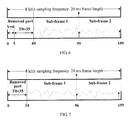
- FIG. 6 shows an instance of the framing method shown in FIG. 5 ;
- FIG. 7 shows another instance of the framing method shown in FIG. 5 ;
- FIG. 8 is a flowchart of another framing method according to an embodiment of the present invention.
- FIG. 9 shows an instance of the framing method shown in FIG. 8 ;
- FIG. 10 shows a structure of a framing apparatus according to an embodiment of the present invention.
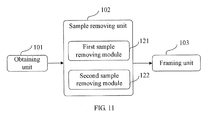
- FIG. 11 shows a structure of another framing apparatus according to an embodiment of the present invention.
- FIG. 12 shows a structure of another framing apparatus according to an embodiment of the present invention.
- FIG. 13 is a flowchart of a framing method according to an embodiment of the present invention.
- a framing method provided in an embodiment of the present invention includes the following steps:
- Step 21 Obtain a Linear Prediction. Coding (LPC) prediction order and a pitch of a signal.
- LPC Linear Prediction. Coding
- Step 22 Remove samples inapplicable to LTP synthesis according to the LPC prediction order and the pitch.
- Step 23 Split remaining samples of the signal into several sub-frames.
- the LPC prediction may be a fixed mode or an adaptive mode.
- the fixed mode means that the prediction order is a fixed integer (such as 4, 8, 12, and 16), and may be selected according to experience or coder characteristics.
- the adaptive mode means that die final prediction order may vary with signals.
- lpc_order represents the final LPC prediction order.
- the method for determining the LPC prediction order in adaptive mode is used in this embodiment:
- the LPC prediction refers to using the previous lpc_order samples to predict the value of the current sample.
- the prediction precision increases gradually (because more samples are involved in the prediction, more accurate value is obtained).
- the LPC prediction is not applicable, and the predictive value of the first sample is 0.
- the LPC formula for the second sample to the last of the lpc_order samples is:
- the LPC residual signal obtained through LPC prediction is relatively large.
- all or part of the samples in the interval that ranges from 0 to lpc_order may be inapplicable to LTP synthesis, and need to be removed.
- the obtained pitch may be the pitch T 0 of the entire speech frame.
- T 0 is obtained through calculation of the correlation function. For example, let d which maximizes the following value be T 0 :
- the obtained pitch may be the pitch of the first sub-frame of the speech frame which has undergone the framing.
- the embodiment solves the problem caused by simple average framing in the prior art that gains between sub-frames are inconsistent, reduces the computational complexity, and reduces the bits for gain quantization, without impacting the performance.
- FIG. 3 shows a framing method in an embodiment of the present invention. This embodiment assumes that the obtained signal is one signal frame.
- the method includes the following steps:
- Step 31 Obtain the LPC prediction order “lpc_order” and the pitch “T 0 ” of a signal frame.
- this step may also be: replacing the pitch “T 0 ” by obtaining the pitch of the first sub-frame.
- T 0 is taken as an example in this step in this embodiment and subsequent embodiments.
- Step 32 Remove the first lpc_order samples at the head of the signal frame and the succeeding T 0 samples.
- the succeeding T 0 samples refer to the T 0 samples succeeding to the lpc_order samples.
- Step 33 Determine the number (S) of sub-frames in the frame to be split according to the signal frame length.
- the frame is split into several sub-frames according to the length of the input signal, and the number of sub-frames varies with the signal length. For example, for the sampling at a frequency of 8 kHz, a 20 ms frame length can be split into 2 sub-frames; a 30 ms frame length can be split into 3 sub-frames; and a 40 ins frame length can be split into 4 sub-frames. Because the pitch of each sub-frame needs to be transmitted to the decoder, if a frame is split into more sub-frames, more bits are consumed for coding the pitch. Therefore, to balance between the performance enhancement and the computational complexity, the number of sub-frames in a frame needs to be determined properly.
- a 20 ms frame length constitutes 1 sub-frame; a frame of 30 ins length is split into 2 sub-frames; and a frame of 40 ins length is split into 3 sub-frames. That is, a frame composed of 160 samples includes only 1 sub-frame; a frame composed of 240 samples includes 2 sub-frames; and a frame composed of 320 samples includes 3 sub-frames.
- Step 34 Divide the number of remaining samples of the signal by the S, and round down the quotient to obtain the length of each of the first S-1 sub-frames.
- Step 35 Subtract the total length of the first S-1 sub-frames from the remaining samples of the signal frame. The obtained difference is the length of the Sth sub-frame.
- this embodiment assumes that the sampling frequency is 8 kHz, and that a frame of 20 ms length is split into 2 sub-frames.
- the lpc_order of the obtained signal frame is 12 (samples), and the pitch T 0 of the obtained signal frame is 35 samples.
- the result is that the length of the first sub-frame is 56 samples.
- the embodiment solves the problem caused by simple average framing in the prior art that gains between sub-frames are inconsistent, reduces the computational complexity, and reduces the bits for gain quantization, without impacting the performance.
- FIG. 5 shows another framing method in an embodiment of the present invention. This embodiment assumes that the obtained signal is one signal frame.
- the method includes the following steps:
- Step 51 Obtain the LPC prediction order “lpc_order” and the pitch “T 0 ” of the signal frame.
- Step 52 Remove a random integer number of samples in the interval that ranges from 0 to lpc_order ⁇ 1 at the head of the signal frame, and remove the succeeding T 0 samples.
- Step 53 Determine the number (S) of sub-frames in the frame to be split according to the signal frame length.
- Step 54 Divide the number of remaining samples of the signal frame by the S, and round down the quotient to obtain the length of each of the first S-1 sub-frames.
- Step 55 Subtract the total length of the first S-1 sub-frames from the remaining samples of the signal frame. The obtained difference is the length of the Sth sub-frame.
- This embodiment differs from the previous embodiment in that: The removal of the samples inapplicable to LTP synthesis removes only part of the first lpc_order samples at the head of the signal frame and the succeeding T 0 samples. Other steps are the same, and thus are not described further.
- the first lpc_order samples make the prediction inaccurate, but the following samples make the prediction more precise.
- the samples that lead to high precision are involved in the LTP synthesis.
- the sampling rate is 8 kHz, and that a frame of 20 ins length is split into 2 sub-frames.
- the result is that the length of the first sub-frame is 59 samples.
- an embodiment still assumes that the sampling frequency is 8 kHz, and that a frame of 20 ins length is split into 2 sub-frames.
- the embodiment solves the problem caused by simple average framing in the prior art that gains between sub-frames are inconsistent, reduces the computational complexity, and reduces the bits for gain quantization, without impacting the performance.
- the foregoing embodiments substitute the pitch T 0 of the entire signal frame for the pitch T[ 0 ] of the first sub-frame, remove the samples inapplicable to LTP synthesis, split the remaining samples of the signal frame into several sub-frames, and use the sub-frame length after the splitting as the final sub-frame length directly.
- FIG. 8 shows another framing method in an embodiment of the present invention. This embodiment assumes that the obtained signal is one signal frame.
- the method includes the following steps:
- Step 81 Obtain the LPC prediction order “lpc_order” and the pitch “T[ 0 ]” of the first sub-frame of a signal frame.
- the pitch T[ 0 ] of the first sub-frame is obtained in pre-framing mode. Specifically, the pitch T 0 of the entire signal frame is used as the pitch of the first sub-frame to split the frame. After the length of the first sub-frame is obtained, the pitch of the first sub-frame is determined through search within the fluctuation range of the pitch of the signal frame.
- Step 82 Remove a random integer number of samples in the interval that ranges from 0 to lpc_order at the head of the signal frame, and remove the succeeding T[ 0 ] samples.
- Step 83 Determine the number (S) of sub-frames in the frame according to the signal frame length.
- Step 84 Divide the number of remaining samples of the signal frame by the S, and round down the quotient to obtain the length of each of the first S-1 sub-frames.
- this step is omissible, and the sub-frame length calculated previously can be used for the subsequent calculation directly.
- Step 85 Subtract the total length of the first S-1 sub-frames from the remaining samples of the signal frame. The obtained difference is the length of the Sth sub-frame.
- this embodiment still assumes that the sampling rate is 8 kHz, and that a frame of 20 ms length is split into 2 sub-frames.
- the lpc_order of the obtained signal frame is 12 (samples), and the pitch T 0 of the obtained signal frame is 35.
- the length of the first sub-frame is 56 samples.
- the T 0 fluctuation range namely, T[ 0 ] ⁇ [T 0 ⁇ 2, T 0 +2]
- T[ 0 ] which is equal to 34 samples
- the framing is performed again according to the obtained best pitch T[ 0 ] of the first sub-frame:
- the result is that the length of the first sub-frame is 57 samples.
- pre-framing is performed first to obtain the pitch of the first sub-frame; after all or part of the first lpc_order samples at the head of the signal frame (this part may be a random integer number of samples, and the integer number ranges from 0 to lpc_order) and the succeeding T[ 0 ] samples of the first sub-frame are removed, the remaining samples of the signal frame are split into several sub-frames, thus ensuring that each sub-frame uses consistent samples for LTP synthesis and obtaining consistent LTP gains. Therefore, the embodiment solves the problem caused by simple average framing in the prior art that gains between sub-frames are inconsistent, reduces the computational complexity, and reduces the bits for gain quantization, without impacting the performance.
- FIG. 13 shows another framing method in an embodiment of the present invention. This embodiment assumes that the obtained signal is one signal frame.
- the method includes the following steps:
- Step 141 Obtain the LPC prediction order and the pitch T 0 of signal.
- Step 142 Remove the samples inapplicable to LTP synthesis according to the LPC prediction order and the pitch T 0 .
- Step 143 Split the remaining samples of the signal into several sub-frames.
- Steps 141 - 143 are a process of performing adaptive framing according to the pitch T 0 to obtain the length of each sub-frame, and have been described in the foregoing embodiments.
- Step 144 Search for the pitch of the first sub-frame according to the length of the first sub-frame among the several sub-frames, and determine the pitch T[ 0 ] of the first sub-frame.
- step 143 in this embodiment the remaining samples are split into several sub-frames; after the length of the first sub-frame is obtained, the fluctuation range of the pitch T 0 of the speech frame, for example, T[ 0 ] ⁇ [T 0 ⁇ 2, T 0 +2], is searched to determine the pitch T[ 0 ] of the first sub-frame.
- Step 145 Determine the start point and the end point of each sub-frame again according to the LPC prediction order, the pitch of the first sub-frame, and the length of each sub-frame.
- T[ 0 ] may be different from T 0 , so that the start point of the first sub-frame may change after the samples which are inapplicable to LTP synthesis are removed again.
- the start point and the end point of the first sub-frame need to be adjusted. Because the sub-frame length obtained in step 143 is still used here, the start point and the end point of each sub-frame following to the first sub-frame need to be determined again. In this case, it is possible that the length of each sub-frame does not change, and that the sum of the lengths of all sub-frames is not equal to the number of the remaining samples of the signal, but this possibility does not impact the effect of this embodiment.
- the length of the first S-1 sub-frames keeps unchanged; the total length of the first S-1 sub-frames is subtracted from the number of the remaining samples of the signal; and the obtained difference serves as the length of the S sub-frame.
- the length of each sub-frame obtained in step 143 is still used, and the length of each sub-frame is not determined again, thus reducing the computation complexity.
- removing the samples inapplicable to LTP synthesis again may be removal of the first lpc_order samples at the head of the signal frame and the succeeding T[ 0 ] samples, or removal of a random integer number of samples in the interval that ranges from 0 to lpc_order ⁇ 1 at the head of the signal frame and the succeeding T[ 0 ] samples.
- Step 146 Search for the pitch of the sub-frames following to the first sub-frame to obtain the pitch of the following sub-frames.
- the pitch of the sub-frames following to the first sub-frame may be searched out, and therefore, the pitch of all sub-frames is obtained, thus facilitating removal of the long term correlation in the signal and facilitating the decoding at the decoder.
- the method for determining the pitch of the following sub-frames is described in step 144 , and is not described further.
- step 146 about determining the pitch of following sub-frames may occur before step 145 , without affecting the fulfillment of the objectives of the present invention.
- step 146 may be combined with step 144 . That is, in step 144 , the pitch of each sub-frame is searched out to obtain the pitch of each sub-frame, including the pitch T[ 0 ] of the first sub-frame. Therefore, the embodiments of the present invention do not limit the occasion of determining the pitch of following sub-frames. All variations of the embodiments provided herein for fulfilling the objectives of the present invention are covered in the scope of protection of the present invention.
- Step 147 Perform adaptive framing again according to the pitch T[ 0 ] of the first sub-frame, and obtain the length of each sub-frame.
- the speech frame may be split for a second time according to the pitch T[ 0 ] of the first sub-frame to obtain the length of each sub-frame again.
- the method for splitting the speech frame for a second time may be: Remove the samples inapplicable to LTP synthesis again according to the LPC prediction order and the pitch T[ 0 ] of the first sub-frame, and split the newly obtained remaining samples of the signal into several sub-frames.
- step 146 may occur after step 147 .
- the pitch of the first sub-frame is obtained first through framing, and then the start point and the end point of each sub-frame are determined again according to the LPC prediction order, the pitch of the first sub-frame, and the length of each sub-frame, thus making the LTP gain more consistent between the sub-frames.
- this embodiment further ensures all sub-frames after division to use consistent samples for LTP synthesis and obtain consistent LTP gains. Therefore, the embodiment solves the problem caused by simple average framing in the prior art that gains between sub-frames are inconsistent, reduces the computational complexity, and reduces the bits for gain quantization, without impacting the performance.
- the pitch of the sub-frames following to the first sub-frame is searched out, and therefore, the pitch of all sub-frames is obtained, thus facilitating removal of the long term correlation in the signal and facilitating the decoding at the decoder.
- a framing apparatus provided in an embodiment of the present invention includes:
- the framing unit 103 includes:
- FIG. 11 shows another embodiment, where the sample removing unit 102 is the first sample removing module 121 .
- the first sample removing module 121 is configured to remove the lpc_order samples at the head of the signal frame and the succeeding T 0 samples, whereupon the framing unit 102 splits the frame into several sub-frames.
- the sample removing unit 102 is the second sample removing module 122 .
- the second sample removing module 122 is configured to remove a part of the lpc_order samples at the head of the signal frame (this part is a random integer number of samples, and the integer number ranges from 0 to lpc_order ⁇ 1) and the succeeding T 0 samples, whereupon the framing unit 102 assigns the length of each sub-frame.
- a framing apparatus provided in another embodiment of the present invention includes:
- the sample removing unit 102 is the third sample removing module 123 .
- the third sample removing module 123 is configured to remove a random integer number of samples at the head of the signal frame and the succeeding T[ 0 ] samples (the integer number ranges from 0 to lpc_order; lpc_order is the LPC prediction order; and T[ 0 ] is the pitch of the first sub-frame), whereupon the framing unit 102 splits the frame into several sub-frames.
- the framing unit 102 is also configured to determine the start point and the end point of each sub-frame again according to the length of each sub-frame.
- the framing unit 103 splits the remaining samples of the signal into several sub-frames. No matter whether the sample removing unit 102 is the first sample removing module 121 , the second sample removing module 122 , or the third sample removing module 123 , the apparatus ensures each sub-frame after division to use consistent samples for LTP synthesis and obtain consistent LTP gains. Therefore, the embodiment solves the problem caused by simple average framing in the prior art that gains between sub-frames are inconsistent, reduces the computational complexity, and reduces the bits for gain quantization, without impacting the performance.
- the obtaining unit 101 obtains the LPC prediction order and the pitch T 0 of the signal. In some embodiments, if the signal frame is split beforehand, this step may also be: obtaining the pitch of the first sub-frame in place of the pitch “T 0 ”. For ease of description, this embodiment takes T 0 as an example.
- the sample removing unit 102 removes the samples inapplicable to LTP synthesis according to the LPC prediction order and the pitch T 0 .
- the first sample removing module 121 removes the first lpc_order samples at the head of the signal frame and the succeeding T 0 samples; in other embodiments, the second sample removing module 122 removes a random integer number of samples at the head of the signal frame (the integer number ranges from 0 to lpc_order ⁇ 1) and the succeeding T 0 samples.
- the framing unit 103 splits the remaining samples of the signal into several sub-frames. Specifically, the sub-frame number determining module 131 determines the number (S) of sub-frames of a frame to be split according to the length of the signal. The sub-frame length assigning module 132 divides the number of the remaining samples of the signal by the S, and rounds down the quotient to obtain the length of each of the first S-1 sub-frames. The last sub-frame length determining module 133 subtracts the total length of the first S-1 sub-frames from the remaining samples of the signal frame, and obtains a difference as the length of the Sth sub-frame.
- the speech frame may be split for a second time.
- the first sub-frame pitch determining unit 120 searches for the pitch of the first sub-frame according to the length of the first sub-frame among the several sub-frames, and determines the pitch T[ 0 ] of the first sub-frame.
- the third sample removing module 123 removes the first lpc_order samples at the head of the signal frame and the succeeding T[ 0 ] samples of the first sub-frame, or removes a random integer number of samples at the head of the signal frame (the integer number ranges from 0 to lpc_order) and the succeeding T[ 0 ] samples of the first sub-frame.
- the framing unit 102 splits the frame for a second time.
- the framing unit 102 may determine the start point and the end point of each sub-frame again according to the length of each sub-frame determined in the first framing operation. In other scenarios, the framing unit 102 determines the start point and the end point of each sub-frame again and then splits the speech frame for a second time.
- the methods in the embodiments of the present invention may be implemented through a software module.
- the software module When being sold or used as an independent product, the software module may also be stored in a computer-readable storage medium.
- the storage medium may be a read-only memory, a magnetic disk or a compact disk.
- All functional units in the embodiments of the present invention may be integrated into a processing module, or exist independently, or two or more of such units are integrated into a module.
- the integrated module may be hardware or a software module.
- the integrated module When being implemented as a software module and sold or used as an independent product, the integrated module may also be stored in a computer-readable storage medium.
- the storage medium may be a read-only memory, a magnetic disk or a compact disk.
Landscapes
- Engineering & Computer Science (AREA)
- Computational Linguistics (AREA)
- Signal Processing (AREA)
- Health & Medical Sciences (AREA)
- Audiology, Speech & Language Pathology (AREA)
- Human Computer Interaction (AREA)
- Physics & Mathematics (AREA)
- Acoustics & Sound (AREA)
- Multimedia (AREA)
- Compression, Expansion, Code Conversion, And Decoders (AREA)
- Compression Or Coding Systems Of Tv Signals (AREA)
Abstract
Description
-
- obtaining a Linear Prediction Coding (LPC) prediction order and a pitch of a signal;
- removing samples inapplicable to LTP synthesis according to the LPC prediction order and the pitch; and
- splitting remaining samples of the signal into several sub-frames.
-
- an obtaining unit, configured to obtain a Linear Prediction Coding (LPC) prediction order and a pitch of a signal;
- a sample removing unit, configured to remove the samples inapplicable to LTP synthesis according to the LPC prediction order and the pitch obtained by the obtaining unit; and
- a framing unit, configured to split remaining samples of the signal after the sample removing unit removes inapplicable samples into several sub-frames.
res(n)=x(n)−x′(n). (3)
-
- where L1 is the number of samples used for computing the correlation function.
-
- an obtaining
unit 101, configured to obtain the LPC prediction order and the pitch of the signal; - a
sample removing unit 102, configured to remove the samples inapplicable to LTP synthesis according to the LPC prediction order and the pitch obtained by the obtainingunit 101; and - a
framing unit 103, configured to split the remaining samples of the signal into several sub-frames after thesample removing unit 102 removes the inapplicable samples.
- an obtaining
-
- a sub-frame
number determining module 131, configured to: determine the number (S) of sub-frames in the frame to be split according to the signal frame length; - a sub-frame
length assigning module 132, configured to round down a quotient of dividing a number by the S to obtain the length of each of the first S-1 sub-frames, where the number is the number of the remaining samples of the signal frame after thesample removing unit 102 performs the removal, and the S is determined by the sub-frame number determining module; and - a last sub-frame
length determining module 133, configured to subtract the total length of the first S-1 sub-frames from the remaining samples of the signal frame, where the obtained difference is the length of the Sth sub-frame.
- a sub-frame
-
- a first sub-frame pitch determining unit 120, configured to search the fluctuation range of the pitch of the signal to determine the pitch of the first sub-frame according to the length of the first sub-frame obtained by the sub-frame
length assigning module 132.
- a first sub-frame pitch determining unit 120, configured to search the fluctuation range of the pitch of the signal to determine the pitch of the first sub-frame according to the length of the first sub-frame obtained by the sub-frame
Claims (18)
Applications Claiming Priority (7)
| Application Number | Priority Date | Filing Date | Title |
|---|---|---|---|
| CN200810186854.8 | 2008-12-31 | ||
| CN200810186854 | 2008-12-31 | ||
| CN200810186854 | 2008-12-31 | ||
| CN200910151834 | 2009-06-25 | ||
| CN200910151834.1 | 2009-06-25 | ||
| CN2009101518341A CN101615394B (en) | 2008-12-31 | 2009-06-25 | Method and device for allocating subframes |
| PCT/CN2009/076309 WO2010075793A1 (en) | 2008-12-31 | 2009-12-31 | Method and apparatus for distributing sub-frame |
Related Parent Applications (1)
| Application Number | Title | Priority Date | Filing Date |
|---|---|---|---|
| PCT/CN2009/076309 Continuation WO2010075793A1 (en) | 2008-12-31 | 2009-12-31 | Method and apparatus for distributing sub-frame |
Publications (2)
| Publication Number | Publication Date |
|---|---|
| US20110099005A1 US20110099005A1 (en) | 2011-04-28 |
| US8843366B2 true US8843366B2 (en) | 2014-09-23 |
Family
ID=41495005
Family Applications (1)
| Application Number | Title | Priority Date | Filing Date |
|---|---|---|---|
| US12/982,142 Active 2032-06-09 US8843366B2 (en) | 2008-12-31 | 2010-12-30 | Framing method and apparatus |
Country Status (5)
| Country | Link |
|---|---|
| US (1) | US8843366B2 (en) |
| EP (3) | EP2755203A1 (en) |
| CN (1) | CN101615394B (en) |
| ES (2) | ES2395365T3 (en) |
| WO (1) | WO2010075793A1 (en) |
Families Citing this family (5)
| Publication number | Priority date | Publication date | Assignee | Title |
|---|---|---|---|---|
| CN101615394B (en) | 2008-12-31 | 2011-02-16 | 华为技术有限公司 | Method and device for allocating subframes |
| CN103971691B (en) * | 2013-01-29 | 2017-09-29 | 鸿富锦精密工业(深圳)有限公司 | Speech signal processing system and method |
| CN105336336B (en) | 2014-06-12 | 2016-12-28 | 华为技术有限公司 | A time-domain envelope processing method and device for audio signals, and an encoder |
| DE102016119750B4 (en) * | 2015-10-26 | 2022-01-13 | Infineon Technologies Ag | Devices and methods for multi-channel scanning |
| CN110865959B (en) * | 2018-08-27 | 2021-10-15 | 武汉杰开科技有限公司 | Method and circuit for waking up I2C equipment |
Citations (14)
| Publication number | Priority date | Publication date | Assignee | Title |
|---|---|---|---|---|
| EP0347307A2 (en) | 1988-06-13 | 1989-12-20 | Matra Communication | Coding method and linear prediction speech coder |
| WO1996021221A1 (en) | 1995-01-06 | 1996-07-11 | France Telecom | Speech coding method using linear prediction and algebraic code excitation |
| US6169970B1 (en) * | 1998-01-08 | 2001-01-02 | Lucent Technologies Inc. | Generalized analysis-by-synthesis speech coding method and apparatus |
| US20020120440A1 (en) * | 2000-12-28 | 2002-08-29 | Shude Zhang | Method and apparatus for improved voice activity detection in a packet voice network |
| WO2003049081A1 (en) | 2001-12-04 | 2003-06-12 | Global Ip Sound Ab | Low bit rate codec |
| US6873954B1 (en) | 1999-09-09 | 2005-03-29 | Telefonaktiebolaget Lm Ericsson (Publ) | Method and apparatus in a telecommunications system |
| US20050197833A1 (en) | 1999-08-23 | 2005-09-08 | Matsushita Electric Industrial Co., Ltd. | Apparatus and method for speech coding |
| CN1971707A (en) | 2006-12-13 | 2007-05-30 | 北京中星微电子有限公司 | Method and apparatus for estimating fundamental tone period and adjudging unvoiced/voiced classification |
| CN101030377A (en) | 2007-04-13 | 2007-09-05 | 清华大学 | Method for increasing base-sound period parameter quantified precision of 0.6kb/s voice coder |
| WO2008072736A1 (en) | 2006-12-15 | 2008-06-19 | Panasonic Corporation | Adaptive sound source vector quantization unit and adaptive sound source vector quantization method |
| US20080215317A1 (en) | 2004-08-04 | 2008-09-04 | Dts, Inc. | Lossless multi-channel audio codec using adaptive segmentation with random access point (RAP) and multiple prediction parameter set (MPPS) capability |
| CN101286319A (en) | 2006-12-26 | 2008-10-15 | 高扬 | Speech coding system for improving speech packet loss repairing quality |
| CN101615394A (en) | 2008-12-31 | 2009-12-30 | 华为技术有限公司 | Method and device for allocating subframes |
| US20100324913A1 (en) * | 2009-06-18 | 2010-12-23 | Jacek Piotr Stachurski | Method and System for Block Adaptive Fractional-Bit Per Sample Encoding |
-
2009
- 2009-06-25 CN CN2009101518341A patent/CN101615394B/en active Active
- 2009-12-31 EP EP14163318.0A patent/EP2755203A1/en not_active Withdrawn
- 2009-12-31 ES ES09836080T patent/ES2395365T3/en active Active
- 2009-12-31 EP EP09836080A patent/EP2296144B1/en active Active
- 2009-12-31 EP EP12185319.6A patent/EP2538407B1/en active Active
- 2009-12-31 WO PCT/CN2009/076309 patent/WO2010075793A1/en not_active Ceased
- 2009-12-31 ES ES12185319.6T patent/ES2509817T3/en active Active
-
2010
- 2010-12-30 US US12/982,142 patent/US8843366B2/en active Active
Patent Citations (15)
| Publication number | Priority date | Publication date | Assignee | Title |
|---|---|---|---|---|
| EP0347307A2 (en) | 1988-06-13 | 1989-12-20 | Matra Communication | Coding method and linear prediction speech coder |
| WO1996021221A1 (en) | 1995-01-06 | 1996-07-11 | France Telecom | Speech coding method using linear prediction and algebraic code excitation |
| US6169970B1 (en) * | 1998-01-08 | 2001-01-02 | Lucent Technologies Inc. | Generalized analysis-by-synthesis speech coding method and apparatus |
| US20050197833A1 (en) | 1999-08-23 | 2005-09-08 | Matsushita Electric Industrial Co., Ltd. | Apparatus and method for speech coding |
| US6873954B1 (en) | 1999-09-09 | 2005-03-29 | Telefonaktiebolaget Lm Ericsson (Publ) | Method and apparatus in a telecommunications system |
| US20020120440A1 (en) * | 2000-12-28 | 2002-08-29 | Shude Zhang | Method and apparatus for improved voice activity detection in a packet voice network |
| WO2003049081A1 (en) | 2001-12-04 | 2003-06-12 | Global Ip Sound Ab | Low bit rate codec |
| US20080215317A1 (en) | 2004-08-04 | 2008-09-04 | Dts, Inc. | Lossless multi-channel audio codec using adaptive segmentation with random access point (RAP) and multiple prediction parameter set (MPPS) capability |
| CN1971707A (en) | 2006-12-13 | 2007-05-30 | 北京中星微电子有限公司 | Method and apparatus for estimating fundamental tone period and adjudging unvoiced/voiced classification |
| WO2008072736A1 (en) | 2006-12-15 | 2008-06-19 | Panasonic Corporation | Adaptive sound source vector quantization unit and adaptive sound source vector quantization method |
| CN101286319A (en) | 2006-12-26 | 2008-10-15 | 高扬 | Speech coding system for improving speech packet loss repairing quality |
| CN101030377A (en) | 2007-04-13 | 2007-09-05 | 清华大学 | Method for increasing base-sound period parameter quantified precision of 0.6kb/s voice coder |
| CN101615394A (en) | 2008-12-31 | 2009-12-30 | 华为技术有限公司 | Method and device for allocating subframes |
| CN101615394B (en) | 2008-12-31 | 2011-02-16 | 华为技术有限公司 | Method and device for allocating subframes |
| US20100324913A1 (en) * | 2009-06-18 | 2010-12-23 | Jacek Piotr Stachurski | Method and System for Block Adaptive Fractional-Bit Per Sample Encoding |
Non-Patent Citations (9)
Also Published As
| Publication number | Publication date |
|---|---|
| EP2296144A1 (en) | 2011-03-16 |
| WO2010075793A1 (en) | 2010-07-08 |
| CN101615394A (en) | 2009-12-30 |
| EP2538407A3 (en) | 2013-04-24 |
| CN101615394B (en) | 2011-02-16 |
| EP2296144A4 (en) | 2011-06-22 |
| ES2509817T3 (en) | 2014-10-20 |
| EP2538407B1 (en) | 2014-07-23 |
| ES2395365T3 (en) | 2013-02-12 |
| EP2296144B1 (en) | 2012-10-03 |
| EP2755203A1 (en) | 2014-07-16 |
| US20110099005A1 (en) | 2011-04-28 |
| EP2538407A2 (en) | 2012-12-26 |
Similar Documents
| Publication | Publication Date | Title |
|---|---|---|
| US8521519B2 (en) | Adaptive audio signal source vector quantization device and adaptive audio signal source vector quantization method that search for pitch period based on variable resolution | |
| US9269366B2 (en) | Hybrid instantaneous/differential pitch period coding | |
| US8396716B2 (en) | Signal compression method and apparatus | |
| US8468017B2 (en) | Multi-stage quantization method and device | |
| US8712763B2 (en) | Method for encoding signal, and method for decoding signal | |
| JP3254687B2 (en) | Audio coding method | |
| EP3869506A1 (en) | Method and device for quantization of linear prediction coefficient and method and device for inverse quantization | |
| US20110099005A1 (en) | Framing method and apparatus | |
| WO2008072736A1 (en) | Adaptive sound source vector quantization unit and adaptive sound source vector quantization method | |
| EP2204795B1 (en) | Method and apparatus for pitch search | |
| JP2019135551A (en) | Method and device for processing time envelope of audio signal, and encoder | |
| US8825494B2 (en) | Computation apparatus and method, quantization apparatus and method, audio encoding apparatus and method, and program | |
| JP2000163096A (en) | Speech coding method and speech coding device | |
| US6470310B1 (en) | Method and system for speech encoding involving analyzing search range for current period according to length of preceding pitch period | |
| US8566085B2 (en) | Preprocessing method, preprocessing apparatus and coding device | |
| JPH09230898A (en) | Acoustic signal conversion coding method and decoding method | |
| EP0859354A2 (en) | LSP prediction coding method and apparatus | |
| CN104025191A (en) | An improved method and apparatus for adaptive multi rate codec | |
| Kleijn et al. | Analysis and improvement of the vector quantization in SELP (Stochastically Excited Linear Prediction) | |
| Chen et al. | Complexity scalability design in coding of the adaptive codebook for ITU-T G. 729 speech coder | |
| KR20060039320A (en) | Pitch Search Method for Reducing the Computation of Intercoder | |
| ZA200903293B (en) | Fixed codebook searching device and fixed codebook searching method | |
| JPH05341800A (en) | Voice coding device | |
| KR20070048989A (en) | Quantization Device of Speech Recognition Parameter Vector | |
| JPH05197799A (en) | Coder |
Legal Events
| Date | Code | Title | Description |
|---|---|---|---|
| AS | Assignment |
Owner name: HUAWEI TECHNOLOGIES CO., LTD., CHINA Free format text: ASSIGNMENT OF ASSIGNORS INTEREST;ASSIGNORS:ZHANG, DEJUN;QI, FENGYAN;MIAO, LEI;AND OTHERS;SIGNING DATES FROM 20101214 TO 20101229;REEL/FRAME:025627/0439 |
|
| STCF | Information on status: patent grant |
Free format text: PATENTED CASE |
|
| FEPP | Fee payment procedure |
Free format text: PAYOR NUMBER ASSIGNED (ORIGINAL EVENT CODE: ASPN); ENTITY STATUS OF PATENT OWNER: LARGE ENTITY |
|
| MAFP | Maintenance fee payment |
Free format text: PAYMENT OF MAINTENANCE FEE, 4TH YEAR, LARGE ENTITY (ORIGINAL EVENT CODE: M1551) Year of fee payment: 4 |
|
| MAFP | Maintenance fee payment |
Free format text: PAYMENT OF MAINTENANCE FEE, 8TH YEAR, LARGE ENTITY (ORIGINAL EVENT CODE: M1552); ENTITY STATUS OF PATENT OWNER: LARGE ENTITY Year of fee payment: 8 |
|
| MAFP | Maintenance fee payment |
Free format text: PAYMENT OF MAINTENANCE FEE, 12TH YEAR, LARGE ENTITY (ORIGINAL EVENT CODE: M1553); ENTITY STATUS OF PATENT OWNER: LARGE ENTITY Year of fee payment: 12 |