US8841836B2 - Flat panel display device, organic light emitting display device and method of manufacturing flat panel display device - Google Patents

Flat panel display device, organic light emitting display device and method of manufacturing flat panel display device Download PDF

Info

Publication number
US8841836B2
US8841836B2 US13/677,123 US201213677123A US8841836B2 US 8841836 B2 US8841836 B2 US 8841836B2 US 201213677123 A US201213677123 A US 201213677123A US 8841836 B2 US8841836 B2 US 8841836B2
Authority
US
United States
Prior art keywords
light
reflective film
transparent
display device
transparent substrate
Prior art date
Legal status (The legal status is an assumption and is not a legal conclusion. Google has not performed a legal analysis and makes no representation as to the accuracy of the status listed.)
Active
Application number
US13/677,123
Other versions
US20130285539A1 (en
Inventor
Sang-Ho Kim
Jae-woo Bae
Hun-Jung Lee
Current Assignee (The listed assignees may be inaccurate. Google has not performed a legal analysis and makes no representation or warranty as to the accuracy of the list.)
Samsung Display Co Ltd
Original Assignee
Samsung Display Co Ltd
Priority date (The priority date is an assumption and is not a legal conclusion. Google has not performed a legal analysis and makes no representation as to the accuracy of the date listed.)
Filing date
Publication date
Application filed by Samsung Display Co Ltd filed Critical Samsung Display Co Ltd
Assigned to SAMSUNG DISPLAY CO., LTD. reassignment SAMSUNG DISPLAY CO., LTD. ASSIGNMENT OF ASSIGNORS INTEREST (SEE DOCUMENT FOR DETAILS). Assignors: BAE, JAE-WOO, KIM, SANG-HO, LEE, HUN-JUNG
Publication of US20130285539A1 publication Critical patent/US20130285539A1/en
Application granted granted Critical
Publication of US8841836B2 publication Critical patent/US8841836B2/en
Active legal-status Critical Current
Anticipated expiration legal-status Critical

Links

Images

Classifications

    • GPHYSICS
    • G02OPTICS
    • G02BOPTICAL ELEMENTS, SYSTEMS OR APPARATUS
    • G02B1/00Optical elements characterised by the material of which they are made; Optical coatings for optical elements
    • G02B1/10Optical coatings produced by application to, or surface treatment of, optical elements
    • G02B1/11Anti-reflection coatings
    • G02B1/118Anti-reflection coatings having sub-optical wavelength surface structures designed to provide an enhanced transmittance, e.g. moth-eye structures
    • GPHYSICS
    • G02OPTICS
    • G02BOPTICAL ELEMENTS, SYSTEMS OR APPARATUS
    • G02B1/00Optical elements characterised by the material of which they are made; Optical coatings for optical elements
    • G02B1/10Optical coatings produced by application to, or surface treatment of, optical elements
    • G02B1/11Anti-reflection coatings
    • G02B1/111Anti-reflection coatings using layers comprising organic materials
    • GPHYSICS
    • G02OPTICS
    • G02BOPTICAL ELEMENTS, SYSTEMS OR APPARATUS
    • G02B1/00Optical elements characterised by the material of which they are made; Optical coatings for optical elements
    • G02B1/10Optical coatings produced by application to, or surface treatment of, optical elements
    • G02B1/11Anti-reflection coatings
    • GPHYSICS
    • G02OPTICS
    • G02BOPTICAL ELEMENTS, SYSTEMS OR APPARATUS
    • G02B5/00Optical elements other than lenses
    • G02B5/20Filters
    • G02B5/22Absorbing filters
    • G02B5/223Absorbing filters containing organic substances, e.g. dyes, inks or pigments
    • GPHYSICS
    • G02OPTICS
    • G02BOPTICAL ELEMENTS, SYSTEMS OR APPARATUS
    • G02B5/00Optical elements other than lenses
    • G02B5/30Polarising elements
    • G02B5/3025Polarisers, i.e. arrangements capable of producing a definite output polarisation state from an unpolarised input state
    • HELECTRICITY
    • H05ELECTRIC TECHNIQUES NOT OTHERWISE PROVIDED FOR
    • H05BELECTRIC HEATING; ELECTRIC LIGHT SOURCES NOT OTHERWISE PROVIDED FOR; CIRCUIT ARRANGEMENTS FOR ELECTRIC LIGHT SOURCES, IN GENERAL
    • H05B33/00Electroluminescent light sources
    • H05B33/10Apparatus or processes specially adapted to the manufacture of electroluminescent light sources
    • HELECTRICITY
    • H05ELECTRIC TECHNIQUES NOT OTHERWISE PROVIDED FOR
    • H05BELECTRIC HEATING; ELECTRIC LIGHT SOURCES NOT OTHERWISE PROVIDED FOR; CIRCUIT ARRANGEMENTS FOR ELECTRIC LIGHT SOURCES, IN GENERAL
    • H05B33/00Electroluminescent light sources
    • H05B33/12Light sources with substantially two-dimensional radiating surfaces
    • HELECTRICITY
    • H05ELECTRIC TECHNIQUES NOT OTHERWISE PROVIDED FOR
    • H05BELECTRIC HEATING; ELECTRIC LIGHT SOURCES NOT OTHERWISE PROVIDED FOR; CIRCUIT ARRANGEMENTS FOR ELECTRIC LIGHT SOURCES, IN GENERAL
    • H05B33/00Electroluminescent light sources
    • H05B33/12Light sources with substantially two-dimensional radiating surfaces
    • H05B33/22Light sources with substantially two-dimensional radiating surfaces characterised by the chemical or physical composition or the arrangement of auxiliary dielectric or reflective layers
    • HELECTRICITY
    • H10SEMICONDUCTOR DEVICES; ELECTRIC SOLID-STATE DEVICES NOT OTHERWISE PROVIDED FOR
    • H10KORGANIC ELECTRIC SOLID-STATE DEVICES
    • H10K50/00Organic light-emitting devices
    • H10K50/80Constructional details
    • H10K50/86Arrangements for improving contrast, e.g. preventing reflection of ambient light
    • HELECTRICITY
    • H10SEMICONDUCTOR DEVICES; ELECTRIC SOLID-STATE DEVICES NOT OTHERWISE PROVIDED FOR
    • H10KORGANIC ELECTRIC SOLID-STATE DEVICES
    • H10K59/00Integrated devices, or assemblies of multiple devices, comprising at least one organic light-emitting element covered by group H10K50/00
    • H10K59/10OLED displays
    • H10K59/12Active-matrix OLED [AMOLED] displays
    • H10K59/121Active-matrix OLED [AMOLED] displays characterised by the geometry or disposition of pixel elements
    • HELECTRICITY
    • H10SEMICONDUCTOR DEVICES; ELECTRIC SOLID-STATE DEVICES NOT OTHERWISE PROVIDED FOR
    • H10KORGANIC ELECTRIC SOLID-STATE DEVICES
    • H10K59/00Integrated devices, or assemblies of multiple devices, comprising at least one organic light-emitting element covered by group H10K50/00
    • H10K59/80Constructional details
    • H10K59/8791Arrangements for improving contrast, e.g. preventing reflection of ambient light
    • GPHYSICS
    • G02OPTICS
    • G02FOPTICAL DEVICES OR ARRANGEMENTS FOR THE CONTROL OF LIGHT BY MODIFICATION OF THE OPTICAL PROPERTIES OF THE MEDIA OF THE ELEMENTS INVOLVED THEREIN; NON-LINEAR OPTICS; FREQUENCY-CHANGING OF LIGHT; OPTICAL LOGIC ELEMENTS; OPTICAL ANALOGUE/DIGITAL CONVERTERS
    • G02F1/00Devices or arrangements for the control of the intensity, colour, phase, polarisation or direction of light arriving from an independent light source, e.g. switching, gating or modulating; Non-linear optics
    • G02F1/01Devices or arrangements for the control of the intensity, colour, phase, polarisation or direction of light arriving from an independent light source, e.g. switching, gating or modulating; Non-linear optics for the control of the intensity, phase, polarisation or colour 
    • G02F1/13Devices or arrangements for the control of the intensity, colour, phase, polarisation or direction of light arriving from an independent light source, e.g. switching, gating or modulating; Non-linear optics for the control of the intensity, phase, polarisation or colour  based on liquid crystals, e.g. single liquid crystal display cells
    • G02F1/133Constructional arrangements; Operation of liquid crystal cells; Circuit arrangements
    • G02F1/1333Constructional arrangements; Manufacturing methods
    • G02F1/1335Structural association of cells with optical devices, e.g. polarisers or reflectors
    • G02F1/133502Antiglare, refractive index matching layers
    • HELECTRICITY
    • H10SEMICONDUCTOR DEVICES; ELECTRIC SOLID-STATE DEVICES NOT OTHERWISE PROVIDED FOR
    • H10KORGANIC ELECTRIC SOLID-STATE DEVICES
    • H10K50/00Organic light-emitting devices
    • H10K50/80Constructional details
    • H10K50/86Arrangements for improving contrast, e.g. preventing reflection of ambient light
    • H10K50/865Arrangements for improving contrast, e.g. preventing reflection of ambient light comprising light absorbing layers, e.g. light-blocking layers
    • HELECTRICITY
    • H10SEMICONDUCTOR DEVICES; ELECTRIC SOLID-STATE DEVICES NOT OTHERWISE PROVIDED FOR
    • H10KORGANIC ELECTRIC SOLID-STATE DEVICES
    • H10K59/00Integrated devices, or assemblies of multiple devices, comprising at least one organic light-emitting element covered by group H10K50/00
    • H10K59/30Devices specially adapted for multicolour light emission
    • H10K59/38Devices specially adapted for multicolour light emission comprising colour filters or colour changing media [CCM]
    • HELECTRICITY
    • H10SEMICONDUCTOR DEVICES; ELECTRIC SOLID-STATE DEVICES NOT OTHERWISE PROVIDED FOR
    • H10KORGANIC ELECTRIC SOLID-STATE DEVICES
    • H10K59/00Integrated devices, or assemblies of multiple devices, comprising at least one organic light-emitting element covered by group H10K50/00
    • H10K59/80Constructional details
    • H10K59/8791Arrangements for improving contrast, e.g. preventing reflection of ambient light
    • H10K59/8792Arrangements for improving contrast, e.g. preventing reflection of ambient light comprising light absorbing layers, e.g. black layers

Definitions

  • the present disclosure relates to a flat panel display device, such as an organic light emitting display device, and a method of manufacturing the flat panel display device.
  • Such flat panel display devices include liquid crystal displays (LCDs), plasma display panels (PDPs), or organic light emitting display devices (OLEDs).
  • LCDs liquid crystal displays
  • PDPs plasma display panels
  • OLEDs organic light emitting display devices
  • the flat panel display device may be implemented as a transparent display device including a transparent region in at least a portion of the flat panel display device.
  • An aspect of the present invention provides a flat panel display device, such as an organic light emitting display device, and a method of manufacturing the flat panel display device, wherein the flat panel display device includes a transparent display panel having an improved bright room contrast and visibility by suppressing external light reflection.
  • One aspect of the present invention provides a flat panel display device including a transparent display panel which includes a transparent area configured to at least partly transmit light incident on one surface of the transparent display panel to the other surface opposite to the one surface; a first anti-reflective film which is formed over the one surface of the transparent display panel and has a moth eye structure; and a second anti-reflective film which is formed over the other surface of the transparent display panel and has a moth eye structure.
  • the first and second anti-reflective films may comprise a plurality of projections, each of which is in the form of a quadrangular pyramid or a circular cone.
  • the moth eye structure may include a plurality of projections that are respectively spaced at an interval equal to or less than the wavelength of a visible ray.
  • the flat panel display device may further include a first circular polarizer interposed between the transparent display panel and the first anti-reflective film.
  • the flat panel display device may further include a second circular polarizer interposed between the transparent display panel and the second anti-reflective film.
  • the flat panel display device may further include a first light-absorbing film, which is interposed between the transparent display panel and the first anti-reflective film and configured to absorb at least a portion of light having a wavelength within a range of about 350 nm to about 800 nm.
  • the flat panel display device may further include a second light-absorbing film, which is interposed between the transparent display panel and the second anti-reflective film and configured to absorb at least a portion of light having a wavelength within a range of about 350 nm to about 800 nm.
  • the first anti-reflective film may include a light-absorbing dye, which absorbs at least a part of light having a wavelength within a range of about 350 nm to about 800 nm.
  • the second anti-reflective film may include a light-absorbing dye, which is configured to absorb at least a part of light having a wavelength within a range of about 350 nm to about 800 nm.
  • an organic light emitting display device including a transparent display panel which includes a transparent area configured to at least partly transmit light incident on one surface of the transparent display panel to the other surface opposite to the one surface, and at least a pixel including a pixel electrode, an organic emission layer disposed over the pixel electrode, and a counter electrode disposed over the organic emission layer; a first anti-reflective film placed over the one surface of the transparent display panel and comprising a moth eye structure; and a second anti-reflective film placed on the other surface of the transparent display panel and comprising a moth eye structure.
  • Still another aspect of the present invention provides a method of manufacturing a flat panel display device.
  • the method includes providing a transparent display panel including a transparent area, which is configured to at least partly transmit light incident on one surface of the transparent display panel to the other surface opposite to the one surface; forming a first anti-reflective film over the one surface of the transparent display panel, wherein the first anti-reflective film comprises a moth eye structure; and forming a second anti-reflective film over the other surface of the transparent display panel, wherein the second anti-reflective film comprises a moth eye structure.
  • the forming of the first and second anti-reflective films may include forming a plurality of projections of the first and second anti-reflective films, each of the plurality of projections being in the form of a quadrangular pyramid or a circular cone.
  • the forming of the first and second anti-reflective films may include forming the moth eye structure including a plurality of projections that are respectively spaced at an interval equal to or less than the wavelength of the visible ray.
  • the method may further include forming a first circular polarizer before the forming of the first anti-reflective film.
  • the method may further include forming a second circular polarizer before the forming of the second anti-reflective film.
  • the method may further include forming a first light-absorbing film configured to absorb at least a portion of light having a wavelength within a range of about 350 nm to about 800 nm before the forming of the first anti-reflective film.
  • the method may further include forming a second light-absorbing film configured to absorb at least a portion of light having a wavelength within a range of about 350 nm to about 800 nm before the forming of the second anti-reflective film.
  • the first anti-reflective film may include a light-absorbing dye, which is configured to absorb at least a part of light having a wavelength within a range of about 350 nm to about 800 nm.
  • the second anti-reflective film may include a light-absorbing dye, which is configured to absorb at least a part of light having a wavelength within a range of about 350 nm to about 800 nm.
  • FIG. 1 is a cross-sectional view schematically illustrating a flat panel display device according to an embodiment of the present invention
  • FIG. 2 shows views illustrating an example of a moth eye structure that is applied to an embodiment of the present invention
  • FIG. 3 is a conceptual view schematically illustrating pathways of external light incident on and reflected from the flat panel display device of FIG. 1 ;
  • FIG. 4 is a cross-sectional view schematically illustrating a flat panel display device according to another embodiment of the present invention.
  • FIG. 5 is a cross-sectional view schematically illustrating a flat panel display device according to another embodiment of the present invention.
  • FIG. 6 is a cross-sectional view schematically illustrating a flat panel display device according to another embodiment of the present invention.
  • FIG. 7 is a cross-sectional view schematically illustrating a flat panel display device according to another embodiment of the present invention.
  • FIG. 8 is a cross-sectional view schematically illustrating an organic light emitting display device according to an embodiment of the present invention.
  • FIGS. 9 through 11 are cross-sectional views schematically illustrating a method of manufacturing the flat panel display device of FIG. 1 according to an embodiment of the present invention.
  • a circular polarizer or an anti-reflective (AR) film may be used in order to improve contrast and visibility by suppressing reflection of external light of the transparent display device.
  • the reflectivity of the external light is high and reflection may occur on a surface where the external light is transmitted through a transparent panel as well as a surface in an incident direction of the external light. Thus, the reflection of the external light may not be sufficiently reduced.
  • FIG. 1 is a cross-sectional view schematically illustrating a flat panel display device 1 according to an embodiment of the present invention
  • FIG. 2 shows views illustrating an example of a moth eye structure that is applied to an embodiment of the present invention.
  • the flat panel display device 1 includes a transparent display panel 100 including a transparent area TA 1 that can transmit light incident on one surface 110 of the transparent display panel 100 to the other surface 120 opposite to the one surface 110 , a first anti-reflective film 210 disposed on the one surface 110 of the transparent display panel 100 and having a moth eye structure, and a second anti-reflective film 220 disposed on the other surface 120 of the transparent display panel 100 and having a moth eye structure.
  • the transparent display panel 100 includes a transparent substrate (not shown), the transparent area TA 1 , and a pixel area PA 1 for forming an image.
  • the pixel area PA 1 may include a pixel of an organic emission layer or a liquid crystal cell.
  • the flat panel display device 1 has the first and second anti-reflective films 210 and 220 that are respectively attached on the two surfaces 110 and 120 of the transparent display panel 100 .
  • each of the first and second anti-reflective films 210 and 220 has a moth eye structure.
  • the moth eye structure includes a plurality of projections that are respectively spaced at an interval equal to or less than the wavelength of a visible ray, and does not reflect light regardless of an incident angle or wavelength of light.
  • the projections may be in the form of a quadrangular pyramid or a circular cone.
  • the incident light acts in the same manner as that of the case that the light is incident on a medium having a continuously varying refractive index from n i to n s as shown in the view (b) of FIG. 2 . That is, the moth eye structure shown in the view (a) of FIG. 2 may be considered as equivalent to the structure shown in the view (b) of FIG. 2 .
  • FIG. 3 is a conceptual view schematically illustrating pathways of external light incident on the flat panel display device 1 of FIG. 1 and light emitted from the flat panel display device 1 of FIG. 1 .
  • a part of the external light L 1 may be reflected from an interface between the first anti-reflective film 210 having the moth eye structure and the transparent display panel 100 .
  • a reflectivity is r 1 .
  • the light that is not reflected therefrom but transmitted through the transparent display panel 100 may be partially reflected from an interface between the second anti-reflective film 220 having the moth eye structure and the transparent display panel 100 with a reflectivity of r 2 .
  • the whole reflectivity of the external light is about r 1 +r 2 when r 1 is much smaller than transmittance of the external light L 1 .
  • the anti-reflective films have the moth eye structure as described above, and the whole reflectivity is also very small, and thus the external light reflection may be effectively suppressed.
  • the reflectivity r 3 has a very small value, and thus most of the light L 2 emitted from the pixels may be emitted without loss.
  • a bright room contrast ratio indicates a ratio of an intensity of light emitted from the pixels to an intensity of light due to the external light reflection
  • the bright room contrast ratio and visibility may be improved by attaching the first and second anti-reflective films 210 and 220 having a moth eye structure on the two opposite surfaces of the transparent display panel 100 , respectively.
  • FIG. 4 is a cross-sectional view schematically illustrating a flat panel display device 2 according to another embodiment of the present invention.
  • the flat panel display device 2 of FIG. 4 further includes a first circular polarizer 300 interposed between the transparent display panel 100 and the first anti-reflective film 210 .
  • the first circular polarizer 300 may include a first quarter wave plate 310 and a first linear polarizer 320 , but the present invention is not limited thereto.
  • the first circular polarizer 300 may be formed of a combination of the linear polarizer and the phase retardation plate that may convert the incident light to circularly polarized light.
  • the first circular polarizer 300 may have a structure of sequentially stacked a quarter wave plate, a half wave plate, and a linear polarizer.
  • the circular polarizer 300 prevents the light from being reflected by a light-reflecting material such as a metal layer (not shown) included in the pixel area PA 1 and from being emitted again to the outside.
  • a light-reflecting material such as a metal layer (not shown) included in the pixel area PA 1 and from being emitted again to the outside.
  • an optical axis of the first quarter wave plate 310 and an absorption axis of the first linear polarizer 320 are disposed to form an angle of about 45 degrees, the light incident from the outside becomes polarized in one direction due to the first linear polarizer 320 , and is converted to circularly polarized light after passing the first quarter wave plate 310 .
  • the light incident from the outside and linearly polarized by passing through the first linear polarizer 320 is perpendicular to the light reflected and linearly polarized by passing through the first quarter wave plate 310 , and thus the reflected light may not transmit the first linear polarizer 320 . Therefore, the light incident from the outside is prevented from being reflected and emitted to the outside again.
  • FIG. 5 is a cross-sectional view schematically illustrating a flat panel display device 3 according to another embodiment of the present invention.
  • the flat panel display device 3 of FIG. 5 further includes a second circular polarizer 400 interposed between the transparent display panel 100 and the second anti-reflective film 220 .
  • the second circular polarizer 400 includes a second quarter wave plate 410 and a second linear polarizer 420 .
  • the flat panel display device 3 in accordance with the illustrated embodiment may be more effective in suppressing external light reflection from the two surfaces of the transparent display panel 100 .
  • FIG. 6 is a cross-sectional view schematically illustrating a flat panel display device 4 according to another embodiment of the present invention.
  • the flat panel display device 4 of FIG. 6 includes the transparent display panel 100 , a first anti-reflective film 210 ′, and a second anti-reflective film 220 ′.
  • the first anti-reflective film 210 ′ is disposed on the one surface 110 of the transparent display panel 100 , has a moth eye structure, and contains a light-absorbing dye that absorbs at least a part of the light having a wavelength within a range of about 350 nm to about 800 nm.
  • the second anti-reflective film 220 ′ is disposed on the other surface 120 of the transparent display panel 100 , has a moth eye structure, and contains a light-absorbing dye that absorbs at least a part of the light having a wavelength within a range of about 350 nm to about 800 nm.
  • the light-absorbing dye absorbs at least a part of the light having wavelengths corresponding to a band of visible ray. In embodiments, the light-absorbing dye may absorb a wavelength within a range of about 350 nm to about 800 nm in one embodiment. In another embodiment, the light-absorbing dye may absorb a wavelength within a range of about 380 nm to about 770 nm.
  • the light-absorbing dye may include red, green, or blue pigments.
  • Color impression of light that is reflected from or transmitted through the flat panel display device 4 may be controlled by providing the light-absorbing dye in the first and second anti-reflective films 210 ′ and 220 ′, and thus quality of an image realized by the flat panel display device 4 may be improved.
  • types and amount of the pigments may be appropriately combined depending on wavelength and quantity of light to be absorbed.
  • the light-absorbing dye is included in both of the first and second anti-reflective films 210 ′ and 220 ′ of the flat panel display device 4 of FIG. 6 , but the present invention is not limited thereto, and the light-absorbing dye may be included in only one of the first and second anti-reflective films 210 ′ and 220 ′.
  • FIG. 7 is a cross-sectional view schematically illustrating a flat panel display device 5 according to another embodiment of the present invention.
  • the flat panel display device 5 of FIG. 7 further includes a first light-absorbing film 510 and a second light-absorbing film 520 .
  • the first light absorbing film 510 is interposed between the transparent display panel 100 and the first anti-reflective film 210 .
  • the second light-absorbing film 520 is interposed between the transparent display panel 100 and the second anti-reflective film 220 .
  • the first and second light-absorbing films 510 and 520 may absorb at least a part of the light having a wavelength within a range of about 350 nm to about 800 nm.
  • the first and second light-absorbing films 510 and 520 are coated with or contain a light-absorbing material which includes the red, green, or blue pigments as described above.
  • color impression of light that is reflected from or transmitted through the flat panel display device 5 may be controlled by controlling wavelength and quantity of light that is absorbed by the first and second light-absorbing films 510 and 520 , and thus quality of an image realized by the flat panel display device 5 may be improved.
  • FIG. 8 is a cross-sectional view schematically illustrating an organic light emitting display device 6 according to an embodiment of the present invention.
  • the organic light emitting display device 6 includes a transparent display panel 600 including a transparent area TA 2 which can transmit light incident on one surface 610 to the other surface 620 opposite to the one surface 610 , and a pixel area PA 2 which includes a pixel including a pixel electrode 41 , an organic emission layer 42 disposed on the pixel electrode 41 , and a counter electrode 43 disposed on the organic emission layer 42 ; a first anti-reflective film 210 formed on the one surface of the transparent display panel 600 with a moth eye structure; and a second anti-reflective film 220 formed on the other surface of the transparent display panel 600 with a moth eye structure.
  • the transparent area TA 2 can be interposed between two neighboring pixel areas.
  • the transparent display panel 600 includes a thin film transistor 20 , a capacitor 30 , and an organic light emitting diode 40 .
  • the transparent display panel 600 includes a transparent substrate 10 formed of a transparent insulating substrate including glass, quartz, ceramic, or plastic.
  • the thin film transistor 20 disposed on the transparent substrate 10 includes an active layer 21 , a gate electrode 23 , and source and drain electrodes 25 a and 25 b.
  • the active layer 21 may be formed of a semiconductor material such as amorphous silicon or polysilicon, but is not limited thereto, and may be formed of an oxide semiconductor.
  • the active layer 21 may include a channel area 21 c and source and drain areas 21 a and 21 b that are doped with ion impurities at outer sides of the channel area 21 c.
  • the gate electrode 23 is disposed on the active layer 21 , and a gate insulating layer 12 is interposed between the active layer 21 and the gate electrode 23 .
  • the gate electrode 23 may include one or more metals selected from Al, Pt, Pd, Ag, Mg, Au, Ni, Nd, Ir, Cr, Li, Ca, Mo, Ti, W, and Cu, and may be formed in a single layer or multi layers.
  • An interlayer insulating layer 14 is disposed on the gate electrode 23 , and the source and drain electrodes 25 a and 25 b , which are respectively connected to the source and drain areas 21 a and 21 b , are disposed with the interlayer insulating layer 14 therebetween.
  • the source and drain electrodes 25 a and 25 b includes one or more metals selected from Al, Pt, Pd, Ag, Mg, Au, Ni, Nd, Ir, Cr, Li, Ca, Mo, Ti, W, and Cu, and may be formed in a single layer or multi layers.
  • the capacitor 30 includes a lower electrode 33 formed of the same material with the gate electrode 23 and an upper electrode 35 formed of the same material with the source and drain electrodes 25 a and 25 b.
  • the organic light emitting diode 40 is disposed on the planarization layer 16 , and the organic light emitting diode 40 includes the pixel electrode 41 , the organic emission layer 42 , and the counter electrode 43 that are sequentially disposed.
  • a pixel defining layer 50 is disposed to cover an edge of the pixel electrode 41 .
  • the pixel electrode 41 may be an anode, and the counter electrode 43 may be a cathode.
  • the present invention is not limited thereto, and the pixel electrode 41 may be a cathode, and the counter electrode 43 may be an anode.
  • the pixel electrode 41 included in the organic light emitting diode 40 according to the current embodiment may be a reflective electrode.
  • the pixel electrode 41 may include a reflecting film formed of Ag, Mg, Al, Pt, Pd, Au, Ni, Nd, Ir, Cr, or a compound thereof, and a transparent or semitransparent electrode layer formed on the reflecting film.
  • the transparent or semitransparent electrode layer may include at least one selected from the group consisting of indium tin oxide (ITO), indium zinc oxide (IZO), zinc oxide (ZnO), indium oxide (In 2 O 3 ), indium gallium oxide (IGO), and aluminum zinc oxide (AZO).
  • ITO indium tin oxide
  • IZO indium zinc oxide
  • ZnO zinc oxide
  • IGO indium gallium oxide
  • AZO aluminum zinc oxide
  • the counter electrode 43 disposed opposite to the pixel electrode 41 may be a transparent electrode and may be formed of a metal thin layer with a small work function including Li, Ca, LiF/Ca, LiF/Al, Al, Ag, Mg, or a compound thereof. Also, an auxiliary electrode layer or a bus electrode as a material for forming the transparent electrode of ITO, IZO, ZnO, or In 2 O 3 may be further formed on the metal thin layer.
  • the counter electrode 43 can transmit the light emitted from the organic light emission layer 42 .
  • the organic emission layer 42 is interposed between the pixel electrode 41 and the counter electrode 43 , and the organic emission layer 42 may be formed of a low molecular weight organic material or a high molecular weight organic material.
  • An interlayer such as a hole transport layer (HTL), a hole injection layer (HIL), an electron transport layer (ETL), or an electron injection layer (EIL) may be selectively interposed between the pixel electrode 41 and the counter electrode 43 as well as the organic emission layer 42 .
  • HTL hole transport layer
  • HIL hole injection layer
  • ETL electron transport layer
  • EIL electron injection layer
  • the light emitted from the organic emission layer 42 may be a top emission type that is directly or reflected by the pixel electrode 41 constructed of the reflective electrode and emitted to the counter electrode 43 .
  • the transparent display panel 600 includes the transparent area TA 2 and the pixel area PA 2 .
  • the gate electrode 23 and the source and drain electrodes 25 a and 25 b of the thin film transistor 20 , the lower electrode 33 and the upper electrode 35 of the capacitor 30 , and the pixel electrode 41 of the organic light emitting diode 40 are formed of a metal which may reflect the incident light.
  • the thin film transistor 20 , the capacitor 30 , and the organic light emitting diode 40 are formed in the pixel area PA 2 , and are not formed in the transparent area TA 2 .
  • the gate insulating layer 12 , the interlayer insulating layer 14 , the planarization layer 16 , and the pixel defining layer 50 that are commonly disposed on the pixel area PA 2 and the transparent area TA 2 are all formed of a transparent insulating layer, and the counter electrode 43 that is formed as a common electrode may be made of a transparent material.
  • a ratio of an area of the transparent area TA 2 to that of the entire transparent display panel 600 may be controlled or adjusted within a range from about 20 to about 90%.
  • the transparent display panel 600 may be sealed by a sealing substrate 60 to protect the organic light emitting diode 40 , and the sealing substrate 60 may be a transparent substrate.
  • the first and second anti-reflective films 210 and 220 having a moth eye structure are disposed on the two surfaces 610 and 620 of the transparent display panel 600 of the organic light emitting display device 6 , respectively.
  • a structure and function of the first and second anti-reflective films 210 and 220 are same as described above.
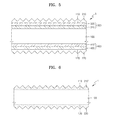
  • FIGS. 9 through 11 are cross-sectional views schematically illustrating a method of manufacturing the flat panel display device of FIG. 1
  • the transparent display panel 100 including the transparent area TA 1 is formed.
  • the transparent display panel 100 includes the transparent area TA 1 for transmitting light and the pixel area PA 1 for forming an image, and the pixel area PA 1 may include the organic emission layer or the liquid crystal cell.
  • the first anti-reflective film 210 having a moth eye structure is disposed on the one surface 110 of the transparent display panel 100 .
  • a moth eye structure includes a plurality of projections that are respectively spaced at an interval equal to or less than the wavelength of a visible ray, and does not reflect light regardless of an incident angle or wavelength of light.
  • the projections may be in the form of a quadrangular pyramid or a circular cone.
  • the second anti-reflective film 220 having a moth eye structure is disposed on the other surface 120 of the transparent display panel 200 .
  • the flat panel display device, the organic light emitting display device, and the method of manufacturing the flat panel display device according to the one or more of the above embodiments of the present invention may improve a bright room contrast and visibility by suppressing external light reflection by disposing the anti-reflective films with a moth eye structure on one or two surfaces of the transparent display panel of the flat panel display device.
  • quality of an image formed by the flat panel display device may further be improved by providing the anti-reflective films including dye that absorbs light of a particular band of wavelengths or by additionally inserting a light absorbing film to the display panel.
  • a luminance efficiency of the light may be increased.

Landscapes

  • Physics & Mathematics (AREA)
  • Optics & Photonics (AREA)
  • General Physics & Mathematics (AREA)
  • Engineering & Computer Science (AREA)
  • Geometry (AREA)
  • Microelectronics & Electronic Packaging (AREA)
  • Manufacturing & Machinery (AREA)
  • Electroluminescent Light Sources (AREA)

Abstract

A flat panel display device includes a transparent display panel including a transparent area transmitting light incident on one surface of the transparent display panel to the other surface opposite to the one surface; a first anti-reflective film which is formed over the one surface of the transparent display panel and has a moth eye structure; and a second anti-reflective film which is formed over the other surface of the transparent display panel and has a moth eye structure.

Description

CROSS-REFERENCE TO RELATED PATENT APPLICATION
This application claims the benefit of Korean Patent Application No. 10-2012-0044671, filed on Apr. 27, 2012, in the Korean Intellectual Property Office, the disclosure of which is incorporated herein in its entirety by reference.
BACKGROUND
1. Field
The present disclosure relates to a flat panel display device, such as an organic light emitting display device, and a method of manufacturing the flat panel display device.
2. Discussion of the Related Technology
Recently, flat panel display devices that may be easily implemented in a large-area dimension, thin type, and light-weighted condition are rapidly and widely being used. Such flat panel display devices include liquid crystal displays (LCDs), plasma display panels (PDPs), or organic light emitting display devices (OLEDs).
Also, the flat panel display device may be implemented as a transparent display device including a transparent region in at least a portion of the flat panel display device.
SUMMARY
An aspect of the present invention provides a flat panel display device, such as an organic light emitting display device, and a method of manufacturing the flat panel display device, wherein the flat panel display device includes a transparent display panel having an improved bright room contrast and visibility by suppressing external light reflection.
One aspect of the present invention provides a flat panel display device including a transparent display panel which includes a transparent area configured to at least partly transmit light incident on one surface of the transparent display panel to the other surface opposite to the one surface; a first anti-reflective film which is formed over the one surface of the transparent display panel and has a moth eye structure; and a second anti-reflective film which is formed over the other surface of the transparent display panel and has a moth eye structure.
In the foregoing device, the first and second anti-reflective films may comprise a plurality of projections, each of which is in the form of a quadrangular pyramid or a circular cone.
The moth eye structure may include a plurality of projections that are respectively spaced at an interval equal to or less than the wavelength of a visible ray.
The flat panel display device may further include a first circular polarizer interposed between the transparent display panel and the first anti-reflective film.
The flat panel display device may further include a second circular polarizer interposed between the transparent display panel and the second anti-reflective film.
The flat panel display device may further include a first light-absorbing film, which is interposed between the transparent display panel and the first anti-reflective film and configured to absorb at least a portion of light having a wavelength within a range of about 350 nm to about 800 nm.
The flat panel display device may further include a second light-absorbing film, which is interposed between the transparent display panel and the second anti-reflective film and configured to absorb at least a portion of light having a wavelength within a range of about 350 nm to about 800 nm.
The first anti-reflective film may include a light-absorbing dye, which absorbs at least a part of light having a wavelength within a range of about 350 nm to about 800 nm.
The second anti-reflective film may include a light-absorbing dye, which is configured to absorb at least a part of light having a wavelength within a range of about 350 nm to about 800 nm.
Another aspect of the present invention provides an organic light emitting display device including a transparent display panel which includes a transparent area configured to at least partly transmit light incident on one surface of the transparent display panel to the other surface opposite to the one surface, and at least a pixel including a pixel electrode, an organic emission layer disposed over the pixel electrode, and a counter electrode disposed over the organic emission layer; a first anti-reflective film placed over the one surface of the transparent display panel and comprising a moth eye structure; and a second anti-reflective film placed on the other surface of the transparent display panel and comprising a moth eye structure.
Still another aspect of the present invention provides a method of manufacturing a flat panel display device. The method includes providing a transparent display panel including a transparent area, which is configured to at least partly transmit light incident on one surface of the transparent display panel to the other surface opposite to the one surface; forming a first anti-reflective film over the one surface of the transparent display panel, wherein the first anti-reflective film comprises a moth eye structure; and forming a second anti-reflective film over the other surface of the transparent display panel, wherein the second anti-reflective film comprises a moth eye structure.
In the foregoing method, the forming of the first and second anti-reflective films may include forming a plurality of projections of the first and second anti-reflective films, each of the plurality of projections being in the form of a quadrangular pyramid or a circular cone.
The forming of the first and second anti-reflective films may include forming the moth eye structure including a plurality of projections that are respectively spaced at an interval equal to or less than the wavelength of the visible ray.
The method may further include forming a first circular polarizer before the forming of the first anti-reflective film.
The method may further include forming a second circular polarizer before the forming of the second anti-reflective film.
The method may further include forming a first light-absorbing film configured to absorb at least a portion of light having a wavelength within a range of about 350 nm to about 800 nm before the forming of the first anti-reflective film.
The method may further include forming a second light-absorbing film configured to absorb at least a portion of light having a wavelength within a range of about 350 nm to about 800 nm before the forming of the second anti-reflective film.
The first anti-reflective film may include a light-absorbing dye, which is configured to absorb at least a part of light having a wavelength within a range of about 350 nm to about 800 nm.
The second anti-reflective film may include a light-absorbing dye, which is configured to absorb at least a part of light having a wavelength within a range of about 350 nm to about 800 nm.
BRIEF DESCRIPTION OF THE DRAWINGS
The above and other features and advantages of the present invention will become more apparent by describing in detail embodiments thereof with reference to the attached drawings in which:
FIG. 1 is a cross-sectional view schematically illustrating a flat panel display device according to an embodiment of the present invention;
FIG. 2 shows views illustrating an example of a moth eye structure that is applied to an embodiment of the present invention;
FIG. 3 is a conceptual view schematically illustrating pathways of external light incident on and reflected from the flat panel display device of FIG. 1;
FIG. 4 is a cross-sectional view schematically illustrating a flat panel display device according to another embodiment of the present invention;
FIG. 5 is a cross-sectional view schematically illustrating a flat panel display device according to another embodiment of the present invention;
FIG. 6 is a cross-sectional view schematically illustrating a flat panel display device according to another embodiment of the present invention;
FIG. 7 is a cross-sectional view schematically illustrating a flat panel display device according to another embodiment of the present invention;
FIG. 8 is a cross-sectional view schematically illustrating an organic light emitting display device according to an embodiment of the present invention;
FIGS. 9 through 11 are cross-sectional views schematically illustrating a method of manufacturing the flat panel display device of FIG. 1 according to an embodiment of the present invention.
DETAILED DESCRIPTION OF EMBODIMENTS
Hereinafter, embodiments of the present invention will be described in detail with reference to the accompanying drawings.
Generally, a circular polarizer or an anti-reflective (AR) film may be used in order to improve contrast and visibility by suppressing reflection of external light of the transparent display device.
However, since a substrate having a high reflectivity is used in the transparent display device, the reflectivity of the external light is high and reflection may occur on a surface where the external light is transmitted through a transparent panel as well as a surface in an incident direction of the external light. Thus, the reflection of the external light may not be sufficiently reduced.
FIG. 1 is a cross-sectional view schematically illustrating a flat panel display device 1 according to an embodiment of the present invention, and FIG. 2 shows views illustrating an example of a moth eye structure that is applied to an embodiment of the present invention.
Referring to FIG. 1, the flat panel display device 1 according to an embodiment includes a transparent display panel 100 including a transparent area TA1 that can transmit light incident on one surface 110 of the transparent display panel 100 to the other surface 120 opposite to the one surface 110, a first anti-reflective film 210 disposed on the one surface 110 of the transparent display panel 100 and having a moth eye structure, and a second anti-reflective film 220 disposed on the other surface 120 of the transparent display panel 100 and having a moth eye structure.
The transparent display panel 100 includes a transparent substrate (not shown), the transparent area TA1, and a pixel area PA1 for forming an image. In embodiment, the pixel area PA1 may include a pixel of an organic emission layer or a liquid crystal cell.
The flat panel display device 1 according to an embodiment of the present invention has the first and second anti-reflective films 210 and 220 that are respectively attached on the two surfaces 110 and 120 of the transparent display panel 100. In embodiments, each of the first and second anti-reflective films 210 and 220 has a moth eye structure.
In embodiment, the moth eye structure includes a plurality of projections that are respectively spaced at an interval equal to or less than the wavelength of a visible ray, and does not reflect light regardless of an incident angle or wavelength of light. The projections may be in the form of a quadrangular pyramid or a circular cone.
Generally, when light moves from one medium to another medium with different refractive index, Fresnel reflection occurs due to a refractive index difference between the two mediums.
Referring to the views (a) and (b) of FIG. 2, when a visible ray is incident on the moth eye structure having projections spaced at an interval d equal to or less than the wavelength of the visible ray having a refractive index ns greater than a refractive index ni of air or the like as shown in the view (a) of FIG. 2, the incident light acts in the same manner as that of the case that the light is incident on a medium having a continuously varying refractive index from ni to ns as shown in the view (b) of FIG. 2. That is, the moth eye structure shown in the view (a) of FIG. 2 may be considered as equivalent to the structure shown in the view (b) of FIG. 2.
Therefore, when external light is incident on the transparent display panel 100 through the first anti-reflective film 210 having a continuously varying refractive index, Fresnel reflection does not occur, and thus the external light reflection may be effectively suppressed.
FIG. 3 is a conceptual view schematically illustrating pathways of external light incident on the flat panel display device 1 of FIG. 1 and light emitted from the flat panel display device 1 of FIG. 1.
Referring to FIG. 3, when external light L1 is incident from the outside on the transparent area TA1 of the flat panel display device 1, a part of the external light L1 may be reflected from an interface between the first anti-reflective film 210 having the moth eye structure and the transparent display panel 100. In embodiments, a reflectivity is r1. Also, the light that is not reflected therefrom but transmitted through the transparent display panel 100 may be partially reflected from an interface between the second anti-reflective film 220 having the moth eye structure and the transparent display panel 100 with a reflectivity of r2.
That is, the whole reflectivity of the external light is about r1+r2 when r1 is much smaller than transmittance of the external light L1. In the illustrated embodiment, the anti-reflective films have the moth eye structure as described above, and the whole reflectivity is also very small, and thus the external light reflection may be effectively suppressed.
Moreover, when light L2 emitted from pixels of the transparent display panel 100 is emitted to the outside, a part of the light L2 is reflected from an interface between the transparent display panel 100 and the first anti-reflective film 210 with a reflectivity of r3. However, the reflectivity r3 has a very small value, and thus most of the light L2 emitted from the pixels may be emitted without loss.
Since a bright room contrast ratio indicates a ratio of an intensity of light emitted from the pixels to an intensity of light due to the external light reflection, the bright room contrast ratio and visibility may be improved by attaching the first and second anti-reflective films 210 and 220 having a moth eye structure on the two opposite surfaces of the transparent display panel 100, respectively.
FIG. 4 is a cross-sectional view schematically illustrating a flat panel display device 2 according to another embodiment of the present invention.
Referring to FIG. 4, the flat panel display device 2 of FIG. 4 further includes a first circular polarizer 300 interposed between the transparent display panel 100 and the first anti-reflective film 210.
The first circular polarizer 300 may include a first quarter wave plate 310 and a first linear polarizer 320, but the present invention is not limited thereto.
In embodiments, the first circular polarizer 300 may be formed of a combination of the linear polarizer and the phase retardation plate that may convert the incident light to circularly polarized light. For example, the first circular polarizer 300 may have a structure of sequentially stacked a quarter wave plate, a half wave plate, and a linear polarizer.
When external light is incident on the pixel area PA1 of the transparent display panel 100, the circular polarizer 300 prevents the light from being reflected by a light-reflecting material such as a metal layer (not shown) included in the pixel area PA1 and from being emitted again to the outside.
In embodiments, when an optical axis of the first quarter wave plate 310 and an absorption axis of the first linear polarizer 320 are disposed to form an angle of about 45 degrees, the light incident from the outside becomes polarized in one direction due to the first linear polarizer 320, and is converted to circularly polarized light after passing the first quarter wave plate 310.
When the light converted to the circularly polarized light is reflected at the pixel area PA1, a phase of the light is shifted by about 90 degrees, and the light becomes polarized in one direction again after passing through the first quarter wave plate 310.
In embodiments, the light incident from the outside and linearly polarized by passing through the first linear polarizer 320 is perpendicular to the light reflected and linearly polarized by passing through the first quarter wave plate 310, and thus the reflected light may not transmit the first linear polarizer 320. Therefore, the light incident from the outside is prevented from being reflected and emitted to the outside again.
FIG. 5 is a cross-sectional view schematically illustrating a flat panel display device 3 according to another embodiment of the present invention.
Referring to FIG. 5, the flat panel display device 3 of FIG. 5 further includes a second circular polarizer 400 interposed between the transparent display panel 100 and the second anti-reflective film 220. The second circular polarizer 400 includes a second quarter wave plate 410 and a second linear polarizer 420.
When the two surfaces of the transparent display panel 100 emit light, the flat panel display device 3 in accordance with the illustrated embodiment may be more effective in suppressing external light reflection from the two surfaces of the transparent display panel 100.
FIG. 6 is a cross-sectional view schematically illustrating a flat panel display device 4 according to another embodiment of the present invention.
Referring to FIG. 6, the flat panel display device 4 of FIG. 6 includes the transparent display panel 100, a first anti-reflective film 210′, and a second anti-reflective film 220′. The first anti-reflective film 210′ is disposed on the one surface 110 of the transparent display panel 100, has a moth eye structure, and contains a light-absorbing dye that absorbs at least a part of the light having a wavelength within a range of about 350 nm to about 800 nm. The second anti-reflective film 220′ is disposed on the other surface 120 of the transparent display panel 100, has a moth eye structure, and contains a light-absorbing dye that absorbs at least a part of the light having a wavelength within a range of about 350 nm to about 800 nm.
In embodiments, the light-absorbing dye absorbs at least a part of the light having wavelengths corresponding to a band of visible ray. In embodiments, the light-absorbing dye may absorb a wavelength within a range of about 350 nm to about 800 nm in one embodiment. In another embodiment, the light-absorbing dye may absorb a wavelength within a range of about 380 nm to about 770 nm.
In embodiments, the light-absorbing dye may include red, green, or blue pigments.
Color impression of light that is reflected from or transmitted through the flat panel display device 4 may be controlled by providing the light-absorbing dye in the first and second anti-reflective films 210′ and 220′, and thus quality of an image realized by the flat panel display device 4 may be improved.
In embodiments, types and amount of the pigments may be appropriately combined depending on wavelength and quantity of light to be absorbed.
The light-absorbing dye is included in both of the first and second anti-reflective films 210′ and 220′ of the flat panel display device 4 of FIG. 6, but the present invention is not limited thereto, and the light-absorbing dye may be included in only one of the first and second anti-reflective films 210′ and 220′.
FIG. 7 is a cross-sectional view schematically illustrating a flat panel display device 5 according to another embodiment of the present invention.
Referring to FIG. 7, the flat panel display device 5 of FIG. 7 further includes a first light-absorbing film 510 and a second light-absorbing film 520. The first light absorbing film 510 is interposed between the transparent display panel 100 and the first anti-reflective film 210. The second light-absorbing film 520 is interposed between the transparent display panel 100 and the second anti-reflective film 220.
In embodiments, the first and second light-absorbing films 510 and 520 may absorb at least a part of the light having a wavelength within a range of about 350 nm to about 800 nm. The first and second light-absorbing films 510 and 520 are coated with or contain a light-absorbing material which includes the red, green, or blue pigments as described above.
In the flat panel display device 5 according to the current embodiment of the present invention, color impression of light that is reflected from or transmitted through the flat panel display device 5 may be controlled by controlling wavelength and quantity of light that is absorbed by the first and second light-absorbing films 510 and 520, and thus quality of an image realized by the flat panel display device 5 may be improved.
FIG. 8 is a cross-sectional view schematically illustrating an organic light emitting display device 6 according to an embodiment of the present invention.
Referring to FIG. 8, the organic light emitting display device 6 according to an embodiment of the present invention includes a transparent display panel 600 including a transparent area TA2 which can transmit light incident on one surface 610 to the other surface 620 opposite to the one surface 610, and a pixel area PA2 which includes a pixel including a pixel electrode 41, an organic emission layer 42 disposed on the pixel electrode 41, and a counter electrode 43 disposed on the organic emission layer 42; a first anti-reflective film 210 formed on the one surface of the transparent display panel 600 with a moth eye structure; and a second anti-reflective film 220 formed on the other surface of the transparent display panel 600 with a moth eye structure. In embodiments, the transparent area TA2 can be interposed between two neighboring pixel areas.
In embodiments, the transparent display panel 600 includes a thin film transistor 20, a capacitor 30, and an organic light emitting diode 40.
In one embodiment, the transparent display panel 600 includes a transparent substrate 10 formed of a transparent insulating substrate including glass, quartz, ceramic, or plastic. The thin film transistor 20 disposed on the transparent substrate 10 includes an active layer 21, a gate electrode 23, and source and drain electrodes 25 a and 25 b.
The active layer 21 may be formed of a semiconductor material such as amorphous silicon or polysilicon, but is not limited thereto, and may be formed of an oxide semiconductor. The active layer 21 may include a channel area 21 c and source and drain areas 21 a and 21 b that are doped with ion impurities at outer sides of the channel area 21 c.
The gate electrode 23 is disposed on the active layer 21, and a gate insulating layer 12 is interposed between the active layer 21 and the gate electrode 23. In embodiments, the gate electrode 23 may include one or more metals selected from Al, Pt, Pd, Ag, Mg, Au, Ni, Nd, Ir, Cr, Li, Ca, Mo, Ti, W, and Cu, and may be formed in a single layer or multi layers.
An interlayer insulating layer 14 is disposed on the gate electrode 23, and the source and drain electrodes 25 a and 25 b, which are respectively connected to the source and drain areas 21 a and 21 b, are disposed with the interlayer insulating layer 14 therebetween.
The source and drain electrodes 25 a and 25 b includes one or more metals selected from Al, Pt, Pd, Ag, Mg, Au, Ni, Nd, Ir, Cr, Li, Ca, Mo, Ti, W, and Cu, and may be formed in a single layer or multi layers.
A planarization layer 16 including via holes, which electrically connect the pixel electrode 41 and one of the source and drain electrodes 25 a and 25 b, is disposed on the source and drain electrodes 25 a and 25 b.
The capacitor 30 includes a lower electrode 33 formed of the same material with the gate electrode 23 and an upper electrode 35 formed of the same material with the source and drain electrodes 25 a and 25 b.
The organic light emitting diode 40 is disposed on the planarization layer 16, and the organic light emitting diode 40 includes the pixel electrode 41, the organic emission layer 42, and the counter electrode 43 that are sequentially disposed. In embodiments, a pixel defining layer 50 is disposed to cover an edge of the pixel electrode 41.
According to the current embodiment, the pixel electrode 41 may be an anode, and the counter electrode 43 may be a cathode. However, the present invention is not limited thereto, and the pixel electrode 41 may be a cathode, and the counter electrode 43 may be an anode.
The pixel electrode 41 included in the organic light emitting diode 40 according to the current embodiment may be a reflective electrode. The pixel electrode 41 may include a reflecting film formed of Ag, Mg, Al, Pt, Pd, Au, Ni, Nd, Ir, Cr, or a compound thereof, and a transparent or semitransparent electrode layer formed on the reflecting film.
The transparent or semitransparent electrode layer may include at least one selected from the group consisting of indium tin oxide (ITO), indium zinc oxide (IZO), zinc oxide (ZnO), indium oxide (In2O3), indium gallium oxide (IGO), and aluminum zinc oxide (AZO).
The counter electrode 43 disposed opposite to the pixel electrode 41 may be a transparent electrode and may be formed of a metal thin layer with a small work function including Li, Ca, LiF/Ca, LiF/Al, Al, Ag, Mg, or a compound thereof. Also, an auxiliary electrode layer or a bus electrode as a material for forming the transparent electrode of ITO, IZO, ZnO, or In2O3 may be further formed on the metal thin layer.
Thus, in embodiments, the counter electrode 43 can transmit the light emitted from the organic light emission layer 42.
The organic emission layer 42 is interposed between the pixel electrode 41 and the counter electrode 43, and the organic emission layer 42 may be formed of a low molecular weight organic material or a high molecular weight organic material.
An interlayer such as a hole transport layer (HTL), a hole injection layer (HIL), an electron transport layer (ETL), or an electron injection layer (EIL) may be selectively interposed between the pixel electrode 41 and the counter electrode 43 as well as the organic emission layer 42.
The light emitted from the organic emission layer 42 may be a top emission type that is directly or reflected by the pixel electrode 41 constructed of the reflective electrode and emitted to the counter electrode 43.
The transparent display panel 600 according to embodiments includes the transparent area TA2 and the pixel area PA2. The gate electrode 23 and the source and drain electrodes 25 a and 25 b of the thin film transistor 20, the lower electrode 33 and the upper electrode 35 of the capacitor 30, and the pixel electrode 41 of the organic light emitting diode 40 are formed of a metal which may reflect the incident light.
In embodiments, the thin film transistor 20, the capacitor 30, and the organic light emitting diode 40 are formed in the pixel area PA2, and are not formed in the transparent area TA2. In some embodiments, the gate insulating layer 12, the interlayer insulating layer 14, the planarization layer 16, and the pixel defining layer 50 that are commonly disposed on the pixel area PA2 and the transparent area TA2 are all formed of a transparent insulating layer, and the counter electrode 43 that is formed as a common electrode may be made of a transparent material.
In embodiments, a ratio of an area of the transparent area TA2 to that of the entire transparent display panel 600 may be controlled or adjusted within a range from about 20 to about 90%.
The transparent display panel 600 may be sealed by a sealing substrate 60 to protect the organic light emitting diode 40, and the sealing substrate 60 may be a transparent substrate.
In embodiments, the first and second anti-reflective films 210 and 220 having a moth eye structure are disposed on the two surfaces 610 and 620 of the transparent display panel 600 of the organic light emitting display device 6, respectively. A structure and function of the first and second anti-reflective films 210 and 220 are same as described above.
FIGS. 9 through 11 are cross-sectional views schematically illustrating a method of manufacturing the flat panel display device of FIG. 1
Referring to FIG. 9, in embodiments, the transparent display panel 100 including the transparent area TA1 is formed. The transparent display panel 100 includes the transparent area TA1 for transmitting light and the pixel area PA1 for forming an image, and the pixel area PA1 may include the organic emission layer or the liquid crystal cell.
Referring to FIG. 10, the first anti-reflective film 210 having a moth eye structure is disposed on the one surface 110 of the transparent display panel 100.
A moth eye structure includes a plurality of projections that are respectively spaced at an interval equal to or less than the wavelength of a visible ray, and does not reflect light regardless of an incident angle or wavelength of light. The projections may be in the form of a quadrangular pyramid or a circular cone.
Referring to FIG. 11, the second anti-reflective film 220 having a moth eye structure is disposed on the other surface 120 of the transparent display panel 200.
A detailed description of each of the elements is described above, and thus their description will be omitted for brevity.
As described above, the flat panel display device, the organic light emitting display device, and the method of manufacturing the flat panel display device according to the one or more of the above embodiments of the present invention may improve a bright room contrast and visibility by suppressing external light reflection by disposing the anti-reflective films with a moth eye structure on one or two surfaces of the transparent display panel of the flat panel display device.
Also, quality of an image formed by the flat panel display device may further be improved by providing the anti-reflective films including dye that absorbs light of a particular band of wavelengths or by additionally inserting a light absorbing film to the display panel.
Moreover, a luminance efficiency of the light may be increased.
The elements in the drawings may be described exaggerated or minimized for clarity, and thus the present invention is not limited to the size or shape of the elements in the drawings. While embodiments of the present invention have been particularly shown and described with reference to the drawings, it will be understood by those of ordinary skill in the art that various changes in form and details may be made therein without departing from the spirit and scope of the present invention as defined by the following claims.

Claims (17)

What is claimed is:
1. A flat panel display device comprising:
a transparent display panel comprising a front transparent substrate, a back transparent substrate and a pixel array interposed between the front and back transparent substrates;
the pixel array comprising a plurality of pixels and a plurality of transparent areas, each transparent area having sufficient transparency to transmit visible light such that light beams incident on the front transparent substrate pass through one or more of the transparent areas of the pixel array and further pass through the back transparent substrate;
a first anti-reflective film which is formed over a surface of the front transparent substrate and comprises a moth eye structure;
a second anti-reflective film which is formed over a surface of the back transparent substrate and comprises a moth eye structure, wherein the second anti-reflective film is configured to inhibit reflection, back toward the front transparent substrate, of light beams that have passed through one or more of the transparent areas and reached the second anti-reflective film; and
a first light-absorbing film covering the transparent areas when viewed in a direction perpendicular to a major surface of the front transparent substrate, the first light-absorbing film being interposed between the transparent display panel and the first anti-reflective film, the first light-absorbing film being configured to absorb at least a portion of light having a wavelength within a range of about 350 nm to about 800 nm.
2. The flat panel display device of claim 1, wherein the first and second anti-reflective films comprise a plurality of projections, each of which is in the form of a quadrangular pyramid or a circular cone.
3. The flat panel display device of claim 1, wherein the moth eye structure comprises a plurality of projections that are respectively spaced at an interval equal to or less than the wavelength of a visible ray.
4. The flat panel display device of claim 1 further comprising a first circular polarizer interposed between the transparent display panel and the first anti-reflective film.
5. The flat panel display device of claim 1 further comprising a second circular polarizer interposed between the transparent display panel and the second anti-reflective film.
6. The flat panel display device of claim 1 further comprising a second light-absorbing film, which is interposed between the transparent display panel and the second anti-reflective film and configured to absorb at least a portion of light having a wavelength within a range of about 350 nm to about 800 nm.
7. The flat panel display device of claim 1, wherein the first anti-reflective film comprises a light-absorbing dye, which absorbs at least a part of light having a wavelength within a range of about 350 nm to about 800 nm.
8. The flat panel display device of claim 1, wherein the second anti-reflective film comprises a light-absorbing dye, which is configured to absorb at least a part of light having a wavelength within a range of about 350 nm to about 800 nm.
9. An organic light emitting display device comprising:
a transparent display panel comprising a front transparent substrate, a back transparent substrate and a pixel array interposed between the front and back transparent substrates;
the pixel array comprising a plurality of pixels and a plurality of transparent areas, at least one of the plurality of pixels comprising a pixel electrode, an organic emission layer disposed over the pixel electrode, and a counter electrode disposed over the organic emission layer, at least one of the plurality of transparent areas having sufficient transparency to transmit visible light such that light beams incident on the front transparent substrate pass through one or more of the transparent areas of the pixel array and further pass through the back transparent substrate;
a first anti-reflective film placed over a surface of the front transparent substrate and comprising a moth eye structure;
a second anti-reflective film placed over a surface of the back transparent substrate and comprising a moth eye structure, wherein the second anti-reflective film is configured to inhibit reflection, back toward the front transparent substrate, of light beams that have passed through one or more of the transparent areas and reached the second anti-reflective film; and
a first light-absorbing film covering the transparent areas when viewed in a direction perpendicular to a major surface of the front transparent substrate, the first light-absorbing film being interposed between the transparent display panel and the first anti-reflective film, the first light-absorbing film being configured to absorb at least a portion of light having a wavelength within a range of about 350 nm to about 800 nm.
10. A method of manufacturing a flat panel display device comprising:
providing a transparent display panel comprising a front transparent substrate, a back transparent substrate and a pixel array interposed between the front and back transparent substrates, the pixel array comprising a plurality of pixels and a plurality of transparent areas, each transparent area having sufficient transparency to transmit visible light such that light beams incident on the front transparent substrate pass through one or more of the transparent areas of the pixel array and further pass through the back transparent substrate;
forming, over the transparent areas when viewed in a direction perpendicular to a major surface of the front transparent substrate, a first light-absorbing film configured to absorb at least a portion of light having a wavelength within a range of about 350 nm to about 800 nm;
forming a first anti-reflective film over the first light-absorbing film, wherein the first anti-reflective film comprises a moth eye structure; and
forming a second anti-reflective film over a surface of the back transparent substrate, wherein the second anti-reflective film comprises a moth eye structure.
11. The method of claim 10, wherein the forming of the first and second anti-reflective films comprises forming a plurality of projections of the first and second anti-reflective films, each of the plurality of projections being in the form of a quadrangular pyramid or a circular cone.
12. The method of claim 10, wherein the forming of the first and second anti-reflective films comprises forming the moth eye structure comprising a plurality of projections that are respectively spaced at an interval equal to or less than the wavelength of the visible ray.
13. The method of claim 10, wherein the method further comprises forming a first circular polarizer before the forming of the first anti-reflective film.
14. The method of claim 10, wherein the method further comprises forming a second circular polarizer before the forming of the second anti-reflective film.
15. The method of claim 10, wherein the method further comprises forming a second light-absorbing film configured to absorb at least a portion of light having a wavelength within a range of about 350 nm to about 800 nm before the forming of the second anti-reflective film.
16. The method of claim 10, wherein the first anti-reflective film comprises a light-absorbing dye, which is configured to absorb at least a part of light having a wavelength within a range of about 350 nm to about 800 nm.
17. The method of claim 10, wherein the second anti-reflective film comprises a light-absorbing dye, which is configured to absorb at least a part of light having a wavelength within a range of about 350 nm to about 800 nm.
US13/677,123 2012-04-27 2012-11-14 Flat panel display device, organic light emitting display device and method of manufacturing flat panel display device Active US8841836B2 (en)

Applications Claiming Priority (2)

Application Number Priority Date Filing Date Title
KR10-2012-0044671 2012-04-27
KR1020120044671A KR101913704B1 (en) 2012-04-27 2012-04-27 Flat panel display device, organic light emitting display device and the method for manufacturing the flat panel display device

Publications (2)

Publication Number Publication Date
US20130285539A1 US20130285539A1 (en) 2013-10-31
US8841836B2 true US8841836B2 (en) 2014-09-23

Family

ID=49462998

Family Applications (1)

Application Number Title Priority Date Filing Date
US13/677,123 Active US8841836B2 (en) 2012-04-27 2012-11-14 Flat panel display device, organic light emitting display device and method of manufacturing flat panel display device

Country Status (4)

Country Link
US (1) US8841836B2 (en)
KR (1) KR101913704B1 (en)
CN (1) CN103378124B (en)
TW (1) TWI562353B (en)

Cited By (5)

* Cited by examiner, † Cited by third party
Publication number Priority date Publication date Assignee Title
US9905622B2 (en) 2014-08-27 2018-02-27 Boe Technology Group Co., Ltd. Organic electroluminescent device and manufacturing method thereof, each having a display apparatus
CN109742108A (en) * 2019-01-03 2019-05-10 京东方科技集团股份有限公司 A kind of display panel and preparation method thereof, display device
US10488559B2 (en) 2015-06-19 2019-11-26 Samsung Electronics Co., Ltd. Anti-reflective film, electronic device including the same, and apparatus for and method of manufacturing the same
US20220285655A1 (en) * 2021-03-05 2022-09-08 Samsung Display Co., Ltd. Display apparatus
US11782479B2 (en) 2020-02-13 2023-10-10 Samsung Display Co., Ltd. Electronic apparatus and method of manufacturing the same

Families Citing this family (29)

* Cited by examiner, † Cited by third party
Publication number Priority date Publication date Assignee Title
KR101407586B1 (en) * 2011-04-25 2014-06-27 삼성디스플레이 주식회사 Display device and operating method thereof
JP6303803B2 (en) * 2013-07-03 2018-04-04 ソニー株式会社 Solid-state imaging device and manufacturing method thereof
CN103680316B (en) * 2013-12-17 2015-09-23 京东方科技集团股份有限公司 Transparent display panel and manufacture method, display device
US20150185554A1 (en) * 2013-12-31 2015-07-02 Shenzhen China Star Optoelectronics Technology Co. Ltd. Liquid crystal display and method for manufacturing the same
US10585213B2 (en) * 2014-03-14 2020-03-10 Sharp Kabushiki Kaisha Optical element and display device
CN103928625B (en) * 2014-04-08 2016-05-18 陕西科技大学 The device architecture of a kind of flexible and transparent OLED and preparation method
KR102364387B1 (en) * 2014-07-04 2022-02-18 삼성디스플레이 주식회사 Organic light emitting display device
US9217892B1 (en) * 2014-07-17 2015-12-22 Shenzhen China Star Optoelectronics Technology Co., Ltd Circular polarizer, liquid crystal panel and the liquid crystal device
KR102386458B1 (en) * 2014-11-17 2022-04-15 삼성디스플레이 주식회사 Organic light emitting display device and method of manufacturing the same
TWI560477B (en) * 2014-12-12 2016-12-01 Wistron Corp Display module
KR101702570B1 (en) * 2015-10-30 2017-02-03 엘지디스플레이 주식회사 Transparent Organic Light Emitting Display Device
KR102416742B1 (en) 2015-12-21 2022-07-06 삼성디스플레이 주식회사 Transparent display devices
US10429892B1 (en) * 2016-01-12 2019-10-01 Apple Inc. Electronic devices with thin display housings
CN106199812B (en) * 2016-08-30 2019-08-06 苏州柔彩新材料科技有限公司 A kind of thinning functional polarizing piece and its preparation method and application
CN107015296A (en) * 2017-04-21 2017-08-04 台州学院 Visible region nano-structure array anti-reflection film and preparation method thereof
CN107359186A (en) * 2017-08-21 2017-11-17 信利半导体有限公司 A kind of OLED display modules
CN109841644B (en) * 2017-11-24 2021-07-27 上海和辉光电股份有限公司 Display panel and display device
CN107976837B (en) * 2017-12-18 2021-12-07 华显光电技术(惠州)有限公司 Polaroid and display device
KR102661095B1 (en) * 2018-12-12 2024-04-26 엘지디스플레이 주식회사 Display panel
CN111384284B (en) * 2018-12-29 2021-06-25 武汉华星光电半导体显示技术有限公司 Display panel, electronic device, and method of making the display panel
CN111524456B (en) * 2019-02-01 2022-06-17 北京小米移动软件有限公司 Folding display and folding screen terminal
CN110265581B (en) * 2019-07-22 2022-10-04 广州国显科技有限公司 Display panel and display device
CN110989241B (en) * 2019-12-26 2022-09-06 厦门天马微电子有限公司 Display device
CN111312797A (en) 2020-04-02 2020-06-19 武汉华星光电半导体显示技术有限公司 A display panel and method of making the same
CN116324536A (en) * 2020-10-29 2023-06-23 华为技术有限公司 Multifunctional film for display stacks and devices comprising such display stacks
CN113870723B (en) * 2021-11-26 2022-02-25 赛德半导体有限公司 A bendable cover plate, preparation method, display panel and display device
WO2023114512A2 (en) * 2021-12-17 2023-06-22 Magic Leap, Inc. Area specific color absorption in nanoimprint lithography
JP2023147063A (en) * 2022-03-29 2023-10-12 パナソニックIpマネジメント株式会社 display device
CN117456851A (en) * 2023-10-20 2024-01-26 珠海华萃科技有限公司 Display panels and display devices

Citations (13)

* Cited by examiner, † Cited by third party
Publication number Priority date Publication date Assignee Title
KR20010001104A (en) 1999-06-02 2001-01-05 구본준 Transmission-reflection type liquid crystal display device
US6514674B1 (en) * 1999-03-11 2003-02-04 Canon Kabushiki Kaisha Method of forming an optical element
US20040155846A1 (en) * 2003-02-07 2004-08-12 Randy Hoffman Transparent active-matrix display
US20060175959A1 (en) * 2005-02-09 2006-08-10 Osram Opto Semiconductors Gmbh Green enhancement filter to improve yield of white displays
WO2006125988A1 (en) * 2005-05-25 2006-11-30 Cambridge Display Technology Limited Electroluminescent device
KR100754327B1 (en) 2006-03-02 2007-08-31 재단법인서울대학교산학협력재단 Surface anti-reflective material for display device having surface structure below visible light wavelength by plasma etching and manufacturing method thereof
US20080042926A1 (en) * 2006-05-31 2008-02-21 Egi Yuji Display device
US20090115321A1 (en) * 2007-11-02 2009-05-07 Seiko Epson Corporation Organic electroluminescent device, method for producing the same, and electronic apparatus
US20100123384A1 (en) * 2008-11-17 2010-05-20 Miller Michael E Tiled oled device with edge light extraction
KR20100104103A (en) 2009-03-16 2010-09-29 고려대학교 산학협력단 Fabrication method of anti-reflection layer for solar cells using nano-sized patterns
JP2011048000A (en) 2009-08-25 2011-03-10 Dainippon Printing Co Ltd Antireflection film, polarizing plate, and display device
US20110164210A1 (en) * 2008-09-25 2011-07-07 Kazuhiko Tsuda Display device
US20120049206A1 (en) * 2010-08-24 2012-03-01 Jun-Ho Choi Organic light-emitting display device

Family Cites Families (6)

* Cited by examiner, † Cited by third party
Publication number Priority date Publication date Assignee Title
US6897855B1 (en) * 1998-02-17 2005-05-24 Sarnoff Corporation Tiled electronic display structure
CN1983365B (en) * 2002-04-26 2011-05-18 东芝松下显示技术有限公司 Drive circuit for electroluminescence display screen
JP5403860B2 (en) * 2006-10-10 2014-01-29 株式会社ジャパンディスプレイ Color liquid crystal display device
JP4720865B2 (en) * 2008-07-25 2011-07-13 ソニー株式会社 Display device, display method, and electronic apparatus
KR101598729B1 (en) * 2009-06-23 2016-02-29 미츠비시 레이온 가부시키가이샤 Antireflection article and display device
JP5705459B2 (en) * 2009-09-04 2015-04-22 富士フイルム株式会社 Photocurable composition for color filter, color filter formed with the photocurable composition, and image display device including the same

Patent Citations (15)

* Cited by examiner, † Cited by third party
Publication number Priority date Publication date Assignee Title
US6514674B1 (en) * 1999-03-11 2003-02-04 Canon Kabushiki Kaisha Method of forming an optical element
US6671016B1 (en) 1999-06-02 2003-12-30 Lg Philips Lcd Co., Ltd. Transmission-reflection type liquid crystal display device having a selectively reflective filter layer
KR20010001104A (en) 1999-06-02 2001-01-05 구본준 Transmission-reflection type liquid crystal display device
US20040155846A1 (en) * 2003-02-07 2004-08-12 Randy Hoffman Transparent active-matrix display
US20060175959A1 (en) * 2005-02-09 2006-08-10 Osram Opto Semiconductors Gmbh Green enhancement filter to improve yield of white displays
US20120126688A1 (en) * 2005-05-25 2012-05-24 Cambridge Display Technology Limited Electroluminescent device
WO2006125988A1 (en) * 2005-05-25 2006-11-30 Cambridge Display Technology Limited Electroluminescent device
KR100754327B1 (en) 2006-03-02 2007-08-31 재단법인서울대학교산학협력재단 Surface anti-reflective material for display device having surface structure below visible light wavelength by plasma etching and manufacturing method thereof
US20080042926A1 (en) * 2006-05-31 2008-02-21 Egi Yuji Display device
US20090115321A1 (en) * 2007-11-02 2009-05-07 Seiko Epson Corporation Organic electroluminescent device, method for producing the same, and electronic apparatus
US20110164210A1 (en) * 2008-09-25 2011-07-07 Kazuhiko Tsuda Display device
US20100123384A1 (en) * 2008-11-17 2010-05-20 Miller Michael E Tiled oled device with edge light extraction
KR20100104103A (en) 2009-03-16 2010-09-29 고려대학교 산학협력단 Fabrication method of anti-reflection layer for solar cells using nano-sized patterns
JP2011048000A (en) 2009-08-25 2011-03-10 Dainippon Printing Co Ltd Antireflection film, polarizing plate, and display device
US20120049206A1 (en) * 2010-08-24 2012-03-01 Jun-Ho Choi Organic light-emitting display device

Cited By (6)

* Cited by examiner, † Cited by third party
Publication number Priority date Publication date Assignee Title
US9905622B2 (en) 2014-08-27 2018-02-27 Boe Technology Group Co., Ltd. Organic electroluminescent device and manufacturing method thereof, each having a display apparatus
US10488559B2 (en) 2015-06-19 2019-11-26 Samsung Electronics Co., Ltd. Anti-reflective film, electronic device including the same, and apparatus for and method of manufacturing the same
CN109742108A (en) * 2019-01-03 2019-05-10 京东方科技集团股份有限公司 A kind of display panel and preparation method thereof, display device
US11081678B2 (en) 2019-01-03 2021-08-03 Boe Technology Group Co., Ltd. Display panel, method for fabricating the same, and display device
US11782479B2 (en) 2020-02-13 2023-10-10 Samsung Display Co., Ltd. Electronic apparatus and method of manufacturing the same
US20220285655A1 (en) * 2021-03-05 2022-09-08 Samsung Display Co., Ltd. Display apparatus

Also Published As

Publication number Publication date
TW201344897A (en) 2013-11-01
US20130285539A1 (en) 2013-10-31
TWI562353B (en) 2016-12-11
KR101913704B1 (en) 2018-11-01
CN103378124B (en) 2018-02-16
CN103378124A (en) 2013-10-30
KR20130121454A (en) 2013-11-06

Similar Documents

Publication Publication Date Title
US8841836B2 (en) Flat panel display device, organic light emitting display device and method of manufacturing flat panel display device
US11527733B2 (en) Organic light emitting display apparatus
US10559637B2 (en) Thin film encapsulation unit, organic light emitting diode display including the same and manufacturing method thereof
KR100852115B1 (en) Organic light emitting display device
KR101580827B1 (en) Organic electroluminescent device and manufacturing method thereof
KR20150012591A (en) Organic light emitting display apparatus and method of manufacturing the same
US12543486B2 (en) Display substrate and display device
KR20120044655A (en) Organic light emitting diode display
WO2017043242A1 (en) Organic electroluminescence device, lighting device and display device
US10261348B2 (en) Display device
US9146418B2 (en) Display device
US20130193456A1 (en) Organic light emitting diode display
KR101830613B1 (en) Organic light emitting device and method for fabricating the same
EP2197061B1 (en) Organic light emitting diode display
KR20200058154A (en) Electro-luminescence display apparatus
CN111312789A (en) Display panel and display device
CN206610812U (en) Organic Light Emitting Diode Display Device
US20240206296A1 (en) Display Substrate and Display Device
KR102154489B1 (en) Organic Electro-Luminescence Device
US20260020485A1 (en) Display panel and display device

Legal Events

Date Code Title Description
AS Assignment

Owner name: SAMSUNG DISPLAY CO., LTD., KOREA, REPUBLIC OF

Free format text: ASSIGNMENT OF ASSIGNORS INTEREST;ASSIGNORS:KIM, SANG-HO;BAE, JAE-WOO;LEE, HUN-JUNG;REEL/FRAME:029299/0698

Effective date: 20121108

FEPP Fee payment procedure

Free format text: PAYOR NUMBER ASSIGNED (ORIGINAL EVENT CODE: ASPN); ENTITY STATUS OF PATENT OWNER: LARGE ENTITY

STCF Information on status: patent grant

Free format text: PATENTED CASE

MAFP Maintenance fee payment

Free format text: PAYMENT OF MAINTENANCE FEE, 4TH YEAR, LARGE ENTITY (ORIGINAL EVENT CODE: M1551)

Year of fee payment: 4

MAFP Maintenance fee payment

Free format text: PAYMENT OF MAINTENANCE FEE, 8TH YEAR, LARGE ENTITY (ORIGINAL EVENT CODE: M1552); ENTITY STATUS OF PATENT OWNER: LARGE ENTITY

Year of fee payment: 8