US8831913B2 - Method of design optimisation - Google Patents
Method of design optimisation Download PDFInfo
- Publication number
- US8831913B2 US8831913B2 US12/482,003 US48200309A US8831913B2 US 8831913 B2 US8831913 B2 US 8831913B2 US 48200309 A US48200309 A US 48200309A US 8831913 B2 US8831913 B2 US 8831913B2
- Authority
- US
- United States
- Prior art keywords
- geometric object
- design
- lattice
- geometry
- points
- Prior art date
- Legal status (The legal status is an assumption and is not a legal conclusion. Google has not performed a legal analysis and makes no representation as to the accuracy of the status listed.)
- Expired - Fee Related, expires
Links
Images




Classifications
-
- G—PHYSICS
- G06—COMPUTING OR CALCULATING; COUNTING
- G06F—ELECTRIC DIGITAL DATA PROCESSING
- G06F30/00—Computer-aided design [CAD]
- G06F30/10—Geometric CAD
- G06F30/15—Vehicle, aircraft or watercraft design
-
- G—PHYSICS
- G05—CONTROLLING; REGULATING
- G05B—CONTROL OR REGULATING SYSTEMS IN GENERAL; FUNCTIONAL ELEMENTS OF SUCH SYSTEMS; MONITORING OR TESTING ARRANGEMENTS FOR SUCH SYSTEMS OR ELEMENTS
- G05B17/00—Systems involving the use of models or simulators of said systems
- G05B17/02—Systems involving the use of models or simulators of said systems electric
-
- G—PHYSICS
- G06—COMPUTING OR CALCULATING; COUNTING
- G06F—ELECTRIC DIGITAL DATA PROCESSING
- G06F2113/00—Details relating to the application field
- G06F2113/28—Fuselage, exterior or interior
-
- Y—GENERAL TAGGING OF NEW TECHNOLOGICAL DEVELOPMENTS; GENERAL TAGGING OF CROSS-SECTIONAL TECHNOLOGIES SPANNING OVER SEVERAL SECTIONS OF THE IPC; TECHNICAL SUBJECTS COVERED BY FORMER USPC CROSS-REFERENCE ART COLLECTIONS [XRACs] AND DIGESTS
- Y02—TECHNOLOGIES OR APPLICATIONS FOR MITIGATION OR ADAPTATION AGAINST CLIMATE CHANGE
- Y02T—CLIMATE CHANGE MITIGATION TECHNOLOGIES RELATED TO TRANSPORTATION
- Y02T90/00—Enabling technologies or technologies with a potential or indirect contribution to GHG emissions mitigation
Definitions
- the present invention relates to a method of design optimisation.
- FIG. 1 A typical optimisation process using CFD analysis is illustrated in FIG. 1 .
- a CFD mesh representation 2 of an aerodynamic structure is generated from a corresponding Computer Aided Design (CAD) model 1 .
- CAD Computer Aided Design
- a CFD analysis is performed on the mesh at step 3 and the results are analysed at step 4 to determine whether the design has been optimised. If so, the optimal design is output from the process at step 5 . If not, the design is altered at step 6 . This will be explained in more detail below.
- a CFD analysis is then performed on the altered design at step 3 and the results are analysed again at step 4 . This process is repeated until an optimal design has been found.
- a flexible parameterisation method is required to generate new aerodynamic designs at step 6 .
- the parameterisation technique defines the design space and hence determines the range of possible designs the optimisation process can produce.
- the suitability of a particular parameterisation technique is based on its ability to balance the need for a flexible representation with a manageable number of design variables. If the parameterisation is too inflexible the number and variation of the possible shapes is restricted, thereby restricting the outcome of the optimisation process. Conversely, a very flexible parameterisation is likely to require a large number of design variables. If the number of design variables is too large the design space becomes inefficient and the search process will struggle to find the optimum design.
- FFD is performed directly on the CFD analysis mesh and a CAD geometry is not present within the optimisation loop. If a CAD model of the resulting geometry is required, reverse engineering techniques need to be utilised at step 7 to recreate the CAD model from the deformed CFD mesh. However, it is difficult to recreate the CAD model from the deformed CFD mesh precisely.
- FFD was first introduced in Sederberg, T. W. and Parry, S. R., “Free-Form Deformation of Solid Geometric Models”, SIGGRAPH' 86, Vol. 20, ACM, August 1986, pp. 151-160 (Sederberg and Parry) in the field of computer graphics as a method for deforming geometric models in a flexible manner.
- free-form deformation techniques encompass the following processes: first a volume definition is required and positioned such that it encloses the geometry; a method is then used to deform said volume and finally the geometry inside the volume must deform as part of the volume that encloses it.
- Sederberg and Parry's FFD method achieves this by using a tricubic Bezier volume that is defined using a lattice of control points. Movements in these control points provide the deformation of the control volume needed. This deformation occurs in an analogous fashion to deforming a Bezier curve through its polygon points. Deformations applied to the Bezier volume are passed to the geometry through its parametric co-ordinates.
- the following physical analogy, illustrated by FIGS. 2 a and 2 b was proposed by Sederberg and Parry and is useful to understand the general FFD method.
- the geometry to be deformed is in this example a flexible rubber ball 10 . This geometry is embedded within a clear flexible plastic block 12 .
- the embedded geometry 10 is forced to deform in a similar fashion to produce a deformed geometry 10 a .
- the deformed block/geometry 12 a , 10 a is shown in FIG. 2 b .
- FFD is the mathematical equivalent of this process.
- the Sederberg and Parry FFD method can be described in three steps: Control volume/lattice construction; freezing the lattice; lattice and geometry deformation. The three general steps are now discussed in turn.
- Sederberg and Parry define the control volume which is defined by a regular uniformly subdivided 3D lattice of control points.
- the lattice consists of l, m and n control points in the S, T and U directions respectively.
- Bezier volumes were used in the discussion by Sederberg and Parry, it is also possible to use other basis functions such as B-splines or non-uniform rational B-splines (NURBS).
- Sederberg and Parry restrict the initial lattice shape to be parallelepiped and aligned with the global co-ordinate system. While this limits the types of deformations achievable it has two major advantages.
- the second advantage which is as a consequence of the first is that the “lattice freezing” process is drastically simplified.
- Freezing the lattice requires the calculation of the position of each geometry point in the local co-ordinate system. For a parallelepiped control volume this can be accomplished through simple linear algebra.
- Deformations are applied to the lattice by moving the control points away from their original positions.
- the geometry deformed position is then defined by a trivariate tensor product Bernstein polynomial, as
- Lamousin and Waggenspack show that the use of NURBS as the basis function enables the use of a non-uniformly spaced lattice and deformation through control point weights. These abilities increase the flexibility of the original FFD method. However, the control lattice is still restricted to a parallelepiped shape.
- Coquillart uses a tensor product piecewise tricubic Bezier volume to define the geometry deformation.
- a tensor product piecewise tricubic Bezier volume to define the geometry deformation.
- Coquillart places an arbitrary tricubic Bezier volume. This extends the original lattice to a (3l+1) ⁇ (3m+1) ⁇ (3n+1) lattice.
- Each chunk is equivalent to a single basic FFD volume as presented by Sederberg and Parry.
- Coquillart's EFFD implementation only the corner points of the chunks can be deformed.
- the positions of the intermediate lattice points are automatically calculated from the chunk point positions and are positioned so as to maintain continuity between the chunk volumes. This is done by maintaining a constant tangent over the chunk boundaries. Freezing the lattice requires first locating the lattice chunk that the geometry resides within and then using numerical search techniques to find the local point co-ordinates.
- Each geometry point within a chunk is defined by:
- the EFFD method does enable a greater range of deformations when compared to the original FFD methods, it loses some of the flexibility due to the automatic calculation of intermediate lattice points. It is also clear that the numerical search techniques needed to freeze the EFFD lattice are time consuming and computationally expensive. The EFFD lattice by its very nature will rarely be aligned with the global Cartesian co-ordinate system. Due to this the numerical search cannot be reduced to three line searches, which can be used when a NURBS basis is utilised. Instead a more complicated three variable volume search is required. However, during a design optimisation process freezing the lattice still only needs to occur once to freeze the base design. All subsequent designs will use the frozen base co-ordinates.
- DMFFD was first introduced in Hsu, W. M., Hughes, J. F., and Kaufman, H., “Direct Manipulation of Free-Form Deformations”, Computer Graphics , Vol. 26, No. 2, July 1992, pp. 177-184 (Hsu et al) as a method of providing a more intuitive interface for the FFD routines.
- An object point is a point placed within the global co-ordinate system on to a particular part of the geometry that can be used as a manipulation handle.
- the user defines the required position of the object point after deformation.
- the deformed control point locations needed to produce the required deformation are then calculated and are subsequently used with Eq(3) above to determine the deformed geometry positions.
- ⁇ Ob B* ⁇ P (5)
- the system of equations is over-determined and hence there is no unique solution. If the system of equations is under-determined, i.e. the number of control lattice points does not equal the number of object points, multiple solutions exist. In this situation the pseudoinverse gives the least squares solution and so defines the solutions with the minimum control point displacement.
- a first aspect of the present invention provides a method of design optimisation, the method comprising:
- the nodes may be Bezier poles as described in, for example, Holden, C. M. E. and Wright, W. A. “ Optimisation Methods for Wing Section Design.” Proceedings of the 38 th Aerospace Sciences Meeting and Exhibit , Reno, Nev., January 2000, AIAA 2000-0842; non-uniform rational B-spline (NURBS) poles; or freeform deformation (FFD) nodes defining an FFD volume.
- NURBS non-uniform rational B-spline
- FFD freeform deformation
- the set of construction points each have a position defined by a local co-ordinate system within the FFD volume; and the computer model of a new geometry is produced by: deforming the FFD volume by moving one or more of the FFD nodes; and recalculating the positions of the construction points in response to the deformation of the FFD volume.
- the nodes defined in step a)i) are a 3D lattice of nodes, particularly when complex geometries are involved. It is also preferable that the set of nodes defined in step a)i) comprises an active set of nodes which can be moved in step d)i) and a fixed set of nodes which cannot be moved in step d)i). This enables continuity to be maintained between the geometry to be optimised and any adjoining geometries.
- Steps d)-f) may be performed plural times sequentially before performing step g) in order to identify an optimal geometry in step g).
- each new geometry may be an iterated version of the previous geometry.
- An optimal one of these geometries may then be selected in step g) based on its fluid dynamic performance as measured in step c) or f).
- steps d)-f) may be performed plural times simultaneously before performing step g).
- the method before performing step g), the method may further comprise interpolating between the results of steps c) and f) for the first and new geometries to construct a response surface which approximates a measure of the fluid dynamic performance for a plurality of further geometries.
- an optimal geometry may then be identified from the response surface.
- the optimal geometry identified in step g) may not be one of the geometries produced in steps a) or d).
- the method further comprises: testing the quality of the response surface; and, if the response surface is of insufficient quality, repeating steps d)-f) for one or more further geometries and using the results of step f) for the one or more further geometries to improve the quality of the response surface before performing step g). This ensures that a geometry is not wrongly identified as optimal from an inaccurate response surface.
- FIG. 1 is a block diagram illustrating a conventional method of design optimisation
- FIG. 2 shows a sphere being deformed by Free Form deformation (FFD);
- FIG. 3 illustrates a Delaunay tessellation which subdivides EFFD lattice chunks into six simplex elements
- FIG. 4 shows the restrictions imposed a 3D FFD lattice when used with a design table integration of 2D profiles
- FIG. 5 a shows a simple CATIA (Computer Aided Three-Dimensional Interactive Application) surface by lofting through spline profiles
- FIG. 5 b shows the corresponding IGES construction points in MATLAB
- FIG. 5 c shows the MATLAB reconstructed surface
- FIGS. 6 a - e illustrate a method of controlling continuity over an FFD lattice boundary
- FIG. 7 shows the wing body construction of the DLR-F6 (German Aerospace Center design designation F6) geometry with a simple circular arc wing-fillet;
- FIG. 8 provides details of the size of the DLR-F6 geometry
- FIG. 9 is a table displaying the properties of the DLR-F6 geometry
- FIG. 10 shows an initial wing-fillet construction consisting of five separate sections
- FIG. 11 shows the DLR-F6 geometry with a simplified wing
- FIG. 12 is a schematic perspective view of the wing fillet, showing an initial 3D FFD lattice, construction points and wing upper surface and fuselage constraint curves;
- FIG. 13 is a flow chart of the full analysis process of a design point
- FIG. 14 is a flow chart illustrating an optimisation strategy which involves building an interpolated response surface
- FIG. 15 is a table displaying an initial set up for a CFD analysis
- FIG. 16 shows a distribution of the results evaluated during an initial eighty point DOE for the wing-fillet case study
- FIGS. 17 a - c show design plots of the CATIA model, pressure contours with surface restricted streamlines and a detailed view of the flow lines in the wing-fillet region respectively for the designs on the Pareto front of FIG. 16 ;
- FIGS. 18 a - c show design plots of the CATIA model, pressure contours with surface restricted streamlines and a detailed view of the flow lines in the wing-fillet region respectively for the designs furthest away from Pareto front of FIG. 16 ;
- FIG. 19 is a table displaying details of the mesh sizes and associated boundary layers for the DLR-F6 geometry
- FIG. 21 is a table showing the cruise condition details for the first case study from the second drag prediction workshop (see below);
- FIG. 22 summarises the lift and drag data found during the second drag prediction workshop and analysis of the coarse and intermediate meshes.
- FIG. 23 shows a separation bubble predicted by the coarse grid analysis of the first case study from the second drag prediction workshop.
- a method of design optimisation according to the invention is described below with reference to a case study.
- the aerodynamic optimisation of a faring placed around the wing/fuselage junction (termed the ‘wing fillet’) of a typical transonic passenger aircraft is considered.
- wing fillet the aerodynamic optimisation of a faring placed around the wing/fuselage junction
- the method described in the case study uses an implementation of a three-dimensional Directly Manipulated Extended FFD Method (DM-EFFD) using a B-spline basis.
- DM-EFFD Directly Manipulated Extended FFD Method
- B-spline basis is used as it provides the necessary local control without the added complexity of using a NURBS basis.
- the EFFD implementation employed in this study uses a piecewise tricubic B-spline volume to define the deformable space.
- a 3-dimensional Delaunay tessellation is used. This is illustrated in FIG. 3 .
- the Delaunay tessellation subdivides each chunk 20 into six simplex elements 21 - 26 . This is implemented using the MATLAB function delaunay.
- the convex-hull properties of each of the simplex elements can then be used to determine if a geometry point lies within any of the simplex elements and subsequently within that lattice chunk.
- Sequential Quadratic Programming is used to solve the constrained optimisation problem of calculating the local co-ordinates of each geometry point.
- An initial estimate of the local co-ordinate of [0.5, 0.5, 0.5] is used to start the optimisation. This is the same seed point as used by both Lamousin and Waggenspack and Coquillart, neither of whom found any cases that did not converge.
- the EFFD lattice is directly manipulated using a slight alteration to the explicit direct manipulation solution Hu et al developed.
- the local co-ordinates of the direct manipulation points are calculated in the same manner as the geometry points, i.e. first the chunk they reside within is found and then a numerical search of the volume is used. During this process each direct manipulation point is tagged with a flag to the chunk it resides in. This speeds up the FFD routine as the chunk search process is only executed once.
- the Hu et al explicit direct manipulation solution is used to determine the chunk inner lattice node deformations required. The chunk corner nodes of the EFFD lattice are then calculated from the chunk inner lattice corner node positions.
- a CAD geometry is maintained within an optimisation framework by integrating the FFD techniques set out above with the chosen CAD package.
- the CAD software used throughout this study is CATIA V5 (version 5 of CATIA), although the methodologies presented should be applicable with any of the major CAD packages. Attempts to use CAD directly in optimisation are not new of course. For example in Fudge, D. M., Zingg, D. W., and Haimes, R., “A CAD-Free and a CAD-Based Geometry Control System for Aerodynamic Shape Optimization,” AIAA , Vol. 51, No. 4, January 2005, pp. 1-15 (Fudge et al) both a CAD based and a CAD free optimisation system are produced. Fudge et al communicated with CATIA V5 through the use of CAPRI (Computational Analysis Programming Interface). However, the methodology outlined here does not use this middle-ware but communicates with the CAD software through internal CAD functions/methods.
- the surface can be exported from CATIA using the Initial Graphics Exchange Specification (IGES) standard, through which access can be gained to the surface construction points.
- IGES Initial Graphics Exchange Specification
- CATIA design tables can be used to gain access to the spline construction points.
- CATIA design tables allow the values of CATIA geometry constraints to be linked with an external file. This can take the form of an Excel sheet or a tab delimited text file. The design table can be edited externally and the design can then be updated with the new values. Any CATIA constraints applied within a CATIA model can be linked with a design table, although typically design tables are used with numerical constraints.
- CATIA design tables cannot be used to export surface construction points from CATIA, they can still be used to integrate FFD methods. If the surface to be deformed/optimised is created using the ‘loft’ command, parameterising the loft profiles in turn parameterises the desired surface. It is commonplace for lofting profiles to consist of splines constructed through points. If the position of the spline construction points are constrained, a design table can be used to export the constrained co-ordinates. This re-parameterisation is particularly useful if there is a large number of lofting profiles as the number of construction point co-ordinates will be too large to use directly as design variables.
- the method of constructing the loft profiles is particularly important when using this method.
- the loft profiles can be constructed either within the CATIA global environment using three-dimensional points, or within a CATIA sketch using two-dimensional points.
- a CATIA sketch is a planar two dimensional environment with an independent origin. There are two reasons why this is significant when linking the FFD methods. First, any point co-ordinates use the sketch origin as the reference point. It is therefore important that the sketch origin is the projection of the global origin onto the sketch plane. The second reason why profile construction using a CATIA sketch is significant is that any profile constructed using a CATIA sketch can only be deformed within the sketch plane. This has to be taken into account when setting up any subsequent FFD operations.
- FIG. 4 shows a surface 30 comprising three 2D curves 31 - 33 which lie on planes 31 a - 33 a respectively.
- the space 34 , 35 between the curves 31 - 33 is interpolated to complete the structure of the surface 30 .
- Lattice nodes can be defined on each of the 2D curves 31 - 33 . These lattice nodes must only be deformed in their respective planes—that is, the lattice nodes cannot be moved into the interpolated regions 34 , 35 between the curves 31 - 33 . Therefore, restrictions are imposed on their movement. As an alternative to using a three-dimensional lattice, it would also be possible to use a sequence of two-dimensional FFD operations in parallel (one for each loft profile). This would eliminate the need to impose restrictions on the lattice node movements as the lattice node movements are already implicitly restricted. The disadvantage is that this would produce an increase in the number of design variables.
- the main limitation of this type of parameterisation is that the design process allows no control over the surface between the lofting profiles.
- Splines can be used as guide curves between lofting profiles, but in practice the limitations on the degree of curvature that the guide curves can have limits any usefulness except to maintain a smooth edge transition.
- the restrictions on the 3D lattice node movement limits the type of geometries that it is possible to create.
- This limitation is addressed with the IGES file integration approach.
- An advantage that this type of integration has over the use of IGES files is that one design table can contain numerous designs, whereas an individual IGES file is needed for each design. Each row of the design table is able to contain the co-ordinates of all the spline construction points within a design. The advantage of this is that it enables the engineer to quickly visually compare the types of designs that the optimisation process is generating.
- the IGES standard is a commonly used data format that enables the exchange of information from one CAD system to another.
- IGES files take the form of text files in ASCII format.
- the IGES format can be exploited in order to integrate the CAD package with the FFD methods.
- the surface to be optimised can be exclusively exported in the IGES format.
- Within CATIA this is achieved by hiding all but the target surface: only geometry in the ‘visible’ space is exported.
- a script can be written to read an IGES file and extract the information relating to any rational B-spline surfaces.
- Rational B-Spline surfaces take the following form:
- the information captured by the script developed here comprises first and second knot sequences, weights and control point co-ordinates.
- Equation (8) above it is possible to recreate the surfaces within an external program such as MATLAB, although this is not necessary to integrate the FFD methods. Deformation of the surface can be achieved by using a three-dimensional lattice to encapsulate the surface construction points. In this way only the surface construction point co-ordinates are altered. Neither the construction point weights nor the knot vectors are considered. As the FFD lattice is deformed the construction points move. The resulting construction point positions can be written back to the IGES file using a similar script to the IGES import script described above.
- FIGS. 5 a - c shows the CATIA model of a lofted surface 37 ( FIG. 5 a ), the surface construction points 38 in MATLAB ( FIG. 5 b ) and the reconstructed surface 39 within MATLAB ( FIG. 5 c ).
- the CATIA model has 3 lofting profiles 40 - 42 while the MATLAB construction points make up the equivalent of 6 lofting profiles 43 - 48 .
- the main advantage of this method over the design table integration is that the deformed surface is independent of the construction method.
- the FFD lattice can also be laid over CAD surface joins allowing the optimisation of arbitrary surface selections.
- IGES surfaces the more complicated it becomes to manipulate the data set.
- FIGS. 6 a - e show an example of how this can be adopted to achieve a C 2 continuous connection along one co-ordinate direction.
- a simple base geometry of a cylinder 50 (see FIG. 7 ) is deformed using FFD lattice 51 a to enlarge the diameter of one half 52 of the cylinder 50 .
- FIG. 7 shows the simplest FFD lattice 51 a to achieve this.
- Lattice 51 a disregards boundary continuity and hence a separation occurs at the boundary 53 between the enlarged half 52 a and the un-deformed half 54 of the cylinder 50 .
- FIGS. 6( c )-( e ) show the FFD lattices 51 b - d required to produce C 0 to C 2 continuous boundaries and the resulting geometries. To achieve this a plane 55 - 57 of undeformed control points is added to each FFD grid 51 a - c respectively. This is equivalent to appending the original FFD lattice (here termed the “active” lattice), with another undeformed lattice, (here termed the “continuity” lattice), at the boundary requiring continuity control. Obviously this method can be used to achieve continuous boundaries with surfaces to all faces of the FFD lattice.
- Angle of attack (AoA): 1 degree;
- Geometric constraints are applied to the problem via the upper and lower bounds of the design variables such that: 0 ⁇ D var ⁇ 1 (9) where Dvar defines a vector of normalised design variables.
- the base geometry selected for this study is the wing-body configuration of the DLR-F6 as used in the AIAA (American Institute of Aeronautics and Astronautics) second drag prediction workshop [AIAA, Second drag prediction workshop ,] (see FIG. 7 ).
- the DLR-F6 geometry was selected as it represents a fairly modem aircraft geometry for which experimental wind tunnel data is widely available.
- the DLR-F6 geometry is a modification of the DLR-F4 with the aim of reducing the boundary layer separation at the rear upper wing surface.
- the base CATIA model was achieved by reconfiguring the IGES model made publicly available by ONERA (the French Aerospace Lab) for the second drag prediction workshop to the wing body configuration.
- ONERA the French Aerospace Lab
- the DLR-F6 base geometry does not contain any type of wing-fuselage junction fairing. Details of the size of the DLR-F6 geometry can be found in FIG. 8 . The properties of the DLR-F6 geometry are given in the table shown in FIG. 9 .
- a wing-fillet is usually defined by a circular arc of varying radius, tangential to both the wing and fuselage.”
- wing-fillet geometry The combination of the initial wing-fillet geometry and deformation method needs to be able to generate such a shape whilst maintaining the flexibility to generate new radical geometries.
- a circular arc 60 of constant radius is used as an initial base geometry for the wing fillet 61 .
- the construction method of the wing-fillet 61 has an impact on the most applicable integration method and consequently on the outcome of the optimisation study.
- the geometry was created using the CATIA “loft” function.
- the wing-fillet 61 was constructed from surfaces superimposed on top of the initial base geometry. This enables a greater range of deformations than the alternative of embedding the wing-fillet within the base geometry. It also ensures that the designs of the fuselage and the wing remain undisturbed.
- the wing-fillet 61 As shown in FIG. 10 , it was decided to construct the wing-fillet 61 in five distinct sections.
- the five separate surfaces are as follows: the upper surface 62 , lower surface 63 , leading edge 64 , upper surface trailing edge 65 and lower surface trailing edge 66 . This increases the flexibility of the design and enables a more detailed individual analysis of each section if necessary.
- the wing-fillet 61 is constructed using spline profiles that are equally spaced around the wing-fuselage junction line and are positioned on a plane which is normal to the wing-surface.
- the spline profiles are each defined by four construction points and are constrained to be coincident and tangential to both the wing-surface and the plane tangential to the fuselage.
- the wing-fillet surfaces are created by lofting through the spline profiles using two guide splines to ensure that connection with the wing and fuselage is achieved.
- the two guide curves are created by interpolating the profile start and end points respectively using the appropriate surface as a basis.
- the simplified model consists of a modified wing attached to the DLR-F6 fuselage.
- the fuselage is unaltered to maintain realistic boundary layer growth, which is a significant factor in the fluid behaviour in the wing-fuselage junction region.
- the new wing has been created with no twist, taper or dihedral (see FIG. 11 ) and is generated by extruding the original wing profile at the wing-fuselage junction to a distance of twice the section chord length.
- a mirror plane is placed at the wing tip to eliminate any wing-tip effects.
- the refined region of the CFD mesh normally needed to capture such fluid behaviour is then redundant and can be omitted from the simplified model CFD mesh.
- the geometry parameterisation is most clearly explained with reference to FIG. 12 .
- the wing-fillet upper surface is manipulated. This enables the outlined methods to be examined without the added complication of the geometry restrictions that need to be applied to the leading and trailing edges to maintain continuity.
- This initial study selects a relatively coarse active lattice 70 , the nodes of which are represented by squares on FIG. 12 , which has 3 planes in each of the x, y and z directions.
- the active lattice can be thought of initially as comprising three substantially parallel planes 70 a , 70 b and 70 c , each comprising 9 active lattice nodes.
- the active lattice 70 is appended at either end in the y-direction by 3 ⁇ 3 ⁇ 3 continuity lattices 72 , 74 , the nodes of which are represented by triangles on FIG. 12 .
- the x's in FIG. 12 refer to the wing fillet upper surface IGES construction points.
- the nodes of the continuity lattices 72 , 74 are fixed in the 3D space in order to maintain C 2 continuity with the other wing-fillet surfaces.
- movement of the lattice nodes on these boundaries is suitably restricted.
- the fuselage main section and wing surfaces are generated within MATLAB and are used to create boundary curves 75 - 80 .
- the fuselage boundary curves 75 - 77 are the 2D lofting profiles used to produce the fuselage main section.
- the wing boundary curves 78 - 80 are produced by interpolating points projected onto the wing surface.
- Each active lattice plane 70 a - 70 c lies on two boundary constraint curves (for instance, active lattice plane 70 b lies on boundary constraint curves 76 and 79 ). Movements of the active lattice nodes which lie on these boundary curves 75 - 80 are restricted to movements along those respective curves 75 - 80 .
- each of the active lattice planes 70 a - 70 c has a fixed position relative to its associated boundary node constraint curves. Moreover, the separation distance between each adjacent lattice node is kept equal within each active lattice plane 70 a - 70 c . This allows a design variable to be defined for each of the boundary curves, each design variable describing the extent to which the associated active lattice plane is stretched along that particular boundary curve.
- the target position for each of the active lattice nodes on the boundary curves is calculated via the parametric equations of the boundary curves. As well as maintaining continuity, this method also reduces the number of design variables for the problem.
- the other design variables required are the co-ordinates of the target position of direct manipulation (DM) points placed on the wing-fillet surface.
- the position and number of direct manipulation points are also part of the FFD parameter survey. Initially two direct manipulation points 82 , 84 are used that are equally spaced along the mid-chord of the surface. Each direct manipulation point is free to move within 3D space. However, the movement of the DM points 82 , 84 is restricted by the design variable range set for each co-ordinate during the optimisation process.
- the initial study thus uses a total of twelve design variables (six boundary node positions and x, y and z co-ordinates for each of the two direct manipulation points) to describe each new design. These design variables describe the way in which the initial lattice (and thus the initial geometry) is deformed to obtain the new design. Effectively, two successive deformations are applied. Firstly, the six boundary curve design variables scale the size of the active lattice, allowing the size of the wing-fillet along the surface to vary. Secondly, further deformations are applied to the active lattice based on the DM point design variables, allowing bumps/divots to be induced along the surface.
- CATIA V5 is an object-orientated CAD package that exposes a large number of objects to external applications.
- the geometry parameterisation technique outlined above is integrated within the optimisation framework OPTIONS which is performed in MATLAB.
- the particular optimisation strategy used in this case study is illustrated in FIG. 14 .
- the initial design is constructed and the FFD parameterisation described above is performed.
- the optimisation strategy incorporates a design of experiments (DOE) which is intended to produce an initial database (in step 104 ) of n (n being a user defined number) alternative designs which together cover as much as possible of the design space encompassing all of the potential design points.
- DOE design of experiments
- Many types of DOE techniques are available with varying space filling properties.
- the Latin Hypercube method is used as it has been shown to provide a near uniformly distributed set of control points with a degree of stochastic positioning.
- other suitable DOE techniques may be used.
- a design point full analysis (see subsection D and FIG. 13 above) is performed on each of the designs proposed in the DOE step 102 either simultaneously or sequentially.
- the results of the CFD analyses are stored, along with the potential designs, in the database in step 104 .
- a response surface (RS) model is created in step 105 .
- This is a type of curve fitting (or interpolation) technique used to approximate a measure of the fluid dynamic performance of the design, such as its CFD drag coefficient (C D , where C D as used herein stands for drag coefficient), for any combination of design variables in the design space based on the results of the CFD analyses performed in steps 103 a - n .
- Evaluation of the RS can thus be used in lieu of a full CFD analysis for each point on the design space.
- a numerical search technique e.g. a genetic algorithm
- n being a user defined number
- the RS is subjected to a series of quality analysis procedures in step 108 . These procedures evaluate the quality of the RS as a representation of the actual design space.
- the RS may potentially be inaccurate in places where, for example, significant interpolation has been carried out between the designs evaluated calculated in steps 103 a - n (or indeed at steps 107 a - n ) which can be relatively distant from each other in the design space.
- steps 107 a - n full CFD analyses are performed on the n potentially optimal designs identified in step 106 .
- the RS is then updated in step 105 with the results of these additional CFD analyses to improve its resolution and its accuracy. This loop is repeated until an RS of sufficient quality is produced and an optimal design is identified at step 110 .
- step 108 may be performed before steps 107 a - n to prevent the need for additional CFD analyses to be performed when the RS is of sufficient quality.
- the optimal geometry identified at step 110 may not necessarily be one of the geometries produced and analysed in step 103 or step 107 as it may be inferred directly from the response surface.
- an additional step 109 is included in the loop return path between steps 108 and 105 to prevent the program from entering an infinite loop. Checks are performed here to keep track of how many times the loop has been processed and whether each subsequent loop yields any improvement in the accuracy of the RS.
- the geometry may simply be optimised by repeating the procedure illustrated in FIG. 13 (which describes the full analysis of each optimisation design point) sequentially, in each case altering the proposed geometry based on the results of the analysis of the previous geometry. In this case, the geometry would be iterated in this way until a sufficiently optimal design is identified.
- Harpoon v3.0a19 is used here to produce the CFD mesh in step 96 (see FIG. 13 ) for each new design. Harpoon is an automated application, that can produce hex dominant meshes at up to 2+ million cells/minute on some PCs. Although it is possible to use FFD methods to manipulate the CFD mesh, thereby eliminating the need to produce a new CFD mesh for each design, to do this in parallel with the geometry is not trivial. The complication arises as it is necessary to ensure the geometry produced by the CAD package is accurately described by the CFD mesh. In particular the ability to vary the global size of the wing-fillet would be complicated, as this would require an FFD grid to be produced around the entire CFD mesh rather than just the wing-fillet. The speed at which Harpoon is capable of creating an adequate 3D CFD mesh when compared to the time for the CFD analysis is however insignificant for three-dimensional studies. A five million cell mesh can be created in 229 seconds, whereas the CFD solve takes approximately 10 hours.
- Harpoon generates the new CFD mesh while running in batch mode from Harpoon configuration files.
- MATLAB is used to update the configuration file 112 for each new design to point to the exported IGES geometry.
- mesh size control is achieved by setting a global base size, surface size, an expansion rate and if necessary a maximum cell size. Harpoon creates a mesh by initially meshing the geometry surface using the surface base sized elements and then grows the volume mesh away from this surface towards the outer boundaries expanding the element size as it is grown.
- a boundary layer is required it is applied after the initial volume mesh is created.
- the boundary layer is grown from the surfaces, pushing the existing volume mesh out.
- Harpoon restricts the boundary layer height to a maximum of three times the local cell height. Note that it is preferable to keep it within two times the local cell height.
- a refinement region can be used. For this case study refinement regions are placed around the trailing edge and more importantly the wing-fuselage junction (see FIG. 17 ). It is expected that the drag changes seen between designs is likely to be relatively small. It is, therefore, paramount that the flow within this region is captured with as much detail as possible.
- the refinement region around the fuselage-wing junction is sized so as to enclose any of the possible wing-fillet designs.
- SA Spalart-Allmaras
- the boundary conditions used for the full DLR-F6 geometry analyses are set to simulate the design cruise conditions as shown in table 1 using far-field pressure boundary conditions. Details of the setup used are displayed in the table in FIG. 15 .
- the output from the CFD simulations are fed back into the OPTIONS optimisation routine at step 99 in FIG. 13 to update the RS and/or to determine whether the design has been sufficiently optimised.
- FIG. 16 shows a distribution of the results evaluated during an initial eighty point DOE.
- the graph shown plots the deviation of the lift coefficient C L from a target lift coefficient, versus the drag coefficient C D calculated during the CFD simulations of each design.
- the results display a relatively significant variation in C D of, as well as a maximum distance of 0.05 from the target lift coefficient.
- This distribution contains a Pareto-like front upon which the best preforming designs reside. There is an obvious trade off between minimising the C D value and minimising the distance from the target C L value. Designs such as point nine perform the best with respect to the drag values achieved, however they perform the worst when assessing its lift coefficient compared to the target value. The exact opposite is true of design eight, however both of these designs lie on the Pareto front.
- FIGS. 17 a - c and 18 a - c Details of a selection of designs located on the Pareto-like front (design points 8 , 9 , 13 , 37 , 57 ) and those farthest away from the front (design points 15 , 19 and 47 ) can be seen in FIGS. 17 a - c and 18 a - c respectively.
- For each design plots are shown of the CATIA model, pressure contours with surface restricted streamlines and a detailed view of the flow lines in the wing-fillet region.
- the dominating flow features are the separation bubbles 120 a - i .
- These separation bubbles 120 a - i are located at the trailing edge of both the designs on the Pareto front (shown in FIGS. 17 a - c ) and the designs away from the Pareto front (shown in FIGS. 18 a - c ), and also on the upper surface of the designs away from the Pareto front.
- the designs located on the front do not exhibit the separation on the upper surface that is seen on the designs away from the front.
- the lower surface shows no significant flow features on any of the designs explored.
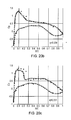
- FIG. 20 shows the plots of the C P distributions achieved with coarse and intermediate meshes, normalised over the wing chord length.
Landscapes
- Engineering & Computer Science (AREA)
- Physics & Mathematics (AREA)
- Geometry (AREA)
- General Physics & Mathematics (AREA)
- Theoretical Computer Science (AREA)
- Automation & Control Theory (AREA)
- Mathematical Optimization (AREA)
- Mathematical Analysis (AREA)
- Computational Mathematics (AREA)
- Pure & Applied Mathematics (AREA)
- Computer Hardware Design (AREA)
- Evolutionary Computation (AREA)
- General Engineering & Computer Science (AREA)
- Aviation & Aerospace Engineering (AREA)
- Processing Or Creating Images (AREA)
- Management, Administration, Business Operations System, And Electronic Commerce (AREA)
Abstract
Description
X=X 0 +sS+tT+uU; (1)
where X0 is the origin of the local co-ordinate system in Cartesian co-ordinates. Note that for any point within the
FFD Advances
where in this case Bi,Bj,Bk are the control points of fourth order Bernstein polynomials. If the chunk is not parallelepiped a numerical search technique is utilised to solve (4) and find the points.
ΔOb=B*ΔP (5)
ΔP=B + ΔOb (6)
-
- a. producing a first computer model of a first geometry, the first computer model comprising:
- i. a set of nodes; and
- ii. a set of construction points each having a position defined by a local co-ordinate system;
- b. producing a computational fluid dynamics (CFD) mesh from the first computer model;
- c. using the CFD mesh to produce a measure of the fluid dynamic performance of the first geometry, such as drag count or lift coefficient;
- d. producing a new computer model of a new geometry by:
- i. moving one or more of the nodes; and
- ii. recalculating the positions of the construction points in response to movement of the one or more nodes;
- e. producing a computational fluid dynamics (CFD) mesh from the new computer model;
- f. using the CFD mesh to produce a measure of the fluid dynamic performance of the new geometry, such as drag count or lift coefficient; and
- g. identifying an optimal geometry using the fluid dynamic performance measurements of the first and new geometries produced in steps c and f.
- a. producing a first computer model of a first geometry, the first computer model comprising:
0≦{Dvar}≦1 (9)
where Dvar defines a vector of normalised design variables.
B. Geometry
-
- At
step 90, the initial twelve design variables are input to the OPTIONS optimisation framework in MATLAB (see below). - The design variables are then decoded in step 92 (i.e. the FFD stage). Design variables are initially defined as a normalised vector between 0 and 1 (see equation 9). Decoding is required to convert this normalised vector to ‘real’ values which relate to lattice deformations;
- The required lattice node deformations are also calculated in step 92 (i.e. the FFD stage). As discussed above, two successive deformations are applied to the
active lattice 70. First, theactive lattice planes 70 a-c (and thus the active lattice 70) are scaled using the boundary curve design variables. Next, using the scaled active lattice, a pair of chunks 86, 88 (seeFIG. 13 ) are defined between the pairs of adjacentactive lattice planes 70 a-70 b and 70 b-70 c. These chunks 86, 88 are defined using chunk nodes (not shown) which are the same in number and have the same initial positions as those in the scaled active lattice planes. The chunks are then deformed using the DM point variables (according to the slight alteration to the explicit direct manipulation solution Hu et al developed as described above). The positions of the deformed chunk nodes are then translated onto the active lattice planes, thus applying a second deformation to theactive lattice planes 70 a-70 c (and thus the active lattice 70). - The geometry is also deformed during step 92 (i.e. the FFD stage). The wing fillet IGES surface is exported from the initial CATIA geometry into MATLAB for deformation in this step using the deformed active lattice positions to produce a new wing fillet IGES surface;
- CATIA model update. The deformed wing
fillet IGES surface 94 is output from theFFD process 92. This new wing fillet IGES surface is combined with the base geometry to produce the CATIA product of the wing fillet and base geometry instep 95. Note that the CATIA (or CAD) model is thus effectively deformed here using FFD. This differs from the typical prior art optimisation technique described in ‘Background Of The Invention’ which involves deforming the CFD mesh using FFD. The advantage of this new technique is that the CATIA (or CAD) model is output directly and precisely from the optimisation process and that no potentially inaccurate reverse engineering techniques are required to obtain the CATIA (or CAD) model from an optimised CFD mesh (as required in existing processes); - CFD grid (or mesh) production. This is done in a commercially available CFD grid generation package such as Harpoon in
step 96. A CFD grid is produced from the CATIA product of the wing fillet and base geometry. This will be explained in more detail in subsection G below; and - CFD analysis of the CFD grid. This is done using a commercially available CFD simulation tool such as FLUENT in
step 98 to produce a measure of the fluid dynamic performance of the geometry, such as drag count or lift coefficient. This is explained in more detail in subsection H below.
- At
Claims (6)
Priority Applications (1)
| Application Number | Priority Date | Filing Date | Title |
|---|---|---|---|
| US12/482,003 US8831913B2 (en) | 2009-06-10 | 2009-06-10 | Method of design optimisation |
Applications Claiming Priority (1)
| Application Number | Priority Date | Filing Date | Title |
|---|---|---|---|
| US12/482,003 US8831913B2 (en) | 2009-06-10 | 2009-06-10 | Method of design optimisation |
Publications (2)
| Publication Number | Publication Date |
|---|---|
| US20100318327A1 US20100318327A1 (en) | 2010-12-16 |
| US8831913B2 true US8831913B2 (en) | 2014-09-09 |
Family
ID=43307142
Family Applications (1)
| Application Number | Title | Priority Date | Filing Date |
|---|---|---|---|
| US12/482,003 Expired - Fee Related US8831913B2 (en) | 2009-06-10 | 2009-06-10 | Method of design optimisation |
Country Status (1)
| Country | Link |
|---|---|
| US (1) | US8831913B2 (en) |
Cited By (3)
| Publication number | Priority date | Publication date | Assignee | Title |
|---|---|---|---|---|
| US10274935B2 (en) | 2016-01-15 | 2019-04-30 | Honeywell Federal Manufacturing & Technologies, Llc | System, method, and computer program for creating geometry-compliant lattice structures |
| US12345178B1 (en) | 2023-12-29 | 2025-07-01 | General Electric Company | Turbofan engine including a fan actuation system |
| US12480415B2 (en) | 2023-12-29 | 2025-11-25 | General Electric Company | Turbofan engine including a fan actuation system |
Families Citing this family (28)
| Publication number | Priority date | Publication date | Assignee | Title |
|---|---|---|---|---|
| US8401827B2 (en) * | 2008-04-14 | 2013-03-19 | Daa Draexlmaier Automotive Of America Llc | Processing device and method for structure data representing a physical structure |
| ES2387170B1 (en) * | 2009-11-30 | 2013-08-20 | Airbus Operations S.L. | METHODS AND SYSTEMS TO OPTIMIZE THE DESIGN OF AERODYNAMIC SURFACES |
| TWI393071B (en) * | 2010-02-12 | 2013-04-11 | 國立清華大學 | Image processing method and system capable of retaining image features |
| US8781993B2 (en) * | 2010-04-09 | 2014-07-15 | Bae Systems Information And Electronic Systems Integration Inc. | Nearly orthogonal latin hypercubes for optimization algorithms |
| CN102306211A (en) * | 2011-07-08 | 2012-01-04 | 南京航空航天大学 | Carrier aircraft landing guiding half-physical emulating system |
| US8949087B2 (en) * | 2012-03-01 | 2015-02-03 | The Boeing Company | System and method for structural analysis |
| KR101358037B1 (en) * | 2012-11-28 | 2014-02-05 | 한국과학기술정보연구원 | Record medium recorded in a structure of file format and directory for massive cfd(computational fuid dynamics) data visualization in parallel, and method for transforming structure of data file format thereof |
| WO2014112948A1 (en) * | 2013-01-21 | 2014-07-24 | Singapore Technologies Aerospace Ltd | Method for improving crosswind stability of a propeller duct and a corresponding apparatus, system and computer readable medium |
| US20160098494A1 (en) * | 2014-10-06 | 2016-04-07 | Brigham Young University | Integration of analysis with multi-user cad |
| CN104992023A (en) * | 2015-07-13 | 2015-10-21 | 南京航空航天大学 | Aircraft parametric design method based on state type function |
| DE102015117181A1 (en) | 2015-10-08 | 2017-04-13 | Airbus Operations Gmbh | An aircraft reconfigurator for reconfiguring an aircraft configuration |
| JP6768348B2 (en) | 2016-05-26 | 2020-10-14 | 三菱重工業株式会社 | Fuselage cross-sectional shape design method, design equipment and design program |
| CN108563885B (en) * | 2018-04-23 | 2022-05-06 | 中国航空工业集团公司沈阳飞机设计研究所 | Method and system for quickly moving wing flutter model beam rib layout |
| CN108763825B (en) * | 2018-06-19 | 2020-12-04 | 广东电网有限责任公司电力科学研究院 | Numerical simulation method for simulating wind field of complex terrain |
| CN108984862B (en) * | 2018-06-27 | 2021-05-07 | 中国直升机设计研究所 | Pneumatic characteristic CFD calculation result correction method |
| WO2020068244A2 (en) * | 2018-09-24 | 2020-04-02 | Bruno Oscar Pablo | General scattered field simulator |
| US10915680B2 (en) * | 2018-12-21 | 2021-02-09 | Dassault Systemes Simulia Corp. | Local control of design patterns on surfaces for enhanced physical properties |
| CN110851912A (en) * | 2019-08-14 | 2020-02-28 | 湖南云顶智能科技有限公司 | Multi-target pneumatic design method for hypersonic aircraft |
| US11928396B2 (en) * | 2019-08-30 | 2024-03-12 | Toyota Motor Engineering & Manufacturing North America, Inc. | Method for quantifying visual differences in automotive aerodynamic simulations |
| US11875091B2 (en) * | 2019-09-05 | 2024-01-16 | Toyota Motor Engineering & Manufacturing North America, Inc. | Method for data-driven comparison of aerodynamic simulations |
| CN111079330A (en) * | 2019-12-09 | 2020-04-28 | 桂林理工大学 | A wind-resistant design method for large-span membrane structures considering fluid-structure interaction effects |
| EP3885851B1 (en) * | 2020-03-26 | 2023-06-28 | Tata Consultancy Services Limited | System and method for optimization of industrial processes |
| CN114372426B (en) * | 2022-01-07 | 2024-12-10 | 中国人民解放军国防科技大学 | An optimization design method and system for isolation sections based on FFD method |
| GB2617197A (en) * | 2022-04-01 | 2023-10-04 | Bae Systems Plc | Vehicle design tool |
| US20230342512A1 (en) * | 2022-04-21 | 2023-10-26 | Ford Global Technologies, Llc | Automotive shape design by combining computational fluid dynamics and generative adversarial networks |
| CN116050009B (en) * | 2022-12-13 | 2024-04-19 | 北京交通大学 | Geometric profile optimization design method for dust collection port of steel rail abrasive belt grinding equipment |
| CN116399554A (en) * | 2023-04-10 | 2023-07-07 | 扬州大学 | A Method for Optimizing Turbulence Model Parameters by Fusion of Airfoil Wind Tunnel Experimental Data |
| CN118966090B (en) * | 2024-10-21 | 2024-12-17 | 中国空气动力研究与发展中心高速空气动力研究所 | Airfoil pressure distribution test result densification method |
Citations (1)
| Publication number | Priority date | Publication date | Assignee | Title |
|---|---|---|---|---|
| US20080275677A1 (en) * | 2007-03-19 | 2008-11-06 | Optimal Solutions Software, Llc | System, methods, and computer readable media, for product design using coupled computer aided engineering models |
-
2009
- 2009-06-10 US US12/482,003 patent/US8831913B2/en not_active Expired - Fee Related
Patent Citations (1)
| Publication number | Priority date | Publication date | Assignee | Title |
|---|---|---|---|---|
| US20080275677A1 (en) * | 2007-03-19 | 2008-11-06 | Optimal Solutions Software, Llc | System, methods, and computer readable media, for product design using coupled computer aided engineering models |
Non-Patent Citations (15)
| Title |
|---|
| Amoiralis et al., Freeform Deformation Versus B-Spline Representation in Inverse Airfoil Design, Jun. 2008, Journal of Computing and Information Science in Engineering, vol. 8, No. 2, pp. 1-13. * |
| Brezillon et al., Aerodynamic Optimization for Cruise and High-Lift Configurations, May 23-24, 2007, Megadesign and MegaOpt -German Initiatives for Aerodynamic Simulation and Optimization in Aircraft Design, Springer Berlin/Heidelberg, vol. 107, pp. 249-262. * |
| Brezillon et al., Aerodynamic Optimization for Cruise and High-Lift Configurations, May 23-24, 2007, Megadesign and MegaOpt —German Initiatives for Aerodynamic Simulation and Optimization in Aircraft Design, Springer Berlin/Heidelberg, vol. 107, pp. 249-262. * |
| Brezillon et al., Aerodynamic Optimization for Cruise and High-Lift Configurations, May 23-24, 2007, Megadesign and MegaOpt-German Initiatives for Aerodynamic Simulation and Optimization in Aircraft Design, Springer Berlin/Heidelberg, vol. 107, pp. 249-262. * |
| Brezillon et al., Aerodynamic Optimization for Cruise and High-Lift Configurations, May 23-24, 2007, Megadesign and MegaOpt—German Initiatives for Aerodynamic Simulation and Optimization in Aircraft Design, Springer Berlin/Heidelberg, vol. 107, pp. 249-262. * |
| Brezillon et al., Development and Application Of A Flexible And Efficient Environment For Aerodynamic Shape Optimisation, 2006, Proceedings of the ONERA-DLR Aerospace Symposium (ODAS), Toulouse, pp. 1-10. * |
| Brezillon et al., Numerical aerodynamic optimisation of 3d high-lift configurations, Sep. 14-19, 2008, 26th International Congress of the Aeronautical Sciences, pp. 1-11. * |
| Desideri and Janka, Multilevel Shape Parameterization for Aerodynamic Optimization: Application to Drag and Noise Reduction of Transonic/Supersonic Business Jet, Jul. 24-28, 2004, ECCOMAS 2004, pp. 1-14. * |
| Dwight and Brezillon, Adjoint Algorithms For The Optimization Of 3d Turbulent Configurations, Jan. 1, 2008, Springer Berlin Heidelberg, New Results in Numerical and Experimental Fluid Mechanics VI, NNFM 96, pp. 194-201. * |
| Huang et al., MetaMorphs: Deformable Shape and Texture Models, 2004, IEEE CVPR Proceedings, pp. 1-8. * |
| Jamshid A. Samareh, Aerodynamic Shape Optimization Based on Free-form Deformation, Jul. 8, 2004, pp. 1-13. * |
| Kuhn et al., Engineering Optimisation by Means of Knowledge Sharing and Reuse, 2008, IFIP International Federation for Information Processing, vol. 277, Computer-Aided Innovation (CAI), pp. 95-106. * |
| Menzel et al., Application of Free form deformation techniques in evolutionary design optimisation, May 30-Jun.3, 2005, 6th World Congress on Structural and Multidisciplinary Optimization, Rio de Janeiro, pp. 1-10. * |
| Ye et al., Reverse innovative design-an integrated product design methodology, Available online Aug. 1, 2007, Computer-Aided Design, vol. 40, Issue 7, Jul. 2008, pp. 812-827. * |
| Ye et al., Reverse innovative design—an integrated product design methodology, Available online Aug. 1, 2007, Computer-Aided Design, vol. 40, Issue 7, Jul. 2008, pp. 812-827. * |
Cited By (3)
| Publication number | Priority date | Publication date | Assignee | Title |
|---|---|---|---|---|
| US10274935B2 (en) | 2016-01-15 | 2019-04-30 | Honeywell Federal Manufacturing & Technologies, Llc | System, method, and computer program for creating geometry-compliant lattice structures |
| US12345178B1 (en) | 2023-12-29 | 2025-07-01 | General Electric Company | Turbofan engine including a fan actuation system |
| US12480415B2 (en) | 2023-12-29 | 2025-11-25 | General Electric Company | Turbofan engine including a fan actuation system |
Also Published As
| Publication number | Publication date |
|---|---|
| US20100318327A1 (en) | 2010-12-16 |
Similar Documents
| Publication | Publication Date | Title |
|---|---|---|
| US8831913B2 (en) | Method of design optimisation | |
| CN100468418C (en) | Method and program for generating volume data from data represented by boundaries | |
| Chougrani et al. | Lattice structure lightweight triangulation for additive manufacturing | |
| Löhner | Progress in grid generation via the advancing front technique | |
| US11763048B2 (en) | Computer simulation of physical fluids on a mesh in an arbitrary coordinate system | |
| Louhichi et al. | CAD/CAE integration: updating the CAD model after a FEM analysis | |
| Rozza et al. | Free Form Deformation techniques applied to 3D shape optimization problems | |
| Gagnon et al. | Two-level free-form deformation for high-fidelity aerodynamic shape optimization | |
| Xu et al. | Wing-body junction optimisation with CAD-based parametrisation including a moving intersection | |
| Arisoy et al. | Design and topology optimization of lattice structures using deformable implicit surfaces for additive manufacturing | |
| EP2752819A2 (en) | Medial surface generation | |
| Anderson et al. | Parametric deformation of discrete geometry for aerodynamic shape design | |
| Schuff et al. | Advanced CFD-CSD coupling: Generalized, high performant, radial basis function based volume mesh deformation algorithm for structured, unstructured and overlapping meshes | |
| Gomez et al. | Analysis driven shape design using free-form deformation of parametric CAD geometry | |
| Ning et al. | A grid generator for 3-D explosion simulations using the staircase boundary approach in Cartesian coordinates based on STL models | |
| CN112395746A (en) | Method for calculating property of equivalent material of microstructure family, microstructure, system and medium | |
| Gomez et al. | On analysis driven shape design using B-splines | |
| Nurdin et al. | Shape optimisation using CAD linked free-form deformation | |
| Chauhan et al. | Wing shape optimization using FFD and twist parameterization | |
| Brezillon et al. | Development and application of a flexible and efficient environment for aerodynamic shape optimisation | |
| Takenaka et al. | The Application of MDO Technologies to the Design of a High Performance Small Jet Aircraft-Lessons learned and some practical concerns | |
| Denk et al. | Procedural concept design with computer graphic applications for light-weight structures using blender with subdivision surfaces | |
| US20240061979A1 (en) | Differentiable parametric computer-assisted design solution | |
| Ronzheimer | Aircraft geometry parameterization with high-end CAD-software for design optimization | |
| Lakshminarayan et al. | Fully Automated Surface Mesh Adaptation in Strand Grid Framework |
Legal Events
| Date | Code | Title | Description |
|---|---|---|---|
| AS | Assignment |
Owner name: AIRBUS UK LIMITED, UNITED KINGDOM Free format text: ASSIGNMENT OF ASSIGNORS INTEREST;ASSIGNORS:HOLDEN, CARREN;NURDIN, ADAM;BRESSLOFF, NEIL W.;AND OTHERS;SIGNING DATES FROM 20090601 TO 20090604;REEL/FRAME:022807/0295 |
|
| AS | Assignment |
Owner name: AIRBUS OPERATIONS LIMITED, UNITED KINGDOM Free format text: CHANGE OF NAME;ASSIGNOR:AIRBUS UK LIMITED;REEL/FRAME:033092/0833 Effective date: 20090617 |
|
| FEPP | Fee payment procedure |
Free format text: MAINTENANCE FEE REMINDER MAILED (ORIGINAL EVENT CODE: REM.) |
|
| LAPS | Lapse for failure to pay maintenance fees |
Free format text: PATENT EXPIRED FOR FAILURE TO PAY MAINTENANCE FEES (ORIGINAL EVENT CODE: EXP.); ENTITY STATUS OF PATENT OWNER: LARGE ENTITY |
|
| STCH | Information on status: patent discontinuation |
Free format text: PATENT EXPIRED DUE TO NONPAYMENT OF MAINTENANCE FEES UNDER 37 CFR 1.362 |
|
| FP | Lapsed due to failure to pay maintenance fee |
Effective date: 20180909 |