US8831763B1 - Intelligent interest point pruning for audio matching - Google Patents
Intelligent interest point pruning for audio matching Download PDFInfo
- Publication number
- US8831763B1 US8831763B1 US13/276,316 US201113276316A US8831763B1 US 8831763 B1 US8831763 B1 US 8831763B1 US 201113276316 A US201113276316 A US 201113276316A US 8831763 B1 US8831763 B1 US 8831763B1
- Authority
- US
- United States
- Prior art keywords
- interest points
- overlap
- distortion
- distorted
- interest
- Prior art date
- Legal status (The legal status is an assumption and is not a legal conclusion. Google has not performed a legal analysis and makes no representation as to the accuracy of the status listed.)
- Active, expires
Links
Images


Classifications
-
- G—PHYSICS
- G10—MUSICAL INSTRUMENTS; ACOUSTICS
- G10L—SPEECH ANALYSIS TECHNIQUES OR SPEECH SYNTHESIS; SPEECH RECOGNITION; SPEECH OR VOICE PROCESSING TECHNIQUES; SPEECH OR AUDIO CODING OR DECODING
- G10L25/00—Speech or voice analysis techniques not restricted to a single one of groups G10L15/00 - G10L21/00
- G10L25/48—Speech or voice analysis techniques not restricted to a single one of groups G10L15/00 - G10L21/00 specially adapted for particular use
- G10L25/51—Speech or voice analysis techniques not restricted to a single one of groups G10L15/00 - G10L21/00 specially adapted for particular use for comparison or discrimination
- G10L25/54—Speech or voice analysis techniques not restricted to a single one of groups G10L15/00 - G10L21/00 specially adapted for particular use for comparison or discrimination for retrieval
-
- G—PHYSICS
- G10—MUSICAL INSTRUMENTS; ACOUSTICS
- G10L—SPEECH ANALYSIS TECHNIQUES OR SPEECH SYNTHESIS; SPEECH RECOGNITION; SPEECH OR VOICE PROCESSING TECHNIQUES; SPEECH OR AUDIO CODING OR DECODING
- G10L25/00—Speech or voice analysis techniques not restricted to a single one of groups G10L15/00 - G10L21/00
- G10L25/78—Detection of presence or absence of voice signals
- G10L25/87—Detection of discrete points within a voice signal
Definitions
- This application relates to audio matching, and more particularly to interest point pruning.
- Audio samples can be recorded by many commercially available electronic devices such as smart phones, tablets, e-readers, computers, personal digital assistants, personal media players, etc. Audio matching provides for the identification of a recorded audio sample by comparing the audio sample to a set of reference samples. To make the comparison, an audio sample can be transformed to a time-frequency representation of the sample by using, for example, a short time Fourier transform (STFT). Using the time-frequency representation, interest points that characterize time and/or frequency locations of peaks or other distinct patterns of the spectrogram can then be extracted from the audio sample. Fingerprints or descriptors can then be computed as functions of sets of interest points. Fingerprints of the audio sample can then be compared to fingerprints of reference samples to determine identity of the audio sample.
- STFT short time Fourier transform
- an audio matching system contain interest points that are robust to the presence of noise, pitch shifting, time stretching, compression techniques, or other types of distortion in the audio sample that can prevent accurate identification of the audio sample.
- fingerprints are computed as functions of sets of interest points, the more interest points present in a fingerprint, the less scalable the audio matching system becomes.
- a distortion component can generate a plurality of distorted audio samples based upon a clean audio sample and an intensity of distortion.
- An interest point detection component can generate a set of clean interest points based upon the clean audio sample and a plurality of sets of distorted interest points based upon the plurality of distorted audio samples.
- a merging component can determine amount of overlap based upon the clean interest points and the plurality of sets of distorted interested points.
- a pruning component can determine a set of pruned interest points based upon the amount of overlap and an overlap factor.
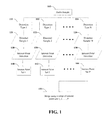
- FIG. 1 illustrates a graphical block diagram example of intelligent interest point pruning
- FIG. 2 illustrates a high-level functional block diagram of an example intelligent interest point pruning system
- FIG. 3 illustrates a high-level functional block diagram of an example intelligent interest point pruning system adjusting for density
- FIG. 4 illustrates an example methodology for intelligent interest point pruning
- FIG. 5 illustrates an example methodology for intelligent interest point pruning adjusting for density
- FIG. 6 illustrates an example schematic block diagram for a computing environment in accordance with the subject specification.
- FIG. 7 illustrates an example block diagram of a computer operable to execute the disclosed architecture.
- Audio matching in general involves analyzing an audio sample for unique characteristics that can be used in comparison to unique characteristics of reference samples to identify the audio sample.
- One way to identify unique characteristics of an audio sample is through the use of a spectrogram.
- a spectrogram represents an audio sample by plotting time on the horizontal axis and frequency on the vertical axis. Additionally, amplitude or intensity of a certain frequency at a certain time can also be incorporated into the spectrogram by using color or a third dimension.
- One technique involves using a series of band-pass filters that can filter an audio sample at a specific frequency and measure amplitude of the audio sample at that specific frequency over time.
- the audio sample can be run through additional filters to individually isolate a set of frequencies to measure amplitude of the set over time.
- a spectrogram can be created by combining all frequency measurements over time on a frequency axis which creates a spectrogram image of frequency amplitudes over time.
- a second technique involves using short-time Fourier transform (“STFT”) to break down an audio sample into time windows, where each window is Fourier transformed to calculate a magnitude of the frequency spectrum for the duration of each window. Combining a set of windows side by side on a time axis of the spectrogram creates an image of frequency amplitudes over time.
- STFT short-time Fourier transform
- Other techniques such as wavelet transforms, can also be used to construct a spectrogram.
- Creating and storing in a database an entire spectrogram for a set of reference samples can require large amounts of storage space and affect scalability of an audio matching system. Therefore, it is desirable to instead calculate and store compact descriptors (“fingerprints”) of reference samples versus an entire spectrogram.
- One method of calculating fingerprints is to first calculate individual interest points that identify unique characteristics of local features of the time-frequency representation of the reference sample. Fingerprints can then be computed as functions of sets of interest points.
- an interest point can be a spectral peak of a specific frequency over a specific window of time.
- an interest point can also include timing of onset of a note. Any suitable unique spectral event over a specific duration of time can constitute an interest point.
- An audio matching system that includes reference fingerprints with many interest points will generally be more robust to distortion.
- a set of clean interest points can be calculated for an audio sample lacking distortion.
- a separate set of distorted interest points can be calculated for the same audio sample suffering from various types of distortion.
- type or intensity of distortion in the second audio sample it is unlikely that every interest point in the set of clean interest points will also be present in the set of distorted interest points.
- a distorted sample may have spectral peaks that become less prominent or alternatively lose a spectral peak entirely as compared to a clean sample of the same audio.
- the distorted sample may retain the same spectral peaks as the clean sample of the same audio.
- a subset of the clean interest points in this example those relating to spectral peaks, may be present in the set of distorted interest points. Therefore, by including more interest points in a reference fingerprint, it is more likely that a subset of the clean interest points will be present in a set of distorted interest points.
- Systems and methods herein provide for taking a clean audio sample and introducing the sample to various types of distortion.
- a separate set of interest points can then be calculated for each distorted variation of the audio sample. From the sets of distorted interest points, it can be determined which interest points are common to or overlap with the most sets of distorted points.
- the system can intelligently select specific interest points that are present in the most sets of distorted interest points while pruning those interest points that are less robust to distortion.
- a set of pruned interest points can be generated that increases scalability while retaining robustness to distortion.
- Certain embodiments of systems and methods herein can also adjust density of pruned interest points allowing an audio matching system to maintain a highly efficient balance between scalability and accuracy.
- various implementations provide for using intelligent interest point pruning methods to improve audio matching performance for samples suffering from distortion while also maintaining scalability.
- N types of distortion are introduced to audio sample 102 creating M distorted audio samples 120 , 122 , and 124 (M is an integer).
- the types of distortion can include pitch shifting, time stretching, compression techniques, noise, etc. It can be appreciated that multiple types of distortion can be applied at once as a distortion. It can also be appreciated that certain types of distortion may be more useful for audio samples from certain sources. For example, pitch shifting and time stretching may be particularly useful for audio samples such as tracks played on or through the radio.
- an audio sample can be pitch shifted by shifting each note up or down in the scale by differing levels.
- introducing differing levels of, for example, pitch shifting distortion, into sample 102 can constitute different types of distortion 110 , 112 , and 114 .
- P sets of interest points 140 , 142 , and 144 (P is an integer) can then be generated by interest point detection methods 130 .
- P sets of interest points 140 , 142 , and 144 can be merged to determine which interest points are common to the most of the P sets of interest points 140 , 142 , and 144 . Therefore, interest points 150 are identified that most robustly withstand differing types of distortion 110 , 112 , and 114 .
- intelligent interest point pruning is accomplished that reduces the amount of interest points necessary in generating a fingerprint while still maintaining robustness to distortion.
- two of the integers may be the same and the third different.
- the three integers differ from each other.
- FIG. 2 illustrates a high level functional block diagram of a non-limiting example interest point pruning system 200 .
- Distortion component 210 can generate a plurality of distorted audio samples based upon clean audio sample 102 and at least one of a type of distortion and an intensity of distortion. It can be appreciated that relevant transforms 206 , including codecs, necessary to introduce a type of distortion can be stored in memory 204 and utilized by distortion component 210 to generate the plurality of distorted audio samples.
- the type of distortion applied can for example include noise, introducing compression codecs, pitch shifting, time stretching etc.
- Compression codecs can include, for example, advanced audio coding (AAC), High-Efficiency Advanced Audio Coding (AAC+), Free Lossless Audio Codec (FLAC), MP3, Ogg. RealAudio, Vorbis, Waveform Audio File Format (WAV), and Windows Media Audio (WMA).
- An intensity of distortion can be used to adjust intensity of certain types of distortion.
- an intensity of distortion associated with noise levels can adjust severity of noise introduced into clean audio sample 102 .
- an intensity of distortion can reflect the level of compression, i.e. reducing the bitrate or increasing the percentage of speedup applied to the clean audio sample. Some types of distortion may not be suitable to adjusting an intensity of distortion.
- multiple transforms 206 can be stored in memory representing varying levels of intensity of distortion.
- the intensity of distortion can be determined by user input, predetermined thresholds indicative of utility, or a threshold based upon machine learning.
- an intensity of distortion that is too high can create distorted audio samples and corresponding sets of distorted interest points that have little overlap with a set of clean interest points.
- too many interest points may be pruned, due to the low amount of overlap, which can prevent accurate identification of audio samples using the overly pruned interest point set.
- using an intensity of distortion that is too low can create distorted audio samples and corresponding sets of distorted interest points that overlap nearly completely with a set of clean interest points.
- too many interest points may be retained in the set of pruned interest points, which can reduce the benefits of scalability associated with the disclosed systems and methods herein. Therefore, it can be further appreciated that an intensity of distortion based upon a predetermined threshold indicative of utility can seek the most useful balance between accuracy and scalability.
- Interest point detection component 220 can generate a plurality of sets of distorted interest points based upon the plurality of distorted audio samples. In one implementation, interest point detection component 220 can further generate a set of clean interest points based upon clean audio sample 102 .
- Merging component 230 can determine an amount of overlap based upon the plurality of sets of distorted interest points. For example, the amount of overlap can represent a percentage of sets of distorted interest points that an individual interest point is present in. In one implementation, merging component 230 can determine amount of overlap for each individual interest point detected by interest point detection component 220 .
- merging component 230 can reduce and/or remove distortion from a set of distorted interest points prior to determining the amount of overlap. For example, the effects of time-stretching or pitch shifting can be eliminated based upon the intensity with which either type of distortion was applied. It can be appreciated that some sets of distorted interest points are based upon multiple types of distortion being introduced to clean audio sample 102 by distortion component 210 .
- merging component 230 can determine the amount of overlap further based upon a set of clean interest points. It can be appreciated that merging component 230 can compare the plurality of sets of distorted interest points to the set of clean interest points and determine amount of overlap for strictly the clean interest points.
- Pruning component 240 can determine a set of pruned interest points 202 based upon the amount of overlap and an overlap factor.
- the overlap factor can set a threshold that the amount of overlap must meet to be included in the set of pruned interest points. It can be appreciated that the overlap factor can be determined by a user input, a predetermined threshold indicative of utility and/or machine learning.
- an overlap factor that sets the threshold that the amount of overlap must meet as too high may prune too many interest points.
- pruning too many interest points can prevent accurate identification of audio samples when using the overly pruned interest point set for audio matching.
- using an overlap factor that sets the threshold that the amount of overlap must meet as too low may not prune enough interest points.
- too many interest points may be retained in the set of pruned interest points, which can reduce the benefits of scalability associated with the disclosed systems and methods herein. Therefore, it can be further appreciated that an overlap factor based upon a predetermined threshold indicative of utility can seek the most useful balance between accuracy and scalability.
- FIG. 3 illustrated is a high-level functional block diagram of intelligent interest point pruning system 200 including density component 310 that can adjust density of the set of pruned interest points based upon desired density.
- the density can be adjusted to either increase or decrease the amount of interest points in the set of pruned interest points.
- the desired density can be determined by at least one of a user input, a predetermined threshold indicative of utility, or a threshold based upon machine learning.
- a predetermined threshold indicative of utility For example, in an audio matching system where the set of pruned interest points are used to calculate a fingerprint of a reference sample, the success or failure of the reference fingerprint based upon the set of pruned interest points can be determined.
- repeated successful performance of a certain density of pruned interest points in an audio matching system could lead to reducing the density of pruned interest points to increase scalability.
- repeated failure of a certain density of pruned interest points in an audio matching system could lead to increasing the density of pruned interest points to improve accuracy. Therefore, it can be further appreciated that the in determining the desired density, systems and methods disclosed herein, can seek the most useful balance between accuracy and scalability.
- density component 310 can reduce the density of the set of pruned interest points by at least one of selecting a random subset, increasing the intensity of distortion, or adjusting the overlap factor. It can be appreciated that increasing the intensity of distortion can result in reduction of the amount of overlap. It can be further appreciated that adjusting the overlap factor may raise the amount of overlap threshold required for an interest point to remain in the set of pruned interest points.
- density component 310 can increase the density of the set of pruned interest points by at least one of decreasing the intensity of distortion or adjusting the overlap factor. It can be appreciated that decreasing the intensity of distortion can result in an increase in the amount of overlap. It can be further appreciated that adjusting the overlap factor can lower the amount of overlap threshold required for an interest point to remain in the set of pruned interest points.
- FIGS. 4-5 illustrate methodologies and/or flow diagrams in accordance with this disclosure.
- the methodologies are depicted and described as a series of acts. However, acts in accordance with this disclosure can occur in various orders and/or concurrently, and with other acts not presented and described herein. Furthermore, not all illustrated acts may be required to implement the methodologies in accordance with the disclosed subject matter.
- the methodologies could alternatively be represented as a series of interrelated states via a state diagram or events.
- the methodologies disclosed in this specification are capable of being stored on an article of manufacture to facilitate transporting and transferring such methodologies to computing devices.
- the term article of manufacture, as used herein, is intended to encompass a computer program accessible from any computer-readable device or storage media.
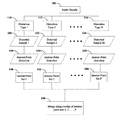
- FIG. 4 illustrates an example methodology 400 for intelligent interest point pruning.
- a set of clean interest points is generated (e.g., by an interest point detection component 220 ) based upon a clean audio sample.
- a plurality of distorted audio samples are generated (e.g., by a distortion component 210 ) based upon the clean audio sample and at least one of a type of distortion or an intensity of distortion. It can be appreciated that the intensity of distortion can be based upon at least one of a user input, a predetermined threshold indicative of utility, or a threshold based upon machine learning.
- a plurality of sets of distorted interest points are generated (e.g., by an interest point detection component 220 ) based upon the plurality of distorted audio samples.
- an amount of overlap is determined (e.g., by merging component 230 ) based upon the set of clean interest points and the plurality of sets of distorted interest points. It can be appreciated that the overlap factor can be determined based upon at least one of a user input, a predetermined threshold indicative of utility, or a threshold based upon machine learning. In one implementation, the method provides for eliminating the type of distortion from a set of distorted interest points prior to determining the amount of overlap.
- a set of pruned interest points is generated (e.g., by pruning component 240 ) based upon the set of clean interest points, the amount of overlap, and a overlap factor.
- FIG. 5 illustrates an example methodology 500 for intelligent interest point pruning including adjusting for density.
- a set of clean interests points is generated (e.g., by a interest point detection component 220 ) based upon a clean audio sample.
- a plurality of distorted audio samples are generated (e.g., by distortion component 210 ) based upon a clean audio sample and at least one of a type of distortion or an intensity of distortion.
- a plurality of sets of distorted interest points are generated (e.g., by interest point detection component 220 ) based upon the plurality of distorted audio samples.
- an amount of overlap is determined (e.g., by merging component 230 ) based upon the set of clean interest points and the plurality of sets of distorted interest points.
- a set of pruned interest points is generated (e.g., by pruning component 240 ) based upon the set of clean interest points, the amount of overlap, and an overlap factor.
- the density of the set of pruned interest points can be adjusted (e.g., by density component 310 ) based upon a desired density.
- the desired density can be at least one of a user input, a predetermined threshold indicative of utility, or a threshold based upon probabilistic machine learning.
- the density can be adjusted by, for example, selecting a random subset of pruned interest points, adjusting the intensity of distortion, and/or adjusting the overlap factor.
- components described herein can examine the entirety or a subset of data available and can provide for reasoning about or infer states of an audio sample, a system, environment, and/or client device from a set of observations as captured via events and/or data.
- Inference can be employed to identify a specific context or action, or can generate a probability distribution over states, for example.
- the inference can be probabilistic—that is, the computation of a probability distribution over states of interest based upon a consideration of data and events.
- Inference can also refer to techniques employed for composing higher-level events from a set of events and/or data.
- Such inference can result in the construction of new events or actions from a set of observed events and/or stored event data, whether or not the events are correlated in close temporal proximity, and whether the events and data come from one or several event and data sources.
- Various classification (explicitly and/or implicitly trained) schemes and/or systems e.g., support vector machines, neural networks, expert systems, Bayesian belief networks, fuzzy logic, data fusion engines . . . ) can be employed in connection with performing automatic and/or inferred action in connection with the claimed subject matter.
- Such classification can employ a probabilistic and/or statistical-based analysis (e.g., factoring into the analysis utilities and costs) to prognose or infer an action that a user desires to be automatically performed.
- a support vector machine (SVM) is an example of a classifier that can be employed. The SVM operates by finding a hyper-surface in the space of possible inputs, where the hyper-surface attempts to split the triggering criteria from the non-triggering events.
- Other directed and undirected model classification approaches include, e.g., na ⁇ ve Bayes, Bayesian networks, decision trees, neural networks, fuzzy logic models, and probabilistic classification models providing different patterns of independence can be employed. Classification as used herein also is inclusive of statistical regression that is utilized to develop models of priority.
- a component may be, but is not limited to being, a process running on a processor (e.g., digital signal processor), a processor, an object, an executable, a thread of execution, a program, and/or a computer.
- a processor e.g., digital signal processor
- an application running on a controller and the controller can be a component.
- One or more components may reside within a process and/or thread of execution and a component may be localized on one computer and/or distributed between two or more computers.
- a “device” can come in the form of specially designed hardware; generalized hardware made specialized by the execution of software thereon that enables hardware to perform specific functions (e.g., generating interest points and/or fingerprints); software on a computer readable medium; or a combination thereof.
- one or more components may be combined into a single component providing aggregate functionality or divided into several separate sub-components, and any one or more middle layers, such as a management layer, may be provided to communicatively couple to such sub-components in order to provide integrated functionality.
- middle layers such as a management layer
- Any components described herein may also interact with one or more other components not specifically described herein but known by those of skill in the art.
- example or “exemplary” are used herein to mean serving as an example, instance, or illustration. Any aspect or design described herein as “exemplary” is not necessarily to be construed as preferred or advantageous over other aspects or designs. Rather, use of the words “example” or “exemplary” is intended to present concepts in a concrete fashion.
- the term “or” is intended to mean an inclusive “or” rather than an exclusive “or”. That is, unless specified otherwise, or clear from context, “X employs A or B” is intended to mean any of the natural inclusive permutations.
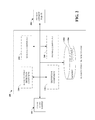
- a suitable environment 600 for implementing various aspects of the claimed subject matter includes a computer 602 .
- the computer 602 includes a processing unit 604 , a system memory 606 , a codec 605 , and a system bus 608 .
- the system bus 608 couples system components including, but not limited to, the system memory 606 to the processing unit 604 .
- the processing unit 604 can be any of various available processors. Dual microprocessors and other multiprocessor architectures also can be employed as the processing unit 604 .
- the system bus 608 can be any of several types of bus structure(s) including the memory bus or memory controller, a peripheral bus or external bus, and/or a local bus using any variety of available bus architectures including, but not limited to, Industrial Standard Architecture (ISA), Micro-Channel Architecture (MSA), Extended ISA (EISA), Intelligent Drive Electronics (IDE), VESA Local Bus (VLB), Peripheral Component Interconnect (PCI), Card Bus, Universal Serial Bus (USB), Advanced Graphics Port (AGP), Personal Computer Memory Card International Association bus (PCMCIA), Firewire (IEEE 1394), and Small Computer Systems Interface (SCSI).
- ISA Industrial Standard Architecture
- MSA Micro-Channel Architecture
- EISA Extended ISA
- IDE Intelligent Drive Electronics
- VLB VESA Local Bus
- PCI Peripheral Component Interconnect
- Card Bus Universal Serial Bus
- USB Universal Serial Bus
- AGP Advanced Graphics Port
- PCMCIA Personal Computer Memory Card International Association bus
- Firewire IEEE 1394
- SCSI Small Computer Systems Interface
- the system memory 606 includes volatile memory 610 and non-volatile memory 612 .
- the basic input/output system (BIOS) containing the basic routines to transfer information between elements within the computer 602 , such as during start-up, is stored in non-volatile memory 612 .
- non-volatile memory 612 can include read only memory (ROM), programmable ROM (PROM), electrically programmable ROM (EPROM), electrically erasable programmable ROM (EEPROM), or flash memory.
- Volatile memory 610 includes random access memory (RAM), which acts as external cache memory. According to present aspects, the volatile memory may store the write operation retry logic (not shown in FIG. 6 ) and the like.
- RAM is available in many forms such as static RAM (SRAM), dynamic RAM (DRAM), synchronous DRAM (SDRAM), double data rate SDRAM (DDR SDRAM), enhanced SDRAM (ESDRAM).
- Disk storage 614 includes, but is not limited to, devices like a magnetic disk drive, solid state disk (SSD) floppy disk drive, tape drive, Jaz drive, Zip drive, LS-100 drive, flash memory card, or memory stick.
- disk storage 614 can include storage media separately or in combination with other storage media including, but not limited to, an optical disk drive such as a compact disk ROM device (CD-ROM), CD recordable drive (CD-R Drive), CD rewritable drive (CD-RW Drive) or a digital versatile disk ROM drive (DVD-ROM).
- CD-ROM compact disk ROM
- CD-R Drive CD recordable drive
- CD-RW Drive CD rewritable drive
- DVD-ROM digital versatile disk ROM drive
- a removable or non-removable interface is typically used, such as interface 616 .
- FIG. 6 describes software that acts as an intermediary between users and the basic computer resources described in the suitable operating environment 600 .
- Such software includes an operating system 618 .
- Operating system 618 which can be stored on disk storage 614 , acts to control and allocate resources of the computer system 602 .
- Applications 620 take advantage of the management of resources by operating system 618 through program modules 624 , and program data 626 , such as the boot/shutdown transaction table and the like, stored either in system memory 606 or on disk storage 614 . It is to be appreciated that the claimed subject matter can be implemented with various operating systems or combinations of operating systems.
- a user enters commands or information into the computer 602 through input device(s) 628 .
- Input devices 628 include, but are not limited to, a pointing device such as a mouse, trackball, stylus, touch pad, keyboard, microphone, joystick, game pad, satellite dish, scanner, TV tuner card, digital camera, digital video camera, web camera, and the like.
- These and other input devices connect to the processing unit 604 through the system bus 608 via interface port(s) 630 .
- Interface port(s) 630 include, for example, a serial port, a parallel port, a game port, and a universal serial bus (USB).
- Output device(s) 636 use some of the same type of ports as input device(s) 628 .
- a USB port may be used to provide input to computer 602 , and to output information from computer 602 to an output device 636 .
- Output adapter 634 is provided to illustrate that there are some output devices 636 like monitors, speakers, and printers, among other output devices 636 , which require special adapters.
- the output adapters 634 include, by way of illustration and not limitation, video and sound cards that provide a means of connection between the output device 636 and the system bus 608 . It should be noted that other devices and/or systems of devices provide both input and output capabilities such as remote computer(s) 638 .
- Computer 602 can operate in a networked environment using logical connections to one or more remote computers, such as remote computer(s) 638 .
- the remote computer(s) 638 can be a personal computer, a server, a router, a network PC, a workstation, a microprocessor based appliance, a peer device, a smart phone, a tablet, or other network node, and typically includes many of the elements described relative to computer 602 .
- only a memory storage device 640 is illustrated with remote computer(s) 638 .
- Remote computer(s) 638 is logically connected to computer 602 through a network interface 642 and then connected via communication connection(s) 644 .
- Network interface 642 encompasses wire and/or wireless communication networks such as local-area networks (LAN) and wide-area networks (WAN) and cellular networks.
- LAN technologies include Fiber Distributed Data Interface (FDDI), Copper Distributed Data Interface (CDDI), Ethernet, Token Ring and the like.
- WAN technologies include, but are not limited to, point-to-point links, circuit switching networks like Integrated Services Digital Networks (ISDN) and variations thereon, packet switching networks, and Digital Subscriber Lines (DSL).
- ISDN Integrated Services Digital Networks
- DSL Digital Subscriber Lines
- Communication connection(s) 644 refers to the hardware/software employed to connect the network interface 642 to the bus 608 . While communication connection 644 is shown for illustrative clarity inside computer 602 , it can also be external to computer 602 .
- the hardware/software necessary for connection to the network interface 642 includes, for exemplary purposes only, internal and external technologies such as, modems including regular telephone grade modems, cable modems and DSL modems, ISDN adapters, and wired and wireless Ethernet cards, hubs, and routers.
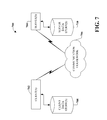
- the system 700 includes one or more client(s) 702 , which can include an application or a system that accesses a service on the server 704 .
- the client(s) 702 can be hardware and/or software (e.g., threads, processes, computing devices).
- the client(s) 702 can house cookie(s), metadata and/or associated contextual information by employing the specification, for example.
- the system 700 also includes one or more server(s) 704 .
- the server(s) 704 can also be hardware or hardware in combination with software (e.g., threads, processes, computing devices).
- the servers 704 can house threads to perform, for example, interest point detection, distorting, merging, pruning, mixing, fingerprint generation, matching score generation, or fingerprint comparisons in accordance with the subject disclosure.
- One possible communication between a client 702 and a server 704 can be in the form of a data packet adapted to be transmitted between two or more computer processes where the data packet contains, for example, an audio sample.
- the data packet can include a cookie and/or associated contextual information, for example.
- the system 700 includes a communication framework 1506 (e.g., a global communication network such as the Internet) that can be employed to facilitate communications between the client(s) 702 and the server(s) 704 .
- a communication framework 1506 e.g., a global communication network such as the Internet
- Communications can be facilitated via a wired (including optical fiber) and/or wireless technology.
- the client(s) 702 are operatively connected to one or more client data store(s) 708 that can be employed to store information local to the client(s) 702 (e.g., cookie(s) and/or associated contextual information).
- the server(s) 704 are operatively connected to one or more server data store(s) 710 that can be employed to store information local to the servers 704 .
- the illustrated aspects of the disclosure may also be practiced in distributed computing environments where certain tasks are performed by remote processing devices that are linked through a communications network.
- program modules can be located in both local and remote memory storage devices.
- the terms used to describe such components are intended to correspond, unless otherwise indicated, to any component which performs the specified function of the described component (e.g., a functional equivalent), even though not structurally equivalent to the disclosed structure, which performs the function in the herein illustrated exemplary aspects of the claimed subject matter.
- the innovation includes a system as well as a computer-readable storage medium having computer-executable instructions for performing the acts and/or events of the various methods of the claimed subject matter.
Landscapes
- Engineering & Computer Science (AREA)
- Computational Linguistics (AREA)
- Signal Processing (AREA)
- Health & Medical Sciences (AREA)
- Audiology, Speech & Language Pathology (AREA)
- Human Computer Interaction (AREA)
- Physics & Mathematics (AREA)
- Acoustics & Sound (AREA)
- Multimedia (AREA)
- Information Retrieval, Db Structures And Fs Structures Therefor (AREA)
Abstract
Description
Claims (22)
Priority Applications (1)
| Application Number | Priority Date | Filing Date | Title |
|---|---|---|---|
| US13/276,316 US8831763B1 (en) | 2011-10-18 | 2011-10-18 | Intelligent interest point pruning for audio matching |
Applications Claiming Priority (1)
| Application Number | Priority Date | Filing Date | Title |
|---|---|---|---|
| US13/276,316 US8831763B1 (en) | 2011-10-18 | 2011-10-18 | Intelligent interest point pruning for audio matching |
Publications (1)
| Publication Number | Publication Date |
|---|---|
| US8831763B1 true US8831763B1 (en) | 2014-09-09 |
Family
ID=51455304
Family Applications (1)
| Application Number | Title | Priority Date | Filing Date |
|---|---|---|---|
| US13/276,316 Active 2032-05-10 US8831763B1 (en) | 2011-10-18 | 2011-10-18 | Intelligent interest point pruning for audio matching |
Country Status (1)
| Country | Link |
|---|---|
| US (1) | US8831763B1 (en) |
Cited By (4)
| Publication number | Priority date | Publication date | Assignee | Title |
|---|---|---|---|---|
| US20170034263A1 (en) * | 2015-07-30 | 2017-02-02 | Amp Me Inc. | Synchronized Playback of Streamed Audio Content by Multiple Internet-Capable Portable Devices |
| US11069334B2 (en) * | 2018-08-13 | 2021-07-20 | Carnegie Mellon University | System and method for acoustic activity recognition |
| US11086931B2 (en) * | 2018-12-31 | 2021-08-10 | Audiobyte Llc | Audio and visual asset matching platform including a master digital asset |
| US11556795B2 (en) | 2019-05-08 | 2023-01-17 | Samsung Electronics Co., Ltd. | Computing device for training artificial neural network model, method of training the artificial neural network model, and memory system for storing the same |
Citations (10)
| Publication number | Priority date | Publication date | Assignee | Title |
|---|---|---|---|---|
| US20020023020A1 (en) | 1999-09-21 | 2002-02-21 | Kenyon Stephen C. | Audio identification system and method |
| US6453252B1 (en) | 2000-05-15 | 2002-09-17 | Creative Technology Ltd. | Process for identifying audio content |
| US6721488B1 (en) | 1999-11-30 | 2004-04-13 | Koninklijke Philips Electronics N.V. | Method and apparatus to identify sequential content stored on a storage medium |
| US20080201140A1 (en) * | 2001-07-20 | 2008-08-21 | Gracenote, Inc. | Automatic identification of sound recordings |
| US20090012638A1 (en) | 2007-07-06 | 2009-01-08 | Xia Lou | Feature extraction for identification and classification of audio signals |
| US7516074B2 (en) * | 2005-09-01 | 2009-04-07 | Auditude, Inc. | Extraction and matching of characteristic fingerprints from audio signals |
| US20090265174A9 (en) * | 2002-04-25 | 2009-10-22 | Wang Avery L | Robust and invariant audio pattern matching |
| US7809580B2 (en) | 2004-11-04 | 2010-10-05 | Koninklijke Philips Electronics N.V. | Encoding and decoding of multi-channel audio signals |
| US7921296B2 (en) * | 2001-02-12 | 2011-04-05 | Gracenote, Inc. | Generating and matching hashes of multimedia content |
| US8341412B2 (en) * | 2005-12-23 | 2012-12-25 | Digimarc Corporation | Methods for identifying audio or video content |
-
2011
- 2011-10-18 US US13/276,316 patent/US8831763B1/en active Active
Patent Citations (10)
| Publication number | Priority date | Publication date | Assignee | Title |
|---|---|---|---|---|
| US20020023020A1 (en) | 1999-09-21 | 2002-02-21 | Kenyon Stephen C. | Audio identification system and method |
| US6721488B1 (en) | 1999-11-30 | 2004-04-13 | Koninklijke Philips Electronics N.V. | Method and apparatus to identify sequential content stored on a storage medium |
| US6453252B1 (en) | 2000-05-15 | 2002-09-17 | Creative Technology Ltd. | Process for identifying audio content |
| US7921296B2 (en) * | 2001-02-12 | 2011-04-05 | Gracenote, Inc. | Generating and matching hashes of multimedia content |
| US20080201140A1 (en) * | 2001-07-20 | 2008-08-21 | Gracenote, Inc. | Automatic identification of sound recordings |
| US20090265174A9 (en) * | 2002-04-25 | 2009-10-22 | Wang Avery L | Robust and invariant audio pattern matching |
| US7809580B2 (en) | 2004-11-04 | 2010-10-05 | Koninklijke Philips Electronics N.V. | Encoding and decoding of multi-channel audio signals |
| US7516074B2 (en) * | 2005-09-01 | 2009-04-07 | Auditude, Inc. | Extraction and matching of characteristic fingerprints from audio signals |
| US8341412B2 (en) * | 2005-12-23 | 2012-12-25 | Digimarc Corporation | Methods for identifying audio or video content |
| US20090012638A1 (en) | 2007-07-06 | 2009-01-08 | Xia Lou | Feature extraction for identification and classification of audio signals |
Non-Patent Citations (6)
| Title |
|---|
| Media Hedge, "Digital Fingerprinting," White Paper, Civolution and Gracenote, 2010, http://www.civolution.com/fileadmin/bestanden/white%20papers/Fingerprinting%20-%20by%20Civolution%20and%20Gracenote%20-%202010.pdf, Last accessed Jul. 11, 2012. |
| Milano, Dominic, "Content Control: Digital Watermarking and Fingerprinting," White Paper, Rhozet, a business unit of Harmonic Inc., http://www.rhozet.com/whitepapers/Fingerprinting-Watermarking.pdf, Last accessed Jul. 11, 2012. |
| Milano, Dominic, "Content Control: Digital Watermarking and Fingerprinting," White Paper, Rhozet, a business unit of Harmonic Inc., http://www.rhozet.com/whitepapers/Fingerprinting—Watermarking.pdf, Last accessed Jul. 11, 2012. |
| MusicBrainz-The Open Music Encyclopedia, http://musicbrainz.org, Last accessed Apr. 12, 2012. |
| MusicBrainz—The Open Music Encyclopedia, http://musicbrainz.org, Last accessed Apr. 12, 2012. |
| Shazam, http://www.shazam.com, Last accessed Apr. 19, 2012. |
Cited By (5)
| Publication number | Priority date | Publication date | Assignee | Title |
|---|---|---|---|---|
| US20170034263A1 (en) * | 2015-07-30 | 2017-02-02 | Amp Me Inc. | Synchronized Playback of Streamed Audio Content by Multiple Internet-Capable Portable Devices |
| US11069334B2 (en) * | 2018-08-13 | 2021-07-20 | Carnegie Mellon University | System and method for acoustic activity recognition |
| US11763798B2 (en) | 2018-08-13 | 2023-09-19 | Carnegie Mellon University | System and method for acoustic activity recognition |
| US11086931B2 (en) * | 2018-12-31 | 2021-08-10 | Audiobyte Llc | Audio and visual asset matching platform including a master digital asset |
| US11556795B2 (en) | 2019-05-08 | 2023-01-17 | Samsung Electronics Co., Ltd. | Computing device for training artificial neural network model, method of training the artificial neural network model, and memory system for storing the same |
Similar Documents
| Publication | Publication Date | Title |
|---|---|---|
| US9411884B1 (en) | Noise based interest point density pruning | |
| CN110457432B (en) | Interview scoring method, interview scoring device, interview scoring equipment and interview scoring storage medium | |
| US8938089B1 (en) | Detection of inactive broadcasts during live stream ingestion | |
| US8886543B1 (en) | Frequency ratio fingerprint characterization for audio matching | |
| US20190043487A1 (en) | Methods and systems for optimizing engine selection using machine learning modeling | |
| US9275427B1 (en) | Multi-channel audio video fingerprinting | |
| CN119740102B (en) | Real-time decoding of EEG signals and intention recognition method and device for attention glasses | |
| CN113228006A (en) | Apparatus and method for detecting anomalies in successive events and computer program product thereof | |
| US11133022B2 (en) | Method and device for audio recognition using sample audio and a voting matrix | |
| CN108596410A (en) | A kind of air control event automatic processing method and device | |
| Pham | Noise robust voice activity detection | |
| US8831763B1 (en) | Intelligent interest point pruning for audio matching | |
| WO2024093578A1 (en) | Voice recognition method and apparatus, and electronic device, storage medium and computer program product | |
| CN115497511A (en) | Training and detection method, device, equipment and medium of voice activity detection model | |
| Khadem-hosseini et al. | Error correction in pitch detection using a deep learning based classification | |
| CN119579182A (en) | Service strategy adjustment method, device, equipment and medium based on emotion recognition | |
| Wang et al. | A histogram density modeling approach to music emotion recognition | |
| US9213703B1 (en) | Pitch shift and time stretch resistant audio matching | |
| US9098576B1 (en) | Ensemble interest point detection for audio matching | |
| US9268845B1 (en) | Audio matching using time alignment, frequency alignment, and interest point overlap to filter false positives | |
| US10283129B1 (en) | Audio matching using time-frequency onsets | |
| CN115394318B (en) | AUDIO DETECTION METHOD AND DEVICE - 特許庁 | |
| US9052986B1 (en) | Pitch shift resistant audio matching | |
| US9055376B1 (en) | Classifying music by genre using discrete cosine transforms | |
| WO2026040959A1 (en) | Audio copy detection method and apparatus, and electronic device, computer storage medium and computer program product |
Legal Events
| Date | Code | Title | Description |
|---|---|---|---|
| AS | Assignment |
Owner name: GOOGLE INC., CALIFORNIA Free format text: ASSIGNMENT OF ASSIGNORS INTEREST;ASSIGNORS:SHARIFI, MATTHEW;POSTELNICU, GHEORGHE;TZANETAKIS, GEORGE;AND OTHERS;SIGNING DATES FROM 20111014 TO 20111018;REEL/FRAME:027087/0559 |
|
| STCF | Information on status: patent grant |
Free format text: PATENTED CASE |
|
| AS | Assignment |
Owner name: GOOGLE LLC, CALIFORNIA Free format text: CHANGE OF NAME;ASSIGNOR:GOOGLE INC.;REEL/FRAME:044277/0001 Effective date: 20170929 |
|
| MAFP | Maintenance fee payment |
Free format text: PAYMENT OF MAINTENANCE FEE, 4TH YEAR, LARGE ENTITY (ORIGINAL EVENT CODE: M1551) Year of fee payment: 4 |
|
| MAFP | Maintenance fee payment |
Free format text: PAYMENT OF MAINTENANCE FEE, 8TH YEAR, LARGE ENTITY (ORIGINAL EVENT CODE: M1552); ENTITY STATUS OF PATENT OWNER: LARGE ENTITY Year of fee payment: 8 |
|
| MAFP | Maintenance fee payment |
Free format text: PAYMENT OF MAINTENANCE FEE, 12TH YEAR, LARGE ENTITY (ORIGINAL EVENT CODE: M1553); ENTITY STATUS OF PATENT OWNER: LARGE ENTITY Year of fee payment: 12 |