US8824491B2 - Distributed scheduling for variable-size packet switching system - Google Patents
Distributed scheduling for variable-size packet switching system Download PDFInfo
- Publication number
- US8824491B2 US8824491B2 US13/281,046 US201113281046A US8824491B2 US 8824491 B2 US8824491 B2 US 8824491B2 US 201113281046 A US201113281046 A US 201113281046A US 8824491 B2 US8824491 B2 US 8824491B2
- Authority
- US
- United States
- Prior art keywords
- crosspoint
- schedule
- input port
- port
- output
- Prior art date
- Legal status (The legal status is an assumption and is not a legal conclusion. Google has not performed a legal analysis and makes no representation as to the accuracy of the status listed.)
- Active, expires
Links
Images



Classifications
-
- H—ELECTRICITY
- H04—ELECTRIC COMMUNICATION TECHNIQUE
- H04Q—SELECTING
- H04Q11/00—Selecting arrangements for multiplex systems
- H04Q11/0001—Selecting arrangements for multiplex systems using optical switching
- H04Q11/0005—Switch and router aspects
-
- H—ELECTRICITY
- H04—ELECTRIC COMMUNICATION TECHNIQUE
- H04L—TRANSMISSION OF DIGITAL INFORMATION, e.g. TELEGRAPHIC COMMUNICATION
- H04L49/00—Packet switching elements
- H04L49/10—Packet switching elements characterised by the switching fabric construction
- H04L49/101—Packet switching elements characterised by the switching fabric construction using crossbar or matrix
-
- H—ELECTRICITY
- H04—ELECTRIC COMMUNICATION TECHNIQUE
- H04L—TRANSMISSION OF DIGITAL INFORMATION, e.g. TELEGRAPHIC COMMUNICATION
- H04L49/00—Packet switching elements
- H04L49/25—Routing or path finding in a switch fabric
- H04L49/253—Routing or path finding in a switch fabric using establishment or release of connections between ports
- H04L49/254—Centralised controller, i.e. arbitration or scheduling
-
- H—ELECTRICITY
- H04—ELECTRIC COMMUNICATION TECHNIQUE
- H04Q—SELECTING
- H04Q11/00—Selecting arrangements for multiplex systems
- H04Q11/0001—Selecting arrangements for multiplex systems using optical switching
- H04Q11/0005—Switch and router aspects
- H04Q2011/0037—Operation
- H04Q2011/005—Arbitration and scheduling
Definitions
- the present invention concerns switches used in communications networks. More specifically, the present invention concerns scheduling of packets sent through the switching fabric of such a switch.
- iSLIP See, e.g., the article, N. Mckeown, “The iSLIP Scheduling Algorithm for Input-Queued Switches,” IEEE/ACM Transactions on Networking , vol. 7, pp. 188-201 (April 1999), incorporated herein by reference.
- iLQF See, e.g., N. Mckeown, “Scheduling Algorithms for Input-queued Cell Switches,” Ph.D. Thesis, University of California at Berkeley , (1995), incorporated herein by reference.
- DRRM See, e.g., the article, Y. Li, S. Panwar, and H. J.
- the algorithm uses the memory of the schedule in the previous time slot S(n ⁇ 1). Therefore, it can reduce the computation complexity to O(N), and still achieve 100% throughput for any admissible Bernoulli traffic.
- its delay performance may be poor.
- Several algorithms were proposed by Giaccone et al. (See, e.g., the article, P. Giaccone, B. Prabhakar, and D. Shah, “Toward Simple, High Performance Schedulers for High-Aggregate Bandwidth Switches,” Proc. of IEEE INFOCOM , (New York, 2002), incorporated herein by reference.) to improve the delay performance. Giaccone et al.
- a new schedule can be generated by adding heavy edges from S(n ⁇ 1) and R(n). This is referred as a “merge”.
- the new algorithm which is called LAURA, can have a much better delay performance.
- SERENA which also considers new arrivals, besides using memory, can have a much better delay performance than the one in the Tassiulas. But it also has a complexity of O(N).
- Li et al. See, e.g., the articles, Y. Li, S. Panwar, and H. J. Chao, “Exhaustive Service Matching Algorithms for Input Queued Switches,” Proc. of IEEE HPSR (Phoenix, Ariz.) (April 2004), incorporated herein by reference.) proposed a scheduling algorithm by using exhaustive service matching. The algorithm only has a complexity of O(log N), thus it still scales with increase in the size of a switch.
- PI-MWM Packet Switching
- Ganjali et al. See, e.g., the article, Y. Ganjali, A. Keshavarzian, and D. Shah, “Input Queued Switches: Cell Switching vs. Packet Switching,” Proc. of IEEE INFOCOM , (San Francisco, Calif.) (2003), incorporated herein by reference.) show that PI-MWM is stable for any form of re-generative admissible traffic, rather than only Bernoulli traffic.
- Exemplary embodiments consistent with the present invention improve scheduling in switches, by providing a distributed scheduling process in which the switch can achieve 100% throughput under any admissible Bernoulli traffic matrix.
- a scheduling process also referred to as Allerton scheduling process, has a low computational complexity of O(1), has a simple hardware implementation, can schedule variable-size packets in both packet mode and cell mode and is stabilized for any admissible Bernoulli traffic.
- Exemplary embodiments consistent with the present invention provide an implementation of the Allerton scheduling process, by either using a low-rate control channel to pass a one-bit message or compromising in throughput moderately.
- the switch is an input-queued switch. Simulation results show that the exemplary scheduling process can provide good delay performance as compared to scheduling processes with higher complexity.
- Exemplary embodiments consistent with the present invention provide a scheduler and scheduling method for scheduling cells in a switch having a plurality of output ports, a plurality of input ports (each of the plurality of input ports having a virtual output queue corresponding to each of the plurality of output ports), and a switch fabric coupling each of the input ports with each of the output ports.
- Such a scheduler or scheduling method may schedule cells by (a) generating or receiving a Hamiltonian walk schedule which defines, for each input port-output port crosspoint i,j , whether the crosspoint i,j is in the Hamiltonian walk schedule or not; (b) accepting a previous schedule which defines, for each input port-output port crosspoint i,j , whether the crosspoint i,j is in the previous schedule or not, wherein, (1) for each input port i, there is at most one crosspoint i,j scheduled in the previous schedule, and (2) for each output port j, there is at most one crosspoint i scheduled in the previous schedule; and (c) at each input port i, for each crosspoint i,j , merging the previous schedule with the Hamiltonian walk schedule to define an updated schedule such that: (1) for a crosspoint i,j that is not in the Hamiltonian walk schedule, maintaining a value of the crosspoint i,j in the updated schedule as that value of the corresponding crosspoint i,j in the previous schedule
- FIG. 1 is a block diagram of an exemplary switch in which each input port has a VOQ corresponding to each of the output ports, and in which or with which a scheduler consistent with the present invention may be used.
- FIG. 2 is a block diagram of an exemplary apparatus that may perform various operations, and store various information generated and/or used by such operations, in a manner consistent with the present invention.
- FIG. 3 is a flow diagram of an exemplary scheduling method consistent with the present invention.
- FIG. 4 is a flow diagram of an exemplary method for defining an updated schedule in an exemplary distributed scheduling method, consistent with the present invention.
- FIG. 5 is a flow diagram of an exemplary method for determining neighbor crosspoints of a crosspoint, for use in an exemplary distributed scheduling method, consistent with the present invention.
- FIG. 6 illustrates an exemplary method of sending one-bit information from an output port to an input port of the switch, consistent with the present invention.
- FIGS. 7A-7E illustrate a simple example of operations of an exemplary scheduling method consistent with the present invention.
- the present invention may involve novel methods, apparatus, message formats, and/or data structures for scheduling the serving of cells in an input-queued switch.
- the following description is presented to enable one skilled in the art to make and use the invention, and is provided in the context of particular applications and their requirements.
- the following description of embodiments consistent with the present invention provides illustration and description, but is not intended to be exhaustive or to limit the present invention to the precise form disclosed.
- Various modifications to the disclosed embodiments will be apparent to those skilled in the art, and the general principles set forth below may be applied to other embodiments and applications.
- a series of acts may be described with reference to a flow diagram, the order of acts may differ in other implementations when the performance of one act is not dependent on the completion of another act.
- FIG. 1 is a block diagram of an N ⁇ N input-queued switch 100 in which input ports 110 are coupled with the output ports 115 via a switching fabric 105 .
- Each input port 110 has a virtual output queue (VOQ) 120 corresponding to each of the output ports 115 .
- the input ports 110 use VOQs 120 to prevent head-of-line blocking Specifically, each input port 110 maintains N VOQs 120 , one for each output of the N output ports 115 .
- the switch 100 supports variable size packet switching by packet segmentation and reassembly. Although a N ⁇ N switch is shown in FIG. 1 , embodiments consistent with the present invention may be used in M ⁇ N switches, having different numbers of inputs and outputs.
- (i,j) represent the crosspoint between input i and output j.
- VOQ ij represent the VOQ at input port i for output port j, (crosspoint (i,j)).
- a ij (n) represents the number of cells arrived at VOQ ij at time n
- D ij (n) represents the number of cells departed from VOQ ij at time n.
- An arrival process is said to be admissible if it satisfies: ⁇ j ⁇ ij ⁇ 1, and ⁇ i ⁇ ij ⁇ 1 (1)
- S(n) represent a schedule at time n.
- An Allerton schedule S(n) is an N ⁇ N matrix, where S ij (n) ⁇ 0, 1 ⁇ , and ⁇ i S ij (n) ⁇ 1, ⁇ j S ij (n) ⁇ 1.
- N ( i,j ) ⁇ ( i′,j ) or ( i,j ′)
- a feasible schedule if (i,j) ⁇ S, then ⁇ (k, l) ⁇ N(i,j), (k, l) ⁇ S.
- S1 and S2, shown below, are two feasible schedules for a 3 ⁇ 3 switch.
- a feasible schedule is not necessarily a permutation matrix (e.g., a square binary matrix that has exactly one entry 1 in each row and each column, and 0s elsewhere).
- S2 as can be seen, is not a permutation matrix.
- Embodiments consistent with the present invention might be implemented in hardware, such as one or more field programmable gate arrays (FPGAs), one or more integrated circuits such as an application specific integrated circuit (ASICs), and/or one or more network processors, etc.
- FPGAs field programmable gate arrays
- ASICs application specific integrated circuit
- network processors etc.
- embodiments consistent with the present invention might be implemented as stored program instructions executed by a processor.
- Such hardware and/or software might be provided in an addressed data (e.g., packet, cell, etc.) forwarding device (e.g., a switch, a router, etc.).
- addressed data e.g., packet, cell, etc.
- forwarding device e.g., a switch, a router, etc.
- FIG. 2 is high-level block diagram of an exemplary machine 200 that may perform one or more of processes described in this application, and/or store information used and/or generated by such processes.
- the exemplary machine 200 includes one or more processors 210 , one or more storage devices 220 , one or more input/output interface units 230 , and one or more system buses and/or networks 240 for facilitating the communication of information among the coupled elements.
- One or more input devices 232 and one or more output devices 234 may be coupled with the one or more input/output interfaces 230 .
- the one or more processors 210 may execute machine-executable instructions (e.g., C or C++ running on the Solaris operating system or the Linux operating system widely available from a number of vendors such as Red Hat, Inc.
- At least a portion of the machine executable instructions may be stored (temporarily or more permanently) on the one or more storage devices 220 and/or may be received from an external source via one or more input interface units 230 .
- the processor(s) 210 may be one or more microprocessors.
- the bus 240 may include a system bus.
- the storage devices 220 may include system memory, such as read only memory (ROM) and/or random access memory (RAM).
- the storage devices 220 may also include a hard disk drive for reading from and writing to a hard disk, a magnetic disk drive for reading from or writing to a (e.g., removable) magnetic disk, and an optical disk drive for reading from or writing to a removable (magneto-) optical disk such as a compact disk or other (magneto-) optical media.
- FIGS. 3-5 A scheduling method consistent with the present invention is described with reference to FIGS. 3-5 . Then, an exemplary distributed embodiment (Allerton Scheduling) is described in ⁇ 6.3.1.
- FIG. 3 is a flow diagram of an exemplary scheduling method 300 consistent with the present invention.
- the scheduling method 300 of FIG. 3 may be used with an input-queued switch having (1) a plurality of output ports, (2) a plurality of input ports (each of the plurality of input ports having a virtual output queue corresponding to each of the plurality of output ports), and (3) a switch fabric coupling each of the input ports with each of the output ports, defining crosspoints.
- the scheduling method 300 is executed at each of the inputs of the input-queued switch.
- a Hamiltonian walk schedule See, e.g., the article, P. Giaccone, B. Prabhakar, and D.
- the previous schedule (1) for each input port i, there is at most one crosspoint i,j scheduled in the previous schedule, and (2) for each output port j, there is at most one crosspoint i,j scheduled in the previous schedule. Finally, for each input port i (loop 315 - 330 ) and for each crosspoint i,j (loop 320 - 335 ), the previous schedule is merged with the Hamiltonian walk schedule to define an updated schedule. (Block 325 ) In at least some exemplary embodiments consistent with the present invention, the updated schedule is for a current time slot, n, and the previous schedule is for a time slot immediately preceding the current time slot, n ⁇ 1.
- FIG. 4 is a flow diagram of an exemplary method 325 ′ for defining an updated schedule in a manner consistent with the present invention. It is determined whether or not a crosspoint i,j is in the Hamiltonian walk schedule. (Decision 405 ) Responsive to a determination that the crosspoint i,j is not in the Hamiltonian walk schedule, a value of the crosspoint i,j in the updated schedule is maintained as that value of the corresponding crosspoint i,j in the previous schedule (Block 410 ) and the method is left (Node 445 ).
- the value of the crosspoint i,j in the updated schedule is maintained as that value of the corresponding crosspoint i,j in the previous schedule (Block 410 ) and the method is left (Node 445 ).
- decision 415 responsive to a determination that the crosspoint i,j does not belong to the previous schedule, it is determined if any neighbor crosspoints k,l of crosspoint i,j belong to the previous schedule. (Block 425 ) It is then determined whether or not any neighbor crosspoints k,l of crosspoint i,j belong to the previous schedule. (Decision 430 ) ( FIG.
- FIG. 5 illustrates an exemplary method for determining if a neighbor crosspoint of a crosspoint i,j is in a previous schedule) Responsive to a determination that a neighbor crosspoint k,l of the crosspoint i,j does not belong to the previous schedule, it is determined whether or not to add the crosspoint i,j to the updated schedule based on an occupancy of the j th virtual output queue corresponding to the input port i (Block 435 ) and the method is left (Node 445 ).
- the crosspoint i,j is excluded from the updated schedule (Block 440 ) and the method is left (Node 445 ).
- a crosspoint is a “neighbor” of crosspoint i,j if the crosspoint has the same input port i but a different output port j than the output port j, or if the crosspoint has the same output port j but a different input port ⁇ than the input port i.
- p i , j e weight i , j 1 + e weight i , j , and (3) adding the crosspoint i,j to the updated schedule with a probability p i,j , and otherwise does not add crosspoint i,j to the updated schedule.
- p ij is also a concave function of the queue length Q ij such that a longer queue has a higher probability to become active.
- FIG. 5 is a flow diagram of an exemplary method 425 ′ for determining if a neighbor crosspoint of a crosspoint i,j is in a previous schedule consistent with the present invention.
- An input port i receives one-bit information from an output port j which indicates whether or not the output port j received a packet from an input port k, different from input port i, in a time slot immediately before a current time slot.
- Block 505 It is determined whether the output port j received a packet from an input port k, different from input port i, in a time slot immediately before a current time slot.
- Decision 510 Responsive to a determination that the output port j did receive a packet from an input port k, different from input port i, in the time slot immediately before the current time slot, it is determined that the crosspoint k,j belonged to the previous schedule (Block 515 ), and the method 425 ′ is left (Node 535 ).
- decision 510 Responsive to a determination that the output port j did not receive a packet from an input port k, it is determined whether any other neighbor crosspoint k,l of the crosspoint i,j belonged to the previous schedule (Decision 520 ).
- the exemplary Allerton scheduling process 300 attempts to add (or remove) an edge to (or from) the schedule with a probability, which is a function of the queue length as discussed above with reference to FIG. 4 .
- a Hamiltonian walk schedule H(n) visits each of the N! distinct matchings of N ⁇ N switch exactly once during N! slots.
- a distributed Hamiltonian walk can be easily generated with a time complexity of O(1).
- a previous schedule S(n ⁇ 1), for a time slot (n ⁇ 1) is accepted.
- each input can make its scheduling decision following the pseudo code below.
- the schedule S(n) may then be generated by merging S(n ⁇ 1) and H(n) as follows:
- S ij (n) can change only when crosspoint ij is selected by H(n). Since there is only one crosspoint (i,j) in H(n), the scheduler only has to decide whether to change the value of S ij (n) based on the transmission status of N(i,j) and the probability p ij . Therefore the computation complexity of the exemplary scheduling process is O(1).
- the exemplary scheduling process is designed to schedule variable-size packets. When all the arriving packets have a fixed size of one cell, the exemplary scheduling process may be also called cell-mode scheduling process with a complexity of O(1).
- the scheduling decisions are made and updated based on H(n), queue length and previous schedule.
- the scheduling process may use a centralized scheduler to generate a schedule at every time slot. Message passing may, therefore, be required between linecards and the scheduler. For example, each linecard may send queue length information to the scheduler at every time slot, and the scheduler may send the schedule generated to the linecards.
- a distributed scheduling process may eliminate the need to pass the above messages between the line cards and a centralized scheduler. For example, suppose that each linecard has an input scheduler. If the input schedulers can make the scheduling decisions by themselves, message passing between the linecards and the switching fabric may not be required.
- the distributed scheduling process is easier to implement, especially for high-speed switching systems.
- each input may have its own scheduler. An exemplary distributed scheduling process consistent with the present invention is described below.
- each input scheduler may still have to use a memory.
- a new schedule H(n) has to be generated.
- each input scheduler may update its schedule based on the pseudo code below.
- input may only have the information for the crosspoints in ⁇ (i,j′)
- a channel with a data rate of 100 Gbps/64*8 ⁇ 0.2 Gbps may be sufficient for the one-bit message passing.
- this may be implemented using an out-of-band signaling channel, e.g., an Ethernet line.
- an additional low-rate data channel may be required.
- every linecard may have to connect to this low-rate channel and be equipped with a transmitter and a receiver, which may increase costs.
- the one-bit message may be passed over this switching fabric itself. Since the data packets are also transmitted over the fabric, this scheme may be referred to as “in-band” signaling.
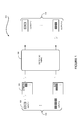
- FIG. 6 illustrates an exemplary in-band signaling method for sending one-bit information from an output port to an input port of a switch 600 consistent with the present invention.
- the inputs transmit the one-bit information following the schedule H T (n), which is the transpose of the matrix H(n). For example, for a 2 ⁇ 2 switch, if the random schedule is:
- Crosspoint (1,2) is in H, so output 2 has to send a one-bit information to input 1 . Since output 2 is in the same linecard 610 as input 2 , it can first pass the information to input 2 . Then input 2 transmits the information over the switching fabric 615 following the schedule H T to output 1 in the linecard 605 , and then output 1 passes the information to input 1 . It can be seen that a one-bit time before every slot should be used for the signaling. So, in at least some embodiments, the throughput may be down to 1 ⁇ (1/(64*8+1)) ⁇ 0.9981. A speedup of 1.002 may compensate for this throughput loss. In at least some embodiments, modest speedups may be needed in cell-based switches to compensate for the overhead of segmenting variable-size packets into fixed size cells, which leads to stuffing bits in the last cell.
- the system may have to be able to switch packets with two different lengths: (1) one-bit and (2) one-cell long.
- the switching systems are designed to switch fixed-size cells. So, if the one-bit message has to be sent using the switching fabric, a one-cell time for the control message may have to be used, which reduces the throughput to only 0.5.
- each input scheduler may be provided with M sub-schedulers 620 , where M is less than the number of bits in one cell.
- the (n mod(M+1)) sub-scheduler is used to switch cells. All the sub-schedulers update their schedules independently based on the distributed scheduling process explained above.
- Each sub-scheduler may get the information it needs from the output, and update its scheduler when it is used to switch cells in the next M slots. So the slot time for control message passing is fully utilized, and the throughput is again 1 ⁇ (1/(64*8+1)) ⁇ 0.9981.
- FIGS. 7A-7E illustrate an example of operations consistent with the exemplary scheduling process pseudo code and properties set forth in ⁇ 6.3 above of an exemplary scheduling method, with reference to the examples illustrated in '207 application.
- the previous schedule 700 a at time slot n ⁇ 1, includes crosspoint (1,2) and crosspoint (2,1) and the Hamiltonian walk schedule includes crosspoints ⁇ (1,2),(2,3),(3,1) ⁇ .
- crosspoint (1,2) since it is both in Hamiltonian and previous schedules, it is determined whether a packet transmission from input i to output port j has been completed. (Recall 405 , 415 and 420 of FIG. 4 .) In the current example, it is assumed that the packet transmission from input i to output port j has been completed. Therefore, a probability p ij , which is a function of the queue size of crosspoint (1,2), would be used to determine whether or not to add this crosspoint to the schedule. (Recall lines (b) and (c) of the Pseudo Code, and 435 of FIG.
- embodiments consistent with the present invention can provide scheduling for an input-queued switch.
- the exemplary distributed scheduling process achieves 100% throughput for any admissible Bernoulli arrival traffic.
- the exemplary distributed scheduling process may be easily implemented with a low-rate control or by sacrificing the throughput by a small amount. Simulation results also showed that this distributed scheduling process can provide very good delay performance for different traffic patterns.
Landscapes
- Engineering & Computer Science (AREA)
- Computer Networks & Wireless Communication (AREA)
- Signal Processing (AREA)
- Physics & Mathematics (AREA)
- Mathematical Physics (AREA)
- Data Exchanges In Wide-Area Networks (AREA)
Abstract
Description
Σjλij<1, and Σiλij<1 (1)
N(i,j)={(i′,j) or (i,j′)|∀i′≠i,∀j′≠j} (2)
N!<|S|<2N×N ,N≧2: (3)
and (3) adding the crosspointi,j to the updated schedule with a probability pi,j, and otherwise does not add crosspointi,j to the updated schedule. So, pij is also a concave function of the queue length Qij such that a longer queue has a higher probability to become active.
-
- (a) Sij(n)=Sij(n−1)
-
- If (i,j)∈S(n−1)
- if the packet transmission between input i and output j has been completed:
- (b) Sij(n)=1 with probability pij;
- (c) Sij(n)=0 with probability
p ij=1−pij- Else, if the packet transmission between input i and output j has not been completed:
- (d) Sij(n)=Sij(n−1)
- Else, if (i,j)∈S(n−1), and ∀(k, l)∈N(i, j), (determine if any neighbor of the crosspointi,j was active)
- If Skl(n−1)=0, then (there is no active neighbor (k, l))
- (e) Sij(n)=1 with probability pij;
- (f) Sij(n)=0 with probability
p ij=1−pij.- Else if Skl(n−1)=1, then (there is an active neighbor)
- (g) Sij(n)=0. (exclude the crosspointi,j from consideration for the updated schedule for time slot n)
- If (i,j)∈S(n−1)
-
- (a) Sij(n)=Sij(n−1)
-
- If (i,j)∈Sij(n−1) (that is, Sij(n−1)=1)
- If the packet transmission between input i and output j has concluded:
- (b) Sij(n)=1 with probability pij;
- (c) Sij(n)=0 with probability
p ij=1−pij- Else, if the packet transmission between input i and output j has not been completed:
- (d) Sij(n)=Sij(n−1)=1
- Else, if (i,j)∉Sij(n−1), and ∀(k, l)∈N(i, j), (determine if any neighbor of the crosspointi,j was active)
- If Skl(n−1)=0, then (there is no active neighbor (k, l))
- (e) Sij(n)=1 with probability pij;
- (f) Sij(n)=0 with probability
p ij=1−pij.- Else if Skl(n−1)=1, then (there is an active neighbor)
- (g) Sij(n)=Sij(n−1)=0. (exclude the crosspointi,j from consideration for the updated schedule for time slot n)
- If (i,j)∈Sij(n−1) (that is, Sij(n−1)=1)
Crosspoint (1,2) is in H, so
Claims (25)
Priority Applications (1)
| Application Number | Priority Date | Filing Date | Title |
|---|---|---|---|
| US13/281,046 US8824491B2 (en) | 2010-10-25 | 2011-10-25 | Distributed scheduling for variable-size packet switching system |
Applications Claiming Priority (2)
| Application Number | Priority Date | Filing Date | Title |
|---|---|---|---|
| US40620710P | 2010-10-25 | 2010-10-25 | |
| US13/281,046 US8824491B2 (en) | 2010-10-25 | 2011-10-25 | Distributed scheduling for variable-size packet switching system |
Publications (2)
| Publication Number | Publication Date |
|---|---|
| US20120128007A1 US20120128007A1 (en) | 2012-05-24 |
| US8824491B2 true US8824491B2 (en) | 2014-09-02 |
Family
ID=46064332
Family Applications (2)
| Application Number | Title | Priority Date | Filing Date |
|---|---|---|---|
| US13/281,026 Active 2033-05-04 US8873955B2 (en) | 2010-10-25 | 2011-10-25 | Distributed scheduling for an optical switch |
| US13/281,046 Active 2032-06-16 US8824491B2 (en) | 2010-10-25 | 2011-10-25 | Distributed scheduling for variable-size packet switching system |
Family Applications Before (1)
| Application Number | Title | Priority Date | Filing Date |
|---|---|---|---|
| US13/281,026 Active 2033-05-04 US8873955B2 (en) | 2010-10-25 | 2011-10-25 | Distributed scheduling for an optical switch |
Country Status (1)
| Country | Link |
|---|---|
| US (2) | US8873955B2 (en) |
Families Citing this family (13)
| Publication number | Priority date | Publication date | Assignee | Title |
|---|---|---|---|---|
| US8824897B2 (en) * | 2008-06-04 | 2014-09-02 | Accipiter Systems, Inc. | Optical network systems and methods for operating same |
| US8737414B2 (en) * | 2009-12-10 | 2014-05-27 | Polytechnic Institute Of New York University | Scheduling, including distributed scheduling, for a buffered crossbar switch |
| US8873955B2 (en) * | 2010-10-25 | 2014-10-28 | Polytechnic Institute Of New York University | Distributed scheduling for an optical switch |
| CN103379038B (en) * | 2012-04-12 | 2018-08-03 | 南京中兴新软件有限责任公司 | A kind of device and method of flow scheduling |
| US8902488B2 (en) | 2012-06-28 | 2014-12-02 | Accipiter Systems, Inc. | System architecture for an optical switch using wavelength, fiber and polarizaton addressing |
| US9184999B1 (en) | 2013-03-15 | 2015-11-10 | Google Inc. | Logical topology in a dynamic data center network |
| US9246760B1 (en) | 2013-05-29 | 2016-01-26 | Google Inc. | System and method for reducing throughput loss responsive to network expansion |
| CN103581054A (en) * | 2013-10-30 | 2014-02-12 | 清华大学 | Switching system used for variable-length packet switching |
| US9166692B1 (en) | 2014-01-28 | 2015-10-20 | Google Inc. | Network fabric reconfiguration |
| US10200509B1 (en) * | 2014-09-16 | 2019-02-05 | Juniper Networks, Inc. | Relative airtime fairness in a wireless network |
| CN107491703B (en) * | 2017-07-31 | 2020-05-19 | 天津大学 | Incorporation of random Hamiltonian loop topologies in chip top shields |
| US11042416B2 (en) | 2019-03-06 | 2021-06-22 | Google Llc | Reconfigurable computing pods using optical networks |
| US11122347B2 (en) | 2019-07-01 | 2021-09-14 | Google Llc | Reconfigurable computing pods using optical networks with one-to-many optical switches |
Citations (5)
| Publication number | Priority date | Publication date | Assignee | Title |
|---|---|---|---|---|
| US20060077873A1 (en) * | 2004-08-17 | 2006-04-13 | Seo Kang S | Recording medium, and method and apparatus for reproducing data from the recording medium |
| US7031330B1 (en) * | 1999-04-15 | 2006-04-18 | Marconi Intellectual Property (Ringfence), Inc. | Very wide memory TDM switching system |
| US7852866B2 (en) * | 2006-12-29 | 2010-12-14 | Polytechnic Institute of New York Universiity | Low complexity scheduling algorithm for a buffered crossbar switch with 100% throughput |
| US20110170558A1 (en) * | 2009-12-10 | 2011-07-14 | Shunyuan Ye | Scheduling, including distributed scheduling, for a buffered crossbar switch |
| US20120128354A1 (en) * | 2010-10-25 | 2012-05-24 | Panwar Shivendra S | Distributed scheduling for an optical switch |
Family Cites Families (1)
| Publication number | Priority date | Publication date | Assignee | Title |
|---|---|---|---|---|
| KR20060032103A (en) * | 2004-10-11 | 2006-04-14 | 한국전자통신연구원 | Output Scheduling Method of Crosspoint Buffer Switch |
-
2011
- 2011-10-25 US US13/281,026 patent/US8873955B2/en active Active
- 2011-10-25 US US13/281,046 patent/US8824491B2/en active Active
Patent Citations (5)
| Publication number | Priority date | Publication date | Assignee | Title |
|---|---|---|---|---|
| US7031330B1 (en) * | 1999-04-15 | 2006-04-18 | Marconi Intellectual Property (Ringfence), Inc. | Very wide memory TDM switching system |
| US20060077873A1 (en) * | 2004-08-17 | 2006-04-13 | Seo Kang S | Recording medium, and method and apparatus for reproducing data from the recording medium |
| US7852866B2 (en) * | 2006-12-29 | 2010-12-14 | Polytechnic Institute of New York Universiity | Low complexity scheduling algorithm for a buffered crossbar switch with 100% throughput |
| US20110170558A1 (en) * | 2009-12-10 | 2011-07-14 | Shunyuan Ye | Scheduling, including distributed scheduling, for a buffered crossbar switch |
| US20120128354A1 (en) * | 2010-10-25 | 2012-05-24 | Panwar Shivendra S | Distributed scheduling for an optical switch |
Also Published As
| Publication number | Publication date |
|---|---|
| US20120128354A1 (en) | 2012-05-24 |
| US20120128007A1 (en) | 2012-05-24 |
| US8873955B2 (en) | 2014-10-28 |
Similar Documents
| Publication | Publication Date | Title |
|---|---|---|
| US8824491B2 (en) | Distributed scheduling for variable-size packet switching system | |
| Stiliadis et al. | A general methodology for designing efficient traffic scheduling and shaping algorithms | |
| US20060285548A1 (en) | Matching process | |
| US8737414B2 (en) | Scheduling, including distributed scheduling, for a buffered crossbar switch | |
| US20050117575A1 (en) | Nonblocking and deterministic unicast packet scheduling | |
| Hu et al. | Feedback-based scheduling for load-balanced two-stage switches | |
| Gong et al. | Queue-proportional sampling: A better approach to crossbar scheduling for input-queued switches | |
| US20260052113A1 (en) | Multi-Packet Sliding Window Scheduler and Method for Input-Queued Switches | |
| Lin et al. | Quasi-pushout cell discarding | |
| US20030112815A1 (en) | Method for generating and transmitting a train packet in an ATM switch system | |
| Tu et al. | Design a simple and high performance switch using a two-stage architecture | |
| Ye et al. | DISQUO: A distributed 100% throughput algorithm for a buffered crossbar switch | |
| Chang et al. | A dynamic frame sizing algorithm for CICQ switches with 100% throughput | |
| US20050129043A1 (en) | Nonblocking and deterministic multicast packet scheduling | |
| Shneer et al. | Stability conditions for a discrete-time decentralised medium access algorithm | |
| Iyer et al. | Maximum size matchings and input queued switches | |
| Ye et al. | An O (1) scheduling algorithm for variable-size packet switching systems | |
| US20050094644A1 (en) | Nonblocking and deterministic multirate unicast packet scheduling | |
| Yeung et al. | A novel feedback mechanism for load balanced two-stage switches | |
| Hu et al. | Dynamic queuing sharing mechanism for per-flow quality of service control | |
| Pan et al. | CQPPS: A scalable multi‐path switch fabric without back pressure | |
| Choi et al. | Round-robin scheduling algorithm with multiple distributed windows | |
| Audzevich | Design and Analysis of Load-Balancing Switch with Finite Buffers and Variable Size Packets | |
| Pan et al. | Achieve constant performance guarantees using asynchronous crossbar scheduling without speedup | |
| KR100662122B1 (en) | Congestion management in telecommunications networks |
Legal Events
| Date | Code | Title | Description |
|---|---|---|---|
| AS | Assignment |
Owner name: POLYTECHNIC INSTITUTE OF NEW YORK UNIVERSITY, NEW Free format text: ASSIGNMENT OF ASSIGNORS INTEREST;ASSIGNORS:PANWAR, SHIVENDRA S.;SHEN, YANMING;YE, SHUNYUAN;SIGNING DATES FROM 20120105 TO 20120110;REEL/FRAME:027675/0778 |
|
| STCF | Information on status: patent grant |
Free format text: PATENTED CASE |
|
| MAFP | Maintenance fee payment |
Free format text: PAYMENT OF MAINTENANCE FEE, 4TH YR, SMALL ENTITY (ORIGINAL EVENT CODE: M2551) Year of fee payment: 4 |
|
| MAFP | Maintenance fee payment |
Free format text: PAYMENT OF MAINTENANCE FEE, 8TH YR, SMALL ENTITY (ORIGINAL EVENT CODE: M2552); ENTITY STATUS OF PATENT OWNER: SMALL ENTITY Year of fee payment: 8 |
|
| MAFP | Maintenance fee payment |
Free format text: PAYMENT OF MAINTENANCE FEE, 12TH YR, SMALL ENTITY (ORIGINAL EVENT CODE: M2553); ENTITY STATUS OF PATENT OWNER: SMALL ENTITY Year of fee payment: 12 |