US8823431B2 - Delay circuit and semiconductor apparatus including the same - Google Patents
Delay circuit and semiconductor apparatus including the same Download PDFInfo
- Publication number
- US8823431B2 US8823431B2 US13/712,625 US201213712625A US8823431B2 US 8823431 B2 US8823431 B2 US 8823431B2 US 201213712625 A US201213712625 A US 201213712625A US 8823431 B2 US8823431 B2 US 8823431B2
- Authority
- US
- United States
- Prior art keywords
- delay
- clock
- control signal
- control
- signal
- Prior art date
- Legal status (The legal status is an assumption and is not a legal conclusion. Google has not performed a legal analysis and makes no representation as to the accuracy of the status listed.)
- Active
Links
Images


Classifications
-
- H—ELECTRICITY
- H03—ELECTRONIC CIRCUITRY
- H03L—AUTOMATIC CONTROL, STARTING, SYNCHRONISATION OR STABILISATION OF GENERATORS OF ELECTRONIC OSCILLATIONS OR PULSES
- H03L7/00—Automatic control of frequency or phase; Synchronisation
- H03L7/06—Automatic control of frequency or phase; Synchronisation using a reference signal applied to a frequency- or phase-locked loop
- H03L7/08—Details of the phase-locked loop
- H03L7/081—Details of the phase-locked loop provided with an additional controlled phase shifter
- H03L7/0812—Details of the phase-locked loop provided with an additional controlled phase shifter and where no voltage or current controlled oscillator is used
- H03L7/0814—Details of the phase-locked loop provided with an additional controlled phase shifter and where no voltage or current controlled oscillator is used the phase shifting device being digitally controlled
-
- G—PHYSICS
- G11—INFORMATION STORAGE
- G11C—STATIC STORES
- G11C7/00—Arrangements for writing information into, or reading information out from, a digital store
- G11C7/22—Read-write [R-W] timing or clocking circuits; Read-write [R-W] control signal generators or management
-
- H—ELECTRICITY
- H03—ELECTRONIC CIRCUITRY
- H03L—AUTOMATIC CONTROL, STARTING, SYNCHRONISATION OR STABILISATION OF GENERATORS OF ELECTRONIC OSCILLATIONS OR PULSES
- H03L7/00—Automatic control of frequency or phase; Synchronisation
- H03L7/06—Automatic control of frequency or phase; Synchronisation using a reference signal applied to a frequency- or phase-locked loop
- H03L7/08—Details of the phase-locked loop
-
- H—ELECTRICITY
- H03—ELECTRONIC CIRCUITRY
- H03L—AUTOMATIC CONTROL, STARTING, SYNCHRONISATION OR STABILISATION OF GENERATORS OF ELECTRONIC OSCILLATIONS OR PULSES
- H03L7/00—Automatic control of frequency or phase; Synchronisation
- H03L7/06—Automatic control of frequency or phase; Synchronisation using a reference signal applied to a frequency- or phase-locked loop
- H03L7/08—Details of the phase-locked loop
- H03L7/0805—Details of the phase-locked loop the loop being adapted to provide an additional control signal for use outside the loop
-
- H—ELECTRICITY
- H03—ELECTRONIC CIRCUITRY
- H03L—AUTOMATIC CONTROL, STARTING, SYNCHRONISATION OR STABILISATION OF GENERATORS OF ELECTRONIC OSCILLATIONS OR PULSES
- H03L7/00—Automatic control of frequency or phase; Synchronisation
- H03L7/06—Automatic control of frequency or phase; Synchronisation using a reference signal applied to a frequency- or phase-locked loop
- H03L7/08—Details of the phase-locked loop
- H03L7/081—Details of the phase-locked loop provided with an additional controlled phase shifter
- H03L7/0812—Details of the phase-locked loop provided with an additional controlled phase shifter and where no voltage or current controlled oscillator is used
- H03L7/0816—Details of the phase-locked loop provided with an additional controlled phase shifter and where no voltage or current controlled oscillator is used the controlled phase shifter and the frequency- or phase-detection arrangement being connected to a common input
-
- H—ELECTRICITY
- H03—ELECTRONIC CIRCUITRY
- H03L—AUTOMATIC CONTROL, STARTING, SYNCHRONISATION OR STABILISATION OF GENERATORS OF ELECTRONIC OSCILLATIONS OR PULSES
- H03L7/00—Automatic control of frequency or phase; Synchronisation
- H03L7/06—Automatic control of frequency or phase; Synchronisation using a reference signal applied to a frequency- or phase-locked loop
- H03L7/08—Details of the phase-locked loop
- H03L7/085—Details of the phase-locked loop concerning mainly the frequency- or phase-detection arrangement including the filtering or amplification of its output signal
- H03L7/093—Details of the phase-locked loop concerning mainly the frequency- or phase-detection arrangement including the filtering or amplification of its output signal using special filtering or amplification characteristics in the loop
Definitions
- the present invention generally relates to a semiconductor apparatus, and more particularly, to a delay circuit which delays a cock and a command signal and a semiconductor apparatus including the same.
- a semiconductor apparatus including a memory performs an operation in synchronization with a clock. Accordingly, in a synchronous type semiconductor apparatus, input data, and output data should be precisely synchronized with an external clock.
- the semiconductor apparatus receives the external clock, converts the external clock into an internal clock, and uses the converted internal clock.
- the semiconductor apparatus generally includes a phase-locked loop or a delay-locked loop.
- the semiconductor apparatus performs an internal data processing operation by synchronizing a command inputted in synchronization with the external clock, with the internal clock.
- a domain crossing operation for synchronizing the command synchronized with the internal clock, with the external clock is performed.
- FIG. 1 is a block diagram showing the configuration of a conventional semiconductor apparatus 10 .
- the semiconductor apparatus 10 includes a clock delay line 11 , a first shift register 12 , a delay modeling block 40 , a phase detection block 30 , and a delay line control block 20 .
- the clock delay line 11 receives an input clock CLKI, delays the input clock CLKI by a preset delay value, and generates a delayed clock CLKD.
- the delay modeling block 40 delays the delayed clock CLKD by a modeled delay value and generates a feedback clock CLKF.
- the phase detection block 30 compares the phases of the input clock CLKI and the feedback clock CLKF.
- the delay line control block 20 generates a control signal CTRL for controlling the first shift register 12 , according to a phase comparison result of the phase detection block 30 .
- the first shift register 12 receives the control signal CTRL and may set the delay value of the clock delay line 11 .
- the semiconductor apparatus 10 further includes a command delay line 51 , a second shift register 52 , a clock driver 60 , and an output enable signal generation block 70 .
- the second shift register 52 sets the delay value of the command delay line 51 in response to the control signal CTRL.
- the command delay line 51 delays a command signal CMD by a preset delay value and generates a delayed command signal CMDD.
- the command delay line 51 may have the same configuration as the clock delay line 11 .
- the clock driver 60 receives the delayed clock CLKD and generates a data clock CLKDQS.
- the output enable signal generation block 70 generates an output enable signal OUTEN according to the delayed clock CLKD, the delayed command signal CMDD and CAS latency information CL.
- the clock delay line 11 and the command delay line 51 have the same configuration and are controlled by the same control signal CTRL. That is to say, the first shift register 12 for setting the delay amount of the clock delay line 11 and the second shift register 52 for setting the delay amount of the command delay line 51 commonly receive the control signal CTRL which is outputted from the delay line control block 20 . In this way, in the conventional semiconductor apparatus, a plurality of delay lines with the same delay value respectively have shift registers.
- a semiconductor apparatus in which a plurality of delay lines share a shift register block is described herein.
- a delay circuit includes: a clock delay line configured to delay an input clock and generate a delayed clock; a command delay line configured to delay a command signal and generate a delayed command signal; a delay line control block configured to generate a control signal according to a result of comparing phases of a feedback clock which is generated as the delayed clock is delayed by a modeled delay value and the input clock; and a shared shift register block configured to set delay amounts of the clock delay line and the command delay line to be substantially the same with each other, in response to the control signal.
- a delay circuit includes: a clock delay line configured to delay an input clock in response to delay control signals and generate a delayed clock; a command delay line configured to delay a command signal in response to the delay control signals and generate a delayed command signal; a delay line control block configured to generate a control signal according to a result of comparing phases of a feedback clock which is generated as the delayed clock is delayed by a modeled delay value and the input clock; and a shared shift register block configured to generate the delay control signals in response to the control signal and provide the delay control signals commonly to the clock delay line and the command delay line.
- a semiconductor apparatus includes: a clock delay line configured to delay an input clock and generate a delayed clock; a command delay line configured to delay a command signal and generate a delayed command signal; a delay line control block configured to generate a control signal according to a result of comparing phases of a feedback clock which is generated as the delayed clock is delayed by a modeled delay value and the input clock; a shared shift register block configured to set delay amounts of the clock delay line and the command delay line to be substantially the same with each other, in response to the control signal; and an output enable signal generation block configured to generate an output enable signal for a data output operation, according to the delayed clock, the delayed command signal and CAS latency information.
- FIG. 1 is a block diagram showing the configuration of a conventional semiconductor apparatus
- FIG. 2 is a block diagram showing the configuration of a semiconductor apparatus in accordance with an embodiment
- FIG. 3 is a block diagram showing the configurations of various embodiments of the clock delay line, the command delay line and the shared shift register block of FIG. 2 ;
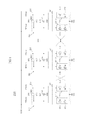
- FIG. 4 is a view showing the configuration of an embodiment of the shared shift register block in the semiconductor apparatus in accordance with an embodiment.
- FIG. 2 is a block diagram showing the configuration of a semiconductor apparatus 1 in accordance with an embodiment.
- the semiconductor apparatus 1 may include a clock delay line 110 , a command delay line 120 , a delay line control block 20 , and a shared shift register block 200 .
- the clock delay line 110 may be configured to receive an input clock CLKI, delay the input clock CLKI and generate a delayed clock CLKD.
- the delay amount of the clock delay line 110 is set according to delay control signals SR ⁇ 0:4> which are generated by the shared shift register block 200 .
- the command delay line 120 may be configured to receive a command signal CMD, delay the command signal CMD and generate a delayed command signal CMDD.
- the delay amount of the command delay line 120 is set according to the delay control signals SR ⁇ 0:4> which are generated by the shared shift register block 200 .
- the delay line control block 20 may be configured to generate a control signal CTRL on the basis of a result of comparing the phases of the input clock CLKI and a feedback clock CLKF which may be acquired by delaying the delayed clock CLKD by a modeled value.
- the delay line control block 20 may generate the control signal CTRL according to whether the phase of the feedback clock CLKF precedes or follows the phase of the input clock CLKI. For example, in the case where the phase of the feedback clock CLKF is earlier than the phase of the input clock CLKI, the control signal CTRL for decreasing the delay amount of the clock delay line 110 may be generated. Conversely, in the case where the phase of the feedback clock CLKF is later than the phase of the input clock CLKI, the control signal CTRL for increasing the delay amount of the clock delay line 110 may be generated.
- the shared shift register block 200 may be configured to set the delay amount of the clock delay line 110 and the command delay line 120 .
- the shared shift register block 200 may generate the delay control signals SR ⁇ 0:4> to change the delay amount of the clock delay line 110 and the command delay line 120 in response to the control signal CTRL.
- the shared shift register block 200 is shared by the clock delay line 110 and the command delay line 120 . Namely, the shared shift register block 200 provides the delay control signals SR ⁇ 0:4> commonly to the clock delay line 110 and the command delay line 120 . Accordingly, the shared shift register block 200 may set the delay amount of the clock delay line 110 and the delay amount of the command delay line 120 to be substantially the same with each other.
- the shared shift register block 200 since the shared shift register block 200 is commonly connected with the clock delay line 110 and the command delay line 120 , it is possible to control a plurality of delay lines using one shift register block.
- the shared shift register block 200 may change the levels of the delay control signals SR ⁇ 0:4> when the control signal CTRL is enabled, and retains the levels of the delay control signals SR ⁇ 0:4> when the control signal CTRL is disabled.
- the shared shift register block 200 may perform a latching operation for retaining the levels of the delay control signals SR ⁇ 0:4>, and does not perform the latching operation when the levels of the delay control signals SR ⁇ 0:4> are changed as the control signal CTRL is enabled.
- the shared shift register block 200 may perform the latching operation in response to the control signal CTRL which is disabled when the level change of the delay control signals SR ⁇ 0:4> is completed according to the control signal CTRL.
- the shared shift register block 200 selectively may perform the latch operation according to whether the control signal CTRL is enabled or disabled. Therefore, the shared shift register block 200 may sufficiently drive the delay control signals SR ⁇ 0:4> which are provided to the clock delay line 110 and the command delay line 120 .
- the semiconductor apparatus 1 may further include a phase detection block 30 , a delay modeling block 40 , a clock driver 60 , and an output enable signal generation block 70 .
- the phase detection block 30 may be configured to compare the phases of the feedback clock CLKF and the input clock CLKI.
- the phase detection block 30 may provide a result of comparing the phases of the feedback clock CLKF and the input clock CLKI, to the delay line control block 20 .
- the delay modeling block 40 may have the delay amount acquired by modeling the amount by which the input clock CLKI is delayed in the internal circuit of the semiconductor apparatus 1 .
- the delay modeling block 40 may be configured to delay the delayed clock CLKD by the modeled delay amount, and generate the feedback clock CLKF.
- the clock driver 60 may be configured to buffer the delayed clock CLKD and generate a data clock CLKDQS.
- the data clock CLKDQS is substantially the same clock as the delayed clock CLKD.
- the output enable signal generation unit 70 may receive the delayed clock CLKD, the delayed command signal CMDD and CAS latency information CL.
- the CAS latency information CL has information from after a read command is applied to the semiconductor apparatus 1 to until data is actually outputted from the semiconductor apparatus 1 to an outside.
- the output enable signal generation block 70 may be configured to generate an output enable signal OUTEN according to the delayed clock CLKD, the delayed command signal CMDD and the CAS latency information CL.
- the semiconductor apparatus 1 may output data in synchronization with the data clock CLKDQS and the output enable signal OUTEN.
- FIG. 3 is a block diagram showing the configurations of various embodiments of the clock delay line 110 , the command delay line 120 and the shared shift register block 200 of FIG. 2 .
- Each of the clock delay line 110 and the command delay line 120 may include a plurality of unit delay cells CUD which are sequentially connected in series.
- the delay amount of each of the clock delay line 110 and the command delay line 120 may be changed depending upon the number of the unit delay cells CUD enabled among the plurality of unit delay cells CUD. For example, as the number of the enabled unit delay cells CUD increases, the delay amount of each of the clock delay line 110 and the command delay line 120 increases, and, as the number of the enabled unit delay cells CUD decreases, the delay amount of each of the clock delay line 110 and the command delay line 120 decreases.
- each of the input clock CLKI and the command signal CMD is sequentially delayed starting from a unit delay cell CUD which is disposed at a forward position, it may be delayed more.
- the number of the enabled unit delay cells CUD decreases, since each of the input clock CLKI and the command signal CMD is sequentially delayed starting from a unit delay cell CUD which is disposed at a backward position, it may be delayed less.
- the shared shift register block 200 may enable the unit delay cells CUD which constitute each of the clock delay line 110 and the command delay line 120 , by generating the delay control signals SR ⁇ 0:4>.
- the shared shift register block 200 may increase or decrease the enable number of the unit delay cells CUD one by one.
- the shared shift register block 200 may include a plurality of shift registers 210 , 220 , and 230 .
- the plurality of shift registers 210 , 220 , and 230 may have substantially the same configuration.
- Each of the plurality of shift registers 210 , 220 , and 230 is commonly connected with corresponding unit delay cells CUD of the clock delay line 110 and the command delay line 120 .
- the plurality of shift registers 210 , 220 , and 230 may generate the delay control signals SR ⁇ 0:4> capable of determining whether to enable corresponding unit delay cells CUD, in response to the control signal CTRL.
- the shift registers 210 , 220 , and 230 may change the levels of the delay control signals SR ⁇ 0:4> when the control signal CTRL is enabled, and may retain the levels of the delay control signals SR ⁇ 0:4> when the control signal CTRL is disabled.
- the shift registers 210 , 220 , and 230 may selectively perform the latching operation for the delay control signals SR ⁇ 0:4> in response to the control signal CTRL. That is to say, the shift registers 210 , 220 , and 230 are configured not to perform the latching operation when the levels of the delay control signals SR ⁇ 0:4> are changed as the control signal CTRL is enabled.
- the shift registers 210 , 220 , and 230 may selectively perform the latching operation according to the control signal CTRL, it is possible to sufficiently drive the delay control signals SR ⁇ 0:4>.
- the shift registers 210 , 220 , and 230 may be commonly connected with respectively corresponding unit delay cells CUD of the clock delay line 110 and the command delay line 120 .
- the control signal CTRL may include first and second odd control signals SLO and SRO and first and second even control signals SLE and SRE.
- the plurality of shift registers 210 , 220 , and 230 alternately receive the first and second odd control signals SLO and SRO and the first and second even control signals SLE and SRE.
- the first and third shift registers 210 and 230 receive the first and second odd control signals SLO and SRO
- the second shift register 220 receives the first and second even control signals SLE and SRE.
- the reason why the plurality of shift registers 210 , 220 , and 230 alternately receive the control signal CTRL is to sequentially change the logic values of the delay control signals SR ⁇ 0:4> which are generated by the shared shift register block 200 .
- FIG. 4 is a view showing the configuration of an embodiment of the shared shift register block 200 in the semiconductor apparatus in accordance with an embodiment.
- the first shift register 210 may include a first sink driver 211 and a first control latch section 212 .
- the first sink driver 211 receives the first and second odd control signals SLO and SRO, and may change the levels of the delay control signal SR ⁇ 0> and the inverted signal SRB ⁇ 0> of the delay control signal SR ⁇ 0>.
- the first control latch section 212 selectively may perform the function of a driver and the function of a latch in response to the first and second odd control signals SLO and SRO.
- the first control latch section 212 may change the levels of the delay control signal SR ⁇ 0> and the inverted signal SRB ⁇ 0> of the delay control signal SR ⁇ 0> when the first and second odd control signals SLO and SRO are enabled, and retains the levels of the delay control signal SR ⁇ 0> and the inverted signal SRB ⁇ 0> of the delay control signal SR ⁇ 0> when the first and second odd control signals SLO and SRO are disabled.
- the first control latch section 212 does not perform the latching operation when the levels of the delay control signal SR ⁇ 0> and the inverted signal SRB ⁇ 0> of the delay control signal SR ⁇ 0> are changed, the levels of the delay control signal SR ⁇ 0> and the inverted signal SRB ⁇ 0> of the delay control signal SR ⁇ 0> may be easily changed.
- the first sink driver 211 may include a first sink part 211 - 1 and a second sink part 211 - 2 .
- the first sink part 211 - 1 may include first and second transistors N 1 and N 2 .
- the first transistor N 1 receives the first odd control signal SLO through the gate, and any one of the source and the drain is connected with the delay control signal SR ⁇ 0>.
- the second transistor N 2 has the gate through which the inverted signal SRB ⁇ 1> of the delay control signal SR ⁇ 1> generated by the second shift register 220 is received, the drain which is connected with the other one of the source and the drain of the first transistor N 1 , and the source which is connected with a ground voltage VSS.
- the first sink part 211 - 1 may change the delay control signal SR ⁇ 0> to a low level in the case where the first odd control signal SLO is enabled and the inverted signal SRB ⁇ 1> of the delay control signal SR ⁇ 1> with a high level is received.
- the second sink part 211 - 2 may include third and fourth transistors N 3 and N 4 .
- the third transistor N 3 receives the second odd control signal SRO through the gate, and any one of the source and the drain is connected with the inverted signal SRB ⁇ 0> of the delay control signal SR ⁇ 0>.
- the fourth transistor N 4 has the gate through which an external voltage VDD is received, the drain which is connected with the other one of the source and the drain of the third transistor N 3 , and the source which is connected with the ground voltage VSS. Accordingly, the second sink part 211 - 2 may change the inverted signal SRB ⁇ 0> of the delay control signal SR ⁇ 0> to a low level in the case where the second odd control signal SRO is enabled.
- the first control latch section 212 may include a first control NAND gate CND 1 and a first control inverter CIV 1 . Whether the first control NAND gate CND 1 is to be operated or not is determined in response to the second odd control signal SRO. The first control NAND gate CND 1 may not operate when the second odd control signal SRO is enabled and may operate when the second odd control signal SRO is disabled. The first control NAND gate CND 1 may receive a reset signal RSTB and the inverted signal SRB ⁇ 0> of the delay control signal SR ⁇ 0> and may generate the delay control signal SR ⁇ 0>.
- the reset signal RSTB is a signal which is enabled to a low level.
- the first control inverter CIV 1 may not operate when the first odd control signal SLO is enabled and may operate when the first odd control signal SLO is disabled.
- the first control inverter CIV 1 may invert the delay control signal SR ⁇ 0> and may generate the inverted signal SRB ⁇ 0> of the delay control signal SR ⁇ 0>.
- the first control latch section 212 may perform the function of a driver in the case where only one of the first and second odd control signals SLO and SRO is enabled. If the first odd control signal SLO is enabled, the first control inverter CIV 1 does not operate and the first control NAND gate CND 1 operates. Namely, if the first odd control signal SLO is enabled, since the level of the delay control signal SR ⁇ 0> may be changed, the first control NAND gate CND 1 performs the function of a driver which changes the level of the delay control signal SR ⁇ 0>. Similarly, if the second odd control signal SRO is enabled, the first control NAND gate CND 1 does not operate and the first control inverter CIV 1 operates.
- the first control inverter CIV 1 performs the function of a driver which changes the level of the inverted signal SRB ⁇ 0> of the delay control signal SR ⁇ 0>.
- the first control NAND gate CND 1 and the first control inverter CIV 1 may form a latch structure and may retain the levels of the delay control signal SR ⁇ 0> and the inverted signal SRB ⁇ 0> of the delay control signal SR ⁇ 0>.
- the second shift register 220 may include a second sink driver 221 and a second control latch section 222 .
- the second sink driver 221 receives the first and second even control signals SLE and SRE, and may change the levels of the delay control signal SR ⁇ 1> and the inverted signal SRB ⁇ 1> of the delay control signal SR ⁇ 1>.
- the second control latch section 222 selectively may perform the function of a driver and the function of a latch in response to the first and second even control signals SLE and SRE.
- the second control latch section 222 may change the levels of the delay control signal SR ⁇ 1> and the inverted signal SRB ⁇ 1> of the delay control signal SR ⁇ 1> when the first and second even control signals SLE and SRE are enabled, and may retain the levels of the delay control signal SR ⁇ 1> and the inverted signal SRB ⁇ 1> of the delay control signal SR ⁇ 1> when the first and second even control signals SLE and SRE are disabled.
- the second control latch section 222 does not perform the latching operation when the levels of the delay control signal SR ⁇ 1> and the inverted signal SRB ⁇ 1> of the delay control signal SR ⁇ 1> are changed, the levels of the delay control signal SR ⁇ 1> and the inverted signal SRB ⁇ 1> of the delay control signal SR ⁇ 1> may be easily changed.
- the second sink driver 221 may include a third sink part 221 - 1 and a fourth sink part 221 - 2 .
- the third sink part 221 - 1 may include fifth and sixth transistors N 5 and N 6 .
- the fifth transistor N 5 receives the first even control signal SLE through the gate, and any one of the source and the drain is connected with the delay control signal SR ⁇ 1>.
- the sixth transistor N 6 has the gate through which the inverted signal SRB ⁇ 2> of the delay control signal SR ⁇ 2> generated by the shift register positioned at the next stage is received, the drain which is connected with the other one of the source and the drain of the fifth transistor N 5 , and the source which is connected with the ground voltage VSS.
- the third sink part 221 - 1 may change the delay control signal SR ⁇ 1> to a low level in the case where the first even control signal SLE is enabled and the inverted signal SRB ⁇ 2> of the delay control signal SR ⁇ 2> with a high level is received.
- the fourth sink part 221 - 2 may include seventh and eighth transistors N 7 and N 8 .
- the seventh transistor N 7 receives the second even control signal SRE through the gate, and any one of the source and the drain is connected with the inverted signal SRB ⁇ 1> of the delay control signal SR ⁇ 1>.
- the eighth transistor N 8 has the gate through which the delay control signal SR ⁇ 0> generated by the first shift register 210 is received, the drain which is connected with the other one of the source and the drain of the seventh transistor N 7 , and the source which is connected with the ground voltage VSS.
- the fourth sink part 221 - 2 may change the inverted signal SRB ⁇ 1> of the delay control signal SR ⁇ 1> to a low level in the case where the second even control signal SRE is enabled and the delay control signal SR ⁇ 0> with a high level is received.
- the second control latch section 222 may include a second control NAND gate CND 2 and a second control inverter CIV 2 . Whether the second control NAND gate CND 2 is to be operated or not is determined in response to the second even control signal SRE. The second control NAND gate CND 2 may not operate when the second even control signal SRE is enabled and may operate when the second even control signal SRE is disabled. The second control NAND gate CND 2 may receive the reset signal RSTB and the inverted signal SRB ⁇ 1> of the delay control signal SR ⁇ 1> and may generate the delay control signal SR ⁇ 1>. Whether the second control inverter CIV 2 is to be operated or not is determined in response to the first even control signal SLE.
- the second control inverter CIV 2 may not operate when the first even control signal SLE is enabled and may operate when the first even control signal SLE is disabled.
- the second control inverter CIV 2 may invert the delay control signal SR ⁇ 1> and may generate the inverted signal SRB ⁇ 1> of the delay control signal SR ⁇ 1>.
- the second control latch section 222 may perform the function of a driver in the case where only one of the first and second even control signals SLE and SRE is enabled. If the first even control signal SLE is enabled, the second control inverter CIV 2 does not operate and the second control NAND gate CND 2 operates. Namely, if the first even control signal SLE is enabled, since the level of the delay control signal SR ⁇ 1> may be changed, the second control NAND gate CND 2 performs the function of a driver which changes the level of the delay control signal SR ⁇ 1>. Similarly, if the second even control signal SRE is enabled, the second control NAND gate CND 2 does not operate and the second control inverter CIV 2 operates.
- the second control inverter CIV 2 performs the function of a driver which changes the level of the inverted signal SRB ⁇ 1> of the delay control signal SR ⁇ 1>.
- both the second control NAND gate CND 2 and the second control inverter CIV 2 may form a latch structure and may retain the levels of the delay control signal SR ⁇ 1> and the inverted signal SRB ⁇ 1> of the delay control signal SR ⁇ 1>.
- the third shift register 230 may include a third sink driver 231 and a third control latch section 232 .
- the third sink driver 231 may include a fifth sink part 231 - 1 and a sixth sink part 231 - 2
- the third control latch section 232 may include a third control NAND gate CND 3 and a third control inverter CIV 3 .
- the third shift register 230 has the same configuration as the first shift register 210 , and may be configured such that a tenth transistor N 10 constituting the fifth sink part 231 - 1 receives the external voltage VDD, instead of receiving the inverted signal of the delay control signal of a next stage.
- a twelfth transistor N 12 constituting the sixth sink part 231 - 2 receives the delay control signal SR ⁇ 3> of the shift register of the previous stage through the gate, instead of receiving the external voltage VDD.
- the unillustrated shift register positioned third receives the first and second odd control signals SLO and SRO and may generate the delay control signal SR ⁇ 2> and the inverted signal SRB ⁇ 2> of the delay control signal SR ⁇ 2>
- the unillustrated shift register positioned fourth receives the first and second even control signals SLE and SRE and may generate the delay control signal SR ⁇ 3> and the inverted signal SRB ⁇ 3> of the delay control signal SR ⁇ 3>.
- the shared shift register block 200 may include five shift registers. That is to say, a first register corresponds to the first shift register 210 , a second shift register corresponds to the second shift register 220 , and a fifth shift register corresponds to the third shift register 230 .
- the number of shift registers may be increased or decreased according to an embodiment.
- the reset signal RSTB is enabled to the low level
- the delay control signals SR ⁇ 0:4> have the levels of 1
- the inverted signals SRB ⁇ 0:4> of the delay control signals SR ⁇ 0:4> have the levels of 0.
- the delay control signals SR ⁇ 0:4> generated by the shared shift register block 200 are set to 11111. If the first odd control signal SLO is enabled, the sink driver and the control NAND gate of the fifth shift register drive the delay control signal SR ⁇ 4> to 0. Since the sink drivers of the first shift register and the third shift register respectively receive the inverted signals SRB ⁇ 1> and SRB ⁇ 3> of the delay control signals SR ⁇ 1> and SR ⁇ 3> of the second shift register and the fourth shift register which have the levels of 0, they cannot drive the delay control signals SR ⁇ 0> and SR ⁇ 2> to 0.
- the delay control signal SR ⁇ 4> is retained to the level of 0 by the control latch section, and the inverted signal SRB ⁇ 4> of the delay control signal SR ⁇ 4> is retained to the level of 1. Therefore, the delay control signals SR ⁇ 0:4> may be set to 11110.
- the sink driver and the control NAND gate of the fourth shift register drive the delay control signal SR ⁇ 3> to 0. If the first even control signal SLE is disabled, the delay control signal SR ⁇ 3> is retained to the level of 0 by the control latch section, and the inverted signal SRB ⁇ 3> of the delay control signal SR ⁇ 3> is retained to the level of 1. Therefore, the delay control signals SR ⁇ 0:4> may be set to 11100.
- the sink driver and the control NAND gate of the fourth shift register drive the inverted signal SRB ⁇ 4> of the delay control signal SR ⁇ 4> to 0. Since the sink driver of the second shift register receives the level of the delay control signal SR ⁇ 0> of the first shift register, that is, 1, it drives the inverted signal SRB ⁇ 1> of the delay control signal SR ⁇ 1> to 0. If the second even control signal SRE is enabled, the delay control signals SR ⁇ 0:4> may be set to 11110. As is apparent from the above descriptions, the shared shift register block 200 in accordance with an embodiment may sequentially increase or decrease the logic values of the delay control signals SR ⁇ 0:4>.
- the shared shift register block in accordance with an embodiment does not perform a latching operation but serves as a driver when the levels of the delay control signals are changed, and performs the latching operation when the level change of the delay control signals is completed. Accordingly, even though the shared shift register block is commonly connected with a plurality of delay lines, it is possible to provide a sufficient driving force for changing the levels of the delay control signals.
Landscapes
- Pulse Circuits (AREA)
- Dram (AREA)
Abstract
Description
Claims (15)
Applications Claiming Priority (2)
| Application Number | Priority Date | Filing Date | Title |
|---|---|---|---|
| KR1020120069386A KR102034150B1 (en) | 2012-06-27 | 2012-06-27 | Delay circuit and semiconductor apparatus including the same |
| KR10-2012-0069386 | 2012-06-27 |
Publications (2)
| Publication Number | Publication Date |
|---|---|
| US20140002154A1 US20140002154A1 (en) | 2014-01-02 |
| US8823431B2 true US8823431B2 (en) | 2014-09-02 |
Family
ID=49777486
Family Applications (1)
| Application Number | Title | Priority Date | Filing Date |
|---|---|---|---|
| US13/712,625 Active US8823431B2 (en) | 2012-06-27 | 2012-12-12 | Delay circuit and semiconductor apparatus including the same |
Country Status (4)
| Country | Link |
|---|---|
| US (1) | US8823431B2 (en) |
| KR (1) | KR102034150B1 (en) |
| CN (1) | CN103516335B (en) |
| TW (1) | TWI593235B (en) |
Families Citing this family (7)
| Publication number | Priority date | Publication date | Assignee | Title |
|---|---|---|---|---|
| US8963597B1 (en) * | 2013-10-02 | 2015-02-24 | Nanya Technology Corporation | Cross-domain enablement method and electronic apparatus |
| KR102544182B1 (en) * | 2018-05-08 | 2023-06-16 | 에스케이하이닉스 주식회사 | Semiconductor Apparatus |
| KR102608910B1 (en) * | 2018-06-14 | 2023-12-04 | 에스케이하이닉스 주식회사 | Semiconductor device |
| US11658668B2 (en) | 2018-06-14 | 2023-05-23 | SK Hynix Inc. | Semiconductor device |
| US10892002B2 (en) * | 2018-10-24 | 2021-01-12 | Micron Technology, Inc. | Selectively controlling clock transmission to a data (DQ) system |
| US11380395B2 (en) * | 2020-09-04 | 2022-07-05 | Micron Technology, Inc. | Access command delay using delay locked loop (DLL) circuitry |
| JP2024071226A (en) * | 2022-11-14 | 2024-05-24 | キヤノン株式会社 | Programmable signal processing device and information processing device |
Citations (10)
| Publication number | Priority date | Publication date | Assignee | Title |
|---|---|---|---|---|
| US6069506A (en) * | 1998-05-20 | 2000-05-30 | Micron Technology, Inc. | Method and apparatus for improving the performance of digital delay locked loop circuits |
| US20040119512A1 (en) * | 2000-08-31 | 2004-06-24 | Feng Lin | Interleaved delay line for phase locked and delay locked loops |
| US20040217788A1 (en) * | 2003-05-03 | 2004-11-04 | Kim Kyung-Hoon | Digital delay locked loop and control method thereof |
| US20050028019A1 (en) * | 2003-07-29 | 2005-02-03 | Kim Kyung-Hoon | Delay locked loop with improved jitter and clock delay compensating method thereof |
| US6853226B2 (en) * | 2002-10-30 | 2005-02-08 | Hynix Semiconductor, Inc. | Register controlled delay locked loop having an acceleration mode |
| US6927612B2 (en) * | 2003-10-10 | 2005-08-09 | Atmel Corporation | Current starved DAC-controlled delay locked loop |
| KR20080074361A (en) | 2007-02-08 | 2008-08-13 | 삼성전자주식회사 | Method and apparatus for controlling accurate read latency of high speed DDR |
| US20080211553A1 (en) * | 2005-01-31 | 2008-09-04 | Hynix Semiconductor Inc. | Delay locked loop in semiconductor memory device and method for generating divided clock therein |
| KR100931026B1 (en) | 2008-07-10 | 2009-12-10 | 주식회사 하이닉스반도체 | Semiconductor memory device and driving method thereof |
| US20110241742A1 (en) * | 2010-04-06 | 2011-10-06 | Hynix Semiconductor Inc. | Data output control circuit |
Family Cites Families (3)
| Publication number | Priority date | Publication date | Assignee | Title |
|---|---|---|---|---|
| US7430502B2 (en) * | 2004-03-29 | 2008-09-30 | Hewlett-Packard Development Company, L.P. | Using thermal management register to simulate processor performance states |
| KR100832007B1 (en) * | 2006-10-31 | 2008-05-26 | 주식회사 하이닉스반도체 | Semiconductor memory device and driving method thereof |
| JP5366872B2 (en) * | 2010-04-02 | 2013-12-11 | ルネサスエレクトロニクス株式会社 | Semiconductor integrated circuit clock signal adjustment circuit |
-
2012
- 2012-06-27 KR KR1020120069386A patent/KR102034150B1/en active Active
- 2012-12-12 US US13/712,625 patent/US8823431B2/en active Active
-
2013
- 2013-01-18 TW TW102102072A patent/TWI593235B/en active
- 2013-03-13 CN CN201310079366.8A patent/CN103516335B/en active Active
Patent Citations (13)
| Publication number | Priority date | Publication date | Assignee | Title |
|---|---|---|---|---|
| US6069506A (en) * | 1998-05-20 | 2000-05-30 | Micron Technology, Inc. | Method and apparatus for improving the performance of digital delay locked loop circuits |
| US20040119512A1 (en) * | 2000-08-31 | 2004-06-24 | Feng Lin | Interleaved delay line for phase locked and delay locked loops |
| US6853226B2 (en) * | 2002-10-30 | 2005-02-08 | Hynix Semiconductor, Inc. | Register controlled delay locked loop having an acceleration mode |
| US20040217788A1 (en) * | 2003-05-03 | 2004-11-04 | Kim Kyung-Hoon | Digital delay locked loop and control method thereof |
| US6987408B2 (en) * | 2003-05-30 | 2006-01-17 | Hynix Semiconductor Inc. | Digital delay locked loop and control method thereof |
| US20050028019A1 (en) * | 2003-07-29 | 2005-02-03 | Kim Kyung-Hoon | Delay locked loop with improved jitter and clock delay compensating method thereof |
| US7436230B2 (en) * | 2003-07-29 | 2008-10-14 | Hynix Semiconductor Inc. | Delay locked loop with improved jitter and clock delay compensating method thereof |
| US20090033392A1 (en) * | 2003-07-29 | 2009-02-05 | Hynix Semiconductor Inc. | Delay locked loop with improved jitter and clock delay compenstating method thereof |
| US6927612B2 (en) * | 2003-10-10 | 2005-08-09 | Atmel Corporation | Current starved DAC-controlled delay locked loop |
| US20080211553A1 (en) * | 2005-01-31 | 2008-09-04 | Hynix Semiconductor Inc. | Delay locked loop in semiconductor memory device and method for generating divided clock therein |
| KR20080074361A (en) | 2007-02-08 | 2008-08-13 | 삼성전자주식회사 | Method and apparatus for controlling accurate read latency of high speed DDR |
| KR100931026B1 (en) | 2008-07-10 | 2009-12-10 | 주식회사 하이닉스반도체 | Semiconductor memory device and driving method thereof |
| US20110241742A1 (en) * | 2010-04-06 | 2011-10-06 | Hynix Semiconductor Inc. | Data output control circuit |
Also Published As
| Publication number | Publication date |
|---|---|
| TWI593235B (en) | 2017-07-21 |
| KR102034150B1 (en) | 2019-10-18 |
| KR20140006218A (en) | 2014-01-16 |
| US20140002154A1 (en) | 2014-01-02 |
| TW201401783A (en) | 2014-01-01 |
| CN103516335B (en) | 2017-05-03 |
| CN103516335A (en) | 2014-01-15 |
Similar Documents
| Publication | Publication Date | Title |
|---|---|---|
| US8823431B2 (en) | Delay circuit and semiconductor apparatus including the same | |
| US10193539B1 (en) | High speed data synchronization | |
| US7915939B2 (en) | Duty cycle correction apparatus and semiconductor integrated circuit having the same | |
| US7741891B2 (en) | Delay locked loop circuit | |
| US6995591B2 (en) | Register controlled delay locked loop with low power consumption | |
| US20070210843A1 (en) | Dll circuit and semiconductor device having the same | |
| US8026748B2 (en) | DLL circuit having activation points | |
| US20080164921A1 (en) | Delay locked loop for high speed semiconductor memory device | |
| US7710171B2 (en) | Delayed locked loop circuit | |
| US7659759B2 (en) | Phase synchronous circuit | |
| JP2015012352A (en) | Semiconductor device | |
| US20080054964A1 (en) | Semiconductor memory device | |
| US6822494B2 (en) | Register controlled delay locked loop | |
| JP6104586B2 (en) | Semiconductor device and method of operating semiconductor device | |
| US7990197B2 (en) | Internal clock driver circuit | |
| JP3776847B2 (en) | Clock synchronization circuit and semiconductor device | |
| US7710794B2 (en) | Semiconductor memory device | |
| KR20080043562A (en) | DLL circuit and its control method | |
| US20250053189A1 (en) | Buffer circuit, and semiconductor apparatus capable of adjusting a clock receiver and/or changing a clock path according to frequency information | |
| KR100795004B1 (en) | DLL circuit and its control method | |
| US7349290B2 (en) | Semiconductor memory device | |
| JP2013021404A (en) | Semiconductor device | |
| US7902889B2 (en) | Delay locked loop |
Legal Events
| Date | Code | Title | Description |
|---|---|---|---|
| AS | Assignment |
Owner name: SK HYNIX INC., KOREA, REPUBLIC OF Free format text: ASSIGNMENT OF ASSIGNORS INTEREST;ASSIGNORS:JANG, JAE MIN;KIM, YONG JU;KWON, DAE HAN;AND OTHERS;REEL/FRAME:029456/0162 Effective date: 20121023 |
|
| STCF | Information on status: patent grant |
Free format text: PATENTED CASE |
|
| FEPP | Fee payment procedure |
Free format text: PAYOR NUMBER ASSIGNED (ORIGINAL EVENT CODE: ASPN); ENTITY STATUS OF PATENT OWNER: LARGE ENTITY |
|
| MAFP | Maintenance fee payment |
Free format text: PAYMENT OF MAINTENANCE FEE, 4TH YEAR, LARGE ENTITY (ORIGINAL EVENT CODE: M1551) Year of fee payment: 4 |
|
| MAFP | Maintenance fee payment |
Free format text: PAYMENT OF MAINTENANCE FEE, 8TH YEAR, LARGE ENTITY (ORIGINAL EVENT CODE: M1552); ENTITY STATUS OF PATENT OWNER: LARGE ENTITY Year of fee payment: 8 |
|
| AS | Assignment |
Owner name: MIMIRIP LLC, TEXAS Free format text: ASSIGNMENT OF ASSIGNORS INTEREST;ASSIGNOR:SK HYNIX INC.;REEL/FRAME:067335/0246 Effective date: 20240311 Owner name: MIMIRIP LLC, TEXAS Free format text: ASSIGNMENT OF ASSIGNOR'S INTEREST;ASSIGNOR:SK HYNIX INC.;REEL/FRAME:067335/0246 Effective date: 20240311 |
|
| MAFP | Maintenance fee payment |
Free format text: PAYMENT OF MAINTENANCE FEE, 12TH YEAR, LARGE ENTITY (ORIGINAL EVENT CODE: M1553); ENTITY STATUS OF PATENT OWNER: LARGE ENTITY Year of fee payment: 12 |