US8823271B2 - Solid-state lighting apparatus including an energy storage module for applying power to a light source element during low power intervals and methods of operating the same - Google Patents
Solid-state lighting apparatus including an energy storage module for applying power to a light source element during low power intervals and methods of operating the same Download PDFInfo
- Publication number
- US8823271B2 US8823271B2 US13/338,095 US201113338095A US8823271B2 US 8823271 B2 US8823271 B2 US 8823271B2 US 201113338095 A US201113338095 A US 201113338095A US 8823271 B2 US8823271 B2 US 8823271B2
- Authority
- US
- United States
- Prior art keywords
- power signal
- lighting apparatus
- interval
- led
- during
- Prior art date
- Legal status (The legal status is an assumption and is not a legal conclusion. Google has not performed a legal analysis and makes no representation as to the accuracy of the status listed.)
- Active, expires
Links
Images




Classifications
-
- H—ELECTRICITY
- H05—ELECTRIC TECHNIQUES NOT OTHERWISE PROVIDED FOR
- H05B—ELECTRIC HEATING; ELECTRIC LIGHT SOURCES NOT OTHERWISE PROVIDED FOR; CIRCUIT ARRANGEMENTS FOR ELECTRIC LIGHT SOURCES, IN GENERAL
- H05B45/00—Circuit arrangements for operating light-emitting diodes [LED]
- H05B45/40—Details of LED load circuits
- H05B45/44—Details of LED load circuits with an active control inside an LED matrix
Definitions
- the present inventive subject matter relates to lighting apparatus and methods and, more particularly, to solid-state lighting apparatus and methods.
- Solid-state lighting arrays are used for a number of lighting applications.
- solid-state lighting panels including arrays of solid-state light emitting devices have been used as direct illumination sources, for example, in architectural and/or accent lighting.
- a solid-state light emitting device may include, for example, a packaged light emitting device including one or more light emitting diodes (LEDs), which may include inorganic LEDs, which may include semiconductor layers forming p-n junctions and/or organic LEDs (OLEDs), which may include organic light emission layers.
- LEDs light emitting diodes
- OLEDs organic LEDs
- Solid-state lighting arrays are used for a number of lighting applications.
- solid-state lighting panels including arrays of solid-state light emitting devices have been used as direct illumination sources, for example, in architectural and/or accent lighting.
- Solid-state lighting devices are also used in lighting fixtures, such as incandescent bulb replacement applications, task lighting, recessed light fixtures and the like.
- Cree, Inc. produces a variety of recessed downlights, such as the LR-6 and CR-6, which use LEDs for illumination.
- Solid-state lighting panels are also commonly used as backlights for small liquid crystal display (LCD) screens, such as LCD display screens used in portable electronic devices, and for larger displays, such as LCD television displays.
- LCD liquid crystal display
- a solid-state light emitting device may include, for example, a packaged light emitting device including one or more LEDs.
- Inorganic LEDs typically include semiconductor layers forming p-n junctions.
- Organic LEDs (OLEDs) which include organic light emission layers, are another type of solid-state light emitting device.
- a solid-state light emitting device generates light through the recombination of electronic carriers, i.e. electrons and holes, in a light emitting layer or region.
- a lighting apparatus includes a string of LED sets coupled in series, each set including at least one LED, a light spreading circuit configured to incrementally turn on respective ones of the LED sets responsive to a power signal, and an energy storage module that is configured to store energy during a first interval of a period of the power signal and to apply the stored energy to the string during a second interval of the period of the power signal.
- the energy storage module is further configured to divert current from the string to a charge storage element during the first interval.
- the energy storage module comprises a notch circuit that is coupled to a node of the string and is configured to electrically disconnect the string from the power signal responsive to a voltage of the power signal exceeding a threshold, such as, for example, a summation of forward bias voltages of the respective LED sets and breakdown voltages of a pair of control Zener diodes.
- a threshold such as, for example, a summation of forward bias voltages of the respective LED sets and breakdown voltages of a pair of control Zener diodes.
- the energy storage module comprises a fill circuit that is configured to electrically couple the charge storage element to the string responsive to a voltage of the power signal falling below a threshold, such as, for example, a breakdown voltage of a control Zener diode.
- the power signal has a peak voltage value during the first interval.
- the power signal has its lowest voltage value during the second interval.
- a voltage value of the power signal is greater during the first interval than the voltage value of the power signal during the second interval.
- the first interval and the second interval have approximately a same duration.
- all of the LED sets in the string are turned on during the second interval.
- a current signal through the string has a dominant frequency component that has a higher frequency value than a frequency value of a dominant frequency of the power signal.
- the frequency value of the dominant frequency component of the current signal through the string is at least three times the frequency value of the dominant frequency of the power signal.
- the lighting apparatus further includes a rectifier circuit configured to be coupled to an ac power source to generate the power signal.
- a lighting apparatus includes a light source element and an energy storage module that is configured to electrically disconnect the light source element from a power signal during a first interval of a period of the power signal to store energy and to apply the stored energy to the light source element during a second interval of the period of the power signal.
- the power signal has a peak voltage value during the first interval.
- the power signal has its lowest voltage value during the second interval.
- a voltage value of the power signal is greater during the first interval than the voltage value of the power signal during the second interval.
- the first interval and the second interval have approximately a same duration.
- a current signal through the light source element has a dominant frequency component that has a higher frequency value than a frequency value of a dominant frequency of the power signal.
- the frequency value of the dominant frequency component of the current signal through the light source element is at least three times the frequency value of the dominant frequency of the power signal.
- the lighting apparatus further includes a rectifier circuit configured to be coupled to an ac power source to generate the power signal.
- the light source element comprises an LED.
- the light source element comprises a string of LED sets coupled in series, each set including at least one LED.
- a lighting apparatus is operated by electrically disconnecting a light source element from a power signal during a first interval of a period of the power signal to store energy and applying the stored energy to the light source element during a second interval of the period of the power signal.
- the power signal has a peak voltage value during the first interval.
- the power signal has its lowest voltage value during the second interval.
- a current signal through the light source element has a dominant frequency component that has a higher frequency value than a frequency value of a dominant frequency of the power signal.
- the frequency value of the dominant frequency component of the current signal through the light source element is at least three times the frequency value of the dominant frequency of the power signal.
- the light source element comprises a string of LED sets coupled in series, each set including at least one LED.
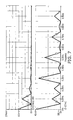
- FIG. 1 illustrates a lighting apparatus according to some embodiments of the inventive subject matter
- FIG. 2 is a graph of a simulation of the rectified voltage provided by the rectified power source and the current through the LED string of FIG. 1 without including the functionality of the energy storage module according to some embodiments of the inventive subject matter;
- FIG. 3 illustrates a frequency domain analysis of the rectified voltage and LED string current waveforms of FIG. 2 according to some embodiments of the inventive subject matter
- FIG. 4 is a graph of a simulation of the rectified voltage provided by the rectified power source and the current through the LED string of FIG. 1 including the functionality of the energy storage module according to some embodiments of the inventive subject matter;
- FIG. 5 illustrates a frequency domain analysis of the rectified voltage and LED string current waveforms of FIG. 4 according to some embodiments of the inventive subject matter
- FIG. 6 is a graph of a simulation of the rectified voltage provided by the rectified power source and the current through the LED string of FIG. 1 including the functionality of the energy storage module according to further embodiments of the inventive subject matter;
- FIG. 7 illustrates a frequency domain analysis of the rectified voltage and LED string current waveforms of FIG. 6 according to some embodiments of the inventive subject matter
- FIG. 8 is a graph of a simulation of the rectified voltage provided by the rectified power source and the current through the LED string of FIG. 1 including the functionality of the energy storage module according to further embodiments of the inventive subject matter;
- FIG. 9 illustrates a frequency domain analysis of the rectified voltage and LED string current waveforms of FIG. 8 according to some embodiments of the inventive subject matter
- FIG. 10 is a graph of a simulation of the rectified voltage provided by the rectified power source and the current through the LED string of FIG. 1 including the functionality of the energy storage module, but in which a portion of the notch circuit functionality is not used, according to some embodiments of the inventive subject matter;
- FIG. 11 illustrates a frequency domain analysis of the rectified voltage and LED string current waveforms of FIG. 10 according to some embodiments of the inventive subject matter
- FIG. 12 is a circuit diagram that illustrates the lighting apparatus of FIG. 1 in more detail according to some embodiments of the inventive subject matter.
- FIGS. 13-16 illustrate various arrangements of lighting apparatus components according to some embodiments of the inventive subject matter.
- Embodiments of the inventive subject matter are described herein with reference to plan and perspective illustrations that are schematic illustrations of idealized embodiments of the inventive subject matter. As such, variations from the shapes of the illustrations as a result, for example, of manufacturing techniques and/or tolerances, are to be expected. Thus, the inventive subject matter should not be construed as limited to the particular shapes of objects illustrated herein, but should include deviations in shapes that result, for example, from manufacturing. Thus, the objects illustrated in the figures are schematic in nature and their shapes are not intended to illustrate the actual shape of a region of a device and are not intended to limit the scope of the inventive subject matter.
- a lighting apparatus can be a device which illuminates an area or volume, e.g., a structure, a swimming pool or spa, a room, a warehouse, an indicator, a road, a parking lot, a vehicle, signage, e.g., road signs, a billboard, a ship, a toy, a mirror, a vessel, an electronic device, a boat, an aircraft, a stadium, a computer, a remote audio device, a remote video device, a cell phone, a tree, a window, an LCD display, a cave, a tunnel, a yard, a lamppost, or a device or array of devices that illuminate an enclosure, or a device that is used for edge or back-lighting (e.g., back light poster, signage, LCD displays), bulb replacements (e.g., for replacing ac incandescent lights, low voltage lights,
- the present inventive subject matter further relates to an illuminated enclosure (the volume of which can be illuminated uniformly or non-uniformly), comprising an enclosed space and at least one lighting apparatus according to the present inventive subject matter, wherein the lighting apparatus illuminates at least a portion of the enclosed space (uniformly or non-uniformly).
- a light spreading circuit can be configured to incrementally activate and deactivate respective ones of a plurality of LED sets coupled in series to form a string.
- An energy storage module is configured to store energy during a first interval of a period of a power signal, such as during a peak of the power signal period, and to apply the stored energy to the string of LED sets during a second interval of the power signal period, such as during a valley portion of the power signal period.
- Such diversion of energy from one portion of the power signal cycle to another portion of the power signal cycle to drive the string of LED sets may provide a more uniform display of light with reduced flicker as the frequency of the current signal through the LED sets may exceed the frequency of the power signal.
- FIG. 1 illustrates a lighting apparatus 100 according to some embodiments of the inventive subject matter.
- the apparatus 100 comprises a rectified power source 110 , an energy storage module 120 , a current control and light spreading module 130 , and an LED string 140 that are connected as shown.
- the LED string 140 comprises a string of serially connected LED sets.
- Each of the LED sets includes at least one LED.
- individual ones of the sets may comprise a single LED and/or individual sets may include multiple LEDs connected in various parallel and/or serial arrangements.
- the current control and light spreading module 130 is used to control the activation and deactivation of the LED sets included in the LED string 140 .
- the LED sets in the LED string 140 may be incrementally activated and deactivated. Examples of current control and light spreading circuits are described, for example, in U.S. patent application Ser. No. 13/235,127 filed Sep. 16, 2011 ('127 application) and U.S. patent application Ser. No.
- the energy storage module 120 may provide additional performance improvements in both reduced flicker, light color, and efficiency by storing energy from the rectified power source 110 during a first interval of the power signal period, such as during a peak of the power signal, and to apply the stored energy to the string 140 of LED sets during a second interval of the power signal period, such as during a valley portion of the power signal period.
- the energy storage module 120 includes a notch circuit 122 that is configured to divert current from the LED string 140 during the first interval by electrically disconnecting the LED string 140 from the rectified power source 110 and directing current to the storage element 126 by electrically coupling the storage element 126 to the rectified power source 110 . This operation produces a notch in the signal representing the current passing through the LED string 140 during the first interval.
- the fill circuit 124 is configured to electrically couple the charge storage element 126 to the LED string 140 during the second interval.
- Power is provided to the LED string 140 from a rectifier circuit 110 that is configured to be coupled to an ac power source and to produce a rectified voltage and current therefrom.
- the rectifier circuit 110 may be included in the lighting apparatus 100 or may be part of a separate unit coupled to the apparatus 100 .
- FIG. 2 is a graph of a simulation of the rectified voltage provided by the rectified power source 110 and the current through the LED string 140 without including the functionality of the energy storage module 120 according to some embodiments of the inventive subject matter.
- the rectified voltage is shown to have a frequency of 100 Hz and is based off of an ac power source having a frequency of 50 Hz.
- the LED string 140 includes three LED sets that are incrementally activated, i.e., forward biased, under the control of the current control and light spreading module 130 at times 52 ms, 53 ms, and 54 ms. Such incremental activation is described in detail in the '127 and '076 applications.
- FIG. 3 illustrates a frequency domain analysis of the rectified voltage and LED string 140 current waveforms of FIG. 2 according to some embodiments of the inventive subject matter.
- the dominant frequency for both the rectified voltage and LED string 140 current is 100 Hz with higher frequency components providing much smaller contributions.
- the 100 Hz component in the LED string 140 current signal may result in an undesirable flicker.
- FIG. 4 is a graph of a simulation of the rectified voltage provided by the rectified power source 110 and the current through the LED string 140 including the functionality of the energy storage module 120 according to some embodiments of the inventive subject matter.
- the notch circuit 122 diverts current from the LED string 140 for a 0.5 ins interval centered around the peak of the rectified voltage provided by the rectified power source 110 at time 55 ms.
- the notch circuit 122 electrically disconnects the LED string 140 from the rectified voltage during the 0.5 ms interval so as to divert current away from the LED string 140 and to direct current to the storage element 126 by electrically coupling the storage element 126 to the rectified power source 110 .
- the fill circuit 124 electrically couples the charge storage element 126 to the LED string 140 during a second interval centered around time 60 ms where the rectified voltage reaches its minimum value of zero volts. This is illustrated by the current shown flowing through the LED string 140 for a 0.5 ms interval centered around the 60 ms time point.
- the energy stored in the storage element 126 is sufficient to forward bias each of the LED sets in the LED string 140 when the stored energy is discharged into the LED string 140 . That is, each of the LED sets in the LED string 140 is turned on during the valley portion of the rectified voltage when the LED sets are typically turned off.
- FIG. 5 illustrates a frequency domain analysis of the rectified voltage and LED string 140 current waveforms of FIG. 4 according to some embodiments of the inventive subject matter.
- the dominant frequency for the rectified voltage is 100 Hz, which is the same as that of FIG. 3 .
- the dominant frequency for the LED string 140 current 140 is also 100 Hz, but in contrast to the simulation of FIGS. 2 and 3 , the higher frequency components are no longer negligible as there are significant odd harmonics at 300 Hz, 500 Hz, 700 Hz, and 900 Hz.
- FIG. 6 is a graph of a simulation of the rectified voltage provided by the rectified power source 110 and the current through the LED string 140 including the functionality of the energy storage module 120 according to some embodiments of the inventive subject matter.
- the notch circuit 122 diverts current from the LED string 140 for a 1.0 ms interval centered around the peak of the rectified voltage provided by the rectified power source 110 at time 55 ms.
- the notch circuit 122 electrically disconnects the LED string 140 from the rectified voltage during the 1.0 ms interval so as to divert current away from the LED string 140 and to direct current to the storage element 126 by electrically coupling the storage element 126 to the rectified power source 110 .
- the fill circuit 124 electrically couples the charge storage element 126 to the LED string 140 during a second interval centered around time 60 ms where the rectified voltage reaches its minimum value of zero volts. This is illustrated by the current shown flowing through the LED string 140 for a 1.0 ms interval centered around the 60 ms time point.
- FIG. 7 illustrates a frequency domain analysis of the rectified voltage and LED string 140 current waveforms of FIG. 6 according to some embodiments of the inventive subject matter.
- the dominant frequency for the rectified voltage is 100 Hz, which is the same as that of FIGS. 3 and 5 .
- the dominant frequency for the LED string 140 current is 300 Hz, which is three times that of the FIGS. 2 and 4 embodiments.
- the dominant frequency for the LED string 140 current can be increased to three times that of the rectified voltage with other higher frequency harmonics also being more dominant than the dominant frequency of the rectified voltage. As a result, low frequency flicker may be reduced and the LED string may also operate at greater efficiency.
- FIG. 8 is a graph of a simulation of the rectified voltage provided by the rectified power source 110 and the current through the LED string 140 including the functionality of the energy storage module 120 according to some embodiments of the inventive subject matter.
- the notch circuit 122 diverts current from the LED string 140 for a 1.0 ms interval centered around the peak of the rectified voltage provided by the rectified power source 110 at time 55 ms.
- the notch circuit 122 electrically disconnects the LED string 140 from the rectified voltage during the 1.0 ms interval so as to divert current away from the LED string 140 and to direct current to the storage element 126 by electrically coupling the storage element 126 to the rectified power source 110 .
- FIG. 9 illustrates a frequency domain analysis of the rectified voltage and LED string 140 current waveforms of FIG. 8 according to some embodiments of the inventive subject matter.
- the dominant frequency for the rectified voltage is 100 Hz, which is the same as that of FIGS. 3 , 5 , and 7 .
- the dominant frequency for the LED string 140 current is 300 Hz, which is three times that of the FIGS. 2 and 4 embodiments.
- FIG. 10 is a graph of a simulation of the rectified voltage provided by the rectified power source 110 and the current through the LED string 140 including the functionality of the energy storage module 120 , but in which a portion of the notch circuit 122 functionality is not used, according to some embodiments of the inventive subject matter.
- a notch is not formed in the LED string 140 current during the 52 ms-58 ms timeframe.
- the notch circuit 122 does, however, couple the storage element 126 to the rectified power source 110 during the 50.5 ms-59.5 ms timeframe.
- the fill circuit 124 electrically couples the charge storage element 126 to the LED string 140 during a second interval centered around time 60 ms where the rectified voltage reaches its minimum value of zero volts. This is illustrated by the current shown flowing through the LED string 140 for a 1.0 ins interval centered around the 60 ms time point.
- FIG. 11 illustrates a frequency domain analysis of the rectified voltage and LED string 140 current waveforms of FIG. 10 according to some embodiments of the inventive subject matter.
- the dominant frequency for the rectified voltage is 100 Hz, which is the same as that of FIGS. 3 , 5 , 7 , and 9 .
- the dominant frequency for the LED string 140 current is also 100 Hz with significant harmonics at 200 Hz, 300 Hz, 400 Hz, and 500 Hz.
- the dominant frequency of the LED string 140 current remains 100 Hz, the additional harmonics spaced 100 Hz apart may alleviate some of the flicker attributed to the low frequency 100 Hz component.
- FIG. 12 is a circuit diagram that illustrates the lighting apparatus of FIG. 1 in more detail according to some embodiments of the inventive subject matter.
- the lighting apparatus is powered by an ac voltage source that is processed through a full wave rectifier circuit comprising diodes D 1 .
- the rectified voltage Vrec is used to power the lighting apparatus, which includes the energy storage module comprising a fill circuit 124 and a notch circuit 122 , a current control and light spreading module 130 , an LED string 140 , comprising three LED sets LED 1 , LED 2 , and LED 3 , and a storage element 126 , which comprises capacitor C 1 .
- the current control and light spreading module 130 includes three current diverter circuits.
- the first current diverter circuit comprises transistors Q 10 and Q 11 , resistor R 8 , and diode D 10 .
- the second current diverter circuit comprises transistors Q 8 and Q 9 , resistor R 7 , and diodes D 8 and D 9 .
- the third current diverter circuit comprises transistors Q 6 and Q 7 , resistor R 6 , and diodes D 5 , D 6 , and D 7 .
- the current control and light spreading module 130 further includes a current limiting and bias control resistor R 9 .
- the current diverter circuits include respective transistors (e.g., transistors Q 6 , Q 8 , and Q 10 ) that are configured to provide respective controllable current diversion paths.
- These transistors may be turned on and off by bias transitions of the LED sets, which may be used to effect biasing of the transistors.
- Such circuitry may be relatively simple in comparison to circuitry that uses comparators or the like to control activation of LED sets in a string.
- the current diverter circuits may allow the LED sets LED 1 , LED 2 , and LED 3 to be incrementally and cumulatively activated and deactivated. Operations of the current control and light spreading module 130 for managing operation of the LED string 140 is described in detail, for example, in the '127 application. It will be understood, however, that other techniques and circuits can be used to implement the current control and light spreading module 130 in accordance with various embodiments of the inventive subject matter. For example, the '076 appplication provides further embodiments of the current control and light spreading module 130 that can be used in the lighting apparatus of FIG. 12 .
- the notch circuit 122 comprises transistors Q 4 and Q 5 , Zener diodes Dz 2 and Dz 3 , resistor R 5 , and diode D 4 , which are configured as shown.
- the fill circuit comprises transistors Q 1 , Q 2 , optocoupler diode/transistor U 1 , resistors R 1 , R 2 , R 3 , and R 4 , Zener diode Dz 1 , and diode D 3 , which are configured as shown. Operations of the notch circuit 122 and fill circuit 124 according to some embodiments of the inventive subject matter will now be described.
- the energy storage module 120 is operable to store energy when the rectified voltage Vrec exceeds the sum of the forward bias threshold voltages for the LED sets in the LED string 140 along with the breakdown voltages of the Zener diode Dz 2 and Dz 3 , i.e., Vrec>V_LED 1 +V_LED 2 +V_LED 3 +V_Dz 2 +V_Dz 3 , then transistor Q 4 is turned on, which allows capacitor C 1 to charge.
- the LED string 140 is electrically disconnected from the rectified voltage Vrec because the breakdown voltage of the Zener diode Dz 3 is greater than the sum of the forward bias voltages of the diodes D 5 , D 6 , and D 7 , i.e., V_Dz 3 >V_D 5 +V_D 6 +V_D 7 .
- transistor Q 6 turns off to create an open circuit between the LED string 140 and resistor R 9 .
- the breakdown voltage of the Zener diode Dz 3 along with resistor R 9 can be used to limit the current during charging of the capacitor C 1 .
- the particular values chosen for the Zener diode Dz 3 along with the resistor R 9 may also be adjusted to control the width of the notch and fill pulse.
- the energy storage module 120 is operable to apply the energy stored in the capacitor C 1 to the LED string 140 , i.e., LED sets LED 1 , LED 2 , and LED 3 when the rectified voltage falls below the breakdown voltage of Zener diode Dz 1 , i.e., Vrec ⁇ Vdz 1 . Responsive to Vrec falling below Vdz 1 , transistor Q 1 turns off and transistor Q 2 turns on. This allows current to flow through the diode of the optocoupler U 1 , which turns the transistor of U 1 on. The capacitor C 1 then discharges into the LED string 140 to provide output during a valley portion of the rectified voltage Vrec.
- the diodes D 2 , D 3 , and D 4 are configured to ensure desired current flow during the charging and discharging of the capacitor C 1 .
- a comparator circuit may be used in place of the Zener diodes Dz 2 and Dz 3 and transistor Q 5 in the notch circuit 122 to compare the rectified voltage Vrec with a reference voltage and generate a bias voltage therefrom to turn off transistor Q 6 to begin charging the capacitor C 1 .
- a comparator circuit may be used in place of transistors Q 1 along with resistors R 1 , R 2 , and R 4 to compare the rectified voltage Vrec with a reference voltage to generate a bias voltage therefrom to turn transistor Q 2 on or, if transistor Q 2 is eliminated, operate a switch to allow current to flow through the optcoupler U 1 .
- reference voltages can be adjusted to control the storage and discharge of energy in the storage element 126 , e.g, capacitor C 1 .
- a lighting apparatus based on the exemplary circuit embodiments of FIG. 12 may provide an efficacy of about 70 lumens per watt in a CR4 lighting unit with a correlated color temperature of about 6000K.
- Embodiments have been described herein where a notch is formed in the LED string current generally centered around a peak in a rectified power voltage. A pulse is then generated that is generally centered around a valley in the rectified voltage. It will be understood that multiple notches and pulses may be generated that may further improve performance. For example, two notches may be formed in the LED string current that are timed so as to be generally symmetrical on either side of the peak portion of a rectified power voltage.
- a 50 Hz power voltage that is rectified to 100 Hz are for purposes of illustration only and the inventive subject matter is not limited to any particular frequency range.
- power signals of other frequencies can also be used, such as a 60 Hz power voltage that is rectified to 120 Hz.
- Non-standard, low frequency power signals such as a 20 Hz power voltage, may also be used.
- the embodiments of the inventive subject matter described herein are based on a sinusoidal based waveform for the non-rectified and rectified power voltage. Other waveforms can also be used, such as trapezoidal, triangular, etc., including non-symmetric waveforms.
- Lighting apparatus circuits as described herein may be implemented in a number of different ways in accordance with various embodiments of the inventive subject matter.
- rectifier circuitry, energy storage circuitry, light spreading circuitry, and LEDs as illustrated, for example, in the embodiments of FIGS. 1 and 12 may be integrated in a common unit configured to be coupled to an ac power source.
- Such an integrated unit may take the form, for example, of a lighting fixture, a screw-in or plug in replacement for a conventional incandescent or compact fluorescent lamp, an integrated circuit or module configured to be used in a lighting fixture or lamp or a variety of other form factors.
- portions of the energy storage and/or light spreading circuitry may be integrated with the LEDs using composite semiconductor structures, e.g., the current diversion transistors Q 6 , Q 8 , and Q 10 illustrated in FIG. 12 may integrated with the respective LEDs that they control to provide multi-terminal controllable LED devices configured for use in arrangements along the lines illustrated herein.
- a rectifier circuit, light spreading/energy storage circuitry, and LEDs may be implemented as separate units 1410 , 1420 , 1430 configured to be connected to an ac power source and interconnected, for example, by wiring, connectors and/or printed circuit conductors.
- a rectifier, light spreading circuitry and energy storage circuitry may be integrated in a common unit 1510 , e.g., in a common microelectronic substrate, thick film assembly, circuit card, module or the like, configured to be connected to an ac power source and to LEDs 1520 .
- a common unit 1510 e.g., in a common microelectronic substrate, thick film assembly, circuit card, module or the like, configured to be connected to an ac power source and to LEDs 1520 .
- LEDs, light spreading circuitry, and energy storage circuitry may be similarly integrated in a common unit 1620 that is configured to be coupled to a rectifier unit 1610 .
- a rectifier unit, energy storage circuitry, light spreading circuitry, and LEDs may be implemented as separate units 1710 , 1720 , 1730 , and 1740 as shown in FIG. 16 .
Landscapes
- Circuit Arrangement For Electric Light Sources In General (AREA)
Abstract
Description
Claims (31)
Priority Applications (4)
| Application Number | Priority Date | Filing Date | Title |
|---|---|---|---|
| US13/338,095 US8823271B2 (en) | 2011-12-27 | 2011-12-27 | Solid-state lighting apparatus including an energy storage module for applying power to a light source element during low power intervals and methods of operating the same |
| EP12862236.2A EP2805579A1 (en) | 2011-12-27 | 2012-12-21 | Led lighting with energy storage for applying power during low power intervals and methods of operating |
| PCT/US2012/071151 WO2013101706A1 (en) | 2011-12-27 | 2012-12-21 | Led lighting with energy storage for applying power during low power intervals and methods of operating |
| CN201280068828.XA CN104106313A (en) | 2011-12-27 | 2012-12-21 | LED lighting with energy storage for applying power during low power intervals and methods of operating |
Applications Claiming Priority (1)
| Application Number | Priority Date | Filing Date | Title |
|---|---|---|---|
| US13/338,095 US8823271B2 (en) | 2011-12-27 | 2011-12-27 | Solid-state lighting apparatus including an energy storage module for applying power to a light source element during low power intervals and methods of operating the same |
Publications (2)
| Publication Number | Publication Date |
|---|---|
| US20130162149A1 US20130162149A1 (en) | 2013-06-27 |
| US8823271B2 true US8823271B2 (en) | 2014-09-02 |
Family
ID=48653841
Family Applications (1)
| Application Number | Title | Priority Date | Filing Date |
|---|---|---|---|
| US13/338,095 Active 2032-11-19 US8823271B2 (en) | 2011-12-27 | 2011-12-27 | Solid-state lighting apparatus including an energy storage module for applying power to a light source element during low power intervals and methods of operating the same |
Country Status (4)
| Country | Link |
|---|---|
| US (1) | US8823271B2 (en) |
| EP (1) | EP2805579A1 (en) |
| CN (1) | CN104106313A (en) |
| WO (1) | WO2013101706A1 (en) |
Cited By (10)
| Publication number | Priority date | Publication date | Assignee | Title |
|---|---|---|---|---|
| US20150002037A1 (en) * | 2013-06-28 | 2015-01-01 | Samsung Electro-Mechanics Co., Ltd. | Light emitting diode driving apparatus |
| US9810379B2 (en) | 2012-04-13 | 2017-11-07 | Cree, Inc. | LED lamp |
| US9995441B2 (en) | 2016-02-08 | 2018-06-12 | Cree, Inc. | LED lamp with internal reflector |
| US10111286B1 (en) * | 2014-02-27 | 2018-10-23 | Inter-Global, Inc. | Driver circuit for LED light |
| US10211660B2 (en) | 2016-02-08 | 2019-02-19 | Cree, Inc. | LED lighting device with adaptive profiles for controlling power consumption |
| US10405406B2 (en) | 2016-06-23 | 2019-09-03 | Ideal Industries Lighting Llc | LED lighting device with communications module and antenna |
| WO2019226411A1 (en) | 2018-05-24 | 2019-11-28 | Ideal Industries Lighting Llc | Led lighting device with led board on network |
| US10544913B2 (en) | 2017-06-08 | 2020-01-28 | Ideal Industries Lighting Llc | LED wall-wash light fixture |
| USRE48489E1 (en) | 2012-04-13 | 2021-03-30 | Ideal Industries Lighting Llc | Gas cooled LED lamp |
| US10991863B2 (en) * | 2018-08-29 | 2021-04-27 | Kaistar Lighting(Xiamen) Co., Ltd. | Light-emitting diode package structure and manufacturing method thereof |
Families Citing this family (32)
| Publication number | Priority date | Publication date | Assignee | Title |
|---|---|---|---|---|
| US8853958B2 (en) | 2011-11-22 | 2014-10-07 | Cree, Inc. | Driving circuits for solid-state lighting apparatus with high voltage LED components and related methods |
| US9651240B2 (en) | 2013-11-14 | 2017-05-16 | Cree, Inc. | LED lamp |
| US9131571B2 (en) | 2012-09-14 | 2015-09-08 | Cree, Inc. | Solid-state lighting apparatus and methods using energy storage with segment control |
| US9203307B2 (en) | 2012-10-31 | 2015-12-01 | Cree, Inc. | Power converter with bias voltage regulation circuit |
| US9664369B2 (en) | 2013-03-13 | 2017-05-30 | Cree, Inc. | LED lamp |
| US9285082B2 (en) | 2013-03-28 | 2016-03-15 | Cree, Inc. | LED lamp with LED board heat sink |
| CN104427688B (en) * | 2013-08-23 | 2016-09-28 | 四川新力光源股份有限公司 | LED alternating-current drive circuit |
| US9541241B2 (en) | 2013-10-03 | 2017-01-10 | Cree, Inc. | LED lamp |
| US10030819B2 (en) | 2014-01-30 | 2018-07-24 | Cree, Inc. | LED lamp and heat sink |
| US9518704B2 (en) | 2014-02-25 | 2016-12-13 | Cree, Inc. | LED lamp with an interior electrical connection |
| US9759387B2 (en) | 2014-03-04 | 2017-09-12 | Cree, Inc. | Dual optical interface LED lamp |
| US9562677B2 (en) | 2014-04-09 | 2017-02-07 | Cree, Inc. | LED lamp having at least two sectors |
| US9435528B2 (en) | 2014-04-16 | 2016-09-06 | Cree, Inc. | LED lamp with LED assembly retention member |
| US9488322B2 (en) | 2014-04-23 | 2016-11-08 | Cree, Inc. | LED lamp with LED board heat sink |
| US9618162B2 (en) | 2014-04-25 | 2017-04-11 | Cree, Inc. | LED lamp |
| US9951910B2 (en) | 2014-05-19 | 2018-04-24 | Cree, Inc. | LED lamp with base having a biased electrical interconnect |
| WO2015195187A1 (en) * | 2014-06-17 | 2015-12-23 | Bae Systems Controls Inc. | Ac driven led light with digital control of color and intensity |
| US9618163B2 (en) | 2014-06-17 | 2017-04-11 | Cree, Inc. | LED lamp with electronics board to submount connection |
| US9488767B2 (en) | 2014-08-05 | 2016-11-08 | Cree, Inc. | LED based lighting system |
| USD768889S1 (en) | 2014-12-09 | 2016-10-11 | Cree, Inc. | LED lamp |
| US9759389B2 (en) | 2014-12-09 | 2017-09-12 | Cree, Inc. | LED based candelabra lamp |
| US9909723B2 (en) | 2015-07-30 | 2018-03-06 | Cree, Inc. | Small form-factor LED lamp with color-controlled dimming |
| US10082269B2 (en) | 2015-06-08 | 2018-09-25 | Cree, Inc. | LED lamp |
| US10132486B2 (en) | 2015-06-15 | 2018-11-20 | Cree, Inc. | LED lamp with axial directed reflector |
| US9903576B2 (en) | 2015-06-15 | 2018-02-27 | Cree, Inc. | Lighting apparatus with electrical connector and control module |
| US10006591B2 (en) | 2015-06-25 | 2018-06-26 | Cree, Inc. | LED lamp |
| US10178717B2 (en) | 2017-03-09 | 2019-01-08 | Dongming Li | Lamp-control circuit for lamp array emitting constant light output |
| IT201700032546A1 (en) * | 2017-03-24 | 2018-09-24 | Cynergi S R L | Electronic circuit for driving a string of light-emitting diodes |
| US10260683B2 (en) | 2017-05-10 | 2019-04-16 | Cree, Inc. | Solid-state lamp with LED filaments having different CCT's |
| US10582598B1 (en) * | 2017-11-02 | 2020-03-03 | Katerra Inc. | Light emitting diode activation control |
| CN207935769U (en) | 2017-11-24 | 2018-10-02 | 上海顿格电子贸易有限公司 | A kind of core column structure and LED light device |
| CN108302349A (en) | 2018-03-23 | 2018-07-20 | 上海顿格电子贸易有限公司 | A kind of LED light source lampshade with self-locking and pre-tightening apparatus |
Citations (22)
| Publication number | Priority date | Publication date | Assignee | Title |
|---|---|---|---|---|
| US5941626A (en) | 1996-05-01 | 1999-08-24 | Hiyoshi Electric Co., Ltd. | Long light emitting apparatus |
| US20040046510A1 (en) | 1998-08-28 | 2004-03-11 | Fiber Optic Designs, Inc | Direct AC driven LED light string |
| US20040206970A1 (en) | 2003-04-16 | 2004-10-21 | Martin Paul S. | Alternating current light emitting device |
| US20060232219A1 (en) | 2003-05-07 | 2006-10-19 | Koninklijke Philips Electronics N.V. | Single driver for multiple light emitting diodes |
| US20080018261A1 (en) * | 2006-05-01 | 2008-01-24 | Kastner Mark A | LED power supply with options for dimming |
| US20080116818A1 (en) | 2006-11-21 | 2008-05-22 | Exclara Inc. | Time division modulation with average current regulation for independent control of arrays of light emitting diodes |
| US20100308739A1 (en) | 2009-06-04 | 2010-12-09 | Exclara Inc. | Apparatus, Method and System for Providing AC Line Power to Lighting Devices |
| US20100308738A1 (en) | 2009-06-04 | 2010-12-09 | Exclara Inc. | Apparatus, Method and System for Providing AC Line Power to Lighting Devices |
| US20110115412A1 (en) | 2008-07-11 | 2011-05-19 | Eldolab Holding B.V. | Power converter for an led assembly and lighting application |
| US20110227484A1 (en) | 2010-03-19 | 2011-09-22 | Active-Semi, Inc | AC LED lamp involving an LED string having separately shortable sections |
| US20110234110A1 (en) | 2010-03-23 | 2011-09-29 | Green Mark Technology Inc. | Led driver circuit |
| US20120091920A1 (en) | 2011-04-11 | 2012-04-19 | Long Yang | LED Light Source with Direct AC Drive |
| US20120099321A1 (en) | 2010-11-11 | 2012-04-26 | Bridgelux, Inc. | Ac led array module for street light applications |
| US8179704B2 (en) * | 2008-12-31 | 2012-05-15 | Genesis Photonics Inc. | Electronic device having a circuit protection unit |
| US8330390B2 (en) * | 2011-04-11 | 2012-12-11 | Bridgelux, Inc. | AC LED light source with reduced flicker |
| US8344659B2 (en) * | 2009-11-06 | 2013-01-01 | Neofocal Systems, Inc. | System and method for lighting power and control system |
| US8373363B2 (en) * | 2009-08-14 | 2013-02-12 | Once Innovations, Inc. | Reduction of harmonic distortion for LED loads |
| US20130069535A1 (en) * | 2011-09-16 | 2013-03-21 | Cree, Inc. | Solid-state lighting apparatus and methods using energy storage |
| US20130069547A1 (en) * | 2011-09-16 | 2013-03-21 | Cree, Inc. | Solid-state lighting apparatus and methods using energy storage |
| US20130069536A1 (en) * | 2011-09-16 | 2013-03-21 | Cree, Inc. | Solid-state lighting apparatus and methods using current diversion controlled by lighting device bias states |
| US20130162153A1 (en) * | 2011-12-27 | 2013-06-27 | Cree, Inc. | Solid-State Lighting Apparatus Including Current Diversion Controlled by Lighting Device Bias States and Current Limiting Using a Passive Electrical Component |
| US8476836B2 (en) * | 2010-05-07 | 2013-07-02 | Cree, Inc. | AC driven solid state lighting apparatus with LED string including switched segments |
-
2011
- 2011-12-27 US US13/338,095 patent/US8823271B2/en active Active
-
2012
- 2012-12-21 CN CN201280068828.XA patent/CN104106313A/en active Pending
- 2012-12-21 WO PCT/US2012/071151 patent/WO2013101706A1/en not_active Ceased
- 2012-12-21 EP EP12862236.2A patent/EP2805579A1/en not_active Withdrawn
Patent Citations (24)
| Publication number | Priority date | Publication date | Assignee | Title |
|---|---|---|---|---|
| US5941626A (en) | 1996-05-01 | 1999-08-24 | Hiyoshi Electric Co., Ltd. | Long light emitting apparatus |
| US20040046510A1 (en) | 1998-08-28 | 2004-03-11 | Fiber Optic Designs, Inc | Direct AC driven LED light string |
| US20040206970A1 (en) | 2003-04-16 | 2004-10-21 | Martin Paul S. | Alternating current light emitting device |
| US20060232219A1 (en) | 2003-05-07 | 2006-10-19 | Koninklijke Philips Electronics N.V. | Single driver for multiple light emitting diodes |
| US20080018261A1 (en) * | 2006-05-01 | 2008-01-24 | Kastner Mark A | LED power supply with options for dimming |
| US20080116818A1 (en) | 2006-11-21 | 2008-05-22 | Exclara Inc. | Time division modulation with average current regulation for independent control of arrays of light emitting diodes |
| US20110115412A1 (en) | 2008-07-11 | 2011-05-19 | Eldolab Holding B.V. | Power converter for an led assembly and lighting application |
| US8179704B2 (en) * | 2008-12-31 | 2012-05-15 | Genesis Photonics Inc. | Electronic device having a circuit protection unit |
| US20100308739A1 (en) | 2009-06-04 | 2010-12-09 | Exclara Inc. | Apparatus, Method and System for Providing AC Line Power to Lighting Devices |
| US20100308738A1 (en) | 2009-06-04 | 2010-12-09 | Exclara Inc. | Apparatus, Method and System for Providing AC Line Power to Lighting Devices |
| US8324840B2 (en) * | 2009-06-04 | 2012-12-04 | Point Somee Limited Liability Company | Apparatus, method and system for providing AC line power to lighting devices |
| US8410717B2 (en) * | 2009-06-04 | 2013-04-02 | Point Somee Limited Liability Company | Apparatus, method and system for providing AC line power to lighting devices |
| US8373363B2 (en) * | 2009-08-14 | 2013-02-12 | Once Innovations, Inc. | Reduction of harmonic distortion for LED loads |
| US8344659B2 (en) * | 2009-11-06 | 2013-01-01 | Neofocal Systems, Inc. | System and method for lighting power and control system |
| US20110227484A1 (en) | 2010-03-19 | 2011-09-22 | Active-Semi, Inc | AC LED lamp involving an LED string having separately shortable sections |
| US20110234110A1 (en) | 2010-03-23 | 2011-09-29 | Green Mark Technology Inc. | Led driver circuit |
| US8476836B2 (en) * | 2010-05-07 | 2013-07-02 | Cree, Inc. | AC driven solid state lighting apparatus with LED string including switched segments |
| US20120099321A1 (en) | 2010-11-11 | 2012-04-26 | Bridgelux, Inc. | Ac led array module for street light applications |
| US8330390B2 (en) * | 2011-04-11 | 2012-12-11 | Bridgelux, Inc. | AC LED light source with reduced flicker |
| US20120091920A1 (en) | 2011-04-11 | 2012-04-19 | Long Yang | LED Light Source with Direct AC Drive |
| US20130069535A1 (en) * | 2011-09-16 | 2013-03-21 | Cree, Inc. | Solid-state lighting apparatus and methods using energy storage |
| US20130069547A1 (en) * | 2011-09-16 | 2013-03-21 | Cree, Inc. | Solid-state lighting apparatus and methods using energy storage |
| US20130069536A1 (en) * | 2011-09-16 | 2013-03-21 | Cree, Inc. | Solid-state lighting apparatus and methods using current diversion controlled by lighting device bias states |
| US20130162153A1 (en) * | 2011-12-27 | 2013-06-27 | Cree, Inc. | Solid-State Lighting Apparatus Including Current Diversion Controlled by Lighting Device Bias States and Current Limiting Using a Passive Electrical Component |
Non-Patent Citations (1)
| Title |
|---|
| International Search Report Corresponding to International Application No. PCT/US12/71151; Date of Mailing: Mar. 7, 2013; 10 Pages. |
Cited By (11)
| Publication number | Priority date | Publication date | Assignee | Title |
|---|---|---|---|---|
| US9810379B2 (en) | 2012-04-13 | 2017-11-07 | Cree, Inc. | LED lamp |
| USRE48489E1 (en) | 2012-04-13 | 2021-03-30 | Ideal Industries Lighting Llc | Gas cooled LED lamp |
| US20150002037A1 (en) * | 2013-06-28 | 2015-01-01 | Samsung Electro-Mechanics Co., Ltd. | Light emitting diode driving apparatus |
| US10111286B1 (en) * | 2014-02-27 | 2018-10-23 | Inter-Global, Inc. | Driver circuit for LED light |
| US9995441B2 (en) | 2016-02-08 | 2018-06-12 | Cree, Inc. | LED lamp with internal reflector |
| US10211660B2 (en) | 2016-02-08 | 2019-02-19 | Cree, Inc. | LED lighting device with adaptive profiles for controlling power consumption |
| US10405406B2 (en) | 2016-06-23 | 2019-09-03 | Ideal Industries Lighting Llc | LED lighting device with communications module and antenna |
| US10544913B2 (en) | 2017-06-08 | 2020-01-28 | Ideal Industries Lighting Llc | LED wall-wash light fixture |
| WO2019226411A1 (en) | 2018-05-24 | 2019-11-28 | Ideal Industries Lighting Llc | Led lighting device with led board on network |
| US10499481B1 (en) | 2018-05-24 | 2019-12-03 | Ideal Industries Lighting Llc | LED lighting device with LED board on network |
| US10991863B2 (en) * | 2018-08-29 | 2021-04-27 | Kaistar Lighting(Xiamen) Co., Ltd. | Light-emitting diode package structure and manufacturing method thereof |
Also Published As
| Publication number | Publication date |
|---|---|
| WO2013101706A1 (en) | 2013-07-04 |
| US20130162149A1 (en) | 2013-06-27 |
| CN104106313A (en) | 2014-10-15 |
| EP2805579A1 (en) | 2014-11-26 |
Similar Documents
| Publication | Publication Date | Title |
|---|---|---|
| US8823271B2 (en) | Solid-state lighting apparatus including an energy storage module for applying power to a light source element during low power intervals and methods of operating the same | |
| US9041302B2 (en) | Solid-state lighting apparatus and methods using energy storage | |
| US11178740B2 (en) | Solid-state lighting apparatus including current diversion controlled by lighting device bias states and current limiting using a passive electrical component | |
| US9131561B2 (en) | Solid-state lighting apparatus and methods using energy storage | |
| US9277605B2 (en) | Solid-state lighting apparatus and methods using current diversion controlled by lighting device bias states | |
| US9374858B2 (en) | Solid-state lighting apparatus and methods using switched energy storage | |
| US9101021B2 (en) | Solid-state lighting apparatus and methods using parallel-connected segment bypass circuits | |
| US9131571B2 (en) | Solid-state lighting apparatus and methods using energy storage with segment control | |
| US9173258B2 (en) | Lighting apparatus including a current bleeder module for sinking current during dimming of the lighting apparatus and methods of operating the same | |
| US8742671B2 (en) | Solid state lighting apparatus and methods using integrated driver circuitry | |
| US9658638B2 (en) | Buck-boost voltage converter circuits for solid state lighting apparatus |
Legal Events
| Date | Code | Title | Description |
|---|---|---|---|
| AS | Assignment |
Owner name: CREE, INC., NORTH CAROLINA Free format text: ASSIGNMENT OF ASSIGNORS INTEREST;ASSIGNORS:VAN DE VEN, ANTONY P.;NI, LIQIN;SIGNING DATES FROM 20120215 TO 20120301;REEL/FRAME:027868/0261 |
|
| STCF | Information on status: patent grant |
Free format text: PATENTED CASE |
|
| MAFP | Maintenance fee payment |
Free format text: PAYMENT OF MAINTENANCE FEE, 4TH YEAR, LARGE ENTITY (ORIGINAL EVENT CODE: M1551) Year of fee payment: 4 |
|
| AS | Assignment |
Owner name: IDEAL INDUSTRIES LIGHTING LLC, ILLINOIS Free format text: ASSIGNMENT OF ASSIGNORS INTEREST;ASSIGNOR:CREE, INC.;REEL/FRAME:049226/0001 Effective date: 20190513 |
|
| MAFP | Maintenance fee payment |
Free format text: PAYMENT OF MAINTENANCE FEE, 8TH YEAR, LARGE ENTITY (ORIGINAL EVENT CODE: M1552); ENTITY STATUS OF PATENT OWNER: LARGE ENTITY Year of fee payment: 8 |
|
| AS | Assignment |
Owner name: FGI WORLDWIDE LLC, NEW YORK Free format text: SECURITY INTEREST;ASSIGNOR:IDEAL INDUSTRIES LIGHTING LLC;REEL/FRAME:064897/0413 Effective date: 20230908 |
|
| FEPP | Fee payment procedure |
Free format text: MAINTENANCE FEE REMINDER MAILED (ORIGINAL EVENT CODE: REM.); ENTITY STATUS OF PATENT OWNER: LARGE ENTITY |