US8822468B2 - 3-Methyl-imidazo[1,2-b]pyridazine derivatives - Google Patents
3-Methyl-imidazo[1,2-b]pyridazine derivatives Download PDFInfo
- Publication number
- US8822468B2 US8822468B2 US12/396,137 US39613709A US8822468B2 US 8822468 B2 US8822468 B2 US 8822468B2 US 39613709 A US39613709 A US 39613709A US 8822468 B2 US8822468 B2 US 8822468B2
- Authority
- US
- United States
- Prior art keywords
- imidazo
- pyridazin
- ylmethyl
- pyrazol
- methyl
- Prior art date
- Legal status (The legal status is an assumption and is not a legal conclusion. Google has not performed a legal analysis and makes no representation as to the accuracy of the status listed.)
- Expired - Fee Related, expires
Links
- 0 *C([2*])([3*])C1=CN=C2C=CC(C[1*])=NN12 Chemical compound *C([2*])([3*])C1=CN=C2C=CC(C[1*])=NN12 0.000 description 48
- FTHFIAKJLSRHPM-UHFFFAOYSA-N C1=CC2=CC(CC3=CN=C4C=CC(NC5=CC=NC=N5)=NN34)=CC=C2N=C1 Chemical compound C1=CC2=CC(CC3=CN=C4C=CC(NC5=CC=NC=N5)=NN34)=CC=C2N=C1 FTHFIAKJLSRHPM-UHFFFAOYSA-N 0.000 description 2
- MAGYUPXAAAZYOA-UHFFFAOYSA-N C1=CC2=CC(CC3=CN=C4C=CC(NC5CCCC5)=NN34)=CC=C2N=C1 Chemical compound C1=CC2=CC(CC3=CN=C4C=CC(NC5CCCC5)=NN34)=CC=C2N=C1 MAGYUPXAAAZYOA-UHFFFAOYSA-N 0.000 description 2
- BMTZQCBWGKXSEG-UHFFFAOYSA-N C1=CC=C(CNC2=NN3C(CC4=CC=C5N=CC=CC5=C4)=CN=C3C=C2)C=C1 Chemical compound C1=CC=C(CNC2=NN3C(CC4=CC=C5N=CC=CC5=C4)=CN=C3C=C2)C=C1 BMTZQCBWGKXSEG-UHFFFAOYSA-N 0.000 description 2
- VNWCRDJPUTYECZ-UHFFFAOYSA-N C1=CC=C2C=C(C3=NN4C(CC5=CC6=CC=CN=C6C=C5)=CN=C4C=C3)C=CC2=C1 Chemical compound C1=CC=C2C=C(C3=NN4C(CC5=CC6=CC=CN=C6C=C5)=CN=C4C=C3)C=CC2=C1 VNWCRDJPUTYECZ-UHFFFAOYSA-N 0.000 description 2
- MMBAWKIOFMPKJB-UHFFFAOYSA-N C1=CC=C2N=CC(C3=NN4C(CC5=CC6=CC=CN=C6C=C5)=CN=C4C=C3)=CC2=C1 Chemical compound C1=CC=C2N=CC(C3=NN4C(CC5=CC6=CC=CN=C6C=C5)=CN=C4C=C3)=CC2=C1 MMBAWKIOFMPKJB-UHFFFAOYSA-N 0.000 description 2
- FJOKEGMKSNHVFR-UHFFFAOYSA-N C1=CN2C=C(CC3=CN=C4C=CC(C5=CN(C6CCNCC6)N=C5)=NN34)C=CC2=N1 Chemical compound C1=CN2C=C(CC3=CN=C4C=CC(C5=CN(C6CCNCC6)N=C5)=NN34)C=CC2=N1 FJOKEGMKSNHVFR-UHFFFAOYSA-N 0.000 description 2
- YJZHCWZRONVTMY-UHFFFAOYSA-N CC(=O)N1CCC(N2C=C(C3=NN4C(CC5=CC6=C(C=C5F)N=CC=C6)=CN=C4C=C3)C=N2)CC1 Chemical compound CC(=O)N1CCC(N2C=C(C3=NN4C(CC5=CC6=C(C=C5F)N=CC=C6)=CN=C4C=C3)C=N2)CC1 YJZHCWZRONVTMY-UHFFFAOYSA-N 0.000 description 2
- XCVJFECQVKFZQK-UHFFFAOYSA-N CC1=CC=C(NC2=NN3C(CC4=CC=C5N=CC=CC5=C4)=CN=C3C=C2)C=C1Cl Chemical compound CC1=CC=C(NC2=NN3C(CC4=CC=C5N=CC=CC5=C4)=CN=C3C=C2)C=C1Cl XCVJFECQVKFZQK-UHFFFAOYSA-N 0.000 description 2
- AHUQHRGRCFBLFS-UHFFFAOYSA-N CC1=CN(C2=NN3C(CC4=CC=C5N=CC=CC5=C4)=CN=C3C=C2)N=C1 Chemical compound CC1=CN(C2=NN3C(CC4=CC=C5N=CC=CC5=C4)=CN=C3C=C2)N=C1 AHUQHRGRCFBLFS-UHFFFAOYSA-N 0.000 description 2
- NOTRQJWYZRXTKS-UHFFFAOYSA-N CCC(C)NC1=NN2C(CC3=CC=C4N=CC=CC4=C3)=CN=C2C=C1 Chemical compound CCC(C)NC1=NN2C(CC3=CC=C4N=CC=CC4=C3)=CN=C2C=C1 NOTRQJWYZRXTKS-UHFFFAOYSA-N 0.000 description 2
- FSBQVFRJAYYKTM-UHFFFAOYSA-N CCN1C=C(C2=NN3C(CC4=CC5=CC=CN=C5C=C4)=CN=C3C=C2)C=N1 Chemical compound CCN1C=C(C2=NN3C(CC4=CC5=CC=CN=C5C=C4)=CN=C3C=C2)C=N1 FSBQVFRJAYYKTM-UHFFFAOYSA-N 0.000 description 2
- KUGHCXDIURFABX-UHFFFAOYSA-N CN1C=C(C2=NN3C(CC4=C(Cl)C=C5N=CC=CC5=C4)=CN=C3C=C2)C=N1 Chemical compound CN1C=C(C2=NN3C(CC4=C(Cl)C=C5N=CC=CC5=C4)=CN=C3C=C2)C=N1 KUGHCXDIURFABX-UHFFFAOYSA-N 0.000 description 2
- ZFTLSKOMUJBESF-UHFFFAOYSA-N CN1C=C(C2=NN3C(CC4=C(F)C=C5C(=C4)C=NN5C)=CN=C3C=C2)C=N1 Chemical compound CN1C=C(C2=NN3C(CC4=C(F)C=C5C(=C4)C=NN5C)=CN=C3C=C2)C=N1 ZFTLSKOMUJBESF-UHFFFAOYSA-N 0.000 description 2
- CJMBZKYBGHSIQP-UHFFFAOYSA-N CN1C=C(C2=NN3C(CC4=CC5=C(C=C4)N=CN5CCN4CCCC4)=CN=C3C=C2)C=N1 Chemical compound CN1C=C(C2=NN3C(CC4=CC5=C(C=C4)N=CN5CCN4CCCC4)=CN=C3C=C2)C=N1 CJMBZKYBGHSIQP-UHFFFAOYSA-N 0.000 description 2
- KCTBSPUHNCFBSX-UHFFFAOYSA-N CNC(=O)C1=C(F)C=C(C2=NN3C(CC4=CC5=CC=CN=C5C=C4)=CN=C3C=C2)C=C1 Chemical compound CNC(=O)C1=C(F)C=C(C2=NN3C(CC4=CC5=CC=CN=C5C=C4)=CN=C3C=C2)C=C1 KCTBSPUHNCFBSX-UHFFFAOYSA-N 0.000 description 2
- XAXPBWWXWIFHMJ-HNNXBMFYSA-N C[C@@H](C1=CC2=C(C=C1)N=CC=C2)C1=CN=C2C=CC(C3=CN(CCO)N=C3)=NN12 Chemical compound C[C@@H](C1=CC2=C(C=C1)N=CC=C2)C1=CN=C2C=CC(C3=CN(CCO)N=C3)=NN12 XAXPBWWXWIFHMJ-HNNXBMFYSA-N 0.000 description 2
- HDMYYQIBNYUDRQ-AWEZNQCLSA-N C[C@@H](C1=CC2=CC=CN=C2C=C1)C1=CN=C2C=CC(C3=CN(C)N=C3)=NN12 Chemical compound C[C@@H](C1=CC2=CC=CN=C2C=C1)C1=CN=C2C=CC(C3=CN(C)N=C3)=NN12 HDMYYQIBNYUDRQ-AWEZNQCLSA-N 0.000 description 2
- YHDOSUJOTKFGID-ZDUSSCGKSA-N C[C@@H](C1=CC=C2C(=C1)C=NN2C)C1=CN=C2C=CC(C3=CN(C)N=C3)=NN12 Chemical compound C[C@@H](C1=CC=C2C(=C1)C=NN2C)C1=CN=C2C=CC(C3=CN(C)N=C3)=NN12 YHDOSUJOTKFGID-ZDUSSCGKSA-N 0.000 description 2
- ATASNKKKUMVJNW-ZDUSSCGKSA-N C[C@@H](C1=CN=C2C=CC(C3=CN(CCO)N=C3)=NN12)C1=C(F)C=C2N=CC=CC2=C1F Chemical compound C[C@@H](C1=CN=C2C=CC(C3=CN(CCO)N=C3)=NN12)C1=C(F)C=C2N=CC=CC2=C1F ATASNKKKUMVJNW-ZDUSSCGKSA-N 0.000 description 2
- JFDXVUAVQISAOG-CQSZACIVSA-N C[C@@H](C1=CN=C2C=CC(C3=CN(CCO)N=C3)=NN12)C1=C/C=C2/N=CN(C)/C2=C\1 Chemical compound C[C@@H](C1=CN=C2C=CC(C3=CN(CCO)N=C3)=NN12)C1=C/C=C2/N=CN(C)/C2=C\1 JFDXVUAVQISAOG-CQSZACIVSA-N 0.000 description 2
- IWWFZIFFFRFPMR-NSHDSACASA-N C[C@H](C1=CN=C2C=CC(C3=CN(C)N=C3)=NN12)C1=C(F)C=C2NN=CC2=C1 Chemical compound C[C@H](C1=CN=C2C=CC(C3=CN(C)N=C3)=NN12)C1=C(F)C=C2NN=CC2=C1 IWWFZIFFFRFPMR-NSHDSACASA-N 0.000 description 2
- AZCXTTOCYTWSOS-UHFFFAOYSA-N ClC1=C(C/C2=C/N=C3/C=CC(C4=CN(C5CCNCC5)N=C4)=NN23)C=CC2=NC=CC=C21 Chemical compound ClC1=C(C/C2=C/N=C3/C=CC(C4=CN(C5CCNCC5)N=C4)=NN23)C=CC2=NC=CC=C21 AZCXTTOCYTWSOS-UHFFFAOYSA-N 0.000 description 2
- NPJQSFFBWUQYFM-UHFFFAOYSA-N ClC1=C(Cl)C(NC2=NN3C(CC4=CC=C5N=CC=CC5=C4)=CN=C3C=C2)=CC=C1 Chemical compound ClC1=C(Cl)C(NC2=NN3C(CC4=CC=C5N=CC=CC5=C4)=CN=C3C=C2)=CC=C1 NPJQSFFBWUQYFM-UHFFFAOYSA-N 0.000 description 2
- YKPNAMASGCBHQA-UHFFFAOYSA-N ClC1=NC=CC(C2=NN3C(CC4=CC5=CC=CN=C5C=C4)=CN=C3C=C2)=C1 Chemical compound ClC1=NC=CC(C2=NN3C(CC4=CC5=CC=CN=C5C=C4)=CN=C3C=C2)=C1 YKPNAMASGCBHQA-UHFFFAOYSA-N 0.000 description 2
- JKQBTSUJWGHPCG-UHFFFAOYSA-N FC(F)(F)C1=CC=CC(C2=NN3C(CC4=CC5=CC=CN=C5C=C4)=CN=C3C=C2)=C1 Chemical compound FC(F)(F)C1=CC=CC(C2=NN3C(CC4=CC5=CC=CN=C5C=C4)=CN=C3C=C2)=C1 JKQBTSUJWGHPCG-UHFFFAOYSA-N 0.000 description 2
- LUPIWHRPBNWRMP-UHFFFAOYSA-N FC1=CC2=C(C=CC=N2)C=C1CC1=CN=C2C=CC(C3=CN(CCN4CCCC4)N=C3)=NN12 Chemical compound FC1=CC2=C(C=CC=N2)C=C1CC1=CN=C2C=CC(C3=CN(CCN4CCCC4)N=C3)=NN12 LUPIWHRPBNWRMP-UHFFFAOYSA-N 0.000 description 2
- KBPCXVGRGANDRJ-UHFFFAOYSA-N FC1=CC=C(C2=NN3C(CC4=CC5=CC=CN=C5C=C4)=CN=C3C=C2)C=C1 Chemical compound FC1=CC=C(C2=NN3C(CC4=CC5=CC=CN=C5C=C4)=CN=C3C=C2)C=C1 KBPCXVGRGANDRJ-UHFFFAOYSA-N 0.000 description 2
- KDQNCGIAOPOGDB-UHFFFAOYSA-N N#CCN1C=C(C2=NN3C(CC4=C(F)C=C5N=CC=CC5=C4F)=CN=C3C=C2)C=N1 Chemical compound N#CCN1C=C(C2=NN3C(CC4=C(F)C=C5N=CC=CC5=C4F)=CN=C3C=C2)C=N1 KDQNCGIAOPOGDB-UHFFFAOYSA-N 0.000 description 2
- XHCCRZCCYDRQDY-UHFFFAOYSA-N O=C1CCN(C2=NN3C(CC4=CC=C5N=CC=CC5=C4)=CN=C3C=C2)CCN1 Chemical compound O=C1CCN(C2=NN3C(CC4=CC=C5N=CC=CC5=C4)=CN=C3C=C2)CCN1 XHCCRZCCYDRQDY-UHFFFAOYSA-N 0.000 description 2
- NTAZIDFSLMMCNB-UHFFFAOYSA-N O=S1(=O)CCC(NC2=NN3C(CC4=CC=C5N=CC=CC5=C4)=CN=C3C=C2)C1 Chemical compound O=S1(=O)CCC(NC2=NN3C(CC4=CC=C5N=CC=CC5=C4)=CN=C3C=C2)C1 NTAZIDFSLMMCNB-UHFFFAOYSA-N 0.000 description 2
- DEDNHBBINMPCQA-UHFFFAOYSA-N OCCN1C=C(C2=NN3C(CC4=CC=C(O)C=C4)=CN=C3C=C2)C=N1 Chemical compound OCCN1C=C(C2=NN3C(CC4=CC=C(O)C=C4)=CN=C3C=C2)C=N1 DEDNHBBINMPCQA-UHFFFAOYSA-N 0.000 description 2
- NJARSSOCUMVUMJ-UHFFFAOYSA-N BrC1=CC=C(C2=NN3C(CC4=CC5=CC=CN=C5C=C4)=CN=C3C=C2)C=C1 Chemical compound BrC1=CC=C(C2=NN3C(CC4=CC5=CC=CN=C5C=C4)=CN=C3C=C2)C=C1 NJARSSOCUMVUMJ-UHFFFAOYSA-N 0.000 description 1
- HWUASVHHYNNXRT-UHFFFAOYSA-N C.C.C.C.C.C.C.C=CC1=C(F)C=C2N=CC=CC2=C1F.C=C[Sn](CCCC)(CCCC)CCCC.F.FC1=C(Br)C(F)=C2C=CC=NC2=C1.NC1=CC(F)=C(Br)C(F)=C1.O=[N+]([O-])C1=CC=CC(SO([Na+])OO)=C1.OCC(O)CO.[H]C(=O)C1=C(F)C=C2N=CC=CC2=C1F Chemical compound C.C.C.C.C.C.C.C=CC1=C(F)C=C2N=CC=CC2=C1F.C=C[Sn](CCCC)(CCCC)CCCC.F.FC1=C(Br)C(F)=C2C=CC=NC2=C1.NC1=CC(F)=C(Br)C(F)=C1.O=[N+]([O-])C1=CC=CC(SO([Na+])OO)=C1.OCC(O)CO.[H]C(=O)C1=C(F)C=C2N=CC=CC2=C1F HWUASVHHYNNXRT-UHFFFAOYSA-N 0.000 description 1
- FAQMKPZCXNTUGK-OVUHKURCSA-N C.C.C.C.C.C.C.CN1N=CC2=C(F)C=C(F)C=C21.I.N/N=C/C1=C(F)C=C(F)C=C1F.O=CC1=C(F)C=C(F)C=C1F.[H]C(=O)C1=C(F)C=C2C(=C1F)C=NN2C.[H]C(=O)N(C)C1=CC=CC=C1 Chemical compound C.C.C.C.C.C.C.CN1N=CC2=C(F)C=C(F)C=C21.I.N/N=C/C1=C(F)C=C(F)C=C1F.O=CC1=C(F)C=C(F)C=C1F.[H]C(=O)C1=C(F)C=C2C(=C1F)C=NN2C.[H]C(=O)N(C)C1=CC=CC=C1 FAQMKPZCXNTUGK-OVUHKURCSA-N 0.000 description 1
- PINTZCSGWOLSBL-UHFFFAOYSA-N C.C.C.C.C.C=CC1=CN2C=CN=C2C=C1F.C=CC1=CN=C(N)C=C1F.C=CC1=CN=C(N)C=C1F.C=C[Sn](CCCC)(CCCC)CCCC.CC(=O)/B=N/SC#N.NC1=NC=C(Br)C(F)=C1.NC1=NC=CC(F)=C1.O=CC1=CN2C=CN=C2C=C1F.[H]C(=O)CCl Chemical compound C.C.C.C.C.C=CC1=CN2C=CN=C2C=C1F.C=CC1=CN=C(N)C=C1F.C=CC1=CN=C(N)C=C1F.C=C[Sn](CCCC)(CCCC)CCCC.CC(=O)/B=N/SC#N.NC1=NC=C(Br)C(F)=C1.NC1=NC=CC(F)=C1.O=CC1=CN2C=CN=C2C=C1F.[H]C(=O)CCl PINTZCSGWOLSBL-UHFFFAOYSA-N 0.000 description 1
- XDCHORUEVINJFB-UHFFFAOYSA-N C.C.C.C.C.CI.CN1N=CC2=C1C=C(F)C(Br)=C2.FC1=CC2=C(C=NN2)C=C1Br.[HH].[H]C(=O)C1=CC2=C(C=C1F)N(C)N=C2.[NaH] Chemical compound C.C.C.C.C.CI.CN1N=CC2=C1C=C(F)C(Br)=C2.FC1=CC2=C(C=NN2)C=C1Br.[HH].[H]C(=O)C1=CC2=C(C=C1F)N(C)N=C2.[NaH] XDCHORUEVINJFB-UHFFFAOYSA-N 0.000 description 1
- HNVVDUPGUAKNAX-UHFFFAOYSA-N C.C.C.CCOC(OCC)OCC.COC(=O)C1=CC(F)=C([N+](=O)[O-])C=C1.COC(=O)C1=CC(NCCN2CCCC2)=C(N)C=C1.COC(=O)C1=CC(NCCN2CCCC2)=C(N)C=C1.COC(=O)C1=CC(NCCN2CCCC2)=C([N+](=O)[O-])C=C1.COC(=O)C1=CC2=C(C=C1)N=CN2CCN1CCCC1.NCCC1CCCC1.O=CC1=CC2=C(C=C1)N=CN2CCN1CCCC1.[Ni][RaH2-] Chemical compound C.C.C.CCOC(OCC)OCC.COC(=O)C1=CC(F)=C([N+](=O)[O-])C=C1.COC(=O)C1=CC(NCCN2CCCC2)=C(N)C=C1.COC(=O)C1=CC(NCCN2CCCC2)=C(N)C=C1.COC(=O)C1=CC(NCCN2CCCC2)=C([N+](=O)[O-])C=C1.COC(=O)C1=CC2=C(C=C1)N=CN2CCN1CCCC1.NCCC1CCCC1.O=CC1=CC2=C(C=C1)N=CN2CCN1CCCC1.[Ni][RaH2-] HNVVDUPGUAKNAX-UHFFFAOYSA-N 0.000 description 1
- SWKPHTJWDCOMHP-UHFFFAOYSA-N C1=CC(NC2=NN3C(CC4=CC=C5N=CC=CC5=C4)=CN=C3C=C2)=CN=C1 Chemical compound C1=CC(NC2=NN3C(CC4=CC=C5N=CC=CC5=C4)=CN=C3C=C2)=CN=C1 SWKPHTJWDCOMHP-UHFFFAOYSA-N 0.000 description 1
- MPZWCTRXNCBRJS-UHFFFAOYSA-N C1=CC2=CC(CC3=CN=C4C=CC(C5=CN(CCN6CCC6)N=C5)=NN34)=CC=C2N=C1 Chemical compound C1=CC2=CC(CC3=CN=C4C=CC(C5=CN(CCN6CCC6)N=C5)=NN34)=CC=C2N=C1 MPZWCTRXNCBRJS-UHFFFAOYSA-N 0.000 description 1
- BMTHTCNTOOHPJI-UHFFFAOYSA-N C1=CC2=CC(CC3=CN=C4C=CC(C5=CN(CCN6CCCC6)N=C5)=NN34)=CC=C2N=C1 Chemical compound C1=CC2=CC(CC3=CN=C4C=CC(C5=CN(CCN6CCCC6)N=C5)=NN34)=CC=C2N=C1 BMTHTCNTOOHPJI-UHFFFAOYSA-N 0.000 description 1
- KOOTURRIYPMIIX-UHFFFAOYSA-N C1=CC2=CC(CC3=CN=C4C=CC(C5=CN(CCOC6CCCCO6)N=C5)=NN34)=CC=C2N=C1 Chemical compound C1=CC2=CC(CC3=CN=C4C=CC(C5=CN(CCOC6CCCCO6)N=C5)=NN34)=CC=C2N=C1 KOOTURRIYPMIIX-UHFFFAOYSA-N 0.000 description 1
- KKFDLRWKXWMOIO-UHFFFAOYSA-N C1=CC2=CC(CC3=CN=C4C=CC(N5C=CC=N5)=NN34)=CC=C2N=C1 Chemical compound C1=CC2=CC(CC3=CN=C4C=CC(N5C=CC=N5)=NN34)=CC=C2N=C1 KKFDLRWKXWMOIO-UHFFFAOYSA-N 0.000 description 1
- VSAQCIYXIZSZHW-UHFFFAOYSA-N C1=CC2=CC(CC3=CN=C4C=CC(N5C=CN=C5)=NN34)=CC=C2N=C1 Chemical compound C1=CC2=CC(CC3=CN=C4C=CC(N5C=CN=C5)=NN34)=CC=C2N=C1 VSAQCIYXIZSZHW-UHFFFAOYSA-N 0.000 description 1
- WABCJHVXKLMPTL-UHFFFAOYSA-N C1=CC2=CC(CC3=CN=C4C=CC(N5CCC6(CC5)OCCO6)=NN34)=CC=C2N=C1 Chemical compound C1=CC2=CC(CC3=CN=C4C=CC(N5CCC6(CC5)OCCO6)=NN34)=CC=C2N=C1 WABCJHVXKLMPTL-UHFFFAOYSA-N 0.000 description 1
- PDVRGIXGHMLMBF-UHFFFAOYSA-N C1=CC2=CC(CC3=CN=C4C=CC(N5CCCC5)=NN34)=CC=C2N=C1 Chemical compound C1=CC2=CC(CC3=CN=C4C=CC(N5CCCC5)=NN34)=CC=C2N=C1 PDVRGIXGHMLMBF-UHFFFAOYSA-N 0.000 description 1
- LPTLDDOMKUMWSO-UHFFFAOYSA-N C1=CC2=CC(CC3=CN=C4C=CC(N5CCOCC5)=NN34)=CC=C2N=C1 Chemical compound C1=CC2=CC(CC3=CN=C4C=CC(N5CCOCC5)=NN34)=CC=C2N=C1 LPTLDDOMKUMWSO-UHFFFAOYSA-N 0.000 description 1
- MVDLEBHFCXGIKM-UHFFFAOYSA-N C1=CC2=CC(CC3=CN=C4C=CC(NC5=CC=C(CN6CCCCC6)C=C5)=NN34)=CC=C2N=C1 Chemical compound C1=CC2=CC(CC3=CN=C4C=CC(NC5=CC=C(CN6CCCCC6)C=C5)=NN34)=CC=C2N=C1 MVDLEBHFCXGIKM-UHFFFAOYSA-N 0.000 description 1
- SOVCYLBYXNNOAV-UHFFFAOYSA-N C1=CC2=CC(CC3=CN=C4C=CC(NC5=CC=CC6=NON=C56)=NN34)=CC=C2N=C1 Chemical compound C1=CC2=CC(CC3=CN=C4C=CC(NC5=CC=CC6=NON=C56)=NN34)=CC=C2N=C1 SOVCYLBYXNNOAV-UHFFFAOYSA-N 0.000 description 1
- OWWNWFHDKVQQQT-UHFFFAOYSA-N C1=CC2=CC(CC3=CN=C4C=CC(NC5CCCCCCC5)=NN34)=CC=C2N=C1 Chemical compound C1=CC2=CC(CC3=CN=C4C=CC(NC5CCCCCCC5)=NN34)=CC=C2N=C1 OWWNWFHDKVQQQT-UHFFFAOYSA-N 0.000 description 1
- SWNHPHJYDSEPEZ-UHFFFAOYSA-N C1=CC2=CC(CC3=CN=C4C=CC(NCC5CCCO5)=NN34)=CC=C2N=C1 Chemical compound C1=CC2=CC(CC3=CN=C4C=CC(NCC5CCCO5)=NN34)=CC=C2N=C1 SWNHPHJYDSEPEZ-UHFFFAOYSA-N 0.000 description 1
- PYQFGRDPSBTSLN-UHFFFAOYSA-N C1=CC2=CC(CC3=CN=C4C=CC(NCCN5CCCC5)=NN34)=CC=C2N=C1 Chemical compound C1=CC2=CC(CC3=CN=C4C=CC(NCCN5CCCC5)=NN34)=CC=C2N=C1 PYQFGRDPSBTSLN-UHFFFAOYSA-N 0.000 description 1
- RTLVKVAKQOZNMR-UHFFFAOYSA-N C1=CC=C(C2=NN3C(CC4=CC5=CC=CN=C5C=C4)=CN=C3C=C2)C=C1 Chemical compound C1=CC=C(C2=NN3C(CC4=CC5=CC=CN=C5C=C4)=CN=C3C=C2)C=C1 RTLVKVAKQOZNMR-UHFFFAOYSA-N 0.000 description 1
- YBXNSMOWSXUICK-UHFFFAOYSA-N C1=CC=C(C2=NOC(C3=NN4C(CC5=CC6=CC=CN=C6C=C5)=CN=C4C=C3)=C2)C=C1 Chemical compound C1=CC=C(C2=NOC(C3=NN4C(CC5=CC6=CC=CN=C6C=C5)=CN=C4C=C3)=C2)C=C1 YBXNSMOWSXUICK-UHFFFAOYSA-N 0.000 description 1
- PFXJVCZXNMYQTC-UHFFFAOYSA-N C1=CC=C(CCNC2=NN3C(CC4=CC=C5N=CC=CC5=C4)=CN=C3C=C2)C=C1 Chemical compound C1=CC=C(CCNC2=NN3C(CC4=CC=C5N=CC=CC5=C4)=CN=C3C=C2)C=C1 PFXJVCZXNMYQTC-UHFFFAOYSA-N 0.000 description 1
- VUGXZKTXMJQFNF-UHFFFAOYSA-N C1=CC=C(CN2CCC(NC3=NN4C(CC5=CC=C6N=CC=CC6=C5)=CN=C4C=C3)C2)C=C1 Chemical compound C1=CC=C(CN2CCC(NC3=NN4C(CC5=CC=C6N=CC=CC6=C5)=CN=C4C=C3)C2)C=C1 VUGXZKTXMJQFNF-UHFFFAOYSA-N 0.000 description 1
- BPPHMWPSMROFFZ-UHFFFAOYSA-N C1=CC=C(NC2=NN3C(CC4=CC=C5N=CC=CC5=C4)=CN=C3C=C2)C=C1 Chemical compound C1=CC=C(NC2=NN3C(CC4=CC=C5N=CC=CC5=C4)=CN=C3C=C2)C=C1 BPPHMWPSMROFFZ-UHFFFAOYSA-N 0.000 description 1
- UGWOCTCTRXQLQG-UHFFFAOYSA-N C1=CN2C=C(CC3=CN=C4C=CC(C5=CNN=C5)=NN34)C=CC2=N1 Chemical compound C1=CN2C=C(CC3=CN=C4C=CC(C5=CNN=C5)=NN34)C=CC2=N1 UGWOCTCTRXQLQG-UHFFFAOYSA-N 0.000 description 1
- SAFFUEUCONZSKA-UHFFFAOYSA-N C1=CN=C(NC2=NN3C(CC4=CC=C5N=CC=CC5=C4)=CN=C3C=C2)N=C1 Chemical compound C1=CN=C(NC2=NN3C(CC4=CC=C5N=CC=CC5=C4)=CN=C3C=C2)N=C1 SAFFUEUCONZSKA-UHFFFAOYSA-N 0.000 description 1
- TVMDSWTUJOADDO-UHFFFAOYSA-N C1=CN=C2C=CC(CC3=CN=C4C=CC(/C5=C/C6=C(C=CC=C6)O5)=NN34)=CC2=C1 Chemical compound C1=CN=C2C=CC(CC3=CN=C4C=CC(/C5=C/C6=C(C=CC=C6)O5)=NN34)=CC2=C1 TVMDSWTUJOADDO-UHFFFAOYSA-N 0.000 description 1
- MDYRGQJDZBHRKL-UHFFFAOYSA-N C1=CN=C2C=CC(CC3=CN=C4C=CC(/C5=C/C6=C(C=CC=C6)S5)=NN34)=CC2=C1 Chemical compound C1=CN=C2C=CC(CC3=CN=C4C=CC(/C5=C/C6=C(C=CC=C6)S5)=NN34)=CC2=C1 MDYRGQJDZBHRKL-UHFFFAOYSA-N 0.000 description 1
- APXDBLLFHKAGMU-UHFFFAOYSA-N C1=CN=C2C=CC(CC3=CN=C4C=CC(C5=C6/C=C\NC6=CC=C5)=NN34)=CC2=C1 Chemical compound C1=CN=C2C=CC(CC3=CN=C4C=CC(C5=C6/C=C\NC6=CC=C5)=NN34)=CC2=C1 APXDBLLFHKAGMU-UHFFFAOYSA-N 0.000 description 1
- JPIYFVPDAFSWCF-UHFFFAOYSA-N C1=CN=C2C=CC(CC3=CN=C4C=CC(C5=C6C=CC=CC6=CC=C5)=NN34)=CC2=C1 Chemical compound C1=CN=C2C=CC(CC3=CN=C4C=CC(C5=C6C=CC=CC6=CC=C5)=NN34)=CC2=C1 JPIYFVPDAFSWCF-UHFFFAOYSA-N 0.000 description 1
- JPQCNZHOLSOARY-UHFFFAOYSA-N C1=CN=C2C=CC(CC3=CN=C4C=CC(C5=C6C=CC=CC6=CN=C5)=NN34)=CC2=C1 Chemical compound C1=CN=C2C=CC(CC3=CN=C4C=CC(C5=C6C=CC=CC6=CN=C5)=NN34)=CC2=C1 JPQCNZHOLSOARY-UHFFFAOYSA-N 0.000 description 1
- BOZZXCDYOKWQBO-UHFFFAOYSA-N C1=CN=C2C=CC(CC3=CN=C4C=CC(C5=CC6=C(C=C5)NC=C6)=NN34)=CC2=C1 Chemical compound C1=CN=C2C=CC(CC3=CN=C4C=CC(C5=CC6=C(C=C5)NC=C6)=NN34)=CC2=C1 BOZZXCDYOKWQBO-UHFFFAOYSA-N 0.000 description 1
- DHVNEGBHUZXFBS-UHFFFAOYSA-N C1=CN=C2C=CC(CC3=CN=C4C=CC(C5=CC6=C(C=C5)OCC6)=NN34)=CC2=C1 Chemical compound C1=CN=C2C=CC(CC3=CN=C4C=CC(C5=CC6=C(C=C5)OCC6)=NN34)=CC2=C1 DHVNEGBHUZXFBS-UHFFFAOYSA-N 0.000 description 1
- LTPKAIQJNMLQLN-UHFFFAOYSA-N C1=CN=C2C=CC(CC3=CN=C4C=CC(C5=CC6=C(C=C5)OCO6)=NN34)=CC2=C1 Chemical compound C1=CN=C2C=CC(CC3=CN=C4C=CC(C5=CC6=C(C=C5)OCO6)=NN34)=CC2=C1 LTPKAIQJNMLQLN-UHFFFAOYSA-N 0.000 description 1
- GJQDBCPSOWGUIZ-UHFFFAOYSA-N C1=CN=C2C=CC(CC3=CN=C4C=CC(C5=CC6=NON=C6C=C5)=NN34)=CC2=C1 Chemical compound C1=CN=C2C=CC(CC3=CN=C4C=CC(C5=CC6=NON=C6C=C5)=NN34)=CC2=C1 GJQDBCPSOWGUIZ-UHFFFAOYSA-N 0.000 description 1
- ZSQKMDAXKHCLSV-UHFFFAOYSA-N C1=CN=C2C=CC(CC3=CN=C4C=CC(C5=CC=NN5)=NN34)=CC2=C1 Chemical compound C1=CN=C2C=CC(CC3=CN=C4C=CC(C5=CC=NN5)=NN34)=CC2=C1 ZSQKMDAXKHCLSV-UHFFFAOYSA-N 0.000 description 1
- AAIJTOQDWMXPGK-UHFFFAOYSA-N C1=CN=C2C=CC(CC3=CN=C4C=CC(C5=CN(C6CCNCC6)N=C5)=NN34)=CC2=C1 Chemical compound C1=CN=C2C=CC(CC3=CN=C4C=CC(C5=CN(C6CCNCC6)N=C5)=NN34)=CC2=C1 AAIJTOQDWMXPGK-UHFFFAOYSA-N 0.000 description 1
- YZCGWHIQHQUWHF-UHFFFAOYSA-N C1=CN=C2C=CC(CC3=CN=C4C=CC(C5=CN=CC=C5)=NN34)=CC2=C1 Chemical compound C1=CN=C2C=CC(CC3=CN=C4C=CC(C5=CN=CC=C5)=NN34)=CC2=C1 YZCGWHIQHQUWHF-UHFFFAOYSA-N 0.000 description 1
- VRNAQJLNDCBUIN-UHFFFAOYSA-N C1=CN=C2C=CC(CC3=CN=C4C=CC(C5=CN=CN=C5)=NN34)=CC2=C1 Chemical compound C1=CN=C2C=CC(CC3=CN=C4C=CC(C5=CN=CN=C5)=NN34)=CC2=C1 VRNAQJLNDCBUIN-UHFFFAOYSA-N 0.000 description 1
- UBFKRPJTZTZDBG-UHFFFAOYSA-N C1=CN=C2C=CC(CC3=CN=C4C=CC(C5=CNN=C5)=NN34)=CC2=C1 Chemical compound C1=CN=C2C=CC(CC3=CN=C4C=CC(C5=CNN=C5)=NN34)=CC2=C1 UBFKRPJTZTZDBG-UHFFFAOYSA-N 0.000 description 1
- FYDWWRVBDZJQNM-UHFFFAOYSA-N C1=CN=C2C=CC(CC3=CN=C4C=CC(C5=CSC=C5)=NN34)=CC2=C1 Chemical compound C1=CN=C2C=CC(CC3=CN=C4C=CC(C5=CSC=C5)=NN34)=CC2=C1 FYDWWRVBDZJQNM-UHFFFAOYSA-N 0.000 description 1
- HUWJDJMMMVIQNC-UHFFFAOYSA-N C=C(C1=CC=C2N=CC=CC2=C1)C1=CN=C2C=CC(C3=CN(C)N=C3)=NN12 Chemical compound C=C(C1=CC=C2N=CC=CC2=C1)C1=CN=C2C=CC(C3=CN(C)N=C3)=NN12 HUWJDJMMMVIQNC-UHFFFAOYSA-N 0.000 description 1
- KAFNHMOSYIDLRP-UHFFFAOYSA-N C=C(C1=CC=C2N=CC=CC2=C1)C1=CN=C2C=CC(Cl)=NN12 Chemical compound C=C(C1=CC=C2N=CC=CC2=C1)C1=CN=C2C=CC(Cl)=NN12 KAFNHMOSYIDLRP-UHFFFAOYSA-N 0.000 description 1
- XKGANSOHXLXUJL-UHFFFAOYSA-N C=CC1=CN=C2/C=C\C(CC3=CN=C4C=CC(C5=CN(C)N=C5)=NN34)=C/N12 Chemical compound C=CC1=CN=C2/C=C\C(CC3=CN=C4C=CC(C5=CN(C)N=C5)=NN34)=C/N12 XKGANSOHXLXUJL-UHFFFAOYSA-N 0.000 description 1
- RUIBYJULONTWCC-UHFFFAOYSA-N CC(=O)C1=CC=C(C2=NN3C(CC4=CC5=CC=CN=C5C=C4)=CN=C3C=C2)C=C1 Chemical compound CC(=O)C1=CC=C(C2=NN3C(CC4=CC5=CC=CN=C5C=C4)=CN=C3C=C2)C=C1 RUIBYJULONTWCC-UHFFFAOYSA-N 0.000 description 1
- OTDZLXQABRVDHS-UHFFFAOYSA-N CC(=O)C1=CC=CC(C2=NN3C(CC4=CC5=CC=CN=C5C=C4)=CN=C3C=C2)=C1 Chemical compound CC(=O)C1=CC=CC(C2=NN3C(CC4=CC5=CC=CN=C5C=C4)=CN=C3C=C2)=C1 OTDZLXQABRVDHS-UHFFFAOYSA-N 0.000 description 1
- WYIWCJXOWFXBOX-UHFFFAOYSA-N CC(=O)C1=CN=C2/C=C\C(CC3=CN=C4C=CC(C5=CN(C)N=C5)=NN34)=C/N12 Chemical compound CC(=O)C1=CN=C2/C=C\C(CC3=CN=C4C=CC(C5=CN(C)N=C5)=NN34)=C/N12 WYIWCJXOWFXBOX-UHFFFAOYSA-N 0.000 description 1
- QIBRBJWCBWFKFL-UHFFFAOYSA-N CC(=O)NC1=CC=CC(C2=NN3C(CC4=CC5=CC=CN=C5C=C4)=CN=C3C=C2)=C1 Chemical compound CC(=O)NC1=CC=CC(C2=NN3C(CC4=CC5=CC=CN=C5C=C4)=CN=C3C=C2)=C1 QIBRBJWCBWFKFL-UHFFFAOYSA-N 0.000 description 1
- DJRMNWRGEOGXTK-UHFFFAOYSA-N CC(=O)NCCNC1=NN2C(CC3=CC=C4N=CC=CC4=C3)=CN=C2C=C1 Chemical compound CC(=O)NCCNC1=NN2C(CC3=CC=C4N=CC=CC4=C3)=CN=C2C=C1 DJRMNWRGEOGXTK-UHFFFAOYSA-N 0.000 description 1
- ZGNHOJNRFQUDAN-UHFFFAOYSA-N CC(C)(C)OC(=O)N1CCC(N2C=C(C3=NN4C(CC5=C(F)C=C6N=CC=CC6=C5F)=CN=C4C=C3)C=N2)CC1 Chemical compound CC(C)(C)OC(=O)N1CCC(N2C=C(C3=NN4C(CC5=C(F)C=C6N=CC=CC6=C5F)=CN=C4C=C3)C=N2)CC1 ZGNHOJNRFQUDAN-UHFFFAOYSA-N 0.000 description 1
- LNMCSZRGRAMREB-UHFFFAOYSA-N CC(C)CNC1=NN2C(C(O)C3=CC=C4N=CC=CC4=C3)=CN=C2C=C1 Chemical compound CC(C)CNC1=NN2C(C(O)C3=CC=C4N=CC=CC4=C3)=CN=C2C=C1 LNMCSZRGRAMREB-UHFFFAOYSA-N 0.000 description 1
- AEJFBJJCEMYUTC-UHFFFAOYSA-N CC(C)CNC1=NN2C(CC3=CC=C4N=CC=CC4=C3)=CN=C2C=C1 Chemical compound CC(C)CNC1=NN2C(CC3=CC=C4N=CC=CC4=C3)=CN=C2C=C1 AEJFBJJCEMYUTC-UHFFFAOYSA-N 0.000 description 1
- VJJBJJNGKRBJTD-UHFFFAOYSA-N CC(C)NC1=NN2C(CC3=CC=C4N=CC=CC4=C3)=CN=C2C=C1 Chemical compound CC(C)NC1=NN2C(CC3=CC=C4N=CC=CC4=C3)=CN=C2C=C1 VJJBJJNGKRBJTD-UHFFFAOYSA-N 0.000 description 1
- XAXPBWWXWIFHMJ-UHFFFAOYSA-N CC(C1=CC2=C(C=C1)N=CC=C2)C1=CN=C2C=CC(C3=CN(CCO)N=C3)=NN12 Chemical compound CC(C1=CC2=C(C=C1)N=CC=C2)C1=CN=C2C=CC(C3=CN(CCO)N=C3)=NN12 XAXPBWWXWIFHMJ-UHFFFAOYSA-N 0.000 description 1
- JBGNRGJMDCTSIV-UHFFFAOYSA-N CC(C1=CC2=C(C=C1F)N=CC=C2)C1=CN=C2C=CC(C3=CN(C)N=C3)=NN12 Chemical compound CC(C1=CC2=C(C=C1F)N=CC=C2)C1=CN=C2C=CC(C3=CN(C)N=C3)=NN12 JBGNRGJMDCTSIV-UHFFFAOYSA-N 0.000 description 1
- NESXPSIOTXHFJI-UHFFFAOYSA-N CC(C1=CC2=C(C=C1F)N=CC=C2)C1=CN=C2C=CC(C3=CN(C4CCN(C)CC4)N=C3)=NN12 Chemical compound CC(C1=CC2=C(C=C1F)N=CC=C2)C1=CN=C2C=CC(C3=CN(C4CCN(C)CC4)N=C3)=NN12 NESXPSIOTXHFJI-UHFFFAOYSA-N 0.000 description 1
- UPPQAMPUPPQQQR-UHFFFAOYSA-N CC(C1=CC2=C(C=C1F)N=CC=C2)C1=CN=C2C=CC(C3=CN(C4CCNCC4)N=C3)=NN12 Chemical compound CC(C1=CC2=C(C=C1F)N=CC=C2)C1=CN=C2C=CC(C3=CN(C4CCNCC4)N=C3)=NN12 UPPQAMPUPPQQQR-UHFFFAOYSA-N 0.000 description 1
- PCJIFXBXJOBBJO-UHFFFAOYSA-N CC(C1=CC2=C(C=C1F)N=CC=C2)C1=CN=C2C=CC(C3=CN(CCO)N=C3)=NN12 Chemical compound CC(C1=CC2=C(C=C1F)N=CC=C2)C1=CN=C2C=CC(C3=CN(CCO)N=C3)=NN12 PCJIFXBXJOBBJO-UHFFFAOYSA-N 0.000 description 1
- BCIPIDYBDAZGFD-UHFFFAOYSA-N CC(C1=CC2=CC=CN=C2C=C1)C1=CN=C2C=CC(Cl)=NN12 Chemical compound CC(C1=CC2=CC=CN=C2C=C1)C1=CN=C2C=CC(Cl)=NN12 BCIPIDYBDAZGFD-UHFFFAOYSA-N 0.000 description 1
- JALOFQIWLYHHAC-UHFFFAOYSA-N CC(C1=CC=C(O)C=C1)C1=CN=C2C=CC(C3=CN(C)N=C3)=NN12 Chemical compound CC(C1=CC=C(O)C=C1)C1=CN=C2C=CC(C3=CN(C)N=C3)=NN12 JALOFQIWLYHHAC-UHFFFAOYSA-N 0.000 description 1
- HCUCIKDUFJTLEE-UHFFFAOYSA-N CC(C1=CC=C(O)C=C1)C1=CN=C2C=CC(C3=CN(CCO)N=C3)=NN12 Chemical compound CC(C1=CC=C(O)C=C1)C1=CN=C2C=CC(C3=CN(CCO)N=C3)=NN12 HCUCIKDUFJTLEE-UHFFFAOYSA-N 0.000 description 1
- HDMYYQIBNYUDRQ-UHFFFAOYSA-N CC(C1=CC=C2N=CC=CC2=C1)C1=CN=C2C=CC(C3=CN(C)N=C3)=NN12 Chemical compound CC(C1=CC=C2N=CC=CC2=C1)C1=CN=C2C=CC(C3=CN(C)N=C3)=NN12 HDMYYQIBNYUDRQ-UHFFFAOYSA-N 0.000 description 1
- XFFVPLPAKPGVSP-UHFFFAOYSA-N CC(C1=CC=C2N=CC=CC2=C1Cl)C1=CN=C2/C=C\C(C3=CN(C)N=C3)=N/N12 Chemical compound CC(C1=CC=C2N=CC=CC2=C1Cl)C1=CN=C2/C=C\C(C3=CN(C)N=C3)=N/N12 XFFVPLPAKPGVSP-UHFFFAOYSA-N 0.000 description 1
- NYICMTHZSGIRPB-UHFFFAOYSA-N CC(C1=CC=C2N=CC=CC2=C1Cl)C1=CN=C2C=CC(C3=CN(CCO)N=C3)=NN12 Chemical compound CC(C1=CC=C2N=CC=CC2=C1Cl)C1=CN=C2C=CC(C3=CN(CCO)N=C3)=NN12 NYICMTHZSGIRPB-UHFFFAOYSA-N 0.000 description 1
- JFDXVUAVQISAOG-UHFFFAOYSA-N CC(C1=CC=C2N=CN(C)C2=C1)C1=CN=C2C=CC(C3=CN(CCO)N=C3)=NN12 Chemical compound CC(C1=CC=C2N=CN(C)C2=C1)C1=CN=C2C=CC(C3=CN(CCO)N=C3)=NN12 JFDXVUAVQISAOG-UHFFFAOYSA-N 0.000 description 1
- WTUJKLOHKQOWSA-UHFFFAOYSA-N CC(C1=CC=C2NCCCC2=C1)C1=CN=C2C=CC(C3=CN(C)N=C3)=NN12 Chemical compound CC(C1=CC=C2NCCCC2=C1)C1=CN=C2C=CC(C3=CN(C)N=C3)=NN12 WTUJKLOHKQOWSA-UHFFFAOYSA-N 0.000 description 1
- WWCHQKPGBFMLMH-UHFFFAOYSA-N CC(C1=CN2C=CN=C2C=C1)C1=CN=C2C=CC(C3=CN(C)N=C3)=NN12 Chemical compound CC(C1=CN2C=CN=C2C=C1)C1=CN=C2C=CC(C3=CN(C)N=C3)=NN12 WWCHQKPGBFMLMH-UHFFFAOYSA-N 0.000 description 1
- OBYUDDUYHJWFEY-UHFFFAOYSA-N CC(C1=CN2C=CN=C2C=C1)C1=CN=C2C=CC(C3=CN(CCO)N=C3)=NN12 Chemical compound CC(C1=CN2C=CN=C2C=C1)C1=CN=C2C=CC(C3=CN(CCO)N=C3)=NN12 OBYUDDUYHJWFEY-UHFFFAOYSA-N 0.000 description 1
- FSEMGOAMNXYEPP-UHFFFAOYSA-N CC(C1=CN=C2C=CC(C3=CN(C)N=C3)=NN12)C1=C(F)C=C2N=CC=CC2=C1F Chemical compound CC(C1=CN=C2C=CC(C3=CN(C)N=C3)=NN12)C1=C(F)C=C2N=CC=CC2=C1F FSEMGOAMNXYEPP-UHFFFAOYSA-N 0.000 description 1
- IWWFZIFFFRFPMR-UHFFFAOYSA-N CC(C1=CN=C2C=CC(C3=CN(C)N=C3)=NN12)C1=C(F)C=C2NN=CC2=C1 Chemical compound CC(C1=CN=C2C=CC(C3=CN(C)N=C3)=NN12)C1=C(F)C=C2NN=CC2=C1 IWWFZIFFFRFPMR-UHFFFAOYSA-N 0.000 description 1
- VZAHNDNQFNJZBZ-UHFFFAOYSA-N CC(C1=CN=C2C=CC(C3=CN(C)N=C3)=NN12)C1=C/C2=C(\C=C/1)N=CN2C Chemical compound CC(C1=CN=C2C=CC(C3=CN(C)N=C3)=NN12)C1=C/C2=C(\C=C/1)N=CN2C VZAHNDNQFNJZBZ-UHFFFAOYSA-N 0.000 description 1
- BNVDHDAKVYUFEY-UHFFFAOYSA-N CC(C1=CN=C2C=CC(C3=CN(C)N=C3)=NN12)C1=C/C2=C(\C=C/1)N=CN2CCN1CCCC1 Chemical compound CC(C1=CN=C2C=CC(C3=CN(C)N=C3)=NN12)C1=C/C2=C(\C=C/1)N=CN2CCN1CCCC1 BNVDHDAKVYUFEY-UHFFFAOYSA-N 0.000 description 1
- MJQBAQPMWUVLTI-UHFFFAOYSA-N CC(C1=CN=C2C=CC(C3=CN(C)N=C3)=NN12)C1=C/C2=C(\C=C/1F)N(C)N=C2 Chemical compound CC(C1=CN=C2C=CC(C3=CN(C)N=C3)=NN12)C1=C/C2=C(\C=C/1F)N(C)N=C2 MJQBAQPMWUVLTI-UHFFFAOYSA-N 0.000 description 1
- IMQWOADKHCVQBV-UHFFFAOYSA-N CC(C1=CN=C2C=CC(C3=CN(C)N=C3)=NN12)C1=C/N2C(Br)=CN=C2/C=C\1 Chemical compound CC(C1=CN=C2C=CC(C3=CN(C)N=C3)=NN12)C1=C/N2C(Br)=CN=C2/C=C\1 IMQWOADKHCVQBV-UHFFFAOYSA-N 0.000 description 1
- LHHUSNTUPHBLFO-UHFFFAOYSA-N CC(C1=CN=C2C=CC(C3=CN(C4CCN(C)CC4)N=C3)=NN12)C1=C(Cl)C2=CC=CN=C2C=C1 Chemical compound CC(C1=CN=C2C=CC(C3=CN(C4CCN(C)CC4)N=C3)=NN12)C1=C(Cl)C2=CC=CN=C2C=C1 LHHUSNTUPHBLFO-UHFFFAOYSA-N 0.000 description 1
- UAFRXRUMKXQTEO-UHFFFAOYSA-N CC(C1=CN=C2C=CC(C3=CN(C4CCNCC4)N=C3)=NN12)C1=C(Cl)C2=CC=CN=C2C=C1 Chemical compound CC(C1=CN=C2C=CC(C3=CN(C4CCNCC4)N=C3)=NN12)C1=C(Cl)C2=CC=CN=C2C=C1 UAFRXRUMKXQTEO-UHFFFAOYSA-N 0.000 description 1
- ATASNKKKUMVJNW-UHFFFAOYSA-N CC(C1=CN=C2C=CC(C3=CN(CCO)N=C3)=NN12)C1=C(F)C=C2N=CC=CC2=C1F Chemical compound CC(C1=CN=C2C=CC(C3=CN(CCO)N=C3)=NN12)C1=C(F)C=C2N=CC=CC2=C1F ATASNKKKUMVJNW-UHFFFAOYSA-N 0.000 description 1
- RUJOJLBOSLRRDY-UHFFFAOYSA-N CC(C1=CN=C2C=CC(C3=CN(CCO)N=C3)=NN12)C1=C/C2=C(\C=C/1F)N(C)N=C2 Chemical compound CC(C1=CN=C2C=CC(C3=CN(CCO)N=C3)=NN12)C1=C/C2=C(\C=C/1F)N(C)N=C2 RUJOJLBOSLRRDY-UHFFFAOYSA-N 0.000 description 1
- GLVQXAJJVXTRPQ-UHFFFAOYSA-N CC(C1=CN=C2C=CC(C3=CN(CCO)N=C3)=NN12)C1=C/C2=CNN=C2/C=C\1 Chemical compound CC(C1=CN=C2C=CC(C3=CN(CCO)N=C3)=NN12)C1=C/C2=CNN=C2/C=C\1 GLVQXAJJVXTRPQ-UHFFFAOYSA-N 0.000 description 1
- QVJSIBPWLZVINX-UHFFFAOYSA-N CC(C1=CN=C2C=CC(C3=CN(CCO)N=C3)=NN12)C1=C/N2C(Br)=CN=C2/C=C\1 Chemical compound CC(C1=CN=C2C=CC(C3=CN(CCO)N=C3)=NN12)C1=C/N2C(Br)=CN=C2/C=C\1 QVJSIBPWLZVINX-UHFFFAOYSA-N 0.000 description 1
- RIUWFKLKURRRQG-UHFFFAOYSA-N CC(C1=CN=C2C=CC(Cl)=NN12)C1=C/N2C=CN=C2/C=C\1 Chemical compound CC(C1=CN=C2C=CC(Cl)=NN12)C1=C/N2C=CN=C2/C=C\1 RIUWFKLKURRRQG-UHFFFAOYSA-N 0.000 description 1
- GHGMWFAHLQSSHP-UHFFFAOYSA-N CC(CNC1=NN2C(CC3=CC=C4N=CC=CC4=C3)=CN=C2C=C1)C1=CC=CC=C1 Chemical compound CC(CNC1=NN2C(CC3=CC=C4N=CC=CC4=C3)=CN=C2C=C1)C1=CC=CC=C1 GHGMWFAHLQSSHP-UHFFFAOYSA-N 0.000 description 1
- UFBYIRKCQXMWJW-UHFFFAOYSA-N CC(NC1=NN2C(CC3=CC=C4N=CC=CC4=C3)=CN=C2C=C1)C1=CC=CC=C1 Chemical compound CC(NC1=NN2C(CC3=CC=C4N=CC=CC4=C3)=CN=C2C=C1)C1=CC=CC=C1 UFBYIRKCQXMWJW-UHFFFAOYSA-N 0.000 description 1
- BEGZXBTXGQTYPT-UHFFFAOYSA-N CC(O)(C1=CN=C2C=CC(C3=CN(CCO)N=C3)=NN12)C1=C(F)C=C2N=CC=CC2=C1 Chemical compound CC(O)(C1=CN=C2C=CC(C3=CN(CCO)N=C3)=NN12)C1=C(F)C=C2N=CC=CC2=C1 BEGZXBTXGQTYPT-UHFFFAOYSA-N 0.000 description 1
- ZYMXCSMXJKETET-UHFFFAOYSA-N CC(O)(C1=CN=C2C=CC(C3=CN(CCO)N=C3)=NN12)C1=C(F)C=C2N=CC=CC2=C1F Chemical compound CC(O)(C1=CN=C2C=CC(C3=CN(CCO)N=C3)=NN12)C1=C(F)C=C2N=CC=CC2=C1F ZYMXCSMXJKETET-UHFFFAOYSA-N 0.000 description 1
- MWHJSTJMEURBSY-UHFFFAOYSA-N CC(O)C1=CN=C2/C=C\C(CC3=CN=C4C=CC(C5=CN(C)N=C5)=NN34)=C/N12 Chemical compound CC(O)C1=CN=C2/C=C\C(CC3=CN=C4C=CC(C5=CN(C)N=C5)=NN34)=C/N12 MWHJSTJMEURBSY-UHFFFAOYSA-N 0.000 description 1
- SVUMUPUQSPVAAL-UHFFFAOYSA-N CC1=C(Cl)C2=C(C=C1)N=CC=C2.CC1=C(F)C2=C(C=C1)N=CC=C2.CC1=C(F)C2=C(C=C1F)N=CC=C2.CC1=C(F)C=C2N/N=C\C2=C1.CC1=C(F)N2C=CN=C2C=C1.CC1=C(F)N2C=CN=C2C=C1F.CC1=CC2=C(C=C1Cl)N=CC=C2.CC1=CC2=C(C=C1F)N=CC=C2.CC1=CC=C2N=C(C)SC2=C1.CC1=CC=C2N=C(N)SC2=C1.CC1=CC=C2N=CN(C)C2=C1.CC1=CC=C2N=CNC2=C1.CC1=CC=C2N=COC2=C1.CC1=CC=C2N=CSC2=C1.CC1=CC=C2NC(=O)NC2=C1.CC1=CC=C2NC=CC2=C1.CC1=CC=C2OC=CC2=C1.CC1=CC=C2OC=NC2=C1.CC1=CC=C2OCCC2=C1.CC1=CN2C(Br)=CN=C2C=C1.CC1=CN2C=CN=C2C=C1F Chemical compound CC1=C(Cl)C2=C(C=C1)N=CC=C2.CC1=C(F)C2=C(C=C1)N=CC=C2.CC1=C(F)C2=C(C=C1F)N=CC=C2.CC1=C(F)C=C2N/N=C\C2=C1.CC1=C(F)N2C=CN=C2C=C1.CC1=C(F)N2C=CN=C2C=C1F.CC1=CC2=C(C=C1Cl)N=CC=C2.CC1=CC2=C(C=C1F)N=CC=C2.CC1=CC=C2N=C(C)SC2=C1.CC1=CC=C2N=C(N)SC2=C1.CC1=CC=C2N=CN(C)C2=C1.CC1=CC=C2N=CNC2=C1.CC1=CC=C2N=COC2=C1.CC1=CC=C2N=CSC2=C1.CC1=CC=C2NC(=O)NC2=C1.CC1=CC=C2NC=CC2=C1.CC1=CC=C2OC=CC2=C1.CC1=CC=C2OC=NC2=C1.CC1=CC=C2OCCC2=C1.CC1=CN2C(Br)=CN=C2C=C1.CC1=CN2C=CN=C2C=C1F SVUMUPUQSPVAAL-UHFFFAOYSA-N 0.000 description 1
- XJKOJJMZGPFAEL-UHFFFAOYSA-N CC1=C(Cl)C=C2/N=C\C=C/C2=C1.CC1=CC(C(N)=O)=CC=C1.CC1=CC(Cl)=C2/N=C\C=C/C2=C1.CC1=CC2=C(C=C1)N(C)CCO2.CC1=CC2=C(C=C1)N=CC=N2.CC1=CC2=C(C=C1)OCCN2C.CC1=CC=C(F)C=C1.CC1=CC=C(NS(C)(=O)=O)C=C1.CC1=CC=C(O)C=C1.CC1=CC=C2/N=C\C=C/C2=C1Cl.CC1=CC=C2/N=C\C=C/C2=N1.CC1=CC=C2N=C(C)C=CC2=C1.CC1=CC=C2N=CC=CC2=C1.CC1=CC=C2N=CN=CC2=C1.CC1=CC=C2NC(=O)COC2=C1.CC1=CC=C2NC(=O)OCC2=C1.CC1=CC=C2NN=CC2=C1.CC1=CC=[N+]([O-])C=C1.CC1=CN(O)N=C1.CC1=CN2C=CN=C2C=C1.CC1=CN2N=CN=C2C=C1.CC1=CNC2=C1C=CC=N2 Chemical compound CC1=C(Cl)C=C2/N=C\C=C/C2=C1.CC1=CC(C(N)=O)=CC=C1.CC1=CC(Cl)=C2/N=C\C=C/C2=C1.CC1=CC2=C(C=C1)N(C)CCO2.CC1=CC2=C(C=C1)N=CC=N2.CC1=CC2=C(C=C1)OCCN2C.CC1=CC=C(F)C=C1.CC1=CC=C(NS(C)(=O)=O)C=C1.CC1=CC=C(O)C=C1.CC1=CC=C2/N=C\C=C/C2=C1Cl.CC1=CC=C2/N=C\C=C/C2=N1.CC1=CC=C2N=C(C)C=CC2=C1.CC1=CC=C2N=CC=CC2=C1.CC1=CC=C2N=CN=CC2=C1.CC1=CC=C2NC(=O)COC2=C1.CC1=CC=C2NC(=O)OCC2=C1.CC1=CC=C2NN=CC2=C1.CC1=CC=[N+]([O-])C=C1.CC1=CN(O)N=C1.CC1=CN2C=CN=C2C=C1.CC1=CN2N=CN=C2C=C1.CC1=CNC2=C1C=CC=N2 XJKOJJMZGPFAEL-UHFFFAOYSA-N 0.000 description 1
- MMELCACCQRDCIN-UHFFFAOYSA-N CC1=C(F)C2=C(C=C1)N(C)/N=C\2.CC1=C(F)C2=C(C=C1F)N(C)/N=C\2.CC1=C(F)C=C2/N=C\N(C)C2=C1.CC1=C(F)C=C2/N=C\N(C)C2=C1.CC1=C(F)C=C2/N=C\N(C)C2=C1F.CC1=C(F)C=C2N/N=C\C2=C1F.CC1=CC2=C(C=C1)N(C)/N=C\2.CC1=CC2=C(C=C1F)N(C)/N=C\2.CC1=CC=C2N/N=C\C2=C1F Chemical compound CC1=C(F)C2=C(C=C1)N(C)/N=C\2.CC1=C(F)C2=C(C=C1F)N(C)/N=C\2.CC1=C(F)C=C2/N=C\N(C)C2=C1.CC1=C(F)C=C2/N=C\N(C)C2=C1.CC1=C(F)C=C2/N=C\N(C)C2=C1F.CC1=C(F)C=C2N/N=C\C2=C1F.CC1=CC2=C(C=C1)N(C)/N=C\2.CC1=CC2=C(C=C1F)N(C)/N=C\2.CC1=CC=C2N/N=C\C2=C1F MMELCACCQRDCIN-UHFFFAOYSA-N 0.000 description 1
- YMSBKSDIMBSFSH-UHFFFAOYSA-N CC1=C(F)C2=C(C=C1)N(C)N=C2.CC1=C(F)C=C2NN=CC2=C1.CC1=C(F)C=C2NN=CC2=C1F.CC1=C(F)N2C=CN=C2C=C1.CC1=C(F)N2C=CN=C2C=C1F.CC1=C(\Cl)C2=C(\C=C/1)N=CC=C2.CC1=C(\F)C2=C(\C=C/1)N=CC=C2.CC1=C(\F)C2=C(\C=C/1F)N=CC=C2.CC1=C/C2=C(\C=C/1Cl)N=CC=C2.CC1=C/C2=C(\C=C/1F)N=CC=C2.CC1=CC2=C(C=C1F)N(C)N=C2.CC1=CC=C2NN=CC2=C1F.CC1=CN2C(Br)=CN=C2C=C1.CC1=CN2C=CN=C2C=C1F Chemical compound CC1=C(F)C2=C(C=C1)N(C)N=C2.CC1=C(F)C=C2NN=CC2=C1.CC1=C(F)C=C2NN=CC2=C1F.CC1=C(F)N2C=CN=C2C=C1.CC1=C(F)N2C=CN=C2C=C1F.CC1=C(\Cl)C2=C(\C=C/1)N=CC=C2.CC1=C(\F)C2=C(\C=C/1)N=CC=C2.CC1=C(\F)C2=C(\C=C/1F)N=CC=C2.CC1=C/C2=C(\C=C/1Cl)N=CC=C2.CC1=C/C2=C(\C=C/1F)N=CC=C2.CC1=CC2=C(C=C1F)N(C)N=C2.CC1=CC=C2NN=CC2=C1F.CC1=CN2C(Br)=CN=C2C=C1.CC1=CN2C=CN=C2C=C1F YMSBKSDIMBSFSH-UHFFFAOYSA-N 0.000 description 1
- NQWGLZFJFMUKIQ-UHFFFAOYSA-N CC1=C(F)C2=C(C=C1F)N(C)N=C2.CC1=C(F)C=C2N=CN(C)C2=C1.CC1=C(F)C=C2N=CN(C)C2=C1F.CC1=CC2=C(C=C1)N(C)N=C2.CC1=CC2=C(C=C1)N=CC=C2.CC1=CC=C2N=CN(C)C2=C1.CC1=CC=C2N=CN(C)C2=C1F.CC1=CC=C2NN=CC2=C1.CC1=CN2C=CN=C2C=C1 Chemical compound CC1=C(F)C2=C(C=C1F)N(C)N=C2.CC1=C(F)C=C2N=CN(C)C2=C1.CC1=C(F)C=C2N=CN(C)C2=C1F.CC1=CC2=C(C=C1)N(C)N=C2.CC1=CC2=C(C=C1)N=CC=C2.CC1=CC=C2N=CN(C)C2=C1.CC1=CC=C2N=CN(C)C2=C1F.CC1=CC=C2NN=CC2=C1.CC1=CN2C=CN=C2C=C1 NQWGLZFJFMUKIQ-UHFFFAOYSA-N 0.000 description 1
- SLFJNSPUZIYUTO-UHFFFAOYSA-N CC1=CC2=C(C=C1)N(C)CCO2.CC1=CC2=C(C=C1)N=CC=N2.CC1=CC2=C(C=C1)OCCN2C.CC1=CC=C2/N=C\C=C/C2=N1.CC1=CC=C2N=CC=CC2=C1.CC1=CC=C2N=CN=CC2=C1.CC1=CC=C2NC(=O)COC2=C1.CC1=CC=C2NC(=O)OCC2=C1.CC1=CC=[N+]([O-])C=C1.CC1=CN(O)N=C1.CC1=CN2C=CC=NC2=N1.CC1=CN=C2N=CC=CN12.CC1=CNC2=C1C=CC=N2.CC1=NC2=C(N=CC=C2)N1 Chemical compound CC1=CC2=C(C=C1)N(C)CCO2.CC1=CC2=C(C=C1)N=CC=N2.CC1=CC2=C(C=C1)OCCN2C.CC1=CC=C2/N=C\C=C/C2=N1.CC1=CC=C2N=CC=CC2=C1.CC1=CC=C2N=CN=CC2=C1.CC1=CC=C2NC(=O)COC2=C1.CC1=CC=C2NC(=O)OCC2=C1.CC1=CC=[N+]([O-])C=C1.CC1=CN(O)N=C1.CC1=CN2C=CC=NC2=N1.CC1=CN=C2N=CC=CN12.CC1=CNC2=C1C=CC=N2.CC1=NC2=C(N=CC=C2)N1 SLFJNSPUZIYUTO-UHFFFAOYSA-N 0.000 description 1
- LNKMXYAVALSCBA-UHFFFAOYSA-N CC1=CC2=C(C=C1)N(C)N=C2.CC1=CC=C2N=CN(C)C2=C1.CC1=CC=C2N=CNC2=C1.CC1=CC=C2N=COC2=C1.CC1=CC=C2N=CSC2=C1.CC1=CC=C2NC(=O)NC2=C1.CC1=CC=C2NC=CC2=C1.CC1=CC=C2NN=CC2=C1.CC1=CC=C2OC=CC2=C1.CC1=CC=C2OC=NC2=C1.CC1=CC=C2OCCC2=C1.CC1=CN2C=CN=C2C=C1.CC1=CN2N=CN=C2C=C1 Chemical compound CC1=CC2=C(C=C1)N(C)N=C2.CC1=CC=C2N=CN(C)C2=C1.CC1=CC=C2N=CNC2=C1.CC1=CC=C2N=COC2=C1.CC1=CC=C2N=CSC2=C1.CC1=CC=C2NC(=O)NC2=C1.CC1=CC=C2NC=CC2=C1.CC1=CC=C2NN=CC2=C1.CC1=CC=C2OC=CC2=C1.CC1=CC=C2OC=NC2=C1.CC1=CC=C2OCCC2=C1.CC1=CN2C=CN=C2C=C1.CC1=CN2N=CN=C2C=C1 LNKMXYAVALSCBA-UHFFFAOYSA-N 0.000 description 1
- UQHMKFUGJSZFEG-UHFFFAOYSA-N CC1=CC=C(C2=NN3C(CC4=CC5=CC=CN=C5C=C4)=CN=C3C=C2)C=C1 Chemical compound CC1=CC=C(C2=NN3C(CC4=CC5=CC=CN=C5C=C4)=CN=C3C=C2)C=C1 UQHMKFUGJSZFEG-UHFFFAOYSA-N 0.000 description 1
- ZUCMWXFNCZKETE-UHFFFAOYSA-N CC1=CC=CC(C2=NN3C(C(C)C4=C/N5C(Br)=CN=C5/C=C\4)=CN=C3C=C2)=C1 Chemical compound CC1=CC=CC(C2=NN3C(C(C)C4=C/N5C(Br)=CN=C5/C=C\4)=CN=C3C=C2)=C1 ZUCMWXFNCZKETE-UHFFFAOYSA-N 0.000 description 1
- JNCPCUSAHBCGGD-UHFFFAOYSA-N CC1=CC=CC(C2=NN3C(C(C)C4=C/N5C=CN=C5/C=C\4)=CN=C3C=C2)=C1 Chemical compound CC1=CC=CC(C2=NN3C(C(C)C4=C/N5C=CN=C5/C=C\4)=CN=C3C=C2)=C1 JNCPCUSAHBCGGD-UHFFFAOYSA-N 0.000 description 1
- KQFWJXWJSGFGIH-UHFFFAOYSA-N CC1=CN(C2=NN3C(CC4=CC5=CC=CN=C5C=C4)=CN=C3C=C2)C=N1 Chemical compound CC1=CN(C2=NN3C(CC4=CC5=CC=CN=C5C=C4)=CN=C3C=C2)C=N1 KQFWJXWJSGFGIH-UHFFFAOYSA-N 0.000 description 1
- KMTNNKBCFIEPSX-UHFFFAOYSA-N CC1=CN=C2C=CC(C)=NN12 Chemical compound CC1=CN=C2C=CC(C)=NN12 KMTNNKBCFIEPSX-UHFFFAOYSA-N 0.000 description 1
- MSOUUCZXELGXFI-UHFFFAOYSA-N CC1=CSC(NC2=NN3C(CC4=CC=C5N=CC=CC5=C4)=CN=C3C=C2)=N1 Chemical compound CC1=CSC(NC2=NN3C(CC4=CC=C5N=CC=CC5=C4)=CN=C3C=C2)=N1 MSOUUCZXELGXFI-UHFFFAOYSA-N 0.000 description 1
- VCUVGQUJDYNCHG-UHFFFAOYSA-N CC1=NC2=C\C=C(CC3=CN=C4C=CC(C5=CN(C)N=C5)=NN34)/C=C\2S1 Chemical compound CC1=NC2=C\C=C(CC3=CN=C4C=CC(C5=CN(C)N=C5)=NN34)/C=C\2S1 VCUVGQUJDYNCHG-UHFFFAOYSA-N 0.000 description 1
- KJOMYDVNCQLLAK-UHFFFAOYSA-N CC1=NC=CN1C1=NN2C(CC3=CC=C4N=CC=CC4=C3)=CN=C2C=C1 Chemical compound CC1=NC=CN1C1=NN2C(CC3=CC=C4N=CC=CC4=C3)=CN=C2C=C1 KJOMYDVNCQLLAK-UHFFFAOYSA-N 0.000 description 1
- BBKROUQRBCCERX-UHFFFAOYSA-N CC1=NN/C2=C\C=C(CC3=CN=C4C=CC(C5=CN(C)N=C5)=NN34)/C=C\12 Chemical compound CC1=NN/C2=C\C=C(CC3=CN=C4C=CC(C5=CN(C)N=C5)=NN34)/C=C\12 BBKROUQRBCCERX-UHFFFAOYSA-N 0.000 description 1
- BNRHYAGQWFHKKW-UHFFFAOYSA-N CC1CCCCN1C1=NN2C(CC3=CC=C4N=CC=CC4=C3)=CN=C2C=C1 Chemical compound CC1CCCCN1C1=NN2C(CC3=CC=C4N=CC=CC4=C3)=CN=C2C=C1 BNRHYAGQWFHKKW-UHFFFAOYSA-N 0.000 description 1
- DZBASZDROQBSJZ-UHFFFAOYSA-N CCC(C)(C)NC1=NN2C(CC3=CC=C4N=CC=CC4=C3)=CN=C2C=C1 Chemical compound CCC(C)(C)NC1=NN2C(CC3=CC=C4N=CC=CC4=C3)=CN=C2C=C1 DZBASZDROQBSJZ-UHFFFAOYSA-N 0.000 description 1
- LIFGHTNVIKBYHE-UHFFFAOYSA-N CCC(CC)NC1=NN2C(CC3=CC=C4N=CC=CC4=C3)=CN=C2C=C1 Chemical compound CCC(CC)NC1=NN2C(CC3=CC=C4N=CC=CC4=C3)=CN=C2C=C1 LIFGHTNVIKBYHE-UHFFFAOYSA-N 0.000 description 1
- QZZUEBNBZAPZLX-QFIPXVFZSA-N CCC1=CC2=C(C=C1CC)CC(NC[C@H](O)C1=C3C=CC(=O)NC3=C(O)C=C1)C2 Chemical compound CCC1=CC2=C(C=C1CC)CC(NC[C@H](O)C1=C3C=CC(=O)NC3=C(O)C=C1)C2 QZZUEBNBZAPZLX-QFIPXVFZSA-N 0.000 description 1
- RFSMGDKILJXVHA-UHFFFAOYSA-N CCCCC1=CC=C(C2=NN3C(CC4=CC5=CC=CN=C5C=C4)=CN=C3C=C2)C=C1 Chemical compound CCCCC1=CC=C(C2=NN3C(CC4=CC5=CC=CN=C5C=C4)=CN=C3C=C2)C=C1 RFSMGDKILJXVHA-UHFFFAOYSA-N 0.000 description 1
- TVHXKHHVSMOMJU-UHFFFAOYSA-N CCCN1C=C(C2=NN3C(CC4=CC5=CC=CN=C5C=C4)=CN=C3C=C2)C=N1 Chemical compound CCCN1C=C(C2=NN3C(CC4=CC5=CC=CN=C5C=C4)=CN=C3C=C2)C=N1 TVHXKHHVSMOMJU-UHFFFAOYSA-N 0.000 description 1
- MGDPOTIWUJMQFP-UHFFFAOYSA-N CCN1C=C(C2=NN3C(C(O)C4=CC5=C(C=C4F)N=CC=C5)=CN=C3C=C2)C=N1 Chemical compound CCN1C=C(C2=NN3C(C(O)C4=CC5=C(C=C4F)N=CC=C5)=CN=C3C=C2)C=N1 MGDPOTIWUJMQFP-UHFFFAOYSA-N 0.000 description 1
- XJWOSZHKXRGHOI-UHFFFAOYSA-N CCN1C=C(C2=NN3C(CC4=C(Cl)C=C5N=CC=CC5=C4)=CN=C3C=C2)C=N1 Chemical compound CCN1C=C(C2=NN3C(CC4=C(Cl)C=C5N=CC=CC5=C4)=CN=C3C=C2)C=N1 XJWOSZHKXRGHOI-UHFFFAOYSA-N 0.000 description 1
- YWSMRIQCDOLDDR-UHFFFAOYSA-N CCN1C=C(C2=NN3C(CC4=CC5=C(C=C4F)N=CC=C5)=CN=C3C=C2)C=N1 Chemical compound CCN1C=C(C2=NN3C(CC4=CC5=C(C=C4F)N=CC=C5)=CN=C3C=C2)C=N1 YWSMRIQCDOLDDR-UHFFFAOYSA-N 0.000 description 1
- HOVPEVMYJFGFBS-UHFFFAOYSA-N CCN1C=C(C2=NN3C(CC4=CN5C=CN=C5C=C4)=CN=C3C=C2)C=N1 Chemical compound CCN1C=C(C2=NN3C(CC4=CN5C=CN=C5C=C4)=CN=C3C=C2)C=N1 HOVPEVMYJFGFBS-UHFFFAOYSA-N 0.000 description 1
- YYYSIPCKWKWIHU-UHFFFAOYSA-N CCN1CCC(N2C=C(C3=NN4C(CC5=CC6=C(C=C5F)N=CC=C6)=CN=C4C=C3)C=N2)CC1 Chemical compound CCN1CCC(N2C=C(C3=NN4C(CC5=CC6=C(C=C5F)N=CC=C6)=CN=C4C=C3)C=N2)CC1 YYYSIPCKWKWIHU-UHFFFAOYSA-N 0.000 description 1
- DLVQRIQKGMJLAC-UHFFFAOYSA-N CCN1CCCC1CNC1=NN2C(CC3=CC=C4N=CC=CC4=C3)=CN=C2C=C1 Chemical compound CCN1CCCC1CNC1=NN2C(CC3=CC=C4N=CC=CC4=C3)=CN=C2C=C1 DLVQRIQKGMJLAC-UHFFFAOYSA-N 0.000 description 1
- GXXXCBSOZCPKNW-UHFFFAOYSA-N CCN1N=CC=C1NC1=NN2C(CC3=CC=C4N=CC=CC4=C3)=CN=C2C=C1 Chemical compound CCN1N=CC=C1NC1=NN2C(CC3=CC=C4N=CC=CC4=C3)=CN=C2C=C1 GXXXCBSOZCPKNW-UHFFFAOYSA-N 0.000 description 1
- LBAOPWPIIPLULG-UHFFFAOYSA-N CCNC(=O)C1=NN2C(CC3=CC4=CC=CN=C4C=C3)=CN=C2C=C1 Chemical compound CCNC(=O)C1=NN2C(CC3=CC4=CC=CN=C4C=C3)=CN=C2C=C1 LBAOPWPIIPLULG-UHFFFAOYSA-N 0.000 description 1
- YXYNEPHYBITBKQ-UHFFFAOYSA-N CCOC(=O)C1=CC=CC(C2=NN3C(CC4=CC5=CC=CN=C5C=C4)=CN=C3C=C2)=C1 Chemical compound CCOC(=O)C1=CC=CC(C2=NN3C(CC4=CC5=CC=CN=C5C=C4)=CN=C3C=C2)=C1 YXYNEPHYBITBKQ-UHFFFAOYSA-N 0.000 description 1
- FLGMNKYRPKHKCH-UHFFFAOYSA-N CCOC1=NN2C(CC3=CC=C4N=CC=CC4=C3)=CN=C2C=C1 Chemical compound CCOC1=NN2C(CC3=CC=C4N=CC=CC4=C3)=CN=C2C=C1 FLGMNKYRPKHKCH-UHFFFAOYSA-N 0.000 description 1
- XNSQLEYKIZEQBX-UHFFFAOYSA-N CN(C(=O)OC(C)(C)C)C1CCN(C2=NN3C(CC4=CC=C5N=CC=CC5=C4)=CN=C3C=C2)C1 Chemical compound CN(C(=O)OC(C)(C)C)C1CCN(C2=NN3C(CC4=CC=C5N=CC=CC5=C4)=CN=C3C=C2)C1 XNSQLEYKIZEQBX-UHFFFAOYSA-N 0.000 description 1
- NMKCVGFWXQIGAP-UHFFFAOYSA-N CN(C)C(=O)C1=CC=CC(C2=NN3C(CC4=CC5=CC=CN=C5C=C4)=CN=C3C=C2)=C1 Chemical compound CN(C)C(=O)C1=CC=CC(C2=NN3C(CC4=CC5=CC=CN=C5C=C4)=CN=C3C=C2)=C1 NMKCVGFWXQIGAP-UHFFFAOYSA-N 0.000 description 1
- YHEKITOXTWFQBA-UHFFFAOYSA-N CN(C)C1=CC=CC(C2=NN3C(CC4=CC5=CC=CN=C5C=C4)=CN=C3C=C2)=C1 Chemical compound CN(C)C1=CC=CC(C2=NN3C(CC4=CC5=CC=CN=C5C=C4)=CN=C3C=C2)=C1 YHEKITOXTWFQBA-UHFFFAOYSA-N 0.000 description 1
- YAPFWVCHQSIGCY-UHFFFAOYSA-N CN(C)C1=NN2C(CC3=CC=C4N=CC=CC4=C3)=CN=C2C=C1 Chemical compound CN(C)C1=NN2C(CC3=CC=C4N=CC=CC4=C3)=CN=C2C=C1 YAPFWVCHQSIGCY-UHFFFAOYSA-N 0.000 description 1
- GZEODIMWKQYVOA-UHFFFAOYSA-N CN(C)C1CCN(C2=NN3C(CC4=CC=C5N=CC=CC5=C4)=CN=C3C=C2)CC1 Chemical compound CN(C)C1CCN(C2=NN3C(CC4=CC=C5N=CC=CC5=C4)=CN=C3C=C2)CC1 GZEODIMWKQYVOA-UHFFFAOYSA-N 0.000 description 1
- OHHOQRFJGMRAMJ-UHFFFAOYSA-N CN(C)CCCNC1=NN2C(CC3=CC=C4N=CC=CC4=C3)=CN=C2C=C1 Chemical compound CN(C)CCCNC1=NN2C(CC3=CC=C4N=CC=CC4=C3)=CN=C2C=C1 OHHOQRFJGMRAMJ-UHFFFAOYSA-N 0.000 description 1
- XCTPHCBXLITPGM-UHFFFAOYSA-N CN(C)CCNC(=O)C1=CC=CC(C2=NN3C(CC4=CC5=CC=CN=C5C=C4)=CN=C3C=C2)=C1 Chemical compound CN(C)CCNC(=O)C1=CC=CC(C2=NN3C(CC4=CC5=CC=CN=C5C=C4)=CN=C3C=C2)=C1 XCTPHCBXLITPGM-UHFFFAOYSA-N 0.000 description 1
- JTXTTWBMIUWIMD-MRXNPFEDSA-N CN(C)[C@@H]1CCN(C2=NN3C(CC4=C/N5C=CN=C5/C=C\4)=CN=C3C=C2)C1 Chemical compound CN(C)[C@@H]1CCN(C2=NN3C(CC4=C/N5C=CN=C5/C=C\4)=CN=C3C=C2)C1 JTXTTWBMIUWIMD-MRXNPFEDSA-N 0.000 description 1
- YKTRCJIXZUFFBA-GOSISDBHSA-N CN(C)[C@@H]1CCN(C2=NN3C(CC4=CC5=CC=CN=C5C=C4)=CN=C3C=C2)C1 Chemical compound CN(C)[C@@H]1CCN(C2=NN3C(CC4=CC5=CC=CN=C5C=C4)=CN=C3C=C2)C1 YKTRCJIXZUFFBA-GOSISDBHSA-N 0.000 description 1
- WMLCUVHGJIXLKN-UHFFFAOYSA-N CN(C1=CC=CC(Cl)=C1)C1=NN2C(CC3=CC=C4N=CC=CC4=C3)=CN=C2C=C1 Chemical compound CN(C1=CC=CC(Cl)=C1)C1=NN2C(CC3=CC=C4N=CC=CC4=C3)=CN=C2C=C1 WMLCUVHGJIXLKN-UHFFFAOYSA-N 0.000 description 1
- JTBMFGRHANZQAP-UHFFFAOYSA-N CN(CC(=O)O)C1=NN2C(CC3=CC=C4N=CC=CC4=C3)=CN=C2C=C1 Chemical compound CN(CC(=O)O)C1=NN2C(CC3=CC=C4N=CC=CC4=C3)=CN=C2C=C1 JTBMFGRHANZQAP-UHFFFAOYSA-N 0.000 description 1
- RDAAUSWWSPXTDP-UHFFFAOYSA-N CN1C=C(C2=CN=C3/C=C\C(CC4=CN=C5C=CC(C6=CN(C)N=C6)=NN45)=C/N23)C=N1 Chemical compound CN1C=C(C2=CN=C3/C=C\C(CC4=CN=C5C=CC(C6=CN(C)N=C6)=NN45)=C/N23)C=N1 RDAAUSWWSPXTDP-UHFFFAOYSA-N 0.000 description 1
- YMMLUTNHRBEMHP-UHFFFAOYSA-N CN1C=C(C2=NN3C(C(C)(O)C4=C(F)C=C5N=CC=CC5=C4F)=CN=C3C=C2)C=N1 Chemical compound CN1C=C(C2=NN3C(C(C)(O)C4=C(F)C=C5N=CC=CC5=C4F)=CN=C3C=C2)C=N1 YMMLUTNHRBEMHP-UHFFFAOYSA-N 0.000 description 1
- VZWVUNZCJBIECN-UHFFFAOYSA-N CN1C=C(C2=NN3C(C(C)(O)C4=CC5=C(C=C4F)N=CC=C5)=CN=C3C=C2)C=N1 Chemical compound CN1C=C(C2=NN3C(C(C)(O)C4=CC5=C(C=C4F)N=CC=C5)=CN=C3C=C2)C=N1 VZWVUNZCJBIECN-UHFFFAOYSA-N 0.000 description 1
- NGGPEFYLEJMKSP-UHFFFAOYSA-N CN1C=C(C2=NN3C(C(C)(O)C4=CC5=CC=CN=C5C=C4)=CN=C3C=C2)C=N1 Chemical compound CN1C=C(C2=NN3C(C(C)(O)C4=CC5=CC=CN=C5C=C4)=CN=C3C=C2)C=N1 NGGPEFYLEJMKSP-UHFFFAOYSA-N 0.000 description 1
- DAVGMMWDKUIIJA-UHFFFAOYSA-N CN1C=C(C2=NN3C(C(F)(F)C4=CC5=CC=CN=C5C=C4)=CN=C3C=C2)C=N1 Chemical compound CN1C=C(C2=NN3C(C(F)(F)C4=CC5=CC=CN=C5C=C4)=CN=C3C=C2)C=N1 DAVGMMWDKUIIJA-UHFFFAOYSA-N 0.000 description 1
- VSPDKADDNVPZSL-UHFFFAOYSA-N CN1C=C(C2=NN3C(C(O)(C4=CC=C5N=CC=CC5=C4)C(F)(F)F)=CN=C3C=C2)C=N1 Chemical compound CN1C=C(C2=NN3C(C(O)(C4=CC=C5N=CC=CC5=C4)C(F)(F)F)=CN=C3C=C2)C=N1 VSPDKADDNVPZSL-UHFFFAOYSA-N 0.000 description 1
- BBHLDVCFVUPXDU-UHFFFAOYSA-N CN1C=C(C2=NN3C(C(O)C4=C/C5=C(\C=C/4)N=CN5C)=CN=C3C=C2)C=N1 Chemical compound CN1C=C(C2=NN3C(C(O)C4=C/C5=C(\C=C/4)N=CN5C)=CN=C3C=C2)C=N1 BBHLDVCFVUPXDU-UHFFFAOYSA-N 0.000 description 1
- WQRLEPISYKEVHW-UHFFFAOYSA-N CN1C=C(C2=NN3C(C(O)C4=C/N5C=C(N)N=C5/C=C\4)=CN=C3C=C2)C=N1 Chemical compound CN1C=C(C2=NN3C(C(O)C4=C/N5C=C(N)N=C5/C=C\4)=CN=C3C=C2)C=N1 WQRLEPISYKEVHW-UHFFFAOYSA-N 0.000 description 1
- BDGKYIODBDRRII-UHFFFAOYSA-N CN1C=C(C2=NN3C(C(O)C4=C/N5C=CN=C5/C=C\4)=CN=C3C=C2)C=N1 Chemical compound CN1C=C(C2=NN3C(C(O)C4=C/N5C=CN=C5/C=C\4)=CN=C3C=C2)C=N1 BDGKYIODBDRRII-UHFFFAOYSA-N 0.000 description 1
- UZQRCZRUYSWDOW-UHFFFAOYSA-N CN1C=C(C2=NN3C(C(O)C4=CC5=C(C=C4)N=CC=N5)=CN=C3C=C2)C=N1 Chemical compound CN1C=C(C2=NN3C(C(O)C4=CC5=C(C=C4)N=CC=N5)=CN=C3C=C2)C=N1 UZQRCZRUYSWDOW-UHFFFAOYSA-N 0.000 description 1
- HTRFMIODDAOULE-UHFFFAOYSA-N CN1C=C(C2=NN3C(C(O)C4=CC5=C(C=C4F)N=CC=C5)=CN=C3C=C2)C=N1 Chemical compound CN1C=C(C2=NN3C(C(O)C4=CC5=C(C=C4F)N=CC=C5)=CN=C3C=C2)C=N1 HTRFMIODDAOULE-UHFFFAOYSA-N 0.000 description 1
- TTYNLTLBRIJQGU-UHFFFAOYSA-N CN1C=C(C2=NN3C(C(O)C4=CC=C5=C(=C4F)C=CC=N5)=CN=C3C=C2)C=N1 Chemical compound CN1C=C(C2=NN3C(C(O)C4=CC=C5=C(=C4F)C=CC=N5)=CN=C3C=C2)C=N1 TTYNLTLBRIJQGU-UHFFFAOYSA-N 0.000 description 1
- UWMAIJWHWBQILH-UHFFFAOYSA-N CN1C=C(C2=NN3C(C(O)C4=CC=C5N=CC=CC5=C4)=CN=C3C=C2)C=N1 Chemical compound CN1C=C(C2=NN3C(C(O)C4=CC=C5N=CC=CC5=C4)=CN=C3C=C2)C=N1 UWMAIJWHWBQILH-UHFFFAOYSA-N 0.000 description 1
- XSTZRTWDEZFQIW-UHFFFAOYSA-N CN1C=C(C2=NN3C(C(O)C4=CC=C5N=CC=CC5=N4)=CN=C3C=C2)C=N1 Chemical compound CN1C=C(C2=NN3C(C(O)C4=CC=C5N=CC=CC5=N4)=CN=C3C=C2)C=N1 XSTZRTWDEZFQIW-UHFFFAOYSA-N 0.000 description 1
- NIXKUOFBZVFRHI-UHFFFAOYSA-N CN1C=C(C2=NN3C(C/C4=C/NC5=C4C=CC=N5)=CN=C3C=C2)C=N1 Chemical compound CN1C=C(C2=NN3C(C/C4=C/NC5=C4C=CC=N5)=CN=C3C=C2)C=N1 NIXKUOFBZVFRHI-UHFFFAOYSA-N 0.000 description 1
- SKGLIDBANNVKEV-UHFFFAOYSA-N CN1C=C(C2=NN3C(C4(C5=CC=C6N=CC=CC6=C5)CC4)=CN=C3C=C2)C=N1 Chemical compound CN1C=C(C2=NN3C(C4(C5=CC=C6N=CC=CC6=C5)CC4)=CN=C3C=C2)C=N1 SKGLIDBANNVKEV-UHFFFAOYSA-N 0.000 description 1
- XZHGPNJYEOMDMA-UHFFFAOYSA-N CN1C=C(C2=NN3C(CC4=C(C(F)(F)F)C=C5N=CC=CC5=C4)=CN=C3C=C2)C=N1 Chemical compound CN1C=C(C2=NN3C(CC4=C(C(F)(F)F)C=C5N=CC=CC5=C4)=CN=C3C=C2)C=N1 XZHGPNJYEOMDMA-UHFFFAOYSA-N 0.000 description 1
- IDUMNCCLRPDKAO-UHFFFAOYSA-N CN1C=C(C2=NN3C(CC4=C(F)C=C(Br)C=C4)=CN=C3C=C2)C=N1 Chemical compound CN1C=C(C2=NN3C(CC4=C(F)C=C(Br)C=C4)=CN=C3C=C2)C=N1 IDUMNCCLRPDKAO-UHFFFAOYSA-N 0.000 description 1
- UEWSGMTUIXNWHZ-UHFFFAOYSA-N CN1C=C(C2=NN3C(CC4=C(F)C=C(F)C=C4)=CN=C3C=C2)C=N1 Chemical compound CN1C=C(C2=NN3C(CC4=C(F)C=C(F)C=C4)=CN=C3C=C2)C=N1 UEWSGMTUIXNWHZ-UHFFFAOYSA-N 0.000 description 1
- RBTMRUVGBNKSEV-UHFFFAOYSA-N CN1C=C(C2=NN3C(CC4=C(F)C=C(O)C=C4)=CN=C3C=C2)C=N1 Chemical compound CN1C=C(C2=NN3C(CC4=C(F)C=C(O)C=C4)=CN=C3C=C2)C=N1 RBTMRUVGBNKSEV-UHFFFAOYSA-N 0.000 description 1
- RWIFJSOHOSJLJQ-UHFFFAOYSA-N CN1C=C(C2=NN3C(CC4=C(F)C=C5N=CC=CC5=C4)=CN=C3C=C2)C=N1 Chemical compound CN1C=C(C2=NN3C(CC4=C(F)C=C5N=CC=CC5=C4)=CN=C3C=C2)C=N1 RWIFJSOHOSJLJQ-UHFFFAOYSA-N 0.000 description 1
- HEWGOPKWQSGXHT-UHFFFAOYSA-N CN1C=C(C2=NN3C(CC4=C(F)C=C5N=CC=CC5=C4F)=CN=C3C=C2)C=N1 Chemical compound CN1C=C(C2=NN3C(CC4=C(F)C=C5N=CC=CC5=C4F)=CN=C3C=C2)C=N1 HEWGOPKWQSGXHT-UHFFFAOYSA-N 0.000 description 1
- PIVVHMMPWRJNBC-UHFFFAOYSA-N CN1C=C(C2=NN3C(CC4=C(F)C=C5NN=CC5=C4)=CN=C3C=C2)C=N1 Chemical compound CN1C=C(C2=NN3C(CC4=C(F)C=C5NN=CC5=C4)=CN=C3C=C2)C=N1 PIVVHMMPWRJNBC-UHFFFAOYSA-N 0.000 description 1
- SBBDEKUPLXGZBZ-UHFFFAOYSA-N CN1C=C(C2=NN3C(CC4=C(F)\C=C5C(=C/4F)/C=NN/5C)=CN=C3C=C2)C=N1 Chemical compound CN1C=C(C2=NN3C(CC4=C(F)\C=C5C(=C/4F)/C=NN/5C)=CN=C3C=C2)C=N1 SBBDEKUPLXGZBZ-UHFFFAOYSA-N 0.000 description 1
- XOLNYGKJWAAAEO-UHFFFAOYSA-N CN1C=C(C2=NN3C(CC4=C/C5=C(\C=C/4)NN=C5)=CN=C3C=C2)C=N1 Chemical compound CN1C=C(C2=NN3C(CC4=C/C5=C(\C=C/4)NN=C5)=CN=C3C=C2)C=N1 XOLNYGKJWAAAEO-UHFFFAOYSA-N 0.000 description 1
- ASBFRANVOGVXEK-UHFFFAOYSA-N CN1C=C(C2=NN3C(CC4=C/C=C5\N=CS\C5=C\4)=CN=C3C=C2)C=N1 Chemical compound CN1C=C(C2=NN3C(CC4=C/C=C5\N=CS\C5=C\4)=CN=C3C=C2)C=N1 ASBFRANVOGVXEK-UHFFFAOYSA-N 0.000 description 1
- XMFGESFWBSBBMX-UHFFFAOYSA-N CN1C=C(C2=NN3C(CC4=C/C=C5\OC=C\C5=C\4)=CN=C3C=C2)C=N1 Chemical compound CN1C=C(C2=NN3C(CC4=C/C=C5\OC=C\C5=C\4)=CN=C3C=C2)C=N1 XMFGESFWBSBBMX-UHFFFAOYSA-N 0.000 description 1
- AKUUSHSSPIADNP-UHFFFAOYSA-N CN1C=C(C2=NN3C(CC4=C/N5C(Br)=CN=C5/C=C\4)=CN=C3C=C2)C=N1 Chemical compound CN1C=C(C2=NN3C(CC4=C/N5C(Br)=CN=C5/C=C\4)=CN=C3C=C2)C=N1 AKUUSHSSPIADNP-UHFFFAOYSA-N 0.000 description 1
- XHNBCLQBMXDILW-UHFFFAOYSA-N CN1C=C(C2=NN3C(CC4=C/N5C(C#N)=CN=C5/C=C\4)=CN=C3C=C2)C=N1 Chemical compound CN1C=C(C2=NN3C(CC4=C/N5C(C#N)=CN=C5/C=C\4)=CN=C3C=C2)C=N1 XHNBCLQBMXDILW-UHFFFAOYSA-N 0.000 description 1
- VUCKPNZVUMNWGL-UHFFFAOYSA-N CN1C=C(C2=NN3C(CC4=C/N5C(C(O)CO)=CN=C5/C=C\4)=CN=C3C=C2)C=N1 Chemical compound CN1C=C(C2=NN3C(CC4=C/N5C(C(O)CO)=CN=C5/C=C\4)=CN=C3C=C2)C=N1 VUCKPNZVUMNWGL-UHFFFAOYSA-N 0.000 description 1
- GAXLOPDIVNPFGP-UHFFFAOYSA-N CN1C=C(C2=NN3C(CC4=C/N5C(C6=CC(C#N)=CC=C6)=CN=C5/C=C\4)=CN=C3C=C2)C=N1 Chemical compound CN1C=C(C2=NN3C(CC4=C/N5C(C6=CC(C#N)=CC=C6)=CN=C5/C=C\4)=CN=C3C=C2)C=N1 GAXLOPDIVNPFGP-UHFFFAOYSA-N 0.000 description 1
- NFPGKGMMGPSRKQ-UHFFFAOYSA-N CN1C=C(C2=NN3C(CC4=C/N5C(C6=CN=CC=C6)=CN=C5/C=C\4)=CN=C3C=C2)C=N1 Chemical compound CN1C=C(C2=NN3C(CC4=C/N5C(C6=CN=CC=C6)=CN=C5/C=C\4)=CN=C3C=C2)C=N1 NFPGKGMMGPSRKQ-UHFFFAOYSA-N 0.000 description 1
- MAZDRTIZHMUZBC-UHFFFAOYSA-N CN1C=C(C2=NN3C(CC4=C/N5C(C=O)=CN=C5/C=C\4)=CN=C3C=C2)C=N1 Chemical compound CN1C=C(C2=NN3C(CC4=C/N5C(C=O)=CN=C5/C=C\4)=CN=C3C=C2)C=N1 MAZDRTIZHMUZBC-UHFFFAOYSA-N 0.000 description 1
- ZVLVUXLTXJMHKG-UHFFFAOYSA-N CN1C=C(C2=NN3C(CC4=C/N5C(CO)=CN=C5/C=C\4)=CN=C3C=C2)C=N1 Chemical compound CN1C=C(C2=NN3C(CC4=C/N5C(CO)=CN=C5/C=C\4)=CN=C3C=C2)C=N1 ZVLVUXLTXJMHKG-UHFFFAOYSA-N 0.000 description 1
- WBQQZLNVGAHPEX-UHFFFAOYSA-N CN1C=C(C2=NN3C(CC4=C/N5C(Cl)=CN=C5/C=C\4)=CN=C3C=C2)C=N1 Chemical compound CN1C=C(C2=NN3C(CC4=C/N5C(Cl)=CN=C5/C=C\4)=CN=C3C=C2)C=N1 WBQQZLNVGAHPEX-UHFFFAOYSA-N 0.000 description 1
- KSNSJVJLPCAVOM-UHFFFAOYSA-N CN1C=C(C2=NN3C(CC4=C/N5C=CN=C5/C=C\4)=CN=C3C=C2)C=N1 Chemical compound CN1C=C(C2=NN3C(CC4=C/N5C=CN=C5/C=C\4)=CN=C3C=C2)C=N1 KSNSJVJLPCAVOM-UHFFFAOYSA-N 0.000 description 1
- GXCKWJSVEXUEPH-UHFFFAOYSA-N CN1C=C(C2=NN3C(CC4=CC5=C(C=C4)N=CN5C)=CN=C3C=C2)C=N1 Chemical compound CN1C=C(C2=NN3C(CC4=CC5=C(C=C4)N=CN5C)=CN=C3C=C2)C=N1 GXCKWJSVEXUEPH-UHFFFAOYSA-N 0.000 description 1
- ITWHOQDFRDZXKT-UHFFFAOYSA-N CN1C=C(C2=NN3C(CC4=CC=C(O)C=C4)=CN=C3C=C2)C=N1 Chemical compound CN1C=C(C2=NN3C(CC4=CC=C(O)C=C4)=CN=C3C=C2)C=N1 ITWHOQDFRDZXKT-UHFFFAOYSA-N 0.000 description 1
- ZPJOMQFTVQERFM-UHFFFAOYSA-N CN1C=C(C2=NN3C(CC4=CC=C5C(=C4)C=NN5C)=CN=C3C=C2)C=N1 Chemical compound CN1C=C(C2=NN3C(CC4=CC=C5C(=C4)C=NN5C)=CN=C3C=C2)C=N1 ZPJOMQFTVQERFM-UHFFFAOYSA-N 0.000 description 1
- RNCNPRCUHHDYPC-UHFFFAOYSA-N CN1C=C(C2=NN3C(CC4=CC=C5N=CC=CC5=C4)=CN=C3C=C2)C=N1 Chemical compound CN1C=C(C2=NN3C(CC4=CC=C5N=CC=CC5=C4)=CN=C3C=C2)C=N1 RNCNPRCUHHDYPC-UHFFFAOYSA-N 0.000 description 1
- PZZOXHONJFSHGK-UHFFFAOYSA-N CN1C=C(C2=NN3C(CC4=CC=C5N=CC=CC5=C4Cl)=CN=C3C=C2)C=N1 Chemical compound CN1C=C(C2=NN3C(CC4=CC=C5N=CC=CC5=C4Cl)=CN=C3C=C2)C=N1 PZZOXHONJFSHGK-UHFFFAOYSA-N 0.000 description 1
- QXVGXEKIJJYJBT-UHFFFAOYSA-N CN1C=C(C2=NN3C(CC4=CC=C5N=CC=CC5=C4F)=CN=C3C=C2)C=N1 Chemical compound CN1C=C(C2=NN3C(CC4=CC=C5N=CC=CC5=C4F)=CN=C3C=C2)C=N1 QXVGXEKIJJYJBT-UHFFFAOYSA-N 0.000 description 1
- WGXFNFCCDKXJKK-UHFFFAOYSA-N CN1C=C(C2=NN3C(CC4=CC=C5NC=NC5=C4)=CN=C3C=C2)C=N1 Chemical compound CN1C=C(C2=NN3C(CC4=CC=C5NC=NC5=C4)=CN=C3C=C2)C=N1 WGXFNFCCDKXJKK-UHFFFAOYSA-N 0.000 description 1
- OQPGQXNVYBQLLS-UHFFFAOYSA-N CN1C=C(C2=NN3C(CC4=CN5C=C(F)N=C5C=C4)=CN=C3C=C2)C=N1 Chemical compound CN1C=C(C2=NN3C(CC4=CN5C=C(F)N=C5C=C4)=CN=C3C=C2)C=N1 OQPGQXNVYBQLLS-UHFFFAOYSA-N 0.000 description 1
- ZNFOIRROCFXSRL-UHFFFAOYSA-N CN1C=C(C2=NN3C(CC4=CN5C=CN=C5C=C4F)=CN=C3C=C2)C=N1 Chemical compound CN1C=C(C2=NN3C(CC4=CN5C=CN=C5C=C4F)=CN=C3C=C2)C=N1 ZNFOIRROCFXSRL-UHFFFAOYSA-N 0.000 description 1
- UWMAIJWHWBQILH-FQEVSTJZSA-N CN1C=C(C2=NN3C([C@@H](O)C4=CC=C5N=CC=CC5=C4)=CN=C3C=C2)C=N1 Chemical compound CN1C=C(C2=NN3C([C@@H](O)C4=CC=C5N=CC=CC5=C4)=CN=C3C=C2)C=N1 UWMAIJWHWBQILH-FQEVSTJZSA-N 0.000 description 1
- UWMAIJWHWBQILH-HXUWFJFHSA-N CN1C=C(C2=NN3C([C@H](O)C4=CC=C5N=CC=CC5=C4)=CN=C3C=C2)C=N1 Chemical compound CN1C=C(C2=NN3C([C@H](O)C4=CC=C5N=CC=CC5=C4)=CN=C3C=C2)C=N1 UWMAIJWHWBQILH-HXUWFJFHSA-N 0.000 description 1
- YMMLUTNHRBEMHP-NRFANRHFSA-N CN1C=C(C2=NN3C([C@](C)(O)C4=C(F)C5=C(C=C4F)N=CC=C5)=CN=C3C=C2)C=N1 Chemical compound CN1C=C(C2=NN3C([C@](C)(O)C4=C(F)C5=C(C=C4F)N=CC=C5)=CN=C3C=C2)C=N1 YMMLUTNHRBEMHP-NRFANRHFSA-N 0.000 description 1
- VZWVUNZCJBIECN-OAQYLSRUSA-N CN1C=C(C2=NN3C([C@](C)(O)C4=CC5=C(C=C4F)N=CC=C5)=CN=C3C=C2)C=N1 Chemical compound CN1C=C(C2=NN3C([C@](C)(O)C4=CC5=C(C=C4F)N=CC=C5)=CN=C3C=C2)C=N1 VZWVUNZCJBIECN-OAQYLSRUSA-N 0.000 description 1
- YMAFZQVDVQQVJM-UHFFFAOYSA-N CN1C=CC2=C1C=CC(C1=NN3C(CC4=CC5=CC=CN=C5C=C4)=CN=C3C=C1)=C2 Chemical compound CN1C=CC2=C1C=CC(C1=NN3C(CC4=CC5=CC=CN=C5C=C4)=CN=C3C=C1)=C2 YMAFZQVDVQQVJM-UHFFFAOYSA-N 0.000 description 1
- JJIQULMEYCXWCW-UHFFFAOYSA-N CN1C=NC2=C1/C=C(CC1=CN=C3C=CC(C4=CN(CCO)N=C4)=NN13)\C=C/2 Chemical compound CN1C=NC2=C1/C=C(CC1=CN=C3C=CC(C4=CN(CCO)N=C4)=NN13)\C=C/2 JJIQULMEYCXWCW-UHFFFAOYSA-N 0.000 description 1
- VWOWVKAZVUBJDJ-UHFFFAOYSA-N CN1C=NC2=C1C=C(C=O)C=C2 Chemical compound CN1C=NC2=C1C=C(C=O)C=C2 VWOWVKAZVUBJDJ-UHFFFAOYSA-N 0.000 description 1
- LRMRZAYVURLMQU-UHFFFAOYSA-N CN1CC(N2C=C(C3=NN4C(CC5=CC6=C(C=C5F)N=CC=C6)=CN=C4C=C3)C=N2)C1 Chemical compound CN1CC(N2C=C(C3=NN4C(CC5=CC6=C(C=C5F)N=CC=C6)=CN=C4C=C3)C=N2)C1 LRMRZAYVURLMQU-UHFFFAOYSA-N 0.000 description 1
- YBXMLZAHUUBANB-UHFFFAOYSA-N CN1CCC(N2C=C(C3=NN4C(CC5=C(Cl)C6=CC=CN=C6C=C5)=CN=C4C=C3)C=N2)CC1 Chemical compound CN1CCC(N2C=C(C3=NN4C(CC5=C(Cl)C6=CC=CN=C6C=C5)=CN=C4C=C3)C=N2)CC1 YBXMLZAHUUBANB-UHFFFAOYSA-N 0.000 description 1
- MJGMQSDRAHVALM-UHFFFAOYSA-N CN1CCC(N2C=C(C3=NN4C(CC5=C(F)C=C6N=CC=CC6=C5F)=CN=C4C=C3)C=N2)CC1 Chemical compound CN1CCC(N2C=C(C3=NN4C(CC5=C(F)C=C6N=CC=CC6=C5F)=CN=C4C=C3)C=N2)CC1 MJGMQSDRAHVALM-UHFFFAOYSA-N 0.000 description 1
- RNSWHGJREXFJDS-UHFFFAOYSA-N CN1CCC(N2C=C(C3=NN4C(CC5=CC6=C(C=C5)N=CC=C6)=CN=C4C=C3)C=N2)CC1 Chemical compound CN1CCC(N2C=C(C3=NN4C(CC5=CC6=C(C=C5)N=CC=C6)=CN=C4C=C3)C=N2)CC1 RNSWHGJREXFJDS-UHFFFAOYSA-N 0.000 description 1
- UGQWDLZCHJPURV-UHFFFAOYSA-N CN1CCC(N2C=C(C3=NN4C(CC5=CC6=C(C=C5F)N(C)N=C6)=CN=C4C=C3)C=N2)CC1 Chemical compound CN1CCC(N2C=C(C3=NN4C(CC5=CC6=C(C=C5F)N(C)N=C6)=CN=C4C=C3)C=N2)CC1 UGQWDLZCHJPURV-UHFFFAOYSA-N 0.000 description 1
- WHELFVIJEQOVTG-UHFFFAOYSA-N CN1CCC(N2C=C(C3=NN4C(CC5=CC6=C(C=C5F)N=CC=C6)=CN=C4C=C3)C=N2)CC1 Chemical compound CN1CCC(N2C=C(C3=NN4C(CC5=CC6=C(C=C5F)N=CC=C6)=CN=C4C=C3)C=N2)CC1 WHELFVIJEQOVTG-UHFFFAOYSA-N 0.000 description 1
- QVSYAFJJAVWKID-UHFFFAOYSA-N CN1CCC(NC2=NN3C(CC4=CC=C5N=CC=CC5=C4)=CN=C3C=C2)CC1 Chemical compound CN1CCC(NC2=NN3C(CC4=CC=C5N=CC=CC5=C4)=CN=C3C=C2)CC1 QVSYAFJJAVWKID-UHFFFAOYSA-N 0.000 description 1
- RYOXRCDCBPMHMX-UHFFFAOYSA-N CN1N=CC2=C(F)/C(CC3=CN=C4C=CC(C5=CN(CCO)N=C5)=NN34)=C(F)/C=C\21 Chemical compound CN1N=CC2=C(F)/C(CC3=CN=C4C=CC(C5=CN(CCO)N=C5)=NN34)=C(F)/C=C\21 RYOXRCDCBPMHMX-UHFFFAOYSA-N 0.000 description 1
- XUHJXPCUQNDQEB-UHFFFAOYSA-N CN1N=CC2=C1/C=C(F)\C(CC1=CN=C3C=CC(C4=CN(C5CCNCC5)N=C4)=NN13)=C/2 Chemical compound CN1N=CC2=C1/C=C(F)\C(CC1=CN=C3C=CC(C4=CN(C5CCNCC5)N=C4)=NN13)=C/2 XUHJXPCUQNDQEB-UHFFFAOYSA-N 0.000 description 1
- PTDCERZNVBVSAE-UHFFFAOYSA-N CN1N=CC2=C1C=C(F)C(CC1=CN=C3C=CC(C4=CN(CCO)N=C4)=NN13)=C2 Chemical compound CN1N=CC2=C1C=C(F)C(CC1=CN=C3C=CC(C4=CN(CCO)N=C4)=NN13)=C2 PTDCERZNVBVSAE-UHFFFAOYSA-N 0.000 description 1
- VRRGLRZMEUKPKU-UHFFFAOYSA-N CNC(=O)C1=C(Cl)C=C(C2=NN3C(CC4=CC5=CC=CN=C5C=C4)=CN=C3C=C2)C=C1 Chemical compound CNC(=O)C1=C(Cl)C=C(C2=NN3C(CC4=CC5=CC=CN=C5C=C4)=CN=C3C=C2)C=C1 VRRGLRZMEUKPKU-UHFFFAOYSA-N 0.000 description 1
- KMCZGLUGBVWWAK-UHFFFAOYSA-N CNC(=O)C1=CC=CC(C2=NN3C(CC4=CC5=CC=CN=C5C=C4)=CN=C3C=C2)=C1 Chemical compound CNC(=O)C1=CC=CC(C2=NN3C(CC4=CC5=CC=CN=C5C=C4)=CN=C3C=C2)=C1 KMCZGLUGBVWWAK-UHFFFAOYSA-N 0.000 description 1
- YAYCRNLRYZNBSV-UHFFFAOYSA-N CNC(=O)C1=NN2C(CC3=CC4=CC=CN=C4C=C3)=CN=C2C=C1 Chemical compound CNC(=O)C1=NN2C(CC3=CC4=CC=CN=C4C=C3)=CN=C2C=C1 YAYCRNLRYZNBSV-UHFFFAOYSA-N 0.000 description 1
- ZIKCAGFXNFEQAX-UHFFFAOYSA-N CNC1CCN(C2=NN3C(CC4=C(F)C=C5N=CC=CC5=C4)=CN=C3C=C2)C1 Chemical compound CNC1CCN(C2=NN3C(CC4=C(F)C=C5N=CC=CC5=C4)=CN=C3C=C2)C1 ZIKCAGFXNFEQAX-UHFFFAOYSA-N 0.000 description 1
- VWSCRGQPQMEGNW-UHFFFAOYSA-N CNC1CCN(C2=NN3C(CC4=CC=C5N=CC=CC5=C4)=CN=C3C=C2)C1 Chemical compound CNC1CCN(C2=NN3C(CC4=CC=C5N=CC=CC5=C4)=CN=C3C=C2)C1 VWSCRGQPQMEGNW-UHFFFAOYSA-N 0.000 description 1
- LTIPVVSGBFIWMC-UHFFFAOYSA-N CNCCN1C=C(C2=NN3C(CC4=CC=C5N=CC=CC5=C4)=CN=C3C=C2)C=N1 Chemical compound CNCCN1C=C(C2=NN3C(CC4=CC=C5N=CC=CC5=C4)=CN=C3C=C2)C=N1 LTIPVVSGBFIWMC-UHFFFAOYSA-N 0.000 description 1
- XOUXOEYXFIBTFV-UHFFFAOYSA-N COC1=CC(NC2=NN3C(CC4=CC=C5N=CC=CC5=C4)=CN=C3C=C2)=CC=C1 Chemical compound COC1=CC(NC2=NN3C(CC4=CC=C5N=CC=CC5=C4)=CN=C3C=C2)=CC=C1 XOUXOEYXFIBTFV-UHFFFAOYSA-N 0.000 description 1
- FSUGNMHCKUFEDP-UHFFFAOYSA-N COC1=CC=C(C(O)C2=CN=C3C=CC(C4=CN(C)N=C4)=NN23)C=C1 Chemical compound COC1=CC=C(C(O)C2=CN=C3C=CC(C4=CN(C)N=C4)=NN23)C=C1 FSUGNMHCKUFEDP-UHFFFAOYSA-N 0.000 description 1
- MTQXHZNIJSRSAA-UHFFFAOYSA-N COC1=CC=C(C2=NN3C(CC4=CC5=CC=CN=C5C=C4)=CN=C3C=C2)C=C1 Chemical compound COC1=CC=C(C2=NN3C(CC4=CC5=CC=CN=C5C=C4)=CN=C3C=C2)C=C1 MTQXHZNIJSRSAA-UHFFFAOYSA-N 0.000 description 1
- CCQVWCVJEVYKKB-UHFFFAOYSA-N COC1=CC=C(CC2=CN=C3C=CC(C4=CN(C)N=C4)=NN23)C=C1 Chemical compound COC1=CC=C(CC2=CN=C3C=CC(C4=CN(C)N=C4)=NN23)C=C1 CCQVWCVJEVYKKB-UHFFFAOYSA-N 0.000 description 1
- RCCREKMTUFWTFO-UHFFFAOYSA-N COC1=CC=C2C=C(C3=NN4C(CC5=CC6=CC=CN=C6C=C5)=CN=C4C=C3)C=CC2=C1 Chemical compound COC1=CC=C2C=C(C3=NN4C(CC5=CC6=CC=CN=C6C=C5)=CN=C4C=C3)C=CC2=C1 RCCREKMTUFWTFO-UHFFFAOYSA-N 0.000 description 1
- FJXPTMXWDNBSLE-UHFFFAOYSA-N COC1=NC=C(C2=NN3C(CC4=CC5=CC=CN=C5C=C4)=CN=C3C=C2)C=C1 Chemical compound COC1=NC=C(C2=NN3C(CC4=CC5=CC=CN=C5C=C4)=CN=C3C=C2)C=C1 FJXPTMXWDNBSLE-UHFFFAOYSA-N 0.000 description 1
- XZMZDOIPXMYUHT-UHFFFAOYSA-N COC1=NC=C(C2=NN3C(CC4=CC5=CC=CN=C5C=C4)=CN=C3C=C2)C=N1 Chemical compound COC1=NC=C(C2=NN3C(CC4=CC5=CC=CN=C5C=C4)=CN=C3C=C2)C=N1 XZMZDOIPXMYUHT-UHFFFAOYSA-N 0.000 description 1
- JLPKTZYYWPCEJP-UHFFFAOYSA-N COCCN1C=C(C2=NN3C(CC4=CC5=C(C=C4F)N=CC=C5)=CN=C3C=C2)C=N1 Chemical compound COCCN1C=C(C2=NN3C(CC4=CC5=C(C=C4F)N=CC=C5)=CN=C3C=C2)C=N1 JLPKTZYYWPCEJP-UHFFFAOYSA-N 0.000 description 1
- NXYWCEFBELAJTB-UHFFFAOYSA-N COCCNC1=NN2C(CC3=CC=C4N=CC=CC4=C3)=CN=C2C=C1 Chemical compound COCCNC1=NN2C(CC3=CC=C4N=CC=CC4=C3)=CN=C2C=C1 NXYWCEFBELAJTB-UHFFFAOYSA-N 0.000 description 1
- AWKBYDGHXUBHMV-UHFFFAOYSA-N COCCOCCN1C=C(C2=NN3C(CC4=CC5=C(C=C4F)N=CC=C5)=CN=C3C=C2)C=N1 Chemical compound COCCOCCN1C=C(C2=NN3C(CC4=CC5=C(C=C4F)N=CC=C5)=CN=C3C=C2)C=N1 AWKBYDGHXUBHMV-UHFFFAOYSA-N 0.000 description 1
- IMDXIKMMPJBHMJ-UHFFFAOYSA-N CS(=O)(=O)C1=CC(NC2=NN3C(CC4=CC=C5N=CC=CC5=C4)=CN=C3C=C2)=CC=C1 Chemical compound CS(=O)(=O)C1=CC(NC2=NN3C(CC4=CC=C5N=CC=CC5=C4)=CN=C3C=C2)=CC=C1 IMDXIKMMPJBHMJ-UHFFFAOYSA-N 0.000 description 1
- WNSVIOGHDYWPCR-UHFFFAOYSA-N CSC1=CC=C(C2=NN3C(CC4=CC5=CC=CN=C5C=C4)=CN=C3C=C2)C=C1 Chemical compound CSC1=CC=C(C2=NN3C(CC4=CC5=CC=CN=C5C=C4)=CN=C3C=C2)C=C1 WNSVIOGHDYWPCR-UHFFFAOYSA-N 0.000 description 1
- JRYCESMUVBBXPQ-SFHVURJKSA-N C[C@@H](C1=CC2=C(C=C1)N=CC=C2)C1=CN=C2C=CC(C3=CN(C4CCN(C)CC4)N=C3)=NN12 Chemical compound C[C@@H](C1=CC2=C(C=C1)N=CC=C2)C1=CN=C2C=CC(C3=CN(C4CCN(C)CC4)N=C3)=NN12 JRYCESMUVBBXPQ-SFHVURJKSA-N 0.000 description 1
- KVVIKLATCKLTBC-ZDUSSCGKSA-N C[C@@H](C1=CC2=C(C=C1)N=CC=C2)C1=CN=C2C=CC(C3=CNN=C3)=NN12 Chemical compound C[C@@H](C1=CC2=C(C=C1)N=CC=C2)C1=CN=C2C=CC(C3=CNN=C3)=NN12 KVVIKLATCKLTBC-ZDUSSCGKSA-N 0.000 description 1
- FWADWMCXRIMCNQ-LBPRGKRZSA-N C[C@@H](C1=CC2=C(C=C1)NN=C2)C1=CN=C2C=CC(C3=CN(C)N=C3)=NN12 Chemical compound C[C@@H](C1=CC2=C(C=C1)NN=C2)C1=CN=C2C=CC(C3=CN(C)N=C3)=NN12 FWADWMCXRIMCNQ-LBPRGKRZSA-N 0.000 description 1
- PCJIFXBXJOBBJO-AWEZNQCLSA-N C[C@@H](C1=CC2=C(C=C1F)N=CC=C2)C1=CN=C2C=CC(C3=CN(CCO)N=C3)=NN12 Chemical compound C[C@@H](C1=CC2=C(C=C1F)N=CC=C2)C1=CN=C2C=CC(C3=CN(CCO)N=C3)=NN12 PCJIFXBXJOBBJO-AWEZNQCLSA-N 0.000 description 1
- BCIPIDYBDAZGFD-NSHDSACASA-N C[C@@H](C1=CC2=CC=CN=C2C=C1)C1=CN=C2C=CC(Cl)=NN12 Chemical compound C[C@@H](C1=CC2=CC=CN=C2C=C1)C1=CN=C2C=CC(Cl)=NN12 BCIPIDYBDAZGFD-NSHDSACASA-N 0.000 description 1
- OPJSXPJOCDJPRA-AWEZNQCLSA-N C[C@@H](C1=CC=C2C(=C1)C=NN2CCO)C1=CN=C2C=CC(C3=CN(C)N=C3)=NN12 Chemical compound C[C@@H](C1=CC=C2C(=C1)C=NN2CCO)C1=CN=C2C=CC(C3=CN(C)N=C3)=NN12 OPJSXPJOCDJPRA-AWEZNQCLSA-N 0.000 description 1
- WWCHQKPGBFMLMH-ZDUSSCGKSA-N C[C@@H](C1=CN2C=CN=C2C=C1)C1=CN=C2C=CC(C3=CN(C)N=C3)=NN12 Chemical compound C[C@@H](C1=CN2C=CN=C2C=C1)C1=CN=C2C=CC(C3=CN(C)N=C3)=NN12 WWCHQKPGBFMLMH-ZDUSSCGKSA-N 0.000 description 1
- FSEMGOAMNXYEPP-LBPRGKRZSA-N C[C@@H](C1=CN=C2C=CC(C3=CN(C)N=C3)=NN12)C1=C(F)C=C2N=CC=CC2=C1F Chemical compound C[C@@H](C1=CN=C2C=CC(C3=CN(C)N=C3)=NN12)C1=C(F)C=C2N=CC=CC2=C1F FSEMGOAMNXYEPP-LBPRGKRZSA-N 0.000 description 1
- IWWFZIFFFRFPMR-LLVKDONJSA-N C[C@@H](C1=CN=C2C=CC(C3=CN(C)N=C3)=NN12)C1=C(F)C=C2NN=CC2=C1 Chemical compound C[C@@H](C1=CN=C2C=CC(C3=CN(C)N=C3)=NN12)C1=C(F)C=C2NN=CC2=C1 IWWFZIFFFRFPMR-LLVKDONJSA-N 0.000 description 1
- BEGZXBTXGQTYPT-JOCHJYFZSA-N C[C@@](O)(C1=CC2=C(C=C1F)N=CC=C2)C1=CN=C2C=CC(C3=CN(CCO)N=C3)=NN12 Chemical compound C[C@@](O)(C1=CC2=C(C=C1F)N=CC=C2)C1=CN=C2C=CC(C3=CN(CCO)N=C3)=NN12 BEGZXBTXGQTYPT-JOCHJYFZSA-N 0.000 description 1
- XAXPBWWXWIFHMJ-OAHLLOKOSA-N C[C@H](C1=CC2=C(C=C1)N=CC=C2)C1=CN=C2C=CC(C3=CN(CCO)N=C3)=NN12 Chemical compound C[C@H](C1=CC2=C(C=C1)N=CC=C2)C1=CN=C2C=CC(C3=CN(CCO)N=C3)=NN12 XAXPBWWXWIFHMJ-OAHLLOKOSA-N 0.000 description 1
- PCJIFXBXJOBBJO-CQSZACIVSA-N C[C@H](C1=CC2=C(C=C1F)N=CC=C2)C1=CN=C2C=CC(C3=CN(CCO)N=C3)=NN12 Chemical compound C[C@H](C1=CC2=C(C=C1F)N=CC=C2)C1=CN=C2C=CC(C3=CN(CCO)N=C3)=NN12 PCJIFXBXJOBBJO-CQSZACIVSA-N 0.000 description 1
- HDMYYQIBNYUDRQ-CQSZACIVSA-N C[C@H](C1=CC2=CC=CN=C2C=C1)C1=CN=C2C=CC(C3=CN(C)N=C3)=NN12 Chemical compound C[C@H](C1=CC2=CC=CN=C2C=C1)C1=CN=C2C=CC(C3=CN(C)N=C3)=NN12 HDMYYQIBNYUDRQ-CQSZACIVSA-N 0.000 description 1
- BCIPIDYBDAZGFD-LLVKDONJSA-N C[C@H](C1=CC2=CC=CN=C2C=C1)C1=CN=C2C=CC(Cl)=NN12 Chemical compound C[C@H](C1=CC2=CC=CN=C2C=C1)C1=CN=C2C=CC(Cl)=NN12 BCIPIDYBDAZGFD-LLVKDONJSA-N 0.000 description 1
- WWCHQKPGBFMLMH-CYBMUJFWSA-N C[C@H](C1=CN2C=CN=C2C=C1)C1=CN=C2C=CC(C3=CN(C)N=C3)=NN12 Chemical compound C[C@H](C1=CN2C=CN=C2C=C1)C1=CN=C2C=CC(C3=CN(C)N=C3)=NN12 WWCHQKPGBFMLMH-CYBMUJFWSA-N 0.000 description 1
- MJQBAQPMWUVLTI-LBPRGKRZSA-N C[C@H](C1=CN=C2C=CC(C3=CN(C)N=C3)=NN12)C1=C(F)/C=C2C(=C/1)/C=NN/2C Chemical compound C[C@H](C1=CN=C2C=CC(C3=CN(C)N=C3)=NN12)C1=C(F)/C=C2C(=C/1)/C=NN/2C MJQBAQPMWUVLTI-LBPRGKRZSA-N 0.000 description 1
- FSEMGOAMNXYEPP-GFCCVEGCSA-N C[C@H](C1=CN=C2C=CC(C3=CN(C)N=C3)=NN12)C1=C(F)C=C2N=CC=CC2=C1F Chemical compound C[C@H](C1=CN=C2C=CC(C3=CN(C)N=C3)=NN12)C1=C(F)C=C2N=CC=CC2=C1F FSEMGOAMNXYEPP-GFCCVEGCSA-N 0.000 description 1
- ATASNKKKUMVJNW-CYBMUJFWSA-N C[C@H](C1=CN=C2C=CC(C3=CN(CCO)N=C3)=NN12)C1=C(F)C=C2N=CC=CC2=C1F Chemical compound C[C@H](C1=CN=C2C=CC(C3=CN(CCO)N=C3)=NN12)C1=C(F)C=C2N=CC=CC2=C1F ATASNKKKUMVJNW-CYBMUJFWSA-N 0.000 description 1
- RUJOJLBOSLRRDY-ZDUSSCGKSA-N C[C@H](C1=CN=C2C=CC(C3=CN(CCO)N=C3)=NN12)C1=C/C2=C(\C=C/1F)N(C)N=C2 Chemical compound C[C@H](C1=CN=C2C=CC(C3=CN(CCO)N=C3)=NN12)C1=C/C2=C(\C=C/1F)N(C)N=C2 RUJOJLBOSLRRDY-ZDUSSCGKSA-N 0.000 description 1
- JFDXVUAVQISAOG-AWEZNQCLSA-N C[C@H](C1=CN=C2C=CC(C3=CN(CCO)N=C3)=NN12)C1=C/C=C2/N=CN(C)/C2=C\1 Chemical compound C[C@H](C1=CN=C2C=CC(C3=CN(CCO)N=C3)=NN12)C1=C/C=C2/N=CN(C)/C2=C\1 JFDXVUAVQISAOG-AWEZNQCLSA-N 0.000 description 1
- QVJSIBPWLZVINX-ZDUSSCGKSA-N C[C@H](C1=CN=C2C=CC(C3=CN(CCO)N=C3)=NN12)C1=C/N2C(Br)=CN=C2/C=C\1 Chemical compound C[C@H](C1=CN=C2C=CC(C3=CN(CCO)N=C3)=NN12)C1=C/N2C(Br)=CN=C2/C=C\1 QVJSIBPWLZVINX-ZDUSSCGKSA-N 0.000 description 1
- ZYMXCSMXJKETET-QFIPXVFZSA-N C[C@](O)(C1=CN=C2C=CC(C3=CN(CCO)N=C3)=NN12)C1=C(F)C2=C(C=C1F)N=CC=C2 Chemical compound C[C@](O)(C1=CN=C2C=CC(C3=CN(CCO)N=C3)=NN12)C1=C(F)C2=C(C=C1F)N=CC=C2 ZYMXCSMXJKETET-QFIPXVFZSA-N 0.000 description 1
- SZTCMROOQOGLOW-UHFFFAOYSA-N ClC1=C(NC2=NN3C(CC4=CC5=CC=CN=C5C=C4)=CN=C3C=C2)C=CC=C1 Chemical compound ClC1=C(NC2=NN3C(CC4=CC5=CC=CN=C5C=C4)=CN=C3C=C2)C=CC=C1 SZTCMROOQOGLOW-UHFFFAOYSA-N 0.000 description 1
- YIHWFYYPAWLJLA-UHFFFAOYSA-N ClC1=CC(NC2=NN3C(CC4=CC=C5N=CC=CC5=C4)=CN=C3C=C2)=CC=C1 Chemical compound ClC1=CC(NC2=NN3C(CC4=CC=C5N=CC=CC5=C4)=CN=C3C=C2)=CC=C1 YIHWFYYPAWLJLA-UHFFFAOYSA-N 0.000 description 1
- OYABMQXMZGCHQK-UHFFFAOYSA-N ClC1=CC=C(C2=CC=C(C3=NN4C(CC5=CC6=CC=CN=C6C=C5)=CN=C4C=C3)C=N2)C=N1 Chemical compound ClC1=CC=C(C2=CC=C(C3=NN4C(CC5=CC6=CC=CN=C6C=C5)=CN=C4C=C3)C=N2)C=N1 OYABMQXMZGCHQK-UHFFFAOYSA-N 0.000 description 1
- ZRHVKQRFUWHSJK-UHFFFAOYSA-N ClC1=CC=C(C2=NN3C(CC4=CC5=CC=CN=C5C=C4)=CN=C3C=C2)C=C1 Chemical compound ClC1=CC=C(C2=NN3C(CC4=CC5=CC=CN=C5C=C4)=CN=C3C=C2)C=C1 ZRHVKQRFUWHSJK-UHFFFAOYSA-N 0.000 description 1
- OFDPNGMRYNHMIC-UHFFFAOYSA-N ClC1=CC=C(C2=NN3C(CC4=CC5=CC=CN=C5C=C4)=CN=C3C=C2)C=N1 Chemical compound ClC1=CC=C(C2=NN3C(CC4=CC5=CC=CN=C5C=C4)=CN=C3C=C2)C=N1 OFDPNGMRYNHMIC-UHFFFAOYSA-N 0.000 description 1
- DENRZFHLHAVNMU-UHFFFAOYSA-N ClC1=CC=C(C2=NN3C(CC4=CC5=CC=CN=C5C=C4)=CN=C3C=C2)S1 Chemical compound ClC1=CC=C(C2=NN3C(CC4=CC5=CC=CN=C5C=C4)=CN=C3C=C2)S1 DENRZFHLHAVNMU-UHFFFAOYSA-N 0.000 description 1
- RRPSUZQHIHVYDZ-UHFFFAOYSA-N ClC1=CC=CC(C2=NN3C(CC4=CC5=CC=CN=C5C=C4)=CN=C3C=C2)=C1 Chemical compound ClC1=CC=CC(C2=NN3C(CC4=CC5=CC=CN=C5C=C4)=CN=C3C=C2)=C1 RRPSUZQHIHVYDZ-UHFFFAOYSA-N 0.000 description 1
- LBISRKNRSPEGSJ-UHFFFAOYSA-N ClC1=CC=CC(OC2=NN3C(CC4=CC=C5N=CC=CC5=C4)=CN=C3C=C2)=C1 Chemical compound ClC1=CC=CC(OC2=NN3C(CC4=CC=C5N=CC=CC5=C4)=CN=C3C=C2)=C1 LBISRKNRSPEGSJ-UHFFFAOYSA-N 0.000 description 1
- LKCLWBAHMFCEDT-UHFFFAOYSA-N ClC1=CC=CC(SC2=NN3C(CC4=CC=C5N=CC=CC5=C4)=CN=C3C=C2)=C1 Chemical compound ClC1=CC=CC(SC2=NN3C(CC4=CC=C5N=CC=CC5=C4)=CN=C3C=C2)=C1 LKCLWBAHMFCEDT-UHFFFAOYSA-N 0.000 description 1
- ADDMCYUEGZVLNR-UHFFFAOYSA-N ClC1=NC=CC(C2=NC=CC(C3=NN4C(CC5=CC6=CC=CN=C6C=C5)=CN=C4C=C3)=C2)=C1 Chemical compound ClC1=NC=CC(C2=NC=CC(C3=NN4C(CC5=CC6=CC=CN=C6C=C5)=CN=C4C=C3)=C2)=C1 ADDMCYUEGZVLNR-UHFFFAOYSA-N 0.000 description 1
- TTXVRNQTTWOMPQ-UHFFFAOYSA-N ClC1=NN2C(CC3=C/N4C=CN=C4/C=C\3)=CN=C2C=C1 Chemical compound ClC1=NN2C(CC3=C/N4C=CN=C4/C=C\3)=CN=C2C=C1 TTXVRNQTTWOMPQ-UHFFFAOYSA-N 0.000 description 1
- WHTPSNPZLVVHGW-UHFFFAOYSA-N ClC1=NN2C(CC3=CC=C4N=CC=CC4=C3)=CN=C2C=C1 Chemical compound ClC1=NN2C(CC3=CC=C4N=CC=CC4=C3)=CN=C2C=C1 WHTPSNPZLVVHGW-UHFFFAOYSA-N 0.000 description 1
- BLFUKAKTVDVSCM-UHFFFAOYSA-N FC(F)(C1=CC2=CC=CN=C2C=C1)C1=CN=C2C=CC(C3=CN(C4CCNCC4)N=C3)=NN12 Chemical compound FC(F)(C1=CC2=CC=CN=C2C=C1)C1=CN=C2C=CC(C3=CN(C4CCNCC4)N=C3)=NN12 BLFUKAKTVDVSCM-UHFFFAOYSA-N 0.000 description 1
- HPOGOSFAQZVOFI-UHFFFAOYSA-N FC(F)(F)C(C1=CC=C2N=CC=CC2=C1)C1=CN=C2C=CC(Cl)=NN12 Chemical compound FC(F)(F)C(C1=CC=C2N=CC=CC2=C1)C1=CN=C2C=CC(Cl)=NN12 HPOGOSFAQZVOFI-UHFFFAOYSA-N 0.000 description 1
- WCLHEQWSLGGJAW-UHFFFAOYSA-N FC(F)(F)C1=CC(NC2=NN3C(CC4=CC=C5N=CC=CC5=C4)=CN=C3C=C2)=CC=C1 Chemical compound FC(F)(F)C1=CC(NC2=NN3C(CC4=CC=C5N=CC=CC5=C4)=CN=C3C=C2)=CC=C1 WCLHEQWSLGGJAW-UHFFFAOYSA-N 0.000 description 1
- ZBJLOEBQRDSPNC-UHFFFAOYSA-N FC(F)(F)C1=CC=C(C2=NN3C(CC4=CC5=CC=CN=C5C=C4)=CN=C3C=C2)C=C1 Chemical compound FC(F)(F)C1=CC=C(C2=NN3C(CC4=CC5=CC=CN=C5C=C4)=CN=C3C=C2)C=C1 ZBJLOEBQRDSPNC-UHFFFAOYSA-N 0.000 description 1
- RHJLXNKZEQTEPR-UHFFFAOYSA-N FC(F)(F)CNC1=NN2C(CC3=CC=C4N=CC=CC4=C3)=CN=C2C=C1 Chemical compound FC(F)(F)CNC1=NN2C(CC3=CC=C4N=CC=CC4=C3)=CN=C2C=C1 RHJLXNKZEQTEPR-UHFFFAOYSA-N 0.000 description 1
- VRNCSSNCDCPJPS-UHFFFAOYSA-N FC(F)(F)OC1=CC=C(C2=NN3C(CC4=CC5=CC=CN=C5C=C4)=CN=C3C=C2)C=C1 Chemical compound FC(F)(F)OC1=CC=C(C2=NN3C(CC4=CC5=CC=CN=C5C=C4)=CN=C3C=C2)C=C1 VRNCSSNCDCPJPS-UHFFFAOYSA-N 0.000 description 1
- WPMAVEPUFNTCSH-UHFFFAOYSA-N FC1=C(CC2=CN=C3C=CC(C4=CN(C5CCNCC5)N=C4)=NN23)C(F)=C2C=CC=NC2=C1 Chemical compound FC1=C(CC2=CN=C3C=CC(C4=CN(C5CCNCC5)N=C4)=NN23)C(F)=C2C=CC=NC2=C1 WPMAVEPUFNTCSH-UHFFFAOYSA-N 0.000 description 1
- QOQATADGEVLJKR-UHFFFAOYSA-N FC1=C(CC2=CN=C3C=CC(C4=CNN=C4)=NN23)C(F)=C2C=CC=NC2=C1 Chemical compound FC1=C(CC2=CN=C3C=CC(C4=CNN=C4)=NN23)C(F)=C2C=CC=NC2=C1 QOQATADGEVLJKR-UHFFFAOYSA-N 0.000 description 1
- HFHGGTMZPHBFCK-UHFFFAOYSA-N FC1=C(Cl)C=C(C2=NN3C(CC4=CC5=CC=CN=C5C=C4)=CN=C3C=C2)C=C1 Chemical compound FC1=C(Cl)C=C(C2=NN3C(CC4=CC5=CC=CN=C5C=C4)=CN=C3C=C2)C=C1 HFHGGTMZPHBFCK-UHFFFAOYSA-N 0.000 description 1
- NCSIWFDTDNJGTL-UHFFFAOYSA-N FC1=CC2=C(C=CC=N2)C=C1CC1=CN=C2C=CC(C3=CN(C4CCN(CC(F)(F)F)CC4)N=C3)=NN12 Chemical compound FC1=CC2=C(C=CC=N2)C=C1CC1=CN=C2C=CC(C3=CN(C4CCN(CC(F)(F)F)CC4)N=C3)=NN12 NCSIWFDTDNJGTL-UHFFFAOYSA-N 0.000 description 1
- UIWKKFMBFLJBOK-UHFFFAOYSA-N FC1=CC2=C(C=CC=N2)C=C1CC1=CN=C2C=CC(C3=CN(C4CCNCC4)N=C3)=NN12 Chemical compound FC1=CC2=C(C=CC=N2)C=C1CC1=CN=C2C=CC(C3=CN(C4CCNCC4)N=C3)=NN12 UIWKKFMBFLJBOK-UHFFFAOYSA-N 0.000 description 1
- RJRNXSXFACCGMY-UHFFFAOYSA-N FC1=CC2=C(C=CC=N2)C=C1CC1=CN=C2C=CC(C3=CN(CCN4CCOCC4)N=C3)=NN12 Chemical compound FC1=CC2=C(C=CC=N2)C=C1CC1=CN=C2C=CC(C3=CN(CCN4CCOCC4)N=C3)=NN12 RJRNXSXFACCGMY-UHFFFAOYSA-N 0.000 description 1
- NMWUCVUWOJZVPD-UHFFFAOYSA-N FC1=CC2=C(C=CC=N2)C=C1CC1=CN=C2C=CC(C3=CNN=C3)=NN12 Chemical compound FC1=CC2=C(C=CC=N2)C=C1CC1=CN=C2C=CC(C3=CNN=C3)=NN12 NMWUCVUWOJZVPD-UHFFFAOYSA-N 0.000 description 1
- JSWOOXZJNRXLMJ-UHFFFAOYSA-N FC1=CC=C(NC2=NN3C(CC4=CC=C5N=CC=CC5=C4)=CN=C3C=C2)C=C1Cl Chemical compound FC1=CC=C(NC2=NN3C(CC4=CC=C5N=CC=CC5=C4)=CN=C3C=C2)C=C1Cl JSWOOXZJNRXLMJ-UHFFFAOYSA-N 0.000 description 1
- QJACPZARZXKFSL-MRXNPFEDSA-N F[C@@H]1CCN(C2=NN3C(CC4=CC=C5N=CC=CC5=C4)=CN=C3C=C2)C1 Chemical compound F[C@@H]1CCN(C2=NN3C(CC4=CC=C5N=CC=CC5=C4)=CN=C3C=C2)C1 QJACPZARZXKFSL-MRXNPFEDSA-N 0.000 description 1
- QJACPZARZXKFSL-INIZCTEOSA-N F[C@H]1CCN(C2=NN3C(CC4=CC=C5N=CC=CC5=C4)=CN=C3C=C2)C1 Chemical compound F[C@H]1CCN(C2=NN3C(CC4=CC=C5N=CC=CC5=C4)=CN=C3C=C2)C1 QJACPZARZXKFSL-INIZCTEOSA-N 0.000 description 1
- VHLPFRFUJJKTCR-UHFFFAOYSA-N N#CC1=C(F)C=CC(C2=NN3C(CC4=CC5=CC=CN=C5C=C4)=CN=C3C=C2)=C1 Chemical compound N#CC1=C(F)C=CC(C2=NN3C(CC4=CC5=CC=CN=C5C=C4)=CN=C3C=C2)=C1 VHLPFRFUJJKTCR-UHFFFAOYSA-N 0.000 description 1
- UFSQZRIYTSLZEV-UHFFFAOYSA-N N#CC1=CC=CC(C2=NN3C(CC4=CC5=CC=CN=C5C=C4)=CN=C3C=C2)=C1 Chemical compound N#CC1=CC=CC(C2=NN3C(CC4=CC5=CC=CN=C5C=C4)=CN=C3C=C2)=C1 UFSQZRIYTSLZEV-UHFFFAOYSA-N 0.000 description 1
- NQOQICIUBJAIHV-UHFFFAOYSA-N N#CC1=NN2C(CC3=CC4=CC=CN=C4C=C3)=CN=C2C=C1 Chemical compound N#CC1=NN2C(CC3=CC4=CC=CN=C4C=C3)=CN=C2C=C1 NQOQICIUBJAIHV-UHFFFAOYSA-N 0.000 description 1
- WTKGFIYNBMDHRP-UHFFFAOYSA-N N#CCN1C=C(C2=NN3C(CC4=C(F)C=C5N=CC=CC5=C4)=CN=C3C=C2)C=N1 Chemical compound N#CCN1C=C(C2=NN3C(CC4=C(F)C=C5N=CC=CC5=C4)=CN=C3C=C2)C=N1 WTKGFIYNBMDHRP-UHFFFAOYSA-N 0.000 description 1
- XTIYMYWGJIXUOK-UHFFFAOYSA-N NC(=O)C1=C(Cl)C=C(C2=NN3C(CC4=CC=C5N=CC=CC5=C4)=CN=C3C=C2)C=C1 Chemical compound NC(=O)C1=C(Cl)C=C(C2=NN3C(CC4=CC=C5N=CC=CC5=C4)=CN=C3C=C2)C=C1 XTIYMYWGJIXUOK-UHFFFAOYSA-N 0.000 description 1
- QBLACKDMHLIZSO-UHFFFAOYSA-N NC(=O)C1=CC=CC(C2=NN3C(CC4=CC5=CC=CN=C5C=C4)=CN=C3C=C2)=C1 Chemical compound NC(=O)C1=CC=CC(C2=NN3C(CC4=CC5=CC=CN=C5C=C4)=CN=C3C=C2)=C1 QBLACKDMHLIZSO-UHFFFAOYSA-N 0.000 description 1
- SWERRESXWNAVRP-UHFFFAOYSA-N NC(=O)C1=NN2C(CC3=CC4=CC=CN=C4C=C3)=CN=C2C=C1 Chemical compound NC(=O)C1=NN2C(CC3=CC4=CC=CN=C4C=C3)=CN=C2C=C1 SWERRESXWNAVRP-UHFFFAOYSA-N 0.000 description 1
- QIDFWRNUCJNPJS-UHFFFAOYSA-N NC1=CC=CC(C2=NN3C(CC4=CC5=CC=CN=C5C=C4)=CN=C3C=C2)=C1 Chemical compound NC1=CC=CC(C2=NN3C(CC4=CC5=CC=CN=C5C=C4)=CN=C3C=C2)=C1 QIDFWRNUCJNPJS-UHFFFAOYSA-N 0.000 description 1
- LRORGHYRSFKDHO-UHFFFAOYSA-N O=C(NCCN1CCCC1)C1=C(Cl)C=C(C2=NN3C(CC4=CC=C5N=CC=CC5=C4)=CN=C3C=C2)C=C1 Chemical compound O=C(NCCN1CCCC1)C1=C(Cl)C=C(C2=NN3C(CC4=CC=C5N=CC=CC5=C4)=CN=C3C=C2)C=C1 LRORGHYRSFKDHO-UHFFFAOYSA-N 0.000 description 1
- UTSBJEZMFHMALO-UHFFFAOYSA-N O=C(O)C1=CC=CC(C2=NN3C(CC4=CC5=C(C=C4)N=CC=C5)=CN=C3C=C2)=C1 Chemical compound O=C(O)C1=CC=CC(C2=NN3C(CC4=CC5=C(C=C4)N=CC=C5)=CN=C3C=C2)=C1 UTSBJEZMFHMALO-UHFFFAOYSA-N 0.000 description 1
- MDYCUQHAOXMXTO-UHFFFAOYSA-N O=C1CCN(C2=NN3C(CC4=CC=C5N=CC=CC5=C4)=CN=C3C=C2)CC1 Chemical compound O=C1CCN(C2=NN3C(CC4=CC=C5N=CC=CC5=C4)=CN=C3C=C2)CC1 MDYCUQHAOXMXTO-UHFFFAOYSA-N 0.000 description 1
- OHHGXSMRUQKNLA-UHFFFAOYSA-N O=C1CN(C2=NN3C(CC4=CC=C5N=CC=CC5=C4)=CN=C3C=C2)CCN1 Chemical compound O=C1CN(C2=NN3C(CC4=CC=C5N=CC=CC5=C4)=CN=C3C=C2)CCN1 OHHGXSMRUQKNLA-UHFFFAOYSA-N 0.000 description 1
- DUUIVBRQKVETPO-UHFFFAOYSA-N O=CC1=C(Cl)C=C2N=CC=CC2=C1.O=CC1=CC=C2N=CC=CC2=C1Cl Chemical compound O=CC1=C(Cl)C=C2N=CC=CC2=C1.O=CC1=CC=C2N=CC=CC2=C1Cl DUUIVBRQKVETPO-UHFFFAOYSA-N 0.000 description 1
- ISEVHIDTDYBRJR-UHFFFAOYSA-N O=S(=O)(C1=CC(Cl)=CC=C1)C1=NN2C(CC3=CC=C4N=CC=CC4=C3)=CN=C2C=C1 Chemical compound O=S(=O)(C1=CC(Cl)=CC=C1)C1=NN2C(CC3=CC=C4N=CC=CC4=C3)=CN=C2C=C1 ISEVHIDTDYBRJR-UHFFFAOYSA-N 0.000 description 1
- GRYXDAAMPGJYJA-UHFFFAOYSA-N O=[N+]([O-])C1=CC=CC(C2=NN3C(CC4=CC5=CC=CN=C5C=C4)=CN=C3C=C2)=C1 Chemical compound O=[N+]([O-])C1=CC=CC(C2=NN3C(CC4=CC5=CC=CN=C5C=C4)=CN=C3C=C2)=C1 GRYXDAAMPGJYJA-UHFFFAOYSA-N 0.000 description 1
- QKCCLVOWZQFDDJ-UHFFFAOYSA-N OC(C1=CC2=C(C=C1F)N=CC=C2)C1=CN=C2C=CC(C3=CNN=C3)=NN12 Chemical compound OC(C1=CC2=C(C=C1F)N=CC=C2)C1=CN=C2C=CC(C3=CNN=C3)=NN12 QKCCLVOWZQFDDJ-UHFFFAOYSA-N 0.000 description 1
- UTVKWLPENKTCQQ-UHFFFAOYSA-N OC1=NC=C(C2=NN3C(CC4=CC=C5N=CC=CC5=C4)=CN=C3C=C2)C=C1 Chemical compound OC1=NC=C(C2=NN3C(CC4=CC=C5N=CC=CC5=C4)=CN=C3C=C2)C=C1 UTVKWLPENKTCQQ-UHFFFAOYSA-N 0.000 description 1
- IVTMHDNPNXRSEM-UHFFFAOYSA-N OCCCC1=CC=C(C2=NN3C(CC4=CC5=CC=CN=C5C=C4)=CN=C3C=C2)C=C1 Chemical compound OCCCC1=CC=C(C2=NN3C(CC4=CC5=CC=CN=C5C=C4)=CN=C3C=C2)C=C1 IVTMHDNPNXRSEM-UHFFFAOYSA-N 0.000 description 1
- GTDKUEBTEWTXMA-UHFFFAOYSA-N OCCN1C=C(C2=N/N3C(CC4=CC=C5N=CC=CC5=C4)=CN=C3/C=C\2)C=N1 Chemical compound OCCN1C=C(C2=N/N3C(CC4=CC=C5N=CC=CC5=C4)=CN=C3/C=C\2)C=N1 GTDKUEBTEWTXMA-UHFFFAOYSA-N 0.000 description 1
- JEMBBTOWTZSPTG-UHFFFAOYSA-N OCCN1C=C(C2=N/N3C(CC4=CC=C5N=CC=CC5=C4Cl)=CN=C3/C=C\2)C=N1 Chemical compound OCCN1C=C(C2=N/N3C(CC4=CC=C5N=CC=CC5=C4Cl)=CN=C3/C=C\2)C=N1 JEMBBTOWTZSPTG-UHFFFAOYSA-N 0.000 description 1
- VKWQFJUVBHXJRA-UHFFFAOYSA-N OCCN1C=C(C2=NN3C(CC4=C(Cl)C=C5N=CC=CC5=C4)=CN=C3C=C2)C=N1 Chemical compound OCCN1C=C(C2=NN3C(CC4=C(Cl)C=C5N=CC=CC5=C4)=CN=C3C=C2)C=N1 VKWQFJUVBHXJRA-UHFFFAOYSA-N 0.000 description 1
- KPLPCNXYROUFCQ-UHFFFAOYSA-N OCCN1C=C(C2=NN3C(CC4=C(F)C=C(O)C=C4)=CN=C3C=C2)C=N1 Chemical compound OCCN1C=C(C2=NN3C(CC4=C(F)C=C(O)C=C4)=CN=C3C=C2)C=N1 KPLPCNXYROUFCQ-UHFFFAOYSA-N 0.000 description 1
- KCRNAUITQWWDED-UHFFFAOYSA-N OCCN1C=C(C2=NN3C(CC4=C(F)C=C5N=CC=CC5=C4F)=CN=C3C=C2)C=N1 Chemical compound OCCN1C=C(C2=NN3C(CC4=C(F)C=C5N=CC=CC5=C4F)=CN=C3C=C2)C=N1 KCRNAUITQWWDED-UHFFFAOYSA-N 0.000 description 1
- KWTNCDPPWSMQDR-UHFFFAOYSA-N OCCN1C=C(C2=NN3C(CC4=C/C5=C(\C=C/4)N=CN5CCN4CCCC4)=CN=C3C=C2)C=N1 Chemical compound OCCN1C=C(C2=NN3C(CC4=C/C5=C(\C=C/4)N=CN5CCN4CCCC4)=CN=C3C=C2)C=N1 KWTNCDPPWSMQDR-UHFFFAOYSA-N 0.000 description 1
- LANZQMLMCXZJTB-UHFFFAOYSA-N OCCN1C=C(C2=NN3C(CC4=C/C5=C(\C=C/4)NN=C5)=CN=C3C=C2)C=N1 Chemical compound OCCN1C=C(C2=NN3C(CC4=C/C5=C(\C=C/4)NN=C5)=CN=C3C=C2)C=N1 LANZQMLMCXZJTB-UHFFFAOYSA-N 0.000 description 1
- PLVMSSAWRKXJBS-UHFFFAOYSA-N OCCN1C=C(C2=NN3C(CC4=C/N5C=CN=C5/C=C\4)=CN=C3C=C2)C=N1 Chemical compound OCCN1C=C(C2=NN3C(CC4=C/N5C=CN=C5/C=C\4)=CN=C3C=C2)C=N1 PLVMSSAWRKXJBS-UHFFFAOYSA-N 0.000 description 1
- SXVJAFAZNCOAMK-UHFFFAOYSA-N OCCN1C=C(C2=NN3C(CC4=CC5=C(C=C4F)N=CC=C5)=CN=C3C=C2)C=N1 Chemical compound OCCN1C=C(C2=NN3C(CC4=CC5=C(C=C4F)N=CC=C5)=CN=C3C=C2)C=N1 SXVJAFAZNCOAMK-UHFFFAOYSA-N 0.000 description 1
- KNQAAJVQYHICGH-UHFFFAOYSA-N OCCN1CCC(N2C=C(C3=NN4C(CC5=CC6=C(C=C5F)N=CC=C6)=CN=C4C=C3)C=N2)CC1 Chemical compound OCCN1CCC(N2C=C(C3=NN4C(CC5=CC6=C(C=C5F)N=CC=C6)=CN=C4C=C3)C=N2)CC1 KNQAAJVQYHICGH-UHFFFAOYSA-N 0.000 description 1
- ANKLUSPUIWJLRN-UHFFFAOYSA-N OCCNC1=NN2C(CC3=C/N4C=CN=C4/C=C\3)=CN=C2C=C1 Chemical compound OCCNC1=NN2C(CC3=C/N4C=CN=C4/C=C\3)=CN=C2C=C1 ANKLUSPUIWJLRN-UHFFFAOYSA-N 0.000 description 1
- LLZDVQVPYBVWTN-UHFFFAOYSA-N OCCNC1=NN2C(CC3=CC=C4N=CC=CC4=C3)=CN=C2C=C1 Chemical compound OCCNC1=NN2C(CC3=CC=C4N=CC=CC4=C3)=CN=C2C=C1 LLZDVQVPYBVWTN-UHFFFAOYSA-N 0.000 description 1
- VCDITUMWWIYQFX-MRXNPFEDSA-N O[C@@H]1CCN(C2=NN3C(CC4=C(F)C=C5N=CC=CC5=C4)=CN=C3C=C2)C1 Chemical compound O[C@@H]1CCN(C2=NN3C(CC4=C(F)C=C5N=CC=CC5=C4)=CN=C3C=C2)C1 VCDITUMWWIYQFX-MRXNPFEDSA-N 0.000 description 1
- DMIGVCLTQNPAPS-QGZVFWFLSA-N O[C@@H]1CCN(C2=NN3C(CC4=CC=C5N=CC=CC5=C4)=CN=C3C=C2)C1 Chemical compound O[C@@H]1CCN(C2=NN3C(CC4=CC=C5N=CC=CC5=C4)=CN=C3C=C2)C1 DMIGVCLTQNPAPS-QGZVFWFLSA-N 0.000 description 1
- VCDITUMWWIYQFX-INIZCTEOSA-N O[C@H]1CCN(C2=NN3C(CC4=C(F)C=C5N=CC=CC5=C4)=CN=C3C=C2)C1 Chemical compound O[C@H]1CCN(C2=NN3C(CC4=C(F)C=C5N=CC=CC5=C4)=CN=C3C=C2)C1 VCDITUMWWIYQFX-INIZCTEOSA-N 0.000 description 1
- DMIGVCLTQNPAPS-KRWDZBQOSA-N O[C@H]1CCN(C2=NN3C(CC4=CC=C5N=CC=CC5=C4)=CN=C3C=C2)C1 Chemical compound O[C@H]1CCN(C2=NN3C(CC4=CC=C5N=CC=CC5=C4)=CN=C3C=C2)C1 DMIGVCLTQNPAPS-KRWDZBQOSA-N 0.000 description 1
- WHTPSNPZLVVHGW-KNXIQCGSSA-N [2H]C([2H])(C1=CC=C2N=CC=CC2=C1)C1=CN=C2C=CC(Cl)=NN12 Chemical compound [2H]C([2H])(C1=CC=C2N=CC=CC2=C1)C1=CN=C2C=CC(Cl)=NN12 WHTPSNPZLVVHGW-KNXIQCGSSA-N 0.000 description 1
- PXPDKWQDYLNHEB-UHFFFAOYSA-N [H]C(=O)C1=C(C(F)(F)F)C=C2N=CC=CC2=C1 Chemical compound [H]C(=O)C1=C(C(F)(F)F)C=C2N=CC=CC2=C1 PXPDKWQDYLNHEB-UHFFFAOYSA-N 0.000 description 1
- PYWTYNPFUNLQFX-UHFFFAOYSA-N [H]C(=O)C1=C(F)C=C2NN=CC2=C1 Chemical compound [H]C(=O)C1=C(F)C=C2NN=CC2=C1 PYWTYNPFUNLQFX-UHFFFAOYSA-N 0.000 description 1
- XIEVJAYUYOJIEB-UHFFFAOYSA-N [H]C(=O)C1=CC=CC(C2=NN3C(CC4=CC5=CC=CN=C5C=C4)=CN=C3C=C2)=C1 Chemical compound [H]C(=O)C1=CC=CC(C2=NN3C(CC4=CC5=CC=CN=C5C=C4)=CN=C3C=C2)=C1 XIEVJAYUYOJIEB-UHFFFAOYSA-N 0.000 description 1
Classifications
-
- C—CHEMISTRY; METALLURGY
- C07—ORGANIC CHEMISTRY
- C07D—HETEROCYCLIC COMPOUNDS
- C07D487/00—Heterocyclic compounds containing nitrogen atoms as the only ring hetero atoms in the condensed system, not provided for by groups C07D451/00 - C07D477/00
- C07D487/02—Heterocyclic compounds containing nitrogen atoms as the only ring hetero atoms in the condensed system, not provided for by groups C07D451/00 - C07D477/00 in which the condensed system contains two hetero rings
- C07D487/04—Ortho-condensed systems
-
- A—HUMAN NECESSITIES
- A61—MEDICAL OR VETERINARY SCIENCE; HYGIENE
- A61P—SPECIFIC THERAPEUTIC ACTIVITY OF CHEMICAL COMPOUNDS OR MEDICINAL PREPARATIONS
- A61P35/00—Antineoplastic agents
-
- A—HUMAN NECESSITIES
- A61—MEDICAL OR VETERINARY SCIENCE; HYGIENE
- A61P—SPECIFIC THERAPEUTIC ACTIVITY OF CHEMICAL COMPOUNDS OR MEDICINAL PREPARATIONS
- A61P43/00—Drugs for specific purposes, not provided for in groups A61P1/00-A61P41/00
-
- C—CHEMISTRY; METALLURGY
- C07—ORGANIC CHEMISTRY
- C07D—HETEROCYCLIC COMPOUNDS
- C07D519/00—Heterocyclic compounds containing more than one system of two or more relevant hetero rings condensed among themselves or condensed with a common carbocyclic ring system not provided for in groups C07D453/00 or C07D455/00
Definitions
- the invention relates to 3-Methyl-imidazo[1,2-b]pyridazine derivatives of the formula (I) given below, as well as salts thereof; the application of a compound of formula (I) in a process for the treatment of the human or animal body, in particular with regard to a proliferative disease; the use of a compound of formula (I) for manufacturing a medicament for the treatment of such diseases; pharmaceutical compositions comprising a compound of the formula (I), optionally in the presence of a combination partner; processes for the preparation of a compound of formula (I).
- the Hepatocyte Growth Factor Receptor herein referred to as c-Met, is a receptor tyrosine kinase that has been shown to be over-expressed and/or genetically altered in a variety of malignancies, specifically, gene amplification and a number of c-Met mutations are found in various solid tumors, see e.g. WO2007/126799. Further, the receptor tyrosine kinase c-Met is involved in the processes of migration, invasion and morphogenesis that accompany embryogenesis and tissue regeneration. C-met is also involved in the process of metastasis. Several lines of evidence have indicated that c-Met plays a role in tumor pathogenesis.
- Gain of function germ line mutations in c-Met is associated with development of hereditary papillary renal cell carcinoma (PRCC). Amplification or mutations in c-Met have also been reported in sporadic forms of PRCC, in head and neck squamous cell carcinoma, in gastric carcinoma, in pancreatic carcinoma and in lung cancer. Such alterations have been shown in selected instances to confer dependence of the tumor on c-Met and/or resistance to other targeted therapies. Elevated levels of c-Met, together with its unique ligand HGF/SF, are observed at high frequency in multiple clinically relevant tumors. A correlation between increased expression and disease progression, metastases and patient mortality has been reported in several cancers, including bladder, breast, squamous cell carcinoma and gastric carcinoma as well as leiomyosarcoma and glioblastoma.
- PRCC hereditary papillary renal cell carcinoma
- WO 2008/008539 discloses certain fused heterocyclic derivatives which are useful in the treatment of HGF mediated diseases.
- WO 2007/013673 discloses fused heterocyclic derivatives as Lck inhibitors which are useful as immunosuppressive agents.
- EP0490587 discloses certain pyrazolopyrimidines which are useful as angiotensin II antagonists.
- the compounds of the formula (I) given below have advantageous pharmacological properties and inhibit, for example c-Met. It has further been found that the compounds of formula (I) given below show improved metabolic stability. Hence, the compounds of formula (I) are suitable, for example, to be used in the treatment of diseases dependent on c-Met activity, especially solid tumors or metastasis derived therefrom. Through the inhibition of c-Met, compounds of the invention also have utility as anti-inflammatory agents, for example for the treatment of an inflammatory condition which is due to an infection.
- the invention relates to compounds of the formula (I),
- any formula given herein is intended to represent compounds having structures depicted by the structural formula as well as certain variations or forms.
- compounds of any formula given herein may have asymmetric centers and therefore exist in different enantiomeric forms. If at least one asymmetrical carbon atom is present in a compound of the formula (I), such a compound may exist in optically active form or in the form of a mixture of optical isomers, e.g. in the form of a racemic mixture. All optical isomers and their mixtures, including the racemic mixtures, are part of the present invention.
- any given formula given herein is intended to represent a racemate, one or more enantiomeric forms, one or more diastereomeric forms, one or more atropisomeric forms, and mixtures thereof.
- certain structures may exist as geometric isomers (i.e. cis and trans isomers), as tautomers, or as atropisomers.
- any formula given herein is intended to represent hydrates, solvates, and polymorphs of such compounds, and mixtures thereof.
- any formula given herein is also intended to represent unlabeled forms as well as isotopically labeled forms of the compounds.
- Isotopically labeled compounds have structures depicted by the formulas given herein except that one or more atoms are replaced by an atom having a selected atomic mass or mass number.
- isotopes that can be incorporated into compounds of the invention include isotopes of hydrogen, carbon, nitrogen, oxygen, phosphorous, fluorine, and chlorine, such as 2 H, 3 H, 11 C, 13 C, 14 C, 15 N, 18 F 31 P, 32 P, 35 S, 36 Cl, 125 I respectively.
- isotopically labeled compounds of the present invention for example those into which radioactive isotopes such as 3 H, 13 C, and 14 C are incorporated.
- Such isotopically labelled compounds are useful in metabolic studies (preferably with 14 C), reaction kinetic studies (with, for example 2 H or 3 H), detection or imaging techniques [such as positron emission tomography (PET) or single-photon emission computed tomography (SPECT) including drug or substrate tissue distribution assays, or in radioactive treatment of patients.
- PET positron emission tomography
- SPECT single-photon emission computed tomography
- an 18 F or labeled compound may be particularly preferred for PET or SPECT studies.
- isotopically labeled compounds of this invention and prodrugs thereof can generally be prepared by carrying out the procedures disclosed in the schemes or in the examples and preparations described below by substituting a readily available isotopically labeled reagent for a non-isotopically labeled reagent.
- isotopic enrichment factor means the ratio between the isotopic abundance and the natural abundance of a specified isotope.
- a substituent in a compound of this invention is denoted deuterium, such compound has an isotopic enrichment factor for each designated deuterium atom of at least 3500 (52.5% deuterium incorporation at each designated deuterium atom), at least 4000 (60% deuterium incorporation), at least 4500 (67.5% deuterium incorporation), at least 5000 (75% deuterium incorporation), at least 5500 (82.5% deuterium incorporation), at least 6000 (90% deuterium incorporation), at least 6333.3 (95% deuterium incorporation), at least 6466.7 (97% deuterium incorporation), at least 6600 (99% deuterium incorporation), or at least 6633.3 (99.5% deuterium incorporation).
- any atom not specifically designated as a particular isotope is meant to represent any stable isotope of that atom.
- a position is designated specifically as “H” or “hydrogen”, the position is understood to have hydrogen at its natural abundance isotopic composition.
- any atom specifically designated as a deuterium (D) is meant to represent deuterium, for example in the ranges given above.
- the selection of a particular moiety from a list of possible species for a specified variable is not intended to define the moiety for the variable appearing elsewhere.
- the choice of the species from a specified list is independent of the choice of the species for the same variable elsewhere in the formula (where one or more up to all more general expressions in embodiments characterized as preferred above or below can be replaced with a more specific definition, thus leading to a more preferred embodiment of the invention, respectively).
- the acid addition salt of compounds of formula (I) are preferably pharmaceutically acceptable salts. Such salts are known in the field.
- Halogen denotes fluorine, bromine, chlorine or iodine, in particular fluorine, chlorine.
- Halogen-substituted groups and moieties, such as alkyl substituted by halogen (halogenalkyl) can be mono-, poly- or per-halogenated.
- Hetero atoms are atoms other than C and H, preferably nitrogen (N), oxygen (O), sulfur (S).
- Carbon containing groups, moieties or molecules contain 1 to 8, preferably 1 to 6, more preferably 1 to 4, most preferably 1 or 2, carbon atoms. Any non-cyclic carbon containing group or moiety with more than 1 carbon atom is straight-chain or branched.
- Alkyl refers to a straight-chain or branched-chain alkyl group, preferably represents a straight-chain or branched-chain C 1-12 alkyl, particularly preferably represents a straight-chain or branched-chain C 1-7 alkyl; for example, methyl, ethyl, n- or iso-propyl, n-, iso-, sec- or tertbutyl, n-pentyl, neo-pentyl, n-hexyl, n-heptyl, n-octyl, n-nonyl, n-decyl, n-undecyl, n-dodecyl, with particular preference given to methyl, ethyl, n-propyl, iso-propyl and n-butyl and iso-butyl.
- Alkyl may be unsubstituted or substituted.
- substituents include, but are not limited to hydroxyl, alkoxy, halogen and amino.
- An example of a substituted alkyl is trifluoro-methyl.
- Cycloalkyl may also be a substituent to alkyl. An example of such a case is the moiety (alkyl)cyclopropyl or alkandiyl-cycloproyl, e.g. —CH 2 -cyclopropyl.
- C 1 -C 7 -alkyl is preferably alkyl with from and including 1 up to and including 7, preferably from and including 1 to and including 4, and is linear or branched; preferably, lower alkyl is butyl, such as n-butyl, sec-butyl, isobutyl, tert-butyl, propyl, such as n-propyl or isopropyl, ethyl or preferably methyl.
- alkyl part of other groups like “alkoxy”, “alkoxyalkyl”, “alkoxycarbonyl”, “alkoxycarbonylalkyl”, “alkylsulfonyl”, “alkylsulfinyl”, “alkylamino”, “halogenalkyl” shall have the same meaning as described in the above-mentioned definition of “alkyl”.
- the prefix “lower” or “C 1 -C 7 ” denotes a radical having up to and including a maximum of 7, especially up to and including a maximum of 4 carbon atoms, the radicals in question being either linear or branched with single or multiple branching.
- Alkandiyl refers to a straight-chain or branched-chain alkandiyl group bound by two different Carbon atoms to the moiety, it preferably represents a straight-chain or branched-chain C 1-12 alkandiyl, particularly preferably represents a straight-chain or branched-chain C 1-6 alkandiyl; for example, methandiyl (—CH 2 —), 1,2-ethanediyl (—CH 2 —CH 2 —), 1,1-ethanediyl ((—CH(CH 3 )—), 1,1-, 1,2-, 1,3-propanediyl and 1,1-, 1,2-, 1,3-, 1,4-butanediyl, with particular preference given to methandiyl, 1,1-ethanediyl, 1,2-ethanediyl, 1,3-propanediyl, 1,4-butanediyl.
- Alkendiyl refers to a straight-chain or branched-chain alkendiyl group bound by two different Carbon atoms to the molecule, it preferably represents a straight-chain or branched-chain C 2-6 alkandiyl; for example, —CH ⁇ CH—, —CH ⁇ C(CH 3 )—, —CH ⁇ CH—CH 2 —, —C(CH 3 ) ⁇ CH—CH 2 —, —CH ⁇ C(CH 3 )—CH 2 —, —CH ⁇ CH—C(CH 3 )H—, —CH ⁇ CH—CH ⁇ CH—, —C(CH 3 ) ⁇ CH—CH ⁇ CH—, —CH ⁇ C(CH 3 )—CH ⁇ CH—, with particular preference given to —CH ⁇ CH—CH 2 —, —CH ⁇ CH—CH ⁇ CH—.
- Alkendiyl may be substituted or unsubstituted.
- Cycloalkyl refers to a saturated or partially saturated, monocyclic, fused polycyclic, or Spiro polycyclic, carbocycle having from 3 to 12 ring atoms per carbocycle.
- Illustrative examples of cycloalkyl groups include the following moieties: cyclopropyl, cyclobutyl, cyclpentyl and cylclohexyl. Cycloalkyl may be unsubstituted or substituted; exemplary substituents are provided in the definition for alkyl.
- Aryl refers to an aromatic homocyclic ring system with 6 or more carbon atoms; aryl is preferably an aromatic moiety with 6 to 14 ring carbon atoms, more preferably with 6 to 10 ring carbon atoms, such as phenyl or naphthyl, preferably phenyl.
- Aryl may be unsubstituted or substituted by one or more, preferably up to three, more preferably up to two substituents independently selected from the group consisting of unsubstituted or substituted heterocyclyl as described below, especially pyrrolidinyl, such as pyrrolidino, oxopyrrolidinyl, such as oxo-pyrrolidino, C 1 -C 7 -alkyl-pyrrolidinyl, 2,5-di-(C 1 -C 7 alkyl)pyrrolidinyl, such as 2,5-di-(C 1 -C 7 alkyl)pyrrolidino, tetrahydrofuranyl, thiophenyl, C 1 -C 7 -alkylpyrazolidinyl, pyridinyl, C 1 -C 7 -alkyl-piperidinyl, piperidino, piperidino substituted by amino or N-mono- or N,N-di
- halo halo-lower alkyl
- substituents independently selected from halo, halo-lower alkyl, such as trifluoromethyl, hydroxy, lower alkoxy, azido, amino, N-mono- or N,N-di-(lower alkyl and/or C 1 -C 7 -alkanoyl)-amino, nitro, carboxy, lower-alkoxycarbonyl, carbamoyl, cyano and/or sulfamoyl.
- heterocyclic radical may be unsubstituted or substituted by one or more, especially 1 to 3, substituents independently selected from the group consisting of the substituents defined above for substituted alkyl or aryl and/or from one or more of the following substituents: oxo ( ⁇ O), thiocarbonyl ( ⁇ S), imino( ⁇ NH), imino-lower alkyl.
- Arylalkyl refers to an aryl group bound to the molecule via an alkyl group, such as a methyl or ethyl group, preferably phenethyl or benzyl, in particular benzyl.
- cycloalkylalkyl and heterocyclyl represents a cycloalkyl group bound to the molecule via an alkyl group or a heterocyclyl group bound to the molecule via an alkyl group.
- aryl, heterocyclyl, cycloalkyl and alkyl may be substituted as defined above.
- Salts are preferably pharmaceutically acceptable salts.
- Such salts are formed, for example, as acid addition salts, preferably with organic or inorganic acids, from compounds of formula (I) with a basic nitrogen atom, especially the pharmaceutically acceptable salts.
- Suitable inorganic acids are, for example, halogen acids, such as hydrochloric acid, sulfuric acid, or phosphoric acid.
- Suitable organic acids are, e.g., carboxylic acids or sulfonic acids, such as fumaric acid or methansulfonic acid.
- any reference to the free compounds hereinbefore and hereinafter is to be understood as referring also to the corresponding salts, as appropriate and expedient.
- C-Met tyrosine kinase mediated diseases are especially such disorders that respond in a beneficial way (e.g. amelioration of one or more symptoms, delay of the onset of a disease, up to temporary or complete cure from a disease) to the inhibition of a protein tyrosine kinase, especially inhibition of a c-Met kinase.
- These disorders include proliferative diseases such as tumor diseases, in particular solid tumors and metastasis derived thereof, e.g.
- PRCC hereditary papillary renal cell carcinoma
- sporadic forms of PRCC head and neck cancer
- squamous cell carcinoma gastric carcinoma
- pancreatic carcinoma lung cancer, bladder cancer, breast cancer
- leiomyosarcoma glioblastoma
- melanoma alveolar soft part sarcoma.
- These disorders further include inflammatory conditions, such as inflammatory conditions due to an infection.
- Treatment includes prophylactic (preventive) and therapeutic treatment as well as the delay of progression of a disease, disorder or condition.
- “Combination” refers to either a fixed combination in one dosage unit form, or a kit of parts for the combined administration where a compound of the formula (I) and a combination partner (e.g. an other drug as explained below, also referred to as “therapeutic agent” or “co-agent”) may be administered independently at the same time or separately within time intervals, especially where these time intervals allow that the combination partners show a cooperative, e.g. synergistic effect.
- the terms “co-administration” or “combined administration” or the like as utilized herein are meant to encompass administration of the selected combination partner to a single subject in need thereof (e.g. a patient), and are intended to include treatment regimens in which the agents are not necessarily administered by the same route of administration or at the same time.
- pharmaceutical combination means a product that results from the mixing or combining of more than one active ingredient and includes both fixed and non-fixed combinations of the active ingredients.
- fixed combination means that the active ingredients, e.g. a compound of formula (I) and a combination partner, are both administered to a patient simultaneously in the form of a single entity or dosage.
- non-fixed combination means that the active ingredients, e.g. a compound of formula (I) and a combination partner, are both administered to a patient as separate entities either simultaneously, concurrently or sequentially with no specific time limits, wherein such administration provides therapeutically effective levels of the two compounds in the body of the patient.
- cocktail therapy e.g. the administration of three or more active ingredients.
- the invention relates to a compound of the formula (I), in free base form or in acid addition salt form, wherein the substituents are as defined herein.
- the invention relates to a compound of formula (IA)
- the invention relates to a compound of formula (IB)
- the invention relates to a compound of formula (IC)
- the invention relates to a compound of formula (ID)
- the invention relates to a compound of formula (IE)
- R 1 represents unsubstituted or substituted cycloalkyl; unsubstituted or substituted alkyl and n, m, A 2 , R 2 , R 3 , R 3 ′, R 4 , R 5 , R 5 ′ are as defined herein.
- the invention relates to a compound of formula (IF)
- R 1 represents unsubstituted or substituted heterocyclyl, unsubstituted or substituted aryl and R 2 , R 3 , R 3 ′ are as defined herein.
- the invention relates to a compound of formula (IG)
- the invention relates to a compound of formula (IH)
- the invention relates to a compound of formula (IJ)
- the invention relates to a compound of formula (IK)
- Preferred compounds of the present invention are those wherein A 1 is a direct bond, i.e. wherein the R 1 moiety is directly bonded to the imidazo[1,2-b]pyridazine bicyclic system.
- the invention further relates to pharmaceutically acceptable prodrugs of a compound of formula (I).
- the invention further relates to pharmaceutically acceptable metabolites of a compound of formula (I).
- the invention relates especially to the compounds of the formula (I) given in the Examples, as well as the methods of manufacture described therein.
- the compounds of formula (I) have valuable pharmacological properties, as described hereinbefore and hereinafter.
- the invention provides a method for treating a c-Met related disorder or condition.
- the disorder or condition to be treated is preferably a proliferative disease such as a cancer or an inflammatory condition.
- Compounds of formula (I) are further useful for treating an unwanted cell, in particular, a cell associated with a c-Met-related condition.
- Proliferative diseases Compounds of formula (I) are particular useful for the treatment of one or more of the following proliferative diseases:
- Compounds of formula (I) are useful in the treatment of cancer wherein the cancer is selected from the group consisting of brain cancer, stomach cancer, genital cancer, urinary cancer, prostate cancer, bladder cancer (superficial and muscle invasive), breast cancer, cervical cancer, colon cancer, colorectal cancer, glioma (including glioblastoma, anaplastic astrocytoma, oligoastrocytoma, oligodendroglioma), esophageal cancer, gastric cancer, gastrointestinal cancer, liver cancer, hepatocellular carcinoma (HCC) including childhood HCC, head and neck cancer (including head and neck squamous-cell carcinoma, nasopharyngeal carcinoma), Hurthle cell carcinoma, epithelial cancer, skin cancer, melanoma (including malignant melanoma), mesothelioma, lymphoma, myeloma (including multiple myeloma), leukemias, lung cancer (including non-small cell lung cancer (including
- Compounds of formula (I) are useful in the treatment of cancer wherein the cancer is stomach, colon, liver, genital, urinary, melanoma, or prostate.
- the cancer is liver or esophageal.
- Compounds of formula (I) are useful in the treatment of colon cancer, including metastases, e.g. in the liver, and of non-small-cell lung carcinoma.
- Compounds of formula (I) may also be used in the treatment of hereditary papillary renal carcinoma (Schmidt, L. et al. Nat. Genet. 16, 68-73, 1997) and other proliferative diseases in which c-MET is overexpressed or constitutively activated by mutations (Jeffers and Vande Woude. Oncogene 18, 5120-5125, 1999; and reference cited therein) or chromosomal rearrangements (e.g. TPR-MET; Cooper et al. Nature 311, 29-33, 1984; Park. et al. Cell 45, 895-904, 1986).
- Compounds of formula (I) are further useful in the treatment of additional cancers and conditions as provided herein or known in the art.
- Inflammatory conditions Compounds of formula (I) are particular suitable for the treatment of one or more inflammatory conditions.
- the inflammatory condition is due to an infection.
- the method of treatment would be to block pathogen infection.
- the infection is a bacterial infection, e.g., a Listeria infection. See, e.g., Shen et al. Cell 103: 501-10, (2000) whereby a bacterial surface protein activates c-Met kinase through binding to the extracellular domain of the receptor, thereby mimicking the effect of the cognate ligand HGF/SF.
- any of the above methods involve further administering a chemotherapeutic agent.
- the chemotherapeutic agent is an anti-cancer agent. Specific combinations are provided throughout the application.
- any of the above methods involve further administering a pathway specific inhibitor.
- the pathway specific inhibitor may be a chemotherapeutic agent or may be a biologic agent, e.g., such as antibodies.
- Pathway specific inhibitors include, but are not limited to, inhibitors of EGFR, Her-2, Her-3, VEGFR, Ron, IGF-IR, PI-3K, mTOR, Raf.
- these methods can further involve observing amelioration or retardation of development or metastasis of the cancer.
- the invention relates to a method of treating a c-Met related disorder of condition which involves administering to a subject in need thereof an effective amount of any of a compound of formula (I).
- the invention relates to a compound of formula (I) or a pharmaceutically acceptable salt, as a medicament/for use as a medicament, in particular for the treatment of one or more C-Met tyrosine kinase mediated diseases.
- the invention relates to the use of a compound of formula (I) or a pharmaceutically acceptable salt, as active ingredient in a medicament, in particular for the treatment of one or more C-Met tyrosine kinase mediated diseases.
- the invention relates to the use of a compound of formula (I) or a pharmaceutically acceptable salt, as medicament, in particular for the treatment of one or more C-Met tyrosine kinase mediated diseases.
- the invention relates to the use of a compound of formula (I) or a pharmaceutically acceptable salt, for the manufacture of a medicament for the treatment of one or more C-Met tyrosine kinase mediated diseases.
- the invention relates to a compound of formula (I) or a pharmaceutically acceptable salt of such a compound, for use in a method for the treatment of a subject in need thereof, especially for the treatment of a C-Met tyrosine kinase mediated disease, most especially in a patient requiring such treatment.
- the invention relates to a method for the treatment of a disease or disorder which responds to an inhibition of C-Met tyrosine kinase, which comprises administering a compound of formula (I) or a pharmaceutically acceptable salt thereof, wherein the radicals and symbols have the meanings as defined above, especially in a quantity effective against said disease, to a warm-blooded animal requiring such treatment.
- the invention relates to a pharmaceutical composition
- a pharmaceutical composition comprising a compound of formula (I) as active ingredient in association with at least one pharmaceutical carrier or diluent.
- Such compositions may be manufactured in conventional manner.
- the invention relates to a method of treatment of one or more C-Met tyrosine kinase mediated diseases, in a subject in need of such treatment, which comprises administering to such subject a therapeutically effective amount of compound of formula (I).
- the invention relates to pharmaceutical compositions comprising: (a) an effective amount of compound of formula (I) and pharmaceutically acceptable salts, pharmaceutically acceptable prodrugs, and pharmaceutically active metabolites thereof; and (b) one or more pharmaceutically acceptable excipients and/or diluents.
- a pharmaceutically acceptable carrier e.g. of solid or liquid tumours in warm-blooded animals, including humans
- the invention provides a pharmaceutical preparation (composition), comprising a compound of formula (I) as defined herein, or a pharmaceutically acceptable salt of such a compound, or a hydrate or solvate thereof, and at least one pharmaceutically acceptable carrier and/or diluents and optionally one or more further therapeutic agents.
- the compounds of the invention may be administered by any conventional route, in particular parenterally, for example in the form of injectable solutions or suspensions, enterally, e.g. orally, for example in the form of tablets or capsules, topically, e.g. in the form of lotions, gels, ointments or creams, or in a nasal or a suppository form.
- Topical administration is e.g. to the skin.
- a further form of topical administration is to the eye.
- Pharmaceutical compositions comprising a compound of the invention in association with at least one pharmaceutical acceptable carrier or diluent may be manufactured in conventional manner by mixing with a pharmaceutically acceptable carrier or diluent.
- pharmaceutically acceptable carriers that are suitable for topical, enteral, for example oral or rectal, or parenteral administration and that may be inorganic or organic, solid or liquid.
- diluents for example lactose, dextrose, mannitol, and/or glycerol, and/or lubricants and/or polyethylene glycol.
- Tablets may also comprise binders, for example magnesium aluminum silicate, starches, such as corn, wheat or rice starch, gelatin, methylcellulose, sodium carboxymethylcellulose and/or polyvinylpyrrolidone, and, if desired, disintegrators, for example starches, agar, alginic acid or a salt thereof, such as sodium alginate, and/or effervescent mixtures, or adsorbents, dyes, flavorings and sweeteners. It is also possible to use the pharmacologically active compounds of the present invention in the form of parenterally administrable compositions or in the form of infusion solutions.
- binders for example magnesium aluminum silicate, starches, such as corn, wheat or rice starch, gelatin, methylcellulose, sodium carboxymethylcellulose and/or polyvinylpyrrolidone
- disintegrators for example starches, agar, alginic acid or a salt thereof, such as sodium alginate, and/or effervescent mixtures, or
- the pharmaceutical compositions may be sterilized and/or may comprise excipients, for example preservatives, stabilisers, wetting compounds and/or emulsifiers, solubilisers, salts for regulating the osmotic pressure and/or buffers.
- excipients for example preservatives, stabilisers, wetting compounds and/or emulsifiers, solubilisers, salts for regulating the osmotic pressure and/or buffers.
- the present pharmaceutical compositions which may, if desired, comprise other pharmacologically active substances are prepared in a manner known per se, for example by means of conventional mixing, granulating, confectionning, dissolving or lyophilising processes, and comprise approximately from 1% to 99%, especially from approximately 1% to approximately 20%, active ingredient(s).
- the dosage of the active ingredient to be applied to a warm-blooded animal depends upon a variety of factors including type, species, age, weight, sex and medical condition of the patient; the severity of the condition to be treated; the route of administration; the renal and hepatic function of the patient; and the particular compound employed.
- a physician, clinician or veterinarian of ordinary skill can readily determine and prescribe the effective amount of the drug required to prevent, counter or arrest the progress of the condition.
- Optimal precision in achieving concentration of drug within the range that yields efficacy without toxicity requires a regimen based on the kinetics of the drug's availability to target sites. This involves a consideration of the distribution, equilibrium, and elimination of a drug.
- the dose of a compound of the formula (I) or a pharmaceutically acceptable salt thereof to be administered to warm-blooded animals is preferably from approximately 3 mg to approximately 5 g, more preferably from approximately 10 mg to approximately 1.5 g per person per day, divided preferably into 1 to 3 single doses which may, for example, be of the same size. Usually, children receive half of the adult dose.
- the invention relates to a combination of a compound of formula (I) with one or more other therapeutically active agents.
- a compound of formula (I) can be administered alone or in combination with one or more other therapeutic agents, possible combination therapy taking the form of fixed combinations or the administration of a compound of the invention and one or more other therapeutic agents being staggered or given independently of one another, or the combined administration of fixed combinations and one or more other therapeutic agents.
- a compound of formula (I) can besides or in addition be administered especially for tumor therapy in combination with chemotherapy, radiotherapy, immunotherapy, surgical intervention, or a combination of these.
- Long-term therapy is equally possible as is adjuvant therapy in the context of other treatment strategies, as described above.
- Other possible treatments are therapy to maintain the patient's status after tumor regression, or even chemopreventive therapy, for example in patients at risk.
- a compound of the formula (I) may be used in combination with other antiproliferative compounds.
- antiproliferative compounds include, but are not limited to aromatase inhibitors; antiestrogens; topoisomerase I inhibitors; topoisomerase II inhibitors; microtubule active compounds; alkylating compounds; histone deacetylase inhibitors; compounds which induce cell differentiation processes; cyclooxygenase inhibitors; MMP inhibitors; mTOR inhibitors; antineoplastic antimetabolites; platin compounds; compounds targeting/decreasing a protein or lipid kinase activity; anti-angiogenic compounds; compounds which target, decrease or inhibit the activity of a protein or lipid phosphatase; gonadorelin agonists; antiandrogens; methionine aminopeptidase inhibitors; bisphosphonates; biological response modifiers; antiproliferative antibodies; heparanase inhibitors; inhibitors of Ras oncogenic isoforms; telomerase
- tumor treatment approaches including surgery, ionizing radiation, photodynamic therapy, implants, e.g. with corticosteroids, hormones, or they may be used as radiosensitizers.
- aromatase inhibitor as used herein relates to a compound which inhibits the estrogen production, i.e. the conversion of the substrates androstenedione and testosterone to estrone and estradiol, respectively.
- the term includes, but is not limited to steroids, especially atamestane, exemestane and formestane and, in particular, non-steroids, especially aminoglutethimide, roglethimide, pyridoglutethimide, trilostane, testolactone, ketokonazole, vorozole, fadrozole, anastrozole and letrozole.
- Exemestane can be administered, e.g., in the form as it is marketed, e.g.
- AROMASIN Formestane can be administered, e.g., in the form as it is marketed, e.g. under the trademark LENTARON. Fadrozole can be administered, e.g., in the form as it is marketed, e.g. under the trademark AFEMA. Anastrozole can be administered, e.g., in the form as it is marketed, e.g. under the trademark ARIMIDEX. Letrozole can be administered, e.g., in the form as it is marketed, e.g. under the trademark FEMARA or FEMAR. Aminoglutethimide can be administered, e.g., in the form as it is marketed, e.g. under the trademark ORIMETEN.
- a combination of the invention comprising a chemotherapeutic agent which is an aromatase inhibitor is particularly useful for the treatment of hormone receptor positive tumors, e.g. breast tumors.
- antiestrogen as used herein relates to a compound which antagonizes the effect of estrogens at the estrogen receptor level.
- the term includes, but is not limited to tamoxifen, fulvestrant, raloxifene and raloxifene hydrochloride.
- Tamoxifen can be administered, e.g., in the form as it is marketed, e.g. under the trademark NOLVADEX.
- Raloxifene hydrochloride can be administered, e.g., in the form as it is marketed, e.g. under the trademark EVISTA.
- Fulvestrant can be formulated as disclosed in U.S. Pat. No.
- 4,659,516 or it can be administered, e.g., in the form as it is marketed, e.g. under the trademark FASLODEX.
- a combination of the invention comprising a chemotherapeutic agent which is an antiestrogen is particularly useful for the treatment of estrogen receptor positive tumors, e.g. breast tumors.
- anti-androgen as used herein relates to any substance which is capable of inhibiting the biological effects of androgenic hormones and includes, but is not limited to, bicalutamide (CASODEX), which can be formulated, e.g. as disclosed in U.S. Pat. No. 4,636,505.
- gonadorelin agonist as used herein includes, but is not limited to abarelix, goserelin and goserelin acetate. Goserelin is disclosed in U.S. Pat. No. 4,100,274 and can be administered, e.g., in the form as it is marketed, e.g. under the trademark ZOLADEX.
- Abarelix can be formulated, e.g. as disclosed in U.S. Pat. No. 5,843,901.
- topoisomerase I inhibitor includes, but is not limited to topotecan, gimatecan, irinotecan, camptothecian and its analogues, 9-nitrocamptothecin and the macromolecular camptothecin conjugate PNU-166148 (compound A1 in WO99/17804).
- Irinotecan can be administered, e.g. in the form as it is marketed, e.g. under the trademark CAMPTOSAR.
- Topotecan can be administered, e.g., in the form as it is marketed, e.g. under the trademark HYCAMTIN.
- topoisomerase II inhibitor includes, but is not limited to the anthracyclines such as doxorubicin (including liposomal formulation, e.g. CAELYX), daunorubicin, epirubicin, idarubicin and nemorubicin, the anthraquinones mitoxantrone and losoxantrone, and the podophillotoxines etoposide and teniposide.
- Etoposide can be administered, e.g. in the form as it is marketed, e.g. under the trademark ETOPOPHOS.
- Teniposide can be administered, e.g. in the form as it is marketed, e.g.
- Doxorubicin can be administered, e.g. in the form as it is marketed, e.g. under the trademark ADRIBLASTIN or ADRIAMYCIN.
- Epirubicin can be administered, e.g. in the form as it is marketed, e.g. under the trademark FARMORUBICIN.
- Idarubicin can be administered, e.g. in the form as it is marketed, e.g. under the trademark ZAVEDOS.
- Mitoxantrone can be administered, e.g. in the form as it is marketed, e.g. under the trademark NOVANTRON.
- microtubule active compound relates to microtubule stabilizing, microtubule destabilizing compounds and microtublin polymerization inhibitors including, but not limited to taxanes, e.g. paclitaxel and docetaxel, vinca alkaloids, e.g., vinblastine, especially vinblastine sulfate, vincristine especially vincristine sulfate, and vinorelbine, discodermolides, cochicine and epothilones and derivatives thereof, e.g. epothilone B or D or derivatives thereof.
- taxanes e.g. paclitaxel and docetaxel
- vinca alkaloids e.g., vinblastine, especially vinblastine sulfate, vincristine especially vincristine sulfate, and vinorelbine
- discodermolides cochicine and epothilones and derivatives thereof, e.g. epothilone B or D or derivative
- Paclitaxel may be administered e.g. in the form as it is marketed, e.g. TAXOL.
- Docetaxel can be administered, e.g., in the form as it is marketed, e.g. under the trademark TAXOTERE.
- Vinblastine sulfate can be administered, e.g., in the form as it is marketed, e.g. under the trademark VINBLASTIN R.P.
- Vincristine sulfate can be administered, e.g., in the form as it is marketed, e.g. under the trademark FARMISTIN.
- Discodermolide can be obtained, e.g., as disclosed in U.S. Pat. No. 5,010,099.
- Epothilone derivatives which are disclosed in WO 98/10121, U.S. Pat. No. 6,194,181, WO 98/25929, WO 98/08849, WO 99/43653, WO 98/22461 and WO 00/31247. Especially preferred are Epothilone A and/or B.
- alkylating compound includes, but is not limited to, cyclophosphamide, ifosfamide, melphalan or nitrosourea (BCNU or Gliadel).
- Cyclophosphamide can be administered, e.g., in the form as it is marketed, e.g. under the trademark CYCLOSTIN.
- Ifosfamide can be administered, e.g., in the form as it is marketed, e.g. under the trademark HOLOXAN.
- histone deacetylase inhibitors or “HDAC inhibitors” relates to compounds which inhibit the histone deacetylase and which possess antiproliferative activity. This includes compounds disclosed in WO 02/22577, especially N-hydroxy-3-[4-[[(2-hydroxyethyl)[2-(1H-indol-3-yl)ethyl]-amino]methyl]phenyl]-2E -2-propenamide, N-hydroxy-3-[4-[[[2-(2-methyl-1H-indol-3-yl)-ethyl]-amino]methyl]phenyl]-2E-2-propenamide and pharmaceutically acceptable salts thereof.
- SAHA Suberoylanilide hydroxamic acid
- HDAC histone deacetylase
- SAHA suberoylanilide hydroxamic acid
- Specific HDAC inhibitors include MS275, SAHA, FK228 (formerly FR901228), Trichostatin A and compounds disclosed in U.S. Pat. No.
- antimetabolite includes, but is not limited to, 5-Fluorouracil or 5-FU, capecitabine, gemcitabine, DNA demethylating compounds, such as 5-azacytidine and decitabine, methotrexate and edatrexate, and folic acid antagonists such as pemetrexed.
- Capecitabine can be administered, e.g., in the form as it is marketed, e.g. under the trademark XELODA.
- Gemcitabine can be administered, e.g., in the form as it is marketed, e.g. under the trademark GEMZAR.
- platinum compound as used herein includes, but is not limited to, carboplatin, cisplatin, cisplatinum and oxaliplatin.
- Carboplatin can be administered, e.g., in the form as it is marketed, e.g. under the trademark CARBOPLAT.
- Oxaliplatin can be administered, e.g., in the form as it is marketed, e.g. under the trademark ELOXATIN.
- compounds targeting/decreasing a protein or lipid kinase activity includes, but is not limited to, c-Met tyrosine kinase and/or serine and/or threonine kinase inhibitors or lipid kinase inhibitors, e.g.,
- anti-angiogenic compounds include compounds having another mechanism for their activity, e.g. unrelated to protein or lipid kinase inhibition e.g. thalidomide (THALOMID) and TNP-470.
- TAALOMID thalidomide
- TNP-470 TNP-470.
- Compounds which target, decrease or inhibit the activity of a protein or lipid phosphatase includes, but is not limited to inhibitors of phosphatase 1, phosphatase 2A, or CDC25, e.g. okadaic acid or a derivative thereof.
- Compounds which induce cell differentiation processes includes, but is not limited to e.g. retinoic acid, ⁇ - ⁇ - or ⁇ -tocopherol or ⁇ - ⁇ - or ⁇ -tocotrienol.
- cyclooxygenase inhibitor includes, but is not limited to, e.g. Cox-2 inhibitors, 5-alkyl substituted 2-arylaminophenylacetic acid and derivatives, such as celecoxib (CELEBREX), rofecoxib (VIOXX), etoricoxib, valdecoxib or a 5-alkyl-2-arylaminophenylacetic acid, e.g. 5-methyl-2-(2′-chloro-6′-fluoroanilino)phenyl acetic acid, lumiracoxib.
- Cox-2 inhibitors such as celecoxib (CELEBREX), rofecoxib (VIOXX), etoricoxib, valdecoxib or a 5-alkyl-2-arylaminophenylacetic acid, e.g. 5-methyl-2-(2′-chloro-6′-fluoroanilino)phenyl acetic acid, lumiracoxib.
- bisphosphonates as used herein includes, but is not limited to, etridonic, clodronic, tiludronic, pamidronic, alendronic, ibandronic, risedronic and zoledronic acid.
- Etridonic acid can be administered, e.g., in the form as it is marketed, e.g. under the trademark DIDRONEL.
- Clodronic acid can be administered, e.g., in the form as it is marketed, e.g. under the trademark BONEFOS.
- titaniumudronic acid can be administered, e.g., in the form as it is marketed, e.g. under the trademark SKELID.
- “Pamidronic acid” can be administered, e.g. in the form as it is marketed, e.g. under the trademark AREDIATM.
- “Alendronic acid” can be administered, e.g., in the form as it is marketed, e.g. under the trademark FOSAMAX.
- “Ibandronic acid” can be administered, e.g., in the form as it is marketed, e.g. under the trademark BONDRANAT.
- “Risedronic acid” can be administered, e.g., in the form as it is marketed, e.g. under the trademark ACTONEL.
- “Zoledronic acid” can be administered, e.g. in the form as it is marketed, e.g. under the trademark ZOMETA.
- mTOR inhibitors relates to compounds which inhibit the mammalian target of rapamycin (mTOR) and which possess antiproliferative activity such as sirolimus (RapamuneTM), everolimus (CerticanTM), CCI-779 and ABT578.
- heparanase inhibitor refers to compounds which target, decrease or inhibit heparin sulfate degradation.
- the term includes, but is not limited to, PI-88.
- biological response modifier refers to a lymphokine or interferons, e.g. interferon ⁇ .
- inhibitor of Ras oncogenic isoforms e.g. H-Ras, K-Ras, or N-Ras, as used herein refers to compounds which target, decrease or inhibit the oncogenic activity of Ras e.g. a “farnesyl transferase inhibitor” e.g. L-744832, DK8G557 or R115777 (Zarnestra).
- telomerase inhibitor refers to compounds which target, decrease or inhibit the activity of telomerase.
- Compounds which target, decrease or inhibit the activity of telomerase are especially compounds which inhibit the telomerase receptor, e.g. telomestatin.
- methionine aminopeptidase inhibitor refers to compounds which target, decrease or inhibit the activity of methionine aminopeptidase.
- Compounds which target, decrease or inhibit the activity of methionine aminopeptidase are e.g. bengamide or a derivative thereof.
- proteasome inhibitor refers to compounds which target, decrease or inhibit the activity of the proteasome.
- Compounds which target, decrease or inhibit the activity of the proteasome include e.g. Bortezomid (VelcadeTM) and MLN 341.
- matrix metalloproteinase inhibitor or (“MMP” inhibitor) as used herein includes, but is not limited to, collagen peptidomimetic and nonpeptidomimetic inhibitors, tetracycline derivatives, e.g. hydroxamate peptidomimetic inhibitor batimastat and its orally bioavailable analogue marimastat (BB-2516), prinomastat (AG3340), metastat (NSC 683551) BMS-279251, BAY 12-9566, TAA211, MMI270B or AAJ996.
- MMP matrix metalloproteinase inhibitor
- FMS-like tyrosine kinase inhibitors e.g. compounds targeting, decreasing or inhibiting the activity of FMS-like tyrosine kinase receptors (Flt-3R); interferon, 1-b-D-arabinofuransylcytosine (ara-c) and bisulfan; and ALK inhibitors e.g. compounds which target, decrease or inhibit anaplastic lymphoma kinase.
- FMS-like tyrosine kinase receptors are especially compounds, proteins or antibodies which inhibit members of the Flt-3R receptor kinase family, e.g. PKC412, midostaurin, a staurosporine derivative, SU11248 and MLN518.
- HSP90 inhibitors includes, but is not limited to, compounds targeting, decreasing or inhibiting the intrinsic ATPase activity of HSP90; degrading, targeting, decreasing or inhibiting the HSP90 client proteins via the ubiquitin proteosome pathway.
- Compounds targeting, decreasing or inhibiting the intrinsic ATPase activity of HSP90 are especially compounds, proteins or antibodies which inhibit the ATPase activity of HSP90 e.g., 17-allylamino, 17-demethoxygeldanamycin (17AAG, 17-DMAG), a geldanamycin derivative; other geldanamycin related compounds; radicicol and HDAC inhibitors; IPI-504, CNF1010, CNF2024, CNF1010 from Conforma Therapeutics; temozolomide (TEMODAL®), AUY922 from Novartis.
- antiproliferative antibodies includes, but is not limited to, trastuzumab (HerceptinTM), Trastuzumab-DM1, erbitux, bevacizumab (AvastinTM), rituximab (RituxanTM), PRO64553 (anti-CD40) and 2C4 Antibody.
- antibodies is meant e.g. intact monoclonal antibodies, polyclonal antibodies, multispecific antibodies formed from at least 2 intact antibodies, and antibodies fragments so long as they exhibit the desired biological activity.
- antigenemic compounds includes, for example, Ara-C, a pyrimidine analog, which is the 2′-alpha-hydroxy ribose (arabinoside) derivative of deoxycytidine. Also included is the purine analog of hypoxanthine, 6-mercaptopurine (6-MP) and fludarabine phosphate.
- Ara-C Ara-C
- pyrimidine analog which is the 2′-alpha-hydroxy ribose (arabinoside) derivative of deoxycytidine.
- purine analog of hypoxanthine 6-mercaptopurine (6-MP)
- 6-MP 6-mercaptopurine
- fludarabine phosphate fludarabine phosphate.
- compounds of formula (I) can be used in combination with standard leukemia therapies, especially in combination with therapies used for the treatment of AML.
- compounds of formula (I) can be administered in combination with, e.g., farnesyl transferase inhibitors and/or other drugs useful for the treatment of AML, such as Daunorubicin, Adriamycin, Ara-C, VP-16, Teniposide, Mitoxantrone, Idarubicin, Carboplatinum and PKC412.
- drugs useful for the treatment of AML such as Daunorubicin, Adriamycin, Ara-C, VP-16, Teniposide, Mitoxantrone, Idarubicin, Carboplatinum and PKC412.
- “Somatostatin receptor antagonists” as used herein refers to compounds which target, treat or inhibit the somatostatin receptor such as octreotide, and SOM230.
- Tumor cell damaging approaches refer to approaches such as ionizing radiation.
- ionizing radiation means ionizing radiation that occurs as either electromagnetic rays (such as X-rays and gamma rays) or particles (such as alpha and beta particles). Ionizing radiation is provided in, but not limited to, radiation therapy and is known in the art. See Hellman, Principles of Radiation Therapy, Cancer, in Principles and Practice of Oncology , Devita et al., Eds., 4 th Edition, Vol. 1, pp. 248-275 (1993).
- EDG binders refers a class of immunosuppressants that modulates lymphocyte recirculation, such as FTY720.
- kinesin spindle protein inhibitors is known in the field and includes SB715992 or SB743921 from GlaxoSmithKline, pentamidine/chlorpromazine from CombinatoRx;
- MEK inhibitors is known in the field and includes ARRY142886 from Array PioPharma, AZD6244 from AstraZeneca, PD181461 from Pfizer, leucovorin.
- ribonucleotide reductase inhibitors includes, but is not limited to pyrimidine or purine nucleoside analogs including, but not limited to, fludarabine and/or cytosine arabinoside (ara-C), 6-thioguanine, 5-fluorouracil, cladribine, 6-mercaptopurine (especially in combination with ara-C against ALL) and/or pentostatin.
- ara-C cytosine arabinoside
- 6-thioguanine 5-fluorouracil
- cladribine 6-mercaptopurine (especially in combination with ara-C against ALL) and/or pentostatin.
- Ribonucleotide reductase inhibitors are especially hydroxyurea or 2-hydroxy-1H-isoindole-1,3-dione derivatives, such as PL-1, PL-2, PL-3, PL-4, PL-5, PL-6, PL-7 or PL-8 mentioned in Nandy et al., Acta Oncologica , Vol. 33, No. 8, pp. 953-961 (1994).
- S-adenosylmethionine decarboxylase inhibitors includes, but is not limited to the compounds disclosed in U.S. Pat. No. 5,461,076.
- VEGF/VEGFR disclosed in WO 98135958, e.g. 1-(4-chloroanilino)-4-(4-pyridylmethyl)phthalazine or a pharmaceutically acceptable salt thereof, e.g. the succinate, or in WO 00/09495, WO 00/27820, WO 00/59509, WO 98/11223, WO 00/27819 and EP 0 769 947; those as described by Prewett et al, Cancer Res , Vol. 59, pp. 5209-5218 (1999); Yuan et al., Proc Natl Acad Sci USA , Vol. 93, pp.
- Photodynamic therapy refers to therapy which uses certain chemicals known as photosensitizing compounds to treat or prevent cancers.
- Examples of photodynamic therapy includes treatment with compounds, such as e.g. VISUDYNE and porfimer sodium.
- Angiostatic steroids refers to compounds which block or inhibit angiogenesis, such as, e.g., anecortave, triamcinolone. hydrocortisone, 11- ⁇ -epihydrocotisol, cortexolone, 17 ⁇ -hydroxyprogesterone, corticosterone, desoxycorticosterone, testosterone, estrone and dexamethasone.
- Corticosteroids as used herein includes, but is not limited to compounds, such as e.g. fluocinolone, dexamethasone; in particular in the form of implants.
- “Other chemotherapeutic compounds” include, but are not limited to, plant alkaloids, hormonal compounds and antagonists; biological response modifiers, preferably lymphokines or interferons; antisense oligonucleotides or oligonucleotide derivatives; shRNA or siRNA; or miscellaneous compounds or compounds with other or unknown mechanism of action.
- a compound of formula (I) may also be used in combination with one or more further drug substances selected from the group of anti-inflammatory drug substances; antihistamine drug substances; bronchodilatatory drug substances, NSAID; antagonists of chemokine receptors.
- the compounds of the invention are also useful as co-therapeutic compounds for use in combination with such further drug substances, particularly in the treatment of inflammatory diseases such as those mentioned hereinbefore, for example as potentiators of therapeutic activity of such drugs or as a means of reducing required dosaging or potential side effects of such drugs.
- a compound of the invention may be mixed with such other drug substance in a fixed pharmaceutical composition or it may be administered separately (i.e. before, simultaneously with or after the other drug substance).
- the invention includes a combination of a compound of formula (I) with one or more further drug substance selected from the group of anti-inflammatory drug substances; antihistamine drug substances; bronchodilatatory drug substances, NSAID antagonists of chemokine receptors; said compound of the formula (I) and said drug substance being in the same or different pharmaceutical composition.
- Suitable anti-inflammatory drugs include steroids, in particular glucocorticosteroids such as budesonide, beclamethasone dipropionate, fluticasone propionate, ciclesonide or mometasone furoate, or steroids described in WO 02/88167, WO 02/12266, WO 02/100879, WO 02/00679 (especially those of Examples 3, 11, 14, 17, 19, 26, 34, 37, 39, 51, 60, 67, 72, 73, 90, 99 and 101), WO 03/035668, WO 03/048181, WO 03/062259, WO 03/064445, WO 03/072592, non-steroidal glucocorticoid receptor agonists such as those described in WO 00/00531, WO 02/10143, WO 03/082280, WO 03/082787, WO 03/104195, WO 04/005229; LTB4 antagonists such LY293111, CGS025019C,
- Suitable bronchodilatory drugs include anticholinergic or antimuscarinic compounds, in particular ipratropium bromide, oxitropium bromide, tiotropium salts and CHF 4226 (Chiesi), and glycopyrrolate, but also those described in WO 01/04118, WO 02/51841, WO 02/53564, WO 03/00840, WO 03/87094, WO 04/05285, WO 02/00652, WO 03/53966, EP 424021, U.S. Pat. No. 5,171,744, U.S. Pat. No. 3,714,357, WO 03/33495 and WO 04/018422.
- Suitable chemokine receptors include, e.g. CCR-1, CCR-2, CCR-3, CCR-4, CCR-5, CCR-6, CCR-7, CCR-8, CCR-9 and CCR10, CXCR1, CXCR2, CXCR3, CXCR4, CXCR5, particularly CCR-5 antagonists such as Schering-Plough antagonists SC-351125, SCH-55700 and SCH-D, Takeda antagonists such as N-[[4-[[[[6,7-dihydro-2-(4-methylphenyl)-5H-benzocyclohepten-8-yl]carbonyl]amino]phenyl]-methyl]tetrahydro-N,N-dim ethyl-2H-pyran-4-aminium chloride (TAK-770), and CCR-5 antagonists described in U.S. Pat. No. 6,166,037 (particularly claims 18 and 19), WO 00/66558 (particularly claim 8), WO 00/66559 (
- Suitable antihistamine drug substances include cetirizine hydrochloride, acetaminophen, clemastine fumarate, promethazine, loratidine, desloratidine, diphenhydramine and fexofenadine hydrochloride, activastine, astemizole, azelastine, ebastine, epinastine, mizolastine and tefenadine as well as those disclosed in WO 03/099807, WO 04/026841 and JP 2004107299.
- Therapeutic agents for possible combination are especially one or more antiproliferative, cytostatic or cytotoxic compounds, for example one or several agents selected from the group which includes, but is not limited to, an inhibitor of polyamine biosynthesis, an inhibitor of a protein kinase, especially of a serine/threonine protein kinase, such as protein kinase C, or of a tyrosine protein kinase, such as the EGF receptor tyrosine kinase, e.g. Iressa®, the VEGF receptor tyrosine kinase, e.g.
- PTK787 or Avastin® an antibody against the ligand VEGF, or the PDGF receptor tyrosine kinase, e.g. STI571 (Glivec®), PI3K (such as BEZ235 from Novartis) and mToR inhibitors, such as rapamycin, RAD001, a cytokine, a negative growth regulator, such as TGF- ⁇ or IFN- ⁇ , an aromatase inhibitor, e.g.
- letrozole (Femara®) or anastrozole, an inhibitor of the interaction of an SH2 domain with a phosphorylated protein, antiestrogens, topoisomerase I inhibitors, such as irinotecan, topoisomerase II inhibitors, microtubule active agents, e.g. paclitaxel or an epothilone, alkylating agents, antiproliferative antimetabolites, such as gemcitabine or capecitabine, platin compounds, such as carboplatin or cis-platin, bisphosphonates, e.g. AREDIA® or ZOMETA®, and monoclonal antibodies, e.g. against HER2, such as trastuzumab.
- a phosphorylated protein e.g. paclitaxel or an epothilone
- microtubule active agents e.g. paclitaxel or an epothilone
- alkylating agents e.g. paclitaxel
- the invention relates in a further embodiment to a combination, particularly a pharmaceutical composition) comprising a therapeutically effective amount of a compound of formula (I) in free form or in pharmaceutically acceptable salt form and a second therapeutically active agent, for simultaneous or sequential administration.
- the additional therapeutic agent is preferably selected from the group consisting of an anti-cancer agent; an anti-inflammatory agent.
- the invention further relates to a method for the treatment of a disease or disorder which responds to a C-Met tyrosine kinase, especially a proliferative disorder or disease, in particular a cancer, said method comprises administration of an effective amount of a combination of pharmaceutical agents which comprise: (a) a compound of formula (I); and (b) one or more pharmaceutically active agents, to a subject in need thereof, especially human.
- a combination of pharmaceutical agents which comprise: (a) a compound of formula (I); and (b) one or more pharmaceutically active agents, to a subject in need thereof, especially human.
- the invention further relates to the use of a combination of pharmaceutical agents which comprise: (a) a compound of formula (I); and (b) one or more pharmaceutically active agents for the treatment of a disease or disorder which responds to a C-Met tyrosine kinase, especially a proliferative disorder or disease, in particular a cancer.
- a combination of pharmaceutical agents which comprise: (a) a compound of formula (I); and (b) one or more pharmaceutically active agents for the treatment of a disease or disorder which responds to a C-Met tyrosine kinase, especially a proliferative disorder or disease, in particular a cancer.
- the invention further relates to the use of a combination of pharmaceutical agents which comprise: (a) a compound of formula (I); and (b) one or more pharmaceutically active agents for the manufacture of a medicament for the treatment of a disease or disorder which responds to a C-Met tyrosine kinase, especially a proliferative disorder or disease, in particular a cancer.
- a combination of pharmaceutical agents which comprise: (a) a compound of formula (I); and (b) one or more pharmaceutically active agents for the manufacture of a medicament for the treatment of a disease or disorder which responds to a C-Met tyrosine kinase, especially a proliferative disorder or disease, in particular a cancer.
- the invention further relates to pharmaceutical compositions comprising (a) a compound of formula (I) and (b) a pharmaceutically active agent; and (c) a pharmaceutically acceptable carrier; wherein at least one pharmaceutically active agent is an anti-cancer therapeutic.
- the present invention further relates to a commercial package or product comprising: (a) a compound of formula (I); and (b) a pharmaceutical formulation of a pharmaceutically active agent for simultaneous, concurrent, separate or sequential use; wherein at least one pharmaceutically active agent is an anti-cancer therapeutic.
- combination component-drugs show a joint therapeutic effect that exceeds the effect found when the combination component-drugs are used independently at time intervals so large that no mutual effect on their therapeutic efficiency can be found, a synergistic effect being especially preferred.
- delay of progression means administration of the combination to patients being in a pre-stage or in an early phase, of the first manifestation or a relapse of the disease to be treated, in which patients, e.g., a pre-form of the corresponding disease is diagnosed or which patients are in a condition, e.g., during a medical treatment or a condition resulting from an accident, under which it is likely that a corresponding disease will develop.
- joint therapeutically active or “joint therapeutic effect” means that the compounds may be given separately (in a chronically staggered manner, especially a sequence-specific manner) in such time intervals that they preferably, in the warm-blooded animal, especially human, to be treated, still show a (preferably synergistic) interaction (joint therapeutic effect).
- a joint therapeutic effect can, inter alia, be determined by following the blood levels, showing that both compounds are present in the blood of the human to be treated at least during certain time intervals.
- the term “Pharmaceutically effective” preferably relates to an amount that is therapeutically or in a broader sense also prophylactically effective against the progression of a disease or disorder as disclosed herein.
- a commercial package or “a product”, as used herein defines especially a “kit of parts” in the sense that the components (a) and (b) as defined above can be dosed independently or by use of different fixed combinations with distinguished amounts of the components (a) and (b), i.e., simultaneously or at different time points.
- these terms comprise a commercial package comprising (especially combining) as active ingredients components (a) and (b), together with instructions for simultaneous, sequential (chronically staggered, in time-specific sequence, preferentially) or (less preferably) separate use thereof in the delay of progression or treatment of a proliferative disease.
- the parts of the kit of parts can then, e.g., be administered simultaneously or chronologically staggered, that is at different time points and with equal or different time intervals for any part of the kit of parts.
- the time intervals are chosen such that the effect on the treated disease in the combined use of the parts is larger than the effect which would be obtained by use of only any one of the combination partners (a) and (b) (as can be determined according to standard methods.
- the ratio of the total amounts of the combination partner (a) to the combination partner (b) to be administered in the combined preparation can be varied, e.g., in order to cope with the needs of a patient sub-population to be treated or the needs of the single patient which different needs can be due to the particular disease, age, sex, body weight, etc. of the patients.
- there is at least one beneficial effect e.g., a mutual enhancing of the effect of the combination partners (a) and (b), in particular a more than additive effect, which hence could be achieved with lower doses of each of the combined drugs, respectively, than tolerable in the case of treatment with the individual drugs only without combination, producing additional advantageous effects, e.g., less side effects or a combined therapeutic effect in a non-effective dosage of one or both of the combination partners (components) (a) and (b), and very preferably a strong synergism of the combination partners (a) and (b).
- a beneficial effect e.g., a mutual enhancing of the effect of the combination partners (a) and (b)
- a more than additive effect which hence could be achieved with lower doses of each of the combined drugs, respectively, than tolerable in the case of treatment with the individual drugs only without combination
- additional advantageous effects e.g., less side effects or a combined therapeutic effect in a non-effective dosage of one or both of the combination partners
- any combination of simultaneous, sequential and separate use is also possible, meaning that the components (a) and (b) may be administered at one time point simultaneously, followed by administration of only one component with lower host toxicity either chronically, e.g., more than 3-4 weeks of daily dosing, at a later time point and subsequently the other component or the combination of both components at a still later time point (in subsequent drug combination treatment courses for an optimal effect) or the like.
- the invention relates to methods of manufacturing a compound of formula (I) and intermediates thereof.
- a compound of the formula (I) may be prepared by processes that, though not applied hitherto for the new compounds of the present invention where they thus form new processes, are known per se. The following schemes illustrate methods for such preparations. Scheme 1 provides a general overview of synthetic strategies to obtain a compound of formula (I)
- Scheme 2 provides details for step a) outlined above, providing an overview of synthetic strategies to obtain preferred compounds of formula (IA), (IB) and (IC).
- Scheme 3 provides details for an alternative synthetic strategy to obtain preferred compounds of formula (IB).
- Scheme 4 provides details for an alternative synthetic strategy to obtain the preferred compound of formula (IC).
- Scheme 5 provides details for a synthetic strategy to obtain the preferred compound of formula (ID) and (IG).
- Scheme 6 provides an overview for deprotection of compounds (XVI) and (XVII) by removal of a protecting group P to obtain a compound of formula (I).
- the invention relates in a further aspect to a manufacturing process (a method for manufacturing) a compound of formula (I) comprising either—method A—converting a compound of formula (II)
- X 1 represents a leaving group, such as tosylate, mesylate or halo, in particular chloride, with a compound of formula (VI) R 1 -A 1 -X 2 (VI) wherein X 2 represents hydrogen or an alkali metal, R 1 and A 1 are as defined herein, to obtain a compound of formula (I) and, if desired, converting a compound of the formula (I) obtained according to method A) or method B) into a different compound of the formula (I), and/or converting an obtainable salt of a compound of the formula (I) into a different salt thereof, and/or converting an obtainable free compound of the formula (I) into a salt thereof, and/or separating an obtainable isomer of a compound of the formula (I) from one or more different obtainable isomers of the formula (I).
- X 1 represents a leaving group, such as tosylate, mesylate or halo, in particular chloride
- the invention also relates in a further aspect to a manufacturing process for a compound of formula (IA) comprising
- the invention also relates in a further aspect to a manufacturing process for a compound of formula (IB) comprising
- substituents are as defined herein with a reducing agent, such as a boron hydride, to obtain a compound of formula (IB) and, if desired, converting a compound of the formula (IB) obtained into a different compound of the formula (IB), and/or converting an obtainable salt of a compound of the formula (IB) into a different salt thereof, and/or converting an obtainable free compound of the formula (IB) into a salt thereof, and/or separating an obtainable isomer of a compound of the formula (IB) from one or more different obtainable isomers of the formula (IB).
- a reducing agent such as a boron hydride
- the invention also relates in a further aspect to a manufacturing process for a compound of formula (IC) comprising
- substituents are as defined herein, with a reducing agent, such as a silane or a mixture of hypophosphoric acid and iodine, or
- substituents are as defined herein, with a reducing agent, such as hydrogen in the presence of a hydrogenating catalyst, to obtain a compound of formula (IC) and, if desired, converting a compound of the formula (IC) obtained into a different compound of the formula (IC), and/or converting an obtainable salt of a compound of the formula (IC) into a different salt thereof, and/or converting an obtainable free compound of the formula (IC) into a salt thereof, and/or separating an obtainable isomer of a compound of the formula (IC) from one or more different obtainable isomers of the formula (IC).
- a reducing agent such as hydrogen in the presence of a hydrogenating catalyst
- the invention also relates in a further aspect to a manufacturing process for a compound of formula (IB) comprising
- X 1 represents a halogen, in particular chloro and X1* represents a halogen, in particular bromo, first with a Mg-compound of the Gringnard type, in particular EtMgBr, followed by a reaction with an aldelhyde of formula (XII) HCO—R 2 (XII) wherein R 2 is as defined herein, and
- R 2 is as defined herein, with a compound (VI) R 1 -A 1 -X 2 (VI) R 1 -A 1 -X 2 (VI) being preferably a bororonic acid or ester reacted in presence of a palladium catalyst (Suzuki reaction); or aternatively an aliphatic or aromatic amine, or a further compound containing nucleophilic hetero-atoms, reacted by nucleophilic aromatic substitution, wherein the substituents are as defined herein, to afford a compound of formula (I); or
- R 1 and A 1 are as defined herein with a halogenating agent, such as NBS, and
- R 1 and A 1 are as defined herein and X 1 * represents a halogen, in particular bromo, first with a Mg-compound of the Gringnard type, in particular EtMgBr, followed by a reaction with an aldehyde of formula (XII) HCO—R 2 (XII) wherein R 2 is as defined herein, and, if desired, converting a compound of the formula (IB) obtained into a different compound of the formula (IB) or (IC), and/or converting an obtainable salt of a compound of the formula (IB) into a different salt thereof, and/or converting an obtainable free compound of the formula (IB) into a salt thereof, and/or separating an obtainable isomer of a compound of the formula (IB) from one or more different obtainable isomers of the formula (IB).
- X 1 * represents a halogen, in particular bromo
- the invention also relates in a further aspect to a manufacturing process for a compound of formula (IC) or (IH) comprising
- the invention also relates in a further aspect to a manufacturing process for a compound of formula (ID) or (IJ) comprising
- step q reacting the obtained compound of formula (XV) with a reducing agent, such hydrogen in the presence of a hydrogenating catalyst, to obtain a compound of formula (VIID),
- the invention also relates in a further aspect to a manufacturing process for a compound of formula (IG) or (IK)
- the invention also relates in a further aspect to a manufacturing process for a compound of formula (I) comprising deprotection in step r by reacting a compound of formula (XVI)
- reaction may take place in the presence of one or more diluents and/or solvents.
- the starting materials may be used in equimolar amounts; alternatively, a compound may be used in excess, e.g. to function as a solvent or to shift equilibrium or to generally accelerate reaction rates.
- Reaction aids such as acids, bases or catalysts may be added in suitable amounts, as known in the field, required by a reaction and in line with generally known procedures.
- This reaction also known as Buchwald amination or Buchwald-Hartwig reaction is generally known in the field.
- This reaction is catalyzed by transition metals, in particular Cu or Pd complexes or salts; takes place in the presence of one or more basic compounds (such as an amine or an alkalialkoxide) and one or more diluents (such as polar aprotic diluents).
- the Suzuki reaction is the organic reaction of an aryl- or vinyl-boronic acid with an aryl- or vinyl-halide catalyzed by a palladium complex.
- Carbonyl, hydroxy group reduction reactions are generally known. Typical condition suitable for the process as described herein are: carbonyl group reduction with sodium borohydride, e.g. as described in “Sodium Borohydride” in Encyclopedia of Reagents for Organic Synthesis (Ed: L. Paquette) 2004, J. Wiley & Sons, New York. Reduction of benzyl alcohols using triethylsilane in presence of TFA, eg as described in Tetrahedron Letters, 1993, 34, 1605-1608; or using a combination of hypophosphorous acid and iodine, e.g. as described in Tetrahedron Letters, 2001, 42, 831-833, the content of these documents is incorporated by reference.
- Carbonyl groups may be converted in the corresponding alkylated hydroxyl group using a Grignard reaction. Typical conditions suitable for the process are described, e.g. in Synthesis, 1981, 585-604. Further, carbonyl groups may be converted in the corresponding dialkylated compounds using a multi-step protocol, e.g. as described in Chem. Ber., 1985, 118, 1050-1057. Furthermore, carbonyl groups may be converted in the corresponding ispiro cyclopropane compound in two steps by Wittig olefination, e.g. as described in Chem. Rev., 1989, 89, 863-927, and subsequent cyclopronation reaction, e.g. Simmons-Smith as described in Org. React., 2001, 58, 1-415; the content of the above documents is incorporated by reference.
- Wittig olefination e.g. as described in Chem. Rev., 1989, 89, 863-927
- one or more other functional groups for example carboxy, hydroxy, amino, sulfhydryl or the like are or need to be protected in a starting material as described herein or any other precursor, because they should not take part in the reaction or disturb the reaction, these are such groups as are usually used in the synthesis of peptide compounds, and also of cephalosporins and penicillins, as well as nucleic acid derivatives and sugars.
- Protecting groups are such groups that are no longer present in the final compounds once they are removed, while groups that remain as substituents are not protecting groups in the sense used here which are groups that are added at a starting material or intermediate stage and removed to obtain a final compound. Also in the case of conversions of a compound of the formula (I) into a different compound of the formula (I), protecting groups may be introduced and removed, if useful or required.
- the protecting groups may already be present in precursors and should protect the functional groups concerned against unwanted secondary reactions, such as acylations, etherifications, esterifications, oxidations, solvolysis, and similar reactions. It is a characteristic of protecting groups that they lend themselves readily, i.e. without undesired secondary reactions, to removal, typically by acetolysis, protonolysis, solvolysis, reduction, photolysis or also by enzyme activity, for example under conditions analogous to physiological conditions, and that they are not present in the end-products.
- the specialist knows, or can easily establish, which protecting groups are suitable with the reactions mentioned above and below. The protection of such functional groups by such protecting groups, the protecting groups themselves, and their removal reactions are described for example in standard reference works, such as J. F. W.
- a compound of the formula (I) may be converted into a different compound of the formula (I).
- the amino can be converted into acylamino, e.g. C 1 -C 7 -alkanoylamino or C 1 -C 7 -alkanesulfonylamino, by reaction with a corresponding C 1 -C 7 -alkanoylhalogenide or C 1 -C 7 -alkanesulfonylhalogenide, e.g.
- a corresponding chloride in the presence of a tertiary nitrogen base, such as triethylamine or pyridine, in the absence or presence of an appropriate solvent, such a methylene chloride, for example at temperatures in the range from ⁇ 20 to 50° C., e.g. at about room temperature.
- a tertiary nitrogen base such as triethylamine or pyridine
- an appropriate solvent such as a methylene chloride
- the cyano may be converted to an aminomethyl group, e.g. by hydrogenation in the presence of an appropriate metal catalyst, such as Raney Nickel or Raney Cobalt, in an appropriate solvent, e.g. a lower alkanol, such as methanol and/or ethanol, for example at temperatures in the range from ⁇ 20 to 50° C., e.g. at about room temperature.
- an appropriate metal catalyst such as Raney Nickel or Raney Cobalt
- an appropriate solvent e.g. a lower alkanol, such as methanol and/or ethanol, for example at temperatures in the range from ⁇ 20 to 50° C., e.g. at about room temperature.
- R 1 or especially R 4 carries a carboxyl (COOH) substituent
- the latter can be converted into an amide group, e.g. an N—C 1 -C 7 -alkyl-carbamoyl group, by reaction with the corresponding amine, e.g.
- a coupling agent that forms a preferred reactive derivative of the carboxyl group in situ
- a coupling agent that forms a preferred reactive derivative of the carboxyl group in situ
- dicyclohexylcarbodiimide/1-hydroxybenzotriazole DCC/HOBT
- bis(2-oxo-3-oxazolidinyl)phosphinic chloride BOPCl
- the reaction mixture is preferably stirred at a temperature of between approximately ⁇ 20 and 50° C., especially between 0° C. and 30° C., e.g. at room temperature.
- the reaction preferably takes place by first reacting the compound of the formula (I) carrying the two vicinal amino groups with formic acid, e.g.
- a coupling agent such as EDC hydrochloride
- a base such as N,N-dimethylaminopyridine (DMAP)
- an appropriate solvent such as methylene chloride
- the amino and formylamino group are then reacted to —N ⁇ C—N— by heating in the presence of an acid, especially acetic acid, e.g. at temperatures in the range from 50 to 110° C., for example at about 100° C.
- Salts of a compound of formula (I) with a salt-forming group may be prepared in a manner known per se. Acid addition salts of compounds of formula (I) may thus be obtained by treatment with an acid or with a suitable anion exchange reagent.
- a salt with two acid molecules for example a dihalogenide of a compound of formula (I)
- Salts can usually be converted to free compounds, e.g. by treating with suitable basic compounds, for example with alkali metal carbonates, alkali metal hydrogencarbonates, or alkali metal hydroxides, typically potassium carbonate or sodium hydroxide.
- Stereoisomeric mixtures e.g. mixtures of diastereomers
- Diastereomeric mixtures for example may be separated into their individual diastereomers by means of fractionated crystallization, chromatography, solvent distribution, and similar procedures. This separation may take place either at the level of a starting compound or in a compound of formula (I) itself.
- Enantiomers may be separated through the formation of diastereomeric salts, for example by salt formation with an enantiomer-pure chiral acid, or by means of chromatography, for example by HPLC, using chromatographic substrates with chiral ligands.
- the starting materials of the formulae II, III, V, VII, IIX, IX, XI and XIII, as well as other starting materials mentioned herein, e.g. below, can be prepared according to or in analogy to methods that are known in the art, are known in the art and/or are commercially available. Novel starting materials, as well as processes for the preparation thereof, are likewise an embodiment of the present invention. In the preferred embodiments, such starting materials are used and the reaction chosen are selected so as to enable the preferred compounds to be obtained.
- the substituents are preferably as defined for a compound of the formula (I).
- the invention also relates to a compound of formula (II), (XI) and (XIII)
- a compound of formula (II) is obtainable by reacting a compound of formula (V)
- R 2 is as defined herein and X 3 represents a lewving group, in particular a halogen such as chloro, optionally in the presence of a diluent, optionally in the presence of a reaction aid.
- a compound of formula (XI) is obtainable by a method as described above, step a1.
- a compound of formula (XIII) is obtainable by converting a compound of formula (XV)
- R 1 and A 1 are as defined herein, with chloroacetaldehyde, optionally in the presence of a diluent, optionally in the presence of a reaction aid.
- the flow is 2 mL/min of acetonitrile and water (both with 0.1% TFA)
- the gradient is the same in conditions 1 and 2. Only the column changes.
- the flow is 2 mL/min of acetonitrile and water (both with 0.1% formic acid)
- the flow is 2 mL/min of acetonitrile and water (both with 0.1% TFA)
- the flow is 2 mL/min of acetonitrile and water (+0.1% TFA)
- the flow is 2 mL/min of acetonitrile and water ( ⁇ 0.1% TFA)
- the flow is 1.4 mL/min of acetonitrile and water ( ⁇ 0.05% TFA)
- the flow is 2 mL/min of acetonitrile and water ( ⁇ 0.1% TFA)
- AIBN ⁇ , ⁇ ’-azo-isobutyronitrile atm. atmosphere
- BINAP 2,2′-Bis-diphenylphosphanyl-[1,1′]binaphthalenyl
- Bn benzyl Boc tert-butoxycarbonyl CDI 1,1′-carbonyldiimidazol
- DAST diethylaminosulfur trifluoride DCM dichloromethane
- DME 1,2-dimethoxyethane
- DMF N,N-dimethylformamide
- DMSO dimethyl sulfoxide eq.
- the title compounds were each obtained from the treatment of the corresponding regioisomer (i) dissolved in DCM, with 10 eq. MnO 2 at rt. After 16 h stirring, the black solid waw filtered off over celite and the solvent was removed to obtain a white solid.
- the reaction was quenched with 100 mL of 1 N HCl.
- the RM was extracted twice with EtOAc. Then the organics were joined and washed with brine, dried over Na 2 SO 4 and the solvent was removed. The residue was triturated for 1 h with Et 2 O. The precipitate formed was filtered off and identified as the desired aldehyde.
- a microwave tube was charged with rac-(6-Chloro-imidazo[1,2-b]pyridazin-3-yl)-quinolin-6-ylmethanol (Stage 1.1, 1.12 g, 3.60 mmol), 1-methyl-4-(4,4,5,5-tetramethyl-[1,3,2]dioxaborolan-2-yl)-1H-pyrazole (789 mg, 3.60 mmol), tetrakis-(triphenylphosphine)palladium (210 mg), 2M Na 2 CO 3 (6.5 mL) and DME (11 mL). It was heated at 150° C. under microwave irradiation for 10 min.
- Methylmagnesium bromide (190 mL of a 1.4 M solution in toluene/THF 3:1, 270 mmol) was added over 35 min to a solution of quinoline-6-carboxylic acid methoxy-methyl-amide (Stage 1.5, 26 g, 120 mmol) in THF at 0° C. under nitrogen.
- the RM was stirred for 30 min at 0° C. and then allowed to warm up to rt.
- CDI (25.8 g, 151 mmol) was added to a solution of 6-quinolinecarboxylic acid (25 g, 141 mmol) in DMF and the mixture stirred at rt for 10 min.
- the compound 6-chloro-3-(4-methoxy-benzyl)-imidazo-[1,2-b]-pyridazine (Stage 4.1, 100 mg, 0.36 mmol) was introduced in a microwave reactor with 1-methyl-4-(4,4,5,5-tetramethyl-1,3,2-dioxaboran-2-yl)-1H-pyrazole (75 mg, 0.36 mmol) and dissolved in 1 mL of 2-dimethoxyethane. An aqueous solution of 2 M Na 2 CO 3 (660 ⁇ L, 1.3 mmol) was added to this mixture and also tetrakis-(triphenylphosphine)-palladium (21 mg, 0.02 mmol).
- the RM was heated at 180° C. for 30 min under microwave irradiations.
- the reaction was taken up with EtOAc and washed with 10% Na 2 CO 3 and brine.
- the organic layer was dried over Na 2 SO 4 and the solvent was removed.
- a microwave tube was charged with 6-[(6-chloro-imidazo[1,2-b]pyridazin-3-yl)-difluoro-methyl]-quinoline (Stage 6.1, 10 mg, 0.03 mmol), 1-methyl-4-(4,4,5,5-tetramethyl-[1,3,2]dioxaborolan-2-yl)-1H-pyrazole (10 mg, 0.045 mmol), tetrakis-(triphenylphosphine)palladium (1.7 mg), 2M Na 2 CO 3 (0.054 mL) and DME (1 mL). It was heated at 150° C. under microwave irradiation for 20 min.
- 3-Amino-6-chloropyridazine (7.76 g, 59.9 mmol) was introduced in a round bottom flask with 1-methyl-4-(4,4,5,5-tetramethyl-1,3,2-dioxaboran-2-yl)-1H-pyrazole (13.1 g, 59.9 mmol) and dissolved in 2-dimethoxyethane (160 mL).
- An aqueous solution of 2 M Na 2 CO 3 110 mL, 220 mmol
- was added to this mixture and also tetrakis-(triphenylphosphine)-palladium (3.5 g, 2.99 mmol).
- the RM was refluxed for 26 h under nitrogen.
- a microwave tube was charged under argon atm. with (rac)-(6-chloro-imidazo[1,2-b]pyridazin-3-yl)-imidazo[1,2-a]pyridin-6-yl-methanol (Stage 9.1, 89.9 mg, 0.3 mmol), 1-methyl-4-(4,4,5,5-tetramethyl-[1,3,2]dioxaborolan-2-yl)-1H-pyrazole (62.4 mg, 0.3 mmol), Pd(PPh 3 ) 2 Cl 2 (6.3 mg) and 2 M K 2 CO 3 (0.405 mL) and DME (1 mL). The mixture was heated at 80° C. for 3 h.
- Ethyl magnesium bromide (3 M in Et 2 O, 333 ⁇ L, 1 mmol) was added to a solution of 3-bromo-6-chloro-imidazo[1,2-b]pyridazine (116 mg, 0.5 mmol) in THF (5 mL) at rt .
- the RM was stirred for 30 min and imidazo[1,2-a]pyridine-6-carbaldehyde (154 mg, 2 mmol) in THF (3 mL) was added dropwise. After 1 h the RM was extracted with a solution of NH 4 Cl and EtOAc.
- H 3 PO 2 28.8 mL of a 50% aqueous solution, 263 mmol was added to a solution of (rac)-(6-chloro-imidazo[1,2-b]pyridazin-3-yl)-quinolin-6-yl-methanol (Stage 1.1, 10.89 g, 35.0 mmol) in acetic acid (272 mL) at 80° C.
- Iodine 13.34 g, 52.6 mmol
- a microwave tube was charged with (6-chloro-imidazo[1,2-b]pyridazin-3-yl)-quinoline (Example 14, 150 mg, 0.509 mmol), 4-carbamoyl-3-chlorophenyboronic acid (304 mg, 1.527 mmol), DME (1.6 mL) and DMF (250 ⁇ L). 2 M Na 2 CO 3 (763 ⁇ L, 1.527 mmol) was then added, followed by tetrakis-(triphenylphosphine)-palladium (21 mg, 0.025 mmol). The RM was heated at 90° C. for 24 h. The cool reaction mixture was poured in DCM, filtered through a Celite pad and washed with water.
- Ethanolamine (277 ⁇ L, 4.55 mmol) was added to a solution of (6-Chloro-3-imidazo[1,2-a]pyridin-6-ylmethyl-imidazo[1,2-b]pyridazine (Example 74, 65 mg, 0.228 mmol) and KF (67 mg, 1.138 mmol) in NMP (1.5 mL).
- the RM was stirred at 180° C. for 2 h.
- the mixture was diluted with EtOAc and washed with 1 M Na 2 CO 3 (1 ⁇ ) and water (3 ⁇ ).
- the aqueous layer was extracted with EtOAc ( ⁇ 2).
- the combined organic layer was dried over Na 2 SO 4 , filtered and concentrated.
- 6-(6-Chloro-imidazo[1,2-b]pyridazin-3-ylmethyl)-quinoline (Example 14, 70 mg, 0.237 mmol), KF (70 mg, 1.187 mmol) and sec-butylamine (484 ⁇ L, 4.75 mmol) were suspended in NMP (1 mL). The RM was stirred at 180° C. for 29 h. The mixture was diluted with EtOAc and washed with 1 M Na 2 CO 3 ( ⁇ 1) and water ( ⁇ 2). The aqueous was further extracted with EtOAc (2 ⁇ ). The combined organic layer was dried over Na 2 SO 4 , filtered and concentrated.
- Example 78 The following compounds are prepared according to the procedure of Example 78 starting with the appropriate amine, imidazole, phenol or thiol.
- Example 110 6-[6-(1,4-Dioxa-8-aza-spiro[4.5]dec-8-yl)-imidazo[1,2-b]pyridazin-3-yl methyl]-quinoline (Example 110, 132 mg, 0.329 mmol) was dissolved in THF (493 ⁇ L). A 2 M HCl solution (493 ⁇ L) was then added and the RM was stirred at rt for 22 h and then at 40° C. for 3 h.
- 6-(6-Chloro-imidazo[1,2-b]pyridazin-3-ylmethyl)-quinoline (Example 14, 101 mg, 0.343 mmol), rac-BINAP (13 mg, 0.021 mmol) and Pd 2 (dba) 3 (6 mg, 0.007 mmol) were charged into a vial under argon. Toluene (1.5 mL) was then added, followed by KOtBu (119 mg, 1.028 mmol). Toluene (1.5 mL) was added again and at last 3-(piperidin-1-ylmethyl)aniline (134 mg, 0.685 mmol). The RM was stirred at 115° C. for 45 min.
- Methylmagnesium bromide in THF (1.4 M, 4.05 mL) was slowly added and the RM was then warmed up to rt and stirred for 6.5 h. The reaction was quenched with water and the RM taken up in EtOAc and washed with water and brine. The organic layer was dried over Na 2 SO 4 and the solvent was removed.
- the RM was stirred for 1 h at rt. It was then taken up with EtOAc and washed with 2.5 M NaOH twice and with brine. The organic layer was then dried over Na 2 SO 4 and the solvent was removed. The residue was purified by MPLC with hexane and EtOAc to give a mixture of [6-fluoro-2-(2-trimethylsilanyl-ethoxymethyl)-2H-indazol-5-yl]-[6-(1-methyl-1H-pyrazol-4-yl)-imidazo[1,2-b]pyridazin-3-yl]-methanone and [6-fluoro-1-(2-trimethylsilanyl-ethoxymethyl)-1H-indazol-5-yl]-[6-(1-methyl-1H-pyrazol-4-yl)-imidazo[1,2-b]pyridazin-3-yl]-methanone as a brown solid (t R 1.6 min and 1.7 min (conditions 2), 49
- the white suspension was filtered and the cake was washed with water, before being dried under vacuum.
- the crude was dissolved in MeOH/water and purified by preparative HPLC (H 2 O/CH 3 CN/TFA 1000:0:1 to 750:250:1 in 20 min.). Collected fractions containing the product were put together and basified with NaHCO 3 , before being concentrated.
- the title compound was obtained from the chiral separation of compound of Example 177 with a preparative HPLC on a on a Chirapak AD-H (1185) 0.46 ⁇ 25 cm column with a flow of 1 mL/min of n-heptane:EtOH:MeOH 60:25:15 (v/v). Oven 20° C., detection 220 nm.
- the title compound was obtained from the chiral separation of compound of Example 177 with a preparative HPLC on a on a Chirapak AD-H (1185) 0.46 ⁇ 25 cm column with a flow of 1 mL/min of n-heptane:EtOH:MeOH 60:25:15 (v/v). Oven 20° C., detection 220 nm.
- a microwave tube was charged with 6-(6-chloro-imidazo[1,2-b]pyridazin-3-ylmethyl)-7-fluoro-quinoline (Stage 180.2, 500 mg, 1.599 mmol), 4-[4-(4,4,5,5-tetramethyl-[1,3,2]dioxaborolan-2-yl)-pyrazol-1-yl]-piperidine-1-carboxylic acid tert-butyl ester (prepared as described in published patent application WO 2007/066185 p.
- the title compound was obtained from the chiral separation of compound of Example 191 using a preparative HPLC on a Chiralpak AD 20 um, 50 ⁇ 500 mm column with a flow of 70 mL/min of EtOH. Oven 20° C., detection 220 nm (t R 38 min).
- the title compound was obtained from the chiral separation of compound of Example 191 using a preparative HPLC on a Chiralpak AD 20 um, 50 ⁇ 500 mm column with a flow of 70 mL/min of EtOH. Oven 20° C., detection 220 nm (t R 23 min).
- the RM was allowed to warm up to rt and stirred for 2.5 h, then it was quenched with water. It was extracted twice with EtOAc. The organics were joined and washed with brine, dried over Na 2 SO 4 . The solvent was removed and the residue was purified by preparative HPLC with acetonitrile and water (+0.1% TFA). The acetonitrile was removed and the aqueous solution was basified with 5% NaHCO 3 . It was extracted twice with EtOAc and then the organics were joined and washed with brine. It was dried over Na 2 SO 4 and the solvent was removed.
Landscapes
- Organic Chemistry (AREA)
- Chemical & Material Sciences (AREA)
- Health & Medical Sciences (AREA)
- Life Sciences & Earth Sciences (AREA)
- General Health & Medical Sciences (AREA)
- Nuclear Medicine, Radiotherapy & Molecular Imaging (AREA)
- General Chemical & Material Sciences (AREA)
- Pharmacology & Pharmacy (AREA)
- Chemical Kinetics & Catalysis (AREA)
- Animal Behavior & Ethology (AREA)
- Medicinal Chemistry (AREA)
- Public Health (AREA)
- Veterinary Medicine (AREA)
- Engineering & Computer Science (AREA)
- Bioinformatics & Cheminformatics (AREA)
- Pharmaceuticals Containing Other Organic And Inorganic Compounds (AREA)
- Nitrogen Condensed Heterocyclic Rings (AREA)
- Nitrogen And Oxygen Or Sulfur-Condensed Heterocyclic Ring Systems (AREA)
Abstract

wherein the substituents are as defined in the specification, the application of a compound of formula (I) in a process for the treatment of the human or animal body, in particular with regard to C-Met tyrosine kinase mediated disease; the use of a compound of formula (I) for manufacturing a medicament for the treatment of such diseases; pharmaceutical compositions comprising a compound of the formula (I), optionally in the presence of a combination partner; processes for the preparation of a compound of formula (I).
Description

wherein
- R1 represents unsubstituted or substituted heterocyclyl, unsubstituted or substituted aryl, unsubstituted or substituted cycloalkyl, unsubstituted or substituted alkyl, unsubstituted or substituted alkoxy, cyano, carboxamide, or halogen;
- R2 represents unsubstituted or substituted heterocyclyl, unsubstituted or substituted aryl;
- R3 represents H, deuterium, lower alkyl and R3′ represents H, deuterium, lower alkyl, halogen, hydroxy or
- R3 represents halogen and R3′ represents halogen or
- R3 and R3′ represent, together with the carbon atom to which they are attached, cycloalkyl or vinyl;
- A1 represents either a direct bond, an —SO2— group, or a group

-
- wherein
- the bond marked * is attached to R1,
- n represents 0 or 1;
- m represents 0, 1, 2, 3, 4 or 5;
- R4 represents H or unsubstituted alkyl;
- R5, R5′ represent independent form each other H or unsubstituted alkyl;
- A2 represents O or NR4;
or salts thereof.

wherein the substituents are as defined for a compound of formula (I).

wherein the substituents are as defined for a compound of formula (I).

wherein the substituents are as defined for a compound of formula (I).
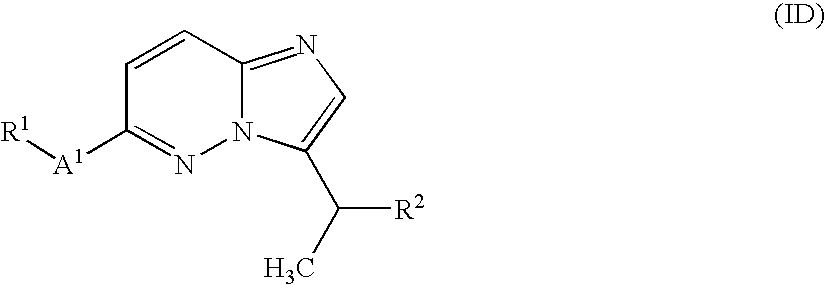
wherein the substituents are as defined for a compound of formula (I).

wherein R1 represents unsubstituted or substituted cycloalkyl; unsubstituted or substituted alkyl and n, m, A2, R2, R3, R3′, R4, R5, R5′ are as defined herein.

wherein R1 represents unsubstituted or substituted heterocyclyl, unsubstituted or substituted aryl and R2, R3, R3′ are as defined herein.


wherein the substituents are as defined for a compound of formula (I).

wherein the substituents are as defined for a compound of formula (I).

wherein the substituents are as defined for a compound of formula (I).
- R1 preferably represents unsubstituted or substituted heterocyclyl;
- wherein said heterocyclyl is selected from unsaturated, saturated or partially saturated heterocycles which are monocyclic, bicyclic, tricyclic or spirocyclic and have 4 to 16, ring atoms wherein one to four heteroatoms are present;
- wherein said substituents are independently selected from one or more, preferably one to four of the following moieties: halo, hydroxy, cyano, nitro, carboxy, C1-C7-alkyl, C3-C12-cyclo-alkyl, phenyl-C1-C7-alkyl, halo-C1-C7-alkyl, hydroxy-C1-C7-alkyl, amino-C1-C7-alkyl, N—C1-C7-alkanoylamino-C1-C7-alkyl, N—C1-C7-alkanesulfonyl-amino-C1-C7-alkyl, pyrrolidino-C1-C7-alkyl, oxo-pyrrolidino-C1-C7-alkyl, piperidino-C1-C7-alkyl, piperazin-1-yl-C1-C7-alkyl, 4-(C1-C7-alkyl, C1-C7-alkoxy-C1-C7-alkyl, halo-C1-C7-alkyl or C3-C10-cycloalkyl)-piperazin-1-yl-C1-C7-alkyl, 4-(amino-C1-C7-alkyl)-piperazin-1-yl-C1-C7-alkyl, 4-[N-mono- or N,N-di-(C1-C7-alkylamino)-C1-C7-alkyl]-piperazin-1-yl-C1-C7-alkyl, morpholino-C1-C7-alkyl, thiomorpholino-C1-C7-alkyl, S-mono- or S,S-dioxo-thiomorpholino-C1-C7-alkyl, carbamoyl-C1-C7-alkyl, [N-mono- or N,N-di-(C1-C7-alkyl)carbamoyl]-C1-C7-alkyl, C1-C7-alkanesulfinyl-C1-C7-alkyl, C1-C7-alkanesulfonyl-C1-C7-alkyl, C1-C7-alkoxy, halo-C1-C7-alkoxy, amino, N-mono- or N,N-di-(C1-C7-alkyl)-amino, C1-C7-alkanoylamino, N—C1-C7-alkanoyl-N—C1-C7-alkyl-amino, C1-C7-alkyloxycarbonylamino, N—C1-C7-alkyloxycarbonyl-N—C1-C7-alkyl-amino, pyrrolidino, oxo-pyrrolidino, piperidino, piperazin-1-yl, 4-(C1-C7-alkyl, C1-C7-alkoxy-C1-C7-alkyl, halo-C1-C7-alkyl or C3-C10-cycloalkyl)-piperazin-1-yl, 4-(amino-C1-C7-alkyl)-piperazin-1-yl, 4-[N-mono- or N,N-di-(C1-C7-alkylamino)-C1-C7-alkyl]-piperazin-1-yl, morpholino, thiomorpholino, S-oxo- or S,S-dioxothio-morpholino, C1-C7-alkanesulfonylamino, carbamoyl, N-mono- or N,N-di-(C1-C7-alkyl, C1-C7-alkoxy-C1-C7-alkyl, amino-C1-C7-alkyl and/or (N′-mono- or N′,N′-di-(C1-C7-alkyl)-amino-C1-C7-alkyl)-carbamoyl, C1-C7-alkylcarbonyl, C1-C7-alkoxycarbonyl, formyl, C1-C7-alkylcarbonyl, amino-carbonyl, amino-C1-C7-alkylcarbonyl, halo-C1-C7-alkylcarbonyl, halo-C1-C7-alkoxycarbonyl, N—C1-C7-alkanoylamino-C1-C7-alkylcarbonyl, pyrrolidin-1-carbonyl, piperidin-1-carbonyl, piperazin-1-carbonyl, 4-(C1-C7-alkyl)piperazin-1-carbonyl, morpholin-1-carbonyl, thiomorpholin-1-carbonyl, S-oxo- or S,S-dioxothio-morpholin-1-carbonyl, sulfo, C1-C7-alkylsulfonyl, C1-C7-alkylsulfinyl, C1-C7-alkylthio, sulfamoyl, N-mono- or N,N-di-(C1-C7-alkyl)-sulfamoyl, morpholinosulfonyl, thiomorpholinosulfonyl; oxo (e.g. C═O or N(+)—O(−)) or C1-6 alkandiyl.
- R1 particular preferably represents unsubstituted or substituted heterocyclyl;
- wherein said heterocyclyl is selected from the group consisting of indanyl, pyrrole, pyrroline, pyrrolidine, pyrazole, pyrazoline, pyrazolidine, imidazole, imidazoline, imidazolidine, triazole, triazoline, triazolidine, tetrazole, furane, dihydrofurane, tetrahydrofurane, furazane (oxadiazole), dioxolane, thiophene, dihydrothiophene, tetrahydrothiophene, oxazole, oxazoline, oxazolidine, isoxazole, isoxazoline, isoxazolidine, thiazole, thiazoline, thiaziolidine, isothiazole, istothiazoline, isothiazolidine, thiadiazole, thiadiazoline, thiadiazolidine, pyridine, piperidine, pyridazine, pyrazine, piperazine, triazine, pyrane, tetrahydropyrane, thiopyrane, tetrahydrothiopyrane, oxazine, thiazine, dioxine, morpholine, purine, pterine, and the corresponding benz-annelated heterocycles, e.g. indole, isoindole, cumarine, cumaronecinoline, isochinoline, chinoline, thionaphtene and wherein said heterocyclyl is substituted by one or more, preferably one to three moieties independently selected from the group consisting of halo, hydroxy, cyano, nitro, carboxy, amino-carbonyl, C1-C7-alkylsulfonylamino, C1-C7-alkyl, (amino, C1-C7-alkylamino, C1-C7-dialkyl-amino)-C1-C7-alkyl, (amino, C1-C7-alkyl-amino, C1-C7-dialkylamino)-C1-C7-alkyloxy, halo-C1-C7-alkyl, N—C1-C7-alkanoylamino-C1-C7-alkyl, N—C1-C7-alkanesulfonyl-amino-C1-C7-alkyl, pyrrolidino-C1-C7-alkyl, oxo-pyrrolidino-C1-C7-alkyl, piperidino-C1-C7-alkyl, piperazin-1-yl-C1-C7-alkyl, 4-(C1-C7-alkyl, C1-C7-alkoxy-C1-C7-alkyl, halo-C1-C7-alkyl or C3-C10-cycloalkyl)-piperazin-1-yl-C1-C7-alkyl, 4-(amino-C1-C7-alkyl)-piperazin-1-yl-C1-C7-alkyl, 4-[N-mono- or N,N-di-(C1-C7-alkylamino)-C1-C7-alkyl]-piperazin-1-yl-C1-C7-alkyl, morpholino-C1-C7-alkyl, thiomorpholino-C1-C7-alkyl, S-mono- or S,S-dioxo-thiomorpholino-C1-C7-alkyl, carbamoyl-C1-C7-alkyl, [N-mono- or N,N-di-(C1-C7-alkyl)-carbamoyl]-C1-C7-alkyl, C1-C7-alkanesulfinyl-C1-C7-alkyl, C1-C7-alkanesulfonyl-C1-C7-alkyl, C1-C7-alkoxy, amino, N-mono- or N,N-di-(C1-C7-alkyl)-amino, C1-C7-alkanoylamino, pyrrolidino, oxo-pyrrolidino, piperidino, piperazin-1-yl, 4-(C1-C7-alkyl, C1-C7-alkoxy-C1-C7-alkyl, halo-C1-C7-alkyl or C3-C10-cycloalkyl)-piperazin-1-yl, 4-(amino-C1-C7-alkyl)-piperazin-1-yl, 4-[N-mono- or N,N-di-(C1-C7-alkyl-amino)-C1-C7-alkyl]-piperazin-1-yl, morpholino, thiomorpholino, S-oxo- or S,S-dioxo-thio-morpholino, C1-C7-alkanesulfonylamino, carbamoyl, N-mono- or N,N-di-(C1-C7-alkyl, C1-C7-alkoxy-C1-C7-alkyl, amino-C1-C7-alkyl and/or (N′-mono- or N′,N′-di-(C1-C7-alkyl)-amino-C1-C7-alkyl)carbamoyl, pyrrolidin-1-carbonyl, piperidin-1-carbonyl, piperazin-1-carbonyl, 4-(C1-C7-alkyl)piperazin-1-carbonyl, morpholin-1-carbonyl, thiomorpholin-1-carbonyl, S-oxo- or S,S-dioxothiomorpholin-1-carbonyl, sulfo, C1-C7-alkanesulfonyl, C1-C7-alkanesulfinyl, sulfamoyl, N-mono- or N,N-di-(C1-C7-alkyl)-sulfamoyl, morpholino-sulfonyl, thiomorpholinosulfonyl, methandiyl, ethandiyl and oxo .
- R1 very particular preferably represents unsubstituted or substituted heterocyclyl;
- wherein said heterocyclyl is selected from the group consisting of pyrrole, pyrroline, pyrrolidine, pyrazole, pyrazoline, pyrazolidine, imidazole, imidazoline, imidazolidine, triazole, triazoline, triazolidine, tetrazole, furane, dihydrofurane, tetrahydrofurane, furazane, dioxolane, thiophene, dihydrothiophene, tetrahydrothiophene, oxazole, oxazoline, oxazolidine, isoxazole, isoxazoline, isoxazolidine, thiazole, thiazoline, thiaziolidine, isothiazole, istothiazoline, isothiazolidine, thiadiazole, thiadiazoline, thiadiazolidine, pyridine, piperidine, pyridazine, pyrazine, piperazine, triazine, pyrane, tetrahydropyrane, thiopyrane, tetrahydrothiopyrane, oxazine, thiazine, dioxine, morpholine, purine, pterine, and the corresponding benz-annelated heterocycles, e.g. indole, isoindole, cumarine, cumaronecinoline, isochinoline, chinoline, thionaphtene and wherein said heterocyclyl is substituted by one or more, preferably one or two moieties independently selected from the group consisting of halo, C1-C4-alkyl, benzyl, C1-C4-alkyloxy, halo-C1-C4-alkyl, pyrrolidino-C1-C2-alkyl, piperidino-C1-C2-alkyl, oxo.
- R1 further preferably represents unsubstituted or substituted aryl;
- wherein said aryl is selected from aromatic moieties with 6 to 14 ring carbon atoms;
- wherein said substituents are independently selected from one or more, preferably one or two of the following moieties: halo, hydroxy, cyano, nitro, carboxy, C1-C7-alkyl, C3-C12-cycloalkyl, phenyl-C1-C7-alkyl, halo-C1-C7-alkyl, hydroxy-C1-C7-alkyl amino-C1-C7-alkyl, N—C1-C7-alkanoylamino-C1-C7-alkyl, N—C1-C7-alkanesulfonyl-amino-C1-C7-alkyl, pyrrolidino-C1-C7-alkyl, oxo-pyrrolidino-C1-C7-alkyl, piperidino-C1-C7-alkyl, piperazin-1-yl-C1-C7-alkyl, 4-(C1-C7-alkyl, C1-C7-alkoxy-C1-C7-alkyl, halo-C1-C7-alkyl or C3-C10-cycloalkyl)-piperazin-1-yl-C1-C7-alkyl, 4-(amino-C1-C7-alkyl)-piperazin-1-yl-C1-C7-alkyl, 4-[N-mono- or N,N-di-(C1-C7-alkylamino)-C1-C7-alkyl]-piperazin-1-yl-C1-C7-alkyl, morpholino-C1-C7-alkyl, thiomorpholino-C1-C7-alkyl, S-mono- or S,S-dioxo-thiomorpholino-C1-C7-alkyl, carbamoyl-C1-C7-alkyl, [N-mono- or N,N-di-(C1-C7-alkyl)carbamoyl]-C1-C7-alkyl, C1-C7-alkanesulfinyl-C1-C7-alkyl, C1-C7-alkanesulfonyl-C1-C7-alkyl, C1-C7-alkoxy, halo-C1-C7-alkoxy, amino, N-mono- or N,N-di-(C1-C7-alkyl)-amino, C1-C7-alkanoylamino, N—C1-C7-alkanoyl-N—C1-C7-alkyl-amino, C1-C7-alkyloxycarbonyl -amino, N—C1-C7-alkyloxycarbonyl-N—C1-C7-alkyl-amino, pyrrolidino, oxo-pyrrolidino, piperidino, piperazin-1-yl, 4-(C1-C7-alkyl, C1-C7-alkoxy-C1-C7-alkyl, halo-C1-C7-alkyl or C3-C10-cycloalkyl)-piperazin-1-yl, 4-(amino-C1-C7-alkyl)-piperazin-1-yl, 4-[N-mono- or N,N-di-(C1-C7-alkylamino)-C1-C7-alkyl]-piperazin-1-yl, morpholino, thiomorpholino, S-oxo- or S,S-dioxothio-morpholino, C1-C7-alkanesulfonylamino, carbamoyl, N-mono- or N,N-di-(C1-C7-alkyl, C1-C7-alkoxy-C1-C7-alkyl, amino-C1-C7-alkyl and/or (N′-mono- or N′,N′-di-(C1-C7-alkyl)-amino-C1-C7-alkyl)-carbamoyl, C1-C7-alkylcarbonyl, C1-C7-alkoxycarbonyl, formyl, C1-C7-alkylcarbonyl, amino-carbonyl, amino-C1-C7-alkylcarbonyl, halo-C1-C7-alkyl-carbonyl, halo-C1-C7-alkoxy-carbonyl, N—C1-C7-alkanoylamino-C1-C7-alkylcarbonyl, pyrrolidin-1-carbonyl, piperidin-1-carbonyl, piperazin-1-carbonyl, 4-(C1-C7-alkyl)-piperazin-1-carbonyl, morpholin-1-carbonyl, thiomorpholin-1-carbonyl, S-oxo- or S,S-dioxothio-morpholin-1-carbonyl, sulfo, C1-C7-alkylsulfonyl, C1-C7-alkylsulfinyl, C1-C7-alkylthio, sulfamoyl, N-mono- or N,N-di-(C1-C7-alkyl)-sulfamoyl, morpholinosulfonyl, thiomorpholinosulfonyl.
- R1 further particular preferably represents unsubstituted or substituted phenyl or napthyl, the substituents being selected from one or more, preferably one to three moieties independently selected from the group consisting of halo, hydroxy, cyano, nitro, aminocarbonyl, C1-C7-alkylsulfonylamino, C1-C7-alkyl, (amino, C1-C7-alkyl-amino, C1-C7-dialkyl-amino)-C1-C7-alkyl, (amino, C1-C7-alkyl-amino, C1-C7-dialkyl-amino)-C1-C7-alkyloxy, halo-C1-C7-alkyl, N—C1-C7-alkanoylamino-C1-C7-alkyl, N—C1-C7-alkanesulfonylamino-C1-C7-alkyl, pyrrolidino-C1-C7-alkyl, oxo-pyrrolidino-C1-C7-alkyl, piperidino-C1-C7-alkyl, piperazin-1-yl-C1-C7-alkyl, 4-(C1-C7-alkyl, C1-C7-alkoxy-C1-C7-alkyl, halo-C1-C7-alkyl or C3-C10-cycloalkyl)-piperazin-1-yl-C1-C7-alkyl, 4-(amino-C1-C7-alkyl)-piperazin-1-yl-C1-C7-alkyl, 4-[N-mono- or N,N-di-(C1-C7-alkylamino)-C1-C7-alkyl]-piperazin-1-yl-C1-C7-alkyl, morpholino-C1-C7-alkyl, thiomorpholino-C1-C7-alkyl, S-mono- or S,S-dioxo-thiomorpholino-C1-C7-alkyl, carbamoyl-C1-C7-alkyl, [N-mono- or N,N-di-(C1-C7-alkyl)carbamoyl]-C1-C7-alkyl, C1-C7-alkanesulfinyl-C1-C7-alkyl, C1-C7-alkanesulfonyl-C1-C7-alkyl, C1-C7-alkoxy, amino, N-mono- or N,N-di-(C1-C7-alkyl)-amino, C1-C7-alkanoylamino, pyrrolidino, oxo-pyrrolidino, piperidino, piperazin-1-yl, 4-(C1-C7-alkyl, C1-C7-alkoxy-C1-C7-alkyl, halo-C1-C7-alkyl or C3-C10-cycloalkyl)-piperazin-1-yl, 4-(amino-C1-C7-alkyl)-piperazin-1-yl, 4-[N-mono- or N,N-di-(C1-C7-alkylamino)-C1-C7-alkyl]-piperazin-1-yl, morpholino, thiomorpholino, S-oxo- or S,S-dioxo-thiomorpholino, C1-C7-alkanesulfonylamino, carbamoyl, N-mono- or N,N-di-(C1-C7-alkyl, C1-C7-alkoxy-C1-C7-alkyl, amino-C1-C7-alkyl and/or (N′-mono- or N′,N′-di-(C1-C7-alkyl)-amino-C1-C7-alkyl)-carbamoyl, pyrrolidin-1-carbonyl, piperidin-1-carbonyl, piperazin-1-carbonyl, 4-(C1-C7-alkyl)piperazin-1-carbonyl, morpholin-1-carbonyl, thiomorpholin-1-carbonyl, S-oxo- or S,S-dioxothiomorpholin-1-carbonyl, sulfo, C1-C7-alkanesulfonyl, C1-C7-alkanesulfinyl, sulfamoyl, N-mono- or N,N-di-(C1-C7-alkyl)-sulfamoyl, morpholinosulfonyl, thiomorpholinosulfonyl.
- R1 further preferably represents halogen, in particular when the group A1 is a direct bond. In particular, R1 is chloro in this embodiment.
- R1 further preferably represents C1-C7-alkoxy, for example ethoxy.
- R1 further preferably represents C1-C7-alkyl, C1-C7-haloalkyl or C3-C12 cycloalkyl.
- R1 further preferably represents C1-C7-alkoxy, cyano, carboxamide, or halogen.
- R1 further particular preferably represents C1-C4-alkyl, C1-C4-fluoroalkyl or C5-C8 cycloalkyl.
- R1 further very particular preferably represents methyl, ethyl, n- or iso-propyl, n-, iso-, sec- or tert-butyl, n-pentyl, neo-pentyl, trifluoromethyl, cyclopentyl, cyclohexyl, cyclooctyl.
- R2 preferably represents unsubstituted or substituted heterocyclyl or unsubstituted or substituted aryl;
- wherein said heterocyclyl is selected from unsaturated, saturated or partially saturated heterocycles which are monocyclic, bicyclic, tricyclic or spirocyclic and have 4 to 16, ring atoms wherein one to four heteroatoms are present;
- wherein said aryl is selected from aromatic moieties with 6 to 14 ring carbon atoms;
- wherein said substitutents are independently selected from one or more, preferably one to four of the following moieties: halo, hydroxy, cyano, nitro, carboxy, C1-C7-alkyl, amino-C1-C7-alkyl, halo-C1-C7-alkyl, N—C1-C7-alkanoylamino-C1-C7-alkyl, N—C1-C7-alkanesulfonyl-amino-C1-C7-alkyl, pyrrolidino-C1-C7-alkyl, oxo-pyrrolidino-C1-C7-alkyl, piperidino-C1-C7-alkyl, piperazin-1-yl-C1-C7-alkyl, 4-(C1-C7-alkyl, C1-C7-alkoxy-C1-C7-alkyl, halo-C1-C7-alkyl or C3-C10-cycloalkyl)-piperazin-1-yl-C1-C7-alkyl, 4-(amino-C1-C7-alkyl)-piperazin-1-yl-C1-C7-alkyl, 4-[N-mono- or N,N-di-(C1-C7-alkylamino)-C1-C7-alkyl]-piperazin-1-yl-C1-C7-alkyl, morpholino-C1-C7-alkyl, thiomorpholino-C1-C7-alkyl, S-mono- or S,S-dioxo-thiomorpholino-C1-C7-alkyl, carbamoyl-C1-C7-alkyl, [N-mono- or N,N-di-(C1-C7-alkyl)-carbamoyl]-C1-C7-alkyl, C1-C7-alkanesulfinyl-C1-C7-alkyl, C1-C7-alkanesulfonyl-C1-C7-alkyl, C1-C7-alkoxy, amino, N-mono- or N,N-di-(C1-C7-alkyl)-amino, C1-C7-alkanoyl-amino, pyrrolidino, oxo-pyrrolidino, piperidino, piperazin-1-yl, 4-(C1-C7-alkyl, C1-C7-alkoxy-C1-C7-alkyl, halo-C1-C7-alkyl or C3-C10-cycloalkyl)-piperazin-1-yl, 4-(amino-C1-C7-alkyl)-piperazin-1-yl, 4-[N-mono- or N,N-di-(C1-C7-alkylamino)-C1-C7-alkyl]-piperazin-1-yl, morpholino, thiomorpholino, S-oxo- or S,S-dioxothio-morpholino, C1-C7-alkanesulfonylamino, carbamoyl, N-mono- or N,N-di-(C1-C7-alkyl, C1-C7-alkoxy-C1-C7-alkyl, amino-C1-C7-alkyl and/or (N′-mono- or N′,N′-di-(C1-C7-alkyl)-amino-C1-C7-alkyl)carbamoyl, C1-C7-alkylcarbonyl, C1-C7-alkoxycarbonyl, amino-carbonyl, amino-C1-C7-alkylcarbonyl, halo-C1-C7-alkylcarbonyl, halo-C1-C7-alkoxycarbonyl, N—C1-C7-alkanoylamino-C1-C7-alkylcarbonyl, pyrrolidin-1-carbonyl, piperidin-1-carbonyl, piperazin-1-carbonyl, 4-(C1-C7-alkyl)piperazin-1-carbonyl, morpholin-1-carbonyl, thiomorpholin-1-carbonyl, S-oxo- or S,S-dioxothiomorpholin-1-carbonyl, sulfo, C1-C7-alkanesulfonyl, C1-C7-alkanesulfinyl, sulfamoyl, N-mono- or N,N-di-(C1-C7-alkyl)-sulfamoyl, morpholinosulfonyl, thiomorpholinosulfonyl and oxo (C═O or N(+)—O(−) provided R2 represents heterocyclyl).
- R2 particular preferably represents unsubstituted or substituted heterocyclyl or unsubstituted or substituted aryl;
- wherein said heterocyclyl or aryl is selected from the group consisting of phenyl, naphthyl, indanyl, pyrrole, pyrroline, pyrrolidine, pyrazole, pyrazoline, pyrazolidine, imidazole, imidazoline, imidazolidine, triazole, triazoline, triazolidine, tetrazole, furane, dihydrofurane, tetrahydrofurane, furazane (oxadiazole), dioxolane, thiophene, dihydrothiophene, tetrahydrothiophene, oxazole, oxazoline, oxazolidine, isoxazole, isoxazoline, isoxazolidine, thiazole, thiazoline, thiaziolidine, isothiazole, istothiazoline, isothiazolidine, thiadiazole, thiadiazoline, thiadiazolidine, pyridine, piperidine, pyridazine, pyrazine, piperazine, triazine, pyrane, tetrahydropyrane, thiopyrane, tetrahydrothiopyrane, oxazine, thiazine, dioxine, morpholine, purine, pterine, and the corresponding benz-annelated heterocycles, e.g. indole, isoindole, cumarine, cumaronecinoline, isochinoline, cinnoline and
- wherein said heterocyclyl or aryl is substituted by one or more, preferably one to three moieties independently selected from the group consisting of halo, hydroxy, cyano, nitro, carboxy, aminocarbonyl, C1-C7-alkylsulfonylamino, C1-C7-alkyl, (amino, C1-C7-alkyl-amino, C1-C7-dialkyl-amino)-C1-C7-alkyl, (amino, C1-C7-alkyl-amino, C1-C7-dialkylamino)-C1-C7-alkyloxy, halo-C1-C7-alkyl, N—C1-C7-alkanoylamino-C1-C7-alkyl, N—C1-C7-alkyl-sulfonyl-amino-C1-C7-alkyl, pyrrolidino-C1-C7-alkyl, oxo-pyrrolidino-C1-C7-alkyl, piperidino-C1-C7-alkyl, piperazin-1-yl-C1-C7-alkyl, 4-(C1-C7-alkyl, C1-C7-alkoxy-C1-C7-alkyl, halo-C1-C7-alkyl or C3-C10-cycloalkyl)-piperazin-1-yl-C1-C7-alkyl, 4-(amino-C1-C7-alkyl)-piperazin-1-yl-C1-C7-alkyl, 4-[N-mono- or N,N-di-(C1-C7-alkylamino)-C1-C7-alkyl]-piperazin-1-yl-C1-C7-alkyl, morpholino-C1-C7-alkyl, thiomorpholino-C1-C7-alkyl, S-mono- or S,S-dioxo-thiomorpholino-C1-C7-alkyl, carbamoyl-C1-C7-alkyl, [N-mono- or N,N-di-(C1-C7-alkyl)-carbamoyl]-C1-C7-alkyl, C1-C7-alkanesulfinyl-C1-C7-alkyl, C1-C7-alkyl-sulfonyl-C1-C7-alkyl, C1-C7-alkoxy, amino, N-mono- or N,N-di-(C1-C7-alkyl)-amino, C1-C7-alkanoylamino, pyrrolidino, oxo-pyrrolidino, piperidino, piperazin-1-yl, 4-(C1-C7-alkyl, C1-C7-alkoxy-C1-C7-alkyl, halo-C1-C7-alkyl or C3-C10-cycloalkyl)-piperazin-1-yl, 4-(amino-C1-C7-alkyl)-piperazin-1-yl, 4-[N-mono- or N,N-di-(C1-C7-alkylamino)-C1-C7-alkyl]-piperazin-1-yl, morpholino, thiomorpholino, S-oxo- or S,S-dioxothiomorpholino, C1-C7-alkanesulfonylamino, carbamoyl, N-mono- or N,N-di-(C1-C7-alkyl, C1-C7-alkoxy-C1-C7-alkyl, amino-C1-C7-alkyl and/or (N′-mono- or N′,N′-di-(C1-C7-alkyl)-amino-C1-C7-alkyl)carbamoyl, pyrrolidin-1-carbonyl, piperidin-1-carbonyl, piperazin-1-carbonyl, 4-(C1-C7-alkyl)piperazin-1-carbonyl, morpholin-1-carbonyl, thiomorpholin-1-carbonyl, S-oxo- or S,S-dioxothiomorpholin-1-carbonyl, sulfo, C1-C7-alkanesulfonyl, C1-C7-alkyl-sulfinyl, sulfamoyl, N-mono- or N,N-di-(C1-C7-alkyl)-sulfamoyl, morpholinosulfonyl, thiomorpholinosulfonyl and oxo (provided R2 represents heterocyclyl).
- R2 very particular preferably represents phenyl or a heterocyclyl selected from the following list


-
- wherein said phenyl or heterocyclyl in each case is unsubstituted or substituted by one or more substituents, said substituent being selected from the group consisting of fluoro, chloro, bromo, 1-methyl-1H-pyrazol (in particular 1-methyl-1H-pyrazol-4-yl), pyridyl (in particular 3-pyridyl), phenyl (in particular substituted phenyl, more particularly 3-benzonitrile), hydroxy, amino, aminocarbonyl, cyano, C1-C4-alkyl (in particular methyl, ethyl), vinyl, C1-C4-alkyloxy (in particular methoxy), formyl, C1-C4-alkylcarbonyl (in particular 1-ethanone), hydroxyl-C1-C4-alkyl (in particular hydroxymethyl, 2-hydroxyethyl, ethane-1,2-diol), halo-C1-C4-alkyl (in particular CF3), C1-C4-alkyloxy-C1-C4-alkyl (in particular methoxymethyl), C1-C4-alkylsulfonylamino (in particular methylsulfonylamino).
- R2 in a particular preferred embodiment relates to the moieties of the following list:


- R2 in a more preferred embodiment relates to the moieties of the following list:


- R3 preferably represents H, methyl, ethyl, n- or iso-propyl, halo-C1-C7-alkyl (in particular CF3), and R3′ preferably represents H, methyl, ethyl, n- or iso-propyl, fluoro, chloro, hydroxy or
- R3 and R3′ represent either both fluoro or chloro or
- R3 and R3′ represent, together with the carbon atom to which they are attached, cyclopropyl.
- R3 and R3′ are particular preferably selected according to the following list:
| R3 | R3′ | ||
| H | H | ||
| D | D | ||
| H | F | ||
| H | OH | ||
| H | CH3 | ||
| CH3 | CH3 | ||
| CH3 | OH | ||
| F | F | ||
| Cyclopropyl |
- R4 preferably represents H, C1-C7-alkyl (in particular H).
- R5 preferably represents H, C1-C7-alkyl (in particular H).
- R5′ preferably represents H, C1-C7-alkyl (in particular H).
- n preferably represents 0 or 1.
- n particular preferably represents 0.
- m preferably represents 0, 1 or 2.
- m particular preferably represents 0.
- A2 preferably represents Oxygen.
- a) compounds targeting, decreasing or inhibiting the activity of the platelet-derived growth factor-receptors (PDGFR), such as compounds which target, decrease or inhibit the activity of PDGFR, especially compounds which inhibit the PDGF receptor, e.g. a N-phenyl-2-pyrimidine-amine derivative, e.g. imatinib, SU101, SU6668 and GFB-111;
- b) compounds targeting, decreasing or inhibiting the activity of the fibroblast growth factor-receptors (FGFR);
- c) compounds targeting, decreasing or inhibiting the activity of the insulin-like growth factor receptor I (IGF-IR), such as compounds which target, decrease or inhibit the activity of IGF-IR, especially compounds which inhibit the kinase activity of IGF-I receptor, such as those compounds disclosed in WO 02/092599, or antibodies that target the extracellular domain of IGF-I receptor or its growth factors;
- d) compounds targeting, decreasing or inhibiting the activity of the Trk receptor tyrosine kinase family, or ephrin kinase family inhibitors;
- e) compounds targeting, decreasing or inhibiting the activity of the Axl receptor tyrosine kinase family;
- f) compounds targeting, decreasing or inhibiting the activity of the Ret receptor tyrosine kinase;
- g) compounds targeting, decreasing or inhibiting the activity of the Kit/SCFR receptor tyrosine kinase, e.g. imatinib;
- h) compounds targeting, decreasing or inhibiting the activity of the C-kit receptor tyrosine kinases—(part of the PDGFR family), such as compounds which target, decrease or inhibit the activity of the c-Kit receptor tyrosine kinase family, especially compounds which inhibit the c-Kit receptor, e.g. imatinib;
- i) compounds targeting, decreasing or inhibiting the activity of members of the c-Abl family, their gene-fusion products (e.g. BCR-Abl kinase) and mutants, such as compounds which target decrease or inhibit the activity of c-Abl family members and their gene fusion products, e.g. a N-phenyl-2-pyrimidine-amine derivative, e.g. imatinib or nilotinib (AMN107); PD180970; AG957; NSC 680410; PD173955 from ParkeDavis; or dasatinib (BMS-354825)
- j) compounds targeting, decreasing or inhibiting the activity of members of the protein kinase C(PKC) and Raf family of serine/threonine kinases, members of the MEK, SRC, JAK, FAK, PDK1, PKB/Akt, and Ras/MAPK family members, and/or members of the cyclin-dependent kinase family (CDK) and are especially those staurosporine derivatives disclosed in U.S. Pat. No. 5,093,330, e.g. midostaurin; examples of further compounds include e.g. UCN-01, safingol, BAY 43-9006, Bryostatin 1, Perifosine; Ilmofosine; RO 318220 and RO 320432; GO 6976; Isis 3521; LY333531/LY379196; isochinoline compounds such as those disclosed in WO 00/09495; FTIs; PD184352 or QAN697 (a P13K inhibitor) or AT7519 (CDK inhibitor);
- k) compounds targeting, decreasing or inhibiting the activity of protein-tyrosine kinase inhibitors, such as compounds which target, decrease or inhibit the activity of protein-tyrosine kinase inhibitors include imatinib mesylate (GLEEVEC) or tyrphostin. A tyrphostin is preferably a low molecular weight (Mr<1500) compound, or a pharmaceutically acceptable salt thereof, especially a compound selected from the benzylidenemalonitrile class or the S-arylbenzenemalonirile or bisubstrate quinoline class of compounds, more especially any compound selected from the group consisting of Tyrphostin A23/RG-50810; AG 99; Tyrphostin AG 213; Tyrphostin AG 1748; Tyrphostin AG 490; Tyrphostin B44; Tyrphostin B44 (+) enantiomer; Tyrphostin AG 555; AG 494; Tyrphostin AG 556, AG957 and adaphostin (4-{[(2,5-dihydroxyphenyl)methyl]amino}-benzoic acid adamantyl ester; NSC 680410, adaphostin);
- l) compounds targeting, decreasing or inhibiting the activity of the epidermal growth factor family of receptor tyrosine kinases (EGFR, ErbB2, ErbB3, ErbB4 as homo- or heterodimers) and their mutants, such as compounds which target, decrease or inhibit the activity of the epidermal growth factor receptor family are especially compounds, proteins or antibodies which inhibit members of the EGF receptor tyrosine kinase family, e.g. EGF receptor, ErbB2, ErbB3 and ErbB4 or bind to EGF or EGF related ligands, and are in particular those compounds, proteins or monoclonal antibodies generically and specifically disclosed in WO 97/02266, e.g. the compound of ex. 39, or in EP 0 564 409, WO 99/03854, EP 0520722, EP 0 566 226, EP 0 787 722, EP 0 837 063, U.S. Pat. No. 5,747,498, WO 98/10767, WO 97/30034, WO 97/49688, WO 97/38983 and, especially, WO 96/30347 (e.g. compound known as CP 358774), WO 96/33980 (e.g. compound ZD 1839) and WO 95/03283 (e.g. compound ZM105180); e.g. trastuzumab (Herceptin™), cetuximab (Erbitux™), Iressa, Tarceva, OSI-774, CI-1033, EKB-569, GW-2016, E1.1, E2.4, E2.5, E6.2, E6.4, E2.11, E6.3 or E7.6.3, and 7H-pyrrolo-[2,3-d]pyrimidine derivatives which are disclosed in WO 03/013541; and
- m) compounds targeting, decreasing or inhibiting the activity of the c-Met receptor, such as compounds which target, decrease or inhibit the activity of c-Met, especially compounds which inhibit the kinase activity of c-Met receptor, or antibodies that target the extracellular domain of c-Met or bind to HGF;
- n) compounds targeting, decreasing or inhibiting the activity of the Ron receptor tyrosine kinase.

and pharmaceutically acceptable salts thereof, as well as compounds (in free or salt or solvate form) of formula I of WO 04/16601, and also compounds of WO 04/033412. Suitable bronchodilatory drugs include anticholinergic or antimuscarinic compounds, in particular ipratropium bromide, oxitropium bromide, tiotropium salts and CHF 4226 (Chiesi), and glycopyrrolate, but also those described in WO 01/04118, WO 02/51841, WO 02/53564, WO 03/00840, WO 03/87094, WO 04/05285, WO 02/00652, WO 03/53966, EP 424021, U.S. Pat. No. 5,171,744, U.S. Pat. No. 3,714,357, WO 03/33495 and WO 04/018422.


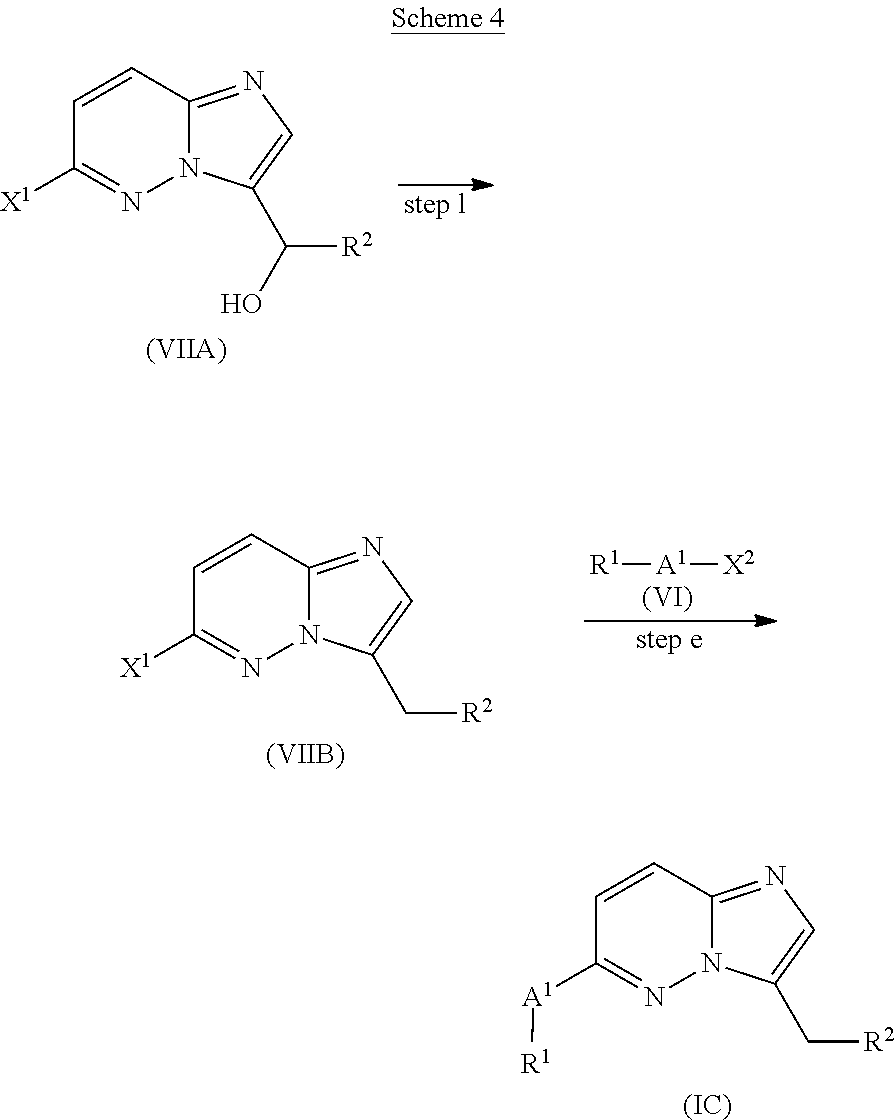


wherein the substituent are as defined herein into a compound of formula (I) or—method B—reacting a compound of formula (VII)

wherein the substituents are as defined herein and X1 represents a leaving group, such as tosylate, mesylate or halo, in particular chloride, with a compound of formula (VI)
R1-A1-X2 (VI)
wherein X2 represents hydrogen or an alkali metal, R1 and A1 are as defined herein, to obtain a compound of formula (I) and, if desired,
converting a compound of the formula (I) obtained according to method A) or method B) into a different compound of the formula (I), and/or converting an obtainable salt of a compound of the formula (I) into a different salt thereof, and/or converting an obtainable free compound of the formula (I) into a salt thereof, and/or separating an obtainable isomer of a compound of the formula (I) from one or more different obtainable isomers of the formula (I).
- step a1: reacting a compound of formula (II)

wherein the substituents are as defined herein, with 1,2-ethanedithiol, optionally in the presence of an reaction aid, such as Boron trifluoride acetic acid complex, to obtain a compound of formula (XI)

wherein the substituents are as defined herein, and
- step a2: reacting the thus obtained compound of formula (XI) with a fluorinating agent, such as DAST, optionally in the presence of a reaction aid, such as NBS, to obtain a compound of formula (IA)
and, if desired, converting a compound of the formula (IA) obtained into a different compound of the formula (IA), and/or converting an obtainable salt of a compound of the formula (IA) into a different salt thereof, and/or converting an obtainable free compound of the formula (IA) into a salt thereof, and/or separating an obtainable isomer of a compound of the formula (IA) from one or more different obtainable isomers of the formula (IA).
- step a3: reacting a compound of formula (II)

wherein the substituents are as defined herein with a reducing agent, such as a boron hydride, to obtain a compound of formula (IB)
and, if desired, converting a compound of the formula (IB) obtained into a different compound of the formula (IB), and/or converting an obtainable salt of a compound of the formula (IB) into a different salt thereof, and/or converting an obtainable free compound of the formula (IB) into a salt thereof, and/or separating an obtainable isomer of a compound of the formula (IB) from one or more different obtainable isomers of the formula (IB).
- step a4: reacting a compound of formula (IB)

wherein the substituents are as defined herein, with a reducing agent, such as a silane or a mixture of hypophosphoric acid and iodine, or
- step a5: reacting a compound of formula (II)

wherein the substituents are as defined herein, with a reducing agent, such as hydrogen in the presence of a hydrogenating catalyst, to obtain a compound of formula (IC) and, if desired, converting a compound of the formula (IC) obtained into a different compound of the formula (IC), and/or converting an obtainable salt of a compound of the formula (IC) into a different salt thereof, and/or converting an obtainable free compound of the formula (IC) into a salt thereof, and/or separating an obtainable isomer of a compound of the formula (IC) from one or more different obtainable isomers of the formula (IC).
- step i: reacting a compound of formula (XI)

wherein X1 represents a halogen, in particular chloro and X1* represents a halogen, in particular bromo, first with a Mg-compound of the Gringnard type, in particular EtMgBr, followed by a reaction with an aldelhyde of formula (XII)
HCO—R2 (XII)
wherein R2 is as defined herein, and
- step e: reacting the obtained compound of formula (VIIA) (which is a compound of formula (VII) wherein R3 represents hydrogen and R3′ represents hydroxyl)

wherein R2 is as defined herein, with a compound (VI)
R1-A1-X2 (VI)
R1-A1-X2 (VI) being preferably a bororonic acid or ester reacted in presence of a palladium catalyst (Suzuki reaction); or aternatively an aliphatic or aromatic amine, or a further compound containing nucleophilic hetero-atoms, reacted by nucleophilic aromatic substitution, wherein the substituents are as defined herein, to afford a compound of formula (I); or
- step k: reacting a compound of formula (XIII)

wherein R1 and A1 are as defined herein with a halogenating agent, such as NBS, and
- step j: reacting the obtained compound of formula (XIV)

wherein R1 and A1 are as defined herein and X1* represents a halogen, in particular bromo, first with a Mg-compound of the Gringnard type, in particular EtMgBr, followed by a reaction with an aldehyde of formula (XII)
HCO—R2 (XII)
wherein R2 is as defined herein,
and, if desired, converting a compound of the formula (IB) obtained into a different compound of the formula (IB) or (IC), and/or converting an obtainable salt of a compound of the formula (IB) into a different salt thereof, and/or converting an obtainable free compound of the formula (IB) into a salt thereof, and/or separating an obtainable isomer of a compound of the formula (IB) from one or more different obtainable isomers of the formula (IB).
- step l: reacting a compound of formula (VIIA)

wherein the substituents are as defined herein, with a reducing agent, such as a combination of hypophosphoric acid and iodine to provide a compound of formula (VIIB)

wherein the substituents are as defined herein
and then
reacting said compound of formula (VIIB) with a compound of formula R1-A1-X2 in analogy to step e to obtain a compound of formula (IC) or alternatively and preferably (IH), wherein A1=BOND.
- step m: reacting a compound of formula (VIIA)

wherein the substituents are as defined herein, with oxidizing agents, such as Dess-Martin periodinane or 2-iodoxybenzoic acid to obtain a compound of formula (IIX)

followed by
- step n: reacting the compound of formula (IIX) with a low alkyl magnesium Grignard reagent, such as methyl magnesium Grignard to obtain a compound of formula (VIIC)

followed by,
- step o: reacting the compound of formula (VIIC) with a reducing agent, such as a combination of hypophosphoric acid and iodine, or
- step p: reacting the compound of formula (VIIC) with an inorganic acid to obtain a compound of formula (XV)
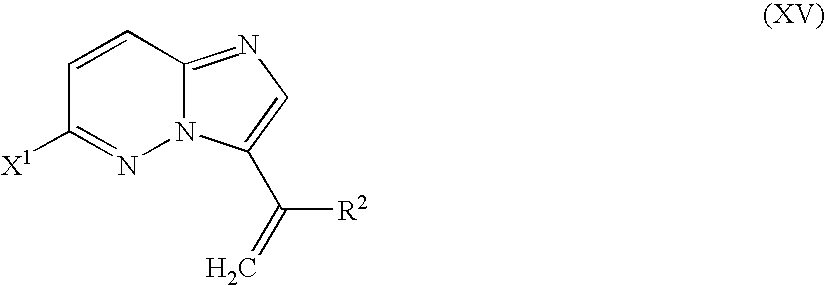
followed by step q: reacting the obtained compound of formula (XV) with a reducing agent, such hydrogen in the presence of a hydrogenating catalyst,
to obtain a compound of formula (VIID),

and then
reacting said compound of formula (VIID) with a compound of formula R1-A1-X2 in analogy to step e to obtain a compound of formula (ID) or alternatively and preferably (IJ), wherein A1=BOND.


comprising,
the reaction a compound of formula (VIIC)

with a compound of formula R1-A1-X2 in analogy to step e wherein, the substituents are as defined herein, to obtain the compound of formula (IG) or alternatively and preferably, (IK) wherein A1=BOND.

wherein P is a protecting group,
or formula (XVII)

wherein P is a protecting group,
with an inorganic or strong organic acid to provide a compound of formula (I).
Reaction Conditions

wherein in each case the substituents are as defined in formula (I) and to manufacturing processes thereof.

wherein the substituents are as defined herein, first with N,N-dimethylformamide dimethylacetal (step c in scheme 1) followed by reaction with a compound of formula (IV)

wherein R2 is as defined herein and X3 represents a lewving group, in particular a halogen such as chloro, optionally in the presence of a diluent, optionally in the presence of a reaction aid.

wherein R1 and A1 are as defined herein, with chloroacetaldehyde, optionally in the presence of a diluent, optionally in the presence of a reaction aid.
- 0-2.2 min: 5% to 95% of acetonitrile
- 2.2-2.7 min: 95% of acetonitrile
- Conditions 1: column Atlantis T3 3 μm 4.6×30 mm from Waters.
- Conditions 2: column Sunfire C18 3.5 μm 2.1×2.0 IS from Waters.
Conditions 3:
- 0-8.0 min: 2% to 100% of acetonitrile
- 8.0-10.0 min: 100% of acetonitrile
- Column: Chromolith Performance, RP-18e 4.6×100 mm from Merck
- Precolumn: Chromolith Performance, RP-18e 4.6×5 mm from Merck
Conditions 4:
- Eluent A: 2500 mL Water, 5 mL ortho-Phosphoric acid 85%, 50 mL Tetramethylammonium hydroxide solution 10%.
- Eluent B: 500 mL Water, 2.5 mL ortho-Phosphoric acid 85%, 25 mL Tetramethylammonium hydroxide solution 10%, 2000 mL Acetonitrile
- 0-6.67 min: 0% to 95% of eluent B
- 6.67-10 min: 95% eluent B
- Column: CC 7013 Nucleosil 100-3 C-18 from Macherey-Nagel
- Precolumn: CC 8/3 Nucleosil 100-3 C18 from Macherey-Nagel
- Oven temperature: 45° C.
Conditions 5.6 and 7: - Eluant A: Water with 0.1% trifluoroacetic acid
- Eluant B: Acetonitrile with 0.1% trifluoroacetic acid
- Column temperature: 45° C.
- Conditions 5: The flow is 3 mL/min of eluents A and B
- 0-4 min: 5% to 100% of acetonitrile
- Column: SunFire C18 20×4.6 mm, 3.5 μm, reverse phase
- Conditions 6: The flow is 2 mL/min of eluents A and B
- 0-min: 5% to 100% of acetonitrile
- Column: XTerra MS C18 50×4.6 mm, 5 μm, reverse phase
- Conditions 7: The flow is 3 mL/min of eluents A and B
- 0-3 min: 1% to 35% of acetonitrile
- 3-3.3 min: 35% to 100% of acetonitrile
- Column: SunFire C18 20×4.6 mm, 3.5 μm, reverse phase
Conditions 8:
- 0-4.5 min: 2% to 100% acetonitrile
- 4.5-5.5 min: 100% of acetonitrile.
- Column: Chromolith Performance RP-18e 100×4.6 from Merck
Conditions 9:
- 0-0.5 min: 2% of acetonitrile
- 0.5-2.9 min: 2% to 100% of acetonitrile
- 2.9-3.2 min: 100% of acetonitrile
- Column: Sunfire C18 3.5 μm 2.1×2.0 IS from Waters
Conditions 10:
- 0-2.7 min: 5% to 50% of acetonitrile
- 2.7-2.9 min: 50% to 95% of acetonitrile
- 2.9-3.3 min: 95% of acetonitrile
- Column: Atlantis T3 3 μm 4.6×30 mm from Waters.
Conditions 11:
- 0-8 min: 5% to 95% of acetonitrile
- Column: CC 70/3 Nucleosil 100-3 C-18 from Macherey-Nagel
- Precolumn: CC 8/3 Nucleosil 100-3 C18 from Macherey-Nagel
- Column temperature: 45° C.
Conditions 12: - System: Agilent 1100 Series with Waters Micromass ZQ
- Column: XBridge C18, 3×30 mm, 2.5 micron
- Flow Rate: 1.4-2.4 mL/min
- Eluent A: H2O, containing 5% acetonitrile and 0.8% HCOOH
- Eluent B: acetonitrile, containing 0.6% HCOOH
- Gradient: 0-2.9 min: 1% to 95% of B
Conditions 13:
- 0-8.0 min: 2% to 100% of acetonitrile
- 8.0-10.0 min: 100% of acetonitrile
- Column: Chromolith Performance, RP-18e 4.6×100 mm from Merck
| AIBN | α,α’-azo-isobutyronitrile |
| atm. | atmosphere |
| BINAP | 2,2′-Bis-diphenylphosphanyl-[1,1′]binaphthalenyl |
| Bn | benzyl |
| Boc | tert-butoxycarbonyl |
| CDI | 1,1′-carbonyldiimidazol |
| DAST | diethylaminosulfur trifluoride |
| DCM | dichloromethane |
| DME | 1,2-dimethoxyethane |
| DMF | N,N-dimethylformamide |
| DMSO | dimethyl sulfoxide |
| eq. | equivalent(s) |
| h | hour(s) |
| HATU | 2-(1H-7-Azabenzotriazol-1-yl)-1,1,3,3- |
| tetramethyluronium hexafluorophosphate | |
| HPLC | High Performance Liquid Chromatography |
| HV | high vacuum |
| Isolute | Isolute ® HM-N by International Solvent |
| Technology Ltd., U.K. | |
| LAH | lithium aluminium hydride |
| LCMS | liquid chromatography coupled with mass |
| spectrometry | |
| LDA | lithium diisopropylamide |
| mL | milliliter(s) |
| min | minute(s) |
| MPLC | Medium Pressure Liquid Chormatography |
| MS-ES | electrospray mass spectrometry |
| MW | microwave |
| NBS | N-Bromosuccinimide |
| n-BuLi | n-Butyllithium |
| NMP | N-Methylpyrrolidinone |
| PdCl2(dppf) | 1,1-Bis(diphenylphosphino) |
| ferrocenedichloropalladiunn (II) | |
| Pd2(dba)3 | Tris(dibenzylideneacetone)dipalladium (0) |
| PL | PolymerLabs (cartridge supplier) |
| RM | reaction mixture |
| Rf | ratio of fronts in TLC |
| SPE | Solid Phase Extraction |
| rt | room temperature |
| TBAF | tetrabutylammonium fluoride |
| TBME | methyl tert-butyl ether |
| TFA | trifluoroacetic acid |
| THF | tetrahydrofuran |
| TLC | thin layer chromatography |
| tR | retention time |
| UV | Ultraviolet. |
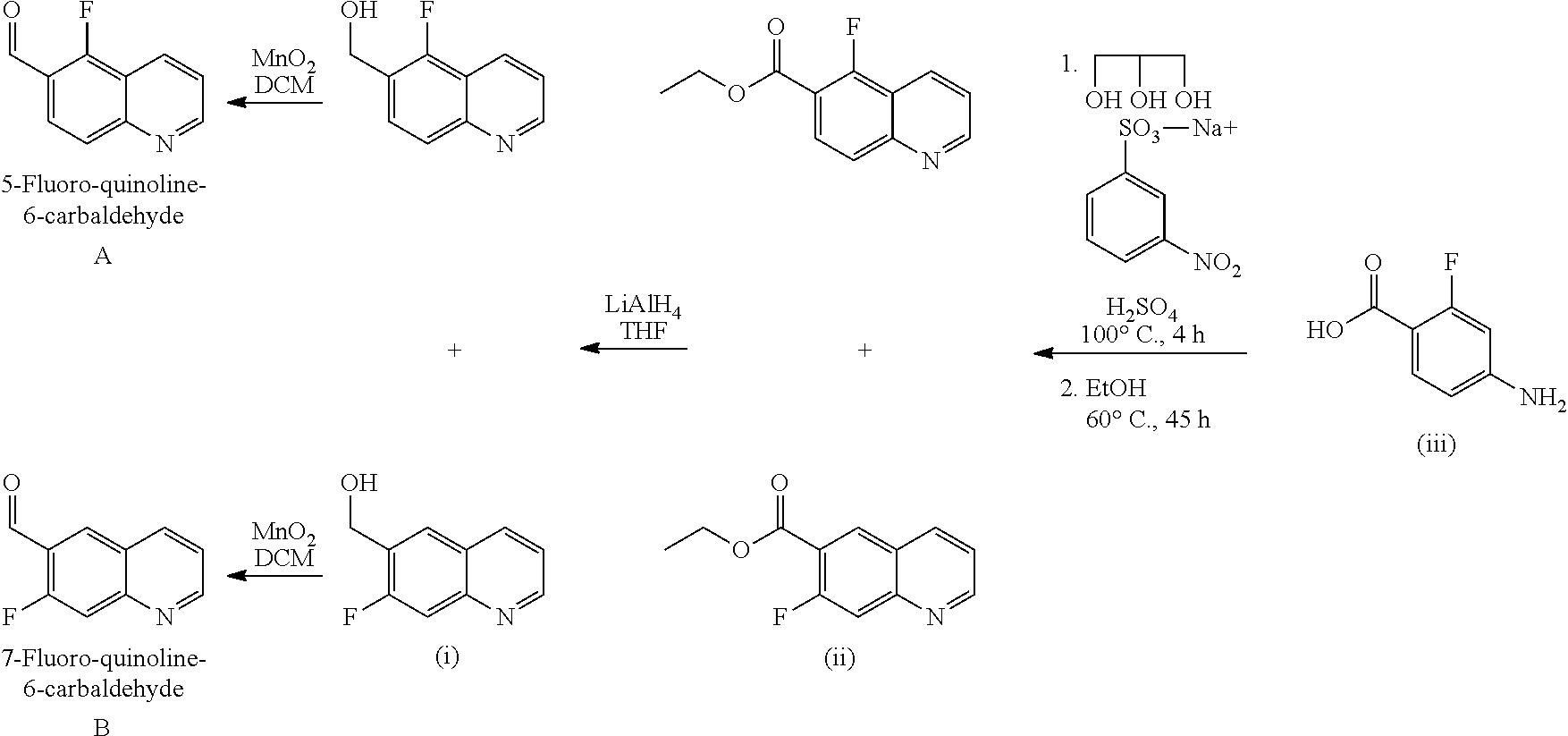


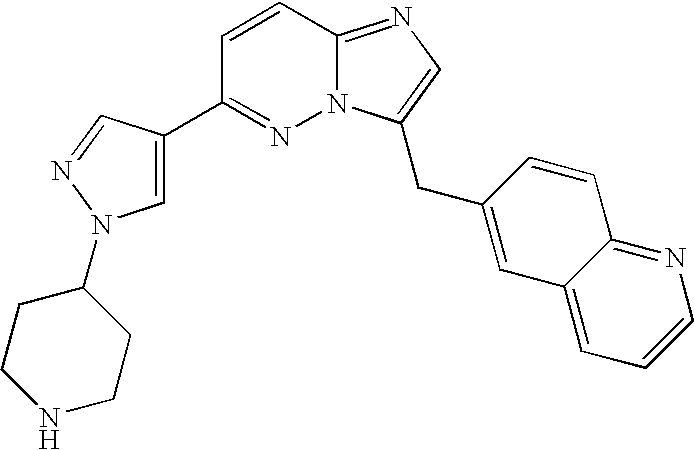


| tR (min) | ||||
| Ex | Structure | Name | Conditions | MH+ |
| 16 |
 |
6-(6-p-Tolyl-imidazo[1,2- b]pyridazin-3-ylmethyl)- quinoline | 6.27 Conditions 4 | 351.0 |
| 17 |
 |
6-(6-Naphthalen-2-yl- imidazo[1,2-b]pyridazin-3- ylmethyl)-quinoline | 7.16 Conditions 4 | 387.0 |
| 18 |
 |
6-[6-(3-Trifluoromethyl- phenyl)-imidazo[1,2- b]pyridazin-3-ylmethyl]- quinoline | 2.55 Conditions 6 | 404.9 |
| 19 |
 |
6-[6-(4-Bromo-phenyl)- imidazo[1,2-b]pyridazin- 3-ylmethyl]-quinoline | 2.53 Conditions 6 | 414.8 |
| 20 |
 |
3-(3-Quinolin-6-ylmethyl- imidazo[1,2-b]pyridazin-6- yl)-phenylamine | 4.24 Conditions 4 | 352.0 |
| 21 |
 |
1-[4-(3-Quinolin-6-ylmethyl- imidazo[1,2-b]pyridazin-6- yl)-phenyl]-ethanone | 2.00 Conditions 6 | 378.9 |
| 22 |
 |
6-[6-(3-Nitro-phenyl)- imidazo[1,2-b]pyridazin-3- ylmethyl]-quinoline | 2.12 Conditions 6 | 381.9 |
| 23 |
 |
6-[6-(4-Methylsulfanyl- phenyl)-imidazo[1,2- b]pyridazin-3-ylmethyl]- quinoline | 2.44 Conditions 6 | 382.9 |
| 24 |
 |
3-(3-Quinolin-6-ylmethyl- imidazo[1,2-b]pyridazin-6- yl)-benzaldehyde | 1.83/1.91 Conditions 6 | 365.0 |
| 25 |
 |
6-[6-(4-Fluoro-phenyl)- imidazo[1,2-b]pyridazin-3- ylmethyl]-quinoline | 2.16 Conditions 6 | 355.0 |
| 26 |
 |
3-(3-Quinolin-6-ylmethyl- imidazo[1,2-b]pyridazin-6- yl)-benzonitrile | 1.98 Conditions 6 | 361.9 |
| 27 |
 |
6-[6-(4-Chloro-phenyl)- imidazo[1,2-b]pyridazin-3- ylmethyl]-quinoline | 2.43 Conditions 6 | 370.9 |
| 28 |
 |
N-[3-(3-Quinolin-6-ylmethyl- imidazo[1,2-b]pyridazin-6- yl)-phenyl]-acetamide | 2.13 Conditions 6 | 393.9 |
| 29 |
 |
6-(6-Pyridin-3-yl- imidazo[1,2-b]pyridazin-3- ylmethyl)-quinoline | 1.23 Conditions 6 | 338.0 |
| 30 |
 |
6-(6-Phenyl-imidazo[1,2- b]pyridazin-3-ylmethyl)- quinoline | 2.07 Conditions 6 | 337.0 |
| 31 |
 |
6-(6-Benzofuran-2-yl- imidazo[1,2-b]pyridazin-3- ylmethyl)-quinoline | 2.50 Conditions 6 | 376.9 |
| 32 |
 |
6-(6-Naphthalen-1-yl- imidazo[1,2-b]pyridazin-3- ylmethyl)-quinoline | 2.53 Conditions 6 | 386.9 |
| 33 |
 |
6-[6-(4-Trifluoromethyl- phenyl)-imidazo[1,2- b]pyridazin-3-ylmethyl]- quinoline | 2.71 Conditions 6 | 404.9 |
| 34 |
 |
6-[6-(3-Phenyl-isoxazol-5- yl)-imidazo[1,2-b]pyridazin- 3-ylmethyl]-quinoline | 2.77 Conditions 6 | 403.9 |
| 35 |
 |
6-[6-(4-Methoxy-phenyl)- imidazo[1,2-b]pyridazin-3- ylmethyl]-quinoline | 2.17 Conditions 6 | 367.0 |
| 36 |
 |
Dimethyl-[3-(3-quinolin-6- ylmethyl-imidazo[1,2- b]pyridazin-6-yl)-phenyl]- amine | 1.63/1.73 Conditions 6 | 380.0 |
| 37 |
 |
6-[6-(1-Methyl-1H-indol-5- yl)-imidazo[1,2-b]pyridazin- 3-ylmethyl]-quinoline | 2.37 Conditions 6 | 390.0 |
| 38 |
 |
6-(6-Benzo[b]thiophen-2-yl- imidazo[1,2-b]pyridazin-3- ylmethyl)-quinoline | 2.62 Conditions 6 | 392.9 |
| 39 |
 |
6-(6-Quinolin-3-yl- imidazo[1,2-b]pyridazin-3- ylmethyl)-quinoline | 1.89 Conditions 6 | 387.9 |
| 40 |
 |
6-[6-(6-Methoxy-naphthalen- 2-yl)-imidazo[1,2-b]pyridazin- 3-ylmethyl]-quinoline | 2.71 Conditions 6 | 416.9 |
| 41 |
 |
6-[6-(5-Chloro-thiophen-2- yl)-imidazo[1,2-b]pyridazin- 3-ylmethyl]-quinoline | 2.42 Conditions 6 | 376.9 |
| 42 |
 |
6-(6-Isoquinolin-4-yl- imidazo[1,2-b]pyridazin-3- ylmethyl)-quinoline | 1.51/1.60 Conditions 6 | 387.9 |
| 43 |
 |
6-[6-(4-Trifluoromethoxy- phenyl)-imidazo[1,2- b]pyridazin-3-ylmethyl]- quinoline | 2.79 Conditions 6 | 420.9 |
| 44 |
 |
6-[6-(4-Butyl-phenyl)- imidazo[1,2-b]pyridazin-3- ylmethyl]-quinoline | 3.19 Conditions 6 | 393.0 |
| 45 |
 |
6-[6-(1H-Indol-5-yl)- imidazo[1,2-b]pyridazin-3- ylmethyl]-quinoline | 2.08 Conditions 6 | 376.0 |
| 46 |
 |
6-[6-(1-Propyl-1H-pyrazol-4- yl)-imidazo[1,2-b]pyridazin- 3-ylmethyl]-quinoline | 1.93 Conditions 6 | 369.0 |
| 47 |
 |
6-[6-(6-Chloro-pyridin-3-yl)- imidazo[1,2-b]pyridazin-3- ylmethyl]-quinoline | 1.96 Conditions 6 | 371.9 |
| 48 |
 |
6′-Chloro-5-(3-quinolin-6- ylmethyl-imidazo[1,2- b]pyridazin-6-yl)- [2,3′]bipyridinyl | 2.40 Conditions 6 | 448.8 |
| 49 |
 |
6-[6-(2-Chloro-pyridin-4-yl)- imidazo[1,2-b]pyridazin-3- ylmethyl]-quinoline | 1.92 Conditions 6 | 371.9 |
| 50 |
 |
2′-Chloro-4-(3-quinolin-6- ylmethyl-imidazo[1,2- b]pyridazin-6-yl)- [2,4′]bipyridinyl | 2.42 Conditions 6 | 448.8 |
| 51 |
 |
6-(6-Benzo[1,3]dioxol-5-yl- imidazo[1,2-b]pyridazin-3- ylmethyl)-quinoline | 2.10 Conditions 6 | 380.9 |
| 52 |
 |
6-(6-Benzo[1,2,5]oxadiazol- 5-yl-imidazo[1,2-b]pyridazin- 3-ylmethyl)-quinoline | 6.31 Conditions 4 | 378.9 |
| 53 |
 |
6-[6-(3-Chloro-phenyl)- imidazo[1,2-b]pyridazin-3- ylmethyl]-quinoline | 2.40 Conditions 6 | 370.9 |
| 54 |
 |
6-(6-Pyrimidin-5-yl- imidazo[1,2-b]pyridazin-3- ylmethyl)-quinoline | 4.03 Conditions 4 | 339.1 |
| 55 |
 |
1-[3-(3-Quinolin-6-ylmethyl- imidazo[1,2-b]pyridazin-6- yl)-phenyl]-ethanone | 5.39 Conditions 4 | 379.3 |
| 56 |
 |
6-[6-(2-Methoxy-pyrimidin-5- yl)-imidazo[1,2-b]pyridazin- 3-ylmethyl]-quinoline | 4.55 Conditions 4 | 369.4 |
| 57 |
 |
3-(3-Quinolin-6-ylmethyl- imidazo[1,2-b]pyridazin-6- yl)-benzamide | 4.06 Conditions 4 | 380.3 |
| 58 |
 |
N-Methyl-3-(3-quinolin-6- ylmethyl-imidazo[1,2- b]pyridazin-6-yl)-benzamide | 1.72 Conditions 6 | 394.0 |
| 59 |
 |
N,N-Dimethyl-3-(3-quinolin-6- 6-ylmethyl-imidazo[1,2- b]pyridazin-6-yl)-benzamide | 1.81 Conditions 6 | 408.0 |
| 60 |
 |
3-(3-Quinolin-6-ylmethyl- imidazo[1,2-b]pyridazin-6- yl)-benzoic acid ethyl ester | 2.53 Conditions 6 | 409.0 |
| 61 |
 |
6-[6-(1H-Indol-4-yl)- imidazo[1,2-b]pyridazin-3- ylmethyl]-quinoline | 2.01 Conditions 6 | 376.0 |
| 62 |
 |
6-[6-(6-Methoxy-pyridin-3- yl)-imidazo[1,2-b]pyridazin- 3-ylmethyl]-quinoline | 1.96 Conditions 6 | 368.1 |
| 63 |
 |
6-[6-(2,3-Dihydro-benzofuran- 5-yl)-imidazo[1,2-b]pyridazin- 3-ylmethyl]-quinoline | 2.22 Conditions 6 | 379.0 |
| 64 |
 |
3-[4-(3-Quinolin-6-ylmethyl- imidazo[1,2-b]pyridazin-6- yl)-phenyl]-propan-1-ol | 2.00 Conditions 6 | 395.0 |
| 65 |
 |
6-(6-Thiophen-3-yl- imidazo[1,2-b]pyridazin-3- ylmethyl)-quinoline | 2.01 Conditions 6 | 343.0 |
| 66 |
 |
N-(2-Dimethylamino-ethyl)- 3-(3-quinolin-6-ylmethyl- imidazo[1,2-b]pyridazin-6- yl)-benzamide | 1.48 Conditions 6 | 451.1 |
| 67 |
 |
2-Fluoro-5-(3-quinolin-6- ylmethyl-imidazo[1,2- b]pyridazin-6-yl)-benzonitrile | 2.21 Conditions 6 | 380.1 |
| 68 |
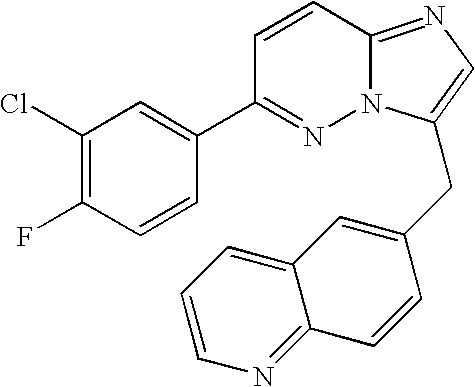 |
6-[6-(3-Chloro-4-fluoro- phenyl)-imidazo[1,2- b]pyridazin-3-ylmethyl]- quinoline | 2.54 Conditions 6 | 389.0 |
| 69 |
 |
6-[6-(2H-Pyrazol-3-yl)- imidazo[1,2-b]pyridazin-3- ylmethyl]-quinoline | 1.39/1.51 Conditions 6 | 327.1 |
| 70 |
 |
2-Fluoro-N-methyl-4-(3- quinolin-6-ylmethyl- imidazo[1,2-b]pyridazin-6- yl)-benzamide | 1.76 Conditions 6 | 412.3 |
| 71 |
 |
2-Chloro-N-methyl-4-(3- quinolin-6-ylmethyl- imidazo[1,2-b]pyridazin-6- yl)-benzamide | 1.73 Conditions 6 | 428.3 |


| tR (min) | ||||
| EX | Structure | Name | Conditions | MH+ |
| 79 |
 |
Isobutyl-(3-quinolin-6- ylmethyl-imidazo[1,2- b]pyridazin-6-yl)-amine | 4.47 Conditions 4 | 332.0 |
| 80 |
 |
(3-Quinolin-6-ylmethyl- imidazo[1,2-b]pyridazin-6-yl)- (tetrahydro-furan-2-ylmethyl)- amine | 3.63 Conditions 4 | 360.3 |
| 81 |
 |
Cyclopentyl-(3-quinolin-6- ylmethyl-imidazo[1,2- b]pyridazin-6-yl)-amine | 4.45 Conditions 4 | 344.2 |
| 82 |
 |
Benzyl-(3-quinolin-6-ylmethyl- imidazo[1,2-b]pyridazin-6-yl)- amine | 4.24 Conditions 4 | 366.2 |
| 83 |
 |
(1-Methyl-piperidin-4-yl)-(3- quinolin-6-ylmethyl- imidazo[1,2-b]pyridazin-6-yl)- amine | 3.12 Conditions 4 | 373.3 |
| 84 |
 |
6-(6-Morpholin-4-yl- imidazo[1,2-b]pyridazin-3- ylmethyl)-quinoline | 3.42 Conditions 4 | 346.2 |
| 85 |
 |
6-(6-Pyrrolidin-1-yl- imidazo[1,2-b]pyridazin-3- ylmethyl)-quinoline | 4.10 Conditions 4 | 330.2 |
| 86 |
 |
Dimethyl-[1-(3-quinolin-6- ylmethyl-imidazo[1,2- b]pyridazin-6-yl)-piperidin- 4-yl]-amine | 2.78 Conditions 4 | 387.4 |
| 87 |
 |
Methyl-[1-(3-quinolin-6- ylmethyl-imidazo[1,2- b]pyridazin-6-yl)-pyrrolidin- 3-yl]-carbamic acid tert- butyl ester | 5.08 Conditions 4 | 459.5 |
| 88 |
 |
Dimethyl-[(R)-1-(3-quinolin- 6-ylmethyl-imidazo[1,2- b]pyridazin-6-yl)-pyrrolidin- 3-yl]-amine | 3.09 Conditions 4 | 373.3 |
| 89 |
 |
(2-Methoxy-ethyl)-(3-quinolin- 6-ylmethyl-imidazo[1,2- b]pyridazin-6-yl)-amine | 3.52 Conditions 4 | 334.2 |
| 90 |
 |
(1-Ethyl-propyl)-(3-quinolin-6- ylmethyl-imidazo[1,2- b]pyridazin-6-yl)-amine | 4.79 Conditions 4 | 346.2 |
| 91 |
 |
Isopropyl-(3-quinolin-6- ylmethyl-imidazo[1,2- b]pyridazin-6-yl)-amine | 4.09 Conditions 4 | 318.2 |
| 92 |
 |
2-(3-Quinolin-6-ylmethyl- imidazo[1,2-b]pyridazin-6- ylamino)-ethanol | 3.03 Conditions 4 | 320.1 |
| 93 |
 |
4-Methyl-thiazol-2-yl)-(3- quinolin-6-ylmethyl- imidazo[1,2-b]pyridazin-6- yl)-amine | 4.49 Conditions 4 | 373.1 |
| 94 |
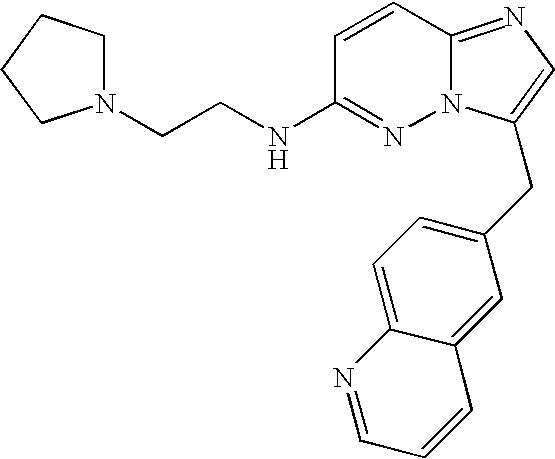 |
(2-Pyrrolidin-1-yl-ethyl)- (3-quinolin-6-ylmethyl- imidazo[1,2-b]pyridazin-6- yl)-amine | 3.26 Conditions 4 | 373.4 |
| 95 |
 |
(1-Ethyl-pyrrolidin-2-ylmethyl)- (3-quinolin-6-ylmethyl- imidazo[1,2-b]pyridazin-6- yl)-amine | 3.29 Conditions 4 | 387.4 |
| 96 |
 |
N-[2-(3-Quinolin-6-ylmethyl- imidazo[1,2-b]pyridazin-6- ylamino)-ethyl]-acetamide | 3.05 Conditions 4 | 361.2 |
| 97 |
 |
Cyclooctyl-(3-quinolin-6- ylmethyl-imidazo[1,2- b]pyridazin-6-yl)-amine | 5.73 Conditions 4 | 386.4 |
| 98 |
 |
(1,1-Dimethyl-propyl)-(3- quinolin-6-ylmethyl- imidazo[1,2-b]pyridazin- 6-yl)-amine | 4.67 Conditions 4 | 346.2 |
| 99 |
 |
1,1-Dioxo-tetrahydro- 1lambda*6*-thiophen-3-yl)- (3-quinolin-6-ylmethyl- imidazo[1,2-b]pyridazin-6- yl)-amine | 3.10 Conditions 4 | 394.2 |
| 100 |
 |
(2-Phenyl-propyl)-(3-quinolin- 6-ylmethyl-imidazo[1,2- b]pyridazin-6-yl)-amine | 5.08 Conditions 4 | 394.4 |
| 101 |
 |
N,N-Dimethyl-N′-(3-quinolin- 6-ylmethyl-imidazo[1,2- b]pyridazin-6-yl)-propane- 1,3-diamine | 3.08/3.23 Conditions 4 | 361.3 |
| 102 |
 |
4-(3-Quinolin-6-ylmethyl- imidazo[1,2-b]pyridazin-6- yl)-piperazin-2-one | 3.43 Conditions 4 | 359.2 |
| 103 |
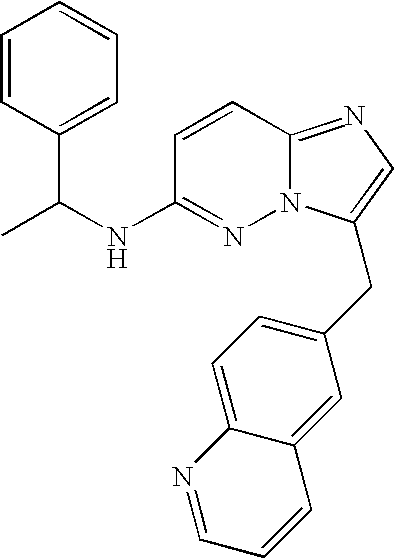 |
(1-Phenyl-ethyl)-(3-quinolin- 6-ylmethyl-imidazo[1,2- b]pyridazin-6-yl)-amine | 4.66 Conditions 4 | 380.4 |
| 104 |
 |
Phenethyl-(3-quinolin-6- ylmethyl-imidazo[1,2- b]pyridazin-6-yl)-amine | 4.77 Conditions 4 | 380.3 |
| 105 |
 |
[Methyl-(3-quinolin-6- ylmethyl-imidazo[1,2- b]pyridazin-6-yl)-amino[- acetic acid | 3.44 Conditions 4 | 348.1 |
| 106 |
 |
Dimethyl-(3-quinolin-6- ylmethyl-imidazo[1,2- b]pyridazin-6-yl)-amine | 3.69 Conditions 4 | 304.2 |
| 107 |
 |
(S)-1-(3-Quinolin-6-ylmethyl- imidazo[1,2-b]pyridazin-6-yl)- pyrrolidin-3-ol | 3.60 Conditions 4 | 346.2 |
| 108 |
 |
(R)-1-(3-Quinolin-6-ylmethyl- imidazo[1,2-b]pyridazin-6-yl)- pyrrolidin-3-ol | 4.65/4.71 Conditions 4 | 346.2 |
| 109 |
 |
1-(3-Quinolin-6-ylmethyl- imidazo[1,2-b]pyridazin-6-yl)- [1,4]diazepan-5-one | 4.59 Conditions 4 | 373.4 |
| 110 |
 |
6-[6-(1,4-Dioxa-8-aza- spiro[4.5]dec-8-yl)- imidazo[1,2-b]pyridazin-3- ylmethyl]-quinoline | 1.86 Conditions 6 | 402.0 |
| 111 |
 |
6-[6-(2-Methyl-piperidin-1- yl)-imidazo[1,2-b]pyridazin- 3-ylmethyl]-quinoline | 2.29 Conditions 6 | 358.2 |
| 112 |
 |
6-[6-(3-Chloro- phenylsulfanyl)-imidazo[1,2- b]pyridazin-3-ylmethyl]- quinoline | 6.95 Method 4 | 403.1 |
| 113 |
 |
6-[6-(3-Chloro-phenoxy)- imidazo[1,2-b]pyridazin-3- ylmethyl]-quinoline | 6.34 Conditions 4 | 387.1 |
| 114 |
 |
(3-Quinolin-6-ylmethyl- imidazo[1,2-b]pyridazin-6- yl)-(2,2,2-trifluoro-ethyl)- amine | 3.82 Conditions 4 | 358.3 |
| 115 |
 |
6-(6-Imidazol-1-yl- imidazo[1,2-b]pyridazin-3- ylmethyl)-quinoline | 3.66 Conditions 4 | 327.1 |
| 116 |
 |
6-[6-(2-Methyl-imidazol-1- yl)-imidazo[1,2-b]pyridazin- 3-ylmethyl]-quinoline | 3.10 Conditions 4 | 341.4 |
| 117 |
 |
(1-Benzyl-pyrrolidin-3-yl)- (3-quinolin-6-ylmethyl- imidazo[1,2-b]pyridazin-6- yl)-amine | 3.56 Conditions 4 | 435.4 |
| 118 |
 |
6-[6-(4-Methyl-imidazol-1- yl)-imidazo[1,2-b]pyridazin- 3-ylmethyl]-quinoline | 1.18/1.29 Conditions 6 | 341.4 |

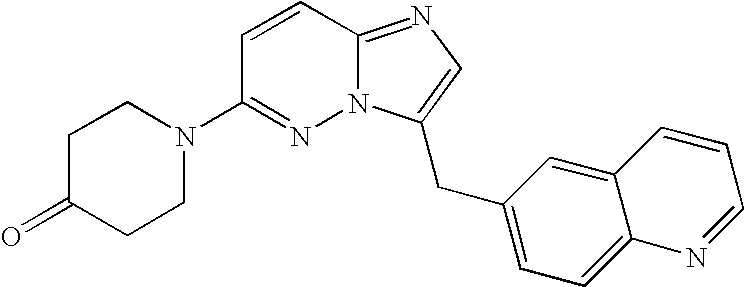


| tR (min) | ||||
| Ex | structure | Name | Conditions | MH+ |
| 127 |
 |
(3-Quinolin-6-ylmethyl- imidazo[1,2-b]pyridazin-6-yl)-(3- trifluoromethyl-phenyl)-amine | 5.48 Conditions 4 | 420.4 |
| 128 |
 |
(2-Chloro-phenyl)-(3-quinolin-6- ylmethyl-imidazo[1,2-b]pyridazin- 6-yl)-amine | 4.64 Conditions 4 | 386.1 |
| 129 |
 |
Pyridin-3-yl-(3-quinolin-6- ylmethyl-imidazo[1,2-b]pyridazin- 6-yl)-amine | 3.07 Conditions 4 | 353.2 |
| 130 |
 |
Pyrimidin-2-yl-(3-quinolin-6- ylmethyl-imidazo[1,2-b]pyridazin- 6-yl)-amine | 3.67 Conditions 4 | 354.3 |
| 131 |
 |
Pyrimidin-4-yl-(3-quinolin-6- ylmethyl-imidazo[1,2-b]pyridazin- 6-yl)-amine | 3.43 Conditions 4 | 354.2 |
| 132 |
 |
(2-Ethyl-2H-pyrazol-3-yl)-(3- quinolin-6-ylmethyl-imidazo[1,2- b]pyridazin-6-yl)-amine | 3.59 Conditions 4 | 370.3 |
| 133 |
 |
7-[6-(4-Methyl-pyrazol-1-yl)- imidazo[1,2-b]pyridazin-3- ylmethyl]-quinoline | 5.54 Conditions 4 | 341.1 |
| 134 |
 |
6-(6-Pyrazol-1-yl-imidazo[1,2- b]pyridazin-3-ylmethyl)-quinoline | 5.08 Conditions 4 | 327.2 |
| 135 |
 |
(3-Chloro-4-methyl-phenyl)-(3- quinolin-7-ylmethyl-imidazo[1,2- b]pyridazin-6-yl)-amine | 5.46 Conditions 4 | 400.2 |
| 136 |
 |
(2,3-Dichloro-phenyl)-(3-quinolin- 6-ylmethyl-imidazo[1,2- b]pyridazin-6-yl)-amine | 5.41 Conditions 4 | 420.1 |
| 137 |
 |
(3-Chloro-4-fluoro-phenyl)-(3- quinolin-6-ylmethyl-imidazo[1,2- b]pyridazin-6-yl)-amine | 5.37 Conditions 4 | 404.1 |
| 138 |
 |
(3-Chloro-phenyl)-methyl-(3- quinolin-6-ylmethyl-imidazo[1,2- b]pyridazin-6-yl)-amine | 5.45 Conditions 4 | 400.2 |
| 139 |
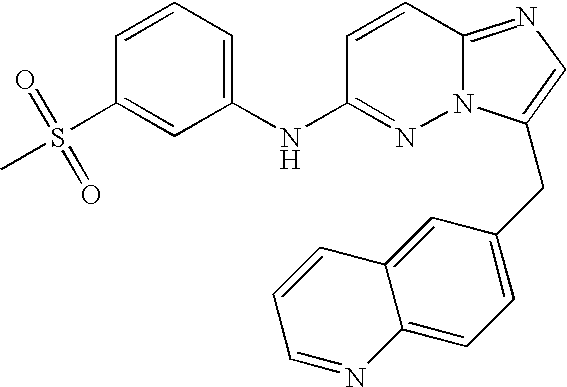 |
(3-Methanesulfonyl-phenyl)-(3- quinolin-6-ylmethyl-imidazo[1,2- b]pyridazin-6-yl)-amine | 3.89 Conditions 4 | 430.3 |
| 140 |
 |
(3-Methoxy-phenyl)-(3-quinolin-6- ylmethyl-imidazo[1,2-b]pyridazin- 6-yl)-amine | 4.39 Conditions 4 | 382.3 |
| 141 |
 |
Benzo[1,2,5]oxadiazol-4-yl-(3- quinolin-7-ylmethyl-imidazo[1,2- b]pyridazin-6-yl)-amine | 4.56 Conditions 4 | 394.4 |


To a solution of 4-(4,4,5,5-tetramethyl-1,3,2-dioxaborolan-2-yl)-1H-pyrazole (1.4 g 5.57 mmol) in DMF (20 mL) stirred at 0° C. was added sodium hydride (55% in oil, 0.243 g, 5.57 mmol). After addition the mixture was stirred 1 h at rt, a solution of the above obtained 3-methanesulfonyloxy-azetidine-1-carboxylic acid tert-butyl ester (1.4 g, 5.57 mmol) in DMF (3 mL) was added. The RM was stirred 30 min at rt, and then 3 h at 95° C. After cooling at rt the mixture was poured in ice water and extracted with EtOAc. The combined organic phases were washed with a solution of saturated NaHCO3 and brine. The organic layer was dried over Na2SO4, filtered and the solvent was removed under reduced pressure. The residue was purified by flash chromatography (with heptane and EtOAc as eluants) to afford the title compound as an oil (tR 4.33 min (conditions 3), MH+=350.1)


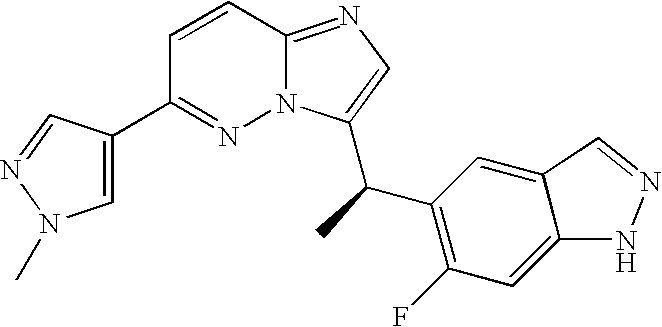


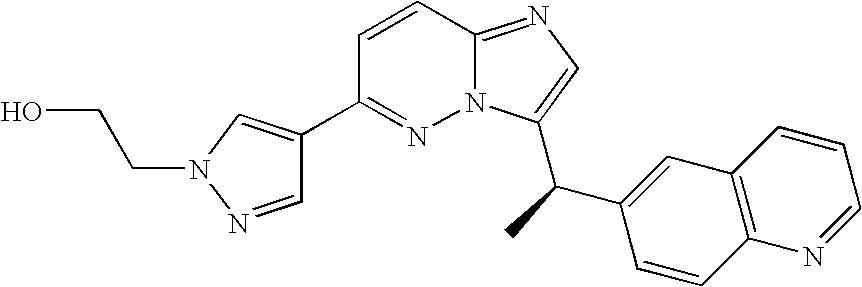


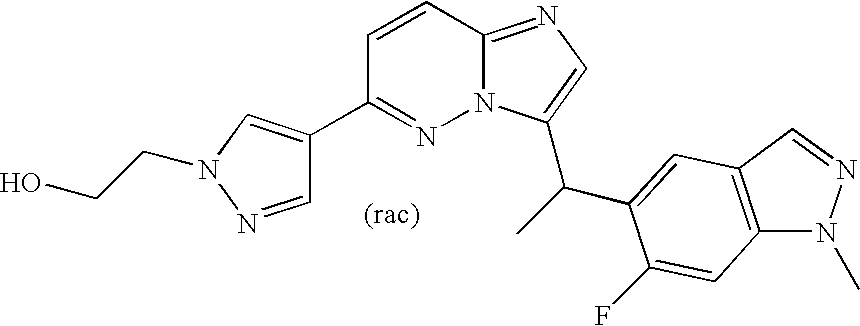


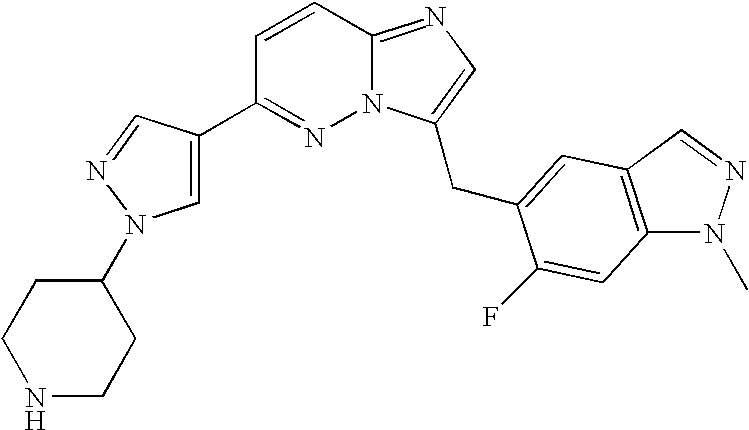


| TABLE 1 | |||
| c-Met | |||
| IC50 | |||
| Example | [uM] | ||
| 1 | 0.14 | ||
| 2 | 0.014 | ||
| 3 | 3.95 | ||
| 4 | 0.28 | ||
| 5 | 0.053 | ||
| 6 | 0.014 | ||
| 7 | 0.05 | ||
| 8 | 0.27 | ||
| 9 | 0.17 | ||
| 10 | 0.0215 | ||
| 11 | 0.91 | ||
| 12 | 0.0325 | ||
| 13 | 0.0735 | ||
| 15 | 0.0095 | ||
| 16 | 0.0945 | ||
| 17 | 0.21 | ||
| 18 | 0.0655 | ||
| 19 | 0.215 | ||
| 20 | 0.06 | ||
| 21 | 0.0275 | ||
| 22 | 0.0074 | ||
| 23 | 0.125 | ||
| 24 | 0.0235 | ||
| 25 | 0.048 | ||
| 26 | 0.02 | ||
| 27 | 0.11 | ||
| 28 | 0.24 | ||
| 29 | 0.04 | ||
| 30 | 0.091 | ||
| 31 | 0.23 | ||
| 33 | 0.37 | ||
| 34 | 0.23 | ||
| 35 | 0.079 | ||
| 36 | 0.065 | ||
| 37 | 0.03 | ||
| 38 | 0.039 | ||
| 39 | 0.072 | ||
| 40 | 0.13 | ||
| 41 | 0.056 | ||
| 42 | 0.45 | ||
| 43 | 0.35 | ||
| 45 | 0.1 | ||
| 46 | 0.057 | ||
| 47 | 0.1 | ||
| 48 | 0.19 | ||
| 49 | 0.023 | ||
| 50 | 0.95 | ||
| 51 | 0.095 | ||
| 52 | 0.24 | ||
| 53 | 0.11 | ||
| 54 | 0.12 | ||
| 55 | 0.031 | ||
| 56 | 0.25 | ||
| 57 | 0.063 | ||
| 58 | 0.25 | ||
| 59 | 0.56 | ||
| 60 | 0.34 | ||
| 62 | 0.039 | ||
| 63 | 0.19 | ||
| 64 | 0.079 | ||
| 65 | 0.16 | ||
| 66 | 0.06 | ||
| 67 | 0.16 | ||
| 68 | 0.48 | ||
| 69 | 0.82 | ||
| 70 | 0.062 | ||
| 71 | 0.024 | ||
| 73 | 0.048 | ||
| 74 | 0.2 | ||
| 75 | 0.3 | ||
| 76 | 0.3 | ||
| 77 | 0.225 | ||
| 78 | 0.009 | ||
| 79 | 0.044 | ||
| 80 | 0.038 | ||
| 81 | 0.076 | ||
| 82 | 0.22 | ||
| 83 | 0.115 | ||
| 84 | 0.049 | ||
| 85 | 0.095 | ||
| 86 | 0.16 | ||
| 87 | 0.37 | ||
| 88 | 0.012 | ||
| 89 | 0.026 | ||
| 90 | 0.074 | ||
| 91 | 0.029 | ||
| 92 | 0.032 | ||
| 93 | 0.39 | ||
| 96 | 0.19 | ||
| 97 | 0.61 | ||
| 98 | 0.11 | ||
| 99 | 0.12 | ||
| 101 | 0.13 | ||
| 102 | 0.038 | ||
| 103 | 0.55 | ||
| 106 | 0.074 | ||
| 107 | 0.02 | ||
| 108 | 0.0098 | ||
| 109 | 0.062 | ||
| 110 | 0.042 | ||
| 111 | 0.34 | ||
| 112 | 0.22 | ||
| 113 | 0.084 | ||
| 114 | 0.056 | ||
| 115 | 0.095 | ||
| 116 | 0.98 | ||
| 117 | 0.63 | ||
| 118 | 0.22 | ||
| 119 | 0.042 | ||
| 120 | 0.069 | ||
| 121 | 0.02 | ||
| 122 | 0.073 | ||
| 123 | 0.087 | ||
| 124 | 0.18 | ||
| 125 | 0.13 | ||
| 126 | 0.016 | ||
| 127 | 0.09 | ||
| 128 | 0.029 | ||
| 129 | 0.069 | ||
| 131 | 0.18 | ||
| 132 | 0.05 | ||
| 133 | 0.47 | ||
| 134 | 0.57 | ||
| 135 | 0.047 | ||
| 136 | 0.35 | ||
| 137 | 0.1 | ||
| 138 | 0.96 | ||
| 139 | 0.13 | ||
| 140 | 0.31 | ||
| 141 | 0.44 | ||
| 142 | 0.21 | ||
| 143 | 0.044 | ||
| 144 | 0.0032 | ||
| 146 | 0.068 | ||
| 147 | 0.082 | ||
| 148 | 0.016 | ||
| 149 | 0.031 | ||
| 150 | 0.056 | ||
| 151 | 0.064 | ||
| 152 | 0.89 | ||
| 155 | 0.86 | ||
| 156 | 0.19 | ||
| 157 | 0.007 | ||
| 158 | 0.54 | ||
| 159 | 0.014 | ||
| 160 | 0.012 | ||
| 162 | 0.034 | ||
| 163 | 0.11 | ||
| 164 | 0.054 | ||
| 165 | 0.012 | ||
| 167 | 0.006 | ||
| 169 | 0.4 | ||
| 170 | 0.006 | ||
| 171 | <0.003 | ||
| 172 | 0.010 | ||
| 173 | 0.004 | ||
| 174 | 0.12 | ||
| 175 | 0.038 | ||
| 177 | 0.02 | ||
| 179 | 0.015 | ||
| 180 | 0.145 | ||
| 181 | 0.065 | ||
| 182 | 0.003 | ||
| 183 | 0.2 | ||
| 184 | <0.003 | ||
| 185 | 0.056 | ||
| 187 | 0.019 | ||
| 188 | 0.0056 | ||
| 189 | 0.095 | ||
| 190 | 0.056 | ||
| 191 | <0.003 | ||
| 192 | <0.003 | ||
| 193 | 0.25 | ||
| 194 | 0.018 | ||
| 195 | 0.014 | ||
| 196 | 0.036 | ||
| 197 | 0.061 | ||
| 199 | 0.0355 | ||
| 200 | 0.023 | ||
| 202 | 0.068 | ||
| 205 | 0.047 | ||
| 206 | 0.031 | ||
| 207 | 0.31 | ||
| 208 | 0.052 | ||
| 210 | 0.052 | ||
| 211 | 0.086 | ||
| 212 | 0.054 | ||
| 215 | 0.13 | ||
| 216 | 0.1 | ||
| 217 | 0.084 | ||
| 219 | 0.12 | ||
| 220 | 0.33 | ||
| 221 | 0.24 | ||
| 222 | 0.25 | ||
| 223 | 0.033 | ||
| 224 | 0.028 | ||
| 225 | 0.025 | ||
| 226 | 0.025 | ||
| 227 | 0.078 | ||
| 228 | 0.099 | ||
| 229 | 0.52 | ||
| 230 | 0.027 | ||
| 231 | 0.026 | ||
| 232 | 0.066 | ||
| 233 | 0.12 | ||
| 234 | 0.11 | ||
| 235 | 0.22 | ||
| 236 | 0.37 | ||
| 237 | 0.17 | ||
| 238 | 0.23 | ||
| 239 | 0.031 | ||
| 240 | 0.0084 | ||
| 241 | 0.0375 | ||
| 242 | 0.086 | ||
| 243 | 0.037 | ||
| 244 | 0.087 | ||
| 245 | 0.044 | ||
| 246 | <0.003 | ||
| 247 | 0.066 | ||
| 248 | 0.37 | ||
| 249 | 0.38 | ||
| 250 | 0.015 | ||
| 251 | 0.021 | ||
| 252 | 0.28 | ||
| 253 | 0.013 | ||
| 254 | 0.033 | ||
| 255 | 0.036 | ||
| 257 | <0.003 | ||
| 258 | 0.043 | ||
| 259 | 0.023 | ||
| 260 | 0.0052 | ||
| 261 | 0.12 | ||
| 262 | 0.042 | ||
| 263 | 0.01 | ||
| 267 | 0.26 | ||
| 273 | 0.021 | ||
| 275 | 0.15 | ||
| 276 | 0.082 | ||
| 277 | 0.061 | ||
| 278 | 0.021 | ||
| 279 | 0.015 | ||
| 281 | 0.077 | ||
| 282 | 0.087 | ||
| 284 | 0.15 | ||
| 285 | 0.011 | ||
| 288 | 0.85 | ||
| 289 | 0.14 | ||
| 290 | 0.12 | ||
| 291 | 0.59 | ||
| 292 | 0.08 | ||
| 293 | 0.023 | ||
| 294 | 0.82 | ||
| 295 | 0.019 | ||
| 296 | 0.057 | ||
| 297 | 0.13 | ||
| 298 | 0.13 | ||
| 299 | 0.27 | ||
| 300 | 0.3 | ||
| 301 | 0.071 | ||
| 302 | 0.094 | ||
| 303 | 0.19 | ||
| 304 | 0.33 | ||
| 305 | 0.26 | ||
| 306 | 0.1 | ||
| 307 | 0.32 | ||
| 308 | 0.082 | ||
| 309 | 0.016 | ||
| 310 | 0.01 | ||
Claims (3)
Applications Claiming Priority (3)
| Application Number | Priority Date | Filing Date | Title |
|---|---|---|---|
| EP08152068.6 | 2008-02-28 | ||
| EP08152068 | 2008-02-28 | ||
| EP08152068 | 2008-02-28 |
Publications (2)
| Publication Number | Publication Date |
|---|---|
| US20090264406A1 US20090264406A1 (en) | 2009-10-22 |
| US8822468B2 true US8822468B2 (en) | 2014-09-02 |
Family
ID=39672115
Family Applications (1)
| Application Number | Title | Priority Date | Filing Date |
|---|---|---|---|
| US12/396,137 Expired - Fee Related US8822468B2 (en) | 2008-02-28 | 2009-03-02 | 3-Methyl-imidazo[1,2-b]pyridazine derivatives |
Country Status (25)
| Country | Link |
|---|---|
| US (1) | US8822468B2 (en) |
| EP (1) | EP2265614A1 (en) |
| JP (1) | JP5576802B2 (en) |
| KR (1) | KR20100128305A (en) |
| CN (1) | CN102015716B (en) |
| AR (1) | AR070487A1 (en) |
| AU (1) | AU2009218459A1 (en) |
| BR (1) | BRPI0908504A2 (en) |
| CA (1) | CA2717034A1 (en) |
| CL (1) | CL2009000443A1 (en) |
| CO (1) | CO6300957A2 (en) |
| CR (1) | CR11620A (en) |
| DO (1) | DOP2010000263A (en) |
| EA (1) | EA201001365A1 (en) |
| EC (1) | ECSP10010427A (en) |
| IL (1) | IL207434A0 (en) |
| MA (1) | MA32167B1 (en) |
| MX (1) | MX2010009414A (en) |
| NI (1) | NI201000145A (en) |
| PE (1) | PE20091468A1 (en) |
| SM (1) | SMAP201000112A (en) |
| TW (1) | TW200940545A (en) |
| UY (1) | UY31676A1 (en) |
| WO (1) | WO2009106577A1 (en) |
| ZA (1) | ZA201005602B (en) |
Cited By (1)
| Publication number | Priority date | Publication date | Assignee | Title |
|---|---|---|---|---|
| US9062045B2 (en) | 2011-09-15 | 2015-06-23 | Novartis Ag | Triazolopyridine compounds |
Families Citing this family (26)
| Publication number | Priority date | Publication date | Assignee | Title |
|---|---|---|---|---|
| UY32049A (en) * | 2008-08-14 | 2010-03-26 | Takeda Pharmaceutical | CMET INHIBITORS |
| US20110053968A1 (en) | 2009-06-09 | 2011-03-03 | Auspex Pharmaceuticals, Inc. | Aminopyrimidine inhibitors of tyrosine kinase |
| US8389526B2 (en) * | 2009-08-07 | 2013-03-05 | Novartis Ag | 3-heteroarylmethyl-imidazo[1,2-b]pyridazin-6-yl derivatives |
| WO2011018454A1 (en) | 2009-08-12 | 2011-02-17 | Novartis Ag | Heterocyclic hydrazone compounds and their uses to treat cancer and inflammation |
| MX2012002179A (en) | 2009-08-20 | 2012-03-16 | Novartis Ag | Heterocyclic oxime compounds. |
| CU24167B1 (en) | 2009-12-31 | 2016-03-31 | Hutchison Medipharma Ltd | DERIVATIVES OF REPLACED TRIAZOLOPIRAZINS AS INHIBITORS OF THE C-MET OR HGF RECEPTOR TO TREAT CANCER |
| US20110195066A1 (en) * | 2010-02-05 | 2011-08-11 | Auspex Pharmaceuticals, Inc. | Quinoline inhibitors of tyrosine kinase |
| EP2588107A1 (en) * | 2010-07-01 | 2013-05-08 | Takeda Pharmaceutical Company Limited | COMBINATION OF A cMET INHIBITOR AND AN ANTIBODY TO HGF AND/OR cMET |
| AR085183A1 (en) | 2010-07-30 | 2013-09-18 | Lilly Co Eli | COMPOUND 6- (1-METHYL-1H-PIRAZOL-4-IL) -3- (2-METHYL-2H-INDAZOL-5-ILTIO) - [1,2,4] TRIAZOL [4,3-B] PIRIDAZINE, PHARMACEUTICAL COMPOSITION THAT UNDERSTAND AND USE IT TO PREPARE A USEFUL MEDICINAL PRODUCT TO TREAT CANCER |
| UY33597A (en) * | 2010-09-09 | 2012-04-30 | Irm Llc | COMPOUNDS AND COMPOSITIONS AS INHIBITORS OF THE TRK |
| CA2839958A1 (en) * | 2011-06-22 | 2012-12-27 | Knut Eis | Heterocyclyl aminoimidazopyridazines |
| CN103958509B (en) * | 2011-09-15 | 2015-12-23 | 诺华股份有限公司 | 6-Substituted 3-(quinolin-6-ylthio)-[1,2,4]triazolo[4,3-A]pyridine compounds as tyrosine kinase inhibitors |
| CN103122000B (en) * | 2012-09-03 | 2013-12-25 | 中美冠科生物技术(太仓)有限公司 | High-selectivity c-Met kinase inhibitor used as antitumor drug |
| DK2925757T3 (en) | 2012-11-19 | 2018-01-15 | Novartis Ag | Compounds and compositions for the treatment of parasitic diseases |
| CN105431148A (en) | 2013-03-07 | 2016-03-23 | 加利菲亚生物公司 | Mixed-lineage kinase inhibitors and methods of treatment |
| AR097543A1 (en) * | 2013-09-06 | 2016-03-23 | Lexicon Pharmaceuticals Inc | COMPOUNDS BASED ON IMIDAZO [1,2-b] PIRIDAZINE, COMPOSITIONS THAT INCLUDE THEM AND THEIR METHODS OF USE |
| CN105326793A (en) * | 2014-08-06 | 2016-02-17 | 中美冠科生物技术(太仓)有限公司 | Solid dispersion containing c-Met kinase inhibitor and preparation method and application of solid dispersion |
| BR112017012930A2 (en) * | 2014-12-19 | 2018-01-09 | Janssen Pharmaceutica Nv | imidazopyridazine derivatives as pi3kbeta inhibitors. |
| US10202387B2 (en) * | 2014-12-19 | 2019-02-12 | Janssen Pharmaceutica Nv | Heterocyclyl linked imidazopyridazine derivatives as PI3KB inhibitors |
| RU2770404C2 (en) * | 2016-09-16 | 2022-04-15 | Гельмгольц Центрум Мюнхен - Дойчес Форшунгсцентрум Фюр Гезундхайт Унд Умвельт (Гмбх) | Traf 6 inhibitors |
| WO2018115319A2 (en) * | 2016-12-23 | 2018-06-28 | Helmholtz Zentrum München - Deutsches Forschungszentrum für Gesundheit und Umwelt (GmbH) | Inhibitors of cytochrome p450 family 7 subfamily b member 1 (cyp7b1) for use in treating diseases |
| WO2018138050A1 (en) | 2017-01-26 | 2018-08-02 | Bayer Aktiengesellschaft | Condensed bicyclic heterocyclene derivatives as pest control agents |
| WO2018237349A1 (en) * | 2017-06-23 | 2018-12-27 | University Of Washington | TYPE 1 METHIONYL-ARNT SYNTHASEASE INHIBITORS AND METHODS OF USE |
| WO2019228940A1 (en) * | 2018-05-28 | 2019-12-05 | F. Hoffmann-La Roche Ag | Novel oxoquinolizine compounds for the treatment and prophylaxis of bacterial infection |
| JP7712932B2 (en) * | 2019-12-18 | 2025-07-24 | ザ リージェンツ オブ ザ ユニバーシティ オブ カリフォルニア | LIN28 INHIBITORS AND METHODS OF USE THEREOF |
| CN119081395B (en) * | 2024-09-07 | 2025-03-18 | 广东环塑众创实业有限公司 | A kind of high temperature resistant nylon engineering plastic and preparation method thereof |
Citations (38)
| Publication number | Priority date | Publication date | Assignee | Title |
|---|---|---|---|---|
| US3489755A (en) | 1966-08-03 | 1970-01-13 | Pfizer & Co C | Imidazo (1,2-b) pyridazines |
| US4910199A (en) | 1987-09-01 | 1990-03-20 | Sanofi | Imidazo[1,2-]pyridazines for cortical cholinergic deficiencies |
| EP0490587A1 (en) | 1990-12-07 | 1992-06-17 | Merck & Co. Inc. | Substituted pyrazolopyrimidines and imidazopyridazines as angiotensin II antagonists |
| WO2001083481A1 (en) | 2000-04-27 | 2001-11-08 | Yamanouchi Pharmaceutical Co., Ltd. | Imidazopyridine derivatives |
| WO2002062800A1 (en) | 2001-02-08 | 2002-08-15 | Eisai Co., Ltd. | Bicyclic nitrogenous fused-ring compound |
| WO2004058749A1 (en) | 2002-12-18 | 2004-07-15 | Vertex Pharmaceuticals Incorporated | Benzisoxazole derivatives useful as inhibitors of protein kinases |
| WO2005004808A2 (en) | 2003-07-02 | 2005-01-20 | Sugen, Inc. | TETRACYCLIC COMPOUNDS AS c-MET INHIBITORS |
| WO2005004807A2 (en) | 2003-06-30 | 2005-01-20 | Merck & Co., Inc. | 17-acetamido-4-azasteroid derivatives as androgen receptor modulators |
| WO2005010005A1 (en) | 2003-07-02 | 2005-02-03 | Sugen, Inc. | Triazolotriazine compounds and uses thereof |
| WO2005041971A1 (en) | 2003-10-21 | 2005-05-12 | Merck & Co., Inc. | Triazolo-pyridazine compounds and derivatives thereof useful in the treatment of neuropathic pain |
| WO2005051906A2 (en) | 2003-11-19 | 2005-06-09 | Array Biopharma Inc. | Heterocyclic inhibitors of mek and methods of use thereof |
| WO2005073224A2 (en) | 2004-01-23 | 2005-08-11 | Amgen Inc | Quinoline quinazoline pyridine and pyrimidine counds and their use in the treatment of inflammation angiogenesis and cancer |
| WO2005080355A1 (en) | 2004-02-12 | 2005-09-01 | Neurogen Corporation | Imidazo-pyridazines, triazolo-pyridazines and related benzodiazepine receptor ligands |
| US20060148801A1 (en) | 2004-12-31 | 2006-07-06 | Hsing-Pang Hsieh | Anti-tumor compounds |
| WO2006124354A2 (en) | 2005-05-12 | 2006-11-23 | Merck & Co., Inc. | Tyrosine kinase inhibitors |
| WO2007013673A1 (en) | 2005-07-29 | 2007-02-01 | Astellas Pharma Inc. | Fused heterocycles as lck inhibitors |
| WO2007038314A2 (en) | 2005-09-22 | 2007-04-05 | Bristol-Myers Squibb Company | Fused heterocyclic compounds useful as kinase modulators |
| WO2007064797A2 (en) | 2005-11-30 | 2007-06-07 | Vertex Pharmaceuticals Incorporated | Inhibitors of c-met and uses thereof |
| WO2007075567A1 (en) | 2005-12-21 | 2007-07-05 | Janssen Pharmaceutica, N.V. | Triazolopyridazines as tyrosine kinase modulators |
| US20070167460A1 (en) | 2005-03-23 | 2007-07-19 | Mcarthur Silvia G | Acetylenyl-pyrazolo-pyrimidine derivatives |
| US20070265272A1 (en) | 2006-05-11 | 2007-11-15 | Pfizer Inc. | Triazolopyrazine derivatives |
| WO2007138472A2 (en) | 2006-05-30 | 2007-12-06 | Pfizer Products Inc. | Triazolopyridazine derivatives |
| WO2008008539A2 (en) | 2006-07-14 | 2008-01-17 | Amgen Inc. | Fused heterocyclic derivatives useful as inhibitors of the hepatocyte growth factor receptor |
| WO2008016192A2 (en) | 2006-08-04 | 2008-02-07 | Takeda Pharmaceutical Company Limited | Fused heterocyclic derivative and use thereof |
| US20080039457A1 (en) | 2006-08-07 | 2008-02-14 | Incyte Corporation | Triazolotriazines as kinase inhibitors |
| WO2008030744A2 (en) | 2006-09-05 | 2008-03-13 | Board Of Regents, The University Of Texas System | Inhibitors of c-met and uses thereof |
| WO2008030579A2 (en) | 2006-09-07 | 2008-03-13 | Biogen Idec Ma Inc. | Irak modulators for treating an inflammatory condition, cell proliferative disorder, immune disorder |
| US7348325B2 (en) | 2005-11-30 | 2008-03-25 | Bristol-Myers Squibb Company | Pyrrolotriazine kinase inhibitors |
| WO2008051805A2 (en) | 2006-10-23 | 2008-05-02 | Sgx Pharmaceuticals, Inc. | Triazolo-pyridazine protein kinase modulators |
| WO2008064157A1 (en) | 2006-11-22 | 2008-05-29 | Incyte Corporation | Imidazotriazines and imidazopyrimidines as kinase inhibitors |
| US20080153813A1 (en) | 2006-12-21 | 2008-06-26 | Alcon Manufacturing, Ltd. | 6-AMINOIMIDAZO[1,2-b]PYRIDAZINE ANALOGS AS RHO KINASE INHIBITORS FOR THE TREATMENT OF RHO KINASE-MEDIATED DISEASES AND CONDITIONS |
| WO2008155378A1 (en) | 2007-06-21 | 2008-12-24 | Janssen Pharmaceutica Nv | Polymorphic and hydrate forms, salts and process for preparing 6-{difluoro[6-(1-methyl-1h-pyrazol-4-yl)[1,2,4]triazolo[4,3-b]pyridazin-3-yl]methyl}quinoline |
| WO2009011954A2 (en) | 2007-04-27 | 2009-01-22 | Alaka'i Consulting & Engineering, Inc. | Laser spectroscopy system |
| US20090124609A1 (en) | 2006-07-14 | 2009-05-14 | Amgen Inc. | Fused heterocyclic derivatives and methods of use |
| WO2009060197A1 (en) | 2007-11-08 | 2009-05-14 | Centro Nacional De Investigaciones Oncologicas (Cnio) | Imidazopyridazines for use as protein kinase inhibitors |
| WO2009088955A2 (en) | 2007-12-31 | 2009-07-16 | Energenox, Inc. | Boundary layer effect turbine |
| JP2009227599A (en) | 2008-03-21 | 2009-10-08 | Daiichi Sankyo Co Ltd | Imidazopyridazine derivative |
| US8198448B2 (en) * | 2006-07-14 | 2012-06-12 | Amgen Inc. | Fused heterocyclic derivatives and methods of use |
Family Cites Families (1)
| Publication number | Priority date | Publication date | Assignee | Title |
|---|---|---|---|---|
| GB8719368D0 (en) * | 1987-08-15 | 1987-09-23 | Wellcome Found | Heterocyclic compounds |
-
2009
- 2009-02-26 AR ARP090100659A patent/AR070487A1/en unknown
- 2009-02-26 AU AU2009218459A patent/AU2009218459A1/en not_active Abandoned
- 2009-02-26 EA EA201001365A patent/EA201001365A1/en unknown
- 2009-02-26 CN CN200980114928.XA patent/CN102015716B/en not_active Expired - Fee Related
- 2009-02-26 PE PE2009000287A patent/PE20091468A1/en not_active Application Discontinuation
- 2009-02-26 CA CA2717034A patent/CA2717034A1/en not_active Abandoned
- 2009-02-26 EP EP09714429A patent/EP2265614A1/en not_active Withdrawn
- 2009-02-26 BR BRPI0908504-1A patent/BRPI0908504A2/en not_active IP Right Cessation
- 2009-02-26 JP JP2010548110A patent/JP5576802B2/en not_active Expired - Fee Related
- 2009-02-26 UY UY031676A patent/UY31676A1/en not_active Application Discontinuation
- 2009-02-26 MX MX2010009414A patent/MX2010009414A/en not_active Application Discontinuation
- 2009-02-26 WO PCT/EP2009/052302 patent/WO2009106577A1/en not_active Ceased
- 2009-02-26 KR KR1020107021426A patent/KR20100128305A/en not_active Ceased
- 2009-02-27 TW TW098106564A patent/TW200940545A/en unknown
- 2009-02-27 CL CL2009000443A patent/CL2009000443A1/en unknown
- 2009-03-02 US US12/396,137 patent/US8822468B2/en not_active Expired - Fee Related
-
2010
- 2010-08-05 IL IL207434A patent/IL207434A0/en unknown
- 2010-08-05 ZA ZA2010/05602A patent/ZA201005602B/en unknown
- 2010-08-06 CR CR11620A patent/CR11620A/en not_active Application Discontinuation
- 2010-08-27 CO CO10106017A patent/CO6300957A2/en not_active Application Discontinuation
- 2010-08-27 EC EC2010010427A patent/ECSP10010427A/en unknown
- 2010-08-27 NI NI201000145A patent/NI201000145A/en unknown
- 2010-08-27 DO DO2010000263A patent/DOP2010000263A/en unknown
- 2010-09-24 MA MA33198A patent/MA32167B1/en unknown
- 2010-09-28 SM SM201000112T patent/SMAP201000112A/en unknown
Patent Citations (42)
| Publication number | Priority date | Publication date | Assignee | Title |
|---|---|---|---|---|
| US3489755A (en) | 1966-08-03 | 1970-01-13 | Pfizer & Co C | Imidazo (1,2-b) pyridazines |
| US4910199A (en) | 1987-09-01 | 1990-03-20 | Sanofi | Imidazo[1,2-]pyridazines for cortical cholinergic deficiencies |
| EP0306408B1 (en) | 1987-09-01 | 1992-03-18 | Elf Sanofi | Imidazo[1,2,-b]pyridazines, process for their preparation and pharmaceutical compositions containing them |
| EP0490587A1 (en) | 1990-12-07 | 1992-06-17 | Merck & Co. Inc. | Substituted pyrazolopyrimidines and imidazopyridazines as angiotensin II antagonists |
| EP1277754B1 (en) | 2000-04-27 | 2005-07-27 | Yamanouchi Pharmaceutical Co. Ltd. | Imidazopyridine derivatives |
| WO2001083481A1 (en) | 2000-04-27 | 2001-11-08 | Yamanouchi Pharmaceutical Co., Ltd. | Imidazopyridine derivatives |
| WO2002062800A1 (en) | 2001-02-08 | 2002-08-15 | Eisai Co., Ltd. | Bicyclic nitrogenous fused-ring compound |
| US7078405B2 (en) | 2001-02-08 | 2006-07-18 | Eisai Co., Ltd. | Imidazo[1,2-b]pyridazine compound |
| WO2004058749A1 (en) | 2002-12-18 | 2004-07-15 | Vertex Pharmaceuticals Incorporated | Benzisoxazole derivatives useful as inhibitors of protein kinases |
| WO2005004807A2 (en) | 2003-06-30 | 2005-01-20 | Merck & Co., Inc. | 17-acetamido-4-azasteroid derivatives as androgen receptor modulators |
| WO2005004808A2 (en) | 2003-07-02 | 2005-01-20 | Sugen, Inc. | TETRACYCLIC COMPOUNDS AS c-MET INHIBITORS |
| WO2005010005A1 (en) | 2003-07-02 | 2005-02-03 | Sugen, Inc. | Triazolotriazine compounds and uses thereof |
| WO2005041971A1 (en) | 2003-10-21 | 2005-05-12 | Merck & Co., Inc. | Triazolo-pyridazine compounds and derivatives thereof useful in the treatment of neuropathic pain |
| WO2005051906A2 (en) | 2003-11-19 | 2005-06-09 | Array Biopharma Inc. | Heterocyclic inhibitors of mek and methods of use thereof |
| WO2005073224A2 (en) | 2004-01-23 | 2005-08-11 | Amgen Inc | Quinoline quinazoline pyridine and pyrimidine counds and their use in the treatment of inflammation angiogenesis and cancer |
| WO2005080355A1 (en) | 2004-02-12 | 2005-09-01 | Neurogen Corporation | Imidazo-pyridazines, triazolo-pyridazines and related benzodiazepine receptor ligands |
| US20060148801A1 (en) | 2004-12-31 | 2006-07-06 | Hsing-Pang Hsieh | Anti-tumor compounds |
| US20070167460A1 (en) | 2005-03-23 | 2007-07-19 | Mcarthur Silvia G | Acetylenyl-pyrazolo-pyrimidine derivatives |
| WO2006124354A2 (en) | 2005-05-12 | 2006-11-23 | Merck & Co., Inc. | Tyrosine kinase inhibitors |
| WO2007013673A1 (en) | 2005-07-29 | 2007-02-01 | Astellas Pharma Inc. | Fused heterocycles as lck inhibitors |
| WO2007038314A2 (en) | 2005-09-22 | 2007-04-05 | Bristol-Myers Squibb Company | Fused heterocyclic compounds useful as kinase modulators |
| WO2007064797A2 (en) | 2005-11-30 | 2007-06-07 | Vertex Pharmaceuticals Incorporated | Inhibitors of c-met and uses thereof |
| US7348325B2 (en) | 2005-11-30 | 2008-03-25 | Bristol-Myers Squibb Company | Pyrrolotriazine kinase inhibitors |
| WO2007075567A1 (en) | 2005-12-21 | 2007-07-05 | Janssen Pharmaceutica, N.V. | Triazolopyridazines as tyrosine kinase modulators |
| US20070265272A1 (en) | 2006-05-11 | 2007-11-15 | Pfizer Inc. | Triazolopyrazine derivatives |
| WO2007138472A2 (en) | 2006-05-30 | 2007-12-06 | Pfizer Products Inc. | Triazolopyridazine derivatives |
| US20090124609A1 (en) | 2006-07-14 | 2009-05-14 | Amgen Inc. | Fused heterocyclic derivatives and methods of use |
| WO2008008539A2 (en) | 2006-07-14 | 2008-01-17 | Amgen Inc. | Fused heterocyclic derivatives useful as inhibitors of the hepatocyte growth factor receptor |
| US8198448B2 (en) * | 2006-07-14 | 2012-06-12 | Amgen Inc. | Fused heterocyclic derivatives and methods of use |
| WO2008016192A2 (en) | 2006-08-04 | 2008-02-07 | Takeda Pharmaceutical Company Limited | Fused heterocyclic derivative and use thereof |
| US20080039457A1 (en) | 2006-08-07 | 2008-02-14 | Incyte Corporation | Triazolotriazines as kinase inhibitors |
| WO2008030744A2 (en) | 2006-09-05 | 2008-03-13 | Board Of Regents, The University Of Texas System | Inhibitors of c-met and uses thereof |
| WO2008030579A2 (en) | 2006-09-07 | 2008-03-13 | Biogen Idec Ma Inc. | Irak modulators for treating an inflammatory condition, cell proliferative disorder, immune disorder |
| WO2008051805A2 (en) | 2006-10-23 | 2008-05-02 | Sgx Pharmaceuticals, Inc. | Triazolo-pyridazine protein kinase modulators |
| WO2008064157A1 (en) | 2006-11-22 | 2008-05-29 | Incyte Corporation | Imidazotriazines and imidazopyrimidines as kinase inhibitors |
| US20080153813A1 (en) | 2006-12-21 | 2008-06-26 | Alcon Manufacturing, Ltd. | 6-AMINOIMIDAZO[1,2-b]PYRIDAZINE ANALOGS AS RHO KINASE INHIBITORS FOR THE TREATMENT OF RHO KINASE-MEDIATED DISEASES AND CONDITIONS |
| WO2009011954A2 (en) | 2007-04-27 | 2009-01-22 | Alaka'i Consulting & Engineering, Inc. | Laser spectroscopy system |
| WO2008155378A1 (en) | 2007-06-21 | 2008-12-24 | Janssen Pharmaceutica Nv | Polymorphic and hydrate forms, salts and process for preparing 6-{difluoro[6-(1-methyl-1h-pyrazol-4-yl)[1,2,4]triazolo[4,3-b]pyridazin-3-yl]methyl}quinoline |
| WO2009060197A1 (en) | 2007-11-08 | 2009-05-14 | Centro Nacional De Investigaciones Oncologicas (Cnio) | Imidazopyridazines for use as protein kinase inhibitors |
| WO2009088955A2 (en) | 2007-12-31 | 2009-07-16 | Energenox, Inc. | Boundary layer effect turbine |
| WO2009091374A2 (en) | 2008-01-15 | 2009-07-23 | Amgen Inc. | Fused heterocyclic derivatives and methods of use |
| JP2009227599A (en) | 2008-03-21 | 2009-10-08 | Daiichi Sankyo Co Ltd | Imidazopyridazine derivative |
Cited By (2)
| Publication number | Priority date | Publication date | Assignee | Title |
|---|---|---|---|---|
| US9062045B2 (en) | 2011-09-15 | 2015-06-23 | Novartis Ag | Triazolopyridine compounds |
| US9474762B2 (en) | 2011-09-15 | 2016-10-25 | Novartis Ag | Triazolopyridine compounds |
Also Published As
| Publication number | Publication date |
|---|---|
| MX2010009414A (en) | 2010-09-24 |
| DOP2010000263A (en) | 2010-09-30 |
| CO6300957A2 (en) | 2011-07-21 |
| MA32167B1 (en) | 2011-03-01 |
| ECSP10010427A (en) | 2010-09-30 |
| EP2265614A1 (en) | 2010-12-29 |
| CA2717034A1 (en) | 2009-09-03 |
| US20090264406A1 (en) | 2009-10-22 |
| BRPI0908504A2 (en) | 2015-08-11 |
| CN102015716B (en) | 2014-09-17 |
| IL207434A0 (en) | 2010-12-30 |
| WO2009106577A1 (en) | 2009-09-03 |
| PE20091468A1 (en) | 2009-10-22 |
| UY31676A1 (en) | 2009-09-30 |
| CL2009000443A1 (en) | 2010-09-10 |
| SMAP201000112A (en) | 2010-11-12 |
| JP5576802B2 (en) | 2014-08-20 |
| EA201001365A1 (en) | 2011-04-29 |
| TW200940545A (en) | 2009-10-01 |
| NI201000145A (en) | 2011-03-02 |
| ZA201005602B (en) | 2011-04-28 |
| JP2011513279A (en) | 2011-04-28 |
| KR20100128305A (en) | 2010-12-07 |
| AR070487A1 (en) | 2010-04-07 |
| AU2009218459A1 (en) | 2009-09-03 |
| CR11620A (en) | 2010-10-08 |
| CN102015716A (en) | 2011-04-13 |
Similar Documents
| Publication | Publication Date | Title |
|---|---|---|
| US8822468B2 (en) | 3-Methyl-imidazo[1,2-b]pyridazine derivatives | |
| KR101277823B1 (en) | Pyrrolo[2,3-d]pyrimidines and use thereof as tyrosine kinase inhibitors | |
| US8410264B2 (en) | Heterocyclic oxime compounds | |
| US8497368B2 (en) | Heterocyclic hydrazone compounds | |
| US20100305113A1 (en) | Substituted Imidazopyridazines as Lipid Kinase Inhibitors | |
| US20100311729A1 (en) | Substituted imidazopyridazines and pyrrolopyrimidines as lipid kinase inhibitors | |
| US8389526B2 (en) | 3-heteroarylmethyl-imidazo[1,2-b]pyridazin-6-yl derivatives | |
| AU2012310168B2 (en) | 6 - substituted 3 - (quinolin- 6 - ylthio) - [1,2,4] triazolo [4, 3 -a] pyradines as tyrosine kinase |
Legal Events
| Date | Code | Title | Description |
|---|---|---|---|
| AS | Assignment |
Owner name: NOVARTIS AG, SWITZERLAND Free format text: ASSIGNMENT OF ASSIGNORS INTEREST;ASSIGNORS:FURET, PASCAL;MCCARTHY, CLIVE;SCHOEPFER, JOSEPH;AND OTHERS;REEL/FRAME:022336/0465;SIGNING DATES FROM 20090203 TO 20090216 Owner name: NOVARTIS AG, SWITZERLAND Free format text: ASSIGNMENT OF ASSIGNORS INTEREST;ASSIGNORS:FURET, PASCAL;MCCARTHY, CLIVE;SCHOEPFER, JOSEPH;AND OTHERS;SIGNING DATES FROM 20090203 TO 20090216;REEL/FRAME:022336/0465 |
|
| STCF | Information on status: patent grant |
Free format text: PATENTED CASE |
|
| MAFP | Maintenance fee payment |
Free format text: PAYMENT OF MAINTENANCE FEE, 4TH YEAR, LARGE ENTITY (ORIGINAL EVENT CODE: M1551) Year of fee payment: 4 |
|
| FEPP | Fee payment procedure |
Free format text: MAINTENANCE FEE REMINDER MAILED (ORIGINAL EVENT CODE: REM.); ENTITY STATUS OF PATENT OWNER: LARGE ENTITY |
|
| LAPS | Lapse for failure to pay maintenance fees |
Free format text: PATENT EXPIRED FOR FAILURE TO PAY MAINTENANCE FEES (ORIGINAL EVENT CODE: EXP.); ENTITY STATUS OF PATENT OWNER: LARGE ENTITY |
|
| STCH | Information on status: patent discontinuation |
Free format text: PATENT EXPIRED DUE TO NONPAYMENT OF MAINTENANCE FEES UNDER 37 CFR 1.362 |
|
| FP | Lapsed due to failure to pay maintenance fee |
Effective date: 20220902 |