US8815928B2 - Hepatitis C virus inhibitors - Google Patents

Hepatitis C virus inhibitors Download PDF

Info

Publication number
US8815928B2
US8815928B2 US12/879,028 US87902810A US8815928B2 US 8815928 B2 US8815928 B2 US 8815928B2 US 87902810 A US87902810 A US 87902810A US 8815928 B2 US8815928 B2 US 8815928B2
Authority
US
United States
Prior art keywords
compounds
optionally substituted
hcv
pharmaceutically acceptable
present
Prior art date
Legal status (The legal status is an assumption and is not a legal conclusion. Google has not performed a legal analysis and makes no representation as to the accuracy of the status listed.)
Active, expires
Application number
US12/879,028
Other versions
US20110070197A1 (en
Inventor
Yat Sun Or
Lu Ying
Xiaowen Peng
Ce Wang
Yao-Ling Qiu
Current Assignee (The listed assignees may be inaccurate. Google has not performed a legal analysis and makes no representation or warranty as to the accuracy of the list.)
Enanta Pharmaceuticals Inc
Original Assignee
Enanta Pharmaceuticals Inc
Priority date (The priority date is an assumption and is not a legal conclusion. Google has not performed a legal analysis and makes no representation as to the accuracy of the date listed.)
Filing date
Publication date
Application filed by Enanta Pharmaceuticals Inc filed Critical Enanta Pharmaceuticals Inc
Priority to US12/879,028 priority Critical patent/US8815928B2/en
Assigned to ENANTA PHARMACEUTICALS, INC. reassignment ENANTA PHARMACEUTICALS, INC. ASSIGNMENT OF ASSIGNORS INTEREST (SEE DOCUMENT FOR DETAILS). Assignors: QIU, YAO-LING, YING, LU, OR, YAT SUN, PENG, XIAOWEN, WANG, CE
Publication of US20110070197A1 publication Critical patent/US20110070197A1/en
Application granted granted Critical
Publication of US8815928B2 publication Critical patent/US8815928B2/en
Active legal-status Critical Current
Adjusted expiration legal-status Critical

Links

Classifications

    • CCHEMISTRY; METALLURGY
    • C07ORGANIC CHEMISTRY
    • C07DHETEROCYCLIC COMPOUNDS
    • C07D401/00Heterocyclic compounds containing two or more hetero rings, having nitrogen atoms as the only ring hetero atoms, at least one ring being a six-membered ring with only one nitrogen atom
    • C07D401/14Heterocyclic compounds containing two or more hetero rings, having nitrogen atoms as the only ring hetero atoms, at least one ring being a six-membered ring with only one nitrogen atom containing three or more hetero rings
    • AHUMAN NECESSITIES
    • A61MEDICAL OR VETERINARY SCIENCE; HYGIENE
    • A61PSPECIFIC THERAPEUTIC ACTIVITY OF CHEMICAL COMPOUNDS OR MEDICINAL PREPARATIONS
    • A61P31/00Antiinfectives, i.e. antibiotics, antiseptics, chemotherapeutics
    • A61P31/12Antivirals
    • A61P31/14Antivirals for RNA viruses
    • CCHEMISTRY; METALLURGY
    • C07ORGANIC CHEMISTRY
    • C07DHETEROCYCLIC COMPOUNDS
    • C07D403/00Heterocyclic compounds containing two or more hetero rings, having nitrogen atoms as the only ring hetero atoms, not provided for by group C07D401/00
    • C07D403/14Heterocyclic compounds containing two or more hetero rings, having nitrogen atoms as the only ring hetero atoms, not provided for by group C07D401/00 containing three or more hetero rings
    • CCHEMISTRY; METALLURGY
    • C07ORGANIC CHEMISTRY
    • C07DHETEROCYCLIC COMPOUNDS
    • C07D413/00Heterocyclic compounds containing two or more hetero rings, at least one ring having nitrogen and oxygen atoms as the only ring hetero atoms
    • C07D413/14Heterocyclic compounds containing two or more hetero rings, at least one ring having nitrogen and oxygen atoms as the only ring hetero atoms containing three or more hetero rings
    • CCHEMISTRY; METALLURGY
    • C07ORGANIC CHEMISTRY
    • C07DHETEROCYCLIC COMPOUNDS
    • C07D417/00Heterocyclic compounds containing two or more hetero rings, at least one ring having nitrogen and sulfur atoms as the only ring hetero atoms, not provided for by group C07D415/00
    • C07D417/14Heterocyclic compounds containing two or more hetero rings, at least one ring having nitrogen and sulfur atoms as the only ring hetero atoms, not provided for by group C07D415/00 containing three or more hetero rings
    • CCHEMISTRY; METALLURGY
    • C12BIOCHEMISTRY; BEER; SPIRITS; WINE; VINEGAR; MICROBIOLOGY; ENZYMOLOGY; MUTATION OR GENETIC ENGINEERING
    • C12NMICROORGANISMS OR ENZYMES; COMPOSITIONS THEREOF; PROPAGATING, PRESERVING, OR MAINTAINING MICROORGANISMS; MUTATION OR GENETIC ENGINEERING; CULTURE MEDIA
    • C12N2770/00MICROORGANISMS OR ENZYMES; COMPOSITIONS THEREOF; PROPAGATING, PRESERVING, OR MAINTAINING MICROORGANISMS; MUTATION OR GENETIC ENGINEERING; CULTURE MEDIA ssRNA viruses positive-sense
    • C12N2770/00011Details
    • C12N2770/24011Flaviviridae
    • C12N2770/24211Hepacivirus, e.g. hepatitis C virus, hepatitis G virus

Definitions

  • the present invention relates to novel antiviral agents. More specifically, the present invention relates to compounds which can inhibit the function of the NS5A protein encoded by Hepatitis C virus (HCV), compositions comprising such compounds, methods for inhibiting HCV viral replication, methods for treating or preventing HCV infection, and processes for making the compounds.
  • HCV Hepatitis C virus
  • HCV infection is responsible for 40-60% of all chronic liver disease and 30% of all liver transplants.
  • Chronic HCV infection accounts for 30% of all cirrhosis, end-stage liver disease, and liver cancer in the U.S. The CDC estimates that the number of deaths due to HCV will minimally increase to 38,000/year by the year 2010.
  • Alpha-interferon (alone or in combination with ribavirin) has been widely used since its approval for treatment of chronic HCV infection.
  • adverse side effects are commonly associated with this treatment: flu-like symptoms, leukopenia, thrombocytopenia, depression from interferon, as well as anemia induced by ribavirin (Lindsay, K. L. (1997) Hepatology, 26 (suppl 1): 71S-77S).
  • HCV is now widely accepted as the most common causative agent of post-transfusion non-A, non-B hepatitis (NANBH) (Kuo, G et al (1989) Science, 244:362-364). Due to its genome structure and sequence homology, this virus was assigned as a new genus in the Flaviviridae family. Like the other members of the Flaviviridae, such as flaviviruses (e.g. yellow fever virus and Dengue virus types 1-4) and pestiviruses (e.g.
  • HCV bovine viral diarrhea virus, border disease virus, and classic swine fever virus
  • the HCV genome is approximately 9.6 kilobases (kb) with a long, highly conserved, noncapped 5′ nontranslated region (NTR) of approximately 340 bases which functions as an internal ribosome entry site (IRES) (Wang C Y et al ‘An RNA pseudoknot is an essential structural element of the internal ribosome entry site located within the hepatitis C virus 5’ noncoding region' RNA—A Publication of the RNA Society. 1(5): 526-537, 1995 Jul.). This element is followed by a region which encodes a single long open reading frame (ORF) encoding a polypeptide of ⁇ 3000 amino acids comprising both the structural and nonstructural viral proteins.
  • ORF long open reading frame
  • this RNA Upon entry into the cytoplasm of the cell, this RNA is directly translated into a polypeptide of ⁇ 3000 amino acids comprising both the structural and nonstructural viral proteins.
  • This large polypeptide is subsequently processed into the individual structural and nonstructural proteins by a combination of host and virally-encoded proteinases (Rice, C. M. (1996) in B. N. Fields, D. M. Knipe and P. M. Howley (eds) Virology, 2 nd Edition, p931-960; Raven Press, N.Y.).
  • host and virally-encoded proteinases There are three structural proteins, C, E1 and E2.
  • the P7 protein is of unknown function and is comprised of a highly variable sequence. There are several non-structural proteins.
  • NS2 is a zinc-dependent metalloproteinase that functions in conjunction with a portion of the NS3 protein.
  • NS3 incorporates two catalytic functions (separate from its association with NS2): a serine protease at the N-terminal end, which requires NS4A as a cofactor, and an ATP-ase-dependent helicase function at the carboxyl terminus.
  • NS4A is a tightly associated but non-covalent cofactor of the serine protease.
  • NS5A is a membrane-anchored phosphoprotein that is observed in basally phosphorylated (56 kDa) and hyperphosphorylated (58 kDa) forms.
  • NS5A While its function has not fully been elucidated, NS5A is believed to be important in viral replication.
  • the NS5B protein (591 amino acids, 65 kDa) of HCV (Behrens, S. E. et al (1996) EMBO J., 151 2-22), encodes an RNA-dependent RNA polymerase (RdRp) activity and contains canonical motifs present in other RNA viral polymerases.
  • RdRp RNA-dependent RNA polymerase
  • the NS5B protein is fairly well conserved both intra-typically ( ⁇ 95-98% amino acid (aa) identity across 1b isolates) and inter-typically ( ⁇ 85% aa identity between genotype 1a and 1b isolates).
  • 3′ NTR which roughly consists of three regions: an ⁇ 40 base region which is poorly conserved among various genotypes, a variable length poly(U)/polypyrimidine tract, and a highly conserved 98 base element also called the “3′ X-tail” (Kolykhalov, A. et al (1996) J. Virology, 70:3363-3371; Tanaka, T. et al (1995) Biochem Biophys. Res. Commun., 215744-749; Tanaka, T. et al (1996) J. Virology, 70:3307-3312; Yamada, N. et al (1996) Virology, 223:255-261).
  • the 3′ NTR is predicted to form a stable secondary structure which is essential for HCV growth in chimps and is believed to function in the initiation and regulation of viral RNA replication.
  • HCV NS5A protein is described, for example, in Tan, S.-L., Katzel, M. G. Virology, 2001, 284, 1; and in Rice, C. M. Nature, 2005, 435, 374.
  • the present invention relates to novel antiviral compounds represented herein below, pharmaceutical compositions comprising such compounds, and methods for the treatment or prophylaxis of viral (particularly HCV) infection in a subject in need of such therapy with said compounds.
  • Compounds of the present invention interfere with the life cycle of the hepatitis C virus and are also useful as antiviral agents.
  • Ring A is absent or a monocyclic or polycyclic group independently selected from aryl, heteroaryl, heterocyclic, C 3 -C 8 cycloalkyl, and C 3 -C 8 cycloalkenyl, each optionally substituted; preferably optionally substituted aryl or optionally substituted heteroaryl;
  • Ring B is a monocyclic or polycyclic group independently selected from aryl, heteroaryl, heterocyclic, C 3 -C 8 cycloalkyl, and C 3 -C 8 cycloalkenyl, each optionally substituted; preferably optionally substituted aryl or optionally substituted heteroaryl;
  • L is absent or selected from the group consisting of optionally substituted C 1 -C 4 alkyl, optionally substituted C 2 -C 4 alkenyl, and optionally substituted C 2 -C 4 alkynyl;
  • R 1 at each occurrence is independently hydrogen or optionally substituted C 1 -C 4 alkyl
  • R 6 at each occurrence is independently selected from the group consisting of optionally substituted O(C 1 -C 8 alkyl); optionally substituted amino; C 1 -C 8 alkyl, C 2 -C 8 alkenyl, C 2 -C 8 alkynyl, C 3 -C 8 cycloalkyl, C 3 -C 8 cycloalkenyl, heterocyclic, aryl, and heteroaryl, each optionally substituted; preferably optionally substituted C 1 -C 8 alkyl; more preferably C 1 -C 8 alkyl optionally substituted with amino, hydroxy, protected amino or O(C 1 -C 4 alkyl);
  • U is absent or independently selected from O, S, S(O), SO 2 , NC(O)—(C 1 -C 4 alkyl), C(O), protected carbonyl, OCH 2 , OCH 2 CH 2 , SCH 2 , SCH 2 CH 2 , C(R 7 ) 2 , and C(R 7 ) 2 C(R 7 ) 2 ; preferably CH 2 ;
  • R 7 at each occurrence is independently selected from the group consisting of hydrogen, halogen, cyano, hydroxy, O(C 1 -C 4 alkyl), S(C 1 -C 4 alkyl), amino optionally substituted with one or two C 1 -C 4 alkyl, optionally substituted aryl, optionally substituted heteroaryl, and optionally substituted C 1 -C 4 alkyl; preferably hydrogen, halogen or hydroxy;
  • two geminal R 7 groups can be taken together with the carbon atom to which they are attached to form a spiro, optionally substituted 3- to 8-membered ring selected from the group consisting of C 3 -C 8 cycloalkyl, C 3 -C 8 cycloalkenyl and 3- to 8-membered heterocyclic, each optionally substituted; preferably an optionally substituted C 3 -C 8 cyclopropyl or an optionally substituted 5- to 6-membered heterocyclic;
  • R 7a and R 7b at each occurrence are each independently selected from the group consisting of hydrogen, optionally substituted aryl, and optionally substituted C 1 -C 4 alkyl; alternatively, CHR 7a —U or CHR 7b —U can be taken together to form a group selected from CH ⁇ CH, optionally substituted C 3 -C 8 cycloalkyl, optionally substituted aryl, and optionally substituted heterocyclic;
  • G is optionally substituted 5-membered heteroaryl or optionally substituted 5/6-member fused heteroaryl; wherein the 5-membered heteroaryl contains one or more nitrogen atoms, and wherein the 6-membered ring of said 5/6-fused membered heteroaryl is attached to one of Ring A, L and Ring B, and is aryl or heteroaryl; preferably optionally substituted imidazolyl or optionally substituted benzimidazolyl;
  • Q is selected from:
  • V is selected from the group consisting of —N(R 1c )—, —N(R 1c )—C(O)—, —N(R 1c )—C(O)O—, and —N(R 1c )—C(O)—N(R 1c )—; preferably —N(R 1c )— or —N(R 1c )—C(O)—;
  • W is O or —N(R 1b )—; preferably —N(R 1b )—;
  • R 1a , R 1b , R 1c , R 1d , R 9 , and R 9a are each independently hydrogen or optionally substituted C 1 -C 4 alkyl; alternatively R 1a and R 9a , R 1a and R 9 , R 1d and R 9a , or R 1d and R 9 can be taken together with the carbon atom(s) to which they are attached to form an optionally substituted C 3 -C 8 cycloalkyl or optionally substituted 4- to 8-membered heterocyclic; or yet alternatively R 1b and R 9a , or R 1b and R 9 can be taken together with the nitrogen or carbon atom(s) to which they are attached to form an optionally substituted 4- to 8-membered heterocyclic;
  • X is absent, O, S, CH 2 , or CH 2 CH 2 ;
  • Y is absent, O, S, C(R 1 ) 2 , C(R 1 ) 2 C(R 7 ) 2 , C(R 1 ) 2 C(R 7 ) 2 C(R 7 ) 2 , C(R 1 ) 2 , C(R 1 ) 2 , or C(R 1 ) 2 SC(R 1 ) 2 ;
  • At least one of X and Y is not O or S;
  • R 2 is hydrogen, optionally substituted C 1 -C 8 alkyl, or —NR a R b ;
  • R a is hydrogen or optionally substituted C 1 -C 8 alkyl
  • R b at each occurrence is —C(O)—R 6 ;
  • R a and R b can be taken together with the nitrogen atom to which they are attached to form an optionally substituted heterocyclic or optionally substituted heteroaryl group;
  • R 3 and R 4 are each independently selected from the group consisting of hydrogen, optionally substituted C 1 -C 8 alkyl, optionally substituted C 2 -C 8 alkenyl, and optionally substituted C 3 -C 8 cycloalkyl; preferably hydrogen or optionally substituted C 1 -C 4 alkyl; alternatively, R 3 and R 4 can be taken together with the carbon atom to which they are attached to form optionally substituted C 3 -C 8 cycloalkyl or optionally substituted heterocyclic; and
  • R 5 is independently hydrogen, optionally substituted C 1 -C 8 alkyl, or optionally substituted C 3 -C 8 cycloalkyl; preferably hydrogen or optionally substituted C 1 -C 4 alkyl.
  • the present invention provides a pharmaceutical composition
  • a pharmaceutical composition comprising a therapeutically effective amount of a compound or combination of compounds of the present invention, or a pharmaceutically acceptable salt thereof, in combination with a pharmaceutically acceptable carrier or excipient.
  • the present invention provides a method of inhibiting the replication of a RNA-containing virus comprising contacting said virus with said pharmaceutical composition. Particularly, this invention is directed to methods of inhibiting the replication of HCV.
  • the present invention provides a method of treating or preventing infection caused by an RNA-containing virus comprising administering to a patient in need of such treatment a therapeutically effective amount of a compound or combination of compounds of the present invention, or a pharmaceutically acceptable salt thereof.
  • this invention is directed to methods of treating or preventing infection caused by HCV.
  • Yet another aspect of the present invention provides the use of a compound or combination of compounds of the present invention, or a pharmaceutically acceptable salt thereof, as defined hereinafter, in the preparation of a medicament for the treatment or prevention of infection caused by RNA-containing virus, specifically HCV.
  • the present invention relates to compounds of Formula (I) as illustrated above, or a pharmaceutically acceptable salt thereof.
  • the compounds of the invention have utility in inhibiting the replication of RNA-containing virus, including, for example, HCV.
  • Other compounds useful for inhibiting the replication of RNA-containing viruses and/or for the treatment or prophylaxis of HCV infection have been described in copending U.S. application Ser. No. 12/702,673 filed Feb. 9, 2010 entitled “Linked Dibenzimidiazole Derivatives”; U.S. application Ser. No. 12/702,692 filed Feb. 9, 2010 entitled “Linked Dibenzimidiazole Derivatives”; U.S. application Ser. No. 12/702,802 filed Feb. 9, 2010 entitled “Linked Dibenzimidiazole Derivatives”; U.S. application Ser. No. 12/707,190 filed Feb.
  • HCV NS5A inhibitors are: US 2009/0202478; US 2009/0202483; WO 2004/014852; WO 2006/079833; WO 2006/1333262; WO 2007/031791; WO 2007/070556; WO 2007/070600; WO 2007/082554; WO 2008/021927; WO 2008/021928; WO 2008/021936; WO 2008/048589; WO 2008/064218; WO 2008/070447; WO 2008/144380; WO 2008/154601; WO 2009/020825; WO 2009/020828; WO 2009/034390; WO 2009/102318; WO 2009/102325; WO 2009/102694; WO 2010/017401; WO 2010/03
  • the present invention relates to compounds of Formula (I), and pharmaceutically acceptable salts thereof; wherein two geminal R 7 groups, taken together with the carbon atom to which they are attached, form a spiro, optionally substituted 3- to 8-membered ring selected from the group consisting of C 3 -C 8 cycloalkyl, C 3 -C 8 cycloalkenyl and 3- to 8-membered heterocyclic, each optionally substituted.
  • the present invention relates to compounds of Formula (I), and pharmaceutically acceptable salts thereof; wherein two geminal R 7 groups, taken together with the carbon atom to which they are attached, form a spiro, optionally substituted cyclopropyl or a spiro, optionally substituted 5- to 6-membered heterocyclic.
  • the present invention relates to compounds of Formula (I), and pharmaceutically acceptable salts thereof; wherein
  • R 1a and R 9a , R 1a and R 9 , R 1d and R 9a , or R 1d and R 9 are taken together with the carbon atoms to which they are attached to form an optionally substituted C 3 -C 8 cycloalkyl or optionally substituted 4- to 8-membered heterocyclic.
  • R 1b and R 9a , or R 1b and R 9 are taken together with the nitrogen or carbon atom(s) to which they are attached to form an optionally substituted 4- to 8-membered heterocyclic.
  • the present invention relates to compounds of Formula (I), and pharmaceutically acceptable salts thereof; wherein the moiety of
  • R 6 is as previously defined and each of the above core groups is optionally substituted.
  • the invention relates to compounds of Formula (I) and pharmaceutically acceptable salts thereof; wherein R 6 is independently an optionally substituted C 1 -C 8 alkyl.
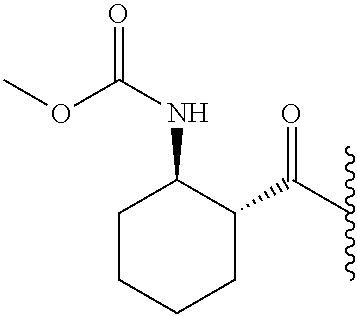
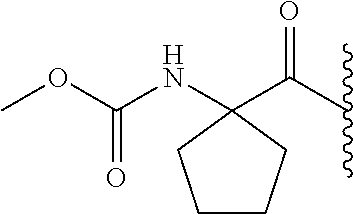
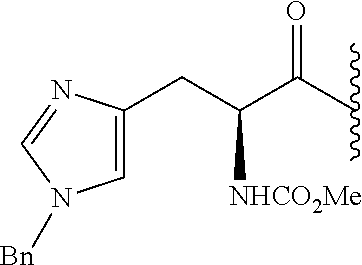
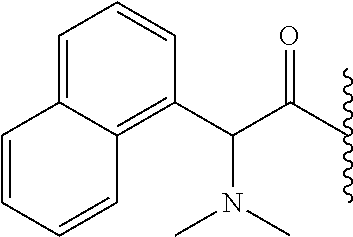
  • the invention relates to compounds of Formula (I) and pharmaceutically acceptable salts thereof; wherein —C(O)R 6 is an ⁇ -amino acid residue.
  • the present invention relates to compounds of Formula (I), and pharmaceutically acceptable salts thereof; wherein G is an optionally substituted five-membered heteroaryl containing one or more nitrogen atoms, and is C-attached.
  • the present invention relates to compounds of Formula (I), and pharmaceutically acceptable salts thereof; wherein G is an optionally substituted 5/6-membered fused heteroaryl; wherein the 5-membered ring of said 5/6-membered fused heteroaryl is a heteroaryl containing one or more nitrogen atoms and wherein the 5-membered ring is C-attached to group Q, and wherein the 6-membered ring of said 5/6-membered fused heteroaryl is aryl or heteroaryl and is C-attached to one of Ring A, L and Ring B.
  • the present invention relates to compounds of Formula (I), and pharmaceutically acceptable salts thereof; wherein G is one of the following heteroaryl groups:
  • the present invention relates to compounds of Formula (I), and pharmaceutically acceptable salts thereof; wherein G is optionally substituted imidazolyl or benzimidazolyl.
  • the present invention relates to compounds of Formulae (Ia-1 ⁇ Ia-4), and pharmaceutically acceptable salts thereof:
  • Ring A, Ring B, G, J, L, U, W, X, Y, R 1 , R 2 , R 3 , R 4 , R 5 , R 6 , R 9 , R 1a , R 1b , R 1d , R 7a , R 7b and R 9a are as previously defined.
  • the present invention relates to compounds of Formulae (Ia-5 ⁇ Ia-8), and pharmaceutically acceptable salts thereof:
  • Ring A, Ring B, G, J, L, U, W, X, Y, R 1 , R 2 , R 3 , R 4 , R 5 , R 6 , R 9 , R 1a , R 2b , R 1c , R 1d , R 7a , R 7b and R 9a are as previously defined.
  • the present invention relates to compounds of Formulae (Ia-9 ⁇ Ia-12), and pharmaceutically acceptable salts thereof:
  • Ring A, Ring B, G, L, R 6 , R 7a and R 7b are as previously defined.
  • the present invention relates to compounds of Formulae (Ia-13 ⁇ Ia-16), and pharmaceutically acceptable salts thereof:
  • Ring A, Ring B, G, L, R 6 , R 7a and R 7b are as previously defined.
  • the present invention relates to compounds of Formulae (Ia-13 ⁇ Ia-16), and pharmaceutically acceptable salts thereof; wherein R 6 at each occurrence is selected from the group consisting of C 1 -C 8 alkyl, C 2 -C 8 alkenyl, C 2 -C 8 alkynyl, C 3 -C 8 cycloalkyl, C 3 -C 8 cycloalkenyl, heterocyclic, aryl, and heteroaryl, each optionally substituted.
  • the present invention relates to compounds of Formula (Ia-13 ⁇ Ia-16), and pharmaceutically acceptable salts thereof; wherein R 6 at each occurrence is independently C 1 -C 8 alkyl optionally substituted with amino, hydroxy, protected amino, or O(C 1 -C 4 alkyl).
  • the present invention relates to compounds of Formulae (Ib-1 ⁇ Ib-4), and pharmaceutically acceptable salts thereof:
  • Ring B, G, Q, U, R 1 , R 6 , R 7a and R 7b are as previously defined; in Formula (Ib-1), Ring A and L are each present and as previously defined; in Formula (Ib-2), Ring A is present and as previously defined; and in Formula (Ib-3), L is present and as previously defined.
  • the present invention relates to compounds of Formula (Ib-1 ⁇ Ib-4), and pharmaceutically acceptable salts thereof; wherein R 6 is independently C 1 -C 8 alkyl optionally substituted with amino, hydroxy, protected amino or O(C 1 -C 4 alkyl).
  • the present invention relates to compounds of Formula (Ib-1), and pharmaceutically acceptable salts thereof; wherein Ring A and Ring B are each independently optionally substituted phenyl or monocyclic heteroaryl; L is optionally substituted C 2 -C 4 alkenyl or optionally substituted C 2 -C 4 alkynyl; and G is optionally substituted imidazolyl or benzimidazolyl.
  • the present invention relates to compounds of Formula (Ib-2), and pharmaceutically acceptable salts thereof; wherein one of Ring A and Ring B is optionally substituted phenyl or optionally substituted monocyclic heteroaryl, the other of Ring A and Ring B is optionally substituted bicyclic aryl or heteroaryl; and G is optionally substituted imidazolyl or benzimidazolyl.
  • the present invention relates to compounds of Formula (Ib-2), and pharmaceutically acceptable salts thereof; wherein Ring A and Ring B are each independently optionally substituted bicyclic aryl or heteroaryl; and G is optionally substituted imidazolyl.
  • the present invention relates to compounds of Formula (Ib-2), and pharmaceutically acceptable salts thereof; wherein Ring A and Ring B are each independently optionally substituted phenyl or monocyclic heteroaryl; and G is optionally substituted benzimidazolyl.
  • the present invention relates to compounds of Formula (Ib-3), and pharmaceutically acceptable salts thereof; wherein Ring B is optionally substituted bicyclic aryl or heteroaryl; L is optionally substituted C 2 -C 4 alkenyl or optionally substituted C 2 -C 4 alkynyl; and G is optionally substituted imidazolyl or benzimidazolyl.
  • the present invention relates to compounds of Formula (Ib-3), and pharmaceutically acceptable salts thereof; wherein B is optionally substituted phenyl or monocyclic heteroaryl; L is optionally substituted C 2 -C 4 alkenyl or optionally substituted C 2 -C 4 alkynyl; and G is optionally substituted imidazolyl or benzimidazolyl.
  • the present invention relates to compounds of Formula (Ib-4), and pharmaceutically acceptable salts thereof; wherein B is optionally substituted polycyclic aryl or heteroaryl; and G is optionally substituted imidazolyl or benzimidazolyl.
  • Representative compounds of the present invention are those selected from compounds I-348 compiled in the following tables:
  • any substituent or variable e.g., R 3 , R 7 , etc.
  • each of the two R 7 groups may be the same or different.
  • linker or spacer e.g., —NH—C(O)—, —OC(O)—NH—, etc.
  • linker e.g., —NH—C(O)—, —OC(O)—NH—, etc.
  • linker when a linker is —NH—C(O)—, it is meant to include —NH—C(O)— and —C(O)—NH— for attachments.
  • the compounds of the present invention may contain one or more asymmetric carbon atoms and may exist in racemic, diastereoisomeric, and optically active forms. It will still be appreciated that certain compounds of the present invention may exist in different tautomeric forms. All tautomers are contemplated to be within the scope of the present invention.
  • references herein to therapy and/or treatment includes, but is not limited to, prevention, retardation, prophylaxis, therapy and/or cure of the disease. It will further be appreciated that references herein to treatment or prophylaxis of HCV infection includes treatment or prophylaxis of HCV-associated disease such as liver fibrosis, cirrhosis and hepatocellular carcinoma.
  • a further embodiment of the present invention includes pharmaceutical compositions comprising any single compound a combination of two or more compounds delineated herein, and pharmaceutically acceptable salts thereof, with a pharmaceutically acceptable carrier or excipient.
  • compositions comprising any single compound or a combination of two or more compounds delineated herein, and pharmaceutically acceptable salts thereof, in combination with one or more agents known in the art, with a pharmaceutically acceptable carrier or excipient.
  • compounds of the present invention can be administered as the sole active pharmaceutical agent, or used in combination with one or more agents to treat or prevent hepatitis C infections or the symptoms associated with HCV infection.
  • agents to be administered in combination with a compound or combination of compounds of the present invention include therapies for disease caused by HCV infection that suppresses HCV viral replication by direct or indirect mechanisms.
  • agents include, but not limited to, host immune modulators (for example, interferon-alpha, pegylated interferon-alpha, consensus interferon, interferon-beta, interferon-gamma, CpG oligonucleotides and the like); antiviral compounds that inhibit host cellular functions such as inosine monophosphate dehydrogenase (for example, ribavirin and the like); cytokines that modulate immune function (for example, interleukin 2, interleukin 6, and interleukin 12); a compound that enhances the development of type 1 helper T cell response; interfering RNA; anti-sense RNA; vaccines comprising HCV antigens or antigen adjuvant combinations directed against HCV; agents that interact with host cellular components to block viral protein synthesis by inhibiting the internal ribosome entry site (IRES) initiated translation step of HCV viral replication or to block viral particle maturation and release with agents targeted toward the viroporin family of membrane proteins such as, for example
  • compositions of the present invention may further comprise other inhibitor(s) of targets in the HCV life cycle, including, but not limited to, helicase, polymerase, metalloprotease, NS4A protein, NS5A protein, and internal ribosome entry site (IRES).
  • targets in the HCV life cycle including, but not limited to, helicase, polymerase, metalloprotease, NS4A protein, NS5A protein, and internal ribosome entry site (IRES).
  • one embodiment of the present invention is directed to a method for treating or preventing an infection caused by an RNA-containing virus comprising co-administering to a patient in need of such treatment one or more agents selected from the group consisting of a host immune modulator and a second or more antiviral agents, or a combination thereof, with a therapeutically effective amount of a compound or combination of compounds of the present invention, or a pharmaceutically acceptable salt thereof.
  • Examples of the host immune modulator include, but are not limited to, interferon-alpha, pegylated-interferon-alpha, interferon-beta, interferon-gamma, a cytokine, a vaccine, and a vaccine comprising an antigen and an adjuvant, and said second antiviral agent inhibits replication of HCV either by inhibiting host cellular functions associated with viral replication or by targeting proteins of the viral genome.
  • RNA-containing virus includes, but is not limited to, hepatitis C virus (HCV).
  • a further embodiment of the present invention is directed to a method of treating or preventing infection caused by an RNA-containing virus comprising co-administering to a patient in need of such treatment an agent or combination of agents that treat or alleviate symptoms of HCV infection including cirrhosis and inflammation of the liver, with a therapeutically effective amount of a compound or combination of compounds of the present invention, or a pharmaceutically acceptable salt thereof.
  • An example of the RNA-containing virus includes, but is not limited to, hepatitis C virus (HCV).
  • Yet another embodiment of the present invention provides a method of treating or preventing infection caused by an RNA-containing virus comprising co-administering to a patient in need of such treatment one or more agents that treat patients for disease caused by hepatitis B (HBV) infection, with a therapeutically effective amount of a compound or a combination of compounds of the present invention, or a pharmaceutically acceptable salt thereof.
  • An agent that treats patients for disease caused by hepatitis B (HBV) infection may be for example, but not limited thereto, L-deoxythymidine, adefovir, lamivudine or tenfovir, or any combination thereof.
  • An example of the RNA-containing virus includes, but is not limited to, hepatitis C virus (HCV).
  • a further embodiment of the present invention provides a method of treating or preventing infection caused by an RNA-containing virus comprising co-administering to a patient in need of such treatment one or more agents that treat patients for disease caused by human immunodeficiency virus (HIV) infection, with a therapeutically effective amount of a compound or a combination of compounds of the present invention, or a pharmaceutically acceptable salt thereof.
  • HIV human immunodeficiency virus
  • the agent that treats patients for disease caused by human immunodeficiency virus (HIV) infection may include, but is not limited thereto, ritonavir, lopinavir, indinavir, nelfinavir, saquinavir, amprenavir, atazanavir, tipranavir, TMC-114, fosamprenavir, zidovudine, lamivudine, didanosine, stavudine, tenofovir, zalcitabine, abacavir, efavirenz, nevirapine, delavirdine, TMC-125, L-870812, S-1360, enfuvirtide (T-20) or T-1249, or any combination thereof.
  • An example of the RNA-containing virus includes, but is not limited to, hepatitis C virus (HCV).
  • a patient may be co-infected with hepatitis C virus and one or more other viruses, including, but not limited to, human immunodeficiency virus (HIV), hepatitis A virus (HAV) and hepatitis B virus (HBV).
  • HAV human immunodeficiency virus
  • HAV hepatitis A virus
  • HBV hepatitis B virus
  • combination therapy to treat such co-infections by co-administering a compound according to the present invention with at least one of an HIV inhibitor, an HAV inhibitor and an HBV inhibitor.
  • the present invention provides the use of a compound or a combination of compounds of the invention, or a pharmaceutically acceptable salt thereof, and one or more agents selected from the group consisting of a host immune modulator and a second or more antiviral agents, or a combination thereof, to prepare a medicament for the treatment of an infection caused by an RNA-containing virus in a patient, particularly hepatitis C virus.
  • Examples of the host immune modulator are, but not limited to, interferon-alpha, pegylated-interferon-alpha, interferon-beta, interferon-gamma, a cytokine, a vaccine, and a vaccine comprising an antigen and an adjuvant, and said second antiviral agent inhibits replication of HCV either by inhibiting host cellular functions associated with viral replication or by targeting proteins of the viral genome.
  • combination of compound or compounds of the present invention, together with one or more agents as defined herein above can be employed in pure form or, where such forms exist, in pharmaceutically acceptable salt thereof.
  • combination of therapeutic agents can be administered as a pharmaceutical composition containing a therapeutically effective amount of the compound or combination of compounds of interest, or their pharmaceutically acceptable salt thereof, in combination with one or more agents as defined hereinabove, and a pharmaceutically acceptable carrier.
  • Such pharmaceutical compositions can be used for inhibiting the replication of an RNA-containing virus, particularly Hepatitis C virus (HCV), by contacting said virus with said pharmaceutical composition.
  • such compositions are useful for the treatment or prevention of an infection caused by an RNA-containing virus, particularly Hepatitis C virus (HCV).
  • a still further embodiment of the invention is directed to a method of treating or preventing infection caused by an RNA-containing virus, particularly a hepatitis C virus (HCV), comprising administering to a patient in need of such treatment a pharmaceutical composition comprising a compound or combination of compounds of the invention or a pharmaceutically acceptable salt thereof, and one or more agents as defined hereinabove, with a pharmaceutically acceptable carrier.
  • an RNA-containing virus particularly a hepatitis C virus (HCV)
  • HCV hepatitis C virus
  • the therapeutic agents When administered as a combination, the therapeutic agents can be formulated as separate compositions which are given at the same time or within a predetermined period of time, or the therapeutic agents can be given as a single unit dosage form.
  • Antiviral agents contemplated for use in such combination therapy include agents (compounds or biologicals) that are effective to inhibit the formation and/or replication of a virus in a mammal, including but not limited to agents that interfere with either host or viral mechanisms necessary for the formation and/or replication of a virus in a mammal.
  • agents can be selected from another anti-HCV agent; an HIV inhibitor; an HAV inhibitor; and an HBV inhibitor.
  • cytochrome P450 monooxygenase inhibitor also referred to herein as a CYP inhibitor
  • the cytochrome P450 monooxygenase inhibitor would be in an amount effective to inhibit metabolism of the compounds of this invention.
  • the CYP inhibitor is administered in an amount such that the bioavailiablity of the protease inhibitor is increased in comparison to the bioavailability in the absence of the CYP inhibitor.
  • the invention provides methods for improving the pharmacokinetics of compounds of the invention.
  • the advantages of improving the pharmacokinetics of drugs are recognized in the art (see, for example, US Patent Pub. Nos. 2004/0091527; US 2004/0152625; and US 2004/0091527). Accordingly, one embodiment of this invention provides a method for administering an inhibitor of CYP3A4 and a compound of the invention.
  • Another embodiment of this invention provides a method for administering a compound of the invention and an inhibitor of isozyme 3A4 (“CYP3A4”), isozyme 2C19 (“CYP2C19”), isozyme 2D6 (“CYP2D6”), isozyme 1A2 (“CYP1A2”), isozyme 2C9 (“CYP2C9”), or isozyme 2E1 (“CYP2E1”).
  • the CYP inhibitor preferably inhibits CYP3A4. Any CYP inhibitor that improves the pharmacokinetics of the relevant NS3/4A protease may be used in a method of this invention.
  • CYP inhibitors include, but are not limited to, ritonavir (see, for example, WO 94/14436), ketoconazole, troleandomycin, 4-methylpyrazole, cyclosporin, clomethiazole, cimetidine, itraconazole, fluconazole, miconazole, fluvoxamine, fluoxetine, nefazodone, sertraline, indinavir, nelfinavir, amprenavir, fosamprenavir, saquinavir, lopinavir, delavirdine, erythromycin, VX-944, and VX-497.
  • Preferred CYP inhibitors include ritonavir, ketoconazole, troleandomycin, 4-methylpyrazole, cyclosporin, and clomethiazole.
  • the pharmaceutical pack further comprises one or more of additional agent as described herein.
  • the additional agent or agents may be provided in the same pack or in separate packs.
  • kits for a patient to use in the treatment of HCV infection or in the prevention of HCV infection comprising: a single or a plurality of pharmaceutical formulation of each pharmaceutical component; a container housing the pharmaceutical formulation(s) during storage and prior to administration; and instructions for carrying out drug administration in a manner effective to treat or prevent HCV infection.
  • kits for the simultaneous or sequential administration of a compound of the invention and a CYP inhibitor (and optionally an additional agent) or derivatives thereof are prepared in a conventional manner.
  • a kit will comprise, e.g. a composition of each inhibitor and optionally the additional agent(s) in a pharmaceutically acceptable carrier (and in one or in a plurality of pharmaceutical formulations) and written instructions for the simultaneous or sequential administration.
  • a packaged kit contains one or more dosage forms for self administration; a container means, preferably sealed, for housing the dosage forms during storage and prior to use; and instructions for a patient to carry out drug administration.
  • the instructions will typically be written instructions on a package insert, a label, and/or on other components of the kit, and the dosage form or forms are as described herein.
  • Each dosage form may be individually housed, as in a sheet of a metal foil-plastic laminate with each dosage form isolated from the others in individual cells or bubbles, or the dosage forms may be housed in a single container, as in a plastic bottle.
  • the present kits will also typically include means for packaging the individual kit components, i.e., the dosage forms, the container means, and the written instructions for use.
  • Such packaging means may take the form of a cardboard or paper box, a plastic or foil pouch, etc.
  • viral infection refers to the introduction of a virus into cells or tissues, e.g., hepatitis C virus (HCV). In general, the introduction of a virus is also associated with replication. Viral infection may be determined by measuring virus antibody titer in samples of a biological fluid, such as blood, using, e.g., enzyme immunoassay. Other suitable diagnostic methods include molecular based techniques, such as RT-PCR, direct hybrid capture assay, nucleic acid sequence based amplification, and the like. A virus may infect an organ, e.g., liver, and cause disease, e.g., hepatitis, cirrhosis, chronic liver disease and hepatocellular carcinoma.
  • HCV hepatitis C virus
  • immune modulator refers to any substance meant to alter the working of the humoral or cellular immune system of a subject.
  • immune modulators include inhibitors of mast cell-mediated inflammation, interferons, interleukins, prostaglandins, steroids, cortico-steroids, colony-stimulating factors, chemotactic factors, etc.
  • aryl refers to a mono- or polycyclic carbocyclic ring system including, but not limited to, phenyl, naphthyl, tetrahydronaphthyl, indanyl, and idenyl.
  • a polycyclic aryl is a polycyclic ring system that comprises at least one aromatic ring.
  • Polycyclic aryls can comprise fused rings, covalently attached rings or a combination thereof.
  • heteroaryl refers to a mono- or polycyclic ring system comprising at least one aromatic ring having one or more ring atom selected from S, O and N; and the remaining ring atoms are carbon, wherein any N or S contained within the ring may be optionally oxidized.
  • Heteroaryl includes, but is not limited to, pyridinyl, pyrazinyl, pyrimidinyl, pyrrolyl, pyrazolyl, imidazolyl, thiazolyl, oxazolyl, isooxazolyl, thiadiazolyl, oxadiazolyl, thiophenyl, furanyl, quinolinyl, isoquinolinyl, benzimidazolyl, benzooxazolyl, and quinoxalinyl.
  • a polycyclic heteroaryl can comprise fused rings, covalently attached rings or a combination thereof.
  • any of the aryls, substituted aryls, heteroaryls and substituted heteroaryls described herein, can be any aromatic group.
  • Aromatic groups can be substituted or unsubstituted.
  • bicyclic aryl or “bicyclic heteroaryl” refers to a ring system consisting of two rings wherein at least one ring is aromatic; and they can be fused or covalently attached.
  • tricyclic aryl or “tricyclic heteroaryl” refers to a ring system consisting of three rings wherein at least one ring is aromatic.
  • C 1 -C 4 alkyl refers to saturated, straight- or branched-chain hydrocarbon radicals containing between one and four, one and six, one and eight carbon atoms, or the like, respectively.
  • Examples of C 1 -C 8 alkyl radicals include, but are not limited to, methyl, ethyl, propyl, isopropyl, n-butyl, tert-butyl, neopentyl, n-hexyl, heptyl and octyl radicals.
  • C 2 -C 8 alkenyl refers to straight- or branched-chain hydrocarbon radicals containing from two to eight, or two to four carbon atoms, or the like, having at least one carbon-carbon double bond by the removal of a single hydrogen atom.
  • Alkenyl groups include, but are not limited to, for example, ethenyl, propenyl, butenyl, 1-methyl-2-buten-1-yl, heptenyl, octenyl, and the like.
  • C 2 -C 8 alkynyl refers to straight- or branched-chain hydrocarbon radicals containing from two to eight, or two to four carbon atoms, or the like, having at least one carbon-carbon triple bond by the removal of a single hydrogen atom.
  • Representative alkynyl groups include, but are not limited to, for example, ethynyl, 1-propynyl, 1-butynyl, heptynyl, octynyl, and the like.
  • C 3 -C 8 -cycloalkyl refers to a monocyclic or polycyclic saturated carbocyclic ring compound, and the carbon atoms may be optionally oxo-substituted.
  • C 3 -C 8 -cycloalkyl examples include, but not limited to, cyclopropyl, cyclobutyl, cyclopentyl, cyclohexyl, cyclopentyl and cyclooctyl; and examples of C 5 -C 7 -cycloalkyl include, but not limited to, cyclopentyl, cyclohexyl, bicyclo[2.2.1]heptyl, and the like.
  • C 3 -C 8 cycloalkenyl or “C 5 -C 7 cycloalkenyl” as used herein, refers to monocyclic or polycyclic carbocyclic ring compound having at least one carbon-carbon double bond, and the carbon atoms may be optionally oxo-substituted.
  • C 3 -C 8 cycloalkenyl examples include, but not limited to, cyclopropenyl, cyclobutenyl, cyclopentenyl, cyclohexenyl, cycloheptenyl, cyclooctenyl, and the like; and examples of C 5 -C 7 cycloalkenyl include, but not limited to, cyclopentenyl, cyclohexenyl, cycloheptenyl, and the like.
  • arylalkyl refers to an aryl-substituted alkyl group. More preferred arylalkyl groups are aryl-C 1 -C 6 -alkyl groups.
  • heteroarylalkyl refers to a heteroaryl-substituted alkyl group. More preferred heteroarylalkyl groups are heteroaryl-C 1 -C 6 -alkyl groups.
  • any alkyl, alkenyl, alkynyl, cycloalkyl and cycloalkenyl moiety described herein can also be an aliphatic group or an alicyclic group.
  • An “aliphatic” group is a non-aromatic moiety comprised of any combination of carbon atoms, hydrogen atoms, halogen atoms, oxygen, nitrogen or other atoms, and optionally contains one or more units of unsaturation, e.g., double and/or triple bonds.
  • aliphatic groups are functional groups, such as, O, OH, NH, NH 2 , C(O), S(O) 2 , C(O)O, C(O)NH, OC(O)O, OC(O)NH, OC(O)NH 2 , S(O) 2 NH, S(O) 2 NH 2 , NHC(O)NH 2 , NHC(O)C(O)NH, NHS(O) 2 NH, NHS(O) 2 NH 2 , C(O)NHS(O) 2 , C(O)NHS(O) 2 NH or C(O)NHS(O) 2 NH 2 , and the like, groups comprising one or more functional groups, non-aromatic hydrocarbons (optionally substituted), and groups wherein one or more carbons of a non-aromatic hydrocarbon (optionally substituted) is replaced by a functional group.
  • functional groups such as, O, OH, NH, NH 2 , C(O), S(O
  • Carbon atoms of an aliphatic group can be optionally oxo-substituted.
  • An aliphatic group may be straight chained, branched, cyclic, or a combination thereof and preferably contains between about 1 and about 24 carbon atoms, more typically between about 1 and about 12 carbon atoms.
  • aliphatic groups expressly include, for example, alkoxyalkyls, polyalkoxyalkyls, such as polyalkylene glycols, polyamines, and polyimines, for example. Aliphatic groups may be optionally substituted.
  • a linear aliphatic group is a non-cyclic aliphatic group.
  • the aliphatic group can be selected from one or more of the specified functional groups or a combination thereof, or a group wherein one or more carbons of a non-aromatic hydrocarbon (optionally substituted) is replaced by a specified functional group.
  • the linear aliphatic group can be represented by the formula M-V′-M′, where M and M′ are each independently absent or an alkyl, alkenyl or alkynyl, each optionally substituted, and V′ is a functional group.
  • V′ is selected from the group consisting of C(O), S(O) 2 , C(O)O, C(O)N(R 11 ), OC(O)O, OC(O)N(R 11 ), S(O) 2 N(R 11 ), N(R 11 )C(O)N(R 11 ), N(R 11 )C(O)C(O)N(R 11 ), N(R 11 )S(O) 2 N(R 11 ), C(O)N(R 11 )S(O) 2 or C(O)N(R 11 )S(O) 2 N(R 11 ); wherein R 11 is as previously defined.
  • an exemplary linear aliphatic group is an alkyl, alkenyl or alkynyl, each optionally substituted, which is interrupted or terminated by a functional group such as described herein.
  • alicyclic denotes a monovalent group derived from a monocyclic or bicyclic saturated carbocyclic ring compound by the removal of a single hydrogen atom, and the carbon atoms may be optionally oxo-substituted. Examples include, but not limited to, cyclopropyl, cyclobutyl, cyclopentyl, cyclohexyl, bicyclo[2.2.1]heptyl, and bicyclo[2.2.2]octyl. Such alicyclic groups may be further substituted.
  • heterocyclic or “heterocycloalkyl” can be used interchangeably and referred to a non-aromatic ring or a bi- or tri-cyclic group fused system, where (i) each ring system contains at least one heteroatom independently selected from oxygen, sulfur and nitrogen, (ii) each ring system can be saturated or unsaturated, (iii) the nitrogen and sulfur heteroatoms may optionally be oxidized, (iv) the nitrogen heteroatom may optionally be quaternized, (v) any of the above rings may be fused to an aromatic ring, and (vi) the remaining ring atoms are carbon atoms which may be optionally oxo-substituted.
  • heterocycloalkyl groups include, but are not limited to, 1,3-dioxolane, pyrrolidinyl, pyrazolinyl, pyrazolidinyl, imidazolinyl, imidazolidinyl, piperidinyl, piperazinyl, oxazolidinyl, isoxazolidinyl, morpholinyl, thiazolidinyl, isothiazolidinyl, quinoxalinyl, pyridazinonyl, and tetrahydrofuryl. Such heterocyclic groups may be further substituted. Heteroaryl or heterocyclic groups can be C-attached or N-attached (where possible).
  • any alkyl, alkenyl, alkynyl, alicyclic, cycloalkyl, cycloalkenyl, aryl, heteroaryl, heterocyclic, aliphatic moiety or the like, described herein can also be a divalent or multivalent group when used as a linkage to connect two or more groups or substituents, which can be at the same or different atom(s).
  • substituted when used with alkyl, alkenyl, alkynyl, alicyclic, cycloalkyl, cycloalkenyl, aryl, heteroaryl, heterocyclic, or aliphatic as described herein refers to substitution by independent replacement of one, two, or three or more of the hydrogen atoms thereon with substituents including, but not limited to, —F, —Cl, —Br, —I, —OH, protected hydroxy, —NO 2 , —N 3 , —CN, —NH 2 , protected amino, oxo, thioxo, —NH—C 1 -C 12 -alkyl, —NH—C 2 -C 8 -alkenyl, —NH—C 2 -C 8 -alkynyl, —NH—C 3 -C 12 -cycloalkyl, —NH-aryl, —NH-heteroaryl, —NH-
  • halogen refers to an atom selected from fluorine, chlorine, bromine and iodine.
  • hydrox includes hydrogen and deuterium.
  • recitation of an atom includes other isotopes of that atom so long as the resulting compound is pharmaceutically acceptable.
  • hydroxy activating group refers to a labile chemical moiety which is known in the art to activate a hydroxyl group so that it will depart during synthetic procedures such as in a substitution or an elimination reaction.
  • hydroxyl activating group include, but not limited to, mesylate, tosylate, triflate, p-nitrobenzoate, phosphonate and the like.
  • activated hydroxy refers to a hydroxy group activated with a hydroxyl activating group, as defined above, including mesylate, tosylate, triflate, p-nitrobenzoate, phosphonate groups, for example.
  • hydroxy protecting group refers to a labile chemical moiety which is known in the art to protect a hydroxyl group against undesired reactions during synthetic procedures. After said synthetic procedure(s) the hydroxy protecting group as described herein may be selectively removed. Hydroxy protecting groups as known in the art are described generally in T. H. Greene and P. G. M. Wuts, Protective Groups in Organic Synthesis, 3rd edition, John Wiley & Sons, New York (1999).
  • hydroxyl protecting groups include benzyloxycarbonyl, 4-methoxybenzyloxycarbonyl, tert-butoxycarbonyl, isopropoxycarbonyl, diphenylmethoxycarbonyl, 2,2,2-trichloroethoxycarbonyl, allyloxycarbonyl, acetyl, formyl, chloroacetyl, trifluoroacetyl, methoxyacetyl, phenoxyacetyl, benzoyl, methyl, t-butyl, 2,2,2-trichloroethyl, 2-trimethylsilyl ethyl, allyl, benzyl, triphenylmethyl(trityl), methoxymethyl, methylthiomethyl, benzyloxymethyl, 2-(trimethylsilyl)ethoxymethyl, methanesulfonyl, trimethylsilyl, triisopropylsilyl, and the like.
  • protected hydroxy refers to a hydroxy group protected with a hydroxy protecting group, as defined above, including benzoyl, acetyl, trimethylsilyl, triethylsilyl, methoxymethyl groups, for example.
  • carbonyl protecting group refers to a labile chemical moiety which is known in the art to protect a carbonyl group against undesired reactions during synthetic procedures. After said synthetic procedure(s) the carbonyl protecting group as described herein may be selectively removed.
  • Carbonyl protecting groups as known in the art are described generally in T. H. Greene and P. G. M. Wuts, Protective Groups in Organic Synthesis, 3rd edition, John Wiley & Sons, New York (1999).
  • carbonyl protecting groups include acetals, ketals, cyclic acetals, cyclic ketals, mono- or dithioacetals, mono- or dithioketals, optionally substituted hydrazones or oximes.
  • protected carbonyl refers to a carbonyl group protected with a carbonyl protecting group, as defined above, including dimethyl acetal, 1,3-dioxolane, 1,3-dioxane, S,S′-dimethylketal, 1,3-dithiane, 1,3-dithiolane, 1,3-oxathiolane, N,N-dimethylhydrazone, oxime, for example.
  • amino protecting group refers to a labile chemical moiety which is known in the art to protect an amino group against undesired reactions during synthetic procedures. After said synthetic procedure(s) the amino protecting group as described herein may be selectively removed.
  • Amino protecting groups as known in the art are described generally in T. H. Greene and P. G. M. Wuts, Protective Groups in Organic Synthesis, 3rd edition, John Wiley & Sons, New York (1999). Examples of amino protecting groups include, but are not limited to, methoxycarbonyl, t-butoxycarbonyl, 9-fluorenylmethoxycarbonyl, benzyloxycarbonyl, and the like.
  • protected amino refers to an amino group protected with an amino protecting group as defined above.
  • substituted amino refers to substitution by replacement of one or two hydrogen atoms of —NH 2 with substituents independently selected from the group consisting of optionally substituted alkyl, optionally substituted alkenyl, optionally substituted alkynyl, optionally substituted aryl, optionally substituted cycloalkyl, optionally substituted heteroaryl, and optionally substituted heterocyclic; alternatively, when disubstituted, the two substitutents can be optionally taken together with the nitrogen atom to which they are attached to form an optionallysubstituted heterocyclic group.
  • leaving group means a functional group or atom which can be displaced by another functional group or atom in a substitution reaction, such as a nucleophilic substitution reaction.
  • representative leaving groups include chloro, bromo and iodo groups; sulfonic ester groups, such as mesylate, tosylate, brosylate, nosylate and the like; hydroxy; imidazolyl; and acyloxy groups, such as acetoxy, trifluoroacetoxy and the like.
  • aprotic solvent refers to a solvent that is relatively inert to proton activity, i.e., not acting as a proton-donor.
  • examples include, but are not limited to, hydrocarbons, such as hexane and toluene, for example, halogenated hydrocarbons, such as, for example, methylene chloride, ethylene chloride, chloroform, and the like, heterocyclic compounds, such as, for example, tetrahydrofuran and N-methylpyrrolidinone, and ethers such as diethyl ether, bis-methoxymethyl ether.
  • protic solvent refers to a solvent that tends to provide protons, such as an alcohol, for example, methanol, ethanol, propanol, isopropanol, butanol, t-butanol, and the like.
  • alcohol for example, methanol, ethanol, propanol, isopropanol, butanol, t-butanol, and the like.
  • solvents are well known to those skilled in the art, and it will be obvious to those skilled in the art that individual solvents or mixtures thereof may be preferred for specific compounds and reaction conditions, depending upon such factors as the solubility of reagents, reactivity of reagents and preferred temperature ranges, for example.
  • stable refers to compounds which possess stability sufficient to allow manufacture and which maintains the integrity of the compound for a sufficient period of time to be useful for the purposes detailed herein (e.g., therapeutic or prophylactic administration to a subject).
  • the synthesized compounds can be separated from a reaction mixture and further purified by a method such as column chromatography, high pressure liquid chromatography, or recrystallization.
  • a method such as column chromatography, high pressure liquid chromatography, or recrystallization.
  • further methods of synthesizing the compounds of the Formula herein will be evident to those of ordinary skill in the art. Additionally, the various synthetic steps may be performed in an alternate sequence or order to give the desired compounds.
  • Synthetic chemistry transformations and protecting group methodologies (protection and deprotection) useful in synthesizing the compounds described herein are known in the art and include, for example, those such as described in R. Larock, Comprehensive Organic Transformations, 2 nd Ed. Wiley-VCH (1999); T. W. Greene and P. G. M.
  • subject refers to an animal.
  • the animal is a mammal. More preferably the mammal is a human.
  • a subject also refers to, for example, dogs, cats, horses, cows, pigs, guinea pigs, fish, birds and the like.
  • the compounds of this invention may be modified by appending appropriate functionalities to enhance selective biological properties.
  • modifications are known in the art and may include those which increase biological penetration into a given biological system (e.g., blood, lymphatic system, central nervous system), increase oral availability, increase solubility to allow administration by injection, alter metabolism and alter rate of excretion.
  • the compounds described herein contain one or more asymmetric centers and thus give rise to enantiomers, diastereomers, and other stereoisomeric forms that may be defined, in terms of absolute stereochemistry, as (R)- or (S)-, or as (D)- or (L)- for amino acids.
  • the present invention is meant to include all such possible isomers, as well as their racemic and optically pure forms.
  • Optical isomers may be prepared from their respective optically active precursors by the procedures described above, or by resolving the racemic mixtures. The resolution can be carried out in the presence of a resolving agent, by chromatography or by repeated crystallization or by some combination of these techniques which are known to those skilled in the art.
  • any carbon-carbon double bond appearing herein is selected for convenience only and is not intended to designate a particular configuration unless the text so states; thus a carbon-carbon double bond or carbon-heteroatom double bond depicted arbitrarily herein as trans may be cis, trans, or a mixture of the two in any proportion.
  • Certain compounds of the present invention may also exist in different stable conformational forms which may be separable. Torsional asymmetry due to restricted rotation about an asymmetric single bond, for example because of steric hindrance or ring strain, may permit separation of different conformers.
  • the present invention includes each conformational isomer of these compounds and mixtures thereof.
  • the term “pharmaceutically acceptable salt” refers to those salts which are, within the scope of sound medical judgment, suitable for use in contact with the tissues of humans and lower animals without undue toxicity, irritation, allergic response and the like, and are commensurate with a reasonable benefit/risk ratio.
  • Pharmaceutically acceptable salts are well known in the art. For example, S. M. Berge, et al. describes pharmaceutically acceptable salts in detail in J. Pharmaceutical Sciences, 66: 1-19 (1977).
  • the salts can be prepared in situ during the final isolation and purification of the compounds of the invention, or separately by reacting the free base function with a suitable organic acid.
  • nontoxic acid addition salts are salts of an amino group formed with inorganic acids such as hydrochloric acid, hydrobromic acid, phosphoric acid, sulfuric acid and perchloric acid or with organic acids such as acetic acid, maleic acid, tartaric acid, citric acid, succinic acid or malonic acid or by using other methods used in the art such as ion exchange.
  • salts include, but are not limited to, adipate, alginate, ascorbate, aspartate, benzenesulfonate, benzoate, bisulfate, borate, butyrate, camphorate, camphorsulfonate, citrate, cyclopentanepropionate, digluconate, dodecylsulfate, ethanesulfonate, formate, fumarate, glucoheptonate, glycerophosphate, gluconate, hemisulfate, heptanoate, hexanoate, hydroiodide, 2-hydroxy-ethanesulfonate, lactobionate, lactate, laurate, lauryl sulfate, malate, maleate, malonate, methanesulfonate, 2-naphthalenesulfonate, nicotinate, nitrate, oleate, oxalate, palmitate, pamo
  • alkali or alkaline earth metal salts include sodium, lithium, potassium, calcium, magnesium, and the like.
  • Further pharmaceutically acceptable salts include, when appropriate, nontoxic ammonium, quaternary ammonium, and amine cations formed using counterions such as halide, hydroxide, carboxylate, sulfate, phosphate, nitrate, alkyl having from 1 to 6 carbon atoms, sulfonate and aryl sulfonate.
  • ester refers to esters which hydrolyze in vivo and include those that break down readily in the human body to leave the parent compound or a salt thereof.
  • Suitable ester groups include, for example, those derived from pharmaceutically acceptable aliphatic carboxylic acids, particularly alkanoic, alkenoic, cycloalkanoic and alkanedioic acids, in which each alkyl or alkenyl moiety advantageously has not more than 6 carbon atoms.
  • esters include, but are not limited to, formates, acetates, propionates, butyrates, acrylates and ethylsuccinates.
  • prodrugs refers to those prodrugs of the compounds of the present invention which are, within the scope of sound medical judgment, suitable for use in contact with the tissues of humans and lower animals with undue toxicity, irritation, allergic response, and the like, commensurate with a reasonable benefit/risk ratio, and effective for their intended use, as well as the zwitterionic forms, where possible, of the compounds of the present invention.
  • Prodrug as used herein means a compound which is convertible in vivo by metabolic means (e.g. by hydrolysis) to a compound of the invention.
  • prodrugs are known in the art, for example, as discussed in Bundgaard, (ed), Design of Prodrugs, Elsevier (1985); Widder, et al. (ed), Methods in Enzymology, vol. 4, Academic Press (1985); Krogsgaard-Larsen, et al., (ed). “Design and Application of Prodrugs, Textbook of Drug Design and Development, Chapter 5, 113-191 (1991); Bundgaard, et al., Journal of Drug Deliver Reviews, 8:1-38 (1992); Bundgaard, J. of Pharmaceutical Sciences, 77:285 et seq. (1988); Higuchi and Stella (eds)
  • the present invention also relates to solvates of the compounds of Formula (I), for example hydrates.
  • This invention also encompasses pharmaceutical compositions containing, and methods of treating viral infections through administering, pharmaceutically acceptable prodrugs of compounds of the invention.
  • compounds of the invention having free amino, amido, hydroxy or carboxylic groups can be converted into prodrugs.
  • Prodrugs include compounds wherein an amino acid residue, or a polypeptide chain of two or more (e.g., two, three or four) amino acid residues is covalently joined through an amide or ester bond to a free amino, hydroxy or carboxylic acid group of compounds of the invention.
  • the amino acid residues include but are not limited to the 20 naturally occurring amino acids commonly designated by three letter symbols and also includes 4-hydroxyproline, hydroxylysine, demosine, isodemosine, 3-methylhistidine, norvalin, beta-alanine, gamma-aminobutyric acid, citrulline, homocysteine, homoserine, ornithine and methionine sulfone. Additional types of prodrugs are also encompassed. For instance, free carboxyl groups can be derivatized as amides or alkyl esters.
  • Free hydroxy groups may be derivatized using groups including but not limited to hemisuccinates, phosphate esters, dimethylaminoacetates, and phosphoryloxymethyloxycarbonyls, as outlined in Advanced Drug Delivery Reviews, 1996, 19, 115.
  • Carbamate prodrugs of hydroxy and amino groups are also included, as are carbonate prodrugs, sulfonate esters and sulfate esters of hydroxy groups.
  • acyl group may be an alkyl ester, optionally substituted with groups including but not limited to ether, amine and carboxylic acid functionalities, or where the acyl group is an amino acid ester as described above, are also encompassed.
  • Prodrugs of this type are described in J. Med. Chem., 1996, 39, 10. Free amines can also be derivatized as amides, sulfonamides or phosphonamides. All of these prodrug moieties may incorporate groups including but not limited to ether, amine and carboxylic acid functionalities.
  • compositions of the present invention comprise a therapeutically effective amount of a compound of the present invention formulated together with one or more pharmaceutically acceptable carriers or excipients.
  • the term “pharmaceutically acceptable carrier or excipient” means a non-toxic, inert solid, semi-solid or liquid filler, diluent, encapsulating material or formulation auxiliary of any type.
  • materials which can serve as pharmaceutically acceptable carriers are sugars such as lactose, glucose and sucrose; starches such as corn starch and potato starch; cellulose and its derivatives such as sodium carboxymethyl cellulose, ethyl cellulose and cellulose acetate; powdered tragacanth; malt; gelatin; talc; excipients such as cocoa butter and suppository waxes; oils such as peanut oil, cottonseed oil, safflower oil, sesame oil, olive oil, corn oil and soybean oil; glycols such as propylene glycol; esters such as ethyl oleate and ethyl laurate; agar; buffering agents such as magnesium hydroxide and aluminun hydroxide; algin
  • compositions of this invention may be administered orally, parenterally, by inhalation spray, topically, rectally, nasally, buccally, vaginally or via an implanted reservoir, preferably by oral administration or administration by injection.
  • the pharmaceutical compositions of this invention may contain any conventional non-toxic pharmaceutically-acceptable carriers, adjuvants or vehicles.
  • the pH of the formulation may be adjusted with pharmaceutically acceptable acids, bases or buffers to enhance the stability of the formulated compound or its delivery form.
  • parenteral as used herein includes subcutaneous, intracutaneous, intravenous, intramuscular, intraarticular, intraarterial, intrasynovial, intrasternal, intrathecal, intralesional and intracranial injection or infusion techniques.
  • Liquid dosage forms for oral administration include pharmaceutically acceptable emulsions, microemulsions, solutions, suspensions, syrups and elixirs.
  • the liquid dosage forms may contain inert diluents commonly used in the art such as, for example, water or other solvents, solubilizing agents and emulsifiers such as ethyl alcohol, isopropyl alcohol, ethyl carbonate, ethyl acetate, benzyl alcohol, benzyl benzoate, propylene glycol, 1,3-butylene glycol, dimethylformamide, oils (in particular, cottonseed, groundnut, corn, germ, olive, castor, and sesame oils), glycerol, tetrahydrofurfuryl alcohol, polyethylene glycols and fatty acid esters of sorbitan, and mixtures thereof.
  • the oral compositions can also include adjuvants such as wetting agents, e
  • Injectable preparations for example, sterile injectable aqueous or oleaginous suspensions, may be formulated according to the known art using suitable dispersing or wetting agents and suspending agents.
  • the sterile injectable preparation may also be a sterile injectable solution, suspension or emulsion in a nontoxic parenterally acceptable diluent or solvent, for example, as a solution in 1,3-butanediol.
  • the acceptable vehicles and solvents that may be employed are water, Ringer's solution, U.S.P. and isotonic sodium chloride solution.
  • sterile, fixed oils are conventionally employed as a solvent or suspending medium.
  • any bland fixed oil can be employed including synthetic mono- or diglycerides.
  • fatty acids such as oleic acid are used in the preparation of injectables.
  • the injectable formulations can be sterilized, for example, by filtration through a bacterial-retaining filter, or by incorporating sterilizing agents in the form of sterile solid compositions which can be dissolved or dispersed in sterile water or other sterile injectable medium prior to use.
  • the rate of drug release can be controlled.
  • biodegradable polymers include poly(orthoesters) and poly(anhydrides).
  • Depot injectable formulations are also prepared by entrapping the drug in liposomes or microemulsions that are compatible with body tissues.
  • compositions for rectal or vaginal administration are preferably suppositories which can be prepared by mixing the compounds of this invention with suitable non-irritating excipients or carriers such as cocoa butter, polyethylene glycol or a suppository wax which are solid at ambient temperature but liquid at body temperature and therefore melt in the rectum or vaginal cavity and release the active compound.
  • suitable non-irritating excipients or carriers such as cocoa butter, polyethylene glycol or a suppository wax which are solid at ambient temperature but liquid at body temperature and therefore melt in the rectum or vaginal cavity and release the active compound.
  • Solid dosage forms for oral administration include capsules, tablets, pills, powders, and granules.
  • the active compound is mixed with at least one inert, pharmaceutically acceptable excipient or carrier such as sodium citrate or dicalcium phosphate and/or: a) fillers or extenders such as starches, lactose, sucrose, glucose, mannitol, and silicic acid, b) binders such as, for example, carboxymethylcellulose, alginates, gelatin, polyvinylpyrrolidinone, sucrose, and acacia, c) humectants such as glycerol, d) disintegrating agents such as agar-agar, calcium carbonate, potato or tapioca starch, alginic acid, certain silicates, and sodium carbonate, e) solution retarding agents such as paraffin, f) absorption accelerators such as quaternary ammonium compounds, g) wetting agents such as, for example, cetyl alcohol and g
  • compositions of a similar type may also be employed as fillers in soft and hard-filled gelatin capsules using such excipients as lactose or milk sugar as well as high molecular weight polyethylene glycols and the like.
  • the active compounds can also be in micro-encapsulated form with one or more excipients as noted above.
  • the solid dosage forms of tablets, dragees, capsules, pills, and granules can be prepared with coatings and shells such as enteric coatings and other coatings well known in the pharmaceutical formulating art. They may optionally contain opacifying agents and can also be of a composition that they release the active ingredient(s) only, or preferentially, in a certain part of the intestinal tract, optionally, in a delayed manner. Examples of embedding compositions that can be used include polymeric substances and waxes.
  • Dosage forms for topical or transdermal administration of a compound of this invention include ointments, pastes, creams, lotions, gels, powders, solutions, sprays, inhalants or patches.
  • the active component is admixed under sterile conditions with a pharmaceutically acceptable carrier and any needed preservatives or buffers as may be required.
  • Ophthalmic formulation, ear drops, eye ointments, powders and solutions are also contemplated as being within the scope of this invention.
  • the ointments, pastes, creams and gels may contain, in addition to an active compound of this invention, excipients such as animal and vegetable fats, oils, waxes, paraffins, starch, tragacanth, cellulose derivatives, polyethylene glycols, silicones, bentonites, silicic acid, talc and zinc oxide, or mixtures thereof.
  • excipients such as animal and vegetable fats, oils, waxes, paraffins, starch, tragacanth, cellulose derivatives, polyethylene glycols, silicones, bentonites, silicic acid, talc and zinc oxide, or mixtures thereof.
  • Powders and sprays can contain, in addition to the compounds of this invention, excipients such as lactose, talc, silicic acid, aluminum hydroxide, calcium silicates and polyamide powder, or mixtures of these substances.
  • Sprays can additionally contain customary propellants such as chlorofluorohydrocarbons.
  • Transdermal patches have the added advantage of providing controlled delivery of a compound to the body.
  • dosage forms can be made by dissolving or dispensing the compound in the proper medium.
  • Absorption enhancers can also be used to increase the flux of the compound across the skin.
  • the rate can be controlled by either providing a rate controlling membrane or by dispersing the compound in a polymer matrix or gel.
  • a therapeutic composition of the invention is formulated and administered to the patient in solid or liquid particulate form by direct administration e.g., inhalation into the respiratory system.
  • Solid or liquid particulate forms of the active compound prepared for practicing the present invention include particles of respirable size: that is, particles of a size sufficiently small to pass through the mouth and larynx upon inhalation and into the bronchi and alveoli of the lungs. Delivery of aerosolized therapeutics, particularly aerosolized antibiotics, is known in the art (see, for example U.S. Pat. No. 5,767,068 to VanDevanter et al., U.S. Pat. No.
  • An inhibitory amount or dose of the compounds of the present invention may range from about 0.01 mg/Kg to about 500 mg/Kg, alternatively from about 0.1 to about 50 mg/Kg. Inhibitory amounts or doses will also vary depending on route of administration, as well as the possibility of co-usage with other agents.
  • viral infections are treated or prevented in a patient such as a human or another animal by administering to the subject a therapeutically effective amount of a compound of the invention, in such amounts and for such time as is necessary to achieve the desired result.
  • An additional method of the present invention is the treatment of biological samples with an inhibitory amount of a compound of composition of the present invention in such amounts and for such time as is necessary to achieve the desired result.
  • terapéuticaally effective amount of a compound of the invention means an amount of the compound which confers a therapeutic effect on the treated subject, at a reasonable benefit/risk ratio applicable to any medical treatment.
  • the therapeutic effect may be objective (i.e., measurable by some test or marker) or subjective (i.e., subject gives an indication of or feels an effect).
  • inhibitory amount of a compound of the present invention means a sufficient amount to decrease the viral load in a biological sample or a subject (e.g., resulting in at least 10%, preferably at least 50%, more preferably at least 80%, and most preferably at least 90% or 95%, reduction in viral load). It is understood that when said inhibitory amount of a compound of the present invention is administered to a subject it will be at a reasonable benefit/risk ratio applicable to any medical treatment as determined by a physician.
  • biological sample(s),” as used herein, means a substance of biological origin intended for administration to a subject.
  • biological samples include, but are not limited to, blood and components thereof such as plasma, platelets, subpopulations of blood cells and the like; organs such as kidney, liver, heart, lung, and the like; sperm and ova; bone marrow and components thereof; or stem cells.
  • another embodiment of the present invention is a method of treating a biological sample by contacting said biological sample with an inhibitory amount of a compound or pharmaceutical composition of the present invention.
  • Effective doses will also vary depending on route of administration, as well as the possibility of co-usage with other agents. It will be understood, however, that the total daily usage of the compounds and compositions of the present invention will be decided by the attending physician within the scope of sound medical judgment.
  • the specific therapeutically effective dose level for any particular patient will depend upon a variety of factors including the disorder being treated and the severity of the disorder; the activity of the specific compound employed; the specific composition employed; the age, body weight, general health, sex and diet of the patient; the time of administration, route of administration, and rate of excretion of the specific compound employed; the duration of the treatment; drugs used in combination or contemporaneously with the specific compound employed; and like factors well known in the medical arts.
  • the total daily dose of the compounds of this invention administered to a human or other animal in single or in divided doses can be in amounts, for example, from 0.01 to 50 mg/kg body weight or more usually from 0.1 to 25 mg/kg body weight.
  • Single dose compositions may contain such amounts or submultiples thereof to make up the daily dose.
  • treatment regimens according to the present invention comprise administration to a patient in need of such treatment from about 10 mg to about 1000 mg of the compound(s) of this invention per day in single or multiple doses.
  • a maintenance dose of a compound, composition or combination of this invention may be administered, if necessary. Subsequently, the dosage or frequency of administration, or both, may be reduced, as a function of the symptoms, to a level at which the improved condition is retained when the symptoms have been alleviated to the desired level. Patients may, however, require intermittent treatment on a long-term basis upon any recurrence of disease symptoms.
  • compositions of this invention comprise a combination of a compound of the Formula (I) described herein and one or more additional therapeutic or prophylactic agents
  • both the compound and the additional agent should be present at dosage levels of between about 1 to 100%, and more preferably between about 5 to 95% of the dosage normally administered in a monotherapy regimen.
  • the additional agents may be administered separately, as part of a multiple dose regimen, from the compounds of this invention. Alternatively, those agents may be part of a single dosage form, mixed together with the compounds of this invention in a single composition.
  • additional therapeutic or prophylactic agents include, but are not limited to, immune therapies (e.g. interferon), therapeutic vaccines, antifibrotic agents, anti-inflammatory agents such as corticosteroids or NSAIDs, bronchodilators such as beta-2 adrenergic agonists and xanthines (e.g. theophylline), mucolytic agents, anti-muscarinics, anti-leukotrienes, inhibitors of cell adhesion (e.g.
  • compositions according to the invention may also be used in combination with gene replacement therapy.
  • Drug resistance most typically occurs by mutation of a gene that encodes for a protein such as an enzyme used in viral replication, and most typically in the case of HCV, RNA polymerase, protease, or helicase.
  • a compound of the present invention can also be administered in combination or alternation with antiviral agent.
  • Examplary antiviral agents include ribavarin, interferon, interleukin or a stabilized prodrug of any of them. More broadly described, the compound can be administered in combination or alternation with any of the anti-HCV drugs listed in Table 11 below.
  • the compounds of the present invention may be prepared via several different synthetic routes from a variety of 5/6-membered fused heteroaryl, 5-membered heteroaryl, and related intermediates.
  • a retro-synthesis of those title compounds include direct formation of a suitably linked core structure (5/6-membered fused heteroaryl or 5-membered heteroaryl) followed by attachment of a suitable capping group (such as —C(O)R 6 ), plus some functional group manipulations in between and/or after.
  • a suitable capping group such as —C(O)R 6
  • Various 5/6-membered fused heteroaryl or 5-membered heteroaryl intermediates are known to those skilled in the art, for example see the encyclopedic volumns edited by A. R. Katrizky, et al, “Comprehensive Heterocyclic Chemistry” 1984; “Comprehensive Heterocyclic Chemistry II” 1996; “Comprehensive Heterocyclic Chemistry III” 2008.
  • the synthesis starts from the construction of an optionally substituted imidazopyridine or benzimidazole 1-2, which may be obtained by condensation of an amino acid or its derivative 1-1.1 or 1-1.2 and a 2,3-diaminopyridine or 1,2-diaminobenzene 1-1 under the conditions to those skilled in the art.
  • the imidazole ring closure may be realized either in one pot by heat, optionally in the presence of an acid and/or with a dehydration reagent such as polyphosphoric acid; or in two steps: 1) amide formation between diamine 1-1 and amino acid 1-1.1 or 1-1.2 in the presence of a condensation reagent such as EDC HCl, DCC or the like; or through mixed anhydride approach by reacting acid 1-1.1 or 1-1.2 with a chloroformate such as methyl chloroformate, isobutyl chloroformate, or the like, in the presence of a base such as TEA, DIPEA, DMAP, N-methylmorpholine, or the like, followed by treating the mixed anhydride with diamine 1-1; and 2) the heterocyclic ring closure in the presence of an acid such as acetic acid, sulfuric acid or the like or a dehydration reagent such as HATU or the like, optionally with heat.
  • a condensation reagent such as EDC HCl, DCC or the like
  • the NH group in the newly formed imidazopyridine or benzimidazole ring of 1-2 may be protected with an amino protecting group, such as SEM (i.e. SEM-Cl, NaH), Boc, Cbz, Teoc, Troc, or the like.
  • SEM i.e. SEM-Cl, NaH
  • Boc Boc
  • Cbz Boc
  • Teoc Teoc
  • Troc Troc
  • the protected imidazopyridine or benzimidazole 1-2 may be subjected to lithium-halogen exchange with various (n-, s-, or t-) butyl lithium and the resulting lithiate can be trapped with a nucleophile, i.e. a halide such as various allyl halide to give the allylated 1-6 as a key intermediate.
  • a nucleophile i.e. a halide such as various allyl halide
  • 1-6 may be obtained from the Stille reaction conditions to those skilled in the art (see reviews: A. Anastasia, et al, Handbook of Organopalladium Chemistry for Organic Synthesis 2002, 1, 311; F. Bellina, et al, Synthesis 2004, 2419; M. G. Organ, et al, Synthesis 2008, 2776; A. T. Lindhardt, et al, Chem.—A European J. 2008, 14, 8756; E. A. B. Kantchev, et al, Angew. Chem. Int. Ed. 2007, 46, 2768; V. Farina, et al, Advances in Metal - Organic Chem.
  • allylstanne such as allyltributylstanne
  • allyltributylstanne as the allyl donor.
  • a key vinyl intermediates 1-3 may be prepared by Stille reaction from bromide 1-2 with tributylvinylstanne.
  • Sonogashira coupling between bromide 1-2 and propargyl alcohol or trimethylsilyl-acetylene can generate propargyl alcohol 1-4 or alkyne 1-5 after removal of TMS. Further bromination of intermediate 1-4 may form the propargyl bromide 1-9.
  • the bromide 1-2 may be converted to methyl ketone 1-7 by coupling with tributyl(1-ethoxyvinyl)tin under Stille coupling conditions followed by acidic hydrolysis.
  • Alcohol 1-11 may be similarly converted to the corresponding amine intermediate 1-14 and bromide intermediate 1-13 as described previously.
  • Bromide 1-13 can be homologated to alkyne intermediate 1-19 with a metal acetylide.
  • bromide 1-13 may be also transformed to thiol 1-16 through nucleophilic substitution, which can be further oxidized to sulfonic acid 1-17.
  • Sulfonamide 1-18 may then be derived from 1-17 through the sulfonyl chloride activation process.
  • the NH group of all the imidazopyridine or benzimidazole related intermediates listed above may be protected with an amino protecting group, such as SEM (i.e. SEM-Cl, NaH), Boc, Cbz, Teoc, Troc, or the like.
  • bromo-imidazole 2-4 can be synthesized in a three-step sequence: 1) condensation between amino acid derived aldehyde 2-1.1 or 2-1.2 and glyoxal 2-1.3 in the presence of methanolic ammonia to generate imidazole 2-2; 2) bromination of 2-2 with excess amount of bromination reagent such as 2,4,4,6-tetrabromo-2,5-cyclohexadienone, NBS, etc. to afford dibromide 2-3; and 3) selective reduction of the dibromide 2-3 by heating in aq. Na 2 SO 3 or aq. NaHSO 3 . 2-4 then may be served as a universal intermediate further elaborable to many other imidazole derivatives using the chemistry discussed in Scheme 1, some of which are listed in the table below.
  • the NH group of imidazole related intermediates listed above may be protected with an amino protecting group (shown in Scheme 2 as PG, theoretically the reaction will generate two regio-isomers, but only one is drawn for clarity), such as SEM (i.e. SEM-Cl, NaH), Boc, Cbz, Teoc, Troc, or the like.
  • an amino protecting group shown in Scheme 2 as PG, theoretically the reaction will generate two regio-isomers, but only one is drawn for clarity
  • SEM i.e. SEM-Cl, NaH
  • Boc Boc
  • Cbz Boc
  • Teoc Teoc
  • Troc Troc
  • the protected imidazole 2-5 may be deprotonated with a strong base such as LDA, BuLi, etc to generate a carbon anion, which may either undergo a nucleophilic substitution with an activated halide such as 2-5.2 to afford aryl or heteroaryl substituted imidazole 2-6 or couple with an aryl or heteroaryl halide 2-5.1 in the presence appropriate transition metal salt to generate bicyclic heteroaryl 2-7.
  • the protected bromo imidazole 2-8 may be subjected to lithium-halogen exchange with various (n-, s-, or t-) butyl lithium, the resulting lithiate may undergo similar reactions to afford 2-6 and 2-7.
  • aryl or heteroaryl bromide 2-5.1 may be converted to methyl ketone 2-9 under Stille coupling conditions with tributyl(1-ethoxyvinyl)tin 2-9.1.2-9 may be brominated under conditions to those skilled in the art to afford bromide 2-10, which may be either converted to the corresponding amine 2-11, or coupled with protected amino acid 1-1.1 or 1-1.2 in the presence of a base such as Et 3 N and DIPEA to afford keto-ester 2-12.
  • amine 2-11 may be converted to the corresponding keto-amide 2-13 via condensation with appropriate amino acid under standard amide formation conditions.
  • 2-12 and 2-13 may be transformed to key intermediate 2-14 via heating with (NH 4 )OAc under thermal or microwave conditions.
  • requisite buiding blocks for the syntheses of the compounds of the present invention are various amide, carbamate or urea-related intermediates, which can be prepared from a suitable, commercially available amine through standard amide, carbamate or urea formation by direct condensation of an carboxylic acid with a dehydration and/or condensation reagent, such as HATU, DCC, BtOH, EDC or the like; or a chloroformate; or an isocyanate; in the presence of a suitable base such as pyridine, TEA, DIPEA, DMAP, NaHCO 3 , K 2 CO 3 or the like.
  • a suitable base such as pyridine, TEA, DIPEA, DMAP, NaHCO 3 , K 2 CO 3 or the like.
  • the acid 3-1a can be condensed with 4-bromoaniline 3-2a in the presence of HATU and DIPEA in CH 2 Cl 2 to afford amide 3-3a.
  • the compounds of the present invention may be prepared through various coupling strategy or a combination of strategies to connect two fragments, optionally with a suitable cyclic or acyclic linker or formation of a cyclic or acyclic linker.
  • the said strategy includes, but not limited to, Stille coupling, Suzuki coupling, Sonogashira coupling, Heck coupling, Buchwald amidation, Buchwald amination, William etherification, Buchwald etherification, alkylation, pericyclic reaction with different variations, or the like.
  • bromides 4-1 and 4-2 can be prepared using similar procedures described in Schemes 1-3 and 3a.
  • Bromide 4-2 can be converted to the corresponding metallated aryl 4-3 (boronate or stanne) under Suzuki or Stille conditions with bis(pinacolato)diboron, hexamethylditin or hexabutylditin in the presence of Pd-catalyst.
  • the latter may be further coupled with imidazopyridine bromide 4-1 under similar conditions to generate a core structure 4-4.
  • Compound 4-4 then may be served as a common intermediate for further derivatizations to 4-5 in two steps: 1) mono-deprotection of the linear or cyclic amine moiety may be accomplished, for example, treatment to hydrogenolytic conditions under Pd catalyst to remove the Cbz protection group; and 2) the released amine functionality may be acylated with an carboxylic acid under standard acylation conditions, for example a coupling reagent such as HATU in combination with an organic base such as DIPEA can be used in this regard; alternatively, the released amine may be reacted with an isocyanate, carbamoyl chloride or chloroformate to provide an urea or carbamate.
  • a coupling reagent such as HATU in combination with an organic base such as DIPEA
  • the released amine may be reacted with an isocyanate, carbamoyl chloride or chloroformate to provide an urea or carbamate.
  • 4-5 may be further deprotected under hydrolytic conditions in the presence of an acid such as TFA or hydrogen chloride to remove the Boc protection group and the released amine functionality can be further derivatized to the title compounds I-1, with a carboxylic acid using the conditions described above.
  • an acid such as TFA or hydrogen chloride
  • the compounds of the present invention may also be derived from bromoimidazopyridine or bromobenzimidazole 4-1a and amide 4-2a using the procedures described previously.
  • the intermediates 4-1a and 4-2a have the desired acyl groups already installed using similar sequences shown in Scheme 4.
  • the compounds of the present invention containing five-membered heteroaryl other than imidazole may be prepared using similar procedures described above in Schemes 1-4 and 4a.
  • some intermediates containing a desired, suitably substituted five-membered heteroaryl have been published in US 2008/0311075A1 by C. Bachand, et al from Bristol-Myers Squibb, Co., which is incorporated by reference. Theses intermediates are compiled in the following table.
  • the synthesis of the compounds of the present invention involves 5/6-membered fused heteroaryl intermediates other than imidazopyridines or benzimidazoles, various 5/6-membered fused heteroaryl are known in the literature.
  • the synthesis of other 5/6-membered fused heteroaryl intermediates depends on the chemical features of each structure. For example, a typical synthesis of indole intermediate is illustrated in Scheme 5.
  • the commercially available bromoiodoaniline 5-1 may be coupled to the commercially available acetylene 5-1.1 under the Sonogashira conditions to give phenylacetylene 5-2.
  • the latter may be cyclized to indole 5-3 under heat or microwave condition in the presence of a copper catalyst.
  • the invention encompasses a process of making a compound of the invention comprising:
  • Examples 1-347 may be prepared using procedures similar to those described in example 348 (described below), and/or as described in the Synthetic Method.
  • Entry E Entry E Entry E Entry E 230 absent 231 CH 2 232 CH 2 O 233 OCH 2 CH 2
  • Step 348a Into a mixture of (S)-1-(tert-butoxycarbonyl)pyrrolidine-2-carboxylic acid (486 mg, 2.26 mmol) and 5-iodopyrimidin-2-amine (500 mg, 2.26 mmol) in acetonitrile (10 mL) was added diisopropylethylamine (0.45 mL, 2.48 mmol) and HATU (859 mg, 2.26 mmol). The resulting mixture was stirred at 150° C. for 1.5 hours (heating with microwave) before being partitioned between water and EtOAc.
  • Step 348b 6-bromo-N-methoxy-N-methyl-2-naphthamide (prepared according to J. Med. Chem., 2006, 49, 4721-4736, 3.57 g, 12.1 mmol) in THF (60 mL) was treated with methyl magnesium bromide (3M in Et 2 O, 8.09 mL, 24.3 mmol) slowly at 0° C. for 1 hour. The solution was warmed up to rt for 2 hours before being quenched with aqueous NH 4 Cl. The volatiles were removed and the residue was partitioned (EtOAc-water). The organics were washed with brine, dried (Na 2 SO 4 ), filtered and evaporated to give the crude desired compound as a white solid (2.89 g, 96%).
  • Step 348c The compound from step 348b (2.89 g, 11.6 mmol) in acetic acid (60 mL) was treated with bromine (0.59 mL, 11.6 mmol) dropwise for 1 hour. The volatiles were evaporated and the residue was partitioned (EtOAc—saturated aqueous NaHCO 3 ). The organics were washed with brine, dried (Na 2 SO 4 ), filtered and evaporated to give the crude desired compound as a light yellow solid (3.898 g).
  • Step 348e A mixture of the compound from step 348d (0.200 g, 0.452 mmol), bis(pinacolato)diboron (0.144 g, 0.565 mmol), PdCl 2 (dppf) 2 (36.9 mg, 0.0452 mmol) and potassium acetate (88.7 mg, 0.904 mmol) in DMSO (5 mL) was degassed and heated at 80° C. under N 2 for 17 hours. The reaction mixture was allowed to cool down and partitioned (EtOAc-water). The organic layer was washed with brine, dried (Na 2 SO 4 ), filtered and evaporated.
  • Step 348f Into a mixture of compound from step 348a (146 mg, 0.35 mmol) and the compound from step 348e (171 mg, 0.35 mmol) in 1,2-dimethoxyethane (5 mL) and water (2.5 mL) was added tetrakis(triphenylphosphine)palladium(0) (40 mg, 0.035 mmol) and NaHCO 3 (371 mg, 4.42 mmol). The resulting mixture was stirred at 65° C. under nitrogen atmosphere for 1.5 hours before being partitioned between water and EtOAc.
  • Step 348g A solution of the compound from step 348f (38 mg, 0.058 mmol) in dichloromethane (1 mL) and methanol (0.1 mL) was treated with HCl in 1,4-dioxane (4 M, 2 mL) at room temperature for 2 hours. The volatiles were evaporated off to give the crude desired compound as a yellow solid which was used directly in the next step.
  • HCV replicon cell lines (kindly provided by R. Bartenschlager) isolated from colonies as described by Lohman et. al. (Lohman et al. (1999) Science 285: 110-113, expressly incorporated by reference in its entirety) and used for all experiments.
  • the HCV replicon has the nucleic acid sequence set forth in EMBL Accession No.: AJ242651, the coding sequence of which is from nucleotides 1801 to 8406.
  • HCV replicon RNA which consists of (i) the HCV 5′UTR fused to the first 12 amino acids of the capsid protein, (ii) the neomycin phosphotransferase gene (neo), (iii) the IRES from encephalomyocarditis virus (EMCV), and (iv) HCV NS2 to NS5B genes and the HCV 3′UTR.
  • HCV replicon RNA which consists of (i) the HCV 5′UTR fused to the first 12 amino acids of the capsid protein, (ii) the firefly luciferase reporter gene, (iii) the ubiquitin gene, (iv) the neomycin phosphotransferase gene (neo), (v) the IRES from encephalomyocarditis virus (EMCV), and (vi) HCV NS3 to NS5B genes that harbor cell culture adaptive mutations (E1202G, T1280I, K1846T) and the HCV 3′UTR.
  • HCV replicon RNA which consists of (i) the HCV 5′UTR fused to the first 12 amino acids of the capsid protein, (ii) the firefly luciferase reporter gene, (iii) the ubiquitin gene, (iv) the neomycin phosphotransferase gene (neo), (v) the IRES
  • EC 50 values of single agent compounds and combinations were determined by HCV RNA detection using quantitative RT-PCR, according to the manufacturer's instructions, with a TAQMAN® One-Step RT-PCR Master Mix Reagents Kit (Cat# AB 4309169, Applied Biosystems) on an ABI Model 7500 thermocycler.
  • the TaqMan primers used for detecting and quantifying HCV RNA were obtained from Integrated DNA Technologies.
  • HCV RNA was normalized to GAPDH RNA levels in drug-treated cells, which was detected and quantified using the Human GAPDH Endogenous Control Mix (Applied Biosystems, AB 4310884E). Total cellular RNA was purified from 96-well plates using the RNAqueous 96 kit (Ambion, Cat# AM1812). Chemical agent cytotoxicity was evaluated using an MTS assay according to the manufacturer's directions (Promega).
  • HCV replicon system assess the potential use of the compound of the present invention or in combination therapies with Interferon alpha, cyclosporine analogs and inhibitors targeting other HCV proteins.
  • the acute effects of a single or combinations of drugs are studied in the “Huh-luc/neo-ET” replicon with each chemical agent titrated in an X or Y direction in a 6 point two-fold dilution curve centered around the EC50 of each drug.
  • replicon cells are seeded at 7,000 cells per well in 90 ul DMEM (without phenol red, Invitrogen Cat.# 31053-036) per well with 10% FCS, 1% non-essential amino acids, 1% of Glutamax and 1% of 100 ⁇ penicillin/streptomycin and incubated overnight at 37° C., 5% CO 2 , 100% relative humidity.
  • test compounds previously solubilized and titrated in dimethyl sulfoxide (“DMSO”) from each X plate and Y plate are diluted 1:100 in DMEM (without phenol red, Invitrogen Cat.# 31053-036) with 10% FCS, 1% non-essential amino acids, 1% of Glutamax and 1% of 100 ⁇ penicillin/streptomycin and added directly to the 96-well plate containing cells and growth medium at a 1:10 dilution for a final dilution of compound and DMSO of 1:1000 (0.2% DMSO final concentration).
  • DMSO dimethyl sulfoxide
  • Drug treated cells are incubated at 37° C., 5% CO 2 , 100% relative humidity for 72 hours before performing a luciferase assay using 100 ul per well BriteLite Plus (Perkin Elmer) according to the manufacturer's instructions.
  • Data analysis utilizes the method published by Prichard and Shipman (Antiviral Research, 1990. 14:181-205). Using this method, the combination data are analyzed for antagonistic, additive, or synergistic combination effects across the entire combination surface created by the diluted compounds in combination.
  • the compounds of the present invention may inhibit HCV by mechanisms in addition to or other than NS5A inhibition.
  • the compounds of the present invention inhibit HCV replicon and in another embodiment the compounds of the present invention inhibit NS5A.
  • the compounds of the present invention can be effective against the HCV 1b genotype. It should also be understood that the compounds of the present invention can inhibit multiple genotypes of HCV. In one embodiment compound of the present invention are active against the 1a, 1b, 2a, 2b, 3a, 4a, and 5a genotypes.
  • Table 15 shows the EC 50 value of a representative compound of the present invention against the HCV 1b genotype from the above described qRT-PCR or luciferase assay. EC 50 ranges against HCV 1b are as follows: A >10 nM; B1-10 nM; C ⁇ 1 nM.

Landscapes

  • Organic Chemistry (AREA)
  • Chemical & Material Sciences (AREA)
  • Health & Medical Sciences (AREA)
  • Life Sciences & Earth Sciences (AREA)
  • Virology (AREA)
  • Chemical Kinetics & Catalysis (AREA)
  • Pharmacology & Pharmacy (AREA)
  • Oncology (AREA)
  • Molecular Biology (AREA)
  • General Chemical & Material Sciences (AREA)
  • Medicinal Chemistry (AREA)
  • Nuclear Medicine, Radiotherapy & Molecular Imaging (AREA)
  • Communicable Diseases (AREA)
  • Animal Behavior & Ethology (AREA)
  • General Health & Medical Sciences (AREA)
  • Public Health (AREA)
  • Veterinary Medicine (AREA)
  • Pharmaceuticals Containing Other Organic And Inorganic Compounds (AREA)
  • Medicines That Contain Protein Lipid Enzymes And Other Medicines (AREA)

Abstract

The present invention discloses compounds of Formula (I), or pharmaceutically acceptable salts, esters, or prodrugs thereof:
Figure US08815928-20140826-C00001

which inhibit RNA-containing virus, particularly the hepatitis C virus (HCV). Consequently, the compounds of the present invention interfere with the life cycle of the hepatitis C virus and are also useful as antiviral agents. The present invention further relates to pharmaceutical compositions comprising the aforementioned compounds for administration to a subject suffering from HCV infection. The invention also relates to methods of treating an HCV infection in a subject by administering a pharmaceutical composition comprising the compounds of the present invention. The present invention relates to novel antiviral compounds represented herein above, pharmaceutical compositions comprising such compounds, and methods for the treatment or prophylaxis of viral (particularly HCV) infection in a subject in need of such therapy with the compounds.

Description

RELATED APPLICATION
This application claims the benefit of U.S. Provisional Application Ser. No. 61/241,617 filed Sep. 11, 2009. The entire teachings of the above application are incorporated herein by reference.
TECHNICAL FIELD
The present invention relates to novel antiviral agents. More specifically, the present invention relates to compounds which can inhibit the function of the NS5A protein encoded by Hepatitis C virus (HCV), compositions comprising such compounds, methods for inhibiting HCV viral replication, methods for treating or preventing HCV infection, and processes for making the compounds.
BACKGROUND OF THE INVENTION
Infection with HCV is a major cause of human liver disease throughout the world. In the US, an estimated 4.5 million Americans are chronically infected with HCV. Although only 30% of acute infections are symptomatic, greater than 85% of infected individuals develop chronic, persistent infection. Treatment costs for HCV infection have been estimated at $5.46 billion for the US in 1997. Worldwide over 200 million people are estimated to be infected chronically. HCV infection is responsible for 40-60% of all chronic liver disease and 30% of all liver transplants. Chronic HCV infection accounts for 30% of all cirrhosis, end-stage liver disease, and liver cancer in the U.S. The CDC estimates that the number of deaths due to HCV will minimally increase to 38,000/year by the year 2010.
Due to the high degree of variability in the viral surface antigens, existence of multiple viral genotypes, and demonstrated specificity of immunity, the development of a successful vaccine in the near future is unlikely. Alpha-interferon (alone or in combination with ribavirin) has been widely used since its approval for treatment of chronic HCV infection. However, adverse side effects are commonly associated with this treatment: flu-like symptoms, leukopenia, thrombocytopenia, depression from interferon, as well as anemia induced by ribavirin (Lindsay, K. L. (1997) Hepatology, 26 (suppl 1): 71S-77S). This therapy remains less effective against infections caused by HCV genotype 1 (which constitutes ˜75% of all HCV infections in the developed markets) compared to infections caused by the other 5 major HCV genotypes. Unfortunately, only ˜50-80% of the patients respond to this treatment (measured by a reduction in serum HCV RNA levels and normalization of liver enzymes) and, of responders, 50-70% relapse within 6 months of cessation of treatment. Recently, with the introduction of pegylated interferon (Peg-IFN), both initial and sustained response rates have improved substantially, and combination treatment of Peg-IFN with ribavirin constitutes the gold standard for therapy. However, the side effects associated with combination therapy and the impaired response in patients with genotype 1 present opportunities for improvement in the management of this disease.
First identified by molecular cloning in 1989 (Choo, Q-L et al (1989) Science, 244:359-362), HCV is now widely accepted as the most common causative agent of post-transfusion non-A, non-B hepatitis (NANBH) (Kuo, G et al (1989) Science, 244:362-364). Due to its genome structure and sequence homology, this virus was assigned as a new genus in the Flaviviridae family. Like the other members of the Flaviviridae, such as flaviviruses (e.g. yellow fever virus and Dengue virus types 1-4) and pestiviruses (e.g. bovine viral diarrhea virus, border disease virus, and classic swine fever virus) (Choo, Q-L et al (1989) Science, 244:359-362; Miller, R. H. and R. H. Purcell (1990) Proc. Natl. Acad. Sci., USA 87:2057-2061), HCV is an enveloped virus containing a single strand RNA molecule of positive polarity. The HCV genome is approximately 9.6 kilobases (kb) with a long, highly conserved, noncapped 5′ nontranslated region (NTR) of approximately 340 bases which functions as an internal ribosome entry site (IRES) (Wang C Y et al ‘An RNA pseudoknot is an essential structural element of the internal ribosome entry site located within the hepatitis C virus 5’ noncoding region' RNA—A Publication of the RNA Society. 1(5): 526-537, 1995 Jul.). This element is followed by a region which encodes a single long open reading frame (ORF) encoding a polypeptide of ˜3000 amino acids comprising both the structural and nonstructural viral proteins.
Upon entry into the cytoplasm of the cell, this RNA is directly translated into a polypeptide of ˜3000 amino acids comprising both the structural and nonstructural viral proteins. This large polypeptide is subsequently processed into the individual structural and nonstructural proteins by a combination of host and virally-encoded proteinases (Rice, C. M. (1996) in B. N. Fields, D. M. Knipe and P. M. Howley (eds) Virology, 2nd Edition, p931-960; Raven Press, N.Y.). There are three structural proteins, C, E1 and E2. The P7 protein is of unknown function and is comprised of a highly variable sequence. There are several non-structural proteins. NS2 is a zinc-dependent metalloproteinase that functions in conjunction with a portion of the NS3 protein. NS3 incorporates two catalytic functions (separate from its association with NS2): a serine protease at the N-terminal end, which requires NS4A as a cofactor, and an ATP-ase-dependent helicase function at the carboxyl terminus. NS4A is a tightly associated but non-covalent cofactor of the serine protease. NS5A is a membrane-anchored phosphoprotein that is observed in basally phosphorylated (56 kDa) and hyperphosphorylated (58 kDa) forms. While its function has not fully been elucidated, NS5A is believed to be important in viral replication. The NS5B protein (591 amino acids, 65 kDa) of HCV (Behrens, S. E. et al (1996) EMBO J., 151 2-22), encodes an RNA-dependent RNA polymerase (RdRp) activity and contains canonical motifs present in other RNA viral polymerases. The NS5B protein is fairly well conserved both intra-typically (˜95-98% amino acid (aa) identity across 1b isolates) and inter-typically (˜85% aa identity between genotype 1a and 1b isolates). The essentiality of the HCV NS5B RdRp activity for the generation of infectious progeny virions has been formally proven in chimpanzees (A. A. Kolykhalov et al. (2000) Journal of Virology, 74(4): 2046-2051). Thus, inhibition of NS5B RdRp activity (inhibition of RNA replication) is predicted to be useful to treat HCV infection.
Following the termination codon at the end of the long ORF, there is a 3′ NTR which roughly consists of three regions: an ˜40 base region which is poorly conserved among various genotypes, a variable length poly(U)/polypyrimidine tract, and a highly conserved 98 base element also called the “3′ X-tail” (Kolykhalov, A. et al (1996) J. Virology, 70:3363-3371; Tanaka, T. et al (1995) Biochem Biophys. Res. Commun., 215744-749; Tanaka, T. et al (1996) J. Virology, 70:3307-3312; Yamada, N. et al (1996) Virology, 223:255-261). The 3′ NTR is predicted to form a stable secondary structure which is essential for HCV growth in chimps and is believed to function in the initiation and regulation of viral RNA replication.
Compounds useful for treating HCV-infected patients are desired which selectively inhibit HCV viral replication. In particular, compounds which are effective to inhibit the function of the NS5A protein are desired. The HCV NS5A protein is described, for example, in Tan, S.-L., Katzel, M. G. Virology, 2001, 284, 1; and in Rice, C. M. Nature, 2005, 435, 374.
Based on the foregoing, there exists a significant need to identify compounds with the ability to inhibit HCV.
SUMMARY OF THE INVENTION
The present invention relates to novel antiviral compounds represented herein below, pharmaceutical compositions comprising such compounds, and methods for the treatment or prophylaxis of viral (particularly HCV) infection in a subject in need of such therapy with said compounds. Compounds of the present invention interfere with the life cycle of the hepatitis C virus and are also useful as antiviral agents.
In its principal aspect, the present invention provides a compound of Formula (I):
Figure US08815928-20140826-C00002

or a pharmaceutically acceptable salt thereof, wherein:
Ring A is absent or a monocyclic or polycyclic group independently selected from aryl, heteroaryl, heterocyclic, C3-C8 cycloalkyl, and C3-C8 cycloalkenyl, each optionally substituted; preferably optionally substituted aryl or optionally substituted heteroaryl;
Ring B is a monocyclic or polycyclic group independently selected from aryl, heteroaryl, heterocyclic, C3-C8 cycloalkyl, and C3-C8 cycloalkenyl, each optionally substituted; preferably optionally substituted aryl or optionally substituted heteroaryl;
L is absent or selected from the group consisting of optionally substituted C1-C4 alkyl, optionally substituted C2-C4 alkenyl, and optionally substituted C2-C4 alkynyl;
R1 at each occurrence is independently hydrogen or optionally substituted C1-C4 alkyl;
R6 at each occurrence is independently selected from the group consisting of optionally substituted O(C1-C8 alkyl); optionally substituted amino; C1-C8 alkyl, C2-C8 alkenyl, C2-C8 alkynyl, C3-C8 cycloalkyl, C3-C8 cycloalkenyl, heterocyclic, aryl, and heteroaryl, each optionally substituted; preferably optionally substituted C1-C8 alkyl; more preferably C1-C8 alkyl optionally substituted with amino, hydroxy, protected amino or O(C1-C4 alkyl);
U is absent or independently selected from O, S, S(O), SO2, NC(O)—(C1-C4 alkyl), C(O), protected carbonyl, OCH2, OCH2CH2, SCH2, SCH2CH2, C(R7)2, and C(R7)2C(R7)2; preferably CH2;
R7 at each occurrence is independently selected from the group consisting of hydrogen, halogen, cyano, hydroxy, O(C1-C4 alkyl), S(C1-C4 alkyl), amino optionally substituted with one or two C1-C4 alkyl, optionally substituted aryl, optionally substituted heteroaryl, and optionally substituted C1-C4 alkyl; preferably hydrogen, halogen or hydroxy;
Optionally two geminal R7 groups can be taken together with the carbon atom to which they are attached to form a spiro, optionally substituted 3- to 8-membered ring selected from the group consisting of C3-C8 cycloalkyl, C3-C8 cycloalkenyl and 3- to 8-membered heterocyclic, each optionally substituted; preferably an optionally substituted C3-C8 cyclopropyl or an optionally substituted 5- to 6-membered heterocyclic;
R7a and R7b at each occurrence are each independently selected from the group consisting of hydrogen, optionally substituted aryl, and optionally substituted C1-C4 alkyl; alternatively, CHR7a—U or CHR7b—U can be taken together to form a group selected from CH═CH, optionally substituted C3-C8 cycloalkyl, optionally substituted aryl, and optionally substituted heterocyclic;
G is optionally substituted 5-membered heteroaryl or optionally substituted 5/6-member fused heteroaryl; wherein the 5-membered heteroaryl contains one or more nitrogen atoms, and wherein the 6-membered ring of said 5/6-fused membered heteroaryl is attached to one of Ring A, L and Ring B, and is aryl or heteroaryl; preferably optionally substituted imidazolyl or optionally substituted benzimidazolyl;
Q is selected from:
Figure US08815928-20140826-C00003
Alternatively G and Q are taken together to form
Figure US08815928-20140826-C00004
V is selected from the group consisting of —N(R1c)—, —N(R1c)—C(O)—, —N(R1c)—C(O)O—, and —N(R1c)—C(O)—N(R1c)—; preferably —N(R1c)— or —N(R1c)—C(O)—;
W is O or —N(R1b)—; preferably —N(R1b)—;
R1a, R1b, R1c, R1d, R9, and R9a are each independently hydrogen or optionally substituted C1-C4 alkyl; alternatively R1a and R9a, R1a and R9, R1d and R9a, or R1d and R9 can be taken together with the carbon atom(s) to which they are attached to form an optionally substituted C3-C8 cycloalkyl or optionally substituted 4- to 8-membered heterocyclic; or yet alternatively R1b and R9a, or R1b and R9 can be taken together with the nitrogen or carbon atom(s) to which they are attached to form an optionally substituted 4- to 8-membered heterocyclic;
X is absent, O, S, CH2, or CH2CH2;
Y is absent, O, S, C(R1)2, C(R1)2C(R7)2, C(R1)2C(R7)2C(R7)2, C(R1)2, C(R1)2, or C(R1)2SC(R1)2;
Wherein at least one of X and Y is present;
Wherein at least one of X and Y is not O or S;
R2 is hydrogen, optionally substituted C1-C8 alkyl, or —NRaRb;
Ra is hydrogen or optionally substituted C1-C8 alkyl;
Rb at each occurrence is —C(O)—R6;
Alternatively Ra and Rb can be taken together with the nitrogen atom to which they are attached to form an optionally substituted heterocyclic or optionally substituted heteroaryl group;
R3 and R4 are each independently selected from the group consisting of hydrogen, optionally substituted C1-C8 alkyl, optionally substituted C2-C8 alkenyl, and optionally substituted C3-C8 cycloalkyl; preferably hydrogen or optionally substituted C1-C4 alkyl; alternatively, R3 and R4 can be taken together with the carbon atom to which they are attached to form optionally substituted C3-C8 cycloalkyl or optionally substituted heterocyclic; and
R5 is independently hydrogen, optionally substituted C1-C8 alkyl, or optionally substituted C3-C8 cycloalkyl; preferably hydrogen or optionally substituted C1-C4 alkyl.
Each preferred group stated above can be taken in combination with one, any or all other preferred groups.
In another aspect, the present invention provides a pharmaceutical composition comprising a therapeutically effective amount of a compound or combination of compounds of the present invention, or a pharmaceutically acceptable salt thereof, in combination with a pharmaceutically acceptable carrier or excipient.
In yet another aspect, the present invention provides a method of inhibiting the replication of a RNA-containing virus comprising contacting said virus with said pharmaceutical composition. Particularly, this invention is directed to methods of inhibiting the replication of HCV.
In still another aspect, the present invention provides a method of treating or preventing infection caused by an RNA-containing virus comprising administering to a patient in need of such treatment a therapeutically effective amount of a compound or combination of compounds of the present invention, or a pharmaceutically acceptable salt thereof. Particularly, this invention is directed to methods of treating or preventing infection caused by HCV.
Yet another aspect of the present invention provides the use of a compound or combination of compounds of the present invention, or a pharmaceutically acceptable salt thereof, as defined hereinafter, in the preparation of a medicament for the treatment or prevention of infection caused by RNA-containing virus, specifically HCV.
DETAILED DESCRIPTION OF THE INVENTION
The present invention relates to compounds of Formula (I) as illustrated above, or a pharmaceutically acceptable salt thereof.
The compounds of the invention have utility in inhibiting the replication of RNA-containing virus, including, for example, HCV. Other compounds useful for inhibiting the replication of RNA-containing viruses and/or for the treatment or prophylaxis of HCV infection have been described in copending U.S. application Ser. No. 12/702,673 filed Feb. 9, 2010 entitled “Linked Dibenzimidiazole Derivatives”; U.S. application Ser. No. 12/702,692 filed Feb. 9, 2010 entitled “Linked Dibenzimidiazole Derivatives”; U.S. application Ser. No. 12/702,802 filed Feb. 9, 2010 entitled “Linked Dibenzimidiazole Derivatives”; U.S. application Ser. No. 12/707,190 filed Feb. 17, 2010 entitled “Linked Diimidazole Antivirals”; U.S. application Ser. No. 12/707,200 filed Feb. 17, 2010 entitled “Linked Diimidazole Derivatives”; U.S. application Ser. No. 12/707,210 filed Feb. 17, 2010 entitled “Hepatitis C Virus Inhibitors”; U.S. application Ser. No. 12/714,583 filed Mar. 1, 2010 entitled “Novel Benzimidazole Derivatives”; and U.S. application Ser. No. 12/714,576 filed Mar. 1, 2010 entitled “Hepatitis C Virus Inhibitors”; U.S. application Ser. No. 12/816,148 filed Jun. 15, 2010 entitled “Hepatitis C Virus Inhibitors”; U.S. application Ser. No. 12/816,171 filed Jun. 15, 2010 entitled “Hepatitis C Virus Inhibitors”; U.S. Provisional Application Ser. No. 61/241,489 filed Sep. 11, 2009 entitled “Hepatitis C Virus Inhibitors”; U.S. Provisional Application Ser. No. 61/241,578 filed Sep. 11, 2009 entitled “Hepatitis C Virus Inhibitors”; U.S. Provisional Application Ser. No. 61/241,595 filed Sep. 11, 2009 entitled “Hepatitis C Virus Inhibitors”; U.S. Provisional Application Ser. No. 61/241,617 filed Sep. 11, 2009 entitled “Hepatitis C Virus Inhibitors”; U.S. Provisional Application Ser. No. 61/241,577 filed Sep. 11, 2009 entitled “Hepatitis C Virus Inhibitors”; U.S. Provisional Application Ser. No. 61/241,598 filed Sep. 11, 2009 entitled “Hepatitis C Virus Inhibitors”; U.S. Provisional Application Ser. No. 61/286,178 filed Dec. 14, 2009 entitled “Hepatitis C Virus Inhibitors”; U.S. Provisional Application Ser. No. 61/297,918 filed Jan. 25, 2010 entitled “Hepatitis C Virus Inhibitors”; U.S. Provisional Application Ser. No. 61/314,304 filed Mar. 16, 2010 entitled “Hepatitis C Virus Inhibitors”; U.S. Provisional Application Ser. No. 61/322,438 filed Apr. 9, 2010 entitled “Hepatitis C Virus Inhibitors”; U.S. Provisional Application Ser. No. 61/351,327 filed Jun. 4, 2010 entitled “Hepatitis C Virus Inhibitors”; U.S. Provisional Application Ser. No. 61/372,999 filed Aug. 12, 2010 entitled “Hepatitis C Virus Inhibitors”; and the contents of each of which are expressly incorporated by reference herein.
As discussed above, a general strategy for the development of antiviral agents is to inactivate virally encoded proteins, including NS5A, that are essential for the replication of the virus. The relevant patent disclosures describing the synthesis of HCV NS5A inhibitors are: US 2009/0202478; US 2009/0202483; WO 2004/014852; WO 2006/079833; WO 2006/1333262; WO 2007/031791; WO 2007/070556; WO 2007/070600; WO 2007/082554; WO 2008/021927; WO 2008/021928; WO 2008/021936; WO 2008/048589; WO 2008/064218; WO 2008/070447; WO 2008/144380; WO 2008/154601; WO 2009/020825; WO 2009/020828; WO 2009/034390; WO 2009/102318; WO 2009/102325; WO 2009/102694; WO 2010/017401; WO 2010/039793; WO 2010/065668; WO 2010/065674; WO 2010/065681; WO 2010/091413; WO 2010/096777; WO 2010/096462 and WO 2010/096302, the contents of each of which are expressly incorporated by reference herein.
In still another embodiment, the present invention relates to compounds of Formula (I), and pharmaceutically acceptable salts thereof; wherein two geminal R7 groups, taken together with the carbon atom to which they are attached, form a spiro, optionally substituted 3- to 8-membered ring selected from the group consisting of C3-C8 cycloalkyl, C3-C8 cycloalkenyl and 3- to 8-membered heterocyclic, each optionally substituted.
In still another embodiment, the present invention relates to compounds of Formula (I), and pharmaceutically acceptable salts thereof; wherein two geminal R7 groups, taken together with the carbon atom to which they are attached, form a spiro, optionally substituted cyclopropyl or a spiro, optionally substituted 5- to 6-membered heterocyclic.
In another embodiment, the present invention relates to compounds of Formula (I), and pharmaceutically acceptable salts thereof; wherein
Figure US08815928-20140826-C00005

is one of the following groups:
Figure US08815928-20140826-C00006
Figure US08815928-20140826-C00007

each of which can be optionally substituted.
In yet another embodiment, R1a and R9a, R1a and R9, R1d and R9a, or R1d and R9 are taken together with the carbon atoms to which they are attached to form an optionally substituted C3-C8 cycloalkyl or optionally substituted 4- to 8-membered heterocyclic.
In a further embodiment R1b and R9a, or R1b and R9 are taken together with the nitrogen or carbon atom(s) to which they are attached to form an optionally substituted 4- to 8-membered heterocyclic.
In yet another embodiment, the present invention relates to compounds of Formula (I), and pharmaceutically acceptable salts thereof; wherein the moiety of
Figure US08815928-20140826-C00008

is one of the following core groups:
Figure US08815928-20140826-C00009

wherein R6 is as previously defined and each of the above core groups is optionally substituted.
In an additional embodiment, the invention relates to compounds of Formula (I) and pharmaceutically acceptable salts thereof; wherein R6 is independently an optionally substituted C1-C8 alkyl.
In a further embodiment, the invention relates to compounds of Formula (I) and pharmaceutically acceptable salts thereof; wherein —C(O)R6 is an α-amino acid residue.
In yet another embodiment, the present invention relates to compounds of Formula (I), and pharmaceutically acceptable salts thereof; wherein G is an optionally substituted five-membered heteroaryl containing one or more nitrogen atoms, and is C-attached.
In yet another embodiment, the present invention relates to compounds of Formula (I), and pharmaceutically acceptable salts thereof; wherein G is an optionally substituted 5/6-membered fused heteroaryl; wherein the 5-membered ring of said 5/6-membered fused heteroaryl is a heteroaryl containing one or more nitrogen atoms and wherein the 5-membered ring is C-attached to group Q, and wherein the 6-membered ring of said 5/6-membered fused heteroaryl is aryl or heteroaryl and is C-attached to one of Ring A, L and Ring B.
In yet another embodiment, the present invention relates to compounds of Formula (I), and pharmaceutically acceptable salts thereof; wherein G is one of the following heteroaryl groups:
Figure US08815928-20140826-C00010

wherein each of the above heteroaryl groups is optionally substituted.
In yet another embodiment, the present invention relates to compounds of Formula (I), and pharmaceutically acceptable salts thereof; wherein G is optionally substituted imidazolyl or benzimidazolyl.
In yet another embodiment, the present invention relates to compounds of Formulae (Ia-1˜Ia-4), and pharmaceutically acceptable salts thereof:
Figure US08815928-20140826-C00011

wherein Ring A, Ring B, G, J, L, U, W, X, Y, R1, R2, R3, R4, R5, R6, R9, R1a, R1b, R1d, R7a, R7b and R9a are as previously defined.
In yet another embodiment, the present invention relates to compounds of Formulae (Ia-5˜Ia-8), and pharmaceutically acceptable salts thereof:
Figure US08815928-20140826-C00012

wherein Ring A, Ring B, G, J, L, U, W, X, Y, R1, R2, R3, R4, R5, R6, R9, R1a, R2b, R1c, R1d, R7a, R7b and R9a are as previously defined.
In yet another embodiment, the present invention relates to compounds of Formulae (Ia-9˜Ia-12), and pharmaceutically acceptable salts thereof:
Figure US08815928-20140826-C00013

wherein Ring A, Ring B, G, L, R6, R7a and R7b are as previously defined.
In yet another embodiment, the present invention relates to compounds of Formulae (Ia-13˜Ia-16), and pharmaceutically acceptable salts thereof:
Figure US08815928-20140826-C00014

wherein Ring A, Ring B, G, L, R6, R7a and R7b are as previously defined.
In yet another embodiment, the present invention relates to compounds of Formulae (Ia-13˜Ia-16), and pharmaceutically acceptable salts thereof; wherein R6 at each occurrence is selected from the group consisting of C1-C8 alkyl, C2-C8 alkenyl, C2-C8 alkynyl, C3-C8 cycloalkyl, C3-C8 cycloalkenyl, heterocyclic, aryl, and heteroaryl, each optionally substituted.
In still another embodiment, the present invention relates to compounds of Formula (Ia-13˜Ia-16), and pharmaceutically acceptable salts thereof; wherein R6 at each occurrence is independently C1-C8 alkyl optionally substituted with amino, hydroxy, protected amino, or O(C1-C4 alkyl).
In still another embodiment, the present invention relates to compounds of Formulae (Ib-1˜Ib-4), and pharmaceutically acceptable salts thereof:
Figure US08815928-20140826-C00015

wherein Ring B, G, Q, U, R1, R6, R7a and R7b are as previously defined; in Formula (Ib-1), Ring A and L are each present and as previously defined; in Formula (Ib-2), Ring A is present and as previously defined; and in Formula (Ib-3), L is present and as previously defined.
In still another embodiment, the present invention relates to compounds of Formula (Ib-1˜Ib-4), and pharmaceutically acceptable salts thereof; wherein R6 is independently C1-C8 alkyl optionally substituted with amino, hydroxy, protected amino or O(C1-C4 alkyl).
In still another embodiment, the present invention relates to compounds of Formula (Ib-1), and pharmaceutically acceptable salts thereof; wherein Ring A and Ring B are each independently optionally substituted phenyl or monocyclic heteroaryl; L is optionally substituted C2-C4 alkenyl or optionally substituted C2-C4 alkynyl; and G is optionally substituted imidazolyl or benzimidazolyl.
In still another embodiment, the present invention relates to compounds of Formula (Ib-2), and pharmaceutically acceptable salts thereof; wherein one of Ring A and Ring B is optionally substituted phenyl or optionally substituted monocyclic heteroaryl, the other of Ring A and Ring B is optionally substituted bicyclic aryl or heteroaryl; and G is optionally substituted imidazolyl or benzimidazolyl.
In still another embodiment, the present invention relates to compounds of Formula (Ib-2), and pharmaceutically acceptable salts thereof; wherein Ring A and Ring B are each independently optionally substituted bicyclic aryl or heteroaryl; and G is optionally substituted imidazolyl.
In still another embodiment, the present invention relates to compounds of Formula (Ib-2), and pharmaceutically acceptable salts thereof; wherein Ring A and Ring B are each independently optionally substituted phenyl or monocyclic heteroaryl; and G is optionally substituted benzimidazolyl.
In still another embodiment, the present invention relates to compounds of Formula (Ib-3), and pharmaceutically acceptable salts thereof; wherein Ring B is optionally substituted bicyclic aryl or heteroaryl; L is optionally substituted C2-C4 alkenyl or optionally substituted C2-C4 alkynyl; and G is optionally substituted imidazolyl or benzimidazolyl.
In still another embodiment, the present invention relates to compounds of Formula (Ib-3), and pharmaceutically acceptable salts thereof; wherein B is optionally substituted phenyl or monocyclic heteroaryl; L is optionally substituted C2-C4 alkenyl or optionally substituted C2-C4 alkynyl; and G is optionally substituted imidazolyl or benzimidazolyl.
In still another embodiment, the present invention relates to compounds of Formula (Ib-4), and pharmaceutically acceptable salts thereof; wherein B is optionally substituted polycyclic aryl or heteroaryl; and G is optionally substituted imidazolyl or benzimidazolyl.
Representative compounds of the present invention are those selected from compounds I-348 compiled in the following tables:
TABLE 1
Compounds 1-219.
Figure US08815928-20140826-C00016
Entry
Figure US08815928-20140826-C00017
 1
Figure US08815928-20140826-C00018
 2
Figure US08815928-20140826-C00019
 3
Figure US08815928-20140826-C00020
 4
Figure US08815928-20140826-C00021
 5
Figure US08815928-20140826-C00022
 6
Figure US08815928-20140826-C00023
 7
Figure US08815928-20140826-C00024
 8
Figure US08815928-20140826-C00025
 9
Figure US08815928-20140826-C00026
 10
Figure US08815928-20140826-C00027
 11
Figure US08815928-20140826-C00028
 12
Figure US08815928-20140826-C00029
 13
Figure US08815928-20140826-C00030
 14
Figure US08815928-20140826-C00031
 15
Figure US08815928-20140826-C00032
 16
Figure US08815928-20140826-C00033
 17
Figure US08815928-20140826-C00034
 18
Figure US08815928-20140826-C00035
 19
Figure US08815928-20140826-C00036
 20
Figure US08815928-20140826-C00037
 21
Figure US08815928-20140826-C00038
 22
Figure US08815928-20140826-C00039
 23
Figure US08815928-20140826-C00040
 24
Figure US08815928-20140826-C00041
 25
Figure US08815928-20140826-C00042
 26
Figure US08815928-20140826-C00043
 27
Figure US08815928-20140826-C00044
 28
Figure US08815928-20140826-C00045
 29
Figure US08815928-20140826-C00046
 30
Figure US08815928-20140826-C00047
 31
Figure US08815928-20140826-C00048
 32
Figure US08815928-20140826-C00049
 33
Figure US08815928-20140826-C00050
 34
Figure US08815928-20140826-C00051
 35
Figure US08815928-20140826-C00052
 36
Figure US08815928-20140826-C00053
 37
Figure US08815928-20140826-C00054
 38
Figure US08815928-20140826-C00055
 39
Figure US08815928-20140826-C00056
 40
Figure US08815928-20140826-C00057
 41
Figure US08815928-20140826-C00058
 42
Figure US08815928-20140826-C00059
 43
Figure US08815928-20140826-C00060
 44
Figure US08815928-20140826-C00061
 45
Figure US08815928-20140826-C00062
 46
Figure US08815928-20140826-C00063
 47
Figure US08815928-20140826-C00064
 48
Figure US08815928-20140826-C00065
 49
Figure US08815928-20140826-C00066
 50
Figure US08815928-20140826-C00067
 51
Figure US08815928-20140826-C00068
 52
Figure US08815928-20140826-C00069
 53
Figure US08815928-20140826-C00070
 54
Figure US08815928-20140826-C00071
 55
Figure US08815928-20140826-C00072
 56
Figure US08815928-20140826-C00073
 57
Figure US08815928-20140826-C00074
 58
Figure US08815928-20140826-C00075
 59
Figure US08815928-20140826-C00076
 60
Figure US08815928-20140826-C00077
 61
Figure US08815928-20140826-C00078
 62
Figure US08815928-20140826-C00079
 63
Figure US08815928-20140826-C00080
 64
Figure US08815928-20140826-C00081
 65
Figure US08815928-20140826-C00082
 66
Figure US08815928-20140826-C00083
 67
Figure US08815928-20140826-C00084
 68
Figure US08815928-20140826-C00085
 69
Figure US08815928-20140826-C00086
 70
Figure US08815928-20140826-C00087
 71
Figure US08815928-20140826-C00088
 72
Figure US08815928-20140826-C00089
 73
Figure US08815928-20140826-C00090
 74
Figure US08815928-20140826-C00091
 75
Figure US08815928-20140826-C00092
 76
Figure US08815928-20140826-C00093
 77
Figure US08815928-20140826-C00094
 78
Figure US08815928-20140826-C00095
 79
Figure US08815928-20140826-C00096
 80
Figure US08815928-20140826-C00097
 81
Figure US08815928-20140826-C00098
 82
Figure US08815928-20140826-C00099
 83
Figure US08815928-20140826-C00100
 84
Figure US08815928-20140826-C00101
 85
Figure US08815928-20140826-C00102
 86
Figure US08815928-20140826-C00103
 87
Figure US08815928-20140826-C00104
 88
Figure US08815928-20140826-C00105
 89
Figure US08815928-20140826-C00106
 90
Figure US08815928-20140826-C00107
 91
Figure US08815928-20140826-C00108
 92
Figure US08815928-20140826-C00109
 93
Figure US08815928-20140826-C00110
 94
Figure US08815928-20140826-C00111
 95
Figure US08815928-20140826-C00112
 96
Figure US08815928-20140826-C00113
 97
Figure US08815928-20140826-C00114
 98
Figure US08815928-20140826-C00115
 99
Figure US08815928-20140826-C00116
100
Figure US08815928-20140826-C00117
101
Figure US08815928-20140826-C00118
102
Figure US08815928-20140826-C00119
103
Figure US08815928-20140826-C00120
104
Figure US08815928-20140826-C00121
105
Figure US08815928-20140826-C00122
106
Figure US08815928-20140826-C00123
107
Figure US08815928-20140826-C00124
108
Figure US08815928-20140826-C00125
109
Figure US08815928-20140826-C00126
110
Figure US08815928-20140826-C00127
111
Figure US08815928-20140826-C00128
112
Figure US08815928-20140826-C00129
113
Figure US08815928-20140826-C00130
114
Figure US08815928-20140826-C00131
115
Figure US08815928-20140826-C00132
116
Figure US08815928-20140826-C00133
117
Figure US08815928-20140826-C00134
118
Figure US08815928-20140826-C00135
119
Figure US08815928-20140826-C00136
120
Figure US08815928-20140826-C00137
121
Figure US08815928-20140826-C00138
122
Figure US08815928-20140826-C00139
123
Figure US08815928-20140826-C00140
124
Figure US08815928-20140826-C00141
125
Figure US08815928-20140826-C00142
126
Figure US08815928-20140826-C00143
127
Figure US08815928-20140826-C00144
128
Figure US08815928-20140826-C00145
129
Figure US08815928-20140826-C00146
130
Figure US08815928-20140826-C00147
131
Figure US08815928-20140826-C00148
132
Figure US08815928-20140826-C00149
133
Figure US08815928-20140826-C00150
134
Figure US08815928-20140826-C00151
135
Figure US08815928-20140826-C00152
136
Figure US08815928-20140826-C00153
137
Figure US08815928-20140826-C00154
138
Figure US08815928-20140826-C00155
139
Figure US08815928-20140826-C00156
140
Figure US08815928-20140826-C00157
141
Figure US08815928-20140826-C00158
142
Figure US08815928-20140826-C00159
143
Figure US08815928-20140826-C00160
144
Figure US08815928-20140826-C00161
145
Figure US08815928-20140826-C00162
146
Figure US08815928-20140826-C00163
147
Figure US08815928-20140826-C00164
148
Figure US08815928-20140826-C00165
149
Figure US08815928-20140826-C00166
150
Figure US08815928-20140826-C00167
151
Figure US08815928-20140826-C00168
152
Figure US08815928-20140826-C00169
153
Figure US08815928-20140826-C00170
154
Figure US08815928-20140826-C00171
155
Figure US08815928-20140826-C00172
156
Figure US08815928-20140826-C00173
157
Figure US08815928-20140826-C00174
158
Figure US08815928-20140826-C00175
159
Figure US08815928-20140826-C00176
160
Figure US08815928-20140826-C00177
161
Figure US08815928-20140826-C00178
162
Figure US08815928-20140826-C00179
163
Figure US08815928-20140826-C00180
164
Figure US08815928-20140826-C00181
165
Figure US08815928-20140826-C00182
166
Figure US08815928-20140826-C00183
167
Figure US08815928-20140826-C00184
168
Figure US08815928-20140826-C00185
169
Figure US08815928-20140826-C00186
170
Figure US08815928-20140826-C00187
171
Figure US08815928-20140826-C00188
172
Figure US08815928-20140826-C00189
173
Figure US08815928-20140826-C00190
174
Figure US08815928-20140826-C00191
175
Figure US08815928-20140826-C00192
176
Figure US08815928-20140826-C00193
177
Figure US08815928-20140826-C00194
178
Figure US08815928-20140826-C00195
179
Figure US08815928-20140826-C00196
180
Figure US08815928-20140826-C00197
181
Figure US08815928-20140826-C00198
182
Figure US08815928-20140826-C00199
183
Figure US08815928-20140826-C00200
184
Figure US08815928-20140826-C00201
185
Figure US08815928-20140826-C00202
186
Figure US08815928-20140826-C00203
187
Figure US08815928-20140826-C00204
188
Figure US08815928-20140826-C00205
189
Figure US08815928-20140826-C00206
190
Figure US08815928-20140826-C00207
191
Figure US08815928-20140826-C00208
192
Figure US08815928-20140826-C00209
193
Figure US08815928-20140826-C00210
194
Figure US08815928-20140826-C00211
195
Figure US08815928-20140826-C00212
196
Figure US08815928-20140826-C00213
197
Figure US08815928-20140826-C00214
198
Figure US08815928-20140826-C00215
199
Figure US08815928-20140826-C00216
200
Figure US08815928-20140826-C00217
201
Figure US08815928-20140826-C00218
202
Figure US08815928-20140826-C00219
203
Figure US08815928-20140826-C00220
204
Figure US08815928-20140826-C00221
205
Figure US08815928-20140826-C00222
206
Figure US08815928-20140826-C00223
207
Figure US08815928-20140826-C00224
208
Figure US08815928-20140826-C00225
209
Figure US08815928-20140826-C00226
210
Figure US08815928-20140826-C00227
211
Figure US08815928-20140826-C00228
212
Figure US08815928-20140826-C00229
213
Figure US08815928-20140826-C00230
214
Figure US08815928-20140826-C00231
215
Figure US08815928-20140826-C00232
216
Figure US08815928-20140826-C00233
217
Figure US08815928-20140826-C00234
218
Figure US08815928-20140826-C00235
219
Figure US08815928-20140826-C00236
TABLE 2
Compounds 220-229.
Figure US08815928-20140826-C00237
Entry R R′ R″ U Entry R R′ R″ U
220 Me H H CH2 221 H H H CF2
222 Me H H S 223 H H H
Figure US08815928-20140826-C00238
224 Me H H O 225 H H H
Figure US08815928-20140826-C00239
226 H Ph H CH2 227 H H H
Figure US08815928-20140826-C00240
228 H H Ph CH2 229 H H H
Figure US08815928-20140826-C00241
TABLE 3
Compounds 230-233.
Figure US08815928-20140826-C00242
Entry E Entry E Entry E Entry E
230 absent 231 CH2 232 CH2O 233 OCH2CH2
TABLE 4
Compounds 234-259.
Figure US08815928-20140826-C00243
Entry R
234
Figure US08815928-20140826-C00244
235
Figure US08815928-20140826-C00245
236
Figure US08815928-20140826-C00246
237
Figure US08815928-20140826-C00247
238
Figure US08815928-20140826-C00248
239
Figure US08815928-20140826-C00249
240
Figure US08815928-20140826-C00250
241
Figure US08815928-20140826-C00251
242
Figure US08815928-20140826-C00252
243
Figure US08815928-20140826-C00253
244
Figure US08815928-20140826-C00254
245
Figure US08815928-20140826-C00255
246
Figure US08815928-20140826-C00256
247
Figure US08815928-20140826-C00257
248
Figure US08815928-20140826-C00258
249
Figure US08815928-20140826-C00259
250
Figure US08815928-20140826-C00260
251
Figure US08815928-20140826-C00261
252
Figure US08815928-20140826-C00262
253
Figure US08815928-20140826-C00263
254
Figure US08815928-20140826-C00264
255
Figure US08815928-20140826-C00265
256
Figure US08815928-20140826-C00266
257
Figure US08815928-20140826-C00267
258
Figure US08815928-20140826-C00268
259
Figure US08815928-20140826-C00269
TABLE 5
Compounds 260-268.
Figure US08815928-20140826-C00270
Entry Qq
260
Figure US08815928-20140826-C00271
261
Figure US08815928-20140826-C00272
262
Figure US08815928-20140826-C00273
263
Figure US08815928-20140826-C00274
264
Figure US08815928-20140826-C00275
265
Figure US08815928-20140826-C00276
266
Figure US08815928-20140826-C00277
267
Figure US08815928-20140826-C00278
268
Figure US08815928-20140826-C00279
TABLE 6
Compounds 269-278.
Figure US08815928-20140826-C00280
Entry R R′ R″ R′′′ Entry R R′ R″ R′′′
269 F H H H 270 F F H H
271 Me H H H 272 Me Me H H
273 H H Me Me 274 H H Et Et
275 CF3 H H H 276 CF3 H CF3 H
277 Cl H H H 278 Cl H Cl H
TABLE 7
Compounds 279-296.
Figure US08815928-20140826-C00281
Entry R R′ R″ Entry R R′ R″
279 Me H H 280 H CO2H H
281 H F H 282 H H CO2H
283 H H F 284 H CO2Me H
285 H Cl H 286 H H CO2Me
287 H H Cl 288 H CONH2 H
289 H Me H 290 H H CONH2
291 H H Me 292 H OMe H
293 H CF3 H 294 H H OMe
295 H H CF3 296 CO2Me H H
Table8:
Compounds 297-314.
Figure US08815928-20140826-C00282
Entry Aa
297
Figure US08815928-20140826-C00283
298
Figure US08815928-20140826-C00284
299
Figure US08815928-20140826-C00285
300
Figure US08815928-20140826-C00286
301
Figure US08815928-20140826-C00287
302
Figure US08815928-20140826-C00288
303
Figure US08815928-20140826-C00289
304
Figure US08815928-20140826-C00290
305
Figure US08815928-20140826-C00291
306
Figure US08815928-20140826-C00292
307
Figure US08815928-20140826-C00293
308
Figure US08815928-20140826-C00294
309
Figure US08815928-20140826-C00295
310
Figure US08815928-20140826-C00296
311
Figure US08815928-20140826-C00297
312
Figure US08815928-20140826-C00298
313
Figure US08815928-20140826-C00299
314
Figure US08815928-20140826-C00300
TABLE 9
Compounds 315-335.
Figure US08815928-20140826-C00301
Entry Aa
315
Figure US08815928-20140826-C00302
316
Figure US08815928-20140826-C00303
317
Figure US08815928-20140826-C00304
318
Figure US08815928-20140826-C00305
319
Figure US08815928-20140826-C00306
320
Figure US08815928-20140826-C00307
321
Figure US08815928-20140826-C00308
322
Figure US08815928-20140826-C00309
323
Figure US08815928-20140826-C00310
324
Figure US08815928-20140826-C00311
325
Figure US08815928-20140826-C00312
326
Figure US08815928-20140826-C00313
327
Figure US08815928-20140826-C00314
328
Figure US08815928-20140826-C00315
329
Figure US08815928-20140826-C00316
330
Figure US08815928-20140826-C00317
331
Figure US08815928-20140826-C00318
332
Figure US08815928-20140826-C00319
333
Figure US08815928-20140826-C00320
334
Figure US08815928-20140826-C00321
335
Figure US08815928-20140826-C00322
TABLE 10
Compounds 336-347.
Figure US08815928-20140826-C00323
Entry Gg Entry Gg
336
Figure US08815928-20140826-C00324
337
Figure US08815928-20140826-C00325
338
Figure US08815928-20140826-C00326
339
Figure US08815928-20140826-C00327
340
Figure US08815928-20140826-C00328
341
Figure US08815928-20140826-C00329
342
Figure US08815928-20140826-C00330
343
Figure US08815928-20140826-C00331
344
Figure US08815928-20140826-C00332
345
Figure US08815928-20140826-C00333
346
Figure US08815928-20140826-C00334
347
Figure US08815928-20140826-C00335
Figure US08815928-20140826-C00336
It will be appreciated that the description of the present invention herein should be construed in congruity with the laws and principals of chemical bonding. In some instances it may be necessary to remove a hydrogen atom in order to accommodate a substitutent at any given location.
It is intended that the definition of any substituent or variable (e.g., R3, R7, etc.) at a particular location in a molecule be independent of its definitions elsewhere in that molecule. For example, when U is C(R7)2, each of the two R7 groups may be the same or different.
It is also intended that the drawn formula of any linker or spacer (e.g., —NH—C(O)—, —OC(O)—NH—, etc.) at a particular location in a molecule be independent of its directions of attachment, unless otherwise indicated. For example, when a linker is —NH—C(O)—, it is meant to include —NH—C(O)— and —C(O)—NH— for attachments.
It is also intended that in some embodiments, the compounds of the present invention may contain one or more asymmetric carbon atoms and may exist in racemic, diastereoisomeric, and optically active forms. It will still be appreciated that certain compounds of the present invention may exist in different tautomeric forms. All tautomers are contemplated to be within the scope of the present invention.
It should be understood that the compounds encompassed by the present invention are those that are suitably stable for use as pharmaceutical agent.
It will be further appreciated that reference herein to therapy and/or treatment includes, but is not limited to, prevention, retardation, prophylaxis, therapy and/or cure of the disease. It will further be appreciated that references herein to treatment or prophylaxis of HCV infection includes treatment or prophylaxis of HCV-associated disease such as liver fibrosis, cirrhosis and hepatocellular carcinoma.
A further embodiment of the present invention includes pharmaceutical compositions comprising any single compound a combination of two or more compounds delineated herein, and pharmaceutically acceptable salts thereof, with a pharmaceutically acceptable carrier or excipient.
Yet a further embodiment of the present invention is a pharmaceutical composition comprising any single compound or a combination of two or more compounds delineated herein, and pharmaceutically acceptable salts thereof, in combination with one or more agents known in the art, with a pharmaceutically acceptable carrier or excipient.
It will be further appreciated that compounds of the present invention can be administered as the sole active pharmaceutical agent, or used in combination with one or more agents to treat or prevent hepatitis C infections or the symptoms associated with HCV infection. Other agents to be administered in combination with a compound or combination of compounds of the present invention include therapies for disease caused by HCV infection that suppresses HCV viral replication by direct or indirect mechanisms. These agents include, but not limited to, host immune modulators (for example, interferon-alpha, pegylated interferon-alpha, consensus interferon, interferon-beta, interferon-gamma, CpG oligonucleotides and the like); antiviral compounds that inhibit host cellular functions such as inosine monophosphate dehydrogenase (for example, ribavirin and the like); cytokines that modulate immune function (for example, interleukin 2, interleukin 6, and interleukin 12); a compound that enhances the development of type 1 helper T cell response; interfering RNA; anti-sense RNA; vaccines comprising HCV antigens or antigen adjuvant combinations directed against HCV; agents that interact with host cellular components to block viral protein synthesis by inhibiting the internal ribosome entry site (IRES) initiated translation step of HCV viral replication or to block viral particle maturation and release with agents targeted toward the viroporin family of membrane proteins such as, for example, HCV P7 and the like; and any agent or combination of agents that inhibit the replication of HCV by targeting other proteins of the viral genome involved in the viral replication and/or interfere with the function of other viral targets, such as inhibitors of NS3/NS4A protease, NS3 helicase, NS5B polymerase, NS4A protein and NS5A protein.
According to yet another embodiment, the pharmaceutical compositions of the present invention may further comprise other inhibitor(s) of targets in the HCV life cycle, including, but not limited to, helicase, polymerase, metalloprotease, NS4A protein, NS5A protein, and internal ribosome entry site (IRES).
Accordingly, one embodiment of the present invention is directed to a method for treating or preventing an infection caused by an RNA-containing virus comprising co-administering to a patient in need of such treatment one or more agents selected from the group consisting of a host immune modulator and a second or more antiviral agents, or a combination thereof, with a therapeutically effective amount of a compound or combination of compounds of the present invention, or a pharmaceutically acceptable salt thereof. Examples of the host immune modulator include, but are not limited to, interferon-alpha, pegylated-interferon-alpha, interferon-beta, interferon-gamma, a cytokine, a vaccine, and a vaccine comprising an antigen and an adjuvant, and said second antiviral agent inhibits replication of HCV either by inhibiting host cellular functions associated with viral replication or by targeting proteins of the viral genome. An example of the RNA-containing virus includes, but is not limited to, hepatitis C virus (HCV).
A further embodiment of the present invention is directed to a method of treating or preventing infection caused by an RNA-containing virus comprising co-administering to a patient in need of such treatment an agent or combination of agents that treat or alleviate symptoms of HCV infection including cirrhosis and inflammation of the liver, with a therapeutically effective amount of a compound or combination of compounds of the present invention, or a pharmaceutically acceptable salt thereof. An example of the RNA-containing virus includes, but is not limited to, hepatitis C virus (HCV).
Yet another embodiment of the present invention provides a method of treating or preventing infection caused by an RNA-containing virus comprising co-administering to a patient in need of such treatment one or more agents that treat patients for disease caused by hepatitis B (HBV) infection, with a therapeutically effective amount of a compound or a combination of compounds of the present invention, or a pharmaceutically acceptable salt thereof. An agent that treats patients for disease caused by hepatitis B (HBV) infection may be for example, but not limited thereto, L-deoxythymidine, adefovir, lamivudine or tenfovir, or any combination thereof. An example of the RNA-containing virus includes, but is not limited to, hepatitis C virus (HCV).
A further embodiment of the present invention provides a method of treating or preventing infection caused by an RNA-containing virus comprising co-administering to a patient in need of such treatment one or more agents that treat patients for disease caused by human immunodeficiency virus (HIV) infection, with a therapeutically effective amount of a compound or a combination of compounds of the present invention, or a pharmaceutically acceptable salt thereof. The agent that treats patients for disease caused by human immunodeficiency virus (HIV) infection may include, but is not limited thereto, ritonavir, lopinavir, indinavir, nelfinavir, saquinavir, amprenavir, atazanavir, tipranavir, TMC-114, fosamprenavir, zidovudine, lamivudine, didanosine, stavudine, tenofovir, zalcitabine, abacavir, efavirenz, nevirapine, delavirdine, TMC-125, L-870812, S-1360, enfuvirtide (T-20) or T-1249, or any combination thereof. An example of the RNA-containing virus includes, but is not limited to, hepatitis C virus (HCV).
It can occur that a patient may be co-infected with hepatitis C virus and one or more other viruses, including, but not limited to, human immunodeficiency virus (HIV), hepatitis A virus (HAV) and hepatitis B virus (HBV). Thus also contemplated is combination therapy to treat such co-infections by co-administering a compound according to the present invention with at least one of an HIV inhibitor, an HAV inhibitor and an HBV inhibitor.
In addition, the present invention provides the use of a compound or a combination of compounds of the invention, or a pharmaceutically acceptable salt thereof, and one or more agents selected from the group consisting of a host immune modulator and a second or more antiviral agents, or a combination thereof, to prepare a medicament for the treatment of an infection caused by an RNA-containing virus in a patient, particularly hepatitis C virus. Examples of the host immune modulator are, but not limited to, interferon-alpha, pegylated-interferon-alpha, interferon-beta, interferon-gamma, a cytokine, a vaccine, and a vaccine comprising an antigen and an adjuvant, and said second antiviral agent inhibits replication of HCV either by inhibiting host cellular functions associated with viral replication or by targeting proteins of the viral genome.
When used in the above or other treatments, combination of compound or compounds of the present invention, together with one or more agents as defined herein above, can be employed in pure form or, where such forms exist, in pharmaceutically acceptable salt thereof. Alternatively, such combination of therapeutic agents can be administered as a pharmaceutical composition containing a therapeutically effective amount of the compound or combination of compounds of interest, or their pharmaceutically acceptable salt thereof, in combination with one or more agents as defined hereinabove, and a pharmaceutically acceptable carrier. Such pharmaceutical compositions can be used for inhibiting the replication of an RNA-containing virus, particularly Hepatitis C virus (HCV), by contacting said virus with said pharmaceutical composition. In addition, such compositions are useful for the treatment or prevention of an infection caused by an RNA-containing virus, particularly Hepatitis C virus (HCV).
Hence, a still further embodiment of the invention is directed to a method of treating or preventing infection caused by an RNA-containing virus, particularly a hepatitis C virus (HCV), comprising administering to a patient in need of such treatment a pharmaceutical composition comprising a compound or combination of compounds of the invention or a pharmaceutically acceptable salt thereof, and one or more agents as defined hereinabove, with a pharmaceutically acceptable carrier.
When administered as a combination, the therapeutic agents can be formulated as separate compositions which are given at the same time or within a predetermined period of time, or the therapeutic agents can be given as a single unit dosage form.
Antiviral agents contemplated for use in such combination therapy include agents (compounds or biologicals) that are effective to inhibit the formation and/or replication of a virus in a mammal, including but not limited to agents that interfere with either host or viral mechanisms necessary for the formation and/or replication of a virus in a mammal. Such agents can be selected from another anti-HCV agent; an HIV inhibitor; an HAV inhibitor; and an HBV inhibitor.
Other agents to be administered in combination with a compound of the present invention include a cytochrome P450 monooxygenase inhibitor (also referred to herein as a CYP inhibitor), which is expected to inhibit metabolism of the compounds of the invention. Therefore, the cytochrome P450 monooxygenase inhibitor would be in an amount effective to inhibit metabolism of the compounds of this invention. Accordingly, the CYP inhibitor is administered in an amount such that the bioavailiablity of the protease inhibitor is increased in comparison to the bioavailability in the absence of the CYP inhibitor.
In one embodiment, the invention provides methods for improving the pharmacokinetics of compounds of the invention. The advantages of improving the pharmacokinetics of drugs are recognized in the art (see, for example, US Patent Pub. Nos. 2004/0091527; US 2004/0152625; and US 2004/0091527). Accordingly, one embodiment of this invention provides a method for administering an inhibitor of CYP3A4 and a compound of the invention. Another embodiment of this invention provides a method for administering a compound of the invention and an inhibitor of isozyme 3A4 (“CYP3A4”), isozyme 2C19 (“CYP2C19”), isozyme 2D6 (“CYP2D6”), isozyme 1A2 (“CYP1A2”), isozyme 2C9 (“CYP2C9”), or isozyme 2E1 (“CYP2E1”). In a preferred embodiment, the CYP inhibitor preferably inhibits CYP3A4. Any CYP inhibitor that improves the pharmacokinetics of the relevant NS3/4A protease may be used in a method of this invention. These CYP inhibitors include, but are not limited to, ritonavir (see, for example, WO 94/14436), ketoconazole, troleandomycin, 4-methylpyrazole, cyclosporin, clomethiazole, cimetidine, itraconazole, fluconazole, miconazole, fluvoxamine, fluoxetine, nefazodone, sertraline, indinavir, nelfinavir, amprenavir, fosamprenavir, saquinavir, lopinavir, delavirdine, erythromycin, VX-944, and VX-497. Preferred CYP inhibitors include ritonavir, ketoconazole, troleandomycin, 4-methylpyrazole, cyclosporin, and clomethiazole.
It will be understood that the administration of the combination of the invention by means of a single patient pack, or patient packs of each formulation, containing within a package insert instructing the patient to the correct use of the invention is a desirable additional feature of this invention.
According to a further aspect of the invention is a pack comprising at least a compound of the invention and a CYP inhibitor of the invention and an information insert containing directions on the use of the combination of the invention. In an alternative embodiment of this invention, the pharmaceutical pack further comprises one or more of additional agent as described herein. The additional agent or agents may be provided in the same pack or in separate packs.
Another aspect of this involves a packaged kit for a patient to use in the treatment of HCV infection or in the prevention of HCV infection, comprising: a single or a plurality of pharmaceutical formulation of each pharmaceutical component; a container housing the pharmaceutical formulation(s) during storage and prior to administration; and instructions for carrying out drug administration in a manner effective to treat or prevent HCV infection.
Accordingly, this invention provides kits for the simultaneous or sequential administration of a compound of the invention and a CYP inhibitor (and optionally an additional agent) or derivatives thereof are prepared in a conventional manner. Typically, such a kit will comprise, e.g. a composition of each inhibitor and optionally the additional agent(s) in a pharmaceutically acceptable carrier (and in one or in a plurality of pharmaceutical formulations) and written instructions for the simultaneous or sequential administration.
In another embodiment, a packaged kit is provided that contains one or more dosage forms for self administration; a container means, preferably sealed, for housing the dosage forms during storage and prior to use; and instructions for a patient to carry out drug administration. The instructions will typically be written instructions on a package insert, a label, and/or on other components of the kit, and the dosage form or forms are as described herein. Each dosage form may be individually housed, as in a sheet of a metal foil-plastic laminate with each dosage form isolated from the others in individual cells or bubbles, or the dosage forms may be housed in a single container, as in a plastic bottle. The present kits will also typically include means for packaging the individual kit components, i.e., the dosage forms, the container means, and the written instructions for use. Such packaging means may take the form of a cardboard or paper box, a plastic or foil pouch, etc.
Definitions
Listed below are definitions of various terms used to describe this invention. These definitions apply to the terms as they are used throughout this specification and claims, unless otherwise limited in specific instances, either individually or as part of a larger group.
The term “viral infection” refers to the introduction of a virus into cells or tissues, e.g., hepatitis C virus (HCV). In general, the introduction of a virus is also associated with replication. Viral infection may be determined by measuring virus antibody titer in samples of a biological fluid, such as blood, using, e.g., enzyme immunoassay. Other suitable diagnostic methods include molecular based techniques, such as RT-PCR, direct hybrid capture assay, nucleic acid sequence based amplification, and the like. A virus may infect an organ, e.g., liver, and cause disease, e.g., hepatitis, cirrhosis, chronic liver disease and hepatocellular carcinoma.
The term “immune modulator” refers to any substance meant to alter the working of the humoral or cellular immune system of a subject. Such immune modulators include inhibitors of mast cell-mediated inflammation, interferons, interleukins, prostaglandins, steroids, cortico-steroids, colony-stimulating factors, chemotactic factors, etc.
The term “aryl,” as used herein, refers to a mono- or polycyclic carbocyclic ring system including, but not limited to, phenyl, naphthyl, tetrahydronaphthyl, indanyl, and idenyl. A polycyclic aryl is a polycyclic ring system that comprises at least one aromatic ring. Polycyclic aryls can comprise fused rings, covalently attached rings or a combination thereof.
The term “heteroaryl,” as used herein, refers to a mono- or polycyclic ring system comprising at least one aromatic ring having one or more ring atom selected from S, O and N; and the remaining ring atoms are carbon, wherein any N or S contained within the ring may be optionally oxidized. Heteroaryl includes, but is not limited to, pyridinyl, pyrazinyl, pyrimidinyl, pyrrolyl, pyrazolyl, imidazolyl, thiazolyl, oxazolyl, isooxazolyl, thiadiazolyl, oxadiazolyl, thiophenyl, furanyl, quinolinyl, isoquinolinyl, benzimidazolyl, benzooxazolyl, and quinoxalinyl. A polycyclic heteroaryl can comprise fused rings, covalently attached rings or a combination thereof.
In accordance with the invention, any of the aryls, substituted aryls, heteroaryls and substituted heteroaryls described herein, can be any aromatic group. Aromatic groups can be substituted or unsubstituted.
The term “bicyclic aryl” or “bicyclic heteroaryl” refers to a ring system consisting of two rings wherein at least one ring is aromatic; and they can be fused or covalently attached.
The term “tricyclic aryl” or “tricyclic heteroaryl” refers to a ring system consisting of three rings wherein at least one ring is aromatic.
The terms “C1-C4 alkyl,” “C1-C6 alkyl,” “C1-C8 alkyl,” “C2-C4 alkyl,” or “C3-C6 alkyl,” as used herein, refer to saturated, straight- or branched-chain hydrocarbon radicals containing between one and four, one and six, one and eight carbon atoms, or the like, respectively. Examples of C1-C8 alkyl radicals include, but are not limited to, methyl, ethyl, propyl, isopropyl, n-butyl, tert-butyl, neopentyl, n-hexyl, heptyl and octyl radicals.
The terms “C2-C8 alkenyl,” “C2-C4 alkenyl,” “C3-C4 alkenyl,” or “C3-C6 alkenyl,” as used herein, refer to straight- or branched-chain hydrocarbon radicals containing from two to eight, or two to four carbon atoms, or the like, having at least one carbon-carbon double bond by the removal of a single hydrogen atom. Alkenyl groups include, but are not limited to, for example, ethenyl, propenyl, butenyl, 1-methyl-2-buten-1-yl, heptenyl, octenyl, and the like.
The terms “C2-C8 alkynyl,” “C2-C4 alkynyl,” “C3-C4 alkynyl,” or “C3-C6 alkynyl,” as used herein, refer to straight- or branched-chain hydrocarbon radicals containing from two to eight, or two to four carbon atoms, or the like, having at least one carbon-carbon triple bond by the removal of a single hydrogen atom. Representative alkynyl groups include, but are not limited to, for example, ethynyl, 1-propynyl, 1-butynyl, heptynyl, octynyl, and the like.
The term “C3-C8-cycloalkyl”, or “C5-C7-cycloalkyl,” as used herein, refers to a monocyclic or polycyclic saturated carbocyclic ring compound, and the carbon atoms may be optionally oxo-substituted. Examples of C3-C8-cycloalkyl include, but not limited to, cyclopropyl, cyclobutyl, cyclopentyl, cyclohexyl, cyclopentyl and cyclooctyl; and examples of C5-C7-cycloalkyl include, but not limited to, cyclopentyl, cyclohexyl, bicyclo[2.2.1]heptyl, and the like.
The term “C3-C8 cycloalkenyl” or “C5-C7 cycloalkenyl” as used herein, refers to monocyclic or polycyclic carbocyclic ring compound having at least one carbon-carbon double bond, and the carbon atoms may be optionally oxo-substituted. Examples of C3-C8 cycloalkenyl include, but not limited to, cyclopropenyl, cyclobutenyl, cyclopentenyl, cyclohexenyl, cycloheptenyl, cyclooctenyl, and the like; and examples of C5-C7 cycloalkenyl include, but not limited to, cyclopentenyl, cyclohexenyl, cycloheptenyl, and the like.
The term “arylalkyl”, as used herein, refers to an aryl-substituted alkyl group. More preferred arylalkyl groups are aryl-C1-C6-alkyl groups.
The term “heteroarylalkyl”, as used herein, refers to a heteroaryl-substituted alkyl group. More preferred heteroarylalkyl groups are heteroaryl-C1-C6-alkyl groups.
It is understood that any alkyl, alkenyl, alkynyl, cycloalkyl and cycloalkenyl moiety described herein can also be an aliphatic group or an alicyclic group.
An “aliphatic” group is a non-aromatic moiety comprised of any combination of carbon atoms, hydrogen atoms, halogen atoms, oxygen, nitrogen or other atoms, and optionally contains one or more units of unsaturation, e.g., double and/or triple bonds. Examples of aliphatic groups are functional groups, such as, O, OH, NH, NH2, C(O), S(O)2, C(O)O, C(O)NH, OC(O)O, OC(O)NH, OC(O)NH2, S(O)2NH, S(O)2NH2, NHC(O)NH2, NHC(O)C(O)NH, NHS(O)2NH, NHS(O)2NH2, C(O)NHS(O)2, C(O)NHS(O)2NH or C(O)NHS(O)2NH2, and the like, groups comprising one or more functional groups, non-aromatic hydrocarbons (optionally substituted), and groups wherein one or more carbons of a non-aromatic hydrocarbon (optionally substituted) is replaced by a functional group. Carbon atoms of an aliphatic group can be optionally oxo-substituted. An aliphatic group may be straight chained, branched, cyclic, or a combination thereof and preferably contains between about 1 and about 24 carbon atoms, more typically between about 1 and about 12 carbon atoms. In addition to aliphatic hydrocarbon groups, as used herein, aliphatic groups expressly include, for example, alkoxyalkyls, polyalkoxyalkyls, such as polyalkylene glycols, polyamines, and polyimines, for example. Aliphatic groups may be optionally substituted. A linear aliphatic group is a non-cyclic aliphatic group. It is to be understood that when an aliphatic group or a linear aliphatic group is said to “contain” or “include” or “comprise” one or more specified functional groups, the aliphatic group can be selected from one or more of the specified functional groups or a combination thereof, or a group wherein one or more carbons of a non-aromatic hydrocarbon (optionally substituted) is replaced by a specified functional group. In some examples, the linear aliphatic group can be represented by the formula M-V′-M′, where M and M′ are each independently absent or an alkyl, alkenyl or alkynyl, each optionally substituted, and V′ is a functional group. In some examples, V′ is selected from the group consisting of C(O), S(O)2, C(O)O, C(O)N(R11), OC(O)O, OC(O)N(R11), S(O)2N(R11), N(R11)C(O)N(R11), N(R11)C(O)C(O)N(R11), N(R11)S(O)2N(R11), C(O)N(R11)S(O)2 or C(O)N(R11)S(O)2N(R11); wherein R11 is as previously defined. In another aspect of the invention, an exemplary linear aliphatic group is an alkyl, alkenyl or alkynyl, each optionally substituted, which is interrupted or terminated by a functional group such as described herein.
The term “alicyclic,” as used herein, denotes a monovalent group derived from a monocyclic or bicyclic saturated carbocyclic ring compound by the removal of a single hydrogen atom, and the carbon atoms may be optionally oxo-substituted. Examples include, but not limited to, cyclopropyl, cyclobutyl, cyclopentyl, cyclohexyl, bicyclo[2.2.1]heptyl, and bicyclo[2.2.2]octyl. Such alicyclic groups may be further substituted.
The terms “heterocyclic” or “heterocycloalkyl” can be used interchangeably and referred to a non-aromatic ring or a bi- or tri-cyclic group fused system, where (i) each ring system contains at least one heteroatom independently selected from oxygen, sulfur and nitrogen, (ii) each ring system can be saturated or unsaturated, (iii) the nitrogen and sulfur heteroatoms may optionally be oxidized, (iv) the nitrogen heteroatom may optionally be quaternized, (v) any of the above rings may be fused to an aromatic ring, and (vi) the remaining ring atoms are carbon atoms which may be optionally oxo-substituted. Representative heterocycloalkyl groups include, but are not limited to, 1,3-dioxolane, pyrrolidinyl, pyrazolinyl, pyrazolidinyl, imidazolinyl, imidazolidinyl, piperidinyl, piperazinyl, oxazolidinyl, isoxazolidinyl, morpholinyl, thiazolidinyl, isothiazolidinyl, quinoxalinyl, pyridazinonyl, and tetrahydrofuryl. Such heterocyclic groups may be further substituted. Heteroaryl or heterocyclic groups can be C-attached or N-attached (where possible).
It is understood that any alkyl, alkenyl, alkynyl, alicyclic, cycloalkyl, cycloalkenyl, aryl, heteroaryl, heterocyclic, aliphatic moiety or the like, described herein can also be a divalent or multivalent group when used as a linkage to connect two or more groups or substituents, which can be at the same or different atom(s).
The term “substituted” when used with alkyl, alkenyl, alkynyl, alicyclic, cycloalkyl, cycloalkenyl, aryl, heteroaryl, heterocyclic, or aliphatic as described herein refers to substitution by independent replacement of one, two, or three or more of the hydrogen atoms thereon with substituents including, but not limited to, —F, —Cl, —Br, —I, —OH, protected hydroxy, —NO2, —N3, —CN, —NH2, protected amino, oxo, thioxo, —NH—C1-C12-alkyl, —NH—C2-C8-alkenyl, —NH—C2-C8-alkynyl, —NH—C3-C12-cycloalkyl, —NH-aryl, —NH-heteroaryl, —NH-heterocycloalkyl, -dialkylamino, -diarylamino, -diheteroarylamino, —O—C1-C12-alkyl, —O—C2-C8-alkenyl, —O—C2-C8-alkynyl, —O—C3-C12-cycloalkyl, —O-aryl, —O-heteroaryl, —O-heterocycloalkyl, —C(O)—C1-C12-alkyl, —C(O)—C2-C8-alkenyl, —C(O)—C2-C8-alkynyl, —C(O)—C3-C12-cycloalkyl, —C(O)-aryl, —C(O)-heteroaryl, —C(O)-heterocycloalkyl, —CONH2, —CONH—C1-C12-alkyl, —CONH—C2-C8-alkenyl, —CONH—C2-C8-alkynyl, —CONH—C3-C12-cycloalkyl, —CONH-aryl, —CONH-heteroaryl, —CONH-heterocycloalkyl, —OCO2—C1-C12-alkyl, —OCO2—C2-C8-alkenyl, —OCO2—C2-C8-alkynyl, —OCO2—C3-C12-cycloalkyl, —OCO2-aryl, —OCO2-heteroaryl, —OCO2-heterocycloalkyl, —OCO2—C1-C12 alkyl, —CO2—C2-C8 alkenyl, —CO2—C2-C8 alkynyl, CO2—C3-C12-cycloalkyl, —CO2— aryl, CO2-heteroaryl, CO2-heterocyloalkyl, —OCONH2, —OCONH—C1-C12-alkyl, —OCONH—C2-C8-alkenyl, —OCONH—C2-C8-alkynyl, —OCONH—C3-C12-cycloalkyl, —OCONH-aryl, —OCONH-heteroaryl, —OCONH— heterocycloalkyl, —NHC(O)H, —NHC(O)—C1-C12-alkyl, —NHC(O)—C2-C8-alkenyl, —NHC(O)—C2-C8-alkynyl, —NHC(O)—C3-C12-cycloalkyl, —NHC(O)-aryl, —NHC(O)-heteroaryl, —NHC(O)-heterocycloalkyl, —NHCO2—C1-C12-alkyl, —NHCO2—C2-C8-alkenyl, —NHCO2—C2-C8-alkynyl, —NHCO2—C3-C12-cycloalkyl, —NHCO2-aryl, —NHCO2-heteroaryl, —NHCO2-heterocycloalkyl, —NHC(O)NH2, —NHC(O)NH—C1-C12-alkyl, —NHC(O)NH—C2-C8-alkenyl, —NHC(O)NH—C2-C8-alkynyl, —NHC(O)NH—C3-C12-cycloalkyl, —NHC(O)NH-aryl, —NHC(O)NH-heteroaryl, —NHC(O)NH-heterocycloalkyl, NHC(S)NH2, —NHC(S)NH—C1-C12-alkyl, —NHC(S)NH—C2-C8-alkenyl, —NHC(S)NH—C2-C8-alkynyl, —NHC(S)NH—C3-C12-cycloalkyl, —NHC(S)NH-aryl, —NHC(S)NH-heteroaryl, —NHC(S)NH-heterocycloalkyl, —NHC(NH)NH2, —NHC(NH)NH—C1-C12-alkyl, —NHC(NH)NH—C2-C8-alkenyl, —NHC(NH)NH—C2-C8-alkynyl, —NHC(NH)NH—C3-C12-cycloalkyl, —NHC(NH)NH-aryl, —NHC(NH)NH-heteroaryl, —NHC(NH)NH-heterocycloalkyl, —NHC(NH)—C1-C12-alkyl, —NHC(NH)—C2-C8-alkenyl, —NHC(NH)—C2-C8-alkynyl, —NHC(NH)—C3-C12-cycloalkyl, —NHC(NH)-aryl, —NHC(NH)-heteroaryl, —NHC(NH)-heterocycloalkyl, —C(NH)NH—C1-C12-alkyl, —C(NH)NH—C2-C8-alkenyl, —C(NH)NH—C2-C8-alkynyl, —C(NH)NH—C3-C12-cycloalkyl, —C(NH)NH-aryl, —C(NH)NH-heteroaryl, —C(NH)NH-heterocycloalkyl, —S(O)—C1-C12-alkyl, —S(O)—C2-C8-alkenyl, —S(O)—C2-C8-alkynyl, —S(O)—C3-C12-cycloalkyl, —S(O)-aryl, —S(O)-heteroaryl, —S(O)-heterocycloalkyl, —SO2NH2, —SO2NH—C1-C12-alkyl, —SO2NH—C2-C8-alkenyl, —SO2NH—C2-C8-alkynyl, —SO2NH—C3-C12-cycloalkyl, —SO2NH-aryl, —SO2NH-heteroaryl, —SO2NH— heterocycloalkyl, —NHSO2—C1-C12-alkyl, —NHSO2—C2-C8-alkenyl, —NHSO2—C2-C8-alkynyl, —NHSO2—C3-C12-cycloalkyl, —NHSO2-aryl, —NHSO2-heteroaryl, —NHSO2-heterocycloalkyl, —CH2NH2, —CH2SO2CH3, -aryl, -arylalkyl, -heteroaryl, -heteroarylalkyl, -heterocycloalkyl, —C3-C12-cycloalkyl, polyalkoxyalkyl, polyalkoxy, -methoxymethoxy, -methoxyethoxy, —SH, —S—C1-C12-alkyl, —S—C2-C8-alkenyl, —S—C2-C8-alkynyl, —S—C3-C12-cycloalkyl, —S-aryl, —S-heteroaryl, —S-heterocycloalkyl, or methylthiomethyl. It is understood that the aryls, heteroaryls, alkyls, and the like can be further substituted.
The term “halogen,” as used herein, refers to an atom selected from fluorine, chlorine, bromine and iodine.
The term “hydrogen” includes hydrogen and deuterium. In addition, the recitation of an atom includes other isotopes of that atom so long as the resulting compound is pharmaceutically acceptable.
The term “hydroxy activating group”, as used herein, refers to a labile chemical moiety which is known in the art to activate a hydroxyl group so that it will depart during synthetic procedures such as in a substitution or an elimination reaction. Examples of hydroxyl activating group include, but not limited to, mesylate, tosylate, triflate, p-nitrobenzoate, phosphonate and the like.
The term “activated hydroxy”, as used herein, refers to a hydroxy group activated with a hydroxyl activating group, as defined above, including mesylate, tosylate, triflate, p-nitrobenzoate, phosphonate groups, for example.
The term “hydroxy protecting group,” as used herein, refers to a labile chemical moiety which is known in the art to protect a hydroxyl group against undesired reactions during synthetic procedures. After said synthetic procedure(s) the hydroxy protecting group as described herein may be selectively removed. Hydroxy protecting groups as known in the art are described generally in T. H. Greene and P. G. M. Wuts, Protective Groups in Organic Synthesis, 3rd edition, John Wiley & Sons, New York (1999). Examples of hydroxyl protecting groups include benzyloxycarbonyl, 4-methoxybenzyloxycarbonyl, tert-butoxycarbonyl, isopropoxycarbonyl, diphenylmethoxycarbonyl, 2,2,2-trichloroethoxycarbonyl, allyloxycarbonyl, acetyl, formyl, chloroacetyl, trifluoroacetyl, methoxyacetyl, phenoxyacetyl, benzoyl, methyl, t-butyl, 2,2,2-trichloroethyl, 2-trimethylsilyl ethyl, allyl, benzyl, triphenylmethyl(trityl), methoxymethyl, methylthiomethyl, benzyloxymethyl, 2-(trimethylsilyl)ethoxymethyl, methanesulfonyl, trimethylsilyl, triisopropylsilyl, and the like.
The term “protected hydroxy,” as used herein, refers to a hydroxy group protected with a hydroxy protecting group, as defined above, including benzoyl, acetyl, trimethylsilyl, triethylsilyl, methoxymethyl groups, for example.
The term “carbonyl protecting group,” as used herein, refers to a labile chemical moiety which is known in the art to protect a carbonyl group against undesired reactions during synthetic procedures. After said synthetic procedure(s) the carbonyl protecting group as described herein may be selectively removed. Carbonyl protecting groups as known in the art are described generally in T. H. Greene and P. G. M. Wuts, Protective Groups in Organic Synthesis, 3rd edition, John Wiley & Sons, New York (1999). Examples of carbonyl protecting groups include acetals, ketals, cyclic acetals, cyclic ketals, mono- or dithioacetals, mono- or dithioketals, optionally substituted hydrazones or oximes.
The term “protected carbonyl,” as used herein, refers to a carbonyl group protected with a carbonyl protecting group, as defined above, including dimethyl acetal, 1,3-dioxolane, 1,3-dioxane, S,S′-dimethylketal, 1,3-dithiane, 1,3-dithiolane, 1,3-oxathiolane, N,N-dimethylhydrazone, oxime, for example.
The term “amino protecting group,” as used herein, refers to a labile chemical moiety which is known in the art to protect an amino group against undesired reactions during synthetic procedures. After said synthetic procedure(s) the amino protecting group as described herein may be selectively removed. Amino protecting groups as known in the art are described generally in T. H. Greene and P. G. M. Wuts, Protective Groups in Organic Synthesis, 3rd edition, John Wiley & Sons, New York (1999). Examples of amino protecting groups include, but are not limited to, methoxycarbonyl, t-butoxycarbonyl, 9-fluorenylmethoxycarbonyl, benzyloxycarbonyl, and the like.
The term “protected amino,” as used herein, refers to an amino group protected with an amino protecting group as defined above.
The term “substituted amino,” as used herein, refers to substitution by replacement of one or two hydrogen atoms of —NH2 with substituents independently selected from the group consisting of optionally substituted alkyl, optionally substituted alkenyl, optionally substituted alkynyl, optionally substituted aryl, optionally substituted cycloalkyl, optionally substituted heteroaryl, and optionally substituted heterocyclic; alternatively, when disubstituted, the two substitutents can be optionally taken together with the nitrogen atom to which they are attached to form an optionallysubstituted heterocyclic group.
The term “leaving group” means a functional group or atom which can be displaced by another functional group or atom in a substitution reaction, such as a nucleophilic substitution reaction. By way of example, representative leaving groups include chloro, bromo and iodo groups; sulfonic ester groups, such as mesylate, tosylate, brosylate, nosylate and the like; hydroxy; imidazolyl; and acyloxy groups, such as acetoxy, trifluoroacetoxy and the like.
The term “aprotic solvent,” as used herein, refers to a solvent that is relatively inert to proton activity, i.e., not acting as a proton-donor. Examples include, but are not limited to, hydrocarbons, such as hexane and toluene, for example, halogenated hydrocarbons, such as, for example, methylene chloride, ethylene chloride, chloroform, and the like, heterocyclic compounds, such as, for example, tetrahydrofuran and N-methylpyrrolidinone, and ethers such as diethyl ether, bis-methoxymethyl ether. Such compounds are well known to those skilled in the art, and it will be obvious to those skilled in the art that individual solvents or mixtures thereof may be preferred for specific compounds and reaction conditions, depending upon such factors as the solubility of reagents, reactivity of reagents and preferred temperature ranges, for example. Further discussions of aprotic solvents may be found in organic chemistry textbooks or in specialized monographs, for example: Organic Solvents Physical Properties and Methods of Purification, 4th ed., edited by John A. Riddick et al., Vol. II, in the Techniques of Chemistry Series, John Wiley & Sons, NY, 1986.
The term “protic solvent,” as used herein, refers to a solvent that tends to provide protons, such as an alcohol, for example, methanol, ethanol, propanol, isopropanol, butanol, t-butanol, and the like. Such solvents are well known to those skilled in the art, and it will be obvious to those skilled in the art that individual solvents or mixtures thereof may be preferred for specific compounds and reaction conditions, depending upon such factors as the solubility of reagents, reactivity of reagents and preferred temperature ranges, for example. Further discussions of protogenic solvents may be found in organic chemistry textbooks or in specialized monographs, for example: Organic Solvents Physical Properties and Methods of Purification, 4th ed., edited by John A. Riddick et al., Vol. II, in the Techniques of Chemistry Series, John Wiley & Sons, NY, 1986.
Combinations of substituents and variables envisioned by this invention are only those that result in the formation of stable compounds. The term “stable”, as used herein, refers to compounds which possess stability sufficient to allow manufacture and which maintains the integrity of the compound for a sufficient period of time to be useful for the purposes detailed herein (e.g., therapeutic or prophylactic administration to a subject).
The synthesized compounds can be separated from a reaction mixture and further purified by a method such as column chromatography, high pressure liquid chromatography, or recrystallization. As can be appreciated by the skilled artisan, further methods of synthesizing the compounds of the Formula herein will be evident to those of ordinary skill in the art. Additionally, the various synthetic steps may be performed in an alternate sequence or order to give the desired compounds. Synthetic chemistry transformations and protecting group methodologies (protection and deprotection) useful in synthesizing the compounds described herein are known in the art and include, for example, those such as described in R. Larock, Comprehensive Organic Transformations, 2nd Ed. Wiley-VCH (1999); T. W. Greene and P. G. M. Wuts, Protective Groups in Organic Synthesis, 3rd Ed., John Wiley and Sons (1999); L. Fieser and M. Fieser, Fieser and Fieser's Reagents for Organic Synthesis, John Wiley and Sons (1994); and L. Paquette, ed., Encyclopedia of Reagents for Organic Synthesis, John Wiley and Sons (1995), and subsequent editions thereof.
The term “subject” as used herein refers to an animal. Preferably the animal is a mammal. More preferably the mammal is a human. A subject also refers to, for example, dogs, cats, horses, cows, pigs, guinea pigs, fish, birds and the like.
The compounds of this invention may be modified by appending appropriate functionalities to enhance selective biological properties. Such modifications are known in the art and may include those which increase biological penetration into a given biological system (e.g., blood, lymphatic system, central nervous system), increase oral availability, increase solubility to allow administration by injection, alter metabolism and alter rate of excretion.
The compounds described herein contain one or more asymmetric centers and thus give rise to enantiomers, diastereomers, and other stereoisomeric forms that may be defined, in terms of absolute stereochemistry, as (R)- or (S)-, or as (D)- or (L)- for amino acids. The present invention is meant to include all such possible isomers, as well as their racemic and optically pure forms. Optical isomers may be prepared from their respective optically active precursors by the procedures described above, or by resolving the racemic mixtures. The resolution can be carried out in the presence of a resolving agent, by chromatography or by repeated crystallization or by some combination of these techniques which are known to those skilled in the art. Further details regarding resolutions can be found in Jacques, et al., Enantiomers, Racemates, and Resolutions (John Wiley & Sons, 1981). When the compounds described herein contain olefinic double bonds, other unsaturation, or other centers of geometric asymmetry, and unless specified otherwise, it is intended that the compounds include both E and Z geometric isomers or cis- and trans-isomers. Likewise, all tautomeric forms are also intended to be included. Tautomers may be in cyclic or acyclic. The configuration of any carbon-carbon double bond appearing herein is selected for convenience only and is not intended to designate a particular configuration unless the text so states; thus a carbon-carbon double bond or carbon-heteroatom double bond depicted arbitrarily herein as trans may be cis, trans, or a mixture of the two in any proportion.
Certain compounds of the present invention may also exist in different stable conformational forms which may be separable. Torsional asymmetry due to restricted rotation about an asymmetric single bond, for example because of steric hindrance or ring strain, may permit separation of different conformers. The present invention includes each conformational isomer of these compounds and mixtures thereof.
As used herein, the term “pharmaceutically acceptable salt” refers to those salts which are, within the scope of sound medical judgment, suitable for use in contact with the tissues of humans and lower animals without undue toxicity, irritation, allergic response and the like, and are commensurate with a reasonable benefit/risk ratio. Pharmaceutically acceptable salts are well known in the art. For example, S. M. Berge, et al. describes pharmaceutically acceptable salts in detail in J. Pharmaceutical Sciences, 66: 1-19 (1977). The salts can be prepared in situ during the final isolation and purification of the compounds of the invention, or separately by reacting the free base function with a suitable organic acid. Examples of pharmaceutically acceptable salts include, but are not limited to, nontoxic acid addition salts are salts of an amino group formed with inorganic acids such as hydrochloric acid, hydrobromic acid, phosphoric acid, sulfuric acid and perchloric acid or with organic acids such as acetic acid, maleic acid, tartaric acid, citric acid, succinic acid or malonic acid or by using other methods used in the art such as ion exchange. Other pharmaceutically acceptable salts include, but are not limited to, adipate, alginate, ascorbate, aspartate, benzenesulfonate, benzoate, bisulfate, borate, butyrate, camphorate, camphorsulfonate, citrate, cyclopentanepropionate, digluconate, dodecylsulfate, ethanesulfonate, formate, fumarate, glucoheptonate, glycerophosphate, gluconate, hemisulfate, heptanoate, hexanoate, hydroiodide, 2-hydroxy-ethanesulfonate, lactobionate, lactate, laurate, lauryl sulfate, malate, maleate, malonate, methanesulfonate, 2-naphthalenesulfonate, nicotinate, nitrate, oleate, oxalate, palmitate, pamoate, pectinate, persulfate, 3-phenylpropionate, phosphate, picrate, pivalate, propionate, stearate, succinate, sulfate, tartrate, thiocyanate, p-toluenesulfonate, undecanoate, valerate salts, and the like. Representative alkali or alkaline earth metal salts include sodium, lithium, potassium, calcium, magnesium, and the like. Further pharmaceutically acceptable salts include, when appropriate, nontoxic ammonium, quaternary ammonium, and amine cations formed using counterions such as halide, hydroxide, carboxylate, sulfate, phosphate, nitrate, alkyl having from 1 to 6 carbon atoms, sulfonate and aryl sulfonate.
As used herein, the term “pharmaceutically acceptable ester” refers to esters which hydrolyze in vivo and include those that break down readily in the human body to leave the parent compound or a salt thereof. Suitable ester groups include, for example, those derived from pharmaceutically acceptable aliphatic carboxylic acids, particularly alkanoic, alkenoic, cycloalkanoic and alkanedioic acids, in which each alkyl or alkenyl moiety advantageously has not more than 6 carbon atoms. Examples of particular esters include, but are not limited to, formates, acetates, propionates, butyrates, acrylates and ethylsuccinates.
The term “pharmaceutically acceptable prodrugs” as used herein refers to those prodrugs of the compounds of the present invention which are, within the scope of sound medical judgment, suitable for use in contact with the tissues of humans and lower animals with undue toxicity, irritation, allergic response, and the like, commensurate with a reasonable benefit/risk ratio, and effective for their intended use, as well as the zwitterionic forms, where possible, of the compounds of the present invention. “Prodrug”, as used herein means a compound which is convertible in vivo by metabolic means (e.g. by hydrolysis) to a compound of the invention. Various forms of prodrugs are known in the art, for example, as discussed in Bundgaard, (ed), Design of Prodrugs, Elsevier (1985); Widder, et al. (ed), Methods in Enzymology, vol. 4, Academic Press (1985); Krogsgaard-Larsen, et al., (ed). “Design and Application of Prodrugs, Textbook of Drug Design and Development, Chapter 5, 113-191 (1991); Bundgaard, et al., Journal of Drug Deliver Reviews, 8:1-38 (1992); Bundgaard, J. of Pharmaceutical Sciences, 77:285 et seq. (1988); Higuchi and Stella (eds)
Prodrugs as Novel Drug Delivery Systems, American Chemical Society (1975); and Bernard Testa & Joachim Mayer, “Hydrolysis In Drug And Prodrug Metabolism: Chemistry, Biochemistry And Enzymology,” John Wiley and Sons, Ltd. (2002).
The present invention also relates to solvates of the compounds of Formula (I), for example hydrates.
This invention also encompasses pharmaceutical compositions containing, and methods of treating viral infections through administering, pharmaceutically acceptable prodrugs of compounds of the invention. For example, compounds of the invention having free amino, amido, hydroxy or carboxylic groups can be converted into prodrugs. Prodrugs include compounds wherein an amino acid residue, or a polypeptide chain of two or more (e.g., two, three or four) amino acid residues is covalently joined through an amide or ester bond to a free amino, hydroxy or carboxylic acid group of compounds of the invention. The amino acid residues include but are not limited to the 20 naturally occurring amino acids commonly designated by three letter symbols and also includes 4-hydroxyproline, hydroxylysine, demosine, isodemosine, 3-methylhistidine, norvalin, beta-alanine, gamma-aminobutyric acid, citrulline, homocysteine, homoserine, ornithine and methionine sulfone. Additional types of prodrugs are also encompassed. For instance, free carboxyl groups can be derivatized as amides or alkyl esters. Free hydroxy groups may be derivatized using groups including but not limited to hemisuccinates, phosphate esters, dimethylaminoacetates, and phosphoryloxymethyloxycarbonyls, as outlined in Advanced Drug Delivery Reviews, 1996, 19, 115. Carbamate prodrugs of hydroxy and amino groups are also included, as are carbonate prodrugs, sulfonate esters and sulfate esters of hydroxy groups. Derivatization of hydroxy groups as (acyloxy)methyl and (acyloxy)ethyl ethers wherein the acyl group may be an alkyl ester, optionally substituted with groups including but not limited to ether, amine and carboxylic acid functionalities, or where the acyl group is an amino acid ester as described above, are also encompassed. Prodrugs of this type are described in J. Med. Chem., 1996, 39, 10. Free amines can also be derivatized as amides, sulfonamides or phosphonamides. All of these prodrug moieties may incorporate groups including but not limited to ether, amine and carboxylic acid functionalities.
Pharmaceutical Compositions
The pharmaceutical compositions of the present invention comprise a therapeutically effective amount of a compound of the present invention formulated together with one or more pharmaceutically acceptable carriers or excipients.
As used herein, the term “pharmaceutically acceptable carrier or excipient” means a non-toxic, inert solid, semi-solid or liquid filler, diluent, encapsulating material or formulation auxiliary of any type. Some examples of materials which can serve as pharmaceutically acceptable carriers are sugars such as lactose, glucose and sucrose; starches such as corn starch and potato starch; cellulose and its derivatives such as sodium carboxymethyl cellulose, ethyl cellulose and cellulose acetate; powdered tragacanth; malt; gelatin; talc; excipients such as cocoa butter and suppository waxes; oils such as peanut oil, cottonseed oil, safflower oil, sesame oil, olive oil, corn oil and soybean oil; glycols such as propylene glycol; esters such as ethyl oleate and ethyl laurate; agar; buffering agents such as magnesium hydroxide and aluminun hydroxide; alginic acid; pyrogen-free water; isotonic saline; Ringer's solution; ethyl alcohol, and phosphate buffer solutions, as well as other non-toxic compatible lubricants such as sodium lauryl sulfate and magnesium stearate, as well as coloring agents, releasing agents, coating agents, sweetening, flavoring and perfuming agents, preservatives and antioxidants can also be present in the composition, according to the judgment of the formulator.
The pharmaceutical compositions of this invention may be administered orally, parenterally, by inhalation spray, topically, rectally, nasally, buccally, vaginally or via an implanted reservoir, preferably by oral administration or administration by injection. The pharmaceutical compositions of this invention may contain any conventional non-toxic pharmaceutically-acceptable carriers, adjuvants or vehicles. In some cases, the pH of the formulation may be adjusted with pharmaceutically acceptable acids, bases or buffers to enhance the stability of the formulated compound or its delivery form. The term parenteral as used herein includes subcutaneous, intracutaneous, intravenous, intramuscular, intraarticular, intraarterial, intrasynovial, intrasternal, intrathecal, intralesional and intracranial injection or infusion techniques.
Liquid dosage forms for oral administration include pharmaceutically acceptable emulsions, microemulsions, solutions, suspensions, syrups and elixirs. In addition to the active compounds, the liquid dosage forms may contain inert diluents commonly used in the art such as, for example, water or other solvents, solubilizing agents and emulsifiers such as ethyl alcohol, isopropyl alcohol, ethyl carbonate, ethyl acetate, benzyl alcohol, benzyl benzoate, propylene glycol, 1,3-butylene glycol, dimethylformamide, oils (in particular, cottonseed, groundnut, corn, germ, olive, castor, and sesame oils), glycerol, tetrahydrofurfuryl alcohol, polyethylene glycols and fatty acid esters of sorbitan, and mixtures thereof. Besides inert diluents, the oral compositions can also include adjuvants such as wetting agents, emulsifying and suspending agents, sweetening, flavoring, and perfuming agents.
Injectable preparations, for example, sterile injectable aqueous or oleaginous suspensions, may be formulated according to the known art using suitable dispersing or wetting agents and suspending agents. The sterile injectable preparation may also be a sterile injectable solution, suspension or emulsion in a nontoxic parenterally acceptable diluent or solvent, for example, as a solution in 1,3-butanediol. Among the acceptable vehicles and solvents that may be employed are water, Ringer's solution, U.S.P. and isotonic sodium chloride solution. In addition, sterile, fixed oils are conventionally employed as a solvent or suspending medium. For this purpose any bland fixed oil can be employed including synthetic mono- or diglycerides. In addition, fatty acids such as oleic acid are used in the preparation of injectables.
The injectable formulations can be sterilized, for example, by filtration through a bacterial-retaining filter, or by incorporating sterilizing agents in the form of sterile solid compositions which can be dissolved or dispersed in sterile water or other sterile injectable medium prior to use.
In order to prolong the effect of a drug, it is often desirable to slow the absorption of the drug from subcutaneous or intramuscular injection. This may be accomplished by the use of a liquid suspension of crystalline or amorphous material with poor water solubility. The rate of absorption of the drug then depends upon its rate of dissolution, which, in turn, may depend upon crystal size and crystalline form. Alternatively, delayed absorption of a parenterally administered drug form is accomplished by dissolving or suspending the drug in an oil vehicle. Injectable depot forms are made by forming microencapsule matrices of the drug in biodegradable polymers such as polylactide-polyglycolide. Depending upon the ratio of drug to polymer and the nature of the particular polymer employed, the rate of drug release can be controlled. Examples of other biodegradable polymers include poly(orthoesters) and poly(anhydrides). Depot injectable formulations are also prepared by entrapping the drug in liposomes or microemulsions that are compatible with body tissues.
Compositions for rectal or vaginal administration are preferably suppositories which can be prepared by mixing the compounds of this invention with suitable non-irritating excipients or carriers such as cocoa butter, polyethylene glycol or a suppository wax which are solid at ambient temperature but liquid at body temperature and therefore melt in the rectum or vaginal cavity and release the active compound.
Solid dosage forms for oral administration include capsules, tablets, pills, powders, and granules. In such solid dosage forms, the active compound is mixed with at least one inert, pharmaceutically acceptable excipient or carrier such as sodium citrate or dicalcium phosphate and/or: a) fillers or extenders such as starches, lactose, sucrose, glucose, mannitol, and silicic acid, b) binders such as, for example, carboxymethylcellulose, alginates, gelatin, polyvinylpyrrolidinone, sucrose, and acacia, c) humectants such as glycerol, d) disintegrating agents such as agar-agar, calcium carbonate, potato or tapioca starch, alginic acid, certain silicates, and sodium carbonate, e) solution retarding agents such as paraffin, f) absorption accelerators such as quaternary ammonium compounds, g) wetting agents such as, for example, cetyl alcohol and glycerol monostearate, h) absorbents such as kaolin and bentonite clay, and i) lubricants such as talc, calcium stearate, magnesium stearate, solid polyethylene glycols, sodium lauryl sulfate, and mixtures thereof. In the case of capsules, tablets and pills, the dosage form may also comprise buffering agents.
Solid compositions of a similar type may also be employed as fillers in soft and hard-filled gelatin capsules using such excipients as lactose or milk sugar as well as high molecular weight polyethylene glycols and the like.
The active compounds can also be in micro-encapsulated form with one or more excipients as noted above. The solid dosage forms of tablets, dragees, capsules, pills, and granules can be prepared with coatings and shells such as enteric coatings and other coatings well known in the pharmaceutical formulating art. They may optionally contain opacifying agents and can also be of a composition that they release the active ingredient(s) only, or preferentially, in a certain part of the intestinal tract, optionally, in a delayed manner. Examples of embedding compositions that can be used include polymeric substances and waxes.
Dosage forms for topical or transdermal administration of a compound of this invention include ointments, pastes, creams, lotions, gels, powders, solutions, sprays, inhalants or patches. The active component is admixed under sterile conditions with a pharmaceutically acceptable carrier and any needed preservatives or buffers as may be required. Ophthalmic formulation, ear drops, eye ointments, powders and solutions are also contemplated as being within the scope of this invention.
The ointments, pastes, creams and gels may contain, in addition to an active compound of this invention, excipients such as animal and vegetable fats, oils, waxes, paraffins, starch, tragacanth, cellulose derivatives, polyethylene glycols, silicones, bentonites, silicic acid, talc and zinc oxide, or mixtures thereof.
Powders and sprays can contain, in addition to the compounds of this invention, excipients such as lactose, talc, silicic acid, aluminum hydroxide, calcium silicates and polyamide powder, or mixtures of these substances. Sprays can additionally contain customary propellants such as chlorofluorohydrocarbons.
Transdermal patches have the added advantage of providing controlled delivery of a compound to the body. Such dosage forms can be made by dissolving or dispensing the compound in the proper medium. Absorption enhancers can also be used to increase the flux of the compound across the skin. The rate can be controlled by either providing a rate controlling membrane or by dispersing the compound in a polymer matrix or gel.
For pulmonary delivery, a therapeutic composition of the invention is formulated and administered to the patient in solid or liquid particulate form by direct administration e.g., inhalation into the respiratory system. Solid or liquid particulate forms of the active compound prepared for practicing the present invention include particles of respirable size: that is, particles of a size sufficiently small to pass through the mouth and larynx upon inhalation and into the bronchi and alveoli of the lungs. Delivery of aerosolized therapeutics, particularly aerosolized antibiotics, is known in the art (see, for example U.S. Pat. No. 5,767,068 to VanDevanter et al., U.S. Pat. No. 5,508,269 to Smith et al., and WO 98/43650 by Montgomery, all of which are incorporated herein by reference). A discussion of pulmonary delivery of antibiotics is also found in U.S. Pat. No. 6,014,969, incorporated herein by reference.
Antiviral Activity
An inhibitory amount or dose of the compounds of the present invention may range from about 0.01 mg/Kg to about 500 mg/Kg, alternatively from about 0.1 to about 50 mg/Kg. Inhibitory amounts or doses will also vary depending on route of administration, as well as the possibility of co-usage with other agents.
According to the methods of treatment of the present invention, viral infections are treated or prevented in a patient such as a human or another animal by administering to the subject a therapeutically effective amount of a compound of the invention, in such amounts and for such time as is necessary to achieve the desired result. An additional method of the present invention is the treatment of biological samples with an inhibitory amount of a compound of composition of the present invention in such amounts and for such time as is necessary to achieve the desired result.
The term “therapeutically effective amount” of a compound of the invention, as used herein, means an amount of the compound which confers a therapeutic effect on the treated subject, at a reasonable benefit/risk ratio applicable to any medical treatment. The therapeutic effect may be objective (i.e., measurable by some test or marker) or subjective (i.e., subject gives an indication of or feels an effect).
The term “inhibitory amount” of a compound of the present invention means a sufficient amount to decrease the viral load in a biological sample or a subject (e.g., resulting in at least 10%, preferably at least 50%, more preferably at least 80%, and most preferably at least 90% or 95%, reduction in viral load). It is understood that when said inhibitory amount of a compound of the present invention is administered to a subject it will be at a reasonable benefit/risk ratio applicable to any medical treatment as determined by a physician. The term “biological sample(s),” as used herein, means a substance of biological origin intended for administration to a subject. Examples of biological samples include, but are not limited to, blood and components thereof such as plasma, platelets, subpopulations of blood cells and the like; organs such as kidney, liver, heart, lung, and the like; sperm and ova; bone marrow and components thereof; or stem cells. Thus, another embodiment of the present invention is a method of treating a biological sample by contacting said biological sample with an inhibitory amount of a compound or pharmaceutical composition of the present invention.
Effective doses will also vary depending on route of administration, as well as the possibility of co-usage with other agents. It will be understood, however, that the total daily usage of the compounds and compositions of the present invention will be decided by the attending physician within the scope of sound medical judgment. The specific therapeutically effective dose level for any particular patient will depend upon a variety of factors including the disorder being treated and the severity of the disorder; the activity of the specific compound employed; the specific composition employed; the age, body weight, general health, sex and diet of the patient; the time of administration, route of administration, and rate of excretion of the specific compound employed; the duration of the treatment; drugs used in combination or contemporaneously with the specific compound employed; and like factors well known in the medical arts.
The total daily dose of the compounds of this invention administered to a human or other animal in single or in divided doses can be in amounts, for example, from 0.01 to 50 mg/kg body weight or more usually from 0.1 to 25 mg/kg body weight. Single dose compositions may contain such amounts or submultiples thereof to make up the daily dose. In general, treatment regimens according to the present invention comprise administration to a patient in need of such treatment from about 10 mg to about 1000 mg of the compound(s) of this invention per day in single or multiple doses.
Upon improvement of a patient's condition, a maintenance dose of a compound, composition or combination of this invention may be administered, if necessary. Subsequently, the dosage or frequency of administration, or both, may be reduced, as a function of the symptoms, to a level at which the improved condition is retained when the symptoms have been alleviated to the desired level. Patients may, however, require intermittent treatment on a long-term basis upon any recurrence of disease symptoms.
When the compositions of this invention comprise a combination of a compound of the Formula (I) described herein and one or more additional therapeutic or prophylactic agents, both the compound and the additional agent should be present at dosage levels of between about 1 to 100%, and more preferably between about 5 to 95% of the dosage normally administered in a monotherapy regimen. The additional agents may be administered separately, as part of a multiple dose regimen, from the compounds of this invention. Alternatively, those agents may be part of a single dosage form, mixed together with the compounds of this invention in a single composition.
The said “additional therapeutic or prophylactic agents” include, but are not limited to, immune therapies (e.g. interferon), therapeutic vaccines, antifibrotic agents, anti-inflammatory agents such as corticosteroids or NSAIDs, bronchodilators such as beta-2 adrenergic agonists and xanthines (e.g. theophylline), mucolytic agents, anti-muscarinics, anti-leukotrienes, inhibitors of cell adhesion (e.g. ICAM antagonists), anti-oxidants (eg N-acetylcysteine), cytokine agonists, cytokine antagonists, lung surfactants and/or antimicrobial and anti-viral agents (eg ribavirin and amantadine). The compositions according to the invention may also be used in combination with gene replacement therapy.
Combination and Alternation Therapy for HCV
It has been recognized that drug-resistant variants of HCV can emerge after prolonged treatment with an antiviral agent. Drug resistance most typically occurs by mutation of a gene that encodes for a protein such as an enzyme used in viral replication, and most typically in the case of HCV, RNA polymerase, protease, or helicase.
Recently, it has been demonstrated that the efficacy of a drug against a viral infection, such as HIV, can be prolonged, augmented, or restored by administering the drug in combination or alternation with a second, and perhaps third, antiviral compound that induces a different mutation from that caused by the principal drug. Alternatively, the pharmacokinetics, biodistribution, or other parameter of the drug can be altered by such combination or alternation therapy. In general, combination therapy is typically preferred over alternation therapy because it induces multiple simultaneous stresses on the virus.
A compound of the present invention can also be administered in combination or alternation with antiviral agent. Examplary antiviral agents include ribavarin, interferon, interleukin or a stabilized prodrug of any of them. More broadly described, the compound can be administered in combination or alternation with any of the anti-HCV drugs listed in Table 11 below.
TABLE 11
Table of anti-Hepatitis C Compounds in Current Clinical Development
Drug name Drug category Pharmaceutical Company
PEGASYS Long acting interferon Roche
pegylated interferon
alfa-2a
INFERGEN Long acting interferon InterMune
interferon alfacon-1
OMNIFERON Long acting interferon Viragen
natural interferon
ALBUFERON Long acting interferon Human Genome Sciences
REBIF Interferon Ares-Serono
interferon beta-la
Omega Interferon Interferon BioMedicine
Oral Interferon alpha Oral Interferon Amarillo Biosciences
Interferon gamma-lb Anti-fibrotic InterMune
IP-501 Anti-fibrotic InterMune
Merimebodib VX-497 IMPDH inhibitor Vertex
(inosine monophosphate
dehydrogenase)
AMANTADINE Broad Antiviral Agent Endo Labs
(Symmetrel) Solvay
IDN-6556 Apotosis regulation Idun Pharma.
XTL-002 Monclonal Antibody XTL
HCV/MF59 Vaccine Chiron
CIVACIR Polyclonal Antibody NABI
Therapeutic vaccine Innogenetics
VIRAMIDINE Nucleoside Analogue ICN
ZADAXIN (thymosin alfa-1) Immunomodulator Sci Clone
CEPLENE (histamine) Immunomodulator Maxim
VX 950/LY 570310 Protease inhibitor Vertex/Eli Lilly
ISIS 14803 Antisense Isis Pharmaceutical/Elan
IDN-6556 Caspase inhibitor Idun Pharmaceuticals
JTK 003 Polymerase Inhibitor AKROS Pharma
Tarvacin Anti-Phospholipid Therapy Peregrine
HCV-796 Polymerase Inhibitor ViroPharma/Wyeth
CH-6 Protease inhibitor Schering
ANA971 Isatoribine ANADYS
ANA245 Isatoribine ANADYS
CPG 10101 (Actilon) Immunomodulator Coley
Rituximab (Rituxam) Anti-CD2O Genetech/IDEC
Monoclonal Antibody
NM283 (Valopicitabine) Polymerase Inhibitor Idenix Pharmaceuticals
HepX ™-C Monoclonal Antibody XTL
IC41 Therapeutic Vaccine Intercell
Medusa Interferon Longer acting interferon Flamel Technology
E-1 Therapeutic Vaccine Innogenetics
Multiferon Long Acting Interferon Viragen
BILN 2061 Protease inhibitor Boehringer-Ingelheim
TMC435350 Protease inhibitor Tibotec/Medivir
Telaprevir (VX-950) Protease inhibitor Vertex
Boceprevir (SCH 503034) Protease inhibitor Schering-Plough
ACH-1625 Protease inhibitor Achillion
ABT-450 Protease inhibitor Abbott/Enanta
BI-201335 Protease inhibitor Boehringer-Ingelheim
PHX-1766 Protease inhibitor Phenomix
VX-500 Protease inhibitor Vertex
MK-7009 protease inhibitor Merck
R7227 (ITMN-191) protease inhibitor InterMune
Narlaprevir (SCH 900518) Protease inhibitor Schering/Merck
Alinia (nitazoxanide) To be determined Romark
ABT-072 Polymerase Inhibitor Abbott
ABT-333 Polymerase Inhibitor Abbott
Filibuvir (PF-00868554) Polymerase Inhibitor Pfizer
VCH-916 Polymerase Inhibitor Vertex
R7128 (PSI6130) Polymerase Inhibitor Roche/Pharmasset
IDX184 Polymerase Inhibitor Idenix
R1626 Polymerase inhibitor Roche
MK-3281 Polymerase inhibitor Merck
PSI-7851 Polymerase inhibitor Pharmasset
ANA598 Polymerase inhibitor Anadys Pharmaceuticals
BI-207127 Polymerase inhibitor Boehringer-Ingelheim
GS-9190 Polymerase inhibitor Gilead
VCH-759 Polymerase Inhibitor Vertex
Clemizole NS4B inhibitor Eiger Biopharmaceuticals
A-832 NS5A inhibitor ArrowTherapeutics
BMS-790052 NS5A inhibitor Bristol-Myers-Squibb
ITX5061 Entry inhibitor iTherx
GS-9450 Caspase inhibitor Gilead
ANA773 TLR agonist Anadys
CYT107 immunomodulator Cytheris
SPC3649 (LNA-antimiR ™-122) microRNA Santaris Pharma
Debio 025 Cyclophilin inhibitor Debiopharm
SCY-635 Cyclophilin inhibitor Scynexis
Unless otherwise defined, all technical and scientific terms used herein are accorded the meaning commonly known to one of ordinary skill in the art. All publications, patents, published patent applications, and other references mentioned herein are hereby incorporated by reference in their entirety.
Abbreviations
Abbreviations which may be used in the descriptions of the scheme and the examples that follow are: Ac for acetyl; AcOH for acetic acid; AIBN for azobisisobutyronitrile; BINAP for 2,2′-bis(diphenylphosphino)-1,1′-binaphthyl; Boc2O for di-tert-butyl-dicarbonate; Boc for t-butoxycarbonyl; Bpoc for 1-methyl-1-(4-biphenylyl)ethyl carbonyl; BtOH for 1-hydroxy-benzotriazole; Bz for benzoyl; Bn for benzyl; BocNHOH for tert-butyl N-hydroxycarbamate; t-BuOK for potassium tert-butoxide; Bu3SnH for tributyltin hydride; BOP for (benzotriazol-1-yloxy)tris(dimethylamino)phos-phonium Hexafluorophosphate; Brine for sodium chloride solution in water; Cbz for carbobenzyloxy; CDI for carbonyldiimidazole; CH2Cl2 for dichloromethane; CH3 for methyl; CH3CN for acetonitrile; Cs2CO3 for cesium carbonate; CuCl for copper (I) chloride; CuI for copper (I) iodide; dba for dibenzylidene acetone; dppb for diphenylphosphino butane; DBU for 1,8-diazabicyclo[5.4.0]undec-7-ene; DCC for N,N′-dicyclohexylcarbodiimide; DEAD for diethylazodicarboxylate; DIAD for diisopropyl azodicarboxylate; DIPEA or (i-Pr)2EtN for N,N-diisopropylethyl amine; Dess-Martin periodinane for 1,1,1-tris(acetyloxy)-1,1-dihydro-1,2-benziodoxol-3-(1H)-one; DMAP for 4-dimethylaminopyridine; DME for 1,2-dimethoxy-ethane; DMF for N,N-dimethylformamide; DMSO for dimethyl sulfoxide; DMT for di(p-methoxyphenyl)phenylmethyl or dimethoxytrityl; DPPA for diphenylphosphoryl azide; EDC for N-(3-dimethylaminopropyl)-N′-ethylcarbodiimide; EDC HCl for N-(3-dimethylamino-propyl)-N′-ethylcarbodiimide hydrochloride; EtOAc for ethyl acetate; EtOH for ethanol; Et2O for diethyl ether; Fmoc for 9-fluorenylmethoxycarbonyl; HATU for O-(7-azabenzotriazol-1-yl)-N,N,N′,N′,-tetramethyluronium Hexafluorophosphate; HCl for hydrogen chloride; HOBT for 1-hydroxybenzotriazole; K2CO3 for potassium carbonate; n-BuLi for n-butyl lithium; i-BuLi for i-butyl lithium; t-BuLi for t-butyl lithium; PhLi for phenyl lithium; LDA for lithium diisopropylamide; LiTMP for lithium 2,2,6,6-tetramethylpiperidinate; MeOH for methanol; Mg for magnesium; MOM for methoxymethyl; Ms for mesyl or —SO2—CH3; Ms2O for methanesulfonic anhydride or mesyl-anhydride; NaBH4 for sodium borohydride; NaBH3CN for sodium cyanoborohydride; NaN(TMS)2 for sodium bis(trimethylsilyl)amide; NaCl for sodium chloride; NaH for sodium hydride; NaHCO3 for sodium bicarbonate or sodium hydrogen carbonate; Na2CO3 sodium carbonate; NaOH for sodium hydroxide; Na2SO4 for sodium sulfate; NaHSO3 for sodium bisulfite or sodium hydrogen sulfite; Na2S2O3 for sodium thiosulfate; NH2NH2 for hydrazine; NH4HCO3 for ammonium bicarbonate; NH4Cl for ammonium chloride; NMMO for N-methylmorpholine N-oxide; NaIO4 for sodium periodate; Ni for nickel; OH for hydroxyl; OsO4 for osmium tetroxide; Pd for palladium; Ph for phenyl; PMB for p-methoxybenzyl; POPd for dihydrogen dichlorobis(di-tert-butylphosphinito-κP)palladate(II); Pd2(dba)3 for tris(dibenzylidene-acetone) dipalladium (0); Pd(PPh3)4 for tetrakis(triphenylphosphine)palladium (0); PdCl2(PPh3)2 for trans-dichlorobis(triphenyl-phosphine)palladium (II); Pt for platinum; Rh for rhodium; rt for room temperature; Ru for ruthenium; SEM for (trimethylsilyl)ethoxymethyl; TBAF for tetrabutylammonium fluoride; TBS for tent-butyl dimethylsilyl; TEA or Et3N for triethylamine; Teoc for 2-trimethylsilyl-ethoxy-carbonyl; TFA for trifluoroacetic acid; THF for tetrahydrofuran; TMEDA for N,N,N′,N′-tetramethylethylenediamine; TPP or PPh3 for triphenyl-phosphine; Troc for 2,2,2-trichloroethyl carbonyl; Ts for tosyl or —SO2—C6H4CH3; Ts2O for tolylsulfonic anhydride or tosyl-anhydride; TsOH for p-tolylsulfonic acid; TMS for trimethylsilyl; or TMSCl for trimethylsilyl chloride.
Synthetic Methods
The compounds and processes of the present invention will be better understood in connection with the following synthetic schemes that illustrate the methods by which the compounds of the invention may be prepared. Starting materials can be obtained from commercial sources or prepared by well-established literature methods known to those of ordinary skill in the art. It will be readily apparent to one of ordinary skill in the art that the compounds defined above can be synthesized by substitution of the appropriate reactants and agents in the syntheses shown below. It will also be readily apparent to one skilled in the art that the selective protection and deprotection steps, as well as the order of the steps themselves, can be carried out in varying order, depending on the nature of the variables to successfully complete the syntheses below. The variables are as defined above unless otherwise noted below.
The compounds of the present invention may be prepared via several different synthetic routes from a variety of 5/6-membered fused heteroaryl, 5-membered heteroaryl, and related intermediates. A retro-synthesis of those title compounds include direct formation of a suitably linked core structure (5/6-membered fused heteroaryl or 5-membered heteroaryl) followed by attachment of a suitable capping group (such as —C(O)R6), plus some functional group manipulations in between and/or after. Various 5/6-membered fused heteroaryl or 5-membered heteroaryl intermediates are known to those skilled in the art, for example see the encyclopedic volumns edited by A. R. Katrizky, et al, “Comprehensive Heterocyclic Chemistry” 1984; “Comprehensive Heterocyclic Chemistry II” 1996; “Comprehensive Heterocyclic Chemistry III” 2008.
A general synthesis and further elaboration of some 6-membered ring fused imidazole related intermediates are summarized in Scheme 1, in which Z is N or CH.
The synthesis starts from the construction of an optionally substituted imidazopyridine or benzimidazole 1-2, which may be obtained by condensation of an amino acid or its derivative 1-1.1 or 1-1.2 and a 2,3-diaminopyridine or 1,2-diaminobenzene 1-1 under the conditions to those skilled in the art. The imidazole ring closure may be realized either in one pot by heat, optionally in the presence of an acid and/or with a dehydration reagent such as polyphosphoric acid; or in two steps: 1) amide formation between diamine 1-1 and amino acid 1-1.1 or 1-1.2 in the presence of a condensation reagent such as EDC HCl, DCC or the like; or through mixed anhydride approach by reacting acid 1-1.1 or 1-1.2 with a chloroformate such as methyl chloroformate, isobutyl chloroformate, or the like, in the presence of a base such as TEA, DIPEA, DMAP, N-methylmorpholine, or the like, followed by treating the mixed anhydride with diamine 1-1; and 2) the heterocyclic ring closure in the presence of an acid such as acetic acid, sulfuric acid or the like or a dehydration reagent such as HATU or the like, optionally with heat.
Optionally, the NH group in the newly formed imidazopyridine or benzimidazole ring of 1-2 may be protected with an amino protecting group, such as SEM (i.e. SEM-Cl, NaH), Boc, Cbz, Teoc, Troc, or the like. The protected imidazopyridine or benzimidazole 1-2 may be subjected to lithium-halogen exchange with various (n-, s-, or t-) butyl lithium and the resulting lithiate can be trapped with a nucleophile, i.e. a halide such as various allyl halide to give the allylated 1-6 as a key intermediate. Alternatively, 1-6 may be obtained from the Stille reaction conditions to those skilled in the art (see reviews: A. Anastasia, et al, Handbook of Organopalladium Chemistry for Organic Synthesis 2002, 1, 311; F. Bellina, et al, Synthesis 2004, 2419; M. G. Organ, et al, Synthesis 2008, 2776; A. T. Lindhardt, et al, Chem.—A European J. 2008, 14, 8756; E. A. B. Kantchev, et al, Angew. Chem. Int. Ed. 2007, 46, 2768; V. Farina, et al, Advances in Metal-Organic Chem. 1996, 5, 1), using an allylstanne such as allyltributylstanne as the allyl donor. Analogously a key vinyl intermediates 1-3 may be prepared by Stille reaction from bromide 1-2 with tributylvinylstanne. Also, Sonogashira coupling between bromide 1-2 and propargyl alcohol or trimethylsilyl-acetylene can generate propargyl alcohol 1-4 or alkyne 1-5 after removal of TMS. Further bromination of intermediate 1-4 may form the propargyl bromide 1-9. In addition, the bromide 1-2 may be converted to methyl ketone 1-7 by coupling with tributyl(1-ethoxyvinyl)tin under Stille coupling conditions followed by acidic hydrolysis.
Figure US08815928-20140826-C00337
Further elaboration of the imidazopyridine or benzimidazole intermediates starts from the vinyl intermediate 1-3, which may be transformed to aldehyde 1-8 through ozonolysis or periodate/OsO4 cleavage or to alcohol 1-12 by hydroboration-oxidation sequence. Alcohol 1-12 may be converted to bromide 1-15 by the well-known bromination procedure, which can be further functionalized to amine 1-20 through azide substitution followed by reduction. Aldehyde 1-8 can then either be reduced to alcohol 1-11, or be converted to α,β-unsaturated acid 1-10 through Horner-Wadsworth-Emmons aldehyde homologation reaction followed by saponification. Alcohol 1-11 may be similarly converted to the corresponding amine intermediate 1-14 and bromide intermediate 1-13 as described previously. Bromide 1-13 can be homologated to alkyne intermediate 1-19 with a metal acetylide. In addition, bromide 1-13 may be also transformed to thiol 1-16 through nucleophilic substitution, which can be further oxidized to sulfonic acid 1-17. Sulfonamide 1-18 may then be derived from 1-17 through the sulfonyl chloride activation process.
It should be noted that optionally the NH group of all the imidazopyridine or benzimidazole related intermediates listed above may be protected with an amino protecting group, such as SEM (i.e. SEM-Cl, NaH), Boc, Cbz, Teoc, Troc, or the like.
Figure US08815928-20140826-C00338
A typical synthesis of an imidazole related intermediate is analogous to that of the imidazopyridine or benzimidazole intermediates. As shown in Scheme 2, bromo-imidazole 2-4 can be synthesized in a three-step sequence: 1) condensation between amino acid derived aldehyde 2-1.1 or 2-1.2 and glyoxal 2-1.3 in the presence of methanolic ammonia to generate imidazole 2-2; 2) bromination of 2-2 with excess amount of bromination reagent such as 2,4,4,6-tetrabromo-2,5-cyclohexadienone, NBS, etc. to afford dibromide 2-3; and 3) selective reduction of the dibromide 2-3 by heating in aq. Na2SO3 or aq. NaHSO3. 2-4 then may be served as a universal intermediate further elaborable to many other imidazole derivatives using the chemistry discussed in Scheme 1, some of which are listed in the table below.
TABLE 12
Figure US08815928-20140826-C00339
Figure US08815928-20140826-C00340
Figure US08815928-20140826-C00341
Figure US08815928-20140826-C00342
Figure US08815928-20140826-C00343
Figure US08815928-20140826-C00344
Figure US08815928-20140826-C00345
Figure US08815928-20140826-C00346
Figure US08815928-20140826-C00347
Figure US08815928-20140826-C00348
Figure US08815928-20140826-C00349
Figure US08815928-20140826-C00350
Figure US08815928-20140826-C00351
Figure US08815928-20140826-C00352
Figure US08815928-20140826-C00353
Figure US08815928-20140826-C00354
Figure US08815928-20140826-C00355
Figure US08815928-20140826-C00356
Figure US08815928-20140826-C00357
Figure US08815928-20140826-C00358
Optionally, the NH group of imidazole related intermediates listed above may be protected with an amino protecting group (shown in Scheme 2 as PG, theoretically the reaction will generate two regio-isomers, but only one is drawn for clarity), such as SEM (i.e. SEM-Cl, NaH), Boc, Cbz, Teoc, Troc, or the like. The protected imidazole 2-5 may be deprotonated with a strong base such as LDA, BuLi, etc to generate a carbon anion, which may either undergo a nucleophilic substitution with an activated halide such as 2-5.2 to afford aryl or heteroaryl substituted imidazole 2-6 or couple with an aryl or heteroaryl halide 2-5.1 in the presence appropriate transition metal salt to generate bicyclic heteroaryl 2-7. Similarly, the protected bromo imidazole 2-8 may be subjected to lithium-halogen exchange with various (n-, s-, or t-) butyl lithium, the resulting lithiate may undergo similar reactions to afford 2-6 and 2-7. Also, when 2-8 is treated with metallated aryl or heteroaryl 2-8.1, in which M at each occurrence is independently a boron, tin, silicon, zinc, zirconium, or copper species, under Suzuki, Stille or related coupling conditions known to those skilled in the art (see reviews: A. Suzuki, Pure Applied Chem., 1991, 63, 419; A. Suzuki, Handbook of Organopalladium Chemistry for Organic Synthesis, 2002, 1, 249; A. Anastasia, et al, Handbook of Organopalladium Chemistry for Organic Synthesis 2002, 1, 311; F. Bellina, et al, Synthesis, 2004, 2419; M. G. Organ, et al, Synthesis, 2008, 2776; A. T. Lindhardt, et al, Chem.—A European J., 2008, 14, 8756; E. A. B. Kantchev, et al, Angew. Chem. Int. Ed., 2007, 46, 2768; V. Farina, et al, Advances in Metal-Organic Chem., 1996, 5, 1), to provide coupling product 2-7. In addition to these direct coupling strategy, aryl or heteroaryl bromide 2-5.1 may be converted to methyl ketone 2-9 under Stille coupling conditions with tributyl(1-ethoxyvinyl)tin 2-9.1.2-9 may be brominated under conditions to those skilled in the art to afford bromide 2-10, which may be either converted to the corresponding amine 2-11, or coupled with protected amino acid 1-1.1 or 1-1.2 in the presence of a base such as Et3N and DIPEA to afford keto-ester 2-12. Similarly, amine 2-11 may be converted to the corresponding keto-amide 2-13 via condensation with appropriate amino acid under standard amide formation conditions. 2-12 and 2-13 may be transformed to key intermediate 2-14 via heating with (NH4)OAc under thermal or microwave conditions.
Similarly when Q is a fused bicyclic group as previously defined, compounds of the present invention may be synthesized from intermediates 3-2 and 3-3 (as shown in Scheme 3), which may be synthesized using similar chemistry described in Schemes 1 and 2 from the bicyclic carboxylic acid 3-1. Bicyclic carboxylic acids or derivatives with various structural features are either commercially available or known in the literature, and have been extensively reviewed by S. Hanessian, et al (Tetrahedron, 1997, 53, 12789) and A. Trabocchi, et al (Amino Acids, 2008, 34, 1) which are incorporated herein by reference.
Figure US08815928-20140826-C00359
Other requisite buiding blocks for the syntheses of the compounds of the present invention are various amide, carbamate or urea-related intermediates, which can be prepared from a suitable, commercially available amine through standard amide, carbamate or urea formation by direct condensation of an carboxylic acid with a dehydration and/or condensation reagent, such as HATU, DCC, BtOH, EDC or the like; or a chloroformate; or an isocyanate; in the presence of a suitable base such as pyridine, TEA, DIPEA, DMAP, NaHCO3, K2CO3 or the like. For example, as shown in Scheme 3a, the acid 3-1a can be condensed with 4-bromoaniline 3-2a in the presence of HATU and DIPEA in CH2Cl2 to afford amide 3-3a.
Figure US08815928-20140826-C00360
Other examples of some of the amide-related intermediates that may be used to construct the title compounds of the present invention are compiled in the table below.
TABLE 13
Figure US08815928-20140826-C00361
Figure US08815928-20140826-C00362
Figure US08815928-20140826-C00363
Figure US08815928-20140826-C00364
Figure US08815928-20140826-C00365
Figure US08815928-20140826-C00366
Figure US08815928-20140826-C00367
Figure US08815928-20140826-C00368
Figure US08815928-20140826-C00369
Figure US08815928-20140826-C00370
Figure US08815928-20140826-C00371
Figure US08815928-20140826-C00372
Figure US08815928-20140826-C00373
Figure US08815928-20140826-C00374
Figure US08815928-20140826-C00375
Figure US08815928-20140826-C00376
Figure US08815928-20140826-C00377
Figure US08815928-20140826-C00378
Figure US08815928-20140826-C00379
Figure US08815928-20140826-C00380
Figure US08815928-20140826-C00381
Figure US08815928-20140826-C00382
Figure US08815928-20140826-C00383
Figure US08815928-20140826-C00384
Figure US08815928-20140826-C00385
Figure US08815928-20140826-C00386
Figure US08815928-20140826-C00387
Figure US08815928-20140826-C00388
Figure US08815928-20140826-C00389
Figure US08815928-20140826-C00390
With a variety of suitably substituted imidazopyridines, benzimidazoles and imidazoles such as those listed in Schemes 1-3 and the amide-related derivatives such as that in Scheme 3a, and the tables above in hand, the compounds of the present invention may be prepared through various coupling strategy or a combination of strategies to connect two fragments, optionally with a suitable cyclic or acyclic linker or formation of a cyclic or acyclic linker. The said strategy includes, but not limited to, Stille coupling, Suzuki coupling, Sonogashira coupling, Heck coupling, Buchwald amidation, Buchwald amination, William etherification, Buchwald etherification, alkylation, pericyclic reaction with different variations, or the like.
An example of the strategies that may be used to prepare the compounds of the present invention is shown in Scheme 4. Both bromides 4-1 and 4-2 can be prepared using similar procedures described in Schemes 1-3 and 3a. Bromide 4-2 can be converted to the corresponding metallated aryl 4-3 (boronate or stanne) under Suzuki or Stille conditions with bis(pinacolato)diboron, hexamethylditin or hexabutylditin in the presence of Pd-catalyst. The latter may be further coupled with imidazopyridine bromide 4-1 under similar conditions to generate a core structure 4-4.
Compound 4-4 then may be served as a common intermediate for further derivatizations to 4-5 in two steps: 1) mono-deprotection of the linear or cyclic amine moiety may be accomplished, for example, treatment to hydrogenolytic conditions under Pd catalyst to remove the Cbz protection group; and 2) the released amine functionality may be acylated with an carboxylic acid under standard acylation conditions, for example a coupling reagent such as HATU in combination with an organic base such as DIPEA can be used in this regard; alternatively, the released amine may be reacted with an isocyanate, carbamoyl chloride or chloroformate to provide an urea or carbamate. Various carboxylic acids including amino acids in racemic or optical form are commercially available, and/or can be synthesized in racemic or optical form, see references cited in reviews by D. Seebach, et al, Synthesis, 2009, 1; C. Cativiela and M. D. Diaz-de-Villegas, Tetrahedron: Asymmetry, 2007, 18, 569; 2000, 11, 645; and 1998, 9, 3517; and experimental examples compiled in patent application WO 08/021927 A2 by C. Bachand, et al, from Bristol-Myers Squibb, Co., which is incorporated herein by reference. 4-5 may be further deprotected under hydrolytic conditions in the presence of an acid such as TFA or hydrogen chloride to remove the Boc protection group and the released amine functionality can be further derivatized to the title compounds I-1, with a carboxylic acid using the conditions described above.
Figure US08815928-20140826-C00391
Alternatively, as shown in Scheme 4a, the compounds of the present invention (for example I-1) may also be derived from bromoimidazopyridine or bromobenzimidazole 4-1a and amide 4-2a using the procedures described previously. The intermediates 4-1a and 4-2a have the desired acyl groups already installed using similar sequences shown in Scheme 4.
Figure US08815928-20140826-C00392
The compounds of the present invention containing five-membered heteroaryl other than imidazole may be prepared using similar procedures described above in Schemes 1-4 and 4a. For example, some intermediates containing a desired, suitably substituted five-membered heteroaryl have been published in US 2008/0311075A1 by C. Bachand, et al from Bristol-Myers Squibb, Co., which is incorporated by reference. Theses intermediates are compiled in the following table.
TABLE 14
Figure US08815928-20140826-C00393
Figure US08815928-20140826-C00394
Figure US08815928-20140826-C00395
Figure US08815928-20140826-C00396
Figure US08815928-20140826-C00397
Figure US08815928-20140826-C00398
Figure US08815928-20140826-C00399
Figure US08815928-20140826-C00400
Figure US08815928-20140826-C00401
The synthesis of the compounds of the present invention involves 5/6-membered fused heteroaryl intermediates other than imidazopyridines or benzimidazoles, various 5/6-membered fused heteroaryl are known in the literature. The synthesis of other 5/6-membered fused heteroaryl intermediates depends on the chemical features of each structure. For example, a typical synthesis of indole intermediate is illustrated in Scheme 5. The commercially available bromoiodoaniline 5-1 may be coupled to the commercially available acetylene 5-1.1 under the Sonogashira conditions to give phenylacetylene 5-2. The latter may be cyclized to indole 5-3 under heat or microwave condition in the presence of a copper catalyst.
Figure US08815928-20140826-C00402
It will be appreciated that, with appropriate manipulation and protection of any chemical functionality, synthesis of compounds of Formula (I) is accomplished by methods analogous to those above and to those described in the Experimental section. Suitable protecting groups can be found, but are not restricted to, those found in T W Greene and P G M Wuts “Protective Groups in Organic Synthesis”, 3rd Ed (1999), J Wiley and Sons.
In certain aspects, the invention encompasses a process of making a compound of the invention comprising:
    • i) Preparing a compound of Formula (II):
Figure US08815928-20140826-C00403
    • via a transition-metal catalyzed cross-coupling reaction;
    • wherein:
    • G, U, R1, R1a, R1b, R1c, R7a, R7b, R9, and R9a are as defined above;
    • Ring A1 is absent, or optionally substituted aryl or optionally substituted heteroaryl;
    • Ring B1 is optionally substituted aryl or optionally substituted heteroaryl;
    • L1 is absent, or optionally substituted C2-C4 alkenyl or C2-C4 alkynyl; and
    • Za or Zb are each independently an amino protecting group or —C(O)—R6; wherein R6 is as defined in claim 1;
    • ii) When Za or Zb is an amino protecting group, fully or selectively deprotecting a compound of Formula (II) to give the corresponding amine of Formula (III):
Figure US08815928-20140826-C00404
    • wherein Zc is hydrogen, an amino protecting group or —C(O)—R6;
    • iii) Capping the released amino group of a compound of Formula (III) with LG-C(O)—R6,
      • wherein LG is a leaving group; to give the compound of Formula (IV):
Figure US08815928-20140826-C00405
    • wherein Zd is an amino protecting group or —C(O)—R6; and
    • iv) Repeated reaction sequence of deprotecting and capping (step ii-iii) to give the compound of Formula (V):
Figure US08815928-20140826-C00406
All references cited herein, whether in print, electronic, computer readable storage media or other form, are expressly incorporated by reference in their entirety, including but not limited to, abstracts, articles, journals, publications, texts, treatises, internet web sites, databases, patents, and patent publications.
EXAMPLES
The compounds and processes of the present invention will be better understood in connection with the following examples, which are intended as an illustration only and not limiting of the scope of the invention. Various changes and modifications to the disclosed embodiments will be apparent to those skilled in the art and such changes and modifications including, without limitation, those relating to the chemical structures, substituents, derivatives, formulations and/or methods of the invention may be made without departing from the spirit of the invention and the scope of the appended claims.
Although the invention has been described with respect to various preferred embodiments, it is not intended to be limited thereto, but rather those skilled in the art will recognize that variations and modifications may be made therein which are within the spirit of the invention and the scope of the appended claims.
The compounds of examples 1-347 may be prepared using procedures similar to those described in example 348 (described below), and/or as described in the Synthetic Method.
Examples 1-219
Figure US08815928-20140826-C00407
Entry
Figure US08815928-20140826-C00408
Entry
Figure US08815928-20140826-C00409
Entry
Figure US08815928-20140826-C00410
 1
Figure US08815928-20140826-C00411
 2
Figure US08815928-20140826-C00412
 3
Figure US08815928-20140826-C00413
 4
Figure US08815928-20140826-C00414
 5
Figure US08815928-20140826-C00415
 6
Figure US08815928-20140826-C00416
 7
Figure US08815928-20140826-C00417
 8
Figure US08815928-20140826-C00418
 9
Figure US08815928-20140826-C00419
 10
Figure US08815928-20140826-C00420
 11
Figure US08815928-20140826-C00421
 12
Figure US08815928-20140826-C00422
 13
Figure US08815928-20140826-C00423
 14
Figure US08815928-20140826-C00424
 15
Figure US08815928-20140826-C00425
 16
Figure US08815928-20140826-C00426
 17
Figure US08815928-20140826-C00427
 18
Figure US08815928-20140826-C00428
 19
Figure US08815928-20140826-C00429
 20
Figure US08815928-20140826-C00430
 21
Figure US08815928-20140826-C00431
 22
Figure US08815928-20140826-C00432
 23
Figure US08815928-20140826-C00433
 24
Figure US08815928-20140826-C00434
 25
Figure US08815928-20140826-C00435
 26
Figure US08815928-20140826-C00436
 27
Figure US08815928-20140826-C00437
 28
Figure US08815928-20140826-C00438
 29
Figure US08815928-20140826-C00439
 30
Figure US08815928-20140826-C00440
 31
Figure US08815928-20140826-C00441
 32
Figure US08815928-20140826-C00442
 33
Figure US08815928-20140826-C00443
 34
Figure US08815928-20140826-C00444
 35
Figure US08815928-20140826-C00445
 36
Figure US08815928-20140826-C00446
 37
Figure US08815928-20140826-C00447
 38
Figure US08815928-20140826-C00448
 39
Figure US08815928-20140826-C00449
 40
Figure US08815928-20140826-C00450
 41
Figure US08815928-20140826-C00451
 42
Figure US08815928-20140826-C00452
 43
Figure US08815928-20140826-C00453
 44
Figure US08815928-20140826-C00454
 45
Figure US08815928-20140826-C00455
 46
Figure US08815928-20140826-C00456
 47
Figure US08815928-20140826-C00457
 48
Figure US08815928-20140826-C00458
 49
Figure US08815928-20140826-C00459
 50
Figure US08815928-20140826-C00460
 51
Figure US08815928-20140826-C00461
 52
Figure US08815928-20140826-C00462
 53
Figure US08815928-20140826-C00463
 54
Figure US08815928-20140826-C00464
 55
Figure US08815928-20140826-C00465
 56
Figure US08815928-20140826-C00466
 57
Figure US08815928-20140826-C00467
 58
Figure US08815928-20140826-C00468
 59
Figure US08815928-20140826-C00469
 60
Figure US08815928-20140826-C00470
 61
Figure US08815928-20140826-C00471
 62
Figure US08815928-20140826-C00472
 63
Figure US08815928-20140826-C00473
 64
Figure US08815928-20140826-C00474
 65
Figure US08815928-20140826-C00475
 66
Figure US08815928-20140826-C00476
 67
Figure US08815928-20140826-C00477
 68
Figure US08815928-20140826-C00478
 69
Figure US08815928-20140826-C00479
 70
Figure US08815928-20140826-C00480
 71
Figure US08815928-20140826-C00481
 72
Figure US08815928-20140826-C00482
 73
Figure US08815928-20140826-C00483
 74
Figure US08815928-20140826-C00484
 75
Figure US08815928-20140826-C00485
 76
Figure US08815928-20140826-C00486
 77
Figure US08815928-20140826-C00487
 78
Figure US08815928-20140826-C00488
 79
Figure US08815928-20140826-C00489
 80
Figure US08815928-20140826-C00490
 81
Figure US08815928-20140826-C00491
 82
Figure US08815928-20140826-C00492
 83
Figure US08815928-20140826-C00493
 84
Figure US08815928-20140826-C00494
 85
Figure US08815928-20140826-C00495
 86
Figure US08815928-20140826-C00496
 87
Figure US08815928-20140826-C00497
 88
Figure US08815928-20140826-C00498
 89
Figure US08815928-20140826-C00499
 90
Figure US08815928-20140826-C00500
 91
Figure US08815928-20140826-C00501
 92
Figure US08815928-20140826-C00502
 93
Figure US08815928-20140826-C00503
 94
Figure US08815928-20140826-C00504
 95
Figure US08815928-20140826-C00505
 96
Figure US08815928-20140826-C00506
 97
Figure US08815928-20140826-C00507
 98
Figure US08815928-20140826-C00508
 99
Figure US08815928-20140826-C00509
100
Figure US08815928-20140826-C00510
101
Figure US08815928-20140826-C00511
102
Figure US08815928-20140826-C00512
103
Figure US08815928-20140826-C00513
104
Figure US08815928-20140826-C00514
105
Figure US08815928-20140826-C00515
106
Figure US08815928-20140826-C00516
107
Figure US08815928-20140826-C00517
108
Figure US08815928-20140826-C00518
109
Figure US08815928-20140826-C00519
110
Figure US08815928-20140826-C00520
111
Figure US08815928-20140826-C00521
112
Figure US08815928-20140826-C00522
113
Figure US08815928-20140826-C00523
114
Figure US08815928-20140826-C00524
115
Figure US08815928-20140826-C00525
116
Figure US08815928-20140826-C00526
117
Figure US08815928-20140826-C00527
118
Figure US08815928-20140826-C00528
119
Figure US08815928-20140826-C00529
120
Figure US08815928-20140826-C00530
121
Figure US08815928-20140826-C00531
122
Figure US08815928-20140826-C00532
123
Figure US08815928-20140826-C00533
124
Figure US08815928-20140826-C00534
125
Figure US08815928-20140826-C00535
126
Figure US08815928-20140826-C00536
127
Figure US08815928-20140826-C00537
128
Figure US08815928-20140826-C00538
129
Figure US08815928-20140826-C00539
130
Figure US08815928-20140826-C00540
131
Figure US08815928-20140826-C00541
132
Figure US08815928-20140826-C00542
133
Figure US08815928-20140826-C00543
134
Figure US08815928-20140826-C00544
135
Figure US08815928-20140826-C00545
136
Figure US08815928-20140826-C00546
137
Figure US08815928-20140826-C00547
138
Figure US08815928-20140826-C00548
139
Figure US08815928-20140826-C00549
140
Figure US08815928-20140826-C00550
141
Figure US08815928-20140826-C00551
142
Figure US08815928-20140826-C00552
143
Figure US08815928-20140826-C00553
144
Figure US08815928-20140826-C00554
145
Figure US08815928-20140826-C00555
146
Figure US08815928-20140826-C00556
147
Figure US08815928-20140826-C00557
148
Figure US08815928-20140826-C00558
149
Figure US08815928-20140826-C00559
150
Figure US08815928-20140826-C00560
151
Figure US08815928-20140826-C00561
152
Figure US08815928-20140826-C00562
153
Figure US08815928-20140826-C00563
154
Figure US08815928-20140826-C00564
155
Figure US08815928-20140826-C00565
156
Figure US08815928-20140826-C00566
157
Figure US08815928-20140826-C00567
158
Figure US08815928-20140826-C00568
159
Figure US08815928-20140826-C00569
160
Figure US08815928-20140826-C00570
161
Figure US08815928-20140826-C00571
162
Figure US08815928-20140826-C00572
163
Figure US08815928-20140826-C00573
164
Figure US08815928-20140826-C00574
165
Figure US08815928-20140826-C00575
166
Figure US08815928-20140826-C00576
167
Figure US08815928-20140826-C00577
168
Figure US08815928-20140826-C00578
169
Figure US08815928-20140826-C00579
170
Figure US08815928-20140826-C00580
171
Figure US08815928-20140826-C00581
172
Figure US08815928-20140826-C00582
173
Figure US08815928-20140826-C00583
174
Figure US08815928-20140826-C00584
175
Figure US08815928-20140826-C00585
176
Figure US08815928-20140826-C00586
177
Figure US08815928-20140826-C00587
178
Figure US08815928-20140826-C00588
179
Figure US08815928-20140826-C00589
180
Figure US08815928-20140826-C00590
181
Figure US08815928-20140826-C00591
182
Figure US08815928-20140826-C00592
183
Figure US08815928-20140826-C00593
184
Figure US08815928-20140826-C00594
185
Figure US08815928-20140826-C00595
186
Figure US08815928-20140826-C00596
187
Figure US08815928-20140826-C00597
188
Figure US08815928-20140826-C00598
189
Figure US08815928-20140826-C00599
190
Figure US08815928-20140826-C00600
191
Figure US08815928-20140826-C00601
192
Figure US08815928-20140826-C00602
193
Figure US08815928-20140826-C00603
194
Figure US08815928-20140826-C00604
195
Figure US08815928-20140826-C00605
196
Figure US08815928-20140826-C00606
197
Figure US08815928-20140826-C00607
198
Figure US08815928-20140826-C00608
199
Figure US08815928-20140826-C00609
200
Figure US08815928-20140826-C00610
201
Figure US08815928-20140826-C00611
202
Figure US08815928-20140826-C00612
203
Figure US08815928-20140826-C00613
204
Figure US08815928-20140826-C00614
205
Figure US08815928-20140826-C00615
206
Figure US08815928-20140826-C00616
207
Figure US08815928-20140826-C00617
208
Figure US08815928-20140826-C00618
209
Figure US08815928-20140826-C00619
210
Figure US08815928-20140826-C00620
211
Figure US08815928-20140826-C00621
212
Figure US08815928-20140826-C00622
213
Figure US08815928-20140826-C00623
214
Figure US08815928-20140826-C00624
215
Figure US08815928-20140826-C00625
216
Figure US08815928-20140826-C00626
217
Figure US08815928-20140826-C00627
218
Figure US08815928-20140826-C00628
219
Figure US08815928-20140826-C00629
Examples 220-229
Figure US08815928-20140826-C00630
Entry R R′ R″ U Entry R R′ R″ U
220 Me H H CH2 221 H H H CF2
222 Me H H S 223 H H H
Figure US08815928-20140826-C00631
224 Me H H O 225 H H H
Figure US08815928-20140826-C00632
226 H Ph H CH2 227 H H H
Figure US08815928-20140826-C00633
228 H H Ph CH2 229 H H H
Figure US08815928-20140826-C00634
Examples 230-233
Figure US08815928-20140826-C00635
Entry E Entry E Entry E Entry E
230 absent 231 CH2 232 CH2O 233 OCH2CH2
Examples 234-259
Figure US08815928-20140826-C00636
Entry R
234
Figure US08815928-20140826-C00637
235
Figure US08815928-20140826-C00638
236
Figure US08815928-20140826-C00639
237
Figure US08815928-20140826-C00640
238
Figure US08815928-20140826-C00641
239
Figure US08815928-20140826-C00642
240
Figure US08815928-20140826-C00643
241
Figure US08815928-20140826-C00644
242
Figure US08815928-20140826-C00645
243
Figure US08815928-20140826-C00646
244
Figure US08815928-20140826-C00647
245
Figure US08815928-20140826-C00648
246
Figure US08815928-20140826-C00649
247
Figure US08815928-20140826-C00650
248
Figure US08815928-20140826-C00651
249
Figure US08815928-20140826-C00652
250
Figure US08815928-20140826-C00653
251
Figure US08815928-20140826-C00654
252
Figure US08815928-20140826-C00655
253
Figure US08815928-20140826-C00656
254
Figure US08815928-20140826-C00657
255
Figure US08815928-20140826-C00658
256
Figure US08815928-20140826-C00659
257
Figure US08815928-20140826-C00660
258
Figure US08815928-20140826-C00661
259
Figure US08815928-20140826-C00662
Examples 260-268
Figure US08815928-20140826-C00663
En- En-
try Qq try Qq
260
Figure US08815928-20140826-C00664
261
Figure US08815928-20140826-C00665
262
Figure US08815928-20140826-C00666
263
Figure US08815928-20140826-C00667
264
Figure US08815928-20140826-C00668
265
Figure US08815928-20140826-C00669
266
Figure US08815928-20140826-C00670
267
Figure US08815928-20140826-C00671
268
Figure US08815928-20140826-C00672
Examples 269-278
Figure US08815928-20140826-C00673
Entry R R′ R″ R′′′
269 F H H H
270 F F H H
271 Me H H H
272 Me Me H H
273 H H Me Me
274 H H Et Et
275 CF3 H H H
276 CF3 H CF3 H
277 Cl H H H
278 Cl H Cl H
Examples 279-296
Figure US08815928-20140826-C00674
Entry R R′ R″
279 Me H H
280 H CO2H H
281 H F H
282 H H CO2H
283 H H F
284 H CO2Me H
285 H Cl H
286 H H CO2Me
287 H H Cl
288 H CONH2 H
289 H Me H
290 H H CONH2
291 H H Me
292 H OMe H
293 H CF3 H
294 H H OMe
295 H H CF3
296 CO2Me H H
Examples 297-314
Figure US08815928-20140826-C00675
Entry Aa
297
Figure US08815928-20140826-C00676
298
Figure US08815928-20140826-C00677
299
Figure US08815928-20140826-C00678
300
Figure US08815928-20140826-C00679
301
Figure US08815928-20140826-C00680
302
Figure US08815928-20140826-C00681
303
Figure US08815928-20140826-C00682
304
Figure US08815928-20140826-C00683
305
Figure US08815928-20140826-C00684
306
Figure US08815928-20140826-C00685
307
Figure US08815928-20140826-C00686
308
Figure US08815928-20140826-C00687
309
Figure US08815928-20140826-C00688
310
Figure US08815928-20140826-C00689
311
Figure US08815928-20140826-C00690
312
Figure US08815928-20140826-C00691
313
Figure US08815928-20140826-C00692
314
Figure US08815928-20140826-C00693
Examples 315-335
Figure US08815928-20140826-C00694
Entry Aa
315
Figure US08815928-20140826-C00695
316
Figure US08815928-20140826-C00696
317
Figure US08815928-20140826-C00697
318
Figure US08815928-20140826-C00698
319
Figure US08815928-20140826-C00699
320
Figure US08815928-20140826-C00700
321
Figure US08815928-20140826-C00701
322
Figure US08815928-20140826-C00702
323
Figure US08815928-20140826-C00703
324
Figure US08815928-20140826-C00704
325
Figure US08815928-20140826-C00705
326
Figure US08815928-20140826-C00706
327
Figure US08815928-20140826-C00707
328
Figure US08815928-20140826-C00708
329
Figure US08815928-20140826-C00709
330
Figure US08815928-20140826-C00710
331
Figure US08815928-20140826-C00711
332
Figure US08815928-20140826-C00712
333
Figure US08815928-20140826-C00713
334
Figure US08815928-20140826-C00714
335
Figure US08815928-20140826-C00715
Examples 336-347
Figure US08815928-20140826-C00716
Entry Gg
336
Figure US08815928-20140826-C00717
337
Figure US08815928-20140826-C00718
338
Figure US08815928-20140826-C00719
339
Figure US08815928-20140826-C00720
340
Figure US08815928-20140826-C00721
341
Figure US08815928-20140826-C00722
342
Figure US08815928-20140826-C00723
343
Figure US08815928-20140826-C00724
344
Figure US08815928-20140826-C00725
345
Figure US08815928-20140826-C00726
346
Figure US08815928-20140826-C00727
347
Figure US08815928-20140826-C00728
Example 348
Figure US08815928-20140826-C00729
Step 348a. Into a mixture of (S)-1-(tert-butoxycarbonyl)pyrrolidine-2-carboxylic acid (486 mg, 2.26 mmol) and 5-iodopyrimidin-2-amine (500 mg, 2.26 mmol) in acetonitrile (10 mL) was added diisopropylethylamine (0.45 mL, 2.48 mmol) and HATU (859 mg, 2.26 mmol). The resulting mixture was stirred at 150° C. for 1.5 hours (heating with microwave) before being partitioned between water and EtOAc. The organic phase was separated, dried (Na2SO4) and concentrated to afford a brown slurry, which was purified by flash column chromatography (silica, EtOAc-hexanes) to give the desired product as a light yellow solid (146 mg, 15%). ESIMS m/z=440.93 [M+Na]+.
Step 348b. 6-bromo-N-methoxy-N-methyl-2-naphthamide (prepared according to J. Med. Chem., 2006, 49, 4721-4736, 3.57 g, 12.1 mmol) in THF (60 mL) was treated with methyl magnesium bromide (3M in Et2O, 8.09 mL, 24.3 mmol) slowly at 0° C. for 1 hour. The solution was warmed up to rt for 2 hours before being quenched with aqueous NH4Cl. The volatiles were removed and the residue was partitioned (EtOAc-water). The organics were washed with brine, dried (Na2SO4), filtered and evaporated to give the crude desired compound as a white solid (2.89 g, 96%).
Step 348c. The compound from step 348b (2.89 g, 11.6 mmol) in acetic acid (60 mL) was treated with bromine (0.59 mL, 11.6 mmol) dropwise for 1 hour. The volatiles were evaporated and the residue was partitioned (EtOAc—saturated aqueous NaHCO3). The organics were washed with brine, dried (Na2SO4), filtered and evaporated to give the crude desired compound as a light yellow solid (3.898 g).
Step 348d. A mixture of the compound from step 348c (at most 11.6 mmol) and N-Boc-L-proline (3.75 g, 17.4 mmol) in CH3CN (60 mL) was added DIPEA (2.89 mL, 23.2 mmol) slowly. The mixture was stirred at rt until the disappearence of the starting material. The volatiles were evaporated and the residue was partitioned (EtOAc-water). The organics were washed with brine, dried (Na2SO4), filtered and evaporated to give the crude desired compound as a yellow-white foam (4.762 g). ESIMS m/z=462.03, 464.02 [M+H]+.
Step 348e. A mixture of the compound from step 348d (0.200 g, 0.452 mmol), bis(pinacolato)diboron (0.144 g, 0.565 mmol), PdCl2(dppf)2 (36.9 mg, 0.0452 mmol) and potassium acetate (88.7 mg, 0.904 mmol) in DMSO (5 mL) was degassed and heated at 80° C. under N2 for 17 hours. The reaction mixture was allowed to cool down and partitioned (EtOAc-water). The organic layer was washed with brine, dried (Na2SO4), filtered and evaporated. The residue was purified by chromatography (silica, hexanes-ethyl acetate) to give the desired compound as a yellow solid (0.188 g, 85%). ESIMS m/z=490.12 [M+H]+.
Step 348f. Into a mixture of compound from step 348a (146 mg, 0.35 mmol) and the compound from step 348e (171 mg, 0.35 mmol) in 1,2-dimethoxyethane (5 mL) and water (2.5 mL) was added tetrakis(triphenylphosphine)palladium(0) (40 mg, 0.035 mmol) and NaHCO3 (371 mg, 4.42 mmol). The resulting mixture was stirred at 65° C. under nitrogen atmosphere for 1.5 hours before being partitioned between water and EtOAc. The organic phase was separated, dried (Na2SO4) and concentrated to afford a brown slurry, which was purified by flash column chromatography (silica, ethyl acetate-hexanes) to give the desired product as a light yellow solid (38 mg, 17%). ESIMS m/z=654.13 [M+H]+.
Step 348g. A solution of the compound from step 348f (38 mg, 0.058 mmol) in dichloromethane (1 mL) and methanol (0.1 mL) was treated with HCl in 1,4-dioxane (4 M, 2 mL) at room temperature for 2 hours. The volatiles were evaporated off to give the crude desired compound as a yellow solid which was used directly in the next step.
Step 348h. The mixture of compounds from step 348g (0.048 mml at most) and (S)-(methoxycarbonyl)amino-3-methyl-butyric acid (prepared according to WO 2008/021927, 20 mg, 0.11 mmol) in MeCN (2 mL) was added diisopropylethylamine (0.11 mL) and HATU (7.7 mg). The resulting solution was stirred at room temperature for 35 minutes before being partitioned between EtOAc and aqueous NaOH (0.5M). The organic phase was separated, dried (Na2SO4) and concentrated to afford a brown slurry, which was purified by HPLC(C18, methanol-water) to give the title compound (2.0 mg). ESIMS m/z=768.35 [M+H]+.
Biological Activity
1. HCV Replicon Cell Lines
HCV replicon cell lines (kindly provided by R. Bartenschlager) isolated from colonies as described by Lohman et. al. (Lohman et al. (1999) Science 285: 110-113, expressly incorporated by reference in its entirety) and used for all experiments. The HCV replicon has the nucleic acid sequence set forth in EMBL Accession No.: AJ242651, the coding sequence of which is from nucleotides 1801 to 8406.
The coding sequence of the published HCV replicon was synthesized and subsequently assembled in a modified plasmid pBR322 (Promega, Madison, Wis.) using standard molecular biology techniques. One replicon cell line (“SGR 11-7”) stably expresses HCV replicon RNA which consists of (i) the HCV 5′UTR fused to the first 12 amino acids of the capsid protein, (ii) the neomycin phosphotransferase gene (neo), (iii) the IRES from encephalomyocarditis virus (EMCV), and (iv) HCV NS2 to NS5B genes and the HCV 3′UTR. Another replicon cell line (“Huh-luc/neo-ET”) described by Vrolijk et. al. (Vrolijk et. al. (2003) Journal of Virological Methods 110:201-209, expressly incorporated by reference in its entirety) stably expresses HCV replicon RNA which consists of (i) the HCV 5′UTR fused to the first 12 amino acids of the capsid protein, (ii) the firefly luciferase reporter gene, (iii) the ubiquitin gene, (iv) the neomycin phosphotransferase gene (neo), (v) the IRES from encephalomyocarditis virus (EMCV), and (vi) HCV NS3 to NS5B genes that harbor cell culture adaptive mutations (E1202G, T1280I, K1846T) and the HCV 3′UTR.
These cell lines were maintained at 37° C., 5% CO2, 100% relative humidity in DMEM (Cat# 11965-084, Invitrogen), with 10% fetal calf serum (“FCS”, Invitrogen), 1% non-essential amino acids (Invitrogen), 1% of Glutamax (Invitrogen), 1% of 100× penicillin/streptomycin (Cat# 15140-122, Invitrogen) and Geneticin (Cat# 10131-027, Invitrogen) at 0.75 mg/ml or 0.5 mg/ml for 11-7 and Huh-luc/neo-ET cells, respectively.
2. HCV Replicon Assay—qRT-PCR
EC50 values of single agent compounds and combinations were determined by HCV RNA detection using quantitative RT-PCR, according to the manufacturer's instructions, with a TAQMAN® One-Step RT-PCR Master Mix Reagents Kit (Cat# AB 4309169, Applied Biosystems) on an ABI Model 7500 thermocycler. The TaqMan primers used for detecting and quantifying HCV RNA were obtained from Integrated DNA Technologies. HCV RNA was normalized to GAPDH RNA levels in drug-treated cells, which was detected and quantified using the Human GAPDH Endogenous Control Mix (Applied Biosystems, AB 4310884E). Total cellular RNA was purified from 96-well plates using the RNAqueous 96 kit (Ambion, Cat# AM1812). Chemical agent cytotoxicity was evaluated using an MTS assay according to the manufacturer's directions (Promega).
3. HCV Replicon Assay—Luciferase
Since clinical drug resistance often develops in viral infections following single agent therapies, there is a need to assess the additive, antagonistic, or synergistic properties of combination therapies. We use the HCV replicon system to assess the potential use of the compound of the present invention or in combination therapies with Interferon alpha, cyclosporine analogs and inhibitors targeting other HCV proteins. The acute effects of a single or combinations of drugs are studied in the “Huh-luc/neo-ET” replicon with each chemical agent titrated in an X or Y direction in a 6 point two-fold dilution curve centered around the EC50 of each drug. Briefly, replicon cells are seeded at 7,000 cells per well in 90 ul DMEM (without phenol red, Invitrogen Cat.# 31053-036) per well with 10% FCS, 1% non-essential amino acids, 1% of Glutamax and 1% of 100× penicillin/streptomycin and incubated overnight at 37° C., 5% CO2, 100% relative humidity. 16-20h after seeding cells, test compounds previously solubilized and titrated in dimethyl sulfoxide (“DMSO”) from each X plate and Y plate are diluted 1:100 in DMEM (without phenol red, Invitrogen Cat.# 31053-036) with 10% FCS, 1% non-essential amino acids, 1% of Glutamax and 1% of 100× penicillin/streptomycin and added directly to the 96-well plate containing cells and growth medium at a 1:10 dilution for a final dilution of compound and DMSO of 1:1000 (0.2% DMSO final concentration). Drug treated cells are incubated at 37° C., 5% CO2, 100% relative humidity for 72 hours before performing a luciferase assay using 100 ul per well BriteLite Plus (Perkin Elmer) according to the manufacturer's instructions. Data analysis utilizes the method published by Prichard and Shipman (Antiviral Research, 1990. 14:181-205). Using this method, the combination data are analyzed for antagonistic, additive, or synergistic combination effects across the entire combination surface created by the diluted compounds in combination.
The compounds of the present invention may inhibit HCV by mechanisms in addition to or other than NS5A inhibition. In one embodiment, the compounds of the present invention inhibit HCV replicon and in another embodiment the compounds of the present invention inhibit NS5A.
The compounds of the present invention can be effective against the HCV 1b genotype. It should also be understood that the compounds of the present invention can inhibit multiple genotypes of HCV. In one embodiment compound of the present invention are active against the 1a, 1b, 2a, 2b, 3a, 4a, and 5a genotypes. Table 15 shows the EC50 value of a representative compound of the present invention against the HCV 1b genotype from the above described qRT-PCR or luciferase assay. EC50 ranges against HCV 1b are as follows: A >10 nM; B1-10 nM; C<1 nM.
TABLE 15
Genotype-1b replicon EC50
Example Range
348 B
While this invention has been particularly shown and described with references to preferred embodiments thereof, it will be understood by those skilled in the art that various changes in form and details may be made therein without departing from the scope of the invention encompassed by the appended claims.

Claims (6)

What is claimed is:
1. A compound selected from compounds compiled in the following table or a pharmaceutically acceptable salt thereof:
Figure US08815928-20140826-C00730
Entry
Figure US08815928-20140826-C00731
3
Figure US08815928-20140826-C00732
13
Figure US08815928-20140826-C00733
14
Figure US08815928-20140826-C00734
15
Figure US08815928-20140826-C00735
16
Figure US08815928-20140826-C00736
17
Figure US08815928-20140826-C00737
18
Figure US08815928-20140826-C00738
19
Figure US08815928-20140826-C00739
20
Figure US08815928-20140826-C00740
21
Figure US08815928-20140826-C00741
22
Figure US08815928-20140826-C00742
23
Figure US08815928-20140826-C00743
24
Figure US08815928-20140826-C00744
25
Figure US08815928-20140826-C00745
26
Figure US08815928-20140826-C00746
27
Figure US08815928-20140826-C00747
28
Figure US08815928-20140826-C00748
29
Figure US08815928-20140826-C00749
30
Figure US08815928-20140826-C00750
31
Figure US08815928-20140826-C00751
32
Figure US08815928-20140826-C00752
33
Figure US08815928-20140826-C00753
34
Figure US08815928-20140826-C00754
35
Figure US08815928-20140826-C00755
36
Figure US08815928-20140826-C00756
37
Figure US08815928-20140826-C00757
38
Figure US08815928-20140826-C00758
39
Figure US08815928-20140826-C00759
40
Figure US08815928-20140826-C00760
41
Figure US08815928-20140826-C00761
42
Figure US08815928-20140826-C00762
43
Figure US08815928-20140826-C00763
44
Figure US08815928-20140826-C00764
45
Figure US08815928-20140826-C00765
46
Figure US08815928-20140826-C00766
47
Figure US08815928-20140826-C00767
48
Figure US08815928-20140826-C00768
49
Figure US08815928-20140826-C00769
50
Figure US08815928-20140826-C00770
51
Figure US08815928-20140826-C00771
52
Figure US08815928-20140826-C00772
53
Figure US08815928-20140826-C00773
54
Figure US08815928-20140826-C00774
55
Figure US08815928-20140826-C00775
56
Figure US08815928-20140826-C00776
57
Figure US08815928-20140826-C00777
58
Figure US08815928-20140826-C00778
59
Figure US08815928-20140826-C00779
60
Figure US08815928-20140826-C00780
64
Figure US08815928-20140826-C00781
65
Figure US08815928-20140826-C00782
77
Figure US08815928-20140826-C00783
80
Figure US08815928-20140826-C00784
85
Figure US08815928-20140826-C00785
86
Figure US08815928-20140826-C00786
87
Figure US08815928-20140826-C00787
92
Figure US08815928-20140826-C00788
93
Figure US08815928-20140826-C00789
94
Figure US08815928-20140826-C00790
95
Figure US08815928-20140826-C00791
96
Figure US08815928-20140826-C00792
97
Figure US08815928-20140826-C00793
98
Figure US08815928-20140826-C00794
99
Figure US08815928-20140826-C00795
100
Figure US08815928-20140826-C00796
101
Figure US08815928-20140826-C00797
102
Figure US08815928-20140826-C00798
103
Figure US08815928-20140826-C00799
104
Figure US08815928-20140826-C00800
105
Figure US08815928-20140826-C00801
106
Figure US08815928-20140826-C00802
107
Figure US08815928-20140826-C00803
108
Figure US08815928-20140826-C00804
109
Figure US08815928-20140826-C00805
110
Figure US08815928-20140826-C00806
111
Figure US08815928-20140826-C00807
112
Figure US08815928-20140826-C00808
113
Figure US08815928-20140826-C00809
114
Figure US08815928-20140826-C00810
115
Figure US08815928-20140826-C00811
116
Figure US08815928-20140826-C00812
117
Figure US08815928-20140826-C00813
118
Figure US08815928-20140826-C00814
119
Figure US08815928-20140826-C00815
120
Figure US08815928-20140826-C00816
121
Figure US08815928-20140826-C00817
122
Figure US08815928-20140826-C00818
123
Figure US08815928-20140826-C00819
124
Figure US08815928-20140826-C00820
125
Figure US08815928-20140826-C00821
126
Figure US08815928-20140826-C00822
127
Figure US08815928-20140826-C00823
128
Figure US08815928-20140826-C00824
129
Figure US08815928-20140826-C00825
130
Figure US08815928-20140826-C00826
131
Figure US08815928-20140826-C00827
132
Figure US08815928-20140826-C00828
133
Figure US08815928-20140826-C00829
134
Figure US08815928-20140826-C00830
135
Figure US08815928-20140826-C00831
136
Figure US08815928-20140826-C00832
137
Figure US08815928-20140826-C00833
138
Figure US08815928-20140826-C00834
139
Figure US08815928-20140826-C00835
140
Figure US08815928-20140826-C00836
141
Figure US08815928-20140826-C00837
142
Figure US08815928-20140826-C00838
143
Figure US08815928-20140826-C00839
144
Figure US08815928-20140826-C00840
145
Figure US08815928-20140826-C00841
146
Figure US08815928-20140826-C00842
147
Figure US08815928-20140826-C00843
148
Figure US08815928-20140826-C00844
149
Figure US08815928-20140826-C00845
150
Figure US08815928-20140826-C00846
151
Figure US08815928-20140826-C00847
152
Figure US08815928-20140826-C00848
153
Figure US08815928-20140826-C00849
154
Figure US08815928-20140826-C00850
155
Figure US08815928-20140826-C00851
156
Figure US08815928-20140826-C00852
157
Figure US08815928-20140826-C00853
158
Figure US08815928-20140826-C00854
159
Figure US08815928-20140826-C00855
160
Figure US08815928-20140826-C00856
161
Figure US08815928-20140826-C00857
162
Figure US08815928-20140826-C00858
163
Figure US08815928-20140826-C00859
164
Figure US08815928-20140826-C00860
165
Figure US08815928-20140826-C00861
166
Figure US08815928-20140826-C00862
167
Figure US08815928-20140826-C00863
168
Figure US08815928-20140826-C00864
169
Figure US08815928-20140826-C00865
170
Figure US08815928-20140826-C00866
171
Figure US08815928-20140826-C00867
172
Figure US08815928-20140826-C00868
173
Figure US08815928-20140826-C00869
174
Figure US08815928-20140826-C00870
175
Figure US08815928-20140826-C00871
176
Figure US08815928-20140826-C00872
177
Figure US08815928-20140826-C00873
178
Figure US08815928-20140826-C00874
179
Figure US08815928-20140826-C00875
180
Figure US08815928-20140826-C00876
181
Figure US08815928-20140826-C00877
184
Figure US08815928-20140826-C00878
196
Figure US08815928-20140826-C00879
200
Figure US08815928-20140826-C00880
201
Figure US08815928-20140826-C00881
202
Figure US08815928-20140826-C00882
203
Figure US08815928-20140826-C00883
204
Figure US08815928-20140826-C00884
205
Figure US08815928-20140826-C00885
206
Figure US08815928-20140826-C00886
207
Figure US08815928-20140826-C00887
208
Figure US08815928-20140826-C00888
210
Figure US08815928-20140826-C00889
211
Figure US08815928-20140826-C00890
212
Figure US08815928-20140826-C00891
213
Figure US08815928-20140826-C00892
214
Figure US08815928-20140826-C00893
215
Figure US08815928-20140826-C00894
216
Figure US08815928-20140826-C00895
217
Figure US08815928-20140826-C00896
218
Figure US08815928-20140826-C00897
219
Figure US08815928-20140826-C00898
.
2. A pharmaceutical composition comprising a compound or a combination of compounds according to claim 1 or a pharmaceutically acceptable salt thereof, in combination with a pharmaceutically acceptable carrier or excipient.
3. A compound selected from compounds compiled in the following tables or a pharmaceutically acceptable salt thereof:
Figure US08815928-20140826-C00899
Entry R R′ R″ U 220 Me H H CH2 221 H H H CF2 223 H H H
Figure US08815928-20140826-C00900
225 H H H
Figure US08815928-20140826-C00901
226 H Ph H CH2 227 H H H
Figure US08815928-20140826-C00902
228 H H Ph CH2 229 H H H
Figure US08815928-20140826-C00903
4. A compound selected from compounds compiled in the following table or a pharmaceutically acceptable salt thereof:
Figure US08815928-20140826-C00904
Entry Qq 260
Figure US08815928-20140826-C00905
261
Figure US08815928-20140826-C00906
262
Figure US08815928-20140826-C00907
5. A compound selected from compounds compiled in the following table or a pharmaceutically acceptable salt thereof:
Figure US08815928-20140826-C00908
Entry R R′ R″ R′′′ 269 F H H H 270 F F H H 271 Me H H H 272 Me Me H H 273 H H Me Me 274 H H Et Et 275 CF3 H H H 276 CF3 H CF3 H 277 Cl H H H 278 Cl H Cl H.
6. A compound selected from compounds compiled in the following table or a pharmaceutically acceptable salt thereof:
Figure US08815928-20140826-C00909
Entry
Figure US08815928-20140826-C00910
Entry
Figure US08815928-20140826-C00911
Entry
Figure US08815928-20140826-C00912
61
Figure US08815928-20140826-C00913
62
Figure US08815928-20140826-C00914
63
Figure US08815928-20140826-C00915
67
Figure US08815928-20140826-C00916
68
Figure US08815928-20140826-C00917
66
Figure US08815928-20140826-C00918
70
Figure US08815928-20140826-C00919
71
Figure US08815928-20140826-C00920
69
Figure US08815928-20140826-C00921
73
Figure US08815928-20140826-C00922
74
Figure US08815928-20140826-C00923
72
Figure US08815928-20140826-C00924
76
Figure US08815928-20140826-C00925
77
Figure US08815928-20140826-C00926
75
Figure US08815928-20140826-C00927
79
Figure US08815928-20140826-C00928
84
Figure US08815928-20140826-C00929
78
Figure US08815928-20140826-C00930
88
Figure US08815928-20140826-C00931
89
Figure US08815928-20140826-C00932
81
Figure US08815928-20140826-C00933
90
Figure US08815928-20140826-C00934
91
Figure US08815928-20140826-C00935
US12/879,028 2009-09-11 2010-09-10 Hepatitis C virus inhibitors Active 2032-09-01 US8815928B2 (en)

Priority Applications (1)

Application Number Priority Date Filing Date Title
US12/879,028 US8815928B2 (en) 2009-09-11 2010-09-10 Hepatitis C virus inhibitors

Applications Claiming Priority (2)

Application Number Priority Date Filing Date Title
US24161709P 2009-09-11 2009-09-11
US12/879,028 US8815928B2 (en) 2009-09-11 2010-09-10 Hepatitis C virus inhibitors

Publications (2)

Publication Number Publication Date
US20110070197A1 US20110070197A1 (en) 2011-03-24
US8815928B2 true US8815928B2 (en) 2014-08-26

Family

ID=43756805

Family Applications (1)

Application Number Title Priority Date Filing Date
US12/879,028 Active 2032-09-01 US8815928B2 (en) 2009-09-11 2010-09-10 Hepatitis C virus inhibitors

Country Status (1)

Country Link
US (1) US8815928B2 (en)

Cited By (3)

* Cited by examiner, † Cited by third party
Publication number Priority date Publication date Assignee Title
US11667651B2 (en) 2017-12-22 2023-06-06 Hibercell, Inc. Aminopyridine derivatives as phosphatidylinositol phosphate kinase inhibitors
US11993613B2 (en) 2022-03-31 2024-05-28 Abbvie Inc. Thiazolo[5,4-b]pyridine MALT-1 inhibitors
US12006332B2 (en) 2019-06-17 2024-06-11 Hibercell, Inc. Aminopyrimidine derivatives as phosphatidylinositol phosphate kinase inhibitors

Families Citing this family (36)

* Cited by examiner, † Cited by third party
Publication number Priority date Publication date Assignee Title
EP2358736A1 (en) * 2008-10-15 2011-08-24 Intermune, Inc. Therapeutic antiviral peptides
CN102245604A (en) 2008-12-23 2011-11-16 雅培制药有限公司 antiviral compound
EP2367824B1 (en) 2008-12-23 2016-03-23 AbbVie Inc. Anti-viral derivatives of pyrimidine
US8314135B2 (en) * 2009-02-09 2012-11-20 Enanta Pharmaceuticals, Inc. Linked dibenzimidazole antivirals
US8242156B2 (en) 2009-02-17 2012-08-14 Enanta Pharmaceuticals, Inc. Linked dibenzimidazole derivatives
US8188132B2 (en) 2009-02-17 2012-05-29 Enanta Pharmaceuticals, Inc. Linked dibenzimidazole derivatives
US9765087B2 (en) 2009-02-27 2017-09-19 Enanta Pharmaceuticals, Inc. Benzimidazole derivatives
US8673954B2 (en) 2009-02-27 2014-03-18 Enanta Pharmaceuticals, Inc. Benzimidazole derivatives
US8101643B2 (en) * 2009-02-27 2012-01-24 Enanta Pharmaceuticals, Inc. Benzimidazole derivatives
CA2758484A1 (en) * 2009-04-15 2010-10-21 David A. Degoey Anti-viral compounds
US8937150B2 (en) 2009-06-11 2015-01-20 Abbvie Inc. Anti-viral compounds
US9394279B2 (en) 2009-06-11 2016-07-19 Abbvie Inc. Anti-viral compounds
US8716454B2 (en) 2009-06-11 2014-05-06 Abbvie Inc. Solid compositions
TWI402070B (en) * 2009-06-11 2013-07-21 Abbott Lab Anti-viral compounds
US8221737B2 (en) * 2009-06-16 2012-07-17 Enanta Pharmaceuticals, Inc. Hepatitis C virus inhibitors
US8759332B2 (en) * 2009-09-11 2014-06-24 Enanta Pharmaceuticals, Inc. Hepatitis C virus inhibitors
US9156818B2 (en) 2009-09-11 2015-10-13 Enanta Pharmaceuticals, Inc. Hepatitis C virus inhibitors
US20110081315A1 (en) * 2009-09-28 2011-04-07 Intermune, Inc. Novel macrocyclic inhibitors of hepatitis c virus replication
US20110082182A1 (en) * 2009-10-01 2011-04-07 Intermune, Inc. Therapeutic antiviral peptides
US8653070B2 (en) * 2009-12-14 2014-02-18 Enanta Pharmaceuticals, Inc. Hepatitis C virus inhibitors
CN104341401B (en) * 2009-12-18 2017-02-15 北京凯因科技股份有限公司 Novel inhibitors of hepatitis c virus replication
US8933110B2 (en) 2010-01-25 2015-01-13 Enanta Pharmaceuticals, Inc. Hepatitis C virus inhibitors
CA2787309A1 (en) 2010-01-25 2011-07-28 Enanta Pharmaceuticals, Inc. Hepatitis c virus inhibitors
US8178531B2 (en) * 2010-02-23 2012-05-15 Enanta Pharmaceuticals, Inc. Antiviral agents
US8623814B2 (en) * 2010-02-23 2014-01-07 Enanta Pharmaceuticals, Inc. Antiviral agents
CN102858157A (en) * 2010-03-04 2013-01-02 埃南塔制药公司 Combination pharmaceutical agents as inhibitors of hcv replication
US9127021B2 (en) 2010-04-09 2015-09-08 Enanta Pharmaceuticals, Inc. Hepatitis C virus inhibitors
EP2575819A4 (en) 2010-06-04 2013-11-27 Enanta Pharm Inc Hepatitis c virus inhibitors
NZ605440A (en) 2010-06-10 2014-05-30 Abbvie Bahamas Ltd Solid compositions comprising an hcv inhibitor
WO2012021704A1 (en) 2010-08-12 2012-02-16 Enanta Pharmaceuticals, Inc. Hepatitis c virus inhibitors
US10201584B1 (en) 2011-05-17 2019-02-12 Abbvie Inc. Compositions and methods for treating HCV
CN103687489A (en) 2011-05-18 2014-03-26 埃南塔制药公司 Processes for the preparation of 5-azaspiro[2.4]heptane-6-carboxylic acid and its derivatives
WO2012175581A1 (en) * 2011-06-24 2012-12-27 F. Hoffmann-La Roche Ag Antiviral compounds
US9034832B2 (en) 2011-12-29 2015-05-19 Abbvie Inc. Solid compositions
US11484534B2 (en) 2013-03-14 2022-11-01 Abbvie Inc. Methods for treating HCV
EP3089757A1 (en) 2014-01-03 2016-11-09 AbbVie Inc. Solid antiviral dosage forms

Citations (46)

* Cited by examiner, † Cited by third party
Publication number Priority date Publication date Assignee Title
US5935982A (en) 1997-02-28 1999-08-10 The University Of North Carolina At Chapel Hill Methods of treating retroviral infection and compounds useful therefor
US20040039043A1 (en) 2000-07-24 2004-02-26 Hans-Ludwig Elbe Biphenyl carboxamides
US20060003942A1 (en) 2003-10-27 2006-01-05 Roger Tung Combinations for HCV treatment
US20060058317A1 (en) 2002-12-19 2006-03-16 Astrazeneca Ab Oxazolidinone derivatives as antibacterial
US7141574B2 (en) 2001-07-25 2006-11-28 Boehringer Ingelheim (Canada) Ltd. Viral polymerase inhibitors
WO2006133326A1 (en) 2005-06-06 2006-12-14 Bristol-Myers Squibb Company Inhibitors of hcv replication
US20070299068A1 (en) 2004-07-14 2007-12-27 Karp Gary M Methods for treating hepatitis C
US20080044379A1 (en) 2006-08-11 2008-02-21 Bristol-Myers Squibb Company Hepatitis C Virus Inhibitors
US20080044380A1 (en) 2006-08-11 2008-02-21 Bristol-Myers Squibb Company Hepatitis C Virus Inhibitors
WO2008021927A2 (en) 2006-08-11 2008-02-21 Bristol-Myers Squibb Company Hepatitis c virus inhibitors
WO2008144380A1 (en) 2007-05-17 2008-11-27 Bristol-Myers Squibb Company Hepatitis c virus inhibitors
WO2009020828A1 (en) 2007-08-08 2009-02-12 Bristol-Myers Squibb Company Crystalline form of methyl ((1s)-1-(((2s)-2-(5-(4'-(2-((2s)-1-((2s)-2-((methoxycarbonyl)amino)-3-methylbutanoyl)-2-pyrrolidinyl)-1h-imidazol-5-yl)-4-biphenylyl)-1h-imidazol-2-yl)-1-pyrrolidinyl)carbonyl)-2-methylpropyl)carbamate dihydrochloride salt
WO2009020825A1 (en) 2007-08-08 2009-02-12 Bristol-Myers Squibb Company Process for synthesizing compounds useful for treating hepatitis c
US20090068140A1 (en) 2006-08-11 2009-03-12 Bristol-Myers Squibb Company Hepatitis c virus inhibitors
US20090202483A1 (en) 2008-02-13 2009-08-13 Bristol-Myers Squibb Company Hepatitis C Virus Inhibitors
US20090202478A1 (en) 2008-02-13 2009-08-13 Bristol-Myers Squibb Company Hepatitis C Virus Inhibitors
WO2009102318A1 (en) 2008-02-12 2009-08-20 Bristol-Myers Squibb Company Hepatitis c virus inhibitors
WO2009102325A1 (en) 2008-02-13 2009-08-20 Bristol-Myers Squibb Company Imidazolyl biphenyl imidazoles as hepatitis c virus inhibitors
WO2009102694A1 (en) 2008-02-12 2009-08-20 Bristol-Myers Squibb Company Heterocyclic derivatives as hepatitis c virus inhibitors
WO2010017401A1 (en) 2008-08-07 2010-02-11 Bristol-Myers Squibb Company Bi-1h-benzimidazoles as hepatitis c virus inhibitors
WO2010039793A1 (en) 2008-10-01 2010-04-08 Bristol-Myers Squibb Company Hepatitis c virus inhibitors
WO2010065668A1 (en) 2008-12-03 2010-06-10 Presidio Pharmaceuticals, Inc. Inhibitors of hcv ns5a
WO2010065674A1 (en) 2008-12-03 2010-06-10 Presidio Pharmaceuticals, Inc. Inhibitors of hcv ns5a
WO2010096302A1 (en) 2009-02-17 2010-08-26 Bristol-Myers Squibb Company Hepatitis c virus inhibitors
WO2010096777A1 (en) 2009-02-23 2010-08-26 Presidio Pharmaceuticals, Inc. Inhibitors of hcv ns5a
US20100221215A1 (en) 2009-02-17 2010-09-02 Yao-Ling Qiu Linked dibenzimidazole derivatives
US20100221216A1 (en) 2009-02-27 2010-09-02 Yat Sun Or Hepatitis c virus inhibitors
US20100221214A1 (en) 2009-02-17 2010-09-02 Yat Sun Or Linked dibenzimidazole derivatives
US20100226883A1 (en) 2009-02-17 2010-09-09 Yao-Ling Qiu Linked diimidazole derivatives
US20100226882A1 (en) 2009-02-17 2010-09-09 Yat Sun Or Linked diimidazole antivirals
US20100233122A1 (en) 2009-02-27 2010-09-16 Yao-Ling Qiu Novel benzimidazole derivatives
WO2010111673A1 (en) 2009-03-27 2010-09-30 Presidio Pharmaceuticals, Inc. Substituted bicyclic hcv inhibitors
WO2010111534A1 (en) 2009-03-27 2010-09-30 Presidio Pharmaceuticals, Inc. Fused ring inhibitors of hepatitis c
WO2010111483A1 (en) 2009-03-27 2010-09-30 Merck Sharp & Dohme Corp. Inhibitors of hepatitis c virus replication
US20100260708A1 (en) 2009-04-09 2010-10-14 Bristol-Myers Squibb Company Hepatitis C Virus Inhibitors
WO2010117635A1 (en) 2009-03-30 2010-10-14 Bristol-Myers Squibb Company Hepatitis c virus inhibitors
WO2010117704A1 (en) 2009-03-30 2010-10-14 Bristol-Myers Squibb Company Hepatitis c virus inhibitors
US20100260715A1 (en) 2009-03-06 2010-10-14 Yat Sun Or Hepatitis c virus inhibitors
US20100266543A1 (en) 2009-02-09 2010-10-21 Yao-Ling Qiu Linked dibenzimidazole antivirals
WO2010132538A1 (en) 2009-05-12 2010-11-18 Schering Corporation Fused tricyclic aryl compounds useful for the treatment of viral diseases
WO2010132601A1 (en) * 2009-05-13 2010-11-18 Gilead Sciences, Inc. Antiviral compounds
WO2010138368A1 (en) 2009-05-29 2010-12-02 Bristol-Myers Squibb Company Hepatitis c virus inhibitors
WO2010138791A1 (en) 2009-05-29 2010-12-02 Schering Corporation Antiviral compounds composed of three linked aryl moieties to treat diseases such as hepatitis c
WO2010138790A1 (en) 2009-05-29 2010-12-02 Schering Corporation Antiviral compounds composed of three aligned aryl moieties to treat diseases such as hepatitis c
WO2010138488A1 (en) 2009-05-29 2010-12-02 Bristol-Myers Squibb Company Hepatitis c virus inhibitors
US20110008288A1 (en) 2009-07-02 2011-01-13 Yat Sun Or Hepatitis c virus inhibitors

Patent Citations (54)

* Cited by examiner, † Cited by third party
Publication number Priority date Publication date Assignee Title
US5935982A (en) 1997-02-28 1999-08-10 The University Of North Carolina At Chapel Hill Methods of treating retroviral infection and compounds useful therefor
US20040039043A1 (en) 2000-07-24 2004-02-26 Hans-Ludwig Elbe Biphenyl carboxamides
US7141574B2 (en) 2001-07-25 2006-11-28 Boehringer Ingelheim (Canada) Ltd. Viral polymerase inhibitors
US20060058317A1 (en) 2002-12-19 2006-03-16 Astrazeneca Ab Oxazolidinone derivatives as antibacterial
US20060003942A1 (en) 2003-10-27 2006-01-05 Roger Tung Combinations for HCV treatment
US20070299068A1 (en) 2004-07-14 2007-12-27 Karp Gary M Methods for treating hepatitis C
WO2006133326A1 (en) 2005-06-06 2006-12-14 Bristol-Myers Squibb Company Inhibitors of hcv replication
US20080050336A1 (en) 2006-08-11 2008-02-28 Bristol-Myers Squibb Company Hepatitis C Virus Inhibitors
WO2008021928A2 (en) 2006-08-11 2008-02-21 Bristol-Myers Squibb Company Hepatitis c virus inhibitors
US20080044380A1 (en) 2006-08-11 2008-02-21 Bristol-Myers Squibb Company Hepatitis C Virus Inhibitors
WO2008021936A2 (en) 2006-08-11 2008-02-21 Bristol-Myers Squibb Company Hepatitis c virus inhibitors
WO2008021927A2 (en) 2006-08-11 2008-02-21 Bristol-Myers Squibb Company Hepatitis c virus inhibitors
US20100233120A1 (en) 2006-08-11 2010-09-16 Bristol-Myers Squibb Company Hepatitis C Virus Inhibitors
US20090068140A1 (en) 2006-08-11 2009-03-12 Bristol-Myers Squibb Company Hepatitis c virus inhibitors
US20080044379A1 (en) 2006-08-11 2008-02-21 Bristol-Myers Squibb Company Hepatitis C Virus Inhibitors
WO2008144380A1 (en) 2007-05-17 2008-11-27 Bristol-Myers Squibb Company Hepatitis c virus inhibitors
WO2009020825A1 (en) 2007-08-08 2009-02-12 Bristol-Myers Squibb Company Process for synthesizing compounds useful for treating hepatitis c
WO2009020828A1 (en) 2007-08-08 2009-02-12 Bristol-Myers Squibb Company Crystalline form of methyl ((1s)-1-(((2s)-2-(5-(4'-(2-((2s)-1-((2s)-2-((methoxycarbonyl)amino)-3-methylbutanoyl)-2-pyrrolidinyl)-1h-imidazol-5-yl)-4-biphenylyl)-1h-imidazol-2-yl)-1-pyrrolidinyl)carbonyl)-2-methylpropyl)carbamate dihydrochloride salt
WO2009102318A1 (en) 2008-02-12 2009-08-20 Bristol-Myers Squibb Company Hepatitis c virus inhibitors
WO2009102694A1 (en) 2008-02-12 2009-08-20 Bristol-Myers Squibb Company Heterocyclic derivatives as hepatitis c virus inhibitors
US20090202483A1 (en) 2008-02-13 2009-08-13 Bristol-Myers Squibb Company Hepatitis C Virus Inhibitors
US20090202478A1 (en) 2008-02-13 2009-08-13 Bristol-Myers Squibb Company Hepatitis C Virus Inhibitors
WO2009102633A1 (en) 2008-02-13 2009-08-20 Bristol-Myers Squibb Company Hepatitis c virus inhibitors
WO2009102325A1 (en) 2008-02-13 2009-08-20 Bristol-Myers Squibb Company Imidazolyl biphenyl imidazoles as hepatitis c virus inhibitors
WO2009102568A1 (en) 2008-02-13 2009-08-20 Bristol-Myers Squibb Company Conformationally restricted biphenyl derivatives for use as hepatitis c virus inhibitors
WO2010017401A1 (en) 2008-08-07 2010-02-11 Bristol-Myers Squibb Company Bi-1h-benzimidazoles as hepatitis c virus inhibitors
WO2010039793A1 (en) 2008-10-01 2010-04-08 Bristol-Myers Squibb Company Hepatitis c virus inhibitors
WO2010065668A1 (en) 2008-12-03 2010-06-10 Presidio Pharmaceuticals, Inc. Inhibitors of hcv ns5a
WO2010065674A1 (en) 2008-12-03 2010-06-10 Presidio Pharmaceuticals, Inc. Inhibitors of hcv ns5a
WO2010065681A1 (en) 2008-12-03 2010-06-10 Presidio Pharmaceuticals, Inc. Inhibitors of hcv ns5a
US20100266543A1 (en) 2009-02-09 2010-10-21 Yao-Ling Qiu Linked dibenzimidazole antivirals
WO2010096302A1 (en) 2009-02-17 2010-08-26 Bristol-Myers Squibb Company Hepatitis c virus inhibitors
US20100221215A1 (en) 2009-02-17 2010-09-02 Yao-Ling Qiu Linked dibenzimidazole derivatives
US20100221214A1 (en) 2009-02-17 2010-09-02 Yat Sun Or Linked dibenzimidazole derivatives
US20100226883A1 (en) 2009-02-17 2010-09-09 Yao-Ling Qiu Linked diimidazole derivatives
US20100226882A1 (en) 2009-02-17 2010-09-09 Yat Sun Or Linked diimidazole antivirals
WO2010096777A1 (en) 2009-02-23 2010-08-26 Presidio Pharmaceuticals, Inc. Inhibitors of hcv ns5a
US20100221216A1 (en) 2009-02-27 2010-09-02 Yat Sun Or Hepatitis c virus inhibitors
US20100233122A1 (en) 2009-02-27 2010-09-16 Yao-Ling Qiu Novel benzimidazole derivatives
US20100260715A1 (en) 2009-03-06 2010-10-14 Yat Sun Or Hepatitis c virus inhibitors
WO2010111483A1 (en) 2009-03-27 2010-09-30 Merck Sharp & Dohme Corp. Inhibitors of hepatitis c virus replication
WO2010111534A1 (en) 2009-03-27 2010-09-30 Presidio Pharmaceuticals, Inc. Fused ring inhibitors of hepatitis c
WO2010111673A1 (en) 2009-03-27 2010-09-30 Presidio Pharmaceuticals, Inc. Substituted bicyclic hcv inhibitors
WO2010117635A1 (en) 2009-03-30 2010-10-14 Bristol-Myers Squibb Company Hepatitis c virus inhibitors
WO2010117704A1 (en) 2009-03-30 2010-10-14 Bristol-Myers Squibb Company Hepatitis c virus inhibitors
US20100260708A1 (en) 2009-04-09 2010-10-14 Bristol-Myers Squibb Company Hepatitis C Virus Inhibitors
WO2010132538A1 (en) 2009-05-12 2010-11-18 Schering Corporation Fused tricyclic aryl compounds useful for the treatment of viral diseases
WO2010132601A1 (en) * 2009-05-13 2010-11-18 Gilead Sciences, Inc. Antiviral compounds
US20100310512A1 (en) 2009-05-13 2010-12-09 Hongyan Guo Antiviral compounds
WO2010138368A1 (en) 2009-05-29 2010-12-02 Bristol-Myers Squibb Company Hepatitis c virus inhibitors
WO2010138791A1 (en) 2009-05-29 2010-12-02 Schering Corporation Antiviral compounds composed of three linked aryl moieties to treat diseases such as hepatitis c
WO2010138790A1 (en) 2009-05-29 2010-12-02 Schering Corporation Antiviral compounds composed of three aligned aryl moieties to treat diseases such as hepatitis c
WO2010138488A1 (en) 2009-05-29 2010-12-02 Bristol-Myers Squibb Company Hepatitis c virus inhibitors
US20110008288A1 (en) 2009-07-02 2011-01-13 Yat Sun Or Hepatitis c virus inhibitors

Non-Patent Citations (9)

* Cited by examiner, † Cited by third party
Title
Bressanelli, et al., "Crystal Structure of the RNA-dependent RNA Polymerase of Hepatitis C Virus," PNAS, 96 (23):13034-13039, 1999.
International Search Report for PCT/US1048377, dated Oct. 25, 2010.
U.S. Appl. No. 12/816,148, Or, et al.
U.S. Appl. No. 12/851,350, Or, et al.
U.S. Appl. No. 12/879,025, Qiu, et al.
U.S. Appl. No. 12/879,026, Or, et al.
U.S. Appl. No. 12/879,027, Qui, et al.
U.S. Appl. No. 12/879,029, Qiu, et al.
U.S. Appl. No. 12/879,031, Or, et al.

Cited By (3)

* Cited by examiner, † Cited by third party
Publication number Priority date Publication date Assignee Title
US11667651B2 (en) 2017-12-22 2023-06-06 Hibercell, Inc. Aminopyridine derivatives as phosphatidylinositol phosphate kinase inhibitors
US12006332B2 (en) 2019-06-17 2024-06-11 Hibercell, Inc. Aminopyrimidine derivatives as phosphatidylinositol phosphate kinase inhibitors
US11993613B2 (en) 2022-03-31 2024-05-28 Abbvie Inc. Thiazolo[5,4-b]pyridine MALT-1 inhibitors

Also Published As

Publication number Publication date
US20110070197A1 (en) 2011-03-24

Similar Documents

Publication Publication Date Title
US8815928B2 (en) Hepatitis C virus inhibitors
US8759332B2 (en) Hepatitis C virus inhibitors
US9156818B2 (en) Hepatitis C virus inhibitors
US8927709B2 (en) Hepatitis C virus inhibitors
US8609648B2 (en) Hepatitis C virus inhibitors
US8221737B2 (en) Hepatitis C virus inhibitors
US8703938B2 (en) Hepatitis C virus inhibitors
US8822700B2 (en) Hepatitis C virus inhibitors
US8507522B2 (en) Hepatitis C virus inhibitors
US8242156B2 (en) Linked dibenzimidazole derivatives
US8653070B2 (en) Hepatitis C virus inhibitors
US8420686B2 (en) Linked diimidazole antivirals
US9000020B2 (en) Linked dibenzimidazole antivirals
US9127021B2 (en) Hepatitis C virus inhibitors
US8426458B2 (en) Hepatitis C Virus inhibitors
US10017499B2 (en) Benzimidazole derivatives
US8188132B2 (en) Linked dibenzimidazole derivatives
US8101643B2 (en) Benzimidazole derivatives
US8697704B2 (en) Hepatitis C virus inhibitors
US9676802B2 (en) Hepatitis C virus inhibitors
US8933110B2 (en) Hepatitis C virus inhibitors
US10752611B2 (en) Benzimidazole derivatives

Legal Events

Date Code Title Description
AS Assignment

Owner name: ENANTA PHARMACEUTICALS, INC., MASSACHUSETTS

Free format text: ASSIGNMENT OF ASSIGNORS INTEREST;ASSIGNORS:OR, YAT SUN;YING, LU;PENG, XIAOWEN;AND OTHERS;SIGNING DATES FROM 20100924 TO 20100929;REEL/FRAME:025437/0343

STCF Information on status: patent grant

Free format text: PATENTED CASE

MAFP Maintenance fee payment

Free format text: PAYMENT OF MAINTENANCE FEE, 4TH YEAR, LARGE ENTITY (ORIGINAL EVENT CODE: M1551)

Year of fee payment: 4

MAFP Maintenance fee payment

Free format text: PAYMENT OF MAINTENANCE FEE, 8TH YEAR, LARGE ENTITY (ORIGINAL EVENT CODE: M1552); ENTITY STATUS OF PATENT OWNER: LARGE ENTITY

Year of fee payment: 8