US8815834B2 - Use of dendrimers to stimulate cell growth - Google Patents
Use of dendrimers to stimulate cell growth Download PDFInfo
- Publication number
- US8815834B2 US8815834B2 US11/658,858 US65885805A US8815834B2 US 8815834 B2 US8815834 B2 US 8815834B2 US 65885805 A US65885805 A US 65885805A US 8815834 B2 US8815834 B2 US 8815834B2
- Authority
- US
- United States
- Prior art keywords
- group
- carbon atoms
- generation
- formula
- aryl
- Prior art date
- Legal status (The legal status is an assumption and is not a legal conclusion. Google has not performed a legal analysis and makes no representation as to the accuracy of the status listed.)
- Active, expires
Links
- 0 *BC([2H])=NN(C)P(=C)(C)C.C[K]*C(C)CP(C)(C)=O Chemical compound *BC([2H])=NN(C)P(=C)(C)C.C[K]*C(C)CP(C)(C)=O 0.000 description 47
- LRMLWYXJORUTBG-UHFFFAOYSA-N CP(C)(C)=O Chemical compound CP(C)(C)=O LRMLWYXJORUTBG-UHFFFAOYSA-N 0.000 description 13
- DEBZEVJNWCNATM-UHFFFAOYSA-N CP1(C)=NP(C)(C)=NP(C)(C)=N1 Chemical compound CP1(C)=NP(C)(C)=NP(C)(C)=N1 DEBZEVJNWCNATM-UHFFFAOYSA-N 0.000 description 11
- WVDHXTHCVVFGIF-UHFFFAOYSA-N C=P(C)(C)C.CP1(C)=NP(C)(C)=NP(C)(C)=N1.CP1(C)=NP(C)(C)=NP(C)(C)=NP(C)(C)=N1 Chemical compound C=P(C)(C)C.CP1(C)=NP(C)(C)=NP(C)(C)=N1.CP1(C)=NP(C)(C)=NP(C)(C)=NP(C)(C)=N1 WVDHXTHCVVFGIF-UHFFFAOYSA-N 0.000 description 5
- ZSISLADIAXKMMN-UHFFFAOYSA-N CC(C)CP(C)(C)=O Chemical compound CC(C)CP(C)(C)=O ZSISLADIAXKMMN-UHFFFAOYSA-N 0.000 description 5
- LFCFOUPBJRZWIV-YYFLFNPHSA-A CN(/N=C/C1=CC=C(OP2(OC3=CC=C(/C=N/N(C)P(=S)(OC4=CC=C(CCN(CP(=O)(O)O[Na])CP(=O)(O)O[Na])C=C4)OC4=CC=C(CCN(CP(=O)(O)O[Na])CP(=O)(O)O[Na])C=C4)C=C3)=NP(OC3=CC=C(/C=N/N(C)P(=S)(OC4=CC=C(CCN(CP(=O)(O)O[Na])CP(=O)(O)O[Na])C=C4)OC4=CC=C(CCN(CP(=O)(O)O[Na])CP(=O)(O)O[Na])C=C4)C=C3)(OC3=CC=C(/C=N/N(C)P(=S)(OC4=CC=C(CCN(CP(=O)(O)O[Na])CP(=O)(O)O[Na])C=C4)OC4=CC=C(CCN(CP(=O)(O)O[Na])CP(=O)(O)O[Na])C=C4)C=C3)=NP(OC3=CC=C(/C=N/N(C)P(=S)(OC4=CC=C(CCN(CP(=O)(O)O[Na])CP(=O)(O)O[Na])C=C4)OC4=CC=C(CCN(CP(=O)(O)O[Na])CP(=O)(O)O[Na])C=C4)C=C3)(OC3=CC=C(/C=N/N(C)P(=S)(OC4=CC=C(CCN(CP(=O)(O)O[Na])CP(=O)(O)O[Na])C=C4)OC4=CC=C(CCN(CP(=O)(O)O[Na])CP(=O)(O)[Na]=O)C=C4)C=C3)=N2)C=C1)P(=S)(OC1=CC=C(CCN(CP(=O)(O)O[Na])CP(=O)(O)O[Na])C=C1)OC1=CC=C(CCN(CP(=O)(O)O[Na])CP(=O)(O)O[Na])C=C1 Chemical compound CN(/N=C/C1=CC=C(OP2(OC3=CC=C(/C=N/N(C)P(=S)(OC4=CC=C(CCN(CP(=O)(O)O[Na])CP(=O)(O)O[Na])C=C4)OC4=CC=C(CCN(CP(=O)(O)O[Na])CP(=O)(O)O[Na])C=C4)C=C3)=NP(OC3=CC=C(/C=N/N(C)P(=S)(OC4=CC=C(CCN(CP(=O)(O)O[Na])CP(=O)(O)O[Na])C=C4)OC4=CC=C(CCN(CP(=O)(O)O[Na])CP(=O)(O)O[Na])C=C4)C=C3)(OC3=CC=C(/C=N/N(C)P(=S)(OC4=CC=C(CCN(CP(=O)(O)O[Na])CP(=O)(O)O[Na])C=C4)OC4=CC=C(CCN(CP(=O)(O)O[Na])CP(=O)(O)O[Na])C=C4)C=C3)=NP(OC3=CC=C(/C=N/N(C)P(=S)(OC4=CC=C(CCN(CP(=O)(O)O[Na])CP(=O)(O)O[Na])C=C4)OC4=CC=C(CCN(CP(=O)(O)O[Na])CP(=O)(O)O[Na])C=C4)C=C3)(OC3=CC=C(/C=N/N(C)P(=S)(OC4=CC=C(CCN(CP(=O)(O)O[Na])CP(=O)(O)O[Na])C=C4)OC4=CC=C(CCN(CP(=O)(O)O[Na])CP(=O)(O)[Na]=O)C=C4)C=C3)=N2)C=C1)P(=S)(OC1=CC=C(CCN(CP(=O)(O)O[Na])CP(=O)(O)O[Na])C=C1)OC1=CC=C(CCN(CP(=O)(O)O[Na])CP(=O)(O)O[Na])C=C1 LFCFOUPBJRZWIV-YYFLFNPHSA-A 0.000 description 5
- VEAZEPMQWHPHAG-UHFFFAOYSA-N CN(C)CCCCN(C)C Chemical compound CN(C)CCCCN(C)C VEAZEPMQWHPHAG-UHFFFAOYSA-N 0.000 description 5
- KWYHDKDOAIKMQN-UHFFFAOYSA-N CN(C)CCN(C)C Chemical compound CN(C)CCN(C)C KWYHDKDOAIKMQN-UHFFFAOYSA-N 0.000 description 5
- ONRBGKNPQLUYGN-KSMHYKJHSA-C C=CCN(CPOO[Na])C(POO[Na])C1=CC=C(O[PH](=S)N(C)/N=C/C2=CC=C(OC)C=C2)C=C1.COC(=O)C(CC1=CC=C(O[PH](=S)N(C)/N=C/C2=CC=C(OC)C=C2)C=C1)N(C[PH](=O)OO[Na])C[PH](=O)OO[Na].COC1=CC=C(/C=N/N(C)[PH](=S)OC2=CC=C(C(O)P(=O)(O)O[Na])C=C2)C=C1.COC1=CC=C(/C=N/N(C)[PH](=S)OC2=CC=C(CCN(CP(=O)(O)O[Na])CP(=O)(O)O[Na])C=C2)C=C1.COC1=CC=C(/C=N/N(C)[PH](=S)OC2=CC=C(CCN(CP(=O)(O)O[Na])CP(=O)(O)O[Na])C=C2)C=C1.COC1=CC=C(/C=N/N(C)[PH](=S)OC2=CC=C(CP(=O)(O)O[Na])C=C2)C=C1.[H]N(C)C(C1=CC=C(O[PH](=S)N(C)/N=C/C2=CC=C(OC)C=C2)C=C1)[PH](=O)OO[Na] Chemical compound C=CCN(CPOO[Na])C(POO[Na])C1=CC=C(O[PH](=S)N(C)/N=C/C2=CC=C(OC)C=C2)C=C1.COC(=O)C(CC1=CC=C(O[PH](=S)N(C)/N=C/C2=CC=C(OC)C=C2)C=C1)N(C[PH](=O)OO[Na])C[PH](=O)OO[Na].COC1=CC=C(/C=N/N(C)[PH](=S)OC2=CC=C(C(O)P(=O)(O)O[Na])C=C2)C=C1.COC1=CC=C(/C=N/N(C)[PH](=S)OC2=CC=C(CCN(CP(=O)(O)O[Na])CP(=O)(O)O[Na])C=C2)C=C1.COC1=CC=C(/C=N/N(C)[PH](=S)OC2=CC=C(CCN(CP(=O)(O)O[Na])CP(=O)(O)O[Na])C=C2)C=C1.COC1=CC=C(/C=N/N(C)[PH](=S)OC2=CC=C(CP(=O)(O)O[Na])C=C2)C=C1.[H]N(C)C(C1=CC=C(O[PH](=S)N(C)/N=C/C2=CC=C(OC)C=C2)C=C1)[PH](=O)OO[Na] ONRBGKNPQLUYGN-KSMHYKJHSA-C 0.000 description 4
- KBUQAEDVNCCBKK-ASQKEVQYSA-N CCN(CC)CCC1=CC=C(OP(=S)(OC2=CC=C(CCN(CC)CC)C=C2)N(C)/N=C/C2=CC=C(OP3(OC4=CC=C(/C=N/N(C)CP(=S)(OC5=CC=C(CCN(CC)CO[PH](C)(C)(=O)O)C=C5)OC5=CC=C(CCN(CP(=O)(O)O(C)C)CP(=O)(O)O(C)C)C=C5)C=C4)=NP(OC4=CC=C(/C=N/N(C)P(=S)(OC5=CC=C(CCN(CC)CC)C=C5)OC5=CC=C(CCN(CC)CC)C=C5)C=C4)(OC4=CC=C(/C=N/N(C)P(=S)(OC5=CC=C(CCN(CC)CC)C=C5)OC5=CC=C(CCN(CC)CP(=O)(O)O(C)C)C=C5)C=C4)=NP(OC4=CC=C(/C=N/N(C)P(=S)(OC5=CC=C(CCN(CP(=O)(O)O(C)C)CP(=O)(O)O(C)C)C=C5)OC5=CC=C(CCN(CP(=O)(O)O(C)C)CP(=O)(O)O(C)C)C=C5)C=C4)(OC4=CC=C(/C=N/N(C)P(=S)(OC5=CC=C(CCN(CP(=O)(O)O(C)C)CP(=O)(O)O(C)C)C=C5)OC5=CC=C(CCN(CP(=O)(O)O(C)C)CP(=O)(O)O(C)C)C=C5)C=C4)=N3)C=C2)C=C1.COP(=O)=O.COP(=O)=O.COP(=O)=O.COP(=O)=O.COP(=O)=O.COP(=O)=O.COP(=O)=O Chemical compound CCN(CC)CCC1=CC=C(OP(=S)(OC2=CC=C(CCN(CC)CC)C=C2)N(C)/N=C/C2=CC=C(OP3(OC4=CC=C(/C=N/N(C)CP(=S)(OC5=CC=C(CCN(CC)CO[PH](C)(C)(=O)O)C=C5)OC5=CC=C(CCN(CP(=O)(O)O(C)C)CP(=O)(O)O(C)C)C=C5)C=C4)=NP(OC4=CC=C(/C=N/N(C)P(=S)(OC5=CC=C(CCN(CC)CC)C=C5)OC5=CC=C(CCN(CC)CC)C=C5)C=C4)(OC4=CC=C(/C=N/N(C)P(=S)(OC5=CC=C(CCN(CC)CC)C=C5)OC5=CC=C(CCN(CC)CP(=O)(O)O(C)C)C=C5)C=C4)=NP(OC4=CC=C(/C=N/N(C)P(=S)(OC5=CC=C(CCN(CP(=O)(O)O(C)C)CP(=O)(O)O(C)C)C=C5)OC5=CC=C(CCN(CP(=O)(O)O(C)C)CP(=O)(O)O(C)C)C=C5)C=C4)(OC4=CC=C(/C=N/N(C)P(=S)(OC5=CC=C(CCN(CP(=O)(O)O(C)C)CP(=O)(O)O(C)C)C=C5)OC5=CC=C(CCN(CP(=O)(O)O(C)C)CP(=O)(O)O(C)C)C=C5)C=C4)=N3)C=C2)C=C1.COP(=O)=O.COP(=O)=O.COP(=O)=O.COP(=O)=O.COP(=O)=O.COP(=O)=O.COP(=O)=O KBUQAEDVNCCBKK-ASQKEVQYSA-N 0.000 description 4
- BFRULQLSHXCQAR-BCYUSAMMSA-H C=CCN(CPOO[Na])C(POO[Na])C1=CC=C(O[PH](=S)N(C)/N=C/C2=CC=C(OC)C=C2)C=C1.COC(=O)C(CC1=CC=C(O[PH](=S)N(C)/N=C/C2=CC=C(OC)C=C2)C=C1)N(C[PH](=O)OO[Na])C[PH](=O)OO[Na].COC1=CC=C(/C=N/N(C)[PH](=S)OC2=CC=C(CCN(CP(=O)(O)O[Na])CP(=O)(O)O[Na])C=C2)C=C1 Chemical compound C=CCN(CPOO[Na])C(POO[Na])C1=CC=C(O[PH](=S)N(C)/N=C/C2=CC=C(OC)C=C2)C=C1.COC(=O)C(CC1=CC=C(O[PH](=S)N(C)/N=C/C2=CC=C(OC)C=C2)C=C1)N(C[PH](=O)OO[Na])C[PH](=O)OO[Na].COC1=CC=C(/C=N/N(C)[PH](=S)OC2=CC=C(CCN(CP(=O)(O)O[Na])CP(=O)(O)O[Na])C=C2)C=C1 BFRULQLSHXCQAR-BCYUSAMMSA-H 0.000 description 3
- MFNIRRXIICSWPR-UHFFFAOYSA-N C=P(C)(C)C Chemical compound C=P(C)(C)C MFNIRRXIICSWPR-UHFFFAOYSA-N 0.000 description 3
- HRYYTGQMGVVTQH-UHFFFAOYSA-N CC(CP(C)(C)=O)CP(C)(C)=O Chemical compound CC(CP(C)(C)=O)CP(C)(C)=O HRYYTGQMGVVTQH-UHFFFAOYSA-N 0.000 description 3
- HYQDVBORCDUHGS-STLGOTQTSA-N CN(/N=C/C1=CC=C(OP=S)C=C1)P(=S)(Cl)Cl.CN(/N=C/C1=CC=C(OP=S)C=C1)[PH](=S)OC1=CC=C(C=O)C=C1.COC1=CC=C(/C=N/N(C)P(=S)(Cl)Cl)C=C1.COC1=CC=C(/C=N/N(C)[PH](=S)OC2=CC=C(/C=N/N(C)P(=S)(Cl)Cl)C=C2)C=C1.COC1=CC=C(/C=N/N(C)[PH](=S)OC2=CC=C(/C=N/N(C)[PH](=S)OC3=CC=C(/C=N/N(C)P(=S)(Cl)Cl)C=C3)C=C2)C=C1.COC1=CC=C(/C=N/N(C)[PH](=S)OC2=CC=C(/C=N/N(C)[PH](=S)OC3=CC=C(/C=N/N(C)[PH](=S)OC4=CC=C(C=O)C=C4)C=C3)C=C2)C=C1.COC1=CC=C(/C=N/N(C)[PH](=S)OC2=CC=C(/C=N/N(C)[PH](=S)OC3=CC=C(C=O)C=C3)C=C2)C=C1.COC1=CC=C(/C=N/N(C)[PH](=S)OC2=CC=C(C=O)C=C2)C=C1 Chemical compound CN(/N=C/C1=CC=C(OP=S)C=C1)P(=S)(Cl)Cl.CN(/N=C/C1=CC=C(OP=S)C=C1)[PH](=S)OC1=CC=C(C=O)C=C1.COC1=CC=C(/C=N/N(C)P(=S)(Cl)Cl)C=C1.COC1=CC=C(/C=N/N(C)[PH](=S)OC2=CC=C(/C=N/N(C)P(=S)(Cl)Cl)C=C2)C=C1.COC1=CC=C(/C=N/N(C)[PH](=S)OC2=CC=C(/C=N/N(C)[PH](=S)OC3=CC=C(/C=N/N(C)P(=S)(Cl)Cl)C=C3)C=C2)C=C1.COC1=CC=C(/C=N/N(C)[PH](=S)OC2=CC=C(/C=N/N(C)[PH](=S)OC3=CC=C(/C=N/N(C)[PH](=S)OC4=CC=C(C=O)C=C4)C=C3)C=C2)C=C1.COC1=CC=C(/C=N/N(C)[PH](=S)OC2=CC=C(/C=N/N(C)[PH](=S)OC3=CC=C(C=O)C=C3)C=C2)C=C1.COC1=CC=C(/C=N/N(C)[PH](=S)OC2=CC=C(C=O)C=C2)C=C1 HYQDVBORCDUHGS-STLGOTQTSA-N 0.000 description 3
- SVZZVJJRBZRZCJ-JWCZEGQJSA-I COC1=CC=C(/C=N/N(C)[PH](=S)OC2=CC=C(C(O)P(=O)(O)O[Na])C=C2)C=C1.COC1=CC=C(/C=N/N(C)[PH](=S)OC2=CC=C(CCN(CP(=O)(O)O[Na])CP(=O)(O)O[Na])C=C2)C=C1.COC1=CC=C(/C=N/N(C)[PH](=S)OC2=CC=C(CP(=O)(O)O[Na])C=C2)C=C1.[H]N(C)C(C1=CC=C(O[PH](=S)N(C)/N=C/C2=CC=C(OC)C=C2)C=C1)[PH](=O)OO[Na] Chemical compound COC1=CC=C(/C=N/N(C)[PH](=S)OC2=CC=C(C(O)P(=O)(O)O[Na])C=C2)C=C1.COC1=CC=C(/C=N/N(C)[PH](=S)OC2=CC=C(CCN(CP(=O)(O)O[Na])CP(=O)(O)O[Na])C=C2)C=C1.COC1=CC=C(/C=N/N(C)[PH](=S)OC2=CC=C(CP(=O)(O)O[Na])C=C2)C=C1.[H]N(C)C(C1=CC=C(O[PH](=S)N(C)/N=C/C2=CC=C(OC)C=C2)C=C1)[PH](=O)OO[Na] SVZZVJJRBZRZCJ-JWCZEGQJSA-I 0.000 description 3
- UIMPAOAAAYDUKQ-UHFFFAOYSA-N COC1=CC=C(C2=CC=C(OC)C=C2)C=C1 Chemical compound COC1=CC=C(C2=CC=C(OC)C=C2)C=C1 UIMPAOAAAYDUKQ-UHFFFAOYSA-N 0.000 description 3
- KTFAZNVGJUIWJM-UHFFFAOYSA-N CP(C)(C)=S Chemical compound CP(C)(C)=S KTFAZNVGJUIWJM-UHFFFAOYSA-N 0.000 description 3
- QZTHYIIFHJUPJD-UHFFFAOYSA-N CP1(C)=NP(C)(C)=NP(C)(C)=NP(C)(C)=N1 Chemical compound CP1(C)=NP(C)(C)=NP(C)(C)=NP(C)(C)=N1 QZTHYIIFHJUPJD-UHFFFAOYSA-N 0.000 description 3
- YHVDHJHQJSCITD-AEHDWFQRSA-N O=P(=O)O.O=P(=O)O.O=P(=O)O.O=P(=O)O.O=P(=O)O.O=P(=O)O.[H]CN(C[H])CCC1=CC=C(OP(=S)(OC2=CC=C(CCN(CC)CC)C=C2)N(C)/N=C/C2=CC=C(OP3(OC4=CC=C(/C=N/N(C)CP(=S)(OC5=CC=C(CCN(CC)CC)C=C5)OC5=CC=C(CCN(CP(=O)(O)O)CP(=O)(O)O)C=C5)C=C4)=NP(OC4=CC=C(/C=N/N(C)P(=S)(OC5=CC=C(CCN(C[H])C[H])C=C5)OC5=CC=C(CCN(CC)CC)C=C5)C=C4)(OC4=CC=C(/C=N/N(C)P(=S)(OC5=CC=C(CCN(C[H])C[H])C=C5)OC5=CC=C(CCN(CP(=O)(O)O)CP(=O)(O)O)C=C5)C=C4)=NP(OC4=CC=C(/C=N/N(C)P(=S)(OC5=CC=C(CCN(CP(=O)(O)O)CP(=O)(O)O)C=C5)OC5=CC=C(CCN(CP(=O)(O)O)CP(=O)(O)O)C=C5)C=C4)(OC4=CC=C(/C=N/N(C)P(=S)(OC5=CC=C(CCN(CP(=O)(O)O)CP(=O)(O)O)C=C5)OC5=CC=C(CCN(CP(=O)(O)O)CP(=O)(O)O)C=C5)C=C4)=N3)C=C2)C=C1 Chemical compound O=P(=O)O.O=P(=O)O.O=P(=O)O.O=P(=O)O.O=P(=O)O.O=P(=O)O.[H]CN(C[H])CCC1=CC=C(OP(=S)(OC2=CC=C(CCN(CC)CC)C=C2)N(C)/N=C/C2=CC=C(OP3(OC4=CC=C(/C=N/N(C)CP(=S)(OC5=CC=C(CCN(CC)CC)C=C5)OC5=CC=C(CCN(CP(=O)(O)O)CP(=O)(O)O)C=C5)C=C4)=NP(OC4=CC=C(/C=N/N(C)P(=S)(OC5=CC=C(CCN(C[H])C[H])C=C5)OC5=CC=C(CCN(CC)CC)C=C5)C=C4)(OC4=CC=C(/C=N/N(C)P(=S)(OC5=CC=C(CCN(C[H])C[H])C=C5)OC5=CC=C(CCN(CP(=O)(O)O)CP(=O)(O)O)C=C5)C=C4)=NP(OC4=CC=C(/C=N/N(C)P(=S)(OC5=CC=C(CCN(CP(=O)(O)O)CP(=O)(O)O)C=C5)OC5=CC=C(CCN(CP(=O)(O)O)CP(=O)(O)O)C=C5)C=C4)(OC4=CC=C(/C=N/N(C)P(=S)(OC5=CC=C(CCN(CP(=O)(O)O)CP(=O)(O)O)C=C5)OC5=CC=C(CCN(CP(=O)(O)O)CP(=O)(O)O)C=C5)C=C4)=N3)C=C2)C=C1 YHVDHJHQJSCITD-AEHDWFQRSA-N 0.000 description 3
- FZWZINRRUNNDRZ-UHFFFAOYSA-N C.CN(COC1=CC=C(P(=N[PH](=S)OC2=CC=C(C=NN(C)[PH](C)=S)C=C2)(C2=CC=CC=C2)C2=CC=CC=C2)C=C1)N=CC1=CC=C(OPP(P)N=[N+]=[N-])C=C1 Chemical compound C.CN(COC1=CC=C(P(=N[PH](=S)OC2=CC=C(C=NN(C)[PH](C)=S)C=C2)(C2=CC=CC=C2)C2=CC=CC=C2)C=C1)N=CC1=CC=C(OPP(P)N=[N+]=[N-])C=C1 FZWZINRRUNNDRZ-UHFFFAOYSA-N 0.000 description 2
- OTNVNOWGHUBHAD-UHFFFAOYSA-N C.COC1=CC=C(C=NN(C)COC2=CC=C(P(=NCOC3=CC=C(C=NN(C)[PH](C)=S)C=C3)(C3=CC=CC=C3)C3=CC=CC=C3)C=C2)C=C1 Chemical compound C.COC1=CC=C(C=NN(C)COC2=CC=C(P(=NCOC3=CC=C(C=NN(C)[PH](C)=S)C=C3)(C3=CC=CC=C3)C3=CC=CC=C3)C=C2)C=C1 OTNVNOWGHUBHAD-UHFFFAOYSA-N 0.000 description 2
- SJVYNMNVZISIEK-UHFFFAOYSA-N C.COC1=CC=C(C=NN(C)[PH](=S)OC2=CC=C(P(=NCOC3=CC=C(C=NN(C)[PH](C)=S)C=C3)(C3=CC=CC=C3)C3=CC=CC=C3)C=C2)C=C1 Chemical compound C.COC1=CC=C(C=NN(C)[PH](=S)OC2=CC=C(P(=NCOC3=CC=C(C=NN(C)[PH](C)=S)C=C3)(C3=CC=CC=C3)C3=CC=CC=C3)C=C2)C=C1 SJVYNMNVZISIEK-UHFFFAOYSA-N 0.000 description 2
- HLZXLWQSOQZZGE-UHFFFAOYSA-N C=CCN(CP(=O)(OC)OC)CP(=O)(OC)OC Chemical compound C=CCN(CP(=O)(OC)OC)CP(=O)(OC)OC HLZXLWQSOQZZGE-UHFFFAOYSA-N 0.000 description 2
- BZIDYHXEKAOTSQ-UHFFFAOYSA-N CC(O)[W].CCCN(C[W])C[W] Chemical compound CC(O)[W].CCCN(C[W])C[W] BZIDYHXEKAOTSQ-UHFFFAOYSA-N 0.000 description 2
- BZXOESWEOVYDFQ-UHFFFAOYSA-N CC([W])N(C)[Si](C)(C)C.CC([W])N(CC1=CC=CC=C1)[Si](C)(C)C.CCC(CC(=O)OC)N(C[W])C[W].CCN(C[W])C[W] Chemical compound CC([W])N(C)[Si](C)(C)C.CC([W])N(CC1=CC=CC=C1)[Si](C)(C)C.CCC(CC(=O)OC)N(C[W])C[W].CCN(C[W])C[W] BZXOESWEOVYDFQ-UHFFFAOYSA-N 0.000 description 2
- ZWXLMYSKBDGZTE-UHFFFAOYSA-N CCCN(CCCN(CCCN(CCCN(CCCN(CCCN)CCCN)CCCN(CCCN)CCCN)CCCN(CCCN(CCCN)CCCN)CCCN(CCCN)CCCN)CCCN(CCCN(CCCN(CCCN)CCCN)CCCN(CCCN)CCCN)CCCN(CCCN(CCCN)CCCN)CCCN(CCCN)CCCN)CCCN(CCCN(CCCN(CCCN(CCCN)CCCN)CCCN(CCCN)CCCN)CCCN(CCCN(CCCN)CCCN)CCCN(CCCN)CCCN)CCCN(CCCN(CCCN(CCCN)CCCN)CCCN(CCCN)CCCN)CCCN(CCCN(CCCN)CCCN)CCCN(CCCN)CCCN Chemical compound CCCN(CCCN(CCCN(CCCN(CCCN(CCCN)CCCN)CCCN(CCCN)CCCN)CCCN(CCCN(CCCN)CCCN)CCCN(CCCN)CCCN)CCCN(CCCN(CCCN(CCCN)CCCN)CCCN(CCCN)CCCN)CCCN(CCCN(CCCN)CCCN)CCCN(CCCN)CCCN)CCCN(CCCN(CCCN(CCCN(CCCN)CCCN)CCCN(CCCN)CCCN)CCCN(CCCN(CCCN)CCCN)CCCN(CCCN)CCCN)CCCN(CCCN(CCCN(CCCN)CCCN)CCCN(CCCN)CCCN)CCCN(CCCN(CCCN)CCCN)CCCN(CCCN)CCCN ZWXLMYSKBDGZTE-UHFFFAOYSA-N 0.000 description 2
- HOFBXSPAAWJELU-UHFFFAOYSA-N CCCN.NCCCCN Chemical compound CCCN.NCCCCN HOFBXSPAAWJELU-UHFFFAOYSA-N 0.000 description 2
- LRZMRLVNOTXIEZ-MUYAMTKBSA-N CCN(CC)CCC1=CC=C(OP(=S)(OC2=CC=C(CCN(CC)CC)C=C2)N(C)/N=C/C2=CC=C(OP3(OC4=CC=C(/C=N/N(C)P(=S)(OC5=CC=C(CCN(CC)CC)C=C5)OC5=CC=C(CCN(CP(=O)(O)O(C)C)CP(=O)(O)O(C)C)C=C5)C=C4)=NP(OC4=CC=C(/C=N/N(C)P(=S)(OC5=CC=C(CCN(CC)CC)C=C5)OC5=CC=C(CCN(CC)CC)C=C5)C=C4)(OC4=CC=C(/C=N/N(C)P(=S)(OC5=CC=C(CCN(CC)CC)C=C5)OC5=CC=C(CCN(CP(=O)(O)O(C)C)CP(=O)(O)O(C)C)C=C5)C=C4)=NP(OC4=CC=C(/C=N/N(C)P(=S)(OC5=CC=C(CCN(CP(=O)(O)O(C)C)CP(=O)(O)O(C)C)C=C5)OC5=CC=C(CCN(CP(=O)(O)O(C)C)CP(=O)(O)O(C)C)C=C5)C=C4)(OC4=CC=C(/C=N/N(C)P(=S)(OC5=CC=C(CCN(CP(=O)(O)O(C)C)CP(=O)(O)O(C)C)C=C5)OC5=CC=C(CCN(CP(=O)(O)O(C)C)CP(=O)(O)O(C)C)C=C5)C=C4)=N3)C=C2)C=C1.COP(=O)=O.COP(=O)=O.COP(=O)=O.COP(=O)=O Chemical compound CCN(CC)CCC1=CC=C(OP(=S)(OC2=CC=C(CCN(CC)CC)C=C2)N(C)/N=C/C2=CC=C(OP3(OC4=CC=C(/C=N/N(C)P(=S)(OC5=CC=C(CCN(CC)CC)C=C5)OC5=CC=C(CCN(CP(=O)(O)O(C)C)CP(=O)(O)O(C)C)C=C5)C=C4)=NP(OC4=CC=C(/C=N/N(C)P(=S)(OC5=CC=C(CCN(CC)CC)C=C5)OC5=CC=C(CCN(CC)CC)C=C5)C=C4)(OC4=CC=C(/C=N/N(C)P(=S)(OC5=CC=C(CCN(CC)CC)C=C5)OC5=CC=C(CCN(CP(=O)(O)O(C)C)CP(=O)(O)O(C)C)C=C5)C=C4)=NP(OC4=CC=C(/C=N/N(C)P(=S)(OC5=CC=C(CCN(CP(=O)(O)O(C)C)CP(=O)(O)O(C)C)C=C5)OC5=CC=C(CCN(CP(=O)(O)O(C)C)CP(=O)(O)O(C)C)C=C5)C=C4)(OC4=CC=C(/C=N/N(C)P(=S)(OC5=CC=C(CCN(CP(=O)(O)O(C)C)CP(=O)(O)O(C)C)C=C5)OC5=CC=C(CCN(CP(=O)(O)O(C)C)CP(=O)(O)O(C)C)C=C5)C=C4)=N3)C=C2)C=C1.COP(=O)=O.COP(=O)=O.COP(=O)=O.COP(=O)=O LRZMRLVNOTXIEZ-MUYAMTKBSA-N 0.000 description 2
- VZIJYNNKSYJYMV-GQXZGCSVSA-N CN(/N=C/C1=CC=C(OC2OC3=CC=CC=C3C3=C(C=CC=C3)O2)C=C1)[PH](=S)OC1=CC=C(CCN(C[W])C[W])C=C1.CN(/N=C/C1=CC=C(OCOC2=CC=CC=C2)C=C1)[PH](=S)OC1=CC=C(CCN(C[W])C[W])C=C1.COC1=CC=C(/C=N/N(C)[PH](=S)OC2=CC=C(CCN(C[W])C[W])C=C2)C=C1 Chemical compound CN(/N=C/C1=CC=C(OC2OC3=CC=CC=C3C3=C(C=CC=C3)O2)C=C1)[PH](=S)OC1=CC=C(CCN(C[W])C[W])C=C1.CN(/N=C/C1=CC=C(OCOC2=CC=CC=C2)C=C1)[PH](=S)OC1=CC=C(CCN(C[W])C[W])C=C1.COC1=CC=C(/C=N/N(C)[PH](=S)OC2=CC=C(CCN(C[W])C[W])C=C2)C=C1 VZIJYNNKSYJYMV-GQXZGCSVSA-N 0.000 description 2
- UDHWWVPCKGQEMO-FSCUGRQFSA-L CN(/N=C/C1=CC=C(OP(P)P)C=C1)[PH](=S)OC1=CC=C(CCN(CP(=O)(O)O[Na])CP(=O)(O)O[Na])C=C1.CN(/N=C/C1=CC=C(OP(P)PN=[N+]=[N-])C=C1)[PH](=S)OC1=CC=C(C=NN=[N+]=[N-])C=C1.CN(/N=C/C1=CC=C(OP(P)PN=[N+]=[N-])C=C1)[PH](=S)OC1=CC=C(C=NN=[N+]=[N-])C=C1.COP(=O)(CN(CCC1=CC=C(O[PH](=S)N(C)/N=C/C2=CC=C(OP(P)P)C=C2)C=C1)CP(=O)(OC)OC)OC Chemical compound CN(/N=C/C1=CC=C(OP(P)P)C=C1)[PH](=S)OC1=CC=C(CCN(CP(=O)(O)O[Na])CP(=O)(O)O[Na])C=C1.CN(/N=C/C1=CC=C(OP(P)PN=[N+]=[N-])C=C1)[PH](=S)OC1=CC=C(C=NN=[N+]=[N-])C=C1.CN(/N=C/C1=CC=C(OP(P)PN=[N+]=[N-])C=C1)[PH](=S)OC1=CC=C(C=NN=[N+]=[N-])C=C1.COP(=O)(CN(CCC1=CC=C(O[PH](=S)N(C)/N=C/C2=CC=C(OP(P)P)C=C2)C=C1)CP(=O)(OC)OC)OC UDHWWVPCKGQEMO-FSCUGRQFSA-L 0.000 description 2
- BTXIOBOXXAOFIK-YYFLFNPHSA-A CN(/N=C/C1=CC=C(OP2(OC3=CC=C(/C=N/N(C)P(=S)(OC4=CC=C(CCN(CP(=O)(O)O[Na])CP(=O)(O)O[Na])C=C4)OC4=CC=C(CCN(CP(=O)(O)O[Na])CP(=O)(O)O[Na])C=C4)C=C3)=NP(OC3=CC=C(/C=N/N(C)P(=S)(OC4=CC=C(CCN(CP(=O)(O)O[Na])CP(=O)(O)O[Na])C=C4)OC4=CC=C(CCN(CP(=O)(O)O[Na])CP(=O)(O)O[Na])C=C4)C=C3)(OC3=CC=C(/C=N/N(C)P(=S)(OC4=CC=C(CCN(CP(=O)(O)O[Na])CP(=O)(O)O[Na])C=C4)OC4=CC=C(CCN(CP(=O)(O)O[Na])CP(=O)(O)[Na]=O)C=C4)C=C3)=NP(OC3=CC=C(/C=N/N(C)P(=S)(OC4=CC=C(CCN(CP(=O)(O)O[Na])CP(=O)(O)O[Na])C=C4)OC4=CC=C(CCN(CP(=O)(O)O[Na])CP(=O)(O)O[Na])C=C4)C=C3)(OC3=CC=C(/C=N/N(C)P(=S)(OC4=CC=C(CCN(CP(=O)(O)O[Na])CP(=O)(O)O[Na])C=C4)OC4=CC=C(CCN(CP(=O)(O)O[Na])CP(=O)(O)O[Na])C=C4)C=C3)=N2)C=C1)P(=O)(OC1=CC=C(CCN(CP(=O)(O)O[Na])CP(=O)(O)O[Na])C=C1)OC1=CC=C(CCN(CP(=O)(O)O[Na])CP(=O)(O)O[Na])C=C1 Chemical compound CN(/N=C/C1=CC=C(OP2(OC3=CC=C(/C=N/N(C)P(=S)(OC4=CC=C(CCN(CP(=O)(O)O[Na])CP(=O)(O)O[Na])C=C4)OC4=CC=C(CCN(CP(=O)(O)O[Na])CP(=O)(O)O[Na])C=C4)C=C3)=NP(OC3=CC=C(/C=N/N(C)P(=S)(OC4=CC=C(CCN(CP(=O)(O)O[Na])CP(=O)(O)O[Na])C=C4)OC4=CC=C(CCN(CP(=O)(O)O[Na])CP(=O)(O)O[Na])C=C4)C=C3)(OC3=CC=C(/C=N/N(C)P(=S)(OC4=CC=C(CCN(CP(=O)(O)O[Na])CP(=O)(O)O[Na])C=C4)OC4=CC=C(CCN(CP(=O)(O)O[Na])CP(=O)(O)[Na]=O)C=C4)C=C3)=NP(OC3=CC=C(/C=N/N(C)P(=S)(OC4=CC=C(CCN(CP(=O)(O)O[Na])CP(=O)(O)O[Na])C=C4)OC4=CC=C(CCN(CP(=O)(O)O[Na])CP(=O)(O)O[Na])C=C4)C=C3)(OC3=CC=C(/C=N/N(C)P(=S)(OC4=CC=C(CCN(CP(=O)(O)O[Na])CP(=O)(O)O[Na])C=C4)OC4=CC=C(CCN(CP(=O)(O)O[Na])CP(=O)(O)O[Na])C=C4)C=C3)=N2)C=C1)P(=O)(OC1=CC=C(CCN(CP(=O)(O)O[Na])CP(=O)(O)O[Na])C=C1)OC1=CC=C(CCN(CP(=O)(O)O[Na])CP(=O)(O)O[Na])C=C1 BTXIOBOXXAOFIK-YYFLFNPHSA-A 0.000 description 2
- VRPSXFQXFIDPBU-UHFFFAOYSA-N CN(C)CCCCN(C)C.CN(C)CCN(C)C.CP(C)(C)=S.CP1(C)=NP(C)(C)=NP(C)(C)=N1.CP1(C)=NP(C)(C)=N[PH](C)(C)N=[PH](C)(C)=N1 Chemical compound CN(C)CCCCN(C)C.CN(C)CCN(C)C.CP(C)(C)=S.CP1(C)=NP(C)(C)=NP(C)(C)=N1.CP1(C)=NP(C)(C)=N[PH](C)(C)N=[PH](C)(C)=N1 VRPSXFQXFIDPBU-UHFFFAOYSA-N 0.000 description 2
- LVIJBYYFVNOLDL-UHFFFAOYSA-N CO(C)P(=O)(O)CN(CC(=O)NCCCCC(NC(=O)CN(CP(=O)(O)O(C)C)CP(=O)(O)O(C)C)C(=O)NCCCCC(NC(=O)C(CCCCNC(=O)CN(CP(=O)(O)O(C)C)CP(=O)(O)O(C)C)NC(=O)CN(CP(=O)(O)O(C)C)CP(=O)(O)O(C)C)C(=O)NCCCCC(NC(=O)C(CCCCNC(=O)C(CCCCNC(=O)CN(CP(=O)(O)O(C)C)CP(=O)(O)O(C)C)NC(=O)CN(CP(=O)(O)O(C)C)CP(=O)(O)O(C)C)NC(=O)C(CCCCNC(=O)CN(CP(=O)(O)O(C)C)CP(=O)(O)O(C)C)NC(=O)CN(CP(=O)(O)O(C)C)CP(=O)(O)O(C)C)C(=O)NC(C1=CC=CC=C1)C1=CC=CC=C1)CP(=O)(O)O(C)C Chemical compound CO(C)P(=O)(O)CN(CC(=O)NCCCCC(NC(=O)CN(CP(=O)(O)O(C)C)CP(=O)(O)O(C)C)C(=O)NCCCCC(NC(=O)C(CCCCNC(=O)CN(CP(=O)(O)O(C)C)CP(=O)(O)O(C)C)NC(=O)CN(CP(=O)(O)O(C)C)CP(=O)(O)O(C)C)C(=O)NCCCCC(NC(=O)C(CCCCNC(=O)C(CCCCNC(=O)CN(CP(=O)(O)O(C)C)CP(=O)(O)O(C)C)NC(=O)CN(CP(=O)(O)O(C)C)CP(=O)(O)O(C)C)NC(=O)C(CCCCNC(=O)CN(CP(=O)(O)O(C)C)CP(=O)(O)O(C)C)NC(=O)CN(CP(=O)(O)O(C)C)CP(=O)(O)O(C)C)C(=O)NC(C1=CC=CC=C1)C1=CC=CC=C1)CP(=O)(O)O(C)C LVIJBYYFVNOLDL-UHFFFAOYSA-N 0.000 description 2
- BTLQRQZLYRQOOL-KMLWPLPUSA-L COC1=CC=C(/C=N/N(C)[PH](=S)OC2=CC=C(CCN(CP(=O)(O)O[Na])CP(=O)(O)O[Na])C=C2)C=C1 Chemical compound COC1=CC=C(/C=N/N(C)[PH](=S)OC2=CC=C(CCN(CP(=O)(O)O[Na])CP(=O)(O)O[Na])C=C2)C=C1 BTLQRQZLYRQOOL-KMLWPLPUSA-L 0.000 description 2
- ZWZLSUQRZDOIAM-JJIBRWJFSA-N COC1=CC=C(/C=N/N(C)[PH](=S)OC2=CC=C(CCN(CP(=O)(OC)OC)CP(=O)(OC)OC)C=C2)C=C1 Chemical compound COC1=CC=C(/C=N/N(C)[PH](=S)OC2=CC=C(CCN(CP(=O)(OC)OC)CP(=O)(OC)OC)C=C2)C=C1 ZWZLSUQRZDOIAM-JJIBRWJFSA-N 0.000 description 2
- UBOFPPOCUBBJFR-UHFFFAOYSA-N COC1=CC=C(C([W])NCC2=CC=CC=C2)C=C1 Chemical compound COC1=CC=C(C([W])NCC2=CC=CC=C2)C=C1 UBOFPPOCUBBJFR-UHFFFAOYSA-N 0.000 description 2
- BXYUFTIJCLURNF-UHFFFAOYSA-N COP(C)(=O)CC(C)C Chemical compound COP(C)(=O)CC(C)C BXYUFTIJCLURNF-UHFFFAOYSA-N 0.000 description 2
- SDKIVCWVJFJQMV-UHFFFAOYSA-N CP1(C)N=[P](C)(C)=NP(C)(C)=NP(C)(C)=N1 Chemical compound CP1(C)N=[P](C)(C)=NP(C)(C)=NP(C)(C)=N1 SDKIVCWVJFJQMV-UHFFFAOYSA-N 0.000 description 2
- GVLKCFLFYRVHFU-UHFFFAOYSA-N C[Si](CC[SiH3])(CCCN(C[W])C[W])CCCN(C[W])C[W] Chemical compound C[Si](CC[SiH3])(CCCN(C[W])C[W])CCCN(C[W])C[W] GVLKCFLFYRVHFU-UHFFFAOYSA-N 0.000 description 2
- IWQDAPDVDBZZQG-UHFFFAOYSA-N ClP1(Cl)=NP(Cl)(Cl)=NP2(=N1)OC1=CC=CC=C1C1=C(C=CC=C1)O2 Chemical compound ClP1(Cl)=NP(Cl)(Cl)=NP2(=N1)OC1=CC=CC=C1C1=C(C=CC=C1)O2 IWQDAPDVDBZZQG-UHFFFAOYSA-N 0.000 description 2
- DQKRMOUWBNJESM-UHFFFAOYSA-N O=C(CN(CP(=O)(O)O)CP(=O)(O)O)NCCCCC(NC(=O)CN(CP(=O)(O)O)CP(=O)(O)O)C(=O)NCCCCC(NC(=O)C(CCCCNC(=O)CN(CP(=O)(O)O)CP(=O)(O)O)NC(=O)CN(CP(=O)(O)O)CP(=O)(O)O)C(=O)NCCCCC(NC(=O)C(CCCCNC(=O)C(CCCCNC(=O)CN(CP(=O)(O)O)CP(=O)(O)O)NC(=O)CN(CP(=O)(O)O)CP(=O)(O)O)NC(=O)C(CCCCNC(=O)CN(CP(=O)(O)O)CP(=O)(O)O)NC(=O)CN(CP(=O)(O)O)CP(=O)(O)O)C(=O)NC(C1=CC=CC=C1)C1=CC=CC=C1 Chemical compound O=C(CN(CP(=O)(O)O)CP(=O)(O)O)NCCCCC(NC(=O)CN(CP(=O)(O)O)CP(=O)(O)O)C(=O)NCCCCC(NC(=O)C(CCCCNC(=O)CN(CP(=O)(O)O)CP(=O)(O)O)NC(=O)CN(CP(=O)(O)O)CP(=O)(O)O)C(=O)NCCCCC(NC(=O)C(CCCCNC(=O)C(CCCCNC(=O)CN(CP(=O)(O)O)CP(=O)(O)O)NC(=O)CN(CP(=O)(O)O)CP(=O)(O)O)NC(=O)C(CCCCNC(=O)CN(CP(=O)(O)O)CP(=O)(O)O)NC(=O)CN(CP(=O)(O)O)CP(=O)(O)O)C(=O)NC(C1=CC=CC=C1)C1=CC=CC=C1 DQKRMOUWBNJESM-UHFFFAOYSA-N 0.000 description 2
- QZPMGMUXSCDUGR-XHJUIHTGSA-N O=P(=O)O.O=P(=O)O.O=P(=O)O.O=P(=O)O.[H]CN(C[H])CCC1=CC=C(OP(=S)(OC2=CC=C(CCN(CC)CC)C=C2)N(C)/N=C/C2=CC=C(OP3(OC4=CC=C(/C=N/N(C)P(=S)(OC5=CC=C(CCN(C[H])C[H])C=C5)OC5=CC=C(CCN(CP(=O)(O)O)CP(=O)(O)O)C=C5)C=C4)=NP(OC4=CC=C(/C=N/N(C)P(=S)(OC5=CC=C(CCN(CP(=O)(O)O)CP(=O)(O)O)C=C5)OC5=CC=C(CCN(CP(=O)(O)O)CP(=O)(O)O)C=C5)C=C4)(OC4=CC=C(/C=N/N(C)P(=S)(OC5=CC=C(CCN(CP(=O)(O)O)CP(=O)(O)O)C=C5)OC5=CC=C(CCN(CP(=O)(O)O)CP(=O)(O)O)C=C5)C=C4)=NP(OC4=CC=C(/C=N/N(C)P(=S)(OC5=CC=C(CCN(CC)CC)C=C5)OC5=CC=C(CCN(CC)CC)C=C5)C=C4)(OC4=CC=C(/C=N/N(C)P(=S)(OC5=CC=C(CCN(CC)CC)C=C5)OC5=CC=C(CCN(CP(=O)(O)O)CP(=O)(O)O)C=C5)C=C4)=N3)C=C2)C=C1 Chemical compound O=P(=O)O.O=P(=O)O.O=P(=O)O.O=P(=O)O.[H]CN(C[H])CCC1=CC=C(OP(=S)(OC2=CC=C(CCN(CC)CC)C=C2)N(C)/N=C/C2=CC=C(OP3(OC4=CC=C(/C=N/N(C)P(=S)(OC5=CC=C(CCN(C[H])C[H])C=C5)OC5=CC=C(CCN(CP(=O)(O)O)CP(=O)(O)O)C=C5)C=C4)=NP(OC4=CC=C(/C=N/N(C)P(=S)(OC5=CC=C(CCN(CP(=O)(O)O)CP(=O)(O)O)C=C5)OC5=CC=C(CCN(CP(=O)(O)O)CP(=O)(O)O)C=C5)C=C4)(OC4=CC=C(/C=N/N(C)P(=S)(OC5=CC=C(CCN(CP(=O)(O)O)CP(=O)(O)O)C=C5)OC5=CC=C(CCN(CP(=O)(O)O)CP(=O)(O)O)C=C5)C=C4)=NP(OC4=CC=C(/C=N/N(C)P(=S)(OC5=CC=C(CCN(CC)CC)C=C5)OC5=CC=C(CCN(CC)CC)C=C5)C=C4)(OC4=CC=C(/C=N/N(C)P(=S)(OC5=CC=C(CCN(CC)CC)C=C5)OC5=CC=C(CCN(CP(=O)(O)O)CP(=O)(O)O)C=C5)C=C4)=N3)C=C2)C=C1 QZPMGMUXSCDUGR-XHJUIHTGSA-N 0.000 description 2
- KHRCKYRWKOQGBJ-UHFFFAOYSA-N S=POCCCO[PH](=S)OC1=CC=C(CCN(C[W])C[W])C=C1 Chemical compound S=POCCCO[PH](=S)OC1=CC=C(CCN(C[W])C[W])C=C1 KHRCKYRWKOQGBJ-UHFFFAOYSA-N 0.000 description 2
- KDRLGHLAFLZDCT-NNTHFVATSA-M [H][N-](C)C(C1=CC=C(O[PH](=S)N(C)/N=C/C2=CC=C(OC)C=C2)C=C1)[PH](=O)OO[Na] Chemical compound [H][N-](C)C(C1=CC=C(O[PH](=S)N(C)/N=C/C2=CC=C(OC)C=C2)C=C1)[PH](=O)OO[Na] KDRLGHLAFLZDCT-NNTHFVATSA-M 0.000 description 2
- OBFVMXSGMSORME-CTLRQFONSA-I C.C.C.C.C.C.C.C.C.C.C.C.C.C.C.C.C.C.C.C.C.C.C.C.C.C.C.C.CN(/N=C/C1=CC=C(ON=[N+]=[N-])C=C1)[PH](=S)OC1=CC=C(CCN(CP(=O)(O)O[Na])CP(=O)(O)O[Na])C=C1.CN(C)/N=C/C1=CC=C(ON=[N+]=[N-])C=C1.CN(C)/N=C/C1=CC=C(ON=[N+]=[N-])C=C1.CN(C)/N=C/C1=CC=C(ON=[N+]=[N-])C=C1.CN(C)/N=C/C1=CC=C(ON=[N+]=[N-])C=C1.CO(C)P(=O)(O)C(O)C1=CC=C(OP(P)P)C=C1.CO(C)P(=O)(O)CN(CCC1=CC=C(OP(P)P)C=C1)CP(=O)(O)O(C)C.COP(=O)(CN(CCC1=CC=C(O[PH](=S)N(C)/N=C/C2=CC=C(ON=[N+]=[N-])C=C2)C=C1)CP(=O)(OC)OC)OC.O=C1C(C2=CC=CC=C2)=C(C2=CC=CC=C2)C(=O)N1CCC1=CC=C(OP(P)P)C=C1.O=C1C(C2=CC=CC=C2)=C(C2=CC=CC=C2)C(=O)N1CCC1=CC=C(OP(P)P)C=C1.O=P(O)(CN(CCC1=CC=C(OP(P)P)C=C1)CP(=O)(O)O[Na])O[Na].O=P(O)(O[Na])C(O)C1=CC=C(OP(P)P)C=C1.P.P.P.P Chemical compound C.C.C.C.C.C.C.C.C.C.C.C.C.C.C.C.C.C.C.C.C.C.C.C.C.C.C.C.CN(/N=C/C1=CC=C(ON=[N+]=[N-])C=C1)[PH](=S)OC1=CC=C(CCN(CP(=O)(O)O[Na])CP(=O)(O)O[Na])C=C1.CN(C)/N=C/C1=CC=C(ON=[N+]=[N-])C=C1.CN(C)/N=C/C1=CC=C(ON=[N+]=[N-])C=C1.CN(C)/N=C/C1=CC=C(ON=[N+]=[N-])C=C1.CN(C)/N=C/C1=CC=C(ON=[N+]=[N-])C=C1.CO(C)P(=O)(O)C(O)C1=CC=C(OP(P)P)C=C1.CO(C)P(=O)(O)CN(CCC1=CC=C(OP(P)P)C=C1)CP(=O)(O)O(C)C.COP(=O)(CN(CCC1=CC=C(O[PH](=S)N(C)/N=C/C2=CC=C(ON=[N+]=[N-])C=C2)C=C1)CP(=O)(OC)OC)OC.O=C1C(C2=CC=CC=C2)=C(C2=CC=CC=C2)C(=O)N1CCC1=CC=C(OP(P)P)C=C1.O=C1C(C2=CC=CC=C2)=C(C2=CC=CC=C2)C(=O)N1CCC1=CC=C(OP(P)P)C=C1.O=P(O)(CN(CCC1=CC=C(OP(P)P)C=C1)CP(=O)(O)O[Na])O[Na].O=P(O)(O[Na])C(O)C1=CC=C(OP(P)P)C=C1.P.P.P.P OBFVMXSGMSORME-CTLRQFONSA-I 0.000 description 1
- RAMJVYJYBWMEEO-DAIWITPHSA-D C.C.C.C.C.C.C.C.C.C.C.C.C.C.C.C.C.C.C.C.C.C.C.C.CO(C)P(=O)(O)CN(CCC1=CC=C(OP=S)C=C1)CP(=O)(O)O(C)C.CO(C)P(=O)(O)CN(CCC1=CC=C(O[PH](=S)OCCCOP=S)C=C1)CP(=O)(O)O(C)C.CO(C)P(=O)(O)CN(CCC[Si](C)(CC[SiH3])CCCN(CP(=O)(O)O(C)C)CP(=O)(O)O(C)C)CP(=O)(O)O(C)C.COC1=CC=C(/C=N/N(C)[PH](=S)OC2=CC=C(CCN(CP(=O)(O)O(C)C)CP(=O)(O)O(C)C)C=C2)C=C1.COC1=CC=C(/C=N/N(C)[PH](=S)OC2=CC=C(CCN(CP(=O)(O)O[Na])CP(=O)(O)O[Na])C=C2)C=C1.C[Si](CC[SiH3])(CCCN(CP(=O)(O)O[Na])CP(=O)(O)O[Na])CCCN(CP(=O)(O)O[Na])CP(=O)(O)O[Na].O=P(O)(CN(CCC1=CC=C(OP=S)C=C1)CP(=O)(O)O[Na])O[Na].O=P(O)(CN(CCC1=CC=C(O[PH](=S)OCCCOP=S)C=C1)CP(=O)(O)O[Na])O[Na].P.P Chemical compound C.C.C.C.C.C.C.C.C.C.C.C.C.C.C.C.C.C.C.C.C.C.C.C.CO(C)P(=O)(O)CN(CCC1=CC=C(OP=S)C=C1)CP(=O)(O)O(C)C.CO(C)P(=O)(O)CN(CCC1=CC=C(O[PH](=S)OCCCOP=S)C=C1)CP(=O)(O)O(C)C.CO(C)P(=O)(O)CN(CCC[Si](C)(CC[SiH3])CCCN(CP(=O)(O)O(C)C)CP(=O)(O)O(C)C)CP(=O)(O)O(C)C.COC1=CC=C(/C=N/N(C)[PH](=S)OC2=CC=C(CCN(CP(=O)(O)O(C)C)CP(=O)(O)O(C)C)C=C2)C=C1.COC1=CC=C(/C=N/N(C)[PH](=S)OC2=CC=C(CCN(CP(=O)(O)O[Na])CP(=O)(O)O[Na])C=C2)C=C1.C[Si](CC[SiH3])(CCCN(CP(=O)(O)O[Na])CP(=O)(O)O[Na])CCCN(CP(=O)(O)O[Na])CP(=O)(O)O[Na].O=P(O)(CN(CCC1=CC=C(OP=S)C=C1)CP(=O)(O)O[Na])O[Na].O=P(O)(CN(CCC1=CC=C(O[PH](=S)OCCCOP=S)C=C1)CP(=O)(O)O[Na])O[Na].P.P RAMJVYJYBWMEEO-DAIWITPHSA-D 0.000 description 1
- PFLKOWHEBDXJOE-FVYRCJNQSA-J C.C.C.C.C.C.C.C.C.C.C.C.C.C.C.C.C.C.C.C.C.C.CN(/N=C/C1=CC=C(OCOC2=CC=C(CCNC(=O)/C(C#N)=C\C3=CC4=C5C(=C3)CCCN5CCC4)C=C2)C=C1)[PH](=S)OC1=CC=C(CCN(CP(=O)(O)O(C)C)CP(=O)(O)O(C)C)C=C1.CN(/N=C/C1=CC=C(OCOC2=CC=C(CCNC(=O)/C(C#N)=C\C3=CC4=C5C(=C3)CCCN5CCC4)C=C2)C=C1)[PH](=S)OC1=CC=C(CCN(CP(=O)(O)O[Na])CP(=O)(O)O[Na])C=C1.CN(/N=C/C1=CC=C(OCOC2=CC=CC=C2)C=C1)[PH](=S)OC1=CC=C(CCN(CP(=O)(O)O(C)C)CP(=O)(O)O(C)C)C=C1.CN(/N=C/C1=CC=C(OCOC2=CC=CC=C2)C=C1)[PH](=S)OC1=CC=C(CCN(CP(=O)(O)O[Na])CP(=O)(O)O[Na])C=C1.COP(=O)(CN(CCC1=CC=C(O[PH](=S)N(C)/N=C/C2=CC=C(OC3OC4=C(C=CC=C4)C4=C(C=CC=C4)O3)C=C2)C=C1)CP(=O)(OC)OC)OC.P.P Chemical compound C.C.C.C.C.C.C.C.C.C.C.C.C.C.C.C.C.C.C.C.C.C.CN(/N=C/C1=CC=C(OCOC2=CC=C(CCNC(=O)/C(C#N)=C\C3=CC4=C5C(=C3)CCCN5CCC4)C=C2)C=C1)[PH](=S)OC1=CC=C(CCN(CP(=O)(O)O(C)C)CP(=O)(O)O(C)C)C=C1.CN(/N=C/C1=CC=C(OCOC2=CC=C(CCNC(=O)/C(C#N)=C\C3=CC4=C5C(=C3)CCCN5CCC4)C=C2)C=C1)[PH](=S)OC1=CC=C(CCN(CP(=O)(O)O[Na])CP(=O)(O)O[Na])C=C1.CN(/N=C/C1=CC=C(OCOC2=CC=CC=C2)C=C1)[PH](=S)OC1=CC=C(CCN(CP(=O)(O)O(C)C)CP(=O)(O)O(C)C)C=C1.CN(/N=C/C1=CC=C(OCOC2=CC=CC=C2)C=C1)[PH](=S)OC1=CC=C(CCN(CP(=O)(O)O[Na])CP(=O)(O)O[Na])C=C1.COP(=O)(CN(CCC1=CC=C(O[PH](=S)N(C)/N=C/C2=CC=C(OC3OC4=C(C=CC=C4)C4=C(C=CC=C4)O3)C=C2)C=C1)CP(=O)(OC)OC)OC.P.P PFLKOWHEBDXJOE-FVYRCJNQSA-J 0.000 description 1
- MSTILENJVDNKAX-DYGSWOPJSA-F C.C.C.C.C.C.C.C.C.C.C.C.C.C.C.C.C=CCN(CP(OC)OC)C(C1=CC=C(O[PH](=S)N(C)/N=C/C2=CC=C(OC)C=C2)C=C1)P(OC)OC.C=CCN(CPOO[Na])C(POO[Na])C1=CC=C(O[PH](=S)N(C)/N=C/C2=CC=C(OC)C=C2)C=C1.COC1=CC=C(/C=N/N(C)[PH](=S)OC2=CC=C(C(N(CC3=CC=CC=C3)CP(=O)(OC)OC)P(=O)(OC)OC)C=C2)C=C1.COC1=CC=C(/C=N/N(C)[PH](=S)OC2=CC=C(C(N(CC3=CC=CC=C3)C[PH](=O)OO[Na])[PH](=O)OO[Na])C=C2)C=C1.COP(=O)(CN(CC(=O)NCCN)CP(=O)(OC)OC)OC.COP(=O)(CN(CCCC(=O)NCCN)CP(=O)(OC)OC)OC.NCCNC(=O)CCCN(CP(=O)(O)O)CP(=O)(O)O.NCCNC(=O)CCCN(CP(=O)(O)O[Na])CP(=O)(O)O[Na].NCCNC(=O)CN(CP(=O)(O)O)CP(=O)(O)O.NCCNC(=O)CN(CP(=O)(O)O[Na])CP(=O)(O)O[Na] Chemical compound C.C.C.C.C.C.C.C.C.C.C.C.C.C.C.C.C=CCN(CP(OC)OC)C(C1=CC=C(O[PH](=S)N(C)/N=C/C2=CC=C(OC)C=C2)C=C1)P(OC)OC.C=CCN(CPOO[Na])C(POO[Na])C1=CC=C(O[PH](=S)N(C)/N=C/C2=CC=C(OC)C=C2)C=C1.COC1=CC=C(/C=N/N(C)[PH](=S)OC2=CC=C(C(N(CC3=CC=CC=C3)CP(=O)(OC)OC)P(=O)(OC)OC)C=C2)C=C1.COC1=CC=C(/C=N/N(C)[PH](=S)OC2=CC=C(C(N(CC3=CC=CC=C3)C[PH](=O)OO[Na])[PH](=O)OO[Na])C=C2)C=C1.COP(=O)(CN(CC(=O)NCCN)CP(=O)(OC)OC)OC.COP(=O)(CN(CCCC(=O)NCCN)CP(=O)(OC)OC)OC.NCCNC(=O)CCCN(CP(=O)(O)O)CP(=O)(O)O.NCCNC(=O)CCCN(CP(=O)(O)O[Na])CP(=O)(O)O[Na].NCCNC(=O)CN(CP(=O)(O)O)CP(=O)(O)O.NCCNC(=O)CN(CP(=O)(O)O[Na])CP(=O)(O)O[Na] MSTILENJVDNKAX-DYGSWOPJSA-F 0.000 description 1
- WCIUVLIYMHTXIU-LVNVTBNDSA-H C.C.C.C.C.C.C.C.C.C.C.C.C.C.C.C.COC(=O)C(CC1=CC=C(O[PH](=S)N(C)/N=C/C2=CC=C(OC)C=C2)C=C1)N(CP(=O)(OC)OC)CP(=O)(OC)OC.COC(=O)C(CC1=CC=C(O[PH](=S)N(C)/N=C/C2=CC=C(OC)C=C2)C=C1)N(C[PH](=O)OO[Na])C[PH](=O)OO[Na].COC1=CC=C(/C=N/N(C)[PH](=S)OC2=CC=C(CCN(CP(=O)(O)O[Na])CP(=O)(O)O[Na])C=C2)C=C1.COC1=CC=C(/C=N/N(C)[PH](=S)OC2=CC=C(CCN(CP(=O)(OC)OC)CP(=O)(OC)OC)C=C2)C=C1.COC1=CC=C(/C=N/N(C)[PH](=S)OC2=CC=C(CN(CP(=O)(OC)OC)CP(=O)(OC)OC)C=C2)C=C1.COC1=CC=C(/C=N/N(C)[PH](=S)OC2=CC=C(CN(C[PH](=O)OO[Na])C[PH](=O)OO[Na])C=C2)C=C1 Chemical compound C.C.C.C.C.C.C.C.C.C.C.C.C.C.C.C.COC(=O)C(CC1=CC=C(O[PH](=S)N(C)/N=C/C2=CC=C(OC)C=C2)C=C1)N(CP(=O)(OC)OC)CP(=O)(OC)OC.COC(=O)C(CC1=CC=C(O[PH](=S)N(C)/N=C/C2=CC=C(OC)C=C2)C=C1)N(C[PH](=O)OO[Na])C[PH](=O)OO[Na].COC1=CC=C(/C=N/N(C)[PH](=S)OC2=CC=C(CCN(CP(=O)(O)O[Na])CP(=O)(O)O[Na])C=C2)C=C1.COC1=CC=C(/C=N/N(C)[PH](=S)OC2=CC=C(CCN(CP(=O)(OC)OC)CP(=O)(OC)OC)C=C2)C=C1.COC1=CC=C(/C=N/N(C)[PH](=S)OC2=CC=C(CN(CP(=O)(OC)OC)CP(=O)(OC)OC)C=C2)C=C1.COC1=CC=C(/C=N/N(C)[PH](=S)OC2=CC=C(CN(C[PH](=O)OO[Na])C[PH](=O)OO[Na])C=C2)C=C1 WCIUVLIYMHTXIU-LVNVTBNDSA-H 0.000 description 1
- IJTQNIGKIHXGMH-QPHLDWKGSA-L C.C.C.C.C.C.C.C.C.C.C.C.C.C.C.CN(/N=C/C1=CC=C(OC2OC3=CC=CC=C3C3=C(C=CC=C3)O2)C=C1)[PH](=S)OC1=CC=C(CCN(CP(=O)(O)O[Na])CP(=O)(O)O[Na])C=C1 Chemical compound C.C.C.C.C.C.C.C.C.C.C.C.C.C.C.CN(/N=C/C1=CC=C(OC2OC3=CC=CC=C3C3=C(C=CC=C3)O2)C=C1)[PH](=S)OC1=CC=C(CCN(CP(=O)(O)O[Na])CP(=O)(O)O[Na])C=C1 IJTQNIGKIHXGMH-QPHLDWKGSA-L 0.000 description 1
- IVCVRYLSFHGGHY-YVGACDIHSA-N C.C.C.C.C.C.C.C.C.C.C.C.C.C.C.COP(=O)(CN(CCC1=CC=C(O[PH](=S)N(C)/N=C/C2=CC=C(OC3OC4=CC=CC=C4C4=C(C=CC=C4)O3)C=C2)C=C1)CP(=O)(OC)OC)OC Chemical compound C.C.C.C.C.C.C.C.C.C.C.C.C.C.C.COP(=O)(CN(CCC1=CC=C(O[PH](=S)N(C)/N=C/C2=CC=C(OC3OC4=CC=CC=C4C4=C(C=CC=C4)O3)C=C2)C=C1)CP(=O)(OC)OC)OC IVCVRYLSFHGGHY-YVGACDIHSA-N 0.000 description 1
- ZAQJFBYEHAORBM-YNOWSSEXSA-N C.C.C.C.C.C.C.C.C.C.C.CN(C)/N=C/C1=CC=C(OCOC2=CC=C(C=O)C=C2)C=C1.P.P Chemical compound C.C.C.C.C.C.C.C.C.C.C.CN(C)/N=C/C1=CC=C(OCOC2=CC=C(C=O)C=C2)C=C1.P.P ZAQJFBYEHAORBM-YNOWSSEXSA-N 0.000 description 1
- NIBQSGDHDZULSD-MOXZJKORSA-N C.C.C.C.C.C.C.C.C.C.C.CN(C)/N=C/C1=CC=C(OCOC2=CC=C(CCN(CP(=O)(O)O(C)C)CP(=O)(O)O(C)C)C=C2)C=C1.P.P Chemical compound C.C.C.C.C.C.C.C.C.C.C.CN(C)/N=C/C1=CC=C(OCOC2=CC=C(CCN(CP(=O)(O)O(C)C)CP(=O)(O)O(C)C)C=C2)C=C1.P.P NIBQSGDHDZULSD-MOXZJKORSA-N 0.000 description 1
- IAGHZXOBZAPABR-GATPLRGISA-L C.C.C.C.C.C.C.C.C.C.C.CN(C)/N=C/C1=CC=C(OCOC2=CC=C(CCN(CP(=O)(O)O[Na])CP(=O)(O)O[Na])C=C2)C=C1.P.P Chemical compound C.C.C.C.C.C.C.C.C.C.C.CN(C)/N=C/C1=CC=C(OCOC2=CC=C(CCN(CP(=O)(O)O[Na])CP(=O)(O)O[Na])C=C2)C=C1.P.P IAGHZXOBZAPABR-GATPLRGISA-L 0.000 description 1
- QTHHPWHEEXERMH-UHFFFAOYSA-N C.C.C.C.C.C.C.C.C.C.C.O=CC1=CC=C(OP2(OC3=CC=C(C=O)C=C3)=NP(OC3=CC=C(C=O)C=C3)(OC3=CC=C(C=O)C=C3)=NP3(=N2)OC2=CC=CC=C2C2=C(C=CC=C2)O3)C=C1.P Chemical compound C.C.C.C.C.C.C.C.C.C.C.O=CC1=CC=C(OP2(OC3=CC=C(C=O)C=C3)=NP(OC3=CC=C(C=O)C=C3)(OC3=CC=C(C=O)C=C3)=NP3(=N2)OC2=CC=CC=C2C2=C(C=CC=C2)O3)C=C1.P QTHHPWHEEXERMH-UHFFFAOYSA-N 0.000 description 1
- LSPPKJNRBPSLRS-URLKAIFASA-N C.C.C.C.C.C.C.C.C/[N-]=C/C1=CC=C(O[PH](=S)N(C)/N=C/C2=CC=C(OC)C=C2)C=C1 Chemical compound C.C.C.C.C.C.C.C.C/[N-]=C/C1=CC=C(O[PH](=S)N(C)/N=C/C2=CC=C(OC)C=C2)C=C1 LSPPKJNRBPSLRS-URLKAIFASA-N 0.000 description 1
- XOJNARJJQHMTIG-TYFFKXTGSA-N C.C.C.C.C.C.C.C.C=CCN(CP(OC)OC)C(C1=CC=C(O[PH](=S)N(C)/N=C/C2=CC=C(OC)C=C2)C=C1)P(OC)OC Chemical compound C.C.C.C.C.C.C.C.C=CCN(CP(OC)OC)C(C1=CC=C(O[PH](=S)N(C)/N=C/C2=CC=C(OC)C=C2)C=C1)P(OC)OC XOJNARJJQHMTIG-TYFFKXTGSA-N 0.000 description 1
- JZHOWLTYKRZYEO-PWKBLMNSSA-M C.C.C.C.C.C.C.C.CN(/N=C/C1=CC=C(O)C=C1)[PH](=S)OC1=CC=C(/C=N/N(C)[PH](=S)OC2=CC=C(CP(=O)(O)O)C=C2)C=C1.CN(/N=C/C1=CC=C(O)C=C1)[PH](=S)OC1=CC=C(CP(=O)(O)O)C=C1.CNP=S.CNP=S.COC1=CC=C(/C=N/N(C)[PH](=S)OC2=CC=C(CP(=O)(O)O[Na])C=C2)C=C1.COC1=CC=C(/C=N/N(C)[PH](=S)OC2=CC=C(NCP(=O)(OC)OC)C([N+](=O)[O-])=C2)C=C1.COC1=CC=C(C(O)P(=O)(O)O(C)C)C=C1.COC1=CC=C(C(O)P(=O)(O)O)C=C1.COC1=CC=C(CP(=O)(O)O)C=C1.COC1=CC=C(CP(=O)(OC)OC)C=C1.N=CC1=CC=C(O)C=C1.N=CC1=CC=C(O)C=C1.[H]N(CC=C)C(C1=CC=C(O[PH](=S)N(C)/N=C/C2=CC=C(OC)C=C2)C=C1)P(=O)(OC)OC.[N-]=[N+]=NP(P)P.[N-]=[N+]=NP(P)P Chemical compound C.C.C.C.C.C.C.C.CN(/N=C/C1=CC=C(O)C=C1)[PH](=S)OC1=CC=C(/C=N/N(C)[PH](=S)OC2=CC=C(CP(=O)(O)O)C=C2)C=C1.CN(/N=C/C1=CC=C(O)C=C1)[PH](=S)OC1=CC=C(CP(=O)(O)O)C=C1.CNP=S.CNP=S.COC1=CC=C(/C=N/N(C)[PH](=S)OC2=CC=C(CP(=O)(O)O[Na])C=C2)C=C1.COC1=CC=C(/C=N/N(C)[PH](=S)OC2=CC=C(NCP(=O)(OC)OC)C([N+](=O)[O-])=C2)C=C1.COC1=CC=C(C(O)P(=O)(O)O(C)C)C=C1.COC1=CC=C(C(O)P(=O)(O)O)C=C1.COC1=CC=C(CP(=O)(O)O)C=C1.COC1=CC=C(CP(=O)(OC)OC)C=C1.N=CC1=CC=C(O)C=C1.N=CC1=CC=C(O)C=C1.[H]N(CC=C)C(C1=CC=C(O[PH](=S)N(C)/N=C/C2=CC=C(OC)C=C2)C=C1)P(=O)(OC)OC.[N-]=[N+]=NP(P)P.[N-]=[N+]=NP(P)P JZHOWLTYKRZYEO-PWKBLMNSSA-M 0.000 description 1
- WUGJSGVGKFSVTH-CKVYIRAWSA-N C.C.C.C.C.C.C.C.COC1=CC=C(/C=N/N(C)[PH](=S)OC2=CC=C(/C=N/CC3=CC=CC=C3)C=C2)C=C1 Chemical compound C.C.C.C.C.C.C.C.COC1=CC=C(/C=N/N(C)[PH](=S)OC2=CC=C(/C=N/CC3=CC=CC=C3)C=C2)C=C1 WUGJSGVGKFSVTH-CKVYIRAWSA-N 0.000 description 1
- PXZZIKUKLNGOBY-WHMUSGNUSA-L C.C.C.C.C.C.C.C.COC1=CC=C(/C=N/N(C)[PH](=S)OC2=CC=C(/C=N/N(C)CC(P(C)(C)=O)P(C)(C)=O)C=C2)C=C1.COC1=CC=C(/C=N/N(C)[PH](=S)OC2=CC=C(/C=N/N(C)[PH](=S)OC3=CC=C(/C=N/N(C)CC(P(C)(C)=O)P(C)(C)=O)C=C3)C=C2)C=C1.[H]N(CC1=CC=CC=C1)C(C1=CC=C(OC)C=C1)P(=O)(O)O[Na].[H]N(CC1=CC=CC=C1)C(C1=CC=C(OC)C=C1)P(=O)(OC)OC.[H][N-](C)C(C1=CC=C(O[PH](=S)N(C)/N=C/C2=CC=C(OC)C=C2)C=C1)P(=O)(OC)OC.[H][N-](C)C(C1=CC=C(O[PH](=S)N(C)/N=C/C2=CC=C(OC)C=C2)C=C1)[PH](=O)OO[Na] Chemical compound C.C.C.C.C.C.C.C.COC1=CC=C(/C=N/N(C)[PH](=S)OC2=CC=C(/C=N/N(C)CC(P(C)(C)=O)P(C)(C)=O)C=C2)C=C1.COC1=CC=C(/C=N/N(C)[PH](=S)OC2=CC=C(/C=N/N(C)[PH](=S)OC3=CC=C(/C=N/N(C)CC(P(C)(C)=O)P(C)(C)=O)C=C3)C=C2)C=C1.[H]N(CC1=CC=CC=C1)C(C1=CC=C(OC)C=C1)P(=O)(O)O[Na].[H]N(CC1=CC=CC=C1)C(C1=CC=C(OC)C=C1)P(=O)(OC)OC.[H][N-](C)C(C1=CC=C(O[PH](=S)N(C)/N=C/C2=CC=C(OC)C=C2)C=C1)P(=O)(OC)OC.[H][N-](C)C(C1=CC=C(O[PH](=S)N(C)/N=C/C2=CC=C(OC)C=C2)C=C1)[PH](=O)OO[Na] PXZZIKUKLNGOBY-WHMUSGNUSA-L 0.000 description 1
- SRXFWPREIQADQA-ABAJERPSSA-N C.C.C.C.C.C.C.C.COC1=CC=C(/C=N/N(C)[PH](=S)OC2=CC=C(C(N(CC3=CC=CC=C3)CP(=O)(OC)OC)P(=O)(OC)OC)C=C2)C=C1 Chemical compound C.C.C.C.C.C.C.C.COC1=CC=C(/C=N/N(C)[PH](=S)OC2=CC=C(C(N(CC3=CC=CC=C3)CP(=O)(OC)OC)P(=O)(OC)OC)C=C2)C=C1 SRXFWPREIQADQA-ABAJERPSSA-N 0.000 description 1
- RPQHTFWMCQMTRN-HEPFXZTBSA-N C.C.C.C.C.C.C.C.COC1=CC=C(/C=N/N(C)[PH](=S)OC2=CC=C(CCN(CP(=O)(O)O(C)C)CP(=O)(O)O(C)C)C=C2)C=C1.P Chemical compound C.C.C.C.C.C.C.C.COC1=CC=C(/C=N/N(C)[PH](=S)OC2=CC=C(CCN(CP(=O)(O)O(C)C)CP(=O)(O)O(C)C)C=C2)C=C1.P RPQHTFWMCQMTRN-HEPFXZTBSA-N 0.000 description 1
- DBDZGICVFHHNPF-UJTCTJMRSA-L C.C.C.C.C.C.C.C.COC1=CC=C(/C=N/N(C)[PH](=S)OC2=CC=C(CCN(CP(=O)(O)O[Na])CP(=O)(O)O[Na])C=C2)C=C1.P Chemical compound C.C.C.C.C.C.C.C.COC1=CC=C(/C=N/N(C)[PH](=S)OC2=CC=C(CCN(CP(=O)(O)O[Na])CP(=O)(O)O[Na])C=C2)C=C1.P DBDZGICVFHHNPF-UJTCTJMRSA-L 0.000 description 1
- IGDRKQKJRGLTFL-UWNAMXSESA-N C.C.C.C.C.C.C.C.COC1=CC=C(/C=N/N(C)[PH](=S)OC2=CC=C(CN(CP(=O)(OC)OC)CP(=O)(OC)OC)C=C2)C=C1 Chemical compound C.C.C.C.C.C.C.C.COC1=CC=C(/C=N/N(C)[PH](=S)OC2=CC=C(CN(CP(=O)(OC)OC)CP(=O)(OC)OC)C=C2)C=C1 IGDRKQKJRGLTFL-UWNAMXSESA-N 0.000 description 1
- FNDIKBUCSIYXGB-XZXCZVRRSA-L C.C.C.C.C.C.C.C.COC1=CC=C(/C=N/N(C)[PH](=S)OC2=CC=C(CN(C[PH](=O)OO[Na])C[PH](=O)OO[Na])C=C2)C=C1 Chemical compound C.C.C.C.C.C.C.C.COC1=CC=C(/C=N/N(C)[PH](=S)OC2=CC=C(CN(C[PH](=O)OO[Na])C[PH](=O)OO[Na])C=C2)C=C1 FNDIKBUCSIYXGB-XZXCZVRRSA-L 0.000 description 1
- BFOGJVFBKJHYIV-QGECUVTOSA-N C.C.C.C.C.C.C.C.[H]N(CC1=CC=CC=C1)C(C1=CC=C(O[PH](=S)N(C)/N=C/C2=CC=C(OC)C=C2)C=C1)P(=O)(OC)OC Chemical compound C.C.C.C.C.C.C.C.[H]N(CC1=CC=CC=C1)C(C1=CC=C(O[PH](=S)N(C)/N=C/C2=CC=C(OC)C=C2)C=C1)P(=O)(OC)OC BFOGJVFBKJHYIV-QGECUVTOSA-N 0.000 description 1
- AZTVXHZKQYIMET-APDYIARISA-M C.C.C.C.C.C.C.C.[H]N(CC1=CC=CC=C1)C(C1=CC=C(O[PH](=S)N(C)/N=C/C2=CC=C(OC)C=C2)C=C1)[PH](=O)OO[Na] Chemical compound C.C.C.C.C.C.C.C.[H]N(CC1=CC=CC=C1)C(C1=CC=C(O[PH](=S)N(C)/N=C/C2=CC=C(OC)C=C2)C=C1)[PH](=O)OO[Na] AZTVXHZKQYIMET-APDYIARISA-M 0.000 description 1
- RYBDFVQNPWLRIX-GGSIEFFFSA-N C.C.C.C.C.C.C.C.[H]N(CC=C)C(C1=CC=C(O[PH](=S)N(C)/N=C/C2=CC=C(OC)C=C2)C=C1)P(=O)(OC)OC Chemical compound C.C.C.C.C.C.C.C.[H]N(CC=C)C(C1=CC=C(O[PH](=S)N(C)/N=C/C2=CC=C(OC)C=C2)C=C1)P(=O)(OC)OC RYBDFVQNPWLRIX-GGSIEFFFSA-N 0.000 description 1
- AFKQLPWUYDFSHH-RDFXMAAOSA-N C.C.C.C.C.C.N#C/C(=C/C1=CC2=C3C(=C1)CCCN3CCC2)C(=O)NCCC1=CC=C(O)C=C1.[Cm].[Co] Chemical compound C.C.C.C.C.C.N#C/C(=C/C1=CC2=C3C(=C1)CCCN3CCC2)C(=O)NCCC1=CC=C(O)C=C1.[Cm].[Co] AFKQLPWUYDFSHH-RDFXMAAOSA-N 0.000 description 1
- LESBDCGZXCWZGP-LLIDICEESA-N C.C.C.C.C.C.N#C/C(=C/C1=CC2=C3C(=C1)CCCN3CCC2)C(=O)NCCC1=CC=C(ON=[N+]=[N-])C=C1.[Cm].[Co].[H]C(=O)C1=CC=C(OP(P)P)C=C1 Chemical compound C.C.C.C.C.C.N#C/C(=C/C1=CC2=C3C(=C1)CCCN3CCC2)C(=O)NCCC1=CC=C(ON=[N+]=[N-])C=C1.[Cm].[Co].[H]C(=O)C1=CC=C(OP(P)P)C=C1 LESBDCGZXCWZGP-LLIDICEESA-N 0.000 description 1
- GDJSWCXFHSYMQA-CEGMFHERSA-N C.C.C.C.C.CN(C)/N=C/C1=CC=C(OP2(Cl)=NP(Cl)(Cl)=NP(Cl)(Cl)=N2)C=C1.P.P Chemical compound C.C.C.C.C.CN(C)/N=C/C1=CC=C(OP2(Cl)=NP(Cl)(Cl)=NP(Cl)(Cl)=N2)C=C1.P.P GDJSWCXFHSYMQA-CEGMFHERSA-N 0.000 description 1
- ASJIRMUGDINTIR-UHFFFAOYSA-N C.C.C.C.CO(C)P(=O)(O)CN(CCC1=CC=C(OP=S)C=C1)CP(=O)(O)O(C)C Chemical compound C.C.C.C.CO(C)P(=O)(O)CN(CCC1=CC=C(OP=S)C=C1)CP(=O)(O)O(C)C ASJIRMUGDINTIR-UHFFFAOYSA-N 0.000 description 1
- WSOBEHKDVQHPAC-ALGJYDSRSA-N C.C.C.C.COC1=CC=C(/C=N/N(C)P(=S)(Cl)Cl)C=C1.P Chemical compound C.C.C.C.COC1=CC=C(/C=N/N(C)P(=S)(Cl)Cl)C=C1.P WSOBEHKDVQHPAC-ALGJYDSRSA-N 0.000 description 1
- AGRVEQHEJUKDQZ-UHFFFAOYSA-N C.C.C.C.O=CC1=CC=C(OP2(Cl)=NP(Cl)(Cl)=NP(Cl)(Cl)=N2)C=C1.P Chemical compound C.C.C.C.O=CC1=CC=C(OP2(Cl)=NP(Cl)(Cl)=NP(Cl)(Cl)=N2)C=C1.P AGRVEQHEJUKDQZ-UHFFFAOYSA-N 0.000 description 1
- CDFIEAQHICJCPU-UHFFFAOYSA-L C.C.C.C.O=P(O)(CN(CCC1=CC=C(OP=S)C=C1)CP(=O)(O)O[Na])O[Na] Chemical compound C.C.C.C.O=P(O)(CN(CCC1=CC=C(OP=S)C=C1)CP(=O)(O)O[Na])O[Na] CDFIEAQHICJCPU-UHFFFAOYSA-L 0.000 description 1
- KOSHHCKOLZKOAS-UHFFFAOYSA-M C.C.C.C.[H]N(CC1=CC=CC=C1)C(C1=CC=C(OC)C=C1)P(=O)(O)O[Na] Chemical compound C.C.C.C.[H]N(CC1=CC=CC=C1)C(C1=CC=C(OC)C=C1)P(=O)(O)O[Na] KOSHHCKOLZKOAS-UHFFFAOYSA-M 0.000 description 1
- XEBXWWIBGUEAMM-UHFFFAOYSA-N C.C.C.C.[H]N(CC1=CC=CC=C1)C(C1=CC=C(OC)C=C1)P(=O)(OC)OC Chemical compound C.C.C.C.[H]N(CC1=CC=CC=C1)C(C1=CC=C(OC)C=C1)P(=O)(OC)OC XEBXWWIBGUEAMM-UHFFFAOYSA-N 0.000 description 1
- LIHHMFTVBVZKLK-CNMPVOTBSA-N C.C.C.CN(C)/N=C/C1=CC=C(OCOC2=CC=C(C(O)P(=O)(O)O(C)C)C=C2)C=C1 Chemical compound C.C.C.CN(C)/N=C/C1=CC=C(OCOC2=CC=C(C(O)P(=O)(O)O(C)C)C=C2)C=C1 LIHHMFTVBVZKLK-CNMPVOTBSA-N 0.000 description 1
- PJHNGBIEXQEAIV-HSEBTKBPSA-M C.C.C.CN(C)/N=C/C1=CC=C(OCOC2=CC=C(C(O)P(=O)(O)O[Na])C=C2)C=C1 Chemical compound C.C.C.CN(C)/N=C/C1=CC=C(OCOC2=CC=C(C(O)P(=O)(O)O[Na])C=C2)C=C1 PJHNGBIEXQEAIV-HSEBTKBPSA-M 0.000 description 1
- JRAXYTDQAKPLNH-LEWXLZHVSA-N C.C.CN(/N=C/C1=CC=C(OCOC2=CC=C(CCNC(=O)/C(C#N)=C\C3=CC4=C5C(=C3)CCCN5CCC4)C=C2)C=C1)P(=S)(Cl)Cl.P Chemical compound C.C.CN(/N=C/C1=CC=C(OCOC2=CC=C(CCNC(=O)/C(C#N)=C\C3=CC4=C5C(=C3)CCCN5CCC4)C=C2)C=C1)P(=S)(Cl)Cl.P JRAXYTDQAKPLNH-LEWXLZHVSA-N 0.000 description 1
- BGCKAXRWCHMOBH-JWJOTIKVSA-N C.C.CN(/N=C/C1=CC=C(OCOC2=CC=C(CCNC(=O)/C(C#N)=C\C3=CC4=C5C(=C3)CCCN5CCC4)C=C2)C=C1)[PH](=S)OC1=CC=C(CCN(CP(=O)(O)O(C)C)CP(=O)(O)O(C)C)C=C1.P Chemical compound C.C.CN(/N=C/C1=CC=C(OCOC2=CC=C(CCNC(=O)/C(C#N)=C\C3=CC4=C5C(=C3)CCCN5CCC4)C=C2)C=C1)[PH](=S)OC1=CC=C(CCN(CP(=O)(O)O(C)C)CP(=O)(O)O(C)C)C=C1.P BGCKAXRWCHMOBH-JWJOTIKVSA-N 0.000 description 1
- SSYKSPQSJQMNGN-QDKLKWPKSA-L C.C.CN(/N=C/C1=CC=C(OCOC2=CC=C(CCNC(=O)/C(C#N)=C\C3=CC4=C5C(=C3)CCCN5CCC4)C=C2)C=C1)[PH](=S)OC1=CC=C(CCN(CP(=O)(O)O[Na])CP(=O)(O)O[Na])C=C1.P Chemical compound C.C.CN(/N=C/C1=CC=C(OCOC2=CC=C(CCNC(=O)/C(C#N)=C\C3=CC4=C5C(=C3)CCCN5CCC4)C=C2)C=C1)[PH](=S)OC1=CC=C(CCN(CP(=O)(O)O[Na])CP(=O)(O)O[Na])C=C1.P SSYKSPQSJQMNGN-QDKLKWPKSA-L 0.000 description 1
- NWEYQXLWOMIRLI-UMVVUDSKSA-N C.C.CN(/N=C/C1=CC=C(OCOC2=CC=CC=C2)C=C1)P(=S)(Cl)Cl Chemical compound C.C.CN(/N=C/C1=CC=C(OCOC2=CC=CC=C2)C=C1)P(=S)(Cl)Cl NWEYQXLWOMIRLI-UMVVUDSKSA-N 0.000 description 1
- XCUUXPSTHYOXAJ-SWHCDAPTSA-N C.C.CN(/N=C/C1=CC=C(OCOC2=CC=CC=C2)C=C1)[PH](=S)OC1=CC=C(CCN(CP(=O)(O)O(C)C)CP(=O)(O)O(C)C)C=C1 Chemical compound C.C.CN(/N=C/C1=CC=C(OCOC2=CC=CC=C2)C=C1)[PH](=S)OC1=CC=C(CCN(CP(=O)(O)O(C)C)CP(=O)(O)O(C)C)C=C1 XCUUXPSTHYOXAJ-SWHCDAPTSA-N 0.000 description 1
- RSXMRHVQEUZNQU-YRVNAFGDSA-L C.C.CN(/N=C/C1=CC=C(OCOC2=CC=CC=C2)C=C1)[PH](=S)OC1=CC=C(CCN(CP(=O)(O)O[Na])CP(=O)(O)O[Na])C=C1 Chemical compound C.C.CN(/N=C/C1=CC=C(OCOC2=CC=CC=C2)C=C1)[PH](=S)OC1=CC=C(CCN(CP(=O)(O)O[Na])CP(=O)(O)O[Na])C=C1 RSXMRHVQEUZNQU-YRVNAFGDSA-L 0.000 description 1
- PCQPPCBEWXPNJE-UHFFFAOYSA-N C.C.N#CCC(=O)NCCC1=CC=C(O)C=C1.[Cm].[Co] Chemical compound C.C.N#CCC(=O)NCCC1=CC=C(O)C=C1.[Cm].[Co] PCQPPCBEWXPNJE-UHFFFAOYSA-N 0.000 description 1
- BBAFBEREMTUTKI-UHFFFAOYSA-N C.C.[H]C(=O)C1=CC=C(OCOC2=CC=CC=C2)C=C1 Chemical compound C.C.[H]C(=O)C1=CC=C(OCOC2=CC=CC=C2)C=C1 BBAFBEREMTUTKI-UHFFFAOYSA-N 0.000 description 1
- LVBQTRTUPGUMRX-SXMBIPSUSA-N C.CN(/N=C/C1=CC=C(OC2OC3=CC=CC=C3C3=C(C=CC=C3)O2)C=C1)P(=S)(Cl)Cl Chemical compound C.CN(/N=C/C1=CC=C(OC2OC3=CC=CC=C3C3=C(C=CC=C3)O2)C=C1)P(=S)(Cl)Cl LVBQTRTUPGUMRX-SXMBIPSUSA-N 0.000 description 1
- GXMOAXYYDAWMNL-UHFFFAOYSA-N C.CN(C)N Chemical compound C.CN(C)N GXMOAXYYDAWMNL-UHFFFAOYSA-N 0.000 description 1
- WPZXPLDXMSVBQR-FGACYFSBSA-N C/C=C/C1=CC=C(O[PH](=S)N(C)/N=C/C2=CC=C(OC)C=C2)C=C1 Chemical compound C/C=C/C1=CC=C(O[PH](=S)N(C)/N=C/C2=CC=C(OC)C=C2)C=C1 WPZXPLDXMSVBQR-FGACYFSBSA-N 0.000 description 1
- SAMYILBFSSUWKN-NLPNGPEOSA-N C/C=C/C1=CC=C(O[PH](=S)N(C)/N=C/C2=CC=C(OC)C=C2)C=C1.CNP=S.CN[PH](=S)OC1=CC=C(/C=N/N(C)[PH](=S)OC2=CC=C(CP(=O)(OC)OC)C=C2)C=C1.COC1=CC=C(/C=N/N(C)[PH](=S)OC2=CC=C(/C=C/P(=O)(O)O(C)C)C=C2)C=C1.COC1=CC=C(/C=N/N(C)[PH](=S)OC2=CC=C(/C=N/N(C)[PH](=S)OC3=CC=C(/C=C/P(=O)(O)O(C)C)C=C3)C=C2)C=C1.COC1=CC=C(/C=N/N(C)[PH](=S)OC2=CC=C(/C=N/N(C)[PH](=S)OC3=CC=C(/C=N/N(C)[PH](=S)OC4=CC=C(/C=C/P(=O)(O)O(C)C)C=C4)C=C3)C=C2)C=C1.COC1=CC=C(/C=N/N(C)[PH](=S)OC2=CC=C(CP(=O)(O)O)C=C2)C=C1.COC1=CC=C(/C=N/N(C)[PH](=S)OC2=CC=C(CP(=O)(OC)OC)C=C2)C=C1.COP(=O)(CC1=CC=C(O[PH](=S)N(C)/N=C/C2=CC=C(O[PH](=S)N(C)/N=C/C3=CC=C(O)C=C3)C=C2)C=C1)OC.N=CC1=CC=C(O)C=C1.N=CC1=CC=C(O)C=C1.[N-]=[N+]=NP(P)P.[N-]=[N+]=NP(P)P Chemical compound C/C=C/C1=CC=C(O[PH](=S)N(C)/N=C/C2=CC=C(OC)C=C2)C=C1.CNP=S.CN[PH](=S)OC1=CC=C(/C=N/N(C)[PH](=S)OC2=CC=C(CP(=O)(OC)OC)C=C2)C=C1.COC1=CC=C(/C=N/N(C)[PH](=S)OC2=CC=C(/C=C/P(=O)(O)O(C)C)C=C2)C=C1.COC1=CC=C(/C=N/N(C)[PH](=S)OC2=CC=C(/C=N/N(C)[PH](=S)OC3=CC=C(/C=C/P(=O)(O)O(C)C)C=C3)C=C2)C=C1.COC1=CC=C(/C=N/N(C)[PH](=S)OC2=CC=C(/C=N/N(C)[PH](=S)OC3=CC=C(/C=N/N(C)[PH](=S)OC4=CC=C(/C=C/P(=O)(O)O(C)C)C=C4)C=C3)C=C2)C=C1.COC1=CC=C(/C=N/N(C)[PH](=S)OC2=CC=C(CP(=O)(O)O)C=C2)C=C1.COC1=CC=C(/C=N/N(C)[PH](=S)OC2=CC=C(CP(=O)(OC)OC)C=C2)C=C1.COP(=O)(CC1=CC=C(O[PH](=S)N(C)/N=C/C2=CC=C(O[PH](=S)N(C)/N=C/C3=CC=C(O)C=C3)C=C2)C=C1)OC.N=CC1=CC=C(O)C=C1.N=CC1=CC=C(O)C=C1.[N-]=[N+]=NP(P)P.[N-]=[N+]=NP(P)P SAMYILBFSSUWKN-NLPNGPEOSA-N 0.000 description 1
- DDNVRYAPONMZGJ-XSURNAIGSA-L C/C=N/N(C)[PH](=S)OC1=CC=C(C([N-](C)CP(=O)(O)O(C)C)P(=O)(O)O(C)C)C=C1.CCCC[N-](CP(=O)(O)O(C)C)C(C1=CC=C(O[PH](=S)N(C)/N=C/C2=CC=C(OC)C=C2)C=C1)P(=O)(O)O(C)C.CCCC[N-](CP(=O)(O)O(C)C)C(C1=CC=C(O[PH](=S)N(C)/N=C/C2=CC=C(O[PH](=S)N(C)/N=C/C3=CC=C(OC)C=C3)C=C2)C=C1)P(=O)(O)O(C)C.CCCC[N-](CP(=O)(O)O[Na])C(C1=CC=C(O[PH](=S)N(C)/N=C/C2=CC=C(OC)C=C2)C=C1)P(=O)(O)O[Na].COC1=CC=C(/C=N/N(C)[PH](=S)OC2=CC=C(/C=N/N(C)[PH](=S)OC3=CC=C(/C=N/N(C)[PH](=S)OC4=CC=C(C)C=C4)C=C3)C=C2)C=C1 Chemical compound C/C=N/N(C)[PH](=S)OC1=CC=C(C([N-](C)CP(=O)(O)O(C)C)P(=O)(O)O(C)C)C=C1.CCCC[N-](CP(=O)(O)O(C)C)C(C1=CC=C(O[PH](=S)N(C)/N=C/C2=CC=C(OC)C=C2)C=C1)P(=O)(O)O(C)C.CCCC[N-](CP(=O)(O)O(C)C)C(C1=CC=C(O[PH](=S)N(C)/N=C/C2=CC=C(O[PH](=S)N(C)/N=C/C3=CC=C(OC)C=C3)C=C2)C=C1)P(=O)(O)O(C)C.CCCC[N-](CP(=O)(O)O[Na])C(C1=CC=C(O[PH](=S)N(C)/N=C/C2=CC=C(OC)C=C2)C=C1)P(=O)(O)O[Na].COC1=CC=C(/C=N/N(C)[PH](=S)OC2=CC=C(/C=N/N(C)[PH](=S)OC3=CC=C(/C=N/N(C)[PH](=S)OC4=CC=C(C)C=C4)C=C3)C=C2)C=C1 DDNVRYAPONMZGJ-XSURNAIGSA-L 0.000 description 1
- QJJRPRZTMPENJI-DAARCYBRSA-N C/C=N/N(C)[PH](=S)OC1=CC=C(C([N-](C)CP(=O)(O)O(C)C)P(=O)(O)O(C)C)C=C1.COC1=CC=C(/C=N/N(C)[PH](=S)OC2=CC=C(/C=N/N(C)[PH](=S)OC3=CC=C(/C=N/N(C)[PH](=S)OC4=CC=C(C)C=C4)C=C3)C=C2)C=C1 Chemical compound C/C=N/N(C)[PH](=S)OC1=CC=C(C([N-](C)CP(=O)(O)O(C)C)P(=O)(O)O(C)C)C=C1.COC1=CC=C(/C=N/N(C)[PH](=S)OC2=CC=C(/C=N/N(C)[PH](=S)OC3=CC=C(/C=N/N(C)[PH](=S)OC4=CC=C(C)C=C4)C=C3)C=C2)C=C1 QJJRPRZTMPENJI-DAARCYBRSA-N 0.000 description 1
- YHIZSLOPPKHIJQ-UHFFFAOYSA-N C/[N-]=C/C1=CC=C(O)C=C1 Chemical compound C/[N-]=C/C1=CC=C(O)C=C1 YHIZSLOPPKHIJQ-UHFFFAOYSA-N 0.000 description 1
- ZTZPONNTPPDLML-RCCKNPSSSA-N C=CC/[N-]=C\C1=CC=C(O[PH](=S)N(C)/N=C/C2=CC=C(OC)C=C2)C=C1 Chemical compound C=CC/[N-]=C\C1=CC=C(O[PH](=S)N(C)/N=C/C2=CC=C(OC)C=C2)C=C1 ZTZPONNTPPDLML-RCCKNPSSSA-N 0.000 description 1
- BVVBUTBXQLUEBE-NZYGGCLTSA-L C=CCN(CPOO[Na])C(POO[Na])C1=CC=C(O[PH](=S)N(C)/N=C/C2=CC=C(OC)C=C2)C=C1 Chemical compound C=CCN(CPOO[Na])C(POO[Na])C1=CC=C(O[PH](=S)N(C)/N=C/C2=CC=C(OC)C=C2)C=C1 BVVBUTBXQLUEBE-NZYGGCLTSA-L 0.000 description 1
- LZJMIDCYGZKTME-UHFFFAOYSA-N C=CCNC(C1=CC=C(O)C=C1)P(=O)(OC)OC Chemical compound C=CCNC(C1=CC=C(O)C=C1)P(=O)(OC)OC LZJMIDCYGZKTME-UHFFFAOYSA-N 0.000 description 1
- XAYKRDQPKPASTH-IMGGWGTHSA-N C=N(N=CC1=CC=C(O=P(=S)(OC2=CC=C(C=NN(=C)=[PH](=S)(Cl)Cl)C=C2)=N(=C)N=CC2=CC=C(O[PH](=S)(OC3=CC=C(C=NN(=C)=P(=S)(OC4=CC=C(C=N=N(=C)=[PH](=S)(Cl)Cl)C=C4)=OC4=CC=C(C=N=N(=C)=[PH](=S)(Cl)Cl)C=C4)C=C3)=N(=C)=N=CC3=CC=C(O=P(=O)(=S)=N(C)=N=CC4=CC=C(OP(O)(=S)OC5=CC=C(C=NN(C)=P(=S)(OC6=CC=C(C=NN(C)P(=S)(OC7=CC=C(C=NN(C)[PH](=S)(CC8=CC=C(C=N=N(C)=P(=S)(Cl)=Cl)C=C8)=OC8=CC=C(C=NN(=C)=P(=S)(Cl)=Cl)C=C8)C=C7)OC7=CC=C(C=NN(=C)[PH](=S)(OC8=CC=C(C=N=N(=C)=P(=S)(Cl)=Cl)C=C8)=OC8=CC=C(C=N=N(=C)[PH](=S)(Cl)=Cl)C=C8)C=C7)C=C6)=OC6=CC=C(C=N(C)=NP(=S)(OC7=CC=C(C=N=N=[PH](=S)(OC8=CC=C(C=N=N(C)P(=S)(Cl)Cl)C=C8)OC8=CC=C(C=N=N(C)=[PH](=S)(Cl)Cl)C=C8)C=C7)OC7=CC=C(C=N=N(C)=[PH](=S)(CC8=CC=C(C=NN(C)=[PH](=S)(Cl)Cl)C=C8)OC8=CC=C(C=N=N=[PH](=S)(Cl)Cl)C=C8)C=C7)C=C6)C=C5)C=C4)C=C3)C=C2)C=C1)[PH](=S)(Cl)=Cl Chemical compound C=N(N=CC1=CC=C(O=P(=S)(OC2=CC=C(C=NN(=C)=[PH](=S)(Cl)Cl)C=C2)=N(=C)N=CC2=CC=C(O[PH](=S)(OC3=CC=C(C=NN(=C)=P(=S)(OC4=CC=C(C=N=N(=C)=[PH](=S)(Cl)Cl)C=C4)=OC4=CC=C(C=N=N(=C)=[PH](=S)(Cl)Cl)C=C4)C=C3)=N(=C)=N=CC3=CC=C(O=P(=O)(=S)=N(C)=N=CC4=CC=C(OP(O)(=S)OC5=CC=C(C=NN(C)=P(=S)(OC6=CC=C(C=NN(C)P(=S)(OC7=CC=C(C=NN(C)[PH](=S)(CC8=CC=C(C=N=N(C)=P(=S)(Cl)=Cl)C=C8)=OC8=CC=C(C=NN(=C)=P(=S)(Cl)=Cl)C=C8)C=C7)OC7=CC=C(C=NN(=C)[PH](=S)(OC8=CC=C(C=N=N(=C)=P(=S)(Cl)=Cl)C=C8)=OC8=CC=C(C=N=N(=C)[PH](=S)(Cl)=Cl)C=C8)C=C7)C=C6)=OC6=CC=C(C=N(C)=NP(=S)(OC7=CC=C(C=N=N=[PH](=S)(OC8=CC=C(C=N=N(C)P(=S)(Cl)Cl)C=C8)OC8=CC=C(C=N=N(C)=[PH](=S)(Cl)Cl)C=C8)C=C7)OC7=CC=C(C=N=N(C)=[PH](=S)(CC8=CC=C(C=NN(C)=[PH](=S)(Cl)Cl)C=C8)OC8=CC=C(C=N=N=[PH](=S)(Cl)Cl)C=C8)C=C7)C=C6)C=C5)C=C4)C=C3)C=C2)C=C1)[PH](=S)(Cl)=Cl XAYKRDQPKPASTH-IMGGWGTHSA-N 0.000 description 1
- HEGRZZZXRWNFOU-APPFPSMESA-N C=N(N=CC1=CC=C(OP(=S)(=NN(C)=CC2=CC=C(OP(=S)(OC3=CC=C(C=NN(=C)=P(=S)(OC4=CC=C(C=N=N(=C)=P(=S)(Cl)=Cl)C=C4)=OC4=CC=C(C=N=N(=C)[PH](=S)(Cl)=Cl)C=C4)C=C3)N(=C)N=CC3=CC=C(OP(=S)(OC4=CC=C(C=N=N(C)=[PH](=S)(OC5=CC=C(C=NN(=C)P(=S)(OC6=CC=CC=C6)OC6=CC=CC=C6)C=C5)OC5=CC=C(/C=N/N=[PH](=S)(OC6=CC=CC=C6)OC6=CC=C(C=NN(=C)P(=S)(Cl)Cl)C=C6)C=C5)C=C4)N(=C)N=CC4=CC=C(O[PH](=S)OC5=CC=C(C=N=N=[PH](=S)=OC6=CC=C(C=NN(=C)[PH](=S)(OC7=CC=C(C=NN(=C)=P(=S)(OC8=CC=C(C=NN(=C)=[PH](=S)(Cl)Cl)C=C8)=OC8=CC=C(C=NN(=C)[PH](=S)(Cl)=Cl)C=C8)C=C7)=OC7=CC=C(C=NN(=C)=[PH](=S)(OC8=CC=C(C=N=N(=C)=P(=S)(Cl)=Cl)C=C8)OC8=CC=C(C=N=N(=C)=[PH](=S)(Cl)Cl)C=C8)C=C7)C=C6)C=C5)C=C4)C=C3)C=C2)=OC2=CC=C(C=NN(=C)P(=S)(Cl)Cl)C=C2)C=C1)P(=S)(Cl)Cl.C=NN=P(C)(=S)(Cl)Cl.C=NN=P(C)(=S)(Cl)Cl.C=NN=P(C)(=S)(Cl)Cl Chemical compound C=N(N=CC1=CC=C(OP(=S)(=NN(C)=CC2=CC=C(OP(=S)(OC3=CC=C(C=NN(=C)=P(=S)(OC4=CC=C(C=N=N(=C)=P(=S)(Cl)=Cl)C=C4)=OC4=CC=C(C=N=N(=C)[PH](=S)(Cl)=Cl)C=C4)C=C3)N(=C)N=CC3=CC=C(OP(=S)(OC4=CC=C(C=N=N(C)=[PH](=S)(OC5=CC=C(C=NN(=C)P(=S)(OC6=CC=CC=C6)OC6=CC=CC=C6)C=C5)OC5=CC=C(/C=N/N=[PH](=S)(OC6=CC=CC=C6)OC6=CC=C(C=NN(=C)P(=S)(Cl)Cl)C=C6)C=C5)C=C4)N(=C)N=CC4=CC=C(O[PH](=S)OC5=CC=C(C=N=N=[PH](=S)=OC6=CC=C(C=NN(=C)[PH](=S)(OC7=CC=C(C=NN(=C)=P(=S)(OC8=CC=C(C=NN(=C)=[PH](=S)(Cl)Cl)C=C8)=OC8=CC=C(C=NN(=C)[PH](=S)(Cl)=Cl)C=C8)C=C7)=OC7=CC=C(C=NN(=C)=[PH](=S)(OC8=CC=C(C=N=N(=C)=P(=S)(Cl)=Cl)C=C8)OC8=CC=C(C=N=N(=C)=[PH](=S)(Cl)Cl)C=C8)C=C7)C=C6)C=C5)C=C4)C=C3)C=C2)=OC2=CC=C(C=NN(=C)P(=S)(Cl)Cl)C=C2)C=C1)P(=S)(Cl)Cl.C=NN=P(C)(=S)(Cl)Cl.C=NN=P(C)(=S)(Cl)Cl.C=NN=P(C)(=S)(Cl)Cl HEGRZZZXRWNFOU-APPFPSMESA-N 0.000 description 1
- KIOZOQXKSDELQN-UHFFFAOYSA-L CC(=O)NCCNC(=O)CCCN(CP(=O)(O)O[Na])CP(=O)(O)O[Na] Chemical compound CC(=O)NCCNC(=O)CCCN(CP(=O)(O)O[Na])CP(=O)(O)O[Na] KIOZOQXKSDELQN-UHFFFAOYSA-L 0.000 description 1
- BBRWPAKDHKWBIW-UHFFFAOYSA-L CC(=O)NCCNC(=O)CN(CP(=O)(O)O[Na])CP(=O)(O)O[Na] Chemical compound CC(=O)NCCNC(=O)CN(CP(=O)(O)O[Na])CP(=O)(O)O[Na] BBRWPAKDHKWBIW-UHFFFAOYSA-L 0.000 description 1
- XACWSBWCLJXKGI-UHFFFAOYSA-N CC(C)(C)[Si](C)(C)OC1=CC=C(C=O)C=C1 Chemical compound CC(C)(C)[Si](C)(C)OC1=CC=C(C=O)C=C1 XACWSBWCLJXKGI-UHFFFAOYSA-N 0.000 description 1
- RMHYTMBCYMFEBG-UHFFFAOYSA-N CC(C)(C)[Si](C)(C)OC1=CC=C(CBr)C=C1 Chemical compound CC(C)(C)[Si](C)(C)OC1=CC=C(CBr)C=C1 RMHYTMBCYMFEBG-UHFFFAOYSA-N 0.000 description 1
- FQYWTODLVZFTLW-UHFFFAOYSA-N CC(C)(C)[Si](C)(C)OC1=CC=C(CO)C=C1 Chemical compound CC(C)(C)[Si](C)(C)OC1=CC=C(CO)C=C1 FQYWTODLVZFTLW-UHFFFAOYSA-N 0.000 description 1
- UXABBPKUSXYVAF-UHFFFAOYSA-N CC(C)(C)[Si](C)(C)OC1=CC=C(COC(=O)C(F)(F)F)C=C1 Chemical compound CC(C)(C)[Si](C)(C)OC1=CC=C(COC(=O)C(F)(F)F)C=C1 UXABBPKUSXYVAF-UHFFFAOYSA-N 0.000 description 1
- VGQSTHHEASVTIF-YWUOITISSA-N CC1=CC=C(/C=N/N(C)CC(P(C)(C)=O)P(C)(C)=O)C=C1.CN[PH](=S)OC1=CC=C(/C=N/N(C)[PH](=S)OC2=CC=C(/C=N/N(C)[PH](=S)OC)C=C2)C=C1.COC1=CC=C(C=N)C=C1 Chemical compound CC1=CC=C(/C=N/N(C)CC(P(C)(C)=O)P(C)(C)=O)C=C1.CN[PH](=S)OC1=CC=C(/C=N/N(C)[PH](=S)OC2=CC=C(/C=N/N(C)[PH](=S)OC)C=C2)C=C1.COC1=CC=C(C=N)C=C1 VGQSTHHEASVTIF-YWUOITISSA-N 0.000 description 1
- OQXYJCRZBROCPR-YJTSPLLBSA-L CC1=CC=C(CCN(CP(=O)(O)O[Na])CP(=O)(O)O[Na])C=C1.COC1=CC=C(/C=N/N(C)[PH](=S)OC2=CC=C(C=NN=[N+]=[N-])C=C2)C=C1.CO[PH](=S)N(C)/N=C/C1=CC=C(OP(P)P)C=C1 Chemical compound CC1=CC=C(CCN(CP(=O)(O)O[Na])CP(=O)(O)O[Na])C=C1.COC1=CC=C(/C=N/N(C)[PH](=S)OC2=CC=C(C=NN=[N+]=[N-])C=C2)C=C1.CO[PH](=S)N(C)/N=C/C1=CC=C(OP(P)P)C=C1 OQXYJCRZBROCPR-YJTSPLLBSA-L 0.000 description 1
- JOCCOVUVEJTFTP-UHFFFAOYSA-N CC1=CC=C(OCC2=CC(OC3=CC(C(=O)NNC(=O)CN(C[W])C[W])=CC(C(=O)NNC(=O)CN(C[W])C[W])=C3)=CC(OC3=CC(C(=O)NNC(=O)CN(C[W])C[W])=CC(C(=O)NNC(=O)CN(C[W])C[W])=C3)=C2)C=C1 Chemical compound CC1=CC=C(OCC2=CC(OC3=CC(C(=O)NNC(=O)CN(C[W])C[W])=CC(C(=O)NNC(=O)CN(C[W])C[W])=C3)=CC(OC3=CC(C(=O)NNC(=O)CN(C[W])C[W])=CC(C(=O)NNC(=O)CN(C[W])C[W])=C3)=C2)C=C1 JOCCOVUVEJTFTP-UHFFFAOYSA-N 0.000 description 1
- HXDMATCFJUXDJL-UHFFFAOYSA-F CC1=CC=C(OCC2=CC(OCC3=CC(C(=O)NNC(=O)CCCN(CP(=O)(O)O[Na])CP(=O)(O)O[Na])=CC(C(=O)NNC(=O)CCCN(CP(=O)(O)O[Na])CP(=O)(O)O[Na])=C3)=CC(OCC3=CC(C(=O)NNC(=O)CCCN(CP(=O)(O)O[Na])CP(=O)(O)O[Na])=CC(C(=O)NNC(=O)CCCN(CP(=O)(O)O[Na])CP(=O)(O)O[Na])=C3)=C2)C=C1 Chemical compound CC1=CC=C(OCC2=CC(OCC3=CC(C(=O)NNC(=O)CCCN(CP(=O)(O)O[Na])CP(=O)(O)O[Na])=CC(C(=O)NNC(=O)CCCN(CP(=O)(O)O[Na])CP(=O)(O)O[Na])=C3)=CC(OCC3=CC(C(=O)NNC(=O)CCCN(CP(=O)(O)O[Na])CP(=O)(O)O[Na])=CC(C(=O)NNC(=O)CCCN(CP(=O)(O)O[Na])CP(=O)(O)O[Na])=C3)=C2)C=C1 HXDMATCFJUXDJL-UHFFFAOYSA-F 0.000 description 1
- JZHHWZYACYGIGZ-UHFFFAOYSA-F CC1=CC=C(OCC2=CC(OCC3=CC(C(=O)NNC(=O)CCCN(CP(=O)(O)O[Na])CP(=O)(O)O[Na])=CC(C(=O)NNC(=O)CCCN(CP(=O)(O)O[Na])CP(=O)(O)O[Na])=C3)=CC(OCC3=CC(C(=O)NNC(=O)CCCN(CP(=O)(O)O[Na])CP(=O)(O)O[Na])=CC(C(=O)NNC(=O)CCCN(CP(=O)(O)O[Na])CP(=O)(O)O[Na])=C3)=C2)C=C1.COP(=O)(CN(CCCC(=O)NNC(=O)C1=CC(COC2=CC(COC3=CC=C(C)C=C3)=CC(OCC3=CC(C(=O)NNC(=O)CCCN(CP(=O)(OC)OC)CP(=O)(OC)OC)=CC(C(=O)NNC(=O)CCCN(CP(=O)(OC)OC)CP(=O)(OC)OC)=C3)=C2)=CC(C(=O)NNC(=O)CCCN(CP(=O)(OC)OC)CP(=O)(OC)OC)=C1)CP(=O)(OC)OC)OC Chemical compound CC1=CC=C(OCC2=CC(OCC3=CC(C(=O)NNC(=O)CCCN(CP(=O)(O)O[Na])CP(=O)(O)O[Na])=CC(C(=O)NNC(=O)CCCN(CP(=O)(O)O[Na])CP(=O)(O)O[Na])=C3)=CC(OCC3=CC(C(=O)NNC(=O)CCCN(CP(=O)(O)O[Na])CP(=O)(O)O[Na])=CC(C(=O)NNC(=O)CCCN(CP(=O)(O)O[Na])CP(=O)(O)O[Na])=C3)=C2)C=C1.COP(=O)(CN(CCCC(=O)NNC(=O)C1=CC(COC2=CC(COC3=CC=C(C)C=C3)=CC(OCC3=CC(C(=O)NNC(=O)CCCN(CP(=O)(OC)OC)CP(=O)(OC)OC)=CC(C(=O)NNC(=O)CCCN(CP(=O)(OC)OC)CP(=O)(OC)OC)=C3)=C2)=CC(C(=O)NNC(=O)CCCN(CP(=O)(OC)OC)CP(=O)(OC)OC)=C1)CP(=O)(OC)OC)OC JZHHWZYACYGIGZ-UHFFFAOYSA-F 0.000 description 1
- KWAZTPCYIJMUTD-UHFFFAOYSA-N CC1=CC=C(OCC2=CC(OCC3=CC(C(=O)NNC(=O)CN(C[W])C[W])=CC(C(=O)NNC(=O)CN(C[W])C[W])=C3)=CC(OCC3=CC(C(=O)NNC(=O)CN(C[W])C[W])=CC(C(=O)NNC(=O)CN(C[W])C[W])=C3)=C2)C=C1 Chemical compound CC1=CC=C(OCC2=CC(OCC3=CC(C(=O)NNC(=O)CN(C[W])C[W])=CC(C(=O)NNC(=O)CN(C[W])C[W])=C3)=CC(OCC3=CC(C(=O)NNC(=O)CN(C[W])C[W])=CC(C(=O)NNC(=O)CN(C[W])C[W])=C3)=C2)C=C1 KWAZTPCYIJMUTD-UHFFFAOYSA-N 0.000 description 1
- WFKRCQGFGYCNPB-FMIVXFBMSA-N CCCC/N=C/C1=CC=C(O)C=C1 Chemical compound CCCC/N=C/C1=CC=C(O)C=C1 WFKRCQGFGYCNPB-FMIVXFBMSA-N 0.000 description 1
- IBZAPMBGNWKKEU-UHFFFAOYSA-N CCCCN(C(C)(C1=CC=C(O)C=C1)P(=O)(OC)OC)C(C)(C)P(=O)(#P)(OC)OC Chemical compound CCCCN(C(C)(C1=CC=C(O)C=C1)P(=O)(OC)OC)C(C)(C)P(=O)(#P)(OC)OC IBZAPMBGNWKKEU-UHFFFAOYSA-N 0.000 description 1
- JDYONKWLQJURAE-UHFFFAOYSA-N CCCCNC(C)(C1=CC=C(O)C=C1)P(=O)(OC)OC Chemical compound CCCCNC(C)(C1=CC=C(O)C=C1)P(=O)(OC)OC JDYONKWLQJURAE-UHFFFAOYSA-N 0.000 description 1
- MDHZRHGIZSZNIG-LGUFXXKBSA-N CCCC[N-](CP(=O)(O)O(C)C)C(C1=CC=C(O[PH](=S)N(C)/N=C/C2=CC=C(OC)C=C2)C=C1)P(=O)(O)O(C)C Chemical compound CCCC[N-](CP(=O)(O)O(C)C)C(C1=CC=C(O[PH](=S)N(C)/N=C/C2=CC=C(OC)C=C2)C=C1)P(=O)(O)O(C)C MDHZRHGIZSZNIG-LGUFXXKBSA-N 0.000 description 1
- PNEVBWLVPUFPAM-DNHJVCTKSA-N CCCC[N-](CP(=O)(O)O(C)C)C(C1=CC=C(O[PH](=S)N(C)/N=C/C2=CC=C(O[PH](=S)N(C)/N=C/C3=CC=C(OC)C=C3)C=C2)C=C1)P(=O)(O)O(C)C Chemical compound CCCC[N-](CP(=O)(O)O(C)C)C(C1=CC=C(O[PH](=S)N(C)/N=C/C2=CC=C(O[PH](=S)N(C)/N=C/C3=CC=C(OC)C=C3)C=C2)C=C1)P(=O)(O)O(C)C PNEVBWLVPUFPAM-DNHJVCTKSA-N 0.000 description 1
- FRZSKMLEHSBOPY-IFGMWRHRSA-L CCCC[N-](CP(=O)(O)O[Na])C(C1=CC=C(O[PH](=S)N(C)/N=C/C2=CC=C(OC)C=C2)C=C1)P(=O)(O)O[Na] Chemical compound CCCC[N-](CP(=O)(O)O[Na])C(C1=CC=C(O[PH](=S)N(C)/N=C/C2=CC=C(OC)C=C2)C=C1)P(=O)(O)O[Na] FRZSKMLEHSBOPY-IFGMWRHRSA-L 0.000 description 1
- SQGFAOIRJZQRDW-UHFFFAOYSA-N CCCNCCCNC(=O)CCCN(CP(=O)(O)O)CP(=O)(O)O Chemical compound CCCNCCCNC(=O)CCCN(CP(=O)(O)O)CP(=O)(O)O SQGFAOIRJZQRDW-UHFFFAOYSA-N 0.000 description 1
- ALHJSMOBAKZSSQ-UHFFFAOYSA-H CCCNCCCNC(=O)CCCN(CP(=O)(O)O)CP(=O)(O)O.CCCNCCCNC(=O)CCCN(CP(=O)(O)O[Na])CP(=O)(O)O[Na].CCCNCCCNC(=O)CCCN(CP(=O)(OC)OC)CP(=O)(OC)OC.CCCNCCCNC(=O)CN(CP(=O)(O)O)CP(=O)(O)O.CCCNCCCNC(=O)CN(CP(=O)(O)O[Na])CP(=O)(O)O[Na].CCCNCCCNC(=O)CN(CP(=O)(OC)OC)CP(=O)(OC)OC.CCCNCCCNCCCNC(=O)CCCN(CP(=O)(OC)OC)CP(=O)(OC)OC.CCCNCCCNCCCNC(=O)CN(CP(=O)(O)O)CP(=O)(O)O.CCCNCCCNCCCNC(=O)CN(CP(=O)(O)O[Na])CP(=O)(O)O[Na].CCCNCCCNCCCNC(=O)CN(CP(=O)(OC)OC)CP(=O)(OC)OC Chemical compound CCCNCCCNC(=O)CCCN(CP(=O)(O)O)CP(=O)(O)O.CCCNCCCNC(=O)CCCN(CP(=O)(O)O[Na])CP(=O)(O)O[Na].CCCNCCCNC(=O)CCCN(CP(=O)(OC)OC)CP(=O)(OC)OC.CCCNCCCNC(=O)CN(CP(=O)(O)O)CP(=O)(O)O.CCCNCCCNC(=O)CN(CP(=O)(O)O[Na])CP(=O)(O)O[Na].CCCNCCCNC(=O)CN(CP(=O)(OC)OC)CP(=O)(OC)OC.CCCNCCCNCCCNC(=O)CCCN(CP(=O)(OC)OC)CP(=O)(OC)OC.CCCNCCCNCCCNC(=O)CN(CP(=O)(O)O)CP(=O)(O)O.CCCNCCCNCCCNC(=O)CN(CP(=O)(O)O[Na])CP(=O)(O)O[Na].CCCNCCCNCCCNC(=O)CN(CP(=O)(OC)OC)CP(=O)(OC)OC ALHJSMOBAKZSSQ-UHFFFAOYSA-H 0.000 description 1
- UEJZHOIGEHQQNT-UHFFFAOYSA-L CCCNCCCNC(=O)CCCN(CP(=O)(O)O[Na])CP(=O)(O)O[Na] Chemical compound CCCNCCCNC(=O)CCCN(CP(=O)(O)O[Na])CP(=O)(O)O[Na] UEJZHOIGEHQQNT-UHFFFAOYSA-L 0.000 description 1
- MCIODCJLIFZEFC-UHFFFAOYSA-N CCCNCCCNC(=O)CCCN(CP(=O)(OC)OC)CP(=O)(OC)OC Chemical compound CCCNCCCNC(=O)CCCN(CP(=O)(OC)OC)CP(=O)(OC)OC MCIODCJLIFZEFC-UHFFFAOYSA-N 0.000 description 1
- NSALAOSLZBMJRI-UHFFFAOYSA-N CCCNCCCNC(=O)CN(CP(=O)(O)O)CP(=O)(O)O Chemical compound CCCNCCCNC(=O)CN(CP(=O)(O)O)CP(=O)(O)O NSALAOSLZBMJRI-UHFFFAOYSA-N 0.000 description 1
- CQMZJYNPJOBUNZ-UHFFFAOYSA-L CCCNCCCNC(=O)CN(CP(=O)(O)O[Na])CP(=O)(O)O[Na] Chemical compound CCCNCCCNC(=O)CN(CP(=O)(O)O[Na])CP(=O)(O)O[Na] CQMZJYNPJOBUNZ-UHFFFAOYSA-L 0.000 description 1
- PTLLFNRDUPLNRD-UHFFFAOYSA-N CCCNCCCNC(=O)CN(CP(=O)(OC)OC)CP(=O)(OC)OC Chemical compound CCCNCCCNC(=O)CN(CP(=O)(OC)OC)CP(=O)(OC)OC PTLLFNRDUPLNRD-UHFFFAOYSA-N 0.000 description 1
- LSZCWJXHWDCOIY-UHFFFAOYSA-N CCCNCCCNCCCNC(=O)CCCN(CP(=O)(O)O)CP(=O)(O)O Chemical compound CCCNCCCNCCCNC(=O)CCCN(CP(=O)(O)O)CP(=O)(O)O LSZCWJXHWDCOIY-UHFFFAOYSA-N 0.000 description 1
- DVVLFVGGFKIAMH-UHFFFAOYSA-H CCCNCCCNCCCNC(=O)CCCN(CP(=O)(O)O)CP(=O)(O)O.CCCNCCCNCCCNC(=O)CCCN(CP(=O)(O)O[Na])CP(=O)(O)O[Na].CCNCCC(=O)NCCNC(=O)CCCN(CP(=O)(O)O)CP(=O)(O)O.CCNCCC(=O)NCCNC(=O)CCCN(CP(=O)(O)O[Na])CP(=O)(O)O[Na].CCNCCC(=O)NCCNC(=O)CCCN(CP(=O)(OC)OC)CP(=O)(OC)OC.CCNCCC(=O)NCCNC(=O)CN(CP(=O)(O)O)CP(=O)(O)O.CCNCCC(=O)NCCNC(=O)CN(CP(=O)(O)O[Na])CP(=O)(O)O[Na].CCNCCC(=O)NCCNC(=O)CN(CP(=O)(OC)OC)CP(=O)(OC)OC Chemical compound CCCNCCCNCCCNC(=O)CCCN(CP(=O)(O)O)CP(=O)(O)O.CCCNCCCNCCCNC(=O)CCCN(CP(=O)(O)O[Na])CP(=O)(O)O[Na].CCNCCC(=O)NCCNC(=O)CCCN(CP(=O)(O)O)CP(=O)(O)O.CCNCCC(=O)NCCNC(=O)CCCN(CP(=O)(O)O[Na])CP(=O)(O)O[Na].CCNCCC(=O)NCCNC(=O)CCCN(CP(=O)(OC)OC)CP(=O)(OC)OC.CCNCCC(=O)NCCNC(=O)CN(CP(=O)(O)O)CP(=O)(O)O.CCNCCC(=O)NCCNC(=O)CN(CP(=O)(O)O[Na])CP(=O)(O)O[Na].CCNCCC(=O)NCCNC(=O)CN(CP(=O)(OC)OC)CP(=O)(OC)OC DVVLFVGGFKIAMH-UHFFFAOYSA-H 0.000 description 1
- BOGHQHRFXGJGFG-UHFFFAOYSA-L CCCNCCCNCCCNC(=O)CCCN(CP(=O)(O)O[Na])CP(=O)(O)O[Na] Chemical compound CCCNCCCNCCCNC(=O)CCCN(CP(=O)(O)O[Na])CP(=O)(O)O[Na] BOGHQHRFXGJGFG-UHFFFAOYSA-L 0.000 description 1
- GGNIWKHEYLGKCG-UHFFFAOYSA-N CCCNCCCNCCCNC(=O)CCCN(CP(=O)(OC)OC)CP(=O)(OC)OC Chemical compound CCCNCCCNCCCNC(=O)CCCN(CP(=O)(OC)OC)CP(=O)(OC)OC GGNIWKHEYLGKCG-UHFFFAOYSA-N 0.000 description 1
- JALQJZOEIKDTCR-UHFFFAOYSA-N CCCNCCCNCCCNC(=O)CN(CP(=O)(O)O)CP(=O)(O)O Chemical compound CCCNCCCNCCCNC(=O)CN(CP(=O)(O)O)CP(=O)(O)O JALQJZOEIKDTCR-UHFFFAOYSA-N 0.000 description 1
- CZWATQJQDXFEEP-UHFFFAOYSA-L CCCNCCCNCCCNC(=O)CN(CP(=O)(O)O[Na])CP(=O)(O)O[Na] Chemical compound CCCNCCCNCCCNC(=O)CN(CP(=O)(O)O[Na])CP(=O)(O)O[Na] CZWATQJQDXFEEP-UHFFFAOYSA-L 0.000 description 1
- YFGZBPZPPHLDQT-UHFFFAOYSA-N CCCNCCCNCCCNC(=O)CN(CP(=O)(OC)OC)CP(=O)(OC)OC Chemical compound CCCNCCCNCCCNC(=O)CN(CP(=O)(OC)OC)CP(=O)(OC)OC YFGZBPZPPHLDQT-UHFFFAOYSA-N 0.000 description 1
- VTKGULFYFQPMCJ-UHFFFAOYSA-A CCN(CC(=O)NCCCCC(NC(=O)CN(CP(=O)(O)O[Na])CP(=O)(O)O[Na])C(=O)NCCCCC(NC(=O)C(CCCCNC(=O)CN(CP(=O)(O)O[Na])CP(=O)(O)O[Na])NC(=O)CN(CP(=O)(O)O[Na])CP(=O)(O)O[Na])C(=O)NC(CCCCNC(=O)C(CCCCNC(=O)C(CCCCNC(=O)CN(CP(=O)(O)O[Na])CP(=O)(O)O[Na])NC(=O)CN(CP(=O)(O)O[Na])CP(=O)(O)O[Na])NC(=O)C(CCCCNC(=O)CN(CP(=O)(O)O[Na])CP(=O)(O)O[Na])NC(=O)CN(CP(=O)(O)O[Na])CP(=O)(O)O[Na])C(=O)NC(C1=CC=CC=C1)C1=CC=CC=C1)CP(=O)(O)O[Na] Chemical compound CCN(CC(=O)NCCCCC(NC(=O)CN(CP(=O)(O)O[Na])CP(=O)(O)O[Na])C(=O)NCCCCC(NC(=O)C(CCCCNC(=O)CN(CP(=O)(O)O[Na])CP(=O)(O)O[Na])NC(=O)CN(CP(=O)(O)O[Na])CP(=O)(O)O[Na])C(=O)NC(CCCCNC(=O)C(CCCCNC(=O)C(CCCCNC(=O)CN(CP(=O)(O)O[Na])CP(=O)(O)O[Na])NC(=O)CN(CP(=O)(O)O[Na])CP(=O)(O)O[Na])NC(=O)C(CCCCNC(=O)CN(CP(=O)(O)O[Na])CP(=O)(O)O[Na])NC(=O)CN(CP(=O)(O)O[Na])CP(=O)(O)O[Na])C(=O)NC(C1=CC=CC=C1)C1=CC=CC=C1)CP(=O)(O)O[Na] VTKGULFYFQPMCJ-UHFFFAOYSA-A 0.000 description 1
- UVXGGAMPGLNHJH-HUBDJTFMSA-F CCN(CC)CCC1=CC=C(OP(=S)(OC2=CC=C(CCN(CC)CC)C=C2)N(C)/N=C/C2=CC=C(OP3(OC4=CC=C(/C=N/N(C)CP(=S)(OC5=CC=C(CCN(CC)COP(=O)=O)C=C5)OC5=CC=C(CCN(CP(=O)(O)O[Na])CP(=O)(O)O[Na])C=C5)C=C4)=NP(OC4=CC=C(/C=N/N(C)P(=S)(OC5=CC=C(CCN(CC)CC)C=C5)OC5=CC=C(CCN(CC)CC)C=C5)C=C4)(OC4=CC=C(/C=N/N(C)P(=S)(OC5=CC=C(CCN(CC)CC)C=C5)OC5=CC=C(CCN(CP(=O)(O)O[Na])CP(=O)(O)O[Na])C=C5)C=C4)=NP(OC4=CC=C(/C=N/N(C)P(=S)(OC5=CC=C(CCN(CP(=O)(O)O[Na])CP(=O)(O)O[Na])C=C5)OC5=CC=C(CCN(CP(=O)(O)O[Na])CP(=O)(O)O[Na])C=C5)C=C4)(OC4=CC=C(CCN5C(=O)C(C6=CC=CC=C6)=C(C6=CC=CC=C6)C5=O)C=C4)=N3)C=C2)C=C1.[NaH] Chemical compound CCN(CC)CCC1=CC=C(OP(=S)(OC2=CC=C(CCN(CC)CC)C=C2)N(C)/N=C/C2=CC=C(OP3(OC4=CC=C(/C=N/N(C)CP(=S)(OC5=CC=C(CCN(CC)COP(=O)=O)C=C5)OC5=CC=C(CCN(CP(=O)(O)O[Na])CP(=O)(O)O[Na])C=C5)C=C4)=NP(OC4=CC=C(/C=N/N(C)P(=S)(OC5=CC=C(CCN(CC)CC)C=C5)OC5=CC=C(CCN(CC)CC)C=C5)C=C4)(OC4=CC=C(/C=N/N(C)P(=S)(OC5=CC=C(CCN(CC)CC)C=C5)OC5=CC=C(CCN(CP(=O)(O)O[Na])CP(=O)(O)O[Na])C=C5)C=C4)=NP(OC4=CC=C(/C=N/N(C)P(=S)(OC5=CC=C(CCN(CP(=O)(O)O[Na])CP(=O)(O)O[Na])C=C5)OC5=CC=C(CCN(CP(=O)(O)O[Na])CP(=O)(O)O[Na])C=C5)C=C4)(OC4=CC=C(CCN5C(=O)C(C6=CC=CC=C6)=C(C6=CC=CC=C6)C5=O)C=C4)=N3)C=C2)C=C1.[NaH] UVXGGAMPGLNHJH-HUBDJTFMSA-F 0.000 description 1
- OSASZPXQQTVFHQ-PFDIRYSMSA-F CCN(CC)CCC1=CC=C(OP(=S)(OC2=CC=C(CCN(CC)CC)C=C2)N(C)/N=C/C2=CC=C(OP3(OC4=CC=C(/C=N/N(C)P(=S)(OC5=CC=C(CCN(CC)CC)C=C5)OC5=CC=C(CCN(CP(=O)(O)O[Na])CP(=O)(O)O[Na])C=C5)C=C4)=NP(OC4=CC=C(/C=N/N(C)P(=S)(OC5=CC=C(CCN(CC)CC)C=C5)OC5=CC=C(CCN(CC)CC)C=C5)C=C4)(OC4=CC=C(/C=N/N(C)P(=S)(OC5=CC=C(CCN(CC)CC)C=C5)OC5=CC=C(CCN(CP(=O)(O)O[Na])CP(=O)(O)O[Na])C=C5)C=C4)=NP(OC4=CC=C(/C=N/N(C)P(=S)(OC5=CC=C(CCN(CP(=O)(O)O[Na])CP(=O)(O)O[Na])C=C5)OC5=CC=C(CCN(CP(=O)(O)O[Na])CP(=O)(O)O[Na])C=C5)C=C4)(OC4=CC=C(CCN5C(=O)C(C6=CC=CC=C6)=C(C6=CC=CC=C6)C5=O)C=C4)=N3)C=C2)C=C1 Chemical compound CCN(CC)CCC1=CC=C(OP(=S)(OC2=CC=C(CCN(CC)CC)C=C2)N(C)/N=C/C2=CC=C(OP3(OC4=CC=C(/C=N/N(C)P(=S)(OC5=CC=C(CCN(CC)CC)C=C5)OC5=CC=C(CCN(CP(=O)(O)O[Na])CP(=O)(O)O[Na])C=C5)C=C4)=NP(OC4=CC=C(/C=N/N(C)P(=S)(OC5=CC=C(CCN(CC)CC)C=C5)OC5=CC=C(CCN(CC)CC)C=C5)C=C4)(OC4=CC=C(/C=N/N(C)P(=S)(OC5=CC=C(CCN(CC)CC)C=C5)OC5=CC=C(CCN(CP(=O)(O)O[Na])CP(=O)(O)O[Na])C=C5)C=C4)=NP(OC4=CC=C(/C=N/N(C)P(=S)(OC5=CC=C(CCN(CP(=O)(O)O[Na])CP(=O)(O)O[Na])C=C5)OC5=CC=C(CCN(CP(=O)(O)O[Na])CP(=O)(O)O[Na])C=C5)C=C4)(OC4=CC=C(CCN5C(=O)C(C6=CC=CC=C6)=C(C6=CC=CC=C6)C5=O)C=C4)=N3)C=C2)C=C1 OSASZPXQQTVFHQ-PFDIRYSMSA-F 0.000 description 1
- JLJXPWQYIMKBGL-BZTQTUJISA-N CCN(CCC1=CC=C(OP(=S)(OC2=CC=C(CCN(CP(=O)(O)O(C)C)CP(=O)(O)O(C)C)C=C2)N(C)/N=C/C2=CC=C(OP3(OC4=CC=C(/C=N/N(C)P(=S)(OC5=CC=C(CCN(CP(=O)(O)O(C)C)CP(=O)(O)O(C)C)C=C5)OC5=CC=C(CCN(CP(=O)(O)O(C)C)CP(=O)(O)O(C)C)C=C5)C=C4)=NP(OC4=CC=C(/C=N/N(C)P(=S)(OC5=CC=C(CCN(CP(=O)(O)O(C)C)CP(=O)(O)O(C)C)C=C5)OC5=CC=C(CCN(CP(=O)(O)O(C)C)CP(=O)(O)O(C)C)C=C5)C=C4)(OC4=CC=C(/C=N/N(C)P(=S)(OC5=CC=C(CCN(CP(=O)(O)O(C)C)CP(=O)(O)O(C)C)C=C5)OC5=CC=C(CN(CP(=O)(O)O(C)C)CP(=O)(O)O(C)C)C=C5)C=C4)=NP(OC4=CC=C(/C=N/N(C)P(=S)(OC5=CC=C(CCN(CP(=O)(O)O(C)C)CP(=O)(O)O(C)C)C=C5)OC5=CC=C(CCN(CP(=O)(O)O(C)C)CP(=O)(O)O(C)C)C=C5)C=C4)(OC4=CC=C(CCNC(=O)/C(C#N)=C/C5=CC6=C7C(=C5)CCCN7CCC6)C=C4)=N3)C=C2)C=C1)CP(=O)(O)O(C)C Chemical compound CCN(CCC1=CC=C(OP(=S)(OC2=CC=C(CCN(CP(=O)(O)O(C)C)CP(=O)(O)O(C)C)C=C2)N(C)/N=C/C2=CC=C(OP3(OC4=CC=C(/C=N/N(C)P(=S)(OC5=CC=C(CCN(CP(=O)(O)O(C)C)CP(=O)(O)O(C)C)C=C5)OC5=CC=C(CCN(CP(=O)(O)O(C)C)CP(=O)(O)O(C)C)C=C5)C=C4)=NP(OC4=CC=C(/C=N/N(C)P(=S)(OC5=CC=C(CCN(CP(=O)(O)O(C)C)CP(=O)(O)O(C)C)C=C5)OC5=CC=C(CCN(CP(=O)(O)O(C)C)CP(=O)(O)O(C)C)C=C5)C=C4)(OC4=CC=C(/C=N/N(C)P(=S)(OC5=CC=C(CCN(CP(=O)(O)O(C)C)CP(=O)(O)O(C)C)C=C5)OC5=CC=C(CN(CP(=O)(O)O(C)C)CP(=O)(O)O(C)C)C=C5)C=C4)=NP(OC4=CC=C(/C=N/N(C)P(=S)(OC5=CC=C(CCN(CP(=O)(O)O(C)C)CP(=O)(O)O(C)C)C=C5)OC5=CC=C(CCN(CP(=O)(O)O(C)C)CP(=O)(O)O(C)C)C=C5)C=C4)(OC4=CC=C(CCNC(=O)/C(C#N)=C/C5=CC6=C7C(=C5)CCCN7CCC6)C=C4)=N3)C=C2)C=C1)CP(=O)(O)O(C)C JLJXPWQYIMKBGL-BZTQTUJISA-N 0.000 description 1
- CKZDULSOKGAPAP-HYNONAQFSA-N CCN(CCC1=CC=C(OP(=S)(OC2=CC=C(CCN(CP(=O)(O)O)CP(=O)(O)O)C=C2)N(C)/N=C/C2=CC=C(OP3(OC4=CC=C(/C=N/N(C)P(=S)(OC5=CC=C(CCN(CP(=O)(O)O)CP(=O)(O)O)C=C5)OC5=CC=C(CCN(CP(=O)(O)O)CP(=O)(O)O)C=C5)C=C4)=NP(OC4=CC=C(/C=N/N(C)P(=S)(OC5=CC=C(CCN(CP(=O)(O)O)CP(=O)(O)O)C=C5)OC5=CC=C(CCN(CP(=O)(O)O)CP(=O)(O)O(C)C)C=C5)C=C4)(OC4=CC=C(/C=N/N(C)P(=S)(OC5=CC=C(CCN(CP(=O)(O)O)CP(=O)(O)O)C=C5)OC5=CC=C(CN(CP(=O)(O)O)CP(=O)(O)O)C=C5)C=C4)=NP(OC4=CC=C(/C=N/N(C)P(=S)(OC5=CC=C(CCN(CP(=O)(O)O)CP(=O)(O)O)C=C5)OC5=CC=C(CCN(CP(=O)(O)O)CP(=O)(O)O)C=C5)C=C4)(OC4=CC=C(CCNC(=O)/C(C#N)=C/C5=CC6=C7C(=C5)CCCN7CCC6)C=C4)=N3)C=C2)C=C1)CP(=O)(O)O Chemical compound CCN(CCC1=CC=C(OP(=S)(OC2=CC=C(CCN(CP(=O)(O)O)CP(=O)(O)O)C=C2)N(C)/N=C/C2=CC=C(OP3(OC4=CC=C(/C=N/N(C)P(=S)(OC5=CC=C(CCN(CP(=O)(O)O)CP(=O)(O)O)C=C5)OC5=CC=C(CCN(CP(=O)(O)O)CP(=O)(O)O)C=C5)C=C4)=NP(OC4=CC=C(/C=N/N(C)P(=S)(OC5=CC=C(CCN(CP(=O)(O)O)CP(=O)(O)O)C=C5)OC5=CC=C(CCN(CP(=O)(O)O)CP(=O)(O)O(C)C)C=C5)C=C4)(OC4=CC=C(/C=N/N(C)P(=S)(OC5=CC=C(CCN(CP(=O)(O)O)CP(=O)(O)O)C=C5)OC5=CC=C(CN(CP(=O)(O)O)CP(=O)(O)O)C=C5)C=C4)=NP(OC4=CC=C(/C=N/N(C)P(=S)(OC5=CC=C(CCN(CP(=O)(O)O)CP(=O)(O)O)C=C5)OC5=CC=C(CCN(CP(=O)(O)O)CP(=O)(O)O)C=C5)C=C4)(OC4=CC=C(CCNC(=O)/C(C#N)=C/C5=CC6=C7C(=C5)CCCN7CCC6)C=C4)=N3)C=C2)C=C1)CP(=O)(O)O CKZDULSOKGAPAP-HYNONAQFSA-N 0.000 description 1
- SEVNZECVHDCMQP-DKPDNFSFSA-A CCN(CCC1=CC=C(OP(=S)(OC2=CC=C(CCN(CP(=O)(O)O[Na])CP(=O)(O)O[Na])C=C2)N(C)/N=C/C2=CC=C(OP3(OC4=CC=C(/C=N/N(C)P(=S)(OC5=CC=C(CCN(CP(=O)(O)O[Na])CP(=O)(O)O[Na])C=C5)OC5=CC=C(CCN(CP(=O)(O)O[Na])CP(=O)(O)O[Na])C=C5)C=C4)=NP(OC4=CC=C(/C=N/N(C)P(=S)(OC5=CC=C(CCN(CP(=O)(O)O[Na])CP(=O)(O)O[Na])C=C5)OC5=CC=C(CCN(CP(=O)(O)O[Na])CP(=O)(O)O[Na])C=C5)C=C4)(OC4=CC=C(/C=N/N(C)P(=S)(OC5=CC=C(CCN(CP(=O)(O)O[Na])CP(=O)(O)O[Na])C=C5)OC5=CC=C(CN(CP(=O)(O)O[Na])CP(=O)(O)O[Na])C=C5)C=C4)=NP(OC4=CC=C(/C=N/N(C)P(=S)(OC5=CC=C(CCN(CP(=O)(O)O[Na])CP(=O)(O)O[Na])C=C5)OC5=CC=C(CCN(CP(=O)(O)O[Na])CP(=O)(O)O[Na])C=C5)C=C4)(OC4=CC=C(CCNC(=O)/C(C#N)=C/C5=CC6=C7C(=C5)CCCN7CCC6)C=C4)=N3)C=C2)C=C1)CP(=O)(O)O[Na] Chemical compound CCN(CCC1=CC=C(OP(=S)(OC2=CC=C(CCN(CP(=O)(O)O[Na])CP(=O)(O)O[Na])C=C2)N(C)/N=C/C2=CC=C(OP3(OC4=CC=C(/C=N/N(C)P(=S)(OC5=CC=C(CCN(CP(=O)(O)O[Na])CP(=O)(O)O[Na])C=C5)OC5=CC=C(CCN(CP(=O)(O)O[Na])CP(=O)(O)O[Na])C=C5)C=C4)=NP(OC4=CC=C(/C=N/N(C)P(=S)(OC5=CC=C(CCN(CP(=O)(O)O[Na])CP(=O)(O)O[Na])C=C5)OC5=CC=C(CCN(CP(=O)(O)O[Na])CP(=O)(O)O[Na])C=C5)C=C4)(OC4=CC=C(/C=N/N(C)P(=S)(OC5=CC=C(CCN(CP(=O)(O)O[Na])CP(=O)(O)O[Na])C=C5)OC5=CC=C(CN(CP(=O)(O)O[Na])CP(=O)(O)O[Na])C=C5)C=C4)=NP(OC4=CC=C(/C=N/N(C)P(=S)(OC5=CC=C(CCN(CP(=O)(O)O[Na])CP(=O)(O)O[Na])C=C5)OC5=CC=C(CCN(CP(=O)(O)O[Na])CP(=O)(O)O[Na])C=C5)C=C4)(OC4=CC=C(CCNC(=O)/C(C#N)=C/C5=CC6=C7C(=C5)CCCN7CCC6)C=C4)=N3)C=C2)C=C1)CP(=O)(O)O[Na] SEVNZECVHDCMQP-DKPDNFSFSA-A 0.000 description 1
- ZDTRUOJPEGJXHM-UHFFFAOYSA-N CCNCCC(=O)NCCNC(=O)CCCN(CP(=O)(O)O)CP(=O)(O)O Chemical compound CCNCCC(=O)NCCNC(=O)CCCN(CP(=O)(O)O)CP(=O)(O)O ZDTRUOJPEGJXHM-UHFFFAOYSA-N 0.000 description 1
- RMKKEXFQMLLBTH-UHFFFAOYSA-L CCNCCC(=O)NCCNC(=O)CCCN(CP(=O)(O)O[Na])CP(=O)(O)O[Na] Chemical compound CCNCCC(=O)NCCNC(=O)CCCN(CP(=O)(O)O[Na])CP(=O)(O)O[Na] RMKKEXFQMLLBTH-UHFFFAOYSA-L 0.000 description 1
- BBTGGBREQPCKST-UHFFFAOYSA-N CCNCCC(=O)NCCNC(=O)CCCN(CP(=O)(OC)OC)CP(=O)(OC)OC Chemical compound CCNCCC(=O)NCCNC(=O)CCCN(CP(=O)(OC)OC)CP(=O)(OC)OC BBTGGBREQPCKST-UHFFFAOYSA-N 0.000 description 1
- KTVYKTMDRHAHMQ-UHFFFAOYSA-N CCNCCC(=O)NCCNC(=O)CN(CP(=O)(O)O)CP(=O)(O)O Chemical compound CCNCCC(=O)NCCNC(=O)CN(CP(=O)(O)O)CP(=O)(O)O KTVYKTMDRHAHMQ-UHFFFAOYSA-N 0.000 description 1
- OMBNWKZBTXQUEH-UHFFFAOYSA-L CCNCCC(=O)NCCNC(=O)CN(CP(=O)(O)O[Na])CP(=O)(O)O[Na] Chemical compound CCNCCC(=O)NCCNC(=O)CN(CP(=O)(O)O[Na])CP(=O)(O)O[Na] OMBNWKZBTXQUEH-UHFFFAOYSA-L 0.000 description 1
- FNUKCZMSZYOXAT-UHFFFAOYSA-N CCNCCC(=O)NCCNC(=O)CN(CP(=O)(OC)OC)CP(=O)(OC)OC Chemical compound CCNCCC(=O)NCCNC(=O)CN(CP(=O)(OC)OC)CP(=O)(OC)OC FNUKCZMSZYOXAT-UHFFFAOYSA-N 0.000 description 1
- VOOIFQAFFRLJDW-UHFFFAOYSA-N CCNCCC(=O)NCCNCCC(=O)NCCNC(=O)CCCN(CP(=O)(O)O)CP(=O)(O)O Chemical compound CCNCCC(=O)NCCNCCC(=O)NCCNC(=O)CCCN(CP(=O)(O)O)CP(=O)(O)O VOOIFQAFFRLJDW-UHFFFAOYSA-N 0.000 description 1
- OEDXRQMVILNOGZ-UHFFFAOYSA-J CCNCCC(=O)NCCNCCC(=O)NCCNC(=O)CCCN(CP(=O)(O)O)CP(=O)(O)O.CCNCCC(=O)NCCNCCC(=O)NCCNC(=O)CCCN(CP(=O)(O)O[Na])CP(=O)(O)O[Na].CCNCCC(=O)NCCNCCC(=O)NCCNC(=O)CCCN(CP(=O)(OC)OC)CP(=O)(OC)OC.CCNCCC(=O)NCCNCCC(=O)NCCNC(=O)CN(CP(=O)(O)O)CP(=O)(O)O.CCNCCC(=O)NCCNCCC(=O)NCCNC(=O)CN(CP(=O)(O)O[Na])CP(=O)(O)O[Na].CCNCCC(=O)NCCNCCC(=O)NCCNC(=O)CN(CP(=O)(OC)OC)CP(=O)(OC)OC Chemical compound CCNCCC(=O)NCCNCCC(=O)NCCNC(=O)CCCN(CP(=O)(O)O)CP(=O)(O)O.CCNCCC(=O)NCCNCCC(=O)NCCNC(=O)CCCN(CP(=O)(O)O[Na])CP(=O)(O)O[Na].CCNCCC(=O)NCCNCCC(=O)NCCNC(=O)CCCN(CP(=O)(OC)OC)CP(=O)(OC)OC.CCNCCC(=O)NCCNCCC(=O)NCCNC(=O)CN(CP(=O)(O)O)CP(=O)(O)O.CCNCCC(=O)NCCNCCC(=O)NCCNC(=O)CN(CP(=O)(O)O[Na])CP(=O)(O)O[Na].CCNCCC(=O)NCCNCCC(=O)NCCNC(=O)CN(CP(=O)(OC)OC)CP(=O)(OC)OC OEDXRQMVILNOGZ-UHFFFAOYSA-J 0.000 description 1
- REGRFXWRAAREQU-UHFFFAOYSA-L CCNCCC(=O)NCCNCCC(=O)NCCNC(=O)CCCN(CP(=O)(O)O[Na])CP(=O)(O)O[Na] Chemical compound CCNCCC(=O)NCCNCCC(=O)NCCNC(=O)CCCN(CP(=O)(O)O[Na])CP(=O)(O)O[Na] REGRFXWRAAREQU-UHFFFAOYSA-L 0.000 description 1
- CMWZWJHIJPEPPI-UHFFFAOYSA-N CCNCCC(=O)NCCNCCC(=O)NCCNC(=O)CCCN(CP(=O)(OC)OC)CP(=O)(OC)OC Chemical compound CCNCCC(=O)NCCNCCC(=O)NCCNC(=O)CCCN(CP(=O)(OC)OC)CP(=O)(OC)OC CMWZWJHIJPEPPI-UHFFFAOYSA-N 0.000 description 1
- MXUZNVMVTGMSDS-UHFFFAOYSA-N CCNCCC(=O)NCCNCCC(=O)NCCNC(=O)CN(CP(=O)(O)O)CP(=O)(O)O Chemical compound CCNCCC(=O)NCCNCCC(=O)NCCNC(=O)CN(CP(=O)(O)O)CP(=O)(O)O MXUZNVMVTGMSDS-UHFFFAOYSA-N 0.000 description 1
- WOQZTNSMVWJGGN-UHFFFAOYSA-L CCNCCC(=O)NCCNCCC(=O)NCCNC(=O)CN(CP(=O)(O)O[Na])CP(=O)(O)O[Na] Chemical compound CCNCCC(=O)NCCNCCC(=O)NCCNC(=O)CN(CP(=O)(O)O[Na])CP(=O)(O)O[Na] WOQZTNSMVWJGGN-UHFFFAOYSA-L 0.000 description 1
- REESGJTYLMXFFH-UHFFFAOYSA-N CCNCCC(=O)NCCNCCC(=O)NCCNC(=O)CN(CP(=O)(OC)OC)CP(=O)(OC)OC Chemical compound CCNCCC(=O)NCCNCCC(=O)NCCNC(=O)CN(CP(=O)(OC)OC)CP(=O)(OC)OC REESGJTYLMXFFH-UHFFFAOYSA-N 0.000 description 1
- OARQQKQFGDFUMA-YFDWUUGKSA-J CN(/N=C/C1=CC=C(O)C=C1)[PH](=S)OC1=CC=C(CCN(CP(=O)(O)O[Na])CP(=O)(O)O[Na])C=C1.CNP=S.CNP=S.COC1=CC=C(/C=N/N(C)[PH](=S)OC2=CC=C(CCN(CP(=O)(O)O[Na])CP(=O)(O)O[Na])C=C2)C=C1.COC1=CC=C(/C=N/N(C)[PH](=S)OC2=CC=C(N(CP(=O)(OC)OC)CP(=O)(OC)OC)C=C2)C=C1.COC1=CC=C(C=N)C=C1.COP(=O)(CN(CCC1=CC=C(C)C=C1)CP(=O)(OC)OC)OC.CO[PH](=S)N(C)/N=C/C1=CC=C(O[PH](=S)N(C)/N=C/C2=CC=C(O)C=C2)C=C1.N=CC1=CC=C(O)C=C1.[N-]=[N+]=NP(P)P Chemical compound CN(/N=C/C1=CC=C(O)C=C1)[PH](=S)OC1=CC=C(CCN(CP(=O)(O)O[Na])CP(=O)(O)O[Na])C=C1.CNP=S.CNP=S.COC1=CC=C(/C=N/N(C)[PH](=S)OC2=CC=C(CCN(CP(=O)(O)O[Na])CP(=O)(O)O[Na])C=C2)C=C1.COC1=CC=C(/C=N/N(C)[PH](=S)OC2=CC=C(N(CP(=O)(OC)OC)CP(=O)(OC)OC)C=C2)C=C1.COC1=CC=C(C=N)C=C1.COP(=O)(CN(CCC1=CC=C(C)C=C1)CP(=O)(OC)OC)OC.CO[PH](=S)N(C)/N=C/C1=CC=C(O[PH](=S)N(C)/N=C/C2=CC=C(O)C=C2)C=C1.N=CC1=CC=C(O)C=C1.[N-]=[N+]=NP(P)P OARQQKQFGDFUMA-YFDWUUGKSA-J 0.000 description 1
- HKGNHHIRYXKPRI-KLPSZGIDSA-L CN(/N=C/C1=CC=C(O)C=C1)[PH](=S)OC1=CC=C(CCN(CP(=O)(O)O[Na])CP(=O)(O)O[Na])C=C1.CNP=S.N=CC1=CC=C(O)C=C1.[N-]=[N+]=NP(P)P Chemical compound CN(/N=C/C1=CC=C(O)C=C1)[PH](=S)OC1=CC=C(CCN(CP(=O)(O)O[Na])CP(=O)(O)O[Na])C=C1.CNP=S.N=CC1=CC=C(O)C=C1.[N-]=[N+]=NP(P)P HKGNHHIRYXKPRI-KLPSZGIDSA-L 0.000 description 1
- FTWOUMXJZKUIMY-BCSAYTTPSA-N CN(/N=C/C1=CC=C(O)C=C1)[PH](=S)OC1=CC=C(CP(=O)(O)O)C=C1.CNP=S.N=CC1=CC=C(O)C=C1.[N-]=[N+]=NP(P)P Chemical compound CN(/N=C/C1=CC=C(O)C=C1)[PH](=S)OC1=CC=C(CP(=O)(O)O)C=C1.CNP=S.N=CC1=CC=C(O)C=C1.[N-]=[N+]=NP(P)P FTWOUMXJZKUIMY-BCSAYTTPSA-N 0.000 description 1
- KYNWGHYSZWHNOG-JXTVUJADSA-N CN(/N=C/C1=CC=C(OC(OC2=CC=C(/C=N/N(C)P(=S)(Cl)Cl)C=C2)(OC2=CC=C(/C=N/N(C)P(=S)(Cl)Cl)C=C2)(OC2=CC=C(/C=N/N(C)P(=S)(Cl)Cl)C=C2)(OC2=CC=C(/C=N/N(C)P(=S)(Cl)Cl)C=C2)OC2=CC=C(/C=N/N(C)P(=S)(Cl)Cl)C=C2)C=C1)P(=S)(Cl)Cl.CN(/N=C/C1=CC=C(OP(=S)(OC2=CC=C(/C=N/N(C)P(=S)(Cl)Cl)C=C2)N(C)/N=C/C2=CC=C(OC(OC3=CC=C(/C=N/N(C)P(=S)(OC4=CC=C(/C=N/N(C)P(=S)(Cl)Cl)C=C4)OC4=CC=C(/C=N/N(C)P(=S)(Cl)Cl)C=C4)C=C3)(OC3=CC=C(/C=N/N(C)P(=S)(OC4=CC=C(/C=N/N(C)P(=S)(Cl)Cl)C=C4)OC4=CC=C(/C=N/N(C)P(=S)(Cl)Cl)C=C4)C=C3)(OC3=CC=C(/C=N/N(C)P(=S)(OC4=CC=C(/C=N/N(C)P(=S)(Cl)Cl)C=C4)OC4=CC=C(/C=N/N(C)P(=S)(Cl)Cl)C=C4)C=C3)(OC3=CC=C(/C=N/N(C)P(=S)(OC4=CC=C(/C=N/N(C)P(=S)(Cl)Cl)C=C4)OC4=CC=C(/C=N/N(C)P(=S)(Cl)Cl)C=C4)C=C3)OC3=CC=C(/C=N/N(C)P(=S)(OC4=CC=C(/C=N/N(C)P(=S)(Cl)Cl)C=C4)OC4=CC=C(/C=N/N(C)P(=S)(Cl)Cl)C=C4)C=C3)C=C2)C=C1)P(=S)(Cl)Cl.CN(/N=C/C1=CC=C(OP(=S)(OC2=CC=C(/C=N/N(C)P(=S)(Cl)Cl)C=C2)OC2=CC=C(/C=N/N(C)P(=S)(Cl)Cl)C=C2)C=C1)P(=S)(Cl)Cl.CN(/N=C/C1=CC=C(OP(=S)(OC2=CC=C(/C=N/N(C)P(=S)(OC3=CC=C(/C=N/N(C)P(=S)(Cl)Cl)C=C3)OC3=CC=C(/C=N/N(C)P(=S)(Cl)Cl)C=C3)C=C2)N(C)/N=C/C2=CC=C(OC(OC3=CC=C(/C=N/N(C)P(=S)(OC4=CC=C(/C=N/N(C)[PH](=S)OC5=CC=C(/C=N/N(C)P(=S)(Cl)Cl)C=C5)C=C4)OC4=CC=C(/C=N/N(C)P(=S)(OC5=CC=C(/C=N/N(C)P(=S)(Cl)Cl)C=C5)OC5=CC=C(/C=N/N(C)P(=S)(Cl)Cl)C=C5)C=C4)C=C3)(OC3=CC=C(/C=N/N(C)P(=S)(OC4=CC=C(/C=N/N(C)[PH](=S)OC5=CC=C(/C=N/N(C)P(=S)(Cl)Cl)C=C5)C=C4)OC4=CC=C(/C=N/N(C)P(=S)(OC5=CC=C(/C=N/N(C)P(=S)(Cl)Cl)C=C5)OC5=CC=C(/C=N/N(C)P(=S)(Cl)Cl)C=C5)C=C4)C=C3)(OC3=CC=C(/C=N/N(C)P(=S)(OC4=CC=C(/C=N/N(C)[PH](=S)OC5=CC=C(/C=N/N(C)P(=S)(Cl)Cl)C=C5)C=C4)OC4=CC=C(/C=N/N(C)P(=S)(OC5=CC=C(/C=N/N(C)P(=S)(Cl)Cl)C=C5)OC5=CC=C(/C=N/N(C)P(=S)(Cl)Cl)C=C5)C=C4)C=C3)(OC3=CC=C(/C=N/N(C)P(=S)(OC4=CC=C(/C=N/N(C)[PH](=S)OC5=CC=C(/C=N/N(C)P(=S)(Cl)Cl)C=C5)C=C4)OC4=CC=C(/C=N/N(C)P(=S)(OC5=CC=C(/C=N/N(C)P(=S)(Cl)Cl)C=C5)OC5=CC=C(/C=N/N(C)P(=S)(Cl)Cl)C=C5)C=C4)C=C3)OC3=CC=C(/C=N/N(C)P(=S)(OC4=CC=C(/C=N/N(C)P(=S)(OC5=CC=C(/C=N/N(C)P(=S)(Cl)Cl)C=C5)OC5=CC=C(/C=N/N(C)P(=S)(Cl)Cl)C=C5)C=C4)OC4=CC=C(/C=N/N(C)P(=S)(OC5=CC=C(/C=N/N(C)P(=S)(Cl)Cl)C=C5)OC5=CC=C(/C=N/N(C)P(=S)(Cl)Cl)C=C5)C=C4)C=C3)C=C2)C=C1)[PH](=S)OC1=CC=C(/C=N/N(C)P(=S)(Cl)Cl)C=C1 Chemical compound CN(/N=C/C1=CC=C(OC(OC2=CC=C(/C=N/N(C)P(=S)(Cl)Cl)C=C2)(OC2=CC=C(/C=N/N(C)P(=S)(Cl)Cl)C=C2)(OC2=CC=C(/C=N/N(C)P(=S)(Cl)Cl)C=C2)(OC2=CC=C(/C=N/N(C)P(=S)(Cl)Cl)C=C2)OC2=CC=C(/C=N/N(C)P(=S)(Cl)Cl)C=C2)C=C1)P(=S)(Cl)Cl.CN(/N=C/C1=CC=C(OP(=S)(OC2=CC=C(/C=N/N(C)P(=S)(Cl)Cl)C=C2)N(C)/N=C/C2=CC=C(OC(OC3=CC=C(/C=N/N(C)P(=S)(OC4=CC=C(/C=N/N(C)P(=S)(Cl)Cl)C=C4)OC4=CC=C(/C=N/N(C)P(=S)(Cl)Cl)C=C4)C=C3)(OC3=CC=C(/C=N/N(C)P(=S)(OC4=CC=C(/C=N/N(C)P(=S)(Cl)Cl)C=C4)OC4=CC=C(/C=N/N(C)P(=S)(Cl)Cl)C=C4)C=C3)(OC3=CC=C(/C=N/N(C)P(=S)(OC4=CC=C(/C=N/N(C)P(=S)(Cl)Cl)C=C4)OC4=CC=C(/C=N/N(C)P(=S)(Cl)Cl)C=C4)C=C3)(OC3=CC=C(/C=N/N(C)P(=S)(OC4=CC=C(/C=N/N(C)P(=S)(Cl)Cl)C=C4)OC4=CC=C(/C=N/N(C)P(=S)(Cl)Cl)C=C4)C=C3)OC3=CC=C(/C=N/N(C)P(=S)(OC4=CC=C(/C=N/N(C)P(=S)(Cl)Cl)C=C4)OC4=CC=C(/C=N/N(C)P(=S)(Cl)Cl)C=C4)C=C3)C=C2)C=C1)P(=S)(Cl)Cl.CN(/N=C/C1=CC=C(OP(=S)(OC2=CC=C(/C=N/N(C)P(=S)(Cl)Cl)C=C2)OC2=CC=C(/C=N/N(C)P(=S)(Cl)Cl)C=C2)C=C1)P(=S)(Cl)Cl.CN(/N=C/C1=CC=C(OP(=S)(OC2=CC=C(/C=N/N(C)P(=S)(OC3=CC=C(/C=N/N(C)P(=S)(Cl)Cl)C=C3)OC3=CC=C(/C=N/N(C)P(=S)(Cl)Cl)C=C3)C=C2)N(C)/N=C/C2=CC=C(OC(OC3=CC=C(/C=N/N(C)P(=S)(OC4=CC=C(/C=N/N(C)[PH](=S)OC5=CC=C(/C=N/N(C)P(=S)(Cl)Cl)C=C5)C=C4)OC4=CC=C(/C=N/N(C)P(=S)(OC5=CC=C(/C=N/N(C)P(=S)(Cl)Cl)C=C5)OC5=CC=C(/C=N/N(C)P(=S)(Cl)Cl)C=C5)C=C4)C=C3)(OC3=CC=C(/C=N/N(C)P(=S)(OC4=CC=C(/C=N/N(C)[PH](=S)OC5=CC=C(/C=N/N(C)P(=S)(Cl)Cl)C=C5)C=C4)OC4=CC=C(/C=N/N(C)P(=S)(OC5=CC=C(/C=N/N(C)P(=S)(Cl)Cl)C=C5)OC5=CC=C(/C=N/N(C)P(=S)(Cl)Cl)C=C5)C=C4)C=C3)(OC3=CC=C(/C=N/N(C)P(=S)(OC4=CC=C(/C=N/N(C)[PH](=S)OC5=CC=C(/C=N/N(C)P(=S)(Cl)Cl)C=C5)C=C4)OC4=CC=C(/C=N/N(C)P(=S)(OC5=CC=C(/C=N/N(C)P(=S)(Cl)Cl)C=C5)OC5=CC=C(/C=N/N(C)P(=S)(Cl)Cl)C=C5)C=C4)C=C3)(OC3=CC=C(/C=N/N(C)P(=S)(OC4=CC=C(/C=N/N(C)[PH](=S)OC5=CC=C(/C=N/N(C)P(=S)(Cl)Cl)C=C5)C=C4)OC4=CC=C(/C=N/N(C)P(=S)(OC5=CC=C(/C=N/N(C)P(=S)(Cl)Cl)C=C5)OC5=CC=C(/C=N/N(C)P(=S)(Cl)Cl)C=C5)C=C4)C=C3)OC3=CC=C(/C=N/N(C)P(=S)(OC4=CC=C(/C=N/N(C)P(=S)(OC5=CC=C(/C=N/N(C)P(=S)(Cl)Cl)C=C5)OC5=CC=C(/C=N/N(C)P(=S)(Cl)Cl)C=C5)C=C4)OC4=CC=C(/C=N/N(C)P(=S)(OC5=CC=C(/C=N/N(C)P(=S)(Cl)Cl)C=C5)OC5=CC=C(/C=N/N(C)P(=S)(Cl)Cl)C=C5)C=C4)C=C3)C=C2)C=C1)[PH](=S)OC1=CC=C(/C=N/N(C)P(=S)(Cl)Cl)C=C1 KYNWGHYSZWHNOG-JXTVUJADSA-N 0.000 description 1
- BOTWOGHFKJABRU-IAGQZPPLSA-N CN(/N=C/C1=CC=C(OC(OC2=CC=C(/C=N/N(C)P(=S)(OC3=CC=C(C(O)P(=O)(O)O(C)C)C=C3)OC3=CC=C(C(O)P(=O)(O)O(C)C)C=C3)C=C2)(OC2=CC=C(/C=N/N(C)P(=S)(OC3=CC=C(C(O)P(=O)(O)O(C)C)C=C3)OC3=CC=C(C(O)P(=O)(O)O(C)C)C=C3)C=C2)(OC2=CC=C(/C=N/N(C)P(=S)(OC3=CC=C(C(O)P(=O)(O)O(C)C)C=C3)OC3=CC=C(C(O)P(=O)(O)O(C)C)C=C3)C=C2)(OC2=CC=C(/C=N/N(C)P(=S)(OC3=CC=C(C(O)P(=O)(O)O(C)C)C=C3)OC3=CC=C(C(O)P(=O)(O)O(C)C)C=C3)C=C2)OC2=CC=C(/C=N/N(C)P(=S)(OC3=CC=C(C(O)P(=O)(O)O(C)C)C=C3)OC3=CC=C(C(O)P(=O)(O)O(C)C)C=C3)C=C2)C=C1)P(=S)(OC1=CC=C(C(O)P(=O)(O)O(C)C)C=C1)OC1=CC=C(C(O)P(=O)(O)O(C)C)C=C1 Chemical compound CN(/N=C/C1=CC=C(OC(OC2=CC=C(/C=N/N(C)P(=S)(OC3=CC=C(C(O)P(=O)(O)O(C)C)C=C3)OC3=CC=C(C(O)P(=O)(O)O(C)C)C=C3)C=C2)(OC2=CC=C(/C=N/N(C)P(=S)(OC3=CC=C(C(O)P(=O)(O)O(C)C)C=C3)OC3=CC=C(C(O)P(=O)(O)O(C)C)C=C3)C=C2)(OC2=CC=C(/C=N/N(C)P(=S)(OC3=CC=C(C(O)P(=O)(O)O(C)C)C=C3)OC3=CC=C(C(O)P(=O)(O)O(C)C)C=C3)C=C2)(OC2=CC=C(/C=N/N(C)P(=S)(OC3=CC=C(C(O)P(=O)(O)O(C)C)C=C3)OC3=CC=C(C(O)P(=O)(O)O(C)C)C=C3)C=C2)OC2=CC=C(/C=N/N(C)P(=S)(OC3=CC=C(C(O)P(=O)(O)O(C)C)C=C3)OC3=CC=C(C(O)P(=O)(O)O(C)C)C=C3)C=C2)C=C1)P(=S)(OC1=CC=C(C(O)P(=O)(O)O(C)C)C=C1)OC1=CC=C(C(O)P(=O)(O)O(C)C)C=C1 BOTWOGHFKJABRU-IAGQZPPLSA-N 0.000 description 1
- NNGHAXAEYMVXBF-HPNXWYHWSA-N CN(/N=C/C1=CC=C(OCOC2=CC=C(CCN3C(=O)C(C4=CC=CC=C4)=C(C4=CC=CC=C4)C3=O)C=C2)C=C1)P(=S)(Cl)Cl Chemical compound CN(/N=C/C1=CC=C(OCOC2=CC=C(CCN3C(=O)C(C4=CC=CC=C4)=C(C4=CC=CC=C4)C3=O)C=C2)C=C1)P(=S)(Cl)Cl NNGHAXAEYMVXBF-HPNXWYHWSA-N 0.000 description 1
- BKYXUTXIISQZPS-RSJGBVGKSA-L CN(/N=C/C1=CC=C(OCOC2=CC=C(CCN3C(=O)C(C4=CC=CC=C4)=C(C4=CC=CC=C4)C3=O)C=C2)C=C1)[PH](=S)OC1=CC=C(CCN(CP(=O)(O)O[Na])CP(=O)(O)O[Na])C=C1 Chemical compound CN(/N=C/C1=CC=C(OCOC2=CC=C(CCN3C(=O)C(C4=CC=CC=C4)=C(C4=CC=CC=C4)C3=O)C=C2)C=C1)[PH](=S)OC1=CC=C(CCN(CP(=O)(O)O[Na])CP(=O)(O)O[Na])C=C1 BKYXUTXIISQZPS-RSJGBVGKSA-L 0.000 description 1
- PKEYYCMGNCOLEB-VEYSKJJSSA-N CN(/N=C/C1=CC=C(OP/P=N/N=N/N=P/P)C=C1)[PH](=S)OC1=CC=C(CCN(C[W])C[W])C=C1 Chemical compound CN(/N=C/C1=CC=C(OP/P=N/N=N/N=P/P)C=C1)[PH](=S)OC1=CC=C(CCN(C[W])C[W])C=C1 PKEYYCMGNCOLEB-VEYSKJJSSA-N 0.000 description 1
- FTURMGAJPZDQPO-CWLWFOQVSA-N CN(/N=C/C1=CC=C(OP2(OC3=CC=C(/C=N/N(C)P(=S)(OC4=CC=C(CCN(CP(=O)(O)O)CP(=O)(O)O)C=C4)OC4=CC=C(CCN(CP(=O)(O)O)CP(=O)(O)O)C=C4)C=C3)=NP(OC3=CC=C(/C=N/N(C)P(=S)(OC4=CC=C(CCN(CP(=O)(O)O)CP(=O)(O)O)C=C4)OC4=CC=C(CCN(CP(=O)(O)O)CP(=O)(O)O)C=C4)C=C3)(OC3=CC=C(/C=N/N(C)P(=S)(OC4=CC=C(CCN(CP(=O)(O)O)CP(=O)(O)O)C=C4)OC4=CC=C(CN(CP(=O)(O)O)CP(=O)(O)O)C=C4)C=C3)=NP(OC3=CC=C(/C=N/N(C)P(=S)(OC4=CC=C(CCN(CP(=O)(O)O)CP(=O)(O)O)C=C4)OC4=CC=C(CCN(CP(=O)(O)O)CP(=O)(O)O)C=C4)C=C3)(OC3=CC=C(CCNC(=O)/C(C#N)=C/C4=CC5=C6C(=C4)CCCN6CCC5)C=C3)=N2)C=C1)P(=S)(OC1=CC=C(CCN(CP(=O)(O)O)CP(=O)(O)O)C=C1)OC1=CC=C(CCN(CP(=O)(O)O)CP(=O)(O)O)C=C1 Chemical compound CN(/N=C/C1=CC=C(OP2(OC3=CC=C(/C=N/N(C)P(=S)(OC4=CC=C(CCN(CP(=O)(O)O)CP(=O)(O)O)C=C4)OC4=CC=C(CCN(CP(=O)(O)O)CP(=O)(O)O)C=C4)C=C3)=NP(OC3=CC=C(/C=N/N(C)P(=S)(OC4=CC=C(CCN(CP(=O)(O)O)CP(=O)(O)O)C=C4)OC4=CC=C(CCN(CP(=O)(O)O)CP(=O)(O)O)C=C4)C=C3)(OC3=CC=C(/C=N/N(C)P(=S)(OC4=CC=C(CCN(CP(=O)(O)O)CP(=O)(O)O)C=C4)OC4=CC=C(CN(CP(=O)(O)O)CP(=O)(O)O)C=C4)C=C3)=NP(OC3=CC=C(/C=N/N(C)P(=S)(OC4=CC=C(CCN(CP(=O)(O)O)CP(=O)(O)O)C=C4)OC4=CC=C(CCN(CP(=O)(O)O)CP(=O)(O)O)C=C4)C=C3)(OC3=CC=C(CCNC(=O)/C(C#N)=C/C4=CC5=C6C(=C4)CCCN6CCC5)C=C3)=N2)C=C1)P(=S)(OC1=CC=C(CCN(CP(=O)(O)O)CP(=O)(O)O)C=C1)OC1=CC=C(CCN(CP(=O)(O)O)CP(=O)(O)O)C=C1 FTURMGAJPZDQPO-CWLWFOQVSA-N 0.000 description 1
- LEHJEYFGKSKVOB-OKFPCLMCSA-A CN(/N=C/C1=CC=C(OP2(OC3=CC=C(/C=N/N(C)P(=S)(OC4=CC=C(CCN(CP(C)(=O)O)CP(=O)(O)O[Na])C=C4)OC4=CC=C(CCN(CP(=O)(O)O[Na])CP(=O)(O)O[Na])C=C4)C=C3)=NP(OC3=CC=C(/C=N/N(C)P(=S)(OC4=CC=C(CCN(CP(=O)(O)O[Na])CP(=O)(O)O[Na])C=C4)OC4=CC=C(CCN(CP(=O)(O)O[Na])CP(=O)(O)O[Na])C=C4)C=C3)(OC3=CC=C(/C=N/N(C)P(=S)(OC4=CC=C(CCN(CP(=O)(O)O[Na])CP(=O)(O)O[Na])C=C4)OC4=CC=C(CCN(CP(=O)(O)O[Na])CP(=O)(O)[Na]=O)C=C4)C=C3)=NP(OC3=CC=C(/C=N/N(C)P(=S)(OC4=CC=C(CCN(CP(=O)(O)O[Na])CP(=O)(O)O[Na])C=C4)OC4=CC=C(CCN(CP(=O)(O)O[Na])CP(=O)(O)O[Na])C=C4)C=C3)(OC3=CC=C(/C=N/N(C)P(=S)(OC4=CC=C(CCN(CP(=O)(O)O[Na])CP(=O)(O)O[Na])C=C4)OC4=CC=C(CCN(CP(=O)(O)O[Na])CP(=O)(O)O[Na])C=C4)C=C3)=N2)C=C1)P(=O)(OC1=CC=C(CCN(CP(=O)(O)O[Na])CP(=O)(O)O[Na])C=C1)OC1=CC=C(CCN(CP(=O)(O)O[Na])CP(=O)(O)O[Na])C=C1 Chemical compound CN(/N=C/C1=CC=C(OP2(OC3=CC=C(/C=N/N(C)P(=S)(OC4=CC=C(CCN(CP(C)(=O)O)CP(=O)(O)O[Na])C=C4)OC4=CC=C(CCN(CP(=O)(O)O[Na])CP(=O)(O)O[Na])C=C4)C=C3)=NP(OC3=CC=C(/C=N/N(C)P(=S)(OC4=CC=C(CCN(CP(=O)(O)O[Na])CP(=O)(O)O[Na])C=C4)OC4=CC=C(CCN(CP(=O)(O)O[Na])CP(=O)(O)O[Na])C=C4)C=C3)(OC3=CC=C(/C=N/N(C)P(=S)(OC4=CC=C(CCN(CP(=O)(O)O[Na])CP(=O)(O)O[Na])C=C4)OC4=CC=C(CCN(CP(=O)(O)O[Na])CP(=O)(O)[Na]=O)C=C4)C=C3)=NP(OC3=CC=C(/C=N/N(C)P(=S)(OC4=CC=C(CCN(CP(=O)(O)O[Na])CP(=O)(O)O[Na])C=C4)OC4=CC=C(CCN(CP(=O)(O)O[Na])CP(=O)(O)O[Na])C=C4)C=C3)(OC3=CC=C(/C=N/N(C)P(=S)(OC4=CC=C(CCN(CP(=O)(O)O[Na])CP(=O)(O)O[Na])C=C4)OC4=CC=C(CCN(CP(=O)(O)O[Na])CP(=O)(O)O[Na])C=C4)C=C3)=N2)C=C1)P(=O)(OC1=CC=C(CCN(CP(=O)(O)O[Na])CP(=O)(O)O[Na])C=C1)OC1=CC=C(CCN(CP(=O)(O)O[Na])CP(=O)(O)O[Na])C=C1 LEHJEYFGKSKVOB-OKFPCLMCSA-A 0.000 description 1
- ISYCUKBNFCEMJS-LDADJPATSA-N CN(/N=C/C1=CC=C(OP=S)C=C1)[PH](=S)OC1=CC=C(C(O)P(=O)(O)O(C)C)C=C1 Chemical compound CN(/N=C/C1=CC=C(OP=S)C=C1)[PH](=S)OC1=CC=C(C(O)P(=O)(O)O(C)C)C=C1 ISYCUKBNFCEMJS-LDADJPATSA-N 0.000 description 1
- SSINQNORZNNUMX-UTCLXFJPSA-L CN(/N=C/C1=CC=C(OP=S)C=C1)[PH](=S)OC1=CC=C(C(O)P(=O)(O)O(C)C)C=C1.CN(/N=C/C1=CC=C(OP=S)C=C1)[PH](=S)OC1=CC=C(C(O)P(=O)(O)O[Na])C=C1.COC1=CC=C(/C=N/N(C)[PH](=S)OC2=CC=C(/C=N/N(C)[PH](=S)OC3=CC=C(/C=N/N(C)[PH](=S)OC4=CC=C(C(O)P(=O)(OC)OC)C=C4)C=C3)C=C2)C=C1.COC1=CC=C(/C=N/N(C)[PH](=S)OC2=CC=C(/C=N/N(C)[PH](=S)OC3=CC=C(C(O)P(=O)(O)O)C=C3)C=C2)C=C1.COC1=CC=C(/C=N/N(C)[PH](=S)OC2=CC=C(/C=N/N(C)[PH](=S)OC3=CC=C(C(O)P(=O)(OC)OC)C=C3)C=C2)C=C1.COC1=CC=C(/C=N/N(C)[PH](=S)OC2=CC=C(C(O)P(=O)(O)O(C)C)C=C2)C=C1.COC1=CC=C(/C=N/N(C)[PH](=S)OC2=CC=C(C(O)P(=O)(O)O)C=C2)C=C1.COC1=CC=C(/C=N/N(C)[PH](=S)OC2=CC=C(C(O)P(=O)(O)O[Na])C=C2)C=C1 Chemical compound CN(/N=C/C1=CC=C(OP=S)C=C1)[PH](=S)OC1=CC=C(C(O)P(=O)(O)O(C)C)C=C1.CN(/N=C/C1=CC=C(OP=S)C=C1)[PH](=S)OC1=CC=C(C(O)P(=O)(O)O[Na])C=C1.COC1=CC=C(/C=N/N(C)[PH](=S)OC2=CC=C(/C=N/N(C)[PH](=S)OC3=CC=C(/C=N/N(C)[PH](=S)OC4=CC=C(C(O)P(=O)(OC)OC)C=C4)C=C3)C=C2)C=C1.COC1=CC=C(/C=N/N(C)[PH](=S)OC2=CC=C(/C=N/N(C)[PH](=S)OC3=CC=C(C(O)P(=O)(O)O)C=C3)C=C2)C=C1.COC1=CC=C(/C=N/N(C)[PH](=S)OC2=CC=C(/C=N/N(C)[PH](=S)OC3=CC=C(C(O)P(=O)(OC)OC)C=C3)C=C2)C=C1.COC1=CC=C(/C=N/N(C)[PH](=S)OC2=CC=C(C(O)P(=O)(O)O(C)C)C=C2)C=C1.COC1=CC=C(/C=N/N(C)[PH](=S)OC2=CC=C(C(O)P(=O)(O)O)C=C2)C=C1.COC1=CC=C(/C=N/N(C)[PH](=S)OC2=CC=C(C(O)P(=O)(O)O[Na])C=C2)C=C1 SSINQNORZNNUMX-UTCLXFJPSA-L 0.000 description 1
- HXWWVRAGQQILMZ-QFHYWFJHSA-M CN(/N=C/C1=CC=C(OP=S)C=C1)[PH](=S)OC1=CC=C(C(O)P(=O)(O)O[Na])C=C1 Chemical compound CN(/N=C/C1=CC=C(OP=S)C=C1)[PH](=S)OC1=CC=C(C(O)P(=O)(O)O[Na])C=C1 HXWWVRAGQQILMZ-QFHYWFJHSA-M 0.000 description 1
- DYFCSCWMDAQSIJ-AETRWDMQSA-N CN(/N=C/C1=CC=C(OP=S)C=C1)[PH](=S)OC1=CC=C(C=O)C=C1.COC1=CC=C(/C=N/N(C)[PH](=S)OC2=CC=C(/C=N/N(C)[PH](=S)OC3=CC=C(/C=N/N(C)[PH](=S)OC4=CC=C(C=O)C=C4)C=C3)C=C2)C=C1.COC1=CC=C(/C=N/N(C)[PH](=S)OC2=CC=C(/C=N/N(C)[PH](=S)OC3=CC=C(C=O)C=C3)C=C2)C=C1.COC1=CC=C(/C=N/N(C)[PH](=S)OC2=CC=C(C=O)C=C2)C=C1 Chemical compound CN(/N=C/C1=CC=C(OP=S)C=C1)[PH](=S)OC1=CC=C(C=O)C=C1.COC1=CC=C(/C=N/N(C)[PH](=S)OC2=CC=C(/C=N/N(C)[PH](=S)OC3=CC=C(/C=N/N(C)[PH](=S)OC4=CC=C(C=O)C=C4)C=C3)C=C2)C=C1.COC1=CC=C(/C=N/N(C)[PH](=S)OC2=CC=C(/C=N/N(C)[PH](=S)OC3=CC=C(C=O)C=C3)C=C2)C=C1.COC1=CC=C(/C=N/N(C)[PH](=S)OC2=CC=C(C=O)C=C2)C=C1 DYFCSCWMDAQSIJ-AETRWDMQSA-N 0.000 description 1
- JBRDEYVUSUNKRR-UHFFFAOYSA-L CN(C)[PH](=S)OC1=CC=C(CCN(CP(=O)(O)O[Na])CP(=O)(O)O[Na])C=C1.CN(N=CC1=CC=C(OPP(P)N=[N+]=[N-])C=C1)P(P)P.CN=CC1=CC=C(ON=[N+]=[N-])C=C1.[N-]=[N+]=NOC1=CC=C(P(=NP(P)P)(C2=CC=CC=C2)C2=CC=CC=C2)C=C1 Chemical compound CN(C)[PH](=S)OC1=CC=C(CCN(CP(=O)(O)O[Na])CP(=O)(O)O[Na])C=C1.CN(N=CC1=CC=C(OPP(P)N=[N+]=[N-])C=C1)P(P)P.CN=CC1=CC=C(ON=[N+]=[N-])C=C1.[N-]=[N+]=NOC1=CC=C(P(=NP(P)P)(C2=CC=CC=C2)C2=CC=CC=C2)C=C1 JBRDEYVUSUNKRR-UHFFFAOYSA-L 0.000 description 1
- WMQCJAIWQMEPCB-UHFFFAOYSA-J CN(COC1=CC=C(P(=NCOC2=CC=C(C=NN(C)[PH](=S)OC3=CC=C(CCN(CP(=O)(O)O[Na])CP(=O)(O)O[Na])C=C3)C=C2)(C2=CC=CC=C2)C2=CC=CC=C2)C=C1)N=CC1=CC=C(OPP(P)N=[N+]=[N-])C=C1.CN(COC1=CC=C(P(=N[PH](=S)OC2=CC=C(C=NN(C)[PH](=S)OC3=CC=C(CCN(CP(=O)(O)O[Na])CP(=O)(O)O[Na])C=C3)C=C2)(C2=CC=CC=C2)C2=CC=CC=C2)C=C1)N=CC1=CC=C(OPP(P)N=[N+]=[N-])C=C1.COP(=O)(CN(CCC1=CC=C(O[PH](=S)N(C)N=CC2=CC=C(OCN=P(C3=CC=CC=C3)(C3=CC=CC=C3)C3=CC=C(OCN(C)N=CC4=CC=C(OPP(P)N=[N+]=[N-])C=C4)C=C3)C=C2)C=C1)CP(=O)(OC)OC)OC Chemical compound CN(COC1=CC=C(P(=NCOC2=CC=C(C=NN(C)[PH](=S)OC3=CC=C(CCN(CP(=O)(O)O[Na])CP(=O)(O)O[Na])C=C3)C=C2)(C2=CC=CC=C2)C2=CC=CC=C2)C=C1)N=CC1=CC=C(OPP(P)N=[N+]=[N-])C=C1.CN(COC1=CC=C(P(=N[PH](=S)OC2=CC=C(C=NN(C)[PH](=S)OC3=CC=C(CCN(CP(=O)(O)O[Na])CP(=O)(O)O[Na])C=C3)C=C2)(C2=CC=CC=C2)C2=CC=CC=C2)C=C1)N=CC1=CC=C(OPP(P)N=[N+]=[N-])C=C1.COP(=O)(CN(CCC1=CC=C(O[PH](=S)N(C)N=CC2=CC=C(OCN=P(C3=CC=CC=C3)(C3=CC=CC=C3)C3=CC=C(OCN(C)N=CC4=CC=C(OPP(P)N=[N+]=[N-])C=C4)C=C3)C=C2)C=C1)CP(=O)(OC)OC)OC WMQCJAIWQMEPCB-UHFFFAOYSA-J 0.000 description 1
- LHGAALLLFKFGQW-UHFFFAOYSA-N CN(C[I]=C)C[I]=C Chemical compound CN(C[I]=C)C[I]=C LHGAALLLFKFGQW-UHFFFAOYSA-N 0.000 description 1
- IKLUBCQIBGNGGP-UHFFFAOYSA-J CN(N=CC1=CC=C(O/N=P\N=P\P=N)C=C1)[PH](=S)OC1=CC=C(CCNC(=O)CCCC(CP(=O)(O)O[Na])CP(=O)(O)O[Na])C=C1.CN(N=CC1=CC=C(O/N=P\N=P\P=N)C=C1)[PH](=S)OC1=CC=C(CCNC(=O)CCCN(CP(=O)(O)O)CP(=O)(O)O)C=C1.CN(N=CC1=CC=C(O/N=P\N=P\P=N)C=C1)[PH](=S)OC1=CC=C(CCNC(=O)CN(CP(=O)(O)O)CP(=O)(O)O)C=C1.CN(N=CC1=CC=C(O/N=P\N=P\P=N)C=C1)[PH](=S)OC1=CC=C(CCNC(=O)CN(CP(=O)(O)O[Na])CP(=O)(O)O[Na])C=C1.COP(=O)(CN(CC(=O)NCCC1=CC=C(O[PH](=S)N(C)N=CC2=CC=C(O/N=P\N=P\P=N)C=C2)C=C1)CP(=O)(OC)OC)OC.COP(=O)(CN(CCCC(=O)NCCC1=CC=C(O[PH](=S)N(C)N=CC2=CC=C(O/N=P\N=P\P=N)C=C2)C=C1)CP(=O)(OC)OC)OC Chemical compound CN(N=CC1=CC=C(O/N=P\N=P\P=N)C=C1)[PH](=S)OC1=CC=C(CCNC(=O)CCCC(CP(=O)(O)O[Na])CP(=O)(O)O[Na])C=C1.CN(N=CC1=CC=C(O/N=P\N=P\P=N)C=C1)[PH](=S)OC1=CC=C(CCNC(=O)CCCN(CP(=O)(O)O)CP(=O)(O)O)C=C1.CN(N=CC1=CC=C(O/N=P\N=P\P=N)C=C1)[PH](=S)OC1=CC=C(CCNC(=O)CN(CP(=O)(O)O)CP(=O)(O)O)C=C1.CN(N=CC1=CC=C(O/N=P\N=P\P=N)C=C1)[PH](=S)OC1=CC=C(CCNC(=O)CN(CP(=O)(O)O[Na])CP(=O)(O)O[Na])C=C1.COP(=O)(CN(CC(=O)NCCC1=CC=C(O[PH](=S)N(C)N=CC2=CC=C(O/N=P\N=P\P=N)C=C2)C=C1)CP(=O)(OC)OC)OC.COP(=O)(CN(CCCC(=O)NCCC1=CC=C(O[PH](=S)N(C)N=CC2=CC=C(O/N=P\N=P\P=N)C=C2)C=C1)CP(=O)(OC)OC)OC IKLUBCQIBGNGGP-UHFFFAOYSA-J 0.000 description 1
- QSUDMRBTYBTOMS-UHFFFAOYSA-L CN(N=CC1=CC=C(OCN=P(C2=CC=CC=C2)(C2=CC=CC=C2)C2=CC=C(O[PH](=S)N(C)N=CC3=CC=C(ON=[N+]=[N-])C=C3)C=C2)C=C1)[PH](=S)OC1=CC=C(CCN(CP(=O)(O)O[Na])CP(=O)(O)O[Na])C=C1.COP(=O)(CN(CCC1=CC=C(O[PH](=S)N(C)N=CC2=CC=C(OCN=CC3=CC=C(O[PH](=S)N(C)N=CC4=CC=C(ON=[N+]=[N-])C=C4)C=C3)C=C2)C=C1)CP(=O)(OC)OC)OC.COP(=O)(CN(CCC1=CC=C(O[PH](=S)N(C)N=CC2=CC=C(O[PH](=S)N=P(C3=CC=CC=C3)(C3=CC=CC=C3)C3=CC=C(OP(N(C)N=CC4=CC=C(ON=[N+]=[N-])C=C4)P(P)N=[N+]=[N-])C=C3)C=C2)C=C1)CP(=O)(OC)OC)OC.PPP.PPP.PPP Chemical compound CN(N=CC1=CC=C(OCN=P(C2=CC=CC=C2)(C2=CC=CC=C2)C2=CC=C(O[PH](=S)N(C)N=CC3=CC=C(ON=[N+]=[N-])C=C3)C=C2)C=C1)[PH](=S)OC1=CC=C(CCN(CP(=O)(O)O[Na])CP(=O)(O)O[Na])C=C1.COP(=O)(CN(CCC1=CC=C(O[PH](=S)N(C)N=CC2=CC=C(OCN=CC3=CC=C(O[PH](=S)N(C)N=CC4=CC=C(ON=[N+]=[N-])C=C4)C=C3)C=C2)C=C1)CP(=O)(OC)OC)OC.COP(=O)(CN(CCC1=CC=C(O[PH](=S)N(C)N=CC2=CC=C(O[PH](=S)N=P(C3=CC=CC=C3)(C3=CC=CC=C3)C3=CC=C(OP(N(C)N=CC4=CC=C(ON=[N+]=[N-])C=C4)P(P)N=[N+]=[N-])C=C3)C=C2)C=C1)CP(=O)(OC)OC)OC.PPP.PPP.PPP QSUDMRBTYBTOMS-UHFFFAOYSA-L 0.000 description 1
- HAOFXPHTTSZOEC-UHFFFAOYSA-L CN(N=CC1=CC=C(OCN=P(C2=CC=CC=C2)(C2=CC=CC=C2)C2=CC=C(O[PH](=S)N(C)N=CC3=CC=C(ON=[N+]=[N-])C=C3)C=C2)C=C1)[PH](=S)OC1=CC=C(CCN(CP(=O)(O)O[Na])CP(=O)(O)O[Na])C=C1.COP(=O)(CN(CCC1=CC=C(O[PH](=S)N(C)N=CC2=CC=C(OCN=CC3=CC=C(O[PH](=S)N(C)N=CC4=CC=C(ON=[N+]=[N-])C=C4)C=C3)C=C2)C=C1)CP(=O)(OC)OC)OC.PPP.PPP Chemical compound CN(N=CC1=CC=C(OCN=P(C2=CC=CC=C2)(C2=CC=CC=C2)C2=CC=C(O[PH](=S)N(C)N=CC3=CC=C(ON=[N+]=[N-])C=C3)C=C2)C=C1)[PH](=S)OC1=CC=C(CCN(CP(=O)(O)O[Na])CP(=O)(O)O[Na])C=C1.COP(=O)(CN(CCC1=CC=C(O[PH](=S)N(C)N=CC2=CC=C(OCN=CC3=CC=C(O[PH](=S)N(C)N=CC4=CC=C(ON=[N+]=[N-])C=C4)C=C3)C=C2)C=C1)CP(=O)(OC)OC)OC.PPP.PPP HAOFXPHTTSZOEC-UHFFFAOYSA-L 0.000 description 1
- WHSDDJDRKKRRPQ-UHFFFAOYSA-J CN(N=CC1=CC=C(ON=[N+]=[N-])C=C1)P(OC1=CC=C(P(=NCOC2=CC=C(C=NN(C)[PH](=S)OC3=CC=C(CCN(CP(=O)(O)O[Na])CP(=O)(O)O[Na])C=C3)C=C2)(C2=CC=CC=C2)C2=CC=CC=C2)C=C1)P(P)N=[N+]=[N-].CN(N=CC1=CC=C(ON=[N+]=[N-])C=C1)P(OC1=CC=C(P(=N[PH](=S)OC2=CC=C(C=NN(C)[PH](=S)OC3=CC=C(CCN(CP(=O)(O)O[Na])CP(=O)(O)O[Na])C=C3)C=C2)(C2=CC=CC=C2)C2=CC=CC=C2)C=C1)P(P)N=[N+]=[N-].COP(=O)(CN(CCC1=CC=C(O[PH](=S)N(C)N=CC2=CC=C(OCN=P(C3=CC=CC=C3)(C3=CC=CC=C3)C3=CC=C(OP(N(C)N=CC4=CC=C(ON=[N+]=[N-])C=C4)P(P)N=[N+]=[N-])C=C3)C=C2)C=C1)CP(=O)(OC)OC)OC.PPP.PPP.PPP Chemical compound CN(N=CC1=CC=C(ON=[N+]=[N-])C=C1)P(OC1=CC=C(P(=NCOC2=CC=C(C=NN(C)[PH](=S)OC3=CC=C(CCN(CP(=O)(O)O[Na])CP(=O)(O)O[Na])C=C3)C=C2)(C2=CC=CC=C2)C2=CC=CC=C2)C=C1)P(P)N=[N+]=[N-].CN(N=CC1=CC=C(ON=[N+]=[N-])C=C1)P(OC1=CC=C(P(=N[PH](=S)OC2=CC=C(C=NN(C)[PH](=S)OC3=CC=C(CCN(CP(=O)(O)O[Na])CP(=O)(O)O[Na])C=C3)C=C2)(C2=CC=CC=C2)C2=CC=CC=C2)C=C1)P(P)N=[N+]=[N-].COP(=O)(CN(CCC1=CC=C(O[PH](=S)N(C)N=CC2=CC=C(OCN=P(C3=CC=CC=C3)(C3=CC=CC=C3)C3=CC=C(OP(N(C)N=CC4=CC=C(ON=[N+]=[N-])C=C4)P(P)N=[N+]=[N-])C=C3)C=C2)C=C1)CP(=O)(OC)OC)OC.PPP.PPP.PPP WHSDDJDRKKRRPQ-UHFFFAOYSA-J 0.000 description 1
- YYLKCCZBRYLBDF-UHFFFAOYSA-L CN(N=CC1=CC=C(ON=[N+]=[N-])C=C1)P(OC1=CC=C(P(=NP(OC2=CC=C(C=NN(C)[PH](=S)OC3=CC=C(CCN(CP(=O)(O)O[Na])CP(=O)(O)O[Na])C=C3)C=C2)P(P)N=[N+]=[N-])(C2=CC=CC=C2)C2=CC=CC=C2)C=C1)P(P)N=[N+]=[N-].COP(=O)(CN(CCC1=CC=C(O[PH](=S)N(C)N=CC2=CC=C(OP(N=P(C3=CC=CC=C3)(C3=CC=CC=C3)C3=CC=C(OP(N(C)N=CC4=CC=C(ON=[N+]=[N-])C=C4)P(P)N=[N+]=[N-])C=C3)P(P)N=[N+]=[N-])C=C2)C=C1)CP(=O)(OC)OC)OC.PPP.PPP Chemical compound CN(N=CC1=CC=C(ON=[N+]=[N-])C=C1)P(OC1=CC=C(P(=NP(OC2=CC=C(C=NN(C)[PH](=S)OC3=CC=C(CCN(CP(=O)(O)O[Na])CP(=O)(O)O[Na])C=C3)C=C2)P(P)N=[N+]=[N-])(C2=CC=CC=C2)C2=CC=CC=C2)C=C1)P(P)N=[N+]=[N-].COP(=O)(CN(CCC1=CC=C(O[PH](=S)N(C)N=CC2=CC=C(OP(N=P(C3=CC=CC=C3)(C3=CC=CC=C3)C3=CC=C(OP(N(C)N=CC4=CC=C(ON=[N+]=[N-])C=C4)P(P)N=[N+]=[N-])C=C3)P(P)N=[N+]=[N-])C=C2)C=C1)CP(=O)(OC)OC)OC.PPP.PPP YYLKCCZBRYLBDF-UHFFFAOYSA-L 0.000 description 1
- BFVOPOKDFHDNPQ-UHFFFAOYSA-L CN(N=CC1=CC=C(ON=[N+]=[N-])C=C1)P(OC1=CC=C(P(=N[PH](=S)OC2=CC=C(C=NN(C)[PH](=S)OC3=CC=C(CCN(CP(=O)(O)O[Na])CP(=O)(O)O[Na])C=C3)C=C2)(C2=CC=CC=C2)C2=CC=CC=C2)C=C1)P(P)N=[N+]=[N-].COP(=O)(CN(CCC1=CC=C(O[PH](=S)N(C)N=CC2=CC=C(O[PH](=S)N=P(C3=CC=CC=C3)(C3=CC=CC=C3)C3=CC=C(OP(N(C)N=CC4=CC=C(ON=[N+]=[N-])C=C4)P(P)N=[N+]=[N-])C=C3)C=C2)C=C1)CP(=O)(OC)OC)OC.PPP.PPP Chemical compound CN(N=CC1=CC=C(ON=[N+]=[N-])C=C1)P(OC1=CC=C(P(=N[PH](=S)OC2=CC=C(C=NN(C)[PH](=S)OC3=CC=C(CCN(CP(=O)(O)O[Na])CP(=O)(O)O[Na])C=C3)C=C2)(C2=CC=CC=C2)C2=CC=CC=C2)C=C1)P(P)N=[N+]=[N-].COP(=O)(CN(CCC1=CC=C(O[PH](=S)N(C)N=CC2=CC=C(O[PH](=S)N=P(C3=CC=CC=C3)(C3=CC=CC=C3)C3=CC=C(OP(N(C)N=CC4=CC=C(ON=[N+]=[N-])C=C4)P(P)N=[N+]=[N-])C=C3)C=C2)C=C1)CP(=O)(OC)OC)OC.PPP.PPP BFVOPOKDFHDNPQ-UHFFFAOYSA-L 0.000 description 1
- RTUDLYCSTISRAP-UHFFFAOYSA-N CN(N=CC1=CC=C(OP(=N)(/N=P/OC2=CC=C(C=NN(C)P(=S)(OC3=CC=C(C=NN(C)P(=S)(OC4=CC=C(C=O)C=C4)OC4=CC=C(C=O)C=C4)C=C3)OC3=CC=C(C=NN(C)P(=S)(OC4=CC=C(C=O)C=C4)OC4=CC=C(C=O)C=C4)C=C3)C=C2)OC2=CC=C(C=NN(C)P(=S)(OC3=CC=C(C=NN(C)P(=S)(OC4=CC=C(C=O)C=C4)OC4=CC=C(C=O)C=C4)C=C3)OC3=CC=C(C=NN(C)P(=S)(OC4=CC=C(C=O)C=C4)OC4=CC=C(C=O)C=C4)C=C3)C=C2)C=C1)PP(=S)(OC1=CC=C(C=NN(C)P(=S)(OC2=CC=C(C=O)C=C2)OC2=CC=C(C=O)C=C2)C=C1)OC1=CC=C(C=NN(C)P(=S)(OC2=CC=C(C=O)C=C2)OC2=CC=C(C=O)C=C2)C=C1 Chemical compound CN(N=CC1=CC=C(OP(=N)(/N=P/OC2=CC=C(C=NN(C)P(=S)(OC3=CC=C(C=NN(C)P(=S)(OC4=CC=C(C=O)C=C4)OC4=CC=C(C=O)C=C4)C=C3)OC3=CC=C(C=NN(C)P(=S)(OC4=CC=C(C=O)C=C4)OC4=CC=C(C=O)C=C4)C=C3)C=C2)OC2=CC=C(C=NN(C)P(=S)(OC3=CC=C(C=NN(C)P(=S)(OC4=CC=C(C=O)C=C4)OC4=CC=C(C=O)C=C4)C=C3)OC3=CC=C(C=NN(C)P(=S)(OC4=CC=C(C=O)C=C4)OC4=CC=C(C=O)C=C4)C=C3)C=C2)C=C1)PP(=S)(OC1=CC=C(C=NN(C)P(=S)(OC2=CC=C(C=O)C=C2)OC2=CC=C(C=O)C=C2)C=C1)OC1=CC=C(C=NN(C)P(=S)(OC2=CC=C(C=O)C=C2)OC2=CC=C(C=O)C=C2)C=C1 RTUDLYCSTISRAP-UHFFFAOYSA-N 0.000 description 1
- SIOMSESVGCDFDR-UHFFFAOYSA-N CN(N=CC1=CC=C(OP2(OC3=CC=C(C=NN(C)P(=S)(OC4=CC=C(C=NN(C)P(=S)(Cl)Cl)C=C4)OC4=CC=C(C=NN(C)P(=S)(Cl)Cl)C=C4)C=C3)=NP(OC3=CC=C(C=NN(C)P(=S)(OC4=CC=C(C=NN(C)P(=S)(Cl)Cl)C=C4)OC4=CC=C(C=NN(C)P(=S)(Cl)Cl)C=C4)C=C3)(OC3=CC=C(C=NN(C)P(=S)(OC4=CC=C(C=NN(C)P(=S)(Cl)Cl)C=C4)OC4=CC=C(C=NN(C)P(=S)(Cl)Cl)C=C4)C=C3)=NP(OC3=CC=C(C=NN(C)P(=S)(OC4=CC=C(C=NN(C)P(=S)(Cl)Cl)C=C4)OC4=CC=C(C=NN(C)P(=S)(Cl)Cl)C=C4)C=C3)(OC3=CC=C(C=NN(C)P(=S)(OC4=CC=C(C=NN(C)P(=S)(Cl)Cl)C=C4)OC4=CC=C(C=NN(C)P(=S)(Cl)Cl)C=C4)C=C3)=N2)C=C1)PP(=S)(OC1=CC=C(C=NN(C)P(=S)(Cl)Cl)C=C1)OC1=CC=C(C=NN(C)P(=S)(Cl)Cl)C=C1 Chemical compound CN(N=CC1=CC=C(OP2(OC3=CC=C(C=NN(C)P(=S)(OC4=CC=C(C=NN(C)P(=S)(Cl)Cl)C=C4)OC4=CC=C(C=NN(C)P(=S)(Cl)Cl)C=C4)C=C3)=NP(OC3=CC=C(C=NN(C)P(=S)(OC4=CC=C(C=NN(C)P(=S)(Cl)Cl)C=C4)OC4=CC=C(C=NN(C)P(=S)(Cl)Cl)C=C4)C=C3)(OC3=CC=C(C=NN(C)P(=S)(OC4=CC=C(C=NN(C)P(=S)(Cl)Cl)C=C4)OC4=CC=C(C=NN(C)P(=S)(Cl)Cl)C=C4)C=C3)=NP(OC3=CC=C(C=NN(C)P(=S)(OC4=CC=C(C=NN(C)P(=S)(Cl)Cl)C=C4)OC4=CC=C(C=NN(C)P(=S)(Cl)Cl)C=C4)C=C3)(OC3=CC=C(C=NN(C)P(=S)(OC4=CC=C(C=NN(C)P(=S)(Cl)Cl)C=C4)OC4=CC=C(C=NN(C)P(=S)(Cl)Cl)C=C4)C=C3)=N2)C=C1)PP(=S)(OC1=CC=C(C=NN(C)P(=S)(Cl)Cl)C=C1)OC1=CC=C(C=NN(C)P(=S)(Cl)Cl)C=C1 SIOMSESVGCDFDR-UHFFFAOYSA-N 0.000 description 1
- VEYGCSUGLNYDBH-UHFFFAOYSA-N CN(N=CC1=CC=C(OPN=P(N)(OC2=CC=C(C=NN(C)P(=S)(OC3=CC=C(C=NN(C)P(=S)(OC4=CC=C(C=O)C=C4)OC4=CC=C(C=O)C=C4)C=C3)OC3=CC=C(C=NN(C)P(=S)(OC4=CC=C(C=O)C=C4)OC4=CC=C(C=O)C=C4)C=C3)C=C2)OC2=CC=C(C=NN(C)P(=S)(OC3=CC=C(C=NN(C)P(=S)(OC4=CC=C(C=O)C=C4)OC4=CC=C(C=O)C=C4)C=C3)OC3=CC=C(C=NN(C)P(=S)(OC4=CC=C(C=O)C=C4)OC4=CC=C(C=O)C=C4)C=C3)C=C2)C=C1)P(=S)(OC1=CC=C(C=NN(C)P(=S)(OC2=CC=C(C=O)C=C2)OC2=CC=C(C=O)C=C2)C=C1)OC1=CC=C(C=NN(C)P(=S)(OC2=CC=C(C=O)C=C2)OC2=CC=C(C=O)C=C2)C=C1 Chemical compound CN(N=CC1=CC=C(OPN=P(N)(OC2=CC=C(C=NN(C)P(=S)(OC3=CC=C(C=NN(C)P(=S)(OC4=CC=C(C=O)C=C4)OC4=CC=C(C=O)C=C4)C=C3)OC3=CC=C(C=NN(C)P(=S)(OC4=CC=C(C=O)C=C4)OC4=CC=C(C=O)C=C4)C=C3)C=C2)OC2=CC=C(C=NN(C)P(=S)(OC3=CC=C(C=NN(C)P(=S)(OC4=CC=C(C=O)C=C4)OC4=CC=C(C=O)C=C4)C=C3)OC3=CC=C(C=NN(C)P(=S)(OC4=CC=C(C=O)C=C4)OC4=CC=C(C=O)C=C4)C=C3)C=C2)C=C1)P(=S)(OC1=CC=C(C=NN(C)P(=S)(OC2=CC=C(C=O)C=C2)OC2=CC=C(C=O)C=C2)C=C1)OC1=CC=C(C=NN(C)P(=S)(OC2=CC=C(C=O)C=C2)OC2=CC=C(C=O)C=C2)C=C1 VEYGCSUGLNYDBH-UHFFFAOYSA-N 0.000 description 1
- ACAJVAQFCATRCB-UHFFFAOYSA-L CN(N=CC1=CC=C(OPP(P)N=[N+]=[N-])C=C1)P(P)P.CN(N=CC1=CC=C(O[PH](=S)N=P(C2=CC=CC=C2)(C2=CC=CC=C2)C2=CC=C(ON=[N+]=[N-])C=C2)C=C1)[PH](C)=S.COC1=CC=C(CCN(CP(=O)(O)O[Na])CP(=O)(O)O[Na])C=C1 Chemical compound CN(N=CC1=CC=C(OPP(P)N=[N+]=[N-])C=C1)P(P)P.CN(N=CC1=CC=C(O[PH](=S)N=P(C2=CC=CC=C2)(C2=CC=CC=C2)C2=CC=C(ON=[N+]=[N-])C=C2)C=C1)[PH](C)=S.COC1=CC=C(CCN(CP(=O)(O)O[Na])CP(=O)(O)O[Na])C=C1 ACAJVAQFCATRCB-UHFFFAOYSA-L 0.000 description 1
- NQYTZWBKRMDRGY-UHFFFAOYSA-N CN(N=CC1=CC=C(OPP(P)N=[N+]=[N-])C=C1)P(P)P.CN(N=CC1=CC=C(O[PH](=S)N=P(C2=CC=CC=C2)(C2=CC=CC=C2)C2=CC=C(ON=[N+]=[N-])C=C2)C=C1)[PH](C)=S.COC1=CC=C(CCN(CP(=O)(OC)OC)CP(=O)(OC)OC)C=C1 Chemical compound CN(N=CC1=CC=C(OPP(P)N=[N+]=[N-])C=C1)P(P)P.CN(N=CC1=CC=C(O[PH](=S)N=P(C2=CC=CC=C2)(C2=CC=CC=C2)C2=CC=C(ON=[N+]=[N-])C=C2)C=C1)[PH](C)=S.COC1=CC=C(CCN(CP(=O)(OC)OC)CP(=O)(OC)OC)C=C1 NQYTZWBKRMDRGY-UHFFFAOYSA-N 0.000 description 1
- GOCKRPCQHLYQMW-UHFFFAOYSA-N CN(N=CC1=CC=C(OPP(P)N=[N+]=[N-])C=C1)P(P)P.CN=CC1=CC=C(ON=[N+]=[N-])C=C1.COP(=O)(CN(CCC1=CC=C(O[PH](=S)N(C)C)C=C1)CP(=O)(OC)OC)OC.[N-]=[N+]=NOC1=CC=C(P(=NP(P)P)(C2=CC=CC=C2)C2=CC=CC=C2)C=C1 Chemical compound CN(N=CC1=CC=C(OPP(P)N=[N+]=[N-])C=C1)P(P)P.CN=CC1=CC=C(ON=[N+]=[N-])C=C1.COP(=O)(CN(CCC1=CC=C(O[PH](=S)N(C)C)C=C1)CP(=O)(OC)OC)OC.[N-]=[N+]=NOC1=CC=C(P(=NP(P)P)(C2=CC=CC=C2)C2=CC=CC=C2)C=C1 GOCKRPCQHLYQMW-UHFFFAOYSA-N 0.000 description 1
- SLSUJWZLCSHEKR-UHFFFAOYSA-N CN(N=CC1=CC=C(O[PH]2=NP(OC3=CC=C(C=NN(C)P(=S)(OC4=CC=C(P(=NP5(OC6=CC=C(C=O)C=C6)=NP(OC6=CC=C(C=O)C=C6)(OC6=CC=C(C=O)C=C6)=NP(OC6=CC=C(C=O)C=C6)(OC6=CC=C(C=O)C=C6)=N5)(C5=CC=CC=C5)C5=CC=CC=C5)C=C4)OC4=CC=C(P(=NP5(OC6=CC=C(C=O)C=C6)=NP(OC6=CC=C(C=O)C=C6)(OC6=CC=C(C=O)C=C6)=NP(OC6=CC=C(C=O)C=C6)(OC6=CC=C(C=O)C=C6)=N5)(C5=CC=CC=C5)C5=CC=CC=C5)C=C4)C=C3)(OC3=CC=C(C=NN(C)P(=S)(OC4=CC=C(P(=NP5(OC6=CC=C(C=O)C=C6)=NP(OC6=CC=C(C=O)C=C6)(OC6=CC=C(C=O)C=C6)=NP(OC6=CC=C(C=O)C=C6)(OC6=CC=C(C=O)C=C6)=N5)(C5=CC=CC=C5)C5=CC=CC=C5)C=C4)OC4=CC=C(P(=NP5(OC6=CC=C(C=O)C=C6)=NP(OC6=CC=C(C=O)C=C6)(OC6=CC=C(C=O)C=C6)=NP(OC6=CC=C(C=O)C=C6)(OC6=CC=C(C=O)C=C6)=N5)(C5=CC=CC=C5)C5=CC=CC=C5)C=C4)C=C3)=NP=N2)C=C1)P(=S)(OC1=CC=C(P(=NP2(OC3=CC=C(C=O)C=C3)=NP(OC3=CC=C(C=O)C=C3)(OC3=CC=C(C=O)C=C3)=NP(OC3=CC=C(C=O)C=C3)(OC3=CC=C(C=O)C=C3)=N2)(C2=CC=CC=C2)C2=CC=CC=C2)C=C1)OC1=CC=C(P(=NP2(OC3=CC=C(C=O)C=C3)=NP(OC3=CC=C(C=O)C=C3)(OC3=CC=C(C=O)C=C3)=NP(OC3=CC=C(C=O)C=C3)(OC3=CC=C(C=O)C=C3)=N2)(C2=CC=CC=C2)C2=CC=CC=C2)C=C1 Chemical compound CN(N=CC1=CC=C(O[PH]2=NP(OC3=CC=C(C=NN(C)P(=S)(OC4=CC=C(P(=NP5(OC6=CC=C(C=O)C=C6)=NP(OC6=CC=C(C=O)C=C6)(OC6=CC=C(C=O)C=C6)=NP(OC6=CC=C(C=O)C=C6)(OC6=CC=C(C=O)C=C6)=N5)(C5=CC=CC=C5)C5=CC=CC=C5)C=C4)OC4=CC=C(P(=NP5(OC6=CC=C(C=O)C=C6)=NP(OC6=CC=C(C=O)C=C6)(OC6=CC=C(C=O)C=C6)=NP(OC6=CC=C(C=O)C=C6)(OC6=CC=C(C=O)C=C6)=N5)(C5=CC=CC=C5)C5=CC=CC=C5)C=C4)C=C3)(OC3=CC=C(C=NN(C)P(=S)(OC4=CC=C(P(=NP5(OC6=CC=C(C=O)C=C6)=NP(OC6=CC=C(C=O)C=C6)(OC6=CC=C(C=O)C=C6)=NP(OC6=CC=C(C=O)C=C6)(OC6=CC=C(C=O)C=C6)=N5)(C5=CC=CC=C5)C5=CC=CC=C5)C=C4)OC4=CC=C(P(=NP5(OC6=CC=C(C=O)C=C6)=NP(OC6=CC=C(C=O)C=C6)(OC6=CC=C(C=O)C=C6)=NP(OC6=CC=C(C=O)C=C6)(OC6=CC=C(C=O)C=C6)=N5)(C5=CC=CC=C5)C5=CC=CC=C5)C=C4)C=C3)=NP=N2)C=C1)P(=S)(OC1=CC=C(P(=NP2(OC3=CC=C(C=O)C=C3)=NP(OC3=CC=C(C=O)C=C3)(OC3=CC=C(C=O)C=C3)=NP(OC3=CC=C(C=O)C=C3)(OC3=CC=C(C=O)C=C3)=N2)(C2=CC=CC=C2)C2=CC=CC=C2)C=C1)OC1=CC=C(P(=NP2(OC3=CC=C(C=O)C=C3)=NP(OC3=CC=C(C=O)C=C3)(OC3=CC=C(C=O)C=C3)=NP(OC3=CC=C(C=O)C=C3)(OC3=CC=C(C=O)C=C3)=N2)(C2=CC=CC=C2)C2=CC=CC=C2)C=C1 SLSUJWZLCSHEKR-UHFFFAOYSA-N 0.000 description 1
- WAPKTBRSQZRJEU-DAKISMMQSA-N CNP=S.COC1=CC=C(/C=N/N(C)CC(P(C)(C)=O)P(C)(C)=O)C=C1.COC1=CC=C(/C=N/N(C)[PH](=S)OC2=CC=C(/C=N/N(C)[PH](=S)OC3=CC=C(/C=N/N(C)[PH](C)=S)C=C3)C=C2)C=C1.COC1=CC=C(/C=N/N(C)[PH](=S)OC2=CC=C(CCN(CP(=O)(OC)OC)CP(=O)(OC)OC)C=C2)C=C1.COP(=O)(CN(CCC1=CC=C(O[PH](=S)N(C)/N=C/C2=CC=C(O)C=C2)C=C1)CP(=O)(OC)OC)OC.N=CC1=CC=C(O)C=C1.[N-]=[N+]=NP(P)P Chemical compound CNP=S.COC1=CC=C(/C=N/N(C)CC(P(C)(C)=O)P(C)(C)=O)C=C1.COC1=CC=C(/C=N/N(C)[PH](=S)OC2=CC=C(/C=N/N(C)[PH](=S)OC3=CC=C(/C=N/N(C)[PH](C)=S)C=C3)C=C2)C=C1.COC1=CC=C(/C=N/N(C)[PH](=S)OC2=CC=C(CCN(CP(=O)(OC)OC)CP(=O)(OC)OC)C=C2)C=C1.COP(=O)(CN(CCC1=CC=C(O[PH](=S)N(C)/N=C/C2=CC=C(O)C=C2)C=C1)CP(=O)(OC)OC)OC.N=CC1=CC=C(O)C=C1.[N-]=[N+]=NP(P)P WAPKTBRSQZRJEU-DAKISMMQSA-N 0.000 description 1
- MORBVKVTDWNPHL-PGQUMATESA-N CNP=S.COP(=O)(CN(CCC1=CC=C(C)C=C1)CP(=O)(OC)OC)OC.CO[PH](=S)N(C)/N=C/C1=CC=C(O[PH](=S)N(C)/N=C/C2=CC=C(O)C=C2)C=C1.N=CC1=CC=C(O)C=C1.[N-]=[N+]=NP(P)P Chemical compound CNP=S.COP(=O)(CN(CCC1=CC=C(C)C=C1)CP(=O)(OC)OC)OC.CO[PH](=S)N(C)/N=C/C1=CC=C(O[PH](=S)N(C)/N=C/C2=CC=C(O)C=C2)C=C1.N=CC1=CC=C(O)C=C1.[N-]=[N+]=NP(P)P MORBVKVTDWNPHL-PGQUMATESA-N 0.000 description 1
- WBCHLFMXGRYDRL-DHGALUOASA-N CNP=S.COP(=O)(CN(CCC1=CC=C(O[PH](=S)N(C)/N=C/C2=CC=C(O)C=C2)C=C1)CP(=O)(OC)OC)OC.N=CC1=CC=C(O)C=C1.[N-]=[N+]=NP(P)P Chemical compound CNP=S.COP(=O)(CN(CCC1=CC=C(O[PH](=S)N(C)/N=C/C2=CC=C(O)C=C2)C=C1)CP(=O)(OC)OC)OC.N=CC1=CC=C(O)C=C1.[N-]=[N+]=NP(P)P WBCHLFMXGRYDRL-DHGALUOASA-N 0.000 description 1
- AJVNBXNNXCBBED-YHHUTSIHSA-N CN[PH](=S)OC1=CC=C(/C=N/N(C)[PH](=S)OC2=CC=C(/C=N/N(C)[PH](=S)OC3=CC=C(CP(=O)(OC)OC)C=C3)C=C2)C=C1.N=CC1=CC=C(O)C=C1.[N-]=[N+]=NP(P)P Chemical compound CN[PH](=S)OC1=CC=C(/C=N/N(C)[PH](=S)OC2=CC=C(/C=N/N(C)[PH](=S)OC3=CC=C(CP(=O)(OC)OC)C=C3)C=C2)C=C1.N=CC1=CC=C(O)C=C1.[N-]=[N+]=NP(P)P AJVNBXNNXCBBED-YHHUTSIHSA-N 0.000 description 1
- OQSRZORZXLMABC-KAQIIPFASA-N CN[PH](=S)OC1=CC=C(/C=N/N(C)[PH](=S)OC2=CC=C(CP(=O)(O)O)C=C2)C=C1.CN[PH](=S)OC1=CC=C(C=N)C=C1.N=CC1=CC=C(O)C=C1.[N-]=[N+]=NP(P)P Chemical compound CN[PH](=S)OC1=CC=C(/C=N/N(C)[PH](=S)OC2=CC=C(CP(=O)(O)O)C=C2)C=C1.CN[PH](=S)OC1=CC=C(C=N)C=C1.N=CC1=CC=C(O)C=C1.[N-]=[N+]=NP(P)P OQSRZORZXLMABC-KAQIIPFASA-N 0.000 description 1
- JUNRSKIIVJMZKC-KMLWPLPUSA-N CN[PH](=S)OC1=CC=C(/C=N/N(C)[PH](=S)OC2=CC=C(CP(=O)(OC)OC)C=C2)C=C1.N=CC1=CC=C(O)C=C1.[N-]=[N+]=NP(P)P Chemical compound CN[PH](=S)OC1=CC=C(/C=N/N(C)[PH](=S)OC2=CC=C(CP(=O)(OC)OC)C=C2)C=C1.N=CC1=CC=C(O)C=C1.[N-]=[N+]=NP(P)P JUNRSKIIVJMZKC-KMLWPLPUSA-N 0.000 description 1
- MMPRNCKNGKLNSD-NXKWWAEKSA-J CN[PH](=S)OC1=CC=C(/C=N/N(C)[PH](=S)OC2=CC=C(N(CP(=O)(OC)OC)CP(=O)(OC)OC)C=C2)C=C1.COC1=CC=C(/C=N/N(C)[PH](=S)OC2=CC=C(/C=N/N(C)[PH](=S)OC3=CC=C(C([N-](C)CP(=O)(O)O(C)C)P(=O)(O)O(C)C)C=C3)C=C2)C=C1.COC1=CC=C(/C=N/N(C)[PH](=S)OC2=CC=C(/C=N/N(C)[PH](=S)OC3=CC=C(C([N-](C)CP(=O)(O)O[Na])P(=O)(O)O[Na])C=C3)C=C2)C=C1.COC1=CC=C(/C=N/N(C)[PH](=S)OC2=CC=C(C([N-](C)CP(=O)(O)O(C)C)P(=O)(O)O(C)C)C=C2)C=C1.COC1=CC=C(/C=N/N(C)[PH](=S)OC2=CC=C(C([N-](C)CP(=O)(O)O[Na])P(=O)(O)O[Na])C=C2)C=C1.COC1=CC=C(C=N)C=C1.COC1=CC=C(CCN(CP(=O)(O)O)CP(=O)(O)O)C=C1.COC1=CC=C(CCN(CP(=O)(OC)OC)CP(=O)(OC)OC)C=C1 Chemical compound CN[PH](=S)OC1=CC=C(/C=N/N(C)[PH](=S)OC2=CC=C(N(CP(=O)(OC)OC)CP(=O)(OC)OC)C=C2)C=C1.COC1=CC=C(/C=N/N(C)[PH](=S)OC2=CC=C(/C=N/N(C)[PH](=S)OC3=CC=C(C([N-](C)CP(=O)(O)O(C)C)P(=O)(O)O(C)C)C=C3)C=C2)C=C1.COC1=CC=C(/C=N/N(C)[PH](=S)OC2=CC=C(/C=N/N(C)[PH](=S)OC3=CC=C(C([N-](C)CP(=O)(O)O[Na])P(=O)(O)O[Na])C=C3)C=C2)C=C1.COC1=CC=C(/C=N/N(C)[PH](=S)OC2=CC=C(C([N-](C)CP(=O)(O)O(C)C)P(=O)(O)O(C)C)C=C2)C=C1.COC1=CC=C(/C=N/N(C)[PH](=S)OC2=CC=C(C([N-](C)CP(=O)(O)O[Na])P(=O)(O)O[Na])C=C2)C=C1.COC1=CC=C(C=N)C=C1.COC1=CC=C(CCN(CP(=O)(O)O)CP(=O)(O)O)C=C1.COC1=CC=C(CCN(CP(=O)(OC)OC)CP(=O)(OC)OC)C=C1 MMPRNCKNGKLNSD-NXKWWAEKSA-J 0.000 description 1
- YOFJEIFRUCCSMW-BUGNPGDCSA-N CN[PH](=S)OC1=CC=C(/C=N/N(C)[PH](=S)OC2=CC=C(N(CP(=O)(OC)OC)CP(=O)(OC)OC)C=C2)C=C1.COC1=CC=C(C=N)C=C1 Chemical compound CN[PH](=S)OC1=CC=C(/C=N/N(C)[PH](=S)OC2=CC=C(N(CP(=O)(OC)OC)CP(=O)(OC)OC)C=C2)C=C1.COC1=CC=C(C=N)C=C1 YOFJEIFRUCCSMW-BUGNPGDCSA-N 0.000 description 1
- GGPIIVQZKLXGOK-UHFFFAOYSA-N CO(C)P(=O)(O)CN(CC(=O)NCCC1=CC=C(O)C=C1)CP(=O)(O)O(C)C Chemical compound CO(C)P(=O)(O)CN(CC(=O)NCCC1=CC=C(O)C=C1)CP(=O)(O)O(C)C GGPIIVQZKLXGOK-UHFFFAOYSA-N 0.000 description 1
- HYOCBMQFUJGNBD-UHFFFAOYSA-N CO(C)P(=O)(O)CN(CC(=O)O)CP(=O)(O)O(C)C Chemical compound CO(C)P(=O)(O)CN(CC(=O)O)CP(=O)(O)O(C)C HYOCBMQFUJGNBD-UHFFFAOYSA-N 0.000 description 1
- HBKIRLHCHXZVNO-UHFFFAOYSA-N CO(C)P(=O)(O)CN(CCC1=CC=C(O(C2=CC=C(CCN(CP(=O)(O)O(C)C)CP(=O)(O)O(C)C)C=C2)[PH](=S)OCCCOP(=S)(OCCCO[PH](=S)O(C2=CC=C(CCN(CP(=O)(O)O(C)C)CP(=O)(O)O(C)C)C=C2)C2=CC=C(CCN(CP(=O)(O)O(C)C)CP(=O)(O)O(C)C)C=C2)OCCCO[PH](=S)O(C2=CC=C(CCN(CP(=O)(O)O(C)C)CP(=O)(O)O(C)C)C=C2)C2=CC=C(CCN(CP(=O)(O)O(C)C)CP(=O)(O)O(C)C)C=C2)C=C1)CP(=O)(O)O(C)C Chemical compound CO(C)P(=O)(O)CN(CCC1=CC=C(O(C2=CC=C(CCN(CP(=O)(O)O(C)C)CP(=O)(O)O(C)C)C=C2)[PH](=S)OCCCOP(=S)(OCCCO[PH](=S)O(C2=CC=C(CCN(CP(=O)(O)O(C)C)CP(=O)(O)O(C)C)C=C2)C2=CC=C(CCN(CP(=O)(O)O(C)C)CP(=O)(O)O(C)C)C=C2)OCCCO[PH](=S)O(C2=CC=C(CCN(CP(=O)(O)O(C)C)CP(=O)(O)O(C)C)C=C2)C2=CC=C(CCN(CP(=O)(O)O(C)C)CP(=O)(O)O(C)C)C=C2)C=C1)CP(=O)(O)O(C)C HBKIRLHCHXZVNO-UHFFFAOYSA-N 0.000 description 1
- VRYQXNNNCZOOBG-UHFFFAOYSA-N CO(C)P(=O)(O)CN(CCC1=CC=C(O[PH](=S)OCCCOP=S)C=C1)CP(=O)(O)O(C)C Chemical compound CO(C)P(=O)(O)CN(CCC1=CC=C(O[PH](=S)OCCCOP=S)C=C1)CP(=O)(O)O(C)C VRYQXNNNCZOOBG-UHFFFAOYSA-N 0.000 description 1
- DVWNFOKPPBMLIA-UHFFFAOYSA-N CO(C)P(=O)(O)CN(CCC[Si](C)(CC[SiH3])CCCN(CP(=O)(O)O(C)C)CP(=O)(O)O(C)C)CP(=O)(O)O(C)C Chemical compound CO(C)P(=O)(O)CN(CCC[Si](C)(CC[SiH3])CCCN(CP(=O)(O)O(C)C)CP(=O)(O)O(C)C)CP(=O)(O)O(C)C DVWNFOKPPBMLIA-UHFFFAOYSA-N 0.000 description 1
- AEYQOSUAWLANCE-UHFFFAOYSA-N CO(C)P(=O)(O)CN(CP(=O)(O)O(C)C)C(CC1=CC=C(O)C=C1)C(=O)O Chemical compound CO(C)P(=O)(O)CN(CP(=O)(O)O(C)C)C(CC1=CC=C(O)C=C1)C(=O)O AEYQOSUAWLANCE-UHFFFAOYSA-N 0.000 description 1
- VQEHIFPUTXEOGM-UHFFFAOYSA-N COC(=O)C(CC1=CC=C(O)C=C1)N(CP(=O)(O)O(C)C)CP(=O)(O)O(C)C Chemical compound COC(=O)C(CC1=CC=C(O)C=C1)N(CP(=O)(O)O(C)C)CP(=O)(O)O(C)C VQEHIFPUTXEOGM-UHFFFAOYSA-N 0.000 description 1
- URJHDMYATPNMIV-YZSQISJMSA-N COC(=O)C(CC1=CC=C(O[PH](=S)N(C)/N=C/C2=CC=C(OC)C=C2)C=C1)N(CP(=O)(OC)OC)CP(=O)(OC)OC Chemical compound COC(=O)C(CC1=CC=C(O[PH](=S)N(C)/N=C/C2=CC=C(OC)C=C2)C=C1)N(CP(=O)(OC)OC)CP(=O)(OC)OC URJHDMYATPNMIV-YZSQISJMSA-N 0.000 description 1
- FSZBPJSFJTXGQS-AFOQGCOTSA-L COC(=O)C(CC1=CC=C(O[PH](=S)N(C)/N=C/C2=CC=C(OC)C=C2)C=C1)N(C[PH](=O)OO[Na])C[PH](=O)OO[Na] Chemical compound COC(=O)C(CC1=CC=C(O[PH](=S)N(C)/N=C/C2=CC=C(OC)C=C2)C=C1)N(C[PH](=O)OO[Na])C[PH](=O)OO[Na] FSZBPJSFJTXGQS-AFOQGCOTSA-L 0.000 description 1
- RPGBZHINCIACDA-RSGSWOHZSA-N COC1=CC=C(/C=N/N(C)COC2=CC=C(C=COC3=CC=C(/C=N/N(C)[PH](=S)OC4=CC=C(CCN(C[W])C[W])C=C4)C=C3)C=C2)C=C1 Chemical compound COC1=CC=C(/C=N/N(C)COC2=CC=C(C=COC3=CC=C(/C=N/N(C)[PH](=S)OC4=CC=C(CCN(C[W])C[W])C=C4)C=C3)C=C2)C=C1 RPGBZHINCIACDA-RSGSWOHZSA-N 0.000 description 1
- WHECYRDKHBJCII-WOBYYGFHSA-N COC1=CC=C(/C=N/N(C)COC2=CC=C(C=NCOC3=CC=C(/C=N/N(C)[PH](=S)OC4=CC=C(CCN(C[W])C[W])C=C4)C=C3)C=C2)C=C1 Chemical compound COC1=CC=C(/C=N/N(C)COC2=CC=C(C=NCOC3=CC=C(/C=N/N(C)[PH](=S)OC4=CC=C(CCN(C[W])C[W])C=C4)C=C3)C=C2)C=C1 WHECYRDKHBJCII-WOBYYGFHSA-N 0.000 description 1
- NYMVKIVRTPOYDD-KPKJPENVSA-N COC1=CC=C(/C=N/N(C)P(=S)(Cl)Cl)C=C1 Chemical compound COC1=CC=C(/C=N/N(C)P(=S)(Cl)Cl)C=C1 NYMVKIVRTPOYDD-KPKJPENVSA-N 0.000 description 1
- KLPDKXGXPWEFLU-KIXDWZFYSA-N COC1=CC=C(/C=N/N(C)[PH](=S)OC2=CC=C(/C=C/P(=O)(O)O(C)C)C=C2)C=C1 Chemical compound COC1=CC=C(/C=N/N(C)[PH](=S)OC2=CC=C(/C=C/P(=O)(O)O(C)C)C=C2)C=C1 KLPDKXGXPWEFLU-KIXDWZFYSA-N 0.000 description 1
- MQYBORASLLJOGJ-MUPYBJATSA-N COC1=CC=C(/C=N/N(C)[PH](=S)OC2=CC=C(/C=N/N(C)CC(P(C)(C)=O)P(C)(C)=O)C=C2)C=C1 Chemical compound COC1=CC=C(/C=N/N(C)[PH](=S)OC2=CC=C(/C=N/N(C)CC(P(C)(C)=O)P(C)(C)=O)C=C2)C=C1 MQYBORASLLJOGJ-MUPYBJATSA-N 0.000 description 1
- PFOPFJCOAKQHPU-AMHNDLGUSA-N COC1=CC=C(/C=N/N(C)[PH](=S)OC2=CC=C(/C=N/N(C)[PH](=S)OC3=CC=C(/C=C/P(=O)(O)O(C)C)C=C3)C=C2)C=C1 Chemical compound COC1=CC=C(/C=N/N(C)[PH](=S)OC2=CC=C(/C=N/N(C)[PH](=S)OC3=CC=C(/C=C/P(=O)(O)O(C)C)C=C3)C=C2)C=C1 PFOPFJCOAKQHPU-AMHNDLGUSA-N 0.000 description 1
- VNLGSHZLJBIUMU-SWTNNVKLSA-N COC1=CC=C(/C=N/N(C)[PH](=S)OC2=CC=C(/C=N/N(C)[PH](=S)OC3=CC=C(/C=N/N(C)CC(P(C)(C)=O)P(C)(C)=O)C=C3)C=C2)C=C1 Chemical compound COC1=CC=C(/C=N/N(C)[PH](=S)OC2=CC=C(/C=N/N(C)[PH](=S)OC3=CC=C(/C=N/N(C)CC(P(C)(C)=O)P(C)(C)=O)C=C3)C=C2)C=C1 VNLGSHZLJBIUMU-SWTNNVKLSA-N 0.000 description 1
- NEJGZYUXTMPWMN-YSBFQQDPSA-N COC1=CC=C(/C=N/N(C)[PH](=S)OC2=CC=C(/C=N/N(C)[PH](=S)OC3=CC=C(/C=N/N(C)[PH](=S)OC4=CC=C(/C=C/P(=O)(O)O(C)C)C=C4)C=C3)C=C2)C=C1 Chemical compound COC1=CC=C(/C=N/N(C)[PH](=S)OC2=CC=C(/C=N/N(C)[PH](=S)OC3=CC=C(/C=N/N(C)[PH](=S)OC4=CC=C(/C=C/P(=O)(O)O(C)C)C=C4)C=C3)C=C2)C=C1 NEJGZYUXTMPWMN-YSBFQQDPSA-N 0.000 description 1
- AGTXPYIENMYVRJ-ZEGQCAOLSA-N COC1=CC=C(/C=N/N(C)[PH](=S)OC2=CC=C(/C=N/N(C)[PH](=S)OC3=CC=C(/C=N/N(C)[PH](=S)OC4=CC=C(C(O)P(=O)(OC)OC)C=C4)C=C3)C=C2)C=C1 Chemical compound COC1=CC=C(/C=N/N(C)[PH](=S)OC2=CC=C(/C=N/N(C)[PH](=S)OC3=CC=C(/C=N/N(C)[PH](=S)OC4=CC=C(C(O)P(=O)(OC)OC)C=C4)C=C3)C=C2)C=C1 AGTXPYIENMYVRJ-ZEGQCAOLSA-N 0.000 description 1
- FTBOJPREJKJRCO-ZZZAPRPPSA-N COC1=CC=C(/C=N/N(C)[PH](=S)OC2=CC=C(/C=N/N(C)[PH](=S)OC3=CC=C(C(O)P(=O)(O)O)C=C3)C=C2)C=C1 Chemical compound COC1=CC=C(/C=N/N(C)[PH](=S)OC2=CC=C(/C=N/N(C)[PH](=S)OC3=CC=C(C(O)P(=O)(O)O)C=C3)C=C2)C=C1 FTBOJPREJKJRCO-ZZZAPRPPSA-N 0.000 description 1
- ZQAZOYNLHWAUOT-UKOHILRMSA-N COC1=CC=C(/C=N/N(C)[PH](=S)OC2=CC=C(/C=N/N(C)[PH](=S)OC3=CC=C(C(O)P(=O)(OC)OC)C=C3)C=C2)C=C1 Chemical compound COC1=CC=C(/C=N/N(C)[PH](=S)OC2=CC=C(/C=N/N(C)[PH](=S)OC3=CC=C(C(O)P(=O)(OC)OC)C=C3)C=C2)C=C1 ZQAZOYNLHWAUOT-UKOHILRMSA-N 0.000 description 1
- FVDCSGOKAPOCAE-RWRHWQIFSA-N COC1=CC=C(/C=N/N(C)[PH](=S)OC2=CC=C(/C=N/N(C)[PH](=S)OC3=CC=C(C([N-](C)CP(=O)(O)O(C)C)P(=O)(O)O(C)C)C=C3)C=C2)C=C1 Chemical compound COC1=CC=C(/C=N/N(C)[PH](=S)OC2=CC=C(/C=N/N(C)[PH](=S)OC3=CC=C(C([N-](C)CP(=O)(O)O(C)C)P(=O)(O)O(C)C)C=C3)C=C2)C=C1 FVDCSGOKAPOCAE-RWRHWQIFSA-N 0.000 description 1
- BHTBHFIVWJGTLV-NDFGGZAQSA-L COC1=CC=C(/C=N/N(C)[PH](=S)OC2=CC=C(/C=N/N(C)[PH](=S)OC3=CC=C(C([N-](C)CP(=O)(O)O[Na])P(=O)(O)O[Na])C=C3)C=C2)C=C1 Chemical compound COC1=CC=C(/C=N/N(C)[PH](=S)OC2=CC=C(/C=N/N(C)[PH](=S)OC3=CC=C(C([N-](C)CP(=O)(O)O[Na])P(=O)(O)O[Na])C=C3)C=C2)C=C1 BHTBHFIVWJGTLV-NDFGGZAQSA-L 0.000 description 1
- JGTLHQPHQBIQCM-BYEGLACWSA-L COC1=CC=C(/C=N/N(C)[PH](=S)OC2=CC=C(C(N(CC3=CC=CC=C3)C[PH](=O)OO[Na])[PH](=O)OO[Na])C=C2)C=C1 Chemical compound COC1=CC=C(/C=N/N(C)[PH](=S)OC2=CC=C(C(N(CC3=CC=CC=C3)C[PH](=O)OO[Na])[PH](=O)OO[Na])C=C2)C=C1 JGTLHQPHQBIQCM-BYEGLACWSA-L 0.000 description 1
- ORHKYHNBYQQBDQ-INKHBPHZSA-N COC1=CC=C(/C=N/N(C)[PH](=S)OC2=CC=C(C(N(CC3=CC=CC=C3)[Si](C)(C)C)P(=O)(O[Si](C)(C)C)O[Si](C)(C)C)C=C2)C=C1 Chemical compound COC1=CC=C(/C=N/N(C)[PH](=S)OC2=CC=C(C(N(CC3=CC=CC=C3)[Si](C)(C)C)P(=O)(O[Si](C)(C)C)O[Si](C)(C)C)C=C2)C=C1 ORHKYHNBYQQBDQ-INKHBPHZSA-N 0.000 description 1
- PLQCFKBUAZIDBL-GZTJUZNOSA-N COC1=CC=C(/C=N/N(C)[PH](=S)OC2=CC=C(C(O)P(=O)(O)O)C=C2)C=C1 Chemical compound COC1=CC=C(/C=N/N(C)[PH](=S)OC2=CC=C(C(O)P(=O)(O)O)C=C2)C=C1 PLQCFKBUAZIDBL-GZTJUZNOSA-N 0.000 description 1
- KAMARXVQHYWBSI-SJDTYFKWSA-M COC1=CC=C(/C=N/N(C)[PH](=S)OC2=CC=C(C(O)P(=O)(O)O[Na])C=C2)C=C1 Chemical compound COC1=CC=C(/C=N/N(C)[PH](=S)OC2=CC=C(C(O)P(=O)(O)O[Na])C=C2)C=C1 KAMARXVQHYWBSI-SJDTYFKWSA-M 0.000 description 1
- WJMNWIRMJSMICS-XQNSMLJCSA-N COC1=CC=C(/C=N/N(C)[PH](=S)OC2=CC=C(C([N-](C)CP(=O)(O)O(C)C)P(=O)(O)O(C)C)C=C2)C=C1 Chemical compound COC1=CC=C(/C=N/N(C)[PH](=S)OC2=CC=C(C([N-](C)CP(=O)(O)O(C)C)P(=O)(O)O(C)C)C=C2)C=C1 WJMNWIRMJSMICS-XQNSMLJCSA-N 0.000 description 1
- FXFDGWRIIJCULS-SWFGUFHISA-L COC1=CC=C(/C=N/N(C)[PH](=S)OC2=CC=C(C([N-](C)CP(=O)(O)O[Na])P(=O)(O)O[Na])C=C2)C=C1 Chemical compound COC1=CC=C(/C=N/N(C)[PH](=S)OC2=CC=C(C([N-](C)CP(=O)(O)O[Na])P(=O)(O)O[Na])C=C2)C=C1 FXFDGWRIIJCULS-SWFGUFHISA-L 0.000 description 1
- LDCDZGNIPRVJPC-SZXQPVLSSA-N COC1=CC=C(/C=N/N(C)[PH](=S)OC2=CC=C(C([N-](C)[Si](C)(C)C)P(=O)(O[Si](C)(C)C)O[Si](C)(C)C)C=C2)C=C1 Chemical compound COC1=CC=C(/C=N/N(C)[PH](=S)OC2=CC=C(C([N-](C)[Si](C)(C)C)P(=O)(O[Si](C)(C)C)O[Si](C)(C)C)C=C2)C=C1 LDCDZGNIPRVJPC-SZXQPVLSSA-N 0.000 description 1
- SWIWROBEDVTBRZ-JOMOFJHWSA-N COC1=CC=C(/C=N/N(C)[PH](=S)OC2=CC=C(C=NCOC3=CC=C(/C=N/N(C)[PH](=S)OC)C=C3)C=C2)C=C1.COP(=O)(CN(CCC1=CC=C(C)C=C1)CP(=O)(OC)OC)OC Chemical compound COC1=CC=C(/C=N/N(C)[PH](=S)OC2=CC=C(C=NCOC3=CC=C(/C=N/N(C)[PH](=S)OC)C=C3)C=C2)C=C1.COP(=O)(CN(CCC1=CC=C(C)C=C1)CP(=O)(OC)OC)OC SWIWROBEDVTBRZ-JOMOFJHWSA-N 0.000 description 1
- MSYNBCLZXIBYFD-ZAWKPCBGSA-N COC1=CC=C(/C=N/N(C)[PH](=S)OC2=CC=C(CCN(C[W])C[W])C=C2)C=C1 Chemical compound COC1=CC=C(/C=N/N(C)[PH](=S)OC2=CC=C(CCN(C[W])C[W])C=C2)C=C1 MSYNBCLZXIBYFD-ZAWKPCBGSA-N 0.000 description 1
- KQOMINIXMVXDFU-GZTJUZNOSA-N COC1=CC=C(/C=N/N(C)[PH](=S)OC2=CC=C(CP(=O)(O)O)C=C2)C=C1 Chemical compound COC1=CC=C(/C=N/N(C)[PH](=S)OC2=CC=C(CP(=O)(O)O)C=C2)C=C1 KQOMINIXMVXDFU-GZTJUZNOSA-N 0.000 description 1
- FXNCIVYVVCJIPM-SJDTYFKWSA-M COC1=CC=C(/C=N/N(C)[PH](=S)OC2=CC=C(CP(=O)(O)O[Na])C=C2)C=C1 Chemical compound COC1=CC=C(/C=N/N(C)[PH](=S)OC2=CC=C(CP(=O)(O)O[Na])C=C2)C=C1 FXNCIVYVVCJIPM-SJDTYFKWSA-M 0.000 description 1
- HQWHAHJHKFDPNP-CPNJWEJPSA-N COC1=CC=C(/C=N/N(C)[PH](=S)OC2=CC=C(CP(=O)(OC)OC)C=C2)C=C1 Chemical compound COC1=CC=C(/C=N/N(C)[PH](=S)OC2=CC=C(CP(=O)(OC)OC)C=C2)C=C1 HQWHAHJHKFDPNP-CPNJWEJPSA-N 0.000 description 1
- RPPNLMFPTBTKMA-PXLXIMEGSA-N COC1=CC=C(/C=N/N(C)[PH](=S)OC2=CC=C(N(CP(=O)(OC)OC)CP(=O)(OC)OC)C=C2)C=C1 Chemical compound COC1=CC=C(/C=N/N(C)[PH](=S)OC2=CC=C(N(CP(=O)(OC)OC)CP(=O)(OC)OC)C=C2)C=C1 RPPNLMFPTBTKMA-PXLXIMEGSA-N 0.000 description 1
- HDZJREYDJDXBHB-UDWIEESQSA-N COC1=CC=C(/C=N/N(C)[PH](=S)OC2=CC=C(NCP(=O)(OC)OC)C([N+](=O)[O-])=C2)C=C1 Chemical compound COC1=CC=C(/C=N/N(C)[PH](=S)OC2=CC=C(NCP(=O)(OC)OC)C([N+](=O)[O-])=C2)C=C1 HDZJREYDJDXBHB-UDWIEESQSA-N 0.000 description 1
- LHOKFWYHJLXHHZ-UHFFFAOYSA-N COC1=CC=C(C(O)P(=O)(O)O(C)C)C=C1 Chemical compound COC1=CC=C(C(O)P(=O)(O)O(C)C)C=C1 LHOKFWYHJLXHHZ-UHFFFAOYSA-N 0.000 description 1
- QXKKQXRTAGJQKZ-UHFFFAOYSA-N COC1=CC=C(C(O)P(=O)(O)O)C=C1 Chemical compound COC1=CC=C(C(O)P(=O)(O)O)C=C1 QXKKQXRTAGJQKZ-UHFFFAOYSA-N 0.000 description 1
- ALRDVOBNRAHDNL-UHFFFAOYSA-N COC1=CC=C(C=NN(C)COC2=CC=C(P(=NCOC3=CC=C(C=O)C=C3)(C3=CC=CC=C3)C3=CC=CC=C3)C=C2)C=C1.CP1(C)=NP(C)(C)=NP(C)(C)=N1 Chemical compound COC1=CC=C(C=NN(C)COC2=CC=C(P(=NCOC3=CC=C(C=O)C=C3)(C3=CC=CC=C3)C3=CC=CC=C3)C=C2)C=C1.CP1(C)=NP(C)(C)=NP(C)(C)=N1 ALRDVOBNRAHDNL-UHFFFAOYSA-N 0.000 description 1
- YFGJUADXSALELJ-UHFFFAOYSA-N COC1=CC=C(C=NN(C)[PH](=S)OC2=CC=C(CCNC(=O)CCCN(CP(=O)(O)O)CP(=O)(O)O)C=C2)C=C1 Chemical compound COC1=CC=C(C=NN(C)[PH](=S)OC2=CC=C(CCNC(=O)CCCN(CP(=O)(O)O)CP(=O)(O)O)C=C2)C=C1 YFGJUADXSALELJ-UHFFFAOYSA-N 0.000 description 1
- VULZSRNPHITCDE-UHFFFAOYSA-L COC1=CC=C(C=NN(C)[PH](=S)OC2=CC=C(CCNC(=O)CCCN(CP(=O)(O)O[Na])CP(=O)(O)O[Na])C=C2)C=C1 Chemical compound COC1=CC=C(C=NN(C)[PH](=S)OC2=CC=C(CCNC(=O)CCCN(CP(=O)(O)O[Na])CP(=O)(O)O[Na])C=C2)C=C1 VULZSRNPHITCDE-UHFFFAOYSA-L 0.000 description 1
- VNPSDDNKRGYPDC-UHFFFAOYSA-N COC1=CC=C(C=NN(C)[PH](=S)OC2=CC=C(CCNC(=O)CCCN(CP(=O)(OC)OC)CP(=O)(OC)OC)C=C2)C=C1 Chemical compound COC1=CC=C(C=NN(C)[PH](=S)OC2=CC=C(CCNC(=O)CCCN(CP(=O)(OC)OC)CP(=O)(OC)OC)C=C2)C=C1 VNPSDDNKRGYPDC-UHFFFAOYSA-N 0.000 description 1
- PSCOZIBMLNRYQH-UHFFFAOYSA-N COC1=CC=C(C=NN(C)[PH](=S)OC2=CC=C(CCNC(=O)CN(CP(=O)(O)O)CP(=O)(O)O)C=C2)C=C1 Chemical compound COC1=CC=C(C=NN(C)[PH](=S)OC2=CC=C(CCNC(=O)CN(CP(=O)(O)O)CP(=O)(O)O)C=C2)C=C1 PSCOZIBMLNRYQH-UHFFFAOYSA-N 0.000 description 1
- HDALAMFYIKKMFN-UHFFFAOYSA-L COC1=CC=C(C=NN(C)[PH](=S)OC2=CC=C(CCNC(=O)CN(CP(=O)(O)O[Na])CP(=O)(O)O[Na])C=C2)C=C1 Chemical compound COC1=CC=C(C=NN(C)[PH](=S)OC2=CC=C(CCNC(=O)CN(CP(=O)(O)O[Na])CP(=O)(O)O[Na])C=C2)C=C1 HDALAMFYIKKMFN-UHFFFAOYSA-L 0.000 description 1
- HGWBCUFTPSNWGB-UHFFFAOYSA-N COC1=CC=C(C=NN(C)[PH](=S)OC2=CC=C(CCNC(=O)CN(CP(=O)(OC)OC)CP(=O)(OC)OC)C=C2)C=C1 Chemical compound COC1=CC=C(C=NN(C)[PH](=S)OC2=CC=C(CCNC(=O)CN(CP(=O)(OC)OC)CP(=O)(OC)OC)C=C2)C=C1 HGWBCUFTPSNWGB-UHFFFAOYSA-N 0.000 description 1
- WQVMSOTYEIZOBO-UHFFFAOYSA-L COC1=CC=C(C=NN(C)[PH](=S)OC2=CC=C(P(=NCOC3=CC=C(C=NN(C)[PH](=S)OC4=CC=C(CCN(CP(=O)(O)O[Na])CP(=O)(O)O[Na])C=C4)C=C3)(C3=CC=CC=C3)C3=CC=CC=C3)C=C2)C=C1.COP(=O)(CN(CCC1=CC=C(O[PH](=S)N(C)N=CC2=CC=C(O[PH](=S)N=P(C3=CC=CC=C3)(C3=CC=CC=C3)C3=CC=C(OCN(C)N=CC4=CC=C(OPP(P)N=[N+]=[N-])C=C4)C=C3)C=C2)C=C1)CP(=O)(OC)OC)OC.COP(=O)(CN(CCC1=CC=C(O[PH](=S)N(C)N=CC2=CC=C(O[PH](=S)N=P(C3=CC=CC=C3)(C3=CC=CC=C3)C3=CC=C(OCN(C)N=CC4=CC=C(OPP(P)N=[N+]=[N-])C=C4)C=C3)C=C2)C=C1)CP(=O)(OC)OC)OC Chemical compound COC1=CC=C(C=NN(C)[PH](=S)OC2=CC=C(P(=NCOC3=CC=C(C=NN(C)[PH](=S)OC4=CC=C(CCN(CP(=O)(O)O[Na])CP(=O)(O)O[Na])C=C4)C=C3)(C3=CC=CC=C3)C3=CC=CC=C3)C=C2)C=C1.COP(=O)(CN(CCC1=CC=C(O[PH](=S)N(C)N=CC2=CC=C(O[PH](=S)N=P(C3=CC=CC=C3)(C3=CC=CC=C3)C3=CC=C(OCN(C)N=CC4=CC=C(OPP(P)N=[N+]=[N-])C=C4)C=C3)C=C2)C=C1)CP(=O)(OC)OC)OC.COP(=O)(CN(CCC1=CC=C(O[PH](=S)N(C)N=CC2=CC=C(O[PH](=S)N=P(C3=CC=CC=C3)(C3=CC=CC=C3)C3=CC=C(OCN(C)N=CC4=CC=C(OPP(P)N=[N+]=[N-])C=C4)C=C3)C=C2)C=C1)CP(=O)(OC)OC)OC WQVMSOTYEIZOBO-UHFFFAOYSA-L 0.000 description 1
- ZRSNZINYAWTAHE-UHFFFAOYSA-N COC1=CC=C(C=O)C=C1 Chemical compound COC1=CC=C(C=O)C=C1 ZRSNZINYAWTAHE-UHFFFAOYSA-N 0.000 description 1
- QCCCFCXVCFMCML-UHFFFAOYSA-N COC1=CC=C(CCN(CP(=O)(O)O)CP(=O)(O)O)C=C1 Chemical compound COC1=CC=C(CCN(CP(=O)(O)O)CP(=O)(O)O)C=C1 QCCCFCXVCFMCML-UHFFFAOYSA-N 0.000 description 1
- JHSLIKIPNPJOKU-UHFFFAOYSA-N COC1=CC=C(CCN(CP(=O)(OC)OC)CP(=O)(OC)OC)C=C1 Chemical compound COC1=CC=C(CCN(CP(=O)(OC)OC)CP(=O)(OC)OC)C=C1 JHSLIKIPNPJOKU-UHFFFAOYSA-N 0.000 description 1
- XUAVFSMXCWTYNM-UHFFFAOYSA-N COC1=CC=C(CP(=O)(O)O)C=C1 Chemical compound COC1=CC=C(CP(=O)(O)O)C=C1 XUAVFSMXCWTYNM-UHFFFAOYSA-N 0.000 description 1
- YDCCGNUMBCREJC-UHFFFAOYSA-N COC1=CC=C(CP(=O)(OC)OC)C=C1 Chemical compound COC1=CC=C(CP(=O)(OC)OC)C=C1 YDCCGNUMBCREJC-UHFFFAOYSA-N 0.000 description 1
- ADFJTJHZFYZOMT-UHFFFAOYSA-N COC1=CC=C(OP(=S)(N=P(C2=CC=CC=C2)(C2=CC=CC=C2)C2=CC=C(OP3(OC4=CC=C(P(=NP(=S)(OC5=CC=C(C=O)C=C5)OC5=CC=C(C=O)C=C5)(C5=CC=CC=C5)C5=CC=CC=C5)C=C4)=N[PH](OC4=CC=C(P(=NP(=S)(OC5=CC=C(C=O)C=C5)OC5=CC=C(C=O)C=C5)(C5=CC=CC=C5)C5=CC=CC=C5)C=C4)(OC4=CC=C(P(=NP(=S)(OC5=CC=C(C=O)C=C5)OC5=CC=C(C=O)C=C5)(C5=CC=CC=C5)C5=CC=CC=C5)C=C4)(N(C)N=CC4=CC=C(OP5(OC6=CC=C(C=NN(C)[PH]7(OC8=CC=C(P(=NP(=S)(OC9=CC=C(C=O)C=C9)OC9=CC=C(C=O)C=C9)(C9=CC=CC=C9)C9=CC=CC=C9)C=C8)(OC8=CC=C(P(=NP(=S)(OC9=CC=C(C=O)C=C9)OC9=CC=C(C=O)C=C9)(C9=CC=CC=C9)C9=CC=CC=C9)C=C8)=N[PH](OC8=CC=C(P(=NP(=S)(OC9=CC=C(C=O)C=C9)OC9=CC=C(C=O)C=C9)(C9=CC=CC=C9)C9=CC=CC=C9)C=C8)=NP(OC8=CC=C(P(=NP(=S)(OC9=CC=C(C=O)C=C9)OC9=CC=C(C=O)C=C9)(C9=CC=CC=C9)C9=CC=CC=C9)C=C8)(OC8=CC=C(P(=NP(=S)(OC9=CC=C(C=O)C=C9)OC9=CC=C(C=O)C=C9)(C9=CC=CC=C9)C9=CC=CC=C9)C=C8)=N7)C=C6)=NP=N[PH](OC6=CC=C(C=NN(C)P7(OC8=CC=C(P(=NP(=S)(OC9=CC=C(C=O)C=C9)OC9=CC=C(C=O)C=C9)(C9=CC=CC=C9)C9=CC=CC=C9)C=C8)=NP(OC8=CC=C(P(=NP(=S)(OC9=CC=C(C=O)C=C9)OC9=CC=C(C=O)C=C9)(C9=CC=CC=C9)C9=CC=CC=C9)C=C8)(OC8=CC=C(P(=NP(=S)(OC9=CC=C(C=O)C=C9)OC9=CC=C(CI)C=C9)(C9=CC=CC=C9)C9=CC=CC=C9)C=C8)=NP(OC8=CC=C(P(=NP(=S)(OC9=CC=C(C=O)C=C9)OC9=CC=C(C=O)C=C9)(C9=CC=CC=C9)C9=CC=CC=C9)C=C8)(OC8=CC=C(P(=NP(=S)(OC9=CC=C(C=O)C=C9)OC9=CC=C(C=O)C=C9)(C9=CC=CC=C9)C9=CC=CC=C9)C=C8)=N7)C=C6)=N5)C=C4)=N[PH](OC4=CC=C(P(=NP(=S)(OC5=CC=C(C=O)C=C5)OC5=CC=C(C=O)C=C5)(C5=CC=CC=C5)C5=CC=CC=C5)C=C4)=N3)C=C2)OC2=CC=C(C=O)C=C2)C=C1 Chemical compound COC1=CC=C(OP(=S)(N=P(C2=CC=CC=C2)(C2=CC=CC=C2)C2=CC=C(OP3(OC4=CC=C(P(=NP(=S)(OC5=CC=C(C=O)C=C5)OC5=CC=C(C=O)C=C5)(C5=CC=CC=C5)C5=CC=CC=C5)C=C4)=N[PH](OC4=CC=C(P(=NP(=S)(OC5=CC=C(C=O)C=C5)OC5=CC=C(C=O)C=C5)(C5=CC=CC=C5)C5=CC=CC=C5)C=C4)(OC4=CC=C(P(=NP(=S)(OC5=CC=C(C=O)C=C5)OC5=CC=C(C=O)C=C5)(C5=CC=CC=C5)C5=CC=CC=C5)C=C4)(N(C)N=CC4=CC=C(OP5(OC6=CC=C(C=NN(C)[PH]7(OC8=CC=C(P(=NP(=S)(OC9=CC=C(C=O)C=C9)OC9=CC=C(C=O)C=C9)(C9=CC=CC=C9)C9=CC=CC=C9)C=C8)(OC8=CC=C(P(=NP(=S)(OC9=CC=C(C=O)C=C9)OC9=CC=C(C=O)C=C9)(C9=CC=CC=C9)C9=CC=CC=C9)C=C8)=N[PH](OC8=CC=C(P(=NP(=S)(OC9=CC=C(C=O)C=C9)OC9=CC=C(C=O)C=C9)(C9=CC=CC=C9)C9=CC=CC=C9)C=C8)=NP(OC8=CC=C(P(=NP(=S)(OC9=CC=C(C=O)C=C9)OC9=CC=C(C=O)C=C9)(C9=CC=CC=C9)C9=CC=CC=C9)C=C8)(OC8=CC=C(P(=NP(=S)(OC9=CC=C(C=O)C=C9)OC9=CC=C(C=O)C=C9)(C9=CC=CC=C9)C9=CC=CC=C9)C=C8)=N7)C=C6)=NP=N[PH](OC6=CC=C(C=NN(C)P7(OC8=CC=C(P(=NP(=S)(OC9=CC=C(C=O)C=C9)OC9=CC=C(C=O)C=C9)(C9=CC=CC=C9)C9=CC=CC=C9)C=C8)=NP(OC8=CC=C(P(=NP(=S)(OC9=CC=C(C=O)C=C9)OC9=CC=C(C=O)C=C9)(C9=CC=CC=C9)C9=CC=CC=C9)C=C8)(OC8=CC=C(P(=NP(=S)(OC9=CC=C(C=O)C=C9)OC9=CC=C(CI)C=C9)(C9=CC=CC=C9)C9=CC=CC=C9)C=C8)=NP(OC8=CC=C(P(=NP(=S)(OC9=CC=C(C=O)C=C9)OC9=CC=C(C=O)C=C9)(C9=CC=CC=C9)C9=CC=CC=C9)C=C8)(OC8=CC=C(P(=NP(=S)(OC9=CC=C(C=O)C=C9)OC9=CC=C(C=O)C=C9)(C9=CC=CC=C9)C9=CC=CC=C9)C=C8)=N7)C=C6)=N5)C=C4)=N[PH](OC4=CC=C(P(=NP(=S)(OC5=CC=C(C=O)C=C5)OC5=CC=C(C=O)C=C5)(C5=CC=CC=C5)C5=CC=CC=C5)C=C4)=N3)C=C2)OC2=CC=C(C=O)C=C2)C=C1 ADFJTJHZFYZOMT-UHFFFAOYSA-N 0.000 description 1
- NVFPWXNMPLSPBE-RFTZNXLBSA-N COC1=CC=C(OP2(OC3=CC=C(C=O)C=C3)=NP(OC3=CC=C(C=O)C=C3)(OC3=CC=C(C=O)C=C3)=NP(N=P(C3=CC=CC=C3)(C3=CC=CC=C3)C3=CC=C(OP(=S)(OC4=CC=C(P(=NP5(OC6=CC=C(C=O)C=C6)=NP(OC6=CC=C(C=O)C=C6)(OC6=CC=C(C=O)C=C6)=NP(OC6=CC=C(C=O)C=C6)(OC6=CC=C(C=O)C=C6)=N5)(C5=CC=CC=C5)C5=CC=CC=C5)C=C4)N(C)N=CC4=CC=C(OP5(OC6=CC=C(/C=N/N(C)P(=S)(OC7=CC=C(P(=NP8(OC9=CC=C(C=O)C=C9)=NP(OC9=CC=C(C=O)C=C9)(OC9=CC=C(C=O)C=C9)=NP(OC9=CC=C(C=O)C=C9)(OC9=CC=C(C=O)C=C9)=N8)(C8=CC=CC=C8)C8=CC=CC=C8)C=C7)OC7=CC=C(P(=NP8(OC9=CC=C(C=O)C=C9)=NP(OC9=CC=C(C=O)C=C9)(OC9=CC=C(C=O)C=C9)=NP(OC9=CC=C(C=O)C=C9)(OC9=CC=C(C=O)C=C9)=N8)(C8=CC=CC=C8)C8=CC=CC=C8)C=C7)C=C6)=N[PH](OC6=CC=C(C=NN(C)P(=S)(OC7=CC=C(P(=NP8(OC9=CC=C(C=O)C=C9)=NP(OC9=CC=C(C=O)C=C9)(OC9=CC=C(C=O)C=C9)=NP(OC9=CC=C(C=O)C=C9)(OC9=CC=C(C=O)C=C9)=N8)(C8=CC=CC=C8)C8=CC=CC=C8)C=C7)OC7=CC=C(P(=NP8(OC9=CC=C(C=O)C=C9)=NP(OC9=CC=C(C=O)C=C9)(OC9=CC=C(C=O)C=C9)=NP(OC9=CC=C(C=O)C=C9)(OC9=CC=C(C=O)C=C9)=N8)(C8=CC=CC=C8)C8=CC=CC=C8)C=C7)C=C6)=NP=N5)C=C4)C=C3)(OC3=CC=C(C=O)C=C3)=N2)C=C1 Chemical compound COC1=CC=C(OP2(OC3=CC=C(C=O)C=C3)=NP(OC3=CC=C(C=O)C=C3)(OC3=CC=C(C=O)C=C3)=NP(N=P(C3=CC=CC=C3)(C3=CC=CC=C3)C3=CC=C(OP(=S)(OC4=CC=C(P(=NP5(OC6=CC=C(C=O)C=C6)=NP(OC6=CC=C(C=O)C=C6)(OC6=CC=C(C=O)C=C6)=NP(OC6=CC=C(C=O)C=C6)(OC6=CC=C(C=O)C=C6)=N5)(C5=CC=CC=C5)C5=CC=CC=C5)C=C4)N(C)N=CC4=CC=C(OP5(OC6=CC=C(/C=N/N(C)P(=S)(OC7=CC=C(P(=NP8(OC9=CC=C(C=O)C=C9)=NP(OC9=CC=C(C=O)C=C9)(OC9=CC=C(C=O)C=C9)=NP(OC9=CC=C(C=O)C=C9)(OC9=CC=C(C=O)C=C9)=N8)(C8=CC=CC=C8)C8=CC=CC=C8)C=C7)OC7=CC=C(P(=NP8(OC9=CC=C(C=O)C=C9)=NP(OC9=CC=C(C=O)C=C9)(OC9=CC=C(C=O)C=C9)=NP(OC9=CC=C(C=O)C=C9)(OC9=CC=C(C=O)C=C9)=N8)(C8=CC=CC=C8)C8=CC=CC=C8)C=C7)C=C6)=N[PH](OC6=CC=C(C=NN(C)P(=S)(OC7=CC=C(P(=NP8(OC9=CC=C(C=O)C=C9)=NP(OC9=CC=C(C=O)C=C9)(OC9=CC=C(C=O)C=C9)=NP(OC9=CC=C(C=O)C=C9)(OC9=CC=C(C=O)C=C9)=N8)(C8=CC=CC=C8)C8=CC=CC=C8)C=C7)OC7=CC=C(P(=NP8(OC9=CC=C(C=O)C=C9)=NP(OC9=CC=C(C=O)C=C9)(OC9=CC=C(C=O)C=C9)=NP(OC9=CC=C(C=O)C=C9)(OC9=CC=C(C=O)C=C9)=N8)(C8=CC=CC=C8)C8=CC=CC=C8)C=C7)C=C6)=NP=N5)C=C4)C=C3)(OC3=CC=C(C=O)C=C3)=N2)C=C1 NVFPWXNMPLSPBE-RFTZNXLBSA-N 0.000 description 1
- MKOOSVGHPFSCBI-UHFFFAOYSA-N COP(=O)(CC1=CC=C(O)C=C1)OC Chemical compound COP(=O)(CC1=CC=C(O)C=C1)OC MKOOSVGHPFSCBI-UHFFFAOYSA-N 0.000 description 1
- IMDRGDXHCBZTGL-UHFFFAOYSA-N COP(=O)(CC1=CC=C(O[Si](C)(C)C(C)(C)C)C=C1)OC Chemical compound COP(=O)(CC1=CC=C(O[Si](C)(C)C(C)(C)C)C=C1)OC IMDRGDXHCBZTGL-UHFFFAOYSA-N 0.000 description 1
- MGYFAAOIVBJBQY-UHFFFAOYSA-N COP(=O)(CN(CC(=O)NCCC1=CC=C(O)C=C1)CP(=O)(OC)OC)OC Chemical compound COP(=O)(CN(CC(=O)NCCC1=CC=C(O)C=C1)CP(=O)(OC)OC)OC MGYFAAOIVBJBQY-UHFFFAOYSA-N 0.000 description 1
- CZVOFVIYLBOYKV-UHFFFAOYSA-N COP(=O)(CN(CC(=O)NCCN)CP(=O)(OC)OC)OC Chemical compound COP(=O)(CN(CC(=O)NCCN)CP(=O)(OC)OC)OC CZVOFVIYLBOYKV-UHFFFAOYSA-N 0.000 description 1
- LCFSHEPZCLMXSN-UHFFFAOYSA-N COP(=O)(CN(CC(=O)NCCNC(C)=O)CP(=O)(OC)OC)OC Chemical compound COP(=O)(CN(CC(=O)NCCNC(C)=O)CP(=O)(OC)OC)OC LCFSHEPZCLMXSN-UHFFFAOYSA-N 0.000 description 1
- MOIBXOLNXOVZTK-UHFFFAOYSA-N COP(=O)(CN(CC(=O)NNC(=O)C1=CC(COC2=CC(COC3=CC=C(C)C=C3)=CC(OCC3=CC(C(=O)NNC(=O)CN(CP(=O)(OC)OC)CP(=O)(OC)OC)=CC(C(=O)NNC(=O)CN(CP(=O)(OC)OC)CP(=O)(OC)OC)=C3)=C2)=CC(C(=O)NNC(=O)CN(CP(=O)(OC)OC)CP(=O)(OC)OC)=C1)CP(=O)(OC)OC)OC Chemical compound COP(=O)(CN(CC(=O)NNC(=O)C1=CC(COC2=CC(COC3=CC=C(C)C=C3)=CC(OCC3=CC(C(=O)NNC(=O)CN(CP(=O)(OC)OC)CP(=O)(OC)OC)=CC(C(=O)NNC(=O)CN(CP(=O)(OC)OC)CP(=O)(OC)OC)=C3)=C2)=CC(C(=O)NNC(=O)CN(CP(=O)(OC)OC)CP(=O)(OC)OC)=C1)CP(=O)(OC)OC)OC MOIBXOLNXOVZTK-UHFFFAOYSA-N 0.000 description 1
- MAOBASQVEBFBHL-UHFFFAOYSA-N COP(=O)(CN(CC(=O)O)CP(=O)(OC)OC)OC Chemical compound COP(=O)(CN(CC(=O)O)CP(=O)(OC)OC)OC MAOBASQVEBFBHL-UHFFFAOYSA-N 0.000 description 1
- BRTFSBACJSBGJQ-UHFFFAOYSA-N COP(=O)(CN(CC1=CC=C(O)C=C1)CP(=O)(OC)OC)OC Chemical compound COP(=O)(CN(CC1=CC=C(O)C=C1)CP(=O)(OC)OC)OC BRTFSBACJSBGJQ-UHFFFAOYSA-N 0.000 description 1
- OLYKCTVHKUWMMY-UHFFFAOYSA-N COP(=O)(CN(CC1=CC=CC=C1)C(C1=CC=C(O)C=C1)P(=O)(OC)OC)OC Chemical compound COP(=O)(CN(CC1=CC=CC=C1)C(C1=CC=C(O)C=C1)P(=O)(OC)OC)OC OLYKCTVHKUWMMY-UHFFFAOYSA-N 0.000 description 1
- BKNQSUYPCUZKKJ-UHFFFAOYSA-N COP(=O)(CN(CCC1=CC=C(O)C=C1)CP(=O)(OC)OC)OC Chemical compound COP(=O)(CN(CCC1=CC=C(O)C=C1)CP(=O)(OC)OC)OC BKNQSUYPCUZKKJ-UHFFFAOYSA-N 0.000 description 1
- SMDDQONTBUJSGS-QKWQYVPCSA-N COP(=O)(CN(CCC1=CC=C(O[PH](=S)N(C)/N=C/C2=CC=C(OCOC3=CC=C(CCN4C(=O)C(C5=CC=CC=C5)=C(C5=CC=CC=C5)C4=O)C=C3)C=C2)C=C1)CP(=O)(OC)OC)OC Chemical compound COP(=O)(CN(CCC1=CC=C(O[PH](=S)N(C)/N=C/C2=CC=C(OCOC3=CC=C(CCN4C(=O)C(C5=CC=CC=C5)=C(C5=CC=CC=C5)C4=O)C=C3)C=C2)C=C1)CP(=O)(OC)OC)OC SMDDQONTBUJSGS-QKWQYVPCSA-N 0.000 description 1
- DSZRQFADVURHFR-UHFFFAOYSA-N COP(=O)(CN(CCCC(=O)NCCC1=CC=C(O)C=C1)CP(=O)(OC)OC)OC Chemical compound COP(=O)(CN(CCCC(=O)NCCC1=CC=C(O)C=C1)CP(=O)(OC)OC)OC DSZRQFADVURHFR-UHFFFAOYSA-N 0.000 description 1
- JZCPUKPQJQPGOJ-UHFFFAOYSA-N COP(=O)(CN(CCCC(=O)NCCN)CP(=O)(OC)OC)OC Chemical compound COP(=O)(CN(CCCC(=O)NCCN)CP(=O)(OC)OC)OC JZCPUKPQJQPGOJ-UHFFFAOYSA-N 0.000 description 1
- JDROOYSADDCYQC-UHFFFAOYSA-N COP(=O)(CN(CCCC(=O)NCCNC(C)=O)CP(=O)(OC)OC)OC Chemical compound COP(=O)(CN(CCCC(=O)NCCNC(C)=O)CP(=O)(OC)OC)OC JDROOYSADDCYQC-UHFFFAOYSA-N 0.000 description 1
- LMAYTINJPRUDGC-UHFFFAOYSA-N COP(=O)(CN(CCCC(=O)NNC(=O)C1=CC(COC2=CC(COC3=CC=C(C)C=C3)=CC(OCC3=CC(C(=O)NNC(=O)CCCN(CP(=O)(OC)OC)CP(=O)(OC)OC)=CC(C(=O)NNC(=O)CCCN(CP(=O)(OC)OC)CP(=O)(OC)OC)=C3)=C2)=CC(C(=O)NNC(=O)CCCN(CP(=O)(OC)OC)CP(=O)(OC)OC)=C1)CP(=O)(OC)OC)OC Chemical compound COP(=O)(CN(CCCC(=O)NNC(=O)C1=CC(COC2=CC(COC3=CC=C(C)C=C3)=CC(OCC3=CC(C(=O)NNC(=O)CCCN(CP(=O)(OC)OC)CP(=O)(OC)OC)=CC(C(=O)NNC(=O)CCCN(CP(=O)(OC)OC)CP(=O)(OC)OC)=C3)=C2)=CC(C(=O)NNC(=O)CCCN(CP(=O)(OC)OC)CP(=O)(OC)OC)=C1)CP(=O)(OC)OC)OC LMAYTINJPRUDGC-UHFFFAOYSA-N 0.000 description 1
- QUNVFNZNAXWOCC-UHFFFAOYSA-N COP(=O)(CN(CCCC(=O)O)CP(=O)(OC)OC)OC Chemical compound COP(=O)(CN(CCCC(=O)O)CP(=O)(OC)OC)OC QUNVFNZNAXWOCC-UHFFFAOYSA-N 0.000 description 1
- LKWBGMIPZVHHDW-UHFFFAOYSA-N COP(=O)(CN(CP(=O)(OC)OC)C1=CC=C(O)C=C1)OC Chemical compound COP(=O)(CN(CP(=O)(OC)OC)C1=CC=C(O)C=C1)OC LKWBGMIPZVHHDW-UHFFFAOYSA-N 0.000 description 1
- BKVVALJWRLCIJN-UHFFFAOYSA-N COP(=O)(CNC1=CC=C(O)C=C1[N+](=O)[O-])OC Chemical compound COP(=O)(CNC1=CC=C(O)C=C1[N+](=O)[O-])OC BKVVALJWRLCIJN-UHFFFAOYSA-N 0.000 description 1
- GHEBEAYKFLRXOQ-UHFFFAOYSA-N COP(=O)(OC)C(NCC1=CC=CC=C1)C1=CC=C(O)C=C1 Chemical compound COP(=O)(OC)C(NCC1=CC=CC=C1)C1=CC=C(O)C=C1 GHEBEAYKFLRXOQ-UHFFFAOYSA-N 0.000 description 1
- VONWDASPFIQPDY-UHFFFAOYSA-N COP(C)(=O)OC Chemical compound COP(C)(=O)OC VONWDASPFIQPDY-UHFFFAOYSA-N 0.000 description 1
- WDJMRPHXLAJWPZ-UHFFFAOYSA-N C[N-](C(C)(C)P(=O)(O)O(C)C)C(C)(C1=CC=C(O)C=C1)P(=O)(O)O(C)C Chemical compound C[N-](C(C)(C)P(=O)(O)O(C)C)C(C)(C1=CC=C(O)C=C1)P(=O)(O)O(C)C WDJMRPHXLAJWPZ-UHFFFAOYSA-N 0.000 description 1
- GRLXDDCUEXUATJ-UHFFFAOYSA-N C[N-]C(C)(C1=CC=C(O)C=C1)P(=O)(O)O(C)C Chemical compound C[N-]C(C)(C1=CC=C(O)C=C1)P(=O)(O)O(C)C GRLXDDCUEXUATJ-UHFFFAOYSA-N 0.000 description 1
- BXGZCNYIUKDCON-UHFFFAOYSA-J C[Si](CC[SiH3])(CCCN(CP(=O)(O)O[Na])CP(=O)(O)O[Na])CCCN(CP(=O)(O)O[Na])CP(=O)(O)O[Na] Chemical compound C[Si](CC[SiH3])(CCCN(CP(=O)(O)O[Na])CP(=O)(O)O[Na])CCCN(CP(=O)(O)O[Na])CP(=O)(O)O[Na] BXGZCNYIUKDCON-UHFFFAOYSA-J 0.000 description 1
- NOOAHSHWFHLIRL-UHFFFAOYSA-N ClP1(Cl)=NP(Cl)(Cl)=NP(Cl)(OC2=CC=CC=C2)=N1 Chemical compound ClP1(Cl)=NP(Cl)(Cl)=NP(Cl)(OC2=CC=CC=C2)=N1 NOOAHSHWFHLIRL-UHFFFAOYSA-N 0.000 description 1
- QSWUKSQTTKTLMK-UHFFFAOYSA-M I[IH]I.[H]C=C.[H]CC=C.[H]C[K]CCC.[H]C[K]CN.[V]I Chemical compound I[IH]I.[H]C=C.[H]CC=C.[H]C[K]CCC.[H]C[K]CN.[V]I QSWUKSQTTKTLMK-UHFFFAOYSA-M 0.000 description 1
- HTTFGUYAEMGEMS-QNGOZBTKSA-N N#C/C(/C(NCCc(cc1)ccc1O)=O)=C/c1cc(CCC2)c3N2CCCc3c1 Chemical compound N#C/C(/C(NCCc(cc1)ccc1O)=O)=C/c1cc(CCC2)c3N2CCCc3c1 HTTFGUYAEMGEMS-QNGOZBTKSA-N 0.000 description 1
- VLRWUDGNRROSEV-UHFFFAOYSA-N NCCNC(=O)CCCN(CP(=O)(O)O)CP(=O)(O)O Chemical compound NCCNC(=O)CCCN(CP(=O)(O)O)CP(=O)(O)O VLRWUDGNRROSEV-UHFFFAOYSA-N 0.000 description 1
- UJWKWNRJLZREIO-UHFFFAOYSA-L NCCNC(=O)CCCN(CP(=O)(O)O[Na])CP(=O)(O)O[Na] Chemical compound NCCNC(=O)CCCN(CP(=O)(O)O[Na])CP(=O)(O)O[Na] UJWKWNRJLZREIO-UHFFFAOYSA-L 0.000 description 1
- OSQJEZXWRVSTPK-UHFFFAOYSA-N NCCNC(=O)CN(CP(=O)(O)O)CP(=O)(O)O Chemical compound NCCNC(=O)CN(CP(=O)(O)O)CP(=O)(O)O OSQJEZXWRVSTPK-UHFFFAOYSA-N 0.000 description 1
- QYRGHHQCAHEVMY-UHFFFAOYSA-L NCCNC(=O)CN(CP(=O)(O)O[Na])CP(=O)(O)O[Na] Chemical compound NCCNC(=O)CN(CP(=O)(O)O[Na])CP(=O)(O)O[Na] QYRGHHQCAHEVMY-UHFFFAOYSA-L 0.000 description 1
- LWDUVIMMRXRZPE-UHFFFAOYSA-N O=C(CCCCCC(NC(=O)CN(C[W])C[W])C(=O)NCCCCC(CC(=O)C(CCCCNCCN(C[W])C[W])NC(=O)CN(C[W])C[W])C(=O)NC(CCCCNC(=O)C(CCCCCC(=O)C(CCCCNC(=O)CN(C[W])C[W])NC(=O)CN(C[W])C[W])NC(=O)C(CCCCNC(=O)CN(C[W])C[W])NC(=O)CN(C[W])C[W])C(=O)CC(C1=CC=CC=C1)C1=CC=CC=C1)CN(C[W])C[W] Chemical compound O=C(CCCCCC(NC(=O)CN(C[W])C[W])C(=O)NCCCCC(CC(=O)C(CCCCNCCN(C[W])C[W])NC(=O)CN(C[W])C[W])C(=O)NC(CCCCNC(=O)C(CCCCCC(=O)C(CCCCNC(=O)CN(C[W])C[W])NC(=O)CN(C[W])C[W])NC(=O)C(CCCCNC(=O)CN(C[W])C[W])NC(=O)CN(C[W])C[W])C(=O)CC(C1=CC=CC=C1)C1=CC=CC=C1)CN(C[W])C[W] LWDUVIMMRXRZPE-UHFFFAOYSA-N 0.000 description 1
- NGRAKQGHEFHONE-UHFFFAOYSA-L O=C(CCCN(CP(=O)(O)O[Na])CP(=O)(O)O[Na])NCCC1=CC=C(O)C=C1 Chemical compound O=C(CCCN(CP(=O)(O)O[Na])CP(=O)(O)O[Na])NCCC1=CC=C(O)C=C1 NGRAKQGHEFHONE-UHFFFAOYSA-L 0.000 description 1
- VFEXBGWVYVZVOG-UHFFFAOYSA-L O=C(CN(CP(=O)(O)O[Na])CP(=O)(O)O[Na])NCCC1=CC=C(O)C=C1 Chemical compound O=C(CN(CP(=O)(O)O[Na])CP(=O)(O)O[Na])NCCC1=CC=C(O)C=C1 VFEXBGWVYVZVOG-UHFFFAOYSA-L 0.000 description 1
- MHPQWGFJWNJOJN-UHFFFAOYSA-A O=C(CN(CP(=O)(O)O[Na])CP(=O)(O)O[Na])NCCCCC(NC(=O)CN(CP(=O)(O)O[Na])CP(=O)(O)O[Na])C(=O)NCCCCC(NC(=O)C(CCCCNC(=O)CN(CP(=O)(O)O[Na])CP(=O)(O)O[Na])NC(=O)CN(CP(=O)(O)O[Na])CP(=O)(O)O[Na])C(=O)NCCCCC(NC(=O)C(CCCCNC(=O)C(CCCCNC(=O)CN(CP(=O)(O)O[Na])CP(=O)(O)O[Na])NC(=O)CN(CP(=O)(O)O[Na])CP(=O)(O)O[Na])NC(=O)C(CCCCNC(=O)CN(CP(=O)(O)O[Na])CP(=O)(O)O[Na])NC(=O)CN(CP(=O)(O)O[Na])CP(=O)(O)O[Na])C(=O)NC(C1=CC=CC=C1)C1=CC=CC=C1 Chemical compound O=C(CN(CP(=O)(O)O[Na])CP(=O)(O)O[Na])NCCCCC(NC(=O)CN(CP(=O)(O)O[Na])CP(=O)(O)O[Na])C(=O)NCCCCC(NC(=O)C(CCCCNC(=O)CN(CP(=O)(O)O[Na])CP(=O)(O)O[Na])NC(=O)CN(CP(=O)(O)O[Na])CP(=O)(O)O[Na])C(=O)NCCCCC(NC(=O)C(CCCCNC(=O)C(CCCCNC(=O)CN(CP(=O)(O)O[Na])CP(=O)(O)O[Na])NC(=O)CN(CP(=O)(O)O[Na])CP(=O)(O)O[Na])NC(=O)C(CCCCNC(=O)CN(CP(=O)(O)O[Na])CP(=O)(O)O[Na])NC(=O)CN(CP(=O)(O)O[Na])CP(=O)(O)O[Na])C(=O)NC(C1=CC=CC=C1)C1=CC=CC=C1 MHPQWGFJWNJOJN-UHFFFAOYSA-A 0.000 description 1
- NDIJYLFTYVHHCO-UHFFFAOYSA-N O=C(CN(C[W])C[W])NCCCCC(NC(=O)CN(C[W])C[W])C(=O)NCCCCC(NC(=O)C(CCCCNC(=O)CN(C[W])C[W])NC(=O)CN(C[W])C[W])C(=O)NCCCCC(NC(=O)C(CCCCNC(=O)C(CCCCNC(=O)CN(C[W])C[W])NC(=O)CN(C[W])C[W])NC(=O)C(CCCCNCCN(C[W])C[W])NC(=O)CN(C[W])C[W])C(=O)NC(C1=CC=CC=C1)C1=CC=CC=C1 Chemical compound O=C(CN(C[W])C[W])NCCCCC(NC(=O)CN(C[W])C[W])C(=O)NCCCCC(NC(=O)C(CCCCNC(=O)CN(C[W])C[W])NC(=O)CN(C[W])C[W])C(=O)NCCCCC(NC(=O)C(CCCCNC(=O)C(CCCCNC(=O)CN(C[W])C[W])NC(=O)CN(C[W])C[W])NC(=O)C(CCCCNCCN(C[W])C[W])NC(=O)CN(C[W])C[W])C(=O)NC(C1=CC=CC=C1)C1=CC=CC=C1 NDIJYLFTYVHHCO-UHFFFAOYSA-N 0.000 description 1
- AETBGDAGWCAYFL-UHFFFAOYSA-N O=C(O)CCCN(CP(=O)(O)O)CP(=O)(O)O Chemical compound O=C(O)CCCN(CP(=O)(O)O)CP(=O)(O)O AETBGDAGWCAYFL-UHFFFAOYSA-N 0.000 description 1
- OXHDYFKENBXUEM-UHFFFAOYSA-N O=C(O)CN(CP(=O)(O)O)CP(=O)(O)O Chemical compound O=C(O)CN(CP(=O)(O)O)CP(=O)(O)O OXHDYFKENBXUEM-UHFFFAOYSA-N 0.000 description 1
- JEOFSCDVKXCCNK-UHFFFAOYSA-N O=C1C(C2=CC=CC=C2)=C(C2=CC=CC=C2)C(=O)N1CCC1=CC=C(O)C=C1 Chemical compound O=C1C(C2=CC=CC=C2)=C(C2=CC=CC=C2)C(=O)N1CCC1=CC=C(O)C=C1 JEOFSCDVKXCCNK-UHFFFAOYSA-N 0.000 description 1
- KORLGBTYDWBJQT-UHFFFAOYSA-N O=C1C(C2=CC=CC=C2)=C(C2=CC=CC=C2)C(=O)N1CCC1=CC=C(OC2(Cl)=NC(Cl)(Cl)=NC(Cl)(Cl)=N2)C=C1 Chemical compound O=C1C(C2=CC=CC=C2)=C(C2=CC=CC=C2)C(=O)N1CCC1=CC=C(OC2(Cl)=NC(Cl)(Cl)=NC(Cl)(Cl)=N2)C=C1 KORLGBTYDWBJQT-UHFFFAOYSA-N 0.000 description 1
- XIIVBURSIWWDEO-UHFFFAOYSA-N O=CC1=CC2=C3C(=C1)CCCN3CCC2 Chemical compound O=CC1=CC2=C3C(=C1)CCCN3CCC2 XIIVBURSIWWDEO-UHFFFAOYSA-N 0.000 description 1
- GAPIOLZCDAJVEN-UHFFFAOYSA-N O=CC1=CC=C(OP2(Cl)=NP(OC3=CC=C(C=O)C=C3)(OC3=CC=C(C=O)C=C3)=NP(OC3=CC=C(C=O)C=C3)(OC3=CC=C(C=O)C=C3)=N2)C=C1.P Chemical compound O=CC1=CC=C(OP2(Cl)=NP(OC3=CC=C(C=O)C=C3)(OC3=CC=C(C=O)C=C3)=NP(OC3=CC=C(C=O)C=C3)(OC3=CC=C(C=O)C=C3)=N2)C=C1.P GAPIOLZCDAJVEN-UHFFFAOYSA-N 0.000 description 1
- XGCWVJNXNDCLLO-UHFFFAOYSA-N O=CC1=CC=C(OP2(OC3=CC=C(C=O)C=C3)=NP(OC3=CC=C(C=O)C=C3)(OC3=CC=C(C=O)C=C3)=NP(OC3=CC=C(C=O)C=C3)(OC3=CC=C(CCN4C(=O)C(C5=CC=CC=C5)=C(C5=CC=CC=C5)C4=O)C=C3)=N2)C=C1 Chemical compound O=CC1=CC=C(OP2(OC3=CC=C(C=O)C=C3)=NP(OC3=CC=C(C=O)C=C3)(OC3=CC=C(C=O)C=C3)=NP(OC3=CC=C(C=O)C=C3)(OC3=CC=C(CCN4C(=O)C(C5=CC=CC=C5)=C(C5=CC=CC=C5)C4=O)C=C3)=N2)C=C1 XGCWVJNXNDCLLO-UHFFFAOYSA-N 0.000 description 1
- YDYOMIWKLSCOJS-UHFFFAOYSA-N O=Cc(cc1)ccc1O[p]1(C2)(Oc3ccc(C=O)cc3)n[p]2(Oc2ccc(C=O)cc2)(Oc2ccc(C=O)cc2)n[p]2(Oc3ccccc3-c(cccc3)c3O2)(P)n1 Chemical compound O=Cc(cc1)ccc1O[p]1(C2)(Oc3ccc(C=O)cc3)n[p]2(Oc2ccc(C=O)cc2)(Oc2ccc(C=O)cc2)n[p]2(Oc3ccccc3-c(cccc3)c3O2)(P)n1 YDYOMIWKLSCOJS-UHFFFAOYSA-N 0.000 description 1
- CBWUXFCMKLKXNR-VPUREGDKSA-N O=P(=O)O.O=P(=O)O.O=P(=O)O.O=P(=O)O.O=P(=O)O.O=P(=O)O.O=P(=O)O.[H]CN(C[H])CCC1=CC=C(OP(=S)(OC2=CC=C(CCN(CC)CC)C=C2)N(C)/N=C/C2=CC=C(OP3(OC4=CC=C(/C=N/N(C)CP(=S)(OC5=CC=C(CCN(CC)CC)C=C5)OC5=CC=C(CCN(CP(=O)(O)O)CP(=O)(O)O)C=C5)C=C4)=NP(OC4=CC=C(/C=N/N(C)P(=S)(OC5=CC=C(CCN(C[H])C[H])C=C5)OC5=CC=C(CCN(CC)CC)C=C5)C=C4)(OC4=CC=C(/C=N/N(C)P(=S)(OC5=CC=C(CCN(C[H])C[H])C=C5)OC5=CC=C(CCN(C[H])CP(=O)(O)O)C=C5)C=C4)=NP(OC4=CC=C(/C=N/N(C)P(=S)(OC5=CC=C(CCN(CP(=O)(O)O)CP(=O)(O)O)C=C5)OC5=CC=C(CCN(CP(=O)(O)O)CP(=O)(O)O)C=C5)C=C4)(OC4=CC=C(/C=N/N(C)P(=S)(OC5=CC=C(CCN(CP(=O)(O)O)CP(=O)(O)O)C=C5)OC5=CC=C(CCN(CP(=O)(O)O)CP(=O)(O)O)C=C5)C=C4)=N3)C=C2)C=C1 Chemical compound O=P(=O)O.O=P(=O)O.O=P(=O)O.O=P(=O)O.O=P(=O)O.O=P(=O)O.O=P(=O)O.[H]CN(C[H])CCC1=CC=C(OP(=S)(OC2=CC=C(CCN(CC)CC)C=C2)N(C)/N=C/C2=CC=C(OP3(OC4=CC=C(/C=N/N(C)CP(=S)(OC5=CC=C(CCN(CC)CC)C=C5)OC5=CC=C(CCN(CP(=O)(O)O)CP(=O)(O)O)C=C5)C=C4)=NP(OC4=CC=C(/C=N/N(C)P(=S)(OC5=CC=C(CCN(C[H])C[H])C=C5)OC5=CC=C(CCN(CC)CC)C=C5)C=C4)(OC4=CC=C(/C=N/N(C)P(=S)(OC5=CC=C(CCN(C[H])C[H])C=C5)OC5=CC=C(CCN(C[H])CP(=O)(O)O)C=C5)C=C4)=NP(OC4=CC=C(/C=N/N(C)P(=S)(OC5=CC=C(CCN(CP(=O)(O)O)CP(=O)(O)O)C=C5)OC5=CC=C(CCN(CP(=O)(O)O)CP(=O)(O)O)C=C5)C=C4)(OC4=CC=C(/C=N/N(C)P(=S)(OC5=CC=C(CCN(CP(=O)(O)O)CP(=O)(O)O)C=C5)OC5=CC=C(CCN(CP(=O)(O)O)CP(=O)(O)O)C=C5)C=C4)=N3)C=C2)C=C1 CBWUXFCMKLKXNR-VPUREGDKSA-N 0.000 description 1
- JPVTZQFXVNLKGW-ODELALIESA-N O=P(=O)O.O=P(=O)O.O=P(=O)O.O=P(=O)O.O=P(=O)O.O=P(=O)O.O=P(=O)O.[H]CN(C[H])CCC1=CC=C(OP(=S)(OC2=CC=C(CCN(CC)CC)C=C2)N(C)/N=C/C2=CC=C(OP3(OC4=CC=C(/C=N/N(C)CP(=S)(OC5=CC=C(CCN(CC)CC)C=C5)OC5=CC=C(CCN(CP(=O)(O)O)CP(=O)(O)O)C=C5)C=C4)=NP(OC4=CC=C(/C=N/N(C)P(=S)(OC5=CC=C(CCN(C[H])C[H])C=C5)OC5=CC=C(CCN(CC)CC)C=C5)C=C4)(OC4=CC=C(/C=N/N(C)P(=S)(OC5=CC=C(CCN(C[H])C[H])C=C5)OC5=CC=C(CCN(C[H])CP(=O)(O)O)C=C5)C=C4)=NP(OC4=CC=C(/C=N/N(C)P(=S)(OC5=CC=C(CCN(CP(=O)(O)O)CP(=O)(O)O)C=C5)OC5=CC=C(CCN(CP(=O)(O)O)CP(=O)(O)O)C=C5)C=C4)(OC4=CC=C(CCN5C(=O)C(C6=CC=CC=C6)C(C6=CC=CC=C6)C5=O)C=C4)=N3)C=C2)C=C1 Chemical compound O=P(=O)O.O=P(=O)O.O=P(=O)O.O=P(=O)O.O=P(=O)O.O=P(=O)O.O=P(=O)O.[H]CN(C[H])CCC1=CC=C(OP(=S)(OC2=CC=C(CCN(CC)CC)C=C2)N(C)/N=C/C2=CC=C(OP3(OC4=CC=C(/C=N/N(C)CP(=S)(OC5=CC=C(CCN(CC)CC)C=C5)OC5=CC=C(CCN(CP(=O)(O)O)CP(=O)(O)O)C=C5)C=C4)=NP(OC4=CC=C(/C=N/N(C)P(=S)(OC5=CC=C(CCN(C[H])C[H])C=C5)OC5=CC=C(CCN(CC)CC)C=C5)C=C4)(OC4=CC=C(/C=N/N(C)P(=S)(OC5=CC=C(CCN(C[H])C[H])C=C5)OC5=CC=C(CCN(C[H])CP(=O)(O)O)C=C5)C=C4)=NP(OC4=CC=C(/C=N/N(C)P(=S)(OC5=CC=C(CCN(CP(=O)(O)O)CP(=O)(O)O)C=C5)OC5=CC=C(CCN(CP(=O)(O)O)CP(=O)(O)O)C=C5)C=C4)(OC4=CC=C(CCN5C(=O)C(C6=CC=CC=C6)C(C6=CC=CC=C6)C5=O)C=C4)=N3)C=C2)C=C1 JPVTZQFXVNLKGW-ODELALIESA-N 0.000 description 1
- LDADSXYDLIQBOQ-ZXGBDFQMSA-N O=P(=O)O.O=P(=O)O.O=P(=O)O.O=P(=O)O.O=P(=O)O.O=P(=O)O.O=P(=O)O.[H]CN(C[H])CCC1=CC=C(OP(=S)(OC2=CC=C(CCN(CC)CC)C=C2)N(C)/N=C/C2=CC=C(OP3(OC4=CC=C(/C=N/N(C)CP(=S)(OC5=CC=C(CCN(CC)CC)C=C5)OC5=CC=C(CCN(CP(=O)(O)O)CP(=O)(O)O)C=C5)C=C4)=NP(OC4=CC=C(/C=N/N(C)P(=S)(OC5=CC=C(CCN(C[H])C[H])C=C5)OC5=CC=C(CCN(CC)CC)C=C5)C=C4)(OC4=CC=C(/C=N/N(C)P(=S)(OC5=CC=C(CCN(C[H])C[H])C=C5)OC5=CC=C(CCN(C[H])CP(=O)(O)O)C=C5)C=C4)=NP(OC4=CC=CC=C4)(OC4=CC=C(/C=N/N(C)P(=S)(OC5=CC=C(CCN(CP(=O)(O)O)CP(=O)(O)O)C=C5)OC5=CC=C(CCN(CP(=O)(O)O)CP(=O)(O)O)C=C5)C=C4)=N3)C=C2)C=C1 Chemical compound O=P(=O)O.O=P(=O)O.O=P(=O)O.O=P(=O)O.O=P(=O)O.O=P(=O)O.O=P(=O)O.[H]CN(C[H])CCC1=CC=C(OP(=S)(OC2=CC=C(CCN(CC)CC)C=C2)N(C)/N=C/C2=CC=C(OP3(OC4=CC=C(/C=N/N(C)CP(=S)(OC5=CC=C(CCN(CC)CC)C=C5)OC5=CC=C(CCN(CP(=O)(O)O)CP(=O)(O)O)C=C5)C=C4)=NP(OC4=CC=C(/C=N/N(C)P(=S)(OC5=CC=C(CCN(C[H])C[H])C=C5)OC5=CC=C(CCN(CC)CC)C=C5)C=C4)(OC4=CC=C(/C=N/N(C)P(=S)(OC5=CC=C(CCN(C[H])C[H])C=C5)OC5=CC=C(CCN(C[H])CP(=O)(O)O)C=C5)C=C4)=NP(OC4=CC=CC=C4)(OC4=CC=C(/C=N/N(C)P(=S)(OC5=CC=C(CCN(CP(=O)(O)O)CP(=O)(O)O)C=C5)OC5=CC=C(CCN(CP(=O)(O)O)CP(=O)(O)O)C=C5)C=C4)=N3)C=C2)C=C1 LDADSXYDLIQBOQ-ZXGBDFQMSA-N 0.000 description 1
- RNVRDKYNJVENIK-RIHNHYKBSA-N O=P(=O)O.O=P(=O)O.O=P(=O)O.O=P(=O)O.O=P(=O)O.O=P(=O)O.O=P(=O)O.[H]CN(C[H])CCC1=CC=C(OP(=S)(OC2=CC=C(CCN(CC)CC)C=C2)N(C)/N=C/C2=CC=C(OP3(OC4=CC=C(/C=N/N(C)P(=S)(OC5=CC=C(CCN(C[H])C[H])C=C5)OC5=CC=C(CCN(C[H])CP(=O)(O)O)C=C5)C=C4)=NP(OC4=CC=CC=C4)(OC4=CC=C(/C=N/N(C)P(=S)(OC5=CC=C(CCN(CP(=O)(O)O)CP(=O)(O)O)C=C5)OC5=CC=C(CCN(CP(=O)(O)O)CP(=O)(O)O)C=C5)C=C4)=NP(OC4=CC=C(/C=N/N(C)P(=S)(OC5=CC=C(CCN(C[H])C[H])C=C5)OC5=CC=C(CCN(CC)CC)C=C5)C=C4)(OC4=CC=C(/C=N/N(C)P(=S)(OC5=CC=C(CCN(CC)CC)C=C5)OC5=CC=C(CCN(CP(=O)(O)O)CP(=O)(O)O)C=C5)C=C4)=N3)C=C2)C=C1 Chemical compound O=P(=O)O.O=P(=O)O.O=P(=O)O.O=P(=O)O.O=P(=O)O.O=P(=O)O.O=P(=O)O.[H]CN(C[H])CCC1=CC=C(OP(=S)(OC2=CC=C(CCN(CC)CC)C=C2)N(C)/N=C/C2=CC=C(OP3(OC4=CC=C(/C=N/N(C)P(=S)(OC5=CC=C(CCN(C[H])C[H])C=C5)OC5=CC=C(CCN(C[H])CP(=O)(O)O)C=C5)C=C4)=NP(OC4=CC=CC=C4)(OC4=CC=C(/C=N/N(C)P(=S)(OC5=CC=C(CCN(CP(=O)(O)O)CP(=O)(O)O)C=C5)OC5=CC=C(CCN(CP(=O)(O)O)CP(=O)(O)O)C=C5)C=C4)=NP(OC4=CC=C(/C=N/N(C)P(=S)(OC5=CC=C(CCN(C[H])C[H])C=C5)OC5=CC=C(CCN(CC)CC)C=C5)C=C4)(OC4=CC=C(/C=N/N(C)P(=S)(OC5=CC=C(CCN(CC)CC)C=C5)OC5=CC=C(CCN(CP(=O)(O)O)CP(=O)(O)O)C=C5)C=C4)=N3)C=C2)C=C1 RNVRDKYNJVENIK-RIHNHYKBSA-N 0.000 description 1
- GMQKCSRBIJRSQH-LAMCWOQSSA-N O=P(=O)O.O=P(=O)O.O=P(=O)O.O=P(=O)O.[H]CN(C[H])CCC1=CC=C(OP(=S)(OC2=CC=C(CCN(CC)CC)C=C2)N(C)/N=C/C2=CC=C(OP3(OC4=CC=C(/C=N/N(C)P(=S)(OC5=CC=C(CCN(C[H])C[H])C=C5)OC5=CC=C(CCN(CP(=O)(O)O)CP(=O)(O)O)C=C5)C=C4)=NP(OC4=CC=C(/C=N/N(C)P(=S)(OC5=CC=C(CCN(CP(=O)(O)O)CP(=O)(O)O)C=C5)OC5=CC=C(CCN(CP(=O)(O)O)CP(=O)(O)O)C=C5)C=C4)(OC4=CC=C(CCN5C(=O)C(C6=CC=CC=C6)=C(C6=CC=CC=C6)C5=O)C=C4)=NP(OC4=CC=C(/C=N/N(C)P(=S)(OC5=CC=C(CCN(CC)CC)C=C5)OC5=CC=C(CCN(CC)CC)C=C5)C=C4)(OC4=CC=C(/C=N/N(C)P(=S)(OC5=CC=C(CCN(CC)CC)C=C5)OC5=CC=C(CCN(CP(=O)(O)O)CP(=O)(O)O)C=C5)C=C4)=N3)C=C2)C=C1 Chemical compound O=P(=O)O.O=P(=O)O.O=P(=O)O.O=P(=O)O.[H]CN(C[H])CCC1=CC=C(OP(=S)(OC2=CC=C(CCN(CC)CC)C=C2)N(C)/N=C/C2=CC=C(OP3(OC4=CC=C(/C=N/N(C)P(=S)(OC5=CC=C(CCN(C[H])C[H])C=C5)OC5=CC=C(CCN(CP(=O)(O)O)CP(=O)(O)O)C=C5)C=C4)=NP(OC4=CC=C(/C=N/N(C)P(=S)(OC5=CC=C(CCN(CP(=O)(O)O)CP(=O)(O)O)C=C5)OC5=CC=C(CCN(CP(=O)(O)O)CP(=O)(O)O)C=C5)C=C4)(OC4=CC=C(CCN5C(=O)C(C6=CC=CC=C6)=C(C6=CC=CC=C6)C5=O)C=C4)=NP(OC4=CC=C(/C=N/N(C)P(=S)(OC5=CC=C(CCN(CC)CC)C=C5)OC5=CC=C(CCN(CC)CC)C=C5)C=C4)(OC4=CC=C(/C=N/N(C)P(=S)(OC5=CC=C(CCN(CC)CC)C=C5)OC5=CC=C(CCN(CP(=O)(O)O)CP(=O)(O)O)C=C5)C=C4)=N3)C=C2)C=C1 GMQKCSRBIJRSQH-LAMCWOQSSA-N 0.000 description 1
- ICKPXONICSYSSA-XVQKUCHZSA-N O=P(=O)O.O=P(=O)O.O=P(=O)O.O=P(=O)O.[H]CN(C[H])CCC1=CC=C(OP(=S)(OC2=CC=C(CCN(CP(=O)(O)O)CP(=O)(O)O)C=C2)N(C)/N=C/C2=CC=C(OP3(OC4=CC=C(/C=N/N(C)P(=S)(OC5=CC=C(CCN(C[H])C[H])C=C5)OC5=CC=C(CCN(CP(=O)(O)O)CP(=O)(O)O)C=C5)C=C4)=NP(OC4=CC=C(/C=N/N(C)P(=S)(OC5=CC=C(CCN(CP(=O)(O)O)CP(=O)(O)O)C=C5)OC5=CC=C(CCN(CP(=O)(O)O)CP(=O)(O)O)C=C5)C=C4)(OC4=CC=C(/C=N/N(C)P(=S)(OC5=CC=C(CCN(CP(=O)(O)O)CP(=O)(O)O)C=C5)OC5=CC=C(CCN(CP(=O)(O)O)CP(=O)(O)O)C=C5)C=C4)=NP(OC4=CC=C(/C=N/N(C)P(=S)(OC5=CC=C(CCN(CP(=O)(O)O)CP(=O)(O)O)C=C5)OC5=CC=C(CCN(CP(=O)(O)O)CP(=O)(O)O)C=C5)C=C4)(OC4=CC=C(/C=N/N(C)P(=S)(OC5=CC=C(CCN(CP(=O)(O)O)CP(=O)(O)O)C=C5)OC5=CC=C(CCN(CP(=O)(O)O)CP(=O)(O)O)C=C5)C=C4)=N3)C=C2)C=C1 Chemical compound O=P(=O)O.O=P(=O)O.O=P(=O)O.O=P(=O)O.[H]CN(C[H])CCC1=CC=C(OP(=S)(OC2=CC=C(CCN(CP(=O)(O)O)CP(=O)(O)O)C=C2)N(C)/N=C/C2=CC=C(OP3(OC4=CC=C(/C=N/N(C)P(=S)(OC5=CC=C(CCN(C[H])C[H])C=C5)OC5=CC=C(CCN(CP(=O)(O)O)CP(=O)(O)O)C=C5)C=C4)=NP(OC4=CC=C(/C=N/N(C)P(=S)(OC5=CC=C(CCN(CP(=O)(O)O)CP(=O)(O)O)C=C5)OC5=CC=C(CCN(CP(=O)(O)O)CP(=O)(O)O)C=C5)C=C4)(OC4=CC=C(/C=N/N(C)P(=S)(OC5=CC=C(CCN(CP(=O)(O)O)CP(=O)(O)O)C=C5)OC5=CC=C(CCN(CP(=O)(O)O)CP(=O)(O)O)C=C5)C=C4)=NP(OC4=CC=C(/C=N/N(C)P(=S)(OC5=CC=C(CCN(CP(=O)(O)O)CP(=O)(O)O)C=C5)OC5=CC=C(CCN(CP(=O)(O)O)CP(=O)(O)O)C=C5)C=C4)(OC4=CC=C(/C=N/N(C)P(=S)(OC5=CC=C(CCN(CP(=O)(O)O)CP(=O)(O)O)C=C5)OC5=CC=C(CCN(CP(=O)(O)O)CP(=O)(O)O)C=C5)C=C4)=N3)C=C2)C=C1 ICKPXONICSYSSA-XVQKUCHZSA-N 0.000 description 1
- ZGKJBVNSXXQWAP-XMMWENQYSA-M [H]CC(C1=CC=C(O[PH](=S)N(C)/N=C/C2=CC=C(OC)C=C2)C=C1)[PH](=O)OO[Na] Chemical compound [H]CC(C1=CC=C(O[PH](=S)N(C)/N=C/C2=CC=C(OC)C=C2)C=C1)[PH](=O)OO[Na] ZGKJBVNSXXQWAP-XMMWENQYSA-M 0.000 description 1
- WQPIDMUPXSLDQQ-UHFFFAOYSA-N [H]N(CCN)C(=O)CCN(CCC(=O)N([H])CCN)CCN([H])C(=O)CCN(CCC(=O)N([H])CCN(CCC(=O)N([H])CCN)CCC(=O)N([H])CCN)CCN([H])C(=O)CCN(CCC(=O)N([H])CCN(CCC(=O)N([H])CCN(CCC(=O)N([H])CCN)CCC(=O)N([H])CCN)CCC(=O)N([H])CCN(CCC(=O)N([H])CCN)CCC(=O)N([H])CCN)CCN([H])C(=O)CCN(CCC)CCC(=O)N([H])CCN(CCC(=O)N([H])CCN(CCC(=O)N([H])CCN(CCC(=O)N([H])CCN)CCC(=O)N([H])CCN)CCC(=O)N([H])CCN(CCC(=O)N([H])CCN)CCC(=O)N([H])CCN)CCC(=O)N([H])CCN(CCC(=O)N([H])CCN(CCC(=O)N([H])CCN)CCC(=O)N([H])CCN)CCC(=O)N([H])CCN(CCC(=O)N([H])CCN)CCC(=O)N([H])CCN Chemical compound [H]N(CCN)C(=O)CCN(CCC(=O)N([H])CCN)CCN([H])C(=O)CCN(CCC(=O)N([H])CCN(CCC(=O)N([H])CCN)CCC(=O)N([H])CCN)CCN([H])C(=O)CCN(CCC(=O)N([H])CCN(CCC(=O)N([H])CCN(CCC(=O)N([H])CCN)CCC(=O)N([H])CCN)CCC(=O)N([H])CCN(CCC(=O)N([H])CCN)CCC(=O)N([H])CCN)CCN([H])C(=O)CCN(CCC)CCC(=O)N([H])CCN(CCC(=O)N([H])CCN(CCC(=O)N([H])CCN(CCC(=O)N([H])CCN)CCC(=O)N([H])CCN)CCC(=O)N([H])CCN(CCC(=O)N([H])CCN)CCC(=O)N([H])CCN)CCC(=O)N([H])CCN(CCC(=O)N([H])CCN(CCC(=O)N([H])CCN)CCC(=O)N([H])CCN)CCC(=O)N([H])CCN(CCC(=O)N([H])CCN)CCC(=O)N([H])CCN WQPIDMUPXSLDQQ-UHFFFAOYSA-N 0.000 description 1
- FAWVMPCDCFYTLP-UHFFFAOYSA-N [H]N(CN)C(=O)CCN(CCC(=O)N([H])CCN)CCN([H])C(=O)CCN(CCC(=O)N([H])CCN(CCC(=O)N([H])CCN)CCC(=O)N([H])CCN)CCN([H])C(=O)CCN(CCC(=O)N([H])CCN(CCC(=O)N([H])CCN(CCC(=O)N([H])CCN)CCC(=O)N([H])CCN)CCC(=O)N([H])CCN(CCC(=O)N([H])CCN)CCC(=O)N([H])CCN)CCN([H])C(=O)CCN(C)CCC(=O)N([H])CCN(CCC(=O)N([H])CCN(CCC(=O)N([H])CCN(CCC(=O)N([H])CCN)CCC(=O)N([H])CCN)CCC(=O)N([H])CCN(CCC(=O)N([H])CCN)CCC(=O)N([H])CCN)CCC(=O)N([H])CCN(CCC(=O)N([H])CCN(CCC(=O)N([H])CCN)CCC(=O)N([H])CCN)CCC(=O)N([H])CCN(CCC(=O)N([H])CCN)CCC(=O)N([H])CCN Chemical compound [H]N(CN)C(=O)CCN(CCC(=O)N([H])CCN)CCN([H])C(=O)CCN(CCC(=O)N([H])CCN(CCC(=O)N([H])CCN)CCC(=O)N([H])CCN)CCN([H])C(=O)CCN(CCC(=O)N([H])CCN(CCC(=O)N([H])CCN(CCC(=O)N([H])CCN)CCC(=O)N([H])CCN)CCC(=O)N([H])CCN(CCC(=O)N([H])CCN)CCC(=O)N([H])CCN)CCN([H])C(=O)CCN(C)CCC(=O)N([H])CCN(CCC(=O)N([H])CCN(CCC(=O)N([H])CCN(CCC(=O)N([H])CCN)CCC(=O)N([H])CCN)CCC(=O)N([H])CCN(CCC(=O)N([H])CCN)CCC(=O)N([H])CCN)CCC(=O)N([H])CCN(CCC(=O)N([H])CCN(CCC(=O)N([H])CCN)CCC(=O)N([H])CCN)CCC(=O)N([H])CCN(CCC(=O)N([H])CCN)CCC(=O)N([H])CCN FAWVMPCDCFYTLP-UHFFFAOYSA-N 0.000 description 1
Images




Classifications
-
- A—HUMAN NECESSITIES
- A61—MEDICAL OR VETERINARY SCIENCE; HYGIENE
- A61K—PREPARATIONS FOR MEDICAL, DENTAL OR TOILETRY PURPOSES
- A61K31/00—Medicinal preparations containing organic active ingredients
- A61K31/66—Phosphorus compounds
- A61K31/662—Phosphorus acids or esters thereof having P—C bonds, e.g. foscarnet, trichlorfon
- A61K31/663—Compounds having two or more phosphorus acid groups or esters thereof, e.g. clodronic acid, pamidronic acid
-
- A—HUMAN NECESSITIES
- A61—MEDICAL OR VETERINARY SCIENCE; HYGIENE
- A61K—PREPARATIONS FOR MEDICAL, DENTAL OR TOILETRY PURPOSES
- A61K31/00—Medicinal preparations containing organic active ingredients
- A61K31/66—Phosphorus compounds
- A61K31/662—Phosphorus acids or esters thereof having P—C bonds, e.g. foscarnet, trichlorfon
-
- A—HUMAN NECESSITIES
- A61—MEDICAL OR VETERINARY SCIENCE; HYGIENE
- A61K—PREPARATIONS FOR MEDICAL, DENTAL OR TOILETRY PURPOSES
- A61K31/00—Medicinal preparations containing organic active ingredients
- A61K31/66—Phosphorus compounds
- A61K31/675—Phosphorus compounds having nitrogen as a ring hetero atom, e.g. pyridoxal phosphate
-
- A—HUMAN NECESSITIES
- A61—MEDICAL OR VETERINARY SCIENCE; HYGIENE
- A61K—PREPARATIONS FOR MEDICAL, DENTAL OR TOILETRY PURPOSES
- A61K31/00—Medicinal preparations containing organic active ingredients
- A61K31/74—Synthetic polymeric materials
- A61K31/80—Polymers containing hetero atoms not provided for in groups A61K31/755 - A61K31/795
-
- A—HUMAN NECESSITIES
- A61—MEDICAL OR VETERINARY SCIENCE; HYGIENE
- A61K—PREPARATIONS FOR MEDICAL, DENTAL OR TOILETRY PURPOSES
- A61K35/00—Medicinal preparations containing materials or reaction products thereof with undetermined constitution
- A61K35/12—Materials from mammals; Compositions comprising non-specified tissues or cells; Compositions comprising non-embryonic stem cells; Genetically modified cells
- A61K35/26—Lymph; Lymph nodes; Thymus; Spleen; Splenocytes; Thymocytes
-
- A—HUMAN NECESSITIES
- A61—MEDICAL OR VETERINARY SCIENCE; HYGIENE
- A61K—PREPARATIONS FOR MEDICAL, DENTAL OR TOILETRY PURPOSES
- A61K40/00—Cellular immunotherapy
- A61K40/10—Cellular immunotherapy characterised by the cell type used
- A61K40/15—Natural-killer [NK] cells; Natural-killer T [NKT] cells
-
- A—HUMAN NECESSITIES
- A61—MEDICAL OR VETERINARY SCIENCE; HYGIENE
- A61K—PREPARATIONS FOR MEDICAL, DENTAL OR TOILETRY PURPOSES
- A61K40/00—Cellular immunotherapy
- A61K40/40—Cellular immunotherapy characterised by antigens that are targeted or presented by cells of the immune system
- A61K40/41—Vertebrate antigens
- A61K40/42—Cancer antigens
-
- A—HUMAN NECESSITIES
- A61—MEDICAL OR VETERINARY SCIENCE; HYGIENE
- A61P—SPECIFIC THERAPEUTIC ACTIVITY OF CHEMICAL COMPOUNDS OR MEDICINAL PREPARATIONS
- A61P35/00—Antineoplastic agents
-
- A—HUMAN NECESSITIES
- A61—MEDICAL OR VETERINARY SCIENCE; HYGIENE
- A61P—SPECIFIC THERAPEUTIC ACTIVITY OF CHEMICAL COMPOUNDS OR MEDICINAL PREPARATIONS
- A61P35/00—Antineoplastic agents
- A61P35/02—Antineoplastic agents specific for leukemia
-
- C—CHEMISTRY; METALLURGY
- C07—ORGANIC CHEMISTRY
- C07F—ACYCLIC, CARBOCYCLIC OR HETEROCYCLIC COMPOUNDS CONTAINING ELEMENTS OTHER THAN CARBON, HYDROGEN, HALOGEN, OXYGEN, NITROGEN, SULFUR, SELENIUM OR TELLURIUM
- C07F9/00—Compounds containing elements of Groups 5 or 15 of the Periodic Table
- C07F9/02—Phosphorus compounds
- C07F9/547—Heterocyclic compounds, e.g. containing phosphorus as a ring hetero atom
- C07F9/6564—Heterocyclic compounds, e.g. containing phosphorus as a ring hetero atom having phosphorus atoms, with or without nitrogen, oxygen, sulfur, selenium or tellurium atoms, as ring hetero atoms
- C07F9/6581—Heterocyclic compounds, e.g. containing phosphorus as a ring hetero atom having phosphorus atoms, with or without nitrogen, oxygen, sulfur, selenium or tellurium atoms, as ring hetero atoms having phosphorus and nitrogen atoms with or without oxygen or sulfur atoms, as ring hetero atoms
- C07F9/65812—Cyclic phosphazenes [P=N-]n, n>=3
- C07F9/65815—Cyclic phosphazenes [P=N-]n, n>=3 n = 3
-
- C—CHEMISTRY; METALLURGY
- C07—ORGANIC CHEMISTRY
- C07F—ACYCLIC, CARBOCYCLIC OR HETEROCYCLIC COMPOUNDS CONTAINING ELEMENTS OTHER THAN CARBON, HYDROGEN, HALOGEN, OXYGEN, NITROGEN, SULFUR, SELENIUM OR TELLURIUM
- C07F9/00—Compounds containing elements of Groups 5 or 15 of the Periodic Table
- C07F9/02—Phosphorus compounds
- C07F9/547—Heterocyclic compounds, e.g. containing phosphorus as a ring hetero atom
- C07F9/6564—Heterocyclic compounds, e.g. containing phosphorus as a ring hetero atom having phosphorus atoms, with or without nitrogen, oxygen, sulfur, selenium or tellurium atoms, as ring hetero atoms
- C07F9/6581—Heterocyclic compounds, e.g. containing phosphorus as a ring hetero atom having phosphorus atoms, with or without nitrogen, oxygen, sulfur, selenium or tellurium atoms, as ring hetero atoms having phosphorus and nitrogen atoms with or without oxygen or sulfur atoms, as ring hetero atoms
- C07F9/65812—Cyclic phosphazenes [P=N-]n, n>=3
- C07F9/65817—Cyclic phosphazenes [P=N-]n, n>=3 n = 4
-
- C—CHEMISTRY; METALLURGY
- C09—DYES; PAINTS; POLISHES; NATURAL RESINS; ADHESIVES; COMPOSITIONS NOT OTHERWISE PROVIDED FOR; APPLICATIONS OF MATERIALS NOT OTHERWISE PROVIDED FOR
- C09B—ORGANIC DYES OR CLOSELY-RELATED COMPOUNDS FOR PRODUCING DYES, e.g. PIGMENTS; MORDANTS; LAKES
- C09B57/00—Other synthetic dyes of known constitution
-
- C—CHEMISTRY; METALLURGY
- C09—DYES; PAINTS; POLISHES; NATURAL RESINS; ADHESIVES; COMPOSITIONS NOT OTHERWISE PROVIDED FOR; APPLICATIONS OF MATERIALS NOT OTHERWISE PROVIDED FOR
- C09B—ORGANIC DYES OR CLOSELY-RELATED COMPOUNDS FOR PRODUCING DYES, e.g. PIGMENTS; MORDANTS; LAKES
- C09B69/00—Dyes not provided for by a single group of this subclass
- C09B69/10—Polymeric dyes; Reaction products of dyes with monomers or with macromolecular compounds
- C09B69/109—Polymeric dyes; Reaction products of dyes with monomers or with macromolecular compounds containing other specific dyes
-
- C—CHEMISTRY; METALLURGY
- C12—BIOCHEMISTRY; BEER; SPIRITS; WINE; VINEGAR; MICROBIOLOGY; ENZYMOLOGY; MUTATION OR GENETIC ENGINEERING
- C12N—MICROORGANISMS OR ENZYMES; COMPOSITIONS THEREOF; PROPAGATING, PRESERVING, OR MAINTAINING MICROORGANISMS; MUTATION OR GENETIC ENGINEERING; CULTURE MEDIA
- C12N5/00—Undifferentiated human, animal or plant cells, e.g. cell lines; Tissues; Cultivation or maintenance thereof; Culture media therefor
- C12N5/06—Animal cells or tissues; Human cells or tissues
- C12N5/0602—Vertebrate cells
- C12N5/0634—Cells from the blood or the immune system
- C12N5/0646—Natural killers cells [NK], NKT cells
-
- A—HUMAN NECESSITIES
- A61—MEDICAL OR VETERINARY SCIENCE; HYGIENE
- A61K—PREPARATIONS FOR MEDICAL, DENTAL OR TOILETRY PURPOSES
- A61K2239/00—Indexing codes associated with cellular immunotherapy of group A61K40/00
- A61K2239/31—Indexing codes associated with cellular immunotherapy of group A61K40/00 characterized by the route of administration
-
- A—HUMAN NECESSITIES
- A61—MEDICAL OR VETERINARY SCIENCE; HYGIENE
- A61K—PREPARATIONS FOR MEDICAL, DENTAL OR TOILETRY PURPOSES
- A61K2239/00—Indexing codes associated with cellular immunotherapy of group A61K40/00
- A61K2239/38—Indexing codes associated with cellular immunotherapy of group A61K40/00 characterised by the dose, timing or administration schedule
-
- A—HUMAN NECESSITIES
- A61—MEDICAL OR VETERINARY SCIENCE; HYGIENE
- A61K—PREPARATIONS FOR MEDICAL, DENTAL OR TOILETRY PURPOSES
- A61K2239/00—Indexing codes associated with cellular immunotherapy of group A61K40/00
- A61K2239/46—Indexing codes associated with cellular immunotherapy of group A61K40/00 characterised by the cancer treated
- A61K2239/48—Blood cells, e.g. leukemia or lymphoma
-
- C—CHEMISTRY; METALLURGY
- C12—BIOCHEMISTRY; BEER; SPIRITS; WINE; VINEGAR; MICROBIOLOGY; ENZYMOLOGY; MUTATION OR GENETIC ENGINEERING
- C12N—MICROORGANISMS OR ENZYMES; COMPOSITIONS THEREOF; PROPAGATING, PRESERVING, OR MAINTAINING MICROORGANISMS; MUTATION OR GENETIC ENGINEERING; CULTURE MEDIA
- C12N2501/00—Active agents used in cell culture processes, e.g. differentation
- C12N2501/20—Cytokines; Chemokines
- C12N2501/23—Interleukins [IL]
-
- C—CHEMISTRY; METALLURGY
- C12—BIOCHEMISTRY; BEER; SPIRITS; WINE; VINEGAR; MICROBIOLOGY; ENZYMOLOGY; MUTATION OR GENETIC ENGINEERING
- C12N—MICROORGANISMS OR ENZYMES; COMPOSITIONS THEREOF; PROPAGATING, PRESERVING, OR MAINTAINING MICROORGANISMS; MUTATION OR GENETIC ENGINEERING; CULTURE MEDIA
- C12N2501/00—Active agents used in cell culture processes, e.g. differentation
- C12N2501/999—Small molecules not provided for elsewhere
Definitions
- the present invention relates to the use of dendrimers to stimulate cell growth.
- Dendrimers are macromolecules constituted by monomers which combine according to a tree-like process around a plurifunctional central core.
- Dendrimers also called “cascade molecules”, are highly branched functional polymers with a defined structure. These macromolecules are effectively polymers since they are based on the combination of repeating units. However, dendrimers differ fundamentally from standard polymers to the extent that they have specific properties due to their tree-like construction. The molecular weight and the form of the dendrimers can be precisely controlled and all the functions are situated at the termination of the tree-like structures, forming a surface, which makes them easily accessible.
- the dendrimers are constructed stage by stage, by the repetition of a sequence of reactions allowing the multiplication of each repeating unit and terminal functions. Each sequence of reactions forms what is called a “new generation”.
- the tree-like construction is carried out by the repetition of a sequence of reactions which makes it possible to obtain a new generation and a growing number of identical branches at the end of each reaction cycle.
- the dendrimer After a few generations, the dendrimer generally assumes a highly branched and plurifunctionalized globular form due to the numerous terminal functions present at the periphery.
- cytokines such as IL-2, IL-7, IL-15, IL-18, IL-21 or IFN ⁇ / ⁇ , as described in particular by Vivier et al., Immunologie des Cancers (2003) eds Médecine-Sciences Flammarion.
- cytokines are in general used in the form of recombinant proteins.
- obstacles limit their use. First of all, these compounds have a relatively high genetic engineering production cost. Moreover, their use in vivo, in particular in therapy in humans, comes up against high toxicity, linked to their pleiotropic action.
- one of the purposes of the present invention is to propose a novel process for the stimulation of cell growth using synthetic and essentially non-toxic compounds with low production costs.
- Another purpose of the invention is to propose new synthetic compounds, which can be used for the stimulation of cell growth.
- Another purpose of the invention is also to propose novel pharmaceutical compositions containing cells the cell growth of which has been stimulated by synthetic and essentially non-toxic compounds with low production costs.
- the present invention relates to the use of dendrimers with monophosphonic or bisphosphonic terminations to stimulate the growth of cell cultures or to activate cells in culture.
- the dendrimers used according to the invention are constituted by a core ⁇ , to which linkage chains are attached in a tree-like structure, said linkage chains being themselves constituted by generation chains, an intermediate chain being optionally attached to the end of each generation chain the furthest from the central core, monophosphonic or bisphosphonic groups being present at the ends not linked to the core of the linkage chains.
- these elements are diagrammatically represented in FIG. 9 .
- the dendrimers with monophosphonic terminations, or monophosphonic dendrimers have a terminal function —PO(OX) 2
- the dendrimers with bisphosphonic terminations, or bisphosphonic dendrimers have two terminal functions —PO(OX) 2 , at the termination of each tree-like structure, where X represents —H or an -alkyl, -aryl, -alkaryl or -aralkyl radical, or the corresponding salts, said salts being formed by the combination of monophosphonic or bisphosphonic terminations and cations.
- the X groups can be identical or different.
- the salts of the dendrimers can be prepared in situ during the final isolation and purification of the compounds.
- the salts can be prepared by separately reacting the purified compound in its acid form with an organic or inorganic base and by isolating the salt thus formed.
- the salts comprise aminated and metal salts.
- Suitable metal salts include sodium, potassium, copper, calcium, barium, zinc, magnesium and aluminium salts.
- Sodium and potassium salts are preferred.
- Suitable basic inorganic salts are prepared from metallic bases which include sodium hydride, sodium hydroxide, potassium hydroxide, calcium hydroxide, aluminium hydroxide, lithium hydroxide, magnesium hydroxide, zinc hydroxide.
- the salts of the monophosphonic or bisphosphonic dendrimers used in the present invention are pharmaceutically acceptable.
- the expression “to stimulate cell culture growth” means that the addition of the abovementioned dendrimers to a cell culture makes it possible to obtain a larger quantity of cells on completion of the culture than when this culture is carried out under the same conditions in the absence of said dendrimers.
- the dendrimers with monophosphonic or bisphosphonic terminations can also cause, directly or indirectly, a cell differentiation and lead to the obtaining of novel cells, said novel cells being able in particular to be characterized by a specific combination of membrane markers and/or by a specific combination of level of expression of membrane markers. This phenomenon is known as “activation of the cells in culture”.
- the cells in question are hematopoietic cells, i.e. cells originating from the differentiation of hematopoietic stem cells.
- the present invention relates more particularly to the use, as defined above, of dendrimers with monophosphonic or bisphosphonic terminations for the preparation of cell compositions enriched with cells of the lymphoid line expressing the receptor NKG2D, from biological samples.
- the enriched cell compositions according to the invention are characterized in that they contain a larger proportion of cells of the lymphoid line expressing the receptor NKG2D compared with the proportion of these same cells in the biological sample from which they originate.
- lymphoid lines express this receptor, it is found more particularly at the surface of the cells involved in innate immunity and in particular at the surface of cells of NK (natural killer) type, of ⁇ T lymphocyte type, of CD8 ⁇ T lymphocyte type (S. Bauer et al., Science, 1999, 285, 727-729; J. Wu, Science, 1999, 285, 730-732).
- NK natural killer
- biological sample any sample of tissue taken from a living being.
- whole blood and whole blood cell fractions such as peripheral blood mononuclear cells (PBMC) are considered biological samples.
- PBMC peripheral blood mononuclear cells
- the main cell types found in PBMCs are T and B lymphocytes, NK cells, and monocyte type cells.
- the dendrimers with monophosphonic or bisphosphonic terminations are of generation n and comprise a central core ⁇ with a valency of m which can establish m ⁇ 2 bonds, providing that m is greater than 2, or m ⁇ 1 bonds, providing that m is greater than 1, or m bonds with linkage chains, preferably identical to each other, which linkage chains are constituted by:
- a 3 can represent
- each A 2 being identical or different
- said central core ⁇ representing a group comprising from 1 to 500 atoms, and optionally containing one or more heteroatoms, said heteroatoms being preferably chosen from oxygen, sulphur, nitrogen, phosphorus or silicon.
- the dendrimers with monophosphonic or bisphosphonic terminations are of generation n and include a central core ⁇ with a valency of m which can establish m ⁇ 2 bonds, providing that m is greater than 2, or m ⁇ 1 bonds, providing that m is greater than 1, or m bonds with linkage chains, preferably identical to each other, m representing an integer from 1 to 20, in particular of 1 to 10 and more particularly of 1 to 8, and n representing an integer from 0 to 12, which linkage chains are constituted by:
- terminal group being represented by the formula:
- a 3 can represent
- each A 2 being identical or different
- said central core ⁇ representing a group comprising from 1 to 500 atoms, and optionally containing one or more heteroatoms, said heteroatoms being preferably chosen from oxygen, sulphur, nitrogen, phosphorus or silicon.
- the linkage chains are of two types depending on whether or not they contain generation chains. In the same molecule, all the linkage chains are identical or different.
- the generation chains make it possible in particular to multiply the number of terminal functions, and to control the size of the dendrimer.
- dendrimer of generation n is meant a dendrimer comprising n generations of generation chains. Each generation chain can then be characterized by the generation to which it belongs.
- a dendrimer of generation 0 comprises no generation chain, the intermediate chains are directly linked to the core.
- a dendrimer of generation 1 comprises only one generation of generation chains, which generation chains are linked, on the one hand, to the core and, on the other hand, to optionally at least 1 intermediate chain.
- the generation chains of generation 1 are linked, on the one hand, to the core and, on the other hand, to at least 2 generation chains of generation 2, each generation chain 2 being linked to a generation chain 1 and optionally to at least 1 intermediate chain.
- a generation chain of a given generation i is linked to a generation chain of generation i ⁇ 1, i.e. of a generation immediately below the given generation, and to at least two generation chains of generation i+1, i.e. of a generation immediately above the given generation.
- the generation chain of generation i is linked to a generation chain of generation n ⁇ 1 and optionally to at least 1 intermediate chain.
- coefficient of divergence is meant the number of generation chains of the generation immediately above the given generation which are linked to the latter.
- the coefficient of divergence is from 2 to 5.
- the coefficient of divergence is identical for a given generation of generation chains, on the other hand it can vary from one generation to another.
- the coefficient of divergence is identical for each generation of a given dendrimer.
- the coefficient of divergence is 2.
- a generation chain of generation n is linked to a number of terminal groups or intermediate chains corresponding to the coefficient of divergence.
- a high coefficient of divergence makes it possible to have a large number of terminal groups at the surface of a dendrimer of a given generation.
- the generation chains are identical to each other for the same generation but can be different from one generation to another.
- the generation chains are all identical to each other.
- the core ⁇ establishes m bonds with m identical linkage chains constituted:
- all of the generation chains of the generation furthest from the central core are attached to an identical substituent which can be either to a terminal group or to an intermediate chain.
- the core establishes m ⁇ 2 or m ⁇ 1 bonds, m representing an integer from 3 to 20, in particular from 3 to 10 and more particularly from 3 to 8, with respectively m ⁇ 2 or m ⁇ 1 identical linkage chains constituted:
- hydrocarbon groups comprising from 1 to 500 carbon atoms, said hydrocarbon groups being in particular constituted by H or by a linear, branched or cyclic hydrocarbon chain with 1 to 200 members, optionally containing one or more double or triple bonds, each of said members being optionally chosen from a heteroatom, said heteroatom being preferably chosen from a nitrogen, oxygen, phosphorus, silicon or sulphur atom, an aryl group of 6 to 24 carbon atoms, a heteroaryl group of 1 to 24 carbon atoms, a carboxyl group, a >C ⁇ NR group, each member being able to be optionally substituted by at least one substituent chosen from a hydroxyl group, an —NR′′R′′′ group, an alkoxy group of 1 to 16 carbon atoms, an alkyl group of 1 to 16 carbon atoms, a halogen atom, an —NO 2 group, a —CN group, a —CF 3 group, an aryl group of 6 to 24 carbon atoms, an
- hydrocarbon groups comprising from 1 to 500 carbon atoms defined above can be fluorophores, or any functional chemical group.
- the generation chains are chosen from any linear, branched or cyclic hydrocarbon chain with 1 to 12 members, optionally containing one or more double or triple bonds, each of said members being optionally chosen from a heteroatom, said heteroatom being preferably chosen from nitrogen, oxygen, sulphur, phosphorus or silicon, an aryl group of 6 to 24 carbon atoms, a heteroaryl group of 1 to 24 carbon atoms, the heteroelement being preferably chosen from oxygen, nitrogen or sulphur, a carboxyl group, a >C ⁇ NR group, each member being able to be optionally substituted by at least one substituent chosen from an alkyl group of 1 to 16 carbon atoms, a halogen atom, an —NO 2 group, an —NRR′ group, a —CN group, a —CF 3 group, a hydroxyl group, an alkoxy group of 1 to 16 carbon atoms, an aryl group of 6 to 24 carbon atoms, or an a
- the intermediate chains are chosen from the groups corresponding to the formula: -J-K-L- where
- the core is chosen from:
- G represents an oxygen, nitrogen, sulphur, selenium, tellurium atom or an ⁇ NR group
- R representing H or an alkyl group of 1 to 16 carbon atoms, an aryl group of 6 to 24 carbon atoms, or an aralkyl group of 7 to 16 carbon atoms, such as the thiophosphoryl group of formula
- N 4 P 4 or P 4 N 4 are also denoted.
- the present invention relates in particular to the use as defined above, of dendrimers of structure PAMAM, DAB or PMMH.
- the dendrimers of structure PAMAM are in particular described by D. A. Tomalia, H. Baker, J. Dewald, M. Hall, G. Kallos, S. Martin, J. Roeck, J. Ryder, P. S. Smith, Polym. J. (Tokyo) 1985, 17, 117; D. A. Tomalia, H. Baker, J. Dewald, M. Hall, G. Kallos, S. Martin, J. Roeck, J. Ryder, P. S. Smith, Macromolecules, 1986, 19, 2466.
- the dendrimers of structure DAB are in particular described by E. M. M. de Brabander-van den Berg, E. W. Meijer Angew. Chem . Int. Ed. Engl. 1993, 32, 1308.
- the dendrimers of structure PMMH are in particular described in “A general synthetic strategy for neutral phosphorus containing dendrimers” Launay N., Caminade A. M., Lahana R., Majoral J. P., Angew. Chem. 1994, 106, 1682 . Angew. Chem. Int. Ed. Engl. 1994, 33, 1589 and in “Synthesis of bowl-shaped dendrimers from generation 1 to generation 8” Launay N., Caminade A. M., Majoral J. P., J. Organomet. Chem. 1997, 529,51.
- the invention relates to the use as defined above, of dendrimers with monophosphonic or bisphosphonic terminations corresponding to the following general formula (1a):
- the invention relates to the use as defined above of a dendrimer of general formula (1a) in which A 3 represents:
- the invention relates more particularly to the use as defined above of dendrimers with bisphosphonic terminations corresponding to the following general formula (1):
- n an integer from 0 to 3, namely:
- the invention relates to the use as defined above of a dendrimer of general formula (1) of structure PMMH, in which
- ⁇ represents
- the invention relates to the use as defined above of compounds of the following formulae:
- the present invention also relates to the use as defined above, of dendrimers with bisphosphonic terminations corresponding to the following general formula (7):
- n an integer from 0 to 3
- m represents 3, 6 or 8
- p represents m ⁇ 1 or m ⁇ 2
- j represents 0 when p represents m ⁇ 1 and 1 when p represents m ⁇ 2, namely:
- the invention relates more particularly to the use as defined above, of a dendrimer of general formula (8) of structure PMMH, in which
- ⁇ represents
- the present invention relates in particular to the use as defined above:
- W represents PO 3 Me 2 , PO 3 HNa, or PO 3 H 2 and R represents a fluorescent group chosen from:
- the latter dendrimers are fluorescent. They can in particular be used within the framework of the detection of cells binding to the dendrimers and/or for the identification of the binding site of the dendrimers at the surface of the cells.
- the present invention also relates to the use as defined above of dendrimers with bisphophonic terminations of the following formula:
- W represents PO 3 Me 2 , PO 3 HNa, or PO 3 H 2
- Q 1 and Q 2 identical or different, represent P ⁇ S or cyclotriphosphazene (N 3 P 3 )
- 1 represents 2 when Q 2 represents P ⁇ S or 5 when Q 2 represents N 3 P 3
- k represents 2 when Q 1 represents P ⁇ S or 5 when Q 1 represents N 3 P 3
- said dendrimers being in particular represented by the following formulae:
- the present invention also relates to the use as defined above of dendrimers with monophosphonic or bisphosphonic terminations of the following formula:
- R represents a group chosen from
- W represents PO 3 Me 2 , PO 3 HNa, or PO 3 H 2 .
- the present invention also relates to the use as defined above of dendrimers with bisphosphonic terminations of the following formula:
- R represents a group chosen from:
- W represents PO 3 Si 2 Me 6 , PO 3 Me 2 , PO 3 HNa, or PO 3 H 2 .
- the present invention also relates to the use as defined above of dendrimers with monophosphonic terminations of the following formula:
- W represents PO 3 Me 2 , PO 3 HNa, or PO 3 H 2 .
- the present invention also relates to the use as defined above of dendrimers with bisphosphonic terminations of the following formula:
- W represents PO 3 Me 2 , PO 3 HNa, or PO 3 H 2 .
- the present invention also relates to the use as defined above of dendrimers with bisphosphonic terminations of the following formula:
- W represents PO 3 Me 2 , PO 3 HNa, or PO 3 H 2 and k represents 1, 2 or 3.
- the present invention also relates to the use as defined above of dendrimers with bisphosphonic terminations of the following formula:
- W represents PO 3 Me 2 , PO 3 HNa, or PO 3 H 2 and k represents 0 or 1.
- the present invention also relates to the use as defined above of dendrimers with bisphosphonic terminations of the following formula:
- W represents PO 3 Me 2 , PO 3 HNa, or PO 3 H 2 .
- the present invention also relates to the use as defined above of dendrimers with bisphosphonic terminations of the following formula:
- W represents PO 3 Me 2 , PO 3 HNa, or PO 3 H 2 .
- the present invention relates in particular to the use, as defined above, of the compounds of the following formulae:
- cells of the lymphoid line expressing the receptor NKG2D are derived from NK cells, from CD8 + ⁇ T lymphocytes or from ⁇ T lymphocytes, in particular from NK cells.
- the expression “derived” signifies that the cells of the invention are in particular obtained by stimulation of the growth of NK cells, CD8 + ⁇ T lymphocytes or ⁇ T lymphocytes.
- cells of the monocyte line in culture are activated by the dendrimers with monophosphonic or bisphosphonic terminations, the activation of the cells of the monocyte line corresponding in particular:
- the cells of the monocyte line in culture exhibit reduced apoptosis compared with cells of the monocyte line cultured in the absence of dendrimers with monophosphonic or bisphosphonic terminations.
- the present invention also relates to a cell culture medium, characterized in that it contains at least one dendrimeric compound with monophosphonic or bisphosphonic terminations.
- cell culture medium is meant a solid or liquid medium, containing all of the elements necessary for the growth of cells (nutrients, growth factors etc.), in particular of eukaryotic cells.
- Such media are well known to a person skilled in the art.
- the culture medium defined above also comprises at least one growth and/or NK cell activation factor.
- Such growth and/or NK cell activation factors can be interleukins, but also type ⁇ or ⁇ interferons.
- the culture medium defined above comprises at least one interleukin chosen from the group comprising: IL-2, IL-7, IL-12, IL-15, IL-18, or IL-21.
- these interleukins are commonly used for the culture of cells, in particular of NK cells.
- the concentration of these compounds in the culture media can be reduced relative to standard culture media, which makes it possible in particular to reduce the cost of said media.
- the culture medium defined above comprises at least one dendrimeric compound with monophosphonic or bisphosphonic terminations in combination with IL-2.
- the IL-2 used is recombinant human IL-2, produced in a prokaryotic ( Escherichia coli for example) or eukaryotic system (human or insect cell lines for example).
- a prokaryotic Escherichia coli for example
- eukaryotic system human or insect cell lines for example
- the dendrimeric compound included in the culture medium as defined above corresponds to the dendrimers as defined above.
- the dendrimeric compound included in the culture medium as defined above corresponds to the dendrimers defined below:
- the culture medium as defined above is characterized in that it comprises the compound GC1 at a concentration of approximately 10 to approximately 50 ⁇ M, in particular approximately 20 ⁇ M, in combination with IL-2 at a concentration of approximately 100 to approximately 1000 units per ml, corresponding to a concentration of approximately 4 to approximately 40 ng per ml, in particular approximately 400 units per ml, corresponding to approximately 16 ng/ml, and in that the IL-2 corresponds to human recombinant IL-2.
- the present invention also relates to a process for the preparation of cell compositions enriched with cells of the lymphoid line expressing the receptor NKG2D, in particular NK cells, characterized in that it comprises a stage of bringing a biological sample together with a dendrimer with monophosphonic or bisphosphonic terminations.
- the above process is characterized in that it comprises cells of the lymphoid line and/or cells of the monocyte line.
- the biological sample is constituted by human blood, in particular by a mononuclear cell fraction of a sample of human peripheral blood.
- peripheral blood mononuclear cell (PBMC) fractions are prepared according to methods well known to a person skilled in the art and in particular by density gradient centrifugation, as described in the examples.
- the dendrimer with monophosphonic or bisphosphonic terminations corresponds to the dendrimers as defined above.
- the present invention also relates to cell compositions enriched with cells of the lymphoid line expressing the receptor NKG2D, in particular NK cells, as obtained by the process defined above.
- the cell compositions defined above also include a dendrimer with monophosphonic or bisphosphonic terminations, in particular GC1.
- the present invention also relates to a process for the preparation of activated monocytes or of cell compositions comprising activated monocytes, characterized in that it comprises a stage of bringing a biological sample comprising monocytes together with a dendrimer with monophosphonic or bisphosphonic terminations.
- the biological sample is constituted by human blood, in particular by a mononuclear cell fraction of a sample of human peripheral blood.
- the dendrimer with monophosphonic or bisphosphonic terminations corresponds to the dendrimers as defined above.
- the dendrimer with monophosphonic or bisphosphonic terminations corresponds to the dendrimers of the following formulae:
- the process defined above comprises an additional stage of purification of the activated monocytes starting with a cell composition comprising activated monocytes.
- the present invention also relates to activated monocytes or cell compositions comprising activated monocytes as obtained by the process defined above.
- the present invention also relates to a pharmaceutical composition characterized in that it comprises, as active ingredient, lymphoid cells expressing the receptor NKG2D, in particular NK cells, and at least one dendrimer with monophosphonic or bisphosphonic terminations, in combination with a pharmaceutically acceptable vehicle.
- the dendrimer with monophosphonic or bisphosphonic terminations corresponds to the dendrimers as defined above.
- the dendrimer with monophosphonic or bisphosphonic terminations corresponds to the dendrimers of the following formulae:
- the pharmaceutical composition defined above contains, as active ingredient, a cell composition enriched with cells of the lymphoid line expressing the receptor NKG2D as defined above and/or activated monocytes or a cell composition comprising activated monocytes as defined above, in combination with a pharmaceutically acceptable vehicle.
- composition defined above, it is suitable for the administration to an individual of a single dose of approximately 10 5 to approximately 5 ⁇ 10 9 lymphoid cells expressing the receptor NKG2D, in particular NK cells.
- the present invention also relates to the use of lymphoid cells expressing the receptor NKG2D, in particular of NK cells, and of GC1 for the preparation of medicaments intended to treat and/or prevent cancers, including tumours of hematopoietic tissues, such as myeloid leukemias or anaplastic lymphomas, and melanomas.
- the cells according to the invention possess cytolytic activity directed against cancer cells. These cells can therefore be administered to a cancer patient in order to destroy in vivo the tumours carried by the latter.
- these cells can be prepared, either from biological samples originating from the patient himself, or from a healthy donor.
- the invention relates more particularly to the use of a cell composition enriched with cells of the lymphoid line expressing the receptor NKG2D as defined above and/or activated monocytes or a cell composition comprising activated monocytes as defined above for the preparation of medicaments intended to treat and/or prevent cancers, including tumours of hematopoietic tissues, such as myeloid leukemias or anaplastic lymphomas, and melanomas.
- the present invention also relates to a pharmaceutical composition containing as active ingredient at least one dendrimer with monophosphonic or bisphosphonic terminations in combination with a pharmaceutically acceptable vehicle.
- the present invention relates more particularly to a pharmaceutical composition containing as active ingredient at least one dendrimer with monophosphonic or bisphosphonic terminations as defined above, characterized in that the dendrimer with monophosphonic or bisphosphonic terminations corresponds to the dendrimers as defined above.
- the dendrimer with monophosphonic or bisphosphonic terminations corresponds to the dendrimers of the following formulae:
- the dendrimers of the invention can advantageously be administered directly to a patient. These effects can take place in particular by the selective stimulation of the growth of the NK cells within the organism, thus allowing the anti-cancer defences of said patient to be reinforced.
- hydrocarbon groups comprising from 1 to 500 carbon atoms
- the present invention also relates to dendrimers with generation n monophosphonic or bisphosphonic terminations comprising a central core ⁇ of valency m, m representing an integer from 3 to 20, in particular from 3 to 10 and more particularly from 3 to 8, the core establishing m ⁇ 2 or m ⁇ 1 bonds with respectively m ⁇ 2 or m ⁇ 1 identical linkage chains, constituted:
- a 3 can represent
- each A 2 being identical or different
- hydrocarbon groups comprising from 1 to 500 atoms defined above can be fluorophores, or any functional chemical group.
- the present invention also relates to dendrimers with monophosphonic or bisphosphonic terminations of generation n, n representing an integer from 0 to 12, comprising a central core ⁇ of valency m, m representing an integer from 3 to 20, in particular 3 to 10 and more particularly 3 to 8, the core establishing m ⁇ 2 or m ⁇ 1 bonds with respectively m ⁇ 2 or m ⁇ 1 identical linkage chains constituted by:
- a 3 can represent
- each A 2 being identical or different
- hydrocarbon groups comprising from 1 to 500 atoms defined above can be fluorophores or any functional chemical group.
- the generation chains are chosen from any linear, branched or cyclic hydrocarbon chain with 1 to 12 members, optionally containing one or more double or triple bonds, each of said members optionally being able to be chosen from a heteroatom, said heteroatom preferably being chosen from nitrogen, oxygen, sulphur, phosphorus or silicon, an aryl group of 6 to 24 carbon atoms, a heteroaryl group of 1 to 24 carbon atoms, the heteroelement preferably being chosen from oxygen, nitrogen or sulphur, a carboxyl group, a >C ⁇ NR group, each member optionally being able to be substituted by at least one substituent chosen from an alkyl group of 1 to 16 carbon atoms, a halogen atom, an —NO 2 group, an —NRR′ group, a —CN group, a —CF 3 group, a hydroxyl group, an alkoxy group of 1 to 16 carbon atoms, an aryl group of 6 to
- the intermediate chains are chosen from the groups corresponding to the formula: -J-K-L-
- the core is chosen from:
- G represents an oxygen, nitrogen, sulphur, selenium, tellurium atom or an ⁇ NR group
- R representing H or an alkyl group of 1 to 16 carbon atoms, an aryl group of 6 to 24 carbon atoms, or an aralkyl group of 7 to 16 carbon atoms, such as the thiophosphoryl group of formula
- the dendrimers defined above have the structure PMMH, PAMAM or DAB.
- the dendrimers defined above have bisphosphonic terminations corresponding to the following general formula (7):
- n an integer from 0 to 3
- m represents 3, 6 or 8
- p represents m ⁇ 1 or m ⁇ 2
- j represents 0 when p represents m ⁇ 1 and 1 when p represents m ⁇ 2, namely:
- Z 1 and Z 2 being identical or different, optionally linked together, in particular by a covalent bond, and representing H or a linear, branched or cyclic hydrocarbon chain with 1 to 16 members, optionally containing one or more double or triple bonds, each of said members optionally being chosen from a heteroatom, said heteroatom preferably being chosen from a nitrogen, oxygen, phosphorus, silicon or sulphur atom, an aryl group of 6 to 24 carbon atoms, a heteroaryl group of 1 to 24 carbon atoms, a carboxyl group, a >C ⁇ NR group, each member being able to be optionally substituted by at least one substituent chosen from a hydroxyl group, an —NR′′R′′′ group, an alkoxy group of 1 to 16 carbon atoms, an alkyl group of 1 to 16 carbon atoms, a halogen atom, an —NO 2 group, a —CN group, a —CF 3 group, an aryl group of 6 to 24 carbon atoms, an
- the dendrimers as defined above have the structure PMMH, and correspond to general formula (8), in which
- ⁇ represents
- the dendrimers defined above correspond to the compounds of the following formulae:
- the dendrimers defined above correspond to the compound of the following formula:
- W represents PO 3 Me 2 , PO 3 HNa, or PO 3 H 2 and R represents a fluorescent group chosen from:
- the present invention also relates to the dendrimers with bisphosphonic terminations of the following formula:
- W represents PO 3 Me 2 , PO 3 HNa, or PO 3 H 2
- Q 1 and Q z identical or different, represent P ⁇ S or the cyclotriphosphazene (N 3 P 3 )
- 1 represents 2 when Q 2 represents P ⁇ S or 5 when Q 2 represents N 3 P 3
- k represents 2 when Q 1 represents P ⁇ S or 5 when Q 1 represents N 3 P 3
- said dendrimers being represented in particular by the following formulae:
- P 3 N 3 represents the cyclotriphosphazene core.
- dendrimers with bisphosphonic terminations are characterized in particular in that the coefficient of divergence varies from one generation to the other for a given dendrimer. Moreover, for each of these dendrimers, at least one generation corresponds to a coefficient of divergence greater than 2.
- the present invention also relates to dendrimers with monophosphonic or bisphosphonic terminations of the following formula:
- R represents a group chosen from
- W represents PO 3 Me 2 , PO 3 HNa, or PO 3 H 2 .
- the present invention also relates to dendrimers with bisphosphonic terminations of the following formula:
- R represents a group chosen from:
- W represents PO 3 Si 2 Me 6 , PO 3 Me 2 , PO 3 HNa, or PO 3 H 2 .
- the present invention also relates to dendrimers with monophosphonic terminations of the following formula:
- W represents PO 3 Me 2 , PO 3 HNa, or PO 3 H 2 .
- the present invention also relates to dendrimers with bisphosphonic terminations of the following formula:
- W represents PO 3 Me 2 , PO 3 HNa, or PO 3 H 2 .
- the present invention also relates to dendrimers with bisphosphonic terminations of the following formula:
- W represents PO 3 Me 2 , PO 3 HNa, or PO 3 H 2 and k represents 1, 2 or 3
- the present invention also relates to dendrimers with bisphosphonic terminations of the following formula:
- W represents PO 3 Me 2 , PO 3 HNa, or PO 3 H 2 and k represents 0 or 1.
- the present invention also relates to dendrimers with bisphosphonic terminations of the following formula:
- W represents PO 3 Me 2 , PO 3 HNa, or PO 3 H 2 .
- the present invention also relates to dendrimers with bisphosphonic terminations of the following formula:
- W represents PO 3 Me 2 , PO 3 HNa, or PO 3 H 2 .
- the present invention also relates to cells of the lymphoid line, characterized in that they express the receptor NKG2D more strongly than cells of the lymphoid line expressing the receptor NKG2D and originating from biological samples and/or cultured under standard conditions.
- the invention relates in particular to cells of the lymphoid line defined above, characterized in that the level of expression of the receptor NKG2D is 2 to 5 times greater than that of the cells of the lymphoid line expressing the receptor NKG2D and originating from biological samples and/or cultured under standard conditions.
- the invention relates in particular to cells of the lymphoid line defined above, characterized in that the level of expression of the receptor NKG2D corresponds to a mean fluorescent intensity (MFI) comprised from approximately 5 to approximately 20 as measured on a Coulter Epics XL device using the Beckman-Coulter-Immunotech anti-NKG2D antibody (clone ON72) labelled with phycoerythrin.
- MFI mean fluorescent intensity
- the cells of the lymphoid line defined above are derived from NK cells, CD8 + ⁇ T lymphocytes or ⁇ T lymphocytes.
- the cells of the lymphoid line defined above are derived from NK cells.
- the cells of the lymphoid line defined above express the receptor TLR2.
- the cells of the lymphoid line defined above are characterized in that the level of expression of the receptor TLR2 corresponds to a mean fluorescent intensity (MFI) comprised from approximately 1 to approximately 3 as measured on a Coulter Epics XL device using the BioLegend anti-TLR2 antibody (clone TL2.1) labelled with phycoerythrin.
- MFI mean fluorescent intensity
- the present invention also relates to a pharmaceutical composition, characterized in that it comprises, as active ingredient, cells of the lymphoid line as defined above, combined with a pharmaceutically acceptable vehicle.
- the pharmaceutical composition defined above comprising, as active ingredient, cells of the lymphoid line as defined above, is characterized in that it is suitable for the administration to an individual of a single dose of approximately 10 5 to approximately 5 ⁇ 10 9 cells of the lymphoid line as defined above.
- the present invention also relates to the use of cells of the lymphoid line as defined above, for the preparation of medicaments intended for the treatment and/or prevention of cancers, including hematopoietic tissue tumors, such as myeloid leukemia or anaplastic lymphomas, and melanomas.
- hematopoietic tissue tumors such as myeloid leukemia or anaplastic lymphomas, and melanomas.
- the mono- and bisphosphonic dendrimers of the invention can be prepared as indicated in the international applications WO 2005/0052032 and WO 2005/0052031 respectively.
- the monophosphonic dendrimers used in the invention can be prepared as indicated below. They are defined below in order to facilitate the description of the preparation processes.
- the monophosphonic dendrimers can be constituted by:
- each X identical or different for a given terminal group, represents an -Me, —H, or /M + radical where M + is a cation, n represents the generation of the dendrimer in question; it represents an integer between 0 and 12. m represents an integer greater than or equal to 1.
- the central core ⁇ is constituted by at least one atom of valency m.
- the central core ⁇ is preferably of formula:
- n is preferably between 0 and 3.
- m is preferably chosen from 3, 4 and 6.
- the monophosphonic dendrimers preferably correspond to the commercial dendrimers to which the terminal group —P( ⁇ O)(OX) 2 has been grafted.
- Said commercial dendrimers are chosen in particular from dendrimers of type DAB-AM, PAMAM (Starbust® in particular) having the terminal functions —NH 2 , —OH or —COOH, or also from dendrimers of type PMMH, such as cyclophosphazene- or thiophosphoryl-PMMH, in particular:
- M preferably represents an element of the group IA, IB, IIA, IIB or IIIA, IIIB of the periodic table; M is preferably chosen from sodium, potassium, copper, calcium, barium, zinc, magnesium, lithium and aluminium atoms, even more preferably sodium, lithium and potassium atoms.
- M + is a cation of an atom, for example a metal atom, or a cation derived from any radical capable of being stable in cation form.
- Said cation can be chosen in particular from ammonium salts, alone or in a mixture, in particular with cationic surfactants.
- M + preferably represents the cation of a nitrogenous base, such as HNEt 3 + .
- the generation chains are chosen from any linear or branched hydrocarbon chain with 1 to 12 members, optionally containing one or more double or triple bonds, each of said members optionally being chosen from a heteroatom, an aryl, heteroaryl, >C ⁇ O, >C ⁇ NR group, each member being able to be optionally substituted by one or more substituents chosen from -alkyl, -Hal, —NO 2 , —NRR′, —CN, —CF 3 , —OH, —Oalkyl, -aryl, -aralkyl.
- R and R′ identical or different, represent independently a hydrogen atom or a -alkyl, -aryl, -aralkyl radical;
- A represents an oxygen, sulphur, phosphorus atom or an —NR— radical
- B represents an -aryl-, -heteroaryl-, -alkyl- radical, each being able to be optionally substituted by a halogen atom or an —NO 2 , —NRR′, —CN, —CF 3 , —OH, -alkyl, -aryl, -aralkyl radical;
- C represents a carbon atom
- D and E identical or different, represent independently a hydrogen atom, an -alkyl, —Oalkyl, -aryl, -aralkyl radical, each being able to be optionally substituted by a halogen atom or an —NO 2 , —NRR′, —CN, —CF 3 , —OH, -alkyl, -aryl, -aralkyl radical;
- G represents a sulphur, oxygen, selenium, tellurium atom or an ⁇ NR radical
- N represents a nitrogen atom
- P represents a phosphorus atom
- ⁇ represents the 2 bonds situated at the end of each generation chain.
- A preferably represents an oxygen atom.
- B preferably represents a phenyl core, optionally substituted by a halogen atom or an —NO 2 , —NRR′, —CN, —CF 3 , —OH, -alkyl, -aryl, -aralkyl radical; still more preferably, B represents a non-substituted phenyl core.
- D preferably represents a hydrogen atom.
- E preferably represents an -alkyl radical.
- G preferably represents a sulphur atom.
- the generation chains are represented by the formula: -A′-(C ⁇ O)—N(R)-B′-N ⁇ (C1′)
- A′ and B′ represent independently an -alkyl, -alkenyl, -alkynyl radical, each being able to be optionally substituted by one or more substituents chosen from -alkyl, -Hal, —NO 2 , —NRR′, —CN, —CF 3 , —OH, —Oalkyl, -aryl, -aralkyl;
- R, R′ are as defined previously.
- A′ preferably represents -alkyl-, still more preferably -ethyl-.
- B′ preferably represents -alkyl-, still more preferably -ethyl-.
- R preferably represents a hydrogen atom.
- the generation chains are represented by the formula: -A′′-N ⁇ (C1′′)
- A′′ represents an -alkyl-, -alkenyl-, -alkynyl- radical, each being able to be optionally substituted by one or more substituents chosen from -alkyl, -Hal, —NO 2 , —NRR′, —CN, —CF 3 , —OH, —Oalkyl, -aryl, -aralkyl, where RR′ are as defined previously.
- A′′ preferably represents -alkyl-, still more preferably -propyl-.
- the dendrimers according to the invention of generation 0 do not include generation chains.
- the generation chain is represented by formulae (C1′) or (C1′′)
- the corresponding dendrimers of generation 0 do not include generation chains.
- the intermediate chains are chosen from any linear or branched hydrocarbon chain with 1 to 12 members, optionally containing one or more double or triple bonds, each of said members optionally being able to be chosen from a heteroatom, an aryl group, heteroaryl, >C ⁇ O, >C ⁇ NR, each member being able to be optionally substituted by one or more substituents chosen from -alkyl, -Hal, —NO 2 , —NRR′, —CN, —CF 3 , —OH, —Oalkyl, -aryl, -aralkyl, where R, R′ are as defined previously.
- the intermediate chains preferably have a single bond at their end.
- J represents an oxygen, sulphur atom, or an —NR— radical
- K represents an -aryl-, -heteroaryl-, -alkyl- radical, each being able to be optionally substituted by a halogen atom or an —NO 2 , —NRR′, —CN, —CF 3 , —OH, -alkyl, -aryl, -aralkyl radical;
- L represents a linear or branched hydrocarbon chain with 1 to 6 members, optionally containing one or more heteroatoms, and/or optionally containing one or more double or triple bonds, each of said linkages optionally being able to be substituted by one or more substituents chosen from —OH, —NRR′, —Oalkyl, -alkyl, -Hal, —NO 2 , —CN, —CF 3 , -aryl, -aralkyl.
- R and R′ identical or different, represent independently a hydrogen atom or an -alkyl, -aryl, -aralkyl radical.
- J preferably represents an oxygen atom.
- K preferably represents a phenyl core, optionally substituted; Still more preferably, K represents a non-substituted phenyl core.
- L represents an -alkyl-, -alkenyl- or -alkynyl- radical, each being able to be optionally substituted by one or more substituents chosen from —OH, —NRR′, —Oalkyl; still more preferably, L represents an -alkyl- radical, optionally substituted by an —OH radical, or an -alkenyl- radical; still more preferably, L represents an -alkyl- radical optionally substituted by an —OH radical.
- L′′ represents an -alkyl- chain with 1 to 6 members, optionally substituted by one or more substituents chosen from —OH, —NRR′, —Oalkyl; still more preferably, L represents an -alkyl-, preferably -methyl- radical.
- the generation chains are preferably identical.
- J and K are respectively preferably equal to A, B.
- the dendrimers can be represented by the following formula (I-2): ⁇ - ⁇ A′-(C ⁇ O)—N(R)-B′-NH— ⁇ n [L′′—PO 3 X 2 ] ⁇ m (I-2) in which:
- ⁇ , A′, B′, C, N, P, X, L′′, m, n are as defined previously.
- the dendrimers can be represented by the following formula (I-3): ⁇ - ⁇ A′′-NH- ⁇ n [L′′—PO 3 X 2 ] ⁇ m (I-3) in which:
- ⁇ , A′′, N, P, X, L′′, m, n are as defined previously.
- ⁇ ⁇ n designates the tree-like structure of generation n of said radical.
- the -alk, -alkyl or -alkyl- radical represents an alkyl radical, i.e. a saturated hydrocarbon radical, in straight or branched chains, with 1 to 20 carbon atoms, preferably 1 to 5 carbon atoms.
- -Alkenyl or -alkenyl- designates an aliphatic hydrocarbon group which contains at least one carbon-carbon double bond and which can be linear or branched having approximately 2 to approximately 15 carbon atoms in the chain.
- Preferred alkenyl groups have 2 to approximately 12 carbon atoms in the chain; and still more preferably approximately 2 to approximately 4 carbon atoms in the chain.
- ⁇ Branched>> denotes that one or more lower alkyl groups, such as methyl, ethyl or propyl, are linked to a linear alkenyl chain.
- alkenyl groups examples include ethenyl, propenyl, n-butenyl, i-butenyl, 3-methylbut-2-enyl, n-pentenyl, heptenyl, octenyl, cyclohexylbutenyl and decenyl.
- Alkynyl or -alkynyl- designates an aliphatic hydrocarbon group which contains at least one carbon-carbon triple bond and which can be linear or branched having 2 to approximately 15 carbon atoms in the chain.
- Preferred alkynyl groups have 2 to approximately 12 carbon atoms in the chain; and still more preferably approximately 2 to approximately 4 carbon atoms in the chain.
- ⁇ Branched>> denotes that one or more lower alkyl groups, such as methyl, ethyl or propyl, are linked to a linear alkynyl chain.
- alkynyl groups examples include ethynyl, propynyl, n-butynyl, 2-butynyl, 3-methylbutynyl, n-pentynyl, heptynyl, octynyl and decynyl.
- halogen atoms there can be mentioned more particularly fluorine, chlorine, bromine and iodine, preferably fluorine, atoms.
- the -aryl or -aryl- radical represents an aryl radical, i.e. a mono or bicyclic, aromatic hydrocarbon system with 6 to 10 carbon atoms.
- aryl radicals there can be mentioned in particular phenyl or naphthyl radicals, more particularly substituted by at least one halogen atom.
- -aralkyl (-arylalkyl) radicals there can be mentioned in particular benzyl or phenethyl radicals.
- heteroatom>> designates a nitrogen, oxygen, silicon, phosphorus or sulphur atom.
- Heteroaryl or -heteroaryl- designates a heteroaryl radical, i.e. a mono or bicyclic aromatic system comprising one or more heteroatoms chosen from nitrogen, oxygen or sulphur with 5 to 10 carbon atoms.
- heteroaryl radicals there can be mentioned pyrazinyl, thienyl, oxazolyl, furazanyl, pyrrolyl, 1,2,4-thiadiazolyl, naphthhyridinyl, pyridazinyl, quinoxalinyl, phtalazinyl, imidazo ⁇ 1,2-a ⁇ pyridine, imidazo[2,1-b]thiazolyl, cinnolinyl, triazinyl, benzofurazanyl, azaindolyl, benzimidazolyl, benzothienyl, thienopyridyl, thienopyrimidinyl, pyrrolopyridyl, imidazopyridyl, benzoazaindole, 1,2,4-triazinyl, benzothiazolyl, furanyl, imidazolyl, indolyl, triazolyl, tetrazolyl, ind
- Preferred heteroaryl groups include thienyl, pyrrolyl, quinoxalinyl, furanyl, imidazolyl, indolyl, isoxazolyl, isothiazolyl, pyrazinyl, pyridazinyl, pyrazolyl, pyridyl, pyrimidinyl, quinazolinyl, quinolinyl, thiazolyl, carbazolyl, thiadiazolyl, and groups originating from fusion with a phenyl core, and more particularly quinolynyl, carbazolyl, thiadiazolyl.
- ⁇ corresponding dendrimer>> is meant a dendrimer of the same generation having the same cores, generation chains, intermediate chains and distinct terminal groups.
- the monophosphonic dendrimers can be prepared by applying or adapting any method known per se and/or within the scope of a person skilled in the art which allows —PO 3 X 2 functions to be grafted, in particular those described by Larock in Comprehensive Organic Transformations , VCH Pub., 1989, or by applying or adapting the processes described in the following examples.
- the reactive functional groups for example the hydroxy, amino, imino, thio, carboxy groups
- the usual protective groups can be used according to standard practice, for examples see T. W. Green and P. G. M. Wuts in Protective Groups in Organic Chemistry , John Wiley and Sons, 1991; J. F. W. McOmie in Protective Groups in Organic Chemistry , Plenum Press, 1973.
- the process for the preparation of a dendrimer according to the invention comprising the —P( ⁇ O)(OX) 2 terminal group comprises:
- Stage (i) comprises the reaction of the corresponding dendrimer of the same generation n having a —CHO, —CH ⁇ NR, or —P( ⁇ S)Cl 2 terminal function
- stage (i) comprises the action of HPO 3 Me 2 on the corresponding dendrimer having a —CHO or —CH ⁇ NR termination by applying or adapting the method described in J. Org. Chem. 1997, 62, 4834.
- this reaction is carried out under stirring, in solution in an aprotic, polar solvent such as THF, chloroform, dichloromethane, acetonitrile, preferably without solvent, in the presence of an organic or inorganic base, preferably a nitrogenous base, such as triethylamine, at a temperature comprised between ⁇ 80° C. and 100° C., preferably at ambient temperature.
- an aprotic, polar solvent such as THF, chloroform, dichloromethane, acetonitrile, preferably without solvent
- an organic or inorganic base preferably a nitrogenous base, such as triethylamine
- the compound of formula HPO 3 Me 2 is commercially available (Aldrich) or can be prepared according to methods known per se.
- stage (i) comprises the action of a compound of formula Z—PO 3 Me 2 , where Z represents the intermediate chain previously defined on a starting dendrimer having the —P( ⁇ S)Cl 2 terminal function.
- This reaction is carried out under stirring, in solution in an aprotic, polar solvent such as THF, chloroform, dichloromethane, acetonitrile, acetone, DMF, preferably THF, in the presence of an organic or inorganic base, preferably a carbonate type, such as cesium carbonate, at a temperature comprised between ⁇ 80° C. and 100° C., preferably at ambient temperature.
- an aprotic, polar solvent such as THF, chloroform, dichloromethane, acetonitrile, acetone, DMF, preferably THF
- an organic or inorganic base preferably a carbonate type, such as cesium carbonate
- ⁇ , A, B, C, D, E, G, N, P, J, K, L, L′, m, n, ⁇ are as defined previously.
- This reaction can be carried out by applying or adapting the method described in J. Org. Chem. 1997, 62, 4834.
- this reaction is carried out under stirring, optionally in solution in an aprotic, polar solvent such as THF, dichloromethane, chloroform or acetonitrile, preferably without solvent, in the presence of an organic or inorganic base, preferably nitrogenous, such as triethylamine, at a temperature comprised between ⁇ 80° C. and 100° C., preferably at ambient temperature.
- an aprotic, polar solvent such as THF, dichloromethane, chloroform or acetonitrile, preferably without solvent
- an organic or inorganic base preferably nitrogenous, such as triethylamine
- the compound of formula (VI) is commercially available (Aldrich) or can be prepared according to the methods known per se.
- the dendrimers of formula (V) are commercially available (Aldrich) or can be prepared according to the methods known per se.
- ⁇ , A, B, C, D, E, G, N, P, J, K, L, m, n are as defined previously.
- This reaction is carried out under stirring, in solution in an aprotic, polar solvent such as THF, chloroform, dichloromethane, acetonitrile, acetone, DMF, preferably THF, in the presence of an organic or inorganic base, preferably carbonate type, such as cesium carbonate, at a temperature comprised between ⁇ 80° C. and 100° C., preferably at ambient temperature.
- an aprotic, polar solvent such as THF, chloroform, dichloromethane, acetonitrile, acetone, DMF, preferably THF
- organic or inorganic base preferably carbonate type, such as cesium carbonate
- the dendrimers of formula (VII) are commercially available (Aldrich) or can be prepared according to methods known per se.
- the dendrimers of formula (V) and (VII) can be chosen in particular from:
- stage (i) comprising the reaction on the corresponding dendrimer n of formula ⁇ - ⁇ A′-(C ⁇ O)—N(R)-B′-N ⁇ R ⁇ n ⁇ m (II-2) or ⁇ - ⁇ A′′-N ⁇ R ⁇ n ⁇ m (I-3)
- R is an >alkyl radical
- This reaction can be carried out by applying or adapting the method described in J. Org. Chem. 1997, 62, 4834.
- this reaction is carried out under stirring, optionally in solution in an aprotic, polar solvent such as THF, chloroform, dichloromethane, acetonitrile, preferably without solvent, in the presence of an organic or inorganic base, preferably nitrogenous, such as triethylamine, at a temperature comprised between ⁇ 80° C. and 100° C., preferably at ambient temperature.
- an aprotic, polar solvent such as THF, chloroform, dichloromethane, acetonitrile, preferably without solvent
- an organic or inorganic base preferably nitrogenous, such as triethylamine
- the compound of formula (VI) is commercially available (Aldrich) or can be prepared according to the methods known per se.
- the dendrimers of formula (XVI) and (XVII) are commercially available and can be chosen in particular from the DAB or PAMAM type dendrimers.
- reaction (ii) is carried out:
- the acid salts of the dendrimers can be obtained from the dendrimers having a terminal chain in which Z represents a hydrogen atom, by applying or adapting known processes by adding a base.
- the operation is preferably carried out in solution, under stirring, in an appropriate protic or aprotic, polar solvent such as alcohols, water, THF, dichloromethane, chloroform, acetonitrile, DMF, preferably water, in the presence of an organic or inorganic base, such as hydroxides, carbonates, nitrogenous bases, preferably sodium, lithium or potassium hydroxide, according to the desired salt.
- an appropriate protic or aprotic, polar solvent such as alcohols, water, THF, dichloromethane, chloroform, acetonitrile, DMF, preferably water
- an organic or inorganic base such as hydroxides, carbonates, nitrogenous bases, preferably sodium, lithium or potassium hydroxide, according to the desired salt.
- the process comprises the additional preliminary stage allowing said groups to be converted to said required functions.
- the process comprises the additional preliminary stage allowing said groups to be converted to said required functions.
- the process comprises the additional preliminary stage allowing said groups to be converted to said required functions.
- the process comprises the additional preliminary stage allowing said groups to be converted to said required functions.
- the process comprises the additional preliminary stage allowing said groups to be converted to said required functions.
- the process comprises the additional preliminary stage allowing said groups to be converted to said required functions.
- the process comprises the additional preliminary stage allowing said groups to be converted to said required functions.
- it is sufficient to carry out any reaction allowing said carboxylic acid or hydroxyl type groups to be converted to the functions of —NH 2 , —CHO, —C ⁇ NR or —PSCl 2 type corresponding to the dendrimers of formula (II-1), (II-2) or (II-3).
- Such reactions are known to a person skilled in the art and/or can be carried out by applying or adapting those discussed by La
- the above reactions can be carried out in the same manner operating from the core, having the required functionality.
- the generation reactions can be carried out operating from a PSCl 3 , P 3 N 3 Cl 6 , P 4 N 4 Cl 8 , or
- Z represents H or a protective group of the -JH function; these protective groups are known per se and can be identified in particular in Green et al or McOmie et al. mentioned above.
- Z represents the TBDMS group (tert-butyl-dimethyl-silyl radical).
- L preferably represents an -alkyl- radical, optionally substituted by an —OH radical, or an -alkenyl- radical; still more preferably, L represents an -alkyl- radical,
- the product of formula (VIII) is obtained from the product of formula (VIII) where Z is a protective group, by applying or adapting any known method for the deprotection of the protective group Z, in particular those described in Green et al. or McOmie et al. (supra).
- the process is carried out by the action of tetrabutylammonium fluoride, preferably 2 equivalents, under stirring, in solution in an aprotic, polar solvent such as THF, chloroform, dichloromethane, acetonitrile, DMF, preferably THF, at a temperature comprised between ⁇ 80° C. and 100° C., preferably at ambient temperature.
- the product of formula (IX) can be obtained by applying or adapting the method described by Olszewski et al in J. Org Chem. 1994, 59, 4285-4296.
- L′′ represents a radical corresponding to L where a hydrogen and carbon atom have been formally eliminated.
- the product of formula (IX) is obtained from the product of formula (XIV) by applying or adapting any known reaction for substituting the trifluoroacetate group by a halogen atom, in particular bromine, for example by the action of LiBr under stirring, in solution in an aprotic, polar solvent such as THF, chloroform, dichloromethane, acetonitrile, DMF, preferably THF, under reflux, for a period of time necessary to obtain an acceptable reaction yield, for example between 5 and 20 hours.
- a halogen atom in particular bromine
- the product of formula (XIV) is obtained from the product of formula (XIII) by applying or adapting any known reaction for substituting the hydroxy function by a trifluoroacetate radical, in particular by the action of trifluoroacetic anhydride (CF 3 CO) 2 O under stirring, in solution in an aprotic, polar solvent such as THF, chloroform, dichloromethane, acetonitrile, DMF, preferably THF, under reflux, for a period of time necessary to obtain an acceptable reaction yield, for example between 5 minutes and 5 hours.
- a trifluoroacetic anhydride CF 3 CO
- polar solvent such as THF, chloroform, dichloromethane, acetonitrile, DMF, preferably THF, under reflux
- the product of formula (XIII) is obtained from the product of formula (XII) by applying or adapting any known reaction for the reduction of the aldehyde function to a hydroxy function, in particular by the action of a reducing agent such as NaBH 4 or any equivalent agent, in solution in a protic or aprotic, polar solvent such as ether, THF, alcohols, water, preferably a THF/EtOH mixture (5/1), under reflux, for a period of time necessary to obtain an acceptable reaction yield, for example between 1 hour and 10 days.
- a reducing agent such as NaBH 4 or any equivalent agent
- the product of formula (XII) is obtained from the product of formula (XI) by applying or adapting any known reaction for the protection of the -JH function by a protective group Z or any other appropriate protective group, by applying or adapting the methods described by Green et al. or Wuts et al. mentioned above.
- the operation is carried out in particular by the action of Cl-TBDMS (XV) under stirring, in solution in an aprotic, polar solvent such as THF, chloroform, dichloromethane, acetonitrile, DMF, preferably dichloromethane, in the presence of a base such as triethylamine (2 equivalents), at a temperature comprised between ⁇ 80° C. and 100° C., preferably at ambient temperature.
- said process can also comprise the stage consisting of isolating the product obtained or the final intermediate product formed in stages (i), (ii) or (iii).
- the compound prepared in this way can be recovered from the reaction mixture by usual means.
- the compounds can be recovered by distilling the solvent from the reaction mixture or if necessary after distillation of the solvent from the solution mixture by pouring the remainder into water followed by extraction with an organic solvent immiscible in water, and by distilling the solvent from the extract.
- the product can also be purified by various techniques such as recrystallization, reprecipitation or various chromatography techniques, in particular column chromatography or preparative thin-layer chromatography.
- the base or intermediate products can be prepared by applying or adapting known processes, for example processes as described in the reference examples or their obvious chemical equivalents.
- the bisphosphonic dendrimers used in the present invention can be prepared as indicated below. They are defined below to facilitate the description of the preparation processes.
- terminal group is represented by the formula: -(A1) ⁇ [A2-P( ⁇ O)(OX) 2 ] 2 (T′) where -A1 ⁇ represents the —CR ⁇ radical or -heteroatom ⁇ ; each A2, identical or different, represents independently a single bond or a linear or branched hydrocarbon chain with 1 to 6 members, each of said members optionally being chosen from a heteroatom, preferably nitrogen, each member being able to be optionally substituted by one or more substituents chosen from -alkyl, -Hal, —NO 2 , —NRR′, —CN, —CF 3 , —OH, —Oalkyl, -aryl, -aralkyl; each X, identical or different for each of the phosphonic groups, represents an -alkyl, -aryl radical, —H, or /M + where M + is a cation, m represents an integer greater than or equal to 1; n represents an integer between 0 and
- the dendrimers used correspond to the commercially available dendrimers to the surface of which has been grafted the -(A1) ⁇ [A2-P( ⁇ O)(OX) 2 ] 2 terminal group.
- Said commercially available dendrimers are chosen in particular from those mentioned above.
- A1 preferably represents the —CH ⁇ or —N ⁇ radical.
- the —P( ⁇ O)(OX) 2 groups are preferably in position gem.
- X preferably represents an -alkyl radical such as -methyl.
- A2 preferably represents -Me-.
- the central core ⁇ is constituted by at least one atom of valency m.
- the central core ⁇ can be chosen from any atom or radical having a valency m greater than or equal to 1. ⁇ preferably contains at least one heteroatom.
- M + is a cation of an atom, for example a metal atom, or a cation derived from any radical capable of being stable in cation form.
- Said cation can be chosen in particular from nitrogenous base salts, in particular ammonium salts, alone or in a mixture, in particular with cationic surfactants.
- M + preferably represents a cation of an element of the group IA, IB, HA, JIB or MA, IIB of the periodic table; M is preferably chosen from sodium, potassium, copper, calcium, barium, zinc, magnesium, lithium and aluminium, still more preferably sodium, lithium and potassium atoms.
- M + represents the cation of a nitrogenous base such as HNEt 3 + .
- the core ⁇ is preferably chosen from the following groups:
- the central core ⁇ is preferably of formula:
- n represents an integer comprised between 1 and 20, in particular 1 to 10, more particularly 1 to 8, still more preferably comprised between 3 and 8, and more particularly 3, 4 or 6;
- n represents the number of generations of the dendrimer; it represents an integer comprised between 0 and 12; preferably comprised between 0 and 3;
- the generation chains are chosen from those defined above according to the definitions given for monophosphonic dendrimers.
- A represents an oxygen, sulphur, phosphorus atom or an —NR— radical
- B represents an -aryl-, -heteroaryl-, -alkyl- radical, each being able to be optionally substituted by a halogen atom or an —NO 2 , —NRR′, —CN, —CF 3 , —OH, -alkyl, -aryl, -aralkyl radical;
- C represents a carbon atom
- D and E identical or different, represent independently a hydrogen atom, an -alkyl, —Oalkyl, -aryl, -aralkyl radical, each being able to be optionally substituted by a halogen atom or an —NO 2 , —NRR′, —CN, —CF 3 , —OH, -alkyl, -aryl, -aralkyl radical;
- G represents a sulphur, oxygen, nitrogen, selenium, tellurium atom or an ⁇ NR radical
- N represents a nitrogen atom
- P represents a phosphorus atom.
- A preferably represents an oxygen atom.
- B preferably represents a phenyl core, optionally substituted by a halogen atom or an —NO 2 , —NRR′, —CN, —CF 3 , —OH, -alkyl, -aryl, -aralkyl radical; still more preferably, B represents a non-substituted phenyl core.
- D preferably represents a hydrogen atom.
- E preferably represents an -alkyl radical.
- G preferably represents a sulphur atom.
- the generation chains are represented by the formula: -A′-(C ⁇ O)—N(R)-B′-N ⁇ (C1′) where
- A′ and B′ represent independently an -alkyl-, -alkenyl-, -alkynyl- radical, each optionally substituted by one or more substituents chosen from -alkyl, -Hal, —NO 2 , —NRR′, —CN, —CF 3 , —OH, —Oalkyl, -aryl, -aralkyl;
- R, R′ are as defined previously.
- A′ preferably represents -alkyl-, still more preferably -ethyl-.
- B′ preferably represents -alkyl-, still more preferably -ethyl-.
- R preferably represents a hydrogen atom.
- the generation chains are represented by the formula: -A′′-N ⁇ (C1′′) where
- A′′ represents an -alkyl-, -alkenyl-, -alkynyl- radical, each optionally substituted by one or more substituents chosen from -alkyl, -Hal, —NO 2 , —NRR′, —CN, —CF 3 , —OH, —Oalkyl, -aryl, -aralkyl, where RR′ are as defined previously.
- A′′ preferably represents -alkyl-, still more preferably -propyl-.
- the dendrimers of generation 0 do not comprise a generation chain.
- the generation chain is represented by formulae (C1′) or (C1′′)
- the corresponding dendrimers of generation 0 do not comprise a generation chain.
- the intermediate chains are chosen from those defined with regard to the monophosphonic dendrimers.
- the intermediate chains preferably have a single bond at their end.
- the intermediate chains are preferably represented by the formula: -J-K-L- (C2) defined above.
- J preferably represents an oxygen atom.
- K preferably represents a phenyl core, optionally substituted; still more preferably, K represents a non-substituted phenyl core.
- D and E identical or different, represent independently a hydrogen atom, an -alkyl, —Oalkyl, -aryl, -aralkyl radical, each being able to be optionally substituted by a halogen atom or an —NO 2 , —NRR′, —CN, —CF 3 , —OH, -alkyl, -aryl, -aralkyl radical;
- a 0 or 1
- R, R′ are as defined previously.
- the intermediate chains are represented by the formula -A′-(C ⁇ O)—N(R)-B′- (C2′ 1 ) where A′, B′, R, R′ are as defined previously.
- A′ preferably represents -alkyl-; still more preferably -ethyl-.
- B′ preferably represents -alkyl-; still more preferably -ethyl-.
- R preferably represents a hydrogen atom.
- the intermediate chains are represented by the formula -A′′- (C2′′) where
- A′′ is as defined previously.
- A′′ preferably represents an -alkyl- radical; still more preferably -propyl-.
- the generation chains are preferably identical.
- J and K are preferably equal to A, B respectively.
- ⁇ , A, B, C, D, E, G, N, P, J, K, X, A2, m, n are as defined previously, ⁇ ⁇ n designates the tree-like structure of the generation chains n of said dendrimer, and a represents 0 or 1; A2 preferably represents an -alkyl- radical.
- ⁇ , A, B, C, D, E, G, N, P, J, K, X, A2, m, n are as defined previously, ⁇ ⁇ n designates the tree-like structure of the generation chains n of said dendrimer, and a represents 0 or 1; A2 preferably represents a single bond.
- the bisphosphonic dendrimers can be represented by the following formula (I-2): ⁇ - ⁇ A′-(C ⁇ O)—N(R)-B′-N ⁇ n [A2-P( ⁇ O)(OX) 2 ] 2 ⁇ m (I-2′) in which:
- ⁇ , A′, B′, C, N, P, X, A2, m, n are as defined previously and ⁇ ⁇ n designates the tree-like structure of the generation chains n of said dendrimer.
- the bisphosphonic dendrimers can be represented by the following formula (I-3): ⁇ - ⁇ A′′-N ⁇ n [A2-P( ⁇ O)(OX) 2 ] 2 ⁇ m (I-3′) in which:
- ⁇ , A′′, N, P, X, A2, m, n are as defined previously and ⁇ ⁇ n designates the tree-like structure of the generation chains n of said dendrimer.
- the -alk, -alkyl or -alkyl-, -alkenyl or -alkenyl-, -alkynyl or -alkynyl- radicals have the meanings mentioned above.
- Hal halogen atoms
- fluorine chlorine, bromine and iodine, preferably fluorine, atoms.
- -aryl or -aryl-, -aralkyl (-alkylaryl), -heteroaryl or -heteroaryl- radicals have the meanings mentioned above.
- ⁇ corresponding dendrimer>> is meant the dendrimer of the same generation having the same cores, generation chains, intermediate chains and distinct terminal groups.
- Bisphosphonic dendrimers can be prepared by applying or adapting any method known per se and/or within the scope of a person skilled in the art allowing the grafting of —PO 3 X 2 functions, particularly -(A1) ⁇ [A2-P( ⁇ O)(OX) 2 ] 2 , in particular those described by Larock in Comprehensive Organic Transformations , VCH Pub., 1989, or by applying or adapting the processes described in the following examples.
- the reactive functional groups for example the hydroxy, amino, imino, thio, carboxy groups
- the usual protective groups can be used according to standard practice, for examples see T. W. Green and P. G. M. Wuts in Protective Groups in Organic Chemistry , John Wiley and Sons, 1991; J. F. W. McOmie in Protective Groups in Organic Chemistry , Plenum Press, 1973.
- the corresponding starting dendrimers are commercially available (Aldrich) or can be prepared according to methods known per se.
- stage (i) can be carried out according to the following alternatives:
- This reaction is carried out under stirring, in solution in an aprotic, polar solvent such as THF, acetonitrile, chloroform, dichloromethane, DMF or acetone, preferably THF, in the presence of an organic or inorganic base, such as cesium carbonate, at a temperature comprised between ⁇ 80° C. and 100° C., preferably at ambient temperature.
- an aprotic, polar solvent such as THF, acetonitrile, chloroform, dichloromethane, DMF or acetone, preferably THF
- an organic or inorganic base such as cesium carbonate
- G preferably represents S.
- the dendrimers of formula (II-1i) are preferably chosen from: SPCl 3 , P 3 N 3 Cl 6 ,
- stage (i) comprises the reaction on the corresponding dendrimer of the same generation n of formula ⁇ - ⁇ A′-(C ⁇ O)—N(R)-B′-NH 2 ⁇ n ⁇ m (II-2′) or ⁇ - ⁇ -A′′-NH 2 ⁇ n ⁇ m (II-3)
- This reaction is carried out under stirring, optionally diluted in aqueous solution, at a temperature comprised between ⁇ 5° C. and the reflux temperature of the mixture.
- the compounds of formula (IV) and (V′) are commercially available (Aldrich) or can be prepared according to the methods known per se.
- the dendrimers of formula (II-2′) and (II-3) are commercially available (Aldrich). They are preferably of DAB or PAMAM type mentioned above.
- L′ represents a —CHO radical
- alk corresponding to alk defined previously in formula (I-1ii) represents an alkenyl radical in the presence of a compound of formula H 3 C—NH—NH 2 (VII′)
- This reaction can be carried out by applying or adapting the method described in J. Org. Chem., 1997, 62, 4834.
- the operation is carried out in a polar, aprotic solvent medium such as THF, chloroform, dichloromethane, or acetonitrile, preferably CH 2 Cl 2 , by simultaneous addition of (VI′) and (VII′) to the dendrimer at a temperature between ⁇ 80° C. and 50° C., preferably approximately 0° C.
- a polar, aprotic solvent medium such as THF, chloroform, dichloromethane, or acetonitrile, preferably CH 2 Cl 2
- the dendrimers of formula (II-1ii) are preferably chosen from: SPCl 3 , P 3 N 3 Cl 6 ,
- Stage (ii) is preferably carried out:
- the acid salts of bisphosphonic dendrimers can be obtained from the bisphosphonic dendrimers having a terminal group in which X represents a hydrogen atom, by applying or adapting known processes by adding a base.
- the operation is preferably carried out in solution, under stirring, in an appropriate polar, protic or aprotic solvent such as THF, chloroform, dichloromethane, DMF, acetonitrile, alcohols, water, preferably water, in the presence of an organic or inorganic base, such as sodium, lithium or potassium hydroxide, according to the desired salt.
- an appropriate polar, protic or aprotic solvent such as THF, chloroform, dichloromethane, DMF, acetonitrile, alcohols, water, preferably water, in the presence of an organic or inorganic base, such as sodium, lithium or potassium hydroxide, according to the desired salt.
- the process comprises the additional preliminary stage of allowing said groups to be converted to said required functions.
- the process comprises the additional preliminary stage of allowing said groups to be converted to said required functions.
- the process comprises the additional preliminary stage of allowing said groups to be converted to said required functions.
- the process comprises the additional preliminary stage of allowing said groups to be converted to said required functions.
- the process comprises the additional preliminary stage of allowing said groups to be converted to said required functions.
- the process comprises the additional preliminary stage of allowing said groups to be converted to said required functions.
- the process comprises the additional preliminary stage of allowing said groups to be converted to said required functions.
- it is sufficient to carry out any reaction allowing said carboxylic acid or hydroxyl type groups to be converted to —NH 2 , —CHO, —CH ⁇ NR or —PSCl 2 type functions corresponding to the dendrimers of formula (II-1i), (II-1ii), (II-2′) or (II-3).
- Such reactions are known to a person skilled in the art and/
- the above reactions can be carried out in the same manner by operating from the core having the required functionality.
- the generation reactions can be carried out by operating from a PSCl 3 , P 3 N 3 Cl 6 , P 4 N 4 Cl 8 , or
- a 0 or 1
- This reaction is carried out by applying or adapting a method known per se, in particular described in I. Linzaga et al., Tetrahedron 2002, 58, 8973-8978.
- the operation is carried out in particular by slowly adding compounds (VIII′) and (IV), then compound (V′), optionally diluted in aqueous solution, preferably at a temperature between ⁇ 5 and 25° C., preferably at approximately 0° C.
- the reaction mixture is then left to adjust to ambient temperature, then optionally reacted under reflux.
- two groups are said to be ⁇ corresponding>> when they are each included in a starting and end product, and their structure is identical and they can be derived from each other.
- said process can also comprise the stage consisting of isolating the product obtained in stages (i), (ii), and/or (iii).
- the compound prepared in this way can be recovered from the reaction mixture by usual means.
- the compounds can be recovered by distilling the solvent from the reaction mixture or if necessary after distillation of the solvent from the solution mixture by pouring the remainder into water followed by extraction with an organic solvent immiscible in water, and by distilling the solvent from the extract.
- the product can also be purified by various techniques such as recrystallization, reprecipitation or various chromatography techniques, in particular column chromatography or preparative thin-layer chromatography.
- the compounds used according to the present invention can contain asymmetrical centres. These asymmetrical centres can be independently in R or S configuration. It is clear to a person skilled in the art that certain compounds used according to the invention can also have a geometric isomerism. It must be understood that the present invention comprises individual geometric isomers and stereoisomers and mixtures of same, including racemic mixtures, of compounds of formula (I) above. These isomers can be separated from their mixtures by applying or adapting known processes, for example chromatography techniques or recrystallization techniques, or they are prepared separately starting from appropriate isomers of their intermediates.
- the compounds used according to the present invention can be prepared easily, or formed during the process of the invention in the form of solvates (for example hydrates).
- the hydrates of the compounds used according to the present invention can be prepared easily by recrystallization from a mixture of aqueous/organic solvents, using organic solvents such as dioxane, tetrahydrofuran or methanol.
- the base products or the intermediates can be prepared by applying or adapting known processes, for example processes as described in the reference examples or their obvious chemical equivalents.
- the monophosphonic or bisphosphonic dendrimers according to the invention for which one or two core bonds are not occupied by generation chains i.e. monophosphonic or bisphosphonic dendrimers having one or two branches missing, are prepared as described in Example 91.
- one or two groups which do not allow the elongation of the generation chains (such as phenol, for example) are attached to the core before implementing the process for elongating the dendrimer already described above for monophosphonic or bisphosphonic dendrimers.
- FIG. 1A represents the fluorescence intensity of cells separated by flow cytometry originating from an initial PBMC population labelled with an anti-CD3-FITC antibody (X-axis) and by an anti-CD56-PC5 antibody (Y-axis).
- Section 1 corresponds to CD3 ⁇ CD56 + cells (23%)
- section 2 corresponds to CD3 + CD56 + cells (6%)
- section 3 corresponds to CD3 ⁇ CD56 ⁇ cells
- section 4 correspond to CD3 + CD56 ⁇ cells (50%).
- FIG. 1B represents the fluorescence intensity of cells separated by flow cytometry originating from an initial PMBC population cultured in the presence of dendrimer GC1, labelled with an anti-CD3-FITC antibody (X-axis) and by an anti-CD56-PC5 antibody (Y-axis).
- Section 1 corresponds to CD3 ⁇ CD56 + cells (76%)
- section 2 corresponds to CD3 + CD56 + cells (14%)
- section 3 corresponds to CD3 ⁇ CD56 ⁇ cells
- section 4 corresponds to CD3 + CD56 ⁇ cells (8%).
- FIG. 1C represents the fluorescence intensity of cells separated by flow cytometry originating from an initial PMBC population cultured in the presence of dendrimer GC1, labelled with an anti-CD16-PE antibody (X-axis) and by an anti-CD56-PC5 antibody (Y-axis).
- Section 1 corresponds to CD16 ⁇ CD56 + cells
- section 2 corresponds to CD16 + CD56 + cells
- section 3 corresponds to CD16 ⁇ CD56 ⁇ cells
- section 4 corresponds to CD16 + CD56 ⁇ cells.
- FIG. 1D represents the fluorescence intensity of cells separated by flow cytometry originating from an initial PMBC population cultured in the presence of dendrimer GC1, labelled with an anti-NKG2D antibody tagged with a GAM (Goat Anti-Mouse)-FITC antibody (X-axis) and by an anti-CD56-PC5 antibody (Y-axis).
- Section 1 corresponds to NKG2D ⁇ CD56 + cells
- section 2 corresponds to NKG2D + CD56 + cells
- section 3 corresponds to NKG2D ⁇ CD56 ⁇ cells
- section 4 corresponds to NKG2D + CD56 ⁇ cells.
- FIG. 1E represents the fluorescence intensity of cells separated by flow cytometry originating from an initial PMBC population cultured in the presence of dendrimer GC1, labelled with an anti-NKp30 antibody tagged with a GAM (Goat Anti-Mouse)-FITC antibody (X-axis) and by an anti-CD56-PC5 antibody (Y-axis).
- Section 1 corresponds to NKp30 ⁇ CD56 + cells
- section 2 corresponds to NKp30 + CD56 + cells
- section 3 corresponds to NKp30 ⁇ CD56 ⁇ cells
- section 4 corresponds to NKp30 + CD56 ⁇ cells.
- FIG. 1F represents the fluorescence intensity of cells separated by flow cytometry originating from an initial PMBC population cultured in the presence of dendrimer GC1, labelled with an anti-NKp44-PE antibody (X-axis) and by an anti-CD56-PC5 antibody (Y-axis).
- Section 1 corresponds to NKp44 ⁇ CD56 + cells
- section 2 corresponds to NKp44 + CD56 + cells
- section 3 corresponds to NKp44 ⁇ CD56 ⁇ cells
- section 4 corresponds to NKp44 + CD56 ⁇ cells.
- FIG. 1G represents the fluorescence intensity of cells separated by flow cytometry originating from an initial PMBC population cultured in the presence of dendrimer GC1, labelled with an anti-CD8 5j (ILT2) antibody tagged with a GAM (Goat Anti-Mouse)-FITC antibody (X-axis) and by an anti-CD56-PC5 antibody (Y-axis).
- Section 1 corresponds to CD85j ⁇ CD56 + cells
- section 2 corresponds to CD85j + CD56 + cells
- section 3 corresponds to CD85j ⁇ CD56 ⁇ cells
- section 4 corresponds to CD85j + CD56 ⁇ cells.
- FIGS. 2A , 2 B, 2 C and 2 D represent respectively the lymphocytic compositions of PBMC cultures in the presence of GC1 originating from four different donors.
- the Y-axis represents the number of cells in millions.
- the bar DO represents the number of cells at the start of the experiment
- the bar GC1 represents the number of cells present after 15 days of culture in the presence of GC1 (NK cells (vertical lines), T ⁇ cells (white) and T ⁇ cells (dots))
- the control bar represents the number of cells present after 15 days of culture in the presence of a standard culture medium (NK cells (vertical lines), T ⁇ cells (white) and T ⁇ cells (dots)).
- FIG. 3 represents the number of NK cells obtained after culture of PBMC from 4 different donors (white circle, black circle, white triangle, black triangle) in the presence (+GC1) or in absence ( ⁇ GC1) of GC1.
- the X-axis represents the number of cells in millions and the Y-axis represents the culture time (in weeks).
- FIG. 4A FIG. 4A
- FIG. 4B
- FIG. 4A represents the number of NK cells obtained (Y-axis, in millions) by culture of PBMC in the presence of variable concentrations of GC1 (X-axis, in ⁇ M).
- FIG. 4B represents the number of NK cells obtained (Y-axis, in millions) by culture of PBMC from different donors (white circle, black circle) in the presence of a standard culture medium (0), GC0, GC1, GC2 or an azabisphosphonic group alone (monomer).
- FIGS. 5A and 5B represent the fluorescence transmitted to NK cells obtained using GC1 (fluorescence intensity, Y-axis) by lymphoma cells B ( FIG. 5A ) or colic carcinoma ( FIG. 5B ) labelled with a fluorescent membrane label, as a function of time (X-axis, in minutes).
- FIG. 5C represents a photograph taken under confocal microscope in which the trogocytosis (arrows) of cancerous cells (target) by an NK cell is visible.
- FIG. 6A represents diagrammatically the redirected lysis experiment in which NK cells cause the lysis of target cells (P815) following the stimulation of receptors of the NK cells carried out by the (Ig) antibody attached using FcR to said target cells.
- FIG. 6B represents the results of a redirected lysis experiment carried out using NK cells obtained with GC1 (Y-axis, percentage of specific lysis) as a function of the E:T ratio (number of effective cells:number of target cells) (X-axis) in the presence of any antibody (white triangles), a control antibody (black triangles), an anti-NKG2D antibody (black circles) or an anti-NKp30 antibody (white circles).
- FIGS. 7A-7C represent the lysis by NK cells obtained with GC1 (percentage of specific lysis, Y-axis) of Burkitt lymphoma cell ( FIG. 7A ), LMC K562 cells ( FIG. 7B ) or PBMC autologues ( FIG. 7C ) as a function of the E:T ratio (X-axis).
- FIG. 8 represents the cytotoxicity exerted by NK1 cells obtained with GC1 (X-axis, percentage of specific lysis) vis-à-vis leukaemia or carcinoma cell line cells as a function of an E:T ratio of 1:1 (white bars) or 10:1 (grey bars).
- the constitutive elements of a dendrimer are represented: a core ( ⁇ ) to which generation chains (D) are attached for dendrimers of generation greater than or equal to 1, or directly the intermediate chains (E) for dendrimers of generation 0, intermediate chains (E) attached to the end of the generation chains, the intermediate chains also being linked to terminal groups (f), the mixture of terminal groups forming the surface of the dendrimer.
- the linkage chains are constituted by a group of generation chains comprising one generation chain attached to the core and the set of the other generation chains which are linked to this chain either directly or via other generation chains.
- FIG. 10A and FIG. 10B are identical to FIG. 10A and FIG. 10B.
- FIG. 10A represents a population of total lymphocytes separated by flow cytometry as a function of their size (X-axis, FS lin) and their granularity (PMT1 lin), as well as those selected to be incubated in the presence of fluorescent dendrimers (circle).
- FIG. 10B represents the results of cultures of the above lymphocytes in the presence of IL2, or fluorescent dendrimer (GC1F) and IL2, or GC1 and IL2, after 4 h (A), 24 h (B) or 15 days (C).
- the X-axis represents the fluorescence intensity (arbitrary units) and the Y-axis the number of cells (arbitrary units).
- FIG. 11 represents the number of NK cells (Y-axis, in millions) obtained after culture, in the presence of GC1 over 2.5 weeks, of PBMC originating from healthy donors and from cancerous patients affected by multiple myeloma (filled circles) with respect to the number of NK cells present at the start of the culture (empty circles).
- FIG. 12A and FIG. 12B are identical to FIG. 12A and FIG. 12B.
- FIG. 12A represents the number of NK cells obtained (Y-axis, in millions) as a function of the duration of culture (X-axis, in days) of PBMC from healthy donors in the presence of IL2 (empty squares), IL15 (empty triangles), IL2+IL15 (empty circles), IL2+GC1 (full squares), IL15+GC1 (full triangles) and IL2+IL15+GC1 (full circles).
- FIG. 12B represents the percentage of NK cells (Y-axis) in a culture of PBMC of healthy donors as a function of the duration of the culture (X-axis, in days), in the presence of IL2 (empty squares), IL15 (empty triangles), IL2+IL15 (empty circles), IL2+GC1 (full squares), IL15+GC1 (full triangles) and IL2+IL15+GC1 (full circles).
- FIG. 13 represents the effect of PMMH-type phosphorus-containing dendrimers with Na salt ends on the amplification of NK cells.
- 0 corresponds to the amplification in culture medium by IL2 alone (without dendrimer).
- the other numbers correspond to the numbers of examples of the dendrimers in question, in their form of sodium salts.
- FIG. 14A represents photographs of slides, observed under an optical microscope, of monocytes cultured in the absence (left) or in the presence (right) of the dendrimer GC1.
- the horizontal bar represents 30 ⁇ m.
- FIG. 14B represents the flow cytometry analysis (X-axis, mean fluorescence intensity (MFI)) of the expression of the labels HLA-A, B, C, CD14 and HLA-DR on monocytes in culture in the presence (black bars) or in the absence (grey bars) of GC1.
- the asterisk symbol (***) represents a significant difference in MFI in a Student test (p ⁇ 0.001). The results are representative of 3 donors.
- FIG. 14C represents the nuclear translocation of NF ⁇ B p50 (Y-axis, RLU ⁇ 10 6 ) (RLU: relative luminescence unit) within monocytes cultured in the absence (triangles) or in the presence (circles) of GC1.
- FIG. 14D represents the number of viable monocytes (Y-axis, in millions) as a function of the duration of culture (X-axis, in days) of monocytes cultured in the absence (grey bars) or in the presence (black bars) of GC1 (first graph from the left) and the percentage of monocytes positive to annexin-V (Y-axis) as a function of the duration of culture of monocytes cultured in the absence (grey bars) or in the presence (black bars) of GC1 (second graph from the left).
- the percentage of monocytes positive to annexin-V is determined by flow cytometry using an anti-annexin-V antibody labelled with FITC.
- the NMR spectra were recorded on Brüker devices (AC200, AM250, DPX 300). The chemical shifts are expressed in parts per million (ppm) relative to phosphoric acid at 85% in water for the 31 P NMR and relative to tetramethylsilane for the 1 H and 13 C NMR.
- the following abbreviations were used in order to express the multiplicity of signals: s (singlet), d (doublet), bd (broad doublet), dd (doublet of doublets), AB syst. (AB system), t (triplet), dt (doublet of triplets), q (quadruplet), hept (heptuplet), m (unresolved multiplet).
- Infrared vibrational spectroscopy was carried out on a Perkin Elmer FT 1725x spectrometer.
- the UV-visible spectroscopy was carried out on an HP 4852A device.
- the thermogravimetric measurements were carried out on a Netzch DSC 204 or Setaram TGA 92-16.18 device.
- the dendrimer G′ 1 (0.14 mmol, 200 mg) is placed in solution in 0.2 ml of THF with distilled triethylamine (0.126 mmol, 4.5 ⁇ L), and dimethylphosphite (1.26 mmol, 115 ⁇ L). The mixture is left for 12 hours with magnetic stirring. The paste obtained is then washed with a THF/Et 2 O: mixture 1/1, in order to produce a white powder. The final product is isolated with a yield of 72%.
- Bromotrimethylsilane (15.8 mmol) is added slowly to a solution of first-generation dendrimer G′ 1 with ⁇ -hydroxy-dimethyl-phosphonate ends (0.8 mmol, 1 g) obtained in Stage 1 at 0° C. in acetonitrile (5 mL) with distilled triethylamine (4.8 mmol).
- acetonitrile 5 mL
- distilled triethylamine 4.8 mmol
- the product Since the product is totally insoluble in organic solvents it is converted to its monosodium salt in the presence of a previously titrated sodium hydroxide solution. The resulting solution is lyophilized in order to produce the dendrimer in the form of a white powder. The final product is isolated with a yield of 48%.
- the dendrimer Gc′ 2 (0.146 mmol, 1 g) is placed in solution in 1 ml of THF with distilled triethylamine (1.3 mmol, 15 ⁇ L), and dimethylphosphite (3.5 mmol, 319 ⁇ L). The mixture is left for 12 hours with magnetic stirring. The paste obtained is then washed with a THF/Et 2 O: mixture 1/1, in order to produce a white powder. The final product is isolated with a yield of 80%.
- the dendrimer Gc′ 3 (1.35 ⁇ 10 ⁇ 2 mmol, 0.2 g) is placed in solution in 0.2 ml of THF with distilled triethylamine (0.8 mmol, 10 ⁇ L), and dimethylphosphite (0.648 mmol, 59 ⁇ L). The mixture is left for 12 hours with magnetic stirring. The paste obtained is then washed with a THF/Et 2 O: mixture 1/1, in order to produce a white powder. The final product is isolated with a yield of 85%.
- the first-generation dendrimer (4.78 ⁇ 10 ⁇ 2 mmol, 200 mg) with ⁇ -hydroxy-dimethylphosphonate ends obtained in Example 2 is suspended in acetonitrile (4 mL) with triethylamine (0.575 mmol, 20.5 ⁇ L) at 0° C. Then trimethylsilane bromide (1.72 mmol, 229 ⁇ L) is added slowly at 0° C., the mixture slowly returns to room temperature over 6 hours. Then anhydrous methanol (1 mL) is added. After 2 hours of stirring the reaction mixture is dried under reduced pressure. Then the powder is suspended in a minimum amount of water for 30 minutes with vigorous stirring. After filtration, the product is dried then thoroughly washed with ether. Preferably, in order to obtain a soluble dendrimer, the final dendrimer must not be totally desolvated. The final product is isolated with a yield of 51%.
- the dendrimer obtained in the preceding stage is dissolved in a solution of titrated soda (0.1966 M, 12 eq.). The solution obtained is filtered on a Millipore filter then freeze-dried.
- the first-generation dendrimer with monosodium salt ends of alpha-hydroxy-phosphonic acid is obtained in the form of a white powder with a yield of 82%.
- the second-generation dendrimer (3.16 ⁇ 10 ⁇ 2 mmol, 300 mg) with ⁇ -hydroxy-dimethylphosphonate ends obtained in Example 3 is suspended in acetonitrile (1.5 mL) with triethylamine (0.86 mmol, 30 ⁇ L) at 0° C. Then trimethylsilane bromide (2.3 mmol, 304 ⁇ L) is added slowly at 0° C., the mixture slowly returns to room temperature over 6 hours. Then anhydrous methanol (1 mL) is added. After 2 hours of stirring the reaction mixture is dried under reduced pressure. Then the powder is suspended in a minimum amount of water for 30 minutes with vigorous stirring. After filtration, the product is dried then thoroughly washed with ether. Preferably, if a soluble product is desired, the final dendrimer must not be totally desolvated. The final product is isolated with a yield of 62%.
- the derivatives with phosphonic acid terminations can be obtained by application or adaptation of this method using the compounds of Examples 1 to 5 and 8 to 10 having a dimethyl phosphonate group. This reaction does not work starting with the compound having a diisopropyl phosphonate group of Example 7.
- Tetraisopropyl-methylene-gem-diphosphonate (3 mmol) as well as sodium hydride (3 mmol, 75 mg) are placed in 2 mL of distilled THF. This mixture is left under vigorous stirring for 2 hours at room temperature. Once the evolution of hydrogen has finished, it is slowly added to the dendrimer Gc′ 1 (0.17 mmol, 500 mg) which has been previously placed in solution in 3 mL of distilled THF. The addition is carried out at 0° C. then the mixture is allowed to return to room temperature overnight.
- the white solid After evaporation of the THF, the white solid is washed with a pentane/ether mixture 1/1 in order to remove the excess of tetraisopropyl-methylene-gem-diphosphonate. Then the dendrimer is suspended in the minimum amount of water, the cloudy solution obtained is centrifuged. A white powder is recovered after centrifugation but it can sometimes be necessary to repeat the operation (centrifugation) a second time still with the minimum amount of water. The final product is isolated with a yield of 55%.
- Tetramethyl-methylene-gem-diphosphonate (11.7 mmol, 2.7 g) as well as sodium hydride (11.7 mmol, 281 mg) are placed in 10 mL of distilled THF. This mixture is left under vigorous stirring for 2 hours at room temperature. Once the evolution of hydrogen has finished, it is slowly added to the dendrimer Gc′ 2 (0.7 mmol, 1 g) which has been previously placed in solution in 5 mL of distilled THF. The addition is carried out at 0° C. then the mixture is allowed to return to room temperature overnight.
- the white solid After evaporation of the THF, the white solid is washed with a pentane/ether mixture 1/1 in order to remove the excess of tetramethyl-methylene-gem-diphosphonate. Then the dendrimer is suspended in the minimum amount of water, the cloudy solution obtained is centrifuged. A white powder is recovered after centrifugation but it can sometimes be necessary to repeat the operation (centrifugation) a second time still with the minimum amount of water. The final product is isolated with a yield of 63%.
- Tetramethyl-methylene-gem-diphosphonate (0.77 mmol, 0.18 g) as well as sodium hydride (0.78 mmol, 19 mg) are placed in 4 mL of distilled THF, this mixture is left under vigorous stirring for 2 hours at room temperature. Once the evolution of hydrogen has finished, it is slowly added to the dendrimer Gc′ 2 (2.9 ⁇ 10 ⁇ 2 mmol, 0.2 mg) which has been previously placed in solution in 2 mL of distilled THF. The addition is carried out at 0° C. then the mixture is allowed to return to room temperature overnight.
- the white solid After evaporation of the THF, the white solid is washed with a pentane/ether mixture 1/1 in order to remove the excess of tetramethyl-methylene-gem-diphosphonate. Then, the dendrimer is suspended in the minimum amount of water, the cloudy solution obtained is centrifuged. A white powder is recovered after centrifugation but it can sometimes be necessary to repeat the operation (centrifugation) a second time still with the minimum amount of water. The final product is isolated with a yield of 68%.
- Tetramethyl-methylene-gem-diphosphonate (0.71 mmol, 165 mg) as well as sodium hydride (0.71 mmol, 17.1 mg) are placed in 5 mL of distilled THF, this mixture is left under vigorous stirring for 2 hours at room temperature. Once the evolution of hydrogen has finished, it is slowly added to the dendrimer Gc′ 3 (1.35 ⁇ 10 ⁇ 2 mmol, 200 mg) which has been previously placed in solution in 3 mL of distilled THF. The addition is carried out at 0° C. then the mixture is allowed to return to room temperature overnight.
- the white solid After evaporation of the THF, the white solid is washed with a pentane/ether mixture 1/1 in order to remove the excess of tetramethyl-methylene-gem-diphosphonate. Then, the dendrimer is suspended in the minimum amount of water, the cloudy solution obtained is centrifuged. A white powder is recovered after centrifugation but it can sometimes be necessary to repeat the operation (centrifugation) a second time still with the minimum amount of water. The final product is isolated with a yield of 72%.
- 4-hydroxy-benzaldehyde (10 g, 0.082 mol) is placed in solution in 100 mL of dichloromethane. Chlorotrimethylsilane (11.72 g, 0.078 mol) as well as N,N-dimethylaminopyridine (1 g, 0.008 mol) and triethylamine (23 mL, 0.164 mol) are added to this solution at room temperature. The mixture is left at room temperature for 48 hours with magnetic stirring then the solvent is evaporated under reduced pressure. The solid obtained is stirred in pure pentane (3 ⁇ 200 mL), and the silylated product is thus extracted.
- the benzylic alcohol obtained in b) (27 g, 0.113 mol) is placed in solution in THF (100 mL); trifluoroacetic anhydride (19.2 mL, 0.136 mol) is added to this solution at room temperature. Then the mixture is refluxed in the THF for one hour. Then the mixture is left to slowly return to room temperature, and 75% of the THF is evaporated then the mixture is taken up in ether and washed firstly with a solution of sodium hydrogen carbonate (2 ⁇ 100 mL) and once with water (100 mL).
- the trifluoroacetate obtained in c) (35 g, 0.105 mol) is placed in solution in THF (100 mL), lithium bromide (11 g, 0.126 mol) is added to this solution and the mixture is refluxed in the THF for 18 hours.
- the THF is evaporated under reduced pressure then the product is taken up in 40 mL of acetonitrile and a decantation is carried out with hexane (4 ⁇ 100 mL).
- the hexane is evaporated and a whitish oil is obtained containing white crystals. The oil must then be recovered again using hexane but by filtering these crystals.
- the product is isolated with a yield of 84%.
- Trimethylphosphite (4 mmol, 0.47 mL) is added to the benzyl bromide of 4-tertiobutyldimethylsiloxane obtained in d) (2.72 mmol, 800 mg).
- the trimethylphosphite is added in several goes: firstly the first equivalent is added (0.32 mL) then the mixture is taken to 80° C. with stirring and without solvent. The reaction releases methyl bromide which must be eliminated under reduced pressure in order to allow the reaction to be complete. After 4 hours of reflux the excess of trimethylphosphite is added (0.15 mL). The reaction mixture is again taken to 80° C. for 2 hours.
- the final mixture contains traces of trimethylphosphite and methyl-dimethylphosphite, by-product caused by the formation of methyl bromide, which can be eliminated under reduced pressure at 80° C.
- the final product is obtained in the form of an oil, with a yield of 90%.
- siloxane obtained in e) (2.72 mmol) is placed in solution in 5 mL anhydrous THF, then tetrabutylammonium fluoride in anhydrous solution at 1 M in THF is added (5.4 mmol, 5.5 mL). The mixture is left for 48 hours at room temperature. A few drops of water are added to this reaction mixture; after 1 hour of stirring the product is washed with pentane. The product is then purified by filtration on silica using a solvent gradient: firstly pure ether, then with a pentane/THF mixture 1/1.
- the final product is recrystallized from dichloromethane, for this it is dissolved in a minimum amount of hot dichloromethane then it is left to very slowly return to room temperature. It is cooled again to ⁇ 20° C., and the product is recovered totally pure, in the form of white crystals with a yield of 50%.
- the first-generation dendrimer with dichlorothiophosphine ends Gc 1 (0.109 mmol, 200 mg) is placed in solution in THF (2 mL).
- Cesium carbonate (2.6 mmol, 853 mg) and 4-hydroxy-benzyl-dimethyl-phosphonate (1.3 mmol, 282 mg) are added to this solution.
- the mixture is left under stirring for 24 hours at room temperature.
- the final product is isolated with a yield of 73%.
- the second-generation dendrimer with dichlorothiophosphine ends Gc 2 (0.02 mmol, 100 mg) is placed in solution in THF (2 mL). Cesium carbonate (1.5 mmol, 490 mg) and 4-hydroxy-benzyl-dimethyl-phosphonate (0.53 mmol, 113 mg) are added to this solution. The mixture is left under stirring for 24 hours at room temperature. After filtration, the sample is placed under vacuum until a white powder is obtained which is washed with a pentane/ether mixture (1/1). The final product is isolated with a yield of 78%.
- the third-generation dendrimer with dichlorothiophosphine ends Gc 3 (0.014 mmol, 150 mg) is placed in solution in THF (2 mL).
- Cesium carbonate (1.4 mmol, 460 mg) and 4-hydroxy-benzyl-dimethyl-phosphonate (0.71 mmol, 153 mg) are added to this solution.
- the mixture is left under stirring for 24 hours at room temperature.
- After filtration, the sample is placed under vacuum until a white powder is obtained which is washed with a pentane/ether mixture (1/1).
- the final product is isolated with a yield of 80%.
- the first-generation dendrimer with benzyl-dimethyl-phosphonate ends obtained in Example 12 (400 mg, 0.1 mmol) is placed in solution in acetonitrile (1 mL). The mixture is cooled to 0° C. then bromotrimethylsilane (386 ⁇ l, 2.9 mmol) or 1.2 equivalents of silane per methyl end is slowly added. The mixture is left for 16 hours at room temperature. Then the sample is placed under vacuum for two hours. After a powder is obtained, anhydrous methanol (1 mL) is added, the suspension is stirred for 2 hours, finally the product is placed under vacuum again for 1 hour. The powder obtained is washed several times with water and with ether. The final product is isolated with a yield of 70%.
- the dendrimer obtained in the preceding stage is dissolved in a solution of titrated soda (0.1966 M, 12 eq.). The solution obtained is filtered on a Millipore filter then freeze-dried.
- the first-generation dendrimer with benzylphosphonic acid monosodium salt ends is obtained in the form of a white powder with a yield of 89%.
- the second-generation dendrimer with benzyl-dimethyl-phosphonate ends obtained in Example 13 (130 mg, 0.014 mmol) is placed in solution in acetonitrile (1 mL). The mixture is cooled to 0° C. then bromotrimethylsilane (101 ⁇ l, 0.76 mmol) or 1.2 equivalents of silane per methyl end is slowly added. The mixture is left for 16 hours at room temperature. Then the sample is left under vacuum for two hours. After a powder is obtained, anhydrous methanol (1 mL) is added, the suspension is stirred for 2 hours, finally the product is placed under vacuum again for one hour. The powder obtained is washed several times with water and with ether. The final product is isolated with a yield of 63%.
- the third-generation dendrimer with benzyl-dimethyl-phosphonate ends obtained in Example 14 (200 mg, 0.01 mmol) is placed in solution in acetonitrile (1 mL). The mixture is cooled to 0° C. then bromotrimethylsilane (146 ⁇ l, 1.09 mmol) or 1.1 equivalents of silane per methyl end is slowly added. The mixture is left for 16 hours at room temperature. Then, the sample is placed under vacuum for two hours. After a powder is obtained, anhydrous methanol (1 mL) is added, the suspension is stirred for 2 hours, finally the product is placed under vacuum again for one hour. The powder obtained is washed several times with water and with ether. The final product is isolated with a yield of 81%.
- the zero-generation dendrimer of Example 18 (4.78 ⁇ 10 ⁇ 2 mmol, 72 mg) with ⁇ -hydroxy-dimethylphosphonate ends is suspended in acetonitrile (4 mL) with triethylamine (0.288 mmol, 10.25 ⁇ L) at 0° C. Then trimethylsilane bromide (0.86 mmol, 115 ⁇ L) is added slowly at 0° C., the mixture slowly returns to room temperature over 6 hours, then anhydrous methanol (1 mL) is added. After 2 hours of stirring the reaction mixture is dried under reduced pressure. Then the powder is suspended in a minimum amount of water for 30 minutes with vigorous stirring. After filtration, the product is dried then thoroughly washed with ether. Preferably, in order to obtain a soluble dendrimer, the final dendrimer must not be totally desolvated. The final product is isolated with a yield of 60%.
- Example 20 The zero-generation dendrimer with benzyl-dimethyl-phosphonate ends of Example 20 (126 mg, 0.1 mmol) is placed in solution in acetonitrile (1 mL). The mixture is cooled to 0° C. then bromotrimethylsilane (198 ⁇ l, 1.45 mmol) or 1.2 equivalents of silane per methyl end is slowly added. The mixture is left for 16 hours at room temperature, then the sample is placed under vacuum for two hours. After a powder is obtained, anhydrous methanol (1 mL) is added, the suspension is stirred for 2 hours, finally the product is placed under vacuum again for 1 hour. The powder obtained is washed several times with water and with ether. The final product is isolated with a yield of 79%.
- Dimethyl phosphite (1 mL, 10.9 mmol) in a large excess (205 eq.) is added to the dendrimer with N-allylimine terminations (200 mg, 60.4 ⁇ mol) without solvent.
- the solution obtained is stirred for 72 hours at room temperature then diluted with 2 mL of THF.
- the dendrimer is precipitated by addition of a large volume of pentane and the solid obtained is washed twice with a THF/pentane mixture then 3 times with ether then dried in order to produce a white powder with a yield of 70%.
- Stage 3a First-Generation Phosphorus-Containing Dendrimer with Monophosphonic Acid (Na Salt) Ends
- the solid is dried under reduced pressure until a powder is obtained.
- a soda solution (0.1966 M, 12 eq.) is slowly added to the solid.
- the solution obtained is filtered then freeze-dried.
- the dendrimer with aminophosphonic acid terminations is obtained in the form of a white powder with a yield of 65%.
- the solid is dried under reduced pressure until a powder is obtained.
- a soda solution (0.1966 M, 12 eq.) is slowly added to the solid.
- the solution obtained is filtered then freeze-dried.
- the dendrimer with aminophosphonic acid terminations is obtained in the form of a white powder.
- Stage 2a Dendrimer with a Dimethyl Benzylamino Mono-Phosphonate Surface
- Dimethyl phosphite (1 mL, 10.9 mmol) in a large excess (195 eq) is then added to the dendrimer with N-benzylimine terminations described above (210 mg, 53 ⁇ mol) without solvent.
- the solution obtained is stirred for 72 hours at room temperature then diluted with 2 mL of THF.
- the dendrimer is precipitated by addition of a large volume of pentane and the solid obtained is washed twice with a THF/pentane mixture then 3 times with ether. After drying under reduced pressure, a white solid is obtained with a yield of 61%.
- Stage 3a First-Generation Phosphorus-Containing Dendrimer with a Monophosphonic Acid (Na Salt) Surface
- the solid is dried under reduced pressure until a powder is obtained.
- a soda solution (0.1966 M, 1.28 mL, 12 eq.) is slowly added to the solid.
- the solution obtained is filtered then freeze-dried.
- the dendrimer with aminophosphonic acid terminations is obtained in the form of a white powder. Its characteristics are given in Stage 3 above.
- Stage 1 Methylimine at the Surface of a First-Generation Phosphorus-Containing Dendrimer
- Methylamine (8 M in ethanol, 110 ⁇ L, 17.4 eq, 0.88 mmol) and 2 grams of MgSO 4 are added to a solution of Gc′1 (145 mg, 50.7 ⁇ mol) in THF (10 mL). The suspension is stirred for 24 hours at room temperature then filtered. The solid is rinsed with 10 mL of THF and the solution is evaporated under reduced pressure. The viscous residue is washed with ether then with a THF/pentane mixture. The solid obtained is solubilized in CH 2 Cl 2 , the resulting solution is then filtered and concentrated under reduced pressure in order to produce a white solid with a yield of 100%.
- Stage 3a First-Generation Phosphorus-Containing Dendrimer with Monophosphonic Acid (Na Salt) Ends
- the reaction mixture obtained in Stage 2 above is concentrated under reduced pressure then 5 mL of methanol are added and the suspension is stirred vigorously for 2 hours. The methanol is evaporated and the residue is washed with distilled water (until washing water at approximately pH 6 is obtained). The solid is washed with 3 times 5 mL of distilled ether then dried under vacuum.
- a soda solution (0.1966 M, 4.39 mL, 12 eq) is added to the solid, the solution obtained is filtered then freeze-dried.
- the dendrimer with aminophosphonic acid terminations is obtained in the form of a white powder with a yield of 92%.
- Stage 2a First-Generation Phosphorus-Containing Dendrimer with Methylphosphonate Ends
- the dendrimer with imine terminations obtained in Stage 1 is solubilized in a large excess of dimethyl phosphite.
- the homogeneous solution is stirred for 72 hours at RT then 10 mL of distilled ether are added. After decantation, the solvent is eliminated and the solid is washed with 3 times 10 mL of ether. The residue is solubilized in a minimum amount of THF then precipitated by addition of pentane.
- the solid obtained is dried under reduced pressure and the dendrimer with a dimethyl N-(methyl)-methylphosphonate termination is obtained pure with a yield of 80% (white powder).
- Stage 3b First-Generation Phosphorus-Containing Dendrimer with Monophosphonic (Na Salt) Acid Ends
- Stage 1 Generation 0 Dendrimer with a Monophosphonate Surface
- Stage 2 Generation 0 Dendrimer with a Phosphonic Acid (Na Salt) Surface
- the methanol is eliminated under reduced pressure and the residue is washed with distilled ether, then water and methanol.
- the solid is dried under reduced pressure until a powder is obtained.
- a soda solution (0.1966 M, 6 eq.) is slowly added to the solid.
- the solution obtained is filtered then freeze-dried.
- the dendrimer with aminophosphonic acid terminations is obtained in the form of a white powder with a yield of 63%.
- Gc′ 1 dendrimer (7.0 ⁇ 10 ⁇ 2 mmol, 200 mg) is placed in solution in CH 2 Cl 2 (10 mL) then monomethylhydrazine is added at 0° C. (1.3 mmol, 66 ⁇ L) as well as tetraisopropyl-vinyl-gem-diphosphonate (0.7 g understanding that it is pure only at 65%); this addition must be simultaneous and slow in order to avoid the formation of an insoluble aggregate. Once the addition is finished, the mixture is stirred at room temperature for 24 hours.
- Gc′ 2 dendrimer (2.9 ⁇ 10 ⁇ 2 mmol, 200 mg) is placed in solution in CH 2 Cl 2 (10 mL) then monomethylhydrazine is added at 0° C. (1.05 mmol, 56 ⁇ L) as well as tetraisopropyl-vinyl-gem-diphosphonate (0.575 g understanding that it is pure only at 65%); this addition must be simultaneous and slow in order to avoid the formation of an insoluble aggregate. Once the addition is finished, the mixture is stirred at room temperature for 24 hours.
- Gc′ 3 dendrimer (1.35 ⁇ 10 ⁇ 2 mmol, 200 mg) is placed in solution in CH 2 Cl 2 (10 mL) then monomethylhydrazine is added at 0° C. (0.97 mmol, 52 ⁇ L) as well as tetraisopropyl-vinyl-gem-diphosphonate (0.532 g understanding that it is pure only at 65%); this addition must be simultaneous and slow in order to avoid the formation of an insoluble aggregate. Once the addition is finished, the mixture is stirred at room temperature for 24 hours.
- Bromotrimethylsilane (1.04 mmol; 138 ⁇ l) is added slowly to a solution of first-generation dendrimer with aza-bis-dimethyl-phosphonate ends derived from the tyramine obtained in Example 33 (1.68 ⁇ 10 ⁇ 2 mmol, 100 mg) at 0° C. in acetonitrile (5 mL). Once the addition is finished the mixture is allowed to return to room temperature over 12 hours. The mixture is then evaporated to dryness then 1 ml of anhydrous methanol is added at room temperature and the mixture is left for one hour under stirring. After evaporation to dryness, the residue is washed several times with pure ether.
- the product As the product is totally insoluble in organic solvents it is converted to its monosodium salt in the presence of soda (36.3 mg of soda, for 100 mg of dendrimer). The resulting solution is lyophilized in order to produce the dendrimer in the form of a white powder. The final product is isolated with a yield of 58%.
- Bromotrimethylsilane (10 mmol, 1.34 ml) is slowly added to a solution of second-generation dendrimer with aza-bis-dimethyl-phosphonate ends derived from the tyramine obtained in Example 34 (8.27 ⁇ 10 ⁇ 2 mmol, 1.08 g) at 0° C. in acetonitrile (10 mL). Once the addition is finished the mixture is allowed to return to room temperature over 12 hours. The mixture is then evaporated to dryness then 3 ml of anhydrous methanol is added at room temperature and the mixture is left for one hour under stirring. After evaporation to dryness, the residue is washed several times with pure ether.
- the product As the product is totally insoluble in organic solvents it is converted to its monosodium salt in the presence of soda (8.2 mg of soda, for 50 mg of dendrimer). The resulting solution is lyophilized in order to produce the dendrimer in the form of a white powder. The final product is isolated with a yield of 62%.
- the dendrimers with an aza-bis-phosphonic surface cannot be prepared by application or adaptation of the above method using dendrimers with a tetraisopropyl-gem-diphosphonate surface of Examples 28 to 30.
- the dendrimers with an aza-bis-phosphonic surface can be prepared by application or adaptation of the method above using dendrimers with an aza-bis-dimethyl-phosphonate surface derived from 4-hydroxyaniline of Examples 38 and 39 below:
Landscapes
- Health & Medical Sciences (AREA)
- Chemical & Material Sciences (AREA)
- Life Sciences & Earth Sciences (AREA)
- General Health & Medical Sciences (AREA)
- Organic Chemistry (AREA)
- Public Health (AREA)
- Veterinary Medicine (AREA)
- Animal Behavior & Ethology (AREA)
- Epidemiology (AREA)
- Medicinal Chemistry (AREA)
- Pharmacology & Pharmacy (AREA)
- Engineering & Computer Science (AREA)
- Biomedical Technology (AREA)
- Zoology (AREA)
- Biotechnology (AREA)
- Immunology (AREA)
- Biochemistry (AREA)
- Cell Biology (AREA)
- Bioinformatics & Cheminformatics (AREA)
- Wood Science & Technology (AREA)
- Genetics & Genomics (AREA)
- Molecular Biology (AREA)
- Hematology (AREA)
- Microbiology (AREA)
- General Chemical & Material Sciences (AREA)
- Nuclear Medicine, Radiotherapy & Molecular Imaging (AREA)
- Developmental Biology & Embryology (AREA)
- Virology (AREA)
- Chemical Kinetics & Catalysis (AREA)
- General Engineering & Computer Science (AREA)
- Oncology (AREA)
- Pharmaceuticals Containing Other Organic And Inorganic Compounds (AREA)
- Micro-Organisms Or Cultivation Processes Thereof (AREA)
- Peptides Or Proteins (AREA)
- Medicines Containing Material From Animals Or Micro-Organisms (AREA)
Abstract
Description
-
- generation chains attached in a tree-like structure around the core on each of the bonds, at least one intermediate chain being optionally attached to the end of each chain generation furthest from the central core, and a terminal group being attached to the end of each chain generation the furthest from the central core or if appropriate to the end of each intermediate chain, or
- intermediate chains attached around the core on each of the bonds, a terminal group being attached to the end of each intermediate chain;
said terminal group being represented by the formula:

where
-
- A1 represents N; a P═Y group, where Y represents O, S, or any atom; an N—R group; or a C—R group; R representing H or a linear, branched or cyclic hydrocarbon chain with 1 to 16 members, optionally containing one or more heteroatoms, said heteroatoms being preferably chosen from oxygen, sulphur, nitrogen, phosphorus, silicon and/or one or more double or triple bonds, each of said members being optionally substituted by at least one substituent chosen from a hydroxyl group, an —NR′R″ group, an alkoxy group of 1 to 16 carbon atoms, an alkyl group of 1 to 16 carbon atoms, a halogen atom, an —NO2 group, a —CN group, a —CF3 group, an aryl group of 6 to 24 carbon atoms, an aralkyl group of 7 to 16 carbon atoms, R′ and R″ representing independently of each other H or an alkyl group of 1 to 16 carbon atoms, an aryl group of 6 to 24 carbon atoms or an aralkyl group of 7 to 16 carbon atoms;
- A2 represents a single bond or a linear, branched or cyclic hydrocarbon chain with 1 to 6 members, each of said members optionally containing one or more heteroatoms, said heteroatoms being preferably chosen from a sulphur, oxygen, phosphorus or nitrogen atom, more preferably nitrogen, and being optionally substituted by at least one substituent chosen from H, an alkyl group of 1 to 16 carbon atoms, a halogen, an —NO2 group, an —NRR′ group, a —CN group, a —CF3 group, a hydroxyl group, an alkoxy group of 1 to 16 carbon atoms, an aryl or heteroaryl group of 1 to 24 carbon atoms, the heteroelement being preferably chosen from oxygen, nitrogen or sulphur, an aralkyl group of 7 to 16 carbon atoms, R and R′ representing independently of each other H or a linear, branched or cyclic hydrocarbon chain with 1 to 16 members, optionally containing one or more heteroatoms, said heteroatoms being preferably chosen from oxygen, sulphur, nitrogen, phosphorus, silicon and/or one or more double or triple bonds, each of said members being optionally substituted by at least one substituent chosen from a hydroxyl group, an —NR″R′″ group, an alkoxy group of 1 to 16 carbon atoms, an alkyl group of 1 to 16 carbon atoms, a halogen atom, an —NO2 group, a —CN group, a —CF3 group, an aryl group of 6 to 24 carbon atoms, an aralkyl group of 7 to 16 carbon atoms, R″ and R′″ representing independently of each other H or an alkyl group of 1 to 16 carbon atoms, an aryl group of 6 to 24 carbon atoms or an aralkyl group of 7 to 16 carbon atoms;
- A3 represents H, or a linear, branched or cyclic hydrocarbon chain with 1 to 6 members, each of said members being optionally chosen from a heteroatom, said heteroatom being preferably chosen from sulphur, nitrogen, phosphorus or silicon, more preferably nitrogen, each member being able to be optionally substituted by at least one group chosen from a hydroxyl group, an —NR″R′″ group, an alkoxy group of 1 to 16 carbon atoms, an alkyl group of 1 to 16 carbon atoms, a halogen atom, an —NO2 group, a —CN group, a —CF3 group, an aryl group of 6 to 24 carbon atoms, an aralkyl group of 7 to 16 carbon atoms, R″ and R″ representing independently of each other H or an alkyl group of 1 to 16 carbon atoms, an aryl group of 6 to 24 carbon atoms, or an aralkyl group of 7 to 16 carbon atoms or

in particular A3 can represent

each A2 being identical or different;
-
- each OX, identical or different for each phosphonic group, represents OH, Oalkyl, where the alkyl group comprises from 1 to 16 carbon atoms, Oaryl, where the aryl group comprises from 6 to 24 carbon atoms, Oaralkyl, where the aralkyl group comprises from 7 to 24 carbon atoms, Oalkylaryl, where the alkylaryl group comprises from 7 to 24 carbon atoms, OSiR′1R′2R′3, where R′1, R′2 and R′3, identical or different, represent an alkyl group of 1 to 16 carbon atoms, or O−M+, where M+ is a cation of elements of group IA, IB, IIA, IIB or IIIA, IIIB of the periodic table of the elements, preferably M+ is chosen from the cations of the sodium, potassium, copper, calcium, barium, zinc, magnesium, lithium and aluminium atoms, or hydrocarbon groups of 1 to 100 carbon atoms, or nitrogenous groups of 0 to 100 carbon atoms, such as NR1R2R3R4 +, where, independently of each other R1, R2, R3 and R4 represent H or a linear, branched or cyclic hydrocarbon chain with 1 to 16 members, optionally containing one or more heteroatoms, said heteroatoms being preferably chosen from oxygen, sulphur, nitrogen, phosphorus, silicon and/or one or more double or triple bonds, each of said members being optionally substituted by at least one substituent chosen from a hydroxyl group, an —NR″R′″ group, an alkoxy group of 1 to 16 carbon atoms, an alkyl group of 1 to 16 carbon atoms, a halogen atom, an —NO2 group, a —CN group, a —CF3 group, an aryl group of 6 to 24 carbon atoms, an aralkyl group of 7 to 16 carbon atoms, R″ and R′″ representing independently of each other H or an alkyl group of 1 to 16 carbon atoms, an aryl group of 6 to 24 carbon atoms or an aralkyl group of 7 to 16 carbon atoms;
- m represents an integer from 1 to 20, in particular of 1 to 10 and more particularly of 1 to 8;
- n represents an integer from 0 to 12;
-
- generation chains attached in a tree-like structure around the core on each of the bonds, when n is greater than or equal to 1, a generation chain of a given generation being linked to
- a generation chain of the generation immediately below the given generation, or to the core when the given generation is 1, and to
- at least 2 generation chains of the generation immediately above the given generation, or optionally to at least one intermediate chain when the given generation is n,
- a terminal group being attached to the end of each generation chain of generation n, or if appropriate to the end of each intermediate chain, or
- intermediate chains attached around the core on each of the bonds, when n is 0, a terminal group being attached to the end of each intermediate chain;
- generation chains attached in a tree-like structure around the core on each of the bonds, when n is greater than or equal to 1, a generation chain of a given generation being linked to

where
-
- A1 represents N; a P═Y group, where Y represents O, S, or any atom; an N—R group; or a C—R group; R representing H or a linear, branched or cyclic hydrocarbon chain with 1 to 16 members, optionally containing one or more heteroatoms, said heteroatoms being preferably chosen from oxygen, sulphur, nitrogen, phosphorus, silicon and/or one or more double or triple bonds, each of said members being optionally substituted by at least one substituent chosen from a hydroxyl group, an —NR′R″ group, an alkoxy group of 1 to 16 carbon atoms, an alkyl group of 1 to 16 carbon atoms, a halogen atom, an —NO2 group, a —CN group, a —CF3 group, an aryl group of 6 to 24 carbon atoms, an aralkyl group of 7 to 16 carbon atoms, R′ and R″ representing independently of each other H or an alkyl group of 1 to 16 carbon atoms, an aryl group of 6 to 24 carbon atoms or an aralkyl group of 7 to 16 carbon atoms;
- A2 represents a single bond or a linear, branched or cyclic hydrocarbon chain with 1 to 6 members, each of said members optionally containing one or more heteroatoms, said heteroatoms being preferably chosen from a sulphur, oxygen, phosphorus or nitrogen atom, more preferably nitrogen, and being optionally substituted by at least one substituent chosen from H, an alkyl group of 1 to 16 carbon atoms, a halogen, an —NO2 group, an —NRR′ group, a —CN group, a —CF3 group, a hydroxyl group, an alkoxy group of 1 to 16 carbon atoms, an aryl or heteroaryl group of 1 to 24 carbon atoms, the heteroelement being preferably chosen from oxygen, nitrogen or sulphur, an aralkyl group of 7 to 16 carbon atoms, R and R′ representing independently of each other H or a linear, branched or cyclic hydrocarbon chain with 1 to 16 members, optionally containing one or more heteroatoms, said heteroatoms being preferably chosen from oxygen, sulphur, nitrogen, phosphorus, silicon and/or one or more double or triple bonds, each of said members being optionally substituted by at least one substituent chosen from a hydroxyl group, an —NR″R′″ group, an alkoxy group of 1 to 16 carbon atoms, an alkyl group of 1 to 16 carbon atoms, a halogen atom, an —NO2 group, a —CN group, a —CF3 group, an aryl group of 6 to 24 carbon atoms, an aralkyl group of 7 to 16 carbon atoms, R″ and R″ representing independently of each other H or an alkyl group of 1 to 16 carbon atoms, an aryl group of 6 to 24 carbon atoms or an aralkyl group of 7 to 16 carbon atoms;
- A3 represents H, or a linear, branched or cyclic hydrocarbon chain with 1 to 6 members, each of said members being optionally chosen from a heteroatom, said heteroatom being preferably chosen from sulphur, nitrogen, phosphorus or silicon, more preferably nitrogen, each member being able to be optionally substituted by at least one group chosen from a hydroxyl group, an —NR″R′″ group, an alkoxy group of 1 to 16 carbon atoms, an alkyl group of 1 to 16 carbon atoms, a halogen atom, an —NO2 group, a —CN group, a —CF3 group, an aryl group of 6 to 24 carbon atoms, an aralkyl group of 7 to 16 carbon atoms, R″ and R′″ representing independently of each other H or an alkyl group of 1 to 16 carbon atoms, an aryl group of 6 to 24 carbon atoms, or an aralkyl group of 7 to 16 carbon atoms or

in particular A3 can represent

each A2 being identical or different;
-
- each OX, identical or different for each phosphonic group, represents OH, Oalkyl, where the alkyl group comprises from 1 to 16 carbon atoms, Oaryl, where the aryl group comprises from 6 to 24 carbon atoms, Oaralkyl, where the aralkyl group comprises from 7 to 24 carbon atoms, Oalkylaryl, where the alkylaryl group comprises from 7 to 24 carbon atoms, OSiR′1R′2R′3, where R′1, R′2 and R′3, identical or different, represent an alkyl group of 1 to 16 carbon atoms, or O−M+, where M+ is a cation of elements of group IA, IB, IIA, IIB or IIIA, IIIB of the periodic table of the elements, preferably M+ is chosen from the cations of the sodium, potassium, copper, calcium, barium, zinc, magnesium, lithium and aluminium atoms, or hydrocarbon groups of 1 to 100 carbon atoms, or nitrogenous groups of 0 to 100 carbon atoms, such as NR1R2R3R4 +, where, independently of each other R1, R2, R3 and R4 represent H or a linear, branched or cyclic hydrocarbon chain with 1 to 16 members, optionally containing one or more heteroatoms, said heteroatoms being preferably chosen from oxygen, sulphur, nitrogen, phosphorus, silicon and/or one or more double or triple bonds, each of said members being optionally substituted by at least one substituent chosen from a hydroxyl group, an —NR″R′″ group, an alkoxy group of 1 to 16 carbon atoms, an alkyl group of 1 to 16 carbon atoms, a halogen atom, an —NO2 group, a —CN group, a —CF3 group, an aryl group of 6 to 24 carbon atoms, an aralkyl group of 7 to 16 carbon atoms, R″ and R″ representing independently of each other H or an alkyl group of 1 to 16 carbon atoms, an aryl group of 6 to 24 carbon atoms or an aralkyl group of 7 to 16 carbon atoms;
-
- either by generation chains attached in a tree-like structure around the core on each of the bonds, the end of each chain generation furthest from the central core being attached either to a terminal group or to an intermediate chain, the end of each intermediate chain being attached to a terminal group,
- or by intermediate chains attached around the core on each of the bonds, the end of each intermediate chain being attached to a terminal group.
-
- either by generation chains attached in a tree-like structure around the core on each of the bonds, the end of each chain generation furthest from the central core being attached either to a terminal group or to an intermediate chain, and the end of each intermediate chain being attached to a terminal group,
- or by intermediate chains attached around the core on each of the bonds, the end of each intermediate chain being attached to a terminal group;
the 1 or 2 remaining bonds being attached to linkage groups, identical or different, optionally linked together, in particular by means of a covalent bond, constituted:
-J-K-L-
where
-
- J represents an oxygen or sulphur atom, or an —NR— group;
- K represents an aryl group of 6 to 24 carbon atoms, a heteroaryl group of 1 to 24 carbon atoms, the heteroelement being preferably chosen from oxygen, nitrogen or sulphur, an alkyl group of 1 to 16 carbon atoms, each being able to be optionally substituted by a halogen atom or an —NO2, —NRR′, —CN, —CF3, —OH group, an alkyl group of 1 to 16 carbon atoms, an aryl group of 6 to 24 carbon atoms, an aralkyl group of 7 to 16 carbon atoms;
- L represents a linear, branched or cyclic hydrocarbon chain with 0 to 10 members, in particular with 0 to 6 members, optionally containing one or more double or triple bonds, each of said members optionally being able to be a heteroatom, said heteroatom being preferably chosen from oxygen, sulphur, nitrogen, phosphorus, silicon, each member being able to be optionally substituted by at least one substituent chosen from an alkyl group of 1 to 16 carbon atoms, a halogen, an oxygen atom, —NO2, —NRR′, —CN, —CF3, —OH, an alkoxy group of 1 to 16 carbon atoms, an aryl group of 6 to 24 carbon atoms, an aralkyl group of 7 to 16 carbon atoms;
- R and R′ representing independently of each other H or an alkyl group of 1 to 16 carbon atoms, an aryl group of 6 to 24 carbon atoms, or an aralkyl group of 7 to 16 carbon atoms.

in which G represents an oxygen, nitrogen, sulphur, selenium, tellurium atom or an ═NR group, R representing H or an alkyl group of 1 to 16 carbon atoms, an aryl group of 6 to 24 carbon atoms, or an aralkyl group of 7 to 16 carbon atoms, such as the thiophosphoryl group of formula


also denoted N3P3 or P3N3,

also denoted N4P4 or P4N4.


where n represents an integer from 0 to 3, namely:
-
- when n=0, formula (1a) corresponds to the following formula (2a),

-
- when n=1, formula (1a) corresponds to the following formula (3a),

-
- when n=2, formula (1a) corresponds to the following formula (4a),

-
- and when n=3, formula (1a) corresponds to the following formula (5a),

and in which formulae:
-
- the central core § is chosen from the following groups:

-
- m represents 3, 6 or 8;
- the generation chain corresponds to the formula:

where
-
- A represents an oxygen, sulphur, phosphorus atom or an —NR— group;
- B represents an aryl group of 6 to 24 carbon atoms, a heteroaryl group of 1 to 24 carbon atoms, an alkyl group of 1 to 16 carbon atoms, each being able to be optionally substituted by a halogen atom or an —NO2, —NRR′, —CN, —CF3, —OH group, an alkyl group of 1 to 16 carbon atoms, an aryl group of 6 to 24 carbon atoms, an aralkyl group of 7 to 16 carbon atoms;
- D represents a hydrogen atom, an alkyl group of 1 to 16 carbon atoms, an alkoxy group of 1 to 16 carbon atoms, an aryl group of 6 to 24 carbon atoms, an aralkyl group of 7 to 16 carbon atoms, each being able to be optionally substituted by a halogen atom or an —NO2, —NRR′, —CN, —CF3, —OH group, an alkyl group of 1 to 16 carbon atoms, an aryl group of 6 to 24 carbon atoms, an aralkyl group of 7 to 16 carbon atoms;
- E represents a hydrogen atom, an alkyl group of 1 to 16 carbon atoms, an alkoxy group of 1 to 16 carbon atoms, an aryl group of 6 to 24 carbon atoms, an aralkyl group of 7 to 16 carbon atoms, each being able to be optionally substituted by a halogen atom or an —NO2, —NRR′, —CN, —CF3, —OH group, an alkyl group of 1 to 16 carbon atoms, an aryl group of 6 to 24 carbon atoms, an aralkyl group of 7 to 16 carbon atoms;
- G represents an oxygen, nitrogen, sulphur, selenium, tellurium atom or an ═NR group; R and R′ representing independently of each other H or an alkyl group of 1 to 16 carbon atoms, an aryl group of 6 to 24 carbon atoms, or an aralkyl group of 7 to 16 carbon atoms;
- the intermediate chain corresponds to the formula:
-J-K-L-
-
- J represents an oxygen, sulphur atom, or an —NR— group;
- K represents an aryl group of 6 to 24 carbon atoms, a heteroaryl group of 1 to 24 carbon atoms, the heteroelement being preferably chosen from oxygen, nitrogen or sulphur, an alkyl group of 1 to 16 carbon atoms, each being able to be optionally substituted by a halogen atom or an —NO2, —NRR′, —CN, —CF3, —OH group, an alkyl group of 1 to 16 carbon atoms, an aryl group of 6 to 24 carbon atoms, an aralkyl group of 7 to 16 carbon atoms;
- L represents a linear, branched or cyclic hydrocarbon chain with 0 to 10 members, optionally containing one or more double or triple bonds, each of said members being able to be optionally a heteroatom, said heteroatom being preferably chosen from oxygen, sulphur, nitrogen, phosphorus, silicon, each member being able to be optionally substituted by at least one substituent chosen from an alkyl group of 1 to 16 carbon atoms, a halogen, an oxygen atom, —NO2, —NRR′, —CN, —CF3, —OH, an alkoxy group of 1 to 16 carbon atoms, an aryl group of 6 to 24 carbon atoms, an aralkyl group of 7 to 16 carbon atoms;
- R and R′ representing independently of each other H or an alkyl group of 1 to 16 carbon atoms, an aryl group of 6 to 24 carbon atoms, or an aralkyl group of 7 to 16 carbon atoms;
- the terminal group corresponds to the formula:

-
- where A1, A3 and X have been defined previously, each X being identical or different.

said general formula (1a) then corresponding to the following general formula (1):

§, A, B, C, D, E, G, J, K, L, A1, A2, X, m and n being as defined above. That is to say the invention relates more particularly to the use as defined above of dendrimers with bisphosphonic terminations corresponding to the following general formula (1):

where n represents an integer from 0 to 3, namely:
-
- when n=0, formula (1) corresponds to the following formula (2),

-
- when n=1, formula (1) corresponds to the following formula (3),

-
- when n=2, formula (1) corresponds to the following formula (4),

-
- and when n=3, formula (1) corresponds to the following formula (5),

and in which formulae:
-
- the central core § is chosen from the following groups:

-
- the generation chain corresponds to the formula:

-
- A represents an oxygen, sulphur, phosphorus atom or an —NR— group;
- B represents an aryl group of 6 to 24 carbon atoms, a heteroaryl group of 1 to 24 carbon atoms, an alkyl group of 1 to 16 carbon atoms, each being able to be optionally substituted by a halogen atom or an —NO2, —NRR′, —CN, —CF3, —OH group, an alkyl group of 1 to 16 carbon atoms, an aryl group of 6 to 24 carbon atoms, an aralkyl group of 7 to 16 carbon atoms;
- D represents a hydrogen atom, an alkyl group of 1 to 16 carbon atoms, an alkoxy group of 1 to 16 carbon atoms, an aryl group of 6 to 24 carbon atoms, an aralkyl group of 7 to 16 carbon atoms, each being able to be optionally substituted by a halogen atom or an —NO2, —NRR′, —CN, —CF3, —OH group, an alkyl group of 1 to 16 carbon atoms, an aryl group of 6 to 24 carbon atoms, an aralkyl group of 7 to 16 carbon atoms;
- E represents a hydrogen atom, an alkyl group of 1 to 16 carbon atoms, an alkoxy group of 1 to 16 carbon atoms, an aryl group of 6 to 24 carbon atoms, an aralkyl group of 7 to 16 carbon atoms, each being able to be optionally substituted by a halogen atom or an —NO2, —NRR′, —CN, —CF3, —OH group, an alkyl group of 1 to 16 carbon atoms, an aryl group of 6 to 24 carbon atoms, an aralkyl group of 7 to 16 carbon atoms;
- G represents an oxygen, nitrogen, sulphur, selenium, tellurium atom or an ═NR group;
- R and R′ representing independently of each other H or an alkyl group of 1 to 16 carbon atoms, an aryl group of 6 to 24 carbon atoms, or an aralkyl group of 7 to 16 carbon atoms;
- the intermediate chain corresponds to the formula:
-J-K-L-
where - J represents an oxygen or sulphur atom, or an —NR— group;
- K represents an aryl group of 6 to 24 carbon atoms, a heteroaryl group of 1 to 24 carbon atoms, the heteroelement being preferably chosen from oxygen, nitrogen or sulphur, an alkyl group of 1 to 16 carbon atoms, each being able to be optionally substituted by a halogen atom or an —NO2, —NRR′, —CN, —CF3, —OH group, an alkyl group of 1 to 16 carbon atoms, an aryl group of 6 to 24 carbon atoms, an aralkyl group of 7 to 16 carbon atoms;
- L represents a linear, branched or cyclic hydrocarbon chain with 0 to 10 members, in particular with 0 to 6 members, optionally containing one or more double or triple bonds, each of said members optionally being able to be a heteroatom, said heteroatom being preferably chosen from oxygen, sulphur, nitrogen, phosphorus, silicon, each member being able to be optionally substituted by at least one substituent chosen from an alkyl group of 1 to 16 carbon atoms, a halogen, an oxygen atom, —NO2, —NRR′, —CN, —CF3, —OH, an alkoxy group of 1 to 16 carbon atoms, an aryl group of 6 to 24 carbon atoms, an aralkyl group of 7 to 16 carbon atoms;
- R and R′ representing independently of each other H or an alkyl group of 1 to 16 carbon atoms, an aryl group of 6 to 24 carbon atoms, or an aralkyl group of 7 to 16 carbon atoms;
- the terminal group corresponds to the formula:

-
- where A1, A2 and X have been defined previously, each X being identical or different.

-
- m represents 6;
- n represents 0, 1, or 2;
- A represents an oxygen atom;
- B represents a benzene group;
- D represents hydrogen;
- E represents a methyl group;
- G represents a sulphur atom;
- J represents an oxygen atom;
- K represents a benzene group;
- L represents a non-substituted linear saturated hydrocarbon chain with two carbon atoms;
- A1 represents a nitrogen atom;
- A2 represents a CH2 group;
- X represents a methyl group, or a hydrogen or sodium atom;
said dendrimer being designated GCn, n being defined above.

or of GC1 compounds of the following formulae:


and in particular of the following formula (6):


where n represents an integer from 0 to 3, m represents 3, 6 or 8, p represents m−1 or m−2, and j represents 0 when p represents m−1 and 1 when p represents m−2, namely:
-
- when p=m−1, formula (7) corresponds to the following formula (8):

-
- when p=m−2, formula (7) corresponds to the following formula (9):
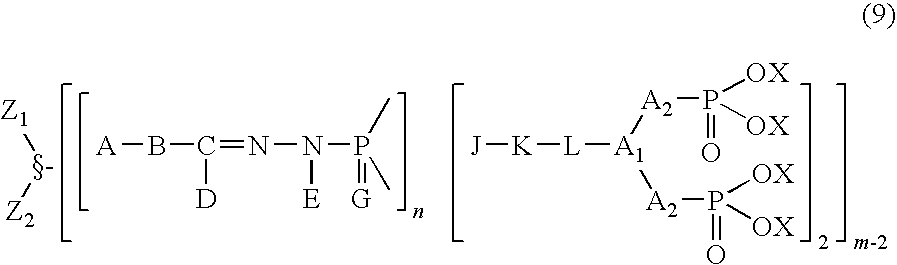
and in which formulae:
-
- the central core § is chosen from the following groups:

-
- the generation chain corresponds to the formula:

where
-
- A represents an oxygen, sulphur, phosphorus atom or an —NR— group;
- B represents an aryl group of 6 to 24 carbon atoms, a heteroaryl group of 1 to 24 carbon atoms, an alkyl group of 1 to 16 carbon atoms, each being able to be optionally substituted by a halogen atom or an —NO2, —NRR′, —CN, —CF3, —OH group, an alkyl group of 1 to 16 carbon atoms, an aryl group of 6 to 24 carbon atoms, an aralkyl group of 7 to 16 carbon atoms;
- D represents a hydrogen atom, an alkyl group of 1 to 16 carbon atoms, an alkoxy group of 1 to 16 carbon atoms, an aryl group of 6 to 24 carbon atoms, an aralkyl group of 7 to 16 carbon atoms, each being able to be optionally substituted by a halogen atom or an —NO2, —NRR′, —CN, —CF3, —OH group, an alkyl group of 1 to 16 carbon atoms, an aryl group of 6 to 24 carbon atoms, an aralkyl group of 7 to 16 carbon atoms;
- E represents a hydrogen atom, an alkyl group of 1 to 16 carbon atoms, an alkoxy group of 1 to 16 carbon atoms, an aryl group of 6 to 24 carbon atoms, an aralkyl group of 7 to 16 carbon atoms, each being able to be optionally substituted by a halogen atom or an —NO2, —NRR′, —CN, —CF3, —OH group, an alkyl group of 1 to 16 carbon atoms, an aryl group of 6 to 24 carbon atoms, an aralkyl group of 7 to 16 carbon atoms;
- G represents an oxygen, nitrogen, sulphur, selenium, tellurium atom or an ═NR group;
- R and R′ representing independently of each other H or an alkyl group of 1 to 16 carbon atoms, an aryl group of 6 to 24 carbon atoms, or an aralkyl group of 7 to 16 carbon atoms;
- the intermediate chain corresponds to the formula:
-J-K-L-
-
- J represents an oxygen or sulphur atom, or an —NR— group;
- K represents an aryl group of 6 to 24 carbon atoms, a heteroaryl group of 1 to 24 carbon atoms, the heteroelement being preferably chosen from oxygen, nitrogen or sulphur, an alkyl group of 1 to 16 carbon atoms, each being able to be optionally substituted by a halogen atom or an —NO2, —NRR′, —CN, —CF3, —OH group, an alkyl group of 1 to 16 carbon atoms, an aryl group of 6 to 24 carbon atoms, an aralkyl group of 7 to 16 carbon atoms;
- L represents a linear, branched or cyclic hydrocarbon chain with 0 to 10 members, in particular with 0 to 6 members, optionally containing one or more double or triple bonds, each of said members optionally being able to be a heteroatom, said heteroatom being preferably chosen from oxygen, sulphur, nitrogen, phosphorus, silicon, each member being able to be optionally substituted by at least one substituent chosen from an alkyl group of 1 to 16 carbon atoms, a halogen, an oxygen atom, —NO2, —NRR′, —CN, —CF3, —OH, an alkoxy group of 1 to 16 carbon atoms, an aryl group of 6 to 24 carbon atoms, an aralkyl group of 7 to 16 carbon atoms;
- R and R′ representing independently of each other H or an alkyl group of 1 to 16 carbon atoms, an aryl group of 6 to 24 carbon atoms, or an aralkyl group of 7 to 16 carbon atoms;
- the terminal group corresponds to the formula:

-
- where A1, A2 and X have been defined previously, each X being identical or different;
Z1 and Z2 being identical or different, optionally linked together, in particular by means of a covalent bond, and representing H or a linear, branched or cyclic hydrocarbon chain with 1 to 16 members, optionally containing one or more double or triple bonds, each of said members being optionally chosen from a heteroatom, said heteroatom being preferably chosen from a nitrogen, oxygen, phosphorus, silicon or sulphur atom, an aryl group of 6 to 24 carbon atoms, a heteroaryl group of 1 to 24 carbon atoms, a carboxyl group, a >C═NR group, each member being able to be optionally substituted by at least one substituent chosen from a hydroxyl group, an —NR″R′″ group, an alkoxy group of 1 to 16 carbon atoms, an alkyl group of 1 to 16 carbon atoms, a halogen atom, an —NO2 group, a —CN group, a —CF3 group, an aryl group of 6 to 24 carbon atoms, an aralkyl group of 7 to 16 carbon atoms, R″ and R′″ representing independently of each other H or an alkyl group of 1 to 16 carbon atoms, an aryl group of 6 to 24 carbon atoms or an aralkyl group of 7 to 16 carbon atoms, the first member of said hydrocarbon chain preferably being oxygen or nitrogen.
- where A1, A2 and X have been defined previously, each X being identical or different;

-
- m represents 6;
- p represents 5;
- n represents 0, 1, or 2;
- A represents an oxygen atom;
- B represents a benzene group;
- D represents hydrogen;
- E represents a methyl group;
- G represents a sulphur atom;
- J represents an oxygen atom;
- K represents a benzene group;
- L represents a non-substituted linear saturated hydrocarbon chain with two carbon atoms;
- A1 represents a nitrogen atom;
- A2 represents a CH2 group;
- X represents a methyl group, or a hydrogen or sodium atom;
- Z1 represents a phenyloxy group;
said dendrimer being designated GCn′, n being defined above.
-
- of the compounds of the following formulae:

in which W represents PO3Me2, PO3HNa, PO3H2, said compounds corresponding, in particular, to compound GC1′ of the following formula (10):

-
- or compounds of the following formula:

in which W represents PO3Me2, PO3HNa, or PO3H2 and R represents a fluorescent group chosen from:

said compounds corresponding in particular to the compounds of the following formulae:


in which W represents PO3Me2, PO3HNa, or PO3H2, Q1 and Q2, identical or different, represent P═S or cyclotriphosphazene (N3P3), 1 represents 2 when Q2 represents P═S or 5 when Q2 represents N3P3 and k represents 2 when Q1 represents P═S or 5 when Q1 represents N3P3, said dendrimers being in particular represented by the following formulae:


in which R represents a group chosen from

where W represents PO3Me2, PO3HNa, or PO3H2.

in which R represents a group chosen from:

where W represents PO3Si2Me6, PO3Me2, PO3HNa, or PO3H2.

in which W represents PO3Me2, PO3HNa, or PO3H2.

in which W represents PO3Me2, PO3HNa, or PO3H2.

in which W represents PO3Me2, PO3HNa, or PO3H2 and k represents 1, 2 or 3.

in which W represents PO3Me2, PO3HNa, or PO3H2 and k represents 0 or 1.

in which W represents PO3Me2, PO3HNa, or PO3H2.

in which W represents PO3Me2, PO3HNa, or PO3H2.


-
- to an increase in the size of the activated cells compared with the non-activated cells, and/or
- to a reduction in the expression of MHC class I and class II molecules, or of the molecule CD14 compared with the non-activated cells, and/or
- to an increase in the nuclear translocation of the factor NFκB.


or to GC0, GC1 or GC2, in particular to GC1.


or to GC0, GC1 or GC2, in particular to GC1.


or to GC0, GC1 or GC2, in particular to GC1.


or to GC0, GC1 or GC2, in particular to GC1.


or to GC0, GC1 or GC2, in particular to GC1.
-
- either by generation chains attached in a tree-like structure around the core on each of the bonds, at least one intermediate chain being optionally attached to the end of each chain of the generation furthest from the central core, and a terminal group being attached to the end of the chain of the generation furthest from the central core or if appropriate to the end of each intermediate chain, or
- by intermediate chains attached around the core on each of the bonds, a terminal group being attached to the end of each intermediate chain;
said terminal group being represented by the formula:

where
-
- A1 represents N; a P═Y group, where Y represents O, S, or any atom; an N—R group; or a C—R group; R representing H or a linear, branched or cyclic hydrocarbon chain with 1 to 16 members, optionally containing one or more heteroatoms, said heteroatoms preferably being chosen from oxygen, sulphur, nitrogen, phosphorus, silicon and/or one or more double or triple bonds, each of said members optionally being substituted by at least one substituent chosen from a hydroxyl group, an —NR′R″ group, an alkoxy group of 1 to 16 carbon atoms, an alkyl group of 1 to 16 carbon atoms, a halogen atom, an —NO2 group, a —CN group, a —CF3 group, an aryl group of 6 to 24 carbon atoms, an aralkyl group of 7 to 16 carbon atoms, R′ and R″ representing independently of each other H or an alkyl group of 1 to 16 carbon atoms, an aryl group of 6 to 24 carbon atoms or aralkyl group of 7 to 16 carbon atoms;
- A2 represents a single bond or a linear, branched or cyclic hydrocarbon chain with 1 to 6 members, each of said members optionally containing one or more heteroatoms, said heteroatoms preferably being chosen from a sulphur, oxygen, phosphorus or nitrogen atom, more preferably nitrogen, and optionally being substituted by at least one substituent chosen from H, an alkyl group of 1 to 16 carbon atoms, a halogen, an —NO2 group, an —NRR′ group, a —CN group, a —CF3 group, a hydroxyl group, an alkoxy group of 1 to 16 carbon atoms, an aryl or heteroaryl group of 1 to 24 carbon atoms, the heteroelement preferably being chosen from oxygen, nitrogen or sulphur, an aralkyl group of 7 to 16 carbon atoms, R and R′ representing independently of each other H or a linear, branched or cyclic hydrocarbon chain with 1 to 16 members, optionally containing one or more heteroatoms, said heteroatoms preferably being chosen from oxygen, sulphur, nitrogen, phosphorus, silicon and/or one or more double or triple bonds, each of said members optionally being substituted by at least one substituent chosen from a hydroxyl group, an —NR″R′″ group, an alkoxy group of 1 to 16 carbon atoms, an alkyl group of 1 to 16 carbon atoms, a halogen atom, an —NO2 group, a —CN group, a —CF3 group, an aryl group of 6 to 24 carbon atoms, an aralkyl group of 7 to 16 carbon atoms, R″ and R′″ representing independently of each other H or an alkyl group of 1 to 16 carbon atoms, an aryl group of 6 to 24 carbon atoms or an aralkyl group of 7 to 16 carbon atoms;
- A3 represents H, or a linear, branched or cyclic hydrocarbon chain with 1 to 6 members, each of said members optionally being chosen from a heteroatom, said heteroatom preferably being chosen from sulphur, nitrogen, phosphorus, or silicon, more preferably nitrogen, each member being able to be optionally substituted by at least one group chosen from a hydroxyl group, an —NR″R′″ group, an alkoxy group of 1 to 16 carbon atoms, an alkyl group of 1 to 16 carbon atoms, a halogen atom, an —NO2 group, a —CN group, a —CF3 group, an aryl group of 6 to 24 carbon atoms, an aralkyl group of 7 to 16 carbon atoms, R″ and R′″ representing independently of each other H or an alkyl group of 1 to 16 carbon atoms, an aryl group of 6 to 24 carbon atoms, or an aralkyl group of 7 to 16 carbon atoms or

in particular A3 can represent

each A2 being identical or different;
-
- each OX, identical or different for each phosphonic group, represents OH, Oalkyl, where the alkyl group comprises 1 to 16 carbon atoms, Oaryl, where the aryl group comprises 6 to 24 carbon atoms, Oaralkyl, where the aralkyl group comprises 7 to 24 carbon atoms, Oalkylaryl, where the alkylaryl group comprises 7 to 24 carbon atoms, OSiR′1R′2R′3, where R′1, R′2 and R′3, identical or different, represent an alkyl group of 1 to 16 carbon atoms, or O−M+, where M+ is a cation of elements of the group IA, IB, IIA, IIB or IIIA, IIIB of the periodic table of the elements, M+ is preferably chosen from the cations of sodium, potassium, copper, calcium, barium, zinc, magnesium, lithium and aluminium atoms, or hydrocarbon groups of 1 to 100 carbon atoms, or nitrogenous groups of 0 to 100 carbon atoms, such as NR1R2R3R4 +, where, independently of one another R1, R2, R3 and R4 represent H or a linear, branched or cyclic hydrocarbon chain with 1 to 16 members, optionally containing one or more heteroatoms, said heteroatoms preferably being chosen from oxygen, sulphur, nitrogen, phosphorus, silicon and/or one or more double or triple bonds, each of said members optionally being substituted by at least one substituent chosen from a hydroxyl group, an —NR″R′″ group, an alkoxy group of 1 to 16 carbon atoms, an alkyl group of 1 to 16 carbon atoms, a halogen atom, an —NO2 group, a —CN group, a —CF3 group, an aryl group of 6 to 24 carbon atoms, an aralkyl group of 7 to 16 carbon atoms, R″ and R′″ representing independently of each other H or an alkyl group of 1 to 16 carbon atoms, an aryl group of 6 to 24 carbon atoms or an aralkyl group of 7 to 16 carbon atoms;
- n represents an integer from 0 to 12;
the 1 or 2 remaining bonds being attached to identical or different linkage groups, optionally linked together, in particular by a covalent bond, constituted either on the one hand by linkage chains defined above,
or by a hydrogen atom,
or by hydrocarbon groups comprising from 1 to 500 carbon atoms,
said hydrocarbon groups being constituted in particular by H or by a linear, branched or cyclic hydrocarbon chain with 1 to 16 members, optionally containing one or more double or triple bonds, each of said members optionally being able to be chosen from a heteroatom, said heteroatom preferably being chosen from a nitrogen, oxygen, phosphorus, silicon or sulphur atom, an aryl group of 6 to 24 carbon atoms, a heteroaryl group of 1 to 24 carbon atoms, a carboxyl group, a >C═NR group, each member being able to be optionally substituted by at least one substituent chosen from a hydroxyl group, an —NR″R′″ group, an alkoxy group of 1 to 16 carbon atoms, an alkyl group of 1 to 16 carbon atoms, a halogen atom, an —NO2 group, a —CN group, a —CF3 group, an aryl group of 6 to 24 carbon atoms, an aralkyl group of 7 to 16 carbon atoms, R″ and R′″ representing independently of each other H or an alkyl group of 1 to 16 carbon atoms, an aryl group of 6 to 24 carbon atoms or an aralkyl group of 7 to 16 carbon atoms, the first member of said hydrocarbon chain preferably being oxygen or nitrogen.
said central core § representing a group comprising from 1 to 500 atoms, and optionally containing one or more heteroatoms, said heteroatoms preferably being chosen from oxygen, sulphur, nitrogen, phosphorus or silicon.
-
- generation chains attached in a tree-like structure around the core on each of the bonds, when n is greater than or equal to 1, a generation chain of a given generation being linked to
- a generation chain of the generation immediately below the given generation, or to the core when the given generation is 1, and to
- at least 2 generation chains of the generation immediately above the given generation, or optionally to at least one intermediate chain when the given generation is n,
- a terminal group being attached to the outside of each generation chain of generation n, or if appropriate to the end of each intermediate chain, or
- intermediate chains attached around the core on each of the bonds, when n is 0, a terminal group being attached to the end of each intermediate chain;
said terminal group being represented by the formula:
- generation chains attached in a tree-like structure around the core on each of the bonds, when n is greater than or equal to 1, a generation chain of a given generation being linked to

where
-
- A1 represents N; a P═Y group, where Y represents O, S, or any atom; an N—R group; or a C—R group; R representing H or a linear, branched or cyclic hydrocarbon chain with 1 to 16 members optionally containing one or more heteroatoms, said heteroatoms preferably being chosen from oxygen, sulphur, nitrogen, phosphorus, silicon and/or one or more double or triple bonds, each of said members optionally being substituted by at least one substituent chosen from a hydroxyl group, an —NR′R″ group, an alkoxy group of 1 to 16 carbon atoms, an alkyl group of 1 to 16 carbon atoms, a halogen atom, an —NO2 group, a —CN group, a —CF3 group, an aryl group of 6 to 24 carbon atoms, an aralkyl group of 7 to 16 carbon atoms, R′ and R″ representing independently of each other H or an alkyl group of 1 to 16 carbon atoms, an aryl group of 6 to 24 carbon atoms or an aralkyl group of 7 to 16 carbon atoms;
- A2 represents a single bond or a linear, branched or cyclic hydrocarbon chain with 1 to 6 members, each of said members optionally containing one or more heteroatoms, said heteroatoms preferably being chosen from a sulphur, oxygen, phosphorus, or nitrogen atom, more preferably nitrogen, and optionally being substituted by at least one substituent chosen from H, an alkyl group of 1 to 16 carbon atoms, a halogen, an —NO2 group, an —NRR′ group, a —CN group, a —CF3 group, a hydroxyl group, an alkoxy group of 1 to 16 carbon atoms, an aryl or heteroaryl group of 1 to 24 carbon atoms, the heteroelement preferably being chosen from oxygen, nitrogen or sulphur, an aralkyl group of 7 to 16 carbon atoms, R and R′ representing independently of each other H or a linear, branched or cyclic hydrocarbon chain with 1 to 16 members, optionally containing one or more heteroatoms, said heteroatoms preferably being chosen from oxygen, sulphur, nitrogen, phosphorus, silicon and/or one or more double or triple bonds, each of said members optionally being substituted by at least one substituent chosen from a hydroxyl group, an —NR″R′″ group, an alkoxy group of 1 to 16 carbon atoms, an alkyl group of 1 to 16 carbon atoms, a halogen atom, an —NO2 group, a —CN group, a —CF3 group, an aryl group of 6 to 24 carbon atoms, an aralkyl group of 7 to 16 carbon atoms, R″ and R″ representing independently of each other H or an alkyl group of 1 to 16 carbon atoms, an aryl group of 6 to 24 carbon atoms or an aralkyl group of 7 to 16 carbon atoms;
- A3 represents H, or a linear, branched or cyclic hydrocarbon chain with 1 to 6 members, each of said members optionally being chosen from a heteroatom, said heteroatom preferably being chosen from sulphur, nitrogen, phosphorus, or silicon, more preferably nitrogen, each member being able to be optionally substituted by at least one group chosen from a hydroxyl group, an —NR″R′″ group, an alkoxy group of 1 to 16 carbon atoms, an alkyl group of 1 to 16 carbon atoms, a halogen atom, an —NO2 group, a —CN group, a —CF3 group, an aryl group of 6 to 24 carbon atoms, an aralkyl group of 7 to 16 carbon atoms, R″ and R′″ representing independently of each other H or an alkyl group of 1 to 16 carbon atoms, an aryl group of 6 to 24 carbon atoms, or an aralkyl group of 7 to 16 carbon atoms or

in particular A3 can represent

each A2 being identical or different;
-
- each OX, identical or different for each phosphonic group, represents OH, Oalkyl, where the alkyl group comprises from 1 to 16 carbon atoms, Oaryl, where the aryl group comprises from 6 to 24 carbon atoms, Oaralkyl, where the aralkyl group comprises from 7 to 24 carbon atoms, Oalkylaryl, where the alkylaryl group comprises from 7 to 24 carbon atoms, OSiR′1R′2R′3, where R′1, R′2 and R′3, identical or different, represent an alkyl group from 1 to 16 carbon atoms, or O−M+, where M+ is a cation of elements of the group IA, IB, IIA, IIB or IIIA, IIIB of the periodic table of the elements, M+ is preferably chosen from the cations of sodium, potassium, copper, calcium, barium, zinc, magnesium, lithium and aluminium atoms, or from hydrocarbon groups of 1 to 100 carbon atoms, or nitrogenous groups of 0 to 100 carbon atoms, such as NR1R2R3R4 +, where, independently of one another R1, R2, R3 and R4 represent H or a linear, branched or cyclic hydrocarbon chain with 1 to 16 members, optionally containing one or more heteroatoms, said heteroatoms preferably being chosen from oxygen, sulphur, nitrogen, phosphorus, silicon and/or one or more double or triple bonds, each of said members optionally being substituted by at least one substituent chosen from a hydroxyl group, an —NR″R′″ group, an alkoxy group of 1 to 16 carbon atoms, an alkyl group of 1 to 16 carbon atoms, a halogen atom, an —NO2 group, a —CN group, a —CF3 group, an aryl group of 6 to 24 carbon atoms, an aralkyl group of 7 to 16 carbon atoms, R″ and R″ representing independently of each other H or an alkyl group of 1 to 16 carbon atoms, an aryl group of 6 to 24 carbon atoms or an aralkyl group of 7 to 16 carbon atoms;
the 1 or 2 remaining bonds being attached to the identical or different linkage groups, optionally linked together, in particular by a covalent bond, constituted
either on the one hand by linkage chains defined above,
or by a hydrogen atom,
or by hydrocarbon groups comprising from 1 to 500 carbon atoms,
said hydrocarbon groups being constituted in particular by H or a linear, branched or cyclic hydrocarbon chain with 1 to 16 members, optionally containing one or more double or triple bonds, each of said members optionally being able to be chosen from a heteroatom, said heteroatom preferably being chosen from a nitrogen, oxygen, phosphorus, silicon or sulphur atom, an aryl group of 6 to 24 carbon atoms, a heteroaryl group of 1 to 24 carbon atoms, a carboxyl group, a >C═NR group, each member being able to be optionally substituted by at least one substituent chosen from a hydroxyl group, an —NR″R′″ group, an alkoxy group of 1 to 16 carbon atoms, an alkyl group of 1 to 16 carbon atoms, a halogen atom, an —NO2 group, a —CN group, a —CF3 group, an aryl group of 6 to 24 carbon atoms, an aralkyl group of 7 to 16 carbon atoms, R″ and R′″ representing independently of each other H or an alkyl group of 1 to 16 carbon atoms, an aryl group of 6 to 24 carbon atoms or an aralkyl group of 7 to 16 carbon atoms, the first member of said hydrocarbon chain preferably being oxygen or nitrogen;
said central core § representing a group comprising from 1 to 500 atoms, and optionally containing one or more heteroatoms, said heteroatoms preferably being chosen from oxygen, sulphur, nitrogen, phosphorus or silicon.
- each OX, identical or different for each phosphonic group, represents OH, Oalkyl, where the alkyl group comprises from 1 to 16 carbon atoms, Oaryl, where the aryl group comprises from 6 to 24 carbon atoms, Oaralkyl, where the aralkyl group comprises from 7 to 24 carbon atoms, Oalkylaryl, where the alkylaryl group comprises from 7 to 24 carbon atoms, OSiR′1R′2R′3, where R′1, R′2 and R′3, identical or different, represent an alkyl group from 1 to 16 carbon atoms, or O−M+, where M+ is a cation of elements of the group IA, IB, IIA, IIB or IIIA, IIIB of the periodic table of the elements, M+ is preferably chosen from the cations of sodium, potassium, copper, calcium, barium, zinc, magnesium, lithium and aluminium atoms, or from hydrocarbon groups of 1 to 100 carbon atoms, or nitrogenous groups of 0 to 100 carbon atoms, such as NR1R2R3R4 +, where, independently of one another R1, R2, R3 and R4 represent H or a linear, branched or cyclic hydrocarbon chain with 1 to 16 members, optionally containing one or more heteroatoms, said heteroatoms preferably being chosen from oxygen, sulphur, nitrogen, phosphorus, silicon and/or one or more double or triple bonds, each of said members optionally being substituted by at least one substituent chosen from a hydroxyl group, an —NR″R′″ group, an alkoxy group of 1 to 16 carbon atoms, an alkyl group of 1 to 16 carbon atoms, a halogen atom, an —NO2 group, a —CN group, a —CF3 group, an aryl group of 6 to 24 carbon atoms, an aralkyl group of 7 to 16 carbon atoms, R″ and R″ representing independently of each other H or an alkyl group of 1 to 16 carbon atoms, an aryl group of 6 to 24 carbon atoms or an aralkyl group of 7 to 16 carbon atoms;
-J-K-L-
-
- J represents an oxygen or sulphur atom, or an —NR— group;
- K represents an aryl group of 6 to 24 carbon atoms, a heteroaryl group of 1 to 24 carbon atoms, the heteroelement preferably being chosen from oxygen, nitrogen or sulphur, an alkyl group of 1 to 16 carbon atoms, each being able to be optionally substituted by a halogen atom or an —NO2, —NRR′, —CN, —CF3, —OH group, an alkyl group of 1 to 16 carbon atoms, an aryl group of 6 to 24 carbon atoms, an aralkyl group of 7 to 16 carbon atoms;
- L represents a linear, branched or cyclic hydrocarbon chain with 0 to 10 members, in particular 0 to 6 members, optionally containing one or more double or triple bonds, each of said members optionally being able to be a heteroatom, said heteroatom preferably being chosen from oxygen, sulphur, nitrogen, phosphorus, silicon, each member being able to be optionally substituted by at least one substituent chosen from an alkyl group of 1 to 16 carbon atoms, a halogen, an oxygen atom, —NO2, —NRR′, —CN, —CF3, —OH, an alkoxy group of 1 to 16 carbon atoms, an aryl group of 6 to 24 carbon atoms, an aralkyl group of 7 to 16 carbon atoms;
- R and R′ representing independently of each other H or an alkyl group of 1 to 16 carbon atoms, an aryl group of 6 to 24 carbon atoms, or an aralkyl group of 7 to 16 carbon atoms.
-
- a nitrogen atom or a silicon atom,
- a group of formula

in which G represents an oxygen, nitrogen, sulphur, selenium, tellurium atom or an ═NR group, R representing H or an alkyl group of 1 to 16 carbon atoms, an aryl group of 6 to 24 carbon atoms, or an aralkyl group of 7 to 16 carbon atoms, such as the thiophosphoryl group of formula

-
- a bis-phenyloxy group of formula

-
- a 1,2-diamino-ethane group of formula

-
- a 1,4-diamino-butane group of formula

-
- a cyclotriphosphazene group of formula

-
- a cyclotetraphosphazene group of formula


where n represents an integer from 0 to 3, m represents 3, 6 or 8, p represents m−1 or m−2, and j represents 0 when p represents m−1 and 1 when p represents m−2, namely:
-
- when p=m−1, formula (7) corresponds to the following formula (8):

-
- when p=m−2, formula (7) corresponds to the following formula (9)

and in which formulae:
-
- the central core § is chosen from the following groups:

-
- the generation chain corresponds to the formula:

where
-
- A represents an oxygen, sulphur, phosphorus atom or an —NR— group;
- B represents an aryl group of 6 to 24 carbon atoms, a heteroaryl group of 1 to 24 carbon atoms, an alkyl group of 1 to 16 carbon atoms, each being able to be optionally substituted by a halogen atom or an —NO2, —NRR′, —CN, —CF3, —OH group, an alkyl group of 1 to 16 carbon atoms, an aryl group of 6 to 24 carbon atoms, an aralkyl group of 7 to 16 carbon atoms;
- D represents a hydrogen atom, an alkyl group of 1 to 16 carbon atoms, an alkoxy group of 1 to 16 carbon atoms, an aryl group of 6 to 24 carbon atoms, an aralkyl group of 7 to 16 carbon atoms, each being able to be optionally substituted by a halogen atom or an —NO2, —NRR′, —CN, —CF3, —OH group, an alkyl group of 1 to 16 carbon atoms, an aryl group of 6 to 24 carbon atoms, an aralkyl group of 7 to 16 carbon atoms;
- E represents a hydrogen atom, an alkyl group of 1 to 16 carbon atoms, an alkoxy group of 1 to 16 carbon atoms, an aryl group of 6 to 24 carbon atoms, an aralkyl group of 7 to 16 carbon atoms, each being able to be optionally substituted by a halogen atom or an —NO2, —NRR′, —CN, —CF3, —OH group, an alkyl group of 1 to 16 carbon atoms, an aryl group of 6 to 24 carbon atoms, an aralkyl group of 7 to 16 carbon atoms;
- G represents an oxygen, nitrogen, sulphur, selenium, tellurium atom or an ═NR group;
- R and R′ representing independently of each other H or an alkyl group of 1 to 16 carbon atoms, an aryl group of 6 to 24 carbon atoms, or an aralkyl group of 7 to 16 carbon atoms;
- the intermediate chain corresponds to the formula:
-J-K-L-
- the intermediate chain corresponds to the formula:
-
- J represents an oxygen, sulphur atom, or an —NR— group;
- K represents an aryl group of 6 to 24 carbon atoms, a heteroaryl group of 1 to 24 carbon atoms, the heteroelement preferably being chosen from oxygen, nitrogen or sulphur, an alkyl group of 1 to 16 carbon atoms, each being able to be optionally substituted by a halogen atom or an —NO2, —NRR′, —CN, —CF3, —OH group, an alkyl group of 1 to 16 carbon atoms, an aryl group of 6 to 24 carbon atoms, an aralkyl group of 7 to 16 carbon atoms;
- L represents a linear, branched or cyclic hydrocarbon chain with 0 to 10 members, in particular 0 to 6 members, optionally containing one or more double or triple bonds, each of said members optionally being able to be a heteroatom, said heteroatom preferably being chosen from oxygen, sulphur, nitrogen, phosphorus, silicon, each member being able to be optionally substituted by at least one substituent chosen from an alkyl group of 1 to 16 carbon atoms, a halogen, an oxygen atom, —NO2, —NRR′, —CN, —CF3, —OH, an alkoxy group of 1 to 16 carbon atoms, an aryl group of 6 to 24 carbon atoms, an aralkyl group of 7 to 16 carbon atoms;
- R and R′ representing independently of each other H or an alkyl group of 1 to 16 carbon atoms, an aryl group of 6 to 24 carbon atoms, or an aralkyl group of 7 to 16 carbon atoms;

-
-
- the terminal group corresponds to the formula:
-

-
- m represents 6;
- p represents 5;
- n represents 0, 1, or 2;
- A represents an oxygen atom;
- B represents a benzene group;
- D represents hydrogen;
- E represents a methyl group;
- G represents a sulphur atom;
- J represents an oxygen atom;
- K represents a benzene group;
- L represents a non substituted saturated linear hydrocarbon chain with two carbon atoms;
- A1 represents a nitrogen atom;
- A2 represents a CH2 group;
- X represents a methyl group, or a hydrogen or sodium atom;
- Z1 represents a phenyloxy group;
said dendrimer being designated GCn′, n being defined above.

in which W represents PO3Me2, PO3HNa, or PO3H2, said dendrimers corresponding in particular to compound GC1′ of the following formula (10):


in which W represents PO3Me2, PO3HNa, or PO3H2 and R represents a fluorescent group chosen from:

said dendrimers corresponding in particular to the compounds of the following formulae:


in which W represents PO3Me2, PO3HNa, or PO3H2, Q1 and Qz, identical or different, represent P═S or the cyclotriphosphazene (N3P3), 1 represents 2 when Q2 represents P═S or 5 when Q2 represents N3P3 and k represents 2 when Q1 represents P═S or 5 when Q1 represents N3P3, said dendrimers being represented in particular by the following formulae:


can be synthesized from the compound of formula:

which can itself be synthesized from compound 6-2-5 defined in Example 40 and described in V. Maraval et al. Angew. Chem. Int. Ed. (2003) 42, 1822.

can be synthesized from the compound of formula:

which can itself be synthesized from compound 6-5-2 defined in Example 40 and described in V. Maraval et al. Angew. Chem. Int. Ed. (2003) 42, 1822.

can be synthesized from the compound of formula:

which can itself be synthesized from compound 6-5-5 defined in Example 40 and described in V. Maraval et al. Angew. Chem. Int. Ed. (2003) 42, 1822.

in which R represents a group chosen from

where W represents PO3Me2, PO3HNa, or PO3H2.

in which R represents a group chosen from:

where W represents PO3Si2Me6, PO3Me2, PO3HNa, or PO3H2.

in which W represents PO3Me2, PO3HNa, or PO3H2.

in which W represents PO3Me2, PO3HNa, or PO3H2.

in which W represents PO3Me2, PO3HNa, or PO3H2 and k represents 1, 2 or 3

in which W represents PO3Me2, PO3HNa, or PO3H2 and k represents 0 or 1.

in which W represents PO3Me2, PO3HNa, or PO3H2.

in which W represents PO3Me2, PO3HNa, or PO3H2.
-
- a central core § of valency m;
- optionally generation chains in a tree-like structure around the core;
- an intermediate chain on the end of each bond around the core or optionally on the end of each generation chain, if necessary; and
- a terminal group in a tree-like structure on the end of each intermediate chain, of formula:

where each X, identical or different for a given terminal group, represents an -Me, —H, or /M+ radical where M+ is a cation,
n represents the generation of the dendrimer in question; it represents an integer between 0 and 12.
m represents an integer greater than or equal to 1.
-
- The central core § preferably presents at least one phosphorus atom. The core § is preferably chosen from the following groups: SPCl3, P3N3Cl6, P4N4Cl8,


-A-B-C(D)=N—N(E)-(P(=G))< (C1)
-A′-(C═O)—N(R)-B′-N< (C1′)
-A″-N< (C1″)
-J-K-L- (C2)
-
- According to another preferred aspect, the intermediate chains can be represented by formula (C2′):
-L″- (C2′)
- According to another preferred aspect, the intermediate chains can be represented by formula (C2′):
§-{{A-B-C(D)=N—N(E)-(P(=G))<}n[J-K-L-PO3X2]2}m (I-1)
in which:
§-{{A′-(C═O)—N(R)-B′-NH—}n[L″—PO3X2]}m (I-2)
in which:
§-{{A″-NH-}n[L″—PO3X2]}m (I-3)
in which:
-
- either —H when the function is —CHO or —CH═NR,
- or the intermediate chain defined previously when said function represents —P(═S)Cl2;
-
- by the action of trimethylsilane halide, preferably trimethylsilane bromide (Me3SiBr), in an organic aprotic, polar solvent such as chloroform, dichloromethane, acetonitrile, preferably acetonitrile. The operation is preferably carried out by slowly adding trimethylsilane halide, keeping the reaction mixture at a temperature comprised between −80° C. and 100° C., preferably at approximately 0° C.
- followed by the action of anhydrous MeOH added to the reaction mixture;
§-{{A-B-C(D)=N—N(E)-(P(=G))<}n[J-K-L-PO3X2]2}m (I-1)
in which §, A, B, C, D, E, G, N, P, J, K, L, X, m, n, < are as defined previously,
§-{{A-B-C(D)=N—N(E)-(P(=G))<}n-Y2}m (II-1)
-
- either -J-K-L′, where L′ represents a —CHO or —CH═NR radical;
- or —Cl;
-
- either H— when Y represents -J-K-L′;
- or H-J-K-L- when Y represents Cl;

in which §, A, B, C, D, E, G, N, P, J, K, L, n, m, < are as defined previously,

where

where

§-{{A′-(C═O)—N(R)-B′-NH-}n[L″-PO3X2]}m (I-2)
in which §, A′, B′, C, N, P, X, L″, m, n are as defined previously.
§-{{A″-NH-}n[L″-PO3X2]2}m (I-3)
in which §, A″, N, P, X, L″, m, n are as defined previously,
the process comprises:
§-{{A′-(C═O)—N(R)-B′-N═R}n}m (II-2)
or §-{{A″-N═R}n}m (I-3)
H—PO3Me2 (VI).
§-{{A′-(C═O)—N(R)-B′-N═R}n}m (II-2)
or §-{{A″-N═R}n}m (II-3)
§-{{A′-(C═O)—N(R)-B′-NH2}n}m (XVI)
or §-{{A″-NH2}n}m (XVII)

-
- by the action of trimethylsilane halide, preferably trimethylsilane bromide (Me3SiBr), in an organic aprotic, polar solvent such as acetonitrile, chloroform or dichloromethane, preferably acetonitrile. The operation is preferably carried out by slowly adding trimethylsilane halide, keeping the reaction mixture at a temperature comprised between −80° C. and 100° C., preferably at approximately 0° C.
- followed by the action of anhydrous MeOH, added to the reaction mixture.

core.
Z-J-K-L-PO3Me2 (VIII)
in which
-
- J represents an oxygen, sulphur atom, or an —NR— radical;
- K represents an -aryl-, -heteroaryl-, -alkyl- radical, each being able to be optionally substituted by a halogen atom or an —NO2, —NRR′, —CN, —CF3, —OH, -alkyl, -aryl, -aralkyl radical;
- L represents a linear or branched hydrocarbon chain with 1 to 6 members, each of said members optionally being able to be chosen from a heteroatom, preferably nitrogen, and/or optionally containing one or more double or triple bonds, each of said linkages optionally being substituted by one or more substituents chosen from —OH, —NRR′, —Oalkyl, -alkyl, -Hal, —NO2, —CN, —CF3, -aryl, -aralkyl.
- R, R′, identical or different, represent independently of each other a hydrogen atom or an -alkyl, -aryl, -aralkyl radical,
- in formula (VIII) above, J preferably represents an oxygen atom,
- in formula (VIII) above, K preferably represents a phenyl core, optionally substituted;
still more preferably, K represents a non-substituted phenyl core,
Z-J-K-L-Hal (IX)→Z-J-K-L-PO3Me2 (VIII)
where Z, J, K, L are as defined previously, Hal represents a halogen atom, preferably bromine.
P(OMe)3 (X)

where Z, J, K, L, Hal are as defined above and L″ represents a radical corresponding to L where a hydrogen and carbon atom have been formally eliminated.
-
- a central core § of valency m;
- optionally generation chains in a tree-like structure around the core;
- an intermediate chain at the end of each generation chain or at the end of each bond around the core, if appropriate; and
- a terminal group at the end of each intermediate chain, if appropriate,
-(A1)<[A2-P(═O)(OX)2]2 (T′)
where
-A1< represents the —CR< radical or -heteroatom<;
each A2, identical or different, represents independently a single bond or a linear or branched hydrocarbon chain with 1 to 6 members, each of said members optionally being chosen from a heteroatom, preferably nitrogen, each member being able to be optionally substituted by one or more substituents chosen from -alkyl, -Hal, —NO2, —NRR′, —CN, —CF3, —OH, —Oalkyl, -aryl, -aralkyl;
each X, identical or different for each of the phosphonic groups, represents an -alkyl, -aryl radical, —H, or /M+ where M+ is a cation,
m represents an integer greater than or equal to 1;
n represents an integer between 0 and 12;
< represents two bonds situated on A1.


-A-B-C(D)=N—N(E)-(P(=G))< (C1)
where:
-A′-(C═O)—N(R)-B′-N< (C1′)
where
-A″-N< (C1″)
where
-J-K-L- (C2)
defined above.
-A′-(C═O)—N(R)-B′- (C2′1)
where A′, B′, R, R′ are as defined previously.
-A″- (C2″)
where
§-{{A-B-C(D)=N—N(E)-(P(=G))<}n[J-K-(Alk)a-N<[A2-P(═O)(OX)2]2]2}m (I-1i)
in which:
§-{{A-B-C(D)=N—N(E)-(P(=G))<}n[J-K-C(D)=N—N(E)-(Alk)a-CH<[A2-P(═O)(OX)2]2]2}m (I-1ii)
in which:
§-{{A′-(C═O)—N(R)-B′-N<}n[A2-P(═O)(OX)2]2}m (I-2′)
in which:
§-{{A″-N<}n[A2-P(═O)(OX)2]2}m (I-3′)
in which:
§-{{A-B-C(D)=N—N(E)-(P(=G))<}n[J-K-(Alk)a-N<[A2-P(═O)(OX)2]2]2}m (I-1i)
in which §, A, B, C, D, E, G, N, P, J, K, A2, Alk, X, a, m, n, < are as defined previously,
§-{A-B-C(D)=N—N(E)-(P(=G))<Y2}n (II-1i)
H-J-K-(Alk)a-N<[A2-P(═O)(OX)2]2 (III)

§-{{A′-(C═O)—N(R)-B′-N<}n[A2-P(═O)(OX)2]2}m (I-2′)
or
§-{{A″-N<}n[A2-P(═O)(OX)2]2}m (I-3′)
in which §, A′, A″, B′, B″, C, N, P, A2, X, m, n, < are as defined previously, stage (i) comprises the reaction on the corresponding dendrimer of the same generation n of formula
§-{{A′-(C═O)—N(R)-B′-NH2}n}m (II-2′)
or
§-{{-A″-NH2}n}m (II-3)
H—P(═O)(OX)2 (IV),
H-A2-(C═O)H (V′).
§-{{A-B-C(D)=N—N(E)-(P(=G))<}n[J-K-C(D)=N—N(E)-(Alk)a-CH<[A2-P(═O)(OX)2]2]2}m (I-1ii)
in which:
§-{{A-B-C(D)=N—N(E)-(P(=G))<}n[J-K-L′]2}m (II-1ii)
(alk′)a-CH-[A2-P(═O)(OX)2] (VI′)
H3C—NH—NH2 (VII′)
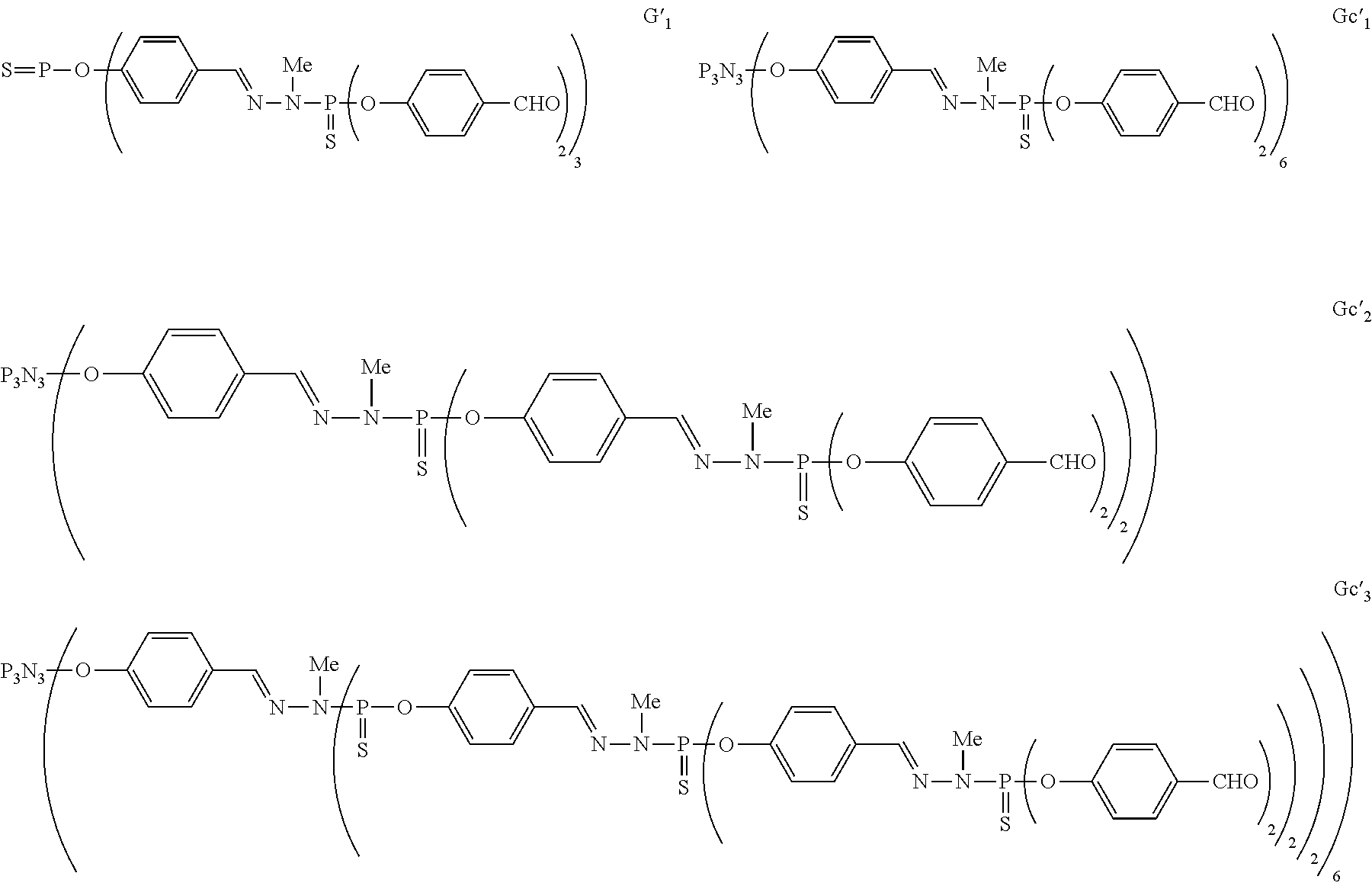
-
- by the action of trimethylsilane halide, preferably trimethylsilane bromide (Me3SiBr), in an organic aprotic, polar solvent such as acetonitrile, chloroform or dichloromethane, preferably acetonitrile. The operation is preferably carried out by slowly adding trimethylsilane halide, keeping the reaction mixture at a temperature comprised between −80° C. and 50° C., preferably at approximately 0° C.
- followed by the action of anhydrous MeOH, added to the reaction mixture.

core.
H-J-K-(Alk)a-N<[A2-P(═O)(OX)2]2 (III)
in which
-
- X represents H, an -alkyl, -aryl or M+ radical where M+ represents a cation;
- J represents an oxygen, sulphur atom, or an —NR— radical;
- K represents an -aryl-, -heteroaryl-, -alkyl- radical, each being able to be optionally substituted by a halogen atom or an —NO2, —NRR′, —CN, —CF3, —OH, -alkyl, -aryl, -aralkyl radical;
each A2, identical or different, represents independently a single bond or a linear or branched hydrocarbon chain with 1 to 6 members, each of said members optionally being able to be chosen from a heteroatom, preferably nitrogen, each member being able to be optionally substituted by one or more substituents chosen from -alkyl, -Hal, —NO2, —NRR′, —CN, —CF3, —OH, —Oalkyl, -aryl, -aralkyl;
-
- in formula (III) above, J preferably represents an oxygen atom;
- in formula (III) above, K preferably represents a phenyl core, optionally substituted; still more preferably, K represents a non-substituted phenyl core;
- in formula (III) above, -alk- preferably represents an -ethyl- radical;
- in formula (III) above, A2 preferably represents an -alkyl- radical, still more preferably, -methyl-;
- in formula (III) above, X preferably represents —H or -Me;


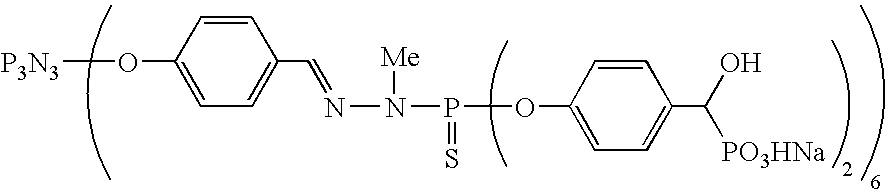


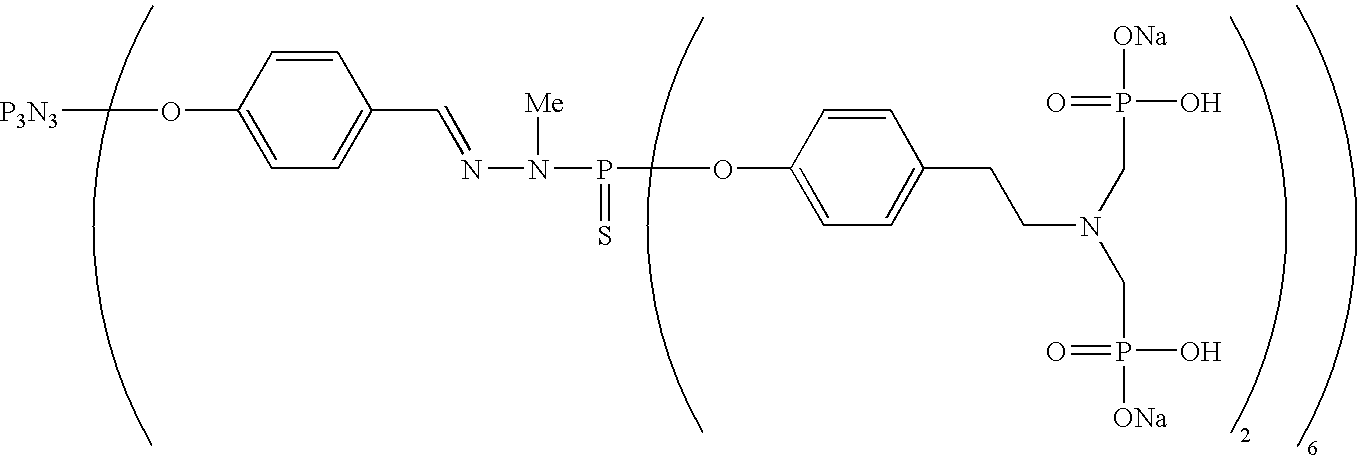


(a) n=1


(a) n=1


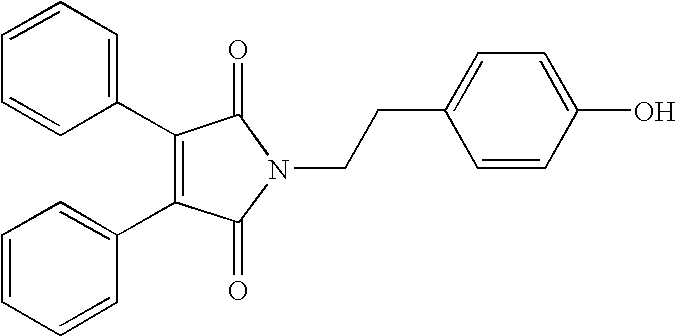


-
- i) 1 mM sodium pyruvate (Invitrogen Corporation, Paisley, UNITED KINGDOM)
- ii) 100 μg/ml of streptomycin and 100 U/ml of penicillin (Cambrex Bio Science, Verviers, BELGIUM);
- iii) 10% by volume of foetal calf serum (Invitrogen Corporation, Paisley, UNITED KINGDOM) decomplemented for 30 minutes at 56° C. (FCS);
- iv) 20 μM of GC1 dendrimer solubilized at a concentration of 2 mM in sterile non-pyrogenic PBS;
- v) 200 U/ml of human recombinant IL2 (Sanofi-Synthelabo, Paris, FRANCE) is added to the culture medium thus produced.
[number of cells in each sub-population=N tot×% of the sub-population in this culture]
-
- the MR: total quantity of 51Cr incorporated by the target cells alone;
- the SR: spontaneous release of 51Cr by the targets alone;
- X: release of 51Cr measured in the test.
[specific lysis (%)=(X−SR)/(MR−SR)]
Claims (18)


-J-K-L-,


-J-K-L-,


Applications Claiming Priority (3)
| Application Number | Priority Date | Filing Date | Title |
|---|---|---|---|
| FR0408426A FR2873715B1 (en) | 2004-07-30 | 2004-07-30 | USE OF DENDRIMERES FOR STIMULATING CELL GROWTH |
| FR0408426 | 2004-07-30 | ||
| PCT/FR2005/002003 WO2006024769A1 (en) | 2004-07-30 | 2005-07-29 | Use of dendrimers to stimulate cell growth |
Publications (2)
| Publication Number | Publication Date |
|---|---|
| US20090142316A1 US20090142316A1 (en) | 2009-06-04 |
| US8815834B2 true US8815834B2 (en) | 2014-08-26 |
Family
ID=34947253
Family Applications (1)
| Application Number | Title | Priority Date | Filing Date |
|---|---|---|---|
| US11/658,858 Active 2030-08-12 US8815834B2 (en) | 2004-07-30 | 2005-07-29 | Use of dendrimers to stimulate cell growth |
Country Status (9)
| Country | Link |
|---|---|
| US (1) | US8815834B2 (en) |
| EP (1) | EP1771548B1 (en) |
| JP (1) | JP2008508244A (en) |
| CN (2) | CN101724599B (en) |
| BR (1) | BRPI0513972A (en) |
| CA (1) | CA2576721C (en) |
| ES (1) | ES2389772T3 (en) |
| FR (1) | FR2873715B1 (en) |
| WO (1) | WO2006024769A1 (en) |
Families Citing this family (12)
| Publication number | Priority date | Publication date | Assignee | Title |
|---|---|---|---|---|
| US10106565B2 (en) | 2008-08-01 | 2018-10-23 | Centre National De La Recherche Scientifique | Phosphorylated dendrimers as antiinflammatory drugs |
| WO2010013086A1 (en) * | 2008-08-01 | 2010-02-04 | Centre National De La Recherche Scientifique | Phosphorylated dendrimers as antiinflammatory drugs |
| WO2011096504A1 (en) * | 2010-02-08 | 2011-08-11 | 株式会社日本バイオセラピー研究所 | Method for producing nk cell enhancement-type blood product |
| US9957291B2 (en) * | 2013-08-05 | 2018-05-01 | Pacific Biosciences Of California, Inc. | Protected fluorescent reagent compounds |
| WO2016126941A1 (en) | 2015-02-04 | 2016-08-11 | Pacific Biosciences Of California, Inc. | Multimeric protected fluorescent reagents |
| US10781483B2 (en) | 2015-11-20 | 2020-09-22 | Pacific Biosciences Of California, Inc. | Labeled nucleotide analogs, reaction mixtures, and methods and systems for sequencing |
| WO2017087974A1 (en) * | 2015-11-20 | 2017-05-26 | Pacific Biosciences Of California, Inc. | Protected dye-labeled reagents |
| US10676788B2 (en) | 2015-11-20 | 2020-06-09 | Pacific Biosciences Of California, Inc. | Modified nucleotide reagents |
| CN107337806A (en) * | 2016-05-03 | 2017-11-10 | 广东广山新材料股份有限公司 | Phosphazene compound, plastic packaging material and composite metal substrate containing phosphonate group |
| CN108976418B (en) * | 2018-07-19 | 2021-01-05 | 中国科学院宁波材料技术与工程研究所 | Three-dimensional structure flame retardant based on furan derivative and cyclotriphosphazene and preparation method thereof |
| CN113077043B (en) * | 2021-03-17 | 2022-05-20 | 华中科技大学 | Machine tool nose dynamic characteristic prediction method based on improved graph convolution network |
| CN113527702B (en) * | 2021-07-15 | 2023-02-03 | 东华大学 | Amphiphilic phosphorus-containing tree crown macromolecular material and preparation and application thereof |
Citations (4)
| Publication number | Priority date | Publication date | Assignee | Title |
|---|---|---|---|---|
| WO2001038335A1 (en) | 1999-11-25 | 2001-05-31 | Centre National De La Recherche Scientifique-Cnrs | Phosphorus-containing dendrimers as transfection agents |
| WO2001091816A1 (en) | 2000-06-02 | 2001-12-06 | The Regents Of The University Of Michigan | Delivery systems comprising biocompatible and bioerodable membranes |
| WO2002067908A1 (en) | 2001-02-26 | 2002-09-06 | Duke University | Novel dendritic polymers and their biomedical uses |
| WO2003091304A2 (en) | 2002-04-23 | 2003-11-06 | Centre National De La Recherche Scientifique | Solid supports functionalised by phosphorus dendrimers, method for preparing same and uses thereof |
Family Cites Families (1)
| Publication number | Priority date | Publication date | Assignee | Title |
|---|---|---|---|---|
| US6849452B1 (en) * | 1998-03-03 | 2005-02-01 | Institut Gustave Roussy | Methods for activating natural killer (NK) cells and means for carrying out said methods |
-
2004
- 2004-07-30 FR FR0408426A patent/FR2873715B1/en not_active Expired - Fee Related
-
2005
- 2005-07-29 JP JP2007523122A patent/JP2008508244A/en active Pending
- 2005-07-29 ES ES05793666T patent/ES2389772T3/en not_active Expired - Lifetime
- 2005-07-29 CN CN2009102534500A patent/CN101724599B/en not_active Expired - Fee Related
- 2005-07-29 WO PCT/FR2005/002003 patent/WO2006024769A1/en not_active Ceased
- 2005-07-29 EP EP05793666A patent/EP1771548B1/en not_active Expired - Lifetime
- 2005-07-29 CN CN2005800330049A patent/CN101031638B/en not_active Expired - Fee Related
- 2005-07-29 US US11/658,858 patent/US8815834B2/en active Active
- 2005-07-29 BR BRPI0513972-4A patent/BRPI0513972A/en not_active Application Discontinuation
- 2005-07-29 CA CA2576721A patent/CA2576721C/en not_active Expired - Fee Related
Patent Citations (4)
| Publication number | Priority date | Publication date | Assignee | Title |
|---|---|---|---|---|
| WO2001038335A1 (en) | 1999-11-25 | 2001-05-31 | Centre National De La Recherche Scientifique-Cnrs | Phosphorus-containing dendrimers as transfection agents |
| WO2001091816A1 (en) | 2000-06-02 | 2001-12-06 | The Regents Of The University Of Michigan | Delivery systems comprising biocompatible and bioerodable membranes |
| WO2002067908A1 (en) | 2001-02-26 | 2002-09-06 | Duke University | Novel dendritic polymers and their biomedical uses |
| WO2003091304A2 (en) | 2002-04-23 | 2003-11-06 | Centre National De La Recherche Scientifique | Solid supports functionalised by phosphorus dendrimers, method for preparing same and uses thereof |
Non-Patent Citations (5)
| Title |
|---|
| "Enhancement of thermal stability of polystyrene and poly(methyl methacrylate) by cyclotriphosphazene derivatives," Polymer Degradation and Stability, pp. 87-93, Apr. 2004, XP002320475. |
| "Phosphate-, phosphite-, ylide-, and phosphonate-terminated dendrimers", Journal of Organic Chemistry, vol. 62, No. 14, pp. 4834-4841, Jul. 11, 1997, XP002144559. |
| Baten et al (Carcinogenesis 10:1595-1598, 1989). * |
| Launay et al (J Organometallic Chem 529:51-58, 1997). * |
| Prevote et al (J Org Chem 62:4834-4841, 1997). * |
Also Published As
| Publication number | Publication date |
|---|---|
| CA2576721A1 (en) | 2006-03-09 |
| CN101031638B (en) | 2012-09-19 |
| CN101031638A (en) | 2007-09-05 |
| FR2873715B1 (en) | 2006-11-17 |
| US20090142316A1 (en) | 2009-06-04 |
| CA2576721C (en) | 2015-10-20 |
| CN101724599B (en) | 2013-08-14 |
| ES2389772T3 (en) | 2012-10-31 |
| WO2006024769A1 (en) | 2006-03-09 |
| JP2008508244A (en) | 2008-03-21 |
| BRPI0513972A (en) | 2008-05-27 |
| FR2873715A1 (en) | 2006-02-03 |
| CN101724599A (en) | 2010-06-09 |
| EP1771548A1 (en) | 2007-04-11 |
| EP1771548B1 (en) | 2012-06-27 |
Similar Documents
| Publication | Publication Date | Title |
|---|---|---|
| US20100173871A1 (en) | Phosphorylated dendrimers as antiinflammatory drugs | |
| JP6802159B2 (en) | Gamma delta T cell proliferation procedure | |
| US20090142316A1 (en) | Use of Dendrimers to Stimulate Cell Growth | |
| JP4281071B1 (en) | Vγ9Vδ2 T cell proliferating agent, method for producing activated Vγ9Vδ2 T cells and use thereof | |
| TW585915B (en) | Methods for activating natural killer (NK) cells | |
| Llopiz et al. | Combined immunization with adjuvant molecules poly (I: C) and anti-CD40 plus a tumor antigen has potent prophylactic and therapeutic antitumor effects | |
| US20160075996A1 (en) | Method for producing nk cell-enriched blood preparation | |
| KR101846464B1 (en) | Natural killer cell comprising foreign mitochondria and pharmaceutical composition comprising same | |
| CN101258238B (en) | Antigen Presenting Cell Activation Treatment Method | |
| WO2014072446A1 (en) | Method for inducing il-2-free proliferation of gamma delta t cells | |
| Weigmann et al. | Diminished contact hypersensitivity response in IL‐4 deficient mice at a late phase of the elicitation reaction | |
| CN106458869A (en) | Novel compound with therapeutic effect on immune diseases and its application | |
| CN101313061B (en) | Method for expanding double-negative T cells | |
| JPWO2006006720A1 (en) | γδT cell culture method, γδT cell and therapeutic / prophylactic agent | |
| US10106565B2 (en) | Phosphorylated dendrimers as antiinflammatory drugs | |
| EP4103202B1 (en) | Cancer immunotherapy using transfusions of allogeneic, tumor-specific cd4+ t cells | |
| TWI764896B (en) | Efficient NKT cell activation technology | |
| US20230096410A1 (en) | Innate Immunity Killer Cells Targeting PSMA Positive Tumor Cells | |
| KR20120135265A (en) | Method for producing regulatory dendritic cells | |
| WO2019227176A1 (en) | Methods of activating cells via ptp 1b inhibition | |
| US20220378872A1 (en) | Composition for treatment and/or prevention of tumor | |
| FR2775692A1 (en) | NATURAL KILLER CELL ACTIVATION METHODS (NK) AND MEANS OF IMPLEMENTATION | |
| WO2026096743A1 (en) | Methods for gamma delta t cells manufacturing | |
| Liu | The Roles of Interleukin-27 in Tumor Immunity | |
| FR2782524A1 (en) | METHODS OF ACTIVATION OF NATURAL KILLER CELLS (NK) AND MEANS OF IMPLEMENTATION |
Legal Events
| Date | Code | Title | Description |
|---|---|---|---|
| AS | Assignment |
Owner name: INSTITUT NATIONAL DE LA SANTE DE LA RECHERCHE MEDI Free format text: ASSIGNMENT OF ASSIGNORS INTEREST;ASSIGNORS:MAJORAL, JEAN-PIERRE;CAMINADE, ANNE-MARIE JEANNINE JACQUELINE;FOURNIE, JEAN-JACQUES;AND OTHERS;REEL/FRAME:019480/0784 Effective date: 20070503 Owner name: RHODIA UK LIMITED, UNITED KINGDOM Free format text: ASSIGNMENT OF ASSIGNORS INTEREST;ASSIGNORS:MAJORAL, JEAN-PIERRE;CAMINADE, ANNE-MARIE JEANNINE JACQUELINE;FOURNIE, JEAN-JACQUES;AND OTHERS;REEL/FRAME:019480/0784 Effective date: 20070503 Owner name: CENTRE NATIONAL DE LA RECHERCHE SCIENTIFIQUE, FRAN Free format text: ASSIGNMENT OF ASSIGNORS INTEREST;ASSIGNORS:MAJORAL, JEAN-PIERRE;CAMINADE, ANNE-MARIE JEANNINE JACQUELINE;FOURNIE, JEAN-JACQUES;AND OTHERS;REEL/FRAME:019480/0784 Effective date: 20070503 |
|
| STCF | Information on status: patent grant |
Free format text: PATENTED CASE |
|
| MAFP | Maintenance fee payment |
Free format text: PAYMENT OF MAINTENANCE FEE, 4TH YEAR, LARGE ENTITY (ORIGINAL EVENT CODE: M1551) Year of fee payment: 4 |
|
| MAFP | Maintenance fee payment |
Free format text: PAYMENT OF MAINTENANCE FEE, 8TH YEAR, LARGE ENTITY (ORIGINAL EVENT CODE: M1552); ENTITY STATUS OF PATENT OWNER: LARGE ENTITY Year of fee payment: 8 |
|
| FEPP | Fee payment procedure |
Free format text: MAINTENANCE FEE REMINDER MAILED (ORIGINAL EVENT CODE: REM.); ENTITY STATUS OF PATENT OWNER: LARGE ENTITY |