US8815643B2 - Method of fabricating semiconductor die with through-hole via on saw streets and through-hole via in active area of die - Google Patents
Method of fabricating semiconductor die with through-hole via on saw streets and through-hole via in active area of die Download PDFInfo
- Publication number
- US8815643B2 US8815643B2 US13/021,856 US201113021856A US8815643B2 US 8815643 B2 US8815643 B2 US 8815643B2 US 201113021856 A US201113021856 A US 201113021856A US 8815643 B2 US8815643 B2 US 8815643B2
- Authority
- US
- United States
- Prior art keywords
- die
- conductive
- vias
- forming
- semiconductor
- Prior art date
- Legal status (The legal status is an assumption and is not a legal conclusion. Google has not performed a legal analysis and makes no representation as to the accuracy of the status listed.)
- Active, expires
Links
Images




Classifications
-
- H—ELECTRICITY
- H10—SEMICONDUCTOR DEVICES; ELECTRIC SOLID-STATE DEVICES NOT OTHERWISE PROVIDED FOR
- H10P—GENERIC PROCESSES OR APPARATUS FOR THE MANUFACTURE OR TREATMENT OF DEVICES COVERED BY CLASS H10
- H10P54/00—Cutting or separating of wafers, substrates or parts of devices
-
- H01L21/6835—
-
- H—ELECTRICITY
- H10—SEMICONDUCTOR DEVICES; ELECTRIC SOLID-STATE DEVICES NOT OTHERWISE PROVIDED FOR
- H10P—GENERIC PROCESSES OR APPARATUS FOR THE MANUFACTURE OR TREATMENT OF DEVICES COVERED BY CLASS H10
- H10P72/00—Handling or holding of wafers, substrates or devices during manufacture or treatment thereof
- H10P72/70—Handling or holding of wafers, substrates or devices during manufacture or treatment thereof for supporting or gripping
- H10P72/74—Handling or holding of wafers, substrates or devices during manufacture or treatment thereof for supporting or gripping using temporarily an auxiliary support
-
- H01L21/76898—
-
- H01L23/481—
-
- H01L24/19—
-
- H01L24/82—
-
- H01L25/03—
-
- H01L25/0657—
-
- H01L25/50—
-
- H—ELECTRICITY
- H10—SEMICONDUCTOR DEVICES; ELECTRIC SOLID-STATE DEVICES NOT OTHERWISE PROVIDED FOR
- H10W—GENERIC PACKAGES, INTERCONNECTIONS, CONNECTORS OR OTHER CONSTRUCTIONAL DETAILS OF DEVICES COVERED BY CLASS H10
- H10W20/00—Interconnections in chips, wafers or substrates
- H10W20/01—Manufacture or treatment
- H10W20/021—Manufacture or treatment of interconnections within wafers or substrates
- H10W20/023—Manufacture or treatment of interconnections within wafers or substrates the interconnections being through-semiconductor vias
-
- H—ELECTRICITY
- H10—SEMICONDUCTOR DEVICES; ELECTRIC SOLID-STATE DEVICES NOT OTHERWISE PROVIDED FOR
- H10W—GENERIC PACKAGES, INTERCONNECTIONS, CONNECTORS OR OTHER CONSTRUCTIONAL DETAILS OF DEVICES COVERED BY CLASS H10
- H10W20/00—Interconnections in chips, wafers or substrates
- H10W20/01—Manufacture or treatment
- H10W20/021—Manufacture or treatment of interconnections within wafers or substrates
- H10W20/023—Manufacture or treatment of interconnections within wafers or substrates the interconnections being through-semiconductor vias
- H10W20/0238—Manufacture or treatment of interconnections within wafers or substrates the interconnections being through-semiconductor vias comprising etching via holes through pads or through electrodes
-
- H—ELECTRICITY
- H10—SEMICONDUCTOR DEVICES; ELECTRIC SOLID-STATE DEVICES NOT OTHERWISE PROVIDED FOR
- H10W—GENERIC PACKAGES, INTERCONNECTIONS, CONNECTORS OR OTHER CONSTRUCTIONAL DETAILS OF DEVICES COVERED BY CLASS H10
- H10W20/00—Interconnections in chips, wafers or substrates
- H10W20/01—Manufacture or treatment
- H10W20/021—Manufacture or treatment of interconnections within wafers or substrates
- H10W20/023—Manufacture or treatment of interconnections within wafers or substrates the interconnections being through-semiconductor vias
- H10W20/0245—Manufacture or treatment of interconnections within wafers or substrates the interconnections being through-semiconductor vias comprising use of blind vias during the manufacture
-
- H—ELECTRICITY
- H10—SEMICONDUCTOR DEVICES; ELECTRIC SOLID-STATE DEVICES NOT OTHERWISE PROVIDED FOR
- H10W—GENERIC PACKAGES, INTERCONNECTIONS, CONNECTORS OR OTHER CONSTRUCTIONAL DETAILS OF DEVICES COVERED BY CLASS H10
- H10W20/00—Interconnections in chips, wafers or substrates
- H10W20/20—Interconnections within wafers or substrates, e.g. through-silicon vias [TSV]
-
- H—ELECTRICITY
- H10—SEMICONDUCTOR DEVICES; ELECTRIC SOLID-STATE DEVICES NOT OTHERWISE PROVIDED FOR
- H10W—GENERIC PACKAGES, INTERCONNECTIONS, CONNECTORS OR OTHER CONSTRUCTIONAL DETAILS OF DEVICES COVERED BY CLASS H10
- H10W70/00—Package substrates; Interposers; Redistribution layers [RDL]
- H10W70/01—Manufacture or treatment
- H10W70/05—Manufacture or treatment of insulating or insulated package substrates, or of interposers, or of redistribution layers
- H10W70/08—Manufacture or treatment of insulating or insulated package substrates, or of interposers, or of redistribution layers by depositing layers on the chip or wafer, e.g. "chip-first" RDLs
- H10W70/09—Manufacture or treatment of insulating or insulated package substrates, or of interposers, or of redistribution layers by depositing layers on the chip or wafer, e.g. "chip-first" RDLs extending onto an encapsulation that laterally surrounds the chip or wafer, e.g. fan-out wafer level package [FOWLP] RDLs
-
- H—ELECTRICITY
- H10—SEMICONDUCTOR DEVICES; ELECTRIC SOLID-STATE DEVICES NOT OTHERWISE PROVIDED FOR
- H10W—GENERIC PACKAGES, INTERCONNECTIONS, CONNECTORS OR OTHER CONSTRUCTIONAL DETAILS OF DEVICES COVERED BY CLASS H10
- H10W90/00—Package configurations
-
- H01L2224/16227—
-
- H01L2224/18—
-
- H01L2224/32145—
-
- H01L2224/32225—
-
- H01L2224/48091—
-
- H01L2224/48145—
-
- H01L2224/48227—
-
- H01L2224/48472—
-
- H01L2224/73265—
-
- H01L2224/81801—
-
- H01L2224/82039—
-
- H01L2225/06506—
-
- H01L2225/06513—
-
- H01L2225/06527—
-
- H01L2225/06541—
-
- H01L23/3128—
-
- H01L24/48—
-
- H01L24/81—
-
- H01L2924/00—
-
- H01L2924/00012—
-
- H01L2924/00014—
-
- H01L2924/01005—
-
- H01L2924/01006—
-
- H01L2924/01013—
-
- H01L2924/01023—
-
- H01L2924/01029—
-
- H01L2924/01033—
-
- H01L2924/01074—
-
- H01L2924/01078—
-
- H01L2924/014—
-
- H01L2924/14—
-
- H01L2924/15311—
-
- H01L2924/19107—
-
- H01L2924/30105—
-
- H—ELECTRICITY
- H10—SEMICONDUCTOR DEVICES; ELECTRIC SOLID-STATE DEVICES NOT OTHERWISE PROVIDED FOR
- H10W—GENERIC PACKAGES, INTERCONNECTIONS, CONNECTORS OR OTHER CONSTRUCTIONAL DETAILS OF DEVICES COVERED BY CLASS H10
- H10W70/00—Package substrates; Interposers; Redistribution layers [RDL]
- H10W70/01—Manufacture or treatment
- H10W70/05—Manufacture or treatment of insulating or insulated package substrates, or of interposers, or of redistribution layers
- H10W70/093—Connecting or disconnecting other interconnections thereto or therefrom, e.g. connecting bond wires or bumps
-
- H—ELECTRICITY
- H10—SEMICONDUCTOR DEVICES; ELECTRIC SOLID-STATE DEVICES NOT OTHERWISE PROVIDED FOR
- H10W—GENERIC PACKAGES, INTERCONNECTIONS, CONNECTORS OR OTHER CONSTRUCTIONAL DETAILS OF DEVICES COVERED BY CLASS H10
- H10W70/00—Package substrates; Interposers; Redistribution layers [RDL]
- H10W70/60—Insulating or insulated package substrates; Interposers; Redistribution layers
-
- H—ELECTRICITY
- H10—SEMICONDUCTOR DEVICES; ELECTRIC SOLID-STATE DEVICES NOT OTHERWISE PROVIDED FOR
- H10W—GENERIC PACKAGES, INTERCONNECTIONS, CONNECTORS OR OTHER CONSTRUCTIONAL DETAILS OF DEVICES COVERED BY CLASS H10
- H10W72/00—Interconnections or connectors in packages
- H10W72/01—Manufacture or treatment
-
- H—ELECTRICITY
- H10—SEMICONDUCTOR DEVICES; ELECTRIC SOLID-STATE DEVICES NOT OTHERWISE PROVIDED FOR
- H10W—GENERIC PACKAGES, INTERCONNECTIONS, CONNECTORS OR OTHER CONSTRUCTIONAL DETAILS OF DEVICES COVERED BY CLASS H10
- H10W72/00—Interconnections or connectors in packages
- H10W72/071—Connecting or disconnecting
- H10W72/072—Connecting or disconnecting of bump connectors
- H10W72/07231—Techniques
- H10W72/07236—Soldering or alloying
-
- H—ELECTRICITY
- H10—SEMICONDUCTOR DEVICES; ELECTRIC SOLID-STATE DEVICES NOT OTHERWISE PROVIDED FOR
- H10W—GENERIC PACKAGES, INTERCONNECTIONS, CONNECTORS OR OTHER CONSTRUCTIONAL DETAILS OF DEVICES COVERED BY CLASS H10
- H10W72/00—Interconnections or connectors in packages
- H10W72/20—Bump connectors, e.g. solder bumps or copper pillars; Dummy bumps; Thermal bumps
- H10W72/241—Dispositions, e.g. layouts
-
- H—ELECTRICITY
- H10—SEMICONDUCTOR DEVICES; ELECTRIC SOLID-STATE DEVICES NOT OTHERWISE PROVIDED FOR
- H10W—GENERIC PACKAGES, INTERCONNECTIONS, CONNECTORS OR OTHER CONSTRUCTIONAL DETAILS OF DEVICES COVERED BY CLASS H10
- H10W72/00—Interconnections or connectors in packages
- H10W72/50—Bond wires
- H10W72/531—Shapes of wire connectors
- H10W72/5363—Shapes of wire connectors the connected ends being wedge-shaped
-
- H—ELECTRICITY
- H10—SEMICONDUCTOR DEVICES; ELECTRIC SOLID-STATE DEVICES NOT OTHERWISE PROVIDED FOR
- H10W—GENERIC PACKAGES, INTERCONNECTIONS, CONNECTORS OR OTHER CONSTRUCTIONAL DETAILS OF DEVICES COVERED BY CLASS H10
- H10W72/00—Interconnections or connectors in packages
- H10W72/851—Dispositions of multiple connectors or interconnections
- H10W72/874—On different surfaces
-
- H—ELECTRICITY
- H10—SEMICONDUCTOR DEVICES; ELECTRIC SOLID-STATE DEVICES NOT OTHERWISE PROVIDED FOR
- H10W—GENERIC PACKAGES, INTERCONNECTIONS, CONNECTORS OR OTHER CONSTRUCTIONAL DETAILS OF DEVICES COVERED BY CLASS H10
- H10W72/00—Interconnections or connectors in packages
- H10W72/851—Dispositions of multiple connectors or interconnections
- H10W72/874—On different surfaces
- H10W72/884—Die-attach connectors and bond wires
-
- H—ELECTRICITY
- H10—SEMICONDUCTOR DEVICES; ELECTRIC SOLID-STATE DEVICES NOT OTHERWISE PROVIDED FOR
- H10W—GENERIC PACKAGES, INTERCONNECTIONS, CONNECTORS OR OTHER CONSTRUCTIONAL DETAILS OF DEVICES COVERED BY CLASS H10
- H10W72/00—Interconnections or connectors in packages
- H10W72/90—Bond pads, in general
- H10W72/941—Dispositions of bond pads
- H10W72/9413—Dispositions of bond pads on encapsulations
-
- H—ELECTRICITY
- H10—SEMICONDUCTOR DEVICES; ELECTRIC SOLID-STATE DEVICES NOT OTHERWISE PROVIDED FOR
- H10W—GENERIC PACKAGES, INTERCONNECTIONS, CONNECTORS OR OTHER CONSTRUCTIONAL DETAILS OF DEVICES COVERED BY CLASS H10
- H10W74/00—Encapsulations, e.g. protective coatings
-
- H—ELECTRICITY
- H10—SEMICONDUCTOR DEVICES; ELECTRIC SOLID-STATE DEVICES NOT OTHERWISE PROVIDED FOR
- H10W—GENERIC PACKAGES, INTERCONNECTIONS, CONNECTORS OR OTHER CONSTRUCTIONAL DETAILS OF DEVICES COVERED BY CLASS H10
- H10W74/00—Encapsulations, e.g. protective coatings
- H10W74/01—Manufacture or treatment
- H10W74/019—Manufacture or treatment using temporary auxiliary substrates
-
- H—ELECTRICITY
- H10—SEMICONDUCTOR DEVICES; ELECTRIC SOLID-STATE DEVICES NOT OTHERWISE PROVIDED FOR
- H10W—GENERIC PACKAGES, INTERCONNECTIONS, CONNECTORS OR OTHER CONSTRUCTIONAL DETAILS OF DEVICES COVERED BY CLASS H10
- H10W74/00—Encapsulations, e.g. protective coatings
- H10W74/10—Encapsulations, e.g. protective coatings characterised by their shape or disposition
- H10W74/111—Encapsulations, e.g. protective coatings characterised by their shape or disposition the semiconductor body being completely enclosed
- H10W74/114—Encapsulations, e.g. protective coatings characterised by their shape or disposition the semiconductor body being completely enclosed by a substrate and the encapsulations
- H10W74/117—Encapsulations, e.g. protective coatings characterised by their shape or disposition the semiconductor body being completely enclosed by a substrate and the encapsulations the substrate having spherical bumps for external connection
-
- H—ELECTRICITY
- H10—SEMICONDUCTOR DEVICES; ELECTRIC SOLID-STATE DEVICES NOT OTHERWISE PROVIDED FOR
- H10W—GENERIC PACKAGES, INTERCONNECTIONS, CONNECTORS OR OTHER CONSTRUCTIONAL DETAILS OF DEVICES COVERED BY CLASS H10
- H10W74/00—Encapsulations, e.g. protective coatings
- H10W74/10—Encapsulations, e.g. protective coatings characterised by their shape or disposition
- H10W74/131—Encapsulations, e.g. protective coatings characterised by their shape or disposition the semiconductor body being only partially enclosed
- H10W74/142—Encapsulations, e.g. protective coatings characterised by their shape or disposition the semiconductor body being only partially enclosed the encapsulations exposing the passive side of the semiconductor body
-
- H—ELECTRICITY
- H10—SEMICONDUCTOR DEVICES; ELECTRIC SOLID-STATE DEVICES NOT OTHERWISE PROVIDED FOR
- H10W—GENERIC PACKAGES, INTERCONNECTIONS, CONNECTORS OR OTHER CONSTRUCTIONAL DETAILS OF DEVICES COVERED BY CLASS H10
- H10W74/00—Encapsulations, e.g. protective coatings
- H10W74/10—Encapsulations, e.g. protective coatings characterised by their shape or disposition
- H10W74/15—Encapsulations, e.g. protective coatings characterised by their shape or disposition on active surfaces of flip-chip devices, e.g. underfills
-
- H—ELECTRICITY
- H10—SEMICONDUCTOR DEVICES; ELECTRIC SOLID-STATE DEVICES NOT OTHERWISE PROVIDED FOR
- H10W—GENERIC PACKAGES, INTERCONNECTIONS, CONNECTORS OR OTHER CONSTRUCTIONAL DETAILS OF DEVICES COVERED BY CLASS H10
- H10W90/00—Package configurations
- H10W90/20—Configurations of stacked chips
- H10W90/297—Configurations of stacked chips characterised by the through-semiconductor vias [TSVs] in the stacked chips
-
- H—ELECTRICITY
- H10—SEMICONDUCTOR DEVICES; ELECTRIC SOLID-STATE DEVICES NOT OTHERWISE PROVIDED FOR
- H10W—GENERIC PACKAGES, INTERCONNECTIONS, CONNECTORS OR OTHER CONSTRUCTIONAL DETAILS OF DEVICES COVERED BY CLASS H10
- H10W90/00—Package configurations
- H10W90/701—Package configurations characterised by the relative positions of pads or connectors relative to package parts
- H10W90/721—Package configurations characterised by the relative positions of pads or connectors relative to package parts of bump connectors
- H10W90/722—Package configurations characterised by the relative positions of pads or connectors relative to package parts of bump connectors between stacked chips
-
- H—ELECTRICITY
- H10—SEMICONDUCTOR DEVICES; ELECTRIC SOLID-STATE DEVICES NOT OTHERWISE PROVIDED FOR
- H10W—GENERIC PACKAGES, INTERCONNECTIONS, CONNECTORS OR OTHER CONSTRUCTIONAL DETAILS OF DEVICES COVERED BY CLASS H10
- H10W90/00—Package configurations
- H10W90/701—Package configurations characterised by the relative positions of pads or connectors relative to package parts
- H10W90/721—Package configurations characterised by the relative positions of pads or connectors relative to package parts of bump connectors
- H10W90/724—Package configurations characterised by the relative positions of pads or connectors relative to package parts of bump connectors between a chip and a stacked insulating package substrate, interposer or RDL
-
- H—ELECTRICITY
- H10—SEMICONDUCTOR DEVICES; ELECTRIC SOLID-STATE DEVICES NOT OTHERWISE PROVIDED FOR
- H10W—GENERIC PACKAGES, INTERCONNECTIONS, CONNECTORS OR OTHER CONSTRUCTIONAL DETAILS OF DEVICES COVERED BY CLASS H10
- H10W90/00—Package configurations
- H10W90/701—Package configurations characterised by the relative positions of pads or connectors relative to package parts
- H10W90/731—Package configurations characterised by the relative positions of pads or connectors relative to package parts of die-attach connectors
- H10W90/732—Package configurations characterised by the relative positions of pads or connectors relative to package parts of die-attach connectors between stacked chips
-
- H—ELECTRICITY
- H10—SEMICONDUCTOR DEVICES; ELECTRIC SOLID-STATE DEVICES NOT OTHERWISE PROVIDED FOR
- H10W—GENERIC PACKAGES, INTERCONNECTIONS, CONNECTORS OR OTHER CONSTRUCTIONAL DETAILS OF DEVICES COVERED BY CLASS H10
- H10W90/00—Package configurations
- H10W90/701—Package configurations characterised by the relative positions of pads or connectors relative to package parts
- H10W90/731—Package configurations characterised by the relative positions of pads or connectors relative to package parts of die-attach connectors
- H10W90/734—Package configurations characterised by the relative positions of pads or connectors relative to package parts of die-attach connectors between a chip and a stacked insulating package substrate, interposer or RDL
-
- H—ELECTRICITY
- H10—SEMICONDUCTOR DEVICES; ELECTRIC SOLID-STATE DEVICES NOT OTHERWISE PROVIDED FOR
- H10W—GENERIC PACKAGES, INTERCONNECTIONS, CONNECTORS OR OTHER CONSTRUCTIONAL DETAILS OF DEVICES COVERED BY CLASS H10
- H10W90/00—Package configurations
- H10W90/701—Package configurations characterised by the relative positions of pads or connectors relative to package parts
- H10W90/751—Package configurations characterised by the relative positions of pads or connectors relative to package parts of bond wires
- H10W90/752—Package configurations characterised by the relative positions of pads or connectors relative to package parts of bond wires between stacked chips
-
- H—ELECTRICITY
- H10—SEMICONDUCTOR DEVICES; ELECTRIC SOLID-STATE DEVICES NOT OTHERWISE PROVIDED FOR
- H10W—GENERIC PACKAGES, INTERCONNECTIONS, CONNECTORS OR OTHER CONSTRUCTIONAL DETAILS OF DEVICES COVERED BY CLASS H10
- H10W90/00—Package configurations
- H10W90/701—Package configurations characterised by the relative positions of pads or connectors relative to package parts
- H10W90/751—Package configurations characterised by the relative positions of pads or connectors relative to package parts of bond wires
- H10W90/754—Package configurations characterised by the relative positions of pads or connectors relative to package parts of bond wires between a chip and a stacked insulating package substrate, interposer or RDL
Definitions
- the present invention is a division of U.S. patent application Ser. No. 11/861,251, filed Sep. 25, 2007, now U.S. Pat. No. 7,902,638, which is a continuation-in-part of application Ser. No. 11/768,844, filed on Jun. 26, 2007, now U.S. Pat. No. 7,723,159, which is a continuation-in-part of application Ser. No. 11/744,657, filed on May 4, 2007, now U.S. Pat. No. 7,569,421.
- the present invention relates in general to semiconductor packaging and, more particularly, to stackable semiconductor die having through-hole vias formed along saw streets and through-hole vias on the active silicon area of the die.
- Semiconductor devices are found in many products used in modern society. Semiconductors find applications in consumer items such as entertainment, communications, networks, computers, and household items markets. In the industrial or commercial market, semiconductors are found in military, aviation, automotive, industrial controllers, and office equipment.
- Front-end manufacturing generally refers to formation of the semiconductor devices on the wafer.
- the finished wafer has an active side containing the transistors and other active and passive components.
- Back-end manufacturing refers to cutting or singulating the finished wafer into the individual die and then packaging the die for structural support and/or environmental isolation.
- 3D interconnects Semiconductor manufacturers are increasingly adopting packaging techniques which involve three-dimensional (3D) interconnects between the semiconductor devices.
- the 3D interconnects provide advantages such as size reduction, reduced interconnect length, and integration of devices with different functionality into an overall 3D package.
- One way of implementing 3D interconnects involves the use of through-hole vias (THV).
- THVs are typically located around the perimeter of the die along its saw street guides.
- Most, if not all, semiconductor packages use the THVs to route signals between adjacent die.
- THVs on saw streets alone limit signal routing options and reduce signal routing density.
- Present day high density packaging require high density and flexible interconnect capability, which is difficult to achieve through the THVs on saw streets.
- the present invention is a method of forming a semiconductor device comprising forming a semiconductor wafer having active areas separated from each other by saw street guides, forming contact pads on a first surface of the semiconductor wafer within the active areas, and forming a trench in the saw street guides.
- the method further comprises filling the trench with organic material, forming first vias in the organic material, and forming second vias through the contact pads on the active area of the die.
- the method further comprises forming conductive traces between the contact pads and first vias, depositing conductive material in the first vias and second vias to form first conductive vias and second conductive vias, respectively, and singulating the semiconductor wafer along the saw street guides to separate the active areas of the semiconductor wafer into die.
- the present invention is a method of fabricating a semiconductor package comprising forming a semiconductor wafer including die, contact pads disposed on first surfaces of the die, first conductive vias disposed outside a perimeter of the die, second conductive vias disposed in the die, and conductive traces electrically connecting the first conductive vias to the contact pads.
- the method further comprises forming redistribution layers (RDLs) on second surfaces of the die opposite the first surfaces, forming repassivation layers between the RDLs on the second surface of the die, and singulating the semiconductor wafer to separate the die.
- the method further comprises stacking the die, and electrically interconnecting the stacked die using the first and second conductive vias.
- the present invention is a method of fabricating a semiconductor package comprising providing a first die having contact pads and first conductive vias formed along a perimeter of the die.
- the first conductive vias are electrically connected to the contact pads by conductive traces, and the first die further includes second conductive vias formed through an active area of the die.
- the method further comprises providing a second die disposed adjacent to the first die, and electrically connecting the first and second die using bond wires and the first conductive vias.
- the present invention is a method of fabricating a semiconductor device comprising providing a semiconductor wafer including die and contact pads disposed on a first surface of an active area of each die.
- the semiconductor wafer includes a saw street guide between each die.
- the method further includes forming a trench in the saw street guide, filling the trench with an organic material, and forming first conductive vias that are surrounded by the organic material.
- the method further comprises forming second conductive vias in the active area of the die, and connecting the contact pads and the first conductive vias using conductive traces.
- FIGS. 1 a - 1 b illustrate top and side views of a semiconductor wafer having a plurality of die separated by saw street guides
- FIGS. 2 a - 2 b illustrate top and side views of the semiconductor wafer with trenches formed in the saw street guides
- FIGS. 3 a - 3 b illustrate top and side views of expanding the saw street guides
- FIGS. 4 a - 4 b illustrate top and side views of the expanded saw streets filled with organic material
- FIGS. 5 a - 5 b illustrate top and side views of forming via holes through the organic material in the saw streets and via holes in an active area of the die;
- FIGS. 6 a - 6 b illustrate top and side views of depositing conductive material in the via holes
- FIGS. 7 a - 7 b illustrate top and side views of cutting the metal vias on the saw streets into two half-circle vias
- FIGS. 8 a - 8 b illustrate top and side views of a semiconductor die with metal vias formed along the saw streets and metal vias formed in the active area of the die;
- FIGS. 9 a - 9 b illustrate top and side views of a semiconductor die with redistribution layers formed on a backside of the die
- FIGS. 10 a - 10 b illustrate top and side views of two side-by-side metal vias formed along the saw streets
- FIGS. 11 a - 11 b illustrate top and side views of cutting the organic material between the two side-by-side metal vias to separate the die
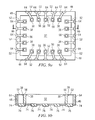
- FIGS. 12 a - 12 b illustrate top and side views of a semiconductor die with full-circle vias along the saw streets and vias formed in the active area of the die;
- FIG. 13 illustrates die-to-die stacking using direct metal-to-metal via bonding
- FIG. 14 illustrates die-to-die stacking using via bonding with solder paste
- FIG. 15 illustrates the semiconductor die with metal vias connected to a second die with wire bonds
- FIG. 16 illustrates the semiconductor die with metal vias connected to a second die with bond wires and solder bumps
- FIG. 17 illustrates another embodiment of interconnecting die using metal vias on saw streets and metal vias in the active area of the die.
- FIG. 18 illustrates another embodiment of interconnecting die using metal vias on saw streets and metal vias in the active area of the die.
- Front-end manufacturing generally refers to formation of the semiconductor devices on the wafer.
- the finished wafer has an active side containing the transistors and other active and passive components.
- Back-end manufacturing refers to cutting or singulating the finished wafer into the individual die and then packaging the die for structural support and/or environmental isolation.
- a semiconductor wafer generally includes an active front side surface having semiconductor devices disposed thereon, and a backside surface formed with bulk semiconductor material, e.g., silicon.
- the active front side surface contains a plurality of semiconductor die.
- the active surface is formed by a variety of semiconductor processes, including layering, patterning, doping, and heat treatment.
- semiconductor materials are grown or deposited on the substrate by techniques involving thermal oxidation, nitridation, chemical vapor deposition, evaporation, and sputtering. Patterning involves the use of photolithography to mask areas of the surface and etch away undesired material to form specific structures.
- the doping process injects concentrations of dopant material by thermal diffusion or ion implantation.
- the active surface is substantially planar and uniform with electrical interconnects, such as bond pads.
- Flip chip semiconductor packages and wafer level chip scale packages are commonly used with integrated circuits (ICs) demanding high speed, high density, and greater pin count.
- Flip chip style packaging involves mounting an active area of the die facedown toward a chip carrier substrate or printed circuit board (PCB).
- the active area contains active and passive devices, conductive layers, and dielectric layers according to the electrical design of the die.
- the electrical and mechanical interconnect is achieved through a solder bump structure comprising a large number of individual conductive solder bumps or balls.
- the solder bumps are formed on the bump pads which are disposed on the active area.
- the bump pads connect to the active circuits by conduction tracks or traces in the active area.
- the solder bumps are electrically and mechanically connected to the contact pads on the carrier substrate by a solder reflow process.
- the flip chip semiconductor package provides a short electrical conduction path from the active devices on the die to conduction tracks on the carrier substrate in order to reduce signal propagation, lower capacitance, and achieve overall better circuit performance.
- a WLP having through-hole vias (THV) formed along saw streets.
- the backside of the wafer has redistribution layers (RDL) for interconnect flexibility separated by repassivation layers.
- RDL redistribution layers
- WLP with THV formed along saw streets are described in U.S. patent application Ser. No. 11/744,657, entitled “Through-Hole Via on Saw Streets”, and further in U.S. patent application Ser. No. 11/768,844, entitled “Package on Package Using Through-Hole Via Die on Saw Streets”, which are incorporated herein by reference.
- a semiconductor wafer 30 having a plurality of die 32 .
- the die are separated by inter die wafer area 36 , commonly known as saw street guides.
- the saw street guides are routed around the wafer such that there is a saw street on every side of each die on the wafer, i.e., around a perimeter of the die.
- Each die 32 has a plurality to contact pads 38 formed on silicon, i.e., formed in an active area of die 32 and not in saw street guides 36 .
- Contact pads 38 are made of aluminum, copper, or aluminum/copper alloys. Contact pads 38 electrically connect to active and passive devices through conduction tracks or layers formed on die 32 .
- the contact pads can be disposed side-by-side a first distance from the edge of the die, as shown in FIG. 1 a .
- the contact pads can be offset in multiple rows such that a first row of contact pads are disposed a first distance from the edge of the die, and a second row of contact pads alternating with the first row are disposed a second distance from the edge of the die.
- a solder bump or wire bond will later be formed to connect to each metal contact pad for electrical and mechanical interconnect to a chip carrier substrate or printed circuit board (PCB).
- FIG. 1 b is a cross-sectional view of wafer 30 , taken along line 1 b - 1 b in FIG. 1 a , showing die 32 separated by saw street guides 36 .
- die 32 may have dimensions ranging from 2 ⁇ 2 millimeters (mm) to 15 ⁇ 15 mm.
- the saw streets provide cutting areas to singulate the wafer into individual die.
- a first die 32 is disposed to the left of the leftmost saw street 36 .
- a second die 32 is disposed between the saw streets 36 .
- a third die 32 is disposed to the right of the rightmost saw street 36 .
- FIG. 2 a semiconductor wafer 30 is again shown with its plurality of die 32 , separated by saw street guides 36 .
- Dicing tape 40 is applied to the back of semiconductor wafer 30 for structural support of the wafer during the following manufacturing operations, as shown in FIG. 2 b which is a cross-sectional view taken along line 2 b - 2 b .
- Saw streets 36 are cut by cutting tool 44 .
- cutting tool 44 can be a saw or laser. Note that the cutting tool completely severs through wafer 30 to form a well or trench 42 .
- the bottom of trench 42 is defined by dicing tape 40 .
- the formation of trench 42 arises from a first singulation of wafer 30 , which creates a trench width that is less than a width of the channel of saw street guide 36 .
- FIG. 3 a semiconductor wafer 30 is shown with its plurality of die 32 , separated by cut saw street guides 36 .
- Wafer 30 undergoes a wafer expansion step to increase the width of saw street guides 36 .
- FIG. 3 b is a cross-sectional view of wafer 30 , taken along line 3 b - 3 b , showing the die being pulled using a wafer expansion table as shown by directional arrows 46 .
- the die can be picked and placed onto a wafer support system. In any case, the die are positioned farther apart following the steps of FIGS. 3 a - 3 b to create wider saw street guides.
- the die separation increases from 50 micrometers ( ⁇ m) to 200 ⁇ m.
- the expanded dimension depends on the design embodiment, i.e. half via, full via, single row via, or double/multiple row via.
- FIG. 4 a semiconductor wafer 30 is shown with its plurality of die 32 , separated by cut saw street guides 36 .
- Organic material 48 is deposited in trench 42 by spin-coating or needle dispensing.
- Organic material 48 can be benzocyclobutene (BCB), polyimide (PI), or acrylic resin.
- FIG. 4 b is a cross-sectional view of wafer 30 , taken along line 4 b - 4 b , showing organic material 48 deposited in trench 42 .
- Organic material 48 fills trench 42 from dicing tape 40 up to the top surface of die 32 .
- the backside of wafer 30 is transferred onto wafer support system 49 , which is made from glass, silicon substrate, or other wafer support material.
- semiconductor wafer 30 is shown with its plurality of die 32 , separated by saw street guides 36 filled with organic material 48 .
- a via hole 50 is cut into organic material 48 along saw streets 36 .
- the via cutting operation uses a laser drill or etching process.
- Via holes 50 are placed along die 32 adjacent to contact pads 38 .
- contact pads 38 and via holes 50 have a minimum separation distance of about 20 ⁇ m to 150 ⁇ m, depending on the diameter and depth of the via.
- FIG. 5 b the cross-sectional view of wafer 30 , taken along line 5 b - 5 b , shows via holes 50 cut into organic material 48 down to wafer support system 49 .
- the laser drilling operation is centered about the channel of the saw street guide and makes a hole having a diameter less than the width of trench 42 , which leaves a layer of organic material 48 surrounding via hole 50 .
- the width of trench 42 is dependent on the width of saw street width, but typically smaller than the saw street width.
- the diameter of via hole 50 is typically about 10 ⁇ m to 100 ⁇ m, depending on the required via depth.
- via holes 53 are cut through contact pads 38 down through wafer 30 to wafer support system 49 .
- the laser drilling operation is centered about contact pad 38 and makes a hole having a diameter less than the width of the contact pad, which leaves part of the contact pad surrounding via hole 53 at the top of die 32 .
- via holes 53 are formed on silicon, i.e., through an active area of die 32 .
- a metal track or trace 52 is routed from each contact pad 38 to the corresponding via hole 50 .
- Trace 52 is formed by a metal patterning process to connect contact pads 38 to via holes 50 , which will be filled with conductive material in a later step. Traces 52 are provided for each contact pad and via hole pairing as shown. Some via holes 50 are dummy vias performing no electrical function. Accordingly, metal trace 52 need not be routed to every via depending on the device function.
- semiconductor wafer 30 is shown with its plurality of die 32 , separated by saw street guides 36 with metal-filled vias 54 and 56 .
- a conductive material is deposited into via holes 50 through a deposition process such as plating or plugging to form metal vias 54 .
- the same conductive material is also deposited into via holes 53 to form metal vias 56 .
- Metal vias 56 are formed through an active area of die 32 .
- the conductive material can be copper (Cu), aluminum (Al), tungsten (W), or alloys thereof, or mixtures of other conductive materials.
- Metal vias 54 are formed in and are surrounded by organic material 48 .
- Metal vias 56 are formed in and are surrounded by contact pad 38 and the active area of wafer 30 .
- Metal via 54 electrically connects to contact pad 38 by way of trace 52 . Traces 52 are provided for each contact pad and metal via pairing as shown.
- FIG. 6 b is a cross-sectional view of wafer 30 , taken along line 6 b - 6 b , showing metal vias 54 electrically connecting to contact pads 38 through traces 52 , and metal vias 56 electrically connecting to contact pads 38 directly.
- Wafer support system 49 is replaced with dicing tape 58 for structural support of the wafer during the second or final singulation to separate die 32 .
- the bottom of metal vias 54 and 56 coincides with dicing tape 58 .
- a redistribution layer can be formed on the backside of wafer 30 .
- the backside RDL operates as an intermediate conductive layer to route electrical signals to various areas of the die, including active and passive circuits, and provides various electrical interconnect options during package integration, such as shown in FIGS. 15-18 .
- a repassivation layer is formed between the individual nodes of the backside RDL for electrical isolation. The formation of backside RDL and repassivation layer is disclosed in U.S. patent application Ser. No. 11/861,244 (Pending), entitled “Semiconductor Wafer having Through Hole Vias on Saw Streets with backside redistribution layer.”
- metal vias 54 are cut through center area 68 by cutting tool 70 .
- cutting tool 70 can be a saw or laser. The cut extends down to dicing tape 58 to completely sever metal vias 54 into two equal half-circle vias 64 .
- a pick and place operation removes die 32 as individual units from dicing tape 58 .
- FIG. 8 a semiconductor die 32 is shown with both metal vias 64 on saw streets and through silicon metal vias 56 .
- FIG. 8 b is a cross-sectional view of die 32 , taken along line 8 b - 8 b , showing metal vias formed through silicon of die 32 and metal vias on saw street configuration, as produced by the manufacturing steps of FIGS. 1-7 .
- FIG. 9 a semiconductor die 32 is shown with through silicon metal vias 56 and further metal vias 64 on saw streets.
- FIG. 9 b is a cross-sectional view of die 32 , taken along line 9 b - 9 b , showing metal vias formed through silicon of die 32 and metal vias on saw street configuration, as produced by the manufacturing steps of FIGS. 1-7 .
- RDL 74 and repassivation layer 76 are shown on the backside of die 32 .
- RDL 74 can be made with nickel (Ni), nickel vanadium (NiV), Cu, or Cu alloy.
- RDL 74 operates as an intermediate conductive layer to route electrical signals to various areas of the die, including active and passive circuits, and provides various electrical interconnect options during package integration, such as shown in FIGS.
- Repassivation layer 76 is formed between the individual nodes of backside RDL 74 for electrical isolation.
- the repassivation layer can be made with silicon nitride (SiN), silicon dioxide (SiO2), silicon oxynitride (SiON), polyimide, benzocyclobutene (BCB), polybenzoxazole (PBO), or other insulating material.
- FIG. 10 a semiconductor die 32 is shown with contact pads 38 connected to metal vias 80 by traces 52 .
- FIG. 10 b is a cross-sectional view of die 32 , taken along line 10 b - 10 b, showing metal vias 80 along saw street 36 .
- the metal via is produced by the steps described in FIGS. 1-7 , with the exception that two via holes like 50 are formed side-by-side in organic material 48 .
- the side-by-side via holes 50 are separated by organic material 48 .
- Conductive traces 52 connect contact pads 38 and via holes 50 .
- the side-by-side via holes are filled with conductive material to form metal vias 80 .
- semiconductor die 32 is shown with contact pads 38 connected to metal vias 80 by traces 52 .
- Dicing tape is applied to the back of semiconductor wafer 30 for structural support of the wafer during the final singulation to separate die 32 , as shown in FIG. 11 b which is a cross-sectional view taken along line 11 b - 11 b .
- the second or final singulation to separate the plurality of die 32 is cut through organic material 48 along line 82 between the side-by-side vias 80 with a cutting tool like 70 .
- the singulation between metal vias 80 results in the metal vias on saw street configuration in combination with through silicon vias 56 .
- FIG. 12 a semiconductor die 32 is shown with contact pads 38 connected to metal vias 80 by traces 52 .
- FIG. 12 b is a cross-sectional view of die 32 , taken along line 12 b - 12 b, showing metal vias on saw street configuration. The metal full-circle vias are produced by the steps described in FIGS. 1-7 and 10 - 11 .
- the side-by-side via holes like 50 are separated by organic material 48 .
- Conductive traces like 52 electrically connect the contact pads and via holes.
- the side-by-side via holes are filled with conductive material to form metal vias 80 .
- the final singulation to separate the plurality of die 32 is cut through organic material 48 between the side-by-side metal vias 80 resulting in the metal via on saw street configuration in combination with through silicon vias 56 .
- FIG. 13 illustrates direct die-to-die stacking using direct via metal bonding.
- a plurality of die 32 is stacked as shown to suit a particular application.
- Each of the metal half-vias 64 and through silicon vias 56 can be joined together as shown by union 90 using a direct via metal bonding process.
- the combination of vias 64 and 56 provide greater interconnect flexibility and options for electrically connecting the stacked die 32 .
- semiconductor die 32 with metal full-vias 80 and through silicon vias 56 can be joined together by union 90 using a direct via metal bonding process.
- FIG. 14 illustrates die-to-die stacking using via bonding with solder paste 92 .
- a plurality of die 32 is stacked as shown to suit a particular application.
- Each of the metal vias 64 and through silicon vias 56 can be joined together as shown by reflowing solder paste 92 to create a strong metallurgical bond between each of stacked die 32 .
- the combination of vias 64 and 56 provide greater interconnect flexibility and options for electrically connecting the stacked die 32 .
- semiconductor die 32 with metal vias 80 and through silicon vias 56 can be joined together by solder paste 92 using a reflow process.
- FIGS. 15-18 shows various packaging applications using, in part, an interconnect technique with the THVs formed on saw streets and THVs on silicon.
- FIG. 15 has semiconductor die 100 attached to die 32 with adhesive 102 .
- Die 100 electrically connects through wire bonds 104 to metal vias 64 on die 32 .
- Die 32 is supported by substrate 106 .
- Metal vias 64 and 56 electrically connect to solder bumps 108 through conductive layer 110 .
- the packages are sealed by epoxy encapsulant 112 .
- FIG. 16 shows semiconductor die 120 attached to die 122 with adhesive 124 .
- Die 120 electrically connects through wire bonds 126 to metal vias 64 on die 32 .
- Die 122 electrically connects through solder bumps 128 to metal vias 56 on die 32 .
- Die 32 is supported by substrate 130 .
- Metal vias 64 and 56 electrically connect to solder bumps 132 through conductive layer 134 .
- the packages are sealed by epoxy encapsulant 136 .
- FIG. 17 shows semiconductor die 140 electrically connected to metal vias 64 or 80 on die 32 by way of bond wires 152 .
- Semiconductor die 154 electrically connects to metal vias 64 and 56 on die 32 by way of wire bonds 156 and conductive layer 158 .
- Die 32 and 140 are supported by substrate 160 .
- the entire assembly is mounted to substrate 161 .
- Wire bonds 162 from substrate 160 provide the electrical connection to solder bumps 164 through conductive layer 166 .
- the packages are encased by epoxy encapsulant 168 .
- Molding compound 170 encapsulates die 154 .
- FIG. 18 shows semiconductor die 180 electrically connected to die 32 with solder bumps 182 .
- Passive devices 184 also connect to metal vias 64 with solder paste 186 .
- Die 32 is mounted to a semiconductor package containing die 190 with adhesive 192 .
- Die 190 electrically connects to solder bumps 200 through wire bonds 194 , conductive layer 196 , and conductive layer 198 .
- the assembly of semiconductor die 32 , 180 , and 190 are supported by substrate 202 .
- Metal vias 56 electrically connect to solder bumps 200 through wire bonds 204 and conductive layer 198 .
- the packages are sealed by epoxy encapsulant 206 .
- An underfill material 208 provides stress relief.
- stackable semiconductor die has been described with THVs formed in the saw streets and THVs formed on silicon.
- the electrical interconnect is accomplished using the THVs on saw streets and THVs on silicon, in addition to a redistribution layer, separated by a repassivation layer, to increase signal routing options and density.
- the THVs on saw streets and THVs on silicon, in addition to the RDLs, provide more signal routing functionality and flexibility within the package.
Landscapes
- Internal Circuitry In Semiconductor Integrated Circuit Devices (AREA)
- Engineering & Computer Science (AREA)
- Manufacturing & Machinery (AREA)
- Power Engineering (AREA)
Abstract
Description
Claims (30)
Priority Applications (1)
| Application Number | Priority Date | Filing Date | Title |
|---|---|---|---|
| US13/021,856 US8815643B2 (en) | 2007-05-04 | 2011-02-07 | Method of fabricating semiconductor die with through-hole via on saw streets and through-hole via in active area of die |
Applications Claiming Priority (4)
| Application Number | Priority Date | Filing Date | Title |
|---|---|---|---|
| US11/744,657 US7569421B2 (en) | 2007-05-04 | 2007-05-04 | Through-hole via on saw streets |
| US11/768,844 US7723159B2 (en) | 2007-05-04 | 2007-06-26 | Package-on-package using through-hole via die on saw streets |
| US11/861,251 US7902638B2 (en) | 2007-05-04 | 2007-09-25 | Semiconductor die with through-hole via on saw streets and through-hole via in active area of die |
| US13/021,856 US8815643B2 (en) | 2007-05-04 | 2011-02-07 | Method of fabricating semiconductor die with through-hole via on saw streets and through-hole via in active area of die |
Related Parent Applications (1)
| Application Number | Title | Priority Date | Filing Date |
|---|---|---|---|
| US11/861,251 Division US7902638B2 (en) | 2007-05-04 | 2007-09-25 | Semiconductor die with through-hole via on saw streets and through-hole via in active area of die |
Publications (3)
| Publication Number | Publication Date |
|---|---|
| US20110124156A1 US20110124156A1 (en) | 2011-05-26 |
| US20120244661A9 US20120244661A9 (en) | 2012-09-27 |
| US8815643B2 true US8815643B2 (en) | 2014-08-26 |
Family
ID=40586523
Family Applications (2)
| Application Number | Title | Priority Date | Filing Date |
|---|---|---|---|
| US11/861,251 Active 2029-02-11 US7902638B2 (en) | 2007-05-04 | 2007-09-25 | Semiconductor die with through-hole via on saw streets and through-hole via in active area of die |
| US13/021,856 Active 2027-09-25 US8815643B2 (en) | 2007-05-04 | 2011-02-07 | Method of fabricating semiconductor die with through-hole via on saw streets and through-hole via in active area of die |
Family Applications Before (1)
| Application Number | Title | Priority Date | Filing Date |
|---|---|---|---|
| US11/861,251 Active 2029-02-11 US7902638B2 (en) | 2007-05-04 | 2007-09-25 | Semiconductor die with through-hole via on saw streets and through-hole via in active area of die |
Country Status (4)
| Country | Link |
|---|---|
| US (2) | US7902638B2 (en) |
| KR (1) | KR101555708B1 (en) |
| SG (2) | SG151167A1 (en) |
| TW (1) | TWI373110B (en) |
Cited By (2)
| Publication number | Priority date | Publication date | Assignee | Title |
|---|---|---|---|---|
| US9324659B2 (en) * | 2011-08-01 | 2016-04-26 | Stats Chippac, Ltd. | Semiconductor device and method of forming POP with stacked semiconductor die and bumps formed directly on the lower die |
| US10756062B2 (en) | 2018-07-09 | 2020-08-25 | Samsung Electronics Co., Ltd. | Semiconductor chip and semiconductor package including the same |
Families Citing this family (50)
| Publication number | Priority date | Publication date | Assignee | Title |
|---|---|---|---|---|
| KR101185886B1 (en) * | 2007-07-23 | 2012-09-25 | 삼성전자주식회사 | Semiconductor chip, semiconductor package, card and system having universal interconnection lines |
| US7972902B2 (en) * | 2007-07-23 | 2011-07-05 | Samsung Electronics Co., Ltd. | Method of manufacturing a wafer including providing electrical conductors isolated from circuitry |
| KR101469770B1 (en) * | 2007-11-21 | 2014-12-09 | 페어차일드코리아반도체 주식회사 | Power device package and manufacturing method thereof |
| KR101465948B1 (en) * | 2007-12-27 | 2014-12-10 | 삼성전자주식회사 | A wafer level stack package and method of manufacturing a wafer level stack package |
| US8072079B2 (en) | 2008-03-27 | 2011-12-06 | Stats Chippac, Ltd. | Through hole vias at saw streets including protrusions or recesses for interconnection |
| US7704796B2 (en) * | 2008-06-04 | 2010-04-27 | Stats Chippac, Ltd. | Semiconductor device and method of forming recessed conductive vias in saw streets |
| US8021907B2 (en) | 2008-06-09 | 2011-09-20 | Stats Chippac, Ltd. | Method and apparatus for thermally enhanced semiconductor package |
| US7888184B2 (en) * | 2008-06-20 | 2011-02-15 | Stats Chippac Ltd. | Integrated circuit packaging system with embedded circuitry and post, and method of manufacture thereof |
| US8080885B2 (en) * | 2008-11-19 | 2011-12-20 | Stats Chippac Ltd. | Integrated circuit packaging system with multi level contact and method of manufacture thereof |
| US7982298B1 (en) * | 2008-12-03 | 2011-07-19 | Amkor Technology, Inc. | Package in package semiconductor device |
| US8093711B2 (en) * | 2009-02-02 | 2012-01-10 | Infineon Technologies Ag | Semiconductor device |
| KR20100096879A (en) * | 2009-02-25 | 2010-09-02 | 삼성전자주식회사 | Devices including copper pads, stacked structures thereof and methods of manufacturing the same |
| US7847382B2 (en) * | 2009-03-26 | 2010-12-07 | Stats Chippac Ltd. | Integrated circuit packaging system with package stacking and method of manufacture thereof |
| US20110068478A1 (en) * | 2009-03-26 | 2011-03-24 | Reza Argenty Pagaila | Integrated circuit packaging system with package stacking and method of manufacture thereof |
| US20100270668A1 (en) * | 2009-04-28 | 2010-10-28 | Wafer-Level Packaging Portfolio Llc | Dual Interconnection in Stacked Memory and Controller Module |
| US8098462B2 (en) * | 2009-06-19 | 2012-01-17 | Tdk Corporation | Manufacturing method of thin-film magnetic head, wafer for thin-film magnetic head and thin-film magnetic head |
| US8587129B2 (en) * | 2009-07-31 | 2013-11-19 | Stats Chippac Ltd. | Integrated circuit packaging system with through silicon via base and method of manufacture thereof |
| US8803332B2 (en) * | 2009-09-11 | 2014-08-12 | Taiwan Semiconductor Manufacturing Company, Ltd. | Delamination resistance of stacked dies in die saw |
| US7867821B1 (en) | 2009-09-18 | 2011-01-11 | Stats Chippac Ltd. | Integrated circuit package system with through semiconductor vias and method of manufacture thereof |
| US8822281B2 (en) * | 2010-02-23 | 2014-09-02 | Stats Chippac, Ltd. | Semiconductor device and method of forming TMV and TSV in WLCSP using same carrier |
| US9275934B2 (en) | 2010-03-03 | 2016-03-01 | Georgia Tech Research Corporation | Through-package-via (TPV) structures on inorganic interposer and methods for fabricating same |
| US20120007211A1 (en) * | 2010-07-06 | 2012-01-12 | Aleksandar Aleksov | In-street die-to-die interconnects |
| KR101683814B1 (en) | 2010-07-26 | 2016-12-08 | 삼성전자주식회사 | Semiconductor apparatus having through vias |
| DE102010041129A1 (en) * | 2010-09-21 | 2012-03-22 | Robert Bosch Gmbh | Multifunction sensor as PoP mWLP |
| US9266721B2 (en) | 2010-11-23 | 2016-02-23 | Robert Bosch Gmbh | Eutectic bonding of thin chips on a carrier substrate |
| US8883561B2 (en) | 2011-04-30 | 2014-11-11 | Stats Chippac, Ltd. | Semiconductor device and method of embedding TSV semiconductor die within encapsulant with TMV for vertical interconnect in POP |
| US9418876B2 (en) | 2011-09-02 | 2016-08-16 | Taiwan Semiconductor Manufacturing Company, Ltd. | Method of three dimensional integrated circuit assembly |
| US9245773B2 (en) | 2011-09-02 | 2016-01-26 | Taiwan Semiconductor Manufacturing Company, Ltd. | Semiconductor device packaging methods and structures thereof |
| US9704725B1 (en) | 2012-03-06 | 2017-07-11 | Amkor Technology, Inc. | Semiconductor device with leadframe configured to facilitate reduced burr formation |
| US8664768B2 (en) * | 2012-05-03 | 2014-03-04 | Taiwan Semiconductor Manufacturing Company, Ltd. | Interposer having a defined through via pattern |
| US9136213B2 (en) * | 2012-08-02 | 2015-09-15 | Infineon Technologies Ag | Integrated system and method of making the integrated system |
| KR101486790B1 (en) | 2013-05-02 | 2015-01-28 | 앰코 테크놀로지 코리아 주식회사 | Micro Lead Frame for semiconductor package |
| KR102053349B1 (en) | 2013-05-16 | 2019-12-06 | 삼성전자주식회사 | Semiconductor package |
| KR101563911B1 (en) | 2013-10-24 | 2015-10-28 | 앰코 테크놀로지 코리아 주식회사 | Semiconductor package |
| US9524942B2 (en) * | 2013-12-18 | 2016-12-20 | Taiwan Semiconductor Manufacturing Company, Ltd. | Chip-on-substrate packaging on carrier |
| US9196592B2 (en) | 2014-01-10 | 2015-11-24 | International Business Machines Corporation | Methods of managing metal density in dicing channel and related integrated circuit structures |
| US9610543B2 (en) * | 2014-01-31 | 2017-04-04 | Infineon Technologies Ag | Method for simultaneous structuring and chip singulation |
| US9673122B2 (en) | 2014-05-02 | 2017-06-06 | Amkor Technology, Inc. | Micro lead frame structure having reinforcing portions and method |
| US9691634B2 (en) | 2015-04-02 | 2017-06-27 | Abexl Inc. | Method for creating through-connected vias and conductors on a substrate |
| US10593562B2 (en) | 2015-04-02 | 2020-03-17 | Samtec, Inc. | Method for creating through-connected vias and conductors on a substrate |
| US12087629B2 (en) | 2015-05-18 | 2024-09-10 | Adeia Semiconductor Technologies Llc | Through-dielectric-vias (TDVs) for 3D integrated circuits in silicon |
| KR102470168B1 (en) * | 2015-12-08 | 2022-11-23 | 삼성전기주식회사 | Package substrate |
| CN107686092A (en) * | 2016-08-04 | 2018-02-13 | 北京卓锐微技术有限公司 | Crystal circle structure and wafer processing method |
| JP2018081945A (en) * | 2016-11-14 | 2018-05-24 | ソニーセミコンダクタソリューションズ株式会社 | Solid-state imaging device, manufacturing method thereof, and electronic device |
| CN112154538A (en) | 2018-03-30 | 2020-12-29 | 申泰公司 | Conductive via and method of making same |
| CN111682003B (en) * | 2019-03-11 | 2024-04-19 | 奥特斯奥地利科技与系统技术有限公司 | Component carrier comprising a component with a vertical through connection |
| US11424212B2 (en) | 2019-07-17 | 2022-08-23 | Advanced Semiconductor Engineering, Inc. | Semiconductor package structure and method for manufacturing the same |
| WO2021067330A2 (en) | 2019-09-30 | 2021-04-08 | Samtec, Inc. | Electrically conductive vias and methods for producing same |
| US11456289B2 (en) * | 2019-12-27 | 2022-09-27 | Micron Technology, Inc. | Face-to-face semiconductor device with fan-out porch |
| US20210375845A1 (en) * | 2020-05-27 | 2021-12-02 | Qualcomm Incorporated | Package cavity for enhanced device performance with an integrated passive device |
Citations (13)
| Publication number | Priority date | Publication date | Assignee | Title |
|---|---|---|---|---|
| US5694551A (en) | 1993-05-20 | 1997-12-02 | Moore Business Forms, Inc. | Computer integration network for channeling customer orders through a centralized computer to various suppliers |
| US6157915A (en) | 1998-08-07 | 2000-12-05 | International Business Machines Corporation | Method and apparatus for collaboratively managing supply chains |
| US20020013721A1 (en) | 2000-05-22 | 2002-01-31 | Alan Dabbiere | System, method and apparatus for integrated supply chain management |
| US20020019761A1 (en) | 2000-01-12 | 2002-02-14 | Derek Lidow | Supply chain architecture |
| US20020042755A1 (en) | 2000-10-05 | 2002-04-11 | I2 Technologies, Us, Inc. | Collaborative fulfillment in a distributed supply chain environment |
| US20020049622A1 (en) | 2000-04-27 | 2002-04-25 | Lettich Anthony R. | Vertical systems and methods for providing shipping and logistics services, operations and products to an industry |
| US6400008B1 (en) | 1996-02-16 | 2002-06-04 | Micron Technology, Inc. | Surface mount ic using silicon vias in an area array format or same size as die array |
| US6743696B2 (en) | 2001-10-16 | 2004-06-01 | Micron Technology, Inc. | Apparatus and method for leadless packaging of semiconductor devices |
| US20040110323A1 (en) * | 2002-10-30 | 2004-06-10 | Karl-Friedrich Becker | Method for producing encapsulated chips |
| US20050186705A1 (en) | 2002-07-31 | 2005-08-25 | Jackson Timothy L. | Semiconductor dice having backside redistribution layer accessed using through-silicon vias, methods |
| US20060019467A1 (en) * | 2004-07-23 | 2006-01-26 | In-Young Lee | Methods of fabricating integrated circuit chips for multi-chip packaging and wafers and chips formed thereby |
| US20060043533A1 (en) * | 2004-08-24 | 2006-03-02 | Lake Rickie C | Wafer backside removal to complete through-holes and provide wafer singulation during the formation of a semiconductor device |
| US7506438B1 (en) * | 2000-11-14 | 2009-03-24 | Freescale Semiconductor, Inc. | Low profile integrated module interconnects and method of fabrication |
Family Cites Families (2)
| Publication number | Priority date | Publication date | Assignee | Title |
|---|---|---|---|---|
| US6943056B2 (en) * | 2002-04-16 | 2005-09-13 | Renesas Technology Corp. | Semiconductor device manufacturing method and electronic equipment using same |
| JP2004221372A (en) | 2003-01-16 | 2004-08-05 | Seiko Epson Corp | Semiconductor device, semiconductor module, electronic device, method of manufacturing semiconductor device, and method of manufacturing semiconductor module |
-
2007
- 2007-09-25 US US11/861,251 patent/US7902638B2/en active Active
-
2008
- 2008-08-08 TW TW097130210A patent/TWI373110B/en active
- 2008-08-13 SG SG200806002-2A patent/SG151167A1/en unknown
- 2008-08-13 SG SG201101669-8A patent/SG170083A1/en unknown
- 2008-09-23 KR KR1020080093390A patent/KR101555708B1/en active Active
-
2011
- 2011-02-07 US US13/021,856 patent/US8815643B2/en active Active
Patent Citations (13)
| Publication number | Priority date | Publication date | Assignee | Title |
|---|---|---|---|---|
| US5694551A (en) | 1993-05-20 | 1997-12-02 | Moore Business Forms, Inc. | Computer integration network for channeling customer orders through a centralized computer to various suppliers |
| US6400008B1 (en) | 1996-02-16 | 2002-06-04 | Micron Technology, Inc. | Surface mount ic using silicon vias in an area array format or same size as die array |
| US6157915A (en) | 1998-08-07 | 2000-12-05 | International Business Machines Corporation | Method and apparatus for collaboratively managing supply chains |
| US20020019761A1 (en) | 2000-01-12 | 2002-02-14 | Derek Lidow | Supply chain architecture |
| US20020049622A1 (en) | 2000-04-27 | 2002-04-25 | Lettich Anthony R. | Vertical systems and methods for providing shipping and logistics services, operations and products to an industry |
| US20020013721A1 (en) | 2000-05-22 | 2002-01-31 | Alan Dabbiere | System, method and apparatus for integrated supply chain management |
| US20020042755A1 (en) | 2000-10-05 | 2002-04-11 | I2 Technologies, Us, Inc. | Collaborative fulfillment in a distributed supply chain environment |
| US7506438B1 (en) * | 2000-11-14 | 2009-03-24 | Freescale Semiconductor, Inc. | Low profile integrated module interconnects and method of fabrication |
| US6743696B2 (en) | 2001-10-16 | 2004-06-01 | Micron Technology, Inc. | Apparatus and method for leadless packaging of semiconductor devices |
| US20050186705A1 (en) | 2002-07-31 | 2005-08-25 | Jackson Timothy L. | Semiconductor dice having backside redistribution layer accessed using through-silicon vias, methods |
| US20040110323A1 (en) * | 2002-10-30 | 2004-06-10 | Karl-Friedrich Becker | Method for producing encapsulated chips |
| US20060019467A1 (en) * | 2004-07-23 | 2006-01-26 | In-Young Lee | Methods of fabricating integrated circuit chips for multi-chip packaging and wafers and chips formed thereby |
| US20060043533A1 (en) * | 2004-08-24 | 2006-03-02 | Lake Rickie C | Wafer backside removal to complete through-holes and provide wafer singulation during the formation of a semiconductor device |
Non-Patent Citations (4)
| Title |
|---|
| "Separate." Dictionary.com Unabridged. Random House, Inc. May 28, 2013. . * |
| "Separate." Dictionary.com Unabridged. Random House, Inc. May 28, 2013. <Dictionary.com http://dictionary.reference.com/browse/separate>. * |
| "Through." Dictionary.com Unabridged. Random House, Inc. May 28, 2013. . * |
| "Through." Dictionary.com Unabridged. Random House, Inc. May 28, 2013. <Dictionary.com http://dictionary.reference.com/browse/through>. * |
Cited By (2)
| Publication number | Priority date | Publication date | Assignee | Title |
|---|---|---|---|---|
| US9324659B2 (en) * | 2011-08-01 | 2016-04-26 | Stats Chippac, Ltd. | Semiconductor device and method of forming POP with stacked semiconductor die and bumps formed directly on the lower die |
| US10756062B2 (en) | 2018-07-09 | 2020-08-25 | Samsung Electronics Co., Ltd. | Semiconductor chip and semiconductor package including the same |
Also Published As
| Publication number | Publication date |
|---|---|
| US20120244661A9 (en) | 2012-09-27 |
| TW200915509A (en) | 2009-04-01 |
| SG151167A1 (en) | 2009-04-30 |
| TWI373110B (en) | 2012-09-21 |
| US20110124156A1 (en) | 2011-05-26 |
| US20080272465A1 (en) | 2008-11-06 |
| KR20090031829A (en) | 2009-03-30 |
| KR101555708B1 (en) | 2015-09-25 |
| US7902638B2 (en) | 2011-03-08 |
| SG170083A1 (en) | 2011-04-29 |
Similar Documents
| Publication | Publication Date | Title |
|---|---|---|
| US8815643B2 (en) | Method of fabricating semiconductor die with through-hole via on saw streets and through-hole via in active area of die | |
| US9177848B2 (en) | Semiconductor wafer having through-hole vias on saw streets with backside redistribution layer | |
| US8021923B2 (en) | Semiconductor package having through-hole vias on saw streets formed with partial saw | |
| US9331002B2 (en) | Semiconductor device and method of forming through vias with reflowed conductive material | |
| US7666711B2 (en) | Semiconductor device and method of forming double-sided through vias in saw streets | |
| US8557639B2 (en) | Apparatus for thermally enhanced semiconductor package | |
| US8525344B2 (en) | Semiconductor device and method of forming bond wires between semiconductor die contact pads and conductive TOV in peripheral area around semiconductor die | |
| US8072079B2 (en) | Through hole vias at saw streets including protrusions or recesses for interconnection | |
| US9252075B2 (en) | Semiconductor device and method of forming a conductive via-in-via structure | |
| US7659145B2 (en) | Semiconductor device and method of forming stepped-down RDL and recessed THV in peripheral region of the device | |
| US9601369B2 (en) | Semiconductor device and method of forming conductive vias with trench in saw street |
Legal Events
| Date | Code | Title | Description |
|---|---|---|---|
| STCF | Information on status: patent grant |
Free format text: PATENTED CASE |
|
| AS | Assignment |
Owner name: CITICORP INTERNATIONAL LIMITED, AS COMMON SECURITY AGENT, HONG KONG Free format text: SECURITY INTEREST;ASSIGNORS:STATS CHIPPAC, INC.;STATS CHIPPAC LTD.;REEL/FRAME:036288/0748 Effective date: 20150806 Owner name: CITICORP INTERNATIONAL LIMITED, AS COMMON SECURITY Free format text: SECURITY INTEREST;ASSIGNORS:STATS CHIPPAC, INC.;STATS CHIPPAC LTD.;REEL/FRAME:036288/0748 Effective date: 20150806 |
|
| AS | Assignment |
Owner name: STATS CHIPPAC PTE. LTE., SINGAPORE Free format text: CHANGE OF NAME;ASSIGNOR:STATS CHIPPAC LTD.;REEL/FRAME:038378/0208 Effective date: 20160329 Owner name: STATS CHIPPAC PTE. LTE., SINGAPORE Free format text: CHANGE OF NAME;ASSIGNOR:STATS CHIPPAC LTD.;REEL/FRAME:038378/0343 Effective date: 20160329 |
|
| MAFP | Maintenance fee payment |
Free format text: PAYMENT OF MAINTENANCE FEE, 4TH YEAR, LARGE ENTITY (ORIGINAL EVENT CODE: M1551) Year of fee payment: 4 |
|
| AS | Assignment |
Owner name: STATS CHIPPAC, INC., CALIFORNIA Free format text: RELEASE BY SECURED PARTY;ASSIGNOR:CITICORP INTERNATIONAL LIMITED, AS COMMON SECURITY AGENT;REEL/FRAME:051285/0318 Effective date: 20190503 Owner name: STATS CHIPPAC PTE. LTD. FORMERLY KNOWN AS STATS CH Free format text: RELEASE BY SECURED PARTY;ASSIGNOR:CITICORP INTERNATIONAL LIMITED, AS COMMON SECURITY AGENT;REEL/FRAME:051285/0318 Effective date: 20190503 Owner name: STATS CHIPPAC PTE. LTD. FORMERLY KNOWN AS STATS CHIPPAC LTD., SINGAPORE Free format text: RELEASE BY SECURED PARTY;ASSIGNOR:CITICORP INTERNATIONAL LIMITED, AS COMMON SECURITY AGENT;REEL/FRAME:051285/0318 Effective date: 20190503 |
|
| AS | Assignment |
Owner name: JCET SEMICONDUCTOR (SHAOXING) CO., LTD., CHINA Free format text: ASSIGNMENT OF ASSIGNORS INTEREST;ASSIGNOR:STATS CHIPPAC PTE. LTD.;REEL/FRAME:051365/0680 Effective date: 20191128 |
|
| MAFP | Maintenance fee payment |
Free format text: PAYMENT OF MAINTENANCE FEE, 8TH YEAR, LARGE ENTITY (ORIGINAL EVENT CODE: M1552); ENTITY STATUS OF PATENT OWNER: LARGE ENTITY Year of fee payment: 8 |
|
| AS | Assignment |
Owner name: STATS CHIPPAC PTE. LTD., SINGAPORE Free format text: CORRECTIVE ASSIGNMENT TO CORRECT THE CORRECT THE SPELLING OF ASSIGNEE'S NAME FROM "STATS CHIPPAC PTE. LTE." TO "STATS CHIPPAC PTE. LTD." PREVIOUSLY RECORDED AT REEL: 038378 FRAME: 0208. ASSIGNOR(S) HEREBY CONFIRMS THE ASSIGNMENT;ASSIGNOR:STATS CHIPPAC LTD.;REEL/FRAME:064803/0387 Effective date: 20160329 |
|
| MAFP | Maintenance fee payment |
Free format text: PAYMENT OF MAINTENANCE FEE, 12TH YEAR, LARGE ENTITY (ORIGINAL EVENT CODE: M1553); ENTITY STATUS OF PATENT OWNER: LARGE ENTITY Year of fee payment: 12 |