US8804550B2 - Method and apparatus for reuse of adaptive partial frequency in a cellular mobile communication system - Google Patents
Method and apparatus for reuse of adaptive partial frequency in a cellular mobile communication system Download PDFInfo
- Publication number
- US8804550B2 US8804550B2 US12/992,277 US99227709A US8804550B2 US 8804550 B2 US8804550 B2 US 8804550B2 US 99227709 A US99227709 A US 99227709A US 8804550 B2 US8804550 B2 US 8804550B2
- Authority
- US
- United States
- Prior art keywords
- interference
- terminal
- cell
- feedback information
- bands
- Prior art date
- Legal status (The legal status is an assumption and is not a legal conclusion. Google has not performed a legal analysis and makes no representation as to the accuracy of the status listed.)
- Active, expires
Links
Images


Classifications
-
- H—ELECTRICITY
- H04—ELECTRIC COMMUNICATION TECHNIQUE
- H04W—WIRELESS COMMUNICATION NETWORKS
- H04W16/00—Network planning, e.g. coverage or traffic planning tools; Network deployment, e.g. resource partitioning or cells structures
- H04W16/02—Resource partitioning among network components, e.g. reuse partitioning
- H04W16/10—Dynamic resource partitioning
-
- H—ELECTRICITY
- H04—ELECTRIC COMMUNICATION TECHNIQUE
- H04W—WIRELESS COMMUNICATION NETWORKS
- H04W72/00—Local resource management
- H04W72/50—Allocation or scheduling criteria for wireless resources
- H04W72/54—Allocation or scheduling criteria for wireless resources based on quality criteria
- H04W72/541—Allocation or scheduling criteria for wireless resources based on quality criteria using the level of interference
-
- H—ELECTRICITY
- H04—ELECTRIC COMMUNICATION TECHNIQUE
- H04W—WIRELESS COMMUNICATION NETWORKS
- H04W52/00—Power management, e.g. Transmission Power Control [TPC] or power classes
- H04W52/04—Transmission power control [TPC]
- H04W52/18—TPC being performed according to specific parameters
- H04W52/24—TPC being performed according to specific parameters using SIR [Signal to Interference Ratio] or other wireless path parameters
- H04W52/243—TPC being performed according to specific parameters using SIR [Signal to Interference Ratio] or other wireless path parameters taking into account interferences
-
- H—ELECTRICITY
- H04—ELECTRIC COMMUNICATION TECHNIQUE
- H04W—WIRELESS COMMUNICATION NETWORKS
- H04W72/00—Local resource management
- H04W72/04—Wireless resource allocation
- H04W72/044—Wireless resource allocation based on the type of the allocated resource
- H04W72/0473—Wireless resource allocation based on the type of the allocated resource the resource being transmission power
Definitions
- the present invention relates to a cellular mobile communication system, and more particularly to an adaptive partial frequency reuse method and apparatus in a cellular mobile communication system.
- a cellular communication system In general, in order to efficiently use limited frequency resources, a cellular communication system employs the same frequency resource in two spatially distant areas. Such use of the same frequency resource in two distant areas is referred to as “frequency reuse”.
- frequency reuse a frequency reuse scheme in a cellular mobile communication system will be described with reference to FIG. 1 .
- all node Bs 115 , 125 , 135 use the same frequency band f 1 to provide communication services to mobile terminals located in corresponding cells A, B, and C 110 , 120 , 130 .
- the frequency reuse factor is 1.
- using the frequency reuse factor of 1 causes the terminal to be much affected by interference from neighbor cells because all cells A, B, and C use the same frequency band f 1 . Accordingly, there is a problem in that using the frequency reuse factor of 1 limits a data transfer rate serviceable to terminals located in a cell boundary.
- FIG. 2 is a view for explaining a power allocation state according to frequency sub-bands of cells A and B when the frequency reuse factor is 1, as shown in FIG. 1 .
- the same power is allocated to sub-bands 1 , 2 , and 3 for both cell A and cell B.
- a terminal located in a boundary between cell A and cell B makes communication in sub-band 1
- the present invention has been made to solve the above-mentioned problems occurring in the prior art, and the present invention provides a system and method for maximizing a frequency reuse factor by adaptively controlling transmit power of neighbor base stations.
- the present invention provides a system and method for increasing a data transfer rate for terminals located in a cell boundary.
- an adaptive partial frequency reuse method in a mobile communication system including at least one base station using the same frequency band and a central controller for coordinately controlling the at least one base station, the adaptive partial frequency reuse method including the steps of: receiving interference feedback information transmitted from at least one terminal; determining if there is a terminal located in a cell boundary, based on the received interference feedback information; when there is the terminal located in the cell boundary, dividing the frequency band into multiple frequency sub-bands, and allocating different power to the respective multiple frequency sub-bands for each of the at least one base station; and providing data service to the terminal by using the power allocated to the respective frequency sub-bands.
- an adaptive partial frequency reuse system in a mobile communication system, the adaptive partial frequency reuse system including: at least one terminal for measuring interference from a serving cell and neighbor cells, and transmitting interference feedback information to a corresponding base station of at least one base station; the at least one base station for collecting the interference feedback information transmitted from terminals located in a corresponding cell, and transmitting the collected interference feedback information to a central controller, the at least one base station using the same frequency band; and the central controller for determining if there is a terminal located in a cell boundary, based on the received interference feedback information, and controlling each of the at least one base station to divide the frequency band into multiple frequency sub-bands and allocate different power to the respective multiple frequency sub-bands thereof when there is the terminal located in the cell boundary.
- inter-cell interference in providing service to the terminal can be reduced by allocating different power to respective corresponding frequency sub-bands for neighbor cells adjoining the terminal.
- FIG. 1 is a view for explaining a frequency reuse scheme in a cellular mobile communication system
- FIG. 2 is a view for explaining the prior art power allocation to respective frequency sub-bands when a frequency reuse factor is 1;
- FIG. 3 is a view for explaining power allocation during partial frequency reuse in accordance with an exemplary embodiment of the present invention.
- FIG. 4 is a view illustrating a cellular mobile communication system including a central controller for power allocation during adaptive partial frequency reuse in accordance with an exemplary embodiment of the present invention
- FIG. 5 is a flowchart for explaining a feedback operation of a terminal in accordance with an exemplary embodiment of present invention.
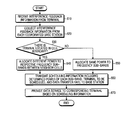
- FIG. 6 is a flowchart for explaining a network operation in accordance with an exemplary embodiment of the present invention.
- the present invention proposes a method and system for dividing the entire frequency band into multiple frequency sub-bands, and then allocating different power to the respective frequency sub-bands. That is, a frequency reuse factor is different for each of the frequency sub-bands.
- the system of the present invention is provided with a central controller that can coordinately control respective base stations located in multiple cells.
- the central controller controls the power of frequency sub-bands for each cell in real time in such a manner that a frequency reuse factor other than 1 is used only when service is provided to terminals located in a cell boundary. That is, a data transfer rate serviceable to terminals located in a cell boundary can be increased by using a frequency reuse factor other than 1, if necessary, and resources can be efficiently used by minimizing the period of time during which the frequency reuse factor other than 1 is used.
- FIG. 3 illustrates an example of power allocation for each cell in the case of an adaptive partial frequency reuse scheme according to an exemplary embodiment of the present invention.
- Neighbor cells A and B are preset such that power is allocated as shown in FIG. 3 .
- cell A uses higher-level power whereas cell B uses lower-level power.
- terminals located close to the base station of cell A or B are provided with service through sub-band 1 corresponding to a frequency reuse factor of 1, which maximizes resource utilization. That is, cells A and B can simultaneously provide service to the terminals located in the corresponding cell by using the same sub-band 2 .
- a base station uses predetermined fixed power as shown in FIG. 3 , it is difficult to adaptively utilize partial frequency reuse depending on movements of terminals. For example, if predetermined lower power is allocated to sub-band 1 of cell B, as shown in FIG. 3 , even when there is no terminal in a cell boundary, then the overall throughput is decreased.
- the present invention proposes a way to allocate different level power to sub-bands into which the entire frequency band is divided and simultaneously employ adaptive partial frequency reuse according to whether or not terminals are located in a cell boundary.
- FIG. 4 illustrates an adaptive partial frequency reuse system according to an exemplary embodiment of the present invention.
- the adaptive partial frequency reuse system includes node Bs 415 , 425 , 435 controlling cells A, B, and C 410 , 420 , 430 respectively, and a central controller 450 , connected to the node Bs 415 , 425 , 435 , for coordinately controlling neighbor cells.
- the central controller 450 may be a separately formed apparatus as shown in FIG. 4 , or any one of the node Bs may serve as the central controller 450 .
- the node Bs 415 , 425 , 435 receive and collect interference feedback information including information on interference from neighbor cells, as well as the overall interference of each terminal, transmitted from all terminals within the corresponding cell, and transmits the interference feedback information to the central controller 450 .
- the overall interference information for each terminal may include all possible parameters providing the overall interference information for a terminal, such as CQI (Channel Quality Indication) and SINR (Signal-to-Interference Noise ratio).
- CQI Channel Quality Indication
- SINR Signal-to-Interference Noise ratio
- the central controller 450 determines a distribution of terminals, based on the interference feedback information transmitted via the node Bs 415 , 425 , 435 , and controls the power of a frequency sub-band for use in transmission to a corresponding terminal according to the determined distribution of terminals. That is, the central controller 450 collects interference feedback information for terminals, transmitted from the node Bs 415 , 425 , 435 of the respective cells, to thus use the collected interference feedback information for scheduling of the respective node Bs, and determine an appropriate terminal to be scheduled for each frame, a data transfer rate, and power to be used in transmission.
- the terminal measures the overall interference of its serving cell, and additionally measures interference from neighbor cells coordinately controlled by the central controller 450 .
- the terminal transmits interference feedback information including the measured overall interference and the measured interference from neighbor cells to the base station of the serving cell.
- the terminal 440 is currently served by cell A, in other words, the serving cell of the terminal 440 is cell A, and the terminal 440 measures interference from two neighbor cells B and C. Then, the terminal 440 configures interference feedback information by including the overall interference Io, interference from cell B, I_B, and interference from cell C, I_C therein, and transmits the configured interference feedback information to its serving node B 415 .
- the interference included in the interference feedback information may be used for the central controller 450 to perform scheduling of the node Bs coordinately controlled by the central controller 450 .
- each base station receives interference feedback information from at least one terminal located within a corresponding cell.
- the interference feedback information includes the overall interference of a corresponding terminal and interference from neighbor cells.
- each base station then delivers the received interference feedback information to the central controller.
- the central controller determines a distribution of terminals, based on the delivered interference feedback information. That is, in step 630 , the central controller determines if there is a terminal located in a cell boundary.
- the central controller determines if there is a terminal located in a cell boundary, in the following manner:
- the central controller compares the CQI of the serving cell for a corresponding terminal with interference from each neighbor cell one by one, and determines if a difference value therebetween is equal to or less than a specific threshold. When the difference value is equal to or less than the threshold as a result of the determination, the central controller determines the corresponding terminal to be located in a cell boundary.
- cell A is the serving cell of a terminal
- cells B and C are neighbor cells.
- interference feedback information for the terminal includes information indicating that the CQI of the serving cell is 4 dB, interference from cell B is 0 dB, and interference from cell C is 2 dB, the difference value between the CQI of the serving cell and the interference from cell B is 4 dB, and the difference value between the CQI of the serving cell and the interference from cell C is 2 dB.
- the specific threshold is 3 dB
- the difference value between the CQI of the serving cell and the interference from cell C, that is, 2 dB is less than the specific threshold of 3 dB, and thus the terminal is determined to be located in a cell boundary.
- the determination as described above is merely an example of determining if a terminal is located in a cell boundary, and the present invention is not limited thereto.
- the central controller controls each base station in step 640 to allocate different power to respective frequency sub-bands, as shown in FIG. 3 .
- the central controller controls each base station in step 650 to allocate the same power to respective frequency sub-bands between the neighbor cells.
- the central controller transmits scheduling information including power to be used in each frequency sub-band by each base station, a terminal to be scheduled, and a data transfer rate to the corresponding base station.
- each base station uses the scheduling information to provide data service to the terminal.
- the base stations coordinately controlled as described above use the interference feedback information transmitted from the terminal to adaptively determine the power of frequency sub-bands. That is, different power is allocated to respective frequency sub-bands between neighbor cells, as shown in FIG. 3 , only when data service needs to be provided to terminals located in a cell boundary, and the same power is allocated to the frequency sub-bands between neighbor cells when data service is provided to terminals not located in a cell boundary. In this way, resource utilization can be maximized, and the overall throughput can be improved.
- the present invention may be applied to uplink, that is, transmission from a terminal to a base station.
- the central controller determines not the power of a base station, but the power of a terminal.
Landscapes
- Engineering & Computer Science (AREA)
- Computer Networks & Wireless Communication (AREA)
- Signal Processing (AREA)
- Quality & Reliability (AREA)
- Mobile Radio Communication Systems (AREA)
Abstract
Description
Claims (8)
Applications Claiming Priority (3)
| Application Number | Priority Date | Filing Date | Title |
|---|---|---|---|
| KR20080048871 | 2008-05-26 | ||
| KR10-2008-0048871 | 2008-05-26 | ||
| PCT/KR2009/002778 WO2009145546A2 (en) | 2008-05-26 | 2009-05-26 | Method and apparatus for reuse of adaptive partial frequency in a cellular mobile communication system |
Publications (2)
| Publication Number | Publication Date |
|---|---|
| US20110090861A1 US20110090861A1 (en) | 2011-04-21 |
| US8804550B2 true US8804550B2 (en) | 2014-08-12 |
Family
ID=41377769
Family Applications (1)
| Application Number | Title | Priority Date | Filing Date |
|---|---|---|---|
| US12/992,277 Active 2031-11-14 US8804550B2 (en) | 2008-05-26 | 2009-05-26 | Method and apparatus for reuse of adaptive partial frequency in a cellular mobile communication system |
Country Status (3)
| Country | Link |
|---|---|
| US (1) | US8804550B2 (en) |
| KR (1) | KR101651407B1 (en) |
| WO (1) | WO2009145546A2 (en) |
Families Citing this family (7)
| Publication number | Priority date | Publication date | Assignee | Title |
|---|---|---|---|---|
| US9420535B2 (en) * | 2012-03-26 | 2016-08-16 | Telefonaktiebolaget Lm Ericsson (Publ) | User equipment, a network node and methods therein for adjusting the length of a discontinuous reception cycle in a user equipment in a wireless communication system |
| KR101465245B1 (en) * | 2012-11-12 | 2014-11-26 | 주식회사 케이티 | Signal processing system, digital signal processing apparatus and method for controlling transmitting power in the same |
| KR20140125926A (en) * | 2013-04-19 | 2014-10-30 | 삼성전자주식회사 | Method and device for exchanging messages among base stations in cooperative communication system |
| US10263741B2 (en) * | 2013-05-10 | 2019-04-16 | Qualcomm Incorporated | Coordinated multipoint (CoMP) and network assisted interference suppression/cancellation |
| KR102110328B1 (en) * | 2013-05-10 | 2020-05-14 | 한국전자통신연구원 | Method and apparatus of resource management for controlling interference between cells |
| US10382174B2 (en) * | 2014-07-25 | 2019-08-13 | Lg Electronics Inc. | Method and apparatus for inter-cell interference cancellation in wireless communication system |
| KR102109299B1 (en) * | 2019-01-17 | 2020-05-11 | 국민대학교산학협력단 | Method and apparatus for allocating frequency band in communication network |
Citations (3)
| Publication number | Priority date | Publication date | Assignee | Title |
|---|---|---|---|---|
| US20070183522A1 (en) * | 2006-02-09 | 2007-08-09 | David Garrett | Measuring interference and noise power using non-content burst periods |
| US20080032731A1 (en) * | 2006-07-21 | 2008-02-07 | Adaptix, Inc. | Subcarrier group based power control for OFDMA systems |
| US20080057934A1 (en) | 2006-08-30 | 2008-03-06 | Pantech Co., Ltd. | Method for controlling inter-cell interference in a mobile communication system |
-
2009
- 2009-05-26 WO PCT/KR2009/002778 patent/WO2009145546A2/en not_active Ceased
- 2009-05-26 KR KR1020107029205A patent/KR101651407B1/en not_active Expired - Fee Related
- 2009-05-26 US US12/992,277 patent/US8804550B2/en active Active
Patent Citations (3)
| Publication number | Priority date | Publication date | Assignee | Title |
|---|---|---|---|---|
| US20070183522A1 (en) * | 2006-02-09 | 2007-08-09 | David Garrett | Measuring interference and noise power using non-content burst periods |
| US20080032731A1 (en) * | 2006-07-21 | 2008-02-07 | Adaptix, Inc. | Subcarrier group based power control for OFDMA systems |
| US20080057934A1 (en) | 2006-08-30 | 2008-03-06 | Pantech Co., Ltd. | Method for controlling inter-cell interference in a mobile communication system |
Non-Patent Citations (2)
| Title |
|---|
| Stolyar, et al.; Self-organizing Dynamic Fractional Frequency Reuse in OFDMA Systems; Proc. IEEE INFOCOM; Apr. 2008 (9pp). |
| Yeom, et al; Mitigation of Inter-Cell Interference in the WiMAX System; IEEE Mobile WiMAX Symposium; pp. 26-31; Mar. 2007 (6pp). |
Also Published As
| Publication number | Publication date |
|---|---|
| WO2009145546A3 (en) | 2010-02-25 |
| KR20110020278A (en) | 2011-03-02 |
| US20110090861A1 (en) | 2011-04-21 |
| WO2009145546A2 (en) | 2009-12-03 |
| KR101651407B1 (en) | 2016-09-05 |
Similar Documents
| Publication | Publication Date | Title |
|---|---|---|
| DK1997334T3 (en) | Measuring supported dynamic frequency re-use in mobile telecommunications networks | |
| KR101629519B1 (en) | Method and apparatus for scheduling resource allocation to contorl inter-cell interference in a cellular communication system | |
| JP5169689B2 (en) | Communication device | |
| EP2761797B1 (en) | Methods and apparatus for interference management | |
| KR101555718B1 (en) | Method and apparatus for power saving in wireless communication node b | |
| FI111599B (en) | Method and apparatus for mobile telecommunications | |
| TWI406524B (en) | System and method for allocating sub-channels in a network | |
| JP5654335B2 (en) | Wireless communication system, base station and control method thereof | |
| MX2008012008A (en) | Radio access network apparatus and method. | |
| TWI415405B (en) | Token based radio resource management | |
| US8804550B2 (en) | Method and apparatus for reuse of adaptive partial frequency in a cellular mobile communication system | |
| JP2010233202A (en) | Method and device for distributing dynamic resource in multi-cell radio communication system | |
| KR100959336B1 (en) | Apparatus and method for reducing neighbor cell interference in broadband wireless communication system | |
| CN102457358B (en) | A kind of dispatching method of cooperative transmission and system | |
| CN102088726A (en) | Frequency multiplexing method and device | |
| EP3437244B1 (en) | A method, system and devices for enabling a network node to perform a radio operation task in a telecommunication network | |
| EP3155835B1 (en) | Methods, apparatuses and computer program for frequency spectrum assignment | |
| KR100800657B1 (en) | Power control apparatus and method in cellular system using wired relay station | |
| KR101306372B1 (en) | Dynamic power allocation method and apparatus for controlling inter-cell interference in multi-cell orthogonal frequency division multiplexing access system | |
| JP5712328B2 (en) | Wireless communication system, base station and control method thereof | |
| KR101474560B1 (en) | Apparatus and method for transmitting and receiving data in a communication system | |
| HK1128070B (en) | Measurement-assisted dynamic frequency-reuse in cellular telecommunications networks |
Legal Events
| Date | Code | Title | Description |
|---|---|---|---|
| AS | Assignment |
Owner name: SAMSUNG ELECTRONICS CO., LTD., KOREA, REPUBLIC OF Free format text: ASSIGNMENT OF ASSIGNORS INTEREST;ASSIGNORS:KIM, DONG-HEE;YU, JAE-CHON;REEL/FRAME:025535/0540 Effective date: 20101105 |
|
| FEPP | Fee payment procedure |
Free format text: PAYOR NUMBER ASSIGNED (ORIGINAL EVENT CODE: ASPN); ENTITY STATUS OF PATENT OWNER: LARGE ENTITY |
|
| STCF | Information on status: patent grant |
Free format text: PATENTED CASE |
|
| MAFP | Maintenance fee payment |
Free format text: PAYMENT OF MAINTENANCE FEE, 4TH YEAR, LARGE ENTITY (ORIGINAL EVENT CODE: M1551) Year of fee payment: 4 |
|
| MAFP | Maintenance fee payment |
Free format text: PAYMENT OF MAINTENANCE FEE, 8TH YEAR, LARGE ENTITY (ORIGINAL EVENT CODE: M1552); ENTITY STATUS OF PATENT OWNER: LARGE ENTITY Year of fee payment: 8 |
|
| MAFP | Maintenance fee payment |
Free format text: PAYMENT OF MAINTENANCE FEE, 12TH YEAR, LARGE ENTITY (ORIGINAL EVENT CODE: M1553); ENTITY STATUS OF PATENT OWNER: LARGE ENTITY Year of fee payment: 12 |