US8801957B2 - Nanoparticle enhanced ionic liquid heat transfer fluids - Google Patents
Nanoparticle enhanced ionic liquid heat transfer fluids Download PDFInfo
- Publication number
- US8801957B2 US8801957B2 US13/234,284 US201113234284A US8801957B2 US 8801957 B2 US8801957 B2 US 8801957B2 US 201113234284 A US201113234284 A US 201113234284A US 8801957 B2 US8801957 B2 US 8801957B2
- Authority
- US
- United States
- Prior art keywords
- heat transfer
- ionic liquid
- nanoparticles
- transfer fluid
- metal oxides
- Prior art date
- Legal status (The legal status is an assumption and is not a legal conclusion. Google has not performed a legal analysis and makes no representation as to the accuracy of the status listed.)
- Active, expires
Links
- IIQMGIHVRGFXFG-UHFFFAOYSA-N C.CCS(=O)(=O)[N-]S(=O)(=O)CF.CS(=O)(=O)[N-]S(=O)(=O)C(F)(F)F.FC(F)(F)F Chemical compound C.CCS(=O)(=O)[N-]S(=O)(=O)CF.CS(=O)(=O)[N-]S(=O)(=O)C(F)(F)F.FC(F)(F)F IIQMGIHVRGFXFG-UHFFFAOYSA-N 0.000 description 3
- KCUGPPHNMASOTE-UHFFFAOYSA-N CC1=[N+](C)C=CN1C Chemical compound CC1=[N+](C)C=CN1C KCUGPPHNMASOTE-UHFFFAOYSA-N 0.000 description 3
- 0 CCCCCCCCS1=C(C)*(C)C=C1 Chemical compound CCCCCCCCS1=C(C)*(C)C=C1 0.000 description 2
- XUAXVBUVQVRIIQ-UHFFFAOYSA-N CCCC[N+]1=C(C)N(C)C=C1 Chemical compound CCCC[N+]1=C(C)N(C)C=C1 XUAXVBUVQVRIIQ-UHFFFAOYSA-N 0.000 description 2
- GARJMFRQLMUUDD-UHFFFAOYSA-N C[N+]1(C)CCCC1 Chemical compound C[N+]1(C)CCCC1 GARJMFRQLMUUDD-UHFFFAOYSA-N 0.000 description 2
- WUWHLUGLPHDJPF-UHFFFAOYSA-N CCCCCCCC[N+]1=C(C)N(C)C=C1.CCCC[N+]1=C(C)N(C)C=C1 Chemical compound CCCCCCCC[N+]1=C(C)N(C)C=C1.CCCC[N+]1=C(C)N(C)C=C1 WUWHLUGLPHDJPF-UHFFFAOYSA-N 0.000 description 1
- WTYGSTRJBHYHDO-UHFFFAOYSA-N CCCCCCCC[N+]1=C(C)N(C)C=C1.CCCC[N+]1=C(C)N(C)C=C1.CCCC[N+]1=CN(C)C=C1.CCCC[N+]1=CN(C)C=C1.CCS(=O)(=O)[N-]S(=O)(=O)CF.CS(=O)(=O)[N-]S(=O)(=O)C(F)(F)F.CS(=O)(=O)[N-]S(=O)(=O)C(F)(F)F.CS(=O)(=O)[N-]S(=O)(=O)C(F)(F)F.FC(F)(F)F Chemical compound CCCCCCCC[N+]1=C(C)N(C)C=C1.CCCC[N+]1=C(C)N(C)C=C1.CCCC[N+]1=CN(C)C=C1.CCCC[N+]1=CN(C)C=C1.CCS(=O)(=O)[N-]S(=O)(=O)CF.CS(=O)(=O)[N-]S(=O)(=O)C(F)(F)F.CS(=O)(=O)[N-]S(=O)(=O)C(F)(F)F.CS(=O)(=O)[N-]S(=O)(=O)C(F)(F)F.FC(F)(F)F WTYGSTRJBHYHDO-UHFFFAOYSA-N 0.000 description 1
- QHSBUIFOHKXXFP-UHFFFAOYSA-N CCCCCCCC[N+]1=CN(C)C=C1.CCCC[N+]1=CN(C)C=C1 Chemical compound CCCCCCCC[N+]1=CN(C)C=C1.CCCC[N+]1=CN(C)C=C1 QHSBUIFOHKXXFP-UHFFFAOYSA-N 0.000 description 1
- SWZRKXICHZPVGU-UHFFFAOYSA-O CCCC[N+](C)(C)C.CCCC[N+]1(C)CCCC1.CS(=O)(=O)[N-]S(=O)(=O)C(F)(F)F.CS(=O)(=O)[N-]S(=O)(=O)C(F)(F)F.CS(=O)(=O)[N-]S(C)(=O)=O.C[N+](C)(C)CCCC(=O)O Chemical compound CCCC[N+](C)(C)C.CCCC[N+]1(C)CCCC1.CS(=O)(=O)[N-]S(=O)(=O)C(F)(F)F.CS(=O)(=O)[N-]S(=O)(=O)C(F)(F)F.CS(=O)(=O)[N-]S(C)(=O)=O.C[N+](C)(C)CCCC(=O)O SWZRKXICHZPVGU-UHFFFAOYSA-O 0.000 description 1
- FAAUTSWBIKTFMR-UHFFFAOYSA-O CCCC[N+](C)(C)C.CCCC[N+]1(C)CCCC1.C[N+](C)(C)CCCC(=O)O Chemical compound CCCC[N+](C)(C)C.CCCC[N+]1(C)CCCC1.C[N+](C)(C)CCCC(=O)O FAAUTSWBIKTFMR-UHFFFAOYSA-O 0.000 description 1
- PXELHGDYRQLRQO-UHFFFAOYSA-N CCCC[N+]1(C)CCCC1 Chemical compound CCCC[N+]1(C)CCCC1 PXELHGDYRQLRQO-UHFFFAOYSA-N 0.000 description 1
- WBHBWKYABCJHEO-UHFFFAOYSA-N CCS(=O)(=O)[N-]S(=O)(=O)CF.CS(=O)(=O)[N-]S(=O)(=O)C(F)(F)F.FC(F)(F)F Chemical compound CCS(=O)(=O)[N-]S(=O)(=O)CF.CS(=O)(=O)[N-]S(=O)(=O)C(F)(F)F.FC(F)(F)F WBHBWKYABCJHEO-UHFFFAOYSA-N 0.000 description 1
- HVVRUQBMAZRKPJ-UHFFFAOYSA-N CN1C=C[N+](C)=C1 Chemical compound CN1C=C[N+](C)=C1 HVVRUQBMAZRKPJ-UHFFFAOYSA-N 0.000 description 1
- JHPNVNIEXXLNTR-UHFFFAOYSA-O C[N+](C)(C)CCCC(=O)O Chemical compound C[N+](C)(C)CCCC(=O)O JHPNVNIEXXLNTR-UHFFFAOYSA-O 0.000 description 1
Images


Classifications
-
- C—CHEMISTRY; METALLURGY
- C09—DYES; PAINTS; POLISHES; NATURAL RESINS; ADHESIVES; COMPOSITIONS NOT OTHERWISE PROVIDED FOR; APPLICATIONS OF MATERIALS NOT OTHERWISE PROVIDED FOR
- C09K—MATERIALS FOR MISCELLANEOUS APPLICATIONS, NOT PROVIDED FOR ELSEWHERE
- C09K5/00—Heat-transfer, heat-exchange or heat-storage materials, e.g. refrigerants; Materials for the production of heat or cold by chemical reactions other than by combustion
- C09K5/08—Materials not undergoing a change of physical state when used
- C09K5/10—Liquid materials
Definitions
- the subject matter of the present invention relates to heat transfer fluids containing nanoparticles dispersed into ionic liquid carriers.
- heat transfer fluids are necessary to a wide variety of processes as a means of cooling and/or heating by the transfer of energy using both thermal conduction with the fluid and movement of the fluid between a heat source and a heat sink.
- one or more heat exchangers within a heat exchange system are used for the transfer of heat to and from the heat transfer fluid.
- the efficiency and capacity of a heat exchange system can be improved upon by e.g., increasing the velocity of the heat transfer fluid within the system and/or increasing the surface area available for heat transfer.
- steps generally come at increased operating and/or equipment expense and may be impractical as a retrofit of an existing heat exchange system.
- the identity of the component(s) used as the heat transfer fluid will also affect heat exchange.
- a heat transfer fluid having increased thermal conductivity and/or increased heat capacity can improve the efficiency and capacity of a heat exchange system.
- the heat transfer fluid it also preferable that the heat transfer fluid remain stable at high temperatures, exhibit Newtonian flow, have a low volatility, and demonstrate compatibility with the materials used in the construction of the system.
- heat transfer fluids that are currently in widespread use e.g., water, ethylene glycol, engine oil
- the thermal conductivities of solids are typically much higher than conventional heat transfer fluids such as water or oil.
- conventional heat transfer fluids such as water or oil.
- the thermal conductivity of copper at room temperature is approximately 700 times higher than water.
- the dispersion of certain solids into a conventional heat transfer fluid has been investigated.
- Carbon nanoparticles dispersed into conventional heat transfer fluids such as ethylene glycol or mixtures of ethylene glycol and water are indicated in U.S. Pat. No. 6,695,974.
- the efficiency of the these mixtures as heat transfer fluids is, however, still limited by the relatively low thermal conductivity and/or heat capacity of water and ethylene glycol.
- the present invention provides a heat transfer fluid that includes an ionic liquid and nanoparticles dispersed in the ionic liquid.
- the nanoparticles are made from one or more inorganic metal oxides.
- the nanoparticles could be selected from the group consisting of alkali metal oxides, alkaline earth metal oxides, transition metal oxides, and combinations thereof.
- the ionic liquid can include a cation selected from a heterocyclic compound having at least one positively charged nitrogen in its ring and an alkyl group that has replaced at least one hydrogen atom on any atom in the ring of the heterocyclic compound.
- the ionic liquid could also include a cation selected from a quaternary ammonium compound where the nitrogen is bonded to at least one alkyl group.
- FIG. 1 provides a plot of thermal stability data for both a reference liquid and exemplary embodiments of nanoparticle enhanced ionic liquids (NEILs) as further described below.
- NEILs nanoparticle enhanced ionic liquids
- FIG. 2 is a plot of the specific heat capacity versus temperature for both a reference liquid and exemplary embodiments of NEILs.
- FIG. 3 is a plot of the specific heat capacity versus temperature for a reference liquid and various weight percentages of carbon black nanoparticles dispersed in an ionic liquid.
- a plot of the viscosity versus weight percentage of certain nanoparticles dispersed in an ionic liquid is provided in FIG. 4 .
- FIG. 5 A plot of specific heat capacity versus temperature for a reference liquid and for NEILs constructed from different types of nanoparticles is provided in FIG. 5 .
- Alkyl refers to monovalent saturated aliphatic hydrocarbon groups having from 1 or more carbon atoms.
- Ionic liquid(s) refers to an organic substance composed of cations and anions that is a liquid at about 100° C. or less and is capable of suspending nanoparticles.
- Specific heat capacity refers to the heat required to raise a unit mass of a substance by one degree of temperature and may be reported, for example, in units of Joules per gram Kelvin or J/g K.
- Volumetric heat capacity refers to the heat required to raise a unit volume of a substance by one degree of temperature and may be reported, for example, in units of Joules per milliliter Kelvin or J/ml K.
- the present invention provides a heat transfer fluid created from nanoparticles that are dispersed into an ionic liquid. More particularly, small volumes of nanoparticles created from e.g., metals or metal oxides and/or alloys of such materials are dispersed into ionic liquids to create a heat transfer fluid.
- the nanoparticles can be dispersed directly into the ionic liquid during nanoparticle formation or the nanoparticles can be formed and then, in a subsequent step, dispersed into the ionic liquid using e.g., agitation. Oxides of metalloids may also be used for the nanoparticles as well.
- these nanoparticle enhanced ionic liquids have an improved heat capacity, improved thermal conductivity relative to conventional heat transfer fluids or to the ionic liquid alone, and have thermal stability at relatively high temperatures.
- NEILs are chemically compatible with commercial stainless steels and aluminum and have a relatively low vapor pressure, low viscosity, and low freezing point.
- Different ionic liquids can be selected to provide different base values in e.g., heat capacity, thermal stability, thermal conductivity, and viscosity with substantial increases in heat capacity and thermal conductivity achieved through the addition of certain nanoparticles.
- the present invention includes a loop for circulation of a NEILs used as a heat transfer fluid.
- the loop provides circulation of the NEILs between a heat sink where energy is dissipated and a heat source where energy is transferred to the NEILs.
- a heat exchanger is used at the heat sink, heat source, or both.
- the nanoparticles for the NEILs can be created from a variety of different substances. Such substances must be amenable to manufacturing as nanoparticles and must be capable of dispersion into the ionic liquid carrier. Preferably, the nanoparticles remain suspended in the ionic liquid carrier for time periods adequate for industrial use so that settling does not occur where the heat transfer fluid may be stationary over certain periods of time. In addition, the nanoparticle should be selected so as to improve the thermal conductivity and heat capacity of ionic liquid when added to it.
- heat transfer may take place at the surface of the particle and that such transfer is enhanced due to the extremely large surface area of a nanoparticle relative to its size as a higher percentage of atoms are available at the surface of the particle for thermal interaction.
- the use of nanoparticles as opposed to e.g., microparticles may further improve the ability of the particle to suspend in the ionic liquid carrier and thereby avoid undesirable settling out during use.
- the nanoparticles used for dispersion in an ionic liquid have at least one dimension less than about 100 nanometers.
- the nanoparticles of the present invention may have at least one dimension less than about 50 nanometers (nm).
- nanoparticles can be produced by inert gas condensation where a source material is evaporated and the resulting vapor is rapidly condensed into nanometer sized crystallites or loose agglomerations in a reduced pressure atmosphere of a relatively cool inert gas.
- a solution-spray conversion process can be used starting with a solution containing water soluble source material. The solution is converted to an aerosol that is spray dried to create a powder. This powder is placed into a fluidized bed reactor in order to pyrolize the mixture, remove volatiles, and yield relatively fine powders.
- nanoparticles may also be created through condensation of metal vapors occurring during their rapid expansion through a supersonic nozzle.
- Inorganic metal oxides are used for the source material of the nanoparticles.
- the nanoparticles can be made from certain metals, metal oxides, and oxides of metalloids. Alloys of such materials may also be used for the nanoparticles.
- the metal oxides that can be used for the creation of the nanoparticles include alkali metal oxides.
- the metal oxide may be selected from the following substances as well as alloys of these substances:
- nanoparticles for use in NEILs of the present invention may also be selected from alkaline earth metal oxides.
- the metal oxide may be selected from the following substances as well as alloys of these substances:
- transition metals as well as transition metal oxides may also be used for creation of the nanoparticles to be dispersed in the ionic liquid carrier.
- Noble metals and lanthanides may be used as well.
- the following substances as well as alloys of these substances may be used:
- oxides of certain metalloids may also be used for the creation of the nanoparticles used for NEILs of the present invention.
- SiO 2 may be used for creation of the nanoparticles.
- lanthanide oxides may also be used in certain exemplary embodiments of the present invention.
- the weight percent of nanoparticles in the ionic liquid is less than about 10 percent. In still other embodiments, the weight percent of nanoparticles in the ionic liquid is less than about 5 percent. For still other exemplary embodiments of the present invention, the weight percent of nanoparticles in the ionic liquid is less than about 3 percent.
- Ionic liquids are used as the liquid carrier for suspension of the nanoparticles to create the NEILs of the present invention.
- the ionic liquid for a particular application is selected for nanoparticle enhancement based in part on the liquid's base heat transfer properties including its heat capacity and thermal conductivity. While the heat transfer and thermodynamic properties of ionic liquids are the subject of continued investigation, a variety of such substances have already shown useful for nanoparticle enhancement and use as a heat transfer fluid. Additionally, it is believed these ionic liquids can be tailored for particular applications.
- the ionic liquids can be selected from heterocyclic compounds having at least one positively charged nitrogen in the ring and at least one hydrogen atom on any ring atom that has been replaced with an alkyl group.
- ionic liquids of the present invention can include complexes of the imidazolium cation and another anion.
- the imidazolium cation for example, may be selected from the following cations:
- Different values of n may be used for the different alkyl groups on the ring.
- the value of n will affect the values of the ionic liquid base heat transfer properties and, therefore, may be selected based on the particular application intended.
- the imidazolium cation may be selected from the following:
- the imidazolium cation may also be selected from the following cations:
- R n is an alkyl group of n carbon atoms and n is an integer equal to 1, 2, 3, 4, 5, 6 or greater.
- n is an integer equal to 1, 2, 3, 4, 5, 6 or greater.
- Different values of n may be used for the different alkyl groups on the ring.
- the value of n will affect the values of the ionic liquid base heat transfer properties and, therefore, may be selected based on the particular application intended.
- the anion can be selected from the following anions:
- the bis(trifluoromethylsulfonyl)imide anion may also be represented herein as [NTf 2 ].
- the bis(perfluoromethylsulfonyl)imide anion may be represented herein as [BETI].
- Other anions that may be used include, by way of example, PF 6 , BF 4 , triflate, halides, nitrates, alkyl sulfates, and others as well.
- ionic liquids based on the following complexes may be selected for use in certain exemplary embodiments, the present invention:
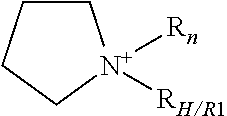
- Ionic liquids of the present invention can also be selected from ion complexes where the cation contains a quaternary ammonium where the nitrogen is bonded to at least one alkyl group.
- the cation for the ionic liquid may be selected from one of the following cations:
- the cation for the ionic liquid may be selected from one of the following cations for example:
- ionic liquids based on the following complexes may be selected for use in certain exemplary embodiments of the present invention:
- ionic liquids including the various cations and anions described, are provided by way of example only. Using the teachings disclosed herein, one of skill in the art will understand that ionic liquids containing complexes of other cations and anions may also be used with the present invention.
- Therminol VP-1 a commercially available heat transfer fluid from Solutia, Inc. of 575 Maryville Centre Dr., St. Louis, Mo. 63141, was used as a reference fluid.
- NEILs were created using nanoparticles dispersed in the ionic liquid [C4mmim][NTf 2 ], obtained from Ionic Liquid Technologies, Inc., 720 2nd Street, Tuscaloosa, Ala. 35401.
- CB carbon black
- the carbon black nanoparticles had at least one dimension that was about 4 nm while the aluminum oxide nanoparticles had at least one dimension that was about 50 nm.
- All NEILs were prepared based on a weight percentage. The weighed materials were added together in a glass vial and shaken with a vortex mixer for 15 minutes on a medium-high setting. In most cases, the ionic nature of the ionic liquid was sufficient to suspend the nanoparticles for the test period.
- Table I provides the results of thermal stability testing where “IL” references the base ionic liquid of [C4mmim][NTf 2 ]. Each sample was subjected to thermal stability testing at heating rates of 10 and 20° C. per minute. Proteus® software was used to calculate the thermal onset temperature. The results in Table I provide the temperature at which 5 weight percent of the original sample has been lost.
- the base ionic liquid with nanoparticles has a much higher thermal stability than the reference fluid, VP-1.
- the addition of nanoparticles to the ionic liquid of [C4mmim][NTf 2 ] does not undermine thermal stability. This can be more readily observed from FIG. 1 , which provides a plot of the percent initial mass of the sample remaining versus temperature for VP-1 (solid line) and 0.5 weight percent Al 2 O 3 at two different heating rates.
- Heat capacities of NEILs with nanoparticles of both CB and Al 2 O 3 dispersed in the ionic liquid of [C4mmim][NTf 2 ] as previously described were measured using a Netzsch DSC 404 with a silver furnace between 40 to 400° C. The values for heat capacity were determined according to ASTM-E1269-05 (2005). All measurements were conducted at least five times for repeatability. The resulting measurements appear in Table II and were calculated with an error of 15 percent or less.
- the ionic liquid of [C4mmim][NTf 2 ] has a higher heat capacity than the reference fluid (Therminol VP-1).
- Creation of the NEILs through addition of the nanoparticles of Al 2 O 3 to this ionic liquid significantly increases the heat capacity of the base ionic liquid.
- the heat capacity of the NEILs is improved by increases in the weight percentage of nanoparticles of Al 2 O 3 .
- the addition of CB nanoparticles has a deleterious effect on the heat capacity of the base ionic liquid that becomes worse as the weight percentage increases.
- FIG. 2 provides a plot of the specific heat capacity versus temperature for the NEILs of Al 2 O 3 nanoparticles dispersed into [C4mmim][NTf 2 ] at various weight percentages. In addition to the improvement in heat capacity with increasing weight percentage of nanoparticles, this plot also shows that the heat capacity also increased with temperature.
- FIG. 3 provides a plot of the specific heat capacity versus temperature for the NEILs of CB nanoparticles dispersed into [C4mmim][NTf 2 ] at various weight percentages. As stated above, a reduction in heat capacity occurred with the increasing weight percentage of CB nanoparticles.
- a heat transfer fluid exhibit Newtonian flow during use. Accordingly, NEILs of CB and Al 2 O 3 nanoparticles that were dispersed into [C4mmim][NTf 2 ] at different weight percentages as previously described and the viscosities were measured at 25° C. according to ASTM-E1269-05 (2005) at 25° C. The results are plotted in FIG. 4 . As shown, the identity of the nanoparticles had a large influence on the viscosity of the resulting NEILs. When CB was used, the viscosity increased 50% with the addition of only 0.5 wt % of material.
- NEILs of 0.5 weight percent of nanoparticles of Fe2O3, Au, CuO, SiO2, CeO2, and CaO were each created as previously described by adding the weighed materials to the ionic liquid of [C4mmim][NTf 2 ] in a glass vial and shaking with a vortex mixer for 15 minutes at a medium-high setting. Each such nanoparticle tested had at least one dimension that was about 50 nm or less.
- the heat capacities of these NEILs were also measured using a Netzsch DSC 404 with a silver furnace between 40 to 400° C. and determined according to ASTM-E1269-05 (2005).
- FIG. 5 shows a plot of the specific heat capacity of these NEILs as well as the base ionic liquid (neat IL).
- a NEILs of the present invention may have a specific heat capacity in the range of about 1.4 to 3.0 J/g K, or in the range of about 2.0 to 2.8 J/g K.
Landscapes
- Chemical & Material Sciences (AREA)
- Engineering & Computer Science (AREA)
- Physics & Mathematics (AREA)
- Chemical Kinetics & Catalysis (AREA)
- Combustion & Propulsion (AREA)
- Thermal Sciences (AREA)
- Materials Engineering (AREA)
- Organic Chemistry (AREA)
- Manufacture Of Metal Powder And Suspensions Thereof (AREA)
Abstract
Description

wherein Rn is an alkyl group of n carbon atoms and n=1, 2, 3, 4, 5, 6 or greater. Different values of n may be used for the different alkyl groups on the ring. The value of n will affect the values of the ionic liquid base heat transfer properties and, therefore, may be selected based on the particular application intended. By way of example, the imidazolium cation may be selected from the following:


wherein Rn is an alkyl group of n carbon atoms and n is an integer equal to 1, 2, 3, 4, 5, 6 or greater. Different values of n may be used for the different alkyl groups on the ring. As stated above, the value of n will affect the values of the ionic liquid base heat transfer properties and, therefore, may be selected based on the particular application intended. These cations may also be represented as [Cnmim] where n=1, 2, 3, 4, 5, 6 or greater. So, for example, the imidazolium cation may also be selected from the following:


The bis(trifluoromethylsulfonyl)imide anion may also be represented herein as [NTf2]. The bis(perfluoromethylsulfonyl)imide anion may be represented herein as [BETI]. Other anions that may be used include, by way of example, PF6, BF4, triflate, halides, nitrates, alkyl sulfates, and others as well.

Other combinations of these ions as well as combinations with additional ions may be used as well.
-
- where Rn is an alkyl group of n carbon atoms and n is an integer equal to 1, 2, 3, 4, 5, 6 or greater, or
- where Rn is an alkyl group of n carbon atoms and n is an integer equal to 1, 2, 3, 4, 5, 6 or greater and also contains a functional group; and,
- RH/R1 is either a hydrogen (H) or a methyl group (CH3).


| TABLE I | |||
| Proteus | |||
| Cal. | 5 wt. wt. | ||
| Onset | lost | ||
| (° C.) | (° C.) | ||
| VP-1 10° C./min | 168 | 125 | ||
| VP-1 20° C./min | 181 | 133 | ||
| |
459 | 430 | ||
| |
464 | 443 | ||
| IL w/0.5 wt. % Al2O3 10° C./min | 447 | 420 | ||
| IL w/0.5 wt. % Al2O3 20° C./min | 464 | 445 | ||
| IL w/1.0 wt. % Al2O3 10° C./min | 438 | 422 | ||
| IL w/1.0 wt. % Al2O3 20° C./min | 450 | 434 | ||
| IL w/2.5 wt. % Al2O3 10° C./min | 428 | 420 | ||
| IL w/2.5 wt. % Al2O3 20° C./min | 439 | 431 | ||
| IL w/0.5 wt. |
448 | 424 | ||
| IL w/0.5 wt. |
461 | 446 | ||
| IL w/1.0 wt. |
448 | 410 | ||
| IL w/1.0 wt. |
465 | 439 | ||
| IL w/2.5 wt. |
455 | 424 | ||
| IL w/2.5 wt. |
468 | 449 | ||
| TABLE II | ||||
| Specific Heat | Volumetric Heat | |||
| Density | Capacity | Capcity | ||
| (g/mL) | (J/g K) | (J/mL K) | ||
| Temperature (° C.) | 80 | 250 | 80 | 250 | 80 | 250 |
| VP-1 | 1.02 | 0.87 | 1.73 | 2.18 | 1.76 | 1.90 |
| IL | 1.37 | 1.29 | 1.53 | 1.84 | 2.10 | 2.37 |
| IL w/0.5 wt. % Al2O3 | 1.39 | 1.16 | 1.70 | 1.99 | 2.36 | 2.31 |
| IL w/1.0 wt. % Al2O3 | 1.43 | 1.20 | 1.93 | 2.35 | 2.75 | 2.82 |
| IL w/2.5 wt. % Al2O3 | 1.51 | 1.32 | 2.02 | 2.40 | 3.05 | 3.17 |
| IL w/0.5 wt. % CB | 1.39 | 1.26 | 1.34 | 1.40 | 1.86 | 1.76 |
| IL w/1.0 wt. % CB | 1.39 | 1.23 | 1.14 | 1.35 | 1.58 | 1.66 |
| IL w/2.5 wt. % CB | 1.23 | 1.21 | 1.09 | 1.28 | 1.34 | 1.55 |
Claims (22)


Priority Applications (1)
| Application Number | Priority Date | Filing Date | Title |
|---|---|---|---|
| US13/234,284 US8801957B2 (en) | 2011-09-16 | 2011-09-16 | Nanoparticle enhanced ionic liquid heat transfer fluids |
Applications Claiming Priority (1)
| Application Number | Priority Date | Filing Date | Title |
|---|---|---|---|
| US13/234,284 US8801957B2 (en) | 2011-09-16 | 2011-09-16 | Nanoparticle enhanced ionic liquid heat transfer fluids |
Publications (2)
| Publication Number | Publication Date |
|---|---|
| US20130068994A1 US20130068994A1 (en) | 2013-03-21 |
| US8801957B2 true US8801957B2 (en) | 2014-08-12 |
Family
ID=47879770
Family Applications (1)
| Application Number | Title | Priority Date | Filing Date |
|---|---|---|---|
| US13/234,284 Active 2032-01-18 US8801957B2 (en) | 2011-09-16 | 2011-09-16 | Nanoparticle enhanced ionic liquid heat transfer fluids |
Country Status (1)
| Country | Link |
|---|---|
| US (1) | US8801957B2 (en) |
Cited By (3)
| Publication number | Priority date | Publication date | Assignee | Title |
|---|---|---|---|---|
| US11746273B2 (en) | 2019-09-20 | 2023-09-05 | Ht Materials Science (Ip) Limited | Heat transfer mixture |
| US11753570B2 (en) | 2019-09-20 | 2023-09-12 | Ht Materials Science (Ip) Limited | Heat transfer mixture |
| US12709704B2 (en) | 2024-03-06 | 2026-08-18 | Ht Materials Science (Ip) Limited | Heat transfer mixture |
Families Citing this family (4)
| Publication number | Priority date | Publication date | Assignee | Title |
|---|---|---|---|---|
| WO2017085600A1 (en) * | 2015-11-16 | 2017-05-26 | Sabic Global Technologies B.V. | Heat transfer fluids including deep eutectic solvents |
| CN107163917A (en) * | 2017-06-20 | 2017-09-15 | 大连理工大学 | Ionic liquid solution base nano-fluid directly absorbs solar airconditioning/heat pump method and apparatus |
| EP3757189A1 (en) | 2019-06-26 | 2020-12-30 | Evonik Operations GmbH | Use of ionic liquids as coolants for vehicle engines, motors and batteries |
| CN114752362A (en) * | 2022-04-29 | 2022-07-15 | 四川大学 | Nano-fluid type wide-temperature-zone heat conduction oil based on ionic liquid and preparation method |
Citations (1)
| Publication number | Priority date | Publication date | Assignee | Title |
|---|---|---|---|---|
| US20080302998A1 (en) * | 2007-06-05 | 2008-12-11 | Haiping Hong | Carbon nanoparticle-containing hydrophilic nanofluid with enhanced thermal conductivity |
-
2011
- 2011-09-16 US US13/234,284 patent/US8801957B2/en active Active
Patent Citations (1)
| Publication number | Priority date | Publication date | Assignee | Title |
|---|---|---|---|---|
| US20080302998A1 (en) * | 2007-06-05 | 2008-12-11 | Haiping Hong | Carbon nanoparticle-containing hydrophilic nanofluid with enhanced thermal conductivity |
Non-Patent Citations (1)
| Title |
|---|
| W. Yu, D. M France, S.U.S. Choi, and J.L. Routbort, "Review and Assessment of Nanofluid Technology For Transportation and Other Applications"; Report from Argonne National Laboratory, Energy Systems Division, ANL/ESD/07-9; Apr. 2007; pp. 1-75. |
Cited By (3)
| Publication number | Priority date | Publication date | Assignee | Title |
|---|---|---|---|---|
| US11746273B2 (en) | 2019-09-20 | 2023-09-05 | Ht Materials Science (Ip) Limited | Heat transfer mixture |
| US11753570B2 (en) | 2019-09-20 | 2023-09-12 | Ht Materials Science (Ip) Limited | Heat transfer mixture |
| US12709704B2 (en) | 2024-03-06 | 2026-08-18 | Ht Materials Science (Ip) Limited | Heat transfer mixture |
Also Published As
| Publication number | Publication date |
|---|---|
| US20130068994A1 (en) | 2013-03-21 |
Similar Documents
| Publication | Publication Date | Title |
|---|---|---|
| US20130068994A1 (en) | Nanoparticle enhanced ionic liquid heat transfer fluids | |
| Yu et al. | A review on nanofluids: preparation, stability mechanisms, and applications | |
| Wei et al. | Rheological properties of multi-walled carbon nanotubes/silica shear thickening fluid suspensions | |
| CN105969333B (en) | A kind of preparation method of the luminescence generated by light ionic liquid of carbon containing quantum dot | |
| CN103881663A (en) | Multielement nitric acid nano-molten salt heat transfer and heat storage medium, preparation method and application thereof | |
| CN104830307A (en) | Organosilicone polyether emulsion type defoaming agent for fracturing fluid and preparation method thereof | |
| Kanti et al. | Stability and thermophysical properties of fly ash nanofluid for heat transfer applications | |
| Mitran et al. | Phase change materials based on mesoporous silica | |
| CA2210095A1 (en) | Heat-transfer concentrate, method of manufacturing it and its use, as well as a latent-heat accumulator making use of the concentrate | |
| Sawant et al. | Nanofluids with recent application & future trends | |
| CN104774675A (en) | Improved giant electrorheological fluid and its preparation method | |
| Qiao et al. | Experimental study on the effect of different surfactants on the thermophysical properties of graphene filled nanofluids | |
| Ma et al. | Preparation and properties of stearic acid–acetanilide eutectic mixture/expanded graphite composite phase‐change material for thermal energy storage | |
| CN109705813B (en) | Heat-storage constant-temperature nano composite phase change material and preparation method thereof | |
| RU2557615C2 (en) | Colloidal aluminium oxide dispersion | |
| CN112408318B (en) | Ionic liquid composition for compressing hydrogen | |
| CN101264525A (en) | A kind of preparation method of copper nanofluid | |
| Khan et al. | Overview of nanofluids to ionanofluids: Applications and challenges | |
| Han et al. | Ionic Liquids‐Assisted Highly Luminescent Copper Nanoclusters with Triangle Supramolecular Nanostructures | |
| CN116694308A (en) | Environment-friendly immersed electronic cooling liquid and preparation method thereof | |
| CN111234203B (en) | Polyether amine triazole derivative and preparation method and application thereof | |
| CN106978233A (en) | A high-temperature anti-wear and anti-friction compound additive and its application | |
| JP3378924B2 (en) | Electrorheological fluid | |
| CN105154029A (en) | Nanometer aluminium nitride modified fused salt and preparation method thereof | |
| CN112500835B (en) | Phase change material and preparation method thereof |
Legal Events
| Date | Code | Title | Description |
|---|---|---|---|
| AS | Assignment |
Owner name: SAVANNAH RIVER NUCLEAR SOLUTIONS, LLC, SOUTH CAROL Free format text: ASSIGNMENT OF ASSIGNORS INTEREST;ASSIGNORS:FOX, ELISE B.;VISSER, ANN E.;BRIDGES, NICHOLAS J.;AND OTHERS;REEL/FRAME:026917/0882 Effective date: 20110906 |
|
| AS | Assignment |
Owner name: ENERGY, UNITED STAES DEPARTMENT OF, DISTRICT OF CO Free format text: CONFIRMATORY LICENSE;ASSIGNOR:SAVANNAH RIVER NUCLEAR SOLUTIONS, LLC;REEL/FRAME:027630/0266 Effective date: 20120124 |
|
| STCF | Information on status: patent grant |
Free format text: PATENTED CASE |
|
| MAFP | Maintenance fee payment |
Free format text: PAYMENT OF MAINTENANCE FEE, 4TH YEAR, LARGE ENTITY (ORIGINAL EVENT CODE: M1551) Year of fee payment: 4 |
|
| MAFP | Maintenance fee payment |
Free format text: PAYMENT OF MAINTENANCE FEE, 8TH YEAR, LARGE ENTITY (ORIGINAL EVENT CODE: M1552); ENTITY STATUS OF PATENT OWNER: LARGE ENTITY Year of fee payment: 8 |
|
| AS | Assignment |
Owner name: BATTELLE SAVANNAH RIVER ALLIANCE, LLC, SOUTH CAROLINA Free format text: ASSIGNMENT OF ASSIGNORS INTEREST;ASSIGNOR:SAVANNAH RIVER NUCLEAR SOLUTIONS, LLC;REEL/FRAME:062292/0495 Effective date: 20221018 |
|
| MAFP | Maintenance fee payment |
Free format text: PAYMENT OF MAINTENANCE FEE, 12TH YEAR, LARGE ENTITY (ORIGINAL EVENT CODE: M1553); ENTITY STATUS OF PATENT OWNER: LARGE ENTITY Year of fee payment: 12 |