US8779134B1 - Six-coordinated ruthenium complex - Google Patents
Six-coordinated ruthenium complex Download PDFInfo
- Publication number
- US8779134B1 US8779134B1 US14/057,263 US201314057263A US8779134B1 US 8779134 B1 US8779134 B1 US 8779134B1 US 201314057263 A US201314057263 A US 201314057263A US 8779134 B1 US8779134 B1 US 8779134B1
- Authority
- US
- United States
- Prior art keywords
- added
- group
- followed
- mmol
- reaction mixture
- Prior art date
- Legal status (The legal status is an assumption and is not a legal conclusion. Google has not performed a legal analysis and makes no representation as to the accuracy of the status listed.)
- Expired - Fee Related
Links
- 0 [1*]C1=NN(C)C(C2=C3C([3*])=C([4*])C([5*])=C([6*])C3=C([7*])C([8*])=N2C)=C1[2*] Chemical compound [1*]C1=NN(C)C(C2=C3C([3*])=C([4*])C([5*])=C([6*])C3=C([7*])C([8*])=N2C)=C1[2*] 0.000 description 15
- QNXRREVVNRFJGY-UHFFFAOYSA-N CC.CC(C)(C)C.CN(C1=CC=CC=C1)C1=CC=CC=C1 Chemical compound CC.CC(C)(C)C.CN(C1=CC=CC=C1)C1=CC=CC=C1 QNXRREVVNRFJGY-UHFFFAOYSA-N 0.000 description 6
- GWQOOADXMVQEFT-UHFFFAOYSA-N CC1=CC=C(C)S1 Chemical compound CC1=CC=C(C)S1 GWQOOADXMVQEFT-UHFFFAOYSA-N 0.000 description 6
- OBSWQJPGWWTHSE-UHFFFAOYSA-N CC.CC.CC1=CC=C(C2=CC=CC=C2)S1 Chemical compound CC.CC.CC1=CC=C(C2=CC=CC=C2)S1 OBSWQJPGWWTHSE-UHFFFAOYSA-N 0.000 description 4
- JLGCYHPNQZEDAZ-UHFFFAOYSA-N CC1=CC=C(C2=CC=C(N(C3=CC=CC=C3)C3=CC=CC=C3)C=C2)S1 Chemical compound CC1=CC=C(C2=CC=C(N(C3=CC=CC=C3)C3=CC=CC=C3)C=C2)S1 JLGCYHPNQZEDAZ-UHFFFAOYSA-N 0.000 description 4
- VSUGUKXAAPOFPQ-UHFFFAOYSA-N CSC1=CC=C(C)S1 Chemical compound CSC1=CC=C(C)S1 VSUGUKXAAPOFPQ-UHFFFAOYSA-N 0.000 description 4
- HYBOQCSAMUGXEV-UHFFFAOYSA-N CC1=C(C)C(C)=N(C)C(C2=C(C)C(C)=C(C)C(C)=N2C)=C1C Chemical compound CC1=C(C)C(C)=N(C)C(C2=C(C)C(C)=C(C)C(C)=N2C)=C1C HYBOQCSAMUGXEV-UHFFFAOYSA-N 0.000 description 3
- XGDYDDVADYFIDS-UHFFFAOYSA-N CC(=O)C1=C2C=CC=C(N(C3=CC=C(C(C)(C)C)C=C3)C3=CC=C(C(C)(C)C)C=C3)C2=CC=N1 Chemical compound CC(=O)C1=C2C=CC=C(N(C3=CC=C(C(C)(C)C)C=C3)C3=CC=C(C(C)(C)C)C=C3)C2=CC=N1 XGDYDDVADYFIDS-UHFFFAOYSA-N 0.000 description 2
- RKWHANSBLNUDGA-UHFFFAOYSA-N CC1=CC=C(N(C2=CC=C(C(C)(C)C)C=C2)C2=CC=CC3=C(C4=CC(C)=NC4)N=CC=C23)C=C1 Chemical compound CC1=CC=C(N(C2=CC=C(C(C)(C)C)C=C2)C2=CC=CC3=C(C4=CC(C)=NC4)N=CC=C23)C=C1 RKWHANSBLNUDGA-UHFFFAOYSA-N 0.000 description 2
- QLEGPTTYKWFYHV-UHFFFAOYSA-N CC1=CC=C(N(C2=CC=C(C(C)(C)C)C=C2)C2=CC=CC3=C(C4=CC(C)=NN4C)N(C)=CC=C23)C=C1 Chemical compound CC1=CC=C(N(C2=CC=C(C(C)(C)C)C=C2)C2=CC=CC3=C(C4=CC(C)=NN4C)N(C)=CC=C23)C=C1 QLEGPTTYKWFYHV-UHFFFAOYSA-N 0.000 description 2
- PAJAWLQUNKXHHU-UHFFFAOYSA-N CC(=O)C1=C2C=C3C(=CC2=CC=N1)C(C)(C)CCC3(C)C Chemical compound CC(=O)C1=C2C=C3C(=CC2=CC=N1)C(C)(C)CCC3(C)C PAJAWLQUNKXHHU-UHFFFAOYSA-N 0.000 description 1
- MEMTVNVPGWBDFT-UHFFFAOYSA-N CC1(C)CCC(C)(C)C2=CC3=CN=CC=C3C=C21 Chemical compound CC1(C)CCC(C)(C)C2=CC3=CN=CC=C3C=C21 MEMTVNVPGWBDFT-UHFFFAOYSA-N 0.000 description 1
- BJYLJNMGCWQHKY-UHFFFAOYSA-N CC1=C(C)C(C)=N(C)C(C2=C(C)C(C)=C(C)N2C)=C1C Chemical compound CC1=C(C)C(C)=N(C)C(C2=C(C)C(C)=C(C)N2C)=C1C BJYLJNMGCWQHKY-UHFFFAOYSA-N 0.000 description 1
- JUBOFNSQUSXYIO-UHFFFAOYSA-N CC1=CC(CC(C)C)=CC2=C(C3=CC(C)=NC3)N=CC=C12 Chemical compound CC1=CC(CC(C)C)=CC2=C(C3=CC(C)=NC3)N=CC=C12 JUBOFNSQUSXYIO-UHFFFAOYSA-N 0.000 description 1
- VLQPCBNDJPCTGA-UHFFFAOYSA-N CC1=CC(CC(C)C)=CC2=C(C3=CC(C)=NN3C)N(C)=CC=C12 Chemical compound CC1=CC(CC(C)C)=CC2=C(C3=CC(C)=NN3C)N(C)=CC=C12 VLQPCBNDJPCTGA-UHFFFAOYSA-N 0.000 description 1
- QLDGJWVLZRZPNI-UHFFFAOYSA-N CC1=CC2=CC=N(C)C(C3=CC(C)=NN3C)=C2C=C1 Chemical compound CC1=CC2=CC=N(C)C(C3=CC(C)=NN3C)=C2C=C1 QLDGJWVLZRZPNI-UHFFFAOYSA-N 0.000 description 1
- OCJOMMZZUYFYOK-UHFFFAOYSA-N CC1=CC2=CC=NC(C3=CC(C)=NC3)=C2C=C1 Chemical compound CC1=CC2=CC=NC(C3=CC(C)=NC3)=C2C=C1 OCJOMMZZUYFYOK-UHFFFAOYSA-N 0.000 description 1
- CRWOSFIVIWDYOT-UHFFFAOYSA-N CC1=CC2=C\C=C(C3=CC(C)=NC3)/N=C\2C=C1 Chemical compound CC1=CC2=C\C=C(C3=CC(C)=NC3)/N=C\2C=C1 CRWOSFIVIWDYOT-UHFFFAOYSA-N 0.000 description 1
- PDXAVPRWYWBZEM-UHFFFAOYSA-N CC1=CC2C3=CC=CC=N3[Ru]34(N5=CC=C(OC=O)C=C5C5=N3C=CC(OC=O)=C5)(N2=N1)N1=C(C=CC=C1)C1=N4N=C(C)C1 Chemical compound CC1=CC2C3=CC=CC=N3[Ru]34(N5=CC=C(OC=O)C=C5C5=N3C=CC(OC=O)=C5)(N2=N1)N1=C(C=CC=C1)C1=N4N=C(C)C1 PDXAVPRWYWBZEM-UHFFFAOYSA-N 0.000 description 1
- LSKCQFSRELBHGU-UHFFFAOYSA-N CC1=CC=C(C2=C3C=CC=CC3=C(C3=CC(C)=NN3C)N=C2)S1 Chemical compound CC1=CC=C(C2=C3C=CC=CC3=C(C3=CC(C)=NN3C)N=C2)S1 LSKCQFSRELBHGU-UHFFFAOYSA-N 0.000 description 1
- KZZRWFJOQQPAHX-UHFFFAOYSA-N CC1=CC=C(C2=CC3=CC=N(C)C(C4=CC(C)=NN4C)=C3C=C2)S1 Chemical compound CC1=CC=C(C2=CC3=CC=N(C)C(C4=CC(C)=NN4C)=C3C=C2)S1 KZZRWFJOQQPAHX-UHFFFAOYSA-N 0.000 description 1
- RKQJTFZCUWZXCV-UHFFFAOYSA-N CC1=CC=C(C2=CC3=CC=NC(C4=CC(C)=NC4)=C3C=C2)S1 Chemical compound CC1=CC=C(C2=CC3=CC=NC(C4=CC(C)=NC4)=C3C=C2)S1 RKQJTFZCUWZXCV-UHFFFAOYSA-N 0.000 description 1
- NUBJIMAMBOPTFT-UHFFFAOYSA-N CC1=CC=C(C2=CC=CC3=C(C4=CC(C)=NC4)N=CC=C23)S1 Chemical compound CC1=CC=C(C2=CC=CC3=C(C4=CC(C)=NC4)N=CC=C23)S1 NUBJIMAMBOPTFT-UHFFFAOYSA-N 0.000 description 1
- LTLDENUVKDXLRY-UHFFFAOYSA-N CC1=CC=C(C2=CC=CC3=C(C4=CC(C)=NN4C)N=CC=C23)S1 Chemical compound CC1=CC=C(C2=CC=CC3=C(C4=CC(C)=NN4C)N=CC=C23)S1 LTLDENUVKDXLRY-UHFFFAOYSA-N 0.000 description 1
- JFDJYJOUAHTIIO-UHFFFAOYSA-N CC1=CC=N(C)C(C2=N(C)C=CC(OC=O)=C2)=C1 Chemical compound CC1=CC=N(C)C(C2=N(C)C=CC(OC=O)=C2)=C1 JFDJYJOUAHTIIO-UHFFFAOYSA-N 0.000 description 1
- PGFZSHRXBBKTRZ-UHFFFAOYSA-N CC1=CC=N(C)C(C2=N(C)C=CC([Na])=C2)=C1.O=C=O Chemical compound CC1=CC=N(C)C(C2=N(C)C=CC([Na])=C2)=C1.O=C=O PGFZSHRXBBKTRZ-UHFFFAOYSA-N 0.000 description 1
- VROOATIJMYZVCW-UHFFFAOYSA-N CC1=NC(C2=NC(C)=C(C)C(C)=C2C)=C(C)C(C)=C1C Chemical compound CC1=NC(C2=NC(C)=C(C)C(C)=C2C)=C(C)C(C)=C1C VROOATIJMYZVCW-UHFFFAOYSA-N 0.000 description 1
- XLSKBXXFEOHRQA-UHFFFAOYSA-N CC1=NCC(C2=C3C=C4C(=CC3=CC=N2)C(C)(C)CCC4(C)C)=C1 Chemical compound CC1=NCC(C2=C3C=C4C(=CC3=CC=N2)C(C)(C)CCC4(C)C)=C1 XLSKBXXFEOHRQA-UHFFFAOYSA-N 0.000 description 1
- IVTLBBIAJSYOBX-UHFFFAOYSA-N CC1=NCC(C2=C3C=CC=CC3=CC=N2)=C1 Chemical compound CC1=NCC(C2=C3C=CC=CC3=CC=N2)=C1 IVTLBBIAJSYOBX-UHFFFAOYSA-N 0.000 description 1
- SWHSKZRBNWWONU-UHFFFAOYSA-N CC1=NCC(C2=CC=C3C=CC=CC3=N2)=C1 Chemical compound CC1=NCC(C2=CC=C3C=CC=CC3=N2)=C1 SWHSKZRBNWWONU-UHFFFAOYSA-N 0.000 description 1
- AGRAEPBMHFDHEW-UHFFFAOYSA-N CC1=NN(C)C(C2=C(C)C(C)=C(C)C(C)=N2C)=C1C Chemical compound CC1=NN(C)C(C2=C(C)C(C)=C(C)C(C)=N2C)=C1C AGRAEPBMHFDHEW-UHFFFAOYSA-N 0.000 description 1
- GKNGQLVLLRJXLA-UHFFFAOYSA-N CC1=NN(C)C(C2=C(C)C(C)=C(C)C(C)=N2C)=N1 Chemical compound CC1=NN(C)C(C2=C(C)C(C)=C(C)C(C)=N2C)=N1 GKNGQLVLLRJXLA-UHFFFAOYSA-N 0.000 description 1
- APPIZNJMJYXGAE-UHFFFAOYSA-N CC1=NN(C)C(C2=C3C=C4C(=CC3=CC=N2C)C(C)(C)CCC4(C)C)=C1 Chemical compound CC1=NN(C)C(C2=C3C=C4C(=CC3=CC=N2C)C(C)(C)CCC4(C)C)=C1 APPIZNJMJYXGAE-UHFFFAOYSA-N 0.000 description 1
- QWIJYXZLNYOKID-UHFFFAOYSA-N CC1=NN(C)C(C2=C3C=CC=CC3=CC=N2C)=C1 Chemical compound CC1=NN(C)C(C2=C3C=CC=CC3=CC=N2C)=C1 QWIJYXZLNYOKID-UHFFFAOYSA-N 0.000 description 1
- NIHRVEWVTHKPCG-UHFFFAOYSA-N CC1=NN2C(=C1)C1=C3C=C(C(C)(C)C)C=C(C(C)(C)C)C3=CC=N1[Ru]213(N2/N=C(C)\C=C/2C2=N1C=CC1=C2C=C(CC(C)C)C=C1C(C)(C)C)N1=CC=C(OC=O)C=C1C1=N3C=CC(OC=O)=C1 Chemical compound CC1=NN2C(=C1)C1=C3C=C(C(C)(C)C)C=C(C(C)(C)C)C3=CC=N1[Ru]213(N2/N=C(C)\C=C/2C2=N1C=CC1=C2C=C(CC(C)C)C=C1C(C)(C)C)N1=CC=C(OC=O)C=C1C1=N3C=CC(OC=O)=C1 NIHRVEWVTHKPCG-UHFFFAOYSA-N 0.000 description 1
- HXGIIIUFXCIRQI-UHFFFAOYSA-N CC1=NN2C(=C1)C1=C3C=C4C(=CC3=CC=N1[Ru]213(N2/N=C(C)\C=C/2C2=N1C=CC1=C2C=C2C(=C1)C(C)(C)CCC2(C)C)N1=CC=C(OC=O)C=C1C1=N3C=CC(OC=O)=C1)C(C)(C)CCC4(C)C Chemical compound CC1=NN2C(=C1)C1=C3C=C4C(=CC3=CC=N1[Ru]213(N2/N=C(C)\C=C/2C2=N1C=CC1=C2C=C2C(=C1)C(C)(C)CCC2(C)C)N1=CC=C(OC=O)C=C1C1=N3C=CC(OC=O)=C1)C(C)(C)CCC4(C)C HXGIIIUFXCIRQI-UHFFFAOYSA-N 0.000 description 1
- FCTMWBMXPBSAFD-UHFFFAOYSA-N CC1=NN2C(=C1)C1=C3C=CC(C(C)(C)C)=CC3=CC=N1[Ru]213(N2/N=C(C)\C=C/2C2=N1C=CC1=C2C=CC(C(C)(C)C)=C1)N1=CC=C(OC=O)C=C1C1=N3C=CC(OC=O)=C1 Chemical compound CC1=NN2C(=C1)C1=C3C=CC(C(C)(C)C)=CC3=CC=N1[Ru]213(N2/N=C(C)\C=C/2C2=N1C=CC1=C2C=CC(C(C)(C)C)=C1)N1=CC=C(OC=O)C=C1C1=N3C=CC(OC=O)=C1 FCTMWBMXPBSAFD-UHFFFAOYSA-N 0.000 description 1
- YPGQADISHANEBK-UHFFFAOYSA-N CC1=NN2C(=C1)C1=C3C=CC=C(C(C4=CC=C(C(C)(C)C)C=C4)C4=CC=C(C(C)(C)C)C=C4)C3=CC=N1[Ru]213(N2/N=C(C)\C=C/2C2=N1/C=C\C1=C2C=CC=C1N(C1=CC=C(C(C)(C)C)C=C1)C1=CC=C(C(C)(C)C)C=C1)N1=CC=C(OC=O)C=C1C1=N3C=CC(OC=O)=C1 Chemical compound CC1=NN2C(=C1)C1=C3C=CC=C(C(C4=CC=C(C(C)(C)C)C=C4)C4=CC=C(C(C)(C)C)C=C4)C3=CC=N1[Ru]213(N2/N=C(C)\C=C/2C2=N1/C=C\C1=C2C=CC=C1N(C1=CC=C(C(C)(C)C)C=C1)C1=CC=C(C(C)(C)C)C=C1)N1=CC=C(OC=O)C=C1C1=N3C=CC(OC=O)=C1 YPGQADISHANEBK-UHFFFAOYSA-N 0.000 description 1
- DJCHTFPQBOZSMF-UHFFFAOYSA-N CC1=NN2C(=C1)C1=C3C=CC=C(N(C4=CC=C(C(C)(C)C)C=C4)C4=CC=C(C(C)(C)C)C=C4)C3=CC=N1[Ru]213(N2/N=C(C)\C=C/2C2=N1/C=C\C1=C2C=CC=C1N(C1=CC=C(C(C)(C)C)C=C1)C1=CC=C(C(C)(C)C)C=C1)N1=CC=C(OC=O)C=C1C1=N3C=CC(OC=O)=C1 Chemical compound CC1=NN2C(=C1)C1=C3C=CC=C(N(C4=CC=C(C(C)(C)C)C=C4)C4=CC=C(C(C)(C)C)C=C4)C3=CC=N1[Ru]213(N2/N=C(C)\C=C/2C2=N1/C=C\C1=C2C=CC=C1N(C1=CC=C(C(C)(C)C)C=C1)C1=CC=C(C(C)(C)C)C=C1)N1=CC=C(OC=O)C=C1C1=N3C=CC(OC=O)=C1 DJCHTFPQBOZSMF-UHFFFAOYSA-N 0.000 description 1
- SQUSGEQQOLOTGS-UHFFFAOYSA-N CC1=NN2C(=C1)C1=C3C=CC=CC3=CC=N1[Ru]213(N2/N=C(C)\C=C/2C2=N1C=CC1=C2C=CC=C1)N1=CC=C(OC=O)C=C1C1=N3C=CC(OC=O)=C1 Chemical compound CC1=NN2C(=C1)C1=C3C=CC=CC3=CC=N1[Ru]213(N2/N=C(C)\C=C/2C2=N1C=CC1=C2C=CC=C1)N1=CC=C(OC=O)C=C1C1=N3C=CC(OC=O)=C1 SQUSGEQQOLOTGS-UHFFFAOYSA-N 0.000 description 1
- HIMYCOQCNBNMNZ-UHFFFAOYSA-N CC1=NN2C(=C1)C1=CC=C3C=C(C(C)(C)C)C=CC3=N1[Ru]213(N2N=C(C)C=C2C2=N1C1=C(C=C2)C=C(C(C)(C)C)C=C1)N1=CC=C(OC=O)C=C1C1=N3C=CC(OC=O)=C1 Chemical compound CC1=NN2C(=C1)C1=CC=C3C=C(C(C)(C)C)C=CC3=N1[Ru]213(N2N=C(C)C=C2C2=N1C1=C(C=C2)C=C(C(C)(C)C)C=C1)N1=CC=C(OC=O)C=C1C1=N3C=CC(OC=O)=C1 HIMYCOQCNBNMNZ-UHFFFAOYSA-N 0.000 description 1
- NKRVNVARVBCWQV-UHFFFAOYSA-N CC1=NN2C(=C1)C1=CC=C3C=CC=CC3=N1[Ru]213(N2N=C(C)C=C2C2=N1C1=C(C=CC=C1)C=C2)N1=CC=C(OC=O)C=C1C1=N3C=CC(OC=O)=C1 Chemical compound CC1=NN2C(=C1)C1=CC=C3C=CC=CC3=N1[Ru]213(N2N=C(C)C=C2C2=N1C1=C(C=CC=C1)C=C2)N1=CC=C(OC=O)C=C1C1=N3C=CC(OC=O)=C1 NKRVNVARVBCWQV-UHFFFAOYSA-N 0.000 description 1
- ACILRVPVWSMITG-UHFFFAOYSA-L CCC1=CC=N2C(=C1)C1=N(C=CC(CC)=C1)[Ru]2(C)Cl.CCCC1=CC=C(C)C=C1.O=C=O.O=C=O.[Cl-] Chemical compound CCC1=CC=N2C(=C1)C1=N(C=CC(CC)=C1)[Ru]2(C)Cl.CCCC1=CC=C(C)C=C1.O=C=O.O=C=O.[Cl-] ACILRVPVWSMITG-UHFFFAOYSA-L 0.000 description 1
- KBEYSKLIWVKSBO-UHFFFAOYSA-N CCCCCCC1=CC2=C(C3=CC(C)=NC3)N=CC=C2C(C)=C1 Chemical compound CCCCCCC1=CC2=C(C3=CC(C)=NC3)N=CC=C2C(C)=C1 KBEYSKLIWVKSBO-UHFFFAOYSA-N 0.000 description 1
- VTZCVQVRKQNJKU-UHFFFAOYSA-N CCCCCCC1=CC2=C(C3=CC(C)=NN3C)N(C)=CC=C2C(C)=C1 Chemical compound CCCCCCC1=CC2=C(C3=CC(C)=NN3C)N(C)=CC=C2C(C)=C1 VTZCVQVRKQNJKU-UHFFFAOYSA-N 0.000 description 1
- DYCKUHIIBQGTPX-UHFFFAOYSA-N CCCCCCC1=CC2=C(C=CN3=C2/C2=C/C(C)=N\N2[Ru]324(N3N=C(C)C=C3C3=C5C=C(CCCCCC)C=C(CCCCCC)C5=CC=N32)N2=CC=C(OC=O)C=C2C2=N4C=CC(OC=O)=C2)C(CCCCCC)=C1 Chemical compound CCCCCCC1=CC2=C(C=CN3=C2/C2=C/C(C)=N\N2[Ru]324(N3N=C(C)C=C3C3=C5C=C(CCCCCC)C=C(CCCCCC)C5=CC=N32)N2=CC=C(OC=O)C=C2C2=N4C=CC(OC=O)=C2)C(CCCCCC)=C1 DYCKUHIIBQGTPX-UHFFFAOYSA-N 0.000 description 1
- ASWYVBFZJBUFOL-UHFFFAOYSA-N CCCCCCC1=CC=C(C2=CC3=C(C(C)=O)N=CC=C3C(C3=CC=C(CCCCCC)S3)=C2)S1 Chemical compound CCCCCCC1=CC=C(C2=CC3=C(C(C)=O)N=CC=C3C(C3=CC=C(CCCCCC)S3)=C2)S1 ASWYVBFZJBUFOL-UHFFFAOYSA-N 0.000 description 1
- GDTDPOQOZVLXBG-UHFFFAOYSA-N CCCCCCC1=CC=C(C2=CC3=C(C(C)=O)N=CC=C3C=C2)S1 Chemical compound CCCCCCC1=CC=C(C2=CC3=C(C(C)=O)N=CC=C3C=C2)S1 GDTDPOQOZVLXBG-UHFFFAOYSA-N 0.000 description 1
- FOSSLIDQPUQDEZ-UHFFFAOYSA-N CCCCCCC1=CC=C(C2=CC3=C(C4=CC(C)=NC4)N=CC=C3C(C3=CC=C(C)S3)=C2)S1 Chemical compound CCCCCCC1=CC=C(C2=CC3=C(C4=CC(C)=NC4)N=CC=C3C(C3=CC=C(C)S3)=C2)S1 FOSSLIDQPUQDEZ-UHFFFAOYSA-N 0.000 description 1
- CRYVCCYCHHAFFF-UHFFFAOYSA-N CCCCCCC1=CC=C(C2=CC3=C(C4=CC(C)=NC4)N=CC=C3C=C2)S1 Chemical compound CCCCCCC1=CC=C(C2=CC3=C(C4=CC(C)=NC4)N=CC=C3C=C2)S1 CRYVCCYCHHAFFF-UHFFFAOYSA-N 0.000 description 1
- RHMZMRDMRTXQGG-UHFFFAOYSA-N CCCCCCC1=CC=C(C2=CC3=C(C4=CC(C)=NN4C)N(C)=CC=C3C(C3=CC=C(C)S3)=C2)S1 Chemical compound CCCCCCC1=CC=C(C2=CC3=C(C4=CC(C)=NN4C)N(C)=CC=C3C(C3=CC=C(C)S3)=C2)S1 RHMZMRDMRTXQGG-UHFFFAOYSA-N 0.000 description 1
- SHWREVCYPDBPSD-UHFFFAOYSA-N CCCCCCC1=CC=C(C2=CC3=C(C4=CC(C)=NN4C)N(C)=CC=C3C=C2)S1 Chemical compound CCCCCCC1=CC=C(C2=CC3=C(C4=CC(C)=NN4C)N(C)=CC=C3C=C2)S1 SHWREVCYPDBPSD-UHFFFAOYSA-N 0.000 description 1
- UVHJQKQIIZLVNI-UHFFFAOYSA-N CCCCCCC1=CC=C(C2=CC3=C(C=C2)C=CN2=C3/C3=C/C(C)=N\N3[Ru]234(N2N=C(C)C=C2C2=C5C=C(C6=CC=C(CCCCCC)S6)C=CC5=CC=N23)N2=CC=C(OC=O)C=C2C2=N4C=CC(OC=O)=C2)S1 Chemical compound CCCCCCC1=CC=C(C2=CC3=C(C=C2)C=CN2=C3/C3=C/C(C)=N\N3[Ru]234(N2N=C(C)C=C2C2=C5C=C(C6=CC=C(CCCCCC)S6)C=CC5=CC=N23)N2=CC=C(OC=O)C=C2C2=N4C=CC(OC=O)=C2)S1 UVHJQKQIIZLVNI-UHFFFAOYSA-N 0.000 description 1
- YCOGANKEOPKFFO-UHFFFAOYSA-N CCCCCCC1=CC=C(C2=CC3=C(C=CN4=C3C3=CC(C)=NN3[Ru]435(N4N=C(C)C=C4C4=C6C=C(C7=CC=C(CCCCCC)S7)C=C(C7=CC=C(CCCCCC)S7)C6=CC=N43)N3=CC=C(OC=O)C=C3C3=N5C=CC(OC=O)=C3)C(C3=CC=C(CCCCCC)S3)=C2)S1 Chemical compound CCCCCCC1=CC=C(C2=CC3=C(C=CN4=C3C3=CC(C)=NN3[Ru]435(N4N=C(C)C=C4C4=C6C=C(C7=CC=C(CCCCCC)S7)C=C(C7=CC=C(CCCCCC)S7)C6=CC=N43)N3=CC=C(OC=O)C=C3C3=N5C=CC(OC=O)=C3)C(C3=CC=C(CCCCCC)S3)=C2)S1 YCOGANKEOPKFFO-UHFFFAOYSA-N 0.000 description 1
- AFKNOEGYAUKLTO-UHFFFAOYSA-N CCCCCCC1=CC=C(C2=CC3=CC=N4C(=C3C=C2)C2=CC(C)=NN2[Ru]423(N4N=C(C)C=C4C4=N2C=CC2=C4C=CC(C4=CC=C(CCCCCC)S4)=C2)N2=CC=C(OC=O)C=C2C2=N3C=CC(OC=O)=C2)S1 Chemical compound CCCCCCC1=CC=C(C2=CC3=CC=N4C(=C3C=C2)C2=CC(C)=NN2[Ru]423(N4N=C(C)C=C4C4=N2C=CC2=C4C=CC(C4=CC=C(CCCCCC)S4)=C2)N2=CC=C(OC=O)C=C2C2=N3C=CC(OC=O)=C2)S1 AFKNOEGYAUKLTO-UHFFFAOYSA-N 0.000 description 1
- PHCBFPHCDJHUJY-UHFFFAOYSA-N CCCCCCC1=CC=C(C2=CC3=CC=NC(C(C)=O)=C3C=C2)S1 Chemical compound CCCCCCC1=CC=C(C2=CC3=CC=NC(C(C)=O)=C3C=C2)S1 PHCBFPHCDJHUJY-UHFFFAOYSA-N 0.000 description 1
- JEEQDXZLEGJMQH-UHFFFAOYSA-N CCCCCCC1=CC=C(C2=CC=CC3=C(C(C)=O)N=CC=C23)S1 Chemical compound CCCCCCC1=CC=C(C2=CC=CC3=C(C(C)=O)N=CC=C23)S1 JEEQDXZLEGJMQH-UHFFFAOYSA-N 0.000 description 1
- KACCURRNQWGZOV-UHFFFAOYSA-N CCCCCCC1=CC=C(C2=CC=CC3=C4C5=CC(C)=NN5[Ru]56(N7N=C(C)C=C7C7=N5C=CC5=C7C=CC=C5C5=CC=C(CCCCCC)S5)(N5=CC=C(OC=O)C=C5C5=N6C=CC(OC=O)=C5)N4=CC=C23)S1 Chemical compound CCCCCCC1=CC=C(C2=CC=CC3=C4C5=CC(C)=NN5[Ru]56(N7N=C(C)C=C7C7=N5C=CC5=C7C=CC=C5C5=CC=C(CCCCCC)S5)(N5=CC=C(OC=O)C=C5C5=N6C=CC(OC=O)=C5)N4=CC=C23)S1 KACCURRNQWGZOV-UHFFFAOYSA-N 0.000 description 1
- DYFFAVRFJWYYQO-UHFFFAOYSA-N CN(c1ccccc1)c1ccccc1 Chemical compound CN(c1ccccc1)c1ccccc1 DYFFAVRFJWYYQO-UHFFFAOYSA-N 0.000 description 1
- NEKXRPVOSZHILM-UHFFFAOYSA-N Cc1ccc(-c2ccccc2)[s]1 Chemical compound Cc1ccc(-c2ccccc2)[s]1 NEKXRPVOSZHILM-UHFFFAOYSA-N 0.000 description 1
- RRAGXXOTEICTAF-UHFFFAOYSA-N [H]C(=O)C1=CC2=C(C=C1)C(C)(C)CCC2(C)C Chemical compound [H]C(=O)C1=CC2=C(C=C1)C(C)(C)CCC2(C)C RRAGXXOTEICTAF-UHFFFAOYSA-N 0.000 description 1
Classifications
-
- C—CHEMISTRY; METALLURGY
- C07—ORGANIC CHEMISTRY
- C07F—ACYCLIC, CARBOCYCLIC OR HETEROCYCLIC COMPOUNDS CONTAINING ELEMENTS OTHER THAN CARBON, HYDROGEN, HALOGEN, OXYGEN, NITROGEN, SULFUR, SELENIUM OR TELLURIUM
- C07F15/00—Compounds containing elements of Groups 8, 9, 10 or 18 of the Periodic Table
- C07F15/0006—Compounds containing elements of Groups 8, 9, 10 or 18 of the Periodic Table compounds of the platinum group
- C07F15/0046—Ruthenium compounds
- C07F15/0053—Ruthenium compounds without a metal-carbon linkage
Definitions
- the invention relates to a six-coordinated ruthenium complex which is suitable for use as a dye in a dye-sensitized solar cell, more particularly to a six-coordinated ruthenium complex which includes a 1-(haloalkylpyrazole)-isoquinoline-based bidentate ligand.
- the dye-sensitized solar cells have shown most promise among solar cells.
- the dye-sensitized solar cells absorb visible light and near infrared light to excite electrons.
- the excited electrons are effectively transferred to a conduction band of a semiconductor electrode in the dye-sensitized solar cells to generate a photocurrent. Therefore, the property of a dye used in the dye-sensitized solar cells would affect directly the photoelectric conversion efficiency of the dye-sensitized solar cell.
- the ruthenium complex is the main target of research for the dye in the solar cell.
- Ru is ruthenium
- X, Y, and Z independently represent a bidentate heterocyclic ligand
- X has a structure represented by the following formula (b)
- Y has a structure represented by the following formula (b), (c), (d), or (e)
- Z has a structure represented by the following formula (c), (d), or (e).
- R a , R b , R c , R d , R e , R f , R g , R h , R i , R j , R k , R l , R m , R n , R o , R p , R q , and R r are independently selected from the group consisting of hydrogen, halogen, an aryl group, an alkenyl group, a C 1 -C 20 alkyl group, a cycloalkyl group, an alkynyl group, CN, CF 3 , an alkylamino group, an amino group, an alkoxy group, a heteroaryl group, a halogen substituted aryl group, a haloalkyl substituted aryl group, a haloalkyl substituted aromatic group, and an aryl substituted C 1 -C 20 alkyl group
- the dye-sensitized solar cell has 12.7 mAcm ⁇ 2 of short circuit current density and 7.84% of photoelectric conversion efficiency.
- the photoelectric conversion efficiency of the conventional dye-sensitized solar cell still cannot satisfy the demand in the industry.
- an object of the present invention is to provide a ruthenium complex that can be used in a dye-sensitized solar cell, thereby improving photoelectric conversion efficiency of the dye-sensitized solar cell.
- L 1 represents a 2,2′-bipyridine-based bidentate ligand having at least two functional groups selected from the group consisting of COOH, a carboxylate group and the combination thereof; and L 2 and L 3 independently represent a 1-(haloalkylpyrazole)-isoquinoline-based bidentate ligand of formula (II) or formula (III);
- R 1 and R 9 independently represent a haloalkyl group
- R 2 , R 3 , R 4 , R 5 , R 6 , R 7 , R 8 , R 10 , R 11 , R 12 , R 13 , and R 14 independently represent hydrogen, an isobutyl group, a hexyl group
- This invention provides a six-coordinated ruthenium complex represented by the following formula (I): RuL 1 L 2 L 3 (I)
- L 1 represents a 2,2′-bipyridine-based bidentate ligand having at least two functional groups selected from the group consisting of COOH, a carboxylate group and the combination thereof; and L 2 and L 3 independently represent a 1-(haloalkylpyrazole)-isoquinoline-based bidentate ligand of formula (II) or formula (III);
- R 1 and R 9 independently represent a haloalkyl group
- R 2 , R 3 , R 4 , R 5 , R 6 , R 7 , R 8 , R 10 , R 11 , R 12 , R 13 , and R 14 independently represent hydrogen, an isobutyl group, a hexyl group
- R 1 and R 9 independently represent C n F 2n+1 , and n represents an integer ranging from 1 to 7.
- R 2 , R 3 , R 4 , R 5 , R 6 , R 7 , R 8 , R 10 , R 11 , R 12 , R 13 , and R 14 independently represent hydrogen, an isobutyl group, a hexyl group,
- the 1-(haloalkylpyrazole)-isoquinoline-based bidentate ligand of formula (II) is
- the 1-(haloalkylpyrazole)-isoquinoline-based bidentate ligand of formula (III) is
- the 2,2′-bipyridine-based bidentate ligand is represented by the following formula (IV):
- X 1 , X 2 , X 3 , X 9 , X 5 , X 6 , X 7 , and X 8 independently represent hydrogen, halogen, a trifluoromethyl group, a C 1 to C 12 linear alkyl group, a C 1 to C 12 branched alkyl group, a phosphoryl group, a phosphate group, a boric acid group, a borate group, a sulfo group, a sulfonate group, a carboxylate group or —COOH; with the proviso that at least two of X 1 , X 2 , X 3 , X 4 , X 5 , X 6 , X 7 , and X 8 represent —COOH, the carboxylate group, or the combination thereof.
- X 3 and X 6 independently represent —COOH.
- X 3 and X 6 independently represent a carboxylate group.
- the carboxylate group is represented by —COOM, in which M is a metal ion.
- the 2,2′-bipyridine-based bidentate ligand having at least two —COOH groups of formula (IV) is
- Isoquinoline is used in the present invention to provide extended conjugation to facilitate absorption of the six-coordinated ruthenium complex in a regime ranging from 400 to 600 nm of solar spectrum. Therefore, a short circuit current density of the dye-sensitized solar cell may be increased, and a photoelectric conversion efficiency of the dye-sensitized solar cell may be improved.
- the proper reactants and reaction conditions for the six-coordinated ruthenium complex may be selected based on the ligands of the ruthenium complex. It should be noted that, in the chemical formula of the ligand of this invention and the chemical formulas of the reactants used to prepare the ligand of this invention, the same serial number has the same definition. For example, R 5 of a reactant (see below) has the same definition as R 5 in formula (II) of this invention.
- the reaction steps for preparing the six-coordinated ruthenium complex of this invention comprises the following steps of: reacting a 2,2′-bipyridine-based bidentate ligand having at least two functional groups selected from the group consisting of COOH, a carboxylate group, and the combination thereof with a ruthenium source under heating to form a reaction product, and then reacting the reaction product with a 1-(haloalkylpyrazole)-isoquinoline-based bidentate compound represented by formula (V) or (VI) in the presence of a catalyst under heating to form the six-coordinated ruthenium complex of the present invention.
- R 1 and R 9 independently represent a haloalkyl group
- R 2 , R 3 , R 4 , R 5 , R 6 , R 7 , R 8 , R 10 , R 11 , R 12 , R 13 , and R 14 independently represent hydrogen, an isobutyl group, a hexyl group
- R 15 and R 16 independently represent hydrogen.
- the 2,2′-bipyridine-based bidentate compound is represented by the following formula (VII):
- X 1 , X 2 , X 3 , X 4 , X 5 , X 6 , X 7 , and X 8 independently represent hydrogen, halogen, a trifluoromethyl group, a C 1 to C 12 linear alkyl group, a C 1 to C 12 branched alkyl group, a phosphoryl group, a phosphate group, a boric acid group, a borate group, a sulfo group, a sulfonate group, a carboxylate group or —COOH; with the proviso that at least two of X 1 to X 8 represent —COOH, the carboxylate group, or the combination thereof.
- the ruthenium source is di- ⁇ -chlorobis[(p-cymene)chlororuthenium(II)]([Ru(p-cymene)Cl 2 ] 2 ).
- the catalyst is potassium acetate (KOAc) or sodium acetate.
- This invention also provides a dye-sensitized solar cell including:
- a first electrode disposed in the electrolytic component and including a transparent conductive substrate and a porous film disposed on a surface of the transparent conductive substrate, the porous film absorbing the abovementioned six-coordinated ruthenium complex;
- a second electrode spaced apart from the first electrode and disposed in the electrolytic component.
- the transparent conductive substrate is made of a flexible polymer material or a rigid material.
- the flexible polymer material includes, but is not limited to, polyethylene, polypropylene, polyimide, polymethyl methacrylate, polycarbonate, polyethylene terephthalate, etc.
- the rigid material includes, but is not limited to, glass.
- the porous film is made of a material that includes, but is not limited to, titanium dioxide (TiO 2 ), zinc oxide or tin oxide.
- Potassium tert-butoxide (t-BuOK, 0.15 g, 1.32 mmol) was added in a 100 ml two-neck bottle, followed by evacuating and injecting nitrogen gas three times. Next, dehydrated THF (40 ml) was added into the two-neck bottle, and a solution obtained by dissolving 1.55 g of 2-acetyl-6-tert-butylisoquinoline in THF was then added under an ice bath, followed by stirring for 30 minutes. Ethyl trifluoroacetate (0.2 ml, 1.32 mmol) was then added to obtain a reaction mixture, followed by heating the reaction mixture to room temperature and then further heating under reflux for 12 hours.
- 1,1,3,3,6-pentamethyl-2,3-dihydronaphthalene (9.3 ml, 39.1 mmol) was added in a 500 ml single neck bottle, followed by adding acetic acid (140 ml) and heating to 100° C.
- acetic acid 140 ml
- a solution obtained by dissolving 5 g of ceric ammonium nitrate in 100 wt % of concentrated acetic acid was dropwise added into the single neck bottle, followed by reaction for 1 hour to obtain a reaction product. After the reaction was finished, the temperature of the reaction product was reduced to room temperature and the reaction product was added with ice cubes (300 g), followed by adding with EA (100 ml) for partition extraction to obtain an organic layer.
- the organic layer was added with an aqueous solution of sodium carbonate (50 ml, 50 wt %) in an ice bath for neutralization, followed by collecting an organic layer.
- the organic layer was added with deionized water (100 ml) for partition extraction.
- the partition extraction was conducted three times.
- a collected organic layer was added with Na 2 SO 4 to remove water, followed by filtration to obtain a filtrate.
- EA was removed from the filtrate by means of reduced pressure distillation to obtain a distilled mixture.
- the light yellow solid product (10 g, 61.7 mmol) and amino acetaldehyde dimethyl acetal (6.48 g, 61.7 mmol) were added in a 100 ml single neck bottle, followed by adding toluene (100 ml) to obtain a reaction mixture. After that, a Dean-stark apparatus and a condenser tube were connected to the single neck bottle and the reaction mixture was heated under reflux for 48 hours. After the reaction was finished, toluene was removed and trichloromethane (150 ml) was added into the single neck bottle, followed by maintaining the temperature of the mixture in the single neck bottle at ⁇ 10° C.
- Ethyl chloroformate (5.9 ml, 61.7 mmol) and triethyl phosphite (13 ml, 74.1 mmol) were slowly dropwise added into the single neck bottle in sequence, followed by heating to room temperature, stirring at room temperature for 24 hours, and then heating under reflux for 24 hours. Thereafter, the temperature of the mixture in the single neck bottle was lowered to ⁇ 10° C. and TiCl 4 (33.2 ml, 370 mmol) was slowly dropwise added into the single neck bottle. Next, the temperature of the mixture in the single neck bottle was raised to 50° C. and the mixture was stirred at 50° C. for 48 hours.
- Acetonitrile 100 ml
- FeSO 4 .7H 2 O (0.22 g, 0.810 mmol
- paraldehyde 33.8 ml, 253 mmol
- tert-butyl hydroperoxide 70 wt % aqueous solution, 12.2 ml, 127 mmol
- the resultant brown oily product (6.54 g, 50.6 mmol)
- trifluoroacetic acid (3.8 ml, 50.6 mmol) were added sequentially in a 250 ml single neck bottle, followed by heating under reflux for 5 hours.
- Acetonitrile was removed and saturated sodium carbonate aqueous solution was added to conduct a neutralization reaction in an ice bath, followed by extracting using EA so as to obtain an organic layer.
- the organic layer was added with deionized water for partition extraction, and then an organic layer was collected.
- the organic layer was added with Na 2 SO 4 to remove water, followed by filtration to obtain a filtrate.
- EA was removed from the filtrate by means of reduced pressure distillation to obtain a distilled mixture.
- the black solid product (0.0425 mmol) was dissolved in acetone (20 ml), followed by adding sodium hydroxide solution (0.2 ml, 1M) and heating under reflux for 3 hours. After the reaction was finished, acetone was removed and deionized water was added into the reaction mixture. Thereafter, pH of the reaction mixture was adjusted to 3 using hydrogen chloride (2N) so as to precipitate a solid product. The solid product was collected by centrifugation, followed by washing several times with deionized water, acetone and diethyl ether, thereby obtaining a dark brown solid product (30.0 mg, 87% yield).
- the black solid product (52 mg, 0.035 mmol) was dissolved in acetone (20 ml), followed by adding sodium hydroxide solution (0.2 ml, 1M) and heating under reflux for 4 hours. After the reaction was finished, acetone was removed and deionized water was added into the reaction mixture. Thereafter, pH of the reaction mixture was adjusted to 3 using hydrogen chloride (2N) so as to precipitate a solid product. The solid product was collected by centrifugation, followed by washing several times with deionized water, acetone and diethyl ether, thereby obtaining a dark reddish brown solid product (44 mg, 88% yield).
- the black solid product (0.035 mmol) was dissolved in acetone (20 ml), followed by adding sodium hydroxide solution (0.2 ml, 1M) and heating under reflux for 4 hours. After the reaction was finished, acetone was removed and deionized water was added into the reaction mixture. Thereafter, pH of the reaction mixture was adjusted to 3 using hydrogen chloride (2N) so as to precipitate a solid product. The solid product was collected by centrifugation, followed by washing several times with deionized water, acetone and diethyl ether, thereby obtaining a dark reddish brown solid product (90% yield).
- the black solid product (0.0425 mmol) was dissolved in acetone (20 ml), followed by adding sodium hydroxide solution (0.2 ml, 1M) and heating under reflux for 3 hours. After the reaction was finished, acetone was removed and deionized water was added into the reaction mixture. Thereafter, pH of the reaction mixture was adjusted to 3 using hydrogen chloride (2N) so as to precipitate a solid product. The solid product was collected by centrifugation, followed by washing several times with deionized water, acetone and diethyl ether, thereby obtaining a dark brown solid product (30 mg, 78% yield).
- the six-coordinated ruthenium complexes in Comparative Example 3 has the structure of formula (o) in US Patent Application Publication No. 2011/0277841 A1 and was prepared based on the method disclosed in the US Patent Application Publication.
- Example 1 Example 2
- Example 3 Example 4
- Example 5 Example 6
- Example 7 Example 8
- Example 9 Example 10
- Example 11 — — Comparative Example 1 Comparative Example 2
- a fluoride-doped tin oxide coated glass 15 ⁇ 15 mm 2 , thickness: 3.2 mm, sheet resistance: 9 ⁇ /cm 2 ) was washed using a cleaning agent, water, acetone and ethanol, followed by placing in an ultra-violet ozone device for 15 minutes. Thereafter, titanium dioxide nanoparticles (20 nm) were applied on the fluoride-doped tin oxide coated glass by means of a screen printing process to achieve an applied surface area of 0.25 cm 2 , followed by thermal cracking at 325° C. for 30 minutes, at 375° C. for 5 minutes, at 450° C. for 15 minutes, and at 500° C. for 3 minutes in sequence.
- the fluoride-doped tin oxide coated glass applied with titanium dioxide nanoparticles was immersed in a titanium tetrachloride aqueous solution (40 mM) at 70° C. for 30 minutes and rinsed with water and ethanol, followed by thermal cracking at 500° C. for 30 minutes to form a conductive substrate containing titanium dioxide.
- a dye solution (3 ⁇ 10 ⁇ 4 M) for 18 hours to form a first electrode.
- the dye solution contains the six-coordinated ruthenium complex of the examples and comparative examples, dimethyl sulfoxide (DMSO) and methanol (the volume ratio of DMSO to methanol is 0.25).
- the first and second electrodes were packaged in pairs using a hot melting polymer film, and the electrolytic component (10 ⁇ L) was injected into pre-drilled small holes in the second electrodes. Next, the small holes were sealed using the hot melting polymer film and small pieces of glass, thereby obtaining the dye-sensitized solar cells.
- the dye-sensitized solar cells were covered with a light-shield plate of stainless steel but had an exposed irradiation area of 0.16 cm 2 .
- the exposed irradiation area of each of the dye-sensitized solar cells was irradiated by a solar simulator (150 W xenon lamp; Class A, Newport Oriel; Model no.: 91159) that provides a simulation light with air mass (AM) 1.5 Global radiation and an intensity of 100 mW/cm 2 .
- the simulation light is defined by a standard solar cell with a KG-5 filter).
- 1-(trifluoromethylpyrazole)-isoquinoline-based bidentate ligand that is used in Examples 1 to 5 of the present invention provides the dye-sensitized solar cell with improved short circuit current density and photoelectric conversion efficiency.
- the six-coordinated ruthenium complex of the present invention can absorb the light with a wavelength ranging from 400 to 600 nm, and could provide superior short circuit current density and photoelectric conversion efficiency for a dye-sensitized solar cell.
Landscapes
- Chemical & Material Sciences (AREA)
- Organic Chemistry (AREA)
- Plural Heterocyclic Compounds (AREA)
- Hybrid Cells (AREA)
Abstract
RuL1L2L3 (I)
-
- wherein L1 represents a 2,2′-bipyridine-based bidentate ligand having at least two functional groups selected from COOH, a carboxylate group and the combination thereof; and L2 and L3 independently represent a 1-(haloalkylpyrazole)-isoquinoline-based bidentate ligand of formula (II) or formula (III).


Description
RuXYZ (a)


RuL1L2L3 (I)


or

RuL1L2L3 (I)


or


or


or


and the 2,2′-bipyridine-based bidentate ligand having at least two carboxylate groups of formula (IV) is


or

and R15 and R16 independently represent hydrogen.


in THF was then added therein under an ice bath, followed by stirring for 30 minutes. Ethyl trifluoroacetate (0.85 ml, 10.6 mmol) was then added to obtain a reaction mixture followed by heating the reaction mixture to room temperature and then further heating under reflux for 12 hours. After the reaction was finished, THF was removed and deionized water (100 ml) was added. Thereafter, hydrogen chloride (2N) was dropwise added into the two-neck bottle to adjust pH of the reaction mixture to about 4 to 5, followed by adding EA (100 ml) for partition extraction. The partition extraction was conducted three times. A collected organic layer was added with anhydrous sodium sulfate (Na2SO4) to remove water, followed by filtration to obtain a filtrate. EA was removed from the filtrate by reduced pressure distillation to obtain an eighth intermediate.


in THF was then added therein under an ice bath, followed by stirring for 30 minutes. Ethyl trifluoroacetate (0.85 ml, 10.6 mmol) was then added to obtain a reaction mixture, followed by heating the reaction mixture to room temperature and then further heating under reflux for 12 hours. After the reaction was finished, THF was removed and deionized water (100 ml) was added. Thereafter, hydrogen chloride (2N) was dropwise added into the two-neck bottle to adjust pH of the reaction mixture to about 4 to 5, followed by adding EA (100 ml) for partition extraction. The partition extraction was conducted three times. A collected organic layer was added with anhydrous sodium sulfate (Na2SO4) to remove water, followed by filtration to obtain a filtrate. EA was removed from the filtrate by reduced pressure distillation to obtain a ninth intermediate.


in THF was then added therein under an ice bath, followed by stirring for 30 minutes. Ethyl trifluoroacetate (0.85 ml, 10.6 mmol) was then added to obtain a reaction mixture, followed by heating the reaction mixture to room temperature and then further heating under reflux for 12 hours. After the reaction was finished, THF was removed and deionized water (100 ml) was added. Thereafter, hydrogen chloride (2N) was dropwise added into the two-neck bottle to adjust pH of the reaction mixture to about 4 to 5, followed by adding EA (100 ml) for partition extraction. The partition extraction was conducted three times. A collected organic layer was added with anhydrous sodium sulfate (Na2SO4) to remove water, followed by filtration to obtain a filtrate. EA was removed from the filtrate by reduced pressure distillation to obtain a tenth intermediate.


in THF was then added therein under an ice bath, followed by stirring for 30 minutes. Ethyl trifluoroacetate (0.85 ml, 10.6 mmol) was then added to obtain a reaction mixture, followed by heating the reaction mixture to room temperature and then further heating under reflux for 12 hours. After the reaction was finished, THF was removed and deionized water (100 ml) was added. Thereafter, hydrogen chloride (2N) was dropwise added into the two-neck bottle to adjust pH of the reaction mixture to about 4 to 5, followed by adding EA (100 ml) for partition extraction. The partition extraction was conducted three times. A collected organic layer was added with anhydrous sodium sulfate (Na2SO4) to remove water, followed by filtration to obtain a filtrate. EA was removed from the filtrate by reduced pressure distillation to obtain an eleventh intermediate.


in THF was then added therein under an ice bath, followed by stirring for 30 minutes. Ethyl trifluoroacetate (0.14 ml, 1.17 mmol) was then added to obtain a reaction mixture, followed by heating the reaction mixture to room temperature and then further heating under reflux for 12 hours. After the reaction was finished, THF was removed and deionized water (100 ml) was added. Thereafter, hydrogen chloride (2N) was dropwise added into the two-neck bottle to adjust pH of the reaction mixture to about 4 to 5, followed by adding EA (100 ml) for partition extraction. The partition extraction was conducted three times. A collected organic layer was added with anhydrous sodium sulfate (Na2SO4) to remove water, followed by filtration to obtain a filtrate. EA was removed from the filtrate by reduced pressure distillation to obtain a twelfth intermediate.
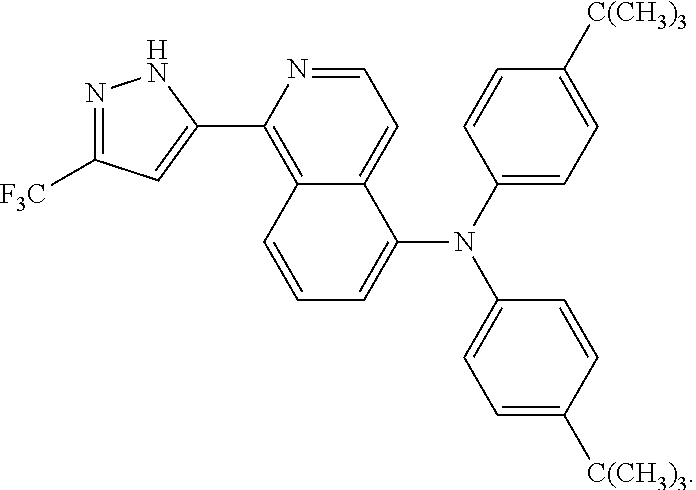

in THF was then added therein under an ice bath, followed by stirring for 30 minutes. Ethyl heptafluorobutyrate (0.14 ml, 1.17 mmol) was then added to obtain a reaction mixture, followed by heating the reaction mixture to room temperature and then further heating under reflux for 12 hours. After the reaction was finished, THF was removed and deionized water (100 ml) was added. Thereafter, hydrogen chloride (2N) was dropwise added into the two-neck bottle to adjust pH of the reaction mixture to about 4 to 5, followed by adding EA (100 ml) for partition extraction. The partition extraction was conducted three times. A collected organic layer was added with anhydrous sodium sulfate (Na2SO4) to remove water, followed by filtration to obtain a filtrate. EA was removed from the filtrate by reduced pressure distillation to obtain a thirteenth intermediate.


| TABLE 1 | ||||
| Six-coordinated | Eluent for | Color | ||
| ruthenium | column | of | Yield | |
| complex | Preparation | chromatography | product | (%) |
| Example | 1 | 1 | 14 | EA:CH2Cl2 = 1:20 | dark brown | 87 |
| 2 | 2 | 14 | EA:hexane = 1:2 | black | 89 | |
| 3 | 5 | 14 | EA:CH2Cl2 = 1:50 | dark brown | 89 | |
| 4 | 6 | 14 | EA:CH2Cl2 = 1:50 | dark brown | 87 | |
| 5 | 7 | 14 | EA:CH2Cl2 = 1:50 | dark brown | 88 | |
| 6 | 12 | 14 | EA:hexane = 1:3 | dark reddish | 88 | |
| brown | ||||||
| 7 | 13 | 14 | EA:hexane = 1:3 | dark reddish | 90 | |
| brown | ||||||
| 8 | 8 | 14 | EA:hexane = 1:3 | dark brown | 78 | |
| 9 | 9 | 14 | EA:hexane = 1:3 | black | 89 | |
| 10 | 11 | 14 | EA:hexane = 1:2 | black | 89 | |
| 11 | 10 | 14 | EA:hexane = 1:2 | black | 85 | |
| Comparative | 1 | 3 | 14 | EA:CH2Cl2 = 1:20 | dark brown | 92 |
| Example | 2 | 4 | 14 | EA:hexane = 1:1 | black | 92 |
| TABLE 2 | |
 |
Example 1 |
 |
Example 2 |
 |
Example 3 |
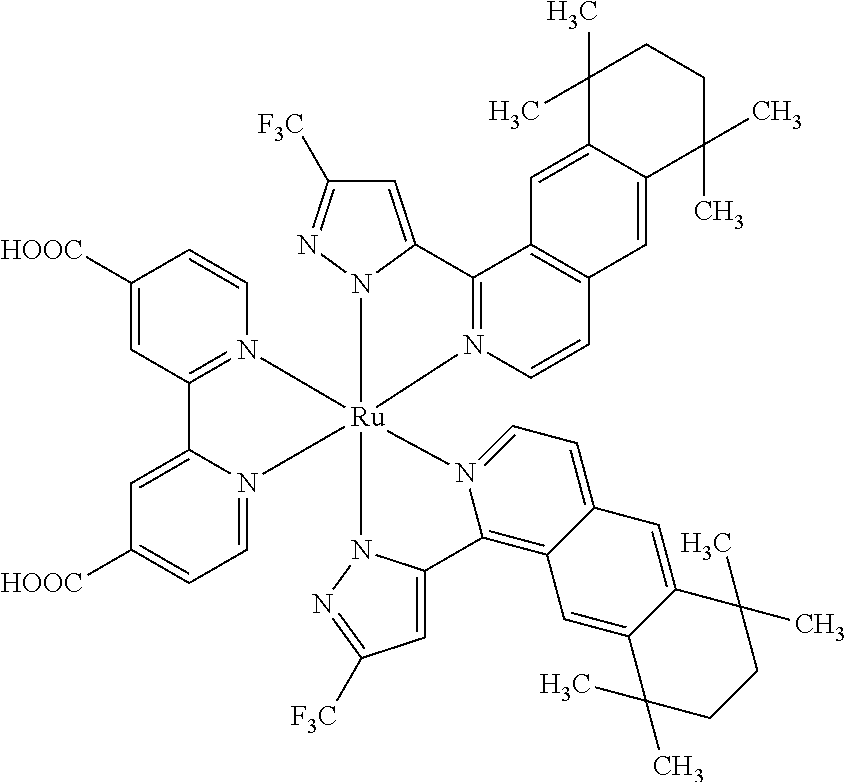 |
Example 4 |
 |
Example 5 |
 |
Example 6 |
 |
Example 7 |
 |
Example 8 |
 |
Example 9 |
 |
Example 10 |
 |
Example 11 |
| — | — |
 |
Comparative Example 1 |
 |
Comparative Example 2 |
| TABLE 3 | |||||
| Short | |||||
| UV absorption | circuit | ||||
| Six- | spectrum | current | Open | ||
| coordinated | Wave- | density | circuit | |||
| ruthenium | length | ε | (mA | voltage | Fill | n |
| complex | (nm) | (×103) | cm−2) | (mV) | factor | (%) |
| Example | 1 | 499 | 17 | 15.4 | 760 | 0.75 | 8.80 |
| 2 | 495 | 16 | 16.3 | 860 | 0.72 | 10.1 | |
| 3 | 494 | 20 | 15.57 | 860 | 0.77 | 10.35 | |
| 4 | 504 | 19 | 16.27 | 850 | 0.77 | 10.58 | |
| 5 | 497 | 21 | 15.98 | 840 | 0.74 | 9.87 | |
| 6 | 507 | 23 | 15.7 | 850 | 0.72 | 9.63 | |
| 7 | 505 | 23 | 16.4 | 850 | 0.71 | 9.84 | |
| 8 | 509 | 23 | 15.03 | 850 | 0.77 | 9.79 | |
| 9 | 518 | 34 | 15.3 | 820 | 0.73 | 9.23 | |
| 10 | 520 | 36 | 14.22 | 830 | 0.78 | 9.21 | |
| 11 | 510 | 29 | 16.43 | 800 | 0.75 | 9.74 | |
| Comparative | 1 | 500 | 12 | 14.6 | 780 | 0.73 | 8.36 |
| Example | 2 | 496 | 12 | 14.7 | 860 | 0.71 | 8.94 |
| 3 | — | — | 12.7 | 830 | 0.74 | 7.84 | |
Claims (9)
RuL1L2L3 (I)


Applications Claiming Priority (2)
| Application Number | Priority Date | Filing Date | Title |
|---|---|---|---|
| TW102114592A | 2013-04-24 | ||
| TW102114592A TWI453210B (en) | 2013-04-24 | 2013-04-24 | Six-coordinated ruthenium complex |
Publications (1)
| Publication Number | Publication Date |
|---|---|
| US8779134B1 true US8779134B1 (en) | 2014-07-15 |
Family
ID=51135633
Family Applications (1)
| Application Number | Title | Priority Date | Filing Date |
|---|---|---|---|
| US14/057,263 Expired - Fee Related US8779134B1 (en) | 2013-04-24 | 2013-10-18 | Six-coordinated ruthenium complex |
Country Status (2)
| Country | Link |
|---|---|
| US (1) | US8779134B1 (en) |
| TW (1) | TWI453210B (en) |
Citations (2)
| Publication number | Priority date | Publication date | Assignee | Title |
|---|---|---|---|---|
| US20100258175A1 (en) | 2009-04-10 | 2010-10-14 | Yun Chi | Panchromatic photosensitizers and dye-sensitized solar cell using the same |
| TW201139453A (en) | 2010-05-14 | 2011-11-16 | Nat Univ Tsing Hua | Thiocyanate-free Ru (ii) sensitizers and dye-sensitized solar cells |
Family Cites Families (1)
| Publication number | Priority date | Publication date | Assignee | Title |
|---|---|---|---|---|
| CA2448718A1 (en) * | 2003-11-07 | 2005-05-07 | National Research Council Of Canada | Phosphorescent osmium (ii) complexes and uses thereof |
-
2013
- 2013-04-24 TW TW102114592A patent/TWI453210B/en not_active IP Right Cessation
- 2013-10-18 US US14/057,263 patent/US8779134B1/en not_active Expired - Fee Related
Patent Citations (4)
| Publication number | Priority date | Publication date | Assignee | Title |
|---|---|---|---|---|
| US20100258175A1 (en) | 2009-04-10 | 2010-10-14 | Yun Chi | Panchromatic photosensitizers and dye-sensitized solar cell using the same |
| TWI379836B (en) | 2009-04-10 | 2012-12-21 | Nat Univ Tsing Hua | Panceromatic photosensitizers and dye-sensitized solar cell using the same |
| TW201139453A (en) | 2010-05-14 | 2011-11-16 | Nat Univ Tsing Hua | Thiocyanate-free Ru (ii) sensitizers and dye-sensitized solar cells |
| US20110277841A1 (en) | 2010-05-14 | 2011-11-17 | Yun Chi | Thiocyanate-free ru(ii) sensitizers and dye-sensitized solar cells |
Non-Patent Citations (2)
| Title |
|---|
| Hu et al., "Ruthenium(II) Sensitizers with Bulky Isoquinolinyl Pyrazolate Chelates for High Efficient Dye-Sensitized Solar Cells", National Tsing Hua University, Oct. 26, 2012, 1 page. |
| Hu et al., "Ruthenium(II) Sensitizers with Bulky Isoquinolinyl Pyrazolate Chelates for High Efficient Dye-Sensitized Solar Cells", Oct. 26, 2012, 1 page. |
Also Published As
| Publication number | Publication date |
|---|---|
| TW201441235A (en) | 2014-11-01 |
| TWI453210B (en) | 2014-09-21 |
Similar Documents
| Publication | Publication Date | Title |
|---|---|---|
| US8580961B2 (en) | 2-phenyl-6-azolylpyridine-based ligand and group VIII transition metal complex | |
| KR101018734B1 (en) | Photosensitive dye | |
| US8822818B2 (en) | 4,4′-dicarboxy-2,2′-bipyridine derived tridentate ligand, metal complex containing the same, and application thereof | |
| US20100125136A1 (en) | Porphyrin-based photosensitizer dyes for dye-sensitized solar cells | |
| US8889872B2 (en) | Bisazole-based compound and group VIII transition metal complex | |
| TW201213309A (en) | Heteroleptic, bis-terdentate Ru (II) complexes as sensitizers for dye-sensitized solar cells | |
| US12317741B2 (en) | Photovoltaic devices containing cyclobutane-based hole transporting materials | |
| JP5241546B2 (en) | Photosensitizer dye | |
| US20230113502A1 (en) | Low energy gap small molecule material and organic optoelectronic device using the same | |
| Perez-Tejada et al. | Organic sensitizers bearing a trialkylsilyl ether group for liquid dye sensitized solar cells | |
| US20140020761A1 (en) | Organic dye material and dye-sensitized solar cell using same | |
| CN102485731B (en) | Preparation of Heteroplexic, Bitridentate Ruthenium Complexes and Sensitized Dye Solar Cells | |
| US8143399B2 (en) | Photosensitizer dye | |
| Vats et al. | Unravelling the bottleneck of phosphonic acid anchoring groups aiming toward enhancing the stability and efficiency of mesoscopic solar cells | |
| US9691555B2 (en) | Photosensitive porphyrin dyes for dye-sensitized solar cells | |
| US8779134B1 (en) | Six-coordinated ruthenium complex | |
| US8404842B2 (en) | Organic and inorganic photosensitizer dyes | |
| US9156869B2 (en) | Ruthenium complex for dye-sensitized solar cell | |
| KR20130066547A (en) | Porphyrin derivatives, organic dye sensitizers containing the same for highly efficient dye-sensitized solar cells and dye-sensitized solar cells containing the same | |
| US11286244B2 (en) | Solar cell dyes for copper redox based dye sensitized solar cells and combinations thereof | |
| Higashino et al. | Energy level tuning of push-pull porphyrin sensitizer by trifluoromethyl group for dye-sensitized solar cells | |
| US10189996B2 (en) | Anthracene-based organic dye | |
| TWI469986B (en) | Novel ruthenium complex for high efficient dye-sensitized solar cells | |
| US8722905B2 (en) | Dyes and photoelectric conversion devices containing the same | |
| US8535574B2 (en) | Transition metal complexes, manufacturing method thereof, photovoltaic cells and manufacturing method thereof |
Legal Events
| Date | Code | Title | Description |
|---|---|---|---|
| AS | Assignment |
Owner name: NATIONAL TSING HUA UNIVERSITY, TAIWAN Free format text: ASSIGNMENT OF ASSIGNORS INTEREST;ASSIGNORS:CHI, YUN;HU, FA-CHUN;WANG, SHENG-WEI;AND OTHERS;REEL/FRAME:031446/0098 Effective date: 20131002 |
|
| STCF | Information on status: patent grant |
Free format text: PATENTED CASE |
|
| MAFP | Maintenance fee payment |
Free format text: PAYMENT OF MAINTENANCE FEE, 4TH YR, SMALL ENTITY (ORIGINAL EVENT CODE: M2551) Year of fee payment: 4 |
|
| FEPP | Fee payment procedure |
Free format text: MAINTENANCE FEE REMINDER MAILED (ORIGINAL EVENT CODE: REM.); ENTITY STATUS OF PATENT OWNER: SMALL ENTITY |
|
| LAPS | Lapse for failure to pay maintenance fees |
Free format text: PATENT EXPIRED FOR FAILURE TO PAY MAINTENANCE FEES (ORIGINAL EVENT CODE: EXP.); ENTITY STATUS OF PATENT OWNER: SMALL ENTITY |
|
| STCH | Information on status: patent discontinuation |
Free format text: PATENT EXPIRED DUE TO NONPAYMENT OF MAINTENANCE FEES UNDER 37 CFR 1.362 |
|
| FP | Lapsed due to failure to pay maintenance fee |
Effective date: 20220715 |