US8774949B2 - Hybrid intelligent control method and system for power generating apparatuses - Google Patents
Hybrid intelligent control method and system for power generating apparatuses Download PDFInfo
- Publication number
- US8774949B2 US8774949B2 US13/272,328 US201113272328A US8774949B2 US 8774949 B2 US8774949 B2 US 8774949B2 US 201113272328 A US201113272328 A US 201113272328A US 8774949 B2 US8774949 B2 US 8774949B2
- Authority
- US
- United States
- Prior art keywords
- net
- intelligent control
- function
- layer
- hybrid intelligent
- Prior art date
- Legal status (The legal status is an assumption and is not a legal conclusion. Google has not performed a legal analysis and makes no representation as to the accuracy of the status listed.)
- Expired - Fee Related, expires
Links
Images


Classifications
-
- F—MECHANICAL ENGINEERING; LIGHTING; HEATING; WEAPONS; BLASTING
- F03—MACHINES OR ENGINES FOR LIQUIDS; WIND, SPRING, OR WEIGHT MOTORS; PRODUCING MECHANICAL POWER OR A REACTIVE PROPULSIVE THRUST, NOT OTHERWISE PROVIDED FOR
- F03D—WIND MOTORS
- F03D7/00—Controlling wind motors
- F03D7/02—Controlling wind motors the wind motors having rotation axis substantially parallel to the air flow entering the rotor
- F03D7/022—Adjusting aerodynamic properties of the blades
- F03D7/0224—Adjusting blade pitch
-
- F—MECHANICAL ENGINEERING; LIGHTING; HEATING; WEAPONS; BLASTING
- F03—MACHINES OR ENGINES FOR LIQUIDS; WIND, SPRING, OR WEIGHT MOTORS; PRODUCING MECHANICAL POWER OR A REACTIVE PROPULSIVE THRUST, NOT OTHERWISE PROVIDED FOR
- F03B—MACHINES OR ENGINES FOR LIQUIDS
- F03B15/00—Controlling
-
- F—MECHANICAL ENGINEERING; LIGHTING; HEATING; WEAPONS; BLASTING
- F03—MACHINES OR ENGINES FOR LIQUIDS; WIND, SPRING, OR WEIGHT MOTORS; PRODUCING MECHANICAL POWER OR A REACTIVE PROPULSIVE THRUST, NOT OTHERWISE PROVIDED FOR
- F03D—WIND MOTORS
- F03D7/00—Controlling wind motors
- F03D7/02—Controlling wind motors the wind motors having rotation axis substantially parallel to the air flow entering the rotor
- F03D7/04—Automatic control; Regulation
-
- F—MECHANICAL ENGINEERING; LIGHTING; HEATING; WEAPONS; BLASTING
- F03—MACHINES OR ENGINES FOR LIQUIDS; WIND, SPRING, OR WEIGHT MOTORS; PRODUCING MECHANICAL POWER OR A REACTIVE PROPULSIVE THRUST, NOT OTHERWISE PROVIDED FOR
- F03D—WIND MOTORS
- F03D7/00—Controlling wind motors
- F03D7/02—Controlling wind motors the wind motors having rotation axis substantially parallel to the air flow entering the rotor
- F03D7/04—Automatic control; Regulation
- F03D7/042—Automatic control; Regulation by means of an electrical or electronic controller
- F03D7/043—Automatic control; Regulation by means of an electrical or electronic controller characterised by the type of control logic
- F03D7/046—Automatic control; Regulation by means of an electrical or electronic controller characterised by the type of control logic with learning or adaptive control, e.g. self-tuning, fuzzy logic or neural network
-
- G—PHYSICS
- G05—CONTROLLING; REGULATING
- G05B—CONTROL OR REGULATING SYSTEMS IN GENERAL; FUNCTIONAL ELEMENTS OF SUCH SYSTEMS; MONITORING OR TESTING ARRANGEMENTS FOR SUCH SYSTEMS OR ELEMENTS
- G05B13/00—Adaptive control systems, i.e. systems automatically adjusting themselves to have a performance which is optimum according to some preassigned criterion
- G05B13/02—Adaptive control systems, i.e. systems automatically adjusting themselves to have a performance which is optimum according to some preassigned criterion electric
- G05B13/0265—Adaptive control systems, i.e. systems automatically adjusting themselves to have a performance which is optimum according to some preassigned criterion electric the criterion being a learning criterion
- G05B13/0275—Adaptive control systems, i.e. systems automatically adjusting themselves to have a performance which is optimum according to some preassigned criterion electric the criterion being a learning criterion using fuzzy logic only
-
- G—PHYSICS
- G06—COMPUTING OR CALCULATING; COUNTING
- G06N—COMPUTING ARRANGEMENTS BASED ON SPECIFIC COMPUTATIONAL MODELS
- G06N5/00—Computing arrangements using knowledge-based models
- G06N5/04—Inference or reasoning models
-
- G—PHYSICS
- G06—COMPUTING OR CALCULATING; COUNTING
- G06N—COMPUTING ARRANGEMENTS BASED ON SPECIFIC COMPUTATIONAL MODELS
- G06N5/00—Computing arrangements using knowledge-based models
- G06N5/04—Inference or reasoning models
- G06N5/048—Fuzzy inferencing
-
- H—ELECTRICITY
- H02—GENERATION; CONVERSION OR DISTRIBUTION OF ELECTRIC POWER
- H02P—CONTROL OR REGULATION OF ELECTRIC MOTORS, ELECTRIC GENERATORS OR DYNAMO-ELECTRIC CONVERTERS; CONTROLLING TRANSFORMERS, REACTORS OR CHOKE COILS
- H02P9/00—Arrangements for controlling electric generators for the purpose of obtaining a desired output
- H02P9/04—Control effected upon non-electric prime mover and dependent upon electric output value of the generator
-
- F—MECHANICAL ENGINEERING; LIGHTING; HEATING; WEAPONS; BLASTING
- F05—INDEXING SCHEMES RELATING TO ENGINES OR PUMPS IN VARIOUS SUBCLASSES OF CLASSES F01-F04
- F05B—INDEXING SCHEME RELATING TO WIND, SPRING, WEIGHT, INERTIA OR LIKE MOTORS, TO MACHINES OR ENGINES FOR LIQUIDS COVERED BY SUBCLASSES F03B, F03D AND F03G
- F05B2270/00—Control
- F05B2270/70—Type of control algorithm
- F05B2270/707—Type of control algorithm fuzzy logic
-
- F—MECHANICAL ENGINEERING; LIGHTING; HEATING; WEAPONS; BLASTING
- F05—INDEXING SCHEMES RELATING TO ENGINES OR PUMPS IN VARIOUS SUBCLASSES OF CLASSES F01-F04
- F05B—INDEXING SCHEME RELATING TO WIND, SPRING, WEIGHT, INERTIA OR LIKE MOTORS, TO MACHINES OR ENGINES FOR LIQUIDS COVERED BY SUBCLASSES F03B, F03D AND F03G
- F05B2270/00—Control
- F05B2270/70—Type of control algorithm
- F05B2270/709—Type of control algorithm with neural networks
-
- Y—GENERAL TAGGING OF NEW TECHNOLOGICAL DEVELOPMENTS; GENERAL TAGGING OF CROSS-SECTIONAL TECHNOLOGIES SPANNING OVER SEVERAL SECTIONS OF THE IPC; TECHNICAL SUBJECTS COVERED BY FORMER USPC CROSS-REFERENCE ART COLLECTIONS [XRACs] AND DIGESTS
- Y02—TECHNOLOGIES OR APPLICATIONS FOR MITIGATION OR ADAPTATION AGAINST CLIMATE CHANGE
- Y02B—CLIMATE CHANGE MITIGATION TECHNOLOGIES RELATED TO BUILDINGS, e.g. HOUSING, HOUSE APPLIANCES OR RELATED END-USER APPLICATIONS
- Y02B10/00—Integration of renewable energy sources in buildings
- Y02B10/30—Wind power
-
- Y—GENERAL TAGGING OF NEW TECHNOLOGICAL DEVELOPMENTS; GENERAL TAGGING OF CROSS-SECTIONAL TECHNOLOGIES SPANNING OVER SEVERAL SECTIONS OF THE IPC; TECHNICAL SUBJECTS COVERED BY FORMER USPC CROSS-REFERENCE ART COLLECTIONS [XRACs] AND DIGESTS
- Y02—TECHNOLOGIES OR APPLICATIONS FOR MITIGATION OR ADAPTATION AGAINST CLIMATE CHANGE
- Y02E—REDUCTION OF GREENHOUSE GAS [GHG] EMISSIONS, RELATED TO ENERGY GENERATION, TRANSMISSION OR DISTRIBUTION
- Y02E10/00—Energy generation through renewable energy sources
- Y02E10/20—Hydro energy
-
- Y—GENERAL TAGGING OF NEW TECHNOLOGICAL DEVELOPMENTS; GENERAL TAGGING OF CROSS-SECTIONAL TECHNOLOGIES SPANNING OVER SEVERAL SECTIONS OF THE IPC; TECHNICAL SUBJECTS COVERED BY FORMER USPC CROSS-REFERENCE ART COLLECTIONS [XRACs] AND DIGESTS
- Y02—TECHNOLOGIES OR APPLICATIONS FOR MITIGATION OR ADAPTATION AGAINST CLIMATE CHANGE
- Y02E—REDUCTION OF GREENHOUSE GAS [GHG] EMISSIONS, RELATED TO ENERGY GENERATION, TRANSMISSION OR DISTRIBUTION
- Y02E10/00—Energy generation through renewable energy sources
- Y02E10/70—Wind energy
- Y02E10/72—Wind turbines with rotation axis in wind direction
-
- Y02E10/725—
-
- Y—GENERAL TAGGING OF NEW TECHNOLOGICAL DEVELOPMENTS; GENERAL TAGGING OF CROSS-SECTIONAL TECHNOLOGIES SPANNING OVER SEVERAL SECTIONS OF THE IPC; TECHNICAL SUBJECTS COVERED BY FORMER USPC CROSS-REFERENCE ART COLLECTIONS [XRACs] AND DIGESTS
- Y02—TECHNOLOGIES OR APPLICATIONS FOR MITIGATION OR ADAPTATION AGAINST CLIMATE CHANGE
- Y02E—REDUCTION OF GREENHOUSE GAS [GHG] EMISSIONS, RELATED TO ENERGY GENERATION, TRANSMISSION OR DISTRIBUTION
- Y02E40/00—Technologies for an efficient electrical power generation, transmission or distribution
- Y02E40/70—Smart grids as climate change mitigation technology in the energy generation sector
-
- Y02E40/76—
-
- Y—GENERAL TAGGING OF NEW TECHNOLOGICAL DEVELOPMENTS; GENERAL TAGGING OF CROSS-SECTIONAL TECHNOLOGIES SPANNING OVER SEVERAL SECTIONS OF THE IPC; TECHNICAL SUBJECTS COVERED BY FORMER USPC CROSS-REFERENCE ART COLLECTIONS [XRACs] AND DIGESTS
- Y04—INFORMATION OR COMMUNICATION TECHNOLOGIES HAVING AN IMPACT ON OTHER TECHNOLOGY AREAS
- Y04S—SYSTEMS INTEGRATING TECHNOLOGIES RELATED TO POWER NETWORK OPERATION, COMMUNICATION OR INFORMATION TECHNOLOGIES FOR IMPROVING THE ELECTRICAL POWER GENERATION, TRANSMISSION, DISTRIBUTION, MANAGEMENT OR USAGE, i.e. SMART GRIDS
- Y04S10/00—Systems supporting electrical power generation, transmission or distribution
- Y04S10/50—Systems or methods supporting the power network operation or management, involving a certain degree of interaction with the load-side end user applications
-
- Y04S10/545—
Definitions
- the present invention relates to a novel hybrid intelligent control system and method for power generating apparatuses, such as a permanent magnet synchronous generator (PMSG), and more particularly to a power generating system adapted for enabling a turbine to operate at its maximum efficiency by adjusting its blade pitch angle in response to the variation of an input flowing into the turbine, while allowing the shaft speed of a power generating apparatus to be controlled by a fuzzy interference mechanism so as to achieve its maximum power output.
- PMSG permanent magnet synchronous generator
- variable-speed generation systems such as wind power generation systems that are capable of harvesting wind power to be used for producing electricity without emissions, beginning to attract more and more attentions as they can be used as clean and safe renewable power sources.
- the power generation system of the prime mover for instance, it can be designed to operate in either a constant-speed mode or a variable-speed mode for producing electricity through the conversion of power electronic converters.
- the variable-speed generation system is more attractive than the fixed-speed system because of the improvement in energy production and the reduction of the flicker problem.
- the turbine in the variable-speed generation system can be operated at the maximum power operating point for various speeds by adjusting the shaft speed optimally to achieve maximum efficiency. All these characteristics are advantages of the variable-speed energy conversion systems. Nevertheless, in order to achieve the maximum power control, some control schemes have been studied.
- PMSG permanent magnet synchronous generator
- a novel hybrid intelligent control system and algorithm for a power generating apparatus capable of optimizing the performance of the power generating apparatus by performing a speed control using a sliding mode controller combined with fuzzy inference mechanism and adaptive algorithm, and also by performing a pitch control upon a turbine coupled to the power generating apparatus using pitch controller embedded with a RBFN algorithm.
- a sliding mode controller a switching surface with an integral operation is designed. Operationally, when the sliding mode occurs, the system dynamic behaves as a robust state feedback control system, and in a general sliding mode control, the upper bound of uncertainties, including parameter variations and external mechanical disturbance, must be available. However, the bound of the uncertainties is difficult to obtain in advance for practical applications.
- a fuzzy sliding speed controller is investigated to resolve the above difficulty, in which a simple fuzzy inference mechanism is utilized to estimate the upper bound of uncertainties. Furthermore, to reduce the control effort of the sliding mode speed controller, the fuzzy inference mechanism is improved by adapting the center of the membership functions to estimate the optimal bound of uncertainties.
- the primary object of the present invention is to provide a novel hybrid intelligent control system and method for a power generating apparatus, such as a permanent magnet synchronous generator (PMSG), adapted for enabling a turbine that is coupled to the power generating apparatus to operate at its maximum efficiency by adjusting its blade pitch angle in response to the variation of any input flowing into the turbine, while allowing the speed of the power generating apparatus to be controlled by a fuzzy interference mechanism so as to achieve its maximum power output.
- a power generating apparatus such as a permanent magnet synchronous generator (PMSG)
- PMSG permanent magnet synchronous generator
- the present invention provides a novel hybrid intelligent control system for a power generating apparatus, such as a permanent magnet synchronous generator (PMSG), which comprises: a fuzzy sliding mode speed controller, being embedded with a fuzzy inference mechanism so as to be used for controlling the speed of a power generating apparatus; and a radial basis function network (RBFN) pitch controller, being embedded with an on-line training RBFN so as to be used for controlling the pitch angle of a turbine coupled to the PMSG; wherein the turbine is driven to operate at its maximum efficiency by adjusting its blade pitch angle in response to the variation of a flow input into the turbine, while allowing the speed of the power generating apparatus to be controlled by a fuzzy inference mechanism so as to achieve its maximum power output.
- a fuzzy sliding mode speed controller being embedded with a fuzzy inference mechanism so as to be used for controlling the speed of a power generating apparatus
- RBFN radial basis function network
- the present invention provides a novel hybrid intelligent control method for a permanent magnet synchronous generator, which comprises the steps of: using a fuzzy sliding mode speed controller that is embedded with a fuzzy inference mechanism, for controlling the speed of a power generating apparatus; and using a radial basis function network (RBFN) pitch controller, that is embedded with an on-line training RBFN, for controlling the pitch angle of a turbine coupled to the power generating apparatus.
- a fuzzy sliding mode speed controller that is embedded with a fuzzy inference mechanism, for controlling the speed of a power generating apparatus
- RBFN radial basis function network
- FIG. 1 is a schematic diagram showing an exemplary power generation system configuration of the present invention.
- FIG. 2 is a diagram showing curves of C P versus ⁇ .
- FIG. 3 shows a configuration of a field-oriented power generating system.
- FIG. 4 is control system block diagram representing the field-oriented power generating system.
- FIG. 5 are diagrams showing membership functions for the fuzzy sets corresponding to switching surface S, ⁇ dot over (S) ⁇ .
- FIG. 6A shows a three-layer neural network used in the pitch controller of the present invention.
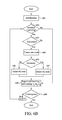
- FIG. 6B is a flow chart depicting the steps performed in an on-line training RBFN that is embedded in a RBFN pitch controller of the present invention.
- FIG. 1 is a schematic diagram showing an exemplary power generation system configuration of the present invention.
- the power generation system shown in FIG. 1 uses a wind turbine 10 as its energy harvesting device, it is not limited thereby, and thus can be a turbine capable of capturing energy of any input flowing therein.
- the input of a wind turbine 10 is the wind and the output is the mechanical power for turning the shaft of a power generating apparatus 12 , such as a PMSG that is coupled to the wind turbine 10 through a gear box 11 .
- a power generating apparatus 12 such as a PMSG that is coupled to the wind turbine 10 through a gear box 11 .
- the wind power P w is harvested by the wind turbine so as to be converted into the output mechanical power P m for driving the shaft of the PMSG 12 to rotate through the coupling of the gear box 11 , and thus enabling the same to produce electricity P e that is to be converted by a power converter 13 into P dc so as to be fed to a dc load 14 or a dc power grid 14 .
- ⁇ and A are air density and the area swept by blades, respectively;
- r is the wind turbine blade radius
- This equation shows the relationship between the turbine power and turbine speed at maximum power output.
- turbine power When regulating the system under the specification of maximum power, it must be taken into account that turbine power must never be higher than generator rated power. Once generator rated power is reached at rated wind velocity, output power must be limited.
- a mechanical actuator is usually employed to change the pitch angle of the blades in order to reduce power coefficient and maintain the power at its rated value.
- rated speed is obtained at a wind velocity lower than that of generator rated power.
- I fd equivalent d-axis magnetizing current
- FIG. 3 The configuration of a field-oriented PMSG system is shown in FIG. 3 , which consists of: a PMSG 31 , a current-controlled PWM voltage source converter (VSC) 32 , an inverter 33 , a current control 34 , a coordinate translator 35 , and a speed controller 36 , and a pitch controller 37 .
- VSC current-controlled PWM voltage source converter
- the PMSG system can be reasonably represented by the control system block diagram shown in FIG. 4 .
- the present invention provides a novel hybrid intelligent control method for a permanent magnet synchronous generator, which comprises the steps of: using a fuzzy sliding mode speed controller 40 that is embedded with a fuzzy inference mechanism, for controlling the speed of a power generating apparatus; and using a radial basis function network (RBFN) pitch control system, that is embedded with an on-line training RBFN 41 , for controlling the pitch angle of a turbine coupled to the power generating apparatus 42 .
- RBFN radial basis function network
- C is set as a positive constant matrix
- sgn(•) is a sign function defined as:
- K f is estimated by fuzzy inference mechanism.
- FIG. 5 are diagrams showing membership functions for the fuzzy sets corresponding to switching surface S, ⁇ dot over (S) ⁇ . As shown in FIG. 5 , their universe of discourses are all assigned to be [ ⁇ 2, 2], where the fuzzy control rules are defined by:
- N Negative ZE
- Z Zero P: Positive NH: Negative Huge
- NB Negative Big NM: Negative Medium
- NS Negative Small PH: Positive Hug
- PS Positive Small PM: Positive Medium
- PB Positive Big PH: Positive Huge Since only three fuzzy subsets, N, Z and P, are defined for S and ⁇ dot over (S) ⁇ , the fuzzy inference mechanism only contains nine rules defined in Table 1, as following:
- Fuzzy output K f can be calculated by the center of gravity (COG) defuzzifier by the following equation:
- ⁇ [c 1 , . . . , c 9 ] is the adjustable parameter vector
- FIG. 6A shows a three-layer neural network used in the pitch controller of the present invention.
- the units in the input, hidden, and output layers can be two, nine and one in respective, for example.
- the nodes in this layer are used to directly transmit the numerical inputs to the next layer.
- every node performs a Gaussian function.
- the Gaussian function a particular example of radial basic functions, is used here as a membership function.
- the aforesaid three-layer RBFN is a supervised learning and training process.
- a supervised learning law 60 of gradient descent is used to train this system.
- the derivation is the same as that of the back-propagation algorithm. It is employed to adjust the parameters m ij , ⁇ ij , and w j of the RBFN by using the training patterns.
- the error term for each layer is calculated, and updated.
- the weight w j is updated.
- the error term to be propagated is given by:
- ⁇ w is the learning rate for adjusting the parameter w j .
- m ij and ⁇ ij are updated.
- the multiplication operation is done in this layer.
- the adaptive rule for m ij is
- FIG. 6B is a flow chart depicting the steps performed in an on-line training RBFN that is embedded in a RBFN pitch controller of the present invention.
- the performing of the on-line training RBFN starts from the step 601 .
- an initialization process is enabled to be performed upon variables used in the RBFN, and then the flow proceeds to step 602 .
- an evaluation is performed for determining whether or not to perform a structure learning process; and if so, the flow proceeds to step 603 ; otherwise, the flow proceeds to step 608 .
- the structure learning is used to find proper input space fuzzy partitions and fuzzy logic rules subject to minimize the number of rules generated and the number of fuzzy sets on the universe of discourse of each input variable, and in an embodiment, the structure learning process is enabled if x 1 >e min or ⁇ dot over (x) ⁇ 1 > ⁇ e min .
- an evaluation is made for whether or not to add a new membership function node, if so, the flow proceeds to step 604 , otherwise the flow proceeds to step 608 .
- a new node is created; and then the flow proceeds to step 605 .
- a similarity test is performed for comparing the newly created node with other nodes; and if the newly created node passes the similarity test, the flow proceeds to step 606 ; otherwise, the flow proceeds to step 607 .
- the newly created node is adopted; and then the flow proceeds to step 608 .
- the newly created node is deleted; and then the flow proceeds to step 608 .
- a supervised learning process is enabled for training the m ij , ⁇ ij , and w j ; and then the flow proceeds to step 609 .
- an convergence test is performed for determining whether the error function E is minimized; if so, the flow stops; otherwise, the flow proceeds back to step 602 for starting a new iteration.
- the present invention provides a novel hybrid intelligent control system and method for a permanent magnet synchronous generator (PMSG), adapted for enabling a wind turbine that is coupled to the PMSG to operate at its maximum efficiency by adjusting its blade pitch angle in response to the variation of wind, while allowing the speed of the PMSG to be controlled by a fuzzy interference mechanism so as to achieve its maximum power output. That is, by the control method of the present invention, the controlled rotor speed, the actual turbine power P m and the generator power P e can track the desired P w closely, and thus not only the maximal wind energy can be captured, but also the system stability can be maintained while allowing the desired performance to be reached even with parameter uncertainties.
- PMSG permanent magnet synchronous generator
Landscapes
- Engineering & Computer Science (AREA)
- General Engineering & Computer Science (AREA)
- Software Systems (AREA)
- Physics & Mathematics (AREA)
- Artificial Intelligence (AREA)
- Theoretical Computer Science (AREA)
- Combustion & Propulsion (AREA)
- Evolutionary Computation (AREA)
- Mathematical Physics (AREA)
- Mechanical Engineering (AREA)
- Chemical & Material Sciences (AREA)
- Life Sciences & Earth Sciences (AREA)
- Sustainable Development (AREA)
- Sustainable Energy (AREA)
- Fuzzy Systems (AREA)
- General Physics & Mathematics (AREA)
- Computing Systems (AREA)
- Data Mining & Analysis (AREA)
- Computational Linguistics (AREA)
- Automation & Control Theory (AREA)
- Fluid Mechanics (AREA)
- Power Engineering (AREA)
- Health & Medical Sciences (AREA)
- Computer Vision & Pattern Recognition (AREA)
- Medical Informatics (AREA)
- Feedback Control In General (AREA)
- Control Of Eletrric Generators (AREA)
Abstract
Description
P m=½ρAC p(λ,β)V ω 3; (1)
-
- Vω is the wind velocity (m/sec); and
- Cp is the power coefficient.
The power coefficient Cp is given as a nonlinear function of the tip speed ratio (TSR) λ in an equation:
-
- ωr is the turbine speed.
Consequently, Cp is can be expressed as a function of the TSR λ and the blade pitch angle β, and is general defined by the following equation:
- ωr is the turbine speed.
wherein λi=((λ−0.02β)−1−3×10⁻³(β3+1)−1)−1
By using (3), the typical Cp versus λ curve is shown in
v q =Ri q +pλ q+ωsλd;
v q =Ri q +pλ q+ωsλd; (5)
and
λq =L q i q;
λd =L d i d +L md I fd; (6)
ωs =n pωr; (7)
T e=3n p [L md I fd i q+(L d −L q)i d i q]/2. (8)
x 1(t)=ωopt−ωr(t); and
{dot over (x)} 1(t)=−{dot over (ω)}r(t)=−x 2(t).
Accordingly, the PMSG system can be written in the following state-space form with
The above equation can be represented as:
{dot over (X)}(t)=AX(t)+BU(t)+D{dot over (T)} m (10)
and
U(t)={dot over (i)} q*(t).
Consider equation (10) with uncertainties, we have:
{dot over (X)}(t)=(A+ΔA)X(t)+(B+ΔB)U(t)+(D+ΔD){dot over (T)} m. (11)
- wherein ΔA, ΔB and ΔD are denoted as the uncertainties introduced by system parameters J, B, Kt, and mechanical torque Tm.
Reformulate equation (11), by
{dot over (X)}(t)=AX(t)+B(U(t)+F(t)) (12)
where F(t) is called the lumped uncertainty and is defined by
F(t)=B −1 ΔAX(t)+B −1 ΔBU(t)+B −1(D+ΔD){dot over (T)} m.
According to (12), an integral-operation switching surface is designed directly from the nominal values of system parameters A and B.
S(t)=C[X(t)−∫0 t(A+BK)X(τ)dτ]=0 (13)
-
- K is a state feedback gain matrix.
From equation (13), if the state trajectory of system equation (12) is trapped on the switching surface equation (13), namely S(t)={dot over (S)}(t)=0, then the equivalent dynamics of system equation (12) is governed by the following equation that:
{dot over (X)}(t)=(A+BK)X(t). (14)
From equation (14), the speed error x1(t) will converge to zero exponentially if the pole of system (14) is strategically located on the left-hand plane. Thus, the overshoot phenomenon will not occur, and the system dynamic will behave as a state feedback control system.
- K is a state feedback gain matrix.
U(t)=KX(t)−f sgn(S(t); (15)
and′
-
- f is defined as |F(t)|≦f.
U(t)=KX(t)−K f sgn(S(t)); (16)
| N: Negative | ZE, Z: Zero | P: Positive |
| NH: Negative Huge | NB: Negative Big | NM: Negative Medium |
| NS: Negative Small | PH: Positive Hug | PS: Positive Small |
| PM: Positive Medium | PB: Positive Big | PH: Positive Huge |
Since only three fuzzy subsets, N, Z and P, are defined for S and {dot over (S)}, the fuzzy inference mechanism only contains nine rules defined in Table 1, as following:
| TABLE 1 | ||
| {dot over (S)} | ||
| Kf | P | Z | N | ||
| S | P | NH | NB | NM |
| (−1.5) | (−1) | (−0.5) | ||
| Z | NS | ZE | PS | |
| (−0.05) | (0) | (0.05) | ||
| N | PM | PB | PH | |
| (0.5) | (1) | (1.5) | ||
For example,
-
- c1 through c9 are the center of the membership functions of Kf;
is a fired strength vector.
neti 1 =x i 1(N);
y i 1(N)=f i 1(neti 1(N))=neti 1(N); i=1,2. (18)
In the hidden layer, every node performs a Gaussian function. The Gaussian function, a particular example of radial basic functions, is used here as a membership function.
Then,
netj 2(N)=−(X−M j)TΣj(X−M j);
y j 2(N)=f j 2(netj 2(N))=exp(netj 2(N)); j=1, . . . ,9;
wherein
M j =[m 1j m 2j . . . m ij]T; and (19)
-
- Σj=diag[1/
σ 1j 2 1/σ2j 2 . . . 1/σij 2]T denotes the mean and the standard deviation, STD, of the Gaussian function.
For the output layer, the single node k in this layer is denoted by Σ, which computes the overall output as the summation of all incoming signals by the following equation:
- Σj=diag[1/
wherein, wj are the connective weight between the hidden and the output layers.
E=½(P w −P m)2; (21)
then, the weight wj is adjusted by the amount
hence, the weight can be updated by the equation:
w j(N+1)=w j(N)+ηw Δw j(N);
and, the adaptive rule for σij is:
Thus the updated rules for mij and σij are
m ij(k+1)=m ij(k)+ηm Δm ij;
σij(k+1)=σij(k)+ησΔσij; (27)
-
- where ηm and are the learning rates for adjusting the parameters mij and σij, respectively.
With tuning parameters mij, σij, and wj, we can derive a learning algorithm that drives E to zero.
- where ηm and are the learning rates for adjusting the parameters mij and σij, respectively.
Claims (28)
P m=½ρAC p(λ,β)V ω 3;
λi=((λ−0.02β)−1−3×10⁻³(β3+1)−1)−1
S(t)=C[X(t)−∫0 t(A+BK)X(τ)dτ]=0;
U(t)=KX(t)−K f sgn(S(t));
neti 1 =x i 1(N); and
y i 1(N)=f i 1(neti 1(N))=neti 1(N);
netj 2(N)=−(X−M j)TΣj(X−M j); and
y j 2(N)=f j 2(netj 2(N))=exp(netj 2(N)), j=1, . . . ,9;
y k 3(N)=f k 3(netk 3(N))=netk 3(N)=βc;
E=½(P w −P m)2;
w j(N+1)=w j(N)+ηw Δw j(N);
m ij(k+1)=m ij(k)+ηmΔm ij; and
σij(k+1)=σij(k)+ησΔσij;
S(t)=C[X(t)−∫0 t(A+BK)X(τ)dτ]=0;
U(t)=KX(t)−K f sgn(S(t));
neti 1 =x i 1(N); and
y i 1(N)=f i 1(neti 1(N))=neti 1(N);
netj 2(N)=−(X−M j)TΣj(X−M j); and
y j 2(N)=f j 2(netj 2(N))=exp(netj 2(N)), j=1, . . . ,9;
y k 3(N)=f k 3(netk 3(N))=netk 3(N)=βc;
E=½(P w −P m)2;
w j(N+1)=w j(N)+ηw Δw j(N);
m ij(k+1)=m ij(k)+ηm Δm ij; and
σij(k+1)=σij(k)+ησΔσij;
Applications Claiming Priority (4)
| Application Number | Priority Date | Filing Date | Title |
|---|---|---|---|
| TW100135909 | 2011-10-04 | ||
| TZ100135909A | 2011-10-04 | ||
| TW100135909A TWI445276B (en) | 2011-10-04 | 2011-10-04 | Hybrid intelligent control system and algorithm for automatic voltage regulator |
| EP11401614 | 2011-10-13 |
Publications (2)
| Publication Number | Publication Date |
|---|---|
| US20130085621A1 US20130085621A1 (en) | 2013-04-04 |
| US8774949B2 true US8774949B2 (en) | 2014-07-08 |
Family
ID=47993347
Family Applications (1)
| Application Number | Title | Priority Date | Filing Date |
|---|---|---|---|
| US13/272,328 Expired - Fee Related US8774949B2 (en) | 2011-10-04 | 2011-10-13 | Hybrid intelligent control method and system for power generating apparatuses |
Country Status (3)
| Country | Link |
|---|---|
| US (1) | US8774949B2 (en) |
| CA (1) | CA2755024C (en) |
| TW (1) | TWI445276B (en) |
Cited By (9)
| Publication number | Priority date | Publication date | Assignee | Title |
|---|---|---|---|---|
| US20130320676A1 (en) * | 2011-02-21 | 2013-12-05 | Samsung Heavy Ind. Co., Ltd. | System and method for correcting nacelle wind velocity of wind power generator |
| US10352298B2 (en) | 2016-12-21 | 2019-07-16 | General Electric Company | Wind generation system and controlling method thereof |
| CN111009909A (en) * | 2020-01-02 | 2020-04-14 | 长沙有色冶金设计研究院有限公司 | Method for Recognition of Low Frequency Oscillation Mode in Power System |
| US20220205425A1 (en) * | 2020-12-29 | 2022-06-30 | POSTECH Research and Business Development Foundation | Wind turbine system using predicted wind conditions and method of controlling wind turbine |
| US11530685B2 (en) | 2020-08-20 | 2022-12-20 | General Electric Company | System and method for managing output flicker generated by a wind farm |
| US11585322B1 (en) * | 2022-05-26 | 2023-02-21 | King Fahd University Of Petroleum And Minerals | Wind turbine control apparatus and method therefor |
| US12129735B2 (en) | 2016-09-30 | 2024-10-29 | Conocophillips Company | Tool for metal plugging or sealing of casing |
| US12180936B2 (en) | 2021-07-28 | 2024-12-31 | General Electric Renovables Espana, S.L. | Systems and methods for operating a wind farm |
| US12281537B2 (en) | 2017-03-11 | 2025-04-22 | Conocophillips Company | Helical coil annular access plug and abandonment |
Families Citing this family (37)
| Publication number | Priority date | Publication date | Assignee | Title |
|---|---|---|---|---|
| CN104564519B (en) * | 2013-10-22 | 2017-07-11 | 同济大学 | The wind-powered electricity generation networking Poewr control method that award setting is combined with super capacitor |
| US20160020670A1 (en) * | 2014-07-15 | 2016-01-21 | IPH + Limited | Energy conversion apparatus and method |
| CN104538989B (en) * | 2014-07-29 | 2017-11-28 | 清华大学 | The control method of wind power plant closed loop active power |
| CN104113247B (en) * | 2014-08-01 | 2016-06-15 | 河海大学常州校区 | Voltage Regulator on Doubly-Salient Generator device and voltage-regulation control method thereof |
| CN104113248B (en) * | 2014-08-01 | 2016-05-11 | 河海大学常州校区 | Voltage Regulator on Doubly-Salient Generator control method |
| CN104242759B (en) * | 2014-08-29 | 2017-02-08 | 国家电网公司 | Double-fed wind power generation system based on vector power system stabilizer |
| CN105179165A (en) * | 2015-07-31 | 2015-12-23 | 苏州欧可罗电子科技有限公司 | Variable-pitch voltage stabilization wind power motor regulation and control system |
| CN105207240B (en) * | 2015-10-23 | 2017-12-29 | 许继集团有限公司 | Distributed energy storage optimizing scheduling control method and system based on efficiency cloud terminal |
| CN105508135A (en) * | 2015-12-14 | 2016-04-20 | 沈阳华创风能有限公司 | Variable pitch control method based on combination of fuzzy feedforward and fuzzy PID control |
| TWI582563B (en) * | 2015-12-17 | 2017-05-11 | 遠東科技大學 | Wind turbine control device and control method thereof |
| CN105610163B (en) * | 2016-01-20 | 2018-05-22 | 河海大学常州校区 | Active Power Filter-APF method of adaptive fuzzy sliding mode control based on fractional order |
| CN106227950B (en) * | 2016-07-26 | 2019-05-28 | 三峡大学 | Modeling method of primary frequency modulation system of wind turbine based on pitch control |
| CN106814626B (en) * | 2017-03-21 | 2019-06-14 | 烟台南山学院 | Fast Tracking Method of Supersonic Vehicle Overload Command Based on Fuzzy Variable Structure |
| CN106708082B (en) * | 2017-03-21 | 2019-06-21 | 烟台南山学院 | Fast Tracking Method of Aircraft Pitch Channel Attitude Command Based on Fuzzy Control |
| CN106870281A (en) * | 2017-04-06 | 2017-06-20 | 哈尔滨理工大学 | A kind of variable pitch control method based on fuzzy feedforward and PI type Fuzzy |
| CN108984815B (en) * | 2018-04-20 | 2022-06-21 | 江苏大学 | Control method of vehicle-mounted flywheel battery radial suspension supporting system based on working condition |
| CN109274106A (en) * | 2018-09-16 | 2019-01-25 | 天津大学 | Smart grid frequency control method based on electric vehicle cluster |
| CN109889069A (en) * | 2019-03-05 | 2019-06-14 | 淮阴工学院 | A single-phase inverter compound control method and system |
| CN110083061B (en) * | 2019-04-12 | 2022-04-08 | 国网宁夏电力有限公司电力科学研究院 | A wheeled mobile robot control method |
| CN111828246B (en) * | 2019-04-23 | 2022-11-18 | 新疆金风科技股份有限公司 | Wind generating set overspeed prevention control method and device and storage medium |
| CN110266227A (en) * | 2019-06-26 | 2019-09-20 | 华中科技大学 | A Control System of Permanent Magnet Synchronous Motor Based on Fuzzy Sliding Film Variable Structure |
| CN110374804B (en) * | 2019-07-03 | 2020-06-19 | 西安交通大学 | Variable pitch control method based on gradient compensation of depth certainty strategy |
| CN110350587B (en) * | 2019-07-30 | 2020-09-04 | 华北电力大学 | Doubly-fed fan subsynchronous oscillation suppression method and system based on converter control |
| CN110501902A (en) * | 2019-08-27 | 2019-11-26 | 江苏华存电子科技有限公司 | A kind of single input Fuzzy Sliding plane control method |
| CN111130406B (en) * | 2019-12-26 | 2021-06-11 | 苏州大学 | Sliding mode control method of spherical motor |
| CN111664062B (en) * | 2020-06-16 | 2021-05-11 | 湖南科技大学 | Fault detection method for doubly-fed induction generator based on switchable sliding mode approach rate |
| CN112696311B (en) * | 2020-12-27 | 2022-10-25 | 中国电建集团河南省电力勘测设计院有限公司 | Variable-boundary-layer-based quasi-sliding mode variable-pitch optimization control method |
| CN113824131B (en) * | 2021-08-23 | 2025-04-04 | 运达能源科技集团股份有限公司 | A frequency adaptive control method for wind turbines taking into account power generation loss |
| CN113946608B (en) * | 2021-09-22 | 2024-05-31 | 宁波大学科学技术学院 | A wind turbine operating status monitoring method based on online RBF neural network |
| US20230281310A1 (en) * | 2022-03-01 | 2023-09-07 | Meta Plataforms, Inc. | Systems and methods of uncertainty-aware self-supervised-learning for malware and threat detection |
| CN114530889B (en) * | 2022-03-28 | 2022-12-13 | 四川大学 | Photovoltaic system dual-mode frequency control method based on large disturbance interval identification |
| CN116453331A (en) * | 2023-03-21 | 2023-07-18 | 浙江数智交院科技股份有限公司 | Motorcade guiding method for signalized intersection based on driving characteristics of head car |
| CN117167190B (en) * | 2023-06-14 | 2026-03-17 | 浙江浙能嘉兴海上风力发电有限公司 | A method for suppressing torsional vibration of wind turbine shaft system based on robust nonlinear adaptive control |
| CN118068694B (en) * | 2024-04-19 | 2024-07-05 | 南京信息工程大学 | An adaptive neural network fuzzy integral sliding mode control method and device |
| CN118281832B (en) * | 2024-06-03 | 2024-08-20 | 长江三峡集团实业发展(北京)有限公司 | DC power control method, device, equipment and storage medium |
| CN119696432B (en) * | 2025-01-26 | 2025-10-10 | 南京师范大学 | A magnetic field weakening voltage stabilization strategy for a permanent magnet generator using direct axis current controlled by input speed |
| CN120159703B (en) * | 2025-05-08 | 2025-08-29 | 内蒙古明阳北方智慧能源研发中心有限公司 | Variable speed variable pitch wind generating set torque control method, system and computer readable medium |
Citations (5)
| Publication number | Priority date | Publication date | Assignee | Title |
|---|---|---|---|---|
| US5652485A (en) * | 1995-02-06 | 1997-07-29 | The United States Of America As Represented By The Administrator Of The U.S. Environmental Protection Agency | Fuzzy logic integrated electrical control to improve variable speed wind turbine efficiency and performance |
| US6711556B1 (en) * | 1999-09-30 | 2004-03-23 | Ford Global Technologies, Llc | Fuzzy logic controller optimization |
| US20100127495A1 (en) * | 2008-11-26 | 2010-05-27 | Per Egedal | Estimating an achievable power production of a wind turbine by means of a neural network |
| US7939961B1 (en) * | 2010-04-28 | 2011-05-10 | General Electric Company | Wind turbine with integrated design and controlling method |
| US20130140819A1 (en) * | 2010-06-02 | 2013-06-06 | Vestas Wind Systems A/S | Method for operating a wind turbine at improved power output |
-
2011
- 2011-10-04 TW TW100135909A patent/TWI445276B/en not_active IP Right Cessation
- 2011-10-13 US US13/272,328 patent/US8774949B2/en not_active Expired - Fee Related
- 2011-10-13 CA CA2755024A patent/CA2755024C/en not_active Expired - Fee Related
Patent Citations (5)
| Publication number | Priority date | Publication date | Assignee | Title |
|---|---|---|---|---|
| US5652485A (en) * | 1995-02-06 | 1997-07-29 | The United States Of America As Represented By The Administrator Of The U.S. Environmental Protection Agency | Fuzzy logic integrated electrical control to improve variable speed wind turbine efficiency and performance |
| US6711556B1 (en) * | 1999-09-30 | 2004-03-23 | Ford Global Technologies, Llc | Fuzzy logic controller optimization |
| US20100127495A1 (en) * | 2008-11-26 | 2010-05-27 | Per Egedal | Estimating an achievable power production of a wind turbine by means of a neural network |
| US7939961B1 (en) * | 2010-04-28 | 2011-05-10 | General Electric Company | Wind turbine with integrated design and controlling method |
| US20130140819A1 (en) * | 2010-06-02 | 2013-06-06 | Vestas Wind Systems A/S | Method for operating a wind turbine at improved power output |
Non-Patent Citations (8)
| Title |
|---|
| Dynamic Analysis ofWind Turbine Blades Using Radial Basis Functions; Ming-Hung Hsu; 12 pages; Published Apr. 2011; printed from Internet on Jan. 27, 2014. * |
| Dynamic control of wind turbines; Kusiak A, et al., Dynamic control of wind turbines, Renewable Energy (2009), doi:10.1016/j.renene.2009.05.022; 8 pages. * |
| Hybrid Fuzzy Control Strategies for Variable Speed Wind Turbines; published in Automatic Control and Robotics; vol. 10, No. 2, 2011, pp. 205-217; Ivan Ciric et al., received Nov. 18, 2011, 13 pages. * |
| Hybrid Fuzzy Control Strategies for Variable Speed Wind Turbines; published in Automatic Control and Robotics; vol. 10, No. 2, 2011, pp. 205-217; Ivan Ćirić et al., received Nov. 18, 2011, 13 pages. * |
| Neural Network-Based Fuzzy Predictive Current Control for Doubly Fed Machine; 2009 IITA International Conference on Control, Automation and Systems Engineering; Zongkai Shao et aL; 4 pages. * |
| Pitch angle control in wind turbines above the rated wind speed by multi-layer perceptron and radial basis function neural networks; Yilmaz et al.; 9 pages. Copyright 2009; printed from Internet on Jan. 27, 2014. * |
| Pitch Angle Control of Variable Low Rated Speed Wind Turbine Using Fuzzy Logic Controller; International Journal of Engineering & Technology IJET-IJENS vol. 10 No. 5; A. Musyafa et al.; 4 pages. * |
| Research on the Intelligent Control Strategy Based on Improved FNNC for Hydraulic Turbine Generating Units; 2009 International Conference on Artificial Intelligence and Computational Intelligence; Shuqing Wang et al.; 5 pages. * |
Cited By (12)
| Publication number | Priority date | Publication date | Assignee | Title |
|---|---|---|---|---|
| US20130320676A1 (en) * | 2011-02-21 | 2013-12-05 | Samsung Heavy Ind. Co., Ltd. | System and method for correcting nacelle wind velocity of wind power generator |
| US9103318B2 (en) * | 2011-02-21 | 2015-08-11 | Samsung Heavy Ind. Co., Ltd. | System and method for correcting nacelle wind velocity of wind power generator |
| US12129735B2 (en) | 2016-09-30 | 2024-10-29 | Conocophillips Company | Tool for metal plugging or sealing of casing |
| US10352298B2 (en) | 2016-12-21 | 2019-07-16 | General Electric Company | Wind generation system and controlling method thereof |
| US12281537B2 (en) | 2017-03-11 | 2025-04-22 | Conocophillips Company | Helical coil annular access plug and abandonment |
| CN111009909A (en) * | 2020-01-02 | 2020-04-14 | 长沙有色冶金设计研究院有限公司 | Method for Recognition of Low Frequency Oscillation Mode in Power System |
| CN111009909B (en) * | 2020-01-02 | 2022-02-01 | 长沙有色冶金设计研究院有限公司 | Low-frequency oscillation mode identification method for power system |
| US11530685B2 (en) | 2020-08-20 | 2022-12-20 | General Electric Company | System and method for managing output flicker generated by a wind farm |
| US20220205425A1 (en) * | 2020-12-29 | 2022-06-30 | POSTECH Research and Business Development Foundation | Wind turbine system using predicted wind conditions and method of controlling wind turbine |
| US12180936B2 (en) | 2021-07-28 | 2024-12-31 | General Electric Renovables Espana, S.L. | Systems and methods for operating a wind farm |
| US11585322B1 (en) * | 2022-05-26 | 2023-02-21 | King Fahd University Of Petroleum And Minerals | Wind turbine control apparatus and method therefor |
| US11879434B2 (en) | 2022-05-26 | 2024-01-23 | King Fahd University Of Petroleum And Minerals | Wind speed-tip speed ratio controlled wind turbine apparatus |
Also Published As
| Publication number | Publication date |
|---|---|
| US20130085621A1 (en) | 2013-04-04 |
| CA2755024A1 (en) | 2013-04-13 |
| TWI445276B (en) | 2014-07-11 |
| TW201316646A (en) | 2013-04-16 |
| CA2755024C (en) | 2014-10-07 |
Similar Documents
| Publication | Publication Date | Title |
|---|---|---|
| US8774949B2 (en) | Hybrid intelligent control method and system for power generating apparatuses | |
| Lin et al. | Hybrid intelligent control of PMSG wind generation system using pitch angle control with RBFN | |
| Sitharthan et al. | Adaptive hybrid intelligent MPPT controller to approximate effectual wind speed and optimal rotor speed of variable speed wind turbine | |
| Hong et al. | Maximum power point tracking-based control algorithm for PMSG wind generation system without mechanical sensors | |
| Mesemanolis et al. | High-efficiency control for a wind energy conversion system with induction generator | |
| Mahmoud et al. | A combination of an OTC based MPPT and fuzzy logic current control for a wind-driven PMSG under variability of wind speed | |
| JP5562366B2 (en) | Hybrid intelligent power control system and method | |
| Lin et al. | Fuzzy neural network output maximization control for sensorless wind energy conversion system | |
| Sabzevari et al. | MPPT control of wind turbines by direct adaptive fuzzy-PI controller and using ANN-PSO wind speed estimator | |
| Zamzoum et al. | Active and reactive power control of wind turbine based on doubly fed induction generator using adaptive sliding mode approach | |
| Hamane et al. | Direct active and reactive power control of DFIG based WECS using PI and sliding mode controllers | |
| El Yaakoubi et al. | Novel power capture optimization based sensorless maximum power point tracking strategy and internal model controller for wind turbines systems driven SCIG | |
| Saad et al. | Optimal tracking, modeling and control of aerogenerator based on PMSG driven by wind turbine | |
| Hagh et al. | Direct power control of DFIG based wind turbine based on wind speed estimation and particle swarm optimization | |
| Ouhssain et al. | Enhancing the Performance of a Wind Turbine Based DFIG Generation System Using an Effective ANFIS Control Technique. | |
| Kesraoui et al. | Aerodynamic power control of wind turbine using fuzzy logic | |
| Belaimeche et al. | A comparative study between a simplified fuzzy PI and classic PI input-output linearizing controller for the wind-turbine doubly fed induction generator | |
| Barambones et al. | Adaptive robust control to maximizing the power generation of a variable speed wind turbine | |
| Amine et al. | Adaptive fuzzy logic control of wind turbine emulator | |
| Sivakumar et al. | Neural network based reinforcement learning for maximum power extraction of wind energy | |
| Chatri et al. | Design of fuzzy control TS for wind energy conversion system based PMSG using LMI approach | |
| Mousavi | Optimal and robust fault tolerant control of wind turbines working under sensor, actuator, and system faults | |
| Chatri et al. | Desired reference model and observer based on TS fuzzy control for PMSG based wind energy conversion system | |
| Alwash et al. | A review of control techniques future trends in wind energy turbine systems with doubly fed induction generators (DFIG) | |
| CN119093792A (en) | Model-free integral sliding mode MPPT control method for permanent magnet direct-drive wind power system based on fixed-time convergence |
Legal Events
| Date | Code | Title | Description |
|---|---|---|---|
| AS | Assignment |
Owner name: INSTITUTE OF NUCLEAR ENERGY RESEARCH ATOMIC ENERGY Free format text: ASSIGNMENT OF ASSIGNORS INTEREST;ASSIGNOR:OU, TING-CHIA;REEL/FRAME:027054/0185 Effective date: 20111012 |
|
| FEPP | Fee payment procedure |
Free format text: PAYOR NUMBER ASSIGNED (ORIGINAL EVENT CODE: ASPN); ENTITY STATUS OF PATENT OWNER: LARGE ENTITY |
|
| FEPP | Fee payment procedure |
Free format text: MAINTENANCE FEE REMINDER MAILED (ORIGINAL EVENT CODE: REM.) |
|
| LAPS | Lapse for failure to pay maintenance fees |
Free format text: PATENT EXPIRED FOR FAILURE TO PAY MAINTENANCE FEES (ORIGINAL EVENT CODE: EXP.) |
|
| STCH | Information on status: patent discontinuation |
Free format text: PATENT EXPIRED DUE TO NONPAYMENT OF MAINTENANCE FEES UNDER 37 CFR 1.362 |
|
| FP | Lapsed due to failure to pay maintenance fee |
Effective date: 20180708 |