US8766942B2 - Electronic device - Google Patents

Electronic device Download PDF

Info

Publication number
US8766942B2
US8766942B2 US13/594,435 US201213594435A US8766942B2 US 8766942 B2 US8766942 B2 US 8766942B2 US 201213594435 A US201213594435 A US 201213594435A US 8766942 B2 US8766942 B2 US 8766942B2
Authority
US
United States
Prior art keywords
signal
touch
parallax
display panel
switching
Prior art date
Legal status (The legal status is an assumption and is not a legal conclusion. Google has not performed a legal analysis and makes no representation as to the accuracy of the status listed.)
Active, expires
Application number
US13/594,435
Other versions
US20130222281A1 (en
Inventor
Yin-Yu Chen
Yao-Shun Tseng
Joseph Chong
Current Assignee (The listed assignees may be inaccurate. Google has not performed a legal analysis and makes no representation or warranty as to the accuracy of the list.)
Wistron Corp
Original Assignee
Wistron Corp
Priority date (The priority date is an assumption and is not a legal conclusion. Google has not performed a legal analysis and makes no representation as to the accuracy of the date listed.)
Filing date
Publication date
Application filed by Wistron Corp filed Critical Wistron Corp
Assigned to WISTRON CORPORATION reassignment WISTRON CORPORATION ASSIGNMENT OF ASSIGNORS INTEREST (SEE DOCUMENT FOR DETAILS). Assignors: CHEN, YIN-YU, CHONG, JOSEPH, TSENG, YAO-SHUN
Publication of US20130222281A1 publication Critical patent/US20130222281A1/en
Application granted granted Critical
Publication of US8766942B2 publication Critical patent/US8766942B2/en
Active legal-status Critical Current
Adjusted expiration legal-status Critical

Links

Images

Classifications

    • GPHYSICS
    • G06COMPUTING OR CALCULATING; COUNTING
    • G06FELECTRIC DIGITAL DATA PROCESSING
    • G06F3/00Input arrangements for transferring data to be processed into a form capable of being handled by the computer; Output arrangements for transferring data from processing unit to output unit, e.g. interface arrangements
    • G06F3/01Input arrangements or combined input and output arrangements for interaction between user and computer
    • G06F3/03Arrangements for converting the position or the displacement of a member into a coded form
    • G06F3/041Digitisers, e.g. for touch screens or touch pads, characterised by the transducing means
    • G06F3/044Digitisers, e.g. for touch screens or touch pads, characterised by the transducing means by capacitive means
    • GPHYSICS
    • G06COMPUTING OR CALCULATING; COUNTING
    • G06FELECTRIC DIGITAL DATA PROCESSING
    • G06F3/00Input arrangements for transferring data to be processed into a form capable of being handled by the computer; Output arrangements for transferring data from processing unit to output unit, e.g. interface arrangements
    • G06F3/01Input arrangements or combined input and output arrangements for interaction between user and computer
    • G06F3/03Arrangements for converting the position or the displacement of a member into a coded form
    • G06F3/041Digitisers, e.g. for touch screens or touch pads, characterised by the transducing means
    • G06F3/0416Control or interface arrangements specially adapted for digitisers
    • G06F3/0418Control or interface arrangements specially adapted for digitisers for error correction or compensation, e.g. based on parallax, calibration or alignment
    • G06F3/04184Synchronisation with the driving of the display or the backlighting unit to avoid interferences generated internally

Definitions

  • the invention relates in general to an electronic device, and more particularly to an electronic device provided with a touch display panel with a three-dimensional (3D) display function.
  • a capacitive touch display panel includes a substrate made of transparent electrodes.
  • the transparent electrodes sense a touch event performed by a conductor (e.g., a user finger) approaching the substrate, and correspondingly generate a detectable electronic signal.
  • a touch display panel can then be implemented through detecting and converting the detectable electronic signal.
  • a compact appearance is one of the key development trends for handheld electronic devices. As the size of handheld electronic devices becomes smaller, manufacturers of handheld electronic device inevitably encounter a problem of mutual interferences among electronic signals. Therefore, under circumstances of limited hardware resources, it is a goal of manufacturers to provide an appropriate circuit design for reducing mutual interferences among electronic signals of handheld electronic devices.
  • an electronic device includes a touch display panel, a touch controller, a control core, a parallax switching barrier and an interference shielding module.
  • the touch controller coupled to the touch display panel, periodically provides a touch sensing signal in a touch sensing period to the touch display panel for detecting a touch operation triggered on the touch display panel.
  • the control core periodically switches a level of a parallax switching signal.
  • the parallax switching barrier is disposed on the touch display panel in parallel, and is controlled by the parallax switching signal to barricade at least one right-eye display zone on the touch display panel in a left-eye display period and to barricade at least one left-eye display zone on the touch display panel in a right-eye display period.
  • the interference shielding module detects the touch sensing signal to identify a first starting point of the touch sensing signal, and provides a control signal to drive the control core to delay the level switching of the parallax switching signal when the first starting point of the touch sensing signal is detected, so as to prevent the level switching of the parallax switching signal from being triggered in the touch sensing period.
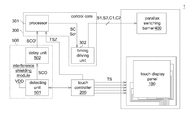
  • FIG. 1 is a block diagram of an electronic device according to an embodiment of the present invention.
  • FIG. 2 is a timing diagram of a touch sensing signal TS in FIG. 1 .
  • FIG. 3 is a schematic diagram of a parallax switching barrier 400 in FIG. 1 .
  • FIG. 4A is a schematic diagram of left-eye and right-eye display zones on a display panel.
  • FIG. 4B is a timing diagram of parallax switching signals in FIG. 4A .
  • FIG. 5A is another schematic diagram of left-eye and right-eye display zones on a display panel.
  • FIG. 5B is a timing diagram of parallax switching signals in FIG. 5A .
  • FIG. 6 is a timing diagram of signals associated with the electronic device in FIG. 1 .
  • FIG. 1 shows a block diagram of an electronic device according to an embodiment of the present invention.
  • an electronic device 1 of the embodiment is a handheld electronic device, such as a mobile phone, a personal digital assistant (PDA), a mobile game console, or a mobile navigation device.
  • PDA personal digital assistant
  • the electronic device 1 includes a touch display panel 100 , a touch controller 200 , a control core 300 , a parallax switching barrier 400 and an interference shielding module 500 .
  • the touch controller 200 is coupled to the touch display panel 100 and the interference shielding module 500 .
  • the control core 300 is coupled to the interference shielding module 500 and the parallax switching barrier 400 .
  • the touch display panel 100 is a common liquid-crystal display (LCD) or a capacitive touch panel.
  • the capacitive touch panel is provided with a substrate made of transparent electrodes.
  • the transparent electrodes sense a touch event triggered by a conductor (e.g., a user finger) approaching the substrate to correspondingly provide a detectable electronic signal.
  • the touch controller 200 periodically provides a touch sensing signal TS to the touch display panel 100 in a touch sensing period T_S, so as to detect a touch operation triggered on the touch display panel 100 .
  • the touch controller 200 further provides a sensing electronic signal TSE to the control core 300 according to the foregoing touch detection.
  • the touch sensing signal TS has a timing as shown in FIG. 2 .
  • the touch sensing signal TS is formed by multiple pulse signals having a cycle time of 14.8 ms, for example.
  • FIG. 3 shows a schematic diagram of the parallax switching barrier 400 in FIG. 1 .
  • the parallax switching barrier 400 may be implemented by a twisted nematic (TN) LCD module, which is disposed on the display panel in parallel via a binding layer to accordingly define left-eye display zones and right-eye display zones on the display panel.
  • TN twisted nematic
  • FIG. 4A shows a schematic diagram of left-eye and right-eye displays zones on a display panel.
  • odd pixel columns of the display panel are defined as left-eye display zones (i.e., shaded pixel columns in FIG. 4A ) and even pixel columns of the display panel are defined as right-eye display zones (i.e., blank pixel columns in FIG. 4A ).
  • the parallax switching barrier 400 is controlled by parallax switching signals S 1 and S 2 , so as to barricade the right-eye display zones A_R on the touch display panel 100 in a left-eye display period T_L and to barricade the left-eye display zones A_L on the touch display panel 100 in a right-eye display period T_R. Accordingly, through the parallax switching of the left-eye and right-eye display periods T_L and T_R, the display panel of the embodiment is allowed to correspondingly display a three-dimensional (3D) image in the landscape mode.
  • signal waveforms of the parallax switching signals S 1 and S 2 are as shown in FIG. 4B .
  • parallax switching signals C 1 and C 2 are parallax switching signals corresponding to a landscape mode of the display panel, and correspond to substantially the same signal waveforms when the display panel operates in the landscape mode.
  • FIG. 5A shows another schematic diagram of the parallax switching barrier 400 in FIG. 1 .
  • the odd pixel rows of the display panel are defined as left-eye display zones A_L′ (i.e., shaded pixel rows in FIG. 5A ), and the even pixel rows of the display panel are defined as right-eye display zones A_R′ (i.e., blank pixel rows in FIG. 5A ).
  • the parallax switching barrier 400 is controlled by the parallax switching signals C 1 and C 2 , so as to barricade the right-eye display zones A_R′ on the touch display panel 100 in the left-eye display period T_L and to barricade the left-eye display zones A_L′ on the touch display panel 100 in the right-eye display period T_R. Accordingly, through the parallax switching of the left-eye and right-eye display periods T_L and T_R, the display panel of the embodiment is allowed to correspondingly display a 3D image in the portrait mode. For example, signal waveforms of the parallax switching signal C 1 and C 2 are as shown in FIG. 5B . For the parallax switching signals S 1 and S 2 corresponding to the portrait mode of the display panel, the parallax switching signals S 1 and S 2 correspond to substantially the same signal waveforms when the display panel operates in the portrait mode.
  • the control core 300 periodically switches levels of the parallax switching signal S 1 , S 2 , C 1 and C 2 to drive the parallax switching barrier 400 .
  • the control core 300 includes a processor 301 and a timing driving unit 302 .
  • the processor 301 is a central processor of the electronic device 1 for controlling other circuits in the electronic device 1 .
  • the processor 301 provides a clock signal Sc, and provides a driving signal Sdr in response to a control signal SCO.
  • the timing driving unit 302 periodically switches the levels of the parallax switching signals S 1 , S 2 , C 1 and C 2 with reference to the clock signal Sc to accordingly generate the parallax switching signals S 1 , S 2 , C 1 and C 2 .
  • the timing driving unit 302 further triggers front edges of the parallax switching signals S 1 , S 2 , C 1 and C 2 .
  • the timing driving unit 302 may be implemented by a flip-flop, which provides the parallax switching signals S 1 , S 2 , C 1 and C 2 through its output and its inverted output with reference to the clock signal Sc.
  • the electronic device 1 of the embodiment effectively implements a 3D touch display.
  • the level switching of the parallax switching signals S 1 , S 2 , C 1 and C 2 frequently causes interference on the touch sensing signal TS, such that an error in the touch detection of the touch controller 200 and the touch display panel 100 may be incurred.
  • the electronic device 1 of the embodiment selectively delays the parallax switching signals S 1 , S 2 , C 1 and C 2 provided by the core controller 300 through the interference shielding module 500 , so as to prevent the level switching from interfering the touch sensing signal TS.
  • the interference shielding module 500 detects the touch sensing signal TS to identify a starting point TP 1 of the touch sensing signal TS, as shown in FIG. 6 .
  • the interference shielding module 500 further provides the driving signal Sdr to drive the control core 300 to delay the level switching of the parallax switching signals S 1 , S 2 , C 1 and C 2 , so as to prevent the level switching of the parallax switching signals S 1 , S 2 , C 1 and C 2 from being triggered in the touch sensing period T_S. Accordingly, the interference shielding module 500 effectively prevents the parallax switching signals S 1 , S 2 , C 1 and C 2 from interfering and altering the touch sensing signal TS.
  • the interference shielding module 500 includes a detecting unit 501 and a delay unit 502 .
  • the detecting unit 501 detects the starting point TP 1 of the touch sensing signal TS, and provides an indication signal SCO at a starting point TP 2 before the starting point TP 1 is triggered. Compared to the starting point TP 2 , the starting point TP 1 is delayed by a delay period Td 1 .
  • the detecting unit 501 through measuring an electric current change in the touch controller 200 when the touch controller 200 drives the touch display panel 100 , the detecting unit 501 correspondingly identifies the indication signal SCO that is substantially a digital cycle signal.
  • the delay unit 502 delays the indication signal SCO by a delay period Td 2 to generate a control signal SCO′, and outputs the control signal SCO′ to the core controller 300 .
  • the processor delays the starting point TP 2 by a delay period Td 2 , and provides the driving signal Sdr to correspondingly drive the timing driving unit 302 to switch the levels of the parallax switching signals S 1 , S 2 , C 1 and C 2 at a corresponding time point TP 3 .
  • a length of the delay period Td 2 is substantially smaller than a length of the delay period Td 1 .
  • the processor 301 drives the timing driving unit 302 to switch the levels of the parallax switching signals S 1 , S 2 , C 1 and C 2 .
  • the interference shielding module 500 effective prevents the parallax switching signals S 1 , S 2 , C 1 and C 2 from being triggered in the touch sensing period T_S.
  • the delay period Td 2 is substantially greater than a sum of the delay period Td 1 and the touch sensing period T_S.
  • the processor 301 correspondingly drives the timing driving unit 302 to switch the levels of the parallax switching signals S 1 , S 2 , C 1 and C 2 .
  • the interference shielding module 500 of the embodiment also effectively prevents the parallax switching signals S 1 , S 2 , C 1 and C 2 from being triggered in the touch sensing period T_S.
  • an electronic device of an embodiment includes a touch display panel and a touch controller.
  • the touch controller periodically provides a touch sensing signal to the touch display panel to detect a touch operation triggered on the touch display panel.
  • the electronic device of the embodiment further includes a parallax switching barrier.
  • the parallax switching barrier is controlled by parallax switching signals to selectively barricade left-eye and right-eye display zones on the touch display panel, so as to display a 3D image to a user.
  • the electronic device of the embodiment further includes an interference shielding module.
  • the interference shielding module When a starting point of the touch sensing signal is detected, the interference shielding module provides a control signal to delay a switching operation of the parallax switching signals, so as to prevent the level switching of the parallax switching signals from being triggered in a touch sensing period and thus preventing the parallax switching signals from interfering the touch sensing signal. Accordingly, compared to a conventional electronic device, the electronic device of the embodiment offers an advantage effectively preventing mutual interference between the parallax switching signals and touch sensing signal in the electronic device.
  • the touch sensing signal of a capacitive touch panel is prevented from interference coming from the parallax switching signals of the parallax switching barrier.
  • the electronic device of the embodiment eliminates an insulation layer between the parallax switching barrier and the capacitive touch panel to further reduce a thickness of the electronic device.

Landscapes

  • Engineering & Computer Science (AREA)
  • General Engineering & Computer Science (AREA)
  • Theoretical Computer Science (AREA)
  • Human Computer Interaction (AREA)
  • Physics & Mathematics (AREA)
  • General Physics & Mathematics (AREA)
  • Control Of Indicators Other Than Cathode Ray Tubes (AREA)
  • Controls And Circuits For Display Device (AREA)
  • Position Input By Displaying (AREA)

Abstract

An electronic device includes: a touch controller, periodically providing a touch sensing signal in a touch sensing period to a touch display panel for touch detection; a control core, periodically switching a level of a parallax switching signal; a parallax switching barrier, for respectively barricading a right-eye display zone and a left-eye display zone on the touch display panel in a left-eye display period and a right-eye display period in response to the parallax display switching signal; and an interference shielding module, for delaying the level switching of the parallax switching signal of the control core when a starting point of the touch sensing signal is detected, so as to prevent the level switching of the parallax switching signal from being triggered in the touch sensing period.

Description

This application claims the benefit of Taiwan application Serial No. 101106419, filed Feb. 24, 2012, the subject matter of which is incorporated herein by reference.
BACKGROUND OF THE INVENTION
1. Field of the Invention
The invention relates in general to an electronic device, and more particularly to an electronic device provided with a touch display panel with a three-dimensional (3D) display function.
2. Description of the Related Art
As the technology continuously progresses in the modern world, touch display panels are developed and prevail in various electronic products. In current techniques, capacitive touch display panels are a mainstream in touch display panels. A capacitive touch display panel includes a substrate made of transparent electrodes. The transparent electrodes sense a touch event performed by a conductor (e.g., a user finger) approaching the substrate, and correspondingly generate a detectable electronic signal. A touch display panel can then be implemented through detecting and converting the detectable electronic signal.
A compact appearance is one of the key development trends for handheld electronic devices. As the size of handheld electronic devices becomes smaller, manufacturers of handheld electronic device inevitably encounter a problem of mutual interferences among electronic signals. Therefore, under circumstances of limited hardware resources, it is a goal of manufacturers to provide an appropriate circuit design for reducing mutual interferences among electronic signals of handheld electronic devices.
SUMMARY OF THE INVENTION
According to an aspect of the present invention, an electronic device is provided. The electronic device includes a touch display panel, a touch controller, a control core, a parallax switching barrier and an interference shielding module. The touch controller, coupled to the touch display panel, periodically provides a touch sensing signal in a touch sensing period to the touch display panel for detecting a touch operation triggered on the touch display panel. The control core periodically switches a level of a parallax switching signal. The parallax switching barrier is disposed on the touch display panel in parallel, and is controlled by the parallax switching signal to barricade at least one right-eye display zone on the touch display panel in a left-eye display period and to barricade at least one left-eye display zone on the touch display panel in a right-eye display period. The interference shielding module detects the touch sensing signal to identify a first starting point of the touch sensing signal, and provides a control signal to drive the control core to delay the level switching of the parallax switching signal when the first starting point of the touch sensing signal is detected, so as to prevent the level switching of the parallax switching signal from being triggered in the touch sensing period.
The above and other aspects of the invention will become better understood with regard to the following detailed description of the preferred but non-limiting embodiments. The following description is made with reference to the accompanying drawings.
BRIEF DESCRIPTION OF THE DRAWINGS
FIG. 1 is a block diagram of an electronic device according to an embodiment of the present invention.
FIG. 2 is a timing diagram of a touch sensing signal TS in FIG. 1.
FIG. 3 is a schematic diagram of a parallax switching barrier 400 in FIG. 1.
FIG. 4A is a schematic diagram of left-eye and right-eye display zones on a display panel.
FIG. 4B is a timing diagram of parallax switching signals in FIG. 4A.
FIG. 5A is another schematic diagram of left-eye and right-eye display zones on a display panel.
FIG. 5B is a timing diagram of parallax switching signals in FIG. 5A.
FIG. 6 is a timing diagram of signals associated with the electronic device in FIG. 1.
DETAILED DESCRIPTION OF THE INVENTION
FIG. 1 shows a block diagram of an electronic device according to an embodiment of the present invention. For example, an electronic device 1 of the embodiment is a handheld electronic device, such as a mobile phone, a personal digital assistant (PDA), a mobile game console, or a mobile navigation device.
The electronic device 1 includes a touch display panel 100, a touch controller 200, a control core 300, a parallax switching barrier 400 and an interference shielding module 500. The touch controller 200 is coupled to the touch display panel 100 and the interference shielding module 500. The control core 300 is coupled to the interference shielding module 500 and the parallax switching barrier 400.
For example, the touch display panel 100 is a common liquid-crystal display (LCD) or a capacitive touch panel. The capacitive touch panel is provided with a substrate made of transparent electrodes. The transparent electrodes sense a touch event triggered by a conductor (e.g., a user finger) approaching the substrate to correspondingly provide a detectable electronic signal. The touch controller 200 periodically provides a touch sensing signal TS to the touch display panel 100 in a touch sensing period T_S, so as to detect a touch operation triggered on the touch display panel 100. The touch controller 200 further provides a sensing electronic signal TSE to the control core 300 according to the foregoing touch detection. For example, the touch sensing signal TS has a timing as shown in FIG. 2. The touch sensing signal TS is formed by multiple pulse signals having a cycle time of 14.8 ms, for example.
FIG. 3 shows a schematic diagram of the parallax switching barrier 400 in FIG. 1. For example, the parallax switching barrier 400 may be implemented by a twisted nematic (TN) LCD module, which is disposed on the display panel in parallel via a binding layer to accordingly define left-eye display zones and right-eye display zones on the display panel.
FIG. 4A shows a schematic diagram of left-eye and right-eye displays zones on a display panel. When the display panel is in a landscape mode, odd pixel columns of the display panel are defined as left-eye display zones (i.e., shaded pixel columns in FIG. 4A) and even pixel columns of the display panel are defined as right-eye display zones (i.e., blank pixel columns in FIG. 4A).
Further, the parallax switching barrier 400 is controlled by parallax switching signals S1 and S2, so as to barricade the right-eye display zones A_R on the touch display panel 100 in a left-eye display period T_L and to barricade the left-eye display zones A_L on the touch display panel 100 in a right-eye display period T_R. Accordingly, through the parallax switching of the left-eye and right-eye display periods T_L and T_R, the display panel of the embodiment is allowed to correspondingly display a three-dimensional (3D) image in the landscape mode. For example, signal waveforms of the parallax switching signals S1 and S2 are as shown in FIG. 4B. Also shown in FIG. 4B, parallax switching signals C1 and C2 are parallax switching signals corresponding to a landscape mode of the display panel, and correspond to substantially the same signal waveforms when the display panel operates in the landscape mode.
FIG. 5A shows another schematic diagram of the parallax switching barrier 400 in FIG. 1. When the display panel is in the portrait mode, the odd pixel rows of the display panel are defined as left-eye display zones A_L′ (i.e., shaded pixel rows in FIG. 5A), and the even pixel rows of the display panel are defined as right-eye display zones A_R′ (i.e., blank pixel rows in FIG. 5A).
Further, the parallax switching barrier 400 is controlled by the parallax switching signals C1 and C2, so as to barricade the right-eye display zones A_R′ on the touch display panel 100 in the left-eye display period T_L and to barricade the left-eye display zones A_L′ on the touch display panel 100 in the right-eye display period T_R. Accordingly, through the parallax switching of the left-eye and right-eye display periods T_L and T_R, the display panel of the embodiment is allowed to correspondingly display a 3D image in the portrait mode. For example, signal waveforms of the parallax switching signal C1 and C2 are as shown in FIG. 5B. For the parallax switching signals S1 and S2 corresponding to the portrait mode of the display panel, the parallax switching signals S1 and S2 correspond to substantially the same signal waveforms when the display panel operates in the portrait mode.
The control core 300 periodically switches levels of the parallax switching signal S1, S2, C1 and C2 to drive the parallax switching barrier 400. Further, the control core 300 includes a processor 301 and a timing driving unit 302. For example, the processor 301 is a central processor of the electronic device 1 for controlling other circuits in the electronic device 1. The processor 301 provides a clock signal Sc, and provides a driving signal Sdr in response to a control signal SCO.
The timing driving unit 302 periodically switches the levels of the parallax switching signals S1, S2, C1 and C2 with reference to the clock signal Sc to accordingly generate the parallax switching signals S1, S2, C1 and C2. The timing driving unit 302 further triggers front edges of the parallax switching signals S1, S2, C1 and C2. For example, the timing driving unit 302 may be implemented by a flip-flop, which provides the parallax switching signals S1, S2, C1 and C2 through its output and its inverted output with reference to the clock signal Sc.
Therefore, through the touch detection performed by the touch controller 200 and the touch display panel 100 as well as the parallax switching performed by the control core 300 and the parallax switching barrier 400, the electronic device 1 of the embodiment effectively implements a 3D touch display.
However, the level switching of the parallax switching signals S1, S2, C1 and C2 frequently causes interference on the touch sensing signal TS, such that an error in the touch detection of the touch controller 200 and the touch display panel 100 may be incurred. To solve the signal interference, the electronic device 1 of the embodiment selectively delays the parallax switching signals S1, S2, C1 and C2 provided by the core controller 300 through the interference shielding module 500, so as to prevent the level switching from interfering the touch sensing signal TS.
The interference shielding module 500 detects the touch sensing signal TS to identify a starting point TP1 of the touch sensing signal TS, as shown in FIG. 6. When the starting point TP1 is detected, the interference shielding module 500 further provides the driving signal Sdr to drive the control core 300 to delay the level switching of the parallax switching signals S1, S2, C1 and C2, so as to prevent the level switching of the parallax switching signals S1, S2, C1 and C2 from being triggered in the touch sensing period T_S. Accordingly, the interference shielding module 500 effectively prevents the parallax switching signals S1, S2, C1 and C2 from interfering and altering the touch sensing signal TS.
For example, the interference shielding module 500 includes a detecting unit 501 and a delay unit 502. The detecting unit 501 detects the starting point TP1 of the touch sensing signal TS, and provides an indication signal SCO at a starting point TP2 before the starting point TP1 is triggered. Compared to the starting point TP2, the starting point TP1 is delayed by a delay period Td1. For example, through measuring an electric current change in the touch controller 200 when the touch controller 200 drives the touch display panel 100, the detecting unit 501 correspondingly identifies the indication signal SCO that is substantially a digital cycle signal.
After receiving the indication signal SCO, the delay unit 502 delays the indication signal SCO by a delay period Td2 to generate a control signal SCO′, and outputs the control signal SCO′ to the core controller 300. In response to the control signal SCO′, the processor delays the starting point TP2 by a delay period Td2, and provides the driving signal Sdr to correspondingly drive the timing driving unit 302 to switch the levels of the parallax switching signals S1, S2, C1 and C2 at a corresponding time point TP3.
In an operation example, a length of the delay period Td2 is substantially smaller than a length of the delay period Td1. In other words, before the starting point TP1 (i.e., the starting point of the touch sensing period T_S), the processor 301 drives the timing driving unit 302 to switch the levels of the parallax switching signals S1, S2, C1 and C2. Thus, the interference shielding module 500 effective prevents the parallax switching signals S1, S2, C1 and C2 from being triggered in the touch sensing period T_S.
In another operation example, the delay period Td2 is substantially greater than a sum of the delay period Td1 and the touch sensing period T_S. In other words, after the touch sensing period T_S ends, the processor 301 correspondingly drives the timing driving unit 302 to switch the levels of the parallax switching signals S1, S2, C1 and C2. Hence, the interference shielding module 500 of the embodiment also effectively prevents the parallax switching signals S1, S2, C1 and C2 from being triggered in the touch sensing period T_S.
In conclusion, an electronic device of an embodiment includes a touch display panel and a touch controller. The touch controller periodically provides a touch sensing signal to the touch display panel to detect a touch operation triggered on the touch display panel. The electronic device of the embodiment further includes a parallax switching barrier. The parallax switching barrier is controlled by parallax switching signals to selectively barricade left-eye and right-eye display zones on the touch display panel, so as to display a 3D image to a user. The electronic device of the embodiment further includes an interference shielding module. When a starting point of the touch sensing signal is detected, the interference shielding module provides a control signal to delay a switching operation of the parallax switching signals, so as to prevent the level switching of the parallax switching signals from being triggered in a touch sensing period and thus preventing the parallax switching signals from interfering the touch sensing signal. Accordingly, compared to a conventional electronic device, the electronic device of the embodiment offers an advantage effectively preventing mutual interference between the parallax switching signals and touch sensing signal in the electronic device.
In an alternative embodiment, in contribution to the interference shielding module in the electronic device, the touch sensing signal of a capacitive touch panel is prevented from interference coming from the parallax switching signals of the parallax switching barrier. Thus, compared to a conventional electronic device, the electronic device of the embodiment eliminates an insulation layer between the parallax switching barrier and the capacitive touch panel to further reduce a thickness of the electronic device.
While the invention has been described by way of example and in terms of the preferred embodiments, it is to be understood that the invention is not limited thereto. On the contrary, it is intended to cover various modifications and similar arrangements and procedures, and the scope of the appended claims therefore should be accorded the broadest interpretation so as to encompass all such modifications and similar arrangements and procedures.
Claims (6)

What is claimed is:
1. An electronic device, comprising:
a touch display panel;
a touch controller, coupled to the touch display panel, periodically providing a touch sensing signal to the touch display panel in a touch sensing period to detect a touch operation triggered on the touch display panel;
a control core, periodically switching a level of a parallax switching signal;
a parallax switching barrier, disposed on the touch display panel in parallel, being controlled by the parallax switching signal to respectively barricade at least one right-eye display zone on the touch display panel in a left-eye display period, and to barricade at least one left-eye display zone on the touch display panel in a right-eye display period; and
an interference shielding module, for detecting the touch sensing signal to identify a first starting point of the touch sensing signal, and providing a control signal for driving the control core to delay the switching of the parallax signal when the first starting point is detected, so as to prevent the level switching of the parallax switching signal from being triggered in the touch sensing period.
2. The electronic device according to claim 1, wherein the interference shielding module comprises:
a detecting unit, for detecting the first starting point of the touch sensing signal, and providing an indication signal at a second starting point before the first starting point is triggered; wherein, the first starting point is delayed by a first delay period compared to the second starting point.
3. The electronic device according to claim 2, wherein the interference shielding module comprises:
a delay unit, when receiving the indication signal, for delaying the control signal by a second delay period and outputting the delayed control signal to the control core;
wherein, in response to the delayed control signal, the control core further switches the level of the parallax switching signal at a time point of delaying the second starting point by the second delay period.
4. The electronic device according to claim 3, wherein the second delay period is substantially smaller than the first delay period, and the control core accordingly switches the level of the parallax switching signal before the first starting point.
5. The electronic device according to claim 3, wherein the second delay period is substantially greater than a sum of the first delay period and the touch sensing period, and the control core accordingly switches the level of the parallax switching signal at a time point after delaying the second starting point by the second delay period.
6. The electronic device according to claim 1, wherein the control core comprises:
a processor, for providing a clock signal; and
a timing driving unit, for periodically switching the level of the parallax switching signal with reference to the clock signal;
wherein, when receiving the control signal, the processor further provides a driving signal for driving the timing driving unit to switch the level of the parallax switching signal.
US13/594,435 2012-02-24 2012-08-24 Electronic device Active 2033-02-20 US8766942B2 (en)

Applications Claiming Priority (3)

Application Number Priority Date Filing Date Title
TW101106419A TWI454991B (en) 2012-02-24 2012-02-24 Electronic device
TW101106419 2012-02-24
TW101106419A 2012-02-24

Publications (2)

Publication Number Publication Date
US20130222281A1 US20130222281A1 (en) 2013-08-29
US8766942B2 true US8766942B2 (en) 2014-07-01

Family

ID=49002296

Family Applications (1)

Application Number Title Priority Date Filing Date
US13/594,435 Active 2033-02-20 US8766942B2 (en) 2012-02-24 2012-08-24 Electronic device

Country Status (3)

Country Link
US (1) US8766942B2 (en)
CN (1) CN103294244B (en)
TW (1) TWI454991B (en)

Families Citing this family (2)

* Cited by examiner, † Cited by third party
Publication number Priority date Publication date Assignee Title
TWI456467B (en) * 2011-05-20 2014-10-11 Au Optronics Corp Operating method of capacitive touch panel and touch control barrier-type 3d display device
TWI490746B (en) * 2013-03-29 2015-07-01 Chunghwa Picture Tubes Ltd Control system applied to touch and capable of switching two-dimensional/three-dimensional mode

Citations (5)

* Cited by examiner, † Cited by third party
Publication number Priority date Publication date Assignee Title
US20110074775A1 (en) * 2008-09-26 2011-03-31 Ryuichi Shibutani Image signal processing device and image signal processing method
US20130002661A1 (en) * 2010-03-18 2013-01-03 Kouichi Tanaka Stereoscopic image display apparatus and method of controlling same
US20130271675A1 (en) * 2010-12-28 2013-10-17 Sharp Kabushiki Kaisha Touch panel, display apparatus including the same, and method for manufacturing touch panel
US8587544B2 (en) * 2010-07-20 2013-11-19 Lg Electronics Inc. Image display apparatus and method of operating the same
US20140028594A1 (en) * 2012-07-27 2014-01-30 Wintek Corporation Touch stereoscopic display device

Family Cites Families (7)

* Cited by examiner, † Cited by third party
Publication number Priority date Publication date Assignee Title
KR20080086110A (en) * 2007-03-21 2008-09-25 삼성전자주식회사 High efficiency 2D / 3D video display device
TW200923737A (en) * 2007-11-23 2009-06-01 Compal Communications Inc Handheld device and operating method thereof
TWM377646U (en) * 2009-11-13 2010-04-01 Top Victory Invest Ltd Display incorporating the function of touch control and button control
TW201122944A (en) * 2009-12-22 2011-07-01 Inventec Besta Co Ltd Touch control identification system and method thereof
CN101980544B (en) * 2010-11-05 2012-08-29 友达光电股份有限公司 Stereoscopic image display method and related display system
CN102135856A (en) * 2011-03-07 2011-07-27 友达光电股份有限公司 Display control method, display device and electronic device
CN102354065B (en) * 2011-09-22 2014-08-13 深圳超多维光电子有限公司 2D/3D (two-dimensional/three-dimensional) switching stereo display device, driving control device and driving method thereof

Patent Citations (5)

* Cited by examiner, † Cited by third party
Publication number Priority date Publication date Assignee Title
US20110074775A1 (en) * 2008-09-26 2011-03-31 Ryuichi Shibutani Image signal processing device and image signal processing method
US20130002661A1 (en) * 2010-03-18 2013-01-03 Kouichi Tanaka Stereoscopic image display apparatus and method of controlling same
US8587544B2 (en) * 2010-07-20 2013-11-19 Lg Electronics Inc. Image display apparatus and method of operating the same
US20130271675A1 (en) * 2010-12-28 2013-10-17 Sharp Kabushiki Kaisha Touch panel, display apparatus including the same, and method for manufacturing touch panel
US20140028594A1 (en) * 2012-07-27 2014-01-30 Wintek Corporation Touch stereoscopic display device

Also Published As

Publication number Publication date
TWI454991B (en) 2014-10-01
US20130222281A1 (en) 2013-08-29
CN103294244B (en) 2016-06-01
TW201335810A (en) 2013-09-01
CN103294244A (en) 2013-09-11

Similar Documents

Publication Publication Date Title
US10175803B2 (en) Touch sensing device and method for driving the same
US9035202B2 (en) Touch detecting function display apparatus, driving circuit, driving method of touch detecting function display apparatus and electronic equipment
US10691228B2 (en) Electronic device having touch sensor and method of driving the same
US10282018B2 (en) Display device
US9189113B2 (en) Capacitive touch panel sensor synchronized with display driving operation and touch panel display device having the same
JP6180621B2 (en) Position detection device
KR20130134007A (en) Touch sensing apparatus and driving method thereof
KR101920426B1 (en) Touch display apparatus, driving circuit thereof and driving method therefor, and electronic apparatus
KR101442041B1 (en) Electronic device and method for scanning a touch panel thereof
US8766942B2 (en) Electronic device
CN106648249A (en) Touch-control display panel and touch-control display device
KR102146678B1 (en) Touch screen device and touch screen display device using the same
US9007537B2 (en) Capacitive touch module and display having capacitive touch module
TWI479379B (en) Image display system and touch display device

Legal Events

Date Code Title Description
AS Assignment

Owner name: WISTRON CORPORATION, TAIWAN

Free format text: ASSIGNMENT OF ASSIGNORS INTEREST;ASSIGNORS:CHEN, YIN-YU;TSENG, YAO-SHUN;CHONG, JOSEPH;REEL/FRAME:028846/0675

Effective date: 20120824

STCF Information on status: patent grant

Free format text: PATENTED CASE

FPAY Fee payment

Year of fee payment: 4

MAFP Maintenance fee payment

Free format text: PAYMENT OF MAINTENANCE FEE, 8TH YEAR, LARGE ENTITY (ORIGINAL EVENT CODE: M1552); ENTITY STATUS OF PATENT OWNER: LARGE ENTITY

Year of fee payment: 8

MAFP Maintenance fee payment

Free format text: PAYMENT OF MAINTENANCE FEE, 12TH YEAR, LARGE ENTITY (ORIGINAL EVENT CODE: M1553); ENTITY STATUS OF PATENT OWNER: LARGE ENTITY

Year of fee payment: 12