US8765775B2 - Anti-angiogenic compounds - Google Patents
Anti-angiogenic compounds Download PDFInfo
- Publication number
- US8765775B2 US8765775B2 US12/863,724 US86372409A US8765775B2 US 8765775 B2 US8765775 B2 US 8765775B2 US 86372409 A US86372409 A US 86372409A US 8765775 B2 US8765775 B2 US 8765775B2
- Authority
- US
- United States
- Prior art keywords
- lower alkyl
- alkyl
- hydrogen
- hydroxy
- ortho
- Prior art date
- Legal status (The legal status is an assumption and is not a legal conclusion. Google has not performed a legal analysis and makes no representation as to the accuracy of the status listed.)
- Expired - Fee Related, expires
Links
- 150000001875 compounds Chemical class 0.000 title claims abstract description 120
- 230000001772 anti-angiogenic effect Effects 0.000 title 1
- 150000003839 salts Chemical class 0.000 claims abstract description 27
- 125000000217 alkyl group Chemical group 0.000 claims description 363
- 239000001257 hydrogen Substances 0.000 claims description 81
- 229910052739 hydrogen Inorganic materials 0.000 claims description 81
- -1 pyrrolyl- Chemical group 0.000 claims description 62
- 125000004453 alkoxycarbonyl group Chemical group 0.000 claims description 43
- 150000002431 hydrogen Chemical group 0.000 claims description 41
- 125000004448 alkyl carbonyl group Chemical group 0.000 claims description 38
- 125000001424 substituent group Chemical group 0.000 claims description 38
- 125000003178 carboxy group Chemical group [H]OC(*)=O 0.000 claims description 28
- 125000004390 alkyl sulfonyl group Chemical group 0.000 claims description 26
- 125000003917 carbamoyl group Chemical group [H]N([H])C(*)=O 0.000 claims description 25
- 125000005223 heteroarylcarbonyl group Chemical group 0.000 claims description 24
- 125000003545 alkoxy group Chemical group 0.000 claims description 23
- 125000005129 aryl carbonyl group Chemical group 0.000 claims description 23
- 125000004391 aryl sulfonyl group Chemical group 0.000 claims description 22
- 125000003118 aryl group Chemical group 0.000 claims description 21
- 125000004471 alkyl aminosulfonyl group Chemical group 0.000 claims description 20
- 125000004397 aminosulfonyl group Chemical group NS(=O)(=O)* 0.000 claims description 20
- 125000005143 heteroarylsulfonyl group Chemical group 0.000 claims description 20
- 125000004435 hydrogen atom Chemical group [H]* 0.000 claims description 19
- 125000001997 phenyl group Chemical group [H]C1=C([H])C([H])=C(*)C([H])=C1[H] 0.000 claims description 16
- 125000004457 alkyl amino carbonyl group Chemical group 0.000 claims description 14
- UFHFLCQGNIYNRP-UHFFFAOYSA-N Hydrogen Chemical compound [H][H] UFHFLCQGNIYNRP-UHFFFAOYSA-N 0.000 claims description 11
- 125000004076 pyridyl group Chemical group 0.000 claims description 8
- 125000005843 halogen group Chemical group 0.000 claims description 6
- 239000000825 pharmaceutical preparation Substances 0.000 claims description 6
- 102100031983 Ephrin type-B receptor 4 Human genes 0.000 abstract description 33
- 238000000034 method Methods 0.000 abstract description 27
- 239000003112 inhibitor Substances 0.000 abstract description 22
- 206010028980 Neoplasm Diseases 0.000 abstract description 20
- 230000033115 angiogenesis Effects 0.000 abstract description 18
- 208000011580 syndromic disease Diseases 0.000 abstract description 14
- 230000001419 dependent effect Effects 0.000 abstract description 13
- 238000012216 screening Methods 0.000 abstract description 6
- 108091008598 receptor tyrosine kinases Proteins 0.000 abstract description 3
- 102000027426 receptor tyrosine kinases Human genes 0.000 abstract description 3
- IAZDPXIOMUYVGZ-WFGJKAKNSA-N Dimethyl sulfoxide Chemical compound [2H]C([2H])([2H])S(=O)C([2H])([2H])[2H] IAZDPXIOMUYVGZ-WFGJKAKNSA-N 0.000 description 82
- 239000012634 fragment Substances 0.000 description 41
- 229910052736 halogen Inorganic materials 0.000 description 28
- 238000005160 1H NMR spectroscopy Methods 0.000 description 27
- 150000002367 halogens Chemical class 0.000 description 27
- IJGRMHOSHXDMSA-UHFFFAOYSA-N nitrogen Substances N#N IJGRMHOSHXDMSA-UHFFFAOYSA-N 0.000 description 25
- 125000002496 methyl group Chemical group [H]C([H])([H])* 0.000 description 23
- 229910052757 nitrogen Inorganic materials 0.000 description 23
- 125000002924 primary amino group Chemical group [H]N([H])* 0.000 description 22
- 238000001644 13C nuclear magnetic resonance spectroscopy Methods 0.000 description 21
- 230000027455 binding Effects 0.000 description 20
- 238000003032 molecular docking Methods 0.000 description 20
- 125000000449 nitro group Chemical group [O-][N+](*)=O 0.000 description 20
- HEDRZPFGACZZDS-MICDWDOJSA-N Trichloro(2H)methane Chemical compound [2H]C(Cl)(Cl)Cl HEDRZPFGACZZDS-MICDWDOJSA-N 0.000 description 18
- 0 [1*]C1=C(C2=CC=CC=C2)N([3*])C2=NC3=C(C(=O)NC(=O)N3[2*])N21.[4*]C.[5*]C Chemical compound [1*]C1=C(C2=CC=CC=C2)N([3*])C2=NC3=C(C(=O)NC(=O)N3[2*])N21.[4*]C.[5*]C 0.000 description 18
- 125000001072 heteroaryl group Chemical group 0.000 description 18
- 125000004429 atom Chemical group 0.000 description 17
- 125000002023 trifluoromethyl group Chemical group FC(F)(F)* 0.000 description 17
- 238000006243 chemical reaction Methods 0.000 description 16
- 125000002887 hydroxy group Chemical group [H]O* 0.000 description 16
- 125000004093 cyano group Chemical group *C#N 0.000 description 15
- 239000004480 active ingredient Substances 0.000 description 14
- 125000000753 cycloalkyl group Chemical group 0.000 description 13
- 239000000203 mixture Substances 0.000 description 13
- 239000000243 solution Substances 0.000 description 13
- QTBSBXVTEAMEQO-UHFFFAOYSA-N Acetic acid Chemical compound CC(O)=O QTBSBXVTEAMEQO-UHFFFAOYSA-N 0.000 description 12
- YMWUJEATGCHHMB-UHFFFAOYSA-N Dichloromethane Chemical compound ClCCl YMWUJEATGCHHMB-UHFFFAOYSA-N 0.000 description 12
- OKKJLVBELUTLKV-UHFFFAOYSA-N Methanol Chemical compound OC OKKJLVBELUTLKV-UHFFFAOYSA-N 0.000 description 12
- 239000003446 ligand Substances 0.000 description 12
- 108020003175 receptors Proteins 0.000 description 12
- 102000005962 receptors Human genes 0.000 description 12
- 125000006193 alkinyl group Chemical group 0.000 description 11
- 125000004432 carbon atom Chemical group C* 0.000 description 11
- 229940125782 compound 2 Drugs 0.000 description 11
- QJGQUHMNIGDVPM-UHFFFAOYSA-N nitrogen group Chemical group [N] QJGQUHMNIGDVPM-UHFFFAOYSA-N 0.000 description 11
- 239000007787 solid Substances 0.000 description 11
- 125000004414 alkyl thio group Chemical group 0.000 description 10
- 238000003556 assay Methods 0.000 description 10
- 125000004682 aminothiocarbonyl group Chemical group NC(=S)* 0.000 description 9
- 208000037265 diseases, disorders, signs and symptoms Diseases 0.000 description 9
- 238000007824 enzymatic assay Methods 0.000 description 9
- 108091000080 Phosphotransferase Proteins 0.000 description 8
- 230000000694 effects Effects 0.000 description 8
- 230000005764 inhibitory process Effects 0.000 description 8
- 239000008194 pharmaceutical composition Substances 0.000 description 8
- 102000020233 phosphotransferase Human genes 0.000 description 8
- 125000005017 substituted alkenyl group Chemical group 0.000 description 8
- 125000003396 thiol group Chemical group [H]S* 0.000 description 8
- 239000013598 vector Substances 0.000 description 8
- 125000003282 alkyl amino group Chemical group 0.000 description 7
- 239000000460 chlorine Substances 0.000 description 7
- 229910052801 chlorine Inorganic materials 0.000 description 7
- 201000010099 disease Diseases 0.000 description 7
- 102000012803 ephrin Human genes 0.000 description 7
- 108060002566 ephrin Proteins 0.000 description 7
- 238000002866 fluorescence resonance energy transfer Methods 0.000 description 7
- 125000004433 nitrogen atom Chemical group N* 0.000 description 7
- 239000000047 product Substances 0.000 description 7
- 102000004169 proteins and genes Human genes 0.000 description 7
- 108090000623 proteins and genes Proteins 0.000 description 7
- 239000002904 solvent Substances 0.000 description 7
- XLYOFNOQVPJJNP-UHFFFAOYSA-N water Substances O XLYOFNOQVPJJNP-UHFFFAOYSA-N 0.000 description 7
- LFQSCWFLJHTTHZ-UHFFFAOYSA-N Ethanol Chemical compound CCO LFQSCWFLJHTTHZ-UHFFFAOYSA-N 0.000 description 6
- XEKOWRVHYACXOJ-UHFFFAOYSA-N Ethyl acetate Chemical compound CCOC(C)=O XEKOWRVHYACXOJ-UHFFFAOYSA-N 0.000 description 6
- PEDCQBHIVMGVHV-UHFFFAOYSA-N Glycerine Chemical compound OCC(O)CO PEDCQBHIVMGVHV-UHFFFAOYSA-N 0.000 description 6
- 230000015572 biosynthetic process Effects 0.000 description 6
- 210000004027 cell Anatomy 0.000 description 6
- 235000014113 dietary fatty acids Nutrition 0.000 description 6
- 239000000194 fatty acid Substances 0.000 description 6
- 229930195729 fatty acid Natural products 0.000 description 6
- 229910052731 fluorine Inorganic materials 0.000 description 6
- 125000000623 heterocyclic group Chemical group 0.000 description 6
- 230000003993 interaction Effects 0.000 description 6
- BWHMMNNQKKPAPP-UHFFFAOYSA-L potassium carbonate Chemical compound [K+].[K+].[O-]C([O-])=O BWHMMNNQKKPAPP-UHFFFAOYSA-L 0.000 description 6
- ZCJBKBXIVRBSBJ-UHFFFAOYSA-N 4-[6-(2-methoxyphenyl)-4-methyl-1,3-dioxopurino[7,8-a]imidazol-7-yl]benzonitrile Chemical compound COC1=CC=CC=C1N(C(=CN12)C=3C=CC(=CC=3)C#N)C2=NC2=C1C(=O)NC(=O)N2C ZCJBKBXIVRBSBJ-UHFFFAOYSA-N 0.000 description 5
- ZAMOUSCENKQFHK-UHFFFAOYSA-N Chlorine atom Chemical compound [Cl] ZAMOUSCENKQFHK-UHFFFAOYSA-N 0.000 description 5
- 102000050554 Eph Family Receptors Human genes 0.000 description 5
- 108091008815 Eph receptors Proteins 0.000 description 5
- VYPSYNLAJGMNEJ-UHFFFAOYSA-N Silicium dioxide Chemical compound O=[Si]=O VYPSYNLAJGMNEJ-UHFFFAOYSA-N 0.000 description 5
- NINIDFKCEFEMDL-UHFFFAOYSA-N Sulfur Chemical group [S] NINIDFKCEFEMDL-UHFFFAOYSA-N 0.000 description 5
- 125000002777 acetyl group Chemical group [H]C([H])([H])C(*)=O 0.000 description 5
- 150000001408 amides Chemical group 0.000 description 5
- QVGXLLKOCUKJST-UHFFFAOYSA-N atomic oxygen Chemical group [O] QVGXLLKOCUKJST-UHFFFAOYSA-N 0.000 description 5
- 229910052794 bromium Inorganic materials 0.000 description 5
- 229910052799 carbon Inorganic materials 0.000 description 5
- 210000004978 chinese hamster ovary cell Anatomy 0.000 description 5
- 239000003599 detergent Substances 0.000 description 5
- 125000004029 hydroxymethyl group Chemical group [H]OC([H])([H])* 0.000 description 5
- 238000000338 in vitro Methods 0.000 description 5
- 238000003367 kinetic assay Methods 0.000 description 5
- 238000004895 liquid chromatography mass spectrometry Methods 0.000 description 5
- 239000001301 oxygen Chemical group 0.000 description 5
- 229910052760 oxygen Inorganic materials 0.000 description 5
- 238000002360 preparation method Methods 0.000 description 5
- 230000002829 reductive effect Effects 0.000 description 5
- 229910052717 sulfur Chemical group 0.000 description 5
- 239000011593 sulfur Chemical group 0.000 description 5
- 239000000725 suspension Substances 0.000 description 5
- LYCAIKOWRPUZTN-UHFFFAOYSA-N Ethylene glycol Chemical compound OCCO LYCAIKOWRPUZTN-UHFFFAOYSA-N 0.000 description 4
- VEXZGXHMUGYJMC-UHFFFAOYSA-N Hydrochloric acid Chemical compound Cl VEXZGXHMUGYJMC-UHFFFAOYSA-N 0.000 description 4
- CSNNHWWHGAXBCP-UHFFFAOYSA-L Magnesium sulfate Chemical compound [Mg+2].[O-][S+2]([O-])([O-])[O-] CSNNHWWHGAXBCP-UHFFFAOYSA-L 0.000 description 4
- QAOWNCQODCNURD-UHFFFAOYSA-N Sulfuric acid Chemical compound OS(O)(=O)=O QAOWNCQODCNURD-UHFFFAOYSA-N 0.000 description 4
- 229920004890 Triton X-100 Polymers 0.000 description 4
- 239000013504 Triton X-100 Substances 0.000 description 4
- 125000003342 alkenyl group Chemical group 0.000 description 4
- 125000005196 alkyl carbonyloxy group Chemical group 0.000 description 4
- 238000013459 approach Methods 0.000 description 4
- 125000003236 benzoyl group Chemical group [H]C1=C([H])C([H])=C(C([H])=C1[H])C(*)=O 0.000 description 4
- 125000002619 bicyclic group Chemical group 0.000 description 4
- 239000001768 carboxy methyl cellulose Substances 0.000 description 4
- 230000002860 competitive effect Effects 0.000 description 4
- 239000013078 crystal Substances 0.000 description 4
- 238000002474 experimental method Methods 0.000 description 4
- 230000002349 favourable effect Effects 0.000 description 4
- 239000011737 fluorine Substances 0.000 description 4
- 239000007788 liquid Substances 0.000 description 4
- 125000002950 monocyclic group Chemical group 0.000 description 4
- 238000007911 parenteral administration Methods 0.000 description 4
- 239000000546 pharmaceutical excipient Substances 0.000 description 4
- 229920001223 polyethylene glycol Polymers 0.000 description 4
- 235000013855 polyvinylpyrrolidone Nutrition 0.000 description 4
- 239000001267 polyvinylpyrrolidone Substances 0.000 description 4
- 239000002244 precipitate Substances 0.000 description 4
- 239000011541 reaction mixture Substances 0.000 description 4
- 229920006395 saturated elastomer Polymers 0.000 description 4
- 239000000741 silica gel Substances 0.000 description 4
- 229910002027 silica gel Inorganic materials 0.000 description 4
- 239000003381 stabilizer Substances 0.000 description 4
- 239000000126 substance Substances 0.000 description 4
- 238000003786 synthesis reaction Methods 0.000 description 4
- WDOUVHMZWZOOIH-UHFFFAOYSA-N 4-benzyl-6-(2-methoxyphenyl)-7-phenylpurino[7,8-a]imidazole-1,3-dione Chemical compound COC1=CC=CC=C1N(C(=CN12)C=3C=CC=CC=3)C2=NC2=C1C(=O)NC(=O)N2CC1=CC=CC=C1 WDOUVHMZWZOOIH-UHFFFAOYSA-N 0.000 description 3
- VGQDSUUYHBSSFK-UHFFFAOYSA-N 4-benzyl-6-(4-hydroxybutyl)-7-phenylpurino[7,8-a]imidazole-1,3-dione Chemical compound OCCCCN1C(C=2C=CC=CC=2)=CN(C=2C(=O)NC3=O)C1=NC=2N3CC1=CC=CC=C1 VGQDSUUYHBSSFK-UHFFFAOYSA-N 0.000 description 3
- YAGDBLVGQCHWPO-UHFFFAOYSA-N 4-benzyl-7-(4-fluorophenyl)-6-(2-methoxyphenyl)purino[7,8-a]imidazole-1,3-dione Chemical compound COC1=CC=CC=C1N(C(=CN12)C=3C=CC(F)=CC=3)C2=NC2=C1C(=O)NC(=O)N2CC1=CC=CC=C1 YAGDBLVGQCHWPO-UHFFFAOYSA-N 0.000 description 3
- OVEQSGNTCVRIGG-UHFFFAOYSA-N 4-benzyl-8-bromo-7-(4-fluorophenyl)-6-phenylpurino[7,8-a]imidazole-1,3-dione Chemical compound C1=CC(F)=CC=C1C1=C(Br)N2C(C(=O)NC(=O)N3CC=4C=CC=CC=4)=C3N=C2N1C1=CC=CC=C1 OVEQSGNTCVRIGG-UHFFFAOYSA-N 0.000 description 3
- RCJPZVKYTXAIBI-UHFFFAOYSA-N 6-(2-methoxyphenyl)-4-methyl-7-phenylpurino[7,8-a]imidazole-1,3-dione Chemical compound COC1=CC=CC=C1N(C(=CN12)C=3C=CC=CC=3)C2=NC2=C1C(=O)NC(=O)N2C RCJPZVKYTXAIBI-UHFFFAOYSA-N 0.000 description 3
- IAKHBFQNTXCUBP-UHFFFAOYSA-N 7-(4-fluorophenyl)-6-(2-methoxyphenyl)-4-(methylsulfanylmethyl)purino[7,8-a]imidazole-1,3-dione Chemical compound COC1=CC=CC=C1N(C(=CN12)C=3C=CC(F)=CC=3)C2=NC2=C1C(=O)NC(=O)N2CSC IAKHBFQNTXCUBP-UHFFFAOYSA-N 0.000 description 3
- OEBWRRQPMBOEOG-UHFFFAOYSA-N 7-(4-fluorophenyl)-6-(2-methoxyphenyl)-4h-purino[7,8-a]imidazole-1,3-dione Chemical compound COC1=CC=CC=C1N(C(=CN12)C=3C=CC(F)=CC=3)C2=NC2=C1C(=O)NC(=O)N2 OEBWRRQPMBOEOG-UHFFFAOYSA-N 0.000 description 3
- AMTOUTHHUMDVOC-UHFFFAOYSA-N 8-bromo-6-(2-methoxyphenyl)-4-methyl-7-phenylpurino[7,8-a]imidazole-1,3-dione Chemical compound COC1=CC=CC=C1N(C(=C(Br)N12)C=3C=CC=CC=3)C2=NC2=C1C(=O)NC(=O)N2C AMTOUTHHUMDVOC-UHFFFAOYSA-N 0.000 description 3
- WFDIJRYMOXRFFG-UHFFFAOYSA-N Acetic anhydride Chemical compound CC(=O)OC(C)=O WFDIJRYMOXRFFG-UHFFFAOYSA-N 0.000 description 3
- WKBOTKDWSSQWDR-UHFFFAOYSA-N Bromine atom Chemical compound [Br] WKBOTKDWSSQWDR-UHFFFAOYSA-N 0.000 description 3
- VMOVPFSUIKKBGQ-UHFFFAOYSA-N CN1C(=O)NC(=O)C2=C1N=C1N2C=C(C2=CC=C(NCCCCO)C=C2)N1CCCCO Chemical compound CN1C(=O)NC(=O)C2=C1N=C1N2C=C(C2=CC=C(NCCCCO)C=C2)N1CCCCO VMOVPFSUIKKBGQ-UHFFFAOYSA-N 0.000 description 3
- CURLTUGMZLYLDI-UHFFFAOYSA-N Carbon dioxide Chemical group O=C=O CURLTUGMZLYLDI-UHFFFAOYSA-N 0.000 description 3
- FBPFZTCFMRRESA-FSIIMWSLSA-N D-Glucitol Natural products OC[C@H](O)[C@H](O)[C@@H](O)[C@H](O)CO FBPFZTCFMRRESA-FSIIMWSLSA-N 0.000 description 3
- FBPFZTCFMRRESA-JGWLITMVSA-N D-glucitol Chemical compound OC[C@H](O)[C@@H](O)[C@H](O)[C@H](O)CO FBPFZTCFMRRESA-JGWLITMVSA-N 0.000 description 3
- IAZDPXIOMUYVGZ-UHFFFAOYSA-N Dimethylsulphoxide Chemical compound CS(C)=O IAZDPXIOMUYVGZ-UHFFFAOYSA-N 0.000 description 3
- 102000004190 Enzymes Human genes 0.000 description 3
- 108090000790 Enzymes Proteins 0.000 description 3
- 108010055334 EphB2 Receptor Proteins 0.000 description 3
- 102100031968 Ephrin type-B receptor 2 Human genes 0.000 description 3
- 102100023721 Ephrin-B2 Human genes 0.000 description 3
- 108010044090 Ephrin-B2 Proteins 0.000 description 3
- 108010010803 Gelatin Proteins 0.000 description 3
- 241001465754 Metazoa Species 0.000 description 3
- DNIAPMSPPWPWGF-UHFFFAOYSA-N Propylene glycol Chemical compound CC(O)CO DNIAPMSPPWPWGF-UHFFFAOYSA-N 0.000 description 3
- 229920002472 Starch Polymers 0.000 description 3
- SGPGESCZOCHFCL-UHFFFAOYSA-N Tilisolol hydrochloride Chemical compound [Cl-].C1=CC=C2C(=O)N(C)C=C(OCC(O)C[NH2+]C(C)(C)C)C2=C1 SGPGESCZOCHFCL-UHFFFAOYSA-N 0.000 description 3
- DPXJVFZANSGRMM-UHFFFAOYSA-N acetic acid;2,3,4,5,6-pentahydroxyhexanal;sodium Chemical compound [Na].CC(O)=O.OCC(O)C(O)C(O)C(O)C=O DPXJVFZANSGRMM-UHFFFAOYSA-N 0.000 description 3
- 239000002253 acid Substances 0.000 description 3
- 125000004644 alkyl sulfinyl group Chemical group 0.000 description 3
- 125000005199 aryl carbonyloxy group Chemical group 0.000 description 3
- 125000005135 aryl sulfinyl group Chemical group 0.000 description 3
- 125000005110 aryl thio group Chemical group 0.000 description 3
- 125000004104 aryloxy group Chemical group 0.000 description 3
- 230000035578 autophosphorylation Effects 0.000 description 3
- 239000011230 binding agent Substances 0.000 description 3
- GDTBXPJZTBHREO-UHFFFAOYSA-N bromine Substances BrBr GDTBXPJZTBHREO-UHFFFAOYSA-N 0.000 description 3
- 239000002775 capsule Substances 0.000 description 3
- KRKNYBCHXYNGOX-UHFFFAOYSA-N citric acid Chemical compound OC(=O)CC(O)(C(O)=O)CC(O)=O KRKNYBCHXYNGOX-UHFFFAOYSA-N 0.000 description 3
- 238000000576 coating method Methods 0.000 description 3
- 238000004440 column chromatography Methods 0.000 description 3
- 239000002131 composite material Substances 0.000 description 3
- 238000000354 decomposition reaction Methods 0.000 description 3
- 239000006185 dispersion Substances 0.000 description 3
- 229940088598 enzyme Drugs 0.000 description 3
- 235000019439 ethyl acetate Nutrition 0.000 description 3
- 125000001153 fluoro group Chemical group F* 0.000 description 3
- 125000002485 formyl group Chemical group [H]C(*)=O 0.000 description 3
- 125000000524 functional group Chemical group 0.000 description 3
- 229920000159 gelatin Polymers 0.000 description 3
- 235000019322 gelatine Nutrition 0.000 description 3
- 235000011852 gelatine desserts Nutrition 0.000 description 3
- 125000005204 heteroarylcarbonyloxy group Chemical group 0.000 description 3
- 125000005553 heteroaryloxy group Chemical group 0.000 description 3
- 125000005150 heteroarylsulfinyl group Chemical group 0.000 description 3
- 125000005842 heteroatom Chemical group 0.000 description 3
- 230000002401 inhibitory effect Effects 0.000 description 3
- HQKMJHAJHXVSDF-UHFFFAOYSA-L magnesium stearate Substances [Mg+2].CCCCCCCCCCCCCCCCCC([O-])=O.CCCCCCCCCCCCCCCCCC([O-])=O HQKMJHAJHXVSDF-UHFFFAOYSA-L 0.000 description 3
- KKDWKJJSAPJWIS-UHFFFAOYSA-N methyl 2-[7-(4-fluorophenyl)-6-(2-methoxyphenyl)-1,3-dioxopurino[7,8-a]imidazol-4-yl]acetate Chemical compound C=1N2C=3C(=O)NC(=O)N(CC(=O)OC)C=3N=C2N(C=2C(=CC=CC=2)OC)C=1C1=CC=C(F)C=C1 KKDWKJJSAPJWIS-UHFFFAOYSA-N 0.000 description 3
- 239000003921 oil Substances 0.000 description 3
- 235000019198 oils Nutrition 0.000 description 3
- 125000003170 phenylsulfonyl group Chemical group C1(=CC=CC=C1)S(=O)(=O)* 0.000 description 3
- 229920000036 polyvinylpyrrolidone Polymers 0.000 description 3
- 229910000027 potassium carbonate Inorganic materials 0.000 description 3
- 150000003141 primary amines Chemical class 0.000 description 3
- 230000008569 process Effects 0.000 description 3
- 238000000746 purification Methods 0.000 description 3
- 125000005400 pyridylcarbonyl group Chemical group N1=C(C=CC=C1)C(=O)* 0.000 description 3
- 239000000523 sample Substances 0.000 description 3
- 238000002864 sequence alignment Methods 0.000 description 3
- 235000019812 sodium carboxymethyl cellulose Nutrition 0.000 description 3
- 229920001027 sodium carboxymethylcellulose Polymers 0.000 description 3
- 239000000600 sorbitol Substances 0.000 description 3
- 235000010356 sorbitol Nutrition 0.000 description 3
- 235000019698 starch Nutrition 0.000 description 3
- 239000000454 talc Substances 0.000 description 3
- 229910052623 talc Inorganic materials 0.000 description 3
- 235000012222 talc Nutrition 0.000 description 3
- 238000004809 thin layer chromatography Methods 0.000 description 3
- LUBJCRLGQSPQNN-UHFFFAOYSA-N 1-Phenylurea Chemical compound NC(=O)NC1=CC=CC=C1 LUBJCRLGQSPQNN-UHFFFAOYSA-N 0.000 description 2
- XLMNCLSIGDJNBQ-UHFFFAOYSA-N 4-[6-(2-methoxyphenyl)-4-methyl-1,3-dioxopurino[7,8-a]imidazol-7-yl]benzoic acid Chemical compound COC1=CC=CC=C1N(C(=CN12)C=3C=CC(=CC=3)C(O)=O)C2=NC2=C1C(=O)NC(=O)N2C XLMNCLSIGDJNBQ-UHFFFAOYSA-N 0.000 description 2
- OFPCPQVVWJMHRP-UHFFFAOYSA-N 4-benzyl-6-methyl-7-phenylpurino[7,8-a]imidazole-1,3-dione Chemical compound CN1C(C=2C=CC=CC=2)=CN(C=2C(=O)NC3=O)C1=NC=2N3CC1=CC=CC=C1 OFPCPQVVWJMHRP-UHFFFAOYSA-N 0.000 description 2
- DTOMDUMFQZQCJR-UHFFFAOYSA-N 4-benzyl-7-(4-fluorophenyl)-6-phenylpurino[7,8-a]imidazole-1,3-dione Chemical compound C1=CC(F)=CC=C1C1=CN2C(C(=O)NC(=O)N3CC=4C=CC=CC=4)=C3N=C2N1C1=CC=CC=C1 DTOMDUMFQZQCJR-UHFFFAOYSA-N 0.000 description 2
- VZBGQBKOAHIUBY-UHFFFAOYSA-N 4-benzyl-7-phenyl-6h-purino[7,8-a]imidazole-1,3-dione Chemical compound C=1C=CC=CC=1CN1C(=O)NC(=O)C(N2C=3)=C1NC2=NC=3C1=CC=CC=C1 VZBGQBKOAHIUBY-UHFFFAOYSA-N 0.000 description 2
- OVZDNKQVBBTUGD-UHFFFAOYSA-N 6-(2-methoxyphenyl)-4-methyl-1,3-dioxo-7-phenylpurino[7,8-a]imidazole-8-carbonitrile Chemical compound COC1=CC=CC=C1N(C(=C(C#N)N12)C=3C=CC=CC=3)C2=NC2=C1C(=O)NC(=O)N2C OVZDNKQVBBTUGD-UHFFFAOYSA-N 0.000 description 2
- CVECIYWHVUKPBR-UHFFFAOYSA-N 6-(2-methoxyphenyl)-4-methyl-7-(4-nitrophenyl)purino[7,8-a]imidazole-1,3-dione Chemical compound COC1=CC=CC=C1N(C(=CN12)C=3C=CC(=CC=3)[N+]([O-])=O)C2=NC2=C1C(=O)NC(=O)N2C CVECIYWHVUKPBR-UHFFFAOYSA-N 0.000 description 2
- WFEZMDMNDVDXDW-UHFFFAOYSA-N 6-butyl-4-methyl-7-phenylpurino[7,8-a]imidazole-1,3-dione Chemical compound C=1N(C=2C(=O)NC(=O)N(C)C=2N=2)C=2N(CCCC)C=1C1=CC=CC=C1 WFEZMDMNDVDXDW-UHFFFAOYSA-N 0.000 description 2
- XBXFOYZYRYBTGF-UHFFFAOYSA-N 6-butyl-4-methyl-8-nitro-7-phenylpurino[7,8-a]imidazole-1,3-dione Chemical compound [O-][N+](=O)C=1N(C=2C(=O)NC(=O)N(C)C=2N=2)C=2N(CCCC)C=1C1=CC=CC=C1 XBXFOYZYRYBTGF-UHFFFAOYSA-N 0.000 description 2
- LRUAVBRXSPGNKJ-UHFFFAOYSA-N 7-(4-fluorophenyl)-6-(2-methoxyphenyl)-4-(methylsulfonylmethyl)purino[7,8-a]imidazole-1,3-dione Chemical compound COC1=CC=CC=C1N(C(=CN12)C=3C=CC(F)=CC=3)C2=NC2=C1C(=O)NC(=O)N2CS(C)(=O)=O LRUAVBRXSPGNKJ-UHFFFAOYSA-N 0.000 description 2
- WSPOAJJSWWKPII-UHFFFAOYSA-N 8-acetyl-6-(2-methoxyphenyl)-4-methyl-7-phenylpurino[7,8-a]imidazole-1,3-dione Chemical compound COC1=CC=CC=C1N(C(=C(C(C)=O)N12)C=3C=CC=CC=3)C2=NC2=C1C(=O)NC(=O)N2C WSPOAJJSWWKPII-UHFFFAOYSA-N 0.000 description 2
- IWJYXTNXCBDVOO-UHFFFAOYSA-N 8-bromo-6-butyl-4-methyl-7-phenylpurino[7,8-a]imidazole-1,3-dione Chemical compound BrC=1N(C=2C(=O)NC(=O)N(C)C=2N=2)C=2N(CCCC)C=1C1=CC=CC=C1 IWJYXTNXCBDVOO-UHFFFAOYSA-N 0.000 description 2
- LRFVTYWOQMYALW-UHFFFAOYSA-N 9H-xanthine Chemical class O=C1NC(=O)NC2=C1NC=N2 LRFVTYWOQMYALW-UHFFFAOYSA-N 0.000 description 2
- XKRFYHLGVUSROY-UHFFFAOYSA-N Argon Chemical compound [Ar] XKRFYHLGVUSROY-UHFFFAOYSA-N 0.000 description 2
- CIWBSHSKHKDKBQ-JLAZNSOCSA-N Ascorbic acid Chemical compound OC[C@H](O)[C@H]1OC(=O)C(O)=C1O CIWBSHSKHKDKBQ-JLAZNSOCSA-N 0.000 description 2
- NVCZUZDUWJQDKU-UHFFFAOYSA-N CN(C)C1=CC=C(C2=CN3C(=NC4=C3C(=O)NC(=O)N4CC3=CC=CC=C3)N2CCCCO)C=C1 Chemical compound CN(C)C1=CC=C(C2=CN3C(=NC4=C3C(=O)NC(=O)N4CC3=CC=CC=C3)N2CCCCO)C=C1 NVCZUZDUWJQDKU-UHFFFAOYSA-N 0.000 description 2
- HEDRZPFGACZZDS-UHFFFAOYSA-N Chloroform Chemical compound ClC(Cl)Cl HEDRZPFGACZZDS-UHFFFAOYSA-N 0.000 description 2
- 102000015792 Cyclin-Dependent Kinase 2 Human genes 0.000 description 2
- 108010024986 Cyclin-Dependent Kinase 2 Proteins 0.000 description 2
- FBPFZTCFMRRESA-KVTDHHQDSA-N D-Mannitol Chemical compound OC[C@@H](O)[C@@H](O)[C@H](O)[C@H](O)CO FBPFZTCFMRRESA-KVTDHHQDSA-N 0.000 description 2
- 229920002307 Dextran Polymers 0.000 description 2
- 102000001301 EGF receptor Human genes 0.000 description 2
- 108060006698 EGF receptor Proteins 0.000 description 2
- PXGOKWXKJXAPGV-UHFFFAOYSA-N Fluorine Chemical compound FF PXGOKWXKJXAPGV-UHFFFAOYSA-N 0.000 description 2
- WSFSSNUMVMOOMR-UHFFFAOYSA-N Formaldehyde Chemical compound O=C WSFSSNUMVMOOMR-UHFFFAOYSA-N 0.000 description 2
- AEMRFAOFKBGASW-UHFFFAOYSA-N Glycolic acid Chemical compound OCC(O)=O AEMRFAOFKBGASW-UHFFFAOYSA-N 0.000 description 2
- 206010025421 Macule Diseases 0.000 description 2
- 229930195725 Mannitol Natural products 0.000 description 2
- JGFZNNIVVJXRND-UHFFFAOYSA-N N,N-Diisopropylethylamine (DIPEA) Chemical compound CCN(C(C)C)C(C)C JGFZNNIVVJXRND-UHFFFAOYSA-N 0.000 description 2
- NXKXZXNNWRYXRE-UHFFFAOYSA-N N-[(1-ethylpyrrolidin-2-yl)methyl]-5-ethylsulfonyl-2-methoxy-4-(methylamino)benzamide Chemical compound CCN1CCCC1CNC(=O)C1=CC(=C(NC)C=C1OC)S(=O)(=O)CC NXKXZXNNWRYXRE-UHFFFAOYSA-N 0.000 description 2
- WCTPJIASVPTYOT-UHFFFAOYSA-N O=C1NC(=O)N(CC2=CC=CC=C2)C2=C1N1C=C(C3=CC=C(CCCCCO)C=C3)N(CCCCO)C1=N2 Chemical compound O=C1NC(=O)N(CC2=CC=CC=C2)C2=C1N1C=C(C3=CC=C(CCCCCO)C=C3)N(CCCCO)C1=N2 WCTPJIASVPTYOT-UHFFFAOYSA-N 0.000 description 2
- NBIIXXVUZAFLBC-UHFFFAOYSA-N Phosphoric acid Chemical compound OP(O)(O)=O NBIIXXVUZAFLBC-UHFFFAOYSA-N 0.000 description 2
- 239000002202 Polyethylene glycol Substances 0.000 description 2
- 102000004022 Protein-Tyrosine Kinases Human genes 0.000 description 2
- 108090000412 Protein-Tyrosine Kinases Proteins 0.000 description 2
- 201000004681 Psoriasis Diseases 0.000 description 2
- CDBYLPFSWZWCQE-UHFFFAOYSA-L Sodium Carbonate Chemical compound [Na+].[Na+].[O-]C([O-])=O CDBYLPFSWZWCQE-UHFFFAOYSA-L 0.000 description 2
- PXIPVTKHYLBLMZ-UHFFFAOYSA-N Sodium azide Chemical compound [Na+].[N-]=[N+]=[N-] PXIPVTKHYLBLMZ-UHFFFAOYSA-N 0.000 description 2
- UIIMBOGNXHQVGW-UHFFFAOYSA-M Sodium bicarbonate Chemical compound [Na+].OC([O-])=O UIIMBOGNXHQVGW-UHFFFAOYSA-M 0.000 description 2
- GWEVSGVZZGPLCZ-UHFFFAOYSA-N Titan oxide Chemical compound O=[Ti]=O GWEVSGVZZGPLCZ-UHFFFAOYSA-N 0.000 description 2
- DGYIJVNZSDYBOE-UHFFFAOYSA-N [CH2]C1=CC=NC=C1 Chemical group [CH2]C1=CC=NC=C1 DGYIJVNZSDYBOE-UHFFFAOYSA-N 0.000 description 2
- 206010064930 age-related macular degeneration Diseases 0.000 description 2
- 239000002168 alkylating agent Substances 0.000 description 2
- 229940100198 alkylating agent Drugs 0.000 description 2
- 230000029936 alkylation Effects 0.000 description 2
- 238000005804 alkylation reaction Methods 0.000 description 2
- 150000001412 amines Chemical class 0.000 description 2
- 125000000539 amino acid group Chemical group 0.000 description 2
- 239000007864 aqueous solution Substances 0.000 description 2
- 125000003785 benzimidazolyl group Chemical group N1=C(NC2=C1C=CC=C2)* 0.000 description 2
- WPYMKLBDIGXBTP-UHFFFAOYSA-N benzoic acid Chemical compound OC(=O)C1=CC=CC=C1 WPYMKLBDIGXBTP-UHFFFAOYSA-N 0.000 description 2
- 125000001797 benzyl group Chemical group [H]C1=C([H])C([H])=C(C([H])=C1[H])C([H])([H])* 0.000 description 2
- HQABUPZFAYXKJW-UHFFFAOYSA-N butan-1-amine Chemical compound CCCCN HQABUPZFAYXKJW-UHFFFAOYSA-N 0.000 description 2
- 239000001506 calcium phosphate Substances 0.000 description 2
- 150000001768 cations Chemical class 0.000 description 2
- 230000001413 cellular effect Effects 0.000 description 2
- 229920002678 cellulose Polymers 0.000 description 2
- 239000001913 cellulose Substances 0.000 description 2
- 235000010980 cellulose Nutrition 0.000 description 2
- 239000003153 chemical reaction reagent Substances 0.000 description 2
- 239000011248 coating agent Substances 0.000 description 2
- DOBRDRYODQBAMW-UHFFFAOYSA-N copper(i) cyanide Chemical compound [Cu+].N#[C-] DOBRDRYODQBAMW-UHFFFAOYSA-N 0.000 description 2
- 230000007850 degeneration Effects 0.000 description 2
- 238000011161 development Methods 0.000 description 2
- 230000018109 developmental process Effects 0.000 description 2
- 208000035475 disorder Diseases 0.000 description 2
- 239000003937 drug carrier Substances 0.000 description 2
- 210000002889 endothelial cell Anatomy 0.000 description 2
- ZFNUBZOLMFUMTI-UHFFFAOYSA-N ethyl 2-[2-(2-ethoxy-2-oxoethyl)-7-(4-fluorophenyl)-6-(2-methoxyphenyl)-1,3-dioxopurino[7,8-a]imidazol-4-yl]acetate Chemical compound C=1N2C=3C(=O)N(CC(=O)OCC)C(=O)N(CC(=O)OCC)C=3N=C2N(C=2C(=CC=CC=2)OC)C=1C1=CC=C(F)C=C1 ZFNUBZOLMFUMTI-UHFFFAOYSA-N 0.000 description 2
- 125000001495 ethyl group Chemical group [H]C([H])([H])C([H])([H])* 0.000 description 2
- 239000000284 extract Substances 0.000 description 2
- 239000000945 filler Substances 0.000 description 2
- 238000001914 filtration Methods 0.000 description 2
- 125000002541 furyl group Chemical group 0.000 description 2
- 239000008273 gelatin Substances 0.000 description 2
- 239000007902 hard capsule Substances 0.000 description 2
- 230000002209 hydrophobic effect Effects 0.000 description 2
- 125000002883 imidazolyl group Chemical group 0.000 description 2
- 238000000126 in silico method Methods 0.000 description 2
- 125000001041 indolyl group Chemical group 0.000 description 2
- 239000007924 injection Substances 0.000 description 2
- 238000002347 injection Methods 0.000 description 2
- 238000003780 insertion Methods 0.000 description 2
- 230000037431 insertion Effects 0.000 description 2
- 229910052740 iodine Inorganic materials 0.000 description 2
- JVTAAEKCZFNVCJ-UHFFFAOYSA-N lactic acid Chemical compound CC(O)C(O)=O JVTAAEKCZFNVCJ-UHFFFAOYSA-N 0.000 description 2
- 208000002780 macular degeneration Diseases 0.000 description 2
- 229910052749 magnesium Inorganic materials 0.000 description 2
- 235000019359 magnesium stearate Nutrition 0.000 description 2
- 229910052943 magnesium sulfate Inorganic materials 0.000 description 2
- 239000000594 mannitol Substances 0.000 description 2
- 235000010355 mannitol Nutrition 0.000 description 2
- RTGDHBUBFJHMES-UHFFFAOYSA-N methyl 2-[7-(4-fluorophenyl)-2-(2-methoxy-2-oxoethyl)-6-(2-methoxyphenyl)-1,3-dioxopurino[7,8-a]imidazol-4-yl]acetate Chemical compound C=1N2C=3C(=O)N(CC(=O)OC)C(=O)N(CC(=O)OC)C=3N=C2N(C=2C(=CC=CC=2)OC)C=1C1=CC=C(F)C=C1 RTGDHBUBFJHMES-UHFFFAOYSA-N 0.000 description 2
- 125000004674 methylcarbonyl group Chemical group CC(=O)* 0.000 description 2
- 150000007522 mineralic acids Chemical class 0.000 description 2
- 125000002757 morpholinyl group Chemical group 0.000 description 2
- 150000007524 organic acids Chemical class 0.000 description 2
- 239000003960 organic solvent Substances 0.000 description 2
- 210000001672 ovary Anatomy 0.000 description 2
- 102000002574 p38 Mitogen-Activated Protein Kinases Human genes 0.000 description 2
- 108010068338 p38 Mitogen-Activated Protein Kinases Proteins 0.000 description 2
- 238000010651 palladium-catalyzed cross coupling reaction Methods 0.000 description 2
- 125000003386 piperidinyl group Chemical group 0.000 description 2
- 235000010482 polyoxyethylene sorbitan monooleate Nutrition 0.000 description 2
- 239000003755 preservative agent Substances 0.000 description 2
- 125000003226 pyrazolyl group Chemical group 0.000 description 2
- 125000000719 pyrrolidinyl group Chemical group 0.000 description 2
- 125000000168 pyrrolyl group Chemical group 0.000 description 2
- 150000003254 radicals Chemical class 0.000 description 2
- 208000037803 restenosis Diseases 0.000 description 2
- 238000007363 ring formation reaction Methods 0.000 description 2
- 150000003384 small molecules Chemical class 0.000 description 2
- 230000009870 specific binding Effects 0.000 description 2
- 238000001228 spectrum Methods 0.000 description 2
- 239000007858 starting material Substances 0.000 description 2
- 238000003756 stirring Methods 0.000 description 2
- 235000000346 sugar Nutrition 0.000 description 2
- 239000000829 suppository Substances 0.000 description 2
- 239000002511 suppository base Substances 0.000 description 2
- 125000001544 thienyl group Chemical group 0.000 description 2
- 125000001425 triazolyl group Chemical group 0.000 description 2
- QORWJWZARLRLPR-UHFFFAOYSA-H tricalcium bis(phosphate) Chemical class [Ca+2].[Ca+2].[Ca+2].[O-]P([O-])([O-])=O.[O-]P([O-])([O-])=O QORWJWZARLRLPR-UHFFFAOYSA-H 0.000 description 2
- 230000002792 vascular Effects 0.000 description 2
- 230000006459 vascular development Effects 0.000 description 2
- LNAZSHAWQACDHT-XIYTZBAFSA-N (2r,3r,4s,5r,6s)-4,5-dimethoxy-2-(methoxymethyl)-3-[(2s,3r,4s,5r,6r)-3,4,5-trimethoxy-6-(methoxymethyl)oxan-2-yl]oxy-6-[(2r,3r,4s,5r,6r)-4,5,6-trimethoxy-2-(methoxymethyl)oxan-3-yl]oxyoxane Chemical compound CO[C@@H]1[C@@H](OC)[C@H](OC)[C@@H](COC)O[C@H]1O[C@H]1[C@H](OC)[C@@H](OC)[C@H](O[C@H]2[C@@H]([C@@H](OC)[C@H](OC)O[C@@H]2COC)OC)O[C@@H]1COC LNAZSHAWQACDHT-XIYTZBAFSA-N 0.000 description 1
- 125000006570 (C5-C6) heteroaryl group Chemical group 0.000 description 1
- BJEPYKJPYRNKOW-REOHCLBHSA-N (S)-malic acid Chemical compound OC(=O)[C@@H](O)CC(O)=O BJEPYKJPYRNKOW-REOHCLBHSA-N 0.000 description 1
- 125000004973 1-butenyl group Chemical group C(=CCC)* 0.000 description 1
- IXPNQXFRVYWDDI-UHFFFAOYSA-N 1-methyl-2,4-dioxo-1,3-diazinane-5-carboximidamide Chemical compound CN1CC(C(N)=N)C(=O)NC1=O IXPNQXFRVYWDDI-UHFFFAOYSA-N 0.000 description 1
- 125000001637 1-naphthyl group Chemical group [H]C1=C([H])C([H])=C2C(*)=C([H])C([H])=C([H])C2=C1[H] 0.000 description 1
- 125000006017 1-propenyl group Chemical group 0.000 description 1
- 125000004974 2-butenyl group Chemical group C(C=CC)* 0.000 description 1
- 125000001731 2-cyanoethyl group Chemical group [H]C([H])(*)C([H])([H])C#N 0.000 description 1
- 125000000954 2-hydroxyethyl group Chemical group [H]C([*])([H])C([H])([H])O[H] 0.000 description 1
- 125000006022 2-methyl-2-propenyl group Chemical group 0.000 description 1
- 125000001622 2-naphthyl group Chemical group [H]C1=C([H])C([H])=C2C([H])=C(*)C([H])=C([H])C2=C1[H] 0.000 description 1
- 125000003903 2-propenyl group Chemical group [H]C([*])([H])C([H])=C([H])[H] 0.000 description 1
- 125000001494 2-propynyl group Chemical group [H]C#CC([H])([H])* 0.000 description 1
- 125000004105 2-pyridyl group Chemical group N1=C([*])C([H])=C([H])C([H])=C1[H] 0.000 description 1
- NHQDETIJWKXCTC-UHFFFAOYSA-N 3-chloroperbenzoic acid Chemical compound OOC(=O)C1=CC=CC(Cl)=C1 NHQDETIJWKXCTC-UHFFFAOYSA-N 0.000 description 1
- 125000003349 3-pyridyl group Chemical group N1=C([H])C([*])=C([H])C([H])=C1[H] 0.000 description 1
- SXIFAEWFOJETOA-UHFFFAOYSA-N 4-hydroxy-butyl Chemical group [CH2]CCCO SXIFAEWFOJETOA-UHFFFAOYSA-N 0.000 description 1
- 125000000339 4-pyridyl group Chemical group N1=C([H])C([H])=C([*])C([H])=C1[H] 0.000 description 1
- ZCYVEMRRCGMTRW-UHFFFAOYSA-N 7553-56-2 Chemical compound [I] ZCYVEMRRCGMTRW-UHFFFAOYSA-N 0.000 description 1
- IUUTWUNNNFNDRB-UHFFFAOYSA-N 8-(butylamino)-3-methyl-7-phenacylpurine-2,6-dione Chemical compound CCCCNC1=NC=2N(C)C(=O)NC(=O)C=2N1CC(=O)C1=CC=CC=C1 IUUTWUNNNFNDRB-UHFFFAOYSA-N 0.000 description 1
- VNQREIGXIFKTAV-UHFFFAOYSA-N 8-(hydroxymethyl)-6-(2-methoxyphenyl)-4-methyl-7-phenylpurino[7,8-a]imidazole-1,3-dione Chemical compound COC1=CC=CC=C1N(C(=C(CO)N12)C=3C=CC=CC=3)C2=NC2=C1C(=O)NC(=O)N2C VNQREIGXIFKTAV-UHFFFAOYSA-N 0.000 description 1
- MDRUDFVHNBRYOO-UHFFFAOYSA-N 8-bromo-3-methyl-7-phenacylpurine-2,6-dione Chemical compound C1=2C(=O)NC(=O)N(C)C=2N=C(Br)N1CC(=O)C1=CC=CC=C1 MDRUDFVHNBRYOO-UHFFFAOYSA-N 0.000 description 1
- 244000215068 Acacia senegal Species 0.000 description 1
- 235000019489 Almond oil Nutrition 0.000 description 1
- GUBGYTABKSRVRQ-XLOQQCSPSA-N Alpha-Lactose Chemical compound O[C@@H]1[C@@H](O)[C@@H](O)[C@@H](CO)O[C@H]1O[C@@H]1[C@@H](CO)O[C@H](O)[C@H](O)[C@H]1O GUBGYTABKSRVRQ-XLOQQCSPSA-N 0.000 description 1
- 239000005711 Benzoic acid Substances 0.000 description 1
- IDYHRMITSUOUJS-UHFFFAOYSA-N CC1(C)CC2=C(CO1)SC(NC(=O)NC1=CC=CC=C1)=C2C(N)=O Chemical compound CC1(C)CC2=C(CO1)SC(NC(=O)NC1=CC=CC=C1)=C2C(N)=O IDYHRMITSUOUJS-UHFFFAOYSA-N 0.000 description 1
- ROPKKKCAPXGQPJ-UHFFFAOYSA-N CCCCN1C(C2=CC=CC=C2)=CN2C1=NC1=C2C(=O)NC(=O)N1C.CCCCN1C2=NC3=C(C(=O)NC(=O)N3C)N2C([N+](=O)[O-])=C1C1=CC=CC=C1.O=[N+]([O-])O Chemical compound CCCCN1C(C2=CC=CC=C2)=CN2C1=NC1=C2C(=O)NC(=O)N1C.CCCCN1C2=NC3=C(C(=O)NC(=O)N3C)N2C([N+](=O)[O-])=C1C1=CC=CC=C1.O=[N+]([O-])O ROPKKKCAPXGQPJ-UHFFFAOYSA-N 0.000 description 1
- DLSBYHGUUSWCHD-UHFFFAOYSA-N CCCN1C(C2=CC=CC=C2)=CN2C1=NC1=C2C(=O)NC(=O)N1C Chemical compound CCCN1C(C2=CC=CC=C2)=CN2C1=NC1=C2C(=O)NC(=O)N1C DLSBYHGUUSWCHD-UHFFFAOYSA-N 0.000 description 1
- JOEYVYNGBCYTGH-UHFFFAOYSA-N CN1C(=O)NC(=O)C2=C1N=C1N2C=C(C2=CC=CC=C2)N1CCCCO Chemical compound CN1C(=O)NC(=O)C2=C1N=C1N2C=C(C2=CC=CC=C2)N1CCCCO JOEYVYNGBCYTGH-UHFFFAOYSA-N 0.000 description 1
- MXZGYPHSDNJLLF-UHFFFAOYSA-N CN1C(=O)NC(=O)C2=C1N=C1N2C=C(C2=CC=CC=C2)N1CCCO Chemical compound CN1C(=O)NC(=O)C2=C1N=C1N2C=C(C2=CC=CC=C2)N1CCCO MXZGYPHSDNJLLF-UHFFFAOYSA-N 0.000 description 1
- DMJHLLDUGXTIMV-UHFFFAOYSA-N CNC1=CC=C(C2=CN3C(=NC4=C3C(=O)NC(=O)N4CC3=CC=CC=C3)N2C)C=C1 Chemical compound CNC1=CC=C(C2=CN3C(=NC4=C3C(=O)NC(=O)N4CC3=CC=CC=C3)N2C)C=C1 DMJHLLDUGXTIMV-UHFFFAOYSA-N 0.000 description 1
- RTKRZZVJGWHGFP-UHFFFAOYSA-N COC1=C(N2C(C3=CC=C(F)C=C3)=CN3C2=NC2=C3C(=O)NC(=O)N2CS(C)(=O)=O)C=CC=C1.COC1=C(N2C(C3=CC=C(F)C=C3)=CN3C2=NC2=C3C(=O)NC(=O)N2CSC)C=CC=C1 Chemical compound COC1=C(N2C(C3=CC=C(F)C=C3)=CN3C2=NC2=C3C(=O)NC(=O)N2CS(C)(=O)=O)C=CC=C1.COC1=C(N2C(C3=CC=C(F)C=C3)=CN3C2=NC2=C3C(=O)NC(=O)N2CSC)C=CC=C1 RTKRZZVJGWHGFP-UHFFFAOYSA-N 0.000 description 1
- JNLKOFQZZMAJAR-UHFFFAOYSA-N COC1=C(N2C3=NC4=C(C(=O)NC(=O)N4C)N3C(Br)=C2C2=CC=CC=C2)C=CC=C1.N#C[Cu].[C-]#[N+]C1=C(C2=CC=CC=C2)N(C2=C(OC)C=CC=C2)C2=NC3=C(C(=O)NC(=O)N3C)N21 Chemical compound COC1=C(N2C3=NC4=C(C(=O)NC(=O)N4C)N3C(Br)=C2C2=CC=CC=C2)C=CC=C1.N#C[Cu].[C-]#[N+]C1=C(C2=CC=CC=C2)N(C2=C(OC)C=CC=C2)C2=NC3=C(C(=O)NC(=O)N3C)N21 JNLKOFQZZMAJAR-UHFFFAOYSA-N 0.000 description 1
- FMIHNSIYOGMGEL-UHFFFAOYSA-N COC1=CC(N2C(C3=CC=C(F)C=C3)=CN3C2=NC2=C3C(=O)NC(=O)N2C)=C(OC)C=C1 Chemical compound COC1=CC(N2C(C3=CC=C(F)C=C3)=CN3C2=NC2=C3C(=O)NC(=O)N2C)=C(OC)C=C1 FMIHNSIYOGMGEL-UHFFFAOYSA-N 0.000 description 1
- VRHBWHUKQYPBTF-UHFFFAOYSA-N COC1=CC(OC)=C(N2C(C3=CC=C(F)C=C3)=CN3C2=NC2=C3C(=O)NC(=O)N2C)C=C1 Chemical compound COC1=CC(OC)=C(N2C(C3=CC=C(F)C=C3)=CN3C2=NC2=C3C(=O)NC(=O)N2C)C=C1 VRHBWHUKQYPBTF-UHFFFAOYSA-N 0.000 description 1
- XONBYXPUPUZTRC-UHFFFAOYSA-N COCCCN1C(C2=CC=CC=C2)=CN2C1=NC1=C2C(=O)NC(=O)N1C Chemical compound COCCCN1C(C2=CC=CC=C2)=CN2C1=NC1=C2C(=O)NC(=O)N1C XONBYXPUPUZTRC-UHFFFAOYSA-N 0.000 description 1
- OYPRJOBELJOOCE-UHFFFAOYSA-N Calcium Chemical compound [Ca] OYPRJOBELJOOCE-UHFFFAOYSA-N 0.000 description 1
- OKTJSMMVPCPJKN-UHFFFAOYSA-N Carbon Chemical compound [C] OKTJSMMVPCPJKN-UHFFFAOYSA-N 0.000 description 1
- 229920002134 Carboxymethyl cellulose Polymers 0.000 description 1
- 229920002261 Corn starch Polymers 0.000 description 1
- 241000699802 Cricetulus griseus Species 0.000 description 1
- 208000011231 Crohn disease Diseases 0.000 description 1
- 102000004127 Cytokines Human genes 0.000 description 1
- 108090000695 Cytokines Proteins 0.000 description 1
- 108010054814 DNA Gyrase Proteins 0.000 description 1
- FEWJPZIEWOKRBE-JCYAYHJZSA-N Dextrotartaric acid Chemical compound OC(=O)[C@H](O)[C@@H](O)C(O)=O FEWJPZIEWOKRBE-JCYAYHJZSA-N 0.000 description 1
- 206010012689 Diabetic retinopathy Diseases 0.000 description 1
- 238000002965 ELISA Methods 0.000 description 1
- 238000012286 ELISA Assay Methods 0.000 description 1
- 108010055196 EphA2 Receptor Proteins 0.000 description 1
- 108010055323 EphB4 Receptor Proteins 0.000 description 1
- 102000030797 EphB4 Receptor Human genes 0.000 description 1
- 102100030340 Ephrin type-A receptor 2 Human genes 0.000 description 1
- VGGSQFUCUMXWEO-UHFFFAOYSA-N Ethene Chemical compound C=C VGGSQFUCUMXWEO-UHFFFAOYSA-N 0.000 description 1
- 108010037362 Extracellular Matrix Proteins Proteins 0.000 description 1
- 102000010834 Extracellular Matrix Proteins Human genes 0.000 description 1
- 208000010412 Glaucoma Diseases 0.000 description 1
- 229920000084 Gum arabic Polymers 0.000 description 1
- 208000017604 Hodgkin disease Diseases 0.000 description 1
- 208000010747 Hodgkins lymphoma Diseases 0.000 description 1
- 241000282412 Homo Species 0.000 description 1
- DGAQECJNVWCQMB-PUAWFVPOSA-M Ilexoside XXIX Chemical compound C[C@@H]1CC[C@@]2(CC[C@@]3(C(=CC[C@H]4[C@]3(CC[C@@H]5[C@@]4(CC[C@@H](C5(C)C)OS(=O)(=O)[O-])C)C)[C@@H]2[C@]1(C)O)C)C(=O)O[C@H]6[C@@H]([C@H]([C@@H]([C@H](O6)CO)O)O)O.[Na+] DGAQECJNVWCQMB-PUAWFVPOSA-M 0.000 description 1
- 208000007766 Kaposi sarcoma Diseases 0.000 description 1
- GUBGYTABKSRVRQ-QKKXKWKRSA-N Lactose Natural products OC[C@H]1O[C@@H](O[C@H]2[C@H](O)[C@@H](O)C(O)O[C@@H]2CO)[C@H](O)[C@@H](O)[C@H]1O GUBGYTABKSRVRQ-QKKXKWKRSA-N 0.000 description 1
- 206010025323 Lymphomas Diseases 0.000 description 1
- FYYHWMGAXLPEAU-UHFFFAOYSA-N Magnesium Chemical compound [Mg] FYYHWMGAXLPEAU-UHFFFAOYSA-N 0.000 description 1
- 208000034578 Multiple myelomas Diseases 0.000 description 1
- HSHXDCVZWHOWCS-UHFFFAOYSA-N N'-hexadecylthiophene-2-carbohydrazide Chemical compound CCCCCCCCCCCCCCCCNNC(=O)c1cccs1 HSHXDCVZWHOWCS-UHFFFAOYSA-N 0.000 description 1
- GRYLNZFGIOXLOG-UHFFFAOYSA-N Nitric acid Chemical compound O[N+]([O-])=O GRYLNZFGIOXLOG-UHFFFAOYSA-N 0.000 description 1
- 240000007594 Oryza sativa Species 0.000 description 1
- 235000007164 Oryza sativa Nutrition 0.000 description 1
- KDLHZDBZIXYQEI-UHFFFAOYSA-N Palladium on carbon Substances [Pd] KDLHZDBZIXYQEI-UHFFFAOYSA-N 0.000 description 1
- 239000005662 Paraffin oil Substances 0.000 description 1
- 235000019483 Peanut oil Nutrition 0.000 description 1
- 206010035226 Plasma cell myeloma Diseases 0.000 description 1
- 229920000604 Polyethylene Glycol 200 Polymers 0.000 description 1
- ZLMJMSJWJFRBEC-UHFFFAOYSA-N Potassium Chemical compound [K] ZLMJMSJWJFRBEC-UHFFFAOYSA-N 0.000 description 1
- 206010038923 Retinopathy Diseases 0.000 description 1
- 206010038934 Retinopathy proliferative Diseases 0.000 description 1
- 208000000102 Squamous Cell Carcinoma of Head and Neck Diseases 0.000 description 1
- 235000021355 Stearic acid Nutrition 0.000 description 1
- 229930006000 Sucrose Natural products 0.000 description 1
- CZMRCDWAGMRECN-UGDNZRGBSA-N Sucrose Chemical compound O[C@H]1[C@H](O)[C@@H](CO)O[C@@]1(CO)O[C@@H]1[C@H](O)[C@@H](O)[C@H](O)[C@@H](CO)O1 CZMRCDWAGMRECN-UGDNZRGBSA-N 0.000 description 1
- FEWJPZIEWOKRBE-UHFFFAOYSA-N Tartaric acid Natural products [H+].[H+].[O-]C(=O)C(O)C(O)C([O-])=O FEWJPZIEWOKRBE-UHFFFAOYSA-N 0.000 description 1
- 108090000190 Thrombin Proteins 0.000 description 1
- 235000021307 Triticum Nutrition 0.000 description 1
- 244000098338 Triticum aestivum Species 0.000 description 1
- 240000008042 Zea mays Species 0.000 description 1
- 235000005824 Zea mays ssp. parviglumis Nutrition 0.000 description 1
- 235000002017 Zea mays subsp mays Nutrition 0.000 description 1
- SMEGJBVQLJJKKX-HOTMZDKISA-N [(2R,3S,4S,5R,6R)-5-acetyloxy-3,4,6-trihydroxyoxan-2-yl]methyl acetate Chemical compound CC(=O)OC[C@@H]1[C@H]([C@@H]([C@H]([C@@H](O1)O)OC(=O)C)O)O SMEGJBVQLJJKKX-HOTMZDKISA-N 0.000 description 1
- XAKBSHICSHRJCL-UHFFFAOYSA-N [CH2]C(=O)C1=CC=CC=C1 Chemical class [CH2]C(=O)C1=CC=CC=C1 XAKBSHICSHRJCL-UHFFFAOYSA-N 0.000 description 1
- 238000010521 absorption reaction Methods 0.000 description 1
- 235000010489 acacia gum Nutrition 0.000 description 1
- 239000000205 acacia gum Substances 0.000 description 1
- 229940081735 acetylcellulose Drugs 0.000 description 1
- 230000002378 acidificating effect Effects 0.000 description 1
- 230000004931 aggregating effect Effects 0.000 description 1
- 230000002776 aggregation Effects 0.000 description 1
- 238000004220 aggregation Methods 0.000 description 1
- 235000010443 alginic acid Nutrition 0.000 description 1
- 239000000783 alginic acid Substances 0.000 description 1
- 229920000615 alginic acid Polymers 0.000 description 1
- 229960001126 alginic acid Drugs 0.000 description 1
- 150000004781 alginic acids Chemical class 0.000 description 1
- 239000008168 almond oil Substances 0.000 description 1
- BJEPYKJPYRNKOW-UHFFFAOYSA-N alpha-hydroxysuccinic acid Natural products OC(=O)C(O)CC(O)=O BJEPYKJPYRNKOW-UHFFFAOYSA-N 0.000 description 1
- PNEYBMLMFCGWSK-UHFFFAOYSA-N aluminium oxide Inorganic materials [O-2].[O-2].[O-2].[Al+3].[Al+3] PNEYBMLMFCGWSK-UHFFFAOYSA-N 0.000 description 1
- 229910000147 aluminium phosphate Inorganic materials 0.000 description 1
- 125000000320 amidine group Chemical group 0.000 description 1
- 238000005576 amination reaction Methods 0.000 description 1
- 150000001413 amino acids Chemical group 0.000 description 1
- 125000004202 aminomethyl group Chemical group [H]N([H])C([H])([H])* 0.000 description 1
- VZTDIZULWFCMLS-UHFFFAOYSA-N ammonium formate Chemical compound [NH4+].[O-]C=O VZTDIZULWFCMLS-UHFFFAOYSA-N 0.000 description 1
- 238000004458 analytical method Methods 0.000 description 1
- 239000004037 angiogenesis inhibitor Substances 0.000 description 1
- 229940121369 angiogenesis inhibitor Drugs 0.000 description 1
- 230000002491 angiogenic effect Effects 0.000 description 1
- 239000003963 antioxidant agent Substances 0.000 description 1
- 235000006708 antioxidants Nutrition 0.000 description 1
- 229910052786 argon Inorganic materials 0.000 description 1
- 210000004618 arterial endothelial cell Anatomy 0.000 description 1
- 206010003246 arthritis Diseases 0.000 description 1
- 235000010323 ascorbic acid Nutrition 0.000 description 1
- 229960005070 ascorbic acid Drugs 0.000 description 1
- 239000011668 ascorbic acid Substances 0.000 description 1
- 125000005605 benzo group Chemical group 0.000 description 1
- 125000004618 benzofuryl group Chemical group O1C(=CC2=C1C=CC=C2)* 0.000 description 1
- 235000010233 benzoic acid Nutrition 0.000 description 1
- 230000000903 blocking effect Effects 0.000 description 1
- 210000004204 blood vessel Anatomy 0.000 description 1
- 230000037396 body weight Effects 0.000 description 1
- 210000004556 brain Anatomy 0.000 description 1
- 210000000481 breast Anatomy 0.000 description 1
- 230000031709 bromination Effects 0.000 description 1
- 238000005893 bromination reaction Methods 0.000 description 1
- 239000000872 buffer Substances 0.000 description 1
- 125000000484 butyl group Chemical group [H]C([*])([H])C([H])([H])C([H])([H])C([H])([H])[H] 0.000 description 1
- 239000011575 calcium Substances 0.000 description 1
- 229910052791 calcium Inorganic materials 0.000 description 1
- FUFJGUQYACFECW-UHFFFAOYSA-L calcium hydrogenphosphate Chemical compound [Ca+2].OP([O-])([O-])=O FUFJGUQYACFECW-UHFFFAOYSA-L 0.000 description 1
- 235000011010 calcium phosphates Nutrition 0.000 description 1
- CJZGTCYPCWQAJB-UHFFFAOYSA-L calcium stearate Chemical compound [Ca+2].CCCCCCCCCCCCCCCCCC([O-])=O.CCCCCCCCCCCCCCCCCC([O-])=O CJZGTCYPCWQAJB-UHFFFAOYSA-L 0.000 description 1
- 235000013539 calcium stearate Nutrition 0.000 description 1
- 239000008116 calcium stearate Substances 0.000 description 1
- 238000004422 calculation algorithm Methods 0.000 description 1
- 238000004364 calculation method Methods 0.000 description 1
- 201000011510 cancer Diseases 0.000 description 1
- 235000013877 carbamide Nutrition 0.000 description 1
- 125000003739 carbamimidoyl group Chemical group C(N)(=N)* 0.000 description 1
- 235000010948 carboxy methyl cellulose Nutrition 0.000 description 1
- 150000001732 carboxylic acid derivatives Chemical class 0.000 description 1
- 125000002843 carboxylic acid group Chemical group 0.000 description 1
- 125000002057 carboxymethyl group Chemical group [H]OC(=O)C([H])([H])[*] 0.000 description 1
- 239000008112 carboxymethyl-cellulose Substances 0.000 description 1
- 239000000969 carrier Substances 0.000 description 1
- 239000004359 castor oil Substances 0.000 description 1
- 235000019438 castor oil Nutrition 0.000 description 1
- 210000000170 cell membrane Anatomy 0.000 description 1
- 230000012292 cell migration Effects 0.000 description 1
- 230000004663 cell proliferation Effects 0.000 description 1
- 229920002301 cellulose acetate Polymers 0.000 description 1
- 210000003679 cervix uteri Anatomy 0.000 description 1
- 150000005829 chemical entities Chemical class 0.000 description 1
- 239000003795 chemical substances by application Substances 0.000 description 1
- 238000005660 chlorination reaction Methods 0.000 description 1
- 125000001309 chloro group Chemical group Cl* 0.000 description 1
- 235000015165 citric acid Nutrition 0.000 description 1
- 229940125904 compound 1 Drugs 0.000 description 1
- 238000000205 computational method Methods 0.000 description 1
- 238000006482 condensation reaction Methods 0.000 description 1
- 235000005822 corn Nutrition 0.000 description 1
- 239000008120 corn starch Substances 0.000 description 1
- 235000012343 cottonseed oil Nutrition 0.000 description 1
- 239000002385 cottonseed oil Substances 0.000 description 1
- 239000006071 cream Substances 0.000 description 1
- 238000005520 cutting process Methods 0.000 description 1
- 125000000113 cyclohexyl group Chemical group [H]C1([H])C([H])([H])C([H])([H])C([H])(*)C([H])([H])C1([H])[H] 0.000 description 1
- 125000001511 cyclopentyl group Chemical group [H]C1([H])C([H])([H])C([H])([H])C([H])(*)C1([H])[H] 0.000 description 1
- 125000001559 cyclopropyl group Chemical group [H]C1([H])C([H])([H])C1([H])* 0.000 description 1
- 230000005595 deprotonation Effects 0.000 description 1
- 238000010537 deprotonation reaction Methods 0.000 description 1
- 238000013461 design Methods 0.000 description 1
- 238000004807 desolvation Methods 0.000 description 1
- 235000019700 dicalcium phosphate Nutrition 0.000 description 1
- 235000013681 dietary sucrose Nutrition 0.000 description 1
- 230000004069 differentiation Effects 0.000 description 1
- 125000005046 dihydronaphthyl group Chemical group 0.000 description 1
- IJKVHSBPTUYDLN-UHFFFAOYSA-N dihydroxy(oxo)silane Chemical compound O[Si](O)=O IJKVHSBPTUYDLN-UHFFFAOYSA-N 0.000 description 1
- 238000010790 dilution Methods 0.000 description 1
- 239000012895 dilution Substances 0.000 description 1
- 125000005879 dioxolanyl group Chemical group 0.000 description 1
- 238000009826 distribution Methods 0.000 description 1
- 239000002552 dosage form Substances 0.000 description 1
- 239000006196 drop Substances 0.000 description 1
- 239000003814 drug Substances 0.000 description 1
- 238000009510 drug design Methods 0.000 description 1
- 239000000975 dye Substances 0.000 description 1
- 239000012039 electrophile Substances 0.000 description 1
- 238000007336 electrophilic substitution reaction Methods 0.000 description 1
- 238000002330 electrospray ionisation mass spectrometry Methods 0.000 description 1
- 230000009881 electrostatic interaction Effects 0.000 description 1
- 230000013020 embryo development Effects 0.000 description 1
- 239000003995 emulsifying agent Substances 0.000 description 1
- 210000004696 endometrium Anatomy 0.000 description 1
- 238000005516 engineering process Methods 0.000 description 1
- 239000002702 enteric coating Substances 0.000 description 1
- 238000009505 enteric coating Methods 0.000 description 1
- 150000002148 esters Chemical class 0.000 description 1
- BEFDCLMNVWHSGT-UHFFFAOYSA-N ethenylcyclopentane Chemical compound C=CC1CCCC1 BEFDCLMNVWHSGT-UHFFFAOYSA-N 0.000 description 1
- AEOCXXJPGCBFJA-UHFFFAOYSA-N ethionamide Chemical group CCC1=CC(C(N)=S)=CC=N1 AEOCXXJPGCBFJA-UHFFFAOYSA-N 0.000 description 1
- 230000005284 excitation Effects 0.000 description 1
- 210000002744 extracellular matrix Anatomy 0.000 description 1
- 150000004665 fatty acids Chemical class 0.000 description 1
- 239000010685 fatty oil Substances 0.000 description 1
- 238000011049 filling Methods 0.000 description 1
- 238000003818 flash chromatography Methods 0.000 description 1
- 239000006260 foam Substances 0.000 description 1
- 230000022244 formylation Effects 0.000 description 1
- 238000006170 formylation reaction Methods 0.000 description 1
- 210000001035 gastrointestinal tract Anatomy 0.000 description 1
- 230000002068 genetic effect Effects 0.000 description 1
- ZEMPKEQAKRGZGQ-XOQCFJPHSA-N glycerol triricinoleate Natural products CCCCCC[C@@H](O)CC=CCCCCCCCC(=O)OC[C@@H](COC(=O)CCCCCCCC=CC[C@@H](O)CCCCCC)OC(=O)CCCCCCCC=CC[C@H](O)CCCCCC ZEMPKEQAKRGZGQ-XOQCFJPHSA-N 0.000 description 1
- 229930004094 glycosylphosphatidylinositol Natural products 0.000 description 1
- 239000008187 granular material Substances 0.000 description 1
- 239000003102 growth factor Substances 0.000 description 1
- 230000009036 growth inhibition Effects 0.000 description 1
- 229940093915 gynecological organic acid Drugs 0.000 description 1
- 230000026030 halogenation Effects 0.000 description 1
- 238000005658 halogenation reaction Methods 0.000 description 1
- 201000000459 head and neck squamous cell carcinoma Diseases 0.000 description 1
- 201000002222 hemangioblastoma Diseases 0.000 description 1
- 201000011066 hemangioma Diseases 0.000 description 1
- 238000004128 high performance liquid chromatography Methods 0.000 description 1
- 229930195733 hydrocarbon Natural products 0.000 description 1
- 150000002430 hydrocarbons Chemical class 0.000 description 1
- 238000005984 hydrogenation reaction Methods 0.000 description 1
- WGCNASOHLSPBMP-UHFFFAOYSA-N hydroxyacetaldehyde Natural products OCC=O WGCNASOHLSPBMP-UHFFFAOYSA-N 0.000 description 1
- 239000001866 hydroxypropyl methyl cellulose Substances 0.000 description 1
- 235000010979 hydroxypropyl methyl cellulose Nutrition 0.000 description 1
- 229920003088 hydroxypropyl methyl cellulose Polymers 0.000 description 1
- 229920003132 hydroxypropyl methylcellulose phthalate Polymers 0.000 description 1
- 229940031704 hydroxypropyl methylcellulose phthalate Drugs 0.000 description 1
- 238000011534 incubation Methods 0.000 description 1
- 125000003392 indanyl group Chemical group C1(CCC2=CC=CC=C12)* 0.000 description 1
- 230000001939 inductive effect Effects 0.000 description 1
- 239000003978 infusion fluid Substances 0.000 description 1
- 150000007529 inorganic bases Chemical class 0.000 description 1
- 238000007918 intramuscular administration Methods 0.000 description 1
- 238000001990 intravenous administration Methods 0.000 description 1
- PNDPGZBMCMUPRI-UHFFFAOYSA-N iodine Chemical compound II PNDPGZBMCMUPRI-UHFFFAOYSA-N 0.000 description 1
- 239000011630 iodine Substances 0.000 description 1
- 230000000302 ischemic effect Effects 0.000 description 1
- 125000000959 isobutyl group Chemical group [H]C([H])([H])C([H])(C([H])([H])[H])C([H])([H])* 0.000 description 1
- 125000001449 isopropyl group Chemical group [H]C([H])([H])C([H])(*)C([H])([H])[H] 0.000 description 1
- 125000002183 isoquinolinyl group Chemical group C1(=NC=CC2=CC=CC=C12)* 0.000 description 1
- 125000001786 isothiazolyl group Chemical group 0.000 description 1
- 125000000842 isoxazolyl group Chemical group 0.000 description 1
- 210000003734 kidney Anatomy 0.000 description 1
- 238000000021 kinase assay Methods 0.000 description 1
- 239000004310 lactic acid Substances 0.000 description 1
- 235000014655 lactic acid Nutrition 0.000 description 1
- 239000008101 lactose Substances 0.000 description 1
- 208000032839 leukemia Diseases 0.000 description 1
- 239000000314 lubricant Substances 0.000 description 1
- 210000004072 lung Anatomy 0.000 description 1
- 210000004698 lymphocyte Anatomy 0.000 description 1
- 239000011777 magnesium Substances 0.000 description 1
- 239000001630 malic acid Substances 0.000 description 1
- 235000011090 malic acid Nutrition 0.000 description 1
- 230000003211 malignant effect Effects 0.000 description 1
- 210000004962 mammalian cell Anatomy 0.000 description 1
- 238000004519 manufacturing process Methods 0.000 description 1
- 238000005259 measurement Methods 0.000 description 1
- 201000001441 melanoma Diseases 0.000 description 1
- 229920000609 methyl cellulose Polymers 0.000 description 1
- 239000001923 methylcellulose Substances 0.000 description 1
- 229960002900 methylcellulose Drugs 0.000 description 1
- 235000010981 methylcellulose Nutrition 0.000 description 1
- 230000003641 microbiacidal effect Effects 0.000 description 1
- 229940124561 microbicide Drugs 0.000 description 1
- 238000013508 migration Methods 0.000 description 1
- 238000002156 mixing Methods 0.000 description 1
- 230000004048 modification Effects 0.000 description 1
- 238000012986 modification Methods 0.000 description 1
- 125000004108 n-butyl group Chemical group [H]C([H])([H])C([H])([H])C([H])([H])C([H])([H])* 0.000 description 1
- 125000004123 n-propyl group Chemical group [H]C([H])([H])C([H])([H])C([H])([H])* 0.000 description 1
- 229930014626 natural product Natural products 0.000 description 1
- 201000003142 neovascular glaucoma Diseases 0.000 description 1
- 230000007514 neuronal growth Effects 0.000 description 1
- 229910017604 nitric acid Inorganic materials 0.000 description 1
- 239000012299 nitrogen atmosphere Substances 0.000 description 1
- IOVCWXUNBOPUCH-UHFFFAOYSA-O nitrosooxidanium Chemical compound [OH2+]N=O IOVCWXUNBOPUCH-UHFFFAOYSA-O 0.000 description 1
- 238000000655 nuclear magnetic resonance spectrum Methods 0.000 description 1
- 150000007523 nucleic acids Chemical class 0.000 description 1
- 102000039446 nucleic acids Human genes 0.000 description 1
- 108020004707 nucleic acids Proteins 0.000 description 1
- 239000012038 nucleophile Substances 0.000 description 1
- QIQXTHQIDYTFRH-UHFFFAOYSA-N octadecanoic acid Chemical compound CCCCCCCCCCCCCCCCCC(O)=O QIQXTHQIDYTFRH-UHFFFAOYSA-N 0.000 description 1
- OQCDKBAXFALNLD-UHFFFAOYSA-N octadecanoic acid Natural products CCCCCCCC(C)CCCCCCCCC(O)=O OQCDKBAXFALNLD-UHFFFAOYSA-N 0.000 description 1
- 239000002674 ointment Substances 0.000 description 1
- 239000004006 olive oil Substances 0.000 description 1
- 235000008390 olive oil Nutrition 0.000 description 1
- 238000005457 optimization Methods 0.000 description 1
- 235000005985 organic acids Nutrition 0.000 description 1
- 150000007530 organic bases Chemical class 0.000 description 1
- 125000001477 organic nitrogen group Chemical group 0.000 description 1
- 239000003791 organic solvent mixture Substances 0.000 description 1
- 230000003204 osmotic effect Effects 0.000 description 1
- 125000001715 oxadiazolyl group Chemical group 0.000 description 1
- 125000000160 oxazolidinyl group Chemical group 0.000 description 1
- 125000002971 oxazolyl group Chemical group 0.000 description 1
- 125000004043 oxo group Chemical group O=* 0.000 description 1
- 210000000496 pancreas Anatomy 0.000 description 1
- 239000012188 paraffin wax Substances 0.000 description 1
- 239000006072 paste Substances 0.000 description 1
- 230000008506 pathogenesis Effects 0.000 description 1
- 239000000312 peanut oil Substances 0.000 description 1
- 125000006340 pentafluoro ethyl group Chemical group FC(F)(F)C(F)(F)* 0.000 description 1
- 210000004786 perivascular cell Anatomy 0.000 description 1
- 230000035699 permeability Effects 0.000 description 1
- 230000000144 pharmacologic effect Effects 0.000 description 1
- 125000002467 phosphate group Chemical group [H]OP(=O)(O[H])O[*] 0.000 description 1
- ABLZXFCXXLZCGV-UHFFFAOYSA-N phosphonic acid group Chemical group P(O)(O)=O ABLZXFCXXLZCGV-UHFFFAOYSA-N 0.000 description 1
- XNGIFLGASWRNHJ-UHFFFAOYSA-L phthalate(2-) Chemical compound [O-]C(=O)C1=CC=CC=C1C([O-])=O XNGIFLGASWRNHJ-UHFFFAOYSA-L 0.000 description 1
- 239000000049 pigment Substances 0.000 description 1
- 125000004193 piperazinyl group Chemical group 0.000 description 1
- 239000004014 plasticizer Substances 0.000 description 1
- 229920000053 polysorbate 80 Polymers 0.000 description 1
- 239000011591 potassium Substances 0.000 description 1
- 229910052700 potassium Inorganic materials 0.000 description 1
- XAEFZNCEHLXOMS-UHFFFAOYSA-M potassium benzoate Chemical compound [K+].[O-]C(=O)C1=CC=CC=C1 XAEFZNCEHLXOMS-UHFFFAOYSA-M 0.000 description 1
- 229920001592 potato starch Polymers 0.000 description 1
- 229940116317 potato starch Drugs 0.000 description 1
- 238000007781 pre-processing Methods 0.000 description 1
- 239000002243 precursor Substances 0.000 description 1
- 125000001844 prenyl group Chemical group [H]C([*])([H])C([H])=C(C([H])([H])[H])C([H])([H])[H] 0.000 description 1
- 125000001436 propyl group Chemical group [H]C([*])([H])C([H])([H])C([H])([H])[H] 0.000 description 1
- 210000002307 prostate Anatomy 0.000 description 1
- 125000006239 protecting group Chemical group 0.000 description 1
- 238000010926 purge Methods 0.000 description 1
- 125000000561 purinyl group Chemical group N1=C(N=C2N=CNC2=C1)* 0.000 description 1
- 125000003373 pyrazinyl group Chemical group 0.000 description 1
- 125000002098 pyridazinyl group Chemical group 0.000 description 1
- 125000000714 pyrimidinyl group Chemical group 0.000 description 1
- 125000002294 quinazolinyl group Chemical group N1=C(N=CC2=CC=CC=C12)* 0.000 description 1
- 125000002943 quinolinyl group Chemical group N1=C(C=CC2=CC=CC=C12)* 0.000 description 1
- 230000007115 recruitment Effects 0.000 description 1
- 230000001105 regulatory effect Effects 0.000 description 1
- 230000004044 response Effects 0.000 description 1
- 230000002441 reversible effect Effects 0.000 description 1
- 206010039073 rheumatoid arthritis Diseases 0.000 description 1
- 235000009566 rice Nutrition 0.000 description 1
- 229940100486 rice starch Drugs 0.000 description 1
- 238000006798 ring closing metathesis reaction Methods 0.000 description 1
- 238000005070 sampling Methods 0.000 description 1
- 238000007789 sealing Methods 0.000 description 1
- 125000002914 sec-butyl group Chemical group [H]C([H])([H])C([H])([H])C([H])(*)C([H])([H])[H] 0.000 description 1
- 239000008159 sesame oil Substances 0.000 description 1
- 235000011803 sesame oil Nutrition 0.000 description 1
- RMAQACBXLXPBSY-UHFFFAOYSA-N silicic acid Chemical compound O[Si](O)(O)O RMAQACBXLXPBSY-UHFFFAOYSA-N 0.000 description 1
- 235000012239 silicon dioxide Nutrition 0.000 description 1
- 239000011734 sodium Substances 0.000 description 1
- 229910052708 sodium Inorganic materials 0.000 description 1
- 235000010413 sodium alginate Nutrition 0.000 description 1
- 239000000661 sodium alginate Substances 0.000 description 1
- 229940005550 sodium alginate Drugs 0.000 description 1
- URGAHOPLAPQHLN-UHFFFAOYSA-N sodium aluminosilicate Chemical class [Na+].[Al+3].[O-][Si]([O-])=O.[O-][Si]([O-])=O URGAHOPLAPQHLN-UHFFFAOYSA-N 0.000 description 1
- 229910000030 sodium bicarbonate Inorganic materials 0.000 description 1
- 229910000029 sodium carbonate Inorganic materials 0.000 description 1
- 235000002639 sodium chloride Nutrition 0.000 description 1
- MNWBNISUBARLIT-UHFFFAOYSA-N sodium cyanide Chemical compound [Na+].N#[C-] MNWBNISUBARLIT-UHFFFAOYSA-N 0.000 description 1
- 239000007901 soft capsule Substances 0.000 description 1
- 239000012453 solvate Substances 0.000 description 1
- 238000007614 solvation Methods 0.000 description 1
- 239000004334 sorbic acid Substances 0.000 description 1
- 235000010199 sorbic acid Nutrition 0.000 description 1
- 229940075582 sorbic acid Drugs 0.000 description 1
- 239000003549 soybean oil Substances 0.000 description 1
- 235000012424 soybean oil Nutrition 0.000 description 1
- 241000894007 species Species 0.000 description 1
- 239000007921 spray Substances 0.000 description 1
- 239000008107 starch Substances 0.000 description 1
- 239000008117 stearic acid Substances 0.000 description 1
- 230000000638 stimulation Effects 0.000 description 1
- 210000002784 stomach Anatomy 0.000 description 1
- 238000007920 subcutaneous administration Methods 0.000 description 1
- 238000006467 substitution reaction Methods 0.000 description 1
- 239000000758 substrate Substances 0.000 description 1
- 238000002907 substructure search Methods 0.000 description 1
- 229960004793 sucrose Drugs 0.000 description 1
- 150000008163 sugars Chemical class 0.000 description 1
- IIACRCGMVDHOTQ-UHFFFAOYSA-N sulfamic acid group Chemical class S(N)(O)(=O)=O IIACRCGMVDHOTQ-UHFFFAOYSA-N 0.000 description 1
- 229940124530 sulfonamide Drugs 0.000 description 1
- 125000000565 sulfonamide group Chemical group 0.000 description 1
- 125000000542 sulfonic acid group Chemical group 0.000 description 1
- AKEJUJNQAAGONA-UHFFFAOYSA-N sulfur trioxide Chemical compound O=S(=O)=O AKEJUJNQAAGONA-UHFFFAOYSA-N 0.000 description 1
- 229940065721 systemic for obstructive airway disease xanthines Drugs 0.000 description 1
- 239000002700 tablet coating Substances 0.000 description 1
- 238000009492 tablet coating Methods 0.000 description 1
- 239000011975 tartaric acid Substances 0.000 description 1
- 235000002906 tartaric acid Nutrition 0.000 description 1
- 125000000999 tert-butyl group Chemical group [H]C([H])([H])C(*)(C([H])([H])[H])C([H])([H])[H] 0.000 description 1
- 125000003718 tetrahydrofuranyl group Chemical group 0.000 description 1
- 125000001712 tetrahydronaphthyl group Chemical group C1(CCCC2=CC=CC=C12)* 0.000 description 1
- 125000001412 tetrahydropyranyl group Chemical group 0.000 description 1
- 230000001225 therapeutic effect Effects 0.000 description 1
- 125000001113 thiadiazolyl group Chemical group 0.000 description 1
- 125000001984 thiazolidinyl group Chemical group 0.000 description 1
- 125000000335 thiazolyl group Chemical group 0.000 description 1
- 150000003556 thioamides Chemical class 0.000 description 1
- 229960004072 thrombin Drugs 0.000 description 1
- 239000004408 titanium dioxide Substances 0.000 description 1
- 238000012549 training Methods 0.000 description 1
- 150000003626 triacylglycerols Chemical class 0.000 description 1
- 229940078499 tricalcium phosphate Drugs 0.000 description 1
- 235000019731 tricalcium phosphate Nutrition 0.000 description 1
- 229910000391 tricalcium phosphate Inorganic materials 0.000 description 1
- ITMCEJHCFYSIIV-UHFFFAOYSA-M triflate Chemical compound [O-]S(=O)(=O)C(F)(F)F ITMCEJHCFYSIIV-UHFFFAOYSA-M 0.000 description 1
- 150000003672 ureas Chemical class 0.000 description 1
- 210000003932 urinary bladder Anatomy 0.000 description 1
- 238000010200 validation analysis Methods 0.000 description 1
- 210000005166 vasculature Anatomy 0.000 description 1
- 235000015112 vegetable and seed oil Nutrition 0.000 description 1
- 239000008158 vegetable oil Substances 0.000 description 1
- 235000013311 vegetables Nutrition 0.000 description 1
- 230000007998 vessel formation Effects 0.000 description 1
- 125000000391 vinyl group Chemical group [H]C([*])=C([H])[H] 0.000 description 1
- 229920002554 vinyl polymer Polymers 0.000 description 1
- 238000005406 washing Methods 0.000 description 1
- 239000000080 wetting agent Substances 0.000 description 1
- 229940100445 wheat starch Drugs 0.000 description 1
Images


Classifications
-
- C—CHEMISTRY; METALLURGY
- C07—ORGANIC CHEMISTRY
- C07D—HETEROCYCLIC COMPOUNDS
- C07D473/00—Heterocyclic compounds containing purine ring systems
- C07D473/02—Heterocyclic compounds containing purine ring systems with oxygen, sulphur, or nitrogen atoms directly attached in positions 2 and 6
- C07D473/04—Heterocyclic compounds containing purine ring systems with oxygen, sulphur, or nitrogen atoms directly attached in positions 2 and 6 two oxygen atoms
- C07D473/06—Heterocyclic compounds containing purine ring systems with oxygen, sulphur, or nitrogen atoms directly attached in positions 2 and 6 two oxygen atoms with radicals containing only hydrogen and carbon atoms, attached in position 1 or 3
-
- C—CHEMISTRY; METALLURGY
- C07—ORGANIC CHEMISTRY
- C07D—HETEROCYCLIC COMPOUNDS
- C07D473/00—Heterocyclic compounds containing purine ring systems
- C07D473/02—Heterocyclic compounds containing purine ring systems with oxygen, sulphur, or nitrogen atoms directly attached in positions 2 and 6
- C07D473/04—Heterocyclic compounds containing purine ring systems with oxygen, sulphur, or nitrogen atoms directly attached in positions 2 and 6 two oxygen atoms
-
- C—CHEMISTRY; METALLURGY
- C07—ORGANIC CHEMISTRY
- C07D—HETEROCYCLIC COMPOUNDS
- C07D487/00—Heterocyclic compounds containing nitrogen atoms as the only ring hetero atoms in the condensed system, not provided for by groups C07D451/00 - C07D477/00
- C07D487/12—Heterocyclic compounds containing nitrogen atoms as the only ring hetero atoms in the condensed system, not provided for by groups C07D451/00 - C07D477/00 in which the condensed system contains three hetero rings
- C07D487/14—Ortho-condensed systems
-
- A—HUMAN NECESSITIES
- A61—MEDICAL OR VETERINARY SCIENCE; HYGIENE
- A61K—PREPARATIONS FOR MEDICAL, DENTAL OR TOILETRY PURPOSES
- A61K31/00—Medicinal preparations containing organic active ingredients
- A61K31/33—Heterocyclic compounds
- A61K31/395—Heterocyclic compounds having nitrogen as a ring hetero atom, e.g. guanethidine or rifamycins
- A61K31/495—Heterocyclic compounds having nitrogen as a ring hetero atom, e.g. guanethidine or rifamycins having six-membered rings with two or more nitrogen atoms as the only ring heteroatoms, e.g. piperazine or tetrazines
- A61K31/505—Pyrimidines; Hydrogenated pyrimidines, e.g. trimethoprim
- A61K31/519—Pyrimidines; Hydrogenated pyrimidines, e.g. trimethoprim ortho- or peri-condensed with heterocyclic rings
- A61K31/52—Purines, e.g. adenine
- A61K31/522—Purines, e.g. adenine having oxo groups directly attached to the heterocyclic ring, e.g. hypoxanthine, guanine, acyclovir
Definitions
- the invention relates to compounds and pharmaceutical preparations useful in the treatment of angiogenesis dependent cancers and intraocular neovascular syndromes, and a computational method for selecting compounds for screening.
- the receptor tyrosine kinase EphB4 is a highly attractive angiogenic target involved in many types of cancer (Cheng N., Brantley D. M. and Chen J., Cytokine Growth Factor Rev 2002, 13:75-85).
- Angiogenesis the formation of new blood vessels from pre-existing vasculature, is a multi-step process involving many various factors, which stimulate endothelial cell proliferation, migration, and assembly, as well as recruitment of perivascular cells and extracellular matrix remodelling.
- Angiogenesis is implicated in the pathogenesis of a variety of disorders, including solid tumours, intraocular neovascular syndromes such as proliferative retinopathies or age-related macular degeneration (AMD), rheumatoid arthritis, and psoriasis.
- solid tumours intraocular neovascular syndromes such as proliferative retinopathies or age-related macular degeneration (AMD), rheumatoid arthritis, and psoriasis.
- AMD age-related macular degeneration
- Ephrins and their receptors were first identified in studies for neuronal growth during development. Unlike other families of receptor tyrosine kinases, which bind soluble ligands, ephrin receptors interact with cell surface-bound ephrin ligands. Ephrins attach to the cell membrane either through a glycosylphosphatidyl inositol anchor (ephrin A) or a transmembrane domain (ephrin B). Ephrin receptors are likewise divided in two subclasses EphA and EphB, depending on the type of interaction with their ligands ephrin A or B.
- Ephrins and their receptors have been shown to play an essential role in vascular development during embryogenesis and in adult angiogenesis, as key regulators of vascular assembly, arteriovenous differentiation, and boundary formation. Both EphA and EphB receptors and their ligands are involved in vascular development. Especially, ephrin B2 is expressed in arterial endothelial cells, whereas its cognate receptor, EphB4 is expressed in venous endothelial cells. EphB4 (also named HTK) and its ligand, ephrin B2 (HTKL), play important roles in establishing and determining vascular networks. Blocking this receptor/ligand pair inhibits the end stage of tumour blood vessel formation, as well as causes direct growth inhibition of certain cancers.
- EphB4 seems to be rather recalcitrant to inhibition because, despite its potential therapeutic importance, only two series of non-peptidic small molecule inhibitors have been reported in the literature up to date (Miyazaki Y. et al., Bioorg Med Chem Lett 2007, 17:250-254). Examples of angiogenesis inhibitors are found in WO 2006/131003 and WO 2007/062805.
- Needle- or anchor-based in vitro screening has been applied to a wide range of enzymes including thrombin, DNA gyrase, and protein tyrosine kinases.
- others have tried to reduce docking computation times by selecting ligands through the application of pharmacophore constraints and were able to identify inhibitors of enzymes.
- the invention relates to compounds of the formula 1
- the invention relates to pharmaceutical preparations comprising the compounds mentioned hereinbefore and such compounds wherein R 1 is hydrogen and R 2 , R 3 , R 4 and R 5 have any of the indicated meanings, the mentioned compounds and such compounds wherein R 1 is hydrogen and R 2 , R 3 , R 4 and R 5 have any of the indicated meanings for use in the treatment of angiogenesis dependent cancers and intraocular neovascular syndromes, methods of treatment of angiogenesis dependent cancers and intraocular neovascular syndromes, and a method of selecting compounds for screening as EphB4 inhibitors by computational procedures.
- FIG. 1 Plot of the response (arbitrary units) versus the concentration of compound 2 on a logarithmic scale. Data obtained with the Omnia Tyr Recombinant Kit KNZ4051 (Biosource, USA) without (a), and with (b) the addition of detergent (0.01% of Triton X-100). Values in panel (b) were measured in duplicates. The concentration of ATP in both assays was 125 ⁇ M, which is close to its K m .
- FIG. 2 Specific velocity plot for compound 2.
- v 0 /v i is the ratio of the initial velocities for the non-inhibited and inhibited reactions at a given ATP concentration. All values were measured in duplicates, but some of the pairs of data points almost completely overlap on the plot.
- ⁇ is the ratio of the ATP concentration and its K m , which was 158 ⁇ M in this experiment. ATP concentrations ranged from 31.25 to 500 ⁇ M. Intersecting of all curves close to (1,1) indicates that compound 2 is ATP competitive. Measurements were carried out by the Omnia kinetic assay described hereinbelow.
- FIG. 3 Calculated binding mode of compound 2.
- Compound 2 and Ser757 and Met696 are shown as stick and ball models. Dashed lines are hydrogen bonds with bond length in ⁇ . Hydrophobic interactions are shown as semi-circles with hatched lines.
- the invention relates to compounds of formula 1
- the invention relates to possible tautomers of the compounds of formula 1.
- tautomers are those wherein the double bond(s) is(are) in a different position of the ring(s), the proton(s) located on nitrogen atoms of the rings are on other nitrogen atoms or on adjacent carbonyl oxygen, i.e. wherein a formal amide function of the six-membered heterocyclic ring is in its hydroxy-imino or ⁇ -hydroxy-enamine tautomeric form, or the protons of substituent R 1 is located at a ring nitrogen atom, i.e. wherein the formal ⁇ -R 1 -enamine function is in the corresponding amide, thioamide or amidino form or the proton of R 1 further delocalized in the rings.
- the prefix “lower” denotes a radical having up to and including a maximum of 7, especially up to and including a maximum of 4 carbon atoms, the radicals in question being either linear or branched with single or multiple branching.
- Alkyl has from 1 to 12, preferably from 1 to 7 carbon atoms, and is linear or branched. Alkyl is preferably lower alkyl.
- Lower alkyl has 1 to 4 carbon atoms and is butyl, such as n-butyl, sec-butyl, isobutyl, tert-butyl, propyl, such as n-propyl or isopropyl, ethyl or methyl.
- Preferably lower alkyl is methyl or ethyl.
- Cycloalkyl has preferably 3 to 7 ring carbon atoms, and may be unsubstituted or substituted, e.g. by lower alkyl or lower alkoxy. Cycloalkyl is, for example, cyclohexyl, cyclopentyl, methylcyclopentyl, or cyclopropyl.
- Aryl stands for a mono- or bicyclic fused ring aromatic group with 5 to 10 carbon atoms, such as optionally substituted phenyl, 1-naphthyl or 2-naphthyl, or also a partially saturated bicyclic fused ring comprising a phenyl group, such as indanyl, dihydro- or tetrahydronaphthyl.
- phenyl carries one, two or three substituents, preferably one or two substituents, and substituents are preferably lower alkyl, lower alkoxy, lower alkoxy-lower alkoxy, methylenedioxy, hydroxy-lower alkyl, halo-lower alkyl, lower alkoxy-lower alkyl, halo, cyano, or nitro, in particular lower alkyl, lower alkoxy, halo-lower alkyl and halo.
- Heteroaryl represents an aromatic group containing at least one heteroatom selected from nitrogen, oxygen and sulfur, and is mono- or bicyclic.
- Monocyclic heteroaryl includes 5 or 6 membered heteroaryl groups containing 1, 2, 3 or 4 heteroatoms selected from nitrogen, sulfur and oxygen.
- Bicyclic heteroaryl includes 9 or 10 membered fused-ring heteroaryl groups.
- heteroaryl examples include optionally substituted pyrrolyl, thienyl, furyl, pyrazolyl, imidazolyl, triazolyl, oxazolyl, isoxazolyl, oxadiazolyl, thiazolyl, isothiazolyl, thiadiazolyl, pyridyl, pyridazinyl, pyrimidinyl, pyrazinyl, benzo fused derivatives of such monocyclic heteroaryl groups, such as indolyl, benzimidazolyl or benzofuryl, quinolinyl, isoquinolinyl, quinazolinyl, or purinyl.
- heteroaryl is pyrrolyl, thienyl, furyl, pyrazolyl, imidazolyl, triazolyl, pyridyl, indolyl, or benzimidazolyl, preferably pyridyl, such as 2-, 3- or 4-pyridyl.
- substituents are preferably lower alkyl, lower alkoxy, lower alkoxy-lower alkoxy, amino, optionally substituted by one or two substituents selected from lower alkyl, lower alkenyl and alkylcarbonyl, hydroxy-lower alkyl, halo-lower alkyl, lower alkoxy-lower alkyl, halo, cyano, or nitro.
- Hydroxy-lower alkyl is preferably hydroxymethyl, 2-hydroxyethyl, 2-hydroxy-2-propyl or 4-hydroxybutyl.
- Halogen is fluorine, chlorine, bromine, or iodine, preferably fluorine or chlorine.
- Halo-lower alkyl is preferably fluoro-lower alkyl, especially trifluoromethyl, 3,3,3-trifluoro-ethyl or pentafluoroethyl.
- Cyano-lower alkyl designates preferably cyanomethyl and cyanoethyl.
- Lower alkoxy is especially methoxy, ethoxy, isopropyloxy, or tert-butyloxy.
- Aryl-lower alkyl includes aryl and lower alkyl as defined hereinbefore, and is e.g. benzyl, 1-phenethyl or 2-phenethyl.
- Heteroaryl-lower alkyl includes heteroaryl and lower alkyl as defined hereinbefore, and is e.g. 2-, 3- or 4-pyridylmethyl, 1- or 2-pyrrolylmethyl, 1-pyrazolylmethyl, 1-imidazolylmethyl, 2-(1-imidazolyl)ethyl or 3-(1-imidazolyl)propyl, preferably 2-, 3- or 4-pyridylmethyl.
- Alkenyl contains one or more, e.g. two or three, double bonds, and is preferably lower alkenyl, such as 1- or 2-butenyl, 3-methyl-2-butenyl, 1-propenyl, 2-methyl-2-propenyl, allyl or vinyl.
- Alkinyl is preferably lower alkinyl, such as propargyl or acetylenyl.
- substituents are preferably lower alkyl, lower alkoxy, lower alkoxycarbonyl, halo, aryl or heteroaryl, and are connected with a saturated or unsaturated carbon atom of alkenyl or alkinyl.
- Heterocyclyl designates preferably a saturated, partially saturated or unsaturated, mono- or bicyclic ring containing 4-10 atoms comprising one, two or three heteroatoms selected from nitrogen, oxygen and sulfur, which may, unless otherwise specified, be carbon or nitrogen linked, wherein a ring nitrogen atom may optionally be substituted by a group selected from lower alkyl, amino-lower alkyl, aryl, aryl-lower alkyl and lower alkylcarbonyl, and a ring carbon atom may be substituted by lower alkyl, amino-lower alkyl, aryl, aryl-lower alkyl, heteroaryl, lower alkoxy, hydroxy or oxo.
- heterocyclyl examples include pyrrolidinyl, oxazolidinyl, thiazolidinyl, piperidinyl, morpholinyl, piperazinyl, dioxolanyl, tetrahydrofuranyl and tetrahydropyranyl, in particular pyrrolidinyl, piperidinyl, and morpholinyl.
- substituent R 4 and R 5 can be connected to the ortho, meta or para position of the phenyl ring, independently of each other.
- substituents R 4 and R 5 may be located in ortho/ortho, ortho/meta, ortho/para, meta/ortho, meta/meta, meta/para, para/ortho or para/meta position. If R 5 is hydrogen, R 4 is in ortho, meta or para position, e.g. in para position. If both R 4 and R 5 are different from hydrogen, R 4 and R 5 are, e.g., in ortho/para, meta/meta or para/ortho position.
- Salts are especially the pharmaceutically acceptable salts of compounds of formula 1.
- Such salts are formed, for example, as acid addition salts, preferably with organic or inorganic acids, from compounds of formula 1 with a basic nitrogen atom, especially the pharmaceutically acceptable salts.
- Suitable inorganic acids are, for example, halogen acids, such as hydrochloric acid, sulfuric acid, or phosphoric acid.
- Suitable organic acids are, for example, carboxylic, phosphonic, sulfonic or sulfamic acids, for example acetic acid, glycolic acid, lactic acid, malic acid, tartaric acid, or citric acid.
- Salts are also formed, for example, as salts with organic or inorganic bases, from compounds of formula 1 with a nitrogen atom bearing an acidic hydrogen. Examples of suitable cations are sodium, potassium, calcium or magnesium cations, or cations of organic nitrogen bases, e.g. protonated mono-, di- or tri-(2-hydroxethyl)amine.
- any reference to the free compounds hereinbefore and hereinafter is to be understood as referring also to the corresponding salts, as appropriate and expedient.
- any reference to the compounds of formula 1 is to be understood as referring also to the corresponding tautomers.
- the compounds of formula 1 have valuable pharmacological properties.
- the invention also relates to compounds of formula 1 as defined hereinbefore for use as medicaments.
- Compounds of the formula 1 inhibit Ephrin receptor kinase, in particular EphB4 kinase, are modulating angiogenesis, and are especially appropriate for the use against diseases or disorders such as angiogenesis dependent cancers, intraocular neovascular syndromes and related diseases, e.g. psoriasis and rheumathoid arthritis.
- Angiogenesis dependent cancers are, for example, so-called solid tumors, especially cancers of the gastrointestinal tract, the pancreas, breast, stomach, cervix, bladder, kidney, prostate, ovaries, endometrium, lung, brain, melanoma, Kaposi's sarcoma, squamous cell carcinoma of head and neck, malignant pleural mesotheriorna, lymphoma or multiple myeloma, also haemangioblastoma and haemangioma, and further liquid tumors, e.g. leukemias.
- Intraocular neovascular syndromes are e.g.
- diabetic retinopathy neovascular glaucoma
- ischemic retinopathies and macula degeneration, e.g. age related macula degeneration.
- macula degeneration e.g. age related macula degeneration.
- Other angiogenesis related diseases are restenosis, e.g. stent-induced restenosis, Crohn's disease, and Hodgkin's disease.
- R 1 is lower alkyl, hydroxy-lower alkyl, hydroxy, lower alkoxy, sulfhydryl, lower alkylthio, lower alkylsulfonyl, aminosulfonyl, lower alkylaminosulfonyl, amino, unsubstituted or substituted by one or two substitutents selected from lower alkyl, cycloalkyl, optionally substituted phenyl-lower alkyl, cycloalkyl-lower alkyl, pyridyl-, pyrrolyl-, pyrazolyl- or imidazolyl-lower alkyl, hydroxy-lower alkyl, lower alkoxy-lower alkyl, or substituted by one substituent optionally substituted phenyl and optionally another substituent lower alkyl, or substituted by one substituent formyl, lower alkylcarbonyl, optionally substituted phenylcarbonyl, lower alkoxycarbonyl or lower alk
- lower alkylcarbonyl carboxy, lower alkoxycarbonyl, lower alkoxy-lower alkoxycarbonyl
- aminocarbonyl and aminothiocarbonyl wherein amino is unsubstituted or substituted by one or two substitutents selected from lower alkyl, cycloalkyl, optionally substituted phenyl-lower alkyl, cycloalkyl-lower alkyl, pyridyl-, pyrrolyl-, pyrazolyl- or imidazolyl-lower alkyl, hydroxy-lower alkyl, lower alkoxy-lower alkyl, or substituted by one substituent optionally substituted phenyl and optionally another substituent lower alkyl, or wherein the two substituents on nitrogen form together with the nitrogen heterocyclyl;
- R 1 is lower alkyl, hydroxy-lower alkyl, hydroxy, sulfhydryl, lower alkylthio, lower alkylsulfonyl, aminosulfonyl, lower alkylaminosulfonyl, amino, unsubstituted or substituted by lower alkyl, di-lower alkyl, lower alkylcarbonyl, lower alkoxycarbonyl, or lower alkoxy-lower alkoxycarbonyl; lower alkylcarbonyl; aminocarbonyl and aminothiocarbonyl wherein amino is unsubstituted or substituted by lower alkyl or di-lower alkyl; cyano, halogen, or nitro.
- R 1 is lower alkyl, lower alkylthio, lower alkylsulfonyl, aminosulfonyl, lower alkylaminosulfonyl, amino, aminocarbonyl or aminothiocarbonyl.
- R 1 is hydroxy, halogen, sulfhydryl, amino, aminocarbonyl, aminothiocarbonyl or lower alkylamino.
- R 2 is hydrogen, lower alkyl, optionally substituted phenyl-lower alkyl, lower alkylcarbonyloxy-lower alkyl, lower alkylcarbonyl-lower alkyl, lower alkoxycarbonyl-lower alkyl, lower alkylthio-lower alkyl, lower alkylsulfonyl-lower alkyl, aminosulfonyl-lower alkyl, lower alkylaminosulfonyl-lower alkyl, amino-lower alkyl wherein amino is optionally substituted by lower alkyl, di-lower alkyl, lower alkylcarbonyl or lower alkoxycarbonyl; optionally substituted alkenyl, optionally substituted alkinyl; lower alkylthio, optionally substituted phenylsulfonyl, optionally substituted pyridylsulfonyl, lower alkylsulfonyl
- R 2 is lower alkyl, optionally substituted phenyl-lower alkyl, lower alkylcarbonyloxy-lower alkyl, lower alkylcarbonyl-lower alkyl, lower alkoxycarbonyl-lower alkyl, lower alkylthio-lower alkyl, lower alkylsulfonyl-lower alkyl, aminosulfonyl-lower alkyl, lower alkylaminosulfonyl-lower alkyl, amino-lower alkyl wherein amino is optionally substituted by lower alkyl, di-lower alkyl, lower alkylcarbonyl or lower alkoxycarbonyl; optionally substituted phenylsulfonyl, optionally substituted pyridylsulfonyl, lower alkylsulfonyl, optionally substituted phenylcarbonyl, optionally substituted pyridyl-carbonyl, lower alkylcarbonyl, lower alky
- R 2 is lower alkyl, optionally substituted phenyl-lower alkyl, lower alkylcarbonyloxy-lower alkyl, lower alkylcarbonyl-lower alkyl, lower alkoxycarbonyl-lower alkyl, lower alkylthio-lower alkyl, lower alkylsulfonyl-lower alkyl, aminosulfonyl-lower alkyl, lower alkylaminosulfonyl-lower alkyl, or amino-lower alkyl.
- R 2 optionally substituted phenylsulfonyl, optionally substituted pyridylsulfonyl, lower alkylsulfonyl, optionally substituted phenylcarbonyl, optionally substituted pyridylcarbonyl, lower alkylcarbonyl, lower alkoxycarbonyl, aminocarbonyl, or carboxy.
- the invention relates to compounds of formula 1, wherein R 3 is lower alkyl, hydroxy-lower alkyl, methoxy-lower alkyl, optionally substituted phenyl-lower alkyl, pyridyl-, pyrrolyl-, pyrazolyl- or imidazolyl-lower alkyl, or optionally substituted phenyl.
- R 3 is lower alkyl, hydroxy-lower alkyl, methoxy-lower alkyl, phenyl-lower alkyl, pyridyl-lower alkyl, or phenyl optionally substituted by one or two substituents lower alkyl, lower alkoxy, halo-lower alkyl or halo.
- R 3 is lower alkyl, hydroxy-lower alkyl, methoxy-lower alkyl, or phenyl optionally substituted by one or two substituents lower alkyl or lower alkoxy.
- R 3 is lower alkyl, optionally substituted phenyl-lower alkyl, or pyridyl-, pyrrolyl-, pyrazolyl- or imidazolyl-lower alkyl.
- R 4 is hydrogen, methyl, trifluoromethyl, hydroxymethyl, hydroxy, methoxy, methylenedioxy, acetyl, nitro, cyano, or halogen;
- R 5 is hydrogen, methyl, trifluoromethyl, hydroxy, methoxy, nitro, or halogen.
- R 4 and R 5 are, independently of each other, hydrogen, methyl, hydroxy, methoxy, nitro, chloro or fluoro.
- R 4 is hydrogen, methyl, trifluoromethyl, methoxy, acetyl, nitro, cyano or halogen;
- R 5 is hydrogen, methyl, trifluoromethyl or halogen.
- R 1 is hydroxy, halogen, sulfhydryl, amino, aminocarbonyl, aminothiocarbonyl or lower alkylamino;
- R 2 is arylsulfonyl, heteroarylsulfonyl, lower alkylsulfonyl, arylcarbonyl, heteroarylcarbonyl, lower alkylcarbonyl, lower alkoxycarbonyl, aminocarbonyl or carboxy;
- R 3 is alkyl, aryl-lower alkyl or heteroaryl-lower alkyl
- R 4 is hydrogen, methyl, trifluoromethyl, methoxy, acetyl, nitro, cyano or halogen;
- R 5 is hydrogen, methyl, trifluoromethyl or halogen.
- R 1 is hydroxy, halogen, sulfhydryl, amino or lower alkylamino
- R 2 is arylsulfonyl, heteroarylsulfonyl, lower alkylsulfonyl, arylcarbonyl, heteroarylcarbonyl, lower alkylcarbonyl, loweralkoxycarbonyl, aminocarbonyl or carboxy;
- R 3 is alkyl, aryl-lower alkyl or heteroaryl-lower alkyl
- R 4 is hydrogen, methyl, trifluoromethyl, methoxy, acetyl, nitro, cyano or halogen;
- R 5 is hydrogen, methyl, trifluoromethyl or halogen.
- the invention relates to compounds of formula 1, wherein R 1 is hydroxy or amino; and R 2 to R 5 have the indicated meanings; and
- R 2 is arylsulfonyl, methylcarbonyl or carboxy; and R 1 and R 3 to R 5 have the indicated meanings; and
- R 1 is hydroxy or amino
- R 2 is arylsulfonyl, methylcarbonyl or carboxy
- R 3 is alkyl
- R 4 is fluorine or chlorine
- R 5 is hydrogen
- the invention relates to compounds of formula 1, wherein R 1 is hydrogen; R 2 is lower alkyl; R 3 is alkyl, hydroxy-lower alkyl, methoxy-lower alkyl, aryl-lower alkyl, heteroaryl-lower alkyl or aryl; and R 4 and R 5 are hydrogen;
- the invention relates to compounds of formula 1, wherein R 1 is hydrogen; R 2 is methyl; R 3 is lower alkyl or hydroxy-lower alkyl; and R 4 and R 5 are hydrogen;
- the invention relates to the compounds of the examples for use in the treatment of angiogenesis dependent cancers and intraocular neovascular syndromes.
- compositions for enteral administration such as nasal, buccal, rectal or, especially, oral administration
- parenteral administration such as intravenous, intramuscular or subcutaneous administration, to warm-blooded animals, especially humans
- the compositions comprise the active ingredient alone or, preferably, together with a pharmaceutically acceptable carrier.
- the dosage of the active ingredient depends upon the disease to be treated and upon the species, its age, weight, and individual condition, the individual pharmacokinetic data, and the mode of administration.
- the present invention relates especially to pharmaceutical compositions that comprise a compound of formula 1, a tautomer, or a pharmaceutically acceptable salt, or a hydrate or solvate thereof, and at least one pharmaceutically acceptable carrier.
- a pharmaceutical composition for the treatment of angiogenesis dependent cancers and intraocular neovascular syndromes of a warm-blooded animal, especially a human requiring such treatment, comprising a compound of formula 1 as active ingredient in a quantity that is therapeutically active against the said diseases, is likewise preferred.
- the pharmaceutical compositions comprise from approximately 1% to approximately 95% active ingredient.
- Unit dose forms are, for example, coated and uncoated tablets, ampoules, vials, suppositories, or capsules. Further dosage forms are, for example, ointments, creams, pastes, foams, tinctures, lip-sticks, drops, sprays, dispersions, etc. Examples are capsules containing from about 0.05 g to about 1.0 g active ingredient.
- compositions of the present invention are prepared in a manner known per se, for example by means of conventional mixing, granulating, coating, dissolving or lyophilizing processes.
- compositions of the active ingredient Preference is given to the use of solutions of the active ingredient, and also suspensions or dispersions, especially isotonic aqueous solutions, dispersions or suspensions which, for example in the case of lyophilized compositions comprising the active ingredient alone or together with a carrier, for example mannitol, can be made up before use.
- the pharmaceutical compositions may be sterilized and/or may comprise excipients, for example preservatives, stabilizers, wetting agents and/or emulsifiers, solubilizers, salts for regulating osmotic pressure and/or buffers and are prepared in a manner known per se, for example by means of conventional dissolving and lyophilizing processes.
- the said solutions or suspensions may comprise viscosity-increasing agents, typically sodium carboxymethylcellulose, carboxymethylcellulose, dextran, polyvinylpyrrolidone, or gelatins, or also solubilizers, e.g. Tween 80® (polyoxyethylene(20)sorbitan mono-oleate).
- viscosity-increasing agents typically sodium carboxymethylcellulose, carboxymethylcellulose, dextran, polyvinylpyrrolidone, or gelatins, or also solubilizers, e.g. Tween 80® (polyoxyethylene(20)sorbitan mono-oleate).
- Suspensions in oil comprise as the oil component the vegetable, synthetic, or semi-synthetic oils customary for injection purposes.
- liquid fatty acid esters that contain as the acid component a long-chained fatty acid having from 8 to 22, especially from 12 to 22, carbon atoms.
- the alcohol component of these fatty acid esters has a maximum of 6 carbon atoms and is a monovalent or polyvalent, for example a mono-, di- or trivalent, alcohol, especially glycol and glycerol.
- vegetable oils such as cottonseed oil, almond oil, olive oil, castor oil, sesame oil, soybean oil and groundnut oil are especially useful.
- injectable preparations are usually carried out under sterile conditions, as is the filling, for example, into ampoules or vials, and the sealing of the containers.
- Suitable carriers are especially fillers, such as sugars, for example lactose, saccharose, mannitol or sorbitol, cellulose preparations, and/or calcium phosphates, for example tricalcium phosphate or calcium hydrogen phosphate, and also binders, such as starches, for example corn, wheat, rice or potato starch, methylcellulose, hydroxypropyl methylcellulose, sodium carboxymethylcellulose, and/or polyvinylpyrrolidone, and/or, if desired, disintegrators, such as the above-mentioned starches, also carboxymethyl starch, crosslinked polyvinylpyrrolidone, alginic acid or a salt thereof, such as sodium alginate.
- Additional excipients are especially flow conditioners and lubricants, for example silicic acid, talc, stearic acid or salts thereof, such as magnesium or calcium stearate, and/or polyethylene glycol, or derivatives thereof.
- Tablet cores can be provided with suitable, optionally enteric, coatings through the use of, inter alia, concentrated sugar solutions which may comprise gum arabic, talc, polyvinyl-pyrrolidone, polyethylene glycol and/or titanium dioxide, or coating solutions in suitable organic solvents or solvent mixtures, or, for the preparation of enteric coatings, solutions of suitable cellulose preparations, such as acetylcellulose phthalate or hydroxypropyl-methylcellulose phthalate. Dyes or pigments may be added to the tablets or tablet coatings, for example for identification purposes or to indicate different doses of active ingredient.
- concentrated sugar solutions which may comprise gum arabic, talc, polyvinyl-pyrrolidone, polyethylene glycol and/or titanium dioxide, or coating solutions in suitable organic solvents or solvent mixtures, or, for the preparation of enteric coatings, solutions of suitable cellulose preparations, such as acetylcellulose phthalate or hydroxypropyl-methylcellulose phthalate.
- Dyes or pigments may be added to the tablets or
- compositions for oral administration also include hard capsules consisting of gelatin, and also soft, sealed capsules consisting of gelatin and a plasticizer, such as glycerol or sorbitol.
- the hard capsules may contain the active ingredient in the form of granules, for example in admixture with fillers, such as corn starch, binders, and/or glidants, such as talc or magnesium stearate, and optionally stabilizers.
- the active ingredient is preferably dissolved or suspended in suitable liquid excipients, such as fatty oils, paraffin oil or liquid polyethylene glycols or fatty acid esters of ethylene or propylene glycol, to which stabilizers and detergents, for example of the polyoxy-ethylene sorbitan fatty acid ester type, may also be added.
- suitable liquid excipients such as fatty oils, paraffin oil or liquid polyethylene glycols or fatty acid esters of ethylene or propylene glycol, to which stabilizers and detergents, for example of the polyoxy-ethylene sorbitan fatty acid ester type, may also be added.
- compositions suitable for rectal administration are, for example, suppositories that consist of a combination of the active ingredient and a suppository base.
- Suitable suppository bases are, for example, natural or synthetic triglycerides, paraffin hydrocarbons, polyethylene glycols or higher alkanols.
- aqueous solutions of an active ingredient in water-soluble form or aqueous injection suspensions that contain viscosity-increasing substances, for example sodium carboxymethylcellulose, sorbitol and/or dextran, and, if desired, stabilizers, are especially suitable.
- the active ingredient, optionally together with excipients, can also be in the form of a lyophilizate and can be made into a solution before parenteral administration by the addition of suitable solvents. Solutions such as are used, for example, for parenteral administration can also be employed as infusion solutions.
- Preferred preservatives are, for example, antioxidants, such as ascorbic acid, or microbicides, such as sorbic acid or benzoic acid.
- the invention relates to a method of treatment of angiogenesis dependent cancers and intraocular neovascular syndromes in a patient in need thereof, characterized in that a therapeutically effective amount of a compound of formula 1 as described hereinbefore as such or in form of a pharmaceutical preparation comprising it is administered to the patient in need thereof.
- the compounds of formula 1 can be administered as such or especially in the form of pharmaceutical compositions, preferably in an amount effective against the said diseases, to a warm-blooded animal, for example a human, requiring such treatment.
- a warm-blooded animal for example a human
- the daily dose administered is from approximately 0.05 g to approximately 5 g, preferably from approximately 0.25 g to approximately 1.5 g, of a compound of the present invention.
- the invention relates to a method of selecting compounds for screening as target inhibitors by computational procedures, in particular for the target EphB4.
- ALTA anchor-based library tailoring
- Scheme 1 The method of the invention termed ALTA (anchor-based library tailoring) starts from a large pool of compounds and consists of six steps which are illustrated in Scheme 1.
- the statistics of the application to EphB4 is shown in Table 1. It is important to underline that although a suite of in-house developed software was used in the present study, the basic workflow can be reproduced with any combination of software that is capable of carrying out all the steps.
- the pool of compounds, to which the method is applied, may be derived by any method.
- three libraries were combined for a total of 728,202 compounds: the NCI database, the ChemDiv library (Moscow, Russia) and the synthetic and natural compound library of InterBioScreen (Moscow, Russia).
- step 1 of ALTA the compounds are decomposed using the program DAIM into predominantly rigid fragments by automatic identification and cutting of rotatable bonds (Kolb P. and Caflisch A., J Med Chem 2006, 49:7384-7392).
- the decomposition of a molecule proceeds in four phases: ring identification, initial fragment definition, functional group merging, and completion of the valences.
- Rings are identified by successively enumerating all neighbours (i.e., directly covalently bound atoms) of every atom, similar to a breadth-first search. A neighbour with an already assigned number indicates a ring closure, and the corresponding ring size is the sum of the two numbers.
- a fragment is defined as a set of atoms connected by unbreakable bonds.
- the basic definition of unbreakable bonds includes terminal, double, triple, and aromatic bonds and bonds in rings. Nonrotatable and unbreakable bonds are distinguished in DAIM; a nonrotatable bond is always unbreakable, whereas the reverse is not true (e.g., a double bond is nonrotatable and unbreakable, whereas an amide bond is unbreakable but can assume more than one conformation).
- An extended definition of unbreakable bonds is used since with the basic definition mentioned above single bonds of groups that form chemical entities would be cut (e.g., in a sulfonamide group, the bond between sulfur and nitrogen is formally a single bond and would thus be cut).
- This extended list includes amide, phosphate group, and sulfonamide bonds, as well as the single bonds in conjugated systems, and the single bond connecting an amidine group.
- small functional groups e.g., —OH, —CH 3 , —CX 3 [where X can be any halogen], —SO 3 , —CHO, —NO 2 , —NH 2 and —SH
- Unbreakable bonds and functional groups can be defined by the user.
- missing atom neighbours are added.
- An atom will lack a neighbour atom where the bond connecting them has been cut. These missing neighbours are replaced by hydrogen atoms to reconstitute the correct valence for every atom.
- a methyl group is used to fill valences where a hydrogen atom would result in an unwanted additional hydrogen bond direction (e.g., a hydrogen replacing a carbon atom bound to an sp 3 nitrogen).
- candidate anchors are chosen from the set of unique fragments, which fulfil the constraints imposed by the binding site.
- the presence of both hydrogen bond donor and acceptor i.e., the ability of a fragment to form the characteristic bidentate hydrogen bonds of ATP with the hinge region of a kinase is used.
- step 3 fragments that contain at least one ring, one hydrogen bond donor (nitrogen, oxygen or sulfur connected to a hydrogen) and one acceptor (nitrogen with a lone pair or oxygen) are docked with a rigid-fragment docking program, e.g. SEED (Majeux N. et al., Proteins: Structure, Function and Genetics 1999, 37:88-105; 2001 42:256-268). SEED docks polar fragments in positions of the receptor where at least one hydrogen bond with good geometry is made.
- predefined rules allow the distribution of vectors of unitary length on all H-bond groups of the fragment in a direction for an ideal H-bond geometry.
- one H-bond vector is generated in the direction of either the lone pair or the NH bond.
- the same procedure is then used for the polar groups in the receptor binding site.
- a spherical probe is set on the vector extremity at a distance corresponding to the sum of the van der Waals radii of the acceptor or donor atom and the probe. The van der Waals interaction between the probe and all the receptor atoms is then evaluated except for the receptor hydrogen atom involved in the H-bond.
- the docking itself is achieved by matching a H-bond vector of the receptor with a H-bond vector of the fragment at a distance that depends on the atom types of donor and acceptor involved in the hydrogen bond.
- the fragment is then rotated around the H-bond axis to increase sampling.
- the presence of a ring is required to select only fragments with a certain rigidity and thus fixed relative orientation of the donor and acceptor group(s).
- Docked fragments are considered to form the bidentate hydrogen bonds if a matching donor and acceptor is found within a radius of 3 ⁇ around the carbonyl oxygen of Glu694 and the amide nitrogen of Met696, respectively.
- Glu694 and Met696 are the first and last residue in the hinge region of EphB4.
- step 4 these fragments are ranked according to their binding energy, which is the sum of van der Waals interaction, electrostatic desolvation of both the receptor and the fragment and the screened electrostatic interaction calculated with a continuum model of the solvent. There are no terms reflecting the internal energy, since fragments are treated as rigid.
- step 5 using the 1,205 top-ranking fragments as queries, 21,418 compounds are retrieved from the composite library of 728,202 molecules.
- step 6 the program FFLD is used for fragment-based flexible-ligand docking by genetic algorithm optimization (Majeux N. et al., Proteins: Structure, Function and Genetics 1999, 37:88-105; 2001 42:256-268).
- EphB4 the protein is kept rigid during docking, but two structures with different orientations of the hydroxy group of Thr693 are used for both fragment and compound docking, since the two positions of the hydrogen are equally probable according to the criteria which are applied during model building.
- step 3 and 6 Docking (steps 3 and 6) is carried out in parallel on two structures of EphB4 differing only in the orientation of the hydroxy group of Thr693 in the ATP binding site.
- the value of N mol is the number of unique fragments (in steps 3-5) or unique molecules (step 6) originating from the docking into the two structures.
- Most interesting set (mis) flexible-ligand docking using the three fragments with the highest chemical richness (sum over the entries in the DAIM molecular fingerprint) as anchors.
- the compounds docked using “mds” are a subset of the compounds using “mis”.
- EphB4 model Since the crystal structure of the kinase domain of EphB4 is not known, a homology model was built using the structure of EphB2 (mouse, PDB entry 1JPA) as template. The overall amino acid sequence identity between the human EphB4 sequence obtained from SWISS-PROT (accession code P54760) and the sequence derived from the mouse EphB2 structure is 88.4% and there are no gaps or insertions in the aligned region. An additionally generated binary sequence alignment with the sequence derived from the human Eph kinase structure EphA2 (PDB entry 1MQB) revealed a lower sequence identity of 63.1% and also three short regions containing gaps or insertions.
- the 1JPA crystal structure comprises two chemically identical subunits in the crystallographic asymmetric unit. A structural superposition of the two subunits results in an average root-mean square deviation of 0.32 ⁇ for 269 C ⁇ atoms. Since subunit A of the 1JPA crystal structure has better main-chain dihedral angles ( ⁇ and ⁇ ) and lower B factors, this subunit was initially chosen as the template structure.
- the two subunits of the 1JPA structure show some clear structural differences around the active site region.
- the differing amino acid residues were analyzed with respect to B factors, possible contacts and stereochemical criteria.
- the side-chain rotamer conformations of the initial template structure (subunit A) were replaced by the corresponding side-chain conformations of subunit B of the 1JPA crystal structure, if the latter were better defined according to the above-mentioned criteria.
- the resulting modified structure was then used as template for homology modelling and a total of 100 different models were generated using the program Modeller.
- the obtained initial models were ranked and analyzed based on internal energy and stereochemical sensibility.
- the best model was manually modified by comparison with the active sites of the two known Eph kinase structures (PDB entry codes 1JPA and 1MQB) and other related kinase structures (PDB entry codes 1BYG, 1FMK, 1FPU, 1IEP, 1M14, 1M17, 1M52, 1MP8, 1OPK, 1OPL and 2SRC) found by PSI-BLAST and DALI searches of protein structure databases.
- the conformational information contained in these homologous structures was used for manually adjusting side-chain conformations of conserved or similar amino acid residues. For some of the mutated residues statistically preferred X-angles were chosen and favourable hydrophobic or polar contacts were also considered. Additionally, an ATP molecule was modelled into the active site to avoid structural changes during minimization.
- LIECE model for kinases was developed using a composite set of 165 known inhibitors, i.e., 73, 51, and 41 inhibitors of cyclin-dependent kinase 2 (CDK2), lymphocyte-specific kinase (Lck), and p38 mitogen-activated protein kinase (p38), respectively. It showed a very low root-mean-square of the error (rmse) of only 1.03 kcal ⁇ mol ⁇ 1 for the 165 inhibitors used as training set in the fitting and a leave-one-out cross-validated q 2 of 0.74.
- CDK2 cyclin-dependent kinase 2
- Lck lymphocyte-specific kinase
- p38 mitogen-activated protein kinase
- This model was also cross-validated on a set of compounds not used for fitting, namely 128 known inhibitors of the epidermal growth factor receptor (EGFR) tyrosine kinase. On this set, the model yielded an rmse of 1.46 kcal ⁇ mol ⁇ 1 .
- EGFR epidermal growth factor receptor
- inhibitor 2 has an LE value of 0.3 kcal ⁇ mol ⁇ 1 per heavy atom suggesting that it is an interesting compound for further development.
- compound 2 was tested in CHO cells for inhibition of EphB4 autophosphorylation in a mammalian cell-based environment. It shows only mild inhibitory effects in CHO cells at a concentration of 20 ⁇ M.
- further molecules containing the scaffold of compound 2 were analysed.
- Compounds 3 and 4 show low-micromolar inhibitory activity in the enzymatic assay (Z'Lyte).
- Compounds 5, 6, 7 and 8 display activity in the mid-micromolar range, with similar activities when tested in CHO cells.
- the similar potency of inhibitors 2-8 is consistent with the binding mode obtained by docking in which the flexible tail (substituent R 3 ) is not involved in direct interactions with atoms in the ATP-binding site.
- inhibitor 2 was investigated further to provide evidence against unspecific binding due to compound aggregation.
- the Omnia kinetic assay was performed under two conditions, with and without the addition of detergent (0.01% Triton X-100).
- the IC 50 values of inhibitor 2 in the two experiments are 5.6 and 7.9 ⁇ M, which corresponds to a K i of 2.7 and 2.9 ⁇ M, respectively ( FIG. 1 ).
- Such detergent-insensitive inhibition is indicative of specific binding.
- the potency is improved by improving the hydrogen bond network with the receptor.
- a substituent R 1 other than hydrogen is introduced (hydroxy, sulfhydryl, amino or lower alkylamino), which improves the binding by a hydrogen bond with C ⁇ O of Glu694 and the OH of Thr693.
- a substituent R 2 other than methyl containing e.g. sulfonyl oxygen or carbonyl oxygen able to interact with the NH of Ala700 further improves binding. Since compounds of type 2 have a low K d in organic solvents, other substituents R 3 may improve and/or adjust the solubility of the compounds of the invention without substantially disturbing the docketing properties. Substituents R 4 and R 5 of the phenyl ring may improve the properties in the apolar pocket, however, are severely restricted in size.
- R 2 is lower alkyl, arylsulfonyl, heteroarylsulfonyl, lower alkylsulfonyl, arylcarbonyl, heteroarylcarbonyl, lower alkylcarbonyl, lower alkoxycarbonyl, aminocarbonyl, carboxy, and the like is accomplished from compound 1 wherein R 2 is a protecting group (such as benzyl) which can be removed by hydrogenation and subsequent alkylation at N2 with the corresponding alkylating agents.
- R 2 is a protecting group (such as benzyl) which can be removed by hydrogenation and subsequent alkylation at N2 with the corresponding alkylating agents.
- Xanthines of type 10 are readily available by standard condensation reactions of malonitriles with R 2 -substituted ureas in the presence of a strong base followed by amination, formylation and subsequent cyclization, then chlorination at C 8 in hydrochloric/acetic acid and deprotonation at N 7 with potassium carbonate.
- the ALTA approach required about 6500 hours (on a Linux cluster with CPUs with clock speeds of 1.7 GHz): 2 hours for decomposition into fragments, 2,200 hours for fragment docking, 1,000 hours for substructure search, and 3,300 hours for flexible-ligand docking and energy minimization.
- the focused library contains 1/34 th of the initial collection of compounds and only about 1 ⁇ 3 rd of the fragments, which yields a net speed-up by a factor of about 20, a number that would be even larger in the case of flexible-protein docking. While the actual computation times per compound will naturally vary for other docking programs, the speed-up achieved by library pre-processing with the ALTA procedure will remain significant.
- Phospho-EphB4 ELISA of CHO cells The ELISA assay was performed as follows: Chinese hamster ovary (CHO)-FRT cells are stably transfected with myc-tagged full-length human EphB4 according to the Flip-In System protocol (Invitrogen, USA). A clone that expresses myc-tagged human EphB4 and shows inducible autophosphorylation of EphB4 upon stimulation with mouse ephrinB2-Fc (mouse ephrinB2 fused to the Fc region of human IgG) is selected.
- mouse ephrinB2-Fc mouse ephrinB2 fused to the Fc region of human IgG
- Cells of this clone are preincubated with EphB4 inhibitors for 15 minutes and then stimulated with preclustered ephrinB2-Fc for 45 minutes at 37° C. Cells are lysed, transferred to a 96-well plate coated with anti-myc antibody and incubated overnight at 4° C. After incubation with anti-phosphotyrosine antibody, reactions are developed with BM Blue peroxydase substrate, and autophosphorylation of EphB4 is quantified by measuring absorption at 450 nm.
- Panvera Z'Lyte In vitro kinase activity was measured using the Panvera Z'Lyte Tyr2 kinase assay PV3191 (Invitrogen, USA), according to the manufacturer's instructions. Five dilutions of compound in a three-fold series are measured, with the highest concentration being 125 ⁇ M.
- the reaction assay (10 ⁇ l) contains 7.5 ng of EphB4 kinase (Proqinase, Germany), 10 ⁇ M ATP, and 1% DMSO. The reaction is performed at room temperature for 1 hour. Since this assay contains Brij, a non-ionic detergent, aggregating compounds (i.e., promiscuous binders) should not show inhibition.
- Cerep The assays performed at Cerep (Celle l'Evescault, France) were done in duplicates at eight different concentrations ranging from 10 nM to 20 ⁇ M.
- the concentration of ATP is 0.75 ⁇ M in the assays for EphB4 at a concentration of 0.2 ⁇ g/ml.
- the spectra are calibrated to the residual 1 H and 13 C signals of the solvents. Multiplicities are abbreviated as follows: singlet (s), doublet (d), triplet (t), quartet (q), doublet-doublet (dd), quintet (quint), sextuplet (sext), septet (sept), multiplet (m), and broad (br).
- High-resolution electrospray ionization mass spectrometry was performed on a Finnigan MAT 900 (Thermo Finnigan, San Jose, Calif.; USA) doublefocusing magnetic sector mass spectrometer. Ten spectra were acquired.
- a mass accuracy ⁇ 2 ppm was obtained in the peak matching acquisition mode by using a solution containing 2 ⁇ l PEG200, 2 ⁇ l PPG450, and 1.5 mg NaOAc (all obtained from Sigma-Aldrich, CH-Buchs) dissolved in 100 ml MeOH (HPLC Supra grade, Scharlau, E-Barcelona) as internal standard.
- LC-MS analysis was done on a Finnigan Voyager GC8000 Top.
- LA-93 (18), LA-95 (19), LA-103 (20), LB-24-3 (21), LB-38 (22), LB-45 (23), LB-47 (24), LB-50 (25), LA-51 (26), LC-57(27), LC-60 (28), LC-66 (29).
Landscapes
- Chemical & Material Sciences (AREA)
- Organic Chemistry (AREA)
- Pharmaceuticals Containing Other Organic And Inorganic Compounds (AREA)
- Plural Heterocyclic Compounds (AREA)
Abstract
The invention relates to compounds of formula 1, tautomers and salts thereof, wherein R1, R2, R3, R4, and R5 have the meanings indicated in the specification. These compounds are receptor tyrosine kinase EphB4 inhibitors useful for the treatment of angiogenesis dependent cancers and intraocular neovascular syndromes. The invention further relates to a method termed ALTA (anchor-based library tailoring) of selecting compounds from a large compound library for screening as EphB4 inhibitors by computational procedures.
Description
This is the U.S. national stage of International application PCT/EP2009/000439, filed Jan. 23, 2009 designating the United States and claiming priority to European application EP 08001289.1, filed on Jan. 24, 2008, which are incorporated herein by reference in their entirety.
The invention relates to compounds and pharmaceutical preparations useful in the treatment of angiogenesis dependent cancers and intraocular neovascular syndromes, and a computational method for selecting compounds for screening.
The receptor tyrosine kinase EphB4 is a highly attractive angiogenic target involved in many types of cancer (Cheng N., Brantley D. M. and Chen J., Cytokine Growth Factor Rev 2002, 13:75-85). Angiogenesis, the formation of new blood vessels from pre-existing vasculature, is a multi-step process involving many various factors, which stimulate endothelial cell proliferation, migration, and assembly, as well as recruitment of perivascular cells and extracellular matrix remodelling. Angiogenesis is implicated in the pathogenesis of a variety of disorders, including solid tumours, intraocular neovascular syndromes such as proliferative retinopathies or age-related macular degeneration (AMD), rheumatoid arthritis, and psoriasis.
Ephrins and their receptors were first identified in studies for neuronal growth during development. Unlike other families of receptor tyrosine kinases, which bind soluble ligands, ephrin receptors interact with cell surface-bound ephrin ligands. Ephrins attach to the cell membrane either through a glycosylphosphatidyl inositol anchor (ephrin A) or a transmembrane domain (ephrin B). Ephrin receptors are likewise divided in two subclasses EphA and EphB, depending on the type of interaction with their ligands ephrin A or B. Ephrins and their receptors have been shown to play an essential role in vascular development during embryogenesis and in adult angiogenesis, as key regulators of vascular assembly, arteriovenous differentiation, and boundary formation. Both EphA and EphB receptors and their ligands are involved in vascular development. Especially, ephrin B2 is expressed in arterial endothelial cells, whereas its cognate receptor, EphB4 is expressed in venous endothelial cells. EphB4 (also named HTK) and its ligand, ephrin B2 (HTKL), play important roles in establishing and determining vascular networks. Blocking this receptor/ligand pair inhibits the end stage of tumour blood vessel formation, as well as causes direct growth inhibition of certain cancers.
EphB4 seems to be rather recalcitrant to inhibition because, despite its potential therapeutic importance, only two series of non-peptidic small molecule inhibitors have been reported in the literature up to date (Miyazaki Y. et al., Bioorg Med Chem Lett 2007, 17:250-254). Examples of angiogenesis inhibitors are found in WO 2006/131003 and WO 2007/062805.
Docking is an important and successful method in computer-aided drug design. However, there is a large and increasing discrepancy between the number of small molecules available in computer-readable format (in the order of 107-108 compounds, not counting those generated by de novo design programs) and the amount of molecules that can be efficiently processed by high-throughput approaches in silico or in vitro (in the order of 105-106). Moreover, it is highly inefficient to use computational resources or robotic systems and chemical reagents for compounds that have a low chance of binding to the target protein. The essential question is how to utilize (structural) information of the target to pre-select the molecules that are most likely to show binding and inhibitory activity.
Several in silico fragment-based approaches, e.g., SEED, MCSS and FFLD, and in vitro “needle screening” procedures have been suggested in the prior art. Needle- or anchor-based in vitro screening has been applied to a wide range of enzymes including thrombin, DNA gyrase, and protein tyrosine kinases. In addition, others have tried to reduce docking computation times by selecting ligands through the application of pharmacophore constraints and were able to identify inhibitors of enzymes.
The invention relates to compounds of the formula 1

wherein
-
- R1 is alkyl, cycloalkyl, heterocyclyl, aryl-lower alkyl, cycloalkyl-lower alkyl, heteroaryl-lower alkyl, hydroxy-lower alkyl, halo-lower alkyl, lower alkoxy-lower alkyl, lower alkoxy-lower alkoxy-lower alkyl, halo-lower alkoxy-lower alkyl, optionally substituted alkenyl, optionally substituted alkinyl, aryl, heteroaryl, hydroxy, lower alkoxy, halo-lower alkoxy, lower alkoxy-lower alkoxy, aryloxy, hetero-aryloxy, formyloxy, lower alkylcarbonyloxy, arylcarbonyloxy, heteroarylcarbonyloxy, sulfhydryl, alkylthio, arylthio, heterarylthio, alkylsulfinyl, arylsulfinyl, heteroarylsulfinyl, alkylsulfonyl, arylsulfonyl, heteroarylsulfonyl, aminosulfonyl, lower alkylaminosulfonyl, amino, unsubstituted or substituted by one or two substitutents selected from lower alkyl, cycloalkyl, aryl-lower alkyl, cycloalkyl-lower alkyl, heteroaryl-lower alkyl, hydroxy-lower alkyl, lower alkoxy-lower alkyl, or substituted by one substituent aryl or heteroaryl and optionally another substituent lower alkyl, or substituted by one substituent formyl, lower alkylcarbonyl, arylcarbonyl, heteroarylcarbonyl, lower alkoxycarbonyl or lower alkoxy-lower alkoxycarbonyl, or wherein the two substituents on nitrogen form together with the nitrogen heterocyclyl;
- formyl, lower alkylcarbonyl, arylcarbonyl, heteroarylcarbonyl, carboxy, lower alkoxycarbonyl, lower alkoxy-lower alkoxycarbonyl;
- aminocarbonyl and aminothiocarbonyl wherein amino is unsubstituted or substituted by one or two substitutents selected from lower alkyl, cycloalkyl, aryl-lower alkyl, cycloalkyl-lower alkyl, heteroaryl-lower alkyl, hydroxy-lower alkyl, lower alkoxy-lower alkyl, or substituted by one substituent aryl or heteroaryl and optionally another substituent lower alkyl, or wherein the two substituents on nitrogen form together with the nitrogen heterocyclyl;
- cyano, halogen, or nitro;
- R2 is hydrogen, lower alkyl, aryl-lower alkyl, cycloalkyl-lower alkyl, heteroaryl-lower alkyl, hydroxy-lower alkyl, halo-lower alkyl, lower alkoxy-lower alkyl, lower alkoxy-lower alkoxy-lower alkyl, halo-lower alkoxy-lower alkyl, lower alkylcarbonyloxy-lower alkyl, arylcarbonyloxy-lower alkyl, aryl-lower alkylcarbonyloxy-lower alkyl, heteroaryl-carbonyloxy-lower alkyl, heteroaryl-lower alkylcarbonyloxy-lower alkyl, lower alkylcarbonyl-lower alkyl, lower alkoxycarbonyl-lower alkyl, arylcarbonyl-lower allkyl, aryl-lower alkylcarbonyl-lower allkyl, aryl-lower alkoxycarbonyl-lower allkyl, cyano-lower alkyl, lower alkylthio-lower alkyl, lower alkylsulfonyl-lower alkyl, aminosulfonyl-lower alkyl, lower alkylaminosulfonyl-lower alkyl, amino-lower alkyl wherein amino is optionally substituted by lower alkyl, di-lower alkyl, lower alkylcarbonyl or lower alkoxycarbonyl; optionally substituted alkenyl, optionally substituted alkinyl; lower alkylthio, arylsulfonyl, heteroarylsulfonyl, lower alkylsulfonyl, aminosulfonyl, lower alkylaminosulfonyl, arylcarbonyl, heteroarylcarbonyl, lower alkylcarbonyl, lower alkoxycarbonyl, aminocarbonyl, lower alkylaminocarbonyl, or carboxy;
- R3 is alkyl, hydroxy-lower alkyl, methoxy-lower alkyl, aryl-lower alkyl, heteroaryl-lower alkyl or aryl;
- R4 is hydrogen, methyl, hydroxymethyl, trifluoromethyl, hydroxy, methoxy, methylenedioxy, amino, methylamino, dimethylamino, hydroxy-lower alkylamino, acetyl, carboxy, nitro, cyano or halogen; and
- R5 is hydrogen, methyl, trifluoromethyl, hydroxy, methoxy, nitro or halogen;
or wherein
-
- R1 is hydrogen,
- R2 is lower alkyl, arylsulfonyl, heteroarylsulfonyl, lower alkylsulfonyl, aminosulfonyl, lower alkylaminosulfonyl, arylcarbonyl, heteroarylcarbonyl, lower alkylcarbonyl, lower alkoxycarbonyl, aminocarbonyl, lower alkylaminocarbonyl or carboxy;
- R3 is alkyl, hydroxy-lower alkyl, methoxy-lower alkyl, aryl-lower alkyl, or heteroaryl-lower alkyl;
- R4 is para-fluoro or para-chloro; and
- R5 is hydrogen;
or wherein
-
- R1 is hydrogen,
- R2 is lower alkyl, arylsulfonyl, heteroarylsulfonyl, lower alkylsulfonyl, aminosulfonyl, lower alkylaminosulfonyl, arylcarbonyl, heteroarylcarbonyl, lower alkylcarbonyl, lower alkoxycarbonyl, aminocarbonyl, lower alkylaminocarbonyl or carboxy;
- R3 is alkyl, hydroxy-lower alkyl, methoxy-lower alkyl, aryl-lower alkyl, heteroaryl-lower alkyl or aryl; and
- R4 and R5 are, independently of each other, hydrogen, ortho- or meta-fluoro, ortho- or meta-chloro, ortho- or meta-methoxy, ortho-nitro, ortho-, meta- or para-methyl, or ortho-, meta- or para-hydroxy; and wherein at least one of R4 and R5 is different from hydrogen;
and tautomers and salts thereof.
Furthermore the invention relates to pharmaceutical preparations comprising the compounds mentioned hereinbefore and such compounds wherein R1 is hydrogen and R2, R3, R4 and R5 have any of the indicated meanings, the mentioned compounds and such compounds wherein R1 is hydrogen and R2, R3, R4 and R5 have any of the indicated meanings for use in the treatment of angiogenesis dependent cancers and intraocular neovascular syndromes, methods of treatment of angiogenesis dependent cancers and intraocular neovascular syndromes, and a method of selecting compounds for screening as EphB4 inhibitors by computational procedures.
The invention relates to compounds of formula 1

wherein
-
- R1 is alkyl, cycloalkyl, heterocyclyl, aryl-lower alkyl, cycloalkyl-lower alkyl, heteroaryl-lower alkyl, hydroxy-lower alkyl, halo-lower alkyl, lower alkoxy-lower alkyl, lower alkoxy-lower alkoxy-lower alkyl halo-lower alkoxy-lower alkyl, optionally substituted alkenyl, optionally substituted alkinyl, aryl, heteroaryl, hydroxy, lower alkoxy, halo-lower alkoxy, lower alkoxy-lower alkoxy, aryloxy, hetero-aryloxy, formyloxy, lower alkylcarbonyloxy, arylcarbonyloxy, heteroarylcarbonyloxy, sulfhydryl, alkylthio, arylthio, heterarylthio, alkylsulfinyl, arylsulfinyl, heteroarylsulfinyl, alkylsulfonyl, arylsulfonyl, heteroarylsulfonyl, aminosulfonyl, lower alkylaminosulfonyl, amino, unsubstituted or substituted by one or two substitutents selected from lower alkyl, cycloalkyl, aryl-lower alkyl, cycloalkyl-lower alkyl, heteroaryl-lower alkyl, hydroxy-lower alkyl, lower alkoxy-lower alkyl, or substituted by one substituent aryl or heteroaryl and optionally another substituent lower alkyl, or substituted by one substituent formyl, lower alkylcarbonyl, arylcarbonyl, heteroarylcarbonyl, lower alkoxycarbonyl or lower alkoxy-lower alkoxycarbonyl, or wherein the two substituents on nitrogen form together with the nitrogen heterocyclyl;
- formyl, lower alkylcarbonyl, arylcarbonyl, heteroarylcarbonyl, carboxy, lower alkoxycarbonyl, lower alkoxy-lower alkoxycarbonyl;
- aminocarbonyl and aminothiocarbonyl wherein amino is unsubstituted or substituted by one or two substitutents selected from lower alkyl, cycloalkyl, aryl-lower alkyl, cycloalkyl-lower alkyl, heteroaryl-lower alkyl, hydroxy-lower alkyl, lower alkoxy-lower alkyl, or substituted by one substituent aryl or heteroaryl and optionally another substituent lower alkyl, or wherein the two substituents on nitrogen form together with the nitrogen heterocyclyl;
- cyano, halogen, or nitro;
- R2 is hydrogen, lower alkyl, aryl-lower alkyl, cycloalkyl-lower alkyl, heteroaryl-lower alkyl, hydroxy-lower alkyl, halo-lower alkyl, lower alkoxy-lower alkyl, lower alkoxy-lower alkoxy-lower alkyl, halo-lower alkoxy-lower alkyl, lower alkylcarbonyloxy-lower alkyl, arylcarbonyloxy-lower alkyl, aryl-lower alkylcarbonyloxy-lower alkyl, heteroarylcarbonyloxy-lower alkyl, heteroaryl-lower alkylcarbonyloxy-lower alkyl, lower alkylcarbonyl-lower alkyl, lower alkoxycarbonyl-lower alkyl, arylcarbonyl-lower allkyl, aryl-lower alkylcarbonyl-lower allkyl, aryl-lower alkoxycarbonyl-lower allkyl, cyano-lower alkyl, lower alkylthio-lower alkyl, lower alkylsulfonyl-lower alkyl, aminosulfonyl-lower alkyl, lower alkylaminosulfonyl-lower alkyl, amino-lower alkyl wherein amino is optionally substituted by lower alkyl, di-lower alkyl, lower alkylcarbonyl or lower alkoxycarbonyl, optionally substituted alkenyl, optionally substituted alkinyl; lower alkylthio, arylsulfonyl, heteroarylsulfonyl, lower alkylsulfonyl, aminosulfonyl, lower alkylaminosulfonyl, arylcarbonyl, heteroarylcarbonyl, lower alkylcarbonyl, lower alkoxycarbonyl, aminocarbonyl, lower alkylaminocarbonyl or carboxy;
- R3 is alkyl, hydroxy-lower alkyl, methoxy-lower alkyl, aryl-lower alkyl, heteroaryl-lower alkyl or aryl;
- R4 is hydrogen, methyl, hydroxymethyl, trifluoromethyl, hydroxy, methoxy, methylenedioxy, amino, methylamino, dimethylamino, hydroxy-lower alkylamino, acetyl, carboxy, nitro, cyano or halogen; and
- R5 is hydrogen, methyl, trifluoromethyl, hydroxy, methoxy, nitro or halogen;
and tautomers and salts thereof.
Furthermore, the invention relates to compounds of formula 1 wherein
-
- R1 is hydrogen,
- R2 is lower alkyl, arylsulfonyl, heteroarylsulfonyl, lower alkylsulfonyl, aminosulfonyl, lower alkylaminosulfonyl, arylcarbonyl, heteroarylcarbonyl, lower alkylcarbonyl, lower alkoxycarbonyl, aminocarbonyl, lower alkylaminocarbonyl or carboxy;
- R3 is alkyl, hydroxy-lower alkyl, methoxy-lower alkyl, aryl-lower alkyl, or heteroaryl-lower alkyl;
- R4 is para-fluoro or para-chloro; and
- R5 is hydrogen;
or wherein
-
- R1 is hydrogen,
- R2 is lower alkyl, arylsulfonyl, heteroarylsulfonyl, lower alkylsulfonyl, aminosulfonyl, lower alkylaminosulfonyl, arylcarbonyl, heteroarylcarbonyl, lower alkylcarbonyl, lower alkoxycarbonyl, aminocarbonyl, lower alkylaminocarbonyl or carboxy;
- R3 is alkyl, hydroxy-lower alkyl, methoxy-lower alkyl, aryl-lower alkyl, heteroaryl-lower alkyl or aryl; and
- R4 and R5 are, independently of each other, hydrogen, ortho- or meta-fluoro, ortho- or meta-chloro, ortho- or meta-methoxy, ortho-nitro, ortho-, meta- or para-methyl, or ortho-, meta- or para-hydroxy; and wherein at least one of R4 and R5 is different from hydrogen;
and tautomers and salts thereof.
The invention relates to possible tautomers of the compounds of formula 1. Examples of tautomers are those wherein the double bond(s) is(are) in a different position of the ring(s), the proton(s) located on nitrogen atoms of the rings are on other nitrogen atoms or on adjacent carbonyl oxygen, i.e. wherein a formal amide function of the six-membered heterocyclic ring is in its hydroxy-imino or α-hydroxy-enamine tautomeric form, or the protons of substituent R1 is located at a ring nitrogen atom, i.e. wherein the formal α-R1-enamine function is in the corresponding amide, thioamide or amidino form or the proton of R1 further delocalized in the rings.
The general terms used hereinbefore and hereinafter preferably have within the context of this disclosure the following meanings, unless otherwise indicated:
The prefix “lower” denotes a radical having up to and including a maximum of 7, especially up to and including a maximum of 4 carbon atoms, the radicals in question being either linear or branched with single or multiple branching.
Alkyl has from 1 to 12, preferably from 1 to 7 carbon atoms, and is linear or branched. Alkyl is preferably lower alkyl.
Lower alkyl has 1 to 4 carbon atoms and is butyl, such as n-butyl, sec-butyl, isobutyl, tert-butyl, propyl, such as n-propyl or isopropyl, ethyl or methyl. Preferably lower alkyl is methyl or ethyl.
Cycloalkyl has preferably 3 to 7 ring carbon atoms, and may be unsubstituted or substituted, e.g. by lower alkyl or lower alkoxy. Cycloalkyl is, for example, cyclohexyl, cyclopentyl, methylcyclopentyl, or cyclopropyl.
Aryl stands for a mono- or bicyclic fused ring aromatic group with 5 to 10 carbon atoms, such as optionally substituted phenyl, 1-naphthyl or 2-naphthyl, or also a partially saturated bicyclic fused ring comprising a phenyl group, such as indanyl, dihydro- or tetrahydronaphthyl.
In optionally substituted phenyl, phenyl carries one, two or three substituents, preferably one or two substituents, and substituents are preferably lower alkyl, lower alkoxy, lower alkoxy-lower alkoxy, methylenedioxy, hydroxy-lower alkyl, halo-lower alkyl, lower alkoxy-lower alkyl, halo, cyano, or nitro, in particular lower alkyl, lower alkoxy, halo-lower alkyl and halo.
Heteroaryl represents an aromatic group containing at least one heteroatom selected from nitrogen, oxygen and sulfur, and is mono- or bicyclic. Monocyclic heteroaryl includes 5 or 6 membered heteroaryl groups containing 1, 2, 3 or 4 heteroatoms selected from nitrogen, sulfur and oxygen. Bicyclic heteroaryl includes 9 or 10 membered fused-ring heteroaryl groups. Examples of heteroaryl include optionally substituted pyrrolyl, thienyl, furyl, pyrazolyl, imidazolyl, triazolyl, oxazolyl, isoxazolyl, oxadiazolyl, thiazolyl, isothiazolyl, thiadiazolyl, pyridyl, pyridazinyl, pyrimidinyl, pyrazinyl, benzo fused derivatives of such monocyclic heteroaryl groups, such as indolyl, benzimidazolyl or benzofuryl, quinolinyl, isoquinolinyl, quinazolinyl, or purinyl. In particular, heteroaryl is pyrrolyl, thienyl, furyl, pyrazolyl, imidazolyl, triazolyl, pyridyl, indolyl, or benzimidazolyl, preferably pyridyl, such as 2-, 3- or 4-pyridyl.
In optionally substituted heteroaryl, substituents are preferably lower alkyl, lower alkoxy, lower alkoxy-lower alkoxy, amino, optionally substituted by one or two substituents selected from lower alkyl, lower alkenyl and alkylcarbonyl, hydroxy-lower alkyl, halo-lower alkyl, lower alkoxy-lower alkyl, halo, cyano, or nitro.
Hydroxy-lower alkyl is preferably hydroxymethyl, 2-hydroxyethyl, 2-hydroxy-2-propyl or 4-hydroxybutyl.
Halogen is fluorine, chlorine, bromine, or iodine, preferably fluorine or chlorine.
Halo-lower alkyl is preferably fluoro-lower alkyl, especially trifluoromethyl, 3,3,3-trifluoro-ethyl or pentafluoroethyl.
Cyano-lower alkyl designates preferably cyanomethyl and cyanoethyl.
Lower alkoxy is especially methoxy, ethoxy, isopropyloxy, or tert-butyloxy.
Aryl-lower alkyl includes aryl and lower alkyl as defined hereinbefore, and is e.g. benzyl, 1-phenethyl or 2-phenethyl.
Heteroaryl-lower alkyl includes heteroaryl and lower alkyl as defined hereinbefore, and is e.g. 2-, 3- or 4-pyridylmethyl, 1- or 2-pyrrolylmethyl, 1-pyrazolylmethyl, 1-imidazolylmethyl, 2-(1-imidazolyl)ethyl or 3-(1-imidazolyl)propyl, preferably 2-, 3- or 4-pyridylmethyl.
Alkenyl contains one or more, e.g. two or three, double bonds, and is preferably lower alkenyl, such as 1- or 2-butenyl, 3-methyl-2-butenyl, 1-propenyl, 2-methyl-2-propenyl, allyl or vinyl.
Alkinyl is preferably lower alkinyl, such as propargyl or acetylenyl.
In optionally substituted alkenyl or alkinyl, substituents are preferably lower alkyl, lower alkoxy, lower alkoxycarbonyl, halo, aryl or heteroaryl, and are connected with a saturated or unsaturated carbon atom of alkenyl or alkinyl.
Heterocyclyl designates preferably a saturated, partially saturated or unsaturated, mono- or bicyclic ring containing 4-10 atoms comprising one, two or three heteroatoms selected from nitrogen, oxygen and sulfur, which may, unless otherwise specified, be carbon or nitrogen linked, wherein a ring nitrogen atom may optionally be substituted by a group selected from lower alkyl, amino-lower alkyl, aryl, aryl-lower alkyl and lower alkylcarbonyl, and a ring carbon atom may be substituted by lower alkyl, amino-lower alkyl, aryl, aryl-lower alkyl, heteroaryl, lower alkoxy, hydroxy or oxo. Examples of heterocyclyl are pyrrolidinyl, oxazolidinyl, thiazolidinyl, piperidinyl, morpholinyl, piperazinyl, dioxolanyl, tetrahydrofuranyl and tetrahydropyranyl, in particular pyrrolidinyl, piperidinyl, and morpholinyl.
In formula 1 the bond connecting substituent R4 and R5, respectively, with the phenyl group is not connected with a particular carbon atom of the phenyl ring. The meaning of such a formula is that substituent R4 and R5, respectively, can be connected to the ortho, meta or para position of the phenyl ring, independently of each other. This means that substituents R4 and R5 may be located in ortho/ortho, ortho/meta, ortho/para, meta/ortho, meta/meta, meta/para, para/ortho or para/meta position. If R5 is hydrogen, R4 is in ortho, meta or para position, e.g. in para position. If both R4 and R5 are different from hydrogen, R4 and R5 are, e.g., in ortho/para, meta/meta or para/ortho position.
Salts are especially the pharmaceutically acceptable salts of compounds of formula 1.
Such salts are formed, for example, as acid addition salts, preferably with organic or inorganic acids, from compounds of formula 1 with a basic nitrogen atom, especially the pharmaceutically acceptable salts. Suitable inorganic acids are, for example, halogen acids, such as hydrochloric acid, sulfuric acid, or phosphoric acid. Suitable organic acids are, for example, carboxylic, phosphonic, sulfonic or sulfamic acids, for example acetic acid, glycolic acid, lactic acid, malic acid, tartaric acid, or citric acid. Salts are also formed, for example, as salts with organic or inorganic bases, from compounds of formula 1 with a nitrogen atom bearing an acidic hydrogen. Examples of suitable cations are sodium, potassium, calcium or magnesium cations, or cations of organic nitrogen bases, e.g. protonated mono-, di- or tri-(2-hydroxethyl)amine.
In view of the close relationship between the novel compounds in free form and those in the form of their salts, any reference to the free compounds hereinbefore and hereinafter is to be understood as referring also to the corresponding salts, as appropriate and expedient. Likewise, in view of the close relationship between the novel compounds as shown in formula 1 and their tautomers, any reference to the compounds of formula 1 is to be understood as referring also to the corresponding tautomers.
The compounds of formula 1 have valuable pharmacological properties. The invention also relates to compounds of formula 1 as defined hereinbefore for use as medicaments. Compounds of the formula 1 inhibit Ephrin receptor kinase, in particular EphB4 kinase, are modulating angiogenesis, and are especially appropriate for the use against diseases or disorders such as angiogenesis dependent cancers, intraocular neovascular syndromes and related diseases, e.g. psoriasis and rheumathoid arthritis. Angiogenesis dependent cancers are, for example, so-called solid tumors, especially cancers of the gastrointestinal tract, the pancreas, breast, stomach, cervix, bladder, kidney, prostate, ovaries, endometrium, lung, brain, melanoma, Kaposi's sarcoma, squamous cell carcinoma of head and neck, malignant pleural mesotheriorna, lymphoma or multiple myeloma, also haemangioblastoma and haemangioma, and further liquid tumors, e.g. leukemias. Intraocular neovascular syndromes are e.g. diabetic retinopathy, neovascular glaucoma, ischemic retinopathies and macula degeneration, e.g. age related macula degeneration. Other angiogenesis related diseases are restenosis, e.g. stent-induced restenosis, Crohn's disease, and Hodgkin's disease.
In particular the invention relates to compounds of formula 1, wherein
R1 is lower alkyl, hydroxy-lower alkyl, hydroxy, lower alkoxy, sulfhydryl, lower alkylthio, lower alkylsulfonyl, aminosulfonyl, lower alkylaminosulfonyl, amino, unsubstituted or substituted by one or two substitutents selected from lower alkyl, cycloalkyl, optionally substituted phenyl-lower alkyl, cycloalkyl-lower alkyl, pyridyl-, pyrrolyl-, pyrazolyl- or imidazolyl-lower alkyl, hydroxy-lower alkyl, lower alkoxy-lower alkyl, or substituted by one substituent optionally substituted phenyl and optionally another substituent lower alkyl, or substituted by one substituent formyl, lower alkylcarbonyl, optionally substituted phenylcarbonyl, lower alkoxycarbonyl or lower alkoxy-lower alkoxycarbonyl, or wherein the two substituents on nitrogen form together with the nitrogen heterocyclyl;
lower alkylcarbonyl, carboxy, lower alkoxycarbonyl, lower alkoxy-lower alkoxycarbonyl;
aminocarbonyl and aminothiocarbonyl wherein amino is unsubstituted or substituted by one or two substitutents selected from lower alkyl, cycloalkyl, optionally substituted phenyl-lower alkyl, cycloalkyl-lower alkyl, pyridyl-, pyrrolyl-, pyrazolyl- or imidazolyl-lower alkyl, hydroxy-lower alkyl, lower alkoxy-lower alkyl, or substituted by one substituent optionally substituted phenyl and optionally another substituent lower alkyl, or wherein the two substituents on nitrogen form together with the nitrogen heterocyclyl;
cyano, halogen, or nitro.
More preferred are compounds wherein R1 is lower alkyl, hydroxy-lower alkyl, hydroxy, sulfhydryl, lower alkylthio, lower alkylsulfonyl, aminosulfonyl, lower alkylaminosulfonyl, amino, unsubstituted or substituted by lower alkyl, di-lower alkyl, lower alkylcarbonyl, lower alkoxycarbonyl, or lower alkoxy-lower alkoxycarbonyl; lower alkylcarbonyl; aminocarbonyl and aminothiocarbonyl wherein amino is unsubstituted or substituted by lower alkyl or di-lower alkyl; cyano, halogen, or nitro.
Even more preferred are compounds wherein R1 is lower alkyl, lower alkylthio, lower alkylsulfonyl, aminosulfonyl, lower alkylaminosulfonyl, amino, aminocarbonyl or aminothiocarbonyl.
Likewise preferred are compounds wherein R1 is hydroxy, halogen, sulfhydryl, amino, aminocarbonyl, aminothiocarbonyl or lower alkylamino.
In particular the invention relates to compounds of formula 1, wherein R2 is hydrogen, lower alkyl, optionally substituted phenyl-lower alkyl, lower alkylcarbonyloxy-lower alkyl, lower alkylcarbonyl-lower alkyl, lower alkoxycarbonyl-lower alkyl, lower alkylthio-lower alkyl, lower alkylsulfonyl-lower alkyl, aminosulfonyl-lower alkyl, lower alkylaminosulfonyl-lower alkyl, amino-lower alkyl wherein amino is optionally substituted by lower alkyl, di-lower alkyl, lower alkylcarbonyl or lower alkoxycarbonyl; optionally substituted alkenyl, optionally substituted alkinyl; lower alkylthio, optionally substituted phenylsulfonyl, optionally substituted pyridylsulfonyl, lower alkylsulfonyl, aminosulfonyl, lower alkylamino-sulfonyl, optionally substituted phenylcarbonyl, optionally substituted pyridylcarbonyl, lower alkylcarbonyl, lower alkoxycarbonyl, aminocarbonyl, lower alkylaminocarbonyl, or carboxy.
More preferred are compounds wherein R2 is lower alkyl, optionally substituted phenyl-lower alkyl, lower alkylcarbonyloxy-lower alkyl, lower alkylcarbonyl-lower alkyl, lower alkoxycarbonyl-lower alkyl, lower alkylthio-lower alkyl, lower alkylsulfonyl-lower alkyl, aminosulfonyl-lower alkyl, lower alkylaminosulfonyl-lower alkyl, amino-lower alkyl wherein amino is optionally substituted by lower alkyl, di-lower alkyl, lower alkylcarbonyl or lower alkoxycarbonyl; optionally substituted phenylsulfonyl, optionally substituted pyridylsulfonyl, lower alkylsulfonyl, optionally substituted phenylcarbonyl, optionally substituted pyridyl-carbonyl, lower alkylcarbonyl, lower alkoxycarbonyl, aminocarbonyl, or carboxy.
Even more preferred are compounds wherein R2 is lower alkyl, optionally substituted phenyl-lower alkyl, lower alkylcarbonyloxy-lower alkyl, lower alkylcarbonyl-lower alkyl, lower alkoxycarbonyl-lower alkyl, lower alkylthio-lower alkyl, lower alkylsulfonyl-lower alkyl, aminosulfonyl-lower alkyl, lower alkylaminosulfonyl-lower alkyl, or amino-lower alkyl.
Likewise preferred are compounds wherein R2 optionally substituted phenylsulfonyl, optionally substituted pyridylsulfonyl, lower alkylsulfonyl, optionally substituted phenylcarbonyl, optionally substituted pyridylcarbonyl, lower alkylcarbonyl, lower alkoxycarbonyl, aminocarbonyl, or carboxy.
In particular the invention relates to compounds of formula 1, wherein R3 is lower alkyl, hydroxy-lower alkyl, methoxy-lower alkyl, optionally substituted phenyl-lower alkyl, pyridyl-, pyrrolyl-, pyrazolyl- or imidazolyl-lower alkyl, or optionally substituted phenyl.
More preferred are compounds wherein R3 is lower alkyl, hydroxy-lower alkyl, methoxy-lower alkyl, phenyl-lower alkyl, pyridyl-lower alkyl, or phenyl optionally substituted by one or two substituents lower alkyl, lower alkoxy, halo-lower alkyl or halo.
Even more preferred are compounds wherein R3 is lower alkyl, hydroxy-lower alkyl, methoxy-lower alkyl, or phenyl optionally substituted by one or two substituents lower alkyl or lower alkoxy.
Likewise preferred are compounds wherein R3 is lower alkyl, optionally substituted phenyl-lower alkyl, or pyridyl-, pyrrolyl-, pyrazolyl- or imidazolyl-lower alkyl.
In particular the invention relates to compounds of formula 1, wherein
R4 is hydrogen, methyl, trifluoromethyl, hydroxymethyl, hydroxy, methoxy, methylenedioxy, acetyl, nitro, cyano, or halogen; and
R5 is hydrogen, methyl, trifluoromethyl, hydroxy, methoxy, nitro, or halogen.
More preferred are compounds wherein
R4 and R5 are, independently of each other, hydrogen, methyl, hydroxy, methoxy, nitro, chloro or fluoro.
Likewise preferred are compounds wherein
R4 is hydrogen, methyl, trifluoromethyl, methoxy, acetyl, nitro, cyano or halogen; and
R5 is hydrogen, methyl, trifluoromethyl or halogen.
More particularly, the invention relates to compounds of formula 1, wherein
R1 is hydroxy, halogen, sulfhydryl, amino, aminocarbonyl, aminothiocarbonyl or lower alkylamino;
R2 is arylsulfonyl, heteroarylsulfonyl, lower alkylsulfonyl, arylcarbonyl, heteroarylcarbonyl, lower alkylcarbonyl, lower alkoxycarbonyl, aminocarbonyl or carboxy;
R3 is alkyl, aryl-lower alkyl or heteroaryl-lower alkyl;
R4 is hydrogen, methyl, trifluoromethyl, methoxy, acetyl, nitro, cyano or halogen; and
R5 is hydrogen, methyl, trifluoromethyl or halogen.
Even more particularly, the invention relates to compounds of formula 1, wherein
R1 is hydroxy, halogen, sulfhydryl, amino or lower alkylamino;
R2 is arylsulfonyl, heteroarylsulfonyl, lower alkylsulfonyl, arylcarbonyl, heteroarylcarbonyl, lower alkylcarbonyl, loweralkoxycarbonyl, aminocarbonyl or carboxy;
R3 is alkyl, aryl-lower alkyl or heteroaryl-lower alkyl;
R4 is hydrogen, methyl, trifluoromethyl, methoxy, acetyl, nitro, cyano or halogen; and
R5 is hydrogen, methyl, trifluoromethyl or halogen.
More particularly, the invention relates to compounds of formula 1, wherein R1 is hydroxy or amino; and R2 to R5 have the indicated meanings; and
to compounds of formula 1, wherein R2 is arylsulfonyl, methylcarbonyl or carboxy; and R1 and R3 to R5 have the indicated meanings; and
to compounds of formula 1, wherein R3 is alkyl; and R1, R2, R4 and R5 have the indicated meanings; and
to compounds of formula 1, wherein R4 is fluorine or chlorine, and R1 to R3 and R5 have the indicated meanings; and
to compounds of formula 1, wherein R5 is hydrogen, and R1 to R4 have the indicated meanings.
Most preferred are compounds of formula 1, wherein R1 is hydroxy or amino; R2 is arylsulfonyl, methylcarbonyl or carboxy; R3 is alkyl; R4 is fluorine or chlorine; and R5 is hydrogen.
Particularly preferred are the compounds of the examples.
Some compounds of formula 1, wherein R1 is hydrogen, may already be known in the prior art, although they have never been used as compounds for the treatment of angiogenesis dependent cancers and intraocular neovascular syndromes. The invention therefore relates to compounds of formula 1

wherein
-
- R1 is hydrogen, alkyl, cycloalkyl, heterocyclyl, aryl-lower alkyl, cycloalkyl-lower alkyl, heteroaryl-lower alkyl, hydroxy-lower alkyl, halo-lower alkyl, lower alkoxy-lower alkyl, lower alkoxy-lower alkoxy-lower alkyl, halo-lower alkoxy-lower alkyl, optionally substituted alkenyl, optionally substituted alkinyl, aryl, heteroaryl, hydroxy, lower alkoxy, halo-lower alkoxy, lower alkoxy-lower alkoxy, aryloxy, hetero-aryloxy, formyloxy, lower alkylcarbonyloxy, arylcarbonyloxy, heteroarylcarbonyloxy, sulfhydryl, alkylthio, arylthio, heterarylthio, alkylsulfinyl, arylsulfinyl, heteroarylsulfinyl, alkylsulfonyl, arylsulfonyl, heteroarylsulfonyl, aminosulfonyl, lower alkylaminosulfonyl, amino, unsubstituted or substituted by one or two substitutents selected from lower alkyl, cycloalkyl, aryl-lower alkyl, cycloalkyl-lower alkyl, heteroaryl-lower alkyl, hydroxy-lower alkyl, lower alkoxy-lower alkyl, or substituted by one substituent aryl or heteroaryl and optionally another substituent lower alkyl, or substituted by one substituent formyl, lower alkylcarbonyl, arylcarbonyl, heteroarylcarbonyl, lower alkoxycarbonyl or lower alkoxy-lower alkoxycarbonyl, or wherein the two substituents on nitrogen form together with the nitrogen heterocyclyl;
- formyl, lower alkylcarbonyl, arylcarbonyl, heteroarylcarbonyl, carboxy, lower alkoxycarbonyl, lower alkoxy-lower alkoxycarbonyl;
- aminocarbonyl and aminothiocarbonyl wherein amino is unsubstituted or substituted by one or two substitutents selected from lower alkyl, cycloalkyl, aryl-lower alkyl, cycloalkyl-lower alkyl, heteroaryl-lower alkyl, hydroxy-lower alkyl, lower alkoxy-lower alkyl, or substituted by one substituent aryl or heteroaryl and optionally another substituent lower alkyl, or wherein the two substituents on nitrogen form together with the nitrogen heterocyclyl;
- cyano, halogen, or nitro;
- R2 is hydrogen, lower alkyl, aryl-lower alkyl, cycloalkyl-lower alkyl, heteroaryl-lower alkyl, hydroxy-lower alkyl, halo-lower alkyl, lower alkoxy-lower alkyl, lower alkoxy-lower alkoxy-lower alkyl, halo-lower alkoxy-lower alkyl, lower alkylcarbonyloxy-lower alkyl, arylcarbonyloxy-lower alkyl, aryl-lower alkylcarbonyloxy-lower alkyl, heteroaryl-carbonyloxy-lower alkyl, heteroaryl-lower alkylcarbonyloxy-lower alkyl, lower alkylcarbonyl-lower alkyl, lower alkoxycarbonyl-lower alkyl, arylcarbonyl-lower allkyl, aryl-lower alkylcarbonyl-lower allkyl, aryl-lower alkoxycarbonyl-lower allkyl, cyano-lower alkyl, lower alkylthio-lower alkyl, lower alkylsulfonyl-lower alkyl, aminosulfonyl-lower alkyl, lower alkylaminosulfonyl-lower alkyl, amino-lower alkyl wherein amino is optionally substituted by lower alkyl, di-lower alkyl, lower alkylcarbonyl or lower alkoxycarbonyl, optionally substituted alkenyl, optionally substituted alkinyl; lower alkylthio, arylsulfonyl, heteroarylsulfonyl, lower alkylsulfonyl, aminosulfonyl, lower alkylaminosulfonyl, arylcarbonyl, heteroarylcarbonyl, lower alkylcarbonyl, lower alkoxycarbonyl, aminocarbonyl, lower alkylaminocarbonyl or carboxy;
- R3 is alkyl, hydroxy-lower alkyl, methoxy-lower alkyl, aryl-lower alkyl, heteroaryl-lower alkyl or aryl;
- R4 is hydrogen, methyl, hydroxymethyl, trifluoromethyl, methoxy, methylenedioxy, acetyl, nitro, cyano or halogen; and
- R5 is hydrogen, methyl, trifluoromethyl or halogen;
and tautomers and salts thereof;
in particular compounds of formula 1 wherein
-
- R1 is hydrogen, hydroxy, halogen, sulfhydryl, amino, aminocarbonyl, aminothiocarbonyl or lower alkylamino;
- R2 is lower alkyl, arylsulfonyl, heteroarylsulfonyl, lower alkylsulfonyl, arylcarbonyl, heteroarylcarbonyl, lower alkylcarbonyl, lower alkoxycarbonyl, aminocarbonyl or carboxy;
- R3 is alkyl, hydroxy-lower alkyl, methoxy-lower alkyl, aryl-lower alkyl, heteroaryl-lower alkyl or aryl;
- R4 is hydrogen, methyl, trifluoromethyl, methoxy, methylenedioxy, acetyl, nitro, cyano or halogen; and
- R5 is hydrogen, methyl, trifluoromethyl or halogen;
and tautomers and salts thereof;
for use in the treatment of angiogenesis dependent cancers and intraocular neovascular syndromes.
In particular, the invention relates to compounds of formula 1, wherein R1 is hydrogen; R2 is lower alkyl; R3 is alkyl, hydroxy-lower alkyl, methoxy-lower alkyl, aryl-lower alkyl, heteroaryl-lower alkyl or aryl; and R4 and R5 are hydrogen;
for use in the treatment of angiogenesis dependent cancers and intraocular neovascular syndromes.
More particularly, the invention relates to compounds of formula 1, wherein R1 is hydrogen; R2 is methyl; R3 is lower alkyl or hydroxy-lower alkyl; and R4 and R5 are hydrogen;
for use in the treatment of angiogenesis dependent cancers and intraocular neovascular syndromes.
Most preferred, the invention relates to the compounds of the examples for use in the treatment of angiogenesis dependent cancers and intraocular neovascular syndromes.
Furthermore the invention relates to pharmaceutical preparations comprising the compounds mentioned hereinbefore as active ingredient and that can be used especially in the treatment of the diseases mentioned. Compositions for enteral administration, such as nasal, buccal, rectal or, especially, oral administration, and for parenteral administration, such as intravenous, intramuscular or subcutaneous administration, to warm-blooded animals, especially humans, are especially preferred. The compositions comprise the active ingredient alone or, preferably, together with a pharmaceutically acceptable carrier. The dosage of the active ingredient depends upon the disease to be treated and upon the species, its age, weight, and individual condition, the individual pharmacokinetic data, and the mode of administration.
The present invention relates especially to pharmaceutical compositions that comprise a compound of formula 1, a tautomer, or a pharmaceutically acceptable salt, or a hydrate or solvate thereof, and at least one pharmaceutically acceptable carrier.
A pharmaceutical composition for the treatment of angiogenesis dependent cancers and intraocular neovascular syndromes of a warm-blooded animal, especially a human requiring such treatment, comprising a compound of formula 1 as active ingredient in a quantity that is therapeutically active against the said diseases, is likewise preferred.
The pharmaceutical compositions comprise from approximately 1% to approximately 95% active ingredient. Unit dose forms are, for example, coated and uncoated tablets, ampoules, vials, suppositories, or capsules. Further dosage forms are, for example, ointments, creams, pastes, foams, tinctures, lip-sticks, drops, sprays, dispersions, etc. Examples are capsules containing from about 0.05 g to about 1.0 g active ingredient.
The pharmaceutical compositions of the present invention are prepared in a manner known per se, for example by means of conventional mixing, granulating, coating, dissolving or lyophilizing processes.
Preference is given to the use of solutions of the active ingredient, and also suspensions or dispersions, especially isotonic aqueous solutions, dispersions or suspensions which, for example in the case of lyophilized compositions comprising the active ingredient alone or together with a carrier, for example mannitol, can be made up before use. The pharmaceutical compositions may be sterilized and/or may comprise excipients, for example preservatives, stabilizers, wetting agents and/or emulsifiers, solubilizers, salts for regulating osmotic pressure and/or buffers and are prepared in a manner known per se, for example by means of conventional dissolving and lyophilizing processes. The said solutions or suspensions may comprise viscosity-increasing agents, typically sodium carboxymethylcellulose, carboxymethylcellulose, dextran, polyvinylpyrrolidone, or gelatins, or also solubilizers, e.g. Tween 80® (polyoxyethylene(20)sorbitan mono-oleate).
Suspensions in oil comprise as the oil component the vegetable, synthetic, or semi-synthetic oils customary for injection purposes. In respect of such, special mention may be made of liquid fatty acid esters that contain as the acid component a long-chained fatty acid having from 8 to 22, especially from 12 to 22, carbon atoms. The alcohol component of these fatty acid esters has a maximum of 6 carbon atoms and is a monovalent or polyvalent, for example a mono-, di- or trivalent, alcohol, especially glycol and glycerol. As mixtures of fatty acid esters, vegetable oils such as cottonseed oil, almond oil, olive oil, castor oil, sesame oil, soybean oil and groundnut oil are especially useful.
The manufacture of injectable preparations is usually carried out under sterile conditions, as is the filling, for example, into ampoules or vials, and the sealing of the containers.
Suitable carriers are especially fillers, such as sugars, for example lactose, saccharose, mannitol or sorbitol, cellulose preparations, and/or calcium phosphates, for example tricalcium phosphate or calcium hydrogen phosphate, and also binders, such as starches, for example corn, wheat, rice or potato starch, methylcellulose, hydroxypropyl methylcellulose, sodium carboxymethylcellulose, and/or polyvinylpyrrolidone, and/or, if desired, disintegrators, such as the above-mentioned starches, also carboxymethyl starch, crosslinked polyvinylpyrrolidone, alginic acid or a salt thereof, such as sodium alginate. Additional excipients are especially flow conditioners and lubricants, for example silicic acid, talc, stearic acid or salts thereof, such as magnesium or calcium stearate, and/or polyethylene glycol, or derivatives thereof.
Tablet cores can be provided with suitable, optionally enteric, coatings through the use of, inter alia, concentrated sugar solutions which may comprise gum arabic, talc, polyvinyl-pyrrolidone, polyethylene glycol and/or titanium dioxide, or coating solutions in suitable organic solvents or solvent mixtures, or, for the preparation of enteric coatings, solutions of suitable cellulose preparations, such as acetylcellulose phthalate or hydroxypropyl-methylcellulose phthalate. Dyes or pigments may be added to the tablets or tablet coatings, for example for identification purposes or to indicate different doses of active ingredient.
Pharmaceutical compositions for oral administration also include hard capsules consisting of gelatin, and also soft, sealed capsules consisting of gelatin and a plasticizer, such as glycerol or sorbitol. The hard capsules may contain the active ingredient in the form of granules, for example in admixture with fillers, such as corn starch, binders, and/or glidants, such as talc or magnesium stearate, and optionally stabilizers. In soft capsules, the active ingredient is preferably dissolved or suspended in suitable liquid excipients, such as fatty oils, paraffin oil or liquid polyethylene glycols or fatty acid esters of ethylene or propylene glycol, to which stabilizers and detergents, for example of the polyoxy-ethylene sorbitan fatty acid ester type, may also be added.
Pharmaceutical compositions suitable for rectal administration are, for example, suppositories that consist of a combination of the active ingredient and a suppository base. Suitable suppository bases are, for example, natural or synthetic triglycerides, paraffin hydrocarbons, polyethylene glycols or higher alkanols.
For parenteral administration, aqueous solutions of an active ingredient in water-soluble form or aqueous injection suspensions that contain viscosity-increasing substances, for example sodium carboxymethylcellulose, sorbitol and/or dextran, and, if desired, stabilizers, are especially suitable. The active ingredient, optionally together with excipients, can also be in the form of a lyophilizate and can be made into a solution before parenteral administration by the addition of suitable solvents. Solutions such as are used, for example, for parenteral administration can also be employed as infusion solutions.
Preferred preservatives are, for example, antioxidants, such as ascorbic acid, or microbicides, such as sorbic acid or benzoic acid.
Furthermore the invention relates to a method of treatment of angiogenesis dependent cancers and intraocular neovascular syndromes in a patient in need thereof, characterized in that a therapeutically effective amount of a compound of formula 1 as described hereinbefore as such or in form of a pharmaceutical preparation comprising it is administered to the patient in need thereof.
The compounds of formula 1 can be administered as such or especially in the form of pharmaceutical compositions, preferably in an amount effective against the said diseases, to a warm-blooded animal, for example a human, requiring such treatment. In the case of an individual having a bodyweight of about 70 kg the daily dose administered is from approximately 0.05 g to approximately 5 g, preferably from approximately 0.25 g to approximately 1.5 g, of a compound of the present invention.
Furthermore the invention relates to a method of selecting compounds for screening as target inhibitors by computational procedures, in particular for the target EphB4.
The method of the invention termed ALTA (anchor-based library tailoring) starts from a large pool of compounds and consists of six steps which are illustrated in Scheme 1. The statistics of the application to EphB4 is shown in Table 1. It is important to underline that although a suite of in-house developed software was used in the present study, the basic workflow can be reproduced with any combination of software that is capable of carrying out all the steps.

The pool of compounds, to which the method is applied, may be derived by any method. In the particular example, three libraries were combined for a total of 728,202 compounds: the NCI database, the ChemDiv library (Moscow, Russia) and the synthetic and natural compound library of InterBioScreen (Moscow, Russia).
In step 1 of ALTA, the compounds are decomposed using the program DAIM into predominantly rigid fragments by automatic identification and cutting of rotatable bonds (Kolb P. and Caflisch A., J Med Chem 2006, 49:7384-7392). The decomposition of a molecule proceeds in four phases: ring identification, initial fragment definition, functional group merging, and completion of the valences. (i) Rings are identified by successively enumerating all neighbours (i.e., directly covalently bound atoms) of every atom, similar to a breadth-first search. A neighbour with an already assigned number indicates a ring closure, and the corresponding ring size is the sum of the two numbers. (ii) A fragment is defined as a set of atoms connected by unbreakable bonds. The basic definition of unbreakable bonds includes terminal, double, triple, and aromatic bonds and bonds in rings. Nonrotatable and unbreakable bonds are distinguished in DAIM; a nonrotatable bond is always unbreakable, whereas the reverse is not true (e.g., a double bond is nonrotatable and unbreakable, whereas an amide bond is unbreakable but can assume more than one conformation). An extended definition of unbreakable bonds is used since with the basic definition mentioned above single bonds of groups that form chemical entities would be cut (e.g., in a sulfonamide group, the bond between sulfur and nitrogen is formally a single bond and would thus be cut). This extended list includes amide, phosphate group, and sulfonamide bonds, as well as the single bonds in conjugated systems, and the single bond connecting an amidine group. (iii) To form chemically relevant fragments and avoid the generation of many small groups, small functional groups (e.g., —OH, —CH3, —CX3 [where X can be any halogen], —SO3, —CHO, —NO2, —NH2 and —SH) are merged with the fragment they are connected to. Unbreakable bonds and functional groups (points ii and iii, respectively) can be defined by the user. (iv) In the final step, missing atom neighbours are added. An atom will lack a neighbour atom where the bond connecting them has been cut. These missing neighbours are replaced by hydrogen atoms to reconstitute the correct valence for every atom. A methyl group is used to fill valences where a hydrogen atom would result in an unwanted additional hydrogen bond direction (e.g., a hydrogen replacing a carbon atom bound to an sp3 nitrogen).
Finally, the three fragments with the highest chemical richness (sum over the entries in the DAIM molecular fingerprint) are selected for every compound.
In step 2, candidate anchors are chosen from the set of unique fragments, which fulfil the constraints imposed by the binding site. For the particular example of EphB4 binding, the presence of both hydrogen bond donor and acceptor, i.e., the ability of a fragment to form the characteristic bidentate hydrogen bonds of ATP with the hinge region of a kinase is used.
In step 3, fragments that contain at least one ring, one hydrogen bond donor (nitrogen, oxygen or sulfur connected to a hydrogen) and one acceptor (nitrogen with a lone pair or oxygen) are docked with a rigid-fragment docking program, e.g. SEED (Majeux N. et al., Proteins: Structure, Function and Genetics 1999, 37:88-105; 2001 42:256-268). SEED docks polar fragments in positions of the receptor where at least one hydrogen bond with good geometry is made. First, predefined rules allow the distribution of vectors of unitary length on all H-bond groups of the fragment in a direction for an ideal H-bond geometry. For example, if a nitrogen atom is bound to two heavy atoms, one H-bond vector is generated in the direction of either the lone pair or the NH bond. The same procedure is then used for the polar groups in the receptor binding site. To discard receptor vectors that point into a region of space occupied by other atoms of the protein and select preferentially vectors in the concave regions of the receptor, a spherical probe is set on the vector extremity at a distance corresponding to the sum of the van der Waals radii of the acceptor or donor atom and the probe. The van der Waals interaction between the probe and all the receptor atoms is then evaluated except for the receptor hydrogen atom involved in the H-bond. The vectors which show less favourable van der Waals energies are discarded. Finally, the docking itself is achieved by matching a H-bond vector of the receptor with a H-bond vector of the fragment at a distance that depends on the atom types of donor and acceptor involved in the hydrogen bond. The fragment is then rotated around the H-bond axis to increase sampling. The presence of a ring is required to select only fragments with a certain rigidity and thus fixed relative orientation of the donor and acceptor group(s). Docked fragments are considered to form the bidentate hydrogen bonds if a matching donor and acceptor is found within a radius of 3 Å around the carbonyl oxygen of Glu694 and the amide nitrogen of Met696, respectively. Glu694 and Met696 are the first and last residue in the hinge region of EphB4.
In step 4, these fragments are ranked according to their binding energy, which is the sum of van der Waals interaction, electrostatic desolvation of both the receptor and the fragment and the screened electrostatic interaction calculated with a continuum model of the solvent. There are no terms reflecting the internal energy, since fragments are treated as rigid.
In step 5, using the 1,205 top-ranking fragments as queries, 21,418 compounds are retrieved from the composite library of 728,202 molecules.
Finally, in step 6, the program FFLD is used for fragment-based flexible-ligand docking by genetic algorithm optimization (Majeux N. et al., Proteins: Structure, Function and Genetics 1999, 37:88-105; 2001 42:256-268). In the particular example of EphB4, the protein is kept rigid during docking, but two structures with different orientations of the hydroxy group of Thr693 are used for both fragment and compound docking, since the two positions of the hydrogen are equally probable according to the criteria which are applied during model building.
| TABLE 1 |
| Application of the ALTA approach to the EphB4 kinase |
| Step | Outcome | Nmol a |
| original library | 728′202 | |
| (1) | fragments obtained by decomposition | 35′513 |
| (2) | fragments remaining after 2D-based filtering | 13′533 |
| (3) | fragments forming two hydrogen bonds with hinge | 5′235 |
| (4) | anchor fragments selected upon |
1′205 |
| (5)(6) | molecules docked using the “mis” b | 21′418 |
| (5)(6) | molecules docked using the “mds” c | 8′849 |
| (6) | molecules forming one or two hydrogen bonds | 9′960 |
| with hinge | ||
| a Number of fragments/compounds processed in individual steps. Docking ( |
||
| b Most interesting set (mis): flexible-ligand docking using the three fragments with the highest chemical richness (sum over the entries in the DAIM molecular fingerprint) as anchors. | ||
| c Maximum diversity set (mds): flexible-ligand docking using the three fragments which are most dissimilar to each other as anchors. The compounds docked using “mds” are a subset of the compounds using “mis”. | ||
EphB4 model. Since the crystal structure of the kinase domain of EphB4 is not known, a homology model was built using the structure of EphB2 (mouse, PDB entry 1JPA) as template. The overall amino acid sequence identity between the human EphB4 sequence obtained from SWISS-PROT (accession code P54760) and the sequence derived from the mouse EphB2 structure is 88.4% and there are no gaps or insertions in the aligned region. An additionally generated binary sequence alignment with the sequence derived from the human Eph kinase structure EphA2 (PDB entry 1MQB) revealed a lower sequence identity of 63.1% and also three short regions containing gaps or insertions. Therefore, only the sequence alignment between EphB4 (human) and EphB2 (mouse) was used in the initial phase of the homology modelling procedure. All sequence alignments were performed using the program Clustal W (Thompson J. D. et al., Nucleic Acids Res 1994, 22:4673-4680). The 1JPA crystal structure comprises two chemically identical subunits in the crystallographic asymmetric unit. A structural superposition of the two subunits results in an average root-mean square deviation of 0.32 Å for 269 Cα atoms. Since subunit A of the 1JPA crystal structure has better main-chain dihedral angles (φ and ψ) and lower B factors, this subunit was initially chosen as the template structure. However, the two subunits of the 1JPA structure show some clear structural differences around the active site region. The differing amino acid residues were analyzed with respect to B factors, possible contacts and stereochemical criteria. Subsequently, the side-chain rotamer conformations of the initial template structure (subunit A) were replaced by the corresponding side-chain conformations of subunit B of the 1JPA crystal structure, if the latter were better defined according to the above-mentioned criteria. The resulting modified structure was then used as template for homology modelling and a total of 100 different models were generated using the program Modeller.
The obtained initial models were ranked and analyzed based on internal energy and stereochemical sensibility. The best model was manually modified by comparison with the active sites of the two known Eph kinase structures (PDB entry codes 1JPA and 1MQB) and other related kinase structures (PDB entry codes 1BYG, 1FMK, 1FPU, 1IEP, 1M14, 1M17, 1M52, 1MP8, 1OPK, 1OPL and 2SRC) found by PSI-BLAST and DALI searches of protein structure databases. The conformational information contained in these homologous structures was used for manually adjusting side-chain conformations of conserved or similar amino acid residues. For some of the mutated residues statistically preferred X-angles were chosen and favourable hydrophobic or polar contacts were also considered. Additionally, an ATP molecule was modelled into the active site to avoid structural changes during minimization.
Minimization and ranking. After docking, multiple poses of each compound were minimized and filtered according to thresholds in van der Waals energy and van der Waals efficiency (the ratio of the van der Waals energy and the molecular weight). A general linear interaction energy with continuum electrostatics (LIECE, Huang D. and Caflisch A., J Med Chem 2004, 47:5791-5797) model was used for the final ranking.
LIECE model for kinases. The LIECE model was developed using a composite set of 165 known inhibitors, i.e., 73, 51, and 41 inhibitors of cyclin-dependent kinase 2 (CDK2), lymphocyte-specific kinase (Lck), and p38 mitogen-activated protein kinase (p38), respectively. It showed a very low root-mean-square of the error (rmse) of only 1.03 kcal·mol−1 for the 165 inhibitors used as training set in the fitting and a leave-one-out cross-validated q2 of 0.74. This model was also cross-validated on a set of compounds not used for fitting, namely 128 known inhibitors of the epidermal growth factor receptor (EGFR) tyrosine kinase. On this set, the model yielded an rmse of 1.46 kcal·mol−1.
Library tailoring by ALTA using the EphB4 structure. Only fragments involved in two or more hydrogen bonds with the EphB4 hinge region were considered in ALTA. Fragments were ranked according to binding energy calculated by SEED (which includes continuum electrostatics solvation). The union of the two sets of 1000 fragments (one set for each protein structure differing in the orientation of the hydroxy group of Thr693) with the most favourable calculated binding energy consists of 1,205 unique fragments. A subset of 21,418 compounds was retrieved from the composite library of 728,202 molecules (step 5 in Scheme 1) using these 1,205 fragments.
In vitro validation. 40 compounds from the high-throughput docking of the focused library of 21,418 molecules were selected upon ranking (step 6 in Scheme 1) and tested first in a fluorescence resonance energy transfer (FRET)-based enzymatic assay. 10 of these could not be measured, because they interfered with the fluorescence read-out. Compound 9 with a phenylurea anchor showed an IC50 of 76 μM in the FRET-based enzymatic assay. In the same assay, compound 2 with a three-ring system as anchor (Table 2) showed an IC50 of about 1.6 μM, with a molecular weight of only 353 Da. Table 2 shows also the values for the related compounds 3-8 with the same basic structure according to the invention. Five more compounds with different anchors inhibited the activity of EphB4 by 15-40% at a concentration of 125 μM.

| TABLE 2 |
| EphB4 inhibitors 2-8 |
| 2-8 |
 |
| Enzymatic assays | Predicted | ||||
| Structure | MW | IC50 [μM] | Cell-based | ΔGf |
| Cpd. | R3 = | [Da] | Z′Lytea | Cerepb | Omniac | assayd [%]e | [kcal · mol−1] |
| 2 | —(CH2)4OH | 353 | 1.4, 1.8 | 6.8 | 5.6, 7.9 | neg. | −11.0 |
| 3 | —(CH2)3CH3 | 337 | 1.5, 1.5 | 8.3 | n.d. | neg. | −10.7 |
| 4 | —(CH2)2CH3 | 323 | 1.9 | n.d. | n.d. | neg. | |
| 5 | —o-OCH3-phenyl | 387 | 27 | n.d. | n.d. | 14% at 20 |
|
| 6 | —(CH2)3OCH3 | 353 | 50 | n.d. | n.d. | 28% at 20 μM | |
| 7 | —(CH2)2-phenyl | 385 | 30% at | n.d. | n.d. | 34% at 20 μM | |
| 14 |
|||||||
| 8 | —(CH2)2—m-CH2-phenyl | 399 | 29% at | n.d. | n.d. | 14% at 20 μM | |
| 5 μMe | |||||||
| aZ′Lyte FRET-based enzymatic assay | |||||||
| bCerep FRET-based enzymatic assay | |||||||
| cOmnia kinetic assay | |||||||
| din CHO cells | |||||||
| ePercent inhibition at specified concentration | |||||||
| fFree energy of binding calculated by LIECE | |||||||
The ligand efficiency (LE=−ΔGexp binding/HAC, where HAC is the number of heavy atoms) is a useful measure for lead selection. Notably, inhibitor 2 has an LE value of 0.3 kcal·mol−1 per heavy atom suggesting that it is an interesting compound for further development. To evaluate its cell permeability and cellular activity, compound 2 was tested in CHO cells for inhibition of EphB4 autophosphorylation in a mammalian cell-based environment. It shows only mild inhibitory effects in CHO cells at a concentration of 20 μM. To further investigate cellular activity and determine whether lack thereof is a general problem of this class of molecules, further molecules containing the scaffold of compound 2 were analysed. Compounds 3 and 4 show low-micromolar inhibitory activity in the enzymatic assay (Z'Lyte). Compounds 5, 6, 7 and 8 display activity in the mid-micromolar range, with similar activities when tested in CHO cells. The similar potency of inhibitors 2-8 is consistent with the binding mode obtained by docking in which the flexible tail (substituent R3) is not involved in direct interactions with atoms in the ATP-binding site.
The compounds showing the strongest inhibition effects in the enzymatic assay (2 and 3) were verified in a FRET-based enzymatic assay offered by Cerep (France). Similar values of IC50 compared to the original FRET-based enzymatic assay (Z'Lyte) are obtained (Table 2).
As a representative of the entire series, inhibitor 2 was investigated further to provide evidence against unspecific binding due to compound aggregation. The Omnia kinetic assay was performed under two conditions, with and without the addition of detergent (0.01% Triton X-100). The IC50 values of inhibitor 2 in the two experiments are 5.6 and 7.9 μM, which corresponds to a Ki of 2.7 and 2.9 μM, respectively (FIG. 1 ). Such detergent-insensitive inhibition is indicative of specific binding.
To further analyze the competitive behaviour of inhibitor 2, different ATP concentrations are used in the Omnia kinetic assay (ranging from 31.25 to 500 μM). The data obtained in these experiments are shown in a specific velocity plot (FIG. 2 ), where the ratio of the initial velocities for the non-inhibited and inhibited reactions at a given ATP concentration (v0/vi in FIG. 2 ) is plotted versus σ/(1+σ), with σ=[ATP]/Km. For an ATP competitive inhibitor, all curves should intersect close to the point (1,1), which is the case for inhibitor 2. This result provides strong evidence that inhibitor 2 does indeed bind to the ATP binding site, as predicted by the docking calculations.
Improving the lead inhibitor, compound 2. For the compounds of the present invention of formula 1, the potency is improved by improving the hydrogen bond network with the receptor. A substituent R1 other than hydrogen is introduced (hydroxy, sulfhydryl, amino or lower alkylamino), which improves the binding by a hydrogen bond with C═O of Glu694 and the OH of Thr693. A substituent R2 other than methyl containing e.g. sulfonyl oxygen or carbonyl oxygen able to interact with the NH of Ala700 further improves binding. Since compounds of type 2 have a low Kd in organic solvents, other substituents R3 may improve and/or adjust the solubility of the compounds of the invention without substantially disturbing the docketing properties. Substituents R4 and R5 of the phenyl ring may improve the properties in the apolar pocket, however, are severely restricted in size.
| TABLE 3 |
| IC50 and % inhibition |
| % inhibition | ||||
| at indicated | ||||
| Compound No. | Formula | MW | IC50 (μM) | |
| 2 | STOCK 3S-89331 |
 |
353 | 8; 7; 6.7; 7 | C = 10 μM: 72; 67; 68; 59; 64 |
| 3 | STOCK 3S-87561 |
 |
337 | 1.9; 2 | C = 10 μM: 89; 82; 99 |
| 4 | STOCK 3S-86417 |
 |
332 | 8; 9 | C = 10 μM: 62; 58; 54 |
| 5 | STOCK 5S-32458 |
 |
387 | 3.5, 5.3, 3.3, 1.5 | C = 10 μM: 75; 84; 74; 71; 80 |
| 6 | STOCK 5S-39703 |
 |
353 | C = 10 μM: 49; 46; 46 | |
| 15 | STOCK 6S-12314 |
 |
339 | C = 10 μM: 11; 50; 1 | |
| 16 | STOCK 6S-32353 |
 |
435 | C = 10 μM: 50; 28 | |
| 17 | STOCK 6S-34876 |
 |
435 | C = 10 μM: 72; 62 | |
| 22 | LB-38 |
 |
481 | C = 10 μM: 17; 1; −5 | |
| 23 | LB-45 |
 |
472 | C = 10 μM: 33; 7 | |
| 24 | LB-47 |
 |
429 | C = 10 μM: 7; −4 C = 30 μM: 0; 15 | |
| 25 | LB-50 |
 |
463 | C = 10 μM: 15; 11 C = 30 μM: 17; 1 | |
| 26 | LA-51 |
 |
516 | C = 20 μM: 42; 20 | |
| 28 | LC-60 |
 |
412 | C = 20 μM: 13; 17 | |
| 29 | LC-66 |
 |
440 | C = 20 μM: 50; 62; 37; 34 | |
| 30 | LB-60 |
 |
391 | 4.6; 6.2 | |
| 32 | LB-91 |
 |
463 | 9.5; 8.9 | |
| 34 | LB-103 |
 |
451 | 5.1; 6.4 | |
| 35 | LB-104 |
 |
483 | 7.9; 7.1 | |
| 36 | LB-32 |
 |
530 | C = 10 μM: 10; 10; 4 | |
| 40 | LC-54 |
 |
429 | C = 20 μM: 14; 20 | |
| 41 | LC-55 |
 |
412 | C = 20 μM: 21; 30 | |
| 44 | LC-69 |
 |
431 | C = 20 μM: 12; 23; 19; 13 | |
| 45 | LC-80 |
 |
382 | C = 20 μM: 8; 9; 14; 16 | |
Synthesis of compounds of the invention. Compounds of formula 1, wherein R1 is hydrogen, are available by reaction of the potassium salt of 3-substituted 8-chloro-xanthines 10 with optionally substituted phenacyl halides 11 to give intermediate 12 which is cyclised by reaction with a primary amine R3—NH2.

For the synthesis of compounds of formula 1, wherein R1 is different from hydrogen, the corresponding optionally substituted phenacyl halide 11 is replaced by a doubly functionalized phenacyl derivative 13 wherein Y represents R1, a protected version of R1 or a precursor of R1, for example chlorine, bromine, iodine or triflate. On reaction of the corresponding intermediate 14 with primary amine R3—NH2, a compound of formula 1 is formed wherein substituent Y still has to be converted to R1, which may be accomplished by palladium catalyzed cross-coupling reaction transferring Y into hydroxy or amino.

Alternatively, the synthesis of compounds of formula 1, wherein R1 is different from hydrogen, can be achieved from compounds of type 1 wherein Y is hydrogen by the following methods:
1) Halogenation of 1 to give Y═F, Cl, Br, or I and subsequent substitution reaction with a nucleophile such as CuCN or NaN3 to give Y═CN or N3, respectively. The corresponding compounds obtained by this method can be further derivatized to the corresponding carboxylic acid, esters, amides, thioamides, aminomethyl compounds, and amines, and related compounds. In addition, compounds of type 1 (Y═F, Cl, Br, I) can be used as starting materials for a palladium-catalyzed cross-coupling reaction, wherein Y is transformed into amino, hydroxy and alkyl-, aryl or heteroarylcarbonyl.
2) Electrophilic substitution of 1 with electrophiles such as nitronium or acyl cation to give Y═NO2 and COCH3, respectively, and subsequent modification of these groups to obtain derivatives in which Y is amino, alkylcarbonyloxy and hydroxy.

Finally, the synthesis of compounds wherein R2 is lower alkyl, arylsulfonyl, heteroarylsulfonyl, lower alkylsulfonyl, arylcarbonyl, heteroarylcarbonyl, lower alkylcarbonyl, lower alkoxycarbonyl, aminocarbonyl, carboxy, and the like is accomplished from compound 1 wherein R2 is a protecting group (such as benzyl) which can be removed by hydrogenation and subsequent alkylation at N2 with the corresponding alkylating agents.

Xanthines of type 10 are readily available by standard condensation reactions of malonitriles with R2-substituted ureas in the presence of a strong base followed by amination, formylation and subsequent cyclization, then chlorination at C8 in hydrochloric/acetic acid and deprotonation at N7 with potassium carbonate.
Computational requirements. It is interesting to compare the CPU time required for the preparation and docking of the focused library with docking of all compounds in the three libraries. The ALTA approach required about 6500 hours (on a Linux cluster with CPUs with clock speeds of 1.7 GHz): 2 hours for decomposition into fragments, 2,200 hours for fragment docking, 1,000 hours for substructure search, and 3,300 hours for flexible-ligand docking and energy minimization. The focused library contains 1/34th of the initial collection of compounds and only about ⅓rd of the fragments, which yields a net speed-up by a factor of about 20, a number that would be even larger in the case of flexible-protein docking. While the actual computation times per compound will naturally vary for other docking programs, the speed-up achieved by library pre-processing with the ALTA procedure will remain significant.
Kinetic assay. Compound 2 was tested in the Omnia Tyr Recombinant Kit KNZ4051 (Biosource, USA) at different concentrations between 50 nM and 100 μM in a Corning 96-well microtiter plate. Fluorescence progress curves are measured upon excitation at 360 nm and emission at 485 nm. The assay contains a final concentration of EphB4 and ATP of 25 ng/μl and 125 μM (which is near its Km), respectively, and is run at 30° C. for 1 hour. To provide evidence for specific binding, a second assay is performed in which 0.01% of Triton X-100 is added to the reaction mixture (FIG. 1 ). Moreover, to show the competitive behaviour of compound 2 towards ATP, different ATP concentrations (ranging from 31.25 to 500 μM) were used (FIG. 2 ). IC50 values (inhibitor concentration at which enzyme activity is reduced by 50%) and fitted curves are determined with GraphPad Prism 5.0 (GraphPad Software).
Phospho-EphB4 ELISA of CHO cells. The ELISA assay was performed as follows: Chinese hamster ovary (CHO)-FRT cells are stably transfected with myc-tagged full-length human EphB4 according to the Flip-In System protocol (Invitrogen, USA). A clone that expresses myc-tagged human EphB4 and shows inducible autophosphorylation of EphB4 upon stimulation with mouse ephrinB2-Fc (mouse ephrinB2 fused to the Fc region of human IgG) is selected. Cells of this clone are preincubated with EphB4 inhibitors for 15 minutes and then stimulated with preclustered ephrinB2-Fc for 45 minutes at 37° C. Cells are lysed, transferred to a 96-well plate coated with anti-myc antibody and incubated overnight at 4° C. After incubation with anti-phosphotyrosine antibody, reactions are developed with BM Blue peroxydase substrate, and autophosphorylation of EphB4 is quantified by measuring absorption at 450 nm.
Panvera Z'Lyte. In vitro kinase activity was measured using the Panvera Z'Lyte Tyr2 kinase assay PV3191 (Invitrogen, USA), according to the manufacturer's instructions. Five dilutions of compound in a three-fold series are measured, with the highest concentration being 125 μM. The reaction assay (10 μl) contains 7.5 ng of EphB4 kinase (Proqinase, Germany), 10 μM ATP, and 1% DMSO. The reaction is performed at room temperature for 1 hour. Since this assay contains Brij, a non-ionic detergent, aggregating compounds (i.e., promiscuous binders) should not show inhibition.
Cerep. The assays performed at Cerep (Celle l'Evescault, France) were done in duplicates at eight different concentrations ranging from 10 nM to 20 μM. The concentration of ATP is 0.75 μM in the assays for EphB4 at a concentration of 0.2 μg/ml.
Biosource Omnia. To provide more evidence against unspecific binding, compound 9 was tested in the Omnia Tyr Recombinant Kit KNZ4051 (Biosource, USA) twice, i.e., without detergent and with 0.01% Triton X-100. In each of the two experiments, the compound is measured in duplicates at eight different concentrations between 50 nM and 100 μM. EphB4 kinase (Proqinase, Germany) and ATP are used at final concentrations of 25 ng/μl and 125 μM, respectively. The assay is run at 30° C. for 1 hour.
All reactions were carried out under a nitrogen atmosphere using Standard Schlenk-lines. All reagents were used as received unless otherwise noted. Solvents were purchased in the best quality available, degassed by purging thoroughly with nitrogen and dried over activated molecular sieves of appropriate size. Alternatively, they were purged with argon and passed through alumina columns in a solvent purification system (Innovative Technology). Reactions were monitored by thin layer chromatography (TLC) using Merck TLC silica gel 60 F254. Flash column chromatography was performed over silica gel (230-400 mesh). NMR spectra were recorded on AV2 400 or AV2 500 MHz Bruker spectrometers. Chemical shifts are given in ppm. The spectra are calibrated to the residual 1H and 13C signals of the solvents. Multiplicities are abbreviated as follows: singlet (s), doublet (d), triplet (t), quartet (q), doublet-doublet (dd), quintet (quint), sextuplet (sext), septet (sept), multiplet (m), and broad (br). High-resolution electrospray ionization mass spectrometry was performed on a Finnigan MAT 900 (Thermo Finnigan, San Jose, Calif.; USA) doublefocusing magnetic sector mass spectrometer. Ten spectra were acquired. A mass accuracy ≦2 ppm was obtained in the peak matching acquisition mode by using a solution containing 2 μl PEG200, 2 μl PPG450, and 1.5 mg NaOAc (all obtained from Sigma-Aldrich, CH-Buchs) dissolved in 100 ml MeOH (HPLC Supra grade, Scharlau, E-Barcelona) as internal standard. LC-MS analysis was done on a Finnigan Voyager GC8000 Top.
General Procedure for the Cyclization of alkylated xanthines

A mixture of 3-alkyl-8-bromo-3,7-dihydro-7-(2-oxo-2-phenyl-ethyl)-1H-purine-2,6-dione (Priymenko, B. A.; Samura, B. A.; Garmash, S. N.; Klyuev, N. A.; Romanenko, N. I. Pharmaceutical Chemistry Journal 1983, 17, 105-108) (1.0 equiv) and the corresponding primary amine (4.0 equiv) in EtOH (concentration, 0.1 M) was heated in a sealed tube at 175° C. for 12 h. The reaction was cooled to room temperature, the solid was filtered off, and washed with water affording the corresponding products in pure form. This method was used to obtain: LA-93 (18), LA-95 (19), LA-103 (20), LB-24-3 (21), LB-38 (22), LB-45 (23), LB-47 (24), LB-50 (25), LA-51 (26), LC-57(27), LC-60 (28), LC-66 (29).

Yield: 33%; mp 393-395° C.; 1H NMR (400 MHz, DMSO-d6): δ=10.99 (s, 1H), 8.12 (s, 1H), 7.79 (d, J=7.6 Hz, 2H), 7.26-7.46 (m, 8H), 5.14 (s, 2H), N3H—not observed; 13C NMR (100 MHz, DMSO-d6): δ=153.1, 152.7, 150.8, 148.2, 137.1, 130.7, 128.9, 128.8, 128.2, 127.8, 127.4, 127.1, 124.3, 103.8, 98.5, 45.0; IR (film): ν=3145, 3030, 2823, 1705, 1667, 1451, 1257, 1159, 721, 589 cm−1; MS (ESI): m/z: calcd for C20H15N5O2Na+: 380.3, found: 380.1.

Yield: 22%; mp 306-308° C.; 1H NMR (400 MHz, DMSO-d6): δ=10.51 (s, 1H), 7.78 (s, 1H), 7.63-7.65 (m, 2H), 7.47-7.55 (m, 3H), 7.24-7.37 (m, 5H), 5.17 (s, 2H), 3.68 (s, 3H); IR (film): ν=3159, 2900, 1668, 1500, 1393, 1242, 1065, 750, 536 cm−1; MS (ESI): m/z: calcd for C21H17N5O2Na+: 394.1, found: 394.2.

Yield: 65%; mp 288-290° C.; 1H NMR (400 MHz, DMSO-d6): δ=10.50 (s, 1H), 7.49 (s, 1H), 7.24-7.36 (m, 7H), 6.63 (d, J=8.4 Hz, 2H), 6.03 (q, J=4.9 Hz, 1H), 5.15 (s, 2H), 3.60 (s, 3H), 2.72 (d, J=4.9 Hz, 3H); 13C NMR (100 MHz, DMSO-d6): δ=153.2, 152.0, 150.7, 150.3, 147.7, 137.0, 133.7, 129.6, 128.3, 127.2, 127.1, 114.0, 111.4, 102.9, 98.9, 44.9, 30.7, 29.3; IR (film): ν=3419, 3139, 3013, 2811, 1674, 1608, 1515, 1454, 1258, 1159, 701, 532 cm−1; MS (ESI): m/z: calcd for C22H20N6O2Na+: 423.4, found: 423.2.

Yield: 70%; mp 250-252° C.; 1H NMR (400 MHz, DMSO-d6): δ=11.13 (s, 1H), 8.03 (s, 1H), 7.17-7.51 (m, 14H), 5.08 (s, 2H); 13C NMR (125 MHz, DMSO-d6): δ=162.0 (d, J=246.7 Hz), 153.3, 152.4, 150.6, 147.5, 136.8, 133.9, 130.8 (d, J=8.4 Hz), 129.6, 129.4, 128.5, 128.2, 127.1, 126.8, 124.2 (d, J=3.1 Hz), 123.0, 115.5 (d, J=21.8 Hz), 106.4, 99.1, 44.9; IR (film): ν=3154, 3043, 2818, 1667, 1485, 1258, 1159, 746, 533 cm−1; MS (ESI): m/z: calcd for C26H18FN5O2Na+: 474.4, found: 474.1.

Yield: 19%; mp 251-253° C.; 1H NMR (500 MHz, DMSO-d6): δ=11.09 (s, 1H), 7.99 (s, 1H), 7.46-7.49 (m, 2H), 7.25-7.29 (m, 6H), 7.20-7.23 (m, 1H), 7.12-7.17 (m, 3H), 7.04-7.08 (m, 1H), 5.05 (s, 2H), 3.54 (s, 3H); 13C NMR (125 MHz, DMSO-d6): δ=161.9 (d, J=246.7 Hz), 154.7, 153.3, 152.4, 150.6, 147.7, 136.8, 132.0, 131.2, 129.9 (d, J=8.4 Hz), 129.6, 128.2, 127.1, 127.0, 124.6 (d, J=3.1 Hz), 122.2, 121.0, 115.4 (d, J=21.8 Hz), 113.0, 105.5, 99.1, 55.6, 44.9; IR (film): ν=3160, 3025, 2822, 1671, 1487, 1225, 1157, 841, 744, 529, 409 cm−1; MS (ESI): m/z: calcd for C27H20FN5O3Na+: 504.4, found: 505.0.

Yield: 18%; 1H NMR (400 MHz, DMSO-d6): δ=10.97 (s, 1H), 7.50 (s, 1H), 7.24-7.40 (m, 7H), 6.82 (d, J=8.9 Hz, 2H), 5.15 (s, 2H), 4.06 (t, J=7.1 Hz, 2H), 3.26 (t, J=7.1 Hz, 2H), 2.97 (s, 6H), 1.69 (quint, J=7.1 Hz, 2H), 1.24 (quint, J=7.1 Hz, 2H), OH—not observed; 13C NMR (100 MHz, DMSO-d6): δ=154.2, 153.1, 151.7, 151.5, 148.6, 138.1, 134.1, 130.8, 129.3, 128.6, 128.2, 115.7, 113.0, 104.8, 99.9, 60.9, 46.0, 44.5, 30.1 (2C), 26.0; IR (film): ν=3374, 3036, 2814, 1689, 1605, 1514, 1445, 1257, 1192, 743, 586 cm−1; MS (ESI): m/z: calcd for C26H28N6O3Na+: 495.5, found: 495.2.

Yield: 28%; 1H NMR (500 MHz, DMSO-d6): δ=11.01 (s, 1H), 7.72 (s, 1H), 7.59 (d, J=7.4 Hz, 2H), 7.48-7.55 (m, 3H), 7.39 (d, J=7.4 Hz, 2H), 7.30-7.33 (m, 2H), 7.25-7.28 (m, 1H), 5.15 (s, 2H), 4.11 (t, J=7.4 Hz, 2H), 3.38 (m, 1H), 3.24 (t, J=7.4 Hz, 2H), 1.67 (quint, J=7.4 Hz, 2H), 1.22 (m, 2H); IR (film): ν=3369, 3044, 2864, 1661, 1498, 1450, 1042, 692 cm−1; MS (ESI): m/z: calcd for C24H23N5O3Na+: 452.4, found: 452.2.

Yield: 40%; mp 301-303° C.; 1H NMR (400 MHz, DMSO-d6): δ=11.08 (s, 1H), 8.00 (s, 1H), 7.46-7.50 (m, 2H), 7.23-7.29 (m, 10H), 7.18 (d, J=7.8 Hz, 1H), 7.06 (t, J=7.8 Hz, 1H), 5.06 (s, 2H), 3.54 (s, 3H); 13C NMR (100 MHz, DMSO-d6, CDCl3): δ=154.7, 153.3, 152.4, 150.6, 147.8, 136.8, 132.9, 131.1, 129.5, 128.3, 128.2, 128.0, 127.5, 127.1, 127.0, 122.4, 120.9, 113.0, 105.4, 99.1, 55.6, 44.9, 1C missing due to overlapping; IR (film): ν=3151, 3030, 2817, 1669, 1488, 1263, 1155, 1024, 754, 529 cm−1; HRMS (ESI): m/z: calcd for C27H21N5O3Na+: 486.1542, found: 486.1540.

Yield: 32%; 1H NMR (500 MHz, DMSO-d6): δ=10.95 (s, 1H), 7.44 (s, 1H), 7.39 (d, J=7.3 Hz, 2H), 7.31 (t, J=7.3 Hz, 2H), 7.22-7.27 (m, 3H), 6.66 (d, J=8.6 Hz, 2H), 6.00 (t, J=6.3 Hz, 1H), 5.14 (s, 2H), 4.40 (t, J=6.3 Hz, 1H), 4.33 (t, J=6.3 Hz, 1H), 4.04 (t, J=6.3 Hz, 2H), 3.44 (q, J=6.6 Hz, 2H), 3.24-3.27 (m, 2H), 3.05 (q, J=6.3 Hz, 2H), 1.69 (quint, J=6.3 Hz, 2H), 1.50-1.62 (m, 4H), 1.24 (quint, J=6.3 Hz, 2H); IR (film): ν=3396, 3030, 2934, 2864, 1672, 1600, 1506, 1455, 1147, 1049, 700, 527 cm−1; MS (LC/MS): m/z: calcd for C28H32N6O4H+: 516.5, found: 517.2.

Yield: 63%; mp 323-325° C.; 1H NMR (400 MHz, DMSO-d6): δ=11.06 (s, 1H), 8.35 (s, 1H), 8.14 (d, J=8.7 Hz, 2H), 7.64 (dd, J=7.6 Hz, J=1.1 Hz, 1H), 7.55 (dt, J=7.6 Hz, J=1.1 Hz, 1H), 7.51 (d, J=8.7 Hz, 2H), 7.21 (d, J=7.6 Hz, 1H), 7.16 (t, J=7.6 Hz, 1H), 3.54 (s, 3H), 3.30 (s, 3H); 13C NMR (100 MHz, DMSO-d6): δ=154.4, 153.2, 153.1, 150.9, 148.4, 146.5, 134.8, 131.5, 130.7, 129.5, 127.6, 123.6, 122.1, 121.2, 113.1, 107.6, 99.1, 55.6, 28.8; IR (film): ν=3012, 2826, 1680, 1501, 1016, 844, 720, 600, 432 cm−1; HRMS (ESI): m/z: calcd for C21H16N6O5Na+: 455.1080, found: 455.1085.

Yield: 68%; mp 303-305° C.; 1H NMR (400 MHz, DMSO-d6): δ=11.04 (s, 1H), 8.28 (s, 1H), 7.77 (d, J=8.4 Hz, 2H), 7.62 (dd, J=7.6 Hz, J=1.2 Hz, 1H), 7.55 (dt, J=7.6 Hz, J=1.2 Hz, 1H), 7.43 (d, J=8.4 Hz, 2H), 7.20 (dd, J=7.6 Hz, J=1.2 Hz, 1H), 7.15 (dt, J=7.6 Hz, J=1.2 Hz, 1H), 3.53 (s, 3H), 3.30 (s, 3H); 13C NMR (100 MHz, DMSO-d6): δ=154.4, 153.3, 153.0, 150.9, 148.3, 132.9, 132.3, 131.4, 131.1, 129.5, 127.3, 122.1, 121.2, 118.3, 113.0, 110.4, 107.1, 99.1, 55.6, 28.8; IR (film): ν=3010, 2835, 1680, 1497, 745, 605, 445 cm−1; HRMS (ESI): m/z: calcd for C22H16N6O3Na+: 435.1182, found: 435.1187.

Yield: 29%; mp 205-207° C.; 1H NMR (400 MHz, DMSO-d6): δ=7.43 (s, 1H), 7.23 (d, J=8.5 Hz, 2H), 6.65 (d, J=8.5 Hz, 2H), 6.00 (t, J=6.6 Hz, 1H), 4.41 (t, J=6.6 Hz, 1H), 4.36 (t, J=6.6 Hz, 1H), 4.04 (t, J=6.6 Hz, 2H), 3.44 (q, J=6.6 Hz, 2H), 3.39 (s, 3H), 3.28 (m, 2H), 3.05 (q, J=6.6 Hz, 2H), 1.69 (quint, J=6.6 Hz, 2H), 1.49-1.61 (m, 4H), 1.26 (quint, J=6.6 Hz, 2H), N3H—not observed; 13C NMR (100 MHz, DMSO-d6): δ=153.2, 152.4, 150.9, 149.5, 147.4, 133.3, 129.8, 113.9, 111.6, 103.3, 98.7, 60.4, 59.8, 43.3, 42.3, 30.0, 29.1, 28.7, 25.1, 25.1; IR (film): ν=3365, 3020, 2941, 2833, 1672, 1608, 1523, 1455, 1150, 1052, 615 cm−1; HRMS (ESI): m/z: calcd for C22H28N6O4Na+: 463.2070, found: 463.2070.

A mixture of LB-38 (22, 528 mg, 1.09 mmol), 10% Pd—C (339 mg) and dry ammonium formate (692 mg, 10.9 mmol) in absolute methanol (16 mL) was heated in a sealed tube at 140° C. for 3 h. The reaction was cooled to room temperature and the mixture was filtered over a short path of celite. The residue was evaporated under reduced pressure affording the desired compound as a white solid (121 mg, 28% yield). 1H NMR (400 MHz, DMSO-d6): δ=11.53 (s, 1H), 10.71 (s, 1H), 7.96 (s, 1H), 7.47-7.51 (m, 2H), 7.28-7.31 (m, 2H), 7.13-7.18 (m, 3H), 7.06-7.10 (m, 1H), 3.56 (s, 3H); 13C NMR (100 MHz, DMSO-d6): δ=162.4 (d, J=246.1 Hz), 155.1, 154.6, 152.7, 151.7, 148.8, 132.2, 131.7, 130.2 (d, J=8.4 Hz), 130.1, 125.3 (d, J=3.2 Hz), 122.8, 121.4, 115.9 (d, J=21.8 Hz), 113.3, 105.9, 99.5, 56.1; IR (film): ν=3159, 2900, 1668, 1500, 1393, 1242, 1065, 750, 536 cm−1; MS (ESI): m/z: calcd for C20H14FN5O3Na+: 414.3, found: 413.4.
General Procedure for the Alkylation at N1

7-p-Fluorophenyl-8-(2-methoxyphenyl)-1H-imidazo[2,1-f]purine-2,4(3H,8H)-dione (30, 1.0 equiv) was dissolved in anhydrous DMF (concentration, 0.05 M), and potassium carbonate (1.0 equiv) was added. After stirring 5 min at room temperature, the corresponding alkylating agent (1.0 equiv) was added dropwise. The reaction was stirred at room temperature for 15 h. Potassium carbonate was then removed by filtration, and the mixture was evaporated under reduced pressure. The residue was purified by column chromatography on silica gel using a gradient CH2Cl2:EtOAc from 10:1 to 5:1. This method was used to obtain: LB-79 (31), LB-91 (32), LB-102 (33), LB-103 (34).

Yield: 17%; 1H NMR (400 MHz, CDCl3): δ=7.56 (s, 1H), 7.43 (dt, J=7.6 Hz, J=1.4 Hz, 1H), 7.37 (dd, J=7.6 Hz, J=1.4 Hz, 1H), 7.13-7.16 (m, 2H), 7.06 (dt, J=7.6 Hz, J=1.4 Hz, 1H), 6.94-6.98 (m, 3H), 4.80 (s, 2H), 4.79 (s, 2H), 4.23 (q, J=7.1 Hz, 2H), 4.19 (q, J=7.1 Hz, 2H), 3.55 (s, 3H), 1.28 (t, J=7.1 Hz, 3H), 1.24 (t, J=7.1 Hz, 3H); 13C NMR (100 MHz, CDCl3): δ=168.4, 167.7, 162.8 (d, J=249.3 Hz), 154.8, 153.2, 151.4, 151.3, 148.1, 132.6, 131.0, 129.7 (d, J=8.3 Hz), 129.3, 124.7 (d, J=3.5 Hz), 122.6, 121.1, 115.7 (d, J=21.9 Hz), 112.5, 105.4, 99.7, 61.5, 61.4, 55.4, 44.3, 42.0, 14.1, 14.0; IR (film): ν=3015, 2952, 1746, 1715, 1665, 1495, 1210, 751, 536 cm−1; MS (ESI): m/z: calcd for C28H26FN5O7Na+: 586.5, found: 586.2.

Yield: 23%; 1H NMR (500 MHz, CDCl3): δ=8.03 (s, 1H), 7.58 (s, 1H), 7.43 (dt, J=7.7 Hz, J=1.5 Hz, 1H), 7.37 (dd, J=7.7 Hz, J=1.5 Hz, 1H), 7.14-7.17 (m, 2H), 7.06 (t, J=7.7 Hz, 1H), 6.95-6.99 (m, 3H), 4.78 (s, 2H), 3.74 (s, 3H), 3.55 (s, 3H); MS (LC/MS): m/z: calcd for C23H18FN5O5H+: 464.4, found: 464.2.

Yield: 27%; 1H NMR (400 MHz, CDCl3): δ=7.57 (s, 1H), 7.44 (dt, J=7.7 Hz, J=1.4 Hz, 1H), 7.37 (dd, J=7.7 Hz, J=1.4 Hz, 1H), 7.13-7.17 (m, 2H), 7.06 (dt, J=7.7 Hz, J=1.4 Hz, 1H), 6.94-6.98 (m, 3H), 4.83 (s, 2H), 4.82 (s, 2H), 3.77 (s, 3H), 3.74 (s, 3H), 3.56 (s, 3H); MS (ESI): m/z: calcd for C26H22FN5O7Na+: 558.4, found: 558.2.

Yield: 18%; 1H NMR (500 MHz, CDCl3): δ=7.92 (s, 1H), 7.58 (s, 1H), 7.44 (t, J=7.7 Hz, 1H), 7.34 (d, J=7.7 Hz, 1H), 7.14-7.17 (m, 2H), 7.06 (t, J=7.7 Hz, 1H), 6.95-6.99 (m, 3H), 5.16 (d, 2H), 3.59 (s, 3H), 2.32 (s, 3H); 13C NMR (100 MHz, CDCl3): δ=162.8 (d, J=249.7 Hz), 154.7, 152.9, 152.6, 150.6, 148.3, 132.7, 131.0, 129.7 (d, J=8.3 Hz), 129.2, 124.6 (d, J=3.2 Hz), 122.5, 121.2, 115.7 (d, J=21.8 Hz), 112.6, 105.4, 100.0, 55.5, 46.4, 16.1; IR (film): ν=3166, 3045, 2963, 2817, 1672, 1504, 1259, 1159, 1021, 740, 584 cm−1; MS (LC/MS): m/z: calcd for C22H18FN5O3SH+: 452.4, found: 452.2.

A solution of LB-103 (34, 6.9 mg, 0.015 mmol) in dry CH2Cl2 (1 mL) was treated with m-CPBA (6.59 mg, 0.038 mmol). The reaction mixture was stirred at room temperature for 5 h, till no starting material was visible by TLC. The reaction mixture was quenched by washing with saturated aq. NaHCO3 (2×10 mL) and the aqueous layer was then extracted with CH2Cl2. The organic extracts were dried over MgSO4 and evaporated under reduced pressure. Purification by column chromatography on silica gel using a gradient CH2Cl2:EtOAc from 10:1 to 5:1 afforded the desired compound as a white solid (0.3 mg, 4% yield). 1H NMR (400 MHz, CDCl3): δ=7.86 (s, 1H), 7.58 (s, 1H), 7.45 (dt, J=7.6 Hz, J=1.4 Hz, 1H), 7.30 (dd, J=7.6 Hz, J=1.4 Hz, 1H), 7.14-7.17 (m, 2H), 7.05 (dt, J=7.6 Hz, J=1.4 Hz, 1H), 6.95-7.00 (m, 3H), 5.34 (s, 2H), 3.60 (s, 3H), 3.10 (s, 3H); MS (LC/MS): m/z: calcd for C22H18FN5O5SH+: 483.4, found: 484.1.
General Procedure for the Bromination

To a solution of the corresponding imidazoxanthine (1.0 equiv) in chloroform (concentration, 0.2 M) at 0° C. was added bromine (1.0 equiv) dropwise over 1 h and stirring was continued for 2 h. The solid was filtered off, washed with water affording the corresponding products in pure form. This method was used to obtain: LB-32 (36), LB-22 (37), LB-23 (38).

Yield: 33%; mp 276-278° C.; 1H NMR (400 MHz, DMSO-d6): δ=11.11 (s, 1H), 7.23-7.46 (m, 14H), 5.09 (s, 2H); 13C NMR (100 MHz, DMSO-d6): δ=162.3 (d, J=247.6 Hz), 152.7, 152.4, 150.4, 146.9, 136.8, 133.7, 132.9 (d, J=8.8 Hz), 129.3, 129.0, 128.5, 128.2, 127.1 (2C), 126.7, 123.2 (d, J=3.2 Hz), 115.6 (d, J=21.8 Hz), 100.0, 91.7, 44.9; IR (film): ξ=3164, 3032, 2838, 1674, 1480, 1254, 1157, 747, 691 cm−1; MS (ESI): m/z: calcd for C26H17BrFN5O2Na+: 553.4, found: 554.0.

Quantitative yield; mp 274-276° C.; 1H NMR (400 MHz, DMSO-d6): δ=10.97 (s, 1H), 7.54 (dd, J=7.8 Hz, J=1.2 Hz, 1H), 7.43 (dt, J=7.8 Hz, J=1.2 Hz, 1H), 7.34-7.36 (m, 3H), 7.28-7.30 (m, 2H), 7.10 (d, J=7.8 Hz, 1H), 7.04 (dt, J=7.8 Hz, J=1.2 Hz, 1H), 3.56 (s, 3H), 3.29 (s, 3H); 13C NMR (100 MHz, DMSO-d6): δ=154.6, 153.1, 152.4, 150.7, 147.3, 131.4, 131.0, 129.8, 129.7, 129.1, 128.2, 126.8, 122.0, 120.8, 112.7, 100.0, 90.4, 55.6, 28.8; IR (film): ν=3155, 3029, 2832, 1676, 1495, 1159, 746 cm−1; HRMS (ESI): m/z: calcd for C21H16BrN5O3Na+: 488.0334, found: 488.0338.
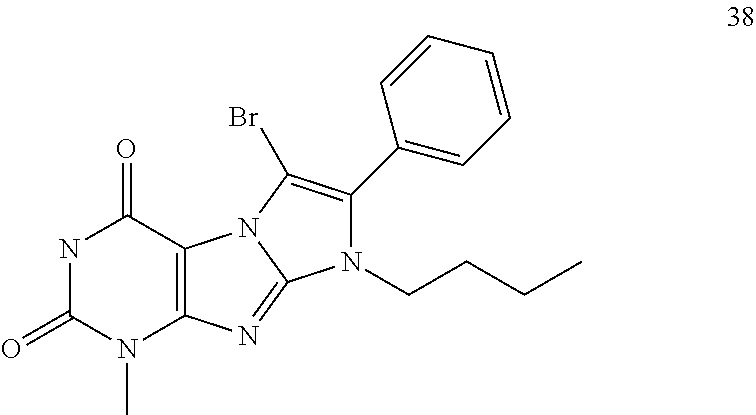
Quantitative yield; mp 302-304° C.; 1H NMR (400 MHz, DMSO-d6): δ=10.89 (s, 1H), 7.54-7.60 (m, 5H), 3.98 (t, J=7.3 Hz, 2H), 3.39 (s, 3H), 1.54 (quint, J=7.3 Hz, 2H), 1.08 (sext, J=7.3 Hz, 2H), 0.69 (t, J=7.3 Hz, 3H); 13C NMR (100 MHz, DMSO-d6): δ=153.0, 152.3, 150.7, 147.2, 130.3, 129.9, 129.6, 128.8, 126.6, 99.7, 89.5, 43.9, 29.9, 28.7, 18.6, 12.9; IR (film): ν=3167, 2958, 2820, 1698, 1669, 1504, 1444, 1154, 743, 581 cm−1; MS (ESI): m/z: calcd for C18H18BrN5O2Na+: 439.2, found: 438.1.

A mixture of commercially available 8-(2-methoxyphenyl)-1-methyl-7-phenyl-1H-imidazo[2,1-f]purine-2,4(3H,8H)-dione (5, 100 mg, 0.258 mmol) in acetic acid (0.387 mL) and formalin (36%, 1.1 mL) was refluxed for 15 h. The solution was then was cooled to room temperature and neutralized with sat. Na2CO3, and the resulting precipitate was filtered off. Cristallization in methanol afforded the desired product as a white solid (6 mg, 5% yield). 1H NMR (500 MHz, DMSO-d6): δ=11.27 (s, 1H), 7.49 (d, J=7.8 Hz, 1H), 7.45 (t, J=7.8 Hz, 1H), 7.32-7.37 (m, 3H), 7.23-7.24 (m, 2H), 7.12 (d, J=7.8 Hz, 1H), 7.05 (t, J=7.8 Hz, 1H), 5.90-5.93 (m, 1H), 4.69-4.72 (m, 2H), 3.55 (s, 3H), 3.32 (s, 3H); 13C NMR (125 MHz, DMSO-d6): δ=154.7, 154.5, 153.6, 150.6, 147.1, 131.1, 129.7, 129.4, 129.2, 128.7, 128.2, 127.0, 122.1, 120.7, 119.4, 112.7, 99.4, 55.5, 52.9, 28.9; IR (film): ν=3134, 2995, 2806, 1668, 1496, 1024, 749, 596 cm−1; HRMS (ESI): m/z: calcd for C22H19N5O4Na+: 440, 1335, found: 440, 1336.

A mixture of commercially available 8-(2-methoxyphenyl)-1-methyl-7-phenyl-1H-imidazo[2,1-f]purine-2,4(3H,8H)-dione (5, 200 mg, 0.516 mmol) in concentrated H2SO4 (0.103 mL) and acetic anhydride (1.29 mL) was refluxed for 2 h. The reaction was cooled to room temperature, poured into 10 mL of water, and extracted with CH2Cl2 (2×10 mL). The organic extracts were dried over MgSO4 and evaporated under reduced pressure. Purification by column chromatography on silica gel using a gradient CH2Cl2:EtOAc from 5:1 to 1:1 afforded the desired compound as a white solid (88 mg, 39% yield). 1H NMR (500 MHz, DMSO-d6): δ=11.03 (s, 1H), 7.54 (d, J=7.9 Hz, 1H), 7.42 (t, J=7.8 Hz, 1H), 7.30-7.37 (m, 5H), 7.08 (d, J=7.9 Hz, 1H), 7.02 (t, J=7.8 Hz, 1H), 3.60 (s, 3H), 3.30 (s, 3H), 2.46 (s, 3H); 13C NMR (100 MHz, DMSO-d6, CDCl3): δ=187.6, 154.4, 153.6, 153.0, 150.6, 146.8, 135.7, 131.4, 130.7, 129.8, 129.6, 127.5, 126.4, 121.2, 120.6, 120.1, 112.5, 101.0, 55.5, 29.6, 28.8; IR (film): ν=3160, 3050, 1668, 1490, 1292, 1211, 1023, 751, 555 cm−1; HRMS (ESI): m/z: calcd for C23H19N5O4Na+: 452.1335, found: 452.1338.

To a solution of LB-22 (37, 140 mg, 0.3 mmol) in DMF (2 mL) was added CuCN (80 mg, 0.9 mmol). The resulting mixture was heated to 160° C. overnight. The reaction was then cooled, poured into 10 mL of 10% aq. NaCN, and the resulting precipitate was filtered off, affording the desired product as a white solid in pure form. (51 mg, 41% yield). 1H NMR (400 MHz, DMSO-d6): δ=11.22 (s, 1H), 7.62 (dd, J=8 Hz, J=1.3 Hz, 1H), 7.52 (dt, J=8 Hz, J=1.3 Hz, 1H), 7.37-7.48 (m, 5H), 7.16 (dd, J=8 Hz, J=1.3 Hz, 1H), 7.11 (dt, J=8 Hz, J=1.3 Hz, 1H), 3.56 (s, 3H), 3.30 (s, 3H); 13C NMR (125 MHz, DMSO-d6): δ=154.3, 153.0, 152.6, 150.7, 146.5, 142.9, 131.9, 130.6, 129.6, 128.7, 128.7, 124.9, 121.0, 120.9, 112.9, 110.6, 100.9, 91.8, 55.7, 28.8; IR (film): ν=3151, 3028, 2811, 1675, 1495, 1159, 1282, 1014, 740, 551 cm−1; HRMS (ESI): m/z: calcd for C22H16N6O3Na+: 435.1182, found: 435.1181.

A mixture of commercially available 8-bromo-3,7-dihydro-3-methyl-7-(2-oxo-2-phenylethyl)-1H-purine-2,6-dione (42, 50 mg, 0.138 mmol), diisopropylethylamine (47 μL, 0.275 mmol) and butylamine (27 μL, 0.275 mmol) in EtOH (1 mL) was heated at 120° C. for 12 h. The reaction was cooled to room temperature, the solid was filtered off, washed with water, affording the desired product as a white solid (22 mg, 44% yield). 1H NMR (400 MHz, DMSO-d6): δ=11.57 (s, 1H), 8.04 (d, J=7.8 Hz, 2H), 7.72 (t, J=7.8 Hz, 1H), 7.60 (t, J=7.8 Hz, 2H), 6.99 (t, J=5.5 Hz, 1H), 5.62 (s, 2H), 3.32 (s, 3H), 3.32 (m, 2H), 1.51 (quint, J=7.4 Hz, 2H), 1.31 (sext, J=7.4 Hz, 2H), 0.88 (t, J=7.4 Hz, 3H); 13C NMR (125 MHz, DMSO-d6): δ=192.2, 154.6, 153.0, 150.7, 150.0, 134.1, 133.8, 128.7, 127.9, 101.7, 49.5, 41.8, 31.0, 28.2, 19.2, 13.5; IR (film): ν=3361, 3008, 2827, 1681, 1485, 1425, 1230, 746 cm−1; HRMS (ESI): m/z: calcd for C18H21N5O3Na+: 378.1542, found: 378.1545.

8-(2-Methoxyphenyl)-1-methyl-7-p-cyanophenyl-1H-imidazo[2,1-f]purine-2,4(3H,8H)-dione (28, LC-55, 85 mg, 0.206 mmol) was dissolved in water (0.910 mL) and conc. H2SO4 (0.803 mL) and refluxed for 2 h. The reaction mixture was then cooled to room temperature, 1 mL of water was added, and the precipitate was filtered off, affording the desired product as a white solid (60 mg, 67% yield). 1H NMR (400 MHz, DMSO-d6): δ=11.02 (s, 1H), 8.16 (s, 1H), 7.82 (d, J=8.3 Hz, 2H), 7.58 (dd, J=7.7 Hz, J=1.4 Hz, 1H), 7.53 (dt, J=7.7 Hz, J=1.4 Hz, 1H), 7.37 (d, J=8.3 Hz, 2H), 7.19 (d, J=7.6 Hz, 1H), 7.14 (t, J=7.6 Hz, 1H), 3.54 (s, 3H), 3.30 (s, 3H), CO2H—not observed; 13C NMR (100 MHz, DMSO-d6): δ=166.6, 154.6, 153.3, 152.9, 150.9, 148.2, 132.3, 131.9, 131.3, 130.2, 129.5, 129.2, 127.0, 122.3, 121.1, 113.0, 106.4, 99.1, 55.6, 28.8; IR (film): ν=3013, 2839, 1681, 1547, 1264, 1158, 1013, 745, 570 cm−1; HRMS (ESI): m/z: calcd for C22H17N5O5Na+: 454.1127, found: 454.1135.

To a solution of commercially available 8-butyl-1-methyl-7-phenyl-1H-imidazo[2,1-f]purine-2,4(3H,8H)-dione (3, 100 mg, 0.296 mmol) in acetic acid (500 μL) was added HNO3 (fuming, 24 μL, 0.592 mmol), and the resulting mixture was stirred at room temperature for 12 h. Water was added, and the resulting precipitate was filtered off. Cristallization in methanol afforded the desired product as a yellow solid (26 mg, 23% yield). 1H NMR (400 MHz, DMSO-d6): δ=11.05 (s, 1H), 7.60-7.69 (m, 5H), 3.93 (t, J=7.3 Hz, 2H), 3.43 (s, 3H), 1.62 (quint, J=7.3 Hz, 2H), 1.14 (sext, J=7.3 Hz, 2H), 0.70 (t, J=7.3 Hz, 3H); 13C NMR (100 MHz, DMSO-d6): δ=153.4, 152.1, 150.5, 144.6, 134.4, 130.9, 130.7, 128.5, 126.9, 124.7, 101.6, 44.3, 29.5, 29.0, 18.6, 12.9; IR (film) ν=3172, 3052, 2964, 1693, 1502, 1356, 1294, 732, 577 cm−1; HRMS (ESI): m/z: calcd for C18H18N6O4Na+: 405.1287, found: 405.1288.
Claims (8)
1. A compound of formula 1

wherein
R1 is hydrogen,
R2 is lower alkyl, arylsulfonyl, heteroarylsulfonyl, lower alkylsulfonyl, aminosulfonyl, lower alkylaminosulfonyl, arylcarbonyl, heteroarylcarbonyl, lower alkylcarbonyl, lower alkoxycarbonyl, aminocarbonyl, lower alkylaminocarbonyl or carboxy;
R3 is alkyl, hydroxy-lower alkyl, methoxy-lower alkyl, aryl-lower alkyl, or heteroaryl-lower alkyl;
R4 is para-fluoro or para-chloro; and
R5 is hydrogen;
or wherein
R1 is hydrogen,
R2 is lower alkyl, arylsulfonyl, heteroarylsulfonyl, lower alkylsulfonyl, aminosulfonyl, lower alkylaminosulfonyl, arylcarbonyl, heteroarylcarbonyl, lower alkylcarbonyl, lower alkoxycarbonyl, aminocarbonyl, lower alkylaminocarbonyl or carboxy;
R3 is alkyl, hydroxy-lower alkyl, methoxy-lower alkyl, aryl-lower alkyl, heteroaryl-lower alkyl or aryl; and
R4 and R5 are, independently of each other, hydrogen, ortho- or meta-fluoro, ortho- or meta-chloro, ortho- or meta-methoxy, ortho-nitro, ortho-, meta- or para-methyl, or ortho-, meta- or para-hydroxy; and wherein at least one of R4 and R5 is different from hydrogen;
and tautomers and salts thereof.
2. The compound of formula 1 according to claim 1 , wherein
R3 is lower alkyl, hydroxy-lower alkyl, methoxy-lower alkyl, optionally substituted phenyl-lower alkyl, pyridyl-, pyrrolyl-, pyrazolyl- or imidazolyl-lower alkyl, or optionally substituted phenyl;
and R1, R2, R4 and R5 have the indicated meanings;
and tautomers and salts thereof.
3. The compound of formula 1 according to claim 1 , wherein
R3 is lower alkyl, hydroxy-lower alkyl, methoxy-lower alkyl, phenyl-lower alkyl, pyridyl-lower alkyl, or phenyl optionally substituted by one or two substituents lower alkyl, lower alkoxy, halo-lower alkyl or halo;
and R1, R2, R4 and R5 have the indicated meanings;
and tautomers and salts thereof.
4. The compound of formula 1 according to claim 1 , wherein
R3 is lower alkyl, hydroxy-lower alkyl, methoxy-lower alkyl, or phenyl optionally substituted by one or two substituents lower alkyl or lower alkoxy;
and R1, R2, R4 and R5 have the indicated meanings;
and tautomers and salts thereof.
5. The compound of formula 1

wherein
R1 is hydrogen,
R2 is lower alkyl, arylsulfonyl, heteroarylsulfonyl, lower alkylsulfonyl, aminosulfonyl, lower alkylaminosulfonyl, arylcarbonyl, heteroarylcarbonyl, lower alkylcarbonyl, lower alkoxycarbonyl, aminocarbonyl, lower alkylaminocarbonyl or carboxy;
R3 is alkyl, hydroxy-lower alkyl, methoxy-lower alkyl, aryl-lower alkyl, or heteroaryl-lower alkyl;
R4 is para-fluoro or para-chloro; and
R5 is hydrogen;
and tautomers and salts thereof.
6. The compound of formula 1 according to claim 1 , wherein
R1 is hydrogen,
R2 is lower alkyl, arylsulfonyl, heteroarylsulfonyl, lower alkylsulfonyl, aminosulfonyl, lower alkylaminosulfonyl, arylcarbonyl, heteroarylcarbonyl, lower alkylcarbonyl, lower alkoxycarbonyl, aminocarbonyl, lower alkylaminocarbonyl or carboxy;
R3 is alkyl, hydroxy-lower alkyl, methoxy-lower alkyl, aryl-lower alkyl, heteroaryl-lower alkyl or aryl; and
R4 and R5 are, independently of each other, hydrogen, ortho- or meta-fluoro, ortho- or meta-chloro, ortho- or meta-methoxy, ortho-nitro, ortho-, meta- or para-methyl, or ortho, meta- or para-hydroxy; and wherein at least one of R4 and R5 is different from hydrogen;
and tautomers and salts thereof.
7. A pharmaceutical preparation comprising a compound of formula 1

wherein
R1 is hydrogen,
R2 is lower alkyl, arylsulfonyl, heteroarylsulfonyl, lower alkylsulfonyl, aminosulfonyl, lower alkylaminosulfonyl, arylcarbonyl, heteroarylcarbonyl, lower alkylcarbonyl, lower alkoxycarbonyl, aminocarbonyl, lower alkylaminocarbonyl or carboxy;
R3 is alkyl, hydroxy-lower alkyl, methoxy-lower alkyl, aryl-lower alkyl, or heteroaryl-lower alkyl;
R4 is para-fluoro or para-chloro; and
R5 is hydrogen;
and tautomers and salts thereof.
8. A pharmaceutical preparation according to claim 7 comprising a compound of formula 1, wherein
R1 is hydrogen,
R2 is lower alkyl, arylsulfonyl, heteroarylsulfonyl, lower alkylsulfonyl, aminosulfonyl, lower alkylaminosulfonyl, arylcarbonyl, heteroarylcarbonyl, lower alkylcarbonyl, lower alkoxycarbonyl, aminocarbonyl, lower alkylaminocarbonyl or carboxy;
R3 is alkyl, hydroxy-lower alkyl, methoxy-lower alkyl, aryl-lower alkyl, heteroaryl-lower alkyl or aryl; and
R4 and R5 are, independently of each other, hydrogen, ortho- or meta-fluoro, ortho- or meta-chloro, ortho- or meta-methoxy, ortho-nitro, ortho-, meta- or para-methyl, or ortho-, meta- or para-hydroxy; and wherein at least one of R4 and R5 is different from hydrogen; and tautomers and salts thereof.
Applications Claiming Priority (4)
| Application Number | Priority Date | Filing Date | Title |
|---|---|---|---|
| EP08001289.1 | 2008-01-24 | ||
| EP08001289 | 2008-01-24 | ||
| EP08001289 | 2008-01-24 | ||
| PCT/EP2009/000439 WO2009092602A2 (en) | 2008-01-24 | 2009-01-23 | Anti-angiogenic compounds |
Publications (2)
| Publication Number | Publication Date |
|---|---|
| US20110077401A1 US20110077401A1 (en) | 2011-03-31 |
| US8765775B2 true US8765775B2 (en) | 2014-07-01 |
Family
ID=40527885
Family Applications (1)
| Application Number | Title | Priority Date | Filing Date |
|---|---|---|---|
| US12/863,724 Expired - Fee Related US8765775B2 (en) | 2008-01-24 | 2009-01-23 | Anti-angiogenic compounds |
Country Status (2)
| Country | Link |
|---|---|
| US (1) | US8765775B2 (en) |
| WO (1) | WO2009092602A2 (en) |
Families Citing this family (1)
| Publication number | Priority date | Publication date | Assignee | Title |
|---|---|---|---|---|
| WO2011009695A1 (en) * | 2009-07-21 | 2011-01-27 | Universität Zürich | New anti-angiogenic compounds |
Citations (1)
| Publication number | Priority date | Publication date | Assignee | Title |
|---|---|---|---|---|
| WO2006083916A2 (en) | 2005-02-02 | 2006-08-10 | King Pharmaceuticals Research And Development, Inc. | Novel adenosine a3 receptor modulators |
-
2009
- 2009-01-23 WO PCT/EP2009/000439 patent/WO2009092602A2/en not_active Ceased
- 2009-01-23 US US12/863,724 patent/US8765775B2/en not_active Expired - Fee Related
Patent Citations (1)
| Publication number | Priority date | Publication date | Assignee | Title |
|---|---|---|---|---|
| WO2006083916A2 (en) | 2005-02-02 | 2006-08-10 | King Pharmaceuticals Research And Development, Inc. | Novel adenosine a3 receptor modulators |
Non-Patent Citations (4)
| Title |
|---|
| Garmash, S. N. et al: "Synthesis and biological activity of 3-formyl-8-methyl-6H-imidazo[1,2-fixanthin e derivatives" in Khimiko-Farmatsevticheskii Zhurnal, vol. 18, No. 3, 1984, pp. 307-311, XP002524016. |
| Lafleur et al, "Structure-Based Optimization of Patent and Selective Inhibitors of the Tyrosine Kinase Erythropoietin Producing Human Hepatocellural Carcinoma Receptor B4 (EphB4)," J. Med. Chem. vol. 52, 2009, pp. 6433-6446. |
| Priimenko, B. A. et al: "Heterocyclic derivatives of purines. 3. Synthesis and mass-spectrometric study of imidazo [I,2-f] purine" in Khimiya Geterotsiklicheskikh Soedinenii, vol. 8, 1980, pp. 1125-1129, XP002524017. |
| Priimenko, et al., Synthesis and Pharmacological Activity of 6,8-dimethylimidazo[1,2-f]xanthines, Khimiko-Farmatsevticheskii Zhurnal, 18(12), 1456-61 (1984). * |
Also Published As
| Publication number | Publication date |
|---|---|
| WO2009092602A3 (en) | 2009-11-05 |
| WO2009092602A2 (en) | 2009-07-30 |
| US20110077401A1 (en) | 2011-03-31 |
| WO2009092602A8 (en) | 2010-09-02 |
Similar Documents
| Publication | Publication Date | Title |
|---|---|---|
| JP6903790B2 (en) | Bicyclic heterocycle as an FGFR inhibitor | |
| KR102956194B1 (en) | Salt of FGFR inhibitors | |
| US11472801B2 (en) | Crystalline forms of a FGFR inhibitor and processes for preparing the same | |
| TWI421077B (en) | Substituted piperidino-dihydrothienopyrimidines | |
| US7253286B2 (en) | Nitrogen-containing aromatic derivatives | |
| USRE46886E1 (en) | Alkoxy pyrazoles as soluble guanylate cyclase activators | |
| US10611777B2 (en) | Imidazopyridazine compounds and their use | |
| US10800741B2 (en) | Quinoline compound, preparation method and medical use therefor | |
| US20050222163A1 (en) | Combinations of signal transduction inhibitors | |
| JP2020526499A (en) | Selective inhibitor of clinically important mutants of EGFR tyrosine kinase | |
| US11691971B2 (en) | Naphthyridinone compounds as JAK2 V617F inhibitors | |
| US11919908B2 (en) | Substituted pyrrolo[2,3-d]pyrimidine compounds as JAK2 V617F inhibitors | |
| US11420975B2 (en) | Substituted imidazo[1,5-a]pyrazines as Bruton's tyrosine kinase inhibitors | |
| US20230033393A1 (en) | Pyrazolopyridines and triazolopyridines as a2a / a2b inhibitors | |
| US12473303B2 (en) | 4-[[(7-aminopyrazolo[1,5-a]pyrimidin-5-yl)amino methyl]piperidin-3-ol compounds and their therapeutic use | |
| TW201902896A (en) | Therapeutic compounds and compositions and methods of use thereof | |
| WO2022242697A1 (en) | Tyk2 selective inhibitor and use thereof | |
| KR102256497B1 (en) | Quinoline analogs as phosphatidylinositol 3-kinase inhibitors | |
| US20220340544A1 (en) | Substituted heterocyclic derivatives as pi3k inhibitors | |
| WO2017133423A1 (en) | Substituted picolinamide compound and use thereof | |
| CN107417687A (en) | Five-ring heterocycles simultaneously [3,4 d] pyridazinone compound, its preparation method, pharmaceutical composition and its application | |
| ES2972862T3 (en) | Pyrropyrimidine compounds as MNK inhibitors | |
| CN107686477A (en) | New compound and its application as CDK4/6 inhibitor | |
| CN114008051B (en) | Pyrazolopyrimidine sulfone inhibitors of JAK kinase and uses thereof | |
| US11666577B2 (en) | MLKL inhibitors |
Legal Events
| Date | Code | Title | Description |
|---|---|---|---|
| AS | Assignment |
Owner name: UNIVERSITAET ZUERICH, SWITZERLAND Free format text: ASSIGNMENT OF ASSIGNORS INTEREST;ASSIGNORS:HUANG, DANZHI;KOLB, PETER;LAFLEUR, KARINE;AND OTHERS;REEL/FRAME:025130/0540 Effective date: 20100810 |
|
| FEPP | Fee payment procedure |
Free format text: MAINTENANCE FEE REMINDER MAILED (ORIGINAL EVENT CODE: REM.) |
|
| LAPS | Lapse for failure to pay maintenance fees |
Free format text: PATENT EXPIRED FOR FAILURE TO PAY MAINTENANCE FEES (ORIGINAL EVENT CODE: EXP.) |
|
| STCH | Information on status: patent discontinuation |
Free format text: PATENT EXPIRED DUE TO NONPAYMENT OF MAINTENANCE FEES UNDER 37 CFR 1.362 |