US8764471B2 - Electrical connector for high-speed data transmission - Google Patents
Electrical connector for high-speed data transmission Download PDFInfo
- Publication number
- US8764471B2 US8764471B2 US13/314,174 US201113314174A US8764471B2 US 8764471 B2 US8764471 B2 US 8764471B2 US 201113314174 A US201113314174 A US 201113314174A US 8764471 B2 US8764471 B2 US 8764471B2
- Authority
- US
- United States
- Prior art keywords
- connector
- front shell
- sheath
- shell
- pin
- Prior art date
- Legal status (The legal status is an assumption and is not a legal conclusion. Google has not performed a legal analysis and makes no representation as to the accuracy of the status listed.)
- Active, expires
Links
Images




Classifications
-
- H—ELECTRICITY
- H01—ELECTRIC ELEMENTS
- H01R—ELECTRICALLY-CONDUCTIVE CONNECTIONS; STRUCTURAL ASSOCIATIONS OF A PLURALITY OF MUTUALLY-INSULATED ELECTRICAL CONNECTING ELEMENTS; COUPLING DEVICES; CURRENT COLLECTORS
- H01R13/00—Details of coupling devices of the kinds covered by groups H01R12/70 or H01R24/00 - H01R33/00
- H01R13/46—Bases; Cases
- H01R13/52—Dustproof, splashproof, drip-proof, waterproof, or flameproof cases
- H01R13/5213—Covers
-
- H—ELECTRICITY
- H01—ELECTRIC ELEMENTS
- H01R—ELECTRICALLY-CONDUCTIVE CONNECTIONS; STRUCTURAL ASSOCIATIONS OF A PLURALITY OF MUTUALLY-INSULATED ELECTRICAL CONNECTING ELEMENTS; COUPLING DEVICES; CURRENT COLLECTORS
- H01R13/00—Details of coupling devices of the kinds covered by groups H01R12/70 or H01R24/00 - H01R33/00
- H01R13/646—Details of coupling devices of the kinds covered by groups H01R12/70 or H01R24/00 - H01R33/00 specially adapted for high-frequency, e.g. structures providing an impedance match or phase match
- H01R13/6461—Means for preventing cross-talk
- H01R13/6463—Means for preventing cross-talk using twisted pairs of wires
-
- H—ELECTRICITY
- H01—ELECTRIC ELEMENTS
- H01R—ELECTRICALLY-CONDUCTIVE CONNECTIONS; STRUCTURAL ASSOCIATIONS OF A PLURALITY OF MUTUALLY-INSULATED ELECTRICAL CONNECTING ELEMENTS; COUPLING DEVICES; CURRENT COLLECTORS
- H01R13/00—Details of coupling devices of the kinds covered by groups H01R12/70 or H01R24/00 - H01R33/00
- H01R13/62—Means for facilitating engagement or disengagement of coupling parts or for holding them in engagement
- H01R13/639—Additional means for holding or locking coupling parts together, after engagement, e.g. separate keylock, retainer strap
-
- H—ELECTRICITY
- H01—ELECTRIC ELEMENTS
- H01R—ELECTRICALLY-CONDUCTIVE CONNECTIONS; STRUCTURAL ASSOCIATIONS OF A PLURALITY OF MUTUALLY-INSULATED ELECTRICAL CONNECTING ELEMENTS; COUPLING DEVICES; CURRENT COLLECTORS
- H01R13/00—Details of coupling devices of the kinds covered by groups H01R12/70 or H01R24/00 - H01R33/00
- H01R13/648—Protective earth or shield arrangements on coupling devices, e.g. anti-static shielding
- H01R13/658—High frequency shielding arrangements, e.g. against EMI [Electro-Magnetic Interference] or EMP [Electro-Magnetic Pulse]
- H01R13/6581—Shield structure
- H01R13/659—Shield structure with plural ports for distinct connectors
-
- H—ELECTRICITY
- H01—ELECTRIC ELEMENTS
- H01R—ELECTRICALLY-CONDUCTIVE CONNECTIONS; STRUCTURAL ASSOCIATIONS OF A PLURALITY OF MUTUALLY-INSULATED ELECTRICAL CONNECTING ELEMENTS; COUPLING DEVICES; CURRENT COLLECTORS
- H01R13/00—Details of coupling devices of the kinds covered by groups H01R12/70 or H01R24/00 - H01R33/00
- H01R13/62—Means for facilitating engagement or disengagement of coupling parts or for holding them in engagement
- H01R13/627—Snap or like fastening
- H01R13/6275—Latching arms not integral with the housing
Definitions
- the field of this disclosure relates to electrical connectors and, in particular, to cable-terminating electrical connector system having enhanced shielding to reduce interference and crosstalk amongst different wires of the cable and different conductors of the connector system.
- Ultra High-Speed (UHS) data transmission involves the transmission of data between electronic devices at rates of 1 to 10 gigabits per second using signal frequencies of 100 MHz to 500 MHz.
- UHS data transmission may be achieved over 1000BASE-T Ethernet networks using category 5, 5E, 6 or 6A cables.
- Such high-speed digital data networks are not confined to terrestrial applications, especially as high-speed electronics are developed for aerospace and other suitable applications.
- High-speed digital data transmission is facilitated by a data transmission system with a relatively high signal to noise ratio.
- One exemplary system includes a 1000BASE-T Ethernet network that includes category 5, 5E, 6 or 6A cables. Cables in such a system are designed to propagate data signals without generating or introducing appreciable noise, and are terminated by electrical connectors at either end to either connect cables together, or to connect cables to electronic devices. Electrical connectors commonly used for terrestrial applications, such as an RJ-45 style connector, have proved to be less than suitable for aerospace and other applications.
- electrical connectors are subjected to a variety of harsh environmental conditions, such as the presence of moisture, vibrations and mechanical shock, relatively high amounts of external electrical and magnetic interference, and pressure changes, all of which can detrimentally affect an electrical connector's performance, that is, its ability to transmit data signals while maintaining a relatively high signal to noise ratio.
- Common electrical connectors for aerospace and other suitable applications such as the Quadrax-style connector, tend to work well for data transfer rates less than 1 gigabit per second, but tend to exhibit, induce, generate or introduce excessive noise during high-speed data transmission at rates faster than 1 gigabit per second.
- U.S. Pat. No. 7,316,584 describes an electrical connector designed to reduce crosstalk.
- Electrical connectors described in the '584 patent include an electrically conductive “X”-shaped grounding post 32 (best seen in FIGS. 3A and 3B thereof) in an attempt to electrically isolate each of four pairs of contacts from the other three pairs of contacts by placing each pair between two adjacent arms of the “X”.
- Devices in the '584 patent also include a follower 42 that is located behind the “X”-shaped grounding post such that each pair of wires corresponding to a pair of contacts traverses through one of four apertures in the follower.
- the follower may be made from an electrically conductive material to provide electrical isolation between each wire pair.
- the '584 patent also discloses that each pair of wires “become untwisted in the region of the follower 42.”
- the present inventor has recognized a need for a robust electrical connector capable of facilitating high-speed data transfer in aerospace and other suitable applications, for example, in aircraft electronic systems having performance criteria meeting gigabit data transfer standards such as 1000BASE-T.
- the present inventor has thus identified a need for an improved connector configuration for reducing crosstalk, noise, and interference in high-speed data transmission systems and for such connectors having enhanced reliability in demanding environments.
- An electrical connector system includes a pin connector and a mating socket connector.
- each of the connectors is attached to a cable having four twisted pairs of wires.
- the connectors preferably include features for shielding each of several pairs of wire-terminating contacts of the connector from the other pairs contacts to thereby reduce interference and crosstalk.
- an electrically conductive front shell of the connector defines a plurality of contact-receiving cavities extending in an axial direction and having openings at a front face of the front shell.
- An electrically conductive insertion plug portion of the front shell projects from the front face in the axial direction from a location on the front face between the openings for insertion into a connection bore of the mating connector.
- the insertion plug portion includes multiple cantilever members each including a radially outwardly projecting portion located proximate a free end of the cantilever member for pressing against an inner surface of the connection bore to establish a low-impedance electrical coupling between the shells of the connector and the mating connector.
- the insertion plug portion and the cantilever members may be integrally formed with the front face of the front shell.
- the cantilever members cooperate with a connecting post slidably mounted in the front shell to provide a latching function.
- a connector system in another aspect, includes a first connector with an electrically conductive front shell having an insertion plug portion projecting from the front face of the front shell in an axial direction, and a second connector that is configured to be slidably mated to the first connector along a connection axis.
- the second connector includes a conductive front shell defining a connection bore sized to receive the insertion plug portion of the first connector so that at least one of the radially outwardly projecting portions of the cantilever members of the insertion plug bears upon a conductive inner surface of the connection bore when the connector and mating connector are mated, to thereby establish a low impedance connection between the front shell of the connector and the front shell of the mating connector.
- an electrical connector comprises an electrically conductive front shell in which is formed a plurality of contact-receiving cavities.
- the cavities extend in an axial direction entirely through the front shell to define a rear opening proximate a rear end of the front shell and an opposite front opening in a front face of the front shell.
- a conductive central core of the front shell extends in the axial direction and may slidably support a connecting post of a latch mechanism.
- a plurality of conductive fins radiate from the core and integrally interconnect the core with a peripheral portion of the front shell so that each fin separates and shields an adjacent pair of the cavities from each other.
- the peripheral portion, the core, and the fins are preferably all integrally formed in a monolithic structure.
- Wire-terminating contacts are held in spaced-apart relation by a plurality of electrically insulating sheaths.
- Each sheath is sized to receive and retain a pair of the contacts such that at least a portion of each electrical contact is contained within the sheath in alignment with one of a pair of contact apertures in a front wall of the sheath, and so each of a pair of wires terminated by the electrical contacts extends through a rear end portion of the sheath.
- Each sheath is sized and shaped for insertion into one of the cavities in the front shell, preferably through the rear opening thereof, so as to position the contact apertures of the sheath in alignment with the front opening of the cavity.
- An electrically conductive rear shell adapted to be coupled to the front shell and extends rearwardly of the rear end thereof so as to capture the insulating sheaths between the front and rear shells and retain them in the cavities.
- the rear shell may also hold a conductive shielding ferrule against the rear end of the front shell, for retaining the insulating sheaths and contacts in place.
- the shielding ferrule may include a flexible rear skirt that is flexed radially inwardly by the rear shell when the rear shell is coupled to the front shell, to thereby clamp onto the cable, such as onto a shielding layer wrapped around the wires of the cable.
- pin and socket contacts are inserted into and removed from the pin and socket connectors without requiring special tools other than tools commonly used to crimp or solder pin and socket contacts to wires, or to separate such contacts from wires.
- FIG. 1 shows an exemplary cable that includes four twisted pairs of wires.
- FIG. 2 is a left-side sectional isometric view of an electrical connector system including mating socket and pin connectors according to a first embodiment.
- FIG. 3 is a sectional isometric view of an electrical connector system showing detail of a latch and a latch release mechanism according to a second embodiment.
- FIG. 3A is an isometric view of a pin connector according to a third embodiment with a rear shell and shielding ferrule of the connector omitted to show detail of a front shell of the connector and wires terminated by the connector.
- FIG. 4 is a right-side isometric partly exploded view of the pin connector of FIG. 2 .
- FIG. 5 is a top view of a pin front shell of the connector FIG. 4 .
- FIG. 6 is a front view of the pin front shell of FIG. 5 .
- FIG. 7 is a left front isometric view of the pin front shell of FIG. 5 .
- FIG. 8 is a right rear isometric view of the pin front shell of FIG. 5 .
- FIG. 9 is a right rear isometric view of another pin front shell.
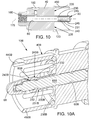
- FIG. 10 is a right-side cross-section view of the pin front shell of FIG. 5 .
- FIG. 10A is a left-side cross-section detail view of a pin connector according to another embodiment showing detail of a latch mechanism and connecting post.
- FIG. 12 is an enlarged right-side cross-section view of a front end portion of the pin front shell of FIG. 5 .
- FIG. 13 is an enlarged rear view of the pin front shell of FIG. 5 .
- FIGS. 14 , 15 and 16 are respective right-side cross-section, rear end and isometric views of a rear shell of the connector of FIG. 4 .
- FIGS. 17 , 18 , 19 , 20 , 21 , and 22 are respective a front end, left side section, side elevation, rear end, and rear and front isometric views of an electrically conductive shield ferrule of the connector of FIG. 4 .
- FIGS. 23 , 24 , 25 , and 26 are respective top, left side section, right-rear isometric, and left-front isometric views of a sheath of the connector of FIG. 4 , with a cover of the sheath (illustrated in FIGS. 27-30 ) omitted to show detail.
- FIG. 23A is a right-rear isometric view of a pin contact sheath according to another embodiment.
- FIG. 23B is a pictorial view of an assembly of a cable and pin contacts with four of the sheaths of FIG. 23A .
- FIGS. 27 , 28 , 29 , and 30 are respective bottom, right side section, bottom-right-front isometric, and top-left-front isometric views of a cover for the sheath of FIGS. 23-30 .
- FIGS. 31 and 32 are side and isometric views of a connecting post of the connector of FIG. 4 .
- FIGS. 33 and 34 are side and isometric views of a latch release button of the connector of FIG. 4 .
- FIG. 35 is an isometric view of a retaining pin of the connector of FIG. 4 .
- FIGS. 36 and 37 are front and side views of a facial seal of the connector of FIG. 4 .
- FIG. 38 are a top and side section views of a boot of the connector of FIG. 4 .
- FIG. 40 is a partly exploded isometric view of the socket connector of FIG. 2 .
- FIG. 41 is a front view of a conductive socket front shell of the connector of FIG. 40 .
- FIG. 42 is a top view of the conductive socket front shell of FIG. 41 .
- FIG. 43 is a rear view of the conductive socket front shell of FIG. 41 .
- FIG. 44 is a left-side cross-sectional view of the conductive socket front shell of FIG. 41 .
- FIG. 45 is an enlarged left-side cross-sectional view of the conductive socket front shell of FIG. 41 .
- FIG. 46 is a cross-sectional view of another embodiment of a conductive socket front shell.
- FIG. 47 is a left-side rear isometric view of the conductive socket front shell of FIG. 41 .
- FIG. 48 is a right-side front isometric view of the conductive socket front shell of FIG. 41 .
- FIGS. 49 , 50 , 51 , 52 , and 53 are respective rear end, top plan, right side section, left-front isometric, and right-rear isometric views of a contact-retaining sheath of the connector of FIG. 40 .
- FIG. 50A is a right-side rear isometric view of sheath for socket contacts according to another embodiment.
- FIG. 50B is a pictorial view of an assembly of a cable and socket contacts with four of the sheaths of FIG. 50A .
- FIG. 54 is an isometric view of an exemplary pin contact.
- FIG. 55 is an isometric view of an exemplary socket contact.
- FIG. 56 illustrates a right-side rear isometric view of an exemplary arrangement of pin contacts located in sheaths as such sheaths would be arranged in a pin front shell and showing wire-termination detail.
- FIG. 57 is an isometric view of first and second housings (yokes) each holding a pair of electrical connectors.
- FIG. 58 illustrates a left-side, bottom, front isometric view of the first housing holding electrical connectors and a right-side, bottom, rear isometric view of the second housing holding electrical connectors of FIG. 57 .
- FIG. 59 illustrates a right-side, top, rear isometric view of the first housing first portion of FIG. 57 .
- FIG. 60 illustrates a bottom isometric view of the first housing first portion of FIG. 57 .
- FIG. 62 illustrates a right-side, top, rear isometric view of the second housing first portion of FIG. 57 .
- FIG. 63 illustrates a top isometric view of the first and second housing second portion of FIG. 57 .
- FIG. 64 illustrates bottom isometric view of the first and second housing second portion of FIG. 57 .
- FIG. 65 illustrates a right-side, top, rear isometric view of another first housing holding electrical connectors and a left-side, top, front isometric view of another second housing holding electrical connectors.
- FIG. 66 illustrates a left-side, bottom, front isometric view of the first housing holding electrical connectors and a right-side, bottom, rear isometric view of the second housing holding electrical connectors of FIG. 65 .
- FIG. 67 illustrates a bottom isometric view of the first housing first portion of FIG. 65 .
- FIG. 68 illustrates a right-side, top, rear isometric view of the first housing first portion of FIG. 65 .
- FIG. 71 illustrates a top isometric view of the first and second housing second portion of FIG. 65 .
- FIG. 72 illustrates bottom isometric view of the first and second housing second portion of FIG. 65 .
- FIG. 74 illustrates a right-side isometric view of another housing.
- FIG. 75 illustrates a right-side isometric view of another housing.
- Such matching helps ensure that signals are propagated between correct wire pairs and helps avoid splitting wire pairs, i.e., making one half of a correct connection and one half of an incorrect connection, which may induce crosstalk, such as near end crosstalk (“NEXT”) or far end crosstalk (“FEXT”).
- NEXT near end crosstalk
- FXT far end crosstalk
- a data signal in other words, an electrical signal typically having a specific wave shape and height, must have sufficient energy to travel through a wire. Such energy is created at the near end of a wire when an electronic device creates an electrical pulse and transmits such electrical pulse to the wire. When an electrical pulse travels through a wire it loses energy, thus attenuating, in other words reducing, the energy of the electrical pulse as it moves through the wire. Such attenuation is frequency dependent. For typical cables or wires, electrical pulses transmitted as signals at relatively high frequencies, for example, high-speed data signals at 100 MHz to 500 MHz, are attenuated to a greater degree than are lower frequency signals, such that higher frequency signals are relatively weak by the time they reach the far end of a cable or wire compared to lower frequency signals. Attenuation may be influenced by the size of the electrical carrier (cross-sectional area), the length of the electrical carrier, and whether the electrical carrier makes a good electrical contact with other components such as contacts, for example.
- Impedance refers to the opposition to the flow of an electric pulse as it travels through a conductor, such as a wire. Impedance is also frequency dependent, but as the frequency increases, impedance decreases. For low frequency signals the impedance is largely a function of the conductor size, for example, a larger diameter wire has a lower impedance than does a smaller diameter wire. For high frequency signals, several physical aspects of a cable in addition to conductor size influence impedance, including the type of insulation material surrounding a wire, the thickness of such insulation, and the number of twists per inch for a twisted pair.
- Each of the twisted pairs (PAIR 1 , PAIR 2 , PAIR 3 , and PAIR 4 ) commonly has a different twist rate, or pitch, that is, how many twists occur per unit of linear distance spanned by the pair.
- Cable C includes a foil shield “S” surrounding PAIR 1 , PAIR 2 , PAIR 3 , and PAIR 4 to help prevent external electromagnetic interference from reaching PAIR 1 , PAIR 2 , PAIR 3 , and PAIR 4 and to help prevent extraneous electrical signals from escaping cable C.
- a jacket “J” provides mechanical protection for shield S and the wires.
- any resulting crosstalk signals within the pair are thus kept relatively small and do not substantially interfere with a data signal being carried by either of the wires. Additionally, because each of the four twisted pairs has its own, unique twist rate, crosstalk signals between each of the four pairs is kept relatively small.
- Untwisting an end portion of each twisted pair of a cable is necessary to connect each end of the cable to a connector for electrically connecting the cable to electronic devices or other cables.
- Each wire is terminated with a socket or pin contact which is then secured into an electrical connector.
- the contacts are typically arranged in a parallel fashion with respect to each other.
- each wire pair and parallel arrangement of contacts may create substantially parallel sections of wires that provide an opportunity for crosstalk to be introduced at the ends of the cable (1) between wires of a twisted pair and (2) between each of the twisted pairs, especially over the length of the pin and socket contacts.
- the crosstalk is referred to as near end crosstalk (NEXT).
- FEXT far end crosstalk
- Return loss occurs when a portion of a data signal traveling through a conductor is reflected at the far end and propagated back through the conductor toward the near end where the data signal originated.
- the reflected portion of the data signal may interfere with a newly generated data signal thus corrupting the wave-shape or other characteristic of the data signal and interfering with the newly generated data signal's ability to convey data.
- Signal reflections are typically created when a data signal encounters an impedance mismatch.
- a characteristic impedance of a cable may have one value while the characteristic impedance of a connector may have a different value.
- an impedance mismatch between a cable and a terminating connector occurs, a portion of a data signal is reflected back down the cable.
- the present inventor has also recognized a limitation of connectors that include an electrically conductive “X”-shaped grounding post between pairs of contacts, namely that there is a gap over each arm of the “X”.
- connectors that include an electrically conductive “X”-shaped grounding post between pairs of contacts, namely that there is a gap over each arm of the “X”.
- the carrier frequencies also increase, which means the carrier wavelengths decrease.
- Such short wavelengths are capable of passing over the gap of each arm of the “X” shaped grounding post which reduces the effectiveness of such a grounding post at preventing cross talk, especially at relatively high data transfer rates.
- a connector system 5 includes a pin connector 10 that mates and interfaces with a socket connector 15 to create an electrical connection between two cables (not illustrated for clarity).
- pin connector 10 includes multiple pin contacts 20 that terminate four twisted wire pairs ( FIG. 56 ). Each pair of pin contacts 20 terminating a corresponding pair of wires (e.g., WIRE 1 and WIRE 2 in FIG. 56 ) of a twisted pair (e.g. PAIR 1 ) are physically separated from each of the other three pairs of pin contacts 20 by placing each pair of pin contacts 20 in an electrically insulating sheath 25 , or another sort of non-conductive contact housing.
- each insulating sheath 25 is closed by a sliding, electrically insulating cover 30 .
- both the insulating sheaths 25 and covers 30 are molded or machined from a polymeric material, for example, fiber reinforced or unreinforced amorphous thermoplastic polyetherimide resin such as ULTEM® 1000, sold by Sabic Innovative Plastics IP B.V. Company of the Netherlands, or other suitable material. Additional details regarding insulating sheaths 25 are given below.
- an electrically non-conductive housing or sheath may be configured to hold only a single contact.
- Each insulating sheath 25 containing a pair of pin contacts 20 terminating the wires of a twisted pair and closed by a cover 30 , is inserted into a cavity 35 in a pin front shell 40 .
- Pin front shell 40 includes four cavities 35 extending in an axial direction entirely through pin front shell 40 . Each cavity 35 has a rear opening proximate a rear end 50 of pin front shell 40 and an opposite front opening in a front face 43 of pin front shell 40 .
- Pin front shell 40 includes a conductive central core member (post section 45 ) that extends in the axial direction, and four conductive fins 46 radiating from the core 45 and integrally interconnecting the core with a peripheral barrel portion of the pin front shell 40 .
- Pin front shell 40 is made from an electrically conductive material, such as silver plated T6-7075 aluminum, for example. Other suitable materials, such as gold or nickel, can be used to plate pin front shell 40 , and other suitable materials, such as other aluminum alloys, steel, copper or other suitable electrically conductive material, can be used to form pin front shell 40 .
- pin front shell 40 is made from an insulating material, such as polyetherimide or other suitable plastic, and is coated or plated with an electrically conductive material, such as silver, gold, or nickel.
- pin front shell 40 is machined from a single unitary block of metal, but other methods of integrally forming pin front shell 40 in a monolithic structure include molding, casting, metal injection molding (MIM), for example.
- Cavities 35 preferably have a curved cross-section in the shape of an arc segment of an annulus having curved or radiused ends that resembles a kidney bean shape or a bent obround shape. In one embodiment, each cavity 35 surrounds a substantial portion of each insulating sheath 25 when pin connector 10 is assembled.
- the conductive core or post section 45 extending from rear end 50 of pin front shell 40 may provide physical support for at least a portion of each insulating sheath 25 .
- the pin front shell may include cavities that extend for substantially the same length as each insulating sheath.
- pin contacts 20 held by sheath 25 are positioned in alignment with the axial direction and extending through the front opening of the cavity 35 in front face 43 .
- an optional locking latch mechanism 55 includes a connecting post 65 slidably received in a locking bore 60 formed in core 45 and extending coaxially through pin front shell 40 .
- a spring 70 is retained in the locking bore 60 by a set screw 75 and operably interposed between pin front shell 40 and connecting post 65 to urge connecting post 65 forwardly toward a front end of pin front shell 40 .
- Connecting post 65 is preferably made from an electrically conductive material, such as T6-7075 aluminum that is plated with nickel, silver, or gold, for example, and is inserted in locking bore 60 . As best illustrated in FIGS.
- locking bore 60 is similar to a modified blind bore, that is, locking bore 60 is not open enough at a front end 80 to permit connecting post 65 to pass therethrough.
- the spring 70 and set screw 75 are inserted in a rear end of locking bore 60 to retain connecting post 65 within locking bore 60 and to urge connecting post 65 toward the front end 80 of the locking bore 60 . Operation of the locking mechanism 55 is described in further detail below with reference to FIGS. 2 , 10 , and 12 .
- an optional release mechanism 85 associated with locking mechanism 55 includes a release button 90 and pin 95 .
- Release button 90 resides in a button aperture 100 formed in a sidewall of pin front shell 40 that communicates with locking bore 60 . Operation of release mechanism 85 is described below with reference to FIGS. 2 , 10 , and 12 .
- a rear seal, or boot, 110 covers release button 90 when pin connector 10 is assembled, to thereby inhibit moisture and other contaminants from entering pin front shell 40 through button aperture 90 .
- a resilient sealing member such as an O-ring 92 may be included in button aperture 100 to form a moisture-resistant seal between button 90 and button aperture 100 .
- O-ring 92 is also preferably sized and positioned to act as a biasing member that urges button 90 away from locking bore 60 .
- pin 95 may not be included to retain button 90 within button aperture 100 .
- release button 90 and button aperture 100 may include a detent mechanism, snap fit mechanism, or other suitable device, for retaining release button 90 within button aperture 100 .
- a release mechanism includes a button aperture 100 A ( FIG. 3A ) that is threaded into a radially outer surface of a peripheral barrel portion of pin front shell 40 B.
- a circumferential sealing member (not illustrated), such as an O-ring, seats in the button aperture 100 A such that a shaft of a release button 90 A passes through the sealing member and a release button head 260 A contacts an upper surface of the sealing member.
- An attachment device such as threaded ring 91 , contacts part of the release button head 260 A and threads into the button aperture 100 A to trap the release button 90 A in the button aperture 100 A.
- the threaded ring 91 also applies pressure to the release button head 260 A to pinch the sealing member between the release button head 260 A and a seat formed in the button aperture 100 A in the pin front shell 40 B.
- the sealing member thus inhibits moisture and other contaminants from entering the pin front shell 40 B through the button aperture 100 A.
- the sealing member acts as a spring to urge the release button head 260 A away from a locking bore, such as locking bore 60 ( FIG. 10 ) in the pin front shell 40 B.
- a facial seal 115 is located in an internal groove 120 ( FIG. 10 ) in pin front shell 40 and functions to hinder moisture, dust, or other contaminants from entering connector system 5 when the pin connector 10 and socket connector 15 are joined together.
- Facial seal 115 is made from a resilient material, for example, fluorosilicone having a hardness of approximately 45 Shore A to approximately 50 Shore A. Facial seal 115 may be a standard size O-ring. Facial seal 115 sits in internal groove 120 , preferably without being glued or otherwise adhered in place. As described below, pin connector 10 and socket connector 15 are linearly joined together, that is, without imparting a twisting motion to either pin connector 10 or socket connector 15 .
- Facial seal 115 is thus linearly compressed by a front face 125 ( FIG. 40 ) of socket connector 15 .
- facial seal 115 has a thickness of approximately 0.040 inch and is locally compressed approximately 0.015 to approximately 0.020 inch to form a seal when pin connector portion 10 and socket connector portion 15 are joined together.
- a radiused or chamfered surface 141 preferably surrounds or substantially surrounds each recess 140 to facilitate seating shield 130 over several sheaths 25 after sheaths 25 have been inserted into cavities 35 .
- the recesses 140 and insulating sheaths 25 cooperate to mechanically couple the electrically conductive shield 130 with the pin front shell 40 to prevent rotational movement between pin front shell 40 and shield 130 .
- the cavities 35 , sheaths 25 and shield 130 are sized for a slight interference of approximately 0.003 inch such that achieving electrical contact between shield 130 and pin front shell 40 requires slightly flexing or compressing sheaths 25 , thereby resulting in a tight hold.
- a raised ridge 142 (best illustrated in FIG.
- each ridge such as ridge 142
- each ridge includes a central longitudinal groove.
- a fin such as a fin 46 , mates into each such longitudinal groove to facilitate electrically isolating sheaths, such as sheaths 25 , and the contacts and wires contained in each sheath. Mating a fin into a longitudinal groove also mechanically couples the conductive shield, such as conductive shield 130 , to the front shell, such as front shell 40 , to resist rotational movement therebetween when a rear shell, such as rear shell 170 , is attached to the front shell.
- fins 46 B may not step down, like fins 46 (best illustrated in FIG. 9 ).
- Post 45 B may be shorter than posts, such as post 45 , of other embodiments and insulating sheaths 25 B ( FIG. 23A ) may be flush, or substantially flush, with face 135 B. Insulating sheaths 25 B are described in further detail below.
- an optional electrically conductive shield such as electrically conductive shield 130
- the optional electrically conductive shield may not include indents, such as recesses 140 .
- the optional electrically conductive shield includes a front end, such as front end 145 ( FIG. 21 ), that engages a back surface of insulating sheaths 25 B to mechanically engage such insulating sheaths 25 B and retain them within the pin front shell 40 B when a rear shell, such as rear shell 170 ( FIG. 2 ) is attached to the pin front shell 40 B.
- a retaining clip (not illustrated) or other suitable device may be used to retain insulating sheaths 25 B in the pin front shell 40 B.
- a waist portion 150 ( FIG. 19 ) of shield 130 which has a lesser outer diameter than both end portions of shield 130 , is proximate a rear end 155 ( FIG. 25 ) of each sheath 25 .
- Slots 160 ( FIG. 22 ) formed in electrically conductive shield 130 create cantilever beams 165 collectively forming a flexible rear skirt portion of shield 130 . In the illustrated embodiment, slots 160 extend through waist portion 150 .
- cantilever beams 165 flex radially inwardly toward a central axis 175 ( FIG. 10 ) of pin front shell 40 when rear shell 170 is coupled to pin front shell 40 , thus constricting, or narrowing, an internal opening 151 ( FIGS. 18 and 22 ) of waist portion 150 to urge and retain sheaths 25 toward a front end 41 ( FIG. 7 ) of the pin front shell 40 .
- This radially inward flexure of cantilever beams 165 may also cause beams 165 to clamp around wires and shielding material of the cable to ensure a grounding contact and to provide cable strain relief.
- Each sheath 25 contacts an internal lip 180 ( FIG. 11 ) in each of the cavities 35 of pin front shell 40 and is maintained in such contact when waist portion 150 of electrically conductive shield 130 is constricted.
- a rear shell such as rear shell 170
- electrically non-conductive sheaths are preferably held in the front shell by a cover, retaining clip, strain relief, or other suitable device.
- some embodiments may include only an electrically conductive front shell and electrically non-conductive sheaths retained in the front shell. Such electrically non-conductive sheaths may be configured to hold a single contact, or may hold two or more contacts.
- Socket connector 15 is described with reference to FIGS. 2 and 40 .
- several components forming socket connector 15 are identical to several of the components forming pin connector 10 .
- the electrically conductive shield and rear shell are optional for some socket connector embodiments.
- the same reference number is used to identify such identical components, for example, an identical rear shell 170 is used to form both the pin connector 10 and the socket connector 15 in a preferred embodiment.
- One advantage of using identical components to form both the pin connector 10 and the socket connector 15 is to reduce the number of unique components needed to create an electrical connector, such as electrical connector 5 .
- One of ordinary skill in the art will recognize that it is not necessary for such components to be identical, and that such components may include relatively minor differences or relatively major differences.
- Socket connector 15 includes multiple pairs of socket contacts 190 that terminate the ends of multiple twisted wire pairs (not illustrated for clarity). Each pair of socket contacts 190 terminating a corresponding pair of wires of a twisted pair are physically separated from each of the other three pairs of socket contacts 190 by locating each pair of socket contacts 190 in an electrically insulating sheath 25 A, or non-conductive socket housing. Each sheath 25 A is closed by a cover 30 . In other exemplary embodiments, there may be only one electrically non-conductive housing or sheath that includes multiple chambers where each chamber houses a pair of socket contacts 190 .
- an electrically non-conductive housing or sheath such as sheath 25 A, may be configured to contain only a single contact.
- Each sheath 25 A containing a pair of socket contacts 190 terminating wires of a twisted pair and located in a chamber closed by a cover 30 , is inserted into a cavity 195 in a conductive socket front shell 200 .
- each cavity 195 surrounds a substantial portion of each insulating sheath 25 A, and a post section 205 extending from a rear end 210 of the conductive socket front shell 200 provides physical support for at least a portion of each insulating sheath 25 A.
- a conductive socket front shell such as socket front shell 200
- insulating sheaths 25 C FIG. 50A
- a post section, such as post section 25 may be relatively shorter and fins, such as fins 206 , may have a relatively greater height.
- An optional electrically conductive annular shield 130 is located over post 205 , for example, by encircling post 205 , and a portion of each sheath 25 A.
- Optional electrically conductive shield 130 abuts a face 215 of the conductive socket front shell 200 .
- Multiple indents, or recessed portions, 140 are formed on an internal surface of electrically conductive shield 130 proximate a front end 145 ( FIG. 21 ).
- Each recess 140 receives one of the insulating sheaths 25 A.
- a radiused or chamfered surface 141 preferably surrounds, or substantially surrounds, each recess 140 to facilitate seating a sheath 25 in an recess 140 .
- the recesses 140 and insulating sheaths 25 A cooperate to mechanically engage the electrically conductive shield 130 with the conductive socket front shell 200 to prevent rotational movement between conductive socket front shell 200 and electrically conductive shield 130 .
- a raised ridge 142 (best illustrated in FIG. 22 ) between each recess 140 assists with providing electrical shielding for wires and contacts contained in each sheath 25 A.
- ridges 142 engage or contact fins 206 (best illustrated in FIGS. 2 and 40 ) to cooperatively encircle and electrically isolate a portion of each sheath 25 A.
- the front end 80 of the structure forming locking bore 60 includes multiple cantilever beams 230 extending from an internal face 235 of pin front shell 40 .
- Four slots 240 separate cantilever beams 230 .
- a snap-lock ridge 245 is formed in each cantilever beam 230 proximate the free end thereof external to the locking bore 60 .
- cantilever beams 230 form an electrically conductive insertion plug 231 projecting from front face 43 of pin front shell 40 in the axial direction from a location between the contact openings in front face.
- insertion plug 231 includes a locking/latching feature, such as cantilever members or beams 230 with snap-lock ridges 245 or other suitable radially outward projecting portions proximate a free end of the cantilever members, or another locking mechanism such as a ball lock.
- a locking/latching feature such as cantilever members or beams 230 with snap-lock ridges 245 or other suitable radially outward projecting portions proximate a free end of the cantilever members, or another locking mechanism such as a ball lock.
- an insertion plug such as insertion plug 231 , may not include a locking feature, and may not include a bore, such as locking bore 60 .
- the front end 80 B ( FIG. 10A ) of the structure forming locking bore 60 B includes multiple cantilever beams 230 B extending from an internal face 235 B of pin front shell 40 B.
- Four slots 240 B separate cantilever beams 230 B.
- each cantilever beam 230 B bears a modified snap-lock feature 245 B, such as radiused surface 232 proximate the free end thereof external to the locking bore 60 B.
- cantilever beams 230 B form an insertion plug 231 B. As illustrated in FIG.
- connecting post 65 B protrudes past front end 80 B and includes a protective cap 66 that inhibits bending of cantilever beams 230 B when a pin connector, such as pin connector 10 B, and a socket connector, such as socket connector 15 , are brought together.
- Protective cap 66 is affixed to connecting post 65 B, preferably via threads, a snap-fit, a press fit or other suitable connection.
- each cantilever beam 230 provides an engagement surface 250 ( FIG. 12 ).
- a front end surface 255 of connecting post 65 contacts engagement surface 250 , which urges the free ends of cantilever beams 230 away from central longitudinal axis 175 of pin front shell 40 .
- release button 90 is inserted into button aperture 100 ( FIG. 4 ).
- Release button 90 includes an external button portion 260 ( FIGS. 33 and 34 ), a shaft 265 , and an engagement surface 270 located on the shaft 265 distal from external button portion 260 .
- engagement surface 270 includes a truncated conical shape having an internal angle ⁇ of approximately 90° between outer surfaces of the conical shape.
- connecting post 65 includes a waist section 280 bounded by a rear facing surface 285 and a front facing surface 290 .
- engagement surface 270 ( FIG. 33 ) of release button 90 engages the front facing surface 290 bounding waist 280 of connecting post 65 when release button 90 is inserted into button aperture 100 ( FIG. 7 ).
- Pin 95 is then secured in pin aperture 105 ( FIG. 10 ), for example, via a press fit or mating threads with or without applying a thread locking material.
- Pin 95 includes an engagement surface 295 ( FIG. 35 ) that engages a retaining lip 275 ( FIG.
- the field assembly stage includes preparing the end of a cable by stripping the outer jacket, such as jacket J ( FIG. 1 ) and overall shielding, such as shielding S from a length of the end of the cable. Preferably, a relatively short amount of jacket J is removed to substantially maintain the impedance characteristics of the cable. Cable preparation also includes untwisting each twisted pair and stripping the insulating material from each wire. Preferably, such untwisting and stripping for each twisted pair involves untwisting and stripping a length of each wire that is approximately 0.40 inch to approximately 0.50 inch.
- one such advantage concerning untwisting a relatively short distance of each twisted pair is a reduced likelihood of creating NEXT between each twisted pair of wires, a reduced likelihood of impedance mismatches at the near end of a cable, the far end of a cable, or both, a reduced likelihood of creating FEXT between each twisted pair of wires, or a reduced likelihood of creating crosstalk between cables (also known as alien crosstalk), singularly or in any combination.
- the present inventor has also recognized that reducing impedance mismatches results in reducing reflected signals at the far end, which reduces signal losses at the far end and also reduces the likelihood of creating near end crosstalk resulting from interference from reflected signals.
- an exemplary pin contact 20 meeting the specifications of MIL-C-39029 includes a crimping barrel 300 .
- a stripped end of a wire is inserted into the crimping barrel 300 and crimped in place as is well known.
- other suitable pin contacts may be used and other suitable manners of attaching a wire to a pin contact may be used, such as soldering, for example.
- the insulating layer surrounding each such wire extends to approximately a rear end 305 of a pin contact 20 .
- the insulating layer preferably extends to within approximately 0.05 inch of the rear end 305 of a pin contact 20 to just contacting the rear end 305 , that is, touching barrel 300 .
- each pin contact 20 is inserted into a sheath 25 without the use of tools.
- a portion of each pin contact 20 is inserted through a contact aperture 310 in a front wall 315 of a sheath 25 .
- a collar 320 ( FIG. 54 ) of each pin contact 20 rests in a collar pocket 325 so that a rear surface 330 ( FIG. 54 ) of the collar 320 is approximately flush with a rear surface 335 of front wall 315 (as illustrated in FIG. 56 ).
- collar pockets 325 are dimensioned to snap fit, press fit, or lightly hold, collars 320 in place.
- a twisted pair jacket “TPJ” covers the twisted portion of PAIR 1 and the twisted portion is proximate rear face 355 ( FIG. 25 ) of dividing wall 350 .
- PAIR 1 is untwisted as little as possible.
- the insulating layer “l” covering each of WIRE 1 and WIRE 2 preferably extends to a position proximate the rear end 305 of each pin contact 20 , for example, as discussed above.
- an untwisted portion of the wires may be re-twisted together prior to such insertion.
- Such re-twisting preferably locates the end of the twisted portion of the wires as close as possible to rear face 355 of dividing wall 350 when pin contacts 20 are inserted through contact apertures 310 , thus reducing, or minimizing, the length of the untwisted portion of the wire pair.
- third and fourth contact troughs 375 of the cover 30 are separated by a dividing wall 380 extending from an underside of cover 30 .
- the third and fourth contact troughs 375 are sized and dimensioned to contact barrels 300 thus further retaining pin contacts 20 in place when cover 30 is locked in place on sheath 25 .
- Dividing wall 380 assists with providing physical isolation between the two pin contacts 20 .
- first locking member 385 of sheath 25 When cover 30 slides through grooves 365 of sheath 25 , head wall 370 of cover 30 encounters first locking member 385 of sheath 25 .
- a rounded surface 390 of first locking member 385 causes first locking member 385 to deflect toward second locking member 395 and slide over dividing wall 380 of cover 30 when head wall 370 of cover 30 contacts first locking member 385 of sheath 25 .
- First locking member 385 then encounters aperture 400 of cover 30 which permits first locking member 385 to flex back to its original upright position.
- a rounded surface 410 of second locking member 395 of sheath 25 encounters head wall 370 of cover 30 , causing second locking member 395 to deflect away from first locking member 385 and slide over dividing wall 380 of cover 30 .
- Second locking member 395 then encounters aperture 400 of cover 30 which permits second locking member 395 to flex back to its original upright position.
- rounded surfaces 390 and 410 of first and second locking members 385 and 395 of sheath 25 respectively, engage edges of aperture 400 of cover 30 to lock cover 30 in place.
- Applying force to cover 30 in a direction away from front wall 315 of sheath 25 causes first and second locking members 385 and 395 to flex in directions opposite to those described above, and permits cover 30 to be removed from sheath 25 .
- each sheath 25 B may be located outside front shell 40 when the pin contacts 20 are inserted, or each sheath 25 B may be located in front shell 40 when the pin contacts 20 are inserted.
- contact between button 31 and an inner wall of cavity 35 causes the forward end 33 of cantilever beam top 30 B to produce an audible click when each pin contact 20 is properly seated.
- each pin contact 20 is inserted through a contact aperture 345 B in a rear wall 316 of a sheath 25 B.
- a collar 320 ( FIG. 54 ) of each pin contact 20 rests in a collar pocket 325 B so that a rear surface 330 ( FIG. 54 ) of the collar 320 is approximately flush with a rear surface 335 B of front wall 315 B.
- collar pockets 325 B may be dimensioned to snap fit, press fit, or lightly hold, collars 320 in place.
- a twisted pair jacket “TPJ” covers the twisted portion of PAIR 1 and the twisted portion is proximate rear wall 316 .
- PAIR 1 is untwisted as little as possible.
- the insulating layer “l” covering each of WIRE 1 and WIRE 2 preferably extends to a position proximate the rear end 305 of each pin contact 20 , for example, as discussed above.
- each pin contact 20 lies in a wire cavity similar to wire cavity 340 discussed above to provide physical and electrical isolation between barrels 300 of pin contacts 20 .
- an untwisted portion of the wires may be re-twisted together prior to such insertion.
- Such re-twisting preferably locates the end of the twisted portion of the wires as close as possible to rear wall 316 when pin contacts 20 are inserted through contact apertures 345 B, thus reducing, or minimizing, the length of the untwisted portion of the wire pair.
- sheaths 25 B include a cantilever beam top 30 B.
- Cantilever beam top 30 B includes a front-facing surface positioned and configured to abut rear surface 330 of the collar 320 of pin contacts 20 ( FIG. 54 ).
- cantilever beam top 30 B pinches, traps, or retains collars 320 in collar pockets 325 B when cover sheath 25 B is inserted into a pin front shell, such as pin front shell 40 B ( FIG. 3A ), and button 31 engages an inside surface of a cavity 35 B ( FIG. 3A ) to press a forward end 33 of the cantilever beam top 30 B toward pin contacts 20 .
- each sheath 25 (closed with a cover 30 ) is inserted into a cavity 35 in pin front shell 40 . No tools are needed to insert each sheath 25 into a cavity 35 .
- Each sheath 25 slides through a cavity 35 until contacting an internal lip 180 ( FIG. 13 ) in each of the cavities 35 .
- an optional electrically conductive shield 130 is slid over post 45 and a portion of each sheath 25 until contacting a face 135 ( FIG. 8 ) of the pin front shell 40 .
- Four sheaths 25 are inserted in recessed portions 140 ( FIG. 22 ) of electrically conductive shield 130 .
- the rear shell 170 is slid over electrically conductive shield 130 and attached to pin front shell 40 , for example via a set of mating threads.
- rear shell 170 is drawn closer to pin front shell 40 , causing an internal sloped surface 415 ( FIG. 14 ) of rear shell 170 to compress cantilever beams 165 ( FIG. 21 ) of electrically conductive shield 130 toward central axis 175 ( FIG. 10 ), thereby constricting an internal opening 151 ( FIG. 18 ) of waist portion 150 of conductive shield 130 .
- the constricted waist portion 150 contacts and retains sheaths 25 in place against internal lips 180 ( FIG. 13 ) of pin front shell 40 .
- Internal grooves 420 ( FIG. 21 ) on each of the cantilever beams 165 of shield 130 facilitate gripping a cable and acting as a strain relief as cantilever beams 165 are moved toward central axis 175 .
- Boot 110 is slid into place over rear shell 170 and pin front shell 40 to cover release button 90 and provide a water and dust resistant environmental seal for pin connector 10 .
- the field assembly stage for the socket connector 15 is similar to the field assembly stage for the pin connector 10 .
- Each wire of each twisted pair is untwisted and stripped as described above.
- Each wire is crimped into a barrel portion 425 ( FIG. 55 ) of a socket contact 190 , or otherwise suitably attached to a socket contact.
- Socket contacts 190 are inserted into sheath 25 A in a manner substantially similar to how pin contacts 20 are inserted into sheath 25 , or into a sheath 25 C ( FIGS. 50A and 50B ) similar to how pin contacts 20 are inserted into sheath 25 B.
- One difference is that no portion of socket contacts 190 protrudes from sheath 25 A or from sheath 25 C in preferred embodiments.
- collar pockets 325 A ( FIG. 51 ) of sheath 25 A (and of sheath 25 C) are each deep enough to contain a socket portion 430 of a socket contact 190 as well as a collar 435 ( FIG. 55 ) of socket contact 190 .
- Cover 30 is also slid into place and locked in place substantially as described above with respect to sheath 25 , and cantilever beam top 30 C functions in a manner substantially as described above with respect to sheath 25 B.
- Sheaths 25 A (or sheaths 25 C) containing wires terminated with socket contacts 190 are loaded into cavities 195 of socket front shell 200 ( FIG. 48 ), and an optional electrically conductive shield 130 and optional rear shell 170 are attached to socket front shell 200 substantially similar to how they are attached to pin front shell 40 described above.
- rear seal 110 is slid into place over rear shell 170 and a portion of socket front shell 200 .
- An assembled pin connector 10 is connected to an assembled socket connector 15 , for example, to connect two ends of two cables together or to connect an end of a cable to an electronic device.
- first alignment feature 440 ( FIG. 7 ) on pin front shell 40 engages a second alignment feature 445 ( FIG. 40 ) on socket front shell 200 .
- first alignment feature 440 is a groove formed in an internal surface of shroud 450 of pin front shell 40 and the second alignment feature 445 is a projection formed on an external surface of socket front shell 200 .
- Other suitable alignment features may be used.
- One purpose of using alignment features 440 and 445 is to properly match twisted pairs between two cables, or between a cable and an electronic device. As illustrated in FIG.
- post 45 includes indicia 455 indicating that a particular pair of wires, for example, wires # 7 and # 8 , should be inserted into a particular cavity 35 , and the order for the pair of wires, i.e., wire # 7 on the left and wire # 8 on the right side of cavity 35 .
- indicia 460 FIG. 47
- the indicia 460 mirror the indicia 455 so that the same wire is electrically connected once pin connector 10 and socket connector 15 are joined.
- wire # 7 from a first cable electrically connects to wire # 7 of a second cable
- wire # 8 of the first cable electrically connects to wire # 8 of the second cable, and so on, for a straight, or patch type connection.
- Other suitable wire matching or pairing schemes may be used.
- Pin connector 10 and socket connector 15 are brought together until a front edge 470 ( FIG. 5 ) of pin front shell 40 contacts annular ring (flange) 475 ( FIG. 40 ) on socket front shell 200 and snap-lock ridge 245 ( FIG. 10 ) moves past shoulder 480 ( FIG. 44 ) created by inner circumferential groove 485 formed in the internal wall of locking bore 465 in socket front shell 200 .
- snap-lock ridge 245 moves past shoulder 480
- spring 70 urges connecting post 65 toward the front end 80 of locking bore 60 , which causes cantilever beams 230 to move away from central axis 175 .
- Snap-lock ridges 245 thus sit behind shoulder 480 and engage shoulder 480 which to latch or lock pin connector 10 and socket connector 15 together, for example, as illustrated in FIG. 2 .
- engagement of snap-lock ridge 245 with shoulder 480 provides a solid mechanical connection and electrical connection between pin connector 10 and socket connector 15 , even when the joined pin connector 10 and socket connector 15 are subjected to mechanical vibrations and stresses, such as mechanical and thermal stresses. Maintaining a solid mechanical and electrical connection between pin connector 10 and socket connector 15 preferably facilitates shielding against external electromagnetic interference that may otherwise interfere with the cables terminated by the pin connector 10 and socket connector 15 .
- Shields 130 made from an electrically conductive material and placed over portions of the sheaths 25 and 25 A cooperate with cavities 35 and 195 to substantially electrically isolate each sheath 25 and 25 A, and the contacts contained within such sheaths.
- the electrically conductive rear shells 170 also contributes to such electrical isolation.
- Lips 180 and 225 of cavities 35 and 195 respectively, provide electrically conductive material proximate and overlapping portions of the front ends of sheaths 25 and 25 A such that when pin connector 10 mates with socket connector 15 there is no substantial gap in electrical shielding surrounding the interface between pin contacts 20 and socket contacts 190 .
- a gap between lips 190 and respective lips 225 is approximately 0.010 inch or less. Therefore, noise emitted by a pair of pin or socket contacts substantially flows to a conductive path to ground instead of to another pair of pin or socket contacts, or to another cable.
- Facial seal 115 and sealing release button 90 preferably provide electrical connectors that inhibit moisture, dust, or other contaminants from entering independently of a separate housing.
- An optional seal similar to facial seal 115 but located between a front shell ( 40 or 200 , for example) and a rear shell ( 170 , for example) may be included to further inhibit moisture, dust, or other contaminants from entering a pin connector ( 10 , for example) or a socket connector ( 15 , for example).
- relatively small, lightweight, and simple housings may be used to hold pin and socket connectors 10 and 15 without the need for such housings to hinder moisture, dust, or other contaminants from entering the electrical connectors 10 and 15 .
- commonly available electrical connectors typically rely on a housing to inhibit moisture, dust, and other contaminant intrusion.
- release button 90 when release button 90 is depressed, surface 270 of release button 90 engages front facing surface 290 of connecting post 65 to move connecting post 65 toward spring 70 .
- connecting post 65 moves away from the front end 80 of locking bore 60 , the inherent spring force in cantilever beams 230 causes each cantilever beam 230 to deflect toward central axis 175 of pin connector 10 .
- snap-lock ridges 245 disengage from shoulder 480 , which permits connecting post 65 to be withdrawn from locking bore 465 of socket connector 15 .
- depressing release button 90 allows pin connector 10 and socket connector 15 to be separated from each other.
- housings 500 and 505 are illustrated in FIGS. 57-64 .
- Housing 500 holds two pin connectors 10 and housing 505 hold two socket connectors 15 . However, it is not important which housing, 500 or 505 , holds pin connectors 10 or socket connectors 15 .
- Two panel mounting devices 510 may be included on each of housings 500 and 505 . Panel mounting devices are described in detail in co-pending U.S. Patent Application No. 61/420,480, filed on Dec. 7, 2010, for “Panel Mounting Device And Method of Use,”, which is fully incorporated by reference herein.
- housing 500 includes a first portion 515 and a second portion 520 .
- First portion 515 includes two U-shaped seats 525 for receiving pin connectors 10 .
- Pin connectors 10 are inserted through the open section of the U-shape such that ring (flange) 490 ( FIG. 7 ) of pin front shell 40 is received in groove 530 .
- ring (flange) 490 FIG. 7
- a protrusion 492 on ring 490 is aligned with slot 535 of first housing portion 515 to orient the first pin connector 10 with respect to the housing 500 .
- second housing portion 520 includes two U-shaped seats 526 for receiving pin connectors 10 .
- U-shaped seats 526 are approximately 1 ⁇ 3 the depth of U-shaped seats 525 of first housing portion 515 .
- Second portion 520 is dropped over pin connectors 10 so that rings 490 of each pin connector 10 are received in grooves 531 .
- a protrusion 492 on ring 490 is aligned with slot 536 to orient the second pin connector 10 with respect to the housing 500 .
- a gap of approximately 0.010 inch exists between first portion 515 and second portion 520 when pin connectors 10 are contained therebetween.
- a fastener such as a screw 540 ( FIG. 58 ), is inserted through aperture 545 in the second portion 520 and into threaded aperture 550 in the first portion 515 . Tightening screw 540 compresses first and second housing portions 515 and 520 together to retain pin connectors 10 in place.
- housing portions 515 and 520 do not touch each other when screw 540 is fully tightened, for example, a gap of approximately 0.005 inch exists between housing portions 515 and 520 in one arrangement.
- Housing portions 515 and 520 are preferably made from a rigid material, such as T6-7075 aluminum, other metal, or a plastic, which may be plated with nickel, silver, or gold.
- a rigid material such as T6-7075 aluminum, other metal, or a plastic, which may be plated with nickel, silver, or gold.
- One advantage from constructing housing portions 515 and 520 from an electrically conductive material is to create an electrical path from a pin front shell 40 through a housing 500 to ground extra space when housing 500 contacts a grounding surface, such as an electrically conducting interior structure of an aircraft.
- Each pin front shell 40 substantially surrounds pin contacts 20 , and is preferably electrically connected to a shield surrounding twisted pairs of a cable. Therefore, providing an electrical path between pin front shell 40 and housing 500 provides a low resistance path to ground for unwanted electric signals in the cable, at the pin contacts 20 , or externally generated and directed toward the cable shield or the pin connector 10 .
- housing 505 is substantially similar to housing 500 .
- both housing 500 and housing 505 use the same housing portion 520 to retain pin connectors 10 or socket connectors 15 .
- housing 505 includes a first portion 515 A that bears a second portion 570 of the alignment device instead of the first portion 565 .
- first portion 515 A is configured to orient and secure socket connectors 15 (or pin connectors 10 ) in conjunction with second portion 520 .
- first portion 565 of the alignment device is a shaped cantilever post extending from first housing portion 515 .
- Second portion 570 of the alignment device is a shaped socket secured to first housing portion 515 A. Because of the shape of the cantilever post and of the shaped socket, housings 500 and 505 can only be brought close enough together for pin contacts 20 to engage socket contacts 190 when housing 500 and housing 505 are in a desired orientation with respect to each other. Such orientation control helps facilitate matching the correct wire pairs between pin connectors 10 and socket connectors 20 . Otherwise, it would be possible for either housing 500 or housing 505 to be mis-oriented by 180° which would result in multiple wire pair mismatches.
- first and second alignment portions 565 and 570 contact and engage each other before pin contacts 20 engage socket contacts 190 to pre-align the pin contacts 20 with the socket contacts 190 .
- Such pre-alignment preferably helps reduce bending or otherwise damaging the pin contacts 20 and the socket contacts 190 when pin connectors 10 and socket connectors 15 are mated together.
- Suitable alignment devices may be used, for example, instead of a single cantilever post two or more posts in a unique arrangement, or two or more posts having different sizes or shapes could be used with corresponding sockets or apertures.
- FIGS. 65-72 illustrate another housing combination.
- Housings 600 and 605 are similar to housings 500 and 505 but include four U-shaped seats 625 , 625 A, and 626 .
- two modified socket connectors 15 A are used with housings 600 and 605 .
- Socket connectors 15 as described above, are located in the two outer sets of U-shaped seats 625 or 625 A.
- the two modified socket connectors 15 A are located in the two central sets of U-shaped seats 625 or 625 A.
- socket connectors 15 may be used with a pin connector 10 B that includes a connecting post 65 B bearing a protective cap 66 .
- Cantilever beams 230 B have a modified snap-lock feature 245 B that includes a rounded surface 232 instead of a planar, or substantially planar, surface such as those of snap-lock features 245 ( FIG. 12 ).
- Pin connectors 10 B may be used in internal positions, such as the two central positions illustrated in FIG. 65 , while pin connectors 10 are used in external positions, or four pin connectors 10 B may be used (of which the outer two preferably include release buttons such as 90 or 90 A).
- modified snap-lock features 245 B provides sufficient interference with the annular groove 485 of socket connectors 15 to inhibit socket connectors 15 from becoming inadvertently disengaged from pin connectors 10 B. But, such rounded surfaces do not prevent socket connectors 15 from becoming disengaged from pin connectors 10 B when a suitable pulling force is exerted against both socket connectors 15 and pin connectors 10 B, even when release buttons 90 or 90 A are not depressed. Pin connectors 10 B therefore may, or may not, include release buttons such as release buttons 90 or 90 A.
- Protective cap 66 serves as a guide to facilitate inserting connecting post 65 B into locking bores 465 and also inhibits cantilever beams 230 B from catching on an edge of the entrance to locking bores 465 or otherwise becoming bent.
- Pin connectors such as pin connectors 10
- housings 600 and 605 facilitate a user activating both release buttons 90 with one hand. Because the modified socket connectors 15 A do not lock with their corresponding pin connectors 10 (or, because pin connectors 10 B do not fully lock with their corresponding socket connectors 15 ), a user may grasp with one hand the socket connectors 15 , 15 A, or both, or the housing 600 or 605 holding such connectors, and with the user's other hand depress the outer two release buttons 90 to separate the pin connectors 10 , 10 B, or both from the socket connectors 15 , 15 A, or both.
- a housing 500 , 505 , 600 , or 605 may include a ridge or lip that snaps over rings 490 to secure pin connectors 10 with socket connectors 15 , 15 A, or both.
- pin connectors 10 may be modified to eliminate the locking mechanism 55 and the release mechanism 85 , and cantilever beams 230 may be eliminated or replaced with a solid post, or pin connectors 10 B may be used.
- pin connectors 10 , 10 B, or both and socket connectors 15 , 15 A, or both may be contained in various housing arrangements.
- Modified socket connectors 15 A, or pin connectors 10 B, are preferably used when access to release buttons 90 on pin connectors 10 is hindered by a housing, such as a housing 700 , 800 , or 900 ( FIGS. 73-75 ).
Landscapes
- Details Of Connecting Devices For Male And Female Coupling (AREA)
Abstract
Description
Claims (38)
Priority Applications (2)
| Application Number | Priority Date | Filing Date | Title |
|---|---|---|---|
| US13/314,174 US8764471B2 (en) | 2010-12-07 | 2011-12-07 | Electrical connector for high-speed data transmission |
| US14/320,298 US9048564B2 (en) | 2010-12-07 | 2014-06-30 | Insulating sheath for retaining contacts in an electrical connector and related assembly method |
Applications Claiming Priority (3)
| Application Number | Priority Date | Filing Date | Title |
|---|---|---|---|
| US42072210P | 2010-12-07 | 2010-12-07 | |
| US201161532436P | 2011-09-08 | 2011-09-08 | |
| US13/314,174 US8764471B2 (en) | 2010-12-07 | 2011-12-07 | Electrical connector for high-speed data transmission |
Related Child Applications (1)
| Application Number | Title | Priority Date | Filing Date |
|---|---|---|---|
| US14/320,298 Division US9048564B2 (en) | 2010-12-07 | 2014-06-30 | Insulating sheath for retaining contacts in an electrical connector and related assembly method |
Publications (2)
| Publication Number | Publication Date |
|---|---|
| US20120171884A1 US20120171884A1 (en) | 2012-07-05 |
| US8764471B2 true US8764471B2 (en) | 2014-07-01 |
Family
ID=46207732
Family Applications (2)
| Application Number | Title | Priority Date | Filing Date |
|---|---|---|---|
| US13/314,174 Active 2032-02-08 US8764471B2 (en) | 2010-12-07 | 2011-12-07 | Electrical connector for high-speed data transmission |
| US14/320,298 Active US9048564B2 (en) | 2010-12-07 | 2014-06-30 | Insulating sheath for retaining contacts in an electrical connector and related assembly method |
Family Applications After (1)
| Application Number | Title | Priority Date | Filing Date |
|---|---|---|---|
| US14/320,298 Active US9048564B2 (en) | 2010-12-07 | 2014-06-30 | Insulating sheath for retaining contacts in an electrical connector and related assembly method |
Country Status (2)
| Country | Link |
|---|---|
| US (2) | US8764471B2 (en) |
| WO (1) | WO2012078824A2 (en) |
Cited By (14)
| Publication number | Priority date | Publication date | Assignee | Title |
|---|---|---|---|---|
| US20140120769A1 (en) * | 2012-10-29 | 2014-05-01 | Carlisle Interconnect Technologies, Inc. | High density sealed electrical connector with multiple shielding strain relief devices |
| US20140170909A1 (en) * | 2012-12-14 | 2014-06-19 | Sheng-Hsin Liao | Assembled connecting device with a protective sleeve |
| US20140242840A1 (en) * | 2012-10-29 | 2014-08-28 | Carlisle Interconnect Technologies, Inc. | High density sealed electrical connector with grounding contact for improved mechanical connection and shielding |
| US20150162710A1 (en) * | 2012-06-18 | 2015-06-11 | HARTING Electronics GmbH | Insulation body of a plug-in connector |
| US20150263466A1 (en) * | 2012-04-19 | 2015-09-17 | Panduit Corp. | Gg45 plug with hinging load bar |
| US9257796B1 (en) | 2015-02-09 | 2016-02-09 | Glenair, Inc. | Electrical connector for high-speed transmission using twisted-pair cable |
| US10305228B2 (en) * | 2016-07-20 | 2019-05-28 | Pic Wire & Cable, Inc. | Electrical connector and modules for high-speed connectivity |
| US10777938B2 (en) * | 2018-10-12 | 2020-09-15 | Makita Corporation | Connector |
| USD902157S1 (en) | 2017-07-19 | 2020-11-17 | Pic Wire & Cable, Inc. | Electrical connector |
| US20210159644A1 (en) * | 2019-11-25 | 2021-05-27 | TE Connectivity Services Gmbh | Impedance control connector with dielectric seperator rib |
| US11114796B2 (en) * | 2018-12-04 | 2021-09-07 | Carlisle Interconnect Technologies, Inc. | Electrical connector with modular housing for accommodating various contact layouts |
| US20220190525A1 (en) * | 2019-03-19 | 2022-06-16 | Harting Electric Gmbh & Co. Kg | Contact carrier and plug connector for a shielded hybrid contact assembly |
| US12212103B2 (en) | 2021-07-23 | 2025-01-28 | Carlisle Interconnect Technologies, Inc. | Electrical coax contact system |
| US12218461B2 (en) | 2021-08-10 | 2025-02-04 | Carlisle Interconnect Technologies, Inc. | High power electrical connector |
Families Citing this family (13)
| Publication number | Priority date | Publication date | Assignee | Title |
|---|---|---|---|---|
| US8926366B2 (en) | 2012-03-26 | 2015-01-06 | Carlisle Interconnect Technologies, Inc. | PCB-mount electrical connector with shielding for inhibiting crosstalk |
| US8979592B2 (en) * | 2013-03-15 | 2015-03-17 | Carlisle Interconnect Technologies, Inc. | Electrical connector for high-speed data transmission |
| DE202013006295U1 (en) * | 2013-07-11 | 2013-09-05 | Rosenberger Hochfrequenztechnik Gmbh & Co. Kg | System with multiple connectors and multiple connectors |
| CA2947588A1 (en) * | 2014-05-04 | 2015-11-12 | Tolteq Group, LLC | Mating connector for downhole tool |
| DE202015005042U1 (en) | 2015-07-14 | 2015-09-09 | Rosenberger Hochfrequenztechnik Gmbh & Co. Kg | Connector assembly with coding |
| US9997875B2 (en) * | 2016-03-15 | 2018-06-12 | Carlisle Interconnect Technologies, Inc. | Connector and cable with torque-limiting features |
| EP3319182B1 (en) * | 2016-11-04 | 2023-01-04 | Rosenberger Hochfrequenztechnik GmbH & Co. KG | Connector assembly |
| US9912104B2 (en) * | 2017-04-18 | 2018-03-06 | Honeywell Federal Maunfacturing and Technologies, LLC | Lightning arrestor connector with mesh dielectric structure |
| CN109698425A (en) * | 2017-10-23 | 2019-04-30 | 广东皓英电子科技有限公司 | Pin connector |
| CN108919689B (en) * | 2018-08-15 | 2024-02-02 | 北京搜狗科技发展有限公司 | Switch |
| US11462342B2 (en) | 2020-10-06 | 2022-10-04 | Te Connectivity Solutions Gmbh | Cable harness assembly with a shielded twisted pair cable |
| US12368267B2 (en) * | 2021-09-15 | 2025-07-22 | Apple Inc. | Connector having a release button |
| CN117996536B (en) * | 2024-04-03 | 2024-07-05 | 国网山西省电力公司太原供电公司 | Portable transfer box for high-voltage test |
Citations (23)
| Publication number | Priority date | Publication date | Assignee | Title |
|---|---|---|---|---|
| US4191443A (en) | 1977-07-28 | 1980-03-04 | Slater Electric Inc. | Electrical connector means |
| US4261633A (en) * | 1979-08-27 | 1981-04-14 | Amp Incorporated | Wiring module for telephone jack |
| US5797770A (en) * | 1996-08-21 | 1998-08-25 | The Whitaker Corporation | Shielded electrical connector |
| US6077122A (en) | 1997-10-30 | 2000-06-20 | Thomas & Bett International, Inc. | Electrical connector having an improved connector shield and a multi-purpose strain relief |
| US6190202B1 (en) | 1999-11-11 | 2001-02-20 | Hon Hai Precision Ind. Co., Ltd. | Cable connector with system for high-speed signal transmission |
| US6244892B1 (en) | 1996-05-14 | 2001-06-12 | Centerpin Technology, Inc. | Electrical connector apparatus and method |
| FR2805932A1 (en) | 2000-03-02 | 2001-09-07 | Fci France | Aircraft/car screened module connections having plug/socket pair cables connected and having complimentary central longitudinal screening section with protruding portion plugging second module. |
| US6328601B1 (en) * | 1998-01-15 | 2001-12-11 | The Siemon Company | Enhanced performance telecommunications connector |
| US6544067B2 (en) | 2000-05-26 | 2003-04-08 | Hirschmann Electronics Gmbh & Co. Kg | Cable connector |
| US20030096529A1 (en) | 2001-03-12 | 2003-05-22 | Brennan Robert J. | High speed modular connector |
| US20040157493A1 (en) | 2002-11-21 | 2004-08-12 | Bert Bergner | Connector arrangement |
| US6893296B2 (en) | 2000-09-29 | 2005-05-17 | Ortronics, Inc. | Low noise communication modular connector insert |
| US7153168B2 (en) | 2004-04-06 | 2006-12-26 | Panduit Corp. | Electrical connector with improved crosstalk compensation |
| US7172466B2 (en) | 2001-04-05 | 2007-02-06 | Ortronics, Inc. | Dual reactance low noise modular connector insert |
| US7195518B2 (en) * | 2005-05-02 | 2007-03-27 | Tyco Electronics Corporation | Electrical connector with enhanced jack interface |
| US7255613B2 (en) | 2005-05-25 | 2007-08-14 | Rockwell Automation Technologies, Inc. | Connector assembly and method of making same |
| US7316584B2 (en) | 2005-09-13 | 2008-01-08 | Deutsch Engineered Connecting Devices, Inc. | Matched impedance shielded pair interconnection system for high reliability applications |
| US20080096433A1 (en) | 2006-06-30 | 2008-04-24 | Molex Incorporated | Differential pair electrical connector having crosstalk shield tabs |
| US20090104819A1 (en) | 2006-04-21 | 2009-04-23 | Stephane Hermant | High bandwidth connector |
| US20100048061A1 (en) | 2006-11-24 | 2010-02-25 | Phoenix Contact Gmbh & Co. Kg | Manufactured round plug connector for ethernet |
| US7736159B1 (en) | 2009-04-07 | 2010-06-15 | Tyco Electronics Corporation | Pluggable connector with differential pairs |
| WO2010115514A2 (en) | 2009-04-09 | 2010-10-14 | Phoenix Contact Gmbh & Co. Kg | Electrical plug-in connector and electrical plug-in connection |
| EP2355258A1 (en) | 2010-02-03 | 2011-08-10 | Tronic Limited | Connectors |
Family Cites Families (3)
| Publication number | Priority date | Publication date | Assignee | Title |
|---|---|---|---|---|
| US4421378A (en) | 1979-11-07 | 1983-12-20 | The Bendix Corporation | Electrical contact retention insert and means for molding same |
| US5643016A (en) | 1995-07-28 | 1997-07-01 | The Whitaker Corporation | Electrical connector assembly with contact retention and removal system |
| US8029322B1 (en) * | 2010-09-27 | 2011-10-04 | Tyco Electronics Corporation | Electrical contact assemblies and connectors including retention clips |
-
2011
- 2011-12-07 WO PCT/US2011/063856 patent/WO2012078824A2/en not_active Ceased
- 2011-12-07 US US13/314,174 patent/US8764471B2/en active Active
-
2014
- 2014-06-30 US US14/320,298 patent/US9048564B2/en active Active
Patent Citations (23)
| Publication number | Priority date | Publication date | Assignee | Title |
|---|---|---|---|---|
| US4191443A (en) | 1977-07-28 | 1980-03-04 | Slater Electric Inc. | Electrical connector means |
| US4261633A (en) * | 1979-08-27 | 1981-04-14 | Amp Incorporated | Wiring module for telephone jack |
| US6244892B1 (en) | 1996-05-14 | 2001-06-12 | Centerpin Technology, Inc. | Electrical connector apparatus and method |
| US5797770A (en) * | 1996-08-21 | 1998-08-25 | The Whitaker Corporation | Shielded electrical connector |
| US6077122A (en) | 1997-10-30 | 2000-06-20 | Thomas & Bett International, Inc. | Electrical connector having an improved connector shield and a multi-purpose strain relief |
| US6328601B1 (en) * | 1998-01-15 | 2001-12-11 | The Siemon Company | Enhanced performance telecommunications connector |
| US6190202B1 (en) | 1999-11-11 | 2001-02-20 | Hon Hai Precision Ind. Co., Ltd. | Cable connector with system for high-speed signal transmission |
| FR2805932A1 (en) | 2000-03-02 | 2001-09-07 | Fci France | Aircraft/car screened module connections having plug/socket pair cables connected and having complimentary central longitudinal screening section with protruding portion plugging second module. |
| US6544067B2 (en) | 2000-05-26 | 2003-04-08 | Hirschmann Electronics Gmbh & Co. Kg | Cable connector |
| US6893296B2 (en) | 2000-09-29 | 2005-05-17 | Ortronics, Inc. | Low noise communication modular connector insert |
| US20030096529A1 (en) | 2001-03-12 | 2003-05-22 | Brennan Robert J. | High speed modular connector |
| US7172466B2 (en) | 2001-04-05 | 2007-02-06 | Ortronics, Inc. | Dual reactance low noise modular connector insert |
| US20040157493A1 (en) | 2002-11-21 | 2004-08-12 | Bert Bergner | Connector arrangement |
| US7153168B2 (en) | 2004-04-06 | 2006-12-26 | Panduit Corp. | Electrical connector with improved crosstalk compensation |
| US7195518B2 (en) * | 2005-05-02 | 2007-03-27 | Tyco Electronics Corporation | Electrical connector with enhanced jack interface |
| US7255613B2 (en) | 2005-05-25 | 2007-08-14 | Rockwell Automation Technologies, Inc. | Connector assembly and method of making same |
| US7316584B2 (en) | 2005-09-13 | 2008-01-08 | Deutsch Engineered Connecting Devices, Inc. | Matched impedance shielded pair interconnection system for high reliability applications |
| US20090104819A1 (en) | 2006-04-21 | 2009-04-23 | Stephane Hermant | High bandwidth connector |
| US20080096433A1 (en) | 2006-06-30 | 2008-04-24 | Molex Incorporated | Differential pair electrical connector having crosstalk shield tabs |
| US20100048061A1 (en) | 2006-11-24 | 2010-02-25 | Phoenix Contact Gmbh & Co. Kg | Manufactured round plug connector for ethernet |
| US7736159B1 (en) | 2009-04-07 | 2010-06-15 | Tyco Electronics Corporation | Pluggable connector with differential pairs |
| WO2010115514A2 (en) | 2009-04-09 | 2010-10-14 | Phoenix Contact Gmbh & Co. Kg | Electrical plug-in connector and electrical plug-in connection |
| EP2355258A1 (en) | 2010-02-03 | 2011-08-10 | Tronic Limited | Connectors |
Non-Patent Citations (5)
| Title |
|---|
| International Electrotechnical Commission, Publicly Available Specification IEC/PAS 61076-2-109 (Pre-Standard), Edition 1.0, dated Mar. 2010, 8 pages. |
| Phoenix Contact, Assembly Instructions, VS-08-M12MS-10G-P SCO and VS-08-M12MR-10G-P SCO, dated Mar. 2010, 1 page. |
| Siemon, Network Cabling Solutions, Siemon Z-MAX Category 6A Structured Cabling System, http://www.siemon.com/us/zMAX, visited Dec. 5, 2011, 8 pages. |
| Siemon, Network Cabling Solutions, Siemon's Z-MAX Structured Cabling Solution: Reinventing the RJ-45 for Tomorrow's Network, Feb. 2009, 12 pages. |
| Yoshitake, James, Interconnect Solutions for Aircraft Ethernet Data Networks, Defense Electronics Magazine, Oct. 2007, pp. 14-17, Penton Media, Inc. |
Cited By (23)
| Publication number | Priority date | Publication date | Assignee | Title |
|---|---|---|---|---|
| US9601885B2 (en) * | 2012-04-19 | 2017-03-21 | Panduit Corp. | GG45 plug with hinging load bar |
| US20150263466A1 (en) * | 2012-04-19 | 2015-09-17 | Panduit Corp. | Gg45 plug with hinging load bar |
| US20150162710A1 (en) * | 2012-06-18 | 2015-06-11 | HARTING Electronics GmbH | Insulation body of a plug-in connector |
| US9502828B2 (en) * | 2012-06-18 | 2016-11-22 | HARTING Electronics GmbH | Insulation body of a plug-in connector |
| US20140242840A1 (en) * | 2012-10-29 | 2014-08-28 | Carlisle Interconnect Technologies, Inc. | High density sealed electrical connector with grounding contact for improved mechanical connection and shielding |
| US20140120769A1 (en) * | 2012-10-29 | 2014-05-01 | Carlisle Interconnect Technologies, Inc. | High density sealed electrical connector with multiple shielding strain relief devices |
| US9306333B2 (en) * | 2012-10-29 | 2016-04-05 | Carlisle Interconnect Technologies, Inc. | High density sealed electrical connector with grounding contact for improved mechanical connection and shielding |
| US9306312B2 (en) * | 2012-10-29 | 2016-04-05 | Carlisle Interconnect Technologies, Inc. | High density sealed electrical connector with multiple shielding strain relief devices |
| US20140170909A1 (en) * | 2012-12-14 | 2014-06-19 | Sheng-Hsin Liao | Assembled connecting device with a protective sleeve |
| US8979598B2 (en) * | 2012-12-14 | 2015-03-17 | Sheng-Hsin Liao | Assembled connecting device with a protective sleeve |
| US9257796B1 (en) | 2015-02-09 | 2016-02-09 | Glenair, Inc. | Electrical connector for high-speed transmission using twisted-pair cable |
| US10305228B2 (en) * | 2016-07-20 | 2019-05-28 | Pic Wire & Cable, Inc. | Electrical connector and modules for high-speed connectivity |
| US10714878B2 (en) | 2016-07-20 | 2020-07-14 | Pic Wire & Cable, Inc. | Electrical connector and modules for high-speed connectivity |
| USD902157S1 (en) | 2017-07-19 | 2020-11-17 | Pic Wire & Cable, Inc. | Electrical connector |
| US10777938B2 (en) * | 2018-10-12 | 2020-09-15 | Makita Corporation | Connector |
| US11114796B2 (en) * | 2018-12-04 | 2021-09-07 | Carlisle Interconnect Technologies, Inc. | Electrical connector with modular housing for accommodating various contact layouts |
| US11721929B2 (en) | 2018-12-04 | 2023-08-08 | Carlisle Interconnect Technologies, Inc. | Electrical connector with modular housing for accommodating various contact layouts |
| US20220190525A1 (en) * | 2019-03-19 | 2022-06-16 | Harting Electric Gmbh & Co. Kg | Contact carrier and plug connector for a shielded hybrid contact assembly |
| US11978982B2 (en) * | 2019-03-19 | 2024-05-07 | Harting Electric Stiftung & Co. Kg | Contact carrier and plug connector for a shielded hybrid contact assembly |
| US20210159644A1 (en) * | 2019-11-25 | 2021-05-27 | TE Connectivity Services Gmbh | Impedance control connector with dielectric seperator rib |
| US11075488B2 (en) * | 2019-11-25 | 2021-07-27 | TE Connectivity Services Gmbh | Impedance control connector with dielectric seperator rib |
| US12212103B2 (en) | 2021-07-23 | 2025-01-28 | Carlisle Interconnect Technologies, Inc. | Electrical coax contact system |
| US12218461B2 (en) | 2021-08-10 | 2025-02-04 | Carlisle Interconnect Technologies, Inc. | High power electrical connector |
Also Published As
| Publication number | Publication date |
|---|---|
| US20120171884A1 (en) | 2012-07-05 |
| US20140315411A1 (en) | 2014-10-23 |
| WO2012078824A9 (en) | 2012-11-01 |
| WO2012078824A3 (en) | 2012-09-13 |
| US9048564B2 (en) | 2015-06-02 |
| WO2012078824A2 (en) | 2012-06-14 |
Similar Documents
| Publication | Publication Date | Title |
|---|---|---|
| US8764471B2 (en) | Electrical connector for high-speed data transmission | |
| US5417588A (en) | Coax connector with center pin locking | |
| US5108313A (en) | Modular connector | |
| EP3167512B1 (en) | Electrical connector for high-speed transmission using twisted-pair cable | |
| US7316584B2 (en) | Matched impedance shielded pair interconnection system for high reliability applications | |
| US7811133B2 (en) | Shielded electrical connector with a spring arrangement | |
| US4386819A (en) | RF Shielded assembly having capacitive coupling feature | |
| US20140017928A1 (en) | Lockable mating connector | |
| US20110306226A1 (en) | Protruding contact receiver for multi-conductor compression cable connector | |
| HK1000394B (en) | Modular connector | |
| CN111934122B (en) | Male connector, female connector and connector assembly comprising male connector and female connector | |
| US8979592B2 (en) | Electrical connector for high-speed data transmission | |
| US11394156B2 (en) | Cable system having shielding layers to reduce and or eliminate EMI leakage | |
| US11677172B2 (en) | Easily assembled coaxial cable and connector with rear body | |
| US10193281B1 (en) | Electrical connector assembly having a shield assembly | |
| US6341986B1 (en) | Power cable assembly | |
| EP2856565B1 (en) | Plug for a miniaturized connector | |
| US7997928B2 (en) | Multi-position coaxial connector system | |
| US11515675B2 (en) | Electrical cable assembly | |
| CN115588887A (en) | Terminal system of connector system | |
| KR20230104028A (en) | Shield connection member, connector, and connector assembly |
Legal Events
| Date | Code | Title | Description |
|---|---|---|---|
| AS | Assignment |
Owner name: CARLYLE, INC. D/B/A CARLISLE INTERCONNECT TECHNOLO Free format text: ASSIGNMENT OF ASSIGNORS INTEREST;ASSIGNOR:DANG, PHONG;REEL/FRAME:027902/0506 Effective date: 20120224 |
|
| AS | Assignment |
Owner name: CARLISLE INTERCONNECT TECHNOLOGIES, INC., WASHINGT Free format text: MERGER;ASSIGNORS:TENSOLITE, LLC;ELECTRONIC SPECIALISTS, INC.;CARLYLE, INC.;REEL/FRAME:030142/0185 Effective date: 20121217 |
|
| STCF | Information on status: patent grant |
Free format text: PATENTED CASE |
|
| AS | Assignment |
Owner name: CARLISLE INTERCONNECT TECHNOLOGIES, INC., WASHINGT Free format text: CORRECTIVE ASSIGNMENT TO CORRECT TO REMOVE INCORRECT SERIAL NUMBERS 10/836,585 AND 10/837,524 PREVIOUSLY RECORDED AT REEL: 030142 FRAME: 0185. ASSIGNOR(S) HEREBY CONFIRMS THE MERGER;ASSIGNORS:TENSOLITE, LLC;ELECTRONIC SPECIALISTS, INC.;CARLYLE, INC.;REEL/FRAME:037133/0983 Effective date: 20121217 |
|
| MAFP | Maintenance fee payment |
Free format text: PAYMENT OF MAINTENANCE FEE, 4TH YEAR, LARGE ENTITY (ORIGINAL EVENT CODE: M1551) Year of fee payment: 4 |
|
| MAFP | Maintenance fee payment |
Free format text: PAYMENT OF MAINTENANCE FEE, 8TH YEAR, LARGE ENTITY (ORIGINAL EVENT CODE: M1552); ENTITY STATUS OF PATENT OWNER: LARGE ENTITY Year of fee payment: 8 |
|
| AS | Assignment |
Owner name: AMPHENOL CABLE AND INTERCONNECT TECHNOLOGIES, INC., CONNECTICUT Free format text: CHANGE OF NAME;ASSIGNOR:CARLISLE INTERCONNECT TECHNOLOGIES, INC.;REEL/FRAME:070778/0591 Effective date: 20241007 |
|
| MAFP | Maintenance fee payment |
Free format text: PAYMENT OF MAINTENANCE FEE, 12TH YEAR, LARGE ENTITY (ORIGINAL EVENT CODE: M1553); ENTITY STATUS OF PATENT OWNER: LARGE ENTITY Year of fee payment: 12 |