US8759537B2 - 3H-imidazo [4, 5-C] pyridine-6-carboxamides as anti-inflammatory agents - Google Patents
3H-imidazo [4, 5-C] pyridine-6-carboxamides as anti-inflammatory agents Download PDFInfo
- Publication number
- US8759537B2 US8759537B2 US13/211,470 US201113211470A US8759537B2 US 8759537 B2 US8759537 B2 US 8759537B2 US 201113211470 A US201113211470 A US 201113211470A US 8759537 B2 US8759537 B2 US 8759537B2
- Authority
- US
- United States
- Prior art keywords
- alkyl
- groups
- optionally substituted
- compound
- pharmaceutically acceptable
- Prior art date
- Legal status (The legal status is an assumption and is not a legal conclusion. Google has not performed a legal analysis and makes no representation as to the accuracy of the status listed.)
- Active
Links
- 0 *NC(=O)C1=CC2=C(C([8*])=C1[7*])N([6*])C(CC1=C([2*])C(CN([H])[W]C)=CC=C1[1*])=N2 Chemical compound *NC(=O)C1=CC2=C(C([8*])=C1[7*])N([6*])C(CC1=C([2*])C(CN([H])[W]C)=CC=C1[1*])=N2 0.000 description 47
- BAFALEWAAPKVTH-UHFFFAOYSA-N CC1=CC2=C(C=C1)CCC2.CC1=CC=CC=C1.CC1=CC=CS1.CC1=CC=NC=C1.CC1=CN=CC=C1.CC1=NC2=C(C=CC=C2)S1.CC1=NC=CC=C1.CC1=NC=CS1.CCC1=CC=CC=C1.CCC1=NC=CC=C1.CCCC1=CC=CC=C1 Chemical compound CC1=CC2=C(C=C1)CCC2.CC1=CC=CC=C1.CC1=CC=CS1.CC1=CC=NC=C1.CC1=CN=CC=C1.CC1=NC2=C(C=CC=C2)S1.CC1=NC=CC=C1.CC1=NC=CS1.CCC1=CC=CC=C1.CCC1=NC=CC=C1.CCCC1=CC=CC=C1 BAFALEWAAPKVTH-UHFFFAOYSA-N 0.000 description 4
- MPLBZTBCPWYJCM-UHFFFAOYSA-N CC1=CC=CC1.CC1=CC=CC=C1.CC1=CC=CN1C.CC1=CC=CS1.CC1=CC=NC1.CC1=CC=NN1C.CC1=CC=NO1.CC1=CN=CS1.CC1=NC=CC1.CC1=NC=CN1C.CC1=NN(C)C=C1 Chemical compound CC1=CC=CC1.CC1=CC=CC=C1.CC1=CC=CN1C.CC1=CC=CS1.CC1=CC=NC1.CC1=CC=NN1C.CC1=CC=NO1.CC1=CN=CS1.CC1=NC=CC1.CC1=NC=CN1C.CC1=NN(C)C=C1 MPLBZTBCPWYJCM-UHFFFAOYSA-N 0.000 description 4
- UKNCNTHZTTYFLD-UHFFFAOYSA-N CC1CC2CCC1C2.CCC1CC1.CCC1CCC1.CCC1CCCC1.CCC1CCCCC1.CCC1CCCO1.CCCC1CC1 Chemical compound CC1CC2CCC1C2.CCC1CC1.CCC1CCC1.CCC1CCCC1.CCC1CCCCC1.CCC1CCCO1.CCCC1CC1 UKNCNTHZTTYFLD-UHFFFAOYSA-N 0.000 description 4
- LBPDMDIGUJUANM-UHFFFAOYSA-N CCNC(=O)C1=C(OCC)C=C2C(=C1)N=C(CC1=C(Cl)C(CNC(=O)C(C)(C)C)=CC=C1Cl)N2C Chemical compound CCNC(=O)C1=C(OCC)C=C2C(=C1)N=C(CC1=C(Cl)C(CNC(=O)C(C)(C)C)=CC=C1Cl)N2C LBPDMDIGUJUANM-UHFFFAOYSA-N 0.000 description 3
- BSAAYVBRWBKHRU-UHFFFAOYSA-N CCOC1=C(C(=O)NC2=C(F)C(Cl)=CC=C2)C=C2N=C(CC3=C(Cl)C(CNC(=O)C(C)(C)C)=CC=C3Cl)N(C)C2=C1 Chemical compound CCOC1=C(C(=O)NC2=C(F)C(Cl)=CC=C2)C=C2N=C(CC3=C(Cl)C(CNC(=O)C(C)(C)C)=CC=C3Cl)N(C)C2=C1 BSAAYVBRWBKHRU-UHFFFAOYSA-N 0.000 description 3
- ISEDBLPXURDVJW-UHFFFAOYSA-N CCOC1=C(C(=O)NC2=CC(Cl)=C(F)C=C2)C=C2N=C(CC3=C(Cl)C(CNC(=O)C(C)(C)C)=CC=C3Cl)N(C)C2=C1 Chemical compound CCOC1=C(C(=O)NC2=CC(Cl)=C(F)C=C2)C=C2N=C(CC3=C(Cl)C(CNC(=O)C(C)(C)C)=CC=C3Cl)N(C)C2=C1 ISEDBLPXURDVJW-UHFFFAOYSA-N 0.000 description 3
- OTMSDBZUPAUEDD-UHFFFAOYSA-N *.CC Chemical compound *.CC OTMSDBZUPAUEDD-UHFFFAOYSA-N 0.000 description 2
- ZCJAYDKWZAWMPR-UHFFFAOYSA-N *.FC1=C(Cl)C=CC=C1 Chemical compound *.FC1=C(Cl)C=CC=C1 ZCJAYDKWZAWMPR-UHFFFAOYSA-N 0.000 description 2
- MRECEJGMNUXZBN-KOMQPUFPSA-N CC(C)(C)C(=O)NCC1=CC=C(Cl)C(CC2=NC3=CC(C(=O)N[C@H]4CC[C@H](C)CC4)=C(F)C(F)=C3N2)=C1Cl Chemical compound CC(C)(C)C(=O)NCC1=CC=C(Cl)C(CC2=NC3=CC(C(=O)N[C@H]4CC[C@H](C)CC4)=C(F)C(F)=C3N2)=C1Cl MRECEJGMNUXZBN-KOMQPUFPSA-N 0.000 description 2
- CLXMWXUYGCMNNM-UHFFFAOYSA-N CC(C)(C)C(=O)NCC1=CC=C(F)C(CC2=NC3=CC(C(=O)NC4=CC(Cl)=C(F)C=C4)=C(F)C=C3N2)=C1F Chemical compound CC(C)(C)C(=O)NCC1=CC=C(F)C(CC2=NC3=CC(C(=O)NC4=CC(Cl)=C(F)C=C4)=C(F)C=C3N2)=C1F CLXMWXUYGCMNNM-UHFFFAOYSA-N 0.000 description 2
- JUDDPQGJGGXMOZ-UHFFFAOYSA-N CC(NC(=O)C1=C(OCC(F)F)C=C2C(=C1)N=C(NC1=C(Cl)C=CC(CNC(=O)C(C)(C)C)=C1Cl)N2C)C(F)(F)F Chemical compound CC(NC(=O)C1=C(OCC(F)F)C=C2C(=C1)N=C(NC1=C(Cl)C=CC(CNC(=O)C(C)(C)C)=C1Cl)N2C)C(F)(F)F JUDDPQGJGGXMOZ-UHFFFAOYSA-N 0.000 description 2
- YUUVKCSEZUTYKF-UHFFFAOYSA-N CC1=CSC(NC(=O)C2=C(F)C=C3C(=C2)N=C(CC2=C(Cl)C(CNC(=O)C(C)(C)C)=CC=C2Cl)N3C)=N1 Chemical compound CC1=CSC(NC(=O)C2=C(F)C=C3C(=C2)N=C(CC2=C(Cl)C(CNC(=O)C(C)(C)C)=CC=C2Cl)N3C)=N1 YUUVKCSEZUTYKF-UHFFFAOYSA-N 0.000 description 2
- VNXBKJFUJUWOCW-UHFFFAOYSA-N CC1CC1 Chemical compound CC1CC1 VNXBKJFUJUWOCW-UHFFFAOYSA-N 0.000 description 2
- DMVJHRVFJARUMG-UHFFFAOYSA-N CC1CCC1.CC1CCCC1.CC1CCCN1C.CC1CCCO1.CC1CCN1C.CC1CCO1.CC1COC1.CN1CCC1.CN1CCCC1 Chemical compound CC1CCC1.CC1CCCC1.CC1CCCN1C.CC1CCCO1.CC1CCN1C.CC1CCO1.CC1COC1.CN1CCC1.CN1CCCC1 DMVJHRVFJARUMG-UHFFFAOYSA-N 0.000 description 2
- ATUOYWHBWRKTHZ-UHFFFAOYSA-N CCC Chemical compound CCC ATUOYWHBWRKTHZ-UHFFFAOYSA-N 0.000 description 2
- OVIAMKKHHIZDMP-UHFFFAOYSA-N CCNC(=O)C1=C(OCC)C=C2C(=C1)N=C(CC1=C(Cl)C(CNC(=O)OC(C)(C)C)=CC=C1Cl)N2C Chemical compound CCNC(=O)C1=C(OCC)C=C2C(=C1)N=C(CC1=C(Cl)C(CNC(=O)OC(C)(C)C)=CC=C1Cl)N2C OVIAMKKHHIZDMP-UHFFFAOYSA-N 0.000 description 2
- YZFMFSNVMWZPBH-UHFFFAOYSA-N CCNC(=O)C1=C(OCC)C=C2C(=C1)N=C(CC1=C(F)C(CNC(=O)C(C)(C)C)=CC=C1F)N2C Chemical compound CCNC(=O)C1=C(OCC)C=C2C(=C1)N=C(CC1=C(F)C(CNC(=O)C(C)(C)C)=CC=C1F)N2C YZFMFSNVMWZPBH-UHFFFAOYSA-N 0.000 description 2
- CGLOZBWOHCFUBL-UHFFFAOYSA-N CCOC1=C(C(=O)NC2=C(F)C=CC(F)=C2F)C=C2N=C(CC3=C(Cl)C(CNC(=O)C(C)(C)C)=CC=C3Cl)N(C)C2=C1 Chemical compound CCOC1=C(C(=O)NC2=C(F)C=CC(F)=C2F)C=C2N=C(CC3=C(Cl)C(CNC(=O)C(C)(C)C)=CC=C3Cl)N(C)C2=C1 CGLOZBWOHCFUBL-UHFFFAOYSA-N 0.000 description 2
- KKGZSYKXCGUVEC-UHFFFAOYSA-N CCOC1=C(C(=O)NC2=C(F)C=CC=C2F)C=C2N=C(CC3=C(Cl)C(CNC(=O)C(C)(C)C)=CC=C3Cl)N(C)C2=C1 Chemical compound CCOC1=C(C(=O)NC2=C(F)C=CC=C2F)C=C2N=C(CC3=C(Cl)C(CNC(=O)C(C)(C)C)=CC=C3Cl)N(C)C2=C1 KKGZSYKXCGUVEC-UHFFFAOYSA-N 0.000 description 2
- ZVQJJAHYWZTYFL-UHFFFAOYSA-N CCOC1=C(C(=O)NC2=CC(F)=CC(Cl)=C2)C=C2N=C(CC3=C(F)C(CNC(=O)C(C)(C)C)=CC=C3F)N(C)C2=C1 Chemical compound CCOC1=C(C(=O)NC2=CC(F)=CC(Cl)=C2)C=C2N=C(CC3=C(F)C(CNC(=O)C(C)(C)C)=CC=C3F)N(C)C2=C1 ZVQJJAHYWZTYFL-UHFFFAOYSA-N 0.000 description 2
- UISNHGFBXLMEIH-UHFFFAOYSA-N CCOC1=C(C(=O)NC2=CC(F)=CC=C2)C=C2N=C(CC3=C(F)C(CNC(=O)C(C)(C)C)=CC=C3F)N(C)C2=C1 Chemical compound CCOC1=C(C(=O)NC2=CC(F)=CC=C2)C=C2N=C(CC3=C(F)C(CNC(=O)C(C)(C)C)=CC=C3F)N(C)C2=C1 UISNHGFBXLMEIH-UHFFFAOYSA-N 0.000 description 2
- GTBDDRYLSXIPMN-UHFFFAOYSA-N CCOC1=C(C(=O)NC2=CC=C(F)C(Cl)=C2)C=C2N=C(CC3=C(Cl)C(CNC(=O)OC(C)(C)C)=CC=C3Cl)N(C)C2=C1 Chemical compound CCOC1=C(C(=O)NC2=CC=C(F)C(Cl)=C2)C=C2N=C(CC3=C(Cl)C(CNC(=O)OC(C)(C)C)=CC=C3Cl)N(C)C2=C1 GTBDDRYLSXIPMN-UHFFFAOYSA-N 0.000 description 2
- NBIBLWWEOONUHB-UHFFFAOYSA-N CCOC1=C(C(=O)NC2=CC=C(F)C(Cl)=C2)C=C2N=C(CC3=C(F)C(CNC(=O)C(C)(C)C)=CC=C3Cl)N(C)C2=C1 Chemical compound CCOC1=C(C(=O)NC2=CC=C(F)C(Cl)=C2)C=C2N=C(CC3=C(F)C(CNC(=O)C(C)(C)C)=CC=C3Cl)N(C)C2=C1 NBIBLWWEOONUHB-UHFFFAOYSA-N 0.000 description 2
- HDOSTDGQNSNKBS-UHFFFAOYSA-N CCOC1=C(C(=O)NC2=CC=C(F)C(Cl)=C2)C=C2N=C(CC3=C(F)C(CNC(=O)C(C)(C)C)=CC=C3F)N(C)C2=C1 Chemical compound CCOC1=C(C(=O)NC2=CC=C(F)C(Cl)=C2)C=C2N=C(CC3=C(F)C(CNC(=O)C(C)(C)C)=CC=C3F)N(C)C2=C1 HDOSTDGQNSNKBS-UHFFFAOYSA-N 0.000 description 2
- PEUNDQKMQZGUOA-UHFFFAOYSA-N CCOC1=C(C(=O)NC2=CC=C(F)C(F)=C2)C=C2N=C(CC3=C(Cl)C(CNC(=O)C(C)(C)C)=CC=C3Cl)N(C)C2=C1 Chemical compound CCOC1=C(C(=O)NC2=CC=C(F)C(F)=C2)C=C2N=C(CC3=C(Cl)C(CNC(=O)C(C)(C)C)=CC=C3Cl)N(C)C2=C1 PEUNDQKMQZGUOA-UHFFFAOYSA-N 0.000 description 2
- VQQZGENEKRTWND-UHFFFAOYSA-N CCOC1=C(C(=O)NCC2CC2)C=C2N=C(CC3=C(Cl)C(CNC(=O)C(C)(C)C)=CC=C3Cl)N(C)C2=C1 Chemical compound CCOC1=C(C(=O)NCC2CC2)C=C2N=C(CC3=C(Cl)C(CNC(=O)C(C)(C)C)=CC=C3Cl)N(C)C2=C1 VQQZGENEKRTWND-UHFFFAOYSA-N 0.000 description 2
- IZHMOPDOSYBKHE-KESTWPANSA-N CCOC1=C(C(=O)N[C@H]2CC[C@H](C)CC2)C=C2N=C(CC3=C(Cl)C(CNC(=O)C(C)(C)C)=CC=C3Cl)N(C)C2=C1 Chemical compound CCOC1=C(C(=O)N[C@H]2CC[C@H](C)CC2)C=C2N=C(CC3=C(Cl)C(CNC(=O)C(C)(C)C)=CC=C3Cl)N(C)C2=C1 IZHMOPDOSYBKHE-KESTWPANSA-N 0.000 description 2
- PIRINKNAGMDFJV-KESTWPANSA-N CCOC1=C(C(=O)N[C@H]2CC[C@H](C)CC2)C=C2N=C(CC3=C(F)C(CNC(=O)C(C)(C)C)=CC=C3F)N(C)C2=C1 Chemical compound CCOC1=C(C(=O)N[C@H]2CC[C@H](C)CC2)C=C2N=C(CC3=C(F)C(CNC(=O)C(C)(C)C)=CC=C3F)N(C)C2=C1 PIRINKNAGMDFJV-KESTWPANSA-N 0.000 description 2
- YYEXALNQGDGNBO-UHFFFAOYSA-N CN1C2=CC(F)=C(C(=O)NC3=CC(Cl)=CC(F)=C3)C=C2N=C1CC1=C(Cl)C(CNC(=O)C(C)(C)C)=CC=C1Cl Chemical compound CN1C2=CC(F)=C(C(=O)NC3=CC(Cl)=CC(F)=C3)C=C2N=C1CC1=C(Cl)C(CNC(=O)C(C)(C)C)=CC=C1Cl YYEXALNQGDGNBO-UHFFFAOYSA-N 0.000 description 2
- STEWJVAXNDOZOO-UHFFFAOYSA-N CN1C2=CC(F)=C(C(=O)NC3=CC(Cl)=CC=C3)C=C2N=C1CC1=C(Cl)C(CNC(=O)C(C)(C)C)=CC=C1Cl Chemical compound CN1C2=CC(F)=C(C(=O)NC3=CC(Cl)=CC=C3)C=C2N=C1CC1=C(Cl)C(CNC(=O)C(C)(C)C)=CC=C1Cl STEWJVAXNDOZOO-UHFFFAOYSA-N 0.000 description 2
- SRUKRFAOWBGHQA-UHFFFAOYSA-N CN1C2=CC(F)=C(C(=O)NC3=CC(Cl)=CC=C3Cl)C=C2N=C1CC1=C(Cl)C(CNC(=O)C(C)(C)C)=CC=C1Cl Chemical compound CN1C2=CC(F)=C(C(=O)NC3=CC(Cl)=CC=C3Cl)C=C2N=C1CC1=C(Cl)C(CNC(=O)C(C)(C)C)=CC=C1Cl SRUKRFAOWBGHQA-UHFFFAOYSA-N 0.000 description 2
- UCEOCJHVHLPLTB-UHFFFAOYSA-N CN1C2=CC(F)=C(C(=O)NC3=CC(F)=C(Cl)C=C3)C=C2N=C1CC1=C(Cl)C(CNC(=O)C(C)(C)C)=CC=C1Cl Chemical compound CN1C2=CC(F)=C(C(=O)NC3=CC(F)=C(Cl)C=C3)C=C2N=C1CC1=C(Cl)C(CNC(=O)C(C)(C)C)=CC=C1Cl UCEOCJHVHLPLTB-UHFFFAOYSA-N 0.000 description 2
- FINRBZBALJCTLR-UHFFFAOYSA-N CN1C2=CC(F)=C(C(=O)NC3=CC=C(Br)C=C3)C=C2N=C1CC1=C(Cl)C(CNC(=O)C(C)(C)C)=CC=C1Cl Chemical compound CN1C2=CC(F)=C(C(=O)NC3=CC=C(Br)C=C3)C=C2N=C1CC1=C(Cl)C(CNC(=O)C(C)(C)C)=CC=C1Cl FINRBZBALJCTLR-UHFFFAOYSA-N 0.000 description 2
- AVPGBWOGZFUFFI-UHFFFAOYSA-N CN1C2=CC(F)=C(C(=O)NC3=CC=C(Br)C=C3)C=C2N=C1CC1=C(F)C(CNC(=O)C(C)(C)C)=CC=C1F Chemical compound CN1C2=CC(F)=C(C(=O)NC3=CC=C(Br)C=C3)C=C2N=C1CC1=C(F)C(CNC(=O)C(C)(C)C)=CC=C1F AVPGBWOGZFUFFI-UHFFFAOYSA-N 0.000 description 2
- AUWNCERGUXUGNE-UHFFFAOYSA-N CN1C2=CC(F)=C(C(=O)NC3CC(F)(F)C3)C=C2N=C1CC1=C(Cl)C(CNC(=O)C(C)(C)C)=CC=C1Cl Chemical compound CN1C2=CC(F)=C(C(=O)NC3CC(F)(F)C3)C=C2N=C1CC1=C(Cl)C(CNC(=O)C(C)(C)C)=CC=C1Cl AUWNCERGUXUGNE-UHFFFAOYSA-N 0.000 description 2
- YXFIPERLFILSFC-QAQDUYKDSA-N CN1C2=CC(F)=C(C(=O)N[C@H]3CC[C@H](C(F)(F)F)CC3)C=C2N=C1CC1=C(Cl)C(CNC(=O)C(C)(C)C)=CC=C1Cl Chemical compound CN1C2=CC(F)=C(C(=O)N[C@H]3CC[C@H](C(F)(F)F)CC3)C=C2N=C1CC1=C(Cl)C(CNC(=O)C(C)(C)C)=CC=C1Cl YXFIPERLFILSFC-QAQDUYKDSA-N 0.000 description 2
- PKZLMYIDYMOFTL-UHFFFAOYSA-N CN1C2=CC(OC3CCOC3)=C(C(=O)NC3=CC=C(F)C(Cl)=C3)C=C2N=C1CC1=C(Cl)C(CNC(=O)C(C)(C)C)=CC=C1Cl Chemical compound CN1C2=CC(OC3CCOC3)=C(C(=O)NC3=CC=C(F)C(Cl)=C3)C=C2N=C1CC1=C(Cl)C(CNC(=O)C(C)(C)C)=CC=C1Cl PKZLMYIDYMOFTL-UHFFFAOYSA-N 0.000 description 2
- MNIWVIAPAYAZNJ-UHFFFAOYSA-N CN1C2=CC(OCC(F)F)=C(C(=O)NC3=CC(C(F)(F)F)=CC=N3)C=C2N=C1CC1=C(Cl)C(CNC(=O)C(C)(C)C)=CC=C1Cl Chemical compound CN1C2=CC(OCC(F)F)=C(C(=O)NC3=CC(C(F)(F)F)=CC=N3)C=C2N=C1CC1=C(Cl)C(CNC(=O)C(C)(C)C)=CC=C1Cl MNIWVIAPAYAZNJ-UHFFFAOYSA-N 0.000 description 2
- ANDJCLBDQGYTLT-UHFFFAOYSA-N CN1C2=CC(OCC(F)F)=C(C(=O)NC3=CC(Cl)=CC(F)=C3)C=C2N=C1NC1=C(Cl)C=CC(CNC(=O)C(C)(C)C)=C1Cl Chemical compound CN1C2=CC(OCC(F)F)=C(C(=O)NC3=CC(Cl)=CC(F)=C3)C=C2N=C1NC1=C(Cl)C=CC(CNC(=O)C(C)(C)C)=C1Cl ANDJCLBDQGYTLT-UHFFFAOYSA-N 0.000 description 2
- KICBSGYNZRFPMS-UHFFFAOYSA-N CN1C2=CC(OCC(F)F)=C(C(=O)NC3=CC(F)=C(Cl)C=C3)C=C2N=C1NC1=C(Cl)C=CC(CNC(=O)C(C)(C)C)=C1Cl Chemical compound CN1C2=CC(OCC(F)F)=C(C(=O)NC3=CC(F)=C(Cl)C=C3)C=C2N=C1NC1=C(Cl)C=CC(CNC(=O)C(C)(C)C)=C1Cl KICBSGYNZRFPMS-UHFFFAOYSA-N 0.000 description 2
- XEGJDYNNLVGVKD-UHFFFAOYSA-N CN1C2=CC(OCC(F)F)=C(C(=O)NC3=CC=C(Br)C=C3)C=C2N=C1CC1=C(Cl)C=CC(CNC(=O)C(C)(C)C)=C1Cl Chemical compound CN1C2=CC(OCC(F)F)=C(C(=O)NC3=CC=C(Br)C=C3)C=C2N=C1CC1=C(Cl)C=CC(CNC(=O)C(C)(C)C)=C1Cl XEGJDYNNLVGVKD-UHFFFAOYSA-N 0.000 description 2
- XEMIFUDFUFWENH-UHFFFAOYSA-N CN1C2=CC(OCC(F)F)=C(C(=O)NC3=CC=C(Br)C=C3)C=C2N=C1CC1=C(F)C(CNC(=O)C(C)(C)C)=CC=C1F Chemical compound CN1C2=CC(OCC(F)F)=C(C(=O)NC3=CC=C(Br)C=C3)C=C2N=C1CC1=C(F)C(CNC(=O)C(C)(C)C)=CC=C1F XEMIFUDFUFWENH-UHFFFAOYSA-N 0.000 description 2
- BPHPOXOCKDIPBH-UHFFFAOYSA-N CN1C2=CC(OCC(F)F)=C(C(=O)NC3=CC=C(Cl)C=C3F)C=C2N=C1NC1=C(Cl)C=CC(CNC(=O)C(C)(C)C)=C1Cl Chemical compound CN1C2=CC(OCC(F)F)=C(C(=O)NC3=CC=C(Cl)C=C3F)C=C2N=C1NC1=C(Cl)C=CC(CNC(=O)C(C)(C)C)=C1Cl BPHPOXOCKDIPBH-UHFFFAOYSA-N 0.000 description 2
- SYOCERNGWLTNDP-UHFFFAOYSA-N CN1C2=CC(OCC(F)F)=C(C(=O)NC3=CC=C(F)C(Cl)=C3)C=C2N=C1NC1=C(Cl)C=CC(CNC(=O)C(C)(C)C)=C1Cl Chemical compound CN1C2=CC(OCC(F)F)=C(C(=O)NC3=CC=C(F)C(Cl)=C3)C=C2N=C1NC1=C(Cl)C=CC(CNC(=O)C(C)(C)C)=C1Cl SYOCERNGWLTNDP-UHFFFAOYSA-N 0.000 description 2
- MYEUOMMSBPOXGN-UHFFFAOYSA-N CN1C2=CC(OCC(F)F)=C(C(=O)NC3=CC=CC(C(F)(F)F)=N3)C=C2N=C1CC1=C(Cl)C(CNC(=O)C(C)(C)C)=CC=C1Cl Chemical compound CN1C2=CC(OCC(F)F)=C(C(=O)NC3=CC=CC(C(F)(F)F)=N3)C=C2N=C1CC1=C(Cl)C(CNC(=O)C(C)(C)C)=CC=C1Cl MYEUOMMSBPOXGN-UHFFFAOYSA-N 0.000 description 2
- NZZMBDXMTXMLPX-UHFFFAOYSA-N CN1C2=CC(OCC(F)F)=C(C(=O)NC3CC4CCC3C4)C=C2N=C1NC1=C(Cl)C=CC(CNC(=O)C(C)(C)C)=C1Cl Chemical compound CN1C2=CC(OCC(F)F)=C(C(=O)NC3CC4CCC3C4)C=C2N=C1NC1=C(Cl)C=CC(CNC(=O)C(C)(C)C)=C1Cl NZZMBDXMTXMLPX-UHFFFAOYSA-N 0.000 description 2
- VKOFRONYZNHXPK-UHFFFAOYSA-N CN1C2=CC(OCC(F)F)=C(C(=O)NCC(F)(F)F)C=C2N=C1NC1=C(Cl)C=CC(CNC(=O)C(C)(C)C)=C1Cl Chemical compound CN1C2=CC(OCC(F)F)=C(C(=O)NCC(F)(F)F)C=C2N=C1NC1=C(Cl)C=CC(CNC(=O)C(C)(C)C)=C1Cl VKOFRONYZNHXPK-UHFFFAOYSA-N 0.000 description 2
- MLQDRBUPGYFZIZ-UHFFFAOYSA-N CN1C2=CC(OCC(F)F)=C(C(=O)NCC3CC3)C=C2N=C1NC1=C(Cl)C=CC(CNC(=O)C(C)(C)C)=C1Cl Chemical compound CN1C2=CC(OCC(F)F)=C(C(=O)NCC3CC3)C=C2N=C1NC1=C(Cl)C=CC(CNC(=O)C(C)(C)C)=C1Cl MLQDRBUPGYFZIZ-UHFFFAOYSA-N 0.000 description 2
- NBTARXDYVJFLSS-UHFFFAOYSA-N CN1C2=CC(OCC(F)F)=C(C(=O)NCCC3=CC=CC=C3)C=C2N=C1NC1=C(Cl)C=CC(CNC(=O)C(C)(C)C)=C1Cl Chemical compound CN1C2=CC(OCC(F)F)=C(C(=O)NCCC3=CC=CC=C3)C=C2N=C1NC1=C(Cl)C=CC(CNC(=O)C(C)(C)C)=C1Cl NBTARXDYVJFLSS-UHFFFAOYSA-N 0.000 description 2
- XVRNKIZHQBPXKV-IYARVYRRSA-N CN1C2=CC(OCC(F)F)=C(C(=O)N[C@H]3CC[C@H](C(F)(F)F)CC3)C=C2N=C1CC1=C(Cl)C(CNC(=O)C(C)(C)C)=CC=C1Cl Chemical compound CN1C2=CC(OCC(F)F)=C(C(=O)N[C@H]3CC[C@H](C(F)(F)F)CC3)C=C2N=C1CC1=C(Cl)C(CNC(=O)C(C)(C)C)=CC=C1Cl XVRNKIZHQBPXKV-IYARVYRRSA-N 0.000 description 2
- JESPAFPLGMSDHZ-UHFFFAOYSA-N CN1C2=CC(OCC3CC3)=C(C(=O)NC3=CC=C(F)C(Cl)=C3)C=C2N=C1CC1=C(Cl)C(CNC(=O)C(C)(C)C)=CC=C1Cl Chemical compound CN1C2=CC(OCC3CC3)=C(C(=O)NC3=CC=C(F)C(Cl)=C3)C=C2N=C1CC1=C(Cl)C(CNC(=O)C(C)(C)C)=CC=C1Cl JESPAFPLGMSDHZ-UHFFFAOYSA-N 0.000 description 2
- AVFZOVWCLRSYKC-UHFFFAOYSA-N CN1CCCC1 Chemical compound CN1CCCC1 AVFZOVWCLRSYKC-UHFFFAOYSA-N 0.000 description 2
- OPHNDRAMZIAHGV-UHFFFAOYSA-N COCCOC1=C(C(=O)NC2=CC=C(F)C(Cl)=C2)C=C2N=C(CC3=C(Cl)C(CNC(=O)C(C)(C)C)=CC=C3Cl)N(C)C2=C1 Chemical compound COCCOC1=C(C(=O)NC2=CC=C(F)C(Cl)=C2)C=C2N=C(CC3=C(Cl)C(CNC(=O)C(C)(C)C)=CC=C3Cl)N(C)C2=C1 OPHNDRAMZIAHGV-UHFFFAOYSA-N 0.000 description 2
- GPCDGGKVBPVZCT-UHFFFAOYSA-N FC1(F)CC1 Chemical compound FC1(F)CC1 GPCDGGKVBPVZCT-UHFFFAOYSA-N 0.000 description 2
- LRDQHOQRKKHGOH-UXKQTRJASA-M *.C.CC(C)(C)C(=O)NCC1=CC=C(Cl)C(N=CC=S)=C1Cl.CCO.CCOC1=C(C(=O)N[C@H]2CC[C@H](C)CC2)C=C2N=C(CC3=C(Cl)C(CNC(=O)C(C)(C)C)=CC=C3Cl)NC2=C1F.CCOC1=C(C(=O)OC)C=C(N)C(N)=C1F.CCOC1=C(C(=O)OC)C=C([N+](=O)[O-])C(N)=C1F.CCOC1=C(C(=O)OC)C=C2N=C(CC3=C(Cl)C(CNC(=O)C(C)(C)C)=CC=C3Cl)NC2=C1F.COC(=O)C1=C(F)C(F)=C(N)C([N+](=O)[O-])=C1.C[C@H]1CC[C@H](N)CC1.C[Pd].O[Na].[3H]B([3H])[U] Chemical compound *.C.CC(C)(C)C(=O)NCC1=CC=C(Cl)C(N=CC=S)=C1Cl.CCO.CCOC1=C(C(=O)N[C@H]2CC[C@H](C)CC2)C=C2N=C(CC3=C(Cl)C(CNC(=O)C(C)(C)C)=CC=C3Cl)NC2=C1F.CCOC1=C(C(=O)OC)C=C(N)C(N)=C1F.CCOC1=C(C(=O)OC)C=C([N+](=O)[O-])C(N)=C1F.CCOC1=C(C(=O)OC)C=C2N=C(CC3=C(Cl)C(CNC(=O)C(C)(C)C)=CC=C3Cl)NC2=C1F.COC(=O)C1=C(F)C(F)=C(N)C([N+](=O)[O-])=C1.C[C@H]1CC[C@H](N)CC1.C[Pd].O[Na].[3H]B([3H])[U] LRDQHOQRKKHGOH-UXKQTRJASA-M 0.000 description 1
- DYFZVJILBZLBEV-KJBICTJFSA-N *.CC(=O)C1=C(F)C=C(F)C([N+](=O)[O-])=C1.CC(C)(C)C(=O)NCC1=CC=C(Cl)C(SC#N)=C1Cl.CCOC1=C(C(=O)NC2=CC=C(Br)C=C2)C=C2N=C(CC3=C(Cl)C(CNC(=O)C(C)(C)C)=CC=C3Cl)N(C)C2=C1.CCOC1=C(C(C)=O)C=C(N)C(NC)=C1.CCOC1=C(C(C)=O)C=C([N+](=O)[O-])C(NC)=C1.CCOC1=C(C(C)=O)C=C2N=C(CC3=C(Cl)C(CNC(=O)C(C)(C)C)=CC=C3Cl)N(C)C2=C1.CNC1=CC(F)=C(C(C)=O)C=C1[N+](=O)[O-].[2H][IH]C Chemical compound *.CC(=O)C1=C(F)C=C(F)C([N+](=O)[O-])=C1.CC(C)(C)C(=O)NCC1=CC=C(Cl)C(SC#N)=C1Cl.CCOC1=C(C(=O)NC2=CC=C(Br)C=C2)C=C2N=C(CC3=C(Cl)C(CNC(=O)C(C)(C)C)=CC=C3Cl)N(C)C2=C1.CCOC1=C(C(C)=O)C=C(N)C(NC)=C1.CCOC1=C(C(C)=O)C=C([N+](=O)[O-])C(NC)=C1.CCOC1=C(C(C)=O)C=C2N=C(CC3=C(Cl)C(CNC(=O)C(C)(C)C)=CC=C3Cl)N(C)C2=C1.CNC1=CC(F)=C(C(C)=O)C=C1[N+](=O)[O-].[2H][IH]C DYFZVJILBZLBEV-KJBICTJFSA-N 0.000 description 1
- IZFCITDIDYHMEL-RAHRDWQVSA-N *.CC(C)(C)C(=O)NCC1=CC=C(Cl)C(CC2=NC3=CC(C(=O)N[C@H]4CC[C@H](C)CC4)=C(F)C=C3N2)=C1Cl.CC(C)(C)C(=O)NCC1=CC=C(Cl)C(N=CC=S)=C1Cl.C[C@H]1CC[C@H](NC(=O)C2=C(F)C=C(N)C(N)=C2)CC1.C[C@H]1CC[C@H](NC(=O)C2=C(F)C=C(N)C([N+](=O)[O-])=C2)CC1.[2H][IH]C Chemical compound *.CC(C)(C)C(=O)NCC1=CC=C(Cl)C(CC2=NC3=CC(C(=O)N[C@H]4CC[C@H](C)CC4)=C(F)C=C3N2)=C1Cl.CC(C)(C)C(=O)NCC1=CC=C(Cl)C(N=CC=S)=C1Cl.C[C@H]1CC[C@H](NC(=O)C2=C(F)C=C(N)C(N)=C2)CC1.C[C@H]1CC[C@H](NC(=O)C2=C(F)C=C(N)C([N+](=O)[O-])=C2)CC1.[2H][IH]C IZFCITDIDYHMEL-RAHRDWQVSA-N 0.000 description 1
- JCNHWOUCCZSDOE-GVOSLGOXSA-N *.CC(C)(C)C(=O)NCC1=CC=C(Cl)C(CC2=NC3=CC(C(=O)N[C@H]4CC[C@H](C)CC4)=C(OC(F)F)C=C3N2)=C1Cl.CC(C)(C)C(=O)NCC1=CC=C(Cl)C(N=CC=S)=C1Cl.C[C@H]1CC[C@H](NC(=O)C2=C(OC(F)F)C=C([N+](=O)[O-])C(N)=C2)CC1.NC1=CC(C(=O)O)=C(OC(F)F)C=C1[N+](=O)[O-] Chemical compound *.CC(C)(C)C(=O)NCC1=CC=C(Cl)C(CC2=NC3=CC(C(=O)N[C@H]4CC[C@H](C)CC4)=C(OC(F)F)C=C3N2)=C1Cl.CC(C)(C)C(=O)NCC1=CC=C(Cl)C(N=CC=S)=C1Cl.C[C@H]1CC[C@H](NC(=O)C2=C(OC(F)F)C=C([N+](=O)[O-])C(N)=C2)CC1.NC1=CC(C(=O)O)=C(OC(F)F)C=C1[N+](=O)[O-] JCNHWOUCCZSDOE-GVOSLGOXSA-N 0.000 description 1
- HCXVFIPEFMLWIG-NLDYMTQRSA-N *.CC(C)(C)C(=O)NCC1=CC=C(Cl)C(N=CC=S)=C1Cl.CN1C2=CC(F)=C(C(=O)NC3=CC=C(Br)C=C3)C=C2N=C1CC1=C(Cl)C(CNC(=O)C(C)(C)C)=CC=C1Cl.CNC1=CC(F)=C(C(=O)NC2=CC=C(Br)C=C2)C=C1N.CNC1=CC(F)=C(C(=O)NC2=CC=C(Br)C=C2)C=C1NC(=S)NC1=C(Cl)C(CNC(=O)C(C)(C)C)=CC=C1Cl.CNC1=CC(F)=C(C(=O)NC2=CC=C(Br)C=C2)C=C1[N+](=O)[O-].[2H][IH]C.[Ni][RaH] Chemical compound *.CC(C)(C)C(=O)NCC1=CC=C(Cl)C(N=CC=S)=C1Cl.CN1C2=CC(F)=C(C(=O)NC3=CC=C(Br)C=C3)C=C2N=C1CC1=C(Cl)C(CNC(=O)C(C)(C)C)=CC=C1Cl.CNC1=CC(F)=C(C(=O)NC2=CC=C(Br)C=C2)C=C1N.CNC1=CC(F)=C(C(=O)NC2=CC=C(Br)C=C2)C=C1NC(=S)NC1=C(Cl)C(CNC(=O)C(C)(C)C)=CC=C1Cl.CNC1=CC(F)=C(C(=O)NC2=CC=C(Br)C=C2)C=C1[N+](=O)[O-].[2H][IH]C.[Ni][RaH] HCXVFIPEFMLWIG-NLDYMTQRSA-N 0.000 description 1
- RFGUAFBIJNFPBO-WIUZBOHLSA-N *.CC(C)(C)C(=O)NCC1=CC=C(Cl)C(N=CC=S)=C1Cl.CN1C2=CC(F)=C(C(=O)NC3=CC=C(F)C(Cl)=C3)C=C2N=C1CC1=C(Cl)C(CNC(=O)C(C)(C)C)=CC=C1Cl.CNC1=CC(F)=C(C(=O)NC2=CC=C(F)C(Cl)=C2)C=C1N.CNC1=CC(F)=C(C(=O)NC2=CC=C(F)C(Cl)=C2)C=C1[N+](=O)[O-].[2H][IH]C.[Ni][RaH] Chemical compound *.CC(C)(C)C(=O)NCC1=CC=C(Cl)C(N=CC=S)=C1Cl.CN1C2=CC(F)=C(C(=O)NC3=CC=C(F)C(Cl)=C3)C=C2N=C1CC1=C(Cl)C(CNC(=O)C(C)(C)C)=CC=C1Cl.CNC1=CC(F)=C(C(=O)NC2=CC=C(F)C(Cl)=C2)C=C1N.CNC1=CC(F)=C(C(=O)NC2=CC=C(F)C(Cl)=C2)C=C1[N+](=O)[O-].[2H][IH]C.[Ni][RaH] RFGUAFBIJNFPBO-WIUZBOHLSA-N 0.000 description 1
- NOFSFAUYZUQHII-HZJRDNQLSA-N *.CC.CC(=O)C1=C(F)C=C(F)C([N+](=O)[O-])=C1.CC(=O)C1=C(F)C=C(N)C([N+](=O)[O-])=C1.CC(C)(C)C(=O)NCC1=CC=C(Cl)C(SC#N)=C1Cl.CCO.CCOC1=C(C(=O)N[C@H]2CC[C@H](C)CC2)C=C(N)C(N)=C1.CCOC1=C(C(=O)N[C@H]2CC[C@H](C)CC2)C=C([N+](=O)[O-])C(N)=C1.CCOC1=C(C(=O)N[C@H]2CC[C@H](C)CC2)C=C2N=C(CC3=C(Cl)C(CNC(=O)C(C)(C)C)=CC=C3Cl)NC2=C1.CCOC1=C(C(C)=O)C=C([N+](=O)[O-])C(N)=C1.C[C@H]1CC[C@H](N)CC1.N.[2H][IH]C Chemical compound *.CC.CC(=O)C1=C(F)C=C(F)C([N+](=O)[O-])=C1.CC(=O)C1=C(F)C=C(N)C([N+](=O)[O-])=C1.CC(C)(C)C(=O)NCC1=CC=C(Cl)C(SC#N)=C1Cl.CCO.CCOC1=C(C(=O)N[C@H]2CC[C@H](C)CC2)C=C(N)C(N)=C1.CCOC1=C(C(=O)N[C@H]2CC[C@H](C)CC2)C=C([N+](=O)[O-])C(N)=C1.CCOC1=C(C(=O)N[C@H]2CC[C@H](C)CC2)C=C2N=C(CC3=C(Cl)C(CNC(=O)C(C)(C)C)=CC=C3Cl)NC2=C1.CCOC1=C(C(C)=O)C=C([N+](=O)[O-])C(N)=C1.C[C@H]1CC[C@H](N)CC1.N.[2H][IH]C NOFSFAUYZUQHII-HZJRDNQLSA-N 0.000 description 1
- VXXAWHPXJSXMGL-YMEAOHPNSA-N *.CC.CC(C)(C)C(=O)NCC1=CC=C(Cl)C(SC#N)=C1Cl.CCO.CCOC1=C(C(=O)N[C@H]2CC[C@H](C)CC2)C=C(N)C(NC)=C1.CCOC1=C(C(=O)N[C@H]2CC[C@H](C)CC2)C=C([N+](=O)[O-])C(NC)=C1.CCOC1=C(C(=O)N[C@H]2CC[C@H](C)CC2)C=C2N=C(CC3=C(Cl)C(CNC(=O)C(C)(C)C)=CC=C3Cl)N(C)C2=C1.CN.CNC1=CC(F)=C(C(=O)N[C@H]2CC[C@H](C)CC2)C=C1[N+](=O)[O-].CNC1=CC(F)=C(C(=O)O)C=C1[N+](=O)[O-].C[C@H]1CC[C@H](C(=O)O)CC1.C[C@H]1CC[C@H](C(N)=O)CC1.C[C@H]1CC[C@H](N)CC1.O=C(O)C1=C(F)C=C(F)C([N+](=O)[O-])=C1.[2H][IH]C Chemical compound *.CC.CC(C)(C)C(=O)NCC1=CC=C(Cl)C(SC#N)=C1Cl.CCO.CCOC1=C(C(=O)N[C@H]2CC[C@H](C)CC2)C=C(N)C(NC)=C1.CCOC1=C(C(=O)N[C@H]2CC[C@H](C)CC2)C=C([N+](=O)[O-])C(NC)=C1.CCOC1=C(C(=O)N[C@H]2CC[C@H](C)CC2)C=C2N=C(CC3=C(Cl)C(CNC(=O)C(C)(C)C)=CC=C3Cl)N(C)C2=C1.CN.CNC1=CC(F)=C(C(=O)N[C@H]2CC[C@H](C)CC2)C=C1[N+](=O)[O-].CNC1=CC(F)=C(C(=O)O)C=C1[N+](=O)[O-].C[C@H]1CC[C@H](C(=O)O)CC1.C[C@H]1CC[C@H](C(N)=O)CC1.C[C@H]1CC[C@H](N)CC1.O=C(O)C1=C(F)C=C(F)C([N+](=O)[O-])=C1.[2H][IH]C VXXAWHPXJSXMGL-YMEAOHPNSA-N 0.000 description 1
- OLAPAAGGUWJREK-MOBXZDGWSA-N *.CC.CC(C)(C)C(=O)NCC1=CC=C(Cl)C(SC#N)=C1Cl.CCOC1=C(C(=O)NC2=CC=C(Br)C=C2)C=C2N=C(CC3=C(Cl)C(CNC(=O)C(C)(C)C)=CC=C3Cl)NC2=C1.CCOC1=C(C(=O)O)C=C(N)C(N)=C1.CCOC1=C(C(=O)O)C=C([N+](=O)[O-])C(N)=C1.CCOC1=C(C(=O)O)C=C2N=C(CC3=C(Cl)C(CNC(=O)C(C)(C)C)=CC=C3Cl)NC2=C1.[2H][IH]C Chemical compound *.CC.CC(C)(C)C(=O)NCC1=CC=C(Cl)C(SC#N)=C1Cl.CCOC1=C(C(=O)NC2=CC=C(Br)C=C2)C=C2N=C(CC3=C(Cl)C(CNC(=O)C(C)(C)C)=CC=C3Cl)NC2=C1.CCOC1=C(C(=O)O)C=C(N)C(N)=C1.CCOC1=C(C(=O)O)C=C([N+](=O)[O-])C(N)=C1.CCOC1=C(C(=O)O)C=C2N=C(CC3=C(Cl)C(CNC(=O)C(C)(C)C)=CC=C3Cl)NC2=C1.[2H][IH]C OLAPAAGGUWJREK-MOBXZDGWSA-N 0.000 description 1
- UBHGRGWCWCQAJK-LWSSLAROSA-N *.CC.CC(C)(C)C(=O)NCC1=CC=C(Cl)C(SC#N)=C1Cl.CN1C2=CC(F)=C(C(=O)N[C@H]3CC[C@H](C)CC3)C=C2N=C1CC1=C(Cl)C(CNC(=O)C(C)(C)C)=CC=C1Cl.CNC1=CC(F)=C(C(=O)N[C@H]2CC[C@H](C)CC2)C=C1N.CNC1=CC(F)=C(C(=O)N[C@H]2CC[C@H](C)CC2)C=C1[N+](=O)[O-].[2H][IH]C Chemical compound *.CC.CC(C)(C)C(=O)NCC1=CC=C(Cl)C(SC#N)=C1Cl.CN1C2=CC(F)=C(C(=O)N[C@H]3CC[C@H](C)CC3)C=C2N=C1CC1=C(Cl)C(CNC(=O)C(C)(C)C)=CC=C1Cl.CNC1=CC(F)=C(C(=O)N[C@H]2CC[C@H](C)CC2)C=C1N.CNC1=CC(F)=C(C(=O)N[C@H]2CC[C@H](C)CC2)C=C1[N+](=O)[O-].[2H][IH]C UBHGRGWCWCQAJK-LWSSLAROSA-N 0.000 description 1
- KLWWVQOIBSQGSO-LKWSREEMSA-N B.CC(C)(C)OC(=O)NCC1=CC=C(Cl)C(N=CC=S)=C1Cl.CCOC1=C(C(=O)N[C@H]2CC[C@H](C)CC2)C=C(N)C(NC)=C1.CCOC1=C(C(=O)N[C@H]2CC[C@H](C)CC2)C=C2N=C(CC3=C(Cl)C(CNC(=O)OC(C)(C)C)=CC=C3Cl)N(C)C2=C1.[2H][IH]C Chemical compound B.CC(C)(C)OC(=O)NCC1=CC=C(Cl)C(N=CC=S)=C1Cl.CCOC1=C(C(=O)N[C@H]2CC[C@H](C)CC2)C=C(N)C(NC)=C1.CCOC1=C(C(=O)N[C@H]2CC[C@H](C)CC2)C=C2N=C(CC3=C(Cl)C(CNC(=O)OC(C)(C)C)=CC=C3Cl)N(C)C2=C1.[2H][IH]C KLWWVQOIBSQGSO-LKWSREEMSA-N 0.000 description 1
- VNWKTOKETHGBQD-UHFFFAOYSA-N C Chemical compound C VNWKTOKETHGBQD-UHFFFAOYSA-N 0.000 description 1
- VCWMAILYBDVXAG-UHFFFAOYSA-N C.CC(=O)CC1=C(Cl)C(C)=CC=C1Cl.CC(=O)NC1=C(Cl)C(C(=O)O)=CC=C1Cl.CC(=O)O.CC(C)(C)C(=O)Cl.CC(C)(C)C(=O)NCC1=CC=C(Cl)C(N)=C1Cl.CC(C)(C)C(=O)NCC1=CC=C(Cl)C(N=C=S)=C1Cl.CC(C)=C(Cl)N(C)C.Cl.N.NC(=O)C1=CC=C(Cl)C(N)=C1Cl.NC1=C(Cl)C(C(=O)O)=CC=C1Cl.NCC1=CC=C(Cl)C(N)=C1Cl.O=C1C=CC=CN1C(=S)N1C=CC=CC1=O.O=[Mn](=O)(=O)(=O)[K].[AlH3].[LiH] Chemical compound C.CC(=O)CC1=C(Cl)C(C)=CC=C1Cl.CC(=O)NC1=C(Cl)C(C(=O)O)=CC=C1Cl.CC(=O)O.CC(C)(C)C(=O)Cl.CC(C)(C)C(=O)NCC1=CC=C(Cl)C(N)=C1Cl.CC(C)(C)C(=O)NCC1=CC=C(Cl)C(N=C=S)=C1Cl.CC(C)=C(Cl)N(C)C.Cl.N.NC(=O)C1=CC=C(Cl)C(N)=C1Cl.NC1=C(Cl)C(C(=O)O)=CC=C1Cl.NCC1=CC=C(Cl)C(N)=C1Cl.O=C1C=CC=CN1C(=S)N1C=CC=CC1=O.O=[Mn](=O)(=O)(=O)[K].[AlH3].[LiH] VCWMAILYBDVXAG-UHFFFAOYSA-N 0.000 description 1
- OWWAKLUSVCJOJF-UHFFFAOYSA-N C.CC(=O)CC1=C(F)C(C)=CC=C1Cl.CC(=O)Cl.CC(=O)NC1=C(F)C(C(=O)O)=CC=C1Cl.CC(=O)O.CC(C)(C)C(=O)Cl.CC(C)(C)C(=O)NCC1=CC=C(Cl)C(N)=C1F.CC(C)(C)C(=O)NCC1=CC=C(Cl)C(N=C=S)=C1F.CC(C)=C(Cl)N(C)C.CC1=CC=C(Cl)C(N)=C1F.Cl.N.NC(=O)C1=CC=C(Cl)C(N)=C1F.NC1=C(F)C(C(=O)O)=CC=C1Cl.NCC1=CC=C(Cl)C(N)=C1F.O=C1C=CC=CN1C(=S)N1C=CC=CC1=O.O=[Mn](=O)(=O)(=O)[K].[AlH3].[LiH] Chemical compound C.CC(=O)CC1=C(F)C(C)=CC=C1Cl.CC(=O)Cl.CC(=O)NC1=C(F)C(C(=O)O)=CC=C1Cl.CC(=O)O.CC(C)(C)C(=O)Cl.CC(C)(C)C(=O)NCC1=CC=C(Cl)C(N)=C1F.CC(C)(C)C(=O)NCC1=CC=C(Cl)C(N=C=S)=C1F.CC(C)=C(Cl)N(C)C.CC1=CC=C(Cl)C(N)=C1F.Cl.N.NC(=O)C1=CC=C(Cl)C(N)=C1F.NC1=C(F)C(C(=O)O)=CC=C1Cl.NCC1=CC=C(Cl)C(N)=C1F.O=C1C=CC=CN1C(=S)N1C=CC=CC1=O.O=[Mn](=O)(=O)(=O)[K].[AlH3].[LiH] OWWAKLUSVCJOJF-UHFFFAOYSA-N 0.000 description 1
- YSRSKFJBARKLBM-XBBCKOEKSA-N C.CC(C)(C)C(=O)NCC1=CC=C(F)C(N=CC=S)=C1F.CCOC1=C(C(=O)NC2=CC=C(Br)C=C2)C=C(N)C(NC2CC2)=C1.CCOC1=C(C(=O)NC2=CC=C(Br)C=C2)C=C([N+](=O)[O-])C(NC2CC2)=C1.CCOC1=C(C(=O)NC2=CC=C(Br)C=C2)C=C2N=C(CC3=C(F)C(CNC(=O)C(C)(C)C)=CC=C3F)N(C3CC3)C2=C1.[2H][IH]C.[Ni][RaH] Chemical compound C.CC(C)(C)C(=O)NCC1=CC=C(F)C(N=CC=S)=C1F.CCOC1=C(C(=O)NC2=CC=C(Br)C=C2)C=C(N)C(NC2CC2)=C1.CCOC1=C(C(=O)NC2=CC=C(Br)C=C2)C=C([N+](=O)[O-])C(NC2CC2)=C1.CCOC1=C(C(=O)NC2=CC=C(Br)C=C2)C=C2N=C(CC3=C(F)C(CNC(=O)C(C)(C)C)=CC=C3F)N(C3CC3)C2=C1.[2H][IH]C.[Ni][RaH] YSRSKFJBARKLBM-XBBCKOEKSA-N 0.000 description 1
- KLDRAFJMWGXGFH-YQRACRNGSA-N C.CC(C)(C)C(=O)NCC1=CC=C(F)C(SC#N)=C1F.CC(C)=C(Cl)N(C)C.CCOC1=C(C(=O)NC2=CC=C(Br)C=C2)C=C(N)C(NC)=C1.CCOC1=C(C(=O)NC2=CC=C(Br)C=C2)C=C([N+](=O)[O-])C(NC)=C1.CCOC1=C(C(=O)NC2=CC=C(Br)C=C2)C=C2N=C(CC3=C(F)C(CNC(=O)C(C)(C)C)=CC=C3F)N(C)C2=C1.CNC1=CC(F)=C(C(=O)NC2=CC=C(Br)C=C2)C=C1[N+](=O)[O-].CNC1=CC(F)=C(C(=O)O)C=C1[N+](=O)[O-].NC1=CC=C(Br)C=C1.[2H][IH]C.[Ni][RaH] Chemical compound C.CC(C)(C)C(=O)NCC1=CC=C(F)C(SC#N)=C1F.CC(C)=C(Cl)N(C)C.CCOC1=C(C(=O)NC2=CC=C(Br)C=C2)C=C(N)C(NC)=C1.CCOC1=C(C(=O)NC2=CC=C(Br)C=C2)C=C([N+](=O)[O-])C(NC)=C1.CCOC1=C(C(=O)NC2=CC=C(Br)C=C2)C=C2N=C(CC3=C(F)C(CNC(=O)C(C)(C)C)=CC=C3F)N(C)C2=C1.CNC1=CC(F)=C(C(=O)NC2=CC=C(Br)C=C2)C=C1[N+](=O)[O-].CNC1=CC(F)=C(C(=O)O)C=C1[N+](=O)[O-].NC1=CC=C(Br)C=C1.[2H][IH]C.[Ni][RaH] KLDRAFJMWGXGFH-YQRACRNGSA-N 0.000 description 1
- AAOANEAMUGDSMB-MNLXNWGJSA-N C.CC1=CC=C(CNC(=O)C(C)(C)C)C(C)=C1N=CC=S.CCOC1=C(C(=O)N[C@H]2CC[C@H](C)CC2)C=C(N)C(NC)=C1.CCOC1=C(C(=O)N[C@H]2CC[C@H](C)CC2)C=C2N=C(CC3=C(C)C(CNC(=O)C(C)(C)C)=CC=C3C)N(C)C2=C1.[2H][IH]C Chemical compound C.CC1=CC=C(CNC(=O)C(C)(C)C)C(C)=C1N=CC=S.CCOC1=C(C(=O)N[C@H]2CC[C@H](C)CC2)C=C(N)C(NC)=C1.CCOC1=C(C(=O)N[C@H]2CC[C@H](C)CC2)C=C2N=C(CC3=C(C)C(CNC(=O)C(C)(C)C)=CC=C3C)N(C)C2=C1.[2H][IH]C AAOANEAMUGDSMB-MNLXNWGJSA-N 0.000 description 1
- LZLZAQLXGIEFGB-UHFFFAOYSA-N C1=CC2=C(C=C1)CCC2.C1=CC2=C(C=C1)CCCC2.C1CC1.C1CC2(C1)CCC2.C1CC2CC(C1)C2.C1CC2CC1C2.C1CC2CC2C1.C1CC2CCC1C2.C1CC2CCC2C1.C1CCC1.C1CCC2(C1)CC2.C1CCC2(C1)CCC2.C1CCC2(CC1)CC2.C1CCC2CC2C1.C1CCCC1.C1CCCCC1.C1CCCCCC1 Chemical compound C1=CC2=C(C=C1)CCC2.C1=CC2=C(C=C1)CCCC2.C1CC1.C1CC2(C1)CCC2.C1CC2CC(C1)C2.C1CC2CC1C2.C1CC2CC2C1.C1CC2CCC1C2.C1CC2CCC2C1.C1CCC1.C1CCC2(C1)CC2.C1CCC2(C1)CCC2.C1CCC2(CC1)CC2.C1CCC2CC2C1.C1CCCC1.C1CCCCC1.C1CCCCCC1 LZLZAQLXGIEFGB-UHFFFAOYSA-N 0.000 description 1
- WTKZEGDFNFYCGP-UHFFFAOYSA-N C1=CNN=C1 Chemical compound C1=CNN=C1 WTKZEGDFNFYCGP-UHFFFAOYSA-N 0.000 description 1
- CTAPFRYPJLPFDF-UHFFFAOYSA-N C1=CON=C1 Chemical compound C1=CON=C1 CTAPFRYPJLPFDF-UHFFFAOYSA-N 0.000 description 1
- LVZWSLJZHVFIQJ-UHFFFAOYSA-N C1CC1 Chemical compound C1CC1 LVZWSLJZHVFIQJ-UHFFFAOYSA-N 0.000 description 1
- YUOPZYXQVOZEBA-UHFFFAOYSA-N C1CC2(CC2)CN1.C1CC2(CCN1)CC2.C1CC2CC2CN1.C1CC2CC2N1.C1CCCNCC1.C1CCNC1.C1CCNCC1.C1CCOC1.C1CCOCC1.C1CCSC1.C1CCSCC1.C1CNC1.C1CNC2CC2C1.C1CNCC2(C1)CC2.C1CNCCN1.C1COC1.C1COCCN1.C1CSC1.C1NCC2CC12 Chemical compound C1CC2(CC2)CN1.C1CC2(CCN1)CC2.C1CC2CC2CN1.C1CC2CC2N1.C1CCCNCC1.C1CCNC1.C1CCNCC1.C1CCOC1.C1CCOCC1.C1CCSC1.C1CCSCC1.C1CNC1.C1CNC2CC2C1.C1CNCC2(C1)CC2.C1CNCCN1.C1COC1.C1COCCN1.C1CSC1.C1NCC2CC12 YUOPZYXQVOZEBA-UHFFFAOYSA-N 0.000 description 1
- PMPVIKIVABFJJI-UHFFFAOYSA-N C1CCC1 Chemical compound C1CCC1 PMPVIKIVABFJJI-UHFFFAOYSA-N 0.000 description 1
- RGSFGYAAUTVSQA-UHFFFAOYSA-N C1CCCC1 Chemical compound C1CCCC1 RGSFGYAAUTVSQA-UHFFFAOYSA-N 0.000 description 1
- WEVYAHXRMPXWCK-UHFFFAOYSA-N CC#N Chemical compound CC#N WEVYAHXRMPXWCK-UHFFFAOYSA-N 0.000 description 1
- NWXSCKQYYLHTON-UHFFFAOYSA-N CC(=O)NCC1=CC=C(Cl)C(CC2=NC3=C(C=C(OCC(F)F)C(C(=O)NC4=CC=C(F)C(Cl)=C4)=C3)N2C)=C1Cl Chemical compound CC(=O)NCC1=CC=C(Cl)C(CC2=NC3=C(C=C(OCC(F)F)C(C(=O)NC4=CC=C(F)C(Cl)=C4)=C3)N2C)=C1Cl NWXSCKQYYLHTON-UHFFFAOYSA-N 0.000 description 1
- WYUMNBGIUYVXMM-UHFFFAOYSA-N CC(=O)NCC1=CC=C(Cl)C(CC2=NC3=C(C=C(OCC(F)F)C(C(=O)NCC(F)(F)F)=C3)N2C)=C1Cl Chemical compound CC(=O)NCC1=CC=C(Cl)C(CC2=NC3=C(C=C(OCC(F)F)C(C(=O)NCC(F)(F)F)=C3)N2C)=C1Cl WYUMNBGIUYVXMM-UHFFFAOYSA-N 0.000 description 1
- JNTJMEMUTFAZQJ-UHFFFAOYSA-N CC(C(=O)NCC1=CC=C(Cl)C(CC2=NC3=C(C=C(OCC(F)F)C(C(=O)NC4=CC=C(F)C(Cl)=C4)=C3)N2C)=C1Cl)C(F)(F)F Chemical compound CC(C(=O)NCC1=CC=C(Cl)C(CC2=NC3=C(C=C(OCC(F)F)C(C(=O)NC4=CC=C(F)C(Cl)=C4)=C3)N2C)=C1Cl)C(F)(F)F JNTJMEMUTFAZQJ-UHFFFAOYSA-N 0.000 description 1
- KNJVCYSAECXRQO-UHFFFAOYSA-N CC(C(=O)NCC1=CC=C(Cl)C(CC2=NC3=C(C=C(OCC(F)F)C(C(=O)NCC(F)(F)F)=C3)N2C)=C1Cl)C(F)(F)F Chemical compound CC(C(=O)NCC1=CC=C(Cl)C(CC2=NC3=C(C=C(OCC(F)F)C(C(=O)NCC(F)(F)F)=C3)N2C)=C1Cl)C(F)(F)F KNJVCYSAECXRQO-UHFFFAOYSA-N 0.000 description 1
- KCQPKVOGVFCHJX-UHFFFAOYSA-N CC(C(F)(F)F)(C(NCc(ccc(Cl)c1Nc([n](C)c2c3)nc2cc(C(NCC(F)(F)F)=O)c3OCC(F)F)c1Cl)=O)O Chemical compound CC(C(F)(F)F)(C(NCc(ccc(Cl)c1Nc([n](C)c2c3)nc2cc(C(NCC(F)(F)F)=O)c3OCC(F)F)c1Cl)=O)O KCQPKVOGVFCHJX-UHFFFAOYSA-N 0.000 description 1
- BWNYEAHTEGPYHB-UHFFFAOYSA-N CC(C(F)(F)F)C(NCc(ccc(Cl)c1Nc([n](C)c2c3)nc2cc(C(Nc(cc2)cc(Cl)c2F)=O)c3OCC(F)F)c1Cl)=O Chemical compound CC(C(F)(F)F)C(NCc(ccc(Cl)c1Nc([n](C)c2c3)nc2cc(C(Nc(cc2)cc(Cl)c2F)=O)c3OCC(F)F)c1Cl)=O BWNYEAHTEGPYHB-UHFFFAOYSA-N 0.000 description 1
- BYYVPRLNHDGYQP-UHFFFAOYSA-N CC(C)(C(NCc(ccc(Cl)c1Nc([n](C)c2c3)nc2cc(C(NCC(F)(F)F)=O)c3OCC(F)F)c1Cl)=O)OC Chemical compound CC(C)(C(NCc(ccc(Cl)c1Nc([n](C)c2c3)nc2cc(C(NCC(F)(F)F)=O)c3OCC(F)F)c1Cl)=O)OC BYYVPRLNHDGYQP-UHFFFAOYSA-N 0.000 description 1
- UXTGYVWOKLNGNQ-UHFFFAOYSA-N CC(C)(C(NCc(ccc(Cl)c1Nc([n](C)c2c3)nc2cc(C(Nc(cc2)cc(Cl)c2F)=O)c3OCC(F)F)c1Cl)=O)OC Chemical compound CC(C)(C(NCc(ccc(Cl)c1Nc([n](C)c2c3)nc2cc(C(Nc(cc2)cc(Cl)c2F)=O)c3OCC(F)F)c1Cl)=O)OC UXTGYVWOKLNGNQ-UHFFFAOYSA-N 0.000 description 1
- HTVIFIUFKQZMLV-UHFFFAOYSA-N CC(C)(C)C(=O)Cl.CC(C)(C)C(=O)NCC1=C(F)C(N)=C(F)C=C1.CC(C)(C)C(=O)NCC1=C(F)C(SC#N)=C(F)C=C1.Cl.N#CC1=C(F)C([N+](=O)[O-])=C(F)C=C1.NCC1=C(F)C(N)=C(F)C=C1.O=C1C=CC=CN1C(=S)N1C=CC=CC1=O Chemical compound CC(C)(C)C(=O)Cl.CC(C)(C)C(=O)NCC1=C(F)C(N)=C(F)C=C1.CC(C)(C)C(=O)NCC1=C(F)C(SC#N)=C(F)C=C1.Cl.N#CC1=C(F)C([N+](=O)[O-])=C(F)C=C1.NCC1=C(F)C(N)=C(F)C=C1.O=C1C=CC=CN1C(=S)N1C=CC=CC1=O HTVIFIUFKQZMLV-UHFFFAOYSA-N 0.000 description 1
- TWOUMNPEZAEULZ-UHFFFAOYSA-M CC(C)(C)C(=O)Cl.CC1=CC=C(CN)C(C)=C1[N+](=O)[O-].CC1=CC=C(CNC(=O)C(C)(C)C)C(C)=C1N.CC1=CC=C(CNC(=O)C(C)(C)C)C(C)=C1N=C=S.CC1=CC=C(CNC(=O)C(C)(C)C)C(C)=C1[N+](=O)[O-].CC1=CC=C(CNC(=O)C(F)(F)F)C(C)=C1[N+](=O)[O-].CC1=CC=CC(C)=C1[N+](=O)[O-].O=C(NCO)C(F)(F)F.O=C1C=CC=CN1C(=S)N1C=CC=CC1=O.O=S(=O)(O)O.O[Na] Chemical compound CC(C)(C)C(=O)Cl.CC1=CC=C(CN)C(C)=C1[N+](=O)[O-].CC1=CC=C(CNC(=O)C(C)(C)C)C(C)=C1N.CC1=CC=C(CNC(=O)C(C)(C)C)C(C)=C1N=C=S.CC1=CC=C(CNC(=O)C(C)(C)C)C(C)=C1[N+](=O)[O-].CC1=CC=C(CNC(=O)C(F)(F)F)C(C)=C1[N+](=O)[O-].CC1=CC=CC(C)=C1[N+](=O)[O-].O=C(NCO)C(F)(F)F.O=C1C=CC=CN1C(=S)N1C=CC=CC1=O.O=S(=O)(O)O.O[Na] TWOUMNPEZAEULZ-UHFFFAOYSA-M 0.000 description 1
- LWTSJHYUJMWMKA-UHFFFAOYSA-N CC(C)(C)C(=O)NCC1=C(Cl)C(CC2=NC3=CC(C(=O)NC4=CC=C(Br)C=C4)=C(OCC(F)F)C=C3N2)=C(Cl)C=C1 Chemical compound CC(C)(C)C(=O)NCC1=C(Cl)C(CC2=NC3=CC(C(=O)NC4=CC=C(Br)C=C4)=C(OCC(F)F)C=C3N2)=C(Cl)C=C1 LWTSJHYUJMWMKA-UHFFFAOYSA-N 0.000 description 1
- RDJBYSTWIALISY-WKILWMFISA-N CC(C)(C)C(=O)NCC1=CC=C(Cl)C(CC2=NC3=CC(C(=O)N[C@H]4CC[C@H](C(F)(F)F)CC4)=C(F)C=C3N2)=C1Cl Chemical compound CC(C)(C)C(=O)NCC1=CC=C(Cl)C(CC2=NC3=CC(C(=O)N[C@H]4CC[C@H](C(F)(F)F)CC4)=C(F)C=C3N2)=C1Cl RDJBYSTWIALISY-WKILWMFISA-N 0.000 description 1
- WMZRHUULIAKDHN-QAQDUYKDSA-N CC(C)(C)C(=O)NCC1=CC=C(Cl)C(CC2=NC3=CC(C(=O)N[C@H]4CC[C@H](C(F)(F)F)CC4)=C(OCC(F)F)C=C3N2)=C1Cl Chemical compound CC(C)(C)C(=O)NCC1=CC=C(Cl)C(CC2=NC3=CC(C(=O)N[C@H]4CC[C@H](C(F)(F)F)CC4)=C(OCC(F)F)C=C3N2)=C1Cl WMZRHUULIAKDHN-QAQDUYKDSA-N 0.000 description 1
- BFPIPSZDJMKHIF-JCNLHEQBSA-N CC(C)(C)C(=O)NCC1=CC=C(Cl)C(CC2=NC3=CC(C(=O)N[C@H]4CC[C@H](C)CC4)=C(OC(F)F)C=C3N2)=C1Cl Chemical compound CC(C)(C)C(=O)NCC1=CC=C(Cl)C(CC2=NC3=CC(C(=O)N[C@H]4CC[C@H](C)CC4)=C(OC(F)F)C=C3N2)=C1Cl BFPIPSZDJMKHIF-JCNLHEQBSA-N 0.000 description 1
- XESWFZRWTFLIAG-UHFFFAOYSA-N CC(C)(C)C(=O)NCC1=CC=C(Cl)C(N)=C1Cl.CC(C)(C)C(=O)NCC1=CC=C(Cl)C(N)=C1F.CC(C)(C)C(=O)NCC1=CC=C(F)C(N)=C1F.CC(C)(C)OC(=O)NCC1=CC=C(Cl)C(N)=C1Cl.CC1=CC=C(CN)C(C)=C1[N+](=O)[O-].CC1=CC=C(CNC(=O)C(C)(C)C)C(C)=C1N.CC1=CC=C(CNC(=O)C(F)(F)F)C(C)=C1[N+](=O)[O-].NC1=C(Cl)C(CNC(=O)C2(C(F)(F)F)CC2)=CC=C1Cl.NCC1=CC=C(Cl)C(N)=C1Cl.NCC1=CC=C(Cl)C(N)=C1F.NCC1=CC=C(Cl)C([N+](=O)[O-])=C1Cl.NCC1=CC=C(F)C(N)=C1F.O=C(NCC1=CC=C(Cl)C([N+](=O)[O-])=C1Cl)C(F)(F)F Chemical compound CC(C)(C)C(=O)NCC1=CC=C(Cl)C(N)=C1Cl.CC(C)(C)C(=O)NCC1=CC=C(Cl)C(N)=C1F.CC(C)(C)C(=O)NCC1=CC=C(F)C(N)=C1F.CC(C)(C)OC(=O)NCC1=CC=C(Cl)C(N)=C1Cl.CC1=CC=C(CN)C(C)=C1[N+](=O)[O-].CC1=CC=C(CNC(=O)C(C)(C)C)C(C)=C1N.CC1=CC=C(CNC(=O)C(F)(F)F)C(C)=C1[N+](=O)[O-].NC1=C(Cl)C(CNC(=O)C2(C(F)(F)F)CC2)=CC=C1Cl.NCC1=CC=C(Cl)C(N)=C1Cl.NCC1=CC=C(Cl)C(N)=C1F.NCC1=CC=C(Cl)C([N+](=O)[O-])=C1Cl.NCC1=CC=C(F)C(N)=C1F.O=C(NCC1=CC=C(Cl)C([N+](=O)[O-])=C1Cl)C(F)(F)F XESWFZRWTFLIAG-UHFFFAOYSA-N 0.000 description 1
- ZYLRCKCBLXIYMJ-OYGADSRZSA-N CC(C)(C)C(=O)NCC1=CC=C(Cl)C(N=CC=S)=C1F.CCOC1=C(C(=O)NC2=CC=C(F)C(Cl)=C2)C=C(N)C(NC)=C1.CCOC1=C(C(=O)NC2=CC=C(F)C(Cl)=C2)C=C2N=C(CC3=C(F)C(CNC(=O)C(C)(C)C)=CC=C3Cl)N(C)C2=C1.[2HH].[2H][IH]C Chemical compound CC(C)(C)C(=O)NCC1=CC=C(Cl)C(N=CC=S)=C1F.CCOC1=C(C(=O)NC2=CC=C(F)C(Cl)=C2)C=C(N)C(NC)=C1.CCOC1=C(C(=O)NC2=CC=C(F)C(Cl)=C2)C=C2N=C(CC3=C(F)C(CNC(=O)C(C)(C)C)=CC=C3Cl)N(C)C2=C1.[2HH].[2H][IH]C ZYLRCKCBLXIYMJ-OYGADSRZSA-N 0.000 description 1
- JSMAMOBDTJHWFR-UHFFFAOYSA-N CC(C)(C)C(=O)NCC1=CC=C(Cl)C(SC#N)=C1Cl.CC(C)(C)C(=O)NCC1=CC=C(Cl)C(SC#N)=C1F.CC(C)(C)C(=O)NCC1=CC=C(F)C(SC#N)=C1F.CC(C)(C)OC(=O)NCC1=CC=C(Cl)C(SC#N)=C1Cl.CC1=CC=C(CNC(=O)C(C)(C)C)C(C)=C1SC#N.N#CSC1=C(Cl)C(CNC(=O)C2(C(F)(F)F)CC2)=CC=C1Cl Chemical compound CC(C)(C)C(=O)NCC1=CC=C(Cl)C(SC#N)=C1Cl.CC(C)(C)C(=O)NCC1=CC=C(Cl)C(SC#N)=C1F.CC(C)(C)C(=O)NCC1=CC=C(F)C(SC#N)=C1F.CC(C)(C)OC(=O)NCC1=CC=C(Cl)C(SC#N)=C1Cl.CC1=CC=C(CNC(=O)C(C)(C)C)C(C)=C1SC#N.N#CSC1=C(Cl)C(CNC(=O)C2(C(F)(F)F)CC2)=CC=C1Cl JSMAMOBDTJHWFR-UHFFFAOYSA-N 0.000 description 1
- IYBZBLCIGAZDHS-UHFFFAOYSA-N CC(C)(C)C(=O)NCC1=CC=C(F)C(CC2=NC3=CC(C(=O)NC4=CC=C(Br)C=C4)=C(OCC(F)F)C=C3N2C2CC2)=C1F Chemical compound CC(C)(C)C(=O)NCC1=CC=C(F)C(CC2=NC3=CC(C(=O)NC4=CC=C(Br)C=C4)=C(OCC(F)F)C=C3N2C2CC2)=C1F IYBZBLCIGAZDHS-UHFFFAOYSA-N 0.000 description 1
- YEVWMOQCYVMDRM-UHFFFAOYSA-N CC(C)(C)C(NCc(ccc(Cl)c1Nc([n](C)c2c3)nc2cc(C(Nc(cc2)ccc2Br)=O)c3OCC(F)F)c1F)=O Chemical compound CC(C)(C)C(NCc(ccc(Cl)c1Nc([n](C)c2c3)nc2cc(C(Nc(cc2)ccc2Br)=O)c3OCC(F)F)c1F)=O YEVWMOQCYVMDRM-UHFFFAOYSA-N 0.000 description 1
- FKEMEPAHYBXCCD-UHFFFAOYSA-N CC(C)(C)C(NCc(ccc(Cl)c1Nc([n](C)c2c3)nc2cc(C(Nc2nc(C(F)(F)F)c[s]2)=O)c3F)c1Cl)=O Chemical compound CC(C)(C)C(NCc(ccc(Cl)c1Nc([n](C)c2c3)nc2cc(C(Nc2nc(C(F)(F)F)c[s]2)=O)c3F)c1Cl)=O FKEMEPAHYBXCCD-UHFFFAOYSA-N 0.000 description 1
- GNYDVHQJKICUJP-UHFFFAOYSA-N CC(C)(C)C(NCc(ccc(Cl)c1Nc2nc(cc(C(NCC(F)(F)F)=O)c(OCC(F)F)c3)c3[n]2C)c1F)=O Chemical compound CC(C)(C)C(NCc(ccc(Cl)c1Nc2nc(cc(C(NCC(F)(F)F)=O)c(OCC(F)F)c3)c3[n]2C)c1F)=O GNYDVHQJKICUJP-UHFFFAOYSA-N 0.000 description 1
- ARNVKNWQGDEDOQ-UHFFFAOYSA-N CC(C)(C)C(NCc(ccc(F)c1Nc([nH]c2c3)nc2cc(C(Nc(cc2Cl)ccc2F)=O)c3F)c1F)=O Chemical compound CC(C)(C)C(NCc(ccc(F)c1Nc([nH]c2c3)nc2cc(C(Nc(cc2Cl)ccc2F)=O)c3F)c1F)=O ARNVKNWQGDEDOQ-UHFFFAOYSA-N 0.000 description 1
- OLRROHYEQOJJCJ-UHFFFAOYSA-N CC(C)(C)OC(=O)NCC1=CC=C(Cl)C(N)=C1Cl.CC(C)(C)OC(=O)NCC1=CC=C(Cl)C(N=C=S)=C1Cl.CC(C)(C)OC(=O)OC(=O)OC(C)(C)C.NCC1=CC=C(Cl)C(N)=C1Cl.O=C1C=CC=CN1C(=S)N1C=CC=CC1=O Chemical compound CC(C)(C)OC(=O)NCC1=CC=C(Cl)C(N)=C1Cl.CC(C)(C)OC(=O)NCC1=CC=C(Cl)C(N=C=S)=C1Cl.CC(C)(C)OC(=O)OC(=O)OC(C)(C)C.NCC1=CC=C(Cl)C(N)=C1Cl.O=C1C=CC=CN1C(=S)N1C=CC=CC1=O OLRROHYEQOJJCJ-UHFFFAOYSA-N 0.000 description 1
- CDONDKNBKTUHTM-UHFFFAOYSA-N CC(C)(CO)C(NCc(ccc(Cl)c1Nc2nc(cc(C(Nc(cc3)cc(Cl)c3F)=O)c(OCC(F)F)c3)c3[n]2C)c1Cl)=O Chemical compound CC(C)(CO)C(NCc(ccc(Cl)c1Nc2nc(cc(C(Nc(cc3)cc(Cl)c3F)=O)c(OCC(F)F)c3)c3[n]2C)c1Cl)=O CDONDKNBKTUHTM-UHFFFAOYSA-N 0.000 description 1
- DYZPICVBJLINQU-UHFFFAOYSA-N CC(C)(F)C(=O)O.CCOC1=C(C(=O)NC2=CC=C(F)C(Cl)=C2)C=C2N=C(CC3=C(Cl)C(CN)=CC=C3Cl)N(C)C2=C1.CCOC1=C(C(=O)NC2=CC=C(F)C(Cl)=C2)C=C2N=C(CC3=C(Cl)C(CNC(=O)C(C)(C)F)=CC=C3Cl)N(C)C2=C1.CCOC1=C(C(=O)NC2=CC=C(F)C(Cl)=C2)C=C2N=C(CC3=C(Cl)C(CNC(=O)OC(C)(C)C)=CC=C3Cl)N(C)C2=C1.Cl Chemical compound CC(C)(F)C(=O)O.CCOC1=C(C(=O)NC2=CC=C(F)C(Cl)=C2)C=C2N=C(CC3=C(Cl)C(CN)=CC=C3Cl)N(C)C2=C1.CCOC1=C(C(=O)NC2=CC=C(F)C(Cl)=C2)C=C2N=C(CC3=C(Cl)C(CNC(=O)C(C)(C)F)=CC=C3Cl)N(C)C2=C1.CCOC1=C(C(=O)NC2=CC=C(F)C(Cl)=C2)C=C2N=C(CC3=C(Cl)C(CNC(=O)OC(C)(C)C)=CC=C3Cl)N(C)C2=C1.Cl DYZPICVBJLINQU-UHFFFAOYSA-N 0.000 description 1
- WRDONCNBOKNDDX-UHFFFAOYSA-N CC(C)=C(Cl)N(C)C.CCOC1=C(C(=O)NC2=C(Cl)C=C(Cl)C=C2)C=C2N=C(CC3=C(Cl)C(CNC(=O)C(C)(C)C)=CC=C3Cl)N(C)C2=C1.CCOC1=C(C(=O)O)C=C2N=C(CC3=C(Cl)C(CNC(=O)C(C)(C)C)=CC=C3Cl)N(C)C2=C1.NC1=CC=C(Cl)C=C1Cl Chemical compound CC(C)=C(Cl)N(C)C.CCOC1=C(C(=O)NC2=C(Cl)C=C(Cl)C=C2)C=C2N=C(CC3=C(Cl)C(CNC(=O)C(C)(C)C)=CC=C3Cl)N(C)C2=C1.CCOC1=C(C(=O)O)C=C2N=C(CC3=C(Cl)C(CNC(=O)C(C)(C)C)=CC=C3Cl)N(C)C2=C1.NC1=CC=C(Cl)C=C1Cl WRDONCNBOKNDDX-UHFFFAOYSA-N 0.000 description 1
- JLEVXGDLFPAHAL-UHFFFAOYSA-M CC(C)=C(Cl)N(C)C.CCOC1=C(C(=O)NC2=CC=CC(C#N)=C2)C=C2N=C(CC3=C(Cl)C(CNC(=O)C(C)(C)C)=CC=C3Cl)N(C)C2=C1.CCOC1=C(C(=O)O)C=C2N=C(CC3=C(Cl)C(CNC(=O)C(C)(C)C)=CC=C3Cl)N(C)C2=C1.CCOC1=C(C(C)=O)C=C2N=C(CC3=C(Cl)C(CNC(=O)C(C)(C)C)=CC=C3Cl)N(C)C2=C1.N#CC1=CC(N)=CC=C1.O[Na] Chemical compound CC(C)=C(Cl)N(C)C.CCOC1=C(C(=O)NC2=CC=CC(C#N)=C2)C=C2N=C(CC3=C(Cl)C(CNC(=O)C(C)(C)C)=CC=C3Cl)N(C)C2=C1.CCOC1=C(C(=O)O)C=C2N=C(CC3=C(Cl)C(CNC(=O)C(C)(C)C)=CC=C3Cl)N(C)C2=C1.CCOC1=C(C(C)=O)C=C2N=C(CC3=C(Cl)C(CNC(=O)C(C)(C)C)=CC=C3Cl)N(C)C2=C1.N#CC1=CC(N)=CC=C1.O[Na] JLEVXGDLFPAHAL-UHFFFAOYSA-M 0.000 description 1
- ZJXDNKGVHYNQCL-UHFFFAOYSA-N CC(C)C(=O)NCC1=CC=C(Cl)C(CC2=NC3=C(C=C(OCC(F)F)C(C(=O)NC4=CC=C(F)C(Cl)=C4)=C3)N2C)=C1Cl Chemical compound CC(C)C(=O)NCC1=CC=C(Cl)C(CC2=NC3=C(C=C(OCC(F)F)C(C(=O)NC4=CC=C(F)C(Cl)=C4)=C3)N2C)=C1Cl ZJXDNKGVHYNQCL-UHFFFAOYSA-N 0.000 description 1
- QBXYIYRSSJXUMA-UHFFFAOYSA-N CC(C)C(=O)NCC1=CC=C(Cl)C(CC2=NC3=C(C=C(OCC(F)F)C(C(=O)NCC(F)(F)F)=C3)N2C)=C1Cl Chemical compound CC(C)C(=O)NCC1=CC=C(Cl)C(CC2=NC3=C(C=C(OCC(F)F)C(C(=O)NCC(F)(F)F)=C3)N2C)=C1Cl QBXYIYRSSJXUMA-UHFFFAOYSA-N 0.000 description 1
- QXALUNHYJJONQH-UHFFFAOYSA-N CC(C)C(F)(F)F Chemical compound CC(C)C(F)(F)F QXALUNHYJJONQH-UHFFFAOYSA-N 0.000 description 1
- ZYFQIDNNJLJAPS-UHFFFAOYSA-N CC(C)C(NCc(ccc(Cl)c1Nc([n](C)c2c3)nc2cc(C(NCC(F)(F)F)=O)c3OCC(F)F)c1Cl)=O Chemical compound CC(C)C(NCc(ccc(Cl)c1Nc([n](C)c2c3)nc2cc(C(NCC(F)(F)F)=O)c3OCC(F)F)c1Cl)=O ZYFQIDNNJLJAPS-UHFFFAOYSA-N 0.000 description 1
- ZXEKIIBDNHEJCQ-UHFFFAOYSA-N CC(C)CO Chemical compound CC(C)CO ZXEKIIBDNHEJCQ-UHFFFAOYSA-N 0.000 description 1
- PRNZBCYBKGCOFI-UHFFFAOYSA-N CC(C)F Chemical compound CC(C)F PRNZBCYBKGCOFI-UHFFFAOYSA-N 0.000 description 1
- KFZMGEQAYNKOFK-UHFFFAOYSA-N CC(C)O Chemical compound CC(C)O KFZMGEQAYNKOFK-UHFFFAOYSA-N 0.000 description 1
- UJPMYEOUBPIPHQ-UHFFFAOYSA-N CC(F)(F)F Chemical compound CC(F)(F)F UJPMYEOUBPIPHQ-UHFFFAOYSA-N 0.000 description 1
- NPNPZTNLOVBDOC-UHFFFAOYSA-N CC(F)F Chemical compound CC(F)F NPNPZTNLOVBDOC-UHFFFAOYSA-N 0.000 description 1
- SNMLKBMPULDPTA-UHFFFAOYSA-N CC(N)C(F)(F)F Chemical compound CC(N)C(F)(F)F SNMLKBMPULDPTA-UHFFFAOYSA-N 0.000 description 1
- BDCNOBFOMKHWMC-UHFFFAOYSA-N CC(O)C(=O)NCC1=CC=C(Cl)C(CC2=NC3=C(C=C(OCC(F)F)C(C(=O)NC4=CC=C(F)C(Cl)=C4)=C3)N2C)=C1Cl Chemical compound CC(O)C(=O)NCC1=CC=C(Cl)C(CC2=NC3=C(C=C(OCC(F)F)C(C(=O)NC4=CC=C(F)C(Cl)=C4)=C3)N2C)=C1Cl BDCNOBFOMKHWMC-UHFFFAOYSA-N 0.000 description 1
- GILIYJDBJZWGBG-UHFFFAOYSA-N CC(O)C(F)(F)F Chemical compound CC(O)C(F)(F)F GILIYJDBJZWGBG-UHFFFAOYSA-N 0.000 description 1
- UQMXJWXKXCMVGY-UHFFFAOYSA-N CC1=CC(C#N)=C(NC(=O)C2=C(OCC(F)F)C=C3C(=C2)N=C(CC2=C(Cl)C(CNC(=O)C(C)(C)C)=CC=C2Cl)N3C)S1 Chemical compound CC1=CC(C#N)=C(NC(=O)C2=C(OCC(F)F)C=C3C(=C2)N=C(CC2=C(Cl)C(CNC(=O)C(C)(C)C)=CC=C2Cl)N3C)S1 UQMXJWXKXCMVGY-UHFFFAOYSA-N 0.000 description 1
- RUSKMMMFHSUTCD-UHFFFAOYSA-N CC1=CC(Cl)=CN=C1NC(=O)C1=C(OCC(F)F)C=C2C(=C1)N=C(CC1=C(Cl)C(CNC(=O)C(C)(C)C)=CC=C1Cl)N2C Chemical compound CC1=CC(Cl)=CN=C1NC(=O)C1=C(OCC(F)F)C=C2C(=C1)N=C(CC1=C(Cl)C(CNC(=O)C(C)(C)C)=CC=C1Cl)N2C RUSKMMMFHSUTCD-UHFFFAOYSA-N 0.000 description 1
- CFBZYEYYOTVHHC-UHFFFAOYSA-N CC1=CC=C(Cl)C=C1NC(=O)C1=C(OCC(F)F)C=C2C(=C1)N=C(NC1=C(Cl)C=CC(CNC(=O)C(C)(C)C)=C1Cl)N2C Chemical compound CC1=CC=C(Cl)C=C1NC(=O)C1=C(OCC(F)F)C=C2C(=C1)N=C(NC1=C(Cl)C=CC(CNC(=O)C(C)(C)C)=C1Cl)N2C CFBZYEYYOTVHHC-UHFFFAOYSA-N 0.000 description 1
- AMZGUODWVZMHIP-UHFFFAOYSA-N CC1=CC=CC=C1.CC1=CC=CN1.CC1=CC=CS1.CC1=CC=NN1.CC1=CC=NO1.CC1=CN=CS1.CC1=NC=CN1 Chemical compound CC1=CC=CC=C1.CC1=CC=CN1.CC1=CC=CS1.CC1=CC=NN1.CC1=CC=NO1.CC1=CN=CS1.CC1=NC=CN1 AMZGUODWVZMHIP-UHFFFAOYSA-N 0.000 description 1
- OBSLLHNATPQFMJ-UHFFFAOYSA-N CC1=CSC(C)=N1 Chemical compound CC1=CSC(C)=N1 OBSLLHNATPQFMJ-UHFFFAOYSA-N 0.000 description 1
- AHHXYSJROUCBSN-UHFFFAOYSA-N CC1=NC(C)=C(C(=O)NCC2=CC=C(Cl)C(CC3=NC4=C(C=C(OCC(F)F)C(C(=O)NC5=CC=C(F)C(Cl)=C5)=C4)N3C)=C2Cl)S1 Chemical compound CC1=NC(C)=C(C(=O)NCC2=CC=C(Cl)C(CC3=NC4=C(C=C(OCC(F)F)C(C(=O)NC5=CC=C(F)C(Cl)=C5)=C4)N3C)=C2Cl)S1 AHHXYSJROUCBSN-UHFFFAOYSA-N 0.000 description 1
- OEQQWOHTMVTBFF-UHFFFAOYSA-N CC1=NC(C)=C(C(=O)NCC2=CC=C(Cl)C(CC3=NC4=C(C=C(OCC(F)F)C(C(=O)NCC(F)(F)F)=C4)N3C)=C2Cl)S1 Chemical compound CC1=NC(C)=C(C(=O)NCC2=CC=C(Cl)C(CC3=NC4=C(C=C(OCC(F)F)C(C(=O)NCC(F)(F)F)=C4)N3C)=C2Cl)S1 OEQQWOHTMVTBFF-UHFFFAOYSA-N 0.000 description 1
- DZDXLHRCBJEKIQ-UHFFFAOYSA-N CC1CCCN1.CC1CCCO1.CC1CCN1.CC1CCO1.CC1COC1.CN1CCC1.CN1CCCC1 Chemical compound CC1CCCN1.CC1CCCO1.CC1CCN1.CC1CCO1.CC1COC1.CN1CCC1.CN1CCCC1 DZDXLHRCBJEKIQ-UHFFFAOYSA-N 0.000 description 1
- AQMBEDXSKRWLJS-DASMUKNDSA-N CC1CCCN1C(=O)NCC1=CC=C(Cl)C(CC2=NC3=CC(C(=O)N[C@H]4CC[C@H](C(F)(F)F)CC4)=C(OCC(F)F)C=C3N2C)=C1Cl Chemical compound CC1CCCN1C(=O)NCC1=CC=C(Cl)C(CC2=NC3=CC(C(=O)N[C@H]4CC[C@H](C(F)(F)F)CC4)=C(OCC(F)F)C=C3N2C)=C1Cl AQMBEDXSKRWLJS-DASMUKNDSA-N 0.000 description 1
- JWUJQDFVADABEY-UHFFFAOYSA-N CC1CCCO1 Chemical compound CC1CCCO1 JWUJQDFVADABEY-UHFFFAOYSA-N 0.000 description 1
- VJQHJNIGWOABDZ-UHFFFAOYSA-N CC1COC1 Chemical compound CC1COC1 VJQHJNIGWOABDZ-UHFFFAOYSA-N 0.000 description 1
- WBURUWPKIPZAGM-UHFFFAOYSA-N CCC(=O)NCC1=CC=C(Cl)C(CC2=NC3=C(C=C(OCC(F)F)C(C(=O)NC4=CC=C(F)C(Cl)=C4)=C3)N2C)=C1Cl Chemical compound CCC(=O)NCC1=CC=C(Cl)C(CC2=NC3=C(C=C(OCC(F)F)C(C(=O)NC4=CC=C(F)C(Cl)=C4)=C3)N2C)=C1Cl WBURUWPKIPZAGM-UHFFFAOYSA-N 0.000 description 1
- HZLVSOVUTAFNRK-UHFFFAOYSA-N CCC(=O)NCC1=CC=C(Cl)C(CC2=NC3=C(C=C(OCC(F)F)C(C(=O)NCC(F)(F)F)=C3)N2C)=C1Cl Chemical compound CCC(=O)NCC1=CC=C(Cl)C(CC2=NC3=C(C=C(OCC(F)F)C(C(=O)NCC(F)(F)F)=C3)N2C)=C1Cl HZLVSOVUTAFNRK-UHFFFAOYSA-N 0.000 description 1
- KDWQLICBSFIDRM-UHFFFAOYSA-N CCC(F)(F)F Chemical compound CCC(F)(F)F KDWQLICBSFIDRM-UHFFFAOYSA-N 0.000 description 1
- XCVRTZRVHZTCJM-UHFFFAOYSA-N CCC(NCc(ccc(Cl)c1Nc([n](C)c2c3)nc2cc(C(NCC(F)(F)F)=O)c3OCC(F)F)c1Cl)=O Chemical compound CCC(NCc(ccc(Cl)c1Nc([n](C)c2c3)nc2cc(C(NCC(F)(F)F)=O)c3OCC(F)F)c1Cl)=O XCVRTZRVHZTCJM-UHFFFAOYSA-N 0.000 description 1
- FOTXAJDDGPYIFU-UHFFFAOYSA-N CCC1CC1 Chemical compound CCC1CC1 FOTXAJDDGPYIFU-UHFFFAOYSA-N 0.000 description 1
- JJXLMZKJAVXZIY-UHFFFAOYSA-N CCCC(=O)NCC1=CC=C(Cl)C(CC2=NC3=C(C=C(OCC(F)F)C(C(=O)NC4=CC=C(F)C(Cl)=C4)=C3)N2C)=C1Cl Chemical compound CCCC(=O)NCC1=CC=C(Cl)C(CC2=NC3=C(C=C(OCC(F)F)C(C(=O)NC4=CC=C(F)C(Cl)=C4)=C3)N2C)=C1Cl JJXLMZKJAVXZIY-UHFFFAOYSA-N 0.000 description 1
- NAEJWHFOVMLGTN-UHFFFAOYSA-N CCCC(=O)NCC1=CC=C(Cl)C(CC2=NC3=C(C=C(OCC(F)F)C(C(=O)NCC(F)(F)F)=C3)N2C)=C1Cl Chemical compound CCCC(=O)NCC1=CC=C(Cl)C(CC2=NC3=C(C=C(OCC(F)F)C(C(=O)NCC(F)(F)F)=C3)N2C)=C1Cl NAEJWHFOVMLGTN-UHFFFAOYSA-N 0.000 description 1
- FKOKRQKKMSQBHH-UHFFFAOYSA-N CCCC(NCc(ccc(Cl)c1Nc([n](C)c2c3)nc2cc(C(NCC(F)(F)F)=O)c3OCC(F)F)c1Cl)=O Chemical compound CCCC(NCc(ccc(Cl)c1Nc([n](C)c2c3)nc2cc(C(NCC(F)(F)F)=O)c3OCC(F)F)c1Cl)=O FKOKRQKKMSQBHH-UHFFFAOYSA-N 0.000 description 1
- BKFDTHYLTXFFBB-UHFFFAOYSA-N CCCNC(=O)C1=C(OCC)C=C2C(=C1)N=C(CC1=C(Cl)C(CNC(=O)C(C)(C)C)=CC=C1Cl)N2C Chemical compound CCCNC(=O)C1=C(OCC)C=C2C(=C1)N=C(CC1=C(Cl)C(CNC(=O)C(C)(C)C)=CC=C1Cl)N2C BKFDTHYLTXFFBB-UHFFFAOYSA-N 0.000 description 1
- OAOBJNTWFCTYLP-UHFFFAOYSA-N CCNC(=O)C1=C(F)C=C2C(=C1)N=C(CC1=C(Cl)C(CNC(=O)C(C)(C)C)=CC=C1Cl)N2C Chemical compound CCNC(=O)C1=C(F)C=C2C(=C1)N=C(CC1=C(Cl)C(CNC(=O)C(C)(C)C)=CC=C1Cl)N2C OAOBJNTWFCTYLP-UHFFFAOYSA-N 0.000 description 1
- BRZXLTNQOUUEJP-UHFFFAOYSA-N CCNC(=O)C1=C(OCC(F)F)C=C2C(=C1)N=C(CC1=C(F)C(CNC(=O)C(C)(C)C)=CC=C1Cl)N2C Chemical compound CCNC(=O)C1=C(OCC(F)F)C=C2C(=C1)N=C(CC1=C(F)C(CNC(=O)C(C)(C)C)=CC=C1Cl)N2C BRZXLTNQOUUEJP-UHFFFAOYSA-N 0.000 description 1
- YDYISUJWVZERIS-UHFFFAOYSA-N CCNC(=O)C1=C(OCC(F)F)C=C2C(=C1)N=C(NC1=C(Cl)C=CC(CNC(=O)C(C)(C)C)=C1Cl)N2C Chemical compound CCNC(=O)C1=C(OCC(F)F)C=C2C(=C1)N=C(NC1=C(Cl)C=CC(CNC(=O)C(C)(C)C)=C1Cl)N2C YDYISUJWVZERIS-UHFFFAOYSA-N 0.000 description 1
- JQGPIJJKEDZBBV-UHFFFAOYSA-N CCNC(=O)C1=C(OCC)C=C2C(=C1)N=C(CC1=C(F)C(CNC(=O)C(C)(C)C)=CC=C1Cl)N2C Chemical compound CCNC(=O)C1=C(OCC)C=C2C(=C1)N=C(CC1=C(F)C(CNC(=O)C(C)(C)C)=CC=C1Cl)N2C JQGPIJJKEDZBBV-UHFFFAOYSA-N 0.000 description 1
- LFQSCWFLJHTTHZ-UHFFFAOYSA-N CCO Chemical compound CCO LFQSCWFLJHTTHZ-UHFFFAOYSA-N 0.000 description 1
- URCIKZKPYVSPDA-UHFFFAOYSA-N CCOC1=C(C(=O)NC(C)C(F)(F)F)C=C2N=C(CC3=C(Cl)C(CNC(=O)C(C)(C)C)=CC=C3Cl)N(C)C2=C1 Chemical compound CCOC1=C(C(=O)NC(C)C(F)(F)F)C=C2N=C(CC3=C(Cl)C(CNC(=O)C(C)(C)C)=CC=C3Cl)N(C)C2=C1 URCIKZKPYVSPDA-UHFFFAOYSA-N 0.000 description 1
- LUSBHMXVWCVHRB-UHFFFAOYSA-N CCOC1=C(C(=O)NC2=C(C#N)C=C(C)S2)C=C2N=C(CC3=C(Cl)C(CNC(=O)C(C)(C)C)=CC=C3Cl)N(C)C2=C1 Chemical compound CCOC1=C(C(=O)NC2=C(C#N)C=C(C)S2)C=C2N=C(CC3=C(Cl)C(CNC(=O)C(C)(C)C)=CC=C3Cl)N(C)C2=C1 LUSBHMXVWCVHRB-UHFFFAOYSA-N 0.000 description 1
- JKAYEQHXHQCBNJ-UHFFFAOYSA-N CCOC1=C(C(=O)NC2=C(C)C=C(Cl)C=N2)C=C2N=C(CC3=C(Cl)C(CNC(=O)C(C)(C)C)=CC=C3Cl)N(C)C2=C1 Chemical compound CCOC1=C(C(=O)NC2=C(C)C=C(Cl)C=N2)C=C2N=C(CC3=C(Cl)C(CNC(=O)C(C)(C)C)=CC=C3Cl)N(C)C2=C1 JKAYEQHXHQCBNJ-UHFFFAOYSA-N 0.000 description 1
- NUHSCHAWCSHYHP-UHFFFAOYSA-N CCOC1=C(C(=O)NC2=C(Cl)C=NC=C2)C=C2N=C(CC3=C(Cl)C(CNC(=O)C(C)(C)C)=CC=C3Cl)N(C)C2=C1 Chemical compound CCOC1=C(C(=O)NC2=C(Cl)C=NC=C2)C=C2N=C(CC3=C(Cl)C(CNC(=O)C(C)(C)C)=CC=C3Cl)N(C)C2=C1 NUHSCHAWCSHYHP-UHFFFAOYSA-N 0.000 description 1
- JOIVTXHPDXJQLZ-UHFFFAOYSA-N CCOC1=C(C(=O)NC2=C(F)C=C(Cl)C=C2)C=C2N=C(CC3=C(Cl)C(CNC(=O)C(C)(C)C)=CC=C3Cl)N(C)C2=C1 Chemical compound CCOC1=C(C(=O)NC2=C(F)C=C(Cl)C=C2)C=C2N=C(CC3=C(Cl)C(CNC(=O)C(C)(C)C)=CC=C3Cl)N(C)C2=C1 JOIVTXHPDXJQLZ-UHFFFAOYSA-N 0.000 description 1
- QZEZVWXWQJLHGL-UHFFFAOYSA-N CCOC1=C(C(=O)NC2=CC(C(F)(F)F)=CC=N2)C=C2N=C(CC3=C(Cl)C(CNC(=O)C(C)(C)C)=CC=C3Cl)N(C)C2=C1 Chemical compound CCOC1=C(C(=O)NC2=CC(C(F)(F)F)=CC=N2)C=C2N=C(CC3=C(Cl)C(CNC(=O)C(C)(C)C)=CC=C3Cl)N(C)C2=C1 QZEZVWXWQJLHGL-UHFFFAOYSA-N 0.000 description 1
- KXIVKUSTBZSNCJ-UHFFFAOYSA-N CCOC1=C(C(=O)NC2=CC(Cl)=CC=C2)C=C2N=C(CC3=C(Cl)C(CNC(=O)C(C)(C)C)=CC=C3Cl)N(C)C2=C1 Chemical compound CCOC1=C(C(=O)NC2=CC(Cl)=CC=C2)C=C2N=C(CC3=C(Cl)C(CNC(=O)C(C)(C)C)=CC=C3Cl)N(C)C2=C1 KXIVKUSTBZSNCJ-UHFFFAOYSA-N 0.000 description 1
- QWSOMYZRFFVSRG-UHFFFAOYSA-N CCOC1=C(C(=O)NC2=CC(Cl)=CC=C2C)C=C2N=C(CC3=C(Cl)C(CNC(=O)C(C)(C)C)=CC=C3Cl)N(C)C2=C1 Chemical compound CCOC1=C(C(=O)NC2=CC(Cl)=CC=C2C)C=C2N=C(CC3=C(Cl)C(CNC(=O)C(C)(C)C)=CC=C3Cl)N(C)C2=C1 QWSOMYZRFFVSRG-UHFFFAOYSA-N 0.000 description 1
- ONGNSIOGIJTRQP-UHFFFAOYSA-N CCOC1=C(C(=O)NC2=CC(F)=C(Cl)C=C2)C=C2N=C(CC3=C(Cl)C(CNC(=O)C(C)(C)C)=CC=C3Cl)N(C)C2=C1 Chemical compound CCOC1=C(C(=O)NC2=CC(F)=C(Cl)C=C2)C=C2N=C(CC3=C(Cl)C(CNC(=O)C(C)(C)C)=CC=C3Cl)N(C)C2=C1 ONGNSIOGIJTRQP-UHFFFAOYSA-N 0.000 description 1
- YPDVNJMHTZEZAO-UHFFFAOYSA-N CCOC1=C(C(=O)NC2=CC(F)=CC(Cl)=C2)C=C2N=C(CC3=C(Cl)C(CNC(=O)C(C)(C)C)=CC=C3Cl)N(C)C2=C1 Chemical compound CCOC1=C(C(=O)NC2=CC(F)=CC(Cl)=C2)C=C2N=C(CC3=C(Cl)C(CNC(=O)C(C)(C)C)=CC=C3Cl)N(C)C2=C1 YPDVNJMHTZEZAO-UHFFFAOYSA-N 0.000 description 1
- OIZZVXLFOAAJGJ-UHFFFAOYSA-N CCOC1=C(C(=O)NC2=CC(F)=CC=C2)C=C2N=C(CC3=C(Cl)C(CNC(=O)C(C)(C)C)=CC=C3Cl)N(C)C2=C1 Chemical compound CCOC1=C(C(=O)NC2=CC(F)=CC=C2)C=C2N=C(CC3=C(Cl)C(CNC(=O)C(C)(C)C)=CC=C3Cl)N(C)C2=C1 OIZZVXLFOAAJGJ-UHFFFAOYSA-N 0.000 description 1
- SOPWPHOHWDJQID-UHFFFAOYSA-N CCOC1=C(C(=O)NC2=CC3=C(C=C2)CCC3)C=C2N=C(CC3=C(Cl)C(CNC(=O)C(C)(C)C)=CC=C3Cl)N(C)C2=C1 Chemical compound CCOC1=C(C(=O)NC2=CC3=C(C=C2)CCC3)C=C2N=C(CC3=C(Cl)C(CNC(=O)C(C)(C)C)=CC=C3Cl)N(C)C2=C1 SOPWPHOHWDJQID-UHFFFAOYSA-N 0.000 description 1
- RGFKEFNDVPOSJL-UHFFFAOYSA-N CCOC1=C(C(=O)NC2=CC=C(Br)C=C2)C=C2N=C(CC3=C(Cl)C(CNC(=O)C(C)(C)C)=CC=C3Cl)N(C)C2=C1 Chemical compound CCOC1=C(C(=O)NC2=CC=C(Br)C=C2)C=C2N=C(CC3=C(Cl)C(CNC(=O)C(C)(C)C)=CC=C3Cl)N(C)C2=C1 RGFKEFNDVPOSJL-UHFFFAOYSA-N 0.000 description 1
- KHMXJBZAEWCLFY-UHFFFAOYSA-N CCOC1=C(C(=O)NC2=CC=C(Br)C=C2)C=C2N=C(CC3=C(F)C(CNC(=O)C(C)(C)C)=CC=C3Cl)N(C)C2=C1 Chemical compound CCOC1=C(C(=O)NC2=CC=C(Br)C=C2)C=C2N=C(CC3=C(F)C(CNC(=O)C(C)(C)C)=CC=C3Cl)N(C)C2=C1 KHMXJBZAEWCLFY-UHFFFAOYSA-N 0.000 description 1
- TWBPGLUYLNSZKU-UHFFFAOYSA-N CCOC1=C(C(=O)NC2=CC=C(Br)C=C2)C=C2N=C(CC3=CC(CNC(=O)C(C)(C)C)=CC=C3Cl)N(C)C2=C1 Chemical compound CCOC1=C(C(=O)NC2=CC=C(Br)C=C2)C=C2N=C(CC3=CC(CNC(=O)C(C)(C)C)=CC=C3Cl)N(C)C2=C1 TWBPGLUYLNSZKU-UHFFFAOYSA-N 0.000 description 1
- OZCAPHKCOXBEGQ-UHFFFAOYSA-N CCOC1=C(C(=O)NC2=CC=C(C(=O)OC)S2)C=C2N=C(CC3=C(Cl)C(CNC(=O)C(C)(C)C)=CC=C3Cl)N(C)C2=C1 Chemical compound CCOC1=C(C(=O)NC2=CC=C(C(=O)OC)S2)C=C2N=C(CC3=C(Cl)C(CNC(=O)C(C)(C)C)=CC=C3Cl)N(C)C2=C1 OZCAPHKCOXBEGQ-UHFFFAOYSA-N 0.000 description 1
- XROOOBNNWJLIAQ-UHFFFAOYSA-N CCOC1=C(C(=O)NC2=CC=C(C)C=N2)C=C2N=C(CC3=C(Cl)C(CNC(=O)C(C)(C)C)=CC=C3Cl)N(C)C2=C1 Chemical compound CCOC1=C(C(=O)NC2=CC=C(C)C=N2)C=C2N=C(CC3=C(Cl)C(CNC(=O)C(C)(C)C)=CC=C3Cl)N(C)C2=C1 XROOOBNNWJLIAQ-UHFFFAOYSA-N 0.000 description 1
- YRYVKTYAODSSPI-UHFFFAOYSA-N CCOC1=C(C(=O)NC2=CC=C(C)N=C2)C=C2N=C(CC3=C(Cl)C(CNC(=O)C(C)(C)C)=CC=C3Cl)N(C)C2=C1 Chemical compound CCOC1=C(C(=O)NC2=CC=C(C)N=C2)C=C2N=C(CC3=C(Cl)C(CNC(=O)C(C)(C)C)=CC=C3Cl)N(C)C2=C1 YRYVKTYAODSSPI-UHFFFAOYSA-N 0.000 description 1
- KLUKSFUINIGSMN-UHFFFAOYSA-N CCOC1=C(C(=O)NC2=CC=C(F)C(Cl)=C2)C=C2N=C(CC3=C(C)C(CNC(=O)C(C)(C)C)=CC=C3C)N(C)C2=C1 Chemical compound CCOC1=C(C(=O)NC2=CC=C(F)C(Cl)=C2)C=C2N=C(CC3=C(C)C(CNC(=O)C(C)(C)C)=CC=C3C)N(C)C2=C1 KLUKSFUINIGSMN-UHFFFAOYSA-N 0.000 description 1
- CDACMHRKXMATFE-UHFFFAOYSA-N CCOC1=C(C(=O)NC2=CC=CC(C)=N2)C=C2N=C(CC3=C(Cl)C(CNC(=O)C(C)(C)C)=CC=C3Cl)N(C)C2=C1 Chemical compound CCOC1=C(C(=O)NC2=CC=CC(C)=N2)C=C2N=C(CC3=C(Cl)C(CNC(=O)C(C)(C)C)=CC=C3Cl)N(C)C2=C1 CDACMHRKXMATFE-UHFFFAOYSA-N 0.000 description 1
- WKNHWSSRMPLNHU-UHFFFAOYSA-N CCOC1=C(C(=O)NC2=NC3=C(C=C(Cl)C=C3)S2)C=C2N=C(CC3=C(Cl)C(CNC(=O)C(C)(C)C)=CC=C3Cl)N(C)C2=C1 Chemical compound CCOC1=C(C(=O)NC2=NC3=C(C=C(Cl)C=C3)S2)C=C2N=C(CC3=C(Cl)C(CNC(=O)C(C)(C)C)=CC=C3Cl)N(C)C2=C1 WKNHWSSRMPLNHU-UHFFFAOYSA-N 0.000 description 1
- CTXSYQMEGHXBIJ-UHFFFAOYSA-N CCOC1=C(C(=O)NC2=NC=C(Cl)S2)C=C2N=C(CC3=C(Cl)C(CNC(=O)C(C)(C)C)=CC=C3Cl)N(C)C2=C1 Chemical compound CCOC1=C(C(=O)NC2=NC=C(Cl)S2)C=C2N=C(CC3=C(Cl)C(CNC(=O)C(C)(C)C)=CC=C3Cl)N(C)C2=C1 CTXSYQMEGHXBIJ-UHFFFAOYSA-N 0.000 description 1
- VNYOYVNHKOJGML-UHFFFAOYSA-N CCOC1=C(C(=O)NC2CC3CCC2C3)C=C2N=C(CC3=C(Cl)C(CNC(=O)C(C)(C)C)=CC=C3Cl)N(C)C2=C1 Chemical compound CCOC1=C(C(=O)NC2CC3CCC2C3)C=C2N=C(CC3=C(Cl)C(CNC(=O)C(C)(C)C)=CC=C3Cl)N(C)C2=C1 VNYOYVNHKOJGML-UHFFFAOYSA-N 0.000 description 1
- YZNZOGIOXWQMIZ-UHFFFAOYSA-N CCOC1=C(C(=O)NC2CCC(F)(F)CC2)C=C2N=C(CC3=C(Cl)C(CNC(=O)C(C)(C)C)=CC=C3Cl)N(C)C2=C1 Chemical compound CCOC1=C(C(=O)NC2CCC(F)(F)CC2)C=C2N=C(CC3=C(Cl)C(CNC(=O)C(C)(C)C)=CC=C3Cl)N(C)C2=C1 YZNZOGIOXWQMIZ-UHFFFAOYSA-N 0.000 description 1
- MKCCQXARNCGRIS-UHFFFAOYSA-N CCOC1=C(C(=O)NC2CCC2)C=C2N=C(CC3=C(Cl)C(CNC(=O)C(C)(C)C)=CC=C3Cl)N(C)C2=C1 Chemical compound CCOC1=C(C(=O)NC2CCC2)C=C2N=C(CC3=C(Cl)C(CNC(=O)C(C)(C)C)=CC=C3Cl)N(C)C2=C1 MKCCQXARNCGRIS-UHFFFAOYSA-N 0.000 description 1
- SQDSQGQKBLBVKU-UHFFFAOYSA-N CCOC1=C(C(=O)NCC(C)(F)F)C=C2N=C(CC3=C(Cl)C(CNC(=O)C(C)(C)C)=CC=C3Cl)N(C)C2=C1 Chemical compound CCOC1=C(C(=O)NCC(C)(F)F)C=C2N=C(CC3=C(Cl)C(CNC(=O)C(C)(C)C)=CC=C3Cl)N(C)C2=C1 SQDSQGQKBLBVKU-UHFFFAOYSA-N 0.000 description 1
- AYTLIBZGSJZKKE-UHFFFAOYSA-N CCOC1=C(C(=O)NCC2(COC)CCCC2)C=C2N=C(CC3=C(Cl)C(CNC(=O)C(C)(C)C)=CC=C3Cl)N(C)C2=C1 Chemical compound CCOC1=C(C(=O)NCC2(COC)CCCC2)C=C2N=C(CC3=C(Cl)C(CNC(=O)C(C)(C)C)=CC=C3Cl)N(C)C2=C1 AYTLIBZGSJZKKE-UHFFFAOYSA-N 0.000 description 1
- MJFOXUCPXTXELI-UHFFFAOYSA-N CCOC1=C(C(=O)NCC2=CC=C(F)C=C2C(F)(F)F)C=C2N=C(CC3=C(Cl)C(CNC(=O)C(C)(C)C)=CC=C3Cl)N(C)C2=C1 Chemical compound CCOC1=C(C(=O)NCC2=CC=C(F)C=C2C(F)(F)F)C=C2N=C(CC3=C(Cl)C(CNC(=O)C(C)(C)C)=CC=C3Cl)N(C)C2=C1 MJFOXUCPXTXELI-UHFFFAOYSA-N 0.000 description 1
- RSJHGBBEIHWNCT-UHFFFAOYSA-N CCOC1=C(C(=O)NCC2=CC=CC=C2C(F)(F)F)C=C2N=C(CC3=C(Cl)C(CNC(=O)C(C)(C)C)=CC=C3Cl)N(C)C2=C1 Chemical compound CCOC1=C(C(=O)NCC2=CC=CC=C2C(F)(F)F)C=C2N=C(CC3=C(Cl)C(CNC(=O)C(C)(C)C)=CC=C3Cl)N(C)C2=C1 RSJHGBBEIHWNCT-UHFFFAOYSA-N 0.000 description 1
- OXIVTJSEPRPHEY-UHFFFAOYSA-N CCOC1=C(C(=O)NCC2=NC=CC=C2C(F)(F)F)C=C2N=C(CC3=C(Cl)C(CNC(=O)C(C)(C)C)=CC=C3Cl)N(C)C2=C1 Chemical compound CCOC1=C(C(=O)NCC2=NC=CC=C2C(F)(F)F)C=C2N=C(CC3=C(Cl)C(CNC(=O)C(C)(C)C)=CC=C3Cl)N(C)C2=C1 OXIVTJSEPRPHEY-UHFFFAOYSA-N 0.000 description 1
- ZSEBDJGENWZXHP-UHFFFAOYSA-N CCOC1=C(C(=O)NCC2CC2(Cl)Cl)C=C2N=C(CC3=C(Cl)C(CNC(=O)C(C)(C)C)=CC=C3Cl)N(C)C2=C1 Chemical compound CCOC1=C(C(=O)NCC2CC2(Cl)Cl)C=C2N=C(CC3=C(Cl)C(CNC(=O)C(C)(C)C)=CC=C3Cl)N(C)C2=C1 ZSEBDJGENWZXHP-UHFFFAOYSA-N 0.000 description 1
- HMGVRTFMCMKEFH-UHFFFAOYSA-N CCOC1=C(C(=O)NCC2CC2)C=C2N=C(CC3=CC(CNC(=O)C(C)(C)C)=CC=C3Cl)N(C)C2=C1 Chemical compound CCOC1=C(C(=O)NCC2CC2)C=C2N=C(CC3=CC(CNC(=O)C(C)(C)C)=CC=C3Cl)N(C)C2=C1 HMGVRTFMCMKEFH-UHFFFAOYSA-N 0.000 description 1
- JMUNGBWRMCWTQK-UHFFFAOYSA-N CCOC1=C(C(=O)NCC2CCC2)C=C2N=C(CC3=C(Cl)C(CNC(=O)C(C)(C)C)=CC=C3Cl)N(C)C2=C1 Chemical compound CCOC1=C(C(=O)NCC2CCC2)C=C2N=C(CC3=C(Cl)C(CNC(=O)C(C)(C)C)=CC=C3Cl)N(C)C2=C1 JMUNGBWRMCWTQK-UHFFFAOYSA-N 0.000 description 1
- NTDXXGQUGPVHQG-UHFFFAOYSA-N CCOC1=C(C(=O)NCC2CCCCC2)C=C2N=C(CC3=C(Cl)C(CNC(=O)C(C)(C)C)=CC=C3Cl)N(C)C2=C1 Chemical compound CCOC1=C(C(=O)NCC2CCCCC2)C=C2N=C(CC3=C(Cl)C(CNC(=O)C(C)(C)C)=CC=C3Cl)N(C)C2=C1 NTDXXGQUGPVHQG-UHFFFAOYSA-N 0.000 description 1
- BGHTZTCKLWJKCJ-UHFFFAOYSA-N CCOC1=C(C(=O)NCCC2=CC=CC=C2)C=C2N=C(CC3=C(Cl)C(CNC(=O)C(C)(C)C)=CC=C3Cl)N(C)C2=C1 Chemical compound CCOC1=C(C(=O)NCCC2=CC=CC=C2)C=C2N=C(CC3=C(Cl)C(CNC(=O)C(C)(C)C)=CC=C3Cl)N(C)C2=C1 BGHTZTCKLWJKCJ-UHFFFAOYSA-N 0.000 description 1
- LZSNIVMFOPWUGH-UHFFFAOYSA-N CCOC1=C(C(=O)NCCC2CC2)C=C2N=C(CC3=C(Cl)C(CNC(=O)C(C)(C)C)=CC=C3Cl)N(C)C2=C1 Chemical compound CCOC1=C(C(=O)NCCC2CC2)C=C2N=C(CC3=C(Cl)C(CNC(=O)C(C)(C)C)=CC=C3Cl)N(C)C2=C1 LZSNIVMFOPWUGH-UHFFFAOYSA-N 0.000 description 1
- MRFUWWJBRMXVCG-SFHVURJKSA-N CCOC1=C(C(=O)NC[C@@H]2CCCO2)C=C2N=C(CC3=C(Cl)C(CNC(=O)C(C)(C)C)=CC=C3Cl)N(C)C2=C1 Chemical compound CCOC1=C(C(=O)NC[C@@H]2CCCO2)C=C2N=C(CC3=C(Cl)C(CNC(=O)C(C)(C)C)=CC=C3Cl)N(C)C2=C1 MRFUWWJBRMXVCG-SFHVURJKSA-N 0.000 description 1
- SPIWUHUQCCJMEE-QTGYNXNVSA-N CCOC1=C(C(=O)N[C@H]2CC[C@H](C)CC2)C=C2N=C(CC3=C(Cl)C(CN)=CC=C3Cl)N(C)C2=C1.CCOC1=C(C(=O)N[C@H]2CC[C@H](C)CC2)C=C2N=C(CC3=C(Cl)C(CNC(=O)N4CC(F)(F)C4)=CC=C3Cl)N(C)C2=C1.CCOC1=C(C(=O)N[C@H]2CC[C@H](C)CC2)C=C2N=C(CC3=C(Cl)C(CNC(=O)OC(C)(C)C)=CC=C3Cl)N(C)C2=C1.Cl.FC1(F)CNC1 Chemical compound CCOC1=C(C(=O)N[C@H]2CC[C@H](C)CC2)C=C2N=C(CC3=C(Cl)C(CN)=CC=C3Cl)N(C)C2=C1.CCOC1=C(C(=O)N[C@H]2CC[C@H](C)CC2)C=C2N=C(CC3=C(Cl)C(CNC(=O)N4CC(F)(F)C4)=CC=C3Cl)N(C)C2=C1.CCOC1=C(C(=O)N[C@H]2CC[C@H](C)CC2)C=C2N=C(CC3=C(Cl)C(CNC(=O)OC(C)(C)C)=CC=C3Cl)N(C)C2=C1.Cl.FC1(F)CNC1 SPIWUHUQCCJMEE-QTGYNXNVSA-N 0.000 description 1
- XCGTYVAYUYOAJN-SAABIXHNSA-N CCOC1=C(C(=O)N[C@H]2CC[C@H](C)CC2)C=C2N=C(CC3=C(Cl)C(CNC(=O)C(C)(C)C)=CC=C3Cl)NC2=C1F Chemical compound CCOC1=C(C(=O)N[C@H]2CC[C@H](C)CC2)C=C2N=C(CC3=C(Cl)C(CNC(=O)C(C)(C)C)=CC=C3Cl)NC2=C1F XCGTYVAYUYOAJN-SAABIXHNSA-N 0.000 description 1
- UCVLVCUYPDZTKE-KESTWPANSA-N CCOC1=C(C(=O)N[C@H]2CC[C@H](C)CC2)C=C2N=C(CC3=C(Cl)C(CNC(=O)N4CCC(F)(F)C4)=CC=C3Cl)N(C)C2=C1 Chemical compound CCOC1=C(C(=O)N[C@H]2CC[C@H](C)CC2)C=C2N=C(CC3=C(Cl)C(CNC(=O)N4CCC(F)(F)C4)=CC=C3Cl)N(C)C2=C1 UCVLVCUYPDZTKE-KESTWPANSA-N 0.000 description 1
- KNMNFTBOBXORDC-SLBPONMJSA-N CCOC1=C(C(=O)N[C@H]2CC[C@H](C)CC2)C=C2N=C(CC3=C(Cl)C(CNC(=O)N4CCCC4C)=CC=C3Cl)N(C)C2=C1 Chemical compound CCOC1=C(C(=O)N[C@H]2CC[C@H](C)CC2)C=C2N=C(CC3=C(Cl)C(CNC(=O)N4CCCC4C)=CC=C3Cl)N(C)C2=C1 KNMNFTBOBXORDC-SLBPONMJSA-N 0.000 description 1
- QFUMZAMDMIXLEZ-KESTWPANSA-N CCOC1=C(C(=O)N[C@H]2CC[C@H](C)CC2)C=C2N=C(CC3=C(F)C(CNC(=O)C(C)(C)C)=CC=C3Cl)N(C)C2=C1 Chemical compound CCOC1=C(C(=O)N[C@H]2CC[C@H](C)CC2)C=C2N=C(CC3=C(F)C(CNC(=O)C(C)(C)C)=CC=C3Cl)N(C)C2=C1 QFUMZAMDMIXLEZ-KESTWPANSA-N 0.000 description 1
- ZCLBHXMPKPNPHR-XYWHTSSQSA-N CCOC1=C(C(=O)N[C@H]2CC[C@H](C)CC2)C=C2N=C(CC3=CC(CNC(=O)C(C)(C)C)=CC=C3Cl)N(C)C2=C1 Chemical compound CCOC1=C(C(=O)N[C@H]2CC[C@H](C)CC2)C=C2N=C(CC3=CC(CNC(=O)C(C)(C)C)=CC=C3Cl)N(C)C2=C1 ZCLBHXMPKPNPHR-XYWHTSSQSA-N 0.000 description 1
- GIGGOQGQEAZOIV-UHFFFAOYSA-N CN1C(CC2=C(Cl)C(CNC(=O)C(C)(C)C(F)(F)F)=CC=C2Cl)=NC2=C1C=C(OCC(F)F)C(C(=O)NC1=CC=C(F)C(Cl)=C1)=C2 Chemical compound CN1C(CC2=C(Cl)C(CNC(=O)C(C)(C)C(F)(F)F)=CC=C2Cl)=NC2=C1C=C(OCC(F)F)C(C(=O)NC1=CC=C(F)C(Cl)=C1)=C2 GIGGOQGQEAZOIV-UHFFFAOYSA-N 0.000 description 1
- KXHWBBYPPICCIH-UHFFFAOYSA-N CN1C(CC2=C(Cl)C(CNC(=O)C(C)(C)C(F)(F)F)=CC=C2Cl)=NC2=C1C=C(OCC(F)F)C(C(=O)NCC(F)(F)F)=C2 Chemical compound CN1C(CC2=C(Cl)C(CNC(=O)C(C)(C)C(F)(F)F)=CC=C2Cl)=NC2=C1C=C(OCC(F)F)C(C(=O)NCC(F)(F)F)=C2 KXHWBBYPPICCIH-UHFFFAOYSA-N 0.000 description 1
- NCLHAUPSWXEPJY-UHFFFAOYSA-N CN1C(CC2=C(Cl)C(CNC(=O)C(C)(C)C)=CC=C2Cl)=NC2=C1C=C(OCCF)C(C(=O)NC1=CC=C(F)C(Cl)=C1)=C2 Chemical compound CN1C(CC2=C(Cl)C(CNC(=O)C(C)(C)C)=CC=C2Cl)=NC2=C1C=C(OCCF)C(C(=O)NC1=CC=C(F)C(Cl)=C1)=C2 NCLHAUPSWXEPJY-UHFFFAOYSA-N 0.000 description 1
- PHNXRJZHYDVMEW-UHFFFAOYSA-N CN1C(CC2=C(Cl)C(CNC(=O)C(C)(C)CO)=CC=C2Cl)=NC2=C1C=C(OCC(F)F)C(C(=O)NC1=CC=C(F)C(Cl)=C1)=C2 Chemical compound CN1C(CC2=C(Cl)C(CNC(=O)C(C)(C)CO)=CC=C2Cl)=NC2=C1C=C(OCC(F)F)C(C(=O)NC1=CC=C(F)C(Cl)=C1)=C2 PHNXRJZHYDVMEW-UHFFFAOYSA-N 0.000 description 1
- MNAQYYZEONVSCX-UHFFFAOYSA-N CN1C(CC2=C(Cl)C(CNC(=O)C(C)(C)CO)=CC=C2Cl)=NC2=C1C=C(OCC(F)F)C(C(=O)NCC(F)(F)F)=C2 Chemical compound CN1C(CC2=C(Cl)C(CNC(=O)C(C)(C)CO)=CC=C2Cl)=NC2=C1C=C(OCC(F)F)C(C(=O)NCC(F)(F)F)=C2 MNAQYYZEONVSCX-UHFFFAOYSA-N 0.000 description 1
- SYGXNAITMPMCON-UHFFFAOYSA-N CN1C(CC2=C(Cl)C(CNC(=O)C(C)(C)F)=CC=C2Cl)=NC2=C1C=C(OCC(F)F)C(C(=O)NC1=CC=C(F)C(Cl)=C1)=C2 Chemical compound CN1C(CC2=C(Cl)C(CNC(=O)C(C)(C)F)=CC=C2Cl)=NC2=C1C=C(OCC(F)F)C(C(=O)NC1=CC=C(F)C(Cl)=C1)=C2 SYGXNAITMPMCON-UHFFFAOYSA-N 0.000 description 1
- NDAVWQLIGZGBJO-UHFFFAOYSA-N CN1C(CC2=C(Cl)C(CNC(=O)C(C)(C)F)=CC=C2Cl)=NC2=C1C=C(OCC(F)F)C(C(=O)NCC(F)(F)F)=C2 Chemical compound CN1C(CC2=C(Cl)C(CNC(=O)C(C)(C)F)=CC=C2Cl)=NC2=C1C=C(OCC(F)F)C(C(=O)NCC(F)(F)F)=C2 NDAVWQLIGZGBJO-UHFFFAOYSA-N 0.000 description 1
- IAMSNKRGLMIAKD-UHFFFAOYSA-N CN1C(CC2=C(Cl)C(CNC(=O)C(C)(C)O)=CC=C2Cl)=NC2=C1C=C(OCC(F)F)C(C(=O)NC1=CC=C(F)C(Cl)=C1)=C2 Chemical compound CN1C(CC2=C(Cl)C(CNC(=O)C(C)(C)O)=CC=C2Cl)=NC2=C1C=C(OCC(F)F)C(C(=O)NC1=CC=C(F)C(Cl)=C1)=C2 IAMSNKRGLMIAKD-UHFFFAOYSA-N 0.000 description 1
- ULPFCMXUSGORRB-UHFFFAOYSA-N CN1C(CC2=C(Cl)C(CNC(=O)C(C)(C)O)=CC=C2Cl)=NC2=C1C=C(OCC(F)F)C(C(=O)NCC(F)(F)F)=C2 Chemical compound CN1C(CC2=C(Cl)C(CNC(=O)C(C)(C)O)=CC=C2Cl)=NC2=C1C=C(OCC(F)F)C(C(=O)NCC(F)(F)F)=C2 ULPFCMXUSGORRB-UHFFFAOYSA-N 0.000 description 1
- LKFBFSYAKRDPBF-UHFFFAOYSA-N CN1C(CC2=C(Cl)C(CNC(=O)C(C)(F)F)=CC=C2Cl)=NC2=C1C=C(OCC(F)F)C(C(=O)NC1=CC=C(F)C(Cl)=C1)=C2 Chemical compound CN1C(CC2=C(Cl)C(CNC(=O)C(C)(F)F)=CC=C2Cl)=NC2=C1C=C(OCC(F)F)C(C(=O)NC1=CC=C(F)C(Cl)=C1)=C2 LKFBFSYAKRDPBF-UHFFFAOYSA-N 0.000 description 1
- YVFLQTNQMBGSLC-UHFFFAOYSA-N CN1C(CC2=C(Cl)C(CNC(=O)C(C)(F)F)=CC=C2Cl)=NC2=C1C=C(OCC(F)F)C(C(=O)NCC(F)(F)F)=C2 Chemical compound CN1C(CC2=C(Cl)C(CNC(=O)C(C)(F)F)=CC=C2Cl)=NC2=C1C=C(OCC(F)F)C(C(=O)NCC(F)(F)F)=C2 YVFLQTNQMBGSLC-UHFFFAOYSA-N 0.000 description 1
- BVQRNYHPQHUTJD-UHFFFAOYSA-N CN1C(CC2=C(Cl)C(CNC(=O)C(C)(N)C(F)(F)F)=CC=C2Cl)=NC2=C1C=C(OCC(F)F)C(C(=O)NC1=CC=C(F)C(Cl)=C1)=C2 Chemical compound CN1C(CC2=C(Cl)C(CNC(=O)C(C)(N)C(F)(F)F)=CC=C2Cl)=NC2=C1C=C(OCC(F)F)C(C(=O)NC1=CC=C(F)C(Cl)=C1)=C2 BVQRNYHPQHUTJD-UHFFFAOYSA-N 0.000 description 1
- QWANIIYDNVTLTK-UHFFFAOYSA-N CN1C(CC2=C(Cl)C(CNC(=O)C(C)(N)C(F)(F)F)=CC=C2Cl)=NC2=C1C=C(OCC(F)F)C(C(=O)NCC(F)(F)F)=C2 Chemical compound CN1C(CC2=C(Cl)C(CNC(=O)C(C)(N)C(F)(F)F)=CC=C2Cl)=NC2=C1C=C(OCC(F)F)C(C(=O)NCC(F)(F)F)=C2 QWANIIYDNVTLTK-UHFFFAOYSA-N 0.000 description 1
- VCYJLGDYLAYXLM-UHFFFAOYSA-N CN1C(CC2=C(Cl)C(CNC(=O)C(C)(O)C(F)(F)F)=CC=C2Cl)=NC2=C1C=C(OCC(F)F)C(C(=O)NC1=CC=C(F)C(Cl)=C1)=C2 Chemical compound CN1C(CC2=C(Cl)C(CNC(=O)C(C)(O)C(F)(F)F)=CC=C2Cl)=NC2=C1C=C(OCC(F)F)C(C(=O)NC1=CC=C(F)C(Cl)=C1)=C2 VCYJLGDYLAYXLM-UHFFFAOYSA-N 0.000 description 1
- RFBRDXLBKLEJIA-UHFFFAOYSA-N CN1C(CC2=C(Cl)C(CNC(=O)C(C)(O)C(F)(F)F)=CC=C2Cl)=NC2=C1C=C(OCC(F)F)C(C(=O)NCC(F)(F)F)=C2 Chemical compound CN1C(CC2=C(Cl)C(CNC(=O)C(C)(O)C(F)(F)F)=CC=C2Cl)=NC2=C1C=C(OCC(F)F)C(C(=O)NCC(F)(F)F)=C2 RFBRDXLBKLEJIA-UHFFFAOYSA-N 0.000 description 1
- KFSQIGVSEOGYNB-UHFFFAOYSA-N CN1C(CC2=C(Cl)C(CNC(=O)C(F)F)=CC=C2Cl)=NC2=C1C=C(OCC(F)F)C(C(=O)NC1=CC=C(F)C(Cl)=C1)=C2 Chemical compound CN1C(CC2=C(Cl)C(CNC(=O)C(F)F)=CC=C2Cl)=NC2=C1C=C(OCC(F)F)C(C(=O)NC1=CC=C(F)C(Cl)=C1)=C2 KFSQIGVSEOGYNB-UHFFFAOYSA-N 0.000 description 1
- ILVWWZQWTBLSJD-UHFFFAOYSA-N CN1C(CC2=C(Cl)C(CNC(=O)C(F)F)=CC=C2Cl)=NC2=C1C=C(OCC(F)F)C(C(=O)NCC(F)(F)F)=C2 Chemical compound CN1C(CC2=C(Cl)C(CNC(=O)C(F)F)=CC=C2Cl)=NC2=C1C=C(OCC(F)F)C(C(=O)NCC(F)(F)F)=C2 ILVWWZQWTBLSJD-UHFFFAOYSA-N 0.000 description 1
- FCIZIINTCVPZMJ-UHFFFAOYSA-N CN1C(CC2=C(Cl)C(CNC(=O)C(N)C(F)(F)F)=CC=C2Cl)=NC2=C1C=C(OCC(F)F)C(C(=O)NC1=CC=C(F)C(Cl)=C1)=C2 Chemical compound CN1C(CC2=C(Cl)C(CNC(=O)C(N)C(F)(F)F)=CC=C2Cl)=NC2=C1C=C(OCC(F)F)C(C(=O)NC1=CC=C(F)C(Cl)=C1)=C2 FCIZIINTCVPZMJ-UHFFFAOYSA-N 0.000 description 1
- MLALSAKWCDUIJQ-UHFFFAOYSA-N CN1C(CC2=C(Cl)C(CNC(=O)C(N)C(F)(F)F)=CC=C2Cl)=NC2=C1C=C(OCC(F)F)C(C(=O)NCC(F)(F)F)=C2 Chemical compound CN1C(CC2=C(Cl)C(CNC(=O)C(N)C(F)(F)F)=CC=C2Cl)=NC2=C1C=C(OCC(F)F)C(C(=O)NCC(F)(F)F)=C2 MLALSAKWCDUIJQ-UHFFFAOYSA-N 0.000 description 1
- XWCZHUJWUFAFGD-UHFFFAOYSA-N CN1C(CC2=C(Cl)C(CNC(=O)C(O)C(F)(F)F)=CC=C2Cl)=NC2=C1C=C(OCC(F)F)C(C(=O)NC1=CC=C(F)C(Cl)=C1)=C2 Chemical compound CN1C(CC2=C(Cl)C(CNC(=O)C(O)C(F)(F)F)=CC=C2Cl)=NC2=C1C=C(OCC(F)F)C(C(=O)NC1=CC=C(F)C(Cl)=C1)=C2 XWCZHUJWUFAFGD-UHFFFAOYSA-N 0.000 description 1
- CKHMENWXRYRSBV-UHFFFAOYSA-N CN1C(CC2=C(Cl)C(CNC(=O)C(O)C(F)(F)F)=CC=C2Cl)=NC2=C1C=C(OCC(F)F)C(C(=O)NCC(F)(F)F)=C2 Chemical compound CN1C(CC2=C(Cl)C(CNC(=O)C(O)C(F)(F)F)=CC=C2Cl)=NC2=C1C=C(OCC(F)F)C(C(=O)NCC(F)(F)F)=C2 CKHMENWXRYRSBV-UHFFFAOYSA-N 0.000 description 1
- MGPGIYOFKZRMNC-UHFFFAOYSA-N CN1C(CC2=C(Cl)C(CNC(=O)C3(C#N)CC3)=CC=C2Cl)=NC2=C1C=C(OCC(F)F)C(C(=O)NC1=CC=C(F)C(Cl)=C1)=C2 Chemical compound CN1C(CC2=C(Cl)C(CNC(=O)C3(C#N)CC3)=CC=C2Cl)=NC2=C1C=C(OCC(F)F)C(C(=O)NC1=CC=C(F)C(Cl)=C1)=C2 MGPGIYOFKZRMNC-UHFFFAOYSA-N 0.000 description 1
- JACQQOXCEBDYAT-UHFFFAOYSA-N CN1C(CC2=C(Cl)C(CNC(=O)C3(C#N)CC3)=CC=C2Cl)=NC2=C1C=C(OCC(F)F)C(C(=O)NCC(F)(F)F)=C2 Chemical compound CN1C(CC2=C(Cl)C(CNC(=O)C3(C#N)CC3)=CC=C2Cl)=NC2=C1C=C(OCC(F)F)C(C(=O)NCC(F)(F)F)=C2 JACQQOXCEBDYAT-UHFFFAOYSA-N 0.000 description 1
- WZGCONNCSHTQMY-UHFFFAOYSA-N CN1C(CC2=C(Cl)C(CNC(=O)C3(C(F)(F)F)CC3)=CC=C2Cl)=NC2=C1C=C(OCC(F)F)C(C(=O)NC1=CC=C(F)C(Cl)=C1)=C2 Chemical compound CN1C(CC2=C(Cl)C(CNC(=O)C3(C(F)(F)F)CC3)=CC=C2Cl)=NC2=C1C=C(OCC(F)F)C(C(=O)NC1=CC=C(F)C(Cl)=C1)=C2 WZGCONNCSHTQMY-UHFFFAOYSA-N 0.000 description 1
- YSSAQLSBWYECEC-UHFFFAOYSA-N CN1C(CC2=C(Cl)C(CNC(=O)C3(C(F)(F)F)CC3)=CC=C2Cl)=NC2=C1C=C(OCC(F)F)C(C(=O)NCC(F)(F)F)=C2 Chemical compound CN1C(CC2=C(Cl)C(CNC(=O)C3(C(F)(F)F)CC3)=CC=C2Cl)=NC2=C1C=C(OCC(F)F)C(C(=O)NCC(F)(F)F)=C2 YSSAQLSBWYECEC-UHFFFAOYSA-N 0.000 description 1
- SUQBCYRXNSNWQU-UHFFFAOYSA-N CN1C(CC2=C(Cl)C(CNC(=O)C3(C(F)(F)F)CCC3)=CC=C2Cl)=NC2=C1C=C(OCC(F)F)C(C(=O)NC1=CC=C(F)C(Cl)=C1)=C2 Chemical compound CN1C(CC2=C(Cl)C(CNC(=O)C3(C(F)(F)F)CCC3)=CC=C2Cl)=NC2=C1C=C(OCC(F)F)C(C(=O)NC1=CC=C(F)C(Cl)=C1)=C2 SUQBCYRXNSNWQU-UHFFFAOYSA-N 0.000 description 1
- GWJHZVUQSQRVCH-UHFFFAOYSA-N CN1C(CC2=C(Cl)C(CNC(=O)C3(C(F)(F)F)CCC3)=CC=C2Cl)=NC2=C1C=C(OCC(F)F)C(C(=O)NCC(F)(F)F)=C2 Chemical compound CN1C(CC2=C(Cl)C(CNC(=O)C3(C(F)(F)F)CCC3)=CC=C2Cl)=NC2=C1C=C(OCC(F)F)C(C(=O)NCC(F)(F)F)=C2 GWJHZVUQSQRVCH-UHFFFAOYSA-N 0.000 description 1
- ATILQWCEOXHSJP-UHFFFAOYSA-N CN1C(CC2=C(Cl)C(CNC(=O)C3(C(F)(F)F)CCCC3)=CC=C2Cl)=NC2=C1C=C(OCC(F)F)C(C(=O)NCC(F)(F)F)=C2 Chemical compound CN1C(CC2=C(Cl)C(CNC(=O)C3(C(F)(F)F)CCCC3)=CC=C2Cl)=NC2=C1C=C(OCC(F)F)C(C(=O)NCC(F)(F)F)=C2 ATILQWCEOXHSJP-UHFFFAOYSA-N 0.000 description 1
- ULSUPQMKLHZPPL-UHFFFAOYSA-N CN1C(CC2=C(Cl)C(CNC(=O)C3(C)CC3)=CC=C2Cl)=NC2=C1C=C(OCC(F)F)C(C(=O)NC1=CC=C(F)C(Cl)=C1)=C2 Chemical compound CN1C(CC2=C(Cl)C(CNC(=O)C3(C)CC3)=CC=C2Cl)=NC2=C1C=C(OCC(F)F)C(C(=O)NC1=CC=C(F)C(Cl)=C1)=C2 ULSUPQMKLHZPPL-UHFFFAOYSA-N 0.000 description 1
- IYEWLHBLMYOQME-UHFFFAOYSA-N CN1C(CC2=C(Cl)C(CNC(=O)C3(C)CC3)=CC=C2Cl)=NC2=C1C=C(OCC(F)F)C(C(=O)NCC(F)(F)F)=C2 Chemical compound CN1C(CC2=C(Cl)C(CNC(=O)C3(C)CC3)=CC=C2Cl)=NC2=C1C=C(OCC(F)F)C(C(=O)NCC(F)(F)F)=C2 IYEWLHBLMYOQME-UHFFFAOYSA-N 0.000 description 1
- CVMZEHYQHFSXNO-UHFFFAOYSA-N CN1C(CC2=C(Cl)C(CNC(=O)C3(C)CCCO3)=CC=C2Cl)=NC2=C1C=C(OCC(F)F)C(C(=O)NC1=CC=C(F)C(Cl)=C1)=C2 Chemical compound CN1C(CC2=C(Cl)C(CNC(=O)C3(C)CCCO3)=CC=C2Cl)=NC2=C1C=C(OCC(F)F)C(C(=O)NC1=CC=C(F)C(Cl)=C1)=C2 CVMZEHYQHFSXNO-UHFFFAOYSA-N 0.000 description 1
- YUJRRCGDHWNTCZ-UHFFFAOYSA-N CN1C(CC2=C(Cl)C(CNC(=O)C3(C)CCCO3)=CC=C2Cl)=NC2=C1C=C(OCC(F)F)C(C(=O)NCC(F)(F)F)=C2 Chemical compound CN1C(CC2=C(Cl)C(CNC(=O)C3(C)CCCO3)=CC=C2Cl)=NC2=C1C=C(OCC(F)F)C(C(=O)NCC(F)(F)F)=C2 YUJRRCGDHWNTCZ-UHFFFAOYSA-N 0.000 description 1
- WLXKUUCVDBPSMK-UHFFFAOYSA-N CN1C(CC2=C(Cl)C(CNC(=O)C3(C)COC3)=CC=C2Cl)=NC2=C1C=C(OCC(F)F)C(C(=O)NC1=CC=C(F)C(Cl)=C1)=C2 Chemical compound CN1C(CC2=C(Cl)C(CNC(=O)C3(C)COC3)=CC=C2Cl)=NC2=C1C=C(OCC(F)F)C(C(=O)NC1=CC=C(F)C(Cl)=C1)=C2 WLXKUUCVDBPSMK-UHFFFAOYSA-N 0.000 description 1
- XRSHSNZXIJKOEL-UHFFFAOYSA-N CN1C(CC2=C(Cl)C(CNC(=O)C3(O)CC3)=CC=C2Cl)=NC2=C1C=C(OCC(F)F)C(C(=O)NC1=CC=C(F)C(Cl)=C1)=C2 Chemical compound CN1C(CC2=C(Cl)C(CNC(=O)C3(O)CC3)=CC=C2Cl)=NC2=C1C=C(OCC(F)F)C(C(=O)NC1=CC=C(F)C(Cl)=C1)=C2 XRSHSNZXIJKOEL-UHFFFAOYSA-N 0.000 description 1
- USXSZZQWDXAFHO-UHFFFAOYSA-N CN1C(CC2=C(Cl)C(CNC(=O)C3(O)CC3)=CC=C2Cl)=NC2=C1C=C(OCC(F)F)C(C(=O)NCC(F)(F)F)=C2 Chemical compound CN1C(CC2=C(Cl)C(CNC(=O)C3(O)CC3)=CC=C2Cl)=NC2=C1C=C(OCC(F)F)C(C(=O)NCC(F)(F)F)=C2 USXSZZQWDXAFHO-UHFFFAOYSA-N 0.000 description 1
- IXNMNADWVPALOQ-UHFFFAOYSA-N CN1C(CC2=C(Cl)C(CNC(=O)C3=C(Cl)C=CC=C3F)=CC=C2Cl)=NC2=C1C=C(OCC(F)F)C(C(=O)NC1=CC=C(F)C(Cl)=C1)=C2 Chemical compound CN1C(CC2=C(Cl)C(CNC(=O)C3=C(Cl)C=CC=C3F)=CC=C2Cl)=NC2=C1C=C(OCC(F)F)C(C(=O)NC1=CC=C(F)C(Cl)=C1)=C2 IXNMNADWVPALOQ-UHFFFAOYSA-N 0.000 description 1
- FYGQXLGHYBYQDO-UHFFFAOYSA-N CN1C(CC2=C(Cl)C(CNC(=O)C3=C(Cl)C=CC=C3F)=CC=C2Cl)=NC2=C1C=C(OCC(F)F)C(C(=O)NCC(F)(F)F)=C2 Chemical compound CN1C(CC2=C(Cl)C(CNC(=O)C3=C(Cl)C=CC=C3F)=CC=C2Cl)=NC2=C1C=C(OCC(F)F)C(C(=O)NCC(F)(F)F)=C2 FYGQXLGHYBYQDO-UHFFFAOYSA-N 0.000 description 1
- VLIHOSUGWZJTHH-UHFFFAOYSA-N CN1C(CC2=C(Cl)C(CNC(=O)C3=C(Cl)C=CS3)=CC=C2Cl)=NC2=C1C=C(OCC(F)F)C(C(=O)NC1=CC=C(F)C(Cl)=C1)=C2 Chemical compound CN1C(CC2=C(Cl)C(CNC(=O)C3=C(Cl)C=CS3)=CC=C2Cl)=NC2=C1C=C(OCC(F)F)C(C(=O)NC1=CC=C(F)C(Cl)=C1)=C2 VLIHOSUGWZJTHH-UHFFFAOYSA-N 0.000 description 1
- GNGRYLXJXJDHJI-UHFFFAOYSA-N CN1C(CC2=C(Cl)C(CNC(=O)C3=C(Cl)C=CS3)=CC=C2Cl)=NC2=C1C=C(OCC(F)F)C(C(=O)NCC(F)(F)F)=C2 Chemical compound CN1C(CC2=C(Cl)C(CNC(=O)C3=C(Cl)C=CS3)=CC=C2Cl)=NC2=C1C=C(OCC(F)F)C(C(=O)NCC(F)(F)F)=C2 GNGRYLXJXJDHJI-UHFFFAOYSA-N 0.000 description 1
- BKKSKFUQDKYJAJ-UHFFFAOYSA-N CN1C(CC2=C(Cl)C(CNC(=O)C3=CC=C(Cl)S3)=CC=C2Cl)=NC2=C1C=C(OCC(F)F)C(C(=O)NC1=CC=C(F)C(Cl)=C1)=C2 Chemical compound CN1C(CC2=C(Cl)C(CNC(=O)C3=CC=C(Cl)S3)=CC=C2Cl)=NC2=C1C=C(OCC(F)F)C(C(=O)NC1=CC=C(F)C(Cl)=C1)=C2 BKKSKFUQDKYJAJ-UHFFFAOYSA-N 0.000 description 1
- BCDQAOZMZBWFQE-UHFFFAOYSA-N CN1C(CC2=C(Cl)C(CNC(=O)C3=CC=C(Cl)S3)=CC=C2Cl)=NC2=C1C=C(OCC(F)F)C(C(=O)NCC(F)(F)F)=C2 Chemical compound CN1C(CC2=C(Cl)C(CNC(=O)C3=CC=C(Cl)S3)=CC=C2Cl)=NC2=C1C=C(OCC(F)F)C(C(=O)NCC(F)(F)F)=C2 BCDQAOZMZBWFQE-UHFFFAOYSA-N 0.000 description 1
- KIDBJPNTNURGLP-UHFFFAOYSA-N CN1C(CC2=C(Cl)C(CNC(=O)C3=CC=NO3)=CC=C2Cl)=NC2=C1C=C(OCC(F)F)C(C(=O)NC1=CC=C(F)C(Cl)=C1)=C2 Chemical compound CN1C(CC2=C(Cl)C(CNC(=O)C3=CC=NO3)=CC=C2Cl)=NC2=C1C=C(OCC(F)F)C(C(=O)NC1=CC=C(F)C(Cl)=C1)=C2 KIDBJPNTNURGLP-UHFFFAOYSA-N 0.000 description 1
- IHYDNLBPJFTJKF-UHFFFAOYSA-N CN1C(CC2=C(Cl)C(CNC(=O)C3=CC=NO3)=CC=C2Cl)=NC2=C1C=C(OCC(F)F)C(C(=O)NCC(F)(F)F)=C2 Chemical compound CN1C(CC2=C(Cl)C(CNC(=O)C3=CC=NO3)=CC=C2Cl)=NC2=C1C=C(OCC(F)F)C(C(=O)NCC(F)(F)F)=C2 IHYDNLBPJFTJKF-UHFFFAOYSA-N 0.000 description 1
- NJSKAGNFWCVNSG-UHFFFAOYSA-N CN1C(CC2=C(Cl)C(CNC(=O)C3=NNC=C3)=CC=C2Cl)=NC2=C1C=C(OCC(F)F)C(C(=O)NC1=CC=C(F)C(Cl)=C1)=C2 Chemical compound CN1C(CC2=C(Cl)C(CNC(=O)C3=NNC=C3)=CC=C2Cl)=NC2=C1C=C(OCC(F)F)C(C(=O)NC1=CC=C(F)C(Cl)=C1)=C2 NJSKAGNFWCVNSG-UHFFFAOYSA-N 0.000 description 1
- RVZFWYPRBUVIPW-UHFFFAOYSA-N CN1C(CC2=C(Cl)C(CNC(=O)C3=NNC=C3)=CC=C2Cl)=NC2=C1C=C(OCC(F)F)C(C(=O)NCC(F)(F)F)=C2 Chemical compound CN1C(CC2=C(Cl)C(CNC(=O)C3=NNC=C3)=CC=C2Cl)=NC2=C1C=C(OCC(F)F)C(C(=O)NCC(F)(F)F)=C2 RVZFWYPRBUVIPW-UHFFFAOYSA-N 0.000 description 1
- YADHRJONQGYXFJ-UHFFFAOYSA-N CN1C(CC2=C(Cl)C(CNC(=O)C3CC(F)(F)C3)=CC=C2Cl)=NC2=C1C=C(OCC(F)F)C(C(=O)NC1=CC=C(F)C(Cl)=C1)=C2 Chemical compound CN1C(CC2=C(Cl)C(CNC(=O)C3CC(F)(F)C3)=CC=C2Cl)=NC2=C1C=C(OCC(F)F)C(C(=O)NC1=CC=C(F)C(Cl)=C1)=C2 YADHRJONQGYXFJ-UHFFFAOYSA-N 0.000 description 1
- OIWFIDNAWYFMQQ-UHFFFAOYSA-N CN1C(CC2=C(Cl)C(CNC(=O)C3CC(F)(F)C3)=CC=C2Cl)=NC2=C1C=C(OCC(F)F)C(C(=O)NCC(F)(F)F)=C2 Chemical compound CN1C(CC2=C(Cl)C(CNC(=O)C3CC(F)(F)C3)=CC=C2Cl)=NC2=C1C=C(OCC(F)F)C(C(=O)NCC(F)(F)F)=C2 OIWFIDNAWYFMQQ-UHFFFAOYSA-N 0.000 description 1
- PGGHDLFKJPACST-UHFFFAOYSA-N CN1C(CC2=C(Cl)C(CNC(=O)C3CC3(F)F)=CC=C2Cl)=NC2=C1C=C(OCC(F)F)C(C(=O)NC1=CC=C(F)C(Cl)=C1)=C2 Chemical compound CN1C(CC2=C(Cl)C(CNC(=O)C3CC3(F)F)=CC=C2Cl)=NC2=C1C=C(OCC(F)F)C(C(=O)NC1=CC=C(F)C(Cl)=C1)=C2 PGGHDLFKJPACST-UHFFFAOYSA-N 0.000 description 1
- WCKVKZWZMNPXLE-UHFFFAOYSA-N CN1C(CC2=C(Cl)C(CNC(=O)C3CC3(F)F)=CC=C2Cl)=NC2=C1C=C(OCC(F)F)C(C(=O)NCC(F)(F)F)=C2 Chemical compound CN1C(CC2=C(Cl)C(CNC(=O)C3CC3(F)F)=CC=C2Cl)=NC2=C1C=C(OCC(F)F)C(C(=O)NCC(F)(F)F)=C2 WCKVKZWZMNPXLE-UHFFFAOYSA-N 0.000 description 1
- JCUULGJXTQQTDF-UHFFFAOYSA-N CN1C(CC2=C(Cl)C(CNC(=O)C3CC3)=CC=C2Cl)=NC2=C1C=C(OCC(F)F)C(C(=O)NC1=CC=C(F)C(Cl)=C1)=C2 Chemical compound CN1C(CC2=C(Cl)C(CNC(=O)C3CC3)=CC=C2Cl)=NC2=C1C=C(OCC(F)F)C(C(=O)NC1=CC=C(F)C(Cl)=C1)=C2 JCUULGJXTQQTDF-UHFFFAOYSA-N 0.000 description 1
- CPKVMNRKMUXHCX-UHFFFAOYSA-N CN1C(CC2=C(Cl)C(CNC(=O)C3CC3)=CC=C2Cl)=NC2=C1C=C(OCC(F)F)C(C(=O)NCC(F)(F)F)=C2 Chemical compound CN1C(CC2=C(Cl)C(CNC(=O)C3CC3)=CC=C2Cl)=NC2=C1C=C(OCC(F)F)C(C(=O)NCC(F)(F)F)=C2 CPKVMNRKMUXHCX-UHFFFAOYSA-N 0.000 description 1
- ZHAJWLVZBLLMRL-UHFFFAOYSA-N CN1C(CC2=C(Cl)C(CNC(=O)C3CCC3)=CC=C2Cl)=NC2=C1C=C(OCC(F)F)C(C(=O)NC1=CC=C(F)C(Cl)=C1)=C2 Chemical compound CN1C(CC2=C(Cl)C(CNC(=O)C3CCC3)=CC=C2Cl)=NC2=C1C=C(OCC(F)F)C(C(=O)NC1=CC=C(F)C(Cl)=C1)=C2 ZHAJWLVZBLLMRL-UHFFFAOYSA-N 0.000 description 1
- MVNWJIKLATXUPC-UHFFFAOYSA-N CN1C(CC2=C(Cl)C(CNC(=O)C3CCC3)=CC=C2Cl)=NC2=C1C=C(OCC(F)F)C(C(=O)NCC(F)(F)F)=C2 Chemical compound CN1C(CC2=C(Cl)C(CNC(=O)C3CCC3)=CC=C2Cl)=NC2=C1C=C(OCC(F)F)C(C(=O)NCC(F)(F)F)=C2 MVNWJIKLATXUPC-UHFFFAOYSA-N 0.000 description 1
- DRFMRXZLOIPXCW-UHFFFAOYSA-N CN1C(CC2=C(Cl)C(CNC(=O)C3CCCC3)=CC=C2Cl)=NC2=C1C=C(OCC(F)F)C(C(=O)NC1=CC=C(F)C(Cl)=C1)=C2 Chemical compound CN1C(CC2=C(Cl)C(CNC(=O)C3CCCC3)=CC=C2Cl)=NC2=C1C=C(OCC(F)F)C(C(=O)NC1=CC=C(F)C(Cl)=C1)=C2 DRFMRXZLOIPXCW-UHFFFAOYSA-N 0.000 description 1
- QNHCSJBYDRDZIT-UHFFFAOYSA-N CN1C(CC2=C(Cl)C(CNC(=O)C3CCCC3)=CC=C2Cl)=NC2=C1C=C(OCC(F)F)C(C(=O)NCC(F)(F)F)=C2 Chemical compound CN1C(CC2=C(Cl)C(CNC(=O)C3CCCC3)=CC=C2Cl)=NC2=C1C=C(OCC(F)F)C(C(=O)NCC(F)(F)F)=C2 QNHCSJBYDRDZIT-UHFFFAOYSA-N 0.000 description 1
- SMSXJJJYRMNLRF-UHFFFAOYSA-N CN1C(CC2=C(Cl)C(CNC(=O)C3CCCO3)=CC=C2Cl)=NC2=C1C=C(OCC(F)F)C(C(=O)NC1=CC=C(F)C(Cl)=C1)=C2 Chemical compound CN1C(CC2=C(Cl)C(CNC(=O)C3CCCO3)=CC=C2Cl)=NC2=C1C=C(OCC(F)F)C(C(=O)NC1=CC=C(F)C(Cl)=C1)=C2 SMSXJJJYRMNLRF-UHFFFAOYSA-N 0.000 description 1
- FEMGJMXSWMTHIE-UHFFFAOYSA-N CN1C(CC2=C(Cl)C(CNC(=O)C3CCCO3)=CC=C2Cl)=NC2=C1C=C(OCC(F)F)C(C(=O)NCC(F)(F)F)=C2 Chemical compound CN1C(CC2=C(Cl)C(CNC(=O)C3CCCO3)=CC=C2Cl)=NC2=C1C=C(OCC(F)F)C(C(=O)NCC(F)(F)F)=C2 FEMGJMXSWMTHIE-UHFFFAOYSA-N 0.000 description 1
- AWQBTPIGKWBSSB-UHFFFAOYSA-N CN1C(CC2=C(Cl)C(CNC(=O)CC#N)=CC=C2Cl)=NC2=C1C=C(OCC(F)F)C(C(=O)NC1=CC=C(F)C(Cl)=C1)=C2 Chemical compound CN1C(CC2=C(Cl)C(CNC(=O)CC#N)=CC=C2Cl)=NC2=C1C=C(OCC(F)F)C(C(=O)NC1=CC=C(F)C(Cl)=C1)=C2 AWQBTPIGKWBSSB-UHFFFAOYSA-N 0.000 description 1
- OZORGMRQMUPXRV-UHFFFAOYSA-N CN1C(CC2=C(Cl)C(CNC(=O)CC#N)=CC=C2Cl)=NC2=C1C=C(OCC(F)F)C(C(=O)NCC(F)(F)F)=C2 Chemical compound CN1C(CC2=C(Cl)C(CNC(=O)CC#N)=CC=C2Cl)=NC2=C1C=C(OCC(F)F)C(C(=O)NCC(F)(F)F)=C2 OZORGMRQMUPXRV-UHFFFAOYSA-N 0.000 description 1
- JVHSTQSZHMHFLD-UHFFFAOYSA-N CN1C(CC2=C(Cl)C(CNC(=O)CC(F)(F)F)=CC=C2Cl)=NC2=C1C=C(OCC(F)F)C(C(=O)NC1=CC=C(F)C(Cl)=C1)=C2 Chemical compound CN1C(CC2=C(Cl)C(CNC(=O)CC(F)(F)F)=CC=C2Cl)=NC2=C1C=C(OCC(F)F)C(C(=O)NC1=CC=C(F)C(Cl)=C1)=C2 JVHSTQSZHMHFLD-UHFFFAOYSA-N 0.000 description 1
- YHSBFKRPOPHXSW-UHFFFAOYSA-N CN1C(CC2=C(Cl)C(CNC(=O)CC(F)(F)F)=CC=C2Cl)=NC2=C1C=C(OCC(F)F)C(C(=O)NCC(F)(F)F)=C2 Chemical compound CN1C(CC2=C(Cl)C(CNC(=O)CC(F)(F)F)=CC=C2Cl)=NC2=C1C=C(OCC(F)F)C(C(=O)NCC(F)(F)F)=C2 YHSBFKRPOPHXSW-UHFFFAOYSA-N 0.000 description 1
- BLKOIAMXQMZEPZ-UHFFFAOYSA-N CN1C(CC2=C(Cl)C(CNC(=O)CC3CC3)=CC=C2Cl)=NC2=C1C=C(OCC(F)F)C(C(=O)NC1=CC=C(F)C(Cl)=C1)=C2 Chemical compound CN1C(CC2=C(Cl)C(CNC(=O)CC3CC3)=CC=C2Cl)=NC2=C1C=C(OCC(F)F)C(C(=O)NC1=CC=C(F)C(Cl)=C1)=C2 BLKOIAMXQMZEPZ-UHFFFAOYSA-N 0.000 description 1
- NBYPZKVJHJXPLE-UHFFFAOYSA-N CN1C(CC2=C(Cl)C(CNC(=O)CC3CC3)=CC=C2Cl)=NC2=C1C=C(OCC(F)F)C(C(=O)NCC(F)(F)F)=C2 Chemical compound CN1C(CC2=C(Cl)C(CNC(=O)CC3CC3)=CC=C2Cl)=NC2=C1C=C(OCC(F)F)C(C(=O)NCC(F)(F)F)=C2 NBYPZKVJHJXPLE-UHFFFAOYSA-N 0.000 description 1
- MTSQKAHJUJNEAO-UHFFFAOYSA-N CN1C(CC2=C(Cl)C(CNC(=O)CO)=CC=C2Cl)=NC2=C1C=C(OCC(F)F)C(C(=O)NC1=CC=C(F)C(Cl)=C1)=C2 Chemical compound CN1C(CC2=C(Cl)C(CNC(=O)CO)=CC=C2Cl)=NC2=C1C=C(OCC(F)F)C(C(=O)NC1=CC=C(F)C(Cl)=C1)=C2 MTSQKAHJUJNEAO-UHFFFAOYSA-N 0.000 description 1
- AHSGNLWPFZXDGB-UHFFFAOYSA-N CN1C(CC2=C(Cl)C(CNC(=O)CO)=CC=C2Cl)=NC2=C1C=C(OCC(F)F)C(C(=O)NCC(F)(F)F)=C2 Chemical compound CN1C(CC2=C(Cl)C(CNC(=O)CO)=CC=C2Cl)=NC2=C1C=C(OCC(F)F)C(C(=O)NCC(F)(F)F)=C2 AHSGNLWPFZXDGB-UHFFFAOYSA-N 0.000 description 1
- QZHLUYQBBQMBJD-DEOSSOPVSA-N CN1C(CC2=C(Cl)C(CNC(=O)[C@@H]3CCCN3C)=CC=C2Cl)=NC2=C1C=C(OCC(F)F)C(C(=O)NC1=CC=C(F)C(Cl)=C1)=C2 Chemical compound CN1C(CC2=C(Cl)C(CNC(=O)[C@@H]3CCCN3C)=CC=C2Cl)=NC2=C1C=C(OCC(F)F)C(C(=O)NC1=CC=C(F)C(Cl)=C1)=C2 QZHLUYQBBQMBJD-DEOSSOPVSA-N 0.000 description 1
- OPTUSKVXTMGOLH-IBGZPJMESA-N CN1C(CC2=C(Cl)C(CNC(=O)[C@@H]3CCCN3C)=CC=C2Cl)=NC2=C1C=C(OCC(F)F)C(C(=O)NCC(F)(F)F)=C2 Chemical compound CN1C(CC2=C(Cl)C(CNC(=O)[C@@H]3CCCN3C)=CC=C2Cl)=NC2=C1C=C(OCC(F)F)C(C(=O)NCC(F)(F)F)=C2 OPTUSKVXTMGOLH-IBGZPJMESA-N 0.000 description 1
- FLDYNTARPWSRIZ-UHFFFAOYSA-N CN1C(NC2=C(Cl)C(CCC(=O)C3(C(F)(F)F)CCCC3)=CC=C2Cl)=NC2=C1C=C(OCC(F)F)C(C(=O)NC1=CC=C(F)C(Cl)=C1)=C2 Chemical compound CN1C(NC2=C(Cl)C(CCC(=O)C3(C(F)(F)F)CCCC3)=CC=C2Cl)=NC2=C1C=C(OCC(F)F)C(C(=O)NC1=CC=C(F)C(Cl)=C1)=C2 FLDYNTARPWSRIZ-UHFFFAOYSA-N 0.000 description 1
- DBFKUHWKOMAGFQ-UHFFFAOYSA-N CN1C(NC2=C(Cl)C(CCC(=O)C3=CC(C(F)(F)F)=NN3)=CC=C2Cl)=NC2=C1C=C(OCC(F)F)C(C(=O)NC1=CC=C(F)C(Cl)=C1)=C2 Chemical compound CN1C(NC2=C(Cl)C(CCC(=O)C3=CC(C(F)(F)F)=NN3)=CC=C2Cl)=NC2=C1C=C(OCC(F)F)C(C(=O)NC1=CC=C(F)C(Cl)=C1)=C2 DBFKUHWKOMAGFQ-UHFFFAOYSA-N 0.000 description 1
- UYCFPEMODXTVEL-UHFFFAOYSA-N CN1C2=CC(F)=C(C(=O)NC3=CC=C(F)C(Cl)=C3)C=C2N=C1CC1=C(Cl)C(CNC(=O)C(C)(C)C)=CC=C1Cl Chemical compound CN1C2=CC(F)=C(C(=O)NC3=CC=C(F)C(Cl)=C3)C=C2N=C1CC1=C(Cl)C(CNC(=O)C(C)(C)C)=CC=C1Cl UYCFPEMODXTVEL-UHFFFAOYSA-N 0.000 description 1
- DPQUXISZBCKZRG-UHFFFAOYSA-N CN1C2=CC(F)=C(C(=O)NCC(F)(F)F)C=C2N=C1CC1=C(Cl)C(CNC(=O)C(C)(C)C)=CC=C1Cl Chemical compound CN1C2=CC(F)=C(C(=O)NCC(F)(F)F)C=C2N=C1CC1=C(Cl)C(CNC(=O)C(C)(C)C)=CC=C1Cl DPQUXISZBCKZRG-UHFFFAOYSA-N 0.000 description 1
- OHQJZDBNCQBLHJ-QAQDUYKDSA-N CN1C2=CC(F)=C(C(=O)N[C@H]3CC[C@H](C(F)(F)F)CC3)C=C2N=C1CC1=C(F)C(CNC(=O)C(C)(C)C)=CC=C1F Chemical compound CN1C2=CC(F)=C(C(=O)N[C@H]3CC[C@H](C(F)(F)F)CC3)C=C2N=C1CC1=C(F)C(CNC(=O)C(C)(C)C)=CC=C1F OHQJZDBNCQBLHJ-QAQDUYKDSA-N 0.000 description 1
- VSYRSQJEQNSGLR-SAABIXHNSA-N CN1C2=CC(F)=C(C(=O)N[C@H]3CC[C@H](C)CC3)C=C2N=C1CC1=C(F)C(CNC(=O)C(C)(C)C)=CC=C1F Chemical compound CN1C2=CC(F)=C(C(=O)N[C@H]3CC[C@H](C)CC3)C=C2N=C1CC1=C(F)C(CNC(=O)C(C)(C)C)=CC=C1F VSYRSQJEQNSGLR-SAABIXHNSA-N 0.000 description 1
- XXGWDHMQNFFNIB-UHFFFAOYSA-N CN1C2=CC(OCC(F)F)=C(C(=O)N/C3=N/C4=C(C=C(Cl)C=C4)S3)C=C2N=C1NC1=C(Cl)C=CC(CNC(=O)C(C)(C)C)=C1Cl Chemical compound CN1C2=CC(OCC(F)F)=C(C(=O)N/C3=N/C4=C(C=C(Cl)C=C4)S3)C=C2N=C1NC1=C(Cl)C=CC(CNC(=O)C(C)(C)C)=C1Cl XXGWDHMQNFFNIB-UHFFFAOYSA-N 0.000 description 1
- QPHIIBXUWKZHKC-UHFFFAOYSA-N CN1C2=CC(OCC(F)F)=C(C(=O)NC3=CC(C#N)=CC=C3)C=C2N=C1NC1=C(Cl)C=CC(CNC(=O)C(C)(C)C)=C1Cl Chemical compound CN1C2=CC(OCC(F)F)=C(C(=O)NC3=CC(C#N)=CC=C3)C=C2N=C1NC1=C(Cl)C=CC(CNC(=O)C(C)(C)C)=C1Cl QPHIIBXUWKZHKC-UHFFFAOYSA-N 0.000 description 1
- LHZFIFXQLZOPGK-UHFFFAOYSA-N CN1C2=CC(OCC(F)F)=C(C(=O)NC3=CC(Cl)=CC=C3)C=C2N=C1NC1=C(Cl)C=CC(CNC(=O)C(C)(C)C)=C1Cl Chemical compound CN1C2=CC(OCC(F)F)=C(C(=O)NC3=CC(Cl)=CC=C3)C=C2N=C1NC1=C(Cl)C=CC(CNC(=O)C(C)(C)C)=C1Cl LHZFIFXQLZOPGK-UHFFFAOYSA-N 0.000 description 1
- LOZFZOQOKBMUCI-UHFFFAOYSA-N CN1C2=CC(OCC(F)F)=C(C(=O)NC3=CC(F)=CC=C3)C=C2N=C1NC1=C(Cl)C=CC(CNC(=O)C(C)(C)C)=C1Cl Chemical compound CN1C2=CC(OCC(F)F)=C(C(=O)NC3=CC(F)=CC=C3)C=C2N=C1NC1=C(Cl)C=CC(CNC(=O)C(C)(C)C)=C1Cl LOZFZOQOKBMUCI-UHFFFAOYSA-N 0.000 description 1
- ALIIDRGVPKLHTE-UHFFFAOYSA-N CN1C2=CC(OCC(F)F)=C(C(=O)NC3=CC4=C(C=C3)CCC4)C=C2N=C1NC1=C(Cl)C=CC(CNC(=O)C(C)(C)C)=C1Cl Chemical compound CN1C2=CC(OCC(F)F)=C(C(=O)NC3=CC4=C(C=C3)CCC4)C=C2N=C1NC1=C(Cl)C=CC(CNC(=O)C(C)(C)C)=C1Cl ALIIDRGVPKLHTE-UHFFFAOYSA-N 0.000 description 1
- IQHISGYMBAKPEE-UHFFFAOYSA-N CN1C2=CC(OCC(F)F)=C(C(=O)NC3=CC=C(Br)C=C3)C=C2N=C1CC1=C(F)C(CNC(=O)C(C)(C)C)=CC=C1Cl Chemical compound CN1C2=CC(OCC(F)F)=C(C(=O)NC3=CC=C(Br)C=C3)C=C2N=C1CC1=C(F)C(CNC(=O)C(C)(C)C)=CC=C1Cl IQHISGYMBAKPEE-UHFFFAOYSA-N 0.000 description 1
- ZXHBOXVDBIFUFO-UHFFFAOYSA-N CN1C2=CC(OCC(F)F)=C(C(=O)NC3=CC=C(C(F)(F)F)C=N3)C=C2N=C1CC1=C(Cl)C(CNC(=O)C(C)(C)C)=CC=C1Cl Chemical compound CN1C2=CC(OCC(F)F)=C(C(=O)NC3=CC=C(C(F)(F)F)C=N3)C=C2N=C1CC1=C(Cl)C(CNC(=O)C(C)(C)C)=CC=C1Cl ZXHBOXVDBIFUFO-UHFFFAOYSA-N 0.000 description 1
- VMIFWAZRQYTSGE-UHFFFAOYSA-N CN1C2=CC(OCC(F)F)=C(C(=O)NC3=CC=C(Cl)C=C3Cl)C=C2N=C1CC1=C(Cl)C(CNC(=O)C(C)(C)C)=CC=C1Cl Chemical compound CN1C2=CC(OCC(F)F)=C(C(=O)NC3=CC=C(Cl)C=C3Cl)C=C2N=C1CC1=C(Cl)C(CNC(=O)C(C)(C)C)=CC=C1Cl VMIFWAZRQYTSGE-UHFFFAOYSA-N 0.000 description 1
- UKCBMACRUTUQQK-UHFFFAOYSA-N CN1C2=CC(OCC(F)F)=C(C(=O)NC3=CC=NC=C3Cl)C=C2N=C1CC1=C(Cl)C(CNC(=O)C(C)(C)C)=CC=C1Cl Chemical compound CN1C2=CC(OCC(F)F)=C(C(=O)NC3=CC=NC=C3Cl)C=C2N=C1CC1=C(Cl)C(CNC(=O)C(C)(C)C)=CC=C1Cl UKCBMACRUTUQQK-UHFFFAOYSA-N 0.000 description 1
- BZQPFSQVHNGIQK-UHFFFAOYSA-N CN1C2=CC(OCC(F)F)=C(C(=O)NC3=CN=C(C(F)(F)F)C=C3)C=C2N=C1NC1=C(Cl)C=CC(CNC(=O)C(C)(C)C)=C1Cl Chemical compound CN1C2=CC(OCC(F)F)=C(C(=O)NC3=CN=C(C(F)(F)F)C=C3)C=C2N=C1NC1=C(Cl)C=CC(CNC(=O)C(C)(C)C)=C1Cl BZQPFSQVHNGIQK-UHFFFAOYSA-N 0.000 description 1
- JAGQIHAMBBPHLX-UHFFFAOYSA-N CN1C2=CC(OCC(F)F)=C(C(=O)NC3=NC=C(Cl)S3)C=C2N=C1NC1=C(Cl)C=CC(CNC(=O)C(C)(C)C)=C1Cl Chemical compound CN1C2=CC(OCC(F)F)=C(C(=O)NC3=NC=C(Cl)S3)C=C2N=C1NC1=C(Cl)C=CC(CNC(=O)C(C)(C)C)=C1Cl JAGQIHAMBBPHLX-UHFFFAOYSA-N 0.000 description 1
- HVQNNNAPSDLZDD-UHFFFAOYSA-N CN1C2=CC(OCC(F)F)=C(C(=O)NC3CCC(F)(F)CC3)C=C2N=C1CC1=C(Cl)C(CNC(=O)C(C)(C)C)=CC=C1Cl Chemical compound CN1C2=CC(OCC(F)F)=C(C(=O)NC3CCC(F)(F)CC3)C=C2N=C1CC1=C(Cl)C(CNC(=O)C(C)(C)C)=CC=C1Cl HVQNNNAPSDLZDD-UHFFFAOYSA-N 0.000 description 1
- ITNWRDBUYDXUGJ-UHFFFAOYSA-N CN1C2=CC(OCC(F)F)=C(C(=O)NC3CCC3)C=C2N=C1NC1=C(Cl)C=CC(CNC(=O)C(C)(C)C)=C1Cl Chemical compound CN1C2=CC(OCC(F)F)=C(C(=O)NC3CCC3)C=C2N=C1NC1=C(Cl)C=CC(CNC(=O)C(C)(C)C)=C1Cl ITNWRDBUYDXUGJ-UHFFFAOYSA-N 0.000 description 1
- HTUKIAFGLQRDLS-UHFFFAOYSA-N CN1C2=CC(OCC(F)F)=C(C(=O)NCC(F)(F)C(F)(F)F)C=C2N=C1NC1=C(Cl)C=CC(CNC(=O)C(C)(C)C)=C1Cl Chemical compound CN1C2=CC(OCC(F)F)=C(C(=O)NCC(F)(F)C(F)(F)F)C=C2N=C1NC1=C(Cl)C=CC(CNC(=O)C(C)(C)C)=C1Cl HTUKIAFGLQRDLS-UHFFFAOYSA-N 0.000 description 1
- RMTPLSINCGOQFF-UHFFFAOYSA-N CN1C2=CC(OCC(F)F)=C(C(=O)NCC(F)F)C=C2N=C1NC1=C(Cl)C=CC(CNC(=O)C(C)(C)C)=C1Cl Chemical compound CN1C2=CC(OCC(F)F)=C(C(=O)NCC(F)F)C=C2N=C1NC1=C(Cl)C=CC(CNC(=O)C(C)(C)C)=C1Cl RMTPLSINCGOQFF-UHFFFAOYSA-N 0.000 description 1
- AXQPEIJSNMFGIW-UHFFFAOYSA-N CN1C2=CC(OCC(F)F)=C(C(=O)NCC3=C(C(F)(F)F)C=CC=C3)C=C2N=C1NC1=C(Cl)C=CC(CNC(=O)C(C)(C)C)=C1Cl Chemical compound CN1C2=CC(OCC(F)F)=C(C(=O)NCC3=C(C(F)(F)F)C=CC=C3)C=C2N=C1NC1=C(Cl)C=CC(CNC(=O)C(C)(C)C)=C1Cl AXQPEIJSNMFGIW-UHFFFAOYSA-N 0.000 description 1
- ABHWBJFRFDJURW-UHFFFAOYSA-N CN1C2=CC(OCC(F)F)=C(C(=O)NCC3=CC=C(F)C=C3C(F)(F)F)C=C2N=C1NC1=C(Cl)C=CC(CNC(=O)C(C)(C)C)=C1Cl Chemical compound CN1C2=CC(OCC(F)F)=C(C(=O)NCC3=CC=C(F)C=C3C(F)(F)F)C=C2N=C1NC1=C(Cl)C=CC(CNC(=O)C(C)(C)C)=C1Cl ABHWBJFRFDJURW-UHFFFAOYSA-N 0.000 description 1
- XZIFVZFZJQNANW-UHFFFAOYSA-N CN1C2=CC(OCC(F)F)=C(C(=O)NCC3=NC=CC=C3C(F)(F)F)C=C2N=C1NC1=C(Cl)C=CC(CNC(=O)C(C)(C)C)=C1Cl Chemical compound CN1C2=CC(OCC(F)F)=C(C(=O)NCC3=NC=CC=C3C(F)(F)F)C=C2N=C1NC1=C(Cl)C=CC(CNC(=O)C(C)(C)C)=C1Cl XZIFVZFZJQNANW-UHFFFAOYSA-N 0.000 description 1
- MLCQNIFTBYXZTD-UHFFFAOYSA-N CN1C2=CC(OCC(F)F)=C(C(=O)NCC3CC3(Cl)Cl)C=C2N=C1NC1=C(Cl)C=CC(CNC(=O)C(C)(C)C)=C1Cl Chemical compound CN1C2=CC(OCC(F)F)=C(C(=O)NCC3CC3(Cl)Cl)C=C2N=C1NC1=C(Cl)C=CC(CNC(=O)C(C)(C)C)=C1Cl MLCQNIFTBYXZTD-UHFFFAOYSA-N 0.000 description 1
- CKXAVUPNJQBCEH-UHFFFAOYSA-N CN1C2=CC(OCC(F)F)=C(C(=O)NCC3CCC3)C=C2N=C1NC1=C(Cl)C=CC(CNC(=O)C(C)(C)C)=C1Cl Chemical compound CN1C2=CC(OCC(F)F)=C(C(=O)NCC3CCC3)C=C2N=C1NC1=C(Cl)C=CC(CNC(=O)C(C)(C)C)=C1Cl CKXAVUPNJQBCEH-UHFFFAOYSA-N 0.000 description 1
- WARJQENJITYIBY-UHFFFAOYSA-N CN1C2=CC(OCC(F)F)=C(C(=O)NCC3CCCCC3)C=C2N=C1NC1=C(Cl)C=CC(CNC(=O)C(C)(C)C)=C1Cl Chemical compound CN1C2=CC(OCC(F)F)=C(C(=O)NCC3CCCCC3)C=C2N=C1NC1=C(Cl)C=CC(CNC(=O)C(C)(C)C)=C1Cl WARJQENJITYIBY-UHFFFAOYSA-N 0.000 description 1
- TVXHMXGONROKCX-UHFFFAOYSA-N CN1C2=CC(OCC(F)F)=C(C(=O)NCC3CCCO3)C=C2N=C1NC1=C(Cl)C=CC(CNC(=O)C(C)(C)C)=C1Cl Chemical compound CN1C2=CC(OCC(F)F)=C(C(=O)NCC3CCCO3)C=C2N=C1NC1=C(Cl)C=CC(CNC(=O)C(C)(C)C)=C1Cl TVXHMXGONROKCX-UHFFFAOYSA-N 0.000 description 1
- FONNGEWOOAQMFQ-UHFFFAOYSA-N CN1C2=CC(OCC(F)F)=C(C(=O)NCCC(F)(F)F)C=C2N=C1NC1=C(Cl)C=CC(CNC(=O)C(C)(C)C)=C1Cl Chemical compound CN1C2=CC(OCC(F)F)=C(C(=O)NCCC(F)(F)F)C=C2N=C1NC1=C(Cl)C=CC(CNC(=O)C(C)(C)C)=C1Cl FONNGEWOOAQMFQ-UHFFFAOYSA-N 0.000 description 1
- KCAQBYCQXBRDDM-UHFFFAOYSA-N CN1C2=CC(OCC(F)F)=C(C(=O)NCCC3CC3)C=C2N=C1NC1=C(Cl)C=CC(CNC(=O)C(C)(C)C)=C1Cl Chemical compound CN1C2=CC(OCC(F)F)=C(C(=O)NCCC3CC3)C=C2N=C1NC1=C(Cl)C=CC(CNC(=O)C(C)(C)C)=C1Cl KCAQBYCQXBRDDM-UHFFFAOYSA-N 0.000 description 1
- XZMOWRFAHZBLIY-QAQDUYKDSA-N CN1C2=CC(OCC(F)F)=C(C(=O)N[C@H]3CC[C@H](C(F)(F)F)CC3)C=C2N=C1CC1=C(Cl)C(CNC(=O)N2CC(F)(F)C2)=CC=C1Cl Chemical compound CN1C2=CC(OCC(F)F)=C(C(=O)N[C@H]3CC[C@H](C(F)(F)F)CC3)C=C2N=C1CC1=C(Cl)C(CNC(=O)N2CC(F)(F)C2)=CC=C1Cl XZMOWRFAHZBLIY-QAQDUYKDSA-N 0.000 description 1
- IMMOEGAYKXTYEX-IYARVYRRSA-N CN1C2=CC(OCC(F)F)=C(C(=O)N[C@H]3CC[C@H](C(F)(F)F)CC3)C=C2N=C1CC1=C(Cl)C(CNC(=O)N2CCC(F)(F)C2)=CC=C1Cl Chemical compound CN1C2=CC(OCC(F)F)=C(C(=O)N[C@H]3CC[C@H](C(F)(F)F)CC3)C=C2N=C1CC1=C(Cl)C(CNC(=O)N2CCC(F)(F)C2)=CC=C1Cl IMMOEGAYKXTYEX-IYARVYRRSA-N 0.000 description 1
- CTUPFURXIBVZHJ-IYARVYRRSA-N CN1C2=CC(OCC(F)F)=C(C(=O)N[C@H]3CC[C@H](C(F)(F)F)CC3)C=C2N=C1CC1=C(Cl)C(CNC(=O)OC(C)(C)C)=CC=C1Cl Chemical compound CN1C2=CC(OCC(F)F)=C(C(=O)N[C@H]3CC[C@H](C(F)(F)F)CC3)C=C2N=C1CC1=C(Cl)C(CNC(=O)OC(C)(C)C)=CC=C1Cl CTUPFURXIBVZHJ-IYARVYRRSA-N 0.000 description 1
- CYXBXJTWHGSBKR-IYARVYRRSA-N CN1C2=CC(OCC(F)F)=C(C(=O)N[C@H]3CC[C@H](C(F)(F)F)CC3)C=C2N=C1CC1=C(F)C(CNC(=O)C(C)(C)C)=CC=C1Cl Chemical compound CN1C2=CC(OCC(F)F)=C(C(=O)N[C@H]3CC[C@H](C(F)(F)F)CC3)C=C2N=C1CC1=C(F)C(CNC(=O)C(C)(C)C)=CC=C1Cl CYXBXJTWHGSBKR-IYARVYRRSA-N 0.000 description 1
- OYXFDLSRVQAFMO-SAABIXHNSA-N CN1C2=CC(OCC(F)F)=C(C(=O)N[C@H]3CC[C@H](C(F)F)CC3)C=C2N=C1CC1=C(Cl)C(CNC(=O)C(C)(C)C)=CC=C1Cl Chemical compound CN1C2=CC(OCC(F)F)=C(C(=O)N[C@H]3CC[C@H](C(F)F)CC3)C=C2N=C1CC1=C(Cl)C(CNC(=O)C(C)(C)C)=CC=C1Cl OYXFDLSRVQAFMO-SAABIXHNSA-N 0.000 description 1
- MQSLINQSJFALSP-UHFFFAOYSA-N CN1C=CC(C(F)(F)F)=N1 Chemical compound CN1C=CC(C(F)(F)F)=N1 MQSLINQSJFALSP-UHFFFAOYSA-N 0.000 description 1
- OXHNLMTVIGZXSG-UHFFFAOYSA-N CN1C=CC=C1 Chemical compound CN1C=CC=C1 OXHNLMTVIGZXSG-UHFFFAOYSA-N 0.000 description 1
- AVSPLDJAGBOQMG-UHFFFAOYSA-N CN1C=CC=C1C(=O)NCC1=CC=C(Cl)C(CC2=NC3=C(C=C(OCC(F)F)C(C(=O)NC4=CC=C(F)C(Cl)=C4)=C3)N2C)=C1Cl Chemical compound CN1C=CC=C1C(=O)NCC1=CC=C(Cl)C(CC2=NC3=C(C=C(OCC(F)F)C(C(=O)NC4=CC=C(F)C(Cl)=C4)=C3)N2C)=C1Cl AVSPLDJAGBOQMG-UHFFFAOYSA-N 0.000 description 1
- WNJBXJJWGZKYIP-UHFFFAOYSA-N CN1C=CC=C1C(=O)NCC1=CC=C(Cl)C(CC2=NC3=C(C=C(OCC(F)F)C(C(=O)NCC(F)(F)F)=C3)N2C)=C1Cl Chemical compound CN1C=CC=C1C(=O)NCC1=CC=C(Cl)C(CC2=NC3=C(C=C(OCC(F)F)C(C(=O)NCC(F)(F)F)=C3)N2C)=C1Cl WNJBXJJWGZKYIP-UHFFFAOYSA-N 0.000 description 1
- MCTWTZJPVLRJOU-UHFFFAOYSA-N CN1C=CN=C1 Chemical compound CN1C=CN=C1 MCTWTZJPVLRJOU-UHFFFAOYSA-N 0.000 description 1
- DGZLQOXJUKMEHY-UHFFFAOYSA-N CN1C=CN=C1C(=O)NCC1=CC=C(Cl)C(CC2=NC3=C(C=C(OCC(F)F)C(C(=O)NC4=CC=C(F)C(Cl)=C4)=C3)N2C)=C1Cl Chemical compound CN1C=CN=C1C(=O)NCC1=CC=C(Cl)C(CC2=NC3=C(C=C(OCC(F)F)C(C(=O)NC4=CC=C(F)C(Cl)=C4)=C3)N2C)=C1Cl DGZLQOXJUKMEHY-UHFFFAOYSA-N 0.000 description 1
- XJYFKGGXNRMRRK-UHFFFAOYSA-N CN1C=CN=C1C(=O)NCC1=CC=C(Cl)C(CC2=NC3=C(C=C(OCC(F)F)C(C(=O)NCC(F)(F)F)=C3)N2C)=C1Cl Chemical compound CN1C=CN=C1C(=O)NCC1=CC=C(Cl)C(CC2=NC3=C(C=C(OCC(F)F)C(C(=O)NCC(F)(F)F)=C3)N2C)=C1Cl XJYFKGGXNRMRRK-UHFFFAOYSA-N 0.000 description 1
- HMQMAWSDPQPRSQ-UHFFFAOYSA-N CN1N=C(C(F)(F)F)C=C1C(=O)CCC1=CC=C(Cl)C(NC2=NC3=C(C=C(OCC(F)F)C(C(=O)NC4=CC=C(F)C(Cl)=C4)=C3)N2C)=C1Cl Chemical compound CN1N=C(C(F)(F)F)C=C1C(=O)CCC1=CC=C(Cl)C(NC2=NC3=C(C=C(OCC(F)F)C(C(=O)NC4=CC=C(F)C(Cl)=C4)=C3)N2C)=C1Cl HMQMAWSDPQPRSQ-UHFFFAOYSA-N 0.000 description 1
- YTIIRNMSOSPXPV-UHFFFAOYSA-N CN1N=C(C(F)(F)F)C=C1C(=O)CCC1=CC=C(Cl)C(NC2=NC3=C(C=C(OCC(F)F)C(C(=O)NCC(F)(F)F)=C3)N2C)=C1Cl Chemical compound CN1N=C(C(F)(F)F)C=C1C(=O)CCC1=CC=C(Cl)C(NC2=NC3=C(C=C(OCC(F)F)C(C(=O)NCC(F)(F)F)=C3)N2C)=C1Cl YTIIRNMSOSPXPV-UHFFFAOYSA-N 0.000 description 1
- OKKJLVBELUTLKV-UHFFFAOYSA-N CO Chemical compound CO OKKJLVBELUTLKV-UHFFFAOYSA-N 0.000 description 1
- LCGLNKUTAGEVQW-UHFFFAOYSA-N COC Chemical compound COC LCGLNKUTAGEVQW-UHFFFAOYSA-N 0.000 description 1
- YVUJDYZNWWMXPM-UHFFFAOYSA-N COC(=O)C1=CC=C(NC(=O)C2=C(OCC(F)F)C=C3C(=C2)N=C(NC2=C(Cl)C=CC(CNC(=O)C(C)(C)C)=C2Cl)N3C)S1 Chemical compound COC(=O)C1=CC=C(NC(=O)C2=C(OCC(F)F)C=C3C(=C2)N=C(NC2=C(Cl)C=CC(CNC(=O)C(C)(C)C)=C2Cl)N3C)S1 YVUJDYZNWWMXPM-UHFFFAOYSA-N 0.000 description 1
- BZZOJOBKWGFQAV-UHFFFAOYSA-N COC(C)(C)C(=O)NCC1=CC=C(Cl)C(CC2=NC3=C(C=C(OCC(F)F)C(C(=O)NC4=CC=C(F)C(Cl)=C4)=C3)N2C)=C1Cl Chemical compound COC(C)(C)C(=O)NCC1=CC=C(Cl)C(CC2=NC3=C(C=C(OCC(F)F)C(C(=O)NC4=CC=C(F)C(Cl)=C4)=C3)N2C)=C1Cl BZZOJOBKWGFQAV-UHFFFAOYSA-N 0.000 description 1
- ATRBLGRMVIJJAD-UHFFFAOYSA-N COC(C)(C)C(=O)NCC1=CC=C(Cl)C(CC2=NC3=C(C=C(OCC(F)F)C(C(=O)NCC(F)(F)F)=C3)N2C)=C1Cl Chemical compound COC(C)(C)C(=O)NCC1=CC=C(Cl)C(CC2=NC3=C(C=C(OCC(F)F)C(C(=O)NCC(F)(F)F)=C3)N2C)=C1Cl ATRBLGRMVIJJAD-UHFFFAOYSA-N 0.000 description 1
- RMGHERXMTMUMMV-UHFFFAOYSA-N COC(C)C Chemical compound COC(C)C RMGHERXMTMUMMV-UHFFFAOYSA-N 0.000 description 1
- LCKLEIQTCYRSPI-UHFFFAOYSA-N COCC(=O)NCC1=CC=C(Cl)C(CC2=NC3=C(C=C(OCC(F)F)C(C(=O)NC4=CC=C(F)C(Cl)=C4)=C3)N2C)=C1Cl Chemical compound COCC(=O)NCC1=CC=C(Cl)C(CC2=NC3=C(C=C(OCC(F)F)C(C(=O)NC4=CC=C(F)C(Cl)=C4)=C3)N2C)=C1Cl LCKLEIQTCYRSPI-UHFFFAOYSA-N 0.000 description 1
- FGEVFVNINSXTRM-UHFFFAOYSA-N COCC(=O)NCC1=CC=C(Cl)C(CC2=NC3=C(C=C(OCC(F)F)C(C(=O)NCC(F)(F)F)=C3)N2C)=C1Cl Chemical compound COCC(=O)NCC1=CC=C(Cl)C(CC2=NC3=C(C=C(OCC(F)F)C(C(=O)NCC(F)(F)F)=C3)N2C)=C1Cl FGEVFVNINSXTRM-UHFFFAOYSA-N 0.000 description 1
- AYZJMAYSQNEGPD-UHFFFAOYSA-N COCC1(CNC(=O)C2=C(OCC(F)F)C=C3C(=C2)N=C(NC2=C(Cl)C=CC(CNC(=O)C(C)(C)C)=C2Cl)N3C)CCCC1 Chemical compound COCC1(CNC(=O)C2=C(OCC(F)F)C=C3C(=C2)N=C(NC2=C(Cl)C=CC(CNC(=O)C(C)(C)C)=C2Cl)N3C)CCCC1 AYZJMAYSQNEGPD-UHFFFAOYSA-N 0.000 description 1
- ALUFMFBZWLTTED-NSHDSACASA-N C[C@H](O)C(=O)NCC1=CC=C(Cl)C(CC2=NC3=C(C=C(OCC(F)F)C(C(=O)NCC(F)(F)F)=C3)N2C)=C1Cl Chemical compound C[C@H](O)C(=O)NCC1=CC=C(Cl)C(CC2=NC3=C(C=C(OCC(F)F)C(C(=O)NCC(F)(F)F)=C3)N2C)=C1Cl ALUFMFBZWLTTED-NSHDSACASA-N 0.000 description 1
- KVBXVFIWYAJXOH-UHFFFAOYSA-N C[n](c1c2)c(Nc(c(Cl)c(CNC(C(C3)CC3(F)F)=O)cc3)c3Cl)nc1cc(C(NCC(F)(F)F)=O)c2OCC(F)F Chemical compound C[n](c1c2)c(Nc(c(Cl)c(CNC(C(C3)CC3(F)F)=O)cc3)c3Cl)nc1cc(C(NCC(F)(F)F)=O)c2OCC(F)F KVBXVFIWYAJXOH-UHFFFAOYSA-N 0.000 description 1
- BNZQETHFPNUGLG-UHFFFAOYSA-N C[n](c1c2)c(Nc(c(Cl)c(CNC(C3(CCCC3)C(F)(F)F)=O)cc3)c3Cl)nc1cc(C(NCC(F)(F)F)=O)c2OCC(F)F Chemical compound C[n](c1c2)c(Nc(c(Cl)c(CNC(C3(CCCC3)C(F)(F)F)=O)cc3)c3Cl)nc1cc(C(NCC(F)(F)F)=O)c2OCC(F)F BNZQETHFPNUGLG-UHFFFAOYSA-N 0.000 description 1
- CBNZLGWSMZGUCG-UHFFFAOYSA-N C[n](c1c2)c(Nc(c(Cl)c(CNC(C3CCCC3)=O)cc3)c3Cl)nc1cc(C(NCC(F)(F)F)=O)c2OCC(F)F Chemical compound C[n](c1c2)c(Nc(c(Cl)c(CNC(C3CCCC3)=O)cc3)c3Cl)nc1cc(C(NCC(F)(F)F)=O)c2OCC(F)F CBNZLGWSMZGUCG-UHFFFAOYSA-N 0.000 description 1
- SAMOWYFTCNKNLX-UHFFFAOYSA-N C[n](c1c2)c(Nc(c(Cl)c(CNC(C3CCCC3)=O)cc3)c3Cl)nc1cc(C(Nc(cc1)cc(Cl)c1F)=O)c2OCC(F)F Chemical compound C[n](c1c2)c(Nc(c(Cl)c(CNC(C3CCCC3)=O)cc3)c3Cl)nc1cc(C(Nc(cc1)cc(Cl)c1F)=O)c2OCC(F)F SAMOWYFTCNKNLX-UHFFFAOYSA-N 0.000 description 1
- KFESNRAGCRFOEO-UHFFFAOYSA-N C[n](c1c2)c(Nc(c(Cl)c(CNC(c(c(F)ccc3)c3Cl)=O)cc3)c3Cl)nc1cc(C(NCC(F)(F)F)=O)c2OCC(F)F Chemical compound C[n](c1c2)c(Nc(c(Cl)c(CNC(c(c(F)ccc3)c3Cl)=O)cc3)c3Cl)nc1cc(C(NCC(F)(F)F)=O)c2OCC(F)F KFESNRAGCRFOEO-UHFFFAOYSA-N 0.000 description 1
- PFYXJOKBXGUMST-UHFFFAOYSA-N C[n](c1c2)c(Nc(c(Cl)c(CNC(c3cc(C(F)(F)F)n[n]3C)=O)cc3)c3Cl)nc1cc(C(Nc(cc1Cl)ccc1F)=O)c2OCC(F)F Chemical compound C[n](c1c2)c(Nc(c(Cl)c(CNC(c3cc(C(F)(F)F)n[n]3C)=O)cc3)c3Cl)nc1cc(C(Nc(cc1Cl)ccc1F)=O)c2OCC(F)F PFYXJOKBXGUMST-UHFFFAOYSA-N 0.000 description 1
- GSFNQBFZFXUTBN-UHFFFAOYSA-N ClC1=CC=CS1 Chemical compound ClC1=CC=CS1 GSFNQBFZFXUTBN-UHFFFAOYSA-N 0.000 description 1
- QUBJDMPBDURTJT-UHFFFAOYSA-N ClC1=CSC=C1 Chemical compound ClC1=CSC=C1 QUBJDMPBDURTJT-UHFFFAOYSA-N 0.000 description 1
- PYXNITNKYBLBMW-UHFFFAOYSA-N FC(F)(F)C1=NNC=C1 Chemical compound FC(F)(F)C1=NNC=C1 PYXNITNKYBLBMW-UHFFFAOYSA-N 0.000 description 1
- JFHAGWAOOHJDEP-UHFFFAOYSA-N FC(F)(F)C1CC1 Chemical compound FC(F)(F)C1CC1 JFHAGWAOOHJDEP-UHFFFAOYSA-N 0.000 description 1
- GHVOECJFQKLZHU-UHFFFAOYSA-N FC(F)(F)C1CCC1 Chemical compound FC(F)(F)C1CCC1 GHVOECJFQKLZHU-UHFFFAOYSA-N 0.000 description 1
- OCEBOBGSOQRMQZ-UHFFFAOYSA-N FC(F)(F)C1CCCC1 Chemical compound FC(F)(F)C1CCCC1 OCEBOBGSOQRMQZ-UHFFFAOYSA-N 0.000 description 1
- DPPHNCGGFCAZGX-UHFFFAOYSA-N FC1(F)CCC1 Chemical compound FC1(F)CCC1 DPPHNCGGFCAZGX-UHFFFAOYSA-N 0.000 description 1
- VZHJIJZEOCBKRA-UHFFFAOYSA-N FC1=CC=CC(Cl)=C1 Chemical compound FC1=CC=CC(Cl)=C1 VZHJIJZEOCBKRA-UHFFFAOYSA-N 0.000 description 1
- RWRIWBAIICGTTQ-UHFFFAOYSA-N FCF Chemical compound FCF RWRIWBAIICGTTQ-UHFFFAOYSA-N 0.000 description 1
- AUQDITHEDVOTCU-UHFFFAOYSA-N N#CC1CC1 Chemical compound N#CC1CC1 AUQDITHEDVOTCU-UHFFFAOYSA-N 0.000 description 1
- AVLFEVGAKXSIEB-UHFFFAOYSA-N N#CSC1=C(Cl)C(CNC(=O)C2(C(F)(F)F)CC2)=CC=C1Cl.NC1=C(Cl)C(CNC(=O)C2(C(F)(F)F)CC2)=CC=C1Cl.NCC1=CC=C(Cl)C(N)=C1Cl.O=C(O)C1(C(F)(F)F)CC1.O=C1C=CC=CN1C(=S)N1C=CC=CC1=O Chemical compound N#CSC1=C(Cl)C(CNC(=O)C2(C(F)(F)F)CC2)=CC=C1Cl.NC1=C(Cl)C(CNC(=O)C2(C(F)(F)F)CC2)=CC=C1Cl.NCC1=CC=C(Cl)C(N)=C1Cl.O=C(O)C1(C(F)(F)F)CC1.O=C1C=CC=CN1C(=S)N1C=CC=CC1=O AVLFEVGAKXSIEB-UHFFFAOYSA-N 0.000 description 1
- KIPSRYDSZQRPEA-UHFFFAOYSA-N NCC(F)(F)F Chemical compound NCC(F)(F)F KIPSRYDSZQRPEA-UHFFFAOYSA-N 0.000 description 1
- YOXHCYXIAVIFCZ-UHFFFAOYSA-N OC1CC1 Chemical compound OC1CC1 YOXHCYXIAVIFCZ-UHFFFAOYSA-N 0.000 description 1
- RHQDFWAXVIIEBN-UHFFFAOYSA-N OCC(F)(F)F Chemical compound OCC(F)(F)F RHQDFWAXVIIEBN-UHFFFAOYSA-N 0.000 description 1
Classifications
-
- C—CHEMISTRY; METALLURGY
- C07—ORGANIC CHEMISTRY
- C07D—HETEROCYCLIC COMPOUNDS
- C07D235/00—Heterocyclic compounds containing 1,3-diazole or hydrogenated 1,3-diazole rings, condensed with other rings
- C07D235/02—Heterocyclic compounds containing 1,3-diazole or hydrogenated 1,3-diazole rings, condensed with other rings condensed with carbocyclic rings or ring systems
- C07D235/04—Benzimidazoles; Hydrogenated benzimidazoles
- C07D235/24—Benzimidazoles; Hydrogenated benzimidazoles with hetero atoms or with carbon atoms having three bonds to hetero atoms with at the most one bond to halogen, e.g. ester or nitrile radicals, directly attached in position 2
- C07D235/30—Nitrogen atoms not forming part of a nitro radical
-
- A—HUMAN NECESSITIES
- A61—MEDICAL OR VETERINARY SCIENCE; HYGIENE
- A61K—PREPARATIONS FOR MEDICAL, DENTAL OR TOILETRY PURPOSES
- A61K31/00—Medicinal preparations containing organic active ingredients
- A61K31/33—Heterocyclic compounds
- A61K31/395—Heterocyclic compounds having nitrogen as a ring hetero atom, e.g. guanethidine or rifamycins
- A61K31/41—Heterocyclic compounds having nitrogen as a ring hetero atom, e.g. guanethidine or rifamycins having five-membered rings with two or more ring hetero atoms, at least one of which being nitrogen, e.g. tetrazole
- A61K31/4164—1,3-Diazoles
- A61K31/4184—1,3-Diazoles condensed with carbocyclic rings, e.g. benzimidazoles
-
- A—HUMAN NECESSITIES
- A61—MEDICAL OR VETERINARY SCIENCE; HYGIENE
- A61P—SPECIFIC THERAPEUTIC ACTIVITY OF CHEMICAL COMPOUNDS OR MEDICINAL PREPARATIONS
- A61P11/00—Drugs for disorders of the respiratory system
-
- A—HUMAN NECESSITIES
- A61—MEDICAL OR VETERINARY SCIENCE; HYGIENE
- A61P—SPECIFIC THERAPEUTIC ACTIVITY OF CHEMICAL COMPOUNDS OR MEDICINAL PREPARATIONS
- A61P19/00—Drugs for skeletal disorders
- A61P19/02—Drugs for skeletal disorders for joint disorders, e.g. arthritis, arthrosis
-
- A—HUMAN NECESSITIES
- A61—MEDICAL OR VETERINARY SCIENCE; HYGIENE
- A61P—SPECIFIC THERAPEUTIC ACTIVITY OF CHEMICAL COMPOUNDS OR MEDICINAL PREPARATIONS
- A61P25/00—Drugs for disorders of the nervous system
-
- A—HUMAN NECESSITIES
- A61—MEDICAL OR VETERINARY SCIENCE; HYGIENE
- A61P—SPECIFIC THERAPEUTIC ACTIVITY OF CHEMICAL COMPOUNDS OR MEDICINAL PREPARATIONS
- A61P25/00—Drugs for disorders of the nervous system
- A61P25/04—Centrally acting analgesics, e.g. opioids
-
- A—HUMAN NECESSITIES
- A61—MEDICAL OR VETERINARY SCIENCE; HYGIENE
- A61P—SPECIFIC THERAPEUTIC ACTIVITY OF CHEMICAL COMPOUNDS OR MEDICINAL PREPARATIONS
- A61P29/00—Non-central analgesic, antipyretic or antiinflammatory agents, e.g. antirheumatic agents; Non-steroidal antiinflammatory drugs [NSAID]
-
- A—HUMAN NECESSITIES
- A61—MEDICAL OR VETERINARY SCIENCE; HYGIENE
- A61P—SPECIFIC THERAPEUTIC ACTIVITY OF CHEMICAL COMPOUNDS OR MEDICINAL PREPARATIONS
- A61P37/00—Drugs for immunological or allergic disorders
-
- A—HUMAN NECESSITIES
- A61—MEDICAL OR VETERINARY SCIENCE; HYGIENE
- A61P—SPECIFIC THERAPEUTIC ACTIVITY OF CHEMICAL COMPOUNDS OR MEDICINAL PREPARATIONS
- A61P43/00—Drugs for specific purposes, not provided for in groups A61P1/00-A61P41/00
-
- C—CHEMISTRY; METALLURGY
- C07—ORGANIC CHEMISTRY
- C07C—ACYCLIC OR CARBOCYCLIC COMPOUNDS
- C07C211/00—Compounds containing amino groups bound to a carbon skeleton
- C07C211/01—Compounds containing amino groups bound to a carbon skeleton having amino groups bound to acyclic carbon atoms
- C07C211/26—Compounds containing amino groups bound to a carbon skeleton having amino groups bound to acyclic carbon atoms of an unsaturated carbon skeleton containing at least one six-membered aromatic ring
- C07C211/29—Compounds containing amino groups bound to a carbon skeleton having amino groups bound to acyclic carbon atoms of an unsaturated carbon skeleton containing at least one six-membered aromatic ring the carbon skeleton being further substituted by halogen atoms or by nitro or nitroso groups
-
- C—CHEMISTRY; METALLURGY
- C07—ORGANIC CHEMISTRY
- C07C—ACYCLIC OR CARBOCYCLIC COMPOUNDS
- C07C211/00—Compounds containing amino groups bound to a carbon skeleton
- C07C211/43—Compounds containing amino groups bound to a carbon skeleton having amino groups bound to carbon atoms of six-membered aromatic rings of the carbon skeleton
- C07C211/44—Compounds containing amino groups bound to a carbon skeleton having amino groups bound to carbon atoms of six-membered aromatic rings of the carbon skeleton having amino groups bound to only one six-membered aromatic ring
- C07C211/52—Compounds containing amino groups bound to a carbon skeleton having amino groups bound to carbon atoms of six-membered aromatic rings of the carbon skeleton having amino groups bound to only one six-membered aromatic ring the carbon skeleton being further substituted by halogen atoms or by nitro or nitroso groups
-
- C—CHEMISTRY; METALLURGY
- C07—ORGANIC CHEMISTRY
- C07C—ACYCLIC OR CARBOCYCLIC COMPOUNDS
- C07C233/00—Carboxylic acid amides
- C07C233/01—Carboxylic acid amides having carbon atoms of carboxamide groups bound to hydrogen atoms or to acyclic carbon atoms
- C07C233/34—Carboxylic acid amides having carbon atoms of carboxamide groups bound to hydrogen atoms or to acyclic carbon atoms having the nitrogen atom of at least one of the carboxamide groups bound to a carbon atom of a hydrocarbon radical substituted by amino groups
- C07C233/35—Carboxylic acid amides having carbon atoms of carboxamide groups bound to hydrogen atoms or to acyclic carbon atoms having the nitrogen atom of at least one of the carboxamide groups bound to a carbon atom of a hydrocarbon radical substituted by amino groups with the substituted hydrocarbon radical bound to the nitrogen atom of the carboxamide group by an acyclic carbon atom
- C07C233/36—Carboxylic acid amides having carbon atoms of carboxamide groups bound to hydrogen atoms or to acyclic carbon atoms having the nitrogen atom of at least one of the carboxamide groups bound to a carbon atom of a hydrocarbon radical substituted by amino groups with the substituted hydrocarbon radical bound to the nitrogen atom of the carboxamide group by an acyclic carbon atom having the carbon atom of the carboxamide group bound to a hydrogen atom or to a carbon atom of an acyclic saturated carbon skeleton
-
- C—CHEMISTRY; METALLURGY
- C07—ORGANIC CHEMISTRY
- C07C—ACYCLIC OR CARBOCYCLIC COMPOUNDS
- C07C233/00—Carboxylic acid amides
- C07C233/57—Carboxylic acid amides having carbon atoms of carboxamide groups bound to carbon atoms of rings other than six-membered aromatic rings
- C07C233/62—Carboxylic acid amides having carbon atoms of carboxamide groups bound to carbon atoms of rings other than six-membered aromatic rings having the nitrogen atom of at least one of the carboxamide groups bound to a carbon atom of a hydrocarbon radical substituted by amino groups
-
- C—CHEMISTRY; METALLURGY
- C07—ORGANIC CHEMISTRY
- C07C—ACYCLIC OR CARBOCYCLIC COMPOUNDS
- C07C271/00—Derivatives of carbamic acids, i.e. compounds containing any of the groups, the nitrogen atom not being part of nitro or nitroso groups
- C07C271/06—Esters of carbamic acids
- C07C271/08—Esters of carbamic acids having oxygen atoms of carbamate groups bound to acyclic carbon atoms
- C07C271/10—Esters of carbamic acids having oxygen atoms of carbamate groups bound to acyclic carbon atoms with the nitrogen atoms of the carbamate groups bound to hydrogen atoms or to acyclic carbon atoms
- C07C271/20—Esters of carbamic acids having oxygen atoms of carbamate groups bound to acyclic carbon atoms with the nitrogen atoms of the carbamate groups bound to hydrogen atoms or to acyclic carbon atoms to carbon atoms of hydrocarbon radicals substituted by nitrogen atoms not being part of nitro or nitroso groups
-
- C—CHEMISTRY; METALLURGY
- C07—ORGANIC CHEMISTRY
- C07C—ACYCLIC OR CARBOCYCLIC COMPOUNDS
- C07C331/00—Derivatives of thiocyanic acid or of isothiocyanic acid
- C07C331/16—Isothiocyanates
- C07C331/28—Isothiocyanates having isothiocyanate groups bound to carbon atoms of six-membered aromatic rings
-
- C—CHEMISTRY; METALLURGY
- C07—ORGANIC CHEMISTRY
- C07D—HETEROCYCLIC COMPOUNDS
- C07D277/00—Heterocyclic compounds containing 1,3-thiazole or hydrogenated 1,3-thiazole rings
- C07D277/02—Heterocyclic compounds containing 1,3-thiazole or hydrogenated 1,3-thiazole rings not condensed with other rings
- C07D277/20—Heterocyclic compounds containing 1,3-thiazole or hydrogenated 1,3-thiazole rings not condensed with other rings having two or three double bonds between ring members or between ring members and non-ring members
- C07D277/32—Heterocyclic compounds containing 1,3-thiazole or hydrogenated 1,3-thiazole rings not condensed with other rings having two or three double bonds between ring members or between ring members and non-ring members with hetero atoms or with carbon atoms having three bonds to hetero atoms with at the most one bond to halogen, e.g. ester or nitrile radicals, directly attached to ring carbon atoms
- C07D277/56—Carbon atoms having three bonds to hetero atoms with at the most one bond to halogen
-
- C—CHEMISTRY; METALLURGY
- C07—ORGANIC CHEMISTRY
- C07D—HETEROCYCLIC COMPOUNDS
- C07D277/00—Heterocyclic compounds containing 1,3-thiazole or hydrogenated 1,3-thiazole rings
- C07D277/60—Heterocyclic compounds containing 1,3-thiazole or hydrogenated 1,3-thiazole rings condensed with carbocyclic rings or ring systems
- C07D277/62—Benzothiazoles
- C07D277/68—Benzothiazoles with hetero atoms or with carbon atoms having three bonds to hetero atoms with at the most one bond to halogen, e.g. ester or nitrile radicals, directly attached in position 2
- C07D277/82—Nitrogen atoms
-
- C—CHEMISTRY; METALLURGY
- C07—ORGANIC CHEMISTRY
- C07D—HETEROCYCLIC COMPOUNDS
- C07D401/00—Heterocyclic compounds containing two or more hetero rings, having nitrogen atoms as the only ring hetero atoms, at least one ring being a six-membered ring with only one nitrogen atom
- C07D401/02—Heterocyclic compounds containing two or more hetero rings, having nitrogen atoms as the only ring hetero atoms, at least one ring being a six-membered ring with only one nitrogen atom containing two hetero rings
- C07D401/12—Heterocyclic compounds containing two or more hetero rings, having nitrogen atoms as the only ring hetero atoms, at least one ring being a six-membered ring with only one nitrogen atom containing two hetero rings linked by a chain containing hetero atoms as chain links
-
- C—CHEMISTRY; METALLURGY
- C07—ORGANIC CHEMISTRY
- C07D—HETEROCYCLIC COMPOUNDS
- C07D403/00—Heterocyclic compounds containing two or more hetero rings, having nitrogen atoms as the only ring hetero atoms, not provided for by group C07D401/00
- C07D403/02—Heterocyclic compounds containing two or more hetero rings, having nitrogen atoms as the only ring hetero atoms, not provided for by group C07D401/00 containing two hetero rings
- C07D403/12—Heterocyclic compounds containing two or more hetero rings, having nitrogen atoms as the only ring hetero atoms, not provided for by group C07D401/00 containing two hetero rings linked by a chain containing hetero atoms as chain links
-
- C—CHEMISTRY; METALLURGY
- C07—ORGANIC CHEMISTRY
- C07D—HETEROCYCLIC COMPOUNDS
- C07D405/00—Heterocyclic compounds containing both one or more hetero rings having oxygen atoms as the only ring hetero atoms, and one or more rings having nitrogen as the only ring hetero atom
- C07D405/02—Heterocyclic compounds containing both one or more hetero rings having oxygen atoms as the only ring hetero atoms, and one or more rings having nitrogen as the only ring hetero atom containing two hetero rings
- C07D405/12—Heterocyclic compounds containing both one or more hetero rings having oxygen atoms as the only ring hetero atoms, and one or more rings having nitrogen as the only ring hetero atom containing two hetero rings linked by a chain containing hetero atoms as chain links
-
- C—CHEMISTRY; METALLURGY
- C07—ORGANIC CHEMISTRY
- C07D—HETEROCYCLIC COMPOUNDS
- C07D409/00—Heterocyclic compounds containing two or more hetero rings, at least one ring having sulfur atoms as the only ring hetero atoms
- C07D409/02—Heterocyclic compounds containing two or more hetero rings, at least one ring having sulfur atoms as the only ring hetero atoms containing two hetero rings
- C07D409/12—Heterocyclic compounds containing two or more hetero rings, at least one ring having sulfur atoms as the only ring hetero atoms containing two hetero rings linked by a chain containing hetero atoms as chain links
-
- C—CHEMISTRY; METALLURGY
- C07—ORGANIC CHEMISTRY
- C07D—HETEROCYCLIC COMPOUNDS
- C07D413/00—Heterocyclic compounds containing two or more hetero rings, at least one ring having nitrogen and oxygen atoms as the only ring hetero atoms
- C07D413/02—Heterocyclic compounds containing two or more hetero rings, at least one ring having nitrogen and oxygen atoms as the only ring hetero atoms containing two hetero rings
- C07D413/12—Heterocyclic compounds containing two or more hetero rings, at least one ring having nitrogen and oxygen atoms as the only ring hetero atoms containing two hetero rings linked by a chain containing hetero atoms as chain links
-
- C—CHEMISTRY; METALLURGY
- C07—ORGANIC CHEMISTRY
- C07D—HETEROCYCLIC COMPOUNDS
- C07D417/00—Heterocyclic compounds containing two or more hetero rings, at least one ring having nitrogen and sulfur atoms as the only ring hetero atoms, not provided for by group C07D415/00
- C07D417/02—Heterocyclic compounds containing two or more hetero rings, at least one ring having nitrogen and sulfur atoms as the only ring hetero atoms, not provided for by group C07D415/00 containing two hetero rings
- C07D417/12—Heterocyclic compounds containing two or more hetero rings, at least one ring having nitrogen and sulfur atoms as the only ring hetero atoms, not provided for by group C07D415/00 containing two hetero rings linked by a chain containing hetero atoms as chain links
-
- C—CHEMISTRY; METALLURGY
- C07—ORGANIC CHEMISTRY
- C07C—ACYCLIC OR CARBOCYCLIC COMPOUNDS
- C07C2601/00—Systems containing only non-condensed rings
- C07C2601/02—Systems containing only non-condensed rings with a three-membered ring
Definitions
- This invention relates to novel compounds, which are inhibitors of the microsomal prostaglandin E 2 synthase-1 (mPGES-1), pharmaceutical compositions containing them, and their use as medicaments for the treatment and/or prevention of inflammatory diseases and associated conditions such as inflammatory/nociceptive pain.
- mPGES-1 microsomal prostaglandin E 2 synthase-1
- mPGES inhibitors may show such an improved side effect profile because they block the generation of PGE 2 in a more specific manner as described below.
- COX cyclooxygenase
- COX-1 cyclooxygenase
- COX-2 cyclooxygenase
- COX-1 cyclooxygenase
- COX-2 cyclooxygenase
- COX-1 cyclooxygenase
- COX-2 cyclooxygenase
- COX-1 cyclooxygenase
- COX-2 cyclooxygenase
- COXs metabolise arachidonic acid to the unstable intermediate prostaglandin H 2 (PGH 2 ).
- PGH 2 is further metabolized to other prostaglandins including PGE 2 , PGF 2 ⁇ , PGD 2 , prostacyclin and thromboxane A 2 .
- PGE 2 arachidonic acid metabolites are known to have pronounced physiological and pathophysiological activity including pro-inflammatory effects.
- PGE 2 in particular is known to be a strong pro-inflammatory mediator, and is also known to induce fever, inflammation and pain. Consequently, numerous drugs were developed with a view to inhibiting the formation of PGE 2 , including “NSAIDs” (non-steroidal antiinflammatory drugs) and “coxibs” (selective COX-2 inhibitors). These drugs act predominantly by inhibition of COX-1 and/or COX-2, thereby reducing the formation of PGE 2 .
- NSAIDs non-steroidal antiinflammatory drugs
- coxibs selective COX-2 inhibitors
- the non-selective inhibition of COXs by NSAIDs may give rise to gastrointestinal side-effects and affect platelet and renal function.
- Even the selective inhibition of COX-2 by coxibs, whilst reducing such gastrointestinal side-effects, is believed to give rise to cardiovascular problems.
- a drug that preferably inhibits the transformation of PGH 2 to the pro-inflammatory mediator PGE 2 selectively might be expected to reduce the inflammatory response in the absence of a corresponding reduction of the formation of other, beneficial arachidonic acid metabolites. Such inhibition would accordingly be expected to alleviate the undesirable side-effects mentioned above.
- PGH 2 may be transformed to PGE 2 by prostaglandin E synthases (PGES).
- PGES prostaglandin E synthases
- mPGES-1 and mPGES-2 Two microsomal prostaglandin E synthases
- cPGES cytosolic prostaglandin E synthase
- mPGES-1 is proposed to be closely linked to COX-2 and both enzyme's are upregulated during e.g. inflammation.
- agents that are capable of inhibiting the action of mPGES-1 and thereby reducing the formation of PGE 2 are likely to be of benefit for the treatment of inflammation and more general acute and chronic pain conditions
- Benzimidazole and imidazopyridine derivatives with mPGES-1 inhibitory activity are disclosed in WO 2010/034796, WO 2010/034797, WO 2010/034798, WO 2010/034799.
- PCT/EP2010/052799 describes a broad class of different 2-arylamino benzimidazoles in which the aryl group bears a particular side chain.
- the present invention is a selection from the general formula of PCT/EP2010/052799 providing compounds that unexpectedly show improved activity in a cell based pharmacological assay.
- the present invention provides a compound of formula I,
- A, M, W, R 1 , R 2 , R 7 , R 8 have the same meaning as defined in any of the preceding embodiments, and
- A, M, W, R 1 , R 2 , R 6 , R 8 have the same meaning as defined in any of the preceding embodiments, and
- M, W, R 1 , R 2 , R 6 , R 7 , R 8 have the same meaning as defined in any of the preceding embodiments, and
- A, W, R 1 , R 2 , R 6 , R 7 , R 8 have the same meaning as defined in any of the preceding embodiments, and
- A, M, R 1 , R 2 , R 6 , R 7 have the same meaning as defined in any of the preceding embodiments.
- C 1-6 -alkyl means an alkyl group or radical having 1 to 6 carbon atoms.
- the last named subgroup is the radical attachment point, for example, the substituent “aryl-C 1-3 -alkyl-” means an aryl group which is bound to a C 1-3 -alkyl-group, the latter of which is bound to the core or to the group to which the substituent is attached.
- a given chemical formula or name shall encompass tautomers (e.g. 1H-benzimidazole may be considered to be identical to a corresponding compound containing a 3H-benzimidazole) and all stereo, optical and geometrical isomers (e.g. enantiomers, diastereomers, E/Z isomers etc. . . .
- phrases “pharmaceutically acceptable” is employed herein to refer to those compounds, materials, compositions, and/or dosage forms which are, within the scope of sound medical judgment, suitable for use in contact with the tissues of human beings and animals without excessive toxicity, irritation, allergic response, or other problem or complication, and commensurate with a reasonable benefit/risk ratio.
- pharmaceutically acceptable salts refer to derivatives of the disclosed compounds wherein the parent compound is modified by making acid or base salts thereof.
- examples of pharmaceutically acceptable salts include, but are not limited to, mineral or organic acid salts of basic residues such as amines; alkali or organic salts of acidic residues such as carboxylic acids; and the like.
- such salts include salts from ammonia, L-arginine, betaine, benethamine, benzathine, calcium hydroxide, choline, deanol, diethanolamine (2,2′-iminobis(ethanol)), diethylamine, 2-(diethylamino)-ethanol, 2-aminoethanol, ethylenediamine, N-ethyl-glucamine, hydrabamine, 1H-imidazole, lysine, magnesium hydroxide, 4-(2-hydroxyethyl)-morpholine, piperazine, potassium hydroxide, 1-(2-hydroxyethyl)-pyrrolidine, sodium hydroxide, triethanolamine(2,2′,2′′-nitrilotris(ethanol)), tromethamine, zinc hydroxide, acetic acid, 2,2-dichloro-acetic acid, adipic acid, alginic acid, ascorbic acid, L-aspartic acid, benzenesulfonic acid, be
- the pharmaceutically acceptable salts of the present invention can be synthesized from the parent compound which contains a basic or acidic moiety by conventional chemical methods.
- such salts can be prepared by reacting the free acid or base forms of these compounds with a sufficient amount of the appropriate base or acid in water or in an organic diluent like ether, ethyl acetate, ethanol, isopropanol, or acetonitrile, or a mixture thereof.
- Salts of other acids than those mentioned above which for example are useful for purifying or isolating the compounds of the present invention e.g. trifluoro acetate salts
- Salts of other acids than those mentioned above which for example are useful for purifying or isolating the compounds of the present invention also comprise a part of the invention.
- halogen generally denotes fluorine, chlorine, bromine and iodine.
- C 1-n -alkyl wherein n is an integer from 2 to n, either alone or in combination with another radical denotes an acyclic, saturated, branched or linear hydrocarbon radical with 1 to n C atoms.
- C 1-5 -alkyl embraces the radicals H 3 C—, H 3 C—CH 2 —, H 3 C—CH 2 —CH 2 —, H 3 C—CH(CH 3 )—, H 3 C—CH 2 —CH 2 —CH 2 —, H 3 C—CH 2 —CH(CH 3 )—, H 3 C—CH(CH 3 )—CH 2 —, H 3 C—C(CH 3 ) 2 —, H 3 C—CH 2 —CH 2 —CH 2 —CH 2 —, H 3 C—CH 2 —CH 2 —CH(CH 3 )—, H 3 C—CH 2 —CH(CH 3 )—CH 2 —, H 3 C—CH(CH 3 )—CH 2 —, H 3
- C 3-n -cycloalkyl wherein n is an integer >3, either alone or in combination with another radical denotes a cyclic, saturated, hydrocarbon radical with 3 to n C atoms.
- C 3-7 -cycloalkyl includes cyclopropyl, cyclobutyl, cyclopentyl, cyclohexyl and cycloheptyl.
- cycloalkyl also includes bi-, tri- or tetra-cyclic ring structures consisting only of carbon and containing between one and four rings wherein such rings may be attached together in a pendent manner or may be fused.
- cycloalkyl additionally encompasses spiro systems, and bridged systems.
- the cyclic hydrocarbon radical may also be fused to an phenyl ring.
- cycloalkyl includes the following exemplary structures which are not depicted as radicals as each form may be attached through a covalent bond to any atom of the cyclalkyl ring fragment as long as appropriate valencies are maintained:
- C 3-n -heterocycloalkyl wherein n is an integer >3, either alone or in combination with another radical denotes a cyclic non-aromatic mono-, bi-, tri- or spirocyclic radical with 3 to n ring atoms wherein at least one ring atom is selected from N, O or S and wherein n is the upper limit of ring atoms.
- the cyclic hydrocarbon radical may also be fused to an phenyl ring.
- Substituents on heterocycloalkyl groups may, where appropriate, be located on any atom in the ring system including a heteroatom.
- heterocycloalkyl radicals may be via any atom in the non-aromatic ring system including (where appropriate) a heteroatom (such as a nitrogen atom) and also including an atom on any fused non-aromatic carbocyclic ring fragment that may be present as part of the ring system.
- heterocycloalkyl includes the following exemplary structures which are not depicted as radicals as each form may be attached through a covalent bond to any atom as long as appropriate valencies are maintained:
- Step a The reaction between phenylenediamine X and the thioisocyanate XI (Step a) can be performed under standard conditions known to those skilled in the art—for example in analogy to the process described in WO2010/034796—in presence of a suitable solvent such as diethyl ether (Et 2 O), dimethylformamide (DMF), dichloromethane (DCM), acetonitrile (MeCN) and/or tetrahydrofuran (THF).
- a suitable solvent such as diethyl ether (Et 2 O), dimethylformamide (DMF), dichloromethane (DCM), acetonitrile (MeCN) and/or tetrahydrofuran (THF).
- the reaction is preferably performed in the presence of a suitable reagent which enhances the cyclisation step as for instance CH 3 —I or a carbodiimide based compound such as N,N′-dicyclohexylcarbodiimide (DCC), 1-ethyl-3-(3-dimethylaminopropyl)carbodiimide (EDCI, or its salt, e.g. hydrochloride) or N,N′-diisopropylcarbodiimide (DIC).
- DCC N,N′-dicyclohexylcarbodiimide
- EDCI 1-ethyl-3-(3-dimethylaminopropyl)carbodiimide
- DIC N,N′-diisopropylcarbodiimide
- the reaction may proceed at any suitable temperature between 0° C. to 200° C., preferably between room temperature and 100° C.
- Step a can be performed in a step-wise reaction under isolation of the
- the protecting group PG acid is a literature known protecting group of a carboxylic acid, well known to those skilled in the art as for example described in “ Protective Groups in Organic Synthesis”, 3 rd edition, T. W. Greene & P. G. M. Wutz, Wiley-Interscience (1999), for example a C 1-5 -alkyl-, allyl- or a benzyl-group.
- Step a) can be performed as described in scheme A, but may also be performed in the presence of an additive (such as 2,2,2-trifluoro-N,O-bis-(trimethylsilyl)-acetamide) when an unprotected carboxylic acid moiety is present in XIII.
- an additive such as 2,2,2-trifluoro-N,O-bis-(trimethylsilyl)-acetamide
- Step b) can be performed under known saponification conditions, for example with aqueous LiOH, NaOH or KOH in ethanol (EtOH), methanol (MeOH), DMF, MeCN, THF or dioxane or with Pd/C in MeOH.
- the amide formation in step c) can be performed with an additional in-situ activating agent like 1-propylphosphonic acid cyclic anhydride (PPA), O-(benzotriazol-1-yl)-N,N,N′,N′-tetramethyl-uronium tetrafluoroborate (TBTU), O-(benzotriazol-1-yl)-N,N,N′,N′-tetramethyl-uronium hexafluorophosphate (HBTU), O-(7-azabenzotriazol-1-yl)-N,N,N′,N′-tetramethyluronium-hexafluorophosphate (HATU), DCC, EDCI, carbonyldiimidazole (CDI), carbonylditriazole (CDT), 1-chloro-2-methyl-propenyl-dimethylamine, oxalyl chloride or other activating agents of the state of the art.
- PPA 1-propy
- the coupling reaction is preferably performed in the presence of a base such as NaOH, KOH, NaHCO 3 , triethylamine (TEA), N-ethyldiisopropylamine (DIPEA), pyridine, N,N,-dimethylaminopyridine (DMAP) or other appropriate bases of the state of the art and for example described in Houben-Weyl, “Methods in Organic Synthesis”, Vol. E22a, p 425ff.
- a base such as NaOH, KOH, NaHCO 3
- TOA triethylamine
- DIPEA N-ethyldiisopropylamine
- pyridine N,N,-dimethylaminopyridine (DMAP) or other appropriate bases of the state of the art and for example described in Houben-Weyl, “Methods in Organic Synthesis”, Vol. E22a, p 425ff.
- the coupling reactions are performed in an appropriate solvent for example DCM, dioxane, THF, MeCN, DMF, dimethylacetamide (DMA), N-methylpyrrolidone (NMP) or in mixtures of the above mentioned solvents at any suitable temperature between 0° C. to 100° C.
- an appropriate solvent for example DCM, dioxane, THF, MeCN, DMF, dimethylacetamide (DMA), N-methylpyrrolidone (NMP) or in mixtures of the above mentioned solvents at any suitable temperature between 0° C. to 100° C.
- PG acid is a methyl or ethyl group
- conversion of XIV to I can also be carried out in a one-pot procedure for example with trimethylaluminium or triethylaluminium in hexane, dioxane, THF at 20-80° C.
- the protecting group PG amino in XV is a literature known protecting group of an amino group well known to those skilled in the art as for example described in “ Protective Groups in Organic Synthesis”, 3 rd edition, T. W. Greene & P. G. M. Wutz, Wiley-Interscience (1999), for example a tert-butoxycarbonyl-, benzyloxycarbonyl-, ethoxycarbonyl-, methoxycarbonyl-, allyloxycarbonyl- or trifluormethylcarbonyl group.
- Step a) can be performed as described in Scheme 1.
- Step d) PG amino in XVI can be removed in accordance with techniques that are well known to those skilled in the art and which are exemplified hereinafter.
- XVI can be deprotected using an appropriate agent (depending on the protecting group) such as for example trifluoro acetic acid, HCl or H 2 SO 4 solutions, KOH; Ba(OH) 2 , Pd on carbon (Pd/C), trimethylsilyl iodide or other conditions as described in “ Protective Groups in Organic Synthesis”, 3 rd edition, T. W. Greene & P. G. M. Wutz, Wiley-Interscience (1999).
- Appropriate co-solvent for this step is for example DCM, THF, MeCN, DMF, DMA, NMP or mixtures of the above mentioned solvents at any suitable temperature between 0° C. to 100° C.
- the amide formation in step e) can be performed with the acids HO—W-M and an additional in-situ activating agent like PPA, TBTU, HBTU, HATU, DCC, EDCI, CD, CTI, 1-chloro-2-methyl-propenyl-dimethylamine, oxalyl chloride or other activating agents of the state of the art in analogy to Scheme B, step c; or directly with the corresponding acid chloride Cl—W-M under analogous conditions without an additional in situ activating agent.
- an additional in-situ activating agent like PPA, TBTU, HBTU, HATU, DCC, EDCI, CD, CTI, 1-chloro-2-methyl-propenyl-dimethylamine, oxalyl chloride or other activating agents of the state of the art in analogy to Scheme B, step c; or directly with the corresponding acid chloride Cl—W-M under analogous conditions without an additional in situ activating agent.
- the coupling reaction is preferably performed in the presence of a base such as NaOH, KOH, NaHCO 3 , TEA, DIPEA, pyridine, DMAP or other appropriate bases of the state of the art and for example described in described in Houben-Weyl, “Methods in Organic Synthesis”, Vol. E22a, p 425ff.
- the coupling reactions are performed in an appropriate solvent for example DCM, dioxane, THF, MeCN, DMF, DMA, NMP or in mixtures of the above mentioned solvents.
- Step f) can be performed according to standard literature procedures for example with reagents such as 1,1′-thiocarbonyldi-2-pyridone, O,O′-di-2-pyridylthiocarbonate, 1,1′-thiocarbonyldiimidazole or with thiophosgene in a solvent as for example DCM, dioxane or DMF at temperatures between 0-150° C. and optionally under addition of a base like DMAP or TEA.
- reagents such as 1,1′-thiocarbonyldi-2-pyridone, O,O′-di-2-pyridylthiocarbonate, 1,1′-thiocarbonyldiimidazole or with thiophosgene in a solvent as for example DCM, dioxane or DMF at temperatures between 0-150° C. and optionally under addition of a base like DMAP or TEA.
- step g) can be performed in analogy to step c) or step e) to synthesize compound XVII or by using common reagents for amino group protection for example di-tert-butyl-dicarbonate, methyl-, ethyl-, benzyl or allyl-chloroformate under standard reaction conditions as described in “ Protective Groups in Organic Synthesis”, 3rd edition, T. W. Greene & P. G. M. Wutz, Wiley-Interscience (1999) to synthesize compounds XVIII.
- common reagents for amino group protection for example di-tert-butyl-dicarbonate, methyl-, ethyl-, benzyl or allyl-chloroformate under standard reaction conditions as described in “ Protective Groups in Organic Synthesis”, 3rd edition, T. W. Greene & P. G. M. Wutz, Wiley-Interscience (1999) to synthesize compounds XVIII.
- nitro group in precursor XVIIa or XVIIIa can be reduced to the amino group in step h) under literature known reduction conditions for example via hydrogenation (preferably at 1-5 bar) in presence of Pd/C or RaNi in MeOH, EtOH or THF optionally under acidic conditions in presence of HCl, or by using SnCl 2 /HCl, Na 2 S 2 O 4 , Zn/HCl, Fe/HCl, Fe-powder/aqueous NH 4 Cl solution or according to procedures described in the literature for example R. Larock, Comprehensive Organic Transformations , VCH Verlagstician, Weinheim (1989).
- Appropriate solvent for this step is for example DCM, THF, MeCN, DMF, DMA, NMP, EtOH, MeOH or mixtures of the above mentioned solvents at any suitable temperature between 0° C. to 100° C.
- Step i) can be performed via hydrogenation (1-5 bar) with a catalyst like Pd/C, PtO 2 or RaNi in a suitable solvent like MeOH or EtOH optionally using HCl or NH 3 as additive at temperatures between 0-60° C. or via reduction with LiAlH 4 or BH 3 -containing reagents under literature-known conditions.
- a catalyst like Pd/C, PtO 2 or RaNi in a suitable solvent like MeOH or EtOH optionally using HCl or NH 3 as additive at temperatures between 0-60° C. or via reduction with LiAlH 4 or BH 3 -containing reagents under literature-known conditions.
- Step j) can be performed under the amide coupling conditions described for step e) and using NH 3 as coupling partner, for example 1-chloro-2-methyl-propenyl-dimethylamine in THF can be used as activating agent.
- Step k) can be performed using LiAlH 4 or BH 3 -containing reagents under literature known conditions as for example compiled in R. C. Larock, Comprehensive Organic Transformations, VCH, 1989, p. 432-433, preferably with LiAlH 4 in THF at 0-80° C.
- Step k) can be performed mixing XXIV with reagent XXV in concentrated H 2 SO 4 or F 3 C—SO 3 H at temperatures between 0-150° C., preferably between 20-80° C.
- Step l) can be performed using literature known deprotection procedures for the corresponding nitrogen protecting groups for example treatment of the phthalimide with hydrazine or cleavage of the amide bond using bases like NaOH in MeOH or EtOH at temperatures between 20-80° C. or under acidic conditions using aqueous HCl solution or HCl in dioxane at temperatures between 20-80° C.
- Step m) can be performed mixing XXX with HO—NH 2 in an appropriate solvent for example MeCN, DCM, THF, optionally using HCl as additive at temperatures between 0-60° C.
- an appropriate solvent for example MeCN, DCM, THF, optionally using HCl as additive at temperatures between 0-60° C.
- Step n) can be performed applying literature known reduction conditions for example via hydrogenation preferably at 1-5 bar H 2 pressure in presence of Pd/C or RaNi in MeOH, EtOH or THF optionally using HCl or HOAc as catalyst, or by using SnCl 2 /HCl, Zn/HCl, Fe/HCl, Fe-powder/aqueous NH 4 Cl solution or according to procedures described in the literature for example R. Larock, Comprehensive Organic Transformations , VCH Verlagstician, Weinheim (1989).
- a further aspect of the present invention is a process for preparing compounds of formula I comprising the following steps:
- a base which is preferably DMAP or TEA
- a reagent selected from the group of CH 3 —I, N,N′-dicyclohexylcarbodiimide (DCC), 1-ethyl-3-(3-dimethylaminopropyl)carbodiimide (EDCI, or its hydrochloride) and N,N′-diisopropylcarbodiimide (DIC); in a solvent selected from the group of diethyl ether (Et 2 O), dimethylformamide (DMF), dichloromethane (DCM), acetonitrile (MeCN) and tetrahydrofuran (THF) preferably at a temperature between 0° C. and 100° C.
- a solvent selected from the group of diethyl ether (Et 2 O), dimethylformamide (DMF), dichloromethane (DCM), acetonitrile (MeCN) and tetrahydrofuran (THF) preferably at a temperature between 0° C. and 100° C.
- a reagent selected from the group of 1,1′-thiocarbonyldi-2-pyridone, O,O′-di-2-pyridylthiocarbonate, 1,1′-thiocarbonyldiimidazole and thiophosgene
- a solvent selected from the group of dichloromethane, dioxane and DMF at temperatures between 0-150° C. and optionally in the presence of a base which is preferably DMAP or TEA
- a reagent selected from the group of CH 3 —I, N,N′-dicyclohexylcarbodiimide (DCC), 1-ethyl-3-(3-dimethylaminopropyl)carbodiimide (EDCI, or its hydrochloride) and N,N′-diisopropylcarbodiimide (DIC); in a solvent selected from the group of diethyl ether (Et 2 O), dimethylformamide (DMF), dichloromethane (DCM), acetonitrile (MeCN) and tetrahydrofuran (THF) preferably at a temperature between 0° C. and 100° C.
- a solvent selected from the group of diethyl ether (Et 2 O), dimethylformamide (DMF), dichloromethane (DCM), acetonitrile (MeCN) and tetrahydrofuran (THF) preferably at a temperature between 0° C. and 100° C.
- a further aspect of the present invention is the intermediates of the formulae XI, XVII, XIX and XX
- a further embodiment comprises, as more preferred intermediates, compounds of formulae XIb, XIc, XVIIb, XVIIc, XIX and XX, namely
- Microsomes from Rosetta E. coli bacteria expressing recombinant human mPGES-1 can be derived as described below:
- the aim of this assay is to determine the affinity of a test compound for the mPGES-1 enzyme.
- the samples are diluted between 1:25 in PBS (Phosphate Buffered Saline). 10 ⁇ l of the diluted samples are transferred to 384-well low volume plate.
- a homogenous time resolved fluorescent (HTRF) detecting of PGE 2 has been performed using a commercially available kit from Cisbio according to the manufactures recommendation. This HTRF-based assay has been described in detail (see: Goedken et al., J Biomol Screen, 2008, 13(7), 619-625). Briefly, the diluted samples are mixed with 5 ⁇ l PGE 2 -d2 conjungate and 5 ⁇ l anti-PGE 2 cryptate conjungate. After an incubation period of the plates over night, the fluorescence is measured by the use of an appropriate microplate reader.
- the extent of the specific HTRF is measured as a ratio of the emission intensity at 665 nm vs. that at 620 nm at an excitation puts of 320 nm.
- the quantification plate contains also wells with different concentrations of PGE 2 as calibration curve for the calculation of the PGE 2 concentrations from the HTRF ratio values.
- the enzymatic assay is a high throughput assay the disadvantage is that it uses a recombinant protein which is not in its natural environment. Accordingly a cellular assay was established in which a cell line of human origin (A549) expressing the mPGES-1 protein was used. In addition in order to mimic the situation in humans in which compounds can be bound to plasma proteins 50% human serum is added in the assay. By having the combination of testing mPGES-1 in a cellular environment and the presence of 50% human serum this assay has a higher relevance to judge the therapeutic potential of a mPGES-inhibitor than the pure enzyme assay.
- A549 cells (ATCC: CCL-185) are grown to about 90% confluence in F-12K Nutrient Mixture (Kaighn's Mod. Gibco) containing 10% FBS in a humified incubator at 37° C. and 5% CO 2 . Cells were detached using Trypsin-EDTA. A549 cells were seeded in a 384-well collagene plate at a density of 7000 cells/well (50 ⁇ l) in F-12 medium containing 1% Penicillin-Streptomycin and 50% human serum. The cells were allowed to attach for 3-4 h.
- the cells were incubated for 20-24 h in F-12k medium supplemented with 50% human serum, 1% Penicillin-Streptomycin and containing IL-1 ⁇ at a final concentration of 5 ng/ml as well as 10 nM arachidonic acid in the presence of a vehicle or a test compound.
- the total volume is 100 ⁇ l.
- Concentrations of PGE 2 in the cell free medium (10 ⁇ l) were measured using a commercially available HTRF kit from Cisbio (as described above). The PGE 2 formation in the absence of test compound was taken as 100%.
- IC 50 values were derived from at 6-8 point titrations using conventional software.
- Tables A, B and C demonstrate that compounds with a similar affinity for the mPGES-1 enzyme as measured in the enzyme assay may have different potencies in the cell based assay.
- the present invention relates to compounds of formula I which are useful in the prevention and/or treatment of a disease and/or condition in which the inhibition of prostaglandin E synthases, in particular that of the microsomal prostaglandin E 2 synthase-1 (mPGES-1) is of therapeutic benefit, including but not limited to the treatment and/or prevention of inflammatory diseases and/or associated conditions.
- mPGES-1 microsomal prostaglandin E 2 synthase-1
- inflammation will be understood to include any inflammatory disease, disorder or condition per se, any condition that has an inflammatory component associated with it, and/or any condition characterised by inflammation as a symptom, including inter alia acute, chronic, ulcerative, specific, allergic and necrotic inflammation, and other forms of inflammation known to those skilled in the art.
- the term thus also includes, for the purposes of this invention, inflammatory pain, pain generally and/or fever.
- Compounds of the invention may also have effects that are not linked to inflammatory mechanisms, such as in the reduction of bone loss in a subject.
- Such conditions include osteoporosis, osteoarthritis, Paget's disease and/or periodontal diseases.
- a further aspect of the present invention relates to a compound of formula I as a medicament.
- Another aspect of the present invention is the use of compounds of formula I for the treatment and/or prevention of a disease and/or condition in which the inhibition of the mPGES-1 is of therapeutic benefit.
- a further aspect of the present invention is the use of a compound of formula I for the treatment and/or prevention of inflammatory diseases and/or associated conditions.
- the present invention also relates to the use of compounds of formula I for the treatment and/or prevention of the following diseases and conditions:
- Rheumatic diseases or autoimmune diseases or muscoskeletal diseases all forms of rheumatic diseases including e.g. soft tissue rheumatism, rheumatoid arthritis, polymyalgia rheumatica, reactive arthritis, tenosynovitis, gout or metabolic arthritis, bursitis, tendonitis, juvenile arthritis, spondyloarthropathies like e.g. spondylitis, ankylosing spondylitis, psoriatric arthropathy; sarcoidosis, fibromyalgia, myositis, polymyositis, osteoarthritis, traumatic arthritis, collagenoses of any origin e.g.
- rheumatic fever and rheumatic heart disease diseases of blood vessels like vasculitis, polyarthritis nodosa, Behcet's syndrome, giant cell arthritis, Wegener's granulomatosis, Henoch-Schönlein purpura; psoriatic arthritis, fungal arthritis, in particular including pain associated with any of the aforementioned conditions; 2. Headaches such as migraines with and without aura, tension-type headaches, cluster headaches and headaches with different origins; 3. Sympathetically maintained pain like complex regional pain syndrome Type I and II; 4.
- Neuropathic pain such as low back pain, hip pain, leg pain, non-herpetic neuralgia, post herpetic neuralgia, diabetic neuropathy, nerve injury-induced pain, acquired immune deficiency syndrome (AIDS) related neuropathic pain, head trauma, toxin and chemotherapy caused nerve injuries, phantom limb pain, multiple sclerosis, root avulsions, painful traumatic mononeuropathy, painful polyneuropathy, thalamic pain syndrome, post-stroke pain, central nervous system injury, post surgical pain, carpal tunnel syndrome, trigeminal neuralgia, post mastectomy syndrome, postthoracotomy syndrome, stump pain, repetitive motion pain, neuropathic pain associated hyperalgesia and allodynia, alcoholism and other drug-induced pain; 5.
- AIDS acquired immune deficiency syndrome
- Cancer pain induced by or associated with tumors such as bone tumors, lymphatic leukemia; Hodgkin's disease, malignant lymphoma; lymphogranulomatoses; lymphosarcoma; solid malignant tumors; extensive metastases; 6. Visceral disorders such as chronic pelvic pain, pancreatitis, peptic ulcer, interstitial cystitis, cystitis, renal colic, angina, dysmenorrhoea, menstruation, gynaecological pain, irritable bowel disease (IBS), inflammatory bowel disease, Crohn's disease and ulcerative colitis, nephritis, prostatitis, vulvodynia, non-ulcer dyspepsia, non-cardiac chest pain, myocardial ischemia; 7.
- IBS irritable bowel disease
- Inflammation associated diseases of ear, nose, mouth and throat like influenza and viral/bacterial infections such as the common cold, allergic rhinitis (seasonal and perennial), pharyngitis, tonsillitis, gingivitis, larhyngitis, sinusitis, and vasomotor rhinitis, fever, hay fever, thyroiditis, otitis, dental conditions like toothache, perioperative and post-operative conditions, trigeminal neuralgia, uveitis; ulceris, allergic keratitis, conjunctivitis, blepharitis, neuritis nervi optici, choroiditis, glaucoma and sympathetic opthalmia, as well as pain thereof; 8.
- Neurological diseases such as cerebral oedema and angioedema, cerebral dementia like e.g. Parkinson's and Alzheimers disease, senile dementia; multiple sclerosis, epilepsy, drug resistant epilepsy, stroke, myasthenia gravis, brain and meningeal infections like encephalomyelitis, meningitis, including HIV as well as schizophrenia, delusional disorders, autism, affective disorders and tic disorders; 9. Work-related diseases like pneumoconiosis, including aluminosis, anthracosis, asbestosis, chalicosis, ptilosis, siderosis, silicosis, tabacosis and byssinosis; 10.
- cerebral dementia like e.g. Parkinson's and Alzheimers disease, senile dementia
- multiple sclerosis epilepsy, drug resistant epilepsy, stroke, myasthenia gravis, brain and meningeal infections like encephalomyelitis, meningitis, including HIV as well as schizophrenia
- Vascular and heart diseases which are inflammation-related like artheriosclerosis including cardiac transplant atherosclerosis, panarteritis nodosa, periarteritis nodosa, arteritis temporalis, Wegner granulomatosis, giant cell arthritis, reperfusion injury and erythema nodosum, thrombosis (e.g.
- deep vein thrombosis renal, hepathic, portal vein thrombosis
- coronary artery disease aneurysm, vascular rejection, myocardial infarction, embolism, stroke, thrombosis including venous thrombosis, angina including unstable angina, coronary plaque inflammation, bacterial-induced inflammation including Chlamydia -induced inflammation, viral induced inflammation, and inflammation associated with surgical procedures such as vascular grafting including coronary artery bypass surgery, revascularization procedures including angioplasty, stent placement, endarterectomy, or other invasive procedures involving arteries, veins and capillaries, artery restenosis; 13.
- Diabetes-associated symptoms such as diabetic vasculopathy, diabetic neuropathy, diabetic retinopathy, post capillary resistance or diabetic symptoms associated with insulitis (e.g. hyperglycemia, diuresis, proteinuria and increased nitrite and kallikrein urinary excretion); 14.
- insulitis e.g. hyperglycemia, diuresis, proteinuria and increased nitrite and kallikrein urinary excretion
- Benign and malignant tumors and neoplasia including cancer, such as colorectal cancer, brain cancer, bone cancer, epithelial cell-derived neoplasia (epithelial carcinoma) such as basal cell carcinoma, adenocarcinoma, gastrointestinal cancer such as lip cancer, mouth cancer, esophageal cancer, small bowel cancer, stomach cancer, colon cancer, liver cancer, bladder cancer, pancreas cancer, ovary cancer, cervical cancer, lung cancer, breast cancer, skin cancer such as squamous cell and basal cell cancers, prostate cancer, renal cell carcinoma, and other known cancers effecting epithelial cells throughout the body; neoplasias like gastrointestinal cancer, Barrett's esophagus, liver cancer, bladder cancer, pancreatic cancer, ovarian cancer, prostate cancer, cervical cancer, lung cancer, breast cancer and skin cancer; adenomatous polyps, including familial adenomatous polyposis (FAP) as well preventing polyps from forming in
- septic shock e.g. as antihypovolemic and/or antihypotensive agents, sepsis, osteoporosis, benign prostatic hyperplasia and hyperactive bladder, nephritis, pruritis, vitiligo, disturbances of visceral motility at respiratory, genitourinary, gastrointestinal or vascular regions, wounds, allergic skin reactions, mixed-vascular and non-vascular syndromes, septic shock associated with bacterial infections or with trauma, central nervous system injury, tissue damage and postoperative fever, syndromes associated with itching.
- septic shock e.g. as antihypovolemic and/or antihypotensive agents, sepsis, osteoporosis, benign prostatic hyperplasia and hyperactive bladder, nephritis, pruritis, vitiligo, disturbances of visceral motility at respiratory, genitourinary, gastrointestinal or vascular regions, wounds, allergic skin reactions, mixed-vascular and non-vascular syndrome
- Preferred according to the present invention is the use of a compound of formula I for the treatment and/or prevention of pain; in particular pain that is associated with any one of the diseases or conditions listed above.
- Another aspect of the present invention is a method for the treatment and/or prevention of above mentioned diseases and conditions, which method comprises the administration of an effective amount of a compound of formula I to a human being.
- the dose range of the compounds of formula I applicable per day is usually from 0.01 to 5000 mg, preferably from 1 to 2000 mg, more preferably from 5 to 500 mg, most preferably 10 to 250 mg.
- Each dosage unit may conveniently contain from 2 to 500 mg, preferably 5 to 250 mg.
- the actual pharmaceutically effective amount or therapeutic dosage will of course depend on factors known by those skilled in the art such as age and weight of the patient, route of administration and severity of disease. In any case the combination will be administered at dosages and in a manner which allows a pharmaceutically effective amount to be delivered based upon patient's unique condition.
- Suitable preparations for administering the compounds of formula will be apparent to those with ordinary skill in the art and include for example tablets, pills, capsules, suppositories, lozenges, troches, solutions, syrups, elixirs, sachets, injectables, inhalatives and powders etc.
- the content of the pharmaceutically active compound(s) should be in the range from 1 to 99 wt.-%, preferably 10 to 90 wt.-%, more preferably 20 to 70 wt.-%, of the composition as a whole.
- Suitable tablets may be obtained, for example, by mixing one or more compounds according to formula I with known excipients, for example inert diluents, carriers, disintegrants, adjuvants, surfactants, binders and/or lubricants.
- the tablets may also consist of several layers.
- a further aspect of the invention is a pharmaceutical formulation including a compound of formula I in admixture with a pharmaceutically acceptable adjuvant, diluent or carrier.
- the compounds according to the present invention can be combined with other treatment options known to be used in the art in connection with a treatment of any of the indications the treatment of which is in the focus of the present invention.
- the combination of compounds is preferably a synergistic combination.
- Synergy as described for example by Chou and Talalay, Adv. Enzyme Regul. 22:27-55 (1984), occurs when the effect of the compounds when administered in combination is greater than the additive effect of the compounds when administered alone as a single agent. In general, a synergistic effect is most clearly demonstrated at suboptimal concentrations of the compounds. Synergy can be in terms of lower cytotoxicity, increased pharmacological effect, or some other beneficial effect of the combination compared with the individual components.
- the TLC data is obtained by using the following tlc plates
- the R f values given are determined without chamber saturation.
- Flash chromatography purifications are performed using silica gel from Millipore (MATREXTM, 35 bis 70 ⁇ m) or Alox (E. Merck, Darmstadt, Aluminiumoxid 90 standardinstrument, 63 bis 200 ⁇ m, sacred-Nr: 1.01097.9050).
- HPLC/MS data where specified, are obtained under the following conditions:
- the diode array detection is measured in a wavelength range of 190-400 nm.
- Range of mass-spectrometric detection m/z 100 to m/z 1000.
- the diode array detection is measured in a wavelength range from 210-500 nm
- Range of mass-spectrometric detection m/z 120 to m/z 820
- the diode array detection is measured in a wavelength range from 190-400 nm
- Range of mass-spectrometric detection m/z 100 to m/z 1000
- the diode array detection is measured in a wavelength of 210-500 nm.
- Range of mass-spectrometric detection m/z 120 to m/z 820.
- the diode array detection is measured in a wavelength of 210-500 nm.
- Range of mass-spectrometric detection m/z 120 to m/z 820.
- 1,1′-Thiocarbonyldi-2-pyridone (4.87 g, 21 mmol) is added to a mixture of N-(3-amino-2,4-dichloro-benzyl)-2,2-dimethyl-propionamide (5.50 g, 20 mmol) and dioxane (200 mL) and stirred at rt for 2 h and at reflux for 8 h. The mixture is concentrated, diluted with DCM and filtered over silica gel. The filtrate is concentrated to give the sub-title compound.
- building block A can also be prepared according to the following scheme:
- 2,2-Dimethyl-propionic acid chloride (0.124 mL, 1.01 mmol) is added to a mixture of 3-nitro-2,4-dichloro-benzylamine (0.28 g, 1.01 mmol) and TEA (0.35 mL, 2.52 mmol) in THF (10 mL) and it is stirred overnight.
- the reaction mixture is concentrated, diluted with EtOAc, washed successively with 5% aq. NaHCO 3 solution and brine, dried with Na 2 SO 4 filtered and concentrated.
- Boc 2 O (1.48 g, 6.68 mmol) in 3.3 mL DCM is added at 0° C. to a mixture of 3-amino-2,4-dichloro-benzylamine (1.16 g, 6.07 mmol), 6.7 mL DCM and 12.1 mL 1 N NaOH-solution.
- the mixture is stirred vigourously for 2 d and diluted with 5% aq NH 3 -solution.
- the organic phase is separated and the aq. phase is washed 2 ⁇ with DCM.
- the combined organic phase is washed with brine, dried with Na 2 SO 4 , filtered and concentrated to give the sub-title compound.
- 1,1′-Thiocarbonyldi-2-pyridone (0.42 g, 1.8 mmol) is added to a mixture of (3-amino-2,4-dichloro-benzyl)-carbamic acid tert-butyl ester (0.50 g, 1.7 mmol) and dioxane (25 mL) and stirred at rt for 2 h and at reflux for 2 d. The mixture is concentrated, diluted with DCM and filtered over silica gel. The filtrate is concentrated to give the title compound.
- TEA 400 ⁇ L, 2.86 mmol
- pivaloyl chloride 60 ⁇ L, 0.52 mmol
- THF 10 mL
- the reaction mixture is diluted with EtOAc and sat. NaHCO 3 -solution, the organic layer is washed with water and brine, dried and concentrated to give the sub-title compound.
- Acetylchloride (2.56 mL, 36.0 mmol) is added to a mixture of 6-chloro-2-fluoro-3-methyl-aniline (5.00 g, 31.3 mmol) and toluene (200 mL), additional toluene (50 mL) is added and the mixture is heated to reflux for 3 h. Then it is cooled with an ice bath and the formed precipitate is filtered off, washed with cold toluene and dried.
- the sub-title compound is prepared from N-(6-chloro-2-fluoro-3-methyl-phenyl)-acetamide and KMnO 4 in pyridine in analogy to step Aa.
- the sub-title compound is prepared from 3-acetylamino-4-chloro-2-fluoro-benzoic acid and 6 M HCl-solution in analogy to step Ab.
- the crude sub-title compound is prepared from 3-amino-4-chloro-2-fluoro-benzamide and LiAlH 4 in analogy to step Ad.
- the sub-title compound is prepared from crude 3-amino-4-chloro-2-fluoro-benzylamine, 2,2-dimethyl-propionic acid chloride and TEA in analogy to example Ae.
- the title compound is prepared from N-(3-amino-4-chloro-2-fluoro-benzyl)-2,2-dimethyl-propionamide, 1,1′-thiocarbonyldi-2-pyridone in analogy to step Af.
- the title compound is prepared from N-(3-amino-2,4-dimethyl-benzyl)-2,2-dimethyl-propionamide, 1,1′-thiocarbonyldi-2-pyridone in analogy to step Af.
- the sub-title compound is prepared from 3-amino-2,4-dichloro-benzylamine (0.310 g, 1.01 mmol), 1-trifluoromethyl-cyclopropane carboxylic acid (0.17 g, 1.1 mmol), TBTU (0.39 g, 1.2 mmol) and TEA (0.71 mL) in DMF in analogy to step 1 d.
- the title compound is prepared from N-(2,4-dichloro-3-amino-benzyl)-1-trifluoromethyl-cyclopropane carboxamide (150 mg, 0.45 mmol) and 1,1′-thiocarbonyldi-2-pyridone (89 mg, 0.38 mmol) in analogy to step Af.
- Methylamine (13.5 mL, 40% in water) is added to an ice-cooled mixture of 2,4-difluoro-5-nitro-benzoic acid (10.0 g, 49 mmol) in water (100 mL) and it is stirred for 30 min at rt. The mixture is acidified with 6N aq. HCl-solution and the precipitate is filtered, washed with water and dried at 60° C. The crude material was recrystallized from MeOH. The final product was slightly contaminated by its regioisomer 4-fluoro-2-methylamino-5-nitro-benzoic acid.
- the subtitle compound is prepared from 2-(2,2-difluoro-ethoxy)-4-amino-5-nitro-benzoic acid and trans-4-trifluoromethyl-cyclohexyl-amine with TBTU and DIPEA in analogy to example 1d.
- the subtitle compound is prepared from N-(trans-4-trifluoromethyl-cyclohex-1-yl)-2-(2,2-difluoro-ethoxy)-4-amino-5-nitro-benzoic acid amide with Pd/C and H 2 in analogy to example 1f.
- the title compound is prepared from N-(trans-4-trifluoromethyl-cyclohex-1-yl)-2-(2,2-difluoro-ethoxy)-4,5-diamino-benzoic acid amide and N-(2,4-dichloro-3-isothiocyanato-benzyl)-2,2-dimethyl-propionamide with DIC in analogy to example 1 g.
- the subtitle compound is prepared from N-(trans-4-trifluoromethyl-cyclohex-1-yl)-2-fluoro-4-methylamino-5-nitro-benzoic acid amide with Pd/C and H 2 in analogy to example 1f.
- the title compound is prepared from N-(trans-4-trifluoromethyl-cyclohex-1-yl)-2-fluoro-4-methylamino-5-amino-benzoic acid amide and N-(2,4-dichloro-3-isothiocyanato-benzyl)-2,2-dimethyl-propionamide with DIC in analogy to example 1g.
- the subtitle compound is prepared from 2-(2,2-difluoro-ethoxy)-4-amino-5-nitro-benzoic acid (example 2c) with Pd/C and H 2 in analogy to example 1f.
- the subtitle compound is prepared from N-(4-bromophenyl)-2-fluoro-4-methylamino-5-nitro-benzamide, 2,2-difluoroethanol and KOtBu in analogy to example 1e.
- the subtitle compound is prepared from N-(4-bromophenyl)-2-(2,2-difluoro-ethoxy)-4-methylamino-5-nitro-benzamide, RaNi and H 2 in analogy to example 5c.
- the title compound is prepared from N-(4-bromophenyl)-2-(2,2-difluoro-ethoxy)-4-methylamino-5-amino-benzamide and N-(2,4-difluoro-3-isothiocyanato-benzyl)-2,2-dimethyl-propionamide with DIC in analogy to example 1g.
- the subtitle compound is prepared from N-(4-bromophenyl)-2-fluoro-4-methylamino-5-nitro-benzamide, RaNi and H 2 in analogy to example 5c.
- the subtitle compound is prepared from N-(4-bromophenyl)-2-(2,2-difluoroethoxy)-4-cyclopropylamino-5-nitro-benzamide (prepared from 2,4-difluoro-5-nitrobenzoic acid, cyclopropylamine, 4-bromoaniline and 2,2-difluoroethanol in analogy to the examples 1c, 6a, 1e) and RaNi/H 2 in analogy to example 5c.
- the title compound is prepared from N-(4-Bromophenyl)-2-(2,2-difluoroethoxy)-4-cyclopropylamino-5-amino-benzamide and N-(2,4-difluoro-3-isothiocyanato-benzyl)-2,2-dimethyl-propionamide with DIC in analogy to the examples 7b/7c.
- the subtitle compound is prepared from N-(trans-4-trifluoromethyl-cyclohex-1-yl)-2-fluoro-4-amino-5-nitro-benzoic acid amide (prepared from 2-fluoro-4-amino-5-nitro-benzoic acid, trans-4-trifluoromethyl-cyclohexylamine in analogy to the example 2d) with Pd/C and H 2 in analogy to example 1f.
- the title compound is prepared from N-(trans-4-trifluoromethyl-cyclohex-1-yl)-2-fluoro-4,5-diamino-benzoic acid amide and N-(2,4-dichloro-3-isothiocyanato-benzyl)-2,2-dimethyl-propionamide with DIC in analogy to examples 7b/7c.
- the title compound is prepared from N-(trans-4-trifluoromethyl-cyclohex-1-yl)-2-(2,2-difluoro-ethoxy)-4-methylamino-5-amino-benzoic acid amide and (2,4-dichloro-3-isothiocyanato-benzyl)-carbamic acid tert-butyl ester with DIC in analogy to examples 7b/7c.
- the title compound is prepared from N-(trans-4-trifluoromethyl-cyclohex-1-yl)-2-(2,2-difluoro-ethoxy)-4-methylamino-5-amino-benzoic acid amide and N-(2,4-dimethyl-3-isothiocyanato-benzyl)-2,2-dimethyl-propionamide with DIC in analogy to examples 7b/7c.
- the subtitle compound is prepared from N-(4-fluoro-3-chloro-phenyl)-2-fluoro-4-methylamino-5-nitro-benzoic acid amide (prepared from 2-fluoro-4-methylamino-5-nitro-benzoic acid, 4-fluoro-3-chloro-aniline in analogy to the step 6a) with RaNi and H 2 in analogy to example 5c.
- the title compound is prepared from N-(4-fluoro-3-chloro-phenyl)-2-fluoro-4-methylamino-5-amino-benzoic acid amide and N-(2,4-dichloro-3-isothiocyanato-benzyl)-2,2-dimethyl-propionamide with DIC in analogy to examples 7b/7c.
- the crude acid chloride solution is added to a mixture of 3-aminobenzonitrile (12 mg, 0.10 mmol), pyridine (24 ⁇ L, 0.30 mmol) and acetonitrile (1.0 mL) and it is stirred for 15 min at rt and additional 5 h at 55° C.
- the solvent is removed in vacuo and the residue is dissolved in 2 mL of a 19:1 DMF/water-solution and is purified via preparative HPLC to furnish the title compound.
- the crude acid chloride solution is added to a mixture of 2,4-dichloroaniline (16 mg, 0.10 mmol), pyridine (24 ⁇ L, 0.30 mmol) and acetonitrile (1.0 mL) and it is stirred over the weekend at 60° C.
- the solvent is removed in vacuo and the residue is dissolved in 2 mL of a 9:1 DMF/water-solution and is purified via preparative HPLC.
- reaction mixture is concentrated to ⁇ 10 mL and stirred for additional 8 h at 60° C. Then it is concentrated i. vac., diluted with MeCN (2.0 mL) and DIC (29 ⁇ l, 0.186 mmol) is added and it is stirred for 4 d. Then the mixture is concentrated, diluted with DMF and THF and purified via HPLC.
- the subtitle compound is prepared from 2-(2,2,3-trifluoro-ethoxy)-3-fluoro-4-amino-5-nitro-benzoic acid methyl ester in analogy to 78b using i) Pd/C and H 2 , ii) N-(2,4-dichloro-3-isothiocyanato-benzyl)-2,2-dimethyl-propionamide and iii) DIC.
- the subtitle compound is prepared from 2- ⁇ 2,6-dichloro-3-[(2,2-dimethyl-propionylamino)-methyl]-phenylamino ⁇ -6-(2,2,2-trifluoroethoxy)-7-fluoro-1H-benzimidazole-5-carboxylic acid methyl ester and NaOH in analogy to example 28a.
- CDT (45 mg, 90%) is added to an ice-cooled mixture of crude N-(trans-4-trifluoromethyl-cyclohex-1-yl)-2-(2,6-dichloro-3-aminomethyl-phenylamino)-6-(2,2-difluoroethoxy)-1-methyl-1H-benzimidazole-5-carboxylic acid amide (140 mg), DIPEA (0.12 mL, 0.68 mmol) and THF (5.0 mL) and it is stirred for 30 min. Then 3,3-difluoroazetidine ⁇ HCl (30 mg, 0.22 mmol) is added and the mixture is heated to 60° C. for 4 d (every day another 30 mg of the azetidine is added). The reaction mixture is concentrated and purified via chromatography (silica gel, DCM ⁇ DCM/EtOH 95:5).
- TBTU (1.0 mL of a 0.11 M solution in DMF) was added to a mixture of N-(3-chloro-4-fluoro-phenyl)-2-(2,6-dichloro-3-aminomethyl-phenylamino)-6-(2,2-difluoroethoxy)-1-methyl-1H-benzimidazole-5-carboxylic acid amide (1.0 mL of a 0.10 M solution in DMF), DIPEA (52 ⁇ l, 0.3 mmol) and 2-fluoro-2-methylpropionic acid (1.0 mL of a 0.13 M solution in DMF) and it was stirred for 3 d and the mixture was purified by prep. HPLC.
- KHMDS (0.320 g, 1.60 mmol) is added to an ice-cooled mixture of N-(4-fluoro-3-chloro-phenyl)-2-fluoro-4-methylamino-5-nitro-benzoic acid amide (500 mg, 1.46 mmol), 2-fluoroethanol (0.129 ml, 2.19 mmol) and 30 ml THF. After 30 min the temperature is raised to 60° C. for 4.5 h, then it is stirred at rt overnight. Additional 2-fluoroethanol (0.129 ml, 2.19 mmol) and KHMDS (0.160 g, 0.80 mmol) are added and it is stirred for 4.5 h at 60° C. Then the mixture is diluted with satd. aq. NaHCO 3 -solution and the precipitate is filtered off, washed with water and dried.
Landscapes
- Chemical & Material Sciences (AREA)
- Organic Chemistry (AREA)
- Health & Medical Sciences (AREA)
- Pharmacology & Pharmacy (AREA)
- Veterinary Medicine (AREA)
- Public Health (AREA)
- General Health & Medical Sciences (AREA)
- Animal Behavior & Ethology (AREA)
- Medicinal Chemistry (AREA)
- Life Sciences & Earth Sciences (AREA)
- General Chemical & Material Sciences (AREA)
- Chemical Kinetics & Catalysis (AREA)
- Nuclear Medicine, Radiotherapy & Molecular Imaging (AREA)
- Engineering & Computer Science (AREA)
- Bioinformatics & Cheminformatics (AREA)
- Neurology (AREA)
- Pain & Pain Management (AREA)
- Rheumatology (AREA)
- Biomedical Technology (AREA)
- Immunology (AREA)
- Neurosurgery (AREA)
- Pulmonology (AREA)
- Orthopedic Medicine & Surgery (AREA)
- Physical Education & Sports Medicine (AREA)
- Epidemiology (AREA)
- Pharmaceuticals Containing Other Organic And Inorganic Compounds (AREA)
- Plural Heterocyclic Compounds (AREA)
Abstract

their use as inhibitors of the microsomal prostaglandin E2 synthase-1 (mPGES-1), pharmaceutical compositions containing them, and their use as medicaments for the treatment and/or prevention of inflammatory diseases and associated conditions. A, M, W, R1, R2, R6, R7, R8 have meanings given in the description.
Description

in which
- R1 and R2 independently represent halo, —C1-3alkyl, which latter alkyl group is optionally substituted by one or more fluorine atoms;
- W represents —C(O)—, —C(O)O—, which groups are bound to the nitrogen of the —NH— moiety via the carbon atom;
- M represents
- —C1-6alkyl, —C3-7cycloalkyl, both of which groups are optionally substituted by one or more groups selected from —F, —OH, —CN, —NH2, —NH(C1-2alkyl),
- —N(C1-2alkyl)2, —OC1-3alkyl, —C1-5alkyl, —C3-4cycloalkyl, in which latter three groups the alkyl or cycloalkyl groups are optionally substituted by one or more fluorine atoms;
- or
- oxetanyl-, tetrahydrofuranyl-, tetrahydropyranyl-, azetidinyl-, pyrrolidinyl-, piperidinyl-, all of which groups are optionally substituted by one or more substituents selected from fluoro, —CN, —C1-3 alkyl, which latter alkyl group is optionally substituted by one or more fluorine atoms;
- or
- phenyl-, pyridyl-, thienyl-, pyrrolyl-, pyrazolyl-, imidazolyl-, thiazolyl-, oxazolyl-, or isoxazolyl-, all of which groups are optionally substituted by one or more substituents selected from halo, —CN or —C1-3alkyl, which latter alkyl group is optionally further substituted by one or more fluorine atoms;
- R8 represents —H, halogen, —C1-3alkyl, which latter alkyl group is optionally substituted by one or more fluorine atoms;
- R6 represents —H, —C1-5alkyl, —C3-5cycloalkyl-C0-2alkyl, in which latter three groups the alkyl or cycloalkyl fragments are optionally substituted by one or more fluorine atoms;
- R7 represents halo, C1-5alkyl-O—, C3-7cycloalkyl-C0-2alkyl-O—, 4-7-membered heterocycloalkyl-C0-2alkyl-O—, in which latter three groups the alkyl, cycloalkyl or heterocycloalkyl fragments are optionally substituted by one or more substituents selected from —F and —OC1-3alkyl which latter alkyl group is optionally further substituted by one or more fluorine atoms;
- A represents C1-8 alkyl-, phenyl-, indanyl-, naphthyl-, 1,2,3,4-tetrahydronaphthyl-, pyridyl-, thienyl-, benzothienyl-, pyrrolyl-, indolyl-pyrazolyl-, thiazolyl-, benzothiazolyl-, oxazolyl-, benzoxazolyl-, isoxazolyl-, benzisoxazolyl-, phenyl-C1-3alkyl-, thienyl-C1-3alkyl-, pyridyl-C1-3alkyl-, C3-7cycloalkyl-C0-3alkyl-, oxetanyl-C0-3alkyl-, tetra-hydrofuranyl-C0-3alkyl, tetrahydropyranyl-C0-3alkyl, in which groups the alkyl-, cycloalkyl- and heterocycloalkyl fragments are optionally substituted by one or more substituents selected from R9a and the aryl and heteroaryl fragments are optionally substituted by one or more substituents selected from R9b;
- each R9a independently represents —F, —Cl, —C1-3alkyl which is optionally substituted by one or more substituents selected from —F, —OC1-3 alkyl;
- each R9b represents independently -halo, —CN; —C1-3 alkyl which is optionally substituted by one or more fluorine atoms;
or a salt thereof, particularly a physiologically acceptable salt thereof.
- R8 represents —H or fluoro.
- R6 represents —H, —CH3, cyclopropyl.
- R1 and R2 independently represent chloro, fluoro, —CH3, —CH2F, —CF3.
- R7 represents fluoro, —OCHF2, —OCH2CH2F, —OCH2CHF2, —OCH2CF3, —O-tetrahydrofuran-3-yl, —O—CH2-cyclopropyl.
- A represents C1-4 alkyl-, C3-7cycloalkyl-C0-2alkyl-, tetrahydrofuranyl-methyl-, phenyl-C1-2 alkyl-, pyridyl-methyl-, phenyl-, indanyl-, pyridyl-, thienyl-, thiazolyl-, benzothiazolyl-, in which groups the alkyl-, cycloalkyl- and heterocycloalkyl-fragments are optionally substituted by one or more substituents selected from —F, —CH3, —CH2F, —CF3, and the aryl and heteroaryl fragments are optionally substituted by —F, —Cl, —Br, —CN, —CH3, CH2F, CHF2, —CF3.
- M represents
- —C1-4 alkyl, —C3-5 cycloalkyl, both of which groups are optionally substituted by one or more groups selected from —F, —OH, —CN, —NH2, —OCH3, —CH3, —CH2F, —CHF2, —CF3, cyclopropyl;
- or
- oxetanyl-, tetrahydrofuranyl-, azetidinyl- or pyrrolidinyl-, all of which groups are optionally substituted by one or more substituents selected from —F, —CH3, —CH2F, —CF3;
- or
- phenyl-, indanyl-, thienyl-, pyrrolyl-, pyrazolyl-, imidazolyl-, thiazolyl-, or isoxazolyl-, all of which groups are optionally substituted by one or more substituents selected from —F, —Cl, —CH3, —CH2F, —CHF2, —CF3.

in which

in which
- M represents
- methyl, ethyl, propyl, i-propyl, n-butyl, s-butyl, t-butyl, —CH2-cyclopropyl, cyclopropyl, cyclobutyl, cyclopentyl, all of which groups are optionally substituted by one or more groups selected from —F, —OH, —CN, —NH2, —OCH3, —CH3, —CF3;
- or is selected from the following groups

-
- which latter nine groups are optionally substituted by one or more substituents selected from —F, —CH3, —CF3;
- or is selected from the following groups

-
- which latter eleven groups are optionally substituted by one or more substituents selected from —F, —Cl, —CH3, —CF3;
and
- which latter eleven groups are optionally substituted by one or more substituents selected from —F, —Cl, —CH3, —CF3;
- A, R1, R2, R6, R7 have the same meaning as defined in any of the preceding embodiments.
- A represents methyl, ethyl, propyl, i-propyl, n-butyl, s-butyl, t-butyl, which latter seven groups are optionally substituted by one or more fluorine atoms,
- or cyclopropyl, cyclobutyl, cyclopentyl, cyclohexyl, which latter four groups are optionally substituted by one or more substituents selected from —F, —CH3, —CHF2, —CF3;
- or is selected from the following groups:

-
- which latter seven groups are optionally substituted by one or more substituents selected from —F, —CH3, —CHF2, —CF3;
- or is selected from the following groups:

-
- in which latter eleven groups the aryl and heteroaryl fragments are optionally substituted by one or more substituents selected from —F, —Cl, —Br, —CN, —CH3, —CF3;
and
- in which latter eleven groups the aryl and heteroaryl fragments are optionally substituted by one or more substituents selected from —F, —Cl, —Br, —CN, —CH3, —CF3;
- M, R1, R2, R6, R7 have the same meaning as defined in any of the preceding embodiments.

in which
- M is tert-butyl;
and - A, R1, R2, R6, R7 have the same meaning as defined in any of the preceding embodiments.

in which
- R1 and R2 independently represent chloro, fluoro, —CH3, —CH2F, —CHF2, —CF3;
- R6 represents —H, —CH3, cyclopropyl;
- R7 represents fluoro, —OCHF2, —OCH2CH2F, —OCH2CHF2, —OCH2CF3, tetrahydrofuran-3-yl-O—, —O—CH2-cyclopropyl;
- A represents methyl, ethyl, propyl, i-propyl, n-butyl, s-butyl, t-butyl, which latter seven groups are optionally substituted by one or more fluorine atoms,
- or cyclopropyl, cyclobutyl, cyclopentyl, cyclohexyl, which latter four groups are optionally substituted by one or more substituents selected from —F, —CH3, —CHF2, —CF3;
- or is selected from the following groups:

-
- which latter seven groups are optionally substituted by one or more substituents selected from —F, —CH3, —CHF2, —CF3;
- or is selected from the following groups:

-
- in which latter eleven groups the aryl and heteroaryl fragments are optionally substituted by one or more substituents selected from —F, —Cl, —Br, —CN, —CH3, —CF3;
- M represents
- methyl, ethyl, propyl, i-propyl, n-butyl, s-butyl, t-butyl, cyclopropyl, —CH2-cyclopropyl, cyclobutyl, cyclopentyl, all of which groups are optionally substituted by one or more groups selected from —F, —OH, —CN, —NH2, —OCH3, —CH3, —CF3;
- or is selected from the following groups

-
- which latter nine groups are optionally substituted by one or more substituents selected from —F, —CH3, —CF3;
- or is selected from the following groups

-
- which latter eleven groups are optionally substituted by one or more substituents selected from —F, —Cl, —CH3, —CF3;
or salts thereof, particularly physiologically acceptable salts thereof.
- which latter eleven groups are optionally substituted by one or more substituents selected from —F, —Cl, —CH3, —CF3;

Stereochemistry/Solvates/Hydrates:

Heterocycloalkyl:


in which
- R1 and R2 independently represent halo, —C1-3alkyl, which latter alkyl group is optionally substituted by one or more fluorine atoms;
with an acid chloride of formula Cl—W-M
in which - W represents —C(O)—, —C(O)O—, which groups are bound to the nitrogen of the —NH— moiety via the carbon atom;
- M represents
- —C1-6alkyl, —C3-7cycloalkyl, both of which groups are optionally substituted by one or more groups selected from —F, —OH, —CN, —NH2, —NH(C1-2alkyl),
- —N(C1-2alkyl)2, —OC1-3alkyl, —C1-3alkyl, —C3-4cycloalkyl, in which latter three groups the alkyl or cycloalkyl groups are optionally substituted by one or more fluorine atoms;
- or
- oxetanyl-, tetrahydrofuranyl-, tetrahydropyranyl-, azetidinyl-, pyrrolidinyl-, piperidinyl-, all of which groups are optionally substituted by one or more substituents selected from fluoro, —CN, —C1-3 alkyl, which latter alkyl group is optionally substituted by one or more fluorine atoms;
- or
- phenyl-, pyridyl-, thienyl-, pyrrolyl-, pyrazolyl-, imidazolyl-, thiazolyl-, oxazolyl-, or isoxazolyl-, all of which groups are optionally substituted by one or more substituents selected from halo, —CN or —C1-3alkyl, which latter alkyl group is optionally further substituted by one or more fluorine atoms;
or
with an acid of formula HO—W-M in the presence of a in situ activating agent selected from the group of 1-propylphosphonic acid cyclic anhydride (PPA), O-(benzotriazol-1-yl)-N,N,N′,N′-tetramethyl-uronium tetrafluoroborate (TBTU), O-(benzotriazol-1-yl)-N,N,N′,N′-tetramethyluronium hexafluorophosphate (HBTU), O-(7-azabenzotriazol-1-yl)-N,N,N′,N′-tetramethyluronium-hexafluorophosphate (HATU), DCC, EDCI, carbonyldiimidazole (CDI), carbonylditriazole (CDT), 1-chloro-2-methyl-propenyl-dimethylamine and oxalyl chloride;
and
in the presence of a base selected from the group of NaOH, KOH, NaHCO3, triethylamine (TEA), N-ethyldiisopropylamine (DIPEA), pyridine, N,N,-dimethylaminopyridine (DMAP) in a solvent selected from the group of dichloromethane, dioxane, THF, MeCN, dimethylformamide, dimethylacetamide (DMA), N-methylpyrrolidone (NMP) or in mixtures thereof; at a temperature between 0° C. to 100° C.
to obtain a compound of formula XVII


in the presence of a reagent selected from the group of CH3—I, N,N′-dicyclohexylcarbodiimide (DCC), 1-ethyl-3-(3-dimethylaminopropyl)carbodiimide (EDCI, or its hydrochloride) and N,N′-diisopropylcarbodiimide (DIC);
in a solvent selected from the group of diethyl ether (Et2O), dimethylformamide (DMF), dichloromethane (DCM), acetonitrile (MeCN) and tetrahydrofuran (THF) preferably at a temperature between 0° C. and 100° C.

in which
- R1 and R2 independently represent halo, —C1-3alkyl, which latter alkyl group is optionally substituted by one or more fluorine atoms;
with an acid chloride of formula Cl—W-M
in which - W represents —C(O)—, —C(O)O—, which groups are bound to the nitrogen of the —NH— moiety via the carbon atom;
- M represents
- —C1-6alkyl, —C3-7cycloalkyl, both of which groups are optionally substituted by one or more groups selected from —F, —OH, —CN, —NH2, —NH(C1-2alkyl), —N(C1-2alkyl)2, —OC1-3alkyl, —C1-5alkyl, —C3-4cycloalkyl, in which latter three groups the alkyl or cycloalkyl groups are optionally substituted by one or more fluorine atoms;
- or
- oxetanyl-, tetrahydrofuranyl-, tetrahydropyranyl-, azetidinyl-, pyrrolidinyl-, piperidinyl-, all of which groups are optionally substituted by one or more substituents selected from fluoro, —CN, —C1-3 alkyl, which latter alkyl group is optionally substituted by one or more fluorine atoms;
- or
- phenyl-, pyridyl-, thienyl-, pyrrolyl-, pyrazolyl-, imidazolyl-, thiazolyl-, oxazolyl-, or isoxazolyl-, all of which groups are optionally substituted by one or more substituents selected from halo, —CN or —C1-3alkyl, which latter alkyl group is optionally further substituted by one or more fluorine atoms.
or
with an acid of formula HO—W-M in the presence of a in situ activating agent selected from the group of 1-propylphosphonic acid cyclic anhydride (PPA), O-(benzotriazol-1-yl)-N,N,N′,N′-tetramethyl-uronium tetrafluoroborate (TBTU), O-(benzotriazol-1-yl)-N,N,N′,N′-tetramethyluronium hexafluorophosphate (HBTU), O-(7-azabenzotriazol-1-yl)-N,N,N′,N′-tetramethyluronium-hexafluorophosphate (HATU), DCC, EDCI, carbonyldiimidazole (CDI), carbonylditriazole (CDT), 1-chloro-2-methyl-propenyl-dimethylamine and oxalyl chloride;
and
in the presence of a base selected from the group of NaOH, KOH, NaHCO3, triethylamine (TEA), N-ethyldiisopropylamine (DIPEA), pyridine, N,N,-dimethylaminopyridine (DMAP) in a solvent selected from the group of dichloromethane, dioxane, THF, MeCN, dimethylformamide, dimethylacetamide (DMA), N-methylpyrrolidone (NMP) or in mixtures thereof;
at a temperature between 0° C. to 100° C.
to obtain a compound of formula XVIIa


by catalytic hydrogenation (preferably at 1-5 bar) in presence of Pd/C or RaNi in MeOH, EtOH or THF, optionally under acidic conditions in presence of HCl,
or
by reduction with a reagent selected from the group of SnCl2/HCl, Na2S2O4, Zn/HCl, Fe/HCl, Fe-powder/aqueous NH4Cl solution in a solvent selected from the group of DCM, THF, MeCN, DMF, DMA, NMP, EtOH, MeOH or mixtures thereof at a temperature between 0° C. to 100° C.;


in the presence of a reagent selected from the group of CH3—I, N,N′-dicyclohexylcarbodiimide (DCC), 1-ethyl-3-(3-dimethylaminopropyl)carbodiimide (EDCI, or its hydrochloride) and N,N′-diisopropylcarbodiimide (DIC);
in a solvent selected from the group of diethyl ether (Et2O), dimethylformamide (DMF), dichloromethane (DCM), acetonitrile (MeCN) and tetrahydrofuran (THF) preferably at a temperature between 0° C. and 100° C.

in which
- R1 and R2 independently represent halo, —C1-3alkyl, which latter alkyl group is optionally substituted by one or more fluorine atoms;
- W represents —C(O)—, —C(O)O—, which groups are bound to the nitrogen of the —NH— moiety via the carbon atom;
- M represents
- —C1-6alkyl, —C3-7cycloalkyl, both of which groups are optionally substituted by one or more groups selected from —F, —OH, —CN, —NH2, —NH(C1-2alkyl), —N(C1-2alkyl)2, —OC1-3alkyl, —C1-5alkyl, —C3-4cycloalkyl, in which latter three groups the alkyl or cycloalkyl groups are optionally substituted by one or more fluorine atoms;
- or
- oxetanyl-, tetrahydrofuranyl-, tetrahydropyranyl-, azetidinyl-, pyrrolidinyl-, piperidinyl-, all of which groups are optionally substituted by one or more substituents selected from fluoro, —CN, —C1-3 alkyl, which latter alkyl group is optionally substituted by one or more fluorine atoms;
- or
- phenyl-, pyridyl-, thienyl-, pyrrolyl-, pyrazolyl-, imidazolyl-, thiazolyl-, oxazolyl-, or isoxazolyl-, all of which groups are optionally substituted by one or more substituents selected from halo, —CN or —C1-3alkyl, which latter alkyl group is optionally further substituted by one or more fluorine atoms.


in which
- R1 and R2 independently represent -chloro, fluoro or —CH3;
- M represents
- methyl, ethyl, propyl, i-propyl, n-butyl, s-butyl, t-butyl, cyclopropyl, —CH2-cyclopropyl, cyclobutyl, cyclopentyl, all of which groups are optionally substituted by one or more groups selected from —F, —OH, —CN, —NH2, —OCH3, —CH3,
- —CF3,
- or is selected from the following groups

-
- all of which groups are optionally substituted by one or more substituents selected from —F, —CH3, or —CF3;
- or is selected from the following groups

-
- all of which groups are optionally substituted by one or more substituents selected from —F, —Cl, —CH3, or —CF3.


-
- 1. Spin down the cells in 250 ml centrifuge flasks for 15 min at 7000 rpm (Beckmann Coulte Avanti J-E centrifuge)
- 2. Dissolve the pellet from 250 ml culture in 12.5 ml homogenization buffer
- 3. (15 mM Tris-HCL pH8, 1 mM EDTA pH8, 0.25 mM Sucrose, 2.5 mM GSH, 1 Tablet Protease inhibitor per 50 ml buffer)
- 4. Disintegrate the cells by sonication, 5×10 seconds at 48% amplitude of a 750 W sonifier
- 5. Add 2.5 ml MgCl2 (100 mM) and DNase 12.5 μl (0.8 mg/ml) and incubate on ice for 30 min
- 6. Spin down the bacteria debris and save the supernatant, 7000 rpm for 15 min
- 7. Isolate the protein containing membranes in the supernatant by ultracentrifugation 120000×g for 2 hour at 4° C. (Sorvall T880 rotor).
- 8. Discard the supernatant and dissolve the pellet in 20 mM Potassium phosphate buffer pH7.4 (KH2PO4 and K2HPO4) buffer by sonication (5×10 s, 30% of a 50 W sonifier) and aliquot the enzyme and store aliquots at −80° C.
| TABLE A |
| mPGES-1 inhibitory effect (IC50 values in nM) |
| of compounds in the enzyme assay |
| IC50 | |||
| example | [nM] | ||
| 1 | 2 | ||
| 2 | 2 | ||
| 3 | 4 | ||
| 4 | 4 | ||
| 5 | 2 | ||
| 6 | 2 | ||
| 7 | 2 | ||
| 8 | 3 | ||
| 9 | 4 | ||
| 10 | 7 | ||
| 11 | 4 | ||
| 12 | 4 | ||
| 13 | 3 | ||
| 14 | 1 | ||
| 15 | 3 | ||
| 16 | 5 | ||
| 17 | 1 | ||
| 18 | 1 | ||
| 19 | 1 | ||
| 20 | 3 | ||
| 21 | 3 | ||
| 22 | 2 | ||
| 23 | 1 | ||
| 24 | 3 | ||
| 25 | 2 | ||
| 26 | 2 | ||
| 27 | 4 | ||
| 28 | 3 | ||
| 29 | 4 | ||
| 30 | 4 | ||
| 31 | 3 | ||
| 32 | 3 | ||
| 33 | 4 | ||
| 34 | 4 | ||
| 35 | 4 | ||
| 36 | 4 | ||
| 37 | 5 | ||
| 38 | 3 | ||
| 39 | 4 | ||
| 40 | 4 | ||
| 41 | 4 | ||
| 42 | 4 | ||
| 43 | 4 | ||
| 44 | 3 | ||
| 45 | 4 | ||
| 46 | 3 | ||
| 47 | 3 | ||
| 48 | 3 | ||
| 49 | 4 | ||
| 50 | 4 | ||
| 51 | 3 | ||
| 52 | 4 | ||
| 53 | 4 | ||
| 54 | 3 | ||
| 55 | 4 | ||
| 56 | 4 | ||
| 57 | 4 | ||
| 58 | 3 | ||
| 59 | 4 | ||
| 60 | 3 | ||
| 61 | 4 | ||
| 62 | 2 | ||
| 63 | 3 | ||
| 64 | 2 | ||
| 65 | 4 | ||
| 66 | 4 | ||
| 67 | 2 | ||
| 68 | 2 | ||
| 69 | 2 | ||
| 70 | 4 | ||
| 71 | 2 | ||
| 72 | 1 | ||
| 73 | 2 | ||
| 74 | 9 | ||
| 75 | 2 | ||
| 76 | 3 | ||
| 77 | 2 | ||
| 78 | 2 | ||
| 79 | 2 | ||
| 80 | 1 | ||
| 81 | 3 | ||
| 82 | 1 | ||
| 85 | 1 | ||
| 177 | 1 | ||
| 178 | 1 | ||
| 179 | 1 | ||
| 180 | 2 | ||
A549 Cell-Based Assay
| TABLE B |
| mPGES-1 inhibitory effect (IC50 values in nM) |
| of compounds in the cell assay |
| IC50 | |||
| example | [nM] | ||
| 1 | <1 | ||
| 2 | 3 | ||
| 3 | 1 | ||
| 4 | 2 | ||
| 5 | <1 | ||
| 6 | 2 | ||
| 7 | 1 | ||
| 8 | <1 | ||
| 9 | 79 | ||
| 10 | 4 | ||
| 11 | 4 | ||
| 12 | 7 | ||
| 13 | 28 | ||
| 14 | 5 | ||
| 15 | 11 | ||
| 16 | 106 | ||
| 17 | 1 | ||
| 18 | 4 | ||
| 19 | 2 | ||
| 20 | 14 | ||
| 21 | 36 | ||
| 22 | 1 | ||
| 23 | <1 | ||
| 25 | 9 | ||
| 26 | 11 | ||
| 27 | 124 | ||
| 28 | 1 | ||
| 29 | <1 | ||
| 30 | <1 | ||
| 31 | 1 | ||
| 32 | 1 | ||
| 33 | <1 | ||
| 34 | 1 | ||
| 35 | <1 | ||
| 36 | <1 | ||
| 37 | 9 | ||
| 38 | <1 | ||
| 39 | <1 | ||
| 40 | <1 | ||
| 41 | 1 | ||
| 42 | <1 | ||
| 43 | 4 | ||
| 44 | 1 | ||
| 45 | <1 | ||
| 46 | 1 | ||
| 47 | <1 | ||
| 48 | 1 | ||
| 49 | 1 | ||
| 50 | 1 | ||
| 51 | <1 | ||
| 52 | <1 | ||
| 53 | 1 | ||
| 54 | <1 | ||
| 55 | <1 | ||
| 56 | 3 | ||
| 57 | <1 | ||
| 58 | 2 | ||
| 59 | <1 | ||
| 60 | <1 | ||
| 61 | <1 | ||
| 62 | 1 | ||
| 63 | 1 | ||
| 64 | <1 | ||
| 65 | 6 | ||
| 66 | <1 | ||
| 67 | 1 | ||
| 68 | 1 | ||
| 69 | 3 | ||
| 70 | 16 | ||
| 71 | 16 | ||
| 72 | 9 | ||
| 73 | 1 | ||
| 74 | 1 | ||
| 75 | <1 | ||
| 76 | 2 | ||
| 77 | 12 | ||
| 78 | 8 | ||
| 79 | 1 | ||
| 80 | 7 | ||
| 81 | 50 | ||
| 82 | 43 | ||
| 84 | <1 | ||
| 85 | 4 | ||
| 86 | <1 | ||
| 87 | 221 | ||
| 88 | 68 | ||
| 90 | 36 | ||
| 91 | 10 | ||
| 92 | 9 | ||
| 93 | 66 | ||
| 95 | 13 | ||
| 96 | 14 | ||
| 98 | 2 | ||
| 100 | 52 | ||
| 101 | 11 | ||
| 102 | 15 | ||
| 103 | 18 | ||
| 107 | 106 | ||
| 108 | 59 | ||
| 109 | 57 | ||
| 110 | 8 | ||
| 111 | 7 | ||
| 112 | 19 | ||
| 113 | 25 | ||
| 115 | 300 | ||
| 16 | 3 | ||
| 17 | 20 | ||
| 18 | 11 | ||
| 20 | 9 | ||
| 21 | 119 | ||
| 22 | 4 | ||
| 23 | 3 | ||
| 24 | 28 | ||
| 25 | 220 | ||
| 126 | 72 | ||
| 127 | 85 | ||
| 128 | 26 | ||
| 130 | 3 | ||
| 131 | 1 | ||
| 132 | 2 | ||
| 133 | 1 | ||
| 134 | 8 | ||
| 135 | <1 | ||
| 136 | 17 | ||
| 137 | 4 | ||
| 138 | 49 | ||
| 139 | 27 | ||
| 141 | <1 | ||
| 142 | 2.5 | ||
| 144 | 2 | ||
| 145 | 7 | ||
| 146 | 2 | ||
| 147 | 4 | ||
| 148 | 2 | ||
| 149 | 1 | ||
| 150 | 1 | ||
| 151 | 1 | ||
| 152 | <1 | ||
| 153 | 3 | ||
| 154 | 36 | ||
| 155 | 2 | ||
| 156 | 10 | ||
| 158 | <1 | ||
| 159 | 1 | ||
| 160 | <1 | ||
| 161 | 2 | ||
| 162 | <1 | ||
| 163 | 5 | ||
| 164 | 15 | ||
| 165 | <1 | ||
| 166 | 7 | ||
| 167 | 6 | ||
| 168 | <1 | ||
| 169 | 1 | ||
| 170 | <1 | ||
| 171 | 4 | ||
| 172 | 2 | ||
| 174 | <1 | ||
| 176 | <1 | ||
| 177 | <1 | ||
| 178 | <1 | ||
| 179 | <1 | ||
| 180 | 93 | ||
| TABLE C |
| Comparison of enzym and cell IC50 (nM) of selected benzimidazoles |
| Enzym | Cell | |
| Structure | IC50 | IC50 |
 |
2 | <1 |
 |
3 | 10 |
 |
2 | <1 |
 |
3 | 17 |
 |
4 | 1 |
 |
2 | >200 |
2. Headaches such as migraines with and without aura, tension-type headaches, cluster headaches and headaches with different origins;
3. Sympathetically maintained pain like complex regional pain syndrome Type I and II;
4. Neuropathic pain such as low back pain, hip pain, leg pain, non-herpetic neuralgia, post herpetic neuralgia, diabetic neuropathy, nerve injury-induced pain, acquired immune deficiency syndrome (AIDS) related neuropathic pain, head trauma, toxin and chemotherapy caused nerve injuries, phantom limb pain, multiple sclerosis, root avulsions, painful traumatic mononeuropathy, painful polyneuropathy, thalamic pain syndrome, post-stroke pain, central nervous system injury, post surgical pain, carpal tunnel syndrome, trigeminal neuralgia, post mastectomy syndrome, postthoracotomy syndrome, stump pain, repetitive motion pain, neuropathic pain associated hyperalgesia and allodynia, alcoholism and other drug-induced pain;
5. Cancer pain induced by or associated with tumors such as bone tumors, lymphatic leukemia; Hodgkin's disease, malignant lymphoma; lymphogranulomatoses; lymphosarcoma; solid malignant tumors; extensive metastases;
6. Visceral disorders such as chronic pelvic pain, pancreatitis, peptic ulcer, interstitial cystitis, cystitis, renal colic, angina, dysmenorrhoea, menstruation, gynaecological pain, irritable bowel disease (IBS), inflammatory bowel disease, Crohn's disease and ulcerative colitis, nephritis, prostatitis, vulvodynia, non-ulcer dyspepsia, non-cardiac chest pain, myocardial ischemia;
7. Inflammation associated diseases of ear, nose, mouth and throat like influenza and viral/bacterial infections such as the common cold, allergic rhinitis (seasonal and perennial), pharyngitis, tonsillitis, gingivitis, larhyngitis, sinusitis, and vasomotor rhinitis, fever, hay fever, thyroiditis, otitis, dental conditions like toothache, perioperative and post-operative conditions, trigeminal neuralgia, uveitis; iritis, allergic keratitis, conjunctivitis, blepharitis, neuritis nervi optici, choroiditis, glaucoma and sympathetic opthalmia, as well as pain thereof;
8. Neurological diseases such as cerebral oedema and angioedema, cerebral dementia like e.g. Parkinson's and Alzheimers disease, senile dementia; multiple sclerosis, epilepsy, drug resistant epilepsy, stroke, myasthenia gravis, brain and meningeal infections like encephalomyelitis, meningitis, including HIV as well as schizophrenia, delusional disorders, autism, affective disorders and tic disorders;
9. Work-related diseases like pneumoconiosis, including aluminosis, anthracosis, asbestosis, chalicosis, ptilosis, siderosis, silicosis, tabacosis and byssinosis;
10. Lung diseases such as asthma including allergic asthma (atopic or non-atopic) as well as exercise-induced bronchoconstriction, occupational asthma, viral- or bacterial exacerbation of asthma, other non-allergic asthmas and “wheezy-infant syndrome”, Chronic obstructive pulmonary disease (COPD) including emphysema, adult respiratory distress syndrome, bronchitis, pneumonia, adult respiratory distress syndrome (ARDS), pigeon fancier's disease, farmers lung;
11. Skin diseases such as psoriasis and eczema, dermatitis, sunburn, burns as well as aprains and strains and tissue trauma;
12. Vascular and heart diseases which are inflammation-related like artheriosclerosis including cardiac transplant atherosclerosis, panarteritis nodosa, periarteritis nodosa, arteritis temporalis, Wegner granulomatosis, giant cell arthritis, reperfusion injury and erythema nodosum, thrombosis (e.g. deep vein thrombosis, renal, hepathic, portal vein thrombosis); coronary artery disease, aneurysm, vascular rejection, myocardial infarction, embolism, stroke, thrombosis including venous thrombosis, angina including unstable angina, coronary plaque inflammation, bacterial-induced inflammation including Chlamydia-induced inflammation, viral induced inflammation, and inflammation associated with surgical procedures such as vascular grafting including coronary artery bypass surgery, revascularization procedures including angioplasty, stent placement, endarterectomy, or other invasive procedures involving arteries, veins and capillaries, artery restenosis;
13. Diabetes-associated symptoms such as diabetic vasculopathy, diabetic neuropathy, diabetic retinopathy, post capillary resistance or diabetic symptoms associated with insulitis (e.g. hyperglycemia, diuresis, proteinuria and increased nitrite and kallikrein urinary excretion);
14. Benign and malignant tumors and neoplasia including cancer, such as colorectal cancer, brain cancer, bone cancer, epithelial cell-derived neoplasia (epithelial carcinoma) such as basal cell carcinoma, adenocarcinoma, gastrointestinal cancer such as lip cancer, mouth cancer, esophageal cancer, small bowel cancer, stomach cancer, colon cancer, liver cancer, bladder cancer, pancreas cancer, ovary cancer, cervical cancer, lung cancer, breast cancer, skin cancer such as squamous cell and basal cell cancers, prostate cancer, renal cell carcinoma, and other known cancers effecting epithelial cells throughout the body; neoplasias like gastrointestinal cancer, Barrett's esophagus, liver cancer, bladder cancer, pancreatic cancer, ovarian cancer, prostate cancer, cervical cancer, lung cancer, breast cancer and skin cancer; adenomatous polyps, including familial adenomatous polyposis (FAP) as well preventing polyps from forming in patients at risk of FAP.
15. Various other disease states and conditions like epilepsy, septic shock e.g. as antihypovolemic and/or antihypotensive agents, sepsis, osteoporosis, benign prostatic hyperplasia and hyperactive bladder, nephritis, pruritis, vitiligo, disturbances of visceral motility at respiratory, genitourinary, gastrointestinal or vascular regions, wounds, allergic skin reactions, mixed-vascular and non-vascular syndromes, septic shock associated with bacterial infections or with trauma, central nervous system injury, tissue damage and postoperative fever, syndromes associated with itching.
-
- non-steroidal antiinflammatory drugs (NSAIDs) including COX-2 inhibitors;
- opiate receptor agonists;
- Cannabionoid agonists or inhibitors of the endocannabinoid pathway
- Sodium channel blockers;
- N-type calcium channel blockers;
- serotonergic and noradrenergic modulators;
- corticosteroids;
- histamine H1 receptor antagonists;
- histamine H2 receptor antagonists;
- proton pump inhibitors;
- leukotriene antagonists and 5-lipoxygenase inhibitors;
- local anesthetics;
- VR1 agonists and antagonists;
- Nicotinic acetylcholine receptor agonists;
- P2X3 receptor antagonists;
- NGF agonists and antagonists or anti-NGF antibodies;
- NK1 and NK2 antagonists;
- Bradykinin B1 antagonists
- CCR2 antagonists
- iNOS or nNOS or eNOS inhibitors
- NMDA antagonist;
- potassium channel modulators;
- GABA modulators;
- serotonergic and noradrenergic modulators;
- anti-migraine drugs;
- neuropathic pain drugs such as pregabaline or duloxetine.
-
- Non-steroidal antiinflammatory drugs (NSAIDs) including COX-2 inhibitors: propionic acid derivatives (alminoprofen, benoxaprofen, bucloxic acid, carprofen, fenhufen, fenoprofen, flubiprofen, ibuprofen, indoprofen, ketoprofen, miroprofen, naproxen, oxaprozin, pirprofen, pranoprofen, suprofen, tiaprofenic acid, and tioxaprofen), acetic acid derivatives (indomethacin, acemetacin, alclofenac, clidanac, diclofenac, fenclofenac, fenclozic acid, fentiazac, furofenac, ibufenac, isoxepac, oxpinac, sulindac, tiopinac, tolmetin, zidometacin, and zomepirac), fenamic acid derivatives (meclofenamic acid, mefenamic acid, and tolfenamic acid), biphenyl-carboxylic acid derivatives, oxicams (isoxicam, meloxicam, piroxicam, sudoxicam and tenoxican), salicylates (acetyl salicylic acid, sulfasalazine) and the pyrazolones (apazone, bezpiperylon, feprazone, mofebutazone, oxyphenbutazone, phenylbutazone), and the coxibs (celecoxib, valecoxib, rofecoxib and etoricoxib) and the like;
- Antiviral drugs like acyclovir, tenovir, pleconaril, peramivir, pocosanol and the like.
- Antibiotic drugs like gentamicin, streptomycin, geldanamycin, doripenem, cephalexin, cefaclor, ceftazichine, cefepime, erythromycin, vancomycin, aztreonam, amoxicillin, bacitracin, enoxacin, mafenide, doxycycline, chloramphenicol and the like;
- Opiate receptor agonists: morphine, propoxyphene (Darvon), tramadol, buprenorphin and the like;
- Glucocorticosteroids such as bethamethasone, budesonide, dexamethasone, hydrocortisone, methylprednisolone, prednisolone, prednisone, triamcinolone and deflazacort; immunosuppressive, immunomodulatory, or cytsostatic drugs including but not limited to hydroxychlorquine, D-penicillamine, sulfasalizine, auranofin, gold mercaptopurine, tacrolimus, sirolimus, mycophenolate mofetil, cyclosporine, leflunomide, methotrexate, azathioprine, cyclophosphamide and glatiramer acetate and novantrone, fingolimod (FTY720), minocycline and thalidomide and the like;
- anti-TNF antibodies or TNF-receptor antagonists such as but not limited to Etanercept, Infliximab, Adalimumab (D2E7), CDP 571, and Ro 45-2081 (Lenercept), or biologic agents directed against targets such as but not limited to CD-4, CTLA-4, LFA-1, IL-6, ICAM-1, C5 and Natalizumab and the like;
- IL-1 receptor antagonists such as but not limited to Kineret;
- Sodium channel blockers: carbamazepine, mexiletine, lamotrigine, tectin, lacosamide and the like.
- N-type calcium channel blockers: Ziconotide and the like.
- Serotonergic and noradrenergic modulators: paroxetine, duloxetine, clonidine, amitriptyline, citalopram;
- Histamine H1 receptor antagonists: bromophtniramint, chlorpheniramine, dexchlorpheniramine, triprolidine, clemastine, diphenhydramine, diphenylpyraline, tripelennamine, hydroxyzine, methdiJazine, promethazine, trimeprazine, azatadine, cyproheptadine, antazoline, pheniramine pyrilamine, astemizole, terfenadine, loratadine, cetirizine, deslo-ratadine, fexofenadine and levocetirizine and the like;
- Histamine H2 receptor antagonists: cimetidine, famotidine and ranitidine and the like;
- Proton pump inhibitors: omeprazole, pantoprazole and esomeprazole and the like;
- Leukotriene antagonists and 5-lipoxygenase inhibitors: zafirlukast, mon-telukast, pranlukast and zileuton and the like;
- Local anesthetics such as ambroxol, lidocaine and the like;
- Potassium channel modulators: like retigabine;
- GABA modulators: lacosamide, pregabalin, gabapentin and the like;
- Anti-migraine drugs: sumatriptan, zolmitriptan, naratriptan, eletriptan, telcegepant and the like;
- NGF antibodies such as RI-724 and the like.
-
- a) Silica gel plates 60 F254 Merck No 1.05714.0001 abbreviated in the experimental part as “silica gel”
- b) Reversed phase plates: RP-8 F 254s Merck No: 1.15684.0001 abbreviated in the experimental part as “RP-8”.
- c) Aluminiumoxide plates 60 F254 Merck 1.05713.0001 abbreviated in the experimental part as “Alox”
| time in min | % E1 | % E2 | flow rate in mL/min | ||
| 0.0 | 95 | 5 | 1.5 | ||
| 1.20 | 70 | 30 | 1.5 | ||
| 2.40 | 0 | 100 | 1.5 | ||
| 2.60 | 0 | 100 | 1.5 | ||
| 2.70 | 95 | 5 | 1.5 | ||
Method B (CE1):
| time in min | % E1 | % E2 | flow rate in mL/min | ||
| 0.00 | 95 | 5 | 1.6 | ||
| 1.00 | 10 | 90 | 1.6 | ||
| 2.50 | 10 | 90 | 1.6 | ||
| 2.75 | 95 | 5 | 1.6 | ||
Method C(CE1):
| time in min | % E1 | % E2 | flow rate in mL/min | ||
| 0.00 | 95 | 5 | 1.6 | ||
| 2.25 | 10 | 90 | 1.6 | ||
| 2.50 | 10 | 90 | 1.6 | ||
| 2.75 | 95 | 5 | 1.6 | ||
Method D (CE 4):
| time in min | % E1 | % E2 | flow rate in mL/min | ||
| 0.00 | 95 | 5 | 1.5 | ||
| 2.00 | 0 | 100 | 1.5 | ||
Method E (CE1):
| time in min | % E1 | % E2 | flow rate in mL/min | ||
| 0.00 | 95 | 5 | 1.6 | ||
| 2.25 | 10 | 90 | 1.6 | ||
| 2.50 | 10 | 90 | 1.6 | ||
| 2.75 | 95 | 5 | 1.6 | ||
Method F (CE 3):
| time in min | % E1 | % E2 | flow rate in mL/min | ||
| 0.00 | 95 | 5 | 50 | ||
| 2.00 | 95 | 5 | 50 | ||
| 11.00 | 10 | 90 | 50 | ||
| 12.00 | 10 | 90 | 50 | ||
| 13.00 | 90 | 10 | 50 | ||
Method G (CE 3):
| time in min | % E1 | % E2 | flow rate in mL/min | ||
| 0.00 | 95 | 5 | 1.6 | ||
| 2.00 | 10 | 90 | 1.6 | ||
| 5.00 | 10 | 90 | 1.6 | ||
| 5.50 | 95 | 5 | 1.6 | ||
Method H (CE 5)
| time in min | % E1 | % E2 | flow rate in mL/min | ||
| 0.0 | 95 | 5 | 1.5 | ||
| 0.70 | 0 | 100 | 1.5 | ||
| 0.80 | 0 | 100 | 1.5 | ||
| 0.81 | 95 | 5 | 1.5 | ||
| 1.90 | 95 | 5 | 0.2 | ||
| 2.00 | 0 | 100 | 0.2 | ||
| 3.00 | 0 | 5 | 0.2 | ||
Method I (CE 4):
| time in min | % E1 | % E2 | flow rate in mL/min | ||
| 0.0 | 95 | 5 | 1.5 | ||
| 2.00 | 0 | 100 | 1.5 | ||
| 2.50 | 0 | 100 | 1.5 | ||
| 2.60 | 95 | 5 | 1.5 | ||


| TABLE 1 | |||||
| Pre- | |||||
| pared | |||||
| Rf (TLC, | in | ||||
| MS* | silica gel) | anal- | |||
| m/z | or Rt [min] | ogy | |||
| Formula/ | [M + | (HPLC- | to ex- | ||
| Ex. | Structure | Mw. | H]+ | method) | ample |
| 8 |
 |
C29H28BrClF3N5O3 666.916 | 666 | Rt = 1.44 (method B) | 6 |
| 9 |
 |
C27H25BrF3N5O2 588.419 | 589 | Rt = 1.39 (method B) | 7 |
| 10 |
 |
C28H31F6N5O2 583.569 | 584 | Rf = 0.25 (DCM/EtOH 95:5) | 3 |
| 15 |
 |
C29H37Cl3F3N5O4 672.909 | 672 | Rt = 2.21 (method E) | 13 |
| 16 |
 |
C25H26Cl2F5N5O4 626.403 | 626 | Rf = 0.36 (PE/EtOH 1:1) | 13 |
| 18 |
 |
C27H25Cl3FN5O2 576.876 | 576 | Rf = 0.35 (DCM/EtOH 95:5) | 17 |
| 19 |
 |
C27H24Cl3F2N5O2 594.867 | 594 | Rf = 0.27 (DCM/EtOH 95:5) | 17 |
| 20 |
 |
C25H26Cl2F3N5O2 556.407 | 556 | Rf = 0.22 (DCM/EtOH 95:5) | 17 |
| 21 |
 |
C23H23Cl2F4N5O2 548.360 | 548 | Rf = 0.24 (DCM/EtOH 95:5) | 17 |
| 22 |
 |
C27H24Cl4FN5O2 611.321 | 610 | Rf = 0.35 (DCM/EtOH 95:5) | 17 |
| 23 |
 |
C27H24Cl3F2N5O2 594.867 | 594 | Rf = 0.29 (DCM/EtOH 95:5) | 17 |
| 24 |
 |
C26H22Cl3F2N5O2 547.932 | 548 | Rf = 0.19 (DCM/EtOH 95:5) | 17 |
| 25 |
 |
C30H34F7N5O3 645.612 | 646 | Rf = 0.22 (DCM/EtOH 95:5) | 1 |
| 26 |
 |
C29H27ClF5N5O3 624.001 | 624 | Rf = 0.27 (DCM/EtOH 95:5) | 11 |
| 27 |
 |
C25H26F7N5O3 577.495 | 578 | Rf = 0.19 (DCM/EtOH 95:5) | 11 |
| 29 |
 |
C29H27Cl3F3N5O3 656.917 | 656 | Rt = 1.78 (method A) | 28 |
| 30 |
 |
C29H28Cl3F2N5O3 638.927 | 638 | Rt = 1.79 (method A) | 28 |
| 31 |
 |
C29H28Cl2F3N5O3 622.472 | 622 | Rt = 1.69 (method A) | 28 |
| 32 |
 |
C27H31Cl2F2N5O3 582.476 | 582 | Rt = 1.51 (method A) | 28 |
| 33 |
 |
C29H27Cl3F3N5O3 656.917 | 656 | Rt = 1.82 (method A) | 28 |
| 34 |
 |
C30H27Cl3F3N6O3S 696.003 | 695 | Rt = 1.93 (method A) | 28 |
| 35 |
 |
C31H30Cl2F5N5O3 686.506 | 686 | Rt = 1.70 (method A) | 28 |
| 36 |
 |
C31H29Cl2F6N5O3 704.496 | 704 | Rt = 1.72 (method A) | 28 |
| 37 |
 |
C28H33Cl2F2N5O4 612.502 | 612 | Rt = 1.42 (method A) | 28 |
| 38 |
 |
C26H26Cl2F7N5O3 660.415 | 660 | Rt = 1.65 (method A) | 28 |
| 39 |
 |
C26H28Cl2F5N5O3 624.435 | 624 | Rt = 1.60 (method A) | 28 |
| 40 |
 |
C29H27Cl3F3N5O3 656.917 | 656 | Rt = 1.83 (method A) | 28 |
| 41 |
 |
C26H25Cl3F2N6O3S 645.943 | 645 | Rt = 1.79 (method A) | 28 |
| 42 |
 |
C30H29Cl2F5N6O3 687.494 | 687 | Rt = 1.62 (method A) | 28 |
| 43 |
 |
C25H27Cl2F4N5O3 592.418 | 592 | Rt = 1.44 (method A) | 28 |
| 44 |
 |
C27H29Cl4F2N5O3 651.366 | 650 | Rt = 1.62 (method A) | 28 |
| 45 |
 |
C29H27Cl3F3N5O3 656.917 | 656 | Rt = 1.81 (method A) | 28 |
| 46 |
 |
C28H33Cl2F2N5O3 596.503 | 596 | Rt = 1.58 (method A) | 28 |
| 47 |
 |
C29H27Cl2F5N6O3 673.467 | 673 | Rt = 1.74 (method A) | 28 |
| 48 |
 |
C26H28Cl2F5N5O3 624.435 | 624 | Rt = 1.54 (method A) | 28 |
| 49 |
 |
C31H39Cl2F2N5O4 654.582 | 654 | Rt = 1.66 (method A) | 28 |
| 50 |
 |
C29H29Cl2F2N5O5S 668.546 | 668 | Rt = 1.70 (method A) | 28 |
| 51 |
 |
C28H33Cl2F2N5O3 596.503 | 596 | Rt = 1.56 (method A) | 28 |
| 52 |
 |
C30H37Cl2F2N5O3 624.556 | 624 | Rt = 1.69 (method A) | 28 |
| 53 |
 |
C27H31Cl2F2N5O3 582.476 | 582 | Rt = 1.50 (method A) | 28 |
| 54 |
 |
C30H30Cl3F2N5O3 652.954 | 652 | Rt = 1.77 (method A) | 28 |
| 55 |
 |
C30H35Cl2F2N5O3 622.541 | 622 | Rt = 1.65 (method A) | 28 |
| 56 |
 |
C25H29Cl2F2N5O3 556.438 | 556 | Rt = 1.36 (method A) | 28 |
| 57 |
 |
C31H33Cl2F2N5O3 632.536 | 632 | Rt = 1.62 (method A) | 28 |
| 58 |
 |
C25H26Cl2F5N5O3 610.408 | 610 | Rt = 1.54 (method A) | 28 |
| 59 |
 |
C32H33Cl2F2N5O3 644.647 | 644 | Rt = 1.77 (method A) | 28 |
| 61 |
 |
C29H27Cl2F5N6O3 673.461 | 673 | Rt = 2.74 (method D) | 60 |
| 62 |
 |
C29H28Cl2F2N6O3S 649.539 | 649 | Rt = 2.73 (method D) | 60 |
| 63 |
 |
C29H29Cl3F5N6O3 653.934 | 653 | Rt = 2.63 (method D) | 60 |
| 64 |
 |
C29H33Cl2F4N5O3 646.503 | 646 | Rt = 2.61 (method D) | 60 |
| 65 |
 |
C29H27Cl3F2N6O3 639.908 | 639 | Rt = 2.65 (method D) | 60 |
| 66 |
 |
C29H27Cl2F5N6O3 673.461 | 673 | Rt = 2.70 (method D) | 60 |
| 67 |
 |
C29H27Cl2F5N6O3 673.461 | 673 | Rt = 2.72 (method D) | 60 |
| 68 |
 |
C30H35Cl2F4N5O3 660.530 | 660 | Rt = 2.64 (method D) | 60 |
| 69 |
 |
C29H27ClF5N5O3 624.001 | 624 | Rf = 0.26 (DCM/EtOH 95:5) | 11 |
| 70 |
 |
C25H22Cl2F4N6O2S 617.446 | 617 | Rf = 0.26 (DCM/EtOH 95:5) | 17 |
| 71 |
 |
C31H33ClF3N5O3 616.074 | 616 | Rf = 0.19 (DCM/EtOH 95:5) | 14 |
| 72 |
 |
C29H28F5N5O3 589.557 | 590 | Rf = 0.27 (DCM/EtOH 95:5) | 6 |
| 73 |
 |
C29H27Cl3F3N5O3 656.910 | 656 | Rf = 0.28 (DCM/EtOH 95:5) | 7 |
| 74 |
 |
C29H27Cl2F4N5O3 640.456 | 640 | Rt = 1.45 (method B) | 7 |
| 76 |
 |
C30H34ClF6N5O3 662.066 | 662 | Rt = 1.42 (method B) | 75 |
| 77 |
 |
C25H26ClF6N5O3 593.949 | 594 | Rt = 1.31 (method B) | 75 |
| 81 |
 |
C30H31Cl2F7N6O3 727.500 | 727 | Rf = 0.28 (DCM/EtOH 95:5) | 80 |
| 82 |
 |
C30H31Cl2F7N6O3 705.546 | 705 | Rf = 0.23 (DCM/EtOH 95:5) | 80 |
| 83 |
 |
C29H27Cl2F4N5O3 640.456 | 640 | Rf = 0.28 (DCM/EtOH 95:5) | 7 |
| 85 |
 |
C29H26Cl2F5N5O3 658.446 | 658 | Rf = 0.25 (DCM/EtOH 95:5) | 7 |
| 178 |
 |
C30H31Cl3FN5O4 650.955 | 650 | Rt = 2.08 (method E) | 177 |
| 179 |
 |
C31H31Cl3FN5O4 662.966 | 662 | Rt = 2.01 (method E) | 177 |
| 180 |
 |
C27H28Cl2F5N5O2 620.441 | 620 | Rt = 2.10 (method E) | 79 |
| 181 |
 |
C29H26Cl3F4N5O3 674.900 | 674 | Rt = 2.18 (method E) | 177 |
| 182 |
 |
C31H31Cl3FN5O3 646.966 | 646 | Rt = 2.23 (method E) | 177 |
| TABLE 2 |
 |
| Ex. |  |
Ex. |
 |
W = |
| 128 | C23H19Cl2F8N5O3 MW: 636.325 MS* m/z [M + H]+ = 636 Rt = 1.5 (method I) | 131 | C27H20Cl3F6N5O3 MW: 682.834 MS* m/z [M + H]+ = 682 Rt = 1.70 (method I) |
 |
| 101 | C23H22Cl2F5N5O4 MW: 598.354 MS* m/z [M + H]+ = 598 Rt = 1.40 (method I) | 163 | C27H23Cl3F3N5O4 MW: 644.863 MS* m/z [M + H]+ = 644 Rt = 1.61 (method I) |
 |
| 104 | C22H20Cl2F5N5O4 MW: 584.33 MS* m/z [M + H]+ = 584 Rt = 1.34 (method I) | 139 | C26H21Cl3F3N5O4 MW: 630.836 MS* m/z [M + H]+ = 630 Rt = 1.54 (method I) |
 |
| 106 | C24H24Cl2F5N5O3 MW: 596.382 MS* m/z [M + H]+ = 596 Rt = 0.47 (method H) | 132 | C28H25Cl3F3N5O3 MW: 642.89 MS* m/z [M + H]+ = 642 Rt = 1.67 (method I) |
 |
| 111 | C23H22Cl2F5N5O3 MW: 582.355 MS* m/z [M + H]+ = 582 Rt = 1.42 (method I) | 146 | C27H23Cl3F3N5O3 MW: 628.864 MS* m/z [M + H]+ = 528 Rt = 1.63 (method I) |
 |
| 112 | C23H19Cl2F5N6O3 MW: 593.338 MS* m/z [M + H]+ = 593 Rt = 1.41 (method I) | 154 | C27H20Cl3F3N6O3 MW: 639.847 MS* m/z [M + H]+ = 639 Rt = 0.52 (method H) |
 |
| 88 | C25H24Cl2F5N5O3 MW: 608.393 MS* m/z [M + H]+ = 608 Rt = 1.48 (method I) | 144 | C29H25Cl3F3N5O3 MW: 654.902 MS* m/z [M + H]+ = 654 Rt = 1.68 (method I) |
 |
| 87 | C23H20Cl2F8N6O3 MW: 651.34 MS* m/z [M + H]+ = 651 Rt = 0.46 (method H) | 164 | C27H21Cl3F6N6O3 MW: 697.849 MS* m/z [M + H]+ = 697 Rt = 0.54 (method H) |
 |
| 89 | C24H21Cl2F8N5O3 MW: 650.352 MS* m/z [M + H]+ = 650 Rt = 0.50 (method H) | 141 | C28H22Cl3F6N5O3 MW: 696.861 MS* m/z [M + H]+ = 696 Rt = 0.58 (method H) |
 |
| 96 | C23H19Cl2F8N5O4 MW: 652.324 MS* m/z [M + H]+ = 652 Rt = 1.47 (method I) | 161 | C27H20Cl3F6N5O4 MW: 698.833 MS* m/z [M + H]+ = 698 Rt = 1.66 (method I) |
 |
| 98 | C24H22Cl2F8N6O3 MW: 665.367 MS* m/z [M + H]+ = 665 Rt = 0.48 (method H) | 152 | C28H23Cl3F6N6O3 MW: 711.876 MS* m/z [M + H]+ = 711 Rt = 0.56 (method H) |
 |
| 116 | C25H23Cl2F8N5O3 MW: 664.379 MS* m/z [M + H]+ = 664 Rt = 0.52 (method H) | 176 | C29H24Cl3F6N5O3 MW: 710.88 MS* m/z [M + H]+ = 710 Rt = 1.78 (method I) |
 |
| 123 | C24H21Cl2F8N5O4 MW: 666.351 MS* m/z [M + H]+ = 666 Rt = 1.49 (method I) | 149 | C28H22Cl3F6N5O4 MW: 712.86 MS* m/z [M + H]+ = 712 Rt = 0.56 (method H) |
 |
| 126 | C25H26Cl2F5N5O4 MW: 626.407 MS* m/z [M + H]+ = 626 Rt = 1.41 (method I) | 155 | C29H27Cl3F3N5O4 MW: 672.916 MS* m/z [M + H]+ = 672 Rt = 0.53 (method H) |
 |
| 130 | C25H26Cl2F5N5O4 MW: 626.407 MS* m/z [M + H]+ = 626 Rt = 1.48 (method I) | 135 | C29H27Cl3F3N5O4 MW: 672.916 MS* m/z [M + H]+ = 672 Rt = 1.68 (method I) |
 |
| 95 | C23H20Cl2F7N5O3 MW: 618.335 MS* m/z [M + H]+ = 618 Rt = 0.48 (method H) | 162 | C27H21Cl3F3N5O3 MW: 664.844 MS* m/z [M + H]+ = 664 Rt = 1.70 (method I) |
 |
| 108 | C24H24Cl2F5N5O4 MW: 612.381 MS* m/z [M + H]+ = 612 Rt = 0.44 (method H) | 175 | C28H25Cl3F3N5O4 MW: 658.89 MS* m/z [M + H]+ = 658 Rt = 1.60 (method I) |
 |
| 109 | C23H22Cl2F5N5O4 MW: 598.354 MS* m/z [M + H]+ = 598 Rt = 1.36 (method I) | 147 | C27H23Cl3F3N5O4 MW: 644.863 MS* m/z [M + H]+ = 644 Rt = 0.51 (method H) |
 |
| 110 | C24H24Cl2F5N5O3 MW: 596.382 MS* m/z [M + H]+ = 596 Rt = 1.47 (method I) | 151 | C28H25Cl3F3N5O3 MW: 642.89 MS* m/z [M + H]+ = 642 Rt = 0.55 (method H) |
 |
| 115 | C22H20Cl2F5N5O3 MW: 568.328 MS* m/z [M + H]+ = 568 Rt = 1.37 (method I) | 173 | C26H21Cl3F3N5O3 MW: 614.837 MS* m/z [M + H]+ = 614 Rt = 1.58 (method I) |
 |
| 118 | C24H23Cl2F6N5O3 MW: 614.372 MS* m/z [M + H]+ = 614 Rt = 0.49 (method H) |
 |
||
| 124 | C22H18Cl2F7N5O3 MW: 604.308 MS* m/z [M + H]+ = 604 Rt = 1.45 (method I) | 159 | C26H19Cl3F5N5O3 MW: 650.817 MS* m/z [M + H]+ = 650 Rt = 0.55 (method H) |
 |
| 86 | C26H23Cl2F8N5O3 MW: 676.39 MS* m/z [M + H]+ = 676 Rt = 0.53 (method H) | 157 | C30H24Cl3F6N5O3 MW: 722.899 MS* m/z [M + H]+ = 722 Rt = 1.78 (method I) |
 |
| 99 | C25H21Cl2F8N5O3 MW: 662.363 MS* m/z [M + H]+ = 662 Rt = 0.52 (method H) | 174 | C29H22Cl3F6N5O3 MW: 708.872 MS* m/z [M + H]+ = 708 Rt = 1.76 (method I) |
 |
| 103 | C25H24Cl2F5N5O3 MW: 608.393 MS* m/z [M + H]+ = 608 Rt = 1.50 (method I) | 133 | C29H25Cl3F3N5O3 MW: 654.902 MS* m/z [M + H]+ = 654 Rt = 0.57 (method H) |
 |
| 93 | C24H22Cl2F5N5O4 MW: 610.365 MS* m/z [M + H]+ = 610 Rt = 0.43 (method H) | 171 | C28H23Cl3F3N5O4 MW: 656.874 MS* m/z [M + H]+ = 656 Rt = 1.60 (method I) |
 |
| 97 | C27H25Cl2F8N5O3 MW: 690.417 MS* m/z [M + H]+ = 690 Rt = 0.55 (method H) | 165 | C31H26Cl3F6N5O3 MW: 736.925 MS* m/z [M + H]+ = 736 Rt = 1.84 (method I) |
 |
| 113 | C25H21Cl2F5N6O3 MW: 619.378 MS* m/z [M + H]+ = 619 Rt = 0.47 (method H) | 145 | C29H22Cl3F3N6O3 MW: 665.885 MS* m/z [M + H]+ = 665 Rt = 0.56 (method H) |
 |
| 100 | C24H22Cl2F5N5O3 MW: 594.366 MS* m/z [M + H]+ = 594 Rt = 1.45 (method I) | 148 | C28H23Cl3F3N5O3 MW: 640.875 MS* m/z [M + H]+ = 640 Rt = 0.55 (method H) |
 |
| 91 | C25H24Cl2F5N5O3 MW: 608.393 MS* m/z [M + H]+ = 608 Rt = 1.49 (method I) | 172 | C29H25Cl3F3N5O3 MW: 654.902 MS* m/z [M + H]+ = 654 Rt = 0.56 (method H) |
 |
| 120 | C26H26Cl2F5N5O3 MW: 622.419 MS* m/z [M + H]+ = 622 Rt = 1.54 (method I) | 160 | C30H27Cl3F3N5O3 MW: 668.928 MS* m/z [M + H]+ = 668 Rt = 1.74 (method I) |
 |
| 90 | C25H24Cl2F5N5O4 MW: 624.392 MS* m/z [M + H]+ = 624 Rt = 0.46 (method H) | 137 | C29H25Cl3F3N5O4 MW: 670.9 MS* m/z [M + H]+ = 670 Rt = 0.54 (method H) |
 |
| 94 | C26H27Cl2F5N6O3 MW: 637.434 MS* m/z [M + H]+ = 637 Rt = 0.49 (method H) | 169 | C30H28Cl3F3N6O3 MW: 683.943 MS* m/z [M + H]+ = 683 Rt = 0.57 (method H) |
 |
| 102 | C25H22Cl2F7N5O3 MW: 644.373 MS* m/z [M + H]+ = 644 Rt = 0.49 (method H) | 167 | C29H23Cl3F5N5O3 MW: 690.882 MS* m/z [M + H]+ = 690 Rt = 0.57 (method H) |
 |
| 119 | C24H20Cl2F7N5O3 MW: 630.346 MS* m/z [M + H]+ = 630 Rt = 0.48 (method H) | 153 | C28H21Cl3F5N5O3 MW: 676.855 MS* m/z [M + H]+ = 676 Rt = 1.69 (method I) |
 |
| 122 | C26H26Cl2F5N5O4 MW: 638.418 MS* m/z [M + H]+ = 638 Rt = 1.48 (method I) | 170 | C30H27Cl3F3N5O4 MW: 684.927 MS* m/z [M + H]+ = 684 Rt = 0.56 (method H) |
 |
| 107 | C24H19Cl2F5N6O4 MW: 621.348 MS* m/z [M + H]+ = 621 Rt = 1.44 (method I) | 166 | C28H20Cl3F3N6O4 MW: 667.857 MS* m/z [M + H]+ = 667 Rt = 0.54 (method H) |
 |
| 127 | C24H20Cl2F5N7O3 MW: 620.364 MS* m/z [M + H]+ = 620 Rt = 0.44 (method H) | 134 | C28H21Cl3F3N7O3 MW: 666.873 MS* m/z [M + H]+ = 666 Rt = 0.54 (method H) |
 |
| 92 | C25H19Cl3F5N5O3S MW: 670.872 MS* m/z [M + H]+ = 670 Rt = 0.54 (method H) | 140 | C29H20Cl4F3N5O3S MW: 717.381 MS* m/z [M + H]+ = 717 Rt = 1.82 (method I) |
 |
| 117 | C25H19Cl3F5N5O3S MW: 670.872 MS* m/z [M + H]+ = 670 Rt = 0.53 (method H) | 168 | C29H20Cl4F3N5O3S MW: 717.381 MS* m/z [M + H]+ = 717 Rt = 1.76 (method I) |
 |
| 114 | C26H23Cl2F5N6O3 MW: 633.403 MS* m/z [M + H]+ = 633 Rt = 1.53 (method I) | 142 | C30H24Cl3F3N6O3 MW: 679.912 MS* m/z [M + H]+ = 679 Rt = 0.54 (method H) |
 |
| 121 | C25H22Cl2F5N7O3 MW: 634.391 MS* m/z [M + H]+ = 634 Rt = 1.35 (method I) | 156 | C29H23Cl3F3N7O3 MW: 680.9 MS* m/z [M + H]+ = 680 Rt = 0.55 (method H) |
 |
| 125 | C26H21Cl2F8N7O3 MW: 702.388 MS* m/z [M + H]+ = 702 Rt = 0.54 (method H) | 143 | C30H22Cl3F6N7O3 MW: 748.897 MS* m/z [M + H]+ = 748 Rt = 1.81 (method I) |
 |
| 129 | C26H23Cl2F5N6O3S MW: 665.469 MS* m/z [M + H]+ = 665 Rt = 0.47 (method H) | 138 | C30H24Cl3F3N6O3S MW: 711.978 MS* m/z [M + H]+ = 711 Rt = 1.64 (method I) |
 |
| 105 | C27H20Cl3F6N5O3 MW: 682.834 MS* m/z [M + H]+ = 682 Rt = 0.47 (method H) | 158 | C31H21Cl4F4N5O3 MW: 729.343 MS* m/z [M + H]+ = 729 Rt = 1.74 (method I) |
 |
| 136 | C29H20Cl3F6N7O3 MW: 734.87 MS* m/z [M + H]+ = 734 Rt = 1.74 (method I) |
 |
||
| 150 | C29H25Cl3F3N5O4 MW: 670.9 MS* m/z [M + H]+ = 670 Rt = 1.60 (method I) |
 |
||
Claims (27)


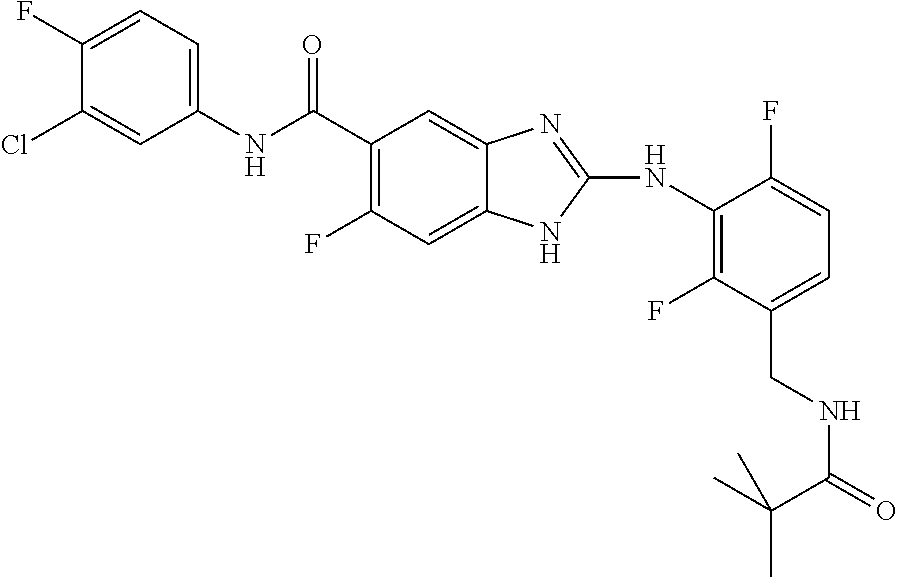


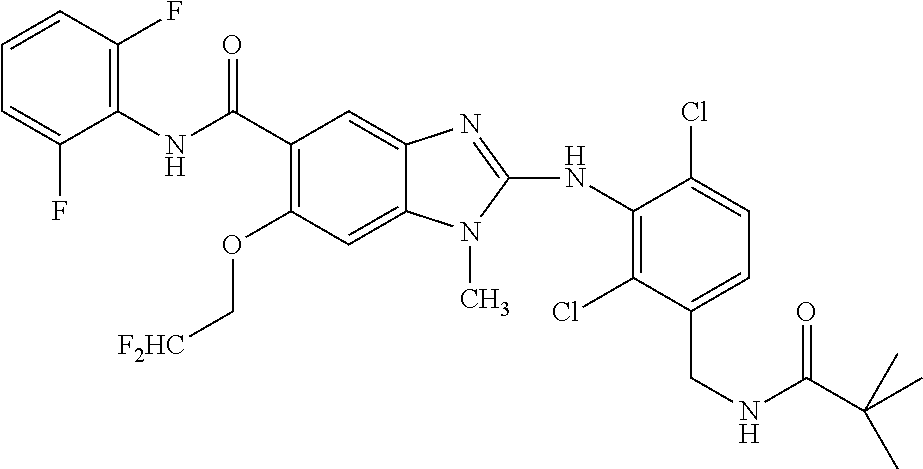


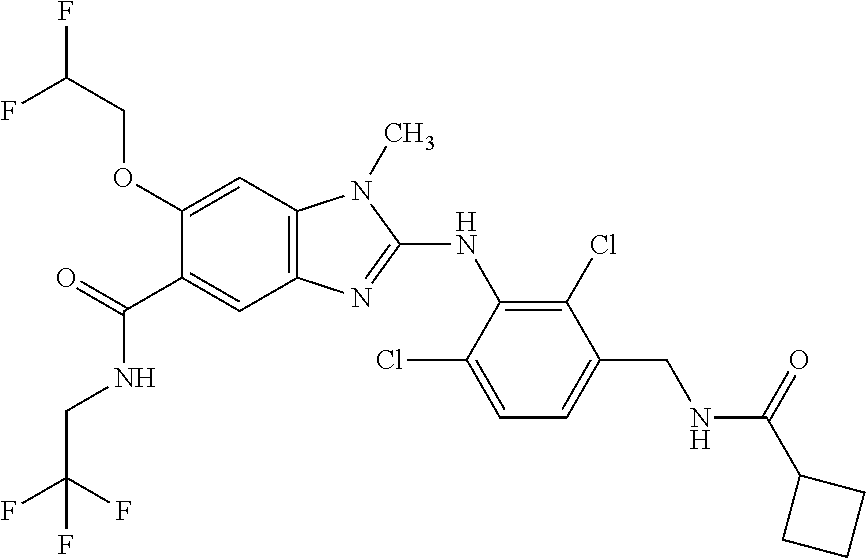


Applications Claiming Priority (3)
| Application Number | Priority Date | Filing Date | Title |
|---|---|---|---|
| EP10173501.7 | 2010-08-20 | ||
| EP10173501 | 2010-08-20 | ||
| EP10173501 | 2010-08-20 |
Publications (2)
| Publication Number | Publication Date |
|---|---|
| US20120214786A1 US20120214786A1 (en) | 2012-08-23 |
| US8759537B2 true US8759537B2 (en) | 2014-06-24 |
Family
ID=43332838
Family Applications (1)
| Application Number | Title | Priority Date | Filing Date |
|---|---|---|---|
| US13/211,470 Active US8759537B2 (en) | 2010-08-20 | 2011-08-17 | 3H-imidazo [4, 5-C] pyridine-6-carboxamides as anti-inflammatory agents |
Country Status (33)
| Country | Link |
|---|---|
| US (1) | US8759537B2 (en) |
| EP (1) | EP2606036B1 (en) |
| JP (1) | JP5650844B2 (en) |
| KR (1) | KR101891494B1 (en) |
| CN (1) | CN103097359B (en) |
| AP (1) | AP2012006641A0 (en) |
| AR (1) | AR082508A1 (en) |
| AU (1) | AU2011290725C1 (en) |
| CA (1) | CA2804575C (en) |
| CL (1) | CL2013000304A1 (en) |
| CO (1) | CO6680683A2 (en) |
| CY (1) | CY1116034T1 (en) |
| DK (1) | DK2606036T3 (en) |
| EA (1) | EA021433B1 (en) |
| EC (1) | ECSP13012499A (en) |
| ES (1) | ES2528751T3 (en) |
| GE (1) | GEP20146197B (en) |
| HR (1) | HRP20150004T1 (en) |
| IL (1) | IL223466A (en) |
| MA (1) | MA35576B1 (en) |
| ME (1) | ME01982B (en) |
| MX (1) | MX356010B (en) |
| PE (1) | PE20131117A1 (en) |
| PH (1) | PH12013500329A1 (en) |
| PL (1) | PL2606036T3 (en) |
| PT (1) | PT2606036E (en) |
| RS (1) | RS53836B1 (en) |
| SG (1) | SG187110A1 (en) |
| SI (1) | SI2606036T1 (en) |
| SM (1) | SMT201500054B (en) |
| TW (1) | TW201302716A (en) |
| UY (1) | UY33564A (en) |
| WO (1) | WO2012022793A1 (en) |
Cited By (1)
| Publication number | Priority date | Publication date | Assignee | Title |
|---|---|---|---|---|
| US11993613B2 (en) | 2022-03-31 | 2024-05-28 | Abbvie Inc. | Thiazolo[5,4-b]pyridine MALT-1 inhibitors |
Families Citing this family (58)
| Publication number | Priority date | Publication date | Assignee | Title |
|---|---|---|---|---|
| UY32138A (en) | 2008-09-25 | 2010-04-30 | Boehringer Ingelheim Int | SUBSTITUTED AMIDES 2- (2,6-DICLORO-PHENYLAMINE) -6-FLUORO-1-METHYL-1H-BENCIMIDAZOL-5-CARBOXYL AND ITS PHARMACEUTICALLY ACCEPTABLE SALTS |
| UY32470A (en) | 2009-03-05 | 2010-10-29 | Boehringer Ingelheim Int | DERIVATIVES OF 2- {2-CHLORINE-5 - [(REPLACED) METHYL] PHENYLAMINE} -1-METHYL] PHENYLAMINE} -1-METHYLBENCIMIDAZOL-5-CARBOXAMIDES-N- (SUBSTITUTED) AND ITS PHYSIOLOGICALLY ACCEPTABLE SALTS, COMPOSITIONS AND APPLIANCE |
| US8937073B2 (en) | 2010-08-20 | 2015-01-20 | Boehringer Ingelheim International Gmbh | Disubstituted tetrahydrofuranyl compounds and their use as B1-receptor antagonists |
| US8586604B2 (en) | 2010-08-20 | 2013-11-19 | Boehringer Ingelheim International Gmbh | Inhibitors of the microsomal prostaglandin E2 synthase-1 |
| US8486968B2 (en) | 2010-12-10 | 2013-07-16 | Boehringer Ingelheim International Gmbh | Compounds |
| UY33779A (en) | 2010-12-10 | 2012-07-31 | Boehringer Ingelheim Int | ? 2- (Phenylamino) -1H-benzimidazol-5-carboxamides novel? |
| US8466186B2 (en) | 2010-12-10 | 2013-06-18 | Boehringer Ingelheim International Gmbh | Compounds |
| GB201603311D0 (en) * | 2016-02-25 | 2016-04-13 | Jakobsson Per Johan | New uses and methods |
| EP3876939A4 (en) | 2018-11-07 | 2022-08-10 | Dana-Farber Cancer Institute, Inc. | BENZOTHIAZOLE DERIVATIVES AND 7-AZA-BENZOTHIAZOLE DERIVATIVES AS JANUS KINASE-2 INHIBITORS AND USES THEREOF |
| WO2020097396A1 (en) | 2018-11-07 | 2020-05-14 | Dana-Farber Cancer Institute, Inc. | Benzimidazole derivatives and aza-benzimidazole derivatives as janus kinase 2 inhibitors and uses thereof |
| US12509455B2 (en) | 2018-11-07 | 2025-12-30 | Dana-Farber Cancer Institute, Inc. | Imidazopyridine derivatives and aza-imidazopyridine derivatives as Janus kinase 2 inhibitors and uses thereof |
| CN114245807B (en) | 2019-06-25 | 2025-05-02 | 吉利德科学公司 | FLT3L-FC fusion proteins and methods of use |
| CN114302874B (en) * | 2019-08-26 | 2025-02-25 | 国际药品株式会社 | Indolecarboxamide derivatives and pharmaceutical compositions containing the same |
| CA3156828A1 (en) | 2019-10-03 | 2021-04-08 | Dana-Farber Cancer Institute, Inc. | Tricyclic kinase inhibitors and uses thereof |
| PH12022550835A1 (en) | 2019-10-18 | 2023-07-03 | Forty Seven Inc | Combination therapies for treating myelodysplastic syndromes and acute myeloid leukemia |
| NZ786589A (en) | 2019-10-31 | 2025-03-28 | Forty Seven Llc | Anti-cd47 and anti-cd20 based treatment of blood cancer |
| TWI778443B (en) | 2019-11-12 | 2022-09-21 | 美商基利科學股份有限公司 | Mcl1 inhibitors |
| CN115362003B (en) | 2019-12-24 | 2024-03-22 | 卡尔那生物科学株式会社 | diacylglycerol kinase modulating compounds |
| US12599589B2 (en) | 2019-12-25 | 2026-04-14 | Nippon Shinyaku Co., Ltd. | Prophylactic and/or therapeutic agent for chronic prostatitis/chronic pelvic pain syndrome |
| TWI890283B (en) | 2020-02-14 | 2025-07-11 | 美商基利科學股份有限公司 | Antibodies and fusion proteins that bind to ccr8 and uses thereof |
| JP7564888B2 (en) | 2020-05-01 | 2024-10-09 | ギリアード サイエンシーズ, インコーポレイテッド | CD73-inhibitory 2,4-dioxopyrimidine compounds |
| TW202204350A (en) | 2020-05-06 | 2022-02-01 | 美商雅捷可斯治療公司 | 6-heteroaryloxy benzimidazoles and azabenzimidazoles as jak2 inhibitors |
| EP4267574B1 (en) | 2020-12-23 | 2025-04-23 | Ajax Therapeutics, Inc. | 6-heteroaryloxy benzimidazoles and azabenzimidazoles as jak2 inhibitors |
| TW202302145A (en) | 2021-04-14 | 2023-01-16 | 美商基利科學股份有限公司 | Co-inhibition of cd47/sirpα binding and nedd8-activating enzyme e1 regulatory subunit for the treatment of cancer |
| WO2022245671A1 (en) | 2021-05-18 | 2022-11-24 | Gilead Sciences, Inc. | Methods of using flt3l-fc fusion proteins |
| MX2023014762A (en) | 2021-06-23 | 2024-01-15 | Gilead Sciences Inc | DIACYL GLYCEROL KINASE MODULATING COMPOUNDS. |
| JP7651018B2 (en) | 2021-06-23 | 2025-03-25 | ギリアード サイエンシーズ, インコーポレイテッド | Diacylglycerol kinase modulating compounds |
| EP4359413A1 (en) | 2021-06-23 | 2024-05-01 | Gilead Sciences, Inc. | Diacylglyercol kinase modulating compounds |
| CN117355531A (en) | 2021-06-23 | 2024-01-05 | 吉利德科学公司 | diacylglycerol kinase modulating compounds |
| EP4423078A1 (en) | 2021-10-28 | 2024-09-04 | Gilead Sciences, Inc. | Pyridizin-3(2h)-one derivatives |
| PE20241186A1 (en) | 2021-10-29 | 2024-06-03 | Gilead Sciences Inc | CD73 COMPOUNDS |
| US12162881B2 (en) | 2021-11-09 | 2024-12-10 | Ajax Therapeutics, Inc. | Forms and compositions of inhibitors of JAK2 |
| CA3234638A1 (en) | 2021-11-09 | 2023-05-19 | Ajax Therapeutics, Inc. | 6-heteroaryloxy benzimidazoles and azabenzimidazoles as jak2 inhibitors |
| CN118488948A (en) | 2021-12-22 | 2024-08-13 | 吉利德科学公司 | IKAROS zinc finger family degraders and their uses |
| US20240124412A1 (en) | 2021-12-22 | 2024-04-18 | Gilead Sciences, Inc. | Ikaros zinc finger family degraders and uses thereof |
| CA3248911A1 (en) | 2022-01-28 | 2023-08-03 | Gilead Sciences, Inc. | Parp7 inhibitors |
| PL4245756T3 (en) | 2022-03-17 | 2025-02-17 | Gilead Sciences, Inc. | Ikaros zinc finger family degraders and uses thereof |
| AU2023240346A1 (en) | 2022-03-24 | 2024-09-19 | Gilead Sciences, Inc. | Combination therapy for treating trop-2 expressing cancers |
| TWI876305B (en) | 2022-04-05 | 2025-03-11 | 美商基利科學股份有限公司 | Combination therapy for treating colorectal cancer |
| EP4511127A1 (en) | 2022-04-21 | 2025-02-26 | Gilead Sciences, Inc. | Kras g12d modulating compounds |
| WO2024006929A1 (en) | 2022-07-01 | 2024-01-04 | Gilead Sciences, Inc. | Cd73 compounds |
| GB202212749D0 (en) | 2022-09-01 | 2022-10-19 | Gesynta Pharma Ab | New uses |
| US20240091351A1 (en) | 2022-09-21 | 2024-03-21 | Gilead Sciences, Inc. | FOCAL IONIZING RADIATION AND CD47/SIRPa DISRUPTION ANTICANCER COMBINATION THERAPY |
| EP4638436A1 (en) | 2022-12-22 | 2025-10-29 | Gilead Sciences, Inc. | Prmt5 inhibitors and uses thereof |
| WO2024215754A1 (en) | 2023-04-11 | 2024-10-17 | Gilead Sciences, Inc. | Kras modulating compounds |
| PE20260121A1 (en) | 2023-04-21 | 2026-01-16 | Gilead Sciences Inc | PRMT5 INHIBITORS AND THEIR USES |
| JP2026522894A (en) | 2023-06-30 | 2026-07-09 | ギリアード サイエンシーズ, インコーポレイテッド | KRAS modulating compounds |
| AU2024297978A1 (en) | 2023-07-26 | 2026-02-05 | Gilead Sciences, Inc. | Parp7 inhibitors |
| CN121568935A (en) | 2023-07-26 | 2026-02-24 | 吉利德科学公司 | PARP7 inhibitors |
| WO2024112287A1 (en) | 2023-08-29 | 2024-05-30 | Banoglu Erden | Benzimidazole compounds and pharmaceutical compositions and uses thereof |
| US20250109147A1 (en) | 2023-09-08 | 2025-04-03 | Gilead Sciences, Inc. | Kras g12d modulating compounds |
| EP4774280A1 (en) | 2023-09-08 | 2026-07-15 | Gilead Sciences, Inc. | Kras g12d modulating compounds |
| WO2025096589A1 (en) | 2023-11-03 | 2025-05-08 | Gilead Sciences, Inc. | Prmt5 inhibitors and uses thereof |
| US20250230168A1 (en) | 2023-12-22 | 2025-07-17 | Gilead Sciences, Inc. | Azaspiro wrn inhibitors |
| WO2025245003A1 (en) | 2024-05-21 | 2025-11-27 | Gilead Sciences, Inc. | Prmt5 inhibitors and uses thereof |
| US20260098049A1 (en) | 2024-08-12 | 2026-04-09 | Gilead Sciences, Inc. | Kras modulating compounds |
| US20260130893A1 (en) | 2024-10-21 | 2026-05-14 | Gilead Sciences, Inc. | Prmt5 inhibitors and uses thereof |
| WO2026136515A1 (en) | 2024-12-19 | 2026-06-25 | Gilead Sciences, Inc. | Parp7 inhibitors |
Citations (39)
| Publication number | Priority date | Publication date | Assignee | Title |
|---|---|---|---|---|
| EP0034743A1 (en) | 1980-02-22 | 1981-09-02 | Dr. Karl Thomae GmbH | Benzoxazoles, their preparation and their use as medicines |
| EP0295656A1 (en) | 1987-06-17 | 1988-12-21 | Eisai Co., Ltd. | Benzothiazole derivative, its use, and pharmaceutical compositions comprising it |
| EP0419210A1 (en) | 1989-09-22 | 1991-03-27 | Pfizer Inc. | Novel benzimidazole compounds and their use |
| WO2000015612A1 (en) | 1998-08-26 | 2000-03-23 | Aventis Pharma Limited | Aza-bicycles which modulate the inhibition of cell adhesion |
| WO2000049005A1 (en) | 1999-02-16 | 2000-08-24 | Aventis Pharma Limited | Bicyclic compounds and their use as integrin receptor ligands |
| WO2000061580A1 (en) | 1999-04-12 | 2000-10-19 | Aventis Pharma Limited | Substituted bicyclic heteroaryl compounds as integrin antagonists |
| WO2000068213A1 (en) | 1999-05-05 | 2000-11-16 | Aventis Pharma Limited | Substituted bicyclic compounds |
| EP1069124A1 (en) | 1999-07-16 | 2001-01-17 | Pfizer Inc. | 2-Benzimidazolylamine compounds as ORL1-receptor agonists |
| WO2001025238A2 (en) | 1999-10-06 | 2001-04-12 | Boehringer Ingelheim Pharmaceuticals, Inc. | Heterocyclic compounds useful as inhibitors of tyrosine kinases |
| WO2003053939A1 (en) | 2001-12-21 | 2003-07-03 | Societe De Conseils De Recherches Et D'applications Scientifiques (S.C.R.A.S.) | Benzimidazole derivatives and their use as gnrh antagonists |
| WO2003074515A1 (en) | 2002-03-01 | 2003-09-12 | Smithkline Beecham Corporation | Diamino-pyrimidines and their use as angiogenesis inhibitors |
| WO2003082272A1 (en) | 2002-03-29 | 2003-10-09 | Chiron Corporation | Substituted benzazoles and use thereof as raf kinase inhibitors |
| WO2004005323A2 (en) | 2002-07-03 | 2004-01-15 | Receptron, Inc. | Affinity small molecules for the epo receptor |
| WO2004035740A2 (en) | 2002-10-15 | 2004-04-29 | Synta Pharmaceuticals Corp. | Aromatic bicyclic heterocyles to modulate 1l - 12 production |
| WO2004072068A1 (en) | 2003-02-10 | 2004-08-26 | Amgen Inc. | Vanilloid receptor ligands and their use in treatments |
| FR2851563A1 (en) | 2003-02-26 | 2004-08-27 | Sod Conseils Rech Applic | Benzimidazole and imidazo-pyridine derivatives, useful in treatment of obesity, cachexia, anorexia, anxiety, depression, pain, and erectile dysfunction, have affinity for melanocortin receptors |
| FR2852957A1 (en) | 2003-03-31 | 2004-10-01 | Sod Conseils Rech Applic | NOVEL IMIDAZO-PYRIDINE DERIVATIVES AND THEIR USE AS A MEDICINAL PRODUCT |
| US20040198768A1 (en) | 2003-04-03 | 2004-10-07 | Park Choo Hea Young | Method for inhibiting 5-lipoxygenase using a benzoxazole derivative or an analogue thereof |
| WO2004085425A1 (en) | 2003-03-21 | 2004-10-07 | Amgen Inc | Fused azoles such as 2,5-disubstituted benzimidazoles, benzoxazoles and benzothiazoles as kinase inhibitors |
| WO2005044793A2 (en) | 2003-10-31 | 2005-05-19 | Takeda Pharmaceutical Company Limited | Nitrogen-containing fused heterocyclic compounds |
| WO2005070906A1 (en) | 2004-01-21 | 2005-08-04 | Novartis Ag | Organic compounds |
| WO2005070920A1 (en) | 2004-01-21 | 2005-08-04 | Bristol-Myers Squibb Company | Amino-benzazoles as p2y1 receptor inhibitors |
| WO2005123674A1 (en) | 2004-06-18 | 2005-12-29 | Biolipox Ab | Indoles useful in the treatment of inflammation |
| WO2006077366A1 (en) | 2005-01-19 | 2006-07-27 | Biolipox Ab | Indoles useful in the treatment of inflammation |
| WO2006090167A2 (en) | 2005-02-25 | 2006-08-31 | Kudos Pharmaceuticals Limited | Hydrazinomethyl, hydr zonomethyl and 5-membered heterocylic compounds which act as mtor inhibitors and their use as anti cancer agents |
| US20060287344A1 (en) | 2005-01-13 | 2006-12-21 | Albers Ronald J | Haloaryl substituted aminopurines, compositions thereof, and methods of treatment therewith |
| US20070060598A1 (en) | 2005-01-13 | 2007-03-15 | Albers Ronald J | Haloaryl substituted aminopurines, compositions thereof, and methods of treatment therewith |
| US20070173488A1 (en) | 2005-11-16 | 2007-07-26 | Sgx Pharmaceuticals, Inc. | Pyrazolothiazole Protein Kinase Modulators |
| WO2007095124A2 (en) | 2006-02-10 | 2007-08-23 | Transtech Pharma, Inc. | Benzazole derivatives, compositions, and methods of use as aurora kinase inhibitors |
| WO2008009924A2 (en) | 2006-07-18 | 2008-01-24 | Biolipox Ab | Indoles useful in the treatment of inflammation |
| WO2008035956A1 (en) | 2006-09-22 | 2008-03-27 | Ewha University - Industry Collaboration Foundation | New benzoxazole derivative, process for the preparation thereof and pharmaceutical composition comprising the same |
| WO2008071944A1 (en) | 2006-12-14 | 2008-06-19 | Boehringer Ingelheim International Gmbh | Benzoxazoles useful in the treatment of inflammation |
| WO2008129276A1 (en) | 2007-04-19 | 2008-10-30 | Boehringer Ingelheim International Gmbh | Disulfonamides useful in the treatment of inflammation |
| WO2010034798A1 (en) | 2008-09-25 | 2010-04-01 | Boehringer Ingelheim International Gmbh | 3h-imidazo [4, 5-c] pyridine-6-carboxamides as anti -inflammatory agents |
| WO2010100249A1 (en) | 2009-03-05 | 2010-09-10 | Boehringer Ingelheim International Gmbh | 3h-imidazo [4, 5 -c] pyridine- 6 -carboxamides as anti- inflammatory agents |
| US20120149676A1 (en) | 2010-12-10 | 2012-06-14 | Boehringer Ingelheim International Gmbh | Novel compounds |
| US20120208839A1 (en) | 2010-08-20 | 2012-08-16 | Boehringer Ingelheim International Gmbh | New compounds |
| US20120309738A1 (en) | 2010-12-10 | 2012-12-06 | Boehringer Ingelheim International Gmbh | Novel compounds |
| US20120309755A1 (en) | 2010-12-10 | 2012-12-06 | Boehringer Ingelheim International Gmbh | Novel compounds |
-
2011
- 2011-08-17 US US13/211,470 patent/US8759537B2/en active Active
- 2011-08-19 CA CA2804575A patent/CA2804575C/en active Active
- 2011-08-19 SI SI201130361T patent/SI2606036T1/en unknown
- 2011-08-19 TW TW100129865A patent/TW201302716A/en unknown
- 2011-08-19 JP JP2013524455A patent/JP5650844B2/en active Active
- 2011-08-19 WO PCT/EP2011/064258 patent/WO2012022793A1/en not_active Ceased
- 2011-08-19 PE PE2013000266A patent/PE20131117A1/en not_active Application Discontinuation
- 2011-08-19 DK DK11746237.4T patent/DK2606036T3/en active
- 2011-08-19 ME MEP-2015-2A patent/ME01982B/en unknown
- 2011-08-19 UY UY0001033564A patent/UY33564A/en not_active Application Discontinuation
- 2011-08-19 PL PL11746237T patent/PL2606036T3/en unknown
- 2011-08-19 AP AP2012006641A patent/AP2012006641A0/en unknown
- 2011-08-19 AR ARP110103037A patent/AR082508A1/en unknown
- 2011-08-19 RS RS20150010A patent/RS53836B1/en unknown
- 2011-08-19 KR KR1020137004206A patent/KR101891494B1/en active Active
- 2011-08-19 EP EP11746237.4A patent/EP2606036B1/en active Active
- 2011-08-19 GE GEAP201113032A patent/GEP20146197B/en unknown
- 2011-08-19 PT PT117462374T patent/PT2606036E/en unknown
- 2011-08-19 MX MX2013001929A patent/MX356010B/en active IP Right Grant
- 2011-08-19 AU AU2011290725A patent/AU2011290725C1/en active Active
- 2011-08-19 EA EA201201665A patent/EA021433B1/en not_active IP Right Cessation
- 2011-08-19 HR HRP20150004AT patent/HRP20150004T1/en unknown
- 2011-08-19 SG SG2013003702A patent/SG187110A1/en unknown
- 2011-08-19 PH PH1/2013/500329A patent/PH12013500329A1/en unknown
- 2011-08-19 ES ES11746237.4T patent/ES2528751T3/en active Active
- 2011-08-19 CN CN201180039690.6A patent/CN103097359B/en active Active
-
2012
- 2012-12-06 IL IL223466A patent/IL223466A/en active IP Right Grant
-
2013
- 2013-01-30 CL CL2013000304A patent/CL2013000304A1/en unknown
- 2013-01-31 MA MA35625A patent/MA35576B1/en unknown
- 2013-02-28 CO CO13040959A patent/CO6680683A2/en active IP Right Grant
- 2013-03-19 EC ECSP13012499 patent/ECSP13012499A/en unknown
-
2015
- 2015-01-08 CY CY20151100019T patent/CY1116034T1/en unknown
- 2015-03-09 SM SM201500054T patent/SMT201500054B/en unknown
Patent Citations (53)
| Publication number | Priority date | Publication date | Assignee | Title |
|---|---|---|---|---|
| EP0034743A1 (en) | 1980-02-22 | 1981-09-02 | Dr. Karl Thomae GmbH | Benzoxazoles, their preparation and their use as medicines |
| EP0295656A1 (en) | 1987-06-17 | 1988-12-21 | Eisai Co., Ltd. | Benzothiazole derivative, its use, and pharmaceutical compositions comprising it |
| EP0419210A1 (en) | 1989-09-22 | 1991-03-27 | Pfizer Inc. | Novel benzimidazole compounds and their use |
| WO2000015612A1 (en) | 1998-08-26 | 2000-03-23 | Aventis Pharma Limited | Aza-bicycles which modulate the inhibition of cell adhesion |
| US6608084B1 (en) | 1998-08-26 | 2003-08-19 | Aventis Pharma Ltd. | Aza-bicycles which modulate the inhibition of cell adhesion |
| WO2000049005A1 (en) | 1999-02-16 | 2000-08-24 | Aventis Pharma Limited | Bicyclic compounds and their use as integrin receptor ligands |
| WO2000061580A1 (en) | 1999-04-12 | 2000-10-19 | Aventis Pharma Limited | Substituted bicyclic heteroaryl compounds as integrin antagonists |
| WO2000068213A1 (en) | 1999-05-05 | 2000-11-16 | Aventis Pharma Limited | Substituted bicyclic compounds |
| EP1069124A1 (en) | 1999-07-16 | 2001-01-17 | Pfizer Inc. | 2-Benzimidazolylamine compounds as ORL1-receptor agonists |
| WO2001025238A2 (en) | 1999-10-06 | 2001-04-12 | Boehringer Ingelheim Pharmaceuticals, Inc. | Heterocyclic compounds useful as inhibitors of tyrosine kinases |
| WO2003053939A1 (en) | 2001-12-21 | 2003-07-03 | Societe De Conseils De Recherches Et D'applications Scientifiques (S.C.R.A.S.) | Benzimidazole derivatives and their use as gnrh antagonists |
| WO2003074515A1 (en) | 2002-03-01 | 2003-09-12 | Smithkline Beecham Corporation | Diamino-pyrimidines and their use as angiogenesis inhibitors |
| WO2003082272A1 (en) | 2002-03-29 | 2003-10-09 | Chiron Corporation | Substituted benzazoles and use thereof as raf kinase inhibitors |
| WO2004005323A2 (en) | 2002-07-03 | 2004-01-15 | Receptron, Inc. | Affinity small molecules for the epo receptor |
| WO2004035740A2 (en) | 2002-10-15 | 2004-04-29 | Synta Pharmaceuticals Corp. | Aromatic bicyclic heterocyles to modulate 1l - 12 production |
| WO2004072068A1 (en) | 2003-02-10 | 2004-08-26 | Amgen Inc. | Vanilloid receptor ligands and their use in treatments |
| FR2851563A1 (en) | 2003-02-26 | 2004-08-27 | Sod Conseils Rech Applic | Benzimidazole and imidazo-pyridine derivatives, useful in treatment of obesity, cachexia, anorexia, anxiety, depression, pain, and erectile dysfunction, have affinity for melanocortin receptors |
| WO2004085425A1 (en) | 2003-03-21 | 2004-10-07 | Amgen Inc | Fused azoles such as 2,5-disubstituted benzimidazoles, benzoxazoles and benzothiazoles as kinase inhibitors |
| FR2852957A1 (en) | 2003-03-31 | 2004-10-01 | Sod Conseils Rech Applic | NOVEL IMIDAZO-PYRIDINE DERIVATIVES AND THEIR USE AS A MEDICINAL PRODUCT |
| WO2004089951A1 (en) | 2003-03-31 | 2004-10-21 | Societe De Conseils De Recherches Et D'applications Scientifiques (S.C.R.A.S.) | Imidazopyridine derivatives having an affinity for melanocortin receptors |
| US20040198768A1 (en) | 2003-04-03 | 2004-10-07 | Park Choo Hea Young | Method for inhibiting 5-lipoxygenase using a benzoxazole derivative or an analogue thereof |
| WO2005044793A2 (en) | 2003-10-31 | 2005-05-19 | Takeda Pharmaceutical Company Limited | Nitrogen-containing fused heterocyclic compounds |
| WO2005070906A1 (en) | 2004-01-21 | 2005-08-04 | Novartis Ag | Organic compounds |
| WO2005070920A1 (en) | 2004-01-21 | 2005-08-04 | Bristol-Myers Squibb Company | Amino-benzazoles as p2y1 receptor inhibitors |
| WO2005123674A1 (en) | 2004-06-18 | 2005-12-29 | Biolipox Ab | Indoles useful in the treatment of inflammation |
| US20060287344A1 (en) | 2005-01-13 | 2006-12-21 | Albers Ronald J | Haloaryl substituted aminopurines, compositions thereof, and methods of treatment therewith |
| US20070060598A1 (en) | 2005-01-13 | 2007-03-15 | Albers Ronald J | Haloaryl substituted aminopurines, compositions thereof, and methods of treatment therewith |
| WO2006077366A1 (en) | 2005-01-19 | 2006-07-27 | Biolipox Ab | Indoles useful in the treatment of inflammation |
| WO2006090167A2 (en) | 2005-02-25 | 2006-08-31 | Kudos Pharmaceuticals Limited | Hydrazinomethyl, hydr zonomethyl and 5-membered heterocylic compounds which act as mtor inhibitors and their use as anti cancer agents |
| US20070173488A1 (en) | 2005-11-16 | 2007-07-26 | Sgx Pharmaceuticals, Inc. | Pyrazolothiazole Protein Kinase Modulators |
| WO2007095124A2 (en) | 2006-02-10 | 2007-08-23 | Transtech Pharma, Inc. | Benzazole derivatives, compositions, and methods of use as aurora kinase inhibitors |
| WO2007127382A1 (en) | 2006-04-26 | 2007-11-08 | Signal Pharmaceuticals, Llc | Haloaryl substituted aminopurines, compositions thereof, and methods of treatment therewith |
| WO2008009924A2 (en) | 2006-07-18 | 2008-01-24 | Biolipox Ab | Indoles useful in the treatment of inflammation |
| WO2008035956A1 (en) | 2006-09-22 | 2008-03-27 | Ewha University - Industry Collaboration Foundation | New benzoxazole derivative, process for the preparation thereof and pharmaceutical composition comprising the same |
| WO2008071944A1 (en) | 2006-12-14 | 2008-06-19 | Boehringer Ingelheim International Gmbh | Benzoxazoles useful in the treatment of inflammation |
| US20100004301A1 (en) | 2006-12-14 | 2010-01-07 | Benjamin Pelcman | Benzoxazoles Useful in the Treatment of Inflammation |
| WO2008129276A1 (en) | 2007-04-19 | 2008-10-30 | Boehringer Ingelheim International Gmbh | Disulfonamides useful in the treatment of inflammation |
| WO2010034799A1 (en) | 2008-09-25 | 2010-04-01 | Boehringer Ingelheim International Gmbh | 3h-imidaz0 [4, 5-b] pyridine- 6 -carboxamides as anti -inflammatory agents |
| US20120115902A1 (en) | 2008-09-25 | 2012-05-10 | Boehringer Ingelheim International Gmbh | 3H-Imidazo [4, 5-B] Pyridine- 6 -Carboxamides As Anti-Inflammatory Agents |
| WO2010034797A1 (en) | 2008-09-25 | 2010-04-01 | Boehringer Ingelheim International Gmbh | 1h-benzimidazole-5-carboxamides as anti-inflammatory agents |
| WO2010034798A1 (en) | 2008-09-25 | 2010-04-01 | Boehringer Ingelheim International Gmbh | 3h-imidazo [4, 5-c] pyridine-6-carboxamides as anti -inflammatory agents |
| WO2010034796A1 (en) | 2008-09-25 | 2010-04-01 | Boehringer Ingelheim International Gmbh | 1h-benz imidazole-5-carboxamides as anti-inflammatory agents |
| US20120122930A1 (en) | 2008-09-25 | 2012-05-17 | Boehringer Ingelheim International Gmbh | 1H-Benzimidazole-5-Carboxamides As Anti-Inflammatory Agents |
| US20110275656A1 (en) | 2008-09-25 | 2011-11-10 | Boehringer Ingelheim International Gmbh | 3H-Imidazo [4, 5-C] Pyridine- 6 -Carboxamides As Anti-Inflammatory Agents |
| US20110312935A1 (en) | 2008-09-25 | 2011-12-22 | Boehringer Ingelheim International Gmbh | 1H-Benz Imidazole-5-Carboxamides As Anti-Inflammatory Agents |
| WO2010100249A1 (en) | 2009-03-05 | 2010-09-10 | Boehringer Ingelheim International Gmbh | 3h-imidazo [4, 5 -c] pyridine- 6 -carboxamides as anti- inflammatory agents |
| US20100256188A1 (en) | 2009-03-05 | 2010-10-07 | Boehringer Ingelheim International Gmbh | New compounds |
| US20120196897A1 (en) * | 2009-03-05 | 2012-08-02 | Boehringer Ingelheim International Gmbh | New compounds |
| US20120208839A1 (en) | 2010-08-20 | 2012-08-16 | Boehringer Ingelheim International Gmbh | New compounds |
| US20120149676A1 (en) | 2010-12-10 | 2012-06-14 | Boehringer Ingelheim International Gmbh | Novel compounds |
| US20120309738A1 (en) | 2010-12-10 | 2012-12-06 | Boehringer Ingelheim International Gmbh | Novel compounds |
| US20120309755A1 (en) | 2010-12-10 | 2012-12-06 | Boehringer Ingelheim International Gmbh | Novel compounds |
| US8466186B2 (en) | 2010-12-10 | 2013-06-18 | Boehringer Ingelheim International Gmbh | Compounds |
Non-Patent Citations (9)
| Title |
|---|
| Cancer [online], [retrieved on Jul. 6, 2007]. Retrieved from the internet, URL http://en.wikipedia.orglwikilCancer. |
| Cancer [online], [retrieved on Jul. 6, 2007]. Retrieved from the internet, URL http://www.nlm.nih.gov/medlineplus/cancer.html>. |
| D.J. Gale et al., The Amidomethylation of Some N,N-Dialkylanilines; Aust.J. Chem.; pp. 2447-2458; vol. 28; 1975. |
| Golub et al., Science (1999), vol. 286, 531-537. |
| International Search Report Form PCT/ISA/210 and Written Opinion Form PCT/ISA/237 for corresponding PCT/EP2011/064258; date of mailing: Oct. 10, 2011. |
| Lala et al., Cancer and Metastasis reviews (1998), 17 (1), 91-106. |
| R.D. Carpenter et al., Carbodiimide-based benzinidazole library method, Journal of Combinatorial Chemistry, Oct. 27, 2006, pp. 907-914, vol. 8, No. 6. |
| Samuelsson et al., Pharmacology Review, vol. 59, No. 3, pp. 207-224, 2007. |
| Silverman et al., The Organic Chemistry of Drug Design and Drug Action, Chapter 2: Drug Discovery, Design, and Development, Academic Press, p. 5-51, 1992. |
Cited By (1)
| Publication number | Priority date | Publication date | Assignee | Title |
|---|---|---|---|---|
| US11993613B2 (en) | 2022-03-31 | 2024-05-28 | Abbvie Inc. | Thiazolo[5,4-b]pyridine MALT-1 inhibitors |
Also Published As
Similar Documents
| Publication | Publication Date | Title |
|---|---|---|
| US8586604B2 (en) | Inhibitors of the microsomal prostaglandin E2 synthase-1 | |
| EP2606036B1 (en) | 2-anilinobenzimidazole-6-carboxamides as anti-inflammatory agents | |
| US8674113B2 (en) | Compounds | |
| US8466186B2 (en) | Compounds | |
| US8486968B2 (en) | Compounds | |
| OA16323A (en) | New compounds. | |
| BR112013003753B1 (en) | Microsomal prostaglandin E2 synthase-1 (MPGES-1) inhibitor compounds and pharmaceutical composition. | |
| TW201307298A (en) | Novel compounds | |
| HK1180312A (en) | Compounds used as inhibitors of the microsomal prostaglandin e2 synthase-1 | |
| HK1180312B (en) | Compounds used as inhibitors of the microsomal prostaglandin e2 synthase-1 |
Legal Events
| Date | Code | Title | Description |
|---|---|---|---|
| AS | Assignment |
Owner name: BOEHRINGER INGELHEIM INTERNATIONAL GMBH, GERMANY Free format text: ASSIGNMENT OF ASSIGNORS INTEREST;ASSIGNORS:PRIEPKE, HENNING;DOODS, HENRI;KUELZER, RAIMUND;AND OTHERS;SIGNING DATES FROM 20111014 TO 20111103;REEL/FRAME:027474/0467 |
|
| FEPP | Fee payment procedure |
Free format text: PAYOR NUMBER ASSIGNED (ORIGINAL EVENT CODE: ASPN); ENTITY STATUS OF PATENT OWNER: LARGE ENTITY |
|
| STCF | Information on status: patent grant |
Free format text: PATENTED CASE |
|
| MAFP | Maintenance fee payment |
Free format text: PAYMENT OF MAINTENANCE FEE, 4TH YEAR, LARGE ENTITY (ORIGINAL EVENT CODE: M1551) Year of fee payment: 4 |
|
| AS | Assignment |
Owner name: OREXO AB, SWEDEN Free format text: ASSIGNMENT OF ASSIGNORS INTEREST;ASSIGNOR:BOEHRINGER INGELHEIM INTERNATIONAL GMBH;REEL/FRAME:048368/0300 Effective date: 20140915 Owner name: GESYNTA PHARMA AB, SWEDEN Free format text: ASSIGNMENT OF ASSIGNORS INTEREST;ASSIGNOR:OREXO AB;REEL/FRAME:048368/0337 Effective date: 20190130 |
|
| MAFP | Maintenance fee payment |
Free format text: PAYMENT OF MAINTENANCE FEE, 8TH YEAR, LARGE ENTITY (ORIGINAL EVENT CODE: M1552); ENTITY STATUS OF PATENT OWNER: LARGE ENTITY Year of fee payment: 8 |
|
| MAFP | Maintenance fee payment |
Free format text: PAYMENT OF MAINTENANCE FEE, 12TH YEAR, LARGE ENTITY (ORIGINAL EVENT CODE: M1553); ENTITY STATUS OF PATENT OWNER: LARGE ENTITY Year of fee payment: 12 |