US8753426B2 - Polymers, polymer membranes and methods of producing the same - Google Patents
Polymers, polymer membranes and methods of producing the same Download PDFInfo
- Publication number
- US8753426B2 US8753426B2 US13/566,535 US201213566535A US8753426B2 US 8753426 B2 US8753426 B2 US 8753426B2 US 201213566535 A US201213566535 A US 201213566535A US 8753426 B2 US8753426 B2 US 8753426B2
- Authority
- US
- United States
- Prior art keywords
- substituted
- group
- formula
- following structures
- polymeric material
- Prior art date
- Legal status (The legal status is an assumption and is not a legal conclusion. Google has not performed a legal analysis and makes no representation as to the accuracy of the status listed.)
- Expired - Fee Related, expires
Links
- 0 C*CN[C@](C)NCNCCC*CCCC*C=* Chemical compound C*CN[C@](C)NCNCCC*CCCC*C=* 0.000 description 14
- ZICDESHEMZFHLL-UHFFFAOYSA-N C1=CC=C(CC2=CC=C(CC3=CC=C(CC4=CC=CC=C4)C=C3)C=C2)C=C1.C1=CC=C(CC2=CC=C(CC3=CC=CC=C3)C=C2)C=C1.CC.CC.CC.CC.CC.CC.CC.CC Chemical compound C1=CC=C(CC2=CC=C(CC3=CC=C(CC4=CC=CC=C4)C=C3)C=C2)C=C1.C1=CC=C(CC2=CC=C(CC3=CC=CC=C3)C=C2)C=C1.CC.CC.CC.CC.CC.CC.CC.CC ZICDESHEMZFHLL-UHFFFAOYSA-N 0.000 description 4
- MIVJLZWVCPVYFO-UHFFFAOYSA-N CC1=CC=C(C(C2=CC(C)=C(C)C=C2)(C(F)(F)F)C(F)(F)F)C=C1.CC1=CC=C(C)C(C)=C1.CC1=CC=C(C2=CC(C)=C(C)C=C2)C=C1.CC1=CC=C(OC2=CC(C)=C(C)C=C2)C=C1.CC1=CC=C(S(=O)(=O)C2=CC(C)=C(C)C=C2)C=C1.CC1=CC=C2C=C(C)C(C)=CC2=C1 Chemical compound CC1=CC=C(C(C2=CC(C)=C(C)C=C2)(C(F)(F)F)C(F)(F)F)C=C1.CC1=CC=C(C)C(C)=C1.CC1=CC=C(C2=CC(C)=C(C)C=C2)C=C1.CC1=CC=C(OC2=CC(C)=C(C)C=C2)C=C1.CC1=CC=C(S(=O)(=O)C2=CC(C)=C(C)C=C2)C=C1.CC1=CC=C2C=C(C)C(C)=CC2=C1 MIVJLZWVCPVYFO-UHFFFAOYSA-N 0.000 description 4
- ZJYYYPVLBBNQNV-UHFFFAOYSA-N CN1C(=O)C(C2=N[Ar](C)C2)C1=O.CN1C(=O)[Ar]2(C1=O)C(=O)N(C)C2=O.C[Ar]1CC(CC2=N[Ar](C)[Y]2)=N1.[Ar].[Ar].[Ar] Chemical compound CN1C(=O)C(C2=N[Ar](C)C2)C1=O.CN1C(=O)[Ar]2(C1=O)C(=O)N(C)C2=O.C[Ar]1CC(CC2=N[Ar](C)[Y]2)=N1.[Ar].[Ar].[Ar] ZJYYYPVLBBNQNV-UHFFFAOYSA-N 0.000 description 4
- DSUVBKKBOIFKIQ-UHFFFAOYSA-N C1=CC2=C(C=C1)C1=C\C=C/C=C\1C2.C1=CC=C2/N=C\C=C/C2=C1.C1=CC=C2C(=C1)/C=C\C1=C2C=CC=C1.C1=CC=NC=C1.C1=CN=C2C(=C1)/C=C\C1=C2N=CC=C1.CC.CC.CC.CC.CC.CC.CC.CC.CC.CC.CC.CC.CC.CC.CC.CC.CC.CC.CC.CC Chemical compound C1=CC2=C(C=C1)C1=C\C=C/C=C\1C2.C1=CC=C2/N=C\C=C/C2=C1.C1=CC=C2C(=C1)/C=C\C1=C2C=CC=C1.C1=CC=NC=C1.C1=CN=C2C(=C1)/C=C\C1=C2N=CC=C1.CC.CC.CC.CC.CC.CC.CC.CC.CC.CC.CC.CC.CC.CC.CC.CC.CC.CC.CC.CC DSUVBKKBOIFKIQ-UHFFFAOYSA-N 0.000 description 3
- WHOQSRFHPHYTNN-UHFFFAOYSA-N C1=CCC=C1.CC.CC.CC.CC.CC1=C(C)C(C)=C(C)C1.CC1=CC=CC=C1.CC1=CC=CC=C1.CC1=NC(C)=C(C)N=C1C Chemical compound C1=CCC=C1.CC.CC.CC.CC.CC1=C(C)C(C)=C(C)C1.CC1=CC=CC=C1.CC1=CC=CC=C1.CC1=NC(C)=C(C)N=C1C WHOQSRFHPHYTNN-UHFFFAOYSA-N 0.000 description 3
- GVPJRUGRJSSELO-UHFFFAOYSA-N CC1=C(C)C(C)=C(C)C1.CC1=C(C)C=C2C(=C1)CCCC1=C2/C=C(C)\C(C)=C\1.CC1=C(C)C=C2C(=C1)CCCC1=C2\C(C)=C(C)/C=C\1.CC1=CC2=C3C(=C1C)CCCC1=C3/C(=C\C(C)=C/1C)CCC2.CC1=CC=C(C2=CC=C(C3=C(C)C(C)=CC=C3)C2)C=C1C.CC1=CC=C(C2=CC=C(C3=CC(C)=C(C)C=C3)C2)C=C1C.CC1=CC=C2CCCC3=C(C2=C1C)\C(C)=C(C)/C=C\3.CC1=CC=CC(C2=CC=C(C3=CC=CC(C)=C3C)C2)=C1C Chemical compound CC1=C(C)C(C)=C(C)C1.CC1=C(C)C=C2C(=C1)CCCC1=C2/C=C(C)\C(C)=C\1.CC1=C(C)C=C2C(=C1)CCCC1=C2\C(C)=C(C)/C=C\1.CC1=CC2=C3C(=C1C)CCCC1=C3/C(=C\C(C)=C/1C)CCC2.CC1=CC=C(C2=CC=C(C3=C(C)C(C)=CC=C3)C2)C=C1C.CC1=CC=C(C2=CC=C(C3=CC(C)=C(C)C=C3)C2)C=C1C.CC1=CC=C2CCCC3=C(C2=C1C)\C(C)=C(C)/C=C\3.CC1=CC=CC(C2=CC=C(C3=CC=CC(C)=C3C)C2)=C1C GVPJRUGRJSSELO-UHFFFAOYSA-N 0.000 description 3
- RJRRWRZXNZFOHH-UHFFFAOYSA-N CC1=C(C)C2=C(C=C1)C/C1=C/C=C(C)\C(C)=C\21.CC1=CC2=C(C=C1C)C1=C(C)/C(C)=C\C=C\1C2.CC1=CC2=C(C=C1C)C1=C\C(C)=C(C)/C=C\1C2 Chemical compound CC1=C(C)C2=C(C=C1)C/C1=C/C=C(C)\C(C)=C\21.CC1=CC2=C(C=C1C)C1=C(C)/C(C)=C\C=C\1C2.CC1=CC2=C(C=C1C)C1=C\C(C)=C(C)/C=C\1C2 RJRRWRZXNZFOHH-UHFFFAOYSA-N 0.000 description 3
- OZXKZCOWKUINGW-UHFFFAOYSA-N CC1=CC(C)=C(C)C1.CC1=CC(C2=CC=C(C3=CC(C)=C(C)C=C3)C2)=CC=C1.CC1=CC2=C(C=C1)C1=CC(C)=C(C)C=C1CCC2.CC1=CC2=C(C=C1)CCCC1=CC(C)=C(C)C=C12.CC1=CC2=C3C(=C1)CCCC1=C3C(=CC(C)=C1C)CCC2.CC1=CC=C(C2=CC=C(C3=CC(C)=C(C)C=C3)C2)C=C1.CC1=CC=CC=C1C1=CC=C(C2=CC(C)=C(C)C=C2)C1 Chemical compound CC1=CC(C)=C(C)C1.CC1=CC(C2=CC=C(C3=CC(C)=C(C)C=C3)C2)=CC=C1.CC1=CC2=C(C=C1)C1=CC(C)=C(C)C=C1CCC2.CC1=CC2=C(C=C1)CCCC1=CC(C)=C(C)C=C12.CC1=CC2=C3C(=C1)CCCC1=C3C(=CC(C)=C1C)CCC2.CC1=CC=C(C2=CC=C(C3=CC(C)=C(C)C=C3)C2)C=C1.CC1=CC=CC=C1C1=CC=C(C2=CC(C)=C(C)C=C2)C1 OZXKZCOWKUINGW-UHFFFAOYSA-N 0.000 description 3
- FOLYTCULPQRLKO-UHFFFAOYSA-N CC1=CC(C)=C(C)C=C1C.CC1=CC=C(C(=O)C2=CC=C(C)C(C)=C2)C=C1C.CC1=CC=C(C(C2=CC=C(C)C(C)=C2)(C(F)(F)F)C(F)(F)F)C=C1C.CC1=CC=C(C)C2=C(C)C=CC(C)=C12.CC1=CC=C(C2=CC(C)=C(C)C=C2)C=C1C.CC1=CC=C(OC2=CC=C(C)C(C)=C2)C=C1C.CC1=CC=C(OC2=CC=C(OC3=CC(C)=C(C)C=C3)C=C2)C=C1C.CC1=CC=C(S(=O)(=O)C2=CC=C(C)C(C)=C2)C=C1C Chemical compound CC1=CC(C)=C(C)C=C1C.CC1=CC=C(C(=O)C2=CC=C(C)C(C)=C2)C=C1C.CC1=CC=C(C(C2=CC=C(C)C(C)=C2)(C(F)(F)F)C(F)(F)F)C=C1C.CC1=CC=C(C)C2=C(C)C=CC(C)=C12.CC1=CC=C(C2=CC(C)=C(C)C=C2)C=C1C.CC1=CC=C(OC2=CC=C(C)C(C)=C2)C=C1C.CC1=CC=C(OC2=CC=C(OC3=CC(C)=C(C)C=C3)C=C2)C=C1C.CC1=CC=C(S(=O)(=O)C2=CC=C(C)C(C)=C2)C=C1C FOLYTCULPQRLKO-UHFFFAOYSA-N 0.000 description 3
- UHOIWYVPULZJEW-UHFFFAOYSA-N CC1=CC(C)=C(C)C=C1C.CC1=CC=C(C(C2=CC=C(C)C(C)=C2)(C(F)(F)F)C(F)(F)F)C=C1C.CC1=CC=C(C)C2=C(C)C=CC(C)=C12.CC1=CC=C(C2=CC(C)=C(C)C=C2)C=C1C.CC1=CC=C(OC2=CC=C(C)C(C)=C2)C=C1C.CC1=CC=C(OC2=CC=C(OC3=CC(C)=C(C)C=C3)C=C2)C=C1C.CC1=CC=C(S(=O)(=O)C2=CC=C(C)C(C)=C2)C=C1C Chemical compound CC1=CC(C)=C(C)C=C1C.CC1=CC=C(C(C2=CC=C(C)C(C)=C2)(C(F)(F)F)C(F)(F)F)C=C1C.CC1=CC=C(C)C2=C(C)C=CC(C)=C12.CC1=CC=C(C2=CC(C)=C(C)C=C2)C=C1C.CC1=CC=C(OC2=CC=C(C)C(C)=C2)C=C1C.CC1=CC=C(OC2=CC=C(OC3=CC(C)=C(C)C=C3)C=C2)C=C1C.CC1=CC=C(S(=O)(=O)C2=CC=C(C)C(C)=C2)C=C1C UHOIWYVPULZJEW-UHFFFAOYSA-N 0.000 description 3
- GWQJXHWSAGEGAT-UHFFFAOYSA-N CC1=CC2=C(C=C1)C1=C(C)/C(C)=C\C=C\1C2.CC1=CC2=C(C=C1C)C1=C\C(C)=C/C=C\1C2.CC1=CC2=C(C=C1C)C1=C\C=C(C)/C=C\1C2 Chemical compound CC1=CC2=C(C=C1)C1=C(C)/C(C)=C\C=C\1C2.CC1=CC2=C(C=C1C)C1=C\C(C)=C/C=C\1C2.CC1=CC2=C(C=C1C)C1=C\C=C(C)/C=C\1C2 GWQJXHWSAGEGAT-UHFFFAOYSA-N 0.000 description 3
- PFGSCPIJLADLBJ-UHFFFAOYSA-N CC1=CC=C(C(=O)C2=CC(C)=C(C)C=C2)C=C1.CC1=CC=C(C(C2=CC(C)=C(C)C=C2)(C(F)(F)F)C(F)(F)F)C=C1.CC1=CC=C(C)C(C)=C1.CC1=CC=C(C2=CC(C)=C(C)C=C2)C=C1.CC1=CC=C(OC2=CC(C)=C(C)C=C2)C=C1.CC1=CC=C(S(=O)(=O)C2=CC(C)=C(C)C=C2)C=C1.CC1=CC=C2C=C(C)C(C)=CC2=C1 Chemical compound CC1=CC=C(C(=O)C2=CC(C)=C(C)C=C2)C=C1.CC1=CC=C(C(C2=CC(C)=C(C)C=C2)(C(F)(F)F)C(F)(F)F)C=C1.CC1=CC=C(C)C(C)=C1.CC1=CC=C(C2=CC(C)=C(C)C=C2)C=C1.CC1=CC=C(OC2=CC(C)=C(C)C=C2)C=C1.CC1=CC=C(S(=O)(=O)C2=CC(C)=C(C)C=C2)C=C1.CC1=CC=C2C=C(C)C(C)=CC2=C1 PFGSCPIJLADLBJ-UHFFFAOYSA-N 0.000 description 3
- GWHJZXXIDMPWGX-UHFFFAOYSA-N CC1=CC=C(C)C(C)=C1 Chemical compound CC1=CC=C(C)C(C)=C1 GWHJZXXIDMPWGX-UHFFFAOYSA-N 0.000 description 3
- MWGOXYOZBBYEDZ-UHFFFAOYSA-N CC1=CC=C(CC2=CC=C(CC3=CC=C(CC4=C(C)C(C)=CC=C4)C=C3)C=C2)C=C1C.CC1=CC=C(CC2=CC=C(CC3=CC=C(CC4=CC(C)=C(C)C=C4)C=C3)C=C2)C=C1C.CC1=CC=CC(CC2=CC=C(CC3=CC=C(CC4=CC=CC(C)=C4C)C=C3)C=C2)=C1C Chemical compound CC1=CC=C(CC2=CC=C(CC3=CC=C(CC4=C(C)C(C)=CC=C4)C=C3)C=C2)C=C1C.CC1=CC=C(CC2=CC=C(CC3=CC=C(CC4=CC(C)=C(C)C=C4)C=C3)C=C2)C=C1C.CC1=CC=CC(CC2=CC=C(CC3=CC=C(CC4=CC=CC(C)=C4C)C=C3)C=C2)=C1C MWGOXYOZBBYEDZ-UHFFFAOYSA-N 0.000 description 3
- SHFZAJPZDURBIP-UHFFFAOYSA-N CC1=CC=C(CC2=CC=C(CC3=CC=C(CC4=CC(C)=C(C)C=C4)C=C3)C=C2)C=C1.CC1=CC=C(CC2=CC=C(CC3=CC=C(CC4=CC=CC(C)=C4C)C=C3)C=C2)C=C1.CC1=CC=CC(CC2=CC=C(CC3=CC=C(CC4=CC=C(C)C(C)=C4)C=C3)C=C2)=C1 Chemical compound CC1=CC=C(CC2=CC=C(CC3=CC=C(CC4=CC(C)=C(C)C=C4)C=C3)C=C2)C=C1.CC1=CC=C(CC2=CC=C(CC3=CC=C(CC4=CC=CC(C)=C4C)C=C3)C=C2)C=C1.CC1=CC=CC(CC2=CC=C(CC3=CC=C(CC4=CC=C(C)C(C)=C4)C=C3)C=C2)=C1 SHFZAJPZDURBIP-UHFFFAOYSA-N 0.000 description 3
- SDSYQWZPEULDNA-UHFFFAOYSA-N C1=CC2=C(C=C1)C1=C\C=C/C=C\1C2.C1=CC=C2/N=C\C=C/C2=C1.C1=CC=C2C(=C1)C=CC1=C2C=CC=C1.C1=CC=NC=C1.C1=CN=C2C(=C1)C=CC1=C2N=CC=C1.C1=CN=CN=C1.CC.CC.CC.CC.CC.CC.CC.CC.CC.CC.CC.CC.CC.CC.CC.CC.CC.CC Chemical compound C1=CC2=C(C=C1)C1=C\C=C/C=C\1C2.C1=CC=C2/N=C\C=C/C2=C1.C1=CC=C2C(=C1)C=CC1=C2C=CC=C1.C1=CC=NC=C1.C1=CN=C2C(=C1)C=CC1=C2N=CC=C1.C1=CN=CN=C1.CC.CC.CC.CC.CC.CC.CC.CC.CC.CC.CC.CC.CC.CC.CC.CC.CC.CC SDSYQWZPEULDNA-UHFFFAOYSA-N 0.000 description 2
- PUXVKNKDKAWPIA-UHFFFAOYSA-N C1=CCC=C1.C1=CCC=C1.C1=CN=CC=N1.CC.CC.CC.CC.CC.CC.CC.CC.CC.CC1=CC=CC=C1.CC1=CC=CC=C1 Chemical compound C1=CCC=C1.C1=CCC=C1.C1=CN=CC=N1.CC.CC.CC.CC.CC.CC.CC.CC.CC.CC1=CC=CC=C1.CC1=CC=CC=C1 PUXVKNKDKAWPIA-UHFFFAOYSA-N 0.000 description 2
- RFYQEHQMGLMTCM-UHFFFAOYSA-N CC1=CC(C)=C(C)C=C1C.CC1=CC2=C(C=C1C)C(C1=CC=CC=C1)(C1=CC=CC=C1)/C1=C/C(C)=C(C)\C=C\21.CC1=CC2=CC(C)=C(C)C=C2C=C1C.CC1=CC=C(C)C2=C(C)C=CC(C)=C12.CC1=CC=C(C2(C3=CC(C)=C(C)C=C3)C3=C(C=CC=C3)C3=C/C=C/C=C\32)C=C1C.CC1=CC=C(C2=CC(C)=C(C)C=C2)C=C1C.CC1=CC=C(C2=CC=C(C3=CC=C(C)C(C)=C3)C=C2)C=C1C.CC1=CC=C(C2=CC=CC(C3=CC(C)=C(C)C=C3)=C2)C=C1C.CC1=CC=C(CC2=CC=C(C)C(C)=C2)C=C1C.CC1=CC=C(CC2=CC=C(CC3=CC(C)=C(C)C=C3)C=C2)C=C1C Chemical compound CC1=CC(C)=C(C)C=C1C.CC1=CC2=C(C=C1C)C(C1=CC=CC=C1)(C1=CC=CC=C1)/C1=C/C(C)=C(C)\C=C\21.CC1=CC2=CC(C)=C(C)C=C2C=C1C.CC1=CC=C(C)C2=C(C)C=CC(C)=C12.CC1=CC=C(C2(C3=CC(C)=C(C)C=C3)C3=C(C=CC=C3)C3=C/C=C/C=C\32)C=C1C.CC1=CC=C(C2=CC(C)=C(C)C=C2)C=C1C.CC1=CC=C(C2=CC=C(C3=CC=C(C)C(C)=C3)C=C2)C=C1C.CC1=CC=C(C2=CC=CC(C3=CC(C)=C(C)C=C3)=C2)C=C1C.CC1=CC=C(CC2=CC=C(C)C(C)=C2)C=C1C.CC1=CC=C(CC2=CC=C(CC3=CC(C)=C(C)C=C3)C=C2)C=C1C RFYQEHQMGLMTCM-UHFFFAOYSA-N 0.000 description 2
- MGYNPSKQSUJDHA-UHFFFAOYSA-N CC1=CC2=C(C=C1)C1(C3=CC=CC=C32)C2=C(C=C(C)C(C)=C2)C2=C/C=C/C=C\21.CC1=CC2=C(C=C1C)C(C1=CC=CC=C1)(C1=CC=CC=C1)/C1=C/C(C)=C\C=C\21.CC1=CC2=C(C=C1C)C1(C3=CC=CC=C3C3=C1C=CC=C3)/C1=C/C(C)=C\C=C\21.CC1=CC=C(C2(C3=CC(C)=C(C)C=C3)C3=C(C=CC=C3)C3=C/C=C/C=C\32)C=C1.CC1=CC=C(C2(C3=CC=CC=C3)C3=C(C=C(C)C(C)=C3)C3=C/C=C/C=C\32)C=C1.CC1=CC=C(C2=C3C=CC=CC3=C(C3=CC(C)=C(C)C=C3)C3=CC=CC=C32)C=C1.CC1=CC=CC(C2=C3C=CC=CC3=C(C3=CC(C)=C(C)C=C3)C3=CC=CC=C32)=C1 Chemical compound CC1=CC2=C(C=C1)C1(C3=CC=CC=C32)C2=C(C=C(C)C(C)=C2)C2=C/C=C/C=C\21.CC1=CC2=C(C=C1C)C(C1=CC=CC=C1)(C1=CC=CC=C1)/C1=C/C(C)=C\C=C\21.CC1=CC2=C(C=C1C)C1(C3=CC=CC=C3C3=C1C=CC=C3)/C1=C/C(C)=C\C=C\21.CC1=CC=C(C2(C3=CC(C)=C(C)C=C3)C3=C(C=CC=C3)C3=C/C=C/C=C\32)C=C1.CC1=CC=C(C2(C3=CC=CC=C3)C3=C(C=C(C)C(C)=C3)C3=C/C=C/C=C\32)C=C1.CC1=CC=C(C2=C3C=CC=CC3=C(C3=CC(C)=C(C)C=C3)C3=CC=CC=C32)C=C1.CC1=CC=CC(C2=C3C=CC=CC3=C(C3=CC(C)=C(C)C=C3)C3=CC=CC=C32)=C1 MGYNPSKQSUJDHA-UHFFFAOYSA-N 0.000 description 2
- XMKPJULNVFBVQP-UHFFFAOYSA-N CC1=CC2=C(C=C1C)C(C1=CC=CC=C1)(C1=CC=CC=C1)/C1=C/C(C)=C(C)\C=C\21.CC1=CC2=C(C=C1C)C(C1=CC=CC=C1)(C1=CC=CC=C1)/C1=C\C=C(C)/C(C)=C\21.CC1=CC2=C(C=C1C)C1(C3=CC=CC=C3C3=C1C=CC=C3)/C1=C/C(C)=C(C)\C=C\21.CC1=CC2=C(C=C1C)C1(C3=CC=CC=C3C3=C1C=CC=C3)/C1=C\C=C(C)/C(C)=C\21.CC1=CC=C(C2(C3=CC(C)=C(C)C=C3)C3=C(C=CC=C3)C3=C/C=C/C=C\32)C=C1C.CC1=CC=C(C2=C3C=CC=CC3=C(C3=CC=C(C)C(C)=C3)C3=CC=CC=C32)C=C1C.CC1=CC=CC(C2(C3=CC(C)=C(C)C=C3)C3=C(C=CC=C3)C3=C/C=C/C=C\32)=C1C Chemical compound CC1=CC2=C(C=C1C)C(C1=CC=CC=C1)(C1=CC=CC=C1)/C1=C/C(C)=C(C)\C=C\21.CC1=CC2=C(C=C1C)C(C1=CC=CC=C1)(C1=CC=CC=C1)/C1=C\C=C(C)/C(C)=C\21.CC1=CC2=C(C=C1C)C1(C3=CC=CC=C3C3=C1C=CC=C3)/C1=C/C(C)=C(C)\C=C\21.CC1=CC2=C(C=C1C)C1(C3=CC=CC=C3C3=C1C=CC=C3)/C1=C\C=C(C)/C(C)=C\21.CC1=CC=C(C2(C3=CC(C)=C(C)C=C3)C3=C(C=CC=C3)C3=C/C=C/C=C\32)C=C1C.CC1=CC=C(C2=C3C=CC=CC3=C(C3=CC=C(C)C(C)=C3)C3=CC=CC=C32)C=C1C.CC1=CC=CC(C2(C3=CC(C)=C(C)C=C3)C3=C(C=CC=C3)C3=C/C=C/C=C\32)=C1C XMKPJULNVFBVQP-UHFFFAOYSA-N 0.000 description 2
- GLFKFHJEFMLTOB-UHFFFAOYSA-N CC1=CC=C(C(C2=CC=C(C)C(C)=C2)(C(F)(F)F)C(F)(F)F)C=C1C Chemical compound CC1=CC=C(C(C2=CC=C(C)C(C)=C2)(C(F)(F)F)C(F)(F)F)C=C1C GLFKFHJEFMLTOB-UHFFFAOYSA-N 0.000 description 2
- LRFPIYGOQMGUGM-UHFFFAOYSA-N CC1=CC=C(CC2=CC=C(CC3=CC=C(CC4=CC(C)=C(C)C=C4)C=C3)C=C2)C=C1.CC1=CC=CC(CC2=CC=C(CC3=CC=C(CC4=CC=C(C)C(C)=C4)C=C3)C=C2)=C1 Chemical compound CC1=CC=C(CC2=CC=C(CC3=CC=C(CC4=CC(C)=C(C)C=C4)C=C3)C=C2)C=C1.CC1=CC=CC(CC2=CC=C(CC3=CC=C(CC4=CC=C(C)C(C)=C4)C=C3)C=C2)=C1 LRFPIYGOQMGUGM-UHFFFAOYSA-N 0.000 description 2
- QNTMYCAKCCDACF-UHFFFAOYSA-N CC1=CC=C(CC2=CC=C(CC3=CC=C(CC4=CC(C)=C(C)C=C4)C=C3)C=C2)C=C1C Chemical compound CC1=CC=C(CC2=CC=C(CC3=CC=C(CC4=CC(C)=C(C)C=C4)C=C3)C=C2)C=C1C QNTMYCAKCCDACF-UHFFFAOYSA-N 0.000 description 2
- RYMYKLLCLCMSPK-UHFFFAOYSA-N CN1C(=O)[Ar]2(C1=O)C(=O)N([Ar](C)C)C2=O.[Ar] Chemical compound CN1C(=O)[Ar]2(C1=O)C(=O)N([Ar](C)C)C2=O.[Ar] RYMYKLLCLCMSPK-UHFFFAOYSA-N 0.000 description 2
- FIUYWARZUFPABS-UHFFFAOYSA-N C/C1=C/C=C2/C3=C4C(=CC=C3)/C(C)=C(C)\C=C/4C3=CC=CC1=C32.CC1=C(C)C=C(C2=C3C=CC=CC3=C(C3=C(C)C=CC=C3)C3=CC=CC=C32)C=C1.CC1=CC2=C(C3=CC=CC=C3)C3=CC(C)=C(C)C=C3C(C3=CC=CC=C3)=C2C=C1.CC1=CC=C(C)C(C)=C1.CC1=CC=C2C(=C1)C=CC(C)=C2C.CC1=CC=C2C=C(C)C(C)=CC2=C1.CC1=CC=CC(C)=C1C.CC1=CC=CC(C2=C3C=CC=CC3=C(C3=CC(C)=C(C)C=C3)C3=CC=CC=C32)=C1.CC1=CC=CC2=C(C)C(C)=CC=C12 Chemical compound C/C1=C/C=C2/C3=C4C(=CC=C3)/C(C)=C(C)\C=C/4C3=CC=CC1=C32.CC1=C(C)C=C(C2=C3C=CC=CC3=C(C3=C(C)C=CC=C3)C3=CC=CC=C32)C=C1.CC1=CC2=C(C3=CC=CC=C3)C3=CC(C)=C(C)C=C3C(C3=CC=CC=C3)=C2C=C1.CC1=CC=C(C)C(C)=C1.CC1=CC=C2C(=C1)C=CC(C)=C2C.CC1=CC=C2C=C(C)C(C)=CC2=C1.CC1=CC=CC(C)=C1C.CC1=CC=CC(C2=C3C=CC=CC3=C(C3=CC(C)=C(C)C=C3)C3=CC=CC=C32)=C1.CC1=CC=CC2=C(C)C(C)=CC=C12 FIUYWARZUFPABS-UHFFFAOYSA-N 0.000 description 1
- HBDAOGNFNXMGES-UHFFFAOYSA-N C1=CC2=C3C(=C1)/C=C\C=C3\C1=C\C=C\C3=C1\C2=C/C=C/3.C1=CC=C(C2(C3=CC=CC=C3)C3=C(C=CC=C3)C3=C/C=C/C=C\32)C=C1.C1=CC=C(C2(C3=CC=CC=C3)C3=C(C=CC=C3)C3=C/C=C/C=C\32)C=C1.C1=CC=C(C2=C3C=CC=CC3=C(C3=CC=CC=C3)C3=CC=CC=C32)C=C1.C1=CC=C(C2=C3C=CC=CC3=C(C3=CC=CC=C3)C3=CC=CC=C32)C=C1.C1=CC=C2C=CC=CC2=C1.C1=CC=CC=C1.C1=CC=CC=C1.C1=CC=CC=C1.C1=CC=CC=C1.C1=CC=CC=C1.C1=CC=CC=C1.CC.CC.CC.CC.CC.CC.CC.CC.CC.CC.CC.CC.CC.CC.CC.CC.CC.CC.CC.CC.CC.CC.CC.CC.CC.CC.CC.CCC.CCC.CCC Chemical compound C1=CC2=C3C(=C1)/C=C\C=C3\C1=C\C=C\C3=C1\C2=C/C=C/3.C1=CC=C(C2(C3=CC=CC=C3)C3=C(C=CC=C3)C3=C/C=C/C=C\32)C=C1.C1=CC=C(C2(C3=CC=CC=C3)C3=C(C=CC=C3)C3=C/C=C/C=C\32)C=C1.C1=CC=C(C2=C3C=CC=CC3=C(C3=CC=CC=C3)C3=CC=CC=C32)C=C1.C1=CC=C(C2=C3C=CC=CC3=C(C3=CC=CC=C3)C3=CC=CC=C32)C=C1.C1=CC=C2C=CC=CC2=C1.C1=CC=CC=C1.C1=CC=CC=C1.C1=CC=CC=C1.C1=CC=CC=C1.C1=CC=CC=C1.C1=CC=CC=C1.CC.CC.CC.CC.CC.CC.CC.CC.CC.CC.CC.CC.CC.CC.CC.CC.CC.CC.CC.CC.CC.CC.CC.CC.CC.CC.CC.CCC.CCC.CCC HBDAOGNFNXMGES-UHFFFAOYSA-N 0.000 description 1
- ODNMWIGZRXXNRY-UHFFFAOYSA-N C1=CC2=C3C(=C1)C1=C4C(=CC=C/C4=C/C=C\1)/C3=C/C=C\2.C1=CC=C(/C2=C3\C=CC=C\C3=C(/C3=CC=CC=C3)C3=CC=CC=C32)C=C1.C1=CC=C(/C2=C3\C=CC=C\C3=C(/C3=CC=CC=C3)C3=CC=CC=C32)C=C1.C1=CC=C(C2(C3=CC=CC=C3)C3=CC=CC=C3C3=C2C=CC=C3)C=C1.C1=CC=C2C=CC=CC2=C1.C1=CC=CC=C1.C1=CC=CC=C1.C1=CC=CC=C1.C1=CC=CC=C1.C1=CC=CC=C1.C1=CC=CC=C1.CC.CC.CC.CC.CC.CC.CC.CC.CC.CC.CC.CC.CC.CC.CC.CC.CC.CC.CC.CC.CC.CC.CC.CC.CC.CC.CC.CC.CC.CC.CC.CC.CC.CC.CC Chemical compound C1=CC2=C3C(=C1)C1=C4C(=CC=C/C4=C/C=C\1)/C3=C/C=C\2.C1=CC=C(/C2=C3\C=CC=C\C3=C(/C3=CC=CC=C3)C3=CC=CC=C32)C=C1.C1=CC=C(/C2=C3\C=CC=C\C3=C(/C3=CC=CC=C3)C3=CC=CC=C32)C=C1.C1=CC=C(C2(C3=CC=CC=C3)C3=CC=CC=C3C3=C2C=CC=C3)C=C1.C1=CC=C2C=CC=CC2=C1.C1=CC=CC=C1.C1=CC=CC=C1.C1=CC=CC=C1.C1=CC=CC=C1.C1=CC=CC=C1.C1=CC=CC=C1.CC.CC.CC.CC.CC.CC.CC.CC.CC.CC.CC.CC.CC.CC.CC.CC.CC.CC.CC.CC.CC.CC.CC.CC.CC.CC.CC.CC.CC.CC.CC.CC.CC.CC.CC ODNMWIGZRXXNRY-UHFFFAOYSA-N 0.000 description 1
- FLKWHYWVBYJCNU-UHFFFAOYSA-N C1=CC=C(CC2=CC=C(CC3=CC=C(CC4=CC=CC=C4)C=C3)C=C2)C=C1.C1=CC=C(CC2=CC=C(CC3=CC=CC=C3)C=C2)C=C1.CC.CC.CC.CC.CC.CC Chemical compound C1=CC=C(CC2=CC=C(CC3=CC=C(CC4=CC=CC=C4)C=C3)C=C2)C=C1.C1=CC=C(CC2=CC=C(CC3=CC=CC=C3)C=C2)C=C1.CC.CC.CC.CC.CC.CC FLKWHYWVBYJCNU-UHFFFAOYSA-N 0.000 description 1
- JJTCLUBOOLGMQX-UHFFFAOYSA-N CC1=C(C)C(C)=C(C)C=C1.CC1=C(C)C2=C3C(=C1)C1=C4C(=CC(C)=C(C)/C4=C/C=C\1)/C3=C/C=C\2.CC1=CC(C)=C(C)C=C1C.CC1=CC2=C(C3=CC=CC=C3)C3=CC(C)=C(C)C=C3C(C3=CC=CC=C3)=C2C=C1C.CC1=CC2=CC(C)=C(C)C=C2C=C1C.CC1=CC=C(C)C2=C(C)C=CC(C)=C12.CC1=CC=C(C2=C(C)C(C)=CC=C2)C=C1C.CC1=CC=C(C2=C3C=CC=CC3=C(C3=CC=C(C)C(C)=C3)C3=CC=CC=C32)C=C1C.CC1=CC=C(C2=CC(C)=C(C)C=C2)C=C1C.CC1=CC=C2C(C)=C(C)C=CC2=C1C.CC1=CC=C2C3=C4C(=CC=C(C)/C4=C(C)/C=C\3)/C3=C/C=C(/C)C1=C23 Chemical compound CC1=C(C)C(C)=C(C)C=C1.CC1=C(C)C2=C3C(=C1)C1=C4C(=CC(C)=C(C)/C4=C/C=C\1)/C3=C/C=C\2.CC1=CC(C)=C(C)C=C1C.CC1=CC2=C(C3=CC=CC=C3)C3=CC(C)=C(C)C=C3C(C3=CC=CC=C3)=C2C=C1C.CC1=CC2=CC(C)=C(C)C=C2C=C1C.CC1=CC=C(C)C2=C(C)C=CC(C)=C12.CC1=CC=C(C2=C(C)C(C)=CC=C2)C=C1C.CC1=CC=C(C2=C3C=CC=CC3=C(C3=CC=C(C)C(C)=C3)C3=CC=CC=C32)C=C1C.CC1=CC=C(C2=CC(C)=C(C)C=C2)C=C1C.CC1=CC=C2C(C)=C(C)C=CC2=C1C.CC1=CC=C2C3=C4C(=CC=C(C)/C4=C(C)/C=C\3)/C3=C/C=C(/C)C1=C23 JJTCLUBOOLGMQX-UHFFFAOYSA-N 0.000 description 1
- AYKVYHCOVQCLFH-UHFFFAOYSA-N CC1=C(C)C(C)=C(C)C=C1.CC1=C(C)C2=C3C(=C1)C1=C4C(=CC(C)=C(C)/C4=C/C=C\1)/C3=C/C=C\2.CC1=CC(C)=C(C)C=C1C.CC1=CC2=C(C3=CC=CC=C3)C3=CC(C)=C(C)C=C3C(C3=CC=CC=C3)=C2C=C1C.CC1=CC2=CC(C)=C(C)C=C2C=C1C.CC1=CC=C(C)C2=C(C)C=CC(C)=C12.CC1=CC=C(C2=C(C)C(C)=CC=C2)C=C1C.CC1=CC=C(C2=CC(C)=C(C)C=C2)C=C1C.CC1=CC=C2C(C)=C(C)C=CC2=C1C.CC1=CC=C2C3=C4C(=CC=C(C)/C4=C(C)/C=C\3)/C3=C/C=C(/C)C1=C23 Chemical compound CC1=C(C)C(C)=C(C)C=C1.CC1=C(C)C2=C3C(=C1)C1=C4C(=CC(C)=C(C)/C4=C/C=C\1)/C3=C/C=C\2.CC1=CC(C)=C(C)C=C1C.CC1=CC2=C(C3=CC=CC=C3)C3=CC(C)=C(C)C=C3C(C3=CC=CC=C3)=C2C=C1C.CC1=CC2=CC(C)=C(C)C=C2C=C1C.CC1=CC=C(C)C2=C(C)C=CC(C)=C12.CC1=CC=C(C2=C(C)C(C)=CC=C2)C=C1C.CC1=CC=C(C2=CC(C)=C(C)C=C2)C=C1C.CC1=CC=C2C(C)=C(C)C=CC2=C1C.CC1=CC=C2C3=C4C(=CC=C(C)/C4=C(C)/C=C\3)/C3=C/C=C(/C)C1=C23 AYKVYHCOVQCLFH-UHFFFAOYSA-N 0.000 description 1
- ACPSZGJAZKZBNU-UHFFFAOYSA-N CC1=C(C)C(C)=C(C)C=C1.CC1=C(C)C2=C3C(=C1)C1=C4C(=CC(C)=C(C)/C4=C/C=C\1)/C3=C/C=C\2.CC1=CC(C)=C(C)C=C1C.CC1=CC2=C(C3=CC=CC=C3)C3=CC(C)=C(C)C=C3C(C3=CC=CC=C3)=C2C=C1C.CC1=CC2=CC(C)=C(C)C=C2C=C1C.CC1=CC=C(C)C2=C(C)C=CC(C)=C12.CC1=CC=C(C2=C(C)C(C)=CC=C2)C=C1C.CC1=CC=C(C2=CC(C)=C(C)C=C2)C=C1C.CC1=CC=C2C(C)=C(C)C=CC2=C1C.CC1=CC=C2C3=C4C(=CC=C(C)/C4=C(C)/C=C\3)/C3=C/C=C(/C)C1=C23.CC1=CC=CC(C2=CC=CC(C)=C2C)=C1C Chemical compound CC1=C(C)C(C)=C(C)C=C1.CC1=C(C)C2=C3C(=C1)C1=C4C(=CC(C)=C(C)/C4=C/C=C\1)/C3=C/C=C\2.CC1=CC(C)=C(C)C=C1C.CC1=CC2=C(C3=CC=CC=C3)C3=CC(C)=C(C)C=C3C(C3=CC=CC=C3)=C2C=C1C.CC1=CC2=CC(C)=C(C)C=C2C=C1C.CC1=CC=C(C)C2=C(C)C=CC(C)=C12.CC1=CC=C(C2=C(C)C(C)=CC=C2)C=C1C.CC1=CC=C(C2=CC(C)=C(C)C=C2)C=C1C.CC1=CC=C2C(C)=C(C)C=CC2=C1C.CC1=CC=C2C3=C4C(=CC=C(C)/C4=C(C)/C=C\3)/C3=C/C=C(/C)C1=C23.CC1=CC=CC(C2=CC=CC(C)=C2C)=C1C ACPSZGJAZKZBNU-UHFFFAOYSA-N 0.000 description 1
- BTMOKONKGCWWME-UHFFFAOYSA-N CC1=C(C)C2=C(C=C1)C1=CC=CC(C)=C1/C=C\2.CC1=CC(CC2=CC=C(CC3=CC(C)=C(C)C=C3)C=C2)=CC=C1.CC1=CC2=C(C=C1)/C(C)=C(/C)C1=CC=CC=C12.CC1=CC2=C(C=C1)C1=CC=CC=C1/C(C)=C\2C.CC1=CC=C(CC2=CC(C)=C(C)C=C2)C=C1.CC1=CC=C(CC2=CC=C(CC3=CC=C(C)C(C)=C3)C=C2)C=C1.CC1=CC=C(CC2=CC=CC(C)=C2C)C=C1.CC1=CC=C2/C=C\C3=C(C=C(C)C(C)=C3)C2=C1.CC1=CC=C2C(=C1)/C=C\C1=C2C=CC(C)=C1C.CC1=CC=CC(CC2=CC=C(C)C(C)=C2)=C1.CC1=CC=CC(CC2=CC=C(CC3=C(C)C=CC=C3)C=C2)=C1C Chemical compound CC1=C(C)C2=C(C=C1)C1=CC=CC(C)=C1/C=C\2.CC1=CC(CC2=CC=C(CC3=CC(C)=C(C)C=C3)C=C2)=CC=C1.CC1=CC2=C(C=C1)/C(C)=C(/C)C1=CC=CC=C12.CC1=CC2=C(C=C1)C1=CC=CC=C1/C(C)=C\2C.CC1=CC=C(CC2=CC(C)=C(C)C=C2)C=C1.CC1=CC=C(CC2=CC=C(CC3=CC=C(C)C(C)=C3)C=C2)C=C1.CC1=CC=C(CC2=CC=CC(C)=C2C)C=C1.CC1=CC=C2/C=C\C3=C(C=C(C)C(C)=C3)C2=C1.CC1=CC=C2C(=C1)/C=C\C1=C2C=CC(C)=C1C.CC1=CC=CC(CC2=CC=C(C)C(C)=C2)=C1.CC1=CC=CC(CC2=CC=C(CC3=C(C)C=CC=C3)C=C2)=C1C BTMOKONKGCWWME-UHFFFAOYSA-N 0.000 description 1
- RQSTUWKBNZJIEB-UHFFFAOYSA-N CC1=C(C)C2=C(C=C1)C1=CC=CC(C)=C1/C=C\2.CC1=CC=C(C2=C(C)C(C)=CC=C2)C=C1.CC1=CC=C(C2=CC=C(C3=CC(C)=C(C)C=C3)C=C2)C=C1.CC1=CC=C(C2=CC=C(C3=CC=CC(C)=C3C)C=C2)C=C1.CC1=CC=C(C2=CC=CC(C3=C(C)C(C)=CC=C3)=C2)C=C1.CC1=CC=C(C2=CC=CC(C3=CC(C)=C(C)C=C3)=C2)C=C1.CC1=CC=C2/C=C\C3=C(C=C(C)C(C)=C3)C2=C1.CC1=CC=C2C(=C1)/C=C\C1=C2C=CC(C)=C1C.CC1=CC=CC(C2=CC=C(C3=CC=C(C)C(C)=C3)C=C2)=C1.CCCCCCC1(CCCCCC)C2=C(C=C(C)C(C)=C2)C2=C\C(C)=C/C=C\21.CCCCCCC1(CCCCCC)C2=C(C=C(C)C(C)=C2)C2=C\C=C(C)/C=C\21 Chemical compound CC1=C(C)C2=C(C=C1)C1=CC=CC(C)=C1/C=C\2.CC1=CC=C(C2=C(C)C(C)=CC=C2)C=C1.CC1=CC=C(C2=CC=C(C3=CC(C)=C(C)C=C3)C=C2)C=C1.CC1=CC=C(C2=CC=C(C3=CC=CC(C)=C3C)C=C2)C=C1.CC1=CC=C(C2=CC=CC(C3=C(C)C(C)=CC=C3)=C2)C=C1.CC1=CC=C(C2=CC=CC(C3=CC(C)=C(C)C=C3)=C2)C=C1.CC1=CC=C2/C=C\C3=C(C=C(C)C(C)=C3)C2=C1.CC1=CC=C2C(=C1)/C=C\C1=C2C=CC(C)=C1C.CC1=CC=CC(C2=CC=C(C3=CC=C(C)C(C)=C3)C=C2)=C1.CCCCCCC1(CCCCCC)C2=C(C=C(C)C(C)=C2)C2=C\C(C)=C/C=C\21.CCCCCCC1(CCCCCC)C2=C(C=C(C)C(C)=C2)C2=C\C=C(C)/C=C\21 RQSTUWKBNZJIEB-UHFFFAOYSA-N 0.000 description 1
- RMOJRZXPLCPPFT-UHFFFAOYSA-N CC1=C(C)C2=C(C=C1)C1=CC=CC(C)=C1C=C2.CC1=CC2=C(C=C1)C(C)=C(C)C1=CC=CC=C12.CC1=CC2=C(C=C1)C1=CC=CC=C1C(C)=C2C.CC1=CC=C2C(=C1)C=CC1=C2C=CC(C)=C1C.CC1=CC=C2C=CC3=C(C=C(C)C(C)=C3)C2=C1.CC1=CC=CC(CC2=CC=C(C)C(C)=C2)=C1.CC1=CC=CC(CC2=CC=C(CC3=C(C)C=CC=C3)C=C2)=C1C.CCCCCCC1(CCCCCC)C2=C(C=C(C)C(C)=C2)C2=C\C(C)=C/C=C\21.CCCCCCC1(CCCCCC)C2=C(C=C(C)C(C)=C2)C2=C\C=C(C)/C=C\21 Chemical compound CC1=C(C)C2=C(C=C1)C1=CC=CC(C)=C1C=C2.CC1=CC2=C(C=C1)C(C)=C(C)C1=CC=CC=C12.CC1=CC2=C(C=C1)C1=CC=CC=C1C(C)=C2C.CC1=CC=C2C(=C1)C=CC1=C2C=CC(C)=C1C.CC1=CC=C2C=CC3=C(C=C(C)C(C)=C3)C2=C1.CC1=CC=CC(CC2=CC=C(C)C(C)=C2)=C1.CC1=CC=CC(CC2=CC=C(CC3=C(C)C=CC=C3)C=C2)=C1C.CCCCCCC1(CCCCCC)C2=C(C=C(C)C(C)=C2)C2=C\C(C)=C/C=C\21.CCCCCCC1(CCCCCC)C2=C(C=C(C)C(C)=C2)C2=C\C=C(C)/C=C\21 RMOJRZXPLCPPFT-UHFFFAOYSA-N 0.000 description 1
- FLICLICBISWIRO-UHFFFAOYSA-N CC1=C(C)C2=C3C(=C1)/C=C\C1=C3C(=CC(C)=C1C)/C=C\2 Chemical compound CC1=C(C)C2=C3C(=C1)/C=C\C1=C3C(=CC(C)=C1C)/C=C\2 FLICLICBISWIRO-UHFFFAOYSA-N 0.000 description 1
- TXFWGPRTZBLRLB-UHFFFAOYSA-N CC1=C(C)C2=C3C(=C1)/C=C\C1=C3C(=CC(C)=C1C)/C=C\2.CC1=CC2=C(N=C1C)C1=NC(C)=C(C)C=C1/C=C\2 Chemical compound CC1=C(C)C2=C3C(=C1)/C=C\C1=C3C(=CC(C)=C1C)/C=C\2.CC1=CC2=C(N=C1C)C1=NC(C)=C(C)C=C1/C=C\2 TXFWGPRTZBLRLB-UHFFFAOYSA-N 0.000 description 1
- CMEBXNWVFGKYOA-UHFFFAOYSA-N CC1=C(C)C=C(C2=C3C=CC=CC3=C(C3=C(C)C=CC=C3)C3=CC=CC=C32)C=C1.CC1=CC(C2=CC(C)=C(C)C=C2)=CC=C1.CC1=CC2=C(C3=CC=CC=C3)C3=CC(C)=C(C)C=C3C(C3=CC=CC=C3)=C2C=C1C.CC1=CC2=C3C(=C1)C1=C4C(=C(C)C(C)=C/C4=C/C=C\1)/C3=C/C=C\2.CC1=CC=C(C)C(C)=C1.CC1=CC=C(C2=CC(C)=C(C)C=C2)C=C1.CC1=CC=C2C(=C1)C=CC(C)=C2C.CC1=CC=C2C3=C4C(=CC(C)=C(C)/C4=C/C=C\3)/C3=C/C=C\C1=C23.CC1=CC=C2C=C(C)C(C)=CC2=C1.CC1=CC=CC(C)=C1C.CC1=CC=CC2=C(C)C(C)=CC=C12 Chemical compound CC1=C(C)C=C(C2=C3C=CC=CC3=C(C3=C(C)C=CC=C3)C3=CC=CC=C32)C=C1.CC1=CC(C2=CC(C)=C(C)C=C2)=CC=C1.CC1=CC2=C(C3=CC=CC=C3)C3=CC(C)=C(C)C=C3C(C3=CC=CC=C3)=C2C=C1C.CC1=CC2=C3C(=C1)C1=C4C(=C(C)C(C)=C/C4=C/C=C\1)/C3=C/C=C\2.CC1=CC=C(C)C(C)=C1.CC1=CC=C(C2=CC(C)=C(C)C=C2)C=C1.CC1=CC=C2C(=C1)C=CC(C)=C2C.CC1=CC=C2C3=C4C(=CC(C)=C(C)/C4=C/C=C\3)/C3=C/C=C\C1=C23.CC1=CC=C2C=C(C)C(C)=CC2=C1.CC1=CC=CC(C)=C1C.CC1=CC=CC2=C(C)C(C)=CC=C12 CMEBXNWVFGKYOA-UHFFFAOYSA-N 0.000 description 1
- KDWFWNAAYWOVSL-UHFFFAOYSA-N CC1=C(C)C=C(C2=C3C=CC=CC3=C(C3=C(C)C=CC=C3)C3=CC=CC=C32)C=C1.CC1=CC2=C(C3=CC=CC=C3)C3=CC(C)=C(C)C=C3C(C3=CC=CC=C3)=C2C=C1.CC1=CC2=C3C(=C1)C1=C4C(=C(C)C(C)=C/C4=C/C=C\1)/C3=C/C=C\2.CC1=CC=C(C)C(C)=C1.CC1=CC=C2C(=C1)C=CC(C)=C2C.CC1=CC=C2C3=C4C(=CC(C)=C(C)/C4=C/C=C\3)/C3=C/C=C\C1=C23.CC1=CC=C2C=C(C)C(C)=CC2=C1.CC1=CC=CC(C)=C1C.CC1=CC=CC2=C(C)C(C)=CC=C12 Chemical compound CC1=C(C)C=C(C2=C3C=CC=CC3=C(C3=C(C)C=CC=C3)C3=CC=CC=C32)C=C1.CC1=CC2=C(C3=CC=CC=C3)C3=CC(C)=C(C)C=C3C(C3=CC=CC=C3)=C2C=C1.CC1=CC2=C3C(=C1)C1=C4C(=C(C)C(C)=C/C4=C/C=C\1)/C3=C/C=C\2.CC1=CC=C(C)C(C)=C1.CC1=CC=C2C(=C1)C=CC(C)=C2C.CC1=CC=C2C3=C4C(=CC(C)=C(C)/C4=C/C=C\3)/C3=C/C=C\C1=C23.CC1=CC=C2C=C(C)C(C)=CC2=C1.CC1=CC=CC(C)=C1C.CC1=CC=CC2=C(C)C(C)=CC=C12 KDWFWNAAYWOVSL-UHFFFAOYSA-N 0.000 description 1
- JPEYLIGDUUDUNP-UHFFFAOYSA-N CC1=C/C2=C3C(=CC=C2)/C2=C(C)/C(C)=C\C4=CC=CC(=C42)\C3=C\1.CC1=CC(C2=CC(C)=C(C)C=C2)=CC=C1.CC1=CC=C(C2=C(C)C(C)=CC=C2)C=C1.CC1=CC=C(C2=CC(C)=C(C)C=C2)C=C1.CC1=CC=C(C2=CC=C(C3=CC(C)=C(C)C=C3)C=C2)C=C1.CC1=CC=C(C2=CC=C(C3=CC=CC(C)=C3C)C=C2)C=C1.CC1=CC=C(C2=CC=CC(C3=C(C)C(C)=CC=C3)=C2)C=C1.CC1=CC=C(C2=CC=CC(C3=CC(C)=C(C)C=C3)=C2)C=C1.CC1=CC=CC(C2=CC=C(C3=CC=C(C)C(C)=C3)C=C2)=C1 Chemical compound CC1=C/C2=C3C(=CC=C2)/C2=C(C)/C(C)=C\C4=CC=CC(=C42)\C3=C\1.CC1=CC(C2=CC(C)=C(C)C=C2)=CC=C1.CC1=CC=C(C2=C(C)C(C)=CC=C2)C=C1.CC1=CC=C(C2=CC(C)=C(C)C=C2)C=C1.CC1=CC=C(C2=CC=C(C3=CC(C)=C(C)C=C3)C=C2)C=C1.CC1=CC=C(C2=CC=C(C3=CC=CC(C)=C3C)C=C2)C=C1.CC1=CC=C(C2=CC=CC(C3=C(C)C(C)=CC=C3)=C2)C=C1.CC1=CC=C(C2=CC=CC(C3=CC(C)=C(C)C=C3)=C2)C=C1.CC1=CC=CC(C2=CC=C(C3=CC=C(C)C(C)=C3)C=C2)=C1 JPEYLIGDUUDUNP-UHFFFAOYSA-N 0.000 description 1
- MHWGKZWYQNASBR-UHFFFAOYSA-N CC1=CC(C(C)(C2=CC=C(O)C(N3C(=O)C4=CC=C(C(C)(C5=C\C=C6\C(=O)N(C)C(=O)\C6=C\5)C(F)(F)F)C=C4C3=O)=C2)C(F)(F)F)=CC=C1O.CC1=CC=C(NC2=CC=CC=C2)C(N2C(=O)C3=CC=C(C(C)(C4=C\C=C5\C(=O)N(C)C(=O)\C5=C\4)C(F)(F)F)C=C3C2=O)=C1.CC1=CC=C(O)C(N2C(=O)C3=CC=C(C(C)(C4=C\C=C5\C(=O)N(C)C(=O)\C5=C\4)C(F)(F)F)C=C3C2=O)=C1 Chemical compound CC1=CC(C(C)(C2=CC=C(O)C(N3C(=O)C4=CC=C(C(C)(C5=C\C=C6\C(=O)N(C)C(=O)\C6=C\5)C(F)(F)F)C=C4C3=O)=C2)C(F)(F)F)=CC=C1O.CC1=CC=C(NC2=CC=CC=C2)C(N2C(=O)C3=CC=C(C(C)(C4=C\C=C5\C(=O)N(C)C(=O)\C5=C\4)C(F)(F)F)C=C3C2=O)=C1.CC1=CC=C(O)C(N2C(=O)C3=CC=C(C(C)(C4=C\C=C5\C(=O)N(C)C(=O)\C5=C\4)C(F)(F)F)C=C3C2=O)=C1 MHWGKZWYQNASBR-UHFFFAOYSA-N 0.000 description 1
- ODEGDQJCKOFUEJ-UHFFFAOYSA-N CC1=CC(C)=C(C)C1.CC1=CC2=C(C=C1)C1=CC(C)=C(C)C=C1CCC2.CC1=CC2=C3C(=C1)CCCC1=C3C(=CC(C)=C1C)CCC2.CC1=CC=C(C)C(C)=N1.CC1=CC=C(C2=CC=C(C3=CC(C)=C(C)C=C3)C2)C=C1.CC1=CN=C(C)C(C)=N1 Chemical compound CC1=CC(C)=C(C)C1.CC1=CC2=C(C=C1)C1=CC(C)=C(C)C=C1CCC2.CC1=CC2=C3C(=C1)CCCC1=C3C(=CC(C)=C1C)CCC2.CC1=CC=C(C)C(C)=N1.CC1=CC=C(C2=CC=C(C3=CC(C)=C(C)C=C3)C2)C=C1.CC1=CN=C(C)C(C)=N1 ODEGDQJCKOFUEJ-UHFFFAOYSA-N 0.000 description 1
- ZJQWBRJBRPOTEI-UHFFFAOYSA-N CC1=CC(C)=C(C)C=C1C.CC1=CC2=C(C=C1C)C(C1=CC=CC=C1)(C1=CC=CC=C1)/C1=C/C(C)=C(C)\C=C\21.CC1=CC2=C(C=C1C)C1(C3=CC=CC=C3C3=C1C=CC=C3)/C1=C/C(C)=C(C)\C=C\21.CC1=CC2=CC(C)=C(C)C=C2C=C1C.CC1=CC=C(C)C2=C(C)C=CC(C)=C12.CC1=CC=C(C2(C3=CC(C)=C(C)C=C3)C3=C(C=CC=C3)C3=C/C=C/C=C\32)C=C1C.CC1=CC=C(C2=CC(C)=C(C)C=C2)C=C1C.CC1=CC=C(C2=CC=C(C3=CC=C(C)C(C)=C3)C=C2)C=C1C.CC1=CC=C(C2=CC=CC(C3=CC(C)=C(C)C=C3)=C2)C=C1C.CC1=CC=C(CC2=CC=C(C)C(C)=C2)C=C1C Chemical compound CC1=CC(C)=C(C)C=C1C.CC1=CC2=C(C=C1C)C(C1=CC=CC=C1)(C1=CC=CC=C1)/C1=C/C(C)=C(C)\C=C\21.CC1=CC2=C(C=C1C)C1(C3=CC=CC=C3C3=C1C=CC=C3)/C1=C/C(C)=C(C)\C=C\21.CC1=CC2=CC(C)=C(C)C=C2C=C1C.CC1=CC=C(C)C2=C(C)C=CC(C)=C12.CC1=CC=C(C2(C3=CC(C)=C(C)C=C3)C3=C(C=CC=C3)C3=C/C=C/C=C\32)C=C1C.CC1=CC=C(C2=CC(C)=C(C)C=C2)C=C1C.CC1=CC=C(C2=CC=C(C3=CC=C(C)C(C)=C3)C=C2)C=C1C.CC1=CC=C(C2=CC=CC(C3=CC(C)=C(C)C=C3)=C2)C=C1C.CC1=CC=C(CC2=CC=C(C)C(C)=C2)C=C1C ZJQWBRJBRPOTEI-UHFFFAOYSA-N 0.000 description 1
- CTRBMMXVYDRSAE-UHFFFAOYSA-N CC1=CC(C)=C(C)C=C1C.CC1=CC2=CC(C)=C(C)C=C2C=C1C.CC1=CC=C(C(=O)C2=CC=C(C)C(C)=C2)C=C1C.CC1=CC=C(C(C)(C)C2=CC=C(C)C(C)=C2)C=C1C.CC1=CC=C(C(C2=CC=C(C)C(C)=C2)(C(F)(F)F)C(F)(F)F)C=C1C.CC1=CC=C(C)C2=C(C)C=CC(C)=C12.CC1=CC=C(C2=CC(C)=C(C)C=C2)C=C1C.CC1=CC=C(C2=CC=C(C3=CC=C(C)C(C)=C3)C=C2)C=C1C.CC1=CC=C(C2=CC=CC(C3=CC(C)=C(C)C=C3)=C2)C=C1C.CC1=CC=C(OC2=CC=C(C)C(C)=C2)C=C1C.CC1=CC=C(OC2=CC=C(OC3=CC(C)=C(C)C=C3)C=C2)C=C1C.CC1=CC=C(S(=O)(=O)C2=CC=C(C)C(C)=C2)C=C1C Chemical compound CC1=CC(C)=C(C)C=C1C.CC1=CC2=CC(C)=C(C)C=C2C=C1C.CC1=CC=C(C(=O)C2=CC=C(C)C(C)=C2)C=C1C.CC1=CC=C(C(C)(C)C2=CC=C(C)C(C)=C2)C=C1C.CC1=CC=C(C(C2=CC=C(C)C(C)=C2)(C(F)(F)F)C(F)(F)F)C=C1C.CC1=CC=C(C)C2=C(C)C=CC(C)=C12.CC1=CC=C(C2=CC(C)=C(C)C=C2)C=C1C.CC1=CC=C(C2=CC=C(C3=CC=C(C)C(C)=C3)C=C2)C=C1C.CC1=CC=C(C2=CC=CC(C3=CC(C)=C(C)C=C3)=C2)C=C1C.CC1=CC=C(OC2=CC=C(C)C(C)=C2)C=C1C.CC1=CC=C(OC2=CC=C(OC3=CC(C)=C(C)C=C3)C=C2)C=C1C.CC1=CC=C(S(=O)(=O)C2=CC=C(C)C(C)=C2)C=C1C CTRBMMXVYDRSAE-UHFFFAOYSA-N 0.000 description 1
- OOJNSNJAXXAOTH-UHFFFAOYSA-N CC1=CC(C)=C(C)C=C1C.CC1=CC2=CC(C)=C(C)C=C2C=C1C.CC1=CC=C(C(=O)C2=CC=C(C)C(C)=C2)C=C1C.CC1=CC=C(C(C)(C)C2=CC=C(C)C(C)=C2)C=C1C.CC1=CC=C(C(C2=CC=C(C)C(C)=C2)(C(F)(F)F)C(F)(F)F)C=C1C.CC1=CC=C(C)C2=C(C)C=CC(C)=C12.CC1=CC=C(C2=CC(C)=C(C)C=C2)C=C1C.CC1=CC=C(C2=CC=C(C3=CC=C(C)C(C)=C3)C=C2)C=C1C.CC1=CC=C(C2=CC=CC(C3=CC(C)=C(C)C=C3)=C2)C=C1C.CC1=CC=C(OC2=CC=C(C)C(C)=C2)C=C1C.CC1=CC=C(S(=O)(=O)C2=CC=C(C)C(C)=C2)C=C1C Chemical compound CC1=CC(C)=C(C)C=C1C.CC1=CC2=CC(C)=C(C)C=C2C=C1C.CC1=CC=C(C(=O)C2=CC=C(C)C(C)=C2)C=C1C.CC1=CC=C(C(C)(C)C2=CC=C(C)C(C)=C2)C=C1C.CC1=CC=C(C(C2=CC=C(C)C(C)=C2)(C(F)(F)F)C(F)(F)F)C=C1C.CC1=CC=C(C)C2=C(C)C=CC(C)=C12.CC1=CC=C(C2=CC(C)=C(C)C=C2)C=C1C.CC1=CC=C(C2=CC=C(C3=CC=C(C)C(C)=C3)C=C2)C=C1C.CC1=CC=C(C2=CC=CC(C3=CC(C)=C(C)C=C3)=C2)C=C1C.CC1=CC=C(OC2=CC=C(C)C(C)=C2)C=C1C.CC1=CC=C(S(=O)(=O)C2=CC=C(C)C(C)=C2)C=C1C OOJNSNJAXXAOTH-UHFFFAOYSA-N 0.000 description 1
- XUHYIAJGOKVKTE-UHFFFAOYSA-N CC1=CC(C)=C(C)C=C1C.CC1=CC=C(C(C2=CC=C(C)C(C)=C2)(C(F)(F)F)C(F)(F)F)C=C1C.CC1=CC=C(C)C2=C(C)C=CC(C)=C12.CC1=CC=C(C2=CC(C)=C(C)C=C2)C=C1C.CC1=CC=C(OC2=CC=C(C)C(C)=C2)C=C1C.CC1=CC=C(S(=O)(=O)C2=CC=C(C)C(C)=C2)C=C1C Chemical compound CC1=CC(C)=C(C)C=C1C.CC1=CC=C(C(C2=CC=C(C)C(C)=C2)(C(F)(F)F)C(F)(F)F)C=C1C.CC1=CC=C(C)C2=C(C)C=CC(C)=C12.CC1=CC=C(C2=CC(C)=C(C)C=C2)C=C1C.CC1=CC=C(OC2=CC=C(C)C(C)=C2)C=C1C.CC1=CC=C(S(=O)(=O)C2=CC=C(C)C(C)=C2)C=C1C XUHYIAJGOKVKTE-UHFFFAOYSA-N 0.000 description 1
- IPVITCKGVQEVMB-UHFFFAOYSA-N CC1=CC(C)=C(C)N=C1C.CC1=CC2=C(C=C1C)C1=CC(C)=C(C)C=C1CC2.CC1=CC2=C(C=C1C)C1=CC=C(C)C(C)=C1CC2.CC1=CC2=C(N=C1C)C1=NC(C)=C(C)C=C1/C=C\2.CC1=CC2=C3C(=C1C)CCC1=C3C(=CC(C)=C1C)CC2.CC1=CC2=CC(C)=C(C)C=C2N=C1C.CC1=CC=C(C2=CC=CC(C3=CC(C)=C(C)C=C3)=N2)C=C1C.CC1=CC=C(C2=CC=NC(C3=CC(C)=C(C)C=C3)=N2)C=C1C.CC1=CC=C(C2=CN=CC(C3=CC(C)=C(C)C=C3)=N2)C=C1C.CC1=CC=C2C3=C(CCC2=C1C)C(C)=C(C)C=C3.CC1=CC=C2CCC3=C(C(C)=C(C)C=C3)C2=C1C.CC1=CN=C(C)C(C)=C1C.CC1=NC(C)=C(C)N=C1C Chemical compound CC1=CC(C)=C(C)N=C1C.CC1=CC2=C(C=C1C)C1=CC(C)=C(C)C=C1CC2.CC1=CC2=C(C=C1C)C1=CC=C(C)C(C)=C1CC2.CC1=CC2=C(N=C1C)C1=NC(C)=C(C)C=C1/C=C\2.CC1=CC2=C3C(=C1C)CCC1=C3C(=CC(C)=C1C)CC2.CC1=CC2=CC(C)=C(C)C=C2N=C1C.CC1=CC=C(C2=CC=CC(C3=CC(C)=C(C)C=C3)=N2)C=C1C.CC1=CC=C(C2=CC=NC(C3=CC(C)=C(C)C=C3)=N2)C=C1C.CC1=CC=C(C2=CN=CC(C3=CC(C)=C(C)C=C3)=N2)C=C1C.CC1=CC=C2C3=C(CCC2=C1C)C(C)=C(C)C=C3.CC1=CC=C2CCC3=C(C(C)=C(C)C=C3)C2=C1C.CC1=CN=C(C)C(C)=C1C.CC1=NC(C)=C(C)N=C1C IPVITCKGVQEVMB-UHFFFAOYSA-N 0.000 description 1
- DCPCWKKPQFPAQU-UHFFFAOYSA-N CC1=CC(C)=C(C)N=C1C.CC1=CC2=C(C=C1C)C1=CC(C)=C(C)C=C1CC2.CC1=CC2=C(C=C1C)C1=CC=C(C)C(C)=C1CC2.CC1=CC2=C3C(=C1C)CCC1=C3C(=CC(C)=C1C)CC2.CC1=CC2=CC(C)=C(C)C=C2N=C1C.CC1=CC=C(C2=CC=CC(C3=CC(C)=C(C)C=C3)=N2)C=C1C.CC1=CC=C(C2=CC=NC(C3=CC(C)=C(C)C=C3)=N2)C=C1C.CC1=CC=C(C2=CN=CC(C3=CC(C)=C(C)C=C3)=N2)C=C1C.CC1=CC=C2C3=C(CCC2=C1C)C(C)=C(C)C=C3.CC1=CC=C2CCC3=C(C(C)=C(C)C=C3)C2=C1C.CC1=CN=C(C)C(C)=C1C.CC1=NC(C)=C(C)N=C1C Chemical compound CC1=CC(C)=C(C)N=C1C.CC1=CC2=C(C=C1C)C1=CC(C)=C(C)C=C1CC2.CC1=CC2=C(C=C1C)C1=CC=C(C)C(C)=C1CC2.CC1=CC2=C3C(=C1C)CCC1=C3C(=CC(C)=C1C)CC2.CC1=CC2=CC(C)=C(C)C=C2N=C1C.CC1=CC=C(C2=CC=CC(C3=CC(C)=C(C)C=C3)=N2)C=C1C.CC1=CC=C(C2=CC=NC(C3=CC(C)=C(C)C=C3)=N2)C=C1C.CC1=CC=C(C2=CN=CC(C3=CC(C)=C(C)C=C3)=N2)C=C1C.CC1=CC=C2C3=C(CCC2=C1C)C(C)=C(C)C=C3.CC1=CC=C2CCC3=C(C(C)=C(C)C=C3)C2=C1C.CC1=CN=C(C)C(C)=C1C.CC1=NC(C)=C(C)N=C1C DCPCWKKPQFPAQU-UHFFFAOYSA-N 0.000 description 1
- AYTNGQURUFSSOU-UHFFFAOYSA-N CC1=CC(C)=C(C)N=C1C.CC1=CC2=C(N=C1C)C1=N\C(C)=C(C)/C=C\1C=C2.CC1=CC=C(C2=CC=CC(C3=CC(C)=C(C)C=C3)=N2)C=C1C.CC1=CC=C(C2=CN=CC(C3=CC(C)=C(C)C=C3)=N2)C=C1C.CC1=NC(C)=C(C)N=C1C Chemical compound CC1=CC(C)=C(C)N=C1C.CC1=CC2=C(N=C1C)C1=N\C(C)=C(C)/C=C\1C=C2.CC1=CC=C(C2=CC=CC(C3=CC(C)=C(C)C=C3)=N2)C=C1C.CC1=CC=C(C2=CN=CC(C3=CC(C)=C(C)C=C3)=N2)C=C1C.CC1=NC(C)=C(C)N=C1C AYTNGQURUFSSOU-UHFFFAOYSA-N 0.000 description 1
- SRPJQXTZVYBSTQ-UHFFFAOYSA-N CC1=CC(C2=CC(C)=C(C)C=C2)=CC=C1.CC1=CC=C(C2=C(C)C(C)=CC=C2)C=C1.CC1=CC=C(C2=CC(C)=C(C)C=C2)C=C1.CC1=CC=C(C2=CC=C(C3=CC(C)=C(C)C=C3)C=C2)C=C1.CC1=CC=C(C2=CC=C(C3=CC=CC(C)=C3C)C=C2)C=C1.CC1=CC=C(C2=CC=CC(C3=C(C)C(C)=CC=C3)=C2)C=C1.CC1=CC=C(C2=CC=CC(C3=CC(C)=C(C)C=C3)=C2)C=C1.CC1=CC=C2C3=C4C(=CC(C)=C(C)/C4=C/C=C\3)/C3=C/C=C\C1=C23.CC1=CC=CC(C2=CC=C(C3=CC=C(C)C(C)=C3)C=C2)=C1 Chemical compound CC1=CC(C2=CC(C)=C(C)C=C2)=CC=C1.CC1=CC=C(C2=C(C)C(C)=CC=C2)C=C1.CC1=CC=C(C2=CC(C)=C(C)C=C2)C=C1.CC1=CC=C(C2=CC=C(C3=CC(C)=C(C)C=C3)C=C2)C=C1.CC1=CC=C(C2=CC=C(C3=CC=CC(C)=C3C)C=C2)C=C1.CC1=CC=C(C2=CC=CC(C3=C(C)C(C)=CC=C3)=C2)C=C1.CC1=CC=C(C2=CC=CC(C3=CC(C)=C(C)C=C3)=C2)C=C1.CC1=CC=C2C3=C4C(=CC(C)=C(C)/C4=C/C=C\3)/C3=C/C=C\C1=C23.CC1=CC=CC(C2=CC=C(C3=CC=C(C)C(C)=C3)C=C2)=C1 SRPJQXTZVYBSTQ-UHFFFAOYSA-N 0.000 description 1
- GJVQEUUTCSJMSQ-UHFFFAOYSA-N CC1=CC(C2=CC(C)=C(C)C=C2)=CC=C1.CC1=CC=C(C2=C(C)C(C)=CC=C2)C=C1.CC1=CC=C(C2=CC(C)=C(C)C=C2)C=C1.CC1=CC=C(C2=CC=C(C3=CC(C)=C(C)C=C3)C=C2)C=C1.CC1=CC=C(C2=CC=C(C3=CC=CC(C)=C3C)C=C2)C=C1.CC1=CC=C(C2=CC=CC(C3=C(C)C(C)=CC=C3)=C2)C=C1.CC1=CC=C(C2=CC=CC(C3=CC(C)=C(C)C=C3)=C2)C=C1.CC1=CC=CC(C2=CC=C(C3=CC=C(C)C(C)=C3)C=C2)=C1.CCCCCCC1(CCCCCC)C2=C(C=C(C)C(C)=C2)C2=C\C(C)=C/C=C\21.CCCCCCC1(CCCCCC)C2=C(C=C(C)C(C)=C2)C2=C\C=C(C)/C=C\21 Chemical compound CC1=CC(C2=CC(C)=C(C)C=C2)=CC=C1.CC1=CC=C(C2=C(C)C(C)=CC=C2)C=C1.CC1=CC=C(C2=CC(C)=C(C)C=C2)C=C1.CC1=CC=C(C2=CC=C(C3=CC(C)=C(C)C=C3)C=C2)C=C1.CC1=CC=C(C2=CC=C(C3=CC=CC(C)=C3C)C=C2)C=C1.CC1=CC=C(C2=CC=CC(C3=C(C)C(C)=CC=C3)=C2)C=C1.CC1=CC=C(C2=CC=CC(C3=CC(C)=C(C)C=C3)=C2)C=C1.CC1=CC=CC(C2=CC=C(C3=CC=C(C)C(C)=C3)C=C2)=C1.CCCCCCC1(CCCCCC)C2=C(C=C(C)C(C)=C2)C2=C\C(C)=C/C=C\21.CCCCCCC1(CCCCCC)C2=C(C=C(C)C(C)=C2)C2=C\C=C(C)/C=C\21 GJVQEUUTCSJMSQ-UHFFFAOYSA-N 0.000 description 1
- PKGHSFPACMSPKN-UHFFFAOYSA-N CC1=CC(C2=CC=CC(C3=CC(C)=C(C)C=C3)=N2)=CC=C1.CC1=CC(C2=CN=CC(C3=CC(C)=C(C)C=C3)=N2)=CC=C1.CC1=CC2=C3C(=C1)/C=C\C1=C3C(=C(C)C(C)=C1)/C=C\2.CC1=CC=C(C2=CC=CC(C3=CC(C)=C(C)C=C3)=N2)C=C1.CC1=CC=C(C2=CC=NC(C3=CC=C(C)C(C)=C3)=N2)C=C1.CC1=CC=C(C2=CN=CC(C3=CC(C)=C(C)C=C3)=N2)C=C1.CC1=CC=CC=C1C1=CC=CC(C2=CC(C)=C(C)C=C2)=N1.CC1=NC2=C(C=C1)/C=C\C1=CC(C)=C(C)N=C12 Chemical compound CC1=CC(C2=CC=CC(C3=CC(C)=C(C)C=C3)=N2)=CC=C1.CC1=CC(C2=CN=CC(C3=CC(C)=C(C)C=C3)=N2)=CC=C1.CC1=CC2=C3C(=C1)/C=C\C1=C3C(=C(C)C(C)=C1)/C=C\2.CC1=CC=C(C2=CC=CC(C3=CC(C)=C(C)C=C3)=N2)C=C1.CC1=CC=C(C2=CC=NC(C3=CC=C(C)C(C)=C3)=N2)C=C1.CC1=CC=C(C2=CN=CC(C3=CC(C)=C(C)C=C3)=N2)C=C1.CC1=CC=CC=C1C1=CC=CC(C2=CC(C)=C(C)C=C2)=N1.CC1=NC2=C(C=C1)/C=C\C1=CC(C)=C(C)N=C12 PKGHSFPACMSPKN-UHFFFAOYSA-N 0.000 description 1
- WEHJJGLQQVQIKU-UHFFFAOYSA-N CC1=CC(C2=CC=CC(C3=CC(C)=C(C)C=C3)=N2)=CC=C1.CC1=CC(C2=CN=CC(C3=CC(C)=C(C)C=C3)=N2)=CC=C1.CC1=CC=C(C2=CC=CC(C3=CC(C)=C(C)C=C3)=N2)C=C1.CC1=CC=C(C2=CC=NC(C3=CC=C(C)C(C)=C3)=N2)C=C1.CC1=CC=C(C2=CN=CC(C3=CC(C)=C(C)C=C3)=N2)C=C1.CC1=CC=C2C=C(C)C(C)=NC2=C1.CC1=CC=CC=C1C1=CC=CC(C2=CC(C)=C(C)C=C2)=N1.CC1=NC2=C(C=CC3=CC(C)=C(C)N=C32)C=C1 Chemical compound CC1=CC(C2=CC=CC(C3=CC(C)=C(C)C=C3)=N2)=CC=C1.CC1=CC(C2=CN=CC(C3=CC(C)=C(C)C=C3)=N2)=CC=C1.CC1=CC=C(C2=CC=CC(C3=CC(C)=C(C)C=C3)=N2)C=C1.CC1=CC=C(C2=CC=NC(C3=CC=C(C)C(C)=C3)=N2)C=C1.CC1=CC=C(C2=CN=CC(C3=CC(C)=C(C)C=C3)=N2)C=C1.CC1=CC=C2C=C(C)C(C)=NC2=C1.CC1=CC=CC=C1C1=CC=CC(C2=CC(C)=C(C)C=C2)=N1.CC1=NC2=C(C=CC3=CC(C)=C(C)N=C32)C=C1 WEHJJGLQQVQIKU-UHFFFAOYSA-N 0.000 description 1
- VNXNDWLFYNEHOH-UHFFFAOYSA-N CC1=CC(C2=CC=CC(C3=CC(C)=C(C)C=C3)=N2)=CC=C1.CC1=CC2=C3C(=C1)/C=C\C1=C3C(=C(C)C(C)=C1)/C=C\2.CC1=CC=C(C2=CC=CC(C3=CC(C)=C(C)C=C3)=N2)C=C1.CC1=CC=C(C2=CC=NC(C3=CC=C(C)C(C)=C3)=N2)C=C1.CC1=CC=CC=C1C1=CC=CC(C2=CC(C)=C(C)C=C2)=N1.CC1=NC2=C(C=C1)/C=C\C1=CC(C)=C(C)N=C12 Chemical compound CC1=CC(C2=CC=CC(C3=CC(C)=C(C)C=C3)=N2)=CC=C1.CC1=CC2=C3C(=C1)/C=C\C1=C3C(=C(C)C(C)=C1)/C=C\2.CC1=CC=C(C2=CC=CC(C3=CC(C)=C(C)C=C3)=N2)C=C1.CC1=CC=C(C2=CC=NC(C3=CC=C(C)C(C)=C3)=N2)C=C1.CC1=CC=CC=C1C1=CC=CC(C2=CC(C)=C(C)C=C2)=N1.CC1=NC2=C(C=C1)/C=C\C1=CC(C)=C(C)N=C12 VNXNDWLFYNEHOH-UHFFFAOYSA-N 0.000 description 1
- PATPZUYYCRZKBK-UHFFFAOYSA-N CC1=CC(C2=CC=CC(C3=CC(C)=C(C)C=C3)=N2)=CC=C1.CC1=CC2=C3C(=C1)/C=C\C1=C3C(=C(C)C(C)=C1)/C=C\2.CC1=NC2=C(C=C1)/C=C\C1=CC(C)=C(C)N=C12 Chemical compound CC1=CC(C2=CC=CC(C3=CC(C)=C(C)C=C3)=N2)=CC=C1.CC1=CC2=C3C(=C1)/C=C\C1=C3C(=C(C)C(C)=C1)/C=C\2.CC1=NC2=C(C=C1)/C=C\C1=CC(C)=C(C)N=C12 PATPZUYYCRZKBK-UHFFFAOYSA-N 0.000 description 1
- PEYVDCCVJFRUSP-UHFFFAOYSA-N CC1=CC(C2=CN=CC(C3=CC(C)=C(C)C=C3)=N2)=CC=C1.CC1=CC2=C3C(=C1)CCC1=C3C(=C(C)C(C)=C1)CC2.CC1=CC2=C3C(=C1C)CCC1=C3C(=C(C)C=C1)CC2.CC1=CC=C(C)C(C)=N1.CC1=CC=C(C2=CN=CC(C3=CC(C)=C(C)C=C3)=N2)C=C1.CC1=CC=C2C(=C1)CCC1=C2C=C(C)C(C)=C1.CC1=CC=C2C(=C1)CCC1=C2C=CC(C)=C1C.CC1=CC=C2C=C(C)C(C)=NC2=C1.CC1=CC=C2CCC3=C(C=C(C)C(C)=C3)C2=C1.CC1=CC=C2N=C(C)C(C)=CC2=C1.CC1=CN=C(C)C(C)=N1.CC1=CN=C(C)C=C1C.CC1=CN=CC(C)=C1C.CC1=NC2=CC(C)=C(C)C=C2C=C1.CC1=NC=CC(C)=C1C Chemical compound CC1=CC(C2=CN=CC(C3=CC(C)=C(C)C=C3)=N2)=CC=C1.CC1=CC2=C3C(=C1)CCC1=C3C(=C(C)C(C)=C1)CC2.CC1=CC2=C3C(=C1C)CCC1=C3C(=C(C)C=C1)CC2.CC1=CC=C(C)C(C)=N1.CC1=CC=C(C2=CN=CC(C3=CC(C)=C(C)C=C3)=N2)C=C1.CC1=CC=C2C(=C1)CCC1=C2C=C(C)C(C)=C1.CC1=CC=C2C(=C1)CCC1=C2C=CC(C)=C1C.CC1=CC=C2C=C(C)C(C)=NC2=C1.CC1=CC=C2CCC3=C(C=C(C)C(C)=C3)C2=C1.CC1=CC=C2N=C(C)C(C)=CC2=C1.CC1=CN=C(C)C(C)=N1.CC1=CN=C(C)C=C1C.CC1=CN=CC(C)=C1C.CC1=NC2=CC(C)=C(C)C=C2C=C1.CC1=NC=CC(C)=C1C PEYVDCCVJFRUSP-UHFFFAOYSA-N 0.000 description 1
- RHKMTOIJCBLJCI-UHFFFAOYSA-N CC1=CC(C2=CN=CC(C3=CC(C)=C(C)C=C3)=N2)=CC=C1.CC1=CC2=C3C(=C1C)CCC1=C3/C(=C/C(C)=C/1)CC2.CC1=CC=C(C2=CC=CC(C3=CC(C)=C(C)C=C3)=N2)C=C1.CC1=CC=C(C2=CN=CC(C3=CC(C)=C(C)C=C3)=N2)C=C1.CC1=CC=C2C(=C1)CCC1=C2C=C(C)C(C)=C1.CC1=CC=C2C(=C1)CCC1=C2C=CC(C)=C1C.CC1=CC=C2C=C(C)C(C)=NC2=C1.CC1=CC=C2CCC3=C(C=C(C)C(C)=C3)C2=C1.CC1=CC=C2N=C(C)C(C)=CC2=C1.CC1=NC2=CC(C)=C(C)C=C2C=C1.CC1=NC=CC(C)=C1C Chemical compound CC1=CC(C2=CN=CC(C3=CC(C)=C(C)C=C3)=N2)=CC=C1.CC1=CC2=C3C(=C1C)CCC1=C3/C(=C/C(C)=C/1)CC2.CC1=CC=C(C2=CC=CC(C3=CC(C)=C(C)C=C3)=N2)C=C1.CC1=CC=C(C2=CN=CC(C3=CC(C)=C(C)C=C3)=N2)C=C1.CC1=CC=C2C(=C1)CCC1=C2C=C(C)C(C)=C1.CC1=CC=C2C(=C1)CCC1=C2C=CC(C)=C1C.CC1=CC=C2C=C(C)C(C)=NC2=C1.CC1=CC=C2CCC3=C(C=C(C)C(C)=C3)C2=C1.CC1=CC=C2N=C(C)C(C)=CC2=C1.CC1=NC2=CC(C)=C(C)C=C2C=C1.CC1=NC=CC(C)=C1C RHKMTOIJCBLJCI-UHFFFAOYSA-N 0.000 description 1
- PLWZOAPICLALGL-UHFFFAOYSA-N CC1=CC(CC2=CC=C(CC3=CC(C)=C(C)C=C3)C=C2)=CC=C1.CC1=CC2=C(C=C1)/C(C)=C(/C)C1=CC=CC=C12.CC1=CC2=C(C=C1)C1=CC=CC=C1/C(C)=C\2C.CC1=CC=C(CC2=CC(C)=C(C)C=C2)C=C1.CC1=CC=C(CC2=CC=C(CC3=CC=C(C)C(C)=C3)C=C2)C=C1.CC1=CC=C(CC2=CC=CC(C)=C2C)C=C1.CC1=CC=CC(CC2=CC=C(C)C(C)=C2)=C1.CC1=CC=CC(CC2=CC=C(CC3=C(C)C=CC=C3)C=C2)=C1C Chemical compound CC1=CC(CC2=CC=C(CC3=CC(C)=C(C)C=C3)C=C2)=CC=C1.CC1=CC2=C(C=C1)/C(C)=C(/C)C1=CC=CC=C12.CC1=CC2=C(C=C1)C1=CC=CC=C1/C(C)=C\2C.CC1=CC=C(CC2=CC(C)=C(C)C=C2)C=C1.CC1=CC=C(CC2=CC=C(CC3=CC=C(C)C(C)=C3)C=C2)C=C1.CC1=CC=C(CC2=CC=CC(C)=C2C)C=C1.CC1=CC=CC(CC2=CC=C(C)C(C)=C2)=C1.CC1=CC=CC(CC2=CC=C(CC3=C(C)C=CC=C3)C=C2)=C1C PLWZOAPICLALGL-UHFFFAOYSA-N 0.000 description 1
- IUTVYFPWGTWGIR-UHFFFAOYSA-N CC1=CC(CC2=CC=C(CC3=CC(C)=C(C)C=C3)C=C2)=CC=C1.CC1=CC=C(CC2=CC(C)=C(C)C=C2)C=C1.CC1=CC=C(CC2=CC=C(CC3=CC=C(C)C(C)=C3)C=C2)C=C1.CC1=CC=C(CC2=CC=C(CC3=CC=C(CC4=CC(C)=C(C)C=C4)C=C3)C=C2)C=C1.CC1=CC=CC(CC2=CC=C(CC3=CC=C(CC4=CC=C(C)C(C)=C4)C=C3)C=C2)=C1 Chemical compound CC1=CC(CC2=CC=C(CC3=CC(C)=C(C)C=C3)C=C2)=CC=C1.CC1=CC=C(CC2=CC(C)=C(C)C=C2)C=C1.CC1=CC=C(CC2=CC=C(CC3=CC=C(C)C(C)=C3)C=C2)C=C1.CC1=CC=C(CC2=CC=C(CC3=CC=C(CC4=CC(C)=C(C)C=C4)C=C3)C=C2)C=C1.CC1=CC=CC(CC2=CC=C(CC3=CC=C(CC4=CC=C(C)C(C)=C4)C=C3)C=C2)=C1 IUTVYFPWGTWGIR-UHFFFAOYSA-N 0.000 description 1
- GROVOHRWBQCRJN-UHFFFAOYSA-N CC1=CC(CC2=CC=C(CC3=CC(C)=C(C)C=C3)C=C2)=CC=C1.CC1=CC=C(CC2=CC(C)=C(C)C=C2)C=C1.CC1=CC=C(CC2=CC=C(CC3=CC=C(C)C(C)=C3)C=C2)C=C1.CC1=CC=C(CC2=CC=CC(C)=C2C)C=C1 Chemical compound CC1=CC(CC2=CC=C(CC3=CC(C)=C(C)C=C3)C=C2)=CC=C1.CC1=CC=C(CC2=CC(C)=C(C)C=C2)C=C1.CC1=CC=C(CC2=CC=C(CC3=CC=C(C)C(C)=C3)C=C2)C=C1.CC1=CC=C(CC2=CC=CC(C)=C2C)C=C1 GROVOHRWBQCRJN-UHFFFAOYSA-N 0.000 description 1
- UWPDUGGRGVVCGZ-UHFFFAOYSA-N CC1=CC2=C(C3=CC=CC=C3)C3=CC(C)=C(C)C=C3C(C3=CC=CC=C3)=C2C=C1.CC1=CC2=C(C=C1C)C(C1=CC=CC=C1)(C1=CC=CC=C1)/C1=C/C(C)=C\C=C\21.CC1=CC2=C(C=C1C)C1(C3=CC=CC=C3C3=C1C=CC=C3)/C1=C/C(C)=C\C=C\21.CC1=CC=C(C)C(C)=C1.CC1=CC=C(C2(C3=CC(C)=C(C)C=C3)C3=C(C=CC=C3)C3=C/C=C/C=C\32)C=C1.CC1=CC=C(C2=C3C=CC=CC3=C(C3=CC(C)=C(C)C=C3)C3=CC=CC=C32)C=C1.CC1=CC=C2C(=C1)C=CC(C)=C2C.CC1=CC=C2C=C(C)C(C)=CC2=C1.CC1=CC=CC2=C(C)C(C)=CC=C12 Chemical compound CC1=CC2=C(C3=CC=CC=C3)C3=CC(C)=C(C)C=C3C(C3=CC=CC=C3)=C2C=C1.CC1=CC2=C(C=C1C)C(C1=CC=CC=C1)(C1=CC=CC=C1)/C1=C/C(C)=C\C=C\21.CC1=CC2=C(C=C1C)C1(C3=CC=CC=C3C3=C1C=CC=C3)/C1=C/C(C)=C\C=C\21.CC1=CC=C(C)C(C)=C1.CC1=CC=C(C2(C3=CC(C)=C(C)C=C3)C3=C(C=CC=C3)C3=C/C=C/C=C\32)C=C1.CC1=CC=C(C2=C3C=CC=CC3=C(C3=CC(C)=C(C)C=C3)C3=CC=CC=C32)C=C1.CC1=CC=C2C(=C1)C=CC(C)=C2C.CC1=CC=C2C=C(C)C(C)=CC2=C1.CC1=CC=CC2=C(C)C(C)=CC=C12 UWPDUGGRGVVCGZ-UHFFFAOYSA-N 0.000 description 1
- CUDHLBVLKIXWTP-UHFFFAOYSA-N CC1=CC2=C(C=C1)C1(C3=CC=CC=C32)C2=C(C=C(C)C(C)=C2)C2=C/C=C/C=C\21.CC1=CC2=C(C=C1C)C(C1=CC=CC=C1)(C1=CC=CC=C1)/C1=C/C(C)=C\C=C\21.CC1=CC2=C(C=C1C)C1(C3=CC=CC=C3C3=C1C=CC=C3)/C1=C/C(C)=C\C=C\21.CC1=CC=C(C2(C3=CC(C)=C(C)C=C3)C3=C(C=CC=C3)C3=C/C=C/C=C\32)C=C1.CC1=CC=C(C2(C3=CC=CC=C3)C3=C(C=C(C)C(C)=C3)C3=C\C=C/C=C\32)C=C1.CC1=CC=C(C2=C3C=CC=CC3=C(C3=CC(C)=C(C)C=C3)C3=CC=CC=C32)C=C1 Chemical compound CC1=CC2=C(C=C1)C1(C3=CC=CC=C32)C2=C(C=C(C)C(C)=C2)C2=C/C=C/C=C\21.CC1=CC2=C(C=C1C)C(C1=CC=CC=C1)(C1=CC=CC=C1)/C1=C/C(C)=C\C=C\21.CC1=CC2=C(C=C1C)C1(C3=CC=CC=C3C3=C1C=CC=C3)/C1=C/C(C)=C\C=C\21.CC1=CC=C(C2(C3=CC(C)=C(C)C=C3)C3=C(C=CC=C3)C3=C/C=C/C=C\32)C=C1.CC1=CC=C(C2(C3=CC=CC=C3)C3=C(C=C(C)C(C)=C3)C3=C\C=C/C=C\32)C=C1.CC1=CC=C(C2=C3C=CC=CC3=C(C3=CC(C)=C(C)C=C3)C3=CC=CC=C32)C=C1 CUDHLBVLKIXWTP-UHFFFAOYSA-N 0.000 description 1
- AQULPWJUINVSIR-UHFFFAOYSA-N CC1=CC2=C(C=C1)C1=CC=CC=C1/C(C)=C\2C.CC1=CC=C2/C=C\C3=C(C=C(C)C(C)=C3)C2=C1.CC1=CC=C2C(=C1)/C=C\C1=C2C=CC(C)=C1C.CC1=CC=CC(CC2=CC=C(C)C(C)=C2)=C1.CC1=CC=CC(CC2=CC=C(CC3=C(C)C=CC=C3)C=C2)=C1C.CCCCCCC1(CCCCCC)C2=C(C=C(C)C(C)=C2)C2=C\C(C)=C/C=C\21.CCCCCCC1(CCCCCC)C2=C(C=C(C)C(C)=C2)C2=C\C=C(C)/C=C\21 Chemical compound CC1=CC2=C(C=C1)C1=CC=CC=C1/C(C)=C\2C.CC1=CC=C2/C=C\C3=C(C=C(C)C(C)=C3)C2=C1.CC1=CC=C2C(=C1)/C=C\C1=C2C=CC(C)=C1C.CC1=CC=CC(CC2=CC=C(C)C(C)=C2)=C1.CC1=CC=CC(CC2=CC=C(CC3=C(C)C=CC=C3)C=C2)=C1C.CCCCCCC1(CCCCCC)C2=C(C=C(C)C(C)=C2)C2=C\C(C)=C/C=C\21.CCCCCCC1(CCCCCC)C2=C(C=C(C)C(C)=C2)C2=C\C=C(C)/C=C\21 AQULPWJUINVSIR-UHFFFAOYSA-N 0.000 description 1
- NNBLHDJZZXGVPB-UHFFFAOYSA-N CC1=CC2=C(C=C1C)/C(C)=C(/C)C1=CC=CC=C12.CC1=CC2=C(C=C1C)C1=C(C)C(C)=CC=C1/C=C\2.CC1=CC2=C(C=C1C)C1=CC(C)=C(C)C=C1/C=C\2.CC1=CC2=C(C=C1C)C1=CC=C(C)C(C)=C1/C=C\2.CC1=CC=C(C2=CC=C(C3=CC=C(C)C(C)=C3)C=C2)C=C1C.CC1=CC=C(C2=CC=C(C3=CC=CC(C)=C3C)C=C2)C=C1C.CC1=CC=C(C2=CC=CC(C3=C(C)C(C)=CC=C3)=C2)C=C1C.CC1=CC=C(C2=CC=CC(C3=CC(C)=C(C)C=C3)=C2)C=C1C.CC1=CC=CC(C2=CC=C(C3=CC=CC(C)=C3C)C=C2)=C1C.CC1=CC=CC2=C1/C(C)=C(/C)C1=C(C)C=CC=C21.CCCCCCC1(CCCCCC)C2=C(C=C(C)C(C)=C2)C2=C\C(C)=C(C)/C=C\21 Chemical compound CC1=CC2=C(C=C1C)/C(C)=C(/C)C1=CC=CC=C12.CC1=CC2=C(C=C1C)C1=C(C)C(C)=CC=C1/C=C\2.CC1=CC2=C(C=C1C)C1=CC(C)=C(C)C=C1/C=C\2.CC1=CC2=C(C=C1C)C1=CC=C(C)C(C)=C1/C=C\2.CC1=CC=C(C2=CC=C(C3=CC=C(C)C(C)=C3)C=C2)C=C1C.CC1=CC=C(C2=CC=C(C3=CC=CC(C)=C3C)C=C2)C=C1C.CC1=CC=C(C2=CC=CC(C3=C(C)C(C)=CC=C3)=C2)C=C1C.CC1=CC=C(C2=CC=CC(C3=CC(C)=C(C)C=C3)=C2)C=C1C.CC1=CC=CC(C2=CC=C(C3=CC=CC(C)=C3C)C=C2)=C1C.CC1=CC=CC2=C1/C(C)=C(/C)C1=C(C)C=CC=C21.CCCCCCC1(CCCCCC)C2=C(C=C(C)C(C)=C2)C2=C\C(C)=C(C)/C=C\21 NNBLHDJZZXGVPB-UHFFFAOYSA-N 0.000 description 1
- QPYXEGGDQQOWNG-UHFFFAOYSA-N CC1=CC2=C(C=C1C)/C(C)=C(/C)C1=CC=CC=C12.CC1=CC2=C(C=C1C)C1=C(C)C(C)=CC=C1/C=C\2.CC1=CC2=C(C=C1C)C1=CC(C)=C(C)C=C1/C=C\2.CC1=CC2=C(C=C1C)C1=CC=C(C)C(C)=C1/C=C\2.CC1=CC=C(CC2=CC=C(C)C(C)=C2)C=C1C.CC1=CC=C(CC2=CC=CC(C)=C2C)C=C1C.CC1=CC=CC(CC2=CC=C(CC3=CC=CC(C)=C3C)C=C2)=C1C.CC1=CC=CC(CC2=CC=CC(C)=C2C)=C1C.CC1=CC=CC2=C1/C(C)=C(/C)C1=C(C)C=CC=C21.CCCCCCC1(CCCCCC)C2=C(C=C(C)C(C)=C2)C2=C\C(C)=C(C)/C=C\21 Chemical compound CC1=CC2=C(C=C1C)/C(C)=C(/C)C1=CC=CC=C12.CC1=CC2=C(C=C1C)C1=C(C)C(C)=CC=C1/C=C\2.CC1=CC2=C(C=C1C)C1=CC(C)=C(C)C=C1/C=C\2.CC1=CC2=C(C=C1C)C1=CC=C(C)C(C)=C1/C=C\2.CC1=CC=C(CC2=CC=C(C)C(C)=C2)C=C1C.CC1=CC=C(CC2=CC=CC(C)=C2C)C=C1C.CC1=CC=CC(CC2=CC=C(CC3=CC=CC(C)=C3C)C=C2)=C1C.CC1=CC=CC(CC2=CC=CC(C)=C2C)=C1C.CC1=CC=CC2=C1/C(C)=C(/C)C1=C(C)C=CC=C21.CCCCCCC1(CCCCCC)C2=C(C=C(C)C(C)=C2)C2=C\C(C)=C(C)/C=C\21 QPYXEGGDQQOWNG-UHFFFAOYSA-N 0.000 description 1
- WEZGUYPRMZOQOB-UHFFFAOYSA-N CC1=CC2=C(C=C1C)C(C)=C(C)C1=CC=CC=C12.CC1=CC2=C(C=C1C)C1=CC(C)=C(C)C=C1C=C2.CC1=CC=C(C2=CC=C(C3=CC=C(C)C(C)=C3)C=C2)C=C1C.CC1=CC=C(C2=CC=C(C3=CC=CC(C)=C3C)C=C2)C=C1C.CC1=CC=C(C2=CC=CC(C3=C(C)C(C)=CC=C3)=C2)C=C1C.CC1=CC=C(C2=CC=CC(C3=CC(C)=C(C)C=C3)=C2)C=C1C.CC1=CC=CC(C2=CC=C(C3=CC=CC(C)=C3C)C=C2)=C1C.CC1=CC=CC(C2=CC=CC(C)=C2C)=C1C.CC1=CC=CC2=C1C(C)=C(C)C1=C(C)C=CC=C21.CCCCCCC1(CCCCCC)C2=C(C=C(C)C(C)=C2)C2=C\C(C)=C(C)/C=C\21 Chemical compound CC1=CC2=C(C=C1C)C(C)=C(C)C1=CC=CC=C12.CC1=CC2=C(C=C1C)C1=CC(C)=C(C)C=C1C=C2.CC1=CC=C(C2=CC=C(C3=CC=C(C)C(C)=C3)C=C2)C=C1C.CC1=CC=C(C2=CC=C(C3=CC=CC(C)=C3C)C=C2)C=C1C.CC1=CC=C(C2=CC=CC(C3=C(C)C(C)=CC=C3)=C2)C=C1C.CC1=CC=C(C2=CC=CC(C3=CC(C)=C(C)C=C3)=C2)C=C1C.CC1=CC=CC(C2=CC=C(C3=CC=CC(C)=C3C)C=C2)=C1C.CC1=CC=CC(C2=CC=CC(C)=C2C)=C1C.CC1=CC=CC2=C1C(C)=C(C)C1=C(C)C=CC=C21.CCCCCCC1(CCCCCC)C2=C(C=C(C)C(C)=C2)C2=C\C(C)=C(C)/C=C\21 WEZGUYPRMZOQOB-UHFFFAOYSA-N 0.000 description 1
- WKHKGEFRHZWHKA-UHFFFAOYSA-N CC1=CC2=C(C=C1C)C(C1=CC=CC=C1)(C1=CC=CC=C1)/C1=C/C(C)=C(C)\C=C\21.CC1=CC2=C(C=C1C)C(C1=CC=CC=C1)(C1=CC=CC=C1)/C1=C\C=C(C)/C(C)=C\21.CC1=CC2=C(C=C1C)C1(C3=CC=CC=C3C3=C1C=CC=C3)/C1=C/C(C)=C(C)\C=C\21.CC1=CC2=C(C=C1C)C1(C3=CC=CC=C3C3=C1C=CC=C3)/C1=C/C=C(C)\C(C)=C\21.CC1=CC=C(C2(C3=CC(C)=C(C)C=C3)C3=C(C=CC=C3)C3=C/C=C/C=C\32)C=C1C.CC1=CC=CC(C2(C3=CC(C)=C(C)C=C3)C3=C(C=CC=C3)C3=C/C=C/C=C\32)=C1C Chemical compound CC1=CC2=C(C=C1C)C(C1=CC=CC=C1)(C1=CC=CC=C1)/C1=C/C(C)=C(C)\C=C\21.CC1=CC2=C(C=C1C)C(C1=CC=CC=C1)(C1=CC=CC=C1)/C1=C\C=C(C)/C(C)=C\21.CC1=CC2=C(C=C1C)C1(C3=CC=CC=C3C3=C1C=CC=C3)/C1=C/C(C)=C(C)\C=C\21.CC1=CC2=C(C=C1C)C1(C3=CC=CC=C3C3=C1C=CC=C3)/C1=C/C=C(C)\C(C)=C\21.CC1=CC=C(C2(C3=CC(C)=C(C)C=C3)C3=C(C=CC=C3)C3=C/C=C/C=C\32)C=C1C.CC1=CC=CC(C2(C3=CC(C)=C(C)C=C3)C3=C(C=CC=C3)C3=C/C=C/C=C\32)=C1C WKHKGEFRHZWHKA-UHFFFAOYSA-N 0.000 description 1
- ZZMNHELRGMMWPU-UHFFFAOYSA-N CC1=CC2=C(C=C1C)C(C1=CC=CC=C1)(C1=CC=CC=C1)/C1=C/C(C)=C\C=C\21.CC1=CC=C(C)C(C)=C1.CC1=CC=C(C2(C3=CC(C)=C(C)C=C3)C3=C(C=CC=C3)C3=C/C=C/C=C\32)C=C1.CC1=CC=C(C2=CC(C)=C(C)C=C2)C=C1.CC1=CC=C(C2=CC=C(C3=CC(C)=C(C)C=C3)C=C2)C=C1.CC1=CC=C(C2=CC=CC(C3=C(C)C(C)=CC=C3)=C2)C=C1.CC1=CC=C(C2=CC=CC(C3=CC(C)=C(C)C=C3)=C2)C=C1.CC1=CC=C(CC2=CC(C)=C(C)C=C2)C=C1.CC1=CC=C(CC2=CC=C(CC3=CC=C(C)C(C)=C3)C=C2)C=C1.CC1=CC=C2C(=C1)C=CC(C)=C2C.CC1=CC=C2C=C(C)C(C)=CC2=C1.CC1=CC=CC(C2=CC=C(C3=CC=C(C)C(C)=C3)C=C2)=C1.CC1=CC=CC2=C(C)C(C)=CC=C12 Chemical compound CC1=CC2=C(C=C1C)C(C1=CC=CC=C1)(C1=CC=CC=C1)/C1=C/C(C)=C\C=C\21.CC1=CC=C(C)C(C)=C1.CC1=CC=C(C2(C3=CC(C)=C(C)C=C3)C3=C(C=CC=C3)C3=C/C=C/C=C\32)C=C1.CC1=CC=C(C2=CC(C)=C(C)C=C2)C=C1.CC1=CC=C(C2=CC=C(C3=CC(C)=C(C)C=C3)C=C2)C=C1.CC1=CC=C(C2=CC=CC(C3=C(C)C(C)=CC=C3)=C2)C=C1.CC1=CC=C(C2=CC=CC(C3=CC(C)=C(C)C=C3)=C2)C=C1.CC1=CC=C(CC2=CC(C)=C(C)C=C2)C=C1.CC1=CC=C(CC2=CC=C(CC3=CC=C(C)C(C)=C3)C=C2)C=C1.CC1=CC=C2C(=C1)C=CC(C)=C2C.CC1=CC=C2C=C(C)C(C)=CC2=C1.CC1=CC=CC(C2=CC=C(C3=CC=C(C)C(C)=C3)C=C2)=C1.CC1=CC=CC2=C(C)C(C)=CC=C12 ZZMNHELRGMMWPU-UHFFFAOYSA-N 0.000 description 1
- HYRMZIIYGLLJGA-UHFFFAOYSA-N CC1=CC2=C(C=C1C)C(C1=CC=CC=C1)(C1=CC=CC=C1)/C1=C/C(C)=C\C=C\21.CC1=CC=C(C)C(C)=C1.CC1=CC=C(C2(C3=CC(C)=C(C)C=C3)C3=C(C=CC=C3)C3=C/C=C/C=C\32)C=C1.CC1=CC=C(C2=CC(C)=C(C)C=C2)C=C1.CC1=CC=C(C2=CC=C(C3=CC(C)=C(C)C=C3)C=C2)C=C1.CC1=CC=C(C2=CC=CC(C3=C(C)C(C)=CC=C3)=C2)C=C1.CC1=CC=C(C2=CC=CC(C3=CC(C)=C(C)C=C3)=C2)C=C1.CC1=CC=C2C(=C1)C=CC(C)=C2C.CC1=CC=C2C=C(C)C(C)=CC2=C1.CC1=CC=CC(C2=CC=C(C3=CC=C(C)C(C)=C3)C=C2)=C1.CC1=CC=CC2=C(C)C(C)=CC=C12 Chemical compound CC1=CC2=C(C=C1C)C(C1=CC=CC=C1)(C1=CC=CC=C1)/C1=C/C(C)=C\C=C\21.CC1=CC=C(C)C(C)=C1.CC1=CC=C(C2(C3=CC(C)=C(C)C=C3)C3=C(C=CC=C3)C3=C/C=C/C=C\32)C=C1.CC1=CC=C(C2=CC(C)=C(C)C=C2)C=C1.CC1=CC=C(C2=CC=C(C3=CC(C)=C(C)C=C3)C=C2)C=C1.CC1=CC=C(C2=CC=CC(C3=C(C)C(C)=CC=C3)=C2)C=C1.CC1=CC=C(C2=CC=CC(C3=CC(C)=C(C)C=C3)=C2)C=C1.CC1=CC=C2C(=C1)C=CC(C)=C2C.CC1=CC=C2C=C(C)C(C)=CC2=C1.CC1=CC=CC(C2=CC=C(C3=CC=C(C)C(C)=C3)C=C2)=C1.CC1=CC=CC2=C(C)C(C)=CC=C12 HYRMZIIYGLLJGA-UHFFFAOYSA-N 0.000 description 1
- POTPFEUHQCTVON-UHFFFAOYSA-N CC1=CC2=C(C=C1C)C1=C(C)C(C)=CC=C1C=C2.CC1=CC2=C(C=C1C)C1=CC=C(C)C(C)=C1C=C2.CC1=CC=C(CC2=CC=C(C)C(C)=C2)C=C1C.CC1=CC=C(CC2=CC=C(CC3=C(C)C(C)=CC=C3)C=C2)C=C1C.CC1=CC=C(CC2=CC=C(CC3=CC(C)=C(C)C=C3)C=C2)C=C1C.CC1=CC=C(CC2=CC=CC(C)=C2C)C=C1C.CC1=CC=CC(CC2=CC=C(CC3=CC=CC(C)=C3C)C=C2)=C1C.CC1=CC=CC(CC2=CC=CC(C)=C2C)=C1C Chemical compound CC1=CC2=C(C=C1C)C1=C(C)C(C)=CC=C1C=C2.CC1=CC2=C(C=C1C)C1=CC=C(C)C(C)=C1C=C2.CC1=CC=C(CC2=CC=C(C)C(C)=C2)C=C1C.CC1=CC=C(CC2=CC=C(CC3=C(C)C(C)=CC=C3)C=C2)C=C1C.CC1=CC=C(CC2=CC=C(CC3=CC(C)=C(C)C=C3)C=C2)C=C1C.CC1=CC=C(CC2=CC=CC(C)=C2C)C=C1C.CC1=CC=CC(CC2=CC=C(CC3=CC=CC(C)=C3C)C=C2)=C1C.CC1=CC=CC(CC2=CC=CC(C)=C2C)=C1C POTPFEUHQCTVON-UHFFFAOYSA-N 0.000 description 1
- UOQIBMGUDIKJCN-UHFFFAOYSA-N CC1=CC2=C(C=C1C)C1=C\C(C)=C(C)/C=C\1C2.CC1=CC=C(CC2=CC=C(CC3=CC(C)=C(C)C=C3)C=C2)C=C1C.CC1=CC=C(CC2=CC=C(CC3=CC=C(CC4=CC(C)=C(C)C=C4)C=C3)C=C2)C=C1C Chemical compound CC1=CC2=C(C=C1C)C1=C\C(C)=C(C)/C=C\1C2.CC1=CC=C(CC2=CC=C(CC3=CC(C)=C(C)C=C3)C=C2)C=C1C.CC1=CC=C(CC2=CC=C(CC3=CC=C(CC4=CC(C)=C(C)C=C4)C=C3)C=C2)C=C1C UOQIBMGUDIKJCN-UHFFFAOYSA-N 0.000 description 1
- ZWSMDKGGRHIMFD-UHFFFAOYSA-N CC1=CC2=C(C=C1C)C1=C\C(C)=C/C=C\1C2.CC1=CC2=C(C=C1C)C1=C\C=C(C)/C=C\1C2 Chemical compound CC1=CC2=C(C=C1C)C1=C\C(C)=C/C=C\1C2.CC1=CC2=C(C=C1C)C1=C\C=C(C)/C=C\1C2 ZWSMDKGGRHIMFD-UHFFFAOYSA-N 0.000 description 1
- GSKHIRFMTJUBSM-UHFFFAOYSA-N CC1=CC2=C3C(=C1)/C=C\C1=C3/C(=C/C(C)=C\1)C=C2 Chemical compound CC1=CC2=C3C(=C1)/C=C\C1=C3/C(=C/C(C)=C\1)C=C2 GSKHIRFMTJUBSM-UHFFFAOYSA-N 0.000 description 1
- CLPDYKPRTNWAEW-UHFFFAOYSA-N CC1=CC2=C3C(=C1)CCC1=C3C(=C(C)C(C)=C1)CC2.CC1=CC2=C3C(=C1C)CCC1=C3C(=C(C)C=C1)CC2.CC1=CC=C(C)C(C)=N1.CC1=CC=C2C(=C1)CCC1=C2C=C(C)C(C)=C1.CC1=CC=C2C(=C1)CCC1=C2C=CC(C)=C1C.CC1=CC=C2C=C(C)C(C)=NC2=C1.CC1=CC=C2CCC3=C(C=C(C)C(C)=C3)C2=C1.CC1=CC=C2N=C(C)C(C)=CC2=C1.CC1=CN=C(C)C(C)=N1.CC1=CN=C(C)C=C1C.CC1=CN=CC(C)=C1C.CC1=NC2=CC(C)=C(C)C=C2C=C1.CC1=NC=CC(C)=C1C Chemical compound CC1=CC2=C3C(=C1)CCC1=C3C(=C(C)C(C)=C1)CC2.CC1=CC2=C3C(=C1C)CCC1=C3C(=C(C)C=C1)CC2.CC1=CC=C(C)C(C)=N1.CC1=CC=C2C(=C1)CCC1=C2C=C(C)C(C)=C1.CC1=CC=C2C(=C1)CCC1=C2C=CC(C)=C1C.CC1=CC=C2C=C(C)C(C)=NC2=C1.CC1=CC=C2CCC3=C(C=C(C)C(C)=C3)C2=C1.CC1=CC=C2N=C(C)C(C)=CC2=C1.CC1=CN=C(C)C(C)=N1.CC1=CN=C(C)C=C1C.CC1=CN=CC(C)=C1C.CC1=NC2=CC(C)=C(C)C=C2C=C1.CC1=NC=CC(C)=C1C CLPDYKPRTNWAEW-UHFFFAOYSA-N 0.000 description 1
- SCOTXZGYTZGSBW-UHFFFAOYSA-N CC1=CC2=C3C(=C1C)CCC1=C3/C(=C(C)/C=C/1)CC2.CC1=CC2=C3C(=C1C)CCC1=C3/C(=C/C(C)=C/1)CC2.CC1=CC=C(C)C(C)=N1.CC1=CC=C2C(=C1)CCC1=C2C=C(C)C(C)=C1.CC1=CC=C2C(=C1)CCC1=C2C=CC(C)=C1C.CC1=CC=C2CCC3=C(C=C(C)C(C)=C3)C2=C1.CC1=CC=C2N=C(C)C(C)=CC2=C1.CC1=CN=C(C)C(C)=N1.CC1=CN=C(C)C=C1C.CC1=CN=CC(C)=C1C.CC1=NC2=CC(C)=C(C)C=C2C=C1.CC1=NC=CC(C)=C1C Chemical compound CC1=CC2=C3C(=C1C)CCC1=C3/C(=C(C)/C=C/1)CC2.CC1=CC2=C3C(=C1C)CCC1=C3/C(=C/C(C)=C/1)CC2.CC1=CC=C(C)C(C)=N1.CC1=CC=C2C(=C1)CCC1=C2C=C(C)C(C)=C1.CC1=CC=C2C(=C1)CCC1=C2C=CC(C)=C1C.CC1=CC=C2CCC3=C(C=C(C)C(C)=C3)C2=C1.CC1=CC=C2N=C(C)C(C)=CC2=C1.CC1=CN=C(C)C(C)=N1.CC1=CN=C(C)C=C1C.CC1=CN=CC(C)=C1C.CC1=NC2=CC(C)=C(C)C=C2C=C1.CC1=NC=CC(C)=C1C SCOTXZGYTZGSBW-UHFFFAOYSA-N 0.000 description 1
- ZOUBHLSVGICZJQ-UHFFFAOYSA-N CC1=CC=C(C(=O)C2=CC(C)=C(C)C=C2)C=C1.CC1=CC=C(C(=O)C2=CC=C(C(=O)C3=CC=C(C)C(C)=C3)C=C2)C=C1.CC1=CC=C(C(C)(C)C2=CC(C)=C(C)C=C2)C=C1.CC1=CC=C(C(C2=CC(C)=C(C)C=C2)(C(F)(F)F)C(F)(F)F)C=C1.CC1=CC=C(S(=O)(=O)C2=CC(C)=C(C)C=C2)C=C1.CC1=CC=C(S(=O)(=O)C2=CC=C(S(=O)(=O)C3=CC=C(C)C(C)=C3)C=C2)C=C1 Chemical compound CC1=CC=C(C(=O)C2=CC(C)=C(C)C=C2)C=C1.CC1=CC=C(C(=O)C2=CC=C(C(=O)C3=CC=C(C)C(C)=C3)C=C2)C=C1.CC1=CC=C(C(C)(C)C2=CC(C)=C(C)C=C2)C=C1.CC1=CC=C(C(C2=CC(C)=C(C)C=C2)(C(F)(F)F)C(F)(F)F)C=C1.CC1=CC=C(S(=O)(=O)C2=CC(C)=C(C)C=C2)C=C1.CC1=CC=C(S(=O)(=O)C2=CC=C(S(=O)(=O)C3=CC=C(C)C(C)=C3)C=C2)C=C1 ZOUBHLSVGICZJQ-UHFFFAOYSA-N 0.000 description 1
- PWSFNYSEYSQFPT-UHFFFAOYSA-N CC1=CC=C(C(=O)C2=CC(C)=C(C)C=C2)C=C1.CC1=CC=C(C(C2=CC(C)=C(C)C=C2)(C(F)(F)F)C(F)(F)F)C=C1.CC1=CC=C(C)C(C)=C1.CC1=CC=C(C2=CC(C)=C(C)C=C2)C=C1.CC1=CC=C(C2=CC=C(C3=CC(C)=C(C)C=C3)C=C2)C=C1.CC1=CC=C(C2=CC=CC(C3=CC(C)=C(C)C=C3)=C2)C=C1.CC1=CC=C(OC2=CC(C)=C(C)C=C2)C=C1.CC1=CC=C(OC2=CC=C(OC3=CC=C(C)C(C)=C3)C=C2)C=C1.CC1=CC=C(S(=O)(=O)C2=CC(C)=C(C)C=C2)C=C1.CC1=CC=C2C(=C1)C=CC(C)=C2C.CC1=CC=C2C=C(C)C(C)=CC2=C1 Chemical compound CC1=CC=C(C(=O)C2=CC(C)=C(C)C=C2)C=C1.CC1=CC=C(C(C2=CC(C)=C(C)C=C2)(C(F)(F)F)C(F)(F)F)C=C1.CC1=CC=C(C)C(C)=C1.CC1=CC=C(C2=CC(C)=C(C)C=C2)C=C1.CC1=CC=C(C2=CC=C(C3=CC(C)=C(C)C=C3)C=C2)C=C1.CC1=CC=C(C2=CC=CC(C3=CC(C)=C(C)C=C3)=C2)C=C1.CC1=CC=C(OC2=CC(C)=C(C)C=C2)C=C1.CC1=CC=C(OC2=CC=C(OC3=CC=C(C)C(C)=C3)C=C2)C=C1.CC1=CC=C(S(=O)(=O)C2=CC(C)=C(C)C=C2)C=C1.CC1=CC=C2C(=C1)C=CC(C)=C2C.CC1=CC=C2C=C(C)C(C)=CC2=C1 PWSFNYSEYSQFPT-UHFFFAOYSA-N 0.000 description 1
- FXFNCYOBQHDAIK-UHFFFAOYSA-N CC1=CC=C(C(=O)C2=CC=C(C(=O)C3=CC(C)=C(C)C=C3)C=C2)C=C1C.CC1=CC=C(OC2=CC=C(OC3=CC(C)=C(C)C=C3)C=C2)C=C1C.CC1=CC=C(S(=O)(=O)C2=CC=C(S(=O)(=O)C3=CC(C)=C(C)C=C3)C=C2)C=C1C Chemical compound CC1=CC=C(C(=O)C2=CC=C(C(=O)C3=CC(C)=C(C)C=C3)C=C2)C=C1C.CC1=CC=C(OC2=CC=C(OC3=CC(C)=C(C)C=C3)C=C2)C=C1C.CC1=CC=C(S(=O)(=O)C2=CC=C(S(=O)(=O)C3=CC(C)=C(C)C=C3)C=C2)C=C1C FXFNCYOBQHDAIK-UHFFFAOYSA-N 0.000 description 1
- OLKILZAOCATFPH-UHFFFAOYSA-N CC1=CC=C(C(=O)C2=CC=C(C(=O)C3=CC(C)=C(C)C=C3)C=C2)C=C1C.CC1=CC=C(S(=O)(=O)C2=CC=C(S(=O)(=O)C3=CC(C)=C(C)C=C3)C=C2)C=C1C Chemical compound CC1=CC=C(C(=O)C2=CC=C(C(=O)C3=CC(C)=C(C)C=C3)C=C2)C=C1C.CC1=CC=C(S(=O)(=O)C2=CC=C(S(=O)(=O)C3=CC(C)=C(C)C=C3)C=C2)C=C1C OLKILZAOCATFPH-UHFFFAOYSA-N 0.000 description 1
- HQDXGCRQFUJFRC-UHFFFAOYSA-N CC1=CC=C(C(=O)C2=CC=C(C(=O)C3=CC=C(C)C(C)=C3)C=C2)C=C1.CC1=CC=C(C(C)(C)C2=CC(C)=C(C)C=C2)C=C1.CC1=CC=C(S(=O)(=O)C2=CC=C(S(=O)(=O)C3=CC=C(C)C(C)=C3)C=C2)C=C1 Chemical compound CC1=CC=C(C(=O)C2=CC=C(C(=O)C3=CC=C(C)C(C)=C3)C=C2)C=C1.CC1=CC=C(C(C)(C)C2=CC(C)=C(C)C=C2)C=C1.CC1=CC=C(S(=O)(=O)C2=CC=C(S(=O)(=O)C3=CC=C(C)C(C)=C3)C=C2)C=C1 HQDXGCRQFUJFRC-UHFFFAOYSA-N 0.000 description 1
- UBYWJGRUCNOMBA-UHFFFAOYSA-N CC1=CC=C(C)C(C)=C1.CC1=CC=C(C2=CC(C)=C(C)C=C2)C=C1.CC1=CC=C(C2=CC=C(C3=CC(C)=C(C)C=C3)C=C2)C=C1.CC1=CC=C(C2=CC=CC(C3=CC(C)=C(C)C=C3)=C2)C=C1.CC1=CC=C(OC2=CC(C)=C(C)C=C2)C=C1.CC1=CC=C(OC2=CC=C(OC3=CC=C(C)C(C)=C3)C=C2)C=C1.CC1=CC=C2C(=C1)C=CC(C)=C2C.CC1=CC=C2C=C(C)C(C)=CC2=C1 Chemical compound CC1=CC=C(C)C(C)=C1.CC1=CC=C(C2=CC(C)=C(C)C=C2)C=C1.CC1=CC=C(C2=CC=C(C3=CC(C)=C(C)C=C3)C=C2)C=C1.CC1=CC=C(C2=CC=CC(C3=CC(C)=C(C)C=C3)=C2)C=C1.CC1=CC=C(OC2=CC(C)=C(C)C=C2)C=C1.CC1=CC=C(OC2=CC=C(OC3=CC=C(C)C(C)=C3)C=C2)C=C1.CC1=CC=C2C(=C1)C=CC(C)=C2C.CC1=CC=C2C=C(C)C(C)=CC2=C1 UBYWJGRUCNOMBA-UHFFFAOYSA-N 0.000 description 1
- ZPLFDHAMUKRCNQ-UHFFFAOYSA-N CC1=CC=C(C2=CC=C(C3=CC=C(C)C(C)=C3)C=C2)C=C1C.CC1=CC=C(C2=CC=C(C3=CC=CC(C)=C3C)C=C2)C=C1C.CC1=CC=C(C2=CC=CC(C3=C(C)C(C)=CC=C3)=C2)C=C1C.CC1=CC=C(C2=CC=CC(C3=CC(C)=C(C)C=C3)=C2)C=C1C.CC1=CC=CC(C2=CC=C(C3=CC=CC(C)=C3C)C=C2)=C1C.CC1=CC=CC(C2=CC=CC(C)=C2C)=C1C Chemical compound CC1=CC=C(C2=CC=C(C3=CC=C(C)C(C)=C3)C=C2)C=C1C.CC1=CC=C(C2=CC=C(C3=CC=CC(C)=C3C)C=C2)C=C1C.CC1=CC=C(C2=CC=CC(C3=C(C)C(C)=CC=C3)=C2)C=C1C.CC1=CC=C(C2=CC=CC(C3=CC(C)=C(C)C=C3)=C2)C=C1C.CC1=CC=CC(C2=CC=C(C3=CC=CC(C)=C3C)C=C2)=C1C.CC1=CC=CC(C2=CC=CC(C)=C2C)=C1C ZPLFDHAMUKRCNQ-UHFFFAOYSA-N 0.000 description 1
- FHJODSFJWVHIAX-UHFFFAOYSA-N CC1=CC=C(CC2=CC(C)=C(C)C=C2)C=C1.CC1=CC=C(CC2=CC=C(CC3=CC=C(C)C(C)=C3)C=C2)C=C1 Chemical compound CC1=CC=C(CC2=CC(C)=C(C)C=C2)C=C1.CC1=CC=C(CC2=CC=C(CC3=CC=C(C)C(C)=C3)C=C2)C=C1 FHJODSFJWVHIAX-UHFFFAOYSA-N 0.000 description 1
- MJYVDUBOKZAKET-UHFFFAOYSA-N CC1=CC=C(CC2=CC=C(C)C(C)=C2)C=C1C.CC1=CC=C(CC2=CC=C(CC3=C(C)C(C)=CC=C3)C=C2)C=C1C.CC1=CC=C(CC2=CC=C(CC3=CC(C)=C(C)C=C3)C=C2)C=C1C.CC1=CC=C(CC2=CC=CC(C)=C2C)C=C1C.CC1=CC=CC(CC2=CC=C(CC3=CC=CC(C)=C3C)C=C2)=C1C.CC1=CC=CC(CC2=CC=CC(C)=C2C)=C1C Chemical compound CC1=CC=C(CC2=CC=C(C)C(C)=C2)C=C1C.CC1=CC=C(CC2=CC=C(CC3=C(C)C(C)=CC=C3)C=C2)C=C1C.CC1=CC=C(CC2=CC=C(CC3=CC(C)=C(C)C=C3)C=C2)C=C1C.CC1=CC=C(CC2=CC=CC(C)=C2C)C=C1C.CC1=CC=CC(CC2=CC=C(CC3=CC=CC(C)=C3C)C=C2)=C1C.CC1=CC=CC(CC2=CC=CC(C)=C2C)=C1C MJYVDUBOKZAKET-UHFFFAOYSA-N 0.000 description 1
- YAUZLVYZTSZTIK-UHFFFAOYSA-N CC1=CC=C(CC2=CC=C(CC3=C(C)C(C)=CC=C3)C=C2)C=C1C.CC1=CC=C(CC2=CC=C(CC3=CC(C)=C(C)C=C3)C=C2)C=C1C Chemical compound CC1=CC=C(CC2=CC=C(CC3=C(C)C(C)=CC=C3)C=C2)C=C1C.CC1=CC=C(CC2=CC=C(CC3=CC(C)=C(C)C=C3)C=C2)C=C1C YAUZLVYZTSZTIK-UHFFFAOYSA-N 0.000 description 1
- LQTIHVGVSXTYCF-UHFFFAOYSA-N CC1CC(C2C(=O)N(C)C2=O)=N1.CC1CC(CC2=N[Ar](C)[Y]2)=N1.CN1C(=O)[Ar]2(C1=O)C(=O)N(C)C2=O.[Ar] Chemical compound CC1CC(C2C(=O)N(C)C2=O)=N1.CC1CC(CC2=N[Ar](C)[Y]2)=N1.CN1C(=O)[Ar]2(C1=O)C(=O)N(C)C2=O.[Ar] LQTIHVGVSXTYCF-UHFFFAOYSA-N 0.000 description 1
Images


Classifications
-
- B—PERFORMING OPERATIONS; TRANSPORTING
- B01—PHYSICAL OR CHEMICAL PROCESSES OR APPARATUS IN GENERAL
- B01D—SEPARATION
- B01D71/00—Semi-permeable membranes for separation processes or apparatus characterised by the material; Manufacturing processes specially adapted therefor
- B01D71/06—Organic material
- B01D71/58—Other polymers having nitrogen in the main chain, with or without oxygen or carbon only
- B01D71/62—Polycondensates having nitrogen-containing heterocyclic rings in the main chain
- B01D71/64—Polyimides; Polyamide-imides; Polyester-imides; Polyamide acids or similar polyimide precursors
-
- B—PERFORMING OPERATIONS; TRANSPORTING
- B01—PHYSICAL OR CHEMICAL PROCESSES OR APPARATUS IN GENERAL
- B01D—SEPARATION
- B01D53/00—Separation of gases or vapours; Recovering vapours of volatile solvents from gases; Chemical or biological purification of waste gases, e.g. engine exhaust gases, smoke, fumes, flue gases, aerosols
- B01D53/22—Separation of gases or vapours; Recovering vapours of volatile solvents from gases; Chemical or biological purification of waste gases, e.g. engine exhaust gases, smoke, fumes, flue gases, aerosols by diffusion
- B01D53/228—Separation of gases or vapours; Recovering vapours of volatile solvents from gases; Chemical or biological purification of waste gases, e.g. engine exhaust gases, smoke, fumes, flue gases, aerosols by diffusion characterised by specific membranes
-
- B—PERFORMING OPERATIONS; TRANSPORTING
- B01—PHYSICAL OR CHEMICAL PROCESSES OR APPARATUS IN GENERAL
- B01D—SEPARATION
- B01D67/00—Processes specially adapted for manufacturing semi-permeable membranes for separation processes or apparatus
- B01D67/0081—After-treatment of organic or inorganic membranes
- B01D67/0083—Thermal after-treatment
-
- B—PERFORMING OPERATIONS; TRANSPORTING
- B01—PHYSICAL OR CHEMICAL PROCESSES OR APPARATUS IN GENERAL
- B01D—SEPARATION
- B01D67/00—Processes specially adapted for manufacturing semi-permeable membranes for separation processes or apparatus
- B01D67/0081—After-treatment of organic or inorganic membranes
- B01D67/0093—Chemical modification
- B01D67/00931—Chemical modification by introduction of specific groups after membrane formation, e.g. by grafting
-
- B—PERFORMING OPERATIONS; TRANSPORTING
- B01—PHYSICAL OR CHEMICAL PROCESSES OR APPARATUS IN GENERAL
- B01D—SEPARATION
- B01D69/00—Semi-permeable membranes for separation processes or apparatus characterised by their form, structure or properties; Manufacturing processes specially adapted therefor
- B01D69/02—Semi-permeable membranes for separation processes or apparatus characterised by their form, structure or properties; Manufacturing processes specially adapted therefor characterised by their properties
-
- B—PERFORMING OPERATIONS; TRANSPORTING
- B01—PHYSICAL OR CHEMICAL PROCESSES OR APPARATUS IN GENERAL
- B01D—SEPARATION
- B01D69/00—Semi-permeable membranes for separation processes or apparatus characterised by their form, structure or properties; Manufacturing processes specially adapted therefor
- B01D69/08—Hollow fibre membranes
-
- B—PERFORMING OPERATIONS; TRANSPORTING
- B01—PHYSICAL OR CHEMICAL PROCESSES OR APPARATUS IN GENERAL
- B01D—SEPARATION
- B01D71/00—Semi-permeable membranes for separation processes or apparatus characterised by the material; Manufacturing processes specially adapted therefor
- B01D71/06—Organic material
- B01D71/76—Macromolecular material not specifically provided for in a single one of groups B01D71/08 - B01D71/74
-
- C—CHEMISTRY; METALLURGY
- C08—ORGANIC MACROMOLECULAR COMPOUNDS; THEIR PREPARATION OR CHEMICAL WORKING-UP; COMPOSITIONS BASED THEREON
- C08G—MACROMOLECULAR COMPOUNDS OBTAINED OTHERWISE THAN BY REACTIONS ONLY INVOLVING UNSATURATED CARBON-TO-CARBON BONDS
- C08G73/00—Macromolecular compounds obtained by reactions forming a linkage containing nitrogen with or without oxygen or carbon in the main chain of the macromolecule, not provided for in groups C08G12/00 - C08G71/00
- C08G73/06—Polycondensates having nitrogen-containing heterocyclic rings in the main chain of the macromolecule
- C08G73/10—Polyimides; Polyester-imides; Polyamide-imides; Polyamide acids or similar polyimide precursors
- C08G73/1067—Wholly aromatic polyimides, i.e. having both tetracarboxylic and diamino moieties aromatically bound
-
- C—CHEMISTRY; METALLURGY
- C08—ORGANIC MACROMOLECULAR COMPOUNDS; THEIR PREPARATION OR CHEMICAL WORKING-UP; COMPOSITIONS BASED THEREON
- C08G—MACROMOLECULAR COMPOUNDS OBTAINED OTHERWISE THAN BY REACTIONS ONLY INVOLVING UNSATURATED CARBON-TO-CARBON BONDS
- C08G73/00—Macromolecular compounds obtained by reactions forming a linkage containing nitrogen with or without oxygen or carbon in the main chain of the macromolecule, not provided for in groups C08G12/00 - C08G71/00
- C08G73/06—Polycondensates having nitrogen-containing heterocyclic rings in the main chain of the macromolecule
- C08G73/10—Polyimides; Polyester-imides; Polyamide-imides; Polyamide acids or similar polyimide precursors
- C08G73/1085—Polyimides with diamino moieties or tetracarboxylic segments containing heterocyclic moieties
-
- C—CHEMISTRY; METALLURGY
- C08—ORGANIC MACROMOLECULAR COMPOUNDS; THEIR PREPARATION OR CHEMICAL WORKING-UP; COMPOSITIONS BASED THEREON
- C08G—MACROMOLECULAR COMPOUNDS OBTAINED OTHERWISE THAN BY REACTIONS ONLY INVOLVING UNSATURATED CARBON-TO-CARBON BONDS
- C08G73/00—Macromolecular compounds obtained by reactions forming a linkage containing nitrogen with or without oxygen or carbon in the main chain of the macromolecule, not provided for in groups C08G12/00 - C08G71/00
- C08G73/06—Polycondensates having nitrogen-containing heterocyclic rings in the main chain of the macromolecule
- C08G73/18—Polybenzimidazoles
-
- C—CHEMISTRY; METALLURGY
- C08—ORGANIC MACROMOLECULAR COMPOUNDS; THEIR PREPARATION OR CHEMICAL WORKING-UP; COMPOSITIONS BASED THEREON
- C08G—MACROMOLECULAR COMPOUNDS OBTAINED OTHERWISE THAN BY REACTIONS ONLY INVOLVING UNSATURATED CARBON-TO-CARBON BONDS
- C08G73/00—Macromolecular compounds obtained by reactions forming a linkage containing nitrogen with or without oxygen or carbon in the main chain of the macromolecule, not provided for in groups C08G12/00 - C08G71/00
- C08G73/06—Polycondensates having nitrogen-containing heterocyclic rings in the main chain of the macromolecule
- C08G73/22—Polybenzoxazoles
-
- B—PERFORMING OPERATIONS; TRANSPORTING
- B01—PHYSICAL OR CHEMICAL PROCESSES OR APPARATUS IN GENERAL
- B01D—SEPARATION
- B01D2256/00—Main component in the product gas stream after treatment
- B01D2256/10—Nitrogen
-
- B—PERFORMING OPERATIONS; TRANSPORTING
- B01—PHYSICAL OR CHEMICAL PROCESSES OR APPARATUS IN GENERAL
- B01D—SEPARATION
- B01D2256/00—Main component in the product gas stream after treatment
- B01D2256/12—Oxygen
-
- B—PERFORMING OPERATIONS; TRANSPORTING
- B01—PHYSICAL OR CHEMICAL PROCESSES OR APPARATUS IN GENERAL
- B01D—SEPARATION
- B01D2256/00—Main component in the product gas stream after treatment
- B01D2256/16—Hydrogen
-
- B—PERFORMING OPERATIONS; TRANSPORTING
- B01—PHYSICAL OR CHEMICAL PROCESSES OR APPARATUS IN GENERAL
- B01D—SEPARATION
- B01D2256/00—Main component in the product gas stream after treatment
- B01D2256/18—Noble gases
-
- B—PERFORMING OPERATIONS; TRANSPORTING
- B01—PHYSICAL OR CHEMICAL PROCESSES OR APPARATUS IN GENERAL
- B01D—SEPARATION
- B01D2256/00—Main component in the product gas stream after treatment
- B01D2256/24—Hydrocarbons
-
- B—PERFORMING OPERATIONS; TRANSPORTING
- B01—PHYSICAL OR CHEMICAL PROCESSES OR APPARATUS IN GENERAL
- B01D—SEPARATION
- B01D2256/00—Main component in the product gas stream after treatment
- B01D2256/24—Hydrocarbons
- B01D2256/245—Methane
-
- B—PERFORMING OPERATIONS; TRANSPORTING
- B01—PHYSICAL OR CHEMICAL PROCESSES OR APPARATUS IN GENERAL
- B01D—SEPARATION
- B01D2257/00—Components to be removed
- B01D2257/10—Single element gases other than halogens
- B01D2257/102—Nitrogen
-
- B—PERFORMING OPERATIONS; TRANSPORTING
- B01—PHYSICAL OR CHEMICAL PROCESSES OR APPARATUS IN GENERAL
- B01D—SEPARATION
- B01D2257/00—Components to be removed
- B01D2257/30—Sulfur compounds
- B01D2257/304—Hydrogen sulfide
-
- B—PERFORMING OPERATIONS; TRANSPORTING
- B01—PHYSICAL OR CHEMICAL PROCESSES OR APPARATUS IN GENERAL
- B01D—SEPARATION
- B01D2257/00—Components to be removed
- B01D2257/40—Nitrogen compounds
- B01D2257/406—Ammonia
-
- B—PERFORMING OPERATIONS; TRANSPORTING
- B01—PHYSICAL OR CHEMICAL PROCESSES OR APPARATUS IN GENERAL
- B01D—SEPARATION
- B01D2257/00—Components to be removed
- B01D2257/50—Carbon oxides
- B01D2257/502—Carbon monoxide
-
- B—PERFORMING OPERATIONS; TRANSPORTING
- B01—PHYSICAL OR CHEMICAL PROCESSES OR APPARATUS IN GENERAL
- B01D—SEPARATION
- B01D2257/00—Components to be removed
- B01D2257/50—Carbon oxides
- B01D2257/504—Carbon dioxide
-
- B—PERFORMING OPERATIONS; TRANSPORTING
- B01—PHYSICAL OR CHEMICAL PROCESSES OR APPARATUS IN GENERAL
- B01D—SEPARATION
- B01D2257/00—Components to be removed
- B01D2257/70—Organic compounds not provided for in groups B01D2257/00 - B01D2257/602
- B01D2257/702—Hydrocarbons
- B01D2257/7022—Aliphatic hydrocarbons
-
- B—PERFORMING OPERATIONS; TRANSPORTING
- B01—PHYSICAL OR CHEMICAL PROCESSES OR APPARATUS IN GENERAL
- B01D—SEPARATION
- B01D2258/00—Sources of waste gases
- B01D2258/06—Polluted air
-
- B—PERFORMING OPERATIONS; TRANSPORTING
- B01—PHYSICAL OR CHEMICAL PROCESSES OR APPARATUS IN GENERAL
- B01D—SEPARATION
- B01D2323/00—Details relating to membrane preparation
- B01D2323/30—Cross-linking
-
- B—PERFORMING OPERATIONS; TRANSPORTING
- B01—PHYSICAL OR CHEMICAL PROCESSES OR APPARATUS IN GENERAL
- B01D—SEPARATION
- B01D2325/00—Details relating to properties of membranes
- B01D2325/02—Details relating to pores or porosity of the membranes
- B01D2325/022—Asymmetric membranes
-
- B—PERFORMING OPERATIONS; TRANSPORTING
- B01—PHYSICAL OR CHEMICAL PROCESSES OR APPARATUS IN GENERAL
- B01D—SEPARATION
- B01D2325/00—Details relating to properties of membranes
- B01D2325/34—Molecular weight or degree of polymerisation
-
- C—CHEMISTRY; METALLURGY
- C08—ORGANIC MACROMOLECULAR COMPOUNDS; THEIR PREPARATION OR CHEMICAL WORKING-UP; COMPOSITIONS BASED THEREON
- C08G—MACROMOLECULAR COMPOUNDS OBTAINED OTHERWISE THAN BY REACTIONS ONLY INVOLVING UNSATURATED CARBON-TO-CARBON BONDS
- C08G73/00—Macromolecular compounds obtained by reactions forming a linkage containing nitrogen with or without oxygen or carbon in the main chain of the macromolecule, not provided for in groups C08G12/00 - C08G71/00
- C08G73/06—Polycondensates having nitrogen-containing heterocyclic rings in the main chain of the macromolecule
- C08G73/10—Polyimides; Polyester-imides; Polyamide-imides; Polyamide acids or similar polyimide precursors
- C08G73/1039—Polyimides; Polyester-imides; Polyamide-imides; Polyamide acids or similar polyimide precursors comprising halogen-containing substituents
-
- C—CHEMISTRY; METALLURGY
- C08—ORGANIC MACROMOLECULAR COMPOUNDS; THEIR PREPARATION OR CHEMICAL WORKING-UP; COMPOSITIONS BASED THEREON
- C08G—MACROMOLECULAR COMPOUNDS OBTAINED OTHERWISE THAN BY REACTIONS ONLY INVOLVING UNSATURATED CARBON-TO-CARBON BONDS
- C08G75/00—Macromolecular compounds obtained by reactions forming a linkage containing sulfur with or without nitrogen, oxygen, or carbon in the main chain of the macromolecule
- C08G75/32—Polythiazoles; Polythiadiazoles
-
- Y—GENERAL TAGGING OF NEW TECHNOLOGICAL DEVELOPMENTS; GENERAL TAGGING OF CROSS-SECTIONAL TECHNOLOGIES SPANNING OVER SEVERAL SECTIONS OF THE IPC; TECHNICAL SUBJECTS COVERED BY FORMER USPC CROSS-REFERENCE ART COLLECTIONS [XRACs] AND DIGESTS
- Y02—TECHNOLOGIES OR APPLICATIONS FOR MITIGATION OR ADAPTATION AGAINST CLIMATE CHANGE
- Y02C—CAPTURE, STORAGE, SEQUESTRATION OR DISPOSAL OF GREENHOUSE GASES [GHG]
- Y02C20/00—Capture or disposal of greenhouse gases
- Y02C20/40—Capture or disposal of greenhouse gases of CO2
-
- Y—GENERAL TAGGING OF NEW TECHNOLOGICAL DEVELOPMENTS; GENERAL TAGGING OF CROSS-SECTIONAL TECHNOLOGIES SPANNING OVER SEVERAL SECTIONS OF THE IPC; TECHNICAL SUBJECTS COVERED BY FORMER USPC CROSS-REFERENCE ART COLLECTIONS [XRACs] AND DIGESTS
- Y02—TECHNOLOGIES OR APPLICATIONS FOR MITIGATION OR ADAPTATION AGAINST CLIMATE CHANGE
- Y02P—CLIMATE CHANGE MITIGATION TECHNOLOGIES IN THE PRODUCTION OR PROCESSING OF GOODS
- Y02P20/00—Technologies relating to chemical industry
- Y02P20/151—Reduction of greenhouse gas [GHG] emissions, e.g. CO2
Definitions
- the present invention relates to polymeric materials, a method for preparation of the polymeric materials, and the separation of mixtures using polymer membranes fabricated from the polymeric materials.
- Membrane-based gas separation has become an important alternative to well-established separation operations, such as cryogenic distillation, and adsorption processes.
- Membrane-based gas separation is a pressure-driven process that does not require a high energy cost phase change of the feed gas mixture, as in other separation operations.
- mechanical simplicity and small footprint of membrane-based gas separation units provides a great deal of flexibility in installation and operation.
- the membrane performance is characterized by permeability and selectivity.
- Permeability is the rate at which any gas component permeates through the membrane. The separation of a gas mixture is achieved by a membrane material that permits a faster permeation rate for one component (i.e., higher permeability) over that of another component. The efficiency of the membrane in enriching a component over another component in the permeate stream can be expressed as a quantity called selectivity.
- Selectivity can be defined as the ratio of the permeabilities of the gas components across the membrane. The selectivity is a key parameter to achieve high product purity at high recoveries.
- a membrane's permeability and selectivity are material properties of the membrane material itself, and thus these properties are ideally constant with feed pressure, flow rate and other process conditions. However, permeability and selectivity are both temperature-dependent. It is desired to develop membrane materials with a high selectivity (efficiency) for the desired component, while maintaining a high permeability (productivity) for the desired component.
- polymeric membranes show relatively high selectivity and low permeability (throughput) when compared to porous materials, due to their low free volume.
- Polymer free volume the fraction of the volume not occupied by the electronic clouds of the polymer, plays an important role in the transport properties of low molecular weight species and gases.
- glassy polymers Because of relatively high gas selectivity and good mechanical properties. In glassy polymers, the more permeable species are those with low molecular diameter and selectivity is due to differences in molecular dimension.
- Medium to high free volume glassy polymers e.g., polyimides, polyphenyleneoxides, poly(trimethylsilylpropyne), etc. are used to produce membranes since the higher free volume aids the transport of gas or liquid through the material.
- a first aspect of the invention comprises a polymeric material comprising repeating units of the following Formulae I-III:
- Formula I can be connected to Formula II or III, but cannot be connected to itself;
- Formula II can be connect to Formula I or III, but cannot be connected to itself;
- Formula III can be connected to Formula I or II or itself, wherein: Ar 1 is:
- a tetravalent C 4 -C 24 heteroarylene which is unsubstituted or substituted with at least one substituent selected from the group consisting of C 1 -C 10 alkyl, C 1 -C 10 haloalkyl, C 1 -C 10 alkoxy, and C 1 -C 10 haloalkoxy; or
- Ar 2 is:
- a C 4 -C 24 trivalent heteroarylene which is unsubstituted or substituted with at least one substituent selected from the group consisting of C 1 -C 10 alkyl, C 1 -C 10 haloalkyl, C 1 -C 10 alkoxy, and C 1 -C 10 haloalkoxy; or
- Ar 1 and Ar 2 can be identical or different arylene or heteroarylene ring structures relative to each other;
- Ar 1 ′ is a divalent group derived from Ar 1 ;
- Ar 1 ′′ is a trivalent group derived from Ar 1 ;
- X and Y are identical or different from each other, and are selected from O, S, NH, and NR, wherein R is a substituted or un-substituted C 1 -C 10 alkyl or C 1 -C 10 alkoxy, or a substituted or un-substituted C 6 -C 20 aryl group, or a substituted or un-substituted C 4 -C 20 heteroaryl group.
- the term “derived from” in connection with Ar 1 ′ and Ar 1 ′′ means that Ar 1 ′ and Ar 1 ′′ are derived through the further condensation with at least one functional group on Ar 2 .
- a second aspect of the invention comprises a method for preparing a polymeric material comprising repeating units of Formulae I-III by thermally treating aromatic polyimide precursors containing ortho-positioned functional groups selected from OH, SH, NH, and NR.
- a third aspect of the invention comprises a polymeric material prepared by a method of the invention, wherein the polymeric material is adapted for use as a gas separation membrane.
- a fifth aspect of the invention comprises a method for separating components of a fluid, said method comprising:
- a separation device comprising a polymeric material of the invention as a separation membrane
- FIG. 1 provides TGA of dry P2 solid. The solid was dried by ramping to 250° C. from room temperature at 10° C./min, and holding for 2 hours.
- FIG. 2 provides 13 CNMR of P2 solid dissolved in D6-DMSO.
- FIG. 4 provides the IR spectra of P5 films.
- FIG. 5 provides the X-ray diffraction analysis of P5 films.
- Formula I can be connected to Formula II or III, but cannot be connected to itself;
- Formula II can be connect to Formula I or III, but cannot be connected to itself;
- Formula III can be connected to Formula I or II or itself;
- Ar 1 is:
- a tetravalent C 4 -C 24 heteroarylene which is unsubstituted or substituted with at least one substituent selected from the group consisting of C 1 -C 10 alkyl, C 1 -C 10 haloalkyl, C 1 -C 10 alkoxy, and C 1 -C 10 haloalkoxy; or
- Ar 2 is:
- a C 4 -C 24 trivalent heteroarylene which is unsubstituted or substituted with at least one substituent selected from the group consisting of C 1 -C 10 alkyl, C 1 -C 10 haloalkyl, C 1 -C 10 alkoxy, and C 1 -C 10 haloalkoxy; or
- Ar 1 and Ar 2 can be identical or different arylene or heteroarylene ring structures relative to each other;
- Ar 1 ′ is a divalent group derived from Ar 1 ;
- Ar 1 ′′ is a trivalent group derived from Ar 1 ;
- X and Y are identical or different from each other, and are selected from O, S, NH, and NR, wherein R is a substituted or un-substituted C 1 -C 10 alkyl or C 1 -C 10 alkoxy, or a substituted or un-substituted C 6 -C 20 aryl group, or a substituted or un-substituted C 4 -C 20 heteroaryl group.
- Ar 1 of the repeating units of Formulae I-III is selected from the following structures:
- R is a substituted or un-substituted C 1 -C 10 alkyl or C 1 -C 10 alkoxy group, or a substituted or un-substituted C 6 -C 20 aryl group, or substituted or un-substituted C 4 -C 20 heteroaryl group;
- Z is O, S, C( ⁇ O), CH(OH), S( ⁇ O) 2 , Si(CH 3 ) 2 , (CH 2 ) m , (CF 2 ) n , C(CH 3 ) 2 , C(CF 3 ) 2 , or C( ⁇ O)NH, wherein m is an integer from 1 to 10, and n is an integer from 1 to 10;
- Z 1 is O, S, C( ⁇ O), or S( ⁇ O) 2 ; and Z is as defined above;
- X 1 is N, O, or S
- X 2 is S, O, NR, Se, or SiR 2 ;
- R 1 is selected from hydrogen, a C 1 -C 10 substituted or un-substituted alkyl group, a substituted or un-substituted C 1 -C 10 alkoxy group, a substituted or un-substituted C 6 -C 20 aryl group, or a substituted or un-substituted C 4 -C 20 heteroaryl group.
- Ar 1 of repeating units of Formulae I-III is selected from the following structures:
- Z is O, S, C( ⁇ O), CH(OH), S( ⁇ O) 2 , Si(CH 3 ) 2 , CH 2 , CF 2 , C(CH 3 ) 2 , C(CF 3 ) 2 , or C( ⁇ O)NH;
- Z 1 is O, S, S( ⁇ O) 2 , or C( ⁇ O); and Z is as defined above;
- X 2 is S, O, NR, Se, or SiR 2 ;
- X 1 is N, O, or S; and X 2 is as defined above.
- Ar 1 of repeating units of Formulae I-III can also be selected from the following structures:
- Ar 2 of repeating units of Formulae I-III is selected from the following structures:
- R is a substituted or un-substituted C 1 -C 10 alkyl group, a C 1 -C 10 alkoxy group, a substituted or un-substituted C 6 -C 20 aryl group, or a substituted or un-substituted C 4 -C 20 heteroaryl;
- Z is O, S, C( ⁇ O), CH(OH), S( ⁇ O) 2 , Si(CH 3 ) 2 , (CH 2 ) m , (CF 2 ) n , C(CH 3 ) 2 , C(CF 3 ) 2 , or C( ⁇ O)NH, wherein m is an integer from 1 to 10, and n is an integer from 1 to 10;
- Z 1 is O, S, C( ⁇ O), or S( ⁇ O) 2 ; and Z is as defined above;
- X 1 is N, O, or S
- X 2 is S, O, NR, Se, or SiRR; wherein R is as defined above;
- Ar 2 of repeating units of Formulae I-III is selected from the following structures:
- X 2 is S, O, NR, Se, or SiR 2 ;
- X 1 is N, O, or S; and X 2 is as defined above;
- X and Y of the repeating units of Formulae I-III are selected from O, S, NH, and N-aryl. More preferably, X and Y are selected from O, S, NH, and N-phenyl.
- a preferred embodiment comprises a polymeric material comprising repeating units of Formulae I-III, wherein:
- Ar 1 is selected from the following structures:
- Z is O, S, C( ⁇ O), S( ⁇ O) 2 , CH 2 , CF 2 , C(CH 3 ) 2 , or C(CF 3 ) 2 ;
- Z 1 is O, S, S( ⁇ O) 2 , or C( ⁇ O);
- Ar 2 is preferably selected from the following structures:
- Z 1 is O, S, S( ⁇ O) 2 , or C( ⁇ O); and Z is as defined above;
- X 1 is N, O, or S; and X 2 is as defined above;
- X and Y of repeating units of Formulae I-III are selected from O, S, and N-phenyl.
- Another preferred embodiment is a polymeric material comprising repeating units of Formulae I-III, wherein:
- Ar 1 is selected from the following structures:
- Z is O, C( ⁇ O), S( ⁇ O) 2 , CH 2 , CF 2 , C(CH 3 ) 2 , or C(CF 3 ) 2 ; or
- Ar 2 is preferably selected from the following structures:
- Z is O, S, C( ⁇ O), CH(OH), S( ⁇ O) 2 , CH 2 , CF 2 , C(CH 3 ) 2 , or C(CF 3 ) 2 ,
- Another preferred embodiment is a polymeric material comprising repeating units of Formulae I-III, wherein:
- Ar 1 is selected from the following structures:
- Ar 1 is selected from the following structures:
- Ar 2 is selected from the following structures:
- X and Y are selected from O, S, and N-phenyl.
- Ar 2 is selected from the following structures:
- X and Y are selected from O, and N-phenyl.
- o-FG is an ortho-positioned functional group (ortho to nitrogen of the imide ring) selected from —OH, —SH, —NH 2 , and —NHR, wherein R is selected from a substituted or un-substituted C 1 -C 10 alkyl or C 1 -C 10 alkoxy group, or a substituted or un-substituted C 6 -C 20 aryl group, or a substituted or un-substituted C 4 -C 20 heteroaryl group.
- the polymer can be described as an example of an AB-CC type copolymer where AB (or BA) represents the asymmetric diamine monomer with two different amine groups.
- the A side comprises a functional group (FG) such as thio, hydroxyl, or amino group ortho to the amine group whereas the B group does not.
- the CC represents the original dianhydride monomer.
- AB and CC cannot react with themselves. This leads to a pseudo atactic polymer differing only in the insertion direction of the AB group and results in a random but uniform distribution of the functional group throughout the polymer.
- the functional group reacts with the imide to form a benzoxazole, benzthiozole or benzimide. This leads to a random but uniform distribution of benzoxazole, benzoxazole, benzthiozole or benzimide and imide groups along the polymer chain.
- Formula I can be connected to Formula II or III, but can not be connected to itself;
- Formula II can be connect to Formula I or III, but can not be connected to itself;
- Formula III can be connected to Formula I or II or itself;
- Ar 1 of repeating units of Formula IV is selected from the following structures:
- R is a substituted or un-substituted C 1 -C 10 alkyl or C 1 -C 10 alkoxy group, or a substituted or un-substituted C 6 -C 20 aryl group, or a substituted or un-substituted C 4 -C 20 heteroaryl group;
- X 1 is N, O, or S
- X 2 is S, O, NR, Se, or SiR 2 ;
- Ar 2 of repeating unit of Formula IV is selected from the following structures:
- R is a substituted or un-substituted C 1 -C 10 alkyl or C 1 -C 10 alkoxy group, or a substituted or un-substituted C 6 -C 20 aryl group, or a substituted or un-substituted C 4 -C 20 heteroaryl group;
- Z is O, S, C( ⁇ O), CH(OH), S( ⁇ O) 2 , Si(CH 3 ) 2 , (CH 2 ) m , (CF 2 ) n , C(CH 3 ) 2 , C(CF 3 ) 2 , or C( ⁇ O)NH, wherein m is an integer of from 1 to 10, and n is an integer of from 1 to 10;
- Z 1 is O, S, C( ⁇ O), or S( ⁇ O) 2 ;
- X 1 is N, O, or S
- X 2 is S, O, NR, Se, or SiR 2 :
- R 1 is hydrogen, a substituted or un-substituted C 1 -C 10 alkyl or C 1 -C 10 alkoxy group, or a substituted or un-substituted C 6 -C 20 aryl group, or a substituted or un-substituted C 4 -C 20 heteroaryl group;
- o-FG is an ortho-positioned functional group (ortho to nitrogen of the imide ring) selected from —OH, —SH, —NH 2 , and —NHR, wherein R is selected from a substituted or un-substituted C 6 -C 20 aryl group, or a substituted or un-substituted C 4 -C 20 heteroaryl group.
- Ar 1 of repeating unit of Formula IV is selected from the following structures:
- Z is O, S, C( ⁇ O), CH(OH), S( ⁇ O) 2 , Si(CH 3 ) 2 , CH 2 , CF 2 , C(CH 3 ) 2 , C(CF 3 ) 2 , or C( ⁇ O)NH;
- Z 1 is O, S, S( ⁇ O) 2 , or C( ⁇ O); and Z is as defined above;
- X 2 is S, O, NR, Se, or SiR 2 ;
- X 1 is N, O, or S; and X 2 is as defined above;
- Ar 2 of repeating unit of Formula IV is selected from the following structures:
- Z is O, S, C( ⁇ O), CH(OH), S( ⁇ O) 2 , Si(CH 3 ) 2 , CH 2 , CF 2 , C(CH 3 ) 2 , C(CF 3 ) 2 , or C( ⁇ O)NH;
- Z 1 is O, S, S( ⁇ O) 2 , or C( ⁇ O); and Z is as defined above;
- X 2 is S, O, NR, Se, or SiR 2 ;
- X 1 is N, O, or S; and X 2 is as defined above;
- o-FG is an ortho-positioned functional group (ortho to nitrogen of the imide ring) selected from —OH, —SH, and —NHR, wherein R is selected from a substituted or un-substituted C 6 -C 20 aryl group, or a substituted or un-substituted C 4 -C 20 heteroaryl group.
- a preferred embodiment comprises heat treatment of aromatic polyimide precursor comprising repeating unit of Formula IV via irreversible molecular rearrangement of, wherein
- Ar 1 is selected from the following structures:
- Ar 2 is selected from the following structures:
- o-FG is an ortho-positioned functional group (ortho to nitrogen of the imide ring) selected from —OH, —SH, and —NH-phenyl.
- the aromatic polyimide precursor comprising repeating unit of Formula IV can be produced by methods well known in the art, e.g., reacting an aromatic tetracarboxylic dianhydride component with an aromatic diamine component at a pre-determined ratio in a polar solvent whereby a polyamic acid is formed first, followed by dehydration and ring closure to form polyimide.
- the tetracarboxylic dianhydride and diamine components can be used either individually or as a mixture of two or more thereof or in combination to produce polyimide polymer or copolymer.
- a polyimide it is desired for a polyimide to have a relatively high molecular weight to produce membranes as hollow fibers or flat sheets with good mechanical properties.
- the polymerization and imidation reaction between a tetracarboxylic dianhydride component and a diamine component at a ratio close to 1 results in polyimide with a relatively high molecular weight.
- the molar ratio of a tetracarboxylic acid component and a diamine component is preferred to be 0.95:1 to 1.05:1, more preferably 0.98:1 to 1.02:1, to obtain a polyimide component having a relatively high molecular weight.
- the polymerization and imidation reaction is carried out by reacting a tetracarboxylic dianhydride component and a diamine component at a predetermined ratio in a polar solvent at a temperature from 0° C. to 250° C. (the temperature not being higher than the boiling point of the solvent) for 2 to 48 hours, whereby polyamic acid is formed, followed by dehydration and ring closure to form an imide group.
- the imidation step can be carried out by thermal or chemical means.
- thermal means the polyamic acid solution is either heated at a temperature from 120° C. to 250° C. for 1 to 48 hours, or by casting the polyamic acid solution onto a substrate, and thermal treating the resulting coating in solid state at 100 to 300° C.
- the polyamic acid solution is heated with a dehydrating agent at a temperature of 30° C. to 180° C. for 1 to 48 hours.
- the diamine component is protonated by an acid such as hydrochloric acid or sulfuric acid
- the polyamic acid is formed in situ and imidized thermally at elevated temperature.
- the protonated diamine component can be released by neutralizing with a base such as triethylamine or pyridine, and then free diamine can react with tetracarboxylic dianhydride to form polyamic acid.
- the aromatic polyimide precursor comprising repeating unit of Formula IV containing ortho-positioned functional groups of —OH, —SH, —NHR are thermally treated to convert to polymeric material of the present invention represented by Formulae I-III as polybenzoxaloles (X ⁇ Y ⁇ O), polybenzothiazoles (X ⁇ Y ⁇ S), and polybenzimidazole (X ⁇ Y ⁇ N-phenyl) via irreversible intermolecular and intermolecular rearrangement.
- the thermal treatment of the aromatic polyimide precursor comprising repeating unit of Formula IV is preferably carried out in the form of membrane such as flat sheet or film, or fibers.
- the membrane of the aromatic polyimide precursor comprising repeating unit of Formula IV is prepared either by casting the polymer solution to form a free standing film sheet, or spun as a hollow fiber.
- copolymers such as copolyimides, including linear and branched structures, as well as physical blends of two or more of these materials.
- Branched polymers include graft polymers, star polymers, dendrimers, and hyperbranched polymers.
- crosslinking There are numerous methods for crosslinking that are familiar to one skilled in the art. Some representative crosslinking strategies include, but are not necessarily limited to:
- irradiative or radical-initiated crosslinking of double bond-containing units such as acrylates, methacrylates, cinnamates, or other vinyl groups
- crosslinkable moieties that react via the Knoevenagel condensation reaction, such as (2-acetoacetoxy)ethyl acrylate and methacrylate;
- crosslinkers having multiple isocyanate units with amines, thiols, or alcohols within the polymer;
- crosslinking moieties are preferable attached to polymer backbone as pedant side chain.
- the crosslinking moiety can be incorporated into monomers as substituted aromatic tetracarboxylic dianhydrides, or aromatic diamines.
- the molecular weight of the aromatic polyimide precursor comprising repeating unit of Formula IV is important in the formation of a membrane.
- the aromatic polyimide precursor comprising repeating unit of Formula IV has a molecular weight above the entanglement molecular weight of the polymer to achieve materials that have high strength and are not brittle. If the molecular weight of the polymer is too low, the membrane is too brittle. If the molecular weight is too high, processability can become difficult.
- the aromatic polyimide precursor comprising repeating unit of Formula IV preferably have an average molecular weight of from 10,000 to 400,000, more preferably from 20,000 to 350,000, still more preferably from 25,000 to 300,000.
- the membranes produced from aromatic polyimide precursor comprising repeating unit of Formula IV can take any form known in the art, for example hollow fibers, tubular shapes, spiral wound, pleated, flat sheet, or polygonal tubes.
- a preferred form for the hollow fiber membranes is integrally skinned or composite asymmetric hollow fibers, which provides both a very thin selective skin layer and a high packing density, to facilitate use of large membrane areas.
- Multiple hollow fiber membrane tubes are preferred for their relatively large contact area. The contact area may be further increased by adding additional tubes or tube contours.
- Hollow fibers can be formed, for example, by extruding a polymer solution through an annular capillary nozzle, e.g., a spinneret, with a core fluid used for the purpose of retaining the hollow fiber geometry.
- the process involves the phase inversion of the glassy polymer solution of the present invention.
- a phase inversion process is a known film formation technique in which a polymer solution is brought into contact with a coagulation bath to cause phase inversion.
- 3,133,132 discloses forming a polymer solution into film, evaporating the solvent from the film of the polymer solution, which can lead to the development of a dense layer, then immersing the film into a coagulating bath (a solvent miscible with the solvent of the polymer solution and non-solvent for the polymers (incapable of dissolving the polymer)) to induce phase separation thereby to form fine pores, which can lead to the formation of a porous support layer.
- the dense layer has such denseness as to have substantially different permeation rates depending on gas species and therefore functions to separate gas species.
- the porous support layer has such porosity as to have practically no gas separation functionality.
- Asymmetric hollow fiber membrane can be provided by extruding a solution of polymer through a spinneret into hollow fiber geometry.
- the polymer solution is forced through a spinneret with a core fluid used for the purpose of retaining the hollow fiber geometry.
- the extruded hollow fibers are passed through an air or nitrogen gas atmosphere and then immersed in a coagulation bath substantially incapable of dissolving the polymer components and compatible with the solvent of the glassy polymer solution to form an asymmetric structure. Subsequently, the hollow fibers are dried and, if desired, heat treated to make a separation membrane.
- the hollow fibers typically have a diameter similar to a human hair and offer the advantage of very high surface area per unit volume.
- Industrial hollow fiber membrane modules typically contain up to hundreds of thousands of individual hollow fibers.
- the hollow fibers typically include an ultrathin ( ⁇ 2000 Angstroms) dense layer on a porous support. Gas separation is accomplished through this selective dense layer.
- This selective dense layer may be supported on the same polymer to form an integrally skinned asymmetric hollow fiber membrane.
- the selective dense layer may be located on either the outer or inner surface of the hollow fiber.
- the most advanced membranes have an asymmetric sheath with the selective dense layer supported on an inexpensive porous core support layer (different polymer) to form a composite hollow fiber membrane as described in U.S. Pat. No. 5,085,676, the contents of which are hereby incorporated by reference.
- the glassy polymer of the present invention can be used both as dense layer and support layer for the hollow fiber membrane.
- the solution of the aromatic polyimide precursor comprising repeating unit of Formula IV to be extruded through the spinneret can have a solution viscosity of 20,000 to 300,000 centipoise, preferably 30,000 to 250,000 centipoise, more preferably 40,000 to 200,000 centipoise, at the spinning temperature of between 25° C. to 100° C.
- Coagulation is preferably carried out by first immersion in a first coagulation bath where the membrane is coagulated to an extent enough to retain its hollow fiber shape, taking up the membrane by a guide roll, and a second immersion in a second coagulating bath, and optionally into additional successive baths, where the membrane is thoroughly coagulated and effectively washed to remove solvent and non-solvents.
- the hollow fiber membranes then undergo an efficient drying process to remove the coagulating liquid.
- the membrane prepared from a polymeric material comprising repeating units of Formulae I-III is achieved by the thermal treatment of the membrane prepared from the aromatic polyimide precursor comprising repeating unit of Formula IV at 350° C. to 500° C. for 15 minutes to 24 hours under vacuum or an intert atmosphere.
- the thermal treatment can be conducted on the membrane prepared from the aromatic polyimide precursor comprising repeating unit of Formula IV in a batch or a continuous mode.
- the continuous mode the process can be conducted during the membrane fabrication or off-line after membrane drying.
- the batch mode can be conducted on membrane fiber bundles for situations where exposure times are not amenable for continuous operations.
- a viscosity enhancing agent or viscosity enhancing salt may be useful for making a polymer solution suitable for spinning into hollow fibers. Viscosity enhancing salts can be most useful when the molecular weight of the polymer is near the low end of the molecular weight range.
- Typical solvents for solution of the aromatic polyimide precursor comprising repeating unit of Formula IV include but are not limited to solvents such as dimethyl formamide, N,N-dimethylacetamide, N-methylpyrrolidone, dimethyl sulfoxide and the like.
- solvents also may be used in the solution of the aromatic polyimide precursor comprising repeating unit of Formula IV employed to form the layers of the membrane.
- the specific mixture of solvents may vary depending on the solubility parameters of the polymer and the viscosity of the solution. For example, two or more solvents may be used which vary in volatility or solvation power.
- the solvent mixture can also contain additional components, such as polymer swelling agents, and non-solvent components. These added components may be useful, for example, to achieve a desired anisotropy in a layer by moving the polymer solution closer to its point of incipient gelation. These additional components may be characterized as extractable or non-extractable in the coagulation bath. Extractable components, that is, materials which are extractable in an aqueous-based coagulation bath, may be useful, for example, as pore formers in a layer. Examples of extractable components include inorganic salts, and polymers, such as polyvinyl pyrrolidone. Non-extractable components may find utility as, for example, membrane permeation modifiers.
- Non-extractable materials vary in composition dependent on whether the end use of the polymer is the dense separating layer or the porous support layer, the composition of the polymer, solvent mixture and coagulation bath.
- additional components which may be employed include, for example, discrete monomeric materials which are insoluble in the composition of the coagulation bath, polymerizable materials, such as moisture-curable siloxanes, and compatible or non-compatible polymers. These examples of additional components are merely illustrative and should not be considered limiting.
- Suitable coagulation baths for the membranes vary depending on the composition of the polymer solutions employed and the results desired. Generally, the coagulation bath is miscible with the solvents of the polymers, but is a non-solvent for the polymers of each layer. However, the coagulation bath may be varied to achieve desired properties in the layer. This may be desirable depending on the solubility parameters of the dense layer polymer, or when specialized membrane configurations are desired. For example, the solvent of the dense layer polymer solution may be immiscible in the coagulation bath whereas the solvent of the support layer polymer solution may be miscible in the coagulation bath.
- a coagulation bath therefore may be a multi-component mixture of water and an organic solvent that is miscible with water and the solvent to be removed from the polymer.
- the temperature and composition of the bath also may be controlled to affect the extent and rate of coagulation.
- the desired coagulation media is water as it is nontoxic, nonflammable, low cost and usually an excellent coagulation media for the polymers.
- Water/alcohol mixtures or other water mixtures with soluble organic species to optimize the membrane properties can also be considered.
- Hollow fibers can be employed in bundled arrays potted at either end to form tube sheets and fitted into a pressure vessel thereby isolating the insides of the tubes from the outsides of the tubes.
- Devices of this type are known in the art. Sheets can be used to fabricate a flat stack permeator, which includes a multitude of membrane layers alternately separated by feed-retentate spacers and permeate spacers. The layers can be glued along their edges to define separate feed-retentate zones and permeate zones. Devices of this type are described in U.S. Pat. No. 5,104,532, the contents of which are hereby incorporated by reference.
- Hollow fibers can be employed in bundled arrays of a few hollow fibers to several hundreds of thousands of hollow fiber membranes potted at either end to form tube sheets and fitted into a pressure vessel.
- the resulting hollow fiber membrane element has at least a mixed gas inlet, a permeate outlet, and a retentate (non-permeate) outlet in such a manner that the space leading to the inside of the individual hollow fibers and the space leading to the outside of the hollow fibers are isolated from each other.
- a gas mixture is fed from the mixed gas inlet to the space in contact with the inside or outside of the hollow fiber membrane. While the mixed gas flows along the hollow fiber membrane, a specific component in the mixed gas selectively passes through the membrane.
- the permeate gas is discharged from the permeate outlet, while the retentate gas that has not passed through the membrane is discharged from the retentate outlet, thus accomplishing gas separation.
- Devices of this type are known in the art.
- the number of fibers bundled together will depend on fiber diameters, lengths, and porosities and on desired throughput, equipment costs, and other engineering considerations understood by those in the art.
- the membranes can be fabricated into appropriate modules and included in a separation system for gas separation applications.
- a separation system for gas separation applications.
- Such system can include an outer perforated shell surrounding one or more inner tubes that contain the membranes.
- a gaseous mixture enters the separation system and the gaseous mixture passes through the inner tubes.
- the gaseous mixture passes through the inner tubes, one or more components of the mixture permeate out of the inner tubes.
- the membranes can be included in a cartridge and used for permeating contaminants from a gaseous mixture.
- the contaminants can permeate out through the membrane, while the desired components continue out of the membrane cartridge.
- the membranes may be stacked within a perforated tube to form the inner tubes or may be interconnected to form a self-supporting tube.
- Each one of the stacked membrane elements may be designed to permeate one or more components of the gaseous mixture.
- one membrane may be designed for removing carbon dioxide, a second for removing hydrogen sulfide, and a third for removing nitrogen.
- the membranes may be stacked in different arrangements to remove various components from the gaseous mixture in different orders.
- Different components may be removed into a single contaminant collection zone and disposed of together, or they may be removed into different zones.
- the membranes may be arranged in series or parallel configurations or in combinations thereof depending on the particular application.
- the membranes may be removable and replaceable by conventional retrieval technology, such as wire line, coil tubing, or pumping.
- the membrane elements may be cleaned in place by pumping gas, liquid, detergent, or other material past the membrane to remove materials accumulated on the membrane surface.
- a gas separation system including the membranes described herein may be of a variable length depending on the particular application.
- the gaseous mixture can flow through the membrane(s) following an inside-out flow path where the mixture flows into the inside of the tube(s) of the membranes and the components which are removed permeate out through the tube.
- the gaseous mixture can flow through the membrane following an outside-in flow path.
- the flowing gaseous mixture may be caused to rotate or swirl within an outer tube. This rotation may be achieved in any known manner, for example using one or more spiral deflectors.
- a vent may also be provided for removing and/or sampling components removed from the gaseous mixture.
- the membranes are preferably durable, resistant to high temperatures, and resistant to exposure to liquids.
- the materials may be coated, ideally with a polymer, to help prevent fouling and improve durability. Examples of suitable polymers include those described in U.S. Pat. Nos. 5,288,304 and 4,728,345, the contents of which are hereby incorporated hereinby reference. Barrier materials may also be used as a pre-filter for removing particulates and other contaminants that may damage the membranes.
- the membrane of the present invention is particularly useful for separating fluid (i.e., gas and/or liquid) components.
- applications include enrichment of air by nitrogen or oxygen, nitrogen or hydrogen removal from methane streams, removal of carbon dioxide, hydrogen sulfide and water vapor from natural gas streams, or carbon monoxide from syngas streams.
- the membrane can also be used in hydrogen separation from refinery streams and other process streams, for example from the dehydrogenation reaction effluent in the catalytic dehydrogenation of paraffins.
- the membrane may be used in any separation process with fluid mixtures involving, for example, hydrogen, nitrogen, methane and other hydrocarbons, carbon dioxide, carbon monoxide, helium or other noble gases, oxygen, water vapor and hydrogen sulfide.
- separation is performed on a feed fluid comprising a gas pair selected from the group consisting of O 2 /N 2 , CO 2 /CH 4 , CO 2 /N 2 , H 2 /N 2 , He/N 2 , H 2 /CH 4 , He/CH 4 , He/H 2 , H 2 /CO 2 and He/CO 2 .
- nitrogen as the non-permeating gas stream is enriched and available for use as a blanketing atmosphere for flammable fluid protection (such as oil, gasoline and other flammable chemical storage and transportation).
- flammable fluid protection such as oil, gasoline and other flammable chemical storage and transportation
- a prominent example of this is a membrane system used onboard oil tankers to provide a blanketing nitrogen atmosphere.
- Another well-known use is the use of membranes to provide nitrogen atmospheres for perishable food and flowers. Nitrogen atmosphere blanketing using membranes is also employed for annealing, carbonizing, sintering, wave soldering and laser cutting. Nitrogen from membranes is also employed for tire inflation. Air enrichment of oxygen for enhanced combustion applications would benefit from membranes of the present invention.
- CO 2 /CH 4 separation Another application involves CO 2 /CH 4 separation with primary emphasis on natural gas separation from various natural gas sources including landfill gas, enhanced oil recovery applications involving CO 2 injection and coal bed methane purification.
- Another CO 2 separation of future potential interest involves CO 2 /N 2 separation of flue gas to collect the CO 2 for environmental sequestration.
- Hydrogen sulfide removal from natural gas is another application presently employing membranes relevant to this invention.
- Hydrogen separation processes of interest include H 2 /N 2 separation of ammonia purge gas and H 2 /CH 4 separation for various petrochemical processes.
- H 2 /CO separation is another separation of interest in the petrochemical industry.
- the membranes can be utilized in gas separation hybrid processes involving purification of streams for pressure swing adsorption or cryogenic separation of gases.
- Helium purification from natural gas sources or helium recovery from applications, such as helium based blimps and deep-diving applications are also within the scope of the invention.
- Dehydration of compressed air or natural gas a well-known membrane separation method, is also of interest.
- Specific membranes of the present invention can be useful for alkane/alkene separation, such as propane/propylene or ethane/ethylene.
- Scheme 1 provides the polymer structures synthesized in the following examples.
- weight average molecular weight was obtained by size exclusion chromatography (GPC) on a Waters Alliance 2690 Separator System connected to 2410 RI and 2996 PDA detectors using PLgel 10 um MIXED-BLS 300 ⁇ 7.5 mm GPC columns.
- HPLC grade tetrahydrofuran (THF) was employed as mobile phase and N-methylpyrrolidone (NMP) as a flow mark.
- Samples of the polymer for GPC analysis were prepared in the following manner. About 20 mg amount of the polymer was charged into a 20 mL sample vial.
- a 10 g of THF with a drop of NMP was also added into the 20 mL vial to dissolve the polymer and provide a 0.15% to 0.2% weight concentration solution.
- About 1.0 mL of the solution was filtered through a 0.45 um nylon filter, and then transferred into a sample vial and place on the auto sample carousel, and was analyzed via GPC at a temperature of 40° C. and a flow rate of 1 mL/min to determine the molecular weight using polystyrene as a standard.
- TGA Thermal gravity analysis
- X-ray diffraction analysis A 1 ⁇ 2′′ ⁇ 1 ⁇ 2′′ piece was cut from larger sheets of each sample film and placed on a zero-background mount. Each sample was scanned on the MPD between 1.5° ⁇ 2 ⁇ 80° using X'Celerator optics, Co radiation, a 0.033° step size, and a 1600 sec count time.
- 13 C NMR analysis The samples wAS dissolved in DMSO-d6 with 0.02M chromium acetylacetonate added as a relaxation agent for the 13 C experiments.
- the NMR experiments were performed at ambient temperature employing the Bruker Avance 500 FT-NMR spectrometer equipped with a 10 mm BBO probe.
- Quantitative 13 C NMR data was acquired using inverse-gated decoupling, a 30° pulse, and a 6 second relaxation delay.
- the 13 C chemical shift scale was referenced to the solvent peak.
- Polymer P2 was prepared as following: An oven dry 3-neck 500 mL round-bottomed flask was equipped with a mechanical stirrer, a nitrogen inlet, a thermocouple, and a Dean-Stark trap and a condenser capped with a drying tube.
- the polymerization temperature was maintained at 160-165° C. for 24 hours.
- Xylenes was distilled from Dean-Stark trap. After cooling to room temperature, the polymer was precipitated into water and collected by vacuum filtration. The polymer was washed with water by soaking in water for 2 hours under stirring, filtered and dried under vacuum at 100° C. overnight. Polymer was obtained as an yellow solid with a slight brown tint at 16.45 g (88% yield).
- Polymer P3 was prepared using the same procedure as P2, except that the polymerization concentration in NMP was targeted for 15% solid of polymer, and the polymerization temperature was maintained at 175° C. for 16 hours. Some gel formation was observed at the end of polymerization. GPC indicated the polymer has a weight average molecular weight of 14,729.
- the reaction was heated up to 50-55° C. for 2 hours and cooled to room temperature by removing the heating source. The reaction was then cooled in an ice bath. To the cooled mixture was added 4,4′-(Hexafluoroisopropylidene)diphthalic anhydride (6FDA, purchased from DuPont Company) (15.63 g, 0.035 mol) which was split into 5 equal additions at 15 minutes interval for each addition to maintain temperature lower than 4° C. At each addition, 4.8 g of NMP was added as well. The reaction was warmed up to room temperature by removing the ice bath. To the reaction was added 20.5 g of xylenes (purchased from Aldrich Chemical Company).
- 6FDA 4,4′-(Hexafluoroisopropylidene)diphthalic anhydride
- the drying tube was replaced with a Dean-Stark trap and a condenser, and the drying tube was now connected to the condenser.
- the Dean-Stark trap was filled with 25.6 g of xylenes.
- the polymerization concentration in NMP was targeted for 20% solid of polymer.
- the polymerization temperature was maintained between 150° C. for 24 hours. After cooling to room temperature, the polymer was precipitated into 1 liter of de-ionized water in a warring blender. The polymer was filtered, washed with water by soaking in water for 2 hours under stirring, filtered again, and dried under vacuum at 100° C. overnight. GPC indicated the polymer has a weight average molecular weight of 95,771.
- DADPA 2,4-diaminodiphenylamine
- NMP N-methylpyrrolidone
- 2,2-(3-amino-4-hydroxyphenyl)hexafluoropropane (bisAPAF, purchased from Central Glass Corporate, Japan) (33.70 g, 0.093 mol) was dissolved in 101 g of NMP and added to an additional funnel.
- the bisAPAF solution was added drop wise to the 6FDA/NMP mixture in the flask to maintain temperature below 40° C.
- the additional funnel was rinsed with 27.5 g of NMP.
- the viscous solution was stirred at room temperature under nitrogen overnight.
- To the reaction was added 27 g of xylenes (purchased from Aldrich Chemical Company).
- the drying tube was replaced with a Dean-Stark trap and a condenser, and the drying tube was now connected to the condenser.
- the Dean-Stark trap was filled with 22 g of xylenes.
- the reaction was heated up slowly with a heating mantle to reflux.
- the polymerization temperature was maintained between 160 to 180° C.
- xylenes was distilled from Dean-Stark trap.
- the polymer solution contained about 25% polymer in NMP.
- a sample of polymer was precipitated into cold water. The polymer was filtered, rinsed with water and dried under vacuum at 100° C. overnight. GPC indicated the polymer has a weight average molecular weight of 164,218.
- Polymer P5 8.61 g was dissolved in 23.83 g of N-methylpyrrolidone (NMP, electronic grade purchased from Mallankroft) in a 4 oz glass bottle. The bottle was placed on a roller mill and rolled overnight to obtain a homogenous solution. A 8 in. ⁇ 8 in. glass plate was cleaned by sonicating in soapy de-ionized water for at least 10 minutes, and rinsed with de-ionized water. After drying in air, the glass plate was rinsed and wiped with acetone and then heptane using cleanroom wipes and allowed to air dry.
- NMP N-methylpyrrolidone
- Permeation coefficients were measured on a Dow Cell permeation unit.
- the apparatus is used to evaluate the permeability of polymer film to pure gases.
- a polymer film is sealed by a viton o-ring into a brass or SS cell.
- the film forms a semi-permeable barrier between two components in the cell.
- a slow purge of test gas is passed across the upper surface of the film and vented thru a silicone oil-filled bubbler.
- the opposite film surface and cell compartment is initially under vacuum.
- the permeability of the gas is determined by measuring the pressure rise in the second compartment as a function of time, generally up to 3 torr. The measurement is performed until repeatable permeation values are achieved. Historical data indicate that permeation coefficients are accurate to within 10% of the value.
- Table 1 The test results are summarized in Table 1.
- microtensile test was carried out using ASTM D1708 method at 0.2 in/minute crosshead speed, 72 F, and 50% humidity. The results are summarized in Table 2. The tensile strength and elongation at break of P5 showed much improvement over comparative example C-P1.
Landscapes
- Chemical & Material Sciences (AREA)
- Chemical Kinetics & Catalysis (AREA)
- Health & Medical Sciences (AREA)
- Medicinal Chemistry (AREA)
- Organic Chemistry (AREA)
- Polymers & Plastics (AREA)
- Engineering & Computer Science (AREA)
- Inorganic Chemistry (AREA)
- Manufacturing & Machinery (AREA)
- Transplantation (AREA)
- Analytical Chemistry (AREA)
- General Chemical & Material Sciences (AREA)
- Oil, Petroleum & Natural Gas (AREA)
- Physics & Mathematics (AREA)
- Thermal Sciences (AREA)
- Macromolecular Compounds Obtained By Forming Nitrogen-Containing Linkages In General (AREA)
- Separation Using Semi-Permeable Membranes (AREA)
Abstract

Description

wherein,
Formula I can be connected to Formula II or III, but cannot be connected to itself;
Formula II can be connect to Formula I or III, but cannot be connected to itself; and
Formula III can be connected to Formula I or II or itself,
wherein:
Ar1 is:

wherein,
Formula I can be connected to Formula II or III, but cannot be connected to itself;
Formula II can be connect to Formula I or III, but cannot be connected to itself; and
Formula III can be connected to Formula I or II or itself;
Ar1 is:

wherein,

wherein,

wherein:

wherein:

wherein:


wherein Z is O, S, C(═O), CH(OH), S(═O)2, Si(CH3)2, CH2, CF2, C(CH3)2, C(CF3)2, or C(═O)NH;

wherein:
Z1 is O, S, S(═O)2, or C(═O); and Z is as defined above;

wherein:

wherein:


wherein,

wherein,

wherein,

wherein,

wherein,


wherein Z is O, S, C(═O), CH(OH), S(═O)2, Si(CH3)2, CH2, CF2, C(CH3)2, C(CF3)2, or C(═O)NH;

wherein:
Z1 is O, S, S(═O)2, or C(═O); and Z is as defined above;

wherein:

wherein:


wherein:


wherein Z is O, S, C(═O), CH(OH), S(═O)2, CH2, CF2, C(CH3)2, or C(CF3)2,

wherein:
Z1 is O, S, S(═O)2, or C(═O); and Z is as defined above;

wherein:
-
- X2 is S, O, or N-phenyl;

wherein:


and X and Y of repeating units of Formulae I-III are selected from O, S, and N-phenyl.

wherein Z is O, C(═O), S(═O)2, CH2, CF2, C(CH3)2, or C(CF3)2; or

wherein:
Z1 is O, S, S(═O)2, or C(═O); and Z is as defined above;

wherein Z is O, S, C(═O), CH(OH), S(═O)2, CH2, CF2, C(CH3)2, or C(CF3)2,

wherein:
Z1 is O, S, S(═O)2, or C(═O); and Z is as defined above;
and X and Y are selected from O, S, and N-phenyl.


and X and Y are selected from O, S, and N-phenyl.


and X and Y are selected from O, S, and N-phenyl.


and X and Y are selected from O, and N-phenyl.

wherein:
-AB-CC-BA-CC-BA-CC-AB-CC-AB-CC-AB-CC-BA-CC-BA-CC-AB-CC-,
wherein
-
- (B-CC-B) is equivalent to Formula I
- (A-CC-A) is equivalent to Formula II
- (A-CC-B) or (B-CC-A) is equivalent to Formula III
(B-CC-B) can only be connected to (A-CC-A), or (A-CC-B), and can not connect to itself;
(A-CC-A) cab only be connected to (B-CC-B), or (B-CC-A), and can not connect to itself;
(A-CC-B) can be connected to (A-CC-A) or (A-CC-B), and
(B-CC-A) can be connected to (B-CC-B) or (B-CC-A).

wherein:

wherein:

wherein:

wherein:

wherein:

wherein:

wherein:

wherein:

wherein:

wherein:


wherein Z is O, S, C(═O), CH(OH), S(═O)2, Si(CH3)2, CH2, CF2, C(CH3)2, C(CF3)2, or C(═O)NH;

wherein:
Z1 is O, S, S(═O)2, or C(═O); and Z is as defined above;

wherein:

wherein:


wherein Z is O, S, C(═O), CH(OH), S(═O)2, Si(CH3)2, CH2, CF2, C(CH3)2, C(CF3)2, or C(═O)NH;

wherein:
Z1 is O, S, S(═O)2, or C(═O); and Z is as defined above;

wherein:

wherein:


and o-FG is an ortho-positioned functional group (ortho to nitrogen of the imide ring) selected from —OH, —SH, and —NHR, wherein R is selected from a substituted or un-substituted C6-C20 aryl group, or a substituted or un-substituted C4-C20 heteroaryl group.


and o-FG is an ortho-positioned functional group (ortho to nitrogen of the imide ring) selected from —OH, —SH, and —NH-phenyl.

| TABLE 1 |
| Permeation testing results |
| Sample | P(CO2) | P(CH4) | Alpha (CO2/CH4) | ||
| C-P1-400C | 227.6 | 4.53 | 50.2 | ||
| P2-250C | 7.0 | 0.14 | 50.0 | ||
| P2-450C | 223.3 | 5.30 | 42.1 | ||
| P3-400C | 48.9 | 0.73 | 67.0 | ||
| P4-200C | 5.9 | 0.095 | 62.1 | ||
| P4-350C | 30.4 | 0.44 | 69.1 | ||
| P4-400C | 100.8 | 1.76 | 57.3 | ||
| P5-250C | 16.0 | 0.35 | 45.7 | ||
| P5-400C | 33.8 | 0.77 | 43.9 | ||
| P5-450C | 68.0 | 1.67 | 40.7 | ||
| P(O2) | P(N2) | Alpha (O2/N2) | |||
| P3-400C | 6.5 | 1.2 | 5.4 | ||
Mechanical Property Testing
| TABLE 2 |
| Microtensile test results |
| Sample | Tensile strength (MPa) | Elongation at break (%) |
| C-P1-120C | 58.6 | 3.3 |
| C-P1-400C | 32.7 | 1.6 |
| P5-250C | 147.1 | 9.4 |
| P5-400C | 132.1 | 8.0 |
Claims (20)


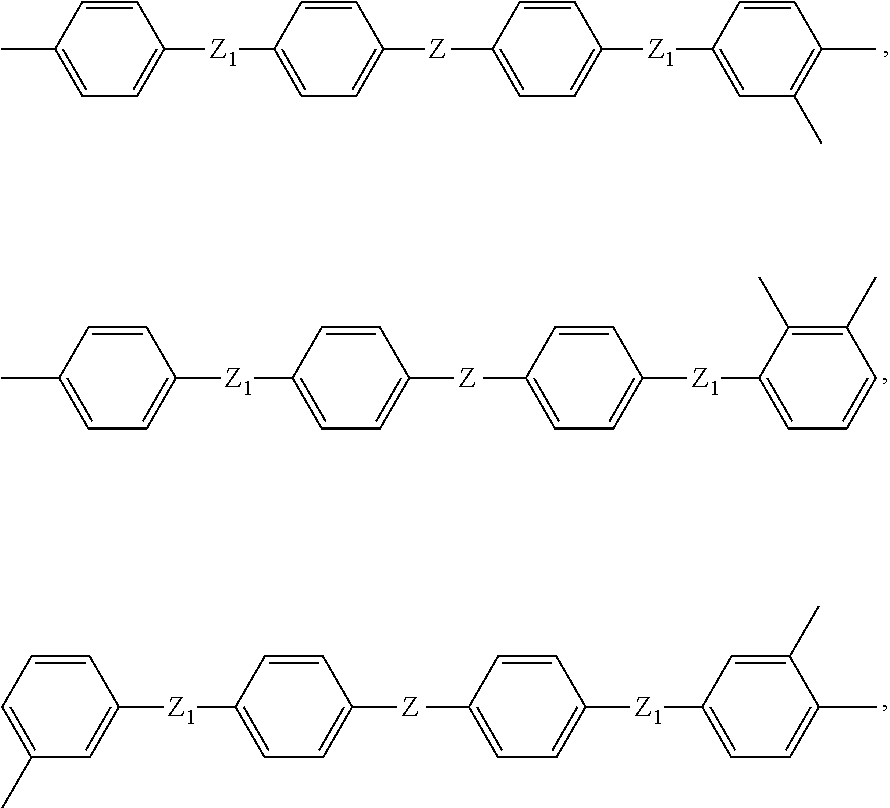


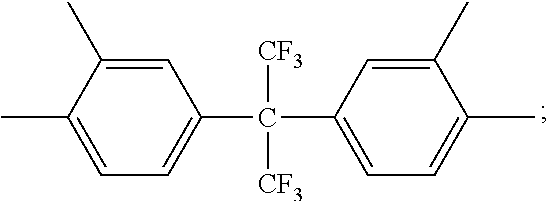

Priority Applications (11)
| Application Number | Priority Date | Filing Date | Title |
|---|---|---|---|
| US13/566,535 US8753426B2 (en) | 2012-08-03 | 2012-08-03 | Polymers, polymer membranes and methods of producing the same |
| TW102127180A TWI498354B (en) | 2012-08-03 | 2013-07-29 | Polymers, polymer membranes and methods of producing the same |
| EP13747767.5A EP2880080B1 (en) | 2012-08-03 | 2013-08-02 | Polymers, polymer membranes and methods of producing the same |
| CA2878956A CA2878956C (en) | 2012-08-03 | 2013-08-02 | Polymers, polymer membranes and methods of producing the same |
| CN201380051917.8A CN104684967B (en) | 2012-08-03 | 2013-08-02 | Polymers, polymer membranes and methods of producing the same |
| KR1020157002470A KR101676586B1 (en) | 2012-08-03 | 2013-08-02 | Polymers, polymer membranes and methods of producing the same |
| PCT/US2013/053344 WO2014022738A1 (en) | 2012-08-03 | 2013-08-02 | Polymers, polymer membranes and methods of producing the same |
| AU2013296320A AU2013296320B2 (en) | 2012-08-03 | 2013-08-02 | Polymers, polymer membranes and methods of producing the same |
| RU2015107208A RU2632205C2 (en) | 2012-08-03 | 2013-08-02 | Polymers, polymer membranes and methods of their producing |
| JP2015525614A JP6023329B2 (en) | 2012-08-03 | 2013-08-02 | Polymer, polymer film and production method thereof |
| MX2015001045A MX351675B (en) | 2012-08-03 | 2013-08-02 | Polymers, polymer membranes and methods of producing the same. |
Applications Claiming Priority (1)
| Application Number | Priority Date | Filing Date | Title |
|---|---|---|---|
| US13/566,535 US8753426B2 (en) | 2012-08-03 | 2012-08-03 | Polymers, polymer membranes and methods of producing the same |
Publications (2)
| Publication Number | Publication Date |
|---|---|
| US20140033918A1 US20140033918A1 (en) | 2014-02-06 |
| US8753426B2 true US8753426B2 (en) | 2014-06-17 |
Family
ID=48951622
Family Applications (1)
| Application Number | Title | Priority Date | Filing Date |
|---|---|---|---|
| US13/566,535 Expired - Fee Related US8753426B2 (en) | 2012-08-03 | 2012-08-03 | Polymers, polymer membranes and methods of producing the same |
Country Status (11)
| Country | Link |
|---|---|
| US (1) | US8753426B2 (en) |
| EP (1) | EP2880080B1 (en) |
| JP (1) | JP6023329B2 (en) |
| KR (1) | KR101676586B1 (en) |
| CN (1) | CN104684967B (en) |
| AU (1) | AU2013296320B2 (en) |
| CA (1) | CA2878956C (en) |
| MX (1) | MX351675B (en) |
| RU (1) | RU2632205C2 (en) |
| TW (1) | TWI498354B (en) |
| WO (1) | WO2014022738A1 (en) |
Cited By (4)
| Publication number | Priority date | Publication date | Assignee | Title |
|---|---|---|---|---|
| US10702669B2 (en) | 2005-02-09 | 2020-07-07 | Vbox, Incorporated | Removable cartridge for oxygen concentrator |
| US11149636B2 (en) | 2019-03-01 | 2021-10-19 | Richard Alan Callahan | Turbine powered electricity generation |
| US11149634B2 (en) | 2019-03-01 | 2021-10-19 | Richard Alan Callahan | Turbine powered electricity generation |
| US11994063B2 (en) | 2019-10-16 | 2024-05-28 | Richard Alan Callahan | Turbine powered electricity generation |
Families Citing this family (13)
| Publication number | Priority date | Publication date | Assignee | Title |
|---|---|---|---|---|
| ES2496493T3 (en) | 2002-01-11 | 2014-09-19 | Bioasis Technologies Inc. | Use of p97 as an enzyme delivery system for the administration of therapeutic lysosomal enzymes |
| US9932565B2 (en) | 2012-07-31 | 2018-04-03 | Bioasis Technologies, Inc. | Dephosphorylated lysosomal storage disease proteins and methods of use thereof |
| EP2970433B1 (en) | 2013-03-13 | 2019-09-18 | Bioasis Technologies Inc. | Fragments of p97 and uses thereof |
| CN103277982B (en) * | 2013-05-21 | 2015-06-17 | 南京九思高科技有限公司 | Technology and device for circulating recycling of volatile organic compound in coating printing industry |
| JP6603227B2 (en) | 2014-02-03 | 2019-11-06 | バイオアシス テクノロジーズ インコーポレイテッド | P97 fusion protein |
| ES2762672T3 (en) | 2014-02-19 | 2020-05-25 | Bioasis Technologies Inc | P97-IDS fusion proteins |
| US9266058B1 (en) * | 2014-09-29 | 2016-02-23 | Uop Llc | High selectivity polyimide membrane for natural gas upgrading and hydrogen purification |
| US20160151738A1 (en) * | 2014-11-30 | 2016-06-02 | L'air Liquide, Societe Anonyme Pour L'etude Et L'exploitation Des Procedes Georges Claude | Cross-linked polyimide gas separation membrane, method of manufacturing the same, and use of the same |
| WO2016136404A1 (en) * | 2015-02-27 | 2016-09-01 | 富士フイルム株式会社 | Gas separation membrane, gas separation module, gas separation device and gas separation method |
| US9480954B2 (en) * | 2015-03-18 | 2016-11-01 | Uop Llc | High selectivity epoxysilicone-cross-linked polyimide membranes for gas separations |
| KR101912737B1 (en) * | 2017-05-23 | 2018-10-30 | 주식회사 대림코퍼레이션 | Method of manufacturing for polyamic acid resin having easily laser Ablation and high heat resistant and polyimide film using the same |
| US11478744B2 (en) * | 2018-08-09 | 2022-10-25 | King Fahd University Of Petroleum And Minerals | Gas separation membrane containing metal-organic frameworks and methods of making thereof |
| CN115872373B (en) * | 2021-09-26 | 2025-06-06 | 中国石油化工股份有限公司 | Method and system for purifying helium from helium-rich gas |
Citations (13)
| Publication number | Priority date | Publication date | Assignee | Title |
|---|---|---|---|---|
| US3133132A (en) | 1960-11-29 | 1964-05-12 | Univ California | High flow porous membranes for separating water from saline solutions |
| US4728345A (en) | 1983-12-28 | 1988-03-01 | Monsanto Company | Multicomponent gas separation membranes having polyphosphazene coatings |
| US5085676A (en) | 1990-12-04 | 1992-02-04 | E. I. Du Pont De Nemours And Company | Novel multicomponent fluid separation membranes |
| US5098985A (en) * | 1988-10-11 | 1992-03-24 | The Dow Chemical Company | Copolymers containing polybenzoxazole, polybenzothiazole and polybenzimidazole moieties |
| US5104532A (en) | 1989-09-15 | 1992-04-14 | Exxon Research And Engineering Company | Flat stack permeator |
| US5120825A (en) * | 1990-12-21 | 1992-06-09 | Hoechst Celanese Corp. | Polymers containing both imidazole and imidazolone structural units |
| US5288304A (en) | 1993-03-30 | 1994-02-22 | The University Of Texas System | Composite carbon fluid separation membranes |
| US20040247974A1 (en) * | 2001-03-01 | 2004-12-09 | Oemer Uensal | Polymer membrane, method for the production and use thereof |
| US7259230B2 (en) * | 2004-06-07 | 2007-08-21 | Battelle Energy Alliance, Llc | Polybenzimidazole compounds, polymeric media, and methods of post-polymerization modifications |
| US20090286078A1 (en) * | 2008-05-19 | 2009-11-19 | Industry-University Cooperation Foundation, Hanyang University | Polyimides dope composition, preparation method of hollow fiber using the same and hollow fiber prepared therefrom |
| US20090286904A1 (en) | 2008-05-19 | 2009-11-19 | Industry-University Cooperation Foundation, Hanyang University | Polyamic acids dope composition, preparation method of hollow fiber using the same and hollow fiber prepared therefrom |
| US20100133187A1 (en) * | 2009-03-27 | 2010-06-03 | Chunqing Liu | Polybenzoxazole Polymer-Based Mixed Matrix Membranes |
| US8013103B2 (en) | 2008-10-10 | 2011-09-06 | Industry-University Cooperation Foundation, Hanyang University | Polymer compounds and a preparation method thereof |
Family Cites Families (9)
| Publication number | Priority date | Publication date | Assignee | Title |
|---|---|---|---|---|
| JPH0525274A (en) * | 1991-07-18 | 1993-02-02 | Sekiyu Sangyo Kasseika Center | Reactive polyimide block copolymer |
| EP1262509B1 (en) * | 1999-11-10 | 2007-01-10 | PI R & D Co., Ltd. | Imide-benzoxazole polycondensate and process for producing the same |
| JP2001348428A (en) | 1999-12-22 | 2001-12-18 | Toray Ind Inc | Polyamic acid composition, soluble polyimide composition and polybenzoxazole-polyimide composition |
| EP2152781A1 (en) * | 2007-04-30 | 2010-02-17 | Teijin Aramid B.V. | Polybenzazoles and polybenzazole precursors |
| RU2465380C2 (en) * | 2008-05-19 | 2012-10-27 | ИЮКФ-ХИЮ (Индастри-Юниверсити Кооперейшн Фаундейшн Ханиянг Юниверсити) | Hollow fiber, spinning solution composition for obtaining hollow fiber, and method of producing hollow fiber with its application |
| US8613362B2 (en) * | 2009-03-27 | 2013-12-24 | Uop Llc | Polymer membranes derived from aromatic polyimide membranes |
| US8561812B2 (en) * | 2009-03-27 | 2013-10-22 | Uop Llc | Blend polymer membranes comprising thermally rearranged polymers derived from aromatic polyimides containing ortho-positioned functional groups |
| US7810652B2 (en) * | 2009-09-25 | 2010-10-12 | Uop Llc | Method to improve the selectivity of polybenzoxazole membranes |
| JP2011221390A (en) * | 2010-04-13 | 2011-11-04 | Toyobo Co Ltd | Positive photosensitive polyimide resin composition |
-
2012
- 2012-08-03 US US13/566,535 patent/US8753426B2/en not_active Expired - Fee Related
-
2013
- 2013-07-29 TW TW102127180A patent/TWI498354B/en not_active IP Right Cessation
- 2013-08-02 WO PCT/US2013/053344 patent/WO2014022738A1/en not_active Ceased
- 2013-08-02 RU RU2015107208A patent/RU2632205C2/en active
- 2013-08-02 AU AU2013296320A patent/AU2013296320B2/en not_active Ceased
- 2013-08-02 KR KR1020157002470A patent/KR101676586B1/en not_active Expired - Fee Related
- 2013-08-02 CA CA2878956A patent/CA2878956C/en not_active Expired - Fee Related
- 2013-08-02 JP JP2015525614A patent/JP6023329B2/en not_active Expired - Fee Related
- 2013-08-02 MX MX2015001045A patent/MX351675B/en active IP Right Grant
- 2013-08-02 EP EP13747767.5A patent/EP2880080B1/en not_active Not-in-force
- 2013-08-02 CN CN201380051917.8A patent/CN104684967B/en not_active Expired - Fee Related
Patent Citations (13)
| Publication number | Priority date | Publication date | Assignee | Title |
|---|---|---|---|---|
| US3133132A (en) | 1960-11-29 | 1964-05-12 | Univ California | High flow porous membranes for separating water from saline solutions |
| US4728345A (en) | 1983-12-28 | 1988-03-01 | Monsanto Company | Multicomponent gas separation membranes having polyphosphazene coatings |
| US5098985A (en) * | 1988-10-11 | 1992-03-24 | The Dow Chemical Company | Copolymers containing polybenzoxazole, polybenzothiazole and polybenzimidazole moieties |
| US5104532A (en) | 1989-09-15 | 1992-04-14 | Exxon Research And Engineering Company | Flat stack permeator |
| US5085676A (en) | 1990-12-04 | 1992-02-04 | E. I. Du Pont De Nemours And Company | Novel multicomponent fluid separation membranes |
| US5120825A (en) * | 1990-12-21 | 1992-06-09 | Hoechst Celanese Corp. | Polymers containing both imidazole and imidazolone structural units |
| US5288304A (en) | 1993-03-30 | 1994-02-22 | The University Of Texas System | Composite carbon fluid separation membranes |
| US20040247974A1 (en) * | 2001-03-01 | 2004-12-09 | Oemer Uensal | Polymer membrane, method for the production and use thereof |
| US7259230B2 (en) * | 2004-06-07 | 2007-08-21 | Battelle Energy Alliance, Llc | Polybenzimidazole compounds, polymeric media, and methods of post-polymerization modifications |
| US20090286078A1 (en) * | 2008-05-19 | 2009-11-19 | Industry-University Cooperation Foundation, Hanyang University | Polyimides dope composition, preparation method of hollow fiber using the same and hollow fiber prepared therefrom |
| US20090286904A1 (en) | 2008-05-19 | 2009-11-19 | Industry-University Cooperation Foundation, Hanyang University | Polyamic acids dope composition, preparation method of hollow fiber using the same and hollow fiber prepared therefrom |
| US8013103B2 (en) | 2008-10-10 | 2011-09-06 | Industry-University Cooperation Foundation, Hanyang University | Polymer compounds and a preparation method thereof |
| US20100133187A1 (en) * | 2009-03-27 | 2010-06-03 | Chunqing Liu | Polybenzoxazole Polymer-Based Mixed Matrix Membranes |
Non-Patent Citations (4)
| Title |
|---|
| Freeman, Benny D., Basis of Permeability/Selectivity Tradeoff Relations in Polymeric Gas Separation Membranes, Macromolecules, 1999, vol. 32, pp. 375-380. Published on web Jan. 5, 1999. |
| Park, Ho Bum, Polymers With Cavities Tuned for Fast Selective Transport of Small Molecules and Ions, www.sciencemag.org, Science vol. 318, Oct. 12, 2007, pp. 254-258. |
| Roberson, Lloyd M., Correlation of Separation Factor Versus Permeability for Polymeric Membranes, Journal of Membrane Science, vol. 62, 1991, pp. 165-185. |
| Robeson, Lloyd M., The Upper Bound Revisited, Journal of Membrane Science, vol. 320, 2008, pp. 390-400. |
Cited By (5)
| Publication number | Priority date | Publication date | Assignee | Title |
|---|---|---|---|---|
| US10702669B2 (en) | 2005-02-09 | 2020-07-07 | Vbox, Incorporated | Removable cartridge for oxygen concentrator |
| US11389614B2 (en) | 2005-02-09 | 2022-07-19 | Vbox, Incorporated | Removable cartridge for oxygen concentrator |
| US11149636B2 (en) | 2019-03-01 | 2021-10-19 | Richard Alan Callahan | Turbine powered electricity generation |
| US11149634B2 (en) | 2019-03-01 | 2021-10-19 | Richard Alan Callahan | Turbine powered electricity generation |
| US11994063B2 (en) | 2019-10-16 | 2024-05-28 | Richard Alan Callahan | Turbine powered electricity generation |
Also Published As
| Publication number | Publication date |
|---|---|
| KR101676586B1 (en) | 2016-11-15 |
| MX2015001045A (en) | 2015-04-09 |
| RU2015107208A (en) | 2016-09-27 |
| TWI498354B (en) | 2015-09-01 |
| EP2880080A1 (en) | 2015-06-10 |
| AU2013296320B2 (en) | 2015-07-02 |
| AU2013296320A1 (en) | 2015-03-12 |
| CA2878956C (en) | 2016-11-29 |
| CN104684967B (en) | 2017-05-17 |
| WO2014022738A1 (en) | 2014-02-06 |
| EP2880080B1 (en) | 2018-07-04 |
| MX351675B (en) | 2017-10-24 |
| US20140033918A1 (en) | 2014-02-06 |
| TW201406820A (en) | 2014-02-16 |
| CA2878956A1 (en) | 2014-02-06 |
| RU2632205C2 (en) | 2017-10-03 |
| JP2015528849A (en) | 2015-10-01 |
| JP6023329B2 (en) | 2016-11-09 |
| CN104684967A (en) | 2015-06-03 |
| KR20150027280A (en) | 2015-03-11 |
Similar Documents
| Publication | Publication Date | Title |
|---|---|---|
| US20140033918A1 (en) | Polymers, Polymer Membranes And Methods Of Producing The Same | |
| US8926733B2 (en) | Polymers, polymer membranes and methods of producing the same | |
| US8127937B2 (en) | High performance cross-linked polybenzoxazole and polybenzothiazole polymer membranes | |
| US8127936B2 (en) | High performance cross-linked polybenzoxazole and polybenzothiazole polymer membranes | |
| JP5981989B2 (en) | Polyimide gas separation membrane | |
| US8704030B2 (en) | Process of separating gases using polyimide membranes | |
| US9126155B2 (en) | Self cross-linkable and self cross-linked aromatic polyimide membranes for separations | |
| US9126156B2 (en) | Self cross-linkable and self cross-linked aromatic polyimide membranes for separations | |
| US20090297850A1 (en) | Hollow fiber, dope composition for forming hollow fiber, and method of making hollow fiber using the same | |
| US11014932B2 (en) | Troger's base-based monomers, and polymers, methods of making and uses thereof | |
| US8710173B2 (en) | Blend polymer gas separation membrane | |
| CN102099512A (en) | Hollow fiber, dope solution composition for forming a hollow fiber, and method for manufacturing a hollow fiber using the same | |
| EP3041599B1 (en) | Highly crosslinked hybrid polyimide-silsesquioxane membranes | |
| US20100331437A1 (en) | Polybenzoxazole membranes prepared from aromatic polyamide membranes | |
| US20100326913A1 (en) | Polybenzoxazole membranes prepared from aromatic polyamide membranes | |
| US20180361327A1 (en) | Gas separation membrane, gas separation module, gas separator, gas separation method, composition for forming gas separation layer, method of producing gas separation membrane, polyimide compound, and diamine monomer |
Legal Events
| Date | Code | Title | Description |
|---|---|---|---|
| AS | Assignment |
Owner name: AIR PRODUCTS AND CHEMICALS, INC., PENNSYLVANIA Free format text: ASSIGNMENT OF ASSIGNORS INTEREST;ASSIGNORS:ZHENG, SHIYING;QUAY, JEFFREY RAYMOND;SIGNING DATES FROM 20121008 TO 20121009;REEL/FRAME:029111/0260 |
|
| STCF | Information on status: patent grant |
Free format text: PATENTED CASE |
|
| CC | Certificate of correction | ||
| FPAY | Fee payment |
Year of fee payment: 4 |
|
| FEPP | Fee payment procedure |
Free format text: MAINTENANCE FEE REMINDER MAILED (ORIGINAL EVENT CODE: REM.); ENTITY STATUS OF PATENT OWNER: LARGE ENTITY |
|
| LAPS | Lapse for failure to pay maintenance fees |
Free format text: PATENT EXPIRED FOR FAILURE TO PAY MAINTENANCE FEES (ORIGINAL EVENT CODE: EXP.); ENTITY STATUS OF PATENT OWNER: LARGE ENTITY |
|
| STCH | Information on status: patent discontinuation |
Free format text: PATENT EXPIRED DUE TO NONPAYMENT OF MAINTENANCE FEES UNDER 37 CFR 1.362 |
|
| FP | Lapsed due to failure to pay maintenance fee |
Effective date: 20220617 |