US8735969B1 - Semiconductor structure and manufacturing method of the same - Google Patents

Semiconductor structure and manufacturing method of the same Download PDF

Info

Publication number
US8735969B1
US8735969B1 US13/670,669 US201213670669A US8735969B1 US 8735969 B1 US8735969 B1 US 8735969B1 US 201213670669 A US201213670669 A US 201213670669A US 8735969 B1 US8735969 B1 US 8735969B1
Authority
US
United States
Prior art keywords
conductive
stacked structure
layer
strips
forming
Prior art date
Legal status (The legal status is an assumption and is not a legal conclusion. Google has not performed a legal analysis and makes no representation as to the accuracy of the status listed.)
Active
Application number
US13/670,669
Other versions
US20140124945A1 (en
Inventor
Erh-Kun Lai
Yen-Hao Shih
Shih-Chang Tsai
Current Assignee (The listed assignees may be inaccurate. Google has not performed a legal analysis and makes no representation or warranty as to the accuracy of the list.)
Macronix International Co Ltd
Original Assignee
Macronix International Co Ltd
Priority date (The priority date is an assumption and is not a legal conclusion. Google has not performed a legal analysis and makes no representation as to the accuracy of the date listed.)
Filing date
Publication date
Application filed by Macronix International Co Ltd filed Critical Macronix International Co Ltd
Priority to US13/670,669 priority Critical patent/US8735969B1/en
Assigned to MACRONIX INTERNATIONAL CO., LTD. reassignment MACRONIX INTERNATIONAL CO., LTD. ASSIGNMENT OF ASSIGNORS INTEREST (SEE DOCUMENT FOR DETAILS). Assignors: TSAI, SHIH-CHANG, LAI, ERH-KUN, SHIH, YEN-HAO
Publication of US20140124945A1 publication Critical patent/US20140124945A1/en
Application granted granted Critical
Publication of US8735969B1 publication Critical patent/US8735969B1/en
Active legal-status Critical Current
Anticipated expiration legal-status Critical

Links

Images

Classifications

    • HELECTRICITY
    • H10SEMICONDUCTOR DEVICES; ELECTRIC SOLID-STATE DEVICES NOT OTHERWISE PROVIDED FOR
    • H10BELECTRONIC MEMORY DEVICES
    • H10B43/00EEPROM devices comprising charge-trapping gate insulators
    • H10B43/30EEPROM devices comprising charge-trapping gate insulators characterised by the memory core region
    • H10W20/42
    • H10W20/084

Definitions

  • the disclosure relates in general to a semiconductor structure and a manufacturing method of the same, and more particularly to a semiconductor structure and a manufacturing method of the same for a memory device.
  • the invention is directed to a semiconductor structure and a manufacturing method of the same, which can be used in memory devices.
  • each of conductive damascene structures is formed independently on two sides of a stacked structure by a damascene process, such that the conductive damascene structures are perfectly separated from one another, there would be no residual conductive materials between the conductive damascene structures, thus, a good insulation between the conductive damascene structures is achieved, and the reliability of memory devices can be improved.
  • a semiconductor structure comprises a stacked structure, a plurality of first conductive blocks, a plurality of first conductive layers, a plurality of second conductive layers, and a plurality of conductive damascene structures.
  • the stacked structure is formed on a substrate, wherein the stacked structure comprises a plurality of conductive strips and a plurality of insulating strips, and the conductive strips and the insulating strips are interlaced.
  • the first conductive blocks are formed on the stacked structure.
  • the first conductive layers and the second conductive layers are formed on two sidewalls of the stacked structure, respectively.
  • the conductive damascene structures are formed on two sides of the stacked structure, wherein each of the first conductive blocks is electrically connected to each of the conductive damascene structures via each of the first conductive strips and each of the second conductive strips.
  • a method of manufacturing a semiconductor structure comprises the following steps.
  • a stacked structure is formed on a substrate, wherein a plurality of conductive strips and a plurality of insulating strips are formed, and the conductive strips and the insulating strips are interlaced.
  • a plurality of first conductive blocks is formed on the stacked structure.
  • a plurality of first conductive layers and a plurality of second conductive layers are formed on two sidewalls of the stacked structure, respectively.
  • a plurality of conductive damascene structures is formed on two sides of the stacked structure, wherein each of the first conductive blocks is electrically connected to each of the conductive damascene structures via each of the first conductive strips and each of the second conductive strips.
  • FIG. 1A shows a top view of a semiconductor structure according to an embodiment of the present disclosure.
  • FIG. 1B show a cross-sectional view along the section line 1 B- 1 B′ in FIG. 1A .
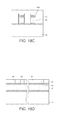
  • FIGS. 1C-1D show cross-sectional views along the section line 1 C- 1 C′ in FIG. 1A .
  • FIGS. 2A-21 illustrate a process for manufacturing a semiconductor structure according to one embodiment of the present disclosure.
  • each of conductive damascene structures is formed independently on two sides of a stacked structure by a damascene process, such that the conductive damascene structures are perfectly separated from one another, there would be no residual conductive materials between the conductive damascene structures, thus, a good insulation between the conductive damascene structures is achieved, and the reliability of memory devices can be improved.
  • the descriptions disclosed in the embodiments of the disclosure such as detailed structures, manufacturing procedures, operating procedures, and material selections are for illustration only, not for limiting the scope of protection of the disclosure.
  • FIG. 1A shows a top view of a semiconductor structure according to an embodiment of the present disclosure.
  • FIG. 1B show a cross-sectional view along the section line 1 B- 1 B′ in FIG. 1A .
  • FIGS. 1C-1D show cross-sectional views along the section line 1 C- 1 C′ in FIG. 1A .
  • Semiconductor structure 100 comprises a substrate 110 , a stacked structure 120 , a plurality of first conductive blocks 141 , a plurality of first conductive layers 131 , a plurality of second conductive layers 133 , and a plurality of conductive damascene structures 150 .
  • the stacked structure 120 is formed on the substrate 110 .
  • the stacked structure 120 comprises a plurality of conductive strips 121 and a plurality of insulating strips 123 , and the conductive strips 121 and the insulating strips 123 are interlaced.
  • the first conductive blocks 141 are formed on the stacked structure 120 , and the first conductive layers 131 and the second conductive layers 133 are formed on two sidewalls 120 a of the stacked structure 120 , respectively.
  • the conductive damascene structures 150 are formed on two sides of the stacked structure 120 , and each of the first conductive blocks 141 is electrically connected to each of the conductive damascene structures 150 via each of the first conductive strips 131 and each of the second conductive strips 133 .
  • the semiconductor structure 100 can further comprise an insulating structure 160 formed between the conductive damascene structures 150 .
  • the semiconductor structure 100 can comprise a plurality of stacked structures 120 , and the insulating structure 160 is also formed between the stacked structures 120 .
  • the conductive damascene structures 150 are extended in a direction D 1 perpendicular to a direction D 2 which the stacked structure 120 is extended in.
  • the material of the insulating structure comprises, for example, nitrides.
  • the semiconductor structure 100 is such as a 3D memory device, as shown in FIGS. 1A-1B , for example, the stacked structure 120 is a bit line, the conductive damascene structure 150 is the main body of a word line, and a working voltage is applied through the first conductive layer 131 and the second conductive layer 133 .
  • a full metal film is etched to form separated word lines.
  • the word lines may be short-circuited due to the residual metal materials between the word lines, caused by an incomplete etching between the word lines, resulting in a malfunction of the memory device.
  • each of conductive damascene structures 150 is formed independently on two sides of the stacked structure 120 by a damascene process, such that the conductive damascene structures 150 are perfectly separated from one another.
  • word lines there would be no residual conductive materials between the conductive damascene structures (word lines), a good insulation between the word lines is achieved, the memory device can function well, and the reliability of memory device can be improved.
  • the semiconductor structure 100 can further comprise a dielectric layer 170 formed on the stacked structure 120 and the conductive damascene structures 150 .
  • the semiconductor structure 100 can further comprise an etching stop layer 173 , and the etching stop layer 173 is such as disposed between the dielectric layer 170 and the stacked structure 120 .
  • the material of the dielectric layer 170 such as comprises metal nitrides.
  • the material selections are depending on the conditions applied and are not limited to the materials aforementioned.
  • the semiconductor structure 100 can further comprise a memory materials layer 180 formed on the two sidewalls 120 a of the stacked structure 120 .
  • the memory material layer 180 is formed between the first conductive layers 131 and the stacked structure 120 and between the second conductive layers 133 and the stacked structure 120 .
  • the memory material layer 180 is formed on the substrate 110 .
  • the memory material layer 180 can also be only formed on the two sidewalls 120 a of the stacked structure 120 and not formed on the substrate 110 (not shown).
  • the memory material layer 180 may have a multi-layer structure, for example, which may be ONO composite layers, ONONO composite layers, or BE-SONOS composite layers, or comprise, for example, an ONO structure formed by alternately stacking silicon oxide and silicon nitride.
  • the semiconductor structure 100 can further comprise an oxide layer 115 formed between the stacked structure 120 and the substrate 110 .
  • the semiconductor structure 100 can further comprise a second conductive block 143 , a third conductive layer 135 , and a fourth conductive layer 137 .
  • the second conductive block 143 is formed on the stacked structure 120
  • the third conductive layer 135 and the fourth conductive layer 137 are formed on the two sidewalls 120 a of the stacked structure 120 , respectively.
  • the second conductive block 143 is electrically connected to the third conductive layer 135 and the fourth conductive layer 137 .
  • the second conductive block 143 , the third conductive layer 135 , and the fourth conductive layer 137 are formed, for example, on an end of the semiconductor structure 100 .
  • the material of the first conductive block 141 is, for example, the same as the material of the second conductive block 143 are the same, and the materials of the first conductive layer 131 , the second conductive layer 133 , the third conductive layer 135 , and the fourth conductive layer 137 are, for example, the same.
  • the materials for the substrate 110 , and conductive blocks 141 and 143 , and the conductive layers 131 , 133 , 135 , and 137 comprise, for example, silicon-containing materials, such as polysilicon.
  • the material selections are depending on the conditions applied and are not limited to the materials aforementioned.
  • the semiconductor structure 100 is such as a 3D memory device, as shown in FIG. 1D
  • the second conductive block 143 is such as a string select line (SSL).
  • the semiconductor structure 100 can further comprise an insulating damascene structure 190 formed on two sides of the second conductive block 143 , and the insulating damascene structure 190 is such as connected to the second conductive block 143 .
  • the insulating damascene structure 190 covers, for example, the third conductive layer 135 and the fourth conductive layer 137 .
  • the insulating damascene structure 190 is extended in a direction D 3 parallel to the direction D 1 which the conductive damascene structures 150 are extended in.
  • the semiconductor structure 100 can further comprise a contact hole 175 formed in the dielectric layer 170 and electrically connected to the second conductive block 143 .
  • the contact hole 175 penetrates through the etching stop layer 173 to be electrically connected to the second conductive block 143 .
  • FIGS. 2A-21 illustrate a process for manufacturing a semiconductor structure according to one embodiment of the present disclosure.
  • a stacked structure 120 is formed on the substrate 110 .
  • the manufacturing method of forming the stacked structure 120 comprises, for example: forming a plurality of conductive strips 121 and a plurality of insulating strips 123 , and the conductive strips 121 and the insulating strips 123 are interlaced.
  • a plurality of stacked structures 120 can also be formed on the substrate 110 .
  • a plurality of first conductive blocks 143 are formed on the stacked structure 120 , and a plurality of first conductive layers 131 and a plurality of second conductive layers 131 are formed on two sidewalls 120 a of the stacked structure 120 , respectively.
  • the manufacturing method of forming the first conductive blocks 143 , the first conductive layers 131 , and the second conductive layers 133 comprises, for example, the following steps.
  • a conductive material layer 140 is formed on the stacked structure 120 .
  • an oxide layer 150 can also be formed between the stacked structure 120 and the substrate 110 .
  • a memory material coating layer 180 a is formed on the stacked structure 120 .
  • the memory material coating layer 180 a fully covers the stacked structure 120 , the conductive material layer 140 , and the substrate 110 .
  • the memory material coating layer 180 a comprises a charge trapping material, for example, ONO composite layers, ONONO composite layers, or BE-SONOS composite layers, or comprises, for example, an ONO structure formed by alternately stacking silicon oxide and silicon nitride.
  • a sacrificial layer 210 is formed on the substrate 110 .
  • the sacrificial layer 210 surrounds the stacked structure 120 and the peripheral of the memory material coating layer 180 a , and at least part of the conductive material layer 140 and the memory material coating layer 180 a is exposed.
  • the sacrificial layer 210 comprises, for example, at least one of pure carbon, carbon-containing oxide, bottom antireflective coating (BARC), and silicon rich bulk (SHB).
  • BARC bottom antireflective coating
  • SHB silicon rich bulk
  • the sacrificial layer 210 may also be disposable films formed of carbon like organic materials, which are easily coated and removed.
  • the sacrificial layer 210 may be formed by one etch back process which is highly selective to the memory material coating layer 180 a for the memory material coating layer 180 a to be exposed.
  • the memory material coating layer 180 a is etched to expose the conductive material layer 140 and form a memory material layer 180 on the two sidewalls 120 a of the stacked structure 120 .
  • the memory material coating layer 180 a exposed from the sacrificial layer 210 is etched to form the memory material layer 180 , and the top of the memory material layer 180 is substantially aligned with the upper surface of the sacrificial layer 210 .
  • the memory material layer 180 is such as formed between the sacrificial layer 210 and the stacked structure 120 .
  • the sacrificial layer 210 is removed to expose the memory material layer 180 .
  • part of the memory material layer 180 on the substrate 110 can also be removed, such that the memory material layer 180 is only located on the two sidewalls 120 a of the stacked structure 120 .
  • a conductive material layer 130 is formed on the stacked structure 120 and the conductive material layer 140 .
  • the conductive material layer 130 fully covers the conductive material layer 140 and the memory material layer 180 .
  • the memory material layer 180 may be highly doped polysilicon or a conformal conductive film.
  • the conductive material layer 130 is etched to expose part of the conductive material layer 140 .
  • the conductive material layer 130 covers the memory material layer 180 and surrounds the stacked structure 120 .
  • a sacrificial layer 220 is formed on the substrate 110 .
  • the sacrificial layer 220 surrounds the stacked structure 120 and covers the conductive material layer 130 on the sidewalls 120 a , exposing an upper surface 140 a of the conductive material layer 140 .
  • the manufacturing method of forming the sacrificial layer 220 comprises, for example: forming a sacrificial coating layer to fully cover the conductive material layer 130 , the conductive material layer 140 , and the substrate; and planarizing the sacrificial layer 220 to expose the upper surface 140 a of the conductive material layer 140 .
  • the sacrificial coating layer is planarized by such as a chemical mechanical polishing (CMP) process.
  • the material of the sacrificial layer 220 comprises, for example, silicon nitride (SiN).
  • FIGS. 10A-10E show cross-sectional views along the section lines 10 B- 10 B′ to 10 E- 10 E′ in FIG. 10A ), patterning the sacrificial layer 220 to form a plurality of sacrificial strips 220 a , and the sacrificial strips 220 a are extended in a direction D 4 perpendicular to the direction D 2 which the stacked structure 120 is extended in.
  • the manufacturing method of forming the sacrificial strips 220 a comprises, for example: forming a plurality of photoresist strips PR 1 on the sacrificial layer 220 and etching the sacrificial layer 220 according to the pattern of the photoresist strips PR 1 to form the sacrificial strips 220 a .
  • the photoresist strips PR 1 are arranged by such as a self-aligned double patterning (SADP) process.
  • SADP self-aligned double patterning
  • FIGS. 11A-11E show cross-sectional views along the section lines 11 B- 11 B′ to 11 E- 11 E′ in FIG. 11A
  • a region of the conductive material layer 140 exposed from the photoresist strips PR 1 is etched to form a plurality of first conductive blocks 141 and a second conductive block 143 on the stacked structure 120 .
  • a region of the conductive material layer 130 exposed from the photoresist strips PR 1 can also be etched to form a plurality of first conductive layers 131 and a second conductive layer 133 on the sidewalls 120 a of the stacked structure 120 .
  • each of the first conductive blocks 141 is spaced apart from the others, each of the first conductive layers 131 is spaced apart form the others, and each of the second conductive layers 133 is spaced apart form the others.
  • each of the first conductive blocks 141 is adjacent to a corresponding first conductive layer 131 and a corresponding second conductive layer 133 , and the first conductive layer 131 and the second conductive layer 133 are adjacent to a corresponding sacrificial layer 220 a .
  • the first conductive block 141 is electrically connected to the first conductive layer 131 and the second conductive layer 133 .
  • a second conductive block 143 can be also formed on the stacked structure 120 , and a third conductive layer 135 and a fourth conductive layer 137 (not shown) can also be formed on the two sidewalls 120 a of the stacked structure 120 .
  • the first conductive blocks 141 and the second conductive block 143 are spaced apart
  • the first conductive layers 131 and the third conductive layer 135 are spaced apart
  • the second conductive layers 133 and the fourth conductive layer 137 are spaced apart.
  • the third conductive layer 135 and the fourth conductive layer 137 are adjacent to a corresponding sacrificial strip 220 a .
  • the second conductive block 143 is electrically connected to the third conductive layer 135 and the fourth conductive layer 137 .
  • FIGS. 12A-12E show cross-sectional views along the section lines 12 B- 12 B′ to 12 E- 12 E′ in FIG. 12A .
  • an insulating structure 160 can also be formed between the sacrificial strips 220 a (between the conductive damascene structures formed in the following steps). In the embodiment, the insulating structure 160 is also formed between the stacked structures 120 .
  • the manufacturing method of forming the insulating structure 160 comprises, for example: forming an insulating material layer on the stacked structure 120 , the first conductive blocks 141 , the second conductive block 143 , and the sacrificial strips 220 a ; and planarizing the insulating material layer to expose the first conductive blocks 141 , the second conductive block 143 , and the sacrificial layer 220 a .
  • the insulating material layer is planarized by such as a CMP process.
  • a cap layer 230 can also be formed on the second conductive block 143 , the third conductive layer 135 , the fourth conductive layer 137 , and adjacent to which the sacrificial strip 220 a .
  • the manufacturing method of forming the cap layer 230 comprises, for example: forming a cap material layer covering the first conductive blocks 141 , the second conductive block 143 , the first conductive layers 131 , the second conductive layers 133 , the third conductive layer 135 , the fourth conductive layer 137 , and the sacrificial strips 220 a ; and removing part of the cap material layer not covering the second conductive block 143 , the third conductive layer 135 , the fourth conductive layer 137 , and adjacent to which the sacrificial strip 220 a .
  • the material of the cap layer 230 comprises such as oxides.
  • a plurality of conductive damascene structures 150 are formed on two sides of the stacked structure 120 .
  • Each of the first conductive blocks 141 is electrically connected to each of the conductive damascene structures 150 via each of the first conductive strips 131 and each of the second conductive strips 133 .
  • the manufacturing method of forming the conductive damascene structures 150 on the two sides of the stacked structure comprises such as the following steps.
  • a plurality of trenches T are formed on the two sides of the stacked structure 120 .
  • the trenches T are extended in a direction D 5 perpendicular to the direction D 2 which the stacked structure 120 is extended in.
  • the manufacturing method of forming the trenches T comprises, for example: removing the sacrificial strips 220 exposed from the cap layer 230 .
  • the sacrificial strips 220 a are removed by such as an etching process, and the sacrificial layer covered by the cap layer 230 is not removed.
  • FIGS. 16A-16E show cross-sectional views along the section lines 16 B- 16 B′ to 16 E- 16 E′ in FIG. 16A
  • a conductive material is filled in the trenches T to form the conductive damascene structure 150 .
  • the conductive damascene structures 150 are formed in trenches T which are separated from one another. Therefore, a good insulation between the conductive damascene structures 150 is achieved. That is to say, each of conductive damascene structures 150 is formed independently in each of the trenches T, which are separated from one another, by a damascene process, such that the conductive damascene structures 150 are perfectly separated from one another. There would be no residual conductive materials between the conductive damascene structures 150 , thus, a good insulation between the conductive damascene structures 150 is achieved, and the reliability of the device to be manufactured in the following process an be improved.
  • FIGS. 17A-17E show cross-sectional views along the section lines 17 B- 17 B′ to 17 E- 17 E′ in FIG. 17A .
  • an insulating damascene structure 190 can also be formed on two sides of the second conductive block 143 .
  • the insulating damascene structure 190 is located adjacent to the second conductive block 143 .
  • the manufacturing method of forming the insulating damascene structure 190 on the two sides of the second conductive block 143 comprises such as the following steps.
  • a trench T′ is formed on the two sides of the second conductive block 143 .
  • the trench T′ is extended in a direction D 6 perpendicular to the direction D 2 which the stacked structure is extended in.
  • the manufacturing method of forming the trench T′ comprises, for example: removing the sacrificial strip 220 a previously covered by the cap layer 230 . That is, the sacrificial strip 220 a located adjacent to the second conductive block 143 , the third conductive layer 135 , and the fourth conductive layer 137 is removed.
  • the sacrificial strip 220 a is removed by such as an etching process.
  • FIGS. 19A-19F show cross-sectional views along the section lines 19 B- 19 B′ to 19 F- 19 F′ in FIG. 19A .
  • a dielectric layer 170 can also be formed on the stacked structure 120 .
  • the dielectric layer 170 can also be formed on the conductive damascene structures 150 and the insulating damascene structure 190 .
  • an etching stop layer 173 can also be formed between the dielectric layer 170 and the stacked structure 120 .
  • a contact hole 175 can also be formed in the dielectric layer 170 .
  • the contact hole 175 is electrically connected to the second conductive block 143 .

Landscapes

  • Engineering & Computer Science (AREA)
  • Internal Circuitry In Semiconductor Integrated Circuit Devices (AREA)
  • Physics & Mathematics (AREA)
  • Condensed Matter Physics & Semiconductors (AREA)
  • General Physics & Mathematics (AREA)
  • Computer Hardware Design (AREA)
  • Microelectronics & Electronic Packaging (AREA)
  • Power Engineering (AREA)
  • Manufacturing & Machinery (AREA)

Abstract

A semiconductor structure and a manufacturing method thereof are provided. The semiconductor structure includes a stacked structure, a plurality of first conductive blocks, a plurality of first conductive layers, a plurality of second conductive layers, and a plurality of conductive damascene structures. The stacked structure, comprising a plurality of conductive strips and a plurality of insulating strips, is formed on a substrate, and the conductive strips and the insulating strips are interlaced. The first conductive blocks are formed on the stacked structure. The first conductive layers and the second conductive layers are formed on two sidewalls of the stacked structure, respectively. The conductive damascene structures are formed on two sides of the stacked structure, wherein each of the first conductive blocks is electrically connected to each of the conductive damascene structures via each of the first conductive strips and each of the second conductive strips.

Description

BACKGROUND OF THE INVENTION
1. Field of the Invention
The disclosure relates in general to a semiconductor structure and a manufacturing method of the same, and more particularly to a semiconductor structure and a manufacturing method of the same for a memory device.
2. Description of the Related Art
In recent years, the structures of semiconductor devices have been changed constantly, and the storage capacity of the devices has been increased continuously. Memory devices are used in storage elements for many products such as MP3 players, digital cameras, computer files, etc. As the application increases, the demand for memory devices focuses on small sizes and large memory capacities. However, as the size of memory devices is reduced, the feature sizes of memory cells are decreased as well, causing a decrease in reliability of memory devices. As such, it is desirable to develop memory devices with improved reliability.
SUMMARY OF THE INVENTION
The invention is directed to a semiconductor structure and a manufacturing method of the same, which can be used in memory devices. In the semiconductor structure, each of conductive damascene structures is formed independently on two sides of a stacked structure by a damascene process, such that the conductive damascene structures are perfectly separated from one another, there would be no residual conductive materials between the conductive damascene structures, thus, a good insulation between the conductive damascene structures is achieved, and the reliability of memory devices can be improved.
According to one embodiment of the present disclosure, a semiconductor structure is provided. The semiconductor structure comprises a stacked structure, a plurality of first conductive blocks, a plurality of first conductive layers, a plurality of second conductive layers, and a plurality of conductive damascene structures. The stacked structure is formed on a substrate, wherein the stacked structure comprises a plurality of conductive strips and a plurality of insulating strips, and the conductive strips and the insulating strips are interlaced. The first conductive blocks are formed on the stacked structure. The first conductive layers and the second conductive layers are formed on two sidewalls of the stacked structure, respectively.
The conductive damascene structures are formed on two sides of the stacked structure, wherein each of the first conductive blocks is electrically connected to each of the conductive damascene structures via each of the first conductive strips and each of the second conductive strips.
According to one embodiment of the present disclosure, a method of manufacturing a semiconductor structure is provided. The method comprises the following steps. A stacked structure is formed on a substrate, wherein a plurality of conductive strips and a plurality of insulating strips are formed, and the conductive strips and the insulating strips are interlaced. A plurality of first conductive blocks is formed on the stacked structure. A plurality of first conductive layers and a plurality of second conductive layers are formed on two sidewalls of the stacked structure, respectively. A plurality of conductive damascene structures is formed on two sides of the stacked structure, wherein each of the first conductive blocks is electrically connected to each of the conductive damascene structures via each of the first conductive strips and each of the second conductive strips.
The disclosure will become apparent from the following detailed description of the preferred but non-limiting embodiments. The following description is made with reference to the accompanying drawings.
BRIEF DESCRIPTION OF THE DRAWINGS
FIG. 1A shows a top view of a semiconductor structure according to an embodiment of the present disclosure.
FIG. 1B show a cross-sectional view along the section line 1B-1B′ in FIG. 1A.
FIGS. 1C-1D show cross-sectional views along the section line 1C-1C′ in FIG. 1A.
FIGS. 2A-21 illustrate a process for manufacturing a semiconductor structure according to one embodiment of the present disclosure.
DETAILED DESCRIPTION OF THE INVENTION
In the embodiment of the present disclosure, a semiconductor structure and a manufacturing method of the same are provided. In the semiconductor structure, each of conductive damascene structures is formed independently on two sides of a stacked structure by a damascene process, such that the conductive damascene structures are perfectly separated from one another, there would be no residual conductive materials between the conductive damascene structures, thus, a good insulation between the conductive damascene structures is achieved, and the reliability of memory devices can be improved. However, the descriptions disclosed in the embodiments of the disclosure such as detailed structures, manufacturing procedures, operating procedures, and material selections are for illustration only, not for limiting the scope of protection of the disclosure.
FIG. 1A shows a top view of a semiconductor structure according to an embodiment of the present disclosure. FIG. 1B show a cross-sectional view along the section line 1B-1B′ in FIG. 1A. FIGS. 1C-1D show cross-sectional views along the section line 1C-1C′ in FIG. 1A.
Please refer to FIGS. 1A-1B. Semiconductor structure 100 comprises a substrate 110, a stacked structure 120, a plurality of first conductive blocks 141, a plurality of first conductive layers 131, a plurality of second conductive layers 133, and a plurality of conductive damascene structures 150. The stacked structure 120 is formed on the substrate 110. The stacked structure 120 comprises a plurality of conductive strips 121 and a plurality of insulating strips 123, and the conductive strips 121 and the insulating strips 123 are interlaced. The first conductive blocks 141 are formed on the stacked structure 120, and the first conductive layers 131 and the second conductive layers 133 are formed on two sidewalls 120 a of the stacked structure 120, respectively. The conductive damascene structures 150 are formed on two sides of the stacked structure 120, and each of the first conductive blocks 141 is electrically connected to each of the conductive damascene structures 150 via each of the first conductive strips 131 and each of the second conductive strips 133.
In an embodiment, as shown in FIG. 1A, the semiconductor structure 100 can further comprise an insulating structure 160 formed between the conductive damascene structures 150. In the embodiment, as shown in FIG. 1B, the semiconductor structure 100 can comprise a plurality of stacked structures 120, and the insulating structure 160 is also formed between the stacked structures 120. In the embodiment, the conductive damascene structures 150 are extended in a direction D1 perpendicular to a direction D2 which the stacked structure 120 is extended in. In the embodiment, the material of the insulating structure comprises, for example, nitrides.
In an embodiment, the semiconductor structure 100 is such as a 3D memory device, as shown in FIGS. 1A-1B, for example, the stacked structure 120 is a bit line, the conductive damascene structure 150 is the main body of a word line, and a working voltage is applied through the first conductive layer 131 and the second conductive layer 133. Conventionally, a full metal film is etched to form separated word lines. However, the word lines may be short-circuited due to the residual metal materials between the word lines, caused by an incomplete etching between the word lines, resulting in a malfunction of the memory device. In contrast, in the embodiment of the disclosure, each of conductive damascene structures 150 is formed independently on two sides of the stacked structure 120 by a damascene process, such that the conductive damascene structures 150 are perfectly separated from one another. As such, there would be no residual conductive materials between the conductive damascene structures (word lines), a good insulation between the word lines is achieved, the memory device can function well, and the reliability of memory device can be improved.
In an embodiment, as shown in FIG. 1B, the semiconductor structure 100 can further comprise a dielectric layer 170 formed on the stacked structure 120 and the conductive damascene structures 150. In the embodiment, the semiconductor structure 100 can further comprise an etching stop layer 173, and the etching stop layer 173 is such as disposed between the dielectric layer 170 and the stacked structure 120. In the embodiment, the material of the dielectric layer 170 such as comprises metal nitrides. However, the material selections are depending on the conditions applied and are not limited to the materials aforementioned.
In an embodiment, as shown in FIG. 1B, the semiconductor structure 100 can further comprise a memory materials layer 180 formed on the two sidewalls 120 a of the stacked structure 120. In the embodiment, the memory material layer 180 is formed between the first conductive layers 131 and the stacked structure 120 and between the second conductive layers 133 and the stacked structure 120. In the embodiment, as shown in FIG. 1B, the memory material layer 180 is formed on the substrate 110. In another embodiment, the memory material layer 180 can also be only formed on the two sidewalls 120 a of the stacked structure 120 and not formed on the substrate 110 (not shown). In the embodiment, the memory material layer 180 may have a multi-layer structure, for example, which may be ONO composite layers, ONONO composite layers, or BE-SONOS composite layers, or comprise, for example, an ONO structure formed by alternately stacking silicon oxide and silicon nitride.
In an embodiment, as shown in FIG. 1B, the semiconductor structure 100 can further comprise an oxide layer 115 formed between the stacked structure 120 and the substrate 110.
Please refer to FIG. 1C. The semiconductor structure 100 can further comprise a second conductive block 143, a third conductive layer 135, and a fourth conductive layer 137. The second conductive block 143 is formed on the stacked structure 120, and the third conductive layer 135 and the fourth conductive layer 137 are formed on the two sidewalls 120 a of the stacked structure 120, respectively. The second conductive block 143 is electrically connected to the third conductive layer 135 and the fourth conductive layer 137. In the embodiment, as shown in FIG. 1A, the second conductive block 143, the third conductive layer 135, and the fourth conductive layer 137 are formed, for example, on an end of the semiconductor structure 100. In the embodiment, the material of the first conductive block 141 is, for example, the same as the material of the second conductive block 143 are the same, and the materials of the first conductive layer 131, the second conductive layer 133, the third conductive layer 135, and the fourth conductive layer 137 are, for example, the same. In the embodiment, the materials for the substrate 110, and conductive blocks 141 and 143, and the conductive layers 131, 133, 135, and 137 comprise, for example, silicon-containing materials, such as polysilicon. However, the material selections are depending on the conditions applied and are not limited to the materials aforementioned.
In an embodiment, the semiconductor structure 100 is such as a 3D memory device, as shown in FIG. 1D, the second conductive block 143 is such as a string select line (SSL).
In an embodiment, as shown in FIG. 1C, the semiconductor structure 100 can further comprise an insulating damascene structure 190 formed on two sides of the second conductive block 143, and the insulating damascene structure 190 is such as connected to the second conductive block 143. In the embodiment, as shown in FIG. 1C, the insulating damascene structure 190 covers, for example, the third conductive layer 135 and the fourth conductive layer 137. In the embodiment, the insulating damascene structure 190 is extended in a direction D3 parallel to the direction D1 which the conductive damascene structures 150 are extended in.
In an embodiment, referring to FIG. 1D, the semiconductor structure 100 can further comprise a contact hole 175 formed in the dielectric layer 170 and electrically connected to the second conductive block 143. In the embodiment, as shown in FIG. 1D, the contact hole 175 penetrates through the etching stop layer 173 to be electrically connected to the second conductive block 143.
The embodiments disclosed below are for elaborating a manufacturing method of the semiconductor structures of the disclosure. However, the descriptions disclosed in the embodiments of the disclosure such as detailed manufacturing procedures are for illustration only, not for limiting the scope of protection of the disclosure. Referring to FIGS. 2A-21, FIGS. 2A-21 illustrate a process for manufacturing a semiconductor structure according to one embodiment of the present disclosure.
Referring to FIGS. 2A-2B (FIG. 2B shows a cross-sectional view along the section line 2B-2B′ in FIG. 2A), a stacked structure 120 is formed on the substrate 110. The manufacturing method of forming the stacked structure 120 comprises, for example: forming a plurality of conductive strips 121 and a plurality of insulating strips 123, and the conductive strips 121 and the insulating strips 123 are interlaced. In an embodiment, a plurality of stacked structures 120 can also be formed on the substrate 110.
Next, as shown in FIGS. 2A-11E, a plurality of first conductive blocks 143 are formed on the stacked structure 120, and a plurality of first conductive layers 131 and a plurality of second conductive layers 131 are formed on two sidewalls 120 a of the stacked structure 120, respectively. The manufacturing method of forming the first conductive blocks 143, the first conductive layers 131, and the second conductive layers 133 comprises, for example, the following steps.
As shown in FIGS. 2A-2B, a conductive material layer 140 is formed on the stacked structure 120. In the embodiment, an oxide layer 150 can also be formed between the stacked structure 120 and the substrate 110.
As shown in FIGS. 3A-3B (FIG. 3B shows a cross-sectional view along the section line 3B-3B′ in FIG. 3A), a memory material coating layer 180 a is formed on the stacked structure 120. In the embodiment, the memory material coating layer 180 a fully covers the stacked structure 120, the conductive material layer 140, and the substrate 110. The memory material coating layer 180 a comprises a charge trapping material, for example, ONO composite layers, ONONO composite layers, or BE-SONOS composite layers, or comprises, for example, an ONO structure formed by alternately stacking silicon oxide and silicon nitride.
As shown in FIGS. 4A-4B (FIG. 4B shows a cross-sectional view along the section line 4B-4B′ in FIG. 4A), a sacrificial layer 210 is formed on the substrate 110. In the embodiment, the sacrificial layer 210 surrounds the stacked structure 120 and the peripheral of the memory material coating layer 180 a, and at least part of the conductive material layer 140 and the memory material coating layer 180 a is exposed. In the embodiment, the sacrificial layer 210 comprises, for example, at least one of pure carbon, carbon-containing oxide, bottom antireflective coating (BARC), and silicon rich bulk (SHB). The sacrificial layer 210 may also be disposable films formed of carbon like organic materials, which are easily coated and removed. The sacrificial layer 210 may be formed by one etch back process which is highly selective to the memory material coating layer 180 a for the memory material coating layer 180 a to be exposed.
As shown in FIGS. 5A-5B (FIG. 5B shows a cross-sectional view along the section line 5B-5B′ in FIG. 5A), the memory material coating layer 180 a is etched to expose the conductive material layer 140 and form a memory material layer 180 on the two sidewalls 120 a of the stacked structure 120. In the embodiment, the memory material coating layer 180 a exposed from the sacrificial layer 210 is etched to form the memory material layer 180, and the top of the memory material layer 180 is substantially aligned with the upper surface of the sacrificial layer 210. In the embodiment, the memory material layer 180 is such as formed between the sacrificial layer 210 and the stacked structure 120.
As shown in FIGS. 6A-6B (FIG. 6B shows a cross-sectional view along the section line 6B-6B′ in FIG. 6A), the sacrificial layer 210 is removed to expose the memory material layer 180. In the embodiment, part of the memory material layer 180 on the substrate 110 can also be removed, such that the memory material layer 180 is only located on the two sidewalls 120 a of the stacked structure 120.
As shown in FIGS. 7A-7B (FIG. 7B shows a cross-sectional view along the section line 7B-7B′ in FIG. 7A), a conductive material layer 130 is formed on the stacked structure 120 and the conductive material layer 140. In the embodiment, the conductive material layer 130 fully covers the conductive material layer 140 and the memory material layer 180. The memory material layer 180 may be highly doped polysilicon or a conformal conductive film.
As shown in FIGS. 8A-8B (FIG. 8B shows a cross-sectional view along the section line 8B-8B′ in FIG. 8A), the conductive material layer 130 is etched to expose part of the conductive material layer 140. In the embodiment, the conductive material layer 130 covers the memory material layer 180 and surrounds the stacked structure 120.
As shown in FIGS. 9A-9B (FIG. 9B shows a cross-sectional view along the section line 9B-9B′ in FIG. 9A), a sacrificial layer 220 is formed on the substrate 110. In the embodiment, the sacrificial layer 220 surrounds the stacked structure 120 and covers the conductive material layer 130 on the sidewalls 120 a, exposing an upper surface 140 a of the conductive material layer 140. The manufacturing method of forming the sacrificial layer 220 comprises, for example: forming a sacrificial coating layer to fully cover the conductive material layer 130, the conductive material layer 140, and the substrate; and planarizing the sacrificial layer 220 to expose the upper surface 140 a of the conductive material layer 140. In the embodiment, the sacrificial coating layer is planarized by such as a chemical mechanical polishing (CMP) process. In the embodiment, the material of the sacrificial layer 220 comprises, for example, silicon nitride (SiN).
As shown in FIGS. 10A-10E (FIGS. 10B-10E show cross-sectional views along the section lines 10B-10B′ to 10E-10E′ in FIG. 10A), patterning the sacrificial layer 220 to form a plurality of sacrificial strips 220 a, and the sacrificial strips 220 a are extended in a direction D4 perpendicular to the direction D2 which the stacked structure 120 is extended in. In the embodiment, the manufacturing method of forming the sacrificial strips 220 a comprises, for example: forming a plurality of photoresist strips PR1 on the sacrificial layer 220 and etching the sacrificial layer 220 according to the pattern of the photoresist strips PR1 to form the sacrificial strips 220 a. In the embodiment, the photoresist strips PR1 are arranged by such as a self-aligned double patterning (SADP) process. In the embodiment, where the sacrificial strips 220 a are located are the predetermined positions for the conductive damascene structures to be formed in the following steps.
As shown in FIGS. 11A-11E (FIGS. 11B-11E show cross-sectional views along the section lines 11B-11B′ to 11E-11E′ in FIG. 11A), a region of the conductive material layer 140 exposed from the photoresist strips PR1 is etched to form a plurality of first conductive blocks 141 and a second conductive block 143 on the stacked structure 120. In the embodiment, a region of the conductive material layer 130 exposed from the photoresist strips PR1 can also be etched to form a plurality of first conductive layers 131 and a second conductive layer 133 on the sidewalls 120 a of the stacked structure 120. In the embodiment, each of the first conductive blocks 141 is spaced apart from the others, each of the first conductive layers 131 is spaced apart form the others, and each of the second conductive layers 133 is spaced apart form the others. In the embodiment, each of the first conductive blocks 141 is adjacent to a corresponding first conductive layer 131 and a corresponding second conductive layer 133, and the first conductive layer 131 and the second conductive layer 133 are adjacent to a corresponding sacrificial layer 220 a. In the embodiment, the first conductive block 141 is electrically connected to the first conductive layer 131 and the second conductive layer 133.
As shown in FIGS. 11A-11E, as the conductive material layer 130 and the conductive material layer 140 exposed from the photoresist strips PR1 are removed, a second conductive block 143 can be also formed on the stacked structure 120, and a third conductive layer 135 and a fourth conductive layer 137 (not shown) can also be formed on the two sidewalls 120 a of the stacked structure 120. In the embodiment, the first conductive blocks 141 and the second conductive block 143 are spaced apart, the first conductive layers 131 and the third conductive layer 135 are spaced apart, and the second conductive layers 133 and the fourth conductive layer 137 are spaced apart. In the embodiment, the third conductive layer 135 and the fourth conductive layer 137 are adjacent to a corresponding sacrificial strip 220 a. In the embodiment, the second conductive block 143 is electrically connected to the third conductive layer 135 and the fourth conductive layer 137.
Next, as shown in FIGS. 12A-12E (FIGS. 12B-12E show cross-sectional views along the section lines 12B-12B′ to 12E-12E′ in FIG. 12A), the photoresist strips PR1 are removed.
Next, as shown in FIGS. 13A-13E (FIGS. 13B-13E show cross-sectional views along the section lines 13B-13B′ to 13E-13E′ in FIG. 13A), an insulating structure 160 can also be formed between the sacrificial strips 220 a (between the conductive damascene structures formed in the following steps). In the embodiment, the insulating structure 160 is also formed between the stacked structures 120. In the embodiment, the manufacturing method of forming the insulating structure 160 comprises, for example: forming an insulating material layer on the stacked structure 120, the first conductive blocks 141, the second conductive block 143, and the sacrificial strips 220 a; and planarizing the insulating material layer to expose the first conductive blocks 141, the second conductive block 143, and the sacrificial layer 220 a. In the embodiment, the insulating material layer is planarized by such as a CMP process.
Next, as shown in FIGS. 14A-14E (FIGS. 14B-14E show cross-sectional views along the section lines 14B-14B′ to 14E-14E′ in FIG. 14A), a cap layer 230 can also be formed on the second conductive block 143, the third conductive layer 135, the fourth conductive layer 137, and adjacent to which the sacrificial strip 220 a. In the embodiment, the manufacturing method of forming the cap layer 230 comprises, for example: forming a cap material layer covering the first conductive blocks 141, the second conductive block 143, the first conductive layers 131, the second conductive layers 133, the third conductive layer 135, the fourth conductive layer 137, and the sacrificial strips 220 a; and removing part of the cap material layer not covering the second conductive block 143, the third conductive layer 135, the fourth conductive layer 137, and adjacent to which the sacrificial strip 220 a. In the embodiment, the material of the cap layer 230 comprises such as oxides.
Next, as shown in FIGS. 15A-16E, a plurality of conductive damascene structures 150 are formed on two sides of the stacked structure 120. Each of the first conductive blocks 141 is electrically connected to each of the conductive damascene structures 150 via each of the first conductive strips 131 and each of the second conductive strips 133. The manufacturing method of forming the conductive damascene structures 150 on the two sides of the stacked structure comprises such as the following steps.
As shown in FIGS. 15A-15E (FIGS. 15B-15E show cross-sectional views along the section lines 15B-15B′ to 15E-15E′ in FIG. 15A), a plurality of trenches T are formed on the two sides of the stacked structure 120. In the embodiment, the trenches T are extended in a direction D5 perpendicular to the direction D2 which the stacked structure 120 is extended in. In the embodiment, the manufacturing method of forming the trenches T comprises, for example: removing the sacrificial strips 220 exposed from the cap layer 230. In the embodiment, the sacrificial strips 220 a are removed by such as an etching process, and the sacrificial layer covered by the cap layer 230 is not removed.
As shown in FIGS. 16A-16E (FIGS. 16B-16E show cross-sectional views along the section lines 16B-16B′ to 16E-16E′ in FIG. 16A), a conductive material is filled in the trenches T to form the conductive damascene structure 150. In the embodiment, the conductive damascene structures 150 are formed in trenches T which are separated from one another. Therefore, a good insulation between the conductive damascene structures 150 is achieved. That is to say, each of conductive damascene structures 150 is formed independently in each of the trenches T, which are separated from one another, by a damascene process, such that the conductive damascene structures 150 are perfectly separated from one another. There would be no residual conductive materials between the conductive damascene structures 150, thus, a good insulation between the conductive damascene structures 150 is achieved, and the reliability of the device to be manufactured in the following process an be improved.
Next, as shown in FIGS. 17A-17E (FIGS. 17B-17E show cross-sectional views along the section lines 17B-17B′ to 17E-17E′ in FIG. 17A), the cap layer 230 is removed.
Next, as shown in FIGS. 18A-19E, an insulating damascene structure 190 can also be formed on two sides of the second conductive block 143. The insulating damascene structure 190 is located adjacent to the second conductive block 143. The manufacturing method of forming the insulating damascene structure 190 on the two sides of the second conductive block 143 comprises such as the following steps.
As shown in FIGS. 18A-18E (FIGS. 18B-18E show cross-sectional views along the section lines 18B-18B′ to 18E-18E′ in FIG. 18A), a trench T′ is formed on the two sides of the second conductive block 143. In the embodiment, the trench T′ is extended in a direction D6 perpendicular to the direction D2 which the stacked structure is extended in. In the embodiment, the manufacturing method of forming the trench T′ comprises, for example: removing the sacrificial strip 220 a previously covered by the cap layer 230. That is, the sacrificial strip 220 a located adjacent to the second conductive block 143, the third conductive layer 135, and the fourth conductive layer 137 is removed. In the embodiment, the sacrificial strip 220 a is removed by such as an etching process.
As shown in FIGS. 19A-19F (FIGS. 19B-19F show cross-sectional views along the section lines 19B-19B′ to 19F-19F′ in FIG. 19A), an insulating material is filled in the trench T′ to form the insulating damascene structure 190.
Next, as shown in FIGS. 20A-20F (FIGS. 20B-20F show cross-sectional views along the section lines 20B-20B′ to 20E-20F′ in FIG. 20A), a dielectric layer 170 can also be formed on the stacked structure 120. In the embodiment, the dielectric layer 170 can also be formed on the conductive damascene structures 150 and the insulating damascene structure 190. In the embodiment, an etching stop layer 173 can also be formed between the dielectric layer 170 and the stacked structure 120.
Next, as shown in FIG. 21, a contact hole 175 can also be formed in the dielectric layer 170. In the embodiment, the contact hole 175 is electrically connected to the second conductive block 143.
While the invention has been described by way of example and in terms of the preferred embodiment(s), it is to be understood that the invention is not limited thereto. On the contrary, it is intended to cover various modifications and similar arrangements and procedures, and the scope of the appended claims therefore should be accorded the broadest interpretation so as to encompass all such modifications and similar arrangements and procedures.

Claims (19)

What is claimed is:
1. A semiconductor structure, comprising:
a stacked structure formed on a substrate, wherein the stacked structure comprises a plurality of conductive strips and a plurality of insulating strips, and the conductive strips and the insulating strips are interlaced;
a plurality of first conductive block formed on the stacked structure;
a plurality of first conductive layers and a plurality of second conductive layers formed on two sidewalls of the stacked structure, respectively;
a plurality of conductive damascene structures formed on two sides of the stacked structure, wherein each of the first conductive blocks is electrically connected to each of the conductive damascene structures via each of the first conductive strips and each of the second conductive strips.
2. The semiconductor structure according to claim 1, further comprising an insulating structure formed between the conductive damascene structures.
3. The semiconductor structure according to claim 1, further comprising a dielectric layer formed on the stacked structure and the conductive damascene structures.
4. The semiconductor structure according to claim 1, wherein the conductive damascene structures are extended in a direction perpendicular to a direction which the stacked structure is extended in.
5. The semiconductor structure according to claim 1, further comprising a memory material layer formed on the two sidewalls of the stacked structure, wherein the memory material layer is formed between the first conductive layers and the stacked structure and between the second conductive layers and the stacked structure.
6. The semiconductor structure according to claim 1, further comprising:
a second conductive block formed on the stacked structure; and
a third conductive layer and a fourth conductive layer formed on the two sidewalls of the stacked structure, respectively, wherein the second conductive block is electrically connected to the third conductive layer and the fourth conductive layer.
7. The semiconductor structure according to claim 6, further comprising an insulating damascene structure formed on two sides of the second conductive block, and the insulating damascene structure is connected to the second conductive block.
8. The semiconductor structure according to claim 7, wherein the insulating damascene structure is extended in a direction parallel to a direction which the conductive damascene structures are extended in.
9. The semiconductor structure according to claim 6, further comprising:
a dielectric layer formed on the stacked structure; and
a contact hole formed in the dielectric layer and electrically connected to the second conductive block.
10. A manufacturing method of a semiconductor structure, comprising:
forming a stacked structure on a substrate, comprising forming a plurality of conductive strips and a plurality of insulating strips, and the conductive strips and the insulating strips are interlaced;
forming a plurality of first conductive blocks on the stacked structure;
forming a plurality of first conductive layers and a plurality of second conductive layers on two sidewalls of the stacked structure, respectively; and
forming a plurality of conductive damascene structures on two sides of the stacked structure, wherein each of the first conductive blocks is electrically connected to each of the conductive damascene structures via each of the first conductive strips and each of the second conductive strips.
11. The method of manufacturing the semiconductor structure according to claim 10, further comprising:
forming an insulating structure between the conductive damascene structures.
12. The method of manufacturing the semiconductor structure according to claim 10, further comprising:
forming a dielectric layer on the stacked structure and the conductive damascene structures.
13. The method of manufacturing the semiconductor structure according to claim 10, further comprising:
forming a memory material layer on the two sidewalls of the stacked structure, wherein the memory material layer is formed between the first conductive layers and the stacked structure and between the second conductive layers and the stacked structure.
14. The method of manufacturing the semiconductor structure according to claim 10, further comprising:
forming a second conductive block on the stacked structure; and
forming a third conductive layer and a fourth conductive layer on the two sidewalls of the stacked structure, wherein the second conductive block is electrically connected to the third conductive layer and the fourth conductive layer.
15. The method of manufacturing the semiconductor structure according to claim 14, further comprising:
forming an insulating damascene structure on two sides of the second conductive block, and the insulating damascene structure is connected to the second conductive block.
16. The method of manufacturing the semiconductor structure according to claim 15, wherein the step of forming the insulating damascene structure on the two sides of the second conductive block comprises:
forming a trench on the two sides of the second conductive block, wherein the trench is extended in a direction perpendicular to a direction which the stacked structure is extended in; and
filling an insulating material in the trench to form the insulating damascene structure.
17. The method of manufacturing the semiconductor structure according to claim 14, further comprising:
forming a dielectric layer on the stacked structure; and
forming a contact hole in the dielectric layer, wherein the contact hole is electrically connected to the second conductive block.
18. The method of manufacturing the semiconductor structure according to claim 10, wherein the step of forming the first conductive layers and the second conductive layers on the two sidewalls of the stacked structure, respectively, comprises:
forming a conductive material layer on the stacked structure and the first conductive blocks; and
etching the conductive material layer to expose the first conductive blocks and form the first conductive layers and the second conductive layers on the two sidewalls of the stacked structure.
19. The method of manufacturing the semiconductor structure according to claim 10, wherein the step of forming the conductive damascene structures on the two sides of the stacked structure comprises:
forming a plurality of trenches on the two sides of the stacked structure, wherein the trenches are extended in a direction perpendicular to a direction which the stacked structure is extended in; and
filling a conductive material in the trenches to form the conductive damascene structures.
US13/670,669 2012-11-07 2012-11-07 Semiconductor structure and manufacturing method of the same Active US8735969B1 (en)

Priority Applications (1)

Application Number Priority Date Filing Date Title
US13/670,669 US8735969B1 (en) 2012-11-07 2012-11-07 Semiconductor structure and manufacturing method of the same

Applications Claiming Priority (1)

Application Number Priority Date Filing Date Title
US13/670,669 US8735969B1 (en) 2012-11-07 2012-11-07 Semiconductor structure and manufacturing method of the same

Publications (2)

Publication Number Publication Date
US20140124945A1 US20140124945A1 (en) 2014-05-08
US8735969B1 true US8735969B1 (en) 2014-05-27

Family

ID=50621615

Family Applications (1)

Application Number Title Priority Date Filing Date
US13/670,669 Active US8735969B1 (en) 2012-11-07 2012-11-07 Semiconductor structure and manufacturing method of the same

Country Status (1)

Country Link
US (1) US8735969B1 (en)

Citations (1)

* Cited by examiner, † Cited by third party
Publication number Priority date Publication date Assignee Title
US20120329224A1 (en) * 2011-06-23 2012-12-27 Samsung Electronics Co., Ltd. Method of forming fine pattern and method of manufacturing semiconductor device

Patent Citations (1)

* Cited by examiner, † Cited by third party
Publication number Priority date Publication date Assignee Title
US20120329224A1 (en) * 2011-06-23 2012-12-27 Samsung Electronics Co., Ltd. Method of forming fine pattern and method of manufacturing semiconductor device

Also Published As

Publication number Publication date
US20140124945A1 (en) 2014-05-08

Similar Documents

Publication Publication Date Title
EP3420595B1 (en) Within-array through-memory-level via structures
CN111180449B (en) Method of forming a gate structure of a three-dimensional memory device
US11282787B2 (en) Semiconductor devices having improved electrical characteristics and methods of fabricating the same
KR102565714B1 (en) Semiconductor device including stack structure
US9245901B1 (en) Memory device and method for fabricating the same
CN108172620A (en) Semiconductor device structure and its manufacturing method
US10475811B2 (en) Memory device and method for fabricating the same
KR20140025054A (en) Nonvolatile memory device and method for fabricating the same
CN108695239B (en) Semiconductor structure with contact plug and manufacturing method thereof
KR20160024592A (en) Nonvolatile memory device and method for manufacturing the same
US8664761B1 (en) Semiconductor structure and manufacturing method of the same
US9312139B2 (en) Semiconductor element having conductive damascene structures extending perpendicular to doping strips, and manufacturing method of the same
US9379131B2 (en) Three dimensional stacked semiconductor structure and method for manufacturing the same
JP7633002B2 (en) Method for manufacturing vertical semiconductor device
CN103730435B (en) Semiconductor structure and manufacturing method thereof
US9142454B1 (en) Semiconductor structure and method for manufacturing the same
CN104576538A (en) Memory and manufacturing method thereof
US10497714B2 (en) Three dimensional memory device with etch-stop structure
CN109390343B (en) Three-dimensional memory element and manufacturing method thereof
CN103887259B (en) Semiconductor structure and manufacturing method thereof
TWI635600B (en) Three dimensional memory device and method for fabricating the same
US8735969B1 (en) Semiconductor structure and manufacturing method of the same
TWI599021B (en) Memory device and method for fabricating the same
TWI497650B (en) Memory and manufacturing method thereof
CN106298785A (en) Semiconductor device and method for manufacturing the same

Legal Events

Date Code Title Description
AS Assignment

Owner name: MACRONIX INTERNATIONAL CO., LTD., TAIWAN

Free format text: ASSIGNMENT OF ASSIGNORS INTEREST;ASSIGNORS:LAI, ERH-KUN;SHIH, YEN-HAO;TSAI, SHIH-CHANG;SIGNING DATES FROM 20121012 TO 20121105;REEL/FRAME:029254/0909

STCF Information on status: patent grant

Free format text: PATENTED CASE

MAFP Maintenance fee payment

Free format text: PAYMENT OF MAINTENANCE FEE, 4TH YEAR, LARGE ENTITY (ORIGINAL EVENT CODE: M1551)

Year of fee payment: 4

MAFP Maintenance fee payment

Free format text: PAYMENT OF MAINTENANCE FEE, 8TH YEAR, LARGE ENTITY (ORIGINAL EVENT CODE: M1552); ENTITY STATUS OF PATENT OWNER: LARGE ENTITY

Year of fee payment: 8

MAFP Maintenance fee payment

Free format text: PAYMENT OF MAINTENANCE FEE, 12TH YEAR, LARGE ENTITY (ORIGINAL EVENT CODE: M1553); ENTITY STATUS OF PATENT OWNER: LARGE ENTITY

Year of fee payment: 12