US8731093B2 - Communication system having data-dependent superimposed training mechanism and communication method thereof - Google Patents
Communication system having data-dependent superimposed training mechanism and communication method thereof Download PDFInfo
- Publication number
- US8731093B2 US8731093B2 US13/527,921 US201213527921A US8731093B2 US 8731093 B2 US8731093 B2 US 8731093B2 US 201213527921 A US201213527921 A US 201213527921A US 8731093 B2 US8731093 B2 US 8731093B2
- Authority
- US
- United States
- Prior art keywords
- data
- matrix
- precoding
- communication system
- superimposed training
- Prior art date
- Legal status (The legal status is an assumption and is not a legal conclusion. Google has not performed a legal analysis and makes no representation as to the accuracy of the status listed.)
- Active, expires
Links
Images




Classifications
-
- H—ELECTRICITY
- H04—ELECTRIC COMMUNICATION TECHNIQUE
- H04L—TRANSMISSION OF DIGITAL INFORMATION, e.g. TELEGRAPHIC COMMUNICATION
- H04L25/00—Baseband systems
- H04L25/02—Details ; arrangements for supplying electrical power along data transmission lines
- H04L25/03—Shaping networks in transmitter or receiver, e.g. adaptive shaping networks
- H04L25/03006—Arrangements for removing intersymbol interference
- H04L25/03159—Arrangements for removing intersymbol interference operating in the frequency domain
-
- H—ELECTRICITY
- H04—ELECTRIC COMMUNICATION TECHNIQUE
- H04L—TRANSMISSION OF DIGITAL INFORMATION, e.g. TELEGRAPHIC COMMUNICATION
- H04L25/00—Baseband systems
- H04L25/02—Details ; arrangements for supplying electrical power along data transmission lines
- H04L25/0202—Channel estimation
- H04L25/022—Channel estimation of frequency response
-
- H—ELECTRICITY
- H04—ELECTRIC COMMUNICATION TECHNIQUE
- H04L—TRANSMISSION OF DIGITAL INFORMATION, e.g. TELEGRAPHIC COMMUNICATION
- H04L25/00—Baseband systems
- H04L25/02—Details ; arrangements for supplying electrical power along data transmission lines
- H04L25/0202—Channel estimation
- H04L25/0224—Channel estimation using sounding signals
- H04L25/0226—Channel estimation using sounding signals sounding signals per se
-
- H—ELECTRICITY
- H04—ELECTRIC COMMUNICATION TECHNIQUE
- H04L—TRANSMISSION OF DIGITAL INFORMATION, e.g. TELEGRAPHIC COMMUNICATION
- H04L27/00—Modulated-carrier systems
- H04L27/26—Systems using multi-frequency codes
- H04L27/2601—Multicarrier modulation systems
- H04L27/2602—Signal structure
- H04L27/261—Details of reference signals
- H04L27/2613—Structure of the reference signals
-
- H—ELECTRICITY
- H04—ELECTRIC COMMUNICATION TECHNIQUE
- H04B—TRANSMISSION
- H04B7/00—Radio transmission systems, i.e. using radiation field
- H04B7/02—Diversity systems; Multi-antenna system, i.e. transmission or reception using multiple antennas
- H04B7/04—Diversity systems; Multi-antenna system, i.e. transmission or reception using multiple antennas using two or more spaced independent antennas
- H04B7/0413—MIMO systems
Definitions
- the present invention relates to a communication system, in particular to a data-dependent superimposed training system and a method thereof that use a precoding matrix to overcome the problem of identifying data.
- channel estimation is a very important part of the receiver, and pilot signals are equidistantly inserted into transmission data to obtain a mean square error of the smallest channel.
- TDM time division multiplexing
- data and pilot signals are transmitted at different time points, but this method will lower the efficiency of bandwidths.
- Another method is to superimpose a training sequence with data before transmitting the data, but this method gives poor channel estimation.
- the data-dependent superimposed training system (DDST) not only maintains the efficiency of bandwidths, but also maintains the channel response of the channel estimation to a precision same as the time division multiplexing (TDM) method.
- the receiver Since the cyclic mean of the data must be removed before transmitting the data, the receiver cannot restore the signals effectively without knowing the existence of the cyclic mean. If a high-level modulation technology is used, the receiver will have a higher chance of producing a misjudgment.
- the present invention provides a communication system with a data-dependent superimposed training mechanism, comprising: a transmitter, comprising: a modulation module, for receiving two-bit data to produce modulation data; and a precoding module, for receiving the modulation data, and precoding the modulation data by a precoding matrix to produce precoding data, and the transmitter adding the precoding data to a data-dependent superimposed training sequence to produce superimposition data, and the superimposition data being added to a cyclic prefix to produce transmission data; and a receiver, for receiving the transmitted data, and removing the cyclic prefix, and then executing a discrete Fourier transform to perform a channel estimation, and then performing a frequency domain equalization and an inverse discrete Fourier transform before performing a demodulation process, so as to restore the transmitted data; wherein, the precoding matrix is an N ⁇ N unitary matrix comprised of a Q ⁇ Q precoding sub-matrix, and Q is equal to a block size N divided a channel length,
- the present invention provides a communication method of communication system with a data-dependent superimposed training mechanism, and the communication method comprises the steps of using a modulation module of a transmitter to receive two-bit data to produce modulation data; using a precoding module of the transmitter to precode the modulation data of a precoding matrix to produce precoding data, wherein the precoding matrix is an N ⁇ N unitary matrix and comprised of a Q ⁇ Q precoding sub-matrix, Q is equal to a block size N divided by a channel length, and any two sets of data precoded by the precoding matrix must be different from each other; using the transmitter to add the precoding data to a data-dependent superimposed training sequence to produce superimposition data, and adding a cyclic prefix into the superimposition data to produce transmission data; removing the cyclic prefix of the transmitted data by a receiver, and then executing a discrete Fourier transform to perform a channel estimation, and then performing a frequency domain equalization and an inverse discrete Fourier transform
- the precoding matrix is comprised of a discrete Fourier transform matrix and a diagonal matrix having a perfect sequence of diagonal elements.
- the precoding matrix satisfies the relation of:
- E is a precoding sub-matrix
- Q is a block size N divided by a channel length
- D is a diagonal matrix having a perfect sequence of diagonal elements
- F H is an inverse discrete Fourier transform matrix
- the perfect sequence is a Zadoff-Chu sequence.
- the perfect sequence has the same gain of frequency domain and time domain.
- the receiver further comprises a demodulation module, and the demodulation module executes the demodulation process by a maximum likelihood detection.
- the communication system and method with a data-dependent superimposed training mechanism in accordance with the present invention have one or more of the following advantages:
- the present invention uses the precoding matrix to precode data before the data-dependent superimposed training sequence, and then uses maximum likelihood detection (ML Detection) to demodulate and restore signals, so that the receiver will not have the issue of data misjudgment.
- ML Detection maximum likelihood detection
- the precoding matrix of the present invention is a unitary matrix, so that the invention can reduce the computational complexity of the receiver significantly.
- the present invention improves the data-dependent superimposed training system to avoid wasting the bandwidth and achieve the best channel estimation performance.
- FIG. 1 is a block diagram of a communication system with a data-dependent superimposed training mechanism of the present invention
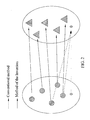
- FIG. 2 is a schematic view of a communication system with a data-dependent superimposed training mechanism in accordance with a preferred embodiment of the present invention
- FIGS. 3 , 4 , 5 and 6 are graphs of simulated results of a communication system with a data-dependent superimposed training mechanism in accordance with a preferred embodiment of the present invention.
- FIG. 7 is a flow chart of a communication method of a communication system with a data-dependent superimposed training mechanism in accordance with the present invention.
- the data-dependent superimposed training system 1 comprises a transmitter 11 and a receiver 12 .
- the transmitter 11 comprises a modulation module 112 and a precoding module 113 .
- the receiver 12 includes a demodulation module 126 .
- the modulation module 112 receives two-bit data 111 to produce modulation data.
- the precoding module 113 uses a precoding matrix 1131 to precode the modulation data to produce precoding data.
- the precoding matrix 1131 must satisfy certain specific conditions to achieve the effect of identifying data correctly by the receiver 12 and reducing the computational complexity.
- the precoding matrix 1131 is a unitary matrix comprised of a Q ⁇ Q matrix and expanded to an N ⁇ N matrix, wherein Q is equal to a block size N diving a channel length, and the precoding matrix distributes the modulation data uniformly on a frequency domain, and any two set of data precoded by the precoding matrix must be different from each other.
- the receiver 11 adds the precoding data to the data-dependent superimposed training sequence 114 to produce superimposition data.
- transmission data are produced and transmitted to the receiver 11 .
- a discrete Fourier transform (DFT) 122 is perform to convert the data into the frequency domain data in order to perform a channel estimation 123 .
- a frequency domain equalization 124 and an inverse discrete Fourier transform (IDFT) 125 are performed to convert the data into time domain data and transmit the time domain data to a demodulation module 126 to execute the demodulation, so as to produce a demodulation signal 127 .
- DFT discrete Fourier transform
- IDFT inverse discrete Fourier transform
- the precoding matrix 1131 of the present invention is a unitary matrix capable of reducing the computational complexity of the receiver 12 significantly.
- the precoding matrix 1131 distributes the modulation data uniformly on a frequency domain to achieve the effect of full frequency diversity. Any two sets of data precoded by the precoding matrix 1131 data must be different from each other, so that the receiver 12 can effectively identify the transmission data, and the receiver 12 will not have any data identification problem.
- the demodulation module 126 of the present invention can restore the data by different demodulation technologies.
- the present invention provides a modulation technology of maximum likelihood detection (ML Detection) to provide an optimal data identification performance of the receiver 12 .
- the precoding matrix distributes the modulation data uniformly on a frequency domain to achieve the effect of full frequency diversity. If the sub-carrier is interfered and cannot be demodulated, data of some portion of other sub-carriers can be recovered, since the data have been distributed uniformly on the frequency domain. Therefore, the precoding matrix satisfies the conditions of the following relation:
- All elements of the precoding matrix E processed by the Fourier transform have equal amplitudes.
- the I-J matrix of the original data-dependent superimposed training system can be represented by:
- I Q and 1 Q are matrices having a size equal to Q, and I Q is a unitary matrix, and 1 Q is a matrix having all elements equal to 1.
- the P DDST is a sub-matrix of the data-dependent superimposed training sequence system.
- E H is a Hermitian matrix of the precoding sub-matrix E
- E ⁇ 1 is an inverse matrix of the precoding sub-matrix E
- G H is a Hermitian matrix of the precoding matrix G
- G ⁇ 1 is a reverse matrix of the precoding matrix G.
- I K is a unit matrix having a size of K, wherein K ⁇ L, and L is a channel length.
- ⁇ is a sub-matrix comprised of a sub-matrix P DDST and a coding sub-matrix E of the data-dependent superimposed training sequence system
- a i,x , a i,y are data sub-blocks with any two length equal to Q ⁇ 1, wherein x ⁇ y.
- the precoding matrix of the present invention can be represented by the following relations:
- ⁇ is a sub-matrix comprised of a sub-matrix P DDST and a coding sub-matrix E of the data-dependent superimposed training sequence system
- D ZC is a diagonal matrix having a perfect sequence of diagonal elements
- F H is an inverse discrete Fourier transform matrix.
- the perfect sequence has the same gain of frequency domain and time domain, and can be a Zadoff-Chu sequence.
- the solid line in the figure represents a corresponding signal of the receiver after the modulation data are processed by the operation of the precoding matrix of the present invention
- the dotted line represents a corresponding signal of the receiver after the modulation data are processed by the operation of the precoding matrix of a conventional data-dependent superimposed training system.
- the method of the present invention can keep each set of sub-groups in 1-to-1 correspondence, so that the receiver can adopt different demodulation systems to restore signals.
- the present invention uses a maximum likelihood detection to demodulate and restore signals, so that the error rate can be reduced significantly.
- FIGS. 3 and 4 show the simulated results of the bit error rate (BER) of various different systems and the system of the present invention provided that different simulated parameters and a binary phase shift keying (BPSK) modulation technology are used, and a single carrier frequency domain equalization (SC-FDE) system is used as a standard for comparison.
- BER bit error rate
- BPSK binary phase shift keying
- SC-FDE single carrier frequency domain equalization
- the precoding matrix G ZC of the present invention uses the data-dependent superimposed training system (DDST) with the iteration successive superimposition detection (ISSD) demodulation technology to provide sufficient performance for the use of the binary phase shift keying modulation technology.
- DDST data-dependent superimposed training system
- ISSD iteration successive superimposition detection
- FIGS. 5 and 6 show that the simulated results of the bit error rate (BER) of various different systems and the system of the present invention provided that different simulated parameters and a quadrature phase shift keying (QPSK) modulation technology are used.
- BER bit error rate
- QPSK quadrature phase shift keying
- FIG. 7 for a flow chart of a communication system with a data-dependent superimposed training mechanism of the present invention.
- S 72 Use a precoding module of the transmitter to precode the modulation data of a precoding matrix to produce precoding data, wherein the precoding matrix is an N ⁇ N unitary matrix and comprised of a Q ⁇ Q precoding sub-matrix, Q is equal to a block size N divided by a channel length, and any two sets of data precoded by the precoding matrix must be different from each other.
- the precoding matrix is an N ⁇ N unitary matrix and comprised of a Q ⁇ Q precoding sub-matrix
- Q is equal to a block size N divided by a channel length, and any two sets of data precoded by the precoding matrix must be different from each other.
- the present invention uses a precoding module installed in front of the data-dependent superimposed training mechanism to precode data by a precoding matrix, and then uses the maximum likelihood detection to demodulate and restore signals, so that the receiver will not have the problem of data misjudgment.
- the precoding matrix of the present invention is a unitary matrix, so that the computational complexity of the receiver can be reduced significantly.
- the present invention improves over the conventional data-dependent superimposed training system to avoid wasting the bandwidth and achieve the best performance of the channel estimation.
Landscapes
- Engineering & Computer Science (AREA)
- Computer Networks & Wireless Communication (AREA)
- Signal Processing (AREA)
- Power Engineering (AREA)
- Digital Transmission Methods That Use Modulated Carrier Waves (AREA)
Abstract
Description
G=(E

(I−J)G=(P DDST E
G H G=GG H =I, G −1 =G H
E H E=EE H =I, E −1 =E H (4)
Θa
Therefore,
(a
Claims (12)
G=(E{circle around (×)}I K)
G=(E{circle around (×)}I K)
Applications Claiming Priority (3)
| Application Number | Priority Date | Filing Date | Title |
|---|---|---|---|
| TW101102751A TWI446770B (en) | 2012-01-20 | 2012-01-20 | Communication system having data-dependent superimposed training mechanism and communication method thereof |
| TW101102751A | 2012-01-20 | ||
| TW101102751 | 2012-01-20 |
Publications (2)
| Publication Number | Publication Date |
|---|---|
| US20130188679A1 US20130188679A1 (en) | 2013-07-25 |
| US8731093B2 true US8731093B2 (en) | 2014-05-20 |
Family
ID=48797169
Family Applications (1)
| Application Number | Title | Priority Date | Filing Date |
|---|---|---|---|
| US13/527,921 Active 2032-08-17 US8731093B2 (en) | 2012-01-20 | 2012-06-20 | Communication system having data-dependent superimposed training mechanism and communication method thereof |
Country Status (2)
| Country | Link |
|---|---|
| US (1) | US8731093B2 (en) |
| TW (1) | TWI446770B (en) |
Families Citing this family (6)
| Publication number | Priority date | Publication date | Assignee | Title |
|---|---|---|---|---|
| JP2013165447A (en) * | 2012-02-13 | 2013-08-22 | Sony Corp | Transmission apparatus, electronic appliance, reception apparatus, and authentication system |
| WO2017007900A1 (en) * | 2015-07-09 | 2017-01-12 | Idac Holdings, Inc. | Tail cancelation and addition of unique word for orthogonal frequency division multiplexing |
| US9544173B1 (en) * | 2015-09-15 | 2017-01-10 | Nokia Solutions And Networks Oy | Iterative normalization technique for reference sequence generation for zero-tail discrete fourier transform spread orthogonal frequency division multiplexing |
| US10237103B2 (en) * | 2015-11-24 | 2019-03-19 | Qualcom Incorporated | Changing cyclic prefix (CP) length based on precoder mode selection |
| TWI624166B (en) * | 2017-01-25 | 2018-05-11 | 國立清華大學 | Multicarrier communication system and channel estimation method thereof |
| CN112688772B (en) * | 2020-12-17 | 2022-08-26 | 西华大学 | Machine learning superimposed training sequence frame synchronization method |
Citations (3)
| Publication number | Priority date | Publication date | Assignee | Title |
|---|---|---|---|---|
| US20080232449A1 (en) * | 2007-03-21 | 2008-09-25 | Farooq Khan | Efficient uplink feedback in a wireless communication system |
| US20100118989A1 (en) * | 2008-11-10 | 2010-05-13 | Motorola, Inc. | Employing cell-specific and user entity-specific reference symbols in an orthogonal frequency-division multiple access |
| US20130094344A1 (en) * | 2007-06-08 | 2013-04-18 | Samsung Electronics Co., Ltd. | Cdd precoding for open loop su mimo |
-
2012
- 2012-01-20 TW TW101102751A patent/TWI446770B/en active
- 2012-06-20 US US13/527,921 patent/US8731093B2/en active Active
Patent Citations (3)
| Publication number | Priority date | Publication date | Assignee | Title |
|---|---|---|---|---|
| US20080232449A1 (en) * | 2007-03-21 | 2008-09-25 | Farooq Khan | Efficient uplink feedback in a wireless communication system |
| US20130094344A1 (en) * | 2007-06-08 | 2013-04-18 | Samsung Electronics Co., Ltd. | Cdd precoding for open loop su mimo |
| US20100118989A1 (en) * | 2008-11-10 | 2010-05-13 | Motorola, Inc. | Employing cell-specific and user entity-specific reference symbols in an orthogonal frequency-division multiple access |
Non-Patent Citations (2)
| Title |
|---|
| Mounir Ghogho et al., Full-Rank and Rank-Deficient Precoding Schemes for Single-Carrier Block Transmissions, IEEE, Nov. 2009, pp. 44332-4442, vol. 57, No. 11. |
| T.Whitworth et al., Data Identifiability for Data-Dependent Superimposed Training, IEEE, 2007, pp. 2545-2550. |
Also Published As
| Publication number | Publication date |
|---|---|
| TWI446770B (en) | 2014-07-21 |
| US20130188679A1 (en) | 2013-07-25 |
| TW201332323A (en) | 2013-08-01 |
Similar Documents
| Publication | Publication Date | Title |
|---|---|---|
| US11558231B2 (en) | Methods and systems for generating a low peak-to-average power ratio (PAPR) data and reference signal | |
| EP3433969B1 (en) | Receiver-side processing of orthogonal time frequency space modulated signals | |
| US8416874B2 (en) | Method of operating a block transmission based communication apparatus | |
| CN101471912B (en) | Transmitting device, transmitting/receiving device, transmitting method and transmitting/receiving method | |
| KR100913874B1 (en) | Interference Cancellation Method between Subchannels in Orthogonal Frequency Division Multiplexing System | |
| US8625508B2 (en) | Apparatus and method for transmitting data using multiple antenna for single carrier frequency division multiple access system | |
| US20130188679A1 (en) | Communication system having data-dependent superimposed training mechanisim and communication method thereof | |
| Bolcskei et al. | A subspace-based approach to blind channel identification in pulse shaping OFDM/OQAM systems | |
| WO2009081820A1 (en) | Radio communication system, reception device, and reception method | |
| US10484226B2 (en) | OFDM communication system with enhanced channel estimation and data detection techniques | |
| US20170359204A1 (en) | Method and apparatus for controlling interference in qam-fbmc system | |
| US12556439B2 (en) | Method and apparatus for pre DFT RS and data multiplexed DFT-S-OFDM with excess bandwidth shaping | |
| WO2010146774A1 (en) | Wireless communication apparatus, wireless communication system and communication method | |
| US9787356B2 (en) | System and method for large dimension equalization using small dimension equalizers | |
| WO2022258193A1 (en) | Generation and reception of precoded signals based on codebook linearization | |
| JP2019501594A (en) | Wireless data communication based on discrete cosine transform | |
| JP5770558B2 (en) | Receiving device, program, and integrated circuit | |
| CN101321040B (en) | Transmitter, data transmission method and receiver, data receiving method | |
| CN106302279A (en) | FBMC system equalization method based on interference variance statistics | |
| EP4094411A1 (en) | Receiver devices and methods for multicarrier modulation schemes | |
| US20250038878A1 (en) | Spatial modulation-based orthogonal signal division multiplexing communications | |
| KR101225649B1 (en) | Apparatus and method for channel estimation in multiple antenna communication system | |
| KR101541679B1 (en) | Method and Device for Demodulating Signal in Receiving device of FBMC System | |
| JP2018532339A (en) | Multi-carrier modulation apparatus, multi-carrier demodulation apparatus, method and system | |
| Miyazaki et al. | Pseudo Block Coded Single-Carrier Frequency-Domain Equalization Transmission |
Legal Events
| Date | Code | Title | Description |
|---|---|---|---|
| AS | Assignment |
Owner name: NATIONAL TSING HUA UNIVERSITY, TAIWAN Free format text: ASSIGNMENT OF ASSIGNORS INTEREST;ASSIGNORS:LI, CHIH-PENG;CHAN, KUEI-CHENG;LIN, YU-SING;AND OTHERS;REEL/FRAME:028410/0329 Effective date: 20120413 |
|
| STCF | Information on status: patent grant |
Free format text: PATENTED CASE |
|
| FPAY | Fee payment |
Year of fee payment: 4 |
|
| MAFP | Maintenance fee payment |
Free format text: PAYMENT OF MAINTENANCE FEE, 8TH YR, SMALL ENTITY (ORIGINAL EVENT CODE: M2552); ENTITY STATUS OF PATENT OWNER: SMALL ENTITY Year of fee payment: 8 |
|
| MAFP | Maintenance fee payment |
Free format text: PAYMENT OF MAINTENANCE FEE, 12TH YR, SMALL ENTITY (ORIGINAL EVENT CODE: M2553); ENTITY STATUS OF PATENT OWNER: SMALL ENTITY Year of fee payment: 12 |