US8729303B2 - 2,2′,6,6′-tetrasubstituted aminophosphine ligand and its synthesis method - Google Patents
2,2′,6,6′-tetrasubstituted aminophosphine ligand and its synthesis method Download PDFInfo
- Publication number
- US8729303B2 US8729303B2 US12/377,000 US37700007A US8729303B2 US 8729303 B2 US8729303 B2 US 8729303B2 US 37700007 A US37700007 A US 37700007A US 8729303 B2 US8729303 B2 US 8729303B2
- Authority
- US
- United States
- Prior art keywords
- tetrasubstituted
- ligand
- tetraminobiphenyl
- aminophosphine ligand
- aminophosphine
- Prior art date
- Legal status (The legal status is an assumption and is not a legal conclusion. Google has not performed a legal analysis and makes no representation as to the accuracy of the status listed.)
- Expired - Fee Related, expires
Links
- 239000003446 ligand Substances 0.000 title claims abstract description 38
- XQJHRCVXRAJIDY-UHFFFAOYSA-N aminophosphine Chemical class PN XQJHRCVXRAJIDY-UHFFFAOYSA-N 0.000 title claims abstract description 21
- 238000001308 synthesis method Methods 0.000 title abstract description 7
- RDUDUBCQBNLONK-UHFFFAOYSA-N 2-(2,6-diaminophenyl)benzene-1,3-diamine Chemical group NC1=CC=CC(N)=C1C1=C(N)C=CC=C1N RDUDUBCQBNLONK-UHFFFAOYSA-N 0.000 claims abstract description 15
- KDLHZDBZIXYQEI-UHFFFAOYSA-N Palladium Chemical compound [Pd] KDLHZDBZIXYQEI-UHFFFAOYSA-N 0.000 claims abstract description 15
- -1 phosphine halide Chemical class 0.000 claims abstract description 15
- FBVPTHLEHALHAX-UHFFFAOYSA-N 2-(2,6-dinitrophenyl)-1,3-dinitrobenzene Chemical group [O-][N+](=O)C1=CC=CC([N+]([O-])=O)=C1C1=C([N+]([O-])=O)C=CC=C1[N+]([O-])=O FBVPTHLEHALHAX-UHFFFAOYSA-N 0.000 claims abstract description 11
- XYFCBTPGUUZFHI-UHFFFAOYSA-N Phosphine Natural products P XYFCBTPGUUZFHI-UHFFFAOYSA-N 0.000 claims abstract description 9
- 229910000073 phosphorus hydride Inorganic materials 0.000 claims abstract description 9
- BPPMIQPXQVIZNJ-UHFFFAOYSA-N 2-chloro-1,3-dinitrobenzene Chemical compound [O-][N+](=O)C1=CC=CC([N+]([O-])=O)=C1Cl BPPMIQPXQVIZNJ-UHFFFAOYSA-N 0.000 claims abstract description 6
- 239000003054 catalyst Substances 0.000 claims abstract description 6
- 230000008878 coupling Effects 0.000 claims abstract description 3
- 238000010168 coupling process Methods 0.000 claims abstract description 3
- 238000005859 coupling reaction Methods 0.000 claims abstract description 3
- 239000007858 starting material Substances 0.000 claims abstract description 3
- 238000000034 method Methods 0.000 claims description 10
- 230000002194 synthesizing effect Effects 0.000 claims description 7
- RYGMFSIKBFXOCR-UHFFFAOYSA-N Copper Chemical compound [Cu] RYGMFSIKBFXOCR-UHFFFAOYSA-N 0.000 claims description 5
- 125000005843 halogen group Chemical group 0.000 claims description 5
- UFHFLCQGNIYNRP-UHFFFAOYSA-N Hydrogen Chemical compound [H][H] UFHFLCQGNIYNRP-UHFFFAOYSA-N 0.000 claims description 3
- 125000003710 aryl alkyl group Chemical group 0.000 claims description 3
- 125000003118 aryl group Chemical group 0.000 claims description 3
- 125000001997 phenyl group Chemical group [H]C1=C([H])C([H])=C(*)C([H])=C1[H] 0.000 claims description 3
- 238000003746 solid phase reaction Methods 0.000 claims description 2
- 229910052739 hydrogen Inorganic materials 0.000 claims 1
- 239000001257 hydrogen Substances 0.000 claims 1
- 238000006243 chemical reaction Methods 0.000 abstract description 14
- 238000002360 preparation method Methods 0.000 abstract description 7
- 229910052751 metal Inorganic materials 0.000 abstract description 5
- 239000002184 metal Substances 0.000 abstract description 5
- 150000001875 compounds Chemical class 0.000 abstract description 4
- 150000002739 metals Chemical class 0.000 abstract description 4
- 230000009257 reactivity Effects 0.000 abstract description 4
- XEKOWRVHYACXOJ-UHFFFAOYSA-N Ethyl acetate Chemical compound CCOC(C)=O XEKOWRVHYACXOJ-UHFFFAOYSA-N 0.000 description 21
- RTZKZFJDLAIYFH-UHFFFAOYSA-N Diethyl ether Chemical compound CCOCC RTZKZFJDLAIYFH-UHFFFAOYSA-N 0.000 description 10
- YMWUJEATGCHHMB-UHFFFAOYSA-N Dichloromethane Chemical compound ClCCl YMWUJEATGCHHMB-UHFFFAOYSA-N 0.000 description 6
- OKKJLVBELUTLKV-UHFFFAOYSA-N Methanol Chemical compound OC OKKJLVBELUTLKV-UHFFFAOYSA-N 0.000 description 6
- WYURNTSHIVDZCO-UHFFFAOYSA-N Tetrahydrofuran Chemical compound C1CCOC1 WYURNTSHIVDZCO-UHFFFAOYSA-N 0.000 description 6
- HEDRZPFGACZZDS-MICDWDOJSA-N Trichloro(2H)methane Chemical compound [2H]C(Cl)(Cl)Cl HEDRZPFGACZZDS-MICDWDOJSA-N 0.000 description 6
- ZMANZCXQSJIPKH-UHFFFAOYSA-N Triethylamine Chemical compound CCN(CC)CC ZMANZCXQSJIPKH-UHFFFAOYSA-N 0.000 description 6
- 239000000203 mixture Substances 0.000 description 6
- 239000000243 solution Substances 0.000 description 5
- CSCPPACGZOOCGX-UHFFFAOYSA-N Acetone Chemical compound CC(C)=O CSCPPACGZOOCGX-UHFFFAOYSA-N 0.000 description 4
- MZRVEZGGRBJDDB-UHFFFAOYSA-N N-Butyllithium Chemical compound [Li]CCCC MZRVEZGGRBJDDB-UHFFFAOYSA-N 0.000 description 4
- 238000006555 catalytic reaction Methods 0.000 description 4
- ZUOUZKKEUPVFJK-UHFFFAOYSA-N diphenyl Chemical compound C1=CC=CC=C1C1=CC=CC=C1 ZUOUZKKEUPVFJK-UHFFFAOYSA-N 0.000 description 4
- 239000003208 petroleum Substances 0.000 description 4
- 239000000047 product Substances 0.000 description 4
- 238000005160 1H NMR spectroscopy Methods 0.000 description 3
- IJGRMHOSHXDMSA-UHFFFAOYSA-N Atomic nitrogen Chemical compound N#N IJGRMHOSHXDMSA-UHFFFAOYSA-N 0.000 description 3
- APHCWWQRFOQDBK-UHFFFAOYSA-N CC1=CC=CC(C)=C1C1=C(C)C=CC=C1C Chemical compound CC1=CC=CC(C)=C1C1=C(C)C=CC=C1C APHCWWQRFOQDBK-UHFFFAOYSA-N 0.000 description 3
- 230000003197 catalytic effect Effects 0.000 description 3
- 229910001873 dinitrogen Inorganic materials 0.000 description 3
- 239000011259 mixed solution Substances 0.000 description 3
- 239000002244 precipitate Substances 0.000 description 3
- 239000007787 solid Substances 0.000 description 3
- 238000003756 stirring Methods 0.000 description 3
- YLQBMQCUIZJEEH-UHFFFAOYSA-N tetrahydrofuran Natural products C=1C=COC=1 YLQBMQCUIZJEEH-UHFFFAOYSA-N 0.000 description 3
- ZCYVEMRRCGMTRW-UHFFFAOYSA-N 7553-56-2 Chemical compound [I] ZCYVEMRRCGMTRW-UHFFFAOYSA-N 0.000 description 2
- VEXZGXHMUGYJMC-UHFFFAOYSA-N Hydrochloric acid Chemical compound Cl VEXZGXHMUGYJMC-UHFFFAOYSA-N 0.000 description 2
- ZDZHCHYQNPQSGG-UHFFFAOYSA-N binaphthyl group Chemical group C1(=CC=CC2=CC=CC=C12)C1=CC=CC2=CC=CC=C12 ZDZHCHYQNPQSGG-UHFFFAOYSA-N 0.000 description 2
- 235000010290 biphenyl Nutrition 0.000 description 2
- 239000004305 biphenyl Substances 0.000 description 2
- 229910052801 chlorine Inorganic materials 0.000 description 2
- XGRJZXREYAXTGV-UHFFFAOYSA-N chlorodiphenylphosphine Chemical compound C=1C=CC=CC=1P(Cl)C1=CC=CC=C1 XGRJZXREYAXTGV-UHFFFAOYSA-N 0.000 description 2
- 238000004440 column chromatography Methods 0.000 description 2
- 239000013078 crystal Substances 0.000 description 2
- 239000003480 eluent Substances 0.000 description 2
- 239000000706 filtrate Substances 0.000 description 2
- 238000005984 hydrogenation reaction Methods 0.000 description 2
- 229910052740 iodine Inorganic materials 0.000 description 2
- 239000011630 iodine Substances 0.000 description 2
- 238000002844 melting Methods 0.000 description 2
- 230000008018 melting Effects 0.000 description 2
- VLKZOEOYAKHREP-UHFFFAOYSA-N n-Hexane Chemical compound CCCCCC VLKZOEOYAKHREP-UHFFFAOYSA-N 0.000 description 2
- 239000011369 resultant mixture Substances 0.000 description 2
- 239000000758 substrate Substances 0.000 description 2
- VZSRBBMJRBPUNF-UHFFFAOYSA-N 2-(2,3-dihydro-1H-inden-2-ylamino)-N-[3-oxo-3-(2,4,6,7-tetrahydrotriazolo[4,5-c]pyridin-5-yl)propyl]pyrimidine-5-carboxamide Chemical compound C1C(CC2=CC=CC=C12)NC1=NC=C(C=N1)C(=O)NCCC(N1CC2=C(CC1)NN=N2)=O VZSRBBMJRBPUNF-UHFFFAOYSA-N 0.000 description 1
- 125000000094 2-phenylethyl group Chemical group [H]C1=C([H])C([H])=C(C([H])=C1[H])C([H])([H])C([H])([H])* 0.000 description 1
- WKBOTKDWSSQWDR-UHFFFAOYSA-N Bromine atom Chemical compound [Br] WKBOTKDWSSQWDR-UHFFFAOYSA-N 0.000 description 1
- FWRUDRUFTFVWGE-UHFFFAOYSA-N CC1=CC=CC(C)=C1C1=C(C)C=CC=C1C.NC1=CC=CC(N)=C1C1=C(N)C=CC=C1N.O=[N+]([O-])C1=CC=CC([N+](=O)[O-])=C1C1=C([N+](=O)[O-])C=CC=C1[N+](=O)[O-].O=[N+]([O-])C1=CC=CC([N+](=O)[O-])=C1Cl.[Cu].[HH] Chemical compound CC1=CC=CC(C)=C1C1=C(C)C=CC=C1C.NC1=CC=CC(N)=C1C1=C(N)C=CC=C1N.O=[N+]([O-])C1=CC=CC([N+](=O)[O-])=C1C1=C([N+](=O)[O-])C=CC=C1[N+](=O)[O-].O=[N+]([O-])C1=CC=CC([N+](=O)[O-])=C1Cl.[Cu].[HH] FWRUDRUFTFVWGE-UHFFFAOYSA-N 0.000 description 1
- ZAMOUSCENKQFHK-UHFFFAOYSA-N Chlorine atom Chemical compound [Cl] ZAMOUSCENKQFHK-UHFFFAOYSA-N 0.000 description 1
- PMZURENOXWZQFD-UHFFFAOYSA-L Sodium Sulfate Chemical compound [Na+].[Na+].[O-]S([O-])(=O)=O PMZURENOXWZQFD-UHFFFAOYSA-L 0.000 description 1
- 125000005073 adamantyl group Chemical group C12(CC3CC(CC(C1)C3)C2)* 0.000 description 1
- 150000001336 alkenes Chemical class 0.000 description 1
- 238000009876 asymmetric hydrogenation reaction Methods 0.000 description 1
- 230000009286 beneficial effect Effects 0.000 description 1
- 125000001797 benzyl group Chemical group [H]C1=C([H])C([H])=C(C([H])=C1[H])C([H])([H])* 0.000 description 1
- MUALRAIOVNYAIW-UHFFFAOYSA-N binap Chemical compound C1=CC=CC=C1P(C=1C(=C2C=CC=CC2=CC=1)C=1C2=CC=CC=C2C=CC=1P(C=1C=CC=CC=1)C=1C=CC=CC=1)C1=CC=CC=C1 MUALRAIOVNYAIW-UHFFFAOYSA-N 0.000 description 1
- 230000015572 biosynthetic process Effects 0.000 description 1
- GDTBXPJZTBHREO-UHFFFAOYSA-N bromine Substances BrBr GDTBXPJZTBHREO-UHFFFAOYSA-N 0.000 description 1
- 229910052794 bromium Inorganic materials 0.000 description 1
- 239000003153 chemical reaction reagent Substances 0.000 description 1
- 239000000460 chlorine Substances 0.000 description 1
- 125000001309 chloro group Chemical group Cl* 0.000 description 1
- 125000006165 cyclic alkyl group Chemical group 0.000 description 1
- 238000006352 cycloaddition reaction Methods 0.000 description 1
- 125000000113 cyclohexyl group Chemical group [H]C1([H])C([H])([H])C([H])([H])C([H])(*)C([H])([H])C1([H])[H] 0.000 description 1
- 125000001511 cyclopentyl group Chemical group [H]C1([H])C([H])([H])C([H])([H])C([H])(*)C1([H])[H] 0.000 description 1
- 238000005888 cyclopropanation reaction Methods 0.000 description 1
- 239000003814 drug Substances 0.000 description 1
- 229940079593 drug Drugs 0.000 description 1
- 125000001495 ethyl group Chemical group [H]C([H])([H])C([H])([H])* 0.000 description 1
- 238000001914 filtration Methods 0.000 description 1
- 230000006698 induction Effects 0.000 description 1
- 125000000959 isobutyl group Chemical group [H]C([H])([H])C([H])(C([H])([H])[H])C([H])([H])* 0.000 description 1
- 125000004491 isohexyl group Chemical group C(CCC(C)C)* 0.000 description 1
- 150000002576 ketones Chemical class 0.000 description 1
- 238000004519 manufacturing process Methods 0.000 description 1
- 125000002496 methyl group Chemical group [H]C([H])([H])* 0.000 description 1
- 125000003136 n-heptyl group Chemical group [H]C([H])([H])C([H])([H])C([H])([H])C([H])([H])C([H])([H])C([H])([H])C([H])([H])* 0.000 description 1
- 125000001280 n-hexyl group Chemical group C(CCCCC)* 0.000 description 1
- 125000004123 n-propyl group Chemical group [H]C([H])([H])C([H])([H])C([H])([H])* 0.000 description 1
- 125000001624 naphthyl group Chemical group 0.000 description 1
- 125000002524 organometallic group Chemical group 0.000 description 1
- 238000007254 oxidation reaction Methods 0.000 description 1
- 238000002203 pretreatment Methods 0.000 description 1
- 238000007363 ring formation reaction Methods 0.000 description 1
- 239000002904 solvent Substances 0.000 description 1
- 239000000126 substance Substances 0.000 description 1
- 238000003786 synthesis reaction Methods 0.000 description 1
- 125000000999 tert-butyl group Chemical group [H]C([H])([H])C(*)(C([H])([H])[H])C([H])([H])[H] 0.000 description 1
- 125000003944 tolyl group Chemical group 0.000 description 1
- 230000007704 transition Effects 0.000 description 1
- 229910052723 transition metal Inorganic materials 0.000 description 1
- 150000003624 transition metals Chemical class 0.000 description 1
- XLYOFNOQVPJJNP-UHFFFAOYSA-N water Substances O XLYOFNOQVPJJNP-UHFFFAOYSA-N 0.000 description 1
- 125000005023 xylyl group Chemical group 0.000 description 1
Classifications
-
- C—CHEMISTRY; METALLURGY
- C07—ORGANIC CHEMISTRY
- C07F—ACYCLIC, CARBOCYCLIC OR HETEROCYCLIC COMPOUNDS CONTAINING ELEMENTS OTHER THAN CARBON, HYDROGEN, HALOGEN, OXYGEN, NITROGEN, SULFUR, SELENIUM OR TELLURIUM
- C07F9/00—Compounds containing elements of Groups 5 or 15 of the Periodic Table
- C07F9/02—Phosphorus compounds
- C07F9/28—Phosphorus compounds with one or more P—C bonds
- C07F9/46—Phosphinous acids [R2POH], [R2P(= O)H]: Thiophosphinous acids including[R2PSH]; [R2P(=S)H]; Aminophosphines [R2PNH2]; Derivatives thereof
Definitions
- the present invention relates to an achiral ligand and its synthesis method, more specifically, to a 2,2′,6,6′-tetrasubstituted aminophosphine ligand used in asymmetric catalytic reaction and its synthesis method.
- Asymmetric catalysis is a good way to obtain chiral drugs of single enantiomer. It is capable of generating large amount of chiral compounds using small amount of catalysts, eliminating or even avoiding the production of ineffective compounds, which is not only environmentally beneficial, but also capable of achieving good atomic economy and avoiding complicated racemic resolution.
- bimetallic ligands as a new backbone of organometallics, may function through the coordination of two metals so as to afford excellent chemical selectivity and enantioselectivity for many reactions. Therefore, the development of bimetallic ligands having axial chirality has become a major research focus in both academic and industrial field.
- the object of the present invention is to provide a 2,2′,6,6′-tetrasubstituted aminophosphine ligand and its synthesis method.
- the ligand may be used in various asymmetric reactions catalyzed by metals with high reactivity and stereoselectivity.
- This kind of ligand differs from the other bimetallic ligands in that this ligand is an achiral compound itself, and is readily to be prepared. Moreover, it may eventually generate a chiral bimetallic catalyst with a single configuration through introduction of external chirality.
- the present invention is preformed through the following technical solution.
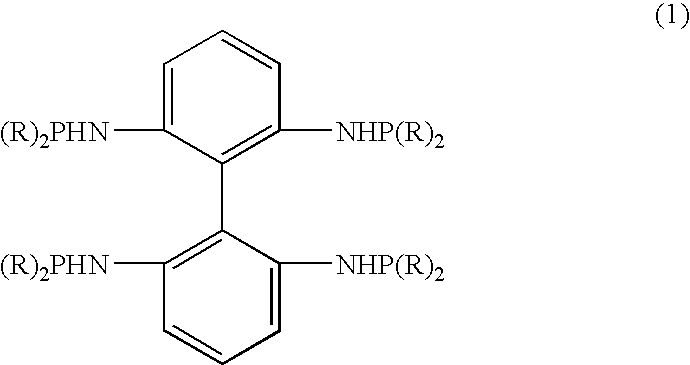
- the 2,2′,6,6′-tetrasubstituted aminophosphine ligand of the present invention has the following formula (1) as shown below.
- R represents a linear, branched or cyclic alkyl, aryl, or aralkyl group.
- the linear, branched or cyclic alkyl group described above, having preferably 1-18 carbons, may be exemplified as, specifically, methyl, ethyl, n-propyl, isobutyl, t-butyl, n-hexyl, isohexyl, n-heptyl, n-octyl, isooctyl, n-dodecyl, isododecyl, n-octadecyl, isooctadecyl, cyclopentyl, cyclohexyl, adamantyl and the like.
- the aryl group may be exemplified as phenyl, tolyl, xylyl, naphthyl and the like, and the aralkyl group may be exemplified as benzyl, phenethyl and the like.
- the R in the formula is preferably a phenyl group.
- the present invention also provides a method for synthesizing the 2,2′,6,6′-tetrasubstituted aminophosphine ligand described above.
- the synthesis method of the present invention is characterized by reacting 2,2′,6,6′-tetraminobiphenyl with a phosphine halide as shown by the formula of (R) 2 PX (wherein, R is defined as above, and X is a halogen atom), to produce the 2,2′,6,6′-tetrasubstituted aminophosphine ligand.
- the R in the formula of the phosphine halide describe above is equivalent to the R group in the formula of the 2,2′,6,6′-tetrasubstituted aminophosphine ligand as shown by the formula (1) above.
- the X in the formula of the phosphine halide described above represents a halogen atom, such as, chlorine, bromine, iodine and the like, wherein the chlorine atom is preferred.
- the method for synthesizing the 2,2′,6,6′-tetrasubstituted aminophosphine ligand of the present invention preferably comprises the following steps 1-3:
- Step 1 coupling 2,6-dinitrochlorobenzene as the starting material, to obtain the 2,2′,6,6′-tetranitrobiphenyl;
- Step 2 hydrogenating the 2,2′,6,6′-tetranitrobiphenyl with Pd/C, to obtain a 2,2′,6,6′-tetraminobiphenyl;
- Step 3 reacting the 2,2′,6,6′-tetraminobiphenyl with a phosphine halide as shown by the formula of (R) 2 PX (wherein, R is defined as above, and X is a halogen atom), to produce the 2,2′,6,6′-tetrasubstituted aminophosphine ligand.
- R is defined as above, and X is a halogen atom
- Step 1 The reaction of Step 1 is specifically performed as follows.
- One equivalence of 2,6-dinitrochlorobenzene is mixed with 2-4 equivalences, and preferably 3 equivalences, of copper powder through solid phase reaction process.
- the resulting mixture is vigorously stirred to react at the temperature of 150-250° C., and preferably at the temperature of 180° C.
- the mixture is washed with, for example, ethyl acetate, and then filtered to remove the precipitate.
- the filtrate is concentrated, and is recrystallized from, for example, a mixed solution of ethyl acetate and petroleum ether.
- the reaction of Step 2 is specifically performed as follows.
- the Pd/C of 5-15%, and preferably 10%, relative to the mass of the substrate, is added as the catalyst to the 2,2′,6,6′-tetranitrobiphenyl.
- the hydrogen gas of 5-20 atm, and preferably 10 atm, is added to the autoclave.
- the solid is filtered off, and the filtrate is concentrated, to afford the 2,2′,6,6′-tetraminobiphenyl.
- Step 3 The reaction of Step 3 is specifically performed as follows.
- the 3-7 equivalences, and preferably 5 equivalences, of phosphine halide as described above is added into 1 equivalence of 2,2′,6,6′-tetraminobiphenyl using, for example, dichloromethane or tetrahydrofuran as the solvent, and triethylamine or butyl lithium as the base.
- the mixture is reacted to afford the 2,2′,6,6′-tetrasubstituted aminophosphine ligand.
- the 2,2′,6,6′-tetrasubstituted aminophosphine ligand of the present invention has four coordination centers.
- This kind of ligand may be applied to various asymmetric reactions catalyzed by metals, such as, asymmetric hydrogenation of ketone, asymmetric cyclopropanation reaction, intramolecular Wacker-Type cyclization reaction, asymmetric oxidation reaction of alkene and intramolecular [2+1] cycloaddition reaction and the like, with high reactivity and stereoselectivity, which shows great potential in future applications.
- the 2,2′,6,6′-tetranitrobiphenyl (1.00 g, 3 mmol) and 100 mg 10% Pd/C were added into a 100 mL hydrogenation flask. Subsequently, 20 mL of methanol is added, and the resultant mixture was bubbled with nitrogen gas. The hydrogenation flask was placed in an autoclave, and was added 10 atm of hydrogen gas. After 6 hours, the reaction is completed. The resultant was filtered to remove Pd/C, and was rotary evaporated to remove the methanol. The residue was extracted with ethyl acetate and water, dried over anhydrous sodium sulfate, filtered, and votary evaporated, to afford the product in a yield of 88%.
- the 2,2′,6,6′-tetraminobiphenyl (107.90 mg, 0.5 mmol) was dissolved in 10 mL of dichloromethane.
- the resultant solution was added triethylamine (0.56 mL, 4 mmol) and diphenylphosphinochloride (0.45 mL, 2.5 mmol) consecutively by dropping.
- the mixture was refluxed at stirring at 50° C. for 24 hours.
- the resultant solution was cooled, concentrated, and added with 5 mL of anhydrous diethyl ether.
- the precipitate was filtered, and was washed with 5 mL of anhydrous diethyl ether.
- the 2,2′,6,6′-tetraminobiphenyl (107.90 mg, 0.5 mmol) was dissolved in 10 mL of tetrahydrofuran.
- the reaction was cooled to ⁇ 30° C., into which a solution of n-butyl lithium (2.57 M, 0.78 mL) in n-hexane is added.
- the diphenylphosphinochloride (0.45 mL, 2.5 mmol) was added by dropping.
- the temperature was increased to 25° C., and the reaction was stirred for a further five hours.
- the precipitate was filtered off, and the tetrahydrofuran was evaporated.
Landscapes
- Chemical & Material Sciences (AREA)
- Organic Chemistry (AREA)
- Health & Medical Sciences (AREA)
- Life Sciences & Earth Sciences (AREA)
- Biochemistry (AREA)
- General Health & Medical Sciences (AREA)
- Molecular Biology (AREA)
- Organic Low-Molecular-Weight Compounds And Preparation Thereof (AREA)
Abstract

Description


Claims (7)
Applications Claiming Priority (4)
| Application Number | Priority Date | Filing Date | Title |
|---|---|---|---|
| CN200610029881 | 2006-08-10 | ||
| CN200610029881.5 | 2006-08-10 | ||
| CNB2006100298815A CN100415755C (en) | 2006-08-10 | 2006-08-10 | 2,2',6,6'-tetrasubstituted nitrogen phosphine ligand and its synthesis method |
| PCT/CN2007/002407 WO2008019598A1 (en) | 2006-08-10 | 2007-08-10 | 2,2',6,6'-tetrasubstituted aminophosphine ligand and its synthesis method |
Publications (2)
| Publication Number | Publication Date |
|---|---|
| US20100217040A1 US20100217040A1 (en) | 2010-08-26 |
| US8729303B2 true US8729303B2 (en) | 2014-05-20 |
Family
ID=37721018
Family Applications (1)
| Application Number | Title | Priority Date | Filing Date |
|---|---|---|---|
| US12/377,000 Expired - Fee Related US8729303B2 (en) | 2006-08-10 | 2007-08-10 | 2,2′,6,6′-tetrasubstituted aminophosphine ligand and its synthesis method |
Country Status (4)
| Country | Link |
|---|---|
| US (1) | US8729303B2 (en) |
| JP (1) | JP5208939B2 (en) |
| CN (2) | CN100415755C (en) |
| WO (1) | WO2008019598A1 (en) |
Families Citing this family (3)
| Publication number | Priority date | Publication date | Assignee | Title |
|---|---|---|---|---|
| CN100415755C (en) * | 2006-08-10 | 2008-09-03 | 上海交通大学 | 2,2',6,6'-tetrasubstituted nitrogen phosphine ligand and its synthesis method |
| CN101648977B (en) * | 2009-09-10 | 2013-04-24 | 上海交通大学 | 2,2',6,6'site connected 1,1'-diphenyl axially chiral bi-phosphoramide and phosphorous acid ester ligand and preparation method thereof |
| CN113651855B (en) * | 2021-08-19 | 2023-08-22 | 东北师范大学 | Novel crystalline porous framework material, and preparation method and application thereof |
Citations (3)
| Publication number | Priority date | Publication date | Assignee | Title |
|---|---|---|---|---|
| US5919981A (en) | 1997-12-10 | 1999-07-06 | The Hong Kong Polytechnic University | Chiral aminophosphines |
| US20020128501A1 (en) | 2000-11-17 | 2002-09-12 | The Penn State Research Foundation | Ortho substituted chiral phosphines and phosphinites and their use in asymmetric catalytic reactions |
| CN1911940A (en) | 2006-08-10 | 2007-02-14 | 上海交通大学 | 2,2',6,6'-tetra substituted nitrogen phosphine ligand and its synthesis method |
Family Cites Families (1)
| Publication number | Priority date | Publication date | Assignee | Title |
|---|---|---|---|---|
| CN100349880C (en) * | 2005-12-29 | 2007-11-21 | 上海交通大学 | 2,2', 6,6'-tetraoxazoline diphenyl ligancy and preparation process thereof |
-
2006
- 2006-08-10 CN CNB2006100298815A patent/CN100415755C/en not_active Expired - Fee Related
-
2007
- 2007-08-10 WO PCT/CN2007/002407 patent/WO2008019598A1/en not_active Ceased
- 2007-08-10 JP JP2009523140A patent/JP5208939B2/en not_active Expired - Fee Related
- 2007-08-10 CN CNA2007800297834A patent/CN101528757A/en active Pending
- 2007-08-10 US US12/377,000 patent/US8729303B2/en not_active Expired - Fee Related
Patent Citations (5)
| Publication number | Priority date | Publication date | Assignee | Title |
|---|---|---|---|---|
| US5919981A (en) | 1997-12-10 | 1999-07-06 | The Hong Kong Polytechnic University | Chiral aminophosphines |
| US20020128501A1 (en) | 2000-11-17 | 2002-09-12 | The Penn State Research Foundation | Ortho substituted chiral phosphines and phosphinites and their use in asymmetric catalytic reactions |
| JP2004513950A (en) | 2000-11-17 | 2004-05-13 | ザ ペン ステイト リサーチ ファンデーション | Ortho-substituted chiral phosphines and phosphinite and their use in asymmetric catalysis |
| CN1911940A (en) | 2006-08-10 | 2007-02-14 | 上海交通大学 | 2,2',6,6'-tetra substituted nitrogen phosphine ligand and its synthesis method |
| US20100217040A1 (en) | 2006-08-10 | 2010-08-26 | Shanghai Jiaotong University | 2, 2', 6, 6'- tetrasubstituted aminophosphine ligand and its synthesis method |
Non-Patent Citations (2)
| Title |
|---|
| International Search Report of PCT/CN2007/002407, Mailing Date of Nov. 1, 2007. |
| Japanese Office Action dated Nov. 6, 2012, issued in corresponding Japanese Patent Application No. 2009-523140, (4 pages). With English Translation. |
Also Published As
| Publication number | Publication date |
|---|---|
| CN1911940A (en) | 2007-02-14 |
| JP2010500295A (en) | 2010-01-07 |
| CN100415755C (en) | 2008-09-03 |
| US20100217040A1 (en) | 2010-08-26 |
| WO2008019598A1 (en) | 2008-02-21 |
| JP5208939B2 (en) | 2013-06-12 |
| CN101528757A (en) | 2009-09-09 |
Similar Documents
| Publication | Publication Date | Title |
|---|---|---|
| Kurihara et al. | An N‐Linked Bidentate Phosphoramidite Ligand (N‐Me‐BIPAM) for Rhodium‐Catalyzed Asymmetric Addition of Arylboronic Acids to N‐Sulfonylarylaldimines | |
| JP2004505091A (en) | Phosphane ligands having an adamantyl group, their preparation and their use in catalytic reactions | |
| CN101671365A (en) | Chiral spiro aminophosphine ligand compound and synthesis method as well as application thereof | |
| Jiang et al. | Asymmetric transfer hydrogenation catalysed by hydrophobic dendritic DACH–rhodium complex in water | |
| EP2275429A2 (en) | Method for producing a ruthenium complex | |
| JP3566955B2 (en) | Novel ruthenium complex and method for producing alcohol compound using the same as catalyst | |
| KR101807773B1 (en) | Method for producing alcohol and/or amine from amide compound | |
| JP2011503221A (en) | Bidentate chiral ligands used in catalytic asymmetric addition reactions | |
| JP5454756B2 (en) | Diphosphine compounds, transition metal complexes thereof, catalysts containing the transition metal complexes, phosphine oxide compounds and diphosphine oxide compounds | |
| EP3438115B1 (en) | Ruthenium based complexes | |
| US20100217040A1 (en) | 2, 2', 6, 6'- tetrasubstituted aminophosphine ligand and its synthesis method | |
| AU2011301115B2 (en) | Biaryl diphosphine ligands, intermediates of the same and their use in asymmetric catalysis | |
| CN109651445B (en) | Preparation and application of a large sterically hindered trivalent rhodium imine complex | |
| US5648548A (en) | Optically active asymmetric diphosphine and process for producing optically active substance in its presence | |
| US7767825B2 (en) | 2,2′,6,6′-tetraoxazolinyl biphenyl ligand and method for preparing the same | |
| CN115286553B (en) | A kind of preparation method of indole compound | |
| WO2009122408A1 (en) | STABLE C - (sup3) - CYCLOMETALATED PINCER COMPLEXES, THEIR PREPARATION AND USE AS CATALYSTS | |
| JP4926043B2 (en) | Pharmaceutical composition | |
| CN117720537B (en) | Axial chiral indole-furan catalyst and preparation method and application thereof | |
| JP2011006363A (en) | Tetrahydropyridine derivative and method for producing the same | |
| JP2006257081A (en) | Catalyst for asymmetric synthesis, ligand used therein, and method for producing optically active compound by asymmetric synthesis reaction using them | |
| CN1356333A (en) | C2 unsymmetric chiral biphosphine ligand and its synthesizing method and application | |
| WO2005068481A2 (en) | Ferrocene derivatives | |
| JP4182242B2 (en) | Optically active azetidine methanol phosphine coordination transition metal complexes, intermediates, processes and applications | |
| JPH09249607A (en) | Optically active 1,1'-biphenanthryl-2,2'-diol, method for producing the compound, and optical resolving agent comprising the compound |
Legal Events
| Date | Code | Title | Description |
|---|---|---|---|
| AS | Assignment |
Owner name: SHANGHAI JIAOTONG UNIVERSITY, CHINA Free format text: ASSIGNMENT OF ASSIGNORS INTEREST;ASSIGNORS:ZHANG, WANBIN;XIE, FANG;FANG, FANG;REEL/FRAME:022766/0281 Effective date: 20090402 |
|
| FEPP | Fee payment procedure |
Free format text: MAINTENANCE FEE REMINDER MAILED (ORIGINAL EVENT CODE: REM.) |
|
| LAPS | Lapse for failure to pay maintenance fees |
Free format text: PATENT EXPIRED FOR FAILURE TO PAY MAINTENANCE FEES (ORIGINAL EVENT CODE: EXP.) |
|
| STCH | Information on status: patent discontinuation |
Free format text: PATENT EXPIRED DUE TO NONPAYMENT OF MAINTENANCE FEES UNDER 37 CFR 1.362 |
|
| FP | Lapsed due to failure to pay maintenance fee |
Effective date: 20180520 |