US8722886B1 - Methods for the total chemical synthesis of enantiomerically-pure 7-(2′-trimethylsilyl)ethyl camptothecin - Google Patents
Methods for the total chemical synthesis of enantiomerically-pure 7-(2′-trimethylsilyl)ethyl camptothecin Download PDFInfo
- Publication number
- US8722886B1 US8722886B1 US13/694,255 US201213694255A US8722886B1 US 8722886 B1 US8722886 B1 US 8722886B1 US 201213694255 A US201213694255 A US 201213694255A US 8722886 B1 US8722886 B1 US 8722886B1
- Authority
- US
- United States
- Prior art keywords
- trimethylsilyl
- camptothecin
- bnp1350
- ring
- trimethylsilanyl
- Prior art date
- Legal status (The legal status is an assumption and is not a legal conclusion. Google has not performed a legal analysis and makes no representation as to the accuracy of the status listed.)
- Active
Links
- VFPBUJJMHNQEHR-HLHVGWJZSA-N *.B.C.C.CC[C@@]1(O)C(=O)OCC2=C1C=C1C3=NC4=CC=CC=C4C=C3CN1C2=O.[2HH] Chemical compound *.B.C.C.CC[C@@]1(O)C(=O)OCC2=C1C=C1C3=NC4=CC=CC=C4C=C3CN1C2=O.[2HH] VFPBUJJMHNQEHR-HLHVGWJZSA-N 0.000 description 1
- BZTSWPTXBIFOGU-AKLSQULLSA-N C#C[Si](C)(C)C.CC(C)(C)OC(=O)NC1=C(C(=O)C#C[Si](C)(C)C)C=CC=C1.CC(C)(C)OC(=O)NC1=C(C(=O)CC[Si](C)(C)C)C=CC=C1.CC(C)(C)OC(=O)NC1=CC=CC=C1I.CC1=CC=C(S(=O)(=O)O)C=C1.CC[C@@]1(O)C(=O)CCC2=C1C=C1C3=NC4=CC=CC=C4C(CC[Si](C)(C)C)=C3CN1C2=O.CC[C@@]1(O)C(=O)OCC2=C1C=C1C(=O)CCN1C2=O.C[Pd].[C-]#[O+] Chemical compound C#C[Si](C)(C)C.CC(C)(C)OC(=O)NC1=C(C(=O)C#C[Si](C)(C)C)C=CC=C1.CC(C)(C)OC(=O)NC1=C(C(=O)CC[Si](C)(C)C)C=CC=C1.CC(C)(C)OC(=O)NC1=CC=CC=C1I.CC1=CC=C(S(=O)(=O)O)C=C1.CC[C@@]1(O)C(=O)CCC2=C1C=C1C3=NC4=CC=CC=C4C(CC[Si](C)(C)C)=C3CN1C2=O.CC[C@@]1(O)C(=O)OCC2=C1C=C1C(=O)CCN1C2=O.C[Pd].[C-]#[O+] BZTSWPTXBIFOGU-AKLSQULLSA-N 0.000 description 1
- GOQXOVPAPOHJSK-GEXZQDEHSA-N C#C[Si](C)(C)C.CC1=CC=C(S(=O)(=O)O)C=C1.CC[C@@]1(O)C(=O)CCC2=C1C=C1C3=NC4=CC=CC=C4C(CC[Si](C)(C)C)=C3CN1C2=O.CC[C@@]1(O)C(=O)OCC2=C1C=C1C(=O)CCN1C2=O.C[Si](C)(C)C#CC(=O)C1=C([N+](=O)[O-])C=CC=C1.C[Si](C)(C)C#CC(O)C1=C([N+](=O)[O-])C=CC=C1.C[Si](C)(C)CCC(=O)C1=C(N)C=CC=C1.C[Si](C)(C)CCC(=O)C1=C(N)C=CC=C1.[H]C(=O)C1=CC=CC=C1[N+](=O)[O-].[Li]C#C[Si](C)(C)C Chemical compound C#C[Si](C)(C)C.CC1=CC=C(S(=O)(=O)O)C=C1.CC[C@@]1(O)C(=O)CCC2=C1C=C1C3=NC4=CC=CC=C4C(CC[Si](C)(C)C)=C3CN1C2=O.CC[C@@]1(O)C(=O)OCC2=C1C=C1C(=O)CCN1C2=O.C[Si](C)(C)C#CC(=O)C1=C([N+](=O)[O-])C=CC=C1.C[Si](C)(C)C#CC(O)C1=C([N+](=O)[O-])C=CC=C1.C[Si](C)(C)CCC(=O)C1=C(N)C=CC=C1.C[Si](C)(C)CCC(=O)C1=C(N)C=CC=C1.[H]C(=O)C1=CC=CC=C1[N+](=O)[O-].[Li]C#C[Si](C)(C)C GOQXOVPAPOHJSK-GEXZQDEHSA-N 0.000 description 1
- YBYSJXFXAGFLRF-SRSZOVQCSA-N C#C[Si](C)(C)C.CC1=CC=C(S(=O)(=O)O)C=C1.CC[C@@]1(O)C(=O)OCC2=C1C=C1C(=O)CCN1C2=O.CC[C@@]1(O)C(=O)OCC2=C1C=C1C3=NC4=CC=CC=C4C(CC[Si](C)(C)C)=C3CN1C2=O.C[Si](C)(C)C#CC(=O)C1=C([N+](=O)[O-])C=CC=C1.C[Si](C)(C)C#CC(O)C1=C([N+](=O)[O-])C=CC=C1.C[Si](C)(C)CCC(=O)C1=C(N)C=CC=C1.C[Si](C)(C)CCC(=O)C1=C(N)C=CC=C1.[H]C(=O)C1=CC=CC=C1[N+](=O)[O-].[Li]C#C[Si](C)(C)C Chemical compound C#C[Si](C)(C)C.CC1=CC=C(S(=O)(=O)O)C=C1.CC[C@@]1(O)C(=O)OCC2=C1C=C1C(=O)CCN1C2=O.CC[C@@]1(O)C(=O)OCC2=C1C=C1C3=NC4=CC=CC=C4C(CC[Si](C)(C)C)=C3CN1C2=O.C[Si](C)(C)C#CC(=O)C1=C([N+](=O)[O-])C=CC=C1.C[Si](C)(C)C#CC(O)C1=C([N+](=O)[O-])C=CC=C1.C[Si](C)(C)CCC(=O)C1=C(N)C=CC=C1.C[Si](C)(C)CCC(=O)C1=C(N)C=CC=C1.[H]C(=O)C1=CC=CC=C1[N+](=O)[O-].[Li]C#C[Si](C)(C)C YBYSJXFXAGFLRF-SRSZOVQCSA-N 0.000 description 1
- JHDAGKZDUPQWEN-UHFFFAOYSA-M C#C[Si](C)(C)C.C[Si](C)(C)C#CC(=O)C1=CC=CC=C1[N+](=O)[O-].C[Si](C)(C)C#C[Zn]Cl.O=C(Cl)C1=CC=CC=C1[N+](=O)[O-] Chemical compound C#C[Si](C)(C)C.C[Si](C)(C)C#CC(=O)C1=CC=CC=C1[N+](=O)[O-].C[Si](C)(C)C#C[Zn]Cl.O=C(Cl)C1=CC=CC=C1[N+](=O)[O-] JHDAGKZDUPQWEN-UHFFFAOYSA-M 0.000 description 1
- SUOIRFPUGGJDJS-KVWLXLKPSA-M C.CC[C@@]1(O)C(=O)OCC2=C1C=C1C(=O)CCN1C2=O.CC[C@@]1(O)C(=O)OCC2=C1C=C1C3=NC4=CC=CC=C4C(CC[Si](C)(C)C)=C3CN1C2=O.C[Si](C)(C)/C=C/C(=O)C1=CC=CC=C1N.C[Si](C)(C)/C=C/[Mg]Br.C[Si](C)(C)CCC(=O)C1=CC=CC=C1[N+](=O)[O-].O=CC1=CC=CC=C1[N+](=O)[O-] Chemical compound C.CC[C@@]1(O)C(=O)OCC2=C1C=C1C(=O)CCN1C2=O.CC[C@@]1(O)C(=O)OCC2=C1C=C1C3=NC4=CC=CC=C4C(CC[Si](C)(C)C)=C3CN1C2=O.C[Si](C)(C)/C=C/C(=O)C1=CC=CC=C1N.C[Si](C)(C)/C=C/[Mg]Br.C[Si](C)(C)CCC(=O)C1=CC=CC=C1[N+](=O)[O-].O=CC1=CC=CC=C1[N+](=O)[O-] SUOIRFPUGGJDJS-KVWLXLKPSA-M 0.000 description 1
- LBBXVVGLIIZIET-QZXWCGNKSA-N CC(C)(C)OC(=O)NC1=CC=CC=C1.CC(C)(C)OC(=O)NC1=CC=CC=C1C(=O)CC[Si](C)(C)C.CC(C)(C)OC(=O)NC1=CC=CC=C1C(=O)CC[Si](C)(C)C.CC1=CC=C(S(=O)(=O)O)C=C1.CC[C@@]1(O)C(=O)CCC2=C1C=C1C3=NC4=CC=CC=C4C(CC[Si](C)(C)C)=C3CN1C2=O.CC[C@@]1(O)C(=O)OCC2=C1C=C1C(=O)CCN1C2=O.CON(C)C(=O)CC[Si](C)(C)C.C[Si](C)(C)CCC(=O)O Chemical compound CC(C)(C)OC(=O)NC1=CC=CC=C1.CC(C)(C)OC(=O)NC1=CC=CC=C1C(=O)CC[Si](C)(C)C.CC(C)(C)OC(=O)NC1=CC=CC=C1C(=O)CC[Si](C)(C)C.CC1=CC=C(S(=O)(=O)O)C=C1.CC[C@@]1(O)C(=O)CCC2=C1C=C1C3=NC4=CC=CC=C4C(CC[Si](C)(C)C)=C3CN1C2=O.CC[C@@]1(O)C(=O)OCC2=C1C=C1C(=O)CCN1C2=O.CON(C)C(=O)CC[Si](C)(C)C.C[Si](C)(C)CCC(=O)O LBBXVVGLIIZIET-QZXWCGNKSA-N 0.000 description 1
- CHYQIOZHDGNIAL-GKLUVQIHSA-N CC(C)(C)OC(=O)NC1=CC=CC=C1.CC(C)(C)OC(=O)NC1=CC=CC=C1C(=O)CC[Si](C)(C)C.CC(C)(C)OC(=O)NC1=CC=CC=C1C(=O)CC[Si](C)(C)C.CC1=CC=C(S(=O)(=O)O)C=C1.CC[C@@]1(O)C(=O)OCC2=C1C=C1C(=O)CCN1C2=O.CC[C@@]1(O)C(=O)OCC2=C1C=C1C3=NC4=CC=CC=C4C(CC[Si](C)(C)C)=C3CN1C2=O.CON(C)C(=O)CC[Si](C)(C)C.C[Si](C)(C)CCC(=O)O Chemical compound CC(C)(C)OC(=O)NC1=CC=CC=C1.CC(C)(C)OC(=O)NC1=CC=CC=C1C(=O)CC[Si](C)(C)C.CC(C)(C)OC(=O)NC1=CC=CC=C1C(=O)CC[Si](C)(C)C.CC1=CC=C(S(=O)(=O)O)C=C1.CC[C@@]1(O)C(=O)OCC2=C1C=C1C(=O)CCN1C2=O.CC[C@@]1(O)C(=O)OCC2=C1C=C1C3=NC4=CC=CC=C4C(CC[Si](C)(C)C)=C3CN1C2=O.CON(C)C(=O)CC[Si](C)(C)C.C[Si](C)(C)CCC(=O)O CHYQIOZHDGNIAL-GKLUVQIHSA-N 0.000 description 1
- POADTFBBIXOWFJ-UHFFFAOYSA-N CCC1(O)C(=O)OCC2=C1C=C1C3=NC4=CC=CC=C4C(CC[Si](C)(C)C)=C3CN1C2=O Chemical compound CCC1(O)C(=O)OCC2=C1C=C1C3=NC4=CC=CC=C4C(CC[Si](C)(C)C)=C3CN1C2=O POADTFBBIXOWFJ-UHFFFAOYSA-N 0.000 description 1
- ZPUDTVMQPWFAJC-CXRNIOQKSA-M CC[C@@]1(O)C(=O)CCC2=C1C=C1C3=NC4=CC=CC=C4C(CC[Si](C)(C)C)=C3CN1C2=O.CC[C@@]1(O)C(=O)OCC2=C1C=C1C(=O)CCN1C2=O.C[Si](C)(C)/C=C/C(=O)C1=CC=CC=C1[N+](=O)[O-].C[Si](C)(C)/C=C/[Mg]Br.C[Si](C)(C)CCC(=O)C1=CC=CC=C1N.O.O=CC1=CC=CC=C1[N+](=O)[O-] Chemical compound CC[C@@]1(O)C(=O)CCC2=C1C=C1C3=NC4=CC=CC=C4C(CC[Si](C)(C)C)=C3CN1C2=O.CC[C@@]1(O)C(=O)OCC2=C1C=C1C(=O)CCN1C2=O.C[Si](C)(C)/C=C/C(=O)C1=CC=CC=C1[N+](=O)[O-].C[Si](C)(C)/C=C/[Mg]Br.C[Si](C)(C)CCC(=O)C1=CC=CC=C1N.O.O=CC1=CC=CC=C1[N+](=O)[O-] ZPUDTVMQPWFAJC-CXRNIOQKSA-M 0.000 description 1
- ORQDIFCJIXRHCF-DFAXRWFFSA-N CC[C@@]1(O)C(=O)CCC2=C1C=C1C3=NC4=CC=CC=C4C(CC[Si](C)(C)C)=C3CN1C2=O.CC[C@@]1(O)C(=O)OCC2=C1C=C1C(=O)CCN1C2=O.C[Si](C)(C)C#CC(=O)C1=CC=CC=C1[N+](=O)[O-].C[Si](C)(C)C#C[Si](C)(C)C.C[Si](C)(C)CCC(=O)C1=CC=CC=C1N.C[Si](C)(C)CCC(=O)C1=CC=CC=C1NCl.O=C(Cl)C1=CC=CC=C1[N+](=O)[O-].O=C(O)C1=CC=CC=C1[N+](=O)[O-] Chemical compound CC[C@@]1(O)C(=O)CCC2=C1C=C1C3=NC4=CC=CC=C4C(CC[Si](C)(C)C)=C3CN1C2=O.CC[C@@]1(O)C(=O)OCC2=C1C=C1C(=O)CCN1C2=O.C[Si](C)(C)C#CC(=O)C1=CC=CC=C1[N+](=O)[O-].C[Si](C)(C)C#C[Si](C)(C)C.C[Si](C)(C)CCC(=O)C1=CC=CC=C1N.C[Si](C)(C)CCC(=O)C1=CC=CC=C1NCl.O=C(Cl)C1=CC=CC=C1[N+](=O)[O-].O=C(O)C1=CC=CC=C1[N+](=O)[O-] ORQDIFCJIXRHCF-DFAXRWFFSA-N 0.000 description 1
- NSDPBPQYMLBKGJ-BDAVKECLSA-N CC[C@@]1(O)C(=O)OCC2=C1C=C1C(=O)CCN1C2=O.CC[C@@]1(O)C(=O)OCC2=C1C=C1C3=NC4=CC=CC=C4C(CC[Si](C)(C)C)=C3CN1C2=O.C[Si](C)(C)C#CC(=O)C1=CC=CC=C1[N+](=O)[O-].C[Si](C)(C)C#C[Si](C)(C)C.C[Si](C)(C)CCC(=O)C1=CC=CC=C1N.C[Si](C)(C)CCC(=O)C1=CC=CC=C1NCl.O=C(Cl)C1=CC=CC=C1[N+](=O)[O-].O=C(O)C1=CC=CC=C1[N+](=O)[O-] Chemical compound CC[C@@]1(O)C(=O)OCC2=C1C=C1C(=O)CCN1C2=O.CC[C@@]1(O)C(=O)OCC2=C1C=C1C3=NC4=CC=CC=C4C(CC[Si](C)(C)C)=C3CN1C2=O.C[Si](C)(C)C#CC(=O)C1=CC=CC=C1[N+](=O)[O-].C[Si](C)(C)C#C[Si](C)(C)C.C[Si](C)(C)CCC(=O)C1=CC=CC=C1N.C[Si](C)(C)CCC(=O)C1=CC=CC=C1NCl.O=C(Cl)C1=CC=CC=C1[N+](=O)[O-].O=C(O)C1=CC=CC=C1[N+](=O)[O-] NSDPBPQYMLBKGJ-BDAVKECLSA-N 0.000 description 1
- 0 [1*][Si]([2*])([3*])CCC1=C2CN3C(=O)C4=C(C=C3C2=NC2=CC=CC=C21)[C@@](O)(CC)C(=O)OC4 Chemical compound [1*][Si]([2*])([3*])CCC1=C2CN3C(=O)C4=C(C=C3C2=NC2=CC=CC=C21)[C@@](O)(CC)C(=O)OC4 0.000 description 1
Images


Classifications
-
- C—CHEMISTRY; METALLURGY
- C07—ORGANIC CHEMISTRY
- C07F—ACYCLIC, CARBOCYCLIC OR HETEROCYCLIC COMPOUNDS CONTAINING ELEMENTS OTHER THAN CARBON, HYDROGEN, HALOGEN, OXYGEN, NITROGEN, SULFUR, SELENIUM OR TELLURIUM
- C07F7/00—Compounds containing elements of Groups 4 or 14 of the Periodic Table
- C07F7/02—Silicon compounds
- C07F7/08—Compounds having one or more C—Si linkages
- C07F7/0803—Compounds with Si-C or Si-Si linkages
- C07F7/081—Compounds with Si-C or Si-Si linkages comprising at least one atom selected from the elements N, O, halogen, S, Se or Te
- C07F7/0812—Compounds with Si-C or Si-Si linkages comprising at least one atom selected from the elements N, O, halogen, S, Se or Te comprising a heterocyclic ring
-
- C—CHEMISTRY; METALLURGY
- C07—ORGANIC CHEMISTRY
- C07F—ACYCLIC, CARBOCYCLIC OR HETEROCYCLIC COMPOUNDS CONTAINING ELEMENTS OTHER THAN CARBON, HYDROGEN, HALOGEN, OXYGEN, NITROGEN, SULFUR, SELENIUM OR TELLURIUM
- C07F7/00—Compounds containing elements of Groups 4 or 14 of the Periodic Table
- C07F7/02—Silicon compounds
- C07F7/08—Compounds having one or more C—Si linkages
- C07F7/10—Compounds having one or more C—Si linkages containing nitrogen having a Si-N linkage
Definitions
- the present invention relates to novel chemical strategies for the total synthesis of enantiomerically-pure 7-(2′-trimethylsilyl)ethyl camptothecin (BNP1350; Karenitecin; Cositecan).
- Camptothecin CPT; IUPAC Nomenclature: (S)-4-Ethyl-4-hydroxy-1H-pyrano[3′,′:6,7]indolizino[1,2-b]quinoline-3,14(4H,12H)-dione
- CPT Camptothecin
- FDA Food and Drug Administration
- CPT was initially isolated in 1966 by Wall, et al., from Camptotheca accuminata , (Nyssaceae family) a Chinese yew. See, Wall, M. E., et al., Plant chemotherapeutic agents.
- Camptothecin a Novel Alkaloidal Leukemia and Tumor Inhibitor from Camptotheca Acuminata. J. Am. Chem. Soc. 88:3888-3890 (1966)).
- camptothecin CPT
- Topoisomerases are essential nuclear enzymes that function in DNA replication and tertiary structural modifications (e.g., overwinding, underwinding, and catenation) which normally arise during replication, transcription, and perhaps other DNA processes.
- Topoisomerase I is a monomeric 100 kDal polypeptide containing 765 amino acids, and is encoded by a gene located on chromosome 20q12-13.2. See, e.g., Creemers, G. J., et al., Topoisomerase I Inhibitors: Topotecan and Irinotecan. Cancer Treat. Rev. 20:73-96 (1994); Takimoto, C. H.; Arbuck, S. G. The Camptothecins. Cancer Chemother and Biother. 2 nd edition (B. L. Chabner, D. L. Longo (eds)), 463-384 (1996).
- Topo I acts in an ATP-independent fashion, by binding to super-coiled DNA and cleaving a phosphodiester bond, resulting in a single-strand break. At the same time, Topo I forms a covalent reversible adduct between a tyrosine residue at position 723 of Topo I and the 3′ end of the single-strand DNA molecule, called the cleavable complex.
- the DNA molecule is able to rotate freely around the intact single DNA strand, and relaxation of the DNA occurs. After the religation of the cleavage, Topo I dissociates from the DNA.
- the cleavable complex usually is present for only a short time, just to allow the single uncleaved DNA strand to unwind.
- CPT forms a reversible covalent complex comprising: Topo I-CPT-DNA.
- the primary mechanism of action of CPT is the inhibition of Topo I by blocking the rejoining step of the cleavage/relegation reaction of Topo I, thus resulting in the accumulation of covalent reaction intermediates (i.e., the cleavable complex).
- CPT-based cellular apoptosis is S-phase-specific killing through potentially lethal collisions between advancing replication forks and Topo I DNA complexes. Two repair responses to Topo I-mediated DNA damage involving covalent modification of Topo I have been identified.
- SUMO Small Ubiquitin-like Modifier
- Topo I purified from human colon carcinoma cells or calf thymus has been shown to be inhibited by CPT.
- CPT, Irinotecan (CPT-11) and an additional Topo I inhibitor, Topotecan has been in used in clinical trials to treat certain types of human cancer.
- CPT analogs include: 7-ethyl-10-[4-(1-piperidino)-1-piperidino]carbonyloxy camptothecin (Irinotecan or CPT-11), 10-hydroxy-7-ethyl camptothecin (HECPT), 9-aminocamptothecin, 10,11 methylenedioxy camptothecin and 9-dimethylaminomethyl-10-hydroxy camptothecin (Topotecan). These CPT analogs use the same mechanism to inhibit Topo I; they stabilize the covalent complex of enzyme and strand-cleaved DNA, which is an intermediate in the catalytic mechanism. These analogs have no binding affinity for either isolated DNA or Topo I but do bind with measurable affinity to the enzyme-DNA complex. The stabilization of the Topo I “cleavable complex” by CPT and analogs is readily reversible.
- Topoisomerase II (Topo II) works in a similar way to Topo I, with the difference being that the former enzyme acts ATP-dependently, to cause reversible doublestrand DNA cleavage, in the relaxation of DNA. Direct interference of CPTs with Topo II has not been described. However, it has been reported that Irinotecan (CPT-11) treatment sensitizes some tumor-xenografts in mice to Topo II inhibitors, by increasing the Topo II mRNA expression after 24 and 48 hours. This suggests that combination therapies with Topo I and Topo II targeting chemotherapy for human solid tumors might be valuable.
- the CPT analogs inhibit the religation reaction of Topo I by selectively inducing a stabilization of the cleavable complexes at Topo I sites bearing a guanine residue at the 5′-terminus of the enzyme mediated breaks. See, e.g., Svejstrup, J. Q., et al., Technique for Uncoupling the Cleavage and Religation Reactions of Eukaryotic Topoisomerase I. The Mode of Action of Camptothecin at a Specific Recognition Site. J. Mol. Biol.
- Topo I inhibitors are only lethal in the presence of ongoing DNA replication or RNA transcription.
- Neovascularization has been positively correlated with increasing invasion and metastases of various human tumors.
- CPT-11 Irinotecan
- Angiogenesis was induced by fibroblast growth factor, but by increasing the dose of Irinotecan CPT-11, the area of angiogenesis in the tumor decreased, following a negative, almost exponential, curve.
- dose levels of 210 mg/kg a significant reduction of neovascularization was observed.
- CPT and the aforementioned CPT analogs have no discernable direct effects on Topo II, these CPT analogs are believed to stabilize the “cleavable complex” in a manner analogous to the way in which epipodophyllotoxin glycosides and various anthracyclines inhibit Topo II.
- CPT Cleukin-12
- S-phase is a relatively short phase of the cell cycle, longer exposure to the drugs results in increased cell killing. Brief exposure of tumor cells to the drugs produces little or no cell killing, and quiescent cells are refractory.
- HLCDs Highly lipophilic camptothecin derivatives
- silicon-containing HLCDs is Karenitecin® (also known as BNP1350, Cositecan; 7-(2′-trimethylsilyl)ethyl camptothecin; IUPAC Nomenclature: (4S)-4-ethyl-4-hydroxy-11-[2-(trimethylsilyl)ethyl]-1H-pyrano[3′:4′: 6,7]indolizino[1,2-b]quinoline-3,14(4H,12H)-dione)), which is currently in Phase 3 human clinical trials in the United States and internationally.
- Karenitecin possess the generic structural formula illustrated, below:
- R 1 , R 2 , R 3 methyl (—CH 3 ) functional groups covalently-bound to the silicon-containing side chain (bound to C7 on the B-ring) of the Karenitecin molecule.
- Karenitecin and its various analogs disclosed and claimed in the present invention represent a novel class of chemotherapeutic compounds that have exhibited potent antineoplastic activity against common types of cancer including but not limited to cancers of the lung, breast, prostate, pancreas, head and neck, ovary, colon, as well as melanoma.
- Karenitecin (and analogs thereof) possesses Topoisomerase I inhibitory activity similar to that of other camptothecin derivatives, it also possess novel structural modifications that are rationally designed for superior bioavailability and tissue penetration, while concomitantly avoiding untoward metabolism and drug resistance mechanisms which are common in human and other mammalian cancers.
- camptothecin is a highly lipophilic camptothecin derivative characterized by substantial lactone stability and long plasma half-life.
- in vitro studies conducted on a panel of over twenty (20) human cancer cell lines indicate that Karenitecin is significantly more potent antitumor agent than either Topotecan or SN-38, the active metabolite of Irinotecan.
- Equilibrium dialysis studies with human plasma demonstrated that Karenitecin is 98 to 99% protein-bound. The free drug concentration in blood plasma is generally considered to be the pharmacologically active form in clinical pharmacology.
- Karenitecin is potentially significantly less toxic than previously disclosed camptothecin derivatives. Moreover, Karenitecin does not undergo A-ring or B-ring glucuronidation (and implicitly deglucuronidation). The lack of glucuronidation decreases deleterious physiological side-effects (e.g., diarrhea, leukopenia) and may also mitigate substantial interpatient variability in drug levels of the free metabolite and its glucuronide conjugate. Karenitecin and its analogs are not prodrugs, requiring metabolic activation.
- Karenitecin (i) possesses potent antitumor activity (i.e., in nanomolar or sub-nanomolar concentrations) for inhibiting the growth of human and animal tumor cells in vitro; (ii) is a potent inhibition of Topoisomerase I; (iii) lacks of susceptibility to MDR/MRP drug resistance; (iv) require no metabolic drug activation: (v) lacks glucuronidation of the A-ring or B-ring; (vi) reduces drug-binding affinity to plasma proteins; (vii) maintains lactone stability; (viii) maintains drug potency; and (ix) possesses a low molecular weight (e.g., MW ⁇ 600).
- potent antitumor activity i.e., in nanomolar or sub-nanomolar concentrations
- the present invention discloses a process for the total chemical synthesis of Karenitecin (also known as BNP1350, Cositecan; 7-(2′-trimethylsilyl)ethyl camptothecin; IUPAC Nomenclature: (4S)-4-ethyl-4-hydroxy-11-[2-(trimethylsilyl)ethyl]-1H-pyrano[3′:4′:6,7]indolizino[1,2-b]quinoline-3,14(4H,12H)-dione)).
- the starting material is commercially available, cost effective 2-nitrobenzaldehyde.
- the first step of the total synthetic process involve the Grignard addition of 2-(trimethylsilyl)vinylmagnesium bromide to the aforementioned starting material, followed by oxidation of this intermediate to produce vinyl aryl ketone.
- Industrially scalable hydrogenation in presence of Pd/C produced the key A-ring intermediate 1-(2-amino-phenyl)-3-trimethylsilanyl-propan-1-one.
- Friedlander condensation of 1-(2-amino-phenyl)-3-trimethylsilanyl-propan-1-one with commercial available enantiomerically pure CDE ring intermediate (tricyclic pyridone) gave the desired BNP1350 product.
- the present invention discloses a process for the total chemical synthesis of Karenitecin (also known as BNP1350, Cositecan).
- the starting reagent is commercially available, cost-effective N-Boc-aniline.
- the synthesis process first included treatment of N-Boc-aniline with tert-butyl lithium, followed by addition to methoxymethyl(3-trimethylsilyl)propionamide to generate 243% trimethylsilylpropionyl)-N-Boc-aniline as A ring key intermediate.
- Friedlander condensation of (7-trimethylsilylpropionyl)-N-Boc-aniline with commercial available chiral CDE ring intermediate gave the desired BNP1350 product.
- the present invention discloses a process for the total chemical synthesis of Karenitecin (also known as BNP1350, Cositecan).
- the starting reagent is commercially available, cost effective N-Boc-2-iodoaniline.
- the synthesis process includes first coupling N-Boc-2-iodoaniline with ethynyltrimethylsilane and followed by hydrogenation in presence of Pd/C to generate 2-(3′-trimethylsilylpropionyl)-N-Boc-aniline to obtain the A ring key intermediate.
- the Friedlander condensation of 2-(3′-trimethylsilylpropionyl)-N-Boc-aniline with the commercially available chiral CDE ring moiety gave the desired BNP1350 (Karenitecin; Cositecan) product.
- the present invention discloses a process for the total chemical synthesis of Karenitecin (also known as BNP1350, Cositecan).
- the starting reagent is commercially available, cost effective ethynyltrimethylsilane to which solutions of n-butullithium and o-nitrobenzaldehyde were added to form 1-(2-nitrophenyl)-3-trimethylsilyl-2-propyn-1-ol.
- the present invention discloses a process for the total chemical synthesis of Karenitecin (also known as BNP1350, Cositecan).
- the starting reagent is commercially available, cost effective 2-nitrobenzoic acid.
- the synthesis process first included activation of 2-nitrobenzoic acid to the more active 2-nitrobenzoyl chloride, followed by Friedel-Craft alkynylation of this crude acid chloride with bis(trimethylsilyl)acetylene to generate 1-phenyl-3-trimethylsilyl-propynone.
- FIG. 1 illustrates the results of the HPLC-based chirality analysis.
- Panel A shows the HPLC peaks for (R)-BNP1350 and (S)-BNP1350 which was synthesized using the aforementioned protocol set forth in U.S. Pat. No. 7,030,243.
- Panel B shows the HPLC peaks for results (S)-BNP1350 which was synthesized using Synthesis Scheme 1 disclosed in the present patent application.
- FIG. 2 illustrates a summary of average IC50 values for BNP1350 prepared from natural product and BNP1350 prepared via total synthesis scheme of the present invention.
- camptothecin is isolated from its natural source Camptotheca accuminata , (Nyssaceae family) a Chinese yew (see, Wall, M. E., et al., Plant chemotherapeutic agents.
- Camptothecin a Novel Alkaloidal Leukemia and Tumor Inhibitor from Camptotheca Acuminata. J. Am. Chem. Soc. 88:3888-3890 (1966)).
- camptothecin the member of monoterpene indole alkaloid. It is also interesting to note, that the camptothecin and its congeners content varies in various parts of the aforementioned tree species that include the isolating parts as roots, bark, leaves and seeds.
- BNP1350 Karenitecin; Cositecan
- BNP1350 can be synthesized through a high yielding, convergent semi-synthetic methodology starting with naturally-occurring camptothecin
- an abundant and reliable source of such naturally-occurring camptothecin has heretofore been a continuous concern in the pharmaceutical industry. Therefore robust, cost effective, and industrially scalable synthetic routes for the total synthesis of BNP1350, without dependence upon the isolation of naturally-occurring camptothecin, would have immense value.
- camptothecin total syntheses Although there are several camptothecin total syntheses synthetic schemes known in literature, they are generally restricted to academic use/interest and possess extremely limited value for use in the pharmaceutical industry, as these aforementioned synthetic routes are not scalable and/or involve the use of expensive reagents or intermediates in the synthesis.
- the present invention discloses and claims five (5) novel, highly efficient synthetic routes for the total chemical synthesis of enantiomerically-pure (i.e., 0.99%) BNP1350 (Karenitecin; Cositecan). These aforementioned synthetic methods are the first to disclose the total syntheses of BNP1350 using a highly novel direct and convergent non-linear synthetic strategy which involves annealing the key C7-(trimethylsilyl)ethyl side chain-bearing key A ring synthons to an enantiomerically-pure commercially available tricyclic pyridone; rather than through the conventional methodology which incorporates the C7-(trimethylsilyl)ethyl side chain as the final synthetic step on a totally synthesized camptothecin parent compound.
- reaction mixtures and the purities of compounds were monitored by a Waters 2695 HPLC instrument. It employs XTerra C18 reversed phase column (4.6 ⁇ 250 mm) with Waters 474 Scanning Fluorescence detector ( ⁇ ex 370 nm; ⁇ em 430 nm), using a gradient of 10-90% of acetonitrile in 0.05% formic acid at a flow rate of 1 mL/min.
- Scheme 1 illustrates the first process of the present invention employed to synthesize BNP1350.
- the starting reagent was commercially available, cost effective 2-nitrobenzaldehyde (1).
- the process includes first 2-(trimethylsilyl)vinylmagnesium bromide addition and following oxidation of the crude to produce vinyl aryl ketone (2). Hydrogenation in presence of Pd/C produced the key A-ring moiety 1-(2-amino-phenyl)-3-trimethylsilanyl-propan-1-one (3), and this intermediate (3) was pure enough to be used directly for the next step without purification.
- the aqueous phase was extracted with 5 mL of ethyl acetate a total of 3-times (EtOAc, 3 ⁇ 5 mL).
- EtOAc ethyl acetate a total of 3-times
- Aqueous phase was extracted with 10 mL of dichloromethane a total of 3-times (3 ⁇ 10 mL).
- the combined organic phases were filtered and the filtrate was evaporated under reduced pressure.
- the crude product was subjected to silica gel chromatography (10% ethyl acetate in hexane; SiO 2 ) to produce the desired 1-(2-nitrophenyl)-3-trimethylsilanyl-propenone (2) (121 mg; 56% yield).
- BNP1350 Karenitecin; Cositecan; 7-(2′-trimethylsilyl)ethyl camptothecin; IUPAC Nomenclature: (4S)-4-ethyl-4-hydroxy-11-[2-(trimethylsilyl)ethyl]-1H-pyrano[3′:4′:6,7]indolizino[1,2-b]quinoline-3,14(4H,12H)-dione).
- FIG. 1 illustrates the results of the HPLC-based chirality analysis.
- Panel A shows the HPLC peaks for (R)-BNP1350 and (S)-BNP1350 which was synthesized using the aforementioned protocol set forth in U.S. Pat. No. 7,030,243.
- Panel B shows the HPLC peaks for results (S)-BNP1350 which was synthesized using Synthesis Scheme 1 disclosed in the present patent application.
- Synthesis Scheme 1 disclosed in the present patent application.
- Synthesis Scheme 2 illustrates the second process of the present invention employed to synthesize BNP1350.
- the starting reagent was commercially available, cost-effective N-Boc-aniline (5).
- the synthesis process includes first treatment of N-Boc-aniline (5) with tert-butyl lithium and followed by addition to the freshly-made methoxymethyl(3-trimethylsilyl)propionamide (6) to generate 243% trimethylsilylpropionyl)-N-Boc-aniline (7).
- A-Ring (7) (20 mg) and CDE-ring (4) (16 mg) were dissolved in a mixture of acetic acid and toluene (1 mL; 1:1 v/v). Toluensulfonic acid (1 mg) was added and the reaction mixture was stirred at 100° C. for 24 hours. The reaction mixture was allowed to cool to room temperature and concentrated under reduced pressure. The residue was then washed 2-times with hexane (2 ⁇ 10 mL) and dried under vacuum. The crude material was purified by silica gel column with a yield of 27 mg (96%). The spectral data were confirmed to be identical to commercially BNP1350 (Karenitecin; Cositecan).
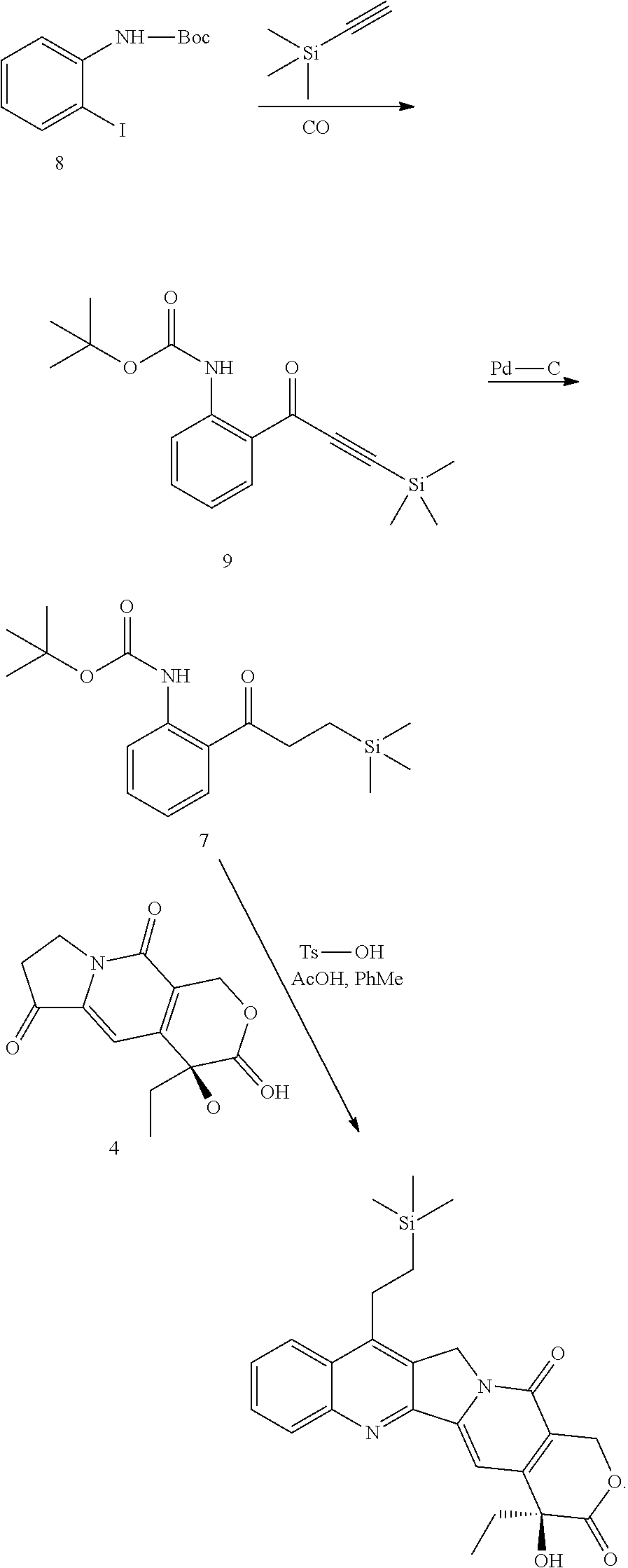
- Scheme 3 illustrates the third process of the present invention employed to synthesize BNP1350.
- the starting reagent was commercially available cost effective N-Boc-2-iodoaniline (8).
- the process includes first coupling N-Boc-2-iodoaniline (8) with ethynyltrimethylsilane and followed by hydrogenation in presence of Pd/C to generate 2-(3′-trimethylsilylpropionyl)-N-Boc-aniline (7).
- the Friedlander condensation of 2-(3′-trimethylsilylpropionyl)-N-Boc-aniline (7) with the commercially available CDE ring moiety (4) gave the desired BNP1350 (Karenitecin; Cositecan) product.
- N-Boc-2-iodo aniline 50 mg
- ethynyltrimethylsilane 27 ⁇ L
- tris(dibenzylideneacetone)dipalladium 15 mg
- 1,1′-bis(diphenylphosphino)ferrocene 8.9 mg
- triethylamine 45 ⁇ L
- tetrahydrofuran THF
- the flask was placed into the “Parr Instrument” reactor under a carbon monoxide (CO) atmosphere (100 psi). The reaction mixture was stirred at room temperature for 48 hours.
- CO carbon monoxide
- Scheme 4 illustrates the fourth process of the present invention employed to synthesize BNP1350.
- the starting reagent was commercially available cost effective ethynyltrimethylsilane to which solutions of n-butullithium and o-nitrobenzaldehyde were added to form 1-(2-Nitrophenyl)-3-trimethylsilyl-2-propyn-1-ol (10).
- the aqueous phase was extracted with ethyl acetate.
- the combined organic phases were dried over sodium sulfate and evaporated to dryness.
- the crude material was purified by chromatography on silica gel giving a yield of 4.3 grams (87%).
- A-Ring (3) (16.8 mg) and CDE-ring (4) (20 mg) were dissolved in a mixture of acetic acid and toluene (1 mL; 1:1 v/v).
- P-Toluensulfonic acid (1 mg) was added and the reaction mixture was stirred at 100° C. for 24 hours.
- the reaction mixture was cooled to room temperature and concentrated under reduced pressure.
- the residue was washed 2-times with hexane (2 ⁇ 10 mL) and dried under vacuum.
- the crude material was purified by silica gel column providing a yield of 32 mg (94%) of the BNP1350 (Karenitecin; Cositecan) product.
- the spectral data was shown to be identical to that obtained for commercially available BNP1350.
- Scheme 5 illustrates the fifth process of the present invention employed to synthesize BNP1350.
- the starting reagent was commercially available cost effective 2-nitrobenzoic acid (12).
- the process includes first conversion of 2-nitrobenzoic acid (12) to more active 2-nitrobenzoyl chloride (13) and following the Friedel-Craft alkynylation of the crude acid chloride (13) with bis(trimethylsilyl)acetylene to generate 1-phenyl-3-trimethylsilyl-propynone (11).
- the aqueous phase was extracted 2-times with dichloromethane (2 ⁇ 2 L).
- the combined organic phase was washed with water (2 L), filtered through a Celite pad (200 g), dried over sodium sulfate (120 g), and concentrated at the temperature below 30° C. (bath temperature) to dryness to give 294 g (99% yield) of the desired product in 95% HPLC purity.
- the crude product was dissolved in ethyl acetate (7.5 L) and treated with 4N hydrochloric acid (600 mL). After the phase separation, HPLC analysis showed the 92.8% purity.
- the organic phase was washed again with 4 N hydrochloric acid (600 mL).
- the organic phase was further washed with 4 N hydrochloric acid (500 mL) one additional time.
- the organic phase was dried over sodium sulfate (200 g), concentrated to give the crude product (3) (220 g; 84% yield).
- a second method of synthesis may also be employed to generate the key intermediate 1-(2-nitrophenyl)-3-(trimethylsilyl)prop-2-yn-1-one (11) which is utilized in the aforementioned Synthesis Scheme 5 for the total chemical synthesis of BNP1350.
- commercially available ethynyltrimethylsilane (15) was treated with n-butullithium and zinc (II) chloride to form ((trimethylsilyl)ethynyl)zinc(II) chloride (16), which was then added to 2-nitrobenzoyl chloride (13) to yield the desired intermediate product, 1-(2-nitrophenyl)-3-(trimethylsilyl)prop-2-yn-1-one (11).
- Wild type human ovarian cancer cells (A2780/WT) and doxorubicin resistant human ovarian cancer cells (A2780/DX5) were cultured in RPMI 1640 medium supplemented with 10% fetal bovine serum and 2 mM glutamine, and grown in a 37° C. incubator with 5% CO 2 .
- BNP1350 synthesized from camptothecin natural product (purchased from APAC) and BNP1350 synthesized via the Total Synthesis Scheme at BioNumerik Pharmaceuticals, Inc. were dissolved in DMSO for use in cytotoxicity experiments where inhibition of cell growth was measured using the SRB assay.
- cells were seeded (450 cells/well in 100 ⁇ L volume) in a 96-well microtiter plates and allowed to attach for 24 hours prior to treatment with either natural product BNP1350 or total synthesis BNP1350 for 2 hours. Following this 2 hour treatment, BNP1350 was removed, the cells were washed with drug-free media (200 ⁇ L), and then drug-free media (200 ⁇ L) was added to the cells which were allowed to continue growing at 37° C. with 5% CO 2 before the SRB assay was performed (total experimental time from the time of initial seeding was 5 days, during which 5 cell doublings occurred).
- IC50 values for BNP1350 prepared from natural product or prepared via total synthesis were very similar (see, Table 1; Graph 2) and both BNP1350 preparations were shown to be potent inhibitors of A2780/WT and A2780/DX5 cell growth with nanomolar IC50 values. Both BNP1350 test articles also exhibited potency in both wild-type and doxorubicin resistant ovarian cancer cells (see, Table 1, Table 2, Graph 2) with resistance factor ratios that were less than 2.0 (see, Table 2).
Landscapes
- Chemical & Material Sciences (AREA)
- Organic Chemistry (AREA)
- Pharmaceuticals Containing Other Organic And Inorganic Compounds (AREA)
- Nitrogen Condensed Heterocyclic Rings (AREA)
Abstract
Description

-
- (i) This class of drugs inhibits the normal activity of Topo I, reversibly. Although they may produce potentially lethal modifications of the DNA structure during DNA replication, the DNA strand breaks may be repaired after washout of the drug; and
- (ii) Cells treated with Topo I inhibitors, such as CPT tend to stay in G0 of the cell cycle until the drug is removed and the cleaved DNA is repaired. Inhibitors of these enzymes can affect many aspects of cell metabolism including replication, transcription, recombination, and chromosomal segregation.

Wherein, R1, R2, R3=methyl (—CH3) functional groups covalently-bound to the silicon-containing side chain (bound to C7 on the B-ring) of the Karenitecin molecule.

-
- (a GMP certified analytical instrument at 022712)


Materials and Methods
| TABLE 1 |
| Summary of IC50 Determinations |
| in Human Ovarian |
| Test |
| 1 | Test 2 | Average | STD |
| IC50 (nM) | |
| A2780/WT |
| Natural Product BNP1350 | 6.7 | 5.4 | 6.1 | 0.9 | ||
| Total Synthesis BNP1350 | 6.0 | 6.8 | 6.4 | 0.8 | ||
| IC50 (nM) | |
| A2780/DX5 |
| Natural Product BNP1350 | 8.9 | 11.6 | 10.3 | 1.9 | ||
| Total Synthesis BNP1350 | 11.9 | 11.7 | 11.8 | 0.1 | ||
| TABLE 2 |
| Summary of Resistance Factor Ratios |
| Resistance Factor Ratio | |||
| A2780/DX5 IC50/A2780WT IC50 | |||
| Natural Product BNP1350 | 1.7 | ||
| Total Synthesis BNP1350 | 1.8 | ||
Claims (5)




Priority Applications (5)
| Application Number | Priority Date | Filing Date | Title |
|---|---|---|---|
| US13/694,255 US8722886B1 (en) | 2012-11-13 | 2012-11-13 | Methods for the total chemical synthesis of enantiomerically-pure 7-(2′-trimethylsilyl)ethyl camptothecin |
| EP13855448.0A EP2920191B1 (en) | 2012-11-13 | 2013-11-07 | Methods for the total chemical synthesis of enantiomerically-pure 7-(2'-trimethylsilyl) ethyl camptothecin |
| PCT/US2013/068938 WO2014078168A1 (en) | 2012-11-13 | 2013-11-07 | Methods for the total chemical synthesis of enantiomerically-pure 7-(2'-trimethylsilyl) ethyl camptothecin |
| JP2015541891A JP2016501187A (en) | 2012-11-13 | 2013-11-07 | Chemical total synthesis method of enantiomerically pure 7- (2'-trimethylsilyl) ethylcamptothecin |
| CN201380067730.7A CN104955830A (en) | 2012-11-13 | 2013-11-07 | Methods for the total chemical synthesis of enantiomerically-pure 7-(2'-trimethylsilyl) ethyl camptothecin |
Applications Claiming Priority (1)
| Application Number | Priority Date | Filing Date | Title |
|---|---|---|---|
| US13/694,255 US8722886B1 (en) | 2012-11-13 | 2012-11-13 | Methods for the total chemical synthesis of enantiomerically-pure 7-(2′-trimethylsilyl)ethyl camptothecin |
Publications (2)
| Publication Number | Publication Date |
|---|---|
| US8722886B1 true US8722886B1 (en) | 2014-05-13 |
| US20140135499A1 US20140135499A1 (en) | 2014-05-15 |
Family
ID=50635594
Family Applications (1)
| Application Number | Title | Priority Date | Filing Date |
|---|---|---|---|
| US13/694,255 Active US8722886B1 (en) | 2012-11-13 | 2012-11-13 | Methods for the total chemical synthesis of enantiomerically-pure 7-(2′-trimethylsilyl)ethyl camptothecin |
Country Status (5)
| Country | Link |
|---|---|
| US (1) | US8722886B1 (en) |
| EP (1) | EP2920191B1 (en) |
| JP (1) | JP2016501187A (en) |
| CN (1) | CN104955830A (en) |
| WO (1) | WO2014078168A1 (en) |
Families Citing this family (1)
| Publication number | Priority date | Publication date | Assignee | Title |
|---|---|---|---|---|
| CN107428770B (en) * | 2014-10-22 | 2019-10-01 | 维瓦西塔斯肿瘤学公司 | Methods and systems for the synthesis of camptothecin analogs |
Citations (1)
| Publication number | Priority date | Publication date | Assignee | Title |
|---|---|---|---|---|
| US7030243B1 (en) * | 2004-10-28 | 2006-04-18 | Bionumerik Pharmaceuticals, Inc. | Process for making camptothecin derivatives |
Family Cites Families (9)
| Publication number | Priority date | Publication date | Assignee | Title |
|---|---|---|---|---|
| US3894329A (en) * | 1972-07-28 | 1975-07-15 | Sperry Rand Corp | Method of making high density electronic interconnections in a termination device |
| IL102764A0 (en) * | 1991-08-16 | 1993-01-31 | Merck & Co Inc | Quinazoline derivatives,and pharmaceutical compositions containing them |
| US5391745A (en) * | 1992-07-23 | 1995-02-21 | Sloan-Kettering Institute For Cancer Research | Methods of preparation of camptothecin analogs |
| AP9300587A0 (en) * | 1992-11-12 | 1995-05-05 | Glaxo Inc | Water soluble camptothecin derivatives. |
| US6136978A (en) * | 1993-06-30 | 2000-10-24 | University Of Pittsburgh | Camptothecin analogs and methods of preparation thereof |
| TWI245768B (en) * | 2001-02-21 | 2005-12-21 | Yakult Honsha Kk | Process for synthesizing camptothecin related compound(s) |
| US6723849B1 (en) * | 2002-10-25 | 2004-04-20 | Bionumerik Pharmaceuticals, Inc. | Process for making camptothecin derivatives |
| WO2008035377A2 (en) * | 2006-09-18 | 2008-03-27 | Shilpa Medicare Ltd. | Novel intermediates for the preparation of camptothecin analogues |
| CN102046634B (en) * | 2008-05-29 | 2013-04-24 | 日本迈科洛生物制药有限公司 | Production method for camptothecin derivative |
-
2012
- 2012-11-13 US US13/694,255 patent/US8722886B1/en active Active
-
2013
- 2013-11-07 WO PCT/US2013/068938 patent/WO2014078168A1/en not_active Ceased
- 2013-11-07 CN CN201380067730.7A patent/CN104955830A/en active Pending
- 2013-11-07 EP EP13855448.0A patent/EP2920191B1/en not_active Not-in-force
- 2013-11-07 JP JP2015541891A patent/JP2016501187A/en active Pending
Patent Citations (1)
| Publication number | Priority date | Publication date | Assignee | Title |
|---|---|---|---|---|
| US7030243B1 (en) * | 2004-10-28 | 2006-04-18 | Bionumerik Pharmaceuticals, Inc. | Process for making camptothecin derivatives |
Also Published As
| Publication number | Publication date |
|---|---|
| US20140135499A1 (en) | 2014-05-15 |
| CN104955830A (en) | 2015-09-30 |
| EP2920191A1 (en) | 2015-09-23 |
| JP2016501187A (en) | 2016-01-18 |
| EP2920191B1 (en) | 2017-07-19 |
| WO2014078168A1 (en) | 2014-05-22 |
| EP2920191A4 (en) | 2016-06-22 |
Similar Documents
| Publication | Publication Date | Title |
|---|---|---|
| JP5313894B2 (en) | Camptothecin derivatives with antitumor activity | |
| JPH01186893A (en) | Water-soluble camptothesine analogue | |
| Fukuda et al. | Lamellarin-inspired potent topoisomerase I inhibitors with the unprecedented benzo [g][1] benzopyrano [4, 3-b] indol-6 (13H)-one scaffold | |
| JP2008273952A (en) | Method for synthesizing camptothecin-related compounds | |
| CA2302226C (en) | Camptothecin analogs and methods of preparation thereof | |
| Zi et al. | Synthesis and antitumor activity of biotinylated camptothecin derivatives as potent cytotoxic agents | |
| EP2197879B1 (en) | C7-substituted camptothecin analogs | |
| US7687496B2 (en) | C7-substituted camptothecin analogs | |
| EP2920191B1 (en) | Methods for the total chemical synthesis of enantiomerically-pure 7-(2'-trimethylsilyl) ethyl camptothecin | |
| US7687497B2 (en) | C10-substituted camptothecin analogs | |
| Dallavalle et al. | Synthesis and cytotoxic activity of substituted 7-aryliminomethyl derivatives of camptothecin | |
| CA2700904C (en) | C10-substituted camptothecin analogs | |
| Dallavalle et al. | Novel cytotoxic 7-iminomethyl and 7-aminomethyl derivatives of camptothecin | |
| JP5313895B2 (en) | Camptothecin derivatives having antitumor activity | |
| WO2015096553A1 (en) | Anti-multidrug resistance taxane anti-tumour compound and preparation method thereof | |
| CN102731516A (en) | Novel camptothecin derivatives having antineoplastic activity | |
| CN101495484B (en) | Camptothecin derivatives with antitumor activity | |
| US20090036418A1 (en) | Pharmaceutical composition for treatment of cancer containing pyridylpyridazine or transition metal complex thereof as active ingredient | |
| WO2005005431A2 (en) | 7-polyaminoalkyl(oxy)iminomethylcamptothecins bearing protective groups | |
| HK1099760B (en) | 7-polyaminoalkyl(oxy)iminomethylcamptothecins bearing protective groups |
Legal Events
| Date | Code | Title | Description |
|---|---|---|---|
| AS | Assignment |
Owner name: BIONUMERIK PHARMACEUTICALS, INC., TEXAS Free format text: ASSIGNMENT OF ASSIGNORS INTEREST;ASSIGNORS:CHEN, XINGHAI, PH.D;HAUSHEER, FREDERICK H., MD;MALAKHOV, ANDREY;AND OTHERS;REEL/FRAME:032519/0284 Effective date: 20121106 Owner name: BIONUMERIK PHARMACEUTICALS, INC., TEXAS Free format text: ASSIGNMENT OF ASSIGNORS INTEREST;ASSIGNORS:CHEN, XINGHAI;HAUSHEER, FREDERICK H.;MALAKHOV, ANDREY;AND OTHERS;REEL/FRAME:032613/0514 Effective date: 20121106 |
|
| STCF | Information on status: patent grant |
Free format text: PATENTED CASE |
|
| FEPP | Fee payment procedure |
Free format text: MAINTENANCE FEE REMINDER MAILED (ORIGINAL EVENT CODE: REM.) |
|
| FEPP | Fee payment procedure |
Free format text: SURCHARGE FOR LATE PAYMENT, LARGE ENTITY (ORIGINAL EVENT CODE: M1554) |
|
| MAFP | Maintenance fee payment |
Free format text: PAYMENT OF MAINTENANCE FEE, 4TH YEAR, LARGE ENTITY (ORIGINAL EVENT CODE: M1551) Year of fee payment: 4 |
|
| AS | Assignment |
Owner name: CROWN BIOSCIENCE, INC., CALIFORNIA Free format text: ASSIGNMENT OF ASSIGNORS INTEREST;ASSIGNOR:BIONUMERIK PHARMACEUTICALS, INC.;REEL/FRAME:048988/0113 Effective date: 20190419 |
|
| FEPP | Fee payment procedure |
Free format text: MAINTENANCE FEE REMINDER MAILED (ORIGINAL EVENT CODE: REM.); ENTITY STATUS OF PATENT OWNER: LARGE ENTITY |
|
| FEPP | Fee payment procedure |
Free format text: 7.5 YR SURCHARGE - LATE PMT W/IN 6 MO, LARGE ENTITY (ORIGINAL EVENT CODE: M1555); ENTITY STATUS OF PATENT OWNER: LARGE ENTITY |
|
| MAFP | Maintenance fee payment |
Free format text: PAYMENT OF MAINTENANCE FEE, 8TH YEAR, LARGE ENTITY (ORIGINAL EVENT CODE: M1552); ENTITY STATUS OF PATENT OWNER: LARGE ENTITY Year of fee payment: 8 |
|
| FEPP | Fee payment procedure |
Free format text: MAINTENANCE FEE REMINDER MAILED (ORIGINAL EVENT CODE: REM.); ENTITY STATUS OF PATENT OWNER: LARGE ENTITY |
|
| FEPP | Fee payment procedure |
Free format text: 11.5 YR SURCHARGE- LATE PMT W/IN 6 MO, LARGE ENTITY (ORIGINAL EVENT CODE: M1556); ENTITY STATUS OF PATENT OWNER: LARGE ENTITY |
|
| MAFP | Maintenance fee payment |
Free format text: PAYMENT OF MAINTENANCE FEE, 12TH YEAR, LARGE ENTITY (ORIGINAL EVENT CODE: M1553); ENTITY STATUS OF PATENT OWNER: LARGE ENTITY Year of fee payment: 12 |