US8703683B2 - Poly (alkyl epdxides), process for making, and lubricant compositions having same - Google Patents

Poly (alkyl epdxides), process for making, and lubricant compositions having same Download PDF

Info

Publication number
US8703683B2
US8703683B2 US12/766,241 US76624110A US8703683B2 US 8703683 B2 US8703683 B2 US 8703683B2 US 76624110 A US76624110 A US 76624110A US 8703683 B2 US8703683 B2 US 8703683B2
Authority
US
United States
Prior art keywords
alkyl
poly
group
polymerizing
acid
Prior art date
Legal status (The legal status is an assumption and is not a legal conclusion. Google has not performed a legal analysis and makes no representation as to the accuracy of the status listed.)
Expired - Fee Related, expires
Application number
US12/766,241
Other versions
US20110263469A1 (en
Inventor
Abhimanyu Onkar Patil
Satish Bodige
Current Assignee (The listed assignees may be inaccurate. Google has not performed a legal analysis and makes no representation or warranty as to the accuracy of the list.)
ExxonMobil Technology and Engineering Co
Original Assignee
ExxonMobil Research and Engineering Co
Priority date (The priority date is an assumption and is not a legal conclusion. Google has not performed a legal analysis and makes no representation as to the accuracy of the date listed.)
Filing date
Publication date
Application filed by ExxonMobil Research and Engineering Co filed Critical ExxonMobil Research and Engineering Co
Priority to US12/766,241 priority Critical patent/US8703683B2/en
Publication of US20110263469A1 publication Critical patent/US20110263469A1/en
Assigned to EXXONMOBIL RESEARCH AND ENGINEERING COMPANY reassignment EXXONMOBIL RESEARCH AND ENGINEERING COMPANY ASSIGNMENT OF ASSIGNORS INTEREST (SEE DOCUMENT FOR DETAILS). Assignors: PATIL, ABHIMANYU O., BODIGE, SATISH
Application granted granted Critical
Publication of US8703683B2 publication Critical patent/US8703683B2/en
Expired - Fee Related legal-status Critical Current
Adjusted expiration legal-status Critical

Links

Images

Classifications

    • CCHEMISTRY; METALLURGY
    • C10PETROLEUM, GAS OR COKE INDUSTRIES; TECHNICAL GASES CONTAINING CARBON MONOXIDE; FUELS; LUBRICANTS; PEAT
    • C10MLUBRICATING COMPOSITIONS; USE OF CHEMICAL SUBSTANCES EITHER ALONE OR AS LUBRICATING INGREDIENTS IN A LUBRICATING COMPOSITION
    • C10M107/00Lubricating compositions characterised by the base-material being a macromolecular compound
    • C10M107/20Lubricating compositions characterised by the base-material being a macromolecular compound containing oxygen
    • C10M107/30Macromolecular compounds obtained otherwise than by reactions only involving carbon-to-carbon unsaturated bonds
    • C10M107/32Condensation polymers of aldehydes or ketones; Polyesters; Polyethers
    • C10M107/34Polyoxyalkylenes
    • CCHEMISTRY; METALLURGY
    • C07ORGANIC CHEMISTRY
    • C07CACYCLIC OR CARBOCYCLIC COMPOUNDS
    • C07C41/00Preparation of ethers; Preparation of compounds having groups, groups or groups
    • C07C41/01Preparation of ethers
    • C07C41/02Preparation of ethers from oxiranes
    • CCHEMISTRY; METALLURGY
    • C07ORGANIC CHEMISTRY
    • C07CACYCLIC OR CARBOCYCLIC COMPOUNDS
    • C07C41/00Preparation of ethers; Preparation of compounds having groups, groups or groups
    • C07C41/01Preparation of ethers
    • C07C41/02Preparation of ethers from oxiranes
    • C07C41/03Preparation of ethers from oxiranes by reaction of oxirane rings with hydroxy groups
    • CCHEMISTRY; METALLURGY
    • C07ORGANIC CHEMISTRY
    • C07CACYCLIC OR CARBOCYCLIC COMPOUNDS
    • C07C43/00Ethers; Compounds having groups, groups or groups
    • C07C43/02Ethers
    • C07C43/03Ethers having all ether-oxygen atoms bound to acyclic carbon atoms
    • C07C43/04Saturated ethers
    • C07C43/10Saturated ethers of polyhydroxy compounds
    • C07C43/11Polyethers containing —O—(C—C—O—)n units with ≤ 2 n≤ 10
    • CCHEMISTRY; METALLURGY
    • C08ORGANIC MACROMOLECULAR COMPOUNDS; THEIR PREPARATION OR CHEMICAL WORKING-UP; COMPOSITIONS BASED THEREON
    • C08GMACROMOLECULAR COMPOUNDS OBTAINED OTHERWISE THAN BY REACTIONS ONLY INVOLVING UNSATURATED CARBON-TO-CARBON BONDS
    • C08G65/00Macromolecular compounds obtained by reactions forming an ether link in the main chain of the macromolecule
    • C08G65/02Macromolecular compounds obtained by reactions forming an ether link in the main chain of the macromolecule from cyclic ethers by opening of the heterocyclic ring
    • C08G65/04Macromolecular compounds obtained by reactions forming an ether link in the main chain of the macromolecule from cyclic ethers by opening of the heterocyclic ring from cyclic ethers only
    • C08G65/06Cyclic ethers having no atoms other than carbon and hydrogen outside the ring
    • C08G65/08Saturated oxiranes
    • C08G65/10Saturated oxiranes characterised by the catalysts used
    • CCHEMISTRY; METALLURGY
    • C08ORGANIC MACROMOLECULAR COMPOUNDS; THEIR PREPARATION OR CHEMICAL WORKING-UP; COMPOSITIONS BASED THEREON
    • C08GMACROMOLECULAR COMPOUNDS OBTAINED OTHERWISE THAN BY REACTIONS ONLY INVOLVING UNSATURATED CARBON-TO-CARBON BONDS
    • C08G65/00Macromolecular compounds obtained by reactions forming an ether link in the main chain of the macromolecule
    • C08G65/02Macromolecular compounds obtained by reactions forming an ether link in the main chain of the macromolecule from cyclic ethers by opening of the heterocyclic ring
    • C08G65/04Macromolecular compounds obtained by reactions forming an ether link in the main chain of the macromolecule from cyclic ethers by opening of the heterocyclic ring from cyclic ethers only
    • C08G65/06Cyclic ethers having no atoms other than carbon and hydrogen outside the ring
    • C08G65/16Cyclic ethers having four or more ring atoms
    • C08G65/18Oxetanes
    • CCHEMISTRY; METALLURGY
    • C08ORGANIC MACROMOLECULAR COMPOUNDS; THEIR PREPARATION OR CHEMICAL WORKING-UP; COMPOSITIONS BASED THEREON
    • C08GMACROMOLECULAR COMPOUNDS OBTAINED OTHERWISE THAN BY REACTIONS ONLY INVOLVING UNSATURATED CARBON-TO-CARBON BONDS
    • C08G65/00Macromolecular compounds obtained by reactions forming an ether link in the main chain of the macromolecule
    • C08G65/02Macromolecular compounds obtained by reactions forming an ether link in the main chain of the macromolecule from cyclic ethers by opening of the heterocyclic ring
    • C08G65/26Macromolecular compounds obtained by reactions forming an ether link in the main chain of the macromolecule from cyclic ethers by opening of the heterocyclic ring from cyclic ethers and other compounds
    • C08G65/2642Macromolecular compounds obtained by reactions forming an ether link in the main chain of the macromolecule from cyclic ethers by opening of the heterocyclic ring from cyclic ethers and other compounds characterised by the catalyst used
    • C08G65/2645Metals or compounds thereof, e.g. salts
    • C08G65/2654Aluminium or boron; Compounds thereof
    • CCHEMISTRY; METALLURGY
    • C08ORGANIC MACROMOLECULAR COMPOUNDS; THEIR PREPARATION OR CHEMICAL WORKING-UP; COMPOSITIONS BASED THEREON
    • C08GMACROMOLECULAR COMPOUNDS OBTAINED OTHERWISE THAN BY REACTIONS ONLY INVOLVING UNSATURATED CARBON-TO-CARBON BONDS
    • C08G65/00Macromolecular compounds obtained by reactions forming an ether link in the main chain of the macromolecule
    • C08G65/02Macromolecular compounds obtained by reactions forming an ether link in the main chain of the macromolecule from cyclic ethers by opening of the heterocyclic ring
    • C08G65/26Macromolecular compounds obtained by reactions forming an ether link in the main chain of the macromolecule from cyclic ethers by opening of the heterocyclic ring from cyclic ethers and other compounds
    • C08G65/2642Macromolecular compounds obtained by reactions forming an ether link in the main chain of the macromolecule from cyclic ethers by opening of the heterocyclic ring from cyclic ethers and other compounds characterised by the catalyst used
    • C08G65/2645Metals or compounds thereof, e.g. salts
    • C08G65/2654Aluminium or boron; Compounds thereof
    • C08G65/2657Aluminosilicates; Clays; Zeolites
    • CCHEMISTRY; METALLURGY
    • C08ORGANIC MACROMOLECULAR COMPOUNDS; THEIR PREPARATION OR CHEMICAL WORKING-UP; COMPOSITIONS BASED THEREON
    • C08GMACROMOLECULAR COMPOUNDS OBTAINED OTHERWISE THAN BY REACTIONS ONLY INVOLVING UNSATURATED CARBON-TO-CARBON BONDS
    • C08G65/00Macromolecular compounds obtained by reactions forming an ether link in the main chain of the macromolecule
    • C08G65/02Macromolecular compounds obtained by reactions forming an ether link in the main chain of the macromolecule from cyclic ethers by opening of the heterocyclic ring
    • C08G65/26Macromolecular compounds obtained by reactions forming an ether link in the main chain of the macromolecule from cyclic ethers by opening of the heterocyclic ring from cyclic ethers and other compounds
    • C08G65/2642Macromolecular compounds obtained by reactions forming an ether link in the main chain of the macromolecule from cyclic ethers by opening of the heterocyclic ring from cyclic ethers and other compounds characterised by the catalyst used
    • C08G65/2645Metals or compounds thereof, e.g. salts
    • C08G65/266Metallic elements not covered by group C08G65/2648 - C08G65/2645, or compounds thereof
    • CCHEMISTRY; METALLURGY
    • C10PETROLEUM, GAS OR COKE INDUSTRIES; TECHNICAL GASES CONTAINING CARBON MONOXIDE; FUELS; LUBRICANTS; PEAT
    • C10MLUBRICATING COMPOSITIONS; USE OF CHEMICAL SUBSTANCES EITHER ALONE OR AS LUBRICATING INGREDIENTS IN A LUBRICATING COMPOSITION
    • C10M111/00Lubrication compositions characterised by the base-material being a mixture of two or more compounds covered by more than one of the main groups C10M101/00 - C10M109/00, each of these compounds being essential
    • C10M111/04Lubrication compositions characterised by the base-material being a mixture of two or more compounds covered by more than one of the main groups C10M101/00 - C10M109/00, each of these compounds being essential at least one of them being a macromolecular organic compound
    • CCHEMISTRY; METALLURGY
    • C10PETROLEUM, GAS OR COKE INDUSTRIES; TECHNICAL GASES CONTAINING CARBON MONOXIDE; FUELS; LUBRICANTS; PEAT
    • C10MLUBRICATING COMPOSITIONS; USE OF CHEMICAL SUBSTANCES EITHER ALONE OR AS LUBRICATING INGREDIENTS IN A LUBRICATING COMPOSITION
    • C10M2209/00Organic macromolecular compounds containing oxygen as ingredients in lubricant compositions
    • C10M2209/10Macromolecular compoundss obtained otherwise than by reactions only involving carbon-to-carbon unsaturated bonds
    • C10M2209/103Polyethers, i.e. containing di- or higher polyoxyalkylene groups
    • C10M2209/1033Polyethers, i.e. containing di- or higher polyoxyalkylene groups used as base material
    • CCHEMISTRY; METALLURGY
    • C10PETROLEUM, GAS OR COKE INDUSTRIES; TECHNICAL GASES CONTAINING CARBON MONOXIDE; FUELS; LUBRICANTS; PEAT
    • C10MLUBRICATING COMPOSITIONS; USE OF CHEMICAL SUBSTANCES EITHER ALONE OR AS LUBRICATING INGREDIENTS IN A LUBRICATING COMPOSITION
    • C10M2209/00Organic macromolecular compounds containing oxygen as ingredients in lubricant compositions
    • C10M2209/10Macromolecular compoundss obtained otherwise than by reactions only involving carbon-to-carbon unsaturated bonds
    • C10M2209/103Polyethers, i.e. containing di- or higher polyoxyalkylene groups
    • C10M2209/104Polyethers, i.e. containing di- or higher polyoxyalkylene groups of alkylene oxides containing two carbon atoms only
    • C10M2209/1045Polyethers, i.e. containing di- or higher polyoxyalkylene groups of alkylene oxides containing two carbon atoms only used as base material
    • CCHEMISTRY; METALLURGY
    • C10PETROLEUM, GAS OR COKE INDUSTRIES; TECHNICAL GASES CONTAINING CARBON MONOXIDE; FUELS; LUBRICANTS; PEAT
    • C10MLUBRICATING COMPOSITIONS; USE OF CHEMICAL SUBSTANCES EITHER ALONE OR AS LUBRICATING INGREDIENTS IN A LUBRICATING COMPOSITION
    • C10M2209/00Organic macromolecular compounds containing oxygen as ingredients in lubricant compositions
    • C10M2209/10Macromolecular compoundss obtained otherwise than by reactions only involving carbon-to-carbon unsaturated bonds
    • C10M2209/103Polyethers, i.e. containing di- or higher polyoxyalkylene groups
    • C10M2209/105Polyethers, i.e. containing di- or higher polyoxyalkylene groups of alkylene oxides containing three carbon atoms only
    • C10M2209/1055Polyethers, i.e. containing di- or higher polyoxyalkylene groups of alkylene oxides containing three carbon atoms only used as base material
    • CCHEMISTRY; METALLURGY
    • C10PETROLEUM, GAS OR COKE INDUSTRIES; TECHNICAL GASES CONTAINING CARBON MONOXIDE; FUELS; LUBRICANTS; PEAT
    • C10MLUBRICATING COMPOSITIONS; USE OF CHEMICAL SUBSTANCES EITHER ALONE OR AS LUBRICATING INGREDIENTS IN A LUBRICATING COMPOSITION
    • C10M2209/00Organic macromolecular compounds containing oxygen as ingredients in lubricant compositions
    • C10M2209/10Macromolecular compoundss obtained otherwise than by reactions only involving carbon-to-carbon unsaturated bonds
    • C10M2209/103Polyethers, i.e. containing di- or higher polyoxyalkylene groups
    • C10M2209/106Polyethers, i.e. containing di- or higher polyoxyalkylene groups of alkylene oxides containing four carbon atoms only
    • C10M2209/1065Polyethers, i.e. containing di- or higher polyoxyalkylene groups of alkylene oxides containing four carbon atoms only used as base material
    • CCHEMISTRY; METALLURGY
    • C10PETROLEUM, GAS OR COKE INDUSTRIES; TECHNICAL GASES CONTAINING CARBON MONOXIDE; FUELS; LUBRICANTS; PEAT
    • C10MLUBRICATING COMPOSITIONS; USE OF CHEMICAL SUBSTANCES EITHER ALONE OR AS LUBRICATING INGREDIENTS IN A LUBRICATING COMPOSITION
    • C10M2209/00Organic macromolecular compounds containing oxygen as ingredients in lubricant compositions
    • C10M2209/10Macromolecular compoundss obtained otherwise than by reactions only involving carbon-to-carbon unsaturated bonds
    • C10M2209/103Polyethers, i.e. containing di- or higher polyoxyalkylene groups
    • C10M2209/108Polyethers, i.e. containing di- or higher polyoxyalkylene groups etherified
    • CCHEMISTRY; METALLURGY
    • C10PETROLEUM, GAS OR COKE INDUSTRIES; TECHNICAL GASES CONTAINING CARBON MONOXIDE; FUELS; LUBRICANTS; PEAT
    • C10NINDEXING SCHEME ASSOCIATED WITH SUBCLASS C10M RELATING TO LUBRICATING COMPOSITIONS
    • C10N2030/00Specified physical or chemical properties which is improved by the additive characterising the lubricating composition, e.g. multifunctional additives
    • C10N2030/02Pour-point; Viscosity index
    • CCHEMISTRY; METALLURGY
    • C10PETROLEUM, GAS OR COKE INDUSTRIES; TECHNICAL GASES CONTAINING CARBON MONOXIDE; FUELS; LUBRICANTS; PEAT
    • C10NINDEXING SCHEME ASSOCIATED WITH SUBCLASS C10M RELATING TO LUBRICATING COMPOSITIONS
    • C10N2030/00Specified physical or chemical properties which is improved by the additive characterising the lubricating composition, e.g. multifunctional additives
    • C10N2030/06Oiliness; Film-strength; Anti-wear; Resistance to extreme pressure
    • CCHEMISTRY; METALLURGY
    • C10PETROLEUM, GAS OR COKE INDUSTRIES; TECHNICAL GASES CONTAINING CARBON MONOXIDE; FUELS; LUBRICANTS; PEAT
    • C10NINDEXING SCHEME ASSOCIATED WITH SUBCLASS C10M RELATING TO LUBRICATING COMPOSITIONS
    • C10N2070/00Specific manufacturing methods for lubricant compositions

Definitions

  • the present disclosure relates to poly(alkyl epoxides) and their polymerization.
  • the present disclosure further relates to the polymerization of alkyl epoxides in the presence of a cationic catalyst.
  • the present disclosure further relates to the polymerization of alkyl epoxides in the presence of a cationic catalyst and an initiator.
  • the present disclosure still further relates to a process for making the lubricant base stock.
  • the present disclosure still yet further relates to a lubricant formulation having poly(alkyl epoxide) polymer therein.
  • PAOs Poly(alpha-olefin) (PAOs) fluids are commercially employed as base stocks in lubricant products. PAOs have many advantages compared to conventional mineral oils and Group III/III+ lubricants. More specifically, PAOs have superior VI (viscosity index), low temperature properties (CCS (crankcase simulation), MRV (mini-rotary viscometer), etc.), pour points, and low traction, which translates into better energy efficiency and additive response and complete miscibility in conventional mineral oils. Performance limitations of PAOs include a lack of polarity, which impacts ability to solubilize polar additives, such as antioxidants, anti-rust agents and anti-wear agents. Conventionally, polar organic esters have been added to PAO lubricants to render them compatible.
  • Useful commercial formulations may have 2% or more of such esters in a fully homogeneous lubricant blend.
  • esters include, for example, bis-tridecanol adipate and pentaerythritol hexanoate.
  • Polyalkylene glycol (PAG) fluids have also been employed as lubricant base stocks. Their performance advantages are high VI, good lubricity (in hydrodynamic, mix, and boundary lubrication conditions), and excellent cleanliness. Some grades are even considered acceptable for incidental food contact (H1 grade). Performance limitations include lack of miscibility and compatibility with conventional mineral and hydrocarbon-based lubricants as well as high solubility in water, which results in severe corrosion problem. Some PAGs have paint or seal compatibility problems. The formulation or additive response of PAGs with respect to additives can be unpredictable, rendering them difficult to formulate with.
  • poly(alkyl epoxides) It would be desirable to have a process for making poly(alkyl epoxides) that is economical and easy to control. It would further be desirable to have a process for making poly(alkyl epoxides) in which mixtures of ⁇ -olefins could be utilized for epoxidation and oligomerization. It would also be desirable to have a process for making poly(alkyl epoxides) employing an initiator for polymerization. It would also be desirable to have poly(alkyl epoxides) that are highly soluble in PAO-type hydrocarbon fluids and that have a base stock that exhibits a low coefficient of friction. It would also be desirable to have a lubricant composition having a base stock of a poly(alkyl epoxide).
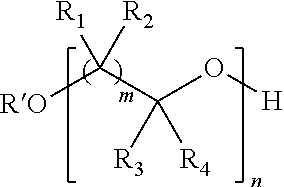
  • R 1 , R 2 , R 3 , and R 4 are hydrogen or alkyl moieties that, taken together, have a total of 1 to 80 carbons; wherein any of R 1 , R 2 , R 3 , and R 4 can be linear or branched if it is an alkyl moiety; wherein “m” is an integer from 1 to 4; and wherein “n” is an integer from 2 to 120.
  • the process has the step of polymerizing one or more alkyl epoxide monomers in the presence of a cationic catalyst according to the following sequence:
  • R 1 , R 2 , R 3 , and R 4 are hydrogen or alkyl moieties that, taken together, have a total of 1 to 80 carbons; wherein any of R 1 , R 2 , R 3 , and R 4 can be linear or branched if it is an alkyl moiety; wherein “m” is an integer from 1 to 4; and wherein “n” is an integer from 2 to 120.
  • R 1 , R 2 , R 3 , and R 4 are hydrogen or alkyl moieties that, taken together, have a total of 1 to 80 carbons; wherein any of R 1 , R 2 , R 3 , and R 4 can be linear or branched if it is an alkyl moiety; wherein R′ is an alkyl moiety, linear or branched, having from 1 to 120 carbons; and wherein “m” is an integer from 1 to 4; and wherein “n” is an integer from 2 to 120.
  • the process has the step of polymerizing one or more alkyl epoxide monomers in the presence of a cationic catalyst and an initiator according to the following sequence:
  • R 1 , R 2 , R 3 , and R 4 are hydrogen or alkyl moieties that, taken together, have a total of 1 to 120 carbons; wherein any of R 1 , R 2 , R 3 , and R 4 can be linear or branched if it is an alkyl moiety; wherein R′ is an alkyl moiety, linear or branched, having from 1 to 120 carbons; and wherein “m” is an integer from 1 to 4; and wherein “n” is an integer from 2 to 120.
  • a lubricant composition having a first lubricant base stock of either or both of the aforementioned poly(epoxyalkane) polymers and a second lubricant base stock different than the first lubricant base stock.
  • the second base stock is selected from among metallocene based poly- ⁇ -olefins, poly- ⁇ -olefins, a GTL (gas-to-liquids materials), a Group I base stock, a Group II based stock, a Group III base stock and combinations of the foregoing.
  • FIG. 1 is a depiction of an IR spectra of a 1,2-epoxybutane monomer and a 1,2-epoxybutane polymer of the present disclosure of Example 1.
  • FIG. 2 is a depiction of an IR spectra of a 1,2-epoxyoctane monomer and a 1,2-epoxyoctane polymer of the present disclosure of Example 2.
  • FIG. 3 is a depiction of an IR spectra of a 1,2-epoxybutane polymer of the present disclosure of Example 1 and a 1,2-epoxybutane polymer the present disclosure of prepared using a C 20 alcohol as an initiator in Example 3.
  • FIG. 4 is a depiction of an IR spectra of a 1,2-epoxyoctane polymer of the present disclosure of Example 2 and a 1,2-epoxyoctane polymer the present disclosure of prepared using a C 20 alcohol as an initiator in Example 4.
  • An embodiment of a poly(alkyl epoxide) of the present disclosure is the following structure:
  • R 1 , R 2 , R 3 , and R 4 are hydrogen or alkyl moieties that, taken together, have a total of 1 to 80 carbons; wherein any of R 1 , R 2 , R 3 , and R 4 can be linear or branched if it is an alkyl moiety; wherein “m” is an integer from 1 to 4; and wherein “n” is an integer from 2 to 120.
  • An embodiment of a process for making a poly(alkyl epoxide) of the present disclosure has the step of polymerizing one or more alkyl epoxide monomers in the presence of a cationic catalyst according to the following sequence:
  • R 1 , R 2 , R 3 , and R 4 are hydrogen or alkyl moieties that, taken together, have a total of 1 to 80 carbons; wherein any of R 1 , R 2 , R 3 , and R 4 can be linear or branched if it is an alkyl moiety; wherein “m” is an integer from 1 to 4; and wherein “n” is an integer from 2 to 120.
  • poly(alkyl epoxide) of the present disclosure is the following structure:
  • R 1 , R 2 , R 3 , and R 4 are hydrogen or alkyl moieties that, taken together, have a total of 1 to 80 carbons; wherein any of R 1 , R 2 , R 3 , and R 4 can be linear or branched if it is an alkyl moiety; wherein R′ is an alkyl moiety, linear or branched, having from 1 to 120 carbons; and wherein “m” is an integer from 1 to 4; and wherein “n” is an integer from 2 to 120.
  • An embodiment for making a poly(alkyl epoxide) of the present disclosure has the step of polymerizing one or more alkyl epoxide monomers in the presence of a cationic catalyst and an initiator according to the following sequence:
  • R 1 , R 2 , R 3 , and R 4 are hydrogen or alkyl moieties that, taken together, have a total of 1 to 120 carbons; wherein any of R 1 , R 2 , R 3 , and R 4 can be linear or branched if it is an alkyl moiety; wherein R′ is an alkyl moiety, linear or branched, having from 1 to 120 carbons; and wherein “m” is an integer from 1 to 4; and wherein “n” is an integer from 2 to 120.
  • Initiators useful in an embodiment the process of the present disclosure include alkyl alcohols, such as those of 4 to 120 carbons and preferably 8 to 40 carbons.
  • ‘Oxo’ alcohols can also be used as initiators (R′—OH).
  • the group of ‘oxo’ alcohols includes hydrogenation products formed directly from ‘oxo’ aldehydes obtained by hydroformulations of olefins as well as those from their primarily aldolization or aldol condensation products.
  • Manufacture of ‘oxo’ alcohols involves catalytic hydrogenation of ‘oxo’ aldehydes usually either by gas phase with Ni or Cu catalysts or liquid phase with Ni catalysts.
  • the Oxo process is well known in the art and is generally described in detail in Kirk-Othmer, Encyclopedia of Chemical Technology, Volume 16, 3rd ed., John Wiley & Sons, pp. 637-653, 1981.
  • olefins are hydroformulated by reaction with carbon monoxide and hydrogen, generally charged as synthesis gas (syn gas) mixtures, in the presence of a cobalt Oxo catalyst in dissolved form to form a mixture of Oxo aldehydes and alcohols.
  • This Oxo reaction is typically carried out at syn gas pressures of from 10.33 MPa to 31.00 MPa (1500 to 4500 psig) and at temperatures of from 65° C. to 230° C.
  • the product mixture containing the alcohols and aldehydes is recovered and can be treated by known means to hydrogenate the aldehydes to form additional quantities of the corresponding alcohols.
  • the C 8 -C 13 ‘oxo’ alcohols obtained from olefin oligomers (e.g., isoheptanes, diisobutenes, tripropenes) and from cracked olefins are useful as initiators for epoxyalkane polymerization.
  • Industrially available branched and unbranched higher olefins are important feedstocks for the manufacture of C 12 -C 19 alcohols after hydroformulation and hydrogenation. These alcohols, in turn, can be used as initiators.
  • Alcohols include that can be prepared from unhydrogenated PAO (PAO with terminal double bond) or of other hydrocarbon macromers, such as polyethylene (PE), polypropylene (PP), ethylene propylene (EP), ethylene butylene (EB), polyisobutylene (PIB), and poly-n-butylene (PNB) macromers.
  • PAO unhydrogenated PAO
  • PP polypropylene
  • EP ethylene propylene
  • EB ethylene butylene
  • PIB polyisobutylene
  • PPB poly-n-butylene
  • a macromer is defined as a polymeric structure that contains terminal unsaturation (terminal double bond), e.g., ethylene monomer units, propylene monomer units, other alpha-olefin monomer units, and combinations thereof.
  • a macromer is a polymer with a relatively low molecular weight with vinyl, vinylene, or vinylidene terminal olefin.
  • a macromer can be a polymer having a weight average molecular weight (M w ) of 20,000 or less, or, more narrowly, 5,000 or less or 2,000 or less.
  • M w weight average molecular weight
  • the macromer can also be a low molecular weight oligomer of ⁇ -olefin that has double bond.
  • a dimer of 1-decene can be prepared via metallocene catalyst.
  • useful initiators include, for example, 2-octyl-1-dodecanol, PAO-OH, metallocene-based PAO-OH, polyethylene monoalcohol (Aldrich CAS #71750-71-5, M n ⁇ 460 or M n ⁇ 700), polypropylene-OH, ethylene-butylene copolymer-OH, and long-chain fatty alcohols.
  • a preferred initiator is 2-octyl-1-dodecanol.
  • the poly(alkyl epoxide) is produced by cationic or acid-catalyzed polymerization.
  • Lewis acid catalysts are preferred.
  • Lewis acid catalysts include metal and metalloid halides conventionally used as Friedel-Crafts catalysts, such as AlCl 3 , BF 3 , AlBr 3 , TiCl 3 , and TiCl 4 either alone or with a protic promoter.
  • Solid Lewis acid catalysts such as synthetic or natural zeolites; acid clays; polymeric acidic resins; amorphous solid catalysts, such as silica-alumina; and heteropoly acids, such as the tungsten zirconates, tungsten molybdates, tungsten vanadates, phosphotungstates and molybdotungstovanadogermanates (e.g., WOx/ZrO 2 , WOx/MoO 3 ), may also be used.
  • the acid catalyst used in the polymerization process is 0.1 to 30 wt % and preferably 0.2 to 5 wt % based on total feed.
  • Preferred Lewis acid catalysts are the metal and metalloid halides.
  • the catalysts most preferred in conventional PAO oligomerization processes are aluminum trichloride and boron trifluoride. Boron trifluoride is typically used in combination with a protic promoter.
  • Promoters are well known in BF 3 -catalyzed olefin oligomerization processes include water, alcohols, such as the lower (C 1 -C 6 ) alkanols, methanol, ethanol, isopropanol, and butanol; acids; organic acids, including carboxylic acids such as acetic acid, propionic acid, and butanoic acid; anhydrides of organic acids such as acetic anhydride; inorganic acids, such as phosphoric acid, and as further described in U.S. Pat. No. 3,149,178; esters, such as ethyl acetate, and as further described in U.S. Pat. No.
  • alcohol alkoxylates such as glycol ethers, e.g., ethylene glycol monomethyl ether (2-methoxyethanol) and propylene glycol monoethyl ether and ethoxylates derived from mixed C 2 to C 24 , preferably C 2 to C 18 , and most preferably C 6 to C 12 straight chain alcohols, and as further described in U.S. Pat. No. 5,068,487; ethers, such as dimethyl ether, diethyl ether and methyl ethyl ether; ketones; aldehydes; and alkyl halides.
  • Protic promoters form a catalyst complex with the boron trifluoride, and such complex serves as a catalyst for the oligomerization.
  • the complex usually contains an excess of boron trifluoride, which is adsorbed in the mixture.
  • Solvents or diluents may be used in the Lewis acid catalyzed polymerization. If the catalyst system being used is a liquid, this may also function as the solvent or diluent for the reaction so that no additional solvent or diluent may be required. Additional liquids that are non-reactive to the selected catalyst system may be used as needed to control viscosity of the reaction mixture or to carry off heat of reaction by evaporation with reflux of the condensed vapor, if desired. Hydrocarbons such as alkanes and aromatics, e.g., hexane and toluene, are suitable for this purpose.
  • a light alpha-olefin oligomer reactant either alone or with additional alpha-olefin co-feed, may be oligomerized directly in the presence of the catalyst system with or without the addition of solvent or diluent.
  • the reactions will normally be carried out in a closed environment if gaseous catalysts such as boron trifluoride are used. Such reactions are usually carried out under an inert atmosphere, e.g., nitrogen.
  • the temperature of the Lewis acid-catalyzed polymerization reactions can usefully vary in practical operation from ⁇ 90° C. to 300° C. and preferably from ⁇ 30° C. to 125° C. Reaction time can vary from 1 minute to 36 hours and preferably from 1 hour to 24 hours.
  • the system may operate under atmospheric pressure as the system typically exhibits low vapor pressures at normal processing temperatures. The system may, however, be operated under mild pressure if it is desired to maintain a closed reaction environment, e.g., under autogenous pressure.
  • the polymerization will normally be carried out using a fixed bed of the catalyst in a downflow mode, although alternative forms of operation, e.g., in a stirred tank reactor, are possible.
  • the catalyst activity may be quenched by addition of water or a dilute aqueous base, such as a 5 wt % NaOH solution.
  • the organic layer may be separated and distilled to remove components other than the base stock.
  • promoted BF 3 catalyst When promoted BF 3 catalyst is used, the gaseous BF 3 and promoter may be recycled if not deactivated at the end of the reaction.
  • a solid catalyst When a solid catalyst is used, a simple filtration is all that is needed to separate the catalyst from the polymer product if the reaction has not been carried out in a fixed bed.
  • the polymer product may then be fractionated to remove any unreacted light olefin and the polymer in the desired boiling range, and, optionally, sent for hydrogenation to remove any residual unsaturation that may be present in the product.
  • the molecular weight of the poly(alkyl epoxide) typically ranges from 200 to 20,000, typically from 300 to 10,000, and most typically from 350 to 7,500. Higher molecular weights and corresponding viscosities may be achieved by suitable choice of reaction conditions. Values of the polydispersity index (PDI) are typically from 1 to 3.
  • Alkyl epoxides useful as monomers in the process of the present disclosure include those having one or more alkyl moieties that have 1 to 80 carbons, preferably 4 to 40 carbons, and more preferably 8 to 20 carbons and can be linear or branched in structure.
  • the epoxide moiety takes the form of a 3 to 6 carbon ring. Three-member rings are preferred.
  • Alkyl epoxides can be prepared by epoxidation of olefins.
  • Olefins can be linear or branched from 4 to 20 carbons.
  • the olefins can be single or mixed such as mixed C 4 olefins.
  • the mixed C 4 olefins include raffinate I (Raff-I) and raffinate II (Raff-II).
  • Typical Raff-I and Raff-II composition percentages are as follows: Raff-I gas mixture, which contained 31.0% of isobutylene, 42.94% of 1-butene, 12.5% of 2-butene, 12.5% of trans-2-butene and 1.06% of butadiene.
  • RAF-II mixture (mole % cis 2-butene: 17%, trans 2-butene 17%, isobutylene 5.51%, 1,3-butadiene 5237 ppm and remaining 1-butene).
  • Raffinate-1 or -2 (Raff-1 or Raff-2, respectively) are per se well known. See, for instance, WO2007/106215.
  • mixtures that can be used as a feed for epoxidation can come from light olefins from fluidized catalytic cracking (“FCC”), propylene/C 4 olefins, such as n-butenes and isobutylene, and C 4 olefin streams from methanol-to-olefin (“MTO”) processes.
  • FCC fluidized catalytic cracking
  • MTO methanol-to-olefin
  • Olefins are epoxidized using an epoxidation catalyst to produce epoxidized product.
  • Epoxidation of the olefin materials can be affected using a peracid, such as performic acid, perbenzoic acid or m-chloroperbenzoic acid, as the oxidizing agent.
  • the oxidation reaction can be performed using a preformed peracid to affect the epoxidation, or the peracid can be generated in-situ, for example by the addition of formic acid and hydrogen peroxide to produce performic acid.
  • Formic acid can be added in a molar ratio to the olefin double bonds of from 10:1 to 30:1.
  • Hydrogen peroxide can be added to the reaction mixture in a molar ratio to the olefin double bonds of from 1.01:1 to 5:1. Addition of both formic acid and H 2 O 2 to the reaction mixture results in the in-situ formation of performic acid as an epoxidizing agent.
  • the epoxidation is conducted at a temperature ranging from ⁇ 10° C. to 100° C., preferably from 30° C. to 70° C. Suitable reaction times will generally range from 0.1 hour to 36 hours, such as from 1 hour to 24 hours.
  • Epoxidation reactions can provide conversion from 50 to 100% of the double bonds into oxirane groups.
  • the epoxidation reaction is generally carried out in a liquid reaction medium.
  • the reaction medium can comprise only the reactants essentially utilized in the process. More conventionally, however, the liquid reaction medium will comprise a suitable reaction solvent in which the reactants and catalyst materials can be dissolved, suspended or dispersed.
  • Suitable reaction solvents include organic liquids that are inert in the reaction mixture. By “inert” is meant that the solvent does not deleteriously affect the oxidation reaction.
  • Suitable inert organic solvents include aromatic hydrocarbons such as benzene, toluene, xylenes, benzonitrile, nitrobenzene, anisole, and phenyl nonane; saturated aliphatic hydrocarbons having from 5 to 20 carbons, such as pentane, hexane, and heptane; adiponitrile; halogenated hydrocarbons such as methylene chloride, 1,2-dichloroethane, chloroform, carbon tetrachloride and the like; non-fluorinated, substituted saturated aliphatic and/or aromatic hydrocarbons having from 1 to 20 carbons, including those selected from the group consisting of alcohols such as methanol, propanol, butanol, isopropanol, and 2,4-di-t-butylphenol; ketones such as acetone; carboxylic acids such as propanoic acid and acetic acid; esters such as ethyl acetate
  • One type of epoxidation of olefins involves reaction of the material with a peracid, such as performic acid or m-chloroperbenzoic acid, to provide an epoxidized material having oxirane rings formed at the sites of the residual double bonds within the molecule.
  • Catalytic epoxidation alternatives using hydrogen peroxide as an oxidizing agent instead of peracids can be used to epoxidize some unsaturated materials.
  • Catalysts based on Ti, V, Mo, W and Re metal complexes are known to promote alkene epoxidation with H 2 O 2 .
  • Some notable effective epoxidation catalysts for use with hydrogen peroxide include titanium silicates, peroxophosphotungstates, manganese triazocyclononane, and methylrhenium trioxide.
  • Epoxidized products of other one or more olefins include 1,2-epoxyoctane, 1,2-epoxynonane, 1,2-epoxydecane, 1,2-epoxydodecane, 1,2-epoxytetradecene, and 1,2-epoxyoctadecane.
  • the poly(alkyl epoxide) is useful use as a lubricant base stock or a functional fluid and preferably has a 100° C. kinematic viscosity of 1.5 cSt to 3000 cSt according to ASTM D445 method.
  • the polymer has a 40° C. kinematic viscosity of 3 to 15000 cSt.
  • Preferred polymers exhibit a high viscosity index (VI).
  • the VI typically ranges from 70 to 300 depending on viscosity, type and number of monomeric units, method of synthesis, chemical composition, and the like. Pour points are generally below ⁇ 5° C.
  • the lubricant fraction of the product will typically be a 4 cSt to 3000 cSt (100° C.) material, but low viscosity products 1.5 cSt to 40 cSt (100° C.) may also be obtained for use in lubricants in which a low viscosity base stock is desired.
  • An advantage of the process of the present disclosure is that it can be employed using alkyl epoxide monomers manufactured from raffinate feedstreams of mixed ⁇ -olefins, such as 1-butene and 2-butene.
  • the poly(alkyl epoxide) polymer may be admixed with other lubricant base stocks with which it is soluble or miscible.
  • Useful blending base stocks include metallocene PAOs, PAOs, GTL (gas-to-liquid materials), Group I, Group II, and Visom (Group III) base stocks.
  • PAO base stocks are disclosed, for example, in U.S. Published Application No. 2008/0177121 A1, which is incorporated herein by reference.
  • GTL base stocks are disclosed, for example, in U.S. Published Application No. 2007/0265178 A1, which is incorporated herein by reference.
  • the polymer may be admixed with other (different) lubricant base stocks in any proportion, such as 1 wt % to 99 wt % polymer and 99 wt % to 1 wt % other lubricant base stocks (and any proportion in between) based on the total weight thereof.
  • Preferred blends have 0.5 wt % polymer and 99.5 wt % other lubricant base stocks, more preferably 5 wt % to 95 wt %, and most preferably 20 wt % to 80 wt % based on the total weight thereof.
  • lower viscosity fluids e.g., below 10 cSt.
  • Lower viscosity is known to impart lower viscous drag and, thus, afford better energy efficiency or fuel economy.
  • Both low viscosity and high viscosity fluids are useful in industrial lubricant formulations to yield different ISO vis grad lubricants.
  • Friction coefficients can be measured by a High Frequency Reciprocating Rig (HFRR) test.
  • the test equipment and procedure are similar to the ASTM D6079 method except the test oil temperature is raised from 32° C. to 195° C. at 2° C./minute, 400 g load, 60 Hz frequency, 0.5 mm stroke length or 400 g load, and 60 Hz frequency at constant temperature, such as 100° C. or 60° C.
  • the test can measure average friction coefficient and wear volume.
  • FIG. 1 shows an IR spectra of 1,2-epoxybutane monomer and a 1,2-epoxybutane polymer.
  • the IR spectrum of monomer shows characteristic epoxide absorption peaks at 905 cm ⁇ 1 and 831 cm ⁇ 1 .
  • the IR spectrum of the polymer shows disappearance of the peaks at 905 cm ⁇ 1 and 831 cm ⁇ 1 and new absorption peaks at 1100 cm ⁇ 1 (polyether) and 3465 cm ⁇ 1 (hydroxyl peak) appeared in the polymer spectrum.
  • the low-boiling MTBE was removed by using a rotary evaporator at 60° C.
  • the high-boiling (1-decane and unreacted 1,2-epoxyoctane) component with an air bath oven at 160° C.-170° C. under vacuum.
  • the final product yield was 50%.
  • FIG. 2 shows an IR spectra of 1,2-epoxyoctane monomer and 1,2-epoxyoctane polymer.
  • An IR spectrum of monomer shows characteristic epoxide absorption peaks at 905 cm ⁇ 1 and 831 cm ⁇ 1 .
  • An IR spectrum of the polymer product shows disappearance of the peaks at 905 cm ⁇ 1 and 831 cm ⁇ 1 and new absorption peaks at 1107 cm ⁇ 1 (polyether) and 3461 cm ⁇ 1 (hydroxyl peak).
  • the 1 H NMR spectrum of the product shows a singlet at 0.848 ppm (—CH 3 ), a broad mutiplet at 1.24 ppm-1.51 ppm (—CH 2 —CH 2 —CH 2 —CH 2 —) and a complex mutiplet center at 3.49 ppm (—CH 2 —O, —CH—O), which suggests formation of a homopolymer of epoxy octane.
  • both IR and NMR analysis suggest the formation of 1,2-epoxyoctane homopolymer.
  • the GPC gave a M n of 662, a M w of 719 using polystyrene standards.
  • the kinematic viscosity (Kv) of the liquid product was measured using ASTM standard D 445 and reported at temperatures of 100° C. (Kv at 100° C.) and/or 40° C. (Kv at 40° C.).
  • the viscosity index (VI) was measured according to ASTM standard D 2270 using the measured kinematic viscosities for each product.
  • the viscosity of the product at 100° C. and at 40° C. is shown in Table 1.
  • Lubricant fuel/energy efficiency has been identified as a important feature for future lubricants.
  • base stocks with lower friction coefficients are needed.
  • the friction coefficient was measured by HFRR (high frequency reciprocating rig) (Speed: 0.1 m/s (60 Hz), temperature of 100° C., pressure of 1 GPa (500 grams), and duration of 4 hours.
  • HFRR high frequency reciprocating rig
  • the friction coefficients of fluids from Example 1 and Example 2 were substantially lower than hydrocarbon fluids like PAO 6.
  • the substantial difference in friction coefficient reflects the energy efficiency of the base stock,
  • the product was soluble in PAO 6.
  • the low boiling (MTBE and 1,2-epoxybutane) was removed by using a rotary evaporator at 60° C.
  • the high boiling 1,2-octyl-1-dodecanol removed with an air bath oven at 210° C. under vacuum.
  • the final product yield was 45%.
  • FIG. 3 shows the IR spectra of the 1,2-epoxybutane polymer of Example 1 and the 1,2-epoxybutane polymer prepared using C 20 alcohol as initiator in Example 3.
  • the respective IR spectra are similar to each other as expected showing characteristic polyether absorption peaks (1110 cm ⁇ 1 ).
  • the hydroxyl peak is, however, shifted in C 20 alcohol-initiated 1,2-epoxybutane polymer (3395 cm ⁇ 1 vs. 3465 cm ⁇ 1 ).
  • the IR spectrum of C 20 alcohol-initiated 1,2-epoxybutane polymer shows addition absorption peak at 721 cm ⁇ 1 due to the alkyl chain of C 20 carbons.
  • the spectrum suggests that alcohol is incorporated in the polymer.
  • the 1 H NMR spectrum of the product shows a broad doublet at 0.862 ppm (—CH 3 ), a broad mutiplet of epoxy and C 20 alkyl chain at 1.230 ppm, and a complex mutiplet center at 3.35-3.52 ppm (—CH 2 —O, —CH—O), suggests the formation alkyl alcohol-initiated 1,2-epoxybutane polymer.
  • both IR and NMR analysis suggest the formation of alcohol-initiated 1,2-epoxybutane homopolymer.
  • the GPC gave M n 577, M w 598 using polystyrene standards.
  • the separated MC layer was dried over anhydrous MgSO 4 and filtered.
  • the low boiling MC was removed by using a rotary evaporator at 60° C.
  • the high boiling 1,2-epoxyoctane and 2-octyl-1-dodecanol was removed with an air bath oven at 210° C. under vacuum.
  • the final product yield was 34%.
  • FIG. 4 shows an IR spectra of the 1,2-epoxyoctane polymer of Example 2 and the 1,2-epoxyoctane polymer product prepared using C 20 alcohol as an initiator in Example 4.
  • the respective IR spectra are similar to each other as expected showing characteristic polyether and hydroxyl peaks.
  • the IR spectrum of C 20 alcohol-initiated 1,2-epoxyoctane polymer shows an addition absorption peak at 720 cm ⁇ 1 due to the alkyl chain.
  • the product IR analysis suggests the formation of alkyl alcohol-initiated 1,2-epoxyoctane polymer.
  • the 1 H NMR spectrum of the product showed a singlet at 0.862 ppm (—CH 3 ), a broad mutiplet of epoxy and C 20 alkyl chain at 1.230 ppm, and a complex multiplet center at 3.35-3.51 ppm (—CH 2 —O, —CH—O), which suggests the formation an alkyl alcohol-initiated 1,2-epoxyoctane polymer.
  • both IR and NMR analysis suggest the formation of alcohol-initiated 1,2-epoxyoctane homopolymer.
  • the GPC gave M n 574, M w 603 using polystyrene standards.
  • the kinematic viscosity (Kv) of the liquid product was measured using ASTM standard D 445 and reported at temperatures of 100° C. (Kv at 100° C.) or 40° C. (Kv at 40° C.). The data is shown in Table 3.
  • the epoxyalkane polymer was soluble with mPAOs, PAOs, GTL, Visom (Gr. III) base stocks. These fluids as such or their blends can be used as lube base stocks.
  • Lubricant fuel/energy efficiency has been identified as an important feature for future lubricants.
  • base stocks with lower friction coefficients are needed.
  • the friction coefficient was measured by HFRR (high frequency reciprocating rig) (Speed: 0.1 m/s (60 Hz), temperature of 100° C., pressure of 1 GPa (500 grams), and duration of 4 hours. The results are shown in Table 4.
  • the friction coefficients of fluids from Example 3 and Example 4 were substantially lower than for PAO 6.
  • the substantial difference in friction coefficient reflects the energy efficiency of the base stock.
  • the product was soluble in PAO 6.

Landscapes

  • Chemical & Material Sciences (AREA)
  • Organic Chemistry (AREA)
  • Chemical Kinetics & Catalysis (AREA)
  • Health & Medical Sciences (AREA)
  • Medicinal Chemistry (AREA)
  • Polymers & Plastics (AREA)
  • General Chemical & Material Sciences (AREA)
  • Oil, Petroleum & Natural Gas (AREA)
  • Emergency Medicine (AREA)
  • Addition Polymer Or Copolymer, Post-Treatments, Or Chemical Modifications (AREA)
  • Lubricants (AREA)

Abstract

A process for making a poly(alkyl epoxide). The process has the step of polymerizing one or more alkyl epoxide monomers in the presence of a cationic catalyst according to the following sequences:
Figure US08703683-20140422-C00001

wherein R1, R2, R3, and R4 are hydrogen or alkyl moieties that, taken together, have a total of 1 to 80 carbons; wherein any of R1, R2, R3, and R4 can be linear or branched if it is an alkyl moiety; wherein “m” is an integer from 1 to 4; and wherein “n” is an integer from 2 to 120. There is also another process for making a poly(alkyl epoxide) using an initiator. There are also poly(alkyl epoxides). There is also a lubricant composition having a first lubricant base stock of one or more poly(alkyl epoxides) and a second lubricant base stock different than the first lubricant base stock.

Description

FIELD
The present disclosure relates to poly(alkyl epoxides) and their polymerization. The present disclosure further relates to the polymerization of alkyl epoxides in the presence of a cationic catalyst. The present disclosure further relates to the polymerization of alkyl epoxides in the presence of a cationic catalyst and an initiator. The present disclosure still further relates to a process for making the lubricant base stock. The present disclosure still yet further relates to a lubricant formulation having poly(alkyl epoxide) polymer therein.
BACKGROUND
Poly(alpha-olefin) (PAOs) fluids are commercially employed as base stocks in lubricant products. PAOs have many advantages compared to conventional mineral oils and Group III/III+ lubricants. More specifically, PAOs have superior VI (viscosity index), low temperature properties (CCS (crankcase simulation), MRV (mini-rotary viscometer), etc.), pour points, and low traction, which translates into better energy efficiency and additive response and complete miscibility in conventional mineral oils. Performance limitations of PAOs include a lack of polarity, which impacts ability to solubilize polar additives, such as antioxidants, anti-rust agents and anti-wear agents. Conventionally, polar organic esters have been added to PAO lubricants to render them compatible. Useful commercial formulations may have 2% or more of such esters in a fully homogeneous lubricant blend. Examples of such esters include, for example, bis-tridecanol adipate and pentaerythritol hexanoate.
Polyalkylene glycol (PAG) fluids have also been employed as lubricant base stocks. Their performance advantages are high VI, good lubricity (in hydrodynamic, mix, and boundary lubrication conditions), and excellent cleanliness. Some grades are even considered acceptable for incidental food contact (H1 grade). Performance limitations include lack of miscibility and compatibility with conventional mineral and hydrocarbon-based lubricants as well as high solubility in water, which results in severe corrosion problem. Some PAGs have paint or seal compatibility problems. The formulation or additive response of PAGs with respect to additives can be unpredictable, rendering them difficult to formulate with.
Other teachings to useful PAO and PAG fluids and processes for making are disclosed in Synthetics, Mineral Oils, and Bio-Based Lubricants, Chemistry and Technology, by L. R. Rudnick, CRC Press, © 2006.
It would be desirable to have a process for making poly(alkyl epoxides) that is economical and easy to control. It would further be desirable to have a process for making poly(alkyl epoxides) in which mixtures of α-olefins could be utilized for epoxidation and oligomerization. It would also be desirable to have a process for making poly(alkyl epoxides) employing an initiator for polymerization. It would also be desirable to have poly(alkyl epoxides) that are highly soluble in PAO-type hydrocarbon fluids and that have a base stock that exhibits a low coefficient of friction. It would also be desirable to have a lubricant composition having a base stock of a poly(alkyl epoxide).
SUMMARY
According to the present disclosure, there is provided a poly(alkyl epoxide) of the following structure:
Figure US08703683-20140422-C00002

wherein R1, R2, R3, and R4 are hydrogen or alkyl moieties that, taken together, have a total of 1 to 80 carbons; wherein any of R1, R2, R3, and R4 can be linear or branched if it is an alkyl moiety; wherein “m” is an integer from 1 to 4; and wherein “n” is an integer from 2 to 120.
According to the present disclosure, there is provided a process for making a poly(alkyl epoxide). The process has the step of polymerizing one or more alkyl epoxide monomers in the presence of a cationic catalyst according to the following sequence:
Figure US08703683-20140422-C00003
wherein R1, R2, R3, and R4 are hydrogen or alkyl moieties that, taken together, have a total of 1 to 80 carbons; wherein any of R1, R2, R3, and R4 can be linear or branched if it is an alkyl moiety; wherein “m” is an integer from 1 to 4; and wherein “n” is an integer from 2 to 120.
According to the present disclosure, there is provided a poly(alkyl epoxide) of the following structure:
Figure US08703683-20140422-C00004

wherein R1, R2, R3, and R4 are hydrogen or alkyl moieties that, taken together, have a total of 1 to 80 carbons; wherein any of R1, R2, R3, and R4 can be linear or branched if it is an alkyl moiety; wherein R′ is an alkyl moiety, linear or branched, having from 1 to 120 carbons; and wherein “m” is an integer from 1 to 4; and wherein “n” is an integer from 2 to 120.
According to the present disclosure, there is provided another process for making a poly(alkyl epoxide). The process has the step of polymerizing one or more alkyl epoxide monomers in the presence of a cationic catalyst and an initiator according to the following sequence:
Figure US08703683-20140422-C00005

wherein R1, R2, R3, and R4 are hydrogen or alkyl moieties that, taken together, have a total of 1 to 120 carbons; wherein any of R1, R2, R3, and R4 can be linear or branched if it is an alkyl moiety; wherein R′ is an alkyl moiety, linear or branched, having from 1 to 120 carbons; and wherein “m” is an integer from 1 to 4; and wherein “n” is an integer from 2 to 120.
According to the present disclosure, there is provided a lubricant composition. The composition has a first lubricant base stock of either or both of the aforementioned poly(epoxyalkane) polymers and a second lubricant base stock different than the first lubricant base stock. Preferably, the second base stock is selected from among metallocene based poly-α-olefins, poly-α-olefins, a GTL (gas-to-liquids materials), a Group I base stock, a Group II based stock, a Group III base stock and combinations of the foregoing.
BRIEF DESCRIPTION OF THE FIGURES
FIG. 1 is a depiction of an IR spectra of a 1,2-epoxybutane monomer and a 1,2-epoxybutane polymer of the present disclosure of Example 1.
FIG. 2 is a depiction of an IR spectra of a 1,2-epoxyoctane monomer and a 1,2-epoxyoctane polymer of the present disclosure of Example 2.
FIG. 3 is a depiction of an IR spectra of a 1,2-epoxybutane polymer of the present disclosure of Example 1 and a 1,2-epoxybutane polymer the present disclosure of prepared using a C20 alcohol as an initiator in Example 3.
FIG. 4 is a depiction of an IR spectra of a 1,2-epoxyoctane polymer of the present disclosure of Example 2 and a 1,2-epoxyoctane polymer the present disclosure of prepared using a C20 alcohol as an initiator in Example 4.
DETAILED DESCRIPTION
All numerical values within the detailed description and the claims herein are modified by “about” or “approximately” the indicated value, and take into account experimental error and variations that would be expected by a person having ordinary skill in the art.
An embodiment of a poly(alkyl epoxide) of the present disclosure is the following structure:
Figure US08703683-20140422-C00006

wherein R1, R2, R3, and R4 are hydrogen or alkyl moieties that, taken together, have a total of 1 to 80 carbons; wherein any of R1, R2, R3, and R4 can be linear or branched if it is an alkyl moiety; wherein “m” is an integer from 1 to 4; and wherein “n” is an integer from 2 to 120.
An embodiment of a process for making a poly(alkyl epoxide) of the present disclosure has the step of polymerizing one or more alkyl epoxide monomers in the presence of a cationic catalyst according to the following sequence:
Figure US08703683-20140422-C00007

wherein R1, R2, R3, and R4 are hydrogen or alkyl moieties that, taken together, have a total of 1 to 80 carbons; wherein any of R1, R2, R3, and R4 can be linear or branched if it is an alkyl moiety; wherein “m” is an integer from 1 to 4; and wherein “n” is an integer from 2 to 120.
Another embodiment of a poly(alkyl epoxide) of the present disclosure is the following structure:
Figure US08703683-20140422-C00008

wherein R1, R2, R3, and R4 are hydrogen or alkyl moieties that, taken together, have a total of 1 to 80 carbons; wherein any of R1, R2, R3, and R4 can be linear or branched if it is an alkyl moiety; wherein R′ is an alkyl moiety, linear or branched, having from 1 to 120 carbons; and wherein “m” is an integer from 1 to 4; and wherein “n” is an integer from 2 to 120.
An embodiment for making a poly(alkyl epoxide) of the present disclosure has the step of polymerizing one or more alkyl epoxide monomers in the presence of a cationic catalyst and an initiator according to the following sequence:
Figure US08703683-20140422-C00009

wherein R1, R2, R3, and R4 are hydrogen or alkyl moieties that, taken together, have a total of 1 to 120 carbons; wherein any of R1, R2, R3, and R4 can be linear or branched if it is an alkyl moiety; wherein R′ is an alkyl moiety, linear or branched, having from 1 to 120 carbons; and wherein “m” is an integer from 1 to 4; and wherein “n” is an integer from 2 to 120.
Initiators useful in an embodiment the process of the present disclosure include alkyl alcohols, such as those of 4 to 120 carbons and preferably 8 to 40 carbons.
‘Oxo’ alcohols can also be used as initiators (R′—OH). The group of ‘oxo’ alcohols includes hydrogenation products formed directly from ‘oxo’ aldehydes obtained by hydroformulations of olefins as well as those from their primarily aldolization or aldol condensation products. Manufacture of ‘oxo’ alcohols involves catalytic hydrogenation of ‘oxo’ aldehydes usually either by gas phase with Ni or Cu catalysts or liquid phase with Ni catalysts. The Oxo process is well known in the art and is generally described in detail in Kirk-Othmer, Encyclopedia of Chemical Technology, Volume 16, 3rd ed., John Wiley & Sons, pp. 637-653, 1981.
In the ‘oxo’ process, olefins are hydroformulated by reaction with carbon monoxide and hydrogen, generally charged as synthesis gas (syn gas) mixtures, in the presence of a cobalt Oxo catalyst in dissolved form to form a mixture of Oxo aldehydes and alcohols. This Oxo reaction is typically carried out at syn gas pressures of from 10.33 MPa to 31.00 MPa (1500 to 4500 psig) and at temperatures of from 65° C. to 230° C. Thereafter, the product mixture containing the alcohols and aldehydes is recovered and can be treated by known means to hydrogenate the aldehydes to form additional quantities of the corresponding alcohols.
The C8-C13 ‘oxo’ alcohols obtained from olefin oligomers (e.g., isoheptanes, diisobutenes, tripropenes) and from cracked olefins are useful as initiators for epoxyalkane polymerization. Industrially available branched and unbranched higher olefins are important feedstocks for the manufacture of C12-C19 alcohols after hydroformulation and hydrogenation. These alcohols, in turn, can be used as initiators.
Other kind of alcohols include that can be prepared from unhydrogenated PAO (PAO with terminal double bond) or of other hydrocarbon macromers, such as polyethylene (PE), polypropylene (PP), ethylene propylene (EP), ethylene butylene (EB), polyisobutylene (PIB), and poly-n-butylene (PNB) macromers.
As used herein, the term “macromer” is defined as a polymeric structure that contains terminal unsaturation (terminal double bond), e.g., ethylene monomer units, propylene monomer units, other alpha-olefin monomer units, and combinations thereof. A macromer is a polymer with a relatively low molecular weight with vinyl, vinylene, or vinylidene terminal olefin. For example, a macromer can be a polymer having a weight average molecular weight (Mw) of 20,000 or less, or, more narrowly, 5,000 or less or 2,000 or less. Vinyl-terminated polymers or oligomers, homopolymers and copolymers synthesized from two or more monomers. Preparation of vinyl-containing macromers is described in U.S. Pat. No. 6,555,635 B2, which is incorporated herein by reference in its entirety.
Preparation of Vinyl-Containing Stereospecific Polypropylene macromers and their manufacture is described in WO 9929743, which is incorporated herein by reference in its entirety. The macromer can also be a low molecular weight oligomer of α-olefin that has double bond. For example, a dimer of 1-decene can be prepared via metallocene catalyst.
These macromers are known to be useful for post-polymerization modification using ‘oxo’ chemistry, hydroboration followed by oxidation chemistry, carbonyl-ene chemistry to obtain alcohol functional material that can be used as an initiator in process of the present disclosure.
Examples of useful initiators include, for example, 2-octyl-1-dodecanol, PAO-OH, metallocene-based PAO-OH, polyethylene monoalcohol (Aldrich CAS #71750-71-5, Mn˜460 or Mn˜700), polypropylene-OH, ethylene-butylene copolymer-OH, and long-chain fatty alcohols. A preferred initiator is 2-octyl-1-dodecanol.
The poly(alkyl epoxide) is produced by cationic or acid-catalyzed polymerization. Lewis acid catalysts are preferred. Examples of Lewis acid catalysts include metal and metalloid halides conventionally used as Friedel-Crafts catalysts, such as AlCl3, BF3, AlBr3, TiCl3, and TiCl4 either alone or with a protic promoter. Solid Lewis acid catalysts, such as synthetic or natural zeolites; acid clays; polymeric acidic resins; amorphous solid catalysts, such as silica-alumina; and heteropoly acids, such as the tungsten zirconates, tungsten molybdates, tungsten vanadates, phosphotungstates and molybdotungstovanadogermanates (e.g., WOx/ZrO2, WOx/MoO3), may also be used. In general, the acid catalyst used in the polymerization process is 0.1 to 30 wt % and preferably 0.2 to 5 wt % based on total feed.
Preferred Lewis acid catalysts are the metal and metalloid halides. The catalysts most preferred in conventional PAO oligomerization processes are aluminum trichloride and boron trifluoride. Boron trifluoride is typically used in combination with a protic promoter. Promoters are well known in BF3-catalyzed olefin oligomerization processes include water, alcohols, such as the lower (C1-C6) alkanols, methanol, ethanol, isopropanol, and butanol; acids; organic acids, including carboxylic acids such as acetic acid, propionic acid, and butanoic acid; anhydrides of organic acids such as acetic anhydride; inorganic acids, such as phosphoric acid, and as further described in U.S. Pat. No. 3,149,178; esters, such as ethyl acetate, and as further described in U.S. Pat. No. 6,824,671; alcohol alkoxylates, such as glycol ethers, e.g., ethylene glycol monomethyl ether (2-methoxyethanol) and propylene glycol monoethyl ether and ethoxylates derived from mixed C2 to C24, preferably C2 to C18, and most preferably C6 to C12 straight chain alcohols, and as further described in U.S. Pat. No. 5,068,487; ethers, such as dimethyl ether, diethyl ether and methyl ethyl ether; ketones; aldehydes; and alkyl halides. Protic promoters form a catalyst complex with the boron trifluoride, and such complex serves as a catalyst for the oligomerization. The complex usually contains an excess of boron trifluoride, which is adsorbed in the mixture.
Solvents or diluents may be used in the Lewis acid catalyzed polymerization. If the catalyst system being used is a liquid, this may also function as the solvent or diluent for the reaction so that no additional solvent or diluent may be required. Additional liquids that are non-reactive to the selected catalyst system may be used as needed to control viscosity of the reaction mixture or to carry off heat of reaction by evaporation with reflux of the condensed vapor, if desired. Hydrocarbons such as alkanes and aromatics, e.g., hexane and toluene, are suitable for this purpose. Thus, a light alpha-olefin oligomer reactant, either alone or with additional alpha-olefin co-feed, may be oligomerized directly in the presence of the catalyst system with or without the addition of solvent or diluent. The reactions will normally be carried out in a closed environment if gaseous catalysts such as boron trifluoride are used. Such reactions are usually carried out under an inert atmosphere, e.g., nitrogen.
The temperature of the Lewis acid-catalyzed polymerization reactions can usefully vary in practical operation from −90° C. to 300° C. and preferably from −30° C. to 125° C. Reaction time can vary from 1 minute to 36 hours and preferably from 1 hour to 24 hours. The system may operate under atmospheric pressure as the system typically exhibits low vapor pressures at normal processing temperatures. The system may, however, be operated under mild pressure if it is desired to maintain a closed reaction environment, e.g., under autogenous pressure. When using a solid Lewis acid as the catalyst, the polymerization will normally be carried out using a fixed bed of the catalyst in a downflow mode, although alternative forms of operation, e.g., in a stirred tank reactor, are possible.
Following completion of the polymerization reaction, the catalyst activity may be quenched by addition of water or a dilute aqueous base, such as a 5 wt % NaOH solution. The organic layer may be separated and distilled to remove components other than the base stock. When promoted BF3 catalyst is used, the gaseous BF3 and promoter may be recycled if not deactivated at the end of the reaction. When a solid catalyst is used, a simple filtration is all that is needed to separate the catalyst from the polymer product if the reaction has not been carried out in a fixed bed. The polymer product may then be fractionated to remove any unreacted light olefin and the polymer in the desired boiling range, and, optionally, sent for hydrogenation to remove any residual unsaturation that may be present in the product.
The molecular weight of the poly(alkyl epoxide) typically ranges from 200 to 20,000, typically from 300 to 10,000, and most typically from 350 to 7,500. Higher molecular weights and corresponding viscosities may be achieved by suitable choice of reaction conditions. Values of the polydispersity index (PDI) are typically from 1 to 3.
Alkyl epoxides useful as monomers in the process of the present disclosure include those having one or more alkyl moieties that have 1 to 80 carbons, preferably 4 to 40 carbons, and more preferably 8 to 20 carbons and can be linear or branched in structure. The epoxide moiety takes the form of a 3 to 6 carbon ring. Three-member rings are preferred.
Alkyl epoxides can be prepared by epoxidation of olefins. Olefins can be linear or branched from 4 to 20 carbons. The olefins can be single or mixed such as mixed C4 olefins. The mixed C4 olefins include raffinate I (Raff-I) and raffinate II (Raff-II). Typical Raff-I and Raff-II composition percentages are as follows: Raff-I gas mixture, which contained 31.0% of isobutylene, 42.94% of 1-butene, 12.5% of 2-butene, 12.5% of trans-2-butene and 1.06% of butadiene. RAF-II mixture (mole % cis 2-butene: 17%, trans 2-butene 17%, isobutylene 5.51%, 1,3-butadiene 5237 ppm and remaining 1-butene). Raffinate-1 or -2 (Raff-1 or Raff-2, respectively) are per se well known. See, for instance, WO2007/106215. Although one skilled in the art knows that such amounts can vary depending on the source of the feed: Other mixtures that can be used as a feed for epoxidation can come from light olefins from fluidized catalytic cracking (“FCC”), propylene/C4 olefins, such as n-butenes and isobutylene, and C4 olefin streams from methanol-to-olefin (“MTO”) processes.
Olefins are epoxidized using an epoxidation catalyst to produce epoxidized product. Epoxidation of the olefin materials can be affected using a peracid, such as performic acid, perbenzoic acid or m-chloroperbenzoic acid, as the oxidizing agent. The oxidation reaction can be performed using a preformed peracid to affect the epoxidation, or the peracid can be generated in-situ, for example by the addition of formic acid and hydrogen peroxide to produce performic acid. Formic acid can be added in a molar ratio to the olefin double bonds of from 10:1 to 30:1. Hydrogen peroxide can be added to the reaction mixture in a molar ratio to the olefin double bonds of from 1.01:1 to 5:1. Addition of both formic acid and H2O2 to the reaction mixture results in the in-situ formation of performic acid as an epoxidizing agent. Typically, the epoxidation is conducted at a temperature ranging from −10° C. to 100° C., preferably from 30° C. to 70° C. Suitable reaction times will generally range from 0.1 hour to 36 hours, such as from 1 hour to 24 hours. Epoxidation reactions can provide conversion from 50 to 100% of the double bonds into oxirane groups.
The epoxidation reaction is generally carried out in a liquid reaction medium. The reaction medium can comprise only the reactants essentially utilized in the process. More conventionally, however, the liquid reaction medium will comprise a suitable reaction solvent in which the reactants and catalyst materials can be dissolved, suspended or dispersed. Suitable reaction solvents include organic liquids that are inert in the reaction mixture. By “inert” is meant that the solvent does not deleteriously affect the oxidation reaction. Suitable inert organic solvents include aromatic hydrocarbons such as benzene, toluene, xylenes, benzonitrile, nitrobenzene, anisole, and phenyl nonane; saturated aliphatic hydrocarbons having from 5 to 20 carbons, such as pentane, hexane, and heptane; adiponitrile; halogenated hydrocarbons such as methylene chloride, 1,2-dichloroethane, chloroform, carbon tetrachloride and the like; non-fluorinated, substituted saturated aliphatic and/or aromatic hydrocarbons having from 1 to 20 carbons, including those selected from the group consisting of alcohols such as methanol, propanol, butanol, isopropanol, and 2,4-di-t-butylphenol; ketones such as acetone; carboxylic acids such as propanoic acid and acetic acid; esters such as ethyl acetate, ethyl benzoate, dimethyl succinate, butyl acetate, tri-n-butyl phosphate, and dimethyl phthalate; ethers, such as tetraglyme; and mixtures thereof.
One type of epoxidation of olefins involves reaction of the material with a peracid, such as performic acid or m-chloroperbenzoic acid, to provide an epoxidized material having oxirane rings formed at the sites of the residual double bonds within the molecule. Catalytic epoxidation alternatives using hydrogen peroxide as an oxidizing agent instead of peracids can be used to epoxidize some unsaturated materials. Catalysts based on Ti, V, Mo, W and Re metal complexes are known to promote alkene epoxidation with H2O2. Some notable effective epoxidation catalysts for use with hydrogen peroxide include titanium silicates, peroxophosphotungstates, manganese triazocyclononane, and methylrhenium trioxide.
Epoxidized products of other one or more olefins include 1,2-epoxyoctane, 1,2-epoxynonane, 1,2-epoxydecane, 1,2-epoxydodecane, 1,2-epoxytetradecene, and 1,2-epoxyoctadecane.
The poly(alkyl epoxide) is useful use as a lubricant base stock or a functional fluid and preferably has a 100° C. kinematic viscosity of 1.5 cSt to 3000 cSt according to ASTM D445 method. The polymer has a 40° C. kinematic viscosity of 3 to 15000 cSt. Preferred polymers exhibit a high viscosity index (VI). The VI typically ranges from 70 to 300 depending on viscosity, type and number of monomeric units, method of synthesis, chemical composition, and the like. Pour points are generally below −5° C. even in the case of the higher molecular weight oligomers with viscosities (100° C.) of 20 cSt or higher. Pour points (ASTM D97 or equivalent) generally range between −20° C. and −55° C. and usually below −25° C. Product viscosity may vary in view of factors such as polymerization conditions, such as reaction temperature and reaction time. Higher temperatures and reaction times may result in higher molecular weight/higher viscosity products. The lubricant fraction of the product will typically be a 4 cSt to 3000 cSt (100° C.) material, but low viscosity products 1.5 cSt to 40 cSt (100° C.) may also be obtained for use in lubricants in which a low viscosity base stock is desired.
An advantage of the process of the present disclosure is that it can be employed using alkyl epoxide monomers manufactured from raffinate feedstreams of mixed α-olefins, such as 1-butene and 2-butene.
The poly(alkyl epoxide) polymer may be admixed with other lubricant base stocks with which it is soluble or miscible. Useful blending base stocks include metallocene PAOs, PAOs, GTL (gas-to-liquid materials), Group I, Group II, and Visom (Group III) base stocks. PAO base stocks are disclosed, for example, in U.S. Published Application No. 2008/0177121 A1, which is incorporated herein by reference. GTL base stocks are disclosed, for example, in U.S. Published Application No. 2007/0265178 A1, which is incorporated herein by reference. The polymer may be admixed with other (different) lubricant base stocks in any proportion, such as 1 wt % to 99 wt % polymer and 99 wt % to 1 wt % other lubricant base stocks (and any proportion in between) based on the total weight thereof. Preferred blends have 0.5 wt % polymer and 99.5 wt % other lubricant base stocks, more preferably 5 wt % to 95 wt %, and most preferably 20 wt % to 80 wt % based on the total weight thereof.
For automotive engine lubricant formulations, it is generally preferred to have lower viscosity fluids, e.g., below 10 cSt. Lower viscosity is known to impart lower viscous drag and, thus, afford better energy efficiency or fuel economy. Both low viscosity and high viscosity fluids are useful in industrial lubricant formulations to yield different ISO vis grad lubricants. For industrial lubricant formulations, it is generally important to use fluids of high VI and high hydrolytic stability.
For both engine and industrial lubricant application, it is important to have a lubricant formulation with a low friction coefficient. Fluids with low friction coefficients exhibit low frictional loss during lubrication. Low frictional loss is critical for improved energy or fuel efficiency of formulated lubricants.
Friction coefficients can be measured by a High Frequency Reciprocating Rig (HFRR) test. The test equipment and procedure are similar to the ASTM D6079 method except the test oil temperature is raised from 32° C. to 195° C. at 2° C./minute, 400 g load, 60 Hz frequency, 0.5 mm stroke length or 400 g load, and 60 Hz frequency at constant temperature, such as 100° C. or 60° C. The test can measure average friction coefficient and wear volume.
The following examples are illustrative of the disclosure and are not to be construed as limiting.
EXAMPLES Example 1 Polymerization of 1,2-Epoxybutane
Charged 1,2-epoxybutane (5.7 grams, 0.08 mole) in to three-necked round bottom flasks under N2. Slowly added anhydrous AlCl3 (0.32 grams, 0.0024 mole) in 2 hours by maintaining the reaction temperature below −5° C. After addition, the reaction mixture was stirred for 2 hours at −5° C. The reaction was stopped by adding 50 ml water and 75 ml MTBE (methyl tert-butyl ether). The MTBE layer was washed with water (2×75 ml) and (1×75 ml) brine until the aqueous layer attained a pH of ˜7. The MTBE layer was separated and dried over anhydrous MgSO4 and filtered. The low boiling MTBE was removed by using a rotary evaporator at 95° C. under house vacuum. The final product yield was 21%.
FIG. 1 shows an IR spectra of 1,2-epoxybutane monomer and a 1,2-epoxybutane polymer. The IR spectrum of monomer shows characteristic epoxide absorption peaks at 905 cm−1 and 831 cm−1. The IR spectrum of the polymer shows disappearance of the peaks at 905 cm−1 and 831 cm−1 and new absorption peaks at 1100 cm−1 (polyether) and 3465 cm−1 (hydroxyl peak) appeared in the polymer spectrum. The 1H NMR spectrum showed a broad doublet at 0.86-0.96 ppm (—CH3), a mutiplet at 1.54 ppm (—CH2—) and a complex mutiplet center at 3.37-3.40 ppm (—CH2—O, —CH—O), which suggests the formation of a homopolymer of epoxy butane. Thus, both IR and NMR analysis suggest the formation of 1,2-epoxybutane homopolymer. The product was soluble in PAO 6.
Example 2 Homopolymerization of 1,2-Epoxyoctane
Charged AlCl3 (1.03 grams, 0.0078 mole) and 5 ml decane in three-necked round bottom flasks under N2 with a mechanical stirrer. Slowly added 1,2-epoxyoctane (10 grams, 0.0781 mole) with an additional funnel at room temperature. After addition, the reaction mixture was stirred for 72 hours. Stopped the reaction by adding 50 ml water and 75 ml MTBE. The MTBE layer was washed with water (2×75 ml) and (1×75 ml) brine until the aqueous layer attained a pH of ˜7. The separated MTBE layer was then dried over anhydrous MgSO4 and filtered. The low-boiling MTBE was removed by using a rotary evaporator at 60° C. The high-boiling (1-decane and unreacted 1,2-epoxyoctane) component with an air bath oven at 160° C.-170° C. under vacuum. The final product yield was 50%.
The polymer product was characterized using IR, NMR and GPC. FIG. 2 shows an IR spectra of 1,2-epoxyoctane monomer and 1,2-epoxyoctane polymer. An IR spectrum of monomer shows characteristic epoxide absorption peaks at 905 cm−1 and 831 cm−1. An IR spectrum of the polymer product shows disappearance of the peaks at 905 cm−1 and 831 cm−1 and new absorption peaks at 1107 cm−1 (polyether) and 3461 cm−1 (hydroxyl peak). The 1H NMR spectrum of the product shows a singlet at 0.848 ppm (—CH3), a broad mutiplet at 1.24 ppm-1.51 ppm (—CH2—CH2—CH2—CH2—CH2—) and a complex mutiplet center at 3.49 ppm (—CH2—O, —CH—O), which suggests formation of a homopolymer of epoxy octane. Thus, both IR and NMR analysis suggest the formation of 1,2-epoxyoctane homopolymer. The GPC gave a Mn of 662, a Mw of 719 using polystyrene standards.
The IR spectrum of 1,2-epoxybutane polymer and 1,2-epoxyoctane polymer, it was found that the IR spectra are similar and show characteristic polyether absorption peaks (1100 cm−1 and 1107 cm−1) and hydroxyl peaks (3465 cm−1 and 3461 cm−1). IR spectrum of 1,2-epoxyoctane polymer shows an additional absorption peak at 725 cm−1 due to an alkyl chain of C6 carbons. The product was soluble in PAO 6.
Lube Properties of Base Stocks
The kinematic viscosity (Kv) of the liquid product was measured using ASTM standard D 445 and reported at temperatures of 100° C. (Kv at 100° C.) and/or 40° C. (Kv at 40° C.). The viscosity index (VI) was measured according to ASTM standard D 2270 using the measured kinematic viscosities for each product. The viscosity of the product at 100° C. and at 40° C. is shown in Table 1.
TABLE 1
Lube Properties of Base Stocks
Viscosity Index
Sample # Kv100 Kv40 (VI)
Example 1 2.7 15.4
Example 2 5.1 32.5  81
PAO 6 5.8 31 138

Friction Coefficients of Base Stocks
Lubricant fuel/energy efficiency has been identified as a important feature for future lubricants. To provide step-out fuel economy while maintaining or improving other performance features for lubricants, base stocks with lower friction coefficients are needed. The friction coefficient was measured by HFRR (high frequency reciprocating rig) (Speed: 0.1 m/s (60 Hz), temperature of 100° C., pressure of 1 GPa (500 grams), and duration of 4 hours. The results are shown in Table 2. The friction coefficients of fluids from Example 1 and Example 2 were substantially lower than hydrocarbon fluids like PAO 6. The substantial difference in friction coefficient reflects the energy efficiency of the base stock, The product was soluble in PAO 6.
TABLE 2
The Friction Coefficient of Base Stocks
Sample # Friction Coefficient (FC)
Example 1 0.08
Example 2 0.09
PAO 6 0.19
Example 3 Polymerization of 1,2-Epoxybutane Using C20-Alcohol (2-octyl-1-dodecanol) as an Initiator
Charged 2-octyl-1-dodecanol (11.92 grams, 0.04 mole) and anhydrous AlCl3 (2.66 grams, 0.02 mole) in three-necked round bottom flasks under N2 with mechanical stirring. Slowly added 1,2-epoxybutane (11.5 grams, 0.16 mole) with an additional funnel at room temperature. After addition, the reaction mixture was stirred for 72 hours. Stopped the reaction by adding 100 ml water and 250 ml MTBE. The MTBE layer was washed with water (3×100 ml) and (1×100 ml) brine until the aqueous layer attained a pH of ˜7. Then the separated MTBE layer was dried over anhydrous MgSO4 and filtered. The low boiling (MTBE and 1,2-epoxybutane) was removed by using a rotary evaporator at 60° C. The high boiling 1,2-octyl-1-dodecanol removed with an air bath oven at 210° C. under vacuum. The final product yield was 45%.
The polymer was characterized using IR, NMR and GPC. FIG. 3 shows the IR spectra of the 1,2-epoxybutane polymer of Example 1 and the 1,2-epoxybutane polymer prepared using C20 alcohol as initiator in Example 3. The respective IR spectra are similar to each other as expected showing characteristic polyether absorption peaks (1110 cm−1). The hydroxyl peak is, however, shifted in C20 alcohol-initiated 1,2-epoxybutane polymer (3395 cm−1 vs. 3465 cm−1). The IR spectrum of C20 alcohol-initiated 1,2-epoxybutane polymer shows addition absorption peak at 721 cm−1 due to the alkyl chain of C20 carbons. The spectrum suggests that alcohol is incorporated in the polymer. The 1H NMR spectrum of the product shows a broad doublet at 0.862 ppm (—CH3), a broad mutiplet of epoxy and C20 alkyl chain at 1.230 ppm, and a complex mutiplet center at 3.35-3.52 ppm (—CH2—O, —CH—O), suggests the formation alkyl alcohol-initiated 1,2-epoxybutane polymer. Thus, both IR and NMR analysis suggest the formation of alcohol-initiated 1,2-epoxybutane homopolymer. The GPC gave Mn 577, Mw 598 using polystyrene standards.
Example 4 Polymerization of 1,2-Epoxyoctane Using C20-Alcohol (2-octyl-1-dodecanol) as Initiator
Charged 2-octyl-1-dodecanol (5.96 grams, 0.02 mole) and anhydrous AlCl3 (1.33 grams, 0.01 mole) in 25 ml methylene chloride containing three-necked round bottom flasks under N2 with mechanical stirring. Slowly added 1,2-epoxyoctane (10.24 grams, 0.08 mole) with an additional funnel at room temperature. After addition, the reaction mixture was stirred for 72 hours. Stopped the reaction by adding 50 ml water and 250 ml methylene chloride (MC). The MC layer was washed with water (2×75 ml) and (1×75 ml) brine until the aqueous layer attained a pH of ˜7. Then the separated MC layer was dried over anhydrous MgSO4 and filtered. The low boiling MC was removed by using a rotary evaporator at 60° C. The high boiling 1,2-epoxyoctane and 2-octyl-1-dodecanol was removed with an air bath oven at 210° C. under vacuum. The final product yield was 34%.
FIG. 4 shows an IR spectra of the 1,2-epoxyoctane polymer of Example 2 and the 1,2-epoxyoctane polymer product prepared using C20 alcohol as an initiator in Example 4. The respective IR spectra are similar to each other as expected showing characteristic polyether and hydroxyl peaks. The IR spectrum of C20 alcohol-initiated 1,2-epoxyoctane polymer shows an addition absorption peak at 720 cm−1 due to the alkyl chain. The product IR analysis suggests the formation of alkyl alcohol-initiated 1,2-epoxyoctane polymer. The 1H NMR spectrum of the product showed a singlet at 0.862 ppm (—CH3), a broad mutiplet of epoxy and C20 alkyl chain at 1.230 ppm, and a complex multiplet center at 3.35-3.51 ppm (—CH2—O, —CH—O), which suggests the formation an alkyl alcohol-initiated 1,2-epoxyoctane polymer. Thus, both IR and NMR analysis suggest the formation of alcohol-initiated 1,2-epoxyoctane homopolymer. The GPC gave Mn 574, Mw 603 using polystyrene standards.
Lube Properties of Base Stocks
The kinematic viscosity (Kv) of the liquid product was measured using ASTM standard D 445 and reported at temperatures of 100° C. (Kv at 100° C.) or 40° C. (Kv at 40° C.). The data is shown in Table 3.
TABLE 3
Lube Properties of Base Stocks
Sample # Kv100 Kv40
Example 3 3.67 23.86
Example 4 4.04 29.48
PAO 6 5.8 31
The epoxyalkane polymer was soluble with mPAOs, PAOs, GTL, Visom (Gr. III) base stocks. These fluids as such or their blends can be used as lube base stocks.
It should be understood that the foregoing description is only illustrative of the present disclosure. Various alternatives and modifications can be devised by those skilled in the art without departing from the disclosure. Accordingly, the present disclosure is intended to embrace all such alternatives, modifications and variances that fall within the scope of the appended claims.
Friction Coefficients of Base Stocks
Lubricant fuel/energy efficiency has been identified as an important feature for future lubricants. To provide step-out fuel economy while maintaining or improving other performance features for lubricants, base stocks with lower friction coefficients are needed. The friction coefficient was measured by HFRR (high frequency reciprocating rig) (Speed: 0.1 m/s (60 Hz), temperature of 100° C., pressure of 1 GPa (500 grams), and duration of 4 hours. The results are shown in Table 4.
The friction coefficients of fluids from Example 3 and Example 4 were substantially lower than for PAO 6. The substantial difference in friction coefficient reflects the energy efficiency of the base stock. The product was soluble in PAO 6.
TABLE 4
The Friction Coefficient of Base Stocks
Sample # Friction Coefficient (FC)
Example 3 0.10
Example 4 0.10
PAO 6 0.19
The Applicants have attempted to disclose all embodiments and applications of the disclosed subject matter that could be reasonably foreseen. However, there may be unforeseeable, insubstantial modifications that remain as equivalents. While the present disclosure has been described in conjunction with specific, exemplary embodiments thereof, it is evident that many alterations, modifications, and variations will be apparent to those skilled in the art in light of the foregoing description without departing from the spirit or scope of the present disclosure. Accordingly, the present disclosure is intended to embrace all such alterations, modifications, and variations of the above detailed description.
All patents, test procedures, and other documents cited herein, including priority documents, are fully incorporated by reference to the extent such disclosure is not inconsistent with this disclosure and for all jurisdictions in which such incorporation is permitted.
When numerical lower limits and numerical upper limits are listed herein, ranges from any lower limit to any upper limit are contemplated. All numerical values within the detailed description and the claims herein are modified by “about” or “approximately” the indicated value, and take into account experimental error and variations that would be expected by a person having ordinary skill in the art.

Claims (12)

What is claimed is:
1. A process for making a poly(alkyl epoxide), comprising: polymerizing one or more alkyl epoxide monomers in the presence of a Lewis acid catalyst according to the following sequence:
Figure US08703683-20140422-C00010
wherein at least one of R1 or R2 and at least one of R3 or R4 are an alkyl moiety and wherein R1, R2, R3, and R4 are hydrogen or alkyl moieties that, taken together, have a total of 1 to 80 carbons; wherein any of R1, R2, R3, and R4 can be linear or branched if it is an alkyl moiety; wherein “m” is 1; and wherein “n” is an integer from 2 to 120, wherein the poly(alkylepoxide) has a Viscosity Index ranging from 70 to 81.
2. The process of claim 1, wherein the Lewis acid is selected from the group consisting of selected from the group consisting of AlCl3, BF3, AlBr3, TiCl3, and TiCl4 either alone or with a protic promoter.
3. The process of claim 1, wherein the Lewis acid is selected from the group consisting of a synthetic or natural zeolites, an acid clay, a polymeric acidic resin, an amorphous solid catalyst, a heteropoly acid, a tungsten zirconate, a tungsten molybdate, a tungsten vanadate, a phosphotungstate, and a molybdotungstovanadogermanate.
4. The process of claim 1, wherein the one or more alkyl epoxides is selected from the group consisting of ethylene oxide, 1,2-epoxybutane, 1,2-epoxyoctane, and 1,2-epoxydecane.
5. The process of claim 1, wherein the polymerizing is carried out at a temperature of −30° C. to 125° C.
6. The process of claim 1, wherein the polymerizing is carried for a time of 1 hour to 24 hours.
7. A process for making a poly(alkyl epoxide) comprising polymerizing one or more alkyl epoxide monomers in the presence of a Lewis acid catalyst and an initiator of R′OH according to the following sequence:
Figure US08703683-20140422-C00011
wherein at least one of R1 or R2 and at least one of R3 or R4 are an alkyl moiety and wherein R1, R2, R3, and R4 are hydrogen or alkyl moieties that, taken together, have a total of 1 to 80 carbons; wherein any of R1, R2, R3, and R4 can be linear or branched if it is an alkyl moiety; wherein “m” is 1; and wherein “n” is an integer from 2 to 120, wherein the poly(alkylepoxide) has a Viscosity Index ranging from 70 to 81.
8. The process of claim 7, wherein the Lewis acid is selected from the group consisting of selected from the group consisting of AlCl3, BF3, AlBr3, TiCl3, and TiCl4 either alone or with a protic promoter.
9. The process of claim 7, wherein the Lewis acid is selected from the group consisting of a synthetic or natural zeolites, an acid clay, a polymeric acidic resin, an amorphous solid catalyst, a heteropoly acid, a tungsten zirconate, a tungsten molybdate, a tungsten vanadate, a phosphotungstate, and a molybdotungstovanadogermanate.
10. The process of claim 7, wherein the one or more alkyl epoxides is selected from the group consisting of ethylene oxide 1,2-epoxybutane, 1,2-epoxyoctane, and 1,2-epoxydecane.
11. The process of claim 7, wherein the polymerizing is carried out at a temperature of ˜30° C. to 125° C.
12. The process of claim 7, wherein the polymerizing is carried for a time of 1 hour to 24 hours.
US12/766,241 2010-04-23 2010-04-23 Poly (alkyl epdxides), process for making, and lubricant compositions having same Expired - Fee Related US8703683B2 (en)

Priority Applications (1)

Application Number Priority Date Filing Date Title
US12/766,241 US8703683B2 (en) 2010-04-23 2010-04-23 Poly (alkyl epdxides), process for making, and lubricant compositions having same

Applications Claiming Priority (1)

Application Number Priority Date Filing Date Title
US12/766,241 US8703683B2 (en) 2010-04-23 2010-04-23 Poly (alkyl epdxides), process for making, and lubricant compositions having same

Publications (2)

Publication Number Publication Date
US20110263469A1 US20110263469A1 (en) 2011-10-27
US8703683B2 true US8703683B2 (en) 2014-04-22

Family

ID=44816291

Family Applications (1)

Application Number Title Priority Date Filing Date
US12/766,241 Expired - Fee Related US8703683B2 (en) 2010-04-23 2010-04-23 Poly (alkyl epdxides), process for making, and lubricant compositions having same

Country Status (1)

Country Link
US (1) US8703683B2 (en)

Citations (19)

* Cited by examiner, † Cited by third party
Publication number Priority date Publication date Assignee Title
US2782240A (en) 1952-11-21 1957-02-19 Dow Chemical Co Ethers of polyoxyalkylene glycols
US2965607A (en) * 1956-04-12 1960-12-20 Shell Oil Co Ethers of epoxy-substituted phenols and their polymers
US3085071A (en) 1960-03-02 1963-04-09 Union Carbide Corp Polymerization of epoxides
US3149178A (en) 1961-07-11 1964-09-15 Socony Mobil Oil Co Inc Polymerized olefin synthetic lubricants
US3382055A (en) 1965-02-24 1968-05-07 Exxon Research Engineering Co Polyalkylethyleneoxide pour point depressant additive
US4481123A (en) 1981-05-06 1984-11-06 Bayer Aktiengesellschaft Polyethers, their preparation and their use as lubricants
US5068487A (en) 1990-07-19 1991-11-26 Ethyl Corporation Olefin oligomerization with BF3 alcohol alkoxylate co-catalysts
JPH04130188A (en) 1990-09-20 1992-05-01 Idemitsu Kosan Co Ltd Lubricating oil for compression refrigerating machine having integral motor
US5741946A (en) 1994-10-27 1998-04-21 Mobil Oil Corporation Polyether lubricants and method for their production
WO1999029743A1 (en) 1997-12-10 1999-06-17 Exxon Chemical Patents Inc. Vinyl-containing stereospecific polypropylene macromers
US6087307A (en) 1998-11-17 2000-07-11 Mobil Oil Corporation Polyether fluids miscible with non-polar hydrocarbon lubricants
JP2000325771A (en) 1999-05-17 2000-11-28 Nof Corp Emulsifier for cosmetics and cosmetics containing the same
US6824671B2 (en) 2001-05-17 2004-11-30 Exxonmobil Chemical Patents Inc. Low noack volatility poly α-olefins
WO2007011973A1 (en) 2005-07-19 2007-01-25 Exxonmobil Chemical Patents Inc. Process to produce low viscosity poly-alpha-olefins
WO2007106215A1 (en) 2006-03-10 2007-09-20 Exxonmobil Chemical Patents Inc. Oligomerization of isobutene-containing feedstocks
US20070265178A1 (en) 2006-05-09 2007-11-15 Patil Abhimanyu O Lubricating compositions containing ashless catalytic antioxidant additives
US20080177121A1 (en) 2005-07-19 2008-07-24 Margaret May-Som Wu Process to produce high viscosity fluids
US20090240012A1 (en) * 2008-03-18 2009-09-24 Abhimanyu Onkar Patil Process for synthetic lubricant production
US20110143983A1 (en) * 2009-12-15 2011-06-16 Abhimanyu Onkar Patil Polyether-containing lubricant base stocks and process for making

Patent Citations (19)

* Cited by examiner, † Cited by third party
Publication number Priority date Publication date Assignee Title
US2782240A (en) 1952-11-21 1957-02-19 Dow Chemical Co Ethers of polyoxyalkylene glycols
US2965607A (en) * 1956-04-12 1960-12-20 Shell Oil Co Ethers of epoxy-substituted phenols and their polymers
US3085071A (en) 1960-03-02 1963-04-09 Union Carbide Corp Polymerization of epoxides
US3149178A (en) 1961-07-11 1964-09-15 Socony Mobil Oil Co Inc Polymerized olefin synthetic lubricants
US3382055A (en) 1965-02-24 1968-05-07 Exxon Research Engineering Co Polyalkylethyleneoxide pour point depressant additive
US4481123A (en) 1981-05-06 1984-11-06 Bayer Aktiengesellschaft Polyethers, their preparation and their use as lubricants
US5068487A (en) 1990-07-19 1991-11-26 Ethyl Corporation Olefin oligomerization with BF3 alcohol alkoxylate co-catalysts
JPH04130188A (en) 1990-09-20 1992-05-01 Idemitsu Kosan Co Ltd Lubricating oil for compression refrigerating machine having integral motor
US5741946A (en) 1994-10-27 1998-04-21 Mobil Oil Corporation Polyether lubricants and method for their production
WO1999029743A1 (en) 1997-12-10 1999-06-17 Exxon Chemical Patents Inc. Vinyl-containing stereospecific polypropylene macromers
US6087307A (en) 1998-11-17 2000-07-11 Mobil Oil Corporation Polyether fluids miscible with non-polar hydrocarbon lubricants
JP2000325771A (en) 1999-05-17 2000-11-28 Nof Corp Emulsifier for cosmetics and cosmetics containing the same
US6824671B2 (en) 2001-05-17 2004-11-30 Exxonmobil Chemical Patents Inc. Low noack volatility poly α-olefins
WO2007011973A1 (en) 2005-07-19 2007-01-25 Exxonmobil Chemical Patents Inc. Process to produce low viscosity poly-alpha-olefins
US20080177121A1 (en) 2005-07-19 2008-07-24 Margaret May-Som Wu Process to produce high viscosity fluids
WO2007106215A1 (en) 2006-03-10 2007-09-20 Exxonmobil Chemical Patents Inc. Oligomerization of isobutene-containing feedstocks
US20070265178A1 (en) 2006-05-09 2007-11-15 Patil Abhimanyu O Lubricating compositions containing ashless catalytic antioxidant additives
US20090240012A1 (en) * 2008-03-18 2009-09-24 Abhimanyu Onkar Patil Process for synthetic lubricant production
US20110143983A1 (en) * 2009-12-15 2011-06-16 Abhimanyu Onkar Patil Polyether-containing lubricant base stocks and process for making

Non-Patent Citations (1)

* Cited by examiner, † Cited by third party
Title
Kirk-Othmer, Encyclopedia of Chemical Technology, vol. 16, 3rd edition, John Wiley & Sons, pp. 637-653, 1981.

Also Published As

Publication number Publication date
US20110263469A1 (en) 2011-10-27

Similar Documents

Publication Publication Date Title
EP1054944B1 (en) Polyether fluids miscible with non-polar hydrocarbon lubricants
US8455415B2 (en) Poly(alpha-olefin/alkylene glycol) copolymer, process for making, and a lubricant formulation therefor
CN1101412C (en) Polyether lubricant
US9200096B2 (en) Polyvinyl ether based high performance synthetic fluids prepared using cationic polymerization
JP5605715B2 (en) Method for producing synthetic lubricant
EP0061822B1 (en) Polyethers modified with alpha olefin oxides
JP4997119B2 (en) High viscosity PAO based on 1-decene / 1-dodecene
US6150576A (en) Synthesis of branched polyethylene fluids for use in lubricant compositions
US8969272B2 (en) Hydroxyaromatic functionalized polyalpha-olefins
US9856335B2 (en) Production of highly reactive low molecular weight PIB oligomers
US8703683B2 (en) Poly (alkyl epdxides), process for making, and lubricant compositions having same
WO2011082029A1 (en) Lubricant base stocks based on block copolymers and processes for making
US8318648B2 (en) Polyether-containing lubricant base stocks and process for making
KR100787851B1 (en) Polybutene Polymer Compositions and Methods for Making the Same
US7790909B2 (en) Dioxolane derivative and method for producing same
CN106947576A (en) A kind of hydraulic fluid compositions, hydraulic oil and preparation method thereof
US10501393B2 (en) Processes for preparing vinylidene dimer derivatives
KR20220058063A (en) Method for producing polyisobutene
IE54042B1 (en) Polyethers modified with alpha olefin oxides

Legal Events

Date Code Title Description
AS Assignment

Owner name: EXXONMOBIL RESEARCH AND ENGINEERING COMPANY, NEW J

Free format text: ASSIGNMENT OF ASSIGNORS INTEREST;ASSIGNORS:PATIL, ABHIMANYU O.;BODIGE, SATISH;SIGNING DATES FROM 20100416 TO 20100420;REEL/FRAME:030133/0963

STCF Information on status: patent grant

Free format text: PATENTED CASE

MAFP Maintenance fee payment

Free format text: PAYMENT OF MAINTENANCE FEE, 4TH YEAR, LARGE ENTITY (ORIGINAL EVENT CODE: M1551)

Year of fee payment: 4

FEPP Fee payment procedure

Free format text: MAINTENANCE FEE REMINDER MAILED (ORIGINAL EVENT CODE: REM.); ENTITY STATUS OF PATENT OWNER: LARGE ENTITY

LAPS Lapse for failure to pay maintenance fees

Free format text: PATENT EXPIRED FOR FAILURE TO PAY MAINTENANCE FEES (ORIGINAL EVENT CODE: EXP.); ENTITY STATUS OF PATENT OWNER: LARGE ENTITY

STCH Information on status: patent discontinuation

Free format text: PATENT EXPIRED DUE TO NONPAYMENT OF MAINTENANCE FEES UNDER 37 CFR 1.362

FP Lapsed due to failure to pay maintenance fee

Effective date: 20220422