US8687900B2 - Image processing apparatus of robot system and method and computer-readable medium thereof - Google Patents
Image processing apparatus of robot system and method and computer-readable medium thereof Download PDFInfo
- Publication number
- US8687900B2 US8687900B2 US12/876,465 US87646510A US8687900B2 US 8687900 B2 US8687900 B2 US 8687900B2 US 87646510 A US87646510 A US 87646510A US 8687900 B2 US8687900 B2 US 8687900B2
- Authority
- US
- United States
- Prior art keywords
- image
- resolution
- original image
- information
- low
- Prior art date
- Legal status (The legal status is an assumption and is not a legal conclusion. Google has not performed a legal analysis and makes no representation as to the accuracy of the status listed.)
- Active, expires
Links
Images




Classifications
-
- H—ELECTRICITY
- H04—ELECTRIC COMMUNICATION TECHNIQUE
- H04N—PICTORIAL COMMUNICATION, e.g. TELEVISION
- H04N7/00—Television systems
- H04N7/18—Closed-circuit television [CCTV] systems, i.e. systems in which the video signal is not broadcast
-
- G—PHYSICS
- G06—COMPUTING OR CALCULATING; COUNTING
- G06V—IMAGE OR VIDEO RECOGNITION OR UNDERSTANDING
- G06V40/00—Recognition of biometric, human-related or animal-related patterns in image or video data
- G06V40/10—Human or animal bodies, e.g. vehicle occupants or pedestrians; Body parts, e.g. hands
- G06V40/16—Human faces, e.g. facial parts, sketches or expressions
- G06V40/161—Detection; Localisation; Normalisation
-
- G—PHYSICS
- G06—COMPUTING OR CALCULATING; COUNTING
- G06F—ELECTRIC DIGITAL DATA PROCESSING
- G06F18/00—Pattern recognition
- G06F18/20—Analysing
- G06F18/21—Design or setup of recognition systems or techniques; Extraction of features in feature space; Blind source separation
- G06F18/213—Feature extraction, e.g. by transforming the feature space; Summarisation; Mappings, e.g. subspace methods
- G06F18/2135—Feature extraction, e.g. by transforming the feature space; Summarisation; Mappings, e.g. subspace methods based on approximation criteria, e.g. principal component analysis
-
- G—PHYSICS
- G06—COMPUTING OR CALCULATING; COUNTING
- G06V—IMAGE OR VIDEO RECOGNITION OR UNDERSTANDING
- G06V10/00—Arrangements for image or video recognition or understanding
- G06V10/70—Arrangements for image or video recognition or understanding using pattern recognition or machine learning
- G06V10/77—Processing image or video features in feature spaces; using data integration or data reduction, e.g. principal component analysis [PCA] or independent component analysis [ICA] or self-organising maps [SOM]; Blind source separation
- G06V10/7715—Feature extraction, e.g. by transforming the feature space, e.g. multi-dimensional scaling [MDS]; Mappings, e.g. subspace methods
-
- H—ELECTRICITY
- H04—ELECTRIC COMMUNICATION TECHNIQUE
- H04N—PICTORIAL COMMUNICATION, e.g. TELEVISION
- H04N5/00—Details of television systems
- H04N5/222—Studio circuitry; Studio devices; Studio equipment
- H04N5/262—Studio circuits, e.g. for mixing, switching-over, change of character of image, other special effects ; Cameras specially adapted for the electronic generation of special effects
Definitions
- Example embodiments relate to an image processing apparatus of a robot system, which efficiently manages a moving image acquired by a robot and reinforces security to prevent an image from being leaked, and a method and computer-readable medium thereof.
- Service provided by such an intelligent robot which is attracting much attention includes a security function for monitoring incidents which takes place in and around a house and preventing external invasion. For example, when a user goes out or sleeps, a robot photographs and records an image while patrolling to adequately cope with an external invader or an incident which takes place in a house.
- a recorded image is acquired by storing an image photographed by a camera of a robot in a recording medium, and a moving image photographed by the camera needs to be stored for a long period of time.
- a method of connecting a robot to a server over a network transmitting a photographed image to the server, and storing and managing image information at the server.
- This method reduces a image processing burden on the robot, but a transmission time is increased due to a network burden because large volumes of moving images are compressed and are transmitted to the server. At the time of image transmission, privacy may be undesirably violated due to image interception or leakage and thus security is weak.
- network load needs to be decreased by decreasing the capacity of information transmitted from a system managed by the server to the server.
- an image processing method of a robot system including: acquiring an original image by a robot, generating, by a processor, object password information used for restoring an object image within the original image, and converting, by the processor, resolution of the original image and generating a low-resolution image.
- the method may further include compressing image information including the object password information and the low-resolution image and transmitting the compressed information from the robot to a server over a network.
- the generating of the object password information may include detecting an object region within the original image, clustering the detected object region based on a similar feature, generating cluster information indicating which cluster the object region belongs to, and generating a high-resolution basis vector to restore the image according to the detected object.
- the detecting of the object region may be performed using Scale Invariant Feature Transform (SIFT).
- SIFT Scale Invariant Feature Transform
- the clustering of the object region may be performed using a K-means clustering algorithm.
- the generating of the basis vector may include extracting a high-resolution Principal Component Analysis (PCA) basis vector using Singular Value Decomposition (SVD).
- PCA Principal Component Analysis
- SVD Singular Value Decomposition
- the converting of the resolution of the original image may include down-converting the resolution using an average of peripheral pixels.
- the original image may include a moving image continuously photographed by a camera of the robot.
- an image processing method of a robot system including: detecting, by a processor, image object password information used for restoring an object image within an original image and a low-resolution image obtained by converting resolution of the original image into a low resolution, from image information received from a server, and restoring, by the processor, a high-resolution object image using the object password information and the low-resolution information.
- the detected object password information may include an object region within the original image, cluster information indicating which cluster the detected object region belongs to, and a high-resolution Principal Component Analysis (PCA) basis vector used for restoring an image according to the detected object.
- PCA Principal Component Analysis
- the restoring of the object image may be performed using a Bayesian-based high-resolution restoration method.
- the restoring of the object image may include estimating a high-resolution feature vector from the object password information and restoring the object image using the estimated high-resolution feature vector.
- an image processing apparatus of a robot system including: an object region detection unit to detect an object region within an original image photographed by a robot, a clustering unit to cluster the object region according to a similar feature and assign the object region to a cluster, a basis vector generation unit to generate a high-resolution basis vector used for restoring an image according to an object, an object password generation unit to generate object password information including the object region, cluster information indicating which cluster the object region belongs to, and the high-resolution basis vector, and a low-resolution generation unit to generate a low-resolution image from the original image.
- the image processing apparatus may further include an image compression and transmission unit to compress image information including the object password information and the low-resolution image and to transmit the compressed information to a server over a network.
- the object region detection unit may detect the object region using Scale Invariant Feature Transform (SIFT).
- SIFT Scale Invariant Feature Transform
- the clustering unit may cluster the object region using a K-means clustering algorithm.
- the basis vector generating unit may extract a high-resolution Principal Component Analysis (PCA) basis vector using Singular Value Decomposition (SVD).
- PCA Principal Component Analysis
- SVD Singular Value Decomposition
- an image processing apparatus of a robot system including: an object password information detection unit to detect object password information used for restoring an object image within an original image from image information received from a server, a low-resolution detection unit to detect a low-resolution image corresponding to the original image from the image information, and an object image restoration unit to restore a high-resolution object image using the object password information and the low-resolution image.
- the object image restoration unit may restore the object image using a Bayesian-based high-resolution restoration method.
- the object image restoration unit may estimate a high-resolution feature vector from the object password information and restore the object image using the estimated high-resolution feature vector.
- the image processing apparatus, method and computer-readable medium of the robot system since the original image is converted into the low-resolution image and the low-resolution image is transmitted to the server over the network, network load may be reduced. Thus, deterioration in transmission efficiency is prevented and storage and management of a recorded image at the server is facilitated.
- security is reinforced in a manner of transmitting image information in a state in which the object region carefully subjected to image processing is encrypted, to efficiently prevent privacy from being violated due to image leakage.
- FIG. 1 is a schematic view explaining the concept of a robot system according to example embodiments
- FIG. 2 is a block diagram showing a robot in an image processing apparatus of a robot system according to example embodiments
- FIG. 3 is a block diagram showing a server in the image processing apparatus of the robot system according to the example embodiments;
- FIG. 4 is a view showing an image processing process according to the example embodiments.
- FIG. 5 is a view showing a basis vector according to the example embodiments.
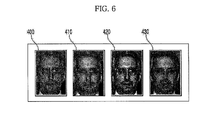
- FIG. 6 is a view showing an original image, a low-resolution image, a restored image and an image restored by a general basis vector according to the example embodiments;
- FIG. 7 is a flowchart illustrating an image processing method performed by a robot according to example embodiments.
- FIG. 8 is a flowchart illustrating an image processing method performed by a server according to example embodiments.
- the operation of a robot may be controlled according to a user command through Human Robot Interaction (HRI) between an intelligent robot 100 and a user 10 .
- HRI Human Robot Interaction
- a robot system based on a network such as the Internet or a Local Area Network (LAN) information stored in and managed by a server 200 is available by Human Computer Interaction (HCI) between a remote client such as a notebook type computer and the user 10 .
- HCI Human Computer Interaction
- the information is available by accessing the server 200 over the Web.
- An emergency stop 30 enables the robot to take necessary action or inform the user 100 of the emergency, when the robot 100 malfunctions or an emergency occurs which may interrupt the operation of the robot.
- the robot 100 has a charging battery. If power of the battery runs low, the robot moves to a charge station 40 to charge the battery while performing a service.
- FIG. 2 is a block diagram showing a robot in an image processing apparatus of a robot system according to example embodiments.
- FIG. 3 is a block diagram showing a server in the image processing apparatus of the robot system according to example embodiments.
- FIG. 4 is a view showing an image processing procedure according to example embodiments.
- the robot 100 includes an image input unit 110 to provide a high-resolution moving image, a object region detection unit 120 to detect an object region 310 from the high-resolution image, a clustering unit 130 to cluster the detected object region and assign the object region to a cluster, a basis vector generation unit 140 to generate a basis vector according to objects, an object password generation unit to generate object password information 320 using the object region, cluster information indicating which cluster the object region belongs to, and the basis vector in association with the object, a resolution conversion unit 160 to convert the resolution of the high-resolution image into low resolution, a low-resolution image generation unit 170 to generate a low-resolution image, and an image compression and transmission unit 180 to compress the object password information and the low-resolution image and to transmit the compressed image information to the server 200 over a network.
- an image input unit 110 to provide a high-resolution moving image
- a object region detection unit 120 to detect an object region 310 from the high-resolution image
- a clustering unit 130 to cluster the detected object region and
- the server 200 includes an image reception unit 210 to decompress the image information received from the robot 100 , an object password information detection unit 220 to detect the object password information from the decompressed image information, a low-resolution image detection unit 230 to detect a low-resolution image 330 from the decompressed image information, and an object image restoration unit 240 to restore a high-resolution object image 350 using the detected object password information with respect to the low-resolution object image 340 corresponding to the object region in the detected low-resolution image 330 .
- a camera to perform a monitoring function is mounted in the robot 100 .
- the high-resolution moving image is acquired by the camera, and such image acquisition is continued for a predetermined time.
- the image input unit 110 provides a high-resolution moving image (hereinafter, referred to as an original image) acquired using the camera to the object region detection unit 120 and the resolution conversion unit 160 .
- the object region detection unit 120 detects an object (e.g., a person's face, a pet, or the like) set by the user from the original image.
- an object e.g., a person's face, a pet, or the like
- Examples of a method of detecting the object region include a Scale Invariant Feature Transform (SIFT) or the like.
- SIFT Scale Invariant Feature Transform
- the detected rectangular object region is temporarily stored with four coordinates (x, y, width and height).
- x and y respectively denote an x-axis coordinate and a y-axis coordinate of the left upper end of the rectangular object region
- width and height respectively denote the sizes of the rectangle.
- the images are primarily classified by a process of cropping and temporarily storing the detected object images, that is, a cropping process.
- the clustering unit 130 classifies the object image cropped from the original image based on a similar feature according to objects and clusters the object image.
- Examples of the clustering method according to the objects include a K-means clustering algorithm or the like.
- the cropped object image is clustered because a high-resolution basis vector is generated according to the objects if the number of types of objects set by the user is plural. For example, if a person's face and a dog's face are set as an important object to be monitored in the original image, the image information of the person's face and the image information of the dog's face have respective different features and thus these two images may be classified into different groups using the K-means clustering algorithm.
- the basis vector generation unit 140 generates the high-resolution basis vector available at the time of image restoration with respect to a group of clustered object images. A method of generating such a high-resolution basis vector will be described in detail.
- Equation 1 Equation 1
- U denotes an m ⁇ m unitary matrix
- ⁇ denotes a diagonal matrix
- V denotes an n ⁇ n matrix
- the U value becomes the PCA basis vector.
- the shape of the PCA basis vector U of a general face image is shown in FIG. 5 .
- the generated basis vector is used to restore the object set in the converted low-resolution image into the high-resolution image. If the generated basis vector U is not the image cropped when the basis vector is generated, precise high-resolution restoration is impossible and as a result the basis vector functions as a private key.
- the resolution conversion unit 160 down-converts and provides the resolution of the high-resolution original image to the low-resolution generation unit 170 .
- Equation 4 i L denotes a low-resolution image
- i H denotes a high-resolution image
- A denotes a resolution conversion matrix
- Equation ⁇ ⁇ 4 A [ 1 16 1 16 ... 1 16 0 0 ... 0 ... 0 0 ... 0 0 ... 0 0 ... 0 1 16 1 16 ... 1 16 0 0 ... 0 ⁇ 0 0 ... 0 0 ... 0 ... 1 16 1 16 ... 1 16 ⁇ ]
- the amount of information to be transmitted to the server 200 is significantly decreased. For example, if the resolution of a 128 ⁇ 96 high-resolution image i H is converted, a 32 ⁇ 24 low-resolution image i L is obtained and thus transmission requirements are reduced.
- the low-resolution image is obtained by down-converting the resolution and functions as a public key which may be used to simply perform restoration using a general image restoration algorithm.
- the high-resolution original image may not be accurately reproduced by restoring the low-resolution image using a general method.
- the original image may be accurately restored using the low-resolution image and the object password information.
- the object image restoration unit 240 uses a Bayesian-based high-resolution restoration method when the high-resolution object image is restored from the low-resolution image.
- Equation 5 the Bayesian Equation used to estimate the high-resolution image using the low-resolution image is expressed by Equation 5.
- Equation 5 shows a probability that the high-resolution image i H is estimated when the low-resolution image i L is given.
- a solution having a high probability needs to be obtained. If the low-resolution image is always given, a probability that the low-resolution image is given is constant. Therefore, when a maximum value max of a probability of estimating the high-resolution image is obtained, the probability that the low-resolution image is given may be ignored.
- Equation 5 is replaced with Equation 6.
- the object password information detection unit 220 detects object password information from the received image information, the high-resolution PCA basis vector, an object region position corresponding to the object image 340 in the low-resolution image 330 , and clustering information indicating what number cluster the image information belongs to, which are included in the object password information may be obtained.
- the high-resolution object image 350 may be restored using the obtained information.
- the high-resolution PCA basis vector generated by a k-th cluster becomes U k .
- m H denotes an average image
- Equation 7 is modified to obtain Equation 8.
- the high-resolution image may be generated from the high-resolution feature vector.
- the desired high-resolution image may be restored if the high-resolution feature vector may be restored from the high-resolution PCA basis vector.
- Equation 6 P(i L
- Equation 10 The estimation of the high-resolution feature vector using the low-resolution image is expressed by Equation 10.
- y _ H ⁇ arg ⁇ ⁇ max y H ⁇ ( P ⁇ ( i L
- y H ) ) ⁇ arg ⁇ ⁇ min y H ⁇ ( ⁇ 2 ⁇ y H T ⁇ V - 1 ⁇ y H + ⁇ ⁇ A ⁇ ( U k ⁇ y H + m H ) - i L ⁇ T ⁇ ⁇ A ⁇ ( U k ⁇ y H + m H ) - i L ⁇ ) Equation ⁇ ⁇ 10
- Equation 11 Since the objective function of Equation 10 is a quadratic equation, a minimum value may be obtained using partial differentiation. Therefore, a high-resolution feature vector to minimize the quadratic equation may be estimated according to Equation 11.
- the high-resolution object image may be restored according to Equation 12.
- 400 denotes a 128 ⁇ 96 high-resolution original image photographed by the camera of the robot 100
- 410 denotes a 32 ⁇ 24 low-resolution image converted by the resolution conversion unit 160 using a resolution conversion matrix A
- 420 denotes a 128 ⁇ 96 high-resolution image restored according to example embodiments
- 430 denotes a 128 ⁇ 96 high-resolution image restored using the general basis vector instead of the PCA basis vector.
- the high-resolution image 420 restored according to the example embodiments has excellent image restoration performance compared with the high-resolution image 430 restored using the general basis vector.
- FIG. 7 is a flowchart illustrating an image processing method processed by a robot according to example embodiments.
- the object region within the original image 300 is detected ( 500 ).
- SIFT or the like may be used as the method of detecting the object regions.
- the object image 310 of the detected object region is clustered based on the similar feature ( 510 ).
- the K-means clustering algorithm or the like may be used as the clustering method according to the objects.
- the high-resolution basis vector is generated according to the objects ( 520 ).
- the generation of the basis vector is performed by extracting the PCA basis vector using SVD.
- the object password information is generated by including the detected object region, clustering information indicating what number cluster the object image classified by clustering belongs to and the high-resolution PCA basis vector ( 530 ).
- the original image is converted into the low-resolution image using the resolution conversion matrix ( 540 ).
- the image information including the low-resolution original image and the object password information is compressed and the compressed image information is transmitted to the server 200 over the network ( 550 ).
- the high-resolution image may not be accurately restored if the object password information is not applied to the low-resolution image which is leaked, it is possible to prevent privacy from being violated due to image leakage and interception.
- FIG. 8 is a flowchart illustrating an image processing method executed by a server according to example embodiments.
- the server 200 decompresses the received image information ( 600 ).
- the object password information and the low-resolution original image are detected from the decompressed image information ( 610 ).
- the high-resolution feature vector is estimated using the Bayesian-based high-resolution restoration method with this information and the low-resolution image 330 , and the high-resolution object image 350 is restored from the estimated high-resolution feature vector ( 620 ).
- the image processing apparatus of the robot system and the method and computer readable medium thereof since large volumes of images acquired by a robot are converted into low-resolution images to significantly reduce transmission requirements, it is possible to prevent excessive network load from being caused when the large volumes of images are transmitted to a server over a network. In addition, it is possible to reinforce security with respect to an object region, which need to be carefully subjected to image processing, to prevent image leakage.
- the above-described embodiments may be recorded in computer-readable media including program instructions to implement various operations embodied by a computer.
- the media may also include, alone or in combination with the program instructions, data files, data structures, and the like.
- Examples of computer-readable media include magnetic media such as hard disks, floppy disks, and magnetic tape; optical media such as CD ROM disks and DVDs; magneto-optical media such as optical disks; and hardware devices that are specially configured to store and perform program instructions, such as read-only memory (ROM), random access memory (RAM), flash memory, and the like.
- the computer-readable media may be a plurality of computer-readable storage devices in a distributed network, so that the program instructions are stored in the plurality of computer-readable storage devices and executed in a distributed fashion.
- the program instructions may be executed by one or more processors or processing devices.
- the computer-readable media may also be embodied in at least one application specific integrated circuit (ASIC) or Field Programmable Gate Array (FPGA). Examples of program instructions include both machine code, such as produced by a compiler, and files containing higher level code that may be executed by the computer using an interpreter.
- the described hardware devices may be configured to act as one or more software modules in order to perform the operations of the above-described exemplary embodiments, or vice versa.
Landscapes
- Engineering & Computer Science (AREA)
- Theoretical Computer Science (AREA)
- Computer Vision & Pattern Recognition (AREA)
- Multimedia (AREA)
- General Physics & Mathematics (AREA)
- Physics & Mathematics (AREA)
- Health & Medical Sciences (AREA)
- General Health & Medical Sciences (AREA)
- Evolutionary Computation (AREA)
- Artificial Intelligence (AREA)
- Oral & Maxillofacial Surgery (AREA)
- Medical Informatics (AREA)
- Databases & Information Systems (AREA)
- Computing Systems (AREA)
- Data Mining & Analysis (AREA)
- Software Systems (AREA)
- Signal Processing (AREA)
- Human Computer Interaction (AREA)
- Life Sciences & Earth Sciences (AREA)
- General Engineering & Computer Science (AREA)
- Evolutionary Biology (AREA)
- Bioinformatics & Computational Biology (AREA)
- Bioinformatics & Cheminformatics (AREA)
- Image Analysis (AREA)
Abstract
Description
M=[i 1 i 2 . . . i n] Equation 1
M=UΣV T Equation 2
i L =Ai H Equation 3
y H =U k T(i H −m H) Equation 7
Claims (21)
Applications Claiming Priority (3)
| Application Number | Priority Date | Filing Date | Title |
|---|---|---|---|
| KR10-2009-0091262 | 2009-09-25 | ||
| KR1020090091262A KR101611504B1 (en) | 2009-09-25 | 2009-09-25 | Robot system and image processing method thereof |
| KR10-2009-91262 | 2009-09-25 |
Publications (2)
| Publication Number | Publication Date |
|---|---|
| US20110075915A1 US20110075915A1 (en) | 2011-03-31 |
| US8687900B2 true US8687900B2 (en) | 2014-04-01 |
Family
ID=43780461
Family Applications (1)
| Application Number | Title | Priority Date | Filing Date |
|---|---|---|---|
| US12/876,465 Active 2031-07-24 US8687900B2 (en) | 2009-09-25 | 2010-09-07 | Image processing apparatus of robot system and method and computer-readable medium thereof |
Country Status (2)
| Country | Link |
|---|---|
| US (1) | US8687900B2 (en) |
| KR (1) | KR101611504B1 (en) |
Cited By (1)
| Publication number | Priority date | Publication date | Assignee | Title |
|---|---|---|---|---|
| US20190161186A1 (en) * | 2017-11-30 | 2019-05-30 | Industrial Technology Research Institute | Unmanned aerial vehicle, control system for unmanned aerial vehicle and control method thereof |
Families Citing this family (9)
| Publication number | Priority date | Publication date | Assignee | Title |
|---|---|---|---|---|
| KR101611504B1 (en) * | 2009-09-25 | 2016-04-11 | 삼성전자 주식회사 | Robot system and image processing method thereof |
| US8639644B1 (en) | 2011-05-06 | 2014-01-28 | Google Inc. | Shared robot knowledge base for use with cloud computing system |
| CN104520897B (en) * | 2012-08-06 | 2018-05-15 | 皇家飞利浦有限公司 | Picture noise reduces and/or image resolution ratio improves |
| KR102266716B1 (en) * | 2013-04-29 | 2021-06-18 | 팅크웨어(주) | Image-processing Apparatus for Car and Method of Processing Data Using The Same |
| CN105096256B (en) * | 2015-08-31 | 2018-05-04 | 深圳市博铭维智能科技有限公司 | The ultra-resolution ratio reconstructing method of specialized robot mobile platform and its gathered image |
| WO2019017720A1 (en) * | 2017-07-20 | 2019-01-24 | 주식회사 이고비드 | Camera system for protecting privacy and method therefor |
| WO2020242221A1 (en) * | 2019-05-31 | 2020-12-03 | 동국대학교 산학협력단 | Method and device for generating high resolution video using operation information |
| KR102337472B1 (en) * | 2020-06-25 | 2021-12-09 | 팅크웨어(주) | Image-processing Apparatus for Car and Method of Processing Data Using The Same |
| CN112102516B (en) * | 2020-09-22 | 2022-08-02 | 国网山东省电力公司电力科学研究院 | Intelligent robot inspection system for transformer substation and access operation method thereof |
Citations (10)
| Publication number | Priority date | Publication date | Assignee | Title |
|---|---|---|---|---|
| US6895305B2 (en) * | 2001-02-27 | 2005-05-17 | Anthrotronix, Inc. | Robotic apparatus and wireless communication system |
| US20050213818A1 (en) * | 2003-04-28 | 2005-09-29 | Sony Corporation | Image recognition device and method, and robot device |
| US20070188883A1 (en) * | 2004-03-22 | 2007-08-16 | Stereo Display, Inc. | Three-dimensional imaging system for robot vision |
| US20070203685A1 (en) * | 2004-03-04 | 2007-08-30 | Nec Corporation | Data Update System, Data Update Method, Data Update Program, and Robot System |
| US20080152191A1 (en) * | 2006-12-21 | 2008-06-26 | Honda Motor Co., Ltd. | Human Pose Estimation and Tracking Using Label Assignment |
| US20080184375A1 (en) * | 2006-05-09 | 2008-07-31 | Masao Nonaka | Confidential data protection apparatus, autonomous mobile robot, confidential data protection method, computer program, and integrated circuit |
| US20110001813A1 (en) * | 2009-07-03 | 2011-01-06 | Electronics And Telecommunications Research Institute | Gesture recognition apparatus, robot system including the same and gesture recognition method using the same |
| US20110075915A1 (en) * | 2009-09-25 | 2011-03-31 | Samsung Electronics Co., Ltd. | Image processing apparatus of robot system and method and computer-readable medium thereof |
| US7957837B2 (en) * | 2005-09-30 | 2011-06-07 | Irobot Corporation | Companion robot for personal interaction |
| US8090193B2 (en) * | 2007-12-06 | 2012-01-03 | Honda Motor Co., Ltd. | Mobile robot |
-
2009
- 2009-09-25 KR KR1020090091262A patent/KR101611504B1/en active Active
-
2010
- 2010-09-07 US US12/876,465 patent/US8687900B2/en active Active
Patent Citations (10)
| Publication number | Priority date | Publication date | Assignee | Title |
|---|---|---|---|---|
| US6895305B2 (en) * | 2001-02-27 | 2005-05-17 | Anthrotronix, Inc. | Robotic apparatus and wireless communication system |
| US20050213818A1 (en) * | 2003-04-28 | 2005-09-29 | Sony Corporation | Image recognition device and method, and robot device |
| US20070203685A1 (en) * | 2004-03-04 | 2007-08-30 | Nec Corporation | Data Update System, Data Update Method, Data Update Program, and Robot System |
| US20070188883A1 (en) * | 2004-03-22 | 2007-08-16 | Stereo Display, Inc. | Three-dimensional imaging system for robot vision |
| US7957837B2 (en) * | 2005-09-30 | 2011-06-07 | Irobot Corporation | Companion robot for personal interaction |
| US20080184375A1 (en) * | 2006-05-09 | 2008-07-31 | Masao Nonaka | Confidential data protection apparatus, autonomous mobile robot, confidential data protection method, computer program, and integrated circuit |
| US20080152191A1 (en) * | 2006-12-21 | 2008-06-26 | Honda Motor Co., Ltd. | Human Pose Estimation and Tracking Using Label Assignment |
| US8090193B2 (en) * | 2007-12-06 | 2012-01-03 | Honda Motor Co., Ltd. | Mobile robot |
| US20110001813A1 (en) * | 2009-07-03 | 2011-01-06 | Electronics And Telecommunications Research Institute | Gesture recognition apparatus, robot system including the same and gesture recognition method using the same |
| US20110075915A1 (en) * | 2009-09-25 | 2011-03-31 | Samsung Electronics Co., Ltd. | Image processing apparatus of robot system and method and computer-readable medium thereof |
Non-Patent Citations (1)
| Title |
|---|
| Rasmus Elsborg Madsen et al, Singular Value Decomposition and Principal Component Analysis, Feb. 2004, pp. 1-5. * |
Cited By (2)
| Publication number | Priority date | Publication date | Assignee | Title |
|---|---|---|---|---|
| US20190161186A1 (en) * | 2017-11-30 | 2019-05-30 | Industrial Technology Research Institute | Unmanned aerial vehicle, control system for unmanned aerial vehicle and control method thereof |
| US10703479B2 (en) * | 2017-11-30 | 2020-07-07 | Industrial Technology Research Institute | Unmanned aerial vehicle, control systems for unmanned aerial vehicle and control method thereof |
Also Published As
| Publication number | Publication date |
|---|---|
| US20110075915A1 (en) | 2011-03-31 |
| KR20110033680A (en) | 2011-03-31 |
| KR101611504B1 (en) | 2016-04-11 |
Similar Documents
| Publication | Publication Date | Title |
|---|---|---|
| US8687900B2 (en) | Image processing apparatus of robot system and method and computer-readable medium thereof | |
| JP5625039B2 (en) | System and method for detecting anomalies from data | |
| US10349060B2 (en) | Encoding video frames using generated region of interest maps | |
| US8942509B2 (en) | Apparatus and method creating ghost-free high dynamic range image using filtering | |
| JP2003284076A (en) | Device and method for detecting movement in digital image storage utilizing mpeg image compression technique | |
| US20160255357A1 (en) | Feature-based image set compression | |
| US20070041638A1 (en) | Systems and methods for real-time object recognition | |
| CN116455941A (en) | Indoor environment multi-source data transmission method and system based on Internet of things | |
| Purohit et al. | Multi-sensor surveillance system based on integrated video analytics | |
| Zhou et al. | Block compressed sampling of image signals by saliency based adaptive partitioning | |
| Hou et al. | Real-time surveillance video salient object detection using collaborative cloud-edge deep reinforcement learning | |
| EP3890312B1 (en) | Distributed image analysis method and system, and storage medium | |
| US11943300B2 (en) | Software-defined sensing | |
| EP4460961A1 (en) | Systems and methods for sharing analytical resources in a camera network | |
| CN100584000C (en) | Monitoring system, image processing device, management device, event detection method | |
| Pandey et al. | Real-time in-network image compression via distributed dictionary learning | |
| CN104125430A (en) | Method and device for detecting video moving objects as well as video monitoring system | |
| Khursheed et al. | Detecting and coding region of interests in bi-level images for data reduction in Wireless Visual Sensor Network | |
| Sharma et al. | CollabCam: Collaborative Inference and Mixed-Resolution Imaging for Energy-Efficient Pervasive Vision | |
| Liang | Research on real-time image processing system combining convolutional neural network and edge computing | |
| Kancherla et al. | Video steganalysis using spatial and temporal redundancies | |
| Xu et al. | Perceptual rate-distortion optimized image compression based on block compressive sensing | |
| Blasch et al. | Multi-modal video fusion for context-aided tracking | |
| Zhao et al. | Compressive sensing based secret signals recovery for effective image Steganalysis in secure communications | |
| KR101347598B1 (en) | Image transformation method and system for controlling the same |
Legal Events
| Date | Code | Title | Description |
|---|---|---|---|
| AS | Assignment |
Owner name: SAMSUNG ELECTRONICS CO., LTD., KOREA, REPUBLIC OF Free format text: ASSIGNMENT OF ASSIGNORS INTEREST;ASSIGNORS:HWANG, WON JUN;HAN, WOO SUP;SIGNING DATES FROM 20100826 TO 20100830;REEL/FRAME:024960/0518 |
|
| STCF | Information on status: patent grant |
Free format text: PATENTED CASE |
|
| FEPP | Fee payment procedure |
Free format text: PAYOR NUMBER ASSIGNED (ORIGINAL EVENT CODE: ASPN); ENTITY STATUS OF PATENT OWNER: LARGE ENTITY |
|
| MAFP | Maintenance fee payment |
Free format text: PAYMENT OF MAINTENANCE FEE, 4TH YEAR, LARGE ENTITY (ORIGINAL EVENT CODE: M1551) Year of fee payment: 4 |
|
| MAFP | Maintenance fee payment |
Free format text: PAYMENT OF MAINTENANCE FEE, 8TH YEAR, LARGE ENTITY (ORIGINAL EVENT CODE: M1552); ENTITY STATUS OF PATENT OWNER: LARGE ENTITY Year of fee payment: 8 |
|
| MAFP | Maintenance fee payment |
Free format text: PAYMENT OF MAINTENANCE FEE, 12TH YEAR, LARGE ENTITY (ORIGINAL EVENT CODE: M1553); ENTITY STATUS OF PATENT OWNER: LARGE ENTITY Year of fee payment: 12 |