US8680282B2 - Cyclic inhibitors of carnitine palmitoyltransferase and treating cancer - Google Patents
Cyclic inhibitors of carnitine palmitoyltransferase and treating cancer Download PDFInfo
- Publication number
- US8680282B2 US8680282B2 US12/671,154 US67115408A US8680282B2 US 8680282 B2 US8680282 B2 US 8680282B2 US 67115408 A US67115408 A US 67115408A US 8680282 B2 US8680282 B2 US 8680282B2
- Authority
- US
- United States
- Prior art keywords
- alkyl
- group
- independently
- substituted
- halogen
- Prior art date
- Legal status (The legal status is an assumption and is not a legal conclusion. Google has not performed a legal analysis and makes no representation as to the accuracy of the status listed.)
- Expired - Fee Related, expires
Links
- 0 [1*]C(=O)CC1(CC[2*])CCC1 Chemical compound [1*]C(=O)CC1(CC[2*])CCC1 0.000 description 25
- ITUPCXLUBBUWQF-UHFFFAOYSA-N *.B.C.C.C.C.C1=CC=CC=C1.C1=COC=C1.C1=CSC=C1.CC.CC.CC Chemical compound *.B.C.C.C.C.C1=CC=CC=C1.C1=COC=C1.C1=CSC=C1.CC.CC.CC ITUPCXLUBBUWQF-UHFFFAOYSA-N 0.000 description 6
- BTMRYSYEOPOPBR-UHFFFAOYSA-N *.C1=CC=CC=C1.CC Chemical compound *.C1=CC=CC=C1.CC BTMRYSYEOPOPBR-UHFFFAOYSA-N 0.000 description 5
- BMMMOYITNQKOIW-GCMYILRPSA-N *.*.B.C.C.C.C.C1=CC=CC=C1.C1=CCC=C1.C1=CN=CC1.C1=COC=C1.C1=COC=N1.C1=COC=N1.C1=CON=C1.C1=CSC=C1.C1=CSC=N1.C1=CSN=C1.C1=NC=NC1.C1=NC=NS1.CC.CC.CC.CC.CC.CC.CC.CC.CC.CC.CC.CC.F.I.[2HH].[HH].[KH] Chemical compound *.*.B.C.C.C.C.C1=CC=CC=C1.C1=CCC=C1.C1=CN=CC1.C1=COC=C1.C1=COC=N1.C1=COC=N1.C1=CON=C1.C1=CSC=C1.C1=CSC=N1.C1=CSN=C1.C1=NC=NC1.C1=NC=NS1.CC.CC.CC.CC.CC.CC.CC.CC.CC.CC.CC.CC.F.I.[2HH].[HH].[KH] BMMMOYITNQKOIW-GCMYILRPSA-N 0.000 description 2
- MUWHALZQVZZVIX-OYQRUQRVSA-N *.B.C.C.C.C.C.C.C.C1=CC=CC=C1.C1=COC=C1.C1=COC=N1.C1=CSC=C1.C1=CSC=N1.CC.CC.CC.CC.CC.[2HH] Chemical compound *.B.C.C.C.C.C.C.C.C1=CC=CC=C1.C1=COC=C1.C1=COC=N1.C1=CSC=C1.C1=CSC=N1.CC.CC.CC.CC.CC.[2HH] MUWHALZQVZZVIX-OYQRUQRVSA-N 0.000 description 2
- KPEZAJAPEFHFAB-UHFFFAOYSA-N C.C.C.C.C.CC1=CC=CS1.CC1=CSC=C1.CCN1CCCCC1.CN1C=CC=C1.CNC(=O)C1=CC=CO1.CNCC1=CCC=C1.CNS(=O)(=O)C1=CC=CC=C1.CNS(=O)(=O)C1=CCC=C1 Chemical compound C.C.C.C.C.CC1=CC=CS1.CC1=CSC=C1.CCN1CCCCC1.CN1C=CC=C1.CNC(=O)C1=CC=CO1.CNCC1=CCC=C1.CNS(=O)(=O)C1=CC=CC=C1.CNS(=O)(=O)C1=CCC=C1 KPEZAJAPEFHFAB-UHFFFAOYSA-N 0.000 description 2
- UHOVQNZJYSORNB-UHFFFAOYSA-N c1ccccc1 Chemical compound c1ccccc1 UHOVQNZJYSORNB-UHFFFAOYSA-N 0.000 description 2
- UPNXQIQXUUEFNJ-DCTXVBGYSA-N *.*.B.C.C.C.C.C.C.C.C.C.C.C.C.C.C.C.C.C1=CC=CC=C1.C1=CC=NC=C1.C1=CCC=C1.C1=CN=CC1.C1=CN=CC1.C1=CN=CN=C1.C1=COC=C1.C1=COC=N1.C1=COC=N1.C1=CON=C1.C1=CSC=C1.C1=CSC=N1.C1=CSC=N1.C1=CSN=C1.C1=NC=NC=N1.CC.CC.CC.CC.CC.CC.CC.CC.CC.CC.CC.CC.CC.CC.CC.F.I.N.O.[2HH].[HH].[KH] Chemical compound *.*.B.C.C.C.C.C.C.C.C.C.C.C.C.C.C.C.C.C1=CC=CC=C1.C1=CC=NC=C1.C1=CCC=C1.C1=CN=CC1.C1=CN=CC1.C1=CN=CN=C1.C1=COC=C1.C1=COC=N1.C1=COC=N1.C1=CON=C1.C1=CSC=C1.C1=CSC=N1.C1=CSC=N1.C1=CSN=C1.C1=NC=NC=N1.CC.CC.CC.CC.CC.CC.CC.CC.CC.CC.CC.CC.CC.CC.CC.F.I.N.O.[2HH].[HH].[KH] UPNXQIQXUUEFNJ-DCTXVBGYSA-N 0.000 description 1
- WWGPTONKOXDHMZ-NUUNVAPLSA-N *.*.B.C.C.C.C.C.C.C.C.C.C.C.C.C1=CC=CC=C1.C1=CC=NC=C1.C1=CCC=C1.C1=CN=CC1.C1=CN=CC1.C1=CN=CN=C1.C1=CN=CN=C1.C1=COC=C1.C1=COC=N1.C1=COC=N1.C1=CON=C1.C1=CSC=C1.C1=CSC=N1.C1=CSC=N1.C1=CSN=C1.CC.CC.CC.CC.CC.CC.CC.CC.CC.CC.CC.CC.CC.CC.CC.F.I.N.O.[2HH].[HH].[KH] Chemical compound *.*.B.C.C.C.C.C.C.C.C.C.C.C.C.C1=CC=CC=C1.C1=CC=NC=C1.C1=CCC=C1.C1=CN=CC1.C1=CN=CC1.C1=CN=CN=C1.C1=CN=CN=C1.C1=COC=C1.C1=COC=N1.C1=COC=N1.C1=CON=C1.C1=CSC=C1.C1=CSC=N1.C1=CSC=N1.C1=CSN=C1.CC.CC.CC.CC.CC.CC.CC.CC.CC.CC.CC.CC.CC.CC.CC.F.I.N.O.[2HH].[HH].[KH] WWGPTONKOXDHMZ-NUUNVAPLSA-N 0.000 description 1
- OUIQAKFQBJLDCG-UHFFFAOYSA-N *.B.C.C.C1=CC=CC=C1.C1=COC=C1.C1=CSC=C1.CC.CC.CC Chemical compound *.B.C.C.C1=CC=CC=C1.C1=COC=C1.C1=CSC=C1.CC.CC.CC OUIQAKFQBJLDCG-UHFFFAOYSA-N 0.000 description 1
- OUTDMIQCAUHVBZ-CLOXSHPFSA-N B.C.C.C.C.C.C.C.C.C.C.C.C.C.C.C.C.C1=CC2=C(C=C1)NC=C2.C1=CC2=C(C=C1)SC=N2.C1=CC2=CC=CN2C=C1.C1=CC=C2C=CC=CC2=C1.C1=CC=C2C=NC=CC2=C1.C1=CC=C2N=CC=CC2=C1.C1=CC=C2OC=CC2=C1.C1=CC=C2OC=NC2=C1.C1=CC=C2SC=CC2=C1.C1=CC=CC=C1.C1=CC=NC=C1.C1=CCC=C1.C1=CN=CC1.C1=CN=CN=C1.C1=COC=C1.C1=COC=N1.C1=CON=C1.C1=CSC=C1.C1=CSC=N1.C1=CSN=C1.C1=NC=NC1.C1=NC=NO1.C1=NC=NS1.CC.CC.CC.CC.CC.CC.CC.CC.CC.CC.CC.CC.CC.CC.CC.CC.CC.CC.CC.CC.CC.CC.CC.F.I.N.O.P.S.[1*].[2HH].[3HH].[HH].[KH].[U].[V].[W].[Y] Chemical compound B.C.C.C.C.C.C.C.C.C.C.C.C.C.C.C.C.C1=CC2=C(C=C1)NC=C2.C1=CC2=C(C=C1)SC=N2.C1=CC2=CC=CN2C=C1.C1=CC=C2C=CC=CC2=C1.C1=CC=C2C=NC=CC2=C1.C1=CC=C2N=CC=CC2=C1.C1=CC=C2OC=CC2=C1.C1=CC=C2OC=NC2=C1.C1=CC=C2SC=CC2=C1.C1=CC=CC=C1.C1=CC=NC=C1.C1=CCC=C1.C1=CN=CC1.C1=CN=CN=C1.C1=COC=C1.C1=COC=N1.C1=CON=C1.C1=CSC=C1.C1=CSC=N1.C1=CSN=C1.C1=NC=NC1.C1=NC=NO1.C1=NC=NS1.CC.CC.CC.CC.CC.CC.CC.CC.CC.CC.CC.CC.CC.CC.CC.CC.CC.CC.CC.CC.CC.CC.CC.F.I.N.O.P.S.[1*].[2HH].[3HH].[HH].[KH].[U].[V].[W].[Y] OUTDMIQCAUHVBZ-CLOXSHPFSA-N 0.000 description 1
- QOCOJGBPJLAOOT-RQHGZCKJSA-N B.C.C.C.C.C.C.C.C.C1=CC=CC=C1.C1=COC=C1.C1=COC=N1.C1=CSC=C1.C1=CSC=N1.CC.CC.CC.CC.CC.[2HH] Chemical compound B.C.C.C.C.C.C.C.C.C1=CC=CC=C1.C1=COC=C1.C1=COC=N1.C1=CSC=C1.C1=CSC=N1.CC.CC.CC.CC.CC.[2HH] QOCOJGBPJLAOOT-RQHGZCKJSA-N 0.000 description 1
- YCMNVZRVVJHPMC-UKLPTRLMSA-N B.C.C.C.C.C.C.C.C1=CC=CC=C1.C1=CC=NC=C1.C1=CCC=C1.C1=CN=CC1.C1=CN=CN=C1.C1=COC=C1.C1=COC=N1.C1=CON=C1.C1=CSC=C1.C1=CSC=N1.C1=CSN=C1.C1=NC=NC1.C1=NC=NO1.C1=NC=NS1.CC.CC.CC.CC.CC.CC.CC.CC.CC.CC.CC.CC.CC.CC.F.I.N.[2HH].[HH].[KH] Chemical compound B.C.C.C.C.C.C.C.C1=CC=CC=C1.C1=CC=NC=C1.C1=CCC=C1.C1=CN=CC1.C1=CN=CN=C1.C1=COC=C1.C1=COC=N1.C1=CON=C1.C1=CSC=C1.C1=CSC=N1.C1=CSN=C1.C1=NC=NC1.C1=NC=NO1.C1=NC=NS1.CC.CC.CC.CC.CC.CC.CC.CC.CC.CC.CC.CC.CC.CC.F.I.N.[2HH].[HH].[KH] YCMNVZRVVJHPMC-UKLPTRLMSA-N 0.000 description 1
- JHNUAYFDVQWGAH-UHFFFAOYSA-N B.C.C.C.C.C.C.C1=CC=CC=C1.C1=COC=C1.C1=CSC=C1.CC.CC.CC Chemical compound B.C.C.C.C.C.C.C1=CC=CC=C1.C1=COC=C1.C1=CSC=C1.CC.CC.CC JHNUAYFDVQWGAH-UHFFFAOYSA-N 0.000 description 1
- CWYMGDSKPCHVNN-UHFFFAOYSA-N C.C1=CC2=C(C=C1)SC=N2.CC.[1*] Chemical compound C.C1=CC2=C(C=C1)SC=N2.CC.[1*] CWYMGDSKPCHVNN-UHFFFAOYSA-N 0.000 description 1
- WLQXAWHLCZHJKS-UHFFFAOYSA-N C.CCCCCCOC1=CC(OCCCCCC(=O)CC2(CC(=O)OCC)CC[N+](C)(C)CC2)=CC=C1 Chemical compound C.CCCCCCOC1=CC(OCCCCCC(=O)CC2(CC(=O)OCC)CC[N+](C)(C)CC2)=CC=C1 WLQXAWHLCZHJKS-UHFFFAOYSA-N 0.000 description 1
- VESMBRAQTYIGNY-UHFFFAOYSA-S C=C(O)CC1(NC(=O)NC2=CC=C(CCCCCCCC)C=C2)C[N+](C)(C)C1.CCCCCC1=CC=C(S(=O)(=O)NC2(CC(=O)O)CCC[N+](C)(C)C2)C=C1.CCCCCC1=CC=C(S(=O)(=O)NC2(CC(=O)O)CC[N+](C)(C)CC2)C=C1.CCCCCCCCC1=CC=C(NS(=O)(=O)NC2(CC(=O)O)CCC[N+](C)(C)C2)C=C1.C[N+]1(C)CCC(CC(=O)O)(NC(=O)C2=CC=C(CCC3=CC=CC=C3)O2)CC1.[CH3-].[CH3-].[CH3-].[CH3-] Chemical compound C=C(O)CC1(NC(=O)NC2=CC=C(CCCCCCCC)C=C2)C[N+](C)(C)C1.CCCCCC1=CC=C(S(=O)(=O)NC2(CC(=O)O)CCC[N+](C)(C)C2)C=C1.CCCCCC1=CC=C(S(=O)(=O)NC2(CC(=O)O)CC[N+](C)(C)CC2)C=C1.CCCCCCCCC1=CC=C(NS(=O)(=O)NC2(CC(=O)O)CCC[N+](C)(C)C2)C=C1.C[N+]1(C)CCC(CC(=O)O)(NC(=O)C2=CC=C(CCC3=CC=CC=C3)O2)CC1.[CH3-].[CH3-].[CH3-].[CH3-] VESMBRAQTYIGNY-UHFFFAOYSA-S 0.000 description 1
- MTRBDOQBCFUCKP-UHFFFAOYSA-O CCCCCC1=CC=C(S(=O)(=O)CC2(CC(=O)O)C[N+](C)(C)C2)C=C1.O=C([O-])C(F)(F)F Chemical compound CCCCCC1=CC=C(S(=O)(=O)CC2(CC(=O)O)C[N+](C)(C)C2)C=C1.O=C([O-])C(F)(F)F MTRBDOQBCFUCKP-UHFFFAOYSA-O 0.000 description 1
- PUGXXAUCGLMWCS-UHFFFAOYSA-O CCCCCC1=CC=C(S(=O)(=O)CC2(CC(=O)O)C[NH+](C)C2)C=C1.O=C([O-])C(F)(F)F Chemical compound CCCCCC1=CC=C(S(=O)(=O)CC2(CC(=O)O)C[NH+](C)C2)C=C1.O=C([O-])C(F)(F)F PUGXXAUCGLMWCS-UHFFFAOYSA-O 0.000 description 1
- BKWWNTZYOYPPBC-UHFFFAOYSA-O CCCCCC1=CC=C(S(=O)(=O)CC2(CC(=O)O)C[NH2+]C2)C=C1.O=C([O-])C(F)(F)F Chemical compound CCCCCC1=CC=C(S(=O)(=O)CC2(CC(=O)O)C[NH2+]C2)C=C1.O=C([O-])C(F)(F)F BKWWNTZYOYPPBC-UHFFFAOYSA-O 0.000 description 1
- HQYNBNKKEHTTRJ-UHFFFAOYSA-O CCCCCC1=CC=C(S(=O)(=O)NC2(CC(=O)O)CCC[N+](C)(C)C2)C=C1.O=C([O-])C(F)(F)F Chemical compound CCCCCC1=CC=C(S(=O)(=O)NC2(CC(=O)O)CCC[N+](C)(C)C2)C=C1.O=C([O-])C(F)(F)F HQYNBNKKEHTTRJ-UHFFFAOYSA-O 0.000 description 1
- UMCAGHDQOILOHL-UHFFFAOYSA-O CCCCCC1=CC=C(S(=O)(=O)NC2(CC(=O)O)CCC[NH+](C)C2)C=C1.O=C([O-])C(F)(F)F Chemical compound CCCCCC1=CC=C(S(=O)(=O)NC2(CC(=O)O)CCC[NH+](C)C2)C=C1.O=C([O-])C(F)(F)F UMCAGHDQOILOHL-UHFFFAOYSA-O 0.000 description 1
- FZAXWGNGSIMBEQ-UHFFFAOYSA-P CCCCCC1=CC=C(S(=O)(=O)NC2(CC(=O)O)CC[N+](C)(C)C2)C=C1.CCCCCCCCC1=CC=C(NS(=O)(=O)NC2(CC(=O)O)CC[N+](C)(C)CC2)C=C1.[CH3-].[CH3-] Chemical compound CCCCCC1=CC=C(S(=O)(=O)NC2(CC(=O)O)CC[N+](C)(C)C2)C=C1.CCCCCCCCC1=CC=C(NS(=O)(=O)NC2(CC(=O)O)CC[N+](C)(C)CC2)C=C1.[CH3-].[CH3-] FZAXWGNGSIMBEQ-UHFFFAOYSA-P 0.000 description 1
- PVSJXDMKIYDWEM-UHFFFAOYSA-O CCCCCC1=CC=C(S(=O)(=O)NC2(CC(=O)O)CC[N+](C)(C)C2)C=C1.O=C([O-])C(F)(F)F Chemical compound CCCCCC1=CC=C(S(=O)(=O)NC2(CC(=O)O)CC[N+](C)(C)C2)C=C1.O=C([O-])C(F)(F)F PVSJXDMKIYDWEM-UHFFFAOYSA-O 0.000 description 1
- SEIXNUIESNTONX-UHFFFAOYSA-O CCCCCC1=CC=C(S(=O)(=O)NC2(CC(=O)O)CC[N+](C)(C)CC2)C=C1.O=C([O-])C(F)(F)F Chemical compound CCCCCC1=CC=C(S(=O)(=O)NC2(CC(=O)O)CC[N+](C)(C)CC2)C=C1.O=C([O-])C(F)(F)F SEIXNUIESNTONX-UHFFFAOYSA-O 0.000 description 1
- IERDJSXGUPPJFK-UHFFFAOYSA-O CCCCCC1=CC=C(S(=O)(=O)NC2(CC(=O)O)CC[NH+](C)C2)C=C1.O=C([O-])C(F)(F)F Chemical compound CCCCCC1=CC=C(S(=O)(=O)NC2(CC(=O)O)CC[NH+](C)C2)C=C1.O=C([O-])C(F)(F)F IERDJSXGUPPJFK-UHFFFAOYSA-O 0.000 description 1
- HUYHNFMBCXWLBI-UHFFFAOYSA-O CCCCCC1=CC=C(S(=O)(=O)NC2(CC(=O)O)CC[NH+](C)CC2)C=C1.O=C([O-])C(F)(F)F Chemical compound CCCCCC1=CC=C(S(=O)(=O)NC2(CC(=O)O)CC[NH+](C)CC2)C=C1.O=C([O-])C(F)(F)F HUYHNFMBCXWLBI-UHFFFAOYSA-O 0.000 description 1
- RHPJIAGFKVQMDL-UHFFFAOYSA-N CCCCCCCCC1=CC=C(CC(=O)CC2(CC(=O)O)CCN(C)(C)CC2)C=C1.O=C(O)C(F)(F)F Chemical compound CCCCCCCCC1=CC=C(CC(=O)CC2(CC(=O)O)CCN(C)(C)CC2)C=C1.O=C(O)C(F)(F)F RHPJIAGFKVQMDL-UHFFFAOYSA-N 0.000 description 1
- LCZBIKMEOIYTQI-UHFFFAOYSA-N CCCCCCCCC1=CC=C(CS(=O)(=O)CC2(CC(=O)O)CCN(C)(C)CC2)C=C1.O=C(O)C(F)(F)F Chemical compound CCCCCCCCC1=CC=C(CS(=O)(=O)CC2(CC(=O)O)CCN(C)(C)CC2)C=C1.O=C(O)C(F)(F)F LCZBIKMEOIYTQI-UHFFFAOYSA-N 0.000 description 1
- SAPRFWGSGPBJDN-UHFFFAOYSA-O CCCCCCCCC1=CC=C(N(C)S(=O)(=O)CC2(CC(=O)O)CCC[N+](C)(C)C2)C=C1.O=C([O-])C(F)(F)F Chemical compound CCCCCCCCC1=CC=C(N(C)S(=O)(=O)CC2(CC(=O)O)CCC[N+](C)(C)C2)C=C1.O=C([O-])C(F)(F)F SAPRFWGSGPBJDN-UHFFFAOYSA-O 0.000 description 1
- DKDCQEOCANRDHQ-UHFFFAOYSA-P CCCCCCCCC1=CC=C(NC(=O)NC2(CC(=O)O)CCC[N+](C)(C)C2)C=C1.CCCCCCCCC1=CC=C(NC(=O)NC2(CC(=O)O)CC[N+](C)(C)CC2)C=C1 Chemical compound CCCCCCCCC1=CC=C(NC(=O)NC2(CC(=O)O)CCC[N+](C)(C)C2)C=C1.CCCCCCCCC1=CC=C(NC(=O)NC2(CC(=O)O)CC[N+](C)(C)CC2)C=C1 DKDCQEOCANRDHQ-UHFFFAOYSA-P 0.000 description 1
- AOTOALFKHWXVDW-UHFFFAOYSA-O CCCCCCCCC1=CC=C(NC(=O)NC2(CC(=O)O)CCC[N+](C)(C)C2)C=C1.O=C([O-])C(F)(F)F Chemical compound CCCCCCCCC1=CC=C(NC(=O)NC2(CC(=O)O)CCC[N+](C)(C)C2)C=C1.O=C([O-])C(F)(F)F AOTOALFKHWXVDW-UHFFFAOYSA-O 0.000 description 1
- SHYAQXVDJWCYFI-UHFFFAOYSA-O CCCCCCCCC1=CC=C(NC(=O)NC2(CC(=O)O)CC[N+](C)(C)C2)C=C1.O=C([O-])C(F)(F)F Chemical compound CCCCCCCCC1=CC=C(NC(=O)NC2(CC(=O)O)CC[N+](C)(C)C2)C=C1.O=C([O-])C(F)(F)F SHYAQXVDJWCYFI-UHFFFAOYSA-O 0.000 description 1
- MLBWWTXNUMSJNO-UHFFFAOYSA-O CCCCCCCCC1=CC=C(NC(=O)NC2(CC(=O)O)CC[NH+](C)C2)C=C1.O=C([O-])C(F)(F)F Chemical compound CCCCCCCCC1=CC=C(NC(=O)NC2(CC(=O)O)CC[NH+](C)C2)C=C1.O=C([O-])C(F)(F)F MLBWWTXNUMSJNO-UHFFFAOYSA-O 0.000 description 1
- XFEQCQQWNOVMPZ-UHFFFAOYSA-O CCCCCCCCC1=CC=C(NC(=O)NC2(CC(=O)O)C[N+](C)(C)C2)C=C1.O=C([O-])C(F)(F)F Chemical compound CCCCCCCCC1=CC=C(NC(=O)NC2(CC(=O)O)C[N+](C)(C)C2)C=C1.O=C([O-])C(F)(F)F XFEQCQQWNOVMPZ-UHFFFAOYSA-O 0.000 description 1
- GELNJOLMDDQYAW-UHFFFAOYSA-O CCCCCCCCC1=CC=C(NC(=O)NC2(CC(=O)O)C[NH2+]C2)C=C1.O=C([O-])C(F)(F)F Chemical compound CCCCCCCCC1=CC=C(NC(=O)NC2(CC(=O)O)C[NH2+]C2)C=C1.O=C([O-])C(F)(F)F GELNJOLMDDQYAW-UHFFFAOYSA-O 0.000 description 1
- ZZYUNRUIQPUPKP-UHFFFAOYSA-N CCCCCCCCC1=CC=C(NS(=O)(=O)NC(=O)OCCCl)C=C1 Chemical compound CCCCCCCCC1=CC=C(NS(=O)(=O)NC(=O)OCCCl)C=C1 ZZYUNRUIQPUPKP-UHFFFAOYSA-N 0.000 description 1
- AODANGGECQOHSM-UHFFFAOYSA-N CCCCCCCCC1=CC=C(NS(=O)(=O)NC2(CC(=O)O)CCC(C)CC2)C=C1.O=C([O-])C(F)(F)F Chemical compound CCCCCCCCC1=CC=C(NS(=O)(=O)NC2(CC(=O)O)CCC(C)CC2)C=C1.O=C([O-])C(F)(F)F AODANGGECQOHSM-UHFFFAOYSA-N 0.000 description 1
- LVAXYBJRPOPCMF-UHFFFAOYSA-N CCCCCCCCC1=CC=C(NS(=O)(=O)NC2(CC(=O)O)CCC2)C=C1.O=C([O-])C(F)(F)F Chemical compound CCCCCCCCC1=CC=C(NS(=O)(=O)NC2(CC(=O)O)CCC2)C=C1.O=C([O-])C(F)(F)F LVAXYBJRPOPCMF-UHFFFAOYSA-N 0.000 description 1
- ZXPFRBSIIHFKCR-UHFFFAOYSA-O CCCCCCCCC1=CC=C(NS(=O)(=O)NC2(CC(=O)O)CCC[N+](C)(C)C2)C=C1.O=C([O-])C(F)(F)F Chemical compound CCCCCCCCC1=CC=C(NS(=O)(=O)NC2(CC(=O)O)CCC[N+](C)(C)C2)C=C1.O=C([O-])C(F)(F)F ZXPFRBSIIHFKCR-UHFFFAOYSA-O 0.000 description 1
- CLRALXRMTKTFPX-UHFFFAOYSA-O CCCCCCCCC1=CC=C(NS(=O)(=O)NC2(CC(=O)O)CCC[NH+](C)C2)C=C1.O=C([O-])C(F)(F)F Chemical compound CCCCCCCCC1=CC=C(NS(=O)(=O)NC2(CC(=O)O)CCC[NH+](C)C2)C=C1.O=C([O-])C(F)(F)F CLRALXRMTKTFPX-UHFFFAOYSA-O 0.000 description 1
- VKSBNCGXEODCTK-UHFFFAOYSA-O CCCCCCCCCCC1=CC=C(C(=O)NC2(CC(=O)O)CC[N+](C)(C)C2)C=C1.O=C([O-])C(F)(F)F Chemical compound CCCCCCCCCCC1=CC=C(C(=O)NC2(CC(=O)O)CC[N+](C)(C)C2)C=C1.O=C([O-])C(F)(F)F VKSBNCGXEODCTK-UHFFFAOYSA-O 0.000 description 1
- RVTHCWIQJYKKCC-UHFFFAOYSA-O CCCCCCCCCCC1=CC=C(C(=O)NC2(CC(=O)O)CC[NH+](C)C2)C=C1.O=C([O-])C(F)(F)F Chemical compound CCCCCCCCCCC1=CC=C(C(=O)NC2(CC(=O)O)CC[NH+](C)C2)C=C1.O=C([O-])C(F)(F)F RVTHCWIQJYKKCC-UHFFFAOYSA-O 0.000 description 1
- LYOHYVLJDTTYOE-UHFFFAOYSA-O CCCCCc(cc1)ccc1S(NC1(CC(O)=O)C[NH+](C)C1)(=O)=O Chemical compound CCCCCc(cc1)ccc1S(NC1(CC(O)=O)C[NH+](C)C1)(=O)=O LYOHYVLJDTTYOE-UHFFFAOYSA-O 0.000 description 1
- OVSMBRZABUOYNL-UHFFFAOYSA-N CCOC(=O)CC1(N)CCC(N)CC1 Chemical compound CCOC(=O)CC1(N)CCC(N)CC1 OVSMBRZABUOYNL-UHFFFAOYSA-N 0.000 description 1
- FQYGSNXTOJSDAQ-UHFFFAOYSA-N CCOC(=O)CC1(N)CCCC1 Chemical compound CCOC(=O)CC1(N)CCCC1 FQYGSNXTOJSDAQ-UHFFFAOYSA-N 0.000 description 1
- GYSOLPWLYGBERM-UHFFFAOYSA-N CCOC(=O)CC1(N)CCCN(C)C1 Chemical compound CCOC(=O)CC1(N)CCCN(C)C1 GYSOLPWLYGBERM-UHFFFAOYSA-N 0.000 description 1
- XPXLMLCRLYNVBC-UHFFFAOYSA-N CCOC(=O)CC1(N)CN(C(=O)OC(C)(C)C)C1 Chemical compound CCOC(=O)CC1(N)CN(C(=O)OC(C)(C)C)C1 XPXLMLCRLYNVBC-UHFFFAOYSA-N 0.000 description 1
- SUGOGSVUWLSLDC-UHFFFAOYSA-O C[N+]1(C)CCC(CC(=O)O)(NC(=O)C2=CC=C(C#CC3=CC=CC=C3)O2)CC1.O=C([O-])C(F)(F)F Chemical compound C[N+]1(C)CCC(CC(=O)O)(NC(=O)C2=CC=C(C#CC3=CC=CC=C3)O2)CC1.O=C([O-])C(F)(F)F SUGOGSVUWLSLDC-UHFFFAOYSA-O 0.000 description 1
- YXWJBMJMSGYVNI-UHFFFAOYSA-O C[N+]1(C)CCC(CC(=O)O)(NC(=O)C2=CC=C(CCC3=CC=CC=C3)O2)CC1.O=C([O-])C(F)(F)F Chemical compound C[N+]1(C)CCC(CC(=O)O)(NC(=O)C2=CC=C(CCC3=CC=CC=C3)O2)CC1.O=C([O-])C(F)(F)F YXWJBMJMSGYVNI-UHFFFAOYSA-O 0.000 description 1
- BRZBTXXVAWYBBD-UHFFFAOYSA-O C[N+]1(C)CCCC(CC(=O)O)(NC(=O)C2=CC=C(CCC3=CC=CC=C3)O2)C1.O=C([O-])C(F)(F)F Chemical compound C[N+]1(C)CCCC(CC(=O)O)(NC(=O)C2=CC=C(CCC3=CC=CC=C3)O2)C1.O=C([O-])C(F)(F)F BRZBTXXVAWYBBD-UHFFFAOYSA-O 0.000 description 1
- VUGASHSAYGDGNS-UHFFFAOYSA-O C[NH+]1CCCC(CC(=O)O)(NC(=O)C2=CC=C(CCC3=CC=CC=C3)O2)C1.O=C([O-])C(F)(F)F Chemical compound C[NH+]1CCCC(CC(=O)O)(NC(=O)C2=CC=C(CCC3=CC=CC=C3)O2)C1.O=C([O-])C(F)(F)F VUGASHSAYGDGNS-UHFFFAOYSA-O 0.000 description 1
- RLBDDWOQTFPKGI-UHFFFAOYSA-O O=C(O)CC1(CC(=O)C2=CC=C(C#CC3=CC=CC=C3)O2)C[NH2+]C1.O=C([O-])C(F)(F)F Chemical compound O=C(O)CC1(CC(=O)C2=CC=C(C#CC3=CC=CC=C3)O2)C[NH2+]C1.O=C([O-])C(F)(F)F RLBDDWOQTFPKGI-UHFFFAOYSA-O 0.000 description 1
- VNJWMBHALVLIRJ-UHFFFAOYSA-M O=C([O-])C(F)(F)F.[H]N1(C)CCCC(CC(=O)O)(NC(=O)NC2=CC=C(CCCCCCCC)C=C2)C1 Chemical compound O=C([O-])C(F)(F)F.[H]N1(C)CCCC(CC(=O)O)(NC(=O)NC2=CC=C(CCCCCCCC)C=C2)C1 VNJWMBHALVLIRJ-UHFFFAOYSA-M 0.000 description 1
- HSIVKWUCLSDQPH-UHFFFAOYSA-O O=C([O-])C(F)(F)F.[H][N+]1(C)CCC(CC(=O)O)(NC(=O)NC2=CC=C(CCCCCCCC)C=C2)CC1 Chemical compound O=C([O-])C(F)(F)F.[H][N+]1(C)CCC(CC(=O)O)(NC(=O)NC2=CC=C(CCCCCCCC)C=C2)CC1 HSIVKWUCLSDQPH-UHFFFAOYSA-O 0.000 description 1
Classifications
-
- C—CHEMISTRY; METALLURGY
- C07—ORGANIC CHEMISTRY
- C07D—HETEROCYCLIC COMPOUNDS
- C07D211/00—Heterocyclic compounds containing hydrogenated pyridine rings, not condensed with other rings
- C07D211/04—Heterocyclic compounds containing hydrogenated pyridine rings, not condensed with other rings with only hydrogen or carbon atoms directly attached to the ring nitrogen atom
- C07D211/06—Heterocyclic compounds containing hydrogenated pyridine rings, not condensed with other rings with only hydrogen or carbon atoms directly attached to the ring nitrogen atom having no double bonds between ring members or between ring members and non-ring members
- C07D211/36—Heterocyclic compounds containing hydrogenated pyridine rings, not condensed with other rings with only hydrogen or carbon atoms directly attached to the ring nitrogen atom having no double bonds between ring members or between ring members and non-ring members with hetero atoms or with carbon atoms having three bonds to hetero atoms with at the most one bond to halogen, e.g. ester or nitrile radicals, directly attached to ring carbon atoms
- C07D211/56—Nitrogen atoms
- C07D211/58—Nitrogen atoms attached in position 4
-
- A—HUMAN NECESSITIES
- A61—MEDICAL OR VETERINARY SCIENCE; HYGIENE
- A61P—SPECIFIC THERAPEUTIC ACTIVITY OF CHEMICAL COMPOUNDS OR MEDICINAL PREPARATIONS
- A61P29/00—Non-central analgesic, antipyretic or antiinflammatory agents, e.g. antirheumatic agents; Non-steroidal antiinflammatory drugs [NSAID]
-
- A—HUMAN NECESSITIES
- A61—MEDICAL OR VETERINARY SCIENCE; HYGIENE
- A61P—SPECIFIC THERAPEUTIC ACTIVITY OF CHEMICAL COMPOUNDS OR MEDICINAL PREPARATIONS
- A61P3/00—Drugs for disorders of the metabolism
- A61P3/08—Drugs for disorders of the metabolism for glucose homeostasis
- A61P3/10—Drugs for disorders of the metabolism for glucose homeostasis for hyperglycaemia, e.g. antidiabetics
-
- A—HUMAN NECESSITIES
- A61—MEDICAL OR VETERINARY SCIENCE; HYGIENE
- A61P—SPECIFIC THERAPEUTIC ACTIVITY OF CHEMICAL COMPOUNDS OR MEDICINAL PREPARATIONS
- A61P31/00—Antiinfectives, i.e. antibiotics, antiseptics, chemotherapeutics
-
- A—HUMAN NECESSITIES
- A61—MEDICAL OR VETERINARY SCIENCE; HYGIENE
- A61P—SPECIFIC THERAPEUTIC ACTIVITY OF CHEMICAL COMPOUNDS OR MEDICINAL PREPARATIONS
- A61P35/00—Antineoplastic agents
-
- A—HUMAN NECESSITIES
- A61—MEDICAL OR VETERINARY SCIENCE; HYGIENE
- A61P—SPECIFIC THERAPEUTIC ACTIVITY OF CHEMICAL COMPOUNDS OR MEDICINAL PREPARATIONS
- A61P35/00—Antineoplastic agents
- A61P35/02—Antineoplastic agents specific for leukemia
-
- C—CHEMISTRY; METALLURGY
- C07—ORGANIC CHEMISTRY
- C07C—ACYCLIC OR CARBOCYCLIC COMPOUNDS
- C07C275/00—Derivatives of urea, i.e. compounds containing any of the groups, the nitrogen atoms not being part of nitro or nitroso groups
- C07C275/28—Derivatives of urea, i.e. compounds containing any of the groups, the nitrogen atoms not being part of nitro or nitroso groups having nitrogen atoms of urea groups bound to carbon atoms of six-membered aromatic rings of a carbon skeleton
- C07C275/32—Derivatives of urea, i.e. compounds containing any of the groups, the nitrogen atoms not being part of nitro or nitroso groups having nitrogen atoms of urea groups bound to carbon atoms of six-membered aromatic rings of a carbon skeleton being further substituted by singly-bound oxygen atoms
- C07C275/34—Derivatives of urea, i.e. compounds containing any of the groups, the nitrogen atoms not being part of nitro or nitroso groups having nitrogen atoms of urea groups bound to carbon atoms of six-membered aromatic rings of a carbon skeleton being further substituted by singly-bound oxygen atoms having nitrogen atoms of urea groups and singly-bound oxygen atoms bound to carbon atoms of the same non-condensed six-membered aromatic ring
- C07C275/36—Derivatives of urea, i.e. compounds containing any of the groups, the nitrogen atoms not being part of nitro or nitroso groups having nitrogen atoms of urea groups bound to carbon atoms of six-membered aromatic rings of a carbon skeleton being further substituted by singly-bound oxygen atoms having nitrogen atoms of urea groups and singly-bound oxygen atoms bound to carbon atoms of the same non-condensed six-membered aromatic ring with at least one of the oxygen atoms further bound to a carbon atom of a six-membered aromatic ring, e.g. N-aryloxyphenylureas
-
- C—CHEMISTRY; METALLURGY
- C07—ORGANIC CHEMISTRY
- C07D—HETEROCYCLIC COMPOUNDS
- C07D205/00—Heterocyclic compounds containing four-membered rings with one nitrogen atom as the only ring hetero atom
- C07D205/02—Heterocyclic compounds containing four-membered rings with one nitrogen atom as the only ring hetero atom not condensed with other rings
- C07D205/04—Heterocyclic compounds containing four-membered rings with one nitrogen atom as the only ring hetero atom not condensed with other rings having no double bonds between ring members or between ring members and non-ring members
-
- C—CHEMISTRY; METALLURGY
- C07—ORGANIC CHEMISTRY
- C07D—HETEROCYCLIC COMPOUNDS
- C07D207/00—Heterocyclic compounds containing five-membered rings not condensed with other rings, with one nitrogen atom as the only ring hetero atom
- C07D207/02—Heterocyclic compounds containing five-membered rings not condensed with other rings, with one nitrogen atom as the only ring hetero atom with only hydrogen or carbon atoms directly attached to the ring nitrogen atom
- C07D207/04—Heterocyclic compounds containing five-membered rings not condensed with other rings, with one nitrogen atom as the only ring hetero atom with only hydrogen or carbon atoms directly attached to the ring nitrogen atom having no double bonds between ring members or between ring members and non-ring members
- C07D207/08—Heterocyclic compounds containing five-membered rings not condensed with other rings, with one nitrogen atom as the only ring hetero atom with only hydrogen or carbon atoms directly attached to the ring nitrogen atom having no double bonds between ring members or between ring members and non-ring members with hydrocarbon radicals, substituted by hetero atoms, attached to ring carbon atoms
- C07D207/09—Radicals substituted by nitrogen atoms, not forming part of a nitro radical
-
- C—CHEMISTRY; METALLURGY
- C07—ORGANIC CHEMISTRY
- C07D—HETEROCYCLIC COMPOUNDS
- C07D211/00—Heterocyclic compounds containing hydrogenated pyridine rings, not condensed with other rings
- C07D211/04—Heterocyclic compounds containing hydrogenated pyridine rings, not condensed with other rings with only hydrogen or carbon atoms directly attached to the ring nitrogen atom
- C07D211/06—Heterocyclic compounds containing hydrogenated pyridine rings, not condensed with other rings with only hydrogen or carbon atoms directly attached to the ring nitrogen atom having no double bonds between ring members or between ring members and non-ring members
- C07D211/36—Heterocyclic compounds containing hydrogenated pyridine rings, not condensed with other rings with only hydrogen or carbon atoms directly attached to the ring nitrogen atom having no double bonds between ring members or between ring members and non-ring members with hetero atoms or with carbon atoms having three bonds to hetero atoms with at the most one bond to halogen, e.g. ester or nitrile radicals, directly attached to ring carbon atoms
- C07D211/56—Nitrogen atoms
-
- C—CHEMISTRY; METALLURGY
- C07—ORGANIC CHEMISTRY
- C07D—HETEROCYCLIC COMPOUNDS
- C07D405/00—Heterocyclic compounds containing both one or more hetero rings having oxygen atoms as the only ring hetero atoms, and one or more rings having nitrogen as the only ring hetero atom
- C07D405/02—Heterocyclic compounds containing both one or more hetero rings having oxygen atoms as the only ring hetero atoms, and one or more rings having nitrogen as the only ring hetero atom containing two hetero rings
- C07D405/12—Heterocyclic compounds containing both one or more hetero rings having oxygen atoms as the only ring hetero atoms, and one or more rings having nitrogen as the only ring hetero atom containing two hetero rings linked by a chain containing hetero atoms as chain links
Definitions
- CPT carnitine palmitoyltransferase
- Fatty acids are catabolized, mostly, in the mitochondria through the ⁇ -oxidation pathway, where the carnitine palmitoyltransferase (CPT) system plays a key role in transporting long chain fatty acids (FAs) from the cytoplasm to the mitochondrial matrix.
- the CPT enzymatic system includes the members CPT1A and CPT1B, which are localized in the outer mitochondrial membrane, and CPT2, localized to the inner mitochondrial membrane. While CPT2 seems to be found in the mitochondrial membranes, regardless of the location of the organelle, the CPT1 isoforms have been found to vary with tissue.
- CPT1A occurs in the liver and CPT1B has been found in muscle.
- a new protein having sequence homology with CPT1 has been recently identified and given then name CPT1C.
- CPT1C is a determinant of cell growth and survival, in particular under hypoxic conditions, such as in a tumor in which the cells are rapidly dividing to the point where hypoxic conditions develop locally in the patient tissue: (a) CPT1C has been found to be up-regulated transcriptionally by p53 in vitro and in vivo; (b) depletion of CPT1C in mouse embryonic (ES) stem cells using a gene-trap was found to result in a decrease of cell proliferation, a smaller cell size and a spontaneous activation of the intrinsic mitochondrial apoptosis pathway evidenced by reduced mitochondrial membrane potential and increased caspase activation; (c) CPT1C-deficient mouse ES cells were more sensitive to glucose deprivation or hypoxia, a condition widely observed in tumors; (d) examination by electron microscopy showed swelling of
- agents which inhibit CPT1, in particular, CPT1A and/or CPT1C have the potential to treat conditions associated with altered fatty acid metabolism.
- agents which can act as glucosylceramide synthase inhibitors There is a need for additional agents which can act as glucosylceramide synthase inhibitors.
- CPT inhibitors disclosed herein are represented by Structural Formula (I), or a pharmaceutically acceptable salt thereof:
- R 1 is —OH or —OC 1-6 alkyl.
- Z is —N(R 4 )—, —N + (R 4 R 5 )X ⁇ — or —C(R 4 R 5 )—.
- Q is —C( ⁇ O)—, —C( ⁇ S)—, —C(O)NH—, —C(S)NH—, —S(O)—, —S(O) 2 —, —S(O)NH—, —S(O) 2 —NH—, —C( ⁇ NH)—, —C( ⁇ NH)—N(R 3 )—, —C(O)N(R 3 )—, —C(S)N(R 3 )—, —S(O)—N(R 3 )— or —S(O) 2 —N(R 3 )—.
- R 2 and R 3 are each independently a substituted or unsubstituted aliphatic group, a substituted or unsubstituted aryl group, or a substituted or unsubstituted heteroaryl group, or R 2 and R 3 taken together with the nitrogen atom of N(R 2 R 3 ) form a substituted or unsubstituted non-aromatic heterocyclic ring.
- R 4 and R 5 independently is —H or C 1-6 alkyl.
- X ⁇ is a pharmaceutically acceptable counter ion.
- n and m independently is 1, 2 or 3.
- the present invention is directed to a compound represented by Structural Formula (I), or a pharmaceutically acceptable salt thereof, wherein values for the variables of Structural Formula (I) are as described above, provided that when Q is —C( ⁇ O)—, —C( ⁇ S)—, —C(O)NH—, —C(S)NH— or —S(O) 2 —, and each of n and m is 2, then R 2 is not a C3-C7 alkyl group substituted with a substituted phenoxy group, and when Q is —C( ⁇ O)— and R 2 is a substituted or unsubstituted phenyl, and when one of n and m is 1 and the other of n and m is 1 or 2 (or only 2), or each of n and m is 2, then Z is —N + (R 4 R 5 )X—.
- the present invention is directed to a pharmaceutical composition
- a pharmaceutical composition comprising a pharmaceutically acceptable carrier and a compound represented by Structural Formula (I) or a pharmaceutically acceptable salt thereof.
- Values for the variables of Structural Formula (I) are as described above, provided that when Q is —C( ⁇ O)—, —C( ⁇ S)—, —C(O)NH—, —C(S)NH— or —S(O) 2 —, and each of n and m is 2, then R 2 is not a C3-C7 alkyl group substituted with a substituted phenoxy group, and when Q is —C( ⁇ O)— and R 2 is a substituted or unsubstituted phenyl, and when one of n and m is 1 and the other of n and m is 2, or each of n and m is 2, then Z is —N + (R 4 R 5 )X ⁇ —.
- the present invention is directed to a method of treating a subject having cancer, comprising administering to the subject a therapeutically effective amount of a compound represented by Structural Formula (I) or a pharmaceutically acceptable salt thereof.
- a compound represented by Structural Formula (I) or a pharmaceutically acceptable salt thereof.
- Values for the variables of Structural Formula (I) are as described above.
- the cancer is selected from the group consisting of lung cancer, colon cancer, brain cancer, neuroblastoma, prostate cancer, melanoma, glioblastoma multiform, ovarian cancer, lymphoma, leukemia, melanoma, sarcoma, paraneoplasia, osteosarcoma, germinoma, glioma and mesothelioma.
- the present invention is directed to a method of treating a subject having cancer, comprising administering to the subject a therapeutically effective amount of a compound represented by Structural Formula (I) or a pharmaceutically acceptable salt thereof.
- Values for the variables of Structural Formula (I) are as described above, provided that when Q is —C( ⁇ O)— and R 2 is a substituted or unsubstituted phenyl, and when one of n and m is 1 and the other of n and m is 2, or each of n and m is 2, then Z is —N + (R 4 R 5 )X ⁇ —.
- the present invention also includes a method of treating a subject with a condition or disease selected from the group consisting of diabetes; a condition or disease mediated by metalloproteases, tumor necrosis factor, aggrecanase or a combination thereof; and a condition or disease mediated by Cholecystokinins.
- the method comprises administering to the subject a therapeutically effective amount of a compound represented by Structural Formula (I) or a pharmaceutically acceptable salt thereof.
- Values for the variables of Structural Formula (I) are as described above, provided that when Q is —C( ⁇ O)—, —C( ⁇ S)—, —C(O)NH—, —C(S)NH— or —S(O) 2 —, and each of n and m is 2, then R 2 is not a C3-C7 alkyl group substituted with a substituted phenoxy group, and when Q is —C( ⁇ O)— and R 2 is a substituted or unsubstituted phenyl, and when one of n and m is 1 and the other of n and m is 2, or each of n and m is 2, then Z is —N + (R 4 R 5 )X ⁇ —.
- a compound represented by Structural Formula (I) or a pharmaceutically acceptable salt thereof for the manufacture of a medicament for treating a subject having cancer selected from the group consisting of lung cancer, colon cancer, brain cancer, neuroblastoma, prostate cancer, melanoma, glioblastoma multiform, ovarian cancer, lymphoma, leukemia, melanoma, sarcoma, paraneoplasia, osteosarcoma, germinoma, glioma and mesothelioma, wherein values for the variables of Structural Formula (I) are as described above.
- the medicament is for treating a subject having cancer, wherein values for the variables of Structural Formula (I) are as described above, provided that when Q is —C( ⁇ O)— and R 2 is a substituted or unsubstituted phenyl, and when one of n and m is 1 and the other of n and m is 2, or each of n and m is 2, then Z is —N + (R 4 R 5 )X ⁇ —.
- the medicament is for treating a subject with a condition or disease selected from the group consisting of diabetes; a condition or disease mediated by metalloproteases, tumor necrosis factor, aggrecanase or a combination thereof and a condition or disease mediated by Cholecystokinins, wherein values for the variables of Structural Formula (I) are as described above, provided that when Q is —C( ⁇ O)—, —C( ⁇ S)—, —C(O)NH—, —C(S)NH— or —S(O) 2 —, and each of n and m is 2, then R 2 is not a C3-C7 alkyl group substituted with a substituted phenoxy group, and when Q is —C( ⁇ O)— and R 2 is a substituted or unsubstituted phenyl, and when one of n and m is 1 and the other of n and m is 2, or each of n and m is 2, then Z is —
- a compound represented by Structural Formula (I) or a pharmaceutically acceptable salt thereof for therapy such as treating cancer, diabetes, a condition or disease mediated by metalloproteases, tumor necrosis factor, aggrecanase or a combination thereof, or a condition or disease mediated by Cholecystokinins.
- Values for the variables of Structural Formula (I) are as described above, provided that when Q is —C( ⁇ O)—, —C( ⁇ S)—, —C(O)NH—, —C(S)NH— or —S(O) 2 —, and each of n and m is 2, then R 2 is not a C3-C7 alkyl group substituted with a substituted phenoxy group, and when Q is —C( ⁇ O)— and R 2 is a substituted or unsubstituted phenyl, and when one of n and m is 1 and the other of n and m is 2, or each of n and m is 2, then Z is —N + (R 4 R 5 )X ⁇ —.
- a compound represented by Structural Formula (I) or a pharmaceutically acceptable salt thereof for treating a subject having cancer selected from the group consisting of lung cancer, colon cancer, brain cancer, neuroblastoma, prostate cancer, melanoma, glioblastoma multiform, ovarian cancer, lymphoma, leukemia, melanoma, sarcoma, paraneoplasia, osteosarcoma, germinoma, glioma and mesothelioma, wherein values for the variables of Structural Formula (I) are as described above.
- a compound represented by Structural Formula (I) or a pharmaceutically acceptable salt thereof for treating a subject having cancer, wherein values for the variables of Structural Formula (I) are as described above, provided that wherein when Q is —C( ⁇ O)— and R 2 is a substituted or unsubstituted phenyl, and when one of n and m is 1 and the other of n and m is 2, or each of n and m is 2, then Z is —N + (R 4 R 5 )X ⁇ —.
- a compound represented by Structural Formula (I) or a pharmaceutically acceptable salt thereof for treating a subject having diabetes, a condition or disease mediated by metalloproteases, tumor necrosis factor, aggrecanase or a combination thereof, or a condition or disease mediated by Cholecystokinins.
- Values for the variables of Structural Formula (I) are as described above, provided that when Q is —C( ⁇ O)—, —C( ⁇ S)—, —C(O)NH—, —C(S)NH— or —S(O) 2 —, and each of n and m is 2, then R 2 is not a C3-C7 alkyl group substituted with a substituted phenoxy group, and when Q is —C( ⁇ O)— and R 2 is a substituted or unsubstituted phenyl, and when one of n and m is 1 and the other of n and m is 2, or each of n and m is 2, then Z is —N + (R 4 R 5 )X ⁇ —.
- the compounds of the invention are inhibitors of CPT1, in particular CPT1A and/or CPT1C. As such, they can be used for treating various disorders associated with fatty acid metabolism, including cancer and diabetes.
- the invention is directed to a compound represented by Structural Formula (I), or a pharmaceutically acceptable salt thereof.
- Structural Formula (I) A first set of values and preferred values for the variables in Structural Formula (I) are provided in the following paragraphs.
- Z is —N(R 4 )—, —N + (R 4 R 5 )X ⁇ —, or —C(R 4 R 5 )—.
- Z is —N(R 4 )— or —N + (R 4 R 5 )X ⁇ —. More preferably, Z is —N + (R 4 R 5 )X ⁇ —.
- X ⁇ is a pharmaceutically acceptable counter ion.
- suitable pharmaceutically acceptable counter ions include acetate, trifluoroacetate, benzenesulfonate, benzoate, citrate, ethanesulfonate, fumarate, gluconate, glycolate, lactate, methanesulfonate, p-toluenesulfonate, tartrate, chloride, bromide, iodide, perchlorate and the like.
- n and m are each independently 1, 2 or 3.
- each of n and m is 1 or 2, and the sum of n and m is 3 or 4.
- the sum of n and m is 3 or 4 (e.g., 4) and Z is —N + (R 4 R 5 )X ⁇ —.
- Q is —C( ⁇ O)—, —C( ⁇ S)—, —C(O)NH—, —C(S)NH—, —S(O)—, —S(O) 2 —, —S(O)NH—, —S(O) 2 —NH—, —C( ⁇ NH)—, —C( ⁇ NH)—N(R 3 )—, —C(O)N(R 3 )—, —C(S)N(R 3 )—, —S(O)—N(R 3 )— or —S(O) 2 —N(R 3 )—.
- Q is —C(O)NH—, —S(O) 2 —, —C( ⁇ O)—, or —S(O) 2 —NH— (e.g., —C(O)NH— or —S(O) 2 —).
- R 1 is —OH or —OC 1-6 alkyl.
- R 1 is —OH, —OCH 3 or —OC 2 H 5 .
- R 1 is —OH or —O ⁇ (e.g., when Z is —N + (R 4 R 5 )X ⁇ —.
- Each R 2 independently is a substituted or unsubstituted aliphatic group, a substituted or unsubstituted aryl group, or a substituted or unsubstituted heteroaryl group.
- R 2 is an aryl or a heteroaryl group optionally substituted with one or more substituents, or an aliphatic group optionally substituted with one or more substituents. More preferably, R 2 is a C1-C20 aliphatic group optionally substituted with one or more substituents, a monocyclic aryl group optionally substituted with one or more substituents, or a monocyclic heteroaryl group optionally substituted with one or more substituents.
- R 2 is a C1-C20 alkyl group optionally substituted with one or more substituents, a monocyclic aryl group optionally substituted with one or more substituents, or a monocyclic heteroaryl group optionally substituted with one or more substituents. Yet, even more preferably, R 2 is a C1-C15 alkyl group optionally substituted with one or more substituents, a monocyclic aryl group optionally substituted with one or more substituents, or a monocyclic heteroaryl group optionally substituted with one or more substituents.
- R 2 Specific values of the aryl and heteroaryl groups represented by R 2 include:
- each of rings A-O is optionally and independently substituted with one or more substituents.
- specific values of the aryl and heteroaryl groups represented by R 2 include:
- each of rings A-L is optionally and independently substituted with one or more substituents.
- the aryl or the heteroaryl group represented by R 2 is selected from:
- each rings A-E is optionally and independently substituted with one or more substituents. More typically, the aryl or the heteroaryl group represented by R 2 is selected from:
- each rings A-C is optionally and independently substituted with one or more substituents.
- R 2 is monosubstituted, e.g., with C 1 -C 10 alkyl), —O(C 1 -C 10 alkyl), or —(C 1 -C 10 )-Ph (e.g., phenethyl).
- Q is —C(O)NH—, —S(O) 2 —, —C( ⁇ O)—, or —S(O) 2 —NH— (e.g., —C(O)NH— or —S(O) 2 —).
- ring A is optionally substituted with one or more substituents.
- A is substituted with at least one substitutents, for example, A is substituted on the para position.
- R 2 is monosubstituted, e.g., with C 1 -C 10 alkyl), —O(C 1 -C 10 alkyl), or —(C 1 -C 10 )-Ph (e.g., phenethyl).
- Q is —C(O)NH—, —S(O) 2 —, —C( ⁇ O)—, or —S(O) 2 —NH— (e.g., —C(O)NH— or —S(O) 2 —).
- Suitable substituents for the aliphatic group represented by R 2 include halogen, Ar 1 , —NO 2 , —CN, —NCS, —C(O)OR 10 , —C(O)R 10 , —C(S)R 10 , —OC(O)R 10 , —C(O)N(R 11 ) 2 , —C(S)N(R 11 ) 2 , —S(O)R 12 , —S(O) 2 R 12 , —SO 3 R 12 , —SO 2 N(R 11 ) 2 , —SO 2 N(R 11 )—NR 11 , —OR 10 , —SR 10 , —N(R 11 ) 2 , —NR 11 C(O)R 10 , —NR 11 S(O)R 12 , —NR 11 C(O)OR 12 , —N(R 11 )C(O)N(R 11 ) 2 , —NR 11 SO 2 N
- Preferred substituents for the aliphatic group represented by R 2 include Ar 1 , —NO 2 , —CN, —OR 10 , —SR 10 , —C(O)OR 10 , —C(O)R 10 , —C(S)R 10 , —OC(O)R 10 , —C(O)N(R 11 ) 2 , —C(S)N(R 11 ) 2 , —N(R 11 ) 2 , —NR 11 C(O)R 10 , —NR 11 C(O)OR 12 , —N(R 11 )C(O)N(R 11 ) 2 and —NR 11 SO 2 R 12 .
- preferred substituents for the aliphatic group represented by R 2 include Ar 1 , —NO 2 , —CN, —OH, —OAk, —SR 10 , —C(O)OR 10 , —C(O)R 10 , —C(S)R 10 , —OC(O)R 10 , —C(O)N(R 11 ) 2 , —C(S)N(R 11 ) 2 , —N(R 11 ) 2 , —NR 11 C(O)R 10 , —NR 11 C(O)OR 12 , —N(R 11 )C(O)N(R 11 ) 2 and —NR 11 SO 2 R 12 , wherein Ak is C1-C10 aliphatic group optionally substituted with halogen, hydroxyl, amino, C 1-15 alkylamino, C 1-15 dialkylamino, C 1-15 alkoxy, nitro, cyano, C 1-15 alkoxycarbonyl, C
- More preferred substituents for the aliphatic group represented by R 2 include halogen, Ar 1 , —OR 10 and —SR 10 .
- more preferred substitutents for the aliphatic group represented by R 2 include halogen, Ar 1 , —OH, —OAk and —SR 10 .
- substituents for the aliphatic group represented by R 2 include halogen, C1-C3 haloalkyl, —O—CH 2 —(C 1-3 haloalkyl), Ph, —O-Ph, —S—CH 2 —(C 1-3 haloalkyl), and —S-Ph, wherein each of the Ph (i.e., phenyl) group is optionally substituted with one or more substituents selected from the group consisting of halogen, C1-C7 alkyl (e.g., C3-C7 alkyl), C1-C7 alkoxy (e.g., —OC 5 H 11 or —OC 6 H 13 ) and C1-3 haloalkyl (e.g., —CF 3 ).
- Suitable substituents for the aryl or the heteroaryl group represented by R 2 include halogen, Ak 1 , Ar 1 , —NO 2 , —CN, —NCS, —C(O)OR 10 , —C(O)R 10 , —C(S)R 10 , —OC(O)R 10 , —C(O)N(R 11 ) 2 , —C(S)N(R 11 ) 2 , —S(O)R 12 , —S(O) 2 R 12 , —SO 3 R 12 , —SO 2 N(R 11 ) 2 , —SO 2 N(R 11 )—NR 11 , —OR 10 , —SR 10 , —N(R 11 ) 2 , —NR 11 C(O)R 10 , —NR 11 S(O)R 12 , —NR 11 C(O)OR 12 , —N(R 11 )C(O)N
- substituents for the aryl or the heteroaryl group represented by R 2 include Ak 1 , —NO 2 , —CN, —OR 10 , —SR 10 , —C(O)OR 10 , —C(O)R 10 , —C(S)R 10 , —OC(O)R 10 , —C(O)N(R 11 ) 2 , —C(S)N(R 11 ) 2 , —N(R 11 ) 2 , —NR 11 C(O)R 10 , —NR 11 C(O)OR 12 , —N(R 11 )C(O)N(R 11 ) 2 and —NR 11 SO 2 R 12 .
- substituents for the aryl or the heteroaryl group represented by R 2 , including rings A-O include halogen, Ak 1 , —OR 10 and —SR 10 . Even more preferably, substituents for the aryl or the heteroaryl group represented by R 2 , including rings A-O, include halogen, C 1-15 alkyl, C 1-15 haloalkyl, —C 2-6 alkynylene-(C 1-10 alkyl), —C 2-6 alkynylene-Ar 2 , —C 1-6 alkylene-Ar 2 , —C 1-6 alkylene-N(R 21 ) 2 , —C 1-6 alkylene-O—Ar 2 , —C 1-6 alkylene-O-Ak 2 -Ar 2 , —C 1-6 alkylene-S—Ar 2 , —C 1-6 alkylene-S-Ak 2 -Ar 2 , —OC 1-10 alkyl, —
- substituents for the aryl or the heteroaryl group represented by R 2 include halogen; C1-C10 alkyl (e.g., methyl, ethyl, propyl, butyl and pentyl; other examples include hexyl, heptyl, octyl, nonyl, or decanyl); C1-C3 haloalkyl; —O(C1-C10 alkyl); —O—CH 2 —CF 3 ; phenyl; —O-Ph; —O-naphthyl; —O—(CH 2 )-Ph; —(CH 2 ) 2 -Ph;
- R 2 is a substituted aryl, e.g., phenyl.
- R 2 is monosubstituted, e.g., with C 1 -C 10 alkyl), —O(C 1 -C 10 alkyl), or —(C 1 -C 10 )-Ph (e.g., phenethyl).
- Q is —C(O)NH—, —S(O) 2 —, —C( ⁇ O)—, or —S(O) 2 —NH— (e.g., —C(O)NH— or —S(O) 2 —).
- R 2 is a substituted furanyl.
- R 2 is monosubstituted, e.g., with C 1 -C 10 alkyl), —O(C 1 -C 10 alkyl), or —(C 1 -C 10 )-Ph (e.g., phenethyl).
- Q is —C(O)NH—, —S(O) 2 —, —C( ⁇ O)—, or —S(O) 2 —NH— (e.g., —C(O)NH— or —S(O) 2 —).
- Each R 3 independently is a substituted or unsubstituted aliphatic group, a substituted or unsubstituted aryl group, or a substituted or unsubstituted heteroaryl group.
- Preferred values of the aryl and heteroaryl groups represented by R 3 are as described above for the aryl and heteroaryl groups represented by R 2 .
- R 3 is an optionally substituted aliphatic group. More preferably, R 3 is an optionally substituted C1-C20 aliphatic group. More preferably, R 3 is an optionally substituted C1-C20 alkyl group. Even more preferably, R 3 is an unsubstituted C1-C10 alkyl group, such as methyl, ethyl, propyl, butyl and pentyl.
- Suitable substituents for the aliphatic group represented by R 3 include halogen, Ar 3 , —NO 2 , —CN, —NCS, —C(O)OR 30 , —C(O)R 30 , —C(S)R 30 , —OC(O)R 30 , —C(O)N(R 31 ) 2 , —C(S)N(R 31 ) 2 , —S(O)R 32 , —S(O) 2 R 32 , —SO 3 R 32 , —SO 2 N(R 31 ) 2 , —SO 2 N(R 31 )—NR 31 , —OR 30 , —SR 30 , —N(R 31 ) 2 , —NR 31 C(O)R 30 , —NR 31 S(O)R 32 , —NR 31 C(O)OR 32 , —N(R 31 )C(O)N(R 31 ) 2 , —NR 31 SO 2 N
- substituents for the aliphatic group represented by R 3 include Ar 3 , —NO 2 , —CN, —OR 30 , —SR 30 , —C(O)OR 30 , —C(O)R 30 , —C(S)R 30 , —OC(O)R 30 , —C(O)N(R 31 ) 2 , —C(S)N(R 31 ) 2 , —N(R 31 ) 2 , —NR 31 C(O)R 30 , —NR 31 C(O)OR 32 , —N(R 31 )C(O)N(R 31 ) 2 and —NR 31 SO 2 R 32 .
- substituents for the aliphatic group represented by R 3 include halogen, Ar 1 , —OR 10 and —SR 10 .
- substituents for the aliphatic group represented by R 3 include halogen, C1-C3 haloalkyl, —O—CH 2 —(C 1-3 haloalkyl), Ph; —O-Ph, —S—CH 2 —(C 1-3 haloalkyl), and —S-Ph, wherein each of the Ph (i.e., phenyl) group is optionally substituted with one or more substituents selected from the group consisting of halogen, C1-C7 alkyl (e.g., C3-C7 alkyl), C1-C7 alkoxy (e.g., —OC 5 H 11 or —OC 6 H 13 ), C1-3 haloalkyl (e.g., —CF 3 ).
- Suitable substituents for the aryl or the heteroaryl group represented by R 3 include halogen, Ak 3 , Ar 3 , —NO 2 , —CN, —NCS, —C(O)OR 30 , —C(O)R 30 , —C(S)R 30 , —OC(O)R 30 , —C(O)N(R 31 ) 2 , —C(S)N(R 31 ) 2 , —S(O)R 32 , —S(O) 2 R 32 , —SO 3 R 32 , —SO 2 N(R 31 ) 2 , —SO 2 N(R 31 )—NR 31 , —OR 30 , —SR 30 , —N(R 31 ) 2 , —NR 31 C(O)R 30 , —NR 31 S(O)R 32 , —NR 31 C(O)OR 32 , —N(R 31 )C(O)N(R 31 ) 2
- substituents for the aryl or the heteroaryl group represented by R 3 include Ak 3 , —NO 2 , —CN, —OR 30 , —SR 30 , —C(O)OR 30 —C(S)R 30 , —OC(O)R 30 , —C(O)N(R 31 ) 2 , —C(S)N(R 31 ) 2 , —N(R 31 ) 2 , —NR 31 C(O)R 30 , —NR 31 C(O)OR 32 , —N(R 31 )C(O)N(R 31 ) 2 and —NR 31 SO 2 R 32 .
- substituents for the aryl or the heteroaryl group represented by R 3 include halogen, Ak 3 , —OR 30 and —SR 30 . Even more preferably, substituents for the aryl or the heteroaryl group represented by R 3 include halogen, C 1-15 alkyl, C 1-15 haloalkyl, —C 2-6 alkynylene-(C 1-10 alkyl), —C 2-6 alkynylene-Ar 4 , —C 1-6 alkylene-Ar 4 , —C 1-6 alkylene-N(R 41 ) 2 , —C 1-6 alkylene-O—Ar 4 , —C 1-6 alkylene-O-Ak 4 -Ar 4 , —C 1-6 alkylene-S—Ar 4 , —C 1-6 alkylene-S-Ak 4 -Ar 4 , —OC 1-10 alkyl, —O—C 1-6 alkylene-Ar 00 ,
- substituents for the aryl or the heteroaryl group represented by R 3 include halogen; C1-C10 alkyl (e.g., methyl, ethyl, propyl, butyl and pentyl); C1-C3 haloalkyl; —O(C1-C10 alkyl); —O—CH 2 —CF 3 ; phenyl; —O-Ph; —O-naphthyl; —O—(CH 2 )-Ph; —(CH 2 ) 2 -Ph;
- R 2 and R 3 taken together with the nitrogen atom of N(R 2 R 3 ) form a substituted or unsubstituted non-aromatic heterocyclic ring.
- the non-aromatic heterocyclic ring is 5-14 membered. More preferably, the non-aromatic heterocyclic ring is an unsubstituted five- or six-membered ring.
- Suitable substituents for the non-aromatic heterocyclic ring represented by N(R 2 R 3 ) include halogen, C 1-10 alkyl, C 2-10 alkenyl, C 2-10 alkynyl, amino, C 1-10 alkylamino, C 1-10 dialkylamino, C 1-10 alkoxy, nitro, cyano, hydroxy, C 1-10 alkoxycarbonyl, C 1-10 alkylcarbonyl, C 1-10 haloalkoxy, (C 1-10 haloakoxy)C 1-10 alkyl, C 1-10 haloalkyl, C 6-14 aryl and 5-14 membered heteroaryl.
- substituents for the non-aromatic heterocyclic ring represented by N(R 4 R 5 ) include halogen, C 1-6 alkyl, C 2-6 alkenyl, C 2-6 alkynyl, amino, C 1-6 alkylamino, C 1-6 dialkylamino, C 1-6 alkoxy, nitro, cyano, hydroxy, C 1-6 alkoxycarbonyl, C 1-6 alkylcarbonyl, C 1-6 haloalkoxy, (C 1-6 haloakoxy)C 1-6 alkyl, C 1-6 haloalkyl, C 6-14 aryl and 5-14 membered heteroaryl.
- each of R 4 and R 5 independently is —H or C 1-6 alkyl.
- each of R 4 and R 5 independently is C 1-6 alkyl. More preferably, each of R 4 and R 5 independently is methyl or ethyl. Even more preferably, each of R 4 and R 5 independently is methyl.
- one of R 4 or R 5 is C 1-6 alkyl (e.g., methyl), and the other of R 4 or R 5 is —H.
- each m and n is independently 1 or 2. In some embodiments, the sum of m and n is 3 or 4.
- Z is N + (R 4 R 5 ) and each R 4 and R 5 are independently H or methyl.
- each m and n is independently 1 or 2. In some embodiments, the sum of m and n is 3 or 4.
- Each R 10 independently is i) hydrogen; ii) a C 1-20 aliphatic group optionally substituted with one or more substituents selected from the group consisting of halogen, —NO 2 , —CN, —Ar 0 , —OR 25 , —O-Ak 0 -Ar 0 , —SR 25 , —S-Ak 0 -Ar 0 , —N(R 26 ) 2 , —NR 26 C(O)R 25 , NR 26 C(O)R 25 , —NR 26 C(O)-Ak 0 -Ar 0 , —N(R 26 )C(O)N(R 26 ) 2 , —C(O)R 25 , —C(O)-Ak 0 -Ar 0 , —C(S)R 25 , —C(S)-Ak 0 -Ar 0 , —CO 2 R 25 , —CO 2
- Each R 11 independently is R 10 , —CO 2 R 10 , —SO 2 R 10 or —C(O)R 10 , or —N(R 11 ) 2 taken together is an optionally substituted, 5-14 membered non-aromatic heterocyclic group.
- the non-aromatic heterocyclic ring is a substituted or unsubstituted five-membered ring, or a substituted or unsubstituted six-membered ring. More preferably, the non-aromatic heterocyclic ring is an unsubstituted five- or six-membered ring.
- Suitable substituents, including preferred values, for the non-aromatic heterocyclic group represented by —N(R 11 ) 2 are as described above for the non-aromatic heterocyclic group represented by —N(R 2 R 3 ).
- Each R 12 independently is i) a C 1-20 aliphatic group optionally and independently substituted with one or more substituents selected from the group consisting of halogen, —NO 2 , —CN, —Ar 0 , —OR 25 , —O-Ak 0 -Ar 0 , —SR 25 , —S-Ak 0 -Ar 0 , —N(R 26 ) 2 , —NR 26 C(O)R 25 , —NR 26 C(O)-Ak 0 -Ar 0 , —N(R 26 )C(O)N(R 26 ) 2 , —C(O)R 25 , —C(O)-Ak 0 -Ar 0 , —C(S)R 25 , —C(S)-Ak 0 -Ar 0 , —CO 2 R 25 , —CO 2 -Ak 0 -Ar 0 ,
- each of R 10 and R 12 independently is i) a C 1-10 aliphatic group optionally substituted with one or more substituents selected from the group consisting of halogen, —NO 2 , —CN, —Ar 0 , —OR 25 , —O-Ak 0 -Ar 0 , —SR 25 , —S-Ak 0 -Ar 0 , —N(R 26 ) 2 , —NR 26 C(O)R 25 , —NR 26 C(O)-Ak 0 -Ar 0 , —C(O)R 25 , —C(O)-Ak 0 -Ar 0 , —CO 2 R 25 , —CO 2 -Ak 0 -Ar 0 and —C(O)N(R 26 ) 2 —; or a C 6-14 aryl or a 5-14 membered heteroaryl group each optionally and independently substituted with one or
- each of R 10 and R 12 independently is i) a C 1-10 aliphatic group optionally substituted with one or more substituents selected from the group consisting of halogen, —Ar 0 , —OR 25 , —O-Ak 0 -Ar 0 , —SR 25 , —S-Ak 0 -Ar 0 and —N(R 26 ) 2 ; or ii) an C 6-14 aryl or a 5-14 membered heteroaryl group each optionally and independently substituted with one or more substituents selected from the group consisting of halogen, nitro, cyano, hydroxy, C 1-6 alkyl, C 2-6 alkenyl, C 2-6 alkynyl, amino, C 1-6 alkylamino, C 1-6 dialkylamino, C 1-6 alkoxy, (C 1-6 alkoxy)C 1-6 alkyl, C 1-6 haloalkoxy, (C 1-6 haloalkoxy, (C
- R 20 and R 25 independently is i) hydrogen; ii) a C 6-14 aryl or a 5-14 membered heteroaryl group each optionally and independently substituted with one or more substituents selected from the group consisting of halogen, nitro, cyano, hydroxy, C 1-15 alkyl, C 2-15 alkenyl, C 2-15 alkynyl, amino, C 1-15 alkylamino, C 1-15 dialkylamino, C 1-15 alkoxy, (C 1-10 alkoxy)C 1-15 alkyl, C 1-15 haloalkoxy, C 1-15 haloalkyl and (C 1-10 haloalkoxy)C 1-15 alkyl; or iii) a C 1-15 alkyl group optionally substituted with one or more substituents selected from the group consisting of halogen, hydroxyl, amino, C 1-15 alkylamino, C 1-15 dialkylamino, C 1-15 alkoxy, nitro, cyano, C 1-15
- each of R 20 and R 25 independently is i) hydrogen, ii) a C 6-14 aryl or a 5-14 membered heteroaryl group optionally and independently substituted with one or more substituents selected from the group consisting of halogen, nitro, cyano, hydroxy, C 1-10 alkyl, C 2-10 alkenyl, C 2-10 alkynyl, amino, C 1-10 alkylamino, C 1-10 dialkylamino, C 1-10 alkoxy, (C 1-6 alkoxy)C 1-10 alkyl, C 1-10 haloalkoxy, C 1-10 haloalkyl and (C 1-6 haloalkoxy)C 1-10 alkyl; or iii) a C 1-10 alkyl group optionally and independently substituted with one or more substituents selected from the group consisting of halogen, hydroxyl, amino, C 1-10 alkylamino, C 1-10 dialkylamino, C 1-10 alkoxy, nitro, cyan
- each of R 20 and R 25 independently is i) hydrogen; ii) a C 6-14 aryl or a 5-14 membered heteroaryl group each optionally and independently substituted with one or more substituents selected from the group consisting of halogen, nitro, cyano, hydroxy, C 1-6 alkyl, C 2-6 alkenyl, C 2-6 alkynyl, amino, C 1-6 alkylamino, C 1-6 dialkylamino, C 1-6 alkoxy, (C 1-6 alkoxy)C 1-6 alkyl, C 1-6 haloalkoxy, C 1-6 haloalkyl and (C 1-6 haloalkoxy)C 1-6 alkyl; or iii) a C 1-10 alkyl group optionally substituted with one or more substituents selected from the group consisting of halogen, hydroxyl, amino, C 1-6 alkylamino, C 1-6 dialkylamino, C 1-6 alkoxy, nitro, cyano
- Each R 21 independently is R 20 , —CO 2 R 20 , or —C(O)R 20 , or —N(R 21 ) 2 taken together is an optionally substituted non-aromatic heterocyclic group.
- the non-aromatic heterocyclic ring is a substituted or unsubstituted five-membered ring, or a substituted or unsubstituted six-membered ring. More preferably, the non-aromatic heterocyclic ring is an unsubstituted five- or six-membered ring.
- Suitable substituents, including preferred values, for the non-aromatic heterocyclic group represented by —N(R 21 ) 2 are as described above for the non-aromatic heterocyclic group represented by —N(R 2 R 3 ).
- Each R 26 independently is R 25 , —CO 2 R 25 , —SO 2 R 25 or —C(O)R 25 , or —N(R 26 ) 2 taken together is an optionally substituted non-aromatic heterocyclic group.
- the non-aromatic heterocyclic ring is a substituted or unsubstituted five-membered ring, or a substituted or unsubstituted six-membered ring. More preferably, the non-aromatic heterocyclic ring is an unsubstituted five- or six-membered ring.
- Suitable substituents, including preferred values, for the non-aromatic heterocyclic group represented by —N(R 26 ) 2 are as described above for the non-aromatic heterocyclic group represented by —N(R 2 R 3 ).
- Each of R 22 and R 27 independently is i) a C 6-14 aryl or a 5-14 membered heteroaryl group each optionally and independently substituted with one or more substituents selected from the group consisting of halogen, nitro, cyano, hydroxy, C 1-15 alkyl, C 2-15 alkenyl, C 2-15 alkynyl, amino, C 1-15 alkylamino, C 1-15 dialkylamino, C 1-15 alkoxy, (C 1-10 alkoxy)C 1-15 alkyl, C 1-15 haloalkoxy, C 1-15 haloalkyl and (C 1-10 haloalkoxy)C 1-15 alkyl; or ii) a C 1-15 alkyl group optionally substituted with one or more substituents selected from the group consisting of halogen, hydroxyl, amino, C 1-15 alkylamino, C 1-15 dialkylamino, C 1-15 alkoxy, nitro, cyano, C 1-15 alkoxycarbonyl
- each R 22 and R 27 independently is i) a C 6-14 aryl or a 5-14 membered heteroaryl group optionally and independently substituted with one or more substituents selected from the group consisting of halogen, nitro, cyano, hydroxy, C 1-10 alkyl, C 2-10 alkenyl, C 2-10 alkynyl, amino, C 1-10 alkylamino, C 1-10 dialkylamino, C 1-10 alkoxy, (C 1-6 alkoxy)C 1-10 alkyl, C 1-10 haloalkoxy, C 1-10 haloalkyl and (C 1-6 haloalkoxy)C 1-10 alkyl; or ii) a C 1-10 alkyl group optionally substituted with one or more substituents selected from the group consisting of halogen, hydroxyl, amino, C 1-10 alkylamino, C 1-10 dialkylamino, C 1-10 alkoxy, nitro, cyano, C 1-10 alkoxycarbony
- each R 22 and R 27 independently is i) a C 6-14 aryl or a 5-14 membered heteroaryl group optionally and independently substituted with one or more substituents selected from the group consisting of halogen, nitro, cyano, hydroxy, C 1-6 alkyl, C 2-6 alkenyl, C 2-6 alkynyl, amino, C 1-6 alkylamino, C 1-6 dialkylamino, C 1-6 alkoxy, (C 1-6 alkoxy)C 1-6 alkyl, C 1-6 haloalkoxy, C 1-6 haloalkyl and (C 1-6 haloalkoxy)C 1-6 alkyl; or ii) a C 1-6 alkyl group optionally substituted with one or more substituents selected from the group consisting of halogen, hydroxyl, amino, C 1-6 alkylamino, C 1-6 dialkylamino, C 1-6 alkoxy, nitro, cyano, C 1-6 alkoxycarbony
- Each R 30 independently is i) hydrogen; ii) a C 1-20 aliphatic group optionally substituted with one or more substituents selected from the group consisting of halogen, —NO 2 , —CN, —Ar 00 , —OR 45 , —O-Ak 00 -Ar 00 , —SR 45 , —S-Ak 00 -Ar 00 , —N(R 46 ) 2 , —NR 46 C(O)R 45 , —NR 46 C(O)-Ak 00 -Ar 00 , —N(R 46 )C(O)N(R 46 ) 2 , —C(O)R 45 , —C(O)-Ak 00 -Ar 00 , —C(S)R 45 , —C(S)-Ak 00 -Ar 00 , —CO 2 R 45 , —CO 2 -Ak 00 -Ar
- Each R 31 independently is R 30 , —CO 2 R 30 , —SO 2 R 30 or —C(O)R 30 , or —N(R 31 ) 2 taken together is an optionally substituted, 5-14 membered non-aromatic heterocyclic group.
- the non-aromatic heterocyclic ring is a substituted or unsubstituted five-membered ring, or a substituted or unsubstituted six-membered ring. More preferably, the non-aromatic heterocyclic ring is an unsubstituted five- or six-membered ring.
- Suitable substituents, including preferred values, for the non-aromatic heterocyclic group represented by —N(R 31 ) 2 are as described above for the non-aromatic heterocyclic group represented by —N(R 2 R 3 ).
- Each R 32 independently is i) a C 1-20 aliphatic group optionally substituted with one or more substituents selected from the group consisting of halogen, —NO 2 , —CN, —Ar 00 , —OR 45 , —O-Ak 00 -Ar 00 , —SR 45 , —S-Ak 00 -Ar 00 , —N(R 46 ) 2 , —NR 46 C(O)R 45 , —NR 46 C(O)-Ak 00 -Ar 00 , —N(R 46 )C(O)N(R 46 ) 2 , —C(O)R 45 , —C(O)-Ak 00 -Ar 00 , —C(S)R 45 , —C(S)-Ak 00 -Ar 00 , —CO 2 R 45 , —CO 2 -Ak 00 -Ar 00 , —OC
- each of R 30 and R 32 independently is i) a C 1-10 aliphatic group optionally substituted with one or more substituents selected from the group consisting of halogen, —NO 2 , —CN, —Ar 00 , —OR 45 , —O-Ak 00 -Ar 00 , —SR 45 , —S-Ak 00 -Ar 00 , —N(R 46 ) 2 , —NR 46 C(O)R 45 , —NR 46 C(O)-Ak 00 -Ar 00 , —C(O)R 45 , —C(O)-Ak 00 -Ar 00 , —CO 2 R 45 , —CO 2 -Ak 00 -Ar 00 and —C(O)N(R 46 ) 2 —; or ii) a C 6-14 aryl or a 5-14 membered heteroaryl group each optionally and independently substitute
- each of R 30 and R 32 independently is i) a C 1-10 aliphatic group optionally substituted with one or more substituents selected from the group consisting of halogen, —Ar 00 , —OR 45 , —O-Ak 00 -Ar 00 , —SR 45 , —S-Ak 00 -Ar 00 and —N(R 46 ) 2 ; or ii) an C 6-14 aryl or a 5-14 membered heteroaryl group each optionally and independently substituted with one or more substituents selected from the group consisting of halogen, nitro, cyano, hydroxy, C 1-6 alkyl, C 2-6 alkenyl, C 2-6 alkynyl, amino, C 1-6 alkylamino, C 1-6 dialkylamino, C 1-6 alkoxy, (C 1-6 alkoxy)C 1-6 alkyl, C 1-6 haloalkoxy, (C 1-6 haloalkoxy, (C
- R 40 and R 45 independently is i) hydrogen; ii) a C 6-14 aryl or a 5-14 membered heteroaryl group each optionally and independently substituted with one or more substituents selected from the group consisting of halogen, nitro, cyano, hydroxy, C 1-15 alkyl, C 2-15 alkenyl, C 2-15 alkynyl, amino, C 1-15 alkylamino, C 1-15 dialkylamino, C 1-15 alkoxy, (C 1-10 alkoxy)C 1-15 alkyl, C 1-15 haloalkoxy, C 1-15 haloalkyl and (C 1-10 haloalkoxy)C 1-15 alkyl; or iii) a C 1-15 alkyl group optionally substituted with one or more substituents selected from the group consisting of halogen, hydroxyl, amino, C 1-15 alkylamino, C 1-15 dialkylamino, C 1-15 alkoxy, nitro, cyano, C 1-15
- each of R 40 and R 45 independently is i) hydrogen, ii) a C 6-14 aryl or a 5-14 membered heteroaryl group optionally and independently substituted with one or more substituents selected from the group consisting of halogen, nitro, cyano, hydroxy, C 1-10 alkyl, C 2-10 alkenyl, C 2-10 alkynyl, amino, C 1-10 alkylamino, C 1-10 dialkylamino, C 1-10 alkoxy, (C 1-6 alkoxy)C 1-10 alkyl, C 1-10 haloalkoxy, C 1-10 haloalkyl and (C 1-6 haloalkoxy)C 1-10 alkyl; or iii) a C 1-10 alkyl group optionally and independently substituted with one or more substituents selected from the group consisting of halogen, hydroxyl, amino, C 1-10 alkylamino, C 1-10 dialkylamino, C 1-10 alkoxy, nitro, cyan
- each of R 40 and R 45 independently is i) hydrogen; ii) a C 6-14 aryl or a 5-14 membered heteroaryl group each optionally and independently substituted with one or more substituents selected from the group consisting of halogen, nitro, cyano, hydroxy, C 1-6 alkyl, C 2-6 alkenyl, C 2-6 alkynyl, amino, C 1-6 alkylamino, C 1-6 dialkylamino, C 1-6 alkoxy, (C 1-6 alkoxy)C 1-6 alkyl, C 1-6 haloalkoxy, C 1-6 haloalkyl and (C 1-6 haloalkoxy)C 1-6 alkyl; or iii) a C 1-10 alkyl group optionally substituted with one or more substituents selected from the group consisting of halogen, hydroxyl, amino, C 1-6 alkylamino, C 1-6 dialkylamino, C 1-6 alkoxy, nitro, cyano
- Each R 41 independently is R 40 , —CO 2 R 40 , —SO 2 R 40 or —C(O)R 40 , or —N(R 41 ) 2 taken together is an optionally substituted, 5-14 membered non-aromatic heterocyclic group.
- the non-aromatic heterocyclic ring is a substituted or unsubstituted five-membered ring, or a substituted or unsubstituted six-membered ring. More preferably, the non-aromatic heterocyclic ring is an unsubstituted five- or six-membered ring.
- Suitable substituents, including preferred values, for the non-aromatic heterocyclic group represented by —N(R 41 ) 2 are as described above for the non-aromatic heterocyclic group represented by —N(R 2 R 3 ).
- Each R 46 independently is R 45 , —CO 2 R 45 , —SO 2 R 45 or —C(O)R 45 , or —N(R 46 ) 2 taken together is an optionally substituted, 5-14 membered non-aromatic heterocyclic group.
- the non-aromatic heterocyclic ring is a substituted or unsubstituted five-membered ring, or a substituted or unsubstituted six-membered ring. More preferably, the non-aromatic heterocyclic ring is an unsubstituted five- or six-membered ring.
- Suitable substituents, including preferred values, for the non-aromatic heterocyclic group represented by —N(R 46 ) 2 are as described above for the non-aromatic heterocyclic group represented by —N(R 2 R 3 ).
- R 42 and R 47 independently is i) a C 6-14 aryl or a 5-14 membered heteroaryl group each optionally and independently substituted with one or more substituents selected from the group consisting of halogen, nitro, cyano, hydroxy, C 1-15 alkyl, C 2-15 alkenyl, C 2-15 alkynyl, amino, C 1-15 alkylamino, C 1-15 dialkylamino, C 1-15 alkoxy, (C 1-10 alkoxy)C 1-15 alkyl, C 1-15 haloalkoxy, C 1-15 haloalkyl and (C 1-10 haloalkoxy)C 1-15 alkyl; or ii) a C 1-15 alkyl group optionally substituted with one or more substituents selected from the group consisting halogen, hydroxyl, amino, C 1-15 alkylamino, C 1-15 dialkylamino, C 1-15 alkoxy, nitro, cyano, C 1-15 alkoxycarbonyl, C
- each R 42 and R 47 independently is i) a C 6-14 aryl or a 5-14 membered heteroaryl group optionally and independently substituted with one or more substituents selected from the group consisting of halogen, nitro, cyano, hydroxy, C 1-10 alkyl, C 2-10 alkenyl, C 2-10 alkynyl, amino, C 1-10 alkylamino, C 1-10 dialkylamino, C 1-10 alkoxy, (C 1-6 alkoxy)C 1-10 alkyl, C 1-10 haloalkoxy, C 1-10 haloalkyl and (C 1-6 haloalkoxy)C 1-10 alkyl; or ii) a C 1-10 alkyl group optionally substituted with one or more substituents selected from the group consisting of halogen, hydroxyl, amino, C 1-10 alkylamino, C 1-10 dialkylamino, C 1-10 alkoxy, nitro, cyano, C 1-10 alkoxycarbony
- each R 42 and R 47 independently is i) a C 6-14 aryl or a 5-14 membered heteroaryl group optionally and independently substituted with one or more substituents selected from the group consisting of halogen, nitro, cyano, hydroxy, C 1-6 alkyl, C 2-6 alkenyl, C 2-6 alkynyl, amino, C 1-6 alkylamino, C 1-6 dialkylamino, C 1-6 alkoxy, (C 1-6 alkoxy)C 1-6 alkyl, C 1-6 haloalkoxy, C 1-6 haloalkyl and (C 1-6 haloalkoxy)C 1-6 alkyl; or ii) a C 1-6 alkyl group optionally substituted with one or more substituents selected from the group consisting of halogen, hydroxyl, amino, C 1-6 alkylamino, C 1-6 dialkylamino, C 1-6 alkoxy, nitro, cyano, C 1-6 alkoxycarbony
- Each of Ak 0 and Ak 2 independently is a C 1-20 alkylene, C 2-20 alkenylene or C 2-20 alkynylene group.
- each of Ak 0 and Ak 2 independently is a C 1-10 alkylene, C 2-10 alkenylene or C 2-10 alkynylene group. More preferably, each of Ak 0 and Ak 2 independently is a C 1-10 alkylene group. Even more preferably, each of Ak 0 and Ak 2 independently is a C 1-6 alkylene group, such as —CH 2 — or —(CH 2 ) 2 —.
- Each Ak 1 independently is an optionally substituted C1-C20 aliphatic group, preferably an optionally substituted C1-C15 aliphatic group.
- Suitable substituents for Ak 1 include halogen, —NO 2 , —CN, —Ar 2 , —OR 20 , —O-Ak 2 -Ar 2 , —SR 20 , —S-Ak 2 -Ar 2 , —N(R 21 ) 2 , —NR 21 C(O)R 20 , —NR 21 C(O)-Ak 2 -Ar 2 , —N(R 21 )C(O)N(R 21 ) 2 , —C(O)R 20 , —C(O)-Ak 2 -Ar 2 , —C(S)R 20 , —C(S)-Ak 2 -Ar 2 , —CO 2 R 20 , —CO 2 -Ak 2 -Ar 2 , —
- Preferred substituents for Ak 1 include —Ar 2 , —OR 20 , —O-Ak 2 -Ar 2 , —SR 20 , —S-Ak 2 -Ar 2 , —N(R 21 ) 2 , —NR 21 C(O)R 20 , —NR 21 C(O)-Ak 2 -Ar 2 , —C(O)R 20 , —C(O)-Ak 2 -Ar 2 , —C(S)R 20 , —C(S)-Ak 2 -Ar 2 , —CO 2 R 20 , —CO 2 -Ak 2 -Ar 2 , —OC(O)—R 20 —OC(O)-Ak 2 -Ar 2 , —C(O)N(R 21 ) 2 —, —S(O) 2 —R 22 , —S(O) 2 -Ak 2 -Ar 2 , —SO 2
- More preferred substituents for Ak 1 include —Ar 2 , —OR 20 , —O-Ak 2 -Ar 2 , —SR 20 , —S-Ak 2 -Ar 2 , —N(R 21 ) 2 and —S(O) 2 -Ak 2 -Ar 2 .
- Each Ak 3 independently is an optionally substituted C1-C20 aliphatic group, preferably an optionally substituted C1-C15 aliphatic group, more preferably an optionally substituted C1-C10 aliphatic group.
- Suitable substitutents for Ak 3 include halogen, —NO 2 , —CN, —Ar 4 , —OR 40 , —O-Ak 4 -Ar 4 , —SR 40 , —S-Ak 4 -Ar 4 , —N(R 41 ) 2 , —NR 41 C(O)R 40 , —NR 41 C(O)-Ak 4 -Ar 4 , —N(R 41 )C(O)N(R 41 ) 2 , —C(O)R 40 , —C(O)-Ak 4 -Ar 4 , —C(S)R 40 , —C(S)-Ak 4 -Ar 4 , —CO 2 R 40
- Preferred substituents for Ak 3 include —Ar 4 , —OR 40 , —O-Ak 4 -Ar 4 , —SR 40 , —S-Ak 4 -Ar 4 , —N(R 41 ) 2 , —NR 41 C(O)R 40 , —NR 41 C(O)-Ak 4 -Ar 4 , —C(O)R 40 , —C(O)-Ak 4 -Ar 4 , —C(S)R 40 , —C(S)-Ak 4 -Ar 4 , —CO 2 R 40 , —CO 2 -Ak 4 -Ar 4 , —OC(O)—R 40 —OC(O)-Ak 4 -Ar 4 , —C(O)N(R 41 ) 2 —, —S(O) 2 —R 42 , —S(O) 2 -Ak 4 -Ar 4 , —SO 2
- More preferred substituents for Ak 3 include —Ar 4 , —OR 40 , —O-Ak 4 -Ar 4 , —SR 40 , —S-Ak 4 -Ar 4 , —N(R 41 ) 2 and —S(O) 2 -Ak 4 -Ar 4 .
- Each of Ak 00 and Ak 4 independently is a C 1-20 alkylene, C 2-20 alkenylene or C 2-20 alkynylene group.
- each of Ak 00 and Ak 4 independently is a C 1-10 alkylene, C 2-10 alkenylene or C 2-10 alkynylene group. More preferably, each of Ak 00 and Ak 4 independently is a C 1-10 alkylene group. Even more preferably, each of Ak 00 and Ak 4 independently is a C 1-6 alkylene group, such as —CH 2 — or —(CH 2 ) 2 —.
- Each of Ar 0 , Ar 00 , Ar 1 , Ar 2 , Ar a and Ar 4 independently is an optionally substituted C 6-14 aryl or an optionally substituted 5-14 membered heteroaryl group.
- each of Ar 0 , Ar 00 , Ar 1 , Ar 2 , Ar 3 and Ar 4 independently is an optionally substituted monocyclic aryl group or an optionally substituted monocyclic heteroaryl group, such as an optionally substituted phenyl group, or an optionally substituted 5- or 6-membered heteroaryl group.
- Suitable substituents for each of the aryl and heteroaryl groups represented by Ar 0 , Ar 00 , Ar 1 , Ar 2 , Ar 3 and Ar 4 include halogen, nitro, cyano, hydroxy, C 1-20 alkyl, C 2-20 alkenyl, C 2-20 alkynyl, amino, C 1-20 alkylamino, C 1-20 dialkylamino, C 1-20 alkoxy, (C 1-10 alkoxy)C 1-20 alkyl, C 1-20 haloalkoxy, (C 1-10 haloalkoxy)C 1-20 alkyl and C 1-20 haloalkyl.
- Preferred substituents for each of the aryl and heteroaryl groups represented by Ar 0 , Ar 00 , Ar 1 , Ar 2 , Ar 3 and Ar 4 include halogen, nitro, cyano, hydroxy, C 1-10 alkyl, C 2-10 alkenyl, C 2-10 alkynyl, amino, C 1-10 alkylamino, C 1-10 dialkylamino, C 1-10 alkoxy, (C 1-6 alkoxy)C 1-10 alkyl, C 1-10 haloalkoxy, (C 1-6 haloalkoxy)C 1-10 alkyl and C 1-10 haloalkyl.
- More preferred substituents for each of the aryl and heteroaryl groups represented by Ar 0 , Ar 00 , Ar 1 , Ar 2 , Ar 3 and Ar 4 include, halogen, nitro, cyano, hydroxy, C 1-10 alkyl, C 2-10 alkenyl, C 2-10 alkynyl, amino, C 1-10 alkylamino, C 1-10 dialkylamino, C 1-10 alkoxy, (C 1-6 alkoxy)C 1-10 alkyl, C 1-10 haloalkoxy, (C 1-6 haloalkoxy)C 1-10 alkyl and C 1-10 haloalkyl.
- each p independently is 1, 2, 3 or 4.
- each p independently is 1 or 2.
- each q independently is 3, 4, 5 or 6.
- each q independently is 1 or 2.
- X ⁇ is a pharmaceutically acceptable counter ion.
- Z is —N(R 4 )— or —N + (R 4 R 5 )X ⁇ —.
- Z is —N + (R 4 R 5 )X ⁇ —.
- R 1 is —OH or —OC 1-6 alkyl.
- R 1 is —OH, —OCH 3 or —OC 2 H 5 .
- R 2 is i) an aryl or a heteroaryl group optionally substituted with one or more substituents selected from the group consisting of halogen, Ak 1 , Ar 1 , —NO 2 , —CN, —NCS, —C(O)OR 10 , —C(O)R 10 , —C(S)R 10 , —OC(O)R 10 , —C(O)N(R 11 ) 2 , —C(S)N(R 11 ) 2 , —S(O)R 12 , —S(O) 2 R 12 , SO 3 R 12 , —SO 2 N(R 11 ) 2 , —SO 2 N(R 11 )—NR 11 , —OR 10 , —SR 10 , —N(R 11 ) 2 , —NR 11 C(O)R 10 , —NR 11 S(O)R 12 , —NR 11 C(O)OR 12 , —N(R 11 )
- Each R 3 independently is a) an aliphatic group optionally substituted with one or more substituents selected from the group consisting of halogen, Ar 3 , —NO 2 , —CN, —NCS, —C(O)OR 30 , —C(O)R 30 , —C(S)R 30 , —OC(O)R 30 , —C(O)N(R 31 ) 2 , —C(S)N(R 31 ) 2 , —S(O)R 32 , —S(O) 2 R 32 , —SO 3 R 32 , —SO 2 N(R 31 ) 2 , —SO 2 N(R 31 )—NR 31 , —OR 30 , —SR 30 , —N(R 31 ) 2 , —NR 31 C(O)R 30 , —NR 31 S(O)R 32 , —NR 31 C(O)OR 32 , —N(R 31 )C(O)N
- R 2 and R 3 taken together with the nitrogen atom of N(R 2 R 3 ) form a substituted or unsubstituted non-aromatic heterocyclic ring.
- Q is —(C ⁇ O), —C( ⁇ S), —C(O)NH—, —C(S)NH—, —C(O)NR 3 — or —C(S)NR 3 —.
- R 4 and R 5 independently is C 1-6 alkyl, and preferably —CH 3 .
- the compound of the invention is represented by Structural Formula (II), or a pharmaceutically acceptable salt thereof:
- the compound of the invention is represented by Structural Formula (III), (IV), (V), (VI), (VII), (VIII), (IX) or (X), or a pharmaceutically acceptable salt thereof:
- X ⁇ is a pharmaceutically acceptable counter ion.
- Each Y for Structural Formulas (III), (IV) and (V) independently is S or O.
- Z is—N(R 4 )— or —N + (R 4 R 5 )X ⁇ —.
- Z is —N + (R 4 R 5 )X ⁇ —.
- Each of r and s independently is 0, 1 or 2, provided that the sum of r and s is 1 or 2.
- R 1 is —OH or —OC 1-6 alkyl.
- R 1 is —OH, —OCH 3 or —OC 2 H 5 .
- Each R 2 independently is an optionally substituted C1-C20 aliphatic group, or an optionally substituted monocyclic aryl, or optionally substituted monocyclic heteroaryl group.
- the aryl or the heteroaryl group represented by R 2 is selected from:
- each rings A-C is optionally and independently substituted with one or more substituents.
- R 2 is monosubstituted, e.g., with C 1 -C 10 alkyl), —O(C 1 -C 10 alkyl), or —(C 1 -C 10 )-Ph (e.g., phenethyl).
- ring A is optionally substituted with one or more substituents.
- A is substituted with at least one substitutent, for example, A is substituted on the para position.
- R 2 is monosubstituted, e.g., with C 1 -C 10 alkyl), —O(C 1 -C 10 alkyl), or —(C 1 -C 10 )-Ph (e.g., phenethyl).
- Each R 3 for Structural Formulas (V), (VII) and (X) independently is an optionally substituted aliphatic group.
- R 4 and R 5 independently is C 1-6 alkyl, and preferably —CH 3 . In some embodiments, one or R 4 or R 5 is H.
- Each R 2 independently is i) a C1-C20 aliphatic group optionally substituted with one or more substituents selected from the group consisting of Ar 1 , —NO 2 , —CN, —OR 10 , —SR 10 , —C(O)OR 10 , —C(O)R 10 , —C(S)R 10 , —OC(O)R 10 , —C(O)N(R 11 ) 2 , —C(S)N(R 11 ) 2 , —N(R 11 ) 2 , —NR 11 C(O)R 10 , —NR 11 C(O)OR 12 , —N(R 11 )C(O)N(R 11 ) 2 and —NR 11 SO 2 R 12 ; or ii) a monocyclic aryl or monocyclic heteroaryl group optionally substituted with one or more substituents selected from the group consisting of Ak 1 , —NO 2 , —CN, —
- Each X ⁇ , Y, Z, r, s, R 1 , R 3 , R 4 and R 5 independently is as described above in the first set of values for the variables of Structural Formulas (III)-(X).
- Each Ak 1 independently is optionally substituted with one or more substitutents selected from the group consisting of halogen, —Ar 2 , —OR 20 , —O-Ak 2 -Ar 2 , —SR 20 , —S-Ak 2 -Ar 2 , —N(R 21 ) 2 , —NR 21 C(O)R 20 , —NR 21 C(O)-Ak 2 -Ar 2 , —C(O)R 20 , —C(O)-Ak 2 -Ar, —C(S)R 20 , —C(S)-Ak 2 -Ar, —CO 2 R 20 , —CO 2 -Ak 2 -Ar 2 , —OC(O)—R 20 , —OC(O)-Ak 2 -Ar 2 , —C(O)N(R 21 ) 2 —, —S(O) 2 R 22 , —S(O) 2
- Each R 3 for Structural Formulas (V), (VII) and (X) independently is a C1-C20 aliphatic group optionally substituted with one or more substituents selected from the group consisting of Ar 3 , —NO 2 , —CN, —OR 30 , —SR 30 , —C(O)OR 30 , —C(O)R 30 , —C(S)R 30 , —OC(O)R 30 , —C(O)N(R 31 ) 2 , —C(S)N(R 31 ) 2 , —N(R 31 ) 2 , NR 31 C(O)R 30 , —NR 31 C(O)OR 32 , —N(R 31 )C(O)N(R 31 ) 2 and —NR 31 SO 2 R 32 .
- R 10 and R 12 independently is i) a C 1-10 aliphatic group optionally substituted with one or more substituents selected from the group consisting of halogen, —NO 2 , —CN, —Ar 0 , —OR 25 , —O-Ak 0 -Ar 0 , —SR 25 , —S-Ak 0 -Ar 0 , —N(R 26 ) 2 , —NR 26 C(O)R 25 , —NR 26 C(O)-Ak 0 -Ar 0 , —C(O)R 25 , —C(O)-Ak 0 -Ar 0 , —CO 2 R 25 , —CO 2 -Ak 0 -Ar 0 and —C(O)N(R 26 ) 2 —; or ii) a C 6-14 aryl or a 5-14 membered heteroaryl group each optionally and independently substituted with one or
- R 30 and R 32 for Structural Formulas (V), (VII) and (X) independently is i) a C 1-10 aliphatic group optionally substituted with one or more substituents selected from the group consisting of halogen, —NO 2 , —CN, —Ar 00 , —OR 45 , —O-Ak 00 -Ar 00 , —SR 45 , —S-Ak 00 -Ar 00 , —N(R 46 ) 2 , —NR 46 C(O)R 45 , —NR 46 C(O)-Ak 00 -Ar 00 , —C(O)R 45 , —C(O)-Ak 00 -Ar 00 , —CO 2 R 45 , —CO 2 -Ak 00 -Ar 00 and —C(O)N(R 46 ) 2 —; or ii) a C 6-14 aryl or a 5
- Each of R 20 , R 25 and R 45 independently is i) hydrogen, ii) a C 6-14 aryl or a 5-14 membered heteroaryl group each optionally and independently substituted with one or more substituents selected from the group consisting of halogen, nitro, cyano, hydroxy, C 1-10 alkyl, C 2-10 alkenyl, C 2-10 alkynyl, amino, C 1-10 alkylamino, C 1-10 dialkylamino, C 1-10 alkoxy, (C 1-6 alkoxy)C 1-10 alkyl, C 1-10 haloalkoxy, C 1-10 haloalkyl and (C 1-6 haloalkoxy)C 1-10 alkyl; or iii) a C 1-10 alkyl group optionally substituted with one or more substituents selected from the group consisting of halogen, hydroxyl, amino, C 1-10 alkylamino, C 1-10 dialkylamino, C 1-10 alkoxy, nitro, cyan
- Each of the non-aromatic heterocyclic group represented by —N(R 21 ) 2 , —N(R 26 ) 2 , and —N(R 46 ) 2 optionally and independently is substituted with one or more substituents selected from the group consisting of halogen, C 1-10 alkyl, C 2-10 alkenyl, C 2-10 alkynyl, amino, C 1-10 alkylamino, C 1-10 dialkylamino, C 1-10 alkoxy, nitro, cyano, hydroxy, C 1-10 alkoxycarbonyl, C 1-10 alkylcarbonyl, C 1-10 haloalkoxy, (C 1-6 haloalkoxy)C 1-10 alkyl, C 1-10 haloalkyl, C 6-14 aryl and 5-14 membered heteroaryl.
- substituents selected from the group consisting of halogen, C 1-10 alkyl, C 2-10 alkenyl, C 2-10 alkynyl, amino, C 1-10 alkyla
- Each R 22 independently is i) a C 6-14 aryl or a 5-14 membered heteroaryl group each optionally and independently substituted with one or more substituents selected from the group consisting of halogen, nitro, cyano, hydroxy, C 1-10 alkyl, C 2-10 alkenyl, C 2-10 alkynyl, amino, C 1-10 alkylamino, C 1-10 dialkylamino, C 1-10 alkoxy, (C 1-6 alkoxy)C 1-10 alkyl, C 1-10 haloalkoxy, C 1-10 haloalkyl and (C 1-6 haloalkoxy)C 1-10 alkyl; or ii) a C 1-10 alkyl group optionally substituted with one or more substituents selected from the group consisting of halogen, hydroxyl, amino, C 1-10 alkylamino, C 1-10 dialkylamino, C 1-10 alkoxy, nitro, cyano, C 1-10 alkoxycarbonyl, C 1-10
- Each of Ak 0 , Ak 2 and Ak 00 independently is a C1-C10 alkylene group.
- values and preferred values of each variable of Structural Formulas (III)-(X) are independently as described above for the first set, the second set, or the third set of values for the variables of Structural Formula (I).
- the compound of the invention is represented by Structural Formula (XI), (XII), (XIII), (XIV), (XV), (XVI), (XVII) or (XVIII), or a pharmaceutically acceptable salt thereof:
- Each X ⁇ independently is a pharmaceutically acceptable counter ion.
- R 1 is —OH or —OC 1-6 alkyl.
- R 1 is —OH, —OCH 3 or —OC 2 H 5 .
- Each R 2 for Structural Formulas (XI), (XII) and (XIV) independently is i) a C1-C20 alkyl group optionally substituted with one or more substituents selected from the group consisting of Ar 1 , —NO 2 , —CN, —OAk, —SR 10 , —C(O)OR 10 , —C(O)R 10 , —C(S)R 10 , —OC(O)R 10 , —C(O)N(R 11 ) 2 , —C(S)N(R 11 ) 2 , —N(R 11 ) 2 , —NR 11 C(O)R 10 , —NR 11 C(O)OR 12 , —N(R 11 )C(O)N(R 11 ) 2 and —NR 11 SO 2 R 12 , wherein Ak is C1-C10 aliphatic group optionally substituted with halogen, hydroxyl, amino, C 1-15 alkylamin
- Each R 2 for Structural Formulas (XIII), (XV), (XVI), (XVII) and (XVIII) independently is i) a C1-C20 alkyl group optionally substituted with one or more substituents selected from the group consisting of Ar 1 , —NO 2 , —CN, —OR 10 , —SR 10 , —C(O)OR 10 , —C(O)R 10 , —C(S)R 10 , —OC(O)R 10 , —C(O)N(R 11 ) 2 , —C(S)N(R 11 ) 2 , —N(R 11 ) 2 , —NR 11 C(O)R 10 , —NR 11 C(O)OR 12 , —N(R 11 )C(O)N(R 11 ) 2 and —NR 11 SO 2 R 12 ; or ii) a monocyclic aryl or monocyclic heteroaryl group optionally substituted with
- R 2 is selected from:
- each rings A-C is optionally and independently substituted with one or more substituents.
- R 2 is monosubstituted, e.g., with C 1 -C 10 alkyl), —O(C 1 -C 10 alkyl), or —(C 1 -C 10 )-Ph (e.g., phenethyl).
- R 2 is
- ring A is optionally substituted with one or more substituents.
- A is substituted with at least one substitutent, for example, A is substituted on the para position.
- R 2 is monosubstituted, e.g., with C 1 -C 10 alkyl), —O(C 1 -C 10 alkyl), or —(C 1 -C 10 )-Ph (e.g., phenethyl).
- Each R 3 for Structural Formulas (XIII), (XV) and (XVII) independently is an unsubstituted C1-C10 alkyl group.
- R 10 and R 12 independently is i) a C 1-10 aliphatic group optionally substituted with one or more substituents selected from the group consisting of halogen, —NO 2 , —CN, —Ar 0 , —OR 25 , —O-Ak 0 -Ar 0 , —SR 25 , —S-Ak 0 -Ar 0 , —N(R 26 ) 2 , —NR 26 C(O)R 25 , —NR 26 C(O)-Ak 0 -Ar 0 , —C(O)R 25 , —C(O)-Ak 0 -Ar 0 , —CO 2 R 25 , —CO 2 -Ak 0 -Ar 0 and —C(O)N(R 26 ) 2 —; or ii) a C 6-14 aryl or a 5-14 membered heteroaryl group each optionally and independently substituted with one or
- Each of R 20 and R 25 independently is i) hydrogen, ii) a C 6-14 aryl or a 5-14 membered heteroaryl group each optionally and independently substituted with one or more substituents selected from the group consisting of halogen, nitro, cyano, hydroxy, C 1-10 alkyl, C 2-10 alkenyl, C 2-10 alkynyl, amino, C 1-10 alkylamino, C 1-10 dialkylamino, C 1-10 alkoxy, (C 1-6 alkoxy)C 1-10 alkyl, C 1-10 haloalkoxy, C 1-10 haloalkyl and (C 1-6 haloalkoxy)C 1-10 alkyl; or iii) a C 1-10 alkyl group optionally substituted with one or more substituents selected from the group consisting of halogen, hydroxyl, amino, C 1-10 alkylamino, C 1-10 dialkylamino, C 1-10 alkoxy, nitro, cyano, C 1
- the non-aromatic heterocyclic group represented by —N(R 21 ) 2 is optionally substituted with one or more substituents selected from the group consisting of halogen, C 1-10 alkyl, C 2-10 alkenyl, C 2-10 alkynyl, amino, C 1-10 alkylamino, C 1-10 dialkylamino, C 1-10 alkoxy, nitro, cyano, hydroxy, C 1-10 alkoxycarbonyl, C 1-10 alkylcarbonyl, C 1-10 haloalkoxy, (C 1-6 haloalkoxy)C 1-10 alkyl, C 1-10 haloalkyl, C 6-14 aryl and 5-14 membered heteroaryl.
- substituents selected from the group consisting of halogen, C 1-10 alkyl, C 2-10 alkenyl, C 2-10 alkynyl, amino, C 1-10 alkylamino, C 1-10 dialkylamino, C 1-10 alkoxy, nitro, cyano,
- Each R 22 independently is i) a C 6-14 aryl or a 5-14 membered heteroaryl group each optionally and independently substituted with one or more substituents selected from the group consisting of halogen, nitro, cyano, hydroxy, C 1-10 alkyl, C 2-10 alkenyl, C 2-10 alkynyl, amino, C 1-10 alkylamino, C 1-10 dialkylamino, C 1-10 alkoxy, (C 1-6 alkoxy)C 1-10 alkyl, C 1-10 haloalkoxy, C 1-10 haloalkyl and (C 1-6 haloalkoxy)C 1-10 alkyl; or ii) a C 1-10 alkyl group optionally substituted with one or more substituents selected from the group consisting of halogen, hydroxyl, amino, C 1-10 alkylamino, C 1-10 dialkylamino, C 1-10 alkoxy, nitro, cyano, C 1-10 alkoxycarbonyl, C 1-10
- Each of Ak 0 and Ak 2 independently is a C1-C10 alkylene group.
- Each Ak 1 independently is optionally substituted with one or more substitutents selected from the group consisting of halogen, —Ar 2 , —OR 20 , —O-Ak 2 -Ar 2 , —SR 20 , —S-Ak 2 -Ar 2 , —N(R 21 ) 2 , —NR 21 C(O)R 20 , —NR 21 C(O)-Ak 2 -Ar 2 , —C(O)R 20 , —C(O)-Ak 2 -Ar, —C(S)R 20 , —C(S)-Ak 2 -Ar, —CO 2 R 20 , —CO 2 -Ak 2 -Ar 2 , —OC(O)—R 20 , —OC(O)-Ak 2 -Ar 2 , —C(O)N(R 21 ) 2 —, —S(O) 2 R 22 , —S(O) 2
- Each R 2 for Structural Formulas (XI), (XII) and (XIII) independently is an optionally substituted C1-C15 alkyl group, or is an aryl or heteroaryl group selected from the group consisting of:
- Each R 2 for Structural Formulas (XIV), (XV), (XVI), (XVII) and (XVIII) independently is an optionally substituted C1-C15 alkyl group, or is an aryl or heteroaryl group selected from the group consisting of
- each of rings A-O is optionally substituted.
- each R 2 for Structural Formulas (XIV), (XV), (XVI), (XVII) and (XVIII) independently is an optionally substituted C1-C15 alkyl group, or is an aryl or heteroaryl group selected from rings A-L.
- Suitable substituents for the C1-C15 alkyl group represented by R 2 for Structural Formulas (XI), (XII) and (XIV) include Ar 1 , —NO 2 , —CN, —OAk, —SR 10 , —C(O)OR 10 , —C(O)R 10 , —C(S)R 10 , —OC(O)R 10 , —C(O)N(R 11 ) 2 , —C(S)N(R 11 ) 2 , —N(R 11 ) 2 , —NR 11 C(O)R 10 , —NR 11 C(O)OR 12 , —N(R 11 )C(O)N(R 11 ) 2 and —NR 11 SO 2 R 12 .
- Suitable substituents for the C1-C15 alkyl group represented by R 2 for Structural Formulas (XIII), (XV), (XVI), (XVII) and (XVIII) include Ar 1 , —NO 2 , —CN, —OR 10 , —SR 10 , —C(O)OR 10 , —C(O)R 10 , —C(S)R 10 , —OC(O)R 10 , —C(O)N(R 11 ) 2 , —C(S)N(R 11 ) 2 , —N(R 11 ) 2 , —NR 11 C(O)R 10 , —NR 11 C(O)OR 12 , —N(R 11 )C(O)N(R 11 ) 2 and —NR 11 SO 2 R 12 .
- each R 2 for Structural Formulas (XI), (XII) and (XIV) independently is i) a C1-C15 alkyl group optionally substituted with halogen, Ar 1 , —OH, —OAk and —SR 10 , or ii) an aryl or a heteroaryl group selected from rings A-L, each of rings A-L being optionally substituted with one or more substituents.
- each R 2 for Structural Formulas (XIV), (XV), (XVI), (XVII) and (XVIII) independently is i) a C1-C15 alkyl group optionally substituted with halogen, Ar 1 , —OR 10 and —SR 10 , or ii) an aryl or a heteroaryl group selected from rings A-L, each of rings A-L being optionally substituted with one or more substituents.
- Preferred substituents for rings A-L include halogen, Ak 1 , —OR 10 and —SR 10 .
- R 2 is selected from:
- each rings A-C is optionally and independently substituted with one or more substituents.
- R 2 is monosubstituted, e.g., with C 1 -C 10 alkyl), —O(C 1 -C 10 alkyl), or —(C 1 -C 10 )-Ph (e.g., phenethyl).
- R 2 is
- ring A is optionally substituted with one or more substituents.
- A is substituted with at least one substitutent, for example, A is substituted on the para position.
- R 2 is monosubstituted, e.g., with C 1 -C 10 alkyl), —O(C 1 -C 10 alkyl), or —(C 1 -C 10 )-Ph (e.g., phenethyl).
- Each X, R 1 , R 3 , R 4 , R 5 , R 10 , R 12 , R 20 , R 22 , R 25 , Ak 0 , Ak 1 and Ak 2 independently is as described above in the first set of values for the variables in Structural Formulas (XI)-(XVIII).
- Each R 10 independently is i) a C 1-10 aliphatic group optionally substituted with one or more substituents selected from the group consisting of halogen, —Ar 0 , —OR 25 , —O-Ak 0 -Ar 0 , —SR 25 , —S-Ak 0 -Ar 0 and —N(R 26 ) 2 ; or ii) an C 6-14 aryl or a 5-14 membered heteroaryl group each optionally and independently substituted with one or more substituents selected from the group consisting of halogen, nitro, cyano, hydroxy, C 1-6 alkyl, C 2-6 alkenyl, C 2-6 alkynyl, amino, C 1-6 alkylamino, C 1-6 dialkylamino, C 1-6 alkoxy, (C 1-6 alkoxy)C 1-6 alkyl, C 1-6 haloalkoxy, (C 1-6 haloalkoxy)C 1-6 alkyl
- R 20 and R 25 independently is i) hydrogen; ii) a C 6-14 aryl or a 5-14 membered heteroaryl group each optionally and independently substituted with one or more substituents selected from the group consisting of halogen, nitro, cyano, hydroxy, C 1-6 alkyl, C 2-6 alkenyl, C 2-6 alkynyl, amino, C 1-6 alkylamino, C 1-6 dialkylamino, C 1-6 alkoxy, (C 1-6 alkoxy)C 1-6 alkyl, C 1-6 haloalkoxy, C 1-6 haloalkyl and (C 1-6 haloalkoxy)C 1-6 alkyl; or iii) a C 1-10 alkyl group optionally substituted with one or more substituents selected from the group consisting of halogen, hydroxyl, amino, C 1-6 alkylamino, C 1-6 dialkylamino, C 1-6 alkoxy, nitro, cyano, C 1-6
- Each Ak 0 and Ak 2 independently is a C 1 -C 6 alkylene group.
- Each Ak 1 independently is a C1-C15 aliphatic group optionally substituted with one or more substituents selected from the group consisting of halogen, —Ar 2 , —OR 20 , —O-Ak 2 -Ar 2 , —SR 20 , —S-Ak 2 -Ar 2 , —N(R 21 ) 2 and —S(O) 2 -Ak 2 -Ar 2 .
- Each X, R 1 , R 2 , R 3 , R 4 , R 5 , R 12 and R 22 independently is as described above in the second set of values for the variables of Structural Formulas (XI)-(XVIII).
- R 2 for Structural Formulas (XI)-(XVIII) independently is selected from the group consisting of:
- each rings A-E is optionally and independently substituted with one or more substituents.
- each R 2 independently is selected from the group consisting of:
- each of rings A-C is optionally and independently substituted with one or more substituents.
- Preferred substituents for rings A-E include halogen, Ak 1 , —OR 10 and —SR 10 .
- Preferable substituents for rings A-E include C 1-15 alkyl, C 1-15 haloalkyl, —C 2-6 alkynylene-(C 1-10 alkyl), —C 2-6 alkynylene-Ar 2 , —C 1-6 alkylene-Ar 2 , —C 1-6 alkylene-N(R 21 ) 2 , —C 1-6 alkylene-O—Ar 2 , —C 1-6 alkylene-O-Ak 2 -Ar 2 , —C 1-6 alkylene-S—Ar 2 , —C 1-6 alkylene-S-Ak 2 -Ar 2 , —OC 1-10 alkyl, —O—C 1-6 alkylene-Ar 0 , —SC
- the aryl or the heteroaryl group represented by R 2 is selected from:
- each rings A-C is optionally and independently substituted with one or more substituents.
- R 2 is monosubstituted, e.g., with C 1 -C 10 alkyl), —O(C 1 -C 10 alkyl), or —(C 1 -C 10 )-Ph (e.g., phenethyl).
- R 2 is
- ring A is optionally substituted with one or more substituents.
- A is substituted with at least one substitutent, for example, A is substituted on the para position.
- R 2 is monosubstituted, e.g., with C 1 -C 10 alkyl), —O(C 1 -C 10 alkyl), or —(C 1 -C 10 )-Ph (e.g., phenethyl).
- Each R 4 and R 5 independently is —CH 3 .
- one of R 4 or R 5 is H and one of R 4 or R 5 is —CH 3 .
- Each X, R 1 , R 3 , R 10 , Ak 0 , Ak 1 and Ak 2 independently is as described above in the third set of values for the variables of Structural Formulas (XI)-(XVIII).
- values and preferred values of each variable of Structural Formulas (XI)-(XVIII) independently are as described above for the first set, second set, third set, or fourth set of values for the variables of Structural Formulas (III)-(X).
- the compound of the invention is represented by Structural Formula (XIX), (XX), (XXI), (XXII), (XXIII), (XXIV), (XXV), (XXVI), (XXVII), (XXVIII), (XXIX), (XXX), (XXXI), (XXXIII) or (XXXIV), or a pharmaceutically acceptable salt thereof:
- Each X ⁇ independently is a pharmaceutically acceptable counter ion.
- Each t for Structural Formulas (XIX), (XX), (XXI), (XXII), (XXIII), (XXIV), (XXVI), (XXVII), (XXVIII), (XXXI), (XXXII) and (XXXIII) independently is 1, 2, 3, 4, 5, 6, 7, 8, 9 or 10.
- each t independently is 6, 7, 8, 9 or 10.
- Each k for Structural Formulas (XIX)-(XXIX) independently is 1 or 2.
- Each of r and s for Structural Formulas (XXXI)-(XXXIV) independently is 0, 1, or 2, provided that the sum of r and s is 1 or 2.
- Each ring A1 for Structural Formulas (XX), (XXI), (XXIII), (XXIV), (XXVII), (XXVIII), (XXXII) and (XXXIII) independently and optionally is substituted with one or more substituents.
- Suitable substitutents include halogen, C 1-15 alkyl (e.g., C 1-10 alkyl or C 3-10 alkyl), C 1-6 haloalkyl, —O—C 1-10 alkyl and (C 1-6 alkoxy)C 1-6 alkyl.
- A1 is monosubstituted (e.g., with C 1-10 alkyl).
- A1 is substituted at the para position.
- Suitable substituents include halogen, Ak 1 , —OR 10 and —SR 10 .
- Preferred substituents for each ring A include halogen, C 1-15 alkyl; C 1-15 haloalkyl; —C 2-10 alkynylene-(C 1-10 alkyl); —C 2-10 alkynyl, —C 1-10 alkylene-N(R 21 ) 2 , —C 1-10 alkylene-O—C 1-5 alkyl; —C 1-10 alkylene-S—C 1-5 alkyl, —OC 1-10 alkyl, and —SC 1-10 alkyl.
- A is monosubstituted (e.g., with C 1-10 alkyl).
- A is substituted at the para position.
- R 1 independently is —OH or —OC 1-6 alkyl.
- R 1 is —OH, —OCH 3 or —OC 2 H 5 .
- Each R 4 and R 5 independently is C 1 -C 6 alkyl. Preferably, each R 4 and R 5 independently is —CH 3 . In some embodiments, one or R 4 or R 5 is H and the other of R 4 or R 5 is C 1-6 alkyl (e.g., —CH 3 ).
- Each 10 independently is i) a C 1-10 aliphatic group optionally substituted with one or more substituents selected from the group consisting of halogen, —NO 2 , —CN, —Ar 0 , —OR 25 , —O-Ak 0 -Ar 0 , —SR 25 , —S-Ak 0 -Ar 0 , —N(R 26 ) 2 , —NR 26 C(O)R 25 , —NR 26 C(O)-Ak 0 -Ar 0 , —C(O)R 25 , —C(O)-Ak 0 -Ar 0 , —CO 2 R 25 , —CO 2 -Ak 0 -Ar 0 and —C(O)N(R 26 ) 2 —; or ii) a C 6-14 aryl or a 5-14 membered heteroaryl group each optionally and independently substituted with one or more substituents
- Each R 25 independently is i) hydrogen, ii) a C 6-14 aryl or a 5-14 membered heteroaryl group each optionally and independently substituted with one or more substituents selected from the group consisting of halogen, nitro, cyano, hydroxy, C 1-10 alkyl, C 2-10 alkenyl, C 2-10 alkynyl, amino, C 1-10 alkylamino, C 1-10 dialkylamino, C 1-10 alkoxy, (C 1-6 alkoxy)C 1-10 alkyl, C 1-10 haloalkoxy, C 1-10 haloalkyl and (C 1-6 haloalkoxy)C 1-10 alkyl; or iii) a C 1-10 alkyl group optionally substituted with one or more substituents selected from the group consisting of halogen, hydroxyl, amino, C 1-10 alkylamino, C 1-10 dialkylamino, C 1-10 alkoxy, nitro, cyano, C 1-10 alkoxy
- Each R 26 independently is R 25 , —CO 2 R 25 , —SO 2 R 25 or —C(O)R 25 , or —N(R 26 ) 2 taken together is an optionally substituted non-aromatic heterocyclic group.
- the non-aromatic heterocyclic group represented by —N(R 26 ) 2 is optionally substituted with one or more substituents selected from the group consisting of halogen, C 1-10 alkyl, C 2-10 alkenyl, C 2-10 alkynyl, amino, C 1-10 alkylamino, C 1-10 dialkylamino, C 1-10 alkoxy, nitro, cyano, hydroxy, C 1-10 alkoxycarbonyl, C 1-10 alkylcarbonyl, C 1-10 haloalkoxy, (C 1-6 haloalkoxy)C 1-10 alkyl, C 1-10 haloalkyl, C 6-14 aryl and 5-14 membered heteroaryl.
- Each Ak 0 independently is a C1-C10 alkylene group.
- Each Ak 1 independently is optionally substituted with one or more substitutents selected from the group consisting of halogen, —Ar 2 , —OR 20 , —O-Ak 2 -Ar 2 , —SR 20 , —S-Ak 2 -Ar 2 , —N(R 21 ) 2 , —NR 21 C(O)R 20 , —NR 21 C(O)-Ak 2 -Ar 2 , —C(O)R 20 , —C(O)-Ak 2 -Ar, —C(S)R 20 , —C(S)-Ak 2 -Ar, —CO 2 R 20 , —CO 2 -Ak 2 -Ar 2 , —OC(O)—R 20 , —OC(O)-Ak 2 -Ar 2 , —C(O)N(R 21 ) 2 —, —S(O) 2 R 22 , —S(O) 2
- Each R 4 and R 5 independently is —CH 3 .
- one of R 4 or R 5 is H and the other of R 4 or R 5 is —CH 3 .
- Each of X ⁇ , R 1 , R 10 , R 25 , Ak 0 , Ak 1 , t, k, r and s independently is as described above in the first set of values for the variables of Structural Formulas (XIX)-(XXXIV).
- Suitable substituents for each of rings A and A1 are independently as described above in the first set of values for the variables of Structural Formulas (XIX)-(XXXIV).
- Each t for Structural Formulas (XIX), (XX), (XXI), (XXII), (XXIII), (XXIV), (XXVI), (XXVII), (XXVIII), (XXXI), (XXXII) and (XXXIII) independently is 1, 2, 3, 4, 5, 6, 7, 8, 9 or 10.
- each t independently is 6, 7, 8, 9 or 10.
- Each k for Structural Formulas (XIX)-(XXIX) independently is 1 or 2.
- Each of r and s for Structural Formulas (XXXI)-(XXXIV) independently is 0, 1, or 2, provided that the sum of r and s is 1 or 2.
- R 1 , R 4 and R 5 independently is as defined in the first set, the second set, or the third set of values for the variables of Structural Formula (I).
- Suitable substituents for each ring A independently are as described above for the aryl group represented by R 2 of Structural Formula (I).
- Suitable substituents for each ring A1 independently are as described above for the aryl group represented by R 20 of Structural Formula (I).
- the compounds of the invention may contain one or more chiral center and/or double bond and, therefore, exist as stereoisomers, such as double-bond isomers (i.e., geometric isomers), enantiomers, or diastereomers.
- stereoisomers such as double-bond isomers (i.e., geometric isomers), enantiomers, or diastereomers.
- stereomerically pure forms e.g., geometrically pure, enantiomerically pure, or diastereomerically pure
- stereoisomeric mixtures are encompassed.
- some compounds represented by Structural Formula (I) below have chiral center a.
- the compounds of the invention depicted by Structural Formula (I), having a chiral center include the pure R stereo isomer, the pure S stereoisomer, and mixtures thereof.
- a racemic mixture means about 50% of one enantiomer and about 50% of is corresponding enantiomer relative to all chiral centers in the molecule.
- the invention encompasses all enantiomerically-pure, enantiomerically-enriched, diastereomerically pure, diastereomerically enriched, and racemic mixtures, and diastereomeric mixtures of the compounds of the invention.
- the compounds of the invention when the compounds of the invention have chiral center a, then the compounds have R stereo chemistry at the chiral center a.
- Enantiomeric and diastereomeric mixtures can be resolved into their component enantiomers or stereoisomers by well known methods, such as chiral-phase gas chromatography, chiral-phase high performance liquid chromatography, crystallizing the compound as a chiral salt complex, or crystallizing the compound in a chiral solvent.
- Enantiomers and diastereomers can also be obtained from diastereomerically- or enantiomerically-pure intermediates, reagents, and catalysts by well known asymmetric synthetic methods.
- the named or depicted stereoisomer is at least 60%, 70%, 80%, 90%, 99% or 99.9% by weight pure relative to the other stereoisomers.
- the depicted or named enantiomer is at least 60%, 70%, 80%, 90%, 99% or 99.9% optically pure. Percent optical purity by weight is the ratio of the weight of the enantiomer over the weight of the enantiomer plus the weight of its optical isomer.
- Suitable pharmaceutically acceptable acid addition salts of the compounds of the invention include salts of inorganic acids (such as hydrochloric acid, hydrobromic, phosphoric, metaphosphoric, nitric, and sulfuric acids) and of organic acids (such as, acetic acid, benzenesulfonic, benzoic, citric, ethanesulfonic, fumaric, gluconic, glycolic, isethionic, lactic, lactobionic, maleic, malic, methanesulfonic, succinic, p-toluenesulfonic, and tartaric acids).
- inorganic acids such as hydrochloric acid, hydrobromic, phosphoric, metaphosphoric, nitric, and sulfuric acids
- organic acids such as, acetic acid, benzenesulfonic, benzoic, citric, ethanesulfonic, fumaric, gluconic, glycolic, isethionic, lactic, lactobionic, maleic,
- Compounds of the invention with acidic groups such as carboxylic acids can form pharmaceutically acceptable salts with pharmaceutically acceptable base(s).
- suitable pharmaceutically acceptable basic salts include ammonium salts, alkali metal salts (such as sodium and potassium salts) and alkaline earth metal salts (such as magnesium and calcium salts).
- Compounds of the invention that comprise a quaternary ammonium group and a carboxylic acid group may, upon reaction with a pharmaceutically acceptable base, form as zwitterion as shown in the structure below:
- Such zwitterions are encompassed within the term “pharmaceutically acceptable salt”, as the term is used herein.
- pharmaceutically acceptable salt as the term is used herein.
- carboxylate anion corresponds to X ⁇ in the structural formulas depicted herein.
- Compounds with a quaternary ammonium group also contain a counteranion such as chloride, bromide, iodide, acetate, perchlorate and the like.
- a counteranion such as chloride, bromide, iodide, acetate, perchlorate and the like.
- Other examples of such salts include hydrochlorides, hydrobromides, sulfates, methanesulfonates, nitrates, maleates, acetates, citrates, fumarates, tartrates [e.g. (+)-tartrates, ( ⁇ )-tartrates or mixtures thereof including racemic mixtures], succinates, benzoates and salts with amino acids such as glutamic acid.
- halo as used herein means halogen and includes chloro, fluoro, bromo and iodo.
- An “aliphatic group” is non-aromatic, consists solely of carbon and hydrogen and may optionally contain one or more units of unsaturation, e.g., double and/or triple bonds.
- An aliphatic group may be straight chained, branched or cyclic. When straight chained or branched, an aliphatic group typically contains between about one and about twenty carbon atoms, typically between about one and about ten carbon atoms, more typically between about one and about six carbon atoms. When cyclic, an aliphatic group typically contains between about three and about ten carbon atoms, more typically between about three and about seven carbon atoms.
- a “substituted aliphatic group” is substituted at any one or more “substitutable carbon atom”.
- a “substitutable carbon atom” in an aliphatic group is a carbon in an aliphatic group that is bonded to one or more hydrogen atoms.
- One or more hydrogen atoms can be optionally replaced with a suitable substituent group.
- a “haloaliphatic group” is an aliphatic group, as defined above, substituted with one or more halogen atoms. Suitable substituents on a substitutable carbon atom of an aliphatic group are the same as those for an alkyl group.
- alkyl used alone or as part of a larger moiety, such as “alkoxy”, “haloalkyl”, “arylalkyl”, “alkylamine”, “cycloalkyl”, “dialkyamine”, “alkylamino”, “dialkyamino” “alkylcarbonyl”, “alkoxycarbonyl” and the like, includes as used herein means saturated straight-chain, cyclic or branched aliphatic group.
- a C 1 -C 6 alkyl group is referred to “lower alkyl.”
- the terms “lower alkoxy”, “lower haloalkyl”, “lower arylalkyl”, “lower alkylamine”, “lower cycloalkylalkyl”, “lower dialkyamine”, “lower alkylamino”, “lower dialkyamino” “lower alkylcarbonyl”, “lower alkoxycarbonyl” include straight and branched saturated chains containing one to six carbon atoms.
- alkoxy means —O-alkyl
- hydroxyalkyl means alkyl substituted with hydroxy
- aralkyl means alkyl substituted with an aryl group
- alkoxyalkyl mean alkyl substituted with an alkoxy group
- alkylamine means amine substituted with an alkyl group
- cycloalkylalkyl means alkyl substituted with cycloalkyl
- dialkylamine means amine substituted with two alkyl groups
- alkylcarbonyl means —C(O)—R, wherein R is alkyl
- alkoxycarbonyl means —C(O)—OR, wherein R is alkyl; and where alkyl is as defined above.
- haloalkyl and haloalkoxy means alkyl or alkoxy, as the case may be, substituted with one or more halogen atoms.
- halogen means F, Cl, Br or I.
- the halogen in a haloalkyl or haloalkoxy is F.
- acyl group mean —C(O)R, wherein R is an optionally substituted alkyl group or aryl group (e.g., optionally substituted phenyl). R is preferably an unsubstituted alkyl group or phenyl.
- alkylene group is represented by —[CH 2 ] z —, wherein z is a positive integer, preferably from one to eight, more preferably from one to four.
- alkenylene group is an alkylene in which at least a pair of adjacent methylenes are replaced with —CH ⁇ CH—.
- alkynylene group is an alkylene in which at least a pair of adjacent methylenes are replaced with —C ⁇ C—.
- aryl group used alone or as part of a larger moiety as in “aralkyl”, “aralkoxy”, or “aryloxyalkyl”, means carbocyclic aromatic rings.
- carbocyclic aromatic group may be used interchangeably with the terms “aryl”, “aryl ring” “carbocyclic aromatic ring”, “aryl group” and “carbocyclic aromatic group”.
- An aryl group typically has six-fourteen ring atoms.
- a “substituted aryl group” is substituted at any one or more substitutable ring atom.
- C 6-14 aryl as used herein means a monocyclic, bicyclic or tricyclic carbocyclic ring system containing from 6 to 14 carbon atoms and includes phenyl, naphthyl, anthracenyl, 1,2-dihydronaphthyl, 1,2,3,4-tetrahydronaphthyl, fluorenyl, indanyl, indenyl and the like.
- heteroaryl refers to aromatic ring groups having five to fourteen ring atoms selected from carbon and at least one (typically 1-4, more typically 1 or 2) heteroatom (e.g., oxygen, nitrogen or sulfur). They include monocyclic rings and polycyclic rings in which a monocyclic heteroaromatic ring is fused to one or more other carbocyclic aromatic or heteroaromatic rings.
- 5-14 membered heteroaryl as used herein means a monocyclic, bicyclic or tricyclic ring system containing one or two aromatic rings and from 5 to 14 atoms of which, unless otherwise specified, one, two, three, four or five are heteroatoms independently selected from N.
- Examples of monocyclic heteroaryl groups include furanyl (e.g., 2-furanyl, 3-furanyl), imidazolyl (e.g., N-imidazolyl, 2-imidazolyl, 4-imidazolyl, 5-imidazolyl), isoxazolyl(e.g., 3-isoxazolyl, 4-isoxazolyl, 5-isoxazolyl), oxadiazolyl (e.g., 2-oxadiazolyl, 5-oxadiazolyl), oxazolyl (e.g., 2-oxazolyl, 4-oxazolyl, 5-oxazolyl), pyrazolyl (e.g., 3-pyrazolyl, 4-pyrazolyl), pyrrolyl (e.g., 1-pyrrolyl, 2-pyrrolyl, 3-pyrrolyl), pyridyl (e.g., 2-pyridyl, 3-pyridyl, 4-pyridyl), pyr
- Examples of monocyclic six-membered nitrogen-containing heteraryl groups include pyrimidinyl, pyridinyl and pyridazinyl.
- Examples of polycyclic aromatic heteroaryl groups include carbazolyl, benzimidazolyl, benzothienyl, benzofuranyl, indolyl, quinolinyl, benzotriazolyl, benzothiazolyl, benzoxazolyl, benzimidazolyl, isoquinolinyl, indolyl, isoindolyl, acridinyl, or benzisoxazolyl.
- aryl and heteroaryl groups including the C 6-14 aryl and the 5-14 membered heteroaryl groups represented by each of R 10 , R 12 , R 20 , R 25 , R 30 , R 32 , R 40 , R 45 , Ar 0 , Ar 00 , Ar 1 , Ar 2 , Ar 3 and Ar 4 , include:
- rings A1-Z7 is optionally substituted. It is noted that, as shown above, rings O1-Z7 can be attached to their designated atom through any ring carbon of the rings which is not at a position bridging two aryl groups. For example,
- aryl and heteroaryl groups including the C 6-14 aryl and the 5-14 membered heteroaryl groups represented by each of R 10 , R 12 , R 20 , R 25 , R 30 , R 32 , R 40 , R 45 , Ar 0 , Ar 00 , Ar 1 , Ar 2 , Ar 3 and Ar 4 , include:
- each of rings A1-N1 is optionally substituted.
- More specific values for the aryl and heteroaryl groups, including the C 6-14 aryl and the 5-14 membered heteroaryl groups represented by each of R 10 , R 12 , R 20 , R 25 , R 30 , R 32 , R 40 , R 45 , Ar 0 , Ar 00 , Ar 1 , Ar 2 , Ar 3 and Ar 4 include:
- each of rings A1-E1 is optionally substituted.
- Even more specific values for the aryl and heteroaryl groups, including the C 6-14 aryl and the 5-14 membered heteroaryl groups represented by each of R 10 , R 12 , R 20 , R 25 , R 30 , R 32 , R 40 , R 45 , Ar 0 , Ar 00 , Ar 1 , Ar 2 , Ar 3 and Ar 4 include:
- each of rings A1-C1 is optionally substituted.
- An optionally substituted ring A is the most common specific value for each of the aryl group, including the C 6-14 aryl group represented by R 10 , R 12 , R 20 , R 25 , R 30 , R 32 , R 40 , R 45 , Ar 0 , Ar 00 , Ar 1 , Ar 2 , Ar 3 and Ar 4 .
- the aryl and heteroaryl groups including the C 6-14 aryl and the 5-14 membered heteroaryl groups represented by each of R 10 , R 12 , R 20 , R 25 , R 30 , R 32 , R 40 , R 45 , Ar 0 , Ar 00 , Ar 1 , Ar 2 , Ar 3 and Ar 4 , can be optionally substituted with one or more substituents selected from the group consisting of halogen, nitro, cyano, hydroxy, C 1-20 alkyl, C 2-20 alkenyl, C 2-20 alkynyl, amino, C 1-20 alkylamino, C 1-20 dialkyl amino, C 1-20 alkoxy, (C 1-10 alkoxy)C 1-20 alkyl, C 1-20 haloalkoxy, (C 1-10 haloalkoxy)C 1-20 alkyl and C 1-20 haloalkyl.
- substituents selected from the group consisting of halogen, nitro, cyano, hydroxy, C 1
- the compounds of the invention can be prepared by processes analogous to those established in the art.
- compounds of Formula (I), wherein Q-R 2 is C(O)—R 2 , and m, n, R 2 , R 4 and R 5 are as defined in Formula (I), may be prepared by the methods outlined in Scheme 1.
- a suitable cyclic ketone, as defined by Formula 2, wherein m and n are as defined in Formula (I), R′ is a C 1-6 alkyl group or a nitrogen protecting group, is reacted with a 3-alkoxy-3-oxopropanoic acid in the presence of an ammonia source such as ammonium acetate to yield compounds of Formula 3.
- compounds of Formula 3, wherein R 1 is C 1-6 alkyl may be optionally converted to compounds of Formula 3 wherein R 1 is O ⁇ or OH.
- the acylating reagent 6 may be generated in situ for example from a carbodiimide prior to reaction with compounds of Formula 3.
- R′ of the reacting substrate 3 is a nitrogen protecting group
- the product of the acylation reaction 4 may be converted to the compounds of Formula (I) wherein the ring nitrogen is a secondary amine by a subsequent deprotection step.
- a benzyloxycarbonyl protecting group may be removed by hydrogenolysis or a t-butyloxycarbonyl protecting group may be removed by acid hydrolysis.
- R′ of the reacting substrate 3 is an C 1-6 alkyl group the product of the acylation reaction will yield compounds of Formula (I) wherein the ring nitrogen is a tertiary amine.
- An alternate method for the preparation of compounds of Formula (I) wherein the ring nitrogen is a tertiary amine involves the reductive amination of compounds of Formula (I) wherein the ring nitrogen is a secondary amine, by treatment with an aldehyde 8 and a reducing agent such as sodium borohydride.
- compounds of Formula (I) wherein the ring nitrogen is a tertiary amine may be converted to compounds of Formula (I) wherein the ring nitrogen is quaternized with two identical or two different substituents by treatment with alkylating agent 7 such as an alkyl halide or an alkyl sulfonate.
- Compounds of Formula (I) wherein the ring nitrogen is a secondary amine may be converted to compounds of Formula (I) wherein the ring nitrogen is a tertiary amine by a reductive amination procedure employing an aldehyde 8 and a reducing agent such as sodium borohydride.
- Compounds of Formula (I) wherein the ring nitrogen is a tertiary amine may be converted to compounds of Formula (I) wherein the ring nitrogen is a quaternary amminium salt by treatment with an alkylating agent 7 such as an alkyl halide or an alkyl sulfonate.
- an alkylating agent 7 such as an alkyl halide or an alkyl sulfonate.
- R′ a protecting group
- subsequent deprotection of compounds of Formula 12 yields compounds of Formula (I) wherein the ring nitrogen is a secondary amine.
- Subsequent alkylation with two or more equivalents of alkylating reagent 7 such as an alkyl halide or sulfonate yields compounds of Formula (I), wherein the ring nitrogen is a quaternary ammonium salt.
- Compounds of Formula (I) wherein the ring nitrogen is a tertiary amine may be converted to compounds of Formula (I) wherein the ring nitrogen is a quaternary amminium salt by treatment with an alkylating agent 7 such as an alkyl halide or sulfonate.
- an alkylating agent 7 such as an alkyl halide or sulfonate.
- Conversion of compounds of Formula (I) wherein said compound is a thiourea to the corresponding urea may be accomplished through an additional oxidation step with a reagent such as manganese dioxide or 35% hydrogen peroxide.
- a reagent such as manganese dioxide or 35% hydrogen peroxide.
- Compounds of Formula (I), wherein Q-R 4 is SO 2 NR 4 R 5 and m, n, R 2 , R 4 and R 5 are as defined in Formula (I) may be prepared, for example, by the methods outlined in Scheme 4.
- Compounds of Formula 3, (wherein R′ is as defined in Formula (I) and R′ is small alkyl i.e. R 4 or a protecting group P) may be reacted with a sulfamylating reagent such as 13 wherein R 2 and is as defined above and LG is a suitable leaving group, for example 2-oxooxazolidine-3-yl, 2-chloroethylcarbamoyl, Cl or imidazolium.
- R′ a protecting group
- subsequent deprotection of compounds of Formula 14 yields compounds of Formula (I) wherein the ring nitrogen is a secondary amine.
- Subsequent alkylation with two or more equivalents of alkylating reagent 7 such as an alkyl halide or alkyl sulfonate yields compounds of Formula (I), wherein the ring nitrogen is a quaternary ammonium salt.
- Compounds of Formula (I) wherein the ring nitrogen is a tertiary amine can be obtained from compounds of Formula (I) wherein the ring nitrogen is a secondary amine by a reductive amination procedure employing an aldehyde 8 and a reducing agent such as sodium borohydride.
- Compounds of Formula (I) wherein the ring nitrogen is a tertiary amine may be converted to compounds of Formula (I) wherein the ring nitrogen is a quaternary amminium salt by treatment with an alkylating agent 7 such as an alkyl halide or sulfonate.
- an alkylating agent 7 such as an alkyl halide or sulfonate.
- Compounds or substrates of Formula 3 include acids and alkyl esters thereof and derivatives, which include various salts thereof. Such compounds may be prepared using methods known in the art or described herein.
- the methods described above can result in the formation of the corresponding free acid and/or free amine or one or both of the corresponding salts thereof. This will depend on the reaction conditions and final isolation procedures as would be known to a person skilled in the art.
- the formation of, or transformation to, a desired compound salt is achieved using standard techniques. For example, the neutral compound is treated with an acid or base in a suitable solvent and the formed salt is isolated by filtration, extraction or any other suitable method
- the methods described above can result in the formation of the corresponding free acid and/or free amine or one or both of the corresponding salts thereof. This will depend on the reaction conditions and final isolation procedures as would be known to a person skilled in the art.
- the formation of, or transformation to, a desired compound salt is achieved using standard techniques. For example, the neutral compound is treated with an acid or base in a suitable solvent and the formed salt is isolated by filtration, extraction or any other suitable method.
- quaternization of the compounds of Formula (I), wherein Z is NR 4 , wherein R 4 is C 1-6 alkyl may be performed by reacting a compound of Formula (I) with a C 1-6 alkyl halide, to yield compounds of Formula (I), wherein Z is a trialkylamminium. If R 1 is a ester, subsequent ester hydrolysis yields the acid compounds of Formula (I), where R 1 is O ⁇ or OH.
- solvates of the compounds of the invention will vary depending on the compound and the solvate.
- solvates are formed by dissolving the compound in the appropriate solvent and isolating the solvate by cooling or using an antisolvent.
- the solvate is typically dried or azeotroped under ambient conditions.
- the present invention includes radiolabeled forms of the compounds of the invention, for example, compounds of the invention labeled by incorporation within the structure of 3 H, 11 C or 14 C or a radioactive halogen such as 125 I and 18 F.
- a radiolabeled compound of the invention may be prepared using standard methods known in the art.
- tritium may be incorporated into a compound of the invention using standard techniques, for example by hydrogenation of a suitable precursor to a compound of the invention using tritium gas and a catalyst.
- a compound of the invention containing radioactive iodine may be prepared from the corresponding trialkyltin (suitably trimethyltin) derivative using standard iodination conditions, such as [ 125 I] sodium iodide in the presence of chloramine-T in a suitable solvent, such as dimethylformamide.
- standard iodination conditions such as [ 125 I] sodium iodide in the presence of chloramine-T in a suitable solvent, such as dimethylformamide.
- the trialkyltin compound may be prepared from the corresponding non-radioactive halo-, suitably iodo-, compound using standard palladium-catalyzed stannylation conditions, for example hexamethylditin in the presence of tetrakis(triphenylphosphine) palladium (0) in an inert solvent, such as dioxane, and at elevated temperatures, suitably 50-100° C.
- a compound of the invention containing a radioactive fluorine may be prepared, for example, by reaction of K[ 18 F]/K222 with a suitable precursor compound, such as a compound of Formula I comprising a suitable leaving group, for example a tosyl group, that may be displaced with the 18 F anion.
- a suitable precursor compound such as a compound of Formula I comprising a suitable leaving group, for example a tosyl group, that may be displaced with the 18 F anion.
- the chemistries outlined above may have to be modified, for instance by use of protective groups, to prevent side reactions due to reactive groups, such as reactive groups attached as substituents.
- protective groups to prevent side reactions due to reactive groups, such as reactive groups attached as substituents. This may be achieved by means of conventional protecting groups, for example as described in “Protective Groups in Organic Chemistry” McOmie, J. F. W. Ed., Plenum Press, 1973 and in Greene, T. W. and Wuts, P. G. M., “Protective Groups in Organic Synthesis”, John Wiley & Sons, 3 rd Edition, 1999.
- R 2 is not a C3-C7 alkyl group substituted with a substituted phenoxy group
- R 2 is not a C 3 -C 7 alkyl group substituted with an optionally substituted phenoxy group, ii) R 2 is not a substituted C3-C7 alkyl group; iii) R 2 is not an alkyl group substituted with an optionally substituted aryloxy group, or iv) R 2 is not a substituted alkyl group.
- the compound of the invention is represented by Structural Formula (I), or a pharmaceutically acceptable salt thereof, wherein when Q is —C( ⁇ O)—, —C(O)NH— or —C( ⁇ O)—N(R 3 )—, then each of R 2 and R 3 independently is not a substituted or unsubstituted, six-membered N-containing heteroaryl group.
- the compound of the invention is represented by Structural Formula (I), or a pharmaceutically acceptable salt thereof, wherein: i) when Q is —C( ⁇ O)— or —C(O)NH—, and when each of n and m is 2, then R 2 is not an unsubstituted C1-C3 alkyl group; ii) when Q os —C( ⁇ O)—N(R 3 )—, and when each of n and m is 2, then each of R 2 and R 3 is not —CH 3 ; and iii) when Q is —S(O) 2 —, or —S(O) 2 —NH—, and when each of n and m is 2, then R 2 is not —CH 3 .
- Structural Formula (I) when Q is —C( ⁇ O)— or —C(O)NH—, and when each of n and m is 2, then R 2 is not an unsubstituted C1-C3 alkyl group
- the compound of the invention is represented by Structural Formula (I), or a pharmaceutically acceptable salt thereof, wherein: i) when Q is —C( ⁇ O)—, —C(O)NH— or —C( ⁇ O)—N(R 3 )—, then each of R 2 and R 3 independently is not a substituted or unsubstituted, six-membered N-containing heteroaryl group; ii) when Q is —C( ⁇ O)— or —C(O)NH—, and when each of n and m is 2, then R 2 is not an unsubstituted C1-C3 alkyl group; iii) when Q os —C( ⁇ O)—N(R 3 )—, and when each of n and m is 2, then each of R 2 and R 3 is not —CH 3 ; and iv) when Q is —S(O) 2 —, or —S(O) 2 —NH—, and when
- the compound of the invention is represented by a formula selected from Structural Formulas (I) and (XVIII), or a pharmaceutically acceptable salt thereof, wherein: i) each of R 2 and R 3 independently is not a substituted or unsubstituted, six-membered N-containing heteroaryl group; ii) when each of n and m for Structural Formula (I) independently is 2, or when each of r and s for Structural Formulas (III)-(X) is independently 1, then each R 2 is not a substituted C3-C7 alkyl group; and/or iii) when each of n and m for Structural Formula (I) independently is 2, or when each of r and s for Structural Formulas (III)-(X) is independently 1, then each R 2 is not an unsubstituted C1-C3 alkyl group.
- the compound of the invention is represented by a formula selected from Structural Formulas (I) and (XVIII), or a pharmaceutically acceptable salt thereof, wherein: i) each of R 2 and R 3 independently is not a substituted or unsubstituted, six-membered N-containing heteroaryl group; and ii) when each of n and m for Structural Formula (I) independently is 2, or when each of r and s for Structural Formulas (III)-(X) is independently 1, then each R 2 is not a substituted C3-C7 alkyl group.
- the compound of the invention is represented by a formula selected from Structural Formulas (I) and (XVIII), or a pharmaceutically acceptable salt thereof, wherein: i) each of R 2 and R 3 independently is not a substituted or unsubstituted, six-membered N-containing heteroaryl group; and ii) when each of n and m for Structural Formula (I) independently is 2, or when each of r and s for Structural Formulas (III)-(X) is independently 1, then each R 2 is not an unsubstituted C1-C3 alkyl group.
- the compound of the invention is represented by a formula selected from Structural Formulas (I) and (XVIII), or a pharmaceutically acceptable salt thereof, wherein: i) when each of n and m for Structural Formula (I) independently is 2, or when each of r and s for Structural Formulas (III)-(X) is independently 1, then each R 2 is not a substituted C3-C7 alkyl group; and ii) when each of n and m for Structural Formula (I) independently is 2, or when each of r and s for Structural Formulas (III)-(X) is independently 1, then each R 2 is not an unsubstituted C1-C3 alkyl group.
- CPT1A and CPT1C Carnitine palmitoyl transferase 1
- CPT1A and CPT1C Carnitine palmitoyl transferase 1
- small molecule inhibitors of these enzymes are potential anti-tumor agents.
- Several compounds disclosed herein have been synthesized that have IC so values against CPT1 in the low ⁇ M range in a biochemical assay.
- the compounds of Formula (I) are CPT1 inhibitors and are useful in inhibiting CPT1 activity for the treatment of various conditions such as cancers. Accordingly, the present invention includes a method of treating a disease which benefits from an inhibition of CPT1 activity comprising administering an effective amount of a compound of the invention to a subject in need thereof.
- the present invention also includes the use of a compound of the invention to treat a disease which benefits from an inhibition of CPT1 activity and a use of a compound of the invention to prepare a medicament to treat a disease which benefits from an inhibition of CPT1 activity.
- CPT1 is CPT1A and/or CPT1C.
- the disease which benefits from an inhibition of CPT1, suitably CPT1A and/or CPT1C, activity is cancer.
- the present invention therefore includes a method of treating cancer comprising administering an effective amount of a compound represented by Structural Formula (I), or pharmaceutically acceptable salt thereof, to a subject in need thereof.
- the cancer is one that depends on CPT1A and/or CPT1C for tumor cell survival.
- the cancer is one that depends on CPT1A and/or CPT1C for tumor cell survival under hypoxic conditions.
- the cancer is selected from the group consisting of lung cancer, breast cancer, colon cancer, brain cancer, neuroblastoma, prostate cancer, melanoma, glioblastoma multiform, ovarian cancer, lymphoma, leukemia, melanoma, sarcoma, paraneoplasia, osteosarcoma, germinoma, glioma and mesothelioma.
- the cancer is selected from the group consisting of lung cancer, colon cancer, brain cancer, neuroblastoma, prostate cancer, melanoma, glioblastoma mutiform and ovarian cancer.
- the cancer is selected from one or more of lung cancer, breast cancer, colon cancer, brain cancer, neuroblastoma, prostate cancer, melanoma, glioblastoma multiform and ovarian cancer.
- the invention further relates to a method of treating tumor cells in a subject in need thereof, comprising administering to the subject, an amount of a compound disclosed herein that is effective to reduce the effective amount of CPT1A and/or CPT1C in the subject.
- the invention further includes a method for treating tumor cells in a subject suffering from a cancer that expresses CPT1A and/or CPT1C in amounts higher that in normal tissue of the same type, comprising administering to the subject a compound disclosed herein in an amount that is effective to inhibit expression of CPT1A and/or CPT1C in the tumor cells and/or to increase apoptosis in the tumor cells.
- the invention still further includes a method for treating tumor cells in a subject suffering from a cancer that depends on CPT1A and/or CPT1C for survival under hypoxic conditions, comprising administering to the subject an amount of a compound disclosed herein that is effect to inhibit expression of CPT1A and/or CPT1C by the tumor cells, increase apoptosis and/or reduce proliferation in the tumor cells.
- the present invention also includes a method of treating diabetes of a subject in need thereof, by administering to the subject a therapeutically effective amount of a compound of the invention disclosed herein.
- the compounds of the invention can also be used for treating a condition or disease of a subject in need thereof, wherein the condition or disease is a condition or disease mediated by metalloproteases, tumor necrosis factor, aggrecanase or a combination thereof. (see U.S. Pat. No. 6,495,565, and U.S.
- condition or disease mediated by metalloproteases, tumor necrosis factor, aggrecanase is selected from the group consisting of inflammatory diseases, fever, acute infection and acute shock, and wherein the condition or disease mediated by Cholecystokinins is selected from the group consisting of: appetite disorders, pancreatic inflammation, pancreatic cancer, biliary tract diseases and Zollinger-Ellison syndrome.
- septic shock haemodynamic shock
- sepsis syndrome post ischemic reperfusion injury
- malaria Crohn's disease
- inflammatory bowel diseases mycobacterial infection
- meningitis psoriasis
- congestive heart failure fibrotic diseases
- cachexia graft rejection
- cancer diseases involving angiogenesis, autoimmune diseases, skin inflammatory diseases, osteoarthritis, rheumatoid arthritis, multiple sclerosis, radiation damage, hyperoxic alveolar injury, periodontal disease, HIV and non-insulin dependent diabetes melitus
- the compounds of the invention can also be used for treating a condition or disease of a subject in need thereof, wherein the condition or disease is a condition or disease mediated by Cholecystokinins (See U.S. Pat. No. 5,847,125, the teachings of which are incorporated herein by reference).
- diseases or conditions include appetite disorders, such as anorexia nervosa, pancreatic inflammation, pancreatic cancer, biliary tract diseases, Zollinger-Ellison syndrome, analgesia, opiate and various psychiatric disorders.
- the compounds of the invention are suitably formulated into pharmaceutical compositions for administration to human subjects in a biologically compatible form suitable for administration in vivo.
- the pharmaceutical compositions of the invention optionally include one or more pharmaceutically acceptable carriers and/or diluents therefor, such as lactose, starch, cellulose and dextrose.
- Other excipients such as flavoring agents; sweeteners; and preservatives, such as methyl, ethyl, propyl and butyl parabens, can also be included. More complete listings of suitable excipients can be found in the Handbook of Pharmaceutical Excipients (5 th Ed., Pharmaceutical Press (2005)).
- the carriers, diluents and/or excipients are “acceptable” in the sense of being compatible with the other ingredients of the pharmaceutical composition and not deleterious to the recipient thereof.
- the described compounds of the invention may be administered to a patient in a variety of forms depending on the selected route of administration, as will be understood by those skilled in the art.
- the compounds of the invention may be administered, for example, by oral, parenteral, buccal, sublingual, nasal, rectal, patch, pump or transdermal administration and the pharmaceutical compositions formulated accordingly.
- Parenteral administration includes intravenous, intraperitoneal, subcutaneous, intramuscular, transepithelial, nasal, intrapulmonary, intrathecal, rectal and topical modes of administration. Parenteral administration may be by continuous infusion over a selected period of time.
- a compound of the invention may be orally administered, for example, with an inert diluent or with an assimilable edible carrier, or it may be enclosed in hard or soft shell gelatin capsules, or it may be compressed into tablets, or it may be incorporated directly with the food of the diet.
- the compound of the invention may be incorporated with excipient and used in the form of ingestible tablets, buccal tablets, troches, capsules, elixirs, suspensions, syrups, wafers, and the like.
- a compound of the invention may also be administered parenterally.
- Solutions of a compound of the invention can be prepared in water suitably mixed with a surfactant such as hydroxypropylcellulose.
- Dispersions can also be prepared in glycerol, liquid polyethylene glycols, DMSO and mixtures thereof with or without alcohol, and in oils. Under ordinary conditions of storage and use, these preparations contain a preservative to prevent the growth of microorganisms.
- a person skilled in the art would know how to prepare suitable formulations. Conventional procedures and ingredients for the selection and preparation of suitable formulations are described, for example, in Remington's Pharmaceutical Sciences (2003-20th edition) and in The United States Pharmacopeia: The National Formulary (USP 24 NF19) published in 1999.
- the pharmaceutical forms suitable for injectable use include sterile aqueous solutions or dispersion and sterile powders for the extemporaneous preparation of sterile injectable solutions or dispersions. In all cases the form must be sterile and must be fluid to the extent that easy syringability exists.
- compositions for nasal administration may conveniently be formulated as aerosols, drops, gels and powders.
- Aerosol formulations typically comprise a solution or fine suspension of the active substance in a physiologically acceptable aqueous or non-aqueous solvent and are usually presented in single or multidose quantities in sterile form in a sealed container, which can take the form of a cartridge or refill for use with an atomizing device.
- the sealed container may be a unitary dispensing device such as a single dose nasal inhaler or an aerosol dispenser fitted with a metering valve which is intended for disposal after use.
- the dosage form comprises an aerosol dispenser, it will contain a propellant which can be a compressed gas such as compressed air or an organic propellant such as fluorochlorohydrocarbon.
- the aerosol dosage forms can also take the form of a pump-atomizer.
- compositions suitable for buccal or sublingual administration include tablets, lozenges, and pastilles, wherein the active ingredient is formulated with a carrier such as sugar, acacia, tragacanth, or gelatin and glycerine.
- Compositions for rectal administration are conveniently in the form of suppositories containing a conventional suppository base such as cocoa butter.
- the compounds of the invention may be administered to an animal, suitably a human patient, alone or in combination with pharmaceutically acceptable carriers, as noted above, the proportion of which is determined by the solubility and chemical nature of the compound, chosen route of administration and standard pharmaceutical practice.
- the compounds of the invention can be formulated alone or for contemporaneous administration with other agents that inhibit CPT1 activity, or inhibit CPT1 activity and other targets, or in combination with other types of treatment (which may or may not modulate CPT1) for treating cancer. Therefore, according to yet another aspect of the present invention, there is included a pharmaceutical composition comprising one or more compounds selected from a compound of Formula I, and pharmaceutically acceptable salts thereof, and a pharmaceutically acceptable carrier, for the preparation of a medicament for the treatment of cancer to be used contemporaneously with another anti-cancer agent, for example, but not limited to a glucose metabolism inhibitor.
- the pharmaceutical compositions of the invention can be administered before or after a meal, or with a meal.
- “before” or “after” a meal is typically within two hours, preferably within one hour, more preferably within thirty minutes, most preferably within ten minutes of commencing or finishing a meal, respectively.
- the method of the present invention is a mono-therapy where the pharmaceutical compositions of the invention are administered alone. Accordingly, in this embodiment, the compound of the invention is the only pharmaceutically active ingredient in the pharmaceutical compositions.
- the method of the invention is a co-therapy with other therapeutically active drugs known in the art for treating the desired diseases or indications.
- the compounds disclosed herein can be co-administered with one or more of other anticancer drugs known in the art.
- the compounds disclosed herein can be co-administered with one or more of other agents that inhibit CPT1A and/or CPT1C activity.
- the compounds of the invention are administered contemporaneously with glucose metabolism inhibitors (such as glycolysis inhibitors).
- a “therapeutically effective amount”, “effective amount” or a “sufficient amount” of a compound of the present invention is a quantity sufficient to, when administered to the subject, including a mammal, for example a human, effect beneficial or desired results, including clinical results, and, as such, an “effective amount” or synonym thereto depends upon the context in which it is being applied. For example, in the context of inhibiting CPT1C and/or CPT1A, for example, it is an amount of the compound sufficient to achieve such an inhibition in CPT1C and/or CPT1A activity as compared to the response obtained without administration of the compound.
- therapeutically effective amounts of the compounds of the present invention are used to treat, modulate, attenuate, reverse, or affect cancer in a subject.
- An “effective amount” is intended to mean that amount of a compound that is sufficient to treat, prevent or inhibit cancer disease associated with cancer.
- the amount of a given compound of the present invention that will correspond to such an amount will vary depending upon various factors, such as the given drug or compound, the pharmaceutical formulation, the route of administration, the type of disease or disorder, the identity of the subject or host being treated, and the like, but can nevertheless be routinely determined by one skilled in the art.
- a “therapeutically effective amount” of a compound of the present invention is an amount which prevents, inhibits, suppresses or reduces cancer (e.g., as determined by clinical symptoms or the amount of cancer cells) in a subject as compared to a control.
- a therapeutically effective amount of a compound of the present invention may be readily determined by one of ordinary skill by routine methods known in the art.
- a therapeutically effective amount of a compound of the present invention ranges from about 0.1 to about 15 mg/kg body weight, suitably about 1 to about 5 mg/kg body weight, and more suitably, from about 2 to about 3 mg/kg body weight.
- the skilled artisan will appreciate that certain factors may influence the dosage required to effectively treat a subject, or prevent a subject, suffering from cancer and these factors include, but are not limited to, the severity of the disease or disorder, previous treatments, the general health and/or age of the subject and other diseases present.
- a “treatment” or “prevention” regime of a subject with a therapeutically effective amount of the compound of the present invention may consist of a single administration, or alternatively comprise a series of applications.
- the compound of the present invention may be administered at least once a week.
- the compound may be administered to the subject from about one time per week to about once daily for a given treatment.
- the length of the treatment period depends on a variety of factors, such as the severity of the disease, the age of the patient, the concentration and the activity of the compounds of the present invention, or a combination thereof.
- the effective dosage of the compound used for the treatment or prophylaxis may increase or decrease over the course of a particular treatment or prophylaxis regime. Changes in dosage may result and become apparent by standard diagnostic assays known in the art. In some instances, chronic administration may be required.
- administered contemporaneously means that two substances are administered to a subject such that they are both biologically active in the subject at the same time.
- the exact details of the administration will depend on the pharmacokinetics of the two substances in the presence of each other, and can include administering one substance within 24 hours of administration of the other, if the pharmacokinetics are suitable. Designs of suitable dosing regimens are routine for one skilled in the art.
- two substances will be administered substantially simultaneously, i.e. within minutes of each other, or in a single composition that comprises both substances.
- treatment is an approach for obtaining beneficial or desired results, including clinical results.
- beneficial or desired clinical results can include, but are not limited to, alleviation or amelioration of one or more symptoms or conditions, diminishment of extent of disease, stabilized (i.e. not worsening) state of disease, preventing spread of disease, delay or slowing of disease progression, amelioration or palliation of the disease state, and remission (whether partial or total), whether detectable or undetectable.
- Treatment can also mean prolonging survival as compared to expected survival if not receiving treatment.
- “Palliating” a disease or disorder means that the extent and/or undesirable clinical manifestations of a disorder or a disease state are lessened and/or time course of the progression is slowed or lengthened, as compared to not treating the disorder.
- prevention refers to a reduction in the risk or probability of a patient becoming afflicted with cancer or manifesting a symptom associated with cancer.
- a function or activity such as ODCase activity
- ODCase activity is to reduce the function or activity when compared to otherwise same conditions except for a condition or parameter of interest, or alternatively, as compared to another conditions.
- subject or “patient” or synonym thereto, as used herein includes all members of the animal kingdom, especially mammals, including human.
- the subject or patient is suitably a human.
- CPT1 refers to CPT1A and/or CPT1C (see U.S. Provisional Application No. 60/893,649, filed Mar. 8, 2007, and U.S. Provisional Application No. 60/893,999, filed on Mar. 9, 2007).
- a cell as used herein includes a plurality of cells. Administering a compound to a cell includes in vivo, ex vivo and in vitro treatment.
- Methyl 2-(1-methyl-3-(3-(4-octylphenyl)ureido)piperidin-3-yl)acetate 53 mg, 0.13 mmol
- LiOH 43 mg, 1.8 mmol
- MeOH 10 mL
- H 2 O 3.5 mL
- MeOH was removed under reduced pressure and the aq residue was loaded on C18 column (5 g, Biotage, 25 mL cartridge). The column was washed with xs H 2 O ( ⁇ 220 mL) and the material was eluted using H 2 O:MeCN(2% AcOH) gradient 0-90% with respect to MeCN—AcOH.
- Methyl 2-(1-methyl-3-(3-(4-octylphenyl)ureido)piperidin-3-yl)acetate (77 mg, 0.18 mmol) in Et 2 O (10 mL) was treated with MeI (0.04 mL, 0.6 mmol) and stirred at rt overnight; DIPEA (0.05 mL, 0.3 mmol) and MeI (0.06 mL, 0.1 mmol) were added and stirring was continued for 3 d. The reaction was evaporated to dryness. LiOH (115 mg, 4.8 mmol), MeOH (8 mL) and H 2 O (2.5 mL) were added and the reaction mixture was stirred at rt overnight.
- Methyl 2-(1-methyl-3-(4-pentylphenylsulfonamido)piperidin-3-yl)acetate (35 mg, 0.073 mmol), was methylated with MeI as described in example 2a to yield crude methyl 2-(1,1-dimethyl-3-(4-pentylphenylsulfonamido)piperidin-3-yl)acetate which was used without further purification.
- This material was saponified as described in example 1b and the product was purified by preparative HPLC to give the title compound (8 mg, 17%) as white solid.
- 3-(2-ethoxy-2-oxoethyl)-1,1-dimethyl-3-(5-phenethylfuran-2-carboxamido)piperidinium iodide was hydrolyzed with sodium hydroxide and purified by HPLC to give the title compound as a white solid (38 mg, 50%).
- benzyl 2-(1-methyl-3-(3-(4-octylphenyl)ureido)pyrrolidin-3-yl)acetate was hydrolyzed with sodium hydroxide to give the title compound as a white solid (2.7 mg, 8%).
- 3-(2-ethoxy-2-oxoethyl)-1,1-dimethyl-3-(4-pentylphenylsulfonamido)pyrrolidinium iodide was hydrolyzed with sodium hydroxide and purified by HPLC to give the title compound as a white solid (20 mg, 64%).
- Nucleotide sequences encoding human CPT1 enzymes were individually cloned into the yeast expression vector pESC-trp at the Cla1 (5′ terminus) and Pac1 (3′ terminus) restriction sites by PCR amplification of the open reading frame using oligonucleotide primers designed to encode the wild-type CPT1 protein sequence.
- Standard molecular biology techniques were used to transform and express the CPT1 proteins in the yeast Saccharomyces cerevisiae .
- the yeast cells were lysed by enzymatic degradation of the cell wall by Zymolase, and the mitochondria were isolated by standard biochemical techniques. The integrity of the isolated mitochondria was monitored by determining the activity of succinate dehydrogenase in the mitochondrial preparations.
- the mitochondrial extracts were stored at ⁇ 80° C. in buffer containing 10 mM HEPES pH 7.4 and 250 mM sucrose.
- Human CPT1 (A, B, C) genes were additionally cloned into the pCDNA3.1 vector individually for expression in cultured mammalian cells. Cells expressing the exogenous CPT1A were identified and grown under standard conditions. Mammalian cells were harvested, and mitochondrial extracts prepared using standard biochemical methods. The mitochondrial extracts were stored at ⁇ 80° C. in buffer containing 10 mM HEPES pH 7.4 and 250 mM sucrose.
- Assays were performed in 96-well plate format. Each 100 ⁇ L reaction contained 40 mM KCl, 50 mM TrisHCl pH 7.5, and 250 mM mannitol (Assay Buffer), and 1.6 ⁇ g protein of an extract, 20 ⁇ M palmitoyl-CoA, 50 ⁇ M L-carnitine, and 10 ug/mL BSA. Reactions were incubated at room temperature and stopped after 10 minutes by extraction with 200 ⁇ L of water saturated n-butanol containing myristoyl carnitine (500 nM) as an internal standard. The samples were thoroughly mixed, and the phases separated by centrifugation.
- the screening format was performed by adding 25 ⁇ L compound in 20% DMSO and Assay Buffer to 25 ⁇ L of extract containing 100 ⁇ M carnitine and Assay Buffer, followed by a 10 minute incubation at room temperature. 50 ⁇ L of 40 ⁇ M palmitoyl-CoA in Assay Buffer was added to the reaction mixture, mixed and incubated for 10 minutes at room temperature. A negative control for activity was also performed where the carnitine was omitted from the reaction. A positive control for activity was also performed by omitting compound from the solution containing 20% DMSO and Assay Buffer. The reaction mixture was extracted and analyzed as described above.
- the inhibition by compound was determined by comparing the control relative activity to the relative activity observed in wells containing the compound. Relative activity was determined by subtracting the relative intensity (area palmitoyl carnitine/area myristoyl carnitine) observed in the negative control from the relative intensity observed in the experimental well, and dividing by the relative activity observed in the positive control.
- the inhibitory activity of a compound was determined using an iterative 4 parameter logistic non linear curve fitting method, and the concentration of compound that inhibits the enzyme reaction by 50% is defined as the IC 50 .
- IC 50 values are indicated as “A,” “B,” C,” “D,” “E” and “F” for those of less than or equal to 1 ⁇ M; those of greater than 1 ⁇ M, and less than or equal to 10 ⁇ M; those of greater than 10 ⁇ M, and less than or equal to 100 ⁇ M; those of greater than 100 ⁇ M, and less than or equal to 1,000 ⁇ M; those of greater than 1,000 ⁇ M, and less than or equal to 2,500 ⁇ M those of greater than 2,500 ⁇ M, respectively.
- numerous compounds of the invention were shown to be CPT1A inhibitors.
- Human cancer cells (MCF-7, H358, H460, HCT116 p53 +/+ , HCT116 p53 ⁇ / ⁇ , A172, PC-3, DU-145 and SW626) were maintained in DMEM medium containing 10% Fetal Bovine Serum (FBS) (Invitrogen, Burlington, ON, Canada) and normal cells HMEC, 184A1, NHBE and PrEC were cultured in MEGM, MEGM plus transferring and cholera toxin, BEGM and PrEGM supplemented with various growth factors (Cambrex, Charles city, Iowa, USA), respectively.
- FBS Fetal Bovine Serum
- Compounds of Examples S1 to S30, and 4-(carboxymethyl)-4-(6-(3-hexyloxy)phenoxy)hexanoamido)-1,1-dimethylpiperidinium 2,2,2-trifluoroactate (“Compound A”) were tested in this example.
- Each of the tested compounds was dissolved in DMSO and further diluted in cell culture medium for the experiments performed. Cells were seeded into 96-well plates with 1,500-5,000 cells/well according to cell growth rate. After 24 h, DMEM medium containing 10% FBS were changed to DMEM containing 3% FBS for cancer cells. The compound was added into the cell culture at the indicated concentrations, and the final concentration of DMSO was adjusted to a final concentration of 0.1%. Cell viability was assessed by Sulforhodamine B (SRB) assay at Day 6.
- SRB Sulforhodamine B
- Sulforhodamine B (SRB) (Sigma, Oakville, ON, Canada) is a water-soluble dye that binds to the basic amino acids of the cellular proteins. Thus, colorimetric measurement of the bound dye provides an estimate of the total protein mass that is related to the cell number.
- the cells were fixed in situ by gently aspirating off the culture media and adding 50 ul of cold 10% Tri-chloroacetic Acid (TCA) per well and incubated at 4° C. for 30-60 min. The plates were washed five times with water and allowed to air dry for 5 min.
- TCA Tri-chloroacetic Acid
- Compound S11 was not tested against MDA-231, A549 and H460, HCT-8 cell lines and did not exihibit activity at 10 ⁇ M against the other cell lines.
Landscapes
- Chemical & Material Sciences (AREA)
- Organic Chemistry (AREA)
- Health & Medical Sciences (AREA)
- Public Health (AREA)
- Pharmacology & Pharmacy (AREA)
- Veterinary Medicine (AREA)
- General Health & Medical Sciences (AREA)
- Animal Behavior & Ethology (AREA)
- Life Sciences & Earth Sciences (AREA)
- Chemical Kinetics & Catalysis (AREA)
- General Chemical & Material Sciences (AREA)
- Medicinal Chemistry (AREA)
- Nuclear Medicine, Radiotherapy & Molecular Imaging (AREA)
- Diabetes (AREA)
- Hematology (AREA)
- Oncology (AREA)
- Bioinformatics & Cheminformatics (AREA)
- Obesity (AREA)
- Endocrinology (AREA)
- Emergency Medicine (AREA)
- Engineering & Computer Science (AREA)
- Pain & Pain Management (AREA)
- Rheumatology (AREA)
- Communicable Diseases (AREA)
- Pharmaceuticals Containing Other Organic And Inorganic Compounds (AREA)
- Acyclic And Carbocyclic Compounds In Medicinal Compositions (AREA)
Abstract

Description


wherein each of rings A-O is optionally and independently substituted with one or more substituents. Alternatively, specific values of the aryl and heteroaryl groups represented by R2 include:

wherein each of rings A-L is optionally and independently substituted with one or more substituents. Typically, the aryl or the heteroaryl group represented by R2 is selected from:

wherein each rings A-E is optionally and independently substituted with one or more substituents. More typically, the aryl or the heteroaryl group represented by R2 is selected from:

wherein each rings A-C is optionally and independently substituted with one or more substituents. In some embodiments R2 is monosubstituted, e.g., with C1-C10 alkyl), —O(C1-C10 alkyl), or —(C1-C10)-Ph (e.g., phenethyl). In some embodiments, Q is —C(O)NH—, —S(O)2—, —C(═O)—, or —S(O)2—NH— (e.g., —C(O)NH— or —S(O)2—).

wherein ring A is optionally substituted with one or more substituents. In some preferred embodiments, A is substituted with at least one substitutents, for example, A is substituted on the para position. In some embodiments R2 is monosubstituted, e.g., with C1-C10 alkyl), —O(C1-C10 alkyl), or —(C1-C10)-Ph (e.g., phenethyl). In some embodiments, Q is —C(O)NH—, —S(O)2—, —C(═O)—, or —S(O)2—NH— (e.g., —C(O)NH— or —S(O)2—).

—(C≡C)-Ph; —(C≡C)—C1-C5 alkyl, —CH2—O-Ph; —CH2—S-Ph; —CH2—O—CH2-Ph; —CH2—S—CH2-Ph; and —NH(C═O)—CH3, wherein each of the Ph (i.e., phenyl), naphthyl, thionyl, pyrrolyl and furanyl group is optionally substituted with one or more substituents selected from the group consisting of halogen, C1-C5 alkyl, methoxy, ethoxy and —CF3.

—(CC)-Ph; —(CC)—C1-C5 alkyl, —CH2—O-Ph; —CH2—S-Ph; —CH2—O—CH2-Ph; —CH2—S—CH2-Ph; and —NH(C═O)—CH3, wherein each of the Ph (i.e., phenyl), naphthyl, thionyl, pyrrolyl and furanyl group is optionally substituted with one or more substituents selected from the group consisting of halogen, C1-C5 alkyl, methoxy, ethoxy and —CF3.

Values and preferred values for the variables of Structural Formula (II) are as described above for the first set, the second set or the third set of values for the variables of Structural Formula (I).

A first set of values for the variables of Structural Formulas (III)-(X) is provided in the following paragraphs:

wherein each rings A-C is optionally and independently substituted with one or more substituents. In some embodiments R2 is monosubstituted, e.g., with C1-C10 alkyl), —O(C1-C10 alkyl), or —(C1-C10)-Ph (e.g., phenethyl).

wherein ring A is optionally substituted with one or more substituents. In some preferred embodiments, A is substituted with at least one substitutent, for example, A is substituted on the para position.


A first set of values for the variables of Structural Formulas (XI)-(XVIII) is provided in the following paragraphs:

wherein each rings A-C is optionally and independently substituted with one or more substituents. In some embodiments R2 is monosubstituted, e.g., with C1-C10 alkyl), —O(C1-C10 alkyl), or —(C1-C10)-Ph (e.g., phenethyl).

wherein ring A is optionally substituted with one or more substituents. In some preferred embodiments, A is substituted with at least one substitutent, for example, A is substituted on the para position. In some embodiments R2 is monosubstituted, e.g., with C1-C10 alkyl), —O(C1-C10 alkyl), or —(C1-C10)-Ph (e.g., phenethyl).

wherein each of rings A-L is optionally substituted.

wherein each of rings A-O is optionally substituted. Preferably, each R2 for Structural Formulas (XIV), (XV), (XVI), (XVII) and (XVIII) independently is an optionally substituted C1-C15 alkyl group, or is an aryl or heteroaryl group selected from rings A-L.

wherein each rings A-C is optionally and independently substituted with one or more substituents. In some embodiments R2 is monosubstituted, e.g., with C1-C10 alkyl), —O(C1-C10 alkyl), or —(C1-C10)-Ph (e.g., phenethyl).

wherein ring A is optionally substituted with one or more substituents. In some preferred embodiments, A is substituted with at least one substitutent, for example, A is substituted on the para position. In some embodiments R2 is monosubstituted, e.g., with C1-C10 alkyl), —O(C1-C10 alkyl), or —(C1-C10)-Ph (e.g., phenethyl).

wherein each rings A-E is optionally and independently substituted with one or more substituents. Preferably, each R2 independently is selected from the group consisting of:

wherein each of rings A-C is optionally and independently substituted with one or more substituents. Preferred substituents for rings A-E include halogen, Ak1, —OR10 and —SR10. Preferable substituents for rings A-E include C1-15 alkyl, C1-15 haloalkyl, —C2-6 alkynylene-(C1-10 alkyl), —C2-6 alkynylene-Ar2, —C1-6 alkylene-Ar2, —C1-6 alkylene-N(R21)2, —C1-6 alkylene-O—Ar2, —C1-6 alkylene-O-Ak2-Ar2, —C1-6 alkylene-S—Ar2, —C1-6 alkylene-S-Ak2-Ar2, —OC1-10 alkyl, —O—C1-6 alkylene-Ar0, —SC1-10 alkyl and —S—C1-6 alkylene-Ar0.

wherein each rings A-C is optionally and independently substituted with one or more substituents. In some embodiments R2 is monosubstituted, e.g., with C1-C10 alkyl), —O(C1-C10 alkyl), or —(C1-C10)-Ph (e.g., phenethyl).

wherein ring A is optionally substituted with one or more substituents. In some preferred embodiments, A is substituted with at least one substitutent, for example, A is substituted on the para position.


A first set of values for the variables of Structural Formulas (XIX)-(XXXIV) is provided in the following paragraphs:


Such zwitterions are encompassed within the term “pharmaceutically acceptable salt”, as the term is used herein. One skilled in the art understands that when a compound of the invention is in the zwitterionic form, the carboxylate anion corresponds to X− in the structural formulas depicted herein.

wherein each of rings A1-Z7 is optionally substituted. It is noted that, as shown above, rings O1-Z7 can be attached to their designated atom through any ring carbon of the rings which is not at a position bridging two aryl groups. For example,

means that the group is attached to its designated atom through either ring Q1 or ring R1. Yet other examples for the aryl and heteroaryl groups, including the C6-14 aryl and the 5-14 membered heteroaryl groups represented by each of R10, R12, R20, R25, R30, R32, R40, R45, Ar0, Ar00, Ar1, Ar2, Ar3 and Ar4, include:

wherein each of rings A1-N1 is optionally substituted. More specific values for the aryl and heteroaryl groups, including the C6-14 aryl and the 5-14 membered heteroaryl groups represented by each of R10, R12, R20, R25, R30, R32, R40, R45, Ar0, Ar00, Ar1, Ar2, Ar3 and Ar4, include:

wherein each of rings A1-E1 is optionally substituted. Even more specific values for the aryl and heteroaryl groups, including the C6-14 aryl and the 5-14 membered heteroaryl groups represented by each of R10, R12, R20, R25, R30, R32, R40, R45, Ar0, Ar00, Ar1, Ar2, Ar3 and Ar4, include:

wherein each of rings A1-C1 is optionally substituted. An optionally substituted ring A is the most common specific value for each of the aryl group, including the C6-14 aryl group represented by R10, R12, R20, R25, R30, R32, R40, R45, Ar0, Ar00, Ar1, Ar2, Ar3 and Ar4.


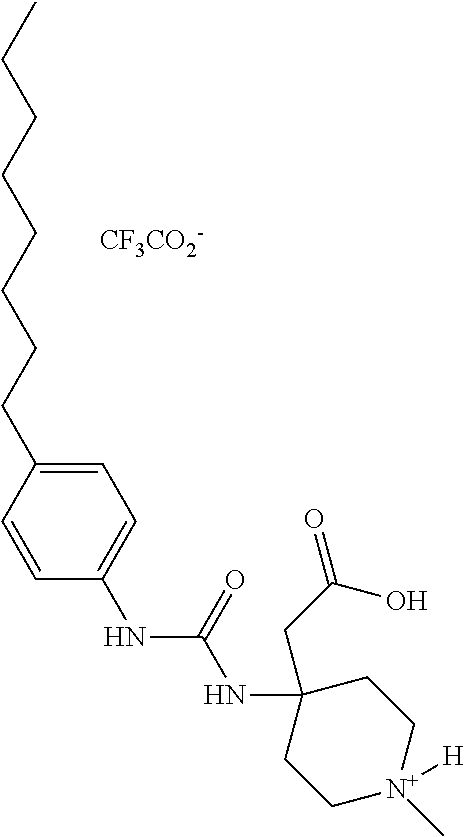


Compound characterization by dose response format was performed using the above described assay conditions and a 16 point compound titration in 2 fold compound dilution steps. The DMSO concentration was kept constant at 20% (v/v) for all compound concentrations. The inhibitory activity of a compound was determined using an iterative 4 parameter logistic non linear curve fitting method, and the concentration of compound that inhibits the enzyme reaction by 50% is defined as the IC50.
y=(A+(B/(1+((x/C)^D)))) where A=background activity
-
- B=dynamic range
- C=x value at inflection point
- D=stoichiometry parameter
Using the dose response assay the IC50 for L-aminocarnitine was determined to be 7.0±2.5 μM (n=17). Similarly, using the dose response assay, the compounds of this invention were determined to have IC50 values of less than or equal to about 5 millimolar and greater than 10 nanomolar.
| TABLE 1 |
| IC50 Data of CPT1A Inhibitors of the Invention |
| Compounds | IC50 | ||
| Example S13. 3-(carboxymethyl)-1-methyl-3-(5- | D | ||
| phenethylfuran-2-carboxamido)-piperidinium 2,2,2- | |||
| trifluoroacetate | |||
| Example S14: 3-(carboxymethyl)-1,1-dimethyl-3-(5- | C | ||
| phenethylfuran-2-carboxamido) piperidinium 2,2,2- | |||
| trifluoroacetate | |||
| Example S9. 3-(Carboxymethyl)-1-methyl-3-(3-(4- | C | ||
| octylphenyl)ureido)piperidinium 2,2,2-trifluoroacetate | |||
| Example S10. 3-(carboxymethyl)-1,1-dimethyl-3-(3- | C | ||
| (4-octylphenyl)ureido)-piperidinium 2,2,2- | |||
| trifluoroacetate | |||
| Example S2. 4-(Carboxymethyl)-1,1-dimethyl-4-(3-(4- | C | ||
| octylphenyl)ureido)piperidin-ium 2,2,2-trifluoroacetate | |||
| Example S3. 4-(carboxymethyl)-1-methyl-4-(4- | C | ||
| pentylphenylsulfonamido)piperidinium 2,2,2- | |||
| trifluoroacetate | |||
| Example S4. 4-(Carboxymethyl)-1,1-dimethyl-4-(4- | A | ||
| pentylphenylsulfonamido)piperidin-ium 2,2,2- | |||
| trifluoroacetate | |||
| Example S5. 4-(Carboxymethyl)-1,1-dimethyl-4-(5- | B | ||
| phenethylfuran-2-carboxamido)-piperidinium 2,2,2- | |||
| trifluoroacetate | |||
| Example S6. 4-(Carboxymethyl)-1,1-dimethyl-4-(5- | D | ||
| (phenylethynyl)furan-2-carboxamido)-piperidinium | |||
| 2,2,2-trifluoroacetate | |||
| Example S23. 3-(carboxymethyl)-3-(3-(4- | E | ||
| octylphenyl)ureido)azetidinium 2,2,2-trifluoroacetate | |||
| Example S11. 3-(carboxymethyl)-1-methyl-3-(4- | B | ||
| pentylphenylsulfonamido)piperidinium 2,2,2- | |||
| trifluoroacetate | |||
| Example S12. 3-(carboxymethyl)-1,1-dimethyl-3-(4- | A | ||
| pentylphenylsulfonamido)-piperidinium 2,2,2- | |||
| trifluoroacetate | |||
| Example S15. 3-(carboxymethyl)-1-methyl-3-(N-(4- | C | ||
| octylphenyl)sulfamoylamino)-piperidinium 2,2,2- | |||
| trifluoroacetate | |||
| Example S16. 3-(carboxymethyl)-1,1-dimethyl-3-(N- | B | ||
| (4-octylphenyl)sulfamoylamino)-piperidinium 2,2,2- | |||
| trifluoroacetate | |||
| Example S24: 3-(Carboxymethyl)-1,1-dimethyl-3-(3- | C | ||
| (4-octylphenyl)ureido)azetidinium 2,2,2- | |||
| trifluoroacetate | |||
| Example S7. 4-(carboxymethyl)-1-methyl-4-(N-(4- | C | ||
| octylphenyl)sulfamoylamino)-piperidinium 2,2,2- | |||
| trifluoroacetate | |||
| Example S8. 4-(carboxymethyl)-1,1-dimethyl-4-(N-(4- | B | ||
| octylphenyl)sulfamoylamino) piperidinium 2,2,2- | |||
| trifluoroacetate | |||
| Example S25. 3-(carboxymethyl)-3-(4- | F | ||
| pentylphenylsulfonamido)azetidinium 2,2,2- | |||
| trifluoroacetate | |||
| Example S19. 3-(carboxymethyl)-1-methyl-3-(4- | D | ||
| pentylphenylsulfonamido)-pyrrolidinium 2,2,2- | |||
| trifluoroacetate | |||
| Example S20: 3-(carboxymethyl)-1,1-dimethyl-3-(4- | B | ||
| pentylphenylsulfonamido)pyrrolidin-ium 2,2,2- | |||
| trifluoroacetate | |||
| Example S26. 3-(carboxymethyl)-3-(5- | D | ||
| (phenylethynyl)furan-2-carboxamido)-azetidinium | |||
| 2,2,2-trifluoroacetate | |||
| Example S17. 3-(carboxymethyl)-1-methyl-3-(3-(4- | C | ||
| octylphenyl)ureido)pyrrolidinium 2,2,2-trifluoroacetate | |||
| Example S18. 3-(carboxymethyl)-1,1-dimethyl-3-(3- | C | ||
| (4-octylphenyl)ureido)-pyrrolidinium 2,2,2- | |||
| trifluoroacetate | |||
| Example S21. 3-(carboxymethyl)-3-(4- | C | ||
| decylbenzamido)-1-methylpyrrolidinium 2,2,2- | |||
| trifluoroacetate | |||
| Example S22. 3-(carboxymethyl)-3-(4- | B | ||
| decylbenzamido)-1,1-dimethylpyrrolidinium 2,2,2- | |||
| trifluoroacetate | |||
| Example S27. 3-(carboxymethyl)-1-methyl-3-(4- | C | ||
| pentylphenylsulfonamido)azetidinium 2,2,2- | |||
| trifluoroacetate | |||
| Example S28. 3-(carboxymethyl)-3-(N-(4- | F | ||
| octylphenyl)sulfamoylamino)azetidinium 2,2,2- | |||
| trifluoroacetate | |||
| Example S29. 3-(carboxymethyl)-1,1-dimethyl-3-(4- | C | ||
| pentylphenylsulfonamido)-azetidinium 2,2,2- | |||
| trifluoroacetate | |||
| Example S30. 3-(carboxymethyl)-1,1-dimethyl-3-(N- | C | ||
| methyl-N-(4-octylphenyl)-sulfamoylamino)- | |||
| piperidinium 2,2,2-trifluoroacetate | |||
| TABLE 2 |
| GI50 Data of CPT Inhibitors of the Invention |
| Ex. S15 | Ex. S7 | Ex. S2 | Ex. S16 | Ex. S10 | Ex. S23 | Ex. S24 | ||
| Breast | MCF-7 | 15 mM | 27 mM | 10 mM | 3.9 mM | 5.1 mM | 26 mM | 27 mM |
| MDA-231 | NT | NT | NT | 0.5 mM | NT | NT | NT | |
| Hs578T | 25 mM | >50 mM | 50 mM | 17 mM | 39 mM | 45 mM | 46 mM | |
| Lung | H358 | 12 mM | 20 mM | 3.1 mM | 1.4 mM | 1.0 mM | 14 mM | 19 mM |
| A549 | 7.5 mM | 52 mM | 99 mM | 6.2 mM | 73 mM | >50 mM | 36 mM | |
| H460 | NT | NT | 1.8 mM | NT | NT | NT | NT | |
| Colon | COLO-205 | 21 mM | 74 mM | 1.3 mM | 10 mM | 1.0 mM | 35 mM | 28 mM |
| HCT-15 | 32 mM | 80 mM | 3.0 mM | 36 mM | 16 mM | 28 mM | 38 mM | |
| SW480 | 36 mM | 68 mM | 0.7 mM | 4.0 mM | 0.7 mM | 28 mM | 29 mM | |
| SW620 | 27 mM | >50 mM | 2.0 mM | 20 mM | 2.5 mM | 43 mM | 44 mM | |
| Brain | A172 | 2.7 mM | 15 mM | 1.8 mM | 1.1 mM | 4.6 mM | 7.2 mM | 41 mM |
| TOV-21G | NT | NT | NT | NT | NT | NT | NT | |
| Prostate | PC-3 | 2.8 mM | 6.0 mM | 8.2 mM | 2.1 mM | 0.9 mM | 24 mM | 21 mM |
| Ovarian | SW626 | 33 mM | >50 mM | 2.5 mM | 18 mM | 2.7 mM | 21 mM | 63 mM |
| Caov-3 | 4.0 mM | 22 mM | NT | 2.5 mM | NT | 17 mM | 45 mM | |
| Ex. S29 | Ex. S30 | Ex. S4 | Ex. S8 | Ex. S18 | Comp. A | |||
| Breast | MCF-7 | 44 mM | 3.1 mM | NT | 2.0 mM | 5.9 mM | 14 mM | |
| MDA-231 | >50 mM | NT | NT | NT | NT | >50 mM | ||
| Hs578T | >50 mM | 3.0 mM | NT | 26 mM | 26 mM | >50 mM | ||
| Lung | H358 | 86 mM | 2.9 mM | NT | 0.9 mM | 2.7 mM | 0.4 mM | |
| A549 | >50 mM | 1.0 mM | NT | 10 mM | 38 mM | >50 mM | ||
| H460 | NT | NT | NT | NT | 2.2 mM | NT | ||
| Colon | COLO-205 | 28 mM | 1.6 mM | >50 mM | 5.3 mM | 1.9 mM | 9.3 mM | |
| HCT-15 | >50 mM | 14 mM | >50 mM | 9.0 mM | 5.4 mM | >50 mM | ||
| SW480 | >50 mM | 3.5 mM | >50 mM | 2.8 mM | 1.2 mM | 16 mM | ||
| SW620 | >77 mM | 3.5 mM | >50 mM | 8.4 mM | 3.1 mM | 49 mM | ||
| Brain | A172 | >50 mM | 0.6 mM | >50 mM | 2.2 mM | 1.9 mM | >50 mM | |
| TOV-21G | NT | NT | 44 mM | NT | NT | NT | ||
| Prostate | PC-3 | >50 mM | 0.7 mM | >50 mM | 1.7 mM | 6.6 mM | 1.5 mM | |
| Ovarian | SW626 | >50 mM | 21 mM | NT | 15 mM | 3.9 mM | 12 mM | |
| Caov-3 | NT | NT | NT | 2.0 mM | NT | 0.6 mM | ||
| NT: not tested | ||||||||
| TABLE 3 |
| Percentage of Growth Inhibition of CPT Inhibitors |
| (at 10 μM) of the Invention |
| Ex. S1 | Ex. S12 | Ex. S13 | Ex. S14 | Ex. S25 | Ex. S26 | Ex. S27 | Ex. S28 | ||
| Breast | MCF-7 | 0.120413 | 0.23515 | NT | NE | 0.14515 | 0.1403 | 0.05347 | 0.04154 |
| MDA-231 | NT | NT | NT | NT | NT | NT | 0.13384 | NE | |
| Lung | H358 | 0.432362 | 0.04495 | NT | 0.39194 | 0.05754 | 0.14368 | 0.07312 | 0.06989 |
| A549 | NT | NT | NT | NT | NT | NT | 0.06854 | NE | |
| H460 | NT | NT | NT | NT | NT | NT | 0.00556 | NE | |
| Colon | COLO-205 | 0.072871 | 0.12811 | NT | NE | NE | 0.18922 | NE | NE |
| HCT-15 | 0.059106 | NE | NT | NE | 0.00572 | NE | NT | NT | |
| SW480 | 0.084588 | NE | NT | NE | NE | 0.04449 | NT | NT | |
| SW620 | 0.043447 | NE | NT | 0.04122 | NE | 0.0551 | NE | NE | |
| HCT-8 | NT | NT | NT | NT | NT | NT | 0.09153 | 0.06675 | |
| Brain | A172 | 0.157052 | 0.07689 | NT | NE | NE | NE | NE | 0.30769 |
| Prostate | PC-3 | 0.192404 | NE | NT | NE | NE | NE | 0.0865 | 0.60429 |
| Ovarian | SW626 | 0.051417 | 0.00486 | NT | NE | 0.07606 | 0.07378 | NE | 0.04727 |
| Ex. S3 | Ex. S5 | Ex. S6 | Ex. S9 | Ex. S19 | Ex. S20 | Ex. S22 | Ex. S21 | Ex. S17 | ||
| Breast | MCF-7 | 0.007318 | 0.02312 | 0.03714 | 0.02731 | 0.08166 | 0.22689 | 0.06486 | 0.01838 | 0.20385 |
| Lung | H358 | 0.463779 | 0.08927 | 0.10737 | NT | NE | 0.27734 | 0.8129 | 0.68016 | 0.66359 |
| A549 | NT | NT | NT | 0.451 | NT | NT | NT | NT | NT | |
| Colon | COLO-205 | 0.034242 | 0.12194 | 0.15431 | 0.28521 | NE | 0.36469 | 0.08112 | 0.02151 | 0.11451 |
| HCT-15 | 0.065146 | NE | NE | NE | NE | NE | 0.07473 | 0.04235 | 0.03874 | |
| SW480 | 0.038296 | NE | 0.03677 | 0.00756 | NE | 0.02596 | 0.61412 | 0.09568 | 0.51905 | |
| SW620 | 0.03948 | 0.05572 | 0.05805 | 0.04904 | NE | 0.01263 | 0.2089 | 0.07327 | 0.06799 | |
| Brain | A172 | NE | 0.01342 | 0.05672 | NE | NE | 0.11755 | 0.12492 | 0.14167 | 0.16059 |
| Prostate | PC-3 | NE | NE | 0.03591 | 0.25848 | NE | NE | 0.44356 | 0.15622 | 0.77126 |
| Ovarian | SW626 | NE | 0.03032 | 0.20836 | 0.02424 | NE | 0.07399 | 0.21981 | 0.15399 | 0.35453 |
As can be seen from Tables 2 and 3, a number of compounds of the invention were tested against cancer cell lines from breast, lung, colon, brain, prostate and ovarian cancer. All of the compounds shown in Tables 2 and 3 had activity against at least one cell line (“NT” means not tested; and “NE” means no activity at 10 micromolar—activity at higher concentrations was not measured). Compound S11 was not tested against MDA-231, A549 and H460, HCT-8 cell lines and did not exihibit activity at 10 μM against the other cell lines.
Claims (11)


Priority Applications (1)
| Application Number | Priority Date | Filing Date | Title |
|---|---|---|---|
| US12/671,154 US8680282B2 (en) | 2007-08-01 | 2008-08-01 | Cyclic inhibitors of carnitine palmitoyltransferase and treating cancer |
Applications Claiming Priority (3)
| Application Number | Priority Date | Filing Date | Title |
|---|---|---|---|
| US96282607P | 2007-08-01 | 2007-08-01 | |
| PCT/CA2008/001415 WO2009015485A1 (en) | 2007-08-01 | 2008-08-01 | Cyclic inhibitors of carnitine palmitoyltransferase and treating cancer |
| US12/671,154 US8680282B2 (en) | 2007-08-01 | 2008-08-01 | Cyclic inhibitors of carnitine palmitoyltransferase and treating cancer |
Publications (2)
| Publication Number | Publication Date |
|---|---|
| US20110015174A1 US20110015174A1 (en) | 2011-01-20 |
| US8680282B2 true US8680282B2 (en) | 2014-03-25 |
Family
ID=40303846
Family Applications (1)
| Application Number | Title | Priority Date | Filing Date |
|---|---|---|---|
| US12/671,154 Expired - Fee Related US8680282B2 (en) | 2007-08-01 | 2008-08-01 | Cyclic inhibitors of carnitine palmitoyltransferase and treating cancer |
Country Status (3)
| Country | Link |
|---|---|
| US (1) | US8680282B2 (en) |
| CA (2) | CA2677049A1 (en) |
| WO (1) | WO2009015485A1 (en) |
Families Citing this family (11)
| Publication number | Priority date | Publication date | Assignee | Title |
|---|---|---|---|---|
| WO2008109991A1 (en) | 2007-03-09 | 2008-09-18 | University Health Network | Inhibitors of carnitine palmitoyltransferase and treating cancer |
| US8877815B2 (en) | 2010-11-16 | 2014-11-04 | Novartis Ag | Substituted carbamoylcycloalkyl acetic acid derivatives as NEP |
| JP5943319B2 (en) * | 2011-12-01 | 2016-07-05 | 国立大学法人 名古屋工業大学 | Heteroarenesulfonylated quinaalkaloid amine compounds |
| WO2018236745A1 (en) | 2017-06-20 | 2018-12-27 | Carnot, Llc | Compositions and methods for increasing efficiency of cardiac metabolism |
| EP4497474A3 (en) | 2018-10-17 | 2025-04-23 | Imbria Pharmaceuticals, Inc. | Methods of treating rheumatic diseases using trimetazidine-based compounds |
| EP3976101A4 (en) | 2019-05-31 | 2023-06-21 | Imbria Pharmaceuticals, Inc. | METHOD OF TREATMENT OF FIBROSIS USING COMPOUNDS TO PROMOTE GLUCOSE OXIDATION |
| CN110563726A (en) * | 2019-07-23 | 2019-12-13 | 上海合全药业股份有限公司 | Preparation method of tert-butyl-7, 9-dioxy-2, 6-diazaspiro [4.5] decane-2-formic acid ester |
| US11780811B2 (en) | 2020-06-30 | 2023-10-10 | Imbria Pharmaceuticals, Inc. | Methods of synthesizing 2-[4-[(2,3,4-trimethoxyphenyl)methyl]piperazin-1-yl]ethyl pyridine-3-carboxylate |
| US11530184B2 (en) | 2020-06-30 | 2022-12-20 | Imbria Pharmaceuticals, Inc. | Crystal forms of 2-[4-[(2,3,4-trimethoxyphenyl)methyl]piperazin-1-yl]ethyl pyridine-3-carboxylate |
| US12448373B2 (en) | 2021-04-19 | 2025-10-21 | Amgen Inc. | Azetidinyl-acetamides as CXCR7 inhibitors |
| US11883396B2 (en) | 2021-05-03 | 2024-01-30 | Imbria Pharmaceuticals, Inc. | Methods of treating kidney conditions using modified forms of trimetazidine |
Citations (32)
| Publication number | Priority date | Publication date | Assignee | Title |
|---|---|---|---|---|
| DE2217169A1 (en) | 1972-04-10 | 1973-10-18 | Hoechst Ag | SUBSTITUTED BENZIMIDAZOLES |
| EP0127098A2 (en) | 1983-05-25 | 1984-12-05 | Takeda Chemical Industries, Ltd. | Derivatives of beta-amino-gamma-trimethylammonio-butyrate, their production and use |
| US4673763A (en) | 1983-01-03 | 1987-06-16 | Miles Laboratories, Inc. | Alpha-functionalized derivatives and labeled conjugates of procainamide and NAPA |
| US4767781A (en) | 1981-11-26 | 1988-08-30 | Takeda Chemical Industries, Ltd. | Derivatives of beta-amino-gamma-trimethylammonio-butyrate and their production and use |
| CA2192088A1 (en) | 1994-07-25 | 1996-02-08 | Gloria Anne Breault | Aromatic amino ethers as pain relieving agents |
| US5593967A (en) | 1990-08-31 | 1997-01-14 | Warner-Lambert Company | Cholecystokinin antagonists, their preparation and therapeutic use |
| US5847125A (en) | 1992-01-09 | 1998-12-08 | James Black Foundation Limited | Amino acid derivatives with anticholecystokinin activity |
| WO1999042435A2 (en) | 1998-02-21 | 1999-08-26 | Analyticon Ag Biotechnologie Pharmazie | Myxochelines |
| WO1999059957A1 (en) | 1998-05-15 | 1999-11-25 | Sigma-Tau Industrie Farmaceutiche Riunite S.P.A. | Compounds having reversible inhibiting activity of carnitine palmitoyl-transferase |
| WO1999065881A1 (en) | 1998-06-19 | 1999-12-23 | Nissan Chemical Industries, Ltd. | Heterocyclic compounds as hypoglycemic agents |
| CA2373360A1 (en) | 1999-05-07 | 2000-11-16 | Texas Biotechnology Corporation | Carboxylic acid derivatives that inhibit the binding of integrins to their receptors |
| WO2001096310A1 (en) | 2000-06-15 | 2001-12-20 | Pharmacia Corporation | Dihydrostilbene alkanoic acid derivatives useful as vitronectin antagonists |
| EP1203766A2 (en) | 2000-11-06 | 2002-05-08 | Texas Biotechnology Corporation | Carboxylic acid derivatives that inhibit the binding of integrins to their receptors |
| US20020187534A1 (en) | 1999-11-12 | 2002-12-12 | Pizer Ellen S. | Treating cancer by increasing intracellular malonyl CoA levels |
| US6495565B2 (en) * | 2000-03-17 | 2002-12-17 | Bristol-Myers Squibb Pharma Company | β-amino acid derivatives as inhibitors of matrix metalloproteases and TNF-α |
| WO2003010129A1 (en) | 2001-07-26 | 2003-02-06 | Sigma-Tau Industrie Farmaceutiche Riunite S.P.A. | Process for the preparation of (r)- or (s)-aminocarnitine inner salt, the salts and derivatives thereof |
| US6528684B1 (en) | 1999-06-30 | 2003-03-04 | Sigma-Tau Industrie Farmaceutiche Riunite S.P.A. | Synthesis of (R) and (S) -aminocarnitine and their derivatives starting from D- and L-aspartic acid |
| CA2366800A1 (en) | 2001-10-09 | 2003-04-10 | Texas Biotechnology Corporation | Carboxylic acid derivatives that inhibit the binding of integrins to their receptors |
| US20030125315A1 (en) | 2001-04-10 | 2003-07-03 | Mjalli Adnan M. M. | Probes, systems, and methods for drug discovery |
| US6656936B1 (en) | 1999-08-20 | 2003-12-02 | Virginia Tech Intellectual Properties, Inc. | Carnitine analogues as topical, microbicidal spermicides |
| US20040072802A1 (en) | 2002-10-09 | 2004-04-15 | Jingwu Duan | Beta-amino acid derivatives as inhibitors of matrix metalloproteases and TNF-alpha |
| WO2004063143A1 (en) | 2003-01-08 | 2004-07-29 | Sigma-Tau Industrie Farmaceutiche Riunite S.P.A. | Synthesis fo (r) and (s)-aminocarnitine and derivatives thereof from d-and l-aspartic acid |
| US20050059705A1 (en) | 2003-08-08 | 2005-03-17 | Mjalli Adnan M.M. | Aryl and heteroaryl compounds, compositions, and methods of use |
| WO2005077354A1 (en) | 2004-02-12 | 2005-08-25 | Defiante Farmaceutica Lda. | Compounds having antitumor activity |
| WO2005105802A1 (en) | 2004-04-28 | 2005-11-10 | Takeda Pharmaceutical Company Limited | Fused quinoline derivative and use thereof |
| WO2006002474A1 (en) | 2004-07-02 | 2006-01-12 | The Walter And Eliza Hall Institute Of Medical Research | Alpha-helical mimetics |
| US20060058287A1 (en) | 2002-06-26 | 2006-03-16 | Axten Jeffrey M | Compounds |
| CA2572208A1 (en) | 2004-10-28 | 2006-05-04 | Shionogi & Co., Ltd. | 3-carbamoyl-2-pyridone derivative |
| WO2006092204A1 (en) | 2005-03-02 | 2006-09-08 | Sigma-Tau Industrie Farmaceutiche Riunite S.P.A. | Derivatives of aminobutanoic acid inhibiting cpt |
| CN1919865A (en) | 2006-08-29 | 2007-02-28 | 中国海洋大学 | Bioactivity peptide, preparing process and application thereof |
| WO2008015081A1 (en) | 2006-08-02 | 2008-02-07 | Sigma-Tau Industrie Farmaceutiche Riunite S.P.A. | Derivatives of 4-trimethylammonium-3-aminobutyrate and 4-trimethylphosphonium-3-aminobutyrate as cpt-inhibitors |
| US20100105900A1 (en) | 2007-03-09 | 2010-04-29 | University Health Network | Inhibitors of carnitine palmitoyltransferase and treating cancer |
-
2008
- 2008-08-01 CA CA002677049A patent/CA2677049A1/en not_active Withdrawn
- 2008-08-01 US US12/671,154 patent/US8680282B2/en not_active Expired - Fee Related
- 2008-08-01 WO PCT/CA2008/001415 patent/WO2009015485A1/en not_active Ceased
- 2008-08-01 CA CA2694724A patent/CA2694724C/en active Active
Patent Citations (36)
| Publication number | Priority date | Publication date | Assignee | Title |
|---|---|---|---|---|
| DE2217169A1 (en) | 1972-04-10 | 1973-10-18 | Hoechst Ag | SUBSTITUTED BENZIMIDAZOLES |
| US4767781A (en) | 1981-11-26 | 1988-08-30 | Takeda Chemical Industries, Ltd. | Derivatives of beta-amino-gamma-trimethylammonio-butyrate and their production and use |
| US4673763A (en) | 1983-01-03 | 1987-06-16 | Miles Laboratories, Inc. | Alpha-functionalized derivatives and labeled conjugates of procainamide and NAPA |
| EP0127098A2 (en) | 1983-05-25 | 1984-12-05 | Takeda Chemical Industries, Ltd. | Derivatives of beta-amino-gamma-trimethylammonio-butyrate, their production and use |
| US5593967A (en) | 1990-08-31 | 1997-01-14 | Warner-Lambert Company | Cholecystokinin antagonists, their preparation and therapeutic use |
| US5847125A (en) | 1992-01-09 | 1998-12-08 | James Black Foundation Limited | Amino acid derivatives with anticholecystokinin activity |
| CA2192088A1 (en) | 1994-07-25 | 1996-02-08 | Gloria Anne Breault | Aromatic amino ethers as pain relieving agents |
| WO1999042435A2 (en) | 1998-02-21 | 1999-08-26 | Analyticon Ag Biotechnologie Pharmazie | Myxochelines |
| US6369073B1 (en) | 1998-05-15 | 2002-04-09 | Sigma-Tau Industrie Farmaceutiche Riunite S.P.A. | Compounds having reversible inhibiting activity of carnitine palmitoyl-transferase |
| WO1999059957A1 (en) | 1998-05-15 | 1999-11-25 | Sigma-Tau Industrie Farmaceutiche Riunite S.P.A. | Compounds having reversible inhibiting activity of carnitine palmitoyl-transferase |
| EP1484313A1 (en) | 1998-05-15 | 2004-12-08 | Sigma-Tau Industrie Farmaceutiche Riunite S.p.A. | Compounds having reversible inhibiting activity of carnitine palmitoyl-transferase |
| WO1999065881A1 (en) | 1998-06-19 | 1999-12-23 | Nissan Chemical Industries, Ltd. | Heterocyclic compounds as hypoglycemic agents |
| CA2373360A1 (en) | 1999-05-07 | 2000-11-16 | Texas Biotechnology Corporation | Carboxylic acid derivatives that inhibit the binding of integrins to their receptors |
| US6528684B1 (en) | 1999-06-30 | 2003-03-04 | Sigma-Tau Industrie Farmaceutiche Riunite S.P.A. | Synthesis of (R) and (S) -aminocarnitine and their derivatives starting from D- and L-aspartic acid |
| US6822115B2 (en) | 1999-06-30 | 2004-11-23 | Sigma-Tau Industrie Farmaceutiche Riunite S.P.A. | Synthesis of (R) and (S)-aminocarnitine, (R) and (S)-4-phosphonium-3-amino-butanoate, (R) and (S) 3,4-diaminobutanoic acid, and their derivatives starting from D- and L-aspartic acid |
| US6656936B1 (en) | 1999-08-20 | 2003-12-02 | Virginia Tech Intellectual Properties, Inc. | Carnitine analogues as topical, microbicidal spermicides |
| US20020187534A1 (en) | 1999-11-12 | 2002-12-12 | Pizer Ellen S. | Treating cancer by increasing intracellular malonyl CoA levels |
| US6495565B2 (en) * | 2000-03-17 | 2002-12-17 | Bristol-Myers Squibb Pharma Company | β-amino acid derivatives as inhibitors of matrix metalloproteases and TNF-α |
| WO2001096310A1 (en) | 2000-06-15 | 2001-12-20 | Pharmacia Corporation | Dihydrostilbene alkanoic acid derivatives useful as vitronectin antagonists |
| EP1203766A2 (en) | 2000-11-06 | 2002-05-08 | Texas Biotechnology Corporation | Carboxylic acid derivatives that inhibit the binding of integrins to their receptors |
| US20030125315A1 (en) | 2001-04-10 | 2003-07-03 | Mjalli Adnan M. M. | Probes, systems, and methods for drug discovery |
| WO2003010129A1 (en) | 2001-07-26 | 2003-02-06 | Sigma-Tau Industrie Farmaceutiche Riunite S.P.A. | Process for the preparation of (r)- or (s)-aminocarnitine inner salt, the salts and derivatives thereof |
| CA2366800A1 (en) | 2001-10-09 | 2003-04-10 | Texas Biotechnology Corporation | Carboxylic acid derivatives that inhibit the binding of integrins to their receptors |
| US20060058287A1 (en) | 2002-06-26 | 2006-03-16 | Axten Jeffrey M | Compounds |
| US20040072802A1 (en) | 2002-10-09 | 2004-04-15 | Jingwu Duan | Beta-amino acid derivatives as inhibitors of matrix metalloproteases and TNF-alpha |
| WO2004063143A1 (en) | 2003-01-08 | 2004-07-29 | Sigma-Tau Industrie Farmaceutiche Riunite S.P.A. | Synthesis fo (r) and (s)-aminocarnitine and derivatives thereof from d-and l-aspartic acid |
| US20050059705A1 (en) | 2003-08-08 | 2005-03-17 | Mjalli Adnan M.M. | Aryl and heteroaryl compounds, compositions, and methods of use |
| WO2005077354A1 (en) | 2004-02-12 | 2005-08-25 | Defiante Farmaceutica Lda. | Compounds having antitumor activity |
| WO2005105802A1 (en) | 2004-04-28 | 2005-11-10 | Takeda Pharmaceutical Company Limited | Fused quinoline derivative and use thereof |
| WO2006002474A1 (en) | 2004-07-02 | 2006-01-12 | The Walter And Eliza Hall Institute Of Medical Research | Alpha-helical mimetics |
| CA2572208A1 (en) | 2004-10-28 | 2006-05-04 | Shionogi & Co., Ltd. | 3-carbamoyl-2-pyridone derivative |
| EP1806342A1 (en) | 2004-10-28 | 2007-07-11 | Shionogi & Co., Ltd. | 3-carbamoyl-2-pyridone derivative |
| WO2006092204A1 (en) | 2005-03-02 | 2006-09-08 | Sigma-Tau Industrie Farmaceutiche Riunite S.P.A. | Derivatives of aminobutanoic acid inhibiting cpt |
| WO2008015081A1 (en) | 2006-08-02 | 2008-02-07 | Sigma-Tau Industrie Farmaceutiche Riunite S.P.A. | Derivatives of 4-trimethylammonium-3-aminobutyrate and 4-trimethylphosphonium-3-aminobutyrate as cpt-inhibitors |
| CN1919865A (en) | 2006-08-29 | 2007-02-28 | 中国海洋大学 | Bioactivity peptide, preparing process and application thereof |
| US20100105900A1 (en) | 2007-03-09 | 2010-04-29 | University Health Network | Inhibitors of carnitine palmitoyltransferase and treating cancer |
Non-Patent Citations (16)
| Title |
|---|
| "Scientific Discussion of Angiox." EMEA 2005 online: "http://www.ema.europa.eu/docs/en-GB/document-library/EPAR-Scientific-Discussion/human/000562/WC500025072.pdf" available Sep. 28, 2004. * |
| Chemical Abstracts Registry No. 886148-32-9 (AKos Consulting and Solutions GMBH) Feb. 7, 2006. |
| Giannessi, et al., "Discovery of a Long-Chain Carbamoyl Aminocarnitine Derivative, a Reversible Carnitine Palmitoyltransferase Inhibitor with Antiketotic and Antidiabetic Activity", J. Med. Chem., 2003, vol. 46, pp. 303-309. |
| Giannessi, et al., "Reversible Carnitine Palmitoyltransferase Inhibitors with Broad Chemical Diversity as Potential Antidiabetic Agents", J. Med. Chem., 2001, vol. 44, pp. 2383-2386. |
| Gilmore, et al., "Synthesis and structure-activity relationship of a novel, achiral series of TNF-alpha converting enzyme inhibitors", Bioorganic & Medicinal Chemistry Letters, 2006, vol. 16, pp. 2699-2704. |
| International Preliminary Report on Patentability for Application No. PCT/CA2008/000440, dated Sep. 15, 2009. |
| International Preliminary Report on Patentability for Application No. PCT/CA2008/001415, dated Feb. 2, 2010. |
| International Search Report and Written Opinion for Application No. PCT/CA2008/000440, dated Jun. 23, 2008. |
| Online "https://www.google.com/search?q=Bivalirudin+Trifluoroacetate&hl=en&rls=com.microsoft%3Aen-us%3AIESearchBox&sa=X&ei=ywLJUM-XOZLE0AGjgYGYCw&ved=0CB0QpwUoBg&source=Int&tbs=cdr%3A1%2Ccd-min%3A%2Ccd-max%3A2007&tbm=" accessed Dec. 12, 2012. * |
| PCT International Search Report and Written Opinion-(PCT/CA2008/001415) Date of Mailing Nov. 18, 2008. |
| STN International, File CAPLUS, CAPLUS accession No. 1974 :94833, Document No. 80:94833, Arnaudov, et al., "Infrared-spectroscopic study of hydrogen bodning in 3-(acylamino)propanoic acids", Godishnik na Sofiiskiya Universitet Sv. Kliment Okhridski, Khimicheski Fakultet, 1973, English Abstract. |
| STN International, File CAPLUS, CAPLUS accession No. 1989 :22986, Document No. 110:22986, Dobrev, et al., "The influence of steric factors on the dehydration of 3-benzoylaminopropionic acids by acetic anhydride"; Comptes Rendus de 1'Academie des Sciences, 1988, English Abstract. |
| STN International, File CAPLUS, CAPLUS accession No. 2004:310829, Document No. 140:303552, Duan, et al., "Preparation of beta-amino acid derivatives as inhibitors of matrix metalloproteases and TNF-alpha", English Abstract. |
| Synthesis of novel, achiral, and reversible inhibitors of carnitine palmitoyltransferase I. Brinkman, John A. et al., Sandoz Research Institute, Sandoz Pharmaceutical Corporation, East Hanover, NJ, ESA. Book of Abstracts, 213th ACS National Meeting, San Francisco, Apr. 13-17, 1997, ORGN-565. Publisher: American Chemical Society, Washington DC CODEN: 64AOAA Conference; Meeting Abstract written in English. AN 1997:162827 CAPLUS (Copyright © 2008 ACS on SciFinder®). |
| Zhang, et al., "Synthesis of Obyanamide, a Marine Cytotoxic Cyclic Depsipepetide", Chinese Chemical Letters, 2006, vol. 17, pp. 285-288. |
| Zhang, et al., "Total synthesis and reassignment of stereochemistry of obyanamide", Tetrahedron, 2006, vol. 62, pp. 9966-9972. |
Also Published As
| Publication number | Publication date |
|---|---|
| CA2677049A1 (en) | 2009-02-05 |
| CA2694724C (en) | 2017-09-12 |
| WO2009015485A8 (en) | 2009-06-18 |
| WO2009015485A1 (en) | 2009-02-05 |
| US20110015174A1 (en) | 2011-01-20 |
| CA2694724A1 (en) | 2009-02-05 |
Similar Documents
| Publication | Publication Date | Title |
|---|---|---|
| US20110015174A1 (en) | Cyclic inhibitors of carnitine palmitoyltransferase and treating cancer | |
| US8410150B2 (en) | Inhibitors of carnitine palmitoyltransferase and treating cancer | |
| US7985759B2 (en) | Dipeptidyl peptidase IV inhibitors and processes for their preparation and pharmaceutical compositions containing them | |
| US7253187B2 (en) | Heterocyclic inhibitors of ERK2 and uses thereof | |
| US20100009956A1 (en) | Novel substituted pyrimidines as cysteine protease inhibitors | |
| US9822074B2 (en) | Dihydropyridinone MGAT2 inhibitors | |
| US12268687B2 (en) | Compounds and uses thereof | |
| US20260015348A1 (en) | Compounds as glp-1r agonists | |
| US12098146B2 (en) | Compounds and uses thereof | |
| US7956070B2 (en) | Piperidines as chemokine modulators (CCR) | |
| US7649002B2 (en) | (3,5-dimethylpiperidin-1yl)(4-phenylpyrrolidin-3-yl)methanone derivatives as MCR4 agonists | |
| US9974778B2 (en) | Substituted pyridinones as MGAT2 inhibitors | |
| US7214698B2 (en) | Beta-agonists, processes for preparing them and their use as pharmaceutical compositions | |
| US10654802B2 (en) | Indoline derivatives and method for using and producing the same | |
| CA3045887A1 (en) | Pendant amines and derivatives as inhibitors of leukotriene a4 hydrolase | |
| US12275746B2 (en) | Pyrrolo[1,2-b]-2-pyridazinone compounds as 5-HT4 receptor agonists | |
| EA049960B1 (en) | COMPOUNDS AND THEIR APPLICATIONS | |
| EP1918284A1 (en) | Hydrazinopyrimidines as cysteine protease inhibitors | |
| HK40060667A (en) | Fxr small molecule agonist and preparation method therefor and use thereof | |
| EP2030621A1 (en) | Novel substituted pyrimidines as cysteine protease inhibitors |
Legal Events
| Date | Code | Title | Description |
|---|---|---|---|
| AS | Assignment |
Owner name: UNIVERSITY HEALTH NETWORK, CANADA Free format text: ASSIGNMENT OF ASSIGNORS INTEREST;ASSIGNORS:PAULS, HEINZ W.;FORREST, BRYAN T.;SAMPSON, PETER BRENT;AND OTHERS;SIGNING DATES FROM 20081028 TO 20081029;REEL/FRAME:021991/0777 |
|
| AS | Assignment |
Owner name: UNIVERSITY HEALTH NETWORK, CANADA Free format text: ASSIGNMENT OF ASSIGNORS INTEREST;ASSIGNORS:PAULS, HEINZ W.;FORREST, BRYAN T.;SAMPSON, PETER BRENT;AND OTHERS;SIGNING DATES FROM 20100527 TO 20100607;REEL/FRAME:025550/0846 |
|
| STCF | Information on status: patent grant |
Free format text: PATENTED CASE |
|
| CC | Certificate of correction | ||
| MAFP | Maintenance fee payment |
Free format text: PAYMENT OF MAINTENANCE FEE, 4TH YEAR, LARGE ENTITY (ORIGINAL EVENT CODE: M1551) Year of fee payment: 4 |
|
| MAFP | Maintenance fee payment |
Free format text: PAYMENT OF MAINTENANCE FEE, 8TH YEAR, LARGE ENTITY (ORIGINAL EVENT CODE: M1552); ENTITY STATUS OF PATENT OWNER: LARGE ENTITY Year of fee payment: 8 |
|
| FEPP | Fee payment procedure |
Free format text: MAINTENANCE FEE REMINDER MAILED (ORIGINAL EVENT CODE: REM.); ENTITY STATUS OF PATENT OWNER: LARGE ENTITY |
|
| LAPS | Lapse for failure to pay maintenance fees |
Free format text: PATENT EXPIRED FOR FAILURE TO PAY MAINTENANCE FEES (ORIGINAL EVENT CODE: EXP.); ENTITY STATUS OF PATENT OWNER: LARGE ENTITY |
|
| STCH | Information on status: patent discontinuation |
Free format text: PATENT EXPIRED DUE TO NONPAYMENT OF MAINTENANCE FEES UNDER 37 CFR 1.362 |