US8673620B2 - Radioresistant alga of the Coccomyxa genus - Google Patents
Radioresistant alga of the Coccomyxa genus Download PDFInfo
- Publication number
- US8673620B2 US8673620B2 US13/578,410 US201113578410A US8673620B2 US 8673620 B2 US8673620 B2 US 8673620B2 US 201113578410 A US201113578410 A US 201113578410A US 8673620 B2 US8673620 B2 US 8673620B2
- Authority
- US
- United States
- Prior art keywords
- coccomyxa
- algae
- radioactive
- metals
- aqueous medium
- Prior art date
- Legal status (The legal status is an assumption and is not a legal conclusion. Google has not performed a legal analysis and makes no representation as to the accuracy of the status listed.)
- Expired - Fee Related
Links
Images




Classifications
-
- C—CHEMISTRY; METALLURGY
- C02—TREATMENT OF WATER, WASTE WATER, SEWAGE, OR SLUDGE
- C02F—TREATMENT OF WATER, WASTE WATER, SEWAGE, OR SLUDGE
- C02F3/00—Biological treatment of water, waste water, or sewage
- C02F3/34—Biological treatment of water, waste water, or sewage characterised by the microorganisms used
-
- B—PERFORMING OPERATIONS; TRANSPORTING
- B09—DISPOSAL OF SOLID WASTE; RECLAMATION OF CONTAMINATED SOIL
- B09C—RECLAMATION OF CONTAMINATED SOIL
- B09C1/00—Reclamation of contaminated soil
- B09C1/10—Reclamation of contaminated soil microbiologically, biologically or by using enzymes
-
- C—CHEMISTRY; METALLURGY
- C02—TREATMENT OF WATER, WASTE WATER, SEWAGE, OR SLUDGE
- C02F—TREATMENT OF WATER, WASTE WATER, SEWAGE, OR SLUDGE
- C02F3/00—Biological treatment of water, waste water, or sewage
- C02F3/32—Biological treatment of water, waste water, or sewage characterised by the animals or plants used, e.g. algae
- C02F3/322—Biological treatment of water, waste water, or sewage characterised by the animals or plants used, e.g. algae use of algae
-
- C—CHEMISTRY; METALLURGY
- C12—BIOCHEMISTRY; BEER; SPIRITS; WINE; VINEGAR; MICROBIOLOGY; ENZYMOLOGY; MUTATION OR GENETIC ENGINEERING
- C12N—MICROORGANISMS OR ENZYMES; COMPOSITIONS THEREOF; PROPAGATING, PRESERVING, OR MAINTAINING MICROORGANISMS; MUTATION OR GENETIC ENGINEERING; CULTURE MEDIA
- C12N1/00—Microorganisms; Compositions thereof; Processes of propagating, maintaining or preserving microorganisms or compositions thereof; Processes of preparing or isolating a composition containing a microorganism; Culture media therefor
- C12N1/12—Unicellular algae; Culture media therefor
-
- C—CHEMISTRY; METALLURGY
- C12—BIOCHEMISTRY; BEER; SPIRITS; WINE; VINEGAR; MICROBIOLOGY; ENZYMOLOGY; MUTATION OR GENETIC ENGINEERING
- C12N—MICROORGANISMS OR ENZYMES; COMPOSITIONS THEREOF; PROPAGATING, PRESERVING, OR MAINTAINING MICROORGANISMS; MUTATION OR GENETIC ENGINEERING; CULTURE MEDIA
- C12N1/00—Microorganisms; Compositions thereof; Processes of propagating, maintaining or preserving microorganisms or compositions thereof; Processes of preparing or isolating a composition containing a microorganism; Culture media therefor
- C12N1/12—Unicellular algae; Culture media therefor
- C12N1/125—Unicellular algae isolates
-
- C—CHEMISTRY; METALLURGY
- C22—METALLURGY; FERROUS OR NON-FERROUS ALLOYS; TREATMENT OF ALLOYS OR NON-FERROUS METALS
- C22B—PRODUCTION AND REFINING OF METALS; PRETREATMENT OF RAW MATERIALS
- C22B3/00—Extraction of metal compounds from ores or concentrates by wet processes
- C22B3/20—Treatment or purification of solutions, e.g. obtained by leaching
- C22B3/22—Treatment or purification of solutions, e.g. obtained by leaching by physical processes, e.g. by filtration, by magnetic means, or by thermal decomposition
- C22B3/24—Treatment or purification of solutions, e.g. obtained by leaching by physical processes, e.g. by filtration, by magnetic means, or by thermal decomposition by adsorption on solid substances, e.g. by extraction with solid resins
-
- C—CHEMISTRY; METALLURGY
- C22—METALLURGY; FERROUS OR NON-FERROUS ALLOYS; TREATMENT OF ALLOYS OR NON-FERROUS METALS
- C22B—PRODUCTION AND REFINING OF METALS; PRETREATMENT OF RAW MATERIALS
- C22B60/00—Obtaining metals of atomic number 87 or higher, i.e. radioactive metals
- C22B60/02—Obtaining thorium, uranium, or other actinides
- C22B60/0204—Obtaining thorium, uranium, or other actinides obtaining uranium
- C22B60/0217—Obtaining thorium, uranium, or other actinides obtaining uranium by wet processes
- C22B60/0252—Obtaining thorium, uranium, or other actinides obtaining uranium by wet processes treatment or purification of solutions or of liquors or of slurries
- C22B60/0256—Obtaining thorium, uranium, or other actinides obtaining uranium by wet processes treatment or purification of solutions or of liquors or of slurries using biological agents, e.g. microorganisms or algae
-
- G—PHYSICS
- G21—NUCLEAR PHYSICS; NUCLEAR ENGINEERING
- G21F—PROTECTION AGAINST X-RADIATION, GAMMA RADIATION, CORPUSCULAR RADIATION OR PARTICLE BOMBARDMENT; TREATING RADIOACTIVELY CONTAMINATED MATERIAL; DECONTAMINATION ARRANGEMENTS THEREFOR
- G21F9/00—Treating radioactively contaminated material; Decontamination arrangements therefor
- G21F9/04—Treating liquids
- G21F9/06—Processing
- G21F9/18—Processing by biological processes
-
- C—CHEMISTRY; METALLURGY
- C02—TREATMENT OF WATER, WASTE WATER, SEWAGE, OR SLUDGE
- C02F—TREATMENT OF WATER, WASTE WATER, SEWAGE, OR SLUDGE
- C02F2101/00—Nature of the contaminant
- C02F2101/006—Radioactive compounds
-
- C—CHEMISTRY; METALLURGY
- C02—TREATMENT OF WATER, WASTE WATER, SEWAGE, OR SLUDGE
- C02F—TREATMENT OF WATER, WASTE WATER, SEWAGE, OR SLUDGE
- C02F2101/00—Nature of the contaminant
- C02F2101/10—Inorganic compounds
- C02F2101/20—Heavy metals or heavy metal compounds
-
- C—CHEMISTRY; METALLURGY
- C12—BIOCHEMISTRY; BEER; SPIRITS; WINE; VINEGAR; MICROBIOLOGY; ENZYMOLOGY; MUTATION OR GENETIC ENGINEERING
- C12R—INDEXING SCHEME ASSOCIATED WITH SUBCLASSES C12C - C12Q, RELATING TO MICROORGANISMS
- C12R2001/00—Microorganisms ; Processes using microorganisms
- C12R2001/89—Algae ; Processes using algae
-
- C—CHEMISTRY; METALLURGY
- C22—METALLURGY; FERROUS OR NON-FERROUS ALLOYS; TREATMENT OF ALLOYS OR NON-FERROUS METALS
- C22B—PRODUCTION AND REFINING OF METALS; PRETREATMENT OF RAW MATERIALS
- C22B3/00—Extraction of metal compounds from ores or concentrates by wet processes
- C22B3/18—Extraction of metal compounds from ores or concentrates by wet processes with the aid of microorganisms or enzymes, e.g. bacteria or algae
-
- Y—GENERAL TAGGING OF NEW TECHNOLOGICAL DEVELOPMENTS; GENERAL TAGGING OF CROSS-SECTIONAL TECHNOLOGIES SPANNING OVER SEVERAL SECTIONS OF THE IPC; TECHNICAL SUBJECTS COVERED BY FORMER USPC CROSS-REFERENCE ART COLLECTIONS [XRACs] AND DIGESTS
- Y02—TECHNOLOGIES OR APPLICATIONS FOR MITIGATION OR ADAPTATION AGAINST CLIMATE CHANGE
- Y02P—CLIMATE CHANGE MITIGATION TECHNOLOGIES IN THE PRODUCTION OR PROCESSING OF GOODS
- Y02P10/00—Technologies related to metal processing
- Y02P10/20—Recycling
Definitions
- a computer readable text file entitled “045636-5205_SeqListing — 08092012.txt,” created on or about Aug. 7, 2012, with a file size of about 28 kb contains the sequence listing for this application and is hereby incorporated by reference in its entirety.
- Radioactive effluents are produced mainly by nuclear power stations. They are mainly water from spent fuel storage pools, water from decontamination tanks, or else water from cooling circuits of nuclear plants, which ultimately contain radioactive compounds owing to the activation of inactive compounds by radiation, or to the release and dissolution of radioactive compounds.
- Other sources of radioactive effluents are nuclear medicine, research laboratories using radioactive materials, and also certain non-nuclear industries (for example extraction of rare earths).
- ion exchange resins are used to maintain low conductivity in water from nuclear plants. They become loaded with radioactive ions and are stored while awaiting a suitable retreatment procedure when they are saturated, or stored under conditions using toxic or highly reactive compounds.
- Biomass derived from algae has been used to purify metals contained in liquid effluents (U.S. Pat. No. 4,769,223; PCT application WO 86/07346; U.S. Pat. No. 5,648,313; PCT application WO 2006/081932).
- the resistance to ionizing radiation of the microorganisms proposed for depolluting materials or effluents contaminated with radioactivity and/or concentrating radioactive compounds has not been tested. This is because they are used to extract U (uranium) and Th (thorium) of which the activity of the main isotopes is low (for example, for 238 U or 235 U, the activity is 0.13 or 0.8 Bq/l for a solution containing 10 ⁇ g/l of 238 U or 235 U, respectively.
- the most radioresistant organisms described to date are prokaryotes.
- the species Deinococcus radiodurans has an extraordinary capacity for resistance to ionizing radiation, grows under irradiations of 60 Gy/h and survives at doses of 15 kGy.
- this bacterium is naturally not very resistant to metals. For example, it does not tolerate cobalt (irrespective of the isotope), which inhibits its growth at 5 ppm, i.e. at approximately 10 ⁇ 4 mol/l (John et al., Symposium Chemical-biological Interactions In Contaminant Fate, Metal Toxicity In Deinococcus radiodurans , p. 426-428 in Preprints of Extended Abstracts Vol. 40 No. 2, 2000).
- these two microorganisms Although they can be used for decontaminating media of which the radioactivity is very high, these two microorganisms have the drawback of being non-autotrophic, and therefore of requiring the external provision of carbonaceous nutrients in order to be able to be used in the form of live cultures. Furthermore, the culture thereof is more sensitive to contamination with other bacteria than that of autotrophic organisms, which, moreover, require a less rich culture medium.
- a single form of radiotolerant autotrophic organism has been described (Farhi et al., 20: 104216, 2008). It is a microalga of the class Chlorophyceae, which tolerates ionizing radiation with an LD50 of 6 kGy, whereas, in general, the LD50s for resistance to ionizing radiation of algae are between 30 and 1200 Gy (IAEA, 1976, Effects of ionizing radiation on aquatic organisms and ecosystems. Technical reports series No. 172, International Atomic Energy Agency, Vienna).
- the inventors have now isolated another radiotolerant microalga, belonging to the Coccomyxa genus (class Trebouxiophyceae: Pröschold and Leliaert, Unravelling the algae: the past, present, and future of algal systematics, CRC Press, Brodie and Lewis eds., 2007), and have discovered that, not only does this alga exhibit resistance to ionizing radiation that is even greater than that of the microalga described by Farhi et al. (2008, above), but that, in addition, it is capable of taking up and concentrating radioactive or nonradioactive metal ions in solution in an aqueous medium, and that it can grow in a radioactive medium.
- Coccomyxa actinabiotis This alga represents a new species of Coccomyxa , hereinafter referred to as Coccomyxa actinabiotis.
- the algae of the Coccomyxa actinabiotis species are characterized in particular in that their genes corresponding to 18S ribosomal RNA-ITS1-5.85 ribosomal RNA-ITS2-26S ribosomal RNA (start) contain a sequence exhibiting at least 95%, and, in order of increasing preference, at least 96%, 97%, 98% or 99% identity with the sequence SEQ ID NO: 1.
- the percentage identity indicated above is calculated after alignment of the sequences using the Clustal software (Larkin et al., Bioinformatics, 23, 2947-2948, 2007), on a comparison window consisting of the whole of the sequence SEQ ID NO: 1.
- the algae of the Coccomyxa actinabiotis species can also be characterized in that the region corresponding to ITS1-5.8S rRNA-ITS2 exhibits at least 90% identity with the corresponding region of the sequence SEQ ID NO: 1.
- This threshold was estimated at 90% on the basis of the observations by the inventors, which show a maximum of 81% identity between this region in Coccomyxa actinabiotis and in other Coccomyxae and also a maximum of 88% identity between the ITS1-5.85 rRNA-ITS2 of the other Coccomyxae compared with one another (cf. table III hereinafter).
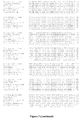
- the sequence of the ribosomal RNA genes of Coccomyxa actinabiotis differs in particular from that of other species of the Coccomyxa genus through the presence, in the region corresponding to the 18S rRNA, of two inserts of approximately 500 bp (inserts represented in italics in FIG. 2 ). It also differs through the nature of its 18S rRNA gene ( FIG. 3 ), and through that of its ITS1 and ITS2.
- Coccomyxa actinabiotis by virtue of its resistance to ionizing radiation, can grow in a radioactive medium, which allows it to take up and metabolize radioactive compounds other than metals (for example 3 H or 14 C), in addition to being able to take up and concentrate radioactive or nonradioactive metal ions in solution in an aqueous medium.
- radioactive compounds for example 3 H or 14 C
- the subject of the present invention is the use of green algae of the Coccomyxa genus, and in particular of the Coccomyxa actinabiotis species defined above, for taking up at least one element chosen from the metals Ag, Co, Cr, Zn, Mn, Sb, Cs, Ni, Fe, actinides, or lanthanides, whether they are radioactive or not, or the radioisotopes 14 C and 3 H, from an aqueous medium containing said metal or said radioisotope in solution.
- the subject of the present invention is a method for taking up at least one element chosen from the radioactive or nonradioactive metals Ag, Co, Cr, Zn, Mn, Sb, Cs, Ni, Fe, actinides or lathanides, or the radioisotopes 14 C and 3 H from an aqueous medium containing said element in solution, characterized in that said uptake is carried out by incubating green algae of the Coccomyxa genus in said aqueous medium.
- said element is a metal chosen from Ag, Co, and the actinide U.
- said element is 14 C.
- the amount of 14 C in the waste from nuclear plants in France has only been regulated individually for the last few years.
- 14 C is the principal radioactive pollutant emitted into the environment by nuclear plants, after tritium.
- the basic nuclear plants of the Tricastin nuclear power station (4 sections of 900 MW) discharged 170 GBq of 14 C into the atmosphere and 15.9 GBq of 14 C in liquid effluents in 2009 (EDF Annual Report 2009).
- Reprocessing factories which use the Purex® process (for example, AREVA The Hague) discharge into the environment approximately 600 GBq/year of 14 C for reprocessing all of the fuel of a 1 GWe reactor (Toxicologie nucléaire assemblageale etexcellent [Environmental and human nuclear toxicology], eds Tec and Doc, Lavoisier, 2009).
- said aqueous medium is a radioactive medium, i.e. a medium in which said algae are subjected to a dose rate that can range from a few ⁇ Gy/h to 1 kGy/h.
- the element to be taken up is a metal chosen from those indicated above, in the form of a radioactive isotope, or in the form of a mixture of isotopes.
- the incubation time of the algae in the aqueous medium can vary in particular according to, firstly, the element(s) concerned and, secondly, the nature of the aqueous medium from which the uptake must be carried out. It will generally be at least 1 hour, and may range up to several months, or even several years. For example, if it is desired to take up only Ag, an incubation time of approximately 1 hour may be sufficient to take up the major part thereof, and of approximately 10 to 20 hours to take up virtually all thereof; if other metals are to be taken up, a longer incubation time, of at least 3 to 5 days, and advantageously of at least one week, may be used. As another example, if it is desired to take up 14 C, an incubation time of 3 h, under the optimized conditions proposed in example 4 hereinafter, will be sufficient to take up the major part thereof.
- the algae of the Coccomyxa genus, and in particular of the Coccomyxa actinabiotis species can grow and live for very long periods of time in weakly mineralized water (conductivity 1 to 1.5 ⁇ S/cm) at a pH of 5 to 6 and a temperature of 20 to 30° C., and in demineralized water (conductivity of 0.05 ⁇ S/cm), they can grow and live for 3 to 4 weeks. Since these green algae need light to carry out photosynthesis and produce their organic matter, their growth stops when they are placed in the dark.
- the growth of the green algae of the Coccomyxa actinabiotis species can be controlled by controlling the illumination of the aqueous medium comprising said algae.
- the Coccomyxa actinabiotis algae can also grow and live for several years in a weakly radioactive medium, where they are subjected to an irradiation of less than or equal to 0.15 mGy/h. They can withstand an irradiation of 1 Gy/h for up to approximately 1 month. They can also withstand an irradiation of 300 Gy/h for approximately a day and an irradiation of 100 Gy/h for approximately 3 days. In a very highly radioactive medium, they can withstand an irradiation of 1 kGy/h for up to 20 hours; if they are then transferred into a nonradioactive medium, they recover their growth capacity in less than two weeks.
- the limit of the range of low dose rates below which no biological effect has been detected can be placed at around 1 mSv/h (i.e. 1 mGy/h for ⁇ -radiation).
- a low dose corresponds to a dose of less than 10 mSv/h.
- a dose rate greater than 1 mSv/h produces dangerous biological effects.
- a high dose corresponds to an irradiation greater than 1 Gy, the value starting from which a deterministic effect begins to become apparent.
- the process can be transported, i.e. the algae are brought into contact with the medium to be depolluted in a chamber separate from the nuclear plant, or implemented in situ; in the latter case, the algae are then implanted directly in the medium to be depolluted.
- the algae can reside in the plant as long as they do not impair operations.
- their growth can be controlled by the intensity of illumination (darkness or weak illumination), or the choice of the wavelength of the lamps (for example, yellow-green non-actinic light).
- Filtration of the water also makes it possible to control their growth by taking up the algae in suspension in the water. If it proves to be necessary to remove them, definite destruction of the algae may be accompanied by release of the metals, and will therefore have to be preferentially carried out by section in the plants, with recovery of the effluents containing a concentration of metals.
- the algae having taken up the metals are harvested by conventional means (filtration, decanting, centrifugation, etc.). They can then be eliminated as waste, optionally after having been dried and/or burnt, without prior extraction of the metals that they contain.
- the metals taken up by the algae can be recovered in order to recycle these metals.
- This recovery can be carried out by any appropriate means. It is, for example, possible to non-destructively recover at least a part of the metals taken up by the algae, thereby making it possible, where appropriate, to reuse said algae, in particular for metals such as Ag and Cr, which, after uptake, remain largely at the level of the mucilage and of the cell surface.
- This recovery can be carried out by placing the algae in the presence of a complexing or acid solution.
- metals such as Ag by treatment of the algae in an acidic medium, at a pH of from 1 to 2.5, preferably from 1.5 to 2, for 1 to 2 days.
- the process in accordance with the invention can be implemented in all cases where it is desired to extract radioactive or nonradioactive metals, and in particular those mentioned above, from an aqueous medium, for the purposes of mining operations, or of depollution of aqueous effluents containing metals, in particular of radioactive effluents.
- the process in accordance with the invention is therefore particularly suitable for depolluting and for decontaminating aqueous media or soils (peat bogs, marshes) contaminated with radioactive or nonradioactive metals, and more particularly radioactive media, such as the water from storage pools or else the light water from secondary cooling circuits of nuclear power stations or reactors, or the effluents from nuclear power stations discharged into the environment.
- radioactive media such as the water from storage pools or else the light water from secondary cooling circuits of nuclear power stations or reactors, or the effluents from nuclear power stations discharged into the environment.
- the present invention can be implemented not only with single-cell green algae of the Coccomyxa actinabiotis species, but also with a mixture of microorganisms comprising single-cell green algae of the Coccomyxa actinabiotis species and at least one microorganism, in particular a bacterium, a fungus, a yeast, another single-cell alga and/or a multicellular plant, preferably radioresistant or radiotolerant, capable of concentrating metal ions in solution and/or of taking up and metabolizing radioactive compounds other than metals (for example, 3 H or 14 C).
- a mixture of microorganisms comprising single-cell green algae of the Coccomyxa actinabiotis species and at least one microorganism, in particular a bacterium, a fungus, a yeast, another single-cell alga and/or a multicellular plant, preferably radioresistant or radiotolerant, capable of concentrating metal ions in solution and/or of taking up and metabolizing
- FIGS. 1A and 1B represent photographs of microalgae according to the invention, observed by photon microscopy (Zeiss binocular Axioplan 2 microscope, magnification 1000 and 3000 for FIGS. 1A and 1B , respectively).
- FIG. 1B shows the joining of two flagellated cells.
- FIG. 4 shows the percentage mortality of Coccomyxa actinabiotis as a function of the dose of irradiation in gray (Gy).
- FIGS. 6 to 8 show the kinetics for binding and for incorporation of metals, silver ( FIGS. 6 and 7 ) and cobalt ( FIG. 8 ), by the Coccomyxa actinabiotis microalgae, with ( FIG. 7 ) or without ( FIGS. 6 and 8 ) mucilage.
- the amounts of metal adsorbed-absorbed, as percentage, are represented as a function of exposure time (in hours).
- FIG. 6A solution containing 110 ⁇ g/l of silver ions
- FIG. 6B solution containing 5.5 mg/l of silver ions
- FIG. 7A solution containing 1.1 mg/l of silver ions
- FIG. 7B solution containing 55 mg/l of silver ions
- FIG. 8A 19 ⁇ g/l of cobalt ions
- FIG. 8B 0.94 mg/l of cobalt ions
- FIG. 8C 4.8 mg/l of cobalt ions.
- the microalgae grow with a rapid growth phase in the short term, similar to that obtained with the BG11 and BBM media, but in the demineralized water with a conductivity of 0.05 ⁇ S/cm, their health deteriorates after 3 to 4 weeks, probably due to the depletion of reserves.
- the microalgae isolated are single-cell microalgae.
- the cells observed by photon microscopy and by confocal microscopy, are nucleated and oval in shape. Their average length is 6.8 ⁇ 0.9 ⁇ m and their average width is 3.8 ⁇ 0.6 ⁇ m. However, depending on their growth stage, it is possible to observe longer average lengths, up to 9-10 ⁇ m, or smaller ones, of about 5 ⁇ m, in particular just after division.
- chloroplasts usually contain chlorophyll and which is the site of photosynthesis.
- the algae cultured in the BBM medium are returned to radioactive and nutritive stress conditions, they go back to the morphology of those isolated from the storage pool water.
- the second are more pigmented (bright green), generally well individualized, and their flagellated cells are very active when the culture is regularly stirred.
- the UV-visible absorption spectrum for this organism shows the presence of chlorophyll a (absorption peak at 663 nm), chlorophyll b (absorption peak at 647 nm) and carotene (absorption peak at 470 nm).
- the primers used are EAF3: TCGACAATCTGGTTG ATCCTGCCAG (SEQ ID NO: 2) and ITS055R: CTCCTTGGTC CGTGTTTCAAGACGGG (SEQ ID NO: 3), conventionally used for amplifying microalga rRNA genes.
- This sequence comparison shows a 73% to 81% identity of the sequence of the CCAP 216/25 strain compared with the other Coccomyxae strains referenced, of the same order as the scores obtained for the comparison of the ITS region of the referenced Coccomyxae with one another (78% to 99%), and very far from that obtained for the comparison with other genera (about from 30 to 50%).
- Coccomyxa actinabiotis is also resistant to acetone, to alcohol, to acids and to ultrasound.
- Coccomyxa actinabiotis is resistant in the long term (more than about ten years) to moderate irradiation (150 ⁇ Gy/h).
- FIG. 4 shows the percentage mortality of Coccomyxa actinabiotis as a function of the dose of irradiation.
- the dose of ionizing radiation which causes the death of half the population is more than 10 kGy (45% mortality at 10 kGy).
- Coccomyxa actinabiotis also remarkably withstands exposure to 20 kGy (80% ⁇ 5% mortality, i.e. 20% ⁇ 5% survivors). In the case of this strong irradiation at 20 kGy, it recolonizes the medium in a few weeks. In four weeks, the culture has recovered a third of its initial photosynthetic activity before irradiation, and it recovers in two weeks a population density equal to that of nonirradiated or weakly irradiated samples.
- the concentrations of the radionuclides were measured at equilibrium in the waters and in the algae by ⁇ -spectrometry.
- concentration factors for each metal 110m Ag, 60 Co, 51 Cr, 65 Zn, 54 Mn and 124 Sb, defined as the ratio of the concentration of the metal adsorbed or absorbed in the microalgae (in atoms/g of fresh matter) to the concentration of the metal in the water (atoms/ml), were thus obtained.
- the kinetics of binding of metals by the Coccomyxa actinabiotis microalgae, and also the amounts adsorbed-absorbed, were determined in the case of a monovalent cation, Ag + , and of a divalent cation, Co 2+ .
- 20 mg of algae (compacted fresh mass) and 90 ml of solution of Ag + at various concentrations are introduced into Erlenmeyer flasks.
- the 20 mg of algae are prepared as follows: sample taken from a round-bottomed culture flask, centrifugation for 20 minutes at 3000 rpm, washing twice in demineralized water (suspension, centrifugation). The culture medium is thus removed and there is no risk of it complexing the silver.
- the algae without mucilage are brought into contact with solutions containing 0.11 mg/L and 5.5 mg/L of Ag + .
- the algae with mucilage are brought into contact with solutions containing 22 ⁇ g/L, 1.1 mg/L and 55 mg/L of Ag + .
- the Erlenmeyer flasks are placed on illuminated shakers and samples of 5 ml are taken for various exposure times in order to monitor the binding kinetics for each of the initial concentrations of silver.
- the samples are centrifuged for 10 minutes at 4500 rpm in order to separate the algae which have concentrated the metal.
- the metal content is then analyzed in the pellet (algae) and in the supernatant.
- the algae without mucilage bind all the silver if its initial concentration is 0.11 mg/l and bind 75% thereof if its initial concentration is 5.5 mg/l.
- the algae with mucilage bind all the silver if its initial concentration is 1.1 mg/l and bind 20% thereof if its initial concentration is 55 mg/l.
- Coccomyxa actinabiotis The limiting doses supported by Coccomyxa actinabiotis were investigated by exposure of the algae to silver or to cobalt for one week (20 mg of microalgae (fresh mass) in 100 ml of deionized water containing Ag or Co ions at various concentrations).
- the algae without mucilage are less resistant to silver metal toxicity than the algae with mucilage.
- the mucilage could prevent a rapid and strong afflux of metal into the cytoplasm at the beginning of exposure. By forming an ion-binding barrier, it limits diffusion to the transmembrane channels and rapid and massive importing of toxic metals. These metals would then be moderately and gradually absorbed and could be stored in forms not aggressive for the cell.
- Coccomyxae actinabiotis without mucilage do not survive at silver concentrations greater than 250 ⁇ g/L, whereas Coccomyxae actinabiotis with mucilage withstand extracellular silver concentrations of at least 50 mg/L.
- the cobalt intolerance threshold is greater than Co 2+ concentrations of 50 mg/l and 800 mg/l for Coccomyxa actinabiotis without mucilage and with mucilage, respectively. No notable effect was observed on the microalgae cultured for one week under these conditions.
- the algae can bind much higher amounts of Ag and of Co than what might be expected by passive binding, in particular owing to their synthesis of abundant mucilage and to active mechanisms of incorporation and detoxification.
- metals are toxic for organisms.
- Silver is generally toxic for organisms at 10 ⁇ 7 -10 ⁇ 5 mol/l (Ratte H T, Environ. Toxicol. Chem. 18: 89-108, 1999).
- Radioresistant organisms such as Deinococcus radiodurans do not grow in the presence of cobalt at 10 ⁇ 4 mol/l (John et al., 2000, above). However, the Coccomyxa actinabiotis microalga does grow in the presence of 10 ⁇ 4 mol/l of cobalt.
- the impact of the presence of 14 C on the physiology of the algae was evaluated by monitoring the growth of the cells.
- the algae incorporate the carbon dioxide inorganic form in equilibrium with the hydrogen carbonate, just as they do the acetate organic form.
- the CO 2 is incorporated into the cells via photosynthesis (6 CO 2 +12 H 2 O+h ⁇ C 6 H 12 O 6 +6 O 2 +H 2 O).
- the acetate is used by the metabolism in the form of acetyl coenzyme A and in particular in the main energy cycle of the cell (Krebs cycle).
- the influence of the pH on the incorporation of 14 C in hydrogen carbonate form was studied in the range 6.9 to 8.5.
- the optimum pH is 6.9 and allows the incorporation of from 80 to 90% of the 14 C present in the medium when the containers in which the bringing into contact is carried out are hermetically closed. At this pH, 25% of the 14 C is in the form of dissolved CO 2 . It is necessary to close the containers in order to avoid rapid degassing of the 14 CO 2 in equilibrium with H 14 CO 3 ⁇ .
- the amount of 14 C incorporated by the algae is low at pH 7.5 (a few %) and zero at pH 8.5.
- the physiological state of the cells at the moment they are brought into contact with the 14 C has an influence on the rate of incorporation of the 14 C.
- the microalgae incorporate the 14 C much more rapidly when they have been cultured beforehand in a medium richer in nutrients (BBM medium diluted two-fold preferable to a BBM medium diluted ten-fold).
- BBM medium diluted two-fold preferable to a BBM medium diluted ten-fold.
- the optimum time for bringing the algae into contact with a medium containing 20 000 Bq/l of 14 C is 50 h if the culture is derived from a BBM medium diluted ten-fold, whereas it is reduced to 3 h if the culture is derived from a BBM medium diluted two-fold.
- the amount of 14 C incorporated in a given period of time increases with the density of the algae in the range 5 ⁇ 10 6 to 15 ⁇ 10 6 cells/ml.
- 50 h are necessary for an algal population with an initial cell density of 5 ⁇ 10 6 cells/ml to incorporate 70% of the amount of 14 C present in the medium (20 000 Bq/l), whereas 7.5 h are sufficient for an algal population with an initial cell density of 15 ⁇ 10 6 cells/ml to incorporate 90% thereof.
- the 14 C incorporation experiments were carried out under weak illumination (50 to 70 ⁇ mol of photons/m 2 /s). However, the photosynthetic activity increases with the illumination, to reach a maximum starting from 500 ⁇ mol of photons/m 2 /s.
- the maximum rate of 14 C incorporation by a population of algae derived from a culture in BBM medium diluted two-fold is 20 Bq/h/10 6 cells for a 14 C concentration of 6000 Bq/l and is 60 Bq/h/10 6 cells for a 14 C concentration of 20 000 Bq/l.
- the amounts incorporated are about 80-90%.
- Coccomyxae actinabiotis can therefore be used to decontaminate the carbon 14 contained in water resulting from nuclear plants: 90% decontamination in 3 to 7 hours, under optimized conditions.
- the algae according to the invention can also be used to take up uranium and transuranium elements.
- Coccomyxae actinabiotis microalgae harvested from a round-bottomed culture flask and washed three times with Milli-Q water in order to remove the culture medium were brought into contact, with shaking and at a concentration equivalent to 60 mg of algae by fresh mass/100 ml of solution, with a solution of uranyl nitrate having a concentration of 10 ⁇ 8 mol/l.
- the algae bind 45% of the amount of uranium initially present in solution.
- the factor of uranium bioconcentration by the Coccomyxae actinabiotis algae is 1300 l/kg of fresh mass, i.e. approximately 13 000 l/kg of dry mass.
- bioconcentration factors reported in the literature are about 120-140 l/kg for freshwater or seawater algae (Paquet et al., Toxicologie nucléaire, articulale etexcellent [Nuclear, environmental and human toxicology], publisher Lavoisier 2009, editions TEC and DOC. Chap. 23 Uranium, p. 411-443).
- the Coccomyxae actinabiotis microalgae were placed on horizontal supports in a fuel element cooling pool of a nuclear plant.
- This pool is filled with water having an average pH of 5.5, an average conductivity of 1.2 ⁇ S/cm, and an average temperature of 25° C., and contains radioactive metal elements owing to the parts which are stored therein.
- the pool is in contact with the ambient air and is illuminated by neon light.
- the light intensity at the surface of the water is 200 lux.
- the dose rate at the level of the algae ranges from about 100 ⁇ Gy/h to a few tens of Gy/h. Under these conditions, Coccomyxae actinabiotis is capable of colonizing the supports on which it is placed, and can live thereon and reproduce thereon for years. The dose rate can sporadically reach a few hundred Gy/h.
- the total activity and also the nature and the activity of each ⁇ -emitter present were determined by performing counting by ⁇ -spectometry on samples of 50 ml of water and of 100 mg of algae sampled from the supports. The results obtained after a residence time of 5 years are given in table IV below.
- the silver in particular has virtually disappeared from the water.
- the cobalt and the chromium were very strongly concentrated.
- Table V below indicates the initial composition of the water, according to the total ⁇ -activity measured and the ⁇ -activity measured per radionuclide, and the percentage of ⁇ -emitting radionuclides bound by the algae at 24 h.
- the microalgae are photosynthetic. They need light to perform photosynthesis and produce their organic matter.
- their growth can therefore be controlled by illumination. In order for them to grow at a given place, it is sufficient to illuminate them. In the pool where they were uncovered, they proliferate preferably close to the light sources. When they are placed in the dark for a period of 2 days to 1 month, their growth stops. Their growth can also be controlled by illuminating them with a light which allows little or no photosynthesis, for example with a yellow-green-colored non-actinic lamp.
- Filtration of the water makes it possible to take up the algae in suspension in the water, and to control the growth thereof.
Landscapes
- Life Sciences & Earth Sciences (AREA)
- Engineering & Computer Science (AREA)
- Chemical & Material Sciences (AREA)
- Biotechnology (AREA)
- Health & Medical Sciences (AREA)
- Organic Chemistry (AREA)
- Microbiology (AREA)
- Environmental & Geological Engineering (AREA)
- Genetics & Genomics (AREA)
- Bioinformatics & Cheminformatics (AREA)
- Wood Science & Technology (AREA)
- Zoology (AREA)
- Biomedical Technology (AREA)
- General Health & Medical Sciences (AREA)
- Cell Biology (AREA)
- General Engineering & Computer Science (AREA)
- Botany (AREA)
- Molecular Biology (AREA)
- General Life Sciences & Earth Sciences (AREA)
- Biochemistry (AREA)
- Virology (AREA)
- Tropical Medicine & Parasitology (AREA)
- Medicinal Chemistry (AREA)
- Geology (AREA)
- Manufacturing & Machinery (AREA)
- Materials Engineering (AREA)
- Mechanical Engineering (AREA)
- Metallurgy (AREA)
- Biodiversity & Conservation Biology (AREA)
- Hydrology & Water Resources (AREA)
- Water Supply & Treatment (AREA)
- Physics & Mathematics (AREA)
- High Energy & Nuclear Physics (AREA)
- Mycology (AREA)
- Soil Sciences (AREA)
- Geochemistry & Mineralogy (AREA)
- Micro-Organisms Or Cultivation Processes Thereof (AREA)
- Preparation Of Compounds By Using Micro-Organisms (AREA)
- Measuring Or Testing Involving Enzymes Or Micro-Organisms (AREA)
- Agricultural Chemicals And Associated Chemicals (AREA)
Abstract
Description
-
- BBM culture medium (Bold's Basal Medium, Sigma), pure or diluted in demineralized water. BBM medium is conventionally used for culturing green algae;
- BG11 culture medium (Rippka et al., “The Prokaryotes”, vol. 1: 212-220, 1979; Sigma). This medium is conventionally used for culturing cyanobacteria;
- weakly mineralized water (conductivity from 1 to 1.5 μS/cm), or demineralized water (conductivity of 0.05 μS/cm).
| TABLE I | |||
| BBM | BG 11 | ||
| Constituents in g/L | |||
| NaNO3 | 0.25 | 1.5 | |
| KH2PO4 | 0.175 | ||
| K2HPO4 | 0.075 | ||
| K2HPO4•3H2O | 0.04 | ||
| MgSO4•7H2O | 0.075 | 0.075 | |
| FeSO4•7H2O | 0.005 | ||
| CaCl2•2H2O | 0.025 | 0.036 | |
| NaCl | 0.025 | ||
| Na2EDTA | 0.01 | ||
| KOH | 0.006 | ||
| Citric acid | 0.006 | ||
| Ferric ammonium citrate | 0.006 |
| Trace elements in mg/L |
| H3BO4 | 12.86 | 2.86 | ||
| MnCl2•4H2O | 1.81 | 1.81 | ||
| ZnSO4•7H2O | 0.222 | 0.222 | ||
| Na2MoO4•2H2O | 0.39 | 0.39 | ||
| CuSO4•5H2O | 0.079 | 0.079 | ||
| Co(NO3)2•6H2O | 0.049 | 0.049 | ||
| pH | 6.4 | 6.5 | ||
| TABLE II | ||||||
| SEQ ID A | Name | Length (nt) | SEQ ID B | Name | Length (nt) | % identity |
| 4 | CCAP 216/25 | 2354 | 5 |
|
1783 | 97 |
| 4 | CCAP 216/25 | 2354 | 6 | Coccomyxa chodatii | 1783 | 98 |
| 4 | CCAP 216/25 | 2354 | 7 | Coccomyxa sp flensburg | 1778 | 97 |
| 4 | CCAP 216/25 | 2354 | 8 | Coccomyxa glaronensis | 1797 | 96 |
| 4 | CCAP 216/25 | 2354 | 9 | |
1797 | 96 |
| 4 | CCAP 216/25 | 2354 | 10 | |
1558 | 92 |
| 5 |
|
1783 | 6 | Coccomyxa chodatii | 1783 | 99 |
| 5 |
|
1783 | 7 | Coccomyxa sp flensburg | 1778 | 96 |
| 5 |
|
1783 | 8 | Coccomyxa glaronensis | 1797 | 96 |
| 5 |
|
1783 | 9 |
|
1797 | 96 |
| 5 | |
1783 | 10 | |
1558 | 92 |
| 6 | Coccomyxa chodatii | 1783 | 7 | Coccomyxa sp flensburg | 1778 | 96 |
| 6 | Coccomyxa chodatii | 1783 | 8 | Coccomyxa glaronensis | 1797 | 96 |
| 6 | Coccomyxa chodatii | 1783 | 9 | |
1797 | 97 |
| 6 | |
1783 | 10 | |
1558 | 92 |
| 7 | Coccomyxa sp flensburg | 1778 | 8 | Coccomyxa glaronensis | 1797 | 99 |
| 7 | Coccomyxa sp flensburg | 1778 | 9 | |
1797 | 99 |
| 7 | |
1778 | 10 | |
1558 | 91 |
| 8 | Coccomyxa glaronensis | 1797 | 9 | |
1797 | 99 |
| 8 | |
1797 | 10 | |
1558 | 91 |
| 9 | |
1797 | 10 | |
1558 | 91 |
-
- AY293964: Coccomyxa peltigerae var. variolosae
- AY293965: Coccomyxa solarinae var. croceae
- AY293966: Coccomyxa solarinae var. bisporae
- AY293967: Coccomyxa solarinae var. saccatae
- AY293968: Coccomyxa chodatii
- AY328522: Coccomyxa peltigerae strain SAG 216-5
- AY328523: Coccomyxa subellipsoidea strain SAG 216-13
- AY328524: Coccomyxa rayssiae strain SAG 216-8
- U66945: Chlamydomonas callosa
- U66956: Dunaliella tertiolecta
- AF376740: Pandorina morum
| TABLE III | ||||
| I | Length (nt) | II | Length (nt) | % identity |
| SEQ ID 11 | 761 | SEQ ID 12 | 617 | 81 |
| SEQ ID 11 | 761 | SEQ ID 13 | 708 | 79 |
| SEQ ID 11 | 761 | AY293964 | 610 | 78 |
| SEQ ID 11 | 761 | AY293965 | 650 | 73 |
| SEQ ID 11 | 761 | AY293966 | 651 | 73 |
| SEQ ID 11 | 761 | AY293967 | 651 | 73 |
| SEQ ID 11 | 761 | AY293968 | 619 | 76 |
| SEQ ID 11 | 761 | AY328522 | 725 | 73 |
| SEQ ID 11 | 761 | AY328523 | 702 | 75 |
| SEQ ID 11 | 761 | AY328524 | 696 | 76 |
| SEQ ID 11 | 761 | U66945 | 625 | 43 |
| SEQ ID 11 | 761 | U66956 | 598 | 45 |
| SEQ ID 11 | 761 | AF376740 | 626 | 27 |
| SEQ ID 12 | 617 | SEQ ID 12 | 708 | 87 |
| SEQ ID 12 | 617 | AY293964 | 610 | 83 |
| SEQ ID 12 | 617 | AY293965 | 650 | 82 |
| SEQ ID 12 | 617 | AY293966 | 651 | 83 |
| SEQ ID 12 | 617 | AY293967 | 651 | 83 |
| SEQ ID 12 | 617 | AY293968 | 619 | 92 |
| SEQ ID 12 | 617 | AY328522 | 725 | 84 |
| SEQ ID 12 | 617 | AY328523 | 702 | 80 |
| SEQ ID 12 | 617 | AY328524 | 696 | 94 |
| SEQ ID 12 | 617 | U66945 | 625 | 38 |
| SEQ ID 12 | 617 | U66956 | 598 | 31 |
| SEQ ID 12 | 617 | AF376740 | 626 | 26 |
| SEQ ID 13 | 708 | AY293964 | 610 | 97 |
| SEQ ID 13 | 708 | AY293965 | 650 | 99 |
| SEQ ID 13 | 708 | AY293966 | 651 | 99 |
| SEQ ID 13 | 708 | AY293967 | 651 | 99 |
| SEQ ID 13 | 708 | AY293968 | 619 | 88 |
| SEQ ID 13 | 708 | AY328522 | 725 | 94 |
| SEQ ID 13 | 708 | AY328523 | 702 | 80 |
| SEQ ID 13 | 708 | AY328524 | 696 | 86 |
| SEQ ID 13 | 708 | U66945 | 625 | 37 |
| SEQ ID 13 | 708 | U66956 | 598 | 51 |
| SEQ ID 13 | 708 | AF376740 | 626 | 34 |
| AY293964 | 610 | AY293965 | 650 | 97 |
| AY293964 | 610 | AY293966 | 651 | 97 |
| AY293964 | 610 | AY293967 | 651 | 97 |
| AY293964 | 610 | AY293968 | 619 | 83 |
| AY293964 | 610 | AY328522 | 725 | 96 |
| AY293964 | 610 | AY328523 | 702 | 78 |
| AY293964 | 610 | AY328524 | 696 | 85 |
| AY293964 | 610 | U66945 | 625 | 41 |
| AY293964 | 610 | U66956 | 598 | 50 |
| AY293964 | 610 | AF376740 | 626 | 48 |
| AY293965 | 650 | AY293966 | 651 | 99 |
| AY293965 | 650 | AY293967 | 651 | 99 |
| AY293965 | 650 | AY293968 | 619 | 88 |
| AY293965 | 650 | AY328522 | 725 | 98 |
| AY293965 | 650 | AY328523 | 702 | 80 |
| AY293965 | 650 | AY328524 | 696 | 85 |
| AY293965 | 650 | U66945 | 625 | 37 |
| AY293965 | 650 | U66956 | 598 | 45 |
| AY293965 | 650 | AF376740 | 626 | 34 |
| AY293966 | 651 | AY293967 | 651 | 99 |
| AY293966 | 651 | AY293968 | 619 | 88 |
| AY293966 | 651 | AY328522 | 725 | 98 |
| AY293966 | 651 | AY328523 | 702 | 79 |
| AY293966 | 651 | AY328524 | 696 | 85 |
| AY293966 | 651 | U66945 | 625 | 37 |
| AY293966 | 651 | U66956 | 598 | 51 |
| AY293966 | 651 | AF376740 | 626 | 34 |
| AY293967 | 651 | AY293968 | 619 | 88 |
| AY293967 | 651 | AY328522 | 725 | 98 |
| AY293967 | 651 | AY328523 | 702 | 79 |
| AY293967 | 651 | AY328524 | 696 | 85 |
| AY293967 | 651 | U66945 | 625 | 37 |
| AY293967 | 651 | U66956 | 598 | 51 |
| AY293967 | 651 | AF376740 | 626 | 34 |
| AY293968 | 619 | AY328522 | 725 | 87 |
| AY293968 | 619 | AY328523 | 702 | 82 |
| AY293968 | 619 | AY328524 | 696 | 96 |
| AY293968 | 619 | U66945 | 625 | 37 |
| AY293968 | 619 | U66956 | 598 | 40 |
| AY293968 | 619 | AF376740 | 626 | 37 |
| AY328522 | 725 | AY328523 | 702 | 83 |
| AY328522 | 725 | AY328524 | 696 | 88 |
| AY328522 | 725 | U66945 | 625 | 37 |
| AY328522 | 725 | U66956 | 598 | 51 |
| AY328522 | 725 | AF376740 | 626 | 34 |
| AY328523 | 702 | AY328524 | 696 | 84 |
| AY328523 | 702 | U66945 | 625 | 38 |
| AY328523 | 702 | U66956 | 598 | 36 |
| AY328523 | 702 | AF376740 | 626 | 35 |
| AY328524 | 696 | U66945 | 625 | 37 |
| AY328524 | 696 | U66956 | 598 | 31 |
| AY328524 | 696 | AF376740 | 626 | 26 |
| U66945 | 625 | U66956 | 598 | 58 |
| U66945 | 625 | AF376740 | 626 | 59 |
| U66956 | 598 | AF376740 | 626 | 51 |
| TABLE IV | ||
| Activity (Bq) of 1 ml | Activity (Bq) of 1 g | |
| Radionuclide | of water | of microalgae |
| 51Cr | 1.73 | 10543 |
| 54Mn | 0.15 | 168 |
| 60Co | 0.64 | 24733 |
| 65Zn | 0.13 | 363 |
| 108mAg | <limit of detection = 0.02 | 556 |
| 110mAg | 0.006 | 2671 |
| 124Sb | 0.87 | 149 |
| TABLE V | |||||||
| Total | 54Mn | 60Co | 110mAg | 137Cs | 238U | ||
| Initial γ-activity in the | 161.9 | 9.2 | 42.4 | 22.7 | 66.5 | 21 |
| water (Bq/l) | ||||||
| % binding | 92 | 100 | 72 | 100 | 100 | 95 |
Claims (10)
Applications Claiming Priority (3)
| Application Number | Priority Date | Filing Date | Title |
|---|---|---|---|
| FR1000578 | 2010-02-12 | ||
| FR1000578A FR2956408B1 (en) | 2010-02-12 | 2010-02-12 | NEW RADIORESISTANT ALGAE OF THE GENUS COCCOMYXA |
| PCT/IB2011/050589 WO2011098979A2 (en) | 2010-02-12 | 2011-02-11 | Novel radioresistant alga of the coccomyxa genus |
Publications (2)
| Publication Number | Publication Date |
|---|---|
| US20130078707A1 US20130078707A1 (en) | 2013-03-28 |
| US8673620B2 true US8673620B2 (en) | 2014-03-18 |
Family
ID=42651308
Family Applications (1)
| Application Number | Title | Priority Date | Filing Date |
|---|---|---|---|
| US13/578,410 Expired - Fee Related US8673620B2 (en) | 2010-02-12 | 2011-02-11 | Radioresistant alga of the Coccomyxa genus |
Country Status (8)
| Country | Link |
|---|---|
| US (1) | US8673620B2 (en) |
| EP (1) | EP2534241B1 (en) |
| JP (1) | JP5894936B2 (en) |
| CN (1) | CN102869764B (en) |
| CA (1) | CA2789376A1 (en) |
| EA (1) | EA029520B1 (en) |
| FR (1) | FR2956408B1 (en) |
| WO (1) | WO2011098979A2 (en) |
Cited By (1)
| Publication number | Priority date | Publication date | Assignee | Title |
|---|---|---|---|---|
| US20180057383A1 (en) * | 2013-04-25 | 2018-03-01 | Commissariat A I'energie Atomique Et Aux Energies Alternatives | Novel Radioresistant Alga of the Genus Coccomyxa |
Families Citing this family (15)
| Publication number | Priority date | Publication date | Assignee | Title |
|---|---|---|---|---|
| ES2531010B2 (en) * | 2012-12-04 | 2015-07-16 | Universidad Complutense De Madrid | Uranium recovery and enrichment method by bioaccumulation in genetically enhanced microalgae |
| WO2014150110A1 (en) * | 2013-03-15 | 2014-09-25 | President And Fellows Of Harvard College | Systems and methods for separating and recovering rare earths |
| JP2015146774A (en) * | 2014-02-06 | 2015-08-20 | 国立大学法人愛媛大学 | Primer sets for detecting red tide, and methods for detecting red tide |
| ES2486490B2 (en) * | 2014-04-11 | 2014-12-04 | Albina Aleksandrovna KORNILOVA | Water radionuclide removal method |
| CN104538076B (en) * | 2014-12-02 | 2017-08-04 | 西南科技大学 | A method for treating high and medium level radioactive waste liquid with a combination of total radioactive activity-mass concentration gradient |
| KR101688305B1 (en) * | 2015-01-30 | 2016-12-20 | 서강대학교산학협력단 | Composition and method for removing radionuclide |
| JP6707250B2 (en) * | 2015-11-17 | 2020-06-10 | 公立大学法人大阪 | Method for recovering radioactive Pd and method for producing Pd |
| CN105842260B (en) * | 2016-03-21 | 2019-04-16 | 集美大学 | A kind of identification method of natural taurine and synthetic taurine |
| CA3040237C (en) * | 2016-10-31 | 2024-05-07 | Mint Innovation Limited | Metal recovery process |
| ES2633038B2 (en) * | 2017-03-29 | 2018-01-30 | Universidad Complutense De Madrid | Microorganism of the Mediterranean Tetraselmis species (CEPA TmmRU) and its use for the production of enriched uranium |
| CN110026137B (en) * | 2019-05-28 | 2021-07-27 | 南华大学 | Preparation method and application of three-dimensional porous algae-based/chitosan aerogel for uranium-containing wastewater treatment |
| EP3998616A4 (en) * | 2019-07-09 | 2023-04-19 | Coenbio Co., Ltd. | COMPOSITION FOR THE BASIC CONVERSION OF A RADIOACTIVE SUBSTANCE INTO A NON-RADIOACTIVE SUBSTANCE AND METHOD FOR PREPARING THE COMPOSITION |
| CN111087078B (en) * | 2020-01-03 | 2022-03-29 | 中国科学院海洋研究所 | Method for repairing marine nuclide pollutants by utilizing green tide enteromorpha |
| JP7029190B2 (en) * | 2020-04-27 | 2022-03-03 | 公立大学法人大阪 | How to recover radioactive platinum group metals |
| CN113005208B (en) * | 2021-04-30 | 2024-03-19 | 南京大学 | A universal metabarcode amplification primer for molluscs and its application method |
Family Cites Families (17)
| Publication number | Priority date | Publication date | Assignee | Title |
|---|---|---|---|---|
| JPS5073810A (en) | 1973-09-08 | 1975-06-18 | ||
| DE2509943C3 (en) | 1975-03-07 | 1978-03-23 | Kernforschungsanlage Juelich Gmbh, 5170 Juelich | Production of a matrix from cultivable microorganisms |
| DE2558750C3 (en) * | 1975-12-24 | 1980-04-03 | Kernforschungsanlage Juelich Gmbh, 5170 Juelich | Production of a mass of living organisms having a cell wall and suspended in a physiological solution |
| US4320093A (en) | 1979-11-13 | 1982-03-16 | Bohumil Volesky | Separation of uranium by biosorption |
| WO1986007346A1 (en) | 1985-06-07 | 1986-12-18 | Societe Lemaire | Methods for the purification of water and the removal of pollutants by using a marine alga, the lithothamnium calcareum |
| US4769223A (en) | 1987-04-22 | 1988-09-06 | Bohumil Volesky | Biosorbent for gold |
| DE4322743C2 (en) | 1993-07-08 | 1997-07-10 | Peter Prof Dr Pohl | Process for obtaining and using adsorbent material |
| JPH08206684A (en) * | 1995-02-08 | 1996-08-13 | Agency Of Ind Science & Technol | Heavy metal ion removing method |
| ATE270251T1 (en) | 1998-04-23 | 2004-07-15 | Svlaamse Instelling Voor Techn | METHOD FOR PURIFYING METAL-CONTAINED WASTE WATER |
| AU7720800A (en) | 1999-09-27 | 2001-04-30 | Henry M. Jackson Foundation, The | Engineered radiation resistant bioremediating bacteria |
| CN1115410C (en) * | 2000-12-18 | 2003-07-23 | 广东梅县梅雁蓝藻有限公司 | Process for preparing Mg-enriched spirulina |
| WO2003011487A1 (en) | 2001-07-27 | 2003-02-13 | Global Biosciences, Inc. | Remediation of metal contaminants with hydrocarbon-utilizing bacteria |
| US7160715B2 (en) | 2002-04-30 | 2007-01-09 | Westinghouse Savannah River Company Llc | Radiation-resistant microorganism |
| RU2005115562A (en) | 2002-10-24 | 2005-10-27 | Пэн Пэсифик Текнолоджиз, Пти Лтд (Au) | METHOD AND SYSTEM FOR REMOVING POLLUTING IMPURITY FROM AQUEOUS SOLUTION |
| JP4247409B2 (en) * | 2004-04-28 | 2009-04-02 | 独立行政法人放射線医学総合研究所 | Method and composition for removing radioactive substances using microorganisms |
| US7479220B2 (en) | 2004-10-06 | 2009-01-20 | Universidad De Chile | Plant for the removal of metals by biosorption from mining or industrial effluents |
| DE102005005569A1 (en) | 2005-02-07 | 2006-08-17 | Kallies Feinchemie Ag | Heavy metal decontamination by hybrid biofilters |
-
2010
- 2010-02-12 FR FR1000578A patent/FR2956408B1/en not_active Expired - Fee Related
-
2011
- 2011-02-11 CN CN201180018527.1A patent/CN102869764B/en not_active Expired - Fee Related
- 2011-02-11 WO PCT/IB2011/050589 patent/WO2011098979A2/en not_active Ceased
- 2011-02-11 US US13/578,410 patent/US8673620B2/en not_active Expired - Fee Related
- 2011-02-11 EP EP11708570.4A patent/EP2534241B1/en not_active Not-in-force
- 2011-02-11 CA CA2789376A patent/CA2789376A1/en not_active Abandoned
- 2011-02-11 JP JP2012552514A patent/JP5894936B2/en not_active Expired - Fee Related
- 2011-02-11 EA EA201290777A patent/EA029520B1/en not_active IP Right Cessation
Non-Patent Citations (6)
| Title |
|---|
| Farhi et al., Spectroscopic investigation of ionizing-radiation tolerance of a Chlorophyceae green micro-alga, Journal of Physics: Condensed Matter, vol. 20, pp. 1-7, 2008. |
| Guschina et al., Lead and copper effects on lipid metabolism in cultured lichen photobionts with different phosphorus status, Phytochemistry, vol. 67, pp. 1731-1739, 2006. |
| International Search Report for PCT/IB2011/050589. |
| Rivasseau et al., An extremely radioresistant green eukaryote for radionuclide bio-decontamination in the nuclear industry, Energy Environ. Sci., 2013, 6, 1230. * |
| Rivasseau et al., Resistance to irradiation of micro-algae growing inthe storage pools of a nuclear reactor investigated by NMR and neutron spectroscopies, Spectroscopy, vol. 24, pp. 381-385, 2010. |
| Zoller et al., Slow algae, fast fungi: exceptionally high nucleotide substitution rate differences between lichenized fungi Omphalina and their symbiotic green algae Coccomyxa, Molecular Phylogenetics and Evolution, vol. 29, pp. 629-640, 2003. |
Cited By (1)
| Publication number | Priority date | Publication date | Assignee | Title |
|---|---|---|---|---|
| US20180057383A1 (en) * | 2013-04-25 | 2018-03-01 | Commissariat A I'energie Atomique Et Aux Energies Alternatives | Novel Radioresistant Alga of the Genus Coccomyxa |
Also Published As
| Publication number | Publication date |
|---|---|
| JP5894936B2 (en) | 2016-03-30 |
| CN102869764A (en) | 2013-01-09 |
| WO2011098979A3 (en) | 2011-10-20 |
| EA029520B1 (en) | 2018-04-30 |
| US20130078707A1 (en) | 2013-03-28 |
| EP2534241B1 (en) | 2016-10-05 |
| EA201290777A1 (en) | 2013-02-28 |
| FR2956408A1 (en) | 2011-08-19 |
| EP2534241A2 (en) | 2012-12-19 |
| CA2789376A1 (en) | 2011-08-18 |
| WO2011098979A2 (en) | 2011-08-18 |
| JP2013519369A (en) | 2013-05-30 |
| FR2956408B1 (en) | 2014-10-17 |
| CN102869764B (en) | 2015-11-25 |
Similar Documents
| Publication | Publication Date | Title |
|---|---|---|
| US20130078707A1 (en) | Novel radioresistant alga of the coccomyxa genus | |
| US20180057383A1 (en) | Novel Radioresistant Alga of the Genus Coccomyxa | |
| Heidari et al. | Isolation of an efficient biosorbent of radionuclides (226Ra, 238U): green algae from high-background radiation areas in Iran | |
| KR102213178B1 (en) | Composition for reducing radioactivity in radioactive substance and a method of preparing the composition | |
| JP2013068556A (en) | Method for purifying environment contaminated by radioactive cesium | |
| Sarkar et al. | Microbial interventions in bioremediation of nuclear waste | |
| Sasaki et al. | Simultaneous removal of cesium and strontium using a photosynthetic bacterium, Rhodobacter sphaeroides SSI immobilized on porous ceramic made from waste glass | |
| US11244771B2 (en) | Composition for converting radioactive substance into non-radioactive substance and a method of preparing the composition | |
| Deng et al. | Construction of the Syngonium podophyllum-Pseudomonas sp. XNN8 symbiotic purification system and investigation of its capability of remediating uranium wastewater | |
| JP4247409B2 (en) | Method and composition for removing radioactive substances using microorganisms | |
| Dighton et al. | Interactions of fungi and radionuclides in soil | |
| Roychoudhury et al. | Radioactive wastes: Management by potential treatments | |
| Nucho et al. | 60Co retention by a freshwater planktonic alga Scenedesmus obliquus | |
| Angelin et al. | Application of Biological Techniques in Mitigation of Radioactive Pollutant | |
| Luan et al. | Establishion of radioactive contamination monitoring network and bioremediation of the soil around the nuclear facilities in China | |
| Singh et al. | Biological Techniques in the Mitigation | |
| Chirwa | Development of biological treatment processes for the separation and recovery of radioactive wastes | |
| Mtimunye | Biological Uranium (VI) Reduction in Fixed-Media and Suspended Culture Systems | |
| Zhu et al. | Effect of Deinococcus radiodurans on speciation of radiocesium in soil | |
| Kato et al. | Remediation of anthropogenic radionuclides | |
| Chabalala | Reduction of uranium-(VI) under microaerobic conditions using an indigenous mine consortium | |
| Lahiri | Diatom: A potential bio-accumulator of gold | |
| Ngwenya et al. | BIOSORPTION OF STRONTIUM FROM AQUEOUS SOLUTION BY SULPHATE REDUCING BACTERIA | |
| Chirwa | Bioremediation of uranium, transuranic waste and fission products. |
Legal Events
| Date | Code | Title | Description |
|---|---|---|---|
| AS | Assignment |
Owner name: CENTRE NATIONAL DE LA RECHERCHE SCIENTIFIQUE, FRAN Free format text: ASSIGNMENT OF ASSIGNORS INTEREST;ASSIGNORS:RIVASSEAU, CORINNE;FARHI, EMMANUEL;COUTE, ALAIN;AND OTHERS;SIGNING DATES FROM 20120904 TO 20120920;REEL/FRAME:029625/0286 Owner name: INSTITUT MAX CON LAUE - PAUL LANGEVIN, FRANCE Free format text: ASSIGNMENT OF ASSIGNORS INTEREST;ASSIGNORS:RIVASSEAU, CORINNE;FARHI, EMMANUEL;COUTE, ALAIN;AND OTHERS;SIGNING DATES FROM 20120904 TO 20120920;REEL/FRAME:029625/0286 Owner name: MUSEUM NATIONAL D'HISTOIRE NATURELLE, FRANCE Free format text: ASSIGNMENT OF ASSIGNORS INTEREST;ASSIGNORS:RIVASSEAU, CORINNE;FARHI, EMMANUEL;COUTE, ALAIN;AND OTHERS;SIGNING DATES FROM 20120904 TO 20120920;REEL/FRAME:029625/0286 Owner name: COMMISSARIAT A L'ENERGIE ATOMIQUE ET AUX ENERGIES Free format text: ASSIGNMENT OF ASSIGNORS INTEREST;ASSIGNORS:RIVASSEAU, CORINNE;FARHI, EMMANUEL;COUTE, ALAIN;AND OTHERS;SIGNING DATES FROM 20120904 TO 20120920;REEL/FRAME:029625/0286 |
|
| AS | Assignment |
Owner name: CENTRE NATIONAL DE LA RECHERCHE SCIENTIFIQUE, FRAN Free format text: CORRECTIVE ASSIGNMENT TO CORRECT THE SECOND ASSIGNEE NAME PREVIOUSLY RECORDED ON REEL 029625 FRAME 0286. ASSIGNOR(S) HEREBY CONFIRMS THE ASSIGNMENT;ASSIGNORS:RIVASSEAU, CORINNE;FARHI, EMMANUEL;COUTE, ALAIN;AND OTHERS;SIGNING DATES FROM 20120904 TO 20120920;REEL/FRAME:031095/0868 Owner name: MUSEUM NATIONAL D'HISTOIRE NATURELLE, FRANCE Free format text: CORRECTIVE ASSIGNMENT TO CORRECT THE SECOND ASSIGNEE NAME PREVIOUSLY RECORDED ON REEL 029625 FRAME 0286. ASSIGNOR(S) HEREBY CONFIRMS THE ASSIGNMENT;ASSIGNORS:RIVASSEAU, CORINNE;FARHI, EMMANUEL;COUTE, ALAIN;AND OTHERS;SIGNING DATES FROM 20120904 TO 20120920;REEL/FRAME:031095/0868 Owner name: INSTITUT MAX VON LAUE - PAUL LANGEVIN, FRANCE Free format text: CORRECTIVE ASSIGNMENT TO CORRECT THE SECOND ASSIGNEE NAME PREVIOUSLY RECORDED ON REEL 029625 FRAME 0286. ASSIGNOR(S) HEREBY CONFIRMS THE ASSIGNMENT;ASSIGNORS:RIVASSEAU, CORINNE;FARHI, EMMANUEL;COUTE, ALAIN;AND OTHERS;SIGNING DATES FROM 20120904 TO 20120920;REEL/FRAME:031095/0868 Owner name: COMMISSARIAT A L'ENERGIE ATOMIQUE ET AUX ENERGIES Free format text: CORRECTIVE ASSIGNMENT TO CORRECT THE SECOND ASSIGNEE NAME PREVIOUSLY RECORDED ON REEL 029625 FRAME 0286. ASSIGNOR(S) HEREBY CONFIRMS THE ASSIGNMENT;ASSIGNORS:RIVASSEAU, CORINNE;FARHI, EMMANUEL;COUTE, ALAIN;AND OTHERS;SIGNING DATES FROM 20120904 TO 20120920;REEL/FRAME:031095/0868 |
|
| STCF | Information on status: patent grant |
Free format text: PATENTED CASE |
|
| CC | Certificate of correction | ||
| MAFP | Maintenance fee payment |
Free format text: PAYMENT OF MAINTENANCE FEE, 4TH YEAR, LARGE ENTITY (ORIGINAL EVENT CODE: M1551) Year of fee payment: 4 |
|
| FEPP | Fee payment procedure |
Free format text: MAINTENANCE FEE REMINDER MAILED (ORIGINAL EVENT CODE: REM.); ENTITY STATUS OF PATENT OWNER: LARGE ENTITY |
|
| LAPS | Lapse for failure to pay maintenance fees |
Free format text: PATENT EXPIRED FOR FAILURE TO PAY MAINTENANCE FEES (ORIGINAL EVENT CODE: EXP.); ENTITY STATUS OF PATENT OWNER: LARGE ENTITY |
|
| STCH | Information on status: patent discontinuation |
Free format text: PATENT EXPIRED DUE TO NONPAYMENT OF MAINTENANCE FEES UNDER 37 CFR 1.362 |
|
| FP | Lapsed due to failure to pay maintenance fee |
Effective date: 20220318 |