US8670969B1 - Circuit simulation system with repetitive algorithmic choices that provides extremely high resolution on clocked and sampled circuits - Google Patents
Circuit simulation system with repetitive algorithmic choices that provides extremely high resolution on clocked and sampled circuits Download PDFInfo
- Publication number
- US8670969B1 US8670969B1 US13/157,281 US201113157281A US8670969B1 US 8670969 B1 US8670969 B1 US 8670969B1 US 201113157281 A US201113157281 A US 201113157281A US 8670969 B1 US8670969 B1 US 8670969B1
- Authority
- US
- United States
- Prior art keywords
- time points
- interval
- sample intervals
- simulation system
- controller
- Prior art date
- Legal status (The legal status is an assumption and is not a legal conclusion. Google has not performed a legal analysis and makes no representation as to the accuracy of the status listed.)
- Active, expires
Links
Images


Classifications
-
- G06F17/5022—
-
- G—PHYSICS
- G06—COMPUTING OR CALCULATING; COUNTING
- G06F—ELECTRIC DIGITAL DATA PROCESSING
- G06F30/00—Computer-aided design [CAD]
- G06F30/30—Circuit design
- G06F30/32—Circuit design at the digital level
- G06F30/33—Design verification, e.g. functional simulation or model checking
-
- G—PHYSICS
- G06—COMPUTING OR CALCULATING; COUNTING
- G06F—ELECTRIC DIGITAL DATA PROCESSING
- G06F30/00—Computer-aided design [CAD]
- G06F30/30—Circuit design
- G06F30/36—Circuit design at the analogue level
- G06F30/367—Design verification, e.g. using simulation, simulation program with integrated circuit emphasis [SPICE], direct methods or relaxation methods
Definitions
- This invention relates to the Fourier analysis of waveforms produced by circuit simulators.
- the invention dramatically improves the resolution of the Fourier analysis, allowing small signals to be resolved that would otherwise be hidden in the error created by the simulator.
- a waveform ( 101 in FIG. 1 ) is a signal displayed versus time; it is the time-domain representation of a signal.
- Fourier analysis applied to a waveform transforms the signal to its frequency-domain representation: its spectrum ( 201 in FIG. 2 ).
- the frequency-domain representation is often very useful as it separates the signal components by their frequencies.
- very small signal components ( 203 ) can be resolved in the presence of much larger components ( 202 ) as long as they fall at different frequencies.
- These small signal components are often undesired artifacts that result from imperfections in the system that generates the signal.
- the engineers designing the system are often keenly interested in these small components of the signal as a measure of their system's performance. If they are too large the engineers will redesign their system to improve its performance until it meets the required specifications. This process is shown in FIG. 3 .
- SPICE When Fourier analysis is performed on signals produced by circuit simulators such as SPICE ⁇ , errors produced within the simulator tend to create a noise floor ( 204 ) that acts to reduce the dynamic range of the result ( 205 ) and hide these small signals (dynamic range is a measure of the resolution of the Fourier analysis result). If a critical signal component is smaller than the noise floor then it cannot be observed and the performance of the system cannot be measured. Designers become very frustrated when the noise floor of the simulator is high enough to make it impossible to verify that a system meets its performance requirements. ⁇ . SPICE is a generic name that represents circuit simulators, programs that take a transistor-level description of a circuit and predict their behavior and performance through simulation. The name derives from a program written by Larry Nagel in the early 1970's.
- Circuit simulators come with a set of knobs that a designer can use to control the accuracy of the result.
- the knobs adjust the tolerances and other settings used by the simulator to control accuracy. If the tolerances and such are tightened, the simulator adjusts its behavior so as to reduce the errors, which should lower the noise floor. Unfortunately, it is not uncommon for the noise floor to increase when these settings are tightened. This occurs because the simulator produces two types of error, only one of which causes the noise floor. Tightening the accuracy settings reduces the total error, but may actually increase the error that causes the noise floor.
- noise floor is use here because it is a well-known term that is commonly used to describe a closely related phenomenon, that being the limitation of the resolution of the Fourier analysis due to presence of small stochastic noise sources in the circuit. However, in this case it is assumed that these noise sources in the circuit are not present during the simulation and the observed ‘noise floor’ is actually due to simulator error. Technically simulator error is not noise, even though it appears similar to noise when observed with Fourier analysis. Perhaps the term ‘error floor’ would be more appropriate, however that term is not in common use.
- error floor can be used interchangeably with the ‘noise floor’ with the understanding that if the circuit being simulated did include noise sources the observed noise floor would consist of two components, one from the circuit noise sources and one from the simulator error.
- This invention eliminates the component of the noise floor due to simulator error without affecting the component due to circuit noise sources.
- FIG. 4 which consists of a sinusoidal current source ( 402 ) in parallel with a noiseless resistor ( 404 ) and a capacitor ( 403 ). Simulating the circuit with transient analysis would produce a waveform like that shown in FIG. 5 at its output ( 405 ). Generally the Fourier analysis is applied to one period of the signal ( 102 ), shown in FIGS. 5 and 6 . For best results the last period is used to give the circuit time to settle. As shown in FIG. 4 , which consists of a sinusoidal current source ( 402 ) in parallel with a noiseless resistor ( 404 ) and a capacitor ( 403 ). Simulating the circuit with transient analysis would produce a waveform like that shown in FIG. 5 at its output ( 405 ). Generally the Fourier analysis is applied to one period of the signal ( 102 ), shown in FIGS. 5 and 6 . For best results the last period is used to give the circuit time to settle. As shown in FIG. 4 , which consists of a sinusoidal current
- the transient analysis interval ( 504 ) consists of an initial phase where the signal settles to its steady-state behavior ( 501 ), an optional phase where the simulator prepares to perform the Fourier analysis ( 502 ), and then the phase where the actual Fourier analysis occurs ( 503 ).
- FIG. 7 shows some of the details of the transient and Fourier analysis.
- the transient analysis breaks the transient analysis interval into a sequence of possibly non-uniform time steps ( 701 ) that are the intervals between time points ( 702 ). The circuit equations are solved at these points.
- the Fourier analysis interval ( 503 ) the signal is sampled uniformly by the Fourier analyzer; meaning that the Fourier sample points ( 703 ) are separated in time by the Fourier sample intervals ( 704 ), all of which have the same size.
- the circuit If the circuit is driven and the response is periodic, then one just needs to choose the Fourier analysis interval so that it equals or is an exact multiple of the signal period ( 102 ) to avoid Error 1. If the circuit is autonomous and the response is periodic, then the signal period cannot be known exactly in advance. In this case it is up to the simulator to dynamically determine the period and choose the Fourier analysis interval appropriately. If the response of the circuit is not periodic, then windowing functions should be applied to make the signal appear periodic to the Fourier analyzer, which improves the resolution [harris78].
- Error 2 can be avoided by carefully choosing the length of the initial transient interval ( 501 ).
- the simulator can help by determining the non-periodicity ( 601 ), which is the difference between the signal at the ends of the Fourier analysis interval, and either reporting it to the user so that he or she can manually increase the length of the initial transient interval if needed, or the simulator could extend the interval automatically.
- Aliasing is an error that results from using a Fourier analysis sample interval ( 704 ) that is too long to accurately capture the dynamics of the signal. It is eliminated either by increasing the number of Fourier analysis sample points ( 703 ) in the Fourier analysis sample interval ( 503 ) until the aliasing disappears, or by using the Fourier Integral approach [ismert94] to compute the spectrum.
- the Fourier Integral approach is the subject of a US patent [ismert97].
- Interpolation error (Error 4) is avoided by having the simulator place a time point ( 702 ) exactly at each of the Fourier analysis sample points ( 703 ), thereby eliminating the interpolation. This can be accomplished using strobing [ismert95].
- Modeling error (Error 6) is an error in the underlying circuit equations and is often not under the control of the user. It is most often a problem when the models are discontinuous as the discontinuity act to create a noise floor that would hide small signals of interest ( 203 ). One only needs to fix the models to avoid this error.
- Error 7 the limited precision of the numbers on the computer, is generally negligible if double precision (64 bit) floating point numbers are used.
- the object of this patent is to prevent simulator errors (Error 5) from limiting the resolution of the Fourier analysis.
- designers ( 307 ) will be able resolve much smaller signals in the presence of large signals.
- Such signals generally are either a noise or a distortion and so are undesirable. They tend to be very small on high performance circuits. Being able to resolve them alerts the designer to their presence, which gives the designer the opportunity to improve the design ( 301 ) and reduce or eliminate the undesirable signal.
- designers will be able to design higher performance systems with confidence.
- This invention consists of a method for eliminating the Fourier analysis noise floor generated by a circuit simulator by making the simulator appear algorithmically identical to the Fourier analyzer over each Fourier analysis sample interval ( 704 ).
- FIG. 1 shows a waveform. This is the natural output of a circuit simulator performing a transient analysis.
- the waveform shown is periodic with period T, meaning that it repeats with a given period T ( 102 ).
- FIG. 2 shows a spectrum. This is the natural output of a Fourier analysis. It typically results from passing a waveform ( 101 ) through a discrete Fourier transform, generally in the form of a Fast Fourier Transform (FFT).
- FFT Fast Fourier Transform
- the spectrum often consists of some large components ( 202 ) that correspond to the primary signal, some small components ( 203 ) that correspond to distortion products, and a noise floor ( 204 ).
- the noise floor is a result of either circuit noise or simulator error. In a transient analysis the circuit noise is generally not present, meaning the noise floor stems from the simulator error.
- FIG. 3 shows a typical design flow that starts with a circuit designer ( 307 ) creating a circuit ( 301 ) that is simulated with a circuit simulator such as SPICE ( 302 ) to produce a set of waveforms ( 303 ) that represent the predicted behavior of the circuit.
- a circuit simulator such as SPICE ( 302 )
- a Fourier analyzer might be used to convert the waveforms into spectra ( 305 ). Viewing the spectra with a display ( 306 ) often provides insight or information that is used by the designer to improve the design of the circuit.
- FIG. 4 shows an example test circuit: a simple RC circuit driven by a sinusoidal current source.
- the circuit is linear and noiseless and so produces a periodic steady-state response that contains no distortion products ( 203 ) and no noise floor ( 204 ). If these things are present in the computed results then they are an artifact of the simulator rather than the circuit. This fact will be used later to demonstrate the resolution achieved with and without the invention.
- FIG. 5 shows the signal at the output of example test circuit ( FIG. 4 ).
- An interval ( 501 ) is allowed to pass before starting the Fourier analysis to allow any initial transients to fully decay.
- An optional interval is shown that is used to prepare for the Fourier analysis ( 502 ).
- the Fourier analysis occurs during the Fourier analysis interval ( 503 ). This interval is T seconds long, where T is the period of the signal ( 102 ) or some integer multiple thereof.
- FIG. 6 illustrates the measurement of non-periodicity. It is a measure of how far the response of the circuit is from periodic steady state ( 601 ).
- FIG. 7 shows the time steps ( 701 ), time points ( 702 ), Fourier analysis sample points ( 703 ), and Fourier analysis sample intervals ( 704 ) for the waveform of FIG. 5 .
- the time points are used by the simulator and the sample points are used by the Fourier analyzer.
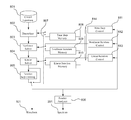
- FIG. 8 shows a block diagram for simulator and Fourier analyzer.
- the main signal flow for the simulator is shown on the left ( 801 - 805 ).
- the input is the circuit equations ( 801 ), which includes mathematical models of all components in the circuit, equations that represent the circuit structure using Kirchhoff's laws, and the stimulus waveforms.
- the circuit equations are continuous-time differential equations that are converted to discrete-time difference equations by the discretizer ( 802 ).
- the discretizer builds a set of equations that can be numerically solved at a finite set of time points ( 702 ) to approximate the solution of the circuit equations.
- the actual time points used are determined by the time step control ( 811 ).
- the discretizer uses numerical integration techniques such as backward Euler, trapezoidal rule, or the backward difference formulae, to perform the discretization.
- the equations output by the discretizer are nonlinear. They are converted by the nonlinear solver ( 803 ) into a sequence of linear equations whose solutions converge to the solution of the nonlinear system of equations.
- the nonlinear solver implements the Newton-Raphson algorithm or some variant.
- the number and type of iterations used by the nonlinear solver is determined by the nonlinear iteration control ( 812 ).
- the nonlinear solver produces a large coupled set of linear equations that is solved by the linear solver.
- the linear solver uses Gaussian elimination or some type of iterative solver such as a Krylov-based method (GMRES, etc.).
- the number, type, and order of iterations is determined by the linear iteration control ( 813 ).
- Both the nonlinear solver and the linear solver are optional; some circuit simulators, notably those that use explicit integration methods, do not need them.
- the output of the linear solver is passed through Newton step limiting ( 805 ) as a way of improving the convergence properties of the nonlinear solver ( 803 ).
- the simulation result is a waveform that approximately solves the circuit equations over the simulation interval ( 504 ). This waveform is processed by the Fourier analyzer ( 806 ) to produce a spectrum ( 201 ).
- the algorithmic choices ( 814 ) in the simulator are controlled directly by the control blocks ( 811 - 813 ) and the Newton step limiting is engaged, as determined by the switches ( 807 ).
- the time steps and iterations are also recorded by the associated memories, the time step memory ( 808 ), the nonlinear iteration memory ( 809 ), and the linear iteration memory ( 810 ).
- the switches change position and the time steps and iterations used by the simulator are replayed from the memories.
- a switch bypasses the Newton step limiting ( 805 ), here being used to represent all simulator algorithms that act in a nonlinear fashion on the signal (including the various bypass algorithms).
- FIG. 9 shows the discrete-time approximation to the source current waveform of the circuit in FIG. 4 and its spectrum.
- the waveform, or time-domain representation of the signal is shown on the left and the spectrum, or frequency-domain representation, is shown on the right.
- FIG. 10 shows the error in the solution computed by the circuit simulator for the circuit of FIG. 4 .
- the error waveform ( 1001 ) is on the left and the error spectrum ( 1002 ) is on the right.
- FIG. 11 shows the computed response, which is the sum of the true solution and the error of FIG. 10 . Notice that the spectrum of the computed response ( 1101 ) is a pure tone, there is no noise floor.
- FIG. 12 shows the error that results when the second time step is split into two.
- FIG. 13 shows the error of FIG. 12 partitioned into a pure tone (top) and residual (bottom).
- FIG. 14 shows the computed response (the sum of the true solution and the error of FIG. 12 ) after being sampled for the FFT. Notice the noise floor ( 204 ) that was created as a result of the simulator taking non-uniform time steps.
- FIG. 15 shows a representative set of time points as chosen by the invention when applied to a clocked circuit.
- FIG. 16 shows the effect of the invention when applied during the simulation of the circuit of FIG. 4 .
- the time steps used when producing the spectrum of FIG. 16 a were taken from an unconstrained circuit simulator simulating a switched-capacitor filter.
- the time steps that produced the spectrum of FIG. 16 b were the same for the first Fourier sample interval, at which point they repeated as required by this invention in a manner similar to that shown in FIG. 15 .
- the use of the invention improves the dynamic range from 111 dB ( 205 a ) to 256 dB ( 205 b ).
- FIG. 17 shows the effect of the invention when applied during the simulation of the circuit of FIG. 4 .
- the time steps used when producing the spectrum of FIG. 17 a were taken from an unconstrained circuit simulator simulating a mixer.
- the time steps that produced the spectrum of FIG. 17 b were the same for the first Fourier sample interval, at which point they repeated as required by this invention in a manner similar to that shown in FIG. 15 .
- the use of the invention improves the dynamic range from 66 dB ( 205 c ) to 268 dB ( 205 d ).
- Circuit simulators work by approximating a continuous-time system that cannot be solved numerically with a closely-related discrete-time system that can. This involves a three step process where the circuit equations are discretized, linearized, and solved as shown in FIG. 8 (these three steps can occur in any order). There is inherently some error in this process.
- the essential idea of this invention is not to eliminate the error in the approximation, which would be impossible, but instead to make the transformation linear and to eliminate the time-varying nature of the approximation, at least as seen by the Fourier analysis. This eliminates the frequency translation that causes the noise floor. If the transformation is linear and time invariant (LTI), then all the error will fall at the same frequency as the signal and there will be no noise floor.
- the steady-state response at out only contains energy at the source frequency, in this case 1 KHz. Gear's method is also linear, and so any error generated must be proportional to the input signal.
- the DFT result will have no noise floor.
- the spectrum as computed by the DFT will only have a nonzero term at 1 KHz, and the error in that term is proportional to the size of the signal, so as the signal shrinks, the error also shrinks at the same rate. In this case the error will never limit the resolution of the measurement. If there is some small signal at a frequency other that 1 KHz, it will be resolvable as there are no error signals at that same frequency to hide it. If the small signal is at 1 KHz, then it may well be hidden, but by the desired signal and not by the error.
- the source current waveform looks like the signal shown in FIG. 9 in both the time and frequency domains.
- the integration method in this example the Gear second-order backward difference method
- the integration method is linear, meaning that the error it produces is proportional to the true solution. As such, it could be represented by the signal in FIG. 10 (the actual numbers are chosen to be representative).
- the true solution would have a 1 V amplitude and the error generated by the integration method is a representative 0.1% (or 1 mV).
- the computed solution would look like the signal in FIG. 11 , which consists of the sum of the 1 V true solution and the error of FIG. 10 .
- This signal can be seen to be equal to the combination of a sinusoid and the residual as shown in FIG. 13 .
- the top of this figure shows the sinusoid and the bottom shows the residual. Together, they sum to the signal shown in FIG. 12 .
- the response would look sinusoidal in the time domain, but the frequency-domain result shows the noise floor ( 204 ) that needs to be avoided.
- the noise floor occurs because the non-uniform time step makes the discretization process appear time varying to the Fourier analysis. This breaks the LTI assumption and acts to convert energy from the stimulus frequency to all other frequencies, which is what creates the noise floor. In this case the total error is less, but there is a noise floor that acts to hide artifacts such as distortion products that result from small imperfections in the circuit.
- the above example demonstrates how non-uniform time steps ( 701 ) during a Fourier sample interval ( 704 ) create the noise floor. Similar examples can be created that demonstrate how changing the integration method used by the discretizer ( 802 ) or the number of iterations used by the nonlinear solver ( 803 ) or linear solver ( 804 ), etc., will also create a noise floor.
- the transformation from continuous-time circuit to discrete-time approximation must be linear.
- all nonlinear simulation algorithms such as step limiting algorithms ( 805 ), device bypass, subcircuit bypass, and the like ⁇ should be disabled.
- a simulation algorithm is nonlinear if it acts in a nonlinear fashion, or in other words, if doubling the size of the signals in the system that the algorithm is applied to does anything other than simply double the size of the computed response.
- all algorithmic dependence on the signal size must be eliminated. This includes its effect on the size of the time step ( 701 ) and on the number of iterations used by the nonlinear ( 803 ) and linear ( 804 ) solvers.
- the transformation must be time-invariant from the perspective of the sampling analyses.
- the sequence of algorithmic choices made by the simulator during each sampling interval must be identical.
- the algorithmic choices made by the simulator could include, but are not limited to, the following
- the simulator In the simplest form of the invention one would constrain the simulator to take evenly spaced time points with exactly the same integration method and number and type of iterations used on each step, while disabling Newton step limiting ( 805 ) and other nonlinear operations.
- the idea is to make every time step algorithmically identical to every other during the Fourier analysis interval.
- the time step ( 701 ) could either exactly match the Fourier analysis sample interval ( 704 ), or could be some exact sub-multiple (it is important that each sample point ( 703 ) fall exactly on a simulation point ( 702 ) to eliminate interpolation error).
- the length of the step and the integration method used during that step must be the same.
- Clocked circuits generally use piecewise linear (PWL) pulse waveforms as their clock signals.
- PWL signals require that simulation points be placed at their corners, which may not be equally spaced. They also require the integration method to switch to a first order method at their corners, which would be undesirable to use on all steps. So instead, the following more flexible approach was developed.
- the step size ( 701 ), number of iterations, integration method, etc. are allowed to vary as needed with the proviso that each sample interval uses exactly the same sequence of time steps, and that each member of that sequence is algorithmically identical to the corresponding members of the sequences used on every other Fourier sample interval.
- the first time step in the first interval must be the same as the first time step in every other interval.
- the same for the second step, the third step, etc. A set of time points that demonstrates this is shown in FIG. 15 . In this way, while variation in the algorithms used on each time step acts to modulate the error, that variation occurs in exact synchronism with the sampling required by the Fourier analysis.
- the modulation occurs at the sample rate of the Fourier analysis and so is ignored by the Fourier analysis. Another way of saying this is that to the Fourier analysis, the sequence of algorithmic choices made on each Fourier analysis step is both linear and identical and so from the perspective of the Fourier analysis the simulator appears to be LTI.
- the frequency of the clock signal is incommensurate with the desired sample rate of the Fourier analysis.
- this issue is resolvable as long as the circuit has a periodic response and the clock frequency is a multiple of the frequency of the response.
- the Fourier analysis sample rate can always be adjusted until it is equal, to or a sub-multiple of, the clock frequency.
- a training interval 502
- the conditions that would exist during the Fourier analysis would be imposed and the time-steps and iterations used would be recorded for the length of one Fourier sample interval ( 704 ).
- the tolerances might be tightened a bit to make the recorded time steps and iterations somewhat conservative.
- the Fourier analysis begins the traditional controls on the time step and iteration count are disabled along with the Newton step limiting algorithms and instead the size of each step, the integration method, and the number and type of iterations on each step are replayed from the record.
- the recorded sequence is repeated exactly during each Fourier sample interval until the Fourier analysis is complete, then the normal control of time step and iteration is restored.
- the simulator's normal error control mechanisms could continue to monitor the error produced by the simulator, and if accuracy limits are exceeded or convergence problems encountered the whole process restarted with more conservative assumptions.
- simulator error control can be maintained during the Fourier analysis interval.
- one Fourier sample interval as the training interval ( 502 )
- full Fourier analysis intervals as the training interval, one could monitor the periodicity constraint (the allowed upper bound on the nonperiodicity ( 601 )) and continue the training period until the constraint is met as a way of insuring that the initial transient has decayed to the point where it is no longer significant before the Fourier analysis interval begins.
- This invention describes many things that can be controlled during the Fourier analysis to improve the resolution of the analysis, each of which acts to eliminate a source of error. Some are sources of large errors and some are sources of small errors. It is important to recognize that the invention does not require that all of these techniques for increasing the resolution be employed together. They can, in fact, be employed individually or in any combination.
- the basic underlying mandate of the invention is to eliminate or minimize algorithmic variation between Fourier sample intervals ( 704 ). Many of the mechanisms for algorithmic variation have been mentioned, but there may be others that exist today or will be created in the future as the art of simulation advances. This invention covers the idea of eliminating or minimizing mechanisms of variation, even those not mentioned.
- the simplest form of this invention is to simply fix the time step, the integration method, the number of iterations, etc. in advance, perhaps based on results observed during a training interval or perhaps by other means, such as choosing values that seem reasonable based on prior experience or by simply asking the user. In this case the memories of FIG. 8 are not needed. However, even this simple form is included in this invention.
- the invention was described as being applied to a circuit simulator. But the invention is useful with any type of simulator that solves differential equations and whose results would be processed with Fourier analysis.
- the invention was applied to the simulation of the circuit in FIG. 4 .
- This circuit is linear, time invariant, and noiseless and so in steady state produces a spectrum without distortion products or noise floor. If they are present in the results they must be an artifact of the simulator.
- different sets of time steps were used. In the first case a set of time steps was extracted from the actual simulation of a switched-capacitor filter. In this case, a large number of time steps were used, resulting in the expectation that the results should be very accurate. This set was then applied as is to simulate the circuit and produce the results shown in FIG. 16 a . The results shown in FIG.
- 16 b were produced using the same time steps up to the end of the first Fourier sample interval ( 704 ), at which time the steps used during the first sample interval were simply repeated until the end of the Fourier analysis interval ( 503 ).
- the first set of time steps represents those found in an unconstrained simulator and the second represents time steps that would be produced under the constraints of this invention.
- the dynamic range of the Fourier analysis was 111 dB ( 205 a ). This is a reasonably good result, a result that was achieved at the cost of a long simulation by using a very large number of time steps.
- the resolution increased to 256 dB ( 205 b ), a factor of 20 million improvement.
- the basic concept of this invention can also be applied to improve simulation in other situations; situations that might not involve Fourier analysis at all.
- shooting-based RF simulators [ismert99] these ideas can also improve the convergence of the shooting algorithm by reducing variation between the shooting iterations.
- transient or transient-like analyses to compute the sensitivity of the circuit's response to changes in its initial state, its component parameter values, or its environment, which is very useful in a variety of process including circuit optimization and synthesis.
- these ideas would be useful on any type of transient simulation where repeatability over a sequence of intervals is required.
- Examples include any large signal noise or jitter simulations, where variation in the simulator algorithms could produce variation in the result that is mistaken for noise or jitter produced by the circuit.
- perturbation analysis where the behavior of the circuit is examined in the presence of small perturbations of either the circuit or its stimulus. In the case of noise and jitter the perturbation is in the stimulus.
- the perturbation analysis is often referred to as a Monte Carlo analysis. Many other non-Fourier analysis applications of this invention are likely to exist now and in the future.
- This invention addresses a long standing problem with circuit simulators, a problem that is particularly vexing for users, that of achieving adequate resolution when using Fourier analysis.
- the only alternative for the user is to painstakingly adjust the simulator settings in the hope that the accuracy of the simulation and subsequent Fourier analysis could be sufficiently improved.
- there is no direct method for doing this There is no one setting that when adjusted will always improve Fourier analysis resolution.
- tightening the simulator tolerances can make the Fourier analysis resolution worse. This makes this issue very frustrating and time consuming.
- tightening tolerances can dramatically slow the simulation. Even if it is possible to configure the simulator settings to get sufficient resolution, it may result in an impractically long simulation.
Landscapes
- Engineering & Computer Science (AREA)
- Computer Hardware Design (AREA)
- Physics & Mathematics (AREA)
- Theoretical Computer Science (AREA)
- Evolutionary Computation (AREA)
- Geometry (AREA)
- General Engineering & Computer Science (AREA)
- General Physics & Mathematics (AREA)
- Microelectronics & Electronic Packaging (AREA)
- Management, Administration, Business Operations System, And Electronic Commerce (AREA)
Abstract
Description
- 1. The signal is not periodic in the Fourier analysis interval (503). Or, in other words, the nonperiodicity (601) is not negligible.
- 2. Fourier analysis begins before the circuit reaches steady state (or the initial transient interval (501) is too short).
- 3. Aliasing (the duration of the Fourier sample interval (704) is too long to accurately capture the dynamics of the waveform).
- 4. Interpolation error (simulation points (702) do not coincide with Fourier sample points (703)).
- 5. Simulation error (approximations made in the simulator corrupt the results somewhat).
- 6. Modeling error (approximations made in the models corrupt the results somewhat).
- 7. Limited numerical precision of the computer's representation of numbers.
- 101—waveform
- 102—signal period
- 201—spectrum
- 202—large signal component
- 203—small signal component
- 204—noise floor
- 205—dynamic range (the ratio of the primary signal component (202) to the noise floor (204))
- 301—a circuit, typically in the form of a schematic or netlist
- 302—a circuit simulator
- 303—a database of waveforms
- 304—a Fourier analyzer. It performs Fourier analysis on one or more waveforms to produce one or more spectra.
- 305—a database of spectra
- 306—a display used for viewing the spectra
- 307—a designer that uses the spectra to improve the design of the circuit
- 401—test circuit
- 402—stimulus (sinusoidal current source)
- 403—capacitor
- 404—noiseless resistor
- 405—output of test circuit
- 501—initial transient interval
- 502—Fourier analysis training interval (can also be placed at the beginning of (and overlap) the Fourier analysis interval (503)).
- 503—Fourier analysis interval. Must equal or be an exact multitude of the signal period (102) for best results.
- 504—Simulation interval. Must equal or be longer than the sum of initial transient interval (501), the training interval (502), and the Fourier analysis interval (503).
- 601—non-periodicity
- 701—time step
- 702—time point
- 703—sample point
- 704—sample interval
- 801—equations of circuit to be simulated
- 802—discretizer (converts differential equation to a sequence of difference equations)
- 803—nonlinear solver (converts nonlinear difference equations to sequence of linear equations)
- 804—linear equation solver
- 805—Newton step limiting (here being used to represent all simulator algorithms that act in a non-linear fashion on the signal)
- 806—Fourier analyzer
- 807—switches
- 808—time step memory
- 809—nonlinear iteration memory
- 810—linear iteration memory
- 811—time step control
- 812—nonlinear iteration control
- 813—linear iteration control
- 814—algorithmic choices
- 1001—error waveform
- 1002—error spectrum, notice that the error is concentrated at signal frequency
- 1101—large signal component (202) contaminated with error (1002) unaccompanied by noise floor (204)
- 1201—error that results when two time small steps (701) that replace one large step
- 1202—error spread over many frequencies so as to form a noise floor
- 1. time step size
- 2. time step type (which integration method is used)
- 3. the iterations used by the nonlinear solver (the number of iterations and type of each iteration (ex. full Newton versus Samanskii [ortega00]))
- 4. the iterations used by the linear solver (with direct methods such as Gaussian elimination the equations would be processed in the same order, with iterative methods such as Krylov subspace methods [saad95], the subspaces would be processed (and recycled [telichevesky96]) in the same order up to the same number)
- 5. circuit partitions (any partitioning of the circuit would be held constant throughout the Fourier analysis interval)
- 6. component model representations (the representation level of each component model would not change during the Fourier analysis interval) †. Newton step limiting shrinks or limits the size of the step taken during an iteration when using Newton or Newton-like methods as a way of improving the convergence properties of the method [ortega00]. Device bypass is a technique used by SPICE to improve the efficiency of simulation whereby the evaluation of a device model is bypassed and the previous values for its terminal currents are used if its terminal voltages have not changed significantly from a previous time point. Subcircuit bypass is similar to device bypass, but is applied to entire subcircuits. It should be understood that bypass algorithms are simply replacing a complicated model for a simpler model under particular circumstances. As described, the simpler models are zero-order or constant current models. However more complicated models, such as first-order or linear models, could also be used.
- [harris78] Fredric J. Harris. On the Use of Windows for Harmonic Analysis with the Discrete Fourier Transform. Proceedings of the IEEE, vol. 66, no. 1, January 1978.
- [kundert94] Kenneth S. Kundert. Accurate Fourier analysis for circuit simulators. Proceedings of the 1994 IEEE Custom Integrated Circuits Conference, May 1994.
- [kundert95] Kenneth S. Kundert. The Designer's Guide to SPICE and Spectre. Kluwer Academic Publishers, 1995.
- [kundert97] Kenneth S. Kundert. Ratiometric Fourier analyzer. U.S. Pat. No. 5,610,847. March 1997.
- [kundert99] Kenneth S. Kundert. Introduction to RF simulation and its application. IEEE Journal of Solid-State Circuits, vol. 34, no. 9 in September 1999.
- [ortega00] J. M. Ortega and W. C. Rheinboldt. Iterative Solution of Nonlinear Equations in Several Variables (Classics in Applied Mathematics, 30). Society for Industrial & Applied Mathematics, 2000.
- [saad95] Yousef Saad. Iterative Methods for Sparse Linear Systems. PWS Publishing Company, 1995.
- [telichevesky96] Ricardo Telichevesky, Kenneth S. Kundert, Jacob K. White. Efficient AC and noise analysis of two-tone RF circuits. Proceedings of the 33rd Design Automation Conference, June 1996.
Claims (20)
Priority Applications (1)
| Application Number | Priority Date | Filing Date | Title |
|---|---|---|---|
| US13/157,281 US8670969B1 (en) | 2007-01-28 | 2011-06-09 | Circuit simulation system with repetitive algorithmic choices that provides extremely high resolution on clocked and sampled circuits |
Applications Claiming Priority (2)
| Application Number | Priority Date | Filing Date | Title |
|---|---|---|---|
| US62797207A | 2007-01-28 | 2007-01-28 | |
| US13/157,281 US8670969B1 (en) | 2007-01-28 | 2011-06-09 | Circuit simulation system with repetitive algorithmic choices that provides extremely high resolution on clocked and sampled circuits |
Related Parent Applications (1)
| Application Number | Title | Priority Date | Filing Date |
|---|---|---|---|
| US62797207A Continuation | 2007-01-28 | 2007-01-28 |
Publications (1)
| Publication Number | Publication Date |
|---|---|
| US8670969B1 true US8670969B1 (en) | 2014-03-11 |
Family
ID=50192822
Family Applications (1)
| Application Number | Title | Priority Date | Filing Date |
|---|---|---|---|
| US13/157,281 Active 2027-08-09 US8670969B1 (en) | 2007-01-28 | 2011-06-09 | Circuit simulation system with repetitive algorithmic choices that provides extremely high resolution on clocked and sampled circuits |
Country Status (1)
| Country | Link |
|---|---|
| US (1) | US8670969B1 (en) |
Cited By (6)
| Publication number | Priority date | Publication date | Assignee | Title |
|---|---|---|---|---|
| US20130246015A1 (en) * | 2012-03-13 | 2013-09-19 | Synopsys, Inc. | Electronic Circuit Simulation Method With Adaptive Iteration |
| US20150205758A1 (en) * | 2014-01-17 | 2015-07-23 | Fujitsu Limited | Arithmetic device, arithmetic method, and wireless communication device |
| US9984188B2 (en) | 2016-02-18 | 2018-05-29 | International Business Machines Corporation | Single ended-mode to mixed-mode transformer spice circuit model for high-speed system signal integrity simulations |
| US10223483B1 (en) * | 2016-12-23 | 2019-03-05 | Intel Corporation | Methods for determining resistive-capacitive component design targets for radio-frequency circuitry |
| US10530422B2 (en) | 2016-02-18 | 2020-01-07 | International Business Machines Corporation | Behavioural circuit jitter model |
| CN116301197A (en) * | 2023-04-27 | 2023-06-23 | 上海合见工业软件集团有限公司 | Clock data recovery method, electronic device and medium |
Citations (2)
| Publication number | Priority date | Publication date | Assignee | Title |
|---|---|---|---|---|
| US5038269A (en) * | 1987-11-25 | 1991-08-06 | National Research Development Corporation | Industrial control systems |
| US5610847A (en) | 1994-10-28 | 1997-03-11 | Cadence Design Systems, Inc. | Ratiometric fourier analyzer |
-
2011
- 2011-06-09 US US13/157,281 patent/US8670969B1/en active Active
Patent Citations (2)
| Publication number | Priority date | Publication date | Assignee | Title |
|---|---|---|---|---|
| US5038269A (en) * | 1987-11-25 | 1991-08-06 | National Research Development Corporation | Industrial control systems |
| US5610847A (en) | 1994-10-28 | 1997-03-11 | Cadence Design Systems, Inc. | Ratiometric fourier analyzer |
Non-Patent Citations (7)
| Title |
|---|
| Cadence, "Virtuoso © SpectreRF Simulation Option User Guide"., Production Version 5.1.41., Jul. 2005., 1600 Pages. * |
| Germund Dahlquist, Ake Bjorck and Ned Anderson. Numerical Methods. Prentice Hall, 1974, pp. 81-95, 255-305, 330-355, and 404-421. |
| J. M. Ortega and W. C. Rheinboldt. Iterative Solution of Nonlinear Equations in Several Variables (Classics in Applied Mathematics, 30). Society of Industrial & Applied Mathematics, 2000, pp. 181-189 (provided with parent U.S. Appl. No. 11/627,972). |
| Kenneth S. Kundert, Introduction to RF simulation and its application. IEEE Journal of Solid-State Circuits, vol. 34, No. 9, Sep. 1999 (provided with parent U.S. Appl. No. 11/627,972). |
| Kenneth S. Kundert. The Designer's Guide to Spice and Spectre, Kluwer Academic Publishers, 1995, pp. 251-334 (provided with parent U.S. Appl. No. 11/627,972). |
| Ricardo Telichevesky, Kenneth S. Kundert, Jacob K. White. Efficient AC and noise analysis of two-tone RF circuits. Proceedings of the 33rd Design Automation Conference, Jun. 1996 (provided with parent U.S. Appl. No. 11/627,972). |
| Yousef Saad. Iterative Methods for Sparse Linear Systems. PWS Publishing Company, 1995, pp. 144-201 (provided with parent U.S. Appl. No. 11/627,972). |
Cited By (10)
| Publication number | Priority date | Publication date | Assignee | Title |
|---|---|---|---|---|
| US20130246015A1 (en) * | 2012-03-13 | 2013-09-19 | Synopsys, Inc. | Electronic Circuit Simulation Method With Adaptive Iteration |
| US9002692B2 (en) * | 2012-03-13 | 2015-04-07 | Synopsys, Inc. | Electronic circuit simulation method with adaptive iteration |
| US20150205758A1 (en) * | 2014-01-17 | 2015-07-23 | Fujitsu Limited | Arithmetic device, arithmetic method, and wireless communication device |
| US9690750B2 (en) * | 2014-01-17 | 2017-06-27 | Fujitsu Limited | Arithmetic device, arithmetic method, and wireless communication device |
| US9984188B2 (en) | 2016-02-18 | 2018-05-29 | International Business Machines Corporation | Single ended-mode to mixed-mode transformer spice circuit model for high-speed system signal integrity simulations |
| US10530422B2 (en) | 2016-02-18 | 2020-01-07 | International Business Machines Corporation | Behavioural circuit jitter model |
| US11120189B2 (en) | 2016-02-18 | 2021-09-14 | International Business Machines Corporation | Single-ended-mode to mixed-mode transformer spice circuit model for high-speed system signal integrity simulations |
| US10223483B1 (en) * | 2016-12-23 | 2019-03-05 | Intel Corporation | Methods for determining resistive-capacitive component design targets for radio-frequency circuitry |
| CN116301197A (en) * | 2023-04-27 | 2023-06-23 | 上海合见工业软件集团有限公司 | Clock data recovery method, electronic device and medium |
| CN116301197B (en) * | 2023-04-27 | 2023-08-04 | 上海合见工业软件集团有限公司 | Clock data recovery method, electronic device and medium |
Similar Documents
| Publication | Publication Date | Title |
|---|---|---|
| Toro et al. | Derivative Riemann solvers for systems of conservation laws and ADER methods | |
| Qiao et al. | The application of cubic B-spline collocation method in impact force identification | |
| Kundert et al. | Steady-state methods for simulating analog and microwave circuits | |
| Camacho et al. | Multilinear discrete lag-cascade model for channel routing | |
| US8185368B2 (en) | Mixed-domain analog/RF simulation | |
| Haag et al. | Model validation and selection based on inverse fuzzy arithmetic | |
| US11636238B2 (en) | Estimating noise characteristics in physical system simulations | |
| Fraedrich et al. | A methodological framework for the validation of predictive simulations | |
| Malti et al. | Dynamic SISO and MISO system approximations based on optimal Laguerre models | |
| Guy et al. | Stability of approximate projection methods on cell-centered grids | |
| US6536026B2 (en) | Method and apparatus for analyzing small signal response and noise in nonlinear circuits | |
| Iskakov et al. | TRIQS/Nevanlinna: Implementation of the Nevanlinna Analytic Continuation method for noise-free data | |
| Bian et al. | Nonlinear delay-table approach for full-chip NBTI degradation prediction | |
| US7007252B2 (en) | Method and apparatus for characterizing the propagation of noise through a cell in an integrated circuit | |
| Tertel et al. | Real-time emulation of block-based analog circuits on an FPGA | |
| US9871649B2 (en) | Real time subsample time resolution signal alignment in time domain | |
| Stanisławski et al. | Implementation of fractional-order difference via Takenaka-Malmquist functions | |
| Yazid et al. | Identification of time-varying linear and nonlinear impulse response functions using parametric Volterra model from model test data with application to a moored floating structure | |
| Oduselu-Hassan | A Second-Order Imex-Rk Approach for Energy-Stable Phase Field Crystal Simulations | |
| US8694568B2 (en) | Method for calculating causal impulse response from a band-limited spectrum | |
| Ménard et al. | Analysis of finite word-length effects in fixed-point systems | |
| Holmes | Guitar effects: pedal emulation and identification | |
| Wiczyński | Estimation of Pst indicator value for a simultaneous influence of two disturbing loads | |
| Fang | A new time-stepping method for circuit simulation | |
| Kvaternik et al. | A computational procedure for identifying bilinear representations of nonlinear systems using volterra kernels |
Legal Events
| Date | Code | Title | Description |
|---|---|---|---|
| STCF | Information on status: patent grant |
Free format text: PATENTED CASE |
|
| FEPP | Fee payment procedure |
Free format text: MAINTENANCE FEE REMINDER MAILED (ORIGINAL EVENT CODE: REM.) |
|
| FEPP | Fee payment procedure |
Free format text: SURCHARGE FOR LATE PAYMENT, SMALL ENTITY (ORIGINAL EVENT CODE: M2554) |
|
| MAFP | Maintenance fee payment |
Free format text: PAYMENT OF MAINTENANCE FEE, 4TH YR, SMALL ENTITY (ORIGINAL EVENT CODE: M2551) Year of fee payment: 4 |
|
| FEPP | Fee payment procedure |
Free format text: MAINTENANCE FEE REMINDER MAILED (ORIGINAL EVENT CODE: REM.); ENTITY STATUS OF PATENT OWNER: SMALL ENTITY |
|
| FEPP | Fee payment procedure |
Free format text: 7.5 YR SURCHARGE - LATE PMT W/IN 6 MO, SMALL ENTITY (ORIGINAL EVENT CODE: M2555); ENTITY STATUS OF PATENT OWNER: SMALL ENTITY |
|
| MAFP | Maintenance fee payment |
Free format text: PAYMENT OF MAINTENANCE FEE, 8TH YR, SMALL ENTITY (ORIGINAL EVENT CODE: M2552); ENTITY STATUS OF PATENT OWNER: SMALL ENTITY Year of fee payment: 8 |
|
| MAFP | Maintenance fee payment |
Free format text: PAYMENT OF MAINTENANCE FEE, 12TH YR, SMALL ENTITY (ORIGINAL EVENT CODE: M2553); ENTITY STATUS OF PATENT OWNER: SMALL ENTITY Year of fee payment: 12 |
|
| AS | Assignment |
Owner name: DESIGNER'S GUIDE CONSULTING , INC., CALIFORNIA Free format text: ASSIGNMENT OF ASSIGNORS INTEREST;ASSIGNORS:CHANG, HENRY;KUNDERT, KENNETH;REEL/FRAME:072561/0742 Effective date: 20250926 |
|
| AS | Assignment |
Owner name: CADENCE DESIGN SYSTEMS, INC., CALIFORNIA Free format text: ASSIGNMENT OF ASSIGNORS INTEREST;ASSIGNOR:DESIGNER'S GUIDE CONSULTING, LLC;REEL/FRAME:073023/0048 Effective date: 20251124 |