US8664507B1 - Musical instrument pickup and methods - Google Patents
Musical instrument pickup and methods Download PDFInfo
- Publication number
- US8664507B1 US8664507B1 US13/290,896 US201113290896A US8664507B1 US 8664507 B1 US8664507 B1 US 8664507B1 US 201113290896 A US201113290896 A US 201113290896A US 8664507 B1 US8664507 B1 US 8664507B1
- Authority
- US
- United States
- Prior art keywords
- pole piece
- coil
- pickup
- phase angle
- frequency
- Prior art date
- Legal status (The legal status is an assumption and is not a legal conclusion. Google has not performed a legal analysis and makes no representation as to the accuracy of the status listed.)
- Active
Links
Images




Classifications
-
- G—PHYSICS
- G10—MUSICAL INSTRUMENTS; ACOUSTICS
- G10H—ELECTROPHONIC MUSICAL INSTRUMENTS; INSTRUMENTS IN WHICH THE TONES ARE GENERATED BY ELECTROMECHANICAL MEANS OR ELECTRONIC GENERATORS, OR IN WHICH THE TONES ARE SYNTHESISED FROM A DATA STORE
- G10H3/00—Instruments in which the tones are generated by electromechanical means
- G10H3/12—Instruments in which the tones are generated by electromechanical means using mechanical resonant generators, e.g. strings or percussive instruments, the tones of which are picked up by electromechanical transducers, the electrical signals being further manipulated or amplified and subsequently converted to sound by a loudspeaker or equivalent instrument
- G10H3/14—Instruments in which the tones are generated by electromechanical means using mechanical resonant generators, e.g. strings or percussive instruments, the tones of which are picked up by electromechanical transducers, the electrical signals being further manipulated or amplified and subsequently converted to sound by a loudspeaker or equivalent instrument using mechanically actuated vibrators with pick-up means
- G10H3/18—Instruments in which the tones are generated by electromechanical means using mechanical resonant generators, e.g. strings or percussive instruments, the tones of which are picked up by electromechanical transducers, the electrical signals being further manipulated or amplified and subsequently converted to sound by a loudspeaker or equivalent instrument using mechanically actuated vibrators with pick-up means using a string, e.g. electric guitar
- G10H3/181—Details of pick-up assemblies
-
- G—PHYSICS
- G10—MUSICAL INSTRUMENTS; ACOUSTICS
- G10H—ELECTROPHONIC MUSICAL INSTRUMENTS; INSTRUMENTS IN WHICH THE TONES ARE GENERATED BY ELECTROMECHANICAL MEANS OR ELECTRONIC GENERATORS, OR IN WHICH THE TONES ARE SYNTHESISED FROM A DATA STORE
- G10H3/00—Instruments in which the tones are generated by electromechanical means
- G10H3/12—Instruments in which the tones are generated by electromechanical means using mechanical resonant generators, e.g. strings or percussive instruments, the tones of which are picked up by electromechanical transducers, the electrical signals being further manipulated or amplified and subsequently converted to sound by a loudspeaker or equivalent instrument
- G10H3/14—Instruments in which the tones are generated by electromechanical means using mechanical resonant generators, e.g. strings or percussive instruments, the tones of which are picked up by electromechanical transducers, the electrical signals being further manipulated or amplified and subsequently converted to sound by a loudspeaker or equivalent instrument using mechanically actuated vibrators with pick-up means
- G10H3/143—Instruments in which the tones are generated by electromechanical means using mechanical resonant generators, e.g. strings or percussive instruments, the tones of which are picked up by electromechanical transducers, the electrical signals being further manipulated or amplified and subsequently converted to sound by a loudspeaker or equivalent instrument using mechanically actuated vibrators with pick-up means characterised by the use of a piezoelectric or magneto-strictive transducer
-
- G—PHYSICS
- G10—MUSICAL INSTRUMENTS; ACOUSTICS
- G10H—ELECTROPHONIC MUSICAL INSTRUMENTS; INSTRUMENTS IN WHICH THE TONES ARE GENERATED BY ELECTROMECHANICAL MEANS OR ELECTRONIC GENERATORS, OR IN WHICH THE TONES ARE SYNTHESISED FROM A DATA STORE
- G10H2220/00—Input/output interfacing specifically adapted for electrophonic musical tools or instruments
- G10H2220/461—Transducers, i.e. details, positioning or use of assemblies to detect and convert mechanical vibrations or mechanical strains into an electrical signal, e.g. audio, trigger or control signal
Definitions
- This invention relates to musical instrument pickups and, more particularly, to methods of characterizing, correlating and predicting pickup performance to thereby design and construct musical instrument pickups with a predictable tonal response. Accordingly, the general objects of the invention are to provide novel systems, methods, apparatus and models of such character.
- Certain musical instruments especially electric guitars and other electric stringed instruments, use magnetic transducers to convert mechanical string vibrations into electrical signals that are subsequently amplified and fed into a loudspeaker.
- a musician typically selects musical instrument electronic components from a wide variety of options to achieve a particular musician-desired tonal quality. Tonal quality is important as it imparts an expressive element from a musician to a listener. For example, a guitar player may prefer analog circuitry over digital circuitry to achieve a more “vintage” tone.
- a guitar player's tone is directly related to the selection of desired amplifiers, guitars, and pickups (in addition to the playing style, finger pressure, etc., of the guitar player). With respect to guitar pickups, many factors, such as the number of coil winds, wire types, magnets, pole piece material, etc., are known to affect the tonal qualities of the pickup.
- Stacked designs are marketed by Kinman® and DiMarzio® among others.
- Lindy Fralin's split blade design diverges from traditional design in incorporating continuous blade pole pieces rather than the discrete cylindrical pole pieces incorporated in standard designs. These design changes are viewed as necessarily resulting in tonal characteristics that are distinct from traditional single coil pickups.
- a P90 pickup is basically a single coil with a different aspect ratio compared to a typical single coil pickup as utilized on a Fender® Stratocaster.
- the P90 coil is typically shorter than a Stratocaster® coil (i.e. in the direction parallel to the pole piece and perpendicular to the string axis) and wider in terms of the aperture it presents to the vibrating string (i.e. the direction perpendicular to the pole piece and parallel to the string axis).
- the P90 therefore senses the string vibration over more of the length of the string compared to a typical Stratocaster® single coil pickup.
- the P90 typically utilizes a magnetically susceptible pole piece (typically a steel screw) rather than a permanently magnetic pole piece.
- the magnetic field in P90 pickups is typically supplied by rectangular plate magnets positioned at the base of the pickup and in proximity to the screw pole pieces.
- dummy coils have been utilized to provide basically an antenna designed to capture noise of the same magnitude but opposite phase as the noise associated with the pickup while minimizing the tonal interference from the dummy coil.
- This system is manufactured by Suhr (the Backplate Silent Single Coil or “BPSSC” system) and as of this writing, it retails for on the order of $250.
- BPSSC Backplate Silent Single Coil
- a set of 3 new high quality traditional single coil pickups retails for about $190 (Fender® Custom Shop Pickups) to $240 (Lollar hand wound “boutique” pickups). This would indicate that some guitar players are willing to pay more than double the cost of pickups alone (not including installation) to achieve a traditional single coil guitar tone with reduced noise.
- the quality and applicability of a guitar pickup is defined by the tonal quality that it imparts on the note.
- Much of the process of designing a pickup is done empirically, and even that using minimal deviations from traditional materials and designs for the most part.
- Traditionally a limited range of materials has been used in the majority of electric guitar pickup design and construction. Very little work has been done to quantify basic pickup electrical response and tie it to tonal performance. The effect of material properties on pickup performance, while recognized as important, has been very poorly and incompletely understood.
- the only known exceptions to the above noted general rule are the work of Helmuth E.W. Lemme, and Prof Steven Errede at the Univ. of Illinois to measure and characterize electric guitar pickup frequency response.
- an object and feature of the present invention is to provide a method-of-designing/system-for-constructing a pickup that allows for targeting a wide range of tonal characteristics on a common platform.
- the material characterization and modeling methods taught herein can identify materials and structures that enable the design/construction of pickups with a wide range of targeted pickup tonalities.
- inventive pickups while outwardly appearing to be substantially similar to one another, may either provide tonal characteristics similar to or distinctly different from, traditional pickups.
- the modeling and design aspects of the present invention may be used to design/construct a pickup with a tonal response similar to that of traditional single coil pickup using AlNiCo alloy pole pieces without the use of AlNiCo at all.
- the modeling and design aspects of the present invention may be used to design/construct pickups with heretofore unknown tonal characteristics.
- the invention may take the form of a method of constructing a musical instrument pickup to achieve a user-desired signal output level and a user-desired tonal characteristic from a stringed instrument.
- the method may include the steps of selecting a coil geometry, selecting a number of coils, selecting a coil wire gauge and number of turns for each coil and selecting a pole piece.
- selecting the pole piece consideration may be given to pole piece composition, pole piece thickness, height and width, and pole piece response in terms of relative inductive and normalized resonant frequency characteristics.
- the method may also include the step of assembling the pole piece and coil into a pickup for detecting a musical instrument string vibrating in proximity therewith. If the selected pole piece is non-magnetic, the method may also include steps for selecting a magnet and assembling the pickup with the magnet.
- a further object and feature of the present invention is to provide a musical instrument pickup design platform that maintains symmetry between the coil geometry and the associated magnetic field.
- Still another object and feature of the present invention is to provide a method of constructing a musical instrument pickup that provides improved symmetry between the coil geometry and the associated magnetic field.
- an inventive pickup for a stringed musical instrument may have at least one coil, at least one laminated pole piece and, if the pole piece is non-magnetic, at least one magnet.
- the pole piece is not an AlNiCo alloy, but the relative inductive and resonant frequency characteristics of the pole piece are substantially similar to an AlNiCo alloy.
- the invention may comprise a pickup for a stringed musical instrument having at least one coil, at least one pole piece and, if the pole piece is non-magnetic, at least one magnet.
- the pole piece may be disposed within the at least one coil, wherein the pole piece material is selected based on the relative inductance and the relative resonant frequency that have been normalized to a reference coil, an exponential parameter alpha; and the shape of the phase angle response near a resonant frequency.
- such pickups comprise a plurality of coils positioned around one or more pole pieces.
- the coils may be oriented such that a long axis thereof forms a constant acute angle with respect to the longitudinal axis of the string.
- the pole pieces may be either permanently magnetic, or they may be of a magnetically permeable material such as a steel screw, rectangular plate or slug, a plurality of thin magnetically permeable sheets, a laminate composed of a plurality of magnetically permeable sheets, or other magnetically permeable matrix.
- the pole pieces may also substantially fill the unwound inner core of the coil, or only partially fill it.
- the design and composition of the pole pieces is arrived at through the use of the aforementioned model which allows for the targeting of specific desired tonal characteristics.
- a pole piece and coil wire wrapping pair may, optionally, be associated with a pole piece cap, such that the pole piece cap substantially follows the contours of the coil wire wrapping and the boundaries of the pole piece cap area are intermediate between the coil wire wrapping interior and the outer boundary of the coil wire wrapping.
- the pole piece cap may be fabricated from a magnetic or a magnetically permeable material, such that the magnetic flux associated with the pole piece is extended to the boundaries of the pole piece cap, especially in the area between adjacent coil wire wrapping pole piece pairs.
- the coil geometry relative to the string may be arranged to provide for each coil being substantially associated with a single string, while simultaneously maximizing the overlap particularly between strings 3 and 4 and also minimizing the overall projected area of the pickup.
- coils 1-3 (servicing strings 1-3) may be arranged such that their geometric centers fall along a first line
- coils 4-6 are arranged such that their geometric centers fall along a second line, such second line being parallel to such first line. Both the first and the second line may intersect coil wire wrappings from each of the coils as well as intersecting the interiors of each of the coil wire wrappings. This configuration may alleviate non-idealities associated with reduced signal strength and coupling of string vibration in the space between adjacent pole pieces of opposite magnetic polarity.
- FIG. 1 represents a schematic top view of a preferred pickup with rectangular or stadium cross section pole pieces and pole piece caps associated with each pole piece;
- FIG. 2 a and FIG. 2 b are exploded diagrams illustrating the assembly of preferred pickups with rectangular plate pole pieces, one of which also utilizes a base plate magnet;
- FIG. 3 shows the magnetic and coil winding orientations of a preferred pickup with rectangular plate pole pieces and base plate magnets designed for full hum cancelling operation
- FIG. 4 shows the cross-section of a preferred coil-bobbin assembly with a pole piece cap and the interior of the coil filled with a laminated pole piece;
- FIG. 5 shows the cross-section of a coil-bobbin assembly with the interior of the coil filled with a solid pole piece
- FIG. 6 is a schematic representation of a component and/or pickup measurement and test apparatus
- FIG. 7 illustrates the gain response as a function of frequency for a variety of commercially available traditional pickups
- FIGS. 8 a and 8 b illustrate phase angle and normalized gain as a function of normalized frequency for a variety of commercially available traditional pickups
- FIGS. 9 a and 9 b illustrate phase angle and normalized gain as a function of normalized frequency for a range of pole piece materials in a preferred reference stadium coil
- FIG. 10 shows relative resonant frequency as a function of relative inductance for a range of pole piece materials in a preferred reference stadium coil
- FIG. 11 shows relative resonant frequency as a function of relative inductance for a range of laminated pole pieces fabricated from low carbon steel in a preferred reference stadium coil
- FIG. 12 relative resonant frequency as a function of relative inductance for a range of laminated pole pieces fabricated from low carbon steel and 430 stainless steel materials in a preferred reference stadium coil;
- FIGS. 13 a and 13 b illustrate phase angle and normalized gain in a preferred reference coil as a function of normalized frequency for a range of laminates fabricated from C1008 low carbon steel;
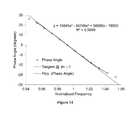
- FIG. 14 illustrates phase angle as a function of normalized frequency, illustrating the tangent to the phase angle at the resonant frequency
- FIGS. 15 a and 15 b illustrate the definition of the 90% Normalized Peak Width and the correlation of 90% peak width to the slope of the tangent to the phase angle;
- FIGS. 16 a and 16 b illustrate the slope of the tangent to the phase angle and the exponent alpha as a function of lamina thickness in a reference coil for a range of pole pieces fabricated from low carbon steel and 430 stainless steel;
- FIG. 17 shows the slope of the tangent to the phase angle plotted against the exponent alpha for a range of pole piece materials in a preferred reference coil, as well as a series of preferred reference pole pieces in a range of preferred coils;
- FIGS. 18 a , 18 b and 18 c illustrate phase angle and gain as a function of normalized frequency for pickups targeted at an AlNiCo-like response with the novel methodology and novel materials discussed herein compared to commercially available traditional pickups.
- pickup 20 consists of a plurality of pole pieces 22 a - 22 f that may be composed of generally rectangular plates characterized by a length, height and thickness (or width). As defined here, the height of the pole piece is the dimension perpendicular to the string plane and the string plane is the plane of the page surface. Further, those of ordinary skill will appreciate that the term “string plane”, as used herein, may sometimes refer to a slightly curved surface (such as the cylindrical surface), for example, where an instrument fingerboard is radiused and the strings arced accordingly.
- the length of each pole piece may be positioned to form a constant acute angle, illustrated in FIG.
- pole pieces 22 a - 22 f may be formed of a permanently magnetic material, such as AlNiCo II or AlNiCo V.
- pole pieces 22 a - 22 f may be formed of a magnetically permeable material, such as iron, steel, a nickel-iron alloy or a laminate thereof.
- the magnetically permeable material may be a solid mass, a powder or aggregate, or it may be composed of a plurality of sheets of material. When in sheet form, the sheets may be laminated together to form a solid structure.
- the particular material and structure of the pole pieces will be selected by a designer to achieve an intended and predictable result using the modeling and design aspects of the invention discussed below.
- one of the coils 26 a - 26 f may be associated with each pole piece, such that the coil has a cross section approximating a stadium.
- the inner coil wrapping may cover the outer surface of the pole piece (if wound directly on the pole piece), or alternatively the outer surface of the bobbin, and approximate the aspect ratio defined by the length and thickness (or width) of the pole piece.
- the pole piece is positioned within the hollow center of the stadium-shaped coil.
- the coil may be directly wound on the pole piece, or wound on a bobbin or support.
- the coil may be of the self-supporting type and designed such that the pole piece will slip inside of it.
- pole piece cap When using a laminated pole piece in connection with the preferred embodiments discussed herein, it may be desirable or necessary to associate a pole piece cap with one or more of the pole pieces.
- the pole piece cap should be designed so as to not disturb the magnetic field shape with respect to the coil, such that the pole piece cap conforms to the coil shape, and especially the coil projection onto the plane defined by the strings such that the cap dimensions are concentric with or equivalent to the cross section of at least one turn of the coil windings.
- the cap acts to extend the region of high permeability, and subsequently the magnetic flux, into the gap between adjacent strings slightly and thereby increasing the overlap of string sensitivity between adjacent strings, but the mass and dimensions of the cap should be minimized as much as possible to minimize the effect of the cap on the magnetic circuit and the inductive response of the coil.
- each of pole piece caps 28 a - 28 f may be defined by stadium cross sections that approximate the respective stadium cross sections of each of pole pieces 22 a - 22 f .
- the dimensions of each pole piece cap 28 a - 28 f may be such that its length and thickness are intermediate between the respective length and width of the inner and outer coil wire wrappings.
- Pole piece caps 28 a - 28 f are preferably fabricated from a magnetically permeable material.
- Each pole piece cap 28 a - 28 f is preferably affixed to, placed onto, or positioned on one end of a corresponding coil via epoxy or other adhesive, adjacent to a pole piece 22 a - 22 f and directly below a string, such that its perimeter is at least generally concentric with the coil wire wrappings.
- each of pole piece caps 28 a - 28 f extend the magnetic field from the pole piece 22 a - 22 f further into the gap between adjacent strings to create a pickup pattern that is more uniform/continuous between adjacent strings (than would be the case without the use of caps). This is especially true in the case of opposing magnetic fields associated with the pole pieces of adjacent strings (pieces 22 c - 22 d in the case of this preferred embodiment).
- use of the pole piece caps maintains the natural symmetry of the magnetic field associated with the pole piece and coil.
- Pole piece caps 28 a - 28 f may perform multiple functions. They may contain the pole piece material within the confines of the core of the coil. Especially in the case of a laminate or series of thin sheets forming the pole piece, a cap may contain the material within the core and may form an effective boundary for the “top” end of the core (note that in this discussion “laminate” will be used to denote a plurality of thin sheets or lamina, which may be loose or bonded together). Also, in the case where the pole piece is formed by a series of sheets or a laminate, the pole piece cap may provide a clean and finished appearance. In the case of a pole piece material that is subject to corrosion, such as iron or low carbon steel, the pole piece cap may act as a barrier to corrosive attack. From this standpoint, a 400 series stainless steel, and most preferably 410 stainless steel, provides a corrosion resistant barrier as well as a highly magnetically permeable and relatively tonally “transparent” pole piece cap.
- pole piece caps 28 a - 28 f may also perform a magnetic function, in that they extend the region of magnetic sensitivity associated with the coil/pole piece assembly further into the region of overlap between adjacent coil/pole piece assemblies. Especially in the case of adjacent pole pieces with opposite magnetic polarity, this is advantageous in maintaining a consistent and continuous sensitivity pattern in the region between adjacent coil/pole piece assemblies. Even when the containment aspect of the pole piece cap is not required, the magnetic aspect may be advantageous, and this is especially the case when AlNiCo is used as a pole piece.
- the pole piece cap may also be used partially, and in fact in a preferred embodiment, the pole piece cap is used only on coils 26 c - 26 d on a pickup with AlNiCo pole pieces similar to the configuration illustrated in FIG. 2 , in order to increase the sensitivity in the region between the magnetically opposed pole pieces 22 c - 22 d.
- the rectangular or stadium shaped coil wrapping/pole piece pairs are arranged such that a first portion of the adjacent, sequential pairs are arranged on a first line l 1 and a second portion, representing the remainder of the adjacent sequential pairs, are arranged on a second line l 2 , as illustrated in FIG. 1 .
- the spacing, in the direction perpendicular to the longitudinal axis of the string, between the adjacent pole piece pairs representing the last of the pairs associated with the first line, and the first of the pairs associated with the second line can be minimized.
- FIG. 1 illustrates the spacing, in the direction perpendicular to the longitudinal axis of the string, between the adjacent pole piece pairs representing the last of the pairs associated with the first line, and the first of the pairs associated with the second line.
- coil/pole piece pairs 1 - 3 are situated along first line l 1 and coil/pole piece pairs 4 - 6 are situated along second line l 2 , a plane p 1 equidistant between strings 24 c - 24 d , parallel to the longitudinal axis of the string and perpendicular to the string plane, bisects the interiors 22 c - 22 d of the coil wire wrappings 26 c - 26 d of the adjacent coil/pole piece pairs.
- This arrangement provides for the maximum allowable overlap between the adjacent pairs while maintaining all of the coil/pole piece pairs within an allowable design footprint, especially as in the case where the pickup is configured for hum cancelling operation and coil/pole piece pairs 1 - 3 and 4 - 6 respectively are configured with opposite magnetic orientations.
- top and bottom flatwork 30 - 32 (if applicable); coils 26 a - 26 f of predefined shape, dimensions, wire type and number of windings; at least one permanent magnet 34 (if applicable) of predefined shape, dimensions and composition, and magnetically permeable screws, slugs, rectangular plate pole pieces, a plurality of thin sheets or a laminate (if applicable) 22 a - 22 f .
- the top and bottom flatwork 30 - 32 will generally contain the appropriate pattern of holes or slots (as required) to accept the pole piece for that design.
- Flatwork 30 - 32 may also incorporate a pattern of metallic eyelets or interconnects to enable the connection of the individual coils.
- Flatwork 30 - 32 can be formed of various materials including vulcanized fiber or FR4 reinforced fiberglass (such as commonly used for printed circuit boards).
- a printed circuit board is especially advantageous, as it can provide mechanical support and a means for accepting the pole piece as well as a connection point for the individual coils, interconnects between the coils and a means for connection to an external device. It is well within the ordinary skill in the art to devise a circuit board design(s) to satisfy these requirements in light of the disclosure herein.
- the six rectangular pole pieces can be fabricated from AlNiCo V material with a height of approximately 0.800′′ a length of 0.460′′ and a thickness of 0.062′′.
- the pole pieces should be magnetized along the height axis.
- the face of the pole piece (perpendicular to the height axis) can be in the shape of a stadium such that the radius of the semicircular end caps of the stadium is about 1/32′′.
- the acute angle of the coil/pole piece pair with respect to the axis of the string (the angle a in FIG. 1 ) may be set to 45°.
- the coils can either be wound directly on the pole pieces, constructed as self supporting coils, or wound on a bobbin. A coil wound on a bobbin will be described here.
- the coils can be constructed from a range of wire gauges, #43 polybond copper wire or equivalent will be described here.
- a coil with a stadium cross section should be constructed.
- the inner core of the bobbin should be sized to accept the stadium cross-section pole piece described above.
- the wall thickness of the bobbin inner core should be minimized.
- the top and bottom flanges of the bobbin will conform to the stadium cross section of the pole piece with a length of about 0.69′′ and a width of about 0.285′′.
- the thickness of the top and bottom flanges of the bobbin should be minimized.
- the overall height of the bobbin is adjustable, but a height of 0.60′′ will be used for this example. Within these dimensions, a coil composing about 8500 turns of #43 polybond wire can be obtained.
- a range of coil winding configurations, and even sizes, may be used and in fact incorporated in a single pickup.
- the winding levels of the D and G strings may be increased relative to the adjacent strings to account for the relatively lower magnetic field in the vicinity of the magnetically opposed D and G pole pieces.
- a bottom flatwork of width 0.95′′, 3.27′′ and thickness 0.062′′ should be slotted to accept the pole pieces at an angle of 45° with respect to the length and a spacing of 0.414′′ along the width.
- the first set of three slots accepting the pole pieces corresponding to the high E, B and G strings on the guitar, will be centered along a first line parallel to the length axis.
- the second set of three slots accepting the pole pieces corresponding to the low E, A and D strings on the guitar, will be centered along a second line parallel to the length axis of the flatwork.
- These first and second lines will preferably be displaced from each other in the direction of the width axis of the flatwork by 0.052′′.
- the spacing along the length axis of the flatwork between the slot corresponding to the G string from the first set of three and the slot corresponding to the D string from the second set of three is reduced to 0.360′′ from the 0.414′′ between the other slots.
- the slots should be centered overall with respect to both length and width of the flatwork.
- the bottom flatwork may be drilled and fitted with brass eyelets (such as commonly used in pickup construction) to allow for interconnection of the individual coils, and also connection of lead wires.
- a top flatwork is not required provided the top flange of the bobbin is robust.
- the bottom flatwork can be constructed as a printed circuit board. The pole pieces are first press fit into the bottom flatwork.
- the individual coils may then be slipped over the pole pieces and the lead wires for the individual coils are threaded through the appropriate eyelets or, in the case of a circuit board flatwork bobbins can be connected via surface or through-hole mounting.
- the coils can then be attached to the bottom flatwork with any of a number of commonly available epoxies, caulks or adhesives. If appropriate, plate magnets can be attached to the bottom surface of the flatwork. Care should be taken to position the magnets with the correct magnetic orientation and centered about their associated pole pieces. Lead wires can then be attached to allow for connection of the pickup to a guitar control assembly.
- FIGS. 1-5 Some preferred orientations of the proposed embodiments are illustrated in FIGS. 1-5 .
- the preferred embodiments of FIGS. 1-4 may incorporate both magnets and, if desired, pole piece caps, that substantially conform to the dimensions and boundaries of the coils with which they are associated. In this way, the respective magnetic fields are focused on, compatible with and symmetric about the coils with which they are associated.
- the bottom plate magnet is preferably formed of a Neodymium-Iron-Boron alloy. Such so called “Neo” magnets are preferred for their high magnetic strength and stability allowing for the achievement of the required magnetic properties in the smallest space.
- the invention also provides a system/model whereby tonal characteristics may be predicted and varied over a wide range.
- desired inductive properties and frequency responses may be obtained over a wide range of tonal and output characteristics.
- the various parameters may include wire gauge and number of windings, coil geometry and layout, magnetic geometry, magnet composition and strength, and especially the composition, dimensions and geometry of the magnetically permeable material filling the unwound interior of the coil.
- inventive pickups may be designed to substantially emulate the tonal and output characteristics of traditional pickup designs, or they may be designed to provide unique characteristics. It will be demonstrated how the inductive and frequency response of various materials and configurations may be characterized and correlated, and how these characterizations may be utilized to identify novel pole piece materials and/or configurations and construct preferred examples of the embodiments.
- the response of an electric guitar pickup may be considered as a narrow band pass filter, with the passband corresponding to the resonant frequency, and various pickups may exhibit widely varying frequency responses in absolute terms.
- the fact that the passband of each pickup may vary greatly from other pickups makes it difficult to compare pickup data directly and draw reasonable conclusions about relative performance and trends.
- this problem is solved by considering the response of various pickups or pickup components on a normalized basis instead of on an absolute basis. This enables a much better comparison because the responses of pickups of similar design and tonal characteristics, when plotted, clearly visually cluster into groups and differentiation between pickups of various types is enhanced.
- a primary differentiating factor of pickup tonal response in this analysis is revealed as not the absolute value of the resonance frequency, DC resistance, inductance or any other electrical measure, but the shape of the normalized frequency response curve.
- a peak width parameter analogous to a bandwidth in standard electrical engineering practice, may be defined and used to quantify the shape of the curve.
- the phase angle response in the vicinity of resonance is closely coupled with the peak width, but a much more sensitive and accurate measure of the shape of the frequency response.
- the method involves determining the gain and phase angle as a function of normalized frequency for a given pole piece in a single, isolated, reference coil.
- the single reference coil represents one of the six coils that are typically used to construct a full pickup of the preferred embodiments.
- Other electromagnetic characteristics, and most specifically the inductance are also determined.
- the resonant frequency and inductance of the pole piece in the reference coil can then be normalized with respect to the “empty” reference coil, i.e.
- This inventive model can be used for the purpose of designing and targeting pickup performance, and specifically for identifying materials that mimic a desired response or materials that achieve a response unobtainable with traditional materials.
- the range of response of pole piece materials in a reference coil may be qualitatively compared to the range of response of conventional pickups. It is important to note, however, that the preferred relative pole piece response may only be measured in the single, isolated, reference coil.
- the preferred relative pole piece response may only be measured in the single, isolated, reference coil.
- tonal response may also be obtained by designing pickups with laminated metal pole pieces.
- the tonal response of pickups designed in this manner is a strong function of both lamina thickness and composition, as shown below.
- Preferred embodiments of the inventive pickups designed in this manner can be targeted to almost exactly mimic the tonal response of pickups constructed with non-laminated AlNiCo magnets. This is highly desirable, as it enables the design of a range of targeted pickup tonalities that are similar to those of traditional pickups, while also being highly flexible and reproducible.
- FIG. 6 is a schematic representation of the measurement and test apparatus 40 to collect gain and phase angle data as a function of frequency.
- a suitable digital oscilloscope is the Circuit Gear CGR-101 digital oscilloscope and a suitable function generator (not shown) is the network analyzer from Syscomp Electronic Design, Ltd.
- Appropriate selection of the resistor, R 1 , in FIG. 6 is important to obtain accurate data regarding the shape of both the gain and phase angle response. This is especially true in obtaining response data close to resonance.
- test apparatus 40 of FIG. 6 should be the benchmark by which pickups and materials are compared.
- one aspect of this invention entails analysis of and comparison to a “reference coil.
- the reference coil being isolated from other sources of inductance, provides an idealized geometry that allows for the direct measurement and identification of the contribution of the pole piece to the electromagnetic characteristics of the pickup, in the absence of convoluting effects arising from the mutual inductive and capacitive coupling that are always present when multiple pole pieces and/or coils are utilized.
- the cross section of the reference coil will approximate the shape of the pole piece.
- the reference coil will represent one coil of the plurality of coils that are incorporated into an assembled pickup.
- the most preferred reference coil is wound on a bobbin of stadium cross section with a length of 0.481′′, width of 0.094′′ and a height of 0.590′′.
- the reference coil is wound with 8000 turns of #43 awg polybond wire. This coil exhibits a DC resistance of about 2050 ⁇ .
- R 1 the resistance value of R 1 of about 470 K ⁇ is more appropriate to obtain reasonable signal to noise ratio when measuring reference coils, which tend to have a resistance value on the order of 1 ⁇ 6 of the value of a full pickup.
- FIG. 7 illustrates gain as a function of frequency for a range of commercially available pickups.
- FIG. 8 illustrates the data from FIG. 7 as well as the phase angle, on a normalized frequency basis.
- a resonant frequency can be defined as the frequency at which the gain is a maximum or the frequency at which the phase angle passes through zero.
- the frequency scale for each pickup is normalized with respect to the resonant frequency for the individual pickup such that:
- ⁇ n is defined as the normalized frequency for any frequency ⁇ w
- ⁇ r is defined as the resonant frequency for the device under test or consideration.
- the gain response is normalized linearly between 0 and 1, with zero generally defined as the mean gain between 1 and 50 Hz (the baseline gain) and 1 as the maximum gain for each data set.
- the absolute value of the baseline gain is a function of the value of R 1 as shown in FIG. 6 and the DC or low frequency AC resistance of the device.
- the value of the phase angle is preferably not normalized. The efficacy of this approach can immediately be observed in the differentiation between the various types of pickups.
- the gain response of the single coil Stratocaster® type pickups (Fender® and Duncan® SSL-1) are clustered at narrower width and exhibit a concave profile.
- the gain peak for the humbucker type pickups is typically wider and less concave as in the Gibson® and Fralin® examples shown here.
- the “fatter” Gibson® and Fralin® humbuckers are at the opposite end of the spectrum and exhibit a shallower slope of the phase angle with respect to normalized frequency at resonance.
- the test apparatus 40 of FIG. 6 was used to deduce material characteristics that may be used to predictably design new pickups.
- a reference coil of the dimensions and specifications detailed earlier was used to characterize a range of materials as pole pieces.
- all materials consisted of coupons of nominal length of 0.375′′ and height 0.75′′ corresponding to the length and height of the preferred coil respectively.
- the width or thickness of the coupons was variable, between about zero and 1/16′′, so that the effect of changes in thickness could be deduced.
- FIG. 9 illustrates the phase angle and normalized gain response for a range of materials in the reference coil as a function of normalized frequency. All of the materials in this example had a nominal thickness of about 0.062′′, with the exception of the C1008 low carbon steel which consisted of eight individual lamina with a thickness of about 0.004′′ each, resulting in a total thickness of about 0.032′′. Unless otherwise noted, all of the soft magnetic material data reported herein were obtained with the test pole piece in a magnetic field, oriented according to FIGS.
- Neo magnet of composition N35 with nominal dimensions of 1.46′′ ⁇ 0.56′′ and a thickness of 0.062′′ may be used.
- the reference coil itself with air filling the core of the bobbin, exhibits the most narrow peak of normalized gain with respect to normalized frequency, and also the most concave, with the concavity defined with respect to the curvature of the gain versus frequency response between the baseline (or “zero”) level and resonance.
- the AlNICo 5 pole piece causes a slight broadening of the peak followed by, in order of increasing width, the laminated C1008 steel, 430 stainless steel, C1008 steel and the CMI-B iron. Note the similarity in the range of response between the commercially available pickups illustrated in FIG. 8 and the pole piece materials illustrated in FIG. 9 .
- these data imply that a full range of tonal characteristics can be obtained by changing the pole piece material in a fixed coil configuration.
- these data can be quantified, correlated and leveraged to target specific tonal characteristics.
- the relative shapes of the frequency responses in FIG. 8 relate to the tonal characteristics of the respective pickups.
- the AlNiCo 5 pole piece contributes to only a very slight broadening of the gain response and softening of the phase angle response, maintaining most of the characteristic frequency response of the coil alone.
- traditional Stratocaster® pickups utilizing AlNiCo pole pieces are commonly and colloquially described by guitar players as “thin”, and “transparent”.
- the AlNiCo pole piece exhibits a relatively narrow gain response and a less significant deviation from the intrinsic characteristics of the reference coil with no pole.
- the C1008 steel exhibits the most significant deviation from the intrinsic coil response and this is analogous to the response of the Gibson® and Lindy Fralin pickups illustrated in FIG. 8 .
- Humbucking pickups are typically and colloquially described as “heavy” or “fat”, consistent with their relative frequency response, and also use low carbon steel or iron screws and slugs as pole pieces as well as additional iron or steel in the support structure.
- DC resistance has been widely used to characterize pickup output and tonal response. While DC resistance can be a useful metric when comparing different pickups of the same design, and especially using similar pole piece materials, the data from FIG. 9 represent a 2 ⁇ range in resonant frequency and more than a 5 ⁇ range in inductance with negligible change in DC resistance. This comparison highlights the inadequacy of DC resistance alone as a performance metric and the need for more comprehensive measures (such as those presented by the invention) capable of differentiating between designs and materials.
- a traditional guitar pickup may be modeled as an RLC band pass circuit.
- the resonant frequency response of an ideal inductance in an RLC circuit can be described according to the relationship:
- FIG. 10 shows relative resonant frequency as a function of relative inductance for a range of pole piece materials in the reference stadium coil. Inductance was measured at 1000 Hz with an Extech model 380193 LCR meter using a series model. In FIG. 10 both the resonant frequency and inductance are normalized with respect to the reference coil alone with no pole.
- a relative resonant frequency and relative inductance can be defined as:
- ⁇ r-rel is defined as the relative resonant frequency for the material or pole piece under test or consideration
- ⁇ r-test is the measured resonant frequency for the material or pole piece under test or consideration when placed in the reference coil
- ⁇ r-ref is the measured resonant frequency for the reference coil itself with no pole piece in place.
- the modeling approach illustrated in FIG. 10 allows for significant differentiation between the behavior of the various pole piece materials.
- the “humbucker-like” materials iron (obtained from CMI corporation) and the carbon steels (including grades 1008, 1020, 1075/1075, 1095 and 4130, obtained from McMaster-Carr), are clustered at high normalized inductance, low normalized resonant frequency and characterized by an a value on the order of 0.3.
- AlNiCo and other “Stratocaster®-like” materials can be characterized by an ⁇ value much closer to 0.5, typically between about 0.45 and 0.48.
- the 400 series stainless steels are a novel material for use as a musical instrument pickup pole piece and exhibit some atypical behavior with both a frequency-inductance response and an alpha value intermediate between humbucker and Stratocaster®-like materials. These characteristics contribute to a unique tonal response (note the intermediate frequency response behavior also evident for the 430 stainless steel in FIG. 9 ) with this material. Also note the nearly ideal inductive response of the laminated Nickel-iron alloys (labeled “thin nickel-iron alloys” in FIG. 10 , and available as CoNetic and Netic alloys from Magnetic Shield Corp). The data for these alloys represent the response obtained with multiple thicknesses of 0.004′′ thick layers laminated into a pole piece.
- FIG. 11 shows relative resonant frequency as a function of relative inductance illustrating the effect of lamina thickness on pole piece response.
- the data in FIG. 11 were generated using a range of lamina and total laminate thickness using the same specification low carbon steel material. Pole pieces were fabricated from C1008 shim steel, available from Precision Brand Company, in layer thicknesses of 0.004, 0.008, 0.015 and 0.031′′. A nominal 0.062′′ pole piece fabricated from C1008 low carbon steel sheet (purchased from McMaster-Carr Company) is also included.
- the data in FIG. 11 illustrate that a range of inductive/resonant behavior can be generated from the same material by using it in a laminated, instead of a solid, form.
- the inductive behavior approaches ideality, “ideality” defined as an alpha value of 0.5, with the 0.004 and 0.008′′ materials exhibiting an alpha value of about 0.47 at the highest normalized inductance.
- ideality defined as an alpha value of 0.5
- the 0.015′′ layer thickness exhibits a shift towards more non-ideal behavior
- the 0.031′′ sample at one layer thickness exhibits an alpha value similar to the 0.062′′ sample. Note that with two layers of 0.031′′ material, the alpha value is significantly reduced from the solid layer value for the same total thickness. From these data the most dramatic shift from more ideal to non-ideal behavior for both single layer and two layer samples occurs between the 0.015′′ and 0.031′′ layer thicknesses.
- FIG. 12 shows relative resonant frequency as a function of relative inductance for laminates of 430 stainless steel and low carbon steel.
- the data in FIG. 12 were generated by measuring the inductance of a series of pole pieces targeted at a constant total laminate thickness constructed from individual lamina of varying thickness.
- the curve for low carbon steel at 0.062′′ thickness was constructed using 4 individual pole pieces consisting of 16 sheets of 0.004′′, 8 sheets of 0.008′′, 4 sheets of 0.015′′, 2 sheets of 0.031′′ and a single sheet of 0.062′′ laminae respectively.
- FIG. 13 illustrates how a single material composition, in this case C1008 steel, can be designed to cover a broad spectrum of gain/phase angle versus frequency response by using laminated layers in place of solid pole pieces.
- the range of frequency response exhibited in FIG. 13 is analogous to the range of response between typical hum-bucking and traditional Stratocaster® single coil pickups illustrated in FIG. 8 , as well as the range of response of a range of materials in a reference coil in FIG. 9 .
- This example serves to highlight the efficacy of the inventive approach described herein, in that the behavior of laminated pole pieces can be quantitatively targeted to achieve a wide range of tonal response in a non-intuitive manner.
- FIG. 14 illustrates the derivation of an additional inventive parameter that is efficacious in quantifying tonal performance.
- FIG. 14 shows the phase angle as a function of normalized frequency in the vicinity of resonance for the reference coil, with no pole installed, used for the generation of the data presented here.
- a qualitative inspection of the gain and phase angle responses in FIGS. 8 , 9 , 13 , and 18 will reveal the strong correlation between the shape of the gain peak close to resonance and the slope of the phase angle versus normalized frequency at resonance.
- the absolute value of the slope of the phase angle response increases, i.e. the slope of the tangent to the phase angle becomes steeper and more negative, as the response of the gain peak close to resonance becomes sharper.
- a preferred method for calculating the slope of the tangent to the phase angle is also illustrated in FIG. 14 .
- a third order polynomial is fit to the phase angle versus normalized frequency data between about 0.95 and 1.05 normalized frequency. As shown in FIG. 14 , the quality of the fit to the data in this example is extremely high, with a regression coefficient, R 2 , value of 0.9999. R 2 values of 1, indicating a virtually perfect fit, are regularly observed. As such, the third order polynomial fit provides an excellent representation of the phase behavior close to resonance.
- phase angle A range of methods could be employed to determine the phase angle including numerical interpolation, a linear fit, a second order or higher order fits, or other methods familiar to those versed in basic mathematics.
- FIG. 15 shows the definition of the 90% width of the gain versus resonant frequency peak. Note that the 90% peak width is taken based on the logarithm of the normalized frequency. FIG. 15 also illustrates a plot of the tangent to the phase angle at resonance against the 90% peak width for a range of pole piece materials, coil winding configurations and coil wire gauge. The correlation is very high, with an R 2 value of over 0.98. This implies that the 90% peak width could be used as a surrogate for the phase angle slope. In fact a number of parameters could be devised based on gain or phase angle response as a function of frequency. The slope of the phase angle versus normalized frequency at resonance, being more sensitive and consistent, is preferred and taught here for the first time.
- FIG. 16 shows the slope of the tangent to the phase angle with frequency in the vicinity of resonance as well as the exponent alpha as a function of lamina thickness for a range of total laminate thicknesses for both low carbon steel, 430 stainless steel, Hiperco50 (available from Ed Fagan Inc.), AlNiCo 2 and AlNiCo 5.
- Hiperco50 available from Ed Fagan Inc.
- AlNiCo 2 and AlNiCo 5 The effect of material composition as well as lamina thickness is evident in these data.
- pole piece materials trend towards a less negative value, approaching ⁇ 150, as lamina thickness is increased to 0.062′′.
- 430 stainless steel maintains a more negative value of phase angle at higher lamina thickness compared to the low carbon steel, approaching the saturation value of ⁇ 150 at about 0.050′′ thickness, whereas low carbon steel laminates approach the saturation value at lower thickness, about 0.031′′.
- Hiperco50 an iron-cobalt alloy available from Ed Fagan, appears to set up on a curve that would saturate in terms of the slope of the phase angle at an even higher thickness than 430 stainless steel, most likely at least 0.062′′ and possibly higher.
- AlNICo 2 and AlNiCo 5 can clearly be seen to be on curves that would saturate at thicknesses higher than 0.062′′.
- pole piece materials trend towards ideality, approaching a value of 0.5, as lamina thickness is decreased.
- the 430 stainless material saturates at a value of about 0.48 at lamina thickness of around 0.025′′ and below.
- saturated denotes that the value under consideration is a weak function of the parameter it is being plotted against. For instance, as seen in FIG.
- the exponent alpha for 430 stainless steel is a strong function of thickness for thicknesses above about 0.025′′ and is relatively constant below that value, so it can be said that the exponent alpha is substantially saturated for thickness below about 0.025′′
- the low carbon steel does not appear to saturate, but increases monotonically with decreasing thickness, approaching a value of about 0.49, very close to the ideal value of 0.5, at a theoretical lamina thickness of zero.
- the slope of the phase angle exhibits a dependence on total laminate thickness, which appears to become more significant as the saturation thickness of the material increases. This dependence can be seen as the range of slope values for any fixed lamina thickness in FIG. 16 a , corresponding to 1, 2, 3, etc., sheets of material of a given thickness.
- the slope of the phase angle increases (becomes less negative) with increasing total laminate thickness at fixed individual lamina thickness.
- low carbon steel exhibits minimal dependence on total thickness
- the Hiperco50 shows a broad range of slope at a fixed thickness of 0.015′′ (representing 1, 2 and 3 sheets of material, the 3 sheet data point exhibiting the least negative slope value), with the 430 stainless steel exhibiting an intermediate level of dependence.
- the exponent alpha exhibits less dependence on total thickness in these data, note that there is very little scatter around the dotted lines in FIG. 16 b , decreasing more or less linearly with lamina thickness above some saturation value.
- FIG. 17 The clearest format for identifying material responses for pickup design is illustrated in FIG. 17 , where the slope of the phase angle is plotted against the exponent alpha for a range of material compositions, lamina and laminate thickness, as well as coil winding configurations.
- coil series data illustrated in FIG. 17 , fixed pole pieces of the materials indicated were installed in a range of coils corresponding to winding levels from 6300 turns of 42 awg copper wire to 11000 turns of 44.5 awg copper wire.
- the dimensions of the coils were similar to the reference coil described earlier, with a stadium cross section nominal inner width of 0.097′′, inner length of 0.504′′ and height of 0.590′′.
- the behavior falls clearly into two distinct regimes, a phase angle saturated regime, for values of the exponent alpha below about 0.42, and an alpha saturated regime, for values of alpha above about 0.42.
- the slope varies only weakly at alpha values below about 0.42, increasing from around ⁇ 165 to only about ⁇ 135 at low alpha.
- the alpha value drops dramatically in this regime falling to as low as 0.29 for a 0.062′′ thick sample of iron.
- alpha values approaching 0.5 alpha tends to saturate while the slope value varies dramatically.
- These regimes can be identified as defining characteristics that are more “AlNiCo-like” in the alpha saturated regime and more “Iron-like” in the slope saturated regime.
- This framework can be utilized to identify materials and material configurations that are more suited to constructing pickups exhibiting a tonality matching that of traditional Stratocaster-style single coil pickups, by selecting more “AlNiCo-like” characteristics.
- a range of tonal response can be obtained across the “Stratocaster® tonal spectrum”, spanning responses substantially similar to the range of AlNiCo alloys as illustrated in FIG. 17 .
- the inventor has determined that the AlNiCo alloys AlNICo 2 and AlNICo 5 substantially represent the full range of electromagnetic behavior in the commercially available range of AlNiCo alloys, which includes but is not limited to AlNiCo 2, AlNiCo 3, AlNiCo 4, AlNiCo 5 and AlNiCo 8.
- the AlNiCo 2 pole piece resides at the upper boundary of the alpha saturated regime and the AlNiCo 5 pole piece resides in a region approaching the ideal alpha value of 0.5, and that a range of laminated pole pieces span a substantially similar range.
- the AlNICo-like regime corresponds to lamina thicknesses below about 0.015′′ and 0.040′′ for low carbon steels and 400 series stainless steels respectively.
- a preferred design regime for an AlNiCo-like response can then be defined for alpha values above about 0.42, and slope values less than about ⁇ 165. Referring back to FIG. 16 , these values correspond to lamina thickness at or below about 0.015′′ for low carbon steel and as high as 0.040′′ for 430 stainless steel. Similarly, in the “iron-like” regime, responses similar to P.A.F. type hum-bucking pickups (which typically utilized low carbon steel or iron screws and slugs as pole pieces) can be obtained. A range of these behaviors can be targeted, and even more transitional tones, especially with the 430 stainless steel alloys. FIG.
- FIGS. 1-4 illustrate the platform and methodology outlined here, representing pickups of the type illustrated in FIGS. 1-4 with pole piece materials and configurations identified utilizing the model described above are compared to two commercially available pickups.
- the commercial pickups are a Seymour Duncan® SSL-1, representing a standard “vintage” design incorporating cylindrical AlNiCo 5 pole pieces, and a DiMarzio® Area 67, representing what many consider to be the state of the traditional art in noiseless pickup design for a vintage Stratocaster® tone.
- the pickups of the type disclosed here are very similar to the vintage design pickup, especially in terms of their response versus normalized frequency.
- the Area 67 pickup by contrast, exhibits an attenuated response both in terms of gain and phase angle. Note particularly that the resonance peak associated with the Area 67 pickup achieves a much lower maximum normalized gain than the other three pickups illustrated in FIG. 18 a .
- the Area 67 exhibits resonance at a frequency of about 9000 Hz and a voltage gain of only about 33 dB, whereas the voltage gain for the other three pickups are nearly 40 dB or higher.
- the nominal pole piece configuration of the two embodiments represented in FIG. 18 comprise 2 laminae of 0.025′′ 430 stainless steel and 7 lamina of 0.006′′ stainless steel respectively.
- additional lamina to the pole piece associated with the D string.
- a 0.010′′ lamina may be added to the 2 ⁇ 0.025′′ pole piece and an additional 0.006′′ lamina may be added to the 7 ⁇ 0.006′′ pole piece.
- pole piece composition is evident throughout this discussion, but especially when considering data such as the slope as a function of lamina thickness plot in FIG. 16 .
- a wide range of saturation thicknesses can be extrapolated from these data, based on the position of the Hiperco50 and AlNiCo points, even if samples of these materials are not readily available in a range of thickness in order to construct the entire curve.
- the AlNiCo alloys in FIG. 16 would be expected to exhibit much higher saturation thickness than the steel alloys discussed here.
- the Hiperco50 alloy appears to exhibit behavior intermediate between the steel and AlNiCo alloys. As such the Hiperco50 might be expected to yield tonal response even more like AlNiCo than the steel examples already shown. Other, as yet unidentified alloys may yield even higher saturation thickness, and as such interesting performance for approaching AlNiCo-like behavior. Any alloy, existing or envisioned, could be analyzed using the techniques outlined here in order to design a desired tonal behavior.
- 430 stainless steel is most preferred due to its relative cost and availability.
- the exponent alpha saturates at about 0.025′′ lamina thickness, although the slope of the phase angle at resonance decreases monotonically with thickness, apparently down to a theoretical thickness of zero.
- 430 stainless steel exhibits AlNiCo-like characteristics at thickness below about 0.040′′ and as such, an “AlNiCo-like” response can be dialed in across this entire range.
- any numerical range recited herein is intended to include all sub-ranges subsumed therein.
- a range of “1 to 10” is intended to include all sub-ranges between and including the recited minimum value of 1 and the recited maximum value of 10; that is, having a minimum value equal to or greater than 1 and a maximum value of equal to or less than 10. Because the disclosed numerical ranges are continuous, they include every value between the minimum and maximum values. Unless expressly indicated otherwise, the various numerical ranges specified in this application are approximations.
- the terms “upper”, “lower”, “right”, “left”, “vertical”, “horizontal”, “top”, “bottom”, “height”, “length”, “width” and “thickness” and derivatives thereof shall relate to the invention as it is oriented in the drawing figures. However, it is to be understood that the invention may assume various alternative variations and step sequences, except where expressly specified to the contrary. It is also to be understood that the specific devices and processes illustrated in the attached drawings, and described in the following specification, are simply exemplary embodiments of the invention. Hence, specific dimensions and other physical characteristics related to the embodiments disclosed herein are not to be considered as limiting.
Landscapes
- Physics & Mathematics (AREA)
- Engineering & Computer Science (AREA)
- Acoustics & Sound (AREA)
- Multimedia (AREA)
- Electrophonic Musical Instruments (AREA)
Abstract
Description
ωr-rel,n =L r-rel,n −α (5)
α=−logL
y=19845x 3−59106x 2+58066x−18805 (7)
and,
y′=59535x 2−118212x+58066=−611 @ωn=1 (8)
Claims (14)
Priority Applications (1)
| Application Number | Priority Date | Filing Date | Title |
|---|---|---|---|
| US13/290,896 US8664507B1 (en) | 2010-09-01 | 2011-11-07 | Musical instrument pickup and methods |
Applications Claiming Priority (5)
| Application Number | Priority Date | Filing Date | Title |
|---|---|---|---|
| US40252710P | 2010-09-01 | 2010-09-01 | |
| US201161461956P | 2011-01-26 | 2011-01-26 | |
| US201161525240P | 2011-08-19 | 2011-08-19 | |
| US201113223625A | 2011-09-01 | 2011-09-01 | |
| US13/290,896 US8664507B1 (en) | 2010-09-01 | 2011-11-07 | Musical instrument pickup and methods |
Related Parent Applications (1)
| Application Number | Title | Priority Date | Filing Date |
|---|---|---|---|
| US201113223625A Continuation | 2010-09-01 | 2011-09-01 |
Publications (1)
| Publication Number | Publication Date |
|---|---|
| US8664507B1 true US8664507B1 (en) | 2014-03-04 |
Family
ID=50158746
Family Applications (1)
| Application Number | Title | Priority Date | Filing Date |
|---|---|---|---|
| US13/290,896 Active US8664507B1 (en) | 2010-09-01 | 2011-11-07 | Musical instrument pickup and methods |
Country Status (1)
| Country | Link |
|---|---|
| US (1) | US8664507B1 (en) |
Cited By (5)
| Publication number | Priority date | Publication date | Assignee | Title |
|---|---|---|---|---|
| US20170162180A1 (en) * | 2015-09-17 | 2017-06-08 | Garry W. Beers | Guitar pickup device and method |
| US10163431B2 (en) * | 2017-05-03 | 2018-12-25 | Christopher Mills | Non-linear pickup for string instruments |
| US10522126B1 (en) | 2018-01-18 | 2019-12-31 | Carey J. Nordstrand | Hum-cancelling system |
| US11610571B2 (en) | 2019-10-24 | 2023-03-21 | Christopher B. Mills | Humbucker pickup for string instruments with interposed tone-altering signal processor |
| USD999276S1 (en) | 2020-02-26 | 2023-09-19 | Mills Christopher B | Pickup for string instruments and electric guitars |
Citations (125)
| Publication number | Priority date | Publication date | Assignee | Title |
|---|---|---|---|---|
| US1915858A (en) | 1931-04-09 | 1933-06-27 | Miessner Inventions Inc | Method and apparatus for the production of music |
| US1933296A (en) | 1932-04-27 | 1933-10-31 | Miessner Inventions Inc | Method and apparatus for the production of music |
| US1977939A (en) | 1931-10-05 | 1934-10-23 | Fichandler Carl | Electromechanical vibratory system and apparatus |
| US2089171A (en) | 1934-06-02 | 1937-08-10 | Electro String Instr Corp | Electrical stringed musical instrument |
| US2130174A (en) | 1936-01-14 | 1938-09-13 | Electro String Instr Corp | Stringed musical instrument |
| US2152783A (en) | 1936-05-26 | 1939-04-04 | Electro String Instr Corp | Stringed musical instrument |
| US2225299A (en) | 1938-10-26 | 1940-12-17 | Rca Corp | Electrical musical instrument |
| US2228881A (en) | 1937-07-26 | 1941-01-14 | Clair Merwin F Le | Music producing apparatus |
| US2310199A (en) | 1940-10-14 | 1943-02-09 | George D Beauchamp | Stringed musical instrument |
| US2455575A (en) | 1944-09-26 | 1948-12-07 | Fender Clarence Leo | Pickup unit for stringed instruments |
| US2892371A (en) | 1957-01-22 | 1959-06-30 | Butts Joseph Raymond | Pickup |
| US2896491A (en) | 1955-06-22 | 1959-07-28 | Gibson Inc | Magnetic pickup for stringed musical instrument |
| US2933967A (en) | 1957-10-18 | 1960-04-26 | Joseph G Riscol | Electromagnetic pickup assembly for stringed instruments |
| US2976755A (en) | 1959-01-06 | 1961-03-28 | Clarence L Fender | Electromagnetic pickup for lute-type musical instrument |
| US3035472A (en) | 1960-02-01 | 1962-05-22 | Quilla H Freeman | Stringed musical instrument |
| US3147332A (en) | 1961-08-21 | 1964-09-01 | Clarence L Fender | Electric guitar incorporating pickup means adapted to minimize beating effects |
| US3177283A (en) | 1961-08-21 | 1965-04-06 | Clarence L Fender | Electric guitar incorporating separate pickups for the wound and unwound strings |
| US3249677A (en) | 1961-10-20 | 1966-05-03 | Ormston Burns Ltd | Pick-ups for guitars and coupling circuits therefor |
| US3483303A (en) | 1965-07-29 | 1969-12-09 | Lorenzo A Warner | Elongated pickup for metal stringed musical instruments having ferromagnetic shielding |
| US3571483A (en) | 1970-02-02 | 1971-03-16 | Hammond Corp | Variable reluctance guitar pickup system |
| US3585424A (en) | 1970-01-28 | 1971-06-15 | Jaz Sa | Electromechanical oscillator with frequency adjustment means |
| US3588311A (en) | 1969-01-16 | 1971-06-28 | Attila C Zoller | Bi-directional electromagnetic pick-up device for stringed musical instruments |
| US3675529A (en) | 1969-11-27 | 1972-07-11 | Philips Corp | Electromechanical transducer for tuning individual strings of a musical instrument |
| US3711619A (en) | 1970-11-04 | 1973-01-16 | R Jones | Natural performance extended range pick-up device |
| US3715446A (en) | 1971-06-22 | 1973-02-06 | Gulf & Western Industries | Magnetic pickup for stringed musical instruments |
| US3748367A (en) | 1971-10-21 | 1973-07-24 | S Lamme | Percussive musical instrument with transducer for actuating an electronic tone generator |
| US3983777A (en) | 1975-02-28 | 1976-10-05 | William Bartolini | Single face, high asymmetry variable reluctance pickup for steel string musical instruments |
| US3983778A (en) | 1974-08-21 | 1976-10-05 | William Bartolini | High asymmetry variable reluctance pickup system for steel string musical instruments |
| US4096780A (en) | 1976-12-23 | 1978-06-27 | Lorna Ann Dawson | Stereophonic electromagnetic pickup device for stringed musical instruments |
| US4137811A (en) | 1976-06-16 | 1979-02-06 | Roland Corporation | Electrical string-instrument |
| US4145944A (en) | 1978-01-23 | 1979-03-27 | Helpinstill Ii Charles T | Guitar pick-up apparatus |
| US4181058A (en) | 1976-06-10 | 1980-01-01 | Roland Corporation | Electrical string-instrument |
| US4182213A (en) | 1978-05-03 | 1980-01-08 | Iodice Robert M | Coil less magnetic pickup for stringed instrument |
| US4212220A (en) | 1977-10-21 | 1980-07-15 | Helpinstill Charles T | Magnetic sensor for a musical instrument and method of constructing same |
| US4220069A (en) * | 1979-06-20 | 1980-09-02 | Fender C Leo | Electromagnetic pickup for stringed musical instruments |
| US4230013A (en) | 1978-05-15 | 1980-10-28 | Wellings Frederick L | Electro-acoustic transducer |
| US4348930A (en) | 1980-01-25 | 1982-09-14 | Chobanian Dennis A | Transducer for sensing string vibrational movement in two mutually perpendicular planes |
| US4364295A (en) | 1981-03-02 | 1982-12-21 | Stich Willi L | Musical instrument sound pickup and method of assembly thereof |
| US4372187A (en) | 1981-05-01 | 1983-02-08 | Ab Laboratories, A Limited Partnership | Novel guitar-like electronic musical instrument |
| US4372186A (en) | 1981-02-17 | 1983-02-08 | Aaroe Kenneth T | Humbucking electromagnetic pickup for stringed musical instruments |
| US4378722A (en) | 1981-10-09 | 1983-04-05 | Isakson David A | Magnetic pickup for stringed musical instruments |
| US4499809A (en) | 1982-03-22 | 1985-02-19 | Clevinger Martin R | Dual signal magnetic pickup with even response of strings of different diameters |
| US4534258A (en) | 1983-10-03 | 1985-08-13 | Anderson Norman J | Transducing assembly responsive to string movement in intersecting planes |
| US4535668A (en) | 1984-01-25 | 1985-08-20 | Schaller Helmut F K | Magnetic pickup for stringed instruments |
| US4580481A (en) | 1984-01-20 | 1986-04-08 | Helmut Schaller | Magnetic pickup for stringed instruments |
| US4581974A (en) | 1984-04-09 | 1986-04-15 | Fender C Leo | Humbucking pick-up assembly including an unmagnetized, disassociated coil |
| US4624172A (en) | 1985-05-29 | 1986-11-25 | Mcdougall Glenn | Guitar pickup pole piece |
| US4654546A (en) | 1984-11-20 | 1987-03-31 | Kari Kirjavainen | Electromechanical film and procedure for manufacturing same |
| WO1987004288A2 (en) | 1985-01-08 | 1987-07-16 | Synthaxe Limited | Electronic stringed musical instrument |
| US4750397A (en) | 1985-08-21 | 1988-06-14 | Ashworth Jones Alun D | Electronic musical instrument with elastomeric strings and shielded bimorphic transducers |
| US4837836A (en) | 1982-09-30 | 1989-06-06 | Barcus Lester M | Microphone pickup system |
| US4852443A (en) | 1986-03-24 | 1989-08-01 | Key Concepts, Inc. | Capacitive pressure-sensing method and apparatus |
| US4907483A (en) | 1988-05-27 | 1990-03-13 | Rose Floyd D | Musical instrument sustainers and transducers |
| US5012716A (en) | 1989-03-21 | 1991-05-07 | Dronge & Rapoport Inc. | Rotatable pick-up head for electric guitar |
| US5070759A (en) | 1989-05-12 | 1991-12-10 | Hoover Alan A | String vibration sustaining device |
| US5111728A (en) | 1990-09-06 | 1992-05-12 | Dimarzio Musical Instrument Pickups, Inc. | Electromagnetic pickup device for electrical string musical instruments |
| US5123324A (en) | 1988-05-27 | 1992-06-23 | Rose Floyd D | Musical instrument sustainers and transducers |
| US5148733A (en) | 1990-03-05 | 1992-09-22 | Seymour Duncan Corporation | Pole piece for an electric string instrument to decrease magnetic flux intensity around strings |
| US5168117A (en) | 1991-01-14 | 1992-12-01 | Tom Anderson Guitarworks | Electromagnetic pickup with flexible magnetic carrier |
| US5206449A (en) | 1988-07-14 | 1993-04-27 | Mcclish Richard E D | Omniplanar pickup for musical instruments |
| US5221805A (en) | 1990-10-10 | 1993-06-22 | Mildred A. Lace | Add-on modification device for string instrument pickup |
| US5233123A (en) | 1988-05-27 | 1993-08-03 | Rose Floyd D | Musical instruments equipped with sustainers |
| US5290968A (en) | 1992-04-17 | 1994-03-01 | Frank Mirigliano | Magnetic pickup for musical instruments |
| US5292998A (en) | 1992-03-31 | 1994-03-08 | Yamaha Corporation | Electronic guitar equipped with asymmetrical humbucking electromagnetic pickup |
| US5335576A (en) | 1992-11-25 | 1994-08-09 | Nobuaki Hayashi | Pickup for guitar |
| US5336845A (en) | 1993-01-04 | 1994-08-09 | Actodyne General, Inc. | Pick-up assembly for a stringed musical instrument |
| US5376754A (en) | 1993-01-12 | 1994-12-27 | Gibson Guitar Corp. | Pickup apparatus, having a winding with an adjacent closed circuit, for stringed musical instruments |
| US5389731A (en) | 1990-10-10 | 1995-02-14 | Thomas E. Dorn | Electromagnetic musical pickup using main and auxiliary permanent magnets |
| US5391832A (en) | 1990-10-10 | 1995-02-21 | Thomas E. Dorn | Electromagnetic musical pickup with wraparound permanent magnet |
| US5391831A (en) | 1990-10-10 | 1995-02-21 | Thomas E. Dorn | Electromagnetic musical pickup having U-shaped ferromagnetic core |
| US5399802A (en) | 1991-03-28 | 1995-03-21 | Dimarzio Musical Instrument Pickups, Inc. | Electromagnetic pickup for stringed musical instruments |
| US5408043A (en) | 1990-10-10 | 1995-04-18 | Thomas E. Dorn | Electromagnetic musical pickups with central permanent magnets |
| US5422432A (en) | 1990-10-10 | 1995-06-06 | Thomas E. Dorn | Electromagnetic pickup for a plural-string musical instrument incorporating a coil around a multi-laminate ferromagnetic core |
| US5508474A (en) * | 1993-07-22 | 1996-04-16 | Fernandes Co., Ltd. | Electromagnetic pickup for an electric stringed instrument |
| US5523526A (en) | 1993-07-23 | 1996-06-04 | Genesis Magnetics Corporation | Sustaining devices for stringed musical instruments |
| US5525750A (en) * | 1993-07-02 | 1996-06-11 | Carter Duncan Corp. | Humbucking pickup for electric guitar |
| US5530199A (en) | 1995-08-22 | 1996-06-25 | Dimarzio Inc. | Electromagnetic pickup for stringed musical instruments |
| US5567903A (en) | 1991-03-04 | 1996-10-22 | Lyrrus Incorporated | Transducer assembly for a stringed musical instrument |
| US5585588A (en) * | 1991-10-24 | 1996-12-17 | Fernandes Co., Ltd. | Electric stringed instrument having a device for sustaining the vibration of a string and an electromagnetic driver for the device |
| US5610357A (en) | 1995-10-06 | 1997-03-11 | Frank-Braun; Michael | Stringed musical instrument pickup with two electromagnetic coil assemblies having toothed cores |
| US5792973A (en) | 1997-01-10 | 1998-08-11 | Gibson Guitar Corp. | Pickup for stringed musical instrument |
| US5894101A (en) | 1995-10-25 | 1999-04-13 | Damm; Wolfgang | Single-coil electric guitar pickup with humbucking-sized housing |
| US5932827A (en) | 1995-01-09 | 1999-08-03 | Osborne; Gary T. | Sustainer for a musical instrument |
| US5949014A (en) | 1998-03-17 | 1999-09-07 | Rashak; Glen | Exchangeable stacked pickup assembly for stringed instruments |
| US6043422A (en) | 1999-02-01 | 2000-03-28 | Chapman; Emmett H. | Compartmentalized pickup module for stringed musical instruments |
| US6078006A (en) | 1996-04-17 | 2000-06-20 | Emf Acoustics Oy Ltd. | Stringed musical instrument transducer and procedure for its fabrication |
| US6103966A (en) * | 1996-03-15 | 2000-08-15 | Kinman; Christopher Ian | Transducer for a stringed musical instrument |
| US6111184A (en) | 1998-01-30 | 2000-08-29 | E-Mu Systems, Inc. | Interchangeable pickup, electric stringed instrument and system for an electric stringed musical instrument |
| US6162984A (en) | 1998-04-08 | 2000-12-19 | Engard; John Michael | Linearly-positional, multi-configurational, stringed musical instrument pickup |
| US6208135B1 (en) | 1994-07-22 | 2001-03-27 | Steve J. Shattil | Inductive noise cancellation circuit for electromagnetic pickups |
| US6291759B1 (en) * | 1998-01-28 | 2001-09-18 | Fender Musical Instruments Corporation | Pickup for electric guitars, and method of transducing the vibrations of guitar strings |
| US20020020281A1 (en) | 1999-05-17 | 2002-02-21 | Devers David George | Electromagnetic humbucker pick-up for stringed musical instruments |
| US6392137B1 (en) | 2000-04-27 | 2002-05-21 | Gibson Guitar Corp. | Polyphonic guitar pickup for sensing string vibrations in two mutually perpendicular planes |
| US20020069749A1 (en) | 2000-12-12 | 2002-06-13 | Hoover Alan Anderson | Basic sustainer components |
| US20020083819A1 (en) | 1999-01-19 | 2002-07-04 | Kinman Christopher Ian | Noise sensing bobbin-coil assembly for amplified stringed musical instrument pickups |
| US6476309B2 (en) | 2000-12-14 | 2002-11-05 | Giovanni Gaglio | Magnetic pick-up device for stringed musical instrument |
| US20030051596A1 (en) | 1999-12-14 | 2003-03-20 | Peter Gustafsson | Electromagnetic microphone for string instruments |
| US6605771B1 (en) | 2001-03-23 | 2003-08-12 | Lloyd R. Baggs | Pickup assembly for musical instrument |
| US6849792B2 (en) | 2003-01-09 | 2005-02-01 | Gibson Guitar Corp. | Guitar pickup support assembly |
| US6852402B2 (en) | 1994-08-12 | 2005-02-08 | Emfitech Oy | Dielectric cellular electret film and procedure for its manufacture |
| US20050028669A1 (en) | 2002-12-06 | 2005-02-10 | John Kavanaugh | Banjo pick-up system |
| US20050076775A1 (en) | 2003-10-09 | 2005-04-14 | Small Craig A. | Stringed instrument with tonal control |
| US20050081703A1 (en) | 2003-10-16 | 2005-04-21 | Hoover Alan A. | Electroacoustic sustainer for musical instruments |
| US20050126377A1 (en) | 2003-12-12 | 2005-06-16 | Roland Corporation | Pick-up system and process |
| US20050162247A1 (en) | 2004-01-22 | 2005-07-28 | Kevin Beller | Hum cancelling electromagnetic pickup for stringed musical instruments with tonal characteristics of single coil pickups |
| US20060150806A1 (en) | 2005-01-07 | 2006-07-13 | Roland Corporation | Pickup apparatus |
| US20060156911A1 (en) | 2005-01-15 | 2006-07-20 | Stich Willi L | Advanced magnetic circuit to improve both the solenoidal and magnetic functions of string instrument pickups with co-linear coil assemblies |
| US7087828B2 (en) | 2000-05-23 | 2006-08-08 | Rolf Krieger | Instrument and method for generating sounds |
| US7105731B1 (en) | 2005-05-02 | 2006-09-12 | Riedl James L | Low noise vibrating string transducer |
| US20060272469A1 (en) | 1998-09-04 | 2006-12-07 | David Meisel | Key actuation systems for keyboard instruments |
| US20060283311A1 (en) | 2002-02-26 | 2006-12-21 | Hosler David L | Transducer for converting between mechanical vibration and electrical signal |
| US7166794B2 (en) | 2003-01-09 | 2007-01-23 | Gibson Guitar Corp. | Hexaphonic pickup for digital guitar system |
| US20070017355A1 (en) * | 2005-07-25 | 2007-01-25 | Lace Melvin A | Electromagnetic musical pickup with hum rejecting shields |
| US20070056435A1 (en) | 2005-09-09 | 2007-03-15 | Juszkiewicz Henry E | Angled pickup for digital guitar |
| US7199302B2 (en) | 1996-04-17 | 2007-04-03 | B-Band Oy | Transducer and method for forming a transducer |
| US7259318B2 (en) | 2004-03-16 | 2007-08-21 | Ilitch S. Chiliachki | Magnetic pickup device for a stringed musical instrument with large free shape low impedance coil for noise cancelation |
| US20080245218A1 (en) | 2007-04-07 | 2008-10-09 | Bret Thomas Stewart | Novel electromagnetic transducer for instrument pickups |
| US20090255397A1 (en) * | 2008-04-10 | 2009-10-15 | Collin Mulvany | Passive electromagnetic string isolating pickup |
| US7612282B1 (en) | 2007-04-16 | 2009-11-03 | Andrew Scott Lawing | Musical instrument pickup |
| US20100101399A1 (en) | 2008-10-28 | 2010-04-29 | Kenneth Calvet | Electromagnetic Pickup for stringed musical instruments |
| US7718886B1 (en) | 2002-01-17 | 2010-05-18 | Actodyne General, Inc. | Sensor assembly for stringed musical instruments |
| US20100122623A1 (en) * | 2008-10-17 | 2010-05-20 | Salo Jarno Johannes | Electromagnetic pickup for stringed musical instrument, and an electric guitar |
| US20110048215A1 (en) | 2008-01-16 | 2011-03-03 | Lace Jeffrey J | Sensor assembly for stringed musical instruments |
| US20110100200A1 (en) | 2009-11-04 | 2011-05-05 | Adam Eugene Mayes | Polyphonic guitar pickup |
| US7989690B1 (en) | 2007-04-16 | 2011-08-02 | Andrew Scott Lawing | Musical instrument pickup systems |
-
2011
- 2011-11-07 US US13/290,896 patent/US8664507B1/en active Active
Patent Citations (141)
| Publication number | Priority date | Publication date | Assignee | Title |
|---|---|---|---|---|
| US1915858A (en) | 1931-04-09 | 1933-06-27 | Miessner Inventions Inc | Method and apparatus for the production of music |
| US1977939A (en) | 1931-10-05 | 1934-10-23 | Fichandler Carl | Electromechanical vibratory system and apparatus |
| US1933296A (en) | 1932-04-27 | 1933-10-31 | Miessner Inventions Inc | Method and apparatus for the production of music |
| US2089171A (en) | 1934-06-02 | 1937-08-10 | Electro String Instr Corp | Electrical stringed musical instrument |
| US2130174A (en) | 1936-01-14 | 1938-09-13 | Electro String Instr Corp | Stringed musical instrument |
| US2152783A (en) | 1936-05-26 | 1939-04-04 | Electro String Instr Corp | Stringed musical instrument |
| US2228881A (en) | 1937-07-26 | 1941-01-14 | Clair Merwin F Le | Music producing apparatus |
| US2225299A (en) | 1938-10-26 | 1940-12-17 | Rca Corp | Electrical musical instrument |
| US2310199A (en) | 1940-10-14 | 1943-02-09 | George D Beauchamp | Stringed musical instrument |
| US2455575A (en) | 1944-09-26 | 1948-12-07 | Fender Clarence Leo | Pickup unit for stringed instruments |
| US2896491A (en) | 1955-06-22 | 1959-07-28 | Gibson Inc | Magnetic pickup for stringed musical instrument |
| US2892371A (en) | 1957-01-22 | 1959-06-30 | Butts Joseph Raymond | Pickup |
| US2933967A (en) | 1957-10-18 | 1960-04-26 | Joseph G Riscol | Electromagnetic pickup assembly for stringed instruments |
| US2976755A (en) | 1959-01-06 | 1961-03-28 | Clarence L Fender | Electromagnetic pickup for lute-type musical instrument |
| US3035472A (en) | 1960-02-01 | 1962-05-22 | Quilla H Freeman | Stringed musical instrument |
| US3147332A (en) | 1961-08-21 | 1964-09-01 | Clarence L Fender | Electric guitar incorporating pickup means adapted to minimize beating effects |
| US3177283A (en) | 1961-08-21 | 1965-04-06 | Clarence L Fender | Electric guitar incorporating separate pickups for the wound and unwound strings |
| US3249677A (en) | 1961-10-20 | 1966-05-03 | Ormston Burns Ltd | Pick-ups for guitars and coupling circuits therefor |
| US3483303A (en) | 1965-07-29 | 1969-12-09 | Lorenzo A Warner | Elongated pickup for metal stringed musical instruments having ferromagnetic shielding |
| US3588311A (en) | 1969-01-16 | 1971-06-28 | Attila C Zoller | Bi-directional electromagnetic pick-up device for stringed musical instruments |
| US3675529A (en) | 1969-11-27 | 1972-07-11 | Philips Corp | Electromechanical transducer for tuning individual strings of a musical instrument |
| US3585424A (en) | 1970-01-28 | 1971-06-15 | Jaz Sa | Electromechanical oscillator with frequency adjustment means |
| US3571483A (en) | 1970-02-02 | 1971-03-16 | Hammond Corp | Variable reluctance guitar pickup system |
| US3711619A (en) | 1970-11-04 | 1973-01-16 | R Jones | Natural performance extended range pick-up device |
| US3715446A (en) | 1971-06-22 | 1973-02-06 | Gulf & Western Industries | Magnetic pickup for stringed musical instruments |
| US3748367A (en) | 1971-10-21 | 1973-07-24 | S Lamme | Percussive musical instrument with transducer for actuating an electronic tone generator |
| US3983778A (en) | 1974-08-21 | 1976-10-05 | William Bartolini | High asymmetry variable reluctance pickup system for steel string musical instruments |
| US3983777A (en) | 1975-02-28 | 1976-10-05 | William Bartolini | Single face, high asymmetry variable reluctance pickup for steel string musical instruments |
| US4181058A (en) | 1976-06-10 | 1980-01-01 | Roland Corporation | Electrical string-instrument |
| US4137811A (en) | 1976-06-16 | 1979-02-06 | Roland Corporation | Electrical string-instrument |
| US4096780A (en) | 1976-12-23 | 1978-06-27 | Lorna Ann Dawson | Stereophonic electromagnetic pickup device for stringed musical instruments |
| US4212220A (en) | 1977-10-21 | 1980-07-15 | Helpinstill Charles T | Magnetic sensor for a musical instrument and method of constructing same |
| US4145944A (en) | 1978-01-23 | 1979-03-27 | Helpinstill Ii Charles T | Guitar pick-up apparatus |
| US4182213A (en) | 1978-05-03 | 1980-01-08 | Iodice Robert M | Coil less magnetic pickup for stringed instrument |
| US4230013A (en) | 1978-05-15 | 1980-10-28 | Wellings Frederick L | Electro-acoustic transducer |
| US4220069A (en) * | 1979-06-20 | 1980-09-02 | Fender C Leo | Electromagnetic pickup for stringed musical instruments |
| US4348930A (en) | 1980-01-25 | 1982-09-14 | Chobanian Dennis A | Transducer for sensing string vibrational movement in two mutually perpendicular planes |
| US4372186A (en) | 1981-02-17 | 1983-02-08 | Aaroe Kenneth T | Humbucking electromagnetic pickup for stringed musical instruments |
| US4364295A (en) | 1981-03-02 | 1982-12-21 | Stich Willi L | Musical instrument sound pickup and method of assembly thereof |
| US4372187A (en) | 1981-05-01 | 1983-02-08 | Ab Laboratories, A Limited Partnership | Novel guitar-like electronic musical instrument |
| US4378722A (en) | 1981-10-09 | 1983-04-05 | Isakson David A | Magnetic pickup for stringed musical instruments |
| US4499809A (en) | 1982-03-22 | 1985-02-19 | Clevinger Martin R | Dual signal magnetic pickup with even response of strings of different diameters |
| US4837836A (en) | 1982-09-30 | 1989-06-06 | Barcus Lester M | Microphone pickup system |
| US4534258A (en) | 1983-10-03 | 1985-08-13 | Anderson Norman J | Transducing assembly responsive to string movement in intersecting planes |
| US4580481A (en) | 1984-01-20 | 1986-04-08 | Helmut Schaller | Magnetic pickup for stringed instruments |
| US4535668A (en) | 1984-01-25 | 1985-08-20 | Schaller Helmut F K | Magnetic pickup for stringed instruments |
| US4581974A (en) | 1984-04-09 | 1986-04-15 | Fender C Leo | Humbucking pick-up assembly including an unmagnetized, disassociated coil |
| US4654546A (en) | 1984-11-20 | 1987-03-31 | Kari Kirjavainen | Electromechanical film and procedure for manufacturing same |
| WO1987004288A2 (en) | 1985-01-08 | 1987-07-16 | Synthaxe Limited | Electronic stringed musical instrument |
| US4624172A (en) | 1985-05-29 | 1986-11-25 | Mcdougall Glenn | Guitar pickup pole piece |
| US4750397A (en) | 1985-08-21 | 1988-06-14 | Ashworth Jones Alun D | Electronic musical instrument with elastomeric strings and shielded bimorphic transducers |
| US4852443A (en) | 1986-03-24 | 1989-08-01 | Key Concepts, Inc. | Capacitive pressure-sensing method and apparatus |
| US4907483A (en) | 1988-05-27 | 1990-03-13 | Rose Floyd D | Musical instrument sustainers and transducers |
| US5123324A (en) | 1988-05-27 | 1992-06-23 | Rose Floyd D | Musical instrument sustainers and transducers |
| US5233123A (en) | 1988-05-27 | 1993-08-03 | Rose Floyd D | Musical instruments equipped with sustainers |
| US5206449A (en) | 1988-07-14 | 1993-04-27 | Mcclish Richard E D | Omniplanar pickup for musical instruments |
| US5012716A (en) | 1989-03-21 | 1991-05-07 | Dronge & Rapoport Inc. | Rotatable pick-up head for electric guitar |
| US5070759A (en) | 1989-05-12 | 1991-12-10 | Hoover Alan A | String vibration sustaining device |
| US5148733A (en) | 1990-03-05 | 1992-09-22 | Seymour Duncan Corporation | Pole piece for an electric string instrument to decrease magnetic flux intensity around strings |
| US5111728A (en) | 1990-09-06 | 1992-05-12 | Dimarzio Musical Instrument Pickups, Inc. | Electromagnetic pickup device for electrical string musical instruments |
| US5408043A (en) | 1990-10-10 | 1995-04-18 | Thomas E. Dorn | Electromagnetic musical pickups with central permanent magnets |
| US5391832A (en) | 1990-10-10 | 1995-02-21 | Thomas E. Dorn | Electromagnetic musical pickup with wraparound permanent magnet |
| US5422432A (en) | 1990-10-10 | 1995-06-06 | Thomas E. Dorn | Electromagnetic pickup for a plural-string musical instrument incorporating a coil around a multi-laminate ferromagnetic core |
| US5221805A (en) | 1990-10-10 | 1993-06-22 | Mildred A. Lace | Add-on modification device for string instrument pickup |
| US5391831A (en) | 1990-10-10 | 1995-02-21 | Thomas E. Dorn | Electromagnetic musical pickup having U-shaped ferromagnetic core |
| US5389731A (en) | 1990-10-10 | 1995-02-14 | Thomas E. Dorn | Electromagnetic musical pickup using main and auxiliary permanent magnets |
| US5168117A (en) | 1991-01-14 | 1992-12-01 | Tom Anderson Guitarworks | Electromagnetic pickup with flexible magnetic carrier |
| US5567903A (en) | 1991-03-04 | 1996-10-22 | Lyrrus Incorporated | Transducer assembly for a stringed musical instrument |
| US5399802A (en) | 1991-03-28 | 1995-03-21 | Dimarzio Musical Instrument Pickups, Inc. | Electromagnetic pickup for stringed musical instruments |
| US5585588A (en) * | 1991-10-24 | 1996-12-17 | Fernandes Co., Ltd. | Electric stringed instrument having a device for sustaining the vibration of a string and an electromagnetic driver for the device |
| US5292998A (en) | 1992-03-31 | 1994-03-08 | Yamaha Corporation | Electronic guitar equipped with asymmetrical humbucking electromagnetic pickup |
| US5290968A (en) | 1992-04-17 | 1994-03-01 | Frank Mirigliano | Magnetic pickup for musical instruments |
| US5335576A (en) | 1992-11-25 | 1994-08-09 | Nobuaki Hayashi | Pickup for guitar |
| US5336845A (en) | 1993-01-04 | 1994-08-09 | Actodyne General, Inc. | Pick-up assembly for a stringed musical instrument |
| US5430246A (en) | 1993-01-04 | 1995-07-04 | Actodyne General, Inc. | Dual coil pick-up assembly for a springed musical instrument |
| US5376754A (en) | 1993-01-12 | 1994-12-27 | Gibson Guitar Corp. | Pickup apparatus, having a winding with an adjacent closed circuit, for stringed musical instruments |
| US5525750A (en) * | 1993-07-02 | 1996-06-11 | Carter Duncan Corp. | Humbucking pickup for electric guitar |
| US5508474A (en) * | 1993-07-22 | 1996-04-16 | Fernandes Co., Ltd. | Electromagnetic pickup for an electric stringed instrument |
| US5523526A (en) | 1993-07-23 | 1996-06-04 | Genesis Magnetics Corporation | Sustaining devices for stringed musical instruments |
| US6211671B1 (en) | 1994-07-22 | 2001-04-03 | Genghiscomm Corporation | Interference-cancellation system for electromagnetic receivers |
| US6208135B1 (en) | 1994-07-22 | 2001-03-27 | Steve J. Shattil | Inductive noise cancellation circuit for electromagnetic pickups |
| US6852402B2 (en) | 1994-08-12 | 2005-02-08 | Emfitech Oy | Dielectric cellular electret film and procedure for its manufacture |
| US5932827A (en) | 1995-01-09 | 1999-08-03 | Osborne; Gary T. | Sustainer for a musical instrument |
| US5530199A (en) | 1995-08-22 | 1996-06-25 | Dimarzio Inc. | Electromagnetic pickup for stringed musical instruments |
| US5610357A (en) | 1995-10-06 | 1997-03-11 | Frank-Braun; Michael | Stringed musical instrument pickup with two electromagnetic coil assemblies having toothed cores |
| US6372976B2 (en) | 1995-10-25 | 2002-04-16 | Gibson Guitar Corp. | Single-coil electric guitar pickup with humbucking-sized housing |
| US5894101A (en) | 1995-10-25 | 1999-04-13 | Damm; Wolfgang | Single-coil electric guitar pickup with humbucking-sized housing |
| US6103966A (en) * | 1996-03-15 | 2000-08-15 | Kinman; Christopher Ian | Transducer for a stringed musical instrument |
| US6078006A (en) | 1996-04-17 | 2000-06-20 | Emf Acoustics Oy Ltd. | Stringed musical instrument transducer and procedure for its fabrication |
| US7199302B2 (en) | 1996-04-17 | 2007-04-03 | B-Band Oy | Transducer and method for forming a transducer |
| US5792973A (en) | 1997-01-10 | 1998-08-11 | Gibson Guitar Corp. | Pickup for stringed musical instrument |
| US20020092413A1 (en) * | 1998-01-28 | 2002-07-18 | Fender Musical Instruments Corporation | Pickup for electric guitars, and method of transducing the vibrations of guitar strings |
| US6291759B1 (en) * | 1998-01-28 | 2001-09-18 | Fender Musical Instruments Corporation | Pickup for electric guitars, and method of transducing the vibrations of guitar strings |
| US6111184A (en) | 1998-01-30 | 2000-08-29 | E-Mu Systems, Inc. | Interchangeable pickup, electric stringed instrument and system for an electric stringed musical instrument |
| US5949014A (en) | 1998-03-17 | 1999-09-07 | Rashak; Glen | Exchangeable stacked pickup assembly for stringed instruments |
| US6162984A (en) | 1998-04-08 | 2000-12-19 | Engard; John Michael | Linearly-positional, multi-configurational, stringed musical instrument pickup |
| US20060272469A1 (en) | 1998-09-04 | 2006-12-07 | David Meisel | Key actuation systems for keyboard instruments |
| US7189916B2 (en) | 1999-01-19 | 2007-03-13 | Christopher Ian Kinman | Noise sensing bobbin-coil assembly for amplified stringed musical instrument pickups |
| US20020083819A1 (en) | 1999-01-19 | 2002-07-04 | Kinman Christopher Ian | Noise sensing bobbin-coil assembly for amplified stringed musical instrument pickups |
| US20060112816A1 (en) | 1999-01-19 | 2006-06-01 | Kinman Christopher I | Noise sensing bobbin-coil assembly for amplified stringed musical instrument pickups |
| US20040003709A1 (en) | 1999-01-19 | 2004-01-08 | Kinman Christopher Ian | Noise sensing bobbin-coil assembly for amplified stringed musical instrument pickups |
| US7022909B2 (en) | 1999-01-19 | 2006-04-04 | Christopher Ian Kinman | Noise sensing bobbin-coil assembly for amplified stringed musical instrument pickups |
| US6043422A (en) | 1999-02-01 | 2000-03-28 | Chapman; Emmett H. | Compartmentalized pickup module for stringed musical instruments |
| US20020020281A1 (en) | 1999-05-17 | 2002-02-21 | Devers David George | Electromagnetic humbucker pick-up for stringed musical instruments |
| US6846981B2 (en) | 1999-05-17 | 2005-01-25 | David George Devers | Electromagnetic humbucker pick-up for stringed musical instruments |
| US20030051596A1 (en) | 1999-12-14 | 2003-03-20 | Peter Gustafsson | Electromagnetic microphone for string instruments |
| US6392137B1 (en) | 2000-04-27 | 2002-05-21 | Gibson Guitar Corp. | Polyphonic guitar pickup for sensing string vibrations in two mutually perpendicular planes |
| US7087828B2 (en) | 2000-05-23 | 2006-08-08 | Rolf Krieger | Instrument and method for generating sounds |
| US20020069749A1 (en) | 2000-12-12 | 2002-06-13 | Hoover Alan Anderson | Basic sustainer components |
| US6476309B2 (en) | 2000-12-14 | 2002-11-05 | Giovanni Gaglio | Magnetic pick-up device for stringed musical instrument |
| US6605771B1 (en) | 2001-03-23 | 2003-08-12 | Lloyd R. Baggs | Pickup assembly for musical instrument |
| US7718886B1 (en) | 2002-01-17 | 2010-05-18 | Actodyne General, Inc. | Sensor assembly for stringed musical instruments |
| US20060283311A1 (en) | 2002-02-26 | 2006-12-21 | Hosler David L | Transducer for converting between mechanical vibration and electrical signal |
| US20050028669A1 (en) | 2002-12-06 | 2005-02-10 | John Kavanaugh | Banjo pick-up system |
| US7166794B2 (en) | 2003-01-09 | 2007-01-23 | Gibson Guitar Corp. | Hexaphonic pickup for digital guitar system |
| US6849792B2 (en) | 2003-01-09 | 2005-02-01 | Gibson Guitar Corp. | Guitar pickup support assembly |
| US20050076775A1 (en) | 2003-10-09 | 2005-04-14 | Small Craig A. | Stringed instrument with tonal control |
| US6992243B2 (en) | 2003-10-09 | 2006-01-31 | First Act Inc. | Stringed instrument with tonal control |
| US20050081703A1 (en) | 2003-10-16 | 2005-04-21 | Hoover Alan A. | Electroacoustic sustainer for musical instruments |
| US7375276B2 (en) | 2003-12-12 | 2008-05-20 | Roland Corporation | Pick-up system and process |
| US20050126377A1 (en) | 2003-12-12 | 2005-06-16 | Roland Corporation | Pick-up system and process |
| US7166793B2 (en) | 2004-01-22 | 2007-01-23 | Kevin Beller | Compact hum-canceling musical instrument pickup with improved tonal response |
| US20050162247A1 (en) | 2004-01-22 | 2005-07-28 | Kevin Beller | Hum cancelling electromagnetic pickup for stringed musical instruments with tonal characteristics of single coil pickups |
| US7259318B2 (en) | 2004-03-16 | 2007-08-21 | Ilitch S. Chiliachki | Magnetic pickup device for a stringed musical instrument with large free shape low impedance coil for noise cancelation |
| US20060150806A1 (en) | 2005-01-07 | 2006-07-13 | Roland Corporation | Pickup apparatus |
| US20060156911A1 (en) | 2005-01-15 | 2006-07-20 | Stich Willi L | Advanced magnetic circuit to improve both the solenoidal and magnetic functions of string instrument pickups with co-linear coil assemblies |
| US7227076B2 (en) * | 2005-01-15 | 2007-06-05 | Fender Musical Instruments Corporation | Advanced magnetic circuit to improve both the solenoidal and magnetic functions of string instrument pickups with co-linear coil assemblies |
| US7105731B1 (en) | 2005-05-02 | 2006-09-12 | Riedl James L | Low noise vibrating string transducer |
| US20070017355A1 (en) * | 2005-07-25 | 2007-01-25 | Lace Melvin A | Electromagnetic musical pickup with hum rejecting shields |
| US7285714B2 (en) | 2005-09-09 | 2007-10-23 | Gibson Guitar Corp. | Pickup for digital guitar |
| US20070056435A1 (en) | 2005-09-09 | 2007-03-15 | Juszkiewicz Henry E | Angled pickup for digital guitar |
| US20080245218A1 (en) | 2007-04-07 | 2008-10-09 | Bret Thomas Stewart | Novel electromagnetic transducer for instrument pickups |
| US7612282B1 (en) | 2007-04-16 | 2009-11-03 | Andrew Scott Lawing | Musical instrument pickup |
| US7989690B1 (en) | 2007-04-16 | 2011-08-02 | Andrew Scott Lawing | Musical instrument pickup systems |
| US20110048215A1 (en) | 2008-01-16 | 2011-03-03 | Lace Jeffrey J | Sensor assembly for stringed musical instruments |
| US20090255397A1 (en) * | 2008-04-10 | 2009-10-15 | Collin Mulvany | Passive electromagnetic string isolating pickup |
| US7982123B2 (en) | 2008-04-10 | 2011-07-19 | Collin Mulvany | Passive electromagnetic string isolating pickup |
| US20100122623A1 (en) * | 2008-10-17 | 2010-05-20 | Salo Jarno Johannes | Electromagnetic pickup for stringed musical instrument, and an electric guitar |
| US7994413B2 (en) * | 2008-10-17 | 2011-08-09 | Salo Jarno Johannes | Electromagnetic pickup for stringed musical instrument, and an electric guitar |
| US20100101399A1 (en) | 2008-10-28 | 2010-04-29 | Kenneth Calvet | Electromagnetic Pickup for stringed musical instruments |
| US20110100200A1 (en) | 2009-11-04 | 2011-05-05 | Adam Eugene Mayes | Polyphonic guitar pickup |
Non-Patent Citations (11)
| Title |
|---|
| Chart showing inherent frequency response of various prior art pickups as noted therein, Prior Art Figure 7, admitted prior art, one sheet. |
| Dirk Wacker, Beefing Up Single Coils, Premier Guitar, Aug. 2007, available online at http://www.premierguitar.com/Magazine/Issue/2007/Aug/. |
| Donald Brosnac, Guitar Electronics for Musicians, 1983 Wise Publications, pp. 37-38. |
| Helmuth E.W. Lemme, The Secrets of Electric Guitar Pickups, originally published in Electronic Musician, Dec. 1986, pp. 66-72, updated version published online at http://buildyourguitar.com/resources/lemme/, Feb. 25, 2009. |
| Leslie Green, RF Inductor Modeling for the 21st Century, EDN: Electronic Design, Strategy, News, Sep. 27, 2001, pp. 67-74. |
| Mario Milan, Pickups: Windings and Magnets . . . and the Guitar Became Electric, 2007 Centerstream Publishing, pp. 71-97. |
| N. Knotos, et al., Inductive Response of Ferrites Based on Resonance Effects, Journal of Optoelectronics and Advanced Materials vol. 8, No. 5, Oct. 2006, p. 1770-1774. |
| Peter D. Hiscocks, Measuring Impedance and Frequency Response of Guitar Pickups, Syscomp Electronic Design, Ltd Applications Note, Apr. 30, 2011, available online at http://www.syscompdesign.com/AppNote.html#AppEd. |
| Steven Errede, Electronic Transducers for Musical Instruments, AES Seminar, UIUC, Nov. 29, 2005, published online at http://online.physics.uiuc.edu/courses/phys498pom/Lecture-Notes/Guitar-Pickup-Talk/. |
| Two color charts showing inherent frequency response of various prior art pickups as noted therein, Prior Art Figure 13, admitted prior art, one sheet. |
| Wallace Marx, Putting the Hex On: the Postmodern Pickups, Premier Guitar, Feb. 2010, p. 60, available online at http://www.premierguitar.com/Magazine/Issue/2010/Feb/Putting-the-Hex-On-the-Postmodern-Pickups.aspx. |
Cited By (7)
| Publication number | Priority date | Publication date | Assignee | Title |
|---|---|---|---|---|
| US20170162180A1 (en) * | 2015-09-17 | 2017-06-08 | Garry W. Beers | Guitar pickup device and method |
| US9818389B2 (en) * | 2015-09-17 | 2017-11-14 | Garry W. Beers | Guitar pickup device and method |
| US10163431B2 (en) * | 2017-05-03 | 2018-12-25 | Christopher Mills | Non-linear pickup for string instruments |
| US10522126B1 (en) | 2018-01-18 | 2019-12-31 | Carey J. Nordstrand | Hum-cancelling system |
| US10984774B2 (en) | 2018-01-18 | 2021-04-20 | Carey J. Nordstrand | Hum-cancelling system |
| US11610571B2 (en) | 2019-10-24 | 2023-03-21 | Christopher B. Mills | Humbucker pickup for string instruments with interposed tone-altering signal processor |
| USD999276S1 (en) | 2020-02-26 | 2023-09-19 | Mills Christopher B | Pickup for string instruments and electric guitars |
Similar Documents
| Publication | Publication Date | Title |
|---|---|---|
| US20100122623A1 (en) | Electromagnetic pickup for stringed musical instrument, and an electric guitar | |
| US7989690B1 (en) | Musical instrument pickup systems | |
| CN108292496B (en) | Method, apparatus and digital storage medium for assisting a user in tuning a drum | |
| US9679550B2 (en) | Method and device using low inductance coil in an electrical pickup | |
| US8471137B2 (en) | Pickup system with a cartridge | |
| US3983777A (en) | Single face, high asymmetry variable reluctance pickup for steel string musical instruments | |
| US4348930A (en) | Transducer for sensing string vibrational movement in two mutually perpendicular planes | |
| US8946537B2 (en) | Electromagnetic transducer for stringed instrument | |
| US7612282B1 (en) | Musical instrument pickup | |
| EP1922715B1 (en) | Angled pickup for digital guitar | |
| JP5175836B2 (en) | Equipment for stringed instruments | |
| US8969701B1 (en) | Musical instrument pickup with field modifier | |
| WO2012052987A1 (en) | Poly-coil matrix | |
| JP6129874B2 (en) | Instrument transducer cavity | |
| US3595981A (en) | Electronic stringed musical instrument with plural resonators and pickup | |
| US7507888B2 (en) | Fret and fingerboard for stringed instruments | |
| Quintavalla et al. | The acoustics of traditional Italian mandolins and their relation with soundboard wood properties | |
| US8759649B2 (en) | Tubular metal neck for stringed musical instruments | |
| US9129582B2 (en) | Master sound post gauge | |
| US20130228060A1 (en) | Electric guitar or bass and device in connection with electric guitar or bass | |
| US20070017355A1 (en) | Electromagnetic musical pickup with hum rejecting shields | |
| US5572791A (en) | Method for positioning a pickup on an electric guitar | |
| US20110174133A1 (en) | Headstock for Altering Tonal Quality of a Stringed Instrument | |
| US12573361B2 (en) | Pickup devices optimised for amplifying an acoustic guitar | |
| KR101712334B1 (en) | Method and apparatus for evaluating harmony tune accuracy |
Legal Events
| Date | Code | Title | Description |
|---|---|---|---|
| STCF | Information on status: patent grant |
Free format text: PATENTED CASE |
|
| MAFP | Maintenance fee payment |
Free format text: PAYMENT OF MAINTENANCE FEE, 4TH YR, SMALL ENTITY (ORIGINAL EVENT CODE: M2551) Year of fee payment: 4 |
|
| FEPP | Fee payment procedure |
Free format text: 7.5 YR SURCHARGE - LATE PMT W/IN 6 MO, SMALL ENTITY (ORIGINAL EVENT CODE: M2555); ENTITY STATUS OF PATENT OWNER: SMALL ENTITY |
|
| MAFP | Maintenance fee payment |
Free format text: PAYMENT OF MAINTENANCE FEE, 8TH YR, SMALL ENTITY (ORIGINAL EVENT CODE: M2552); ENTITY STATUS OF PATENT OWNER: SMALL ENTITY Year of fee payment: 8 |
|
| FEPP | Fee payment procedure |
Free format text: MAINTENANCE FEE REMINDER MAILED (ORIGINAL EVENT CODE: REM.); ENTITY STATUS OF PATENT OWNER: SMALL ENTITY |
|
| FEPP | Fee payment procedure |
Free format text: 11.5 YR SURCHARGE- LATE PMT W/IN 6 MO, SMALL ENTITY (ORIGINAL EVENT CODE: M2556); ENTITY STATUS OF PATENT OWNER: SMALL ENTITY |
|
| MAFP | Maintenance fee payment |
Free format text: PAYMENT OF MAINTENANCE FEE, 12TH YR, SMALL ENTITY (ORIGINAL EVENT CODE: M2553); ENTITY STATUS OF PATENT OWNER: SMALL ENTITY Year of fee payment: 12 |